EP4017022A1 - Portable electronic accessory systems and related devices - Google Patents
Portable electronic accessory systems and related devices Download PDFInfo
- Publication number
- EP4017022A1 EP4017022A1 EP21208463.6A EP21208463A EP4017022A1 EP 4017022 A1 EP4017022 A1 EP 4017022A1 EP 21208463 A EP21208463 A EP 21208463A EP 4017022 A1 EP4017022 A1 EP 4017022A1
- Authority
- EP
- European Patent Office
- Prior art keywords
- portable electronic
- electronic accessory
- control package
- removable control
- headphones
- Prior art date
- Legal status (The legal status is an assumption and is not a legal conclusion. Google has not performed a legal analysis and makes no representation as to the accuracy of the status listed.)
- Pending
Links
Images



Classifications
-
- H—ELECTRICITY
- H04—ELECTRIC COMMUNICATION TECHNIQUE
- H04R—LOUDSPEAKERS, MICROPHONES, GRAMOPHONE PICK-UPS OR LIKE ACOUSTIC ELECTROMECHANICAL TRANSDUCERS; ELECTRIC HEARING AIDS; PUBLIC ADDRESS SYSTEMS
- H04R1/00—Details of transducers, loudspeakers or microphones
- H04R1/10—Earpieces; Attachments therefor ; Earphones; Monophonic headphones
- H04R1/1041—Mechanical or electronic switches, or control elements
-
- G—PHYSICS
- G06—COMPUTING OR CALCULATING; COUNTING
- G06F—ELECTRIC DIGITAL DATA PROCESSING
- G06F3/00—Input arrangements for transferring data to be processed into a form capable of being handled by the computer; Output arrangements for transferring data from processing unit to output unit, e.g. interface arrangements
- G06F3/16—Sound input; Sound output
- G06F3/162—Interface to dedicated audio devices, e.g. audio drivers, interface to CODECs
-
- H—ELECTRICITY
- H01—ELECTRIC ELEMENTS
- H01Q—ANTENNAS, i.e. RADIO AERIALS
- H01Q1/00—Details of, or arrangements associated with, antennas
- H01Q1/12—Supports; Mounting means
- H01Q1/22—Supports; Mounting means by structural association with other equipment or articles
- H01Q1/24—Supports; Mounting means by structural association with other equipment or articles with receiving set
- H01Q1/241—Supports; Mounting means by structural association with other equipment or articles with receiving set used in mobile communications, e.g. GSM
-
- H—ELECTRICITY
- H02—GENERATION; CONVERSION OR DISTRIBUTION OF ELECTRIC POWER
- H02J—ELECTRIC POWER NETWORKS; CIRCUIT ARRANGEMENTS OR SYSTEMS FOR SUPPLYING OR DISTRIBUTING ELECTRIC POWER; SYSTEMS FOR STORING ELECTRIC ENERGY
- H02J7/00—Circuit arrangements for charging or discharging batteries or for supplying loads from batteries
- H02J7/70—Circuit arrangements for charging or discharging batteries or for supplying loads from batteries characterised by the mechanical construction
- H02J7/751—Circuit arrangements for charging or discharging batteries or for supplying loads from batteries characterised by the mechanical construction concerning the insertion or the connection of the batteries
-
- H—ELECTRICITY
- H04—ELECTRIC COMMUNICATION TECHNIQUE
- H04B—TRANSMISSION
- H04B1/00—Details of transmission systems, not covered by a single one of groups H04B3/00 - H04B13/00; Details of transmission systems not characterised by the medium used for transmission
- H04B1/38—Transceivers, i.e. devices in which transmitter and receiver form a structural unit and in which at least one part is used for functions of transmitting and receiving
- H04B1/3827—Portable transceivers
- H04B1/385—Transceivers carried on the body, e.g. in helmets
-
- H—ELECTRICITY
- H04—ELECTRIC COMMUNICATION TECHNIQUE
- H04M—TELEPHONIC COMMUNICATION
- H04M1/00—Substation equipment, e.g. for use by subscribers
- H04M1/60—Substation equipment, e.g. for use by subscribers including speech amplifiers
- H04M1/6033—Substation equipment, e.g. for use by subscribers including speech amplifiers for providing handsfree use or a loudspeaker mode in telephone sets
- H04M1/6041—Portable telephones adapted for handsfree use
-
- H—ELECTRICITY
- H04—ELECTRIC COMMUNICATION TECHNIQUE
- H04R—LOUDSPEAKERS, MICROPHONES, GRAMOPHONE PICK-UPS OR LIKE ACOUSTIC ELECTROMECHANICAL TRANSDUCERS; ELECTRIC HEARING AIDS; PUBLIC ADDRESS SYSTEMS
- H04R1/00—Details of transducers, loudspeakers or microphones
- H04R1/10—Earpieces; Attachments therefor ; Earphones; Monophonic headphones
- H04R1/1025—Accumulators specially adapted for earpieces; Arrangements specially adapted for charging thereof
-
- H—ELECTRICITY
- H04—ELECTRIC COMMUNICATION TECHNIQUE
- H04R—LOUDSPEAKERS, MICROPHONES, GRAMOPHONE PICK-UPS OR LIKE ACOUSTIC ELECTROMECHANICAL TRANSDUCERS; ELECTRIC HEARING AIDS; PUBLIC ADDRESS SYSTEMS
- H04R1/00—Details of transducers, loudspeakers or microphones
- H04R1/10—Earpieces; Attachments therefor ; Earphones; Monophonic headphones
- H04R1/1091—Details not provided for in groups H04R1/1008 - H04R1/1083
-
- H—ELECTRICITY
- H04—ELECTRIC COMMUNICATION TECHNIQUE
- H04R—LOUDSPEAKERS, MICROPHONES, GRAMOPHONE PICK-UPS OR LIKE ACOUSTIC ELECTROMECHANICAL TRANSDUCERS; ELECTRIC HEARING AIDS; PUBLIC ADDRESS SYSTEMS
- H04R5/00—Stereophonic arrangements
- H04R5/033—Headphones for stereophonic communication
-
- H—ELECTRICITY
- H04—ELECTRIC COMMUNICATION TECHNIQUE
- H04B—TRANSMISSION
- H04B1/00—Details of transmission systems, not covered by a single one of groups H04B3/00 - H04B13/00; Details of transmission systems not characterised by the medium used for transmission
- H04B1/38—Transceivers, i.e. devices in which transmitter and receiver form a structural unit and in which at least one part is used for functions of transmitting and receiving
- H04B1/3827—Portable transceivers
- H04B1/385—Transceivers carried on the body, e.g. in helmets
- H04B2001/3866—Transceivers carried on the body, e.g. in helmets carried on the head
-
- H—ELECTRICITY
- H04—ELECTRIC COMMUNICATION TECHNIQUE
- H04R—LOUDSPEAKERS, MICROPHONES, GRAMOPHONE PICK-UPS OR LIKE ACOUSTIC ELECTROMECHANICAL TRANSDUCERS; ELECTRIC HEARING AIDS; PUBLIC ADDRESS SYSTEMS
- H04R2420/00—Details of connection covered by H04R, not provided for in its groups
- H04R2420/07—Applications of wireless loudspeakers or wireless microphones
Definitions
- This disclosure relates generally to portable electronic accessories that interface with removable control packages, and more specifically to truly wireless stereo (TWS) headphone cases including control sockets, and removable control packages that interface with the control sockets.
- TWS truly wireless stereo
- TWS headphones Truly wireless stereo (TWS) headphones have become a popular alternative to conventional wired headphones.
- TWS headphones allow the user to listen to music and podcasts, participate in two-way voice and video communications, and hear audio for videos without the inconveniences associated with wired headphones.
- TWS headphones are commonly sold with a TWS headphone case that is used to charge and store the TWS headphones.
- a portable electronic accessory includes a battery, a control socket, and power circuitry.
- the battery is configured to provide battery power.
- the control socket is configured to receive a removable control package.
- the removable control package is configured to control operation of the portable electronic accessory.
- the power circuitry is configured to deliver at least a portion of the battery power to the removable control package to power the removable control package.
- a removable control package includes input/output pins and one or more communication radio circuits.
- the input/output pins are configured to interface with pins of a control socket of a portable electronic accessory.
- the control socket configured to removably receive the removable control package.
- the input/output pins are configured to electrically connect to the pins of the control socket when the removable control package is received into the control socket.
- the input/output pins are configured to receive battery power from a battery of the portable electronic accessory.
- the one or more communication radio circuits are configured to provide wireless communication capabilities to the portable electronic accessory.
- a general-purpose processor may also be referred to herein as a host processor or simply a host
- the processor may be any conventional processor, controller, microcontroller, or state machine.
- a processor may also be implemented as a combination of computing devices, such as a combination of a DSP and a microprocessor, a plurality of microprocessors, one or more microprocessors in conjunction with a DSP core, or any other such configuration.
- a general-purpose computer including a processor is considered a special-purpose computer while the general-purpose computer is configured to execute computing instructions (e.g., software code) related to embodiments of the present disclosure.
- the embodiments may be described in terms of a process that is depicted as a flowchart, a flow diagram, a structure diagram, or a block diagram. Although a flowchart may describe operational acts as a sequential process, many of these acts can be performed in another sequence, in parallel, or substantially concurrently. In addition, the order of the acts may be re-arranged.
- a process may correspond to a method, a thread, a function, a procedure, a subroutine, a subprogram, other structure, or combinations thereof.
- the methods disclosed herein may be implemented in hardware, software, or both. If implemented in software, the functions may be stored or transmitted as one or more instructions or code on computer-readable media.
- Computer-readable media includes both computer storage media and communication media including any medium that facilitates transfer of a computer program from one place to another.
- any reference to an element herein using a designation such as “first,” “second,” and so forth does not limit the quantity or order of those elements, unless such limitation is explicitly stated. Rather, these designations may be used herein as a convenient method of distinguishing between two or more elements or instances of an element. Thus, a reference to first and second elements does not mean that only two elements may be employed there or that the first element must precede the second element in some manner.
- a set of elements may include one or more elements.
- the term "substantially" in reference to a given parameter, property, or condition means and includes to a degree that one of ordinary skill in the art would understand that the given parameter, property, or condition is met with a small degree of variance, such as, for example, within acceptable manufacturing tolerances.
- the parameter, property, or condition may be at least 90% met, at least 95% met, or even at least 99% met.
- FIG. 1 is a block diagram of a portable electronic accessory system 100, according to some embodiments.
- the portable electronic accessory system 100 includes a portable electronic accessory 102 and a removable control package 104.
- the portable electronic accessory 102 includes a battery 106 configured to provide battery power 154 and a control socket 120 configured to receive the removable control package 104.
- the removable control package 104 is configured to control operation of the portable electronic accessory 102.
- the portable electronic accessory 102 also includes power circuitry 118 configured to deliver at least a portion of the battery power 154 to the removable control package 104 to power the removable control package 104.
- the removable control package 104 also includes a power connector 144 configured to receive external power 152 from an external power source 146 and provide the external power 152 to the power circuitry 118.
- the external power source 146 may include an alternating current (AC) to direct current (DC) power converter configured to convert AC power from a plug to the external power 152 in the form of DC power.
- the external power source 146 may include a wireless power transmitter and the power connector 144 may include a wireless power receiver.
- the power circuitry 118 provides battery power 154 to the battery 106 responsive to the external power 152.
- the power circuitry 118 may also control charging of the battery 106 and distribution of the battery power 154 from the battery 106 to the removable control package 104.
- the portable electronic accessory 102 is a truly wireless stereo (TWS) headphone case including headphone receptacles 124.
- the headphone receptacles 124 are configured to receive headphones 128 (e.g., TWS headphones) therein to store the headphones 128 in the TWS headphone case and charge headphone batteries 130 of the headphones 128 while the headphones 128 are received in the headphone receptacles 124.
- the headphone receptacles 124 include charging pins 132 therein. The charging pins 132 are configured to deliver charging power to the headphones 128 when the headphones 128 are received in the headphone receptacles 124.
- the power circuitry 118 may be configured to control delivery of the battery power 154 to the charging pins 132.
- the headphones 128 may store the charging power in the headphone batteries 130.
- the headphone batteries 130 are configured to power speakers 150 and microphones 148, and circuitry of the headphone 128.
- the portable electronic accessory 102 illustrated in FIG. 1 is a TWS headphone case, the disclosure is not so limited.
- the portable electronic accessory 102 may be a watch (e.g., a smart watch), electronic glasses, or a speaker assembly (e.g., a wireless speaker).
- control socket 120 has a form factor of a secure digital (SD) card socket and the removable control package 104 has a form factor of an SD card.
- SD card form factor may enable easy insertion and removal of the removable control package 104 from the control socket 120.
- the control socket 120 and the removable control package 104 may take other forms, however.
- the control socket 120 and the removable control package 104 may instead reflect a CompactFlash form factor, a MultiMediaCard form factor, a Memory Stick form factor, or any other form factor.
- the control socket 120 is configured to completely house the removable control package 104.
- control socket 120 is configured to at least partially house the removable control package 104.
- the removable control package 104 includes input/output pins (I/O pins 136) configured to interface with control pins 138 of the control socket 120 of a portable electronic accessory 102.
- the control socket 120 is configured to removably receive the removable control package 104.
- the I/O pins 136 are configured to electrically connect to the control pins 138 of the control socket 120 when the removable control package 104 is received into the control socket 120.
- the I/O pins 136 are configured to receive battery power 154 from the battery 106 of the portable electronic accessory 102.
- the removable control package 104 is configured to power circuitry of the removable control package 104 using the battery power 154 received through the I/O pins 136.
- the removable control package 104 may include one or more communication radio circuits.
- the communication radio circuits may include one or more cellular data radio circuits 112 (e.g., a fourth generation (4G) long-term evolution (LTE) radio circuit, a fifth generation (5G) radio circuit, etc.), and one or more PAN radio circuits 114 (e.g., a BLUETOOTH ® radio circuit, a Z IG B EE ® radio circuit, etc.).
- the cellular data radio circuits 112 may include one or more of a narrow-band internet of things (NB-IoT) radio circuit and an enhanced machine type communication (eMTC) long-term evolution (LTE-M) radio circuit.
- NB-IoT narrow-band internet of things
- eMTC enhanced machine type communication
- LTE-M long-term evolution
- the one or more communication radio circuits are configured to provide wireless communication capabilities to the portable electronic accessory 102.
- the cellular data radio circuits 112 include an NB-IoT radio circuit the cellular data radio circuits 112 may be capable of providing voice and data communications.
- the cellular data radio circuits 112 include an LTE-M radio circuit the cellular data radio circuits 112 may be capable of providing full music streaming capabilities to the cellular data radio circuits 112.
- the removable control package 104 may include one or more cellular data radio circuits 112
- the removable control package 104 may include a Subscriber Identity Module (SIM) card slot (SIM card slot 108) configured to receive a SIM card 110.
- SIM Subscriber Identity Module
- the cellular data radio circuits 112 may use the SIM card slot 108 in cellular data operations.
- one or more communication radio circuits of the removable control package 104 may be configured to communicate with one or more antennas 122 of the portable electronic accessory 102 through the I/O pins 136 and the control pins 138.
- the one or more antennas 122 may include a cellular data antenna (not shown) configured to interface with the one or more cellular data radio circuits 112 of the removable control package to enable the cellular data radio circuits 112 to communicate by way of a cellular data network (not shown).
- the one or more antennas 122 may include 4G LTE cellular data antenna.
- the one or more antennas 122 may include a 5G cellular data antenna.
- the one or more antennas may include a narrow-band internet of things (NB-IoT) antenna configured to interface with an NB-IoT radio circuit of the cellular data radio circuits 112.
- the NB-IoT antenna may be configured to enable the NB-IoT radio circuit to communicate by way an NB-IoT network.
- the one or more antennas may include an enhanced machine type communication (eMTC) long-term evolution (LTE-M) antenna configured to interface with an LTE-M radio circuit of the cellular data radio circuits 112.
- eMTC enhanced machine type communication
- LTE-M long-term evolution
- the LTE-M radio circuit is configured to enable the LTE-M radio circuit to communicate by way an NB-IoT network.
- the one or more antennas 122 may include a wireless PAN (e.g., BLUETOOTH ® , Z IG B EE ® , etc.) antenna configured to interface with a wireless PAN radio circuit of the PAN radio circuits 114.
- the wireless PAN antenna may enable the PAN radio circuits 114 to communicate with one or more PAN peripheral devices (e.g., the headphones 128).
- the headphones 128 may include antennas 142 and PAN peripheral circuits 134.
- the PAN peripheral circuits 134 may be configured to communicate with the PAN radio circuits 114 through the antennas 142 and the one or more antennas 122 or one or more antennas 126 (discussed in more detail below).
- the removable control package 104 itself may include one or more antennas 126.
- the one or more antennas 126 may include any one or more of the one or more antennas 122 discussed above.
- all the antennas may be located in the removable control package 104, all of the antennas may be located in the portable electronic accessory 102, or the antennas may be distributed within both the removable control package 104 and the portable electronic accessory 102. Because of limited space on the removable control package 104, however, it may be convenient to provide most or all of the antennas in the one or more antennas 122 of the portable electronic accessory 102.
- the removable control package 104 may further include one or more application processors 116 and one or more data storage devices 140 (e.g., serial Flash, psuedostatic dynamic random access memory (PSRAM), etc.).
- the data storage devices 140 are configured to store computer-readable instructions for an operating system (e.g., an audio operating system) and software applications (e.g., music software applications).
- the application processors 116 are configured to execute the computer-readable instructions stored by the data storage devices 140.
- An audio operating system may be used with truly wireless stereo (TWS) headphones 128 responsive to insertion of the removable control package 104 into the control socket 120., the portable electronic accessory comprising a TWS headphone case for the TWS headphones.
- TWS truly wireless stereo
- the application processors 116 may be configured to execute one or more music software applications to provide music to the headphones 128 (e.g., via the PAN radio circuits 114). Although the application processors 116 is shown separately from the cellular data radio circuits 112 and the PAN radio circuits 114, in some embodiments the application processors 116 may be implemented on the cellular data radio circuits 112 or the PAN radio circuits 114. As a specific non-limiting example the application processors 116 may be implemented on one or more PAN radio circuits 114 including a BLUETOOTH ® radio circuit such as on an Airoha AB1552A BLUETOOTH ® system on chip (SoC).
- the data storage devices 140 may also be configured to store audio data (e.g., music, podcasts, etc.), which may be provided to the headphones 128 via the PAN radio circuits 114 and the PAN peripheral circuits 134.
- the removable control package 104 may be inserted into the control socket 120.
- the removable control package 104 may be powered by battery power 154 delivered to the removable control package 104 (e.g., via the control pins 138 and the I/O pins 136).
- the PAN radio circuits 114 of the removable control package 104 may communicate with the PAN peripheral circuits 134 of the headphones 128 (e.g., through the one or more antennas 122 or the one or more antennas 126 and the antennas 142).
- the application processors 116 may provide and receive audio elements (e.g., audio commands received through the microphones 148, button or touch inputs received through buttons or touch sensors of the headphones 128, etc.) for an audio operating system to and from the headphones 128 via the PAN radio circuits 114, which is in communication with the PAN peripheral circuits 134 of the headphone 128.
- the cellular data radio circuits 112 may provide an Internet connection (e.g., via the one or more antennas 122 or the one or more antennas 126), which may be utilized by the operating system to provide network resources.
- audio e.g., music, podcasts, etc.
- a multi-media software application e.g., a music software application, a podcast software application, etc.
- the audio may be provided by a content provider through the Internet.
- the one or more antennas 122 or the one or more antennas 126 may receive the audio from the Internet and provide the audio to the cellular data radio circuits 112.
- the application processors 116 may control the PAN radio circuits 114 to provide the audio to the PAN peripheral circuits 134 of the headphones 128 (e.g., by providing the audio to the one or more antennas 122, which may provide the audio to the antennas 142 of the headphones 128).
- two-way voice communication may be enabled.
- the microphones 148 may capture voice data corresponding to acoustic waves in proximity to the microphones 148, and provide the voice data to the PAN peripheral circuits 134.
- the PAN peripheral circuits 134 may transmit the voice data, using the antennas 142, to the one or more antennas 122 or the one or more antennas 126, which may provide the voice data to the PAN radio circuits 114.
- the cellular data radio circuits 112 may then transmit the voice data over the Internet via the one or more antennas 122 or the one or more antennas 126.
- the cellular data radio circuits 112 may also receive received voice data transmitted to the cellular data radio circuits 112 via the one or more antennas 122 or the one or more antennas 126 through the Internet.
- the PAN radio circuits 114 may forward the received voice data to the PAN peripheral circuits 134 via the one or more antennas 122 or the one or more antennas 126, and the PAN peripheral circuit 134 may provide the received voice data to the speakers 150, which may convert the received voice data to acoustic waves. In this way, a user may engage in two-way voice communications using the portable electronic accessory system 100.
- the application processors 116 may provide an audio user interface via the headphones.
- audio messages corresponding to menu options may be stored in the data storage devices 140, and the audio messages may be provided to the headphones 128 for presentation to the user using the speakers 150 via the PAN radio circuits 114 and the PAN peripheral circuits 134.
- User selections, other verbal commands, and/or button selections of buttons on the headphones 128 and/or on the portable electronic accessory 102 may be received at the application processors 116 (e.g., through the PAN peripheral circuits 134 and the PAN radio circuits 114 or via the control pins 138 and the I/O pins 136).
- Examples of software applications that may be stored by the data storage devices 140 and executed by the application processors 116 may include a voice interface software application, online shopping software applications, search engine software applications, web browser software applications, music streaming software applications, cloud connection software applications, a settings software application, a software application store software application, a music sharing software application, other software applications, or combinations thereof.
- control socket 120 is configured to receive various different removable control packages.
- the user may simply remove the removable control package 104 and replace the removable control package 104 with a different removable control package having upgraded capabilities.
- a faulty removable control package may be removed from the control socket 120 and replaced with a functional removable control package to enable replacement of the electronics of the removable control package without the need to replace the portable electronic accessory 102.
- the portable electronic accessory 102 may be replaced without the need to replace the removable control package 104 because the removable control package 104 may be removed from the portable electronic accessory 102 and placed into a new portable electronic accessory.
- a user may use the removable control package 104 with various different portable electronic accessories.
- the user may remove the removable control package 104 from the control socket 120 of the portable electronic accessory 102 and insert the removable control package 104 into a different portable electronic accessory (e.g., another TWS headphone case, a smart watch, electronic glasses, etc.).
- a single removable control package 104 may be used in conjunction with several different portable electronic devices without the need for expensive control circuitry in each of the portable electronic devices.
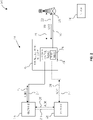
- FIG. 2 is a block diagram of an NB-IoT system 200, according to some embodiments.
- the NB-IoT system 200 includes a portable electronic accessory system 206, which is an example of the portable electronic accessory system 100 of FIG. 1 .
- the NB-IoT system 200 also includes a cellular base station 208, which is connected to the Internet 210.
- the portable electronic accessory system 206 includes a portable electronic accessory 202, a removable control package 204 inserted into the portable electronic accessory 202, and headphones 226, which are similar to the portable electronic accessory 102, the removable control package 104, and the headphones 128 discussed above with reference to FIG. 1 .
- the portable electronic accessory 302 may be a TWS headphone case.
- the removable control package 204 is configured to connect to the headphones 226 via a wireless PAN network 214 (e.g., BLUETOOTH ® ) to enable communication of audio 218 between the removable control package 204 and the headphones 226.
- a wireless PAN network 214 e.g., BLUETOOTH ®
- One of the wireless PAN network 214 lines shown in FIG. 2 is illustrated using broken lines because in some embodiments only one of the headphone 226 may communicate directly with the removable control package 204.
- a wireless PAN network 216 between the headphones 226 may be used to route the audio 218 between the removable control package 204 and the other one of the headphones 226 that is not directly connected to the removable control package 204 by the wireless PAN network 214. In some embodiments, however, both of the headphone 226 may be directly connected to the removable control package 204 using the wireless PAN network 214.
- the removable control package 204 includes an NB-IoT radio 224, which is an example of the cellular data radio circuits 112 of FIG. 1 .
- the NB-IoT radio 224 may enable the removable control package 204 to connect to the cellular base station 208 via a wireless NB-IoT network 212, which is capable of enabling bidirectional voice 220 and data 222 communications between the removable control package 204 and the cellular base station 208.
- the data 222 may provide the removable control package 204 with access to the Internet 210 via the wireless NB-IoT network 212.
- the wireless NB-IoT network 212 may be provided according to 4G LTE protocols or 5G protocols.
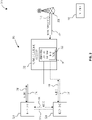
- FIG. 3 is a block diagram of an LTE-M system 300, according to some embodiments.
- the LTE-M system 300 includes a portable electronic accessory system 306, which is an example of the portable electronic accessory system 100 of FIG. 1 .
- the LTE-M system 300 also includes a cellular base station 308, which is connected to the Internet 310.
- the portable electronic accessory system 306 includes a portable electronic accessory 302, a removable control package 304 inserted into the portable electronic accessory 302, and headphones 324, which are similar to the portable electronic accessory 102, the removable control package 104, and the headphones 128 discussed above with reference to FIG. 1 .
- the portable electronic accessory 302 may be a TWS headphone case. Similar to the removable control package 204 discussed above with reference to FIG. 2 , the removable control package 304 is configured to connect to the headphones 324 via a wireless PAN network 314 (e.g., BLUETOOTH ® ) to enable communication of audio 318 between the removable control package 304 and the headphones 324.
- the headphones 324, the wireless PAN network 314, and the wireless PAN network 316 may be similar to the headphone 226, the wireless PAN network 214, and the wireless PAN network 216 discussed above with reference to FIG. 2 .
- the removable control package 304 includes an LTE-M radio 322, which is an example of the cellular data radio circuits 112 of FIG. 1 .
- the LTE-M radio 322 may enable the removable control package 304 to connect to the cellular base station 308 via an LTE-M network 312, which is capable of enabling music streaming 320 to the removable control package 304, and by extension, to the headphones 324.
- the LTE-M network 312 may also be capable of enabling bidirectional voice 220 and data 222 communications, as shown in FIG. 2 (although not shown in FIG. 3 for simplicity) between the removable control package 304 and the cellular base station 308.
- the LTE-M network 312 may be a relatively more broadband network connection than the wireless NB-IoT network 212 of FIG. 2 . Accordingly, the LTE-M system 300 may be capable of providing music streaming 320 where it may be difficult or impossible to provide music streaming in the NB-IoT system 200 of FIG. 2 . It is noted that the removable control package 304 may be removed from the portable electronic accessory 302 and inserted into the portable electronic accessory 202 of FIG. 2 to provide the portable electronic accessory 202 (and by extension the headphones 226) music streaming capabilities.
- FIG. 4 is a flowchart illustrating a method 400 of powering a portable electronic accessory system, according to some embodiments.
- the method 400 includes charging a battery of a portable electronic accessory.
- charging the battery may include plugging an external power source into a power connector of the portable electronic accessory.
- charging the battery may include placing the portable electronic accessory into proximity of a wireless power transmitter (e.g., placing the portable electronic accessory onto a charging pad).
- the method 400 includes receiving a removable control package into a control socket of the portable electronic accessory.
- receiving the removable control package into the control socket includes receiving a removable control package having a form factor of an SD card into an SD card socket.
- the method 400 includes providing battery power from the battery of the portable electronic accessory to the removable control package.
- the method 400 includes converting between radio waves and cellular data control signals using one or more antennas of the portable electronic accessory.
- the portable electronic accessory may optionally include one or more antennas to enable wireless communication radio circuits of the removable control package to communicate wirelessly.
- the removable control package itself may include one or more antennas configured to enable the wireless communication radio circuits to communicate wirelessly.
- the method 400 includes receiving headphones into headphone receptacles of the portable electronic accessory.
- the portable electronic accessory may include a TWS headphone case, which includes headphone receptacles configured to receive TWS headphones.
- the method 400 includes providing battery power from the battery of the portable electronic accessory to the headphones. In some embodiments providing the battery power to the headphones includes providing the battery power to charging pins in the headphone receptacles.
- FIG. 5 illustrates non-limiting examples of implementations of functional elements disclosed herein. In some embodiments, some or all portions of the functional elements disclosed herein may be performed by hardware specially configured for carrying out the functional elements.
- FIG. 5 is a block diagram of circuitry 500 that, in some embodiments, may be used to implement various functions, operations, acts, processes, and/or methods disclosed herein.
- the circuitry 500 includes one or more processors 502 (sometimes referred to herein as “processors 502") operably coupled to one or more data storage devices (sometimes referred to herein as "storage 504").
- the storage 504 includes machine executable code 506 stored thereon and the processors 502 include logic circuitry 508.
- the machine executable code 506 includes information describing functional elements that may be implemented by (e.g., performed by) the logic circuitry 508.
- the logic circuitry 508 is adapted to implement (e.g., perform) the functional elements described by the machine executable code 506.
- the circuitry 500 when executing the functional elements described by the machine executable code 506, should be considered as special purpose hardware configured for carrying out functional elements disclosed herein.
- the processors 502 may be configured to perform the functional elements described by the machine executable code 506 sequentially, concurrently (e.g., on one or more different hardware platforms), or in one or more parallel process streams.
- the machine executable code 506 When implemented by logic circuitry 508 of the processors 502, the machine executable code 506 is configured to adapt the processors 502 to perform operations of embodiments disclosed herein.
- the machine executable code 506 may be configured to adapt the processors 502 to perform at least a portion of the method 400 of FIG. 4 .
- the machine executable code 506 may be configured to adapt the processors 502 to perform at least a portion or a totality of the operations discussed for the application processors 116 of FIG. 1 , the cellular data radio circuits 112 of FIG. 1 , the PAN radio circuits 114 of FIG. 1 , the PAN peripheral circuits 134 of FIG. 1 , the power circuitry 118 of FIG. 1 , the removable control package 204 of FIG. 2 , the NB-IoT radio 224 of FIG. 2 , the removable control package 304 of FIG. 3 , and/or the LTE-M radio 322 of FIG. 3 .
- the processors 502 may include a general purpose processor, a special purpose processor, a central processing unit (CPU), a microcontroller, a programmable logic controller (PLC), a digital signal processor (DSP), an application specific integrated circuit (ASIC), a field-programmable gate array (FPGA) or other programmable logic device, discrete gate or transistor logic, discrete hardware components, other programmable device, or any combination thereof designed to perform the functions disclosed herein.
- a general-purpose computer including a processor is considered a special-purpose computer while the general-purpose computer is configured to execute functional elements corresponding to the machine executable code 506 (e.g., software code, firmware code, hardware descriptions) related to embodiments of the present disclosure.
- a general-purpose processor may also be referred to herein as a host processor or simply a host
- the processors 502 may include any conventional processor, controller, microcontroller, or state machine.
- the processors 502 may also be implemented as a combination of computing devices, such as a combination of a DSP and a microprocessor, a plurality of microprocessors, one or more microprocessors in conjunction with a DSP core, or any other such configuration.
- the storage 504 includes volatile data storage (e.g., random-access memory (RAM)), non-volatile data storage (e.g., Flash memory, a hard disc drive, a solid state drive, erasable programmable read-only memory (EPROM), etc.).
- volatile data storage e.g., random-access memory (RAM)
- non-volatile data storage e.g., Flash memory, a hard disc drive, a solid state drive, erasable programmable read-only memory (EPROM), etc.
- the processors 502 and the storage 504 may be implemented into a single device (e.g., a semiconductor device product, a system on chip (SOC), etc.).
- SOC system on chip
- the processors 502 and the storage 504 may be implemented into separate devices.
- the machine executable code 506 may include computer-readable instructions (e.g., software code, firmware code).
- the computer-readable instructions may be stored by the storage 504, accessed directly by the processors 502, and executed by the processors 502 using at least the logic circuitry 508.
- the computer-readable instructions may be stored on the storage 504, transferred to a memory device (not shown) for execution, and executed by the processors 502 using at least the logic circuitry 508.
- the logic circuitry 508 includes electrically configurable logic circuitry 508.
- the machine executable code 506 may describe hardware (e.g., circuitry) to be implemented in the logic circuitry 508 to perform the functional elements.
- This hardware may be described at any of a variety of levels of abstraction, from low-level transistor layouts to high-level description languages.
- a hardware description language such as an IEEE Standard hardware description language (HDL) may be used.
- Verilog TM SystemVerilog TM or very large scale integration (VLSI) hardware description language (VHDL TM ) may be used.
- HDL descriptions may be converted into descriptions at any of numerous other levels of abstraction as desired.
- a high-level description can be converted to a logic-level description such as a register-transfer language (RTL), a gate-level (GL) description, a layout-level description, or a mask-level description.
- RTL register-transfer language
- GL gate-level
- layout-level description layout-level description
- mask-level description mask-level description
- micro-operations to be performed by hardware logic circuits e.g., gates, flip-flops, registers, without limitation
- the logic circuitry 508 may be described in a RTL and then converted by a synthesis tool into a GL description, and the GL description may be converted by a placement and routing tool into a layout-level description that corresponds to a physical layout of an integrated circuit of a programmable logic device, discrete gate or transistor logic, discrete hardware components, or combinations thereof.
- the machine executable code 506 may include an HDL, an RTL, a GL description, a mask level description, other hardware description, or any combination thereof.
- the machine executable code 506 includes a hardware description (at any level of abstraction)
- a system (not shown, but including the storage 504) may be configured to implement the hardware description described by the machine executable code 506.
- the processors 502 may include a programmable logic device (e.g., an FPGA or a PLC) and the logic circuitry 508 may be electrically controlled to implement circuitry corresponding to the hardware description into the logic circuitry 508.
- the logic circuitry 508 may include hard-wired logic manufactured by a manufacturing system (not shown, but including the storage 504) according to the hardware description of the machine executable code 506.
- the logic circuitry 508 is adapted to perform the functional elements described by the machine executable code 506 when implementing the functional elements of the machine executable code 506. It is noted that although a hardware description may not directly describe functional elements, a hardware description indirectly describes functional elements that the hardware elements described by the hardware description are capable of performing.
- module or “component” may refer to specific hardware implementations configured to perform the actions of the module or component and/or software objects or software routines that may be stored on and/or executed by general purpose hardware (e.g., computer-readable media, processing devices, etc.) of the computing system.
- general purpose hardware e.g., computer-readable media, processing devices, etc.
- the different components, modules, engines, and services described in the present disclosure may be implemented as objects or processes that execute on the computing system (e.g., as separate threads). While some of the system and methods described in the present disclosure are generally described as being implemented in software (stored on and/or executed by general purpose hardware), specific hardware implementations or a combination of software and specific hardware implementations are also possible and contemplated.
- the term "combination" with reference to a plurality of elements may include a combination of all the elements or any of various different subcombinations of some of the elements.
- the phrase "A, B, C, D, or combinations thereof' may refer to any one of A, B, C, or D; the combination of each of A, B, C, and D; and any subcombination of A, B, C, or D such as A, B, and C; A, B, and D; A, C, and D; B, C, and D; A and B; A and C; A and D; B and C; B and D; or C and D.
- any disjunctive word or phrase presenting two or more alternative terms, whether in the description, claims, or drawings, should be understood to contemplate the possibilities of including one of the terms, either of the terms, or both terms.
- the phrase “A or B” should be understood to include the possibilities of "A” or “B” or “A and B.”
Landscapes
- Engineering & Computer Science (AREA)
- Signal Processing (AREA)
- Physics & Mathematics (AREA)
- Acoustics & Sound (AREA)
- Theoretical Computer Science (AREA)
- Computer Networks & Wireless Communication (AREA)
- Multimedia (AREA)
- Health & Medical Sciences (AREA)
- Audiology, Speech & Language Pathology (AREA)
- General Health & Medical Sciences (AREA)
- Human Computer Interaction (AREA)
- General Engineering & Computer Science (AREA)
- General Physics & Mathematics (AREA)
- Power Engineering (AREA)
- Telephone Function (AREA)
Abstract
Description
- This application claims the benefit of the filing date of
United States Patent Application Serial No. 17/247,624, filed December 18, 2020 - This disclosure relates generally to portable electronic accessories that interface with removable control packages, and more specifically to truly wireless stereo (TWS) headphone cases including control sockets, and removable control packages that interface with the control sockets.
- Truly wireless stereo (TWS) headphones have become a popular alternative to conventional wired headphones. TWS headphones allow the user to listen to music and podcasts, participate in two-way voice and video communications, and hear audio for videos without the inconveniences associated with wired headphones. TWS headphones are commonly sold with a TWS headphone case that is used to charge and store the TWS headphones.
- In some embodiments a portable electronic accessory includes a battery, a control socket, and power circuitry. The battery is configured to provide battery power. The control socket is configured to receive a removable control package. The removable control package is configured to control operation of the portable electronic accessory. The power circuitry is configured to deliver at least a portion of the battery power to the removable control package to power the removable control package.
- In some embodiments a removable control package includes input/output pins and one or more communication radio circuits. The input/output pins are configured to interface with pins of a control socket of a portable electronic accessory. The control socket configured to removably receive the removable control package. The input/output pins are configured to electrically connect to the pins of the control socket when the removable control package is received into the control socket. The input/output pins are configured to receive battery power from a battery of the portable electronic accessory. The one or more communication radio circuits are configured to provide wireless communication capabilities to the portable electronic accessory.
- While this disclosure concludes with claims particularly pointing out and distinctly claiming specific embodiments, various features and advantages of embodiments within the scope of this disclosure may be more readily ascertained from the following description when read in conjunction with the accompanying drawings, in which:
-
FIG. 1 is a block diagram of a portable electronic accessory system, according to some embodiments; -
FIG. 2 is a block diagram of a narrow-band internet of things (NB-IoT) system, according to some embodiments; -
FIG. 3 is a block diagram of an enhanced machine type communication (eMTC) long-term evolution (LTE-M) system, according to some embodiments; -
FIG. 4 is a flowchart illustrating a method of powering a portable electronic accessory system, according to some embodiments; and -
FIG. 5 is a block diagram of circuitry that, in some embodiments, may be used to implement various functions, operations, acts, processes, and/or methods disclosed herein. - In the following detailed description, reference is made to the accompanying drawings, which form a part hereof, and in which are shown, by way of illustration, specific examples of embodiments in which the present disclosure may be practiced. These embodiments are described in sufficient detail to enable a person of ordinary skill in the art to practice the present disclosure. However, other embodiments enabled herein may be utilized, and structural, material, and process changes may be made without departing from the scope of the disclosure.
- The illustrations presented herein are not meant to be actual views of any particular method, system, device, or structure, but are merely idealized representations that are employed to describe the embodiments of the present disclosure. In some instances similar structures or components in the various drawings may retain the same or similar numbering for the convenience of the reader; however, the similarity in numbering does not necessarily mean that the structures or components are identical in size, composition, configuration, or any other property.
- The following description may include examples to help enable one of ordinary skill in the art to practice the disclosed embodiments. The use of the terms "exemplary," "by example," and "for example," means that the related description is explanatory, and though the scope of the disclosure is intended to encompass the examples and legal equivalents, the use of such terms is not intended to limit the scope of an embodiment or this disclosure to the specified components, steps, features, functions, or the like.
- It will be readily understood that the components of the embodiments as generally described herein and illustrated in the drawings could be arranged and designed in a wide variety of different configurations. Thus, the following description of various embodiments is not intended to limit the scope of the present disclosure, but is merely representative of various embodiments. While the various aspects of the embodiments may be presented in the drawings, the drawings are not necessarily drawn to scale unless specifically indicated.
- Furthermore, specific implementations shown and described are only examples and should not be construed as the only way to implement the present disclosure unless specified otherwise herein. Elements, circuits, and functions may be shown in block diagram form in order not to obscure the present disclosure in unnecessary detail. Conversely, specific implementations shown and described are exemplary only and should not be construed as the only way to implement the present disclosure unless specified otherwise herein. Additionally, block definitions and partitioning of logic between various blocks is exemplary of a specific implementation. It will be readily apparent to one of ordinary skill in the art that the present disclosure may be practiced by numerous other partitioning solutions. For the most part, details concerning timing considerations and the like have been omitted where such details are not necessary to obtain a complete understanding of the present disclosure and are within the abilities of persons of ordinary skill in the relevant art.
- Those of ordinary skill in the art will understand that information and signals may be represented using any of a variety of different technologies and techniques. Some drawings may illustrate signals as a single signal for clarity of presentation and description. It will be understood by a person of ordinary skill in the art that the signal may represent a bus of signals, wherein the bus may have a variety of bit widths and the present disclosure may be implemented on any number of data signals including a single data signal.
- The various illustrative logical blocks, modules, and circuits described in connection with the embodiments disclosed herein may be implemented or performed with a general purpose processor, a special purpose processor, a digital signal processor (DSP), an Integrated Circuit (IC), an Application Specific Integrated Circuit (ASIC), a Field Programmable Gate Array (FPGA) or other programmable logic device, discrete gate or transistor logic, discrete hardware components, or any combination thereof designed to perform the functions described herein. A general-purpose processor (may also be referred to herein as a host processor or simply a host) may be a microprocessor, but in the alternative, the processor may be any conventional processor, controller, microcontroller, or state machine. A processor may also be implemented as a combination of computing devices, such as a combination of a DSP and a microprocessor, a plurality of microprocessors, one or more microprocessors in conjunction with a DSP core, or any other such configuration. A general-purpose computer including a processor is considered a special-purpose computer while the general-purpose computer is configured to execute computing instructions (e.g., software code) related to embodiments of the present disclosure.
- The embodiments may be described in terms of a process that is depicted as a flowchart, a flow diagram, a structure diagram, or a block diagram. Although a flowchart may describe operational acts as a sequential process, many of these acts can be performed in another sequence, in parallel, or substantially concurrently. In addition, the order of the acts may be re-arranged. A process may correspond to a method, a thread, a function, a procedure, a subroutine, a subprogram, other structure, or combinations thereof. Furthermore, the methods disclosed herein may be implemented in hardware, software, or both. If implemented in software, the functions may be stored or transmitted as one or more instructions or code on computer-readable media. Computer-readable media includes both computer storage media and communication media including any medium that facilitates transfer of a computer program from one place to another.
- Any reference to an element herein using a designation such as "first," "second," and so forth does not limit the quantity or order of those elements, unless such limitation is explicitly stated. Rather, these designations may be used herein as a convenient method of distinguishing between two or more elements or instances of an element. Thus, a reference to first and second elements does not mean that only two elements may be employed there or that the first element must precede the second element in some manner. In addition, unless stated otherwise, a set of elements may include one or more elements.
- As used herein, the term "substantially" in reference to a given parameter, property, or condition means and includes to a degree that one of ordinary skill in the art would understand that the given parameter, property, or condition is met with a small degree of variance, such as, for example, within acceptable manufacturing tolerances. By way of example, depending on the particular parameter, property, or condition that is substantially met, the parameter, property, or condition may be at least 90% met, at least 95% met, or even at least 99% met.
-
FIG. 1 is a block diagram of a portableelectronic accessory system 100, according to some embodiments. The portableelectronic accessory system 100 includes a portableelectronic accessory 102 and aremovable control package 104. The portableelectronic accessory 102 includes abattery 106 configured to providebattery power 154 and acontrol socket 120 configured to receive theremovable control package 104. Theremovable control package 104 is configured to control operation of the portableelectronic accessory 102. The portableelectronic accessory 102 also includespower circuitry 118 configured to deliver at least a portion of thebattery power 154 to theremovable control package 104 to power theremovable control package 104. - The
removable control package 104 also includes apower connector 144 configured to receiveexternal power 152 from anexternal power source 146 and provide theexternal power 152 to thepower circuitry 118. By way of non-limiting example, theexternal power source 146 may include an alternating current (AC) to direct current (DC) power converter configured to convert AC power from a plug to theexternal power 152 in the form of DC power. Also by way of non-limiting example, theexternal power source 146 may include a wireless power transmitter and thepower connector 144 may include a wireless power receiver. Thepower circuitry 118 providesbattery power 154 to thebattery 106 responsive to theexternal power 152. Thepower circuitry 118 may also control charging of thebattery 106 and distribution of thebattery power 154 from thebattery 106 to theremovable control package 104. - In some embodiments the portable
electronic accessory 102 is a truly wireless stereo (TWS) headphone case includingheadphone receptacles 124. Theheadphone receptacles 124 are configured to receive headphones 128 (e.g., TWS headphones) therein to store theheadphones 128 in the TWS headphone case andcharge headphone batteries 130 of theheadphones 128 while theheadphones 128 are received in theheadphone receptacles 124. In some embodiments theheadphone receptacles 124 include chargingpins 132 therein. The charging pins 132 are configured to deliver charging power to theheadphones 128 when theheadphones 128 are received in theheadphone receptacles 124. Thepower circuitry 118 may be configured to control delivery of thebattery power 154 to the charging pins 132. Theheadphones 128 may store the charging power in theheadphone batteries 130. Theheadphone batteries 130 are configured to powerspeakers 150 andmicrophones 148, and circuitry of theheadphone 128. Although the portableelectronic accessory 102 illustrated inFIG. 1 is a TWS headphone case, the disclosure is not so limited. For example, in some embodiments the portableelectronic accessory 102 may be a watch (e.g., a smart watch), electronic glasses, or a speaker assembly (e.g., a wireless speaker). - In some embodiments the
control socket 120 has a form factor of a secure digital (SD) card socket and theremovable control package 104 has a form factor of an SD card. An SD card form factor may enable easy insertion and removal of theremovable control package 104 from thecontrol socket 120. Thecontrol socket 120 and theremovable control package 104 may take other forms, however. For example, thecontrol socket 120 and theremovable control package 104 may instead reflect a CompactFlash form factor, a MultiMediaCard form factor, a Memory Stick form factor, or any other form factor. In some embodiments thecontrol socket 120 is configured to completely house theremovable control package 104. In some embodiments thecontrol socket 120 is configured to at least partially house theremovable control package 104. - The
removable control package 104 includes input/output pins (I/O pins 136) configured to interface withcontrol pins 138 of thecontrol socket 120 of a portableelectronic accessory 102. Thecontrol socket 120 is configured to removably receive theremovable control package 104. The I/O pins 136 are configured to electrically connect to the control pins 138 of thecontrol socket 120 when theremovable control package 104 is received into thecontrol socket 120. The I/O pins 136 are configured to receivebattery power 154 from thebattery 106 of the portableelectronic accessory 102. - The
removable control package 104 is configured to power circuitry of theremovable control package 104 using thebattery power 154 received through the I/O pins 136. For example, theremovable control package 104 may include one or more communication radio circuits. By way of non-limiting examples, the communication radio circuits may include one or more cellular data radio circuits 112 (e.g., a fourth generation (4G) long-term evolution (LTE) radio circuit, a fifth generation (5G) radio circuit, etc.), and one or more PAN radio circuits 114 (e.g., a BLUETOOTH® radio circuit, a ZIGBEE ® radio circuit, etc.). Also by way of non-limiting example, the cellulardata radio circuits 112 may include one or more of a narrow-band internet of things (NB-IoT) radio circuit and an enhanced machine type communication (eMTC) long-term evolution (LTE-M) radio circuit. - The one or more communication radio circuits are configured to provide wireless communication capabilities to the portable
electronic accessory 102. In embodiments where the cellulardata radio circuits 112 include an NB-IoT radio circuit the cellulardata radio circuits 112 may be capable of providing voice and data communications. In embodiments where the cellulardata radio circuits 112 include an LTE-M radio circuit the cellulardata radio circuits 112 may be capable of providing full music streaming capabilities to the cellulardata radio circuits 112. - In embodiments where the
removable control package 104 includes one or more cellulardata radio circuits 112 theremovable control package 104 may include a Subscriber Identity Module (SIM) card slot (SIM card slot 108) configured to receive aSIM card 110. The cellulardata radio circuits 112 may use theSIM card slot 108 in cellular data operations. - In some embodiments one or more communication radio circuits of the
removable control package 104 may be configured to communicate with one ormore antennas 122 of the portableelectronic accessory 102 through the I/O pins 136 and the control pins 138. In some embodiments the one ormore antennas 122 may include a cellular data antenna (not shown) configured to interface with the one or more cellulardata radio circuits 112 of the removable control package to enable the cellulardata radio circuits 112 to communicate by way of a cellular data network (not shown). By way of non-limiting example, the one ormore antennas 122 may include 4G LTE cellular data antenna. Also by way of non-limiting example, the one ormore antennas 122 may include a 5G cellular data antenna. As another non-limiting example, the one or more antennas may include a narrow-band internet of things (NB-IoT) antenna configured to interface with an NB-IoT radio circuit of the cellulardata radio circuits 112. The NB-IoT antenna may be configured to enable the NB-IoT radio circuit to communicate by way an NB-IoT network. As a further non-limiting example, the one or more antennas may include an enhanced machine type communication (eMTC) long-term evolution (LTE-M) antenna configured to interface with an LTE-M radio circuit of the cellulardata radio circuits 112. The LTE-M radio circuit is configured to enable the LTE-M radio circuit to communicate by way an NB-IoT network. As an even further non-limiting example, the one ormore antennas 122 may include a wireless PAN (e.g., BLUETOOTH®, ZIGBEE ®, etc.) antenna configured to interface with a wireless PAN radio circuit of thePAN radio circuits 114. The wireless PAN antenna may enable thePAN radio circuits 114 to communicate with one or more PAN peripheral devices (e.g., the headphones 128). By way of non-limiting example, theheadphones 128 may includeantennas 142 and PANperipheral circuits 134. The PANperipheral circuits 134 may be configured to communicate with thePAN radio circuits 114 through theantennas 142 and the one ormore antennas 122 or one or more antennas 126 (discussed in more detail below). - In some embodiments the
removable control package 104 itself may include one ormore antennas 126. The one ormore antennas 126 may include any one or more of the one ormore antennas 122 discussed above. As a result, in various embodiments all the antennas may be located in theremovable control package 104, all of the antennas may be located in the portableelectronic accessory 102, or the antennas may be distributed within both theremovable control package 104 and the portableelectronic accessory 102. Because of limited space on theremovable control package 104, however, it may be convenient to provide most or all of the antennas in the one ormore antennas 122 of the portableelectronic accessory 102. - The
removable control package 104 may further include one ormore application processors 116 and one or more data storage devices 140 (e.g., serial Flash, psuedostatic dynamic random access memory (PSRAM), etc.). Thedata storage devices 140 are configured to store computer-readable instructions for an operating system (e.g., an audio operating system) and software applications (e.g., music software applications). Theapplication processors 116 are configured to execute the computer-readable instructions stored by thedata storage devices 140. An audio operating system may be used with truly wireless stereo (TWS)headphones 128 responsive to insertion of theremovable control package 104 into the control socket 120., the portable electronic accessory comprising a TWS headphone case for the TWS headphones. Theapplication processors 116 may be configured to execute one or more music software applications to provide music to the headphones 128 (e.g., via the PAN radio circuits 114). Although theapplication processors 116 is shown separately from the cellulardata radio circuits 112 and thePAN radio circuits 114, in some embodiments theapplication processors 116 may be implemented on the cellulardata radio circuits 112 or thePAN radio circuits 114. As a specific non-limiting example theapplication processors 116 may be implemented on one or morePAN radio circuits 114 including a BLUETOOTH® radio circuit such as on an Airoha AB1552A BLUETOOTH® system on chip (SoC). Thedata storage devices 140 may also be configured to store audio data (e.g., music, podcasts, etc.), which may be provided to theheadphones 128 via thePAN radio circuits 114 and the PANperipheral circuits 134. - In operation, the
removable control package 104 may be inserted into thecontrol socket 120. As a result, theremovable control package 104 may be powered bybattery power 154 delivered to the removable control package 104 (e.g., via the control pins 138 and the I/O pins 136). If theheadphones 128 are removed from the headphone receptacle 124 (e.g., worn by a user) thePAN radio circuits 114 of theremovable control package 104 may communicate with the PANperipheral circuits 134 of the headphones 128 (e.g., through the one ormore antennas 122 or the one ormore antennas 126 and the antennas 142). As a result theapplication processors 116 may provide and receive audio elements (e.g., audio commands received through themicrophones 148, button or touch inputs received through buttons or touch sensors of theheadphones 128, etc.) for an audio operating system to and from theheadphones 128 via thePAN radio circuits 114, which is in communication with the PANperipheral circuits 134 of theheadphone 128. The cellulardata radio circuits 112 may provide an Internet connection (e.g., via the one ormore antennas 122 or the one or more antennas 126), which may be utilized by the operating system to provide network resources. - By way of non-limiting example, audio (e.g., music, podcasts, etc.) may be streamed to the
speakers 150 of theheadphone 128 using a multi-media software application (e.g., a music software application, a podcast software application, etc.) executed by theapplication processors 116. The audio may be provided by a content provider through the Internet. The one ormore antennas 122 or the one ormore antennas 126 may receive the audio from the Internet and provide the audio to the cellulardata radio circuits 112. Theapplication processors 116 may control thePAN radio circuits 114 to provide the audio to the PANperipheral circuits 134 of the headphones 128 (e.g., by providing the audio to the one ormore antennas 122, which may provide the audio to theantennas 142 of the headphones 128). - Also by way of non-limiting example, two-way voice communication may be enabled. For example, the
microphones 148 may capture voice data corresponding to acoustic waves in proximity to themicrophones 148, and provide the voice data to the PANperipheral circuits 134. The PANperipheral circuits 134 may transmit the voice data, using theantennas 142, to the one ormore antennas 122 or the one ormore antennas 126, which may provide the voice data to thePAN radio circuits 114. The cellulardata radio circuits 112 may then transmit the voice data over the Internet via the one ormore antennas 122 or the one ormore antennas 126. The cellulardata radio circuits 112 may also receive received voice data transmitted to the cellulardata radio circuits 112 via the one ormore antennas 122 or the one ormore antennas 126 through the Internet. ThePAN radio circuits 114 may forward the received voice data to the PANperipheral circuits 134 via the one ormore antennas 122 or the one ormore antennas 126, and the PANperipheral circuit 134 may provide the received voice data to thespeakers 150, which may convert the received voice data to acoustic waves. In this way, a user may engage in two-way voice communications using the portableelectronic accessory system 100. - As a further non-limiting example, the
application processors 116 may provide an audio user interface via the headphones. For example, audio messages corresponding to menu options may be stored in thedata storage devices 140, and the audio messages may be provided to theheadphones 128 for presentation to the user using thespeakers 150 via thePAN radio circuits 114 and the PANperipheral circuits 134. User selections, other verbal commands, and/or button selections of buttons on theheadphones 128 and/or on the portableelectronic accessory 102 may be received at the application processors 116 (e.g., through the PANperipheral circuits 134 and thePAN radio circuits 114 or via the control pins 138 and the I/O pins 136). - Examples of software applications that may be stored by the
data storage devices 140 and executed by theapplication processors 116 may include a voice interface software application, online shopping software applications, search engine software applications, web browser software applications, music streaming software applications, cloud connection software applications, a settings software application, a software application store software application, a music sharing software application, other software applications, or combinations thereof. - It is contemplated herein that the
control socket 120 is configured to receive various different removable control packages. For example, when a user is desirous to upgrade functional features of theremovable control package 104, the user may simply remove theremovable control package 104 and replace theremovable control package 104 with a different removable control package having upgraded capabilities. In a similar way a faulty removable control package may be removed from thecontrol socket 120 and replaced with a functional removable control package to enable replacement of the electronics of the removable control package without the need to replace the portableelectronic accessory 102. Furthermore, the portableelectronic accessory 102 may be replaced without the need to replace theremovable control package 104 because theremovable control package 104 may be removed from the portableelectronic accessory 102 and placed into a new portable electronic accessory. Also, a user may use theremovable control package 104 with various different portable electronic accessories. For example, the user may remove theremovable control package 104 from thecontrol socket 120 of the portableelectronic accessory 102 and insert theremovable control package 104 into a different portable electronic accessory (e.g., another TWS headphone case, a smart watch, electronic glasses, etc.). As a result, a singleremovable control package 104 may be used in conjunction with several different portable electronic devices without the need for expensive control circuitry in each of the portable electronic devices. -
FIG. 2 is a block diagram of an NB-IoT system 200, according to some embodiments. The NB-IoT system 200 includes a portableelectronic accessory system 206, which is an example of the portableelectronic accessory system 100 ofFIG. 1 . The NB-IoT system 200 also includes acellular base station 208, which is connected to theInternet 210. - The portable
electronic accessory system 206 includes a portableelectronic accessory 202, aremovable control package 204 inserted into the portableelectronic accessory 202, andheadphones 226, which are similar to the portableelectronic accessory 102, theremovable control package 104, and theheadphones 128 discussed above with reference toFIG. 1 . The portableelectronic accessory 302 may be a TWS headphone case. Theremovable control package 204 is configured to connect to theheadphones 226 via a wireless PAN network 214 (e.g., BLUETOOTH®) to enable communication ofaudio 218 between theremovable control package 204 and theheadphones 226. One of thewireless PAN network 214 lines shown inFIG. 2 is illustrated using broken lines because in some embodiments only one of theheadphone 226 may communicate directly with theremovable control package 204. In such embodiments awireless PAN network 216 between theheadphones 226 may be used to route the audio 218 between theremovable control package 204 and the other one of theheadphones 226 that is not directly connected to theremovable control package 204 by thewireless PAN network 214. In some embodiments, however, both of theheadphone 226 may be directly connected to theremovable control package 204 using thewireless PAN network 214. - The
removable control package 204 includes an NB-IoT radio 224, which is an example of the cellulardata radio circuits 112 ofFIG. 1 . The NB-IoT radio 224 may enable theremovable control package 204 to connect to thecellular base station 208 via a wireless NB-IoT network 212, which is capable of enablingbidirectional voice 220 anddata 222 communications between theremovable control package 204 and thecellular base station 208. Thedata 222 may provide theremovable control package 204 with access to theInternet 210 via the wireless NB-IoT network 212. By way of non-limiting examples, the wireless NB-IoT network 212 may be provided according to 4G LTE protocols or 5G protocols. -
FIG. 3 is a block diagram of an LTE-M system 300, according to some embodiments. The LTE-M system 300 includes a portableelectronic accessory system 306, which is an example of the portableelectronic accessory system 100 ofFIG. 1 . The LTE-M system 300 also includes acellular base station 308, which is connected to theInternet 310. - The portable
electronic accessory system 306 includes a portableelectronic accessory 302, aremovable control package 304 inserted into the portableelectronic accessory 302, andheadphones 324, which are similar to the portableelectronic accessory 102, theremovable control package 104, and theheadphones 128 discussed above with reference toFIG. 1 . The portableelectronic accessory 302 may be a TWS headphone case. Similar to theremovable control package 204 discussed above with reference toFIG. 2 , theremovable control package 304 is configured to connect to theheadphones 324 via a wireless PAN network 314 (e.g., BLUETOOTH®) to enable communication ofaudio 318 between theremovable control package 304 and theheadphones 324. Theheadphones 324, thewireless PAN network 314, and thewireless PAN network 316 may be similar to theheadphone 226, thewireless PAN network 214, and thewireless PAN network 216 discussed above with reference toFIG. 2 . - The
removable control package 304 includes an LTE-M radio 322, which is an example of the cellulardata radio circuits 112 ofFIG. 1 . The LTE-M radio 322 may enable theremovable control package 304 to connect to thecellular base station 308 via an LTE-M network 312, which is capable of enabling music streaming 320 to theremovable control package 304, and by extension, to theheadphones 324. The LTE-M network 312 may also be capable of enablingbidirectional voice 220 anddata 222 communications, as shown inFIG. 2 (although not shown inFIG. 3 for simplicity) between theremovable control package 304 and thecellular base station 308. - The LTE-
M network 312 may be a relatively more broadband network connection than the wireless NB-IoT network 212 ofFIG. 2 . Accordingly, the LTE-M system 300 may be capable of providingmusic streaming 320 where it may be difficult or impossible to provide music streaming in the NB-IoT system 200 ofFIG. 2 . It is noted that theremovable control package 304 may be removed from the portableelectronic accessory 302 and inserted into the portableelectronic accessory 202 ofFIG. 2 to provide the portable electronic accessory 202 (and by extension the headphones 226) music streaming capabilities. -
FIG. 4 is a flowchart illustrating amethod 400 of powering a portable electronic accessory system, according to some embodiments. Atoperation 402 themethod 400 includes charging a battery of a portable electronic accessory. In some embodiments charging the battery may include plugging an external power source into a power connector of the portable electronic accessory. In some embodiments charging the battery may include placing the portable electronic accessory into proximity of a wireless power transmitter (e.g., placing the portable electronic accessory onto a charging pad). - At
operation 404 themethod 400 includes receiving a removable control package into a control socket of the portable electronic accessory. In some embodiments receiving the removable control package into the control socket includes receiving a removable control package having a form factor of an SD card into an SD card socket. Atoperation 406 themethod 400 includes providing battery power from the battery of the portable electronic accessory to the removable control package. - At
operation 408 themethod 400 includes converting between radio waves and cellular data control signals using one or more antennas of the portable electronic accessory. For example, the portable electronic accessory may optionally include one or more antennas to enable wireless communication radio circuits of the removable control package to communicate wirelessly. In some embodiments, however, the removable control package itself may include one or more antennas configured to enable the wireless communication radio circuits to communicate wirelessly. - At
operation 410 themethod 400 includes receiving headphones into headphone receptacles of the portable electronic accessory. As previously discussed, the portable electronic accessory may include a TWS headphone case, which includes headphone receptacles configured to receive TWS headphones. Atoperation 412 themethod 400 includes providing battery power from the battery of the portable electronic accessory to the headphones. In some embodiments providing the battery power to the headphones includes providing the battery power to charging pins in the headphone receptacles. - It will be appreciated by those of ordinary skill in the art that functional elements of embodiments disclosed herein (e.g., functions, operations, acts, processes, and/or methods) may be implemented in any suitable hardware, software, firmware, or combinations thereof.
FIG. 5 illustrates non-limiting examples of implementations of functional elements disclosed herein. In some embodiments, some or all portions of the functional elements disclosed herein may be performed by hardware specially configured for carrying out the functional elements. -
FIG. 5 is a block diagram ofcircuitry 500 that, in some embodiments, may be used to implement various functions, operations, acts, processes, and/or methods disclosed herein. Thecircuitry 500 includes one or more processors 502 (sometimes referred to herein as "processors 502") operably coupled to one or more data storage devices (sometimes referred to herein as "storage 504"). Thestorage 504 includes machineexecutable code 506 stored thereon and theprocessors 502 includelogic circuitry 508. The machineexecutable code 506 includes information describing functional elements that may be implemented by (e.g., performed by) thelogic circuitry 508. Thelogic circuitry 508 is adapted to implement (e.g., perform) the functional elements described by the machineexecutable code 506. Thecircuitry 500, when executing the functional elements described by the machineexecutable code 506, should be considered as special purpose hardware configured for carrying out functional elements disclosed herein. In some embodiments theprocessors 502 may be configured to perform the functional elements described by the machineexecutable code 506 sequentially, concurrently (e.g., on one or more different hardware platforms), or in one or more parallel process streams. - When implemented by
logic circuitry 508 of theprocessors 502, the machineexecutable code 506 is configured to adapt theprocessors 502 to perform operations of embodiments disclosed herein. For example, the machineexecutable code 506 may be configured to adapt theprocessors 502 to perform at least a portion of themethod 400 ofFIG. 4 . As another example, the machineexecutable code 506 may be configured to adapt theprocessors 502 to perform at least a portion or a totality of the operations discussed for theapplication processors 116 ofFIG. 1 , the cellulardata radio circuits 112 ofFIG. 1 , thePAN radio circuits 114 ofFIG. 1 , the PANperipheral circuits 134 ofFIG. 1 , thepower circuitry 118 ofFIG. 1 , theremovable control package 204 ofFIG. 2 , the NB-IoT radio 224 ofFIG. 2 , theremovable control package 304 ofFIG. 3 , and/or the LTE-M radio 322 ofFIG. 3 . - The
processors 502 may include a general purpose processor, a special purpose processor, a central processing unit (CPU), a microcontroller, a programmable logic controller (PLC), a digital signal processor (DSP), an application specific integrated circuit (ASIC), a field-programmable gate array (FPGA) or other programmable logic device, discrete gate or transistor logic, discrete hardware components, other programmable device, or any combination thereof designed to perform the functions disclosed herein. A general-purpose computer including a processor is considered a special-purpose computer while the general-purpose computer is configured to execute functional elements corresponding to the machine executable code 506 (e.g., software code, firmware code, hardware descriptions) related to embodiments of the present disclosure. It is noted that a general-purpose processor (may also be referred to herein as a host processor or simply a host) may be a microprocessor, but in the alternative, theprocessors 502 may include any conventional processor, controller, microcontroller, or state machine. Theprocessors 502 may also be implemented as a combination of computing devices, such as a combination of a DSP and a microprocessor, a plurality of microprocessors, one or more microprocessors in conjunction with a DSP core, or any other such configuration. - In some embodiments the
storage 504 includes volatile data storage (e.g., random-access memory (RAM)), non-volatile data storage (e.g., Flash memory, a hard disc drive, a solid state drive, erasable programmable read-only memory (EPROM), etc.). In some embodiments theprocessors 502 and thestorage 504 may be implemented into a single device (e.g., a semiconductor device product, a system on chip (SOC), etc.). In some embodiments theprocessors 502 and thestorage 504 may be implemented into separate devices. - In some embodiments the machine
executable code 506 may include computer-readable instructions (e.g., software code, firmware code). By way of non-limiting example, the computer-readable instructions may be stored by thestorage 504, accessed directly by theprocessors 502, and executed by theprocessors 502 using at least thelogic circuitry 508. Also by way of non-limiting example, the computer-readable instructions may be stored on thestorage 504, transferred to a memory device (not shown) for execution, and executed by theprocessors 502 using at least thelogic circuitry 508. Accordingly, in some embodiments thelogic circuitry 508 includes electricallyconfigurable logic circuitry 508. - In some embodiments the machine
executable code 506 may describe hardware (e.g., circuitry) to be implemented in thelogic circuitry 508 to perform the functional elements. This hardware may be described at any of a variety of levels of abstraction, from low-level transistor layouts to high-level description languages. At a high-level of abstraction, a hardware description language (HDL) such as an IEEE Standard hardware description language (HDL) may be used. By way of non-limiting examples, Verilog™, SystemVerilog™ or very large scale integration (VLSI) hardware description language (VHDL™) may be used. - HDL descriptions may be converted into descriptions at any of numerous other levels of abstraction as desired. As a non-limiting example, a high-level description can be converted to a logic-level description such as a register-transfer language (RTL), a gate-level (GL) description, a layout-level description, or a mask-level description. As a non-limiting example, micro-operations to be performed by hardware logic circuits (e.g., gates, flip-flops, registers, without limitation) of the
logic circuitry 508 may be described in a RTL and then converted by a synthesis tool into a GL description, and the GL description may be converted by a placement and routing tool into a layout-level description that corresponds to a physical layout of an integrated circuit of a programmable logic device, discrete gate or transistor logic, discrete hardware components, or combinations thereof. Accordingly, in some embodiments the machineexecutable code 506 may include an HDL, an RTL, a GL description, a mask level description, other hardware description, or any combination thereof. - In embodiments where the machine
executable code 506 includes a hardware description (at any level of abstraction), a system (not shown, but including the storage 504) may be configured to implement the hardware description described by the machineexecutable code 506. By way of non-limiting example, theprocessors 502 may include a programmable logic device (e.g., an FPGA or a PLC) and thelogic circuitry 508 may be electrically controlled to implement circuitry corresponding to the hardware description into thelogic circuitry 508. Also by way of non-limiting example, thelogic circuitry 508 may include hard-wired logic manufactured by a manufacturing system (not shown, but including the storage 504) according to the hardware description of the machineexecutable code 506. - Regardless of whether the machine
executable code 506 includes computer-readable instructions or a hardware description, thelogic circuitry 508 is adapted to perform the functional elements described by the machineexecutable code 506 when implementing the functional elements of the machineexecutable code 506. It is noted that although a hardware description may not directly describe functional elements, a hardware description indirectly describes functional elements that the hardware elements described by the hardware description are capable of performing. - As used in the present disclosure, the terms "module" or "component" may refer to specific hardware implementations configured to perform the actions of the module or component and/or software objects or software routines that may be stored on and/or executed by general purpose hardware (e.g., computer-readable media, processing devices, etc.) of the computing system. In some embodiments, the different components, modules, engines, and services described in the present disclosure may be implemented as objects or processes that execute on the computing system (e.g., as separate threads). While some of the system and methods described in the present disclosure are generally described as being implemented in software (stored on and/or executed by general purpose hardware), specific hardware implementations or a combination of software and specific hardware implementations are also possible and contemplated.
- As used in the present disclosure, the term "combination" with reference to a plurality of elements may include a combination of all the elements or any of various different subcombinations of some of the elements. For example, the phrase "A, B, C, D, or combinations thereof' may refer to any one of A, B, C, or D; the combination of each of A, B, C, and D; and any subcombination of A, B, C, or D such as A, B, and C; A, B, and D; A, C, and D; B, C, and D; A and B; A and C; A and D; B and C; B and D; or C and D.
- Terms used in the present disclosure and especially in the appended claims (e.g., bodies of the appended claims) are generally intended as "open" terms (e.g., the term "including" should be interpreted as "including, but not limited to," the term "having" should be interpreted as "having at least," the term "includes" should be interpreted as "includes, but is not limited to," etc.).
- Additionally, if a specific number of an introduced claim recitation is intended, such an intent will be explicitly recited in the claim, and in the absence of such recitation no such intent is present. For example, as an aid to understanding, the following appended claims may contain usage of the introductory phrases "at least one" and "one or more" to introduce claim recitations. However, the use of such phrases should not be construed to imply that the introduction of a claim recitation by the indefinite articles "a" or "an" limits any particular claim containing such introduced claim recitation to embodiments containing only one such recitation, even when the same claim includes the introductory phrases "one or more" or "at least one" and indefinite articles such as "a" or "an" (e.g., "a" and/or "an" should be interpreted to mean "at least one" or "one or more"); the same holds true for the use of definite articles used to introduce claim recitations.
- In addition, even if a specific number of an introduced claim recitation is explicitly recited, those skilled in the art will recognize that such recitation should be interpreted to mean at least the recited number (e.g., the bare recitation of "two recitations," without other modifiers, means at least two recitations, or two or more recitations). Furthermore, in those instances where a convention analogous to "at least one of A, B, and C, etc." or "one or more of A, B, and C, etc." is used, in general such a construction is intended to include A alone, B alone, C alone, A and B together, A and C together, B and C together, or A, B, and C together, etc.
- Further, any disjunctive word or phrase presenting two or more alternative terms, whether in the description, claims, or drawings, should be understood to contemplate the possibilities of including one of the terms, either of the terms, or both terms. For example, the phrase "A or B" should be understood to include the possibilities of "A" or "B" or "A and B."
- While the present disclosure has been described herein with respect to certain illustrated embodiments, those of ordinary skill in the art will recognize and appreciate that the present invention is not so limited. Rather, many additions, deletions, and modifications to the illustrated and described embodiments may be made without departing from the scope of the invention as hereinafter claimed along with their legal equivalents. In addition, features from one embodiment may be combined with features of another embodiment while still being encompassed within the scope of the invention as contemplated by the inventor.
Claims (15)
- A portable electronic accessory, comprising:a battery configured to provide battery power;a control socket configured to receive a removable control package, the removable control package configured to control operation of the portable electronic accessory; andpower circuitry configured to deliver at least a portion of the battery power to the removable control package to power the removable control package.
- The portable electronic accessory of claim 1, wherein the portable electronic accessory is a device selected from the group consisting of a watch, electronic glasses, a wireless speaker, or a truly wireless stereo (TWS) headphone case including headphone receptacles, the headphone receptacles configured to receive TWS headphones therein to store the TWS headphones in the TWS headphone case and charge headphone batteries of the TWS headphones while the TWS headphones are received in the headphone receptacles.
- The portable electronic accessory of claim 2, wherein the headphone receptacles include charging pins therein, the charging pins configured to deliver charging power to the TWS headphones when the TWS headphones are received in the headphone receptacles.
- The portable electronic accessory according to any one of claims 1-3, wherein the control socket has a form factor of a secure digital (SD) card socket to receive a removable control package having a form factor of an SD card.
- The portable electronic accessory according to any one of claims 1-4, further comprising one or more antennas configured to interface with one or more communication radio circuits of the removable control package.
- The portable electronic accessory of claim 5, wherein the one or more antennas include a cellular data antenna configured to interface with a cellular data radio circuit of the removable control package to enable the cellular data radio circuit to communicate by way of a cellular data network.
- The portable electronic accessory according to any one of claims 5 and 6, wherein the one or more antennas include a wireless personal area network (PAN) antenna configured to interface with a wireless PAN radio circuit of the removable control package to enable the PAN radio circuit to communicate with a PAN peripheral device.
- The portable electronic accessory of claim 7, wherein the PAN peripheral device includes one or more truly wireless stereo (TWS) headphones.
- The portable electronic accessory of claim 1, further comprising the removable control package, the removable control package comprising:input/output pins configured to interface with pins of the control socket, the input/output pins configured to electrically connect to the pins of the control socket when the removable control package is received into the control socket, the input/output pins configured to receive battery power from the battery of the portable electronic accessory; andone or more communication radio circuits configured to provide wireless communication capabilities to the portable electronic accessory.
- The portable electronic accessory of claim 9, wherein the one or more communication radio circuits comprise one or more of a cellular data radio circuit or a personal area network (PAN) radio circuit.
- The portable electronic accessory of claim 10, wherein the cellular data radio circuit comprises one or more of a narrow-band internet of things (NB-IoT) radio circuit and an enhanced machine type communication (eMTC) long-term evolution (LTE-M) radio circuit.
- The portable electronic accessory according to any one of claims 10 and 11, wherein the cellular data radio circuit is configured to enable one or more of cellular voice communications or music streaming over the Internet for headphones of the portable electronic accessory.
- The portable electronic accessory according to any one of claims 9-12, wherein the removable control package further comprises a Subscriber Identity Module (SIM) card slot configured to receive a SIM card.
- The removable control package according to any one of claims 9-13, further comprising an application processor configured to execute an audio operating system for use with truly wireless stereo (TWS) headphones responsive to insertion of the removable control package into the control socket, the portable electronic accessory comprising a TWS headphone case for the TWS headphones.
- The removable control package of claim 14, wherein the application processor is further configured to execute one or more music software applications to provide music to the TWS headphones.
Applications Claiming Priority (1)
| Application Number | Priority Date | Filing Date | Title |
|---|---|---|---|
| US17/247,624 US12568327B2 (en) | 2020-12-18 | 2020-12-18 | Portable electronic accessory systems and related devices |
Publications (1)
| Publication Number | Publication Date |
|---|---|
| EP4017022A1 true EP4017022A1 (en) | 2022-06-22 |
Family
ID=78676322
Family Applications (1)
| Application Number | Title | Priority Date | Filing Date |
|---|---|---|---|
| EP21208463.6A Pending EP4017022A1 (en) | 2020-12-18 | 2021-11-16 | Portable electronic accessory systems and related devices |
Country Status (3)
| Country | Link |
|---|---|
| US (1) | US12568327B2 (en) |
| EP (1) | EP4017022A1 (en) |
| CN (1) | CN114650478A (en) |
Citations (4)
| Publication number | Priority date | Publication date | Assignee | Title |
|---|---|---|---|---|
| DE202006017795U1 (en) * | 2006-11-22 | 2007-04-05 | AVO DIGITAL, INC., LuChu | Digital wireless stereophonic music transmission device, has transmission module with stereophonic input device, where music transmission device integrates functions of input from stereophonic signals and digital audio signals |
| US20140161301A1 (en) * | 2012-03-30 | 2014-06-12 | Hybrid Skillz Inc. | Retractable storage system for handheld electronic device |
| US20150110315A1 (en) * | 2010-04-22 | 2015-04-23 | Phonak Ag | Hearing assistance system and method |
| US20170064433A1 (en) * | 2015-08-29 | 2017-03-02 | Bragi GmbH | Power Control for Battery Powered Personal Area Network Device System and Method |
Family Cites Families (17)
| Publication number | Priority date | Publication date | Assignee | Title |
|---|---|---|---|---|
| JPH10507052A (en) * | 1995-03-04 | 1998-07-07 | モルド−テック プラスティックス リミテッド パートナーシップ | External communication source for radio interface |
| US8160643B2 (en) * | 2006-03-23 | 2012-04-17 | Griffin Technology, Inc. | Radio accessory having pass through connector |
| CN105717989B (en) * | 2009-02-27 | 2020-02-21 | 艾卡姆有限公司 | Headset-based telecom platform |
| CN102622056B (en) * | 2012-03-31 | 2016-05-11 | 惠州Tcl移动通信有限公司 | The intelligent terminal of the replaceable radio communication device of a kind of user |
| US9736265B2 (en) | 2012-08-09 | 2017-08-15 | Facebook, Inc. | Handling notifications |
| US9088450B2 (en) | 2012-10-31 | 2015-07-21 | Elwha Llc | Methods and systems for data services |
| CN108141488A (en) | 2015-08-14 | 2018-06-08 | 霍尼韦尔国际公司 | Include the communication headset of the wireless communication with individual protective equipment equipment |
| US10601599B2 (en) | 2017-12-29 | 2020-03-24 | Synaptics Incorporated | Voice command processing in low power devices |
| KR102585784B1 (en) | 2018-01-25 | 2023-10-06 | 삼성전자주식회사 | Application processor supporting interrupt during audio playback, electronic device including the same and method of operating the same |
| US10826862B1 (en) | 2018-02-27 | 2020-11-03 | Amazon Technologies, Inc. | Generation and transmission of hierarchical notifications to networked devices |
| US11231975B2 (en) | 2018-09-29 | 2022-01-25 | Apple Inc. | Devices, methods, and user interfaces for providing audio notifications |
| US10929099B2 (en) | 2018-11-02 | 2021-02-23 | Bose Corporation | Spatialized virtual personal assistant |
| US10996761B2 (en) | 2019-06-01 | 2021-05-04 | Apple Inc. | User interfaces for non-visual output of time |
| US11227617B2 (en) | 2019-09-06 | 2022-01-18 | Apple Inc. | Noise-dependent audio signal selection system |
| US11995116B2 (en) | 2019-10-27 | 2024-05-28 | Apple Inc. | Multi-user content queue |
| CN210609615U (en) * | 2019-10-30 | 2020-05-22 | 王震 | Earphone capable of independently talking |
| US11503440B2 (en) | 2020-04-16 | 2022-11-15 | Avaya Management L.P. | Methods and systems for providing enterprise services to wearable and mobile devices |
-
2020
- 2020-12-18 US US17/247,624 patent/US12568327B2/en active Active
-
2021
- 2021-11-16 EP EP21208463.6A patent/EP4017022A1/en active Pending
- 2021-12-02 CN CN202111457259.5A patent/CN114650478A/en active Pending
Patent Citations (4)
| Publication number | Priority date | Publication date | Assignee | Title |
|---|---|---|---|---|
| DE202006017795U1 (en) * | 2006-11-22 | 2007-04-05 | AVO DIGITAL, INC., LuChu | Digital wireless stereophonic music transmission device, has transmission module with stereophonic input device, where music transmission device integrates functions of input from stereophonic signals and digital audio signals |
| US20150110315A1 (en) * | 2010-04-22 | 2015-04-23 | Phonak Ag | Hearing assistance system and method |
| US20140161301A1 (en) * | 2012-03-30 | 2014-06-12 | Hybrid Skillz Inc. | Retractable storage system for handheld electronic device |
| US20170064433A1 (en) * | 2015-08-29 | 2017-03-02 | Bragi GmbH | Power Control for Battery Powered Personal Area Network Device System and Method |
Also Published As
| Publication number | Publication date |
|---|---|
| CN114650478A (en) | 2022-06-21 |
| US12568327B2 (en) | 2026-03-03 |
| US20220201380A1 (en) | 2022-06-23 |
Similar Documents
| Publication | Publication Date | Title |
|---|---|---|
| US11121559B2 (en) | Method and apparatus for charging a battery | |
| EP2860638B1 (en) | Serial communication over communication control pin | |
| JP6571341B2 (en) | Power supply method, device and program for audio use | |
| US20160062935A1 (en) | Usb type c to mhl m1 dead battery charging | |
| CN204031462U (en) | WIFI module and the Portable wireless router of Portable wireless router | |
| KR20180088651A (en) | Adjustable power delivery scheme for universal serial bus | |
| CN108351852A (en) | Enhanced communications over Universal Serial Bus (USB) TYPE-C cables | |
| EP2807571A1 (en) | Operating m-phy communications protocol over universal serial bus (usb) interface, and related devices, systems and methods | |
| EP3036691A1 (en) | Operating m-phy based communications over mass storage-based interfaces, and related connectors, systems and methods | |
| US20140375278A1 (en) | Charging device and operating method thereof | |
| CN101917313A (en) | System and charger for mobile terminal to access Ethernet by electric power circuit | |
| CN109690677B (en) | Apparatus and method for clock shaping of memory | |
| CN107181145A (en) | A kind of data line and USB data line interface | |
| CN109254210B (en) | Electronic equipment port type detection method and device, detection circuit and electronic equipment | |
| CN105955900B (en) | The self-adapting regulation method and device of I2S peripheral circuit sequential | |
| US20140050331A1 (en) | Vehicle data communication module having charging port | |
| US10193286B2 (en) | Electronic device and control method thereof | |
| CN203520391U (en) | Data transmission multiplexing device | |
| US12568327B2 (en) | Portable electronic accessory systems and related devices | |
| CN103517139B (en) | A kind of TV with hardware configuration upgrade function | |
| TWI376079B (en) | Connector and method thereof | |
| CN204992653U (en) | On -vehicle charger and system with wireless data interconnection function | |
| CN105868141A (en) | Digital interface adapter | |
| CN115297185A (en) | Ethernet changes 3GPP 5G's wireless access network device | |
| TWI615704B (en) | Electronic device and the control method thereof |
Legal Events
| Date | Code | Title | Description |
|---|---|---|---|
| PUAI | Public reference made under article 153(3) epc to a published international application that has entered the european phase |
Free format text: ORIGINAL CODE: 0009012 |
|
| STAA | Information on the status of an ep patent application or granted ep patent |
Free format text: STATUS: THE APPLICATION HAS BEEN PUBLISHED |
|
| AK | Designated contracting states |
Kind code of ref document: A1 Designated state(s): AL AT BE BG CH CY CZ DE DK EE ES FI FR GB GR HR HU IE IS IT LI LT LU LV MC MK MT NL NO PL PT RO RS SE SI SK SM TR |
|
| STAA | Information on the status of an ep patent application or granted ep patent |
Free format text: STATUS: REQUEST FOR EXAMINATION WAS MADE |
|
| 17P | Request for examination filed |
Effective date: 20221222 |
|
| RBV | Designated contracting states (corrected) |
Designated state(s): AL AT BE BG CH CY CZ DE DK EE ES FI FR GB GR HR HU IE IS IT LI LT LU LV MC MK MT NL NO PL PT RO RS SE SI SK SM TR |