EP4016940A1 - Shortest path computation method, routing obtaining device, and server - Google Patents
Shortest path computation method, routing obtaining device, and server Download PDFInfo
- Publication number
- EP4016940A1 EP4016940A1 EP20857120.8A EP20857120A EP4016940A1 EP 4016940 A1 EP4016940 A1 EP 4016940A1 EP 20857120 A EP20857120 A EP 20857120A EP 4016940 A1 EP4016940 A1 EP 4016940A1
- Authority
- EP
- European Patent Office
- Prior art keywords
- constraint
- obligatory
- weights
- shortest path
- calculating
- Prior art date
- Legal status (The legal status is an assumption and is not a legal conclusion. Google has not performed a legal analysis and makes no representation as to the accuracy of the status listed.)
- Granted
Links
Images


Classifications
-
- H—ELECTRICITY
- H04—ELECTRIC COMMUNICATION TECHNIQUE
- H04L—TRANSMISSION OF DIGITAL INFORMATION, e.g. TELEGRAPHIC COMMUNICATION
- H04L45/00—Routing or path finding of packets in data switching networks
- H04L45/12—Shortest path evaluation
- H04L45/124—Shortest path evaluation using a combination of metrics
-
- H—ELECTRICITY
- H04—ELECTRIC COMMUNICATION TECHNIQUE
- H04L—TRANSMISSION OF DIGITAL INFORMATION, e.g. TELEGRAPHIC COMMUNICATION
- H04L45/00—Routing or path finding of packets in data switching networks
- H04L45/12—Shortest path evaluation
-
- H—ELECTRICITY
- H04—ELECTRIC COMMUNICATION TECHNIQUE
- H04L—TRANSMISSION OF DIGITAL INFORMATION, e.g. TELEGRAPHIC COMMUNICATION
- H04L45/00—Routing or path finding of packets in data switching networks
- H04L45/02—Topology update or discovery
-
- H—ELECTRICITY
- H04—ELECTRIC COMMUNICATION TECHNIQUE
- H04L—TRANSMISSION OF DIGITAL INFORMATION, e.g. TELEGRAPHIC COMMUNICATION
- H04L45/00—Routing or path finding of packets in data switching networks
- H04L45/14—Routing performance; Theoretical aspects
-
- Y—GENERAL TAGGING OF NEW TECHNOLOGICAL DEVELOPMENTS; GENERAL TAGGING OF CROSS-SECTIONAL TECHNOLOGIES SPANNING OVER SEVERAL SECTIONS OF THE IPC; TECHNICAL SUBJECTS COVERED BY FORMER USPC CROSS-REFERENCE ART COLLECTIONS [XRACs] AND DIGESTS
- Y02—TECHNOLOGIES OR APPLICATIONS FOR MITIGATION OR ADAPTATION AGAINST CLIMATE CHANGE
- Y02D—CLIMATE CHANGE MITIGATION TECHNOLOGIES IN INFORMATION AND COMMUNICATION TECHNOLOGIES [ICT], I.E. INFORMATION AND COMMUNICATION TECHNOLOGIES AIMING AT THE REDUCTION OF THEIR OWN ENERGY USE
- Y02D30/00—Reducing energy consumption in communication networks
-
- Y—GENERAL TAGGING OF NEW TECHNOLOGICAL DEVELOPMENTS; GENERAL TAGGING OF CROSS-SECTIONAL TECHNOLOGIES SPANNING OVER SEVERAL SECTIONS OF THE IPC; TECHNICAL SUBJECTS COVERED BY FORMER USPC CROSS-REFERENCE ART COLLECTIONS [XRACs] AND DIGESTS
- Y02—TECHNOLOGIES OR APPLICATIONS FOR MITIGATION OR ADAPTATION AGAINST CLIMATE CHANGE
- Y02D—CLIMATE CHANGE MITIGATION TECHNOLOGIES IN INFORMATION AND COMMUNICATION TECHNOLOGIES [ICT], I.E. INFORMATION AND COMMUNICATION TECHNOLOGIES AIMING AT THE REDUCTION OF THEIR OWN ENERGY USE
- Y02D30/00—Reducing energy consumption in communication networks
- Y02D30/70—Reducing energy consumption in communication networks in wireless communication networks
Definitions
- the embodiments of the present disclosure relate to the field of communication technology, and in particular to a method for calculating a shortest path, a routing acquisition device, and a server.
- SDN Software defined network
- the SDN controller may use the link layer discovery protocol to acquire network resource information.
- the network resource information includes real-time bandwidth and delay of network-wide topology and links. Based on such information, the SDN controller can easily calculate the shortest (i.e., optimal) path to meet the service requirements.
- obligatory nodes or links may be designated for routing. For example, due to requirements of information security, it is required that certain flows must pass through specific routing and switching devices or links. In addition, some cross-border communications may be required to bypass some politically sensitive areas or must pass through networks in specific regions or network nodes. This requires the controller to add obligatory constraints (including obligatory nodes and obligatory links) to the routing calculation process.
- the K shortest path algorithm is one of the classical methods to calculate shortest paths with obligatory constraints, the principle of which is to use the shortest path algorithm to calculate the first K shortest paths in sequence in a given network topology, and after each path is calculated, to check whether it satisfies the obligatory constraints (i.e., whether the path passes through all required obligatory nodes and obligatory links); and if the k-th shortest path satisfies the obligatory constraints, then stop the calculation and return that path as the calculation result, otherwise continue to calculate the (k+1)th shortest path until a path satisfying the obligatory constraints is found or all paths have been traversed, then stop the calculation.
- the obligatory constraints i.e., whether the path passes through all required obligatory nodes and obligatory links
- the embodiments of the present disclosure provide a method for calculating a shortest path, a routing acquisition device, and a server.
- the embodiments of the present disclosure provide a method for calculating a shortest path, including: acquiring resource information for a network according to a received routing request, where the routing request includes a start node, an end node, a service constraint, and an obligatory constraint; calculating service constraint weights for topological elements in the network according to the service constraint, and calculating obligatory constraint weights for the topological elements according to the obligatory constraint and the resource information for the network; calculating, according to the service constraint weights and the obligatory constraint weights for the topological elements, a shortest path from the start node to the end node that satisfies the obligatory constraint.
- the embodiments of the present disclosure further provide a routing acquisition device, including: a topology acquisition module configured to acquire resource information for a network according to a received routing request, where the routing request includes a start node, an end node, a service constraint, and an obligatory constraint; a weight calculation module configured to calculate service constraint weights for topological elements in the network according to the service constraint, and calculate obligatory constraint weights for the topological elements according to the obligatory constraint and the resource information for the network; and a routing calculation module configured to calculate, according to the service constraint weights and the obligatory constraint weights for the topological elements, a shortest path from the start node to the end node that satisfies the obligatory constraint.
- a routing acquisition device including: a topology acquisition module configured to acquire resource information for a network according to a received routing request, where the routing request includes a start node, an end node, a service constraint, and an obligatory constraint; a weight calculation
- the embodiments of the present disclosure further provide a server, including: at least one processor; and a memory connected to the at least one processor, where the memory stores instructions executable by the at least one processor, the instructions being executed by the at least one processor to enable the at least one processor to perform the above method for calculating a shortest path.
- the embodiments of the present disclosure further provide a computer-readable storage medium storing a computer program which, when executed by a processor, causes the processor to perform the above method for calculating a shortest path.
- the algorithm is not designed for obligatory constraints and its computational complexity is O(Kn 3 ), where n is the number of nodes in the network topology and K is the number of shortest paths that have been found. Therefore, when the scale of the network is large, i.e., when the number of nodes in the network topology is large, the computational efficiency of this algorithm will be very low and it is difficult to meet the real-time requirements of routing calculation. Moreover, for routing calculations with obligatory constraints, the solution process of the K shortest path algorithm contains too many invalid calculations. Based on the above findings, the inventors propose the technical scheme of the present disclosure. That is, the method for calculating a shortest path of this embodiment is proposed for routing calculation of the shortest path with obligatory constraints in a network.
- the first implementation of the present disclosure relates to a method for calculating a shortest path.
- the process is as shown in Fig. 1 .
- step 101 resource information for a network is acquired according to a received routing request, where the routing request includes a start node, an end node, a service constraint, and an obligatory constraint.
- step 102 service constraint weights for topological elements in the network are calculated according to the service constraint, and obligatory constraint weights for the topological elements are calculated according to the obligatory constraint and the resource information for the network.
- step 103 a shortest path from the start node to the end node that satisfies the obligatory constraint is calculated according to the service constraint weights and the obligatory constraint weights for the topological elements.
- the network in this embodiment may be a software-defined network, referred to as an SDN; and the method for calculating a shortest path in this embodiment is applied to a routing acquisition device, which may exist independently or may be integrated in an SDN controller.
- the routing request received by the routing acquisition device includes a start node, an end node, a service constraint, and an obligatory constraint.
- the service constraint refers to the quality of the service, i.e., the requirement for transmission quality, and the quality of the service includes, for example, forwarding hop count, required bandwidth, delay, delay jitter, etc.
- the obligatory constraint refers to the nodes and/or links that must be passed through from the start node to the end node, where the nodes or links that must be passed through may be collectively referred to as obligatory elements.
- the routing acquisition device may acquire the resource information for the network according to the service constraint in the routing request.
- the network refers to a network where the start node and the end node are located, and the resource information for the network includes information such as the topological structure of the network, the real-time bandwidth of each topological element, and the delay, where the routing acquisition device acquires from the network an available topology that satisfies the service constraint.
- the topological element is a node or link in that available topology.
- step 102 includes two sub-steps.
- a routing policy is acquired, where the routing policy includes at least a service constraint policy acquired according to the service constraint and an obligatory constraint policy acquired according to the resource information for the network.
- service constraint weights and obligatory constraint weights are calculated for the topological elements based on the routing policy, where the service constraint weights are obtained through calculation according to the service constraint and the service constraint policy, and the obligatory constraint weights are obtained through calculation according to the obligatory constraint and the obligatory constraint policy.
- a first selection policy is pre-stored in the routing acquisition device, and the first selection policy is used to select a corresponding service constraint policy for the service constraint in the routing request.
- the first selection policy may be understood as a selection function, where a service constraint is taken as an input parameter of the first selection policy, and the first selection policy determines a service constraint policy corresponding to that service constraint by analyzing the service constraint. For example, if the service constraint contains a limit on the forwarding hop count, the service constraint policy corresponding to the service constraint that is determined by this first selection policy may be a minimum-hop policy.
- Different service constraints correspond to different service constraint policies.
- Different service constraint policies include, for example, a minimum-hop policy, a bandwidth balancing policy, a minimum-delay policy, a minimum-delay jitter policy, and the like. More specifically, for example: when the service constraint policy is the minimum-hop policy, the service constraint weights of all links may be set to a constant greater than 0, e.g., 100; when the service constraint policy is the bandwidth balancing policy, the service constraint weight is determined by the ratio of the bandwidth required by the service to the bandwidth available at that node or link; when the service constraint policy is the minimum-delay policy, the service constraint weight is determined by the delay of the node or link; and when the service constraint policy is the minimum-delay jitter policy, the service constraint weight is determined by the delay jitter of the node or link.
- a second selection policy is pre-stored in the routing acquisition device, and the second selection policy is used to select a corresponding obligatory constraint policy for this current network.
- the second selection policy may be understood as a selection function, where the resource information for the network is taken as an input parameter of the second selection policy, and the second selection policy determines an obligatory constraint policy by analyzing the resource information for the network.
- the resource information for the network may include, for example, the forwarding hop count, required bandwidth, delay, delay jitter, etc., of each topological element, the distance between the topological elements, and the like.
- the service constraint weights and obligatory constraint weights may be calculated.
- network G G(V, E), where V is the set of nodes in G and E is the set of links in G
- the service constraints for the routing request include the forwarding hop count h, the required bandwidth b, the delay d, and the delay jitter j, etc.
- the obligatory elements (obligatory nodes or obligatory links) in the obligatory constraint of the routing request are e, e e S E , where S E is the set of obligatory elements and S E ⁇ G.
- the topological elements (nodes or links) to be examined be g ⁇ G
- an obligatory constraint weight for each topological element g includes a total sum of obligatory constraint weights generated by obligatory elements e in the obligatory constraint on the topological element g; and an obligatory constraint weight generated by each obligatory element e on the topological element is obtained based on the obligatory constraint policy.
- Equation (3) The parameters in Equation (3) are explained below.
- w 0 denotes the statistical characteristic value of the service constraint weights of at least part of the topological elements.
- the at least part of the topological elements may include: a topological element in the set of the topological elements directly connected to the obligatory elements. That is, w 0 may be the statistical characteristic value of the service constraint weight of a topological element directly connected to the obligatory elements. However, without limitation, w 0 may also be the statistical characteristic value of the service constraint weights of all topological elements.
- the statistical characteristic value may be one of a minimum value, a maximum value, an average value, and a median value of the service constraint weights for the topological elements.
- c e denotes a ratio evaluation coefficient of the service constraint weight and the obligatory constraint weight of an obligatory element, and c e is a real number greater than 0.
- the ratio evaluation coefficient may be set according to the actual situation.
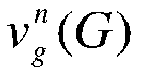
- v g e G denotes a proximity evaluation coefficient for an obligatory element with respect to a topological element. In an example, it may be measured by the distance between an obligatory element and a topological element, and the larger the distance, the larger the proximity evaluation coefficient.
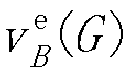
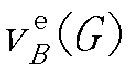
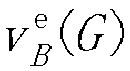
- v B e G denotes a baseline value of a proximity evaluation coefficient for an obligatory element with respect to at least part of the topological elements.
- the at least part of the topological elements may include: a topological element in the set of the topological elements directly connected to the obligatory elements. That is, v B e G may be the baseline value of the proximity evaluation coefficient for an obligatory element with respect to topological elements directly connected to the obligatory element. However, without limitation, v B e G may also be the baseline value of the proximity evaluation coefficient for an obligatory element with respect to each topological element in the network.
- the function f C E denotes the obligatory constraint policy
- the obligatory constraint weight f C E e g G generated by each obligatory element on the topological element may be calculated.
- the relevant information for the obligatory element e includes, for example, the service constraint weight for the obligatory element e, the distance between the obligatory element e and the topological element, and other information that may be used to calculate the values of the parameters in Equation (3) above.
- step 103 contains the following sub-steps.
- a sum of the service constraint weight and the obligatory constraint weight for each topological element is used as a total weight for each topological element.
- a shortest path from the start node to the end node that passes through the obligatory constraint is calculated according to the total weights for the topological elements.
- the total weight for each topological element is equal to the sum of the service constraint weight and the obligatory constraint weight.
- the total weight of a topological element the product of the service constraint weight and its corresponding weight coefficient + the product of the obligatory constraint weight and its corresponding weight coefficient.
- this may be implemented based on the K shortest path algorithm; and the routing policy determined in sub-step 1021 may further include a K value determined based on the resource information for the network, e.g., a K value determined based on the topological size of the network, sparsity, etc., where the K value is an upper limit on the number of shortest paths traversed.
- the Dijkstra algorithm may be used to calculate the shortest path P 0 , where the length of the path is measured in terms of path cost.
- the path cost represents the degree to which the path satisfies the routing requirements, and the path cost is the sum of the weights of all nodes and links on the path, and the larger the path cost, the lower the degree of satisfaction.
- suboptimal paths i.e., the second shortest path, the third shortest path, ...) are calculated one by one using an iterative method based on the shortest path Po; every time a suboptimal path Pi is obtained, it is first checked whether P i satisfies the obligatory constraint condition, if so, P i is returned as the calculation result, and if not, the relationship between i+1 and K is determined, if i+1 ⁇ K, the process continues to calculate the Pi+lth suboptimal path, and if the P i+1 th suboptimal path is not found, it means that there are only i reachable paths from the start node to the end node in the current network topology, then a null value is returned and the calculation is ended; and if i+1>K, it means that a path satisfying the obligatory constraint cannot be found under the current routing policy.
- sub-step 1032 includes the following sub-step 1032
- sub-step 1032-1 the i-th shortest path P i from the start node to the end node is iteratively calculated, if Pi exists, the process proceeds to sub-step 1032-2; and if not, the process proceeds to sub-step 1032-3.
- sub-step 1032-2 it is checked whether Pi satisfies the obligatory constraint condition, if yes, the process proceeds to sub-step 1032-4; and if not, the process proceeds to sub-step 1032-5.
- Pi is returned as the calculated shortest path and the process ends.
- sub-step 1032-5 it is determined whether i+1 is less than or equal to K, if yes, the process returns to sub-step 1032-1; and if not, the process ends.
- this embodiment is implemented based on the K shortest path algorithm.
- any method that can use the total weight for each topological element to find the shortest path from the start node to the end node is applicable to this embodiment.
- an obligatory constraint policy is acquired according to resource information for the network, and obligatory constraint weights of topological elements are calculated according to the obligatory constraint and the obligatory constraint policy; and a shortest path from the start node to the end node that satisfies the obligatory constraint is calculated according to the service constraint weights and the obligatory constraint weights for the topological elements.
- the obligatory constraint weight is also introduced, and the obligatory constraint weight is taken into consideration together with the service constraint weight to realize the routing calculation with obligatory constraints, and thus the efficiency of the routing calculation with obligatory constraints in large-scale complex networks can be significantly improved.
- the parameters in the obligatory constraint policy are calculated using the topological elements directly connected to the obligatory elements, which makes the resulting obligatory constraint policy more accurate.
- the weights of both links and nodes in the network are considered at the same time, which is more comprehensive compared to the existing technology where only the weights of links are considered.
- using the sum of the service constraint weight and the obligatory constraint weight as the total weight for each topological element provides a combination of considering the service constraint weights and the obligatory constraint weights together.
- a second implementation of the present disclosure relates to a method for calculating a shortest path.
- the second implementation is substantially the same as the first implementation, with the main difference being that: in the second implementation of the present disclosure, if the shortest path cannot be obtained according to the service constraint weights and the obligatory constraint weights for the topological elements, the routing policy is adjusted and the service constraint weights and the obligatory constraint weights for the topological elements are recalculated based on the adjusted routing policy, and then the shortest path from the start node to the end node that satisfies the obligatory constraint is calculated according to the recalculated service constraint weights and obligatory constraint weights for the topological elements.
- FIG. 5 A flowchart of the method for calculating a shortest path in the second embodiment is shown in Fig. 5 , where compared with Fig. 4 in the first embodiment, step 104 is added to adjust the routing policy.
- the process proceeds to step 104 to adjust the routing policy; and then returns to sub-step 1022, so that the service constraint weights and the obligatory constraint weights for the topological elements can be recalculated based on the adjusted routing policy; and a shortest path from the start node to the end node that satisfies the obligatory constraint can be calculated according to the recalculated service constraint weights and obligatory constraint weights for the topological elements.
- the routing policy may be adjusted and then recalculation is performed, until the shortest path satisfying the constraint condition is found.
- the routing policy is adjusted.
- the obligatory constraint policy may be adjusted, such as adjusting w 0 , c e (at least one of c n , c l ) or v B e G (at least one of ⁇ B n G , ⁇ B l G ) in Equation (3); or, the K value may be adjusted.
- the calculation of the shortest path based on the K shortest path algorithm is illustrated as an example.
- the shortest path may also be calculated based on another algorithm, and when the shortest path cannot be obtained, the routing policy may also be adjusted, and the total weight of each topological element may be recalculated based on the adjusted routing policy and the shortest path may be recalculated based on that another algorithm.
- a third implementation of the present disclosure relates to a method for calculating a shortest path.
- the third implementation is substantially the same as the first or second implementation, with the main difference being that: in the third implementation of the present disclosure, an illustration of calculating the ratio evaluation coefficient c e is provided.
- the ratio evaluation coefficient c e may be determined from a statistical characteristic value w 1 of the service constraint weight for each topological element; and the statistical characteristic value w 1 is, for example, the variance.
- a preset relationship between the variance of the service constraint weights for the topological elements and the ratio evaluation coefficient is pre-stored within the routing acquisition device; and the variance of the service constraint weights for the topological elements may be calculated first, and then the ratio evaluation coefficient c e corresponding to that variance may be obtained based on the preset relationship between the variance and the ratio evaluation coefficients, where in this preset relationship, the larger the variance is, the smaller the ratio evaluation coefficient is; and the preset relationship may be expressed in the form of a control table, or in the form of a function.
- the ratio evaluation coefficient c e is calculated based on the statistical characteristic value w 1 of the service constraint weights for the topological elements in the current network, which can make the obtained ratio evaluation coefficient c e better match the current network, thus making the calculated obligatory constraint weights more accurate, thereby helping to further improve the efficiency of routing calculation with obligatory constraints in large-scale complex networks.
- a fourth implementation of the present disclosure relates to a routing acquisition device, as shown in Fig. 6 , including:
- this implementation is a device embodiment corresponding to the first, or second, or third implementation, and this implementation may be implemented in conjunction with the first, or second, or third implementation.
- the relevant technical details mentioned in the first, or second, or third implementation are still valid in this implementation, and will not be repeated here in order to reduce repetition. Accordingly, the relevant technical details mentioned in this implementation may also be applied in the first, or second, or third implementation.
- modules involved in this embodiment are logic modules.
- a logic unit may be a physical unit or a part of a physical unit, or be implemented by a combination of multiple physical units.
- units that are not closely related to solving the technical problem proposed by the present disclosure are not introduced in this embodiment, but this does not mean that there are no other units in this embodiment.
- a fifth implementation of the present disclosure relates to a server, as shown in Fig. 7 , including:
- the memory 42 and the at least one processor 41 are connected by means of a bus, and the bus may include any number of bus interconnects and bridges, and the bus connects the at least one processor 41 and various circuits of the memory 42 together.
- the bus may also connect various other circuits such as a peripheral device, a voltage regulator and a power management circuit, which are well known in the art and therefore will not be further described here.
- a bus interface provides an interface between the bus and a transceiver.
- the transceiver may be one element or multiple elements, such as multiple receivers and transmitters, and provide a unit for communicating with various other apparatuses on a transmission medium.
- Data that has been processed by the processor 41 is transmitted on a wireless medium by means of an antenna. Further, the antenna also receives data and transmits the data to the processor 41.
- the processor 41 is responsible for bus management and general processing, and may also provide various functions, including timing, peripheral interface, voltage regulation, power management and other control functions.
- the memory 42 may be configured to store data used by the processor 41 when performing operations.
- the sixth embodiment of the present disclosure relates to a computer-readable storage medium storing a computer program.
- the computer program when executed by the processor, causes the processor to perform the methods according to the embodiments above.
- the aforementioned storage medium includes: various media that can store program codes, such as a USB flash drive, a mobile hard disk, a read-only memory (ROM), a random access memory (RAM), a magnetic disk or an optical disk.
Landscapes
- Engineering & Computer Science (AREA)
- Computer Networks & Wireless Communication (AREA)
- Signal Processing (AREA)
- Data Exchanges In Wide-Area Networks (AREA)
Abstract
Description
- The present application is based on and claims the priority of
Chinese patent application No. 201910816009.2 filed on August 30, 2019 - The embodiments of the present disclosure relate to the field of communication technology, and in particular to a method for calculating a shortest path, a routing acquisition device, and a server.
- Software defined network (SDN) is a new type of network architecture, the main idea of which is to separate the control plane and data plane of network apparatuses and realize centralized control of the network by introducing controllers, so as to realize more open and flexible network management as well as more intelligent and convenient resource scheduling and operation maintenance. The SDN controller may use the link layer discovery protocol to acquire network resource information. The network resource information includes real-time bandwidth and delay of network-wide topology and links. Based on such information, the SDN controller can easily calculate the shortest (i.e., optimal) path to meet the service requirements.
- As the communication services become more and more diverse, there are more and more constraints on network routing. In addition to the requirements (such as bandwidth, delay, delay jitter, etc.) regarding the quality of service, some obligatory nodes or links may be designated for routing. For example, due to requirements of information security, it is required that certain flows must pass through specific routing and switching devices or links. In addition, some cross-border communications may be required to bypass some politically sensitive areas or must pass through networks in specific regions or network nodes. This requires the controller to add obligatory constraints (including obligatory nodes and obligatory links) to the routing calculation process.
- The K shortest path algorithm is one of the classical methods to calculate shortest paths with obligatory constraints, the principle of which is to use the shortest path algorithm to calculate the first K shortest paths in sequence in a given network topology, and after each path is calculated, to check whether it satisfies the obligatory constraints (i.e., whether the path passes through all required obligatory nodes and obligatory links); and if the k-th shortest path satisfies the obligatory constraints, then stop the calculation and return that path as the calculation result, otherwise continue to calculate the (k+1)th shortest path until a path satisfying the obligatory constraints is found or all paths have been traversed, then stop the calculation.
- The embodiments of the present disclosure provide a method for calculating a shortest path, a routing acquisition device, and a server.
- The embodiments of the present disclosure provide a method for calculating a shortest path, including: acquiring resource information for a network according to a received routing request, where the routing request includes a start node, an end node, a service constraint, and an obligatory constraint; calculating service constraint weights for topological elements in the network according to the service constraint, and calculating obligatory constraint weights for the topological elements according to the obligatory constraint and the resource information for the network; calculating, according to the service constraint weights and the obligatory constraint weights for the topological elements, a shortest path from the start node to the end node that satisfies the obligatory constraint.
- The embodiments of the present disclosure further provide a routing acquisition device, including: a topology acquisition module configured to acquire resource information for a network according to a received routing request, where the routing request includes a start node, an end node, a service constraint, and an obligatory constraint; a weight calculation module configured to calculate service constraint weights for topological elements in the network according to the service constraint, and calculate obligatory constraint weights for the topological elements according to the obligatory constraint and the resource information for the network; and a routing calculation module configured to calculate, according to the service constraint weights and the obligatory constraint weights for the topological elements, a shortest path from the start node to the end node that satisfies the obligatory constraint.
- The embodiments of the present disclosure further provide a server, including: at least one processor; and a memory connected to the at least one processor, where the memory stores instructions executable by the at least one processor, the instructions being executed by the at least one processor to enable the at least one processor to perform the above method for calculating a shortest path.
- The embodiments of the present disclosure further provide a computer-readable storage medium storing a computer program which, when executed by a processor, causes the processor to perform the above method for calculating a shortest path.
- One or more embodiments are illustrated with reference to corresponding figures in the accompanying drawings, and these illustrations do not constitute a limitation to the embodiments. Elements having the same reference signs in the accompanying drawings represent similar elements. The figures in the accompanying drawings are not necessarily drawn to scale unless otherwise specified.
-
Fig. 1 is a flowchart of a method for calculating a shortest path according to a first embodiment of the present disclosure; -
Fig. 2 is a flowchart of an example ofstep 102 according to the first embodiment of the present disclosure; -
Fig. 3 is a flowchart of an example ofstep 103 according to the first embodiment of the present disclosure; -
Fig. 4 is a flowchart of an example ofsub-step 1032 according to the first embodiment of the present disclosure; -
Fig. 5 is a flowchart of a method for calculating a shortest path according to a second embodiment of the present disclosure; -
Fig. 6 is a block diagram of a routing acquisition device according to a fourth embodiment of the present disclosure; and -
Fig. 7 is a block diagram of a server according to a fifth embodiment of the present disclosure. - In order to make the purposes, technical schemes and advantages of the embodiments of the present disclosure clear, the embodiments of the present disclosure will be described in detail with reference to the accompanying drawings. Those having ordinary skills in the art can understand that, in various embodiments of the present disclosure, many technical details have been set forth in order to enable readers to better understand the present disclosure. However, even without these technical details and various changes and modifications based on the following embodiments, the technical schemes of the present disclosure can be implemented. The following embodiments are divided for convenience of description, and should not constitute any limitation on the specific implementation of the present disclosure. The embodiments can be combined with and referenced by each other with no conflict.
- Although the current K shortest path algorithm can theoretically guarantee to obtain the shortest path that satisfies the obligatory constraint, the algorithm is not designed for obligatory constraints and its computational complexity is O(Kn3), where n is the number of nodes in the network topology and K is the number of shortest paths that have been found. Therefore, when the scale of the network is large, i.e., when the number of nodes in the network topology is large, the computational efficiency of this algorithm will be very low and it is difficult to meet the real-time requirements of routing calculation. Moreover, for routing calculations with obligatory constraints, the solution process of the K shortest path algorithm contains too many invalid calculations. Based on the above findings, the inventors propose the technical scheme of the present disclosure. That is, the method for calculating a shortest path of this embodiment is proposed for routing calculation of the shortest path with obligatory constraints in a network.
- The first implementation of the present disclosure relates to a method for calculating a shortest path. The process is as shown in
Fig. 1 . - In
step 101, resource information for a network is acquired according to a received routing request, where the routing request includes a start node, an end node, a service constraint, and an obligatory constraint. - In
step 102, service constraint weights for topological elements in the network are calculated according to the service constraint, and obligatory constraint weights for the topological elements are calculated according to the obligatory constraint and the resource information for the network. - In
step 103, a shortest path from the start node to the end node that satisfies the obligatory constraint is calculated according to the service constraint weights and the obligatory constraint weights for the topological elements. - The implementation details of the method for calculating a shortest path of this implementation are specified below, and the following are implementation details provided for ease of understanding only, and are not necessary to implement this scheme.
- The network in this embodiment may be a software-defined network, referred to as an SDN; and the method for calculating a shortest path in this embodiment is applied to a routing acquisition device, which may exist independently or may be integrated in an SDN controller.
- In
step 101, the routing request received by the routing acquisition device includes a start node, an end node, a service constraint, and an obligatory constraint. Here, the service constraint refers to the quality of the service, i.e., the requirement for transmission quality, and the quality of the service includes, for example, forwarding hop count, required bandwidth, delay, delay jitter, etc.; and the obligatory constraint refers to the nodes and/or links that must be passed through from the start node to the end node, where the nodes or links that must be passed through may be collectively referred to as obligatory elements. - The routing acquisition device may acquire the resource information for the network according to the service constraint in the routing request. The network refers to a network where the start node and the end node are located, and the resource information for the network includes information such as the topological structure of the network, the real-time bandwidth of each topological element, and the delay, where the routing acquisition device acquires from the network an available topology that satisfies the service constraint. Here, the topological element is a node or link in that available topology.
- As shown in the example of
Fig. 2 ,step 102 includes two sub-steps. - In
sub-step 1021, a routing policy is acquired, where the routing policy includes at least a service constraint policy acquired according to the service constraint and an obligatory constraint policy acquired according to the resource information for the network. - In
sub-step 1022, service constraint weights and obligatory constraint weights are calculated for the topological elements based on the routing policy, where the service constraint weights are obtained through calculation according to the service constraint and the service constraint policy, and the obligatory constraint weights are obtained through calculation according to the obligatory constraint and the obligatory constraint policy. - In
sub-step 1021, specifically, a first selection policy is pre-stored in the routing acquisition device, and the first selection policy is used to select a corresponding service constraint policy for the service constraint in the routing request. That is, the first selection policy may be understood as a selection function, where a service constraint is taken as an input parameter of the first selection policy, and the first selection policy determines a service constraint policy corresponding to that service constraint by analyzing the service constraint. For example, if the service constraint contains a limit on the forwarding hop count, the service constraint policy corresponding to the service constraint that is determined by this first selection policy may be a minimum-hop policy. - Different service constraints correspond to different service constraint policies. Different service constraint policies include, for example, a minimum-hop policy, a bandwidth balancing policy, a minimum-delay policy, a minimum-delay jitter policy, and the like. More specifically, for example: when the service constraint policy is the minimum-hop policy, the service constraint weights of all links may be set to a constant greater than 0, e.g., 100; when the service constraint policy is the bandwidth balancing policy, the service constraint weight is determined by the ratio of the bandwidth required by the service to the bandwidth available at that node or link; when the service constraint policy is the minimum-delay policy, the service constraint weight is determined by the delay of the node or link; and when the service constraint policy is the minimum-delay jitter policy, the service constraint weight is determined by the delay jitter of the node or link.
- Similarly, a second selection policy is pre-stored in the routing acquisition device, and the second selection policy is used to select a corresponding obligatory constraint policy for this current network. That is, the second selection policy may be understood as a selection function, where the resource information for the network is taken as an input parameter of the second selection policy, and the second selection policy determines an obligatory constraint policy by analyzing the resource information for the network. The resource information for the network may include, for example, the forwarding hop count, required bandwidth, delay, delay jitter, etc., of each topological element, the distance between the topological elements, and the like.
- In sub-step 1022, the service constraint weights and obligatory constraint weights may be calculated. For ease of description, the following notations are introduced: network G = G(V, E), where V is the set of nodes in G and E is the set of links in G; the service constraints for the routing request include the forwarding hop count h, the required bandwidth b, the delay d, and the delay jitter j, etc.; and the obligatory elements (obligatory nodes or obligatory links) in the obligatory constraint of the routing request are e, e e S E , where S E is the set of obligatory elements and S E ∈ G. Let the topological elements (nodes or links) to be examined be g ∈ G
- In an example, the service constraint weight wI for g may be expressed as:

- In an example, an obligatory constraint weight for each topological element g includes a total sum of obligatory constraint weights generated by obligatory elements e in the obligatory constraint on the topological element g; and an obligatory constraint weight generated by each obligatory element e on the topological element is obtained based on the obligatory constraint policy.
- The obligatory constraint weight wC (g) for each topological element g may be expressed as:


- In an example, the obligatory constraint policy is expressed as the following equation:

- The parameters in Equation (3) are explained below.
- w 0 denotes the statistical characteristic value of the service constraint weights of at least part of the topological elements. In an example, the at least part of the topological elements may include: a topological element in the set of the topological elements directly connected to the obligatory elements. That is, w 0 may be the statistical characteristic value of the service constraint weight of a topological element directly connected to the obligatory elements. However, without limitation, w 0 may also be the statistical characteristic value of the service constraint weights of all topological elements. Here, the statistical characteristic value may be one of a minimum value, a maximum value, an average value, and a median value of the service constraint weights for the topological elements.
- c e denotes a ratio evaluation coefficient of the service constraint weight and the obligatory constraint weight of an obligatory element, and c e is a real number greater than 0. Here, the ratio evaluation coefficient may be set according to the actual situation.


- Here, the function


- If the obligatory constraint contains both obligatory nodes and obligatory links, let the obligatory nodes n ∈ SN , the set of obligatory nodes SN ∈ V; and the obligatory links ℓ ∈ SL , the set of obligatory links SL ∈ E, where S E = SN ∪ SL , then, corresponding to the above Equations (2) and (3), the obligatory constraint weights wC (g) for g may be expressed as follows:




- In an example, as shown in
Fig. 3 , step 103 contains the following sub-steps. - In sub-step 1031, a sum of the service constraint weight and the obligatory constraint weight for each topological element is used as a total weight for each topological element.
- In sub-step 1032, a shortest path from the start node to the end node that passes through the obligatory constraint is calculated according to the total weights for the topological elements.
- In sub-step 1031, the total weight for each topological element is equal to the sum of the service constraint weight and the obligatory constraint weight. However, without limitation, in other examples, it is also possible to set different weight coefficients for the service constraint weights and the obligatory constraint weights as needed, that is, the total weight of a topological element = the product of the service constraint weight and its corresponding weight coefficient + the product of the obligatory constraint weight and its corresponding weight coefficient.
- In sub-step 1032, this may be implemented based on the K shortest path algorithm; and the routing policy determined in sub-step 1021 may further include a K value determined based on the resource information for the network, e.g., a K value determined based on the topological size of the network, sparsity, etc., where the K value is an upper limit on the number of shortest paths traversed.
- Specifically, the Dijkstra algorithm may be used to calculate the shortest path P0, where the length of the path is measured in terms of path cost. The path cost represents the degree to which the path satisfies the routing requirements, and the path cost is the sum of the weights of all nodes and links on the path, and the larger the path cost, the lower the degree of satisfaction. The basic idea of the K shortest path algorithm is as follows: the suboptimal paths (i.e., the second shortest path, the third shortest path, ...) are calculated one by one using an iterative method based on the shortest path Po; every time a suboptimal path Pi is obtained, it is first checked whether Pi satisfies the obligatory constraint condition, if so, Pi is returned as the calculation result, and if not, the relationship between i+1 and K is determined, if i+1 ≦ K, the process continues to calculate the Pi+lth suboptimal path, and if the Pi+1th suboptimal path is not found, it means that there are only i reachable paths from the start node to the end node in the current network topology, then a null value is returned and the calculation is ended; and if i+1>K, it means that a path satisfying the obligatory constraint cannot be found under the current routing policy. Referring to
Fig. 4 , sub-step 1032 includes the following sub-steps: - In sub-step 1032-1, the i-th shortest path Pi from the start node to the end node is iteratively calculated, if Pi exists, the process proceeds to sub-step 1032-2; and if not, the process proceeds to sub-step 1032-3.
- In sub-step 1032-2, it is checked whether Pi satisfies the obligatory constraint condition, if yes, the process proceeds to sub-step 1032-4; and if not, the process proceeds to sub-step 1032-5.
- In sub-step 1032-3, a null value is returned and the process ends.
- In sub-step 1032-4, Pi is returned as the calculated shortest path and the process ends.
- In sub-step 1032-5, it is determined whether i+1 is less than or equal to K, if yes, the process returns to sub-step 1032-1; and if not, the process ends.
- It should be noted that this embodiment is implemented based on the K shortest path algorithm. However, without limitation, any method that can use the total weight for each topological element to find the shortest path from the start node to the end node is applicable to this embodiment.
- Compared with the existing technology, in the embodiments of the present disclosure, an obligatory constraint policy is acquired according to resource information for the network, and obligatory constraint weights of topological elements are calculated according to the obligatory constraint and the obligatory constraint policy; and a shortest path from the start node to the end node that satisfies the obligatory constraint is calculated according to the service constraint weights and the obligatory constraint weights for the topological elements. That is, in the calculation of the shortest path, in addition to the service constraint weight as a consideration factor, the obligatory constraint weight is also introduced, and the obligatory constraint weight is taken into consideration together with the service constraint weight to realize the routing calculation with obligatory constraints, and thus the efficiency of the routing calculation with obligatory constraints in large-scale complex networks can be significantly improved.
- In some embodiments, the parameters in the obligatory constraint policy are calculated using the topological elements directly connected to the obligatory elements, which makes the resulting obligatory constraint policy more accurate.
- In some embodiments, in the calculation of the shortest path, the weights of both links and nodes in the network are considered at the same time, which is more comprehensive compared to the existing technology where only the weights of links are considered.
- In some embodiments, using the sum of the service constraint weight and the obligatory constraint weight as the total weight for each topological element provides a combination of considering the service constraint weights and the obligatory constraint weights together.
- A second implementation of the present disclosure relates to a method for calculating a shortest path. The second implementation is substantially the same as the first implementation, with the main difference being that: in the second implementation of the present disclosure, if the shortest path cannot be obtained according to the service constraint weights and the obligatory constraint weights for the topological elements, the routing policy is adjusted and the service constraint weights and the obligatory constraint weights for the topological elements are recalculated based on the adjusted routing policy, and then the shortest path from the start node to the end node that satisfies the obligatory constraint is calculated according to the recalculated service constraint weights and obligatory constraint weights for the topological elements.
- A flowchart of the method for calculating a shortest path in the second embodiment is shown in
Fig. 5 , where compared withFig. 4 in the first embodiment,step 104 is added to adjust the routing policy. - Specifically, when the determination result of sub-step 1032-5 is no, it means that the shortest path from the start node to the end node that satisfies the obligatory constraint cannot be found under the current routing policy. In this case, the process proceeds to step 104 to adjust the routing policy; and then returns to sub-step 1022, so that the service constraint weights and the obligatory constraint weights for the topological elements can be recalculated based on the adjusted routing policy; and a shortest path from the start node to the end node that satisfies the obligatory constraint can be calculated according to the recalculated service constraint weights and obligatory constraint weights for the topological elements. Here, if the shortest path satisfying the constraint condition cannot be obtained under the current routing policy, the routing policy may be adjusted and then recalculation is performed, until the shortest path satisfying the constraint condition is found.
- In
step 104, the routing policy is adjusted. Specifically, the obligatory constraint policy may be adjusted, such as adjusting w 0 , c e (at least one of cn, cℓ) or


- It should be noted that in this embodiment, after the total weight for each topological element is calculated, the calculation of the shortest path based on the K shortest path algorithm is illustrated as an example. In other examples, the shortest path may also be calculated based on another algorithm, and when the shortest path cannot be obtained, the routing policy may also be adjusted, and the total weight of each topological element may be recalculated based on the adjusted routing policy and the shortest path may be recalculated based on that another algorithm.
- A third implementation of the present disclosure relates to a method for calculating a shortest path. The third implementation is substantially the same as the first or second implementation, with the main difference being that: in the third implementation of the present disclosure, an illustration of calculating the ratio evaluation coefficient c e is provided.
- In this embodiment, the ratio evaluation coefficient c e may be determined from a statistical characteristic value w 1 of the service constraint weight for each topological element; and the statistical characteristic value w 1 is, for example, the variance.
- Specifically, a preset relationship between the variance of the service constraint weights for the topological elements and the ratio evaluation coefficient is pre-stored within the routing acquisition device; and the variance of the service constraint weights for the topological elements may be calculated first, and then the ratio evaluation coefficient c e corresponding to that variance may be obtained based on the preset relationship between the variance and the ratio evaluation coefficients, where in this preset relationship, the larger the variance is, the smaller the ratio evaluation coefficient is; and the preset relationship may be expressed in the form of a control table, or in the form of a function.
- In the calculation of the ratio evaluation coefficient c e provided in this embodiment, the ratio evaluation coefficient c e is calculated based on the statistical characteristic value w 1 of the service constraint weights for the topological elements in the current network, which can make the obtained ratio evaluation coefficient c e better match the current network, thus making the calculated obligatory constraint weights more accurate, thereby helping to further improve the efficiency of routing calculation with obligatory constraints in large-scale complex networks.
- The steps of the above methods are divided only for the sake of clear description, and during implementation, the steps may be combined into one step or one step may be split into multiple steps. All shall fall within the scope of protection of the present disclosure provided that the same logical relationship is included. Insignificant modifications added to or insignificant designs introduced into an algorithm or a procedure without changing the core of the algorithm or the procedure shall fall within the scope of protection of the present disclosure.
- A fourth implementation of the present disclosure relates to a routing acquisition device, as shown in
Fig. 6 , including: - a
topology acquisition module 31 configured to acquire resource information for a network according to a received routing request, where the routing request includes a start node, an end node, a service constraint, and an obligatory constraint; - a
weight calculation module 32 configured to calculate service constraint weights for topological elements in the network according to the service constraint, and calculate obligatory constraint weights for the topological elements according to the obligatory constraint and the resource information for the network; and - a
routing calculation module 33 configured to calculate, according to the service constraint weights and the obligatory constraint weights for the topological elements, a shortest path from the start node to the end node that satisfies the obligatory constraint. - Not surprisingly, this implementation is a device embodiment corresponding to the first, or second, or third implementation, and this implementation may be implemented in conjunction with the first, or second, or third implementation. The relevant technical details mentioned in the first, or second, or third implementation are still valid in this implementation, and will not be repeated here in order to reduce repetition. Accordingly, the relevant technical details mentioned in this implementation may also be applied in the first, or second, or third implementation.
- It is worth mentioning that all the modules involved in this embodiment are logic modules. In practical applications, a logic unit may be a physical unit or a part of a physical unit, or be implemented by a combination of multiple physical units. In addition, in order to highlight the innovative part of the present disclosure, units that are not closely related to solving the technical problem proposed by the present disclosure are not introduced in this embodiment, but this does not mean that there are no other units in this embodiment.
- A fifth implementation of the present disclosure relates to a server, as shown in
Fig. 7 , including: - at least one
processor 41; and - a
memory 42 communicatively connected to the at least oneprocessor 41, where - the
memory 42 stores instructions executable by the at least oneprocessor 41, the instructions being executed by the at least oneprocessor 41 to enable the at least oneprocessor 41 to perform the above method for calculating a shortest path. - Here, the
memory 42 and the at least oneprocessor 41 are connected by means of a bus, and the bus may include any number of bus interconnects and bridges, and the bus connects the at least oneprocessor 41 and various circuits of thememory 42 together. The bus may also connect various other circuits such as a peripheral device, a voltage regulator and a power management circuit, which are well known in the art and therefore will not be further described here. A bus interface provides an interface between the bus and a transceiver. The transceiver may be one element or multiple elements, such as multiple receivers and transmitters, and provide a unit for communicating with various other apparatuses on a transmission medium. Data that has been processed by theprocessor 41 is transmitted on a wireless medium by means of an antenna. Further, the antenna also receives data and transmits the data to theprocessor 41. - The
processor 41 is responsible for bus management and general processing, and may also provide various functions, including timing, peripheral interface, voltage regulation, power management and other control functions. Thememory 42 may be configured to store data used by theprocessor 41 when performing operations. - The sixth embodiment of the present disclosure relates to a computer-readable storage medium storing a computer program. The computer program, when executed by the processor, causes the processor to perform the methods according to the embodiments above.
- That is, those having ordinary skills in the art can understand that all or some of the steps in the methods for implementing the above embodiments can be completed by instructing related hardware through a program, which is stored in a storage medium and includes several instructions configured to enable a device (which may be a single-chip microcomputer, a chip, etc.) or a processor to execute all or some of the steps of the methods according to the embodiments of the present disclosure. The aforementioned storage medium includes: various media that can store program codes, such as a USB flash drive, a mobile hard disk, a read-only memory (ROM), a random access memory (RAM), a magnetic disk or an optical disk.
- Those having ordinary skills in the art can understand that several embodiments are provided to explain various implementations of the present disclosure, but in practical applications, various changes in form and detail can be made therein without departing from the principle and scope of the present disclosure.
Claims (15)
- A method for calculating a shortest path, comprising:acquiring resource information for a network according to a received routing request, wherein the routing request comprises a start node, an end node, a service constraint, and an obligatory constraint;calculating service constraint weights for topological elements in the network according to the service constraint, and calculating obligatory constraint weights for the topological elements according to the obligatory constraint and the resource information for the network; andcalculating, according to the service constraint weights and the obligatory constraint weights for the topological elements, a shortest path from the start node to the end node that satisfies the obligatory constraint.
- The method for calculating a shortest path of claim 1, wherein calculating service constraint weights for topological elements in the network according to the service constraint, and calculating obligatory constraint weights for the topological elements according to the obligatory constraint and the resource information for the network comprises:acquiring a routing policy, wherein the routing policy comprises at least a service constraint policy acquired according to the service constraint and an obligatory constraint policy acquired according to the resource information for the network; andcalculating service constraint weights and obligatory constraint weights for the topological elements based on the routing policy, wherein the service constraint weights are obtained through calculation according to the service constraint and the service constraint policy, and the obligatory constraint weights are obtained through calculation according to the obligatory constraint and the obligatory constraint policy.
- The method for calculating a shortest path of claim 2, wherein calculating, according to the service constraint weights and the obligatory constraint weights for the topological elements, a shortest path from the start node to the end node that satisfies the obligatory constraint comprising:
in response to the shortest path being unobtainable according to the service constraint weights and the obligatory constraint weights for the topological elements, adjusting the routing policy, recalculating the service constraint weights and the obligatory constraint weights for the topological elements based on the adjusted routing policy, and calculating the shortest path from the start node to the end node that satisfies the obligatory constraint according to the recalculated service constraint weights and obligatory constraint weights for the topological elements. - The method for calculating a shortest path of claim 2 or 3, wherein an obligatory constraint weight for each topological element comprises a total sum of obligatory constraint weights generated by obligatory elements in the obligatory constraint on the topological element; and an obligatory constraint weight generated by each obligatory element on the topological element is obtained based on the obligatory constraint policy.
- The method for calculating a shortest path of claim 4, wherein the obligatory constraint policy is expressed with an equation:


- The method for calculating a shortest path of claim 5, wherein the at least part of the topological elements comprises: a topological element in the set of the topological elements directly connected to the obligatory elements.
- The method for calculating a shortest path of claim 5, wherein the statistical characteristic value w 0 is one of a minimum value, a maximum value, an average value, and a median value of the service constraint weights for the topological elements.
- The method for calculating a shortest path of claim 5, wherein the ratio evaluation coefficient c e is calculated by:calculating a statistical characteristic value w 1 of the service constraint weights for the topological elements; andacquiring a ratio evaluation coefficient c e corresponding to the statistical characteristic value w 1 according to a preset relationship between statistical characteristic values and ratio evaluation coefficients.
- The method for calculating a shortest path of claim 8, wherein the statistical characteristic value w 1 is a variance of the service constraint weights for the topological elements; and in the preset relationship, the larger the variance is, the smaller the ratio evaluation coefficient is.
- The method for calculating a shortest path of claim 1, wherein the topological elements comprise links and nodes.
- The method for calculating a shortest path of claim 1, wherein determining, according to the service constraint weights and the obligatory constraint weights for the topological elements, a shortest path from the start node to the end node that passes the obligatory constraint comprises:adopting a sum of the service constraint weight and the obligatory constraint weight for each topological element as a total weight for each topological element; andcalculating, according to the total weights for the topological elements, a shortest path from the start node to the end node that passes through the obligatory constraint.
- The method for calculating a shortest path of claim 11, wherein calculating, according to the total weights for the topological elements, a shortest path from the start node to the end node that passes through the obligatory constraint is implemented based on a K shortest path algorithm.
- A routing acquisition device, comprising:a topology acquisition module configured to acquire resource information for a network according to a received routing request, wherein the routing request comprises a start node, an end node, a service constraint, and an obligatory constraint;a weight calculation module configured to calculate service constraint weights for topological elements in the network according to the service constraint, and calculate obligatory constraint weights for the topological elements according to the obligatory constraint and the resource information for the network; anda routing calculation module configured to calculate, according to the service constraint weights and the obligatory constraint weights for the topological elements, a shortest path from the start node to the end node that satisfies the obligatory constraint.
- A server, comprising:at least one processor; anda memory communicatively connected to the at least one processor, whereinthe memory stores instructions executable by the at least one processor, the instructions being executed by the at least one processor to enable the at least one processor to perform the method for calculating a shortest path of any one of claims 1 to 12.
- A computer-readable storage medium storing a computer program which, when executed by a processor, causes the processor to perform the method for calculating a shortest path of any one of claims 1 to 12.
Applications Claiming Priority (2)
| Application Number | Priority Date | Filing Date | Title |
|---|---|---|---|
| CN201910816009.2A CN112448886B (en) | 2019-08-30 | 2019-08-30 | Shortest path calculation method, route acquisition device and server |
| PCT/CN2020/105535 WO2021036660A1 (en) | 2019-08-30 | 2020-07-29 | Shortest path computation method, routing obtaining device, and server |
Publications (3)
| Publication Number | Publication Date |
|---|---|
| EP4016940A1 true EP4016940A1 (en) | 2022-06-22 |
| EP4016940A4 EP4016940A4 (en) | 2022-09-07 |
| EP4016940B1 EP4016940B1 (en) | 2024-10-09 |
Family
ID=74683432
Family Applications (1)
| Application Number | Title | Priority Date | Filing Date |
|---|---|---|---|
| EP20857120.8A Active EP4016940B1 (en) | 2019-08-30 | 2020-07-29 | Shortest path computation method and server |
Country Status (4)
| Country | Link |
|---|---|
| US (1) | US12381812B2 (en) |
| EP (1) | EP4016940B1 (en) |
| CN (1) | CN112448886B (en) |
| WO (1) | WO2021036660A1 (en) |
Cited By (2)
| Publication number | Priority date | Publication date | Assignee | Title |
|---|---|---|---|---|
| RU239109U1 (en) * | 2025-05-28 | 2025-11-24 | Федеральное государственное бюджетное учреждение "4 Центральный научно-исследовательский институт" Министерства обороны Российской Федерации | A device for finding paths with two intermediate nodes in command and signal systems |
| EP4661365A4 (en) * | 2023-02-20 | 2026-04-29 | Huawei Tech Co Ltd | METHOD AND DEVICE FOR FORWARD PATH DETERMINATION, ELECTRONIC DEVICE AND STORAGE MEDIUM |
Families Citing this family (14)
| Publication number | Priority date | Publication date | Assignee | Title |
|---|---|---|---|---|
| WO2022249364A1 (en) * | 2021-05-26 | 2022-12-01 | 日本電信電話株式会社 | Path determination device, path determination method, and program |
| CN113285880B (en) * | 2021-07-19 | 2021-10-15 | 北京壁仞科技开发有限公司 | Multicast routing method, interconnection device, mesh network system and configuration method thereof |
| EP4125249B1 (en) * | 2021-07-29 | 2025-06-25 | TTTech Computertechnik Aktiengesellschaft | Method to configure real-time communications in a network with time-triggered and rate-constrained traffic |
| CN113726560B (en) * | 2021-08-12 | 2023-08-29 | 中盈优创资讯科技有限公司 | Method and device for acquiring meta value suggestion of backbone link of operator |
| CN113962054B (en) * | 2021-11-12 | 2024-02-02 | 国网江苏省电力有限公司泰州供电分公司 | A medium voltage feeder network path planning method and device for medium voltage distribution network |
| CN114978982B (en) * | 2022-03-30 | 2024-06-18 | 网络通信与安全紫金山实验室 | Method and device for determining multicast path |
| CN114928569B (en) * | 2022-04-28 | 2023-06-09 | 烽火通信科技股份有限公司 | Shortest path implementation method and system containing multiple necessary resources |
| CN117354160A (en) * | 2022-06-29 | 2024-01-05 | 中兴通讯股份有限公司 | Path calculation method, controller and computer-readable storage medium |
| CN115333947B (en) * | 2022-08-03 | 2024-04-16 | 北京视界云天科技有限公司 | Route optimization method, device, computer equipment and storage medium based on guidance |
| CN117914710A (en) * | 2022-10-11 | 2024-04-19 | 华为技术有限公司 | Method and device for processing network flow problems |
| CN115358681B (en) * | 2022-10-19 | 2023-03-24 | 睿羿科技(山东)有限公司 | Indoor multi-task point path planning method under static barrier |
| CN116720638B (en) * | 2023-04-13 | 2024-03-26 | 广东工业大学 | Method and system for adjusting inverse shortest path weight based on improved evolutionary algorithm |
| CN117807939B (en) * | 2023-12-29 | 2024-12-10 | 苏州异格技术有限公司 | Circuit hypergraph determination method, device, computer equipment and storage medium |
| CN118285919B (en) * | 2024-03-26 | 2025-02-14 | 南京工业大学 | A puncture robot ultrasonic navigation method and system |
Family Cites Families (21)
| Publication number | Priority date | Publication date | Assignee | Title |
|---|---|---|---|---|
| US6563798B1 (en) * | 1998-06-29 | 2003-05-13 | Cisco Technology, Inc. | Dynamically created service class-based routing tables |
| US6377551B1 (en) * | 1998-08-17 | 2002-04-23 | Nortel Networks Limited | QoS based route determination method for communications networks |
| US6965575B2 (en) * | 2000-12-29 | 2005-11-15 | Tropos Networks | Selection of routing paths based upon path quality of a wireless mesh network |
| US7324453B2 (en) * | 2002-08-30 | 2008-01-29 | Alcatel Lucent | Constraint-based shortest path first method for dynamically switched optical transport networks |
| US7957266B2 (en) * | 2004-05-28 | 2011-06-07 | Alcatel-Lucent Usa Inc. | Efficient and robust routing independent of traffic pattern variability |
| US8218445B2 (en) * | 2006-06-02 | 2012-07-10 | Ciena Corporation | Smart ethernet edge networking system |
| US20100034098A1 (en) * | 2008-08-05 | 2010-02-11 | At&T Intellectual Property I, Lp | Towards Efficient Large-Scale Network Monitoring and Diagnosis Under Operational Constraints |
| CN101621721A (en) * | 2009-08-06 | 2010-01-06 | 中兴通讯股份有限公司 | K-shortest path computing method and device |
| US8711703B2 (en) * | 2010-10-29 | 2014-04-29 | Telefonaktiebolaget L M Ericsson (Publ) | Load balancing in shortest-path-bridging networks |
| US8452176B2 (en) * | 2011-02-18 | 2013-05-28 | At&T Intellectual Property I, Lp | Reachability matrices spanning multiple domains in an optical network |
| CN104753713B (en) | 2013-12-31 | 2019-02-05 | 华为技术有限公司 | A method for SDN deployment service and SDN controller |
| US9634867B2 (en) * | 2014-05-02 | 2017-04-25 | Futurewei Technologies, Inc. | Computing service chain-aware paths |
| CN105634954B (en) * | 2016-01-08 | 2019-04-16 | 烽火通信科技股份有限公司 | The shortest path calculation method of light injury is considered based on WSON network |
| IL244937A (en) * | 2016-04-05 | 2017-07-31 | Musman Lior | Global optimization and load balancing in networks |
| US10404576B2 (en) * | 2016-10-13 | 2019-09-03 | Futurewei Technologies, Inc. | Constrained shortest path determination in a network |
| CN108075980A (en) * | 2016-11-17 | 2018-05-25 | 中兴通讯股份有限公司 | A kind of control method of forward-path, device and control device |
| CN107733796B (en) * | 2017-02-07 | 2021-01-26 | 深圳臻云技术股份有限公司 | Method and system for calculating preferred path |
| CN109995650B (en) * | 2018-01-03 | 2022-02-22 | 中兴通讯股份有限公司 | SDN network-based path calculation method and device under multidimensional constraint |
| WO2019157666A1 (en) * | 2018-02-13 | 2019-08-22 | 华为技术有限公司 | Routing method and apparatus |
| CN108683593B (en) * | 2018-07-10 | 2021-01-15 | 烽火通信科技股份有限公司 | K short path calculation method |
| US11134007B2 (en) * | 2019-01-17 | 2021-09-28 | The Regents Of The University Of California | Network congestion reduction using boolean constrained multipath routing |
-
2019
- 2019-08-30 CN CN201910816009.2A patent/CN112448886B/en active Active
-
2020
- 2020-07-29 EP EP20857120.8A patent/EP4016940B1/en active Active
- 2020-07-29 US US17/638,055 patent/US12381812B2/en active Active
- 2020-07-29 WO PCT/CN2020/105535 patent/WO2021036660A1/en not_active Ceased
Cited By (2)
| Publication number | Priority date | Publication date | Assignee | Title |
|---|---|---|---|---|
| EP4661365A4 (en) * | 2023-02-20 | 2026-04-29 | Huawei Tech Co Ltd | METHOD AND DEVICE FOR FORWARD PATH DETERMINATION, ELECTRONIC DEVICE AND STORAGE MEDIUM |
| RU239109U1 (en) * | 2025-05-28 | 2025-11-24 | Федеральное государственное бюджетное учреждение "4 Центральный научно-исследовательский институт" Министерства обороны Российской Федерации | A device for finding paths with two intermediate nodes in command and signal systems |
Also Published As
| Publication number | Publication date |
|---|---|
| US12381812B2 (en) | 2025-08-05 |
| CN112448886A (en) | 2021-03-05 |
| EP4016940A4 (en) | 2022-09-07 |
| EP4016940B1 (en) | 2024-10-09 |
| US20220278920A1 (en) | 2022-09-01 |
| WO2021036660A1 (en) | 2021-03-04 |
| CN112448886B (en) | 2023-08-01 |
Similar Documents
| Publication | Publication Date | Title |
|---|---|---|
| EP4016940A1 (en) | Shortest path computation method, routing obtaining device, and server | |
| US8301823B2 (en) | Bus controller arranged between a bus master and a networked communication bus in order to control the transmission route of a packet that flows through the communication bus, and simulation program to design such a bus controller | |
| CN111512600B (en) | Method and apparatus for distributing traffic in a telecommunications network | |
| US10111171B2 (en) | Method and apparatus for HTTP adaptive streaming in wireless network environment | |
| CN113472659A (en) | Method and device for determining forwarding path and SDN controller | |
| CN112867088A (en) | Dynamic adjustment method and system for cloud-edge-end communication architecture | |
| US20130136034A1 (en) | Network design device | |
| CN112543151B (en) | SDN controller deployment method and device, electronic equipment and storage medium | |
| Moscholios et al. | The Erlang multirate loss model with Batched Poisson arrival processes under the bandwidth reservation policy | |
| EP2727296B1 (en) | Routing method and routing device for a packet-oriented communication network | |
| CN111404815A (en) | Constrained routing method based on deep learning | |
| EP3890244B1 (en) | Method for providing multi-site orchestration in a public network for factory automation | |
| Tu et al. | Enhanced-SETL: A multi-variable deep reinforcement learning approach for contention window optimization in dense Wi-Fi networks | |
| EP3247077B1 (en) | Path selection method, device and system | |
| US10412000B2 (en) | Wireless mesh communications networks | |
| EP2930617A1 (en) | Resource management method and device | |
| Ito et al. | Deep Learning Based Path Planning Using Integer Linear Programming Method to Teacher Signal | |
| CN116406007B (en) | Data transmission optimization method, device, terminal and medium of communication system | |
| CN106209461B (en) | A kind of flow processing method and device | |
| CN115297047B (en) | Networking method, electronic device and computer-readable storage medium | |
| CN115878306B (en) | HQOS rate limiting methods, devices, boards, and storage media | |
| EP4319095A1 (en) | Automatic tsn model learning for 5g systems | |
| He et al. | Priority-Aware Multi-Agent Q-Learning Routing for Decentralized Wireless Federated Learning | |
| CN113067659A (en) | An information processing method, apparatus, device, and computer-readable storage medium | |
| CN121619551A (en) | Communication networking method, service center and related equipment |
Legal Events
| Date | Code | Title | Description |
|---|---|---|---|
| STAA | Information on the status of an ep patent application or granted ep patent |
Free format text: STATUS: THE INTERNATIONAL PUBLICATION HAS BEEN MADE |
|
| PUAI | Public reference made under article 153(3) epc to a published international application that has entered the european phase |
Free format text: ORIGINAL CODE: 0009012 |
|
| STAA | Information on the status of an ep patent application or granted ep patent |
Free format text: STATUS: REQUEST FOR EXAMINATION WAS MADE |
|
| 17P | Request for examination filed |
Effective date: 20220316 |
|
| AK | Designated contracting states |
Kind code of ref document: A1 Designated state(s): AL AT BE BG CH CY CZ DE DK EE ES FI FR GB GR HR HU IE IS IT LI LT LU LV MC MK MT NL NO PL PT RO RS SE SI SK SM TR |
|
| REG | Reference to a national code |
Ref country code: DE Ref legal event code: R079 Ref document number: 602020039292 Country of ref document: DE Free format text: PREVIOUS MAIN CLASS: H04L0012721000 Ipc: H04L0045020000 |
|
| A4 | Supplementary search report drawn up and despatched |
Effective date: 20220809 |
|
| RIC1 | Information provided on ipc code assigned before grant |
Ipc: H04L 45/00 20220101ALI20220803BHEP Ipc: H04L 45/12 20220101ALI20220803BHEP Ipc: H04L 45/02 20220101AFI20220803BHEP |
|
| DAV | Request for validation of the european patent (deleted) | ||
| DAX | Request for extension of the european patent (deleted) | ||
| GRAP | Despatch of communication of intention to grant a patent |
Free format text: ORIGINAL CODE: EPIDOSNIGR1 |
|
| STAA | Information on the status of an ep patent application or granted ep patent |
Free format text: STATUS: GRANT OF PATENT IS INTENDED |
|
| INTG | Intention to grant announced |
Effective date: 20240715 |
|
| GRAS | Grant fee paid |
Free format text: ORIGINAL CODE: EPIDOSNIGR3 |
|
| GRAA | (expected) grant |
Free format text: ORIGINAL CODE: 0009210 |
|
| STAA | Information on the status of an ep patent application or granted ep patent |
Free format text: STATUS: THE PATENT HAS BEEN GRANTED |
|
| AK | Designated contracting states |
Kind code of ref document: B1 Designated state(s): AL AT BE BG CH CY CZ DE DK EE ES FI FR GB GR HR HU IE IS IT LI LT LU LV MC MK MT NL NO PL PT RO RS SE SI SK SM TR |
|
| REG | Reference to a national code |
Ref country code: CH Ref legal event code: EP |
|
| REG | Reference to a national code |
Ref country code: DE Ref legal event code: R096 Ref document number: 602020039292 Country of ref document: DE |
|
| REG | Reference to a national code |
Ref country code: IE Ref legal event code: FG4D |
|
| REG | Reference to a national code |
Ref country code: LT Ref legal event code: MG9D |
|
| REG | Reference to a national code |
Ref country code: NL Ref legal event code: MP Effective date: 20241009 |
|
| REG | Reference to a national code |
Ref country code: AT Ref legal event code: MK05 Ref document number: 1731830 Country of ref document: AT Kind code of ref document: T Effective date: 20241009 |
|
| PG25 | Lapsed in a contracting state [announced via postgrant information from national office to epo] |
Ref country code: NL Free format text: LAPSE BECAUSE OF FAILURE TO SUBMIT A TRANSLATION OF THE DESCRIPTION OR TO PAY THE FEE WITHIN THE PRESCRIBED TIME-LIMIT Effective date: 20241009 |
|
| PG25 | Lapsed in a contracting state [announced via postgrant information from national office to epo] |
Ref country code: NL Free format text: LAPSE BECAUSE OF FAILURE TO SUBMIT A TRANSLATION OF THE DESCRIPTION OR TO PAY THE FEE WITHIN THE PRESCRIBED TIME-LIMIT Effective date: 20241009 |
|
| PG25 | Lapsed in a contracting state [announced via postgrant information from national office to epo] |
Ref country code: PT Free format text: LAPSE BECAUSE OF FAILURE TO SUBMIT A TRANSLATION OF THE DESCRIPTION OR TO PAY THE FEE WITHIN THE PRESCRIBED TIME-LIMIT Effective date: 20250210 Ref country code: IS Free format text: LAPSE BECAUSE OF FAILURE TO SUBMIT A TRANSLATION OF THE DESCRIPTION OR TO PAY THE FEE WITHIN THE PRESCRIBED TIME-LIMIT Effective date: 20250209 Ref country code: HR Free format text: LAPSE BECAUSE OF FAILURE TO SUBMIT A TRANSLATION OF THE DESCRIPTION OR TO PAY THE FEE WITHIN THE PRESCRIBED TIME-LIMIT Effective date: 20241009 |
|
| PG25 | Lapsed in a contracting state [announced via postgrant information from national office to epo] |
Ref country code: FI Free format text: LAPSE BECAUSE OF FAILURE TO SUBMIT A TRANSLATION OF THE DESCRIPTION OR TO PAY THE FEE WITHIN THE PRESCRIBED TIME-LIMIT Effective date: 20241009 |
|
| PG25 | Lapsed in a contracting state [announced via postgrant information from national office to epo] |
Ref country code: BG Free format text: LAPSE BECAUSE OF FAILURE TO SUBMIT A TRANSLATION OF THE DESCRIPTION OR TO PAY THE FEE WITHIN THE PRESCRIBED TIME-LIMIT Effective date: 20241009 |
|
| PG25 | Lapsed in a contracting state [announced via postgrant information from national office to epo] |
Ref country code: ES Free format text: LAPSE BECAUSE OF FAILURE TO SUBMIT A TRANSLATION OF THE DESCRIPTION OR TO PAY THE FEE WITHIN THE PRESCRIBED TIME-LIMIT Effective date: 20241009 |
|
| PG25 | Lapsed in a contracting state [announced via postgrant information from national office to epo] |
Ref country code: NO Free format text: LAPSE BECAUSE OF FAILURE TO SUBMIT A TRANSLATION OF THE DESCRIPTION OR TO PAY THE FEE WITHIN THE PRESCRIBED TIME-LIMIT Effective date: 20250109 |
|
| PG25 | Lapsed in a contracting state [announced via postgrant information from national office to epo] |
Ref country code: LV Free format text: LAPSE BECAUSE OF FAILURE TO SUBMIT A TRANSLATION OF THE DESCRIPTION OR TO PAY THE FEE WITHIN THE PRESCRIBED TIME-LIMIT Effective date: 20241009 Ref country code: GR Free format text: LAPSE BECAUSE OF FAILURE TO SUBMIT A TRANSLATION OF THE DESCRIPTION OR TO PAY THE FEE WITHIN THE PRESCRIBED TIME-LIMIT Effective date: 20250110 Ref country code: AT Free format text: LAPSE BECAUSE OF FAILURE TO SUBMIT A TRANSLATION OF THE DESCRIPTION OR TO PAY THE FEE WITHIN THE PRESCRIBED TIME-LIMIT Effective date: 20241009 |
|
| PG25 | Lapsed in a contracting state [announced via postgrant information from national office to epo] |
Ref country code: PL Free format text: LAPSE BECAUSE OF FAILURE TO SUBMIT A TRANSLATION OF THE DESCRIPTION OR TO PAY THE FEE WITHIN THE PRESCRIBED TIME-LIMIT Effective date: 20241009 |
|
| PG25 | Lapsed in a contracting state [announced via postgrant information from national office to epo] |
Ref country code: RS Free format text: LAPSE BECAUSE OF FAILURE TO SUBMIT A TRANSLATION OF THE DESCRIPTION OR TO PAY THE FEE WITHIN THE PRESCRIBED TIME-LIMIT Effective date: 20250109 |
|
| PG25 | Lapsed in a contracting state [announced via postgrant information from national office to epo] |
Ref country code: SM Free format text: LAPSE BECAUSE OF FAILURE TO SUBMIT A TRANSLATION OF THE DESCRIPTION OR TO PAY THE FEE WITHIN THE PRESCRIBED TIME-LIMIT Effective date: 20241009 |
|
| PG25 | Lapsed in a contracting state [announced via postgrant information from national office to epo] |
Ref country code: DK Free format text: LAPSE BECAUSE OF FAILURE TO SUBMIT A TRANSLATION OF THE DESCRIPTION OR TO PAY THE FEE WITHIN THE PRESCRIBED TIME-LIMIT Effective date: 20241009 |
|
| REG | Reference to a national code |
Ref country code: DE Ref legal event code: R097 Ref document number: 602020039292 Country of ref document: DE |
|
| PG25 | Lapsed in a contracting state [announced via postgrant information from national office to epo] |
Ref country code: EE Free format text: LAPSE BECAUSE OF FAILURE TO SUBMIT A TRANSLATION OF THE DESCRIPTION OR TO PAY THE FEE WITHIN THE PRESCRIBED TIME-LIMIT Effective date: 20241009 |
|
| PG25 | Lapsed in a contracting state [announced via postgrant information from national office to epo] |
Ref country code: RO Free format text: LAPSE BECAUSE OF FAILURE TO SUBMIT A TRANSLATION OF THE DESCRIPTION OR TO PAY THE FEE WITHIN THE PRESCRIBED TIME-LIMIT Effective date: 20241009 |
|
| PG25 | Lapsed in a contracting state [announced via postgrant information from national office to epo] |
Ref country code: SK Free format text: LAPSE BECAUSE OF FAILURE TO SUBMIT A TRANSLATION OF THE DESCRIPTION OR TO PAY THE FEE WITHIN THE PRESCRIBED TIME-LIMIT Effective date: 20241009 |
|
| PG25 | Lapsed in a contracting state [announced via postgrant information from national office to epo] |
Ref country code: CZ Free format text: LAPSE BECAUSE OF FAILURE TO SUBMIT A TRANSLATION OF THE DESCRIPTION OR TO PAY THE FEE WITHIN THE PRESCRIBED TIME-LIMIT Effective date: 20241009 |
|
| PG25 | Lapsed in a contracting state [announced via postgrant information from national office to epo] |
Ref country code: IT Free format text: LAPSE BECAUSE OF FAILURE TO SUBMIT A TRANSLATION OF THE DESCRIPTION OR TO PAY THE FEE WITHIN THE PRESCRIBED TIME-LIMIT Effective date: 20241009 |
|
| PLBE | No opposition filed within time limit |
Free format text: ORIGINAL CODE: 0009261 |
|
| STAA | Information on the status of an ep patent application or granted ep patent |
Free format text: STATUS: NO OPPOSITION FILED WITHIN TIME LIMIT |
|
| PG25 | Lapsed in a contracting state [announced via postgrant information from national office to epo] |
Ref country code: SE Free format text: LAPSE BECAUSE OF FAILURE TO SUBMIT A TRANSLATION OF THE DESCRIPTION OR TO PAY THE FEE WITHIN THE PRESCRIBED TIME-LIMIT Effective date: 20241009 |
|
| 26N | No opposition filed |
Effective date: 20250710 |
|
| PGFP | Annual fee paid to national office [announced via postgrant information from national office to epo] |
Ref country code: DE Payment date: 20250722 Year of fee payment: 6 |
|
| PGFP | Annual fee paid to national office [announced via postgrant information from national office to epo] |
Ref country code: GB Payment date: 20250724 Year of fee payment: 6 |
|
| PGFP | Annual fee paid to national office [announced via postgrant information from national office to epo] |
Ref country code: FR Payment date: 20250725 Year of fee payment: 6 |
|
| REG | Reference to a national code |
Ref country code: CH Ref legal event code: H13 Free format text: ST27 STATUS EVENT CODE: U-0-0-H10-H13 (AS PROVIDED BY THE NATIONAL OFFICE) Effective date: 20260224 |
|
| PG25 | Lapsed in a contracting state [announced via postgrant information from national office to epo] |
Ref country code: LU Free format text: LAPSE BECAUSE OF NON-PAYMENT OF DUE FEES Effective date: 20250729 |
|
| REG | Reference to a national code |
Ref country code: BE Ref legal event code: MM Effective date: 20250731 |
|
| PG25 | Lapsed in a contracting state [announced via postgrant information from national office to epo] |
Ref country code: BE Free format text: LAPSE BECAUSE OF NON-PAYMENT OF DUE FEES Effective date: 20250731 |
|
| PG25 | Lapsed in a contracting state [announced via postgrant information from national office to epo] |
Ref country code: CH Free format text: LAPSE BECAUSE OF NON-PAYMENT OF DUE FEES Effective date: 20250731 |