EP4016561B1 - High-cu and high-al neodymium iron boron magnet and preparation method therefor - Google Patents
High-cu and high-al neodymium iron boron magnet and preparation method therefor Download PDFInfo
- Publication number
- EP4016561B1 EP4016561B1 EP20908416.9A EP20908416A EP4016561B1 EP 4016561 B1 EP4016561 B1 EP 4016561B1 EP 20908416 A EP20908416 A EP 20908416A EP 4016561 B1 EP4016561 B1 EP 4016561B1
- Authority
- EP
- European Patent Office
- Prior art keywords
- content
- iron boron
- neodymium iron
- percentage
- elements
- Prior art date
- Legal status (The legal status is an assumption and is not a legal conclusion. Google has not performed a legal analysis and makes no representation as to the accuracy of the status listed.)
- Active
Links
Images

Classifications
-
- H—ELECTRICITY
- H01—ELECTRIC ELEMENTS
- H01F—MAGNETS; INDUCTANCES; TRANSFORMERS; SELECTION OF MATERIALS FOR THEIR MAGNETIC PROPERTIES
- H01F1/00—Magnets or magnetic bodies characterised by the magnetic materials therefor; Selection of materials for their magnetic properties
- H01F1/01—Magnets or magnetic bodies characterised by the magnetic materials therefor; Selection of materials for their magnetic properties of inorganic materials
- H01F1/03—Magnets or magnetic bodies characterised by the magnetic materials therefor; Selection of materials for their magnetic properties of inorganic materials characterised by their coercivity
- H01F1/032—Magnets or magnetic bodies characterised by the magnetic materials therefor; Selection of materials for their magnetic properties of inorganic materials characterised by their coercivity of hard-magnetic materials
- H01F1/04—Magnets or magnetic bodies characterised by the magnetic materials therefor; Selection of materials for their magnetic properties of inorganic materials characterised by their coercivity of hard-magnetic materials metals or alloys
- H01F1/047—Alloys characterised by their composition
- H01F1/053—Alloys characterised by their composition containing rare earth metals
- H01F1/055—Alloys characterised by their composition containing rare earth metals and magnetic transition metals, e.g. SmCo5
- H01F1/057—Alloys characterised by their composition containing rare earth metals and magnetic transition metals, e.g. SmCo5 and IIIa elements, e.g. Nd2Fe14B
- H01F1/0571—Alloys characterised by their composition containing rare earth metals and magnetic transition metals, e.g. SmCo5 and IIIa elements, e.g. Nd2Fe14B in the form of particles, e.g. rapid quenched powders or ribbon flakes
- H01F1/0575—Alloys characterised by their composition containing rare earth metals and magnetic transition metals, e.g. SmCo5 and IIIa elements, e.g. Nd2Fe14B in the form of particles, e.g. rapid quenched powders or ribbon flakes pressed, sintered or bonded together
- H01F1/0577—Alloys characterised by their composition containing rare earth metals and magnetic transition metals, e.g. SmCo5 and IIIa elements, e.g. Nd2Fe14B in the form of particles, e.g. rapid quenched powders or ribbon flakes pressed, sintered or bonded together sintered
-
- C—CHEMISTRY; METALLURGY
- C22—METALLURGY; FERROUS OR NON-FERROUS ALLOYS; TREATMENT OF ALLOYS OR NON-FERROUS METALS
- C22C—ALLOYS
- C22C38/00—Ferrous alloys, e.g. steel alloys
- C22C38/002—Ferrous alloys, e.g. steel alloys containing In, Mg, or other elements not provided for in one single group C22C38/001 - C22C38/60
-
- C—CHEMISTRY; METALLURGY
- C22—METALLURGY; FERROUS OR NON-FERROUS ALLOYS; TREATMENT OF ALLOYS OR NON-FERROUS METALS
- C22C—ALLOYS
- C22C38/00—Ferrous alloys, e.g. steel alloys
- C22C38/005—Ferrous alloys, e.g. steel alloys containing rare earths, i.e. Sc, Y, Lanthanides
-
- C—CHEMISTRY; METALLURGY
- C22—METALLURGY; FERROUS OR NON-FERROUS ALLOYS; TREATMENT OF ALLOYS OR NON-FERROUS METALS
- C22C—ALLOYS
- C22C38/00—Ferrous alloys, e.g. steel alloys
- C22C38/06—Ferrous alloys, e.g. steel alloys containing aluminium
-
- C—CHEMISTRY; METALLURGY
- C22—METALLURGY; FERROUS OR NON-FERROUS ALLOYS; TREATMENT OF ALLOYS OR NON-FERROUS METALS
- C22C—ALLOYS
- C22C38/00—Ferrous alloys, e.g. steel alloys
- C22C38/10—Ferrous alloys, e.g. steel alloys containing cobalt
-
- C—CHEMISTRY; METALLURGY
- C22—METALLURGY; FERROUS OR NON-FERROUS ALLOYS; TREATMENT OF ALLOYS OR NON-FERROUS METALS
- C22C—ALLOYS
- C22C38/00—Ferrous alloys, e.g. steel alloys
- C22C38/12—Ferrous alloys, e.g. steel alloys containing tungsten, tantalum, molybdenum, vanadium, or niobium
-
- C—CHEMISTRY; METALLURGY
- C22—METALLURGY; FERROUS OR NON-FERROUS ALLOYS; TREATMENT OF ALLOYS OR NON-FERROUS METALS
- C22C—ALLOYS
- C22C38/00—Ferrous alloys, e.g. steel alloys
- C22C38/14—Ferrous alloys, e.g. steel alloys containing titanium or zirconium
-
- C—CHEMISTRY; METALLURGY
- C22—METALLURGY; FERROUS OR NON-FERROUS ALLOYS; TREATMENT OF ALLOYS OR NON-FERROUS METALS
- C22C—ALLOYS
- C22C38/00—Ferrous alloys, e.g. steel alloys
- C22C38/16—Ferrous alloys, e.g. steel alloys containing copper
-
- H—ELECTRICITY
- H01—ELECTRIC ELEMENTS
- H01F—MAGNETS; INDUCTANCES; TRANSFORMERS; SELECTION OF MATERIALS FOR THEIR MAGNETIC PROPERTIES
- H01F1/00—Magnets or magnetic bodies characterised by the magnetic materials therefor; Selection of materials for their magnetic properties
- H01F1/01—Magnets or magnetic bodies characterised by the magnetic materials therefor; Selection of materials for their magnetic properties of inorganic materials
- H01F1/03—Magnets or magnetic bodies characterised by the magnetic materials therefor; Selection of materials for their magnetic properties of inorganic materials characterised by their coercivity
- H01F1/032—Magnets or magnetic bodies characterised by the magnetic materials therefor; Selection of materials for their magnetic properties of inorganic materials characterised by their coercivity of hard-magnetic materials
- H01F1/04—Magnets or magnetic bodies characterised by the magnetic materials therefor; Selection of materials for their magnetic properties of inorganic materials characterised by their coercivity of hard-magnetic materials metals or alloys
- H01F1/047—Alloys characterised by their composition
- H01F1/053—Alloys characterised by their composition containing rare earth metals
- H01F1/055—Alloys characterised by their composition containing rare earth metals and magnetic transition metals, e.g. SmCo5
- H01F1/057—Alloys characterised by their composition containing rare earth metals and magnetic transition metals, e.g. SmCo5 and IIIa elements, e.g. Nd2Fe14B
-
- H—ELECTRICITY
- H01—ELECTRIC ELEMENTS
- H01F—MAGNETS; INDUCTANCES; TRANSFORMERS; SELECTION OF MATERIALS FOR THEIR MAGNETIC PROPERTIES
- H01F1/00—Magnets or magnetic bodies characterised by the magnetic materials therefor; Selection of materials for their magnetic properties
- H01F1/01—Magnets or magnetic bodies characterised by the magnetic materials therefor; Selection of materials for their magnetic properties of inorganic materials
- H01F1/03—Magnets or magnetic bodies characterised by the magnetic materials therefor; Selection of materials for their magnetic properties of inorganic materials characterised by their coercivity
- H01F1/032—Magnets or magnetic bodies characterised by the magnetic materials therefor; Selection of materials for their magnetic properties of inorganic materials characterised by their coercivity of hard-magnetic materials
- H01F1/04—Magnets or magnetic bodies characterised by the magnetic materials therefor; Selection of materials for their magnetic properties of inorganic materials characterised by their coercivity of hard-magnetic materials metals or alloys
- H01F1/047—Alloys characterised by their composition
- H01F1/053—Alloys characterised by their composition containing rare earth metals
- H01F1/055—Alloys characterised by their composition containing rare earth metals and magnetic transition metals, e.g. SmCo5
- H01F1/057—Alloys characterised by their composition containing rare earth metals and magnetic transition metals, e.g. SmCo5 and IIIa elements, e.g. Nd2Fe14B
- H01F1/0571—Alloys characterised by their composition containing rare earth metals and magnetic transition metals, e.g. SmCo5 and IIIa elements, e.g. Nd2Fe14B in the form of particles, e.g. rapid quenched powders or ribbon flakes
- H01F1/0575—Alloys characterised by their composition containing rare earth metals and magnetic transition metals, e.g. SmCo5 and IIIa elements, e.g. Nd2Fe14B in the form of particles, e.g. rapid quenched powders or ribbon flakes pressed, sintered or bonded together
- H01F1/0576—Alloys characterised by their composition containing rare earth metals and magnetic transition metals, e.g. SmCo5 and IIIa elements, e.g. Nd2Fe14B in the form of particles, e.g. rapid quenched powders or ribbon flakes pressed, sintered or bonded together pressed, e.g. hot working
-
- H—ELECTRICITY
- H01—ELECTRIC ELEMENTS
- H01F—MAGNETS; INDUCTANCES; TRANSFORMERS; SELECTION OF MATERIALS FOR THEIR MAGNETIC PROPERTIES
- H01F41/00—Apparatus or processes specially adapted for manufacturing or assembling magnets, inductances or transformers; Apparatus or processes specially adapted for manufacturing materials characterised by their magnetic properties
- H01F41/02—Apparatus or processes specially adapted for manufacturing or assembling magnets, inductances or transformers; Apparatus or processes specially adapted for manufacturing materials characterised by their magnetic properties for manufacturing cores, coils, or magnets
- H01F41/0253—Apparatus or processes specially adapted for manufacturing or assembling magnets, inductances or transformers; Apparatus or processes specially adapted for manufacturing materials characterised by their magnetic properties for manufacturing cores, coils, or magnets for manufacturing permanent magnets
-
- H—ELECTRICITY
- H01—ELECTRIC ELEMENTS
- H01F—MAGNETS; INDUCTANCES; TRANSFORMERS; SELECTION OF MATERIALS FOR THEIR MAGNETIC PROPERTIES
- H01F41/00—Apparatus or processes specially adapted for manufacturing or assembling magnets, inductances or transformers; Apparatus or processes specially adapted for manufacturing materials characterised by their magnetic properties
- H01F41/02—Apparatus or processes specially adapted for manufacturing or assembling magnets, inductances or transformers; Apparatus or processes specially adapted for manufacturing materials characterised by their magnetic properties for manufacturing cores, coils, or magnets
- H01F41/0253—Apparatus or processes specially adapted for manufacturing or assembling magnets, inductances or transformers; Apparatus or processes specially adapted for manufacturing materials characterised by their magnetic properties for manufacturing cores, coils, or magnets for manufacturing permanent magnets
- H01F41/0266—Moulding; Pressing
-
- H—ELECTRICITY
- H01—ELECTRIC ELEMENTS
- H01F—MAGNETS; INDUCTANCES; TRANSFORMERS; SELECTION OF MATERIALS FOR THEIR MAGNETIC PROPERTIES
- H01F41/00—Apparatus or processes specially adapted for manufacturing or assembling magnets, inductances or transformers; Apparatus or processes specially adapted for manufacturing materials characterised by their magnetic properties
- H01F41/02—Apparatus or processes specially adapted for manufacturing or assembling magnets, inductances or transformers; Apparatus or processes specially adapted for manufacturing materials characterised by their magnetic properties for manufacturing cores, coils, or magnets
- H01F41/0253—Apparatus or processes specially adapted for manufacturing or assembling magnets, inductances or transformers; Apparatus or processes specially adapted for manufacturing materials characterised by their magnetic properties for manufacturing cores, coils, or magnets for manufacturing permanent magnets
- H01F41/0273—Imparting anisotropy
-
- H—ELECTRICITY
- H02—GENERATION; CONVERSION OR DISTRIBUTION OF ELECTRIC POWER
- H02K—DYNAMO-ELECTRIC MACHINES
- H02K1/00—Details of the magnetic circuit
- H02K1/02—Details of the magnetic circuit characterised by the magnetic material
-
- C—CHEMISTRY; METALLURGY
- C22—METALLURGY; FERROUS OR NON-FERROUS ALLOYS; TREATMENT OF ALLOYS OR NON-FERROUS METALS
- C22C—ALLOYS
- C22C2202/00—Physical properties
- C22C2202/02—Magnetic
-
- H—ELECTRICITY
- H01—ELECTRIC ELEMENTS
- H01F—MAGNETS; INDUCTANCES; TRANSFORMERS; SELECTION OF MATERIALS FOR THEIR MAGNETIC PROPERTIES
- H01F1/00—Magnets or magnetic bodies characterised by the magnetic materials therefor; Selection of materials for their magnetic properties
- H01F1/01—Magnets or magnetic bodies characterised by the magnetic materials therefor; Selection of materials for their magnetic properties of inorganic materials
- H01F1/03—Magnets or magnetic bodies characterised by the magnetic materials therefor; Selection of materials for their magnetic properties of inorganic materials characterised by their coercivity
- H01F1/032—Magnets or magnetic bodies characterised by the magnetic materials therefor; Selection of materials for their magnetic properties of inorganic materials characterised by their coercivity of hard-magnetic materials
- H01F1/04—Magnets or magnetic bodies characterised by the magnetic materials therefor; Selection of materials for their magnetic properties of inorganic materials characterised by their coercivity of hard-magnetic materials metals or alloys
- H01F1/047—Alloys characterised by their composition
- H01F1/053—Alloys characterised by their composition containing rare earth metals
- H01F1/055—Alloys characterised by their composition containing rare earth metals and magnetic transition metals, e.g. SmCo5
- H01F1/057—Alloys characterised by their composition containing rare earth metals and magnetic transition metals, e.g. SmCo5 and IIIa elements, e.g. Nd2Fe14B
- H01F1/0571—Alloys characterised by their composition containing rare earth metals and magnetic transition metals, e.g. SmCo5 and IIIa elements, e.g. Nd2Fe14B in the form of particles, e.g. rapid quenched powders or ribbon flakes
- H01F1/0573—Alloys characterised by their composition containing rare earth metals and magnetic transition metals, e.g. SmCo5 and IIIa elements, e.g. Nd2Fe14B in the form of particles, e.g. rapid quenched powders or ribbon flakes obtained by reduction or by hydrogen decrepitation or embrittlement
Definitions
- Adding Cu element to the neodymium iron boron magnet can effectively improve the coercivity of the neodymium iron boron magnet.
- the additive content of Cu exceeds 0.35wt.%, due to the enrichment of Cu at the grain boundary, micro-cracks will be formed after the magnet is sintered, thereby reducing the compactness and strength of the magnet, which affects the magnetic properties of the neodymium iron boron magnet and limits the availability of the high-Cu technology in the neodymium iron boron CN 106 098 279 and CN 101 552 063 show related magnets.
- the technical problem to be solved in the present disclosure is for overcoming the defect in the prior art that the mechanical properties of the sintered neodymium iron boron magnet will be poorer after increasing the Cu content, and thus high-Cu and high-Al neodymium iron boron magnet and preparation method therefor are provided.
- the present disclosure can effectively solve the problems of low mechanical strength and low intrinsic coercivity (Hcj) of high-Cu neodymium iron boron magnets by adding a certain proportion of Al, RH, and high-melting-point metal elements in combination.
- compositions for magnets are disclosed which encompass the inventive solutions achieved by the method of the claims.
- the present disclosure discloses a high-Cu and high-Al neodymium iron boron magnet, which comprises: 29.5-33.5% of R, 0.985% or more of B, 0.50% or more of Al, 0.35% or more of Cu, 1% or more of RH and 0.1-0.4% of high-melting-point element N and Fe; wherein, the percentage is the mass percentage of the element in the total amount of the elements;
- the present disclosure also discloses a high-Cu and high-Al neodymium iron boron magnet, which is made from the following raw materials, the raw materials comprises: 29.5-33.5% of R, 0.985% or more of B, 0.50% or more of Al, 0.35% or more of Cu, 1% or more of RH and 0.1-0.4% of high-melting-point element N and Fe; wherein, the percentage is the mass percentage of the element in the total amount of the elements;
- the content of B is 0.985%-1.100%; wherein, the percentage is the mass percentage of the element in the total amount of the elements.
- the content of B is 0.985%-1%, for example, the content of B is 0.985%, 0.99% or 1%; wherein, the percentage is the mass percentage of the element in the total amount of the elements.
- the content of Al is 0.50%-1.25%, for example, the content of Al is 0.5%, 0.6%, 0.8% or 1.25%; wherein, the percentage is the mass percentage of the element in the total amount of the elements.
- the content of Cu is 0.35%-0.7%; wherein, the percentage is the mass percentage of the element in the total amount of the elements.
- the content of Cu is 0.39%-0.6%, for example, the content of Cu is 0.39%, 0.4%, 0.41%, 0.42%, 0.48% or 0.6%; wherein, the percentage is the mass percentage of the element in the total amount of the elements.
- the content of the RH is 1.0%-2.5%; wherein, the percentage is the mass percentage of the element in the total amount of the elements.
- the content of the RH is 1.1%-2.3%, for example, the content of RH is 1.1%, 1.5%, 1.7%, 1.9%, 2.1%, 2.2% or 2.3%; wherein, the percentage is the mass percentage of the element in the total amount of the elements.
- the content of the high-melting-point element N is 0.15%-0.35%; wherein, the percentage is the mass percentage of the element in the total amount of the elements.
- the content of the high-melting-point element N is 0.2%-0.3%, for example, the content of the high-melting-point element N is 0.2%, 0.25% or 0.3%; wherein, the percentage is the mass percentage of the element in the total amount of the elements.
- the neodymium iron boron magnet or the raw material of the neodymium iron boron magnet further comprises Co in a mass percentage of 0.9-2wt.%, for example, the content of Co is 1%; wherein, the percentage is the mass percentage of the element in the total amount of the elements.
- the content of Fe is conventional in the field.
- the content of Fe is the balance of 100% by mass percentage.
- the content of Fe is 64%-66%; wherein, the percentage is the mass percentage of the element in the total amount of the elements.
- the high-Cu and high-Al neodymium iron boron magnet comprises: the content of Nd is 30.8%, Dy is 1.1%, Al is 0.8%, Cu is 0.6%, Co is 1%, Nb is 0.2%, B is 0.99%, and Fe is the balance; wherein, the percentage is the mass percentage of the element in the total amount of the elements.
- the high-Cu and high-Al neodymium iron boron magnet comprises: the content of Nd is 30.2%, Dy is 1.7%, Al is 0.6%, Cu is 0.48%, Co is 1%, Zr is 0.3%, B is 1%, and Fe is the balance; wherein, the percentage is the mass percentage of the element in the total amount of the elements.
- the high-Cu and high-Al neodymium iron boron magnet comprises: the content of Nd is 30.2%, Tb is 1.1%, Al is 0.6%, Cu is 0.4%, Co is 1%, Zr is 0.3%, B is 0.985%, and Fe is the balance; wherein, the percentage is the mass percentage of the element in the total amount of the elements.
- the high-Cu and high-Al neodymium iron boron magnet which comprises: the content of Nd is 30.4%, Dy is 1.5%, Al is 1.25%, Cu is 0.39%, Co is 1%, Zr is 0.2%, B is 0.99%, and Fe is the balance; wherein, the percentage is the mass percentage of the element in the total amount of the elements.
- the high-Cu and high-Al neodymium iron boron magnet which comprises: the content of Nd is 30%, Dy is 2.2%, Al is 0.8%, Cu is 0.42%, Co is 1%, Zr is 0.2%, B is 0.99%, and Fe is the balance; wherein, the percentage is the mass percentage of the element in the total amount of the elements.
- the high-Cu and high-Al neodymium iron boron magnet which comprises: the content of Nd is 30%, Dy is 2.3%, Al is 0.6%, Cu is 0.4%, Co is 1%, Nb is 0.2%, B is 0.99%, and Fe is the balance; wherein, the percentage is the mass percentage of the element in the total amount of the elements.
- the high-Cu and high-Al neodymium iron boron magnet which comprises: the content of Nd is 30.2%, Dy is 2.1%, Al is 0.6%, Cu is 0.4%, Co is 1%, Nb is 0.2%, B is 0.99%, and Fe is the balance; wherein, the percentage is the mass percentage of the element in the total amount of the elements.
- the high-Cu and high-Al neodymium iron boron magnet which comprises: the content of Nd is 30.2%, Dy is 1.9%, Al is 0.6%, Cu is 0.41%, Co is 1%, Nb is 0.2%, B is 0.99%, and Fe is the balance; wherein, the percentage is the mass percentage of the element in the total amount of the elements.
- the high-Cu and high-Al neodymium iron boron magnet which comprises: the content of Nd is 30.2%, Dy is 2.3%, Al is 0.5%, Cu is 0.4%, Co is 1%, Nb is 0.25%, B is 0.99%, and Fe is the balance; wherein, the percentage is the mass percentage of the element in the total amount of the elements.
- the high-Cu and high-Al neodymium iron boron magnet which comprises: the content of Nd is 29.5%, Dy is 1.5%, Al is 0.6%, Cu is 0.41%, Co is 1%, Nb is 0.2%, B is 0.99%, and Fe is the balance; wherein, the percentage is the mass percentage of the element in the total amount of the elements.
- the invention as specified in the claims is based on a preparation method for the high-Cu and high-Al neodymium iron boron magnet, which comprises the following steps: the raw materials of the high-Cu and high-Al neodymium iron boron magnet is successively subjected to melting, hydrogen decrepitation, jet milling, forming, sintering and aging.
- the raw material of the high-Cu and high-Al neodymium iron boron magnet is the raw material which satisfies the mass percentages of the element content and the relationships among the mass percentages of the element content of the high-Cu and high-Al neodymium iron boron magnet as described above.
- process parameters are disclosed that encompass those of the invention as specified in the claims.
- the melting can be conventional in the field, preferably, the melting is to obtain neodymium iron boron alloy casting strips by using strip casting method.
- the average thickness of the neodymium iron boron alloy casting strips is preferably 0.25-0.35mm, more preferably 0.28-0.3mm, for example, 0.28mm, 0.29mm or 0.30mm.
- the hydrogen decrepitation can be conventional in the field.
- the hydrogen decrepitation comprises a hydrogen adsorption process and a dehydrogenation process, and the neodymium iron boron alloy casting strips can be subjected to hydrogen decrepitation to obtain neodymium iron boron powder.
- the hydrogen pressure of the hydrogen adsorption process is preferably 0.067-0.098MPa, more preferably 0.08-0.085MPa, for example, 0.081MPa.
- the temperature of the dehydrogenation process is preferably 480-530°C, more preferably 500-510°C, for example, 500°C.
- the jet milling can be conventional in the field, preferably, the jet milling is to send the neodymium iron boron powder into a jet mill for jet milling to continue pulverizing to obtain fine powder.
- the particle size of the fine powder is preferably 3.8-4.1 ⁇ m, more preferably 3.9-4.0 ⁇ m, for example, 3.95 ⁇ m.
- the oxygen content in the milling chamber of the jet mill in the jet milling is preferably 50ppm or less.
- the forming can be conventional in the field, preferably, the fine powder is formed by orientation under a certain magnetic field intensity to obtain a compact.
- the forming is preferably carried out under the magnetic field intensity of 1.8T or more and the protection of nitrogen atmosphere.
- the forming is preferably carried out under the magnetic field intensity of 1.8-2.5T, for example, 1.9T.
- the sintering can be conventional in the field.
- the temperature of the sintering is preferably 1030-1080°C, more preferably 1040-1050°C, for example, 1040°C or 1050°C.
- the time of the sintering is preferably 4-7 hours, more preferably 6h.
- the temperature of the aging treatment is preferably 460-520°C, more preferably 500°C.
- the time of the aging treatment is preferably 4-10h, more preferably 6h.
- the present disclosure also discloses a high-Cu and high-Al neodymium iron boron magnet, which comprises: main phase and grain boundary phase;
- the present disclosure also discloses a use of the high-Cu and high-Al neodymium iron boron magnet as mentioned above in a motor as motor rotor magnet material.
- the reagents and raw materials used in the present disclosure are commercially available.
- the present disclosure can effectively solve the problem of insufficient strength of high-Cu magnet and meanwhile ensure the magnetic properties of the magnet material by adding a certain proportion of Al, RH, and high-melting-point metal elements in combination.
- the neodymium iron boron magnet of the present disclosure can meet the following conditions: Br is greater than 12.5kGs, Hcj is greater than 23kOe, Hk/Hcj is greater than 0.97, and bending strength is greater than 430MPa.
- wt.% refers to the mass percentage of the element in the total amount of the elements, and "/" means that the element is not added.
- “Br” is remanence
- "Hcj” is the intrinsic coercivity
- “Hk/Hcj” is the squareness ratio.
- Table 1 the mass percentages of the elements in neodymium iron boron magnets Content (wt.%) No.
- the preparation method for neodymium iron boron magnet was as follows:
- the rotation speed of the sorting wheel in the jet milling was 4000rpm/min.
- the particle size of fine powder was 3.95 ⁇ m.
- the forming was carried out under the magnetic field intensity of 1.9T and the protection of nitrogen atmosphere.
- the temperature of the sintering was 1050°C.
- the time of the sintering was 6h.
- the temperature of the aging treatment was 500°C.
- the time of the aging treatment was 6h.
- the preparation method for neodymium iron boron magnet was as follows:
- the preparation method for neodymium iron boron magnet was as follows:
- the preparation method for neodymium iron boron magnet was as follows:
- the preparation method for neodymium iron boron magnet was as follows:
- the preparation method for neodymium iron boron magnet was as follows:
- the preparation method for neodymium iron boron magnet was as follows:
- the magnetic properties and bending strength of the neodymium iron boron magnets prepared in each example and comparative example were measured, as shown in Table 2 below.
- Cu and high-melting-point elements such as Nb are enriched in most of the grain boundary phase area in the magnet, while the heavy rare earth elements Dy and Al are barren at grain boundaries; more specifically, Cu and high-melting-point elements such as Nb are enriched in the grain boundary phase area, and the existence of enrichment area of Cu and the high-melting-point elements in the grain boundary phase contributes to preventing the abnormal growth of crystal grains during the sintering process, reducing the sensitivity of the magnet to the temperature of the sintering, which is beneficial to increase the temperature of the sintering, the increase of the sintering temperature is beneficial to improve the coercive force and mechanical strength of the magnet.
- Example 1 it can be seen from the SEM spectrum ( Figure1 ) that the magnet of Example 1 is composed of main phase of Nd 2 Fe 14 B (reference number 1, gray area) and intergranular Nd-riched phase (reference number 2, silver-white area).
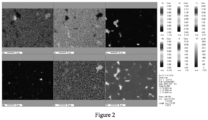
- the EPMA microanalysis of Example 1 is shown in Figure 2 .
- the composition of the main phase of the magnet is: Nd 25-28 Dy 0.1-2.1 Fe 65-71 Al 0.55-1.2 Co 1-2.5 B 0.9-1.1
- the composition of the grain boundary phase is: Nd 35-48 Dy 0.5-4.5 Fe 45-51 Al 0.05 - 0.25 Nb 1.5-6 B 0.8-1.1 Cu 6-15 Co 1-5.5 ; wherein, the proportion of the main phase is 88-93wt.%, and the proportion of the grain boundary phase is 7-12wt.%.
Landscapes
- Chemical & Material Sciences (AREA)
- Engineering & Computer Science (AREA)
- Power Engineering (AREA)
- Metallurgy (AREA)
- Materials Engineering (AREA)
- Mechanical Engineering (AREA)
- Organic Chemistry (AREA)
- Crystallography & Structural Chemistry (AREA)
- Inorganic Chemistry (AREA)
- Manufacturing & Machinery (AREA)
- Hard Magnetic Materials (AREA)
- Manufacturing Cores, Coils, And Magnets (AREA)
- Manufacture Of Metal Powder And Suspensions Thereof (AREA)
- Powder Metallurgy (AREA)
Description
- The present disclosure relates to high-Cu and high-Al neodymium iron boron magnet and preparation method therefor.
- Neodymium iron boron permanent magnet material is the most widely used rare earth permanent magnet material at present with its excellent performance, which is widely used in electronics, electric machinery, medical equipment, toys, packaging, hardware machinery, aerospace and other fields, more common in permanent magnet motors, speakers, magnetic separators, computer disk drives, magnetic resonance imaging equipment and meters, etc.
- Adding Cu element to the neodymium iron boron magnet can effectively improve the coercivity of the neodymium iron boron magnet. However, when the additive content of Cu exceeds 0.35wt.%, due to the enrichment of Cu at the grain boundary, micro-cracks will be formed after the magnet is sintered, thereby reducing the compactness and strength of the magnet, which affects the magnetic properties of the neodymium iron boron magnet and limits the availability of the high-Cu technology in the neodymium iron boron
CN 106 098 279 andCN 101 552 063 show related magnets. - The technical problem to be solved in the present disclosure is for overcoming the defect in the prior art that the mechanical properties of the sintered neodymium iron boron magnet will be poorer after increasing the Cu content, and thus high-Cu and high-Al neodymium iron boron magnet and preparation method therefor are provided. The present disclosure can effectively solve the problems of low mechanical strength and low intrinsic coercivity (Hcj) of high-Cu neodymium iron boron magnets by adding a certain proportion of Al, RH, and high-melting-point metal elements in combination.
- The present disclosure solves the above-mentioned technical problems through the method specified in
claims 1, 4, and 5.Claims 2 and 3 specify preferable solutions based on claim 1. - In the following, compositions for magnets are disclosed which encompass the inventive solutions achieved by the method of the claims.
- The present disclosure discloses a high-Cu and high-Al neodymium iron boron magnet, which comprises: 29.5-33.5% of R, 0.985% or more of B, 0.50% or more of Al, 0.35% or more of Cu, 1% or more of RH and 0.1-0.4% of high-melting-point element N and Fe; wherein, the percentage is the mass percentage of the element in the total amount of the elements;
- wherein, the mass percentage of the element content must satisfy the following relationships: (1) 1<RH<0.11R<3.54B; (2) 0.12RH<Al;
- wherein, Cu is copper; Al is aluminum; R is praseodymium Pr and/or neodymium Nd; B is boron; RH is dysprosium Dy and/or terbium Tb; high-melting-point metal element N is one or more selected from the group consisting of niobium Nb, zirconium Zr, titanium Ti and hafnium Hf; Fe is iron.
- The present disclosure also discloses a high-Cu and high-Al neodymium iron boron magnet, which is made from the following raw materials, the raw materials comprises: 29.5-33.5% of R, 0.985% or more of B, 0.50% or more of Al, 0.35% or more of Cu, 1% or more of RH and 0.1-0.4% of high-melting-point element N and Fe; wherein, the percentage is the mass percentage of the element in the total amount of the elements;
- wherein, the mass percentage of the element content must satisfy the following relationships: (1) 1<RH<0.11R<3.54B; (2) 0.12RH<Al;
- wherein, Cu is copper; Al is aluminum; R is praseodymium Pr and/or neodymium Nd; B is boron; RH is dysprosium Dy and/or terbium Tb; high-melting-point metal element N is one or more selected from the group consisting of niobium Nb, zirconium Zr, titanium Ti and hafnium Hf; Fe is iron.
- Preferably, the content of R is 29.5%-30.8%, for example, the content of R is 29.5%, 29.8%, 30%, 30.2%, 30.4% or 30.8%; wherein, the percentage is the mass percentage of the element in the total amount of the elements.
- Preferably, the content of B is 0.985%-1.100%; wherein, the percentage is the mass percentage of the element in the total amount of the elements.
- More preferably, the content of B is 0.985%-1%, for example, the content of B is 0.985%, 0.99% or 1%; wherein, the percentage is the mass percentage of the element in the total amount of the elements.
- Preferably, the content of Al is 0.50%-1.25%, for example, the content of Al is 0.5%, 0.6%, 0.8% or 1.25%; wherein, the percentage is the mass percentage of the element in the total amount of the elements.
- Preferably, the content of Cu is 0.35%-0.7%; wherein, the percentage is the mass percentage of the element in the total amount of the elements.
- More preferably, the content of Cu is 0.39%-0.6%, for example, the content of Cu is 0.39%, 0.4%, 0.41%, 0.42%, 0.48% or 0.6%; wherein, the percentage is the mass percentage of the element in the total amount of the elements.
- More preferably, the content of Cu is 0.35%≤Cu<0.5%, or 0.5%<Cu<0.7%; wherein, the percentage is the mass percentage of the element in the total amount of the elements.
- Preferably, the content of the RH is 1.0%-2.5%; wherein, the percentage is the mass percentage of the element in the total amount of the elements.
- More preferably, the content of the RH is 1.1%-2.3%, for example, the content of RH is 1.1%, 1.5%, 1.7%, 1.9%, 2.1%, 2.2% or 2.3%; wherein, the percentage is the mass percentage of the element in the total amount of the elements.
- Preferably, the content of the high-melting-point element N is 0.15%-0.35%; wherein, the percentage is the mass percentage of the element in the total amount of the elements.
- More preferably, the content of the high-melting-point element N is 0.2%-0.3%, for example, the content of the high-melting-point element N is 0.2%, 0.25% or 0.3%; wherein, the percentage is the mass percentage of the element in the total amount of the elements.
- Preferably, the neodymium iron boron magnet or the raw material of the neodymium iron boron magnet further comprises Co in a mass percentage of 0.9-2wt.%, for example, the content of Co is 1%; wherein, the percentage is the mass percentage of the element in the total amount of the elements.
- In the present disclosure, the content of Fe is conventional in the field.
- Preferably, the content of Fe is the balance of 100% by mass percentage.
- More preferably, the content of Fe is 64%-66%; wherein, the percentage is the mass percentage of the element in the total amount of the elements.
- In a preferred embodiment of the present disclosure, the high-Cu and high-Al neodymium iron boron magnet comprises: the content of Nd is 30.2%, Dy is 1.7%, Al is 0.6%, Cu is 0.4%, Co is 1%, Nb is 0.2%, B is 0.99%, and Fe is the balance; wherein, the percentage is the mass percentage of the element in the total amount of the elements.
- In a preferred embodiment of the present disclosure, the high-Cu and high-Al neodymium iron boron magnet comprises: the content of Nd is 30.8%, Dy is 1.1%, Al is 0.8%, Cu is 0.6%, Co is 1%, Nb is 0.2%, B is 0.99%, and Fe is the balance; wherein, the percentage is the mass percentage of the element in the total amount of the elements.
- In a preferred embodiment of the present disclosure, the high-Cu and high-Al neodymium iron boron magnet comprises: the content of Nd is 30.2%, Dy is 1.7%, Al is 0.6%, Cu is 0.48%, Co is 1%, Zr is 0.3%, B is 1%, and Fe is the balance; wherein, the percentage is the mass percentage of the element in the total amount of the elements.
- In a preferred embodiment of the present disclosure, the high-Cu and high-Al neodymium iron boron magnet comprises: the content of Nd is 30.2%, Tb is 1.1%, Al is 0.6%, Cu is 0.4%, Co is 1%, Zr is 0.3%, B is 0.985%, and Fe is the balance; wherein, the percentage is the mass percentage of the element in the total amount of the elements.
- In a preferred embodiment of the present disclosure, the high-Cu and high-Al neodymium iron boron magnet, which comprises: the content of Nd is 30.4%, Dy is 1.5%, Al is 1.25%, Cu is 0.39%, Co is 1%, Zr is 0.2%, B is 0.99%, and Fe is the balance; wherein, the percentage is the mass percentage of the element in the total amount of the elements.
- In a preferred embodiment of the present disclosure, the high-Cu and high-Al neodymium iron boron magnet, which comprises: the content of Nd is 30%, Dy is 2.2%, Al is 0.8%, Cu is 0.42%, Co is 1%, Zr is 0.2%, B is 0.99%, and Fe is the balance; wherein, the percentage is the mass percentage of the element in the total amount of the elements.
- In a preferred embodiment of the present disclosure, the high-Cu and high-Al neodymium iron boron magnet, which comprises: the content of Nd is 30%, Dy is 2.3%, Al is 0.6%, Cu is 0.4%, Co is 1%, Nb is 0.2%, B is 0.99%, and Fe is the balance; wherein, the percentage is the mass percentage of the element in the total amount of the elements.
- In a preferred embodiment of the present disclosure, the high-Cu and high-Al neodymium iron boron magnet, which comprises: the content of Nd is 29.8%, Dy is 2.3%, Al is 0.6%, Cu is 0.4%, Co is 1%, Nb is 0.2%, B is 0.99%, and Fe is the balance; wherein, the percentage is the mass percentage of the element in the total amount of the elements.
- In a preferred embodiment of the present disclosure, the high-Cu and high-Al neodymium iron boron magnet, which comprises: the content of Nd is 30.2%, Dy is 2.1%, Al is 0.6%, Cu is 0.4%, Co is 1%, Nb is 0.2%, B is 0.99%, and Fe is the balance; wherein, the percentage is the mass percentage of the element in the total amount of the elements.
- In a preferred embodiment of the present disclosure, the high-Cu and high-Al neodymium iron boron magnet, which comprises: the content of Nd is 30.2%, Dy is 1.9%, Al is 0.6%, Cu is 0.41%, Co is 1%, Nb is 0.2%, B is 0.99%, and Fe is the balance; wherein, the percentage is the mass percentage of the element in the total amount of the elements.
- In a preferred embodiment of the present disclosure, the high-Cu and high-Al neodymium iron boron magnet, which comprises: the content of Nd is 30.2%, Dy is 2.3%, Al is 0.5%, Cu is 0.4%, Co is 1%, Nb is 0.25%, B is 0.99%, and Fe is the balance; wherein, the percentage is the mass percentage of the element in the total amount of the elements.
- In a preferred embodiment of the present disclosure, the high-Cu and high-Al neodymium iron boron magnet, which comprises: the content of Nd is 29.5%, Dy is 1.5%, Al is 0.6%, Cu is 0.41%, Co is 1%, Nb is 0.2%, B is 0.99%, and Fe is the balance; wherein, the percentage is the mass percentage of the element in the total amount of the elements.
- The invention as specified in the claims is based on a preparation method for the high-Cu and high-Al neodymium iron boron magnet, which comprises the following steps: the raw materials of the high-Cu and high-Al neodymium iron boron magnet is successively subjected to melting, hydrogen decrepitation, jet milling, forming, sintering and aging.
- In the present disclosure, as is known to those skilled in the art, the raw material of the high-Cu and high-Al neodymium iron boron magnet is the raw material which satisfies the mass percentages of the element content and the relationships among the mass percentages of the element content of the high-Cu and high-Al neodymium iron boron magnet as described above. In the following, process parameters are disclosed that encompass those of the invention as specified in the claims.
- In the present disclosure, the melting can be conventional in the field, preferably, the melting is to obtain neodymium iron boron alloy casting strips by using strip casting method.
- Wherein, the average thickness of the neodymium iron boron alloy casting strips is preferably 0.25-0.35mm, more preferably 0.28-0.3mm, for example, 0.28mm, 0.29mm or 0.30mm.
- In the present disclosure, the hydrogen decrepitation can be conventional in the field. Preferably, the hydrogen decrepitation comprises a hydrogen adsorption process and a dehydrogenation process, and the neodymium iron boron alloy casting strips can be subjected to hydrogen decrepitation to obtain neodymium iron boron powder.
- Wherein, the hydrogen pressure of the hydrogen adsorption process is preferably 0.067-0.098MPa, more preferably 0.08-0.085MPa, for example, 0.081MPa.
- Wherein, the temperature of the dehydrogenation process is preferably 480-530°C, more preferably 500-510°C, for example, 500°C.
- In the present disclosure, the jet milling can be conventional in the field, preferably, the jet milling is to send the neodymium iron boron powder into a jet mill for jet milling to continue pulverizing to obtain fine powder.
- Wherein, the particle size of the fine powder is preferably 3.8-4.1µm, more preferably 3.9-4.0µm, for example, 3.95µm.
- Wherein, the oxygen content in the milling chamber of the jet mill in the jet milling is preferably 50ppm or less.
- Wherein, the rotation speed of the sorting wheel in the jet milling is preferably 3500-4300rpm/min, more preferably 3900-4100rpm/min, for example, 4000rpm/min.
- In the present disclosure, the forming can be conventional in the field, preferably, the fine powder is formed by orientation under a certain magnetic field intensity to obtain a compact.
- Wherein, the forming is preferably carried out under the magnetic field intensity of 1.8T or more and the protection of nitrogen atmosphere.
- Wherein, the forming is preferably carried out under the magnetic field intensity of 1.8-2.5T, for example, 1.9T.
- In the present disclosure, the sintering can be conventional in the field.
- Wherein, the temperature of the sintering is preferably 1030-1080°C, more preferably 1040-1050°C, for example, 1040°C or 1050°C.
- Wherein, the time of the sintering is preferably 4-7 hours, more preferably 6h.
- In the present disclosure, the aging can be conventional in the field.
- Wherein, the temperature of the aging treatment is preferably 460-520°C, more preferably 500°C.
- Wherein, the time of the aging treatment is preferably 4-10h, more preferably 6h.
- The present disclosure also discloses a high-Cu and high-Al neodymium iron boron magnet, which comprises: main phase and grain boundary phase;
- wherein, the composition of the main phase is: R23-29RH0.1-3.1Fe66-73.5Al0.45-1.53B0.9-1.1; the composition of the grain boundary phase is: R35-48RH0.5-5.9Fe46-56.5Al0.05-0.25N1.5-6.2B0.8-1.1Cu6-15;
- wherein, Cu is copper; Al is aluminum; R is praseodymium Pr and/or neodymium Nd; B is boron; RH is dysprosium Dy and/or terbium Tb; high-melting-point metal element N is one or more selected from the group consisting of niobium Nb, zirconium Zr, titanium Ti and hafnium Hf; Fe is iron;
- wherein, the mass ratio of the main phase to the magnet is 86-94wt.%, and the mass ratio of the grain boundary phase to the magnet is 5-14wt.%;
- preferably, the composition of the main phase is: R23-29R.H0.1-3.1Fe65-71Al0.45-1.53Co1-2.5B0.9-1.1; the composition of the grain boundary phase is: R35-48RH0.5-5.9Fe45-51Al0.05-0.25N1.5-6.2B0.8-1.1Cu6-15Co1-5.5;
- wherein, Co is cobalt.
- The present disclosure also discloses a use of the high-Cu and high-Al neodymium iron boron magnet as mentioned above in a motor as motor rotor magnet material.
- Based on the common sense in the field, the preferred conditions of the preparation methods can be combined arbitrarily to obtain preferred examples of the present disclosure.
- The reagents and raw materials used in the present disclosure are commercially available.
- The positive progressive effects of the present disclosure are as follows:
- The present disclosure can effectively solve the problem of insufficient strength of high-Cu magnet and meanwhile ensure the magnetic properties of the magnet material by adding a certain proportion of Al, RH, and high-melting-point metal elements in combination.
- The neodymium iron boron magnet of the present disclosure can meet the following conditions: Br is greater than 12.5kGs, Hcj is greater than 23kOe, Hk/Hcj is greater than 0.97, and bending strength is greater than 430MPa.
-
-
Figure 1 is the SEM spectrum of the neodymium iron boron magnet of Example 1. -
Figure 2 is the EPMA spectrum of the neodymium iron boron magnet of Example 1. - The following examples further illustrate the present disclosure, but the present disclosure is not limited thereto. Experiment methods in which specific conditions are not indicated in the following examples are selected according to conventional methods and conditions, or according to the product specification.
- The mass percentages of the elements in the neodymium iron boron magnet in each Examples 1-12 and Comparative Examples 13-24 are shown in Table 1 below.
- In the table below, wt.% refers to the mass percentage of the element in the total amount of the elements, and "/" means that the element is not added. "Br" is remanence, "Hcj" is the intrinsic coercivity, and "Hk/Hcj" is the squareness ratio.
Table 1 the mass percentages of the elements in neodymium iron boron magnets Content (wt.%) No. Pr Nd Tb Dy Al Cu Co Nb Zr B Fe 1 / 30.2 / 1.7 0.6 0.4 1 0.2 / 0.99 bal 2 / 30.8 / 1.1 0.8 0.6 1 0.2 / 0.99 bal 3 / 30.2 / 1.7 0.6 0.48 1 / 0.3 1 bal 4 / 30.2 1.1 / 0.6 0.4 1 / 0.3 0.985 bal 5 / 30.4 / 1.5 1.25 0.39 1 / 0.2 0.99 bal 6 / 30 / 2.2 0.8 0.42 1 / 0.2 0.99 bal 7 / 30 / 2.3 0.6 0.4 1 0.2 / 0.99 bal 8 / 29.8 / 2.3 0.6 0.4 1 0.2 / 0.99 bal 9 / 30.2 / 2.1 0.6 0.4 1 0.2 / 0.99 bal 10 / 30.2 / 1.9 0.6 0.41 1 0.2 / 0.99 bal 11 / 30.2 / 2.3 0.5 0.4 1 0.25 / 0.99 bal 12 / 29.5 / 1.5 0.6 0.41 1 0.2 / 0.99 bal 13 / 30.2 / 1.7 0.4 0.4 1 0.25 / 0.99 bal 14 / 30.2 / / / 0.4 1 / / 0.99 bal 15 / 30.2 / / 0.6 0.4 1 / / 0.99 bal 16 / 30.2 / 1.7 / 0.4 1 / / 0.99 bal 17 / 30.2 / / / 0.4 1 0.2 / 0.99 bal 18 7.55 22.65 / 1.7 0.18 0.4 1 0.2 / 0.99 bal 19 / 30.2 / 0.5 0.6 0.4 1 0.2 / 0.99 bal 20 / 26 / 3 0.6 0.4 1 0.2 / 0.99 bal 21 / 32 / 1.1 0.6 0.4 1 0.2 / 0.99 bal 22 / 30.2 / 1.7 0.6 0.48 1 / 0.3 1 bal 23 7.55 22.65 / 1.7 0.6 0.48 1 / 0.3 1 bal 24 / 30.2 / 1.7 0.6 0.48 1 / 0.3 1 bal Note: bal refers to the balance. - The preparation method for neodymium iron boron magnet was as follows:
- (1) Melting: according to the mass percentages of the elements in each example and comparative example as shown in Table 1, the raw material formulas meeting the mass percentages of the elements were configured. The raw material was melted and the strip casting method was adopted to obtain neodymium iron boron alloy casting strips.
The average thickness of the neodymium iron boron alloy casting strips was 0.28mm. - (2) Hydrogen decrepitation: the hydrogen pressure of the hydrogen adsorption process of the neodymium iron boron alloy casting strips was 0.081MPa; the temperature of the dehydrogenation process was 500°C, neodymium iron boron powder was obtained.
- (3) Jet milling: the neodymium iron boron powder was sent into a jet mill for jet milling to continue pulverizing, fine powder was obtained.
- The oxygen content in the milling chamber of the jet mill was 50ppm or less.
- The rotation speed of the sorting wheel in the jet milling was 4000rpm/min.
- The particle size of fine powder was 3.95µm.
- (4) Forming: the fine powder was formed by orientation under a certain magnetic field intensity to obtain the compact.
- The forming was carried out under the magnetic field intensity of 1.9T and the protection of nitrogen atmosphere.
- The temperature of the sintering was 1050°C. The time of the sintering was 6h.
- The temperature of the aging treatment was 500°C. The time of the aging treatment was 6h.
- In the preparation process of Examples 5-12 and Comparative Examples 13-17, except that the selected raw material formulas were different, the parameters in the preparation process were the same as those in Example 1.
- The preparation method for neodymium iron boron magnet was as follows:
- Except that the selected raw material formulas were different and the average thickness of the neodymium iron boron alloy casting strips in the step (1) melting was 0.30mm, the other parameters in the preparation process were the same as those in Example 1.
- For the preparation process of Comparative Examples 18-21, except that the selected raw material formulas were different, the parameters in the preparation process were the same as those in Example 2.
- The preparation method for neodymium iron boron magnet was as follows:
- Except that the selected raw material formulas were different and the temperature of the sintering in step (5) sintering was 1040°C, the other parameters in the preparation process were the same as those in Example 1.
- The preparation method for neodymium iron boron magnet was as follows:
- Except that the selected raw material formulas were different and the average thickness of the neodymium iron boron alloy casting strips in the step (1) melting was 0.29mm, the other parameters in the preparation process were the same as those in Example 1.
- The preparation method for neodymium iron boron magnet was as follows:
- Except that the selected raw material formulas were different and the average thickness of the neodymium iron boron alloy casting strips in the step (1) melting was 0.38mm, the other parameters in the preparation process were the same as those in Example 3.
- The preparation method for neodymium iron boron magnet was as follows:
- Except that the selected raw material formulas were different and the temperature of the sintering in step (5) sintering was 1080°C, the other parameters in the preparation process were the same as those in Example 3.
- The preparation method for neodymium iron boron magnet was as follows:
- Except that the selected raw material formulas were different and the particle size of fine powder in the step (3) jet milling was 4.25µm, the other parameters in the preparation process were the same as those in Example 3.
- The magnetic properties and bending strength of the neodymium iron boron magnets prepared in each example and comparative example were measured, as shown in Table 2 below.
- The Br, Hcj and Hk/Hcj in each example and comparative example of the present disclosure were tested using the NIM-62000 rare earth permanent magnet measurement system of the National Institute of Metrology, China; the bending strength was tested under the standard of GB/T 14452-93 (three-point bending) using three-point bending equipment.
Table 2 the magnetic properties and bending strength of the neodymium iron boron magnets 1kGs=0.1T and 1kOe=1/ (4π)A/m, wherein No. Br (kGs) Hcj (kOe) Hk/Hcj Bending strength (MPa) 1 13.12 23.36 0.99 451 2 13.11 23.25 0.98 447 3 13.09 23.51 0.99 439 4 13.37 23.74 0.99 445 5 12.58 26.03 0.98 436 6 12.74 25.71 0.99 465 7 12.87 25.07 0.99 439 8 12.91 24.98 0.99 446 9 12.92 24.56 0.98 438 10 13.02 23.96 0.98 451 11 12.91 24.66 0.99 453 12 13.12 24.25 0.97 436 13 13.32 21.31 0.99 396 14 14.10 14.86 0.87 352 15 13.63 17.73 0.89 332 16 13.75 19.25 0.85 315 17 13.98 15.35 0.84 337 18 13.52 20.22 0.93 396 19 13.41 19.36 0.98 387 20 13.45 22.98 0.87 393 21 13.10 20.38 0.83 364 22 13.08 21.68 0.94 403 23 13.09 21.83 0.85 412 24 13.10 21.23 0.83 354 - It can be seen that the examples of the present disclosure can effectively solve the problems of insufficient strength of high-Cu magnet and meanwhile ensure the magnetic properties of magnet material.
- By adding a certain amount of Cu, Al, Dy, Nb in combination, it can be found that Cu and high-melting-point elements such as Nb are enriched in most of the grain boundary phase area in the magnet, while the heavy rare earth elements Dy and Al are barren at grain boundaries; more specifically, Cu and high-melting-point elements such as Nb are enriched in the grain boundary phase area, and the existence of enrichment area of Cu and the high-melting-point elements in the grain boundary phase contributes to preventing the abnormal growth of crystal grains during the sintering process, reducing the sensitivity of the magnet to the temperature of the sintering, which is beneficial to increase the temperature of the sintering, the increase of the sintering temperature is beneficial to improve the coercive force and mechanical strength of the magnet. At the same time, the content of Al and Dy in the grain boundary phase is relatively low, the poorness of Al and Dy in the grain boundary phase means that more Al and Dy exist in the phase interface between the main phase and grain boundary phase of the neodymium iron boron magnet, the existence of Al in the phase interface is beneficial to improve the fluidity of the intergranular phase during the high-temperature heat treatment process, thereby forming a more stable phase interface and reducing the interface energy, thereby improving the mechanical strength of the magnet. The existence of Dy in the phase interface is beneficial to increase the magnetocrystalline anisotropy field of the phase interface, thereby increasing the coercivity of the magnet.
- Taking Example 1 as an example, it can be seen from the SEM spectrum (
Figure1 ) that the magnet of Example 1 is composed of main phase of Nd2Fe14B (reference number 1, gray area) and intergranular Nd-riched phase (reference number 2, silver-white area). The EPMA microanalysis of Example 1 is shown inFigure 2 . - The results of EPMA microanalysis can be obtained from
Figure 2 : - The composition of the main phase of the magnet is: Nd25-28 Dy0.1-2.1Fe65-71Al0.55-1.2Co1-2.5B0.9-1.1, the composition of the grain boundary phase is: Nd35-48 Dy0.5-4.5Fe45-51Al0.05-0.25Nb1.5-6B0.8-1.1Cu6-15Co1-5.5; wherein, the proportion of the main phase is 88-93wt.%, and the proportion of the grain boundary phase is 7-12wt.%.
- The above is the main reason why the mechanical strength and coercivity of the magnet with high Cu content in the present disclosure do not deteriorate due to the high Cu content.
No. Main phase Main phase content (%) Grain boundary phase Grain boundaryp hase content (%) 1 Nd25-28Dy0.1-2.1Fe65-71Al0.55-1.2Co1- 2.5B0.9-1.1 88-93wt% Nd35-48Dy0.5-4.5Fe45-51Al0.05-0.25Nb1.5- 6B0.8-1.1Cu6-15Co1-5.5 7-12wt% 2 Nd25-28Dy0.1-1.8Fe65-71Al0.77-1.2Co1- 2.5B0.9-1.1 88-94wt% Nd35-48Dy0.5-4.1Fe45-51Al0.05-0.24Nb1.5- 6B0.8-1.1Cu6-14Co1-5.5 6-12wt% 3 Nd24-28Dy0.1-2.2Fe65-71Al0.77-1.2Co1- 2.5B0.9-1.1 88-93wt% Nd35-48Dy0.5-3.9Fe45-51Al0.05-0.25Zr1.5- 6.2B0.8-1.1Cu6-14Co1-5.5 7-12wt% 4 Nd24-28Tb1-1.8Fe65-71Al0.77-1.2Co 1-2.5 B0.9-1.1 89-95wt% Nd35-48Dy0.5-4.1Fe45-51Al0.05-0.25Zr1.5- 6.2B0.8-1.1Cu6-14Co1-5.5 5-11wt% 5 Nd23-28Dy0.1-2.1Fe65-71Al0.79- 1.53Co1-2.5B0.9-1.1 87-93wt% Nd35-48Dy0.5-4.5Fe45-51Al0.05.0.25Zr1.5- 5.6B0.8-1.1Cu6-15Co1-5.5 7-13wt% 6 Nd24-28Dy0.2-3.1Fe65-71Al 0.75-1.45 Co1-2.5B0.9-1.1 86-92wt% Nd35-48Dy0.7-5.6Fe45-51Al0.05-0.25Zr1.5- 5.5B0.8-1.1Cu6-15Co1-5.5 8-14wt% 7 Nd25-28Dy0.2-3.1Fe65-71Al0.75- 1.42Co1-2.5B0.9-1.1 86-92wt% Nd35-48Dy0.7-5.8Fe45-51Al0.05-0.21Nb1.5- 5.5B0.8-1.1Cu6-15Co1-5.5 8-14wt% 8 Nd25-27Dy0.1-2.6Fe65-71Al0.55-1.2Co1- 2.5B0.9-1.1 89-94wt% Nd35-48Dy0.5-4.8Fe45-51Al0.05-0.24Nb1.5- 6B0.8-1.1Cu6-15Co1-5.5 6-11wt% 9 Nd25-29Dy0.1-2.0Fe65-71Al0.55-1.2Co1- 2.5B0.9-1.1 88-93wt% Nd35-48Dy0.5-4.3Fe45-51Al0.05-0.25Nb1.5- 6B0.8-1.1Cu6-15Co1-5.5 7-12wt% 10 Nd25-29Dy0.1-1.8Fe65-71Al0.55-1.2Co1- 2.5B0.9-1.1 88-94wt% Nd35-48Dy0.5-4.1Fe45-51Al0.05-0.25Nb1.5- 6B0.8-1.1Cu6-15Co1-5.5 6-12wt% 11 Nd25-29D0.2-3.1Fe65-70Al0.45- 0.83Co1-2.5B0.9-1.1 86-92wt% Nd35-48Dy0.8-5.9Fe45-51Al0.05-0.21Nb1.5- 5.8B0.8-1.1Cu6-15Co1-5.5 8-14wt% 12 Nd25-27Dy0.2-3.0Fe65-71Al0.47- 0.91Co1-2.5B0.9-1.1 86-92wt% Nd35-48Dy0.7-4.7Fe45-51Al0.05-0.21Nb1.5- 5.3B0.8-1.1Cu6-15Co1-5.5 8-14wt% 13 Nd25-28Dy0.1-2.5Fe65-71Al0.32- 0.67Co1-2.5B0.9-1.1 89-94wt% Nd35-48Dy0.5-2.5Fe45-51Al0.05-0.15Nb1.5- 6B0.8-1.1Cu6-15Co1-5.5 6-11wt% 14 Nd27-31Fe65-71Co1-2.5B0.9-1.1 90-95wt% Nd36-53Fe45-51B0.8-1.1Cu6-14Co1-5.5 5-10wt% 15 Nd26-31Fe65-71Al0.30-0.83Co1-2.5B0.9- 1.1 88-95wt% Nd35-48Fe45-51Al0.05-0.24B0.8-1.1Cu6- 14Co1-5.5 5-12wt% 16 Nd25-28Dy0.1-2.1Fe65-71Co1-2.5B0.9-1.1 90-94wt% Nd35-48Dy0.5-4.5Fe45-51B0.8-1.1Co1-5.5 6-10wt% 17 Nd26-31Fe65-71Co1-2.5B0.9-1.1 88-93wt% Nd38-53Fe45-51Nb1.5-6B0.8-1.1Cu6-15Co1- 5.5 7-12wt% 18 Nd18-20Pr7-9Dy0.1-2.1Fe65-71Al0.15- 0.34Co1-2.5B0.9-1.1 88-93wt% Nd20-30Pr15-19Dy0.5-4.5Fe45-51Al0.05- 0.10Nb1.5-6B0.8-1.1Cu6-15Co1-5.5 7-12wt% 19 Nd25-28Dy0.1-0.6Fe65-71Al0.55-1.1Co1-2.5B0.9-1.1 89-94wt% Nd35-48Dy0.2-0.6Fe45-51Al0.05-0.35Nb1.5- 6B0.8-1.1Cu6-15Co1-5.5 6-11wt% 20 Nd25-28Dy0.1-2.8Fe65-71Al0.55-1.2Co1- 2.5B0.9-1.1 91-96wt% Nd35-48Dy0.5-5.7Fe45-51Al0.05-0.25Nb1.5- 6B0.8-1.1Cu6-15Co1-5.5 4-9wt% 21 Nd25-28Dy0.1-1.5Fe65-71Al0.55-1.2Co1- 2.5B0.9-1.1 87-92wt% Nd35-48Dy0.5-4.1Fe45-51Al0.05-0.25Nb1.5- 6B0.71-0.79Cu6-15Co1-5.5 8-13wt% 22 Nd25-29Dy0.1-2.1Fe65-72Al0.55-1.1Co1- 2.5B0.9-1.1 89-94wt% Nd35-46Dy0.5-4.5Fe45-52Al0.05-0.25Nb1.5- 6B0.8-1.1Cu6-14Co1-5.5 6-11wt% 23 Nd18-20Pr7-9Dy0.1-2.1Fe65-71Al0.15- 0.34Co1-2.5B0.9-1.1 88-94wt% Nd20-30Pr15-19Dy0.5-4.5Fe45-51Al0.05- 0.10Nb1.5-6B0.8-1.1Cu6-15Co1-5.5 6-12wt% 24 Nd25-27Dy0.1-2.1Fe65-70Al0.55-1.2Co1- 2.5B0.9-1.1 88-93wt% Nd35-49Dy0.5-4.5Fe45-52Al0.05-0.25Nb1.5- 6B0.8-1.1Cu6-15Co1-5.5 7-12wt%
Claims (5)
- A preparation method for a high-Cu and high-Al neodymium iron boron magnet, wherein the high-Cu and high-Al neodymium iron boron magnet is made from a raw material that comprises:the content of R is 29.5%-30.8%, for example, the content of R is 29.5%, 29.8%, 30%, 30.2%, 30.4% or 30.8%;the content of B is 0.985%-1.100%; preferably, the content of B is 0.985%-1%, for example, the content of B is 0.985%, 0.99% or 1%;the content of Al is 0.50%-1.25%, for example, the content of Al is 0.5%, 0.6%, 0.8% or 1.25%;the content of Cu is 0.35%-0.7%; preferably, the content of Cu is 0.39%-0.6%, for example, the content of Cu is 0.39%, 0.4%, 0.41%, 0.42%, 0.48% or 0.6%; preferably, the content of Cu is 0.35%≤Cu<0.5%, or 0.5%<Cu<0.7%;the content of the RH is 1.5%-2.5%; preferably, the content of the RH is 1.5%-2.3%, for example, the content of RH is 1.5%, 1.7%, 1.9%, 2.1%, 2.2% or 2.3%;the content of the high-melting-point element N is 0.15%-0.35%; preferably, the content of the high-melting-point element N is 0.2%-0.3%, for example, the content of the high-melting-point element N is 0.2%, 0.25% or 0.3%;the content of Fe is the balance of 100% by mass percentage; preferably, the content of Fe is 64%-66%;wherein Cu is copper; Al is aluminum; R is praseodymium Pr and/or neodymium Nd; B is boron; RH is dysprosium Dy and/or terbium Tb; high-melting-point metal element N is one or more selected from the group consisting of niobium Nb, zirconium Zr, titanium Ti and hafnium Hf; Fe is iron;wherein, the percentage is the mass percentage of the element in the total amount of the elements;wherein the preparation method comprises the following steps: the raw materials are successively subjected to melting, hydrogen decrepitation, jet milling, forming, sintering and aging;wherein the melting is to obtain neodymium iron boron alloy casting strips by using strip casting method;the hydrogen decrepitation comprises a hydrogen adsorption process and a dehydrogenation process, to obtain neodymium iron boron powder;wherein, the hydrogen pressure of the hydrogen adsorption process is 0.067-0.098MPa, more preferably 0.08-0.085MPa, for example, 0.081MPa;wherein, the temperature of the dehydrogenation process is 480-530°C, more preferably 500-510°C, for example, 500°C;the jet milling is to send the neodymium iron boron powder into a jet mill for jet milling to continue pulverizing to obtain fine powder;wherein, the oxygen content in the milling chamber of the jet mill in the jet milling is 50ppm or less;wherein, the rotation speed of the sorting wheel in the jet milling is 3500-4300rpm/min, preferably 3900-4100rpm/min, for example, 4000rpm/min;the forming is carried out under the magnetic field intensity of 1.8T or more and the protection of nitrogen atmosphere; the magnetic field intensity of the forming is preferably 1.8-2.5T, for example, 1.9T;the time of the sintering is 4-7 hours, preferably 6h;the temperature of aging treatment is 460-520°C, preferably 500°C;the time of aging treatment is 4-10h, preferably 6h;wherein the average thickness of the neodymium iron boron alloy casting strips is 0.28-0.3mm, for example, 0.28mm, 0.29mm or 0.30mm;the particle size of the fine powder is 3.9-4.0µm, for example, 3.95µm;and the temperature of the sintering is 1040-1050°C, for example, 1040°C or 1050°C.
- The preparation method according to claim 1, wherein the raw material for the neodymium iron boron magnet further comprises Co in a mass percentage of 0.9-2wt.%, for example, the content of Co is 1%; wherein, the percentage is the mass percentage of the element in the total amount of the elements.
- The preparation method according to claim 1 or 2, wherein the raw material for the high-Cu and high-Al neodymium iron boron magnet comprises:the content of Nd is 30.2%, Dy is 1.7%, Al is 0.6%, Cu is 0.4%, Co is 1%, Nb is 0.2%, B is 0.99%, and Fe is the balance; wherein, the percentage is the mass percentage of the element in the total amount of the elements;or, the high-Cu and high-Al neodymium iron boron magnet comprises: the content of Nd is 30.8%, Dy is 1.1%, Al is 0.8%, Cu is 0.6%, Co is 1%, Nb is 0.2%, B is 0.99%, and Fe is the balance; wherein, the percentage is the mass percentage of the element in the total amount of the elements;or, the high-Cu and high-Al neodymium iron boron magnet comprises: the content of Nd is 30.2%, Dy is 1.7%, Al is 0.6%, Cu is 0.48%, Co is 1%, Zr is 0.3%, B is 1%, and Fe is the balance; wherein, the percentage is the mass percentage of the element in the total amount of the elements;or, the high-Cu and high-Al neodymium iron boron magnet comprises: the content of Nd is 30.2%, Tb is 1.1%, Al is 0.6%, Cu is 0.4%, Co is 1%, Zr is 0.3%, B is 0.985%, and Fe is the balance; wherein, the percentage is the mass percentage of the element in the total amount of the elements;or, the high-Cu and high-Al neodymium iron boron magnet comprises: the content of Nd is 30.4%, Dy is 1.5%, Al is 1.25%, Cu is 0.39%, Co is 1%, Zr is 0.2%, B is 0.99%, and Fe is the balance; wherein, the percentage is the mass percentage of the element in the total amount of the elements;or, the high-Cu and high-Al neodymium iron boron magnet comprises: the content of Nd is 30%, Dy is 2.2%, Al is 0.8%, Cu is 0.42%, Co is 1%, Zr is 0.2%, B is 0.99%, and Fe is the balance; wherein, the percentage is the mass percentage of the element in the total amount of the elements;or, the high-Cu and high-Al neodymium iron boron magnet comprises: the content of Nd is 30%, Dy is 2.3%, Al is 0.6%, Cu is 0.4%, Co is 1%, Nb is 0.2%, B is 0.99%, and Fe is the balance; wherein, the percentage is the mass percentage of the element in the total amount of the elements;or, the high-Cu and high-Al neodymium iron boron magnet comprises: the content of Nd is 29.8%, Dy is 2.3%, Al is 0.6%, Cu is 0.4%, Co is 1%, Nb is 0.2%, B is 0.99%, and Fe is the balance; wherein, the percentage is the mass percentage of the element in the total amount of the elements;or, the high-Cu and high-Al neodymium iron boron magnet comprises: the content of Nd is 30.2%, Dy is 2.1%, Al is 0.6%, Cu is 0.4%, Co is 1%, Nb is 0.2%, B is 0.99%, and Fe is the balance; wherein, the percentage is the mass percentage of the element in the total amount of the elements;or, the high-Cu and high-Al neodymium iron boron magnet comprises: the content of Nd is 30.2%, Dy is 1.9%, Al is 0.6%, Cu is 0.41%, Co is 1%, Nb is 0.2%, B is 0.99%, and Fe is the balance; wherein, the percentage is the mass percentage of the element in the total amount of the elements;or, the high-Cu and high-Al neodymium iron boron magnet comprises: the content of Nd is 30.2%, Dy is 2.3%, Al is 0.5%, Cu is 0.4%, Co is 1%, Nb is 0.25%, B is 0.99%, and Fe is the balance; wherein, the percentage is the mass percentage of the element in the total amount of the elements;or, the high-Cu and high-Al neodymium iron boron magnet comprises: the content of Nd is 29.5%, Dy is 1.5%, Al is 0.6%, Cu is 0.41%, Co is 1%, Nb is 0.2%, B is 0.99%, and Fe is the balance; wherein, the percentage is the mass percentage of the element in the total amount of the elements.
- A preparation method for a high-Cu and high-Al neodymium iron boron magnet, wherein the raw material of the high-Cu and high-Al neodymium iron boron magnet comprises:the content of Nd is 30.8%, Dy is 1.1%, Al is 0.8%, Cu is 0.6%, Co is 1%, Nb is 0.2%, B is 0.99%, and Fe is the balance; wherein, the percentage is the mass percentage of the element in the total amount of the elements;wherein the preparation method comprises the following steps: the raw materials are successively subjected to melting, hydrogen decrepitation, jet milling, forming, sintering and aging;wherein the melting is to obtain neodymium iron boron alloy casting strips by using strip casting method;the hydrogen decrepitation comprises a hydrogen adsorption process and a dehydrogenation process, to obtain neodymium iron boron powder;wherein, the hydrogen pressure of the hydrogen adsorption process is 0.067-0.098MPa, more preferably 0.08-0.085MPa, for example, 0.081MPa;wherein, the temperature of the dehydrogenation process is 480-530°C, more preferably 500-510°C, for example, 500°C;the jet milling is to send the neodymium iron boron powder into a jet mill for jet milling to continue pulverizing to obtain fine powder;wherein, the oxygen content in the milling chamber of the jet mill in the jet milling is 50ppm or less;wherein, the rotation speed of the sorting wheel in the jet milling is 3500-4300rpm/min, preferably 3900-4100rpm/min, for example, 4000rpm/min;the forming is carried out under the magnetic field intensity of 1.8T or more and the protection of nitrogen atmosphere; the magnetic field intensity of the forming is preferably 1.8-2.5T, for example, 1.9T;the time of the sintering is 4-7 hours, preferably 6h;the temperature of aging treatment is 460-520°C, preferably 500°C;the time of aging treatment is 4-10h, preferably 6h;wherein the average thickness of the neodymium iron boron alloy casting strips is 0.30mm;the particle size of the fine powder is 3.9-4.0µm, for example, 3.95µm;and the temperature of the sintering is 1040-1050°C, for example, 1040°C or 1050°C.
- A preparation method for a high-Cu and high-Al neodymium iron boron magnet, wherein the raw material of the high-Cu and high-Al neodymium iron boron magnet comprises:the content of Nd is 30.2%, Tb is 1.1%, Al is 0.6%, Cu is 0.4%, Co is 1%, Zr is 0.3%, B is 0.985%, and Fe is the balance; wherein, the percentage is the mass percentage of the element in the total amount of the elements;wherein the preparation method comprises the following steps: the raw materials are successively subjected to melting, hydrogen decrepitation, jet milling, forming, sintering and aging;wherein the melting is to obtain neodymium iron boron alloy casting strips by using strip casting method;the hydrogen decrepitation comprises a hydrogen adsorption process and a dehydrogenation process, to obtain neodymium iron boron powder;wherein, the hydrogen pressure of the hydrogen adsorption process is 0.067-0.098MPa, more preferably 0.08-0.085MPa, for example, 0.081MPa;wherein, the temperature of the dehydrogenation process is 480-530°C, more preferably 500-510°C, for example, 500°C;the jet milling is to send the neodymium iron boron powder into a jet mill for jet milling to continue pulverizing to obtain fine powder;wherein, the oxygen content in the milling chamber of the jet mill in the jet milling is 50ppm or less;wherein, the rotation speed of the sorting wheel in the jet milling is 3500-4300rpm/min, preferably 3900-4100rpm/min, for example, 4000rpm/min;the forming is carried out under the magnetic field intensity of 1.8T or more and the protection of nitrogen atmosphere; the magnetic field intensity of the forming is preferably 1.8-2.5T, for example, 1.9T;the time of the sintering is 4-7 hours, preferably 6h;the temperature of aging treatment is 460-520°C, preferably 500°C;the time of aging treatment is 4-10h, preferably 6h;wherein the average thickness of the neodymium iron boron alloy casting strips is 0.29mm;the particle size of the fine powder is 3.9-4.0µm, for example, 3.95µm;and the temperature of the sintering is 1040-1050°C, for example, 1040°C or 1050°C.
Applications Claiming Priority (2)
| Application Number | Priority Date | Filing Date | Title |
|---|---|---|---|
| CN201911348739.0A CN110993234B (en) | 2019-12-24 | 2019-12-24 | High Cu high Al NdFeB magnet and preparation method thereof |
| PCT/CN2020/100582 WO2021128802A1 (en) | 2019-12-24 | 2020-07-07 | High-cu and high-al neodymium iron boron magnet and preparation method therefor |
Publications (4)
| Publication Number | Publication Date |
|---|---|
| EP4016561A1 EP4016561A1 (en) | 2022-06-22 |
| EP4016561A4 EP4016561A4 (en) | 2022-10-19 |
| EP4016561C0 EP4016561C0 (en) | 2025-06-11 |
| EP4016561B1 true EP4016561B1 (en) | 2025-06-11 |
Family
ID=70074888
Family Applications (1)
| Application Number | Title | Priority Date | Filing Date |
|---|---|---|---|
| EP20908416.9A Active EP4016561B1 (en) | 2019-12-24 | 2020-07-07 | High-cu and high-al neodymium iron boron magnet and preparation method therefor |
Country Status (7)
| Country | Link |
|---|---|
| US (1) | US12416070B2 (en) |
| EP (1) | EP4016561B1 (en) |
| JP (1) | JP7214041B2 (en) |
| KR (1) | KR102589813B1 (en) |
| CN (1) | CN110993234B (en) |
| TW (1) | TWI741909B (en) |
| WO (1) | WO2021128802A1 (en) |
Families Citing this family (7)
| Publication number | Priority date | Publication date | Assignee | Title |
|---|---|---|---|---|
| CN110993234B (en) | 2019-12-24 | 2021-06-25 | 厦门钨业股份有限公司 | High Cu high Al NdFeB magnet and preparation method thereof |
| CN111180159B (en) * | 2019-12-31 | 2021-12-17 | 厦门钨业股份有限公司 | Neodymium-iron-boron permanent magnet material, preparation method and application |
| CN111524675B (en) * | 2020-04-30 | 2022-02-08 | 福建省长汀金龙稀土有限公司 | R-T-B series permanent magnetic material and preparation method and application thereof |
| CN111599562B (en) * | 2020-05-29 | 2024-03-29 | 福建省金龙稀土股份有限公司 | Neodymium-iron-boron permanent magnet material, raw material composition thereof, preparation method and application thereof |
| CN113674944B (en) | 2021-07-29 | 2023-10-20 | 福建省长汀金龙稀土有限公司 | Neodymium-iron-boron magnet material and preparation method and application thereof |
| CN113674943B (en) | 2021-07-29 | 2023-01-24 | 福建省长汀金龙稀土有限公司 | Neodymium-iron-boron magnet material and preparation method and application thereof |
| KR102511700B1 (en) * | 2022-10-13 | 2023-03-21 | 귀네테르 주식회사 | Manufacturing method of magnetic substance to release magnetic energy for treatment |
Family Cites Families (24)
| Publication number | Priority date | Publication date | Assignee | Title |
|---|---|---|---|---|
| US7485193B2 (en) * | 2004-06-22 | 2009-02-03 | Shin-Etsu Chemical Co., Ltd | R-FE-B based rare earth permanent magnet material |
| KR20070023643A (en) * | 2004-06-22 | 2007-02-28 | 신에쓰 가가꾸 고교 가부시끼가이샤 | R- フ e-B rare earth permanent magnet material |
| US9324485B2 (en) * | 2008-02-29 | 2016-04-26 | Daido Steel Co., Ltd. | Material for anisotropic magnet and method of manufacturing the same |
| CN101552063A (en) * | 2008-12-09 | 2009-10-07 | 宁波同创强磁材料有限公司 | High-performance neodymium-iron-boron magnet with composite addition of titanium and zirconium |
| CN101552062A (en) * | 2008-12-09 | 2009-10-07 | 宁波同创强磁材料有限公司 | Medium-to-high grade neodymium-iron-boron magnet with composite addition of gadolinium and holmium |
| US10410777B2 (en) * | 2013-08-09 | 2019-09-10 | Tdk Corporation | R-T-B based sintered magnet and motor |
| DE112015001049T5 (en) | 2014-02-28 | 2016-12-08 | Hitachi Metals Ltd. | R-T-B-based sintered magnet and process for its preparation |
| CN103996475B (en) * | 2014-05-11 | 2016-05-25 | 沈阳中北通磁科技股份有限公司 | A kind of high-performance Ne-Fe-B rare-earth permanent magnet and manufacture method with compound principal phase |
| JP6493138B2 (en) * | 2015-10-07 | 2019-04-03 | Tdk株式会社 | R-T-B sintered magnet |
| CN105513737A (en) | 2016-01-21 | 2016-04-20 | 烟台首钢磁性材料股份有限公司 | Preparation method of sintered neodymium-iron-boron magnet without containing heavy rare earth elements |
| CN105575651A (en) * | 2016-03-01 | 2016-05-11 | 京磁材料科技股份有限公司 | Compression molding technology for neodymium iron boron magnet |
| CN106098279A (en) * | 2016-05-26 | 2016-11-09 | 安徽宁磁电子科技有限公司 | A kind of robot Nd-Fe-B permanent magnet material and preparation method thereof |
| JP6624455B2 (en) * | 2016-08-17 | 2019-12-25 | 日立金属株式会社 | Method for producing RTB based sintered magnet |
| JP2018056188A (en) * | 2016-09-26 | 2018-04-05 | 信越化学工業株式会社 | R-Fe-B sintered magnet |
| US10748685B2 (en) * | 2017-03-30 | 2020-08-18 | Tdk Corporation | R-T-B based sintered magnet |
| CN107492429A (en) * | 2017-08-09 | 2017-12-19 | 江西金力永磁科技股份有限公司 | A kind of high temperature resistant neodymium iron boron magnetic body and preparation method thereof |
| CN107887091A (en) * | 2017-11-15 | 2018-04-06 | 宁德市星宇科技有限公司 | A kind of neodymium iron boron magnetic body containing dysprosium and its method for preparation |
| CN108281246B (en) * | 2018-02-23 | 2020-08-25 | 金力永磁(宁波)科技有限公司 | High-performance sintered neodymium-iron-boron magnet and preparation method thereof |
| JP7180095B2 (en) * | 2018-03-23 | 2022-11-30 | Tdk株式会社 | R-T-B system sintered magnet |
| JP7314513B2 (en) * | 2018-07-09 | 2023-07-26 | 大同特殊鋼株式会社 | RFeB sintered magnet |
| CN110310795B (en) * | 2019-06-25 | 2020-12-15 | 宁波合力磁材技术有限公司 | Anti-corrosion neodymium iron boron magnet and preparation method thereof |
| CN110556223B (en) * | 2019-09-30 | 2021-07-02 | 厦门钨业股份有限公司 | A kind of NdFeB magnet material and its preparation method and application |
| CN110797157B (en) * | 2019-11-21 | 2021-06-04 | 厦门钨业股份有限公司 | Neodymium-iron-boron magnet material, raw material composition, preparation method and application |
| CN110993234B (en) * | 2019-12-24 | 2021-06-25 | 厦门钨业股份有限公司 | High Cu high Al NdFeB magnet and preparation method thereof |
-
2019
- 2019-12-24 CN CN201911348739.0A patent/CN110993234B/en active Active
-
2020
- 2020-07-07 US US17/635,407 patent/US12416070B2/en active Active
- 2020-07-07 WO PCT/CN2020/100582 patent/WO2021128802A1/en not_active Ceased
- 2020-07-07 KR KR1020227006985A patent/KR102589813B1/en active Active
- 2020-07-07 EP EP20908416.9A patent/EP4016561B1/en active Active
- 2020-07-07 JP JP2022510789A patent/JP7214041B2/en active Active
- 2020-12-14 TW TW109144046A patent/TWI741909B/en active
Also Published As
| Publication number | Publication date |
|---|---|
| EP4016561A1 (en) | 2022-06-22 |
| US20220325391A1 (en) | 2022-10-13 |
| EP4016561C0 (en) | 2025-06-11 |
| US12416070B2 (en) | 2025-09-16 |
| TWI741909B (en) | 2021-10-01 |
| CN110993234A (en) | 2020-04-10 |
| JP7214041B2 (en) | 2023-01-27 |
| WO2021128802A1 (en) | 2021-07-01 |
| EP4016561A4 (en) | 2022-10-19 |
| KR102589813B1 (en) | 2023-10-13 |
| JP2022543487A (en) | 2022-10-12 |
| CN110993234B (en) | 2021-06-25 |
| KR20220041192A (en) | 2022-03-31 |
| TW202125543A (en) | 2021-07-01 |
Similar Documents
| Publication | Publication Date | Title |
|---|---|---|
| EP4016561A1 (en) | High-cu and high-al neodymium iron boron magnet and preparation method therefor | |
| EP1675133B1 (en) | Nd-Fe-B rare earth permanent magnet material | |
| JP5310923B2 (en) | Rare earth magnets | |
| CN105453193B (en) | R-T-B series sintered magnets and motors | |
| AU2021288185B2 (en) | Heavy rare earth alloy, neodymium-iron-boron permanent magnet material, raw material, and preparation method | |
| CN102610347B (en) | RE permanent magnetic alloy material and preparation technology thereof | |
| CN102956336B (en) | A kind of method preparing the sintered Nd-Fe-B permanent magnetic material of compound interpolation gadolinium, holmium and yttrium | |
| CN110047636B (en) | Preparation method of high-coercivity La/Ce-rich sintered magnet | |
| EP2590180A1 (en) | R-t-b type rare earth permanent magnet, motor, automobile, power generator, and wind power generation system | |
| KR20110126059A (en) | R-T-B rare earth sintered magnet | |
| WO2013191276A1 (en) | Sintered magnet | |
| US20110236246A1 (en) | Method of fabrication of mixed rare-earth permanent magnet | |
| CN105990019A (en) | Preparation method for low heavy rare earth sintered neodymium iron boron | |
| US20230021772A1 (en) | R-t-b-based sintered magnet and preparation method therefor | |
| CN108281246B (en) | High-performance sintered neodymium-iron-boron magnet and preparation method thereof | |
| EP0302947B1 (en) | Rare earth element-iron base permanent magnet and process for its production | |
| WO2012043139A1 (en) | Alloy material for r-t-b system rare earth permanent magnet, method for producing r-t-b system rare earth permanent magnet, and motor | |
| US20030141951A1 (en) | Rare earth permanent magnet | |
| EP2612940A1 (en) | Alloy material for r-t-b-based rare earth permanent magnet, production method for r-t-b-based rare earth permanent magnet, and motor | |
| CN111341515B (en) | Cerium-containing neodymium-iron-boron magnetic steel and preparation method thereof | |
| JP4821128B2 (en) | R-Fe-B rare earth permanent magnet | |
| CN116313352B (en) | Low-boron sintered neodymium-iron-boron magnetic material and preparation method thereof | |
| CN101499342A (en) | Method for improving permanent magnet coercive force |
Legal Events
| Date | Code | Title | Description |
|---|---|---|---|
| STAA | Information on the status of an ep patent application or granted ep patent |
Free format text: STATUS: THE INTERNATIONAL PUBLICATION HAS BEEN MADE |
|
| PUAI | Public reference made under article 153(3) epc to a published international application that has entered the european phase |
Free format text: ORIGINAL CODE: 0009012 |
|
| STAA | Information on the status of an ep patent application or granted ep patent |
Free format text: STATUS: REQUEST FOR EXAMINATION WAS MADE |
|
| 17P | Request for examination filed |
Effective date: 20220315 |
|
| AK | Designated contracting states |
Kind code of ref document: A1 Designated state(s): AL AT BE BG CH CY CZ DE DK EE ES FI FR GB GR HR HU IE IS IT LI LT LU LV MC MK MT NL NO PL PT RO RS SE SI SK SM TR |
|
| RAP1 | Party data changed (applicant data changed or rights of an application transferred) |
Owner name: FUJIAN CHANGTING GOLDEN DRAGON RARE-EARTH CO., LTD. |
|
| A4 | Supplementary search report drawn up and despatched |
Effective date: 20220915 |
|
| RIC1 | Information provided on ipc code assigned before grant |
Ipc: C22C 38/16 20060101ALI20220909BHEP Ipc: C22C 38/14 20060101ALI20220909BHEP Ipc: C22C 38/12 20060101ALI20220909BHEP Ipc: C22C 38/10 20060101ALI20220909BHEP Ipc: C22C 38/06 20060101ALI20220909BHEP Ipc: C22C 38/00 20060101ALI20220909BHEP Ipc: H01F 41/02 20060101ALI20220909BHEP Ipc: H01F 1/057 20060101AFI20220909BHEP |
|
| DAV | Request for validation of the european patent (deleted) | ||
| DAX | Request for extension of the european patent (deleted) | ||
| STAA | Information on the status of an ep patent application or granted ep patent |
Free format text: STATUS: EXAMINATION IS IN PROGRESS |
|
| 17Q | First examination report despatched |
Effective date: 20240117 |
|
| RAP3 | Party data changed (applicant data changed or rights of an application transferred) |
Owner name: FUJIAN GOLDEN DRAGON RARE-EARTH CO., LTD. |
|
| GRAP | Despatch of communication of intention to grant a patent |
Free format text: ORIGINAL CODE: EPIDOSNIGR1 |
|
| STAA | Information on the status of an ep patent application or granted ep patent |
Free format text: STATUS: GRANT OF PATENT IS INTENDED |
|
| GRAS | Grant fee paid |
Free format text: ORIGINAL CODE: EPIDOSNIGR3 |
|
| INTG | Intention to grant announced |
Effective date: 20250404 |
|
| GRAA | (expected) grant |
Free format text: ORIGINAL CODE: 0009210 |
|
| STAA | Information on the status of an ep patent application or granted ep patent |
Free format text: STATUS: THE PATENT HAS BEEN GRANTED |
|
| AK | Designated contracting states |
Kind code of ref document: B1 Designated state(s): AL AT BE BG CH CY CZ DE DK EE ES FI FR GB GR HR HU IE IS IT LI LT LU LV MC MK MT NL NO PL PT RO RS SE SI SK SM TR |
|
| REG | Reference to a national code |
Ref country code: GB Ref legal event code: FG4D |
|
| REG | Reference to a national code |
Ref country code: CH Ref legal event code: EP |
|
| REG | Reference to a national code |
Ref country code: DE Ref legal event code: R096 Ref document number: 602020052764 Country of ref document: DE |
|
| REG | Reference to a national code |
Ref country code: IE Ref legal event code: FG4D |
|
| U01 | Request for unitary effect filed |
Effective date: 20250711 |
|
| U07 | Unitary effect registered |
Designated state(s): AT BE BG DE DK EE FI FR IT LT LU LV MT NL PT RO SE SI Effective date: 20250717 |
|
| PG25 | Lapsed in a contracting state [announced via postgrant information from national office to epo] |
Ref country code: ES Free format text: LAPSE BECAUSE OF FAILURE TO SUBMIT A TRANSLATION OF THE DESCRIPTION OR TO PAY THE FEE WITHIN THE PRESCRIBED TIME-LIMIT Effective date: 20250611 |
|
| PG25 | Lapsed in a contracting state [announced via postgrant information from national office to epo] |
Ref country code: NO Free format text: LAPSE BECAUSE OF FAILURE TO SUBMIT A TRANSLATION OF THE DESCRIPTION OR TO PAY THE FEE WITHIN THE PRESCRIBED TIME-LIMIT Effective date: 20250911 Ref country code: GR Free format text: LAPSE BECAUSE OF FAILURE TO SUBMIT A TRANSLATION OF THE DESCRIPTION OR TO PAY THE FEE WITHIN THE PRESCRIBED TIME-LIMIT Effective date: 20250912 |
|
| PG25 | Lapsed in a contracting state [announced via postgrant information from national office to epo] |
Ref country code: HR Free format text: LAPSE BECAUSE OF FAILURE TO SUBMIT A TRANSLATION OF THE DESCRIPTION OR TO PAY THE FEE WITHIN THE PRESCRIBED TIME-LIMIT Effective date: 20250611 |
|
| PG25 | Lapsed in a contracting state [announced via postgrant information from national office to epo] |
Ref country code: RS Free format text: LAPSE BECAUSE OF FAILURE TO SUBMIT A TRANSLATION OF THE DESCRIPTION OR TO PAY THE FEE WITHIN THE PRESCRIBED TIME-LIMIT Effective date: 20250911 |
|
| U20 | Renewal fee for the european patent with unitary effect paid |
Year of fee payment: 6 Effective date: 20250924 |
|
| PG25 | Lapsed in a contracting state [announced via postgrant information from national office to epo] |
Ref country code: IS Free format text: LAPSE BECAUSE OF FAILURE TO SUBMIT A TRANSLATION OF THE DESCRIPTION OR TO PAY THE FEE WITHIN THE PRESCRIBED TIME-LIMIT Effective date: 20251011 |
|
| PG25 | Lapsed in a contracting state [announced via postgrant information from national office to epo] |
Ref country code: SM Free format text: LAPSE BECAUSE OF FAILURE TO SUBMIT A TRANSLATION OF THE DESCRIPTION OR TO PAY THE FEE WITHIN THE PRESCRIBED TIME-LIMIT Effective date: 20250611 |
|
| PG25 | Lapsed in a contracting state [announced via postgrant information from national office to epo] |
Ref country code: CZ Free format text: LAPSE BECAUSE OF FAILURE TO SUBMIT A TRANSLATION OF THE DESCRIPTION OR TO PAY THE FEE WITHIN THE PRESCRIBED TIME-LIMIT Effective date: 20250611 |
|
| PG25 | Lapsed in a contracting state [announced via postgrant information from national office to epo] |
Ref country code: PL Free format text: LAPSE BECAUSE OF FAILURE TO SUBMIT A TRANSLATION OF THE DESCRIPTION OR TO PAY THE FEE WITHIN THE PRESCRIBED TIME-LIMIT Effective date: 20250611 |
|
| PG25 | Lapsed in a contracting state [announced via postgrant information from national office to epo] |
Ref country code: SK Free format text: LAPSE BECAUSE OF FAILURE TO SUBMIT A TRANSLATION OF THE DESCRIPTION OR TO PAY THE FEE WITHIN THE PRESCRIBED TIME-LIMIT Effective date: 20250611 |
|
| REG | Reference to a national code |
Ref country code: CH Ref legal event code: H13 Free format text: ST27 STATUS EVENT CODE: U-0-0-H10-H13 (AS PROVIDED BY THE NATIONAL OFFICE) Effective date: 20260224 |
|
| PG25 | Lapsed in a contracting state [announced via postgrant information from national office to epo] |
Ref country code: MC Free format text: LAPSE BECAUSE OF FAILURE TO SUBMIT A TRANSLATION OF THE DESCRIPTION OR TO PAY THE FEE WITHIN THE PRESCRIBED TIME-LIMIT Effective date: 20250611 |
|
| PLBE | No opposition filed within time limit |
Free format text: ORIGINAL CODE: 0009261 |
|
| STAA | Information on the status of an ep patent application or granted ep patent |
Free format text: STATUS: NO OPPOSITION FILED WITHIN TIME LIMIT |
|
| PG25 | Lapsed in a contracting state [announced via postgrant information from national office to epo] |
Ref country code: CH Free format text: LAPSE BECAUSE OF NON-PAYMENT OF DUE FEES Effective date: 20250731 |
|
| REG | Reference to a national code |
Ref country code: CH Ref legal event code: L10 Free format text: ST27 STATUS EVENT CODE: U-0-0-L10-L00 (AS PROVIDED BY THE NATIONAL OFFICE) Effective date: 20260423 |