EP4015881B1 - A valve unit for a vehicle thermal management system, a vehicle thermal management system, and a method for operating a valve unit - Google Patents
A valve unit for a vehicle thermal management system, a vehicle thermal management system, and a method for operating a valve unit Download PDFInfo
- Publication number
- EP4015881B1 EP4015881B1 EP20214214.7A EP20214214A EP4015881B1 EP 4015881 B1 EP4015881 B1 EP 4015881B1 EP 20214214 A EP20214214 A EP 20214214A EP 4015881 B1 EP4015881 B1 EP 4015881B1
- Authority
- EP
- European Patent Office
- Prior art keywords
- valve body
- valve
- flow port
- flow channel
- housing structure
- Prior art date
- Legal status (The legal status is an assumption and is not a legal conclusion. Google has not performed a legal analysis and makes no representation as to the accuracy of the status listed.)
- Active
Links
Images





Classifications
-
- F—MECHANICAL ENGINEERING; LIGHTING; HEATING; WEAPONS; BLASTING
- F16—ENGINEERING ELEMENTS AND UNITS; GENERAL MEASURES FOR PRODUCING AND MAINTAINING EFFECTIVE FUNCTIONING OF MACHINES OR INSTALLATIONS; THERMAL INSULATION IN GENERAL
- F16K—VALVES; TAPS; COCKS; ACTUATING-FLOATS; DEVICES FOR VENTING OR AERATING
- F16K11/00—Multiple-way valves, e.g. mixing valves; Pipe fittings incorporating such valves
- F16K11/02—Multiple-way valves, e.g. mixing valves; Pipe fittings incorporating such valves with all movable sealing faces moving as one unit
- F16K11/08—Multiple-way valves, e.g. mixing valves; Pipe fittings incorporating such valves with all movable sealing faces moving as one unit comprising only taps or cocks
- F16K11/085—Multiple-way valves, e.g. mixing valves; Pipe fittings incorporating such valves with all movable sealing faces moving as one unit comprising only taps or cocks with cylindrical plug
- F16K11/0853—Multiple-way valves, e.g. mixing valves; Pipe fittings incorporating such valves with all movable sealing faces moving as one unit comprising only taps or cocks with cylindrical plug having all the connecting conduits situated in a single plane perpendicular to the axis of the plug
-
- F—MECHANICAL ENGINEERING; LIGHTING; HEATING; WEAPONS; BLASTING
- F16—ENGINEERING ELEMENTS AND UNITS; GENERAL MEASURES FOR PRODUCING AND MAINTAINING EFFECTIVE FUNCTIONING OF MACHINES OR INSTALLATIONS; THERMAL INSULATION IN GENERAL
- F16K—VALVES; TAPS; COCKS; ACTUATING-FLOATS; DEVICES FOR VENTING OR AERATING
- F16K11/00—Multiple-way valves, e.g. mixing valves; Pipe fittings incorporating such valves
- F16K11/02—Multiple-way valves, e.g. mixing valves; Pipe fittings incorporating such valves with all movable sealing faces moving as one unit
- F16K11/08—Multiple-way valves, e.g. mixing valves; Pipe fittings incorporating such valves with all movable sealing faces moving as one unit comprising only taps or cocks
- F16K11/085—Multiple-way valves, e.g. mixing valves; Pipe fittings incorporating such valves with all movable sealing faces moving as one unit comprising only taps or cocks with cylindrical plug
- F16K11/0856—Multiple-way valves, e.g. mixing valves; Pipe fittings incorporating such valves with all movable sealing faces moving as one unit comprising only taps or cocks with cylindrical plug having all the connecting conduits situated in more than one plane perpendicular to the axis of the plug
-
- F—MECHANICAL ENGINEERING; LIGHTING; HEATING; WEAPONS; BLASTING
- F16—ENGINEERING ELEMENTS AND UNITS; GENERAL MEASURES FOR PRODUCING AND MAINTAINING EFFECTIVE FUNCTIONING OF MACHINES OR INSTALLATIONS; THERMAL INSULATION IN GENERAL
- F16K—VALVES; TAPS; COCKS; ACTUATING-FLOATS; DEVICES FOR VENTING OR AERATING
- F16K11/00—Multiple-way valves, e.g. mixing valves; Pipe fittings incorporating such valves
- F16K11/10—Multiple-way valves, e.g. mixing valves; Pipe fittings incorporating such valves with two or more closure members not moving as a unit
- F16K11/14—Multiple-way valves, e.g. mixing valves; Pipe fittings incorporating such valves with two or more closure members not moving as a unit operated by one actuating member, e.g. a handle
- F16K11/16—Multiple-way valves, e.g. mixing valves; Pipe fittings incorporating such valves with two or more closure members not moving as a unit operated by one actuating member, e.g. a handle which only slides, or only turns, or only swings in one plane
- F16K11/163—Multiple-way valves, e.g. mixing valves; Pipe fittings incorporating such valves with two or more closure members not moving as a unit operated by one actuating member, e.g. a handle which only slides, or only turns, or only swings in one plane only turns
- F16K11/165—Multiple-way valves, e.g. mixing valves; Pipe fittings incorporating such valves with two or more closure members not moving as a unit operated by one actuating member, e.g. a handle which only slides, or only turns, or only swings in one plane only turns with the rotating spindles parallel to the closure members
-
- B—PERFORMING OPERATIONS; TRANSPORTING
- B60—VEHICLES IN GENERAL
- B60H—ARRANGEMENTS OF HEATING, COOLING, VENTILATING OR OTHER AIR-TREATING DEVICES SPECIALLY ADAPTED FOR PASSENGER OR GOODS SPACES OF VEHICLES
- B60H1/00—Heating, cooling or ventilating devices
- B60H1/00642—Control systems or circuits; Control members or indication devices for heating, cooling or ventilating devices
- B60H1/00814—Control systems or circuits characterised by their output, for controlling particular components of the heating, cooling or ventilating installation
- B60H1/00878—Control systems or circuits characterised by their output, for controlling particular components of the heating, cooling or ventilating installation the components being temperature regulating devices
- B60H1/00885—Controlling the flow of heating or cooling liquid, e.g. valves or pumps
Definitions
- the present disclosure relates to a valve unit for a vehicle thermal management system.
- the valve unit comprises a first valve body, a second valve body, and a housing structure.
- the first valve body and the second valve body are arranged within the housing structure and rotatably arranged in relation to the housing structure between different valve positions around a common rotational axis.
- the disclosure further relates to a vehicle thermal management system comprising a valve unit, a vehicle comprising a thermal management system, and a method for operating a valve unit.
- Vehicle thermal management systems are commonly used in today's vehicles for controlling the temperature ranges of different vehicle units, such as for example battery units, power electronics units, heating, ventilation and air conditioning (HVAC) systems, and other types of vehicle units or components being part of the vehicle construction.
- HVAC heating, ventilation and air conditioning
- new energy vehicles such as for example hybrid or electric vehicles, including battery electric vehicles, fuel-cell electric vehicles and plug-in hybrid electric vehicles
- the high voltage battery components used for providing energy to the electric motors as well as the power electronic components need to be temperature controlled.
- the temperature controlling may depend on for example the driving conditions of the vehicle, the ambient temperature, and the type of components used in the vehicle system.
- the thermal management of the vehicle is constructed for cooling or heating the respective vehicle systems.
- thermal management systems For new energy vehicles, the thermal management systems need a redesign compared to the systems used in traditional vehicles with internal combustion engines. These systems are often complex in design and construction, involving a high number of components that take up space in the vehicle and increase the weight of the vehicle construction. This leads to component packaging problems and weight issues, and further, the thermal management systems are often expensive and non-flexible in construction.
- Patent publication DE 102012220451 A1 discloses a valve having a housing with multiple fluid ports and two coaxially arranged rotary disks rotatable by a common drive.
- the rotary disks are rotatable respectively about a predetermined angular range, to block or release the fluid ports, where the rotary disks are rotated relative to each other over a part of the angular range.
- the rotary disks are coupled to each other in a rotational direction via a spring, and the rotating movement of the rotary disks is limited by a stop.
- Patent publication WO 2015/013323 A1 discloses a thermal management valve module having at least one flow chamber. One or more inlet and outlet ports are connected to the at least one flow chamber. A first valve body is rotatably positioned in the at least one flow chamber, and includes a fluid pathway that connects a first port to the flow chamber. A second valve body is rotatably positioned in the at least one flow chamber, and includes a fluid pathway that connects a second port. One or more actuators can be used to independently position the first and second valve bodies.
- Patent publication US 2015/0286224 A1 discloses a thermostat valve for a combustion engine, comprising a housing, which has several cooling fluid connections.
- the valve comprises at least one first hollow valve element mounted rotatably in the housing, and at least one second valve element rotatable in the housing relative to the at least one first valve element.
- a rotational drive is provided, with which the at least one first valve element and/or the at least one second valve element can be driven rotatably.
- An object of the present disclosure is to provide a valve unit for a vehicle thermal management system, a vehicle thermal management system, a vehicle comprising a vehicle thermal management system, and a method for operating a valve unit, where the previously mentioned problems are avoided.
- This object is at least partly achieved by the features of the independent claims.
- the dependent claims contain further developments of the valve unit for a vehicle thermal management system.
- the disclosure concerns a valve unit for a vehicle thermal management system.
- the valve unit comprises a first valve body, a second valve body, and a housing structure.
- the first valve body and the second valve body are arranged within the housing structure and rotatably arranged in relation to the housing structure between different valve positions around a common rotational axis.
- the first valve body is connected to an actuator for rotational displacement of the first valve body around the rotational axis
- the second valve body is connected to the first valve body via a spring.
- the second valve body is configured for being rotatably displaced around the rotational axis by the spring upon rotational displacement of the first valve body.
- the housing structure comprises a first inlet flow port, a second inlet flow port, a first outlet flow port, and a second outlet flow port, configured for connecting the housing structure to at least a first thermal control loop and a second thermal control loop, and configured for being in fluid communication with the first valve body.
- the housing structure comprises a third inlet flow port, a fourth inlet flow port, a third outlet flow port, and a fourth outlet flow port, configured for connecting the housing structure to at least the first thermal control loop and the second thermal control loop, and configured for being in fluid communication with the second valve body.
- the housing structure comprises a first mixing chamber arranged in connection to the first valve body and a second mixing chamber arranged in connection to the second valve body.
- the first valve body comprises a first mixing flow channel, a second mixing flow channel, a third mixing flow channel, and a fourth mixing flow channel, where each mixing flow channel is configured for connecting any of the first inlet flow port, the second inlet flow port, the first outlet flow port, and the second outlet flow port to the first mixing chamber.
- the second valve body comprises a fifth mixing flow channel, a sixth mixing flow channel, a seventh mixing flow channel, and an eight mixing flow channel, where each mixing flow channel is configured for connecting any of the third inlet flow port, the fourth inlet flow port, the third outlet flow port, and the fourth outlet flow port to the second mixing chamber.
- the thermal management system through the design and configuration of the valve unit can be made with a compact design having a low weight compared to traditional systems.
- These systems can further be made with a less complex design and construction with the attachment of system components to the valve unit, which is reducing the number of system components taking up space in the vehicle.
- the valve unit is thus simplifying the component packaging and is providing a flexible and less expensive construction of the system.
- the solution is simple in design with fewer components compared to current systems used, providing reduced weight.
- the valve unit is simplifying the integration of different components with each other, and integrating system components in an efficient way is increasingly important for simplifying component packaging.
- the valve unit is with its unique configuration allowing controlling of more than only one system component in an efficient way through the actuation with only one actuator and the spring.
- the valve unit can be made with a compact and robust design that is reducing the need for a high number of different system components.
- the spring is arranged as an elastic element, and may have any suitable design and configuration for rotatably displacing the second valve body around the rotational axis upon rotational displacement of the first valve body.
- the connection to the thermal control loops are providing a simple construction of the vehicle thermal management system.
- the mixing chambers are allowing an efficient mixing of different flows of heat transfer fluid.
- the respective mixing chambers are arranged as internal volumes in the valve unit for receiving heat transfer fluid flow from the respective corresponding inlet flow ports and distributing a mixed flow of heat transfer fluid to the respective corresponding outlet flow ports, and thus allowing heat transfer fluid from different loops or circuits to be mixed.
- the spring is configured for rotatably displacing the second valve body upon a spring tension at least equal to a predetermined spring tension value, and below the predetermined spring tension value the second valve body is prevented from being rotatably displaced by the spring.
- the spring tension is dependent on a relative angular displacement of the first valve body in relation to the second valve body around the axis.
- the spring is a torsion spring.
- a torsion spring is simple and reliable in construction and is efficiently transferring torque from the first valve body to the second valve body for displacing the second valve body in relation to the housing structure.
- the spring comprises a first end attached to the first valve body and a second end attached to the second valve body.
- the spring ends are suitably configured as bended portions of the spring and each of the valve bodies may comprise a slot or similar arrangement for attaching the respective spring ends to the corresponding valve body.
- a rotational force can be transferred by the spring from the first valve body to the second valve body, when the first valve body is rotated by the actuator.
- the spring or the second valve body comprises a protruding element, wherein the protruding element is configured for being rotatably displaced with the second valve body and configured for limiting the rotational movement of the second valve body in relation to the housing structure.
- the protruding element is securing a correct positioning of the second valve body in relation to the housing structure between different valve body positions.
- the housing structure comprises a first blocking member and a second blocking member
- the protruding element is configured for interacting with the first blocking member and the second blocking member.
- the first blocking member and the second blocking member are configured for allowing displacement of the second valve body in relation to the housing structure when the protruding element is rotatably displaced with the second valve body between the first blocking member and the second blocking member.
- the first blocking member and the second blocking member are configured for preventing displacement of the second valve body in relation to the housing structure through engagement between the protruding element and the first blocking member or through engagement between the protruding element and the second blocking member.
- the blocking members are in this way controlling the positions of the second valve body, where the second valve body is allowed to rotate in relation to the housing structure with a certain angular displacement when the protruding element is displaced between the blocking members.
- the blocking members are through the engagement with the protruding element efficiently limiting the displacement of the second valve body beyond predefined limits, which may vary depending on the design and construction of the valve unit.
- the protruding element is extending radially outside of the second valve body, wherein the protruding element is configured for being movably arranged within a slot of the housing structure.
- the slot is delimited by the first blocking member and the second blocking member. The interaction between the protruding element and the slot is securing an efficient control of the positions of the second valve body.
- the first valve body comprises a first valve flow channel and a second valve flow channel.
- the first valve flow channel is configured for connecting the first inlet flow port or the second inlet flow port to the first outlet flow port or the second outlet flow port.
- the second valve flow channel is configured for connecting the first inlet flow port or the second inlet flow port to the first outlet flow port or the second outlet flow port.
- the second valve body comprises a third valve flow channel and a fourth valve flow channel.
- the third valve flow channel is configured for connecting the third inlet flow port or the fourth inlet flow port to the third outlet flow port or the fourth outlet flow port.
- the fourth valve flow channel is configured for connecting the third inlet flow port or the fourth inlet flow port to the third outlet flow port or the fourth outlet flow port.
- the first valve flow channel and the second valve flow channel are separately arranged from each other within the first valve body.
- the third valve flow channel and the fourth valve flow channel are separately arranged from each other within the second valve body.
- the disclosure further concerns a vehicle thermal management system comprising a valve unit as described above.
- the system further comprises a first thermal control loop in fluid communication with the valve unit, and a second thermal control loop in fluid communication with the valve unit.
- the control loops are securing an efficient temperature control functionality of vehicle units or components.
- the disclosure further concerns a vehicle comprising a vehicle thermal management system as described above.
- the disclosure further concerns a method for operating a valve unit for a vehicle thermal management system.
- the valve unit comprises a first valve body, a second valve body, and a housing structure.
- the first valve body and the second valve body are arranged within the housing structure and rotatably arranged in relation to the housing structure between different valve positions around a common rotational axis.
- the first valve body is connected to an actuator for rotational displacement of the first valve body around the rotational axis
- the second valve body is connected to the first valve body via a spring.
- the housing structure comprises a first inlet flow port, a second inlet flow port, a first outlet flow port, and a second outlet flow port, configured for connecting the housing structure to at least a first thermal control loop and a second thermal control loop, and configured for being in fluid communication with the first valve body.
- the housing structure comprises a third inlet flow port, a fourth inlet flow port, a third outlet flow port, and a fourth outlet flow port, configured for connecting the housing structure to at least the first thermal control loop and the second thermal control loop, and configured for being in fluid communication with the second valve body.
- the housing structure comprises a first mixing chamber arranged in connection to the first valve body and a second mixing chamber arranged in connection to the second valve body.
- the first valve body comprises a first mixing flow channel, a second mixing flow channel, a third mixing flow channel, and a fourth mixing flow channel, where each mixing flow channel is configured for connecting any of the first inlet flow port, the second inlet flow port, the first outlet flow port, and the second outlet flow port to the first mixing chamber.
- the second valve body comprises a fifth mixing flow channel, a sixth mixing flow channel, a seventh mixing flow channel, and an eight mixing flow channel, where each mixing flow channel is configured for connecting any of the third inlet flow port, the fourth inlet flow port, the third outlet flow port, and the fourth outlet flow port to the second mixing chamber.
- the method comprises the steps: rotatably displacing the first valve body around the rotational axis by means of the actuator; and rotatably displacing the second valve body around the rotational axis by means of the spring upon rotational displacement of the first valve body.
- the thermal management system through the design and configuration of the valve unit can be operated in a simple manner, where the system can be made with a compact design having a low weight compared to traditional systems.
- These systems can further be made with a less complex design and construction with the attachment of system components to the valve unit, which is reducing the number of system components taking up space in the vehicle.
- the simple operation with the valve bodies arranged in the same housing structure and the efficient controlling of the valve bodies by means of the actuator and the spring is further simplifying the system control functionality.
- the valve unit is thus simple to operate and is further simplifying the component packaging and is providing a flexible and less expensive construction of the system.
- the valve unit is providing an efficient control of and integration of different components with each other.
- the valve unit is with its unique configuration allowing controlling of more than only one system component in an efficient way through the actuation with only one actuator and the spring.
- the valve unit can be made with a compact and robust design that is reducing the need for a high number of different system components.
- the spring is arranged as an elastic element, and may have any suitable design and configuration for rotatably displacing the second valve body around the rotational axis upon rotational displacement of the first valve body.
- the spring is suitably configured as a traditional torsion spring.
- the mixing chambers are allowing an efficient mixing of different flows of heat transfer fluid.
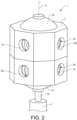
- FIGS 1 and 2 schematically show a valve unit 1 for a vehicle thermal management system S.
- the valve unit 1 is used for controlling the flow of heat transfer fluid or coolant to different system components or units of the vehicle thermal management system S.
- FIG 1 a schematic layout of a vehicle thermal management system S comprising a valve unit 1 according to the disclosure is shown.
- the vehicle thermal management system S is arranged in a vehicle V, and vehicle thermal management system S is used in the vehicle V for controlling temperature ranges of different vehicle units or components.
- the system S may also be used for controlling the temperature ranges of a passenger compartment or similar structure of the vehicle.
- the vehicle thermal management system S has a two thermal control loop configuration, and the vehicle thermal management system S comprises a first thermal control loop CL1 in fluid communication with the valve unit 1 and a second thermal control loop CL2 in fluid communication with the valve unit 1.
- the first thermal control loop CL1 and the second thermal control loop CL2 are connected to the valve unit 1, as will be further described below.
- the vehicle thermal management system S is used for controlling the temperature ranges of vehicle units with the heat transfer fluid that is circulated in the first thermal control loop CL1 and the second thermal control loop CL2, and the temperature ranges of the respective thermal control loops are for example depending on the driving conditions of the vehicle and the variations in ambient temperature.
- the heat transfer fluid may be of any type suitable for vehicle applications.
- the first thermal control loop CL1 is connected to a first vehicle unit U1
- the second thermal control loop CL2 is connected to a second vehicle unit U2.
- the first vehicle unit U1 may for example be a battery temperature regulating unit and the second vehicle unit U2 may for example be a power electronics temperature regulating unit.
- the battery temperature regulating unit may for example be used for controlling the temperatures of one or more batteries with related components used in the vehicle system.
- the power electronics temperature regulating unit may for example be used for controlling the temperatures of the power electronic components, such as the electric motor and other electric components being part of the power electronics system.
- the thermal control loop configurations and components may be of any conventional type used for vehicle purposes, and will not be described in detail. It should however be understood that the system S may be used for heating or cooling other types of vehicle units or components than the ones described above, depending on the design and construction of the vehicle and the vehicle systems. It should be understood that the respective control loops may include any suitable number of components for controlling the temperature ranges and the flow of heat transfer fluid, such as for example heat exchangers, chillers, heaters, filters, air separators, connectors, fans, valves, circulation pumps, and/or any other components known in the art as related to such thermal systems.
- the heat transfer fluid can be controlled to circulate in the first thermal control loop CL1 and the second thermal control loop CL2 in separated or connected flow patterns, depending on the operation of the valve unit 1.
- the heat transfer fluid is suitably circulated in the respective thermal control loops by a circulation pump integrated into each thermal control loop.
- the first thermal control loop CL1 comprises a first circulation pump P1
- the second thermal control loop CL2 comprises a second circulation pump P2.
- the circulation pumps can be used together if the thermal control loops are connected, or used separately if the thermal control loops are separated, which may depend on the driving conditions of the vehicle. This is providing a flexible vehicle thermal management system with different alternatives for the distribution of the heat transfer fluid.
- the vehicle thermal management system S further comprises a first system component SC1, such as a chiller or radiator, and a second system component SC2, such as a chiller or radiator.
- the type of component used may vary depending on the configuration of the vehicle thermal management system S.
- the radiator may be of any suitable type for controlling the temperature of the system, such as a traditional radiator heat-exchanger.
- the chiller may be of any suitable type for controlling the temperature of the system, such as a chiller connected to a heat pump system.
- the vehicle thermal management system S further comprises a first component circuit CC1 for the first system component SC1, and a second component circuit CC2 for the second system component SC2.
- the first component circuit CC1 and the second component circuit CC2 are connected to the valve unit 1.
- the vehicle thermal management system S may further comprise a control unit 13 for controlling the system components, the temperature ranges, and the flow of heat transfer fluid.
- the respective thermal control loops and component circuits are connecting the valve unit 1 to the vehicle units or components with conduits, pipes or other suitable connection means.
- the vehicle thermal management system S according to the disclosure is designed and constructed in a way so that the system is adapted for being operated in different operational modes controlled by the control unit 13, where the heat transfer fluid is efficiently circulated to the vehicle units or components.
- the valve unit 1 comprises a first valve body 2a, a second valve body 2b, and a housing structure 3.
- the first valve body 2a and the second valve body 2b are arranged within the housing structure 3 and rotatably arranged in relation to the housing structure 3 between different valve positions around a common rotational axis A.
- the first valve body 2a is connected to an actuator 4 for rotational displacement of the first valve body 2a around the rotational axis A
- the second valve body 2b is connected to the first valve body 2a via a spring 5.
- the first valve body 2a is attached to the actuator 4 via a drive shaft 4a.
- the actuator may be of any suitable type, such as for example an electric motor.
- the first valve body 2a is suitably fixedly arranged on the drive shaft 4a, and the second valve body 2b is guided by a shaft or similar structure allowing a rotational movement around the rotational axis A.
- the second valve body 2b is configured for being rotatably displaced around the rotational axis A by the spring 5 upon rotational displacement of the first valve body 2a.
- the first valve body 2a is rotatably displaced around the rotational axis A by means of the actuator 4, and the second valve body 2b is rotatably displaced around the rotational axis A by means of the spring 5 upon rotational displacement of the first valve body 2a.
- the valve bodies are configured to either move at the same time or move independently from each other, as will be further described below.
- the housing structure 3 may be arranged with seals or similar structures for preventing leakage between the housing structure 3 and the respective valve bodies.
- the spring 5 is defined as an elastic element, and may have any suitable design and configuration for rotatably displacing the second valve body 2b around the rotational axis A upon rotational displacement of the first valve body 2a.
- the elastic element is capable of returning to its original state, or to essentially its original state, after being deformed, stretched, compressed or expanded.
- the elastic element may be made of any suitable material, such as for example metals and metallic materials, composite materials, or elastomeric materials.
- the spring is configured as a traditional torsion spring.
- the valve unit 1 will be described with a spring 5 having a torsion spring configuration.
- the first thermal control loop CL1 is connected to the valve unit 1, and comprises the first vehicle unit U1.
- the first thermal control loop CL1 is in fluid communication with the first valve body 2a and the second valve body 2b.
- the first component circuit CC1 is connected to the valve unit 1, and comprises the first system component SC1.
- the first component circuit CC1 is in fluid communication with the first valve body 2a and the second valve body 2b.
- the second thermal control loop CL2 is connected to the valve unit 1, and comprises the second vehicle unit U2.
- the second thermal control loop CL2 is in fluid communication with the first valve body 2a and the second valve body 2b.
- the second component circuit CC2 is connected to the valve unit 1, and comprises the second system component SC2.
- the second component circuit CC2 is in fluid communication with the first valve body 2a and the second valve body 2b.
- the housing structure 3 comprises a first inlet flow port 9a, a second inlet flow port 9b, a first outlet flow port 10a, and a second outlet flow port 10b, configured for connecting the housing structure 3 to at least the first thermal control loop CL1 and the second thermal control loop CL2, and configured for being in fluid communication with the first valve body 2a.
- the housing structure 3 further comprises a third inlet flow port 9c, a fourth inlet flow port 9c, a third outlet flow port 10c, and a fourth outlet flow port 10d, configured for connecting the housing structure 3 to at least the first thermal control loop CL1 and the second thermal control loop CL2, and configured for being in fluid communication with the second valve body 2b.
- the first thermal control loop CL1 is connected to the first inlet flow port 9a for allowing flow of heat transfer fluid from the first thermal control loop CL1 into the valve unit 1, where the inlet flow from the first thermal control loop CL1 is controlled by the first valve body 2a.
- the first thermal control loop CL1 is further connected to the third outlet flow port 10c for allowing flow of heat transfer fluid out from the valve unit 1 into the first thermal control loop CL1, where the outlet flow from valve unit 1 into the first thermal control loop CL1 is controlled by the second valve body 2b.
- the second thermal control loop CL2 is connected to the second inlet flow port 9b for allowing flow of heat transfer fluid from the second thermal control loop CL2 into the valve unit 1, where the inlet flow from the second thermal control loop CL2 is controlled by the first valve body 2a.
- the second thermal control loop CL2 is further connected to the fourth outlet flow port 10d for allowing flow of heat transfer fluid out from the valve unit 1 into the second thermal control loop CL2, where the outlet flow from valve unit 1 into the second thermal control loop CL2 is controlled by the second valve body 2b.
- the first component circuit CC1 is connected to the third inlet flow port 9c for allowing flow of heat transfer fluid from the first component circuit CC1 into the valve unit 1, where the inlet flow from the first component circuit CC1 is controlled by the second valve body 2b.
- the first component circuit CC1 is further connected to the first outlet flow port 10a for allowing flow of heat transfer fluid out from the valve unit 1 into the first component circuit CC1, where the outlet flow from valve unit 1 into the first component circuit CC1 is controlled by the first valve body 2a.
- the second component circuit CC2 is connected to the fourth inlet flow port 9d for allowing flow of heat transfer fluid from the second component circuit CC2 into the valve unit 1, where the inlet flow from the second component circuit CC2 is controlled by the second valve body 2b.
- the second component circuit CC2 is further connected to the second outlet flow port 10b for allowing flow of heat transfer fluid out from the valve unit 1 into the second component circuit CC2, where the outlet flow from valve unit 1 into the second component circuit CC2 is controlled by the first valve body 2a.
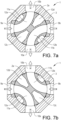
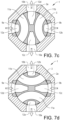
- the first valve body 2a comprises a first valve flow channel 11a and a second valve flow channel 11b, as shown in figures 7a-d .
- the first valve flow channel 11a is configured for connecting the first inlet flow port 9a or the second inlet flow port 9b to the first outlet flow port 10a or the second outlet flow port 10b, depending on the rotational position of the first valve body 2a around the rotational axis A in relation to the housing structure 3.
- the second valve flow channel 11a is configured for connecting the first inlet flow port 9a or the second inlet flow port 9b to the first outlet flow port 10a or the second outlet flow port 10b, depending on the rotational position of the first valve body 2a around the rotational axis A in relation to the housing structure 3.
- the first valve flow channel 11a is connecting the first inlet flow port 9a and the second outlet flow port 10b
- the second valve flow channel 11b is connecting the second inlet flow port 9b and the first outlet flow port 10a.
- the first inlet flow port 9a can instead be connected to the second outlet flow port 10b by the second valve flow channel 11b, and the second inlet flow port 9b to the first outlet flow port 10a by the first valve flow channel 11a.
- the first inlet flow port 9a can instead be connected to the first outlet flow port 10a by the second valve flow channel 11b, and the second inlet flow port 9b to the second outlet flow port 10b by the first valve flow channel 11a.
- the first valve flow channel 11a and the second valve flow channel 11b are suitably separately arranged from each other within the first valve body 2a, preventing flow of heat transfer fluid between the first valve flow channel 11a and the second valve flow channel 11b.
- the second valve body 2b comprises a third valve flow channel 11c and a fourth valve flow channel 11d, as shown in figures 8a-d .
- the third valve flow channel 11c is configured for connecting the third inlet flow port 9c or the fourth inlet flow port 9d to the third outlet flow port 10c or the fourth outlet flow port 10d, depending on the rotational position of the second valve body 2b around the rotational axis A in relation to the housing structure 3.
- the fourth valve flow channel 11d is configured for connecting the third inlet flow port 9c or the fourth inlet flow port 9d to the third outlet flow port 10c or the fourth outlet flow port 10d depending on the rotational position of the second valve body 2b around the rotational axis A in relation to the housing structure 3.
- the third valve flow channel 11c is connecting the fourth inlet flow port 9d and the third outlet flow port 10c
- the fourth valve flow channel 11d is connecting the third inlet flow port 9c and the fourth outlet flow port 10d.
- the second valve body 2b may be rotated around the rotational axis A to a different valve body position, as shown in figure 8b , to instead be arranged to connect the fourth inlet flow port 9d and the fourth outlet flow port 10d by the fourth valve flow channel 11d, and connect the third inlet flow port 9c and the third outlet flow port 10c by the third valve flow channel 11c.
- the fourth inlet flow port 9d can instead be connected to the third outlet flow port 10c by the fourth valve flow channel 11d, and the third inlet flow port 9c to the fourth outlet flow port 10d by the third valve flow channel 11c.
- the fourth inlet flow port 9d can instead be connected to the fourth outlet flow port 10d by the third valve flow channel 11c, and the third inlet flow port 9c to the third outlet flow port 10c by the fourth valve flow channel 11d.
- the third valve flow channel 11c and the fourth valve flow channel 11d are suitably separately arranged from each other within the second valve body 2b, preventing flow of heat transfer fluid between the third valve flow channel 11c and the fourth valve flow channel 11d.
- the first thermal control loop CL1 may for example be connected to the first component circuit CC1 or the second component circuit CC2 in separated flow patterns.
- the second thermal control loop CL2 may in a similar way for example be connected to the second component circuit CC2 or the first component circuit CC1 in separated flow patterns. It may also be possible to connect all of the first thermal control loop CL1, the first component circuit CC1, the second thermal control loop CL2, and the second component circuit CC2 in series to form combined flow patterns.
- the valve unit is configured with a flow mixing functionality.
- the housing structure 3 comprises a first mixing chamber 3a arranged in connection to the first valve body 2a and a second mixing chamber 3b arranged in connection to the second valve body 2b.
- the first mixing chamber 3b is schematically illustrated in a cross-sectional view from below
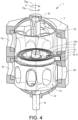
- the second mixing chamber 3b is illustrated in a cross-sectional view from above, where below and above are referring to the positioning of the valve unit 1 in figure 4 .
- the respective mixing chambers are arranged as internal volumes in the valve unit 1 for receiving heat transfer fluid flow from the respective corresponding inlet flow ports and distributing a mixed flow of heat transfer fluid to the respective corresponding outlet flow ports, and thus allowing heat transfer fluid from different loops or circuits to be mixed.
- the mixed flow patterns are controlling the temperature for the respective units and components by mixing the flows of heat transfer fluid. It may be possible to change the position of both the first valve body 2a and the second valve body 2b to mixed flows, or alternatively only the first valve body 2a or the second valve body 2b to mixed flows.
- the first valve body 2a comprises a first mixing flow channel 12a, a second mixing flow channel 12b, a third mixing flow channel 12c, and a fourth mixing flow channel 12b.
- Each mixing flow channel 12a,12b,12c,12d is configured for connecting any of the first inlet flow port 9a, the second inlet flow port 9b, the first outlet flow port 10a, and the second outlet flow port 10b to the first mixing chamber 3a.
- the first inlet flow port 9a is connected to the first mixing flow channel 12a
- the second inlet flow port 9b is connected to the second mixing flow channel 12b
- the first outlet flow port 10a is connected to the third mixing flow channel 12c
- the second outlet flow port 10b is connected to the fourth mixing flow channel 12d.
- the second valve body 2b comprises a fifth mixing flow channel 12e, a sixth mixing flow channel 12f, a seventh mixing flow channel 12g, and an eight mixing flow channel 12h.
- Each mixing flow channel 12e,12f,12g,12h is configured for connecting any of the third inlet flow port 9c, the fourth inlet flow port 9d, the third outlet flow port 10c, and the fourth outlet flow port 10d to the second mixing chamber 3b.
- the third inlet flow port 9c is connected to the fifth mixing flow channel 12e
- the fourth inlet flow port 9d is connected to the sixth mixing flow channel 12f
- the third outlet flow port 10c is connected to the seventh mixing flow channel 12g
- the fourth outlet flow port 10d is connected to the eight mixing flow channel 12h.
- the second valve body 2b is configured for being rotatably displaced around the rotational axis A by the spring 5 upon rotational displacement of the first valve body 2a, and when the first valve body 2a is rotated by the actuator 4 the spring 5 is arranged to rotatably displace the second valve body 2b around the rotational axis A in relation to the housing structure 3.
- the spring 5 or the second valve body 2b comprises a protruding element 6 configured for being rotatably displaced with the second valve body 2b and configured for limiting the rotational movement of the second valve body 2b in relation to the housing structure 3.
- the protruding element 6 is arranged to extend out from the second valve body 2b in a radial direction for interaction with the housing structure 3.
- the protruding element 6 has through the interaction with the housing structure 3 the function to restrict the rotational movement of the second valve body 2b in relation to the housing structure 3.
- the protruding element 6 alternatively could be arranged on the housing structure 3 or any other suitable part of the valve unit 1, and configured for limiting the rotational movement of the second valve body 2b in relation to the housing structure 3.
- the protruding element 6 may have any suitable configuration for restricting the rotational movement of the second valve body 2b, and the second valve body 2b may be provided with means that are interacting with the protruding element 6.
- the spring 5 is suitably a torsion spring, and as shown in figures 4 , 5a-b , and 6a-e , the spring 5 comprises a first end 5a attached to the first valve body 2a and a second end 5b attached to the second valve body 2b.
- the spring ends are configured as bended portions of the spring 5 and each of the valve bodies may comprise a slot or similar arrangement for attaching the respective spring end to the valve body.
- the spring tension T is dependent on a relative angular displacement of the first valve body 2a in relation to the second valve body 2b around the rotational axis A.
- the spring tension T is increasing.
- the spring tension T is decreasing.
- the slot 8 is delimited by a first blocking member 7a and a second blocking member 7b of the housing structure 3, and the protruding element 6 is arranged to move within the slot 8 between two end positions constituted by the first blocking member 7a and the second blocking member 7b.
- the first blocking member 7a is arranged as a wall section in a first end of the slot 8
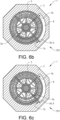
- the second blocking member 7b is arranged as a wall section in a second end of the slot 8, as illustrated in figures 6a-e .
- the slot 8 is extending between the first blocking member 7a and the second blocking member 7b, and the protruding element 6 is thus configured for being movably arranged within the slot 8 of the housing structure 3 between the first blocking member 7a and the second blocking member 7b, with a corresponding rotational movement of the second valve body 2b.
- the protruding element 6 is configured for interacting with the first blocking member 7a and the second blocking member 7b in the respective end positions.
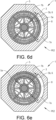
- a first end position P E1 shown in figures 6b and 6c the protruding element 6 is in engagement with the first blocking member 7a.
- the first blocking member 7a is preventing a rotational movement of the second valve body 2b around the rotational axis A in the second rotational direction D R2 , such as when the first end 5a of the spring 5 is moving with the first valve body 2a from the position in figure 6c to the position in figure 6b .
- the first blocking member 7a is allowing a rotational movement of the second valve body 2b around the rotational axis A in the first rotational direction D R1 towards the second end position P E2 if the spring tension T is at least equal to the predetermined spring tension value T PD , such as from the position in figure 6c to the positions in figure 6a or 6d .
- the protruding element 6 is in engagement with the second blocking member 7b, and in this position the second blocking member 7b is preventing a rotational movement of the second valve body 2b around the rotational axis A in the first rotational direction D R1 , such as when the first end 5a of the spring 5 is moving with the first valve body 2a from the position in figure 6d to the position in figure 6e .
- the second blocking 7b member is allowing a rotational movement of the second valve body 2b around the rotational axis A in the second rotational direction D R2 towards the first end position P E1 , such as from the position in figure 6d to the positions in figure 6a or 6c .
- first blocking member 7a and the second blocking member 7b are configured for allowing displacement of the second valve body 2b in relation to the housing structure 3 when the protruding element 6 is rotatably displaced with the second valve body 2b between the first blocking member 7a and the second blocking member 7b, and the first blocking member 7a and the second blocking member 7b are configured for preventing displacement of the second valve body 2b in relation to the housing structure 3 when the protruding element 6 is in engagement with the first blocking member 7a or the second blocking member 7b.
- the protruding element 6 is positioned between the first end position P E1 and the second end position P E2 .
- the positions of the first end 5a and the second end 5b of the spring 5 in figure 6a is corresponding to the positions shown in figure 4
- the positions of the first end 5a and the second end 5b in figure 6d is corresponding to the positions shown in figure 5a
- the positions of the first end 5a and the second end 5b in figure 6e is corresponding to the positions shown in figure 5b .
- the second valve body 2b is arranged to be rotatably displaced around the axis A by the spring 5 between different positions determined by the extension of the slot 8, which slot 8 is limited by the first blocking member 7a and the second blocking member 7b.
- the extension of the slot 8 may vary depending on the design of the valve unit 1 for allowing different valve body positions of the second valve body 2b in relation to the housing structure 3.
- the first valve body 2a may thus be moved in relation to the housing structure 3 without movement of the second valve body, depending on the position of the second valve body 2b in relation to the first blocking member 7a and the second blocking member 7b, as well as the spring tension T.
- the second valve body 2b is arranged to move with the first valve body 2a via the spring 5 in both the first rotational direction D R1 and the second rotational direction D R2 .
- the first valve body 2a can move in the second rotational direction D R2 , and also in the first rotational direction D R1 until the spring tension T is at least equal to the predetermined spring tension value T PD , without any movement of the second valve body 2b.
- the first valve body 2a When the protruding element 6 is in engagement with the second blocking member 7b, the first valve body 2a can move in the first rotational direction D R1 , and also in the second rotational direction D R2 when the spring tension T is above the predetermined spring tension value T PD , without any movement of the second valve body 2a, since the spring 5 is positioning the protruding element 6 against the second blocking member 7b.
- the spring 5 is arranged to move the second valve body 2b from the second end position P E2 towards the first end position P E1 when the spring tension T is essentially equal to the predetermined spring tension value T PD .
- valve unit may be used in connection to any type of valve unit comprising a housing structure, a valve body and a mixing chamber, where the housing structure comprises at least two inlet flow ports and at least one outlet flow port.
- a valve unit may comprise any of the different features described in the embodiments above.
- the valve unit may have a different configuration and comprise only one valve body, or alternatively two or more valve bodies.
- Such a valve unit may or may not comprise the spring for displacing a valve body.
- the housing structure may comprise any suitable number of inlet flow ports and outlet flow ports for one or more valve bodies.
- valve unit for a vehicle thermal management system, wherein the valve unit comprises one or more valve bodies, and a housing structure, wherein each of the one or more valve bodies is arranged within the housing structure and rotatably arranged in relation to the housing structure between different valve positions around a rotational axis, wherein the housing structure comprises two or more inlet flow ports, one or more outlet flow ports, and one or more mixing chambers, wherein each of the one or more mixing chambers is arranged in connection to one of the one or more valve bodies.
- each mixing chamber is arranged as an internal volume in the valve unit configured for receiving heat transfer fluid flow from two or more inlet flow ports and distributing a mixed flow of heat transfer fluid to one or more outlet flow ports, allowing the heat transfer fluid from two or more inlet flow ports to be mixed.
- the one or more valve bodies of the valve unit are arranged within the housing structure and rotatably arranged in relation to the housing structure between different valve positions around a common rotational axis.
- each of the one or more valve bodies of the valve unit arranged in connection to a corresponding mixing chamber comprises three or more mixing flow channels, wherein each mixing flow channel is configured for connecting one of the two or more inlet flow ports or one of the one or more outlet flow ports to the mixing chamber.
- At least one of the one or more valve bodies of the valve unit is connected to an actuator for rotational displacement of the valve body around the rotational axis.
- At least one of the one or more valve bodies of the valve unit is attached to the actuator via a drive shaft.
- each valve body of the valve unit further comprises one or more valve flow channels configured for connecting one of the two or more inlet flow ports to one of the one or more outlet flow ports.
- a non-transitory computer-readable storage medium storing one or more programs configured to be executed by one or more processors of the control unit 13 of the vehicle thermal management system S, the one or more programs comprising instructions for performing the method according to any one of the above-discussed embodiments.
- a cloud computing system can be configured to perform any of the method aspects presented herein.
- the cloud computing system may comprise distributed cloud computing resources that jointly perform the method aspects presented herein under control of one or more computer program products.
- the processor may be connected to one or more communication interfaces and/or sensor interfaces for receiving and/transmitting data with external entities such as e.g. sensors arranged on the vehicle surface, an off-site server, or a cloud-based server.
- the processor or processors associated with the control unit 13 may be or include any number of hardware components for conducting data or signal processing or for executing computer code stored in memory.
- the system may have an associated memory, and the memory may be one or more devices for storing data and/or computer code for completing or facilitating the various methods described in the present description.
- the memory may include volatile memory or non-volatile memory.
- the memory may include database components, object code components, script components, or any other type of information structure for supporting the various activities of the present description. According to an exemplary embodiment, any distributed or local memory device may be utilized with the systems and methods of this description.
- the memory is communicably connected to the processor (e.g., via a circuit or any other wired, wireless, or network connection) and includes computer code for executing one or more processes described herein.
Landscapes
- Engineering & Computer Science (AREA)
- General Engineering & Computer Science (AREA)
- Mechanical Engineering (AREA)
- Multiple-Way Valves (AREA)
Description
- The present disclosure relates to a valve unit for a vehicle thermal management system. The valve unit comprises a first valve body, a second valve body, and a housing structure. The first valve body and the second valve body are arranged within the housing structure and rotatably arranged in relation to the housing structure between different valve positions around a common rotational axis. The disclosure further relates to a vehicle thermal management system comprising a valve unit, a vehicle comprising a thermal management system, and a method for operating a valve unit.
- Vehicle thermal management systems are commonly used in today's vehicles for controlling the temperature ranges of different vehicle units, such as for example battery units, power electronics units, heating, ventilation and air conditioning (HVAC) systems, and other types of vehicle units or components being part of the vehicle construction. In for example new energy vehicles, such as for example hybrid or electric vehicles, including battery electric vehicles, fuel-cell electric vehicles and plug-in hybrid electric vehicles, the high voltage battery components used for providing energy to the electric motors as well as the power electronic components need to be temperature controlled. The temperature controlling may depend on for example the driving conditions of the vehicle, the ambient temperature, and the type of components used in the vehicle system. The thermal management of the vehicle is constructed for cooling or heating the respective vehicle systems.
- For new energy vehicles, the thermal management systems need a redesign compared to the systems used in traditional vehicles with internal combustion engines. These systems are often complex in design and construction, involving a high number of components that take up space in the vehicle and increase the weight of the vehicle construction. This leads to component packaging problems and weight issues, and further, the thermal management systems are often expensive and non-flexible in construction.
- There is thus a need for improved thermal management systems, where the systems are simple in design and construction with fewer components compared to current systems used, where the system further is designed to reduce weight and packaging problems.
- Patent publication
DE 102012220451 A1 discloses a valve having a housing with multiple fluid ports and two coaxially arranged rotary disks rotatable by a common drive. The rotary disks are rotatable respectively about a predetermined angular range, to block or release the fluid ports, where the rotary disks are rotated relative to each other over a part of the angular range. The rotary disks are coupled to each other in a rotational direction via a spring, and the rotating movement of the rotary disks is limited by a stop. - Patent publication
WO 2015/013323 A1 discloses a thermal management valve module having at least one flow chamber. One or more inlet and outlet ports are connected to the at least one flow chamber. A first valve body is rotatably positioned in the at least one flow chamber, and includes a fluid pathway that connects a first port to the flow chamber. A second valve body is rotatably positioned in the at least one flow chamber, and includes a fluid pathway that connects a second port. One or more actuators can be used to independently position the first and second valve bodies. - Patent publication
US 2015/0286224 A1 discloses a thermostat valve for a combustion engine, comprising a housing, which has several cooling fluid connections. The valve comprises at least one first hollow valve element mounted rotatably in the housing, and at least one second valve element rotatable in the housing relative to the at least one first valve element. A rotational drive is provided, with which the at least one first valve element and/or the at least one second valve element can be driven rotatably. - An object of the present disclosure is to provide a valve unit for a vehicle thermal management system, a vehicle thermal management system, a vehicle comprising a vehicle thermal management system, and a method for operating a valve unit, where the previously mentioned problems are avoided. This object is at least partly achieved by the features of the independent claims. The dependent claims contain further developments of the valve unit for a vehicle thermal management system.
- The disclosure concerns a valve unit for a vehicle thermal management system. The valve unit comprises a first valve body, a second valve body, and a housing structure. The first valve body and the second valve body are arranged within the housing structure and rotatably arranged in relation to the housing structure between different valve positions around a common rotational axis. The first valve body is connected to an actuator for rotational displacement of the first valve body around the rotational axis, and the second valve body is connected to the first valve body via a spring. The second valve body is configured for being rotatably displaced around the rotational axis by the spring upon rotational displacement of the first valve body. The housing structure comprises a first inlet flow port, a second inlet flow port, a first outlet flow port, and a second outlet flow port, configured for connecting the housing structure to at least a first thermal control loop and a second thermal control loop, and configured for being in fluid communication with the first valve body. The housing structure comprises a third inlet flow port, a fourth inlet flow port, a third outlet flow port, and a fourth outlet flow port, configured for connecting the housing structure to at least the first thermal control loop and the second thermal control loop, and configured for being in fluid communication with the second valve body. The housing structure comprises a first mixing chamber arranged in connection to the first valve body and a second mixing chamber arranged in connection to the second valve body. The first valve body comprises a first mixing flow channel, a second mixing flow channel, a third mixing flow channel, and a fourth mixing flow channel, where each mixing flow channel is configured for connecting any of the first inlet flow port, the second inlet flow port, the first outlet flow port, and the second outlet flow port to the first mixing chamber. The second valve body comprises a fifth mixing flow channel, a sixth mixing flow channel, a seventh mixing flow channel, and an eight mixing flow channel, where each mixing flow channel is configured for connecting any of the third inlet flow port, the fourth inlet flow port, the third outlet flow port, and the fourth outlet flow port to the second mixing chamber.
- Advantages with these features are that the thermal management system through the design and configuration of the valve unit can be made with a compact design having a low weight compared to traditional systems. These systems can further be made with a less complex design and construction with the attachment of system components to the valve unit, which is reducing the number of system components taking up space in the vehicle. The valve unit is thus simplifying the component packaging and is providing a flexible and less expensive construction of the system. The solution is simple in design with fewer components compared to current systems used, providing reduced weight. The valve unit is simplifying the integration of different components with each other, and integrating system components in an efficient way is increasingly important for simplifying component packaging. The valve unit is with its unique configuration allowing controlling of more than only one system component in an efficient way through the actuation with only one actuator and the spring. The valve unit can be made with a compact and robust design that is reducing the need for a high number of different system components. The spring is arranged as an elastic element, and may have any suitable design and configuration for rotatably displacing the second valve body around the rotational axis upon rotational displacement of the first valve body. The connection to the thermal control loops are providing a simple construction of the vehicle thermal management system. The mixing chambers are allowing an efficient mixing of different flows of heat transfer fluid. The respective mixing chambers are arranged as internal volumes in the valve unit for receiving heat transfer fluid flow from the respective corresponding inlet flow ports and distributing a mixed flow of heat transfer fluid to the respective corresponding outlet flow ports, and thus allowing heat transfer fluid from different loops or circuits to be mixed.
- According to an aspect of the disclosure, the spring is configured for rotatably displacing the second valve body upon a spring tension at least equal to a predetermined spring tension value, and below the predetermined spring tension value the second valve body is prevented from being rotatably displaced by the spring. The spring tension is dependent on a relative angular displacement of the first valve body in relation to the second valve body around the axis. With this configuration, the positioning of the second valve body in relation to the housing structure is achieved in a simple and reliable way.
- According to another aspect of the disclosure, the spring is a torsion spring. A torsion spring is simple and reliable in construction and is efficiently transferring torque from the first valve body to the second valve body for displacing the second valve body in relation to the housing structure.
- According to an aspect of the disclosure, the spring comprises a first end attached to the first valve body and a second end attached to the second valve body. With the attachment of the spring ends, an efficient controlling of the valve unit can be achieved. The spring ends are suitably configured as bended portions of the spring and each of the valve bodies may comprise a slot or similar arrangement for attaching the respective spring ends to the corresponding valve body. With the attachment of the spring ends to the respective valve bodies, a rotational force can be transferred by the spring from the first valve body to the second valve body, when the first valve body is rotated by the actuator.
- According to another aspect of the disclosure, the spring or the second valve body comprises a protruding element, wherein the protruding element is configured for being rotatably displaced with the second valve body and configured for limiting the rotational movement of the second valve body in relation to the housing structure. The protruding element is securing a correct positioning of the second valve body in relation to the housing structure between different valve body positions.
- According to a further aspect of the disclosure, the housing structure comprises a first blocking member and a second blocking member, and the protruding element is configured for interacting with the first blocking member and the second blocking member. The first blocking member and the second blocking member are configured for allowing displacement of the second valve body in relation to the housing structure when the protruding element is rotatably displaced with the second valve body between the first blocking member and the second blocking member. The first blocking member and the second blocking member are configured for preventing displacement of the second valve body in relation to the housing structure through engagement between the protruding element and the first blocking member or through engagement between the protruding element and the second blocking member. The blocking members are in this way controlling the positions of the second valve body, where the second valve body is allowed to rotate in relation to the housing structure with a certain angular displacement when the protruding element is displaced between the blocking members. The blocking members are through the engagement with the protruding element efficiently limiting the displacement of the second valve body beyond predefined limits, which may vary depending on the design and construction of the valve unit.
- According to an aspect of the disclosure, the protruding element is extending radially outside of the second valve body, wherein the protruding element is configured for being movably arranged within a slot of the housing structure. The slot is delimited by the first blocking member and the second blocking member. The interaction between the protruding element and the slot is securing an efficient control of the positions of the second valve body.
- According to another aspect of the disclosure, the first valve body is attached to the actuator via a drive shaft. The drive shaft is securing an efficient displacement of the first valve body upon actuation from the actuator. The drive shaft may have any suitable configuration for rotating the first valve body in relation to the housing structure.
- According to an aspect of the disclosure, the first valve body comprises a first valve flow channel and a second valve flow channel. The first valve flow channel is configured for connecting the first inlet flow port or the second inlet flow port to the first outlet flow port or the second outlet flow port. The second valve flow channel is configured for connecting the first inlet flow port or the second inlet flow port to the first outlet flow port or the second outlet flow port. The second valve body comprises a third valve flow channel and a fourth valve flow channel. The third valve flow channel is configured for connecting the third inlet flow port or the fourth inlet flow port to the third outlet flow port or the fourth outlet flow port. The fourth valve flow channel is configured for connecting the third inlet flow port or the fourth inlet flow port to the third outlet flow port or the fourth outlet flow port. The valve flow channels are securing an efficient functionality of the valve unit for the distribution of heat transfer fluid into different flows, and depending on the position of the valve flow channels in relation to the flow ports different flow patterns can be established for controlling the temperature of vehicle units or components.
- According to another aspect of the disclosure, the first valve flow channel and the second valve flow channel are separately arranged from each other within the first valve body. The third valve flow channel and the fourth valve flow channel are separately arranged from each other within the second valve body. By separating the flow channels, there is no mixing of heat transfer fluid between the valve flow channels for a controlled flow of heat transfer fluid.
- The disclosure further concerns a vehicle thermal management system comprising a valve unit as described above. The system further comprises a first thermal control loop in fluid communication with the valve unit, and a second thermal control loop in fluid communication with the valve unit. The control loops are securing an efficient temperature control functionality of vehicle units or components.
- The disclosure further concerns a vehicle comprising a vehicle thermal management system as described above.
- The disclosure further concerns a method for operating a valve unit for a vehicle thermal management system. The valve unit comprises a first valve body, a second valve body, and a housing structure. The first valve body and the second valve body are arranged within the housing structure and rotatably arranged in relation to the housing structure between different valve positions around a common rotational axis. The first valve body is connected to an actuator for rotational displacement of the first valve body around the rotational axis, and the second valve body is connected to the first valve body via a spring. The housing structure comprises a first inlet flow port, a second inlet flow port, a first outlet flow port, and a second outlet flow port, configured for connecting the housing structure to at least a first thermal control loop and a second thermal control loop, and configured for being in fluid communication with the first valve body. The housing structure comprises a third inlet flow port, a fourth inlet flow port, a third outlet flow port, and a fourth outlet flow port, configured for connecting the housing structure to at least the first thermal control loop and the second thermal control loop, and configured for being in fluid communication with the second valve body. The housing structure comprises a first mixing chamber arranged in connection to the first valve body and a second mixing chamber arranged in connection to the second valve body. The first valve body comprises a first mixing flow channel, a second mixing flow channel, a third mixing flow channel, and a fourth mixing flow channel, where each mixing flow channel is configured for connecting any of the first inlet flow port, the second inlet flow port, the first outlet flow port, and the second outlet flow port to the first mixing chamber. The second valve body comprises a fifth mixing flow channel, a sixth mixing flow channel, a seventh mixing flow channel, and an eight mixing flow channel, where each mixing flow channel is configured for connecting any of the third inlet flow port, the fourth inlet flow port, the third outlet flow port, and the fourth outlet flow port to the second mixing chamber. The method comprises the steps: rotatably displacing the first valve body around the rotational axis by means of the actuator; and rotatably displacing the second valve body around the rotational axis by means of the spring upon rotational displacement of the first valve body.
- Advantages with these features are that the thermal management system through the design and configuration of the valve unit can be operated in a simple manner, where the system can be made with a compact design having a low weight compared to traditional systems. These systems can further be made with a less complex design and construction with the attachment of system components to the valve unit, which is reducing the number of system components taking up space in the vehicle. The simple operation with the valve bodies arranged in the same housing structure and the efficient controlling of the valve bodies by means of the actuator and the spring is further simplifying the system control functionality. The valve unit is thus simple to operate and is further simplifying the component packaging and is providing a flexible and less expensive construction of the system. The valve unit is providing an efficient control of and integration of different components with each other. The valve unit is with its unique configuration allowing controlling of more than only one system component in an efficient way through the actuation with only one actuator and the spring. The valve unit can be made with a compact and robust design that is reducing the need for a high number of different system components. The spring is arranged as an elastic element, and may have any suitable design and configuration for rotatably displacing the second valve body around the rotational axis upon rotational displacement of the first valve body. The spring is suitably configured as a traditional torsion spring. The mixing chambers are allowing an efficient mixing of different flows of heat transfer fluid.
- The disclosure will be described in detail in the following, with reference to the attached drawings, in which
- Fig. 1
- shows schematically, in a system layout view, a vehicle thermal management system with a valve unit according to the disclosure,
- Fig. 2
- shows schematically, in a perspective view, the valve unit according to the disclosure,
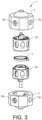
- Fig. 3
- shows schematically, in an exploded perspective view, the valve unit according to the disclosure,
- Fig. 4
- shows schematically, in a cross-sectional perspective view, the valve unit according to the disclosure,
- Fig. 5a-b
- show schematically, in cross-sectional perspective views, the valve unit in different valve body positions according to the disclosure,
- Fig. 6a-e
- show schematically, in views from above, a spring of the valve unit in different valve body positions according to the disclosure,
- Fig. 7a-d
- show schematically, in cross-sectional views, a first valve body in different valve body positions according to the disclosure,
- Fig. 8a-d
- show schematically, in cross-sectional views, a second valve body in different valve body positions according to the disclosure, and
- Fig. 9
- shows schematically, in a configurational view from below or above, the valve unit with a valve body according to the disclosure.
- Various aspects of the disclosure will hereinafter be described in conjunction with the appended drawings to illustrate and not to limit the disclosure, wherein like designations denote like elements, and variations of the described aspects are not restricted to the specifically shown embodiments, but are applicable on other variations of the disclosure.
- Those skilled in the art will appreciate that the steps, services and functions explained herein may be implemented using individual hardware circuitry, using software functioning in conjunction with a programmed microprocessor or general purpose computer, using one or more Application Specific Integrated Circuits (ASICs) and/or using one or more Digital Signal Processors (DSPs). It will also be appreciated that when the present disclosure is described in terms of a method, it may also be embodied in one or more processors and one or more memories coupled to the one or more processors, wherein the one or more memories store one or more programs that perform the steps, services and functions disclosed herein when executed by the one or more processors.
-
Figures 1 and2 schematically show avalve unit 1 for a vehicle thermal management system S. Thevalve unit 1 is used for controlling the flow of heat transfer fluid or coolant to different system components or units of the vehicle thermal management system S. - In
figure 1 , a schematic layout of a vehicle thermal management system S comprising avalve unit 1 according to the disclosure is shown. The vehicle thermal management system S is arranged in a vehicle V, and vehicle thermal management system S is used in the vehicle V for controlling temperature ranges of different vehicle units or components. The system S may also be used for controlling the temperature ranges of a passenger compartment or similar structure of the vehicle. In the embodiment shown infigure 1 , the vehicle thermal management system S has a two thermal control loop configuration, and the vehicle thermal management system S comprises a first thermal control loop CL1 in fluid communication with thevalve unit 1 and a second thermal control loop CL2 in fluid communication with thevalve unit 1. The first thermal control loop CL1 and the second thermal control loop CL2 are connected to thevalve unit 1, as will be further described below. - The vehicle thermal management system S is used for controlling the temperature ranges of vehicle units with the heat transfer fluid that is circulated in the first thermal control loop CL1 and the second thermal control loop CL2, and the temperature ranges of the respective thermal control loops are for example depending on the driving conditions of the vehicle and the variations in ambient temperature. The heat transfer fluid may be of any type suitable for vehicle applications.
- In the embodiment illustrated in
figure 1 , the first thermal control loop CL1 is connected to a first vehicle unit U1, and the second thermal control loop CL2 is connected to a second vehicle unit U2. The first vehicle unit U1 may for example be a battery temperature regulating unit and the second vehicle unit U2 may for example be a power electronics temperature regulating unit. The battery temperature regulating unit may for example be used for controlling the temperatures of one or more batteries with related components used in the vehicle system. The power electronics temperature regulating unit may for example be used for controlling the temperatures of the power electronic components, such as the electric motor and other electric components being part of the power electronics system. - The thermal control loop configurations and components may be of any conventional type used for vehicle purposes, and will not be described in detail. It should however be understood that the system S may be used for heating or cooling other types of vehicle units or components than the ones described above, depending on the design and construction of the vehicle and the vehicle systems. It should be understood that the respective control loops may include any suitable number of components for controlling the temperature ranges and the flow of heat transfer fluid, such as for example heat exchangers, chillers, heaters, filters, air separators, connectors, fans, valves, circulation pumps, and/or any other components known in the art as related to such thermal systems.
- With the
valve unit 1, the heat transfer fluid can be controlled to circulate in the first thermal control loop CL1 and the second thermal control loop CL2 in separated or connected flow patterns, depending on the operation of thevalve unit 1. The heat transfer fluid is suitably circulated in the respective thermal control loops by a circulation pump integrated into each thermal control loop. In the embodiment illustrated infigure 1 , the first thermal control loop CL1 comprises a first circulation pump P1, and the second thermal control loop CL2 comprises a second circulation pump P2. The circulation pumps can be used together if the thermal control loops are connected, or used separately if the thermal control loops are separated, which may depend on the driving conditions of the vehicle. This is providing a flexible vehicle thermal management system with different alternatives for the distribution of the heat transfer fluid. - As shown in
figure 1 , the vehicle thermal management system S further comprises a first system component SC1, such as a chiller or radiator, and a second system component SC2, such as a chiller or radiator. The type of component used may vary depending on the configuration of the vehicle thermal management system S. The radiator may be of any suitable type for controlling the temperature of the system, such as a traditional radiator heat-exchanger. The chiller may be of any suitable type for controlling the temperature of the system, such as a chiller connected to a heat pump system. - As illustrated in
figure 1 , the vehicle thermal management system S further comprises a first component circuit CC1 for the first system component SC1, and a second component circuit CC2 for the second system component SC2. The first component circuit CC1 and the second component circuit CC2 are connected to thevalve unit 1. - The vehicle thermal management system S may further comprise a
control unit 13 for controlling the system components, the temperature ranges, and the flow of heat transfer fluid. The respective thermal control loops and component circuits are connecting thevalve unit 1 to the vehicle units or components with conduits, pipes or other suitable connection means. The vehicle thermal management system S according to the disclosure is designed and constructed in a way so that the system is adapted for being operated in different operational modes controlled by thecontrol unit 13, where the heat transfer fluid is efficiently circulated to the vehicle units or components. - As shown in
figures 2-4 , thevalve unit 1 comprises afirst valve body 2a, asecond valve body 2b, and ahousing structure 3. Thefirst valve body 2a and thesecond valve body 2b are arranged within thehousing structure 3 and rotatably arranged in relation to thehousing structure 3 between different valve positions around a common rotational axis A. Thefirst valve body 2a is connected to anactuator 4 for rotational displacement of thefirst valve body 2a around the rotational axis A, and thesecond valve body 2b is connected to thefirst valve body 2a via aspring 5. Thefirst valve body 2a is attached to theactuator 4 via adrive shaft 4a. The actuator may be of any suitable type, such as for example an electric motor. Thefirst valve body 2a is suitably fixedly arranged on thedrive shaft 4a, and thesecond valve body 2b is guided by a shaft or similar structure allowing a rotational movement around the rotational axis A. Thesecond valve body 2b is configured for being rotatably displaced around the rotational axis A by thespring 5 upon rotational displacement of thefirst valve body 2a. To operate the vehicle thermal management system S, thefirst valve body 2a is rotatably displaced around the rotational axis A by means of theactuator 4, and thesecond valve body 2b is rotatably displaced around the rotational axis A by means of thespring 5 upon rotational displacement of thefirst valve body 2a. The valve bodies are configured to either move at the same time or move independently from each other, as will be further described below. Thehousing structure 3 may be arranged with seals or similar structures for preventing leakage between thehousing structure 3 and the respective valve bodies. - The
spring 5 is defined as an elastic element, and may have any suitable design and configuration for rotatably displacing thesecond valve body 2b around the rotational axis A upon rotational displacement of thefirst valve body 2a. The elastic element is capable of returning to its original state, or to essentially its original state, after being deformed, stretched, compressed or expanded. The elastic element may be made of any suitable material, such as for example metals and metallic materials, composite materials, or elastomeric materials. In the illustrated embodiment, the spring is configured as a traditional torsion spring. In the following, thevalve unit 1 will be described with aspring 5 having a torsion spring configuration. - With the configuration of the thermal management system S in the embodiment illustrated in
figure 1 , the first thermal control loop CL1 is connected to thevalve unit 1, and comprises the first vehicle unit U1. The first thermal control loop CL1 is in fluid communication with thefirst valve body 2a and thesecond valve body 2b. The first component circuit CC1 is connected to thevalve unit 1, and comprises the first system component SC1. The first component circuit CC1 is in fluid communication with thefirst valve body 2a and thesecond valve body 2b. The second thermal control loop CL2 is connected to thevalve unit 1, and comprises the second vehicle unit U2. The second thermal control loop CL2 is in fluid communication with thefirst valve body 2a and thesecond valve body 2b. The second component circuit CC2 is connected to thevalve unit 1, and comprises the second system component SC2. The second component circuit CC2 is in fluid communication with thefirst valve body 2a and thesecond valve body 2b. It should however be understood that the system may have other configurations than the one illustrated infigure 1 , depending on the system and vehicle design. - As shown in for example
figures 1-3 and9 , thehousing structure 3 comprises a firstinlet flow port 9a, a secondinlet flow port 9b, a firstoutlet flow port 10a, and a secondoutlet flow port 10b, configured for connecting thehousing structure 3 to at least the first thermal control loop CL1 and the second thermal control loop CL2, and configured for being in fluid communication with thefirst valve body 2a. Thehousing structure 3 further comprises a thirdinlet flow port 9c, a fourthinlet flow port 9c, a thirdoutlet flow port 10c, and a fourthoutlet flow port 10d, configured for connecting thehousing structure 3 to at least the first thermal control loop CL1 and the second thermal control loop CL2, and configured for being in fluid communication with thesecond valve body 2b. - As shown in for example
figures 1-3 and9 , the first thermal control loop CL1 is connected to the firstinlet flow port 9a for allowing flow of heat transfer fluid from the first thermal control loop CL1 into thevalve unit 1, where the inlet flow from the first thermal control loop CL1 is controlled by thefirst valve body 2a. The first thermal control loop CL1 is further connected to the thirdoutlet flow port 10c for allowing flow of heat transfer fluid out from thevalve unit 1 into the first thermal control loop CL1, where the outlet flow fromvalve unit 1 into the first thermal control loop CL1 is controlled by thesecond valve body 2b. - As shown in for example
figures 1-3 and9 , the second thermal control loop CL2 is connected to the secondinlet flow port 9b for allowing flow of heat transfer fluid from the second thermal control loop CL2 into thevalve unit 1, where the inlet flow from the second thermal control loop CL2 is controlled by thefirst valve body 2a. The second thermal control loop CL2 is further connected to the fourthoutlet flow port 10d for allowing flow of heat transfer fluid out from thevalve unit 1 into the second thermal control loop CL2, where the outlet flow fromvalve unit 1 into the second thermal control loop CL2 is controlled by thesecond valve body 2b. - As shown in for example
figures 1-3 and9 , the first component circuit CC1 is connected to the thirdinlet flow port 9c for allowing flow of heat transfer fluid from the first component circuit CC1 into thevalve unit 1, where the inlet flow from the first component circuit CC1 is controlled by thesecond valve body 2b. The first component circuit CC1 is further connected to the firstoutlet flow port 10a for allowing flow of heat transfer fluid out from thevalve unit 1 into the first component circuit CC1, where the outlet flow fromvalve unit 1 into the first component circuit CC1 is controlled by thefirst valve body 2a. - As shown in for example
figures 1-3 and9 , the second component circuit CC2 is connected to the fourthinlet flow port 9d for allowing flow of heat transfer fluid from the second component circuit CC2 into thevalve unit 1, where the inlet flow from the second component circuit CC2 is controlled by thesecond valve body 2b. The second component circuit CC2 is further connected to the secondoutlet flow port 10b for allowing flow of heat transfer fluid out from thevalve unit 1 into the second component circuit CC2, where the outlet flow fromvalve unit 1 into the second component circuit CC2 is controlled by thefirst valve body 2a. - The
first valve body 2a comprises a firstvalve flow channel 11a and a secondvalve flow channel 11b, as shown infigures 7a-d . The firstvalve flow channel 11a is configured for connecting the firstinlet flow port 9a or the secondinlet flow port 9b to the firstoutlet flow port 10a or the secondoutlet flow port 10b, depending on the rotational position of thefirst valve body 2a around the rotational axis A in relation to thehousing structure 3. The secondvalve flow channel 11a is configured for connecting the firstinlet flow port 9a or the secondinlet flow port 9b to the firstoutlet flow port 10a or the secondoutlet flow port 10b, depending on the rotational position of thefirst valve body 2a around the rotational axis A in relation to thehousing structure 3. - As shown in the valve body position for the
first valve body 2a infigure 7a , the firstvalve flow channel 11a is connecting the firstinlet flow port 9a and the secondoutlet flow port 10b, and the secondvalve flow channel 11b is connecting the secondinlet flow port 9b and the firstoutlet flow port 10a. By rotating thefirst valve body 2a around the rotational axis A to a different valve body position, as shown infigure 7b , thevalve unit 1 can instead be arranged to connect the firstinlet flow port 9a and the firstoutlet flow port 10a by the firstvalve flow channel 11a, and connect the secondinlet flow port 9b and the secondoutlet flow port 10b by the secondvalve flow channel 11b. By rotating thefirst valve body 2a around the rotational axis A, different non-illustrated flow patterns can be established. The firstinlet flow port 9a can instead be connected to the secondoutlet flow port 10b by the secondvalve flow channel 11b, and the secondinlet flow port 9b to the firstoutlet flow port 10a by the firstvalve flow channel 11a. Alternatively, the firstinlet flow port 9a can instead be connected to the firstoutlet flow port 10a by the secondvalve flow channel 11b, and the secondinlet flow port 9b to the secondoutlet flow port 10b by the firstvalve flow channel 11a. - The first
valve flow channel 11a and the secondvalve flow channel 11b are suitably separately arranged from each other within thefirst valve body 2a, preventing flow of heat transfer fluid between the firstvalve flow channel 11a and the secondvalve flow channel 11b. - The
second valve body 2b comprises a thirdvalve flow channel 11c and a fourthvalve flow channel 11d, as shown infigures 8a-d . The thirdvalve flow channel 11c is configured for connecting the thirdinlet flow port 9c or the fourthinlet flow port 9d to the thirdoutlet flow port 10c or the fourthoutlet flow port 10d, depending on the rotational position of thesecond valve body 2b around the rotational axis A in relation to thehousing structure 3. The fourthvalve flow channel 11d is configured for connecting the thirdinlet flow port 9c or the fourthinlet flow port 9d to the thirdoutlet flow port 10c or the fourthoutlet flow port 10d depending on the rotational position of thesecond valve body 2b around the rotational axis A in relation to thehousing structure 3. - As shown in the valve body position for the
second valve body 2a infigure 8a , the thirdvalve flow channel 11c is connecting the fourthinlet flow port 9d and the thirdoutlet flow port 10c, and the fourthvalve flow channel 11d is connecting the thirdinlet flow port 9c and the fourthoutlet flow port 10d. Thesecond valve body 2b may be rotated around the rotational axis A to a different valve body position, as shown infigure 8b , to instead be arranged to connect the fourthinlet flow port 9d and the fourthoutlet flow port 10d by the fourthvalve flow channel 11d, and connect the thirdinlet flow port 9c and the thirdoutlet flow port 10c by the thirdvalve flow channel 11c. By rotating thesecond valve body 2b around the rotational axis A, different non-illustrated flow patterns can be established. The fourthinlet flow port 9d can instead be connected to the thirdoutlet flow port 10c by the fourthvalve flow channel 11d, and the thirdinlet flow port 9c to the fourthoutlet flow port 10d by the thirdvalve flow channel 11c. Alternatively, the fourthinlet flow port 9d can instead be connected to the fourthoutlet flow port 10d by the thirdvalve flow channel 11c, and the thirdinlet flow port 9c to the thirdoutlet flow port 10c by the fourthvalve flow channel 11d. - The third
valve flow channel 11c and the fourthvalve flow channel 11d are suitably separately arranged from each other within thesecond valve body 2b, preventing flow of heat transfer fluid between the thirdvalve flow channel 11c and the fourthvalve flow channel 11d. - From the configuration of the
valve unit 1 described above, it is understood that depending on the positioning of thefirst valve body 2a and thesecond valve body 2b in relation to each other and/or in relation to thehousing structure 3, different flow patterns of the vehicle thermal managements system S can be established. The first thermal control loop CL1 may for example be connected to the first component circuit CC1 or the second component circuit CC2 in separated flow patterns. The second thermal control loop CL2 may in a similar way for example be connected to the second component circuit CC2 or the first component circuit CC1 in separated flow patterns. It may also be possible to connect all of the first thermal control loop CL1, the first component circuit CC1, the second thermal control loop CL2, and the second component circuit CC2 in series to form combined flow patterns. - To further increase the flexibility of the vehicle thermal management system S, the valve unit is configured with a flow mixing functionality. As shown in for example
figures 2 ,4 ,5a-b , and9 , thehousing structure 3 comprises afirst mixing chamber 3a arranged in connection to thefirst valve body 2a and asecond mixing chamber 3b arranged in connection to thesecond valve body 2b. Infigure 9 , thefirst mixing chamber 3b is schematically illustrated in a cross-sectional view from below, and thesecond mixing chamber 3b is illustrated in a cross-sectional view from above, where below and above are referring to the positioning of thevalve unit 1 infigure 4 . The respective mixing chambers are arranged as internal volumes in thevalve unit 1 for receiving heat transfer fluid flow from the respective corresponding inlet flow ports and distributing a mixed flow of heat transfer fluid to the respective corresponding outlet flow ports, and thus allowing heat transfer fluid from different loops or circuits to be mixed. By changing the position of thefirst valve body 2a and/or thesecond valve body 2b around the rotational axis A the flow of heat transfer fluid can be changed from the flow patterns described above to mixed flow patterns. The mixed flow patterns are controlling the temperature for the respective units and components by mixing the flows of heat transfer fluid. It may be possible to change the position of both thefirst valve body 2a and thesecond valve body 2b to mixed flows, or alternatively only thefirst valve body 2a or thesecond valve body 2b to mixed flows. - As shown in
figures 7a-d , thefirst valve body 2a comprises a firstmixing flow channel 12a, a secondmixing flow channel 12b, a thirdmixing flow channel 12c, and a fourthmixing flow channel 12b. Each mixingflow channel inlet flow port 9a, the secondinlet flow port 9b, the firstoutlet flow port 10a, and the secondoutlet flow port 10b to thefirst mixing chamber 3a. In the valve body position shown infigure 7c , the firstinlet flow port 9a is connected to the firstmixing flow channel 12a, the secondinlet flow port 9b is connected to the secondmixing flow channel 12b, the firstoutlet flow port 10a is connected to the thirdmixing flow channel 12c, and the secondoutlet flow port 10b is connected to the fourthmixing flow channel 12d. With this configuration, the flows from the first thermal control loop CL1 via the firstinlet flow port 9a and the second thermal control loop CL2 via the secondinlet flow port 9b are mixed in thefirst mixing chamber 3a, for further distribution to the first component circuit CC1 via the firstoutlet flow port 10a and the second component circuit CC2 via the secondoutlet flow port 10b. - As shown in
figures 8a-d , thesecond valve body 2b comprises a fifthmixing flow channel 12e, a sixthmixing flow channel 12f, a seventhmixing flow channel 12g, and an eightmixing flow channel 12h. Each mixingflow channel inlet flow port 9c, the fourthinlet flow port 9d, the thirdoutlet flow port 10c, and the fourthoutlet flow port 10d to thesecond mixing chamber 3b. In the valve body position shown infigure 8c , the thirdinlet flow port 9c is connected to the fifthmixing flow channel 12e, the fourthinlet flow port 9d is connected to the sixthmixing flow channel 12f, the thirdoutlet flow port 10c is connected to the seventhmixing flow channel 12g, and the fourthoutlet flow port 10d is connected to the eightmixing flow channel 12h. With this configuration, the flows from the first component circuit CC1 via the thirdinlet flow port 9c and the second component circuit CC2 via the fourthinlet flow port 9d are mixed in thesecond mixing chamber 3b, for further distribution to the first thermal control loop CL1 via the thirdoutlet flow port 10c and the second thermal control loop CL2 via the fourthoutlet flow port 10d. - The
first valve body 2a is connected to theactuator 4 for rotational displacement of thefirst valve body 2a around the rotational axis A, and thesecond valve body 2b is connected to thefirst valve body 2a via aspring 5, as schematically shown infigures 1 and2 . Thefirst valve body 2a is attached to theactuator 4 via thedrive shaft 4a, and when rotating thedrive shaft 4a with theactuator 4, thefirst valve body 2a is rotated around the rotational axis A in relation to thehousing structure 3 between different valve body positions. Thesecond valve body 2b is configured for being rotatably displaced around the rotational axis A by thespring 5 upon rotational displacement of thefirst valve body 2a, and when thefirst valve body 2a is rotated by theactuator 4 thespring 5 is arranged to rotatably displace thesecond valve body 2b around the rotational axis A in relation to thehousing structure 3. - The
spring 5 or thesecond valve body 2b comprises aprotruding element 6 configured for being rotatably displaced with thesecond valve body 2b and configured for limiting the rotational movement of thesecond valve body 2b in relation to thehousing structure 3. The protrudingelement 6 is arranged to extend out from thesecond valve body 2b in a radial direction for interaction with thehousing structure 3. The protrudingelement 6 has through the interaction with thehousing structure 3 the function to restrict the rotational movement of thesecond valve body 2b in relation to thehousing structure 3. - It should be understood that the protruding
element 6 alternatively could be arranged on thehousing structure 3 or any other suitable part of thevalve unit 1, and configured for limiting the rotational movement of thesecond valve body 2b in relation to thehousing structure 3. The protrudingelement 6 may have any suitable configuration for restricting the rotational movement of thesecond valve body 2b, and thesecond valve body 2b may be provided with means that are interacting with the protrudingelement 6. - The
spring 5 is suitably a torsion spring, and as shown infigures 4 ,5a-b , and6a-e , thespring 5 comprises afirst end 5a attached to thefirst valve body 2a and asecond end 5b attached to thesecond valve body 2b. In the illustrated embodiment, the spring ends are configured as bended portions of thespring 5 and each of the valve bodies may comprise a slot or similar arrangement for attaching the respective spring end to the valve body. With the attachment of the spring ends to the respective valve bodies, a rotational force can be transferred by thespring 5 from thefirst valve body 2a to thesecond valve body 2b, when thefirst valve body 2a is rotated by theactuator 4. In order to both control the rotational movement of thesecond valve body 2b and to overcome frictional forces between thesecond valve body 2b and thehousing structure 3, thespring 5 is configured for rotatably displacing thesecond valve body 2b upon a spring tension T at least equal to a predetermined spring tension value TPD. When thespring 5 is in a low tension state below the predetermined spring tension value TPD, as shown infigure 6b , it is possible to rotate thefirst valve body 2a with theactuator 4 without transferring any rotational force to thesecond valve body 2b via thespring 5, such as between the positions of the spring shown infigures 6b and 6c . Thus, below the predetermined spring tension value TPD thesecond valve body 2b is prevented from being rotatably displaced by thespring 5. The spring tension T is dependent on a relative angular displacement of thefirst valve body 2a in relation to thesecond valve body 2b around the rotational axis A. By rotating thefirst valve body 2a in a first rotational direction DR1 around the rotational axis A, the spring tension T is increasing. By rotating thefirst valve body 2a in a second rotational direction DR2 around the rotational axis A opposite the first rotational direction DR1, the spring tension T is decreasing. - In the embodiment illustrated in
figure 4 ,5a-b , and6a-e , thesecond end 5b of thespring 5 is configured as the protrudingelement 6 extending radially outside of thesecond valve body 2b. As further shown infigure 4 ,5a-b , and6a-e , thehousing structure 3 is provided with aslot 8 arranged around a part of the inner periphery of thehousing structure 3, and theslot 8 suitably has an arcuate configuration arranged as a groove or similarly configured recess in thehousing structure 3. The protrudingelement 6 is arranged to move within theslot 8 upon movement of thesecond valve body 2b in relation to thehousing structure 3. Theslot 8 is delimited by afirst blocking member 7a and asecond blocking member 7b of thehousing structure 3, and theprotruding element 6 is arranged to move within theslot 8 between two end positions constituted by thefirst blocking member 7a and thesecond blocking member 7b. Thefirst blocking member 7a is arranged as a wall section in a first end of theslot 8, and thesecond blocking member 7b is arranged as a wall section in a second end of theslot 8, as illustrated infigures 6a-e . With this configuration, theslot 8 is extending between thefirst blocking member 7a and thesecond blocking member 7b, and theprotruding element 6 is thus configured for being movably arranged within theslot 8 of thehousing structure 3 between thefirst blocking member 7a and thesecond blocking member 7b, with a corresponding rotational movement of thesecond valve body 2b. - As shown in for example
figures 6c and6d , the protrudingelement 6 is configured for interacting with thefirst blocking member 7a and thesecond blocking member 7b in the respective end positions. In a first end position PE1 shown infigures 6b and 6c , the protrudingelement 6 is in engagement with thefirst blocking member 7a. In the first end position PE1, thefirst blocking member 7a is preventing a rotational movement of thesecond valve body 2b around the rotational axis A in the second rotational direction DR2, such as when thefirst end 5a of thespring 5 is moving with thefirst valve body 2a from the position infigure 6c to the position infigure 6b . Thefirst blocking member 7a is allowing a rotational movement of thesecond valve body 2b around the rotational axis A in the first rotational direction DR1 towards the second end position PE2 if the spring tension T is at least equal to the predetermined spring tension value TPD, such as from the position infigure 6c to the positions infigure 6a or6d . In a second end position PE2 shown infigures 6d and 6e , the protrudingelement 6 is in engagement with thesecond blocking member 7b, and in this position thesecond blocking member 7b is preventing a rotational movement of thesecond valve body 2b around the rotational axis A in the first rotational direction DR1, such as when thefirst end 5a of thespring 5 is moving with thefirst valve body 2a from the position infigure 6d to the position infigure 6e . Thesecond blocking 7b member is allowing a rotational movement of thesecond valve body 2b around the rotational axis A in the second rotational direction DR2 towards the first end position PE1, such as from the position infigure 6d to the positions infigure 6a or6c . In this way, thefirst blocking member 7a and thesecond blocking member 7b are configured for allowing displacement of thesecond valve body 2b in relation to thehousing structure 3 when the protrudingelement 6 is rotatably displaced with thesecond valve body 2b between thefirst blocking member 7a and thesecond blocking member 7b, and thefirst blocking member 7a and thesecond blocking member 7b are configured for preventing displacement of thesecond valve body 2b in relation to thehousing structure 3 when the protrudingelement 6 is in engagement with thefirst blocking member 7a or thesecond blocking member 7b. Infigure 6a , the protrudingelement 6 is positioned between the first end position PE1 and the second end position PE2. The positions of thefirst end 5a and thesecond end 5b of thespring 5 infigure 6a is corresponding to the positions shown infigure 4 , the positions of thefirst end 5a and thesecond end 5b infigure 6d is corresponding to the positions shown infigure 5a , and the positions of thefirst end 5a and thesecond end 5b infigure 6e is corresponding to the positions shown infigure 5b . - The
second valve body 2b is arranged to be rotatably displaced around the axis A by thespring 5 between different positions determined by the extension of theslot 8, whichslot 8 is limited by thefirst blocking member 7a and thesecond blocking member 7b. The extension of theslot 8 may vary depending on the design of thevalve unit 1 for allowing different valve body positions of thesecond valve body 2b in relation to thehousing structure 3. Thefirst valve body 2a may thus be moved in relation to thehousing structure 3 without movement of the second valve body, depending on the position of thesecond valve body 2b in relation to thefirst blocking member 7a and thesecond blocking member 7b, as well as the spring tension T. Thesecond valve body 2b is arranged to move with thefirst valve body 2a via thespring 5 in both the first rotational direction DR1 and the second rotational direction DR2. When theprotruding element 6 is in engagement with thefirst blocking member 7a, thefirst valve body 2a can move in the second rotational direction DR2, and also in the first rotational direction DR1 until the spring tension T is at least equal to the predetermined spring tension value TPD, without any movement of thesecond valve body 2b. When theprotruding element 6 is in engagement with thesecond blocking member 7b, thefirst valve body 2a can move in the first rotational direction DR1, and also in the second rotational direction DR2 when the spring tension T is above the predetermined spring tension value TPD, without any movement of thesecond valve body 2a, since thespring 5 is positioning the protrudingelement 6 against thesecond blocking member 7b. Thespring 5 is arranged to move thesecond valve body 2b from the second end position PE2 towards the first end position PE1 when the spring tension T is essentially equal to the predetermined spring tension value TPD. - It should be understood that the mixing chamber configuration of the valve unit may be used in connection to any type of valve unit comprising a housing structure, a valve body and a mixing chamber, where the housing structure comprises at least two inlet flow ports and at least one outlet flow port. Such a valve unit may comprise any of the different features described in the embodiments above. However, the valve unit may have a different configuration and comprise only one valve body, or alternatively two or more valve bodies. Such a valve unit may or may not comprise the spring for displacing a valve body. The housing structure may comprise any suitable number of inlet flow ports and outlet flow ports for one or more valve bodies. Such a valve unit could be used in a thermal management system as described in the embodiments above and be defined, described and exemplified with the features below:
A valve unit for a vehicle thermal management system, wherein the valve unit comprises one or more valve bodies, and a housing structure, wherein each of the one or more valve bodies is arranged within the housing structure and rotatably arranged in relation to the housing structure between different valve positions around a rotational axis, wherein the housing structure comprises two or more inlet flow ports, one or more outlet flow ports, and one or more mixing chambers, wherein each of the one or more mixing chambers is arranged in connection to one of the one or more valve bodies. - In embodiments of the valve unit, each mixing chamber is arranged as an internal volume in the valve unit configured for receiving heat transfer fluid flow from two or more inlet flow ports and distributing a mixed flow of heat transfer fluid to one or more outlet flow ports, allowing the heat transfer fluid from two or more inlet flow ports to be mixed.
- In embodiments of the valve unit, the one or more valve bodies of the valve unit are arranged within the housing structure and rotatably arranged in relation to the housing structure between different valve positions around a common rotational axis.
- In embodiments of the valve unit, each of the one or more valve bodies of the valve unit arranged in connection to a corresponding mixing chamber comprises three or more mixing flow channels, wherein each mixing flow channel is configured for connecting one of the two or more inlet flow ports or one of the one or more outlet flow ports to the mixing chamber.
- In embodiments of the valve unit, at least one of the one or more valve bodies of the valve unit is connected to an actuator for rotational displacement of the valve body around the rotational axis.
- In embodiments of the valve unit, at least one of the one or more valve bodies of the valve unit is attached to the actuator via a drive shaft.
- In embodiments of the valve unit, each valve body of the valve unit further comprises one or more valve flow channels configured for connecting one of the two or more inlet flow ports to one of the one or more outlet flow ports.
- The present disclosure has been presented above with reference to specific embodiments. However, other embodiments than the above described are possible and within the scope of the disclosure. Different method steps than those described above, performing the method by hardware or software, may be provided within the scope of the disclosure. Thus, according to an exemplary embodiment, there is provided a non-transitory computer-readable storage medium storing one or more programs configured to be executed by one or more processors of the
control unit 13 of the vehicle thermal management system S, the one or more programs comprising instructions for performing the method according to any one of the above-discussed embodiments. Alternatively, according to another exemplary embodiment a cloud computing system can be configured to perform any of the method aspects presented herein. The cloud computing system may comprise distributed cloud computing resources that jointly perform the method aspects presented herein under control of one or more computer program products. Moreover, the processor may be connected to one or more communication interfaces and/or sensor interfaces for receiving and/transmitting data with external entities such as e.g. sensors arranged on the vehicle surface, an off-site server, or a cloud-based server. - The processor or processors associated with the
control unit 13 may be or include any number of hardware components for conducting data or signal processing or for executing computer code stored in memory. The system may have an associated memory, and the memory may be one or more devices for storing data and/or computer code for completing or facilitating the various methods described in the present description. The memory may include volatile memory or non-volatile memory. The memory may include database components, object code components, script components, or any other type of information structure for supporting the various activities of the present description. According to an exemplary embodiment, any distributed or local memory device may be utilized with the systems and methods of this description. According to an exemplary embodiment the memory is communicably connected to the processor (e.g., via a circuit or any other wired, wireless, or network connection) and includes computer code for executing one or more processes described herein. - It will be appreciated that the above description is merely exemplary in nature and is not intended to limit the present disclosure, its application or uses. While specific examples have been described in the specification and illustrated in the drawings, it will be understood by those of ordinary skill in the art that various changes may be made and equivalents may be substituted for elements thereof without departing from the scope of the present disclosure as defined in the claims. Furthermore, modifications may be made to adapt a particular situation or material to the teachings of the present disclosure without departing from the essential scope thereof. Therefore, it is intended that the present disclosure not be limited to the particular examples illustrated by the drawings and described in the specification as the best mode presently contemplated for carrying out the teachings of the present disclosure, but that the scope of the present disclosure will include any embodiments falling within the foregoing description and the appended claims. Reference signs mentioned in the claims should not be seen as limiting the extent of the matter protected by the claims, and their sole function is to make claims easier to understand.
-
- 1:
- Valve unit
- 2a:
- First valve body
- 2b:
- Second valve body
- 3:
- Housing structure
- 3a:
- First mixing chamber
- 3b:
- Second mixing chamber
- 4:
- Actuator
- 4a:
- Drive shaft
- 5:
- Spring
- 5a:
- First end
- 5b:
- Second end
- 6:
- Protruding element
- 7a:
- First blocking member
- 7b:
- Second blocking member
- 8:
- Slot
- 9:
- Inlet flow port
- 10:
- Outlet flow port
- 11:
- Valve flow channel
- 12:
- Mixing flow channel
- 13:
- Control unit
- A:
- Rotational axis
- CL1:
- First thermal control loop
- CL2:
- Second thermal control loop
- DR1:
- First rotational direction
- DR2:
- Second rotational direction
- PE1:
- First end position
- PE2:
- Second end position
- S:
- Vehicle thermal management system
- SC1:
- First system component
- SC2:
- Second system component
- U1:
- First vehicle unit
- U2:
- Second vehicle unit
- V:
- Vehicle
Claims (13)
- A valve unit (1) for a vehicle thermal management system (S), wherein the valve unit (1) comprises a first valve body (2a), a second valve body (2b), and a housing structure (3), wherein the first valve body (2a) and the second valve body (2b) are arranged within the housing structure (3) and rotatably arranged in relation to the housing structure (3) between different valve positions around a common rotational axis (A), wherein the first valve body (2a) is connectable to an actuator (4) for rotational displacement of the first valve body (2a) around the rotational axis (A),wherein the second valve body (2b) is connected to the first valve body (2a) via a spring (5), wherein the second valve body (2b) is configured for being rotatably displaced around the rotational axis (A) by the spring (5) upon rotational displacement of the first valve body (2a),characterized in thatthe housing structure (3) comprises a first inlet flow port (9a), a second inlet flow port (9b), a first outlet flow port (10a), and a second outlet flow port (10b), configured for connecting the housing structure (3) to at least a first thermal control loop (CL1) and a second thermal control loop (CL2), and configured for being in fluid communication with the first valve body (2a); wherein the housing structure (3) comprises a third inlet flow port (9c), a fourth inlet flow port (9c), a third outlet flow port (10c), and a fourth outlet flow port (10d), configured for connecting the housing structure (3) to at least the first thermal control loop (CL1) and the second thermal control loop (CL2), and configured for being in fluid communication with the second valve body (2b),whereinthe housing structure (3) comprises a first mixing chamber (3a) arranged in connection to the first valve body (2a) and a second mixing chamber (3b) arranged in connection to the second valve body (2b),wherein the first valve body (2a) comprises a first mixing flow channel (12a), a second mixing flow channel (12b), a third mixing flow channel (12c), and a fourth mixing flow channel (12b), wherein each mixing flow channel (12a, 12b, 12c, 12d) is configured for connecting any of the first inlet flow port (9a), the second inlet flow port (9b), the first outlet flow port (10a), and the second outlet flow port (10b) to the first mixing chamber (3a); wherein the second valve body (2b) comprises a fifth mixing flow channel (12e), a sixth mixing flow channel (12f), a seventh mixing flow channel (12g), and an eight mixing flow channel (12h), wherein each mixing flow channel (12e,12f,12g,12h) is configured for connecting any of the third inlet flow port (9c), the fourth inlet flow port (9d), the third outlet flow port (10c), and the fourth outlet flow port (10d) to the second mixing chamber (3b).
- The valve unit (1) according to claim 1,
characterized in that the spring (5) is configured for rotatably displacing the second valve body (2b) upon a spring tension (T) at least equal to a predetermined spring tension value (TPD), wherein below the predetermined spring tension value (TPD) the second valve body (2b) is prevented from being rotatably displaced by the spring (5), wherein the spring tension (T) is dependent on a relative angular displacement of the first valve body (2a) in relation to the second valve body (2b) around the axis (A). - The valve unit (1) according to claim 1 or 2,
characterized in that the spring (5) is a torsion spring. - The valve unit (1) according to any preceding claim,
characterized in that the spring (5) comprises a first end (5a) attached to the first valve body (2a) and a second end (5b) attached to the second valve body (2b). - The valve unit (1) according to any preceding claim,
characterized in that the spring (5) or the second valve body (2b) comprises a protruding element (6), wherein the protruding element (6) is configured for being rotatably displaced with the second valve body (2b) and configured for limiting the rotational movement of the second valve body (2b) in relation to the housing structure (3). - The valve unit (1) according to claim 5,characterized in that the housing structure (3) comprises a first blocking member (7a) and a second blocking member (7b), wherein the protruding element (6) is configured for interacting with the first blocking member (7a) and the second blocking member (7b),wherein the first blocking member (7a) and the second blocking member (7b) are configured for allowing displacement of the second valve body (2b) in relation to the housing structure (3) when the protruding element (6) is rotatably displaced with the second valve body (2b) between the first blocking member (7a) and the second blocking member (7b), andwherein the first blocking member (7a) and the second blocking member (7b) are configured for preventing displacement of the second valve body (2b) in relation to the housing structure (3) through engagement between the protruding element (6) and the first blocking member (7a) or through engagement between the protruding element (6) and the second blocking member (7b).
- The valve unit (1) according to claim 6,
characterized in that the protruding element (6) is extending radially outside of the second valve body (2b), wherein the protruding element (6) is configured for being movably arranged within a slot (8) of the housing structure (3), wherein the slot (8) is delimited by the first blocking member (7a) and the second blocking member (7b). - The valve unit (1) according to any preceding claim,
characterized in that the first valve body (2a) is attached to the actuator (4) via a drive shaft (4a). - The valve unit (1) according to any preceding claim,characterized in that the first valve body (2a) comprises a first valve flow channel (11a) and a second valve flow channel (11b), wherein the first valve flow channel (11a) is configured for connecting the first inlet flow port (9a) or the second inlet flow port (9b) to the first outlet flow port (10a) or the second outlet flow port (10b), and wherein the second valve flow channel (11a) is configured for connecting the first inlet flow port (9a) or the second inlet flow port (9b) to the first outlet flow port (10a) or the second outlet flow port (10b);wherein the second valve body (2b) comprises a third valve flow channel (11c) and a fourth valve flow channel (11d), wherein the third valve flow channel (11c) is configured for connecting the third inlet flow port (9c) or the fourth inlet flow port (9d) to the third outlet flow port (10c) or the fourth outlet flow port (10d), and wherein the fourth valve flow channel (11d) is configured for connecting the third inlet flow port (9c) or the fourth inlet flow port (9d) to the third outlet flow port (10c) or the fourth outlet flow port (10d).
- The valve unit (1) according to claim 9,
characterized in that the first valve flow channel (11a) and the second valve flow channel (11b) are separately arranged from each other within the first valve body (2a), and wherein the third valve flow channel (11c) and the fourth valve flow channel (11d) are separately arranged from each other within the second valve body (2b). - A vehicle thermal management system (S) comprising a valve unit (1) according to any of claims 1 to 10,
characterized in that the system (S) further comprises a first thermal control loop (CL1) in fluid communication with the valve unit (1), and a second thermal control loop (CL2) in fluid communication with the valve unit (1). - A vehicle (V) comprising a vehicle thermal management system (S) according to claim 11.
- A method for operating a valve unit (1) for a vehicle thermal management system (S), wherein the valve unit (1) comprises a first valve body (2a), a second valve body (2b), and a housing structure (3), wherein the first valve body (2a) and the second valve body (2b) are arranged within the housing structure (3) and rotatably arranged in relation to the housing structure (3) between different valve positions around a common rotational axis (A), wherein the first valve body (2a) is connected to an actuator (4) for rotational displacement of the first valve body (2a) around the rotational axis (A), wherein the second valve body (2b) is connected to the first valve body (2a) via a spring (5),wherein the housing structure (3) comprises a first inlet flow port (9a), a second inlet flow port (9b), a first outlet flow port (10a), and a second outlet flow port (10b), configured for connecting the housing structure (3) to at least a first thermal control loop (CL1) and a second thermal control loop (CL2), and configured for being in fluid communication with the first valve body (2a); wherein the housing structure (3) comprises a third inlet flow port (9c), a fourth inlet flow port (9c), a third outlet flow port (10c), and a fourth outlet flow port (10d), configured for connecting the housing structure (3) to at least the first thermal control loop (CL1) and the second thermal control loop (CL2), and configured for being in fluid communication with the second valve body (2b),wherein the housing structure (3) comprises a first mixing chamber (3a) arranged in connection to the first valve body (2a) and a second mixing chamber (3b) arranged in connection to the second valve body (2b), wherein the first valve body (2a) comprises a first mixing flow channel (12a), a second mixing flow channel (12b), a third mixing flow channel (12c), and a fourth mixing flow channel (12b), wherein each mixing flow channel (12a,12b,12c,12d) is configured for connecting any of the first inlet flow port (9a), the second inlet flow port (9b), the first outlet flow port (10a), and the second outlet flow port (10b) to the first mixing chamber (3a); wherein the second valve body (2b) comprises a fifth mixing flow channel (12e), a sixth mixing flow channel (12f), a seventh mixing flow channel (12g), and an eight mixing flow channel (12h), wherein each mixing flow channel (12e, 12f, 12g, 12h) is configured for connecting any of the third inlet flow port (9c), the fourth inlet flow port (9d), the third outlet flow port (10c), and the fourth outlet flow port (10d) to the second mixing chamber (3b), wherein the method comprises the steps:rotatably displacing the first valve body (2a) around the rotational axis (A) by means of the actuator (4); androtatably displacing the second valve body (2b) around the rotational axis (A) by means of the spring (5) upon rotational displacement of the first valve body (2a).
Priority Applications (4)
| Application Number | Priority Date | Filing Date | Title |
|---|---|---|---|
| EP20214214.7A EP4015881B1 (en) | 2020-12-15 | 2020-12-15 | A valve unit for a vehicle thermal management system, a vehicle thermal management system, and a method for operating a valve unit |
| CN202180083702.9A CN116635614A (en) | 2020-12-15 | 2021-12-13 | Valve unit for vehicle thermal management system, vehicle thermal management system and method for operating valve unit |
| PCT/CN2021/137363 WO2022127725A1 (en) | 2020-12-15 | 2021-12-13 | A valve unit for a vehicle thermal management system, a vehicle thermal management system, and a method for operating a valve unit |
| US18/205,230 US12253179B2 (en) | 2020-12-15 | 2023-06-02 | Valve unit for a vehicle thermal management system, a vehicle thermal management system, and a method for operating a valve unit |
Applications Claiming Priority (1)
| Application Number | Priority Date | Filing Date | Title |
|---|---|---|---|
| EP20214214.7A EP4015881B1 (en) | 2020-12-15 | 2020-12-15 | A valve unit for a vehicle thermal management system, a vehicle thermal management system, and a method for operating a valve unit |
Publications (2)
| Publication Number | Publication Date |
|---|---|
| EP4015881A1 EP4015881A1 (en) | 2022-06-22 |
| EP4015881B1 true EP4015881B1 (en) | 2025-01-22 |
Family
ID=73854596
Family Applications (1)
| Application Number | Title | Priority Date | Filing Date |
|---|---|---|---|
| EP20214214.7A Active EP4015881B1 (en) | 2020-12-15 | 2020-12-15 | A valve unit for a vehicle thermal management system, a vehicle thermal management system, and a method for operating a valve unit |
Country Status (4)
| Country | Link |
|---|---|
| US (1) | US12253179B2 (en) |
| EP (1) | EP4015881B1 (en) |
| CN (1) | CN116635614A (en) |
| WO (1) | WO2022127725A1 (en) |
Families Citing this family (6)
| Publication number | Priority date | Publication date | Assignee | Title |
|---|---|---|---|---|
| US11932078B2 (en) * | 2021-03-31 | 2024-03-19 | Tesla, Inc. | Electric vehicle heat pump using enhanced valve unit |
| CN114001175B (en) * | 2021-10-28 | 2022-11-25 | 浙江银轮机械股份有限公司 | Multi-way valve |
| JP7460194B1 (en) * | 2022-09-29 | 2024-04-02 | 株式会社東海理機 | Rotary Valve |
| KR20240067419A (en) * | 2022-11-09 | 2024-05-17 | 현대자동차주식회사 | Multi-way coolant valve and heat pump system having the same |
| WO2025195611A1 (en) * | 2024-03-22 | 2025-09-25 | Cmblu Energy Ag | Valve device for selectively opening and closing lines in a flow battery, and flow battery having a valve device |
| DE102024206848A1 (en) * | 2024-07-22 | 2026-01-22 | Zf Friedrichshafen Ag | Valve module for a valve unit and for adjusting fluid flows and distribution unit |
Family Cites Families (21)
| Publication number | Priority date | Publication date | Assignee | Title |
|---|---|---|---|---|
| DE10304837A1 (en) * | 2003-02-06 | 2004-08-19 | Robert Bosch Gmbh | Valve with full closure, especially for motor vehicle cooling and/or heating system, has arrangement for enabling relative position of valve bodies in valve chamber to be varied via actuator |
| DE102009004157B3 (en) | 2009-01-09 | 2010-04-15 | Audi Ag | Rotary slide valve for controlling flow characteristics of cooling circuit of internal combustion engine in vehicle, has spiral spring that is operated on one cross-section adjustment member to exert force in direction of stop position |
| US8584708B2 (en) | 2011-08-24 | 2013-11-19 | GM Global Technology Operations LLC | Multi-port variable flow control valve with single actuator and interface |
| DE102012220451B4 (en) * | 2012-11-09 | 2023-08-10 | Bayerische Motoren Werke Aktiengesellschaft | rotary valve |
| DE102012022238A1 (en) * | 2012-11-14 | 2014-05-15 | Illinois Tool Works Inc. | Thermostatic valve for an internal combustion engine |
| US9382833B2 (en) * | 2013-07-25 | 2016-07-05 | Schaeffler Technologies AG & Co. KG | Actuation system for multi-chamber thermal management valve module |
| EP3295002B1 (en) * | 2014-08-05 | 2019-09-11 | Schaeffler Technologies AG & Co. KG | Thermal management valve module with concentric shafts for rotary valve control |
| DE102015210763A1 (en) * | 2015-06-12 | 2016-12-15 | Mahle International Gmbh | Valve device for a motor vehicle, in particular for an oil circuit of a motor vehicle |
| FR3049673B1 (en) * | 2016-03-30 | 2018-11-23 | Faurecia Systemes D'echappement | EXHAUST LINE VALVE AND CORRESPONDING MOUNTING METHOD |
| SE541222C2 (en) | 2016-05-16 | 2019-05-07 | Scania Cv Ab | A multi-valve and a multi-valve device for a cooling system |
| CN107542570B (en) * | 2016-06-27 | 2021-09-10 | 舍弗勒技术股份两合公司 | Thermal management module |
| DE102017209481B4 (en) | 2017-06-06 | 2019-05-16 | Audi Ag | Fluid technical valve device and method for operating a fluidic valve device |
| US10107175B1 (en) * | 2017-07-12 | 2018-10-23 | GM Global Technology Operations LLC | Valve assembly for thermal management system |
| US11168797B2 (en) | 2017-08-24 | 2021-11-09 | Vitesco Technologies USA, LLC | Combination multi-port valve |
| FR3074536B1 (en) * | 2017-12-06 | 2020-11-20 | Faurecia Systemes Dechappement | EXHAUST LINE VALVE WITH EASY COUPLING BETWEEN THE ACTUATOR AND THE SHUTTER, AND ASSEMBLY METHOD OF SUCH A VALVE |
| GB201808925D0 (en) * | 2018-05-31 | 2018-07-18 | Johnson Electric Sa | Multi-channel disc valve assembly |
| CN108758010B (en) | 2018-06-22 | 2023-09-05 | 江苏花山阀门有限公司 | An adjustable multi-channel valve |
| CN110700933B (en) * | 2018-07-10 | 2021-02-26 | 长城汽车股份有限公司 | Valve body for vehicle thermal management system and vehicle |
| CN109057940B (en) * | 2018-07-24 | 2020-09-11 | 浙江吉利控股集团有限公司 | Automobile water pump control method, device, system and controller |
| KR102120004B1 (en) | 2019-04-18 | 2020-06-05 | 현대자동차주식회사 | Multi path valve for fuel cell system |
| KR102751297B1 (en) * | 2020-03-24 | 2025-01-09 | 현대자동차주식회사 | Air control valve for fuel cell vehicle |
-
2020
- 2020-12-15 EP EP20214214.7A patent/EP4015881B1/en active Active
-
2021
- 2021-12-13 CN CN202180083702.9A patent/CN116635614A/en active Pending
- 2021-12-13 WO PCT/CN2021/137363 patent/WO2022127725A1/en not_active Ceased
-
2023
- 2023-06-02 US US18/205,230 patent/US12253179B2/en active Active
Also Published As
| Publication number | Publication date |
|---|---|
| US12253179B2 (en) | 2025-03-18 |
| US20230304590A1 (en) | 2023-09-28 |
| CN116635614A (en) | 2023-08-22 |
| EP4015881A1 (en) | 2022-06-22 |
| WO2022127725A1 (en) | 2022-06-23 |
Similar Documents
| Publication | Publication Date | Title |
|---|---|---|
| EP4015881B1 (en) | A valve unit for a vehicle thermal management system, a vehicle thermal management system, and a method for operating a valve unit | |
| KR102908683B1 (en) | Double 6-way valve for vehicle cooling system | |
| US12055229B2 (en) | Valve assembly for a refrigerant circuit | |
| JP4025762B2 (en) | Disc valve for engine cooling | |
| CN108202594B (en) | Heat Exchanger Cooling System | |
| CN115179712A (en) | Thermal management integrated module and method for pure electric vehicle | |
| US20240110630A1 (en) | Multiway valve for an electric vehicle, thermal management system, and method for operating a thermal management system | |
| US11186138B2 (en) | Vehicle thermal management system | |
| CN116804442A (en) | Valve device and integrated thermal management system using the same | |
| KR20210127435A (en) | Integrated thermal management system | |
| CN111169325B (en) | Temperature regulating system and multi-channel valve | |
| US12492755B2 (en) | Switching device | |
| EP4715245A1 (en) | Multi-way valve, thermal management apparatus, energy storage device, and vehicle | |
| CN116729050A (en) | Flow control module and thermal management system for vehicle | |
| CN119189606A (en) | Thermal management system and vehicle | |
| CN111173963A (en) | Temperature regulation system and multi-channel valve | |
| JP7845304B2 (en) | Switching device | |
| CN210034529U (en) | Temperature regulating system | |
| US20260112741A1 (en) | Thermal management system for electrified vehicle | |
| EP4509742A2 (en) | Multi-port valve, water-side component, thermal management integrated system, and vehicle | |
| US20250237312A1 (en) | Rotary multi-way valve | |
| WO2025088935A1 (en) | Coolant device and heat management system | |
| KR20260039614A (en) | Valve device, thermal management system, use and method | |
| CN120042939A (en) | Four-way valve, temperature control system and energy storage system | |
| CN120100934A (en) | Multi-way valve and heat pump system including the multi-way valve |
Legal Events
| Date | Code | Title | Description |
|---|---|---|---|
| PUAI | Public reference made under article 153(3) epc to a published international application that has entered the european phase |
Free format text: ORIGINAL CODE: 0009012 |
|
| STAA | Information on the status of an ep patent application or granted ep patent |
Free format text: STATUS: REQUEST FOR EXAMINATION WAS MADE |
|
| 17P | Request for examination filed |
Effective date: 20201215 |
|
| AK | Designated contracting states |
Kind code of ref document: A1 Designated state(s): AL AT BE BG CH CY CZ DE DK EE ES FI FR GB GR HR HU IE IS IT LI LT LU LV MC MK MT NL NO PL PT RO RS SE SI SK SM TR |
|
| STAA | Information on the status of an ep patent application or granted ep patent |
Free format text: STATUS: EXAMINATION IS IN PROGRESS |
|
| 17Q | First examination report despatched |
Effective date: 20231122 |
|
| GRAP | Despatch of communication of intention to grant a patent |
Free format text: ORIGINAL CODE: EPIDOSNIGR1 |
|
| STAA | Information on the status of an ep patent application or granted ep patent |
Free format text: STATUS: GRANT OF PATENT IS INTENDED |
|
| INTG | Intention to grant announced |
Effective date: 20240820 |
|
| GRAS | Grant fee paid |
Free format text: ORIGINAL CODE: EPIDOSNIGR3 |
|
| GRAA | (expected) grant |
Free format text: ORIGINAL CODE: 0009210 |
|
| STAA | Information on the status of an ep patent application or granted ep patent |
Free format text: STATUS: THE PATENT HAS BEEN GRANTED |
|
| AK | Designated contracting states |
Kind code of ref document: B1 Designated state(s): AL AT BE BG CH CY CZ DE DK EE ES FI FR GB GR HR HU IE IS IT LI LT LU LV MC MK MT NL NO PL PT RO RS SE SI SK SM TR |
|
| REG | Reference to a national code |
Ref country code: GB Ref legal event code: FG4D |
|
| REG | Reference to a national code |
Ref country code: CH Ref legal event code: EP |
|
| REG | Reference to a national code |
Ref country code: IE Ref legal event code: FG4D |
|
| REG | Reference to a national code |
Ref country code: DE Ref legal event code: R096 Ref document number: 602020045093 Country of ref document: DE |
|
| REG | Reference to a national code |
Ref country code: NL Ref legal event code: MP Effective date: 20250122 |
|
| PG25 | Lapsed in a contracting state [announced via postgrant information from national office to epo] |
Ref country code: NL Free format text: LAPSE BECAUSE OF FAILURE TO SUBMIT A TRANSLATION OF THE DESCRIPTION OR TO PAY THE FEE WITHIN THE PRESCRIBED TIME-LIMIT Effective date: 20250122 |
|
| PG25 | Lapsed in a contracting state [announced via postgrant information from national office to epo] |
Ref country code: RS Free format text: LAPSE BECAUSE OF FAILURE TO SUBMIT A TRANSLATION OF THE DESCRIPTION OR TO PAY THE FEE WITHIN THE PRESCRIBED TIME-LIMIT Effective date: 20250422 |
|
| PG25 | Lapsed in a contracting state [announced via postgrant information from national office to epo] |
Ref country code: FI Free format text: LAPSE BECAUSE OF FAILURE TO SUBMIT A TRANSLATION OF THE DESCRIPTION OR TO PAY THE FEE WITHIN THE PRESCRIBED TIME-LIMIT Effective date: 20250122 |
|
| PG25 | Lapsed in a contracting state [announced via postgrant information from national office to epo] |
Ref country code: PL Free format text: LAPSE BECAUSE OF FAILURE TO SUBMIT A TRANSLATION OF THE DESCRIPTION OR TO PAY THE FEE WITHIN THE PRESCRIBED TIME-LIMIT Effective date: 20250122 |
|
| PG25 | Lapsed in a contracting state [announced via postgrant information from national office to epo] |
Ref country code: ES Free format text: LAPSE BECAUSE OF FAILURE TO SUBMIT A TRANSLATION OF THE DESCRIPTION OR TO PAY THE FEE WITHIN THE PRESCRIBED TIME-LIMIT Effective date: 20250122 |
|
| REG | Reference to a national code |
Ref country code: LT Ref legal event code: MG9D |
|
| PG25 | Lapsed in a contracting state [announced via postgrant information from national office to epo] |
Ref country code: NO Free format text: LAPSE BECAUSE OF FAILURE TO SUBMIT A TRANSLATION OF THE DESCRIPTION OR TO PAY THE FEE WITHIN THE PRESCRIBED TIME-LIMIT Effective date: 20250422 Ref country code: IS Free format text: LAPSE BECAUSE OF FAILURE TO SUBMIT A TRANSLATION OF THE DESCRIPTION OR TO PAY THE FEE WITHIN THE PRESCRIBED TIME-LIMIT Effective date: 20250522 |
|
| REG | Reference to a national code |
Ref country code: AT Ref legal event code: MK05 Ref document number: 1761686 Country of ref document: AT Kind code of ref document: T Effective date: 20250122 |
|
| PG25 | Lapsed in a contracting state [announced via postgrant information from national office to epo] |
Ref country code: HR Free format text: LAPSE BECAUSE OF FAILURE TO SUBMIT A TRANSLATION OF THE DESCRIPTION OR TO PAY THE FEE WITHIN THE PRESCRIBED TIME-LIMIT Effective date: 20250122 |
|
| PG25 | Lapsed in a contracting state [announced via postgrant information from national office to epo] |
Ref country code: PT Free format text: LAPSE BECAUSE OF FAILURE TO SUBMIT A TRANSLATION OF THE DESCRIPTION OR TO PAY THE FEE WITHIN THE PRESCRIBED TIME-LIMIT Effective date: 20250522 Ref country code: LV Free format text: LAPSE BECAUSE OF FAILURE TO SUBMIT A TRANSLATION OF THE DESCRIPTION OR TO PAY THE FEE WITHIN THE PRESCRIBED TIME-LIMIT Effective date: 20250122 |
|
| PG25 | Lapsed in a contracting state [announced via postgrant information from national office to epo] |
Ref country code: BG Free format text: LAPSE BECAUSE OF FAILURE TO SUBMIT A TRANSLATION OF THE DESCRIPTION OR TO PAY THE FEE WITHIN THE PRESCRIBED TIME-LIMIT Effective date: 20250122 |
|
| PG25 | Lapsed in a contracting state [announced via postgrant information from national office to epo] |
Ref country code: AT Free format text: LAPSE BECAUSE OF FAILURE TO SUBMIT A TRANSLATION OF THE DESCRIPTION OR TO PAY THE FEE WITHIN THE PRESCRIBED TIME-LIMIT Effective date: 20250122 |
|
| PG25 | Lapsed in a contracting state [announced via postgrant information from national office to epo] |
Ref country code: SE Free format text: LAPSE BECAUSE OF FAILURE TO SUBMIT A TRANSLATION OF THE DESCRIPTION OR TO PAY THE FEE WITHIN THE PRESCRIBED TIME-LIMIT Effective date: 20250122 |
|
| PG25 | Lapsed in a contracting state [announced via postgrant information from national office to epo] |
Ref country code: SM Free format text: LAPSE BECAUSE OF FAILURE TO SUBMIT A TRANSLATION OF THE DESCRIPTION OR TO PAY THE FEE WITHIN THE PRESCRIBED TIME-LIMIT Effective date: 20250122 |
|
| PG25 | Lapsed in a contracting state [announced via postgrant information from national office to epo] |
Ref country code: DK Free format text: LAPSE BECAUSE OF FAILURE TO SUBMIT A TRANSLATION OF THE DESCRIPTION OR TO PAY THE FEE WITHIN THE PRESCRIBED TIME-LIMIT Effective date: 20250122 |
|
| PG25 | Lapsed in a contracting state [announced via postgrant information from national office to epo] |
Ref country code: IT Free format text: LAPSE BECAUSE OF FAILURE TO SUBMIT A TRANSLATION OF THE DESCRIPTION OR TO PAY THE FEE WITHIN THE PRESCRIBED TIME-LIMIT Effective date: 20250122 |
|
| PG25 | Lapsed in a contracting state [announced via postgrant information from national office to epo] |
Ref country code: EE Free format text: LAPSE BECAUSE OF FAILURE TO SUBMIT A TRANSLATION OF THE DESCRIPTION OR TO PAY THE FEE WITHIN THE PRESCRIBED TIME-LIMIT Effective date: 20250122 Ref country code: CZ Free format text: LAPSE BECAUSE OF FAILURE TO SUBMIT A TRANSLATION OF THE DESCRIPTION OR TO PAY THE FEE WITHIN THE PRESCRIBED TIME-LIMIT Effective date: 20250122 |
|
| REG | Reference to a national code |
Ref country code: DE Ref legal event code: R097 Ref document number: 602020045093 Country of ref document: DE |
|
| PG25 | Lapsed in a contracting state [announced via postgrant information from national office to epo] |
Ref country code: RO Free format text: LAPSE BECAUSE OF FAILURE TO SUBMIT A TRANSLATION OF THE DESCRIPTION OR TO PAY THE FEE WITHIN THE PRESCRIBED TIME-LIMIT Effective date: 20250122 |
|
| PG25 | Lapsed in a contracting state [announced via postgrant information from national office to epo] |
Ref country code: SK Free format text: LAPSE BECAUSE OF FAILURE TO SUBMIT A TRANSLATION OF THE DESCRIPTION OR TO PAY THE FEE WITHIN THE PRESCRIBED TIME-LIMIT Effective date: 20250122 |
|
| PLBE | No opposition filed within time limit |
Free format text: ORIGINAL CODE: 0009261 |
|
| STAA | Information on the status of an ep patent application or granted ep patent |
Free format text: STATUS: NO OPPOSITION FILED WITHIN TIME LIMIT |
|
| 26N | No opposition filed |
Effective date: 20251023 |
|
| PGFP | Annual fee paid to national office [announced via postgrant information from national office to epo] |
Ref country code: GB Payment date: 20251104 Year of fee payment: 6 |
|
| PGFP | Annual fee paid to national office [announced via postgrant information from national office to epo] |
Ref country code: FR Payment date: 20251117 Year of fee payment: 6 |
|
| PGFP | Annual fee paid to national office [announced via postgrant information from national office to epo] |
Ref country code: DE Payment date: 20251222 Year of fee payment: 6 |