EP4015605A2 - Detergent composition having reduced turbidity - Google Patents
Detergent composition having reduced turbidity Download PDFInfo
- Publication number
- EP4015605A2 EP4015605A2 EP21212881.3A EP21212881A EP4015605A2 EP 4015605 A2 EP4015605 A2 EP 4015605A2 EP 21212881 A EP21212881 A EP 21212881A EP 4015605 A2 EP4015605 A2 EP 4015605A2
- Authority
- EP
- European Patent Office
- Prior art keywords
- amount
- present
- weight percent
- composition
- total weight
- Prior art date
- Legal status (The legal status is an assumption and is not a legal conclusion. Google has not performed a legal analysis and makes no representation as to the accuracy of the status listed.)
- Pending
Links
- 239000000203 mixture Substances 0.000 title claims abstract description 185
- 239000003599 detergent Substances 0.000 title claims abstract description 58
- 239000004094 surface-active agent Substances 0.000 claims abstract description 151
- WCUXLLCKKVVCTQ-UHFFFAOYSA-M Potassium chloride Chemical compound [Cl-].[K+] WCUXLLCKKVVCTQ-UHFFFAOYSA-M 0.000 claims abstract description 109
- LFQSCWFLJHTTHZ-UHFFFAOYSA-N Ethanol Chemical compound CCO LFQSCWFLJHTTHZ-UHFFFAOYSA-N 0.000 claims abstract description 106
- FAPWRFPIFSIZLT-UHFFFAOYSA-M sodium chloride Inorganic materials [Na+].[Cl-] FAPWRFPIFSIZLT-UHFFFAOYSA-M 0.000 claims abstract description 90
- -1 alkylbenzene sulfonate Chemical class 0.000 claims abstract description 64
- 239000011780 sodium chloride Substances 0.000 claims abstract description 60
- 239000001103 potassium chloride Substances 0.000 claims abstract description 55
- 235000011164 potassium chloride Nutrition 0.000 claims abstract description 55
- XLYOFNOQVPJJNP-UHFFFAOYSA-N water Substances O XLYOFNOQVPJJNP-UHFFFAOYSA-N 0.000 claims abstract description 54
- GSPKZYJPUDYKPI-UHFFFAOYSA-N diethoxy sulfate Chemical compound CCOOS(=O)(=O)OOCC GSPKZYJPUDYKPI-UHFFFAOYSA-N 0.000 claims abstract description 45
- 229920001577 copolymer Polymers 0.000 claims abstract description 41
- DGAQECJNVWCQMB-PUAWFVPOSA-M Ilexoside XXIX Chemical compound C[C@@H]1CC[C@@]2(CC[C@@]3(C(=CC[C@H]4[C@]3(CC[C@@H]5[C@@]4(CC[C@@H](C5(C)C)OS(=O)(=O)[O-])C)C)[C@@H]2[C@]1(C)O)C)C(=O)O[C@H]6[C@@H]([C@H]([C@@H]([C@H](O6)CO)O)O)O.[Na+] DGAQECJNVWCQMB-PUAWFVPOSA-M 0.000 claims abstract description 32
- NJSSICCENMLTKO-HRCBOCMUSA-N [(1r,2s,4r,5r)-3-hydroxy-4-(4-methylphenyl)sulfonyloxy-6,8-dioxabicyclo[3.2.1]octan-2-yl] 4-methylbenzenesulfonate Chemical compound C1=CC(C)=CC=C1S(=O)(=O)O[C@H]1C(O)[C@@H](OS(=O)(=O)C=2C=CC(C)=CC=2)[C@@H]2OC[C@H]1O2 NJSSICCENMLTKO-HRCBOCMUSA-N 0.000 claims abstract description 22
- SMZOUWXMTYCWNB-UHFFFAOYSA-N 2-(2-methoxy-5-methylphenyl)ethanamine Chemical compound COC1=CC=C(C)C=C1CCN SMZOUWXMTYCWNB-UHFFFAOYSA-N 0.000 claims abstract description 21
- NIXOWILDQLNWCW-UHFFFAOYSA-N 2-Propenoic acid Natural products OC(=O)C=C NIXOWILDQLNWCW-UHFFFAOYSA-N 0.000 claims abstract description 21
- IAYPIBMASNFSPL-UHFFFAOYSA-N Ethylene oxide Chemical compound C1CO1 IAYPIBMASNFSPL-UHFFFAOYSA-N 0.000 claims description 41
- 125000004432 carbon atom Chemical group C* 0.000 claims description 20
- 125000000217 alkyl group Chemical group 0.000 claims description 14
- 229940057950 sodium laureth sulfate Drugs 0.000 claims description 14
- SXHLENDCVBIJFO-UHFFFAOYSA-M sodium;2-[2-(2-dodecoxyethoxy)ethoxy]ethyl sulfate Chemical group [Na+].CCCCCCCCCCCCOCCOCCOCCOS([O-])(=O)=O SXHLENDCVBIJFO-UHFFFAOYSA-M 0.000 claims description 14
- 230000007717 exclusion Effects 0.000 claims description 13
- 101100001669 Emericella variicolor andD gene Proteins 0.000 abstract 1
- 150000003839 salts Chemical class 0.000 description 18
- 239000000194 fatty acid Substances 0.000 description 14
- 239000000654 additive Substances 0.000 description 13
- 235000014113 dietary fatty acids Nutrition 0.000 description 13
- 229930195729 fatty acid Natural products 0.000 description 13
- KRKNYBCHXYNGOX-UHFFFAOYSA-N citric acid Chemical compound OC(=O)CC(O)(C(O)=O)CC(O)=O KRKNYBCHXYNGOX-UHFFFAOYSA-N 0.000 description 12
- 238000000034 method Methods 0.000 description 11
- 239000000243 solution Substances 0.000 description 11
- 229920002126 Acrylic acid copolymer Polymers 0.000 description 10
- 239000003125 aqueous solvent Substances 0.000 description 10
- 150000004665 fatty acids Chemical class 0.000 description 10
- 229920001223 polyethylene glycol Polymers 0.000 description 10
- PEDCQBHIVMGVHV-UHFFFAOYSA-N Glycerol Natural products OCC(O)CO PEDCQBHIVMGVHV-UHFFFAOYSA-N 0.000 description 9
- 239000002202 Polyethylene glycol Substances 0.000 description 9
- DNIAPMSPPWPWGF-UHFFFAOYSA-N Propylene glycol Chemical compound CC(O)CO DNIAPMSPPWPWGF-UHFFFAOYSA-N 0.000 description 9
- HEMHJVSKTPXQMS-UHFFFAOYSA-M Sodium hydroxide Chemical compound [OH-].[Na+] HEMHJVSKTPXQMS-UHFFFAOYSA-M 0.000 description 9
- 239000000463 material Substances 0.000 description 8
- 229920000642 polymer Polymers 0.000 description 8
- LYCAIKOWRPUZTN-UHFFFAOYSA-N ethylene glycol Natural products OCCO LYCAIKOWRPUZTN-UHFFFAOYSA-N 0.000 description 6
- 239000007788 liquid Substances 0.000 description 6
- RTZKZFJDLAIYFH-UHFFFAOYSA-N Diethyl ether Chemical compound CCOCC RTZKZFJDLAIYFH-UHFFFAOYSA-N 0.000 description 5
- 238000007792 addition Methods 0.000 description 5
- 150000001298 alcohols Chemical class 0.000 description 5
- 150000001875 compounds Chemical class 0.000 description 5
- 239000002736 nonionic surfactant Substances 0.000 description 5
- 239000007787 solid Substances 0.000 description 5
- 125000002947 alkylene group Chemical group 0.000 description 4
- 125000000129 anionic group Chemical group 0.000 description 4
- 239000003945 anionic surfactant Substances 0.000 description 4
- 125000002091 cationic group Chemical group 0.000 description 4
- 239000002738 chelating agent Substances 0.000 description 4
- 239000003795 chemical substances by application Substances 0.000 description 4
- 235000011187 glycerol Nutrition 0.000 description 4
- 230000006872 improvement Effects 0.000 description 4
- 239000002563 ionic surfactant Substances 0.000 description 4
- 230000003287 optical effect Effects 0.000 description 4
- 239000001508 potassium citrate Substances 0.000 description 4
- 229960002635 potassium citrate Drugs 0.000 description 4
- QEEAPRPFLLJWCF-UHFFFAOYSA-K potassium citrate (anhydrous) Chemical compound [K+].[K+].[K+].[O-]C(=O)CC(O)(CC([O-])=O)C([O-])=O QEEAPRPFLLJWCF-UHFFFAOYSA-K 0.000 description 4
- 235000011082 potassium citrates Nutrition 0.000 description 4
- LSNNMFCWUKXFEE-UHFFFAOYSA-M Bisulfite Chemical compound OS([O-])=O LSNNMFCWUKXFEE-UHFFFAOYSA-M 0.000 description 3
- QAOWNCQODCNURD-UHFFFAOYSA-L Sulfate Chemical compound [O-]S([O-])(=O)=O QAOWNCQODCNURD-UHFFFAOYSA-L 0.000 description 3
- GSEJCLTVZPLZKY-UHFFFAOYSA-N Triethanolamine Chemical compound OCCN(CCO)CCO GSEJCLTVZPLZKY-UHFFFAOYSA-N 0.000 description 3
- 150000004996 alkyl benzenes Chemical class 0.000 description 3
- 239000002585 base Substances 0.000 description 3
- 230000008901 benefit Effects 0.000 description 3
- 229940077388 benzenesulfonate Drugs 0.000 description 3
- MTHSVFCYNBDYFN-UHFFFAOYSA-N diethylene glycol Chemical compound OCCOCCO MTHSVFCYNBDYFN-UHFFFAOYSA-N 0.000 description 3
- 230000000694 effects Effects 0.000 description 3
- 150000002148 esters Chemical class 0.000 description 3
- 238000007046 ethoxylation reaction Methods 0.000 description 3
- 150000002191 fatty alcohols Chemical class 0.000 description 3
- 239000006260 foam Substances 0.000 description 3
- 150000002334 glycols Chemical class 0.000 description 3
- WGCNASOHLSPBMP-UHFFFAOYSA-N hydroxyacetaldehyde Natural products OCC=O WGCNASOHLSPBMP-UHFFFAOYSA-N 0.000 description 3
- 239000003112 inhibitor Substances 0.000 description 3
- 229920001451 polypropylene glycol Polymers 0.000 description 3
- 239000003755 preservative agent Substances 0.000 description 3
- 230000002335 preservative effect Effects 0.000 description 3
- SVTBMSDMJJWYQN-UHFFFAOYSA-N 2-methylpentane-2,4-diol Chemical compound CC(O)CC(C)(C)O SVTBMSDMJJWYQN-UHFFFAOYSA-N 0.000 description 2
- 208000032484 Accidental exposure to product Diseases 0.000 description 2
- OKTJSMMVPCPJKN-UHFFFAOYSA-N Carbon Chemical compound [C] OKTJSMMVPCPJKN-UHFFFAOYSA-N 0.000 description 2
- GOOHAUXETOMSMM-UHFFFAOYSA-N Propylene oxide Chemical compound CC1CO1 GOOHAUXETOMSMM-UHFFFAOYSA-N 0.000 description 2
- ULUAUXLGCMPNKK-UHFFFAOYSA-N Sulfobutanedioic acid Chemical compound OC(=O)CC(C(O)=O)S(O)(=O)=O ULUAUXLGCMPNKK-UHFFFAOYSA-N 0.000 description 2
- QAOWNCQODCNURD-UHFFFAOYSA-N Sulfuric acid Chemical class OS(O)(=O)=O QAOWNCQODCNURD-UHFFFAOYSA-N 0.000 description 2
- WERYXYBDKMZEQL-UHFFFAOYSA-N butane-1,4-diol Chemical compound OCCCCO WERYXYBDKMZEQL-UHFFFAOYSA-N 0.000 description 2
- 229910052799 carbon Inorganic materials 0.000 description 2
- 229920006317 cationic polymer Polymers 0.000 description 2
- 150000001860 citric acid derivatives Chemical class 0.000 description 2
- SZXQTJUDPRGNJN-UHFFFAOYSA-N dipropylene glycol Chemical compound OCCCOCCCO SZXQTJUDPRGNJN-UHFFFAOYSA-N 0.000 description 2
- 239000004744 fabric Substances 0.000 description 2
- 230000014509 gene expression Effects 0.000 description 2
- 229930182470 glycoside Natural products 0.000 description 2
- 230000008569 process Effects 0.000 description 2
- 239000000344 soap Substances 0.000 description 2
- 239000011734 sodium Substances 0.000 description 2
- 229910052708 sodium Inorganic materials 0.000 description 2
- 125000001273 sulfonato group Chemical group [O-]S(*)(=O)=O 0.000 description 2
- AKEJUJNQAAGONA-UHFFFAOYSA-N sulfur trioxide Chemical compound O=S(=O)=O AKEJUJNQAAGONA-UHFFFAOYSA-N 0.000 description 2
- 239000000725 suspension Substances 0.000 description 2
- DNIAPMSPPWPWGF-VKHMYHEASA-N (+)-propylene glycol Chemical compound C[C@H](O)CO DNIAPMSPPWPWGF-VKHMYHEASA-N 0.000 description 1
- PUPZLCDOIYMWBV-UHFFFAOYSA-N (+/-)-1,3-Butanediol Chemical compound CC(O)CCO PUPZLCDOIYMWBV-UHFFFAOYSA-N 0.000 description 1
- YPFDHNVEDLHUCE-UHFFFAOYSA-N 1,3-propanediol Substances OCCCO YPFDHNVEDLHUCE-UHFFFAOYSA-N 0.000 description 1
- 229940035437 1,3-propanediol Drugs 0.000 description 1
- FKKAGFLIPSSCHT-UHFFFAOYSA-N 1-dodecoxydodecane;sulfuric acid Chemical compound OS(O)(=O)=O.CCCCCCCCCCCCOCCCCCCCCCCCC FKKAGFLIPSSCHT-UHFFFAOYSA-N 0.000 description 1
- SBASXUCJHJRPEV-UHFFFAOYSA-N 2-(2-methoxyethoxy)ethanol Chemical compound COCCOCCO SBASXUCJHJRPEV-UHFFFAOYSA-N 0.000 description 1
- HZAXFHJVJLSVMW-UHFFFAOYSA-N 2-Aminoethan-1-ol Chemical compound NCCO HZAXFHJVJLSVMW-UHFFFAOYSA-N 0.000 description 1
- RWLALWYNXFYRGW-UHFFFAOYSA-N 2-Ethyl-1,3-hexanediol Chemical compound CCCC(O)C(CC)CO RWLALWYNXFYRGW-UHFFFAOYSA-N 0.000 description 1
- COBPKKZHLDDMTB-UHFFFAOYSA-N 2-[2-(2-butoxyethoxy)ethoxy]ethanol Chemical compound CCCCOCCOCCOCCO COBPKKZHLDDMTB-UHFFFAOYSA-N 0.000 description 1
- WFSMVVDJSNMRAR-UHFFFAOYSA-N 2-[2-(2-ethoxyethoxy)ethoxy]ethanol Chemical compound CCOCCOCCOCCO WFSMVVDJSNMRAR-UHFFFAOYSA-N 0.000 description 1
- POAOYUHQDCAZBD-UHFFFAOYSA-N 2-butoxyethanol Chemical compound CCCCOCCO POAOYUHQDCAZBD-UHFFFAOYSA-N 0.000 description 1
- RFVNOJDQRGSOEL-UHFFFAOYSA-N 2-hydroxyethyl octadecanoate Chemical compound CCCCCCCCCCCCCCCCCC(=O)OCCO RFVNOJDQRGSOEL-UHFFFAOYSA-N 0.000 description 1
- YEYKMVJDLWJFOA-UHFFFAOYSA-N 2-propoxyethanol Chemical compound CCCOCCO YEYKMVJDLWJFOA-UHFFFAOYSA-N 0.000 description 1
- AFHJQYHRLPMKHU-XXWVOBANSA-N Aloin Natural products O=C1c2c(O)cc(CO)cc2[C@H]([C@H]2[C@H](O)[C@@H](O)[C@@H](O)[C@@H](CO)O2)c2c1c(O)ccc2 AFHJQYHRLPMKHU-XXWVOBANSA-N 0.000 description 1
- 235000013162 Cocos nucifera Nutrition 0.000 description 1
- 244000060011 Cocos nucifera Species 0.000 description 1
- 102000004190 Enzymes Human genes 0.000 description 1
- 108090000790 Enzymes Proteins 0.000 description 1
- DBVJJBKOTRCVKF-UHFFFAOYSA-N Etidronic acid Chemical compound OP(=O)(O)C(O)(C)P(O)(O)=O DBVJJBKOTRCVKF-UHFFFAOYSA-N 0.000 description 1
- 229920001732 Lignosulfonate Polymers 0.000 description 1
- 229910019142 PO4 Inorganic materials 0.000 description 1
- 229920000604 Polyethylene Glycol 200 Polymers 0.000 description 1
- 229920002556 Polyethylene Glycol 300 Polymers 0.000 description 1
- 229920002565 Polyethylene Glycol 400 Polymers 0.000 description 1
- 229920002582 Polyethylene Glycol 600 Polymers 0.000 description 1
- ZLMJMSJWJFRBEC-UHFFFAOYSA-N Potassium Chemical compound [K] ZLMJMSJWJFRBEC-UHFFFAOYSA-N 0.000 description 1
- WYURNTSHIVDZCO-UHFFFAOYSA-N Tetrahydrofuran Chemical compound C1CCOC1 WYURNTSHIVDZCO-UHFFFAOYSA-N 0.000 description 1
- ZJCCRDAZUWHFQH-UHFFFAOYSA-N Trimethylolpropane Chemical compound CCC(CO)(CO)CO ZJCCRDAZUWHFQH-UHFFFAOYSA-N 0.000 description 1
- IMLXCKIOFHIZJR-UHFFFAOYSA-N [Na].CC(C)CCCCCOC(=O)CC(S(O)(=O)=O)C(=O)OCCCCCC(C)C Chemical compound [Na].CC(C)CCCCCOC(=O)CC(S(O)(=O)=O)C(=O)OCCCCCC(C)C IMLXCKIOFHIZJR-UHFFFAOYSA-N 0.000 description 1
- 239000002253 acid Substances 0.000 description 1
- 230000000996 additive effect Effects 0.000 description 1
- 238000013019 agitation Methods 0.000 description 1
- 229910052783 alkali metal Inorganic materials 0.000 description 1
- 229910001413 alkali metal ion Inorganic materials 0.000 description 1
- 125000005011 alkyl ether group Chemical group 0.000 description 1
- 150000008051 alkyl sulfates Chemical class 0.000 description 1
- 125000005227 alkyl sulfonate group Chemical group 0.000 description 1
- CPUHNROBVJNNPW-UHFFFAOYSA-N aloin A Natural products OC1C(O)C(O)C(CO)OC1OC1C2=CC(CO)=CC(O)=C2C(=O)C2=C(O)C=CC=C21 CPUHNROBVJNNPW-UHFFFAOYSA-N 0.000 description 1
- AFHJQYHRLPMKHU-WEZNYRQKSA-N aloin B Chemical compound O[C@@H]1[C@@H](O)[C@H](O)[C@@H](CO)O[C@H]1[C@H]1C2=CC(CO)=CC(O)=C2C(=O)C2=C(O)C=CC=C21 AFHJQYHRLPMKHU-WEZNYRQKSA-N 0.000 description 1
- 239000002518 antifoaming agent Substances 0.000 description 1
- 125000005228 aryl sulfonate group Chemical group 0.000 description 1
- 125000004429 atom Chemical group 0.000 description 1
- 229920001400 block copolymer Polymers 0.000 description 1
- 229950003621 butoxylate Drugs 0.000 description 1
- MQWDTXAOPTYTLC-UHFFFAOYSA-N butyl 1-(3-cyano-3,3-diphenylpropyl)-4-phenylpiperidine-4-carboxylate Chemical compound C1CC(C(=O)OCCCC)(C=2C=CC=CC=2)CCN1CCC(C#N)(C=1C=CC=CC=1)C1=CC=CC=C1 MQWDTXAOPTYTLC-UHFFFAOYSA-N 0.000 description 1
- 150000001768 cations Chemical class 0.000 description 1
- 230000008859 change Effects 0.000 description 1
- 238000006243 chemical reaction Methods 0.000 description 1
- 238000004140 cleaning Methods 0.000 description 1
- 238000007796 conventional method Methods 0.000 description 1
- VWTINHYPRWEBQY-UHFFFAOYSA-N denatonium Chemical compound [O-]C(=O)C1=CC=CC=C1.C=1C=CC=CC=1C[N+](CC)(CC)CC(=O)NC1=C(C)C=CC=C1C VWTINHYPRWEBQY-UHFFFAOYSA-N 0.000 description 1
- 229960001610 denatonium benzoate Drugs 0.000 description 1
- 229940028356 diethylene glycol monobutyl ether Drugs 0.000 description 1
- XXJWXESWEXIICW-UHFFFAOYSA-N diethylene glycol monoethyl ether Chemical compound CCOCCOCCO XXJWXESWEXIICW-UHFFFAOYSA-N 0.000 description 1
- 229940075557 diethylene glycol monoethyl ether Drugs 0.000 description 1
- 150000002009 diols Chemical group 0.000 description 1
- 238000004851 dishwashing Methods 0.000 description 1
- LLRANSBEYQZKFY-UHFFFAOYSA-N dodecanoic acid;propane-1,2-diol Chemical compound CC(O)CO.CCCCCCCCCCCC(O)=O LLRANSBEYQZKFY-UHFFFAOYSA-N 0.000 description 1
- MOTZDAYCYVMXPC-UHFFFAOYSA-N dodecyl hydrogen sulfate Chemical compound CCCCCCCCCCCCOS(O)(=O)=O MOTZDAYCYVMXPC-UHFFFAOYSA-N 0.000 description 1
- 229940043264 dodecyl sulfate Drugs 0.000 description 1
- 238000005516 engineering process Methods 0.000 description 1
- 150000002170 ethers Chemical class 0.000 description 1
- 125000004494 ethyl ester group Chemical group 0.000 description 1
- 229960005082 etohexadiol Drugs 0.000 description 1
- 238000009472 formulation Methods 0.000 description 1
- 239000011521 glass Substances 0.000 description 1
- 125000003827 glycol group Chemical group 0.000 description 1
- 229940100242 glycol stearate Drugs 0.000 description 1
- 230000005484 gravity Effects 0.000 description 1
- SXCBDZAEHILGLM-UHFFFAOYSA-N heptane-1,7-diol Chemical compound OCCCCCCCO SXCBDZAEHILGLM-UHFFFAOYSA-N 0.000 description 1
- JZGXQKWQIKFIBT-UHFFFAOYSA-N hexadecanoic acid;propane-1,2-diol Chemical compound CC(O)CO.CCCCCCCCCCCCCCCC(O)=O JZGXQKWQIKFIBT-UHFFFAOYSA-N 0.000 description 1
- 229940051250 hexylene glycol Drugs 0.000 description 1
- 230000002209 hydrophobic effect Effects 0.000 description 1
- 239000004615 ingredient Substances 0.000 description 1
- AFHJQYHRLPMKHU-UHFFFAOYSA-N isobarbaloin Natural products OC1C(O)C(O)C(CO)OC1C1C2=CC(CO)=CC(O)=C2C(=O)C2=C(O)C=CC=C21 AFHJQYHRLPMKHU-UHFFFAOYSA-N 0.000 description 1
- 238000004519 manufacturing process Methods 0.000 description 1
- 229910052751 metal Inorganic materials 0.000 description 1
- 239000002184 metal Substances 0.000 description 1
- 150000004702 methyl esters Chemical class 0.000 description 1
- 125000002496 methyl group Chemical group [H]C([H])([H])* 0.000 description 1
- WLTHPEHYBIKNHR-UHFFFAOYSA-M methyl sulfate;tris(2-hydroxyethyl)-methylazanium Chemical compound COS([O-])(=O)=O.OCC[N+](C)(CCO)CCO WLTHPEHYBIKNHR-UHFFFAOYSA-M 0.000 description 1
- 150000005673 monoalkenes Chemical class 0.000 description 1
- 239000012454 non-polar solvent Substances 0.000 description 1
- JRZJOMJEPLMPRA-UHFFFAOYSA-N olefin Natural products CCCCCCCC=C JRZJOMJEPLMPRA-UHFFFAOYSA-N 0.000 description 1
- 150000007524 organic acids Chemical class 0.000 description 1
- 235000005985 organic acids Nutrition 0.000 description 1
- 239000003960 organic solvent Substances 0.000 description 1
- JCGNDDUYTRNOFT-UHFFFAOYSA-N oxolane-2,4-dione Chemical compound O=C1COC(=O)C1 JCGNDDUYTRNOFT-UHFFFAOYSA-N 0.000 description 1
- 239000002245 particle Substances 0.000 description 1
- UWJJYHHHVWZFEP-UHFFFAOYSA-N pentane-1,1-diol Chemical compound CCCCC(O)O UWJJYHHHVWZFEP-UHFFFAOYSA-N 0.000 description 1
- 235000021317 phosphate Nutrition 0.000 description 1
- 150000003009 phosphonic acids Chemical class 0.000 description 1
- 150000003013 phosphoric acid derivatives Chemical class 0.000 description 1
- 230000000704 physical effect Effects 0.000 description 1
- 239000003880 polar aprotic solvent Substances 0.000 description 1
- 229920000058 polyacrylate Polymers 0.000 description 1
- 229920001748 polybutylene Polymers 0.000 description 1
- 229920000223 polyglycerol Polymers 0.000 description 1
- 229920000151 polyglycol Polymers 0.000 description 1
- 239000010695 polyglycol Substances 0.000 description 1
- 229920000136 polysorbate Polymers 0.000 description 1
- 229940068965 polysorbates Drugs 0.000 description 1
- 229920000166 polytrimethylene carbonate Polymers 0.000 description 1
- 229960003975 potassium Drugs 0.000 description 1
- 159000000001 potassium salts Chemical class 0.000 description 1
- 239000003586 protic polar solvent Substances 0.000 description 1
- 229920006395 saturated elastomer Polymers 0.000 description 1
- 150000004671 saturated fatty acids Chemical class 0.000 description 1
- 235000003441 saturated fatty acids Nutrition 0.000 description 1
- 238000002791 soaking Methods 0.000 description 1
- 239000001509 sodium citrate Substances 0.000 description 1
- 239000002689 soil Substances 0.000 description 1
- 239000002904 solvent Substances 0.000 description 1
- BDHFUVZGWQCTTF-UHFFFAOYSA-M sulfonate Chemical compound [O-]S(=O)=O BDHFUVZGWQCTTF-UHFFFAOYSA-M 0.000 description 1
- 238000006277 sulfonation reaction Methods 0.000 description 1
- 150000003512 tertiary amines Chemical class 0.000 description 1
- 239000004753 textile Substances 0.000 description 1
- 229910052723 transition metal Inorganic materials 0.000 description 1
- 150000003624 transition metals Chemical class 0.000 description 1
- ZIBGPFATKBEMQZ-UHFFFAOYSA-N triethylene glycol Chemical compound OCCOCCOCCO ZIBGPFATKBEMQZ-UHFFFAOYSA-N 0.000 description 1
- JLGLQAWTXXGVEM-UHFFFAOYSA-N triethylene glycol monomethyl ether Chemical compound COCCOCCOCCO JLGLQAWTXXGVEM-UHFFFAOYSA-N 0.000 description 1
- 150000004670 unsaturated fatty acids Chemical class 0.000 description 1
- 235000021122 unsaturated fatty acids Nutrition 0.000 description 1
- 239000002888 zwitterionic surfactant Substances 0.000 description 1
Images

Classifications
-
- C—CHEMISTRY; METALLURGY
- C11—ANIMAL OR VEGETABLE OILS, FATS, FATTY SUBSTANCES OR WAXES; FATTY ACIDS THEREFROM; DETERGENTS; CANDLES
- C11D—DETERGENT COMPOSITIONS; USE OF SINGLE SUBSTANCES AS DETERGENTS; SOAP OR SOAP-MAKING; RESIN SOAPS; RECOVERY OF GLYCEROL
- C11D1/00—Detergent compositions based essentially on surface-active compounds; Use of these compounds as a detergent
- C11D1/66—Non-ionic compounds
- C11D1/83—Mixtures of non-ionic with anionic compounds
- C11D1/831—Mixtures of non-ionic with anionic compounds of sulfonates with ethers of polyoxyalkylenes without phosphates
-
- C—CHEMISTRY; METALLURGY
- C11—ANIMAL OR VEGETABLE OILS, FATS, FATTY SUBSTANCES OR WAXES; FATTY ACIDS THEREFROM; DETERGENTS; CANDLES
- C11D—DETERGENT COMPOSITIONS; USE OF SINGLE SUBSTANCES AS DETERGENTS; SOAP OR SOAP-MAKING; RESIN SOAPS; RECOVERY OF GLYCEROL
- C11D1/00—Detergent compositions based essentially on surface-active compounds; Use of these compounds as a detergent
- C11D1/02—Anionic compounds
- C11D1/12—Sulfonic acids or sulfuric acid esters; Salts thereof
- C11D1/29—Sulfates of polyoxyalkylene ethers
-
- C—CHEMISTRY; METALLURGY
- C11—ANIMAL OR VEGETABLE OILS, FATS, FATTY SUBSTANCES OR WAXES; FATTY ACIDS THEREFROM; DETERGENTS; CANDLES
- C11D—DETERGENT COMPOSITIONS; USE OF SINGLE SUBSTANCES AS DETERGENTS; SOAP OR SOAP-MAKING; RESIN SOAPS; RECOVERY OF GLYCEROL
- C11D1/00—Detergent compositions based essentially on surface-active compounds; Use of these compounds as a detergent
- C11D1/02—Anionic compounds
- C11D1/37—Mixtures of compounds all of which are anionic
-
- C—CHEMISTRY; METALLURGY
- C11—ANIMAL OR VEGETABLE OILS, FATS, FATTY SUBSTANCES OR WAXES; FATTY ACIDS THEREFROM; DETERGENTS; CANDLES
- C11D—DETERGENT COMPOSITIONS; USE OF SINGLE SUBSTANCES AS DETERGENTS; SOAP OR SOAP-MAKING; RESIN SOAPS; RECOVERY OF GLYCEROL
- C11D1/00—Detergent compositions based essentially on surface-active compounds; Use of these compounds as a detergent
- C11D1/66—Non-ionic compounds
- C11D1/72—Ethers of polyoxyalkylene glycols
-
- C—CHEMISTRY; METALLURGY
- C11—ANIMAL OR VEGETABLE OILS, FATS, FATTY SUBSTANCES OR WAXES; FATTY ACIDS THEREFROM; DETERGENTS; CANDLES
- C11D—DETERGENT COMPOSITIONS; USE OF SINGLE SUBSTANCES AS DETERGENTS; SOAP OR SOAP-MAKING; RESIN SOAPS; RECOVERY OF GLYCEROL
- C11D1/00—Detergent compositions based essentially on surface-active compounds; Use of these compounds as a detergent
- C11D1/66—Non-ionic compounds
- C11D1/83—Mixtures of non-ionic with anionic compounds
-
- C—CHEMISTRY; METALLURGY
- C11—ANIMAL OR VEGETABLE OILS, FATS, FATTY SUBSTANCES OR WAXES; FATTY ACIDS THEREFROM; DETERGENTS; CANDLES
- C11D—DETERGENT COMPOSITIONS; USE OF SINGLE SUBSTANCES AS DETERGENTS; SOAP OR SOAP-MAKING; RESIN SOAPS; RECOVERY OF GLYCEROL
- C11D17/00—Detergent materials or soaps characterised by their shape or physical properties
- C11D17/0008—Detergent materials or soaps characterised by their shape or physical properties aqueous liquid non soap compositions
-
- C—CHEMISTRY; METALLURGY
- C11—ANIMAL OR VEGETABLE OILS, FATS, FATTY SUBSTANCES OR WAXES; FATTY ACIDS THEREFROM; DETERGENTS; CANDLES
- C11D—DETERGENT COMPOSITIONS; USE OF SINGLE SUBSTANCES AS DETERGENTS; SOAP OR SOAP-MAKING; RESIN SOAPS; RECOVERY OF GLYCEROL
- C11D3/00—Other compounding ingredients of detergent compositions covered in group C11D1/00
- C11D3/02—Inorganic compounds ; Elemental compounds
- C11D3/04—Water-soluble compounds
- C11D3/046—Salts
-
- C—CHEMISTRY; METALLURGY
- C11—ANIMAL OR VEGETABLE OILS, FATS, FATTY SUBSTANCES OR WAXES; FATTY ACIDS THEREFROM; DETERGENTS; CANDLES
- C11D—DETERGENT COMPOSITIONS; USE OF SINGLE SUBSTANCES AS DETERGENTS; SOAP OR SOAP-MAKING; RESIN SOAPS; RECOVERY OF GLYCEROL
- C11D3/00—Other compounding ingredients of detergent compositions covered in group C11D1/00
- C11D3/16—Organic compounds
- C11D3/37—Polymers
- C11D3/3746—Macromolecular compounds obtained by reactions only involving carbon-to-carbon unsaturated bonds
- C11D3/3769—(Co)polymerised monomers containing nitrogen, e.g. carbonamides, nitriles or amines
- C11D3/3773—(Co)polymerised monomers containing nitrogen, e.g. carbonamides, nitriles or amines in liquid compositions
-
- C—CHEMISTRY; METALLURGY
- C11—ANIMAL OR VEGETABLE OILS, FATS, FATTY SUBSTANCES OR WAXES; FATTY ACIDS THEREFROM; DETERGENTS; CANDLES
- C11D—DETERGENT COMPOSITIONS; USE OF SINGLE SUBSTANCES AS DETERGENTS; SOAP OR SOAP-MAKING; RESIN SOAPS; RECOVERY OF GLYCEROL
- C11D3/00—Other compounding ingredients of detergent compositions covered in group C11D1/00
- C11D3/16—Organic compounds
- C11D3/37—Polymers
- C11D3/3796—Amphoteric polymers or zwitterionic polymers
-
- C—CHEMISTRY; METALLURGY
- C11—ANIMAL OR VEGETABLE OILS, FATS, FATTY SUBSTANCES OR WAXES; FATTY ACIDS THEREFROM; DETERGENTS; CANDLES
- C11D—DETERGENT COMPOSITIONS; USE OF SINGLE SUBSTANCES AS DETERGENTS; SOAP OR SOAP-MAKING; RESIN SOAPS; RECOVERY OF GLYCEROL
- C11D1/00—Detergent compositions based essentially on surface-active compounds; Use of these compounds as a detergent
- C11D1/02—Anionic compounds
- C11D1/12—Sulfonic acids or sulfuric acid esters; Salts thereof
- C11D1/22—Sulfonic acids or sulfuric acid esters; Salts thereof derived from aromatic compounds
Definitions
- the present disclosure generally relates to a detergent composition that includes a DADMAC-acrylic acid copolymer and has a reduced turbidity. More specifically, this disclosure relates to use of sodium and/or potassium salts in conjunction with particular surfactants to unexpectedly reduce turbidity in the aforementioned composition.
- Chemistries that provide this benefit are typically cationically charged and may be unstable when added to a detergent composition containing anionic and nonionic surfactants.
- cationic chemistries can lead to excess turbidity in solutions which reduces usefulness and commercial desirability.
- DADMAC-acrylic acid co-polymers can be unstable in many current surfactant compositions.
- Low water content formulas such as unit dose formulations, do not tend to exhibit this instability and the solutions tend to remain clear.
- the compositions become cloudy indicating instability.
- This disclosure provides a detergent composition comprising:
- This disclosure also provides a detergent composition consisting essentially of:
- the detergent composition exhibits superior and unexpected results. More specifically, it was discovered that improvements were surprisingly found when a total ionic strength of the detergent composition surpassed a critical concentration. This allowed for the co-polymer to be stabilized with a lower concentration of the three surfactants of the surfactant component.
- the linear alkylbenzene sulfonate did not negatively impact turbidity when in the detergent composition. However, the alcohol ethoxy sulfate did negatively affect turbidity. It was previously believed that both of these surfactants would affect turbidity. Therefore, the results are surprising, unexpected, and superior to what is known and shown in the art.
- Embodiments of the present disclosure are generally directed to detergent compositions and methods for forming the same.
- conventional techniques related to detergent compositions may not be described in detail herein.
- the various tasks and process steps described herein may be incorporated into a more comprehensive procedure or process having additional steps or functionality not described in detail herein.
- steps in the manufacture of detergent compositions are well-known and so, in the interest of brevity, many conventional steps will only be mentioned briefly herein or will be omitted entirely without providing the well-known process details.
- liquid or “liquid composition”, as referred to herein, is any composition that has a viscosity. More particularly, for purposes herein, liquids are compositions that flow under influence of a force such as gravity, agitation, etc. It is to be appreciated that the liquid compositions may contain particulate components therein provided that the composition retains a viscosity and the presence of a separate particulate phase does not change the character of the composition from being a liquid.
- laundry composition or “detergent composition” as used herein, refers to a composition that provides cleaning as well as fabric care benefits.
- the term encompasses compositions for handwash, machine wash and other purposes such as soaking and/or pretreatment of stained fabrics.
- the term “comprising” means including, made up of, composed, characterized by or having.
- Turbidity is defined as the cloudiness or haziness of a solution caused by finely suspended particles. Turbidity is measured using nephelometric turbidity units (NTU).
- NTU nephelometric turbidity units
- low turbidity suspensions are those generally having a low solids concentration (on a weight basis), i.e., a solids weight percent of 0.1 or less. This typically corresponds with an approximate turbidity of 50 NTU's or less, but may vary due to the nature of the solids or dissolved colored matter.
- High solids suspensions include those systems containing in excess of 0.1 weight percent suspended solids, which generally corresponds to a turbidity of greater than 50 NTU's.
- composition consisting of' excludes any element, step or ingredient not explicitly specified, whereas “consisting essentially of' allows for the presence of further materials or steps, but only in so far as these further materials or steps do not materially affect the characteristics of the invention. It is preferred that in a composition consisting essentially of a given list of components, further materials may only be present in an amount of less than 5% of the composition, more preferred less than 1% of the composition, even more preferred less than 0.5% of the composition.
- the present disclosure provides a detergent composition with reduced turbidity.
- the detergent composition is typically used as a liquid detergent composition product but is not limited to such applications.
- the detergent composition may alternatively be used for laundry applications, dishwashing applications, industrial or residential surfactant and cleanser applications, etc.
- this disclosure provides a detergent composition comprising:
- this disclosure also provides a detergent composition consisting essentially of:
- percent actives is well recognized in the art and means the percent amount of active or actual compound or molecule present as compared to, for example, a total weight of a diluted solution of water and such a compound. Some compounds, such as water, are not described relative to a percent actives because it is well known to be approximately 100% actives of H 2 O.
- the present disclosure provides a method for reducing turbidity of a detergent composition.
- the method includes the step of providing a preliminary detergent composition that includes the surfactant component, water, and co-polymer described below. This preliminary detergent composition has a particular turbidity.
- the method also includes the step of adding sodium and/or potassium chloride thereto. This combination forms the detergent composition from the preliminary detergent composition and lowers the turbidity of the preliminary detergent composition to a second turbidity, as described below.
- the detergent composition shows a trend of reducing turbidity thereby indicating increased solution stability. More specifically, it was discovered that improvements were surprisingly found when a total ionic strength of the detergent composition surpassed a critical concentration. This allowed for the co-polymer to be stabilized with a lower concentration of the three surfactants of the surfactant component.
- the linear alkylbenzene sulfonate did not negatively impact turbidity when in the detergent composition.
- the alcohol ethoxy sulfate did negatively affect turbidity. It was previously believed that both of these surfactants would affect turbidity. Therefore, the results are surprising, unexpected, and superior to what is known and shown in the art.
- composition may be, include, consist essentially of, or consist of, the cationic polymer, sodium and/or potassium chloride, the surfactant component, and water, as each is described below, e.g. in any one or more of the amounts described in greater detail below.
- the composition comprises the co-polymer of diallyldimethylammonium chloride and acrylic acid, the sodium and/or potassium chloride, the surfactant component, and the water.
- the composition consists essentially of the co-polymer of diallyldimethylammonium chloride and acrylic acid, the sodium and/or potassium chloride, the surfactant component, and the water.
- the composition consists of the co-polymer of diallyldimethylammonium chloride and acrylic acid, the sodium and/or potassium chloride, the surfactant component, and the water.
- the composition comprises the co-polymer of diallyldimethylammonium chloride and acrylic acid, the sodium and/or potassium chloride, the surfactant component, the water, and one or more additional surfactants.
- the composition consists essentially of the co-polymer of diallyldimethylammonium chloride and acrylic acid, the sodium and/or potassium chloride, the surfactant component, the water, and one or more additional surfactants.
- the composition consists of the co-polymer of diallyldimethylammonium chloride and acrylic acid, the sodium and/or potassium chloride, the surfactant component, the water, and one or more additional surfactants.
- the composition comprises the co-polymer of diallyldimethylammonium chloride and acrylic acid, the sodium and/or potassium chloride, the surfactant component, the water, one or more additional surfactants, and one or more additives.
- the composition consists essentially of the co-polymer of diallyldimethylammonium chloride and acrylic acid, the sodium and/or potassium chloride, the surfactant component, the water, one or more additional surfactants, and one or more additives.
- the composition consists of the co-polymer of diallyldimethylammonium chloride and acrylic acid, the sodium and/or potassium chloride, the surfactant component, the water, one or more additional surfactants, and one or more additives.
- the composition comprises the co-polymer of diallyldimethylammonium chloride and acrylic acid, the sodium and/or potassium chloride, the surfactant component, the water, and one or more additives, and is free of one or more additional surfactants.
- the composition consists essentially of the co-polymer of diallyldimethylammonium chloride and acrylic acid, the sodium and/or potassium chloride, the surfactant component, the water, and one or more additives, and is free of one or more additional surfactants.
- the composition consists of the co-polymer of diallyldimethylammonium chloride and acrylic acid, the sodium and/or potassium chloride, the surfactant component, the water, and one or more additives, and is free of one or more additional surfactants.
- the terminology "consists essentially of' or “consisting essentially of'” describes that the composition may be free of, or include less than 1, 0.5, 0.1, 0.05, or 0.01, weight percent of, any one or more of the optional components or additives described above or below, one or more salts that are not sodium and/or potassium chloride, any co-polymer that is not the co-polymer of this disclosure, any one or more surfactants that are not those of this disclosure, any non-aqueous solvents, aqueous solvents that are not water, etc., as understood by those of skill in the art.
- the composition also includes the copolymer of diallyldimethylammonium chloride (DADMAC) and acrylic acid.
- DADMAC diallyldimethylammonium chloride
- This copolymer is not particularly limited and may be any known in the art.
- the copolymer is present in an amount of from about 0.05 to about 1 weight percent actives based on a total weight of the composition. In other embodiments, the copolymer is present in an amount of from about 0.1 to about 0.95, about 0.15 to about 0.9, about 0.2 to about 0.85, about 0.25 to about 0.8, about 0.3 to about 0.75, about 0.35 to about 0.7, about 0.4 to about 0.65, about 0.45 to about 0.6, or about 0.5 to about 0.55, weight percent actives based on a total weight of the composition.
- the copolymer is present in an amount of about 0.05, 0.1, 0.15, 0.2, 0.25, 0.3, 0.35, 0.4, 0.45, 0.5, 0.66, 0.6, 0.65, 0.7, 0.75, 0.8, 0.85, 0.9, 0.95 or 1, weight percent actives based on a total weight of the composition.
- all values, both whole and fractional, between and including all of the above, are hereby expressly contemplated for use herein.
- the composition also includes sodium and/or potassium chloride.
- the composition may include sodium chloride to the exclusion of potassium chloride.
- the composition may include potassium chloride to the exclusion of sodium chloride.
- the composition includes both sodium chloride and potassium chloride.
- the sodium and/or potassium chloride is present in an amount of greater than about 0.5 weight percent actives based on a total weight of the composition.
- this weight is greater than about 0.5 and up to about 10, greater than about 0.5 and up to about 7.5, greater than about 0.5 and up to about 5, greater than about 0.5 and up to about 4.5, about 1 to about 4, about 1.5 to about 3.5, about 2 to about 3, about 2.5 to about 3, greater than about 0.5 and up to about 3, greater than about 0.5 and up to about 2.5, greater than about 0.5 and up to about 2, greater than about 0.5 and up to about 1.5, greater than about 0.5 and up to about 1, greater than about 0.5 and up to about 0.75, about 0.75 to about 2, about 0.75 to about 1.75, about 0.75 to about 1.5, about 0.75 to about 1.25, about 0.75 to about 1, about 1 to about 2, about 1 to about 1.75, about 1 to about 1.5, about 1 to about 1.25, about 1.25 to about 2, about 1.25 to about 1.75, about 1.25 to about 1.5, about 1.5 to about 2, about 1.5 to about 1.75, about 1.75 to about 2, weight percent actives based on a total weight of the composition.
- this amount is about 0.55, 0.6, 0.65, 0.7, 0.75, 0.8, 0.85, 0.9, 0.95, 1, 1.05, 1.1, 1.15, 1.2, 1.25, 1.3, 1.35, 1.4, 1.45, 1.5, 1.55, 1.6, 1.65, 1.7, 1.75, 1.8, 1.85, 1.9, 1.95, or 2, weight percent actives based on a total weight of the composition.
- weight percent actives based on a total weight of the composition.
- the composition is free of, or includes less than 5, 4, 3, 2, 1, 0.5, 0.1, or 0.05, weight percent actives of other salts such as organic and inorganic salts, based on a total weight of the composition.
- such salts include sodium and/or potassium citrate, Group I and II metal organic salts, transition metal organic salts, etc.
- citrates may be utilized as formed from citric acid used in the composition. The same may be true for other organic salts formed from organic acids used in the composition. Typically, though, citrates or other organic salts are not specifically added to control turbidity.
- the composition has a turbidity of less than about 80 NTU measured at 25°C when sodium chloride is utilized, e.g. to the exclusion of potassium chloride.
- the turbidity may be less than about 75, 70, 65, 60,55, 50, 45, 40, 35, 30, 25, 20, etc., NTU measured at 25°C.
- the composition has a turbidity of less than about 110 NTU measured at 25°C when potassium chloride is utilized, e.g. to the exclusion of sodium chloride.
- the turbidity may be less than about 110, 105, 100, 95, 90, 85, 80, 75, 70, 65, 60,55, 50, 45, 40, 35, 30, 25, 20, etc., NTU measured at 25°C.
- the composition has a turbidity of less than about 100 NTU measured at 25°C, e.g. when both sodium and potassium chloride are utilized.
- the turbidity may be less than about 100, 95, 90, 85, 80, 75, 70, 65, 60, 55, 50, 45, 40, 35, 30, 25, 20, etc., NTU measured at 25°C.
- turbidity is measured using a Hatch 2100N turbidity meter at about 25°C in a glass vial. Without intending to be bound by any particular theory, it is believed that similar solutions without the copolymer are transparent. As such, it is the copolymer that typically leads to turbidity issues wherein in the technology of the instant disclosure minimizes this turbidity. In various non-limiting embodiments, all values, both whole and fractional, between and including all of the above, are hereby expressly contemplated for use herein.
- the composition includes the surfactant component.
- the surfactant component includes, is, consists essentially of, or consists of, three surfactants (1), (2) and (3), i.e., (1) an alcohol ethoxy sulfate having a C8-C20 backbone that is ethoxylated with from about 1 to about 10 moles of ethylene oxide, (2) an alkoxylated alcohol, and (3) a linear alkylbenzene sulfonate.
- surfactant component includes, is, consists essentially of, or consists of, three surfactants (1), (2) and (3), i.e., (1) an alcohol ethoxy sulfate having a C8-C20 backbone that is ethoxylated with from about 1 to about 10 moles of ethylene oxide, (2) an alkoxylated alcohol, and (3) a linear alkylbenzene sulfonate.
- all values, both whole and fractional, between and including all of the above, are hereby expressly contemplated for
- the surfactant component includes (1) an alcohol ethoxy sulfate having a C8-C20 backbone that is ethoxylated with from about 1 to about 10 moles of ethylene oxide, (2) an alkoxylated alcohol, and (3) a linear alkylbenzene sulfonate.
- an alcohol ethoxy sulfate having a C8-C20 backbone that is ethoxylated with from about 1 to about 10 moles of ethylene oxide (2) an alkoxylated alcohol, and (3) a linear alkylbenzene sulfonate.
- the surfactant component consists essentially of (1) an alcohol ethoxy sulfate having a C8-C20 backbone that is ethoxylated with from about 1 to about 10 moles of ethylene oxide, (2) an alkoxylated alcohol, and (3) a linear alkylbenzene sulfonate.
- an alcohol ethoxy sulfate having a C8-C20 backbone that is ethoxylated with from about 1 to about 10 moles of ethylene oxide (2) an alkoxylated alcohol, and (3) a linear alkylbenzene sulfonate.
- the surfactant component consists of (1) an alcohol ethoxy sulfate having a C8-C20 backbone that is ethoxylated with from about 1 to about 10 moles of ethylene oxide, (2) an alkoxylated alcohol, and (3) a linear alkylbenzene sulfonate.
- an alcohol ethoxy sulfate having a C8-C20 backbone that is ethoxylated with from about 1 to about 10 moles of ethylene oxide (2) an alkoxylated alcohol, and (3) a linear alkylbenzene sulfonate.
- the (1) alcohol ethoxy sulfate is present in an amount of from about 0 to about 60 weight percent actives based on a total weight of the surfactant component.
- the (2) alkoxylated alcohol is present in an amount of from about 0 to about 90 weight percent actives based on a total weight of the surfactant component.
- the (3) linear alkylbenzene is sulfonate present in an amount of from about 0 to about 90 weight percent actives based on a total weight of the surfactant component.
- at least two of the (1) alcohol ethoxy sulfate, the (2) alkoxylated alcohol, and the (3) linear alkylbenzene sulfonate are each independently present in an amount of greater than zero.
- the surfactant component includes:
- the surfactant (1) which is the alcohol ethoxy sulfate, may be present in an amount of about 0, 5, 10, 15, 20, 25, 30, 35, 40, 45, 50, 55, or 60, weight percent actives based on a total weight of the surfactant component. In various embodiments, this surfactant is present in an amount of from about 25 to about 40, about 30 to about 35, or about 30, 31, 32, 33, 34, 35, 36, 37, 38, 39, or 40, weight percent actives based on a total weight of the surfactant component.
- this surfactant is present in an amount of from about 0 to about 60, about 5 to about 55, about 10 to about 50, about 15 to about 45, about 20 to about 40, about 25 to about 35, or about 25 to about 30, weight percent actives based on a total weight of the surfactant component.
- weight percent actives based on a total weight of the surfactant component.
- surfactant (2) which is the alkoxylated alcohol may be present in an amount of about 0, 5, 10, 15, 20, 25, 30, 35, 40, 45, 50, 55, 60, 65, 70, 75, 80, 85, or 90, weight percent actives based on a total weight of the surfactant component. In various embodiments, this surfactant is present in an amount of from about 45 to about 60, about 50 to about 55, or about 50, 51, 52, 53, 54, 55, 56, 57, 58, 59, or 60, weight percent actives based on a total weight of the surfactant component.
- this surfactant is present in an amount of from about 0 to about 90, about 5 to about 85, about 10 to about 80, about 15 to about 75, about 20 to about 70, about 25 to about 65, about 30 to about 60, about 35 to about 55, about 40 to about 50, or about 45 to about 50, weight percent actives based on a total weight of the surfactant component.
- weight percent actives based on a total weight of the surfactant component.
- surfactant (3) which is the linear alkylbenzene
- surfactant (3) may be present in an amount of about 0, 5, 10, 15, 20, 25, 30, 35, 40, 45, 50, 55, 60, 65, 70, 75, 80, 85, or 90, weight percent actives based on a total weight of the surfactant component.
- this surfactant is present in an amount of from about 0 to about 90, about 5 to about 85, about 10 to about 80, about 15 to about 75, about 20 to about 70, about 25 to about 65, about 30 to about 60, about 35 to about 55, about 40 to about 50, or about 45 to about 50, weight percent actives based on a total weight of the surfactant component.
- all values, both whole and fractional, between and including all of the above, are hereby expressly contemplated for use herein.
- At least two of the (1) alcohol ethoxy sulfate, the (2) alkoxylated alcohol, and the (3) linear alkylbenzene sulfonate are each independently present in an amount of greater than zero.
- all values, both whole and fractional, between and including all of the above, are hereby expressly contemplated for use herein.
- the (1) alcohol ethoxy sulfate, the (2) alkoxylated alcohol, and the (3) linear alkylbenzene sulfonate may be present in a weight ratio of about (0 to 60): about (0 to 90) : about (0 to 90).
- the surfactant (1) which is the alcohol ethoxy sulfate, may be present in an amount of the aforementioned ratio of about 0, 0.5, 0.1, 0.15, 0.2, 0.25, 0.3, 0.35, 0.4, 0.45, 0.5, 0.55, or 0.6.
- surfactant (2) which is the alkoxylated alcohol
- surfactant (3) which is the linear alkylbenzene
- surfactant (3) which is the linear alkylbenzene
- surfactant (3) which is the linear alkylbenzene
- surfactant (3) which is the linear alkylbenzene
- surfactant (3) which is the linear alkylbenzene
- surfactant (3) which is the linear alkylbenzene
- surfactant (3) which is the linear alkylbenzene
- surfactant (3) which is the linear alkylbenzene
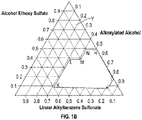
- the weight ratio of actives of the (1) alcohol ethoxy sulfate: the (2) alkoxylated alcohol: the (3) linear alkylbenzene sulfonate falls within a multi-sided region (X) of a ternary plot, wherein the multi-sided region (X) is defined by seven points approximately as follows:
- each of these values may independently vary by about 1, 5, 10, 15, or 20 percent. In various non-limiting embodiments, all values, both whole and fractional, between and including all of the above, are hereby expressly contemplated for use herein.
- the weight ratio of actives of the (1) alcohol ethoxy sulfate: the (2) alkoxylated alcohol: the (3) linear alkylbenzene sulfonate falls within a multi-sided region (Y) of a ternary plot, wherein the multi-sided region (Y) is defined by seven points approximately as follows:
- each of these values may independently vary by about 1, 5, 10, 15, or 20 percent. In various non-limiting embodiments, all values, both whole and fractional, between and including all of the above, are hereby expressly contemplated for use herein.
- the weight ratio of actives of (1), (2), and (3) are about 0.6 : 0.4 : 0. In another embodiment, the weight ratio of actives of (1), (2), and (3) are about 0.1 : 0.9 : 0. In another embodiment, the weight ratio of actives of (1), (2), and (3) are about 0 : 0.9 : 0.1. In another embodiment, the weight ratio of actives of (1), (2), and (3) are about 0 : 0.1 : 0.9. In another embodiment, the weight ratio of actives of (1), (2), and (3) are about 0.1 : 0 : 0.9.
- the weight ratio of actives of (1), (2), and (3) are about 0.4 : 0 : 0.6. In another embodiment, the weight ratio of actives of (1), (2), and (3) are about 0.4 : 0.2 : 0.4. In another embodiment, the weight ratio of actives of (1), (2), and (3) are about 0.5 : 0.5 : 0. In another embodiment, the weight ratio of actives of (1), (2), and (3) are about 0.2 : 0.8 : 0. In another embodiment, the weight ratio of actives of (1), (2), and (3) are about 0 : 0.8 : 0.2. In another embodiment, the weight ratio of actives of (1), (2), and (3) are about 0.1 : 0.3 : 0.6.
- the weight ratio of actives of (1), (2), and (3) are about 0.4 : 0.3 : 0.3. In another embodiment, the weight ratio of actives of (1), (2), and (3) are about 0.4 : 0.4 : 0.2. In another embodiment, the weight ratio of actives of (1), (2), and (3) are about 0.5 : 0.4 : 0.1. In various embodiments, each of these values may independently vary by about 1, 5, 10, 15, or 20 percent. Each of these points is also shown in FIGS. 1A or 1B . It is contemplated that the weight ratios of the active of (1), (2), and (3) may fall anywhere within the ternary plot shown in FIGS. 1A or 1B or anywhere within the multisided-sided figures of FIGS. 1A or 1B . In various non-limiting embodiments, all values, both whole and fractional, between and including all of the above, are hereby expressly contemplated for use herein.
- the amount of the surfactant component itself in the composition is not particularly limited.
- the surfactant component can be present in the composition in an amount of from about 5 to about 30, about 8 to about 30, about 10 to about 25, about 15 to about 20, about 10 to about 15, about 11 to about 14, about 12 to about 13, or about 5, 6, 7, 8, 9, 10, 11, 12, 13, 14, 15, 16, 17, 18, 19, 20, 21, 22, 23, 24, 25, 26, 27, 28, 29, or 30, weight percent actives based on a total weight of the composition.
- all values, both whole and fractional, between and including all of the above, are hereby expressly contemplated for use herein.
- the surfactant component includes the (1) alcohol ethoxy sulfate, which may be described as an anionic surfactant.
- the alcohol ethoxy sulfate has a C 8 -C 20 backbone that is ethoxylated with from about 1 to about 10 moles of ethylene oxide.
- the alcohol ethoxy sulfate may be described as having a C 8 -C 20 backbone and about 1 to 10 moles of ethylene oxide units bonded thereto.
- the backbone may have any number of carbon atoms from 8 to 20, e.g. 10 to 18, 12 to 16, 12 to 14, 14 to 16, or 8, 9, 10, 11, 12, 13, 14, 15, 16, 17, 18, 19, or 20, carbon atoms.
- Various mixtures of alcohol ethoxy sulfates may also be used wherein different length backbones are utilized.
- the backbone is ethoxylated with from about 1 to about 10, about 2 to about 9, about 3 to about 8, about 4 to about 7, about 5 to about 6, or 1, 2, 3, 4, 5, 6, 7, 8, 9, or 10, moles of ethylene oxide.
- all values, both whole and fractional, between and including all of the above, are hereby expressly contemplated for use herein.
- the alcohol ethoxy sulfate is further defined as sodium laureth sulfate (SLES) having the formula: CH 3 (CH 2 ) 10 CH 2 (OCH 2 CH 2 ) n OSO 3 Na wherein n is from about 1 to about 10.
- the alcohol ethoxy sulfate is sodium laureth sulfate ethoxylated with about 2 to about 4 moles of ethylene oxide.
- all values, both whole and fractional, between and including all of the above, are hereby expressly contemplated for use herein.
- the surfactant component also includes the (2) alkoxylated alcohol.
- the alkoxylated alcohol may be a C 8 -C 20 alcohol that is capped with (or comprises) approximately 2 to 12 moles of an alkylene oxide.
- the alkoxylated alcohol may be an alcohol alkoxylate that has from 8 to 20, 10 to 18, 12 to 16, or 12 to 14, carbon atoms and is an ethoxylate, propoxylate, or butoxylate and is capped with an alkylene oxide, e.g. ethylene oxide, propylene oxide, or butylene oxide.
- the alcohol alkoxylate may be capped with varying numbers of moles of the alkylene oxide, e.g.
- the surfactant component also includes the (3) linear alkylbenzene sulfonate (LAS).
- the linear alkylbenzene sulfonate may have a linear alkyl chain that has, e.g. 10 to 13 carbon atoms. These carbon atoms are present in approximately the following mole ratios C10:C11:C12:C13 is about 13:30:33:24 having an average carbon number of about 11.6 and a content of the most hydrophobic 2-phenyl isomers of about 18-29 wt%.
- the linear alkylbenzene sulfonate may be any known in the art. In various non-limiting embodiments, all values, both whole and fractional, between and including all of the above, are hereby expressly contemplated for use herein.
- the alcohol ethoxy sulfate is sodium laureth sulfate ethoxylated with about 2 to about 4 moles of ethylene oxide
- the linear alkyl benzenesulfonate has a linear alkyl chain that has from about 10 to about 13 carbon atoms
- the alkoxylated alcohol is an ethoxylated alcohol comprising a C 8 -C 20 backbone that is ethoxylated with from about 2 to about 12 moles of ethylene oxide.
- the (1) alcohol ethoxy sulfate is sodium laureth sulfate ethoxylated with about 2 to about 4 moles of ethylene oxide
- the (2) alkoxylated alcohol is a C12-C15 alcohol ethoxylate that is capped with approximately 7 moles of ethylene oxide
- the (3) linear alkyl benzenesulfonate is optionally 2-Phenyl Sulfonic Acid.
- the weight ratio of actives of these particular (1): (2): (3) falls within a multi-sided region (X) of a ternary plot, e.g. as set forth in FIG. 1A , wherein the multi-sided region (X) is defined by seven points approximately as follows:
- the (1) alcohol ethoxy sulfate is sodium laureth sulfate ethoxylated with about 2 to about 4 moles of ethylene oxide
- the (2) alkoxylated alcohol is a C12-C15 alcohol ethoxylate that is capped with approximately 7 moles of ethylene oxide
- the (3) linear alkyl benzenesulfonate is optionally 2-Phenyl Sulfonic Acid wherein the weight ratio of actives of these particular (1): (2): (3) falls within a multi-sided region (Y) of a ternary plot, , e.g. as set forth in FIG. 1B , wherein the multi-sided region (Y) is defined by seven points approximately as follows:
- one or more additional surfactants may be utilized and may be or include cationic, anionic, non-ionic, and/or zwitterionic surfactants, and/or combinations thereof.
- the composition may be free of one or more of such additional surfactants.
- Additional anionic surfactants may include soaps which contain sulfate or sulfonate groups, including those with alkali metal ions as cations, can be used.
- Usable soaps include alkali metal salts of saturated or unsaturated fatty acids with 12 to 18 carbon (C) atoms. Such fatty acids may also be used in incompletely neutralized form.
- Usable ionic surfactants of the sulfate type include the salts of sulfuric acid semi esters of fatty alcohols with 12 to 18 C atoms.
- Usable ionic surfactants of the sulfonate type include alkane sulfonates with 12 to 18 C atoms and olefin sulfonates with 12 to 18 C atoms, such as those that arise from the reaction of corresponding monoolefins with sulfur trioxide, alpha-sulfofatty acid esters such as those that arise from the sulfonation of fatty acid methyl or ethyl esters.
- all values, both whole and fractional, between and including all of the above, are hereby expressly contemplated for use herein.
- additional nonionic surfactants include alkyl glycosides and ethoxylation and/or propoxylation products of alkyl glycosides or linear or branched alcohols in each case having 12 to 18 carbon atoms in the alkyl moiety and 3 to 20, or 4 to 10, alkyl ether groups.
- Corresponding ethoxylation and/or propoxylation products of N-alkylamines, vicinal diols, and fatty acid amides, which correspond to the alkyl moiety in the stated long-chain alcohol derivatives may furthermore be used.
- Alkylphenols having 5 to 12 carbon atoms may also be used in the alkyl moiety of the above described long-chain alcohol derivatives.
- all values, both whole and fractional, between and including all of the above, are hereby expressly contemplated for use herein.
- the additional surfactant is chosen from nonionic and ionic surfactants, such as alkoxylates, polyglycerols, glycol ethers, glycols, polyethylene glycols, polypropylene glycols, polybutylene glycols, glycerol ester ethoxylates, polysorbates, alkyl ether sulfates, alkyl- and/or arylsulfonates, alkyl sulfates, ester sulfonates (sulfo-fatty acid esters), ligninsulfonates, fatty acid cyanamides, anionic sulfosuccinic acid surfactants, fatty acid isethionates, acylaminoalkane-sulfonates (fatty acid taurides), fatty acid sarcosinates, ether carboxylic acids and alkyl(ether)phosphates.
- nonionic and ionic surfactants such as alkoxylates, polyglyce
- suitable nonionic surfactants include C 2 -C 6 -alkylene glycols and poly-C 2 -C 3 -alkylene glycol ethers, optionally, etherified on one side with a C 1 -C 6 -alkanol and having, on average, 1 to 9 identical or different, typically identical, alkylene glycol groups per molecule, and also alcohols and fatty alcohol polyglycol ethers, typically propylene glycol, dipropylene glycol, trimethylolpropane, and fatty alcohols with low degrees of ethoxylation having 6 to 22, typically 8 to 18, more typically 8 to 12, and even more typically 8 to 11, carbon atoms.
- suitable ionic surfactants include alkyl ether sulfates, sulfosuccinic acid surfactants, polyacrylates and phosphonic acids, typically lauryl sulfate, lauryl ether sulfate, sodium sulfosuccinic acid diisooctyl ester, 1-hydroxyethane-1,1-diphosphonic acid, and diacetyltartaric esters.
- alkyl ether sulfates typically lauryl sulfate, lauryl ether sulfate, sodium sulfosuccinic acid diisooctyl ester, 1-hydroxyethane-1,1-diphosphonic acid, and diacetyltartaric esters.
- the one or more additional surfactants may be part of the surfactant component, as described above, or may be independent from the surfactant component.
- the one or more additional surfactants is or includes an additional anionic surfactant and/or a non-ionic surfactant.
- other surfactants such as cationic and/or zwitterionic (amphoteric) surfactants may also be utilized or may be excluded from the composition.
- the detergent composition also includes water.
- Water is present in the composition in a total amount of at least about 60 weight percent based on a total weight of the composition. In various embodiments, the water is present in a total amount of from about 60 to about 93, about 60 to about 90, about 65 to about 85, about 70 to about 80, about 75 to about 80, weight percent based on a total weight of the composition.
- total amount refers to a total amount of water present in the composition from all components, i.e., not simply water added independently from, for example, the surfactant component and/or the tertiary amine. In various non-limiting embodiments, all values, both whole and fractional, between and including all of the above, are hereby expressly contemplated for use herein.
- An independent source of water such as DI water, may be used to dilute the composition.
- This water may be independent from any water present in the composition as originating from one or more components. In other words, the composition includes water originating from the components themselves. However, to further dilute the composition, the independent water source may be used.
- the composition may include, or may be free of, a non-aqueous solvent.
- the non-aqueous solvent is present in an amount of from about 1 to about 30, about 3 to about 30, about 5 to about 30, about 10 to about 25, or about 15 to about 20, weight percent based on a total weight of the composition.
- all values, both whole and fractional, between and including all of the above, are hereby expressly contemplated for use herein.
- the non-aqueous solvent is not particularly limited and may be any known in the art.
- the non-aqueous solvent is chosen from glycerol (glycerin), propylene glycol, ethylene glycol, ethanol, and 4C+ compounds.
- 4C+ compound refers to one or more of: polypropylene glycol; polyethylene glycol esters such as polyethylene glycol stearate, propylene glycol laurate, and/or propylene glycol palmitate; methyl ester ethoxylate; diethylene glycol; dipropylene glycol; tetramethylene glycol; butylene glycol; pentanediol; hexylene glycol; heptylene glycol; octylene glycol; 2-methyl, 1,3 propanediol; triethylene glycol; polypropylene glycol; glycol ethers, such as ethylene glycol monobutyl ether, diethylene glycol monobutyl ether, triethylene glycol monobutyl ether, ethylene glycol monopropyl ether, diethylene glycol monoethyl ether, triethylene glycol monoethyl ether, diethylene glycol monomethyl ether, and triethylene glycol monomethyl ether; tris (2-hydroxye
- the non-aqueous solvent is a relatively low molecular weight polyethylene glycol (PEG) having a weight average molecular weight of less than about 600 Da, e.g. about 400, such as those having a weight average molecular weight of from about 380 to about 420, Da.
- PEG 200, PEG 250, PEG 300, PEG 350, PEG 400, PEG 450, PEG 500, PEG 550, and/or PEG 600 (wherein the numerals represent the approximate weight average molecular weight in Daltons) may be used.
- Other suitable non-aqueous solvents include ethylene oxide / propylene oxide block co-polymers. In various non-limiting embodiments, all values, both whole and fractional, between and including all of the above, are hereby expressly contemplated for use herein.
- the composition is free of the non-aqueous solvent.
- the composition may include one or more of the following additives or may be free of one or more of the following additives.
- the composition may include one or more foam inhibitors (e.g. defoaming agents). Suitable foam inhibitors include, but are not limited to, fatty acids such as coconut fatty acids.
- the composition may include the foam inhibitor at an amount of from about 0 to about 10 weight percent, based on the total weight of the composition. In various non-limiting embodiments, all values, both whole and fractional, between and including all of the above, are hereby expressly contemplated for use herein.
- Bittering agents may optionally be added to hinder accidental ingestion of the composition.
- Bittering agents are compositions that taste bad, so children or others are discouraged from accidental ingestion.
- Exemplary bittering agents include denatonium benzoate, aloin, and others.
- Bittering agents may be present in the composition at an amount of from about 0 to about 1 weight percent, or an amount of from about 0 to about 0.5 weight percent, or an amount of from about 0 to about 0.1 weight percent in various embodiments, based on the total weight of the composition. In various non-limiting embodiments, all values, both whole and fractional, between and including all of the above, are hereby expressly contemplated for use herein.
- additives may be or include neutralizers/pH adjustors just as monoethanolamine and the like, enzymes, optical brighteners, chelators, and combinations thereof. These additives may be chosen from any known in the art.
- the additive may include, or be free of, a cationic polymer (apart from the co-polymer of this disclosure) including, but not limited to, a copolymer of ((2-methacryloyloxy)ethyl)-trimethyl ammonium chloride, cationic cellulosic polymers, and combinations thereof.
- a cationic polymer (apart from the co-polymer of this disclosure) including, but not limited to, a copolymer of ((2-methacryloyloxy)ethyl)-trimethyl ammonium chloride, cationic cellulosic polymers, and combinations thereof.
- composition can include non-ionic and/or anionic soil release polymer, which may be any known in the art.
- the composition is free of, or includes less than 5, 4, 3, 2, 1, 0.5, or 0.1, weight percent of, a solvent other than water, e.g. any organic solvent, non-polar solvent, polar aprotic solvent, polar protic solvent, etc. and combinations thereof.
- the composition is free of, or includes less than 5, 4, 3, 2, 1, 0.5, or 0.1, weight percent of, propylene glycol and/or glycerine.
- all values, both whole and fractional, between and including all of the above, are hereby expressly contemplated for use herein.
- weight ranges set forth above. However, in additional embodiments, these weight ranges may be narrower and/or specific weight ratios may be utilized. These weight ranges and/or ratios may be representative of embodiments that produce special, superior, and unexpected results, such as those demonstrated in the Examples. Relative to all of the paragraphs set forth immediately below, in various non-limiting embodiments, all values, both whole and fractional, between and including all of the above, are hereby expressly contemplated for use herein.
- predictive expressions can be used to predict turbidity.
- the following predictive expression can be used:
- the sodium and/or potassium chloride is present in an amount of from about 1 to about 2 percent actives based on a total weight of the composition; (1) the alcohol ethoxy sulfate is sodium laureth sulfate ethoxylated with about 2 to about 4 moles of ethylene oxide; (2) the alkoxylated alcohol is a C12-C15 alcohol ethoxylate that is capped with about 7 moles of ethylene oxide; and (3) the linear alkylbenzene sulfonate has a linear alkyl chain that has from about 10 to about 13 carbon atoms.
- all values, both whole and fractional, between and including all of the above, are hereby expressly contemplated for use herein.
- (1) is present in an amount of from about 0 to about 50 weight percent actives based on a total weight of the surfactant component, (2) is present in an amount of from about 30 to about 80 weight percent actives based on a total weight of the surfactant component, and (3) is present in an amount of from about 0 to about 60 weight percent actives based on a total weight of the surfactant component.
- all values, both whole and fractional, between and including all of the above, are hereby expressly contemplated for use herein.
- the surfactant component is present in an amount of from about 12 to about 13 weight percent actives based on a total weight of the composition and comprises:
- the composition may be, include, consist essentially of, or consist of, any combination of the following: Approximate Ranges Material Description Activity (%) w/w (%) Water 100.00 30 to 70 Citric Acid 50% solution 50.00 3 to 12 Triethanolamine 85.00 0.5 to 2 Surfactant (2) e.g. Alcohol Ethoxylate 25-7 100.00 5 to 11.3 Surfactant (3) e.g. LAS Sulfonic acid 96.00 1.2 to 11.5 Coco Fatty Acid 100.00 0.25 to 1.5 Sodium Hydroxide 50.00 Adjust to pH 7.2 to 8.2 Surfactant (1) e.g.
- the composition may include the following approximate weight ratios of percent actives of surfactants based on a total weight of the surfactant composition wherein the composition also includes the copolymer in an amount of from about 0.05 to about 1 weight percent actives based on a total weight of the composition.
- NaCl and/or KCl present in an amount of greater than about 0.5 and up to about 2, 3, 4, or 5, weight percent actives based on a total weight of the composition, and water present in an amount of at least about 60 weight percent based on a total weight of the composition.
- Surfactant 1 Surfactant 2
- Surfactant 3 Co-Polymer NaCl/KCl 0.440 0.166 0.394 0.05-1 > 0.5 to about 2 0.342 0.561 0.097 0.05-1 > 0.5 to about 2 0.098 0.722 0.180 0.05-1 > 0.5 to about 2 0.097 0.396 0.507 0.05-1 > 0.5 to about 2 0.290 0.411 0.299 0.05-1 > 0.5 to about 2 0.693 0.182 0.125 0.05-1 > 0.5 to about 2 0.177 0.116 0.708 0.05-1 > 0.5 to about 2 0.319 0.542 0.139 0.05-1 > 0.5 to about 2
- composition 1 The following base (Composition 1) was made 12.55 percent total active surfactant: Material Description Activity (%) Composition 1 w/w (%) Water 100.00 50.000 Citric Acid 50% solution 50.00 8.800 Triethanolamine 85.00 1.482 Alcohol Ethoxylate 25-7 Surfactant (2) 100.00 6.802 LAS Sulfonic acid Surfactant (3) 96.00 1.817 Coco Fatty Acid 100.00 0.500 Sodium Hydroxide 50.00 Adjust to pH 7.7 Steol 25-3S/60 (AES) Surfactant (1) 60.00 6.672 Performance Polymer 80.00 0.070 Optical Brightener 100.00 0.100 Chelator 34.00 0.735 Preservative 8.60 0.094 DADMAC-Acrylic Acid Copolymer 42.50 0.000 Water 100.00 QS to 90 -- Total-- 90.000
- Composition 1 then had the DADMAC-Acrylic Acid Copolymer added at different concentrations so as to form Compositions 2 to 9 to determine the turbidity impact of the polymer wherein additional water was added to each Composition as shown below.
- Composition 2 is the same as Composition 1 but with an additional 10 % water added to the 90% base of Composition 1, notably with no copolymer and no salt.
- Composition 3 had 0.12% of DADMAC-Acrylic Acid Copolymer added as supplied (supplied as 42.5% active for 0.05% active polymer) plus 9.88% water added. The turbidity was measured using the instrumentation and method described in the detailed description above. Comp. Amount of Comp.
- compositions 11-28 The following salts were added to Composition 10 (90 parts of Composition 1 plus 0.82 parts of DADMAC-Acrylic Acid as supplied (0.35% active) so as to form Compositions 11-28 as shown below. Any remaining parts of the formula after the salt addition was QS'd with Water to bring the formula to 100 parts (i.e. 100%). The turbidity was measured using the instrumentation and method described in the detailed description above.
- composition 29 The following base (Composition 29) was made 15.13 percent total active surfactant: Composition 29 Material Description Activity (%) w/w (%) Water 100.00 50.000 Citric Acid 50% solution 50.00 8.800 Triethanolamine 85.00 1.482 Alcohol Ethoxylate 25-7 Surfactant (1) 100.00 5.159 LAS Sulfonic acid Surfactant (3) 96.00 3.909 Coco Fatty Acid 100.00 0.500 Sodium Hydroxide 50.00 Adjust to pH 7.7 Steol 25-3S/60 (AES) Surfactant (1) 60.00 6.064 Performance Polymer 80.00 0.070 Optical Brightener 100.00 0.100 Chelator 34.00 0.735 Preservative 8.60 0.094 DADMAC-Acrylic Acid Copolymer 42.50 0.706 (i.e. 0.35% active co-polymer) Water 100.00 QS to 90 -- Total-- 100.000
- Composition 30 was 90 parts Composition 29 with 10 parts water.
- Composition 31 was 90 parts Composition 29 with 1.5% active sodium chloride (added as a 25% active solution), with the remaining parts being water.
- the turbidity of Composition 30 was 275 NTU and the turbidity of Composition 31 was 124 NTU. The turbidity was measured using the instrumentation and method described in the detailed description above. It was unexpected to discover the ratios of surfactants plus polymer that would yield turbid results, the impact of salt addition to improve transparency, and the amount of salt required.
Landscapes
- Chemical & Material Sciences (AREA)
- Life Sciences & Earth Sciences (AREA)
- Engineering & Computer Science (AREA)
- Chemical Kinetics & Catalysis (AREA)
- Oil, Petroleum & Natural Gas (AREA)
- Wood Science & Technology (AREA)
- Organic Chemistry (AREA)
- Inorganic Chemistry (AREA)
- Detergent Compositions (AREA)
Abstract
Description
- The present disclosure generally relates to a detergent composition that includes a DADMAC-acrylic acid copolymer and has a reduced turbidity. More specifically, this disclosure relates to use of sodium and/or potassium salts in conjunction with particular surfactants to unexpectedly reduce turbidity in the aforementioned composition.
- Softening textiles through the wash is a desirable benefit for consumers. Chemistries that provide this benefit are typically cationically charged and may be unstable when added to a detergent composition containing anionic and nonionic surfactants. For example, when added to such compositions, cationic chemistries can lead to excess turbidity in solutions which reduces usefulness and commercial desirability.
- More specifically, commercially available DADMAC-acrylic acid co-polymers can be unstable in many current surfactant compositions. Low water content formulas, such as unit dose formulations, do not tend to exhibit this instability and the solutions tend to remain clear. However, upon addition of such copolymers to high water content detergent compositions, the compositions become cloudy indicating instability.
- Accordingly, there remains an opportunity for improvement. Furthermore, other desirable features and characteristics of the present disclosure will become apparent from the subsequent detailed description of the disclosure and the appended claims, taken in conjunction this background of the disclosure.
- This disclosure provides a detergent composition comprising:
- A. a co-polymer of diallyldimethylammonium chloride and acrylic acid present in an amount of from about 0.05 to about 1 weight percent actives based on a total weight of the composition;
- B. sodium and/or potassium chloride present in an amount of greater than about 0.5 up to about 5 weight percent actives based on a total weight of the composition;
- C. a surfactant component present in an amount of from about 8 to about 30 weight percent actives based on a total weight of the composition and comprising:
- (1) an alcohol ethoxy sulfate having a C8-C20 backbone that is ethoxylated with from about 1 to about 10 moles of ethylene oxide and present in an amount of from about 0 to about 60 weight percent actives based on a total weight of the surfactant component;
- (2) an alkoxylated alcohol present in an amount of from about 0 to about 90 weight percent actives based on a total weight of the surfactant component;
- (3) a linear alkylbenzene sulfonate present in an amount of from about 0 to about 90 weight percent actives based on a total weight of the surfactant component;
wherein the detergent composition has a turbidity of less than about 80 NTU measured at 25°C when sodium chloride is utilized to the exclusion of potassium chloride, a turbidity of less than about 110 NTU measured at 25°C when potassium chloride is utilized to the exclusion of sodium chloride, and a turbidity of less than about 100 NTU measured at 25°C when both sodium and potassium chloride are utilized. - This disclosure also provides a detergent composition consisting essentially of:
- A. a co-polymer of diallyldimethylammonium chloride and acrylic acid present in an amount of from about 0.2 to about 0.3 weight percent actives based on a total weight of the composition;
- B. sodium chloride present in an amount of from about 1 to about 2 weight percent actives based on a total weight of the composition;
- C. a surfactant component present in an amount of from about 12 to about 13 weight percent actives based on a total weight of the composition and comprising:
- (1) sodium laureth sulfate ethoxylated with about 2 to about 4 moles of ethylene oxide and is present in an amount of from about 30 to about 33 weight percent actives based on a total weight of the surfactant component;
- (2) a C12-C15 alcohol ethoxylate that is capped with about 7 moles of ethylene oxide and is present in an amount of from about 53 to about 55 weight percent actives based on a total weight of the surfactant component; and
- (3) a linear alkylbenzene sulfonate that has a linear alkyl chain that has from about 10 to about 13 carbon atoms and is present in an amount of from about 13 to about 15 weight percent actives based on a total weight of the surfactant component; and
- D. water present in a total amount of at least about 60 weight percent based on a total weight of the detergent; and
wherein the detergent composition has a turbidity of less than about 72 NTU measured at 25°C. - The detergent composition exhibits superior and unexpected results. More specifically, it was discovered that improvements were surprisingly found when a total ionic strength of the detergent composition surpassed a critical concentration. This allowed for the co-polymer to be stabilized with a lower concentration of the three surfactants of the surfactant component. The linear alkylbenzene sulfonate did not negatively impact turbidity when in the detergent composition. However, the alcohol ethoxy sulfate did negatively affect turbidity. It was previously believed that both of these surfactants would affect turbidity. Therefore, the results are surprising, unexpected, and superior to what is known and shown in the art.
- The present disclosure will hereinafter be described in conjunction with the following Figures, wherein:
-
FIG. 1A is a ternary plot of weight ratios of actives of three surfactants of various embodiments of the instant disclosure showing a multi-sided region (X) that is defined by seven points of the weight ratio actives of (1) an alcohol ethoxy sulfate having a C8-C20 backbone that is ethoxylated with from about 1 to about 10 moles of ethylene oxide, (2) an alkoxylated alcohol, and (3) a linear alkylbenzene sulfonate, as set forth as follows:- (A) 0.6 : 0.4 : 0;
- (B) 0.1 : 0.9 : 0;
- (C) 0: 0.9: 0.1;
- (D) 0 : 0.1 : 0.9;
- (E) 0.1:0:0.9;
- (F) 0.4 : 0 : 0.6; and
- (G) 0.4 : 0.2 : 0.4;
-
FIG. 1B is a ternary plot of weight ratios of actives of three surfactants of various embodiments of the instant disclosure showing a multi-sided region (Y) that is defined by seven points of the weight ratio actives of (1) an alcohol ethoxy sulfate having a C8-C20 backbone that is ethoxylated with from about 1 to about 10 moles of ethylene oxide, (2) an alkoxylated alcohol, and (3) a linear alkylbenzene sulfonate, as set forth as follows:- (H) 0.5 : 0.5 : 0;
- (I) 0.2 : 0.8 : 0;
- (J) 0 : 0.8 : 0.2;
- (K) 0.1 : 0.3 : 0.6;
- (L) 0.4 : 0.3 : 0.3;
- (M) 0.4 : 0.4 : 0.2; and
- (N) 0.5 : 0.4 : 0.1,
- The following detailed description is merely exemplary in nature and is not intended to limit the disclosure. Furthermore, there is no intention to be bound by any theory presented in the preceding background or the following detailed description.
- Embodiments of the present disclosure are generally directed to detergent compositions and methods for forming the same. For the sake of brevity, conventional techniques related to detergent compositions may not be described in detail herein. Moreover, the various tasks and process steps described herein may be incorporated into a more comprehensive procedure or process having additional steps or functionality not described in detail herein. In particular, various steps in the manufacture of detergent compositions are well-known and so, in the interest of brevity, many conventional steps will only be mentioned briefly herein or will be omitted entirely without providing the well-known process details.
- "Liquid" or "liquid composition", as referred to herein, is any composition that has a viscosity. More particularly, for purposes herein, liquids are compositions that flow under influence of a force such as gravity, agitation, etc. It is to be appreciated that the liquid compositions may contain particulate components therein provided that the composition retains a viscosity and the presence of a separate particulate phase does not change the character of the composition from being a liquid.
- The term "laundry composition" or "detergent composition" as used herein, refers to a composition that provides cleaning as well as fabric care benefits. The term encompasses compositions for handwash, machine wash and other purposes such as soaking and/or pretreatment of stained fabrics.
- The term "about" as used in connection with a numerical value throughout the specification and the claims denotes an interval of accuracy, familiar and acceptable to a person skilled in the art. In general, such interval of accuracy is ± 10%. Thus, "about ten" means 9 to 11. All numbers in this description indicating amounts, ratios of materials, physical properties of materials, and/or use are to be understood as modified by the word "about," except as otherwise explicitly indicated.
- As used herein, the term "comprising" means including, made up of, composed, characterized by or having.
- Turbidity, as used herein, is defined as the cloudiness or haziness of a solution caused by finely suspended particles. Turbidity is measured using nephelometric turbidity units (NTU). As used herein, low turbidity suspensions are those generally having a low solids concentration (on a weight basis), i.e., a solids weight percent of 0.1 or less. This typically corresponds with an approximate turbidity of 50 NTU's or less, but may vary due to the nature of the solids or dissolved colored matter. High solids suspensions include those systems containing in excess of 0.1 weight percent suspended solids, which generally corresponds to a turbidity of greater than 50 NTU's.
- As used herein, "consisting of' excludes any element, step or ingredient not explicitly specified, whereas "consisting essentially of' allows for the presence of further materials or steps, but only in so far as these further materials or steps do not materially affect the characteristics of the invention. It is preferred that in a composition consisting essentially of a given list of components, further materials may only be present in an amount of less than 5% of the composition, more preferred less than 1% of the composition, even more preferred less than 0.5% of the composition.
- In one aspect, the present disclosure provides a detergent composition with reduced turbidity. The detergent composition is typically used as a liquid detergent composition product but is not limited to such applications. The detergent composition may alternatively be used for laundry applications, dishwashing applications, industrial or residential surfactant and cleanser applications, etc.
- In one embodiment, this disclosure provides a detergent composition comprising:
- A. a co-polymer of diallyldimethylammonium chloride and acrylic acid present in an amount of from about 0.05 to about 1 weight percent actives based on a total weight of the composition;
- B. sodium and/or potassium chloride present in an amount of greater than about 0.5 up to about 5 weight percent actives based on a total weight of the composition;
- C. a surfactant component present in an amount of from about 8 to about 30 weight percent actives based on a total weight of the composition and comprising:
- (1) an alcohol ethoxy sulfate having a C8-C20 backbone that is ethoxylated with from about 1 to about 10 moles of ethylene oxide and present in an amount of from about 0 to about 60 weight percent actives based on a total weight of the surfactant component;
- (2) an alkoxylated alcohol present in an amount of from about 0 to about 90 weight percent actives based on a total weight of the surfactant component;
- (3) a linear alkylbenzene sulfonate present in an amount of from about 0 to about 90 weight percent actives based on a total weight of the surfactant component;
wherein at least two of the (1) alcohol ethoxy sulfate, the (2) alkoxylated alcohol, and the (3) linear alkylbenzene sulfonate are present in an amount of greater than zero; and
- D. water present in a total amount of at least about 60 weight percent based on a total weight of the detergent; and wherein the detergent composition has a turbidity of less than about 80 NTU measured at 25°C when sodium chloride is utilized to the exclusion of potassium chloride, a turbidity of less than about 110 NTU measured at 25°C when potassium chloride is utilized to the exclusion of sodium chloride, and a turbidity of less than about 100 NTU measured at 25°C when both sodium and potassium chloride are utilized.
- In another embodiment, this disclosure also provides a detergent composition consisting essentially of:
- A. a co-polymer of diallyldimethylammonium chloride and acrylic acid present in an amount of from about 0.2 to about 0.3 weight percent actives based on a total weight of the composition;
- B. sodium chloride present in an amount of from about 1 to about 2 weight percent actives based on a total weight of the composition;
- C. a surfactant component present in an amount of from about 12 to about 13 weight percent actives based on a total weight of the composition and comprising:
- (1) sodium laureth sulfate ethoxylated with about 2 to about 4 moles of ethylene oxide and is present in an amount of from about 30 to about 33 weight percent actives based on a total weight of the surfactant component;
- (2) a C12-C15 alcohol ethoxylate that is capped with about 7 moles of ethylene oxide and is present in an amount of from about 53 to about 55 weight percent actives based on a total weight of the surfactant component; and
- (3) a linear alkylbenzene sulfonate that has a linear alkyl chain that has from about 10 to about 13 carbon atoms and is present in an amount of from about 13 to about 15 weight percent actives based on a total weight of the surfactant component; and
- D. water present in a total amount of at least about 60 weight percent based on a total weight of the detergent; and wherein the detergent composition has a turbidity of less than about 72 NTU measured at 25°C.
- Throughout this disclosure, the terminology percent "actives" is well recognized in the art and means the percent amount of active or actual compound or molecule present as compared to, for example, a total weight of a diluted solution of water and such a compound. Some compounds, such as water, are not described relative to a percent actives because it is well known to be approximately 100% actives of H2O.
- In another aspect, the present disclosure provides a method for reducing turbidity of a detergent composition. The method includes the step of providing a preliminary detergent composition that includes the surfactant component, water, and co-polymer described below. This preliminary detergent composition has a particular turbidity. The method also includes the step of adding sodium and/or potassium chloride thereto. This combination forms the detergent composition from the preliminary detergent composition and lowers the turbidity of the preliminary detergent composition to a second turbidity, as described below.
- It was unexpectedly discovered that, as a result of incorporating the sodium and/or potassium chloride, the detergent composition shows a trend of reducing turbidity thereby indicating increased solution stability. More specifically, it was discovered that improvements were surprisingly found when a total ionic strength of the detergent composition surpassed a critical concentration. This allowed for the co-polymer to be stabilized with a lower concentration of the three surfactants of the surfactant component. The linear alkylbenzene sulfonate did not negatively impact turbidity when in the detergent composition. However, the alcohol ethoxy sulfate did negatively affect turbidity. It was previously believed that both of these surfactants would affect turbidity. Therefore, the results are surprising, unexpected, and superior to what is known and shown in the art.
- This disclosure provides the detergent composition, first introduced above and hereinafter referred to as a composition. The composition may be, include, consist essentially of, or consist of, the cationic polymer, sodium and/or potassium chloride, the surfactant component, and water, as each is described below, e.g. in any one or more of the amounts described in greater detail below.
- In one embodiment, the composition comprises the co-polymer of diallyldimethylammonium chloride and acrylic acid, the sodium and/or potassium chloride, the surfactant component, and the water.
- In another embodiment, the composition consists essentially of the co-polymer of diallyldimethylammonium chloride and acrylic acid, the sodium and/or potassium chloride, the surfactant component, and the water.
- In still another embodiment, the composition consists of the co-polymer of diallyldimethylammonium chloride and acrylic acid, the sodium and/or potassium chloride, the surfactant component, and the water.
- In yet another embodiment, the composition comprises the co-polymer of diallyldimethylammonium chloride and acrylic acid, the sodium and/or potassium chloride, the surfactant component, the water, and one or more additional surfactants.
- In another embodiment, the composition consists essentially of the co-polymer of diallyldimethylammonium chloride and acrylic acid, the sodium and/or potassium chloride, the surfactant component, the water, and one or more additional surfactants.
- In another embodiment, the composition consists of the co-polymer of diallyldimethylammonium chloride and acrylic acid, the sodium and/or potassium chloride, the surfactant component, the water, and one or more additional surfactants.
- In yet another embodiment, the composition comprises the co-polymer of diallyldimethylammonium chloride and acrylic acid, the sodium and/or potassium chloride, the surfactant component, the water, one or more additional surfactants, and one or more additives.
- In another embodiment, the composition consists essentially of the co-polymer of diallyldimethylammonium chloride and acrylic acid, the sodium and/or potassium chloride, the surfactant component, the water, one or more additional surfactants, and one or more additives.
- In another embodiment, the composition consists of the co-polymer of diallyldimethylammonium chloride and acrylic acid, the sodium and/or potassium chloride, the surfactant component, the water, one or more additional surfactants, and one or more additives.
- In yet another embodiment, the composition comprises the co-polymer of diallyldimethylammonium chloride and acrylic acid, the sodium and/or potassium chloride, the surfactant component, the water, and one or more additives, and is free of one or more additional surfactants.
- In another embodiment, the composition consists essentially of the co-polymer of diallyldimethylammonium chloride and acrylic acid, the sodium and/or potassium chloride, the surfactant component, the water, and one or more additives, and is free of one or more additional surfactants.
- In another embodiment, the composition consists of the co-polymer of diallyldimethylammonium chloride and acrylic acid, the sodium and/or potassium chloride, the surfactant component, the water, and one or more additives, and is free of one or more additional surfactants.
- In various embodiments throughout this disclosure, the terminology "consists essentially of' or "consisting essentially of' describes that the composition may be free of, or include less than 1, 0.5, 0.1, 0.05, or 0.01, weight percent of, any one or more of the optional components or additives described above or below, one or more salts that are not sodium and/or potassium chloride, any co-polymer that is not the co-polymer of this disclosure, any one or more surfactants that are not those of this disclosure, any non-aqueous solvents, aqueous solvents that are not water, etc., as understood by those of skill in the art.
- The composition also includes the copolymer of diallyldimethylammonium chloride (DADMAC) and acrylic acid. This copolymer is not particularly limited and may be any known in the art. The copolymer is present in an amount of from about 0.05 to about 1 weight percent actives based on a total weight of the composition. In other embodiments, the copolymer is present in an amount of from about 0.1 to about 0.95, about 0.15 to about 0.9, about 0.2 to about 0.85, about 0.25 to about 0.8, about 0.3 to about 0.75, about 0.35 to about 0.7, about 0.4 to about 0.65, about 0.45 to about 0.6, or about 0.5 to about 0.55, weight percent actives based on a total weight of the composition. In other embodiments, the copolymer is present in an amount of about 0.05, 0.1, 0.15, 0.2, 0.25, 0.3, 0.35, 0.4, 0.45, 0.5, 0.66, 0.6, 0.65, 0.7, 0.75, 0.8, 0.85, 0.9, 0.95 or 1, weight percent actives based on a total weight of the composition. In various non-limiting embodiments, all values, both whole and fractional, between and including all of the above, are hereby expressly contemplated for use herein.
- The composition also includes sodium and/or potassium chloride. For example, the composition may include sodium chloride to the exclusion of potassium chloride. Alternatively, the composition may include potassium chloride to the exclusion of sodium chloride. In another embodiment, the composition includes both sodium chloride and potassium chloride. The sodium and/or potassium chloride is present in an amount of greater than about 0.5 weight percent actives based on a total weight of the composition. In various embodiments this weight is greater than about 0.5 and up to about 10, greater than about 0.5 and up to about 7.5, greater than about 0.5 and up to about 5, greater than about 0.5 and up to about 4.5, about 1 to about 4, about 1.5 to about 3.5, about 2 to about 3, about 2.5 to about 3, greater than about 0.5 and up to about 3, greater than about 0.5 and up to about 2.5, greater than about 0.5 and up to about 2, greater than about 0.5 and up to about 1.5, greater than about 0.5 and up to about 1, greater than about 0.5 and up to about 0.75, about 0.75 to about 2, about 0.75 to about 1.75, about 0.75 to about 1.5, about 0.75 to about 1.25, about 0.75 to about 1, about 1 to about 2, about 1 to about 1.75, about 1 to about 1.5, about 1 to about 1.25, about 1.25 to about 2, about 1.25 to about 1.75, about 1.25 to about 1.5, about 1.5 to about 2, about 1.5 to about 1.75, about 1.75 to about 2, weight percent actives based on a total weight of the composition. In other embodiments, this amount is about 0.55, 0.6, 0.65, 0.7, 0.75, 0.8, 0.85, 0.9, 0.95, 1, 1.05, 1.1, 1.15, 1.2, 1.25, 1.3, 1.35, 1.4, 1.45, 1.5, 1.55, 1.6, 1.65, 1.7, 1.75, 1.8, 1.85, 1.9, 1.95, or 2, weight percent actives based on a total weight of the composition. In various non-limiting embodiments, all values, both whole and fractional, between and including all of the above, are hereby expressly contemplated for use herein.
- In various embodiments, the composition is free of, or includes less than 5, 4, 3, 2, 1, 0.5, 0.1, or 0.05, weight percent actives of other salts such as organic and inorganic salts, based on a total weight of the composition. For example, such salts include sodium and/or potassium citrate, Group I and II metal organic salts, transition metal organic salts, etc. However, it is contemplated that citrates may be utilized as formed from citric acid used in the composition. The same may be true for other organic salts formed from organic acids used in the composition. Typically, though, citrates or other organic salts are not specifically added to control turbidity.
- Typically, the composition has a turbidity of less than about 80 NTU measured at 25°C when sodium chloride is utilized, e.g. to the exclusion of potassium chloride. For example, in various embodiments, the turbidity may be less than about 75, 70, 65, 60,55, 50, 45, 40, 35, 30, 25, 20, etc., NTU measured at 25°C. In other embodiments, the composition has a turbidity of less than about 110 NTU measured at 25°C when potassium chloride is utilized, e.g. to the exclusion of sodium chloride. For example, in various embodiments, the turbidity may be less than about 110, 105, 100, 95, 90, 85, 80, 75, 70, 65, 60,55, 50, 45, 40, 35, 30, 25, 20, etc., NTU measured at 25°C. In still other embodiments, the composition has a turbidity of less than about 100 NTU measured at 25°C, e.g. when both sodium and potassium chloride are utilized. For example, in various embodiments, the turbidity may be less than about 100, 95, 90, 85, 80, 75, 70, 65, 60, 55, 50, 45, 40, 35, 30, 25, 20, etc., NTU measured at 25°C. Typically, turbidity is measured using a Hatch 2100N turbidity meter at about 25°C in a glass vial. Without intending to be bound by any particular theory, it is believed that similar solutions without the copolymer are transparent. As such, it is the copolymer that typically leads to turbidity issues wherein in the technology of the instant disclosure minimizes this turbidity. In various non-limiting embodiments, all values, both whole and fractional, between and including all of the above, are hereby expressly contemplated for use herein.
- As first introduced above, the composition includes the surfactant component. The surfactant component includes, is, consists essentially of, or consists of, three surfactants (1), (2) and (3), i.e., (1) an alcohol ethoxy sulfate having a C8-C20 backbone that is ethoxylated with from about 1 to about 10 moles of ethylene oxide, (2) an alkoxylated alcohol, and (3) a linear alkylbenzene sulfonate. In various non-limiting embodiments, all values, both whole and fractional, between and including all of the above, are hereby expressly contemplated for use herein.
- In one embodiment, the surfactant component includes (1) an alcohol ethoxy sulfate having a C8-C20 backbone that is ethoxylated with from about 1 to about 10 moles of ethylene oxide, (2) an alkoxylated alcohol, and (3) a linear alkylbenzene sulfonate. In various non-limiting embodiments, all values, both whole and fractional, between and including all of the above, are hereby expressly contemplated for use herein.
- In another embodiment, the surfactant component consists essentially of (1) an alcohol ethoxy sulfate having a C8-C20 backbone that is ethoxylated with from about 1 to about 10 moles of ethylene oxide, (2) an alkoxylated alcohol, and (3) a linear alkylbenzene sulfonate. In various non-limiting embodiments, all values, both whole and fractional, between and including all of the above, are hereby expressly contemplated for use herein.
- In a further embodiment, the surfactant component consists of (1) an alcohol ethoxy sulfate having a C8-C20 backbone that is ethoxylated with from about 1 to about 10 moles of ethylene oxide, (2) an alkoxylated alcohol, and (3) a linear alkylbenzene sulfonate. In various non-limiting embodiments, all values, both whole and fractional, between and including all of the above, are hereby expressly contemplated for use herein.
- In various embodiments, the (1) alcohol ethoxy sulfate is present in an amount of from about 0 to about 60 weight percent actives based on a total weight of the surfactant component. The (2) alkoxylated alcohol is present in an amount of from about 0 to about 90 weight percent actives based on a total weight of the surfactant component. The (3) linear alkylbenzene is sulfonate present in an amount of from about 0 to about 90 weight percent actives based on a total weight of the surfactant component. In the above, at least two of the (1) alcohol ethoxy sulfate, the (2) alkoxylated alcohol, and the (3) linear alkylbenzene sulfonate are each independently present in an amount of greater than zero. Said differently, at least two of the surfactants (1) alcohol ethoxy sulfate, (2) alkoxylated alcohol, and (3) linear alkylbenzene sulfonate must be present. This means that two of the surfactants cannot be present in an amount of zero. For example, the surfactant component includes:
- (1) the alcohol ethoxy sulfate, (2) the alkoxylated alcohol, and (3) the linear alkylbenzene sulfonate; or
- (1) the alcohol ethoxy sulfate and (2) the alkoxylated alcohol without (3) the linear alkylbenzene sulfonate; or
- (1) the alcohol ethoxy sulfate and (3) the linear alkylbenzene sulfonate without (2) the alkoxylated alcohol; or
- (2) the alkoxylated alcohol and (3) the linear alkylbenzene sulfonate, without (1) the alcohol ethoxy sulfate.
- In various non-limiting embodiments, all values, both whole and fractional, between and including all of the above, are hereby expressly contemplated for use herein.
- In other embodiments, the surfactant (1), which is the alcohol ethoxy sulfate, may be present in an amount of about 0, 5, 10, 15, 20, 25, 30, 35, 40, 45, 50, 55, or 60, weight percent actives based on a total weight of the surfactant component. In various embodiments, this surfactant is present in an amount of from about 25 to about 40, about 30 to about 35, or about 30, 31, 32, 33, 34, 35, 36, 37, 38, 39, or 40, weight percent actives based on a total weight of the surfactant component. In other embodiments, this surfactant is present in an amount of from about 0 to about 60, about 5 to about 55, about 10 to about 50, about 15 to about 45, about 20 to about 40, about 25 to about 35, or about 25 to about 30, weight percent actives based on a total weight of the surfactant component. In various non-limiting embodiments, all values, both whole and fractional, between and including all of the above, are hereby expressly contemplated for use herein.
- Moreover, surfactant (2), which is the alkoxylated alcohol may be present in an amount of about 0, 5, 10, 15, 20, 25, 30, 35, 40, 45, 50, 55, 60, 65, 70, 75, 80, 85, or 90, weight percent actives based on a total weight of the surfactant component. In various embodiments, this surfactant is present in an amount of from about 45 to about 60, about 50 to about 55, or about 50, 51, 52, 53, 54, 55, 56, 57, 58, 59, or 60, weight percent actives based on a total weight of the surfactant component. In other embodiments, this surfactant is present in an amount of from about 0 to about 90, about 5 to about 85, about 10 to about 80, about 15 to about 75, about 20 to about 70, about 25 to about 65, about 30 to about 60, about 35 to about 55, about 40 to about 50, or about 45 to about 50, weight percent actives based on a total weight of the surfactant component. In various non-limiting embodiments, all values, both whole and fractional, between and including all of the above, are hereby expressly contemplated for use herein.
- Furthermore, surfactant (3), which is the linear alkylbenzene, may be present in an amount of about 0, 5, 10, 15, 20, 25, 30, 35, 40, 45, 50, 55, 60, 65, 70, 75, 80, 85, or 90, weight percent actives based on a total weight of the surfactant component. In other embodiments, this surfactant is present in an amount of from about 0 to about 90, about 5 to about 85, about 10 to about 80, about 15 to about 75, about 20 to about 70, about 25 to about 65, about 30 to about 60, about 35 to about 55, about 40 to about 50, or about 45 to about 50, weight percent actives based on a total weight of the surfactant component. In various non-limiting embodiments, all values, both whole and fractional, between and including all of the above, are hereby expressly contemplated for use herein.
- In the above, at least two of the (1) alcohol ethoxy sulfate, the (2) alkoxylated alcohol, and the (3) linear alkylbenzene sulfonate are each independently present in an amount of greater than zero. In various non-limiting embodiments, all values, both whole and fractional, between and including all of the above, are hereby expressly contemplated for use herein.
- The (1) alcohol ethoxy sulfate, the (2) alkoxylated alcohol, and the (3) linear alkylbenzene sulfonate may be present in a weight ratio of about (0 to 60): about (0 to 90) : about (0 to 90). In other embodiments, the surfactant (1), which is the alcohol ethoxy sulfate, may be present in an amount of the aforementioned ratio of about 0, 0.5, 0.1, 0.15, 0.2, 0.25, 0.3, 0.35, 0.4, 0.45, 0.5, 0.55, or 0.6. Moreover, surfactant (2), which is the alkoxylated alcohol, may be present in an amount of the aforementioned ratio of about 0, 0.5, 0.1, 0.15, 0.2, 0.25, 0.3, 0.35, 0.4, 0.45, 0.5, 0.55, 0.6, 0.65, 0.7, 0.75, 0.8, 0.85, or 0.9. Furthermore, surfactant (3), which is the linear alkylbenzene, may be present in an amount of the aforementioned ratio of about 0, 0.5, 0.1, 0.15, 0.2, 0.25, 0.3, 0.35, 0.4, 0.45, 0.5, 0.55, 0.6, 0.65, 0.7, 0.75, 0.8, 0.85, or 0.9. In various non-limiting embodiments, all values, both whole and fractional, between and including all of the above, are hereby expressly contemplated for use herein.
- In one embodiment, as shown in
FIG. 1A , the weight ratio of actives of the (1) alcohol ethoxy sulfate: the (2) alkoxylated alcohol: the (3) linear alkylbenzene sulfonate falls within a multi-sided region (X) of a ternary plot, wherein the multi-sided region (X) is defined by seven points approximately as follows: - (A) 0.6 : 0.4 : 0;
- (B) 0.1 : 09 : 0;
- (C) 0: 0.9: 0.1;
- (D) 0: 0.1 : 0.9;
- (E) 0.1:0:0.9;
- (F) 0.4 : 0 : 0.6; and
- (G) 0.4 : 0.2 : 0.4.
- In various embodiments, each of these values may independently vary by about 1, 5, 10, 15, or 20 percent. In various non-limiting embodiments, all values, both whole and fractional, between and including all of the above, are hereby expressly contemplated for use herein.
- In another embodiment, as shown in
FIG. 1B , the weight ratio of actives of the (1) alcohol ethoxy sulfate: the (2) alkoxylated alcohol: the (3) linear alkylbenzene sulfonate falls within a multi-sided region (Y) of a ternary plot, wherein the multi-sided region (Y) is defined by seven points approximately as follows: - (H) 0.5 : 0.5 : 0;
- (I) 0.2 : 0.8 : 0;
- (J) 0 : 0.8 : 0.2;
- (K) 0.1 : 0.3 : 0.6;
- (L) 0.4 : 0.3 : 0.3;
- (M) 0.4 : 0.4 : 0.2; and
- (N) 0.5 : 0.4 : 0.1.
- In various embodiments, each of these values may independently vary by about 1, 5, 10, 15, or 20 percent. In various non-limiting embodiments, all values, both whole and fractional, between and including all of the above, are hereby expressly contemplated for use herein.
- In one embodiment, wherein the (1) is the alcohol ethoxy sulfate, the (2) is the alkoxylated alcohol, and (3) is the linear alkylbenzene sulfonate, the weight ratio of actives of (1), (2), and (3) are about 0.6 : 0.4 : 0. In another embodiment, the weight ratio of actives of (1), (2), and (3) are about 0.1 : 0.9 : 0. In another embodiment, the weight ratio of actives of (1), (2), and (3) are about 0 : 0.9 : 0.1. In another embodiment, the weight ratio of actives of (1), (2), and (3) are about 0 : 0.1 : 0.9. In another embodiment, the weight ratio of actives of (1), (2), and (3) are about 0.1 : 0 : 0.9. In another embodiment, the weight ratio of actives of (1), (2), and (3) are about 0.4 : 0 : 0.6. In another embodiment, the weight ratio of actives of (1), (2), and (3) are about 0.4 : 0.2 : 0.4. In another embodiment, the weight ratio of actives of (1), (2), and (3) are about 0.5 : 0.5 : 0. In another embodiment, the weight ratio of actives of (1), (2), and (3) are about 0.2 : 0.8 : 0. In another embodiment, the weight ratio of actives of (1), (2), and (3) are about 0 : 0.8 : 0.2. In another embodiment, the weight ratio of actives of (1), (2), and (3) are about 0.1 : 0.3 : 0.6. In another embodiment, the weight ratio of actives of (1), (2), and (3) are about 0.4 : 0.3 : 0.3. In another embodiment, the weight ratio of actives of (1), (2), and (3) are about 0.4 : 0.4 : 0.2. In another embodiment, the weight ratio of actives of (1), (2), and (3) are about 0.5 : 0.4 : 0.1. In various embodiments, each of these values may independently vary by about 1, 5, 10, 15, or 20 percent. Each of these points is also shown in
FIGS. 1A or1B . It is contemplated that the weight ratios of the active of (1), (2), and (3) may fall anywhere within the ternary plot shown inFIGS. 1A or1B or anywhere within the multisided-sided figures ofFIGS. 1A or1B . In various non-limiting embodiments, all values, both whole and fractional, between and including all of the above, are hereby expressly contemplated for use herein. - The amount of the surfactant component itself in the composition is not particularly limited. In various embodiments, the surfactant component can be present in the composition in an amount of from about 5 to about 30, about 8 to about 30, about 10 to about 25, about 15 to about 20, about 10 to about 15, about 11 to about 14, about 12 to about 13, or about 5, 6, 7, 8, 9, 10, 11, 12, 13, 14, 15, 16, 17, 18, 19, 20, 21, 22, 23, 24, 25, 26, 27, 28, 29, or 30, weight percent actives based on a total weight of the composition. In various non-limiting embodiments, all values, both whole and fractional, between and including all of the above, are hereby expressly contemplated for use herein.
- The surfactant component includes the (1) alcohol ethoxy sulfate, which may be described as an anionic surfactant. The alcohol ethoxy sulfate has a C8-C20 backbone that is ethoxylated with from about 1 to about 10 moles of ethylene oxide. Alternatively, the alcohol ethoxy sulfate may be described as having a C8-C20 backbone and about 1 to 10 moles of ethylene oxide units bonded thereto. The backbone may have any number of carbon atoms from 8 to 20, e.g. 10 to 18, 12 to 16, 12 to 14, 14 to 16, or 8, 9, 10, 11, 12, 13, 14, 15, 16, 17, 18, 19, or 20, carbon atoms. Various mixtures of alcohol ethoxy sulfates may also be used wherein different length backbones are utilized. The backbone is ethoxylated with from about 1 to about 10, about 2 to about 9, about 3 to about 8, about 4 to about 7, about 5 to about 6, or 1, 2, 3, 4, 5, 6, 7, 8, 9, or 10, moles of ethylene oxide. In various non-limiting embodiments, all values, both whole and fractional, between and including all of the above, are hereby expressly contemplated for use herein.
- In various embodiments, the alcohol ethoxy sulfate is further defined as sodium laureth sulfate (SLES) having the formula: CH3(CH2)10CH2(OCH2CH2)nOSO3Na wherein n is from about 1 to about 10. In another embodiment, the alcohol ethoxy sulfate is sodium laureth sulfate ethoxylated with about 2 to about 4 moles of ethylene oxide. In various non-limiting embodiments, all values, both whole and fractional, between and including all of the above, are hereby expressly contemplated for use herein.
- The surfactant component also includes the (2) alkoxylated alcohol. The alkoxylated alcohol may be a C8-C20 alcohol that is capped with (or comprises) approximately 2 to 12 moles of an alkylene oxide. In other embodiments, the alkoxylated alcohol may be an alcohol alkoxylate that has from 8 to 20, 10 to 18, 12 to 16, or 12 to 14, carbon atoms and is an ethoxylate, propoxylate, or butoxylate and is capped with an alkylene oxide, e.g. ethylene oxide, propylene oxide, or butylene oxide. The alcohol alkoxylate may be capped with varying numbers of moles of the alkylene oxide, e.g. about 2 to about 12, about 3 to about 11, about 4 to about 10, about 5 to about 9, about 6 to about 8, or about 7 to about 8, moles. In various non-limiting embodiments, all values, both whole and fractional, between and including all of the above, are hereby expressly contemplated for use herein.
- The surfactant component also includes the (3) linear alkylbenzene sulfonate (LAS). The linear alkylbenzene sulfonate may have a linear alkyl chain that has, e.g. 10 to 13 carbon atoms. These carbon atoms are present in approximately the following mole ratios C10:C11:C12:C13 is about 13:30:33:24 having an average carbon number of about 11.6 and a content of the most hydrophobic 2-phenyl isomers of about 18-29 wt%. The linear alkylbenzene sulfonate may be any known in the art. In various non-limiting embodiments, all values, both whole and fractional, between and including all of the above, are hereby expressly contemplated for use herein.
- In one embodiment, the alcohol ethoxy sulfate is sodium laureth sulfate ethoxylated with about 2 to about 4 moles of ethylene oxide, the linear alkyl benzenesulfonate has a linear alkyl chain that has from about 10 to about 13 carbon atoms, and the alkoxylated alcohol is an ethoxylated alcohol comprising a C8-C20 backbone that is ethoxylated with from about 2 to about 12 moles of ethylene oxide.
- In another embodiment, the (1) alcohol ethoxy sulfate is sodium laureth sulfate ethoxylated with about 2 to about 4 moles of ethylene oxide, the (2) alkoxylated alcohol is a C12-C15 alcohol ethoxylate that is capped with approximately 7 moles of ethylene oxide; and the (3) linear alkyl benzenesulfonate is optionally 2-Phenyl Sulfonic Acid. In a related embodiment, the weight ratio of actives of these particular (1): (2): (3) falls within a multi-sided region (X) of a ternary plot, e.g. as set forth in
FIG. 1A , wherein the multi-sided region (X) is defined by seven points approximately as follows: - (A) 0.6 : 0.4 : 0;
- (B) 0.1 : 0.9 : 0;
- (C) 0: 0.9: 0.1;
- (D) 0 : 0.1 : 0.9;
- (E) 0.1:0:0.9;
- (F) 0.4 : 0 : 0.6; and
- (G) 0.4 : 0.2 : 0.4.
- In various non-limiting embodiments, all values, both whole and fractional, between and including all of the above within the three-sided region, are hereby expressly contemplated for use herein.
- In another embodiment, the (1) alcohol ethoxy sulfate is sodium laureth sulfate ethoxylated with about 2 to about 4 moles of ethylene oxide, the (2) alkoxylated alcohol is a C12-C15 alcohol ethoxylate that is capped with approximately 7 moles of ethylene oxide; and the (3) linear alkyl benzenesulfonate is optionally 2-Phenyl Sulfonic Acid wherein the weight ratio of actives of these particular (1): (2): (3) falls within a multi-sided region (Y) of a ternary plot, , e.g. as set forth in
FIG. 1B , wherein the multi-sided region (Y) is defined by seven points approximately as follows: - (H) 0.5 : 0.5 : 0;
- (I) 0.2 : 0.8 : 0;
- (J) 0 : 0.8 : 0.2;
- (K) 0.1 : 0.3 : 0.6;
- (L) 0.4 : 0.3 : 0.3;
- (M) 0.4 : 0.4 : 0.2; and
- (N) 0.5 : 0.4 : 0.1.
- In various non-limiting embodiments, all values, both whole and fractional, between and including all of the above within the three-sided region, are hereby expressly contemplated for use herein.
- In other embodiments, one or more additional surfactants may be utilized and may be or include cationic, anionic, non-ionic, and/or zwitterionic surfactants, and/or combinations thereof. Alternatively, the composition may be free of one or more of such additional surfactants. Additional anionic surfactants may include soaps which contain sulfate or sulfonate groups, including those with alkali metal ions as cations, can be used. Usable soaps include alkali metal salts of saturated or unsaturated fatty acids with 12 to 18 carbon (C) atoms. Such fatty acids may also be used in incompletely neutralized form. Usable ionic surfactants of the sulfate type include the salts of sulfuric acid semi esters of fatty alcohols with 12 to 18 C atoms. Usable ionic surfactants of the sulfonate type include alkane sulfonates with 12 to 18 C atoms and olefin sulfonates with 12 to 18 C atoms, such as those that arise from the reaction of corresponding monoolefins with sulfur trioxide, alpha-sulfofatty acid esters such as those that arise from the sulfonation of fatty acid methyl or ethyl esters. In various non-limiting embodiments, all values, both whole and fractional, between and including all of the above, are hereby expressly contemplated for use herein.
- Other suitable examples of additional nonionic surfactants include alkyl glycosides and ethoxylation and/or propoxylation products of alkyl glycosides or linear or branched alcohols in each case having 12 to 18 carbon atoms in the alkyl moiety and 3 to 20, or 4 to 10, alkyl ether groups. Corresponding ethoxylation and/or propoxylation products of N-alkylamines, vicinal diols, and fatty acid amides, which correspond to the alkyl moiety in the stated long-chain alcohol derivatives, may furthermore be used. Alkylphenols having 5 to 12 carbon atoms may also be used in the alkyl moiety of the above described long-chain alcohol derivatives. In various non-limiting embodiments, all values, both whole and fractional, between and including all of the above, are hereby expressly contemplated for use herein.
- In other embodiments, the additional surfactant is chosen from nonionic and ionic surfactants, such as alkoxylates, polyglycerols, glycol ethers, glycols, polyethylene glycols, polypropylene glycols, polybutylene glycols, glycerol ester ethoxylates, polysorbates, alkyl ether sulfates, alkyl- and/or arylsulfonates, alkyl sulfates, ester sulfonates (sulfo-fatty acid esters), ligninsulfonates, fatty acid cyanamides, anionic sulfosuccinic acid surfactants, fatty acid isethionates, acylaminoalkane-sulfonates (fatty acid taurides), fatty acid sarcosinates, ether carboxylic acids and alkyl(ether)phosphates. In such embodiments, suitable nonionic surfactants include C2-C6-alkylene glycols and poly-C2-C3-alkylene glycol ethers, optionally, etherified on one side with a C1-C6-alkanol and having, on average, 1 to 9 identical or different, typically identical, alkylene glycol groups per molecule, and also alcohols and fatty alcohol polyglycol ethers, typically propylene glycol, dipropylene glycol, trimethylolpropane, and fatty alcohols with low degrees of ethoxylation having 6 to 22, typically 8 to 18, more typically 8 to 12, and even more typically 8 to 11, carbon atoms. Moreover, suitable ionic surfactants include alkyl ether sulfates, sulfosuccinic acid surfactants, polyacrylates and phosphonic acids, typically lauryl sulfate, lauryl ether sulfate, sodium sulfosuccinic acid diisooctyl ester, 1-hydroxyethane-1,1-diphosphonic acid, and diacetyltartaric esters. In various non-limiting embodiments, all values, both whole and fractional, between and including all of the above, are hereby expressly contemplated for use herein.
- The one or more additional surfactants may be part of the surfactant component, as described above, or may be independent from the surfactant component. In various embodiments, the one or more additional surfactants is or includes an additional anionic surfactant and/or a non-ionic surfactant. However, other surfactants such as cationic and/or zwitterionic (amphoteric) surfactants may also be utilized or may be excluded from the composition.
- The detergent composition also includes water. Water is present in the composition in a total amount of at least about 60 weight percent based on a total weight of the composition. In various embodiments, the water is present in a total amount of from about 60 to about 93, about 60 to about 90, about 65 to about 85, about 70 to about 80, about 75 to about 80, weight percent based on a total weight of the composition. Typically, the terminology "total amount" refers to a total amount of water present in the composition from all components, i.e., not simply water added independently from, for example, the surfactant component and/or the tertiary amine. In various non-limiting embodiments, all values, both whole and fractional, between and including all of the above, are hereby expressly contemplated for use herein.
- An independent source of water, such as DI water, may be used to dilute the composition. This water may be independent from any water present in the composition as originating from one or more components. In other words, the composition includes water originating from the components themselves. However, to further dilute the composition, the independent water source may be used.
- In some embodiments, the composition may include, or may be free of, a non-aqueous solvent. In various embodiments, the non-aqueous solvent is present in an amount of from about 1 to about 30, about 3 to about 30, about 5 to about 30, about 10 to about 25, or about 15 to about 20, weight percent based on a total weight of the composition. In various non-limiting embodiments, all values, both whole and fractional, between and including all of the above, are hereby expressly contemplated for use herein.
- The non-aqueous solvent is not particularly limited and may be any known in the art. In various embodiments, the non-aqueous solvent is chosen from glycerol (glycerin), propylene glycol, ethylene glycol, ethanol, and 4C+ compounds. The term "4C+ compound" refers to one or more of: polypropylene glycol; polyethylene glycol esters such as polyethylene glycol stearate, propylene glycol laurate, and/or propylene glycol palmitate; methyl ester ethoxylate; diethylene glycol; dipropylene glycol; tetramethylene glycol; butylene glycol; pentanediol; hexylene glycol; heptylene glycol; octylene glycol; 2-methyl, 1,3 propanediol; triethylene glycol; polypropylene glycol; glycol ethers, such as ethylene glycol monobutyl ether, diethylene glycol monobutyl ether, triethylene glycol monobutyl ether, ethylene glycol monopropyl ether, diethylene glycol monoethyl ether, triethylene glycol monoethyl ether, diethylene glycol monomethyl ether, and triethylene glycol monomethyl ether; tris (2-hydroxyethyl)methyl ammonium methylsulfate; ethylene oxide/propylene oxide copolymers with a number average molecular weight of 3,500 Daltons or less; and ethoxylated fatty acids. In other embodiments, the non-aqueous solvent is a relatively low molecular weight polyethylene glycol (PEG) having a weight average molecular weight of less than about 600 Da, e.g. about 400, such as those having a weight average molecular weight of from about 380 to about 420, Da. In other embodiments, PEG 200, PEG 250, PEG 300, PEG 350, PEG 400, PEG 450, PEG 500, PEG 550, and/or PEG 600 (wherein the numerals represent the approximate weight average molecular weight in Daltons) may be used. Other suitable non-aqueous solvents include ethylene oxide / propylene oxide block co-polymers. In various non-limiting embodiments, all values, both whole and fractional, between and including all of the above, are hereby expressly contemplated for use herein.
- In other embodiments, the composition is free of the non-aqueous solvent.
- The composition may include one or more of the following additives or may be free of one or more of the following additives. For example, the composition may include one or more foam inhibitors (e.g. defoaming agents). Suitable foam inhibitors include, but are not limited to, fatty acids such as coconut fatty acids. The composition may include the foam inhibitor at an amount of from about 0 to about 10 weight percent, based on the total weight of the composition. In various non-limiting embodiments, all values, both whole and fractional, between and including all of the above, are hereby expressly contemplated for use herein.
- Bittering agents may optionally be added to hinder accidental ingestion of the composition. Bittering agents are compositions that taste bad, so children or others are discouraged from accidental ingestion. Exemplary bittering agents include denatonium benzoate, aloin, and others. Bittering agents may be present in the composition at an amount of from about 0 to about 1 weight percent, or an amount of from about 0 to about 0.5 weight percent, or an amount of from about 0 to about 0.1 weight percent in various embodiments, based on the total weight of the composition. In various non-limiting embodiments, all values, both whole and fractional, between and including all of the above, are hereby expressly contemplated for use herein.
- In other embodiments, additives may be or include neutralizers/pH adjustors just as monoethanolamine and the like, enzymes, optical brighteners, chelators, and combinations thereof. These additives may be chosen from any known in the art.
- The additive may include, or be free of, a cationic polymer (apart from the co-polymer of this disclosure) including, but not limited to, a copolymer of ((2-methacryloyloxy)ethyl)-trimethyl ammonium chloride, cationic cellulosic polymers, and combinations thereof.
- It is further contemplated that the composition can include non-ionic and/or anionic soil release polymer, which may be any known in the art.
- In one embodiment, the composition is free of, or includes less than 5, 4, 3, 2, 1, 0.5, or 0.1, weight percent of, a solvent other than water, e.g. any organic solvent, non-polar solvent, polar aprotic solvent, polar protic solvent, etc. and combinations thereof. In another embodiment, the composition is free of, or includes less than 5, 4, 3, 2, 1, 0.5, or 0.1, weight percent of, propylene glycol and/or glycerine. In various non-limiting embodiments, all values, both whole and fractional, between and including all of the above, are hereby expressly contemplated for use herein.
- The aforementioned components are generally present in amounts within the weight ranges set forth above. However, in additional embodiments, these weight ranges may be narrower and/or specific weight ratios may be utilized. These weight ranges and/or ratios may be representative of embodiments that produce special, superior, and unexpected results, such as those demonstrated in the Examples. Relative to all of the paragraphs set forth immediately below, in various non-limiting embodiments, all values, both whole and fractional, between and including all of the above, are hereby expressly contemplated for use herein.
- In various embodiments, predictive expressions, as set forth below, can be used to predict turbidity. For example, in one embodiment, the following predictive expression can be used:
- Turbidity = 430 times (% surfactant of LAS of total surfactant) + -171.78 times (% surfactant of AES) + 231.84 times (% surfactant of NI) with the total active surfactant approximately 12.55% and the active co-polymer 0.35% and no salt added,
- wherein LAS is linear alkylbenzene sulfonate, NI is the C12-C15 the alcohol ethoxylate, and AES is the alcohol ethoxy sulfate.
- In one additional embodiment, the sodium and/or potassium chloride is present in an amount of from about 1 to about 2 percent actives based on a total weight of the composition; (1) the alcohol ethoxy sulfate is sodium laureth sulfate ethoxylated with about 2 to about 4 moles of ethylene oxide; (2) the alkoxylated alcohol is a C12-C15 alcohol ethoxylate that is capped with about 7 moles of ethylene oxide; and (3) the linear alkylbenzene sulfonate has a linear alkyl chain that has from about 10 to about 13 carbon atoms. In various non-limiting embodiments, all values, both whole and fractional, between and including all of the above, are hereby expressly contemplated for use herein.
- In another embodiment, (1) is present in an amount of from about 0 to about 50 weight percent actives based on a total weight of the surfactant component, (2) is present in an amount of from about 30 to about 80 weight percent actives based on a total weight of the surfactant component, and (3) is present in an amount of from about 0 to about 60 weight percent actives based on a total weight of the surfactant component. In various non-limiting embodiments, all values, both whole and fractional, between and including all of the above, are hereby expressly contemplated for use herein.
- In another embodiment, the surfactant component is present in an amount of from about 12 to about 13 weight percent actives based on a total weight of the composition and comprises:
- (1) sodium laureth sulfate ethoxylated with about 2 to about 4 moles of ethylene oxide and is present in an amount of from about 30 to about 33 weight percent actives based on a total weight of the surfactant component; (2) a C12-C15 alcohol ethoxylate that is capped with about 7 moles of ethylene oxide and is present in an amount of from about 53 to about 55 weight percent actives based on a total weight of the surfactant component; and (3) a linear alkylbenzene sulfonate that has a linear alkyl chain that has from about 10 to about 13 carbon atoms and is present in an amount of from about 13 to about 15 weight percent actives based on a total weight of the surfactant component. In various non-limiting embodiments, all values, both whole and fractional, between and including all of the above, are hereby expressly contemplated for use herein.
- In still other embodiments, the composition may be, include, consist essentially of, or consist of, any combination of the following:
Approximate Ranges Material Description Activity (%) w/w (%) Water 100.00 30 to 70 Citric Acid 50% solution 50.00 3 to 12 Triethanolamine 85.00 0.5 to 2 Surfactant (2) e.g. Alcohol Ethoxylate 25-7 100.00 5 to 11.3 Surfactant (3) e.g. LAS Sulfonic acid 96.00 1.2 to 11.5 Coco Fatty Acid 100.00 0.25 to 1.5 Sodium Hydroxide 50.00 Adjust to pH 7.2 to 8.2 Surfactant (1) e.g. Steol 25-3S/60 (AES) 60.00 2 to 8.5 Performance Polymer 80.00 0 to 4 Optical Brightener 100.00 0 to 0.30 Chelator 34.00 0 to 1.5 Preservative 8.60 0.02 to 0.15 DADMAC-Acrylic Acid Copolymer 42.50 0.1 to 0.7 Water 100.00 QS to 90 -- Total-- ~100 - In various non-limiting embodiments, all values, both whole and fractional, between and including all of the above, are hereby expressly contemplated for use herein.
- In still other embodiments, the composition may include the following approximate weight ratios of percent actives of surfactants based on a total weight of the surfactant composition wherein the composition also includes the copolymer in an amount of from about 0.05 to about 1 weight percent actives based on a total weight of the composition. NaCl and/or KCl present in an amount of greater than about 0.5 and up to about 2, 3, 4, or 5, weight percent actives based on a total weight of the composition, and water present in an amount of at least about 60 weight percent based on a total weight of the composition.
Surfactant 1 Surfactant 2 Surfactant 3 Co-Polymer NaCl/KCl 0.440 0.166 0.394 0.05-1 > 0.5 to about 2 0.342 0.561 0.097 0.05-1 > 0.5 to about 2 0.098 0.722 0.180 0.05-1 > 0.5 to about 2 0.097 0.396 0.507 0.05-1 > 0.5 to about 2 0.290 0.411 0.299 0.05-1 > 0.5 to about 2 0.693 0.182 0.125 0.05-1 > 0.5 to about 2 0.177 0.116 0.708 0.05-1 > 0.5 to about 2 0.319 0.542 0.139 0.05-1 > 0.5 to about 2 - In various non-limiting embodiments, all values, both whole and fractional, between and including all of the above, are hereby expressly contemplated for use herein.
- The following base (Composition 1) was made 12.55 percent total active surfactant:
Material Description Activity (%) Composition 1 w/w (%) Water 100.00 50.000 Citric Acid 50% solution 50.00 8.800 Triethanolamine 85.00 1.482 Alcohol Ethoxylate 25-7 Surfactant (2) 100.00 6.802 LAS Sulfonic acid Surfactant (3) 96.00 1.817 Coco Fatty Acid 100.00 0.500 Sodium Hydroxide 50.00 Adjust to pH 7.7 Steol 25-3S/60 (AES) Surfactant (1) 60.00 6.672 Performance Polymer 80.00 0.070 Optical Brightener 100.00 0.100 Chelator 34.00 0.735 Preservative 8.60 0.094 DADMAC-Acrylic Acid Copolymer 42.50 0.000 Water 100.00 QS to 90 -- Total-- 90.000 - Composition 1 then had the DADMAC-Acrylic Acid Copolymer added at different concentrations so as to form Compositions 2 to 9 to determine the turbidity impact of the polymer wherein additional water was added to each Composition as shown below. For instance, Composition 2 is the same as Composition 1 but with an additional 10 % water added to the 90% base of Composition 1, notably with no copolymer and no salt. Composition 3 had 0.12% of DADMAC-Acrylic Acid Copolymer added as supplied (supplied as 42.5% active for 0.05% active polymer) plus 9.88% water added. The turbidity was measured using the instrumentation and method described in the detailed description above.
Comp. Amount of Comp. 1 Added DADMAC-Acrylic Acid Copolymer DADMAC-Acrylic Acid Copolymer Additional Water Added to Composition 1 to make formula 100 weigh percent Turbidity (As Supplied as 42.5% Active) (Total % Active in the Composition) NTU at 25°C 2 90 0 0 10 12.3 3 90 0.118 0.05 9.88 31.2 4 90 0.235 0.1 9.76 30.7 5 90 0.471 0.2 9.53 62.6 6 90 0.706 0.3 9.29 95.7 7 90 0.941 0.4 9.06 147 8 90 1.176 0.5 8.82 237 9 90 1.412 0.6 8.59 281 - As shown in the table above, increasing the amount of DADMAC-Acrylic Acid Copolymer caused the turbidity of the solution to increase somewhat linearly.
- The following salts were added to Composition 10 (90 parts of Composition 1 plus 0.82 parts of DADMAC-Acrylic Acid as supplied (0.35% active) so as to form Compositions 11-28 as shown below. Any remaining parts of the formula after the salt addition was QS'd with Water to bring the formula to 100 parts (i.e. 100%). The turbidity was measured using the instrumentation and method described in the detailed description above.
Composition Salt Type % Active Salt addition Turbidity NTU at 25°C 11 None 0 105 12 NaCl 0.5 124 13∗ NaCl 0.75 About 90 - 100 14 NaCl 1.0 71.4 15 NaCl 1.25 65.8 16 NaCl 1.5 56.7 17 NaCl 1.75 46.9 18 NaCl 2.0 36.9 19 KCl 0.5 118 20∗ KCl 0.75 About 110 - 115 21 KCl 1 107 22∗ KCl 1.25 About 100 - 105 23∗ KCl 1.5 About 90 - 95 24∗ KCl 1.75 About 80 - 85 25 KCl 2 76.6 26 Potassium Citrate 0.5 118 27 Potassium Citrate 1 121 28 Potassium Citrate 2 164 ∗ Prophetic Examples - The above data demonstrates that potassium and sodium chloride were unexpectedly effective at reducing the turbidity of the formula below 80 NTU and at higher inclusion levels of sodium chloride, below 50 NTU. It was surprising that both 0.5 wt% of sodium chloride and 0.5 wt% potassium chloride worsened the turbidity of the formula. This, therefore, demonstrates an unexpected and superior synergy present in the instant disclosure.
- The following base (Composition 29) was made 15.13 percent total active surfactant:
Composition 29 Material Description Activity (%) w/w (%) Water 100.00 50.000 Citric Acid 50% solution 50.00 8.800 Triethanolamine 85.00 1.482 Alcohol Ethoxylate 25-7 Surfactant (1) 100.00 5.159 LAS Sulfonic acid Surfactant (3) 96.00 3.909 Coco Fatty Acid 100.00 0.500 Sodium Hydroxide 50.00 Adjust to pH 7.7 Steol 25-3S/60 (AES) Surfactant (1) 60.00 6.064 Performance Polymer 80.00 0.070 Optical Brightener 100.00 0.100 Chelator 34.00 0.735 Preservative 8.60 0.094 DADMAC-Acrylic Acid Copolymer 42.50 0.706 (i.e. 0.35% active co-polymer) Water 100.00 QS to 90 -- Total-- 100.000 - Composition 30 was 90 parts Composition 29 with 10 parts water. Composition 31 was 90 parts Composition 29 with 1.5% active sodium chloride (added as a 25% active solution), with the remaining parts being water. The turbidity of Composition 30 was 275 NTU and the turbidity of Composition 31 was 124 NTU. The turbidity was measured using the instrumentation and method described in the detailed description above. It was unexpected to discover the ratios of surfactants plus polymer that would yield turbid results, the impact of salt addition to improve transparency, and the amount of salt required.
- While at least one exemplary embodiment has been presented in the foregoing detailed description, it should be appreciated that a vast number of variations exist. It should also be appreciated that the exemplary embodiment or exemplary embodiments are only examples, and are not intended to limit the scope, applicability, or configuration in any way. Rather, the foregoing detailed description will provide those skilled in the art with a convenient road map for implementing an exemplary embodiment. It being understood that various changes may be made in the function and arrangement of elements described in an exemplary embodiment without departing from the scope as set forth in the appended claims.
Claims (14)
- A detergent composition comprising:A. a co-polymer of diallyldimethylammonium chloride and acrylic acid present in an amount of from about 0.05 to about 1 weight percent actives based on a total weight of said composition;B. sodium and/or potassium chloride present in an amount of greater than about 0.5 up to about 5 weight percent actives based on a total weight of said composition;C. a surfactant component present in an amount of from about 8 to about 30 weight percent actives based on a total weight of said composition and comprising:(1) an alcohol ethoxy sulfate having a C8-C20 backbone that is ethoxylated with from about 1 to about 10 moles of ethylene oxide and present in an amount of from about 0 to about 60 weight percent actives based on a total weight of said surfactant component;(2) an alkoxylated alcohol present in an amount of from about 0 to about 90 weight percent actives based on a total weight of said surfactant component;(3) a linear alkylbenzene sulfonate present in an amount of from about 0 to about 90 weight percent actives based on a total weight of said surfactant component;
wherein at least two of said (1) alcohol ethoxy sulfate, said (2) alkoxylated alcohol, and said (3) linear alkylbenzene sulfonate are present in an amount of greater than zero; andD. water present in a total amount of at least about 60 weight percent based on a total weight of said detergent; and
wherein said detergent composition has a turbidity of less than about 80 NTU measured at 25°C when sodium chloride is utilized to the exclusion of potassium chloride, a turbidity of less than about 110 NTU measured at 25°C when potassium chloride is utilized to the exclusion of sodium chloride, and a turbidity of less than about 100 NTU measured at 25°C when both sodium and potassium chloride are utilized. - The detergent composition of claim 1 wherein the weight ratio of actives of said (1) alcohol ethoxy sulfate: said (2) alkoxylated alcohol: said (3) linear alkylbenzene sulfonate falls within a multi-sided region (X) of a ternary plot, wherein the multi-sided region (X) is defined by seven points approximately as follows:(A) 0.6 : 0.4 : 0;(B) 0.1 : 0.9 : 0;(C) 0: 0.9: 0.1;(D) 0 : 0.1 : 0.9;(E) 0.1:0:0.9;(F) 0.4 : 0 : 0.6; and(G) 0.4 : 0.2 : 0.4.
- The detergent composition of claim 1 wherein said (1) alcohol ethoxy sulfate is present in an amount of from about 0 to about 50 weight percent actives based on a total weight of said surfactant component, said (2) alkoxylated alcohol is present in an amount of from about 30 to about 80 weight percent actives based on a total weight of said surfactant component, and said (3) linear alkylbenzene sulfonate is present in an amount of from about 0 to about 60 weight percent actives based on a total weight of said surfactant component.
- The detergent composition of claim 1 wherein the weight ratio of actives of said (1) the alcohol ethoxy sulfate: said (2) alkoxylated alcohol: said (3) linear alkylbenzene sulfonate falls within a multi-sided region (Y) of a ternary plot, wherein the multi-sided region (Y) is defined by seven points approximately as follows:(H) 0.5 : 0.5 : 0;(I) 0.2 : 0.8 : 0;(J) 0 : 0.8 : 0.2;(K) 0.1 : 0.3 : 0.6;(L) 0.4 : 0.3 : 0.3;(M) 0.4 : 0.4 : 0.2; and(N) 0.5 : 0.4 : 0.1.
- The detergent composition of any one of the preceding claims wherein:
the sodium and/or potassium chloride is present in an amount of from about 1 to about 2 percent actives based on a total weight of said composition;(1) the alcohol ethoxy sulfate is sodium laureth sulfate ethoxylated with about 2 to about 4 moles of ethylene oxide;(2) the alkoxylated alcohol is a C12-C15 alcohol ethoxylate that is capped with about 7 moles of ethylene oxide; and(3) the linear alkylbenzene sulfonate has a linear alkyl chain that has from about 10 to about 13 carbon atoms. - The detergent composition of any one of the preceding claims wherein sodium chloride is utilized to the exclusion of potassium chloride.
- The detergent composition of any one of the preceding claims having a turbidity of less than about 40 NTU measured at 25°C.
- The detergent composition of claim 1 wherein:
the sodium and/or potassium chloride is present in an amount of from about 1 to about 2 percent actives based on a total weight of said composition;(1) the alcohol ethoxy sulfate is sodium laureth sulfate ethoxylated with about 2 to about 4 moles of ethylene oxide and is present in an amount of from about 30 to about 35 weight percent actives based on a total weight of said surfactant component;(2) the alkoxylated alcohol is a C12-C15 alcohol ethoxylate that is capped with about 7 moles of ethylene oxide and is present in an amount of from about 50 to about 55 weight percent actives based on a total weight of said surfactant component; and(3) the linear alkylbenzene sulfonate has a linear alkyl chain that has from about 10 to about 13 carbon atoms and is present in an amount of from about 10 to about 15 weight percent actives based on a total weight of said surfactant component. - The detergent composition of claim 8 wherein sodium chloride is utilized to the exclusion of potassium chloride.
- The detergent composition of any one of claims 8 or 9 having a turbidity of less than about 40 NTU measured at 25°C.
- The detergent composition of claim 1 wherein the surfactant component is present in an amount of from about 12 to about 13 weight percent actives based on a total weight of said composition and comprises:(1) sodium laureth sulfate ethoxylated with about 2 to about 4 moles of ethylene oxide and is present in an amount of from about 30 to about 33 weight percent actives based on a total weight of said surfactant component;(2) a C12-C15 alcohol ethoxylate that is capped with about 7 moles of ethylene oxide and is present in an amount of from about 53 to about 55 weight percent actives based on a total weight of said surfactant component; and(3) a linear alkylbenzene sulfonate that has a linear alkyl chain that has from about 10 to about 13 carbon atoms and is present in an amount of from about 13 to about 15 weight percent actives based on a total weight of said surfactant component;
- The detergent composition of claim 11 wherein sodium chloride is utilized to the exclusion of potassium chloride.
- The detergent composition of any one of claims 11 or 12 having a turbidity of less than about 40 NTU measured at 25°C.
- A detergent composition consisting essentially of:A. a co-polymer of diallyldimethylammonium chloride and acrylic acid present in an amount of from about 0.2 to about 0.3 weight percent actives based on a total weight of said composition;B. sodium chloride present in an amount of from about 1 to about 2 weight percent actives based on a total weight of said composition;C. a surfactant component present in an amount of from about 12 to about 13 weight percent actives based on a total weight of said composition and comprising:(1) sodium laureth sulfate ethoxylated with about 2 to about 4 moles of ethylene oxide and is present in an amount of from about 30 to about 33 weight percent actives based on a total weight of said surfactant component;(2) a C12-C15 alcohol ethoxylate that is capped with about 7 moles of ethylene oxide and is present in an amount of from about 53 to about 55 weight percent actives based on a total weight of said surfactant component; and(3) a linear alkylbenzene sulfonate that has a linear alkyl chain that has from about 10 to about 13 carbon atoms and is present in an amount of from about 13 to about 15 weight percent actives based on a total weight of said surfactant component; andD. water present in a total amount of at least about 60 weight percent based on a total weight of said detergent; and
wherein said detergent composition has a turbidity of less than about 72 NTU measured at 25°C.
Applications Claiming Priority (1)
| Application Number | Priority Date | Filing Date | Title |
|---|---|---|---|
| US17/122,086 US11851634B2 (en) | 2020-12-15 | 2020-12-15 | Detergent composition having reduced turbidity |
Publications (2)
| Publication Number | Publication Date |
|---|---|
| EP4015605A2 true EP4015605A2 (en) | 2022-06-22 |
| EP4015605A3 EP4015605A3 (en) | 2022-07-20 |
Family
ID=78825075
Family Applications (1)
| Application Number | Title | Priority Date | Filing Date |
|---|---|---|---|
| EP21212881.3A Pending EP4015605A3 (en) | 2020-12-15 | 2021-12-07 | Detergent composition having reduced turbidity |
Country Status (2)
| Country | Link |
|---|---|
| US (1) | US11851634B2 (en) |
| EP (1) | EP4015605A3 (en) |
Citations (1)
| Publication number | Priority date | Publication date | Assignee | Title |
|---|---|---|---|---|
| EP1698688A1 (en) * | 2005-03-04 | 2006-09-06 | Rohm and Haas Company | Laundry compositions and their use |
Family Cites Families (21)
| Publication number | Priority date | Publication date | Assignee | Title |
|---|---|---|---|---|
| US4913828A (en) | 1987-06-10 | 1990-04-03 | The Procter & Gamble Company | Conditioning agents and compositions containing same |
| US5073274A (en) | 1988-02-08 | 1991-12-17 | The Procter & Gamble Co. | Liquid detergent containing conditioning agent and high levels of alkyl sulfate/alkyl ethoxylated sulfate |
| US4844821A (en) | 1988-02-10 | 1989-07-04 | The Procter & Gamble Company | Stable liquid laundry detergent/fabric conditioning composition |
| US5723426A (en) | 1996-02-29 | 1998-03-03 | Zhen; Yueqian | Liquid laundry detergent compositions containing surfactants and silicone emulsions |
| US6258771B1 (en) | 1998-12-16 | 2001-07-10 | Unilever Home & Personal Care, Usa Division Of Conopco | Process for preparing pourable, transparent/translucent liquid detergent with non-continuous suspending system |
| GB9911437D0 (en) | 1999-05-17 | 1999-07-14 | Unilever Plc | Fabric softening compositions |
| DE10044473A1 (en) | 2000-09-08 | 2002-03-21 | Cognis Deutschland Gmbh | detergent tablets |
| DE10044472A1 (en) | 2000-09-08 | 2002-03-21 | Cognis Deutschland Gmbh | laundry detergent |
| DE10044471A1 (en) | 2000-09-08 | 2002-03-21 | Cognis Deutschland Gmbh | Fabric-conditioning detergent composition comprising an anionic surfactant, a nonionic and amphoteric surfactant, a cationic polymer and a phosphate |
| US7056880B2 (en) | 2002-02-28 | 2006-06-06 | The Procter & Gamble Company | Using cationic celluloses to enhance delivery of fabric care benefit agents |
| US7056879B2 (en) | 2002-02-28 | 2006-06-06 | The Procter & Gamble Company | Using cationic celluloses to enhance delivery of fabric care benefit agents |
| US20040152616A1 (en) | 2003-02-03 | 2004-08-05 | Unilever Home & Personal Care Usa, Division Of Conopco, Inc. | Laundry cleansing and conditioning compositions |
| US20060030513A1 (en) | 2004-08-03 | 2006-02-09 | Unilever Home & Personal Care Usa, Division Of Conopco, Inc. | Softening laundry detergent |
| US7772175B2 (en) | 2006-06-20 | 2010-08-10 | The Procter & Gamble Company | Detergent compositions for cleaning and fabric care comprising a benefit agent, deposition polymer, surfactant and laundry adjuncts |
| EP1950280A1 (en) | 2007-01-26 | 2008-07-30 | Cognis IP Management GmbH | Clear aqueous washing and cleaning agent |
| EP2216392B1 (en) | 2009-02-02 | 2013-11-13 | The Procter and Gamble Company | Liquid hand dishwashing detergent composition |
| US9862912B2 (en) | 2014-03-26 | 2018-01-09 | The Procter & Gamble Company | Cleaning compositions containing cationic polymers, and methods of making and using same |
| WO2016106168A1 (en) * | 2014-12-23 | 2016-06-30 | Lubrizol Advanced Materials, Inc. | Laundry detergent compositions stabilized with an amphiphilic rheology modifier crosslinked with an amphiphilic crosslinker |
| DE102017209211A1 (en) | 2017-05-31 | 2018-12-06 | Henkel Ag & Co. Kgaa | Protection against loss of elasticity |
| CA3063453A1 (en) | 2017-07-10 | 2019-01-17 | Colgate-Palmolive Company | Fabric care composition |
| WO2019084375A1 (en) | 2017-10-26 | 2019-05-02 | Lubrizol Advanced Materials, Inc. | Esterquat free liquid fabric softener compositions containing unsaturated fatty acid soap |
-
2020
- 2020-12-15 US US17/122,086 patent/US11851634B2/en active Active
-
2021
- 2021-12-07 EP EP21212881.3A patent/EP4015605A3/en active Pending
Patent Citations (1)
| Publication number | Priority date | Publication date | Assignee | Title |
|---|---|---|---|---|
| EP1698688A1 (en) * | 2005-03-04 | 2006-09-06 | Rohm and Haas Company | Laundry compositions and their use |
Also Published As
| Publication number | Publication date |
|---|---|
| US20220186143A1 (en) | 2022-06-16 |
| US11851634B2 (en) | 2023-12-26 |
| EP4015605A3 (en) | 2022-07-20 |
Similar Documents
| Publication | Publication Date | Title |
|---|---|---|
| US10907118B2 (en) | Use of ethyleneoxy and propyleneoxy copolymer to control rheology of unit dose detergent pack | |
| US10472593B2 (en) | Liquid detergent | |
| US11377622B2 (en) | Liquid detergent compositions comprising alkyl ethoxylated sulfate surfactant | |
| US20210230508A1 (en) | Concentrated surfactant composition | |
| JP2018035251A (en) | Liquid detergent for dishwashing | |
| JP5419357B2 (en) | Liquid detergent composition | |
| US20180216031A1 (en) | Concentrated surfactant composition | |
| CN102149808B (en) | Liquid detergent composition | |
| US11306279B2 (en) | Use of glycol ether to control rheology of unit dose detergent pack | |
| US11851634B2 (en) | Detergent composition having reduced turbidity | |
| KR20120039772A (en) | Liquid detergent composition | |
| US11447727B2 (en) | Use of surfactant blend to control rheology of unit dose or liquid laundry detergent | |
| US10731107B2 (en) | Detergent compositions comprising AES surfactant having alkyl chain lengths of fourteen total carbons | |
| US11629313B2 (en) | Use of tertiary amine to control rheology of unit dose detergent pack | |
| EP3750980A1 (en) | Salt-free structured unit dose systems | |
| US11667871B2 (en) | Use of alkyl dialkylamine oxide and surfactant blend to increase mildness of unit dose or liquid laundry detergent | |
| EP0815188B1 (en) | Alkaline detergent having high contents of nonionic surfactant and complexing agent, and use of an amphoteric compound as solubiliser | |
| USH1632H (en) | Liquid laundry detergent formulations | |
| JPH08231998A (en) | Liquid detergent composition | |
| JP6635598B2 (en) | Liquid bleach composition | |
| US20260071142A1 (en) | Laundry detergent compositions | |
| US20260071140A1 (en) | Laundry detergent compositions | |
| JP6749155B2 (en) | Liquid detergent composition for clothing | |
| JP6472984B2 (en) | Dishwashing composition for hand washing | |
| EP0620269A1 (en) | Cleaning composition |
Legal Events
| Date | Code | Title | Description |
|---|---|---|---|
| PUAI | Public reference made under article 153(3) epc to a published international application that has entered the european phase |
Free format text: ORIGINAL CODE: 0009012 |
|
| STAA | Information on the status of an ep patent application or granted ep patent |
Free format text: STATUS: REQUEST FOR EXAMINATION WAS MADE |
|
| PUAL | Search report despatched |
Free format text: ORIGINAL CODE: 0009013 |
|
| 17P | Request for examination filed |
Effective date: 20211207 |
|
| AK | Designated contracting states |
Kind code of ref document: A2 Designated state(s): AL AT BE BG CH CY CZ DE DK EE ES FI FR GB GR HR HU IE IS IT LI LT LU LV MC MK MT NL NO PL PT RO RS SE SI SK SM TR |
|
| AK | Designated contracting states |
Kind code of ref document: A3 Designated state(s): AL AT BE BG CH CY CZ DE DK EE ES FI FR GB GR HR HU IE IS IT LI LT LU LV MC MK MT NL NO PL PT RO RS SE SI SK SM TR |
|
| RIC1 | Information provided on ipc code assigned before grant |
Ipc: C11D 17/00 20060101ALI20220615BHEP Ipc: C11D 3/37 20060101ALI20220615BHEP Ipc: C11D 3/04 20060101ALI20220615BHEP Ipc: C11D 1/83 20060101ALI20220615BHEP Ipc: C11D 1/72 20060101ALI20220615BHEP Ipc: C11D 1/37 20060101ALI20220615BHEP Ipc: C11D 1/29 20060101ALI20220615BHEP Ipc: C11D 1/22 20060101AFI20220615BHEP |
|
| RAP1 | Party data changed (applicant data changed or rights of an application transferred) |
Owner name: HENKEL AG & CO. KGAA |
|
| P01 | Opt-out of the competence of the unified patent court (upc) registered |
Effective date: 20230530 |
|
| STAA | Information on the status of an ep patent application or granted ep patent |
Free format text: STATUS: EXAMINATION IS IN PROGRESS |
|
| 17Q | First examination report despatched |
Effective date: 20250303 |