EP4015565A1 - Addition-curing silicone resin for producing heat-shielding film, method for forming heat-shielding film on inner surface of combustion chamber of engine by means of addition-curing silicone resin, heat-shielding film, and heat shielding method for reducing or preventing heat dissipation from combustion chamber of engine to outside by means of heat-shielding film - Google Patents
Addition-curing silicone resin for producing heat-shielding film, method for forming heat-shielding film on inner surface of combustion chamber of engine by means of addition-curing silicone resin, heat-shielding film, and heat shielding method for reducing or preventing heat dissipation from combustion chamber of engine to outside by means of heat-shielding film Download PDFInfo
- Publication number
- EP4015565A1 EP4015565A1 EP21214250.9A EP21214250A EP4015565A1 EP 4015565 A1 EP4015565 A1 EP 4015565A1 EP 21214250 A EP21214250 A EP 21214250A EP 4015565 A1 EP4015565 A1 EP 4015565A1
- Authority
- EP
- European Patent Office
- Prior art keywords
- unit
- heat
- mol
- shielding film
- addition
- Prior art date
- Legal status (The legal status is an assumption and is not a legal conclusion. Google has not performed a legal analysis and makes no representation as to the accuracy of the status listed.)
- Granted
Links
Images




Classifications
-
- C—CHEMISTRY; METALLURGY
- C08—ORGANIC MACROMOLECULAR COMPOUNDS; THEIR PREPARATION OR CHEMICAL WORKING-UP; COMPOSITIONS BASED THEREON
- C08J—WORKING-UP; GENERAL PROCESSES OF COMPOUNDING; AFTER-TREATMENT NOT COVERED BY SUBCLASSES C08B, C08C, C08F, C08G or C08H
- C08J9/00—Working-up of macromolecular substances to porous or cellular articles or materials; After-treatment thereof
- C08J9/0061—Working-up of macromolecular substances to porous or cellular articles or materials; After-treatment thereof characterized by the use of several polymeric components
-
- C—CHEMISTRY; METALLURGY
- C09—DYES; PAINTS; POLISHES; NATURAL RESINS; ADHESIVES; COMPOSITIONS NOT OTHERWISE PROVIDED FOR; APPLICATIONS OF MATERIALS NOT OTHERWISE PROVIDED FOR
- C09D—COATING COMPOSITIONS, e.g. PAINTS, VARNISHES OR LACQUERS; FILLING PASTES; CHEMICAL PAINT OR INK REMOVERS; INKS; CORRECTING FLUIDS; WOODSTAINS; PASTES OR SOLIDS FOR COLOURING OR PRINTING; USE OF MATERIALS THEREFOR
- C09D183/00—Coating compositions based on macromolecular compounds obtained by reactions forming in the main chain of the macromolecule a linkage containing silicon, with or without sulfur, nitrogen, oxygen, or carbon only; Coating compositions based on derivatives of such polymers
- C09D183/04—Polysiloxanes
-
- C—CHEMISTRY; METALLURGY
- C08—ORGANIC MACROMOLECULAR COMPOUNDS; THEIR PREPARATION OR CHEMICAL WORKING-UP; COMPOSITIONS BASED THEREON
- C08G—MACROMOLECULAR COMPOUNDS OBTAINED OTHERWISE THAN BY REACTIONS ONLY INVOLVING UNSATURATED CARBON-TO-CARBON BONDS
- C08G77/00—Macromolecular compounds obtained by reactions forming a linkage containing silicon with or without sulfur, nitrogen, oxygen or carbon in the main chain of the macromolecule
- C08G77/04—Polysiloxanes
-
- C—CHEMISTRY; METALLURGY
- C08—ORGANIC MACROMOLECULAR COMPOUNDS; THEIR PREPARATION OR CHEMICAL WORKING-UP; COMPOSITIONS BASED THEREON
- C08G—MACROMOLECULAR COMPOUNDS OBTAINED OTHERWISE THAN BY REACTIONS ONLY INVOLVING UNSATURATED CARBON-TO-CARBON BONDS
- C08G77/00—Macromolecular compounds obtained by reactions forming a linkage containing silicon with or without sulfur, nitrogen, oxygen or carbon in the main chain of the macromolecule
- C08G77/04—Polysiloxanes
- C08G77/06—Preparatory processes
-
- C—CHEMISTRY; METALLURGY
- C08—ORGANIC MACROMOLECULAR COMPOUNDS; THEIR PREPARATION OR CHEMICAL WORKING-UP; COMPOSITIONS BASED THEREON
- C08G—MACROMOLECULAR COMPOUNDS OBTAINED OTHERWISE THAN BY REACTIONS ONLY INVOLVING UNSATURATED CARBON-TO-CARBON BONDS
- C08G77/00—Macromolecular compounds obtained by reactions forming a linkage containing silicon with or without sulfur, nitrogen, oxygen or carbon in the main chain of the macromolecule
- C08G77/04—Polysiloxanes
- C08G77/12—Polysiloxanes containing silicon bound to hydrogen
-
- C—CHEMISTRY; METALLURGY
- C08—ORGANIC MACROMOLECULAR COMPOUNDS; THEIR PREPARATION OR CHEMICAL WORKING-UP; COMPOSITIONS BASED THEREON
- C08G—MACROMOLECULAR COMPOUNDS OBTAINED OTHERWISE THAN BY REACTIONS ONLY INVOLVING UNSATURATED CARBON-TO-CARBON BONDS
- C08G77/00—Macromolecular compounds obtained by reactions forming a linkage containing silicon with or without sulfur, nitrogen, oxygen or carbon in the main chain of the macromolecule
- C08G77/04—Polysiloxanes
- C08G77/20—Polysiloxanes containing silicon bound to unsaturated aliphatic groups
-
- C—CHEMISTRY; METALLURGY
- C08—ORGANIC MACROMOLECULAR COMPOUNDS; THEIR PREPARATION OR CHEMICAL WORKING-UP; COMPOSITIONS BASED THEREON
- C08G—MACROMOLECULAR COMPOUNDS OBTAINED OTHERWISE THAN BY REACTIONS ONLY INVOLVING UNSATURATED CARBON-TO-CARBON BONDS
- C08G77/00—Macromolecular compounds obtained by reactions forming a linkage containing silicon with or without sulfur, nitrogen, oxygen or carbon in the main chain of the macromolecule
- C08G77/70—Siloxanes defined by use of the MDTQ nomenclature
-
- C—CHEMISTRY; METALLURGY
- C08—ORGANIC MACROMOLECULAR COMPOUNDS; THEIR PREPARATION OR CHEMICAL WORKING-UP; COMPOSITIONS BASED THEREON
- C08J—WORKING-UP; GENERAL PROCESSES OF COMPOUNDING; AFTER-TREATMENT NOT COVERED BY SUBCLASSES C08B, C08C, C08F, C08G or C08H
- C08J5/00—Manufacture of articles or shaped materials containing macromolecular substances
- C08J5/18—Manufacture of films or sheets
-
- C—CHEMISTRY; METALLURGY
- C08—ORGANIC MACROMOLECULAR COMPOUNDS; THEIR PREPARATION OR CHEMICAL WORKING-UP; COMPOSITIONS BASED THEREON
- C08K—Use of inorganic or non-macromolecular organic substances as compounding ingredients
- C08K3/00—Use of inorganic substances as compounding ingredients
- C08K3/01—Use of inorganic substances as compounding ingredients characterized by their specific function
- C08K3/016—Flame-proofing or flame-retarding additives
-
- C—CHEMISTRY; METALLURGY
- C08—ORGANIC MACROMOLECULAR COMPOUNDS; THEIR PREPARATION OR CHEMICAL WORKING-UP; COMPOSITIONS BASED THEREON
- C08L—COMPOSITIONS OF MACROMOLECULAR COMPOUNDS
- C08L83/00—Compositions of macromolecular compounds obtained by reactions forming in the main chain of the macromolecule a linkage containing silicon with or without sulfur, nitrogen, oxygen or carbon only; Compositions of derivatives of such polymers
- C08L83/04—Polysiloxanes
-
- B—PERFORMING OPERATIONS; TRANSPORTING
- B32—LAYERED PRODUCTS
- B32B—LAYERED PRODUCTS, i.e. PRODUCTS BUILT-UP OF STRATA OF FLAT OR NON-FLAT, e.g. CELLULAR OR HONEYCOMB, FORM
- B32B7/00—Layered products characterised by the relation between layers; Layered products characterised by the relative orientation of features between layers, or by the relative values of a measurable parameter between layers, i.e. products comprising layers having different physical, chemical or physicochemical properties; Layered products characterised by the interconnection of layers
- B32B7/04—Interconnection of layers
- B32B7/12—Interconnection of layers using interposed adhesives or interposed materials with bonding properties
-
- C—CHEMISTRY; METALLURGY
- C08—ORGANIC MACROMOLECULAR COMPOUNDS; THEIR PREPARATION OR CHEMICAL WORKING-UP; COMPOSITIONS BASED THEREON
- C08G—MACROMOLECULAR COMPOUNDS OBTAINED OTHERWISE THAN BY REACTIONS ONLY INVOLVING UNSATURATED CARBON-TO-CARBON BONDS
- C08G77/00—Macromolecular compounds obtained by reactions forming a linkage containing silicon with or without sulfur, nitrogen, oxygen or carbon in the main chain of the macromolecule
- C08G77/80—Siloxanes having aromatic substituents, e.g. phenyl side groups
-
- C—CHEMISTRY; METALLURGY
- C08—ORGANIC MACROMOLECULAR COMPOUNDS; THEIR PREPARATION OR CHEMICAL WORKING-UP; COMPOSITIONS BASED THEREON
- C08J—WORKING-UP; GENERAL PROCESSES OF COMPOUNDING; AFTER-TREATMENT NOT COVERED BY SUBCLASSES C08B, C08C, C08F, C08G or C08H
- C08J2383/00—Characterised by the use of macromolecular compounds obtained by reactions forming in the main chain of the macromolecule a linkage containing silicon with or without sulfur, nitrogen, oxygen, or carbon only; Derivatives of such polymers
- C08J2383/04—Polysiloxanes
-
- C—CHEMISTRY; METALLURGY
- C08—ORGANIC MACROMOLECULAR COMPOUNDS; THEIR PREPARATION OR CHEMICAL WORKING-UP; COMPOSITIONS BASED THEREON
- C08J—WORKING-UP; GENERAL PROCESSES OF COMPOUNDING; AFTER-TREATMENT NOT COVERED BY SUBCLASSES C08B, C08C, C08F, C08G or C08H
- C08J2383/00—Characterised by the use of macromolecular compounds obtained by reactions forming in the main chain of the macromolecule a linkage containing silicon with or without sulfur, nitrogen, oxygen, or carbon only; Derivatives of such polymers
- C08J2383/04—Polysiloxanes
- C08J2383/07—Polysiloxanes containing silicon bound to unsaturated aliphatic groups
-
- C—CHEMISTRY; METALLURGY
- C08—ORGANIC MACROMOLECULAR COMPOUNDS; THEIR PREPARATION OR CHEMICAL WORKING-UP; COMPOSITIONS BASED THEREON
- C08J—WORKING-UP; GENERAL PROCESSES OF COMPOUNDING; AFTER-TREATMENT NOT COVERED BY SUBCLASSES C08B, C08C, C08F, C08G or C08H
- C08J2483/00—Characterised by the use of macromolecular compounds obtained by reactions forming in the main chain of the macromolecule a linkage containing silicon with or without sulfur, nitrogen, oxygen, or carbon only; Derivatives of such polymers
- C08J2483/04—Polysiloxanes
-
- C—CHEMISTRY; METALLURGY
- C08—ORGANIC MACROMOLECULAR COMPOUNDS; THEIR PREPARATION OR CHEMICAL WORKING-UP; COMPOSITIONS BASED THEREON
- C08K—Use of inorganic or non-macromolecular organic substances as compounding ingredients
- C08K3/00—Use of inorganic substances as compounding ingredients
- C08K3/02—Elements
- C08K3/08—Metals
- C08K2003/0812—Aluminium
-
- C—CHEMISTRY; METALLURGY
- C08—ORGANIC MACROMOLECULAR COMPOUNDS; THEIR PREPARATION OR CHEMICAL WORKING-UP; COMPOSITIONS BASED THEREON
- C08K—Use of inorganic or non-macromolecular organic substances as compounding ingredients
- C08K3/00—Use of inorganic substances as compounding ingredients
- C08K3/02—Elements
- C08K3/08—Metals
- C08K2003/0881—Titanium
-
- C—CHEMISTRY; METALLURGY
- C08—ORGANIC MACROMOLECULAR COMPOUNDS; THEIR PREPARATION OR CHEMICAL WORKING-UP; COMPOSITIONS BASED THEREON
- C08K—Use of inorganic or non-macromolecular organic substances as compounding ingredients
- C08K3/00—Use of inorganic substances as compounding ingredients
- C08K3/18—Oxygen-containing compounds, e.g. metal carbonyls
- C08K3/20—Oxides; Hydroxides
- C08K3/22—Oxides; Hydroxides of metals
- C08K2003/2227—Oxides; Hydroxides of metals of aluminium
-
- C—CHEMISTRY; METALLURGY
- C08—ORGANIC MACROMOLECULAR COMPOUNDS; THEIR PREPARATION OR CHEMICAL WORKING-UP; COMPOSITIONS BASED THEREON
- C08K—Use of inorganic or non-macromolecular organic substances as compounding ingredients
- C08K3/00—Use of inorganic substances as compounding ingredients
- C08K3/18—Oxygen-containing compounds, e.g. metal carbonyls
- C08K3/20—Oxides; Hydroxides
- C08K3/22—Oxides; Hydroxides of metals
- C08K2003/2237—Oxides; Hydroxides of metals of titanium
- C08K2003/2241—Titanium dioxide
-
- C—CHEMISTRY; METALLURGY
- C08—ORGANIC MACROMOLECULAR COMPOUNDS; THEIR PREPARATION OR CHEMICAL WORKING-UP; COMPOSITIONS BASED THEREON
- C08K—Use of inorganic or non-macromolecular organic substances as compounding ingredients
- C08K3/00—Use of inorganic substances as compounding ingredients
- C08K3/18—Oxygen-containing compounds, e.g. metal carbonyls
- C08K3/20—Oxides; Hydroxides
- C08K3/22—Oxides; Hydroxides of metals
- C08K2003/2244—Oxides; Hydroxides of metals of zirconium
-
- C—CHEMISTRY; METALLURGY
- C08—ORGANIC MACROMOLECULAR COMPOUNDS; THEIR PREPARATION OR CHEMICAL WORKING-UP; COMPOSITIONS BASED THEREON
- C08K—Use of inorganic or non-macromolecular organic substances as compounding ingredients
- C08K2201/00—Specific properties of additives
- C08K2201/011—Nanostructured additives
-
- C—CHEMISTRY; METALLURGY
- C08—ORGANIC MACROMOLECULAR COMPOUNDS; THEIR PREPARATION OR CHEMICAL WORKING-UP; COMPOSITIONS BASED THEREON
- C08K—Use of inorganic or non-macromolecular organic substances as compounding ingredients
- C08K3/00—Use of inorganic substances as compounding ingredients
- C08K3/02—Elements
- C08K3/08—Metals
-
- C—CHEMISTRY; METALLURGY
- C08—ORGANIC MACROMOLECULAR COMPOUNDS; THEIR PREPARATION OR CHEMICAL WORKING-UP; COMPOSITIONS BASED THEREON
- C08K—Use of inorganic or non-macromolecular organic substances as compounding ingredients
- C08K3/00—Use of inorganic substances as compounding ingredients
- C08K3/34—Silicon-containing compounds
- C08K3/36—Silica
-
- C—CHEMISTRY; METALLURGY
- C08—ORGANIC MACROMOLECULAR COMPOUNDS; THEIR PREPARATION OR CHEMICAL WORKING-UP; COMPOSITIONS BASED THEREON
- C08K—Use of inorganic or non-macromolecular organic substances as compounding ingredients
- C08K7/00—Use of ingredients characterised by shape
- C08K7/22—Expanded, porous or hollow particles
- C08K7/24—Expanded, porous or hollow particles inorganic
-
- C—CHEMISTRY; METALLURGY
- C08—ORGANIC MACROMOLECULAR COMPOUNDS; THEIR PREPARATION OR CHEMICAL WORKING-UP; COMPOSITIONS BASED THEREON
- C08K—Use of inorganic or non-macromolecular organic substances as compounding ingredients
- C08K7/00—Use of ingredients characterised by shape
- C08K7/22—Expanded, porous or hollow particles
- C08K7/24—Expanded, porous or hollow particles inorganic
- C08K7/26—Silicon- containing compounds
Definitions
- a heat-shielding film has been sometimes utilized for enhancing an energy efficiency in industrial or customer equipment requiring energy supply.
- Japanese Patent Application Laid-Open No. 2016/65155 (particularly, paragraphs 0009 and 0013 to 0015) describes that a heat insulating layer (a heat-shielding film) is provided on a top surface of a piston forming a combustion chamber of an engine.
- the heat insulating layer of Japanese Patent Application Laid-Open No. 2016/65155 contains many hollow particles and a binder, and silicone resin as the binder contains a T unit and a D unit as basic structural units.
- a D unit is also contained as a basic structural unit of the silicone resin in addition to the T unit so that a thermal conductivity and volume specific heat can be reduced while heat resistance is improved.
- the heat insulating layer (the heat-shielding film) is used in a severe place such as the combustion chamber of the engine in which explosion occurs under high temperature and pressure as in Japanese Patent Application Laid-Open No. 2016/65155
- a high heat resistance is required for the heat-shielding film, and a demand level is extremely high, such as the necessity of reliably reducing or preventing, e.g., cracks on a heat insulating layer surface to avoid disturbance of the flow of combustion gas.
- development of a high-performance heat-shielding film suitable for the above-described use has been demanded.
- an object of the present invention is to provide addition-curing silicone resin particularly suitable for production of a heat-shielding film having a high heat resistance and being capable of reliably reducing or preventing, e.g., occurrence of cracks.
- addition-curing silicone resin for producing a heat-shielding film
- the addition-curing silicone resin containing organopolysiloxane, organopolysiloxane including the combination of a plurality of units including at least a R 1 SiO 3/2 unit (a T unit), a R 2 R 3 SiO 2/2 unit (a D unit), and a R 4 R 5 R 6 SiO 1/2 unit (a M unit) (in each unit, R 1 to R 6 is aliphatic hydrocarbon or hydrogen), and the molar ratio of the T unit, the D unit, and the M unit among all structural units being T: 33.3 mol% to 71.4 mol%, D: 7.0 mol% to 42.9 mol%, and M: 11.1 mol% to 42.9 mol%.
- the addition-curing silicone resin particularly suitable for producing the heat-shielding film having a high heat resistance and being capable of reliably reducing or preventing, e.g., occurrence of cracks.
- the molar ratio of the T unit, the D unit, and the M unit among all structural units of organopolysiloxane isT: 40 mol% to 62.9 mol%, D: 17.8 mol% to 34.3 mol%, andM: 15.0 mol% to 34.3 mol%.
- the molar ratio of the T unit, the D unit, and the M unit of the addition-curing silicone resin particularly suitable for producing the heat-shielding film can be further specified.
- the D unit or the M unit among all structural units of organopolysiloxane contains an addition-curing reaction group as an atom group reacting in addition-curing reaction.
- an excessive increase in a crosslinking density can be reduced or prevented, and occurrence of cracks on the heat-shielding film can be reduced or prevented.
- the D unit or the M unit includes a first type in which a vinyl group as the addition-curing reaction group is bound directly to a silicon atom and a second type in which a hydrogen atom reacting with the vinyl group is bound directly to a silicon element, and the blending ratio (First Type: Second Type) of the first type and the second type is 1:1.
- the remaining unreacted vinyl group or hydrogen atom after the addition-curing reaction can be reduced or prevented.
- any of R 1 to R 6 other than the vinyl group and the hydrogen atom is a methyl group bound directly to a silicon atom.
- the heat resistance of the heat-shielding film can be improved.
- a sixth aspect of the present invention there is provided the method for forming a heat-shielding film on an inner surface of a combustion chamber of an engine by means of the addition-curing silicone resin for producing the heat-shielding film according to any one of the first to fifth aspects.
- the heat-shielding film having a high heat resistance and being capable of reliably reducing or preventing, e.g., occurrence of cracks.
- the molar ratio of the T unit, the D unit, and the M unit among all structural units of organopolysiloxane is T: 40 mol% to 62.9 mol%, D: 17.8 mol% to 34.3 mol%, and M: 15.0 mol% to 34.3 mol%.
- the molar ratio of the T unit, the D unit, and the M unit of the addition-curing silicone resin particularly suitable for producing the heat-shielding film can be further specified.
- the D unit or the M unit among all structural units of organopolysiloxane contains an addition-curing reaction group as an atom group reacting in addition-curing reaction.
- an excessive increase in a crosslinking density can be reduced or prevented, and occurrence of cracks on the heat-shielding film can be reduced or prevented.
- the D unit or the M unit includes a first type in which a vinyl group as the addition-curing reaction group is bound directly to a silicon atom and a second type in which a hydrogen atom reacting with the vinyl group is bound directly to a silicon element, and the blending ratio (First Type: Second Type) of the first type and the second type is 1:1.
- the remaining unreacted vinyl group or hydrogen atom after the addition-curing reaction can be reduced or prevented.
- any of R 1 to R 6 other than the vinyl group and the hydrogen atom is a methyl group bound directly to a silicon atom.
- the heat resistance of the heat-shielding film can be improved.
- the heat-shielding film according to any one of the seventh to eleventh aspects further contains hollow particles and nanoparticles, and the sum of the proportion of the hollow particles and the proportion of the nanoparticles in the total amount of the addition-curing silicone resin, the hollow particles, and the nanoparticles is equal to or greater than 37% by volume and equal to or smaller than 82% by volume.
- the thickness of the heat-shielding film is equal to or greater than 20 ⁇ m and equal to or smaller than 150 11 m.
- the internal stress of the heat-shielding film can be reduced, and occurrence of cracks can be reduced or prevented.
- the median diameter of the hollow particles is 30 ⁇ m or less.
- heat shielding performance required for the heat-shielding film is easily fulfilled.
- the porosity of the hollow particle is equal to or greater than 60% by volume, and more preferably equal to or greater than 70% by volume.
- the heat shielding performance required for the heat-shielding film is easily fulfilled.
- the proportion of the hollow particles in the total amount of the addition-curing silicone resin, the hollow particles, and the nanoparticles is equal to or greater than 30% by volume and equal to or smaller than 60% by volume, and more preferably equal to or greater than 40% by volume and equal to or smaller than 55% by volume.
- the addition-curing silicone resin further contains toluene as a solvent and is used as a resin solution.
- organopolysiloxane can be favorably dissolved in the resin solution.
- the proportion of toluene in the resin solution is equal to or greater than 30% by volume and equal to or smaller than 70% by volume.
- a proper HSP distance between the resin solution and the nanoparticle can be easily held.
- a heat shielding method for reducing or preventing heat dissipation from a combustion chamber of an engine to the outside by means of the heat-shielding film according to any one of the seventh to eighteenth aspects.
- the heat-shielding film is formed in such a manner that addition-curing silicone resin is formed in a film shape according to a heat shielding target.
- addition-curing silicone resin is formed in a film shape according to a heat shielding target.
- FIG. 1 is a vertical sectional view showing a configuration near a combustion chamber of the diesel engine.
- This diesel engine includes a piston 1 made of aluminum alloy, a cylinder block 2, a cylinder head 3, an intake valve 4, an intake port 5, an exhaust valve 6, an exhaust port 7, and a fuel injection valve 8.
- the piston 1 reciprocates up and down in a cylinder of the cylinder block 2.
- the intake port 5 and the exhaust port 7 are formed at the cylinder head 3, and the intake valve 4 is openably provided at the intake port 5 and the exhaust valve 6 is openably provided at the exhaust port 7.
- the combustion chamber of the diesel engine is formed by a top surface of the piston 1, the cylinder block 2, the cylinder head 3, and inner surfaces (surfaces facing the combustion chamber) of umbrella portions of the intake valve 4 and the exhaust valve 6.
- a cavity 9 is formed on the top surface of the piston 1.
- FIG. 2 is a vertical sectional view showing the configuration of the heat-shielding film 11 provided on the top surface of the piston 1 of the diesel engine. As shown in FIG. 2 , the heat-shielding film 11 is formed on the top surface of the piston 1.
- FIG. 3 is an enlarged sectional view of the heat-shielding film 11.
- the heat-shielding film 11 includes many hollow particles 12, a silicone resin binder 13, and many nanoparticles 14.
- the thickness of the heat-shielding film 11 is, for example, equal to or greater than 20 ⁇ m and equal to or smaller than 150 ⁇ m, and more preferably equal to or greater than 40 ⁇ m and equal to or smaller than 100 11 m. Note that the numerical range of the thickness of the heat-shielding film 11 is merely a preferred range in a case where a heat-shielding film is provided on an inner surface of a combustion chamber of a general diesel engine and may vary according to, e.g., the size of the engine.
- the numerical range of the thickness of the heat-shielding film can be changed to a smaller or greater range than the above-described numerical range, as necessary.
- the hollow particles 12 are substantially uniformly dispersed across the entirety of the heat-shielding film 11.
- the hollow particle 12 is a particle made of inorganic oxide.
- the hollow particle 12 may be a ceramic-based hollow particle containing a silicon-based oxide component (e.g., silica) or an aluminum-based oxide component (e.g., alumina), such as a glass balloon, a glass bubble, a fly ash balloon, a shirasu balloon, a silica balloon, or an aluminosilicate balloon.
- the hollow particle 12 has a particle size of ⁇ m order smaller than the thickness of the heat-shielding film 11.
- the median diameter of the hollow particle 12, i.e., the median value of the particle sizes of all hollow particles 12, is 30 ⁇ m or less, and more preferably 10 ⁇ m or less, for example.
- the porosity of the hollow particle 12 is, for example, 60% by volume or more, and more preferably 70% by volume or more.
- the proportion of the hollow particles 12 in the total amount of many hollow particles 12, the silicone resin binder 13, and many nanoparticles 14 is, for example, equal to or greater than 30% by volume and equal to or smaller than 60% by volume, and more preferably equal to or greater than 40% by volume and equal to or smaller than 55% by volume.
- the above-described proportion of the hollow particles 12 can be adjusted as necessary according to heat shielding performance (level) required for the heat-shielding film 11.
- the nanoparticles 14 are indicated by dots. As shown in FIG. 3 , the nanoparticles 14 are substantially uniformly dispersed across the entirety of the silicone resin binder 13.
- the nanoparticle 14 is a hollow or solid particle.
- the nanoparticle 14 is a particle made of an inorganic compound or metal.
- the nanoparticle 14 may be made of an inorganic compound such as zirconia, alumina, silica, or titania, or may be made of metal such as titanium, zirconium, or aluminum.
- the nanoparticle 14 has a particle size of nm order significantly smaller than the thickness of the heat-shielding film 11.
- the average particle size of the nanoparticles 14, i.e., the average value of the particle sizes of all nanoparticles 14, is preferably equal to or smaller than 500 nm, more preferably equal to or greater than 1 nm and equal to or smaller than 200 nm, and much more preferably equal to or greater than 1 nm and equal to or smaller than 120 nm.
- the sum of the proportion of the hollow particles 12 and the proportion of the nanoparticles 14 in the total amount of many hollow particles 12, the silicone resin binder 13, and many nanoparticles 14 is preferably equal to or greater than 37% by volume and equal to or smaller than 82% by volume.
- the silicone resin binder 13 is obtained in such a manner that a thermosetting silicone resin solution is baked and solidified by a later-described method.
- the silicone resin binder 13 holds the hollow particles 12 in the vicinity of the top surface of the piston 1, and fills a gap among the hollow particles 12 to form the matrix of the heat-shielding film 11.
- the silicone resin binder 13 contains addition-cured organopolysiloxane. That is, the thermosetting silicone resin solution contains organopolysiloxane before addition-curing reaction. Note that a detailed configuration of the thermosetting silicone resin solution will be described later.
- thermosetting silicone resin solution hereinafter, simply referred to as a "silicone resin solution"
- the silicone resin solution contains organopolysiloxane and a solvent.
- the solvent is for adjusting an HSP distance between the silicone resin solution and the nanoparticle as necessary (e.g., adjusting to equal to or greater than 8.5 MPa 0.5 ) when the silicone resin solution and the nanoparticles are mixed later.
- the solvent various publicly-known solvents can be adopted as long as the above-described purpose can be achieved, and for example, toluene can be preferably used.
- the proportion of toluene in the total amount of the silicone resin solution can be, for example, equal to or greater than 30% by volume and equal to or smaller than 70% by volume.
- organopolysiloxane units As basic structural units (siloxane units), a unit (hereinafter referred to as a "T unit") represented by R 1 SiO 3/2 , a unit (hereinafter referred to as a "D unit”) represented by R 2 R 3 SiO 2/2 , and a unit (hereinafter referred to as a "M unit”) represented by R 4 R 5 R 6 SiO 1/2 .
- R 1 to R 6 are aliphatic hydrocarbon or hydrogen. Specific configurations of R 1 to R 6 will be described later.
- the T unit, the D unit, and the M unit are combined such that the molar ratio thereof is T: 33.3 mol% to 71.4 mol%, D: 7.0 mol% to 42.9 mol%, and M: 11.1 mol% to 42. 9 mol%. More preferably, in one molecule of organopolysiloxane of the present embodiment, the T unit, the D unit, and the M unit are combined such that the molar ratio thereof isT: 40 mol% to 62.9 mol%,D: 17.8 mol% to 34.3 mol%, andM: 15.0 mol% to 34.3 mol%.
- the heat resistance of organopolysiloxane is improved and the rigidity of a product (in the present embodiment, the heat-shielding film 11) after baking increases.
- the greater the proportion of the T unit is, the more cross-linked structures of siloxane bonds (Si-O-Si) are contained.
- bond energy contains a relatively large number of siloxane bonds, the heat resistance is high.
- the inventors of the present application have found that when the proportion of the M unit contained in one molecule of organopolysiloxane is too small, storage stability is deteriorated. On the other hand, the inventors of the present application have also found that when the proportion of the M unit is too great, many organic groups weak against heat are contained and the heat resistance is degraded accordingly.
- the molar ratio of the T unit, the D unit, and the M unit contained in one molecule of organopolysiloxane is set within the above-described numerical range so that a material having both rigidity and flexibility which are generally in a trade-off relationship can be achieved.
- a unit (hereinafter, referred to as a "Q unit") represented by SiO 4/2 may be also contained in part of organopolysiloxane of the present embodiment.
- the T unit contained in organopolysiloxane in the present embodiment is represented by Chemical Formula (1) below.
- R1 is a methyl group bound directly to a silicon atom.
- the D units contained in organopolysiloxane in the present embodiment is represented by Chemical Formulae (2) and (3) below.
- a first type represented by Chemical Formula (2) and a second type represented by Chemical Formula (3) are mixed at a blending ratio of 1:1 (First Type: Second Type).
- R2 is a methyl group bound directly to a silicon atom as in Chemical Formula (2).
- R3 is a vinyl group bound to the silicon atom as in Chemical Formula (2).
- R2 is a methyl group bound directly to a silicon atom as in Chemical Formula (3).
- R3 is a hydrogen atom bound directly to the silicon atom as in Chemical Formula (3).
- the vinyl group (R3) corresponds to an "addition-curing reaction group" according to the present embodiment.
- the hydrogen atom (R3) also corresponds to an "addition-curing reaction group” according to the present embodiment.
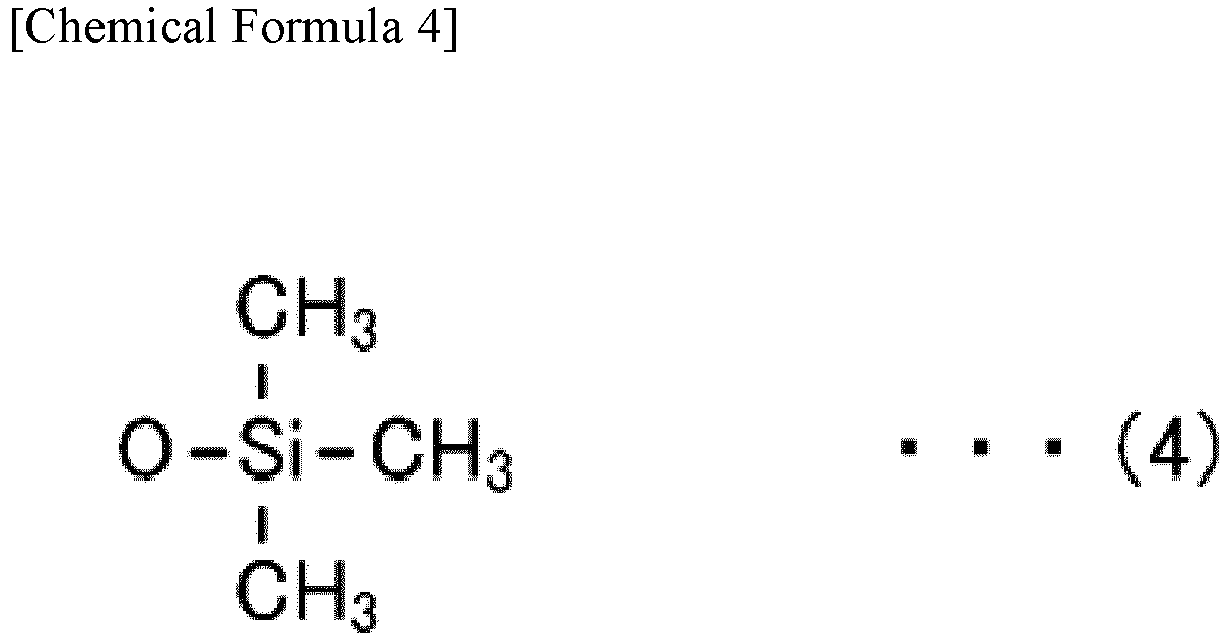
- the M unit contained in organopolysiloxane in the present embodiment is represented by Chemical Formula (4) below.
- R4, R5, and R6 are methyl groups bound directly to a silicon atom.
- organopolysiloxane having a structure in which an organic group (e.g., a phenyl group) having a great carbon number is contained in a siloxane unit has been known, but, in a case where a heat-shielding film is manufactured using such organopolysiloxane, such a heat-shielding film cannot withstand use in a severe place such as a combustion chamber of an engine in which explosion occurs under high temperature and pressure.
- organopolysiloxane of the present embodiment all organic groups of atom groups contained in the siloxane units other than the vinyl group of the D unit (the first type) are methyl groups having the minimum carbon number.
- the heat-shielding film manufactured using organopolysiloxane of the present embodiment has a high heat resistance and is particularly suitable for use in a severe place such as the combustion chamber of the engine.
- Organopolysiloxane as described above can be manufactured by a publicly-known method.
- organopolysiloxane can be obtained in such a manner that organochlorosilane and/or organoalkoxysilane capable of forming the above-described siloxane units by hydrolysis condensation reaction or a partially-hydrolyzed condensate thereof and excess water for hydrolyzing all hydrolyzable groups (e.g., a chloro group and an alkoxy group) are subjected to the hydrolysis condensation reaction under an acidic condition in an organic solvent capable of dissolving a raw material silane compound and generated organopolysiloxane.
- hydrolyzable groups e.g., a chloro group and an alkoxy group
- Organopolysiloxane having a desired weight average molecular weight can be obtained by adjustment of a monomer mixing ratio, reaction temperature and time, and the blending amounts of water and the organic solvent. Before use, the unnecessary organic solvent is removed from organopolysiloxane manufactured as described above, and a precipitate is removed by filtration.
- Organopolysiloxane from which the unnecessary organic solvent has been removed is mixed with the above-described solvent (e.g., toluene) to generate the silicone resin solution.
- solvent e.g., toluene
- This manufacturing method includes a nanoparticle dispersion preparation step, the coating step of coating a base material with nanoparticle dispersion, and the baking step of baking and solidifying the layer of the coated nanoparticle dispersion.
- nanoparticles are added to a silicone resin solution generated as described above and the resultant is stirred, and in this manner, a nanoparticle dispersion is prepared.
- the blending amount of the nanoparticles may be, for example, equal to or greater than 10% by volume and equal to or smaller than 55% by volume in terms of the proportion in the total amount of the silicone resin solution and the nanoparticles.
- a nanoparticle dispersion containing hollow particles may be prepared in such a manner that the nanoparticles are added to and stirred with the silicone resin solution and the hollow particles are further added to and stirred with the resultant.
- the blending amount of the hollow particles can be adjusted as necessary according to the required heat shielding performance. For example, the blending amount of the hollow particles may be equal to or greater than 30% by volume and equal to or smaller than 60% by volume.
- the obtained nanoparticle dispersion can be stored until, e.g., the heat-shielding film 11 is manufactured.
- the HSP distance between the nanoparticle and the silicone resin solution is adjusted to a proper distance, a nanoparticle dispersion state in the dispersion is maintained even during storage.
- a coating layer is formed in such a manner that a base material (in the case of the present embodiment, the piston) is coated with the mixture of the nanoparticle dispersion and the hollow particles in the case of the nanoparticle dispersion containing no hollow particles, and is formed in such a manner that the base material is directly coated with the nanoparticle dispersion in the case of the nanoparticle dispersion to which the hollow particles have been added in advance.
- Such coating can be performed using, e.g., a spray, but is not limited to above and coating may be performed using a brush or a spatula.
- the viscosity of the nanoparticle dispersion may be adjusted to a viscosity suitable for coating in such a manner that an appropriate solvent is additionally added.
- the coating layer on the base material is dried and baked to form a heat-shielding film. That is, addition-curing reaction groups contained in a D unit of the silicone resin solution react due to baking. Specifically, a vinyl group contained in a first type of the D unit and a hydrogen atom contained in a second type of the D unit are bound to each other by addition polymerization reaction, and silicone resin is cured accordingly. In this manner, a heat-shielding film containing the hollow particles and the nanoparticles is obtained. Baking can be performed in such a manner that the coating layer is heated at a temperature of about 100°C to 200°C for several minutes to several hours, for example.
- Mw weight average molecular weight
- the viscosity of silicone oligomer is a value measured at 25°C by means of a Cannon-Fenske viscometer.
- the viscosity of polysiloxane is a value measured at 25°C by means of a single cylindrical rotary viscometer in accordance with JIS Z 8803 9.2.
- composition of silicone resin was calculated from the results of 1 H-NMR measurement (Apparatus Name: ULTRA SHIELD 400 Plus manufactured by Bruker) and 29 Si-NMR measurement (Apparatus Name: JNM-ECX5002 manufactured by JEOL).
- Each abbreviation represents the following siloxane unit:Q: SiO 4/2 , T Me : MeSiO 3/2 , T H : HSiO 3/2 , T Vi : ViSiO 3/2 , T Ph : PhSiO 3/2 , D H : MeHSiO 2/2 , D Vi : MeViSiO 2/2 , M H : Me 2 HSiO 1/2 , M Vi : Me 2 ViSiO 1/2 , M: Me 3 SiO 1/2 (where Me represents a methyl group, Vi represents a vinyl group, and a Ph represents phenyl group).
- a silicone oligomer (1A) of 445 g, a vinylmethyldimethoxysilane of 165 g, a methyldimethoxysilane of 133 g, a hexamethyldisiloxane of 202 g, and a toluene of 780 g were charged into a glass flask equipped with a stirring apparatus, a thermometer, a cooling tube, and a dripping apparatus such that a T Me unit is 50 mol%, a D Vi unit is 12.5 mol%, a D H unit is 12.5 mol%, and a M unit is 25 mol% and a methane sulfonic acid of 10 g was injected during stirring, and thereafter, a water of 105 g was further dripped over one hour and the resultant was aged at 67°C for two hours and was further aged within a temperature range of 80°C to 90°C for three hours. The obtained liquid was washed with water until the liquidity of the extracted water become
- Organopolysiloxane obtained had a viscosity of 1,000 mPa ⁇ s, and from the results of the NMR measurement, contained a T Me unit of 50 mol%, a D H unit of 12.5 mol%, a D Vi unit of 12.5 mol%, and a M unit of 25 mol%. Moreover, organopolysiloxane had a weight average molecular weight of 30,000. Thus, the blending ratio of T Unit: D Unit: M Unit in organopolysiloxane according to the example of the present invention was 2:1:1.
- hydrocarbon groups connected to a silicon atom of each unit are a vinyl group and a methyl group.
- a silicone oligomer (1A) of 427 g, a trimethoxysilane of 122 g, a vinyltrimethoxysilane of 148 g, a tetramethyldisiloxane of 202 g, and a toluene of 638 g were charged into a glass flask equipped with a stirring apparatus, a thermometer, a cooling tube, and a dripping apparatus such that the T Me unit is 50 mol%, the T H unit is 10 mol%, the T Vi unit is 10 mol%, and the M H unit is 30 mol% and a methane sulfonic acid of 10 g was injected during stirring, and thereafter, a water of 100 g was further dripped over one hour and the resultant was aged at 67°C for two hours and was further aged within a temperature range of 80°C to 90°C for three hours. The obtained liquid was washed with water until the liquidity of the extracted water become neutral, and thereafter, the solvent was evaporate
- Organopolysiloxane obtained had a viscosity of 25,000 mPa ⁇ s, and from the results of the NMR measurement, contained a T unit of 50 mol%, a T H unit of 10 mol%, a T Vi unit of 10 mol%, and a M H unit of 30 mol%. Moreover, organopolysiloxane had a weight average molecular weight of 40,000.
- the blending ratio of T Unit: D Unit: M Unit in Organopolysiloxane-2 according to the comparative example was 7:0:3.
- hydrocarbon groups connected to a silicon atom of each unit are a vinyl group and a methyl group.
- Organopolysiloxane-1 and Organopolysiloxane-2 were applied to a flat base material made of aluminum to a thickness of 50 11 m. The resultant was heated at 200°C for two hours in an oven. Note that through previous preliminary experiment, the inventors et al. have found that addition-curing reaction in organopolysiloxane is completed about 100% when organopolysiloxane is heated at 200°C for 30 minutes or more.
- the elasticity modulus (E) of the coated surface, the coefficient (ac) of linear expansion of the coated surface, and the glass transition temperature (Tg) of the coated surface were each obtained by a nanoindentation method, a TMA method, and a DMA method.
- the coefficient (am) of linear expansion of the base material was obtained by a publicly-known method.
- a temperature (Tr) in a laboratory was measured with a thermometer. Using these values, the internal stress (P) of the coated surface of the base material coated with Organopolysiloxane-1 was about 11 MPa according to Expression (1) below.
- P E ac ⁇ am Tg ⁇ Tr
- the internal stress (P) of the coated surface of the base material coated with Organopolysiloxane-2 was about 38 MPa according to Expression (1) above.
- bar graphs showing the results for Organopolysiloxane-1 and Organopolysiloxane-2 are shown next to each other in FIG. 5 .
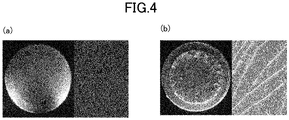
- FIGS. 4 and 5 it is assumed that the internal stress of the coated surface is significantly smaller in the example than in the comparative example, and therefore occurrence of cracks is significantly smaller in the example than in the comparative example.
- a phenyltrimethoxysilane of 991 g, a methyldimethoxysilane of 133 g, a vinylmethyldimethoxysilane of 165 g, a hexamethyldisiloxane of 203 g, and a toluene of 1050 g were charged into a glass flask equipped with a stirring apparatus, a thermometer, a cooling tube, and a dripping apparatus such that a T Ph unit is 50 mol%, a D H unit is 12.5 mol%, a D Vi unit is 12.5 mol%, and a M unit is 25 mol% and a methane sulfonic acid of 15 g was injected during stirring, and thereafter, a water of 216 g was further dripped over one hour and the resultant was aged at 67°C for two hours and was further aged within a temperature range of 80°C to 90°C for three hours. The obtained liquid was washed with water until the liquidity of the
- Organopolysiloxane obtained had a viscosity of 1,000 mPa ⁇ s, and from the results of the NMR measurement, contained a T Ph unit of 50 mol%, a D H unit of 12.5 mol%, a D Vi unit of 12.5 mol%, and a M unit of 25 mol%.
- the blending ratio of T Unit: D Unit: M Unit in organopolysiloxane-3 according to Comparative Example 2 was 2:1:1.
- Organopolysiloxane had a weight average molecular weight of 2,000.
- hydrocarbon groups connected to a silicon atom of each unit are a vinyl group, a methyl group, and a phenyl group.
- organopolysiloxane according to Comparative Example 2 about 30% of R 1 to R 6 was a phenyl group having a relatively-great carbon number, and about the remaining half of R 1 to R 6 was an atom group (a hydrocarbon group) or a hydrogen atom having a smaller carbon number.
- thermogravimetric reduction in a film cured at 200°C was evaluated by TG-DTA. Regarding evaluation conditions, the temperature was increased from 30°C to 800°C at 10°C/min.
- a chronological change in the weight retention rate (%) of Organopolysiloxane-1 when the weight of a film obtained by curing of Organopolysiloxane-1 at 200°C is defined as 100 is shown in FIG. 6 .
- a chronological change in the weight retention rate (%) of Organopolysiloxane-3 when the weight of a film obtained by curing of Organopolysiloxane-3 at 200°C is defined as 100 is shown in FIG. 6 .
- the weight retention rate starts significantly decreasing from around 500°C, and reaches about 50% at around 700°C.
- organopolysiloxane includes the combination of a plurality of units including at least the R 1 SiO 3/2 unit (the T unit), the R 2 R 3 SiO 2/2 unit (the D unit), and the R 4 R 5 R 6 SiO 1/2 unit (the M unit) (in each unit, R 1 to R 6 are aliphatic hydrocarbon or hydrogen), and the molar ratio of the T unit, the D unit, and the M unit among all structural units is T: 33.3 mol% to 71.4 mol%, D: 11.1 mol% to 42.9 mol%, M: 7.0 mol% to 42.9 mol%, and more preferably T: 40 mol% to 62.9 mol%, D: 17.8 mol% to 34.3 mol%, M: 15.0 mol% to 34.3 mol%.
- the heat-shielding film 11 having a high heat resistance and capable of reliably reducing or preventing occurrence of cracks etc. is provided.
- the D unit among all structural units of organopolysiloxane as described above includes the addition-curing reaction groups as the atom groups reacting in the addition-curing reaction.
- the D unit includes the first type in which the vinyl group as the addition-curing reaction group is bound directly to the silicon atom and the second type in which the hydrogen atom reacting with the vinyl group is bound directly to a silicon element, and the blending ratio (First Type: Second Type) between the first type and the second type is 1:1.
- any of R 1 to R 6 as described above other than the vinyl group and the hydrogen atom is the methyl group bound directly to the silicon atom. With this configuration, the heat resistance of the heat-shielding film can be improved.
- the heat-shielding film 11 contains the hollow particles 12 and the nanoparticles 14, and the sum of the proportion of the hollow particles 12 and the proportion of the nanoparticles 14 in the total amount of the addition-curing silicone resin, the hollow particles 12, and the nanoparticles 14 is equal to or greater than 37 vol% and equal to or less than 82 vol%. With this configuration, a sufficient amount of hollow particles 12 and a sufficient amount of nanoparticles 14 can be contained in the heat-shielding film.
- the thickness of the heat-shielding film 11 is equal to or greater than 25 ⁇ m and equal to or smaller than 100 11 m. With this configuration, the internal stress of the heat-shielding film 11 can be decreased, and occurrence of cracks can be reduced or prevented.
- the median diameter of the hollow particle is 30 ⁇ m or less.
- the porosity of the hollow particle is 60% by volume or more.
- the proportion of the hollow particles 12 in the total amount of the addition-curing silicone resin, the hollow particles 12, and the nanoparticles 14 is equal to or greater than 30% by volume and equal to or smaller than 60% by volume. With this configuration, only a necessary sufficient amount of hollow particles 12 can be contained in the heat-shielding film 11.
- the addition-curing silicone resin further contains toluene as the solvent, and is used as the resin solution.
- organopolysiloxane can be favorably dissolved in the resin solution.
- the proportion of toluene in the resin solution is equal to or greater than 30% by volume and equal to or smaller than 70% by volume. With this configuration, an appropriate HSP distance between the resin solution and the nanoparticle 14 can be easily held.
- addition-curing reaction groups were bound to the D unit.
- present invention is not limited thereto, and instead, some of the addition-curing reaction groups may be bound to the M unit.
- R 1 to R 6 are the methyl groups having the minimum carbon number. Such a configuration is suitable for improving the heat resistance, but the present invention is not limited thereto. That is, in a case where a heat resistance condition is that the weight retention rate is maintained at equal to or greater than 60%, organic groups of about 30 mol% or less of all of R 1 to R 6 may be phenyl groups, for example.
Landscapes
- Chemical & Material Sciences (AREA)
- Chemical Kinetics & Catalysis (AREA)
- Organic Chemistry (AREA)
- Polymers & Plastics (AREA)
- Health & Medical Sciences (AREA)
- Medicinal Chemistry (AREA)
- Engineering & Computer Science (AREA)
- Materials Engineering (AREA)
- Manufacturing & Machinery (AREA)
- Life Sciences & Earth Sciences (AREA)
- Wood Science & Technology (AREA)
- Silicon Polymers (AREA)
- Thermal Insulation (AREA)
- Manufacture Of Macromolecular Shaped Articles (AREA)
- Compositions Of Macromolecular Compounds (AREA)
Abstract
Description
- This application claims priority to
Japanese Patent Application No. 2020-209566 filed on December 17, 2020 - Typically, a heat-shielding film has been sometimes utilized for enhancing an energy efficiency in industrial or customer equipment requiring energy supply. For example,
Japanese Patent Application Laid-Open No. 2016/65155 - The heat insulating layer of
Japanese Patent Application Laid-Open No. 2016/65155 Japanese Patent Application Laid-Open No. 2016/65155 - However, in order for the silicone resin forming the heat insulating layer to have both rigidity and flexibility, it has been demanded that the proportion of each basic structural unit in the entirety of the silicone resin is more optimized.
- Particularly, in a case where the heat insulating layer (the heat-shielding film) is used in a severe place such as the combustion chamber of the engine in which explosion occurs under high temperature and pressure as in
Japanese Patent Application Laid-Open No. 2016/65155 - In view of the foregoing, it is an object of the present invention is to provide addition-curing silicone resin particularly suitable for production of a heat-shielding film having a high heat resistance and being capable of reliably reducing or preventing, e.g., occurrence of cracks.
- According to a first aspect of the present invention, there is provided addition-curing silicone resin for producing a heat-shielding film, the addition-curing silicone resin containing organopolysiloxane, organopolysiloxane including the combination of a plurality of units including at least a R1SiO3/2 unit (a T unit), a R2R3SiO2/2 unit (a D unit), and a R4R5R6SiO1/2 unit (a M unit) (in each unit, R1 to R6 is aliphatic hydrocarbon or hydrogen), and the molar ratio of the T unit, the D unit, and the M unit among all structural units being T: 33.3 mol% to 71.4 mol%, D: 7.0 mol% to 42.9 mol%, and M: 11.1 mol% to 42.9 mol%.
- According to this aspect, there is provided the addition-curing silicone resin particularly suitable for producing the heat-shielding film having a high heat resistance and being capable of reliably reducing or preventing, e.g., occurrence of cracks.
- According to a second aspect of the present invention, in the addition-curing silicone resin for producing the heat-shielding film according to the first aspect, the molar ratio of the T unit, the D unit, and the M unit among all structural units of organopolysiloxane isT: 40 mol% to 62.9 mol%, D: 17.8 mol% to 34.3 mol%, andM: 15.0 mol% to 34.3 mol%.
- According to this aspect, the molar ratio of the T unit, the D unit, and the M unit of the addition-curing silicone resin particularly suitable for producing the heat-shielding film can be further specified.
- In a third aspect of the present invention, in the addition-curing silicone resin for producing the heat-shielding film according to the first or second aspect, the D unit or the M unit among all structural units of organopolysiloxane contains an addition-curing reaction group as an atom group reacting in addition-curing reaction.
- According to this aspect, in a three-dimensional network structure after addition-curing, an excessive increase in a crosslinking density can be reduced or prevented, and occurrence of cracks on the heat-shielding film can be reduced or prevented.
- According to a fourth aspect of the present invention, in the addition-curing silicone resin for producing the heat-shielding film according to the third aspect, the D unit or the M unit includes a first type in which a vinyl group as the addition-curing reaction group is bound directly to a silicon atom and a second type in which a hydrogen atom reacting with the vinyl group is bound directly to a silicon element, and the blending ratio (First Type: Second Type) of the first type and the second type is 1:1.
- According to this aspect, the remaining unreacted vinyl group or hydrogen atom after the addition-curing reaction can be reduced or prevented.
- According to a fifth aspect of the present invention, in the addition-curing silicone resin for producing the heat-shielding film according to the fourth aspect, any of R1 to R6 other than the vinyl group and the hydrogen atom is a methyl group bound directly to a silicon atom.
- According to this aspect, the heat resistance of the heat-shielding film can be improved.
- According to a sixth aspect of the present invention, there is provided the method for forming a heat-shielding film on an inner surface of a combustion chamber of an engine by means of the addition-curing silicone resin for producing the heat-shielding film according to any one of the first to fifth aspects.
- According to this aspect, even when the heat-shielding film is used in a severe place such as the combustion chamber of the engine in which explosion occurs under high temperature and pressure, the heat resistance of the heat-shielding film is maintained, and the flow of combustion gas is not disturbed due to no occurrence of cracks.
- According to a seventh aspect of the present invention, there is provided a heat-shielding film formed of addition-curing silicone resin containing organopolysiloxane, organopolysiloxane including the combination of a plurality of units including at least a R1SiO3/2 unit (a T unit), a R2R3SiO2/2 unit (a D unit), and a R4R5R6SiO1/2 unit (a M unit) (in each unit, R1 to R6 is aliphatic hydrocarbon or hydrogen) and the molar ratio of the T unit, the D unit, and the M unit among all structural units being T: 33.3 mol% to 71.4 mol%, D: 7.0 mol% to 42.9 mol%, and M: 11.1 mol% to 42.9 mol%.
- According to this aspect, there is provided the heat-shielding film having a high heat resistance and being capable of reliably reducing or preventing, e.g., occurrence of cracks.
- According to an eighth aspect of the present invention, in the heat-shielding film according to the seventh aspect, the molar ratio of the T unit, the D unit, and the M unit among all structural units of organopolysiloxane is T: 40 mol% to 62.9 mol%, D: 17.8 mol% to 34.3 mol%, and M: 15.0 mol% to 34.3 mol%.
- According to this aspect, the molar ratio of the T unit, the D unit, and the M unit of the addition-curing silicone resin particularly suitable for producing the heat-shielding film can be further specified.
- According to a ninth aspect of the present invention, in the heat-shielding film according to the seventh or eighth aspect, the D unit or the M unit among all structural units of organopolysiloxane contains an addition-curing reaction group as an atom group reacting in addition-curing reaction.
- According to this aspect, in a three-dimensional network structure after addition-curing, an excessive increase in a crosslinking density can be reduced or prevented, and occurrence of cracks on the heat-shielding film can be reduced or prevented.
- According to a tenth aspect of the present invention, in the heat-shielding film according to the ninth aspect, the D unit or the M unit includes a first type in which a vinyl group as the addition-curing reaction group is bound directly to a silicon atom and a second type in which a hydrogen atom reacting with the vinyl group is bound directly to a silicon element, and the blending ratio (First Type: Second Type) of the first type and the second type is 1:1.
- According to this aspect, the remaining unreacted vinyl group or hydrogen atom after the addition-curing reaction can be reduced or prevented.
- In an eleventh aspect of the present invention, in the heat-shielding film according to the tenth aspect, any of R1 to R6 other than the vinyl group and the hydrogen atom is a methyl group bound directly to a silicon atom.
- According to this aspect, the heat resistance of the heat-shielding film can be improved.
- According to a twelfth aspect of the present invention, the heat-shielding film according to any one of the seventh to eleventh aspects further contains hollow particles and nanoparticles, and the sum of the proportion of the hollow particles and the proportion of the nanoparticles in the total amount of the addition-curing silicone resin, the hollow particles, and the nanoparticles is equal to or greater than 37% by volume and equal to or smaller than 82% by volume.
- With this configuration, only a sufficient amount of hollow particles and a sufficient amount of nanoparticles can be contained in the heat-shielding film while the function of a binder obtained by addition-curing of the addition-curing silicone resin is fulfilled.
- According to a thirteenth aspect of the present invention, in the heat-shielding film according to any one of the seventh to the twelfth aspects, the thickness of the heat-shielding film is equal to or greater than 20 µm and equal to or smaller than 150 11m.
- According to this aspect, the internal stress of the heat-shielding film can be reduced, and occurrence of cracks can be reduced or prevented.
- In a fourteenth aspect of the present invention, in the heat-shielding film according to the twelfth or thirteenth aspect, the median diameter of the hollow particles is 30 µm or less.
- According to this aspect, heat shielding performance required for the heat-shielding film is easily fulfilled.
- According to a fifteenth aspect of the present invention, in the heat-shielding film according to the twelfth, thirteenth, or fourteenth aspect, the porosity of the hollow particle is equal to or greater than 60% by volume, and more preferably equal to or greater than 70% by volume.
- According to this aspect, the heat shielding performance required for the heat-shielding film is easily fulfilled.
- According to a sixteenth aspect of the present invention, in the heat-shielding film according to any one of the twelfth to fifteenth aspects, the proportion of the hollow particles in the total amount of the addition-curing silicone resin, the hollow particles, and the nanoparticles is equal to or greater than 30% by volume and equal to or smaller than 60% by volume, and more preferably equal to or greater than 40% by volume and equal to or smaller than 55% by volume.
- According to this aspect, only a necessary sufficient amount of hollow particles can be contained in the heat-shielding film.
- According to a seventeenth aspect of the present invention, in the heat-shielding film according to any one of the seventh to sixteenth aspects, the addition-curing silicone resin further contains toluene as a solvent and is used as a resin solution.
- According to this aspect, organopolysiloxane can be favorably dissolved in the resin solution.
- According to an eighteenth aspect of the present invention, in the heat-shielding film according to the seventeenth aspect, the proportion of toluene in the resin solution is equal to or greater than 30% by volume and equal to or smaller than 70% by volume.
- According to this aspect, a proper HSP distance between the resin solution and the nanoparticle can be easily held.
- According to a nineteenth aspect of the present invention, there is provided a heat shielding method for reducing or preventing heat dissipation from a combustion chamber of an engine to the outside by means of the heat-shielding film according to any one of the seventh to eighteenth aspects.
- According to this aspect, even in a severe place such as a combustion chamber of an engine in which explosion occurs under high temperature and high pressure, the heat resistance of the heat-shielding film is maintained, and the flow of combustion gas is not disturbed due to no occurrence of cracks on the heat-shielding film.
-
-
FIG. 1 is a vertical sectional view showing a configuration in the vicinity of a combustion chamber of an engine as an application example of the present invention. -
FIG. 2 is a vertical sectional view showing the configuration of a heat-shielding film provided on a top surface of a piston of the engine. -
FIG. 3 is an enlarged sectional view of the heat-shielding film. -
FIG. 4(a) is a photograph of a coated surface in an example of a first experimental example on the left side, and shows an enlarged view thereof on the right side.FIG. 4(b) is a photograph of a coated surface in a comparative example of the first experimental example on the left side, and shows an enlarged view thereof on the right side. -
FIG. 5 is a bar graph showing the internal stress of the coated surface in each of the example and the comparative example of the first experimental example. -
FIG. 6 is a graph showing a relationship between the temperature and weight retention rate of addition-curing silicone resin (solution) in each of an example and a comparative example of a second experimental example. - Hereinafter, an embodiment of the present invention will be described with reference to the drawings. Note that the following description of a preferred embodiment is merely an example in nature and is not intended to limit the present invention.
- The heat-shielding film is formed in such a manner that addition-curing silicone resin is formed in a film shape according to a heat shielding target. Hereinafter, the preferred embodiment will be described, but is not intended to limit the present invention.
- Hereinafter, a schematic configuration of a diesel engine to which the heat-shielding
film 11 according to the present invention is applied will be described with reference toFIG. 1. FIG. 1 is a vertical sectional view showing a configuration near a combustion chamber of the diesel engine. This diesel engine includes apiston 1 made of aluminum alloy, acylinder block 2, acylinder head 3, anintake valve 4, anintake port 5, anexhaust valve 6, anexhaust port 7, and afuel injection valve 8. Thepiston 1 reciprocates up and down in a cylinder of thecylinder block 2. Theintake port 5 and theexhaust port 7 are formed at thecylinder head 3, and theintake valve 4 is openably provided at theintake port 5 and theexhaust valve 6 is openably provided at theexhaust port 7. The combustion chamber of the diesel engine is formed by a top surface of thepiston 1, thecylinder block 2, thecylinder head 3, and inner surfaces (surfaces facing the combustion chamber) of umbrella portions of theintake valve 4 and theexhaust valve 6. Acavity 9 is formed on the top surface of thepiston 1. - In the above-described diesel engine, when liquid fuel is injected into the combustion chamber from the
fuel injection valve 8, thepiston 1 reciprocates in the cylinder by propulsion obtained by explosion occurred in the combustion chamber, reciprocation motion of thepiston 1 is converted into rotation motion of a crankshaft (not shown) via a rod (not shown), and power is obtained accordingly. -
FIG. 2 is a vertical sectional view showing the configuration of the heat-shieldingfilm 11 provided on the top surface of thepiston 1 of the diesel engine. As shown inFIG. 2 , the heat-shieldingfilm 11 is formed on the top surface of thepiston 1. - Hereinafter, a schematic configuration of the heat-shielding
film 11 will be described with reference toFIG. 3. FIG. 3 is an enlarged sectional view of the heat-shieldingfilm 11. The heat-shieldingfilm 11 includes manyhollow particles 12, asilicone resin binder 13, andmany nanoparticles 14. - The thickness of the heat-shielding
film 11 is, for example, equal to or greater than 20 µm and equal to or smaller than 150 µm, and more preferably equal to or greater than 40 µm and equal to or smaller than 100 11m. Note that the numerical range of the thickness of the heat-shieldingfilm 11 is merely a preferred range in a case where a heat-shielding film is provided on an inner surface of a combustion chamber of a general diesel engine and may vary according to, e.g., the size of the engine. In a case where a heat-shielding film is provided at, e.g., industrial/consumer equipment to be used in a severe situation other than a combustion chamber of an engine, the numerical range of the thickness of the heat-shielding film can be changed to a smaller or greater range than the above-described numerical range, as necessary. - Hereinafter, the configuration of the
hollow particle 12 will be described. As shown inFIG. 3 , thehollow particles 12 are substantially uniformly dispersed across the entirety of the heat-shieldingfilm 11. Thehollow particle 12 is a particle made of inorganic oxide. Specifically, thehollow particle 12 may be a ceramic-based hollow particle containing a silicon-based oxide component (e.g., silica) or an aluminum-based oxide component (e.g., alumina), such as a glass balloon, a glass bubble, a fly ash balloon, a shirasu balloon, a silica balloon, or an aluminosilicate balloon. - The
hollow particle 12 has a particle size of µm order smaller than the thickness of the heat-shieldingfilm 11. The median diameter of thehollow particle 12, i.e., the median value of the particle sizes of allhollow particles 12, is 30 µm or less, and more preferably 10 µm or less, for example. The porosity of thehollow particle 12 is, for example, 60% by volume or more, and more preferably 70% by volume or more. - The proportion of the
hollow particles 12 in the total amount of manyhollow particles 12, thesilicone resin binder 13, andmany nanoparticles 14 is, for example, equal to or greater than 30% by volume and equal to or smaller than 60% by volume, and more preferably equal to or greater than 40% by volume and equal to or smaller than 55% by volume. The above-described proportion of thehollow particles 12 can be adjusted as necessary according to heat shielding performance (level) required for the heat-shieldingfilm 11. - Hereinafter, the configuration of the
nanoparticle 14 will be described. InFIG. 3 , thenanoparticles 14 are indicated by dots. As shown inFIG. 3 , thenanoparticles 14 are substantially uniformly dispersed across the entirety of thesilicone resin binder 13. Thenanoparticle 14 is a hollow or solid particle. Thenanoparticle 14 is a particle made of an inorganic compound or metal. Specifically, thenanoparticle 14 may be made of an inorganic compound such as zirconia, alumina, silica, or titania, or may be made of metal such as titanium, zirconium, or aluminum. - The
nanoparticle 14 has a particle size of nm order significantly smaller than the thickness of the heat-shieldingfilm 11. The average particle size of thenanoparticles 14, i.e., the average value of the particle sizes of allnanoparticles 14, is preferably equal to or smaller than 500 nm, more preferably equal to or greater than 1 nm and equal to or smaller than 200 nm, and much more preferably equal to or greater than 1 nm and equal to or smaller than 120 nm. - The sum of the proportion of the
hollow particles 12 and the proportion of thenanoparticles 14 in the total amount of manyhollow particles 12, thesilicone resin binder 13, andmany nanoparticles 14 is preferably equal to or greater than 37% by volume and equal to or smaller than 82% by volume. - The
silicone resin binder 13 is obtained in such a manner that a thermosetting silicone resin solution is baked and solidified by a later-described method. Thesilicone resin binder 13 holds thehollow particles 12 in the vicinity of the top surface of thepiston 1, and fills a gap among thehollow particles 12 to form the matrix of the heat-shieldingfilm 11. Thesilicone resin binder 13 contains addition-cured organopolysiloxane. That is, the thermosetting silicone resin solution contains organopolysiloxane before addition-curing reaction. Note that a detailed configuration of the thermosetting silicone resin solution will be described later. - Hereinafter, the configuration of the thermosetting silicone resin solution (hereinafter, simply referred to as a "silicone resin solution") will be described in detail.
- The silicone resin solution contains organopolysiloxane and a solvent.
- The solvent is for adjusting an HSP distance between the silicone resin solution and the nanoparticle as necessary (e.g., adjusting to equal to or greater than 8.5 MPa0.5) when the silicone resin solution and the nanoparticles are mixed later. As the solvent, various publicly-known solvents can be adopted as long as the above-described purpose can be achieved, and for example, toluene can be preferably used. The proportion of toluene in the total amount of the silicone resin solution can be, for example, equal to or greater than 30% by volume and equal to or smaller than 70% by volume.
- One molecule of organopolysiloxane has, as basic structural units (siloxane units), a unit (hereinafter referred to as a "T unit") represented by R1SiO3/2, a unit (hereinafter referred to as a "D unit") represented by R2R3SiO2/2, and a unit (hereinafter referred to as a "M unit") represented by R4R5R6SiO1/2. Note that in each unit, R1 to R6 are aliphatic hydrocarbon or hydrogen. Specific configurations of R1 to R6 will be described later. In one molecule of organopolysiloxane of the present embodiment, the T unit, the D unit, and the M unit are combined such that the molar ratio thereof is T: 33.3 mol% to 71.4 mol%, D: 7.0 mol% to 42.9 mol%, and M: 11.1 mol% to 42. 9 mol%. More preferably, in one molecule of organopolysiloxane of the present embodiment, the T unit, the D unit, and the M unit are combined such that the molar ratio thereof isT: 40 mol% to 62.9 mol%,D: 17.8 mol% to 34.3 mol%, andM: 15.0 mol% to 34.3 mol%.
- In general, as the proportion of the T unit contained in one molecule of organopolysiloxane increases, the heat resistance of organopolysiloxane is improved and the rigidity of a product (in the present embodiment, the heat-shielding film 11) after baking increases. This is because the greater the proportion of the T unit is, the more cross-linked structures of siloxane bonds (Si-O-Si) are contained. When bond energy contains a relatively large number of siloxane bonds, the heat resistance is high.
- The inventors of the present application have found that when the proportion of the M unit contained in one molecule of organopolysiloxane is too small, storage stability is deteriorated. On the other hand, the inventors of the present application have also found that when the proportion of the M unit is too great, many organic groups weak against heat are contained and the heat resistance is degraded accordingly.
- In the present embodiment, the molar ratio of the T unit, the D unit, and the M unit contained in one molecule of organopolysiloxane is set within the above-described numerical range so that a material having both rigidity and flexibility which are generally in a trade-off relationship can be achieved.
- Note that in addition to the T unit, the D unit, and the M unit, a unit (hereinafter, referred to as a "Q unit") represented by SiO4/2 may be also contained in part of organopolysiloxane of the present embodiment.
- The T unit contained in organopolysiloxane in the present embodiment is represented by Chemical Formula (1) below. As in Chemical Formula (1), R1 is a methyl group bound directly to a silicon atom.


- The D units contained in organopolysiloxane in the present embodiment is represented by Chemical Formulae (2) and (3) below. In the D unit contained in organopolysiloxane of the present embodiment, a first type represented by Chemical Formula (2) and a second type represented by Chemical Formula (3) are mixed at a blending ratio of 1:1 (First Type: Second Type). In the first type, R2 is a methyl group bound directly to a silicon atom as in Chemical Formula (2). Moreover, in the first type, R3 is a vinyl group bound to the silicon atom as in Chemical Formula (2). In the second type, R2 is a methyl group bound directly to a silicon atom as in Chemical Formula (3). Moreover, in the second type, R3 is a hydrogen atom bound directly to the silicon atom as in Chemical Formula (3).


- Of the first type of the D unit, the vinyl group (R3) corresponds to an "addition-curing reaction group" according to the present embodiment. Of the second type of the D unit, the hydrogen atom (R3) also corresponds to an "addition-curing reaction group" according to the present embodiment.
- The M unit contained in organopolysiloxane in the present embodiment is represented by Chemical Formula (4) below. As in Chemical Formula (4), R4, R5, and R6 are methyl groups bound directly to a silicon atom.
- In general, it has been known that an organic group (particularly, one having a great carbon number) has a relatively small bond energy between carbon atoms, and therefore, is weak against heat. Typically, organopolysiloxane having a structure in which an organic group (e.g., a phenyl group) having a great carbon number is contained in a siloxane unit has been known, but, in a case where a heat-shielding film is manufactured using such organopolysiloxane, such a heat-shielding film cannot withstand use in a severe place such as a combustion chamber of an engine in which explosion occurs under high temperature and pressure. On this point, in organopolysiloxane of the present embodiment, all organic groups of atom groups contained in the siloxane units other than the vinyl group of the D unit (the first type) are methyl groups having the minimum carbon number. Thus, the heat-shielding film manufactured using organopolysiloxane of the present embodiment has a high heat resistance and is particularly suitable for use in a severe place such as the combustion chamber of the engine.
- Organopolysiloxane as described above can be manufactured by a publicly-known method. For example, organopolysiloxane can be obtained in such a manner that organochlorosilane and/or organoalkoxysilane capable of forming the above-described siloxane units by hydrolysis condensation reaction or a partially-hydrolyzed condensate thereof and excess water for hydrolyzing all hydrolyzable groups (e.g., a chloro group and an alkoxy group) are subjected to the hydrolysis condensation reaction under an acidic condition in an organic solvent capable of dissolving a raw material silane compound and generated organopolysiloxane. Organopolysiloxane having a desired weight average molecular weight can be obtained by adjustment of a monomer mixing ratio, reaction temperature and time, and the blending amounts of water and the organic solvent. Before use, the unnecessary organic solvent is removed from organopolysiloxane manufactured as described above, and a precipitate is removed by filtration.
- Organopolysiloxane from which the unnecessary organic solvent has been removed is mixed with the above-described solvent (e.g., toluene) to generate the silicone resin solution.
- Hereinafter, the method for manufacturing the heat-shielding
film 11 will be described. This manufacturing method includes a nanoparticle dispersion preparation step, the coating step of coating a base material with nanoparticle dispersion, and the baking step of baking and solidifying the layer of the coated nanoparticle dispersion. - First, nanoparticles are added to a silicone resin solution generated as described above and the resultant is stirred, and in this manner, a nanoparticle dispersion is prepared. The blending amount of the nanoparticles may be, for example, equal to or greater than 10% by volume and equal to or smaller than 55% by volume in terms of the proportion in the total amount of the silicone resin solution and the nanoparticles.
- A nanoparticle dispersion containing hollow particles may be prepared in such a manner that the nanoparticles are added to and stirred with the silicone resin solution and the hollow particles are further added to and stirred with the resultant. The blending amount of the hollow particles can be adjusted as necessary according to the required heat shielding performance. For example, the blending amount of the hollow particles may be equal to or greater than 30% by volume and equal to or smaller than 60% by volume.
- The obtained nanoparticle dispersion can be stored until, e.g., the heat-shielding
film 11 is manufactured. As described above, since the HSP distance between the nanoparticle and the silicone resin solution is adjusted to a proper distance, a nanoparticle dispersion state in the dispersion is maintained even during storage. - A coating layer is formed in such a manner that a base material (in the case of the present embodiment, the piston) is coated with the mixture of the nanoparticle dispersion and the hollow particles in the case of the nanoparticle dispersion containing no hollow particles, and is formed in such a manner that the base material is directly coated with the nanoparticle dispersion in the case of the nanoparticle dispersion to which the hollow particles have been added in advance. Such coating can be performed using, e.g., a spray, but is not limited to above and coating may be performed using a brush or a spatula. At the coating step, the viscosity of the nanoparticle dispersion may be adjusted to a viscosity suitable for coating in such a manner that an appropriate solvent is additionally added.
- The coating layer on the base material is dried and baked to form a heat-shielding film. That is, addition-curing reaction groups contained in a D unit of the silicone resin solution react due to baking. Specifically, a vinyl group contained in a first type of the D unit and a hydrogen atom contained in a second type of the D unit are bound to each other by addition polymerization reaction, and silicone resin is cured accordingly. In this manner, a heat-shielding film containing the hollow particles and the nanoparticles is obtained. Baking can be performed in such a manner that the coating layer is heated at a temperature of about 100°C to 200°C for several minutes to several hours, for example.
- Hereinafter, the present invention will be specifically described with reference to preparation examples, examples, and comparative examples, but is not limited to the following examples.
- Note that the value of a weight average molecular weight (Mw) is, in description below, a standard polystyrene equivalent value measured using tetrahydrofuran as a developing solvent by means of gel permeation chromatography (GPC, Product Name: HLC-8320GPC EccSEC manufactured by Tosoh Corporation).
- The viscosity of silicone oligomer is a value measured at 25°C by means of a Cannon-Fenske viscometer. The viscosity of polysiloxane is a value measured at 25°C by means of a single cylindrical rotary viscometer in accordance with JIS Z 8803 9.2.
- The composition of silicone resin was calculated from the results of 1H-NMR measurement (Apparatus Name: ULTRA SHIELD 400 Plus manufactured by Bruker) and 29Si-NMR measurement (Apparatus Name: JNM-ECX5002 manufactured by JEOL).
- Each abbreviation represents the following siloxane unit:Q: SiO4/2, TMe: MeSiO3/2, TH: HSiO3/2, TVi: ViSiO3/2, TPh: PhSiO3/2, DH: MeHSiO2/2, DVi: MeViSiO2/2, MH: Me2HSiO1/2, MVi: Me2ViSiO1/2, M: Me3SiO1/2 (where Me represents a methyl group, Vi represents a vinyl group, and a Ph represents phenyl group).
- After a methyltrimethoxysilane of 4,087 g had been injected into a glass flask equipped with a stirring apparatus, a thermometer, a cooling tube, and a dripping apparatus, a IN hydrochloric acid of 486 g was dripped over one hour during stirring, followed by aging at 67°C for two hours. The obtained liquid was neutralized with a propylene oxide of 29 g and a volatile component and a solvent were evaporated out, and in this manner, silicone oligomer (1A) was obtained. The obtained silicone oligomer (1A) had a Mw of 1,700 and a viscosity of 25 mm2/s.
- A silicone oligomer (1A) of 445 g, a vinylmethyldimethoxysilane of 165 g, a methyldimethoxysilane of 133 g, a hexamethyldisiloxane of 202 g, and a toluene of 780 g were charged into a glass flask equipped with a stirring apparatus, a thermometer, a cooling tube, and a dripping apparatus such that a TMe unit is 50 mol%, a DVi unit is 12.5 mol%, a DH unit is 12.5 mol%, and a M unit is 25 mol% and a methane sulfonic acid of 10 g was injected during stirring, and thereafter, a water of 105 g was further dripped over one hour and the resultant was aged at 67°C for two hours and was further aged within a temperature range of 80°C to 90°C for three hours. The obtained liquid was washed with water until the liquidity of the extracted water become neutral, and thereafter, the solvent was evaporated out to obtain a product.
- Organopolysiloxane obtained had a viscosity of 1,000 mPa·s, and from the results of the NMR measurement, contained a TMe unit of 50 mol%, a DH unit of 12.5 mol%, a DVi unit of 12.5 mol%, and a M unit of 25 mol%. Moreover, organopolysiloxane had a weight average molecular weight of 30,000. Thus, the blending ratio of T Unit: D Unit: M Unit in organopolysiloxane according to the example of the present invention was 2:1:1.
- In addition, from the results of the NMR measurement, it was confirmed that hydrocarbon groups connected to a silicon atom of each unit (the T unit, the D unit, and the M unit) are a vinyl group and a methyl group.
- A silicone oligomer (1A) of 427 g, a trimethoxysilane of 122 g, a vinyltrimethoxysilane of 148 g, a tetramethyldisiloxane of 202 g, and a toluene of 638 g were charged into a glass flask equipped with a stirring apparatus, a thermometer, a cooling tube, and a dripping apparatus such that the TMe unit is 50 mol%, the TH unit is 10 mol%, the TVi unit is 10 mol%, and the MH unit is 30 mol% and a methane sulfonic acid of 10 g was injected during stirring, and thereafter, a water of 100 g was further dripped over one hour and the resultant was aged at 67°C for two hours and was further aged within a temperature range of 80°C to 90°C for three hours. The obtained liquid was washed with water until the liquidity of the extracted water become neutral, and thereafter, the solvent was evaporated out to obtain a product.
- Organopolysiloxane obtained had a viscosity of 25,000 mPa·s, and from the results of the NMR measurement, contained a T unit of 50 mol%, a TH unit of 10 mol%, a TVi unit of 10 mol%, and a MH unit of 30 mol%. Moreover, organopolysiloxane had a weight average molecular weight of 40,000.
- Thus, the blending ratio of T Unit: D Unit: M Unit in Organopolysiloxane-2 according to the comparative example was 7:0:3.
- In addition, from the results of the NMR measurement, it was confirmed that hydrocarbon groups connected to a silicon atom of each unit (the T unit, the D unit, and the M unit) are a vinyl group and a methyl group.
- Each of Organopolysiloxane-1 and Organopolysiloxane-2 was applied to a flat base material made of aluminum to a thickness of 50 11m. The resultant was heated at 200°C for two hours in an oven. Note that through previous preliminary experiment, the inventors et al. have found that addition-curing reaction in organopolysiloxane is completed about 100% when organopolysiloxane is heated at 200°C for 30 minutes or more.
- After having been heated at 200°C for two hours, the base material was observed. As a result, as shown in
FIG. 4(b) , it was observed that many cracks are caused on a coated surface of the base material coated with Organopolysiloxane-2. On the other hand, as shown inFIG. 4(a) , no cracks were observed at a coated surface of the base material coated with Organopolysiloxane-1. - Note that for the base material coated with Organopolysiloxane-1, the elasticity modulus (E) of the coated surface, the coefficient (ac) of linear expansion of the coated surface, and the glass transition temperature (Tg) of the coated surface were each obtained by a nanoindentation method, a TMA method, and a DMA method. Moreover, the coefficient (am) of linear expansion of the base material was obtained by a publicly-known method. In addition, a temperature (Tr) in a laboratory was measured with a thermometer. Using these values, the internal stress (P) of the coated surface of the base material coated with Organopolysiloxane-1 was about 11 MPa according to Expression (1) below.

- According to a similar manner, the internal stress (P) of the coated surface of the base material coated with Organopolysiloxane-2 was about 38 MPa according to Expression (1) above. For comparison, bar graphs showing the results for Organopolysiloxane-1 and Organopolysiloxane-2 are shown next to each other in
FIG. 5 . Referring toFIGS. 4 and5 , it is assumed that the internal stress of the coated surface is significantly smaller in the example than in the comparative example, and therefore occurrence of cracks is significantly smaller in the example than in the comparative example. - A phenyltrimethoxysilane of 991 g, a methyldimethoxysilane of 133 g, a vinylmethyldimethoxysilane of 165 g, a hexamethyldisiloxane of 203 g, and a toluene of 1050 g were charged into a glass flask equipped with a stirring apparatus, a thermometer, a cooling tube, and a dripping apparatus such that a TPh unit is 50 mol%, a DH unit is 12.5 mol%, a DVi unit is 12.5 mol%, and a M unit is 25 mol% and a methane sulfonic acid of 15 g was injected during stirring, and thereafter, a water of 216 g was further dripped over one hour and the resultant was aged at 67°C for two hours and was further aged within a temperature range of 80°C to 90°C for three hours. The obtained liquid was washed with water until the liquidity of the extracted water become neutral, and thereafter, the solvent was evaporated out to obtain a product.
- Organopolysiloxane obtained had a viscosity of 1,000 mPa·s, and from the results of the NMR measurement, contained a TPh unit of 50 mol%, a DH unit of 12.5 mol%, a DVi unit of 12.5 mol%, and a M unit of 25 mol%. Thus, the blending ratio of T Unit: D Unit: M Unit in organopolysiloxane-3 according to Comparative Example 2 was 2:1:1. Organopolysiloxane had a weight average molecular weight of 2,000.
- In addition, from the results of the NMR measurement, it was confirmed that hydrocarbon groups connected to a silicon atom of each unit (the T unit, the D unit, and the M unit) are a vinyl group, a methyl group, and a phenyl group.
- That is, in organopolysiloxane according to Comparative Example 2, about 30% of R1 to R6 was a phenyl group having a relatively-great carbon number, and about the remaining half of R1 to R6 was an atom group (a hydrocarbon group) or a hydrogen atom having a smaller carbon number.
- For Organopolysiloxane-1 and Organopolysiloxane-3, thermogravimetric reduction in a film cured at 200°C was evaluated by TG-DTA. Regarding evaluation conditions, the temperature was increased from 30°C to 800°C at 10°C/min.
- A chronological change in the weight retention rate (%) of Organopolysiloxane-1 when the weight of a film obtained by curing of Organopolysiloxane-1 at 200°C is defined as 100 is shown in
FIG. 6 . Similarly, a chronological change in the weight retention rate (%) of Organopolysiloxane-3 when the weight of a film obtained by curing of Organopolysiloxane-3 at 200°C is defined as 100 is shown inFIG. 6 . As apparent fromFIG. 6 , in the comparative example, the weight retention rate starts significantly decreasing from around 500°C, and reaches about 50% at around 700°C. On the other hand, in the experimental example, although the weight retention rate temporarily decreases at a temperature before 500°C, the weight retention rate only gradually decreases thereafter and is maintained at 80% even after 700°C. Accordingly, it is assumed that the smaller the carbon number in the atom groups of R1 to R6 is, the higher the heat resistance is exhibited. - As described above, organopolysiloxane includes the combination of a plurality of units including at least the R1SiO3/2 unit (the T unit), the R2R3SiO2/2 unit (the D unit), and the R4R5R6SiO1/2 unit (the M unit) (in each unit, R1 to R6 are aliphatic hydrocarbon or hydrogen), and the molar ratio of the T unit, the D unit, and the M unit among all structural units is T: 33.3 mol% to 71.4 mol%, D: 11.1 mol% to 42.9 mol%, M: 7.0 mol% to 42.9 mol%, and more preferably T: 40 mol% to 62.9 mol%, D: 17.8 mol% to 34.3 mol%, M: 15.0 mol% to 34.3 mol%. With this configuration, the heat-shielding
film 11 having a high heat resistance and capable of reliably reducing or preventing occurrence of cracks etc. is provided. - In the heat-shielding
film 11, the D unit among all structural units of organopolysiloxane as described above includes the addition-curing reaction groups as the atom groups reacting in the addition-curing reaction. With this configuration, in a three-dimensional network structure after addition-curing, an excessive increase in a crosslinking density can be reduced or prevented, and occurrence of cracks in the heat-shieldingfilm 11 can be reduced or prevented. - In addition, the D unit includes the first type in which the vinyl group as the addition-curing reaction group is bound directly to the silicon atom and the second type in which the hydrogen atom reacting with the vinyl group is bound directly to a silicon element, and the blending ratio (First Type: Second Type) between the first type and the second type is 1:1. With this configuration, the remaining unreacted vinyl group or hydrogen atom after the addition-curing reaction can be reduced or prevented.
- In the heat-shielding
film 11, any of R1 to R6 as described above other than the vinyl group and the hydrogen atom is the methyl group bound directly to the silicon atom. With this configuration, the heat resistance of the heat-shielding film can be improved. - The heat-shielding
film 11 contains thehollow particles 12 and thenanoparticles 14, and the sum of the proportion of thehollow particles 12 and the proportion of thenanoparticles 14 in the total amount of the addition-curing silicone resin, thehollow particles 12, and thenanoparticles 14 is equal to or greater than 37 vol% and equal to or less than 82 vol%. With this configuration, a sufficient amount ofhollow particles 12 and a sufficient amount ofnanoparticles 14 can be contained in the heat-shielding film. - The thickness of the heat-shielding
film 11 is equal to or greater than 25 µm and equal to or smaller than 100 11m. With this configuration, the internal stress of the heat-shieldingfilm 11 can be decreased, and occurrence of cracks can be reduced or prevented. - The median diameter of the hollow particle is 30 µm or less. With this configuration, the heat shielding performance required for the heat-shielding
film 11 can be easily satisfied. - Further, the porosity of the hollow particle is 60% by volume or more. With this configuration, the heat shielding performance required for the heat-shielding
film 11 can be easily satisfied. - In the heat-shielding
film 11, the proportion of thehollow particles 12 in the total amount of the addition-curing silicone resin, thehollow particles 12, and thenanoparticles 14 is equal to or greater than 30% by volume and equal to or smaller than 60% by volume. With this configuration, only a necessary sufficient amount ofhollow particles 12 can be contained in the heat-shieldingfilm 11. - The addition-curing silicone resin further contains toluene as the solvent, and is used as the resin solution. Thus, organopolysiloxane can be favorably dissolved in the resin solution.
- In the heat-shielding
film 11, the proportion of toluene in the resin solution is equal to or greater than 30% by volume and equal to or smaller than 70% by volume. With this configuration, an appropriate HSP distance between the resin solution and thenanoparticle 14 can be easily held. - The preferred embodiment and examples of the present invention have been described above. However, the present invention is not limited thereto, and various changes can be made to the embodiment and examples described above.
- In the above-described examples, all of the addition-curing reaction groups were bound to the D unit. However, the present invention is not limited thereto, and instead, some of the addition-curing reaction groups may be bound to the M unit.
- In the above-described examples, all of R1 to R6 are the methyl groups having the minimum carbon number. Such a configuration is suitable for improving the heat resistance, but the present invention is not limited thereto. That is, in a case where a heat resistance condition is that the weight retention rate is maintained at equal to or greater than 60%, organic groups of about 30 mol% or less of all of R1 to R6 may be phenyl groups, for example.
Claims (16)
- Addition-curing silicone resin for producing a heat-shielding film, comprising: organopolysiloxane,
the organopolysiloxane including a combination of a plurality of units including at least a R1SiO3/2 unit as a T unit, a R2R3SiO2/2 unit as a D unit, and a R4R5R6SiO1/2 unit as a M unit, R1 to R6 being aliphatic hydrocarbon or hydrogen in each unit, and a molar ratio of the T unit, the D unit, and the M unit among all structural units being T: 33.3 mol% to 71.4 mol%, D: 7.0 mol% to 42.9 mol%, and M: 11.1 mol% to 42.9 mol%. - The addition-curing silicone resin of claim 1, wherein
the molar ratio of the T unit, the D unit, and the M unit among all structural units of the organopolysiloxane is T: 40 mol% to 62.9 mol%, D: 17.8 mol% to 34.3 mol%, and M: 15.0 mol% to 34.3 mol%. - The addition-curing silicone resin of claim 1 or 2, wherein
the D unit or the M unit among all structural units of the organopolysiloxane contains an addition-curing reaction group as an atom group reacting in addition-curing reaction. - The addition-curing silicone resin of claim 3, whereinthe D unit or the M unit includesa first type in which a vinyl group as the addition-curing reaction group is bound directly to a silicon atom, anda second type in which a hydrogen atom reacting with the vinyl group is bound directly to a silicon element, anda blending ratio of the first type and the second type as First Type: Second Type is 1:1.
- The addition-curing silicone resin of claim 4, wherein
any of R1 to R6 other than the vinyl group and the hydrogen atom is a methyl group bound directly to a silicon atom. - A method for forming a heat-shielding film on an inner surface of a combustion chamber of an engine by means of the addition-curing silicone resin of any one of claims 1 to 5.
- A heat-shielding film formed of addition-curing silicone resin containing organopolysiloxane,
the organopolysiloxane including a combination of a plurality of units including at least a R1SiO3/2 unit as a T unit, a R2R3SiO2/2 unit as a D unit, and a R4R5R6SiO1/2 unit as a M unit, R1 to R6 being aliphatic hydrocarbon or hydrogen in each unit, and a molar ratio of the T unit, the D unit, and the M unit among all structural units being T: 33.3 mol% to 71.4 mol%, D: 7.0 mol% to 42.9 mol%, and M: 11.1 mol% to 42.9 mol%. - The heat-shielding film of claim 7, wherein
the molar ratio of the T unit, the D unit, and the M unit among all structural units of the organopolysiloxane is T: 40 mol% to 62.9 mol%, D: 17.8 mol% to 34.3 mol%, and M: 15.0 mol% to 34.3 mol%. - The heat-shielding film of claim 7 or 8, wherein
the D unit or the M unit among all structural units of the organopolysiloxane contains an addition-curing reaction group as an atom group reacting in addition-curing reaction. - The heat-shielding film of 9, whereinthe D unit or the M unit includesa first type in which a vinyl group as the addition-curing reaction group is bound directly to a silicon atom, anda second type in which a hydrogen atom reacting with the vinyl group is bound directly to a silicon element, anda blending ratio of the first type and the second type as First Type: Second Type is 1:1.
- The heat-shielding film of claim 10, wherein
any of R1 to R6 other than the vinyl group and the hydrogen atom is a methyl group bound directly to a silicon atom. - The heat-shielding film of any one of claims 7 to 11, further comprising:a hollow particle; anda nanoparticle, whereina sum of a proportion of the hollow particle and a proportion of the nanoparticle in a total amount of the addition-curing silicone resin, the hollow particle, and the nanoparticle is equal to or greater than 37% by volume and equal to or smaller than 82% by volume.
- The heat-shielding film of claim 12, wherein
a median diameter of the hollow particle is 30 µm or less. - The heat-shielding film of claim 12 or 13, wherein
a porosity of the hollow particle is equal to or greater than 60% by volume, and is further equal to or greater than 70% by volume. - The heat-shielding film of any one of claims 12 to 14, wherein
the proportion of the hollow particle in the total amount of the addition-curing silicone resin, the hollow particle, and the nanoparticle is equal to or greater than 30% by volume and equal to or smaller than 60% by volume, and further equal to or greater than 40% by volume and equal to or smaller than 55% by volume. - A heat shielding method for reducing or preventing heat dissipation from a combustion chamber of an engine to an outside by means of the heat-shielding film of any one of claims 7 to 15.
Applications Claiming Priority (1)
| Application Number | Priority Date | Filing Date | Title |
|---|---|---|---|
| JP2020209566A JP7610968B2 (en) | 2020-12-17 | 2020-12-17 | Addition-curing silicone resin for producing heat-shielding film, method for forming heat-shielding film on inner surface of engine combustion chamber using the same, heat-shielding film, and shielding method for preventing heat radiation from engine combustion chamber to outside using the same |
Publications (2)
| Publication Number | Publication Date |
|---|---|
| EP4015565A1 true EP4015565A1 (en) | 2022-06-22 |
| EP4015565B1 EP4015565B1 (en) | 2023-09-27 |
Family
ID=80035198
Family Applications (1)
| Application Number | Title | Priority Date | Filing Date |
|---|---|---|---|
| EP21214250.9A Active EP4015565B1 (en) | 2020-12-17 | 2021-12-14 | Addition-curing silicone resin for producing heat-shielding film, method for forming heat-shielding film on inner surface of combustion chamber of engine by means of addition-curing silicone resin, heat-shielding film, and heat shielding method for reducing or preventing heat dissipation from combustion chamber of engine to outside by means of heat-shielding film |
Country Status (4)
| Country | Link |
|---|---|
| US (1) | US11708472B2 (en) |
| EP (1) | EP4015565B1 (en) |
| JP (1) | JP7610968B2 (en) |
| CN (1) | CN114644756B (en) |
Citations (3)
| Publication number | Priority date | Publication date | Assignee | Title |
|---|---|---|---|---|
| KR20030059480A (en) * | 2001-12-29 | 2003-07-10 | 주식회사 금강고려화학 | Heat curable silicone rubber compositions having heat stability, electrical insulation and high strength |
| JP2016065155A (en) | 2014-09-25 | 2016-04-28 | マツダ株式会社 | Thermal insulation layer |
| CN107501557A (en) * | 2017-09-26 | 2017-12-22 | 株洲时代新材料科技股份有限公司 | A kind of MDT phenyl polysiloxanes and its preparation method and application |
Family Cites Families (13)
| Publication number | Priority date | Publication date | Assignee | Title |
|---|---|---|---|---|
| DE69421312T2 (en) * | 1993-04-30 | 2000-07-13 | General Electric Co., Schenectady | Liquid, injection-moldable silicone composition |
| ATA208693A (en) * | 1993-10-18 | 1997-11-15 | Ica Innoconsult Ag | CORROSION PROTECTION METHOD FOR COMBUSTION PLANTS |
| CN101939359B (en) * | 2007-10-22 | 2015-09-09 | 弗莱克斯伯陶器公司 | Refractory flexible ceramic resin blends and composite articles formed therefrom |
| US8309213B2 (en) * | 2007-10-22 | 2012-11-13 | Flexible Ceramics, Inc. | Fire resistant flexible ceramic resin blend and composite products formed therefrom |
| US8168739B2 (en) | 2007-11-19 | 2012-05-01 | Toagosei Co., Ltd. | Polysiloxane, method for producing the same, and method for producing cured product of the same |
| DE102008020216B4 (en) * | 2008-04-22 | 2013-10-10 | Nano-X Gmbh | Method for protecting a metal from corrosion and use of the method |
| JP5562018B2 (en) * | 2009-12-10 | 2014-07-30 | 株式会社リケン | Coating composition for engine parts and engine parts using the same |
| JP5658585B2 (en) * | 2011-02-03 | 2015-01-28 | 株式会社リケン | Combination piston ring |
| JP6036005B2 (en) * | 2012-08-23 | 2016-11-30 | マツダ株式会社 | Thermal insulation structure for engine combustion chamber member and method for manufacturing the same |
| JP6390643B2 (en) | 2016-03-02 | 2018-09-19 | マツダ株式会社 | Thermal barrier layer and manufacturing method thereof |
| JP6844506B2 (en) | 2017-11-15 | 2021-03-17 | 信越化学工業株式会社 | Polysiloxane and its manufacturing method |
| CN107915906A (en) * | 2017-11-16 | 2018-04-17 | 西安长峰机电研究所 | A kind of low-density, the adiabatic layer material of non-antiflaming dose of resistance to ablation |
| JP6761890B1 (en) | 2019-04-15 | 2020-09-30 | ダイキン工業株式会社 | Air conditioning system |
-
2020
- 2020-12-17 JP JP2020209566A patent/JP7610968B2/en active Active
-
2021
- 2021-12-14 EP EP21214250.9A patent/EP4015565B1/en active Active
- 2021-12-16 US US17/644,751 patent/US11708472B2/en active Active
- 2021-12-17 CN CN202111550630.2A patent/CN114644756B/en active Active
Patent Citations (3)
| Publication number | Priority date | Publication date | Assignee | Title |
|---|---|---|---|---|
| KR20030059480A (en) * | 2001-12-29 | 2003-07-10 | 주식회사 금강고려화학 | Heat curable silicone rubber compositions having heat stability, electrical insulation and high strength |
| JP2016065155A (en) | 2014-09-25 | 2016-04-28 | マツダ株式会社 | Thermal insulation layer |
| CN107501557A (en) * | 2017-09-26 | 2017-12-22 | 株洲时代新材料科技股份有限公司 | A kind of MDT phenyl polysiloxanes and its preparation method and application |
Also Published As
| Publication number | Publication date |
|---|---|
| JP2022096453A (en) | 2022-06-29 |
| CN114644756B (en) | 2024-05-03 |
| EP4015565B1 (en) | 2023-09-27 |
| CN114644756A (en) | 2022-06-21 |
| JP7610968B2 (en) | 2025-01-09 |
| US20220195136A1 (en) | 2022-06-23 |
| US11708472B2 (en) | 2023-07-25 |
Similar Documents
| Publication | Publication Date | Title |
|---|---|---|
| CN1048749C (en) | Process for the production of compounds based on silanes containing epoxy groups | |
| JP2023168633A5 (en) | ||
| JP3662499B2 (en) | Inorganic organic hybrid material | |
| CN104177837A (en) | Tackifier and preparation method thereof as well as addition-type organic silicon rubber and preparation method thereof | |
| CN105164184A (en) | Curable polysiloxane coating composition | |
| CN103804689A (en) | Special dirt-resistant organosilicone oligomer for polyurea and preparation method thereof | |
| CN107500732B (en) | A method for preparing three-dimensional inorganic ceramics | |
| CN1155672C (en) | Coating compositions based on silanes containing epoxy groups | |
| EP3729497B1 (en) | Crack-resistant silicon-based planarizing compositions, methods and films | |
| JP2009029881A (en) | Transparent organic glass and method for producing the same | |
| CN102439070B (en) | Reactive inorganic clusters | |
| TW200806748A (en) | Liquid organopolysiloxane composition for matting and cured article having a matted surface | |
| EP4015565B1 (en) | Addition-curing silicone resin for producing heat-shielding film, method for forming heat-shielding film on inner surface of combustion chamber of engine by means of addition-curing silicone resin, heat-shielding film, and heat shielding method for reducing or preventing heat dissipation from combustion chamber of engine to outside by means of heat-shielding film | |
| US7368500B2 (en) | Film-forming silicone resin composition | |
| KR20200078637A (en) | Polysiloxane and its manufacturing method | |
| JP2824044B2 (en) | Heat resistant insulating coating composition | |
| JPH06298940A (en) | Silicone resin containing epoxy group and its production | |
| JP2000063750A (en) | Coating composition and coating film | |
| JPH0832853B2 (en) | Coating composition | |
| JPS63156867A (en) | Coating material composition | |
| JPH0343310B2 (en) | ||
| JP2000053917A (en) | Coating composition and coating film | |
| JP7283347B2 (en) | Room-temperature curing organopolysiloxane composition for long-life coolant seals, cured silicone rubber for cooling coolant oil seals, and cooling coolant oil seals | |
| CA2336510A1 (en) | Methoxy-functional organopolysiloxanes, their preparation and use | |
| TWI895407B (en) | Organopolysiloxane, its production method, curable composition, cured product, coating agent, and article having a coating layer |
Legal Events
| Date | Code | Title | Description |
|---|---|---|---|
| PUAI | Public reference made under article 153(3) epc to a published international application that has entered the european phase |
Free format text: ORIGINAL CODE: 0009012 |
|
| STAA | Information on the status of an ep patent application or granted ep patent |
Free format text: STATUS: THE APPLICATION HAS BEEN PUBLISHED |
|
| AK | Designated contracting states |
Kind code of ref document: A1 Designated state(s): AL AT BE BG CH CY CZ DE DK EE ES FI FR GB GR HR HU IE IS IT LI LT LU LV MC MK MT NL NO PL PT RO RS SE SI SK SM TR |
|
| STAA | Information on the status of an ep patent application or granted ep patent |
Free format text: STATUS: REQUEST FOR EXAMINATION WAS MADE |
|
| 17P | Request for examination filed |
Effective date: 20221116 |
|
| RBV | Designated contracting states (corrected) |
Designated state(s): AL AT BE BG CH CY CZ DE DK EE ES FI FR GB GR HR HU IE IS IT LI LT LU LV MC MK MT NL NO PL PT RO RS SE SI SK SM TR |
|
| GRAP | Despatch of communication of intention to grant a patent |
Free format text: ORIGINAL CODE: EPIDOSNIGR1 |
|
| STAA | Information on the status of an ep patent application or granted ep patent |
Free format text: STATUS: GRANT OF PATENT IS INTENDED |
|
| INTG | Intention to grant announced |
Effective date: 20230512 |
|
| GRAS | Grant fee paid |
Free format text: ORIGINAL CODE: EPIDOSNIGR3 |
|
| GRAA | (expected) grant |
Free format text: ORIGINAL CODE: 0009210 |
|
| STAA | Information on the status of an ep patent application or granted ep patent |
Free format text: STATUS: THE PATENT HAS BEEN GRANTED |
|
| AK | Designated contracting states |
Kind code of ref document: B1 Designated state(s): AL AT BE BG CH CY CZ DE DK EE ES FI FR GB GR HR HU IE IS IT LI LT LU LV MC MK MT NL NO PL PT RO RS SE SI SK SM TR |
|
| REG | Reference to a national code |
Ref country code: GB Ref legal event code: FG4D |
|
| REG | Reference to a national code |
Ref country code: CH Ref legal event code: EP |
|
| REG | Reference to a national code |
Ref country code: DE Ref legal event code: R096 Ref document number: 602021005455 Country of ref document: DE |
|
| REG | Reference to a national code |
Ref country code: IE Ref legal event code: FG4D |
|
| REG | Reference to a national code |
Ref country code: LT Ref legal event code: MG9D |
|
| PG25 | Lapsed in a contracting state [announced via postgrant information from national office to epo] |
Ref country code: GR Free format text: LAPSE BECAUSE OF FAILURE TO SUBMIT A TRANSLATION OF THE DESCRIPTION OR TO PAY THE FEE WITHIN THE PRESCRIBED TIME-LIMIT Effective date: 20231228 |
|
| PG25 | Lapsed in a contracting state [announced via postgrant information from national office to epo] |
Ref country code: SE Free format text: LAPSE BECAUSE OF FAILURE TO SUBMIT A TRANSLATION OF THE DESCRIPTION OR TO PAY THE FEE WITHIN THE PRESCRIBED TIME-LIMIT Effective date: 20230927 Ref country code: RS Free format text: LAPSE BECAUSE OF FAILURE TO SUBMIT A TRANSLATION OF THE DESCRIPTION OR TO PAY THE FEE WITHIN THE PRESCRIBED TIME-LIMIT Effective date: 20230927 Ref country code: NO Free format text: LAPSE BECAUSE OF FAILURE TO SUBMIT A TRANSLATION OF THE DESCRIPTION OR TO PAY THE FEE WITHIN THE PRESCRIBED TIME-LIMIT Effective date: 20231227 Ref country code: LV Free format text: LAPSE BECAUSE OF FAILURE TO SUBMIT A TRANSLATION OF THE DESCRIPTION OR TO PAY THE FEE WITHIN THE PRESCRIBED TIME-LIMIT Effective date: 20230927 Ref country code: LT Free format text: LAPSE BECAUSE OF FAILURE TO SUBMIT A TRANSLATION OF THE DESCRIPTION OR TO PAY THE FEE WITHIN THE PRESCRIBED TIME-LIMIT Effective date: 20230927 Ref country code: HR Free format text: LAPSE BECAUSE OF FAILURE TO SUBMIT A TRANSLATION OF THE DESCRIPTION OR TO PAY THE FEE WITHIN THE PRESCRIBED TIME-LIMIT Effective date: 20230927 Ref country code: GR Free format text: LAPSE BECAUSE OF FAILURE TO SUBMIT A TRANSLATION OF THE DESCRIPTION OR TO PAY THE FEE WITHIN THE PRESCRIBED TIME-LIMIT Effective date: 20231228 Ref country code: FI Free format text: LAPSE BECAUSE OF FAILURE TO SUBMIT A TRANSLATION OF THE DESCRIPTION OR TO PAY THE FEE WITHIN THE PRESCRIBED TIME-LIMIT Effective date: 20230927 |
|
| REG | Reference to a national code |
Ref country code: NL Ref legal event code: MP Effective date: 20230927 |
|
| REG | Reference to a national code |
Ref country code: AT Ref legal event code: MK05 Ref document number: 1615395 Country of ref document: AT Kind code of ref document: T Effective date: 20230927 |
|
| PG25 | Lapsed in a contracting state [announced via postgrant information from national office to epo] |
Ref country code: NL Free format text: LAPSE BECAUSE OF FAILURE TO SUBMIT A TRANSLATION OF THE DESCRIPTION OR TO PAY THE FEE WITHIN THE PRESCRIBED TIME-LIMIT Effective date: 20230927 |
|
| PG25 | Lapsed in a contracting state [announced via postgrant information from national office to epo] |
Ref country code: IS Free format text: LAPSE BECAUSE OF FAILURE TO SUBMIT A TRANSLATION OF THE DESCRIPTION OR TO PAY THE FEE WITHIN THE PRESCRIBED TIME-LIMIT Effective date: 20240127 |
|
| PG25 | Lapsed in a contracting state [announced via postgrant information from national office to epo] |
Ref country code: AT Free format text: LAPSE BECAUSE OF FAILURE TO SUBMIT A TRANSLATION OF THE DESCRIPTION OR TO PAY THE FEE WITHIN THE PRESCRIBED TIME-LIMIT Effective date: 20230927 |
|
| PG25 | Lapsed in a contracting state [announced via postgrant information from national office to epo] |
Ref country code: ES Free format text: LAPSE BECAUSE OF FAILURE TO SUBMIT A TRANSLATION OF THE DESCRIPTION OR TO PAY THE FEE WITHIN THE PRESCRIBED TIME-LIMIT Effective date: 20230927 |
|
| PG25 | Lapsed in a contracting state [announced via postgrant information from national office to epo] |
Ref country code: SM Free format text: LAPSE BECAUSE OF FAILURE TO SUBMIT A TRANSLATION OF THE DESCRIPTION OR TO PAY THE FEE WITHIN THE PRESCRIBED TIME-LIMIT Effective date: 20230927 Ref country code: RO Free format text: LAPSE BECAUSE OF FAILURE TO SUBMIT A TRANSLATION OF THE DESCRIPTION OR TO PAY THE FEE WITHIN THE PRESCRIBED TIME-LIMIT Effective date: 20230927 Ref country code: IS Free format text: LAPSE BECAUSE OF FAILURE TO SUBMIT A TRANSLATION OF THE DESCRIPTION OR TO PAY THE FEE WITHIN THE PRESCRIBED TIME-LIMIT Effective date: 20240127 Ref country code: ES Free format text: LAPSE BECAUSE OF FAILURE TO SUBMIT A TRANSLATION OF THE DESCRIPTION OR TO PAY THE FEE WITHIN THE PRESCRIBED TIME-LIMIT Effective date: 20230927 Ref country code: EE Free format text: LAPSE BECAUSE OF FAILURE TO SUBMIT A TRANSLATION OF THE DESCRIPTION OR TO PAY THE FEE WITHIN THE PRESCRIBED TIME-LIMIT Effective date: 20230927 Ref country code: CZ Free format text: LAPSE BECAUSE OF FAILURE TO SUBMIT A TRANSLATION OF THE DESCRIPTION OR TO PAY THE FEE WITHIN THE PRESCRIBED TIME-LIMIT Effective date: 20230927 Ref country code: AT Free format text: LAPSE BECAUSE OF FAILURE TO SUBMIT A TRANSLATION OF THE DESCRIPTION OR TO PAY THE FEE WITHIN THE PRESCRIBED TIME-LIMIT Effective date: 20230927 Ref country code: SK Free format text: LAPSE BECAUSE OF FAILURE TO SUBMIT A TRANSLATION OF THE DESCRIPTION OR TO PAY THE FEE WITHIN THE PRESCRIBED TIME-LIMIT Effective date: 20230927 Ref country code: PT Free format text: LAPSE BECAUSE OF FAILURE TO SUBMIT A TRANSLATION OF THE DESCRIPTION OR TO PAY THE FEE WITHIN THE PRESCRIBED TIME-LIMIT Effective date: 20240129 |
|
| PG25 | Lapsed in a contracting state [announced via postgrant information from national office to epo] |
Ref country code: PL Free format text: LAPSE BECAUSE OF FAILURE TO SUBMIT A TRANSLATION OF THE DESCRIPTION OR TO PAY THE FEE WITHIN THE PRESCRIBED TIME-LIMIT Effective date: 20230927 Ref country code: IT Free format text: LAPSE BECAUSE OF FAILURE TO SUBMIT A TRANSLATION OF THE DESCRIPTION OR TO PAY THE FEE WITHIN THE PRESCRIBED TIME-LIMIT Effective date: 20230927 |
|
| REG | Reference to a national code |
Ref country code: DE Ref legal event code: R097 Ref document number: 602021005455 Country of ref document: DE |
|
| PG25 | Lapsed in a contracting state [announced via postgrant information from national office to epo] |
Ref country code: DK Free format text: LAPSE BECAUSE OF FAILURE TO SUBMIT A TRANSLATION OF THE DESCRIPTION OR TO PAY THE FEE WITHIN THE PRESCRIBED TIME-LIMIT Effective date: 20230927 |
|
| PG25 | Lapsed in a contracting state [announced via postgrant information from national office to epo] |
Ref country code: DK Free format text: LAPSE BECAUSE OF FAILURE TO SUBMIT A TRANSLATION OF THE DESCRIPTION OR TO PAY THE FEE WITHIN THE PRESCRIBED TIME-LIMIT Effective date: 20230927 |
|
| PLBE | No opposition filed within time limit |
Free format text: ORIGINAL CODE: 0009261 |
|
| STAA | Information on the status of an ep patent application or granted ep patent |
Free format text: STATUS: NO OPPOSITION FILED WITHIN TIME LIMIT |
|
| PG25 | Lapsed in a contracting state [announced via postgrant information from national office to epo] |
Ref country code: LU Free format text: LAPSE BECAUSE OF NON-PAYMENT OF DUE FEES Effective date: 20231214 |
|
| PG25 | Lapsed in a contracting state [announced via postgrant information from national office to epo] |
Ref country code: MC Free format text: LAPSE BECAUSE OF FAILURE TO SUBMIT A TRANSLATION OF THE DESCRIPTION OR TO PAY THE FEE WITHIN THE PRESCRIBED TIME-LIMIT Effective date: 20230927 |
|
| REG | Reference to a national code |
Ref country code: BE Ref legal event code: MM Effective date: 20231231 |
|
| PG25 | Lapsed in a contracting state [announced via postgrant information from national office to epo] |
Ref country code: MC Free format text: LAPSE BECAUSE OF FAILURE TO SUBMIT A TRANSLATION OF THE DESCRIPTION OR TO PAY THE FEE WITHIN THE PRESCRIBED TIME-LIMIT Effective date: 20230927 Ref country code: LU Free format text: LAPSE BECAUSE OF NON-PAYMENT OF DUE FEES Effective date: 20231214 |
|
| 26N | No opposition filed |
Effective date: 20240628 |
|
| REG | Reference to a national code |
Ref country code: IE Ref legal event code: MM4A |
|
| PG25 | Lapsed in a contracting state [announced via postgrant information from national office to epo] |
Ref country code: IE Free format text: LAPSE BECAUSE OF NON-PAYMENT OF DUE FEES Effective date: 20231214 |
|
| PG25 | Lapsed in a contracting state [announced via postgrant information from national office to epo] |
Ref country code: BE Free format text: LAPSE BECAUSE OF NON-PAYMENT OF DUE FEES Effective date: 20231231 |
|
| PG25 | Lapsed in a contracting state [announced via postgrant information from national office to epo] |
Ref country code: FR Free format text: LAPSE BECAUSE OF NON-PAYMENT OF DUE FEES Effective date: 20231231 |
|
| PG25 | Lapsed in a contracting state [announced via postgrant information from national office to epo] |
Ref country code: SI Free format text: LAPSE BECAUSE OF FAILURE TO SUBMIT A TRANSLATION OF THE DESCRIPTION OR TO PAY THE FEE WITHIN THE PRESCRIBED TIME-LIMIT Effective date: 20230927 |
|
| PG25 | Lapsed in a contracting state [announced via postgrant information from national office to epo] |
Ref country code: SI Free format text: LAPSE BECAUSE OF FAILURE TO SUBMIT A TRANSLATION OF THE DESCRIPTION OR TO PAY THE FEE WITHIN THE PRESCRIBED TIME-LIMIT Effective date: 20230927 Ref country code: IE Free format text: LAPSE BECAUSE OF NON-PAYMENT OF DUE FEES Effective date: 20231214 Ref country code: FR Free format text: LAPSE BECAUSE OF NON-PAYMENT OF DUE FEES Effective date: 20231231 Ref country code: BE Free format text: LAPSE BECAUSE OF NON-PAYMENT OF DUE FEES Effective date: 20231231 |
|
| PG25 | Lapsed in a contracting state [announced via postgrant information from national office to epo] |
Ref country code: BG Free format text: LAPSE BECAUSE OF FAILURE TO SUBMIT A TRANSLATION OF THE DESCRIPTION OR TO PAY THE FEE WITHIN THE PRESCRIBED TIME-LIMIT Effective date: 20230927 |
|
| PG25 | Lapsed in a contracting state [announced via postgrant information from national office to epo] |
Ref country code: BG Free format text: LAPSE BECAUSE OF FAILURE TO SUBMIT A TRANSLATION OF THE DESCRIPTION OR TO PAY THE FEE WITHIN THE PRESCRIBED TIME-LIMIT Effective date: 20230927 |
|
| PG25 | Lapsed in a contracting state [announced via postgrant information from national office to epo] |
Ref country code: CY Free format text: LAPSE BECAUSE OF FAILURE TO SUBMIT A TRANSLATION OF THE DESCRIPTION OR TO PAY THE FEE WITHIN THE PRESCRIBED TIME-LIMIT; INVALID AB INITIO Effective date: 20211214 |
|
| REG | Reference to a national code |
Ref country code: CH Ref legal event code: PL |
|
| PG25 | Lapsed in a contracting state [announced via postgrant information from national office to epo] |
Ref country code: CH Free format text: LAPSE BECAUSE OF NON-PAYMENT OF DUE FEES Effective date: 20241231 |
|
| PG25 | Lapsed in a contracting state [announced via postgrant information from national office to epo] |
Ref country code: TR Free format text: LAPSE BECAUSE OF FAILURE TO SUBMIT A TRANSLATION OF THE DESCRIPTION OR TO PAY THE FEE WITHIN THE PRESCRIBED TIME-LIMIT Effective date: 20230927 |
|
| PGFP | Annual fee paid to national office [announced via postgrant information from national office to epo] |
Ref country code: DE Payment date: 20251028 Year of fee payment: 5 |
|
| PG25 | Lapsed in a contracting state [announced via postgrant information from national office to epo] |
Ref country code: HU Free format text: LAPSE BECAUSE OF FAILURE TO SUBMIT A TRANSLATION OF THE DESCRIPTION OR TO PAY THE FEE WITHIN THE PRESCRIBED TIME-LIMIT; INVALID AB INITIO Effective date: 20211214 |