EP4015506A2 - Composition for preventing or treating cancer, containing novel trifluoromethyl phenyl pyrazole derivative as active ingredient - Google Patents
Composition for preventing or treating cancer, containing novel trifluoromethyl phenyl pyrazole derivative as active ingredient Download PDFInfo
- Publication number
- EP4015506A2 EP4015506A2 EP20867743.5A EP20867743A EP4015506A2 EP 4015506 A2 EP4015506 A2 EP 4015506A2 EP 20867743 A EP20867743 A EP 20867743A EP 4015506 A2 EP4015506 A2 EP 4015506A2
- Authority
- EP
- European Patent Office
- Prior art keywords
- cancer
- phenyl
- pyrazol
- trifluoromethyl
- tumor
- Prior art date
- Legal status (The legal status is an assumption and is not a legal conclusion. Google has not performed a legal analysis and makes no representation as to the accuracy of the status listed.)
- Withdrawn
Links
- 206010028980 Neoplasm Diseases 0.000 title claims abstract description 128
- 201000011510 cancer Diseases 0.000 title claims abstract description 96
- 239000000203 mixture Substances 0.000 title claims abstract description 30
- 239000004480 active ingredient Substances 0.000 title claims abstract description 23
- NPBFIVINYZHYIJ-UHFFFAOYSA-N 5-phenyl-4-(trifluoromethyl)-1h-pyrazole Chemical class C1=NNC(C=2C=CC=CC=2)=C1C(F)(F)F NPBFIVINYZHYIJ-UHFFFAOYSA-N 0.000 title abstract description 5
- 238000001959 radiotherapy Methods 0.000 claims abstract description 29
- 239000002534 radiation-sensitizing agent Substances 0.000 claims abstract description 17
- 229940124530 sulfonamide Drugs 0.000 claims abstract description 3
- 150000001875 compounds Chemical class 0.000 claims description 82
- 206010006187 Breast cancer Diseases 0.000 claims description 34
- 208000026310 Breast neoplasm Diseases 0.000 claims description 34
- 239000008194 pharmaceutical composition Substances 0.000 claims description 31
- 230000005855 radiation Effects 0.000 claims description 28
- 125000000217 alkyl group Chemical group 0.000 claims description 21
- 150000003839 salts Chemical class 0.000 claims description 21
- 229910052739 hydrogen Inorganic materials 0.000 claims description 15
- 239000001257 hydrogen Substances 0.000 claims description 15
- JUJWROOIHBZHMG-UHFFFAOYSA-N Pyridine Chemical compound C1=CC=NC=C1 JUJWROOIHBZHMG-UHFFFAOYSA-N 0.000 claims description 14
- 125000003118 aryl group Chemical group 0.000 claims description 12
- 125000001246 bromo group Chemical group Br* 0.000 claims description 12
- 125000001309 chloro group Chemical group Cl* 0.000 claims description 12
- ZUOUZKKEUPVFJK-UHFFFAOYSA-N diphenyl Chemical compound C1=CC=CC=C1C1=CC=CC=C1 ZUOUZKKEUPVFJK-UHFFFAOYSA-N 0.000 claims description 12
- 125000001153 fluoro group Chemical group F* 0.000 claims description 12
- 125000005843 halogen group Chemical group 0.000 claims description 12
- 230000036541 health Effects 0.000 claims description 12
- -1 cyano, hydroxy Chemical group 0.000 claims description 11
- 210000004392 genitalia Anatomy 0.000 claims description 10
- 230000035945 sensitivity Effects 0.000 claims description 10
- 235000013376 functional food Nutrition 0.000 claims description 9
- 208000005718 Stomach Neoplasms Diseases 0.000 claims description 8
- 206010017758 gastric cancer Diseases 0.000 claims description 8
- 201000011549 stomach cancer Diseases 0.000 claims description 8
- 208000003174 Brain Neoplasms Diseases 0.000 claims description 7
- 206010009944 Colon cancer Diseases 0.000 claims description 7
- 208000001333 Colorectal Neoplasms Diseases 0.000 claims description 7
- 206010060862 Prostate cancer Diseases 0.000 claims description 7
- 208000000236 Prostatic Neoplasms Diseases 0.000 claims description 7
- UMJSCPRVCHMLSP-UHFFFAOYSA-N pyridine Natural products COC1=CC=CN=C1 UMJSCPRVCHMLSP-UHFFFAOYSA-N 0.000 claims description 7
- JNCMHMUGTWEVOZ-UHFFFAOYSA-N F[CH]F Chemical group F[CH]F JNCMHMUGTWEVOZ-UHFFFAOYSA-N 0.000 claims description 6
- 206010033128 Ovarian cancer Diseases 0.000 claims description 6
- 206010061535 Ovarian neoplasm Diseases 0.000 claims description 6
- YTPLMLYBLZKORZ-UHFFFAOYSA-N Thiophene Chemical compound C=1C=CSC=1 YTPLMLYBLZKORZ-UHFFFAOYSA-N 0.000 claims description 6
- 125000003545 alkoxy group Chemical group 0.000 claims description 6
- 125000003282 alkyl amino group Chemical group 0.000 claims description 6
- 235000010290 biphenyl Nutrition 0.000 claims description 6
- VUWZPRWSIVNGKG-UHFFFAOYSA-N fluoromethane Chemical group F[CH2] VUWZPRWSIVNGKG-UHFFFAOYSA-N 0.000 claims description 6
- 150000002431 hydrogen Chemical group 0.000 claims description 6
- 125000004435 hydrogen atom Chemical group [H]* 0.000 claims description 6
- 125000001997 phenyl group Chemical group [H]C1=C([H])C([H])=C(*)C([H])=C1[H] 0.000 claims description 6
- 125000001424 substituent group Chemical group 0.000 claims description 6
- 125000002023 trifluoromethyl group Chemical group FC(F)(F)* 0.000 claims description 6
- 208000014829 head and neck neoplasm Diseases 0.000 claims description 5
- 208000006678 Abdominal Neoplasms Diseases 0.000 claims description 4
- 206010061424 Anal cancer Diseases 0.000 claims description 4
- 208000007860 Anus Neoplasms Diseases 0.000 claims description 4
- 206010005003 Bladder cancer Diseases 0.000 claims description 4
- 208000006274 Brain Stem Neoplasms Diseases 0.000 claims description 4
- 206010007953 Central nervous system lymphoma Diseases 0.000 claims description 4
- 206010008342 Cervix carcinoma Diseases 0.000 claims description 4
- 206010014733 Endometrial cancer Diseases 0.000 claims description 4
- 206010014759 Endometrial neoplasm Diseases 0.000 claims description 4
- 206010014967 Ependymoma Diseases 0.000 claims description 4
- 208000000461 Esophageal Neoplasms Diseases 0.000 claims description 4
- 208000022072 Gallbladder Neoplasms Diseases 0.000 claims description 4
- 206010021042 Hypopharyngeal cancer Diseases 0.000 claims description 4
- 206010056305 Hypopharyngeal neoplasm Diseases 0.000 claims description 4
- 208000008839 Kidney Neoplasms Diseases 0.000 claims description 4
- 206010023825 Laryngeal cancer Diseases 0.000 claims description 4
- 206010025323 Lymphomas Diseases 0.000 claims description 4
- 208000004059 Male Breast Neoplasms Diseases 0.000 claims description 4
- 208000032271 Malignant tumor of penis Diseases 0.000 claims description 4
- 208000001894 Nasopharyngeal Neoplasms Diseases 0.000 claims description 4
- 206010061306 Nasopharyngeal cancer Diseases 0.000 claims description 4
- 208000010505 Nose Neoplasms Diseases 0.000 claims description 4
- 206010030155 Oesophageal carcinoma Diseases 0.000 claims description 4
- 201000010133 Oligodendroglioma Diseases 0.000 claims description 4
- 206010031096 Oropharyngeal cancer Diseases 0.000 claims description 4
- 206010057444 Oropharyngeal neoplasm Diseases 0.000 claims description 4
- 206010061902 Pancreatic neoplasm Diseases 0.000 claims description 4
- 208000002471 Penile Neoplasms Diseases 0.000 claims description 4
- 206010034299 Penile cancer Diseases 0.000 claims description 4
- 201000007286 Pilocytic astrocytoma Diseases 0.000 claims description 4
- 208000007913 Pituitary Neoplasms Diseases 0.000 claims description 4
- 201000005746 Pituitary adenoma Diseases 0.000 claims description 4
- 206010061538 Pituitary tumour benign Diseases 0.000 claims description 4
- 206010035226 Plasma cell myeloma Diseases 0.000 claims description 4
- 206010038389 Renal cancer Diseases 0.000 claims description 4
- 208000004337 Salivary Gland Neoplasms Diseases 0.000 claims description 4
- 206010061934 Salivary gland cancer Diseases 0.000 claims description 4
- 208000000453 Skin Neoplasms Diseases 0.000 claims description 4
- 206010041067 Small cell lung cancer Diseases 0.000 claims description 4
- 208000000728 Thymus Neoplasms Diseases 0.000 claims description 4
- 208000024770 Thyroid neoplasm Diseases 0.000 claims description 4
- 206010046431 Urethral cancer Diseases 0.000 claims description 4
- 206010046458 Urethral neoplasms Diseases 0.000 claims description 4
- 208000007097 Urinary Bladder Neoplasms Diseases 0.000 claims description 4
- 208000006105 Uterine Cervical Neoplasms Diseases 0.000 claims description 4
- 206010002224 anaplastic astrocytoma Diseases 0.000 claims description 4
- 201000011165 anus cancer Diseases 0.000 claims description 4
- 201000009036 biliary tract cancer Diseases 0.000 claims description 4
- 208000020790 biliary tract neoplasm Diseases 0.000 claims description 4
- 201000010881 cervical cancer Diseases 0.000 claims description 4
- 210000000038 chest Anatomy 0.000 claims description 4
- 201000004101 esophageal cancer Diseases 0.000 claims description 4
- 201000000374 female urethral cancer Diseases 0.000 claims description 4
- 201000010175 gallbladder cancer Diseases 0.000 claims description 4
- 201000006866 hypopharynx cancer Diseases 0.000 claims description 4
- 201000010982 kidney cancer Diseases 0.000 claims description 4
- 206010023841 laryngeal neoplasm Diseases 0.000 claims description 4
- 208000032839 leukemia Diseases 0.000 claims description 4
- 201000007270 liver cancer Diseases 0.000 claims description 4
- 208000014018 liver neoplasm Diseases 0.000 claims description 4
- 201000003175 male breast cancer Diseases 0.000 claims description 4
- 208000010907 male breast carcinoma Diseases 0.000 claims description 4
- 208000030883 malignant astrocytoma Diseases 0.000 claims description 4
- 208000015486 malignant pancreatic neoplasm Diseases 0.000 claims description 4
- 206010027191 meningioma Diseases 0.000 claims description 4
- 201000000050 myeloid neoplasm Diseases 0.000 claims description 4
- 208000037830 nasal cancer Diseases 0.000 claims description 4
- 208000018280 neoplasm of mediastinum Diseases 0.000 claims description 4
- 208000002154 non-small cell lung carcinoma Diseases 0.000 claims description 4
- 201000006958 oropharynx cancer Diseases 0.000 claims description 4
- 201000002528 pancreatic cancer Diseases 0.000 claims description 4
- 208000008443 pancreatic carcinoma Diseases 0.000 claims description 4
- 208000021310 pituitary gland adenoma Diseases 0.000 claims description 4
- 208000037968 sinus cancer Diseases 0.000 claims description 4
- 201000000849 skin cancer Diseases 0.000 claims description 4
- 208000000587 small cell lung carcinoma Diseases 0.000 claims description 4
- 201000002314 small intestine cancer Diseases 0.000 claims description 4
- 201000009377 thymus cancer Diseases 0.000 claims description 4
- 201000002510 thyroid cancer Diseases 0.000 claims description 4
- 208000029729 tumor suppressor gene on chromosome 11 Diseases 0.000 claims description 4
- 201000005112 urinary bladder cancer Diseases 0.000 claims description 4
- 208000037965 uterine sarcoma Diseases 0.000 claims description 4
- 206010046885 vaginal cancer Diseases 0.000 claims description 4
- 208000013139 vaginal neoplasm Diseases 0.000 claims description 4
- NEHCGYNQRXSPNN-RPPGKUMJSA-N C(C)(C)(C)O\N=C\C1=CC(=CC=C1)C=1C=NN(C=1)C1=CC=C(C=C1)C(F)(F)F Chemical compound C(C)(C)(C)O\N=C\C1=CC(=CC=C1)C=1C=NN(C=1)C1=CC=C(C=C1)C(F)(F)F NEHCGYNQRXSPNN-RPPGKUMJSA-N 0.000 claims description 3
- DTUWZWKTDUNBLE-UVHMKAGCSA-N C(C)(C)(C)\[N+](=C/C1=CC(=CC=C1)C=1C=NN(C=1)C1=CC=C(C=C1)C(F)(F)F)\[O-] Chemical compound C(C)(C)(C)\[N+](=C/C1=CC(=CC=C1)C=1C=NN(C=1)C1=CC=C(C=C1)C(F)(F)F)\[O-] DTUWZWKTDUNBLE-UVHMKAGCSA-N 0.000 claims description 3
- HWXCOSJXTFBMRX-RPPGKUMJSA-N C(C)(C)\[N+](=C/C1=CC(=CC=C1)C=1C=NN(C=1)C1=CC=C(C=C1)C(F)(F)F)\[O-] Chemical compound C(C)(C)\[N+](=C/C1=CC(=CC=C1)C=1C=NN(C=1)C1=CC=C(C=C1)C(F)(F)F)\[O-] HWXCOSJXTFBMRX-RPPGKUMJSA-N 0.000 claims description 3
- SBLKHFOXRVRKQC-BHGWPJFGSA-N C(C)O\N=C\C1=CC(=CC=C1)C=1C=NN(C=1)C1=CC=C(C=C1)C(F)(F)F Chemical compound C(C)O\N=C\C1=CC(=CC=C1)C=1C=NN(C=1)C1=CC=C(C=C1)C(F)(F)F SBLKHFOXRVRKQC-BHGWPJFGSA-N 0.000 claims description 3
- WBZIFLNHAGIXCK-WYMPLXKRSA-N C(C)\[N+](=C/C1=CC(=CC=C1)C=1C=NN(C=1)C1=CC=C(C=C1)C(F)(F)F)\[O-] Chemical compound C(C)\[N+](=C/C1=CC(=CC=C1)C=1C=NN(C=1)C1=CC=C(C=C1)C(F)(F)F)\[O-] WBZIFLNHAGIXCK-WYMPLXKRSA-N 0.000 claims description 3
- RMAFZQKTHDBGCL-UHFFFAOYSA-N CN(S(=O)(=O)CC)C1=CC(=CC=C1)C=1C=NN(C=1)C1=CC=C(C=C1)C(F)(F)F Chemical compound CN(S(=O)(=O)CC)C1=CC(=CC=C1)C=1C=NN(C=1)C1=CC=C(C=C1)C(F)(F)F RMAFZQKTHDBGCL-UHFFFAOYSA-N 0.000 claims description 3
- SRLFAPWUQJJJPN-UHFFFAOYSA-N ClC1=CC=C(CN(S(=O)(=O)CC)C2=CC(=CC=C2)C=2C=NN(C=2)C2=CC=C(C=C2)C(F)(F)F)C=C1 Chemical compound ClC1=CC=C(CN(S(=O)(=O)CC)C2=CC(=CC=C2)C=2C=NN(C=2)C2=CC=C(C=C2)C(F)(F)F)C=C1 SRLFAPWUQJJJPN-UHFFFAOYSA-N 0.000 claims description 3
- UFHFLCQGNIYNRP-UHFFFAOYSA-N Hydrogen Chemical compound [H][H] UFHFLCQGNIYNRP-UHFFFAOYSA-N 0.000 claims description 3
- 150000001336 alkenes Chemical class 0.000 claims description 3
- 150000001345 alkine derivatives Chemical class 0.000 claims description 3
- 239000004305 biphenyl Substances 0.000 claims description 3
- 125000002887 hydroxy group Chemical group [H]O* 0.000 claims description 3
- 125000000449 nitro group Chemical group [O-][N+](*)=O 0.000 claims description 3
- 125000004043 oxo group Chemical group O=* 0.000 claims description 3
- 125000002924 primary amino group Chemical group [H]N([H])* 0.000 claims description 3
- 229930192474 thiophene Natural products 0.000 claims description 3
- 201000009636 cerebral lymphoma Diseases 0.000 claims 2
- 201000000349 mediastinal cancer Diseases 0.000 claims 2
- 230000001850 reproductive effect Effects 0.000 claims 2
- 239000002246 antineoplastic agent Substances 0.000 abstract description 9
- HFFXLYHRNRKAPM-UHFFFAOYSA-N 2,4,5-trichloro-n-(5-methyl-1,2-oxazol-3-yl)benzenesulfonamide Chemical compound O1C(C)=CC(NS(=O)(=O)C=2C(=CC(Cl)=C(Cl)C=2)Cl)=N1 HFFXLYHRNRKAPM-UHFFFAOYSA-N 0.000 abstract description 2
- 150000003456 sulfonamides Chemical class 0.000 abstract description 2
- 230000001640 apoptogenic effect Effects 0.000 abstract 1
- 210000004027 cell Anatomy 0.000 description 89
- HEDRZPFGACZZDS-MICDWDOJSA-N Trichloro(2H)methane Chemical compound [2H]C(Cl)(Cl)Cl HEDRZPFGACZZDS-MICDWDOJSA-N 0.000 description 64
- 238000005160 1H NMR spectroscopy Methods 0.000 description 32
- 238000004895 liquid chromatography mass spectrometry Methods 0.000 description 32
- XEKOWRVHYACXOJ-UHFFFAOYSA-N Ethyl acetate Chemical compound CCOC(C)=O XEKOWRVHYACXOJ-UHFFFAOYSA-N 0.000 description 24
- 238000006243 chemical reaction Methods 0.000 description 24
- 230000002829 reductive effect Effects 0.000 description 21
- 230000000694 effects Effects 0.000 description 19
- 238000002360 preparation method Methods 0.000 description 18
- 239000007858 starting material Substances 0.000 description 16
- 239000007832 Na2SO4 Substances 0.000 description 15
- PMZURENOXWZQFD-UHFFFAOYSA-L Sodium Sulfate Chemical compound [Na+].[Na+].[O-]S([O-])(=O)=O PMZURENOXWZQFD-UHFFFAOYSA-L 0.000 description 15
- 238000004440 column chromatography Methods 0.000 description 15
- 238000012790 confirmation Methods 0.000 description 15
- 239000012044 organic layer Substances 0.000 description 15
- 229910052938 sodium sulfate Inorganic materials 0.000 description 15
- 230000001093 anti-cancer Effects 0.000 description 13
- 230000006907 apoptotic process Effects 0.000 description 13
- 239000007795 chemical reaction product Substances 0.000 description 13
- 238000000034 method Methods 0.000 description 13
- XLYOFNOQVPJJNP-UHFFFAOYSA-N water Chemical compound O XLYOFNOQVPJJNP-UHFFFAOYSA-N 0.000 description 13
- 102220497176 Small vasohibin-binding protein_T47D_mutation Human genes 0.000 description 12
- 235000019439 ethyl acetate Nutrition 0.000 description 12
- 239000008213 purified water Substances 0.000 description 12
- 241000699666 Mus <mouse, genus> Species 0.000 description 10
- 238000001262 western blot Methods 0.000 description 10
- LFQSCWFLJHTTHZ-UHFFFAOYSA-N Ethanol Chemical compound CCO LFQSCWFLJHTTHZ-UHFFFAOYSA-N 0.000 description 9
- 239000000243 solution Substances 0.000 description 9
- 239000002904 solvent Substances 0.000 description 9
- 239000000126 substance Substances 0.000 description 9
- 102100021663 Baculoviral IAP repeat-containing protein 5 Human genes 0.000 description 8
- 108010002687 Survivin Proteins 0.000 description 8
- 230000001965 increasing effect Effects 0.000 description 8
- BWHMMNNQKKPAPP-UHFFFAOYSA-L potassium carbonate Chemical compound [K+].[K+].[O-]C([O-])=O BWHMMNNQKKPAPP-UHFFFAOYSA-L 0.000 description 8
- 108090000623 proteins and genes Proteins 0.000 description 8
- 102100035108 High affinity nerve growth factor receptor Human genes 0.000 description 7
- 101710091869 High affinity nerve growth factor receptor Proteins 0.000 description 7
- 230000015572 biosynthetic process Effects 0.000 description 7
- 102000004169 proteins and genes Human genes 0.000 description 7
- 230000005778 DNA damage Effects 0.000 description 6
- 231100000277 DNA damage Toxicity 0.000 description 6
- VEXZGXHMUGYJMC-UHFFFAOYSA-N Hydrochloric acid Chemical compound Cl VEXZGXHMUGYJMC-UHFFFAOYSA-N 0.000 description 6
- 206010058467 Lung neoplasm malignant Diseases 0.000 description 6
- VYPSYNLAJGMNEJ-UHFFFAOYSA-N Silicium dioxide Chemical compound O=[Si]=O VYPSYNLAJGMNEJ-UHFFFAOYSA-N 0.000 description 6
- 238000003556 assay Methods 0.000 description 6
- 229940126214 compound 3 Drugs 0.000 description 6
- 238000002474 experimental method Methods 0.000 description 6
- 201000005202 lung cancer Diseases 0.000 description 6
- 208000020816 lung neoplasm Diseases 0.000 description 6
- SCVFZCLFOSHCOH-UHFFFAOYSA-M potassium acetate Chemical compound [K+].CC([O-])=O SCVFZCLFOSHCOH-UHFFFAOYSA-M 0.000 description 6
- WEVYAHXRMPXWCK-UHFFFAOYSA-N Acetonitrile Chemical compound CC#N WEVYAHXRMPXWCK-UHFFFAOYSA-N 0.000 description 5
- 241000283973 Oryctolagus cuniculus Species 0.000 description 5
- 201000010099 disease Diseases 0.000 description 5
- 208000037265 diseases, disorders, signs and symptoms Diseases 0.000 description 5
- 235000013305 food Nutrition 0.000 description 5
- 239000002953 phosphate buffered saline Substances 0.000 description 5
- RYHBNJHYFVUHQT-UHFFFAOYSA-N 1,4-Dioxane Chemical compound C1COCCO1 RYHBNJHYFVUHQT-UHFFFAOYSA-N 0.000 description 4
- 108090000672 Annexin A5 Proteins 0.000 description 4
- RPDJSUKGSRNHMF-UHFFFAOYSA-N FC(C1=CC=C(C=C1)N1N=CC(=C1)C=1C=C(N)C=CC=1)(F)F Chemical compound FC(C1=CC=C(C=C1)N1N=CC(=C1)C=1C=C(N)C=CC=1)(F)F RPDJSUKGSRNHMF-UHFFFAOYSA-N 0.000 description 4
- CDBYLPFSWZWCQE-UHFFFAOYSA-L Sodium Carbonate Chemical compound [Na+].[Na+].[O-]C([O-])=O CDBYLPFSWZWCQE-UHFFFAOYSA-L 0.000 description 4
- 238000004458 analytical method Methods 0.000 description 4
- 230000005880 cancer cell killing Effects 0.000 description 4
- 239000004615 ingredient Substances 0.000 description 4
- 229910000027 potassium carbonate Inorganic materials 0.000 description 4
- 230000004083 survival effect Effects 0.000 description 4
- 238000003786 synthesis reaction Methods 0.000 description 4
- 230000004614 tumor growth Effects 0.000 description 4
- NLXLAEXVIDQMFP-UHFFFAOYSA-N Ammonia chloride Chemical compound [NH4+].[Cl-] NLXLAEXVIDQMFP-UHFFFAOYSA-N 0.000 description 3
- 102000004121 Annexin A5 Human genes 0.000 description 3
- 101100220616 Caenorhabditis elegans chk-2 gene Proteins 0.000 description 3
- 108090000397 Caspase 3 Proteins 0.000 description 3
- 102100029855 Caspase-3 Human genes 0.000 description 3
- 102000004039 Caspase-9 Human genes 0.000 description 3
- 108090000566 Caspase-9 Proteins 0.000 description 3
- 108020004414 DNA Proteins 0.000 description 3
- IAZDPXIOMUYVGZ-UHFFFAOYSA-N Dimethylsulphoxide Chemical compound CS(C)=O IAZDPXIOMUYVGZ-UHFFFAOYSA-N 0.000 description 3
- PEDCQBHIVMGVHV-UHFFFAOYSA-N Glycerine Chemical compound OCC(O)CO PEDCQBHIVMGVHV-UHFFFAOYSA-N 0.000 description 3
- OKKJLVBELUTLKV-UHFFFAOYSA-N Methanol Chemical compound OC OKKJLVBELUTLKV-UHFFFAOYSA-N 0.000 description 3
- 239000002033 PVDF binder Substances 0.000 description 3
- 108091000080 Phosphotransferase Proteins 0.000 description 3
- 229920000776 Poly(Adenosine diphosphate-ribose) polymerase Polymers 0.000 description 3
- 108010017324 STAT3 Transcription Factor Proteins 0.000 description 3
- 102100024040 Signal transducer and activator of transcription 3 Human genes 0.000 description 3
- YXFVVABEGXRONW-UHFFFAOYSA-N Toluene Chemical compound CC1=CC=CC=C1 YXFVVABEGXRONW-UHFFFAOYSA-N 0.000 description 3
- 229940041181 antineoplastic drug Drugs 0.000 description 3
- 230000030833 cell death Effects 0.000 description 3
- 230000004663 cell proliferation Effects 0.000 description 3
- 238000002512 chemotherapy Methods 0.000 description 3
- 238000009643 clonogenic assay Methods 0.000 description 3
- 231100000096 clonogenic assay Toxicity 0.000 description 3
- 229940125904 compound 1 Drugs 0.000 description 3
- 229940125782 compound 2 Drugs 0.000 description 3
- 230000006378 damage Effects 0.000 description 3
- 230000003247 decreasing effect Effects 0.000 description 3
- 238000002651 drug therapy Methods 0.000 description 3
- 238000001962 electrophoresis Methods 0.000 description 3
- 239000012091 fetal bovine serum Substances 0.000 description 3
- 238000000338 in vitro Methods 0.000 description 3
- 238000001727 in vivo Methods 0.000 description 3
- 230000002401 inhibitory effect Effects 0.000 description 3
- 230000005764 inhibitory process Effects 0.000 description 3
- 238000000021 kinase assay Methods 0.000 description 3
- 239000012528 membrane Substances 0.000 description 3
- 229940126619 mouse monoclonal antibody Drugs 0.000 description 3
- 102000020233 phosphotransferase Human genes 0.000 description 3
- 229920002981 polyvinylidene fluoride Polymers 0.000 description 3
- 235000011056 potassium acetate Nutrition 0.000 description 3
- 239000000377 silicon dioxide Substances 0.000 description 3
- 238000002415 sodium dodecyl sulfate polyacrylamide gel electrophoresis Methods 0.000 description 3
- 238000003756 stirring Methods 0.000 description 3
- 239000003826 tablet Substances 0.000 description 3
- 210000001519 tissue Anatomy 0.000 description 3
- KQNBRMUBPRGXSL-UHFFFAOYSA-N 1-(bromomethyl)-4-chlorobenzene Chemical compound ClC1=CC=C(CBr)C=C1 KQNBRMUBPRGXSL-UHFFFAOYSA-N 0.000 description 2
- PAMIQIKDUOTOBW-UHFFFAOYSA-N 1-methylpiperidine Chemical compound CN1CCCCC1 PAMIQIKDUOTOBW-UHFFFAOYSA-N 0.000 description 2
- PVNSLNDEWPMYKP-UHFFFAOYSA-N 3-(1-phenylpyrazol-4-yl)aniline Chemical compound NC1=CC=CC(C2=CN(N=C2)C=2C=CC=CC=2)=C1 PVNSLNDEWPMYKP-UHFFFAOYSA-N 0.000 description 2
- YYUUZLPCEIFWRH-UHFFFAOYSA-N 3-(1-pyridin-4-ylpyrazol-4-yl)aniline Chemical compound NC1=CC=CC(C2=CN(N=C2)C=2C=CN=CC=2)=C1 YYUUZLPCEIFWRH-UHFFFAOYSA-N 0.000 description 2
- GOYWJOXAJYPXLK-UHFFFAOYSA-N 3-[1-(4-fluorophenyl)pyrazol-4-yl]aniline Chemical compound FC1=CC=C(C=C1)N1N=CC(=C1)C=1C=C(N)C=CC=1 GOYWJOXAJYPXLK-UHFFFAOYSA-N 0.000 description 2
- BADSZRMNXWLUKO-UHFFFAOYSA-N 4-chloro-1h-pyrazole Chemical compound ClC=1C=NNC=1 BADSZRMNXWLUKO-UHFFFAOYSA-N 0.000 description 2
- 108091003079 Bovine Serum Albumin Proteins 0.000 description 2
- LZASTILJFPYAFL-UHFFFAOYSA-N C1(=CC=C(C=C1)N1N=CC(=C1)C=1C=C(N)C=CC=1)C Chemical compound C1(=CC=C(C=C1)N1N=CC(=C1)C=1C=C(N)C=CC=1)C LZASTILJFPYAFL-UHFFFAOYSA-N 0.000 description 2
- CDCVKQJELQAMQP-UHFFFAOYSA-N C1(=CC=C(C=C1)N1N=CC(=C1)C=1C=C(N)C=CC=1)C1=CC=CC=C1 Chemical compound C1(=CC=C(C=C1)N1N=CC(=C1)C=1C=C(N)C=CC=1)C1=CC=CC=C1 CDCVKQJELQAMQP-UHFFFAOYSA-N 0.000 description 2
- JVPGKJRXHNFDCU-UHFFFAOYSA-N COC1=CC=C(C=C1)N1N=CC(=C1)C=1C=C(N)C=CC=1 Chemical compound COC1=CC=C(C=C1)N1N=CC(=C1)C=1C=C(N)C=CC=1 JVPGKJRXHNFDCU-UHFFFAOYSA-N 0.000 description 2
- 102000053602 DNA Human genes 0.000 description 2
- 239000006144 Dulbecco’s modified Eagle's medium Substances 0.000 description 2
- ZWABUVSOQBWWIM-UHFFFAOYSA-N FC(C1=CC=C(C=C1)N1N=CC(=C1)C=1C=C(C=CC=1)NS(=O)(=O)N1CCCCC1)(F)F Chemical compound FC(C1=CC=C(C=C1)N1N=CC(=C1)C=1C=C(C=CC=1)NS(=O)(=O)N1CCCCC1)(F)F ZWABUVSOQBWWIM-UHFFFAOYSA-N 0.000 description 2
- 108010040476 FITC-annexin A5 Proteins 0.000 description 2
- 238000012413 Fluorescence activated cell sorting analysis Methods 0.000 description 2
- IXKOCTZFHCZUPF-UHFFFAOYSA-N NC1=CC(C2=CN(C3=CC=CS3)N=C2)=CC=C1 Chemical compound NC1=CC(C2=CN(C3=CC=CS3)N=C2)=CC=C1 IXKOCTZFHCZUPF-UHFFFAOYSA-N 0.000 description 2
- 229930182555 Penicillin Natural products 0.000 description 2
- JGSARLDLIJGVTE-MBNYWOFBSA-N Penicillin G Chemical compound N([C@H]1[C@H]2SC([C@@H](N2C1=O)C(O)=O)(C)C)C(=O)CC1=CC=CC=C1 JGSARLDLIJGVTE-MBNYWOFBSA-N 0.000 description 2
- 230000009471 action Effects 0.000 description 2
- 239000000654 additive Substances 0.000 description 2
- 239000002671 adjuvant Substances 0.000 description 2
- 239000007864 aqueous solution Substances 0.000 description 2
- 239000011230 binding agent Substances 0.000 description 2
- 230000009702 cancer cell proliferation Effects 0.000 description 2
- 239000002775 capsule Substances 0.000 description 2
- 230000005754 cellular signaling Effects 0.000 description 2
- 230000005757 colony formation Effects 0.000 description 2
- 235000009508 confectionery Nutrition 0.000 description 2
- LOKCTEFSRHRXRJ-UHFFFAOYSA-I dipotassium trisodium dihydrogen phosphate hydrogen phosphate dichloride Chemical compound P(=O)(O)(O)[O-].[K+].P(=O)(O)([O-])[O-].[Na+].[Na+].[Cl-].[K+].[Cl-].[Na+] LOKCTEFSRHRXRJ-UHFFFAOYSA-I 0.000 description 2
- 101150042537 dld1 gene Proteins 0.000 description 2
- 230000007783 downstream signaling Effects 0.000 description 2
- 229940079593 drug Drugs 0.000 description 2
- 239000003814 drug Substances 0.000 description 2
- 239000003937 drug carrier Substances 0.000 description 2
- 239000000839 emulsion Substances 0.000 description 2
- 238000005516 engineering process Methods 0.000 description 2
- 238000001943 fluorescence-activated cell sorting Methods 0.000 description 2
- 238000009472 formulation Methods 0.000 description 2
- 230000006870 function Effects 0.000 description 2
- 239000008187 granular material Substances 0.000 description 2
- 208000035474 group of disease Diseases 0.000 description 2
- 238000003365 immunocytochemistry Methods 0.000 description 2
- 238000007917 intracranial administration Methods 0.000 description 2
- INQOMBQAUSQDDS-UHFFFAOYSA-N iodomethane Chemical compound IC INQOMBQAUSQDDS-UHFFFAOYSA-N 0.000 description 2
- 239000000314 lubricant Substances 0.000 description 2
- 239000002609 medium Substances 0.000 description 2
- 238000002156 mixing Methods 0.000 description 2
- 229940049954 penicillin Drugs 0.000 description 2
- HXITXNWTGFUOAU-UHFFFAOYSA-N phenylboronic acid Chemical compound OB(O)C1=CC=CC=C1 HXITXNWTGFUOAU-UHFFFAOYSA-N 0.000 description 2
- 230000008569 process Effects 0.000 description 2
- 239000000047 product Substances 0.000 description 2
- 239000002994 raw material Substances 0.000 description 2
- 229910000029 sodium carbonate Inorganic materials 0.000 description 2
- 238000010186 staining Methods 0.000 description 2
- UCSJYZPVAKXKNQ-HZYVHMACSA-N streptomycin Chemical compound CN[C@H]1[C@H](O)[C@@H](O)[C@H](CO)O[C@H]1O[C@@H]1[C@](C=O)(O)[C@H](C)O[C@H]1O[C@@H]1[C@@H](NC(N)=N)[C@H](O)[C@@H](NC(N)=N)[C@H](O)[C@H]1O UCSJYZPVAKXKNQ-HZYVHMACSA-N 0.000 description 2
- 238000001356 surgical procedure Methods 0.000 description 2
- 230000002195 synergetic effect Effects 0.000 description 2
- VZCYOOQTPOCHFL-UHFFFAOYSA-N trans-butenedioic acid Natural products OC(=O)C=CC(O)=O VZCYOOQTPOCHFL-UHFFFAOYSA-N 0.000 description 2
- 210000004881 tumor cell Anatomy 0.000 description 2
- 238000012447 xenograft mouse model Methods 0.000 description 2
- ORDUEJQKENOOPA-UHFFFAOYSA-N (1-iodocyclohexa-2,4-dien-1-yl)benzene Chemical group C=1C=CC=CC=1C1(I)CC=CC=C1 ORDUEJQKENOOPA-UHFFFAOYSA-N 0.000 description 1
- HJBGZJMKTOMQRR-UHFFFAOYSA-N (3-formylphenyl)boronic acid Chemical compound OB(O)C1=CC=CC(C=O)=C1 HJBGZJMKTOMQRR-UHFFFAOYSA-N 0.000 description 1
- KGNQDBQYEBMPFZ-UHFFFAOYSA-N 1-fluoro-4-iodobenzene Chemical compound FC1=CC=C(I)C=C1 KGNQDBQYEBMPFZ-UHFFFAOYSA-N 0.000 description 1
- BTUGGGLMQBJCBN-UHFFFAOYSA-N 1-iodo-2-methylpropane Chemical compound CC(C)CI BTUGGGLMQBJCBN-UHFFFAOYSA-N 0.000 description 1
- SKGRFPGOGCHDPC-UHFFFAOYSA-N 1-iodo-4-(trifluoromethyl)benzene Chemical compound FC(F)(F)C1=CC=C(I)C=C1 SKGRFPGOGCHDPC-UHFFFAOYSA-N 0.000 description 1
- UDHAWRUAECEBHC-UHFFFAOYSA-N 1-iodo-4-methylbenzene Chemical compound CC1=CC=C(I)C=C1 UDHAWRUAECEBHC-UHFFFAOYSA-N 0.000 description 1
- ROIMNSWDOJCBFR-UHFFFAOYSA-N 2-iodothiophene Chemical compound IC1=CC=CS1 ROIMNSWDOJCBFR-UHFFFAOYSA-N 0.000 description 1
- RTLUPHDWSUGAOS-UHFFFAOYSA-N 4-iodopyridine Chemical compound IC1=CC=NC=C1 RTLUPHDWSUGAOS-UHFFFAOYSA-N 0.000 description 1
- QTBSBXVTEAMEQO-UHFFFAOYSA-M Acetate Chemical compound CC([O-])=O QTBSBXVTEAMEQO-UHFFFAOYSA-M 0.000 description 1
- 102100022900 Actin, cytoplasmic 1 Human genes 0.000 description 1
- 108010085238 Actins Proteins 0.000 description 1
- 108010088751 Albumins Proteins 0.000 description 1
- 102000009027 Albumins Human genes 0.000 description 1
- 239000004604 Blowing Agent Substances 0.000 description 1
- 102000014914 Carrier Proteins Human genes 0.000 description 1
- KRKNYBCHXYNGOX-UHFFFAOYSA-K Citrate Chemical compound [O-]C(=O)CC(O)(CC([O-])=O)C([O-])=O KRKNYBCHXYNGOX-UHFFFAOYSA-K 0.000 description 1
- RGHNJXZEOKUKBD-SQOUGZDYSA-M D-gluconate Chemical compound OC[C@@H](O)[C@@H](O)[C@H](O)[C@@H](O)C([O-])=O RGHNJXZEOKUKBD-SQOUGZDYSA-M 0.000 description 1
- 239000012623 DNA damaging agent Substances 0.000 description 1
- FEWJPZIEWOKRBE-JCYAYHJZSA-N Dextrotartaric acid Chemical compound OC(=O)[C@H](O)[C@@H](O)C(O)=O FEWJPZIEWOKRBE-JCYAYHJZSA-N 0.000 description 1
- 102000009024 Epidermal Growth Factor Human genes 0.000 description 1
- 101800003838 Epidermal growth factor Proteins 0.000 description 1
- UUDWKZFJCMCTHZ-UHFFFAOYSA-N FC(C1=CC=C(C=C1)N1N=CC(=C1)C1=C(C=O)C=CC=C1)(F)F Chemical compound FC(C1=CC=C(C=C1)N1N=CC(=C1)C1=C(C=O)C=CC=C1)(F)F UUDWKZFJCMCTHZ-UHFFFAOYSA-N 0.000 description 1
- BDAGIHXWWSANSR-UHFFFAOYSA-M Formate Chemical compound [O-]C=O BDAGIHXWWSANSR-UHFFFAOYSA-M 0.000 description 1
- VZCYOOQTPOCHFL-OWOJBTEDSA-N Fumaric acid Chemical compound OC(=O)\C=C\C(O)=O VZCYOOQTPOCHFL-OWOJBTEDSA-N 0.000 description 1
- WQZGKKKJIJFFOK-GASJEMHNSA-N Glucose Chemical compound OC[C@H]1OC(O)[C@H](O)[C@@H](O)[C@@H]1O WQZGKKKJIJFFOK-GASJEMHNSA-N 0.000 description 1
- 102100034533 Histone H2AX Human genes 0.000 description 1
- 101001067891 Homo sapiens Histone H2AX Proteins 0.000 description 1
- 108010020437 Ki-67 Antigen Proteins 0.000 description 1
- QIVBCDIJIAJPQS-VIFPVBQESA-N L-tryptophane Chemical compound C1=CC=C2C(C[C@H](N)C(O)=O)=CNC2=C1 QIVBCDIJIAJPQS-VIFPVBQESA-N 0.000 description 1
- JVTAAEKCZFNVCJ-UHFFFAOYSA-M Lactate Chemical compound CC(O)C([O-])=O JVTAAEKCZFNVCJ-UHFFFAOYSA-M 0.000 description 1
- 239000005913 Maltodextrin Substances 0.000 description 1
- 229920002774 Maltodextrin Polymers 0.000 description 1
- AFVFQIVMOAPDHO-UHFFFAOYSA-N Methanesulfonic acid Chemical compound CS(O)(=O)=O AFVFQIVMOAPDHO-UHFFFAOYSA-N 0.000 description 1
- 241000699670 Mus sp. Species 0.000 description 1
- 229910002651 NO3 Inorganic materials 0.000 description 1
- NHNBFGGVMKEFGY-UHFFFAOYSA-N Nitrate Chemical compound [O-][N+]([O-])=O NHNBFGGVMKEFGY-UHFFFAOYSA-N 0.000 description 1
- MUBZPKHOEPUJKR-UHFFFAOYSA-N Oxalic acid Chemical compound OC(=O)C(O)=O MUBZPKHOEPUJKR-UHFFFAOYSA-N 0.000 description 1
- 229910019142 PO4 Inorganic materials 0.000 description 1
- 229930040373 Paraformaldehyde Natural products 0.000 description 1
- NFHFRUOZVGFOOS-UHFFFAOYSA-N Pd(PPh3)4 Substances [Pd].C1=CC=CC=C1P(C=1C=CC=CC=1)C1=CC=CC=C1.C1=CC=CC=C1P(C=1C=CC=CC=1)C1=CC=CC=C1.C1=CC=CC=C1P(C=1C=CC=CC=1)C1=CC=CC=C1.C1=CC=CC=C1P(C=1C=CC=CC=1)C1=CC=CC=C1 NFHFRUOZVGFOOS-UHFFFAOYSA-N 0.000 description 1
- 229920001213 Polysorbate 20 Polymers 0.000 description 1
- 102100034836 Proliferation marker protein Ki-67 Human genes 0.000 description 1
- 102000001253 Protein Kinase Human genes 0.000 description 1
- 108020004682 Single-Stranded DNA Proteins 0.000 description 1
- FAPWRFPIFSIZLT-UHFFFAOYSA-M Sodium chloride Chemical compound [Na+].[Cl-] FAPWRFPIFSIZLT-UHFFFAOYSA-M 0.000 description 1
- QAOWNCQODCNURD-UHFFFAOYSA-L Sulfate Chemical compound [O-]S([O-])(=O)=O QAOWNCQODCNURD-UHFFFAOYSA-L 0.000 description 1
- 241001122767 Theaceae Species 0.000 description 1
- DTQVDTLACAAQTR-UHFFFAOYSA-M Trifluoroacetate Chemical compound [O-]C(=O)C(F)(F)F DTQVDTLACAAQTR-UHFFFAOYSA-M 0.000 description 1
- OKJPEAGHQZHRQV-UHFFFAOYSA-N Triiodomethane Natural products IC(I)I OKJPEAGHQZHRQV-UHFFFAOYSA-N 0.000 description 1
- QIVBCDIJIAJPQS-UHFFFAOYSA-N Tryptophan Natural products C1=CC=C2C(CC(N)C(O)=O)=CNC2=C1 QIVBCDIJIAJPQS-UHFFFAOYSA-N 0.000 description 1
- 238000002835 absorbance Methods 0.000 description 1
- 235000013334 alcoholic beverage Nutrition 0.000 description 1
- BHELZAPQIKSEDF-UHFFFAOYSA-N allyl bromide Chemical compound BrCC=C BHELZAPQIKSEDF-UHFFFAOYSA-N 0.000 description 1
- 235000019270 ammonium chloride Nutrition 0.000 description 1
- 239000003963 antioxidant agent Substances 0.000 description 1
- 238000013459 approach Methods 0.000 description 1
- 239000007900 aqueous suspension Substances 0.000 description 1
- YCOXTKKNXUZSKD-UHFFFAOYSA-N as-o-xylenol Natural products CC1=CC=C(O)C=C1C YCOXTKKNXUZSKD-UHFFFAOYSA-N 0.000 description 1
- 230000008901 benefit Effects 0.000 description 1
- SRSXLGNVWSONIS-UHFFFAOYSA-M benzenesulfonate Chemical compound [O-]S(=O)(=O)C1=CC=CC=C1 SRSXLGNVWSONIS-UHFFFAOYSA-M 0.000 description 1
- 229940077388 benzenesulfonate Drugs 0.000 description 1
- 235000013361 beverage Nutrition 0.000 description 1
- 239000012148 binding buffer Substances 0.000 description 1
- 108091008324 binding proteins Proteins 0.000 description 1
- 230000007321 biological mechanism Effects 0.000 description 1
- 230000033228 biological regulation Effects 0.000 description 1
- 239000000090 biomarker Substances 0.000 description 1
- 230000037396 body weight Effects 0.000 description 1
- 238000002725 brachytherapy Methods 0.000 description 1
- 235000008429 bread Nutrition 0.000 description 1
- SXDBWCPKPHAZSM-UHFFFAOYSA-M bromate Inorganic materials [O-]Br(=O)=O SXDBWCPKPHAZSM-UHFFFAOYSA-M 0.000 description 1
- SXDBWCPKPHAZSM-UHFFFAOYSA-N bromic acid Chemical compound OBr(=O)=O SXDBWCPKPHAZSM-UHFFFAOYSA-N 0.000 description 1
- 239000000872 buffer Substances 0.000 description 1
- 239000007975 buffered saline Substances 0.000 description 1
- FJDQFPXHSGXQBY-UHFFFAOYSA-L caesium carbonate Chemical compound [Cs+].[Cs+].[O-]C([O-])=O FJDQFPXHSGXQBY-UHFFFAOYSA-L 0.000 description 1
- 229910000024 caesium carbonate Inorganic materials 0.000 description 1
- 159000000007 calcium salts Chemical class 0.000 description 1
- MIOPJNTWMNEORI-UHFFFAOYSA-N camphorsulfonic acid Chemical compound C1CC2(CS(O)(=O)=O)C(=O)CC1C2(C)C MIOPJNTWMNEORI-UHFFFAOYSA-N 0.000 description 1
- 230000010261 cell growth Effects 0.000 description 1
- 230000004709 cell invasion Effects 0.000 description 1
- 210000003855 cell nucleus Anatomy 0.000 description 1
- 239000006285 cell suspension Substances 0.000 description 1
- 230000003833 cell viability Effects 0.000 description 1
- 238000012200 cell viability kit Methods 0.000 description 1
- 239000007810 chemical reaction solvent Substances 0.000 description 1
- 239000003795 chemical substances by application Substances 0.000 description 1
- 238000002038 chemiluminescence detection Methods 0.000 description 1
- 235000019219 chocolate Nutrition 0.000 description 1
- 239000011248 coating agent Substances 0.000 description 1
- 238000010293 colony formation assay Methods 0.000 description 1
- 230000002301 combined effect Effects 0.000 description 1
- 239000012141 concentrate Substances 0.000 description 1
- 235000008504 concentrate Nutrition 0.000 description 1
- 238000012136 culture method Methods 0.000 description 1
- 238000012258 culturing Methods 0.000 description 1
- 235000013365 dairy product Nutrition 0.000 description 1
- 230000034994 death Effects 0.000 description 1
- 230000007123 defense Effects 0.000 description 1
- 238000001514 detection method Methods 0.000 description 1
- 238000011161 development Methods 0.000 description 1
- 235000005911 diet Nutrition 0.000 description 1
- 230000037213 diet Effects 0.000 description 1
- 239000003085 diluting agent Substances 0.000 description 1
- 238000010790 dilution Methods 0.000 description 1
- 239000012895 dilution Substances 0.000 description 1
- 230000006806 disease prevention Effects 0.000 description 1
- 239000007884 disintegrant Substances 0.000 description 1
- 239000002270 dispersing agent Substances 0.000 description 1
- 231100000673 dose–response relationship Toxicity 0.000 description 1
- 239000006196 drop Substances 0.000 description 1
- 230000000235 effect on cancer Effects 0.000 description 1
- 230000002708 enhancing effect Effects 0.000 description 1
- 238000006911 enzymatic reaction Methods 0.000 description 1
- 229940116977 epidermal growth factor Drugs 0.000 description 1
- FRYHCSODNHYDPU-UHFFFAOYSA-N ethanesulfonyl chloride Chemical compound CCS(Cl)(=O)=O FRYHCSODNHYDPU-UHFFFAOYSA-N 0.000 description 1
- 210000002950 fibroblast Anatomy 0.000 description 1
- 239000000796 flavoring agent Substances 0.000 description 1
- 238000000684 flow cytometry Methods 0.000 description 1
- 235000012041 food component Nutrition 0.000 description 1
- 235000013355 food flavoring agent Nutrition 0.000 description 1
- 239000005417 food ingredient Substances 0.000 description 1
- 235000003599 food sweetener Nutrition 0.000 description 1
- 235000011389 fruit/vegetable juice Nutrition 0.000 description 1
- 229940050410 gluconate Drugs 0.000 description 1
- 239000003102 growth factor Substances 0.000 description 1
- 201000010536 head and neck cancer Diseases 0.000 description 1
- 201000005787 hematologic cancer Diseases 0.000 description 1
- 230000002489 hematologic effect Effects 0.000 description 1
- 208000024200 hematopoietic and lymphoid system neoplasm Diseases 0.000 description 1
- 239000005556 hormone Substances 0.000 description 1
- 229940088597 hormone Drugs 0.000 description 1
- 238000001794 hormone therapy Methods 0.000 description 1
- 235000015243 ice cream Nutrition 0.000 description 1
- 238000002513 implantation Methods 0.000 description 1
- 230000006872 improvement Effects 0.000 description 1
- 230000001939 inductive effect Effects 0.000 description 1
- 230000008595 infiltration Effects 0.000 description 1
- 238000001764 infiltration Methods 0.000 description 1
- 239000007972 injectable composition Substances 0.000 description 1
- 238000002347 injection Methods 0.000 description 1
- 239000007924 injection Substances 0.000 description 1
- 238000001361 intraarterial administration Methods 0.000 description 1
- 238000007918 intramuscular administration Methods 0.000 description 1
- 238000007912 intraperitoneal administration Methods 0.000 description 1
- 238000001990 intravenous administration Methods 0.000 description 1
- SNHMUERNLJLMHN-UHFFFAOYSA-N iodobenzene Chemical compound IC1=CC=CC=C1 SNHMUERNLJLMHN-UHFFFAOYSA-N 0.000 description 1
- 230000002147 killing effect Effects 0.000 description 1
- 231100000636 lethal dose Toxicity 0.000 description 1
- 239000003446 ligand Substances 0.000 description 1
- 239000006193 liquid solution Substances 0.000 description 1
- 229910003002 lithium salt Inorganic materials 0.000 description 1
- 159000000002 lithium salts Chemical class 0.000 description 1
- 238000011068 loading method Methods 0.000 description 1
- JMZFEHDNIAQMNB-UHFFFAOYSA-N m-aminophenylboronic acid Chemical compound NC1=CC=CC(B(O)O)=C1 JMZFEHDNIAQMNB-UHFFFAOYSA-N 0.000 description 1
- 159000000003 magnesium salts Chemical class 0.000 description 1
- VZCYOOQTPOCHFL-UPHRSURJSA-N maleic acid Chemical compound OC(=O)\C=C/C(O)=O VZCYOOQTPOCHFL-UPHRSURJSA-N 0.000 description 1
- 230000003211 malignant effect Effects 0.000 description 1
- 229940035034 maltodextrin Drugs 0.000 description 1
- 239000000463 material Substances 0.000 description 1
- 235000013372 meat Nutrition 0.000 description 1
- 238000012544 monitoring process Methods 0.000 description 1
- JFCHSQDLLFJHOA-UHFFFAOYSA-N n,n-dimethylsulfamoyl chloride Chemical compound CN(C)S(Cl)(=O)=O JFCHSQDLLFJHOA-UHFFFAOYSA-N 0.000 description 1
- ODXGUKYYNHKQBC-UHFFFAOYSA-N n-(pyrrolidin-3-ylmethyl)cyclopropanamine Chemical compound C1CNCC1CNC1CC1 ODXGUKYYNHKQBC-UHFFFAOYSA-N 0.000 description 1
- CPQCSJYYDADLCZ-UHFFFAOYSA-N n-methylhydroxylamine Chemical compound CNO CPQCSJYYDADLCZ-UHFFFAOYSA-N 0.000 description 1
- ODHYIQOBTIWVRZ-UHFFFAOYSA-N n-propan-2-ylhydroxylamine Chemical compound CC(C)NO ODHYIQOBTIWVRZ-UHFFFAOYSA-N 0.000 description 1
- XWESXZZECGOXDQ-UHFFFAOYSA-N n-tert-butylhydroxylamine Chemical compound CC(C)(C)NO XWESXZZECGOXDQ-UHFFFAOYSA-N 0.000 description 1
- 235000012149 noodles Nutrition 0.000 description 1
- AQFWNELGMODZGC-UHFFFAOYSA-N o-ethylhydroxylamine Chemical compound CCON AQFWNELGMODZGC-UHFFFAOYSA-N 0.000 description 1
- KKVUFSINQFSJNK-UHFFFAOYSA-N o-tert-butylhydroxylamine Chemical compound CC(C)(C)ON KKVUFSINQFSJNK-UHFFFAOYSA-N 0.000 description 1
- 229920002113 octoxynol Polymers 0.000 description 1
- 210000000056 organ Anatomy 0.000 description 1
- YJVFFLUZDVXJQI-UHFFFAOYSA-L palladium(ii) acetate Chemical compound [Pd+2].CC([O-])=O.CC([O-])=O YJVFFLUZDVXJQI-UHFFFAOYSA-L 0.000 description 1
- 229920002866 paraformaldehyde Polymers 0.000 description 1
- 239000000546 pharmaceutical excipient Substances 0.000 description 1
- NBIIXXVUZAFLBC-UHFFFAOYSA-K phosphate Chemical compound [O-]P([O-])([O-])=O NBIIXXVUZAFLBC-UHFFFAOYSA-K 0.000 description 1
- 239000010452 phosphate Substances 0.000 description 1
- 230000026731 phosphorylation Effects 0.000 description 1
- 238000006366 phosphorylation reaction Methods 0.000 description 1
- 239000006187 pill Substances 0.000 description 1
- QQJYAXDCMMXECR-UHFFFAOYSA-N piperidine-1-sulfonyl chloride Chemical compound ClS(=O)(=O)N1CCCCC1 QQJYAXDCMMXECR-UHFFFAOYSA-N 0.000 description 1
- 235000013550 pizza Nutrition 0.000 description 1
- 239000000256 polyoxyethylene sorbitan monolaurate Substances 0.000 description 1
- 235000010486 polyoxyethylene sorbitan monolaurate Nutrition 0.000 description 1
- XAEFZNCEHLXOMS-UHFFFAOYSA-M potassium benzoate Chemical compound [K+].[O-]C(=O)C1=CC=CC=C1 XAEFZNCEHLXOMS-UHFFFAOYSA-M 0.000 description 1
- 239000000843 powder Substances 0.000 description 1
- 230000002265 prevention Effects 0.000 description 1
- 108090000765 processed proteins & peptides Proteins 0.000 description 1
- 230000002062 proliferating effect Effects 0.000 description 1
- 230000035755 proliferation Effects 0.000 description 1
- 108060006633 protein kinase Proteins 0.000 description 1
- 239000012857 radioactive material Substances 0.000 description 1
- 239000011541 reaction mixture Substances 0.000 description 1
- 230000009257 reactivity Effects 0.000 description 1
- 102000005962 receptors Human genes 0.000 description 1
- 108020003175 receptors Proteins 0.000 description 1
- 238000011084 recovery Methods 0.000 description 1
- 238000007670 refining Methods 0.000 description 1
- 230000008439 repair process Effects 0.000 description 1
- 238000011160 research Methods 0.000 description 1
- 230000033764 rhythmic process Effects 0.000 description 1
- 235000013580 sausages Nutrition 0.000 description 1
- 230000028327 secretion Effects 0.000 description 1
- 238000000926 separation method Methods 0.000 description 1
- 230000019491 signal transduction Effects 0.000 description 1
- 239000011780 sodium chloride Substances 0.000 description 1
- 159000000000 sodium salts Chemical class 0.000 description 1
- 235000011152 sodium sulphate Nutrition 0.000 description 1
- VSIVTUIKYVGDCX-UHFFFAOYSA-M sodium;4-[2-(2-methoxy-4-nitrophenyl)-3-(4-nitrophenyl)tetrazol-2-ium-5-yl]benzene-1,3-disulfonate Chemical compound [Na+].COC1=CC([N+]([O-])=O)=CC=C1[N+]1=NC(C=2C(=CC(=CC=2)S([O-])(=O)=O)S([O-])(=O)=O)=NN1C1=CC=C([N+]([O-])=O)C=C1 VSIVTUIKYVGDCX-UHFFFAOYSA-M 0.000 description 1
- 239000007787 solid Substances 0.000 description 1
- 235000014347 soups Nutrition 0.000 description 1
- 239000008223 sterile water Substances 0.000 description 1
- 229960005322 streptomycin Drugs 0.000 description 1
- KDYFGRWQOYBRFD-UHFFFAOYSA-L succinate(2-) Chemical compound [O-]C(=O)CCC([O-])=O KDYFGRWQOYBRFD-UHFFFAOYSA-L 0.000 description 1
- 230000009469 supplementation Effects 0.000 description 1
- 239000000829 suppository Substances 0.000 description 1
- 239000004094 surface-active agent Substances 0.000 description 1
- 239000000725 suspension Substances 0.000 description 1
- 238000013268 sustained release Methods 0.000 description 1
- 239000012730 sustained-release form Substances 0.000 description 1
- 239000003765 sweetening agent Substances 0.000 description 1
- 230000002194 synthesizing effect Effects 0.000 description 1
- 235000020357 syrup Nutrition 0.000 description 1
- 239000006188 syrup Substances 0.000 description 1
- 229940095064 tartrate Drugs 0.000 description 1
- 235000013616 tea Nutrition 0.000 description 1
- 230000001225 therapeutic effect Effects 0.000 description 1
- JOXIMZWYDAKGHI-UHFFFAOYSA-M toluene-4-sulfonate Chemical compound CC1=CC=C(S([O-])(=O)=O)C=C1 JOXIMZWYDAKGHI-UHFFFAOYSA-M 0.000 description 1
- 230000000699 topical effect Effects 0.000 description 1
- 231100000331 toxic Toxicity 0.000 description 1
- 230000002588 toxic effect Effects 0.000 description 1
- 229940043263 traditional drug Drugs 0.000 description 1
- 238000002054 transplantation Methods 0.000 description 1
- 210000000689 upper leg Anatomy 0.000 description 1
- VBEQCZHXXJYVRD-GACYYNSASA-N uroanthelone Chemical compound C([C@@H](C(=O)N[C@H](C(=O)N[C@@H](CS)C(=O)N[C@@H](CC(N)=O)C(=O)N[C@@H](CS)C(=O)N[C@H](C(=O)N[C@@H]([C@@H](C)CC)C(=O)NCC(=O)N[C@@H](CC=1C=CC(O)=CC=1)C(=O)N[C@@H](CO)C(=O)NCC(=O)N[C@@H](CC(O)=O)C(=O)N[C@@H](CCCNC(N)=N)C(=O)N[C@@H](CS)C(=O)N[C@@H](CCC(N)=O)C(=O)N[C@@H]([C@@H](C)O)C(=O)N[C@@H](CCCNC(N)=N)C(=O)N[C@@H](CC(O)=O)C(=O)N[C@@H](CC(C)C)C(=O)N[C@@H](CCCNC(N)=N)C(=O)N[C@@H](CC=1C2=CC=CC=C2NC=1)C(=O)N[C@@H](CC=1C2=CC=CC=C2NC=1)C(=O)N[C@@H](CCC(O)=O)C(=O)N[C@@H](CC(C)C)C(=O)N[C@@H](CCCNC(N)=N)C(O)=O)C(C)C)[C@@H](C)O)NC(=O)[C@H](CO)NC(=O)[C@H](CC(O)=O)NC(=O)[C@H](CC(C)C)NC(=O)[C@H](CO)NC(=O)[C@H](CCC(O)=O)NC(=O)[C@@H](NC(=O)[C@H](CC=1NC=NC=1)NC(=O)[C@H](CCSC)NC(=O)[C@H](CS)NC(=O)[C@@H](NC(=O)CNC(=O)CNC(=O)[C@H](CC(N)=O)NC(=O)[C@H](CC(C)C)NC(=O)[C@H](CS)NC(=O)[C@H](CC=1C=CC(O)=CC=1)NC(=O)CNC(=O)[C@H](CC(O)=O)NC(=O)[C@H](CC=1C=CC(O)=CC=1)NC(=O)[C@H](CO)NC(=O)[C@H](CO)NC(=O)[C@H]1N(CCC1)C(=O)[C@H](CS)NC(=O)CNC(=O)[C@H]1N(CCC1)C(=O)[C@H](CC=1C=CC(O)=CC=1)NC(=O)[C@H](CO)NC(=O)[C@@H](N)CC(N)=O)C(C)C)[C@@H](C)CC)C1=CC=C(O)C=C1 VBEQCZHXXJYVRD-GACYYNSASA-N 0.000 description 1
- 235000013343 vitamin Nutrition 0.000 description 1
- 239000011782 vitamin Substances 0.000 description 1
- 229940088594 vitamin Drugs 0.000 description 1
- 229930003231 vitamin Natural products 0.000 description 1
- 150000003722 vitamin derivatives Chemical class 0.000 description 1
- 238000005406 washing Methods 0.000 description 1
Images



Classifications
-
- A—HUMAN NECESSITIES
- A61—MEDICAL OR VETERINARY SCIENCE; HYGIENE
- A61K—PREPARATIONS FOR MEDICAL, DENTAL OR TOILETRY PURPOSES
- A61K41/00—Medicinal preparations obtained by treating materials with wave energy or particle radiation ; Therapies using these preparations
- A61K41/0038—Radiosensitizing, i.e. administration of pharmaceutical agents that enhance the effect of radiotherapy
-
- A—HUMAN NECESSITIES
- A61—MEDICAL OR VETERINARY SCIENCE; HYGIENE
- A61K—PREPARATIONS FOR MEDICAL, DENTAL OR TOILETRY PURPOSES
- A61K31/00—Medicinal preparations containing organic active ingredients
- A61K31/33—Heterocyclic compounds
- A61K31/395—Heterocyclic compounds having nitrogen as a ring hetero atom, e.g. guanethidine or rifamycins
- A61K31/41—Heterocyclic compounds having nitrogen as a ring hetero atom, e.g. guanethidine or rifamycins having five-membered rings with two or more ring hetero atoms, at least one of which being nitrogen, e.g. tetrazole
- A61K31/415—1,2-Diazoles
-
- A—HUMAN NECESSITIES
- A61—MEDICAL OR VETERINARY SCIENCE; HYGIENE
- A61K—PREPARATIONS FOR MEDICAL, DENTAL OR TOILETRY PURPOSES
- A61K31/00—Medicinal preparations containing organic active ingredients
- A61K31/33—Heterocyclic compounds
- A61K31/395—Heterocyclic compounds having nitrogen as a ring hetero atom, e.g. guanethidine or rifamycins
- A61K31/41—Heterocyclic compounds having nitrogen as a ring hetero atom, e.g. guanethidine or rifamycins having five-membered rings with two or more ring hetero atoms, at least one of which being nitrogen, e.g. tetrazole
- A61K31/415—1,2-Diazoles
- A61K31/4155—1,2-Diazoles non condensed and containing further heterocyclic rings
-
- A—HUMAN NECESSITIES
- A61—MEDICAL OR VETERINARY SCIENCE; HYGIENE
- A61K—PREPARATIONS FOR MEDICAL, DENTAL OR TOILETRY PURPOSES
- A61K31/00—Medicinal preparations containing organic active ingredients
- A61K31/33—Heterocyclic compounds
- A61K31/395—Heterocyclic compounds having nitrogen as a ring hetero atom, e.g. guanethidine or rifamycins
- A61K31/435—Heterocyclic compounds having nitrogen as a ring hetero atom, e.g. guanethidine or rifamycins having six-membered rings with one nitrogen as the only ring hetero atom
- A61K31/44—Non condensed pyridines; Hydrogenated derivatives thereof
- A61K31/4427—Non condensed pyridines; Hydrogenated derivatives thereof containing further heterocyclic ring systems
- A61K31/4439—Non condensed pyridines; Hydrogenated derivatives thereof containing further heterocyclic ring systems containing a five-membered ring with nitrogen as a ring hetero atom, e.g. omeprazole
-
- A—HUMAN NECESSITIES
- A61—MEDICAL OR VETERINARY SCIENCE; HYGIENE
- A61K—PREPARATIONS FOR MEDICAL, DENTAL OR TOILETRY PURPOSES
- A61K31/00—Medicinal preparations containing organic active ingredients
- A61K31/33—Heterocyclic compounds
- A61K31/395—Heterocyclic compounds having nitrogen as a ring hetero atom, e.g. guanethidine or rifamycins
- A61K31/435—Heterocyclic compounds having nitrogen as a ring hetero atom, e.g. guanethidine or rifamycins having six-membered rings with one nitrogen as the only ring hetero atom
- A61K31/44—Non condensed pyridines; Hydrogenated derivatives thereof
- A61K31/445—Non condensed piperidines, e.g. piperocaine
- A61K31/4523—Non condensed piperidines, e.g. piperocaine containing further heterocyclic ring systems
- A61K31/454—Non condensed piperidines, e.g. piperocaine containing further heterocyclic ring systems containing a five-membered ring with nitrogen as a ring hetero atom, e.g. pimozide, domperidone
-
- A—HUMAN NECESSITIES
- A61—MEDICAL OR VETERINARY SCIENCE; HYGIENE
- A61N—ELECTROTHERAPY; MAGNETOTHERAPY; RADIATION THERAPY; ULTRASOUND THERAPY
- A61N5/00—Radiation therapy
- A61N5/10—X-ray therapy; Gamma-ray therapy; Particle-irradiation therapy
-
- A—HUMAN NECESSITIES
- A61—MEDICAL OR VETERINARY SCIENCE; HYGIENE
- A61P—SPECIFIC THERAPEUTIC ACTIVITY OF CHEMICAL COMPOUNDS OR MEDICINAL PREPARATIONS
- A61P35/00—Antineoplastic agents
-
- C—CHEMISTRY; METALLURGY
- C07—ORGANIC CHEMISTRY
- C07D—HETEROCYCLIC COMPOUNDS
- C07D231/00—Heterocyclic compounds containing 1,2-diazole or hydrogenated 1,2-diazole rings
- C07D231/02—Heterocyclic compounds containing 1,2-diazole or hydrogenated 1,2-diazole rings not condensed with other rings
- C07D231/10—Heterocyclic compounds containing 1,2-diazole or hydrogenated 1,2-diazole rings not condensed with other rings having two or three double bonds between ring members or between ring members and non-ring members
- C07D231/12—Heterocyclic compounds containing 1,2-diazole or hydrogenated 1,2-diazole rings not condensed with other rings having two or three double bonds between ring members or between ring members and non-ring members with only hydrogen atoms, hydrocarbon or substituted hydrocarbon radicals, directly attached to ring carbon atoms
-
- C—CHEMISTRY; METALLURGY
- C07—ORGANIC CHEMISTRY
- C07D—HETEROCYCLIC COMPOUNDS
- C07D401/00—Heterocyclic compounds containing two or more hetero rings, having nitrogen atoms as the only ring hetero atoms, at least one ring being a six-membered ring with only one nitrogen atom
- C07D401/02—Heterocyclic compounds containing two or more hetero rings, having nitrogen atoms as the only ring hetero atoms, at least one ring being a six-membered ring with only one nitrogen atom containing two hetero rings
- C07D401/04—Heterocyclic compounds containing two or more hetero rings, having nitrogen atoms as the only ring hetero atoms, at least one ring being a six-membered ring with only one nitrogen atom containing two hetero rings directly linked by a ring-member-to-ring-member bond
-
- C—CHEMISTRY; METALLURGY
- C07—ORGANIC CHEMISTRY
- C07D—HETEROCYCLIC COMPOUNDS
- C07D409/00—Heterocyclic compounds containing two or more hetero rings, at least one ring having sulfur atoms as the only ring hetero atoms
- C07D409/02—Heterocyclic compounds containing two or more hetero rings, at least one ring having sulfur atoms as the only ring hetero atoms containing two hetero rings
- C07D409/04—Heterocyclic compounds containing two or more hetero rings, at least one ring having sulfur atoms as the only ring hetero atoms containing two hetero rings directly linked by a ring-member-to-ring-member bond
-
- A—HUMAN NECESSITIES
- A61—MEDICAL OR VETERINARY SCIENCE; HYGIENE
- A61N—ELECTROTHERAPY; MAGNETOTHERAPY; RADIATION THERAPY; ULTRASOUND THERAPY
- A61N5/00—Radiation therapy
- A61N5/10—X-ray therapy; Gamma-ray therapy; Particle-irradiation therapy
- A61N2005/1092—Details
- A61N2005/1098—Enhancing the effect of the particle by an injected agent or implanted device
Definitions
- the present invention relates to a composition for preventing or treating cancer, containing a novel trifluoromethyl phenyl pyrazole derivative as an active ingredient, and, more specifically, to a composition for preventing, alleviating, or treating cancer and a radiosensitizer composition for treating cancer with radiotherapy, which contain, as an active ingredient, a novel trifluoromethyl phenyl pyrazole derivative including N,N-dimethyl-N'-(3-(1-(4-(trifluoromethyl)phenyl)-1H-pyrazol-4-yl)phenyl)azanesulfonamide.
- An effective and traditional treatment method for diseases caused by the failure of normal gene control is surgical excision and removal of a tumor.
- An anti-cancer agent used for the drug therapy is mainly used by synthesizing a single molecular substance by an organic or inorganic method.
- This type of traditional drug therapy is accompanied by many side effects, one of which is that the substance used as a drug is an artificially synthesized ex vivo substance and that the action point of an anticancer substance targets already overexpressed proteins.
- breast cancer in particular accounts for 25.2% incidence rate of female cancers worldwide, and the incidence rate of breast cancer between 2008 and 2012 continued to rise and increased by about 20%. In Korea, the incidence rate is 52.1%, which is one of the highest rates of breast cancer among OECD countries. It is widely known that treatment methods for breast cancer differ depending on the expression of receptors that respond to hormones. In order to treat such breast cancer, surgery, chemotherapy, radiation therapy, and hormone therapy are used in parallel depending on the progression.
- radiation therapy is an essential treatment method for various cancers, but acquisition of radiation resistance of cancer cells and damage to normal tissues during high-dose radiation therapy are continuously pointed out as problems that reduce the efficiency of radiation therapy. Accordingly, there is an increasing need for substances capable of increasing the effect of radiation therapy in the method for treating cancer cells.
- another object of the present invention is to provide a pharmaceutical composition for preventing or treating cancer and a health functional food composition for preventing or alleviating cancer, containing a novel trifluoromethyl phenyl pyrazole derivative compound, an isomer thereof or a pharmaceutically acceptable salt thereof as an active ingredient.
- another object of the present invention is to provide a radiosensitizer pharmaceutical composition for treating cancer with radiotherapy, containing a novel trifluoromethyl phenyl pyrazole derivative compound, an isomer thereof, or a pharmaceutically acceptable salt thereof as an active ingredient.
- the present invention provides a compound represented by the following Formula 1, an isomer thereof, or a pharmaceutically acceptable salt thereof.
- the present invention provides a compound represented by the following Formula 2, an isomer thereof, or a pharmaceutically acceptable salt thereof.
- the present invention provides a pharmaceutical composition for preventing or treating cancer, containing the compound, an isomer thereof, or a pharmaceutically acceptable salt thereof as an active ingredient.
- the present invention provides a health functional food composition for preventing or alleviating cancer, containing the compound, an isomer thereof, or a pharmaceutically acceptable salt thereof as an active ingredient.
- the present invention provides a radiosensitizer pharmaceutical composition for treating cancer with radiotherapy, containing the compound, an isomer thereof, or a pharmaceutically acceptable salt thereof as an active ingredient.
- the present invention relates to a composition for preventing or treating cancer, containing a novel trifluoromethyl phenyl pyrazole derivative as an active ingredient, and, more specifically, to a composition for preventing, alleviating or treating cancer and a radiosensitizer composition for treating cancer with radiotherapy, which contain, as an active ingredient, a novel sulfonamide derivative including N,N-dimethyl-N'-(3-(1-(4-(trifluoromethyl)phenyl)-1H-pyrazol-4-yl)phenyl)azanesulfonamide.
- Novel sulfonamide derivatives according to the present invention can be used as an effective anticancer agent because of their excellent apoptosis effect on cancer cells, and can be used as a radiosensitizer composition for cancer treatment by lowering radioresistance of cancer cells.
- the present invention provides a compound represented by the following Formula 1, an isomer thereof, or a pharmaceutically acceptable salt thereof.
- the present invention provides a compound represented by the following Formula 2, an isomer thereof, or a pharmaceutically acceptable salt thereof.
- the compound represented by Formula 2 is,
- the pharmaceutically acceptable salt may be selected from the group consisting of hydrochloride, bromate, sulfate, phosphate, nitrate, citrate, acetate, lactate, tartrate, maleate, gluconate, succinate, formate, trifluoroacetate, oxalate, fumarate, methanesulfonate, benzenesulfonate, paratoluenesulfonate, camphorsulfonate, sodium salt, potassium salt, lithium salt, calcium salt, and magnesium salt, but is not limited thereto.
- the present invention provides a pharmaceutical composition for preventing or treating cancer, containing the compound, an isomer thereof, or a pharmaceutically acceptable salt thereof as an active ingredient.
- the pharmaceutical composition of the present invention reduced the expression of survivin essential for the survival of cancer cells and induces cell death.
- Survivin shows a high expression rate in various cancers such as lung cancer, breast cancer, prostate cancer, and ovarian cancer, and is a protein that inhibits cell death and is involved in the survival and proliferation of cancer cells.
- the survivin is being studied a lot as a target for the development of diagnostic markers and targeted anti-cancer agent. Accordingly, the present inventors determined that cancer cell proliferation could be effectively inhibited in the case that cancer cells were treated with KRCT-1, which inhibited the expression of survivin.
- the composition of the present invention is a pharmaceutical composition
- it may be prepared using a pharmaceutically suitable and physiologically acceptable adjuvant in addition to the active ingredient, and as the adjuvant, an excipient, a disintegrant, a sweetener, a binder, a coating agent, a blowing agent, a lubricant, a glidant agent, a flavoring agent, or a solubilizer may be used.
- the pharmaceutical composition of the present invention may be preferably formulated into a pharmaceutical composition including one or more pharmaceutically acceptable carriers in addition to the active ingredient for administration.
- acceptable pharmaceutical carriers are sterile and biocompatible, and may be used by mixing saline, sterile water, Ringer's solution, buffered saline, albumin injection, dextrose solution, maltodextrin solution, glycerol, ethanol and one or more of these components, and other conventional additives such as antioxidants, buffers, and bacteriostats may be added as needed.
- diluents, dispersants, surfactants, binders and lubricants may be additionally added to formulate an injectable formulation such as an aqueous solution, suspension, and emulsion, pills, capsules, granules, or tablets.
- the pharmaceutical formulation form of the pharmaceutical composition of the present invention may be granules, powders, coated tablets, tablets, capsules, suppositories, syrups, juices, suspensions, emulsions, drops or injectable solutions, and sustained-release formulations of the active compound.
- the pharmaceutical composition of the present invention can be administered in a conventional manner via intravenous, intraarterial, intraperitoneal, intramuscular, intrasternal, transdermal, intranasal, inhalational, topical, rectal, oral, intraocular or intradermal routes.
- the effective amount of the active ingredient of the pharmaceutical composition of the present invention means an amount required for preventing or treating a disease.
- the type of disease including the type of disease, the severity of the disease, the type and content of the active ingredient and other ingredients contained in the composition, the type of formulation and the age, weight, general health condition, sex and diet of the patient, administration time, administration route and composition secretion rate, duration of treatment, and concomitant drugs.
- the pharmaceutical composition according to the present invention may contain a trifluoromethyl phenyl pyrazole derivative compound at a concentration of 5 to 150 ⁇ M as an active ingredient, preferably 10 to 120 ⁇ M, and it may be included more preferably at an effective concentration of 30 to 100 ⁇ M.
- 'cancer' refers to a group of diseases characterized by excessive cell proliferation and infiltration into surrounding tissues in the case that the normal balance of apoptosis is disrupted.
- the cancer of the present invention may be selected from the group consisting of brain tumor, benign astrocytoma, malignant astrocytoma, pituitary adenoma, meningioma, brain lymphoma, oligodendroglioma, intracranial tumor, ependymoma, brain stem tumor, head and neck tumor, laryngeal cancer, oropharyngeal cancer, nasal/sinus cancer, nasopharyngeal cancer, salivary gland cancer, hypopharyngeal cancer, thyroid cancer, chest tumor, small cell lung cancer, non-small cell lung cancer, thymus cancer, mediastinum tumor, esophageal cancer, breast cancer, male breast cancer, abdominal tumor, stomach cancer, liver cancer, gallbladder cancer, biliary tract cancer, pancre
- the pharmaceutical composition of the present invention can be used in combination with radiation therapy, and in particular, the pharmaceutical composition of the present invention can increase the sensitivity to radiation even for cancer cells or cancer cells having radioresistance, so in the case that it can be used in combination with radiation therapy, in a method of treating cancer cells, it is characterized in that it can increase the effect of radiation therapy.
- the present invention provides a health functional food composition for preventing or alleviating cancer, containing the compound, an isomer thereof, or a pharmaceutically acceptable salt thereof as an active ingredient.
- the term "health functional food” refers to a food manufactured and processed using a specific ingredient as a raw material for the purpose of health supplementation or by extracting, concentrating, refining, or mixing a specific ingredient contained in the food raw material. It refers to food that is designed and processed to sufficiently exert biological control functions, such as biological defense, regulation of biological rhythm, and prevention and recovery of disease, by the components and refers to a food that can perform functions related to prevention of disease or restoration of health.
- the trifluoromethyl phenyl pyrazole derivative compound according to the present invention is used as a health functional food, it may be added as it is or used together with other foods or food ingredients, which may be appropriately selected as needed.
- the type of health functional food in which the trifluoromethyl phenyl pyrazole derivative compound according to the present invention can be used there is no particular limitation on the type of health functional food in which the trifluoromethyl phenyl pyrazole derivative compound according to the present invention can be used.
- the health functional food according to the present invention may be mixed with other suitable auxiliary ingredients and known additives that may be normally contained in health functional food according to the selection of those skilled in the art other than the trifluoromethyl phenyl pyrazole derivative compound.
- the present invention provides a radiosensitizer pharmaceutical composition for treating cancer with radiotherapy, containing the compound, an isomer thereof, or a pharmaceutically acceptable salt thereof as an active ingredient.
- the trifluoromethyl phenyl pyrazole derivative compound of the present invention is treated with cancer cells, the sensitivity of the cancer cells to radiation is increased, thereby enhancing the death of cancer cells.
- radiosensitivity or radioresistance can be classified according to the slope value of a linear model created using cell viability in the case that irradiated with 0 to 3 Gy of gamma radiation. This classification method has been reported by Jerry R. Williams et al. in their papers (Acta Oncologica, 46, 628-638, 2007 ).
- radiosensitivity means a cell having a characteristic that the slope value is in the range of 0.00 to 0.30
- “radioresistance” refers to a cell having a characteristic included in the range of 0.31 to 1.00.
- the cancers of the present invention may be selected from the group consisting of brain tumor, benign astrocytoma, malignant astrocytoma, pituitary adenoma, meningioma, brain lymphoma, oligodendroglioma, intracranial tumor, ependymoma, brain stem tumor, head and neck tumor, laryngeal cancer, oropharyngeal cancer, nasal/sinus cancer, nasopharyngeal cancer, salivary gland cancer, hypopharyngeal cancer, thyroid cancer, chest tumor, small cell lung cancer, non-small cell lung cancer, thymus cancer, mediastinum tumor, esophageal cancer, breast cancer, male breast cancer, abdominal tumor, stomach cancer, liver cancer, gallbladder cancer, biliary tract cancer, pancreatic cancer, small intestine cancer, colorectal cancer, anal cancer, bladder cancer, kidney cancer, male genital tumor, penile cancer, urethral cancer, prostate cancer, female gen
- the radiosensitizer pharmaceutical composition for treating cancer with radiotherapy according to the present invention may be used in combination with radiation therapy.
- the radiation therapy used in the present invention is a local treatment method that damages the DNA of malignant cells. Normal cells have a greater capacity to repair this damage than tumor cells, and the radiation therapy is known to take advantage of this difference.
- the radiation therapy may include external beam radiation (x-rays, ⁇ -rays, protons and neutrons), brachytherapy, and radioactive material implantation, and may be administered by 2-D, 3-D, confocal, intensity-modulated (IMRT) and image-guided (IGRT) approaches.
- the standard radiation therapy that can be used in the cancer treatment of the present invention may be a method of providing a total dose of about 60 Gys (50 ⁇ 70 Gys) at 2.5 Gy/day. However, those skilled in the art may select the desired radiation dose based on the particular subject, device, and tumor type.
- the radiosensitizer pharmaceutical composition for treating cancer with radiotherapy according to the present invention constitutes an improvement over the existing radiation therapy by increasing the sensitivity of cancer cells to radiation.
- the use of the radiosensitizer pharmaceutical composition for treating cancer with radiotherapy of the present invention causes cancer cells to have sensitivity of at least 30%, 40%, 50%, 60%, 70%, 80%, 90%, 100% or more to radiation.
- sensitivity and "radiosensitivity” refer to the number of viable cells based on radiation dose. Accordingly, an increase in radiosensitivity may mean a decrease in the number of cells surviving at a certain radiation dose, a decrease in the radiation dose required for a lethal dose, or a combination thereof.
- the radiosensitizer pharmaceutical composition for treating cancer with radiotherapy of the present invention can increase the sensitivity not only for radiotherapy of cancer cells but also for chemotherapy, the radiosensitizer of the present invention can be used as a sensitizer for increasing sensitivity in chemotherapy.
- the use case may also fall within the scope of the present invention.
- the term "administered in combination” means administering radiation irradiation together in an anticancer process for treating various types of cancer cells. Specifically, it may be one in which radiation therapy is concurrently treated in an anticancer process for treating cancer cells such as solid cancers such as lung cancer, breast cancer, colorectal cancer, ovarian cancer, head and neck cancer, and brain cancer.
- Step 1 4-iodobenzotrifluoride (1.00 g, 3.68 mmol), 4-chloro-1H-pyrazole (415 mg, 4.05 mmol), cesium carbonate (2.40 g, 7.36 mmol), CuI (105 mg, 0.55 mmol) were added to anhydrous toluene (35 mL), which is a reaction solvent, and then stirred at 110°C for 24 hours. After confirming the reaction product by TLC, the reaction solution was diluted with EtOAc and washed with purified water. The organic layer was dehydrated over anhydrous Na 2 SO 4 , concentrated under reduced pressure, and separated by silica column chromatography to obtain 1.12 g of the title compound (compound 1).
- Step 2 The compound 1 (800 mg, 3.25 mmol) obtained in step 1 was put in a reaction vessel, and 3-aminophenylboronic acid(534 mg, 3.90 mmol), Pd(OAc) 2 (73 mg, 0.32 mmol), sSPhos(250 mg, 0.49 mmol), Na 2 CO 3 (689 mg, 6.50 mmol) were added to anhydrous dioxane (25 mL), followed by treatment with N 2 (g) for 5 minutes. After the reaction was stirred at 110° C for 12 hours, the product was confirmed by TLC, and dioxane, a solvent, was removed by concentration under reduced pressure. The remaining reaction mixture was diluted with EtOAc and washed with purified water.
- Step 1 Compound 2 synthesized in Preparation Example 1, 3-(1-(4-(trifluoromethyl)phenyl)-1H-pyrazol-4-yl)aniline (591 mg, 1.95 mmol) was added into a reaction flask, and dissolved with a 20 mL anhydrous DCM solvent. Ethanesulfonyl chloride (204 ⁇ L, 2.16 mmol) and pyridine (174 ⁇ L, 2.16 mmol) were added, followed by stirring at room temperature for 12 hours. After the reaction product was confirmed by TLC, it was diluted with DCM and washed with NH 4 Cl aqueous solution.
- Step 2 The compound 4 (256 mg, 0.65 mmol) obtained in step 1 above was put in a reaction flask, and dissolved with 7 mL of anhydrous MeCN solvent. Methyl iodide (38 ⁇ L, 0.65 mmol) and K 2 CO 3 (90 mg, 0.65 mmol) were added, and the mixture was stirred at 80°C for 2 hours. The reaction product was confirmed by TLC, diluted with EtOAc and washed with purified water. The separated organic layer was dehydrated with anhydrous Na 2 SO 4 , concentrated under reduced pressure, and separated by column chromatography to obtain 220 mg of the title compound #14-1.
- Example #14-3 The compound of Example #14-3 (100 mg, 0.24 mmol) was placed in a reaction flask and dissolved with 3 mL of anhydrous MeCN solvent. After adding iodomethane (17 ⁇ L, 0.28 mmol) and K 2 CO 3 (67 mg, 0.50 mmol), the mixture was stirred at 80°C for 2 hours. After the reaction product was confirmed by TLC, it was diluted with EtOAc and washed with purified water. The separated organic layer was dehydrated over anhydrous Na 2 SO 4 ,concentrated under reduced pressure, and separated by column chromatography to obtain 94 mg of the title compound #14-4.
- Example #14-3 The compound of Example #14-3 (100 mg, 0.24 mmol) was placed in a reaction flask and dissolved with 3 mL of anhydrous MeCN solvent. 4-Chlorobenzyl bromide (55 mg, 0.28 mmol) and K 2 CO 3 (67 mg, 0.50 mmol) were added, followed by stirring at 80°C for 2 hours. After the reaction product was confirmed by TLC, it was diluted with EtOAc and washed with purified water. The separated organic layer was dehydrated over anhydrous Na 2 SO 4 , concentrated under reduced pressure, and separated by column chromatography to obtain 106 mg of the title compound #14-5.
- Step 1 Iodobenzene (1.00 g, 4.90 mmol) and 4-chloro-1H-pyrazole (552 mg, 5.39 mmol) were reacted in a similar manner to Preparation Example 1 to obtain 750 mg of the title compound 3-(1-phenyl-1H- pyrazol-4-yl)aniline.
- Step 2 Using the compound obtained in step 1, 3-(1-phenyl-1H-pyrazol-4-yl)aniline (200 mg, 0.85 mmol) as a starting material for the reaction, it was reacted in a similar manner to Example #14-3 to obtaine 87 mg of the title compound.
- Step 1 Using 1-iodo-4-methylbenzene (1.00 g, 4.58 mmol) as a starting material, it was reacted in a manner similar to Preparation Example 1 to obtain 632 mg of the title compound 3-(1-(p-tolyl)-1H-pyrazol-4-yl)aniline.
- Step 2 Using the compound obtained in step 1, 3-(1-(p-tolyl)-1H-pyrazol-4-yl)aniline (200 mg, 0.83 mmol) as a starting material for the reaction, it was reacted in a similar manner to Example #14-3 to obtaine 58 mg of the title compound.
- Step 1 Using 1-iodo-4-methoybenzene (1.00 g, 4.27 mmol) as a starting material, it was reacted in a manner similar to Preparation Example 1 to obtain 734 mg of the title compound 3-(1-(4-methoxyphenyl)-1H-pyrazol-4-yl)aniline.
- Step 2 Using the compound obtained in step 1, 3-(1-(4-methoxyphenyl)-1H-pyrazol-4-yl)aniline (200 mg, 0.76 mmol) as a starting material for the reaction, it was reacted in a similar manner to Example #14-3 to obtaine 61 mg of the title compound.
- Step 1 Using 4-iodopyridine (1.00 g, 4.87 mmol) as a starting material, it was reacted in a manner similar to Preparation Example 1 to obtaine 541 mg of the title compound 3-(1-(pyridin-4-yl)-1H-pyrazol-4-yl)aniline.
- Step 2 Using the compound obtained in step 1, 3-(1-(pyridin-4-yl)-1H-pyrazol-4-yl)aniline (200 mg, 0.84 mmol) as a starting material for the reaction, it was reacted in a similar manner to Example #14-3 to obtaine 47 mg of the title compound.
- Step 1 Using 2-iodothiophen (1.00 g, 4.21 mmol) as a starting material, it was reacted in a manner similar to Preparation Example 1 to obtain 708 mg of the title compound 3-(1-(thiophen-2-yl)-1H-pyrazol-4-yl)aniline.
- Step 2 Using the compound obtained from step 1, 3-(1-(thiophen-2-yl)-1H-pyrazol-4-yl)aniline as a starting material for the reaction, it was reacted in a similar manner to Example #14-3 to obtaine 63 mg of the title compound.
- Step 1 Using 1-fluoro-4-iodobenzene (1.00 g, 4.51 mmol) as a starting material, it was reacted in a manner similar to Preparation Example 1 to obtain 672 mg of the title compound 3-(1-(4-fluorophenyl)-1H-pyrazol-4-yl)aniline.
- Step 2 Using the compound obtained in step 1, 3-(1-(4-fluorophenyl)-1H-pyrazol-4-yl)aniline (200 mg, 0.78 mmol) as a starting material for the reaction, it was reacted in a similar manner to Example #14-3 to obtaine 65 mg of the title compound.
- Step 1 Using 1-iodobiphenyl (1.00 g, 3.57 mmol) as a starting material, it was reacted in a similar manner to Preparation Example 1 to obtaine 812 mg of the title compound 3-(1-([1,1'-biphenyl]-4-yl)-1H-pyrazol-4-yl)aniline.
- Step 2 Using the compound obtained from step 1, 3-(1-([1,1'-biphenyl]-4-yl)-1H-pyrazol-4-yl)aniline (200 mg, 0.64 mmol) as a starting material, it was reacted in a similar manner to Example #14-3 to obtaine 61 mg of the title compound.
- Human-derived tumor cell lines and breast cancer cell lines MCF7 and T47D, BT549, MDA-MB231, and MDA-MB453 was cultured in a DMEM medium (Corning, NY, USA), containing 10% fetal bovine serum (FBS; HyClone, South Logan, UT) and 1% penicillin/streptomycin at 37° C and 5% CO 2 conditions.
- FBS fetal bovine serum
- penicillin/streptomycin 37° C and 5% CO 2 conditions.
- Colonogenic analysis was performed to determine whether the selected KRCT-1 could efficiently kill cancer cells.
- cells of various breast cancer cell lines BT549, MCF7, T47D and MDA MB231 500-1000 cells were cultured in a 60 mm culture plate, and 24 hours later, 10 ⁇ M of the compound was treated, respectively, and cultured for 14 days. It was fixed and stained with tryptophan blue added with methanol, quantified using Image J software, and was shown in FIG. 3C .
- tumorsphere forming assay was performed.
- Breast cancer cells MCF7 (2500-10000 cells) were suspended in serum-free DMEM/F12 (welGENE), containing 1% penicillin, B-27 (1:50; invitrogen), 20 ng/mL epidermal growth factor (R&D Systems) and 20 ng/mL fibroblasts growth factors (R&D Systems) on low adhesion plates and cultured. After 24 hours had elapsed, the cells were treated with the compound and cultured for 14 days, and then the diameter of the tumorspheres was measured and quantified, which is shown in FIG. 3D .
- the cells were centrifuged at 1500 rpm for 5 minutes, washed with 1 ⁇ PBS, resuspended at 1 ⁇ 10 6 cell concentration, and then 100 ⁇ l of the cell suspension was added in a 5 ml tube, and 5 ⁇ l of Annexin V-FITC and 5 ⁇ l of PI were added thereto and cultured in the dark for 15 minutes at RT. 400 ⁇ l of 1 ⁇ binding buffer was added to each tube and samples were analyzed by flow cytometry. The results of the FACS assay are shown in FIG. 5a . As a result, it was confirmed that MCF7 induced about 40%, BT549 induced about 23% cell death.
- Apoptosis by KRCT-1 was confirmed through Western blotting. After separation of 20 ⁇ g of protein by SDS-PAGE electrophoresis and transferred to PVDF membrane, the following specific antibodies were used: rabbit polyclonal antibodies cleaved PARP (Asp214) (#9541) and phospho-Chk2 (Thr68) ( #2661; Cell Signaling Technology, MA); rabbit monoclonal antibodies caspase3 (#9664), chk2 (#6334S), survivin (#2808S); mouse monoclonal antibody caspase 9 (551246; BD Pharmingen, CA, USA).
- mouse monoclonal antibody ⁇ -actin (C4; Santa Cruz Biotechnology, CA, USA) was used as a loading control, washed with 1 ⁇ PBS/0.1% Tween 20, and HRP-binding secondary antibody and improved chemiluminescence detection system was used to detect the binding protein, and an image of the band was obtained using the Amersham Imager 600 system (GE Healthcare Life Science), which is shown in FIG. 5b .
- a clonogenic assay was performed to confirm the effect of the combination of KRCT-1 and radiation.
- breast cancer cell lines BT549, T47D and MCF7 were treated with 2.5 ⁇ M of KRCT-1 compound, and 2.5 Gy radiation was used using Biobeam GM8000 (Gamma-Gamma-Service Medical GmbH, Leipzig, Germany).
- the experimental technique for the remaining colony formation was performed in the same manner as in the above Example, and was shown in FIG. 6a .
- the radiation treatment effect of the two cancer cell lines was significant compared to the group treated with DMSO, confirming that the number of cancer cell colonies decreased.
- KRCT-1 affects DNA damage induced by radiation.
- a ⁇ -H2AX foci experiment was performed.
- single-stranded or double-stranded DNA is cleaved by various DNA damaging agents including radiation
- ⁇ -H2AX phosphorylation occurs and nuclear foci are generated in the cell nucleus.
- the effect of the combination according to DNA damage was evaluated.
- KRCT-1 20 ⁇ M was treated for 24 h, and the cells were fixed at 1 h after irradiation with 2 Gy of radiation.
- Triton-X phosphate buffered saline for permeation
- 4% paraformaldehyde and 0.2% Triton-X were added and reacted for 10 min each.
- 1 h pretreatment with 5% fetal bovine serum 1:100 dilution of ⁇ -H2AX (05-656; EMD Millipore Corp., MA, USA) antibody to phosphorylated H2AX for was treated for 16 h, and it was washed 3 times with 0.1% TritonX-100/phosphate buffered saline solution (Tritonx-100/PBS).
- Alexa488-conjugated secondary antibody (AP132JA4, Invitrogen) was reacted for 2 h at room temperature and labeled, and phosphorylated ⁇ -H2AX foci were photographed and analyzed with IN Cell Analyzer 6000 (GE Healthcare Life Science).
- IN Cell Analyzer 6000 GE Healthcare Life Science.
- FIG. 6B it was confirmed that DNA damage occurred in relatively many cancer cells in the case that treated with KRCT-1 and radiation compared to each control group, and it was confirmed that the sensitivity to radiation was improved.
- KRCT-1 is a material that can be effectively used as a radiosensitizer.
- KRCT-1 inhibits the activity of Trk-A kinase to inhibit downstream signaling.
- Trk-A is activated by ligand
- the MEK/ERK and STAT3 signaling pathways in the cell are activated.
- changes in phosphorylated ERK and phosphorylated STAT3 were confirmed in the case that cancer cell lines were treated with KRCT-1 concentrations (2.5, 5, 10, 20 ⁇ M).
- KRCT-1 concentrations 2.5, 5, 10, 20 ⁇ M
- rabbit polyclonal antibody phospho-STAT3 (Tyr705) (ab76315; Abcam, UK), mouse monoclonal antibodies phospho-ERK (Thr202/Tyr204) (sc-514302; Santa Cruz Biotechnology), ERK (sc-7383; Santa Cruz Biotechnology), and STAT3 (sc8019; Santa Cruz Biotechnology) were used.
- the remaining conditions of Western blotting were performed in the same manner as in the above Example.
Landscapes
- Health & Medical Sciences (AREA)
- Chemical & Material Sciences (AREA)
- Organic Chemistry (AREA)
- Veterinary Medicine (AREA)
- Life Sciences & Earth Sciences (AREA)
- Animal Behavior & Ethology (AREA)
- General Health & Medical Sciences (AREA)
- Public Health (AREA)
- Medicinal Chemistry (AREA)
- Pharmacology & Pharmacy (AREA)
- Epidemiology (AREA)
- Nuclear Medicine, Radiotherapy & Molecular Imaging (AREA)
- Engineering & Computer Science (AREA)
- Biomedical Technology (AREA)
- Chemical Kinetics & Catalysis (AREA)
- General Chemical & Material Sciences (AREA)
- Pathology (AREA)
- Radiology & Medical Imaging (AREA)
- Pharmaceuticals Containing Other Organic And Inorganic Compounds (AREA)
- Coloring Foods And Improving Nutritive Qualities (AREA)
- Plural Heterocyclic Compounds (AREA)
- Radiation-Therapy Devices (AREA)
Abstract
Description
- The present invention relates to a composition for preventing or treating cancer, containing a novel trifluoromethyl phenyl pyrazole derivative as an active ingredient, and, more specifically, to a composition for preventing, alleviating, or treating cancer and a radiosensitizer composition for treating cancer with radiotherapy, which contain, as an active ingredient, a novel trifluoromethyl phenyl pyrazole derivative including N,N-dimethyl-N'-(3-(1-(4-(trifluoromethyl)phenyl)-1H-pyrazol-4-yl)phenyl)azanesulfonamide.
- An effective and traditional treatment method for diseases caused by the failure of normal gene control, typically referred to as cancer, is surgical excision and removal of a tumor. However, in the case that primary cancer metastasizes to other organs, surgery is not possible, so anticancer drug therapy is widely used. An anti-cancer agent used for the drug therapy is mainly used by synthesizing a single molecular substance by an organic or inorganic method. This type of traditional drug therapy is accompanied by many side effects, one of which is that the substance used as a drug is an artificially synthesized ex vivo substance and that the action point of an anticancer substance targets already overexpressed proteins.
- 'Cancer' refers to a group of diseases characterized by excessive cell proliferation and invasion into surrounding tissues in the case that the normal balance of apoptosis is disrupted. Among them, breast cancer in particular accounts for 25.2% incidence rate of female cancers worldwide, and the incidence rate of breast cancer between 2008 and 2012 continued to rise and increased by about 20%. In Korea, the incidence rate is 52.1%, which is one of the highest rates of breast cancer among OECD countries. It is widely known that treatment methods for breast cancer differ depending on the expression of receptors that respond to hormones. In order to treat such breast cancer, surgery, chemotherapy, radiation therapy, and hormone therapy are used in parallel depending on the progression.
- Until now, many natural and protein or peptide anti-cancer agent and chemical synthetic anti-cancer agent have been developed and used, but most of them not only show serious side effects that affect normal cells in vivo, but also usually do not have the same therapeutic effect depending on the type of cancer or depending on the patient even for the same type of cancer.
- In particular, as a method for treating cancer, radiation therapy is an essential treatment method for various cancers, but acquisition of radiation resistance of cancer cells and damage to normal tissues during high-dose radiation therapy are continuously pointed out as problems that reduce the efficiency of radiation therapy. Accordingly, there is an increasing need for substances capable of increasing the effect of radiation therapy in the method for treating cancer cells.
- Therefore, as a new concept anticancer drug that solves the above problems worldwide, there is a need for a lot of research to develop an anticancer drug that can selectively remove only cancer cells without affecting normal cells in vivo, and further increase the sensitivity of cancer cells to radiation.
- It is an object of the present invention to provide a novel trifluoromethyl phenyl pyrazole derivative compound, an isomer thereof, or a pharmaceutically acceptable salt thereof.
- In addition, another object of the present invention is to provide a pharmaceutical composition for preventing or treating cancer and a health functional food composition for preventing or alleviating cancer, containing a novel trifluoromethyl phenyl pyrazole derivative compound, an isomer thereof or a pharmaceutically acceptable salt thereof as an active ingredient.
- In addition, another object of the present invention is to provide a radiosensitizer pharmaceutical composition for treating cancer with radiotherapy, containing a novel trifluoromethyl phenyl pyrazole derivative compound, an isomer thereof, or a pharmaceutically acceptable salt thereof as an active ingredient.
- In order to achieve the above objects, the present invention provides a compound represented by the following
Formula 1, an isomer thereof, or a pharmaceutically acceptable salt thereof.
- In Formula 1,
- R1 is selected from hydrogen, (C1~C6)alkyl, (C1~C6)alkene, (C1~C6)alkyne, substituted or unsubstituted aryl(C1~C6)alkyl, or substituted or unsubstituted aryl wherein said aryl may be substituted with 1 to 3 substituents which are independently selected from the group consisting of halo selected from the group consisting of fluoro, chloro and bromo, nitro, cyano, hydroxy, and oxo,
- R2 is selected from hydrogen, (C1~C6)alkyl, amino, (C1~C6)alkylamino, or di(C1~C6)alkylamino,
- A is any one of aryl, pyridine, thiophene, or biphenyl, and
- X is hydrogen, CF3, CHF2, CH2F, (C1~C6)alkyl, (C1~C6)alkoxy, or halo selected from the group consisting of fluoro, chloro, and bromo.
- Further, the present invention provides a compound represented by the following
Formula 2, an isomer thereof, or a pharmaceutically acceptable salt thereof.
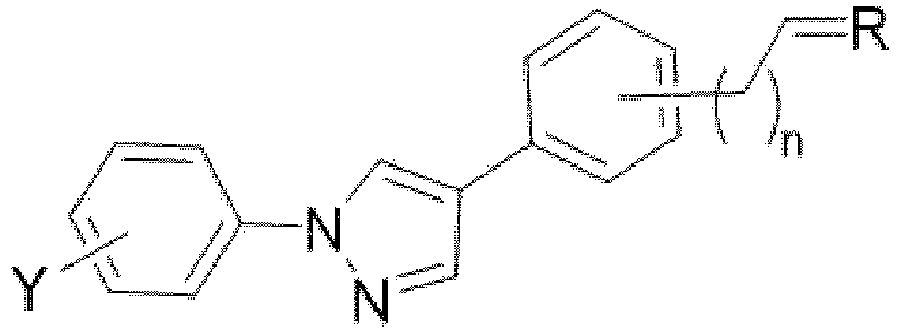
- In Formula 2,
- Y is hydrogen, CF3, CHF2, CH2F, (C1~C6)alkyl, (C1~C6)alkoxy, or halo selected from the group consisting of fluoro, chloro, and bromo,
- n is an integer between 0 to 5,
- R is


- Further, the present invention provides a pharmaceutical composition for preventing or treating cancer, containing the compound, an isomer thereof, or a pharmaceutically acceptable salt thereof as an active ingredient.
- Further, the present invention provides a health functional food composition for preventing or alleviating cancer, containing the compound, an isomer thereof, or a pharmaceutically acceptable salt thereof as an active ingredient.
- In addition, the present invention provides a radiosensitizer pharmaceutical composition for treating cancer with radiotherapy, containing the compound, an isomer thereof, or a pharmaceutically acceptable salt thereof as an active ingredient.
- The present invention relates to a composition for preventing or treating cancer, containing a novel trifluoromethyl phenyl pyrazole derivative as an active ingredient, and, more specifically, to a composition for preventing, alleviating or treating cancer and a radiosensitizer composition for treating cancer with radiotherapy, which contain, as an active ingredient, a novel sulfonamide derivative including N,N-dimethyl-N'-(3-(1-(4-(trifluoromethyl)phenyl)-1H-pyrazol-4-yl)phenyl)azanesulfonamide. Novel sulfonamide derivatives according to the present invention can be used as an effective anticancer agent because of their excellent apoptosis effect on cancer cells, and can be used as a radiosensitizer composition for cancer treatment by lowering radioresistance of cancer cells.
-
-
FIGS. 1a and1b show structural formulas of compounds used in the present invention. -
FIG. 2a shows results of determining anti-cancer effect of various compounds in an MCF7 breast cancer cell line. A was treated with 10 µM and B was treated with 20 µM. -
FIG. 2b shows anti-cancer effect of compounds in various cancer cell lines including colorectal cancer (DLD1, HCT116), lung cancer (H1299, A545), brain cancer (U373, LN18), and the like. -
FIG. 3A shows a chemical formula of N,N-dimethyl-N'-(3-(1-(4-(trifluoromethyl)phenyl)-1H-pyrazol-4-yl)phenyl)azanesulfonamide (#14-3) designated as KRCT-1 in the present invention.FIG. 3B shows inhibition rates of cancer cell growth in the case that various breast cancer cell lines of T47D, BT-549, MDA-MB 453, MCF7, and MDA-MB 231, a stomach cancer cell line (SNU668), and a hematological cancer cell line (MV4-11) are treated with KRCT-1.FIG. 3C shows results of cancer cell line colony formation assay in the case that various breast cancer cell lines of T47D, BT-549, MCF7, and MDA-MB 231 are treated with KRCT-1.FIG. 3D shows results of tumorsphere formation assay in the case that various breast cancer cell lines of T47D, BT-549, MCF7, and MDA-MB 231 are treated with KRCT-1. -
FIG. 4a shows results of monitoring tumor volume and mouse weight according to administration of KRCT-1 to an immunodeficient mouse tumor model (Xenograft mouse model) transplanted with the BT-549 cell line. -
FIG. 4b shows a tumor growth inhibitory effect by KRCT-1 in the immunodeficient mouse tumor model transplanted with the BT-549 cell line. It is the result of checking the expression of a biomarker Ki-67 protein that determines a proliferative ability in a tumor dissected from the mouse shown inFIG. 4a . -
FIG. 5a shows an apoptosis-inducing effect of KRCT-1 treatment in the breast cancer cell line shown by FACS analysis with Annexin V / PI staining. -
FIG. 5b shows results of determining the apoptosis effect of KRCT-1 treatment in each breast cancer cell line of BT549 (A), T47D (B), and MCF7 (C) by Western blot. -
FIG. 6a shows results of checking cancer cell colony formation of breast cancer cell lines BT549, T47D, and MCF7 in order to determine radiosensitivity of KRCT-1. -
FIG. 6b shows results of checking DNA damage of breast cancer cell lines BT549, T47D, and MCF7 in order to determine the radiosensitivity of KRCT-1. DNA damage markers were confirmed by Western blot and immunocytochemistry (ICC). -
FIG. 7a shows results of 104 kinase profiling to explore a molecular biological mechanism of action of KRCT-1. -
FIG. 7b shows inhibition of an in vitro Trk-A kinase activity of KRCT-1. -
FIG. 7c shows results confirming that downstream signaling of Trk-A kinase in cancer cells is inhibited by KRCT-1. - The present invention provides a compound represented by the following
Formula 1, an isomer thereof, or a pharmaceutically acceptable salt thereof.
- In
Formula 1, - R1 is selected from hydrogen, (C1~C6)alkyl, (C1~C6)alkene, (C1~C6)alkyne, substituted or unsubstituted aryl(C1~C6)alkyl, or substituted or unsubstituted aryl wherein said aryl may be substituted with 1 to 3 substituents which are independently selected from the group consisting of halo selected from the group consisting of fluoro, chloro, and bromo, nitro, cyano, hydroxy, and oxo,
- R2 is selected from hydrogen, (C1~C6)alkyl, amino, (C1~C6)alkylamino, or di(C1~C6)alkylamino,
- A is any one of aryl, pyridine, thiophene, or biphenyl, and
- X is hydrogen, CF3, CHF2, CH2F, (C1~C6)alkyl, (C1~C6)alkoxy, or halo selected from the group consisting of fluoro, chloro, and bromo.
- Preferably, the compound represented by
Formula 1 is, - N-methyl-N-(3-(1-(4-(trifluoromethyl)phenyl)-1H-pyrazol-4-yl)phenyl)ethanesulfonamide (#14-1),
- N-(4-chlorobenzyl)-N-(3-(1-(4-(trifluoromethyl)phenyl)-1H-pyrazol-4-yl)phenyl)ethanesulfonamide (#14-2),
- N,N-dimethyl-N'-(3-(1-(4-(trifluoromethyl)phenyl)-1H-pyrazol-4-yl)phenyl)azanesulfonamide (#14-3),
- N,N-dimethyl-N'-methyl-N'-(3-(1-(4-(trifluoromethyl)phenyl)-1H-pyrazol-4-yl)phenyl)azanesulfonamide (#14-4),
- N,N-dimethyl-N'-(4-chlorobenzyl)-N'-(3-(1-(4-(trifluoromethyl)phenyl)-1H-pyrazol-4-yl) phenyl)azanesulfonamide (#14-5),
- N,N-dimethyl-N '-(3-(1-(4-phenyl)-1H-pyrazol-4-yl)phenyl)azanesulfonamide (#14-11),
- N,N- dimethyl-N'-(3-(1-(4-(methyl)phenyl)-1H-pyrazol-4-yl)phenyl)azanesulfonamide (#14-12),
- N,N -dimethyl-N'-(3-(1-(4-(methoxy)phenyl)-1H-pyrazol-4-yl)phenyl)azanesulfonamide (#14-13),
- N,N-dimethyl -N'-(3-(1-(pyridin-4-yl)-1H-pyrazol-4-yl)phenyl)azanesulfonamide (#14-14),
- N,N- dimethyl-N'-(3-(1-(thiophen-4-yl)-1H-pyrazol-4-yl)phenyl)azanesulfonamide (#14-15),
- N,N-dimethyl -N'-(3-(1-(4-fluorophenyl)-1H-pyrazol-4-yl)phenyl)azanesulfonamide (#14-16),
- N,N-dimethyl-N'-(3-(1-(4-([1,1'-biphenyl]-1H-pyrazol-4-yl)phenyl)azanesulfonamide (#14-17),
- N,N- dimethyl-N'-isobutyl-N'-(3-(1-(4-(trifluoromethyl)phenyl)-1H-pyrazol-4-yl)phenyl)azanesulfonamide (#14-18),
- N,N-dimethyl-N'- allyl-N'-(3-(1-(4-(trifluoromethyl)phenyl)-1H-pyrazol-4-yl)phenyl)azanesulfonamide (#14-19),
- N,N-dimethyl-N'-phenyl-N'- (3-(1-(4-(trifluoromethyl)phenyl)-1H-pyrazol-4-yl)phenyl)azanesulfonamide (#14-20), or
- N-(3-(1-(4-(trifluoromethyl)phenyl)-1H-pyrazol-4-yl)phenyl)piperidine -1-sulfonamide (#14-21), but is not limited thereto.
- Chemical structural formulas of compounds #14-1 to #14-5 and #14-11 to #14-21 are as follows.


- In addition, the present invention provides a compound represented by the following
Formula 2, an isomer thereof, or a pharmaceutically acceptable salt thereof.
- In
Formula 2, - Y is hydrogen, CF3, CHF2, CH2F, (C1~C6)alkyl, (C1~C6)alkoxy, or halo selected from the group consisting of fluoro, chloro, and bromo,
- n is an integer between 0 to 5,
- R is


- Preferably, the compound represented by
Formula 2 is, - (E)-N-ethyl-1-(3-(1-(4-(trifluoromethyl)phenyl)-1H-pyrazol-4-yl)phenyl)methanimine oxide (#14-6),
- (E)-N-isopropyl-1-(3-(1-(4-(trifluoromethyl)phenyl)-1H-pyrazol-4-yl)phenyl)methanimine oxide (#14-7),
- (E)-N-tert-butyl-1-(3-(1-(4-(trifluoromethyl)phenyl)-1H-pyrazol-4-yl)phenyl)methanimine oxide (#14-8),
- (E)-3-(1 -(4-(trifluoromethyl)phenyl)-1H-pyrazol-4-yl)benzaldehyde O-ethyl oxime (#14-9), or
- (E)- 3-(1-(4-(trifluoromethyl)phenyl)-1H-pyrazol-4-yl)benzaldehyde O-(tert-butyl) oxime (#14-10), but is not limited thereto.
- Chemical structural formulas of compounds #14-6 to #14-10 are as follows.


- The pharmaceutically acceptable salt may be selected from the group consisting of hydrochloride, bromate, sulfate, phosphate, nitrate, citrate, acetate, lactate, tartrate, maleate, gluconate, succinate, formate, trifluoroacetate, oxalate, fumarate, methanesulfonate, benzenesulfonate, paratoluenesulfonate, camphorsulfonate, sodium salt, potassium salt, lithium salt, calcium salt, and magnesium salt, but is not limited thereto.
- In addition, the present invention provides a pharmaceutical composition for preventing or treating cancer, containing the compound, an isomer thereof, or a pharmaceutically acceptable salt thereof as an active ingredient.
- It was confirmed that the pharmaceutical composition of the present invention reduced the expression of survivin essential for the survival of cancer cells and induces cell death. Survivin shows a high expression rate in various cancers such as lung cancer, breast cancer, prostate cancer, and ovarian cancer, and is a protein that inhibits cell death and is involved in the survival and proliferation of cancer cells. The survivin is being studied a lot as a target for the development of diagnostic markers and targeted anti-cancer agent. Accordingly, the present inventors determined that cancer cell proliferation could be effectively inhibited in the case that cancer cells were treated with KRCT-1, which inhibited the expression of survivin.
- In the case that the composition of the present invention is a pharmaceutical composition, it may be prepared using a pharmaceutically suitable and physiologically acceptable adjuvant in addition to the active ingredient, and as the adjuvant, an excipient, a disintegrant, a sweetener, a binder, a coating agent, a blowing agent, a lubricant, a glidant agent, a flavoring agent, or a solubilizer may be used. The pharmaceutical composition of the present invention may be preferably formulated into a pharmaceutical composition including one or more pharmaceutically acceptable carriers in addition to the active ingredient for administration. In the composition formulated as a liquid solution, acceptable pharmaceutical carriers are sterile and biocompatible, and may be used by mixing saline, sterile water, Ringer's solution, buffered saline, albumin injection, dextrose solution, maltodextrin solution, glycerol, ethanol and one or more of these components, and other conventional additives such as antioxidants, buffers, and bacteriostats may be added as needed. In addition, diluents, dispersants, surfactants, binders and lubricants may be additionally added to formulate an injectable formulation such as an aqueous solution, suspension, and emulsion, pills, capsules, granules, or tablets.
- The pharmaceutical formulation form of the pharmaceutical composition of the present invention may be granules, powders, coated tablets, tablets, capsules, suppositories, syrups, juices, suspensions, emulsions, drops or injectable solutions, and sustained-release formulations of the active compound. The pharmaceutical composition of the present invention can be administered in a conventional manner via intravenous, intraarterial, intraperitoneal, intramuscular, intrasternal, transdermal, intranasal, inhalational, topical, rectal, oral, intraocular or intradermal routes. The effective amount of the active ingredient of the pharmaceutical composition of the present invention means an amount required for preventing or treating a disease. Therefore, it may be adjusted according to various factors, including the type of disease, the severity of the disease, the type and content of the active ingredient and other ingredients contained in the composition, the type of formulation and the age, weight, general health condition, sex and diet of the patient, administration time, administration route and composition secretion rate, duration of treatment, and concomitant drugs.
- In addition, the pharmaceutical composition according to the present invention may contain a trifluoromethyl phenyl pyrazole derivative compound at a concentration of 5 to 150 µM as an active ingredient, preferably 10 to 120 µM, and it may be included more preferably at an effective concentration of 30 to 100 µM.
- In the present invention, 'cancer' refers to a group of diseases characterized by excessive cell proliferation and infiltration into surrounding tissues in the case that the normal balance of apoptosis is disrupted. The cancer of the present invention may be selected from the group consisting of brain tumor, benign astrocytoma, malignant astrocytoma, pituitary adenoma, meningioma, brain lymphoma, oligodendroglioma, intracranial tumor, ependymoma, brain stem tumor, head and neck tumor, laryngeal cancer, oropharyngeal cancer, nasal/sinus cancer, nasopharyngeal cancer, salivary gland cancer, hypopharyngeal cancer, thyroid cancer, chest tumor, small cell lung cancer, non-small cell lung cancer, thymus cancer, mediastinum tumor, esophageal cancer, breast cancer, male breast cancer, abdominal tumor, stomach cancer, liver cancer, gallbladder cancer, biliary tract cancer, pancreatic cancer, small intestine cancer, colorectal cancer, anal cancer, bladder cancer, kidney cancer, male genital tumor, penile cancer, urethral cancer, prostate cancer, female genital tumor, cervical cancer, endometrial cancer, ovarian cancer, uterine sarcoma, vaginal cancer, external genital cancer, female urethra cancer, skin cancer, myeloma, leukemia, and malignant lymphoma, preferably may be breast cancer, prostate cancer, lung cancer, or stomach cancer, and most preferably, breast cancer, but is not limited thereto.
- The pharmaceutical composition of the present invention can be used in combination with radiation therapy, and in particular, the pharmaceutical composition of the present invention can increase the sensitivity to radiation even for cancer cells or cancer cells having radioresistance, so in the case that it can be used in combination with radiation therapy, in a method of treating cancer cells, it is characterized in that it can increase the effect of radiation therapy.
- In addition, the present invention provides a health functional food composition for preventing or alleviating cancer, containing the compound, an isomer thereof, or a pharmaceutically acceptable salt thereof as an active ingredient.
- As used herein, the term "health functional food" refers to a food manufactured and processed using a specific ingredient as a raw material for the purpose of health supplementation or by extracting, concentrating, refining, or mixing a specific ingredient contained in the food raw material. It refers to food that is designed and processed to sufficiently exert biological control functions, such as biological defense, regulation of biological rhythm, and prevention and recovery of disease, by the components and refers to a food that can perform functions related to prevention of disease or restoration of health.
- In the case that the trifluoromethyl phenyl pyrazole derivative compound according to the present invention is used as a health functional food, it may be added as it is or used together with other foods or food ingredients, which may be appropriately selected as needed.
- In addition, there is no particular limitation on the type of health functional food in which the trifluoromethyl phenyl pyrazole derivative compound according to the present invention can be used. For example, there are ramen, other noodles, beverages, tea, drinks, alcoholic beverages, various soups, meat, sausage, bread, chocolate, candy, confectionery, pizza, gum, dairy products, including ice cream, or vitamin complex. In addition, the health functional food according to the present invention may be mixed with other suitable auxiliary ingredients and known additives that may be normally contained in health functional food according to the selection of those skilled in the art other than the trifluoromethyl phenyl pyrazole derivative compound.
- In addition, the present invention provides a radiosensitizer pharmaceutical composition for treating cancer with radiotherapy, containing the compound, an isomer thereof, or a pharmaceutically acceptable salt thereof as an active ingredient.
- In the case that the trifluoromethyl phenyl pyrazole derivative compound of the present invention is treated with cancer cells, the sensitivity of the cancer cells to radiation is increased, thereby enhancing the death of cancer cells.
- The criteria for radiosensitivity or radioresistance can be classified according to the slope value of a linear model created using cell viability in the case that irradiated with 0 to 3 Gy of gamma radiation. This classification method has been reported by Jerry R. Williams et al. in their papers (Acta Oncologica, 46, 628-638, 2007). As used herein, the term "radiosensitivity" means a cell having a characteristic that the slope value is in the range of 0.00 to 0.30, and "radioresistance" refers to a cell having a characteristic included in the range of 0.31 to 1.00.
- The cancers of the present invention may be selected from the group consisting of brain tumor, benign astrocytoma, malignant astrocytoma, pituitary adenoma, meningioma, brain lymphoma, oligodendroglioma, intracranial tumor, ependymoma, brain stem tumor, head and neck tumor, laryngeal cancer, oropharyngeal cancer, nasal/sinus cancer, nasopharyngeal cancer, salivary gland cancer, hypopharyngeal cancer, thyroid cancer, chest tumor, small cell lung cancer, non-small cell lung cancer, thymus cancer, mediastinum tumor, esophageal cancer, breast cancer, male breast cancer, abdominal tumor, stomach cancer, liver cancer, gallbladder cancer, biliary tract cancer, pancreatic cancer, small intestine cancer, colorectal cancer, anal cancer, bladder cancer, kidney cancer, male genital tumor, penile cancer, urethral cancer, prostate cancer, female genital tumor, cervical cancer, endometrial cancer, ovarian cancer, uterine sarcoma, vaginal cancer, external genital cancer, female urethra cancer, skin cancer, myeloma, leukemia, and malignant lymphoma, but may preferably be prostate cancer including breast cancer, lung cancer or stomach cancer, and most preferably, breast cancer, but is not limited thereto.
- The radiosensitizer pharmaceutical composition for treating cancer with radiotherapy according to the present invention may be used in combination with radiation therapy.
- The radiation therapy used in the present invention is a local treatment method that damages the DNA of malignant cells. Normal cells have a greater capacity to repair this damage than tumor cells, and the radiation therapy is known to take advantage of this difference.
- The radiation therapy may include external beam radiation (x-rays, γ-rays, protons and neutrons), brachytherapy, and radioactive material implantation, and may be administered by 2-D, 3-D, confocal, intensity-modulated (IMRT) and image-guided (IGRT) approaches. The standard radiation therapy that can be used in the cancer treatment of the present invention may be a method of providing a total dose of about 60 Gys (50 ~ 70 Gys) at 2.5 Gy/day. However, those skilled in the art may select the desired radiation dose based on the particular subject, device, and tumor type.
- The radiosensitizer pharmaceutical composition for treating cancer with radiotherapy according to the present invention constitutes an improvement over the existing radiation therapy by increasing the sensitivity of cancer cells to radiation. For example, the use of the radiosensitizer pharmaceutical composition for treating cancer with radiotherapy of the present invention causes cancer cells to have sensitivity of at least 30%, 40%, 50%, 60%, 70%, 80%, 90%, 100% or more to radiation. As used herein, the terms "sensitivity" and "radiosensitivity" refer to the number of viable cells based on radiation dose. Accordingly, an increase in radiosensitivity may mean a decrease in the number of cells surviving at a certain radiation dose, a decrease in the radiation dose required for a lethal dose, or a combination thereof.
- Since the radiosensitizer pharmaceutical composition for treating cancer with radiotherapy of the present invention can increase the sensitivity not only for radiotherapy of cancer cells but also for chemotherapy, the radiosensitizer of the present invention can be used as a sensitizer for increasing sensitivity in chemotherapy. The use case may also fall within the scope of the present invention.
- As used herein, the term "administered in combination" means administering radiation irradiation together in an anticancer process for treating various types of cancer cells. Specifically, it may be one in which radiation therapy is concurrently treated in an anticancer process for treating cancer cells such as solid cancers such as lung cancer, breast cancer, colorectal cancer, ovarian cancer, head and neck cancer, and brain cancer.
- Hereinafter, the present invention will be described in detail through examples. These examples are merely for illustrating the present invention in more detail, and it will be apparent to those of skilled in the art that the scope of the present invention is not limited by these examples according to the gist of the present invention.
-

- Step 1: 4-iodobenzotrifluoride (1.00 g, 3.68 mmol), 4-chloro-1H-pyrazole (415 mg, 4.05 mmol), cesium carbonate (2.40 g, 7.36 mmol), CuI (105 mg, 0.55 mmol) were added to anhydrous toluene (35 mL), which is a reaction solvent, and then stirred at 110°C for 24 hours. After confirming the reaction product by TLC, the reaction solution was diluted with EtOAc and washed with purified water. The organic layer was dehydrated over anhydrous Na2SO4, concentrated under reduced pressure, and separated by silica column chromatography to obtain 1.12 g of the title compound (compound 1). 1H-NMR(300 MHz, CDCl3): δ 8.23 (s, 1H), 8.02 (s, 1H), 7.89 (2H, d, J=8.77 Hz), 7.76 (2H, d, J=8.77 Hz); LC-MS (ESI, m/z) = 247.0 (M+H+).
- Step 2: The compound 1 (800 mg, 3.25 mmol) obtained in
step 1 was put in a reaction vessel, and 3-aminophenylboronic acid(534 mg, 3.90 mmol), Pd(OAc)2(73 mg, 0.32 mmol), sSPhos(250 mg, 0.49 mmol), Na2CO3(689 mg, 6.50 mmol) were added to anhydrous dioxane (25 mL), followed by treatment with N2(g) for 5 minutes. After the reaction was stirred at 110° C for 12 hours, the product was confirmed by TLC, and dioxane, a solvent, was removed by concentration under reduced pressure. The remaining reaction mixture was diluted with EtOAc and washed with purified water. The organic layer was dehydrated with anhydrous Na2SO4, concentrated under reduced pressure, and separated by silica column chromatography to obtain 921 mg of the title compound (compound 2). 1H-NMR(300 MHz, CDCl3): δ 8.21 (s, 1H), 8.08 (s, 1H), 7.81 (2H, d, J=8.74 Hz), 7.67 (2H, d, J=8.77 Hz), 7.45 (1H, m), 7.02 (1H, d, J=7.82 Hz), 6.89 (1H, s), 6.76 (1H, d, J=7.69 Hz), 4.66 (2H, s); LC-MS (ESI, m/z) = 304.1 (M+H+). -

- Compound 1 (800 mg, 3.25 mmol) obtained in
step 1 of Preparation Example 1 was put in a reaction vessel, and (3-formylphenyl)boronic acid(585 mg, 3.90 mmol), Pd(PPh3)4(375 mg, 0.33 mmol), Na2CO3(689 mg, 6.54 mmol) was added to dioxane (32 mL), followed by treatment with N2(g) for 5 minutes. After the reaction was stirred at 90° C for 8 hours, the product was confirmed by TLC, and dioxane, a solvent, was removed by concentration under reduced pressure. The reaction concentrate was diluted with EtOAc and washed with purified water. The organic layer was dehydrated over anhydrous Na2SO4, concentrated under reduced pressure, and separated by silica column chromatography to obtain 870 mg of the title compound (compound 3). 1H-NMR(300 MHz, CDCl3): δ 9.85 (s, 1H), 8.61 (s, 1H), 8.21 (s, 1H), 8.08 (s, 1H), 7.95 (1H, d, J=7.86 Hz), 7.81 (2H, d, J=8.74 Hz), 7.67 (2H, d, J=8.77 Hz), 7.45 (1H, m), 7.22 (1H, d, J=7.82 Hz); LC-MS (ESI, m/z) = 317.1 (M+H+). -

- Step 1:
Compound 2 synthesized in Preparation Example 1, 3-(1-(4-(trifluoromethyl)phenyl)-1H-pyrazol-4-yl)aniline (591 mg, 1.95 mmol) was added into a reaction flask, and dissolved with a 20 mL anhydrous DCM solvent. Ethanesulfonyl chloride (204 µL, 2.16 mmol) and pyridine (174 µL, 2.16 mmol) were added, followed by stirring at room temperature for 12 hours. After the reaction product was confirmed by TLC, it was diluted with DCM and washed with NH4Cl aqueous solution. The separated organic layer was dehydrated with anhydrous Na2SO4, concentrated under reduced pressure, and separated by column chromatography to obtain 603 mg ofcompound 4. 1H-NMR (300 MHz, CDCl3): δ 10.51 (s, 1H), 8.20 (s, 1H), 8.04 (s, 1H), 7.83 (d, 2H, J=8.77 Hz), 7.73 (d, 2H, J= 8.77 Hz), 7.62 (s, 1H), 7.51 (d, 1H, J= 7.44 Hz), 7.42 (t, 1H, J= 7.71 Hz), 7.27 (d, 1H, J= 7.71 Hz), 3.12 (q, 2H, J= 7.44 Hz), 1.42 (t, 3H, J= 7.71 Hz); LC-MS (ESI, m/z) = 396.1 (M+H+). - Step 2: The compound 4 (256 mg, 0.65 mmol) obtained in
step 1 above was put in a reaction flask, and dissolved with 7 mL of anhydrous MeCN solvent. Methyl iodide (38 µL, 0.65 mmol) and K2CO3 (90 mg, 0.65 mmol) were added, and the mixture was stirred at 80°C for 2 hours. The reaction product was confirmed by TLC, diluted with EtOAc and washed with purified water. The separated organic layer was dehydrated with anhydrous Na2SO4, concentrated under reduced pressure, and separated by column chromatography to obtain 220 mg of the title compound #14-1. 1H-NMR (300 MHz, CDCl3): δ 8.23 (s, 1H), 8.02 (s, 1H), 7.89 (d, 2H, J=8.77 Hz), 7.76 (d, 2H, J= 8.77 Hz), 7.62 (s, 1H), 7.49 (d, 1H, J= 7.44 Hz), 7.45 (t, 1H, J= 7.71 Hz), 7.30 (d, 1H, J= 7.71 Hz), 3.40 (s, 3H), 3.12 (q, 2H, J= 7.44 Hz), 1.42 (t, 3H, J= 7.71 Hz); LC-MS (ESI, m/z) = 410.2 (M+H+). - Compound 4 (67 mg, 0.17 mmol) obtained in
step 1 above was placed in a reaction flask and dissolved with 3 mL of anhydrous MeCN solvent. After adding 1-(Bromomethyl)-4-chlorobenzene (82 mg, 0.21 mmol) and K2CO3(29 mg, 0.21 mmol), the mixture was stirred at 80° C for 2 hours. The reaction product was confirmed by TLC, diluted with EtOAc, and washed with purified water. The separated organic layer was dehydrated over anhydrous Na2SO4,concentrated under reduced pressure, and separated by column chromatography to obtain 60 mg of the title compound #14-2. 1H-NMR (300 MHz, CDCl3): δ 8.12 (s, 1H), 7.94 (s, 1H), 7.87 (d, 2H, J= 8.54 Hz), 7.75 (d, 2H, J= 8.54 Hz), 7.46 (m, 1H), 7.38 (m, 2H), 7.24 (m, 3H), 7.17 (m, 1H), 4.88 (s, 2H), 3.15 (q, 2H, J= 7.35 Hz), 1.47 (t, 3H, J= 7.35 Hz); LC-MS (ESI, m/z) = 520.1 (M+H+). -

-
Compound 2 synthesized in Preparation Example 1, 3-(1-(4-(trifluoromethyl)phenyl)-1H-pyrazol-4-yl)aniline (591 mg, 1.95 mmol) was placed in a reaction flask, and dissolved with 20 mL of anhydrous DCM solvent. Dimethylsulfamoyl chloride (671 µL, 2.16 mmol) and pyridine (174 µL, 2.16 mmol) were added, followed by stirring at room temperature for 12 hours. After the reaction product was confirmed by TLC, it was diluted with DCM and washed with NH4Cl solution. The separated organic layer was dehydrated over anhydrous Na2SO4, concentrated under reduced pressure, and separated by column chromatography to obtain 781 mg of the title compound #14-3. 1H-NMR (300 MHz, CDCl3): δ 8.21 (S, 1H), 8.01 (s, 1H), 7.89 (d, 2H, J= 8.51 Hz), 7.76 (d, 2H, J= 8.51 Hz), 7.40 (m, 1H), 7.36 (m, 2H), 7.09 (m, 1H), 6.54 (s, 1H), 2.89 (s, 6H); LC-MS (ESI, m/z) = 411.1 (M+H+). - The compound of Example #14-3 (100 mg, 0.24 mmol) was placed in a reaction flask and dissolved with 3 mL of anhydrous MeCN solvent. After adding iodomethane (17 µL, 0.28 mmol) and K2CO3(67 mg, 0.50 mmol), the mixture was stirred at 80°C for 2 hours. After the reaction product was confirmed by TLC, it was diluted with EtOAc and washed with purified water. The separated organic layer was dehydrated over anhydrous Na2SO4,concentrated under reduced pressure, and separated by column chromatography to obtain 94 mg of the title compound #14-4. 1H-NMR (300 MHz, CDCl3): δ 8.23 (s, 1H), 8.02 (s, 1H), 7.89 (d, 2H, J= 8.62 Hz), 7.76 (d, 2H, J= 8.62 Hz), 7.62 (m, 1H), 7.48 (m, 1H), 7.44 (t, 1H, J= 7.63 Hz), 7.32 (m, 1H), 3.33 (s, 3H), 2.83 (s, 6H); LC-MS (ESI, m/z) = 425.1 (M+H+).
- The compound of Example #14-3 (100 mg, 0.24 mmol) was placed in a reaction flask and dissolved with 3 mL of anhydrous MeCN solvent. 4-Chlorobenzyl bromide (55 mg, 0.28 mmol) and K2CO3 (67 mg, 0.50 mmol) were added, followed by stirring at 80°C for 2 hours. After the reaction product was confirmed by TLC, it was diluted with EtOAc and washed with purified water. The separated organic layer was dehydrated over anhydrous Na2SO4, concentrated under reduced pressure, and separated by column chromatography to obtain 106 mg of the title compound #14-5. 1H-NMR (300 MHz, CDCl3): δ 8.12 (s, 1H), 7.94 (s, 1H), 7.88 (d, 2H, J= 8.83 Hz), 7.75 (d, 2H, J= 8.83 Hz), 7.46 (m, 1H), 7.37 (t, 1H, J= 7.61 Hz), 7.26 (s, 1H), 7.24 (d, 2H, J= 10.96 Hz), 7.15 (m, 1H), 4.78 (s, 2H), 2.78 (s, 6H); LC-MS (ESI, m/z) = 535.1 (M+H+).
- Step 1: Iodobenzene (1.00 g, 4.90 mmol) and 4-chloro-1H-pyrazole (552 mg, 5.39 mmol) were reacted in a similar manner to Preparation Example 1 to obtain 750 mg of the title compound 3-(1-phenyl-1H- pyrazol-4-yl)aniline. 1H-NMR (300 MHz, CDCl3): δ 8.19 (s, 1H), 8.10 (s, 1H), 7.64 (2H, d, J=8.71 Hz), 7.42 (2H, m), 7.02 (1H, d, J=7.69 Hz), 6.84 (1H, s), 6.78 (1H, d, J=7.74 Hz), 4.67 (2H, s); LC-MS (ESI, m/z) = 236.1 (M+H+).
- Step 2: Using the compound obtained in
step 1, 3-(1-phenyl-1H-pyrazol-4-yl)aniline (200 mg, 0.85 mmol) as a starting material for the reaction, it was reacted in a similar manner to Example #14-3 to obtaine 87 mg of the title compound. 1H-NMR (300 MHz, CDCl3): δ 10.51 (s, 1H), 8.19 (S, 1H), 8.01 (s, 1H), 7.87-7.74 (m, 5H), 7.40 (m, 1H), 7.36 (m, 2H), 7.12 (m, 1H), 6.52 (s, 1H), 2.89 (s, 6H); LC-MS (ESI, m/z) = 344.2 (M+H+). - Step 1: Using 1-iodo-4-methylbenzene (1.00 g, 4.58 mmol) as a starting material, it was reacted in a manner similar to Preparation Example 1 to obtain 632 mg of the title compound 3-(1-(p-tolyl)-1H-pyrazol-4-yl)aniline. 1H-NMR (300 MHz, CDCl3): δ 8.21 (s, 1H), 8.09 (s, 1H), 7.82 (2H, d, J=8.77 Hz), 7.69 (2H, d, J=8.77 Hz), 7.00 (1H, d, J=7.85 Hz), 6.86 (1H, s), 6.76 (1H, d, J=7.66 Hz), 4.69 (s, 2H), 2.43 (s, 3H); LC-MS (ESI, m/z) = 250.08 (M+H+).
- Step 2: Using the compound obtained in
step 1, 3-(1-(p-tolyl)-1H-pyrazol-4-yl)aniline (200 mg, 0.83 mmol) as a starting material for the reaction, it was reacted in a similar manner to Example #14-3 to obtaine 58 mg of the title compound. 1H-NMR (300 MHz, CDCl3): δ 10.50 (s, 1H), 8.20 (S, 1H), 8.00 (s, 1H), 7.89 (d, 2H, J=8.48 Hz), 7.76 (d, 2H, J=8.51 Hz), 7.37 (m, 1H), 7.38 (m, 2H), 7.08 (m, 1H), 6.54 (s, 1H), 2.44 (s, 3H), 2.88 (s, 6H); LC-MS (ESI, m/z) = 357.1 (M+H+). - Step 1: Using 1-iodo-4-methoybenzene (1.00 g, 4.27 mmol) as a starting material, it was reacted in a manner similar to Preparation Example 1 to obtain 734 mg of the title compound 3-(1-(4-methoxyphenyl)-1H-pyrazol-4-yl)aniline. 1H-NMR (300 MHz, CDCl3): δ 8.20 (s, 1H), 8.03 (s, 1H), 7.78 (2H, d, J=8.74 Hz), 7.64 (2H, d, J=8.74 Hz), 6.97 (1H, d, J=7.74 Hz), 6.85 (1H, s), 6.76 (1H, d, J=7.66 Hz), 4.69 (s, 2H), 3.82 (s, 3H); LC-MS (ESI, m/z) = 266.0 (M+H+).
- Step 2: Using the compound obtained in
step 1, 3-(1-(4-methoxyphenyl)-1H-pyrazol-4-yl)aniline (200 mg, 0.76 mmol) as a starting material for the reaction, it was reacted in a similar manner to Example #14-3 to obtaine 61 mg of the title compound. 1H-NMR (300 MHz, CDCl3): δ 8.15 (S, 1H), 8.03 (s, 1H), 7.85 (d, 2H, J=8.45 Hz), 7.69 (d, 2H, J=8.48 Hz), 7.34 (m, 1H), 7.30 (m, 2H), 7.09 (m, 1H), 6.52 (s, 1H), 3.81 (s, 3H), 2.88 (s, 6H); LC-MS (ESI, m/z) = 373.1 (M+H+). - Step 1: Using 4-iodopyridine (1.00 g, 4.87 mmol) as a starting material, it was reacted in a manner similar to Preparation Example 1 to obtaine 541 mg of the title compound 3-(1-(pyridin-4-yl)-1H-pyrazol-4-yl)aniline. 1H-NMR (300 MHz, CDCl3): δ 8.32 (s, 1H), 8.12 (s, 1H), 7.98 (2H, d, J=8.64 Hz), 7.83 (2H, d, J=6.64 Hz), 7.01 (m, 1H), 6.97 (1H, d, J=7.72 Hz), 6.85 (1H, s), 6.72 (1H, d, J=7.72 Hz), 4.69 (s, 2H); LC-MS (ESI, m/z) = 237.0 (M+H+).
- Step 2: Using the compound obtained in
step 1, 3-(1-(pyridin-4-yl)-1H-pyrazol-4-yl)aniline (200 mg, 0.84 mmol) as a starting material for the reaction, it was reacted in a similar manner to Example #14-3 to obtaine 47 mg of the title compound. 1H-NMR (300 MHz, CDCl3): δ 10.53 (s, 1H), 8.21 (S, 1H), 8.19 (s, 1H), 7.98 (d, 2H, J=8.42 Hz), 7.79 (d, 2H, J=8.42 Hz), 7.31 (m, 1H), 7.29 (m, 2H), 7.09 (m, 1H), 6.51 (s, 1H), 2.87 (s, 6H); LC-MS (ESI, m/z) = 344.1 (M+H+). - Step 1: Using 2-iodothiophen (1.00 g, 4.21 mmol) as a starting material, it was reacted in a manner similar to Preparation Example 1 to obtain 708 mg of the title compound 3-(1-(thiophen-2-yl)-1H-pyrazol-4-yl)aniline. 1H-NMR (300 MHz, CDCl3): δ 8.39 (s, 1H), 8.09 (s, 1H), 7.89(1H, d, J=8.64 Hz), 7.75 (1H, d, J=8.64 Hz), 7.65 (m, 1H), 7.01 (m, 1H), 6.97 (1H, d, J=7.72 Hz), 6.85 (1H, s), 6.72 (1H, d, J=7.72 Hz), 4.67 (s, 2H); LC-MS (ESI, m/z) = 242.3 (M+H+).
- Step 2: Using the compound obtained from
step 1, 3-(1-(thiophen-2-yl)-1H-pyrazol-4-yl)aniline as a starting material for the reaction, it was reacted in a similar manner to Example #14-3 to obtaine 63 mg of the title compound. 1H-NMR (300 MHz, CDCl3): δ 10.50 (s, 1H), 8.39 (s, 1H), 8.12 (s, 1H), 7.95(1H, d, J=8.64 Hz), 7.79 (1H, d, J=8.64 Hz), 7.64 (m, 1H), 7.01 (m, 1H), 6.98 (1H, d, J=7.72 Hz), 6.85 (1H, s), 6.71 (1H, d, J=7.72 Hz), 6.52 (s, 1H), 2.88 (s, 6H); LC-MS (ESI, m/z) = 348.9 (M+H+). - Step 1: Using 1-fluoro-4-iodobenzene (1.00 g, 4.51 mmol) as a starting material, it was reacted in a manner similar to Preparation Example 1 to obtain 672 mg of the title compound 3-(1-(4-fluorophenyl)-1H-pyrazol-4-yl)aniline. 1H-NMR (300 MHz, CDCl3): δ 8.27 (s, 1H), 8.08 (s, 1H), 7.82 (2H, d, J=8.74 Hz), 7.68 (2H, d, J=8.74 Hz), 7.46 (m, 1H), 7.04 (1H, d, J=7.82 Hz), 6.85 (1H, s), 6.72 (1H, d, J=7.69 Hz), 4.64 (s, 2H); LC-MS (ESI, m/z) = 254.1 (M+H+).
- Step 2: Using the compound obtained in
step 1, 3-(1-(4-fluorophenyl)-1H-pyrazol-4-yl)aniline (200 mg, 0.78 mmol) as a starting material for the reaction, it was reacted in a similar manner to Example #14-3 to obtaine 65 mg of the title compound. 1H-NMR (300 MHz, CDCl3): δ 10.50 (s, 1H), 8.26 (s, 1H), 8.08 (s, 1H), 7.84 (2H, d, J=8.71 Hz), 7.69 (2H, d, J=8.74 Hz), 7.48 (m, 1H), 7.06 (1H, d, J=7.85 Hz), 6.85 (1H, s), 6.72 (1H, d, J=7.69 Hz), 6.52 (s, 1H), 2.90 (s, 6H); LC-MS (ESI, m/z) = 361.1 (M+H+). - Step 1: Using 1-iodobiphenyl (1.00 g, 3.57 mmol) as a starting material, it was reacted in a similar manner to Preparation Example 1 to obtaine 812 mg of the title compound 3-(1-([1,1'-biphenyl]-4-yl)-1H-pyrazol-4-yl)aniline. 1H-NMR (300 MHz, CDCl3): δ 8.32 (s, 1H), 8.14 (s, 1H), 7.81 (2H, d, J=8.77 Hz), 7.72 (2H, d, J=8.77 Hz), 7.69-7.52 (m, 5H), 7.46 (m, 1H), 7.01 (1H, d, J=7.82 Hz), 6.85 (1H, s), 6.78 (1H, d, J=7.66 Hz), 4.65 (s, 2H); LC-MS (ESI, m/z) = 312.1 (M+H+).
- Step 2: Using the compound obtained from
step 1, 3-(1-([1,1'-biphenyl]-4-yl)-1H-pyrazol-4-yl)aniline (200 mg, 0.64 mmol) as a starting material, it was reacted in a similar manner to Example #14-3 to obtaine 61 mg of the title compound. 1H-NMR (300 MHz, CDCl3): δ 10.48 (s, 1H), 8.32 (s, 1H), 8.11 (s, 1H), 7.83 (2H, d, J=8.77 Hz), 7.70 (2H, d, J=8.77 Hz), 7.70-7.52 (m, 5H), 7.46 (m, 1H), 7.03 (1H, d, J=7.74 Hz), 6.81 (1H, s), 6.73 (1H, d, J=7.69 Hz), 6.50 (s, 1H), 2.91 (s. 6H); LC-MS (ESI, m/z) = 419.0 (M+H+). - 1-iodo-2-methylpropan (53 mg, 0.29 mmol) was added to the starting material #14-3 (100 mg, 0.24 mmol) and it was reacted in a manner similar to Example #14-4 to obtain 32 mg of the title compound. 1H-NMR (300 MHz, CDCl3): δ 8.22 (s, 1H), 8.01 (s, 1H), 7.87 (d, 2H, J= 8.62 Hz), 7.71 (d, 2H, J= 8.62 Hz), 7.59 (m, 1H), 7.49 (m, 1H), 7.42 (t, 1H, J= 7.60 Hz), 7.30 (m, 1H), 2.98 (d, J=7.72 Hz, 2H), 2.82 (s, 6H), 1.68 (m, 1H), 0.92 (d, 6H, J=6.8 Hz); LC-MS (ESI, m/z) = 466.9 (M+H+).
- 3-bromo-1-propene (35 mg, 0.29 mmol) was added to the starting material #14-3 (100 mg, 0.24 mmol) and it was reacted in a similar manner to Example #14-4 to obtain 41 mg of the title compound. 1H-NMR (300 MHz, CDCl3): δ 8.23 (s, 1H), 8.04 (s, 1H), 7.86 (d, 2H, J= 8.45 Hz), 7.72 (d, 2H, J= 8.45 Hz), 7.61 (m, 1H), 7.52 (m, 1H), 7.41 (t, 1H, J= 7.63 Hz), 7.31 (m, 1H), 5.85 (m, 1H), 5.19 (d, J=17.1 Hz, 1H), 5.17 (d, J=17.1 Hz, 1H), 3.73 (d, J=6.2 Hz, 1H), 2.82 (s, 6H); LC-MS (ESI, m/z) = 450.9 (M+H+).
-

- Starting material #14-3 (100 mg, 0.24 mmol), phenylboronic acid (36 mg, 0.29 mmol), Tetrakis(acetonitrile)copper(I) hexafluorophosphate (108 mg, 0.29 mmol), N-methylpiperidine (0.17 mL, 1.46 mmol) were added to anhydrous MeCN and stirred at room temperature for 12 hours. After the reaction product was confirmed by TLC, it was diluted with DCM and washed with NH4Cl solution. The separated organic layer was dehydrated with anhydrous Na2SO4, concentrated under reduced pressure, and separated by column chromatography to obtain 29 mg of the title compound #14-20.
- 1H-NMR (300 MHz, CDCl3): δ 8.23 (S, 1H), 8.08 (s, 1H), 7.88 (d, 2H, J= 8.48 Hz), 7.79 (d, 2H, J= 8.48 Hz), 7.42 (m, 1H), 7.31 (m, 2H), 7.29-7.15 (m, 5H), 7.09 (m, 1H), 2.87 (s, 6H); LC-MS (ESI, m/z) = 486.9 (M+H+).
- The compound synthesized in Preparation Example 1, 3-(1-(4-(trifluoromethyl)phenyl)-1H-pyrazol-4-yl)aniline (100 mg, 0.33 mmol) and Piperidine-1-sulfonyl chloride (56 uL, 0.39 mmol) was reacted similarly to Example #14-3 to obtain 42 mg of the title compound. 1H-NMR (300 MHz, CDCl3): δ 8.23 (S, 1H), 7.98 (s, 1H), 7.84 (d, 2H, J= 8.31 Hz), 7.74 (d, 2H, J= 8.31 Hz), 7.36 (m, 1H), 7.33 (m, 2H), 7.01 (m, 1H), 3.07 (t, J= 7.7 Hz, 4H), 1.53-1.43 (m, 6H); LC-MS (ESI, m/z) = 451.1 (M+H+).
-

- Compound 3 (100 mg, 0.32 mmol) obtained in Preparation Example 2 was placed in a reaction flask and dissolved in 3 mL of anhydrous EtOH. After adding N-methylhydroxylamine.HCl (79 mg, 0.95 mmol) and potassium acetate (93 mg, 0.95 mmol), the mixture was stirred at room temperature for 24 hours. After the reaction product was confirmed by TLC, it was diluted with EtOAc and washed with purified water. The separated organic layer was dehydrated with anhydrous Na2SO4, concentrated under reduced pressure, and separated by column chromatography to obtain 76 mg of the title compound #14-6. 1H-NMR (300 MHz, CDCl3): δ 8.35 (s, 1H), 8.12 (s, 1H), 7.86 (d, 2H, J= 8.59 Hz), 7.74 (d, 2H, J= 8.59 Hz), 7.70 (m, 1H), 7.56 (m, 1H), 7.44 (t, 1H, J= 7.63 Hz), 7.32 (m, 1H), 3.98 (q, 2H, J=9.00 Hz), 1.56 (t, 3H, J=9.00 Hz); LC-MS (ESI, m/z) = 360.2 (M+H+).
- Compound 3 (100 mg, 0.32 mmol) obtained in Preparation Example 2 was placed in a reaction flask and dissolved in 3 mL of anhydrous EtOH. After adding N-isopropylhydroxylamine.HCl (105 mg, 0.95 mmol) and potassium acetate (93 mg, 0.95 mmol), the mixture was stirred at room temperature for 24 hours. After the reaction product was confirmed by TLC, it was diluted with EtOAc and washed with purified water. The separated organic layer was dehydrated with anhydrous Na2SO4,concentrated under reduced pressure, and separated by column chromatography to obtain 60 mg of the title compound #14-7. 1H-NMR (300 MHz, CDCl3): δ 8.32 (s, 1H), 8.12 (s, 1H), 7.86 (d, 2H, J= 8.50 Hz), 7.71 (d, 2H, J= 8.50 Hz), 7.65 (m, 1H), 7.56 (m, 1H), 7.41 (t, 1H, J= 7.61 Hz), 7.29 (m, 1H), 4.21 (m, 1H), 1.51 (s, 3H), 1.49 (s, 3H); LC-MS (ESI, m/z) = 374.0 (M+H+).
- Compound 3(100 mg, 0.32 mmol) obtained in Preparation Example 2 was placed in a reaction flask and dissolved in 3 mL of anhydrous EtOH. After adding N-tert-butylhydroxylamine.HCl (118 mg, 0.95 mmol) and potassium acetate (93 mg, 0.95 mmol), the mixture was stirred at room temperature for 24 hours. After the reaction product was confirmed by TLC, it was diluted with EtOAc and washed with purified water. The separated organic layer was dehydrated with anhydrous Na2SO4, concentrated under reduced pressure, and separated by column chromatography to obtain 71 mg of the title compound #14-8. 1H-NMR (300 MHz, CDCl3): δ 8.38 (s, 1H), 8.21 (s, 1H), 7.84 (d, 2H, J= 8.12 Hz), 7.72 (d, 2H, J= 8.12 Hz), 7.59 (m, 1H), 7.53 (m, 1H), 7.40 (t, 1H, J= 7.61 Hz), 7.27 (m, 1H), 1.60 (s, 9H); LC-MS (ESI, m/z) = 388.1 (M+H+).
-

- Compound 3 (100 mg, 0.32 mmol) obtained in Preparation Example 2 was placed in a reaction flask and dissolved in 5 mL of anhydrous DCM. After adding ethoxyamine.HCl (46 mg, 0.47 mmol) and pyridine (56 µL, 0.70 mmol), the mixture was stirred at room temperature for 5 hours. After the reaction product was confirmed by TLC, it was diluted with EtOAc and washed with purified water. The separated organic layer was dehydrated with anhydrous Na2SO4, concentrated under reduced pressure, and separated by column chromatography to obtain 78 mg of the title compound #14-9. 1H-NMR (300 MHz, CDCl3): δ 8.46 (s, 1H), 8.32 (s, 1H), 8.08 (s, 1H), 7.80 (d, 2H, J= 8.45 Hz), 7.71 (d, 2H, J= 8.45 Hz), 7.64 (m, 1H), 7.53 (m, 1H), 7.41 (t, 1H, J= 7.61 Hz), 7.32 (m, 1H), 3.57 (q, 2H, J=9.82 Hz), 1.51 (t, 3H, J=9.82 Hz); LC-MS (ESI, m/z) = 360.1 (M+H+).
- Compound 3 (100 mg, 0.32 mmol) obtained in Preparation Example 2 was placed in a reaction flask and dissolved in 5 mL of anhydrous DCM. After adding tert-butoxyamine.HCl (59 mg, 0.47 mmol) and pyridine (56 µL, 0.70 mmol), the mixture was stirred at room temperature for 5 hours. After confirming the reaction product by TLC, it was diluted with EtOAc and washed with purified water. The separated organic layer was dehydrated over anhydrous Na2SO4, concentrated under reduced pressure, and separated by column chromatography to obtain 85 mg of the title compound #14-10. 1H-NMR (300 MHz, CDCl3): δ 8.52 (s, 1H), 8.38 (s, 1H), 8.12 (s, 1H), 7.83 (d, 2H, J= 8.42 Hz), 7.74 (d, 2H, J= 8.42 Hz), 7.63 (m, 1H), 7.50 (m, 1H), 7.47 (t, 1H, J= 7.59 Hz), 7.32 (m, 1H), 1.25 (s, 9H); LC-MS (ESI, m/z) = 388.0 (M+H+).
- Human-derived tumor cell lines and breast cancer cell lines MCF7 and T47D, BT549, MDA-MB231, and MDA-MB453 was cultured in a DMEM medium (Corning, NY, USA), containing 10% fetal bovine serum (FBS; HyClone, South Logan, UT) and 1% penicillin/streptomycin at 37° C and 5% CO2 conditions.
- Thereafter, the cell lines and compounds prepared through the above method were used in the following Examples.
- In order to confirm the inhibition of cancer cell proliferation by KRCT-1, WST-8 analysis (Cyto XTM cell viability assay kit, LPS solution, Daejeon, Korea) was performed according to the manufacturer's protocol. Colorectal cancer (DLD1, HCT-116), lung cancer (H1299, A549), brain tumor (U373, LN18), breast cancer (T47D, BT549, MDA-MB 453, MCF7 and MDA MB-231), stomach cancer (SNU668), blood cancer (MV4-11) cells were seeded in 96-well plates, cultured for 24 hours, and then treated with the compound. Then, the absorbance was measured at 450 nm using a Versamax microplate reader (Molecular Devices, CA, USA), and the results of the experiment are shown in
FIG. 2 and3B . - Colonogenic analysis was performed to determine whether the selected KRCT-1 could efficiently kill cancer cells. First, cells of various breast cancer cell lines BT549, MCF7, T47D and MDA MB231 (500-1000 cells) were cultured in a 60 mm culture plate, and 24 hours later, 10 µM of the compound was treated, respectively, and cultured for 14 days. It was fixed and stained with tryptophan blue added with methanol, quantified using Image J software, and was shown in
FIG. 3C . - As can be seen in
FIG. 3C , it was confirmed that the number and size of cell colonies were significantly reduced upon KRCT-1 treatment in various breast cancer cell lines. As a result, KRCT-1 effectively kills the colonies of cancer cells. - In order to determine whether the selected KRCT-1 can effectively reduce the tumorsphere formation in cancer cells, tumorsphere forming assay was performed. Breast cancer cells MCF7 (2500-10000 cells) were suspended in serum-free DMEM/F12 (welGENE), containing 1% penicillin, B-27 (1:50; invitrogen), 20 ng/mL epidermal growth factor (R&D Systems) and 20 ng/mL fibroblasts growth factors (R&D Systems) on low adhesion plates and cultured. After 24 hours had elapsed, the cells were treated with the compound and cultured for 14 days, and then the diameter of the tumorspheres was measured and quantified, which is shown in
FIG. 3D . - As confirmed in
FIG. 3D , it was confirmed that the diameter of cancer cell tumorspheres was significantly reduced in the case that various breast cancer cell lines were treated with KRCT-1. Consequently, KRCT-1 effectively reduces the formation of tumorspheres in cancer cells. - By subcutaneously implanting a cancer cell line into an immunodeficient mouse tumor model, it was attempted to verify whether the anticancer effect of the compound actually occurs at the in vivo level. After the tumor was formed by implanting the BT549 cell line subcutaneously in the thigh of an immunodeficient mouse, in the case that the size of the tumor reached 50~100 mm^~3~, the compound was intraperitoneally injected at 30 mg/kg twice a week. The tumor volume and the mouse weight were measured 3 times a week for the control group and the KRCT-1 treatment group, respectively. A in
FIG. 4a and A inFIG. 4b were observed that the group treated with KRCT-1 had a smaller tumor volume and size than the control group when the breast cancer cell line was 4 weeks after transplantation. Western blotting was performed on the isolated mouse tumor for the tumor growth antigen Ki-67, which is shown B inFIG. 4b . B inFIG. 4a shows a result of measuring the weight of themouse 3 times a week during the administration of the compound. - As shown in
FIG. 4 , it was confirmed that the KRCT-1 treated group had a small tumor volume and size, and the expression of Ki-67 was significantly reduced. As a result, it was confirmed that the KRCT-1 compound inhibited tumor growth and had an anticancer effect. In addition, since the body weight of immunodeficient mice was not significantly changed with KRCT-1 treatment, it was confirmed that KRCT-1 was not toxic and could inhibit tumor growth. - After Annexin V/PI staining, FACS analysis was performed to confirm the cancer cell killing effect. Cancer cell lines MCF7 and BT549 were treated for 48 h in the presence and absence of 20 µM of KRCT-1, and analysis of Annexin V binding was performed using the Annexin V-FITC apoptosis Detection Kit (BD Biosciences, San Jose, CA, USA) according to the manufacturer's recommended protocol. Briefly, after collecting all cells, including the cell medium, the cells were centrifuged at 1500 rpm for 5 minutes, washed with 1× PBS, resuspended at 1×10⁶ cell concentration, and then 100 µl of the cell suspension was added in a 5 ml tube, and 5 µl of Annexin V-FITC and 5 µl of PI were added thereto and cultured in the dark for 15 minutes at RT. 400 µl of 1× binding buffer was added to each tube and samples were analyzed by flow cytometry. The results of the FACS assay are shown in
FIG. 5a . As a result, it was confirmed that MCF7 induced about 40%, BT549 induced about 23% cell death. - Apoptosis by KRCT-1 was confirmed through Western blotting. After separation of 20 µg of protein by SDS-PAGE electrophoresis and transferred to PVDF membrane, the following specific antibodies were used: rabbit polyclonal antibodies cleaved PARP (Asp214) (#9541) and phospho-Chk2 (Thr68) ( #2661; Cell Signaling Technology, MA); rabbit monoclonal antibodies caspase3 (#9664), chk2 (#6334S), survivin (#2808S); mouse monoclonal antibody caspase 9 (551246; BD Pharmingen, CA, USA). In addition, mouse monoclonal antibody β-actin (C4; Santa Cruz Biotechnology, CA, USA) was used as a loading control, washed with 1× PBS/0.1
% Tween 20, and HRP-binding secondary antibody and improved chemiluminescence detection system was used to detect the binding protein, and an image of the band was obtained using theAmersham Imager 600 system (GE Healthcare Life Science), which is shown inFIG. 5b . - Breast cancer cell lines BT549, T47D, and MCF7 were treated with 0, 2.5, 5, 10, and 20 µM of KRCT-1 in a dose-dependent manner for 24 h each, and the expression level of survivin essential for the survival of cancer cells and the expression levels of an apoptosis markers, clv-PARP,
caspase 9 andcaspase 3 were checked. According to the concentration of the treated KRCT-1, the expression levels of survivin and pro-caspase 9 in cancer cells were decreased, and it was confirmed that the truncated PARP and caspase3 increased during apoptosis. Through the above results, it was confirmed that apoptosis was activated due to KRCT-1. - A clonogenic assay was performed to confirm the effect of the combination of KRCT-1 and radiation. To perform clonogenic assay, breast cancer cell lines BT549, T47D and MCF7 were treated with 2.5 µM of KRCT-1 compound, and 2.5 Gy radiation was used using Biobeam GM8000 (Gamma-Gamma-Service Medical GmbH, Leipzig, Germany). The experimental technique for the remaining colony formation was performed in the same manner as in the above Example, and was shown in
FIG. 6a . In the group treated with KRCT-1, the radiation treatment effect of the two cancer cell lines was significant compared to the group treated with DMSO, confirming that the number of cancer cell colonies decreased. - In order to confirm the synergistic effect of radiosensitivity of cancer cell lines through treatment with KRCT-1 through Western blotting experiments, 10 µM of KRCT-1 compound was treated in breast cancer cell lines BT549, T47D and MCF7, and Biobeam GM8000 (Gamma-Gamma-Service Medical GmbH, Leipzig, Germany) was used to culture for 30 h after treatment with 3 Gy radiation. For Western blotting, 20 µg of protein was isolated through SDS-PAGE electrophoresis and transferred to a PVDF membrane. The following specific antibodies were used: rabbit polyclonal antibody phospho-Chk2 (Thr68) (#2661; Cell Signaling Technology, MA); rabbit monoclonal antibody chk2 (#6334S) were used. The remaining conditions of Western blotting were performed in the same manner as in the above Example. As a result, as shown in
FIG. 6A , the expression level of survivin decreased and the expression level of phosphorylated Chk2 increased in the group treated with KRCT-1 after the radiation treatment. Through the above results, it was confirmed that apoptosis of cancer cells appeared effectively. - To determine how KRCT-1 affects DNA damage induced by radiation, a γ-H2AX foci experiment was performed. In the case that single-stranded or double-stranded DNA is cleaved by various DNA damaging agents including radiation, γ-H2AX phosphorylation occurs and nuclear foci are generated in the cell nucleus. Using this as an index, the effect of the combination according to DNA damage was evaluated. After culturing 2.5×10⁴ MCF7 cells in a 24-well plate for 48 h, KRCT-1 20 µM was treated for 24 h, and the cells were fixed at 1 h after irradiation with 2 Gy of radiation. Then, after washing with phosphate buffered saline for permeation, 4% paraformaldehyde and 0.2% Triton-X were added and reacted for 10 min each. After 1 h pretreatment with 5% fetal bovine serum, 1:100 dilution of γ-H2AX (05-656; EMD Millipore Corp., MA, USA) antibody to phosphorylated H2AX for was treated for 16 h, and it was washed 3 times with 0.1% TritonX-100/phosphate buffered saline solution (Tritonx-100/PBS). Alexa488-conjugated secondary antibody (AP132JA4, Invitrogen) was reacted for 2 h at room temperature and labeled, and phosphorylated γ-H2AX foci were photographed and analyzed with IN Cell Analyzer 6000 (GE Healthcare Life Science). As a result, as shown in
FIG. 6B , it was confirmed that DNA damage occurred in relatively many cancer cells in the case that treated with KRCT-1 and radiation compared to each control group, and it was confirmed that the sensitivity to radiation was improved. Taken together, in cancer cells, it was confirmed that KRCT-1 is a material that can be effectively used as a radiosensitizer. - To measure the selective reactivity of KRCT-1 to a specific kinase, in vitro kinase assay profiling was commissioned to Goma Biotech (Seoul, Korea), and the enzyme reaction experiment was performed at Eurofins Pharma Discovery Services (Scotland, UK). For kinase profiling, 104 kinase series and 10 µM KRCT-1 were used in the reaction as a broad oncology panel. To obtain the IC50 kinase assay of Trk-A, KRCT-1 serially diluted 3-fold from 100 µM was used.
- In cancer cell lines, it was confirmed whether KRCT-1 inhibits the activity of Trk-A kinase to inhibit downstream signaling. In the case that Trk-A is activated by ligand, the MEK/ERK and STAT3 signaling pathways in the cell are activated. Using this as an indicator, changes in phosphorylated ERK and phosphorylated STAT3 were confirmed in the case that cancer cell lines were treated with KRCT-1 concentrations (2.5, 5, 10, 20 µM). For Western blotting, 20 µg of protein was isolated through SDS-PAGE electrophoresis and transferred to PVDF membrane. The following specific antibodies were used: rabbit polyclonal antibody phospho-STAT3 (Tyr705) (ab76315; Abcam, UK), mouse monoclonal antibodies phospho-ERK (Thr202/Tyr204) (sc-514302; Santa Cruz Biotechnology), ERK (sc-7383; Santa Cruz Biotechnology), and STAT3 (sc8019; Santa Cruz Biotechnology) were used. The remaining conditions of Western blotting were performed in the same manner as in the above Example.
- Although specific parts of the present invention have been described above in detail, it is clear for those skilled in the art that these specific descriptions are merely preferred example embodiments and the scope of the present invention is not limited thereby. Accordingly, the substantial scope of the present invention would be defined by the appended claims and their equivalents.
Claims (12)
- A compound represented by Formula 1 below, an isomer thereof, or a pharmaceutically acceptable salt thereof,
 wherein, in Formula 1,R1 is selected from hydrogen, (C1~C6)alkyl, (C1~C6)alkene, (C1~C6)alkyne, substituted or unsubstituted aryl(C1~C6)alkyl, or substituted or unsubstituted aryl wherein said aryl may be substituted with 1 to 3 substituents which are independently selected from the group consisting of halo selected from the group consisting of fluoro, chloro and bromo, nitro, cyano, hydroxy, and oxo, R2 is selected from hydrogen, (C1~C6)alkyl, amino, (C1~C6)alkylamino, or di(C1~C6)alkylamino,A is any one of aryl, pyridine, thiophene, or biphenyl, andX is hydrogen, CF3, CHF2, CH2F, (C1~C6)alkyl, (C1~C6)alkoxy, or halo selected from the group consisting of fluoro, chloro, and bromo.
 - A compound represented by Formula 2 below, an isomer thereof, or a pharmaceutically acceptable salt thereof,

 Y is hydrogen, CF3, CHF2, CH2F, (C1~C6)alkyl, (C1~C6)alkoxy, or halo selected from the group consisting of fluoro, chloro, and bromo,n is an integer between 0 to 5,R is

- The compound, an isomer thereof, or a pharmaceutically acceptable salt thereof according to claim 1, wherein the compound represented by Formula 1 is any one selected from the group consisting of:N-methyl-N-(3-(1-(4-(trifluoromethyl)phenyl)-1H-pyrazol-4-yl)phenyl)ethanesulfonamide;N-(4-chlorobenzyl)-N-(3-(1-(4-(trifluoromethyl) phenyl)-1H-pyrazol-4-yl)phenyl)ethanesulfonamide;N,N-dimethyl-N'-(3-(1-(4-(trifluoromethyl)phenyl)-1H-pyrazol-4-yl)phenyl)azanesulfonamide;N,N -dimethyl-N'-methyl-N'-(3-(1-(4-(trifluoromethyl)phenyl)-1H-pyrazol-4-yl)phenyl)azanesulfonamide;N,N-dimethyl-N'-(4-chlorobenzyl)-N'-(3-(1-(4-(trifluoromethyl)phenyl)-1H-pyrazol-4-yl)phenyl)azanesulfonamide;N,N-dimethyl-N'-(3-(1-(4-phenyl)-1H-pyrazol-4-yl)phenyl)azanesulfonamide;N,N-dimethyl-N'-(3-(1-(4-(methyl)phenyl)-1H-pyrazol-4-yl)phenyl)azanesulfonamide;N,N-dimethyl-N'-(3-(1-( 4-(methoxy)phenyl)-1H-pyrazol-4-yl)phenyl)azanesulfonamide;N,N-dimethyl-N'-(3-(1-(pyridin-4-yl)-1H-pyrazol-4-yl)phenyl)azanesulfonamide;N,N-dimethyl-N'-(3-(1-(thiophen-4-yl)-1H-pyrazol-4-yl)phenyl)azanesulfonamide;N,N-dimethyl-N'-(3-(1-(4-fluorophenyl)-1H-pyrazol-4-yl)phenyl)azanesulfoneamide;N,N-dimethyl-N'-(3-(1 -(4-([1,1'biphenyl]-1H-pyrazol-4-yl)phenyl)azanesulfonamide;N,N-dimethyl-N'-isobutyl-N'-(3-(1-(4-(trifluoromethyl)phenyl)-1H-pyrazol-4-yl)phenyl)azanesulfonamide;N,N-dimethyl-N'-allyl-N'-(3-(1-(4-(trifluoromethyl)phenyl)-1H-pyrazole- 4-yl)phenyl)azanesulfonamide;N,N-dimethyl-N'-phenyl-N'-(3-(1-(4-(trifluoromethyl)phenyl)-1H-pyrazol-4-yl)phenyl)azanesulfonamide; andN-(3-(1-(4-(trifluoromethyl)phenyl)-1H-pyrazol-4-yl)phenyl)piperdine-1-sulfonamide.
- The compound, an isomer thereof, or a pharmaceutically acceptable salt thereof according to claim 2, wherein the compound represented by Formula 2 is any one selected from the group consisting of:(E)-N-ethyl-1-(3-(1-(4-(trifluoromethyl)phenyl)-1H-pyrazol-4-yl )phenyl)methanimine oxide;(E)- N-isopropyl-1-(3-(1-(4-(trifluoromethyl)phenyl)-1H-pyrazol-4-yl)phenyl)methanimine oxide;(E)-N-tert-butyl-1-(3-(1-(4- (trifluoromethyl)phenyl)-1H-pyrazol-4-yl)phenyl)methanimine oxide;(E)-3-(1-(4-(trifluoromethyl)phenyl)-1H-pyrazol-4-yl)benzaldehyde O-ethyl oxime; and(E)-3-(1-(4-(trifluoromethyl)phenyl)-1H-pyrazol-4-yl)benzaldehyde O-(tert-butyl) oxime.
- A pharmaceutical composition for preventing or treating cancer, comprising the compound, an isomer thereof, or a pharmaceutically acceptable salt thereof according to any one of claims 1 to 4, as an active ingredient.
- The pharmaceutical composition according to claim 5, wherein the cancer is selected from the group consisting of brain tumor, benign astrocytoma, malignant astrocytoma, pituitary adenoma, meningioma, cerebral lymphoma, oligodendroglioma, intracranioma, ependymoma, brainstem tumor, head and neck tumor, laryngeal cancer, oropharyngeal cancer, nasal/sinus cancer, nasopharyngeal cancer, salivary gland cancer, hypopharyngeal cancer, thyroid cancer, chest tumor, small cell lung cancer, non-small cell lung cancer, thymus cancer, mediastinal tumor, esophageal cancer, breast cancer, male breast cancer, abdominal tumor, stomach cancer, liver cancer, gallbladder cancer, biliary tract cancer, pancreatic cancer, small intestine cancer, colorectal cancer, anal cancer, bladder cancer, kidney cancer, male genital tumor, penile cancer, urethral cancer, prostate cancer, female genital tumor, cervical cancer, endometrial cancer, ovarian cancer, uterine sarcoma, vaginal cancer, female external reproductive cancer, female urethral cancer, skin cancer, myeloma, leukemia, and malignant lymphoma.
- The pharmaceutical composition according to claim 5, wherein the pharmaceutical composition is administered in combination with radiation irradiation during cancer treatment.
- The pharmaceutical composition according to claim 5, wherein the pharmaceutical composition increases sensitivity to radiation of cancer cells or cancer cells having radioresistance.
- A health functional food composition for preventing or alleviating cancer, containing the compound, an isomer thereof, or a pharmaceutically acceptable salt thereof according to any one of claims 1 to 4, as an active ingredient.
- A radiosensitizer pharmaceutical composition for treating cancer with radiotherapy, containing the compound, an isomer thereof, or a pharmaceutically acceptable salt thereof according to any one of claims 1 to 4, as an active ingredient.
- The radiosensitizer pharmaceutical composition for treating cancer with radiotherapy according to claim 10, wherein the cancer is selected from the group consisting of brain tumor, benign astrocytoma, malignant astrocytoma, pituitary adenoma, meningioma, cerebral lymphoma, oligodendroglioma, intracranioma, ependymoma, brainstem tumor, head and neck tumor, laryngeal cancer, oropharyngeal cancer, nasal/sinus cancer, nasopharyngeal cancer, salivary gland cancer, hypopharyngeal cancer, thyroid cancer, chest tumor, small cell lung cancer, non-small cell lung cancer, thymus cancer, mediastinal tumor, esophageal cancer, breast cancer, male breast cancer, abdominal tumor, stomach cancer, liver cancer, gallbladder cancer, biliary tract cancer, pancreatic cancer, small intestine cancer, colorectal cancer, anal cancer, bladder cancer, kidney cancer, male genital tumor, penile cancer, urethral cancer, prostate cancer, female genital tumor, cervical cancer, endometrial cancer, ovarian cancer, uterine sarcoma, vaginal cancer, female external reproductive cancer, female urethral cancer, skin cancer, myeloma, leukemia, and malignant lymphoma.
- The radiosensitizer pharmaceutical composition for treating cancer with radiotherapy according to claim 10, wherein the pharmaceutical composition is administered in combination with radiation irradiation during cancer treatment.
Applications Claiming Priority (3)
| Application Number | Priority Date | Filing Date | Title |
|---|---|---|---|
| KR20190118142 | 2019-09-25 | ||
| KR1020200122837A KR102663365B1 (en) | 2019-09-25 | 2020-09-23 | Composition for preventing or treating cancer comprising novel trifluoromethylphenylpyrazol derivative |
| PCT/KR2020/013001 WO2021060888A2 (en) | 2019-09-25 | 2020-09-24 | Composition for preventing or treating cancer, containing novel trifluoromethyl phenyl pyrazole derivative as active ingredient |
Publications (2)
| Publication Number | Publication Date |
|---|---|
| EP4015506A2 true EP4015506A2 (en) | 2022-06-22 |
| EP4015506A4 EP4015506A4 (en) | 2023-08-30 |
Family
ID=75165900
Family Applications (1)
| Application Number | Title | Priority Date | Filing Date |
|---|---|---|---|
| EP20867743.5A Withdrawn EP4015506A4 (en) | 2019-09-25 | 2020-09-24 | COMPOSITION FOR THE PREVENTION OR TREATMENT OF CANCER WITH A NOVEL TRIFLUOROMETHYLPENYLPYRAZOLE DERIVATIVE AS THE ACTIVE INGREDIENT |
Country Status (5)
| Country | Link |
|---|---|
| US (1) | US20230000982A1 (en) |
| EP (1) | EP4015506A4 (en) |
| JP (1) | JP2022550109A (en) |
| CN (1) | CN114728909A (en) |
| WO (1) | WO2021060888A2 (en) |
Family Cites Families (9)
| Publication number | Priority date | Publication date | Assignee | Title |
|---|---|---|---|---|
| US6114365A (en) * | 1999-08-12 | 2000-09-05 | Pharmacia & Upjohn S.P.A. | Arylmethyl-carbonylamino-thiazole derivatives, process for their preparation, and their use as antitumor agents |
| EP1815206B1 (en) * | 2004-10-13 | 2016-04-06 | PTC Therapeutics, Inc. | Compounds for nonsense suppression, and methods for their use |
| DE102010025786A1 (en) * | 2010-07-01 | 2012-01-05 | Merck Patent Gmbh | Pyrazolochinoline |
| JP2013256468A (en) * | 2012-06-13 | 2013-12-26 | Nissan Chem Ind Ltd | Parasite controlling agent for animal |
| US9353078B2 (en) * | 2013-10-01 | 2016-05-31 | New York University | Amino, amido and heterocyclic compounds as modulators of rage activity and uses thereof |
| US10328064B2 (en) * | 2014-12-23 | 2019-06-25 | Fgh Biotech, Inc. | Compositions of fatostatin based heterocyclic compounds and uses thereof |
| ES2912921T3 (en) * | 2016-04-29 | 2022-05-30 | Fgh Biotech Inc | Disubstituted pyrazole compounds for the treatment of diseases |
| JP2020100564A (en) * | 2017-04-03 | 2020-07-02 | 京都薬品工業株式会社 | Read-through inducer and pharmaceutical use thereof |
| EP3927330A4 (en) * | 2019-02-19 | 2022-11-30 | The Regents of the University of California | NURR1 RECEIVER MODULATORS |
-
2020
- 2020-09-24 CN CN202080080517.XA patent/CN114728909A/en not_active Withdrawn
- 2020-09-24 US US17/762,376 patent/US20230000982A1/en not_active Abandoned
- 2020-09-24 WO PCT/KR2020/013001 patent/WO2021060888A2/en not_active Ceased
- 2020-09-24 JP JP2022519343A patent/JP2022550109A/en active Pending
- 2020-09-24 EP EP20867743.5A patent/EP4015506A4/en not_active Withdrawn
Also Published As
| Publication number | Publication date |
|---|---|
| EP4015506A4 (en) | 2023-08-30 |
| WO2021060888A3 (en) | 2021-09-02 |
| CN114728909A (en) | 2022-07-08 |
| US20230000982A1 (en) | 2023-01-05 |
| WO2021060888A2 (en) | 2021-04-01 |
| JP2022550109A (en) | 2022-11-30 |
Similar Documents
| Publication | Publication Date | Title |
|---|---|---|
| CN110372669B (en) | A compound based on CRBN ligand-induced EGFR degradation and its preparation method, pharmaceutical composition and application | |
| EA022095B1 (en) | IMIDAZO[4,5-c]QUINOLINES AS DNA-PK INHIBITORS | |
| US20160074373A1 (en) | Methods and compositions for inhibiting human copper trafficking proteins atox1 and ccs | |
| US20110212911A1 (en) | Transcription factor inhibitors and related compositions, formulations and methods | |
| Fan et al. | Design, synthesis, and biological evaluation of a novel indoleamine 2, 3-dioxigenase 1 (IDO1) and thioredoxin reductase (TrxR) dual inhibitor | |
| JP2023519424A (en) | Deuterated oxophenylarsine compounds and uses thereof | |
| US11427543B2 (en) | Compounds for targeting cancer stem cells | |
| KR102663365B1 (en) | Composition for preventing or treating cancer comprising novel trifluoromethylphenylpyrazol derivative | |
| US20230000982A1 (en) | Composition for preventing or treating cancer, containing novel trifluoromethyl phenyl pyrazole derivative as active ingredient | |
| US9752151B2 (en) | Composition for treatment or metastasis suppression of cancers which includes p34 expression inhibitor or activity inhibitor as active ingredient | |
| JP2018024645A (en) | Protein phosphatase inhibitor | |
| JP2024023269A (en) | Antitumor agents and combination drugs | |
| TW202327583A (en) | Methods of treating cancer using a cdk7 inhibitor | |
| WO2022249120A1 (en) | Novel benzoindolone compounds and pharmaceutical composition comprising same | |
| US11629121B2 (en) | Benzylideneacetone derivative and use thereof | |
| US10512631B2 (en) | Chalcone compounds | |
| US11104684B2 (en) | Dimers of covalent NFKB inhibitors | |
| KR102771568B1 (en) | Novel heterocyclic compound and pharmaceutical composition comprising the same | |
| JP6082488B1 (en) | Preparation of ester of PAK1 blocker acidified by carboxyl group and application to treatment of cancer and other PAK1-dependent diseases | |
| US9604974B2 (en) | Compounds as modulator of JAK-STAT pathway, methods and applications thereof | |
| US20240132486A1 (en) | Rnf4 targeting compounds and uses thereof | |
| KR20190012556A (en) | Novel benzylideneacetone derivatives and uses thereof | |
| US20110190240A1 (en) | Nuclear factor kappa b pathway inhibitor composition and use of same | |
| KR20230037853A (en) | Composition for preventing or treating pancreatic cancer | |
| KR20250024499A (en) | Benzofuran compound and pharmaceutical composition for preventing and treating cancer and cancer metastasis comprising same |
Legal Events
| Date | Code | Title | Description |
|---|---|---|---|
| STAA | Information on the status of an ep patent application or granted ep patent |
Free format text: STATUS: THE INTERNATIONAL PUBLICATION HAS BEEN MADE |
|
| PUAI | Public reference made under article 153(3) epc to a published international application that has entered the european phase |
Free format text: ORIGINAL CODE: 0009012 |
|
| STAA | Information on the status of an ep patent application or granted ep patent |
Free format text: STATUS: REQUEST FOR EXAMINATION WAS MADE |
|
| 17P | Request for examination filed |
Effective date: 20220315 |
|
| AK | Designated contracting states |
Kind code of ref document: A2 Designated state(s): AL AT BE BG CH CY CZ DE DK EE ES FI FR GB GR HR HU IE IS IT LI LT LU LV MC MK MT NL NO PL PT RO RS SE SI SK SM TR |
|
| DAV | Request for validation of the european patent (deleted) | ||
| DAX | Request for extension of the european patent (deleted) | ||
| STAA | Information on the status of an ep patent application or granted ep patent |
Free format text: STATUS: THE APPLICATION HAS BEEN WITHDRAWN |
|
| A4 | Supplementary search report drawn up and despatched |
Effective date: 20230727 |
|
| RIC1 | Information provided on ipc code assigned before grant |
Ipc: A61P 35/00 20060101ALI20230721BHEP Ipc: A61K 41/00 20200101ALI20230721BHEP Ipc: A61K 31/415 20060101ALI20230721BHEP Ipc: C07D 231/12 20060101AFI20230721BHEP |
|
| 18W | Application withdrawn |
Effective date: 20230803 |