EP4015312B1 - Support foot - Google Patents
Support foot Download PDFInfo
- Publication number
- EP4015312B1 EP4015312B1 EP20215029.8A EP20215029A EP4015312B1 EP 4015312 B1 EP4015312 B1 EP 4015312B1 EP 20215029 A EP20215029 A EP 20215029A EP 4015312 B1 EP4015312 B1 EP 4015312B1
- Authority
- EP
- European Patent Office
- Prior art keywords
- locking means
- cap
- state
- support foot
- attachment lever
- Prior art date
- Legal status (The legal status is an assumption and is not a legal conclusion. Google has not performed a legal analysis and makes no representation as to the accuracy of the status listed.)
- Active
Links
Images






Classifications
-
- B—PERFORMING OPERATIONS; TRANSPORTING
- B60—VEHICLES IN GENERAL
- B60R—VEHICLES, VEHICLE FITTINGS, OR VEHICLE PARTS, NOT OTHERWISE PROVIDED FOR
- B60R9/00—Supplementary fittings on vehicle exterior for carrying loads, e.g. luggage, sports gear or the like
- B60R9/04—Carriers associated with vehicle roof
- B60R9/058—Carriers associated with vehicle roof characterised by releasable attaching means between carrier and roof
-
- B—PERFORMING OPERATIONS; TRANSPORTING
- B60—VEHICLES IN GENERAL
- B60R—VEHICLES, VEHICLE FITTINGS, OR VEHICLE PARTS, NOT OTHERWISE PROVIDED FOR
- B60R9/00—Supplementary fittings on vehicle exterior for carrying loads, e.g. luggage, sports gear or the like
- B60R9/04—Carriers associated with vehicle roof
- B60R9/052—Carriers comprising elongate members extending only transversely of vehicle
Definitions
- the present invention relates to a support foot for luggage carriers mounted on the roof a vehicle, more specifically a support foot wherein unauthorized access is prohibited by a locking means and wherein said locking means is covered.
- roof rails In order to facilitate the transportation of bulky, cumbersome cargo or leisure equipment, such as bicycles, by vehicles, luggage carriers such as roof rails are often employed.
- the rails mounted in the longitudinal direction of the vehicle, are in turn adapted to support roof boxes or transverse load bars upon which equipment can be suspended.
- load bars are often readily mounted at a position of choice along the length of the roof rails and fastened thereto by means of clamping force mediated by a lever.
- the load bar and the cargo it carries said support feet can be equipped with some anti-theft measure.
- EP 3290273 discloses the features of the preamble of claim 1.
- An object of the present invention is therefore to alleviate at least some of the abovementioned problems with the current state of the art.
- a support foot for a luggage carrier for a vehicle comprising: a first clamping portion and a second clamping portion, wherein at least one of the first and second clamping portions is movable; a clamping mechanism comprising an attachment lever, the attachment lever is arranged to operate in a first plane between a closed and an open position, and thereby also moving the at least one movable clamping portion; a locking means comprising a locked state and an unlocked state characterized in that: the locking means is adapted to receive a key; and wherein the support foot further comprises a cap comprising a latched state and an unlatched state, wherein the cap is adapted to cover the locking means and at least partially cover the attachment lever when the cap is in the latched state and wherein the cap is adapted to pivot in a second plane when the cap is in the unlatched state; and wherein the cap is in the latched state when the locking means is in the locked state, and wherein
- a locked state of a locking means is to be understood as a state in which the locking means is locked, e.g. in a state such that accessibility to crucial functionality of the support foot is hindered so that it e.g. can not be removed from the roof rail on which it is mounted, and that means for unlocking, in the form of a key, has to be applied in order for the locking means to be unlocked.
- An unlocking state is correspondingly to be understood as a state which the locking means is in after it has bin unlocked.
- the cap is, when the locking means is in the locked state, adapted to at least partially cover the locking means.
- the cap may cover or hide parts of the locking means, such as parts that are essential to cover from external contact.
- the cap may also entirely cover or hide the locking means.
- the locking means is e.g. protected from external contamination. This is especially important during e.g. snowing conditions, where covering the locking means renders it unsusceptible to clogging.
- the locking means is protected from rain and other sources of moisture which, in the case the locking means is comprised of metal, can rust the lock and thereby rendering it unusable.
- the covering of the locking means furthermore protects it from any physical damage originating from e.g. any cargo that is suspended or that is being suspended on the roof of the vehicle.
- the covering or partial covering of the locking means is indicative of the locking means being in a locked state.
- the user of the invention who, for example, can confirm that the support foot is locked just by observing that the locking means is covered.
- the cap is hindered to move to the cap position in which the locking means is at least partially covered. This entails that it will be clear to a user of the invention whether or not the locking means is locked or not based on whether or not they can at least partially cover the locking means with the cap.
- a support foot according to the present invention is also flush, since it has fewer protruding elements, and thus minimizes draft when in use on a vehicle in motion.
- covering of the locking means entails covering of the attachment lever.
- the covering of the attachment lever protects it, in the same manner as the covering of the locking means, from external contamination.
- the locking state of the locking means also determines the ability to use the attachment lever and therefore the ability to attach or detach the load bar, on which the support foot is attached, from a mounting rail.
- the locking means may be situated at any position along the attachment lever. Preferably, the locking means is situated at a distal end of the attachment lever.
- the plane in which the attachment lever is operable may as an example be substantially perpendicular to a plane in which the cap, when said locking means is in said unlocking state, is pivotable.
- the lever may as an example be adapted to be rotatable 90 degrees in relation to the support foot.
- the locking means may be situated at a distal end of the attachment lever so that the locking means, when the lever is rotated out from the support foot from a closed position to an open position, is substantially maximally displaced from the support foot.
- the cap further comprises a stopping protrusion
- the attachment lever further comprises a slit
- the stopping protrusion is slideably arranged within the slit
- the attachment lever By having the cap comprising a stopping protrusion arranged within the slit of the attachment lever, the attachment lever is unable to be rotationally operated away from the support foot unless the stopping protrusion of the cap is fully detached from the slit.
- the locking means further comprises a second stopping surface, wherein the second stopping surface is adapted to abut on and stop the stopping protrusion of the cap when the locking means is in the unlocked state such that the cap is in the unlatched state.
- the second stopping surface stops the cap from transitioning from the unlatched state to the latched state.
- the first stopping surface and the second stopping surface may be arranged at an angle in relation to each other.
- the first stopping surface may be arranged at an angle of 90° in relation to the second stopping surface.
- the cap comprises an abutment surface adapted to abut on an outer peripheral surface of the locking means when the locking means is in the unlocked state.
- the first stopping surface 20, which was perpendicular to the movement of the cap 4, i.e. perpendicular to a longitudinal extension of the support foot 1, is parallel to the movement of the cap 4 when the locking means 14 is in the unlocked state.
- the movement of the cap 4 may e.g. be along the rail 16 as shown inter alia in Fig. 2a .
- the second stopping surface 22 is parallel to the to the movement of the cap 4 when the locking means 14 is in the locked state and perpendicular to the movement of the cap 4 when the locking means 14 is in the unlocked state.
- the stopping protrusion 18 of the cap 4 comprises a radial cut-out 29 adapted to abut on a radial surface 30 of the locking means 14.
- the radial surface 30 of the locking means 14 may be complementary to the radial cut-out 29 of the cap 4.
- the radial cut-out 29 will abut on the radial surface 30 such that the cap 4 is prevented to move from the latched state to the unlatched state.
- the locking means 14 further comprises a second sliding surface 17 adapted to abut on the second circumferential track portion 26b.
- the locking means 14 may comprise further sliding surfaces adapted to abut on and, when the locking means 14 is arranged within the cylindrical hollow portion 26, slide along any circumferential track portion of the cylindrical hollow portion 26 of attachment lever 6.
- Fig. 7a shows the support foot 1 when the cap 4 is in the unlatched state and in a tilted position.
- the cap 4 is here shown as being tilted with respect the longitudinal extension of the foot 1. That the cap 4 is tilted is to be understood as at least one extension of the cap 4 being different in the tilted position than in the position in which the cap 4 covers the locking means.
- a plane coinciding with a longitudinal extension of a first and second linking arm 4 a,b of the cap 4 deviates from a longitudinal extension of the rail 16. The cap 4 is therefore tiltable in a plane coinciding with the longitudinal extension of the support foot 1.
Landscapes
- Engineering & Computer Science (AREA)
- Mechanical Engineering (AREA)
- Lock And Its Accessories (AREA)
Description
- The present invention relates to a support foot for luggage carriers mounted on the roof a vehicle, more specifically a support foot wherein unauthorized access is prohibited by a locking means and wherein said locking means is covered.
- In order to facilitate the transportation of bulky, cumbersome cargo or leisure equipment, such as bicycles, by vehicles, luggage carriers such as roof rails are often employed. The rails, mounted in the longitudinal direction of the vehicle, are in turn adapted to support roof boxes or transverse load bars upon which equipment can be suspended. To provide adaptability for cargo of varying weight and dimension, such load bars are often readily mounted at a position of choice along the length of the roof rails and fastened thereto by means of clamping force mediated by a lever. Thus, in order to prevent unauthorized access to the support feet, the load bar and the cargo it carries, said support feet can be equipped with some anti-theft measure.
- Common in the prior art is the provision of a covering of the fastening means of the support foot. By covering the fastening means or any other mechanism that controls the support foot and/or the load bar, it is made inaccessible from the outside. Such a covering is further fixated to said support foot by a lock. However, this configuration entails that the lock is exposed to the external environment, rendering it prone to contamination. This is solved in the prior art by providing a separate cover for the lock.
- An example of a prior art solution is provided in
EP 3290273 , which discloses the features of the preamble ofclaim 1. - The usage of different cargo carriers adapted for vehicle roofs can be somewhat tedious due to the amount of operations needed in order to displace, mount, adjust and fasten the cargo. This can prove to be further problematic by the fact that this kind of equipment often is used in harsh climates, such as cold weather, and is by default difficult to handle due to its placement on the roof of the vehicle. The addition of a separate cover for the lock of a support foot thus provide further inconvenience in handling the equipment, making it harder to use and less appealing for the end user. Furthermore, a separate cover is operated independently of other mechanisms, including the lock, which entails that the state of such a cover does not disclose any information about the state of said lock, i.e. if it is locked or unlocked. A user will, e.g., not be able to tell by an open cover if the support foot is locked or unlocked, and therefore have to take further actions in order to determine this.
- In light of the above, there is a need for support feet that provides restriction of access to those unauthorized while at the same time maintaining an easy to use device with multipurpose functionality wherein the locking means is protected from contamination by the external environment.
- An object of the present invention is therefore to alleviate at least some of the abovementioned problems with the current state of the art.
- According to a first aspect of the present invention, a support foot for a luggage carrier for a vehicle is provided, the support foot comprising: a first clamping portion and a second clamping portion, wherein at least one of the first and second clamping portions is movable; a clamping mechanism comprising an attachment lever, the attachment lever is arranged to operate in a first plane between a closed and an open position, and thereby also moving the at least one movable clamping portion; a locking means comprising a locked state and an unlocked state characterized in that: the locking means is adapted to receive a key; and wherein the support foot further comprises a cap comprising a latched state and an unlatched state, wherein the cap is adapted to cover the locking means and at least partially cover the attachment lever when the cap is in the latched state and wherein the cap is adapted to pivot in a second plane when the cap is in the unlatched state; and wherein the cap is in the latched state when the locking means is in the locked state, and wherein the cap is in the unlatched state when the locking means is in the unlocked state.
- A locked state of a locking means is to be understood as a state in which the locking means is locked, e.g. in a state such that accessibility to crucial functionality of the support foot is hindered so that it e.g. can not be removed from the roof rail on which it is mounted, and that means for unlocking, in the form of a key, has to be applied in order for the locking means to be unlocked. An unlocking state is correspondingly to be understood as a state which the locking means is in after it has bin unlocked.
- The cap is, when the locking means is in the locked state, adapted to at least partially cover the locking means. This entails that the cap may cover or hide parts of the locking means, such as parts that are essential to cover from external contact. The cap may also entirely cover or hide the locking means. By covering parts of or all of the locking means by the cap, the locking means is e.g. protected from external contamination. This is especially important during e.g. snowing conditions, where covering the locking means renders it unsusceptible to clogging. Moreover, the locking means is protected from rain and other sources of moisture which, in the case the locking means is comprised of metal, can rust the lock and thereby rendering it unusable. The covering of the locking means furthermore protects it from any physical damage originating from e.g. any cargo that is suspended or that is being suspended on the roof of the vehicle.
- Furthermore, by having a cap that is adapted to at least partially cover the locking means only when the locking means is in a locked state, the covering or partial covering of the locking means is indicative of the locking means being in a locked state. This is a benefit to the user of the invention who, for example, can confirm that the support foot is locked just by observing that the locking means is covered. Furthermore, if the locking means is in the unlocked state, the cap is hindered to move to the cap position in which the locking means is at least partially covered. This entails that it will be clear to a user of the invention whether or not the locking means is locked or not based on whether or not they can at least partially cover the locking means with the cap.
- By having a cap that covers both the locking means for the support foot as well as the internal mechanisms, such as clamping means or other manual controls, less material is needed in order to produce the support foot. A support foot according to the present invention is also flush, since it has fewer protruding elements, and thus minimizes draft when in use on a vehicle in motion.
- Moreover, by having the locking means incorporated, built-in or attached to an attachment lever arranged to secure a load bar to a mounting rail, covering of the locking means entails covering of the attachment lever. The covering of the attachment lever protects it, in the same manner as the covering of the locking means, from external contamination. Furthermore, by having the locking means incorporated, built-in or attached to an attachment lever, the locking state of the locking means also determines the ability to use the attachment lever and therefore the ability to attach or detach the load bar, on which the support foot is attached, from a mounting rail.
- The locking means may be situated at any position along the attachment lever. Preferably, the locking means is situated at a distal end of the attachment lever.
- The plane in which the attachment lever is operable may as an example be substantially perpendicular to a plane in which the cap, when said locking means is in said unlocking state, is pivotable. In such a case, the mobility of the attachment lever and the mobility of the cap does not influence one another, which renders the invention easier to use. The lever may as an example be adapted to be rotatable 90 degrees in relation to the support foot. The locking means may be situated at a distal end of the attachment lever so that the locking means, when the lever is rotated out from the support foot from a closed position to an open position, is substantially maximally displaced from the support foot.
- According to an exemplary embodiment of the present invention, the cap further comprises a stopping protrusion, wherein the attachment lever further comprises a slit, and wherein the stopping protrusion is slideably arranged within the slit.
- By having the cap comprising a stopping protrusion arranged within the slit of the attachment lever, the attachment lever is unable to be rotationally operated away from the support foot unless the stopping protrusion of the cap is fully detached from the slit.
- According to an exemplary embodiment of the present invention, the locking means further comprises a first stopping surface, wherein the first stopping surface is adapted to abut on and stop the stopping protrusion of the cap when the locking means is in the locked state such that the cap is in the latched state.
- The first stopping surface stops the cap from transitioning from the latched state to the unlatched state.
- According to an exemplary embodiment of the present invention, the locking means further comprises a second stopping surface, wherein the second stopping surface is adapted to abut on and stop the stopping protrusion of the cap when the locking means is in the unlocked state such that the cap is in the unlatched state.
- The second stopping surface stops the cap from transitioning from the unlatched state to the latched state.
- The first stopping surface and the second stopping surface may be arranged at an angle in relation to each other. For example, the first stopping surface may be arranged at an angle of 90° in relation to the second stopping surface.
- According to an exemplary embodiment of the present invention, the cap comprises an abutment surface adapted to abut on an outer peripheral surface of the locking means when the locking means is in the unlocked state.
- As such, the cap is hindered from moving to a position in which it is covering the locking means.
- According to an exemplary embodiment of the present invention, the attachment lever further comprises a cylindrical hollow portion, and wherein the locking means is adapted to be arranged within the cylindrical hollow portion.
- The cylindrical hollow portion may also be arranged so that it intersects the slit of the attachment lever. The attachment lever and the slit may e.g. intersect in a substantially perpendicular manner.
- According to an exemplary embodiment of the present invention, the cylindrical hollow portion comprises a cirumferential track arranged along an inner circumference of the cylindrical hollow portion, and wherein the locking means comprises at least one sliding surface adapted to abut on the at least one circumferential track portion such that the locking means is adapted to slide along the at least one circumferential track portion when the locking means is rotated.
- The locking means is rotated e.g. when it is being brought from an unlocked state to a locked state or from a locked state to an unlocked state.
- According to an exemplary embodiment of the present invention, wherein the at least one circumferential track portion is spirally arranged along a periphery of the cylindrical hollow portion such that the locking means is adapted to move along the rotational axis shen the locking means is rotated.
- The locking means may e.g. comprise a first and a second sliding surface, wherein the cylindrical hollow portion comprises a first and a second cirumferential track portion, and wherein the first sliding surface is adapted to abut on the circumferential track portion and the second sliding surface is adapted to abut on the second circumferential track portion.
- According to an exemplary embodiment, a support foot is provided wherein the cap is pivotably movable between at least two cap positions when the locking means is in said unlocking state.
- The cap may e.g. be pivoted out of a plane that comprises the locking means and that is substantially horizontal in relation to a roof rail on which the support foot is adapted to be mounted. By pivoting the cap in this manner, the user is granted access to essential parts of the support foot, such as clamping mechanisms. The cap may be snap-locked in a pivoted position.
- According to a third aspect of the present invention, a load bar for a vehicle roof is provided, the load bar comprising at least one support foot according to the first aspect of the present invention.
- According to a second aspect of the present invention, a method for covering a locking means and at least partially cover an attachment lever of a support foot is provided, said method comprising: providing the support foot, wherein the locking means is in the unlocked state and the cap is in the unlatched state; operating the attachment lever in the first plane from an open position to a closed position; moving the cap from a first unlatched position to a second unlatched position; bringing the locking means from the unlocked state to the locked state, thereby also bringing the cap from the unlatched state to the latched state; and moving the cap from a first latched position to a second latched position, thereby covering the locking means and at least partially cover the attachment lever.
- The inventive concept, some non-limiting embodiments, and further advantages of the inventive concept will now be described with references to the drawings, in which:
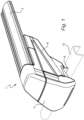
- Fig. 1
- is a perspective view of one embodiment of a support foot according to a first aspect of the present invention where the cap is in a latched state.
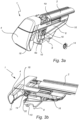
- Fig. 2a
- is a perspective view of an embodiment of a support foot where the cap is in a latched state but in a different position with respect to the position thereof in
Fig. 1 , and where the locking means is visible and in a locked state. - Fig. 2b
- is a perspective view of an embodiment of a support foot where the foot is shown in a perspective different than that in
Fig. 2a . - Fig. 3a
- is a perspective view of an embodiment of a support foot where the locking means is being brought from a locked state to an unlocked state and where the cap is being brought from a latched state to an unlatched state.
- Fig. 3b
- is a perspective view of an embodiment of the locking means when being brought from the locked state to the unlocked state shown in three different positions.
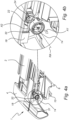
- Fig. 4a
- is a perspective view of an embodiment of a support foot where the locking means is in an unlocked state and the cap is in a unlatched state.
- Fig. 4b
- is a perspective view of the locking means as shown in
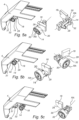
Fig. 4a . - Fig. 5a-c
- are perspective views of an alternative embodiment of the present invention detailing the cap and the locking means.
- Fig. 6a
- is a perspective view of an embodiment of an attachment lever of the support foot.
- Fig. 6b
- is a perspective view of the attachment lever shown in
Fig. 5a detailing a cylindrical hollow portion of the lever. - Fig. 6c
- is a perspective view of an exemplary embodiment of the locking means adapted to be arranged within the cylindrical hollow portion as shown in
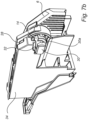
Fig. 5b . - Fig. 7a
- is a perspective view of an embodiment of the support foot when the cap is in a tilted position.
- Fig. 7b
- is a perspective view of an embodiment of the attachment lever when in a closed position.
- Fig. 8a
- is a perspective view of an embodiment of the attachment lever when the lever is brought from the closed position to an open position.
- Fig 8b
- is a perspective view of an embodiment of the support foot when the cap is in a tilted position and when the attachment lever is in an open position.
- In the following detailed description, some embodiments of the present invention will be described. However, it is to be understood that features of the different embodiments are exchangeable between the embodiments and may be combined in different ways, unless anything is specifically indicated. Even though in the following description, numerous details are set forth to provide a more thorough understanding of the present invention, it will be apparent to one skilled in the art that the present invention may be practiced without these details. In other instances, well known constructions or functions are not described in detail, so as not to obscure the present invention.
-
Fig. 1 shows asupport foot 1 according to the first aspect of the present invention. Thesupport foot 1 is mounted on aload bar 2 adapted to be arranged on the roof of a vehicle. Thesupport foot 1 comprises acap 4 and anattachment lever 6. Theattachment lever 6 is comprised in a clamping mechanism that further comprises afirst clamping portion 8 and a second clamping portion 10 (shown inFig. 2a ). Here, thesecond clamping portion 10 is partially covered by thecap 4. Theattachment lever 6 is adapted to operate in a first plane substantially coinciding with a longitudinal extension of thefoot 1. The longitudinal extension of thefoot 1 is, when in use, substantially coinciding with a plane horizontal with respect to the ground. The first and thesecond clamping portions roof bar 12 of a vehicle such that thesupport foot 1 as well as theload bar 2 is fixedly attached thereto. The clamping mechanism is operated by theattachment lever 6 such that when thelever 6 is brought, by operating it in the first plane, from a closed position to an open position, the first andsecond clamping portions roof bar 12. Furthermore, when thelever 6 is brought from an open position to a closed position, the first andsecond clamping portions roof bar 12. Even though theattachment lever 6 is, inFig. 1 , shown in a closed position,Fig. 1 does not show thesupport foot 1 when mounted on theroof bar 12, but thefoot 1 and theroof bar 12 are rather for illustrating purposes shown separate. - In
Fig. 2a , thecap 4 has been displaced along the longitudinal extension of thefoot 1. Thecap 4 is slideably displaceable along the longitudinal extension of thefoot 1 by sliding along arail 16 of thefoot 1. The displacement of thecap 4 reveals the locking means 14 of theattachment lever 6. The locking means 14 is arranged within a cylindricalhollow portion 26 of theattachment lever 6. The displacement of thecap 4 further reveals adistal surface portion 6a of theattachment lever 6. The locking means 14 and thedistal surface portion 6a are therefore arranged to be covered by thecap 4 when thecap 4 is in the position as shown inFig. 1 . - The locking means in
Fig. 2a is in a locked state. The locking means 14 is adapted to receive a key (not shown). The locking mechanism of the locking means 14 is here shown to comprise an outer protrudingsurface 14a arranged to be engageable with a key (not shown) adapted to interact with the specific geometry of said outer protrudingsurface 14a. Here, the outer protrudingsurface 14a has a smooth polygonal geometry, but any other geometry, such as triangular, quadratic or hexagonal, is possible. Furthermore, the locking means 14 may comprise any other type of locking mechanism known to a person skilled in the art, such as one having a keyhole arranged to interact with a key adapted to be inserted into said keyhole. -
Fig. 2b shows thefoot 1 from another perspective where theattachment lever 6 is not shown in the purpose of displaying inner details of thefoot 1. The locking means 14 is here in a locked state, and thecap 4 is in a latched state. Thecap 4 is in the latched state because the locking means 14 is in the locked state. In the latched state, the movement of thecap 4 is restricted. In the present embodiment, thecap 4 when the locking means 14 is in the locked state is substantially restricted to move at least between the position shown inFig. 1 , i.e. the position in which the locking means 14 is fully covered by thecap 4, and the position shown inFig. 2a and2b , i.e. the position in which the locking means 14 is not covered by thecap 4. That thecap 4 is movable between at least two cap positions when the locking means 14 is in said locked state is to be understood that thecap 4 is restricted to move within a range of cap positions dictated by the certain state, the locked state, of the locking means. - The
cap 4 further comprises a stoppingprotrusion 18 adapted to stop thecap 4 from being displaced further. Thecap 4 is stopped by the stoppingprotrusion 18 making contact with the locking means 14 when themeans 14 is in the locked state. - In
fig. 2c , the locking means 14 is shown in detail. The locking means 14 is here shown as having a substantially cylindrical extension. The locking means 14 comprises a first stoppingsurface 20 adapted to make contact with the stoppingprotrusion 18 of thecap 14. When the locking means 14 is being brought from a locked state to an unlocked state, the locking means 14 is rotated around a rotation axis RA substantially coinciding with the cylindrical extension of the locking means 14. By rotating the locking means around the rotation axis RA, the first stoppingsurface 20 is also rotated. The locking means 14 is arranged to rotate in such a way as to allow passage of the stoppingprotrusion 18 of thecap 4. - The
cap 4 further comprises anabutment surface 31 adapted to abut on an outerperipheral surface 32 of the locking means 14 when the locking means 14 is in the unlocked state. -
Fig. 3a showsfoot 1 when the locking means 14 is being brought from the locked state to an unlocked state. For the purpose of illustration, the locking means 14 has inFig. 3a been extracted from thefoot 1, and a curved arrow around the locking means 14 illustrates the direction of rotation when themeans 14 is brought from the locked state to the unlocked state. In the present embodiment, the locking means 14 is rotated around 90° counterclockwise in order to bring it from the locked state to the unlocked state. - The arrow at a
linking arm 4a of thecap 4 indicates the direction of displacement occurring as the locking means 14 is brought from the locked state to the unlocked state. This displacement of thecap 4 may occur simultaneously as the locking means 14 is brought from the locked state to the unlocked state, or it may occur after. In another example, the displacement partially occurs due to the locking means 14 being brought from the locked state to the unlocked state, whereafter the last partial displacement is to be carried out by hand. When thecap 4 has been displaced due to the locking means 14 being brought from the locked state to the unlocked state, thecap 4 is in an unlatched state. This is e.g. indicated by the stoppingprotrusion 18 of thecap 4 being positioned to the left of the locking means 14, i.e. the first stoppingsurface 20 of the locking means 14 (shown inFig. 2c ) has been rotated around the axis RA such that the stoppingprotrusion 18 and consequently thecap 4 has been allowed displacement from a latched state to an unlatched state. Therefore, thecap 4 is in an unlatched state when the locking means 14 is in an unlocked state. Thus, thecap 4 is restricted to move within a range of cap positions dictated by the unlocked state when the locking means 14 is in the unlocked state. Alternatively, thecap 4 may not be displaced at all when the locking means 14 is brought from the locked state to the unlocked state. Furthermore, thecap 4 comprises anabutment surface 31 adapted to abut on an outerperipheral surface 32 of the locking means 14 when the locking means 14 is in the unlocked state. - By bringing the locking means 14 from one state to the other, i.e. from a locked state to an unlocked state or from an unlocked state to a locked state, thus brings the
cap 4 from one range of cap positions to another range of cap positions. In the alternative case where thecap 4 is not displaced at all when the locking means 14 is brought from the locked state to the unlocked state, the range of cap positions thecap 4 is restricted to when the locking means 14 is in the locked state may overlap with the range of cap positions thecap 4 is restricted to when the locking means 14 is in the unlocked state. The movement of thecap 4 may, for example, be restricted between two end positions when the locking means 14 is in the locked state, wherein one end position coincides with the range of allowable cap positions when the locking means 14 is in the locked state. A cap position that is common to the locked state and the unlocked state may, e.g., be a position in which thecap 4 has to be in order for the locking means 14 to be brought from one state to the other. The range of cap positions may not overlap at all, e.g. in the case where thecap 4 is displaced when the locking means 14 is brought from the locked state to the unlocked state. - That the
cap 4 is positioned at an end position of any range of cap position may be indicated by some indicator means, such as a visual indication or an acoustic indication. An acoustic indication may be a sound of a snap-fitting or snap-locking of thecap 4 in such a cap position. -
Fig. 3b displays a detailed illustration of three views of the locking means 14 and the stopping protrusion 18: a first view, a second view and a third view counting from left to right as they are displayed inFig. 3b . The three views illustrate how the locking means 14 is brought from the locked state to the unlocked state and how, as a result, the first stoppingprotrusion 18 of thecap 4 is allowed passage by the locking means 14. In the first, leftmost, view, the locking means 14 is in the locked state in which the first stoppingsurface 20 of the locking means 14 abuts on and stops the stoppingprotrusion 18 of thecap 4 such that thecap 4 is in the latched state. The second, middle, view shows the locking means 14 being brought from the locked state to the unlocked state and having been rotated 90° counterclockwise such that the stoppingsurface 20 also has been rotated 90° so that it does not abut on and stop the stoppingprotrusion 18 and thus allows passage of thecap 4. The third, rightmost view show the stoppingprotrusion 18 having passed the locking means 14. Thecap 4 is in the rightmost view in the unlatched state. - In
Fig. 4A-B thecap 4 is in the unlatched state and the locking means 14 is in the unlocked state. When thecap 4 is in the unlatched state, the movement of thecap 4 is restricted such that thecap 4 at least cannot assume the position in which it at least partially cover the locking means 14. As is shown inFig. 4b , such restriction of the movement of thecap 4 is in an exemplary embodiment achieved by a stoppingwall 24 of the locking means 14 comprising a second stoppingsurface 22 adapted to abut on and stop the stoppingprotrusion 18 of thecap 4. The stoppingwall 24 and the second stoppingsurface 22 is here shown as being substantially orthogonal to the first stoppingsurface 20. In this exemplary embodiment, the first stoppingsurface 20, which was perpendicular to the movement of thecap 4, i.e. perpendicular to a longitudinal extension of thesupport foot 1, is parallel to the movement of thecap 4 when the locking means 14 is in the unlocked state. The movement of thecap 4 may e.g. be along therail 16 as shown inter alia inFig. 2a . Thus, the second stoppingsurface 22 is parallel to the to the movement of thecap 4 when the locking means 14 is in the locked state and perpendicular to the movement of thecap 4 when the locking means 14 is in the unlocked state. - The locking means 14 is further, when brought from the locked state to the unlocked state, arranged to be displaced. As is seen in
Fig. 4b , the locking means 14 is displaced in a direction substantially transverse to a longitudinal extension of thesupport foot 1 and along the rotational axis RA of the locking means 14. This displacement is indicated by the arrow A1. The displacement of the locking means 14 consequently displaces the stoppingwall 24 so that it is aligned with a line of movement of thecap 4, especially a line of movement of the stoppingprotrusion 18 indicated by the arrow A2. Thus, the locking means 14, when in the unlocked state, is arranged to stop thecap 4 from transitioning from the unlatched state to the latched state. - In
Fig. 5a-c , an alternative embodiment of the present invention is shown. Here, the stoppingprotrusion 18 of thecap 4 comprises a radial cut-out 29 adapted to abut on aradial surface 30 of the locking means 14. Theradial surface 30 of the locking means 14 may be complementary to the radial cut-out 29 of thecap 4. When the locking means 14 is in the locked state, the radial cut-out 29 will abut on theradial surface 30 such that thecap 4 is prevented to move from the latched state to the unlatched state. Furthermore, as is also shown inter alia inFig. 2c andFig. 3a , thecap 4 comprises anabutment surface 31 adapted to abut on an outerperipheral surface 32 of the locking means 14 when the locking means 14 is in the unlocked state. The locking means 14 in the unlocked state is displaced along the rotational axis RA of the locking means 14 in comparison to the locked state. As such, when the locking means 14 has been displaced due to it having been brought from the locked state to the unlocked state, the outerperipheral surface 32 is arranged such that theabutment surface 31 of thecap 4 will abut on the outerperipheral surface 32. -
Fig. 5A shows the arrangement of thecap 4 and the locking means 14 when the locking means 14 is in the locked state and thecap 4 is in the latched state.Fig. 5B shows the arrangement of thecap 4 and the locking means 14 when the locking means 14 has been brought from the locked state to the unlocked state, and thus the locking means 14 has been displaced along the rotational axis RA of the locking means 14. Due to the locking means 14 having been displaced along the rotational axis RA, the stoppingprotrustion 18 of thecap 4 is allowed passaged such that thecap 4 may be arranged in the unlatched state.Fig. 5C shows arrangement of thecap 4 and the locking means 14 when the locking means 14 is in the unlocked state and thecap 4 is in the unlatched state. Here, the outerperipheral surface 32 of the locking means 14 is arranged such that theabutment surface 31 of thecap 4 will abut on the outerperipheral surface 32 if the cap would be moved towards the locking means 14.Fig. 6a-b shows a portion of theattachment lever 6 and thedistal surface portion 6a. The cylindricalhollow portion 26 is adapted to receive the locking means 14, wherein the locking means 14 is adapted to be arranged within the cylindricalhollow portion 26. The cylindricalhollow portion 26 comprises at least one circumferential track portion. In this exemplary embodiment, the cylindricalhollow portion 26 comprises a firstcircumferential track portion 26a and a secondcircumferential track portion 26b. The first and secondcircumferential track portions circumferential track portions -
Fig. 6c shows the locking means 14 from three different perspectives. The locking means 14 comprises a first slidingsurface 15 adapted to abut on slide along the firstcircumferential track portion 26a. The first slidingsurface 15 is angled with regards to the rotational axis, which is indicated by the increase in length between the slidingsurface 15 and afront rim portion 14b of the locking means 14 from l1 to l2, i.e. that l1 <l2. Moreover, the firstcircumferential track portion 26a is spirally arranged along the circumference of the cylindricalhollow portion 26, and thus also angled with regards to the rotational axis RA. Preferably, the angling of the firstcircumferential track portion 26a is substantially the same as the angling of the first slidingsurface 15. The angling of the first slidingsurface 15 facilitates the displacement of the locking means 14 when being brought from the locked state to the unlocked state. When the locking means 14 is being brought from the locked state to the unlocked state, when the locking means 14 is arranged within the cylindricalhollow portion 26, the locking means 14 is rotated around the rotational axis RA such that the first slidingsurface 15 slides along the firstcircumferential track portion 26a. The magnitude of the displacement of the locking means 14 along the rotational axis RS is thus dependent upon the angle by which the first slidingsurface 15 and the firstcircumferential track portion 26a makes with RA. The angle may e.g. be 1 °, 3°, 5°, 10°, 20° or 50°. The locking means 14 further comprises a second slidingsurface 17 adapted to abut on the secondcircumferential track portion 26b. The locking means 14 may comprise further sliding surfaces adapted to abut on and, when the locking means 14 is arranged within the cylindricalhollow portion 26, slide along any circumferential track portion of the cylindricalhollow portion 26 ofattachment lever 6. - As is seen in
Fig. 6a , theattachment lever 6 further comprises aslit 28 adapted to receive the stoppingprotrusion 18 of thecap 4. Theslit 28 is here shown to intersect the cylindricalhollow portion 26, i.e. the cylindricalhollow portion 26 is accessible through theslit 28. The stoppingprotrusion 18 is slideably arrangeable within theslit 28. The length of the slit may vary. As an example, theslit 28 may end directly after the locking means such that the stoppingprotrusion 18 is not arranged within the slit when thecap 4 is in the unlatched state. Alternatively, theslit 28 may continue further than the locking means 14 such that the stoppingprotrusion 18 may be arranged within theslit 28 when thecap 4 is in the unlatched state. In this way, theattachment lever 6 comprising theslit 28 is hindered from operating in the first plane even though the locking means 14 is in the unlocked state. -
Fig. 7a shows thesupport foot 1 when thecap 4 is in the unlatched state and in a tilted position. Thecap 4 is here shown as being tilted with respect the longitudinal extension of thefoot 1. That thecap 4 is tilted is to be understood as at least one extension of thecap 4 being different in the tilted position than in the position in which thecap 4 covers the locking means. Infig. 6a , a plane coinciding with a longitudinal extension of a first andsecond linking arm 4 a,b of thecap 4 deviates from a longitudinal extension of therail 16. Thecap 4 is therefore tiltable in a plane coinciding with the longitudinal extension of thesupport foot 1. - The
cap 4 may further be fixated in the tilted position. The fixation may e.g. be snap-locking of thecap 4 in the tilted position. By being able to snap-lock thecap 4 in a tilted position, e.g. the position shown inFig. 7a , a user of thesupport foot 1 has access to the inner mechanisms of the support foot, such as a curvedouter surface 10a of thesecond clamping portion 10. Furthermore, thecap 4 is fixated in such a position so that it does not cover any portion of theattachment lever 6. That thecap 4 does not cover any portion of theattachment lever 6 implies that it is not restricted in movement by thecap 4. Theattachment lever 6 is, when not covered by thecap 4 and when the locking means 14 is in the unlocked state, operable in a first plane. -
Fig. 7b shows theattachment lever 6 from a backside perspective in relation toFig. 7a . The locking means 14 comprises aclasp 30 adapted to engage with or disengage from anindention 32 comprised in aside wall 34 of thesupport foot 1. Theclasp 30 further comprises anedge portion 30a. When the locking means 14 is in the locked state, theedge portion 30a is engaged with theindention 32 such that theattachment lever 6 is restricted to operate at least away from theside wall 34. When the locking means 14 is in the unlocked state, as is shown inFig. 7b , theedge portion 30a is disengaged from theindention 32, and theattachment lever 6 is thus permitted to operate to and/or from theside wall 34. The plane in which theattachment lever 6 is adapted to operate in may as an exemplary embodiment be perpendicular to the plane in which thecap 4 is tiltable. -
Fig. 8A-B shows theattachment lever 6 when it has disengaged from theside wall 34. As indicated by the arrow A3, theattachment lever 6 is operable in a plane coinciding with the longitudinal extension of thesupport foot 1. Theattachment lever 6 is operable and movable when the locking means 14 is in an unlocked state and when the stoppingprotrusion 18 of thecap 4 is not arranged within theslit 28. The locking means 14 may, e.g., be adapted to be brought between the unlocked state and the locked state only when theattachment lever 6 is in a closed position. A closed position of theattachment lever 6 would in such a case entail that thelever 6 and the locking means 14 is in contact with thesupport foot 1. Theattachment 6 lever may, when brought to said closed position, be brought to a latched state in which it is latched to thesupport foot 1. When theattachment lever 6 is latched to thesupport foot 1, the locking means 15 is adapted to be brought into the locked state, thereby locking thelever 6 to thesupport foot 1. Theattachment 6 lever may, when latched to thesupport foot 1, snap-lock to thefoot 1 such that a sound signaling that thelever 6 is latched is emitted. - By operating the
attachment lever 6, the first and thesecond clamping portions second clamping portions support foot 1 may be attached to a roof rail of a vehicle. - The person skilled in the art realizes that the present inventive concept by no means is limited to the embodiments described above. The features of the described embodiments may be combined in different ways, and many modifications and variations are possible within the scope of the appended claims. In the claims, any reference signs placed between parentheses shall not be construed as limiting the claim. The word "comprising" does not exclude the presence of other elements or steps than those listed in the claim. The word "a" or "an" preceding an element does not exclude the presence of a plurality of such elements.
Claims (15)
- A support foot (1) for a luggage carrier for a vehicle, said support foot (1) comprising:a first clamping portion (8) and a second clamping portion (10), wherein at least one of said first (8) and second (10) clamping portions is movable;a clamping mechanism comprising an attachment lever (6), said attachment lever (6) is arranged to operate in a first plane between a closed and an open position, and thereby also moving said at least one movable clamping portion (8, 10);a locking means (14) comprising a locked state and an unlocked state,characterized in that:said locking means (14) is adapted to receive a key; andwherein the support foot (1) further comprises a cap (4) comprising a latched state and an unlatched state, wherein said cap (4) is adapted to cover said locking means (14) and at least partially cover said attachment lever (6) when said cap (4) is in said latched state and wherein said cap (4) is adapted to pivot in a second plane when said cap (4) is in said unlatched state; andwherein said cap (4) is in said latched state when said locking means (14) is in said locked state, and wherein said cap (4) is in said unlatched state when said locking means (14) is in said unlocked state.
- The support foot (1) according to claim 1, wherein said cap (4) further comprises a stopping protrusion (18), wherein said attachment lever (6) further comprises a slit (28), and wherein said stopping protrusion (18) is slideably arranged within said slit (28).
- The support foot (1) according to claim 2, wherein said stopping protrusion (18) further comprises a radial cut-out (29) adapted to abut on a radial surface (30) of said locking means (14) when said locking means (14) is in said locked state.
- The support foot (1) according to any preceding claim, wherein said locking means (14) comprises a rotational axis (RA), and wherein said locking means (14) is arranged to rotate around said rotational axis (RA) between said locked state and said unlocked state.
- The support foot (1) according to claim 4, wherein said locking means (14) is further arranged to move along said rotational axis (RA) between said locked state and said unlocked state.
- The support foot (1) according to claim 4 or 5, wherein said locking means (14) further comprises a first stopping surface (20), wherein said first stopping surface (20) is adapted to abut on and stop said stopping protrusion (18) of said cap (4) when said locking means (14) is in said locked state such that said cap (4) is in said latched state.
- The support foot (1) according to claim 6, wherein said locking means (14) further comprises a second stopping surface (22), wherein said second stopping surface (22) is adapted to abut on and stop said stopping protrusion (18) of said cap (4) when said locking means (14) is in said unlocked state such that said cap (4) is in said unlatched state.
- The support foot (1) according to claim 6, wherein said cap (4) comprises an abutment surface (31) adapted to abut on an outer peripheral surface (32) of said locking means (14) when said locking means (14) is in said unlocked state.
- The support foot (1) according to any preceding claim, wherein said attachment lever (6) further comprises a cylindrical hollow portion (26), and wherein said locking means (14) is adapted to be arranged within said cylindrical hollow portion (26).
- The support foot (1) according to claim 9 and claim 2, wherein said cylindrical hollow portion (26) is intersecting said slit (28).
- The support foot (1) according to claim 9 or 10, wherein said cylindrical hollow portion (26) comprises at least one cirumferential track portion (26a, 26b) arranged along an inner circumference of said cylindrical hollow portion (26), and wherein said locking means (14) comprises at least one sliding surface (15, 17) adapted to abut on said at least one circumferential track portion (26a, 26b) such that said locking means (14) is adapted to slide along said at least one circumferential track portion (26a, 26b) when said locking means (14) is rotated.
- The support foot (1) according to claim 11, wherein said at least one circumferential track portion (26a, 26b) is spirally arranged along a periphery of said cylindrical hollow portion (26) such that said locking means (14) is adapted to move along said rotational axis when said locking means (14) is rotated.
- The support foot (1) according to claim 11 or 12, wherein said locking means (14) comprises a first (15) and a second (17) sliding surface, wherein said cylindrical hollow portion (26) comprises a first (26a) and a second (26b) cirumferential track portion, and wherein said first sliding surface (15) is adapted to abut on said first circumferential track portion (26a) and said second sliding surface (17) is adapted to abut on said second circumferential track portion (26a).
- A method for covering a locking means (14) and at least partially cover an attachment lever (6) of a support foot (1) according to claim 1, comprising:providing said support foot (1), wherein said locking means (14) is in said unlocked state and said cap (4) is in said unlatched state;operating said attachment lever (6) in said first plane from an open position to a closed position;moving said cap (4) from a first unlatched position to a second unlatched position;bringing said locking means (14) from said unlocked state to said locked state, thereby also bringing said cap (4) from said unlatched state to said latched state; andmoving said cap (4) from a first latched position to a second latched position, thereby covering said locking means (14) and at least partially cover said attachment lever (6).
- A load bar (2) for a vehicle roof comprising at least one support foot (1) according to any one of claims 1-13.
Priority Applications (1)
| Application Number | Priority Date | Filing Date | Title |
|---|---|---|---|
| EP20215029.8A EP4015312B1 (en) | 2020-12-17 | 2020-12-17 | Support foot |
Applications Claiming Priority (1)
| Application Number | Priority Date | Filing Date | Title |
|---|---|---|---|
| EP20215029.8A EP4015312B1 (en) | 2020-12-17 | 2020-12-17 | Support foot |
Publications (3)
| Publication Number | Publication Date |
|---|---|
| EP4015312A1 EP4015312A1 (en) | 2022-06-22 |
| EP4015312C0 EP4015312C0 (en) | 2024-07-10 |
| EP4015312B1 true EP4015312B1 (en) | 2024-07-10 |
Family
ID=73855352
Family Applications (1)
| Application Number | Title | Priority Date | Filing Date |
|---|---|---|---|
| EP20215029.8A Active EP4015312B1 (en) | 2020-12-17 | 2020-12-17 | Support foot |
Country Status (1)
| Country | Link |
|---|---|
| EP (1) | EP4015312B1 (en) |
Family Cites Families (7)
| Publication number | Priority date | Publication date | Assignee | Title |
|---|---|---|---|---|
| SE463968B (en) * | 1982-04-14 | 1991-02-18 | Thule Ind Ab | LASTHAALLARE FOR VEHICLES |
| DE3709335A1 (en) * | 1987-03-21 | 1988-10-06 | Opel Adam Ag | Roofrack for a motor vehicle |
| WO2005037606A1 (en) * | 2003-10-20 | 2005-04-28 | Roof Rack Industries Pty Ltd. | A vehicle roof rack end support |
| US7721925B1 (en) * | 2004-10-28 | 2010-05-25 | Graffy Thomas F | Universal removable roof rack mounting system |
| US6997657B1 (en) * | 2005-04-08 | 2006-02-14 | Sportrack Llc | Stanchion and cross rail assembly |
| EP3290273B1 (en) * | 2016-09-06 | 2019-07-17 | Bosal ACPS Holding 2 B.V. | Roof rack |
| DE202019100142U1 (en) * | 2019-01-11 | 2019-01-30 | Thule Sweden Ab | Load carrier foot with cover section |
-
2020
- 2020-12-17 EP EP20215029.8A patent/EP4015312B1/en active Active
Also Published As
| Publication number | Publication date |
|---|---|
| EP4015312C0 (en) | 2024-07-10 |
| EP4015312A1 (en) | 2022-06-22 |
Similar Documents
| Publication | Publication Date | Title |
|---|---|---|
| US5297406A (en) | Lock device for a steering wheel of an automobile | |
| US8028551B2 (en) | Secure mounting arrangements for a lock assembly | |
| US4577478A (en) | Locking filler tube cover apparatus for underground fuel tanks | |
| US5410897A (en) | Vehicle wheel locking and anti-theft device | |
| JPH0427719Y2 (en) | ||
| US7107802B2 (en) | Wheel immobilizer | |
| US7328823B2 (en) | Rack tower | |
| AU2008286697A1 (en) | Closure means | |
| EP4015312B1 (en) | Support foot | |
| US6116064A (en) | Telescoping motorcycle helmet lock | |
| JP2014527938A (en) | Lockable fixing device for vehicle seat and vehicle seat | |
| CN212579759U (en) | Mounting system for mounting electronic device on vehicle | |
| US5520034A (en) | Trailer wheel locking and anti-theft device | |
| US5855088A (en) | Outrigger pivot assembly | |
| US10000945B2 (en) | Universal electronics lock | |
| US5676001A (en) | Anti-theft device for vehicle | |
| US6990838B2 (en) | Skid steer attachment lock | |
| WO2011063202A2 (en) | Anti-theft device | |
| WO2001089889A1 (en) | Dead-bolt operated steering wheel lock | |
| US20130014551A1 (en) | Steering column locking device | |
| US20070119219A1 (en) | Computer lock and corresponding security hole pattern | |
| US9865408B2 (en) | Switch extension device and mounting assembly | |
| US8678434B2 (en) | Auxiliary apparatus of carrier for vehicles | |
| NO20220449A1 (en) | Wheel clamps | |
| AU1085700A (en) | Insulator |
Legal Events
| Date | Code | Title | Description |
|---|---|---|---|
| PUAI | Public reference made under article 153(3) epc to a published international application that has entered the european phase |
Free format text: ORIGINAL CODE: 0009012 |
|
| STAA | Information on the status of an ep patent application or granted ep patent |
Free format text: STATUS: THE APPLICATION HAS BEEN PUBLISHED |
|
| AK | Designated contracting states |
Kind code of ref document: A1 Designated state(s): AL AT BE BG CH CY CZ DE DK EE ES FI FR GB GR HR HU IE IS IT LI LT LU LV MC MK MT NL NO PL PT RO RS SE SI SK SM TR |
|
| STAA | Information on the status of an ep patent application or granted ep patent |
Free format text: STATUS: REQUEST FOR EXAMINATION WAS MADE |
|
| 17P | Request for examination filed |
Effective date: 20221222 |
|
| RBV | Designated contracting states (corrected) |
Designated state(s): AL AT BE BG CH CY CZ DE DK EE ES FI FR GB GR HR HU IE IS IT LI LT LU LV MC MK MT NL NO PL PT RO RS SE SI SK SM TR |
|
| STAA | Information on the status of an ep patent application or granted ep patent |
Free format text: STATUS: EXAMINATION IS IN PROGRESS |
|
| 17Q | First examination report despatched |
Effective date: 20230417 |
|
| GRAP | Despatch of communication of intention to grant a patent |
Free format text: ORIGINAL CODE: EPIDOSNIGR1 |
|
| STAA | Information on the status of an ep patent application or granted ep patent |
Free format text: STATUS: GRANT OF PATENT IS INTENDED |
|
| INTG | Intention to grant announced |
Effective date: 20240201 |
|
| GRAS | Grant fee paid |
Free format text: ORIGINAL CODE: EPIDOSNIGR3 |
|
| GRAA | (expected) grant |
Free format text: ORIGINAL CODE: 0009210 |
|
| STAA | Information on the status of an ep patent application or granted ep patent |
Free format text: STATUS: THE PATENT HAS BEEN GRANTED |
|
| AK | Designated contracting states |
Kind code of ref document: B1 Designated state(s): AL AT BE BG CH CY CZ DE DK EE ES FI FR GB GR HR HU IE IS IT LI LT LU LV MC MK MT NL NO PL PT RO RS SE SI SK SM TR |
|
| REG | Reference to a national code |
Ref country code: CH Ref legal event code: EP |
|
| REG | Reference to a national code |
Ref country code: DE Ref legal event code: R096 Ref document number: 602020033679 Country of ref document: DE |
|
| U01 | Request for unitary effect filed |
Effective date: 20240710 |
|
| U07 | Unitary effect registered |
Designated state(s): AT BE BG DE DK EE FI FR IT LT LU LV MT NL PT RO SE SI Effective date: 20240902 |
|
| U20 | Renewal fee for the european patent with unitary effect paid |
Year of fee payment: 5 Effective date: 20241114 |
|
| PG25 | Lapsed in a contracting state [announced via postgrant information from national office to epo] |
Ref country code: NO Free format text: LAPSE BECAUSE OF FAILURE TO SUBMIT A TRANSLATION OF THE DESCRIPTION OR TO PAY THE FEE WITHIN THE PRESCRIBED TIME-LIMIT Effective date: 20241010 |
|
| PG25 | Lapsed in a contracting state [announced via postgrant information from national office to epo] |
Ref country code: GR Free format text: LAPSE BECAUSE OF FAILURE TO SUBMIT A TRANSLATION OF THE DESCRIPTION OR TO PAY THE FEE WITHIN THE PRESCRIBED TIME-LIMIT Effective date: 20241011 Ref country code: PL Free format text: LAPSE BECAUSE OF FAILURE TO SUBMIT A TRANSLATION OF THE DESCRIPTION OR TO PAY THE FEE WITHIN THE PRESCRIBED TIME-LIMIT Effective date: 20240710 |
|
| PG25 | Lapsed in a contracting state [announced via postgrant information from national office to epo] |
Ref country code: IS Free format text: LAPSE BECAUSE OF FAILURE TO SUBMIT A TRANSLATION OF THE DESCRIPTION OR TO PAY THE FEE WITHIN THE PRESCRIBED TIME-LIMIT Effective date: 20241110 |
|
| PG25 | Lapsed in a contracting state [announced via postgrant information from national office to epo] |
Ref country code: HR Free format text: LAPSE BECAUSE OF FAILURE TO SUBMIT A TRANSLATION OF THE DESCRIPTION OR TO PAY THE FEE WITHIN THE PRESCRIBED TIME-LIMIT Effective date: 20240710 |
|
| PG25 | Lapsed in a contracting state [announced via postgrant information from national office to epo] |
Ref country code: ES Free format text: LAPSE BECAUSE OF FAILURE TO SUBMIT A TRANSLATION OF THE DESCRIPTION OR TO PAY THE FEE WITHIN THE PRESCRIBED TIME-LIMIT Effective date: 20240710 Ref country code: RS Free format text: LAPSE BECAUSE OF FAILURE TO SUBMIT A TRANSLATION OF THE DESCRIPTION OR TO PAY THE FEE WITHIN THE PRESCRIBED TIME-LIMIT Effective date: 20241010 |
|
| PG25 | Lapsed in a contracting state [announced via postgrant information from national office to epo] |
Ref country code: RS Free format text: LAPSE BECAUSE OF FAILURE TO SUBMIT A TRANSLATION OF THE DESCRIPTION OR TO PAY THE FEE WITHIN THE PRESCRIBED TIME-LIMIT Effective date: 20241010 Ref country code: PL Free format text: LAPSE BECAUSE OF FAILURE TO SUBMIT A TRANSLATION OF THE DESCRIPTION OR TO PAY THE FEE WITHIN THE PRESCRIBED TIME-LIMIT Effective date: 20240710 Ref country code: NO Free format text: LAPSE BECAUSE OF FAILURE TO SUBMIT A TRANSLATION OF THE DESCRIPTION OR TO PAY THE FEE WITHIN THE PRESCRIBED TIME-LIMIT Effective date: 20241010 Ref country code: IS Free format text: LAPSE BECAUSE OF FAILURE TO SUBMIT A TRANSLATION OF THE DESCRIPTION OR TO PAY THE FEE WITHIN THE PRESCRIBED TIME-LIMIT Effective date: 20241110 Ref country code: HR Free format text: LAPSE BECAUSE OF FAILURE TO SUBMIT A TRANSLATION OF THE DESCRIPTION OR TO PAY THE FEE WITHIN THE PRESCRIBED TIME-LIMIT Effective date: 20240710 Ref country code: GR Free format text: LAPSE BECAUSE OF FAILURE TO SUBMIT A TRANSLATION OF THE DESCRIPTION OR TO PAY THE FEE WITHIN THE PRESCRIBED TIME-LIMIT Effective date: 20241011 Ref country code: ES Free format text: LAPSE BECAUSE OF FAILURE TO SUBMIT A TRANSLATION OF THE DESCRIPTION OR TO PAY THE FEE WITHIN THE PRESCRIBED TIME-LIMIT Effective date: 20240710 |
|
| PG25 | Lapsed in a contracting state [announced via postgrant information from national office to epo] |
Ref country code: SM Free format text: LAPSE BECAUSE OF FAILURE TO SUBMIT A TRANSLATION OF THE DESCRIPTION OR TO PAY THE FEE WITHIN THE PRESCRIBED TIME-LIMIT Effective date: 20240710 |
|
| PG25 | Lapsed in a contracting state [announced via postgrant information from national office to epo] |
Ref country code: CZ Free format text: LAPSE BECAUSE OF FAILURE TO SUBMIT A TRANSLATION OF THE DESCRIPTION OR TO PAY THE FEE WITHIN THE PRESCRIBED TIME-LIMIT Effective date: 20240710 |
|
| PG25 | Lapsed in a contracting state [announced via postgrant information from national office to epo] |
Ref country code: SK Free format text: LAPSE BECAUSE OF FAILURE TO SUBMIT A TRANSLATION OF THE DESCRIPTION OR TO PAY THE FEE WITHIN THE PRESCRIBED TIME-LIMIT Effective date: 20240710 |
|
| PLBE | No opposition filed within time limit |
Free format text: ORIGINAL CODE: 0009261 |
|
| STAA | Information on the status of an ep patent application or granted ep patent |
Free format text: STATUS: NO OPPOSITION FILED WITHIN TIME LIMIT |
|
| 26N | No opposition filed |
Effective date: 20250411 |
|
| PG25 | Lapsed in a contracting state [announced via postgrant information from national office to epo] |
Ref country code: MC Free format text: LAPSE BECAUSE OF FAILURE TO SUBMIT A TRANSLATION OF THE DESCRIPTION OR TO PAY THE FEE WITHIN THE PRESCRIBED TIME-LIMIT Effective date: 20240710 |
|
| REG | Reference to a national code |
Ref country code: CH Ref legal event code: PL |
|
| GBPC | Gb: european patent ceased through non-payment of renewal fee |
Effective date: 20241217 |
|
| PG25 | Lapsed in a contracting state [announced via postgrant information from national office to epo] |
Ref country code: GB Free format text: LAPSE BECAUSE OF NON-PAYMENT OF DUE FEES Effective date: 20241217 |
|
| PG25 | Lapsed in a contracting state [announced via postgrant information from national office to epo] |
Ref country code: CH Free format text: LAPSE BECAUSE OF NON-PAYMENT OF DUE FEES Effective date: 20241231 |
|
| PG25 | Lapsed in a contracting state [announced via postgrant information from national office to epo] |
Ref country code: IE Free format text: LAPSE BECAUSE OF NON-PAYMENT OF DUE FEES Effective date: 20241217 |
|
| U20 | Renewal fee for the european patent with unitary effect paid |
Year of fee payment: 6 Effective date: 20251117 |