EP4014506B1 - Methods and devices for generation and processing of modified audio bitstreams - Google Patents
Methods and devices for generation and processing of modified audio bitstreams Download PDFInfo
- Publication number
- EP4014506B1 EP4014506B1 EP20761468.6A EP20761468A EP4014506B1 EP 4014506 B1 EP4014506 B1 EP 4014506B1 EP 20761468 A EP20761468 A EP 20761468A EP 4014506 B1 EP4014506 B1 EP 4014506B1
- Authority
- EP
- European Patent Office
- Prior art keywords
- bitstream
- media data
- data
- information
- pcm audio
- Prior art date
- Legal status (The legal status is an assumption and is not a legal conclusion. Google has not performed a legal analysis and makes no representation as to the accuracy of the status listed.)
- Active
Links
Images


Classifications
-
- G—PHYSICS
- G10—MUSICAL INSTRUMENTS; ACOUSTICS
- G10L—SPEECH ANALYSIS TECHNIQUES OR SPEECH SYNTHESIS; SPEECH RECOGNITION; SPEECH OR VOICE PROCESSING TECHNIQUES; SPEECH OR AUDIO CODING OR DECODING
- G10L19/00—Speech or audio signals analysis-synthesis techniques for redundancy reduction, e.g. in vocoders; Coding or decoding of speech or audio signals, using source filter models or psychoacoustic analysis
- G10L19/04—Speech or audio signals analysis-synthesis techniques for redundancy reduction, e.g. in vocoders; Coding or decoding of speech or audio signals, using source filter models or psychoacoustic analysis using predictive techniques
- G10L19/08—Determination or coding of the excitation function; Determination or coding of the long-term prediction parameters
- G10L19/083—Determination or coding of the excitation function; Determination or coding of the long-term prediction parameters the excitation function being an excitation gain
-
- G—PHYSICS
- G10—MUSICAL INSTRUMENTS; ACOUSTICS
- G10L—SPEECH ANALYSIS TECHNIQUES OR SPEECH SYNTHESIS; SPEECH RECOGNITION; SPEECH OR VOICE PROCESSING TECHNIQUES; SPEECH OR AUDIO CODING OR DECODING
- G10L19/00—Speech or audio signals analysis-synthesis techniques for redundancy reduction, e.g. in vocoders; Coding or decoding of speech or audio signals, using source filter models or psychoacoustic analysis
- G10L19/04—Speech or audio signals analysis-synthesis techniques for redundancy reduction, e.g. in vocoders; Coding or decoding of speech or audio signals, using source filter models or psychoacoustic analysis using predictive techniques
- G10L19/16—Vocoder architecture
- G10L19/167—Audio streaming, i.e. formatting and decoding of an encoded audio signal representation into a data stream for transmission or storage purposes
-
- H—ELECTRICITY
- H04—ELECTRIC COMMUNICATION TECHNIQUE
- H04L—TRANSMISSION OF DIGITAL INFORMATION, e.g. TELEGRAPHIC COMMUNICATION
- H04L65/00—Network arrangements, protocols or services for supporting real-time applications in data packet communication
- H04L65/1066—Session management
- H04L65/1069—Session establishment or de-establishment
-
- H—ELECTRICITY
- H04—ELECTRIC COMMUNICATION TECHNIQUE
- H04L—TRANSMISSION OF DIGITAL INFORMATION, e.g. TELEGRAPHIC COMMUNICATION
- H04L65/00—Network arrangements, protocols or services for supporting real-time applications in data packet communication
- H04L65/60—Network streaming of media packets
- H04L65/65—Network streaming protocols, e.g. real-time transport protocol [RTP] or real-time control protocol [RTCP]
-
- H—ELECTRICITY
- H04—ELECTRIC COMMUNICATION TECHNIQUE
- H04L—TRANSMISSION OF DIGITAL INFORMATION, e.g. TELEGRAPHIC COMMUNICATION
- H04L65/00—Network arrangements, protocols or services for supporting real-time applications in data packet communication
- H04L65/60—Network streaming of media packets
- H04L65/75—Media network packet handling
- H04L65/762—Media network packet handling at the source
-
- H—ELECTRICITY
- H04—ELECTRIC COMMUNICATION TECHNIQUE
- H04L—TRANSMISSION OF DIGITAL INFORMATION, e.g. TELEGRAPHIC COMMUNICATION
- H04L65/00—Network arrangements, protocols or services for supporting real-time applications in data packet communication
- H04L65/80—Responding to QoS
Definitions
- the present disclosure relates generally to a method and source device for generating a modified bitstream, and more specifically to generating a modified bitstream by embedding payload of additional media data into a bitstream including coded media data.
- the present disclosure also relates to a method and sink device for processing said modified bitstream.
- the Bluetooth SIG may define use-cases which require to pass-through bitstreams received on, for example, a mobile device (BT source) to connected speaker systems (BT sink).
- BT source mobile device
- BT sink connected speaker systems
- the data-format used from the service throughout the BT endpoint may be coded audio, there is no easy way of conveying earcons and/or system sounds from the mobile device to the BT speaker.
- earcons may include ringtones, mail notification sounds, key-press sounds and so on.
- the audio received from a service is usually decoded in the device into the uncompressed domain (PCM), where it can be modified and/or mixed. If a pass-through mode of operation is enabled, there may be no easy possibility on the BT-source device in order to enable and/or mix system sounds into the experience which is transported from BT source to BT sink.
- PCM uncompressed domain
- US7039116B1 describes systems and methods for modifying a compressed video data stream.
- US2002/181606A1 describes a transmitter for transmitting a first and second digital information signal.
- EP3145189A2 describes adaptive decoding and streaming multi-layer video systems and methods.
- WO2010/003152A1 describes systems and methods for imperceptibly embedding information by overwriting original video content with other content from a bitstream.
- EP16355755A1 describes systems and methods for embedding scene change information in a multimedia bitstream to form a hybrid multimedia bitstream having data representing scene change information as well data representing multimedia signal.
- EP2843963A1 describes a method for watermarking a content.
- US2018/0068666A1 describes techniques for adaptive processing of media data based on separate data specifying a state of the media data.
- EP3522554A1 describes an audio data processor comprising a receiver for receiving encoded audio data, a metadata parser, an interaction interface, and a data stream generator.
- EP2360683A1 describes a method to decode audio data that includes N.n channels to M.m decoded audio channels.
- US2004/160962A1 describes a system and a method for storing re-synchronization, error correction and/or error detection data within an existing communication protocol, while still maintaining full compliance to a standard, such as the MPEG-2 AAC standard.
- the method allows to insert system sounds or Earcons into a bitstream that includes coded media data and that is passed through by a source device (e.g., a Bluetooth source device, such as a mobile phone) for a sink device (e.g., a Bluetooth sink device, such as a Bluetooth loudspeaker).
- a source device e.g., a Bluetooth source device, such as a mobile phone
- a sink device e.g., a Bluetooth sink device, such as a Bluetooth loudspeaker.
- This enables to pass system sounds/Earcons to the sink device without having to establish an additional connection between the source device and the sink device, and without having to decode and re-encode the coded media data.
- the method enables simultaneous processing of the system sounds/Earcons and the coded media data.
- the additional media data may be played back by the sink device.
- the additional media data may be played back by the source device.
- the coded media data in the received bitstream may be passed through the source device to the sink device via the modified bitstream.
- a sink device for processing a modified bitstream according to claims 12-13.
- a system of a source device for generating a modified bitstream wherein the source device includes one or more processors configured to perform a method for generating a modified bitstream on said source device and a sink device for processing a modified bitstream, wherein the sink device includes one or more processors configured to perform a method for processing a modified bitstream on said sink device.
- a computer program product comprising a computer-readable storage medium with instructions adapted to cause the device to carry out a method for generating a modified bitstream on a source device when executed by a device having processing capability.
- MPEG-4 audio bitstreams may refer to bitstreams compatible with the standard set out in ISO/IEC 14496-3, Coding of audio-visual objects - Part 3: Audio, and all future editions, revisions and amendments thereto ("hereinafter MPEG-4 audio").
- MPEG-4 audio Coding of audio-visual objects - Part 3: Audio
- MPEG-4 audio all future editions, revisions and amendments thereto
- additional media data being PCM uncompressed audio data, may be transported and processed together with coded media data delivering media content. This may enable to transmit and process earcon and/or system sounds data without the additional burden of system- and computational complexity in both, source and sink device.
- a relative gain (or mixing gain) used by an embedder of the source device may be exactly the same as a control parameter used by a mixer of the sink device.
- a bitstream including coded media data may be received by a receiver of the source device.
- the bitstream including the coded media data may be received, for example, from one or more media servers.
- the coded media data may include coded audio data.
- the coded audio data may be compliant with the MPEG-4 audio standard.
- the bitstream may, for example, deliver audio content to be played back by a sink device connected to the source device.
- the source device is not limited.
- the source device may be a mobile device, including one or more of a mobile phone, a smart watch, a laptop and a tablet pc including convertibles.
- payload of additional media data i.e. other than and in addition to the coded media data, e.g. additional audio data
- the additional media data generated in step S101 is to be mixed with the media data by (at a side of) the sink device.
- this enables mixing of the additional media data with the media data at the sink device side.
- the coded media data and the additional media data are different (e.g. type of) media data.
- the coded media data and the additional media data may have different format.
- the coded media data and the additional media data include different type of media content.
- the coded media data may include main audio content, e.g., music, audio, etc.
- the additional media data may include secondary audio content, e.g., earcons, system sounds, key press sounds, e-mail notification sounds, etc.
- the main audio content and the secondary audio content may be played back by the sink device.
- the main audio content and the secondary audio content may be played back by the source device.
- the coded media data may be played back by the source device, the sink device or both the source device and the sink device.
- the additional media data may be played back by the source device, the sink device or both the source device and the sink device.
- the additional media data are uncompressed PCM audio data generated at the source device.
- the generation of the PCM data may be based on a user input.
- the user input may be, for example, a key-press.
- the generation of the PCM data may be facilitated at the source device independent of a user input, e.g. based on an email notification.
- the PCM audio data may include one or more of earcon-data and system sounds
- a modified bitstream including the coded media data and the payload of additional media data may be obtained.
- the modified bitstream may then be output to a sink device.
- the coded media data in the received bitstream is passed through the source device to the sink device via the modified bitstream.
- the coded media data as received from the source device is embedded in the modified bitstream and outputted to the sink device.
- generating (at the source device) and outputting the modified bitstream to the sink device streamlines mixing of the media data with the additional media data at the side of the sink device.
- a single bitstream is used by the source device to embed and transport the media data and the additional media data to the sink device, thereby a single channel/connection can be used between the source and the sink device.
- no additional decoders and/or encoders are present in the source device to, e.g., decode and re-encode the coded media data.
- No additional mixers are used in the source device to, e.g., mix decoded coded media data with the additional media data.
- the modified bitstream may be output to the sink device via a Bluetooth connection.
- the source device may be connected to a sink device via a Bluetooth connection.
- earphones connected to a mobile phone via Bluetooth.
- the proposed technique and implementations and examples thereof described throughout this disclosure involve generating and outputting a modified bitstream to the sink device facilitates transmission of the payload of additional media data (e.g., system sounds/Earcons) to the sink device, e.g. when the source device is in a pass-through mode of operation.
- the payload of additional media data may be generated and embedded into the received bitstream including the coded media data to generate the modified bitstream without, for example, decoding and re-encoding the coded media data.
- the additional media data can be passed to the sink device without need to establish an additional connection between the source device and the since device.
- the proposed technique enables simultaneous processing of the additional media data and the coded media data.
- step S101 further information on the additional media data may be generated (e.g. as part of metadata) and embedded in the bitstream (as indicated by the dashed line).
- the generated information may include one or more of information on a configuration of the additional media data, information on a presence of the additional media data in the modified bitstream, information on a default loudness value, information on a value for delay alignment, information on delay adaption, information on panning and information on a type of the additional media data.
- the generated information may be utilized by the sink device to process the received modified bitstream as detailed below.
- the information on the configuration of the additional media data may, for example, include information on a sampling rate which may enable to decide at the side of the sink device as to whether the additional media data may need to be resampled prior to mixing.
- the information on the configuration of the additional media data may further include, for example, information on a channel mode which may enable to decide at the side of the sink device if the additional media data may need to be downmixed/upmixed prior to mixing.
- the information on a default loudness value may include, for example, a measured loudness as according to one of the methods specified in ITU-R BS. 1770-4.
- the measured loudness may enable to decide at the side of the sink device at which level the additional media data may be mixed with the core decoded media data.
- the information on the type of the additional media data may indicate at the side of the sink device as to whether the additional media data may need to be decoded, for example, as to whether the additional media data may be uncompressed or compressed media data.
- step S101 may further include generating information relating to a relative gain between the coded media data and the additional media data (e.g. also as part of metadata) and embedding the information relating to the relative gain in the bitstream (as indicated by the dashed line).
- the relative gain between the coded media data and the additional media data may be used by the sink device to generate an output signal based on the received modified bitstream as detailed below.
- source device and sink device may use the same relative gain value. For example, if the source device is a mobile phone, optimal system sound mixing settings may be automatically determined based on an estimated loudness ratio of the system sounds and coded media data content.
- the relative gain value may include a mixing gain value and/or an attenuation gain value which may be used by the mixer of the sink device.
- the modified bitstream may be in MPEG-4 audio format (i.e. MPEG-4 audio standard compliant bitstream).
- the generated payload may be transported in the modified bitstream via an MPEG-4 audio bitstream extension mechanism.
- the generated information and/or the generated information relating to the relative gain may be transported in the modified bitstream via the MPEG-4 audio bitstream extension mechanism.
- the following syntax may be used in order to embed the generated payload of the additional media data, the generated information on the additional media data and/or the generated information relating to the relative gain into the modified bitstream of MPEG-4 audio format.
- Top level syntactic element to convey the generated payload of the additional media data, the generated information (information on the additional media data) and/or the generated information relating to the relative gain.
- system_sound_config_present If set, system_sound_config is present in the stream system_sound_payload_present If set, system_sound_payload is present in the stream
- the MPEG-4 audio bitstream extension mechanism is a data stream element (DSE).
- DSE data stream element
- Data stream elements in MPEG-4 audio standard are generally used to transport metadata and not payload of media data (audio content).
- the data stream element (DSE) in the MPEG-4 audio bitstream is used to transport the generated payload of additional media data. Therefore an existing Data stream element in MPEG-4 bitstream is used to transport payload of media data (e.g.
- Element Description element_instance_tag A number to identify the data stream element. Must be handled with care if multiple DSEs are present cnt Size of the payload in bytes data_stream_byte Contains system sound info
- the data stream element may be located at a predefined position in the modified bitstream and/or may include a specific instance tag.
- the MPEG-4 audio bitstream extension mechanism may be a Fill Element (ID_FIL).
- MPEG-4 audio defines another extension mechanism with the top level syntactic element extension_payload(int).
- extension_payload(int) may be contained inside a Fill Element (ID_FIL).
- the generated payload may be transported via a generic extension payload element inside the Fill Element. Additionally, in an embodiment, not covered by the scope of protection of present invention, further the generated information (information on the additional media data) and/or the generated information relating to the relative gain may be transported via the generic extension payload element inside the Fill Element.
- the extension _ type EXT DATA ELEMENT may be used.
- the generated payload may be transported via a new extension payload element inside the Fill Element.
- the generated information information on the additional media data
- the generated information relating to the relative gain may be transported via the new extension payload element inside the Fill Element.
- DSE data stream element
- Extension_payload For the syntactic element system_sound_info() may be defined.
- the syntax of 14496-3, Table 4.59: "Syntax of extension_payload” may be extended as follows:
- the new extension payload element may include a unique identifier.
- the unique identifier may be, for example, EXT_SYS_SOUND _INFO.
- the additional media data and the information on the additional media data can be readily embedded into an existing MPEG-4 compliant bitstream that is passed-through by the source device.
- a modified bitstream including coded media data (e.g. as received by the source device) and payload of additional media data may be received by a receiver of a sink device.
- the received modified bitstream may be parsed, by a bitstream parser, into the coded media data and the payload of additional media data.
- the format of the modified bitstream is not limited, the modified bitstream may be in MPEG-4 audio format (i.e. MPEG-4 audio standard compliant bitstream).
- the modified bitstream may include an MPEG-4 audio bitstream extension mechanism, and parsing in step S201 may further be based on identifying the MPEG-4 audio bitstream extension mechanism in the modified bitstream.
- the MPEG-4 audio bitstream extension mechanism is a data stream element (DSE) and parsing in step S201 may further be based on identifying a position of the data stream element in the modified bitstream and/or identifying a specific instance tag of the data stream element.
- DSE data stream element
- the MPEG-4 audio bitstream extension mechanism may be a Fill Element (ID_FIL) and parsing in step S201 may further be based on identifying an extension payload element inside the Fill Element.
- ID_FIL Fill Element
- the coded media data may be core decoded by a core decoder.
- the core decoded media data may be mixed with the additional media data, by a mixer, to obtain an output signal.
- step 204 the obtained output signal may then be output by a control unit.
- the modified bitstream may further include information on the additional media data, and processing the modified bitstream by the sink device may be based on the information.
- the information may include one or more of information on a configuration of the additional media data, information on a presence of the additional media data in the modified bitstream, information on a default loudness value, information on a value for delay alignment, information on delay adaption, information on panning and information on a type of the additional media data.
- the method may further include the step S202a of processing, by a processing unit, the additional media data prior to mixing the core decoded media data and the additional media data.
- step S203 the core decoded media data are then mixed with the processed additional media data.
- processing the additional media data may include one or more of resampling, delay adaption and loudness processing.
- the processing of the additional media data may be guided by (based on) the generated information included in the modified bitstream and provided in step S201 by the bitstream parser (as indicated by the dashed line). For example, resampling may be guided by information on a sampling rate of the additional media data which may be included in the information on the configuration of the additional media data.
- processing the additional media data may include downmixing/upmixing the additional media data which may be guided by information on a channel mode which may be included in the information on the configuration of the additional media data. Loudness processing may be guided, for example, by information on a default loudness value which may include a measured loudness as according to one of the methods specified in ITU-R BS. 1770-4.
- the modified bitstream may further include information relating to a relative gain between the coded media data and the additional media data, and mixing in step S203 the core decoded media data and the additional media data, which may have optionally been processed prior to mixing to obtain processed additional media data (as indicated by the dotted lines), may be based on the information relating to the relative gain.
- the sink device may use the relative gain value generated at the source device. In other words, both, source device and sink device may use the same relative gain value.
- the relative gain value may also further be modified via a user input in the mixing step S203.
- the relative gain value may include a mixing gain and/or an attenuation gain value.
- the information relating to the relative gain may be provided in step S201 by the bitstream parser as indicated by the dashed line.
- the information on the additional media data and alternatively, or additionally, the information relating to the relative gain value may be embedded in the modified bitstream in the system_sound_config top level syntax element as described above.
- the additional media data may be compressed media data and the method may further include the step S205 of decoding, by a decoder, the compressed media data to obtain decoded additional media data, and in step S203 the decoded additional media data may be mixed with the core decoded media data.
- the method includes further a step of processing the additional media data, S202a, in case of compressed media data, the decoded additional media data may optionally be subjected to processing in step S202a, as detailed above and indicated by the dotted lines, prior to mixing with the core decoded media data.
- the format of the compressed media data is not limited, the format may belong to the Bluetooth ecosystem.
- the compressed media data may be in SBC format or in an aptX-based format. Also in case of compressed media data, processing in step S202a may be guided by (based on) generated information on the additional media data included in the modified bitstream and provided in step S201 as indicated by the dashed line.
- mixing in step S203 the core decoded media data and the decoded additional media data, which may have optionally been processed prior to mixing, may also be based on information relating to a relative gain as detailed above.
- the information relating to the relative gain may also be provided in step S201 as indicated by the dashed line.
- the additional media data are uncompressed media data
- the uncompressed additional media data may be mixed with the core decoded media data in accordance with the example illustrated in Figure 3 or Figure 4 .
- the uncompressed media data may also optionally be subjected to processing in step S202a, as detailed above, prior to mixing with the core decoded media data.
- the uncompressed media data are PCM data generated at the source device.
- the PCM data may include one or more of earcon-data and system sounds data.
- the source device 100 may include a receiver 102 configured to receive a bitstream including coded media data 101.
- the bitstream may be received, for example, from one or more media servers.
- the bitstream may, for example, deliver audio content to be played back by a sink device connected to the source device 100.
- the source device 100 is not limited.
- the source device 100 may be a mobile device including one or more of a mobile phone, a smart watch, a laptop and a tablet pc including convertibles.
- the coded media data may be played back by the source device, the sink device or both the source device and the sink device.
- the additional media data may be played back by the source device, the sink device or both the source device and the sink device.
- the source device 100 may further include an embedder 104 configured to generate payload of additional media data 103 and to embed the generated payload in the bitstream to obtain a modified bitstream including the coded media data 101 and the payload of additional media data 103.
- a modified bitstream may also be generated even if the source device is operated in pass-through mode.
- the source device 100 may be configured to pass through the coded media data to the sink device via the modified bitstream.
- the coded media data as received from the source device is embedded in the modified bitstream and outputted to the sink device.
- generating (at the source device) and outputting the modified bitstream to the sink device streamlines mixing of the media data with the additional media data at the side of the sink device.
- a single bitstream is used by the source device to embed and transport the media data and the additional media data to the sink device, thereby a single channel/connection can be used between the source and the sink device.
- no additional decoders and/or encoders are present in the source device to, e.g., decode and re-encode the coded media data.
- No additional mixers are used in the source device to, e.g., mix decoded coded media data with the additional media data.
- the modified bitstream is in MPEG-4 audio format (i.e. MPEG-4 audio standard compliant bitstream).
- the embedder may be configured to transport the generated payload via an MPEG-4 audio bitstream extension mechanism in the modified bitstream as detailed above.
- the additional media data 103 may be compressed media data, not covered by the scope of protection of present invention, or uncompressed media data, mainly uncompressed PCM audio data, generated at the source device 100. While the generation of PCM data is not limited, in an embodiment, not part of the present invention, the generation of the PCM data may be based on a user input.
- the user input may be, for example, a key-press.
- the source device 100 may then include a user interface which may be, for example, a touch display. Alternatively, or additionally the source device 100 may further include at least a keyboard. However, the generation of the PCM data may also be facilitated at the source device 100 independent of a user input, e.g. based on an email notification.
- the PCM data may include one or more of earcon-data and system sounds data.
- the PCM data may be stored in the source device 100.
- the compressed media data is not limited, the format of the compressed media data may belong to the Bluetooth ecosystem. In an example not covered by the scope of protection of present invention, the compressed media data may be in SBC format or in an aptX-based format.
- the compressed media data may be generated at the source device 100.
- the compressed media data may be stored in the source device 100. Alternatively, or additionally, the compressed media data may be received via the receiver 102.
- the embedder 104 may further be configured to generate information 106 on the additional media data 103 and to embed the generated information 106 in the bitstream (as indicated by the dashed line). Alternatively, or additionally, in an embodiment, the embedder 104 may further be configured to generate information 106 relating to a relative gain between the coded media data 101 and the additional media data 103 and to embed the information 106 relating to the relative gain in the bitstream (as also indicated by the dashed line). In an embodiment, the embedder may further be configured to transport the generated information and/or the generated information relating to the relative gain via the MPEG-4 audio bitstream extension mechanism in the modified bitstream as detailed above.
- the source device 100 may further include a control unit 105 configured to output the modified bitstream to a sink device.
- the sink device 200 may include a receiver 201 configured to receive a modified bitstream including coded media data and payload of additional media data.
- the sink device 200 is not limited.
- the sink device 200 may be a peripheral device to the source device, for example, earphones.
- the sink device 200 and the source device may be connected via Bluetooth.
- the sink device 200 may be configured to play back audio content included in the modified bitstream.
- the sink device 200 may be configured to play back the coded media data or the additional media data or both the coded media data and the additional media data.
- the sink device 200 may further include a bitstream parser 202 configured to parse the modified bitstream into the coded media data and the payload of the additional media data.
- the modified bitstream is in MPEG-4 audio format (i.e. MPEG-4 audio standard compliant bitstream).
- the bitstream parser 202 may be configured to parse the bitstream based on identifying an MPEG-4 audio bitstream extension mechanism in the modified bitstream.
- the sink device 200 may further include a core decoder 203 configured to core decode the coded media data to obtain core decoded media data.
- the core decoder 203 may be an MPEG-4 audio decoder (compliant with the MPEG-4 audio standard as detailed above).
- the sink device 200 may further include a mixer 204 configured to mix the core decoded media data and the additional media data to obtain an output signal.
- the additional media data are uncompressed media data, and the mixer 204 may be configured to mix the core decoded media data and the uncompressed additional media data.
- the modified bitstream may further include information on the additional media data
- the sink device 200 may be configured to process the modified bitstream based on the information.
- the sink device 200 may further include a processing unit 206 configured to process the additional media data prior to mixing the core decoded media data and the additional media data in the mixer 204.
- processing the additional media data by the processing unit 206 may include one or more of resampling, delay adaption and loudness processing. Processing the additional media data by the processing unit 206 may be guided by (based on) the information on the additional media data as detailed above.
- the information on the additional media data may be provided by the bitstream parser 202 to the processing unit 206 as indicated by the dashed line.
- the uncompressed media data may be directly processed after the modified bitstream has been parsed in the bitstream parser 202 and prior to entering the mixer 204.
- the modified bitstream may further include information relating to a relative gain between the coded media data and the additional media data
- the mixer 204 may further be configured to mix the core decoded media data and the additional media data, which may optionally have been processed prior to mixing (as indicated by the dotted lines), based on the information relating to the relative gain as described above.
- the information relating to the relative gain may be provided to the mixer 204 by the bitstream parser 202 as indicated by the dashed line.
- the additional media data may be compressed media data.
- the sink device 200 may further include a decoder 207 configured to decode the compressed media data to obtain decoded additional media data, and the mixer 204 may be configured to mix the core decoded media data and the decoded additional media data.
- the modified bitstream may further include information relating to a relative gain between the coded media data and the additional media data, and the mixer 204 may further be configured to mix the core decoded media data and the decoded additional media data based on the information relating to the relative gain as described above.
- the information relating to the relative gain may be provided to the mixer 204 by the bitstream parser 202 as indicated by the dashed line.
- the decoded additional media data may further optionally be processed by the processing unit 206 prior to mixing with the core decoded media data in the mixer 204 (as indicated by the dotted lines). Processing the decoded additional media data by the processing unit 206 may be guided by (based on) information on the additional media data which may be included in the modified bitstream as detailed above. The information on the additional media data may be provided by the bitstream parser 202 to the processing unit 206 as indicated by the dashed line.
- the sink device 200 may further include a control unit 205 configured to output the output signal.
- the output signal may be output via earphones to a user of the sink device 200.
- the above described methods may be implemented individually on the above described devices.
- the above described devices capable of performing the above described methods may also form a respective system.
- Devices 300 may include one or more processors 301, 302 as illustrated by way of example in Figure 13 .
- the above described methods may also be implemented as a computer program product comprising a computer-readable storage medium with instructions adapted to cause the device 300 to carry out said methods when executed on a device 300 having processing capability 301, 302.
- processor may refer to any device or portion of a device that processes electronic data, e.g., from registers and/or memory to transform that electronic data into other electronic data that, e.g., may be stored in registers and/or memory.
- a "computer” or a “computing machine” or a “computing platform” may include one or more processors.
- the methodologies described herein are, in one example embodiment, performable by one or more processors that accept computer-readable (also called machine-readable) code containing a set of instructions that when executed by one or more of the processors carry out at least one of the methods described herein.
- Any processor capable of executing a set of instructions (sequential or otherwise) that specify actions to be taken are included.
- a typical processing system that includes one or more processors.
- Each processor may include one or more of a CPU, a graphics processing unit, and a programmable DSP unit.
- the processing system further may include a memory subsystem including main RAM and/or a static RAM, and/or ROM.
- a bus subsystem may be included for communicating between the components.
- the processing system further may be a distributed processing system with processors coupled by a network. If the processing system requires a display, such a display may be included, e.g., a liquid crystal display (LCD) or a cathode ray tube (CRT) display. If manual data entry is required, the processing system also includes an input device such as one or more of an alphanumeric input unit such as a keyboard, a pointing control device such as a mouse, and so forth. The processing system may also encompass a storage system such as a disk drive unit. The processing system in some configurations may include a sound output device, and a network interface device.
- LCD liquid crystal display
- CRT cathode ray tube
- the memory subsystem thus includes a computer-readable carrier medium that carries computer-readable code (e.g., software) including a set of instructions to cause performing, when executed by one or more processors, one or more of the methods described herein.
- computer-readable code e.g., software
- the software may reside in the hard disk, or may also reside, completely or at least partially, within the RAM and/or within the processor during execution thereof by the computer system.
- the memory and the processor also constitute computer-readable carrier medium carrying computer-readable code.
- a computer-readable carrier medium may form, or be included in a computer program product.
- the one or more processors operate as a standalone device or may be connected, e.g., networked to other processor(s), in a networked deployment, the one or more processors may operate in the capacity of a server or a user machine in server-user network environment, or as a peer machine in a peer-to-peer or distributed network environment.
- the one or more processors may form a personal computer (PC), a tablet PC, a Personal Digital Assistant (PDA), a cellular telephone, a web appliance, a network router, switch or bridge, or any machine capable of executing a set of instructions (sequential or otherwise) that specify actions to be taken by that machine.
- machine shall also be taken to include any collection of machines that individually or jointly execute a set (or multiple sets) of instructions to perform any one or more of the methodologies discussed herein.
- each of the methods described herein is in the form of a computer-readable carrier medium carrying a set of instructions, e.g., a computer program that is for execution on one or more processors, e.g., one or more processors that are part of web server arrangement.
- example embodiments of the present disclosure may be embodied as a method, an apparatus such as a special purpose apparatus, an apparatus such as a data processing system, or a computer-readable carrier medium, e.g., a computer program product.
- the computer-readable carrier medium carries computer readable code including a set of instructions that when executed on one or more processors cause the processor or processors to implement a method.
- aspects of the present disclosure may take the form of a method, an entirely hardware example embodiment, an entirely software example embodiment or an example embodiment combining software and hardware aspects.
- the present disclosure may take the form of carrier medium (e.g., a computer program product on a computer-readable storage medium) carrying computer-readable program code embodied in the medium.
- the software may further be transmitted or received over a network via a network interface device.
- the carrier medium is in an example embodiment a single medium, the term “carrier medium” should be taken to include a single medium or multiple media (e.g., a centralized or distributed database, and/or associated caches and servers) that store the one or more sets of instructions.
- the term “carrier medium” shall also be taken to include any medium that is capable of storing, encoding or carrying a set of instructions for execution by one or more of the processors and that cause the one or more processors to perform any one or more of the methodologies of the present disclosure.
- a carrier medium may take many forms, including but not limited to, non-volatile media, volatile media, and transmission media.
- Non-volatile media includes, for example, optical, magnetic disks, and magnetooptical disks.
- Volatile media includes dynamic memory, such as main memory.
- Transmission media includes coaxial cables, copper wire and fiber optics, including the wires that comprise a bus subsystem. Transmission media may also take the form of acoustic or light waves, such as those generated during radio wave and infrared data communications.
- carrier medium shall accordingly be taken to include, but not be limited to, solid-state memories, a computer product embodied in optical and magnetic media; a medium bearing a propagated signal detectable by at least one processor or one or more processors and representing a set of instructions that, when executed, implement a method; and a transmission medium in a network bearing a propagated signal detectable by at least one processor of the one or more processors and representing the set of instructions.
- any one of the terms comprising, comprised of or which comprises is an open term that means including at least the elements/features that follow, but not excluding others.
- the term comprising, when used in the claims should not be interpreted as being limitative to the means or elements or steps listed thereafter.
- the scope of the expression a device comprising A and B should not be limited to devices consisting only of elements A and B.
- Any one of the terms including or which includes or that includes as used herein is also an open term that also means including at least the elements/features that follow the term, but not excluding others. Thus, including is synonymous with and means comprising.
Landscapes
- Engineering & Computer Science (AREA)
- Multimedia (AREA)
- Signal Processing (AREA)
- Computer Networks & Wireless Communication (AREA)
- Audiology, Speech & Language Pathology (AREA)
- Health & Medical Sciences (AREA)
- Computational Linguistics (AREA)
- Human Computer Interaction (AREA)
- Physics & Mathematics (AREA)
- Acoustics & Sound (AREA)
- Business, Economics & Management (AREA)
- General Business, Economics & Management (AREA)
- Two-Way Televisions, Distribution Of Moving Picture Or The Like (AREA)
- Compression, Expansion, Code Conversion, And Decoders (AREA)
- Circuit For Audible Band Transducer (AREA)
Description
- The present disclosure relates generally to a method and source device for generating a modified bitstream, and more specifically to generating a modified bitstream by embedding payload of additional media data into a bitstream including coded media data. The present disclosure also relates to a method and sink device for processing said modified bitstream.
- While some embodiments will be described herein with particular reference to that disclosure, it will be appreciated that the present disclosure is not limited to such a field of use and is applicable in broader contexts.
- Any discussion of the background art throughout the disclosure should in no way be considered as an admission that such art is widely known or forms part of common general knowledge in the field.
- Recent efforts have been made to establish AAC-family based codecs as part of the Bluetooth (BT) Ecosystem. In this context, the Bluetooth SIG may define use-cases which require to pass-through bitstreams received on, for example, a mobile device (BT source) to connected speaker systems (BT sink). As the data-format used from the service throughout the BT endpoint may be coded audio, there is no easy way of conveying earcons and/or system sounds from the mobile device to the BT speaker. Such earcons may include ringtones, mail notification sounds, key-press sounds and so on.
- In currently deployed systems, the audio received from a service is usually decoded in the device into the uncompressed domain (PCM), where it can be modified and/or mixed. If a pass-through mode of operation is enabled, there may be no easy possibility on the BT-source device in order to enable and/or mix system sounds into the experience which is transported from BT source to BT sink.
- One possibility to overcome this limitation by still enabling pass-through, would be to open an additional link between both devices. However, this setup has the drawback that it needs an additional link and encoder-decoder pair of a Bluetooth-codec in order to work. This comes with unwanted additional system complexity and burdens both the BT source and sink device with additional computational complexity, which may cost battery as well.
- Accordingly, there is an existing need for simultaneous generating and processing of earcons and/or system sounds in parallel to the media content via bitstreams, in particular in MPEG-4 audio format.
-
US7039116B1 describes systems and methods for modifying a compressed video data stream. -
US2002/181606A1 describes a transmitter for transmitting a first and second digital information signal. -
EP3145189A2 describes adaptive decoding and streaming multi-layer video systems and methods. -
WO2010/003152A1 describes systems and methods for imperceptibly embedding information by overwriting original video content with other content from a bitstream. -
EP16355755A1 -
EP2843963A1 describes a method for watermarking a content. -
US2018/0068666A1 describes techniques for adaptive processing of media data based on separate data specifying a state of the media data. -
EP3522554A1 describes an audio data processor comprising a receiver for receiving encoded audio data, a metadata parser, an interaction interface, and a data stream generator. -
EP2360683A1 describes a method to decode audio data that includes N.n channels to M.m decoded audio channels. -
US2004/160962A1 describes a system and a method for storing re-synchronization, error correction and/or error detection data within an existing communication protocol, while still maintaining full compliance to a standard, such as the MPEG-2 AAC standard. - The invention is set out by the
independent claims 1, 5, 10, 12, 14 and 15. The dependent claims refer to preferred embodiments. - In accordance with a first aspect of the present disclosure there is provided a method for generating a modified bitstream according to claims 1-4.
- Configured as proposed, the method allows to insert system sounds or Earcons into a bitstream that includes coded media data and that is passed through by a source device (e.g., a Bluetooth source device, such as a mobile phone) for a sink device (e.g., a Bluetooth sink device, such as a Bluetooth loudspeaker). This enables to pass system sounds/Earcons to the sink device without having to establish an additional connection between the source device and the sink device, and without having to decode and re-encode the coded media data. Moreover, the method enables simultaneous processing of the system sounds/Earcons and the coded media data.
- In some examples, the additional media data may be played back by the sink device.
- In some examples, the additional media data may be played back by the source device.
- In some examples, the coded media data in the received bitstream may be passed through the source device to the sink device via the modified bitstream.
- In accordance with a second aspect of the present disclosure there is provided a method for processing a modified bitstream by a sink device according to claims 5-9.
- In accordance with a third aspect of the present disclosure there is provided a source device for generating a modified bitstream according to claims 10-11.
- In accordance with a fourth aspect of the present disclosure there is provided a sink device for processing a modified bitstream according to claims 12-13.
- In accordance with a fifth aspect of the present disclosure according to claim 14 there is provided a system of a source device for generating a modified bitstream, wherein the source device includes one or more processors configured to perform a method for generating a modified bitstream on said source device and a sink device for processing a modified bitstream, wherein the sink device includes one or more processors configured to perform a method for processing a modified bitstream on said sink device.
- In accordance with a sixth aspect of the present disclosure according to claim 15 there is provided a computer program product comprising a computer-readable storage medium with instructions adapted to cause the device to carry out a method for generating a modified bitstream on a source device when executed by a device having processing capability.
- Example embodiments of the disclosure will now be described, by way of example only, with reference to the accompanying drawings in which:
-
FIG. 1 illustrates a flow diagram of an example of a method for generating a modified bitstream on a source device. -
FIG. 2 illustrates a flow diagram of a further example of a method for generating a modified bitstream on a source device. -
FIG. 3 illustrates a flow diagram of an example of a method for processing a modified bitstream on a sink device. -
FIG. 4 illustrates a flow diagram of a further example of a method for processing a modified bitstream on a sink device. -
FIG. 5 illustrates a flow diagram of yet a further example of a method for processing a modified bitstream on a sink device. -
FIG. 6 illustrates a flow diagram of yet a further example of a method for processing a modified bitstream on a sink device. -
FIG. 7 illustrates an example of a source device for generating a modified bitstream. -
FIG. 8 illustrates a further example of a source device for generating a modified bitstream. -
FIG. 9 illustrates an example of a sink device for processing a modified bitstream. -
FIG. 10 illustrates a further example of a sink device for processing a modified bitstream. -
FIG. 11 illustrates yet a further example of a sink device for processing a modified bitstream. -
FIG. 12 illustrates yet a further example of a sink device for processing a modified bitstream. -
FIG. 13 illustrates an example of a device having one or more processors. - In the following, methods and devices will be described for generation and processing of modified MPEG-4 audio bitstreams. Within this document, MPEG-4 audio bitstreams may refer to bitstreams compatible with the standard set out in ISO/IEC 14496-3, Coding of audio-visual objects - Part 3: Audio, and all future editions, revisions and amendments thereto ("hereinafter MPEG-4 audio"). By the described methods and devices, additional media data, being PCM uncompressed audio data, may be transported and processed together with coded media data delivering media content. This may enable to transmit and process earcon and/or system sounds data without the additional burden of system- and computational complexity in both, source and sink device.
- Additionally, it may be possible to control all settings (e.g. level of system sounds, DRC etc.) on both the source device and the sink device using a same mechanism and bitstream variables. This means, a relative gain (or mixing gain) used by an embedder of the source device may be exactly the same as a control parameter used by a mixer of the sink device.
- Referring to the example of
Figure 1 , an example of a method for generating a modified bitstream on a source device is illustrated. In step S100 a bitstream including coded media data (to be core decoded by a sink device as detailed below) may be received by a receiver of the source device. The bitstream including the coded media data may be received, for example, from one or more media servers. The coded media data may include coded audio data. The coded audio data may be compliant with the MPEG-4 audio standard. The bitstream may, for example, deliver audio content to be played back by a sink device connected to the source device. The source device is not limited. For example, the source device may be a mobile device, including one or more of a mobile phone, a smart watch, a laptop and a tablet pc including convertibles. Referring again to the example ofFigure 1 , in step S101, payload of additional media data (i.e. other than and in addition to the coded media data, e.g. additional audio data) may be generated and embedded in the bitstream by an embedder. - The additional media data generated in step S101 is to be mixed with the media data by (at a side of) the sink device. Advantageously, this enables mixing of the additional media data with the media data at the sink device side.
- The coded media data and the additional media data are different (e.g. type of) media data. For example, as explained below, the coded media data and the additional media data may have different format. The coded media data and the additional media data include different type of media content. The coded media data may include main audio content, e.g., music, audio, etc. The additional media data may include secondary audio content, e.g., earcons, system sounds, key press sounds, e-mail notification sounds, etc. The main audio content and the secondary audio content may be played back by the sink device.
- Alternatively or additionally, the main audio content and the secondary audio content may be played back by the source device.
- In an embodiment, the coded media data may be played back by the source device, the sink device or both the source device and the sink device.
- In an embodiment, the additional media data may be played back by the source device, the sink device or both the source device and the sink device.
- The additional media data are uncompressed PCM audio data generated at the source device.
- While the generation of PCM data is also not limited, in an embodiment, not part of the scope of protection of present invention, the generation of the PCM data may be based on a user input. The user input may be, for example, a key-press.
- Alternatively, or additionally, and not covered by the scope of protection of present invention, the generation of the PCM data may be facilitated at the source device independent of a user input, e.g. based on an email notification.
- In an embodiment, the PCM audio data may include one or more of earcon-data and system sounds
- Referring again to the example of
Figure 1 , in step S102, as an output from the embedder, a modified bitstream including the coded media data and the payload of additional media data may be obtained. In step S103 the modified bitstream may then be output to a sink device. The coded media data in the received bitstream is passed through the source device to the sink device via the modified bitstream. The coded media data as received from the source device is embedded in the modified bitstream and outputted to the sink device. Advantageously, generating (at the source device) and outputting the modified bitstream to the sink device streamlines mixing of the media data with the additional media data at the side of the sink device. A single bitstream is used by the source device to embed and transport the media data and the additional media data to the sink device, thereby a single channel/connection can be used between the source and the sink device. Furthermore, no additional decoders and/or encoders are present in the source device to, e.g., decode and re-encode the coded media data. No additional mixers are used in the source device to, e.g., mix decoded coded media data with the additional media data. - In an embodiment, the modified bitstream may be output to the sink device via a Bluetooth connection. In other words, the source device may be connected to a sink device via a Bluetooth connection. For example, earphones connected to a mobile phone via Bluetooth. In general, the proposed technique and implementations and examples thereof described throughout this disclosure involve generating and outputting a modified bitstream to the sink device facilitates transmission of the payload of additional media data (e.g., system sounds/Earcons) to the sink device, e.g. when the source device is in a pass-through mode of operation. In other words, the payload of additional media data may be generated and embedded into the received bitstream including the coded media data to generate the modified bitstream without, for example, decoding and re-encoding the coded media data. Likewise, the additional media data can be passed to the sink device without need to establish an additional connection between the source device and the since device. As a further advantage, the proposed technique enables simultaneous processing of the additional media data and the coded media data.
- Referring now to the example of
Figure 2 , a further example of a method for generating a modified bitstream on a source device is illustrated. The example ofFigure 2 differs from the example ofFigure 1 detailed above in that in step S101 further information on the additional media data may be generated (e.g. as part of metadata) and embedded in the bitstream (as indicated by the dashed line). In an embodiment, the generated information may include one or more of information on a configuration of the additional media data, information on a presence of the additional media data in the modified bitstream, information on a default loudness value, information on a value for delay alignment, information on delay adaption, information on panning and information on a type of the additional media data. The generated information may be utilized by the sink device to process the received modified bitstream as detailed below. The information on the configuration of the additional media data may, for example, include information on a sampling rate which may enable to decide at the side of the sink device as to whether the additional media data may need to be resampled prior to mixing. Alternatively, or additionally, the information on the configuration of the additional media data may further include, for example, information on a channel mode which may enable to decide at the side of the sink device if the additional media data may need to be downmixed/upmixed prior to mixing. The information on a default loudness value may include, for example, a measured loudness as according to one of the methods specified in ITU-R BS. 1770-4. The measured loudness may enable to decide at the side of the sink device at which level the additional media data may be mixed with the core decoded media data. Further, not part of the present invention, the information on the type of the additional media data may indicate at the side of the sink device as to whether the additional media data may need to be decoded, for example, as to whether the additional media data may be uncompressed or compressed media data. - Alternatively, or additionally, step S101 may further include generating information relating to a relative gain between the coded media data and the additional media data (e.g. also as part of metadata) and embedding the information relating to the relative gain in the bitstream (as indicated by the dashed line). The relative gain between the coded media data and the additional media data may be used by the sink device to generate an output signal based on the received modified bitstream as detailed below. In this, source device and sink device may use the same relative gain value. For example, if the source device is a mobile phone, optimal system sound mixing settings may be automatically determined based on an estimated loudness ratio of the system sounds and coded media data content. For example, the relative gain value may include a mixing gain value and/or an attenuation gain value which may be used by the mixer of the sink device. By including this information into the bitstream, it can be ensured that the additional media data can be mixed with the coded media data, after decoding, in an appropriate manner, and cases in which the additional media data is rendered at an inappropriate sound level compared to the coded media data can be avoided. In general, by including the information on the additional media data into the bitstream, the source device is given control over the processing (e.g., including rendering) of the additional media data at the sink device. This ensures appropriate rendering of the additional media data at the sink device.
- While the format of the modified bitstream is not limited, in an embodiment, the modified bitstream may be in MPEG-4 audio format (i.e. MPEG-4 audio standard compliant bitstream). Referring to the example of
Figure 1 , in an embodiment, the generated payload may be transported in the modified bitstream via an MPEG-4 audio bitstream extension mechanism. Referring to the example ofFigure 2 , additionally, in an embodiment, further the generated information and/or the generated information relating to the relative gain may be transported in the modified bitstream via the MPEG-4 audio bitstream extension mechanism. - As an example, the following syntax may be used in order to embed the generated payload of the additional media data, the generated information on the additional media data and/or the generated information relating to the relative gain into the modified bitstream of MPEG-4 audio format.
- Top level syntactic element to convey the generated payload of the additional media data, the generated information (information on the additional media data) and/or the generated information relating to the relative gain.


-
Element Description system_sound_config_present If set, system_sound_config is present in the stream system_sound_payload_present If set, system_sound_payload is present in the stream -


-


-
Element Description sys_sound_active System sound is active and shall be decoded -


-


-


- NOTE 1: 'pcm_frame_size' is either derived from 'pcm_frame_size_index' or set directly in 'pcm_data_config'
- NOTE 2: Bits per sample (bps) can be derived from 'pcm_data_format_index'
-
Table 3: Semantics of pcm data payload() Element Description pcm sample PCM sample, either IEEE 754 (floating point) or two's complement - There are at least two independent extension mechanisms provided by the MPEG-4 audio standard. Either a data stream element (ID_DSE) or extension_payload(int), not covered by the scope of protection of present invention, may be used to transport the generated payload of additional media data, the generated information and/or the generated information relating to the relative gain. In present invention, the MPEG-4 audio bitstream extension mechanism is a data stream element (DSE). Data stream elements in MPEG-4 audio standard are generally used to transport metadata and not payload of media data (audio content). In present invention, the data stream element (DSE) in the MPEG-4 audio bitstream is used to transport the generated payload of additional media data. Therefore an existing Data stream element in MPEG-4 bitstream is used to transport payload of media data (e.g. earcons) instead and/or in addition to metadata. An example syntax is given below.


Element Description element_instance_tag A number to identify the data stream element. Must be handled with care if multiple DSEs are present cnt Size of the payload in bytes data_stream_byte Contains system sound info - In an embodiment, the data stream element may be located at a predefined position in the modified bitstream and/or may include a specific instance tag.
- Alternatively, in an embodiment, not covered by the scope of protection of present invention, the MPEG-4 audio bitstream extension mechanism may be a Fill Element (ID_FIL). MPEG-4 audio defines another extension mechanism with the top level syntactic element extension_payload(int). For non-resilience payloads, extension_payload(int) may be contained inside a Fill Element (ID_FIL).

- In an embodiment, not covered by the scope of protection of present invention, the generated payload may be transported via a generic extension payload element inside the Fill Element. Additionally, in an embodiment, not covered by the scope of protection of present invention, further the generated information (information on the additional media data) and/or the generated information relating to the relative gain may be transported via the generic extension payload element inside the Fill Element. For example, for generic data, the extension_type EXT DATA ELEMENT may be used.
- Alternatively, in an embodiment, not covered by the scope of protection of present invention, the generated payload may be transported via a new extension payload element inside the Fill Element. Additionally, in an embodiment, not covered by the scope of protection of present invention, further the generated information (information on the additional media data) and/or the generated information relating to the relative gain may be transported via the new extension payload element inside the Fill Element.
- Fill elements in MPEG-4 audio standard are generally used to transport metadata and not payload of media data (audio content). In present invention, the data stream element (DSE) in the MPEG-4 audio bitstream is used to transport the generated payload of additional media data.
- New extension payload types (extension type) for the syntactic element system_sound_info() may be defined. The syntax of 14496-3, Table 4.59: "Syntax of extension_payload" may be extended as follows:
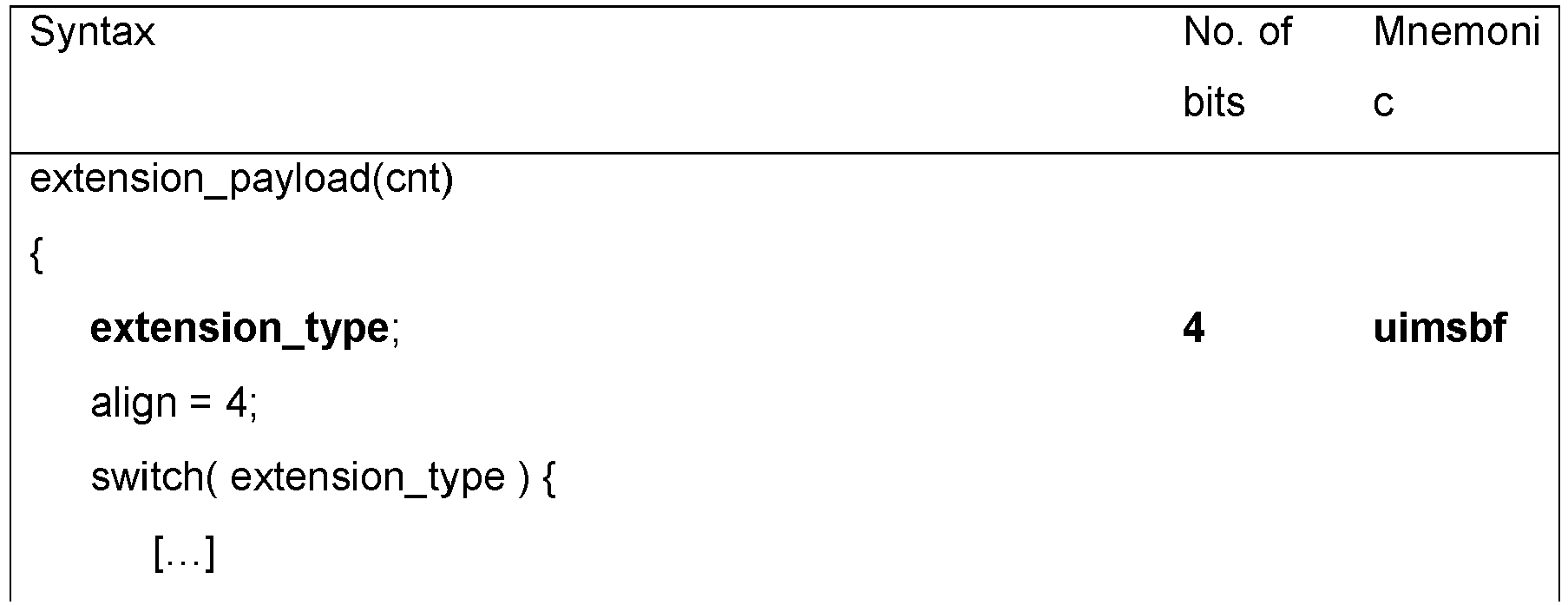

- In an embodiment, the new extension payload element may include a unique identifier. The unique identifier may be, for example, EXT_SYS_SOUND _INFO.
- Using the above techniques, the additional media data and the information on the additional media data can be readily embedded into an existing MPEG-4 compliant bitstream that is passed-through by the source device.
- Referring now the example of
Figure 3 , an example of a method for processing a modified bitstream on a sink device is illustrated. In step S200, a modified bitstream including coded media data (e.g. as received by the source device) and payload of additional media data may be received by a receiver of a sink device. - In step S201, the received modified bitstream may be parsed, by a bitstream parser, into the coded media data and the payload of additional media data. While the format of the modified bitstream is not limited, the modified bitstream may be in MPEG-4 audio format (i.e. MPEG-4 audio standard compliant bitstream). Referring to the example of
Figure 4 , in an embodiment, the modified bitstream may include an MPEG-4 audio bitstream extension mechanism, and parsing in step S201 may further be based on identifying the MPEG-4 audio bitstream extension mechanism in the modified bitstream. In present invention, the MPEG-4 audio bitstream extension mechanism is a data stream element (DSE) and parsing in step S201 may further be based on identifying a position of the data stream element in the modified bitstream and/or identifying a specific instance tag of the data stream element. - Alternatively, in an embodiment, not covered by the scope of protection of present invention, the MPEG-4 audio bitstream extension mechanism may be a Fill Element (ID_FIL) and parsing in step S201 may further be based on identifying an extension payload element inside the Fill Element.
- Referring to the example of
Figure 3 or4 , in step S202, the coded media data may be core decoded by a core decoder. - In step S203, the core decoded media data may be mixed with the additional media data, by a mixer, to obtain an output signal.
- In
step 204, the obtained output signal may then be output by a control unit. - Referring now to the example of
Figure 5 , a further example of a method for processing a modified bitstream on a sink device is illustrated. In the example ofFigure 5 , in an embodiment, the modified bitstream may further include information on the additional media data, and processing the modified bitstream by the sink device may be based on the information. In an embodiment, the information may include one or more of information on a configuration of the additional media data, information on a presence of the additional media data in the modified bitstream, information on a default loudness value, information on a value for delay alignment, information on delay adaption, information on panning and information on a type of the additional media data. - In the example of
Figure 5 , the method may further include the step S202a of processing, by a processing unit, the additional media data prior to mixing the core decoded media data and the additional media data. In step S203, the core decoded media data are then mixed with the processed additional media data. In an embodiment, processing the additional media data may include one or more of resampling, delay adaption and loudness processing. The processing of the additional media data may be guided by (based on) the generated information included in the modified bitstream and provided in step S201 by the bitstream parser (as indicated by the dashed line). For example, resampling may be guided by information on a sampling rate of the additional media data which may be included in the information on the configuration of the additional media data. Alternatively, or additionally, processing the additional media data may include downmixing/upmixing the additional media data which may be guided by information on a channel mode which may be included in the information on the configuration of the additional media data. Loudness processing may be guided, for example, by information on a default loudness value which may include a measured loudness as according to one of the methods specified in ITU-R BS. 1770-4. - Alternatively, or additionally, in an embodiment, the modified bitstream may further include information relating to a relative gain between the coded media data and the additional media data, and mixing in step S203 the core decoded media data and the additional media data, which may have optionally been processed prior to mixing to obtain processed additional media data (as indicated by the dotted lines), may be based on the information relating to the relative gain. In this, the sink device may use the relative gain value generated at the source device. In other words, both, source device and sink device may use the same relative gain value. The relative gain value may also further be modified via a user input in the mixing step S203. The relative gain value may include a mixing gain and/or an attenuation gain value. The information relating to the relative gain may be provided in step S201 by the bitstream parser as indicated by the dashed line. The information on the additional media data and alternatively, or additionally, the information relating to the relative gain value may be embedded in the modified bitstream in the system_sound_config top level syntax element as described above.
- Referring now to the example of
Figure 6 , in an embodiment, not part of the present invention, the additional media data may be compressed media data and the method may further include the step S205 of decoding, by a decoder, the compressed media data to obtain decoded additional media data, and in step S203 the decoded additional media data may be mixed with the core decoded media data. If the method includes further a step of processing the additional media data, S202a, in case of compressed media data, the decoded additional media data may optionally be subjected to processing in step S202a, as detailed above and indicated by the dotted lines, prior to mixing with the core decoded media data. While the format of the compressed media data is not limited, the format may belong to the Bluetooth ecosystem. In an embodiment, not part of the present invention, the compressed media data may be in SBC format or in an aptX-based format. Also in case of compressed media data, processing in step S202a may be guided by (based on) generated information on the additional media data included in the modified bitstream and provided in step S201 as indicated by the dashed line. - Alternatively, or additionally, mixing in step S203 the core decoded media data and the decoded additional media data, which may have optionally been processed prior to mixing, may also be based on information relating to a relative gain as detailed above. The information relating to the relative gain may also be provided in step S201 as indicated by the dashed line.
- In present invention, the additional media data are uncompressed media data, and in step S203 the uncompressed additional media data may be mixed with the core decoded media data in accordance with the example illustrated in
Figure 3 orFigure 4 . In accordance with the example ofFigure 5 , the uncompressed media data may also optionally be subjected to processing in step S202a, as detailed above, prior to mixing with the core decoded media data. In the present invention, the uncompressed media data are PCM data generated at the source device. In an embodiment, the PCM data may include one or more of earcon-data and system sounds data. - Referring now to the example of
Figure 7 , an example of a source device for generating a modified bitstream is illustrated. Thesource device 100 may include areceiver 102 configured to receive a bitstream including codedmedia data 101. The bitstream may be received, for example, from one or more media servers. The bitstream may, for example, deliver audio content to be played back by a sink device connected to thesource device 100. Thesource device 100 is not limited. For example, thesource device 100 may be a mobile device including one or more of a mobile phone, a smart watch, a laptop and a tablet pc including convertibles. - In an embodiment, the coded media data may be played back by the source device, the sink device or both the source device and the sink device. In an embodiment, the additional media data may be played back by the source device, the sink device or both the source device and the sink device.
- The
source device 100 may further include anembedder 104 configured to generate payload ofadditional media data 103 and to embed the generated payload in the bitstream to obtain a modified bitstream including the codedmedia data 101 and the payload ofadditional media data 103. In this, a modified bitstream may also be generated even if the source device is operated in pass-through mode. Thesource device 100 may be configured to pass through the coded media data to the sink device via the modified bitstream. The coded media data as received from the source device is embedded in the modified bitstream and outputted to the sink device. - Advantageously, generating (at the source device) and outputting the modified bitstream to the sink device streamlines mixing of the media data with the additional media data at the side of the sink device. A single bitstream is used by the source device to embed and transport the media data and the additional media data to the sink device, thereby a single channel/connection can be used between the source and the sink device. Furthermore, no additional decoders and/or encoders are present in the source device to, e.g., decode and re-encode the coded media data. No additional mixers are used in the source device to, e.g., mix decoded coded media data with the additional media data.
- In present invention, the modified bitstream is in MPEG-4 audio format (i.e. MPEG-4 audio standard compliant bitstream). In an embodiment, the embedder may be configured to transport the generated payload via an MPEG-4 audio bitstream extension mechanism in the modified bitstream as detailed above.
- In an embodiment, the
additional media data 103 may be compressed media data, not covered by the scope of protection of present invention, or uncompressed media data, mainly uncompressed PCM audio data, generated at thesource device 100. While the generation of PCM data is not limited, in an embodiment, not part of the present invention, the generation of the PCM data may be based on a user input. The user input may be, for example, a key-press. Thesource device 100 may then include a user interface which may be, for example, a touch display. Alternatively, or additionally thesource device 100 may further include at least a keyboard. However, the generation of the PCM data may also be facilitated at thesource device 100 independent of a user input, e.g. based on an email notification. In an embodiment, the PCM data may include one or more of earcon-data and system sounds data. The PCM data may be stored in thesource device 100. - While the compressed media data is not limited, the format of the compressed media data may belong to the Bluetooth ecosystem. In an example not covered by the scope of protection of present invention, the compressed media data may be in SBC format or in an aptX-based format. The compressed media data may be generated at the
source device 100. The compressed media data may be stored in thesource device 100. Alternatively, or additionally, the compressed media data may be received via thereceiver 102. - Referring now to the example of
Figure 8 , in an embodiment, theembedder 104 may further be configured to generateinformation 106 on theadditional media data 103 and to embed the generatedinformation 106 in the bitstream (as indicated by the dashed line). Alternatively, or additionally, in an embodiment, theembedder 104 may further be configured to generateinformation 106 relating to a relative gain between thecoded media data 101 and theadditional media data 103 and to embed theinformation 106 relating to the relative gain in the bitstream (as also indicated by the dashed line). In an embodiment, the embedder may further be configured to transport the generated information and/or the generated information relating to the relative gain via the MPEG-4 audio bitstream extension mechanism in the modified bitstream as detailed above. - The
source device 100 may further include acontrol unit 105 configured to output the modified bitstream to a sink device. - Referring now to the example of
Figure 9 , an example of a sink device for processing a modified bitstream is illustrated. Thesink device 200 may include areceiver 201 configured to receive a modified bitstream including coded media data and payload of additional media data. Thesink device 200 is not limited. Thesink device 200 may be a peripheral device to the source device, for example, earphones. Thesink device 200 and the source device may be connected via Bluetooth. Thesink device 200 may be configured to play back audio content included in the modified bitstream. For example, thesink device 200 may be configured to play back the coded media data or the additional media data or both the coded media data and the additional media data. - The
sink device 200 may further include abitstream parser 202 configured to parse the modified bitstream into the coded media data and the payload of the additional media data. - In present invention, the modified bitstream is in MPEG-4 audio format (i.e. MPEG-4 audio standard compliant bitstream). As already detailed above, in an embodiment, the
bitstream parser 202 may be configured to parse the bitstream based on identifying an MPEG-4 audio bitstream extension mechanism in the modified bitstream. - The
sink device 200 may further include acore decoder 203 configured to core decode the coded media data to obtain core decoded media data. In an embodiment, thecore decoder 203 may be an MPEG-4 audio decoder (compliant with the MPEG-4 audio standard as detailed above). - The
sink device 200 may further include amixer 204 configured to mix the core decoded media data and the additional media data to obtain an output signal. The additional media data are uncompressed media data, and themixer 204 may be configured to mix the core decoded media data and the uncompressed additional media data. - Referring now to the example of
Figure 10 , the modified bitstream may further include information on the additional media data, and thesink device 200 may be configured to process the modified bitstream based on the information. In an embodiment, thesink device 200 may further include aprocessing unit 206 configured to process the additional media data prior to mixing the core decoded media data and the additional media data in themixer 204. In an embodiment, processing the additional media data by theprocessing unit 206 may include one or more of resampling, delay adaption and loudness processing. Processing the additional media data by theprocessing unit 206 may be guided by (based on) the information on the additional media data as detailed above. The information on the additional media data may be provided by thebitstream parser 202 to theprocessing unit 206 as indicated by the dashed line. In case of the additional media data being uncompressed media data, the uncompressed media data may be directly processed after the modified bitstream has been parsed in thebitstream parser 202 and prior to entering themixer 204. - Alternatively, or additionally, in an embodiment, the modified bitstream may further include information relating to a relative gain between the coded media data and the additional media data, and the
mixer 204 may further be configured to mix the core decoded media data and the additional media data, which may optionally have been processed prior to mixing (as indicated by the dotted lines), based on the information relating to the relative gain as described above. The information relating to the relative gain may be provided to themixer 204 by thebitstream parser 202 as indicated by the dashed line. - In an embodiment, not part of the present invention, the additional media data may be compressed media data. Referring now to the example of
Figure 11 , thesink device 200 may further include adecoder 207 configured to decode the compressed media data to obtain decoded additional media data, and themixer 204 may be configured to mix the core decoded media data and the decoded additional media data. Alternatively or additionally, the modified bitstream may further include information relating to a relative gain between the coded media data and the additional media data, and themixer 204 may further be configured to mix the core decoded media data and the decoded additional media data based on the information relating to the relative gain as described above. The information relating to the relative gain may be provided to themixer 204 by thebitstream parser 202 as indicated by the dashed line. - Referring further to the example of
Figure 12 , the decoded additional media data may further optionally be processed by theprocessing unit 206 prior to mixing with the core decoded media data in the mixer 204 (as indicated by the dotted lines). Processing the decoded additional media data by theprocessing unit 206 may be guided by (based on) information on the additional media data which may be included in the modified bitstream as detailed above. The information on the additional media data may be provided by thebitstream parser 202 to theprocessing unit 206 as indicated by the dashed line. - Referring to the examples of
Figures 9 to 12 , thesink device 200 may further include acontrol unit 205 configured to output the output signal. For example, the output signal may be output via earphones to a user of thesink device 200. - The above described methods may be implemented individually on the above described devices. The above described devices capable of performing the above described methods may also form a respective system.
Devices 300, as referred to herein, may include one ormore processors Figure 13 . Alternatively, or additionally, the above described methods may also be implemented as a computer program product comprising a computer-readable storage medium with instructions adapted to cause thedevice 300 to carry out said methods when executed on adevice 300 havingprocessing capability - Unless specifically stated otherwise, as apparent from the following discussions, it is appreciated that throughout the disclosure discussions utilizing terms such as "processing," "computing," "calculating," "determining", analyzing" or the like, refer to the action and/or processes of a computer or computing system, or similar electronic computing devices, that manipulate and/or transform data represented as physical, such as electronic, quantities into other data similarly represented as physical quantities.
- In a similar manner, the term "processor" may refer to any device or portion of a device that processes electronic data, e.g., from registers and/or memory to transform that electronic data into other electronic data that, e.g., may be stored in registers and/or memory. A "computer" or a "computing machine" or a "computing platform" may include one or more processors.
- The methodologies described herein are, in one example embodiment, performable by one or more processors that accept computer-readable (also called machine-readable) code containing a set of instructions that when executed by one or more of the processors carry out at least one of the methods described herein. Any processor capable of executing a set of instructions (sequential or otherwise) that specify actions to be taken are included. Thus, one example is a typical processing system that includes one or more processors. Each processor may include one or more of a CPU, a graphics processing unit, and a programmable DSP unit. The processing system further may include a memory subsystem including main RAM and/or a static RAM, and/or ROM. A bus subsystem may be included for communicating between the components. The processing system further may be a distributed processing system with processors coupled by a network. If the processing system requires a display, such a display may be included, e.g., a liquid crystal display (LCD) or a cathode ray tube (CRT) display. If manual data entry is required, the processing system also includes an input device such as one or more of an alphanumeric input unit such as a keyboard, a pointing control device such as a mouse, and so forth. The processing system may also encompass a storage system such as a disk drive unit. The processing system in some configurations may include a sound output device, and a network interface device. The memory subsystem thus includes a computer-readable carrier medium that carries computer-readable code (e.g., software) including a set of instructions to cause performing, when executed by one or more processors, one or more of the methods described herein. Note that when the method includes several elements, e.g., several steps, no ordering of such elements is implied, unless specifically stated. The software may reside in the hard disk, or may also reside, completely or at least partially, within the RAM and/or within the processor during execution thereof by the computer system. Thus, the memory and the processor also constitute computer-readable carrier medium carrying computer-readable code. Furthermore, a computer-readable carrier medium may form, or be included in a computer program product.
- In alternative example embodiments, the one or more processors operate as a standalone device or may be connected, e.g., networked to other processor(s), in a networked deployment, the one or more processors may operate in the capacity of a server or a user machine in server-user network environment, or as a peer machine in a peer-to-peer or distributed network environment. The one or more processors may form a personal computer (PC), a tablet PC, a Personal Digital Assistant (PDA), a cellular telephone, a web appliance, a network router, switch or bridge, or any machine capable of executing a set of instructions (sequential or otherwise) that specify actions to be taken by that machine.
- Note that the term "machine" shall also be taken to include any collection of machines that individually or jointly execute a set (or multiple sets) of instructions to perform any one or more of the methodologies discussed herein.
- Thus, one example embodiment of each of the methods described herein is in the form of a computer-readable carrier medium carrying a set of instructions, e.g., a computer program that is for execution on one or more processors, e.g., one or more processors that are part of web server arrangement. Thus, as will be appreciated by those skilled in the art, example embodiments of the present disclosure may be embodied as a method, an apparatus such as a special purpose apparatus, an apparatus such as a data processing system, or a computer-readable carrier medium, e.g., a computer program product. The computer-readable carrier medium carries computer readable code including a set of instructions that when executed on one or more processors cause the processor or processors to implement a method. Accordingly, aspects of the present disclosure may take the form of a method, an entirely hardware example embodiment, an entirely software example embodiment or an example embodiment combining software and hardware aspects. Furthermore, the present disclosure may take the form of carrier medium (e.g., a computer program product on a computer-readable storage medium) carrying computer-readable program code embodied in the medium.
- The software may further be transmitted or received over a network via a network interface device. While the carrier medium is in an example embodiment a single medium, the term "carrier medium" should be taken to include a single medium or multiple media (e.g., a centralized or distributed database, and/or associated caches and servers) that store the one or more sets of instructions. The term "carrier medium" shall also be taken to include any medium that is capable of storing, encoding or carrying a set of instructions for execution by one or more of the processors and that cause the one or more processors to perform any one or more of the methodologies of the present disclosure. A carrier medium may take many forms, including but not limited to, non-volatile media, volatile media, and transmission media. Non-volatile media includes, for example, optical, magnetic disks, and magnetooptical disks. Volatile media includes dynamic memory, such as main memory. Transmission media includes coaxial cables, copper wire and fiber optics, including the wires that comprise a bus subsystem. Transmission media may also take the form of acoustic or light waves, such as those generated during radio wave and infrared data communications. For example, the term "carrier medium" shall accordingly be taken to include, but not be limited to, solid-state memories, a computer product embodied in optical and magnetic media; a medium bearing a propagated signal detectable by at least one processor or one or more processors and representing a set of instructions that, when executed, implement a method; and a transmission medium in a network bearing a propagated signal detectable by at least one processor of the one or more processors and representing the set of instructions.
- It will be understood that the steps of methods discussed are performed in one example embodiment by an appropriate processor (or processors) of a processing (e.g., computer) system executing instructions (computer-readable code) stored in storage. It will also be understood that the disclosure is not limited to any particular implementation or programming technique and that the disclosure may be implemented using any appropriate techniques for implementing the functionality described herein. The disclosure is not limited to any particular programming language or operating system.
- As used herein, unless otherwise specified the use of the ordinal adjectives "first", "second", "third", etc., to describe a common object, merely indicate that different instances of like objects are being referred to and are not intended to imply that the objects so described must be in a given sequence, either temporally, spatially, in ranking, or in any other manner.
- In the claims below and the description herein, any one of the terms comprising, comprised of or which comprises is an open term that means including at least the elements/features that follow, but not excluding others. Thus, the term comprising, when used in the claims, should not be interpreted as being limitative to the means or elements or steps listed thereafter. For example, the scope of the expression a device comprising A and B should not be limited to devices consisting only of elements A and B. Any one of the terms including or which includes or that includes as used herein is also an open term that also means including at least the elements/features that follow the term, but not excluding others. Thus, including is synonymous with and means comprising.
- It should be appreciated that in the above description of example embodiments of the disclosure, various features of the disclosure are sometimes grouped together in a single example embodiment, Fig., or description thereof for the purpose of streamlining the disclosure and aiding in the understanding of one or more of the various inventive aspects. This method of disclosure, however, is not to be interpreted as reflecting an intention that the claims require more features than are expressly recited in each claim. Rather, as the following claims reflect, inventive aspects lie in less than all features of a single foregoing disclosed example embodiment. Thus, the claims following the Description are hereby expressly incorporated into this Description, with each claim standing on its own as a separate example embodiment of this disclosure.
- In the description provided herein, numerous specific details are set forth. However, it is understood that example embodiments of the disclosure may be practiced without these specific details. In other instances, well-known methods, structures and techniques have not been shown in detail in order not to obscure an understanding of this description.
Claims (15)
- A method for generating a modified bitstream in MPEG-4 audio format by a source device, the source device comprising a receiver and an embedder, wherein the method includes the steps of:a) receiving (S100), by the receiver, a bitstream including coded media data;b) generating (S101), by the embedder, payload of additional uncompressed PCM audio data and embedding the payload in the bitstream for obtaining (S102), as an output from the embedder, a modified bitstream including the coded media data and the payload of the additional uncompressed PCM audio data, wherein the generated payload is embedded in the bitstream by transporting the payload in the modified bitstream via an MPEG-4 audio bitstream extension mechanism, wherein the MPEG-4 audio bitstream extension mechanism is a data stream element (DSE); andc) outputting (S103) the modified bitstream to the sink device.
- Method according to claim 1, wherein step b) further includes generating information on the additional uncompressed PCM audio data and embedding the information in the bitstream, and optionally wherein
the generated information includes one or more of information on a configuration of the additional uncompressed PCM audio data, information on a presence of the additional uncompressed PCM audio data in the modified bitstream, information on a default loudness value, information on a value for delay alignment, information on delay adaption, information on panning and information on a type of the additional data uncompressed PCM audio data. - Method according to claim 1 or claim 2, wherein step b) further includes generating information relating to a relative gain between the coded media data and the additional uncompressed PCM audio data and embedding the information relating to the relative gain in the bitstream, and/or wherein
the data stream element (DSE) is located at a predefined position in the modified bitstream and/or includes a specific instance tag. - Method according to any of the preceding claims, wherein in step c) the modified bitstream is output to the sink device via a Bluetooth connection, and/or wherein
the uncompressed PCM audio data include one or more of earcon-data and system sounds data. - A method for processing a modified bitstream in MPEG-4 audio format by a sink device comprising a receiver, a bitstream parser, a core decoder, a mixer, wherein the method includes the steps of:a) receiving (S200), by the receiver, a modified bitstream including coded media data, payload of additional uncompressed PCM audio data and an MPEG-4 audio bitstream extension mechanism, wherein the MPEG-4 audio bitstream extension mechanism is a data stream element (DSE);b) parsing (S201), by the bitstream parser, the modified bitstream into the coded media data and the payload of additional uncompressed PCM audio data, wherein the parsing is based on identifying the MPEG-4 audio bitstream extension mechanism in the modified bitstream;c) core decoding (S202), by the core decoder, the coded media data to obtain core decoded media data;d) mixing (S203), by the mixer, the core decoded media data and the additional uncompressed PCM audio data to obtain an output signal; ande) outputting (S204) the output signal.
- Method according to claim 5, wherein the modified bitstream further includes information on the additional uncompressed PCM audio data, and wherein the method further includes, after step a) and before step b), a step of processing the modified bitstream based on the information, and optionally wherein
the information includes one or more of information on a configuration of the additional uncompressed PCM audio data, information on a presence of the additional uncompressed PCM audio data in the modified bitstream, information on a default loudness value, information on a value for delay alignment, information on delay adaption, information on panning and information on a type of the additional uncompressed PCM audio data. - Method according to claim 5 or claim 6, wherein the modified bitstream further includes information relating to a relative gain between the coded media data and the additional uncompressed PCM audio data, and wherein mixing in step d) the core decoded media data and the additional uncompressed PCM audio data is based on the information relating to the relative gain.
- Method according to any of claims 5-7, wherein the method further includes the step of processing, by a processing unit, the additional uncompressed PCM audio data prior to mixing the core decoded media data and the additional uncompressed PCM audio data, and optionally wherein
processing the additional uncompressed PCM audio data includes one or more of resampling, delay adaption and loudness processing. - Method according to any one of the claims 5 to 8, wherein parsing in step b) is further based on identifying a position of the data stream element in the modified bitstream and/or identifying a specific instance tag of the data stream element.
- Source device (100) for generating a modified bitstream in MPEG-4 audio format, wherein the device includes:a) a receiver (102) configured to receive a bitstream including coded media data;b) an embedder (104) configured to generate payload of additional uncompressed PCM audio data and to embed the generated payload in the bitstream to obtain a modified bitstream including the coded media data and the payload of the additional uncompressed PCM audio data wherein the embedder is further configured to embed the generated payload in the bitstream by transporting the payload in the modified bitstream via an MPEG-4 audio bitstream extension mechanism, wherein the MPEG-4 audio bitstream extension mechanism is a data stream element (DSE); andc) a control unit (105) configured to output the modified bitstream to a sink device.
- Source device according to claim 10, wherein the embedder is further configured to generate information on the additional uncompressed PCM audio data and to embed the information in the bitstream, and/or whereinthe embedder is further configured to generate information relating to a relative gain between the coded media data and the additional uncompressed PCM audio data and to embed the information relating to the relative gain in the bitstream, and/or whereinthe uncompressed PCM audio data include one or more of earcon-data and system sounds data.
- Sink device (200) for processing a modified bitstream in MPEG-4 audio format, wherein the device includes:a) a receiver (201) configured to receive a modified bitstream including coded media data, payload of additional uncompressed PCM audio data and an MPEG-4 audio bitstream extension mechanism, wherein the MPEG-4 audio bitstream extension mechanism is a data stream element (DSE);b) a bitstream parser (202) configured to parse the modified bitstream into the coded media data and the payload of the additional uncompressed PCM audio data, wherein the bitstream parser is further configured to parse the modified bitstream based on identifying the MPEG-4 audio bitstream extension mechanism in the modified bitstream;c) a core decoder (203) configured to core decode the coded media data to obtain core decoded media data;d) a mixer (204) configured to mix the core decoded media data and the additional uncompressed PCM audio data to obtain an output signal; ande) a control unit configured to output the output signal.
- Sink device according to claim 12, further including a processing unit (206) configured to process the additional uncompressed PCM audio data prior to mixing the core decoded media data and the additional uncompressed PCM audio data, and/or whereinthe modified bitstream further includes information on the additional uncompressed PCM audio data, and wherein the sink device is configured to process the modified bitstream based on the information, and/or whereinthe modified bitstream further includes information relating to a relative gain between the coded media data and the additional uncompressed PCM audio data, and wherein the mixer is further configured to mix the core decoded media data and the additional uncompressed PCM audio data based on the information relating to the relative gain, and/or whereinthe core decoder is an MPEG-4 audio decoder.
- System of a source device for generating a modified bitstream in MPEG-4 audio format, wherein the source device includes one or more processors configured to perform the method according to any of claims 1 to 4 and a sink device for processing a modified bitstream in MPEG-4 audio format, wherein the sink device includes one or more processors configured to perform the method according to claims 5 to 9.
- A computer program product comprising a computer-readable storage medium with instructions adapted to cause the device to carry out the method according to any one of claims 1 to 9 when executed by a device having processing capability.
Applications Claiming Priority (3)
| Application Number | Priority Date | Filing Date | Title |
|---|---|---|---|
| US201962887098P | 2019-08-15 | 2019-08-15 | |
| EP19191920 | 2019-08-15 | ||
| PCT/US2020/046042 WO2021030515A1 (en) | 2019-08-15 | 2020-08-13 | Methods and devices for generation and processing of modified audio bitstreams |
Publications (2)
| Publication Number | Publication Date |
|---|---|
| EP4014506A1 EP4014506A1 (en) | 2022-06-22 |
| EP4014506B1 true EP4014506B1 (en) | 2023-01-11 |
Family
ID=72235010
Family Applications (1)
| Application Number | Title | Priority Date | Filing Date |
|---|---|---|---|
| EP20761468.6A Active EP4014506B1 (en) | 2019-08-15 | 2020-08-13 | Methods and devices for generation and processing of modified audio bitstreams |
Country Status (6)
| Country | Link |
|---|---|
| US (1) | US11967330B2 (en) |
| EP (1) | EP4014506B1 (en) |
| JP (2) | JP7314398B2 (en) |
| KR (2) | KR20250133479A (en) |
| CN (3) | CN120656467A (en) |
| WO (1) | WO2021030515A1 (en) |
Families Citing this family (1)
| Publication number | Priority date | Publication date | Assignee | Title |
|---|---|---|---|---|
| CN120656467A (en) * | 2019-08-15 | 2025-09-16 | 杜比国际公司 | Method and apparatus for generating and processing a modified audio bitstream |
Family Cites Families (49)
| Publication number | Priority date | Publication date | Assignee | Title |
|---|---|---|---|---|
| GB2341746A (en) | 1998-09-10 | 2000-03-22 | Snell & Wilcox Ltd | Digital TV service protector |
| WO2001046954A1 (en) * | 1999-12-21 | 2001-06-28 | Koninklijke Philips Electronics N.V. | Embedding a first digital information signal into a second digital information signal for transmission via a transmission medium |
| US7266501B2 (en) | 2000-03-02 | 2007-09-04 | Akiba Electronics Institute Llc | Method and apparatus for accommodating primary content audio and secondary content remaining audio capability in the digital audio production process |
| US6718507B1 (en) * | 2000-09-12 | 2004-04-06 | At&T Corp. | System and method for representing compressed information |
| US7039116B1 (en) * | 2000-11-07 | 2006-05-02 | Cisco Technology, Inc. | Methods and apparatus for embedding and format conversion of compressed video data |
| US6990202B2 (en) * | 2001-10-04 | 2006-01-24 | Hewlett-Packard Development Company, L.P. | Packetizing devices for secure scalable data streaming |
| KR100545901B1 (en) | 2003-06-13 | 2006-02-09 | (주)엠아이유 | A wireless system for transmitting and receiving multimedia data free of charge and a method therefor |
| KR100571824B1 (en) * | 2003-11-26 | 2006-04-17 | 삼성전자주식회사 | Method and apparatus for embedded MP-4 audio USB encoding / decoding |
| US9805400B2 (en) | 2004-03-02 | 2017-10-31 | Nokia Technologies Oy | Downloading different versions of media files based on a type of download link |
| US20060059510A1 (en) * | 2004-09-13 | 2006-03-16 | Huang Jau H | System and method for embedding scene change information in a video bitstream |
| KR100942860B1 (en) | 2005-12-16 | 2010-02-17 | 돌비 스웨덴 에이비 | Apparatus and methods for generating and interpreting data streams into segments with specified entry points and computer readable media having recorded them |
| US8756626B2 (en) | 2005-12-22 | 2014-06-17 | Broadcom Corporation | Method and apparatus for using the host-pod interface of a digital television or other digital audio/video receiver for new services |
| KR20070098726A (en) * | 2006-03-30 | 2007-10-05 | 엘지전자 주식회사 | Method and apparatus for encoding / decoding media signal |
| US20070294738A1 (en) | 2006-06-16 | 2007-12-20 | Broadcom Corporation | Single chip cable set-top box supporting DOCSIS set-top Gateway (DSG) protocol and high definition advanced video codec (HD AVC) decode |
| KR101087379B1 (en) * | 2007-02-23 | 2011-11-25 | 노키아 코포레이션 | Packetization method and apparatus, bitstream representation processing method and apparatus and computer readable medium |
| WO2008154041A1 (en) * | 2007-06-14 | 2008-12-18 | Thomson Licensing | Modifying a coded bitstream |
| US20090055005A1 (en) | 2007-08-23 | 2009-02-26 | Horizon Semiconductors Ltd. | Audio Processor |
| KR100916702B1 (en) | 2007-09-05 | 2009-09-11 | 에스케이 텔레콤주식회사 | Apparatus and method for decoding channel of transport stream packet |
| CN102144237B (en) * | 2008-07-03 | 2014-10-22 | 美国唯美安视国际有限公司 | Efficient watermarking approaches of compressed media |
| GB2466242B (en) | 2008-12-15 | 2013-01-02 | Audio Analytic Ltd | Sound identification systems |
| CN102860008B (en) * | 2010-01-06 | 2016-05-11 | 杜比实验室特许公司 | Complexity Adaptive Scalable Decoding and Stream Processing for Multilayer Video Systems |
| US20110213681A1 (en) | 2010-02-03 | 2011-09-01 | Mohammad Shahid | Delivering enhanced content to broadcast media receivers with internet connection and enhancing user experience |
| TWI557723B (en) * | 2010-02-18 | 2016-11-11 | 杜比實驗室特許公司 | Decoding method and system |
| EP2362653A1 (en) | 2010-02-26 | 2011-08-31 | Panasonic Corporation | Transport stream packet header compression |
| EP2393060A1 (en) * | 2010-06-02 | 2011-12-07 | Thomson Licensing | Providing a watermarked decoded audio or video signal derived from a watermarked audio or video signal that was low bit rate encoded and decoded |
| US20130298171A1 (en) | 2010-11-18 | 2013-11-07 | Sharp Kabushiki Kaisha | Device for generating content data, method for generating content data, and recording medium |
| TWI581250B (en) * | 2010-12-03 | 2017-05-01 | 杜比實驗室特許公司 | Adaptive processing technology using multimedia processing nodes |
| KR101748756B1 (en) * | 2011-03-18 | 2017-06-19 | 프라운호퍼 게젤샤프트 쭈르 푀르데룽 데어 안겐반텐 포르슝 에.베. | Frame element positioning in frames of a bitstream representing audio content |
| US9779736B2 (en) | 2011-11-18 | 2017-10-03 | Sirius Xm Radio Inc. | Systems and methods for implementing efficient cross-fading between compressed audio streams |
| US9167296B2 (en) * | 2012-02-28 | 2015-10-20 | Qualcomm Incorporated | Customized playback at sink device in wireless display system |
| MX343571B (en) * | 2013-01-21 | 2016-11-09 | Dolby Laboratories Licensing Corp | AUDIO CODE AND DECODER WITH LIMIT METADATES AND PROGRAM SOUND. |
| US9607624B2 (en) | 2013-03-29 | 2017-03-28 | Apple Inc. | Metadata driven dynamic range control |
| EP2814256B1 (en) | 2013-06-11 | 2022-01-26 | MX1 GmbH | Method and apparatus for modifying a stream of digital content |
| TWM487509U (en) * | 2013-06-19 | 2014-10-01 | 杜比實驗室特許公司 | Audio processing apparatus and electrical device |
| EP2843963A1 (en) | 2013-08-30 | 2015-03-04 | Thomson Licensing | Method for watermarking a content |
| EP2866227A1 (en) | 2013-10-22 | 2015-04-29 | Fraunhofer-Gesellschaft zur Förderung der angewandten Forschung e.V. | Method for decoding and encoding a downmix matrix, method for presenting audio content, encoder and decoder for a downmix matrix, audio encoder and audio decoder |
| KR101519000B1 (en) | 2014-04-23 | 2015-05-19 | 오픈스택 주식회사 | Apparatus of an encoder embedded with a modulator for automatic switching and Method thereof |
| PT3149955T (en) * | 2014-05-28 | 2019-08-05 | Fraunhofer Ges Forschung | Data processor and transport of user control data to audio decoders and renderers |
| JP6729382B2 (en) | 2014-10-16 | 2020-07-22 | ソニー株式会社 | Transmission device, transmission method, reception device, and reception method |
| WO2016172328A1 (en) | 2015-04-24 | 2016-10-27 | Vid Scale, Inc. | Content protection and modification detection in adaptive streaming and transport streams |
| US9837086B2 (en) | 2015-07-31 | 2017-12-05 | Apple Inc. | Encoded audio extended metadata-based dynamic range control |
| US10008214B2 (en) | 2015-09-11 | 2018-06-26 | Electronics And Telecommunications Research Institute | USAC audio signal encoding/decoding apparatus and method for digital radio services |
| EP3470976A1 (en) | 2017-10-12 | 2019-04-17 | Fraunhofer-Gesellschaft zur Förderung der angewandten Forschung e.V. | Method and apparatus for efficient delivery and usage of audio messages for high quality of experience |
| TW202546814A (en) * | 2017-03-23 | 2025-12-01 | 瑞典商都比國際公司 | Backward-compatible integration of harmonic transposer for high frequency reconstruction of audio signals |
| US10075802B1 (en) | 2017-08-08 | 2018-09-11 | Qualcomm Incorporated | Bitrate allocation for higher order ambisonic audio data |
| US10812700B2 (en) | 2017-11-02 | 2020-10-20 | Arris Enterprises Llc | Approach to live multi-camera streaming of events with hand-held cameras |
| CN115691517A (en) | 2018-02-22 | 2023-02-03 | 杜比国际公司 | Method and apparatus for processing a secondary media stream embedded in an MPEG-H3D audio stream |
| KR102852659B1 (en) * | 2018-08-21 | 2025-08-29 | 돌비 인터네셔널 에이비 | Method, device and system for generating, transmitting and processing an instantaneous playback frame (IPF) |
| CN120656467A (en) * | 2019-08-15 | 2025-09-16 | 杜比国际公司 | Method and apparatus for generating and processing a modified audio bitstream |
-
2020
- 2020-08-13 CN CN202510797022.3A patent/CN120656467A/en active Pending
- 2020-08-13 WO PCT/US2020/046042 patent/WO2021030515A1/en not_active Ceased
- 2020-08-13 JP JP2022505628A patent/JP7314398B2/en active Active
- 2020-08-13 KR KR1020257028464A patent/KR20250133479A/en active Pending
- 2020-08-13 KR KR1020227004777A patent/KR102852687B1/en active Active
- 2020-08-13 CN CN202510788529.2A patent/CN120656466A/en active Pending
- 2020-08-13 CN CN202080057519.7A patent/CN114303190B/en active Active
- 2020-08-13 US US17/635,183 patent/US11967330B2/en active Active
- 2020-08-13 EP EP20761468.6A patent/EP4014506B1/en active Active
-
2023
- 2023-07-12 JP JP2023114205A patent/JP7816881B2/en active Active
Also Published As
| Publication number | Publication date |
|---|---|
| JP7816881B2 (en) | 2026-02-18 |
| CN114303190A (en) | 2022-04-08 |
| US20220277755A1 (en) | 2022-09-01 |
| JP7314398B2 (en) | 2023-07-25 |
| EP4014506A1 (en) | 2022-06-22 |
| JP2023145513A (en) | 2023-10-11 |
| KR20250133479A (en) | 2025-09-05 |
| CN120656466A (en) | 2025-09-16 |
| CN114303190B (en) | 2025-07-04 |
| WO2021030515A1 (en) | 2021-02-18 |
| US11967330B2 (en) | 2024-04-23 |
| CN120656467A (en) | 2025-09-16 |
| JP2022546923A (en) | 2022-11-10 |
| KR102852687B1 (en) | 2025-08-29 |
| KR20220034860A (en) | 2022-03-18 |
Similar Documents
| Publication | Publication Date | Title |
|---|---|---|
| TWI466102B (en) | Method and apparatus for blanking out errors in encoded audio data | |
| US11227616B2 (en) | Concept for audio encoding and decoding for audio channels and audio objects | |
| JP5852140B2 (en) | Device for encoding and decoding watermarked signals | |
| JP7816881B2 (en) | Method and apparatus for generating and processing modified audio bitstreams | |
| US20240355338A1 (en) | Method and apparatus for metadata-based dynamic processing of audio data | |
| EP4014236B1 (en) | Methods and devices for generation and processing of modified bitstreams | |
| EP4626033A1 (en) | Virtual speaker determination method and related apparatus | |
| CA3241847A1 (en) | Method and apparatus for processing of audio data | |
| JP2025511384A (en) | Method and apparatus for audio data processing - Patents.com | |
| WO2026098917A1 (en) | An apparatus and method for mapping immersive audio with coded audio | |
| HK40116098A (en) | Method and apparatus for processing of audio data | |
| HK1174701A (en) | Exposing off-host audio processing capabilities | |
| HK1174701B (en) | Exposing off-host audio processing capabilities |
Legal Events
| Date | Code | Title | Description |
|---|---|---|---|
| STAA | Information on the status of an ep patent application or granted ep patent |
Free format text: STATUS: UNKNOWN |
|
| STAA | Information on the status of an ep patent application or granted ep patent |
Free format text: STATUS: THE INTERNATIONAL PUBLICATION HAS BEEN MADE |
|
| PUAI | Public reference made under article 153(3) epc to a published international application that has entered the european phase |
Free format text: ORIGINAL CODE: 0009012 |
|
| STAA | Information on the status of an ep patent application or granted ep patent |
Free format text: STATUS: REQUEST FOR EXAMINATION WAS MADE |
|
| 17P | Request for examination filed |
Effective date: 20220315 |
|
| AK | Designated contracting states |
Kind code of ref document: A1 Designated state(s): AL AT BE BG CH CY CZ DE DK EE ES FI FR GB GR HR HU IE IS IT LI LT LU LV MC MK MT NL NO PL PT RO RS SE SI SK SM TR |
|
| REG | Reference to a national code |
Ref country code: DE Ref legal event code: R079 Ref document number: 602020007566 Country of ref document: DE Free format text: PREVIOUS MAIN CLASS: H04N0021238900 Ipc: G10L0019160000 |
|
| RIC1 | Information provided on ipc code assigned before grant |
Ipc: H04L 65/80 20220101ALI20220717BHEP Ipc: H04L 65/75 20220101ALI20220717BHEP Ipc: H04L 65/1069 20220101ALI20220717BHEP Ipc: G10L 19/16 20130101AFI20220717BHEP |
|
| GRAP | Despatch of communication of intention to grant a patent |
Free format text: ORIGINAL CODE: EPIDOSNIGR1 |
|
| STAA | Information on the status of an ep patent application or granted ep patent |
Free format text: STATUS: GRANT OF PATENT IS INTENDED |
|
| INTG | Intention to grant announced |
Effective date: 20220905 |
|
| RAP3 | Party data changed (applicant data changed or rights of an application transferred) |
Owner name: DOLBY LABORATORIES LICENSING CORPORATION Owner name: DOLBY INTERNATIONAL AB |
|
| DAV | Request for validation of the european patent (deleted) | ||
| DAX | Request for extension of the european patent (deleted) | ||
| GRAS | Grant fee paid |
Free format text: ORIGINAL CODE: EPIDOSNIGR3 |
|
| GRAA | (expected) grant |
Free format text: ORIGINAL CODE: 0009210 |
|
| STAA | Information on the status of an ep patent application or granted ep patent |
Free format text: STATUS: THE PATENT HAS BEEN GRANTED |
|
| AK | Designated contracting states |
Kind code of ref document: B1 Designated state(s): AL AT BE BG CH CY CZ DE DK EE ES FI FR GB GR HR HU IE IS IT LI LT LU LV MC MK MT NL NO PL PT RO RS SE SI SK SM TR |
|
| REG | Reference to a national code |
Ref country code: GB Ref legal event code: FG4D |
|
| REG | Reference to a national code |
Ref country code: CH Ref legal event code: EP |
|
| REG | Reference to a national code |
Ref country code: DE Ref legal event code: R096 Ref document number: 602020007566 Country of ref document: DE |
|
| REG | Reference to a national code |
Ref country code: IE Ref legal event code: FG4D |
|
| REG | Reference to a national code |
Ref country code: AT Ref legal event code: REF Ref document number: 1543905 Country of ref document: AT Kind code of ref document: T Effective date: 20230215 |
|
| REG | Reference to a national code |
Ref country code: LT Ref legal event code: MG9D |
|
| REG | Reference to a national code |
Ref country code: NL Ref legal event code: MP Effective date: 20230111 |
|
| REG | Reference to a national code |
Ref country code: AT Ref legal event code: MK05 Ref document number: 1543905 Country of ref document: AT Kind code of ref document: T Effective date: 20230111 |
|
| P01 | Opt-out of the competence of the unified patent court (upc) registered |
Effective date: 20230517 |
|
| PG25 | Lapsed in a contracting state [announced via postgrant information from national office to epo] |
Ref country code: NL Free format text: LAPSE BECAUSE OF FAILURE TO SUBMIT A TRANSLATION OF THE DESCRIPTION OR TO PAY THE FEE WITHIN THE PRESCRIBED TIME-LIMIT Effective date: 20230111 |
|
| PG25 | Lapsed in a contracting state [announced via postgrant information from national office to epo] |
Ref country code: RS Free format text: LAPSE BECAUSE OF FAILURE TO SUBMIT A TRANSLATION OF THE DESCRIPTION OR TO PAY THE FEE WITHIN THE PRESCRIBED TIME-LIMIT Effective date: 20230111 Ref country code: PT Free format text: LAPSE BECAUSE OF FAILURE TO SUBMIT A TRANSLATION OF THE DESCRIPTION OR TO PAY THE FEE WITHIN THE PRESCRIBED TIME-LIMIT Effective date: 20230511 Ref country code: NO Free format text: LAPSE BECAUSE OF FAILURE TO SUBMIT A TRANSLATION OF THE DESCRIPTION OR TO PAY THE FEE WITHIN THE PRESCRIBED TIME-LIMIT Effective date: 20230411 Ref country code: LV Free format text: LAPSE BECAUSE OF FAILURE TO SUBMIT A TRANSLATION OF THE DESCRIPTION OR TO PAY THE FEE WITHIN THE PRESCRIBED TIME-LIMIT Effective date: 20230111 Ref country code: LT Free format text: LAPSE BECAUSE OF FAILURE TO SUBMIT A TRANSLATION OF THE DESCRIPTION OR TO PAY THE FEE WITHIN THE PRESCRIBED TIME-LIMIT Effective date: 20230111 Ref country code: HR Free format text: LAPSE BECAUSE OF FAILURE TO SUBMIT A TRANSLATION OF THE DESCRIPTION OR TO PAY THE FEE WITHIN THE PRESCRIBED TIME-LIMIT Effective date: 20230111 Ref country code: ES Free format text: LAPSE BECAUSE OF FAILURE TO SUBMIT A TRANSLATION OF THE DESCRIPTION OR TO PAY THE FEE WITHIN THE PRESCRIBED TIME-LIMIT Effective date: 20230111 Ref country code: AT Free format text: LAPSE BECAUSE OF FAILURE TO SUBMIT A TRANSLATION OF THE DESCRIPTION OR TO PAY THE FEE WITHIN THE PRESCRIBED TIME-LIMIT Effective date: 20230111 |
|
| PG25 | Lapsed in a contracting state [announced via postgrant information from national office to epo] |
Ref country code: SE Free format text: LAPSE BECAUSE OF FAILURE TO SUBMIT A TRANSLATION OF THE DESCRIPTION OR TO PAY THE FEE WITHIN THE PRESCRIBED TIME-LIMIT Effective date: 20230111 Ref country code: PL Free format text: LAPSE BECAUSE OF FAILURE TO SUBMIT A TRANSLATION OF THE DESCRIPTION OR TO PAY THE FEE WITHIN THE PRESCRIBED TIME-LIMIT Effective date: 20230111 Ref country code: IS Free format text: LAPSE BECAUSE OF FAILURE TO SUBMIT A TRANSLATION OF THE DESCRIPTION OR TO PAY THE FEE WITHIN THE PRESCRIBED TIME-LIMIT Effective date: 20230511 Ref country code: GR Free format text: LAPSE BECAUSE OF FAILURE TO SUBMIT A TRANSLATION OF THE DESCRIPTION OR TO PAY THE FEE WITHIN THE PRESCRIBED TIME-LIMIT Effective date: 20230412 Ref country code: FI Free format text: LAPSE BECAUSE OF FAILURE TO SUBMIT A TRANSLATION OF THE DESCRIPTION OR TO PAY THE FEE WITHIN THE PRESCRIBED TIME-LIMIT Effective date: 20230111 |
|
| REG | Reference to a national code |
Ref country code: DE Ref legal event code: R097 Ref document number: 602020007566 Country of ref document: DE |
|
| PG25 | Lapsed in a contracting state [announced via postgrant information from national office to epo] |
Ref country code: SM Free format text: LAPSE BECAUSE OF FAILURE TO SUBMIT A TRANSLATION OF THE DESCRIPTION OR TO PAY THE FEE WITHIN THE PRESCRIBED TIME-LIMIT Effective date: 20230111 Ref country code: RO Free format text: LAPSE BECAUSE OF FAILURE TO SUBMIT A TRANSLATION OF THE DESCRIPTION OR TO PAY THE FEE WITHIN THE PRESCRIBED TIME-LIMIT Effective date: 20230111 Ref country code: EE Free format text: LAPSE BECAUSE OF FAILURE TO SUBMIT A TRANSLATION OF THE DESCRIPTION OR TO PAY THE FEE WITHIN THE PRESCRIBED TIME-LIMIT Effective date: 20230111 Ref country code: DK Free format text: LAPSE BECAUSE OF FAILURE TO SUBMIT A TRANSLATION OF THE DESCRIPTION OR TO PAY THE FEE WITHIN THE PRESCRIBED TIME-LIMIT Effective date: 20230111 Ref country code: CZ Free format text: LAPSE BECAUSE OF FAILURE TO SUBMIT A TRANSLATION OF THE DESCRIPTION OR TO PAY THE FEE WITHIN THE PRESCRIBED TIME-LIMIT Effective date: 20230111 |
|
| PLBE | No opposition filed within time limit |
Free format text: ORIGINAL CODE: 0009261 |
|
| STAA | Information on the status of an ep patent application or granted ep patent |
Free format text: STATUS: NO OPPOSITION FILED WITHIN TIME LIMIT |
|
| PG25 | Lapsed in a contracting state [announced via postgrant information from national office to epo] |
Ref country code: SK Free format text: LAPSE BECAUSE OF FAILURE TO SUBMIT A TRANSLATION OF THE DESCRIPTION OR TO PAY THE FEE WITHIN THE PRESCRIBED TIME-LIMIT Effective date: 20230111 |
|
| 26N | No opposition filed |
Effective date: 20231012 |
|
| PG25 | Lapsed in a contracting state [announced via postgrant information from national office to epo] |
Ref country code: SI Free format text: LAPSE BECAUSE OF FAILURE TO SUBMIT A TRANSLATION OF THE DESCRIPTION OR TO PAY THE FEE WITHIN THE PRESCRIBED TIME-LIMIT Effective date: 20230111 |
|
| PG25 | Lapsed in a contracting state [announced via postgrant information from national office to epo] |
Ref country code: MC Free format text: LAPSE BECAUSE OF FAILURE TO SUBMIT A TRANSLATION OF THE DESCRIPTION OR TO PAY THE FEE WITHIN THE PRESCRIBED TIME-LIMIT Effective date: 20230111 |
|
| REG | Reference to a national code |
Ref country code: CH Ref legal event code: PL |
|
| PG25 | Lapsed in a contracting state [announced via postgrant information from national office to epo] |
Ref country code: MC Free format text: LAPSE BECAUSE OF FAILURE TO SUBMIT A TRANSLATION OF THE DESCRIPTION OR TO PAY THE FEE WITHIN THE PRESCRIBED TIME-LIMIT Effective date: 20230111 |
|
| PG25 | Lapsed in a contracting state [announced via postgrant information from national office to epo] |
Ref country code: LU Free format text: LAPSE BECAUSE OF NON-PAYMENT OF DUE FEES Effective date: 20230813 |
|
| PG25 | Lapsed in a contracting state [announced via postgrant information from national office to epo] |
Ref country code: LU Free format text: LAPSE BECAUSE OF NON-PAYMENT OF DUE FEES Effective date: 20230813 Ref country code: CH Free format text: LAPSE BECAUSE OF NON-PAYMENT OF DUE FEES Effective date: 20230831 |
|
| REG | Reference to a national code |
Ref country code: BE Ref legal event code: MM Effective date: 20230831 |
|
| REG | Reference to a national code |
Ref country code: IE Ref legal event code: MM4A |
|
| PG25 | Lapsed in a contracting state [announced via postgrant information from national office to epo] |
Ref country code: IT Free format text: LAPSE BECAUSE OF FAILURE TO SUBMIT A TRANSLATION OF THE DESCRIPTION OR TO PAY THE FEE WITHIN THE PRESCRIBED TIME-LIMIT Effective date: 20230111 |
|
| PG25 | Lapsed in a contracting state [announced via postgrant information from national office to epo] |
Ref country code: IE Free format text: LAPSE BECAUSE OF NON-PAYMENT OF DUE FEES Effective date: 20230813 |
|
| PG25 | Lapsed in a contracting state [announced via postgrant information from national office to epo] |
Ref country code: IE Free format text: LAPSE BECAUSE OF NON-PAYMENT OF DUE FEES Effective date: 20230813 |
|
| PG25 | Lapsed in a contracting state [announced via postgrant information from national office to epo] |
Ref country code: BE Free format text: LAPSE BECAUSE OF NON-PAYMENT OF DUE FEES Effective date: 20230831 |
|
| PG25 | Lapsed in a contracting state [announced via postgrant information from national office to epo] |
Ref country code: BG Free format text: LAPSE BECAUSE OF FAILURE TO SUBMIT A TRANSLATION OF THE DESCRIPTION OR TO PAY THE FEE WITHIN THE PRESCRIBED TIME-LIMIT Effective date: 20230111 |
|
| PG25 | Lapsed in a contracting state [announced via postgrant information from national office to epo] |
Ref country code: BG Free format text: LAPSE BECAUSE OF FAILURE TO SUBMIT A TRANSLATION OF THE DESCRIPTION OR TO PAY THE FEE WITHIN THE PRESCRIBED TIME-LIMIT Effective date: 20230111 |
|
| PG25 | Lapsed in a contracting state [announced via postgrant information from national office to epo] |
Ref country code: CY Free format text: LAPSE BECAUSE OF FAILURE TO SUBMIT A TRANSLATION OF THE DESCRIPTION OR TO PAY THE FEE WITHIN THE PRESCRIBED TIME-LIMIT; INVALID AB INITIO Effective date: 20200813 |
|
| PG25 | Lapsed in a contracting state [announced via postgrant information from national office to epo] |
Ref country code: HU Free format text: LAPSE BECAUSE OF FAILURE TO SUBMIT A TRANSLATION OF THE DESCRIPTION OR TO PAY THE FEE WITHIN THE PRESCRIBED TIME-LIMIT; INVALID AB INITIO Effective date: 20200813 |
|
| PGFP | Annual fee paid to national office [announced via postgrant information from national office to epo] |
Ref country code: DE Payment date: 20250724 Year of fee payment: 6 |
|
| PGFP | Annual fee paid to national office [announced via postgrant information from national office to epo] |
Ref country code: GB Payment date: 20250724 Year of fee payment: 6 |
|
| PGFP | Annual fee paid to national office [announced via postgrant information from national office to epo] |
Ref country code: FR Payment date: 20250723 Year of fee payment: 6 |
|
| PG25 | Lapsed in a contracting state [announced via postgrant information from national office to epo] |
Ref country code: TR Free format text: LAPSE BECAUSE OF FAILURE TO SUBMIT A TRANSLATION OF THE DESCRIPTION OR TO PAY THE FEE WITHIN THE PRESCRIBED TIME-LIMIT Effective date: 20230111 |