EP4013269B1 - Cushioning for furniture item - Google Patents
Cushioning for furniture item Download PDFInfo
- Publication number
- EP4013269B1 EP4013269B1 EP20756984.9A EP20756984A EP4013269B1 EP 4013269 B1 EP4013269 B1 EP 4013269B1 EP 20756984 A EP20756984 A EP 20756984A EP 4013269 B1 EP4013269 B1 EP 4013269B1
- Authority
- EP
- European Patent Office
- Prior art keywords
- furniture
- cushioning
- cushioning pad
- prongs
- pad
- Prior art date
- Legal status (The legal status is an assumption and is not a legal conclusion. Google has not performed a legal analysis and makes no representation as to the accuracy of the status listed.)
- Active
Links
Images


Classifications
-
- A—HUMAN NECESSITIES
- A47—FURNITURE; DOMESTIC ARTICLES OR APPLIANCES; COFFEE MILLS; SPICE MILLS; SUCTION CLEANERS IN GENERAL
- A47C—CHAIRS; SOFAS; BEDS
- A47C7/00—Parts, details, or accessories of chairs or stools
- A47C7/02—Seat parts
- A47C7/021—Detachable or loose seat cushions
- A47C7/0213—Detachable or loose seat cushions detachably secured to seats, e.g. by ties or hook and loop straps
-
- A—HUMAN NECESSITIES
- A47—FURNITURE; DOMESTIC ARTICLES OR APPLIANCES; COFFEE MILLS; SPICE MILLS; SUCTION CLEANERS IN GENERAL
- A47C—CHAIRS; SOFAS; BEDS
- A47C9/00—Stools for specified purposes
- A47C9/002—Stools for specified purposes with exercising means or having special therapeutic or ergonomic effects
-
- A—HUMAN NECESSITIES
- A47—FURNITURE; DOMESTIC ARTICLES OR APPLIANCES; COFFEE MILLS; SPICE MILLS; SUCTION CLEANERS IN GENERAL
- A47C—CHAIRS; SOFAS; BEDS
- A47C7/00—Parts, details, or accessories of chairs or stools
- A47C7/02—Seat parts
- A47C7/025—Springs not otherwise provided for in A47C7/22 - A47C7/35
- A47C7/027—Springs not otherwise provided for in A47C7/22 - A47C7/35 with elastomeric springs
-
- A—HUMAN NECESSITIES
- A47—FURNITURE; DOMESTIC ARTICLES OR APPLIANCES; COFFEE MILLS; SPICE MILLS; SUCTION CLEANERS IN GENERAL
- A47C—CHAIRS; SOFAS; BEDS
- A47C7/00—Parts, details, or accessories of chairs or stools
- A47C7/02—Seat parts
- A47C7/14—Seat parts of adjustable shape; elastically mounted ; adaptable to a user contour or ergonomic seating positions
- A47C7/144—Seat parts of adjustable shape; elastically mounted ; adaptable to a user contour or ergonomic seating positions with array of movable supports
-
- A—HUMAN NECESSITIES
- A47—FURNITURE; DOMESTIC ARTICLES OR APPLIANCES; COFFEE MILLS; SPICE MILLS; SUCTION CLEANERS IN GENERAL
- A47C—CHAIRS; SOFAS; BEDS
- A47C7/00—Parts, details, or accessories of chairs or stools
- A47C7/02—Seat parts
- A47C7/24—Upholstered seats
- A47C7/26—Upholstered seats with reinforcement of the external layer of the upholstery, e.g. vandal resistant
-
- A—HUMAN NECESSITIES
- A47—FURNITURE; DOMESTIC ARTICLES OR APPLIANCES; COFFEE MILLS; SPICE MILLS; SUCTION CLEANERS IN GENERAL
- A47C—CHAIRS; SOFAS; BEDS
- A47C7/00—Parts, details, or accessories of chairs or stools
- A47C7/02—Seat parts
- A47C7/34—Seat parts with springs in compression, e.g. coiled
- A47C7/345—Seat parts with springs in compression, e.g. coiled of adjustable resilience
-
- A—HUMAN NECESSITIES
- A47—FURNITURE; DOMESTIC ARTICLES OR APPLIANCES; COFFEE MILLS; SPICE MILLS; SUCTION CLEANERS IN GENERAL
- A47C—CHAIRS; SOFAS; BEDS
- A47C9/00—Stools for specified purposes
Definitions
- the present disclosure is directed to furniture elements. More particularly the disclosure concerns a furniture covering element configured with a cushioning arrangement.
- US Patent Application 20090042014 discloses a compressible molded component comprises a compressible cushion member integrally formed with an additional member.
- the compressible cushion member is comprised of a deformable material formed by an injection molding process. During the molding process, the deformable material is injected in molten form into a core component of a mold, the core component having an array of protrusions. The array of protrusions in the mold forms an array of voids in the compressible cushion member when the component is removed from the mold.
- the additional member may include a skin member and/or a structural member attached to the compressible cushion member.
- the present disclosure is directed to a cushioning pad for use in conjunction with a furniture element.
- a furniture cushioning pad that is made of molded elastomer material and comprising a furniture engaging portion and at least a cushioning portion having top face and a bottom face, with a plurality of resilient prongs projecting from the bottom face; the prongs being configurable between a rest, non-deformed position, a pre-stressed position upon articulating the cushioning pad over a rigid surface portion of a furniture element, and a stressed position upon applying pressure over the top face thereof.
- a furniture item comprising at least a rigid surface portion and a pad mounting portion, wherein a furniture cushioning pad is applied over said rigid surface portion with a furniture engaging portion secured to the pad mounting portion, and wherein said cushioning pad is made of molded elastomer material and comprises at least a cushioning portion having top face and a bottom face, with a plurality of resilient prongs projecting from the bottom face; said prongs configurable between a rest, non-deformed position, a pre-stressed position upon articulating the cushioning pad over a rigid surface portion of a furniture element, and a stressed position upon applying pressure over the top face thereof.
- the arrangement is such that at a detached position, when the cushioning pad is free, i.e. removed from the furniture, the plurality of prongs are at rest and are substantially non-deformed.
- the prongs deform into a so-called pre-stressed position, and upon applying pressure over the top face of the cushioning pad, the prongs deform into the stressed position. Then, upon ceasing the pressure from the top face, the prongs spontaneously assume their pre-stressed position.
- Stiffness/elasticity parameters of the prongs and of the cushioning portion define the softness of the cushioning pad when engaged by an individual.
- the bottom face Upon applying pressure over the top face of the cushioning pad, e.g. upon an individual sitting on the cushioning portion of the cushioning pad of the furniture item (i.e. resulting in applying pressure thereto), the bottom face temporarily nears towards the a rigid surface portion of a furniture item, resulting in further elastic deflection of the prongs, arbitrary deforming between the bottom face and the rigid surface, such that a soft, cushioning effect is sensed by the individual.
- the disclosure also concerns a furniture system comprising at least one furniture item or a portion thereof, and at least one furniture cushioning pad according to the disclosure herein.
- the rigid surface portion may be pliable, as sometimes is the case with comfort furniture.
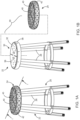
- FIGs. 1A and 1B illustrating a furniture item set generally designated 20, namely a stool 22 and a cushioning pad 24.
- the stool 22 is configured with four legs 28 and a seat portion 30 comprising a top flat, rigid seat surface portion 32 which in turn is configured with several openings 36, and an annular pad mounting portion 38, which in the illustrated example has a concaved section (best seen in the sectioned drawings, e.g. in Fig. 3D ).
- Openings 36 serve as air discharge openings, to facilitate escape of air entrapped in the space between the stool's support surface 32 and the cushioning pad 24.
- other openings can be configured, optionally also at the cushioning pad (not shown).
- the cushioning pad 24 is made of molded thermoplastic elastomeric material (e.g. SBS, SEBS, LDPE, etc.), generally bowl-like shaped with a generally flat cushioning portion 40 and an annular skirt 42 extending therefrom, having an inside surface 45. It is noted that the cushioning portion 40 is substantially flat, though according to the particular example it can be slightly domed.
- molded thermoplastic elastomeric material e.g. SBS, SEBS, LDPE, etc.
- An outside surface of the cushioning pad 24 (namely top face 43 and skirt 42) can mimic, as far as texture and color ('look and feel') a natural material, imparting it, in this specific example, with a quilted matelass6 appearance. Even more so, the outside surface of the cushioning pad 24 of this specific example, is configured with annular stich-like patterns at a top edge 44T and a bottom edge 44B of the annular skirt 42, imparting it a realistic appearance. Also, at least the top face of the cushioning pad can be configured with an embedded layer of other material, e.g. fabric (not shown), imparting the cushioning pad a soft to touch and authentic appearance.
- annular lip portion 48 Radially inwardly extending from a bottom edge 44B of the skirt 42 there is an annular lip portion 48, which together with skirt 42 constitutes a furniture engaging portion, as will be discussed herein after in greater detail.
- a bottom face 52 of the cushioning portion 40 is configured with a plurality of resilient spike-like prongs 54, which in the illustrated example are disposed in an ordered matrix, with their longitudinal axes projecting substantially normal from the bottom face 52 and parallelly disposed with respect to one another.
- the prongs are conical, having a thinned free end, with a root of each prong having a thickness (diameter) D similar to or less than the thickness T of the cushioning portion 40 (at the location of the prongs 54), as illustrated in Fig. 2C .
- the prongs extend towards the bottom end of the cushioning pad 24, ending at a distance h from the bottom, and being shorter than the inside height H thereof. It is appreciated that since the cushioning portion 40 is slightly domed, the length of the prongs slightly differs, such that at the center of the cushioning portion 40 they are slightly longer as compared to the peripheral ones.
- prongs are conical, it is appreciated that different prong configurations can be embodied.
- prongs of different geometrical shapes and cross-sections can be disposed at the bottom face of the cushioning portion, having different resilience in different orientations and at varying levels of stiffness.
- the prongs can be a priori oriented at specific direction, so as to impart prongs at certain zones with different elastic resistance.
- annular skirt 42 has a curved section, conforming to the shape and size of the seat portion 30 of stool 22, the arrangement being such that the cushioning pad 24 is mountable over the seat portion 30 by stretching it over and allowing the annular lip portion 48 to engage below the seat portion 30, with the inside surface 45 of the annular skirt 42 bearing flush against the annular pad mounting portion 38 of the seat portion 30, whereby the cushioning pad 24 is tightly stretched and securely applied thereover, and will not spontaneously detach, as seen for example in Fig. 3D .
- the prongs 54 of the cushioning pad 24 are flexibly deformable between three positions.
- the first position is the so-called 'rest position', is the natural position of the prongs, when the cushioning pad 24 is not applied over a bearing surface. This position is illustrated in Figs. 1B and 2A to 2C , where the prongs 54 project substantially upright from the bottom face 52.
- the second position is the position the prongs acquire after positioning and attaching the cushioning pad 24 over the rigid seat surface portion 32 of the stool 22.
- the prongs are deflected from their natural projecting position, however mostly the free ends of the prongs deform, and the root portions of the prongs (those portions near the bottom face 52) remain mostly non-deformed. This occurs owing to the light pressure applied to the prongs 54 as a result of the articulation of the cushioning pad to the rigid surface of the stool.
- the free end portions of the prongs are randomly deformed, resulting in the cushioning portion 40 supported spaced from the top surface of the rigid seat surface portion 32, and imparting the cushioned pad a comfortable, cushioning appearance, with some resilience, such that depressing the top face 43 of the cushioning portion 40 against the rigid seat surface portion 32 will momentarily deform the cushioning portion 40 (into the third, stressed position, as will be discussed hereinafter), and upon ceasing the pressure it will reassume the pre-stressed position owing to elasticity of the prongs applying a biasing force and acting as 'springs' disposed between the rigid seat surface portion 32 of the stool and the bottom surface 52 of the cushioning portion 40 of the cushioning pad 24.
- the force F causes the already slightly deformed prongs 54 to further deform, also near their root portion, such that the bottom face 52 of the cushioning potion 40 nears to the rigid seat surface portion 32, i.e. distance Li ( Fig. 1F ) decreases to L 2 ( Fig. 3E ), against the biasing effect of the deformed prongs 54, imparting an occupant of the stool a cushioned feeling.
- the cushioning portion and the prongs spontaneously assume their second position (i.e. the ⁇ pre-stressed position').
- the arrangement is such that the top face of the cushioning portion substantially does not undergo local deformation at the stressed position nor are molding indentations ('sucks') noticed at locations over the top face corresponding with locations of prongs (at the bottom face), owing to thickness, material density, elasticity, etc.
- a stool is a mere example of a furniture item, and that the cushioning pad subject of the present disclosure can be used in conjunction with any other form of furniture, at any one or more portions thereof, and for any purpose.
- the resilience and elasticity of the prongs can be selectively governed, by altering various parameters thereof, e.g. length, thickness, density, shape, material properties, etc.
Landscapes
- Legs For Furniture In General (AREA)
- Mattresses And Other Support Structures For Chairs And Beds (AREA)
- Buffer Packaging (AREA)
Description
- The present disclosure is directed to furniture elements. More particularly the disclosure concerns a furniture covering element configured with a cushioning arrangement.
- References considered to be relevant as background to the presently disclosed subject matter are listed below:
-
US Patent Application 2009/0042014 , -
US 2011/095581 A1 , -
FR 379 374 A -
US 5 153 956 A . - Acknowledgement of the above references herein is not to be inferred as meaning that these are in any way relevant to the patentability of the presently disclosed subject matter.
-
US Patent Application 20090042014 discloses a compressible molded component comprises a compressible cushion member integrally formed with an additional member. The compressible cushion member is comprised of a deformable material formed by an injection molding process. During the molding process, the deformable material is injected in molten form into a core component of a mold, the core component having an array of protrusions. The array of protrusions in the mold forms an array of voids in the compressible cushion member when the component is removed from the mold. The additional member may include a skin member and/or a structural member attached to the compressible cushion member. - The present disclosure is directed to a cushioning pad for use in conjunction with a furniture element.
- The invention is defined by independent claim 1. There is provided a furniture cushioning pad that is made of molded elastomer material and comprising a furniture engaging portion and at least a cushioning portion having top face and a bottom face, with a plurality of resilient prongs projecting from the bottom face; the prongs being configurable between a rest, non-deformed position, a pre-stressed position upon articulating the cushioning pad over a rigid surface portion of a furniture element, and a stressed position upon applying pressure over the top face thereof.
- According to a second aspect of the disclosure, there is provided a furniture item comprising at least a rigid surface portion and a pad mounting portion, wherein a furniture cushioning pad is applied over said rigid surface portion with a furniture engaging portion secured to the pad mounting portion, and wherein said cushioning pad is made of molded elastomer material and comprises at least a cushioning portion having top face and a bottom face, with a plurality of resilient prongs projecting from the bottom face; said prongs configurable between a rest, non-deformed position, a pre-stressed position upon articulating the cushioning pad over a rigid surface portion of a furniture element, and a stressed position upon applying pressure over the top face thereof.
- The arrangement is such that at a detached position, when the cushioning pad is free, i.e. removed from the furniture, the plurality of prongs are at rest and are substantially non-deformed. However, when the cushioning pad is applied over a rigid surface portion of a furniture item, and even more so upon securing the furniture engaging portion to the pad mounting portion, the prongs deform into a so-called pre-stressed position, and upon applying pressure over the top face of the cushioning pad, the prongs deform into the stressed position. Then, upon ceasing the pressure from the top face, the prongs spontaneously assume their pre-stressed position.
- Stiffness/elasticity parameters of the prongs and of the cushioning portion define the softness of the cushioning pad when engaged by an individual.
- Upon applying pressure over the top face of the cushioning pad, e.g. upon an individual sitting on the cushioning portion of the cushioning pad of the furniture item (i.e. resulting in applying pressure thereto), the bottom face temporarily nears towards the a rigid surface portion of a furniture item, resulting in further elastic deflection of the prongs, arbitrary deforming between the bottom face and the rigid surface, such that a soft, cushioning effect is sensed by the individual.
- The disclosure also concerns a furniture system comprising at least one furniture item or a portion thereof, and at least one furniture cushioning pad according to the disclosure herein.
- The term 'rigid' as used herein, with reference to the surface of the furniture item supporting the cushioning portion of the cushioning pad, denotes a substantially non-deformable surface. However, according to some examples, the rigid surface portion may be pliable, as sometimes is the case with comfort furniture.
- Any one or more of the following features designs and configurations can be applied to any of the aspects of the present disclosure, separately or in various combinations thereof:
- The prongs can extend substantially parallel to one another;
- The prongs can have similar length;
- A longitudinal axis of the prongs can extend substantially normal to the bottom face;
- The prongs can be equally dispersed over the portion of the bottom face;
- The prongs can be of uniform cross-section;
- The prongs can have a tapering section along a longitudinal axis thereof;
- The prongs can have a staggered section along a longitudinal axis thereof;
- The prongs can be pre-deformed at different orientations for imparting different cushioning effects to the cushioning portion;
- The prongs can be configured with different resiliency properties for imparting the cushioning portion with different cushioning effects;
- Elasticity of the prongs projecting from the bottom face of the cushioning pad can be equal over the entire cushioning portion thereof, or have different elasticity properties, so as to render the cushioning pad with differential cushioning properties;
- The thickness of the cushioning portion of the cushioning pad can be uniform;
- The cushioning portion of the cushioning pad can be flat or slightly domed, to thereby obtain gradually changing stiffness;
- The cushioning portion of the cushioning pad can be configured with reinforcements for governing stiffness/elasticity parameters thereof;
- The cushioning pad can be configured with openings, so as to facilitate air discharge upon applying pressure over the top face thereof; the openings can be configured at the cushioning portion or at other locations thereof;
- The rigid surface portion of the furniture item can be configured with openings, so as to facilitate air discharge upon applying pressure over the top face thereof;
- The furniture engaging portion of the cushioning pad can conform to a rigid surface portion of the furniture item;
- The cushioning portion of the cushioning pad can conform to any furniture item, e.g. a seat, a bed, etc.;
- The cushioning portion of the cushioning pad can conform to any one or more body engaging surfaces of a furniture item, or with portions of body engaging surfaces of a furniture item, e.g. a seat portion, a back rest, arm rest, foot rest, leg rest, head support, etc.;
- At least the top face of the cushioning pad can be configured with a natural material mimicking pattern;
- At least the top face of the cushioning pad can be configured with an embedded layer of other material, e.g. fabric, fibers, foil, etc.;
- The cushioning pad can be detachably attached to the furniture item;
- At the pre-stressed positions of the prongs, a root portion thereof can remain substantially non-deformed, with most deformation taking place at a distal portion (at the free end) of the prongs.
- In order to better understand the subject matter that is disclosed herein and to exemplify how it may be carried out in practice, embodiments will now be described, by way of non-limiting example only, with reference to the accompanying drawings, in which:
-
Fig. 1A is a top perspective view of a furniture system comprising a stool fitted with a cushioning pad, according to an example of the disclosure; -
Fig. 1B is an exploded view of the furniture system ofFig. 1A ; -
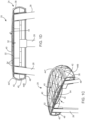
Fig. 1C is e section taken along line I - I inFig. 1A , the prongs illustrated at their pre-stressed position; -
Fig. 1D is a planar view ofFig. 1C ; -
Fig. 1E is an enlargement of the portion marked I inFig. 1C ; -
Fig. 1F is a supper-enlarged view of the portion marked II inFig. 1E ; -
Fig. 2A is a perspective bottom view of the cushioning pad seen inFig. 1B , the prongs at the rest, non-deformed position; -
Fig. 2B is a section along line II - II inFig. 2A ; -
Fig. 2C is a planar sectioned view of the cushioning pad; -
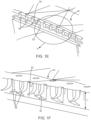
Fig. 3A is the same asFig. 1C , however with pressure applied over the cushioning pad and the prongs are at the stressed position; -
Fig. 3B is a planar view ofFig. 3A ; -
Fig. 3C is an enlargement of the portion marked III inFig. 3A ; -
Fig. 3D is an enlargement of the portion marked IV inFig. 3B ; and -
Fig. 3E is a supper-enlarged view of the portion marked V inFig. 3C . - Attention is first directed to
Figs. 1A and 1B , illustrating a furniture item set generally designated 20, namely astool 22 and acushioning pad 24. Thestool 22 is configured with fourlegs 28 and aseat portion 30 comprising a top flat, rigidseat surface portion 32 which in turn is configured withseveral openings 36, and an annularpad mounting portion 38, which in the illustrated example has a concaved section (best seen in the sectioned drawings, e.g. inFig. 3D ).Openings 36 serve as air discharge openings, to facilitate escape of air entrapped in the space between the stool'ssupport surface 32 and thecushioning pad 24. Likewise, other openings can be configured, optionally also at the cushioning pad (not shown). - Turning now to the
cushioning pad 24, and as can be seen better also inFigs. 2A - 2C , it is made of molded thermoplastic elastomeric material (e.g. SBS, SEBS, LDPE, etc.), generally bowl-like shaped with a generallyflat cushioning portion 40 and anannular skirt 42 extending therefrom, having aninside surface 45. It is noted that thecushioning portion 40 is substantially flat, though according to the particular example it can be slightly domed. - An outside surface of the cushioning pad 24 (namely
top face 43 and skirt 42) can mimic, as far as texture and color ('look and feel') a natural material, imparting it, in this specific example, with a quilted matelass6 appearance. Even more so, the outside surface of thecushioning pad 24 of this specific example, is configured with annular stich-like patterns at atop edge 44T and abottom edge 44B of theannular skirt 42, imparting it a realistic appearance. Also, at least the top face of the cushioning pad can be configured with an embedded layer of other material, e.g. fabric (not shown), imparting the cushioning pad a soft to touch and authentic appearance. - Radially inwardly extending from a
bottom edge 44B of theskirt 42 there is anannular lip portion 48, which together withskirt 42 constitutes a furniture engaging portion, as will be discussed herein after in greater detail. - A
bottom face 52 of thecushioning portion 40 is configured with a plurality of resilient spike-like prongs 54, which in the illustrated example are disposed in an ordered matrix, with their longitudinal axes projecting substantially normal from thebottom face 52 and parallelly disposed with respect to one another. By way of example, in the presently illustrated drawings, the prongs are conical, having a thinned free end, with a root of each prong having a thickness (diameter) D similar to or less than the thickness T of the cushioning portion 40 (at the location of the prongs 54), as illustrated inFig. 2C . The prongs extend towards the bottom end of thecushioning pad 24, ending at a distance h from the bottom, and being shorter than the inside height H thereof. It is appreciated that since thecushioning portion 40 is slightly domed, the length of the prongs slightly differs, such that at the center of thecushioning portion 40 they are slightly longer as compared to the peripheral ones. - Whilst in the presently illustrated example the prongs are conical, it is appreciated that different prong configurations can be embodied. For example, prongs of different geometrical shapes and cross-sections can be disposed at the bottom face of the cushioning portion, having different resilience in different orientations and at varying levels of stiffness. Likewise, the prongs can be a priori oriented at specific direction, so as to impart prongs at certain zones with different elastic resistance.
- It is further noted that the
annular skirt 42 has a curved section, conforming to the shape and size of theseat portion 30 ofstool 22, the arrangement being such that thecushioning pad 24 is mountable over theseat portion 30 by stretching it over and allowing theannular lip portion 48 to engage below theseat portion 30, with theinside surface 45 of theannular skirt 42 bearing flush against the annularpad mounting portion 38 of theseat portion 30, whereby thecushioning pad 24 is tightly stretched and securely applied thereover, and will not spontaneously detach, as seen for example inFig. 3D . - Whilst in the present example there is illustrated a particular pad mounting portion of the furniture item, with a corresponding particular furniture engaging portion, it should be appreciated that other engagement configurations are possible, however as long as at a mounted position the cushioning
portion 40 of thecushioning pad 24 is well positioned and secured over therigid surface portion 32 of the furniture item, and at least partially tensioned, so as to maintain the cushioning effect as will be discussed herein after. - It is appreciated that the
prongs 54 of thecushioning pad 24 are flexibly deformable between three positions. The first position, the so-called 'rest position', is the natural position of the prongs, when thecushioning pad 24 is not applied over a bearing surface. This position is illustrated inFigs. 1B and2A to 2C , where theprongs 54 project substantially upright from thebottom face 52. - The second position, the so-called 'pre-stressed position', is the position the prongs acquire after positioning and attaching the
cushioning pad 24 over the rigidseat surface portion 32 of thestool 22. At this position, illustrated inFigs. 1C to 1F , the prongs are deflected from their natural projecting position, however mostly the free ends of the prongs deform, and the root portions of the prongs (those portions near the bottom face 52) remain mostly non-deformed. This occurs owing to the light pressure applied to theprongs 54 as a result of the articulation of the cushioning pad to the rigid surface of the stool. At the pre-stressed position, the free end portions of the prongs are randomly deformed, resulting in thecushioning portion 40 supported spaced from the top surface of the rigidseat surface portion 32, and imparting the cushioned pad a comfortable, cushioning appearance, with some resilience, such that depressing thetop face 43 of thecushioning portion 40 against the rigidseat surface portion 32 will momentarily deform the cushioning portion 40 (into the third, stressed position, as will be discussed hereinafter), and upon ceasing the pressure it will reassume the pre-stressed position owing to elasticity of the prongs applying a biasing force and acting as 'springs' disposed between the rigidseat surface portion 32 of the stool and thebottom surface 52 of thecushioning portion 40 of thecushioning pad 24. - The third position, so-called 'stressed position', as illustrated in
Figs. 3A to 3E , force F is applied over thetop face 43 of thecushioning potion 40, e.g. upon an individual sitting on the stool. The force F causes the already slightlydeformed prongs 54 to further deform, also near their root portion, such that thebottom face 52 of thecushioning potion 40 nears to the rigidseat surface portion 32, i.e. distance Li (Fig. 1F ) decreases to L2 (Fig. 3E ), against the biasing effect of thedeformed prongs 54, imparting an occupant of the stool a cushioned feeling. As already mentioned, once the force F stops, e.g. when the individual get up from the stool, the cushioning portion and the prongs spontaneously assume their second position (i.e. the `pre-stressed position'). - The arrangement is such that the top face of the cushioning portion substantially does not undergo local deformation at the stressed position nor are molding indentations ('sucks') noticed at locations over the top face corresponding with locations of prongs (at the bottom face), owing to thickness, material density, elasticity, etc.
- It is noted that a stool is a mere example of a furniture item, and that the cushioning pad subject of the present disclosure can be used in conjunction with any other form of furniture, at any one or more portions thereof, and for any purpose.
- It is also appreciated that the resilience and elasticity of the prongs can be selectively governed, by altering various parameters thereof, e.g. length, thickness, density, shape, material properties, etc.
Claims (14)
- A furniture cushioning pad (24), said cushioning pad being made of molded elastomer material, and comprising a furniture engaging portion (42) and at least a cushioning portion (40) having a top face (43) and a bottom face (52), with a plurality of resilient prongs (54) projecting from the bottom face; said prongs configurable between a rest, non-deformed position, a pre-stressed position upon articulating the cushioning pad over a rigid surface portion of a furniture element, and a stressed position upon applying pressure over the top face thereof, in which the prongs deform in different orientations, and a thickness (D) of a root of the prongs is equal to or lesser than the thickness (T) of the cushioning portion (40) of the cushioning pad, characterized in that the furniture engaging portion (42) of the cushioning pad is configured for circumferential engaging over a pad mounting portion of a furniture item, said furniture engaging portion of the cushioning pad is a skirt-like portion configured for elastically tensioning and snug mounting over the pad mounting portion of the furniture item.
- The furniture cushioning pad of claim 1, wherein the prongs extend substantially parallel to one another.
- The furniture cushioning pad of claim 1 or 2, wherein a longitudinal axis of the prongs extends substantially normal to the bottom face of the cushioning portion.
- The furniture cushioning pad of any one of claims 1 to 3, wherein the prongs are equally dispersed over a portion of the bottom face.
- The furniture cushioning pad of any one of claims 1 to 4, wherein the prongs have a uniform cross-section along a longitudinal axis thereof.
- The furniture cushioning pad of any one of claims 1 to 4, wherein the prongs have a tapering cross-section or a staggered cross-section along a longitudinal axis thereof.
- The furniture cushioning pad of any one of claims 1 to 6, wherein the prongs have the same length.
- The furniture cushioning pad of any one of claims 1 to 7, wherein elasticity of the prongs projecting from the bottom face of the cushioning pad is equal over the entire cushioning portion.
- The furniture cushioning pad of any one of claims 1 to 7, wherein the prongs projecting from the bottom face of the cushioning pad have different elasticity properties, so as to render the cushioning pad with differential cushioning properties.
- The furniture cushioning pad of any one of claims 1 to 9, wherein the cushioning portion of the cushioning pad is flat, or the cushioning portion of the cushioning pad is slightly domed, to thereby obtain gradually changing stiffness.
- The furniture cushioning pad of any one of claims 1 to 10, wherein the cushioning portion of the cushioning pad is configured with reinforcements for governing stiffness/elasticity parameters thereof.
- The furniture cushioning pad of any one of claims 1 to 11, wherein the cushioning pad is configured with openings, so as to facilitate air discharge upon applying pressure over the top face thereof.
- The furniture cushioning pad of any one of claims 1 to 12, wherein at least the top face of the cushioning pad is configured with a natural material mimicking pattern.
- A furniture item (20) comprising at least a rigid surface portion (32) and a furniture cushioning pad mounting portion (38), wherein a furniture cushioning pad (24) according to any one of claims 1 to 13 is applied over said rigid surface portion with a furniture engaging portion (42) of the furniture cushioning pad (24) secured to the furniture cushioning pad mounting portion (38).
Applications Claiming Priority (2)
| Application Number | Priority Date | Filing Date | Title |
|---|---|---|---|
| IL268638A IL268638B2 (en) | 2019-08-12 | 2019-08-12 | Cushioning for furniture item |
| PCT/IL2020/050851 WO2021028903A1 (en) | 2019-08-12 | 2020-08-04 | Cushioning for furniture item |
Publications (2)
| Publication Number | Publication Date |
|---|---|
| EP4013269A1 EP4013269A1 (en) | 2022-06-22 |
| EP4013269B1 true EP4013269B1 (en) | 2024-07-31 |
Family
ID=68382062
Family Applications (1)
| Application Number | Title | Priority Date | Filing Date |
|---|---|---|---|
| EP20756984.9A Active EP4013269B1 (en) | 2019-08-12 | 2020-08-04 | Cushioning for furniture item |
Country Status (5)
| Country | Link |
|---|---|
| US (1) | US11737569B2 (en) |
| EP (1) | EP4013269B1 (en) |
| ES (1) | ES2993250T3 (en) |
| IL (1) | IL268638B2 (en) |
| WO (1) | WO2021028903A1 (en) |
Citations (2)
| Publication number | Priority date | Publication date | Assignee | Title |
|---|---|---|---|---|
| US5153956A (en) * | 1989-12-21 | 1992-10-13 | Bruno Fronebner | Lowering unit area pressure |
| US5628079A (en) * | 1996-01-16 | 1997-05-13 | Kizemchuk; Hanya | Seat cushion with projections |
Family Cites Families (8)
| Publication number | Priority date | Publication date | Assignee | Title |
|---|---|---|---|---|
| FR379374A (en) | 1907-06-28 | 1907-11-06 | Zingg-Reichwein | Elastic seat |
| DE29922174U1 (en) * | 1999-12-17 | 2000-02-24 | Chiu, Ciber, Lukang Chen, Changhua | Inflatable massage pillow |
| CA2658120A1 (en) * | 2006-07-19 | 2008-01-24 | Peter C. Prust | Seat cushion |
| US20090042014A1 (en) | 2007-08-06 | 2009-02-12 | Innatech | Compressible molded component |
| US20110095581A1 (en) * | 2009-10-26 | 2011-04-28 | Wendell Craig Pierce | Portable seat cushion |
| CA2861385C (en) * | 2012-01-31 | 2017-03-07 | Raft Global, Llc | Seat cushion with flexible contouring |
| US9635897B2 (en) * | 2012-01-31 | 2017-05-02 | Backjoy Orthotics, Llc | Cushion items with flexible contouring |
| US10455944B2 (en) * | 2016-10-17 | 2019-10-29 | Anatoli Chernin | Seat cushion |
-
2019
- 2019-08-12 IL IL268638A patent/IL268638B2/en unknown
-
2020
- 2020-08-04 US US17/633,422 patent/US11737569B2/en active Active
- 2020-08-04 WO PCT/IL2020/050851 patent/WO2021028903A1/en not_active Ceased
- 2020-08-04 EP EP20756984.9A patent/EP4013269B1/en active Active
- 2020-08-04 ES ES20756984T patent/ES2993250T3/en active Active
Patent Citations (2)
| Publication number | Priority date | Publication date | Assignee | Title |
|---|---|---|---|---|
| US5153956A (en) * | 1989-12-21 | 1992-10-13 | Bruno Fronebner | Lowering unit area pressure |
| US5628079A (en) * | 1996-01-16 | 1997-05-13 | Kizemchuk; Hanya | Seat cushion with projections |
Also Published As
| Publication number | Publication date |
|---|---|
| ES2993250T3 (en) | 2024-12-26 |
| IL268638B2 (en) | 2023-09-01 |
| IL268638A (en) | 2021-03-01 |
| WO2021028903A1 (en) | 2021-02-18 |
| US20220279930A1 (en) | 2022-09-08 |
| CA3146722A1 (en) | 2021-02-18 |
| EP4013269A1 (en) | 2022-06-22 |
| IL268638B1 (en) | 2023-05-01 |
| US11737569B2 (en) | 2023-08-29 |
Similar Documents
| Publication | Publication Date | Title |
|---|---|---|
| US6224160B1 (en) | Body supporting apparatus | |
| JP6795415B2 (en) | Back support for chairs | |
| KR100334317B1 (en) | Office chair fabrics, seat structures, and methods of making the chair | |
| TWI556771B (en) | Chair of the support device | |
| US7712837B2 (en) | Padding for furniture | |
| EP2908698B1 (en) | A chair and supports | |
| US20170079440A1 (en) | Molded Seat | |
| CN113507865A (en) | Body support assembly and methods for use and assembly thereof | |
| US20140084663A1 (en) | Molded seat | |
| US3276048A (en) | Spring assembly | |
| US11737569B2 (en) | Cushioning for furniture item | |
| CA3146722C (en) | Cushioning for furniture item | |
| DK2293706T3 (en) | CHAIR SEATS AND CHAIRS INCORPORATING THIS | |
| JP4221952B2 (en) | Elastic unit and mattress | |
| US20090315384A1 (en) | Chair and Chair Covering | |
| JP3434133B2 (en) | Chair elastic shell structure | |
| JP6959657B2 (en) | pillow | |
| JP2001327360A (en) | Chair | |
| JP4625399B2 (en) | Chair seat | |
| JP3233327U (en) | sofa | |
| KR102676379B1 (en) | Fixing clip for gel cushion | |
| JP2024111559A (en) | Cushion body | |
| JP3155944B2 (en) | Chair armrest cushion structure | |
| JP2026066601A (en) | Bathtub cushion | |
| KR200390024Y1 (en) | Elastic supporting system of chair head rest |
Legal Events
| Date | Code | Title | Description |
|---|---|---|---|
| STAA | Information on the status of an ep patent application or granted ep patent |
Free format text: STATUS: UNKNOWN |
|
| STAA | Information on the status of an ep patent application or granted ep patent |
Free format text: STATUS: THE INTERNATIONAL PUBLICATION HAS BEEN MADE |
|
| PUAI | Public reference made under article 153(3) epc to a published international application that has entered the european phase |
Free format text: ORIGINAL CODE: 0009012 |
|
| STAA | Information on the status of an ep patent application or granted ep patent |
Free format text: STATUS: REQUEST FOR EXAMINATION WAS MADE |
|
| 17P | Request for examination filed |
Effective date: 20220311 |
|
| AK | Designated contracting states |
Kind code of ref document: A1 Designated state(s): AL AT BE BG CH CY CZ DE DK EE ES FI FR GB GR HR HU IE IS IT LI LT LU LV MC MK MT NL NO PL PT RO RS SE SI SK SM TR |
|
| DAV | Request for validation of the european patent (deleted) | ||
| DAX | Request for extension of the european patent (deleted) | ||
| STAA | Information on the status of an ep patent application or granted ep patent |
Free format text: STATUS: EXAMINATION IS IN PROGRESS |
|
| 17Q | First examination report despatched |
Effective date: 20230313 |
|
| GRAP | Despatch of communication of intention to grant a patent |
Free format text: ORIGINAL CODE: EPIDOSNIGR1 |
|
| STAA | Information on the status of an ep patent application or granted ep patent |
Free format text: STATUS: GRANT OF PATENT IS INTENDED |
|
| INTG | Intention to grant announced |
Effective date: 20240229 |
|
| GRAS | Grant fee paid |
Free format text: ORIGINAL CODE: EPIDOSNIGR3 |
|
| GRAA | (expected) grant |
Free format text: ORIGINAL CODE: 0009210 |
|
| STAA | Information on the status of an ep patent application or granted ep patent |
Free format text: STATUS: THE PATENT HAS BEEN GRANTED |
|
| AK | Designated contracting states |
Kind code of ref document: B1 Designated state(s): AL AT BE BG CH CY CZ DE DK EE ES FI FR GB GR HR HU IE IS IT LI LT LU LV MC MK MT NL NO PL PT RO RS SE SI SK SM TR |
|
| P01 | Opt-out of the competence of the unified patent court (upc) registered |
Free format text: CASE NUMBER: APP_37860/2024 Effective date: 20240625 |
|
| REG | Reference to a national code |
Ref country code: CH Ref legal event code: EP Ref country code: GB Ref legal event code: FG4D |
|
| REG | Reference to a national code |
Ref country code: DE Ref legal event code: R096 Ref document number: 602020034898 Country of ref document: DE |
|
| REG | Reference to a national code |
Ref country code: IE Ref legal event code: FG4D |
|
| REG | Reference to a national code |
Ref country code: NL Ref legal event code: FP |
|
| REG | Reference to a national code |
Ref country code: LT Ref legal event code: MG9D |
|
| PG25 | Lapsed in a contracting state [announced via postgrant information from national office to epo] |
Ref country code: PT Free format text: LAPSE BECAUSE OF FAILURE TO SUBMIT A TRANSLATION OF THE DESCRIPTION OR TO PAY THE FEE WITHIN THE PRESCRIBED TIME-LIMIT Effective date: 20241202 |
|
| REG | Reference to a national code |
Ref country code: AT Ref legal event code: MK05 Ref document number: 1707619 Country of ref document: AT Kind code of ref document: T Effective date: 20240731 |
|
| REG | Reference to a national code |
Ref country code: ES Ref legal event code: FG2A Ref document number: 2993250 Country of ref document: ES Kind code of ref document: T3 Effective date: 20241226 |
|
| PG25 | Lapsed in a contracting state [announced via postgrant information from national office to epo] |
Ref country code: PT Free format text: LAPSE BECAUSE OF FAILURE TO SUBMIT A TRANSLATION OF THE DESCRIPTION OR TO PAY THE FEE WITHIN THE PRESCRIBED TIME-LIMIT Effective date: 20241202 |
|
| PG25 | Lapsed in a contracting state [announced via postgrant information from national office to epo] |
Ref country code: NO Free format text: LAPSE BECAUSE OF FAILURE TO SUBMIT A TRANSLATION OF THE DESCRIPTION OR TO PAY THE FEE WITHIN THE PRESCRIBED TIME-LIMIT Effective date: 20241031 |
|
| PG25 | Lapsed in a contracting state [announced via postgrant information from national office to epo] |
Ref country code: FI Free format text: LAPSE BECAUSE OF FAILURE TO SUBMIT A TRANSLATION OF THE DESCRIPTION OR TO PAY THE FEE WITHIN THE PRESCRIBED TIME-LIMIT Effective date: 20240731 Ref country code: GR Free format text: LAPSE BECAUSE OF FAILURE TO SUBMIT A TRANSLATION OF THE DESCRIPTION OR TO PAY THE FEE WITHIN THE PRESCRIBED TIME-LIMIT Effective date: 20241101 Ref country code: PL Free format text: LAPSE BECAUSE OF FAILURE TO SUBMIT A TRANSLATION OF THE DESCRIPTION OR TO PAY THE FEE WITHIN THE PRESCRIBED TIME-LIMIT Effective date: 20240731 |
|
| PG25 | Lapsed in a contracting state [announced via postgrant information from national office to epo] |
Ref country code: BG Free format text: LAPSE BECAUSE OF FAILURE TO SUBMIT A TRANSLATION OF THE DESCRIPTION OR TO PAY THE FEE WITHIN THE PRESCRIBED TIME-LIMIT Effective date: 20240731 |
|
| PG25 | Lapsed in a contracting state [announced via postgrant information from national office to epo] |
Ref country code: LV Free format text: LAPSE BECAUSE OF FAILURE TO SUBMIT A TRANSLATION OF THE DESCRIPTION OR TO PAY THE FEE WITHIN THE PRESCRIBED TIME-LIMIT Effective date: 20240731 |
|
| PG25 | Lapsed in a contracting state [announced via postgrant information from national office to epo] |
Ref country code: AT Free format text: LAPSE BECAUSE OF FAILURE TO SUBMIT A TRANSLATION OF THE DESCRIPTION OR TO PAY THE FEE WITHIN THE PRESCRIBED TIME-LIMIT Effective date: 20240731 Ref country code: IS Free format text: LAPSE BECAUSE OF FAILURE TO SUBMIT A TRANSLATION OF THE DESCRIPTION OR TO PAY THE FEE WITHIN THE PRESCRIBED TIME-LIMIT Effective date: 20241130 |
|
| PG25 | Lapsed in a contracting state [announced via postgrant information from national office to epo] |
Ref country code: HR Free format text: LAPSE BECAUSE OF FAILURE TO SUBMIT A TRANSLATION OF THE DESCRIPTION OR TO PAY THE FEE WITHIN THE PRESCRIBED TIME-LIMIT Effective date: 20240731 |
|
| PG25 | Lapsed in a contracting state [announced via postgrant information from national office to epo] |
Ref country code: RS Free format text: LAPSE BECAUSE OF FAILURE TO SUBMIT A TRANSLATION OF THE DESCRIPTION OR TO PAY THE FEE WITHIN THE PRESCRIBED TIME-LIMIT Effective date: 20241031 |
|
| PG25 | Lapsed in a contracting state [announced via postgrant information from national office to epo] |
Ref country code: RS Free format text: LAPSE BECAUSE OF FAILURE TO SUBMIT A TRANSLATION OF THE DESCRIPTION OR TO PAY THE FEE WITHIN THE PRESCRIBED TIME-LIMIT Effective date: 20241031 Ref country code: PL Free format text: LAPSE BECAUSE OF FAILURE TO SUBMIT A TRANSLATION OF THE DESCRIPTION OR TO PAY THE FEE WITHIN THE PRESCRIBED TIME-LIMIT Effective date: 20240731 Ref country code: NO Free format text: LAPSE BECAUSE OF FAILURE TO SUBMIT A TRANSLATION OF THE DESCRIPTION OR TO PAY THE FEE WITHIN THE PRESCRIBED TIME-LIMIT Effective date: 20241031 Ref country code: LV Free format text: LAPSE BECAUSE OF FAILURE TO SUBMIT A TRANSLATION OF THE DESCRIPTION OR TO PAY THE FEE WITHIN THE PRESCRIBED TIME-LIMIT Effective date: 20240731 Ref country code: IS Free format text: LAPSE BECAUSE OF FAILURE TO SUBMIT A TRANSLATION OF THE DESCRIPTION OR TO PAY THE FEE WITHIN THE PRESCRIBED TIME-LIMIT Effective date: 20241130 Ref country code: HR Free format text: LAPSE BECAUSE OF FAILURE TO SUBMIT A TRANSLATION OF THE DESCRIPTION OR TO PAY THE FEE WITHIN THE PRESCRIBED TIME-LIMIT Effective date: 20240731 Ref country code: GR Free format text: LAPSE BECAUSE OF FAILURE TO SUBMIT A TRANSLATION OF THE DESCRIPTION OR TO PAY THE FEE WITHIN THE PRESCRIBED TIME-LIMIT Effective date: 20241101 Ref country code: FI Free format text: LAPSE BECAUSE OF FAILURE TO SUBMIT A TRANSLATION OF THE DESCRIPTION OR TO PAY THE FEE WITHIN THE PRESCRIBED TIME-LIMIT Effective date: 20240731 Ref country code: BG Free format text: LAPSE BECAUSE OF FAILURE TO SUBMIT A TRANSLATION OF THE DESCRIPTION OR TO PAY THE FEE WITHIN THE PRESCRIBED TIME-LIMIT Effective date: 20240731 Ref country code: AT Free format text: LAPSE BECAUSE OF FAILURE TO SUBMIT A TRANSLATION OF THE DESCRIPTION OR TO PAY THE FEE WITHIN THE PRESCRIBED TIME-LIMIT Effective date: 20240731 |
|
| REG | Reference to a national code |
Ref country code: CH Ref legal event code: PL |
|
| PG25 | Lapsed in a contracting state [announced via postgrant information from national office to epo] |
Ref country code: DK Free format text: LAPSE BECAUSE OF FAILURE TO SUBMIT A TRANSLATION OF THE DESCRIPTION OR TO PAY THE FEE WITHIN THE PRESCRIBED TIME-LIMIT Effective date: 20240731 Ref country code: RO Free format text: LAPSE BECAUSE OF FAILURE TO SUBMIT A TRANSLATION OF THE DESCRIPTION OR TO PAY THE FEE WITHIN THE PRESCRIBED TIME-LIMIT Effective date: 20240731 Ref country code: SM Free format text: LAPSE BECAUSE OF FAILURE TO SUBMIT A TRANSLATION OF THE DESCRIPTION OR TO PAY THE FEE WITHIN THE PRESCRIBED TIME-LIMIT Effective date: 20240731 |
|
| PG25 | Lapsed in a contracting state [announced via postgrant information from national office to epo] |
Ref country code: LU Free format text: LAPSE BECAUSE OF NON-PAYMENT OF DUE FEES Effective date: 20240804 |
|
| PG25 | Lapsed in a contracting state [announced via postgrant information from national office to epo] |
Ref country code: CH Free format text: LAPSE BECAUSE OF NON-PAYMENT OF DUE FEES Effective date: 20240831 Ref country code: MC Free format text: LAPSE BECAUSE OF FAILURE TO SUBMIT A TRANSLATION OF THE DESCRIPTION OR TO PAY THE FEE WITHIN THE PRESCRIBED TIME-LIMIT Effective date: 20240731 Ref country code: EE Free format text: LAPSE BECAUSE OF FAILURE TO SUBMIT A TRANSLATION OF THE DESCRIPTION OR TO PAY THE FEE WITHIN THE PRESCRIBED TIME-LIMIT Effective date: 20240731 |
|
| PG25 | Lapsed in a contracting state [announced via postgrant information from national office to epo] |
Ref country code: CZ Free format text: LAPSE BECAUSE OF FAILURE TO SUBMIT A TRANSLATION OF THE DESCRIPTION OR TO PAY THE FEE WITHIN THE PRESCRIBED TIME-LIMIT Effective date: 20240731 |
|
| PG25 | Lapsed in a contracting state [announced via postgrant information from national office to epo] |
Ref country code: SK Free format text: LAPSE BECAUSE OF FAILURE TO SUBMIT A TRANSLATION OF THE DESCRIPTION OR TO PAY THE FEE WITHIN THE PRESCRIBED TIME-LIMIT Effective date: 20240731 |
|
| REG | Reference to a national code |
Ref country code: DE Ref legal event code: R097 Ref document number: 602020034898 Country of ref document: DE |
|
| PLBE | No opposition filed within time limit |
Free format text: ORIGINAL CODE: 0009261 |
|
| STAA | Information on the status of an ep patent application or granted ep patent |
Free format text: STATUS: NO OPPOSITION FILED WITHIN TIME LIMIT |
|
| REG | Reference to a national code |
Ref country code: BE Ref legal event code: MM Effective date: 20240831 |
|
| 26N | No opposition filed |
Effective date: 20250501 |
|
| PG25 | Lapsed in a contracting state [announced via postgrant information from national office to epo] |
Ref country code: BE Free format text: LAPSE BECAUSE OF NON-PAYMENT OF DUE FEES Effective date: 20240831 |
|
| PG25 | Lapsed in a contracting state [announced via postgrant information from national office to epo] |
Ref country code: IE Free format text: LAPSE BECAUSE OF NON-PAYMENT OF DUE FEES Effective date: 20240804 |
|
| PGFP | Annual fee paid to national office [announced via postgrant information from national office to epo] |
Ref country code: NL Payment date: 20250716 Year of fee payment: 6 |
|
| PG25 | Lapsed in a contracting state [announced via postgrant information from national office to epo] |
Ref country code: SE Free format text: LAPSE BECAUSE OF FAILURE TO SUBMIT A TRANSLATION OF THE DESCRIPTION OR TO PAY THE FEE WITHIN THE PRESCRIBED TIME-LIMIT Effective date: 20240731 |
|
| PGFP | Annual fee paid to national office [announced via postgrant information from national office to epo] |
Ref country code: ES Payment date: 20250909 Year of fee payment: 6 |
|
| PGFP | Annual fee paid to national office [announced via postgrant information from national office to epo] |
Ref country code: DE Payment date: 20250708 Year of fee payment: 6 |
|
| PGFP | Annual fee paid to national office [announced via postgrant information from national office to epo] |
Ref country code: IT Payment date: 20250722 Year of fee payment: 6 Ref country code: TR Payment date: 20250724 Year of fee payment: 6 |
|
| PGFP | Annual fee paid to national office [announced via postgrant information from national office to epo] |
Ref country code: GB Payment date: 20250710 Year of fee payment: 6 |
|
| PGFP | Annual fee paid to national office [announced via postgrant information from national office to epo] |
Ref country code: FR Payment date: 20250708 Year of fee payment: 6 |
|
| PG25 | Lapsed in a contracting state [announced via postgrant information from national office to epo] |
Ref country code: CY Free format text: LAPSE BECAUSE OF FAILURE TO SUBMIT A TRANSLATION OF THE DESCRIPTION OR TO PAY THE FEE WITHIN THE PRESCRIBED TIME-LIMIT; INVALID AB INITIO Effective date: 20200804 |
|
| PG25 | Lapsed in a contracting state [announced via postgrant information from national office to epo] |
Ref country code: HU Free format text: LAPSE BECAUSE OF FAILURE TO SUBMIT A TRANSLATION OF THE DESCRIPTION OR TO PAY THE FEE WITHIN THE PRESCRIBED TIME-LIMIT; INVALID AB INITIO Effective date: 20200804 |