EP4012992B1 - Virtualization of multiple network functions in high-scale routing - Google Patents
Virtualization of multiple network functions in high-scale routing Download PDFInfo
- Publication number
- EP4012992B1 EP4012992B1 EP21152045.7A EP21152045A EP4012992B1 EP 4012992 B1 EP4012992 B1 EP 4012992B1 EP 21152045 A EP21152045 A EP 21152045A EP 4012992 B1 EP4012992 B1 EP 4012992B1
- Authority
- EP
- European Patent Office
- Prior art keywords
- network processing
- processing element
- service
- network
- provisioning
- Prior art date
- Legal status (The legal status is an assumption and is not a legal conclusion. Google has not performed a legal analysis and makes no representation as to the accuracy of the status listed.)
- Active
Links
Images


Classifications
-
- H—ELECTRICITY
- H04—ELECTRIC COMMUNICATION TECHNIQUE
- H04L—TRANSMISSION OF DIGITAL INFORMATION, e.g. TELEGRAPHIC COMMUNICATION
- H04L47/00—Traffic control in data switching networks
- H04L47/70—Admission control; Resource allocation
- H04L47/74—Admission control; Resource allocation measures in reaction to resource unavailability
- H04L47/746—Reaction triggered by a failure
-
- H—ELECTRICITY
- H04—ELECTRIC COMMUNICATION TECHNIQUE
- H04L—TRANSMISSION OF DIGITAL INFORMATION, e.g. TELEGRAPHIC COMMUNICATION
- H04L47/00—Traffic control in data switching networks
- H04L47/70—Admission control; Resource allocation
- H04L47/74—Admission control; Resource allocation measures in reaction to resource unavailability
-
- H—ELECTRICITY
- H04—ELECTRIC COMMUNICATION TECHNIQUE
- H04L—TRANSMISSION OF DIGITAL INFORMATION, e.g. TELEGRAPHIC COMMUNICATION
- H04L47/00—Traffic control in data switching networks
- H04L47/70—Admission control; Resource allocation
- H04L47/78—Architectures of resource allocation
- H04L47/788—Autonomous allocation of resources
-
- H—ELECTRICITY
- H04—ELECTRIC COMMUNICATION TECHNIQUE
- H04L—TRANSMISSION OF DIGITAL INFORMATION, e.g. TELEGRAPHIC COMMUNICATION
- H04L47/00—Traffic control in data switching networks
- H04L47/70—Admission control; Resource allocation
- H04L47/82—Miscellaneous aspects
- H04L47/822—Collecting or measuring resource availability data
-
- H—ELECTRICITY
- H04—ELECTRIC COMMUNICATION TECHNIQUE
- H04L—TRANSMISSION OF DIGITAL INFORMATION, e.g. TELEGRAPHIC COMMUNICATION
- H04L67/00—Network arrangements or protocols for supporting network services or applications
- H04L67/01—Protocols
- H04L67/10—Protocols in which an application is distributed across nodes in the network
-
- H—ELECTRICITY
- H04—ELECTRIC COMMUNICATION TECHNIQUE
- H04L—TRANSMISSION OF DIGITAL INFORMATION, e.g. TELEGRAPHIC COMMUNICATION
- H04L67/00—Network arrangements or protocols for supporting network services or applications
- H04L67/50—Network services
- H04L67/60—Scheduling or organising the servicing of application requests, e.g. requests for application data transmissions using the analysis and optimisation of the required network resources
Definitions
- the present disclosure generally relates to the field of communication systems. More particularly, the present disclosure relates to systems implementing infrastructure for multiservice routing, virtual network function virtualization and software-defined networking.
- a plurality of different services e.g. networking and third party services which benefits from such a model by utilizing state data associated with one or more functions required for carrying out each of the plurality of different services.
- a network processing element for use in a cluster comprising a plurality of network processing elements, wherein said network processing element is characterized in that it is configured to enable provisioning of a plurality of different services for conveying traffic, wherein said network processing element is configured to store state data associated with one or more network functions required for carrying out each of said plurality of different services for conveying traffic, and wherein upon receiving by said network processing element a request for provisioning of a service for conveying traffic, at any port from among the ports associated with said network processing element and irrespective of whether said service can be provided via said receiving port, said network processing element is configured to establish which resources are required for provisioning the required service, and based on state data associated with instantaneous availability of processing resources of the network processing element, to determine if that network processing element may be used for the provisioning of the requested service.
- a network processing element e.g. an NPU
- the service or part thereof that is provided by the network processing element is provided in response to a request for provisioning that service received by another network processing element belonging to the cluster.
- the request for the provisioning of the service that was directed to the other network processing element is forwarded from the other network processing element to the present network processing element in response to the other network processing element being under congestion.
- the request for the provisioning of the service that was directed to the other network processing element is forwarded from that other network processing element to the present network processing element in response to determining that the other network processing element is not provided with means that could have enabled it to provide the required service.
- the network processing element is further configured to receive a request for the provisioning of a service at any one of the ports (e.g. physical or logical ports) associated with that network processing element, irrespective of whether the requested service can be provided via the receiving port.
- the ports e.g. physical or logical ports
- One of the major advantages of this embodiment is that it allows the virtualization of different ports and the use of any physical or logical port in the context of any service, thereby enabling a significant cost reduction, and is essentially equivalent to using virtual machines on top of a physical compute element.
- the network processing element is further configured to store state data associated with a plurality of functions required for the provisioning of a plurality of services.
- the network processing element comprises a non-IP interface configured to implement an Inter Service Link (ISL) through which control and data traffic is forwarded between different network functions over the network fabric as if the network processing elements belonging to the cluster are physically connected there-between.
- ISL Inter Service Link
- a method for use by a cluster comprising a plurality of network processing elements, wherein at least two of the network processing elements comprised in the cluster are configured to enable provisioning of a plurality of different services, and wherein each of the plurality of network processing elements is configured to provide a service or part thereof for which a request for the provisioning of that service was received by a network processing element from among the plurality of network processing elements comprised in the cluster, and wherein the method comprises the steps of:
- This example enables optimal resource allocation in an intelligent way - and a very important functionality in multiplexing a plurality of services of a shared infrastructure.
- the request for provisioning of the service was received by a first network processing element belonging to the cluster and at least part of the requested service provided was carried out by a second network processing element belonging to the cluster.
- the request for the provisioning of the service that was directed to the first network processing element is forwarded from that first network processing element to the second network processing element in response to the first network processing element being under congestion.
- the request for the provisioning of the service that was directed to the first network processing element is forwarded from that first network processing element to the second network processing element in response to determining that the first network processing element is not equipped with means that could have enabled it to provide the required service.
- the request for the provisioning of a service is received at any one of the ports associated with one of the network processing elements, irrespective of whether that service can be provided via the receiving port.
- step (iv) of the method provided further comprises determining current availability of memory at each of the plurality of network processing elements that belong to the cluster.
- step (iv) further comprises a step of following the determination of which one or more of the plurality of network processing elements may be used for the provisioning of the requested service, determining which functions will be carried out by each of the determined one or more of the plurality of network processing elements.
- the method provided further comprising a step of carrying out a paging mechanism for multiplexing a plurality of network functions carried out by a single network entity (e.g. a router, a cluster, a network fabric and the like).
- a single network entity e.g. a router, a cluster, a network fabric and the like.
- paging as used herein throughout the specification and claims is used to denote a memory management scheme by which a computer stores and retrieves data from a secondary storage for https://en.wikipedia.org/wiki/Computer_data_storage - Secondary_storage use in the main memory.
- the operating system retrieves data from secondary storage in same-size blocks referred to as pages.
- Paging is a part of virtual memory implementations in operating systems, using secondary storage to let programs exceed the size of available physical memory.
- a system comprising a plurality of network processing elements described hereinabove, wherein that system is configured to provide a plurality of services, where each of these services is provided by using a number of network processing elements selected from among that plurality of network processing elements, while at least two of the selected network processing elements carry out each at least one different task from the one or more tasks carried by the other of the at least two network processing elements.
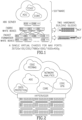
- the solution provided by the present disclosure is one that enables collapsing various network processing elements into a single hardware fabric as demonstrated in FIGs. 1 and 2 .
- Fig. 1 illustrates a schematic example of a network cloud cluster comprising a plurality of white boxes each configured to be used as a Network Cloud Packet forwarder (NCP) that executes traffic forwarding and is further configured to hold data-path features, including FIB tables, access management lists, DDOS attack mitigation, Quality of Service (QoS) classification and VLAN QinQ tagging, and the like.
- NCP white box includes a high-speed packet processor, such as for example Broadcom's Jericho II, and its ports handle traffic at speeds of up to 400Gb/s, with total device capacity of 4Tb/s.
- a single NCP may function as a standalone router, while multiple NCPs can be clustered over a fabric to deliver capacity of hundreds of terabits by a single routing entity.
- an NCP may be designed for carrying out network functionalities such as routing, VPNs, MPLS, and tunneling even in demanding environments such as ISP and CSP core networks.
- the network cloud cluster illustrated on FIG. 1 comprises a plurality of white boxes each configured to be used in a Network Cloud Fabric (NCF) which allows a plurality of NCPs to scale their data-path well beyond the capacity of a single device.
- NCF Network Cloud Fabric
- a plurality of NCF's white boxes can be used for data-path connectivity within a single virtual chassis.
- the fabric comprising white boxes is collapsed according to the solution provided, into a virtual single hardware network cloud fabric, while the plurality of white boxes configured to operate as packets' forwarders, may be collapsed into a virtual single hardware NCP.
- a network cloud can be deployed in a variety of sizes, starting with a standalone 4Tb/s router with dozens of ports (a single NCP), all the way to a gigantic 768Tb/s cluster having thousands of ports.
- the network cloud clusters are generated by connecting NCPs over a fabric (using NCFs).
- FIG. 2 illustrates a schematic view of another example of a unified infrastructure that enables provisioning of any service via any port, construed in accordance with another embodiment of the present invention.
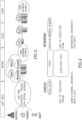
- the example illustrated in FIG. 3 demonstrates an embodiment of the present disclosure showing the provisioning of any service through any port at any scale.
- the solution exemplified in FIG. 3 comprises a number of networks (subsystems) .
- a last mile sub-system in which traffic may be carried for example over an OTN optical network through which traffic is conveyed to/from enterprises and/or mobile users and/or broadband users.
- a metro sub-system in which traffic may be carried for example over an aggregation network such as an IP and/or an MPLS network through which traffic is conveyed to/from the last mile sub-system.
- edge sub-system in which traffic is conveyed to/from the metro sub-system from/to a core network, in which traffic may be carried for example over an IP and/or an MPLS network.
- control and management plains are clearly separated and isolated from the data-plains, and that the network processing resources are intelligently allocated between the network functions that require utilizing network processing resources, in order for these network functions to be implemented.
- state memory e.g., TCAM and counter resources
- state memory parameters are non-linear parameters, they do not allow a paging function to switch between a state of one process to that of another process.
- the allocation function aims to optimize a service on one or more NPUs
- the underlying idea of the present invention aims to optimize a plurality of services on NPUs comprised in a cluster of such elements.
- the present invention is preferably directed to allocate logical (state) processing resources in an intelligent way, thereby enabling individual NPUs that belong to a cluster of NPUs, to operate at a maximal rate, while its memory means is assigned to serve an optimized number of functions.
- paging may preferably be carried out in order to select a relevant subset of NPUs from among the plurality of NPUs included in the cluster, which can serve a given traffic packet and the internal redirection of traffic to these NPUs ( FIG. 5 ) .
- FIG. 6 demonstrates an example of a multi-service platform in which a plurality of services can be provided by a single platform.
- the platform comprising network and computing processing resources that are carried out by utilizing the following entities: Network Cloud Computing elements (NCCs) that are used as computing elements which run a plurality of computing functions.
- NCCs Network Cloud Computing elements
- traffic is being forwarded by network cloud packet forwarders NCP 1 up to NCP N (where N can be for example as high as 192), to the network cloud fabric comprising elements NCF 1 to NCF N (where M can be for example as high as 13).
- NCP 1 up to NCP N where N can be for example as high as 192
- the network cloud fabric comprising elements NCF 1 to NCF N (where M can be for example as high as 13).
- This configuration enables selecting a subset of NPUs from among the plurality of NPUs included in the cluster for carrying out a paging activity.
- FIG. 7 presents a high-level architecture of a network operating system construed in accordance with an embodiment of the present invention.
- the architecture comprises a docker that comprises two managing entities. The first being a cluster manager that comprises hypervisor entity and a processor for determining current availability of processing resources associated with the various network processing elements, and the second being an operation manager that comprises interfaces and a processor for analyzing statistics received.
- FOG. 8 illustrates examples of a network cloud packet forwarder and of a network fabric, both construed in accordance with embodiments of the present invention.
- Unit 800 is a schematic illustration of a network cloud packet forwarder (NCP) and unit 850 is a schematic illustration of a network cloud fabric (NCF).
- NCP network cloud packet forwarder
- NCF network cloud fabric
- Exemplified NCP 800 comprises elements of two white box data path. Each such data path of this embodiment of the present invention, comprises Forwarding Information Base (FIB) 810 and 810', Bidirectional Forwarding Detecting (BFD) elements 820 and 820', Access Control Lists (ACL) 830 and 830' and Netflow processors 840 and 840', which enable collecting IP network traffic as it enters or exits control and management interface 845.
- FIB Forwarding Information Base
- BFD Bidirectional Forwarding Detecting
- ACL Access Control Lists
- Netflow processors 840 and 840' which enable collecting IP network traffic as it enters or exits control and management interface 845.
- processor 805 can determine for example the source and destination of traffic, class of service, and the causes of congestion. These elements enable handling a high load of traffic by dividing/diverting certain tasks to other network processing elements that belong to the same cluster.
- Exemplified NCF 850 comprises elements 860 and 860' of two white boxes that enable conveying traffic in a multicasting mode.
- FIG. 9 demonstrates bandwidth-based paging according to an embodiment construed in accordance with the present invention.
- the FIG. shows the increase in services that can be provided as a function of increasing the internal bandwidth and the number of NCPs.
- the internal bandwidth and the NCP resources enable affecting a paging mechanism, thereby achieving practically full (100%) utilization of these processing resources.
- an addition of one or more NCPs to the cluster adds effectively computing and networking resources for carrying out the plurality of the services, thereby enabling a cost beneficial increase in the network capacity.
- FIG. 10 demonstrates a schematic overview of an implementation of an ISL (Inter Service Link) between different Service Instances.
- This link described in this example is a uni-directional channel between each pair (when needed and provisioned) of instances among the plurality of services, allowing for native and transparent chaining in terms of both control and forwarded traffic.
- recycled ports may be used on the receiving element, namely, virtual ports that enable a packet to start a new cycle of packet processing.
Landscapes
- Engineering & Computer Science (AREA)
- Computer Networks & Wireless Communication (AREA)
- Signal Processing (AREA)
- Data Exchanges In Wide-Area Networks (AREA)
Description
- The present disclosure generally relates to the field of communication systems. More particularly, the present disclosure relates to systems implementing infrastructure for multiservice routing, virtual network function virtualization and software-defined networking.
-
- ACL - Access Control List.
- BFD - Bidirectional Forwarding Detection.
- CE - Customer element.
- CPU - Central processing unit.
- CSP - Content security policy.
- DDOS - Distributed denial-of-service.
- ECMP - Equal-cost multi-path routing.
- FIB - Forwarding Information Base.
- FLOPS - Floating point Operations Per Second (FLOPS, or flop/s). Gbps - Giga bit per second.
- ISL - Inter Service Link.
- ISP - Internet service provider.
- MIPS - Microprocessor without Interlocked Pipelined Stages. MPLS - Multiprotocol Label Switching.
- NCF - Network Cloud Fabric.
- NCP - Network Cloud Packet Forwarder.
- NIF - Network Interface.
- NPU - Network Processing Unit.
- OTN - Optical Transport Network.
- QinQ - refers to Ethernet networking standard IEEE 802.1ad. The technique is also known as provider bridging, Stacked VLANs, or simply QinQ or Q-in-Q. It can be applied by devices that support this standard, to C-tag stacking on C-tag.
- PE - Processing Element.
- QoS - Quality of service.
- TCAM - Ternary Content-Addressable Memory.
- VLAN - Virtual Local Access Network - A network or part of a network that operates separately from the Internet. VLAN is an approach that enables separating between networks operating within the same physical network.
- VPN - Virtual Private Network.
- Typically, multiple network services are provided to customers by using discrete communication devices implemented by means of dedicated routers. There are many reasons for adopting this approach, such as the ability to utilize different operational models that are implemented for various network entities (e.g. core networking, enterprise services, mobility services, best-effort peering and internet services and the like).
- Unfortunately, implementing such a network topology is bound to be subjected to substantial adverse effects both on the CAPES and OPEX of the system, as well as on the ability to improve optimization of power consumed, rack efficiency, and resources' consumption, hence an improved solution to the above difficulties is desired.
- The publication by Jalali Fatemeh et al. "Dynamic Edge Fabric EnvironmenT: Seamless and Automatic Switching Among Resources at the Edge of IoT Network and Cloud" 2019 IEEE International Conference on Edge Computing (Edge), IEEE pp. 77-86, 8.7.2019, describes a network of IoT devices, in which available computational resources and power resources are broadcasted by the various IoT devices, and the system automatically learns where best to execute computational tasks based on real time system status and task requirements.
- The disclosure may be summarized by referring to the appended claims.
- It is an object of the present disclosure to provide a novel network processing element, infrastructure and a method for using it, for hosting and provisioning of a plurality of different services.
- It is another object of the present disclosure to provide a novel network processing element, and a method for hosting and provisioning of a plurality of different services e.g. networking and third party services which benefits from such a model by utilizing state data associated with one or more functions required for carrying out each of the plurality of different services.
- It is another object of the present disclosure to provide a novel network processing element, a system and a method for allocating resources required to carry out a service or a part thereof, based on the availability of these resources in the various network processing elements that belong to a cluster, wherein the allocation of the processing resources is based on state data associated with the different network processing elements, thereby carrying out one or more functions in the provisioning of the requested service by a number of different network processing elements.
- Other objects of the present disclosure will become apparent from the following description.
- The invention is defined by the independent claims.
- According to a first example there is provided a network processing element (e.g. an NPU) for use in a cluster comprising a plurality of network processing elements, wherein said network processing element is characterized in that it is configured to enable provisioning of a plurality of different services for conveying traffic, wherein said network processing element is configured to store state data associated with one or more network functions required for carrying out each of said plurality of different services for conveying traffic, and wherein upon receiving by said network processing element a request for provisioning of a service for conveying traffic, at any port from among the ports associated with said network processing element and irrespective of whether said service can be provided via said receiving port, said network processing element is configured to establish which resources are required for provisioning the required service, and based on state data associated with instantaneous availability of processing resources of the network processing element, to determine if that network processing element may be used for the provisioning of the requested service.
- According to another example, the service or part thereof that is provided by the network processing element, is provided in response to a request for provisioning that service received by another network processing element belonging to the cluster.
- By yet another example, the request for the provisioning of the service that was directed to the other network processing element, is forwarded from the other network processing element to the present network processing element in response to the other network processing element being under congestion.
- In accordance with another example the request for the provisioning of the service that was directed to the other network processing element, is forwarded from that other network processing element to the present network processing element in response to determining that the other network processing element is not provided with means that could have enabled it to provide the required service.
- According to still another example, the network processing element is further configured to receive a request for the provisioning of a service at any one of the ports (e.g. physical or logical ports) associated with that network processing element, irrespective of whether the requested service can be provided via the receiving port. One of the major advantages of this embodiment is that it allows the virtualization of different ports and the use of any physical or logical port in the context of any service, thereby enabling a significant cost reduction, and is essentially equivalent to using virtual machines on top of a physical compute element.
- In accordance with another example of the present disclosure, the network processing element is further configured to store state data associated with a plurality of functions required for the provisioning of a plurality of services.
- By yet another example, the network processing element comprises a non-IP interface configured to implement an Inter Service Link (ISL) through which control and data traffic is forwarded between different network functions over the network fabric as if the network processing elements belonging to the cluster are physically connected there-between. One of the major advantages of this embodiment is that it allows different services to interact with one another as if they were physically connected and at the same time, lowering the total power consumption and inter-service/router delays.
- According to another example, there is provided a method for use by a cluster comprising a plurality of network processing elements, wherein at least two of the network processing elements comprised in the cluster are configured to enable provisioning of a plurality of different services, and wherein each of the plurality of network processing elements is configured to provide a service or part thereof for which a request for the provisioning of that service was received by a network processing element from among the plurality of network processing elements comprised in the cluster, and wherein the method comprises the steps of:
- (i) providing state data associated with a plurality of functions required for carrying out a plurality of different services, and storing respective state data at each of the plurality of network processing elements;
- (ii) receiving, by a network processing element belonging to the plurality of network processing element, a request for provisioning of a service;
- (iii) establishing which resources are required for provisioning that service;
- (iv) determining which one or more of the plurality of network processing elements may be used for the provisioning of the requested service, based on state data associated with instantaneous availability of processing resources of the one or more of the plurality of network processing elements (e.g. by implementing a min-max solution); and
- (v) providing the requested service by one or more of the network processing elements determined in step (iv).
- This example enables optimal resource allocation in an intelligent way - and a very important functionality in multiplexing a plurality of services of a shared infrastructure.
- According to another example, the request for provisioning of the service was received by a first network processing element belonging to the cluster and at least part of the requested service provided was carried out by a second network processing element belonging to the cluster.
- In accordance with another example, the request for the provisioning of the service that was directed to the first network processing element, is forwarded from that first network processing element to the second network processing element in response to the first network processing element being under congestion.
- By yet another example, the request for the provisioning of the service that was directed to the first network processing element, is forwarded from that first network processing element to the second network processing element in response to determining that the first network processing element is not equipped with means that could have enabled it to provide the required service.
- In accordance with another example, the request for the provisioning of a service is received at any one of the ports associated with one of the network processing elements, irrespective of whether that service can be provided via the receiving port.
- According to still another example step (iv) of the method provided, further comprises determining current availability of memory at each of the plurality of network processing elements that belong to the cluster.
- By yet another embodiment step (iv) further comprises a step of following the determination of which one or more of the plurality of network processing elements may be used for the provisioning of the requested service, determining which functions will be carried out by each of the determined one or more of the plurality of network processing elements.
- According to still another example, the method provided further comprising a step of carrying out a paging mechanism for multiplexing a plurality of network functions carried out by a single network entity (e.g. a router, a cluster, a network fabric and the like).
- The term "paging" as used herein throughout the specification and claims is used to denote a memory management scheme by which a computer stores and retrieves data from a secondary storage for https://en.wikipedia.org/wiki/Computer_data_storage - Secondary_storage use in the main memory. In this scheme, the operating system retrieves data from secondary storage in same-size blocks referred to as pages. Paging is a part of virtual memory implementations in operating systems, using secondary storage to let programs exceed the size of available physical memory.
- According to another aspect of the present disclosure, there is provided a system comprising a plurality of network processing elements described hereinabove, wherein that system is configured to provide a plurality of services, where each of these services is provided by using a number of network processing elements selected from among that plurality of network processing elements, while at least two of the selected network processing elements carry out each at least one different task from the one or more tasks carried by the other of the at least two network processing elements.
- The accompanying drawing, which is incorporated herein and constitute a part of this specification, illustrates an embodiment of the disclosure and, together with the description,
-
FIG. 1 illustrates a schematic view of an example of a network cloud cluster comprising various network processing elements that are collapsed into a single hardware, construed in accordance with an embodiment of the present invention; -
FIG. 2 illustrates a schematic view of another example of a unified infrastructure that enables provisioning of any service on any port, construed in accordance with another embodiment of the present invention; -
FIG. 3 demonstrates an embodiment of the present disclosure presenting an example of provisioning of any service through any port at any scale; -
FIG. 4 presents differences between virtualization in computing and networking fields; -
FIG. 5 illustrates over utilization of network processing resources in a cluster comprising a plurality of network processing units; -
FIG. 6 demonstrates an example of a single platform configured to provide a plurality of services; -
FIG. 7 presents a high-level architecture of a network operating system construed in accordance with an embodiment of the present invention; -
FIG. 8 illustrates examples of a network cloud packet forwarder and of a network fabric, both construed in accordance with embodiments of the present invention; and -
FIG. 9 demonstrates bandwidth-based paging according to an embodiment construed in accordance with the present invention. -
FIG. 10 demonstrates an implementation of an Inter Service Link ("ISL") configured to carry control and forwarded traffic between service instances over fabric interfaces. - Some of the specific details and values in the following detailed description refer to certain examples of the disclosure. However, this description is provided only by way of example and is not intended to limit the scope of the invention in any way. As will be appreciated by those skilled in the art, the claimed distributed routing system may be implemented by using other devices that are known in the art per se. The scope of the invention can be summarized by referring to the appended claims.
- Deploying a successful white box-based routing infrastructure in the challenging environment of SP core networks requires a collaboration between multiple providers. The present disclosure enables delivering an overall definition of the architecture as well as its various networking software pieces.
- As discussed above, the solution provided by the present disclosure is one that enables collapsing various network processing elements into a single hardware fabric as demonstrated in
FIGs. 1 and 2 . -
Fig. 1 illustrates a schematic example of a network cloud cluster comprising a plurality of white boxes each configured to be used as a Network Cloud Packet forwarder (NCP) that executes traffic forwarding and is further configured to hold data-path features, including FIB tables, access management lists, DDOS attack mitigation, Quality of Service (QoS) classification and VLAN QinQ tagging, and the like. Typically, an NCP white box includes a high-speed packet processor, such as for example Broadcom's Jericho II, and its ports handle traffic at speeds of up to 400Gb/s, with total device capacity of 4Tb/s. A single NCP may function as a standalone router, while multiple NCPs can be clustered over a fabric to deliver capacity of hundreds of terabits by a single routing entity. - With carrier-grade traffic management and large buffers, an NCP may be designed for carrying out network functionalities such as routing, VPNs, MPLS, and tunneling even in demanding environments such as ISP and CSP core networks.
- In addition, the network cloud cluster illustrated on
FIG. 1 comprises a plurality of white boxes each configured to be used in a Network Cloud Fabric (NCF) which allows a plurality of NCPs to scale their data-path well beyond the capacity of a single device. Depending on the size of a cluster, a plurality of NCF's white boxes can be used for data-path connectivity within a single virtual chassis. In other words, the fabric comprising white boxes is collapsed according to the solution provided, into a virtual single hardware network cloud fabric, while the plurality of white boxes configured to operate as packets' forwarders, may be collapsed into a virtual single hardware NCP. - A network cloud can be deployed in a variety of sizes, starting with a standalone 4Tb/s router with dozens of ports (a single NCP), all the way to a gigantic 768Tb/s cluster having thousands of ports. The network cloud clusters are generated by connecting NCPs over a fabric (using NCFs).
-
FIG. 2 illustrates a schematic view of another example of a unified infrastructure that enables provisioning of any service via any port, construed in accordance with another embodiment of the present invention. - Some efforts were made to allow implementing multiplexing of various network services on the same routers, but none of these efforts were optimized and suitable to tackle operational and technical complexities to achieve a unified solution. Implementations were typically limited to a single function per line-card and port.
- The example illustrated in
FIG. 3 , demonstrates an embodiment of the present disclosure showing the provisioning of any service through any port at any scale. The solution exemplified inFIG. 3 comprises a number of networks (subsystems) . A last mile sub-system in which traffic may be carried for example over an OTN optical network through which traffic is conveyed to/from enterprises and/or mobile users and/or broadband users. Next, there is a metro sub-system in which traffic may be carried for example over an aggregation network such as an IP and/or an MPLS network through which traffic is conveyed to/from the last mile sub-system. - Further, there is an edge sub-system in which traffic is conveyed to/from the metro sub-system from/to a core network, in which traffic may be carried for example over an IP and/or an MPLS network.
- In order to achieve the above-described solution, it is preferred that the control and management plains are clearly separated and isolated from the data-plains, and that the network processing resources are intelligently allocated between the network functions that require utilizing network processing resources, in order for these network functions to be implemented.
- In order to intelligently allocate the network processing resources between the network functions that require utilizing network processing resources, let us consider the differences between virtualization in computing and networking fields.
- Before conducting this comparison, let us first make the following definitions:
- 1. State - the data required for the executing processor (CPU in computing, NPU in networking) algorithm, so that the latter can determine the action to be taken.
- 2. Execution-path - The hardware processing resources and logical entity on which scheduling takes place (Thread in computing, Packet Flow in networking).
- 3. Bandwidth - The number of operations that are carried out per second (MIPS/FLOPS in computing, PPS/Gbps in networking).
- These differences are presented in
FIG. 4 . - As will be appreciated by those skilled in the art, one of the major challenges in virtualizing NPU processing resources is the state memory (e.g., TCAM and counter resources), due to the fact that these state memory parameters are non-linear parameters, they do not allow a paging function to switch between a state of one process to that of another process.
- Thus, since no prior art memory paging can be implemented as part of the solution to the problem which the present invention is facing, the inventors found a solution that overcomes this problem. The solution found by the inventors, is based on trading off memory for bandwidth. In order to implement such a solution a research was conducted and it was surprisingly found that the limiting factor for scaling up an applicable configuration is not the ability to process the traffic packets as would have been expected, but rather to store state data so that it can be made available for many functions that may be carried out while using the same NPU.
- Unlike traditional approaches in which the allocation function aims to optimize a service on one or more NPUs, the underlying idea of the present invention aims to optimize a plurality of services on NPUs comprised in a cluster of such elements.
- Therefore, the present invention is preferably directed to allocate logical (state) processing resources in an intelligent way, thereby enabling individual NPUs that belong to a cluster of NPUs, to operate at a maximal rate, while its memory means is assigned to serve an optimized number of functions.
- Thus, in accordance with a preferred embodiment of the present invention, in case that the memory means of a certain NPU cannot be temporarily utilized due to the fact that it is currently under congestion (load), another NPU from among the NPU's cluster members will be selected for taking over the responsibility for the implementing the required function.
- Nest, paging may preferably be carried out in order to select a relevant subset of NPUs from among the plurality of NPUs included in the cluster, which can serve a given traffic packet and the internal redirection of traffic to these NPUs (
FIG. 5 ) . -
FIG. 6 demonstrates an example of a multi-service platform in which a plurality of services can be provided by a single platform. The platform comprising network and computing processing resources that are carried out by utilizing the following entities: Network Cloud Computing elements (NCCs) that are used as computing elements which run a plurality of computing functions. Then traffic is being forwarded by network cloud packet forwarders NCP1 up to NCPN (where N can be for example as high as 192), to the network cloud fabric comprising elements NCF1 to NCFN (where M can be for example as high as 13). This configuration enables selecting a subset of NPUs from among the plurality of NPUs included in the cluster for carrying out a paging activity. -
FIG. 7 presents a high-level architecture of a network operating system construed in accordance with an embodiment of the present invention. As can be seen in this FIG., the architecture comprises a docker that comprises two managing entities. The first being a cluster manager that comprises hypervisor entity and a processor for determining current availability of processing resources associated with the various network processing elements, and the second being an operation manager that comprises interfaces and a processor for analyzing statistics received. - FOG. 8 illustrates examples of a network cloud packet forwarder and of a network fabric, both construed in accordance with embodiments of the present invention.
Unit 800 is a schematic illustration of a network cloud packet forwarder (NCP) andunit 850 is a schematic illustration of a network cloud fabric (NCF). -
Exemplified NCP 800 comprises elements of two white box data path. Each such data path of this embodiment of the present invention, comprises Forwarding Information Base (FIB) 810 and 810', Bidirectional Forwarding Detecting (BFD)elements 820 and 820', Access Control Lists (ACL) 830 and 830' andNetflow processors 840 and 840', which enable collecting IP network traffic as it enters or exits control andmanagement interface 845. By analyzing the data provided by NetFlow,processor 805 can determine for example the source and destination of traffic, class of service, and the causes of congestion. These elements enable handling a high load of traffic by dividing/diverting certain tasks to other network processing elements that belong to the same cluster. -
Exemplified NCF 850 compriseselements 860 and 860' of two white boxes that enable conveying traffic in a multicasting mode. -
FIG. 9 demonstrates bandwidth-based paging according to an embodiment construed in accordance with the present invention. The FIG., shows the increase in services that can be provided as a function of increasing the internal bandwidth and the number of NCPs. Thus, the internal bandwidth and the NCP resources enable affecting a paging mechanism, thereby achieving practically full (100%) utilization of these processing resources. It should be noted that an addition of one or more NCPs to the cluster, adds effectively computing and networking resources for carrying out the plurality of the services, thereby enabling a cost beneficial increase in the network capacity. -
FIG. 10 demonstrates a schematic overview of an implementation of an ISL (Inter Service Link) between different Service Instances. This link described in this example, is a uni-directional channel between each pair (when needed and provisioned) of instances among the plurality of services, allowing for native and transparent chaining in terms of both control and forwarded traffic. According to an embodiment of the invention, recycled ports may be used on the receiving element, namely, virtual ports that enable a packet to start a new cycle of packet processing. - The present invention has been described using detailed descriptions of embodiments thereof that are provided by way of example and are not intended to limit the scope of the invention in any way. The described embodiments comprise different features, not all of which are required in all embodiments of the invention. Some embodiments of the present invention utilize only some of the features or possible combinations of the features. Variations of embodiments of the present invention that are described and embodiments of the present invention comprising different combinations of features noted in the described embodiments will occur to persons of the art. The scope of the invention is limited only by the following claims.
Claims (14)
- A network processing element for use in a cluster comprising a plurality of network processing elements, wherein said network processing element is configured to:
enable provisioning of a plurality of different services, wherein said network processing element is configured to store state data associated with one or more network functions required for carrying out each of said plurality of different services and wherein upon receiving by said network processing element a request for provisioning of a service at any port from among the ports associated with said network processing element and irrespective of whether said service can be provided via said receiving port, said network processing element is further configured to:
establish which resources are required for provisioning the required service, and based on state data associated with instantaneous availability of processing resources of the network processing element, to determine if said network processing element may be used for the provisioning of the requested service. - The network processing element of claim 1, wherein the service or part thereof provided by said network processing element, is provided in response to a request for the provisioning of said service received by another network processing element belonging to said cluster.
- The network processing element of claim 1, wherein a request for the provisioning of said service that was directed to another network processing element, is forwarded from said other network processing element to said network processing element in response to said other network processing element being under congestion.
- The network processing element of claim 1, wherein the request for the provisioning of said service that was directed to the other network processing element, is forwarded from said other network processing element to said network processing element in response to determining that said other network processing element is not provided with available processing resources that could have enabled said other network processing element to provide the required service.
- The network processing element of claim 1, further configured to store state data associated with a plurality of functions required for the provisioning of a plurality of services.
- The network processing element of claim 1, comprising a non-IP interface configured to implement an Inter Service Link, ISL; through which control and data traffic is forwarded between different network functions over the network fabric as if the network processing elements belonging to the cluster are physically connected there-between.
- A method for use by a cluster comprising a plurality of network processing elements, wherein at least two of the network processing elements comprised in the cluster are configured to enable provisioning of a plurality of different services, and wherein each of the plurality of network processing elements is configured to provide a service or part thereof, for which a request for the provisioning of said service was received by a network processing element from among the plurality of network processing elements comprised in the cluster, and wherein said method comprises the steps of:(i) providing state data associated with a plurality of functions required for carrying out a plurality of different services, and storing respective state data at each of said plurality of network processing elements;(ii) receiving, by a network processing element belonging to said plurality of network processing element, a request for provisioning of a service, wherein said request may be received at any port from among the ports associated with said network processing element, irrespective of whether said service can be provided via said receiving port;(iii) establishing which resources are required for provisioning said required service;(iv) determining based on state data associated with instantaneous availability of processing resources of the network processing elements, which one or more of the plurality of network processing elements may be used for the provisioning of the requested service; and(v) providing the requested service by one or more of the network processing elements determined in step (iv).
- The method of claim 7, wherein the request for provisioning of said service was received by a first network processing element belonging to said cluster and at least part of the requested service provided was carried out by a second network processing element belonging to the cluster.
- The method of claim 8, wherein the request for the provisioning of said service that was directed to the first network processing element, is forwarded from said first network processing element to said second network processing element in response to said first network processing element being under congestion.
- The network processing element of claim 8, wherein the request for the provisioning of said service that was directed to the first network processing element, is forwarded from said first network processing element to said second network processing element in response to determining that said first network processing element is not provided with available processing resources that could have enabled said network processing element to provide the required service.
- The method of claim 7, wherein step (iv) further comprises determining current availability of memory at each of the plurality of network processing elements that belong to said cluster.
- The method of claim 7, wherein step (iv) further comprises a step of following the determination of which one or more of the plurality of network processing elements may be used for the provisioning of the requested service, determining which functions will be carried out by each of the determined one or more of the plurality of network processing elements.
- The method of claim 7, further comprising a step of carrying out a paging mechanism for multiplexing a plurality of network functions carried out by a single network entity.
- A system comprising a cluster comprising a plurality of network processing elements wherein each of said plurality of network processing elements is configured to enable provisioning of a plurality of different services, wherein each of said plurality of network processing elements is configured to store state data associated with one or more network functions required for carrying out each of said plurality of different services, and wherein each of said plurality of network processing elements is further configured that upon receiving a request for provisioning of a service at any port from among the ports associated with said network processing element and irrespective of whether said service can be provided via said receiving port, establishing which resources are required for provisioning the required service, and based on state data associated with instantaneous availability of processing resources of the network processing elements, and determining which of the plurality of network processing elements will be used for the provisioning of the requested service.
Priority Applications (1)
| Application Number | Priority Date | Filing Date | Title |
|---|---|---|---|
| HRP20241542TT HRP20241542T1 (en) | 2020-12-11 | 2021-01-18 | VIRTUALIZATION OF MULTIPLE NETWORK FUNCTIONS IN HIGH-SCALE ROUTING |
Applications Claiming Priority (1)
| Application Number | Priority Date | Filing Date | Title |
|---|---|---|---|
| US17/119,012 US11818230B2 (en) | 2020-12-11 | 2020-12-11 | Virtualization of multiple network functions in high-scale routing |
Publications (2)
| Publication Number | Publication Date |
|---|---|
| EP4012992A1 EP4012992A1 (en) | 2022-06-15 |
| EP4012992B1 true EP4012992B1 (en) | 2024-10-16 |
Family
ID=74186605
Family Applications (1)
| Application Number | Title | Priority Date | Filing Date |
|---|---|---|---|
| EP21152045.7A Active EP4012992B1 (en) | 2020-12-11 | 2021-01-18 | Virtualization of multiple network functions in high-scale routing |
Country Status (10)
| Country | Link |
|---|---|
| US (1) | US11818230B2 (en) |
| EP (1) | EP4012992B1 (en) |
| JP (1) | JP2022093226A (en) |
| DK (1) | DK4012992T3 (en) |
| ES (1) | ES2992492T3 (en) |
| HR (1) | HRP20241542T1 (en) |
| HU (1) | HUE069238T2 (en) |
| IL (1) | IL279976B2 (en) |
| PL (1) | PL4012992T3 (en) |
| PT (1) | PT4012992T (en) |
Families Citing this family (1)
| Publication number | Priority date | Publication date | Assignee | Title |
|---|---|---|---|---|
| CN118921268A (en) * | 2023-05-08 | 2024-11-08 | 锐捷网络股份有限公司 | Decentralised network equipment system, decentralised network construction method and decentralised network construction equipment |
Family Cites Families (8)
| Publication number | Priority date | Publication date | Assignee | Title |
|---|---|---|---|---|
| US7636908B1 (en) * | 2007-06-14 | 2009-12-22 | Xilinx, Inc. | Generation of a specification of a network packet processor |
| US10038629B2 (en) * | 2014-09-11 | 2018-07-31 | Microsoft Technology Licensing, Llc | Virtual machine migration using label based underlay network forwarding |
| US10511485B2 (en) * | 2015-08-11 | 2019-12-17 | At&T Intellectual Property I, L.P. | Dynamic virtual network topology discovery engine |
| US10860374B2 (en) * | 2015-09-26 | 2020-12-08 | Intel Corporation | Real-time local and global datacenter network optimizations based on platform telemetry data |
| US10205636B1 (en) * | 2016-10-05 | 2019-02-12 | Cisco Technology, Inc. | Two-stage network simulation |
| US11036531B2 (en) * | 2017-06-27 | 2021-06-15 | Intel Corporation | Techniques to migrate a virtual machine using disaggregated computing resources |
| US10901805B2 (en) * | 2018-12-18 | 2021-01-26 | At&T Intellectual Property I, L.P. | Distributed load balancing for processing of high-volume data streams |
| US10999766B2 (en) * | 2019-02-26 | 2021-05-04 | Verizon Patent And Licensing Inc. | Method and system for scheduling multi-access edge computing resources |
-
2020
- 2020-12-11 US US17/119,012 patent/US11818230B2/en active Active
-
2021
- 2021-01-06 IL IL279976A patent/IL279976B2/en unknown
- 2021-01-18 PL PL21152045.7T patent/PL4012992T3/en unknown
- 2021-01-18 ES ES21152045T patent/ES2992492T3/en active Active
- 2021-01-18 EP EP21152045.7A patent/EP4012992B1/en active Active
- 2021-01-18 HU HUE21152045A patent/HUE069238T2/en unknown
- 2021-01-18 PT PT211520457T patent/PT4012992T/en unknown
- 2021-01-18 HR HRP20241542TT patent/HRP20241542T1/en unknown
- 2021-01-18 DK DK21152045.7T patent/DK4012992T3/en active
- 2021-02-26 JP JP2021031178A patent/JP2022093226A/en active Pending
Also Published As
| Publication number | Publication date |
|---|---|
| DK4012992T3 (en) | 2024-10-28 |
| IL279976A (en) | 2022-07-01 |
| HRP20241542T1 (en) | 2025-03-28 |
| JP2022093226A (en) | 2022-06-23 |
| US20220191302A1 (en) | 2022-06-16 |
| PT4012992T (en) | 2024-10-31 |
| US11818230B2 (en) | 2023-11-14 |
| HUE069238T2 (en) | 2025-02-28 |
| EP4012992A1 (en) | 2022-06-15 |
| ES2992492T3 (en) | 2024-12-13 |
| IL279976B2 (en) | 2024-12-01 |
| IL279976B1 (en) | 2024-08-01 |
| PL4012992T3 (en) | 2025-03-10 |
Similar Documents
| Publication | Publication Date | Title |
|---|---|---|
| US8767722B2 (en) | Data traffic handling in a distributed fabric protocol (DFP) switching network architecture | |
| US10237379B2 (en) | High-efficiency service chaining with agentless service nodes | |
| US8588224B2 (en) | Priority based flow control in a distributed fabric protocol (DFP) switching network architecture | |
| US8837499B2 (en) | Distributed fabric protocol (DFP) switching network architecture | |
| US9407540B2 (en) | Distributed service chaining in a network environment | |
| US9197549B2 (en) | Server load balancer traffic steering | |
| WO2020232185A1 (en) | Slice-based routing | |
| US9065745B2 (en) | Network traffic distribution | |
| US20190173777A1 (en) | Virtual port channel bounce in overlay network | |
| WO2015077878A1 (en) | Switched path aggregation for data centers | |
| RU2675212C1 (en) | Adaptive load balancing during package processing | |
| US11818230B2 (en) | Virtualization of multiple network functions in high-scale routing | |
| Kannan et al. | Raptor: Scalable rule placement over multiple path in software defined networks | |
| US10218612B2 (en) | Method and a device for defining implementation of a look-up table for a network element of a software-defined network | |
| CN113316769A (en) | Method for using event priority based on rule feedback in network function virtualization | |
| Soni et al. | Scalable guaranteed-bandwidth multicast service in software defined ISP networks | |
| Kuo et al. | SWF: Segmented wildcard forwarding for flow migration in OpenFlow datacenter networks | |
| US20090086754A1 (en) | Content Aware Connection Transport | |
| Cui et al. | SD-HDC: Software-Defined Hybrid Optical/Electrical Data Center Architecture |
Legal Events
| Date | Code | Title | Description |
|---|---|---|---|
| REG | Reference to a national code |
Ref country code: HR Ref legal event code: TUEP Ref document number: P20241542T Country of ref document: HR |
|
| PUAI | Public reference made under article 153(3) epc to a published international application that has entered the european phase |
Free format text: ORIGINAL CODE: 0009012 |
|
| STAA | Information on the status of an ep patent application or granted ep patent |
Free format text: STATUS: THE APPLICATION HAS BEEN PUBLISHED |
|
| AK | Designated contracting states |
Kind code of ref document: A1 Designated state(s): AL AT BE BG CH CY CZ DE DK EE ES FI FR GB GR HR HU IE IS IT LI LT LU LV MC MK MT NL NO PL PT RO RS SE SI SK SM TR |
|
| STAA | Information on the status of an ep patent application or granted ep patent |
Free format text: STATUS: REQUEST FOR EXAMINATION WAS MADE |
|
| 17P | Request for examination filed |
Effective date: 20220824 |
|
| REG | Reference to a national code |
Ref country code: DE Ref legal event code: R079 Free format text: PREVIOUS MAIN CLASS: H04L0012911000 Ipc: H04L0047740000 Ref country code: DE Ref legal event code: R079 Ref document number: 602021020202 Country of ref document: DE Free format text: PREVIOUS MAIN CLASS: H04L0012911000 Ipc: H04L0047740000 |
|
| GRAP | Despatch of communication of intention to grant a patent |
Free format text: ORIGINAL CODE: EPIDOSNIGR1 |
|
| RIC1 | Information provided on ipc code assigned before grant |
Ipc: H04L 47/70 20220101ALI20240430BHEP Ipc: H04L 47/78 20220101ALI20240430BHEP Ipc: H04L 47/74 20220101AFI20240430BHEP |
|
| STAA | Information on the status of an ep patent application or granted ep patent |
Free format text: STATUS: GRANT OF PATENT IS INTENDED |
|
| INTG | Intention to grant announced |
Effective date: 20240606 |
|
| P01 | Opt-out of the competence of the unified patent court (upc) registered |
Free format text: CASE NUMBER: APP_36663/2024 Effective date: 20240619 |
|
| GRAS | Grant fee paid |
Free format text: ORIGINAL CODE: EPIDOSNIGR3 |
|
| GRAA | (expected) grant |
Free format text: ORIGINAL CODE: 0009210 |
|
| STAA | Information on the status of an ep patent application or granted ep patent |
Free format text: STATUS: THE PATENT HAS BEEN GRANTED |
|
| AK | Designated contracting states |
Kind code of ref document: B1 Designated state(s): AL AT BE BG CH CY CZ DE DK EE ES FI FR GB GR HR HU IE IS IT LI LT LU LV MC MK MT NL NO PL PT RO RS SE SI SK SM TR |
|
| REG | Reference to a national code |
Ref country code: GB Ref legal event code: FG4D |
|
| REG | Reference to a national code |
Ref country code: DK Ref legal event code: T3 Effective date: 20241023 |
|
| REG | Reference to a national code |
Ref country code: NL Ref legal event code: FP |
|
| REG | Reference to a national code |
Ref country code: PT Ref legal event code: SC4A Ref document number: 4012992 Country of ref document: PT Date of ref document: 20241031 Kind code of ref document: T Free format text: AVAILABILITY OF NATIONAL TRANSLATION Effective date: 20241028 Ref country code: DE Ref legal event code: R096 Ref document number: 602021020202 Country of ref document: DE Ref country code: CH Ref legal event code: EP |
|
| REG | Reference to a national code |
Ref country code: IE Ref legal event code: FG4D |
|
| REG | Reference to a national code |
Ref country code: ES Ref legal event code: FG2A Ref document number: 2992492 Country of ref document: ES Kind code of ref document: T3 Effective date: 20241213 |
|
| REG | Reference to a national code |
Ref country code: GR Ref legal event code: EP Ref document number: 20240402697 Country of ref document: GR Effective date: 20241209 |
|
| REG | Reference to a national code |
Ref country code: SE Ref legal event code: TRGR |
|
| REG | Reference to a national code |
Ref country code: SK Ref legal event code: T3 Ref document number: E 45471 Country of ref document: SK |
|
| REG | Reference to a national code |
Ref country code: LT Ref legal event code: MG9D |
|
| REG | Reference to a national code |
Ref country code: HR Ref legal event code: ODRP Ref document number: P20241542T Country of ref document: HR Payment date: 20250107 Year of fee payment: 5 |
|
| REG | Reference to a national code |
Ref country code: HU Ref legal event code: AG4A Ref document number: E069238 Country of ref document: HU |
|
| REG | Reference to a national code |
Ref country code: HR Ref legal event code: T1PR Ref document number: P20241542 Country of ref document: HR |
|
| PG25 | Lapsed in a contracting state [announced via postgrant information from national office to epo] |
Ref country code: IS Free format text: LAPSE BECAUSE OF FAILURE TO SUBMIT A TRANSLATION OF THE DESCRIPTION OR TO PAY THE FEE WITHIN THE PRESCRIBED TIME-LIMIT Effective date: 20250216 |
|
| PG25 | Lapsed in a contracting state [announced via postgrant information from national office to epo] |
Ref country code: FI Free format text: LAPSE BECAUSE OF FAILURE TO SUBMIT A TRANSLATION OF THE DESCRIPTION OR TO PAY THE FEE WITHIN THE PRESCRIBED TIME-LIMIT Effective date: 20241016 |
|
| PG25 | Lapsed in a contracting state [announced via postgrant information from national office to epo] |
Ref country code: BG Free format text: LAPSE BECAUSE OF FAILURE TO SUBMIT A TRANSLATION OF THE DESCRIPTION OR TO PAY THE FEE WITHIN THE PRESCRIBED TIME-LIMIT Effective date: 20241016 |
|
| PG25 | Lapsed in a contracting state [announced via postgrant information from national office to epo] |
Ref country code: NO Free format text: LAPSE BECAUSE OF FAILURE TO SUBMIT A TRANSLATION OF THE DESCRIPTION OR TO PAY THE FEE WITHIN THE PRESCRIBED TIME-LIMIT Effective date: 20250116 |
|
| PG25 | Lapsed in a contracting state [announced via postgrant information from national office to epo] |
Ref country code: LV Free format text: LAPSE BECAUSE OF FAILURE TO SUBMIT A TRANSLATION OF THE DESCRIPTION OR TO PAY THE FEE WITHIN THE PRESCRIBED TIME-LIMIT Effective date: 20241016 |
|
| PG25 | Lapsed in a contracting state [announced via postgrant information from national office to epo] |
Ref country code: RS Free format text: LAPSE BECAUSE OF FAILURE TO SUBMIT A TRANSLATION OF THE DESCRIPTION OR TO PAY THE FEE WITHIN THE PRESCRIBED TIME-LIMIT Effective date: 20250116 |
|
| PG25 | Lapsed in a contracting state [announced via postgrant information from national office to epo] |
Ref country code: SM Free format text: LAPSE BECAUSE OF FAILURE TO SUBMIT A TRANSLATION OF THE DESCRIPTION OR TO PAY THE FEE WITHIN THE PRESCRIBED TIME-LIMIT Effective date: 20241016 |
|
| REG | Reference to a national code |
Ref country code: DE Ref legal event code: R097 Ref document number: 602021020202 Country of ref document: DE |
|
| PG25 | Lapsed in a contracting state [announced via postgrant information from national office to epo] |
Ref country code: EE Free format text: LAPSE BECAUSE OF FAILURE TO SUBMIT A TRANSLATION OF THE DESCRIPTION OR TO PAY THE FEE WITHIN THE PRESCRIBED TIME-LIMIT Effective date: 20241016 |
|
| PLBE | No opposition filed within time limit |
Free format text: ORIGINAL CODE: 0009261 |
|
| STAA | Information on the status of an ep patent application or granted ep patent |
Free format text: STATUS: NO OPPOSITION FILED WITHIN TIME LIMIT |
|
| REG | Reference to a national code |
Ref country code: CH Ref legal event code: PL |
|
| PG25 | Lapsed in a contracting state [announced via postgrant information from national office to epo] |
Ref country code: MC Free format text: LAPSE BECAUSE OF FAILURE TO SUBMIT A TRANSLATION OF THE DESCRIPTION OR TO PAY THE FEE WITHIN THE PRESCRIBED TIME-LIMIT Effective date: 20241016 Ref country code: LU Free format text: LAPSE BECAUSE OF NON-PAYMENT OF DUE FEES Effective date: 20250118 |
|
| 26N | No opposition filed |
Effective date: 20250717 |
|
| PG25 | Lapsed in a contracting state [announced via postgrant information from national office to epo] |
Ref country code: CH Free format text: LAPSE BECAUSE OF NON-PAYMENT OF DUE FEES Effective date: 20250131 |
|
| REG | Reference to a national code |
Ref country code: AT Ref legal event code: UEP Ref document number: 1733856 Country of ref document: AT Kind code of ref document: T Effective date: 20241016 |
|
| PGFP | Annual fee paid to national office [announced via postgrant information from national office to epo] |
Ref country code: GB Payment date: 20251220 Year of fee payment: 6 |
|
| PGFP | Annual fee paid to national office [announced via postgrant information from national office to epo] |
Ref country code: PT Payment date: 20251218 Year of fee payment: 6 |
|
| PGFP | Annual fee paid to national office [announced via postgrant information from national office to epo] |
Ref country code: DK Payment date: 20251217 Year of fee payment: 6 |
|
| PGFP | Annual fee paid to national office [announced via postgrant information from national office to epo] |
Ref country code: NL Payment date: 20251217 Year of fee payment: 6 Ref country code: FR Payment date: 20251217 Year of fee payment: 6 |
|
| PGFP | Annual fee paid to national office [announced via postgrant information from national office to epo] |
Ref country code: GR Payment date: 20251218 Year of fee payment: 6 Ref country code: BE Payment date: 20251217 Year of fee payment: 6 |
|
| PGFP | Annual fee paid to national office [announced via postgrant information from national office to epo] |
Ref country code: SE Payment date: 20251217 Year of fee payment: 6 |
|
| PGFP | Annual fee paid to national office [announced via postgrant information from national office to epo] |
Ref country code: CZ Payment date: 20251230 Year of fee payment: 6 Ref country code: IE Payment date: 20251218 Year of fee payment: 6 |
|
| PGFP | Annual fee paid to national office [announced via postgrant information from national office to epo] |
Ref country code: PL Payment date: 20251223 Year of fee payment: 6 |
|
| PGFP | Annual fee paid to national office [announced via postgrant information from national office to epo] |
Ref country code: SK Payment date: 20251223 Year of fee payment: 6 |
|
| REG | Reference to a national code |
Ref country code: HR Ref legal event code: ODRP Ref document number: P20241542 Country of ref document: HR Payment date: 20260112 Year of fee payment: 6 |
|
| PGFP | Annual fee paid to national office [announced via postgrant information from national office to epo] |
Ref country code: HU Payment date: 20260119 Year of fee payment: 6 |
|
| PGFP | Annual fee paid to national office [announced via postgrant information from national office to epo] |
Ref country code: ES Payment date: 20260202 Year of fee payment: 6 |
|
| PGFP | Annual fee paid to national office [announced via postgrant information from national office to epo] |
Ref country code: DE Payment date: 20251217 Year of fee payment: 6 |
|
| PGFP | Annual fee paid to national office [announced via postgrant information from national office to epo] |
Ref country code: HR Payment date: 20260112 Year of fee payment: 6 Ref country code: AT Payment date: 20251218 Year of fee payment: 6 |
|
| PGFP | Annual fee paid to national office [announced via postgrant information from national office to epo] |
Ref country code: RO Payment date: 20260112 Year of fee payment: 6 Ref country code: IT Payment date: 20260107 Year of fee payment: 6 |