EP4012462A1 - Object detecting device, object detecting method, and storage medium - Google Patents
Object detecting device, object detecting method, and storage medium Download PDFInfo
- Publication number
- EP4012462A1 EP4012462A1 EP21213476.1A EP21213476A EP4012462A1 EP 4012462 A1 EP4012462 A1 EP 4012462A1 EP 21213476 A EP21213476 A EP 21213476A EP 4012462 A1 EP4012462 A1 EP 4012462A1
- Authority
- EP
- European Patent Office
- Prior art keywords
- detected object
- detection signal
- target substance
- signal quantity
- index parameter
- Prior art date
- Legal status (The legal status is an assumption and is not a legal conclusion. Google has not performed a legal analysis and makes no representation as to the accuracy of the status listed.)
- Granted
Links
Images


Classifications
-
- G—PHYSICS
- G01—MEASURING; TESTING
- G01V—GEOPHYSICS; GRAVITATIONAL MEASUREMENTS; DETECTING MASSES OR OBJECTS; TAGS
- G01V5/00—Prospecting or detecting by the use of ionising radiation, e.g. of natural or induced radioactivity
- G01V5/20—Detecting prohibited goods, e.g. weapons, explosives, hazardous substances, contraband or smuggled objects
- G01V5/22—Active interrogation, i.e. by irradiating objects or goods using external radiation sources, e.g. using gamma rays or cosmic rays
- G01V5/232—Active interrogation, i.e. by irradiating objects or goods using external radiation sources, e.g. using gamma rays or cosmic rays having relative motion between the source, detector and object other than by conveyor
-
- G—PHYSICS
- G01—MEASURING; TESTING
- G01V—GEOPHYSICS; GRAVITATIONAL MEASUREMENTS; DETECTING MASSES OR OBJECTS; TAGS
- G01V5/00—Prospecting or detecting by the use of ionising radiation, e.g. of natural or induced radioactivity
- G01V5/20—Detecting prohibited goods, e.g. weapons, explosives, hazardous substances, contraband or smuggled objects
- G01V5/22—Active interrogation, i.e. by irradiating objects or goods using external radiation sources, e.g. using gamma rays or cosmic rays
-
- G—PHYSICS
- G01—MEASURING; TESTING
- G01V—GEOPHYSICS; GRAVITATIONAL MEASUREMENTS; DETECTING MASSES OR OBJECTS; TAGS
- G01V5/00—Prospecting or detecting by the use of ionising radiation, e.g. of natural or induced radioactivity
- G01V5/20—Detecting prohibited goods, e.g. weapons, explosives, hazardous substances, contraband or smuggled objects
- G01V5/22—Active interrogation, i.e. by irradiating objects or goods using external radiation sources, e.g. using gamma rays or cosmic rays
- G01V5/234—Measuring induced radiation, e.g. thermal neutron activation analysis
Definitions
- the embodiments of the present disclosure relate to a field of a security inspection, in particular to an object detecting device, an object detecting method, and a storage medium.
- the security inspection may include detecting whether explosives, drugs and other prohibited objects exist in the object or not.
- An existing object detecting method such as an imaging method, a mass spectrometry method, etc., may be implemented to accurately detect whether the object contains a prohibited object, but cannot determine a spatial position of the prohibited object in the object, and thus fail to provide a powerful clue for a further inspection.
- an object detecting device an object detecting method, and a storage medium.
- an object detecting device including: a neutron source configured to release a neutron to a detected object, so that a neutron induced nuclear reaction occurs between the neutron and the detected object and a gamma ray is generated; a detector configured to receive the gamma ray and analyze the gamma ray, so as to obtain a detection signal quantity corresponding to the gamma ray; a rotating component configured to carry the detected object and rotate the detected object relative to the neutron source and the detector; and a processor configured to: control the rotating component to rotate the detected object from an initial angle to at least M predetermined angles in sequence, where M is an integer greater than or equal to 2; acquire at least M detection signal quantities respectively corresponding to the M predetermined angles; and determine an angular orientation of a suspected target substance in the detected object based on the M detection signal quantities and a preset reference signal quantity.
- the determining an angular orientation of a suspected target substance in the detected object based on the M detection signal quantities and a preset reference signal quantity includes: acquiring M reference signal quantities respectively corresponding to the M predetermined angles, wherein the reference signal quantity is pre-obtained by detecting a reference object not containing a target substance; determining an index parameter value for each predetermined angle of the M predetermined angles based on a detection signal quantity and the reference signal quantity, wherein the index parameter value indicates a ratio of an increment of the detection signal quantity relative to the reference signal quantity to a measurement noise; and determining the angular orientation of the suspected target substance in the detected object based on the respective index parameter values of the M predetermined angles.
- the detector is further configured to analyze the received gamma ray so as to obtain a gamma energy spectrum; the processor is further configured to: acquire the gamma energy spectrum from the detector; and determine a type of a target element contained in the detected object based on the gamma energy spectrum, the target element being used to determine a type of the suspected target substance.
- the detector includes N sub-detectors arranged in a height direction of the object detecting device, and the N sub-detectors respectively correspond to N predetermined heights, where N is an integer greater than or equal to 2; the processor is further configured to: acquire N detection signal quantities respectively corresponding to the N predetermined heights; and determine a height position of the suspected target substance in the detected object based on the N detection signal quantities.
- the controlling the rotating component to rotate the detected object from an initial angle to at least M predetermined angles in sequence; and acquiring at least M detection signal quantities respectively corresponding to the M predetermined angles includes: acquiring an initial detection signal quantity when the detected object is at the initial angle; and controlling the rotating component to rotate the detected object by 180° from the initial angle, and acquiring the detection signal quantity when the detected object is at 180°.
- the controlling the rotating component to rotate the detected object from an initial angle to at least M predetermined angles in sequence; and acquiring at least M detection signal quantities respectively corresponding to the M predetermined angles includes: controlling the rotating component to rotate the detected object at a constant speed by 360° from the initial angle, and the detected object being rotated to a predetermined angle every predetermined period of time and a detection signal quantity at the predetermined angle being acquired during a rotation of the detected object, where M is an integer greater than or equal to 2.
- the processor is further configured to: acquire an initial detection signal quantity when the detected object is at the initial angle; determine an initial index parameter value based on the initial detection signal quantity and a preset reference signal quantity, the initial index parameter value being used to indicate a probability that the detected object contains the target element; and determine, based on the initial index parameter value, whether to control to rotate the detected object.
- the processor is further configured to: determine a content range of the suspected target substance based on an index parameter value exceeding a preset threshold in the M index parameter values and a preset mass estimation information, wherein the mass estimation information includes a corresponding relationship between the index parameter value and the content range.
- the determining a type of a target substance contained in the detected object based on the gamma energy spectrum includes: determining an existence probability of each target element of a plurality of target elements based on a characteristic peak in the gamma energy spectrum; and determining the type of the target substance contained in the detected object based on the existence probability of each target element.
- an object detecting method performed by the object detecting device described above, including: releasing a neutron to a detected object by using a neutron source, so that a neutron induced nuclear reaction occurs between the neutron and the detected object and a gamma ray is generated; controlling a rotating component to rotate the detected object from an initial angle to at least M predetermined angles in sequence; acquiring at least M detection signal quantities respectively corresponding to the M predetermined angles, the detection signal quantity being obtained by analyzing the gamma ray received by the detector, where M is an integer greater than or equal to 2; and determining an angular orientation of a suspected target substance in the detected object based on the M detection signal quantities and a preset reference signal quantity.
- the determining an angular orientation of a suspected target substance in the detected object based on the M detection signal quantities and a preset reference signal quantity includes: acquiring M reference signal quantities respectively corresponding to the M predetermined angles, the reference signal quantity being pre-obtained by detecting a reference object not containing a target substance; determining an index parameter value for each predetermined angle of the M predetermined angles based on a detection signal quantity and the reference signal quantity, wherein the index parameter value indicates a ratio of an increment of the detection signal quantity relative to the reference signal quantity to a measurement noise; and determining the angular orientation of the suspected target substance in the detected object based on the respective index parameter values of the M predetermined angles.
- the object detecting method further includes: acquiring a gamma energy spectrum, the gamma energy spectrum being obtained by analyzing the gamma ray received by the detector; and determining a type of a target element contained in the detected object based on the gamma energy spectrum, the type of the target element being used to determine a type of the suspected target substance.
- the object detecting method further includes: acquiring N detection signal quantities respectively corresponding to N predetermined heights, the N detection signal quantities being respectively acquired by N sub-detectors of the detector arranged in a height direction, where N is an integer greater than or equal to 2; and determining a height position of the suspected target substance in the detected object based on the N detection signal quantities.
- the controlling the rotating component to rotate the detected object from an initial angle to at least M predetermined angles in sequence; and acquiring at least M detection signal quantities respectively corresponding to the M predetermined angles includes: acquiring an initial detection signal quantity when the detected object is at the initial angle; and controlling the rotating component to rotate the detected object by 180° from the initial angle, and acquiring the detection signal quantity when the detected object is at 180°.
- the controlling the rotating component to rotate the detected object from an initial angle to at least M predetermined angles in sequence; and acquiring at least M detection signal quantities respectively corresponding to the M predetermined angles includes: controlling the rotating component to rotate the detected object at a constant speed by 360° from the initial angle, the detected object being rotated to a predetermined angle every predetermined period of time and a detection signal quantity at the predetermined angle being acquired during a rotation of the detected object, where M is an integer greater than or equal to 2.
- the object detecting method further includes: acquiring an initial detection signal quantity when the detected object is at the initial angle; determining an initial index parameter value based on the initial detection signal quantity and a preset reference signal quantity, the initial index parameter value being used to indicate a probability that the detected object contains the target element; and determining, based on the initial index parameter value, whether to control to rotate the detected object.
- the object detecting method further includes: determining a content range of the suspected target substance based on an index parameter value exceeding a preset threshold in the M index parameter values and a preset mass estimation information, wherein the mass estimation information includes a corresponding relationship between the index parameter value and the content range.
- the determining a type of a target substance contained in the detected object based on the gamma energy spectrum includes: determining an existence probability of each target element of a plurality of target elements based on a characteristic peak in the gamma energy spectrum; and determining the type of the target substance contained in the detected object based on the existence probability of each target element.
- a computer-readable storage medium having executable instructions stored thereon, and the instructions, when executed by a processor, cause the processor to implement the object detecting method described in any of the above embodiments.
- the neutron is used to react with the target substance (such as drugs, explosives, etc.) in the detected object to generate a gamma ray, and the detected object is controlled to rotate so that the signal quantity of the ray at some angles (or angle intervals) may be detected during the rotation, and then the angular orientation of the target substance in the detected object may be determined according to a magnitude of the signal quantity at each angle, so as to provide an object search clue for a further inspection.
- a non-destructive detection is performed by using the neutron, which may not cause damage to the inspected object and may meet a requirement of food safety.
- references to "one embodiment,” “an embodiment,” “one example,” or “an example” mean that a specific feature, structure, or characteristic described in conjunction with the embodiment or example is included in at least one embodiment of the present disclosure. Therefore, the phrases “in one embodiment”, “in an embodiment”, “one example” or “an example” appearing in various places throughout the specification do not necessarily refer to the same embodiment or example. Further, specific features, structures or characteristics may be combined in one or more embodiments or examples in any suitable combination and/or sub-combination. In addition, those of ordinary skilled in the art should understand that the term “and/or” as used here includes any and all combinations of one or more related listed items.
- the embodiments of the present disclosure propose an object detecting device, an object detecting method, and a storage medium.
- the object detecting device may include a neutron source, a detector, a rotating component, and a processor.
- the neutron source is configured to release a neutron to a detected object, so that a neutron induced nuclear reaction occurs between the neutron and the detected object and a gamma ray is generated.
- the detector is configured to receive the gamma ray and analyze the gamma ray so as to obtain a detection signal quantity corresponding to the gamma ray.
- the rotating component is configured to carry the detected object and rotate the detected object with respect to the neutron source and the detector.
- the processor is configured to: control the rotating component to rotate the detected object from an initial angle to at least M predetermined angles in sequence; acquire at least M detection signal quantities respectively corresponding to the M predetermined angles, wherein M is an integer greater than or equal to 2; and determine an angular orientation of a suspected target substance in the detected object based on the M detection signal quantities and a preset reference signal quantity.
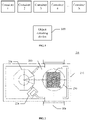
- FIG. 1 schematically shows an application scenario of an object detecting device and an object detecting method according to the embodiments of the present disclosure. It should be noted that FIG. 1 only shows an example of the application scenario in which the embodiments of the present disclosure may be applied so as to help those skilled in the art understand technical contents of the present disclosure. It does not mean that the embodiments of the present disclosure may not be used for other apparatuses, systems, environments or scenes.
- an object detecting device 100 may, for example, detect a batch of containers (container 1 to container N) in sequence.
- One container may be placed in the object detecting device 100 at a time, and after a detection is performed, a next container may be placed.
- the container may contain, for example, a tray of fruits, that is, a tray is placed in the container, and a plurality of corrugated boxes containing fruits are stacked on the tray.
- a target substance may be, for example, explosives and drugs. After the container is placed into the object detecting device 100, the object detecting device 100 may detect whether explosives and drugs are hidden in the container.
- the neutron source in the object detecting device 100 may be used to release a neutron to the container.
- a neutron induced nuclear reaction may occur between the neutron and a substance contained in the container, and a ⁇ (gamma) ray may be generated.
- the detector may receive and measure the ⁇ ray so as to obtain a ⁇ energy spectrum. Because the ⁇ energy spectrum produced by a nuclear reaction corresponds to a type of an element involved in the reaction, a characteristic element in the object may be accurately identified through the ⁇ energy spectrum.
- the type of the suspected target substance may be further determined by other means, such as an unpacking inspection.
- the object detecting device 100 of the embodiments of the present disclosure may not only detect whether the suspected target substance is hidden in the container, but may also determine an angular orientation of the suspected target substance in the container, so as to provide a search clue for a further unpacking inspection.
- the rotating component of the object detecting device 100 may be used to control a rotation of the container with respect to the neutron source and the detector. During the rotation, a signal quantity of gamma rays measured at different rotation angles may be detected. The signal quantity may refer to a count rate. Then, the orientation of the suspected target substance in the container may be determined according to the detection signal quantity at each angle and a magnitude of a reference signal quantity at the angle.
- the reference signal quantity may be obtained by detecting a reference object that does not contain the target substance. For example, an angle at which the detected signal quantity has the greatest relative increment with respect to the reference signal quantity may be determined as the angular orientation of the suspected target substance in the container. If a determined angle is 90°, the angular orientation of the suspected target substance is an orientation rotated away from a starting angle by about 90°.
- the object detecting device and the object detecting method in the embodiments of the present disclosure may be not only implemented to detect the container, but also implemented to detect a luggage box, a package and other objects in airports, stations, ports, post offices, logistics checkpoints, and other public places.
- FIG. 2 schematically shows a top view structural diagram of the object detecting device according to the embodiments of the present disclosure.
- an object detecting device 200 may include a neutron source 210, a detector 220, a rotating component 230, and a processor (not shown).
- the neutron source 210 is configured to release a neutron to a detected object A, so that a neutron induced nuclear reaction occurs between the neutron and the detected object A and a gamma ray is generated.
- a nuclear reaction equation for a reaction of a neutron with a substance may include, for example, Equation (1) or Equation (2).
- Equation (1) Equation (2).
- n represents a neutron
- X represents a substance contained in the detected object
- A represents the number of nucleons of the substance X
- Z represents the number of protons of the substance X
- ⁇ represents the gamma ray
- n' represents a neutron after an energy change.
- Some elements are easy to react with a neutron. These elements may be called sensitive elements.
- a substance containing these sensitive elements such as explosives and drugs, may be called a neutron-detection-sensitive substance, or a special substance.
- Whether an element is sensitive to a neutron is related to a cross section of the element. C element and O element have a small cross section, and a neutron is not easy to react with them.
- Cl element and N element have a large cross section, and a neutron is easy to react with them.
- the detector 220 is configured to receive the gamma ray and analyze the gamma ray so as to obtain a detection signal quantity corresponding to the gamma ray.
- the detector 220 may be a high-purity germanium spectrometer, which may measure an information such as a gamma energy spectrum corresponding to the gamma ray.
- the energy spectrum contains a count rate information, and the signal quantity may refer to, for example, a count rate.
- a magnitude of the detection signal quantity is related to a type of element.
- the reaction between the Cl element and the neutron may generate relatively more gamma rays, so that a relatively large magnitude of signal quantity may be detected, while the reaction between the C element and the neutron may generate relatively less gamma rays, so that a relatively small magnitude of signal quantity may be detected.
- the signal quantity is further related to a position of the element in the detected object.
- Cl element is located on a side of the detected object close to the neutron source and the detector, there is not too much barrier material between the Cl element and the neutron source, and the neutron released by the neutron source may impact the Cl element with a large flux, so that relatively more gamma rays may be generated, and a relatively large magnitude of signal quantity may be detected.
- the neutron needs to pass through a thick barrier material to reach the Cl element, and when the neutron passes through the barrier material, the flux may be greatly reduced.
- the generated ⁇ ray also needs to pass through a thick barrier material to reach the detector, so that a relatively small magnitude of signal quantity may be detected.
- the rotating component 230 is configured to carry the detected object A and rotate the detected object A relative to the neutron source 210 and the detector 220.
- the rotating component 230 may be a turntable rotatable around its own central axis, and the detected object A may be placed at a central position of the rotating component 230.
- the neutron source 210 and the detector 220 may be fixed relative to a housing 240 of the object detecting device 200.
- the housing 240 may be, for example, a shielding wall with a shielding effect.
- the object detecting device may be further provided with a protective door 250 connected to the housing 240.
- the protective door 250 and the housing 240 may enclose a detection chamber 260, and the rotating component 230 is located in the detection chamber 260.
- the rotating component 230 may rotate, for example, at least 360°, that is, it may drive the detected object A to rotate for at least one cycle, so that all orientations of the detected object A may be detected.
- the processor is configured to: control the rotating component to rotate the detected object from an initial angle to at least M predetermined angles in sequence; acquire at least M detection signal quantities corresponding to the M predetermined angles, where M is an integer greater than or equal to 2; and determine an angular orientation (also known as an azimuth angle) of a suspected target substance in the detected object based on the M detection signal quantities and a preset reference signal quantity.
- a specific mark of the detected object A may face the detector 220, and an angle when the specific mark of the detected object A faces the detector 220 may be determined as the initial angle.
- the initial angle may be marked as, for example, 0°
- the M predetermined angles may be, for example, several angles evenly distributed in a range of 0° - 360°, which may include, for example, 0°, 60°, 120°, 180°, 240° and 300°.
- the rotating component 230 may be controlled to rotate the detected object A from the initial angle to the at least M predetermined angles in sequence, and the signal quantity at each predetermined angle may be detected using the detector 220, so as to obtain the detection signal quantity corresponding to each predetermined angle.
- each predetermined angle may also represent an angle range.
- 60° may represent an interval [30° - 90°]
- 180° may represent an interval [150° - 210°].
- the detector 220 may measure the detection signal quantity corresponding to several angle intervals.
- the angular orientation of the suspected target substance in the detected object A may be determined according to the M detection signal quantities corresponding to the M predetermined angles and the preset reference signal quantity. Since the detected object is not isotropic, a reference object that does not contain the target substance may be pre-detected to obtain the reference signal quantity at each predetermined angle. Then, in the detection of the detected object, a result of a comparison between the detection signal quantity and the reference signal quantity at the corresponding angle may be used as a condition for determining the azimuth angle of the target substance. For example, the predetermined angle at which the detection signal quantity has the most significant increment relative to the reference signal quantity may be determined as the azimuth angle of the suspected target substance in the detected object A.
- the neutron is used to react with the target substance (such as drugs, explosives, etc.) in the detected object to generate a gamma ray, and the detected object is controlled to rotate so that the signal quantity of the ray at some angles (or angle intervals) may be detected during the rotation, and then the angular orientation of the target substance in the detected object may be determined according to the detection signal quantity at each angle and the reference signal quantity, so as to provide an object search clue for a further inspection.
- a non-destructive detection is performed by using the neutron, which may not cause damage to the detected object and may meet a requirement of food safety.
- the determining the angular orientation of the suspected target substance in the detected object based on the M detection signal quantities and the preset reference signal quantity may include: acquiring M reference signal quantities corresponding to the M predetermined angles respectively, wherein the reference signal quantity is pre-obtained by detecting the reference object not containing the target substance; determining an index parameter value for each predetermined angle of the M predetermined angles based on the detection signal quantity and the reference signal quantity, wherein the index parameter value indicates a ratio of an increment of the detection signal quantity relative to the reference signal quantity to a measurement noise; and determining the angular orientation of the suspected target substance in the detected object based on the respective index parameter values of the M predetermined angles.
- the reference signal quantity may be pre-obtained by detecting a reference object that does not contain the target substance and that has the same specification and similar content as the detected object A.
- a significance of a change of the detection signal quantity relative to the reference signal quantity may be used as a criterion for the orientation of the suspected target substance.
- the reference signal quantity corresponding to the reference object is N 0
- the detection signal quantity corresponding to the detected object A is N 1 .
- a change of the k value may be monitored in real time. If the k value exceeds a preset threshold (for example, 1.5) when the detected object is rotated to an angle, it may be initially determined that the detected object contains the target substance, then the apparatus may control an alarm device to issue an alarm information to prompt the staff. On the contrary, if the k value is always below the preset threshold after the detected object rotates for a cycle, it may be initially determined that the detected object does not contain the target substance and there is no need to alarm.
- a preset threshold for example, 1.5
- the index parameter value corresponding to each predetermined angle may be obtained, and then the azimuth angle of the suspected target substance in the detected object may be determined according to the M index parameter values. For example, an angle corresponding to a greatest index parameter value of the M index parameter values may be selected as the azimuth angle of the suspected target substance in the detected object A.
- a relationship curve between the M predetermined angles and the M index parameter values may be drawn, and an angle corresponding to a peak of the index parameter in the relationship curve may be determined as the azimuth angle of the suspected target substance in the detected object A.
- FIG. 3 schematically shows a graph of a relationship between the angle and the index parameter value according to the embodiments of the present disclosure.
- a relationship curve 301 is drawn by using a plurality of angles (0° ,60° , 120° , 180° , 240° , 300° ) and the index parameter value corresponding to each angle.
- a peak 302 of the index parameter in the curve 301 and an angle 303 corresponding to the peak 302 may be found through an algorithm, and the angle 303 may be determined as the angle of the suspected target substance in the detected object, or an angle interval in which the angle 303 is located may be determined as an angle range of the suspected target substance in the detected object.
- the significance of the increment of the detection signal quantity relative to the reference signal quantity may be used as the criterion for the orientation of the suspected target substance, which is simple to calculate and may improve an accuracy of determination.
- the index parameter value may also be expressed as an incremental percentage of the detection signal quantity relative to the reference signal quantity.
- the detector is further configured to obtain a gamma spectrum by analyzing the received gamma ray.
- the processor is further configured to: obtain the gamma spectrum from the detector; and determine a type of a target element contained in the detected object based on the gamma spectrum.
- the target element is used to determine a type of the suspected target substance.
- the reaction between each element with the neutron in Equation (1) or Equation (2) may generate a distinctive ⁇ energy spectrum, which is equivalent to a fingerprint of the element involved in the reaction.
- the neutron may refer to a thermal neutron or a cold neutron. Because the cold neutron and the thermal neutron have a very small difference in energy, an ⁇ energy spectrum generated by a reaction of the cold neutron with the substance is consistent with that generated by a reaction of the thermal neutron with the substance.
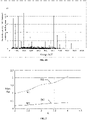
- FIG. 4A schematically shows a schematic diagram of the ⁇ energy spectrum generated by a reaction of the N element with the thermal neutron according to the embodiments of the present disclosure.
- FIG. 4B schematically shows a schematic diagram of the ⁇ energy spectrum generated by a reaction of the Cl element with the thermal neutron according to the embodiments of the present disclosure.
- a measured ⁇ energy spectrum is a result of a superposition of the ⁇ energy spectra of the plurality of types of elements.
- a characteristic peak of each element may be identified through an algorithm. Since characteristic peaks of different elements are located in different energy regions, the type of element may be determined according to the characteristic peak, and then an analysis may be made to determine the element involved in the reaction that brings the measured spectral line. After the elements involved in the reaction is determined, the target substance existing in the detected object may be initially determined.
- the container containing fruits it may be initially determined that the container contains drugs. If the N element is found and the Cl element is not found in the container containing fruits, it may be initially determined that that the container contains explosives.
- a non-target substance may also contain sensitive elements such as Cl and N, for example, salt contains Cl element and Na element.
- sensitive elements such as Cl and N
- salt contains Cl element and Na element.
- a specific distinction may be made based on the application scenario. For example, if an inspector is told that the detected object is fruit but Cl element and N element are found in the detection process, it may be suspected that drugs are hidden in the fruit. If the inspector is told that the detected object is salt, a determination may be made in combination with other elements in the detection process. For example, if a content ratio of Cl element and Na element meets a composition ratio of salt and N element is not detected, it may be initially determined that drugs and explosives are not contained, or an analysis may be performed in combination with other means.
- determining the type of target substance contained in the detected object based on the gamma energy spectrum may further include: determining an existence probability of each target element of a plurality of target elements based on the characteristic peak in the gamma energy spectrum; and determine the type of target substance contained in the detected object and an existence probability of the target substance based on the existence probability of each target element.
- the ⁇ energy spectrum measured by the detector may contain a plurality of characteristic peaks of the Cl element. Several significant characteristic peaks may be selected and used to determine the existence probability of the Cl element. Specifically, a determination may be made using method (1) or method (2) as follows.
- a count rate of an energy interval where each characteristic peak is located is obtained, and a reference count rate in a reference energy spectrum corresponding to the energy interval where each characteristic peak is located is obtained.
- the reference energy spectrum may refer to the ⁇ energy spectrum of a container that has the same size and similar object as the detected object and that does not contain the target substance.
- the k value corresponding to each characteristic peak is calculated by using Equation (3). After that, the k value corresponding to each characteristic peak may be weighted and summed to obtain a final k value corresponding to the Cl element.
- a weight for each characteristic peak may be determined according to a height of the characteristic peak. For example, the higher the peak, the greater the weight.
- a sum of the count rates corresponding to the several characteristic peaks may be taken as N 1
- a sum of the count rates of the corresponding energy intervals in the reference energy spectrum may be taken as N 0 .
- the value calculated by Equation (3) may be taken as the k value corresponding to the Cl element.
- the neutron may be used to react with the element in the detected object to obtain the ⁇ energy spectrum, and the type of element contained in the detected object may be analyzed based on the ⁇ energy spectrum, and then the type of target substance may be determined according to the type of element, which may solve a problem in a related art that the object detecting method such as the imaging method cannot determine the type of the target substance.
- the reference energy spectrum refers to the ⁇ energy spectrum pre-obtained by detecting the reference object that does not contain the target substance and that has the same specification and similar content as the detected object. By removing the reference energy spectrum on the basis of the energy spectrum of the detected object, the energy spectrum of other elements may be obtained.
- the reference energy spectrum may be the ⁇ energy spectrum of the container that has the same size and similar fruits and that does not contain a suspected object, or may be a classified average spectrum.
- the classified average spectrum may be an energy spectrum obtained by classifying and averaging energy spectral of a plurality of reference objects, in which a suspected energy spectrum may be eliminated in combination with an algorithm so as to improve an accuracy of the classified average spectrum.
- the controlling the rotating component to rotate the detected object from the initial angle to at least M predetermined angles in sequence and acquiring at least M detection signal quantities corresponding to the M predetermined angles performed by the processor may include: acquiring an initial detection signal quantity when the detected object is at the initial angle; controlling the rotating component to rotate the detected object by 180° from the initial angle, and acquiring the detection signal quantity when the detected object is at 180°.
- the detection may be performed only on opposite sides of the detected object.
- the initial signal quantity at the initial angle may be detected firstly, and the initial signal quantity at the initial angle and the reference signal quantity may be substituted into Equation (3) to obtain an initial index parameter value k 1 .
- the detected object is rotated by 180° to detect the other side so as to obtain the detection signal quantity at 180°, and the detection signal quantity at 180° and the reference signal quantity are substituted into Equation (3) to obtain an index parameter value k 2 at 180°.
- the orientation of the target substance may be determined according to the k values on both sides. Based on this detection method, a detection efficiency may be improved while ensuring a certain detection accuracy.
- the controlling the rotating component to rotate the detected object from the initial angle to at least M predetermined angles in sequence and acquiring at least M detection signal quantities corresponding to the M predetermined angles performed by the processor may include: controlling the rotating component to rotate the detected object at a constant speed by 360° from the initial angle, rotating the detected object to a predetermined angle every predetermined time during the rotation of the detected object and acquiring the detection signal quantity at the corresponding predetermined angle, where M is an integer greater than or equal to 2.
- the detected object may be rotated at a constant speed by 360°, and the detection may be performed every predetermined period of time (e.g. 2s) until the detected object is rotated by 360° and returns to the initial angle.
- the angle corresponding to each detection may be determined according to the rotation speed and the detection time, and the detection signal quantity corresponding to the M predetermined angles may be obtained.
- the k value at each predetermined angle may be calculated, and the orientation of the target substance may be determined according to the k value of each predetermined angle. Based on this detection method, the detection accuracy may be improved, and the azimuth angle of the target substance may be determined accurately.
- the processor may be further configured to: acquire the initial detection signal quantity when the detected object is at the initial angle; determine the initial index parameter value based on the initial detection signal quantity and the preset reference signal quantity, the initial index parameter value is used to characterize a probability of the detected object containing the target element; and determine, based on the initial index parameter value, whether to control to rotate the detected object.
- the initial signal quantity may be detected firstly, and the initial signal quantity and the reference signal quantity may be substituted into Equation (3) to obtain the initial index parameter value.
- the initial index parameter value may be used as an initial probability of the detected object containing a neutron-sensitive element (such as Cl element and N element) in addition to a known element (such as C element and O element).
- the initial index parameter value When the initial index parameter value is less than a preset threshold (e.g., 1), it may be initially determined that the detected object does not contain the target substance, and there is no need to rotate the detected object. On the contrary, when the initial index parameter value is greater than or equal to the preset threshold, it may be initially determined that the detected object contains the target substance, and it is needed to further control to rotate the detected object, so as to determine the angle orientation of the target substance in the detected object. Based on this scheme, the efficiency of object detection may be improved.
- a preset threshold e.g. 1, 1
- the detected object may be rotated and detected without considering a size of the initial index parameter value. For example, when the initial index parameter value is less than the preset threshold, it may only be considered that the detected object does not contain the target material within this angle range, and the detected object may be rotated to detect situations at other angles. On the contrary, when the initial index parameter value is greater than or equal to the preset threshold, it may be considered that the detected object contains the target material within this angle range, and the detected object may be further rotated to determine whether the target substance further exists in other angle orientations of the detected object, and the azimuth angle of the target substance may be determined.
- the processor may be further configured to: determine a content range of the suspected target substance based on the index parameter value exceeding the preset threshold in the M index parameter values and a preset mass estimation information.
- the mass estimation information may include a corresponding relationship between the index parameter value and the content range.
- the k value exceeding the threshold may be used to query the preset mass estimation information to obtain the content range of the target substance.
- a size of the k value has a positive correlation with an amount of the target substance, that is, the greater the k value, the greater the mass of the target substance.
- a corresponding relationship curve between the index parameter value k and the mass of the target material may be pre-drawn at a position where the target substance is most difficult to be detected.
- the position where the target substance is most difficult to be detected may refer to, for example, a position of the detected object away from the neutron source and the detector.
- a corresponding relationship curve between the index parameter value k and the mass of the target substance may also be experimentally pre-drawn at a position where the target substance is easiest to be detected.
- the position where the target substance is easiest to be detected may refer to, for example, a position of the detected object close to the neutron source and the detector.
- FIG. 5 schematically shows a relationship curve between the index parameter value and the content according to the embodiments of the present disclosure.
- a mass upper limit curve 501 and a mass lower limit curve 502 may be obtained.
- the mass upper limit curve 501 may be, for example, a corresponding relationship curve between the index parameter value k and the mass of the target substance drawn for the position where the object of interest is most difficult to be detected
- the mass lower limit curve 502 may be, for example, a corresponding relationship curve between the index parameter value k and the mass of the target substance drawn for the position where the object of interest is easiest to be detected.
- an estimated range of the mass of the object of interest may be determined by these two curves. For example, if the measured index parameter value k is 2.5, it may be determined that the content of the target substance in the detected object is in a range of [W1, W2].
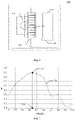
- FIG. 6 schematically shows a side view structural diagram of an object detecting device 600 according to another embodiment of the present disclosure.
- the object detecting device 600 may include a neutron source 610, a detector 620, and a rotating component 630.
- the detector 620 may include N sub-detectors 621 arranged in a height direction of the object detecting device 600.
- the N sub-detectors 621 correspond to N predetermined heights respectively, where N is an integer greater than or equal to 2.
- the processor is further configured to: acquire N detection signal quantities respectively corresponding to the N predetermined heights; determine a height position of the suspected target substance in the detected object A based on the N detection signal quantities.
- the detector 620 may be a detector array component including a plurality of sub-detectors arranged in the height direction to respectively receive rays at different heights.
- the detector 620 may include, for example, ten sub-detectors 621 respectively arranged at a height different from a carrier surface height of the rotating component 630 by h1, h2, h3, h4, h5, h6, h7, h8, h9 and h10.
- Each sub-detector 621 may analyze and obtain the detection signal quantity at the corresponding height.
- each predetermined height may also represent a height interval.
- each sub-detector 621 may measure the signal quantity corresponding to a height interval.
- a reference object that does not contain the target substance may be pre-detected to obtain the reference signal quantity at each predetermined height, and then when the detected object is detected, a result of a comparison between the detection signal quantity and the reference signal quantity at the corresponding height may be used as a condition for determining the height where the target substance is located. For example, a predetermined height at which the detection signal quantity has the most significant increment relative to the reference signal quantity may be determined as the height of the suspected target substance in the detected object A.
- a relationship curve may be drawn by using the N heights and the corresponding N index parameter values, and the height corresponding to the peak of the index parameter in the relationship curve may be determined as the height of the suspected target substance in the detected object A.
- FIG. 7 schematically shows a graph of a relationship between the height and the index parameter value according to the embodiments of the present disclosure.
- a relationship curve 701 is drawn by using a plurality of heights (h1-h10) and the index parameter value corresponding to each height.
- a peak 702 of the index parameter in the curve 701 and a height 703 corresponding to the peak 702 may be found through an algorithm, and the height 703 may be determined as the height of the suspected target substance in the detected object.
- the signal quantities at a plurality of heights measured by a plurality of detectors at different heights may be obtained, and the height of the suspected target substance in the detected object may be determined according to the increment of the detection signal quantity relative to the reference signal quantity. Combined with the angle, the position of the suspected target substance in the detected object may be determined accurately.
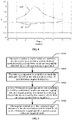
- whether the suspected target substance is located in a central region or an edge region of the detected object may be determined according to a smoothness of the curve of the index parameter value k changing along the angle, that is, a polar radius range of the suspected target substance on a rotation plane may be determined according to the smoothness of the index parameter value k changing along the angle.
- the polar radius range may refer to a radial distance range between the suspected target substance and a central axis of the detected object.
- FIG. 8 schematically shows two relationship curves between the angle and the index parameter value according to the embodiments of the present disclosure.
- the present disclosure it is possible to detect whether the detected object contains the suspected target substance or not. Further, if the suspected target substance exists, the angle of the suspected target substance and/or the height of the suspected target substance and/or an approximate position of the suspected target substance in the radial direction may be determined, and the mass of the suspected target substance may be roughly estimated.
- the present disclosure may be implemented to effectively detect explosives and has important practical significance in counter-terrorism and homeland security, and may be further implemented to effectively detect drugs and has a strong application prospect in the field of anti-drug. It is particularly effective for the detection of drugs or explosives hidden in the object such as the fruit tray.
- the object detecting device may be still widely used after the positioning function is turned off, for example, used in a detection and content analysis of a valuable component in minerals, an analysis of salt content in concrete, and so on.
- Another aspect of the embodiments of the present disclosure provides an object detecting method performed by the object detecting device described above.
- FIG. 9 schematically shows a flowchart of an object detecting method according to the embodiments of the present disclosure.
- the object detecting method includes operation S910 to operation S940.
- the neutron source is used to release a neutron to the detected object, so that a neutron induced nuclear reaction occurs between the neutron and the detected object and a gamma ray is generated.
- the rotating component is controlled to rotate the detected object from the initial angle to at least M predetermined angles in sequence.
- At least M detection signal quantities corresponding to the M predetermined angles are acquired, and the detection signal quantity is obtained by analyzing the gamma ray received by the detector, where M is an integer greater than or equal to 2.
- the angular orientation of the suspected target substance in the detected object is determined based on the M detection signal quantities and the preset reference signal quantity.
- determining the angular orientation of the suspected target substance in the detected object based on the M detection signal quantities and the preset reference signal quantity includes: acquiring M reference signal quantities respectively corresponding to the M predetermined angles, where the reference signal quantity is pre-obtained by detecting the reference object that does not contain the target substance; determining the index parameter value for each predetermined angle of the M predetermined angles based on the detection signal quantity and the reference signal quantity, where the index parameter value represents a ratio of an increment of the detection signal quantity relative to the reference signal quantity to a measurement noise; and determining the angular orientation of the suspected target substance in the detected object based on the respective index parameter values of the M predetermined angles.
- the object detecting method may further include: obtaining a gamma spectrum by analyzing the gamma ray received by the detector; determining the type of target element contained in the detected object based on the gamma spectrum, the type of target element being used to determine the type of the suspected target substance.
- the object detecting method may further include: acquiring N detection signal quantities respectively corresponding to N predetermined heights, the N detection signal quantities being respectively obtained by N sub-detectors of the detector arranged in the height direction, where N is an integer greater than or equal to 2; and determining the height position of the suspected target substance in the detected object based on the N signal quantities.
- controlling the rotating component to rotate the detected object from the initial angle to at least M predetermined angles, and acquiring at least M detection signal quantities corresponding to the M predetermined angles may include: acquiring the initial detection signal quantity when the detected object is at the initial angle; and controlling the rotating component to rotate the detected object by 180° from the initial angle, and acquiring the detection signal quantity when the detected object is at 180°.
- controlling the rotating component to rotate the detected object from the initial angle to the at least M predetermined angles in sequence, and acquiring at least M detection signal quantities corresponding to the M predetermined angles may include: controlling the rotating component to rotate the detected object at a constant speed by 360° from the initial angle, rotating the detected object to a predetermined angle every predetermined period of time during the rotation of the detected object, and acquiring the detection signal quantity at the corresponding predetermined angle, where M is an integer greater than or equal to 2.
- the object detecting method may further include: acquiring the initial detection signal quantity when the detected object is at the initial angle; determining the initial index parameter value based on the initial detection signal quantity and the preset reference signal quantity, where the initial index parameter value is used to characterize the probability of the detected object containing the target element; and determining, based on the initial index parameter value, whether to control to rotate the detected object.
- the object detecting method may further include: determining the content range of the suspected target substance based on the index parameter value exceeding the preset threshold in the M index parameter values and the preset mass estimation information, where the mass estimation information includes the corresponding relationship between the index parameter value and the content range.
- determining the type of the target substance contained in the detected object based on the gamma energy spectrum may include: determining the existence probability of each target element of the plurality of target elements based on the characteristic peak in the gamma energy spectrum; and determining the type of the target substance contained in the detected object based on the existence probability of each target element.
- FIG. 10 schematically shows a block diagram of an object detecting device according to the embodiments of the present disclosure.
- an object detecting device 1000 may include a first control module 1010, a second control module 1020, an acquisition module 1030 and a determination module 1040.
- the first control module 1010 is used to release a neutron to the detected object by using a neutron source, so that a neutron induced nuclear reaction occurs between the neutron and the detected object and a gamma ray is generated.
- the second control module 1020 is used to control the rotating component to rotate the detected object from the initial angle to at least M predetermined angles in sequence.
- the acquisition module 1030 is used to acquire at least M detection signal quantities respectively corresponding to the M predetermined angles, and the detection signal quantity is obtained by analyzing the gamma ray received by the detector, where M is an integer greater than or equal to 2.
- the determination module 1040 is used to determine the angle orientation of the suspected target substance in the detected object based on the M detection signal quantities and the preset reference signal quantity.
- Any two or more of the modules, sub-modules, units and subunits according to the embodiments of the present disclosure, or at least part of the functions of any two or more of them may be implemented in one module. Any one or more of the modules, sub-modules, units and subunits according to the embodiments of the present disclosure may be split into multiple modules for implementation.
- any one or more of the modules, sub-modules, units and subunits according to the embodiments of the present disclosure may be implemented at least partially as a hardware circuit, such as a field programmable gate array (FPGA), a programmable logic array (PLA), a system on a chip, a system on a substrate, a system on a package, an Application Specific Integrated Circuit (ASIC), or may be implemented by hardware or firmware in any other reasonable way that integrates or encapsulates the circuit, or may be implemented by any one of the three implementation modes of software, hardware and firmware or an appropriate combination thereof.
- FPGA field programmable gate array
- PLA programmable logic array
- ASIC Application Specific Integrated Circuit
- one or more of the modules, sub-modules, units and subunits according to the embodiments of the present disclosure may be at least partially implemented as a computer program module that, when executed, performs the corresponding functions.
- the part of the embodiments of the object detecting device of the present disclosure corresponds to the part of the embodiments of the object detecting method of the present disclosure.
- the description of the object detecting device may refer to that of the object detecting method, which will not be repeated here.
- FIG. 11 schematically shows a block diagram of an electronic device suitable for implementing the method described above according to the embodiments of the present disclosure.
- the electronic device shown in FIG. 11 is only an example and should not bring any limitation to the function and scope of use of the embodiments of the present disclosure.
- an electronic device 1100 includes a processor 1110 and a computer-readable storage medium 1120.
- the electronic device 1100 may perform the method according to the embodiments of the present disclosure.
- the processor 1110 may include, for example, a general-purpose microprocessor, an instruction set processor and/or a related chipset and/or a special-purpose microprocessor (for example, an application specific integrated circuit (ASIC)), and the like.
- the processor 1110 may further include an on-board memory for caching purposes.
- the processor 1110 may be a single processing unit or a plurality of processing units for executing different actions of the method flow according to the embodiments of the present disclosure.
- the computer-readable storage medium 1120 may be a non-transitory computer-readable storage medium. Specific examples include, but are not limited to: a magnetic storage device, such as a magnetic tape or a hard disk (HDD); an optical storage device, such as a compact disc (CD-ROM); a memory, such as a random access memory (RAM) or a flash memory; and so on.
- a magnetic storage device such as a magnetic tape or a hard disk (HDD)
- an optical storage device such as a compact disc (CD-ROM)
- CD-ROM compact disc
- memory such as a random access memory (RAM) or a flash memory
- the computer-readable storage medium 1120 may contain a computer program 1121.
- the computer program 1121 may contain code/computer-executable instructions that, when executed by the processor 1110, cause the processor 1110 to perform the method according to the embodiments of the present disclosure or any modification thereof.
- the computer program 1121 may be configured as a computer program code containing, for example, a computer program module.
- the code in the computer program 1121 may contain one or more program modules, such as 1121A, 1121B,... It should be noted that the division method and number of modules are not fixed. Those skilled in the art may use appropriate program modules or program module combinations according to actual conditions. When executed by the processor 1110, these program module combinations may cause the processor 1110 to perform the method according to the embodiments of the present disclosure or any modification thereof.
- At least one of the first control module 1010, the second control module 1020, the acquisition module 1030 and the determination module 1040 may be implemented as a computer program module described above with reference to FIG. 11 that, when executed by the processor 1110, may implement the corresponding operations described above.
- Another aspect of the present disclosure provides a computer-readable storage medium applied to the object detecting device described above.
- the computer-readable storage medium has executable instructions stored thereon, and the instructions, when executed by a processor, causes the processor to implement the object detecting method described above.
- the present disclosure further provides a computer-readable storage medium, which may be included in the apparatus/device/system described in the above embodiments; or exist alone without being assembled into the apparatus/device/system.
- the above-mentioned computer-readable storage medium may carry one or more programs that when executed, implement the method according to the embodiments of the present disclosure.
- the computer-readable storage medium may be a non-transitory computer-readable storage medium that, for example, may include but not limited to: a portable computer disk, a hard disk, a random access memory (RAM), a read-only memory (ROM), an erasable programmable read-only memory (EPROM or flash memory), a portable compact disk read-only memory (CD-ROM), an optical storage device, a magnetic storage device, or any suitable combination of the above.
- the computer-readable storage medium may be any tangible medium that contains or stores programs that may be used by or in combination with an instruction execution system, apparatus or device.
- each block in the flowcharts or block diagrams may represent a part of a module, a program segment, or a code, which part includes one or more executable instructions for implementing the specified logical function.
- the functions noted in the blocks may also occur in a different order from that noted in the accompanying drawings. For example, two blocks shown in succession may actually be executed substantially in parallel, or they may sometimes be executed in a reverse order, depending on the functions involved.
- each block in the block diagrams or flowcharts, and the combination of blocks in the block diagrams or flowcharts may be implemented by a dedicated hardware-based system that performs the specified functions or operations, or may be implemented by a combination of dedicated hardware and computer instructions.
Landscapes
- Physics & Mathematics (AREA)
- High Energy & Nuclear Physics (AREA)
- Life Sciences & Earth Sciences (AREA)
- General Life Sciences & Earth Sciences (AREA)
- General Physics & Mathematics (AREA)
- Geophysics (AREA)
- Analysing Materials By The Use Of Radiation (AREA)
Abstract
Description
- The embodiments of the present disclosure relate to a field of a security inspection, in particular to an object detecting device, an object detecting method, and a storage medium.
- In order to ensure a public safety and reduce illegal crimes, a security inspection needs to be performed on an object at airports, stations, ports, logistics checkpoints and other places. The security inspection may include detecting whether explosives, drugs and other prohibited objects exist in the object or not. An existing object detecting method, such as an imaging method, a mass spectrometry method, etc., may be implemented to accurately detect whether the object contains a prohibited object, but cannot determine a spatial position of the prohibited object in the object, and thus fail to provide a powerful clue for a further inspection.
- According to the embodiments of the present disclosure, there is proposed an object detecting device, an object detecting method, and a storage medium.
- In an aspect of the present disclosure, there is proposed an object detecting device, including: a neutron source configured to release a neutron to a detected object, so that a neutron induced nuclear reaction occurs between the neutron and the detected object and a gamma ray is generated; a detector configured to receive the gamma ray and analyze the gamma ray, so as to obtain a detection signal quantity corresponding to the gamma ray; a rotating component configured to carry the detected object and rotate the detected object relative to the neutron source and the detector; and a processor configured to: control the rotating component to rotate the detected object from an initial angle to at least M predetermined angles in sequence, where M is an integer greater than or equal to 2; acquire at least M detection signal quantities respectively corresponding to the M predetermined angles; and determine an angular orientation of a suspected target substance in the detected object based on the M detection signal quantities and a preset reference signal quantity.
- According to the embodiments of the present disclosure, the determining an angular orientation of a suspected target substance in the detected object based on the M detection signal quantities and a preset reference signal quantity includes: acquiring M reference signal quantities respectively corresponding to the M predetermined angles, wherein the reference signal quantity is pre-obtained by detecting a reference object not containing a target substance; determining an index parameter value for each predetermined angle of the M predetermined angles based on a detection signal quantity and the reference signal quantity, wherein the index parameter value indicates a ratio of an increment of the detection signal quantity relative to the reference signal quantity to a measurement noise; and determining the angular orientation of the suspected target substance in the detected object based on the respective index parameter values of the M predetermined angles.
- According to the embodiments of the present disclosure, the detector is further configured to analyze the received gamma ray so as to obtain a gamma energy spectrum; the processor is further configured to: acquire the gamma energy spectrum from the detector; and determine a type of a target element contained in the detected object based on the gamma energy spectrum, the target element being used to determine a type of the suspected target substance.
- According to the embodiments of the present disclosure, the detector includes N sub-detectors arranged in a height direction of the object detecting device, and the N sub-detectors respectively correspond to N predetermined heights, where N is an integer greater than or equal to 2; the processor is further configured to: acquire N detection signal quantities respectively corresponding to the N predetermined heights; and determine a height position of the suspected target substance in the detected object based on the N detection signal quantities.
- According to the embodiments of the present disclosure, the controlling the rotating component to rotate the detected object from an initial angle to at least M predetermined angles in sequence; and acquiring at least M detection signal quantities respectively corresponding to the M predetermined angles includes: acquiring an initial detection signal quantity when the detected object is at the initial angle; and controlling the rotating component to rotate the detected object by 180° from the initial angle, and acquiring the detection signal quantity when the detected object is at 180°.
- According to the embodiments of the present disclosure, the controlling the rotating component to rotate the detected object from an initial angle to at least M predetermined angles in sequence; and acquiring at least M detection signal quantities respectively corresponding to the M predetermined angles includes: controlling the rotating component to rotate the detected object at a constant speed by 360° from the initial angle, and the detected object being rotated to a predetermined angle every predetermined period of time and a detection signal quantity at the predetermined angle being acquired during a rotation of the detected object, where M is an integer greater than or equal to 2.
- According to the embodiments of the present disclosure, the processor is further configured to: acquire an initial detection signal quantity when the detected object is at the initial angle; determine an initial index parameter value based on the initial detection signal quantity and a preset reference signal quantity, the initial index parameter value being used to indicate a probability that the detected object contains the target element; and determine, based on the initial index parameter value, whether to control to rotate the detected object.
- According to the embodiments of the present disclosure, the processor is further configured to: determine a content range of the suspected target substance based on an index parameter value exceeding a preset threshold in the M index parameter values and a preset mass estimation information, wherein the mass estimation information includes a corresponding relationship between the index parameter value and the content range.
- According to the embodiments of the present disclosure, the determining a type of a target substance contained in the detected object based on the gamma energy spectrum includes: determining an existence probability of each target element of a plurality of target elements based on a characteristic peak in the gamma energy spectrum; and determining the type of the target substance contained in the detected object based on the existence probability of each target element.
- In another aspect of the present disclosure, there is proposed an object detecting method performed by the object detecting device described above, including: releasing a neutron to a detected object by using a neutron source, so that a neutron induced nuclear reaction occurs between the neutron and the detected object and a gamma ray is generated; controlling a rotating component to rotate the detected object from an initial angle to at least M predetermined angles in sequence; acquiring at least M detection signal quantities respectively corresponding to the M predetermined angles, the detection signal quantity being obtained by analyzing the gamma ray received by the detector, where M is an integer greater than or equal to 2; and determining an angular orientation of a suspected target substance in the detected object based on the M detection signal quantities and a preset reference signal quantity.
- According to the embodiments of the present disclosure, the determining an angular orientation of a suspected target substance in the detected object based on the M detection signal quantities and a preset reference signal quantity includes: acquiring M reference signal quantities respectively corresponding to the M predetermined angles, the reference signal quantity being pre-obtained by detecting a reference object not containing a target substance; determining an index parameter value for each predetermined angle of the M predetermined angles based on a detection signal quantity and the reference signal quantity, wherein the index parameter value indicates a ratio of an increment of the detection signal quantity relative to the reference signal quantity to a measurement noise; and determining the angular orientation of the suspected target substance in the detected object based on the respective index parameter values of the M predetermined angles.
- According to the embodiments of the present disclosure, the object detecting method further includes: acquiring a gamma energy spectrum, the gamma energy spectrum being obtained by analyzing the gamma ray received by the detector; and determining a type of a target element contained in the detected object based on the gamma energy spectrum, the type of the target element being used to determine a type of the suspected target substance.
- According to the embodiments of the present disclosure, the object detecting method further includes: acquiring N detection signal quantities respectively corresponding to N predetermined heights, the N detection signal quantities being respectively acquired by N sub-detectors of the detector arranged in a height direction, where N is an integer greater than or equal to 2; and determining a height position of the suspected target substance in the detected object based on the N detection signal quantities.
- According to the embodiments of the present disclosure, the controlling the rotating component to rotate the detected object from an initial angle to at least M predetermined angles in sequence; and acquiring at least M detection signal quantities respectively corresponding to the M predetermined angles includes: acquiring an initial detection signal quantity when the detected object is at the initial angle; and controlling the rotating component to rotate the detected object by 180° from the initial angle, and acquiring the detection signal quantity when the detected object is at 180°.
- According to the embodiments of the present disclosure, the controlling the rotating component to rotate the detected object from an initial angle to at least M predetermined angles in sequence; and acquiring at least M detection signal quantities respectively corresponding to the M predetermined angles includes: controlling the rotating component to rotate the detected object at a constant speed by 360° from the initial angle, the detected object being rotated to a predetermined angle every predetermined period of time and a detection signal quantity at the predetermined angle being acquired during a rotation of the detected object, where M is an integer greater than or equal to 2.
- According to the embodiments of the present disclosure, the object detecting method further includes: acquiring an initial detection signal quantity when the detected object is at the initial angle; determining an initial index parameter value based on the initial detection signal quantity and a preset reference signal quantity, the initial index parameter value being used to indicate a probability that the detected object contains the target element; and determining, based on the initial index parameter value, whether to control to rotate the detected object.
- According to the embodiments of the present disclosure, the object detecting method further includes: determining a content range of the suspected target substance based on an index parameter value exceeding a preset threshold in the M index parameter values and a preset mass estimation information, wherein the mass estimation information includes a corresponding relationship between the index parameter value and the content range.
- According to the embodiments of the present disclosure, the determining a type of a target substance contained in the detected object based on the gamma energy spectrum includes: determining an existence probability of each target element of a plurality of target elements based on a characteristic peak in the gamma energy spectrum; and determining the type of the target substance contained in the detected object based on the existence probability of each target element.
- In another aspect of the present disclosure, there is proposed a computer-readable storage medium having executable instructions stored thereon, and the instructions, when executed by a processor, cause the processor to implement the object detecting method described in any of the above embodiments.
- According to the embodiments of the present disclosure, the neutron is used to react with the target substance (such as drugs, explosives, etc.) in the detected object to generate a gamma ray, and the detected object is controlled to rotate so that the signal quantity of the ray at some angles (or angle intervals) may be detected during the rotation, and then the angular orientation of the target substance in the detected object may be determined according to a magnitude of the signal quantity at each angle, so as to provide an object search clue for a further inspection. In addition, a non-destructive detection is performed by using the neutron, which may not cause damage to the inspected object and may meet a requirement of food safety.
- In order to better understand the embodiments of the present disclosure, the embodiments of the present disclosure will be described in detail based on the accompanying drawings.
-
FIG. 1 schematically shows an application scenario of an object detecting device and an object detecting method according to the embodiments of the present disclosure. -
FIG. 2 schematically shows a top view structural diagram of the object detecting device according to the embodiments of the present disclosure. -
FIG. 3 schematically shows a graph of a relationship between an angle and an index parameter value according to the embodiments of the present disclosure. -
FIG. 4A schematically shows a schematic diagram of a γ energy spectrum generated by a reaction between N element and thermal neutron according to the embodiments of the present disclosure. -
FIG. 4B schematically shows a schematic diagram of a γ energy spectrum generated by a reaction between Cl element and thermal neutron according to the embodiments of the present disclosure. -
FIG. 5 schematically shows a graph of a relationship between an index parameter value and a mass according to the embodiments of the present disclosure. -
FIG. 6 schematically shows a side view structural diagram of the object detecting device according to another embodiment of the present disclosure. -
FIG. 7 schematically shows a graph of a relationship between a height and an index parameter value according to the embodiments of the present disclosure. -
FIG. 8 schematically shows two relationship curves for an angle and an index parameter value according to the embodiments of the present disclosure. -
FIG. 9 schematically shows a flowchart of an object detecting method according to the embodiments of the present disclosure. -
FIG. 10 schematically shows a block diagram of an object detecting device according to the embodiments of the present disclosure. -
FIG. 11 schematically shows a block diagram of an electronic device suitable for implementing the object detecting method according to the embodiments of the present disclosure. - Specific embodiments of the present disclosure will be described in detail below. It should be noted that the embodiments described here are only used for exemplification and are not used to limit the embodiments of the present disclosure. In the following description, a number of specific details are set forth in order to provide a thorough understanding of the present disclosure. However, it will be apparent to those of ordinary skilled in the art that these specific details are not necessary to implement the embodiments of the present disclosure. In other examples, in order to avoid confusion with the present disclosure, well-known structures, materials, or methods are not specifically described.
- Throughout the specification, references to "one embodiment," "an embodiment," "one example," or "an example" mean that a specific feature, structure, or characteristic described in conjunction with the embodiment or example is included in at least one embodiment of the present disclosure. Therefore, the phrases "in one embodiment", "in an embodiment", "one example" or "an example" appearing in various places throughout the specification do not necessarily refer to the same embodiment or example. Further, specific features, structures or characteristics may be combined in one or more embodiments or examples in any suitable combination and/or sub-combination. In addition, those of ordinary skilled in the art should understand that the term "and/or" as used here includes any and all combinations of one or more related listed items.
- The embodiments of the present disclosure propose an object detecting device, an object detecting method, and a storage medium. The object detecting device may include a neutron source, a detector, a rotating component, and a processor. The neutron source is configured to release a neutron to a detected object, so that a neutron induced nuclear reaction occurs between the neutron and the detected object and a gamma ray is generated. The detector is configured to receive the gamma ray and analyze the gamma ray so as to obtain a detection signal quantity corresponding to the gamma ray. The rotating component is configured to carry the detected object and rotate the detected object with respect to the neutron source and the detector. The processor is configured to: control the rotating component to rotate the detected object from an initial angle to at least M predetermined angles in sequence; acquire at least M detection signal quantities respectively corresponding to the M predetermined angles, wherein M is an integer greater than or equal to 2; and determine an angular orientation of a suspected target substance in the detected object based on the M detection signal quantities and a preset reference signal quantity.
-
FIG. 1 schematically shows an application scenario of an object detecting device and an object detecting method according to the embodiments of the present disclosure. It should be noted thatFIG. 1 only shows an example of the application scenario in which the embodiments of the present disclosure may be applied so as to help those skilled in the art understand technical contents of the present disclosure. It does not mean that the embodiments of the present disclosure may not be used for other apparatuses, systems, environments or scenes. - As shown in
FIG. 1 , anobject detecting device 100 may, for example, detect a batch of containers (container 1 to container N) in sequence. One container may be placed in theobject detecting device 100 at a time, and after a detection is performed, a next container may be placed. The container may contain, for example, a tray of fruits, that is, a tray is placed in the container, and a plurality of corrugated boxes containing fruits are stacked on the tray. A target substance may be, for example, explosives and drugs. After the container is placed into theobject detecting device 100, theobject detecting device 100 may detect whether explosives and drugs are hidden in the container. - For example, after a container is placed in the
object detecting device 100, the neutron source in theobject detecting device 100 may be used to release a neutron to the container. A neutron induced nuclear reaction may occur between the neutron and a substance contained in the container, and a γ (gamma) ray may be generated. The detector may receive and measure the γ ray so as to obtain a γ energy spectrum. Because the γ energy spectrum produced by a nuclear reaction corresponds to a type of an element involved in the reaction, a characteristic element in the object may be accurately identified through the γ energy spectrum. By performing an operation such as a spectrum unfolding on the γ energy spectrum, it is possible to determine the element involved in the reaction that brings a measured spectral line, and then initially determine whether a target substance exists or not according to the element type. For example, fruits mainly contain C (carbon) element, H (hydrogen) element and O (oxygen) element, while drugs generally contain Cl (chlorine) element and N (nitrogen) element and explosives contain N element. Therefore, if Cl element and N element are found in the container containing fruits, it may be initially determined that the container contains drugs, and if N element is found and Cl element is not found in the container containing fruits, it may be initially determined that the container contains explosives. In addition, it is also possible to estimate a content of each element through the γ energy spectrum, and further determine a type of a suspected target substance based on the type and content of the element. Alternatively, the type of the suspected target substance may be further determined by other means, such as an unpacking inspection. - The
object detecting device 100 of the embodiments of the present disclosure may not only detect whether the suspected target substance is hidden in the container, but may also determine an angular orientation of the suspected target substance in the container, so as to provide a search clue for a further unpacking inspection. For example, the rotating component of theobject detecting device 100 may be used to control a rotation of the container with respect to the neutron source and the detector. During the rotation, a signal quantity of gamma rays measured at different rotation angles may be detected. The signal quantity may refer to a count rate. Then, the orientation of the suspected target substance in the container may be determined according to the detection signal quantity at each angle and a magnitude of a reference signal quantity at the angle. The reference signal quantity may be obtained by detecting a reference object that does not contain the target substance. For example, an angle at which the detected signal quantity has the greatest relative increment with respect to the reference signal quantity may be determined as the angular orientation of the suspected target substance in the container. If a determined angle is 90°, the angular orientation of the suspected target substance is an orientation rotated away from a starting angle by about 90°. - It should be noted that the object detecting device and the object detecting method in the embodiments of the present disclosure may be not only implemented to detect the container, but also implemented to detect a luggage box, a package and other objects in airports, stations, ports, post offices, logistics checkpoints, and other public places.
-
FIG. 2 schematically shows a top view structural diagram of the object detecting device according to the embodiments of the present disclosure. - As shown in the top view of
FIG. 2 , anobject detecting device 200 may include aneutron source 210, adetector 220, arotating component 230, and a processor (not shown). - The
neutron source 210 is configured to release a neutron to a detected object A, so that a neutron induced nuclear reaction occurs between the neutron and the detected object A and a gamma ray is generated. - According to the embodiments of the present disclosure, a nuclear reaction equation for a reaction of a neutron with a substance may include, for example, Equation (1) or Equation (2).


- Some elements, such as Cl element and N element, are easy to react with a neutron. These elements may be called sensitive elements. A substance containing these sensitive elements, such as explosives and drugs, may be called a neutron-detection-sensitive substance, or a special substance. Whether an element is sensitive to a neutron is related to a cross section of the element. C element and O element have a small cross section, and a neutron is not easy to react with them. Cl element and N element have a large cross section, and a neutron is easy to react with them.
- According to the embodiments of the present disclosure, the
detector 220 is configured to receive the gamma ray and analyze the gamma ray so as to obtain a detection signal quantity corresponding to the gamma ray. - For example, the
detector 220 may be a high-purity germanium spectrometer, which may measure an information such as a gamma energy spectrum corresponding to the gamma ray. The energy spectrum contains a count rate information, and the signal quantity may refer to, for example, a count rate. A magnitude of the detection signal quantity is related to a type of element. For example, the reaction between the Cl element and the neutron may generate relatively more gamma rays, so that a relatively large magnitude of signal quantity may be detected, while the reaction between the C element and the neutron may generate relatively less gamma rays, so that a relatively small magnitude of signal quantity may be detected. In addition, the signal quantity is further related to a position of the element in the detected object. For example, if Cl element is located on a side of the detected object close to the neutron source and the detector, there is not too much barrier material between the Cl element and the neutron source, and the neutron released by the neutron source may impact the Cl element with a large flux, so that relatively more gamma rays may be generated, and a relatively large magnitude of signal quantity may be detected. If the Cl element is located on a side of the detected object away from the neutron source and the detector, the neutron needs to pass through a thick barrier material to reach the Cl element, and when the neutron passes through the barrier material, the flux may be greatly reduced. The generated γ ray also needs to pass through a thick barrier material to reach the detector, so that a relatively small magnitude of signal quantity may be detected. - According to the embodiments of the present disclosure, the
rotating component 230 is configured to carry the detected object A and rotate the detected object A relative to theneutron source 210 and thedetector 220. - For example, the
rotating component 230 may be a turntable rotatable around its own central axis, and the detected object A may be placed at a central position of therotating component 230. Theneutron source 210 and thedetector 220 may be fixed relative to ahousing 240 of theobject detecting device 200. Thehousing 240 may be, for example, a shielding wall with a shielding effect. In addition, the object detecting device may be further provided with aprotective door 250 connected to thehousing 240. Theprotective door 250 and thehousing 240 may enclose adetection chamber 260, and therotating component 230 is located in thedetection chamber 260. - According to the embodiments of the present disclosure, the
rotating component 230 may rotate, for example, at least 360°, that is, it may drive the detected object A to rotate for at least one cycle, so that all orientations of the detected object A may be detected. - According to the embodiments of the present disclosure, the processor is configured to: control the rotating component to rotate the detected object from an initial angle to at least M predetermined angles in sequence; acquire at least M detection signal quantities corresponding to the M predetermined angles, where M is an integer greater than or equal to 2; and determine an angular orientation (also known as an azimuth angle) of a suspected target substance in the detected object based on the M detection signal quantities and a preset reference signal quantity.
- For example, when the detected object A is placed, a specific mark of the detected object A may face the
detector 220, and an angle when the specific mark of the detected object A faces thedetector 220 may be determined as the initial angle. The initial angle may be marked as, for example, 0°, and the M predetermined angles may be, for example, several angles evenly distributed in a range of 0° - 360°, which may include, for example, 0°, 60°, 120°, 180°, 240° and 300°. Therotating component 230 may be controlled to rotate the detected object A from the initial angle to the at least M predetermined angles in sequence, and the signal quantity at each predetermined angle may be detected using thedetector 220, so as to obtain the detection signal quantity corresponding to each predetermined angle. According to the embodiments of the present disclosure, each predetermined angle may also represent an angle range. For example, 60° may represent an interval [30° - 90°], and 180° may represent an interval [150° - 210°]. In this case, thedetector 220 may measure the detection signal quantity corresponding to several angle intervals. - Then, the angular orientation of the suspected target substance in the detected object A may be determined according to the M detection signal quantities corresponding to the M predetermined angles and the preset reference signal quantity. Since the detected object is not isotropic, a reference object that does not contain the target substance may be pre-detected to obtain the reference signal quantity at each predetermined angle. Then, in the detection of the detected object, a result of a comparison between the detection signal quantity and the reference signal quantity at the corresponding angle may be used as a condition for determining the azimuth angle of the target substance. For example, the predetermined angle at which the detection signal quantity has the most significant increment relative to the reference signal quantity may be determined as the azimuth angle of the suspected target substance in the detected object A.
- According to the embodiments of the present disclosure, the neutron is used to react with the target substance (such as drugs, explosives, etc.) in the detected object to generate a gamma ray, and the detected object is controlled to rotate so that the signal quantity of the ray at some angles (or angle intervals) may be detected during the rotation, and then the angular orientation of the target substance in the detected object may be determined according to the detection signal quantity at each angle and the reference signal quantity, so as to provide an object search clue for a further inspection. In addition, a non-destructive detection is performed by using the neutron, which may not cause damage to the detected object and may meet a requirement of food safety.
- According to the embodiments of the present disclosure, the determining the angular orientation of the suspected target substance in the detected object based on the M detection signal quantities and the preset reference signal quantity may include: acquiring M reference signal quantities corresponding to the M predetermined angles respectively, wherein the reference signal quantity is pre-obtained by detecting the reference object not containing the target substance; determining an index parameter value for each predetermined angle of the M predetermined angles based on the detection signal quantity and the reference signal quantity, wherein the index parameter value indicates a ratio of an increment of the detection signal quantity relative to the reference signal quantity to a measurement noise; and determining the angular orientation of the suspected target substance in the detected object based on the respective index parameter values of the M predetermined angles.
- For example, the reference signal quantity may be pre-obtained by detecting a reference object that does not contain the target substance and that has the same specification and similar content as the detected object A. According to the embodiments of the present disclosure, a significance of a change of the detection signal quantity relative to the reference signal quantity may be used as a criterion for the orientation of the suspected target substance. For example, at a predetermined angle, the reference signal quantity corresponding to the reference object is N0, and the detection signal quantity corresponding to the detected object A is N1. According to the law of Poisson distribution, an index parameter value k may be calculated by Equation (3).

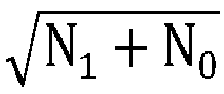
- According to the embodiments of the present disclosure, the index parameter value k may be used as a reference value for a probability that the detected object contains the target substance. For example, when k=1, it may be considered that there is a 68.3% probability of containing the target substance; when k=2, it may be considered that there is a 95.5% probability of containing the target substance; and when k=3, it may be considered that there is a 99.7% probability of containing the target substance.
- During the rotation of the detected object, a change of the k value may be monitored in real time. If the k value exceeds a preset threshold (for example, 1.5) when the detected object is rotated to an angle, it may be initially determined that the detected object contains the target substance, then the apparatus may control an alarm device to issue an alarm information to prompt the staff. On the contrary, if the k value is always below the preset threshold after the detected object rotates for a cycle, it may be initially determined that the detected object does not contain the target substance and there is no need to alarm.
- Based on the above method, the index parameter value corresponding to each predetermined angle may be obtained, and then the azimuth angle of the suspected target substance in the detected object may be determined according to the M index parameter values. For example, an angle corresponding to a greatest index parameter value of the M index parameter values may be selected as the azimuth angle of the suspected target substance in the detected object A.
- In another embodiment of the present disclosure, a relationship curve between the M predetermined angles and the M index parameter values may be drawn, and an angle corresponding to a peak of the index parameter in the relationship curve may be determined as the azimuth angle of the suspected target substance in the detected object A.
-
FIG. 3 schematically shows a graph of a relationship between the angle and the index parameter value according to the embodiments of the present disclosure. - As shown in
FIG. 3 , arelationship curve 301 is drawn by using a plurality of angles (0° ,60° , 120° , 180° , 240° , 300° ) and the index parameter value corresponding to each angle. Apeak 302 of the index parameter in thecurve 301 and anangle 303 corresponding to thepeak 302 may be found through an algorithm, and theangle 303 may be determined as the angle of the suspected target substance in the detected object, or an angle interval in which theangle 303 is located may be determined as an angle range of the suspected target substance in the detected object. - According to the embodiments of the present disclosure, the significance of the increment of the detection signal quantity relative to the reference signal quantity may be used as the criterion for the orientation of the suspected target substance, which is simple to calculate and may improve an accuracy of determination.
- In another embodiment of the present disclosure, the index parameter value may also be expressed as an incremental percentage of the detection signal quantity relative to the reference signal quantity.
- According to the embodiments of the present disclosure, the detector is further configured to obtain a gamma spectrum by analyzing the received gamma ray. The processor is further configured to: obtain the gamma spectrum from the detector; and determine a type of a target element contained in the detected object based on the gamma spectrum. The target element is used to determine a type of the suspected target substance.
- According to the embodiments of the present disclosure, the reaction between each element with the neutron in Equation (1) or Equation (2) may generate a distinctive γ energy spectrum, which is equivalent to a fingerprint of the element involved in the reaction. The neutron may refer to a thermal neutron or a cold neutron. Because the cold neutron and the thermal neutron have a very small difference in energy, an γ energy spectrum generated by a reaction of the cold neutron with the substance is consistent with that generated by a reaction of the thermal neutron with the substance.
-
FIG. 4A schematically shows a schematic diagram of the γ energy spectrum generated by a reaction of the N element with the thermal neutron according to the embodiments of the present disclosure. -
FIG. 4B schematically shows a schematic diagram of the γ energy spectrum generated by a reaction of the Cl element with the thermal neutron according to the embodiments of the present disclosure. - As shown in
FIG. 4A andFIG. 4B , there is a great difference between the γ energy spectrum corresponding to the N element and the γ energy spectrum corresponding to the Cl element. When the detected object contains a plurality of types of elements, a measured γ energy spectrum is a result of a superposition of the γ energy spectra of the plurality of types of elements. A characteristic peak of each element may be identified through an algorithm. Since characteristic peaks of different elements are located in different energy regions, the type of element may be determined according to the characteristic peak, and then an analysis may be made to determine the element involved in the reaction that brings the measured spectral line. After the elements involved in the reaction is determined, the target substance existing in the detected object may be initially determined. For example, if the Cl element and the N element are found in the container containing fruits, it may be initially determined that the container contains drugs. If the N element is found and the Cl element is not found in the container containing fruits, it may be initially determined that that the container contains explosives. - According to the embodiments of the present disclosure, a non-target substance may also contain sensitive elements such as Cl and N, for example, salt contains Cl element and Na element. In this case, a specific distinction may be made based on the application scenario. For example, if an inspector is told that the detected object is fruit but Cl element and N element are found in the detection process, it may be suspected that drugs are hidden in the fruit. If the inspector is told that the detected object is salt, a determination may be made in combination with other elements in the detection process. For example, if a content ratio of Cl element and Na element meets a composition ratio of salt and N element is not detected, it may be initially determined that drugs and explosives are not contained, or an analysis may be performed in combination with other means.
- According to the embodiments of the present disclosure, determining the type of target substance contained in the detected object based on the gamma energy spectrum may further include: determining an existence probability of each target element of a plurality of target elements based on the characteristic peak in the gamma energy spectrum; and determine the type of target substance contained in the detected object and an existence probability of the target substance based on the existence probability of each target element.
- For example, if the detected object contains the Cl element, the γ energy spectrum measured by the detector may contain a plurality of characteristic peaks of the Cl element. Several significant characteristic peaks may be selected and used to determine the existence probability of the Cl element. Specifically, a determination may be made using method (1) or method (2) as follows.
- In method (1), for each selected significant characteristic peak, a count rate of an energy interval where each characteristic peak is located is obtained, and a reference count rate in a reference energy spectrum corresponding to the energy interval where each characteristic peak is located is obtained. The reference energy spectrum may refer to the γ energy spectrum of a container that has the same size and similar object as the detected object and that does not contain the target substance. Then, the k value corresponding to each characteristic peak is calculated by using Equation (3). After that, the k value corresponding to each characteristic peak may be weighted and summed to obtain a final k value corresponding to the Cl element. A weight for each characteristic peak may be determined according to a height of the characteristic peak. For example, the higher the peak, the greater the weight.
- In method (2), for several selected characteristic peaks, a sum of the count rates corresponding to the several characteristic peaks may be taken as N1, and a sum of the count rates of the corresponding energy intervals in the reference energy spectrum may be taken as N0. The value calculated by Equation (3) may be taken as the k value corresponding to the Cl element.
- If the existence probability of Cl element is greater than a preset threshold, it may be determined that the Cl element exists.
- According to the embodiments of the present disclosure, the neutron may be used to react with the element in the detected object to obtain the γ energy spectrum, and the type of element contained in the detected object may be analyzed based on the γ energy spectrum, and then the type of target substance may be determined according to the type of element, which may solve a problem in a related art that the object detecting method such as the imaging method cannot determine the type of the target substance.
- According to the embodiments of the present disclosure, when the spectrum unfolding is performed on the γ energy spectrum measured by the detector, there may be a need to use the reference energy spectrum. The reference energy spectrum refers to the γ energy spectrum pre-obtained by detecting the reference object that does not contain the target substance and that has the same specification and similar content as the detected object. By removing the reference energy spectrum on the basis of the energy spectrum of the detected object, the energy spectrum of other elements may be obtained. In a scenario where the detected object is a container containing a tray of fruits, the reference energy spectrum may be the γ energy spectrum of the container that has the same size and similar fruits and that does not contain a suspected object, or may be a classified average spectrum. The classified average spectrum may be an energy spectrum obtained by classifying and averaging energy spectral of a plurality of reference objects, in which a suspected energy spectrum may be eliminated in combination with an algorithm so as to improve an accuracy of the classified average spectrum.
- According to the embodiments of the present disclosure, the controlling the rotating component to rotate the detected object from the initial angle to at least M predetermined angles in sequence and acquiring at least M detection signal quantities corresponding to the M predetermined angles performed by the processor may include: acquiring an initial detection signal quantity when the detected object is at the initial angle; controlling the rotating component to rotate the detected object by 180° from the initial angle, and acquiring the detection signal quantity when the detected object is at 180°.
- For example, the detection may be performed only on opposite sides of the detected object. After the detected object is placed in the object detecting device, the initial signal quantity at the initial angle may be detected firstly, and the initial signal quantity at the initial angle and the reference signal quantity may be substituted into Equation (3) to obtain an initial index parameter value k1. Then, the detected object is rotated by 180° to detect the other side so as to obtain the detection signal quantity at 180°, and the detection signal quantity at 180° and the reference signal quantity are substituted into Equation (3) to obtain an index parameter value k2 at 180°. Then, the orientation of the target substance may be determined according to the k values on both sides. Based on this detection method, a detection efficiency may be improved while ensuring a certain detection accuracy.
- According to another embodiment of the present disclosure, the controlling the rotating component to rotate the detected object from the initial angle to at least M predetermined angles in sequence and acquiring at least M detection signal quantities corresponding to the M predetermined angles performed by the processor may include: controlling the rotating component to rotate the detected object at a constant speed by 360° from the initial angle, rotating the detected object to a predetermined angle every predetermined time during the rotation of the detected object and acquiring the detection signal quantity at the corresponding predetermined angle, where M is an integer greater than or equal to 2.
- For example, the detected object may be rotated at a constant speed by 360°, and the detection may be performed every predetermined period of time (e.g. 2s) until the detected object is rotated by 360° and returns to the initial angle. The angle corresponding to each detection may be determined according to the rotation speed and the detection time, and the detection signal quantity corresponding to the M predetermined angles may be obtained. Then, the k value at each predetermined angle may be calculated, and the orientation of the target substance may be determined according to the k value of each predetermined angle. Based on this detection method, the detection accuracy may be improved, and the azimuth angle of the target substance may be determined accurately.
- According to another embodiment of the present disclosure, the processor may be further configured to: acquire the initial detection signal quantity when the detected object is at the initial angle; determine the initial index parameter value based on the initial detection signal quantity and the preset reference signal quantity, the initial index parameter value is used to characterize a probability of the detected object containing the target element; and determine, based on the initial index parameter value, whether to control to rotate the detected object.
- For example, after the detected object is placed in the object detecting device, the initial signal quantity may be detected firstly, and the initial signal quantity and the reference signal quantity may be substituted into Equation (3) to obtain the initial index parameter value. The initial index parameter value may be used as an initial probability of the detected object containing a neutron-sensitive element (such as Cl element and N element) in addition to a known element (such as C element and O element).
- When the initial index parameter value is less than a preset threshold (e.g., 1), it may be initially determined that the detected object does not contain the target substance, and there is no need to rotate the detected object. On the contrary, when the initial index parameter value is greater than or equal to the preset threshold, it may be initially determined that the detected object contains the target substance, and it is needed to further control to rotate the detected object, so as to determine the angle orientation of the target substance in the detected object. Based on this scheme, the efficiency of object detection may be improved.
- In another embodiment of the present disclosure, the detected object may be rotated and detected without considering a size of the initial index parameter value. For example, when the initial index parameter value is less than the preset threshold, it may only be considered that the detected object does not contain the target material within this angle range, and the detected object may be rotated to detect situations at other angles. On the contrary, when the initial index parameter value is greater than or equal to the preset threshold, it may be considered that the detected object contains the target material within this angle range, and the detected object may be further rotated to determine whether the target substance further exists in other angle orientations of the detected object, and the azimuth angle of the target substance may be determined.
- According to the embodiments of the present disclosure, the processor may be further configured to: determine a content range of the suspected target substance based on the index parameter value exceeding the preset threshold in the M index parameter values and a preset mass estimation information. The mass estimation information may include a corresponding relationship between the index parameter value and the content range.
- For example, during the rotation of the detected object, if the k value exceeds the preset threshold at a certain angle and an alarm is issued, the k value exceeding the threshold may be used to query the preset mass estimation information to obtain the content range of the target substance.
- According to the embodiments of the present disclosure, when the index parameter value k exceeds a threshold, a size of the k value has a positive correlation with an amount of the target substance, that is, the greater the k value, the greater the mass of the target substance. A corresponding relationship curve between the index parameter value k and the mass of the target material may be pre-drawn at a position where the target substance is most difficult to be detected. The position where the target substance is most difficult to be detected may refer to, for example, a position of the detected object away from the neutron source and the detector. Similarly, a corresponding relationship curve between the index parameter value k and the mass of the target substance may also be experimentally pre-drawn at a position where the target substance is easiest to be detected. The position where the target substance is easiest to be detected may refer to, for example, a position of the detected object close to the neutron source and the detector.
-
FIG. 5 schematically shows a relationship curve between the index parameter value and the content according to the embodiments of the present disclosure. - As shown in
FIG. 5 , a massupper limit curve 501 and a masslower limit curve 502 may be obtained. The massupper limit curve 501 may be, for example, a corresponding relationship curve between the index parameter value k and the mass of the target substance drawn for the position where the object of interest is most difficult to be detected, and the masslower limit curve 502 may be, for example, a corresponding relationship curve between the index parameter value k and the mass of the target substance drawn for the position where the object of interest is easiest to be detected. - If the k value measured at a certain angle during the rotation of a detected object exceeds an alarm threshold, an estimated range of the mass of the object of interest may be determined by these two curves. For example, if the measured index parameter value k is 2.5, it may be determined that the content of the target substance in the detected object is in a range of [W1, W2].
-
FIG. 6 schematically shows a side view structural diagram of anobject detecting device 600 according to another embodiment of the present disclosure. - As shown in the side view of
FIG. 6 , according to the embodiments of the present disclosure, theobject detecting device 600 may include aneutron source 610, adetector 620, and arotating component 630. Thedetector 620 may includeN sub-detectors 621 arranged in a height direction of theobject detecting device 600. The N sub-detectors 621 correspond to N predetermined heights respectively, where N is an integer greater than or equal to 2. The processor is further configured to: acquire N detection signal quantities respectively corresponding to the N predetermined heights; determine a height position of the suspected target substance in the detected object A based on the N detection signal quantities. - For example, the
detector 620 may be a detector array component including a plurality of sub-detectors arranged in the height direction to respectively receive rays at different heights. Thedetector 620 may include, for example, tensub-detectors 621 respectively arranged at a height different from a carrier surface height of therotating component 630 by h1, h2, h3, h4, h5, h6, h7, h8, h9 and h10. Each sub-detector 621 may analyze and obtain the detection signal quantity at the corresponding height. Then, the index parameter value at each predetermined height may be calculated based on the detection signal quantity and the reference signal quantity, and then the height position of the suspected target substance in the detected object A may be determined according to the index parameter value k corresponding to each height. For example, a height corresponding to the largest index parameter value of the N index parameter values may be determined as the height of the suspected target substance in the detected object A. According to the embodiments of the present disclosure, each predetermined height may also represent a height interval. In this case, each sub-detector 621 may measure the signal quantity corresponding to a height interval. - Since the detected object exhibits different properties at different heights, a reference object that does not contain the target substance may be pre-detected to obtain the reference signal quantity at each predetermined height, and then when the detected object is detected, a result of a comparison between the detection signal quantity and the reference signal quantity at the corresponding height may be used as a condition for determining the height where the target substance is located. For example, a predetermined height at which the detection signal quantity has the most significant increment relative to the reference signal quantity may be determined as the height of the suspected target substance in the detected object A.
- In another embodiment of the present disclosure, a relationship curve may be drawn by using the N heights and the corresponding N index parameter values, and the height corresponding to the peak of the index parameter in the relationship curve may be determined as the height of the suspected target substance in the detected object A.
-
FIG. 7 schematically shows a graph of a relationship between the height and the index parameter value according to the embodiments of the present disclosure. - As shown in
FIG. 7 , arelationship curve 701 is drawn by using a plurality of heights (h1-h10) and the index parameter value corresponding to each height. Apeak 702 of the index parameter in thecurve 701 and aheight 703 corresponding to thepeak 702 may be found through an algorithm, and theheight 703 may be determined as the height of the suspected target substance in the detected object. - According to the embodiments of the present disclosure, the signal quantities at a plurality of heights measured by a plurality of detectors at different heights may be obtained, and the height of the suspected target substance in the detected object may be determined according to the increment of the detection signal quantity relative to the reference signal quantity. Combined with the angle, the position of the suspected target substance in the detected object may be determined accurately.
- According to the embodiments of the present disclosure, whether the suspected target substance is located in a central region or an edge region of the detected object may be determined according to a smoothness of the curve of the index parameter value k changing along the angle, that is, a polar radius range of the suspected target substance on a rotation plane may be determined according to the smoothness of the index parameter value k changing along the angle. The polar radius range may refer to a radial distance range between the suspected target substance and a central axis of the detected object. Through this scheme, the position of the suspected target substances may be further determined.
-
FIG. 8 schematically shows two relationship curves between the angle and the index parameter value according to the embodiments of the present disclosure. - As shown in
FIG. 8 , the smoother the curve of the k value changing along the angle, the closer the target substance is to the central axis of the detected object in the radial direction, as shown incurve 801. On the contrary, the sharper the curve of the k value changing along the angle, the closer the target substance is to a surface of the detected object in the radial direction, as shown incurve 802. - According to the embodiments of the present disclosure, it is possible to detect whether the detected object contains the suspected target substance or not. Further, if the suspected target substance exists, the angle of the suspected target substance and/or the height of the suspected target substance and/or an approximate position of the suspected target substance in the radial direction may be determined, and the mass of the suspected target substance may be roughly estimated. The present disclosure may be implemented to effectively detect explosives and has important practical significance in counter-terrorism and homeland security, and may be further implemented to effectively detect drugs and has a strong application prospect in the field of anti-drug. It is particularly effective for the detection of drugs or explosives hidden in the object such as the fruit tray. For a situation that the suspected target substance may be evenly distributed in the detected object, the object detecting device may be still widely used after the positioning function is turned off, for example, used in a detection and content analysis of a valuable component in minerals, an analysis of salt content in concrete, and so on.
- Another aspect of the embodiments of the present disclosure provides an object detecting method performed by the object detecting device described above.
-
FIG. 9 schematically shows a flowchart of an object detecting method according to the embodiments of the present disclosure. - As shown in
Fig. 9 , the object detecting method includes operation S910 to operation S940. - In operation S910, the neutron source is used to release a neutron to the detected object, so that a neutron induced nuclear reaction occurs between the neutron and the detected object and a gamma ray is generated.
- In operation S920, the rotating component is controlled to rotate the detected object from the initial angle to at least M predetermined angles in sequence.
- In operation S930, at least M detection signal quantities corresponding to the M predetermined angles are acquired, and the detection signal quantity is obtained by analyzing the gamma ray received by the detector, where M is an integer greater than or equal to 2.
- In operation S940, the angular orientation of the suspected target substance in the detected object is determined based on the M detection signal quantities and the preset reference signal quantity.
- According to the embodiments of the present disclosure, determining the angular orientation of the suspected target substance in the detected object based on the M detection signal quantities and the preset reference signal quantity includes: acquiring M reference signal quantities respectively corresponding to the M predetermined angles, where the reference signal quantity is pre-obtained by detecting the reference object that does not contain the target substance; determining the index parameter value for each predetermined angle of the M predetermined angles based on the detection signal quantity and the reference signal quantity, where the index parameter value represents a ratio of an increment of the detection signal quantity relative to the reference signal quantity to a measurement noise; and determining the angular orientation of the suspected target substance in the detected object based on the respective index parameter values of the M predetermined angles.
- According to the embodiments of the present disclosure, the object detecting method may further include: obtaining a gamma spectrum by analyzing the gamma ray received by the detector; determining the type of target element contained in the detected object based on the gamma spectrum, the type of target element being used to determine the type of the suspected target substance.
- According to the embodiments of the present disclosure, the object detecting method may further include: acquiring N detection signal quantities respectively corresponding to N predetermined heights, the N detection signal quantities being respectively obtained by N sub-detectors of the detector arranged in the height direction, where N is an integer greater than or equal to 2; and determining the height position of the suspected target substance in the detected object based on the N signal quantities.
- According to the embodiments of the present disclosure, controlling the rotating component to rotate the detected object from the initial angle to at least M predetermined angles, and acquiring at least M detection signal quantities corresponding to the M predetermined angles may include: acquiring the initial detection signal quantity when the detected object is at the initial angle; and controlling the rotating component to rotate the detected object by 180° from the initial angle, and acquiring the detection signal quantity when the detected object is at 180°.
- According to the embodiments of the present disclosure, controlling the rotating component to rotate the detected object from the initial angle to the at least M predetermined angles in sequence, and acquiring at least M detection signal quantities corresponding to the M predetermined angles may include: controlling the rotating component to rotate the detected object at a constant speed by 360° from the initial angle, rotating the detected object to a predetermined angle every predetermined period of time during the rotation of the detected object, and acquiring the detection signal quantity at the corresponding predetermined angle, where M is an integer greater than or equal to 2.
- According to the embodiments of the present disclosure, the object detecting method may further include: acquiring the initial detection signal quantity when the detected object is at the initial angle; determining the initial index parameter value based on the initial detection signal quantity and the preset reference signal quantity, where the initial index parameter value is used to characterize the probability of the detected object containing the target element; and determining, based on the initial index parameter value, whether to control to rotate the detected object.
- According to the embodiments of the present disclosure, the object detecting method may further include: determining the content range of the suspected target substance based on the index parameter value exceeding the preset threshold in the M index parameter values and the preset mass estimation information, where the mass estimation information includes the corresponding relationship between the index parameter value and the content range.
- According to the embodiments of the present disclosure, determining the type of the target substance contained in the detected object based on the gamma energy spectrum may include: determining the existence probability of each target element of the plurality of target elements based on the characteristic peak in the gamma energy spectrum; and determining the type of the target substance contained in the detected object based on the existence probability of each target element.
-
FIG. 10 schematically shows a block diagram of an object detecting device according to the embodiments of the present disclosure. - As shown in
FIG. 10 , anobject detecting device 1000 may include afirst control module 1010, asecond control module 1020, anacquisition module 1030 and adetermination module 1040. - The
first control module 1010 is used to release a neutron to the detected object by using a neutron source, so that a neutron induced nuclear reaction occurs between the neutron and the detected object and a gamma ray is generated. - The
second control module 1020 is used to control the rotating component to rotate the detected object from the initial angle to at least M predetermined angles in sequence. - The
acquisition module 1030 is used to acquire at least M detection signal quantities respectively corresponding to the M predetermined angles, and the detection signal quantity is obtained by analyzing the gamma ray received by the detector, where M is an integer greater than or equal to 2. - The
determination module 1040 is used to determine the angle orientation of the suspected target substance in the detected object based on the M detection signal quantities and the preset reference signal quantity. - Any two or more of the modules, sub-modules, units and subunits according to the embodiments of the present disclosure, or at least part of the functions of any two or more of them may be implemented in one module. Any one or more of the modules, sub-modules, units and subunits according to the embodiments of the present disclosure may be split into multiple modules for implementation. Any one or more of the modules, sub-modules, units and subunits according to the embodiments of the present disclosure may be implemented at least partially as a hardware circuit, such as a field programmable gate array (FPGA), a programmable logic array (PLA), a system on a chip, a system on a substrate, a system on a package, an Application Specific Integrated Circuit (ASIC), or may be implemented by hardware or firmware in any other reasonable way that integrates or encapsulates the circuit, or may be implemented by any one of the three implementation modes of software, hardware and firmware or an appropriate combination thereof. Alternatively, one or more of the modules, sub-modules, units and subunits according to the embodiments of the present disclosure may be at least partially implemented as a computer program module that, when executed, performs the corresponding functions.
- It should be noted that the part of the embodiments of the object detecting device of the present disclosure corresponds to the part of the embodiments of the object detecting method of the present disclosure. The description of the object detecting device may refer to that of the object detecting method, which will not be repeated here.
-
FIG. 11 schematically shows a block diagram of an electronic device suitable for implementing the method described above according to the embodiments of the present disclosure. The electronic device shown inFIG. 11 is only an example and should not bring any limitation to the function and scope of use of the embodiments of the present disclosure. - As shown in
FIG. 11 , anelectronic device 1100 includes aprocessor 1110 and a computer-readable storage medium 1120. Theelectronic device 1100 may perform the method according to the embodiments of the present disclosure. - Specifically, the
processor 1110 may include, for example, a general-purpose microprocessor, an instruction set processor and/or a related chipset and/or a special-purpose microprocessor (for example, an application specific integrated circuit (ASIC)), and the like. Theprocessor 1110 may further include an on-board memory for caching purposes. Theprocessor 1110 may be a single processing unit or a plurality of processing units for executing different actions of the method flow according to the embodiments of the present disclosure. - The computer-
readable storage medium 1120, for example, may be a non-transitory computer-readable storage medium. Specific examples include, but are not limited to: a magnetic storage device, such as a magnetic tape or a hard disk (HDD); an optical storage device, such as a compact disc (CD-ROM); a memory, such as a random access memory (RAM) or a flash memory; and so on. - The computer-
readable storage medium 1120 may contain acomputer program 1121. Thecomputer program 1121 may contain code/computer-executable instructions that, when executed by theprocessor 1110, cause theprocessor 1110 to perform the method according to the embodiments of the present disclosure or any modification thereof. - The
computer program 1121 may be configured as a computer program code containing, for example, a computer program module. For example, in an exemplary embodiment, the code in thecomputer program 1121 may contain one or more program modules, such as 1121A, 1121B,... It should be noted that the division method and number of modules are not fixed. Those skilled in the art may use appropriate program modules or program module combinations according to actual conditions. When executed by theprocessor 1110, these program module combinations may cause theprocessor 1110 to perform the method according to the embodiments of the present disclosure or any modification thereof. - According to the embodiments of the present disclosure, at least one of the
first control module 1010, thesecond control module 1020, theacquisition module 1030 and thedetermination module 1040 may be implemented as a computer program module described above with reference toFIG. 11 that, when executed by theprocessor 1110, may implement the corresponding operations described above. - Another aspect of the present disclosure provides a computer-readable storage medium applied to the object detecting device described above. The computer-readable storage medium has executable instructions stored thereon, and the instructions, when executed by a processor, causes the processor to implement the object detecting method described above.
- The present disclosure further provides a computer-readable storage medium, which may be included in the apparatus/device/system described in the above embodiments; or exist alone without being assembled into the apparatus/device/system. The above-mentioned computer-readable storage medium may carry one or more programs that when executed, implement the method according to the embodiments of the present disclosure.
- According to the embodiments of the present disclosure, the computer-readable storage medium may be a non-transitory computer-readable storage medium that, for example, may include but not limited to: a portable computer disk, a hard disk, a random access memory (RAM), a read-only memory (ROM), an erasable programmable read-only memory (EPROM or flash memory), a portable compact disk read-only memory (CD-ROM), an optical storage device, a magnetic storage device, or any suitable combination of the above. In the present disclosure, the computer-readable storage medium may be any tangible medium that contains or stores programs that may be used by or in combination with an instruction execution system, apparatus or device.
- The flowcharts and block diagrams in the accompanying drawings illustrate the possible architecture, functions, and operations of the system, method, and computer program product according to various embodiments of the present disclosure. In this regard, each block in the flowcharts or block diagrams may represent a part of a module, a program segment, or a code, which part includes one or more executable instructions for implementing the specified logical function. It should be further noted that, in some alternative implementations, the functions noted in the blocks may also occur in a different order from that noted in the accompanying drawings. For example, two blocks shown in succession may actually be executed substantially in parallel, or they may sometimes be executed in a reverse order, depending on the functions involved. It should be further noted that each block in the block diagrams or flowcharts, and the combination of blocks in the block diagrams or flowcharts, may be implemented by a dedicated hardware-based system that performs the specified functions or operations, or may be implemented by a combination of dedicated hardware and computer instructions.
- Those skilled in the art may understand that the various embodiments of the present disclosure and/or the features described in the claims may be combined in various ways, even if such combinations are not explicitly described in the present disclosure. In particular, without departing from the spirit and teachings of the present disclosure, the various embodiments of the present disclosure and/or the features described in the claims may be combined in various ways. All these combinations fall within the scope of the present disclosure.
- Although the present disclosure has been shown and described with reference to specific exemplary embodiments of the present disclosure, those skilled in the art should understand that without departing from the spirit and scope of the present disclosure defined by the appended claims and their equivalents, various modifications in form and details may be made to the present disclosure. Therefore, the scope of the present disclosure should not be limited to the embodiments described above, but should be defined by the appended claims and their equivalents.
Claims (15)
- An object detecting device (100, 200, 600), comprising:a neutron source (210, 610) configured to release a neutron to a detected object (A), so that a neutron induced nuclear reaction occurs between the neutron and the detected object (A) and a gamma ray is generated;a detector (220, 620) configured to receive the gamma ray and analyze the gamma ray, so as to obtain a detection signal quantity corresponding to the gamma ray;a rotating component (230, 630) configured to carry the detected object (A) and rotate the detected object (A) relative to the neutron source (210, 610) and the detector (220, 620); anda processor configured to:control the rotating component (230, 630) to rotate the detected object (A) from an initial angle to at least M predetermined angles in sequence, where M is an integer greater than or equal to 2;acquire at least M detection signal quantities respectively corresponding to the M predetermined angles; anddetermine an angular orientation of a suspected target substance in the detected object (A) based on the M detection signal quantities and a preset reference signal quantity.
- The object detecting device (100, 200, 600) of claim 1, wherein determining an angular orientation of a suspected target substance in the detected object (A) based on the M detection signal quantities and a preset reference signal quantity comprises:acquiring M reference signal quantities respectively corresponding to the M predetermined angles, wherein the reference signal quantity is pre-obtained by detecting a reference object not containing a target substance;determining an index parameter value for each predetermined angle of the M predetermined angles based on a detection signal quantity and the reference signal quantity, wherein the index parameter value indicates a ratio of an increment of the detection signal quantity relative to the reference signal quantity to a measurement noise; anddetermining the angular orientation of the suspected target substance in the detected object (A) based on the respective index parameter values of the M predetermined angles.
- The object detecting device (100, 200, 600) of any preceding claim, wherein,the detector (220, 620) is further configured to analyze the received gamma ray so as to obtain a gamma energy spectrum;the processor is further configured to: acquire the gamma energy spectrum from the detector (220, 620); and determine a type of a target element contained in the detected object (A) based on the gamma energy spectrum, wherein the target element is used to determine a type of the suspected target substance.
- The object detecting device (100, 200, 600) of any preceding claim, wherein,the detector (220, 620) comprises N sub-detectors (621) arranged in a height direction of the object detecting device (100, 200, 600), and the N sub-detectors (621) respectively correspond to N predetermined heights, where N is an integer greater than or equal to 2;the processor is further configured to: acquire N detection signal quantities respectively corresponding to the N predetermined heights; and determine a height position of the suspected target substance in the detected object (A) based on the N detection signal quantities.
- The object detecting device (100, 200, 600) of any preceding claim, wherein the processor is further configured to:acquire an initial detection signal quantity when the detected object (A) is at the initial angle;determine an initial index parameter value based on the initial detection signal quantity and a preset reference signal quantity, wherein the initial index parameter value is used to indicate a probability that the detected object (A) contains the target element; anddetermine, based on the initial index parameter value, whether to control to rotate the detected object (A).
- The object detecting device (100, 200, 600) of claim 2, wherein the processor is further configured to:
determine a content range of the suspected target substance based on an index parameter value exceeding a preset threshold in the M index parameter values and a preset mass estimation information, wherein the mass estimation information includes a corresponding relationship between the index parameter value and the content range. - The object detecting device (100, 200, 600) of claim 3, wherein determining a type of a target substance contained in the detected object (A) based on the gamma energy spectrum comprises:determining an existence probability of each target element of a plurality of target elements based on a characteristic peak in the gamma energy spectrum; anddetermining the type of the target substance contained in the detected object (A) based on the existence probability of each target element.
- An object detecting method performed by the object detecting device (100, 200, 600) of claim 1, comprising:releasing a neutron to a detected object (A) by using a neutron source (210, 610), so that a neutron induced nuclear reaction occurs between the neutron and the detected object (A) and a gamma ray is generated (S910);controlling a rotating component (230, 630) to rotate the detected object (A) from an initial angle to at least M predetermined angles in sequence (S920);acquiring at least M detection signal quantities respectively corresponding to the M predetermined angles, wherein the detection signal quantity is obtained by analyzing the gamma ray received by the detector (220, 620), where M is an integer greater than or equal to 2 (S930); anddetermining an angular orientation of a suspected target substance in the detected object (A) based on the M detection signal quantities and a preset reference signal quantity (S940).
- The object detecting method of claim 8, wherein determining an angular orientation of a suspected target substance in the detected object (A) based on the M detection signal quantities and a preset reference signal quantity comprises:acquiring M reference signal quantities respectively corresponding to the M predetermined angles, wherein the reference signal quantity is pre-obtained by detecting a reference object not containing a target substance;determining an index parameter value for each predetermined angle of the M predetermined angles based on a detection signal quantity and the reference signal quantity, wherein the index parameter value indicates a ratio of an increment of the detection signal quantity relative to the reference signal quantity to a measurement noise; anddetermining the angular orientation of the suspected target substance in the detected object (A) based on the respective index parameter values of the M predetermined angles.
- The object detecting method of any preceding claim, further comprising:acquiring a gamma energy spectrum, wherein the gamma energy spectrum is obtained by analyzing the gamma ray received by the detector (220, 620); anddetermining a type of a target element contained in the detected object (A) based on the gamma energy spectrum, wherein the type of the target element is used to determine a type of the suspected target substance.
- The object detecting method of any preceding claim, further comprising:acquiring N detection signal quantities respectively corresponding to N predetermined heights, wherein the N detection signal quantities are respectively acquired by N sub-detectors (621) of the detector (220, 620) arranged in a height direction, where N is an integer greater than or equal to 2; anddetermining a height position of the suspected target substance in the detected object (A) based on the N detection signal quantities.
- The object detecting method of any preceding claim, further comprising:acquiring an initial detection signal quantity when the detected object (A) is at the initial angle;determining an initial index parameter value based on the initial detection signal quantity and a preset reference signal quantity, wherein the initial index parameter value is used to indicate a probability that the detected object (A) contains the target element; anddetermining, based on the initial index parameter value, whether to control to rotate the detected object (A).
- The object detecting method of claim 9, further comprising:
determining a content range of the suspected target substance based on an index parameter value exceeding a preset threshold in the M index parameter values and a preset mass estimation information, wherein the mass estimation information includes a corresponding relationship between the index parameter value and the content range. - The object detecting method of claim 10, wherein the determining a type of a target substance contained in the detected object (A) based on the gamma energy spectrum comprises:determining an existence probability of each target element of a plurality of target elements based on a characteristic peak in the gamma energy spectrum; anddetermining the type of the target substance contained in the detected object (A) based on the existence probability of each target element.
- A computer-readable storage medium (1120) having executable instructions stored thereon, applied to an object detecting device (100, 200, 600) comprising a neutron source (210, 610), a detector (220, 620) and a rotating component (230, 630), wherein the instructions, when executed by a processor (1110), cause the processor (1110) to implement the object detecting method of any preceding claim.
Applications Claiming Priority (1)
| Application Number | Priority Date | Filing Date | Title |
|---|---|---|---|
| CN202011432974.9A CN114609685B (en) | 2020-12-09 | 2020-12-09 | Object detection device, object detection method and storage medium |
Publications (2)
| Publication Number | Publication Date |
|---|---|
| EP4012462A1 true EP4012462A1 (en) | 2022-06-15 |
| EP4012462B1 EP4012462B1 (en) | 2026-04-22 |
Family
ID=78828193
Family Applications (1)
| Application Number | Title | Priority Date | Filing Date |
|---|---|---|---|
| EP21213476.1A Active EP4012462B1 (en) | 2020-12-09 | 2021-12-09 | Object detecting device, object detecting method, and storage medium |
Country Status (2)
| Country | Link |
|---|---|
| EP (1) | EP4012462B1 (en) |
| CN (1) | CN114609685B (en) |
Citations (3)
| Publication number | Priority date | Publication date | Assignee | Title |
|---|---|---|---|---|
| JP2009175065A (en) * | 2008-01-28 | 2009-08-06 | Japan Atomic Energy Agency | Simultaneous 3D distribution / visualization / measurement method of multiple elements by neutron prompt gamma ray analysis and its equipment |
| WO2013181646A2 (en) * | 2012-06-01 | 2013-12-05 | Rapiscan Systems, Inc. | Methods and systems for time-of-flight neutron interrogation for material descrimination |
| US20200132613A1 (en) * | 2017-05-31 | 2020-04-30 | Aachen Institute For Nuclear Training Gmbh | Method and device for multielement analysis on the basis of neutron activation, and use |
Family Cites Families (7)
| Publication number | Priority date | Publication date | Assignee | Title |
|---|---|---|---|---|
| JPH09101371A (en) * | 1995-10-06 | 1997-04-15 | Rikagaku Kenkyusho | Gamma ray detection method and detection device |
| DE102004026357B4 (en) * | 2004-05-26 | 2022-11-17 | Werth Messtechnik Gmbh | Device and method for measuring an object |
| CN102147376B (en) * | 2007-10-05 | 2014-02-26 | 清华大学 | Liquid article detection method and device |
| US9063237B2 (en) * | 2012-05-08 | 2015-06-23 | Koninklijke Philips N.V. | SPECT/PET imaging system |
| JP6128333B2 (en) * | 2014-05-23 | 2017-05-17 | パルステック工業株式会社 | X-ray diffraction measurement method |
| CN105301669B (en) * | 2015-12-04 | 2019-01-04 | 同方威视技术股份有限公司 | Rays safety detection apparatus and X-ray detection X method |
| CN111465845B (en) * | 2017-12-15 | 2024-02-20 | 日本精工株式会社 | Inspection method of rotating parts and inspection device of rotating parts |
-
2020
- 2020-12-09 CN CN202011432974.9A patent/CN114609685B/en active Active
-
2021
- 2021-12-09 EP EP21213476.1A patent/EP4012462B1/en active Active
Patent Citations (3)
| Publication number | Priority date | Publication date | Assignee | Title |
|---|---|---|---|---|
| JP2009175065A (en) * | 2008-01-28 | 2009-08-06 | Japan Atomic Energy Agency | Simultaneous 3D distribution / visualization / measurement method of multiple elements by neutron prompt gamma ray analysis and its equipment |
| WO2013181646A2 (en) * | 2012-06-01 | 2013-12-05 | Rapiscan Systems, Inc. | Methods and systems for time-of-flight neutron interrogation for material descrimination |
| US20200132613A1 (en) * | 2017-05-31 | 2020-04-30 | Aachen Institute For Nuclear Training Gmbh | Method and device for multielement analysis on the basis of neutron activation, and use |
Also Published As
| Publication number | Publication date |
|---|---|
| CN114609685B (en) | 2025-06-10 |
| EP4012462B1 (en) | 2026-04-22 |
| CN114609685A (en) | 2022-06-10 |
Similar Documents
| Publication | Publication Date | Title |
|---|---|---|
| US5440136A (en) | Anisotropic neutron scatter method and apparatus | |
| CN106233160B (en) | Discrimination of low atomic weight materials using scattering and stopping of cosmic ray electrons and muons | |
| WO2004005905A1 (en) | X-ray inspection by coherent-scattering from variably disposed scatterers identified as suspect objects | |
| US10001571B2 (en) | Fission meter and neutron detection using poisson distribution comparison | |
| CN102422150A (en) | Method for the identification of materials in a container | |
| US20160061752A1 (en) | Detection of an object within a volume of interest | |
| RU2516186C2 (en) | Nonintrusive method for detection of chemical element | |
| RU2196980C1 (en) | Device to detect hidden substances | |
| KR101975787B1 (en) | A method for detecting a radionuclide, a process for detecting a radionuclide using the same, and a radiation detecting devece for the same | |
| EP2677304B1 (en) | Method and device for identifying unknown substances in an object | |
| US8194814B2 (en) | Detecting fission from special nuclear material sources | |
| US10852257B2 (en) | Method and apparatus for the inspection of contained materials | |
| EP4012462B1 (en) | Object detecting device, object detecting method, and storage medium | |
| US9423363B2 (en) | Object monitoring using multi spectral radiation | |
| KR101962370B1 (en) | A method for detecting a radionuclide, a process for detecting a radionuclide using the same, and a radiation detecting devece for the same | |
| US9689814B2 (en) | Chemical detection system and related methods | |
| KR101962360B1 (en) | A method for detecting a radionuclide, a process for detecting a radionuclide using the same, and a radiation detecting devece for the same | |
| EP2171723A2 (en) | Non-intrusive method to identify presence of nuclear materials using energetic prompt neutrons from photon-induced fission | |
| KR20160047122A (en) | Radiation monitoring system and method using thereof | |
| Zhang et al. | Enhancing the sensitivity for weak radioactive source detection | |
| Révay et al. | Analytical performance of the FIPPS/IFIN facility at ILL | |
| Dang et al. | RESEARCHING ALGORITHMS FOR PROCESSING GAMMA SPECTRUM OF PVT DETECTOR | |
| RU2645307C1 (en) | Device for express control of uranium enrichment in powders | |
| YE et al. | Development and application of a spatial associated particle neutron detection system | |
| RU2559309C1 (en) | Method of detecting and identifying concealed substances |
Legal Events
| Date | Code | Title | Description |
|---|---|---|---|
| PUAI | Public reference made under article 153(3) epc to a published international application that has entered the european phase |
Free format text: ORIGINAL CODE: 0009012 |
|
| STAA | Information on the status of an ep patent application or granted ep patent |
Free format text: STATUS: REQUEST FOR EXAMINATION WAS MADE |
|
| 17P | Request for examination filed |
Effective date: 20211209 |
|
| AK | Designated contracting states |
Kind code of ref document: A1 Designated state(s): AL AT BE BG CH CY CZ DE DK EE ES FI FR GB GR HR HU IE IS IT LI LT LU LV MC MK MT NL NO PL PT RO RS SE SI SK SM TR |
|
| STAA | Information on the status of an ep patent application or granted ep patent |
Free format text: STATUS: EXAMINATION IS IN PROGRESS |
|
| 17Q | First examination report despatched |
Effective date: 20240620 |
|
| 17Q | First examination report despatched |
Effective date: 20240627 |
|
| GRAP | Despatch of communication of intention to grant a patent |
Free format text: ORIGINAL CODE: EPIDOSNIGR1 |
|
| STAA | Information on the status of an ep patent application or granted ep patent |
Free format text: STATUS: GRANT OF PATENT IS INTENDED |
|
| INTG | Intention to grant announced |
Effective date: 20251113 |
|
| GRAS | Grant fee paid |
Free format text: ORIGINAL CODE: EPIDOSNIGR3 |
|
| GRAA | (expected) grant |
Free format text: ORIGINAL CODE: 0009210 |
|
| STAA | Information on the status of an ep patent application or granted ep patent |
Free format text: STATUS: THE PATENT HAS BEEN GRANTED |
|
| AK | Designated contracting states |
Kind code of ref document: B1 Designated state(s): AL AT BE BG CH CY CZ DE DK EE ES FI FR GB GR HR HU IE IS IT LI LT LU LV MC MK MT NL NO PL PT RO RS SE SI SK SM TR |
|
| REG | Reference to a national code |
Ref country code: CH Ref legal event code: F10 Free format text: ST27 STATUS EVENT CODE: U-0-0-F10-F00 (AS PROVIDED BY THE NATIONAL OFFICE) Effective date: 20260422 Ref country code: GB Ref legal event code: FG4D |
|
| REG | Reference to a national code |
Ref country code: DE Ref legal event code: R096 Ref document number: 602021052487 Country of ref document: DE |
|
| REG | Reference to a national code |
Ref country code: IE Ref legal event code: FG4D |
|
| REG | Reference to a national code |
Ref country code: NL Ref legal event code: FP |