EP4012384B1 - Food monitoring apparatus, refrigerator including the same, and operating method thereof - Google Patents
Food monitoring apparatus, refrigerator including the same, and operating method thereof Download PDFInfo
- Publication number
- EP4012384B1 EP4012384B1 EP21203948.1A EP21203948A EP4012384B1 EP 4012384 B1 EP4012384 B1 EP 4012384B1 EP 21203948 A EP21203948 A EP 21203948A EP 4012384 B1 EP4012384 B1 EP 4012384B1
- Authority
- EP
- European Patent Office
- Prior art keywords
- food
- information
- monitoring apparatus
- parameter
- light
- Prior art date
- Legal status (The legal status is an assumption and is not a legal conclusion. Google has not performed a legal analysis and makes no representation as to the accuracy of the status listed.)
- Active
Links
Images




Classifications
-
- H—ELECTRICITY
- H04—ELECTRIC COMMUNICATION TECHNIQUE
- H04N—PICTORIAL COMMUNICATION, e.g. TELEVISION
- H04N7/00—Television systems
- H04N7/18—Closed-circuit television [CCTV] systems, i.e. systems in which the video signal is not broadcast
-
- G—PHYSICS
- G01—MEASURING; TESTING
- G01N—INVESTIGATING OR ANALYSING MATERIALS BY DETERMINING THEIR CHEMICAL OR PHYSICAL PROPERTIES
- G01N21/00—Investigating or analysing materials by the use of optical means, i.e. using sub-millimetre waves, infrared, visible or ultraviolet light
- G01N21/17—Systems in which incident light is modified in accordance with the properties of the material investigated
- G01N21/25—Colour; Spectral properties, i.e. comparison of effect of material on the light at two or more different wavelengths or wavelength bands
- G01N21/31—Investigating relative effect of material at wavelengths characteristic of specific elements or molecules, e.g. atomic absorption spectrometry
-
- G—PHYSICS
- G01—MEASURING; TESTING
- G01N—INVESTIGATING OR ANALYSING MATERIALS BY DETERMINING THEIR CHEMICAL OR PHYSICAL PROPERTIES
- G01N21/00—Investigating or analysing materials by the use of optical means, i.e. using sub-millimetre waves, infrared, visible or ultraviolet light
- G01N21/84—Systems specially adapted for particular applications
-
- F—MECHANICAL ENGINEERING; LIGHTING; HEATING; WEAPONS; BLASTING
- F25—REFRIGERATION OR COOLING; COMBINED HEATING AND REFRIGERATION SYSTEMS; HEAT PUMP SYSTEMS; MANUFACTURE OR STORAGE OF ICE; LIQUEFACTION SOLIDIFICATION OF GASES
- F25D—REFRIGERATORS; COLD ROOMS; ICE-BOXES; COOLING OR FREEZING APPARATUS NOT OTHERWISE PROVIDED FOR
- F25D27/00—Lighting arrangements
- F25D27/005—Lighting arrangements combined with control means
-
- F—MECHANICAL ENGINEERING; LIGHTING; HEATING; WEAPONS; BLASTING
- F25—REFRIGERATION OR COOLING; COMBINED HEATING AND REFRIGERATION SYSTEMS; HEAT PUMP SYSTEMS; MANUFACTURE OR STORAGE OF ICE; LIQUEFACTION SOLIDIFICATION OF GASES
- F25D—REFRIGERATORS; COLD ROOMS; ICE-BOXES; COOLING OR FREEZING APPARATUS NOT OTHERWISE PROVIDED FOR
- F25D29/00—Arrangement or mounting of control or safety devices
-
- F—MECHANICAL ENGINEERING; LIGHTING; HEATING; WEAPONS; BLASTING
- F25—REFRIGERATION OR COOLING; COMBINED HEATING AND REFRIGERATION SYSTEMS; HEAT PUMP SYSTEMS; MANUFACTURE OR STORAGE OF ICE; LIQUEFACTION SOLIDIFICATION OF GASES
- F25D—REFRIGERATORS; COLD ROOMS; ICE-BOXES; COOLING OR FREEZING APPARATUS NOT OTHERWISE PROVIDED FOR
- F25D29/00—Arrangement or mounting of control or safety devices
- F25D29/003—Arrangement or mounting of control or safety devices for movable devices
-
- F—MECHANICAL ENGINEERING; LIGHTING; HEATING; WEAPONS; BLASTING
- F25—REFRIGERATION OR COOLING; COMBINED HEATING AND REFRIGERATION SYSTEMS; HEAT PUMP SYSTEMS; MANUFACTURE OR STORAGE OF ICE; LIQUEFACTION SOLIDIFICATION OF GASES
- F25D—REFRIGERATORS; COLD ROOMS; ICE-BOXES; COOLING OR FREEZING APPARATUS NOT OTHERWISE PROVIDED FOR
- F25D29/00—Arrangement or mounting of control or safety devices
- F25D29/005—Mounting of control devices
-
- G—PHYSICS
- G01—MEASURING; TESTING
- G01J—MEASUREMENT OF INTENSITY, VELOCITY, SPECTRAL CONTENT, POLARISATION, PHASE OR PULSE CHARACTERISTICS OF INFRARED, VISIBLE OR ULTRAVIOLET LIGHT; COLORIMETRY; RADIATION PYROMETRY
- G01J3/00—Spectrometry; Spectrophotometry; Monochromators; Measuring colours
- G01J3/02—Details
- G01J3/027—Control of working procedures of a spectrometer; Failure detection; Bandwidth calculation
-
- G—PHYSICS
- G01—MEASURING; TESTING
- G01J—MEASUREMENT OF INTENSITY, VELOCITY, SPECTRAL CONTENT, POLARISATION, PHASE OR PULSE CHARACTERISTICS OF INFRARED, VISIBLE OR ULTRAVIOLET LIGHT; COLORIMETRY; RADIATION PYROMETRY
- G01J3/00—Spectrometry; Spectrophotometry; Monochromators; Measuring colours
- G01J3/02—Details
- G01J3/10—Arrangements of light sources specially adapted for spectrometry or colorimetry
-
- G—PHYSICS
- G01—MEASURING; TESTING
- G01J—MEASUREMENT OF INTENSITY, VELOCITY, SPECTRAL CONTENT, POLARISATION, PHASE OR PULSE CHARACTERISTICS OF INFRARED, VISIBLE OR ULTRAVIOLET LIGHT; COLORIMETRY; RADIATION PYROMETRY
- G01J3/00—Spectrometry; Spectrophotometry; Monochromators; Measuring colours
- G01J3/28—Investigating the spectrum
- G01J3/2823—Imaging spectrometer
-
- G—PHYSICS
- G01—MEASURING; TESTING
- G01N—INVESTIGATING OR ANALYSING MATERIALS BY DETERMINING THEIR CHEMICAL OR PHYSICAL PROPERTIES
- G01N33/00—Investigating or analysing materials by specific methods not covered by groups G01N1/00 - G01N31/00
- G01N33/02—Food
-
- G—PHYSICS
- G06—COMPUTING OR CALCULATING; COUNTING
- G06T—IMAGE DATA PROCESSING OR GENERATION, IN GENERAL
- G06T7/00—Image analysis
- G06T7/0002—Inspection of images, e.g. flaw detection
-
- F—MECHANICAL ENGINEERING; LIGHTING; HEATING; WEAPONS; BLASTING
- F25—REFRIGERATION OR COOLING; COMBINED HEATING AND REFRIGERATION SYSTEMS; HEAT PUMP SYSTEMS; MANUFACTURE OR STORAGE OF ICE; LIQUEFACTION SOLIDIFICATION OF GASES
- F25D—REFRIGERATORS; COLD ROOMS; ICE-BOXES; COOLING OR FREEZING APPARATUS NOT OTHERWISE PROVIDED FOR
- F25D2317/00—Details or arrangements for circulating cooling fluids; Details or arrangements for circulating gas, e.g. air, within refrigerated spaces, not provided for in other groups of this subclass
- F25D2317/04—Treating air flowing to refrigeration compartments
- F25D2317/041—Treating air flowing to refrigeration compartments by purification
- F25D2317/0413—Treating air flowing to refrigeration compartments by purification by humidification
- F25D2317/04131—Control means therefor
-
- F—MECHANICAL ENGINEERING; LIGHTING; HEATING; WEAPONS; BLASTING
- F25—REFRIGERATION OR COOLING; COMBINED HEATING AND REFRIGERATION SYSTEMS; HEAT PUMP SYSTEMS; MANUFACTURE OR STORAGE OF ICE; LIQUEFACTION SOLIDIFICATION OF GASES
- F25D—REFRIGERATORS; COLD ROOMS; ICE-BOXES; COOLING OR FREEZING APPARATUS NOT OTHERWISE PROVIDED FOR
- F25D2400/00—General features of, or devices for refrigerators, cold rooms, ice-boxes, or for cooling or freezing apparatus not covered by any other subclass
- F25D2400/36—Visual displays
-
- F—MECHANICAL ENGINEERING; LIGHTING; HEATING; WEAPONS; BLASTING
- F25—REFRIGERATION OR COOLING; COMBINED HEATING AND REFRIGERATION SYSTEMS; HEAT PUMP SYSTEMS; MANUFACTURE OR STORAGE OF ICE; LIQUEFACTION SOLIDIFICATION OF GASES
- F25D—REFRIGERATORS; COLD ROOMS; ICE-BOXES; COOLING OR FREEZING APPARATUS NOT OTHERWISE PROVIDED FOR
- F25D2400/00—General features of, or devices for refrigerators, cold rooms, ice-boxes, or for cooling or freezing apparatus not covered by any other subclass
- F25D2400/36—Visual displays
- F25D2400/361—Interactive visual displays
-
- F—MECHANICAL ENGINEERING; LIGHTING; HEATING; WEAPONS; BLASTING
- F25—REFRIGERATION OR COOLING; COMBINED HEATING AND REFRIGERATION SYSTEMS; HEAT PUMP SYSTEMS; MANUFACTURE OR STORAGE OF ICE; LIQUEFACTION SOLIDIFICATION OF GASES
- F25D—REFRIGERATORS; COLD ROOMS; ICE-BOXES; COOLING OR FREEZING APPARATUS NOT OTHERWISE PROVIDED FOR
- F25D2500/00—Problems to be solved
- F25D2500/06—Stock management
-
- F—MECHANICAL ENGINEERING; LIGHTING; HEATING; WEAPONS; BLASTING
- F25—REFRIGERATION OR COOLING; COMBINED HEATING AND REFRIGERATION SYSTEMS; HEAT PUMP SYSTEMS; MANUFACTURE OR STORAGE OF ICE; LIQUEFACTION SOLIDIFICATION OF GASES
- F25D—REFRIGERATORS; COLD ROOMS; ICE-BOXES; COOLING OR FREEZING APPARATUS NOT OTHERWISE PROVIDED FOR
- F25D2600/00—Control issues
- F25D2600/02—Timing
-
- F—MECHANICAL ENGINEERING; LIGHTING; HEATING; WEAPONS; BLASTING
- F25—REFRIGERATION OR COOLING; COMBINED HEATING AND REFRIGERATION SYSTEMS; HEAT PUMP SYSTEMS; MANUFACTURE OR STORAGE OF ICE; LIQUEFACTION SOLIDIFICATION OF GASES
- F25D—REFRIGERATORS; COLD ROOMS; ICE-BOXES; COOLING OR FREEZING APPARATUS NOT OTHERWISE PROVIDED FOR
- F25D2600/00—Control issues
- F25D2600/04—Controlling heat transfer
-
- F—MECHANICAL ENGINEERING; LIGHTING; HEATING; WEAPONS; BLASTING
- F25—REFRIGERATION OR COOLING; COMBINED HEATING AND REFRIGERATION SYSTEMS; HEAT PUMP SYSTEMS; MANUFACTURE OR STORAGE OF ICE; LIQUEFACTION SOLIDIFICATION OF GASES
- F25D—REFRIGERATORS; COLD ROOMS; ICE-BOXES; COOLING OR FREEZING APPARATUS NOT OTHERWISE PROVIDED FOR
- F25D2600/00—Control issues
- F25D2600/06—Controlling according to a predetermined profile
-
- F—MECHANICAL ENGINEERING; LIGHTING; HEATING; WEAPONS; BLASTING
- F25—REFRIGERATION OR COOLING; COMBINED HEATING AND REFRIGERATION SYSTEMS; HEAT PUMP SYSTEMS; MANUFACTURE OR STORAGE OF ICE; LIQUEFACTION SOLIDIFICATION OF GASES
- F25D—REFRIGERATORS; COLD ROOMS; ICE-BOXES; COOLING OR FREEZING APPARATUS NOT OTHERWISE PROVIDED FOR
- F25D2700/00—Means for sensing or measuring; Sensors therefor
- F25D2700/06—Sensors detecting the presence of a product
-
- G—PHYSICS
- G01—MEASURING; TESTING
- G01J—MEASUREMENT OF INTENSITY, VELOCITY, SPECTRAL CONTENT, POLARISATION, PHASE OR PULSE CHARACTERISTICS OF INFRARED, VISIBLE OR ULTRAVIOLET LIGHT; COLORIMETRY; RADIATION PYROMETRY
- G01J3/00—Spectrometry; Spectrophotometry; Monochromators; Measuring colours
- G01J2003/003—Comparing spectra of two light sources
-
- G—PHYSICS
- G01—MEASURING; TESTING
- G01J—MEASUREMENT OF INTENSITY, VELOCITY, SPECTRAL CONTENT, POLARISATION, PHASE OR PULSE CHARACTERISTICS OF INFRARED, VISIBLE OR ULTRAVIOLET LIGHT; COLORIMETRY; RADIATION PYROMETRY
- G01J3/00—Spectrometry; Spectrophotometry; Monochromators; Measuring colours
- G01J3/02—Details
- G01J3/10—Arrangements of light sources specially adapted for spectrometry or colorimetry
- G01J2003/102—Plural sources
- G01J2003/104—Monochromatic plural sources
-
- G—PHYSICS
- G01—MEASURING; TESTING
- G01J—MEASUREMENT OF INTENSITY, VELOCITY, SPECTRAL CONTENT, POLARISATION, PHASE OR PULSE CHARACTERISTICS OF INFRARED, VISIBLE OR ULTRAVIOLET LIGHT; COLORIMETRY; RADIATION PYROMETRY
- G01J3/00—Spectrometry; Spectrophotometry; Monochromators; Measuring colours
- G01J3/28—Investigating the spectrum
- G01J2003/283—Investigating the spectrum computer-interfaced
- G01J2003/2843—Processing for eliminating interfering spectra
-
- G—PHYSICS
- G01—MEASURING; TESTING
- G01N—INVESTIGATING OR ANALYSING MATERIALS BY DETERMINING THEIR CHEMICAL OR PHYSICAL PROPERTIES
- G01N21/00—Investigating or analysing materials by the use of optical means, i.e. using sub-millimetre waves, infrared, visible or ultraviolet light
- G01N21/62—Systems in which the material investigated is excited whereby it emits light or causes a change in wavelength of the incident light
- G01N21/63—Systems in which the material investigated is excited whereby it emits light or causes a change in wavelength of the incident light optically excited
- G01N21/64—Fluorescence; Phosphorescence
- G01N21/645—Specially adapted constructive features of fluorimeters
- G01N21/6456—Spatial resolved fluorescence measurements; Imaging
-
- G—PHYSICS
- G01—MEASURING; TESTING
- G01N—INVESTIGATING OR ANALYSING MATERIALS BY DETERMINING THEIR CHEMICAL OR PHYSICAL PROPERTIES
- G01N2201/00—Features of devices classified in G01N21/00
- G01N2201/12—Circuits of general importance; Signal processing
- G01N2201/129—Using chemometrical methods
-
- G—PHYSICS
- G06—COMPUTING OR CALCULATING; COUNTING
- G06T—IMAGE DATA PROCESSING OR GENERATION, IN GENERAL
- G06T2207/00—Indexing scheme for image analysis or image enhancement
- G06T2207/10—Image acquisition modality
- G06T2207/10141—Special mode during image acquisition
- G06T2207/10152—Varying illumination
Definitions
- the present disclosure relates to food monitoring apparatuses, refrigerators including the same, and operating method of the same.
- Technology of acquiring information about food and analyzing characteristics or conditions of food based on the acquired information is widely used not only for research purposes but also for the purpose of providing convenience to users.
- a method of preparing a sample by pulverizing food, and measuring a pH of the sample, a volatile basic nitrogen (VBN) content, and the number of microorganisms may be suitable for measuring the freshness of food, but may not be suitable for general consumers because the food to be measured is destroyed. Therefore, there is a need for a technology that accurately provides information on the condition of food without destroying the food to be measured.
- VBN volatile basic nitrogen
- a model evaluator evaluates that the recognition result does not meet the predetermined reference, when the number of pieces of the evaluation data for which the recognition result is not correct or the rate of the evaluation data for which the recognition result is not correct exceeds a predetermined critical value.
- One or more example embodiments of this disclosure provide food monitoring apparatuses, refrigerators including the same, and operating methods of the food monitoring apparatuses.
- the at least one processor may be further configured to correct at least one of the hyperspectral image, and a correlation between the at least one parameter and the second information.
- the first information may include at least one of a type of the food and a part of the food, and the at least one processor may be further configured to selectively apply a weight to the at least one parameter based on the first information, and obtain the second information by analyzing the hyperspectral image based on the at least one parameter to which the weight is applied.
- the first information may include a packaging condition of the food, and the at least one processor may be further configured to correct the at least one parameter based on the packaging condition, and obtain the second information based on the corrected at least one parameter.
- the at least one parameter may include at least one of 1,4-dihydronicotinamide adenine dinucleotide (NADH) content, porphyrin content, flavin adenine dinucleotide (FAD) content, and collagen content included in the food.
- NADH 1,4-dihydronicotinamide adenine dinucleotide
- FAD flavin adenine dinucleotide
- the first information may include a location of the food in the food monitoring apparatus, and the at least one processor may be further configured to control the at least one light source to radiate the light of the second wavelength band to an area of the food monitoring apparatus corresponding to the location of the food, and obtain the hyperspectral image from light received from the area of the food monitoring apparatus corresponding to the location of the food.
- the first wavelength band may range from 400 nm to 700 nm
- the second wavelength band may range from 250 nm to 400 nm
- the at least one image sensor may be further configured to measure light in a wavelength band ranging from 300 nm to 700 nm.
- the second information may include at least one of freshness, maturity, and spoilage of the food
- the at least one processor may be further configured to determine at least one of whether the food is edible, an intakeable period of the food, an optimum intake time of the food, and a cooking method of the food based on the at least one of the freshness, maturity, and spoilage of the food.
- the refrigerator may further include a controller including at least one processor and configured to control at least one of temperature, humidity, and gas composition ratio in the storage space.
- a controller including at least one processor and configured to control at least one of temperature, humidity, and gas composition ratio in the storage space.
- the second information may include maturity of the food, and the at least one processor is further configured to determine whether acceleration or deceleration of maturation of the food may be necessary to reach a target maturation at a preset intake time of the food based on the maturity of the food, and control the at least one of temperature, humidity, and gas composition ratio in the storage space by the controller.
- the at least one processor may be further configured to increase or decrease a temperature in the storage space from a preset temperature during at least a portion of a period between a time when the maturity of the food is determined and the preset intake time.
- the refrigerator may further include a display device disposed on the door of the food monitoring apparatus, the display device configured to output the second information received from the food monitoring apparatus.
- the refrigerator may further include a communication interface configured to communicate with an external device to transmit the second information to the external device.
- the obtaining of the second information may include correcting at least one of the hyperspectral image, and a correlation between at least one parameter and the second information.
- the first information may include at least one of a type of the food and a part of the food
- the obtaining of the second information may include selectively applying a weight to the at least one parameter based on the first information, and obtaining the second information by analyzing the hyperspectral image based on the at least one parameter to which the weight is applied.
- the first information may include a packaging condition of food
- the obtaining of the second information may include correcting the at least one parameter based on the packaging condition, and obtaining the second information based on the corrected parameters.
- the at least one parameter may include at least one of 1,4-dihydronicotinamide adenine dinucleotide (NADH) content, porphyrin content, flavin adenine dinucleotide (FAD) content, and collagen content in the food.
- NADH 1,4-dihydronicotinamide adenine dinucleotide
- FAD flavin adenine dinucleotide
- the first information may include a location of the food in the food monitoring apparatus, and the obtaining of the visible image of the food or the hyperspectral image of the food may include controlling the at least one light source to radiate light of the second wavelength band to an area of the food monitoring apparatus corresponding to the location of the food, and obtaining the hyperspectral image based on light received from the area of the food monitoring apparatus corresponding to the location of the food.
- example embodiments may have different forms and should not be construed as being limited to the descriptions set forth herein. Accordingly, the example embodiments are merely described below, by referring to the figures, to explain aspects.
- the term “and/or” includes any and all combinations of one or more of the associated listed items. Expressions such as “at least one of,” when preceding a list of elements, modify the entire list of elements and do not modify the individual elements of the list.
- the expression, "at least one of a, b, and c,” should be understood as including only a, only b, only c, both a and b, both a and c, both b and c, or all of a, b, and c.
- FIG. 1 is a block diagram illustrating an example of a food monitoring apparatus 10 according to example embodiments.
- the food monitoring apparatus 10 may be applicable to any apparatus that determines the state of food without limitation.
- the food monitoring apparatus 10 may correspond to an apparatus that determines the state of food by being disposed in a food storage apparatus, such as a refrigerator, a kimchi refrigerator, a warmer, a storage container, a sealed container, etc., but embodiments are not limited thereto.
- the food monitoring apparatus 10 may correspond to an apparatus used to analyze the state of food for research purposes.
- Food refers to food that a person consumes on a daily basis, and may include, for example, meat, fish, eggs, grains, vegetables, fruits, dairy products, etc.
- the food monitoring apparatus 10 may include at least one light source 110, at least one image sensor 120, and at least one processor 130. However, only components related to the example embodiments are shown in the food monitoring apparatus 10 shown in FIG. 1 . Therefore, the food monitoring apparatus 10 may further include other general-purpose components in addition to the components shown in FIG. 1 . For example, the food monitoring apparatus 10 may further include a memory.
- an apparatus including only some of the components shown in FIG. 1 also corresponds to the food monitoring apparatus 10.
- the food monitoring apparatus 10 may include only the at least one image sensor 120 and the at least one processor 130, and the at least one light source 110 may be disposed outside the food monitoring apparatus 10.
- the memory may be hardware that stores various types of data processed by the food monitoring apparatus 10, for example, the memory may store data processed by the food monitoring apparatus 10 and data to be processed. In addition, the memory may store applications, drivers, etc. to be driven by the food monitoring apparatus 10.
- RAM random access memory
- DRAM dynamic random access memory
- SRAM static random access memory
- ROM read-only memory
- EEPROM electrically erasable programmable read-only memory
- CD-ROM compact disc-read-only memory
- HDD hard disk drive
- SSD solid state drive
- flash memory and also other external storage devices that may be accessed in the food monitoring apparatus 10.
- the at least one light source 110 may refer to a device for radiating light on food.
- the at least one light source 110 may radiate light of a plurality of different wavelength bands to the food.
- the at least one light source 110 may selectively radiate light of a first wavelength band and light of a second wavelength band that is different from the first wavelength band to the food.
- the first wavelength band may range, for example, from about 400 nm to about 700 nm
- the second wavelength band may range, for example, from about 250 nm to about 400 nm.
- the at least one light source 110 may be a light-emitting diode (LED) or a fluorescent lamp that radiates broad light in a visible light band, or may be a laser diode that radiates strong light with a short wavelength.
- LED light-emitting diode
- the at least one light source 110 may emit light of a wavelength band suitable for acquiring first information or second information about food.
- the at least one light source 110 may be a single light source configured to selectively radiate light of a plurality of different wavelength bands on the food.
- the at least one light source 110 may include a plurality of light sources, each of which may radiate light of one wavelength band.
- the at least one light source 110 may include a plurality of light sources capable of selectively radiating light of a plurality of different wavelength bands to food.
- the at least one image sensor 120 may refer to a device for acquiring a visible image or a hyperspectral image of the food from light scattered, emitted or reflected from the food.
- the at least one image sensor 120 may obtain a visible image or a hyperspectral image of the food by measuring light in a wavelength band ranging from about 300 nm to about 700 nm.
- embodiments are not necessarily limited thereto, and the at least one image sensor 120 may measure light in an arbitrary wavelength band suitable for acquiring information about food.
- the at least one image sensor 120 may include a chargecoupled device (CCD) sensor, a complementary metal oxide semiconductor (CMOS) sensor, or a photodiode array capable of obtaining a visible image, but is not limited thereto.
- the at least one image sensor 120 may acquire a visible image including information on an appearance, such as a color or shape of food.
- the at least one image sensor 120 may acquire an RGB image of food.
- the at least one image sensor 120 may acquire a hyperspectral image including information on fluorescence emitted from food.
- Indicator materials in food may emit fluorescence as light is radiated from the at least one light source 110.
- the indicator material according to the invention includes at least one of 1,4-dihydronicotinamide adenine dinucleotide (NADH), porphyrin, flavin adenine dinucleotide (FAD), and collagen.
- NADH may denote a reduced form of nicotinamide adenine dinucleotide (NAD).
- Parameters representing the content of indicator materials may be obtained from the hyperspectral image, and are used to acquire second information.
- NADH is a material produced as a result product of cellular respiration, and because it is produced only by microorganisms after an animal dies, information, such as freshness, maturity, and spoilage of food, may be obtained from the NADH content.
- the at least one image sensor 120 may be a single image sensor configured to acquire a visible image or a hyperspectral image of food from light scattered, emitted, or reflected from the food.
- the at least one image sensor 120 may include a plurality of image sensors each obtaining one visible image or a hyperspectral image of the food from light scattered, emitted, or reflected from the food.
- the at least one image sensor 120 may include a plurality of image sensors for acquiring a plurality of visible or hyperspectral images of the food from light scattered, emitted, or reflected from the food.
- the at least one processor 130 may perform an overall function for controlling the food monitoring apparatus 10. For example, the at least one processor 130 may control the operation of the at least one light source 110 and the at least one image sensor 120.
- the at least one processor 130 may be implemented as an array of a plurality of logic gates, and may be implemented as a combination of a general-purpose microprocessor with a memory in which a program executable by the microprocessor is stored.
- the at least one processor 130 may acquire first information on the food based on a visible image acquired from the at least one image sensor 120, and may acquire second information on the food based on the acquired first information and the hyperspectral image obtained from the at least one image sensor 120. In this way, the at least one processor 130 does not acquire the second information by using only the information acquired through the analysis of the hyperspectral image, but acquires the second information by comprehensively considering the information acquired through the analysis of the visible image, and accordingly, the accuracy of the second information on the food may be increased.
- the first information includes at least one of a type, a part, and a packaging condition of the food, and a position of the food in the food monitoring apparatus 10, and the second information includes at least one of freshness, maturity, and spoilage of the food.
- embodiments are not necessarily limited thereto.
- the at least one processor 130 may use a recognition algorithm to identify the presence of food and acquire information on the type, part, and packaging condition of the food, and location of the food in the food monitoring apparatus 10.
- the recognition algorithm may correspond to a classification algorithm, a clustering algorithm, an ensemble learning algorithm, a general algorithm for predicting an arbitrary structured label, a regression algorithm, and the like.
- the classification algorithm may include SVC, Naive Bayes Classifier, K-nearest Neighbors Classifier, Ensemble Classifier, SGD Classifier, kernel approximation, Neural Network, SVM, decision Trees, Logistic Regression, etc.
- the clustering algorithm may include Spectral Clustering, Kmeans Clustering, MiniBatch Kmeans Clustering, and the like.
- the ensemble learning algorithm may include Boosting (meta-algorithm), Bootstrap aggregating ("bagging"), and Ensemble averaging
- the general algorithm for predicting an arbitrary structured label may include Bayesian networks and Markov random fields
- the regression algorithm may include Gaussian process regression (kriging), Linear/Nonlinear regression and extensions, Neural networks and Deep learning methods, Independent component analysis (ICA), Principal components analysis (PCA), and the like.
- the neural network may include n-layers neural networks or a deep neural network (DNN) including one or more hidden layers.
- DNN may include Convolutional Neural Networks (CNN), Recurrent Neural Networks (RNN), Deep Belief Networks, Restricted Boltzmann Machines, and the like, but is not limited thereto.
- CNN Convolutional Neural Networks
- RNN Recurrent Neural Networks
- Deep Belief Networks Deep Belief Networks
- Restricted Boltzmann Machines Restricted Boltzmann Machines
- the at least one processor 130 may determine freshness, maturity, and spoilage of the food based on at least one of NADH content, porphyrin content, FAD content, and collagen content in the food or the content ratio thereof.
- the at least one processor 130 may measure the NADH content based on a spectral distribution with respect to a wavelength band of, for example, about 430 nm to about 550 nm, and may measure the porphyrin content based on a spectral distribution with respect to a wavelength band of, for example, about 570 nm to about 630 nm.
- the at least one processor 130 may measure the FAD content based on the spectral distribution with respect to the wavelength band of, for example, about 500 nm to about 550 nm, and measure the collagen content based on the spectral distribution with respect to the wavelength band of, for example, about 360 nm to about 420 nm.
- the at least one processor 130 may correct at least one of a hyperspectral image, parameters used to analyze the hyperspectral image, and a correlation between the parameters and information about the state of food by using information acquired through the analysis of a visible image.
- the at least one processor 130 may obtain a clearer hyperspectral image with respect to an object to be measured by allowing the at least one light source 110 to radiate light of the second wavelength band to a region corresponding to the location of the food.
- the at least one processor 130 may amplify the content of the parameters according to a predetermined ratio for each packaging condition.
- the at least one processor 130 may assign a weight to the parameters.
- embodiments are not necessarily limited thereto.
- the at least one processor 130 determines the state of the food not by using only the information acquired through the analysis of the hyperspectral image, but by comprehensively considering the information acquired through the analysis of the visible image. Thus, the accuracy of the condition of the food may be increased.
- a process of operating the food monitoring apparatus 10 will be described in more detail with reference to FIG. 2 .
- FIG. 2 is a conceptual diagram of the food monitoring apparatus 10 according to example embodiments.
- the at least one light source 110 may selectively radiate light of a first wavelength band and light of a second wavelength band that is different from the first wavelength band to the food 140, and the light may be scattered, emitted, or reflected from the food 140.
- the at least one processor 130 may acquire information about the location of the food 140 based on a visible image obtained from the at least one image sensor 120, and may accurately radiate light of a second wavelength band to the location of the food 140.
- the light may be concentrated and radiated onto the food 140 as an object to be measured. Accordingly, signals by foods or articles other than the food 140 may be removed, and the maximum output of at least one light source 110 may be used to determine the state of the food 140, and thus, the accuracy of information about the condition of the food obtained from the spectroscopic image may be increased.
- the at least one processor 130 may control the at least one light source 110 to radiate light of the second wavelength band to an area corresponding to the location of the food and may acquire a hyperspectral image from light received from an area corresponding to the location of the food.
- FIGS. 3 and 4 are diagrams illustrating examples of parameters obtained from hyperspectral images by different parts of food, according to example embodiments.
- graphs 310 and 320 show measurement results of the intensity of light scattered, emitted, or reflected from fat tissue of meat in a wavelength band ranging from about 350 nm to about 750 nm.
- the graph 310 corresponds to the measurement result of fat tissue of fresh meat
- the graph 320 corresponds to the measurement result of fat tissue of decayed meat.
- graphs 410 and 420 show measurement results of the intensity of light scattered, emitted, or reflected from muscle tissue of meat in a wavelength band ranging from about 350 nm to about 750 nm.
- the graph 410 corresponds to the measurement result of the muscle tissue of the fresh meat
- the graph 420 corresponds to the measurement result of the muscle tissue of the decayed meat.
- the intensity in the wavelength band of about 430 nm to about 550 nm corresponds to the NADH content
- the intensity in the wavelength band of about 570 nm to about 630 nm corresponds to the porphyrin content.
- Information on the freshness, spoilage, and maturity of the food may be obtained based on the graph pattern and the intensity in a specific wavelength band. For example, information on freshness, spoilage, and maturity of food may be obtained using the recognition algorithm described with reference to FIG. 1 .
- the change of aspects of the parameters may be different depending on the type of food.
- the criteria for determining the freshness of the food may be different depending on the type of food.
- the type of food may be classified according to the porphyrin content, and the porphyrin content may be analyzed based on the color of the appearance of the food obtained from a visible image.
- At least one processor may selectively apply weights to parameters according to the information and may acquire information on the state of the food by analyzing the hyperspectral image by using the weighted parameters.
- weights are applied to parameters according to the type or part of the food, the state of the food may be determined by using parameters more suitable for analyzing the state of the food to be measured. Therefore, the accuracy of information about the state of food may be increased.
- FIG. 5 is a diagram illustrating examples of data acquired from a hyperspectral image by varying the packaging state of food, according to example embodiments.
- Graph 510 represents data obtained with respect to vinyl wrap-packed food
- graph 520 represents data obtained for vinyl vacuum-packed food.
- the intensity of light in the wavelength band of about 430 nm to about 550 nm corresponds to the NADH content
- the intensity of light in the wavelength band of about 570 nm to about 630 nm corresponds to the porphyrin content.
- a prominent peak appears in a wavelength band of about 430 nm to about 550 nm corresponding to the NADH content. If a signal by an article other than food to be measured is not removed, the accuracy of the method of determining the state of the food may decrease, and thus, parameters must be corrected according to the packaging conditions of the food.
- At least one processor may correct the parameters based on the packing condition and acquire information about the state of the food based on the corrected parameters.
- a change in a pattern or parameter of a graph may become clearer, and thus, the accuracy of information about the state of the food may be increased.
- the light of the second wavelength band may be radiated to a part of the food in which the material of the packaging material is not present. In this case, a signal emitted from a packaged part of the food to be measured may decrease. Therefore, the accuracy of information about the state of food may be increased.
- FIG. 6 is a flowchart illustrating an operating method a food monitoring apparatus 10 according to example embodiments.
- a method of operating the food monitoring apparatus 10 includes operations processed in a time series in the food monitoring apparatus 10 shown in FIGS. 1 and 2 . Accordingly, the descriptions given with respect to FIGS. 1 to 5 , even though omitted below, may be applied to the method of operating the food monitoring apparatus of FIG. 6 .
- the food monitoring apparatus may selectively radiate light of a first wavelength band and light of a second wavelength band that is different from the first wavelength band on the food by using at least one light source.
- the food monitoring apparatus may selectively radiate light in a first wavelength band in a range of about 400 nm to about 700 nm and light in a second wavelength band in a range of about 250 nm to about 400 nm by using the at least one light source.
- a first wavelength band in a range of about 400 nm to about 700 nm
- a second wavelength band in a range of about 250 nm to about 400 nm by using the at least one light source.
- embodiments are not necessarily limited thereto.
- the food monitoring apparatus may acquire a visible image or a hyperspectral image of the food from light scattered, emitted, or reflected from the food by using at least one image sensor.
- the at least one image sensor may acquire a visible image including information about an appearance of the food, such as color or shape.
- the at least one image sensor may acquire a hyperspectral image including information about fluorescence emitted from the food.
- the food monitoring apparatus may measure light in a wavelength band ranging from about 300 nm to about 700 nm by using the at least one image sensor.
- embodiments are not necessarily limited thereto.
- the food monitoring apparatus may acquire first information about the food based on the visible image.
- the first information may include any information necessary to accurately measure the state of the food.
- the first information may include at least one of a type, a part, and a packaging condition of the food, and a location of the food in the food monitoring apparatus.
- embodiments are not necessarily limited thereto.
- the food monitoring apparatus may acquire second information about the food based on the acquired first information and the hyperspectral image.
- the second information about the food may include all information indicating the state of the food.
- the second information may include at least one of freshness, maturity, and spoilage of the food.
- embodiments are not necessarily limited thereto.
- the food monitoring apparatus may include a correction operation correcting at least one of a hyperspectral image, parameters used to analyze the hyperspectral image, and a correlation between the parameters and the second information by using the acquired first information.
- the parameters may include at least one of NADH content, porphyrin content, FAD content, and collagen content in food.
- embodiments are not necessarily limited thereto.
- the food monitoring apparatus may selectively apply a weight to the parameters according to the first information, and may acquire second information by analyzing the hyperspectral image using the weighted parameters.
- the food monitoring apparatus may correct parameters based on the packaging condition and acquire second information based on the corrected parameters.
- the food monitoring apparatus may control the at least one light source to radiate light of the second wavelength band to an area corresponding to the location of the food, and obtain a hyperspectral image from light received from the area corresponding to the location of the food.
- the method of operating the food monitoring apparatus described above may be stored in a computer-readable recording medium in which one or more programs including instructions for executing the method are recorded.
- the computer-readable recording media include magnetic media, such as hard disks, floppy disks, and magnetic tape, optical media, such as CD-ROMs and DVDs, magneto-optical media, such as floptical disks, and hardware devices specifically configured to store and execute program instructions, such as ROM, RAM, flash memory, etc.
- Examples of program instructions include machine code produced by a compiler as well as high-level language code that may be executed by a computer by using an interpreter, etc.
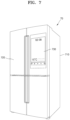
- FIG. 7 is a perspective view of a refrigerator according to example embodiments.
- a refrigerator 70 including a main body 710, a door 720, a display device 730, and a food monitoring apparatus may be provided. Because the food monitoring apparatus corresponds to the food monitoring apparatus 10 of FIGS. 1 and 2 , repeated descriptions thereof are omitted.
- the main body 710 includes a storage space, and not only one food product but also a plurality of food products may be located in the storage space.
- the door 720 may open and close the storage space, and thus, an environment independent from the external environment may be formed in the storage space.
- the display device 730 is arranged in front of the door 720 and may output second information received from the food monitoring apparatus. The display device 730 provides the second information received from the food monitoring apparatus to the user by outputting an image or audio.
- At least one processor included in the food monitoring apparatus may determine at least one of whether food is edible, an intake period, an optimum intake time, and a cooking method based on at least one of freshness, maturity, and spoilage.
- the at least one processor may provide the user with the determined possibility of whether food is edible, intake period, optimum intake time, or cooking method to the user through the display device 730.
- the refrigerator 70 may further include a controller that includes at least one processor and is configured to control at least one of temperature, humidity, and gas composition ratio in the storage space.
- the controller controls the temperature in the storage space to be in a range of about -25°C to about 10°C, but is not limited thereto. Because the storage space forms an environment independent from the outside, the gas composition ratio in the storage space may be controlled, and the ratio of oxygen in the gas in the storage space may be controlled.
- the at least one processor may determine whether acceleration or deceleration of maturation of the food is necessary in order to reach a target maturity at a scheduled intake date of the food based on the maturity of the food. According to the determination, the at least one processor may control at least one of temperature, humidity, and gas composition ratio in the storage space by using a controller configured to control at least one of temperature, humidity, and gas composition ratio.
- the at least one processor calculates the time when the maturity of the food is determined and the estimated time required until the scheduled intake date of the food, determines acceleration of maturation if the temperature at the time when the maturity of the food is determined is not high enough to reach a target maturity at the scheduled intake date, and determines the deceleration of maturation if the temperature is high enough to exceed the target maturity at the scheduled intake date.
- the at least one processor may increase or decrease a temperature in the storage space from a preset temperature during at least a portion of a period between the time when the maturity of the food is determined and the scheduled intake date.
- the maturation rate is related to the temperature, humidity, and gas composition ratio of the surrounding environment. For example, when the temperature is increased, the humidity is decreased, or the oxygen ratio in the gas is increased, the maturation rate increases, and when the temperature is decreased, the humidity is increased, or the oxygen ratio in the gas is decreased, the maturation rate decreases.
- the at least one processor may accelerate a chemical reaction for maturation by increasing the temperature in the storage space.
- the at least one processor may slow the chemical reaction for maturation by reducing the temperature in the storage space.
- the maturation of food may be decelerated.
- the at least one processor may calculate a temperature difference between the temperature in the storage space at the time when the maturity of the food is determined and the temperature at which the target maturity may be reached on the scheduled intake date, and may increase or decrease the temperature in the storage space by the corresponding temperature difference.
- the user may acquire the food of a desired maturity on the intake date, and thus, such a case that additional maturation time is required due to insufficient maturation or the taste or texture of food is deteriorated due to excessive maturation may not occur.
- the at least one processor may change the temperature in the storage space to a preset temperature or a temperature set by the user for intake or cooking before the user intakes or cooks. In this case, because the user may acquire food at a suitable temperature for intake or cooking, the time required for heating or cooling food, such as defrosting frozen food for intake or cooking is reduced.
- the processing of food by the at least one processor described above may be performed by a separate processor provided in the refrigerator in addition to the at least one processor included in the food monitoring apparatus.
- FIG. 8 is a conceptual diagram of a refrigerator further including a communication interface for communicating with an external apparatus according to example embodiments.
- the refrigerator 70 may include a communication interface that communicates with an external apparatus to transmit second information to the external apparatus.
- the refrigerator 70 may communicate with a server 810 and/or a mobile terminal 820 through the communication interface.
- the communication interface may include a short-range wireless communication interface, a mobile communication unit, and the like.
- the short-range wireless communication interface includes a Bluetooth communication unit, a Bluetooth Low Energy (BLE) communication unit, a Near Field Communication interface, a WLAN (Wi-Fi) communication unit, a Zigbee communication unit, an infrared Data Association (IrDA) communication unit, a Wi-Fi Direct (WFD) communication unit, an ultra wideband (UWB) communication unit, an Ant+ communication unit, etc., but is not limited thereto.
- the refrigerator 70 including a communication interface configured to communicate with an external apparatus allows a user to monitor information about the state of food in the storage space without restrictions on location and time by transmitting information about the state of food to the mobile terminal 820 of the user.
- information about food from a plurality of refrigerators 70 may be provided to the server 810, and it may be easier for a user to determine and manage the state of a large amount of arbitrary products.
- the refrigerator 70 including a communication interface communicating with external apparatuses may also be applied to distribution management.
- FIG. 9 is a flowchart illustrating a method of controlling at least one of temperature, humidity, and gas composition ratio in a storage space by a refrigerator according to example embodiments.
- the method of controlling at least one of temperature, humidity, and gas composition ratio in the storage space by the refrigerator includes operations performed in a time series in the refrigerator 70 illustrated in FIGS. 7 and 8 . Accordingly, the descriptions given with respect to FIGS. 7 and 8 , even though omitted below, may be applied to the method of controlling at least one of temperature, humidity, and gas composition ratio in the storage space of the refrigerator of FIG. 9 .
- the method of FIG. 9 may be performed by a food monitoring apparatus (e.g., the food monitoring apparatus 10 of FIG. 1 or 2 ) included in a refrigerator (e.g., the refrigerator 70 of FIG. 7 or 8 ), or may be performed by a separate processor outside the food monitoring apparatus.
- a food monitoring apparatus e.g., the food monitoring apparatus 10 of FIG. 1 or 2
- a refrigerator e.g., the refrigerator 70 of FIG. 7 or 8
- the method of FIG. 9 may be performed by arbitrary components included in the food monitoring apparatus (e.g., the at least one processor 130 of FIG. 1 or 2 ).
- the refrigerator may selectively radiate light of a first wavelength band to food and light of a second wavelength band that is different from the first wavelength band by using at least one light source.
- Operation 910 of FIG. 9 corresponds to operation 610 of FIG. 6 , and thus, repeated descriptions thereof are omitted.
- the refrigerator may acquire a visible image or a hyperspectral image of the food from light scattered, emitted, or reflected from the food by using at least one image sensor.
- Operation 920 of FIG. 9 corresponds to operation 620 of FIG. 6 , and thus, repeated descriptions thereof are omitted.
- the refrigerator may acquire first information on the food based on the visible image.
- Operation 930 of FIG. 9 corresponds to operation 630 of FIG. 6 , and thus, repeated descriptions thereof are omitted.
- the refrigerator may acquire second information on the food based on the acquired first information and the hyperspectral image.
- Operation 940 of FIG. 9 corresponds to operation 640 of FIG. 6 , and thus, repeated descriptions thereof are omitted.
- the refrigerator determines whether acceleration or deceleration of maturation of the food is necessary to reach a target maturity at the scheduled intake date of the food based on the maturity of the food. For example, the refrigerator calculates the time when the maturity of the food is determined and the estimated time required until the scheduled intake date of the food, determines acceleration of maturation if the temperature at the time when the maturity of the food is determined is not high enough to reach a target maturity at the scheduled intake date, and determines the deceleration of maturation if the temperature is high enough to exceed the target maturity at the scheduled intake date.
- the refrigerator may control at least one of temperature, humidity, and gas composition ratio in a storage space by using a controller configured to control at least one of temperature, humidity, and gas composition ratio.
- the refrigerator may increase or decrease the temperature in a storage space from a preset temperature during at least a portion of a period between the time when the maturity of the food is determined and the scheduled intake date.
- the refrigerator may calculate a temperature difference between a temperature in a storage space at a time when the maturity of food is determined and a temperature that may reach a target maturity on a scheduled intake date, and may increase or decrease the temperature in the storage space by the corresponding temperature difference.
- the refrigerator may change the temperature in the storage space to a preset temperature or a temperature preferred by the user for intake or cooking before the user intakes or cooks.
- the refrigerator may maintain the temperature, humidity, and gas composition ratio in the storage space.
Landscapes
- Engineering & Computer Science (AREA)
- Physics & Mathematics (AREA)
- Chemical & Material Sciences (AREA)
- Spectroscopy & Molecular Physics (AREA)
- General Physics & Mathematics (AREA)
- Health & Medical Sciences (AREA)
- Life Sciences & Earth Sciences (AREA)
- Food Science & Technology (AREA)
- General Engineering & Computer Science (AREA)
- Thermal Sciences (AREA)
- Mechanical Engineering (AREA)
- Combustion & Propulsion (AREA)
- Pathology (AREA)
- Immunology (AREA)
- General Health & Medical Sciences (AREA)
- Biochemistry (AREA)
- Analytical Chemistry (AREA)
- Medicinal Chemistry (AREA)
- Signal Processing (AREA)
- Multimedia (AREA)
- Quality & Reliability (AREA)
- Computer Vision & Pattern Recognition (AREA)
- Theoretical Computer Science (AREA)
- Investigating Or Analysing Materials By Optical Means (AREA)
- Cold Air Circulating Systems And Constructional Details In Refrigerators (AREA)
- Devices That Are Associated With Refrigeration Equipment (AREA)
Description
- The present disclosure relates to food monitoring apparatuses, refrigerators including the same, and operating method of the same.
- Technology of acquiring information about food and analyzing characteristics or conditions of food based on the acquired information is widely used not only for research purposes but also for the purpose of providing convenience to users.
- Among conventional methods of analyzing the state of food, a method of preparing a sample by pulverizing food, and measuring a pH of the sample, a volatile basic nitrogen (VBN) content, and the number of microorganisms may be suitable for measuring the freshness of food, but may not be suitable for general consumers because the food to be measured is destroyed. Therefore, there is a need for a technology that accurately provides information on the condition of food without destroying the food to be measured.
- In the food monitoring apparatus of
US 2020/097776 A1 a model evaluator evaluates that the recognition result does not meet the predetermined reference, when the number of pieces of the evaluation data for which the recognition result is not correct or the rate of the evaluation data for which the recognition result is not correct exceeds a predetermined critical value. Siche R. et al in "Evaluation of Food Quality and Safety with Hyperspectral Imaging (HSI)", Food Engineering Reviews, vol. 8 (2015), discloses that evaluation of parameters related to the food composition can be measured simultaneously by the HSI, which allows to obtain data on a larger number of spectral bands. - Wang Meng in "Fluorescence Image Based Food Quality Measurement" (2014), discloses that food quality can be evaluated with many indicators, for example tryptophan, NADH, tyrosine and riboflavin.
- One or more example embodiments of this disclosure provide food monitoring apparatuses, refrigerators including the same, and operating methods of the food monitoring apparatuses.
- The invention is defined in the appended claims.
- Additional aspects will be set forth in part in the description which follows and, in part, will be apparent from the description, or may be learned by practice of example embodiments.
- In the following the term "embodiment" does not necessarily refer to an embodiment of the invention but may refer to examples helpful in understanding the invention.
- According to an aspect of the invention, there is provided a food monitoring apparatus as defined in independent claim 1.
- The at least one processor may be further configured to correct at least one of the hyperspectral image, and a correlation between the at least one parameter and the second information.
- The first information may include at least one of a type of the food and a part of the food, and the at least one processor may be further configured to selectively apply a weight to the at least one parameter based on the first information, and obtain the second information by analyzing the hyperspectral image based on the at least one parameter to which the weight is applied.
- The first information may include a packaging condition of the food, and the at least one processor may be further configured to correct the at least one parameter based on the packaging condition, and obtain the second information based on the corrected at least one parameter.
- The at least one parameter may include at least one of 1,4-dihydronicotinamide adenine dinucleotide (NADH) content, porphyrin content, flavin adenine dinucleotide (FAD) content, and collagen content included in the food.
- The first information may include a location of the food in the food monitoring apparatus, and the at least one processor may be further configured to control the at least one light source to radiate the light of the second wavelength band to an area of the food monitoring apparatus corresponding to the location of the food, and obtain the hyperspectral image from light received from the area of the food monitoring apparatus corresponding to the location of the food.
- The first wavelength band may range from 400 nm to 700 nm, the second wavelength band may range from 250 nm to 400 nm, and the at least one image sensor may be further configured to measure light in a wavelength band ranging from 300 nm to 700 nm.
- According to another aspect of the invention, there is provided a refrigerator as defined in independent claim 7.
- The second information may include at least one of freshness, maturity, and spoilage of the food, and the at least one processor may be further configured to determine at least one of whether the food is edible, an intakeable period of the food, an optimum intake time of the food, and a cooking method of the food based on the at least one of the freshness, maturity, and spoilage of the food.
- The refrigerator may further include a controller including at least one processor and configured to control at least one of temperature, humidity, and gas composition ratio in the storage space.
- The second information may include maturity of the food, and the at least one processor is further configured to determine whether acceleration or deceleration of maturation of the food may be necessary to reach a target maturation at a preset intake time of the food based on the maturity of the food, and control the at least one of temperature, humidity, and gas composition ratio in the storage space by the controller.
- When it is determined that acceleration or deceleration of maturation of the food is necessary, the at least one processor may be further configured to increase or decrease a temperature in the storage space from a preset temperature during at least a portion of a period between a time when the maturity of the food is determined and the preset intake time.
- The refrigerator may further include a display device disposed on the door of the food monitoring apparatus, the display device configured to output the second information received from the food monitoring apparatus.
- The refrigerator may further include a communication interface configured to communicate with an external device to transmit the second information to the external device.
- According to yet another aspect of the invention, there is provided a method as defined in independent claim 12.
- The obtaining of the second information may include correcting at least one of the hyperspectral image, and a correlation between at least one parameter and the second information.
- The first information may include at least one of a type of the food and a part of the food, and the obtaining of the second information may include selectively applying a weight to the at least one parameter based on the first information, and obtaining the second information by analyzing the hyperspectral image based on the at least one parameter to which the weight is applied.
- The first information may include a packaging condition of food, and the obtaining of the second information may include correcting the at least one parameter based on the packaging condition, and obtaining the second information based on the corrected parameters.
- The at least one parameter may include at least one of 1,4-dihydronicotinamide adenine dinucleotide (NADH) content, porphyrin content, flavin adenine dinucleotide (FAD) content, and collagen content in the food.
- The first information may include a location of the food in the food monitoring apparatus, and the obtaining of the visible image of the food or the hyperspectral image of the food may include controlling the at least one light source to radiate light of the second wavelength band to an area of the food monitoring apparatus corresponding to the location of the food, and obtaining the hyperspectral image based on light received from the area of the food monitoring apparatus corresponding to the location of the food.
- The above and/or other aspects, features, and advantages of example embodiments will be more apparent from the following description taken in conjunction with the accompanying drawings, in which:
-
FIG. 1 is a block diagram illustrating an example of a food monitoring apparatus according to example embodiments; -
FIG. 2 is a conceptual diagram of a food monitoring apparatus according to example embodiments; -
FIGS. 3 and 4 are diagrams illustrating examples of parameters obtained from hyperspectral images by different parts of food, according to example embodiments; -
FIG. 5 is a diagram illustrating examples of data acquired from a hyperspectral image by varying a packaging state of food, according to example embodiments; -
FIG. 6 is a flowchart illustrating an operating method of a food monitoring apparatus according to example embodiments; -
FIG. 7 is a perspective view of a refrigerator according to example embodiments; -
FIG. 8 is a conceptual diagram of a refrigerator further including a communication interface for communicating with an external apparatus according to example embodiments; and -
FIG. 9 is a flowchart illustrating a method of controlling at least one of temperature, humidity, and gas composition ratio in a storage space by a refrigerator according to example embodiments. - Reference will now be made in detail to example embodiments of which are illustrated in the accompanying drawings, wherein like reference numerals refer to like elements throughout. In this regard, example embodiments may have different forms and should not be construed as being limited to the descriptions set forth herein. Accordingly, the example embodiments are merely described below, by referring to the figures, to explain aspects. As used herein, the term "and/or" includes any and all combinations of one or more of the associated listed items. Expressions such as "at least one of," when preceding a list of elements, modify the entire list of elements and do not modify the individual elements of the list. For example, the expression, "at least one of a, b, and c," should be understood as including only a, only b, only c, both a and b, both a and c, both b and c, or all of a, b, and c.
- Terminologies used herein are selected as commonly used by those of ordinary skill in the art in consideration of functions of example embodiments, but may vary according to the technical intention, precedents, or a disclosure of a new technology. Also, in particular cases, some terms are arbitrarily selected by the applicant, and in this case, the meanings of the terms will be described in detail at corresponding parts of the specification. Accordingly, the terms used in the specification should not be simply interpreted based on their names but based on the meaning and content of the whole specification.
- As used herein, the singular forms "a," "an" and "the" are intended to include the plural forms as well, unless the context clearly indicates otherwise. It should be understood that, when a part "comprises" or "includes" an element in the specification, unless otherwise defined, other elements are not excluded from the part and the part may further include other elements.
- It will be further understood that the term "comprises" or "includes" should not be construed as necessarily including various constituent elements and various operations described in the specification, and also should not be construed that portions of the constituent elements or operations of the various constituent elements and various operations may not be included or additional constituent elements and operations may further be included.
- It will be understood that, although the terms "first", "second", etc. may be used herein to describe various constituent elements, these constituent elements should not be limited by these terms. These terms are only used to distinguish one constituent element from another.
- The descriptions of the example embodiments should not be interpreted as limiting, and modifications will be apparent to skilled in the art within the scope of the appended claims. Reference will now be made in detail to example embodiments which are illustrated in the accompanying drawings.
-
FIG. 1 is a block diagram illustrating an example of afood monitoring apparatus 10 according to example embodiments. - The
food monitoring apparatus 10 may be applicable to any apparatus that determines the state of food without limitation. For example, thefood monitoring apparatus 10 may correspond to an apparatus that determines the state of food by being disposed in a food storage apparatus, such as a refrigerator, a kimchi refrigerator, a warmer, a storage container, a sealed container, etc., but embodiments are not limited thereto. Thefood monitoring apparatus 10 may correspond to an apparatus used to analyze the state of food for research purposes. Food refers to food that a person consumes on a daily basis, and may include, for example, meat, fish, eggs, grains, vegetables, fruits, dairy products, etc. - Referring to
FIG. 1 , thefood monitoring apparatus 10 may include at least onelight source 110, at least oneimage sensor 120, and at least oneprocessor 130. However, only components related to the example embodiments are shown in thefood monitoring apparatus 10 shown inFIG. 1 . Therefore, thefood monitoring apparatus 10 may further include other general-purpose components in addition to the components shown inFIG. 1 . For example, thefood monitoring apparatus 10 may further include a memory. - Moreover, when the object of the present disclosure is achieved even if only some of the components shown in
FIG. 1 are included, an apparatus including only some of the components shown inFIG. 1 also corresponds to thefood monitoring apparatus 10. For example, thefood monitoring apparatus 10 may include only the at least oneimage sensor 120 and the at least oneprocessor 130, and the at least onelight source 110 may be disposed outside thefood monitoring apparatus 10. - The memory may be hardware that stores various types of data processed by the
food monitoring apparatus 10, for example, the memory may store data processed by thefood monitoring apparatus 10 and data to be processed. In addition, the memory may store applications, drivers, etc. to be driven by thefood monitoring apparatus 10. - Memory may include random access memory (RAM), such as dynamic random access memory (DRAM), static random access memory (SRAM), read-only memory (ROM), electrically erasable programmable read-only memory (EEPROM), CD-ROM, Blu-ray or other optical disk storage, hard disk drive (HDD), solid state drive (SSD), or flash memory, and also other external storage devices that may be accessed in the
food monitoring apparatus 10. - The at least one
light source 110 may refer to a device for radiating light on food. The at least onelight source 110 may radiate light of a plurality of different wavelength bands to the food. For example, the at least onelight source 110 may selectively radiate light of a first wavelength band and light of a second wavelength band that is different from the first wavelength band to the food. The first wavelength band may range, for example, from about 400 nm to about 700 nm, and the second wavelength band may range, for example, from about 250 nm to about 400 nm. - For example, the at least one
light source 110 may be a light-emitting diode (LED) or a fluorescent lamp that radiates broad light in a visible light band, or may be a laser diode that radiates strong light with a short wavelength. However, embodiments are not necessarily limited thereto. The at least onelight source 110 may emit light of a wavelength band suitable for acquiring first information or second information about food. - Also, the at least one
light source 110 may be a single light source configured to selectively radiate light of a plurality of different wavelength bands on the food. However, embodiments are not limited thereto, and the at least onelight source 110 may include a plurality of light sources, each of which may radiate light of one wavelength band. Also, the at least onelight source 110 may include a plurality of light sources capable of selectively radiating light of a plurality of different wavelength bands to food. - The at least one
image sensor 120 may refer to a device for acquiring a visible image or a hyperspectral image of the food from light scattered, emitted or reflected from the food. In one example, the at least oneimage sensor 120 may obtain a visible image or a hyperspectral image of the food by measuring light in a wavelength band ranging from about 300 nm to about 700 nm. However, embodiments are not necessarily limited thereto, and the at least oneimage sensor 120 may measure light in an arbitrary wavelength band suitable for acquiring information about food. - For example, the at least one
image sensor 120 may include a chargecoupled device (CCD) sensor, a complementary metal oxide semiconductor (CMOS) sensor, or a photodiode array capable of obtaining a visible image, but is not limited thereto. The at least oneimage sensor 120 may acquire a visible image including information on an appearance, such as a color or shape of food. For example, the at least oneimage sensor 120 may acquire an RGB image of food. - In addition, the at least one
image sensor 120 may acquire a hyperspectral image including information on fluorescence emitted from food. Indicator materials in food may emit fluorescence as light is radiated from the at least onelight source 110. The indicator material according to the invention includes at least one of 1,4-dihydronicotinamide adenine dinucleotide (NADH), porphyrin, flavin adenine dinucleotide (FAD), and collagen. NADH may denote a reduced form of nicotinamide adenine dinucleotide (NAD). Parameters representing the content of indicator materials may be obtained from the hyperspectral image, and are used to acquire second information. For example, NADH is a material produced as a result product of cellular respiration, and because it is produced only by microorganisms after an animal dies, information, such as freshness, maturity, and spoilage of food, may be obtained from the NADH content. - In addition, the at least one
image sensor 120 may be a single image sensor configured to acquire a visible image or a hyperspectral image of food from light scattered, emitted, or reflected from the food. However, embodiments are not limited thereto, and the at least oneimage sensor 120 may include a plurality of image sensors each obtaining one visible image or a hyperspectral image of the food from light scattered, emitted, or reflected from the food. In addition, the at least oneimage sensor 120 may include a plurality of image sensors for acquiring a plurality of visible or hyperspectral images of the food from light scattered, emitted, or reflected from the food. - The at least one
processor 130 may perform an overall function for controlling thefood monitoring apparatus 10. For example, the at least oneprocessor 130 may control the operation of the at least onelight source 110 and the at least oneimage sensor 120. The at least oneprocessor 130 may be implemented as an array of a plurality of logic gates, and may be implemented as a combination of a general-purpose microprocessor with a memory in which a program executable by the microprocessor is stored. - The at least one
processor 130 may acquire first information on the food based on a visible image acquired from the at least oneimage sensor 120, and may acquire second information on the food based on the acquired first information and the hyperspectral image obtained from the at least oneimage sensor 120. In this way, the at least oneprocessor 130 does not acquire the second information by using only the information acquired through the analysis of the hyperspectral image, but acquires the second information by comprehensively considering the information acquired through the analysis of the visible image, and accordingly, the accuracy of the second information on the food may be increased. - For example, the first information includes at least one of a type, a part, and a packaging condition of the food, and a position of the food in the
food monitoring apparatus 10, and the second information includes at least one of freshness, maturity, and spoilage of the food. However, embodiments are not necessarily limited thereto. - The at least one
processor 130 may use a recognition algorithm to identify the presence of food and acquire information on the type, part, and packaging condition of the food, and location of the food in thefood monitoring apparatus 10. The recognition algorithm may correspond to a classification algorithm, a clustering algorithm, an ensemble learning algorithm, a general algorithm for predicting an arbitrary structured label, a regression algorithm, and the like. - The classification algorithm may include SVC, Naive Bayes Classifier, K-nearest Neighbors Classifier, Ensemble Classifier, SGD Classifier, kernel approximation, Neural Network, SVM, decision Trees, Logistic Regression, etc., and the clustering algorithm may include Spectral Clustering, Kmeans Clustering, MiniBatch Kmeans Clustering, and the like. Also, the ensemble learning algorithm may include Boosting (meta-algorithm), Bootstrap aggregating ("bagging"), and Ensemble averaging, the general algorithm for predicting an arbitrary structured label may include Bayesian networks and Markov random fields, and the regression algorithm may include Gaussian process regression (kriging), Linear/Nonlinear regression and extensions, Neural networks and Deep learning methods, Independent component analysis (ICA), Principal components analysis (PCA), and the like.
- The neural network may include n-layers neural networks or a deep neural network (DNN) including one or more hidden layers. DNN may include Convolutional Neural Networks (CNN), Recurrent Neural Networks (RNN), Deep Belief Networks, Restricted Boltzmann Machines, and the like, but is not limited thereto. When the pattern recognition algorithm is a neural network, an estimation result of the pattern recognition algorithm may correspond to an inference result of the neural network.
- The at least one
processor 130 may determine freshness, maturity, and spoilage of the food based on at least one of NADH content, porphyrin content, FAD content, and collagen content in the food or the content ratio thereof. When radiating light of a specific wavelength band on the food, the at least oneprocessor 130 may measure the NADH content based on a spectral distribution with respect to a wavelength band of, for example, about 430 nm to about 550 nm, and may measure the porphyrin content based on a spectral distribution with respect to a wavelength band of, for example, about 570 nm to about 630 nm. In addition, the at least oneprocessor 130 may measure the FAD content based on the spectral distribution with respect to the wavelength band of, for example, about 500 nm to about 550 nm, and measure the collagen content based on the spectral distribution with respect to the wavelength band of, for example, about 360 nm to about 420 nm. - According to an example, the at least one
processor 130 may correct at least one of a hyperspectral image, parameters used to analyze the hyperspectral image, and a correlation between the parameters and information about the state of food by using information acquired through the analysis of a visible image. As described later, when the information acquired through the analysis of the visible image includes a location of the food in the food monitoring apparatus, the at least oneprocessor 130 may obtain a clearer hyperspectral image with respect to an object to be measured by allowing the at least onelight source 110 to radiate light of the second wavelength band to a region corresponding to the location of the food. When the information acquired through the analysis of the visible image includes the packaging condition of the food, the at least oneprocessor 130 may amplify the content of the parameters according to a predetermined ratio for each packaging condition. In addition, when the information acquired through the analysis of the visible image includes at least one of a type and a part of the food, the at least oneprocessor 130 may assign a weight to the parameters. However, embodiments are not necessarily limited thereto. - In this way, the at least one
processor 130 determines the state of the food not by using only the information acquired through the analysis of the hyperspectral image, but by comprehensively considering the information acquired through the analysis of the visible image. Thus, the accuracy of the condition of the food may be increased. Hereinafter, a process of operating thefood monitoring apparatus 10 will be described in more detail with reference toFIG. 2 . -
FIG. 2 is a conceptual diagram of thefood monitoring apparatus 10 according to example embodiments. - Referring to
FIG. 2 , the conceptual diagram for explaining a process in which thefood monitoring apparatus 10 ofFIG. 1 determines the state offood 140 is shown. The at least onelight source 110 may selectively radiate light of a first wavelength band and light of a second wavelength band that is different from the first wavelength band to thefood 140, and the light may be scattered, emitted, or reflected from thefood 140. - According to example embodiments, the at least one
processor 130 may acquire information about the location of thefood 140 based on a visible image obtained from the at least oneimage sensor 120, and may accurately radiate light of a second wavelength band to the location of thefood 140. In this example, compared to when the light is radiated over an entire measurement space of thefood monitoring apparatus 10, the light may be concentrated and radiated onto thefood 140 as an object to be measured. Accordingly, signals by foods or articles other than thefood 140 may be removed, and the maximum output of at least onelight source 110 may be used to determine the state of thefood 140, and thus, the accuracy of information about the condition of the food obtained from the spectroscopic image may be increased. - For example, when information acquired through the analysis of a visible image includes a location of the food in the
food monitoring apparatus 10, the at least oneprocessor 130 may control the at least onelight source 110 to radiate light of the second wavelength band to an area corresponding to the location of the food and may acquire a hyperspectral image from light received from an area corresponding to the location of the food. -
FIGS. 3 and 4 are diagrams illustrating examples of parameters obtained from hyperspectral images by different parts of food, according to example embodiments. - In
FIG. 3 ,graphs graph 310 corresponds to the measurement result of fat tissue of fresh meat, and thegraph 320 corresponds to the measurement result of fat tissue of decayed meat. InFIG. 4 ,graphs graph 410 corresponds to the measurement result of the muscle tissue of the fresh meat, and thegraph 420 corresponds to the measurement result of the muscle tissue of the decayed meat. - In the graphs, the intensity in the wavelength band of about 430 nm to about 550 nm corresponds to the NADH content, and the intensity in the wavelength band of about 570 nm to about 630 nm corresponds to the porphyrin content. Information on the freshness, spoilage, and maturity of the food may be obtained based on the graph pattern and the intensity in a specific wavelength band. For example, information on freshness, spoilage, and maturity of food may be obtained using the recognition algorithm described with reference to
FIG. 1 . - However, comparing
FIGS. 3 and 4 , it may be seen that the patterns of thegraphs graphs - In addition, depending on the type of food, for example, depending on whether the food to be measured is meat, fish, eggs, grains, vegetables, fruits, or dairy products, the change of aspects of the parameters may be different. Therefore, as in the case of the part of the food, the criteria for determining the freshness of the food may be different depending on the type of food. In one example, the type of food may be classified according to the porphyrin content, and the porphyrin content may be analyzed based on the color of the appearance of the food obtained from a visible image.
- For example, when the information acquired through the analysis of the visible image includes at least one of a food type and a part, at least one processor (e.g., the at least one
processor 110 inFIG. 1 or 2 ) may selectively apply weights to parameters according to the information and may acquire information on the state of the food by analyzing the hyperspectral image by using the weighted parameters. When weights are applied to parameters according to the type or part of the food, the state of the food may be determined by using parameters more suitable for analyzing the state of the food to be measured. Therefore, the accuracy of information about the state of food may be increased. -
FIG. 5 is a diagram illustrating examples of data acquired from a hyperspectral image by varying the packaging state of food, according to example embodiments.Graph 510 represents data obtained with respect to vinyl wrap-packed food, andgraph 520 represents data obtained for vinyl vacuum-packed food. - In the
graphs - Referring to
FIG. 5 , in the example of thegraph 520, compared with thegraph 510, a prominent peak appears in a wavelength band of about 430 nm to about 550 nm corresponding to the NADH content. If a signal by an article other than food to be measured is not removed, the accuracy of the method of determining the state of the food may decrease, and thus, parameters must be corrected according to the packaging conditions of the food. - For example, when the information acquired through the analysis of the visible image includes the packaging condition of the food, at least one processor (e.g., the at least one
processor 110 ofFIG. 1 or 2 ) may correct the parameters based on the packing condition and acquire information about the state of the food based on the corrected parameters. - For example, when a signal by packaging is removed, a change in a pattern or parameter of a graph may become clearer, and thus, the accuracy of information about the state of the food may be increased.
- In addition, when a material of a packaging material that interrupts light of the second wavelength band from being radiated to the food is present, the light of the second wavelength band may be radiated to a part of the food in which the material of the packaging material is not present. In this case, a signal emitted from a packaged part of the food to be measured may decrease. Therefore, the accuracy of information about the state of food may be increased.
-
FIG. 6 is a flowchart illustrating an operating method afood monitoring apparatus 10 according to example embodiments. - Referring to
FIG. 6 , a method of operating thefood monitoring apparatus 10 includes operations processed in a time series in thefood monitoring apparatus 10 shown inFIGS. 1 and 2 . Accordingly, the descriptions given with respect toFIGS. 1 to 5 , even though omitted below, may be applied to the method of operating the food monitoring apparatus ofFIG. 6 . - In
operation 610, the food monitoring apparatus may selectively radiate light of a first wavelength band and light of a second wavelength band that is different from the first wavelength band on the food by using at least one light source. - In one example, the food monitoring apparatus may selectively radiate light in a first wavelength band in a range of about 400 nm to about 700 nm and light in a second wavelength band in a range of about 250 nm to about 400 nm by using the at least one light source. However, embodiments are not necessarily limited thereto.
- In
operation 620, the food monitoring apparatus may acquire a visible image or a hyperspectral image of the food from light scattered, emitted, or reflected from the food by using at least one image sensor. The at least one image sensor may acquire a visible image including information about an appearance of the food, such as color or shape. In addition, the at least one image sensor may acquire a hyperspectral image including information about fluorescence emitted from the food. - In one example, the food monitoring apparatus may measure light in a wavelength band ranging from about 300 nm to about 700 nm by using the at least one image sensor. However, embodiments are not necessarily limited thereto.
- In
operation 630, the food monitoring apparatus may acquire first information about the food based on the visible image. The first information may include any information necessary to accurately measure the state of the food. For example, the first information may include at least one of a type, a part, and a packaging condition of the food, and a location of the food in the food monitoring apparatus. However, embodiments are not necessarily limited thereto. - In
operation 640, the food monitoring apparatus may acquire second information about the food based on the acquired first information and the hyperspectral image. The second information about the food may include all information indicating the state of the food. For example, the second information may include at least one of freshness, maturity, and spoilage of the food. However, embodiments are not necessarily limited thereto. - The food monitoring apparatus may include a correction operation correcting at least one of a hyperspectral image, parameters used to analyze the hyperspectral image, and a correlation between the parameters and the second information by using the acquired first information. For example, the parameters may include at least one of NADH content, porphyrin content, FAD content, and collagen content in food. However, embodiments are not necessarily limited thereto.
- When the first information includes at least one of the type and part of the food, the food monitoring apparatus may selectively apply a weight to the parameters according to the first information, and may acquire second information by analyzing the hyperspectral image using the weighted parameters.
- In addition, when the first information includes a packaging condition of the food, the food monitoring apparatus may correct parameters based on the packaging condition and acquire second information based on the corrected parameters.
- When the first information includes a location of the food in the food monitoring apparatus, the food monitoring apparatus may control the at least one light source to radiate light of the second wavelength band to an area corresponding to the location of the food, and obtain a hyperspectral image from light received from the area corresponding to the location of the food.
- The method of operating the food monitoring apparatus described above may be stored in a computer-readable recording medium in which one or more programs including instructions for executing the method are recorded. Examples of the computer-readable recording media include magnetic media, such as hard disks, floppy disks, and magnetic tape, optical media, such as CD-ROMs and DVDs, magneto-optical media, such as floptical disks, and hardware devices specifically configured to store and execute program instructions, such as ROM, RAM, flash memory, etc. Examples of program instructions include machine code produced by a compiler as well as high-level language code that may be executed by a computer by using an interpreter, etc.
-
FIG. 7 is a perspective view of a refrigerator according to example embodiments. - Referring to
FIG. 7 , arefrigerator 70 including amain body 710, adoor 720, adisplay device 730, and a food monitoring apparatus may be provided. Because the food monitoring apparatus corresponds to thefood monitoring apparatus 10 ofFIGS. 1 and 2 , repeated descriptions thereof are omitted. - The
main body 710 includes a storage space, and not only one food product but also a plurality of food products may be located in the storage space. Thedoor 720 may open and close the storage space, and thus, an environment independent from the external environment may be formed in the storage space. Thedisplay device 730 is arranged in front of thedoor 720 and may output second information received from the food monitoring apparatus. Thedisplay device 730 provides the second information received from the food monitoring apparatus to the user by outputting an image or audio. - According to example embodiments, when the second information includes at least one of freshness, maturity and spoilage of food, at least one processor (e.g., the at least one
processor 110 ofFIG. 1 or 2 ) included in the food monitoring apparatus may determine at least one of whether food is edible, an intake period, an optimum intake time, and a cooking method based on at least one of freshness, maturity, and spoilage. In addition, the at least one processor may provide the user with the determined possibility of whether food is edible, intake period, optimum intake time, or cooking method to the user through thedisplay device 730. - According to example embodiments, the
refrigerator 70 may further include a controller that includes at least one processor and is configured to control at least one of temperature, humidity, and gas composition ratio in the storage space. In addition, the controller controls the temperature in the storage space to be in a range of about -25°C to about 10°C, but is not limited thereto. Because the storage space forms an environment independent from the outside, the gas composition ratio in the storage space may be controlled, and the ratio of oxygen in the gas in the storage space may be controlled. - For example, when the second information includes the maturity of the food, the at least one processor may determine whether acceleration or deceleration of maturation of the food is necessary in order to reach a target maturity at a scheduled intake date of the food based on the maturity of the food. According to the determination, the at least one processor may control at least one of temperature, humidity, and gas composition ratio in the storage space by using a controller configured to control at least one of temperature, humidity, and gas composition ratio.
- The at least one processor calculates the time when the maturity of the food is determined and the estimated time required until the scheduled intake date of the food, determines acceleration of maturation if the temperature at the time when the maturity of the food is determined is not high enough to reach a target maturity at the scheduled intake date, and determines the deceleration of maturation if the temperature is high enough to exceed the target maturity at the scheduled intake date.
- In addition, when it is determined that acceleration or deceleration of maturation of the food is necessary, the at least one processor may increase or decrease a temperature in the storage space from a preset temperature during at least a portion of a period between the time when the maturity of the food is determined and the scheduled intake date.
- The maturation rate is related to the temperature, humidity, and gas composition ratio of the surrounding environment. For example, when the temperature is increased, the humidity is decreased, or the oxygen ratio in the gas is increased, the maturation rate increases, and when the temperature is decreased, the humidity is increased, or the oxygen ratio in the gas is decreased, the maturation rate decreases.
- For example, when acceleration of maturation of food is required, the at least one processor may accelerate a chemical reaction for maturation by increasing the temperature in the storage space. Thus, the maturation of food may be accelerated. When a deceleration of maturation of food is necessary, the at least one processor may slow the chemical reaction for maturation by reducing the temperature in the storage space. Thus, the maturation of food may be decelerated.
- When acceleration or deceleration of maturation of food is required, the at least one processor may calculate a temperature difference between the temperature in the storage space at the time when the maturity of the food is determined and the temperature at which the target maturity may be reached on the scheduled intake date, and may increase or decrease the temperature in the storage space by the corresponding temperature difference. In this case, the user may acquire the food of a desired maturity on the intake date, and thus, such a case that additional maturation time is required due to insufficient maturation or the taste or texture of food is deteriorated due to excessive maturation may not occur.
- In addition, when the temperature in a storage space is increased or decreased from a preset temperature in order to accelerate or decelerate the maturation of food, the at least one processor may change the temperature in the storage space to a preset temperature or a temperature set by the user for intake or cooking before the user intakes or cooks. In this case, because the user may acquire food at a suitable temperature for intake or cooking, the time required for heating or cooling food, such as defrosting frozen food for intake or cooking is reduced.
- The processing of food by the at least one processor described above may be performed by a separate processor provided in the refrigerator in addition to the at least one processor included in the food monitoring apparatus.
-
FIG. 8 is a conceptual diagram of a refrigerator further including a communication interface for communicating with an external apparatus according to example embodiments. - Referring to
FIG. 8 , therefrigerator 70 may include a communication interface that communicates with an external apparatus to transmit second information to the external apparatus. Therefrigerator 70 may communicate with aserver 810 and/or amobile terminal 820 through the communication interface. The communication interface may include a short-range wireless communication interface, a mobile communication unit, and the like. The short-range wireless communication interface includes a Bluetooth communication unit, a Bluetooth Low Energy (BLE) communication unit, a Near Field Communication interface, a WLAN (Wi-Fi) communication unit, a Zigbee communication unit, an infrared Data Association (IrDA) communication unit, a Wi-Fi Direct (WFD) communication unit, an ultra wideband (UWB) communication unit, an Ant+ communication unit, etc., but is not limited thereto. - The
refrigerator 70 including a communication interface configured to communicate with an external apparatus allows a user to monitor information about the state of food in the storage space without restrictions on location and time by transmitting information about the state of food to themobile terminal 820 of the user. In addition, information about food from a plurality ofrefrigerators 70 may be provided to theserver 810, and it may be easier for a user to determine and manage the state of a large amount of arbitrary products. Thus, therefrigerator 70 including a communication interface communicating with external apparatuses may also be applied to distribution management. -
FIG. 9 is a flowchart illustrating a method of controlling at least one of temperature, humidity, and gas composition ratio in a storage space by a refrigerator according to example embodiments. - Referring to
FIG. 9 , the method of controlling at least one of temperature, humidity, and gas composition ratio in the storage space by the refrigerator includes operations performed in a time series in therefrigerator 70 illustrated inFIGS. 7 and8 . Accordingly, the descriptions given with respect toFIGS. 7 and8 , even though omitted below, may be applied to the method of controlling at least one of temperature, humidity, and gas composition ratio in the storage space of the refrigerator ofFIG. 9 . - In addition, the method of
FIG. 9 may be performed by a food monitoring apparatus (e.g., thefood monitoring apparatus 10 ofFIG. 1 or 2 ) included in a refrigerator (e.g., therefrigerator 70 ofFIG. 7 or8 ), or may be performed by a separate processor outside the food monitoring apparatus. When the method ofFIG. 9 is performed by the food monitoring apparatus, the method ofFIG. 9 may be performed by arbitrary components included in the food monitoring apparatus (e.g., the at least oneprocessor 130 ofFIG. 1 or 2 ). - In
operation 910, the refrigerator may selectively radiate light of a first wavelength band to food and light of a second wavelength band that is different from the first wavelength band by using at least one light source.Operation 910 ofFIG. 9 corresponds tooperation 610 ofFIG. 6 , and thus, repeated descriptions thereof are omitted. - In
operation 920, the refrigerator may acquire a visible image or a hyperspectral image of the food from light scattered, emitted, or reflected from the food by using at least one image sensor.Operation 920 ofFIG. 9 corresponds tooperation 620 ofFIG. 6 , and thus, repeated descriptions thereof are omitted. - In
operation 930, the refrigerator may acquire first information on the food based on the visible image.Operation 930 ofFIG. 9 corresponds tooperation 630 ofFIG. 6 , and thus, repeated descriptions thereof are omitted. - In
operation 940, the refrigerator may acquire second information on the food based on the acquired first information and the hyperspectral image.Operation 940 ofFIG. 9 corresponds tooperation 640 ofFIG. 6 , and thus, repeated descriptions thereof are omitted. - In
operation 950, if the second information includes the maturity of food, the refrigerator determines whether acceleration or deceleration of maturation of the food is necessary to reach a target maturity at the scheduled intake date of the food based on the maturity of the food. For example, the refrigerator calculates the time when the maturity of the food is determined and the estimated time required until the scheduled intake date of the food, determines acceleration of maturation if the temperature at the time when the maturity of the food is determined is not high enough to reach a target maturity at the scheduled intake date, and determines the deceleration of maturation if the temperature is high enough to exceed the target maturity at the scheduled intake date. - In
operation 960, when it is determined that acceleration or deceleration of maturation of food is necessary, the refrigerator may control at least one of temperature, humidity, and gas composition ratio in a storage space by using a controller configured to control at least one of temperature, humidity, and gas composition ratio. For example, the refrigerator may increase or decrease the temperature in a storage space from a preset temperature during at least a portion of a period between the time when the maturity of the food is determined and the scheduled intake date. - The refrigerator may calculate a temperature difference between a temperature in a storage space at a time when the maturity of food is determined and a temperature that may reach a target maturity on a scheduled intake date, and may increase or decrease the temperature in the storage space by the corresponding temperature difference. In addition, when the temperature in a storage space is increased or decreased from a preset temperature in order to accelerate or decelerate the maturation of food, the refrigerator may change the temperature in the storage space to a preset temperature or a temperature preferred by the user for intake or cooking before the user intakes or cooks.
- In
operation 970, when it is determined that acceleration or deceleration of maturation of the food is not required, the refrigerator may maintain the temperature, humidity, and gas composition ratio in the storage space. - Although example embodiments have been described in detail above, various modifications and improvements may be made by those skilled in the art within the scope of the invention, defined by the following claims.
Claims (15)
- A food monitoring apparatus (10) comprising:at least one light source (110) configured to selectively radiate light of a first wavelength band and light of a second wavelength band that is different from the first wavelength band to food (140);at least one image sensor (120) configured to obtain a visible image of the food (140) and a hyperspectral image of the food (140) based on light scattered, emitted, or reflected from the food (140); andat least one processor (130) configured to obtain first information of the food (140) based on the visible image,wherein the at least one processor (130) is further configured to obtain at least one parameter representing a content of an indicator material included in the food (140) from the hyperspectral image, the indicator material emitting fluorescence based on the light radiated by the at least one light source (110); andthe at least one processor (130) is further configured to correct, based on the first information of the food (140) obtained based on the visible image, a value of the at least one parameter obtained from the hyperspectral image, and obtain the second information based on the corrected value of the at least one parameter,wherein the indicator material includes at least one of 1,4-dihydronicotinamide adenine dinucleotide (NADH), porphyrin, flavin adenine dinucleotide (FAD), and collagen.
- The food monitoring apparatus (10) of claim 1, wherein the at least one processor (130) is further configured to further correct, based on the first information, at least one of the hyperspectral image, and a correlation between the at least one parameter and the second information.
- The food monitoring apparatus (10) of claim 2, wherein the first information includes at least one of a type of the food and a part of the food, andwherein the at least one processor (130) is further configured to selectively apply a weight to the at least one parameter based on the first information, and obtain the second information by analyzing the hyperspectral image based on the at least one parameter to which the weight is applied; orwherein the first information includes a packaging condition of the food (140), andwherein the at least one processor (130) is further configured to correct the at least one parameter based on the packaging condition, and obtain the second information based on the corrected at least one parameter.
- The food monitoring apparatus (10) of one of claims 2 or 3, wherein the at least one parameter includes at least one of 1,4-dihydronicotinamide adenine dinucleotide (NADH) content, porphyrin content, flavin adenine dinucleotide (FAD) content, and collagen content included in the food (140).
- The food monitoring apparatus (10) of one of claims 1 to 4, wherein the first information includes a location of the food (140) in the food monitoring apparatus, and
wherein the at least one processor (130) is further configured to:control the at least one light source (110) to radiate the light of the second wavelength band to an area of the food monitoring apparatus (10) corresponding to the location of the food (140); andobtain the hyperspectral image from light received from the area of the food monitoring apparatus (10) corresponding to the location of the food (140). - The food monitoring apparatus (10) of one of claims 1 to 5, wherein the first wavelength band ranges from 400 nm to 700 nm,wherein the second wavelength band ranges from 250 nm to 400 nm, andwherein the at least one image sensor (120) is further configured to measure light in a wavelength band ranging from 300 nm to 700 nm.
- A refrigerator (70) comprising:a main body (710) comprising a storage space;a door (720) configured to open and close the storage space; andthe food monitoring apparatus (10) according to any one of claims 1 to 6 that is disposed in the storage space.
- The refrigerator (70) of claim 7, wherein the second information includes at least one of freshness, maturity, and spoilage of the food, and
wherein the at least one processor (130) is further configured to determine at least one of whether the food (140) is edible, an intakeable period of the food (140), an optimum intake time of the food (140), and a cooking method of the food (140) based on the at least one of the freshness, maturity, and spoilage of the food (140). - The refrigerator (70) of one of claims 7 or 8, further comprising a controller comprising at least one processor and configured to control at least one of temperature, humidity, and gas composition ratio in the storage space.
- The refrigerator (70) of claim 9, wherein the second information includes maturity of the food (140), and
wherein the at least one processor is further configured to:determine whether acceleration or deceleration of maturation of the food (140) is necessary to reach a target maturation at a preset intake time of the food (140) based on the maturity of the food (140); andcontrol the at least one of temperature, humidity, and gas composition ratio in the storage space by the controller,wherein, when it is determined that acceleration or deceleration of maturation of the food (140) is necessary, the at least one processor (130) is further configured to increase or decrease a temperature in the storage space from a preset temperature during at least a portion of a period between a time when the maturity of the food (140) is determined and the preset intake time. - The refrigerator (70) of one of claims 7 to 10, further comprising:a display device (730) disposed on the door (720), the display device (730) configured to output the second information received from the food monitoring apparatus (10); anda communication interface configured to communicate with an external device (820) to transmit the second information to the external device (820).
- A method of operating a food monitoring apparatus (10), the method comprising:selectively radiating light of a first wavelength band and light of a second wavelength band that is different from the first wavelength band to food (140) by at least one light source (110);obtaining a visible image of the food (140) and a hyperspectral image of the food (140) based on light scattered, emitted, or reflected from the food (140) by at least one image sensor (120);obtaining first information of the food (140) based on the visible image;wherein the obtaining the second information includes:obtaining at least one parameter representing a content of an indicator material included in the food (140) from the hyperspectral image, the indicator material emitting fluorescence based on the light radiated by the at least one light source (110);correcting, based on the first information of the food (140) obtained based on the visible image, a value of the at least one parameter obtained from the hyperspectral image; andobtaining the second information based on the corrected value of the at least one parameter,wherein the indicator material includes at least one of 1,4-dihydronicotinamide adenine dinucleotide (NADH), porphyrin, flavin adenine dinucleotide (FAD), and collagen.
- The method of claim 12, wherein the obtaining of the second information further includes correcting, based on the first information, at least one of the hyperspectral image, and a correlation between the at least one parameter and the second information.
- The method of claim 13, wherein the first information includes at least one of a type of the food (140) and a part of the food (140), andwherein the obtaining of the second information further includes selectively applying a weight to the at least one parameter based on the first information, and obtaining the second information by analyzing the hyperspectral image based on the at least one parameter to which the weight is applied; orwherein the first information includes a packaging condition of food (140), andwherein the obtaining of the second information further includes correcting the at least one parameter based on the packaging condition, and obtaining the second information based on the corrected at least one parameter, andwherein the at least one parameter include at least one of 1,4-dihydronicotinamide adenine dinucleotide (NADH) content, porphyrin content, flavin adenine dinucleotide (FAD) content, and collagen content in the food (140).
- The method of one of claims 12 to 14, wherein the first information includes a location of the food (140) in the food monitoring apparatus (10), and
wherein the obtaining of the visible image of the food (140) or the hyperspectral image of the food (140) includes controlling the at least one light source (110) to radiate light of the second wavelength band to an area of the food monitoring apparatus (10) corresponding to the location of the food (140), and obtaining the hyperspectral image based on light received from the area of the food monitoring apparatus (10) corresponding to the location of the food (140).
Applications Claiming Priority (1)
| Application Number | Priority Date | Filing Date | Title |
|---|---|---|---|
| KR1020200173505A KR102953714B1 (en) | 2020-12-11 | 2020-12-11 | Food monitoring apparatus, refrigerator including the same, and operating method thereof |
Publications (2)
| Publication Number | Publication Date |
|---|---|
| EP4012384A1 EP4012384A1 (en) | 2022-06-15 |
| EP4012384B1 true EP4012384B1 (en) | 2025-06-04 |
Family
ID=78371827
Family Applications (1)
| Application Number | Title | Priority Date | Filing Date |
|---|---|---|---|
| EP21203948.1A Active EP4012384B1 (en) | 2020-12-11 | 2021-10-21 | Food monitoring apparatus, refrigerator including the same, and operating method thereof |
Country Status (5)
| Country | Link |
|---|---|
| US (1) | US11758091B2 (en) |
| EP (1) | EP4012384B1 (en) |
| JP (1) | JP2022093290A (en) |
| KR (1) | KR102953714B1 (en) |
| CN (1) | CN114624233A (en) |
Families Citing this family (4)
| Publication number | Priority date | Publication date | Assignee | Title |
|---|---|---|---|---|
| KR102654875B1 (en) | 2021-12-23 | 2024-04-05 | 삼성전자주식회사 | Apparatus for detecting UV blocking material and mobile device including same |
| CN115046363B (en) * | 2022-06-30 | 2024-05-07 | 桂林电子科技大学 | Intelligent refrigerator and operation method based on machine vision and spectral detection |
| CN116196621B (en) * | 2023-05-05 | 2023-10-03 | 荣耀终端有限公司 | Application processing methods and related devices |
| KR102921885B1 (en) | 2024-03-14 | 2026-02-02 | 이은지 | Multifunctional foldable fish spine detection light device |
Family Cites Families (28)
| Publication number | Priority date | Publication date | Assignee | Title |
|---|---|---|---|---|
| JPH0396838A (en) | 1989-09-08 | 1991-04-22 | Sumitomo Electric Ind Ltd | Meat freshness measuring device |
| CA2133825C (en) | 1992-04-13 | 2002-12-31 | Alan Benn | Image analysis for meat |
| JP2002162358A (en) | 2000-11-22 | 2002-06-07 | Ishii Ind Co Ltd | Method for detecting a mutated part of an object to be detected |
| JP2005043295A (en) * | 2003-07-25 | 2005-02-17 | Nireco Corp | Internal quality inspection device and internal quality inspection method |
| JP4522907B2 (en) * | 2005-04-15 | 2010-08-11 | 三菱電機株式会社 | refrigerator |
| KR101071032B1 (en) * | 2005-06-01 | 2011-10-06 | 엘지전자 주식회사 | Food keeping refrigerator |
| CN101251526B (en) * | 2008-02-26 | 2012-08-29 | 浙江大学 | Method and apparatus for nondestructively testing food synthetic quality |
| WO2010081116A2 (en) | 2009-01-10 | 2010-07-15 | Goldfinch Solutions, Llc | System and method for analyzing properties of meat using multispectral imaging |
| WO2011099137A1 (en) * | 2010-02-12 | 2011-08-18 | 株式会社ユニソク | Food quality measuring device |
| JP2013064646A (en) * | 2011-09-16 | 2013-04-11 | National Institute Of Information & Communication Technology | Method for evaluating material by terahertz spectroscopy |
| US9322769B2 (en) | 2011-12-19 | 2016-04-26 | Robert R. Alfano | Method and apparatus for detecting degree of spoilage of food |
| JP2014153163A (en) | 2013-02-07 | 2014-08-25 | Zensho Holdings Co Ltd | Food inspection device and method |
| US20140267684A1 (en) | 2013-03-15 | 2014-09-18 | Chemlmage Corporation | System and method for detecting contamination in food using hyperspectral imaging |
| AU2015412899B9 (en) * | 2015-10-30 | 2019-02-28 | Mitsubishi Electric Corporation | Refrigerator |
| CN105928888A (en) * | 2016-04-29 | 2016-09-07 | 合肥华凌股份有限公司 | Refrigerator and food nutrient real-time detection method for refrigerator |
| JP2018004646A (en) * | 2016-07-05 | 2018-01-11 | シャープ株式会社 | Determination device of degree of ripeness, and method for determining degree of ripeness |
| CN106871568A (en) * | 2016-12-30 | 2017-06-20 | 青岛海尔智能技术研发有限公司 | The category identification method and refrigerator of refrigerator inside food |
| CN108663332A (en) * | 2017-03-27 | 2018-10-16 | 青岛海尔智能技术研发有限公司 | High light spectrum image-forming component and refrigerator for detecting food in refrigerator |
| KR102452955B1 (en) * | 2017-11-23 | 2022-10-11 | 삼성전자주식회사 | Method and apparatus for optical signal processing |
| US10628660B2 (en) * | 2018-01-10 | 2020-04-21 | Trax Technology Solutions Pte Ltd. | Withholding notifications due to temporary misplaced products |
| US10989595B2 (en) * | 2018-08-01 | 2021-04-27 | Qcell Pc | Hybrid spectral imager |
| US11353259B2 (en) * | 2018-09-18 | 2022-06-07 | Samsung Electronics Co., Ltd. | Augmented-reality refrigerator and method of controlling thereof |
| KR102551358B1 (en) * | 2018-09-21 | 2023-07-04 | 삼성전자주식회사 | Method and system for providing information related to a status of an object in a refrigerator |
| JP6913953B2 (en) | 2018-11-07 | 2021-08-04 | 有限会社 ワーコム農業研究所 | Digitization method of quality standard of meat quality grade, digital processing method of quality evaluation using the quality standard, automatic meat quality evaluation device using them, and software installed in it |
| CN109752496A (en) * | 2019-01-10 | 2019-05-14 | 珠海格力电器股份有限公司 | Food material detection method and device and storage device |
| CN110987885A (en) | 2019-11-23 | 2020-04-10 | 四川省农业科学院分析测试中心 | Method and device for detecting freshness of fish body based on autofluorescence intensity of fish body |
| CN110956217A (en) | 2019-12-06 | 2020-04-03 | 广东美的白色家电技术创新中心有限公司 | Food maturity recognition method and device and computer storage medium |
| CN114252400A (en) | 2020-09-21 | 2022-03-29 | 三星电子株式会社 | Meat inspection device, meat inspection system, refrigerator, and meat inspection method |
-
2020
- 2020-12-11 KR KR1020200173505A patent/KR102953714B1/en active Active
-
2021
- 2021-07-02 US US17/366,695 patent/US11758091B2/en active Active
- 2021-07-26 CN CN202110847466.5A patent/CN114624233A/en active Pending
- 2021-10-21 EP EP21203948.1A patent/EP4012384B1/en active Active
- 2021-12-01 JP JP2021195163A patent/JP2022093290A/en active Pending
Non-Patent Citations (1)
| Title |
|---|
| "Fluorescence Image Based Food Quality Measurement", 1 February 2014, THE UNIVERSITY OF TOKYO, article WANG MENG: "Fluorescence Image Based Food Quality Measurement", XP055889551 * |
Also Published As
| Publication number | Publication date |
|---|---|
| KR102953714B1 (en) | 2026-04-15 |
| KR20220083349A (en) | 2022-06-20 |
| US11758091B2 (en) | 2023-09-12 |
| CN114624233A (en) | 2022-06-14 |
| US20220191432A1 (en) | 2022-06-16 |
| EP4012384A1 (en) | 2022-06-15 |
| JP2022093290A (en) | 2022-06-23 |
Similar Documents
| Publication | Publication Date | Title |
|---|---|---|
| US11758091B2 (en) | Food monitoring apparatus, refrigerator including the same, and operating method thereof | |
| Cui et al. | Recent advances in shelf life prediction models for monitoring food quality | |
| Shehzad | Predictive AI models for food spoilage and shelf-life estimation | |
| US12608787B2 (en) | Machine learning-based assessment of food item quality | |
| Huang et al. | Rapid and nondestructive detection of freshness quality of postharvest spinaches based on machine vision and electronic nose | |
| Dissing et al. | Using multispectral imaging for spoilage detection of pork meat | |
| Soni et al. | Hyperspectral imaging and deep learning for quantification of Clostridium sporogenes spores in food products using 1D-convolutional neural networks and random forest model | |
| Panagou et al. | Potential of multispectral imaging technology for rapid and non-destructive determination of the microbiological quality of beef filets during aerobic storage | |
| CN113791055B (en) | Fish freshness detection method and system | |
| US11847681B2 (en) | Ultraviolet light and machine learning-based assessment of food item quality | |
| CN112740229A (en) | Method and system for providing information related to state of object in refrigerator | |
| Crichton et al. | Classification of organic beef freshness using VNIR hyperspectral imaging | |
| Moscetti et al. | Real-time monitoring of organic carrot (var. Romance) during hot-air drying using near-infrared spectroscopy | |
| Alshejari et al. | An intelligent decision support system for the detection of meat spoilage using multispectral images | |
| Yang et al. | Detection of the freshness state of cooked beef during storage using hyperspectral imaging | |
| EP3855161A1 (en) | Object recognition apparatus and operation method thereof | |
| El-Mesery et al. | Machine learning algorithm for estimating and optimizing the phytochemical content and physicochemical properties of okra slices in an infrared heating system | |
| Vashishth et al. | Smart technologies in food manufacturing | |
| Tsujihashi et al. | Application of time–temperature indicator/integrator based on the Maillard reaction to frozen food distribution | |
| JP6915718B1 (en) | Learning equipment, perishables storage equipment and programs | |
| Bailón-Moreno et al. | Shelf-life kinetic model for freeze-dried oranges using sensory analysis and luminance determination | |
| Gantner et al. | Application of MAP and ethylene–vinyl alcohol copolymer (EVOH) to extend the shelf-life of green and white asparagus (Asparagus officinalis L.) spears | |
| Meenakshi et al. | Effect of machine learning techniques to detect Listeria monocytogenes in Queso fresco using shortwave-infrared imaging | |
| KR20160074534A (en) | Logistic transport system for nutritional substances | |
| Pedrotti et al. | Texture, color and aroma instrumental analysis for predicting vegetables freshness perceived by consumers |
Legal Events
| Date | Code | Title | Description |
|---|---|---|---|
| PUAI | Public reference made under article 153(3) epc to a published international application that has entered the european phase |
Free format text: ORIGINAL CODE: 0009012 |
|
| STAA | Information on the status of an ep patent application or granted ep patent |
Free format text: STATUS: THE APPLICATION HAS BEEN PUBLISHED |
|
| AK | Designated contracting states |
Kind code of ref document: A1 Designated state(s): AL AT BE BG CH CY CZ DE DK EE ES FI FR GB GR HR HU IE IS IT LI LT LU LV MC MK MT NL NO PL PT RO RS SE SI SK SM TR |
|
| STAA | Information on the status of an ep patent application or granted ep patent |
Free format text: STATUS: REQUEST FOR EXAMINATION WAS MADE |
|
| 17P | Request for examination filed |
Effective date: 20220812 |
|
| RBV | Designated contracting states (corrected) |
Designated state(s): AL AT BE BG CH CY CZ DE DK EE ES FI FR GB GR HR HU IE IS IT LI LT LU LV MC MK MT NL NO PL PT RO RS SE SI SK SM TR |
|
| P01 | Opt-out of the competence of the unified patent court (upc) registered |
Effective date: 20230530 |
|
| STAA | Information on the status of an ep patent application or granted ep patent |
Free format text: STATUS: EXAMINATION IS IN PROGRESS |
|
| 17Q | First examination report despatched |
Effective date: 20231214 |
|
| REG | Reference to a national code |
Ref country code: DE Ref legal event code: R079 Free format text: PREVIOUS MAIN CLASS: G01N0021310000 Ipc: G01J0003280000 Ref document number: 602021031675 Country of ref document: DE |
|
| GRAP | Despatch of communication of intention to grant a patent |
Free format text: ORIGINAL CODE: EPIDOSNIGR1 |
|
| STAA | Information on the status of an ep patent application or granted ep patent |
Free format text: STATUS: GRANT OF PATENT IS INTENDED |
|
| RIC1 | Information provided on ipc code assigned before grant |
Ipc: G01N 21/64 20060101ALN20241219BHEP Ipc: G01J 3/10 20060101ALI20241219BHEP Ipc: G01N 33/02 20060101ALI20241219BHEP Ipc: G01N 21/31 20060101ALI20241219BHEP Ipc: G01J 3/28 20060101AFI20241219BHEP |
|
| INTG | Intention to grant announced |
Effective date: 20250114 |
|
| GRAS | Grant fee paid |
Free format text: ORIGINAL CODE: EPIDOSNIGR3 |
|
| GRAA | (expected) grant |
Free format text: ORIGINAL CODE: 0009210 |
|
| STAA | Information on the status of an ep patent application or granted ep patent |
Free format text: STATUS: THE PATENT HAS BEEN GRANTED |
|
| AK | Designated contracting states |
Kind code of ref document: B1 Designated state(s): AL AT BE BG CH CY CZ DE DK EE ES FI FR GB GR HR HU IE IS IT LI LT LU LV MC MK MT NL NO PL PT RO RS SE SI SK SM TR |
|
| REG | Reference to a national code |
Ref country code: GB Ref legal event code: FG4D |
|
| REG | Reference to a national code |
Ref country code: CH Ref legal event code: EP |
|
| REG | Reference to a national code |
Ref country code: DE Ref legal event code: R096 Ref document number: 602021031675 Country of ref document: DE |
|
| REG | Reference to a national code |
Ref country code: IE Ref legal event code: FG4D |
|
| REG | Reference to a national code |
Ref country code: NL Ref legal event code: MP Effective date: 20250604 |
|
| PG25 | Lapsed in a contracting state [announced via postgrant information from national office to epo] |
Ref country code: FI Free format text: LAPSE BECAUSE OF FAILURE TO SUBMIT A TRANSLATION OF THE DESCRIPTION OR TO PAY THE FEE WITHIN THE PRESCRIBED TIME-LIMIT Effective date: 20250604 Ref country code: ES Free format text: LAPSE BECAUSE OF FAILURE TO SUBMIT A TRANSLATION OF THE DESCRIPTION OR TO PAY THE FEE WITHIN THE PRESCRIBED TIME-LIMIT Effective date: 20250604 |
|
| REG | Reference to a national code |
Ref country code: LT Ref legal event code: MG9D |
|
| PG25 | Lapsed in a contracting state [announced via postgrant information from national office to epo] |
Ref country code: NO Free format text: LAPSE BECAUSE OF FAILURE TO SUBMIT A TRANSLATION OF THE DESCRIPTION OR TO PAY THE FEE WITHIN THE PRESCRIBED TIME-LIMIT Effective date: 20250904 Ref country code: GR Free format text: LAPSE BECAUSE OF FAILURE TO SUBMIT A TRANSLATION OF THE DESCRIPTION OR TO PAY THE FEE WITHIN THE PRESCRIBED TIME-LIMIT Effective date: 20250905 |
|
| PG25 | Lapsed in a contracting state [announced via postgrant information from national office to epo] |
Ref country code: PL Free format text: LAPSE BECAUSE OF FAILURE TO SUBMIT A TRANSLATION OF THE DESCRIPTION OR TO PAY THE FEE WITHIN THE PRESCRIBED TIME-LIMIT Effective date: 20250604 |
|
| PG25 | Lapsed in a contracting state [announced via postgrant information from national office to epo] |
Ref country code: BG Free format text: LAPSE BECAUSE OF FAILURE TO SUBMIT A TRANSLATION OF THE DESCRIPTION OR TO PAY THE FEE WITHIN THE PRESCRIBED TIME-LIMIT Effective date: 20250604 |
|
| PGFP | Annual fee paid to national office [announced via postgrant information from national office to epo] |
Ref country code: GB Payment date: 20250911 Year of fee payment: 5 |
|
| PG25 | Lapsed in a contracting state [announced via postgrant information from national office to epo] |
Ref country code: HR Free format text: LAPSE BECAUSE OF FAILURE TO SUBMIT A TRANSLATION OF THE DESCRIPTION OR TO PAY THE FEE WITHIN THE PRESCRIBED TIME-LIMIT Effective date: 20250604 |
|
| PGFP | Annual fee paid to national office [announced via postgrant information from national office to epo] |
Ref country code: FR Payment date: 20250908 Year of fee payment: 5 |
|
| PG25 | Lapsed in a contracting state [announced via postgrant information from national office to epo] |
Ref country code: RS Free format text: LAPSE BECAUSE OF FAILURE TO SUBMIT A TRANSLATION OF THE DESCRIPTION OR TO PAY THE FEE WITHIN THE PRESCRIBED TIME-LIMIT Effective date: 20250904 |
|
| PG25 | Lapsed in a contracting state [announced via postgrant information from national office to epo] |
Ref country code: LV Free format text: LAPSE BECAUSE OF FAILURE TO SUBMIT A TRANSLATION OF THE DESCRIPTION OR TO PAY THE FEE WITHIN THE PRESCRIBED TIME-LIMIT Effective date: 20250604 |
|
| PG25 | Lapsed in a contracting state [announced via postgrant information from national office to epo] |
Ref country code: NL Free format text: LAPSE BECAUSE OF FAILURE TO SUBMIT A TRANSLATION OF THE DESCRIPTION OR TO PAY THE FEE WITHIN THE PRESCRIBED TIME-LIMIT Effective date: 20250604 |
|
| PG25 | Lapsed in a contracting state [announced via postgrant information from national office to epo] |
Ref country code: PT Free format text: LAPSE BECAUSE OF FAILURE TO SUBMIT A TRANSLATION OF THE DESCRIPTION OR TO PAY THE FEE WITHIN THE PRESCRIBED TIME-LIMIT Effective date: 20251006 |
|
| REG | Reference to a national code |
Ref country code: AT Ref legal event code: MK05 Ref document number: 1800737 Country of ref document: AT Kind code of ref document: T Effective date: 20250604 |
|
| PG25 | Lapsed in a contracting state [announced via postgrant information from national office to epo] |
Ref country code: IS Free format text: LAPSE BECAUSE OF FAILURE TO SUBMIT A TRANSLATION OF THE DESCRIPTION OR TO PAY THE FEE WITHIN THE PRESCRIBED TIME-LIMIT Effective date: 20251004 |
|
| PGFP | Annual fee paid to national office [announced via postgrant information from national office to epo] |
Ref country code: DE Payment date: 20250910 Year of fee payment: 5 |
|
| PG25 | Lapsed in a contracting state [announced via postgrant information from national office to epo] |
Ref country code: AT Free format text: LAPSE BECAUSE OF FAILURE TO SUBMIT A TRANSLATION OF THE DESCRIPTION OR TO PAY THE FEE WITHIN THE PRESCRIBED TIME-LIMIT Effective date: 20250604 Ref country code: SM Free format text: LAPSE BECAUSE OF FAILURE TO SUBMIT A TRANSLATION OF THE DESCRIPTION OR TO PAY THE FEE WITHIN THE PRESCRIBED TIME-LIMIT Effective date: 20250604 |
|
| PG25 | Lapsed in a contracting state [announced via postgrant information from national office to epo] |
Ref country code: CZ Free format text: LAPSE BECAUSE OF FAILURE TO SUBMIT A TRANSLATION OF THE DESCRIPTION OR TO PAY THE FEE WITHIN THE PRESCRIBED TIME-LIMIT Effective date: 20250604 |
|
| PG25 | Lapsed in a contracting state [announced via postgrant information from national office to epo] |
Ref country code: EE Free format text: LAPSE BECAUSE OF FAILURE TO SUBMIT A TRANSLATION OF THE DESCRIPTION OR TO PAY THE FEE WITHIN THE PRESCRIBED TIME-LIMIT Effective date: 20250604 |
|
| PG25 | Lapsed in a contracting state [announced via postgrant information from national office to epo] |
Ref country code: SK Free format text: LAPSE BECAUSE OF FAILURE TO SUBMIT A TRANSLATION OF THE DESCRIPTION OR TO PAY THE FEE WITHIN THE PRESCRIBED TIME-LIMIT Effective date: 20250604 Ref country code: RO Free format text: LAPSE BECAUSE OF FAILURE TO SUBMIT A TRANSLATION OF THE DESCRIPTION OR TO PAY THE FEE WITHIN THE PRESCRIBED TIME-LIMIT Effective date: 20250604 |
|
| PG25 | Lapsed in a contracting state [announced via postgrant information from national office to epo] |
Ref country code: IT Free format text: LAPSE BECAUSE OF FAILURE TO SUBMIT A TRANSLATION OF THE DESCRIPTION OR TO PAY THE FEE WITHIN THE PRESCRIBED TIME-LIMIT Effective date: 20250604 |
|
| REG | Reference to a national code |
Ref country code: DE Ref legal event code: R097 Ref document number: 602021031675 Country of ref document: DE |
|
| PLBE | No opposition filed within time limit |
Free format text: ORIGINAL CODE: 0009261 |
|
| STAA | Information on the status of an ep patent application or granted ep patent |
Free format text: STATUS: NO OPPOSITION FILED WITHIN TIME LIMIT |
|
| PG25 | Lapsed in a contracting state [announced via postgrant information from national office to epo] |
Ref country code: DK Free format text: LAPSE BECAUSE OF FAILURE TO SUBMIT A TRANSLATION OF THE DESCRIPTION OR TO PAY THE FEE WITHIN THE PRESCRIBED TIME-LIMIT Effective date: 20250604 |
|
| REG | Reference to a national code |
Ref country code: CH Ref legal event code: L10 Free format text: ST27 STATUS EVENT CODE: U-0-0-L10-L00 (AS PROVIDED BY THE NATIONAL OFFICE) Effective date: 20260416 |
|
| 26N | No opposition filed |
Effective date: 20260305 |