EP4012086B1 - Breathable and waterproof non-woven fabric, manufacturing method of breathable and waterproof non-woven fabric, and breathable and waterproof cloth - Google Patents
Breathable and waterproof non-woven fabric, manufacturing method of breathable and waterproof non-woven fabric, and breathable and waterproof cloth Download PDFInfo
- Publication number
- EP4012086B1 EP4012086B1 EP21213194.0A EP21213194A EP4012086B1 EP 4012086 B1 EP4012086 B1 EP 4012086B1 EP 21213194 A EP21213194 A EP 21213194A EP 4012086 B1 EP4012086 B1 EP 4012086B1
- Authority
- EP
- European Patent Office
- Prior art keywords
- breathable
- woven fabric
- waterproof
- waterproof non
- melt
- Prior art date
- Legal status (The legal status is an assumption and is not a legal conclusion. Google has not performed a legal analysis and makes no representation as to the accuracy of the status listed.)
- Active
Links
Images



Classifications
-
- D—TEXTILES; PAPER
- D04—BRAIDING; LACE-MAKING; KNITTING; TRIMMINGS; NON-WOVEN FABRICS
- D04H—MAKING TEXTILE FABRICS, e.g. FROM FIBRES OR FILAMENTARY MATERIAL; FABRICS MADE BY SUCH PROCESSES OR APPARATUS, e.g. FELTS, NON-WOVEN FABRICS; COTTON-WOOL; WADDING ; NON-WOVEN FABRICS FROM STAPLE FIBRES, FILAMENTS OR YARNS, BONDED WITH AT LEAST ONE WEB-LIKE MATERIAL DURING THEIR CONSOLIDATION
- D04H1/00—Non-woven fabrics formed wholly or mainly of staple fibres or like relatively short fibres
- D04H1/40—Non-woven fabrics formed wholly or mainly of staple fibres or like relatively short fibres from fleeces or layers composed of fibres without existing or potential cohesive properties
- D04H1/54—Non-woven fabrics formed wholly or mainly of staple fibres or like relatively short fibres from fleeces or layers composed of fibres without existing or potential cohesive properties by welding together the fibres, e.g. by partially melting or dissolving
- D04H1/56—Non-woven fabrics formed wholly or mainly of staple fibres or like relatively short fibres from fleeces or layers composed of fibres without existing or potential cohesive properties by welding together the fibres, e.g. by partially melting or dissolving in association with fibre formation, e.g. immediately following extrusion of staple fibres
-
- D—TEXTILES; PAPER
- D04—BRAIDING; LACE-MAKING; KNITTING; TRIMMINGS; NON-WOVEN FABRICS
- D04H—MAKING TEXTILE FABRICS, e.g. FROM FIBRES OR FILAMENTARY MATERIAL; FABRICS MADE BY SUCH PROCESSES OR APPARATUS, e.g. FELTS, NON-WOVEN FABRICS; COTTON-WOOL; WADDING ; NON-WOVEN FABRICS FROM STAPLE FIBRES, FILAMENTS OR YARNS, BONDED WITH AT LEAST ONE WEB-LIKE MATERIAL DURING THEIR CONSOLIDATION
- D04H3/00—Non-woven fabrics formed wholly or mainly of yarns or like filamentary material of substantial length
- D04H3/02—Non-woven fabrics formed wholly or mainly of yarns or like filamentary material of substantial length characterised by the method of forming fleeces or layers, e.g. reorientation of yarns or filaments
- D04H3/03—Non-woven fabrics formed wholly or mainly of yarns or like filamentary material of substantial length characterised by the method of forming fleeces or layers, e.g. reorientation of yarns or filaments at random
- D04H3/033—Non-woven fabrics formed wholly or mainly of yarns or like filamentary material of substantial length characterised by the method of forming fleeces or layers, e.g. reorientation of yarns or filaments at random reorientation immediately after yarn or filament formation
-
- B—PERFORMING OPERATIONS; TRANSPORTING
- B32—LAYERED PRODUCTS
- B32B—LAYERED PRODUCTS, i.e. PRODUCTS BUILT-UP OF STRATA OF FLAT OR NON-FLAT, e.g. CELLULAR OR HONEYCOMB, FORM
- B32B5/00—Layered products characterised by the non- homogeneity or physical structure, i.e. comprising a fibrous, filamentary, particulate or foam layer; Layered products characterised by having a layer differing constitutionally or physically in different parts
- B32B5/02—Layered products characterised by the non- homogeneity or physical structure, i.e. comprising a fibrous, filamentary, particulate or foam layer; Layered products characterised by having a layer differing constitutionally or physically in different parts characterised by structural features of a fibrous or filamentary layer
- B32B5/022—Non-woven fabric
-
- B—PERFORMING OPERATIONS; TRANSPORTING
- B32—LAYERED PRODUCTS
- B32B—LAYERED PRODUCTS, i.e. PRODUCTS BUILT-UP OF STRATA OF FLAT OR NON-FLAT, e.g. CELLULAR OR HONEYCOMB, FORM
- B32B5/00—Layered products characterised by the non- homogeneity or physical structure, i.e. comprising a fibrous, filamentary, particulate or foam layer; Layered products characterised by having a layer differing constitutionally or physically in different parts
- B32B5/02—Layered products characterised by the non- homogeneity or physical structure, i.e. comprising a fibrous, filamentary, particulate or foam layer; Layered products characterised by having a layer differing constitutionally or physically in different parts characterised by structural features of a fibrous or filamentary layer
- B32B5/024—Woven fabric
-
- B—PERFORMING OPERATIONS; TRANSPORTING
- B32—LAYERED PRODUCTS
- B32B—LAYERED PRODUCTS, i.e. PRODUCTS BUILT-UP OF STRATA OF FLAT OR NON-FLAT, e.g. CELLULAR OR HONEYCOMB, FORM
- B32B5/00—Layered products characterised by the non- homogeneity or physical structure, i.e. comprising a fibrous, filamentary, particulate or foam layer; Layered products characterised by having a layer differing constitutionally or physically in different parts
- B32B5/02—Layered products characterised by the non- homogeneity or physical structure, i.e. comprising a fibrous, filamentary, particulate or foam layer; Layered products characterised by having a layer differing constitutionally or physically in different parts characterised by structural features of a fibrous or filamentary layer
- B32B5/026—Knitted fabric
-
- B—PERFORMING OPERATIONS; TRANSPORTING
- B32—LAYERED PRODUCTS
- B32B—LAYERED PRODUCTS, i.e. PRODUCTS BUILT-UP OF STRATA OF FLAT OR NON-FLAT, e.g. CELLULAR OR HONEYCOMB, FORM
- B32B5/00—Layered products characterised by the non- homogeneity or physical structure, i.e. comprising a fibrous, filamentary, particulate or foam layer; Layered products characterised by having a layer differing constitutionally or physically in different parts
- B32B5/22—Layered products characterised by the non- homogeneity or physical structure, i.e. comprising a fibrous, filamentary, particulate or foam layer; Layered products characterised by having a layer differing constitutionally or physically in different parts characterised by the presence of two or more layers which are next to each other and are fibrous, filamentary, formed of particles or foamed
- B32B5/24—Layered products characterised by the non- homogeneity or physical structure, i.e. comprising a fibrous, filamentary, particulate or foam layer; Layered products characterised by having a layer differing constitutionally or physically in different parts characterised by the presence of two or more layers which are next to each other and are fibrous, filamentary, formed of particles or foamed one layer being a fibrous or filamentary layer
- B32B5/26—Layered products characterised by the non- homogeneity or physical structure, i.e. comprising a fibrous, filamentary, particulate or foam layer; Layered products characterised by having a layer differing constitutionally or physically in different parts characterised by the presence of two or more layers which are next to each other and are fibrous, filamentary, formed of particles or foamed one layer being a fibrous or filamentary layer another layer next to it also being fibrous or filamentary
- B32B5/262—Layered products characterised by the non- homogeneity or physical structure, i.e. comprising a fibrous, filamentary, particulate or foam layer; Layered products characterised by having a layer differing constitutionally or physically in different parts characterised by the presence of two or more layers which are next to each other and are fibrous, filamentary, formed of particles or foamed one layer being a fibrous or filamentary layer another layer next to it also being fibrous or filamentary characterised by one fibrous or filamentary layer being a woven fabric layer
-
- B—PERFORMING OPERATIONS; TRANSPORTING
- B32—LAYERED PRODUCTS
- B32B—LAYERED PRODUCTS, i.e. PRODUCTS BUILT-UP OF STRATA OF FLAT OR NON-FLAT, e.g. CELLULAR OR HONEYCOMB, FORM
- B32B5/00—Layered products characterised by the non- homogeneity or physical structure, i.e. comprising a fibrous, filamentary, particulate or foam layer; Layered products characterised by having a layer differing constitutionally or physically in different parts
- B32B5/22—Layered products characterised by the non- homogeneity or physical structure, i.e. comprising a fibrous, filamentary, particulate or foam layer; Layered products characterised by having a layer differing constitutionally or physically in different parts characterised by the presence of two or more layers which are next to each other and are fibrous, filamentary, formed of particles or foamed
- B32B5/24—Layered products characterised by the non- homogeneity or physical structure, i.e. comprising a fibrous, filamentary, particulate or foam layer; Layered products characterised by having a layer differing constitutionally or physically in different parts characterised by the presence of two or more layers which are next to each other and are fibrous, filamentary, formed of particles or foamed one layer being a fibrous or filamentary layer
- B32B5/26—Layered products characterised by the non- homogeneity or physical structure, i.e. comprising a fibrous, filamentary, particulate or foam layer; Layered products characterised by having a layer differing constitutionally or physically in different parts characterised by the presence of two or more layers which are next to each other and are fibrous, filamentary, formed of particles or foamed one layer being a fibrous or filamentary layer another layer next to it also being fibrous or filamentary
- B32B5/265—Layered products characterised by the non- homogeneity or physical structure, i.e. comprising a fibrous, filamentary, particulate or foam layer; Layered products characterised by having a layer differing constitutionally or physically in different parts characterised by the presence of two or more layers which are next to each other and are fibrous, filamentary, formed of particles or foamed one layer being a fibrous or filamentary layer another layer next to it also being fibrous or filamentary characterised by one fibrous or filamentary layer being a non-woven fabric layer
-
- B—PERFORMING OPERATIONS; TRANSPORTING
- B32—LAYERED PRODUCTS
- B32B—LAYERED PRODUCTS, i.e. PRODUCTS BUILT-UP OF STRATA OF FLAT OR NON-FLAT, e.g. CELLULAR OR HONEYCOMB, FORM
- B32B5/00—Layered products characterised by the non- homogeneity or physical structure, i.e. comprising a fibrous, filamentary, particulate or foam layer; Layered products characterised by having a layer differing constitutionally or physically in different parts
- B32B5/22—Layered products characterised by the non- homogeneity or physical structure, i.e. comprising a fibrous, filamentary, particulate or foam layer; Layered products characterised by having a layer differing constitutionally or physically in different parts characterised by the presence of two or more layers which are next to each other and are fibrous, filamentary, formed of particles or foamed
- B32B5/24—Layered products characterised by the non- homogeneity or physical structure, i.e. comprising a fibrous, filamentary, particulate or foam layer; Layered products characterised by having a layer differing constitutionally or physically in different parts characterised by the presence of two or more layers which are next to each other and are fibrous, filamentary, formed of particles or foamed one layer being a fibrous or filamentary layer
- B32B5/26—Layered products characterised by the non- homogeneity or physical structure, i.e. comprising a fibrous, filamentary, particulate or foam layer; Layered products characterised by having a layer differing constitutionally or physically in different parts characterised by the presence of two or more layers which are next to each other and are fibrous, filamentary, formed of particles or foamed one layer being a fibrous or filamentary layer another layer next to it also being fibrous or filamentary
- B32B5/275—Layered products characterised by the non- homogeneity or physical structure, i.e. comprising a fibrous, filamentary, particulate or foam layer; Layered products characterised by having a layer differing constitutionally or physically in different parts characterised by the presence of two or more layers which are next to each other and are fibrous, filamentary, formed of particles or foamed one layer being a fibrous or filamentary layer another layer next to it also being fibrous or filamentary characterised by one woven fabric layer next to a non-woven fabric layer
-
- B—PERFORMING OPERATIONS; TRANSPORTING
- B32—LAYERED PRODUCTS
- B32B—LAYERED PRODUCTS, i.e. PRODUCTS BUILT-UP OF STRATA OF FLAT OR NON-FLAT, e.g. CELLULAR OR HONEYCOMB, FORM
- B32B5/00—Layered products characterised by the non- homogeneity or physical structure, i.e. comprising a fibrous, filamentary, particulate or foam layer; Layered products characterised by having a layer differing constitutionally or physically in different parts
- B32B5/22—Layered products characterised by the non- homogeneity or physical structure, i.e. comprising a fibrous, filamentary, particulate or foam layer; Layered products characterised by having a layer differing constitutionally or physically in different parts characterised by the presence of two or more layers which are next to each other and are fibrous, filamentary, formed of particles or foamed
- B32B5/24—Layered products characterised by the non- homogeneity or physical structure, i.e. comprising a fibrous, filamentary, particulate or foam layer; Layered products characterised by having a layer differing constitutionally or physically in different parts characterised by the presence of two or more layers which are next to each other and are fibrous, filamentary, formed of particles or foamed one layer being a fibrous or filamentary layer
- B32B5/26—Layered products characterised by the non- homogeneity or physical structure, i.e. comprising a fibrous, filamentary, particulate or foam layer; Layered products characterised by having a layer differing constitutionally or physically in different parts characterised by the presence of two or more layers which are next to each other and are fibrous, filamentary, formed of particles or foamed one layer being a fibrous or filamentary layer another layer next to it also being fibrous or filamentary
- B32B5/279—Layered products characterised by the non- homogeneity or physical structure, i.e. comprising a fibrous, filamentary, particulate or foam layer; Layered products characterised by having a layer differing constitutionally or physically in different parts characterised by the presence of two or more layers which are next to each other and are fibrous, filamentary, formed of particles or foamed one layer being a fibrous or filamentary layer another layer next to it also being fibrous or filamentary characterised by a knit fabric layer next to a non-woven fabric layer
-
- B—PERFORMING OPERATIONS; TRANSPORTING
- B32—LAYERED PRODUCTS
- B32B—LAYERED PRODUCTS, i.e. PRODUCTS BUILT-UP OF STRATA OF FLAT OR NON-FLAT, e.g. CELLULAR OR HONEYCOMB, FORM
- B32B7/00—Layered products characterised by the relation between layers; Layered products characterised by the relative orientation of features between layers, or by the relative values of a measurable parameter between layers, i.e. products comprising layers having different physical, chemical or physicochemical properties; Layered products characterised by the interconnection of layers
- B32B7/04—Interconnection of layers
- B32B7/12—Interconnection of layers using interposed adhesives or interposed materials with bonding properties
-
- B—PERFORMING OPERATIONS; TRANSPORTING
- B32—LAYERED PRODUCTS
- B32B—LAYERED PRODUCTS, i.e. PRODUCTS BUILT-UP OF STRATA OF FLAT OR NON-FLAT, e.g. CELLULAR OR HONEYCOMB, FORM
- B32B7/00—Layered products characterised by the relation between layers; Layered products characterised by the relative orientation of features between layers, or by the relative values of a measurable parameter between layers, i.e. products comprising layers having different physical, chemical or physicochemical properties; Layered products characterised by the interconnection of layers
- B32B7/04—Interconnection of layers
- B32B7/12—Interconnection of layers using interposed adhesives or interposed materials with bonding properties
- B32B7/14—Interconnection of layers using interposed adhesives or interposed materials with bonding properties applied in spaced arrangements, e.g. in stripes
-
- D—TEXTILES; PAPER
- D01—NATURAL OR MAN-MADE THREADS OR FIBRES; SPINNING
- D01D—MECHANICAL METHODS OR APPARATUS IN THE MANUFACTURE OF ARTIFICIAL FILAMENTS, THREADS, FIBRES, BRISTLES OR RIBBONS
- D01D5/00—Formation of filaments, threads, or the like
- D01D5/08—Melt spinning methods
- D01D5/098—Melt spinning methods with simultaneous stretching
-
- D—TEXTILES; PAPER
- D01—NATURAL OR MAN-MADE THREADS OR FIBRES; SPINNING
- D01F—CHEMICAL FEATURES IN THE MANUFACTURE OF ARTIFICIAL FILAMENTS, THREADS, FIBRES, BRISTLES OR RIBBONS; APPARATUS SPECIALLY ADAPTED FOR THE MANUFACTURE OF CARBON FILAMENTS
- D01F1/00—General methods for the manufacture of artificial filaments or the like
- D01F1/02—Addition of substances to the spinning solution or to the melt
- D01F1/10—Other agents for modifying properties
-
- D—TEXTILES; PAPER
- D04—BRAIDING; LACE-MAKING; KNITTING; TRIMMINGS; NON-WOVEN FABRICS
- D04H—MAKING TEXTILE FABRICS, e.g. FROM FIBRES OR FILAMENTARY MATERIAL; FABRICS MADE BY SUCH PROCESSES OR APPARATUS, e.g. FELTS, NON-WOVEN FABRICS; COTTON-WOOL; WADDING ; NON-WOVEN FABRICS FROM STAPLE FIBRES, FILAMENTS OR YARNS, BONDED WITH AT LEAST ONE WEB-LIKE MATERIAL DURING THEIR CONSOLIDATION
- D04H1/00—Non-woven fabrics formed wholly or mainly of staple fibres or like relatively short fibres
- D04H1/40—Non-woven fabrics formed wholly or mainly of staple fibres or like relatively short fibres from fleeces or layers composed of fibres without existing or potential cohesive properties
- D04H1/42—Non-woven fabrics formed wholly or mainly of staple fibres or like relatively short fibres from fleeces or layers composed of fibres without existing or potential cohesive properties characterised by the use of certain kinds of fibres insofar as this use has no preponderant influence on the consolidation of the fleece
- D04H1/4326—Condensation or reaction polymers
- D04H1/435—Polyesters
-
- D—TEXTILES; PAPER
- D04—BRAIDING; LACE-MAKING; KNITTING; TRIMMINGS; NON-WOVEN FABRICS
- D04H—MAKING TEXTILE FABRICS, e.g. FROM FIBRES OR FILAMENTARY MATERIAL; FABRICS MADE BY SUCH PROCESSES OR APPARATUS, e.g. FELTS, NON-WOVEN FABRICS; COTTON-WOOL; WADDING ; NON-WOVEN FABRICS FROM STAPLE FIBRES, FILAMENTS OR YARNS, BONDED WITH AT LEAST ONE WEB-LIKE MATERIAL DURING THEIR CONSOLIDATION
- D04H3/00—Non-woven fabrics formed wholly or mainly of yarns or like filamentary material of substantial length
- D04H3/005—Synthetic yarns or filaments
- D04H3/009—Condensation or reaction polymers
- D04H3/011—Polyesters
-
- D—TEXTILES; PAPER
- D04—BRAIDING; LACE-MAKING; KNITTING; TRIMMINGS; NON-WOVEN FABRICS
- D04H—MAKING TEXTILE FABRICS, e.g. FROM FIBRES OR FILAMENTARY MATERIAL; FABRICS MADE BY SUCH PROCESSES OR APPARATUS, e.g. FELTS, NON-WOVEN FABRICS; COTTON-WOOL; WADDING ; NON-WOVEN FABRICS FROM STAPLE FIBRES, FILAMENTS OR YARNS, BONDED WITH AT LEAST ONE WEB-LIKE MATERIAL DURING THEIR CONSOLIDATION
- D04H3/00—Non-woven fabrics formed wholly or mainly of yarns or like filamentary material of substantial length
- D04H3/08—Non-woven fabrics formed wholly or mainly of yarns or like filamentary material of substantial length characterised by the method of strengthening or consolidating
- D04H3/16—Non-woven fabrics formed wholly or mainly of yarns or like filamentary material of substantial length characterised by the method of strengthening or consolidating with bonds between thermoplastic filaments produced in association with filament formation, e.g. immediately following extrusion
-
- D—TEXTILES; PAPER
- D06—TREATMENT OF TEXTILES OR THE LIKE; LAUNDERING; FLEXIBLE MATERIALS NOT OTHERWISE PROVIDED FOR
- D06M—TREATMENT, NOT PROVIDED FOR ELSEWHERE IN CLASS D06, OF FIBRES, THREADS, YARNS, FABRICS, FEATHERS OR FIBROUS GOODS MADE FROM SUCH MATERIALS
- D06M11/00—Treating fibres, threads, yarns, fabrics or fibrous goods made from such materials, with inorganic substances or complexes thereof; Such treatment combined with mechanical treatment, e.g. mercerising
- D06M11/77—Treating fibres, threads, yarns, fabrics or fibrous goods made from such materials, with inorganic substances or complexes thereof; Such treatment combined with mechanical treatment, e.g. mercerising with silicon or compounds thereof
- D06M11/79—Treating fibres, threads, yarns, fabrics or fibrous goods made from such materials, with inorganic substances or complexes thereof; Such treatment combined with mechanical treatment, e.g. mercerising with silicon or compounds thereof with silicon dioxide, silicic acids or their salts
-
- A—HUMAN NECESSITIES
- A41—WEARING APPAREL
- A41D—OUTERWEAR; PROTECTIVE GARMENTS; ACCESSORIES
- A41D31/00—Materials specially adapted for outerwear
- A41D31/04—Materials specially adapted for outerwear characterised by special function or use
- A41D31/10—Impermeable to liquids, e.g. waterproof; Liquid-repellent
- A41D31/102—Waterproof and breathable
-
- B—PERFORMING OPERATIONS; TRANSPORTING
- B32—LAYERED PRODUCTS
- B32B—LAYERED PRODUCTS, i.e. PRODUCTS BUILT-UP OF STRATA OF FLAT OR NON-FLAT, e.g. CELLULAR OR HONEYCOMB, FORM
- B32B2255/00—Coating on the layer surface
- B32B2255/02—Coating on the layer surface on fibrous or filamentary layer
-
- B—PERFORMING OPERATIONS; TRANSPORTING
- B32—LAYERED PRODUCTS
- B32B—LAYERED PRODUCTS, i.e. PRODUCTS BUILT-UP OF STRATA OF FLAT OR NON-FLAT, e.g. CELLULAR OR HONEYCOMB, FORM
- B32B2255/00—Coating on the layer surface
- B32B2255/20—Inorganic coating
-
- B—PERFORMING OPERATIONS; TRANSPORTING
- B32—LAYERED PRODUCTS
- B32B—LAYERED PRODUCTS, i.e. PRODUCTS BUILT-UP OF STRATA OF FLAT OR NON-FLAT, e.g. CELLULAR OR HONEYCOMB, FORM
- B32B2262/00—Composition or structural features of fibres which form a fibrous or filamentary layer or are present as additives
- B32B2262/02—Synthetic macromolecular fibres
- B32B2262/0276—Polyester fibres
-
- B—PERFORMING OPERATIONS; TRANSPORTING
- B32—LAYERED PRODUCTS
- B32B—LAYERED PRODUCTS, i.e. PRODUCTS BUILT-UP OF STRATA OF FLAT OR NON-FLAT, e.g. CELLULAR OR HONEYCOMB, FORM
- B32B2307/00—Properties of the layers or laminate
- B32B2307/70—Other properties
- B32B2307/724—Permeability to gases, adsorption
-
- B—PERFORMING OPERATIONS; TRANSPORTING
- B32—LAYERED PRODUCTS
- B32B—LAYERED PRODUCTS, i.e. PRODUCTS BUILT-UP OF STRATA OF FLAT OR NON-FLAT, e.g. CELLULAR OR HONEYCOMB, FORM
- B32B2307/00—Properties of the layers or laminate
- B32B2307/70—Other properties
- B32B2307/73—Hydrophobic
-
- D—TEXTILES; PAPER
- D06—TREATMENT OF TEXTILES OR THE LIKE; LAUNDERING; FLEXIBLE MATERIALS NOT OTHERWISE PROVIDED FOR
- D06M—TREATMENT, NOT PROVIDED FOR ELSEWHERE IN CLASS D06, OF FIBRES, THREADS, YARNS, FABRICS, FEATHERS OR FIBROUS GOODS MADE FROM SUCH MATERIALS
- D06M2200/00—Functionality of the treatment composition and/or properties imparted to the textile material
- D06M2200/10—Repellency against liquids
- D06M2200/12—Hydrophobic properties
Definitions
- the present disclosure relates to a non-woven fabric, a manufacturing method of the non-woven fabric, and a cloth fabricated by the non-woven fabric, and particularly relates to a breathable and waterproof non-woven fabric, a manufacturing method of the breathable and waterproof non-woven fabric, and a breathable and waterproof cloth.
- WO 01/86044A1 teaches that meltblowns prepared from a blend of PET and PPT, which would both be expected to have a MFI of 350-1310 g/10 min at 270°C can be used.
- the meltblowns can be used to produce apparel and may be treated with a waterproofing agent.
- DE 196 42 253 A1 discloses a water vapor permeable and water repellent lining material comprising a layer of a knitted textile fabric and a layer of a meltblown nonwoven made of thermoplastic synthetic material and comprising meltblown microfibers, wherein the meltblown nonwoven has a weight per unit area of from 10 to 100 g/m 2 , preferably from 20 to 70 g/m 2 , wherein the meltblown nonwoven has pores of a residual pore size which permit water vapor permeability but repel water permeation.
- US 2006/008651 A1 discloses a fluorochemical additive comprising the reaction product under polymerization conditions of monomers that comprise: (a) an aromatic polycarboxylic acid as an anhydride, ester, or ester chloride; (b) at least one fluorinated reactant; and (c) at least one reactive aliphatic amine, mercaptan, or alcohol.
- non-woven fabrics have the advantages of short process time, high output, low cost, and wide sources of its raw materials, they are suitable for applied in the consumer market.
- a broad definition of non-woven fabrics can be a cloth formed by pressure or by stickiness.
- the manufacturing process of the non-woven fabrics can be quite diverse, and as the manufacturing method changes, the characteristics of the non-woven fabrics change accordingly.
- non-woven fabrics with breathable and waterproof functions began to be developed in the industry.
- the non-woven fabric formed by the electrospinning process usually has finer fibers, and therefore has better air permeability and waterproofness.
- the production speed of the electrospinning process is slower than that of the melt-blowing process due to the limitation of the electrospinning equipment, and a large amount of organic solvent is needed. Therefore, how to manufacture a non-woven textile with good air permeability and waterproofness through the melt-blowing process is so far an important issue.
- the present disclosure provides a breathable and waterproof non-woven fabric and a manufacturing method of the breathable and waterproof non-woven fabric.
- the breathable and waterproof non-woven fabric disclosed in the present disclosure is manufactured by a melt-blowing process, and is provided with good water repellency and water pressure resistance.
- the present disclosure also provides a breathable and waterproof cloth fabricated by the aforementioned breathable and waterproof non-woven fabric and the aforementioned manufacturing method, in which the breathable and waterproof cloth has good air permeability and waterproofness.
- the manufacturing method of a breathable and waterproof non-woven fabric includes the following steps. Performing a kneading process on 87 to 91 parts by weight of a polyester, 5 to 7 parts by weight of a water repellent, and 3 to 6 parts by weight of a flow promote, such that a mixture is formed, wherein the flow promoter comprises 0.1 to 6.0 parts by weight of a slip agent and 0.1 to 6.0 parts by weight of a polyol, the polyol comprises ethylene glycol, propylene glycol, butylene glycol, polyethylene glycol, or combinations thereof, the polyester has a melt index between 350 g/10min and 1310 g/10min at a temperature of 270°C, and the mixture has a melt index between 530 g/10min and 1540 g/10min at a temperature of 270°C.
- melt-blowing process on the mixture, such that the flow promoter is volatilized and a melt-blown fiber is formed to obtain the breathable and waterproof non-woven fabric (110) having an average pore diameter between 1.5 ⁇ m and 2.0 ⁇ m, wherein the melt-blown fiber has a fiber body and the water repellent, and the water repellent is disposed on the fiber body, and the average pore diameter is measured by a porosimeter.
- a temperature of the melt-blowing process is between 250°C and 275°C.
- the flow promoter includes 0.1 to 6.0 parts by weight of a slip agent and 0.1 to 6.0 parts by weight of a polyol.
- the polyol includes ethylene glycol, propylene glycol, butylene glycol, polyethylene glycol, or combinations thereof.
- the manufacturing method of the breathable and waterproof non-woven fabric further includes the following steps. Receiving a plurality of the melt-blown fiber. Performing a calendering process on the plurality of the received melt-blown fiber, such that the breathable and waterproof non-woven fabric is formed.
- the breathable and waterproof non-woven fabric is manufactured by the aforementioned manufacturing method, in which the water repellent is disposed on a surface of the fiber body, and the water repellent has a particle size (D90) between 350 nm and 450 nm.
- an average fiber diameter of the melt-blown fiber is between 600 nm and 1700 nm, wherein the average fiber diameter is measured by a scanning electron microscope.
- an average pore diameter of the breathable and waterproof non-woven fabric is between 1.5 ⁇ m and 2.0 ⁇ m., wherein the average pore diameter is measured by a porosimeter.
- the water repellent is attached to the surface of the fiber body and is prevented from penetrating into the fiber body.
- the water repellent includes a silicon dioxide aerogel, and a specific surface area of the silicon dioxide aerogel is between 600 m 2 /g and 800 m 2 /g.
- the breathable and waterproof cloth includes a breathable and waterproof non-woven fabric, a first adhesive layer, and a first base fabric.
- the breathable and waterproof non-woven fabric is manufactured by the aforementioned manufacturing method of the breathable and waterproof non-woven fabric, and has an average pore diameter between 1.5 ⁇ m and 2.0 ⁇ m, wherein the average pore diameter is measured by a porosimeter.
- the breathable and waterproof non-woven fabric includes a plurality of melt-blown fibers, in which the melt-blown fibers have an average fiber diameter between 600 nm and 1700 nm.
- the first adhesive layer is disposed on a first surface of the breathable and waterproof non-woven fabric and has a plurality of adhesive dots.
- the first base fabric is disposed on the first surface of the breathable and waterproof non-woven fabric through the adhesive dots.
- the adhesion dots are disposed on the first surface of the breathable and waterproof non-woven fabric at intervals, and a distribution density of the adhesion dots is between 8 pcs/mm 2 and 10 pcs/mm 2 .
- a diameter of each of the adhesion dots is between 90 ⁇ m and 110 ⁇ m.
- a viscosity of the first adhesive layer at a temperature of 90°C is between 8000 mPa s (or 8000 cP, wherein 1 mPa s is identical with 1 cP) and 9000 mPa s (cP).
- the first base fabric is a woven fabric.
- the breathable and waterproof cloth further includes a second adhesive layer and a second base fabric.
- the second adhesive layer is disposed on an entire surface of a second surface of the breathable and waterproof non-woven fabric.
- the second base fabric is disposed on the second surface of the breathable and waterproof non-woven fabric through the second adhesive layer, in which the second base fabric is a knitted fabric.
- the water repellent has a particle size (D90) between 350 nm and 450 nm.
- the water repellent includes a silicon dioxide aerogel, and a specific surface area of the silicon dioxide aerogel is between 600 m 2 /g and 800 m 2 /g.
- the melt-blown fiber can be provided with small fiber fineness, such that the breathable and waterproof non-woven fabric has high fiber distribution uniformity and a small pore diameter.
- the breathable and waterproof non-woven fabric can be provided with good water pressure resistance.
- the breathable and waterproof non-woven fabric can be provided with good water repellency, and since the water repellent is disposed on the surface of the fiber body with a suitable size, the water repellency of the water repellent can be exerted well and the breathable and waterproof non-woven fabric can provide good wearing comfort.
- the breathable and waterproof cloth of the present disclosure includes the breathable and waterproof non-woven fabric manufactured by the aforementioned manufacturing method and the base fabric disposed on the breathable and waterproof non-woven fabric through the first adhesive layer. Since the aforementioned manufacturing method can provide suitable fiber fineness and pore size to the breathable and waterproof non-woven fabric, the breathable and waterproof cloth can have good waterproofness. On the other hand, through the special configuration of the first adhesive layer, the breathable and waterproof cloth can have good air permeability.
- the present disclosure provides a breathable and waterproof non-woven fabric and a manufacturing method thereof.
- the manufacturing method of the breathable and waterproof non-woven fabric by adding a flow promoter and a water repellent, the breathable and waterproof non-woven fabric can be provided with good water repellency and good water pressure resistance.
- the water repellent is disposed on a surface of the fiber body with a suitable size, the water repellency of the water repellent can be exerted well and the breathable and waterproof non-woven fabric can provide good wearing comfort.
- the present disclosure also provides a breathable and waterproof cloth which includes the breathable and waterproof non-woven fabric manufactured by the aforementioned manufacturing method and a base fabric disposed on the breathable and waterproof non-woven fabric through the first adhesive layer.
- the manufacturing method can provide suitable fiber fineness and pore size to the breathable and waterproof non-woven fabric, the breathable and waterproof cloth can have good waterproofness. Furthermore, through the special configuration of the first adhesive layer, the breathable and waterproof cloth can have good air permeability. In the following description, the description will be mainly on the breathable and waterproof cloth.
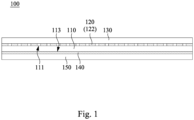
- Fig. 1 is a schematic side view illustrating a breathable and waterproof cloth 100 according to some embodiments of the present disclosure.
- the breathable and waterproof cloth 100 includes a breathable and waterproof non-woven fabric 110, a first adhesive layer 120, and a first base fabric 130.
- the breathable and waterproof non-woven fabric 110 is manufactured by a melt-blowing process and includes melt-blown fibers, in which the melt-blown fibers have an average fiber diameter between 600 nm and 1700 nm (i.e., the melt-blown fibers of the present disclosure are micro-nanometer grade melt-blown fibers).
- the breathable and waterproof non-woven fabric 110 has an average pore diameter between 1.5 ⁇ m and 2.0 ⁇ m.
- the breathable and waterproof cloth 100 may have good waterproofness.
- the first adhesive layer 120 is disposed on a first surface 111 of the breathable and waterproof non-woven fabric 110 and has a plurality of adhesive dots 122. Based on the configuration of the adhesion points 122, the breathable and waterproof cloth 100 may have good air permeability.
- the first base fabric 130 is disposed on the first surface 111 of the breathable and waterproof non-woven fabric 110 through the adhesion points 122.
- the breathable and waterproof non-woven fabric 110 of the present disclosure is manufactured by the melt-blowing process.
- Fig. 2 is a flowchart illustrating a manufacturing method of a breathable and waterproof non-woven fabric 110 according to some embodiments of the present disclosure.
- the manufacturing method of the breathable and waterproof non-woven fabric 110 includes steps S10, S20, S30, and S40.
- step S10 a kneading process is performed on a polyester, a water repellent, and a flow promoter, such that a mixture is formed.
- a melt-blowing process is performed on the mixture, such that a melt-blown fiber is formed.
- step S30 a plurality of the melt-blown fiber is received.
- step S40 a calendering process is performed on the plurality of the received melt-blown fiber, such that the breathable and waterproof non-woven fabric 110 of the present disclosure is formed.
- the main component of the melt-blown fiber in the present disclosure may also include materials such as polypropylene or nylon.
- step S10 is proceeded to uniformly mix 87 parts by weight to 91 parts by weight of the polyester, 5 parts by weight to 7 parts by weight of the water repellent, and 3 parts by weight to 6 parts by weight of the flow promoter, and the kneading process is performed, such that the mixture is formed.
- the mixture made by mixing the above reagents has a melt index (MI) between 530 g/10min and 1540 g/10min at a temperature of 270°C, such that the mixture can be provided with good fluidity during the subsequent melt-blowing process, and the breathable and waterproof non-woven fabric 110 is further provided with good water pressure resistance.
- MI melt index
- a temperature of the kneading process may be between 235°C and 245°C.
- the polyester disclosed in the present disclosure is used as the main raw material of the melt-blown fiber in the breathable and waterproof non-woven fabric 110, that is, the melt-blown fiber includes polyester.
- the polyester has a melt index between 350 g/10min and 1310 g/10min at a temperature of 270°C, so as to provide certain fluidity for the mixture during the subsequent melt-blowing process.
- different types of polyester may have different ranges of melt index.
- a first type of polyester may have a melt index between 350 g/10min and 450 g/10min at a temperature of 270°C
- a second type of polyester may have a melt index between 1210 g/10min and 1310 g/10min at a temperature of 270°C.
- the polyester may be, for example, polyethylene terephthalate (PET), polytrimethylene terephthalate (PPT), or polybutylene terephthalate (PBT).
- the water repellent of the present disclosure is used to provide good water repellency for the breathable and waterproof non-woven fabric 110.
- the water repellent has a particle size (D90) between 350 nm and 450 nm to be uniformly dispersed in the mixture during the kneading process, so as to provide the breathable and waterproof non-woven fabric 110 with good water repellency and wearing comfort to the user.
- D90 particle size
- the particle size of the water repellent is greater than 450 nm, the water repellent may not be uniformly dispersed in the mixture, which may be difficult for the water repellent to provide good water repellency, causing the breathable and waterproof non-woven fabric 110 have significant graininess, thereby failing to provide the user with wearing comfort.
- the water repellent may include a silicon dioxide or silicon dioxide aerogel, and on a microscopic scale, a shape of the silicon dioxide or silicon dioxide aerogel may be, a spherical shape, thereby having a low surface energy to provide good water repellency.
- a specific surface area of the silicon dioxide or silicon dioxide aerogel can be between 600 m 2 /g and 800 m 2 /g, which is beneficial for strengthening its low density, high porosity, and high hydrophobicity characteristics, thereby providing the breathable and waterproof non-woven fabric 110 with good water repellency.
- the flow promoter of the present disclosure is used to provide the breathable and waterproof non-woven fabric 110 with good water pressure resistance, such that the breathable and waterproof cloth 100 have good waterproofness.
- the flow promoter can make the aforementioned mixture have a lower melt index relative to the polyester, that is, the mixture can have better fluidity compared to the polyester, such that the melt-blown fiber formed by the mixture during the subsequent melt-blowing process can have small fiber fineness.
- the breathable and waterproof non-woven fabric 110 is provided with a small pore diameter to have good water pressure resistance.
- the mixture has a melt index between 530 g/10min and 1540 g/10min at a temperature of 270°C.
- the mixture when the aforementioned first type of polyester is used to form the mixture, the mixture may have a melt index between 530g/10min and 630g/10min at a temperature of 270°C, and when the aforementioned second type of polyester is used to forms the mixture, the mixture may have a melt index between 1440 g/10min and 1540 g/10min at a temperature of 270°C.
- the flow promoter may include 0.1 to 6.0 parts by weight of a slip agent and 0.1 to 6.0 parts by weight of a polyol.
- the slip agent and the polyol can provide the mixture with good fluidity, and the polyol can improve the compatibility between the slip agent and the polyester.
- the polyol may include ethylene glycol, propylene glycol, butylene glycol, polyethylene glycol, or combinations thereof.
- the flow promoter is easy to volatilize when the temperature is above 250°C, and can stably exist in the mixture when the temperature is below 250°C.
- the flow promoter can stably exist in the mixture during the kneading process (which is under a temperature less than 250°C), such that the mixture is provided with good fluidity, and the flow promoter will volatilize during the subsequent melt-blowing process (which is under a temperature greater than or equal to 250°C) to avoid being left over in the breathable and waterproof non-woven fabric 110.
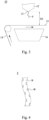
- Fig. 3 is a schematic side view illustrating a textile equipment 10 according to some embodiments of the present disclosure.
- the textile equipment 10 may include a melt-blowing device 12 and a collecting device 14, in which the melt-blowing device 12 may have a plurality of ejecting holes 13, and the collecting device 14 may have a receiving net 15.
- the collecting device 14 may further have a suction element 16 for providing suction to guide the melt-blown fibers F to the receiving net 15.
- Fig. 4 is a schematic partial enlarged view illustrating the melt-blown fiber F shown in Fig. 3 .
- the melt-blown fiber F ejected by the melt-blown device 10 has a fiber body B and a water repellent W, and the water repellent W is disposed on the fiber body B. In some embodiments, the water repellent W may be attached to the surface of the fiber body B.
- the water repellent W can only be attached to the surface of the fiber body B, and is prevented from penetrating into the fiber body B. It should be noted that the "preventing from permeating into the fiber body B" in the present disclosure refers to "embedded in the surface of the fiber body B and partially exposed from the surface of the fiber body B" (as shown in Fig. 4 ).
- a temperature of the melt-blowing process may be between 250°C and 275°C, so as to ensure that the mixture has sufficient fluidity during the melt-blowing process and ensure that the flow promoter is completely volatilized.
- the pore diameter of the ejecting hole 13 can be configured to be about 0.2 mm, and a ratio of the length to the pore diameter of the ejecting hole 13 can be configured to be about 20, thereby helping to form melt-blown fibers F with small fiber fineness.
- an average fiber diameter of the melt-blown fiber F may be between 600 nm and 1700 nm, such that the formed breathable and waterproof non-woven fabric 110 has high fiber distribution uniformity and a small pore diameter, thereby being provided with good water pressure resistance.
- the breathable and waterproof non-woven fabric 110 of the present disclosure can withstand a water pressure ranging from 6000 mmH 2 O to 8000 mmH 2 O.
- the operating parameters of the melt-blowing process can be adjusted, such that the formed melt-blown fiber F has small fiber fineness. More specifically, the melt-blown fiber F can have small fiber fineness by adjusting the air temperature, air pressure, air flow, fiber throughput, and distance D1 between the ejecting hole 13 and the receiving net 15 during the melt-blowing process.
- the specific ranges of the operating parameters of the melt-blowing process are shown in Table 1. Table 1. operating parameters of the melt-blowing process air temperature (°C) air pressure (MPa) air flow (m 3 /min) fiber throughput (g/(hole*min)) distance D1 (cm) 250-280 0.008-0.034 3.0-7.0 0.05-0.20 4-10
- step S40 is proceeded to perform a calendering process on the melt-blown fibers F that have been received to form the breathable and waterproof non-woven fabric 110.
- the breathable and waterproof non-woven fabric 110 formed by the calendering process has an average pore diameter between 1.5 ⁇ m and 2.0 ⁇ m, so as to provide the breathable and waterproof non-woven fabric 110 with good water pressure resistance, such that the breathable and waterproof cloth 100 can have good waterproofness.
- the operating parameters of the calendering process can be adjusted, such that the formed breathable and waterproof non-woven fabric 110 has a small pore diameter.
- the breathable and waterproof non-woven fabric 110 can have a small pore diameter by adjusting the temperature of the upper wheel, temperature of the lower wheel, wheel gap, line pressure, and line speed of the calendering process.
- the specific ranges of the operating parameters of the calendering process are shown in Table 2.
- the breathable and waterproof non-woven fabric 110 of the present disclosure can be formed.
- Fig. 5 is a schematic perspective view illustrating a breathable and waterproof non-woven fabric 110 according to some embodiments of the present disclosure
- Fig. 6 is a schematic partial enlarged view illustrating the area R of the breathable and waterproof non-woven fabric 110 shown in Fig. 5 .
- the breathable and waterproof non-woven fabric 110 includes a plurality of melt-blown fibers F, in which each melt-blown fiber F has a fiber body B and a water repellent W, and the water repellent W is disposed on the surface of the fiber body B.
- the water repellent W is disposed on the surface of the fiber body B with a suitable size, the water repellency of the water repellent W can be exerted well and the breathable and waterproof non-woven fabric 110 can provide good wearing comfort.
- the melt-blown fiber F has small fiber fineness, the breathable and waterproof non-woven fabric 110 can have high fiber distribution uniformity.
- the breathable and waterproof non-woven fabric 110 has a small pore diameter, the breathable and waterproof non-woven fabric 110 can be provided with good water pressure resistance.
- the melt index is measured for the mixture (i.e., the mixture formed by the polyester, water repellent, and flow promoter through the kneading process) used to form each embodiment and each comparative example, and the fiber fineness, pore diameter, and water repellency are measured for each embodiment and thecomparative example.
- the melt index is measured by the test method ASTM D1238, the fiber fineness is measured by a scanning electron microscope (SEM), the pore diameter is measured by a porosimeter (purchased from Porous Material Inc.), and the water repellency is measured by the test method ASTM-D583-54.
- SEM scanning electron microscope
- the pore diameter is measured by a porosimeter (purchased from Porous Material Inc.)
- the water repellency is measured by the test method ASTM-D583-54. The measurement results are shown in Table 4.
- melt index of mixture (g/10min) average fiber diameter of melt-blown fiber (nm) average pore diameter of non-woven fabric ( ⁇ m) water repellency of non-woven fabric comparative example 1 350 2000 --- 0 embodiment 1 530 1700 1.6 90-100 embodiment 2 1540 1270 1.65 90-100 embodiment 3 1540 740 1.86 90-100 embodiment 4 1540 780 1.83 90-100
- the mixture of the polyester, water repellent, and flow promoter can be made to have a higher melt index than that of polyester, thereby having a higher fluidity. Therefore, the melt-blown fibers with small fiber fineness (less than 2000 nm) and the breathable and waterproof non-woven fabrics with small pore diameters (less than 2 ⁇ m) can be formed.
- the water repellent when added during the kneading process, the water repellency of the breathable and waterproof non-woven fabric can be between 90 and 100, showing good water repellency.
- the melt-blown fiber can be provided with small fiber fineness, such that the breathable and waterproof non-woven fabric has high fiber distribution uniformity and a small pore diameter.
- the breathable and waterproof non-woven fabric can be provided with good water pressure resistance.
- the breathable and waterproof non-woven fabric can be provided with good water repellency, and since the water repellent is disposed on the surface of the fiber body with a suitable size, the water repellency of the water repellent can be exerted well and the breathable and waterproof non-woven fabric can provide good wearing comfort.
- Fig. 7 is a schematic view illustrating a configuration of the first adhesive layer 120 of the breathable and waterproof cloth 100 shown in Fig. 1 .
- the first adhesive layer 120 is disposed on the first surface 111 of the breathable and waterproof non-woven fabric 110 to fix the first base fabric 130 on the first surface 111 of the breathable and waterproof non-woven fabric 110.
- the first adhesive layer 120 may be, for example, a moisture-curing reactive hot-melt adhesive to provide a strong adhesive force and a high curing rate.
- the first adhesive layer 120 can be formed on the first surface 111 of the breathable and waterproof non-woven fabric 110 through dispensing when the temperature is between 110°C and 130°C, and a viscosity of the first adhesive layer 120 at a temperature of 90°C is between 8000 mPa s (cP) and 9000 mPas s (cP). Thereby, the first adhesive layer 120 can be easily transferred to the breathable and waterproof non-woven fabric 110, and the forming position of the first adhesive layer 120 can be well controlled.
- the viscosity of the first adhesive layer 120 at a temperature of 90°C is less than 8000 mPa s (cP)
- the viscosity of the first adhesive layer 120 at a temperature of 90°C is greater than 9000 mPa s (cP)
- the first adhesive layer 120 may be too viscous to be transferred to the breathable and waterproof non-woven fabric 110.
- the first adhesive layer 120 is disposed on the first surface 111 of the breathable and waterproof non-woven fabric 110, and has a plurality of adhesive dots 122.
- the adhesion dots 122 may, for example, be disposed on the first surface 111 of the breathable and waterproof non-woven fabric 110 at intervals, such that the breathable and waterproof cloth 100 has good air permeability.
- the adhesion dots 122 may be, for example, equidistantly disposed on the first surface 111 of the breathable and waterproof non-woven fabric 110, such that the breathable and waterproof cloth 100 has good flatness and uniform air permeability.
- a top-viewed shape (i.e., the shape viewed from the viewing angle of Fig. 7 ) of the adhesion dot 122 may be, for example, a rectangle, a diamond, a circle, an ellipse, a triangle, a trapezoid, or other suitable shapes.
- the distribution density and the size of the adhesion dots 122 can also affect the air permeability of the breathable waterproof cloth 100.
- a distribution density of the adhesion dots 122 may be between 8 pcs/mm 2 and 10 pcs/mm 2 , and when the circular adhesion dots 122 are taken as an example, a diameter D of each adhesion dot 122 may be between 90 ⁇ m and 110 ⁇ m.
- the air permeability of the breathable waterproof cloth 100 may be insufficient; if the distribution density of the adhesion dots 122 is less than 5 pcs/mm 2 and/or the diameter D of each adhesion dot 122 is less than 90 ⁇ m, it may cause insufficient adhesion of the first adhesion layer 120, thereby affecting the stability of the breathable waterproof cloth 100.
- the first base fabric 130 is disposed on the first surface 111 of the breathable and waterproof non-woven fabric 110 through the adhesion dots 122 of the first adhesive layer 120.
- the first base fabric 130 may be, for example, a woven fabric with high density.
- the first base fabric 130 may be configured as an outer fabric of the clothing.
- the present disclosure also provides a bonding device and a bonding method for bonding the breathable and waterproof non-woven fabric 110, the first adhesive layer 120, and the first base fabric 130.
- a bonding device and a bonding method for bonding the breathable and waterproof non-woven fabric 110, the first adhesive layer 120, and the first base fabric 130 Through the rotation and matching of the wheels in the bonding device, the breathable and waterproof non-woven fabric 110 and the first base fabric 130 can go forward in the bonding device and be attached to each other.
- an adhesive with an appropriate viscosity the transfer of the adhesive between the wheels can be facilitated, thereby enhancing the convenience of the bonding process.
- the breathable and waterproof cloth 100 fabricated by the bonding device and bonding method of the present disclosure can have good air permeability, good waterproofness, and good peeling strength.
- the bonding device 1000 includes a coating wheel 1, a dispensing wheel 2, a cloth feeding wheel 3, a first pressing wheel 4, and a second pressing wheel 5, and the coating wheel 1, the dispensing wheel 2, the cloth feeding wheel 3, the first pressing wheel 4, and the second pressing wheel 5 are arranged adjacently and sequentially from near the entrance I of the bonding device 1000 to near the exit O. More specifically, the dispensing wheel 2 is adjacent to the coating wheel 1, the cloth feeding wheel 3 is adjacent to the dispensing wheel 2, the first pressing wheel 4 is adjacent to the cloth feeding wheel 3, and the second pressing wheel 5 is adjacent to the first pressing wheel 4.
- each of the aforementioned wheels has its own rotation direction.
- the cloth feeding wheel 3 and the first pressing wheel 4 have a first rotation direction
- the dispensing wheel 2 and the second pressing wheel 5 have a second rotation direction.
- the first rotation direction may be different from the second rotation direction, for example, the first rotation direction may be a clockwise direction
- the second rotation direction may be a counterclockwise direction.
- each wheel can be driven by a different and independently operating motor.
- the coating wheel 1 has a scraper (not shown) disposed thereon, and a wheel distance between the first pressing wheel 4 and the second pressing wheel 5 is 50% to 70% of a thickness of the semi-finished product including the breathable and waterproof non-woven fabric 110, the first adhesive layer 120, and the first base fabric 130.
- the bonding method may include step S10a to step S70a.
- step S10a the bonding device is provided.
- step S20a an adhesive is provided to the coating wheel.
- step S30a the adhesive is transferred from the coating wheel to the dispensing wheel.
- step S40a a first base fabric is guided between the dispensing wheel and the fabric feeding wheel.
- step S50a the adhesive is transferred from the dispensing wheel to a surface of the first base fabric, such that a first adhesive layer is formed.
- step S60a the first base fabric with the first adhesive layer and a breathable and waterproof non-woven fabric are guided between the first pressing wheel and the second pressing wheel.
- step S70a the breathable and waterproof non-woven fabric is pressed onto the surface of the first base fabric.
- step S10a is proceeded to provide the bonding device 1000, in which the bonding device 1000 may include the coating wheel 1, the dispensing wheel 2, the cloth feeding wheel 3, the first pressing wheel 4, and the second pressing wheel 5 arranged adjacently in sequence.
- step S20a is proceeded to provide the adhesive AD to the coating wheel 1.
- the coating wheel 1 can carry the adhesive AD through the scraper arranged on its wheel surface.
- a bearing capacity of the adhesive AD on the coating wheel 1 can be controlled by changing the shape, width, and thickness of the scraper.
- the adhesive AD can be introduced into the spacing between the coating wheel 1 and the dispensing wheel 2. Therefore, the amount of adhesive AD can be controlled by adjusting the distance between the coating wheel 1 and the dispensing wheel 2.
- the spacing between the coating wheel 1 and the dispensing wheel 2 herein refers to the "spacing between the scraper of the coating wheel 1 and the dispensing wheel 2".
- the distance between the coating wheel 1 and the dispensing wheel 2 may be between 50 mm and 100 mm, such that an appropriate amount of adhesive AD can be loaded.
- the distance between the coating wheel 1 and the dispensing wheel 2 is less than 50 mm, the breathable and waterproof cloth 100 may easily peel off due to the insufficient amount of adhesive AD; if the distance between the coating wheel 1 and the dispensing wheel 2 is greater than 100 mm, the adhesive AD may leak due to the excessive amount of adhesive AD.
- the wheel temperature of the coating wheel 1 and the dispensing wheel 2 can be between 90°C and 130°C, such that the adhesive AD carried thereon has proper fluidity.
- the adhesive AD used in the present disclosure has a viscosity between 8000 mPa s (cP) and 9000 mPa s (cP) at a temperature of 90°C, such that the adhesive AD has appropriate fluidity and is beneficial to be transferred between the wheels (e.g., the coating wheel 1 and the dispensing wheel 2).
- the viscosity of the adhesive AD at a temperature of 90°C is greater than 9000 mPa s (cP)
- the adhesive AD may excessively adhere to the surfaces of the wheels due to its insufficient fluidity, and thus cannot be transferred by the wheels
- the viscosity of AD at a temperature of 90°C is less than 8000 mPa s (cP)
- the adhesive AD may not easily adhere to the surfaces of the wheels due to its high fluidity, and thus cannot be transferred by the wheels.
- step S30a is proceeded to transfer the adhesive AD from the coating wheel 1 to the dispensing wheel 2.
- the coating wheel 1 is fixed and does not rotate, and the dispensing wheel 2 has a second rotation direction.
- the coating wheel 1 can transfer the adhesive AD to the dispensing wheel 2.
- the coating wheel 1 can transfer the adhesive AD to the dispensing wheel 2 in a scraping manner through its scraper.
- the dispensing wheel 2 may have a three-dimensional pattern arranged on its wheel surface, such that the adhesive AD is attached to the three-dimensional pattern during the transfer to the dispensing wheel 2.
- a wheel temperature of the dispensing wheel 2 can be between 90°C and 130°C, such that the adhesive AD carried on the dispensing wheel 2 has appropriate fluidity.
- the aforementioned distance between the coating wheel 1 and the dispensing wheel 2 may affect the thickness of the adhesive AD attached to the dispensing wheel 2. Specifically, the distance between the coating wheel 1 and the dispensing wheel 2 may be equal to a thickness of the adhesive AD attached to the dispensing wheel 2.
- step S40a is proceeded to guide the first base fabric 130 to be between the dispensing wheel 2 and the cloth feeding wheel 3, such that the first base fabric 130 passes through the gap between the dispensing wheel 2 and the cloth feeding wheel 3.
- the first base fabric 130 may be, for example, a woven fabric, and when the breathable and waterproof cloth 100 is applied to the field of wearing clothing, the first base fabric 130 may be configured as an outer fabric of the clothing.
- step S50a is proceeded to transfer the adhesive AD from the dispensing wheel 2 to the surface of the first base fabric 130 to form the first adhesive layer 120.
- the dispensing wheel 2 has the second rotation direction
- the cloth feeding wheel 3 has the first rotation direction.
- the dispensing wheel 2 can transfer the adhesive AD that moves between the dispensing wheel 2 and the cloth feeding wheel 3 to the surface of the first base fabric 130.
- the cloth feeding wheel 3 and the dispensing wheel 2 can jointly transfer the adhesive AD to the surface of the first base fabric 130.
- the first adhesive layer 120 includes a plurality of adhesive dots 122, and the distribution density of the adhesive dots 122 on the first base fabric 130 can be controlled by adjusting the relative rotation speed of the dispensing wheel 2 and the cloth feeding wheel 3.
- the rotation speed of the dispensing wheel 2 is 5% to 300% of the rotation speed of the cloth feeding wheel 3, such that the adhesion dots 122 are arranged on the surface of the first base fabric 130 with an appropriate distribution density.
- the uniformity of the first adhesive layer 120 can be maintained by controlling the rotation speed ratio of the cloth feeding wheel 3 to the first pressing wheel 4.
- the rotation speed ratio of the cloth feeding wheel 3 to the first pressing wheel 4 may be, for example, 1:1 to control the tension of the first base fabric 130, such that the first adhesive layer 120 is uniformly and smoothly formed on the surface of the first base fabric 130.
- step S60a is proceeded to guide the first base fabric 130 with the first adhesive layer 120 and the breathable and waterproof non-woven fabric 110 to be between the first pressing wheel 4 and the second pressing wheel 5, and position the first adhesive layer 120 to be between the first base fabric 130 and the breathable and waterproof non-woven fabric 110.
- step S70a is proceeded to press the breathable and waterproof non-woven fabric 110 onto the surface of the first base fabric 130.
- the first pressing wheel 4 has the first rotation direction
- the second pressing wheel 5 has the second rotation direction.
- the distance between the first pressing wheel 4 and the second pressing wheel 5 of the present disclosure is about 50% to 70% of the thickness of the semi-finished product, such that the breathable and waterproof non-woven fabric 110 and the first base fabric 130 have good pressure strength.
- the distance between the first pressing wheel 4 and the second pressing wheel 5 is less than 50% of the thickness of the semi-finished product, it may cause adhesion leakage, thereby affecting the configuration of the adhesion dots 122; if the distance between the wheel 4 and the second pressing wheel 5 is greater than 70% of the thickness of the semi-finished product, the breathable and waterproof non-woven fabric 110 and the first base fabric 130 may not be firmly pressed against each other, thereby affecting the stability of the breathable and waterproof cloth 100.
- the rotation speed ratio of the first pressing wheel 4 and the second pressing wheel 5 may be, for example, 1:1 to control the respective tension of the breathable and waterproof non-woven fabric 110 and the first base fabric 130, such that the breathable and waterproof cloth 100 has good flatness.
- the temperature of each of the first pressing wheel 4 and the second pressing wheel 5 can be between room temperature and 170°C, such that the bonding device 1000 and the bonding method of the present disclosure are suitable for the bonding process of fabrics of various materials.
- the semi-finished can be formed.
- the bonding device 1000 and bonding method of the present disclosure to fabricate the breathable waterproof cloth 100, the first adhesive layer 120 can be accurately formed on the first base fabric 130, and the amount of adhesive AD can be precisely controlled In order to control the thickness and uniformity of the first adhesive layer 120. Accordingly, the breathable and waterproof cloth 100 has good air permeability, waterproofness, and peeling strength.
- the breathable and waterproof cloth 100 may further include a second adhesive layer 140, which is disposed on the second surface 113 of the breathable and waterproof non-woven fabric 110 facing away from the first surface 111.
- the second adhesive layer 140 may be disposed on an entire surface of the second surface 113 of the breathable and waterproof non-woven fabric 110, thereby facilitating manufacturing convenience and providing good adhesion.
- the second adhesive layer 140 may be, for example, a moisture-curing reactive hot-melt adhesive to provide a strong adhesive force and a high curing rate.
- the second adhesive layer 140 can be formed on the second surface 113 of the breathable and waterproof non-woven fabric 110 by coating at a temperature of 110°C to 130°C, and a viscosity of the second adhesive layer 140 at a temperature of 90°C is between 8000 mPa s (cP) and 9000 mPa s (cP). Thereby, the second adhesive layer 140 can be easily transferred to the breathable and waterproof non-woven fabric 110, and the thickness of the second adhesive layer 140 can be well controlled.
- the thickness of the second adhesive layer 140 may not be easily controlled due to its high fluidity; if the viscosity of the second adhesive layer 140 at a temperature of 90°C is greater than 9000 mPa s (cP), the second adhesive layer 140 may be too viscous to transfer to the breathable and waterproof non-woven fabric 110.
- the breathable and waterproof cloth 100 may further include a second base fabric 150, which is disposed on the second surface 113 of the breathable and waterproof non-woven fabric 110 through the second adhesive layer 140.
- the second base fabric 150 and the first base fabric 130 are respectively disposed on two opposite surfaces of the breathable and waterproof non-woven fabric 110 respectively through the second adhesive layer 140 and the first adhesive layer 120.
- the second base fabric 150 since the second adhesive layer 140 is configured in a whole-surface configuration, the second base fabric 150 may be, for example, a woven fabric with low weaving density, and when the breathable and waterproof cloth 100 is applied to the field of wearing clothing, the second base fabric 150 may be configured as an inner cloth of clothing.
- the breathable and waterproof cloth of each embodiment can have good air permeability and waterproofness.
- the breathable and waterproof cloth of each embodiment can have better waterproofness.
- the breathable and waterproof cloth of each embodiment can also have good moisture permeability, so as to prevent the entry of moisture from the external environment and help release moisture on the surface of the human body, thereby providing the user with a good wearing comfort.
- the breathable and waterproof cloth of the present disclosure includes a breathable and waterproof non-woven fabric manufactured by a melt-blowing process, the breathable and waterproof non-woven fabric can have good water pressure resistance, thereby providing the breathable and waterproof fabric with good waterproofness.
- the melt-blown fiber in the breathable and waterproof non-woven fabric has a water repellent with suitable size, it can provide the breathable and waterproof non-woven fabric with good water repellency.
- the breathable and waterproof cloth can have good air permeability.
- the breathable and waterproof cloth of the present disclosure has been tested and shown to have good moisture permeability, thereby providing the user with a good wearing comfort.
Landscapes
- Engineering & Computer Science (AREA)
- Textile Engineering (AREA)
- Chemical & Material Sciences (AREA)
- Chemical Kinetics & Catalysis (AREA)
- Mechanical Engineering (AREA)
- Manufacturing & Machinery (AREA)
- General Chemical & Material Sciences (AREA)
- Treatments For Attaching Organic Compounds To Fibrous Goods (AREA)
- Laminated Bodies (AREA)
Description
- The present disclosure relates to a non-woven fabric, a manufacturing method of the non-woven fabric, and a cloth fabricated by the non-woven fabric, and particularly relates to a breathable and waterproof non-woven fabric, a manufacturing method of the breathable and waterproof non-woven fabric, and a breathable and waterproof cloth.
- In the textile industry, since non-woven fabrics can be formed without warp knitting, issues related to non-woven fabrics have gradually become the focus of development. For example,
WO 01/86044A1 DE 196 42 253 A1 discloses a water vapor permeable and water repellent lining material comprising a layer of a knitted textile fabric and a layer of a meltblown nonwoven made of thermoplastic synthetic material and comprising meltblown microfibers, wherein the meltblown nonwoven has a weight per unit area of from 10 to 100 g/m2, preferably from 20 to 70 g/m2, wherein the meltblown nonwoven has pores of a residual pore size which permit water vapor permeability but repel water permeation. Additionally,US 2006/008651 A1 discloses a fluorochemical additive comprising the reaction product under polymerization conditions of monomers that comprise: (a) an aromatic polycarboxylic acid as an anhydride, ester, or ester chloride; (b) at least one fluorinated reactant; and (c) at least one reactive aliphatic amine, mercaptan, or alcohol. In addition, since non-woven fabrics have the advantages of short process time, high output, low cost, and wide sources of its raw materials, they are suitable for applied in the consumer market. A broad definition of non-woven fabrics can be a cloth formed by pressure or by stickiness. However, the manufacturing process of the non-woven fabrics can be quite diverse, and as the manufacturing method changes, the characteristics of the non-woven fabrics change accordingly. - With the continuous development of the textile industry, non-woven fabrics with breathable and waterproof functions began to be developed in the industry. Generally, compared with the melt-blowing process, the non-woven fabric formed by the electrospinning process usually has finer fibers, and therefore has better air permeability and waterproofness. However, the production speed of the electrospinning process is slower than that of the melt-blowing process due to the limitation of the electrospinning equipment, and a large amount of organic solvent is needed. Therefore, how to manufacture a non-woven textile with good air permeability and waterproofness through the melt-blowing process is so far an important issue.
- The present invention is set out in the appended set of claims.
- The present disclosure provides a breathable and waterproof non-woven fabric and a manufacturing method of the breathable and waterproof non-woven fabric. The breathable and waterproof non-woven fabric disclosed in the present disclosure is manufactured by a melt-blowing process, and is provided with good water repellency and water pressure resistance. The present disclosure also provides a breathable and waterproof cloth fabricated by the aforementioned breathable and waterproof non-woven fabric and the aforementioned manufacturing method, in which the breathable and waterproof cloth has good air permeability and waterproofness.
- According to the present disclosure, the manufacturing method of a breathable and waterproof non-woven fabric includes the following steps. Performing a kneading process on 87 to 91 parts by weight of a polyester, 5 to 7 parts by weight of a water repellent, and 3 to 6 parts by weight of a flow promote, such that a mixture is formed, wherein the flow promoter comprises 0.1 to 6.0 parts by weight of a slip agent and 0.1 to 6.0 parts by weight of a polyol, the polyol comprises ethylene glycol, propylene glycol, butylene glycol, polyethylene glycol, or combinations thereof, the polyester has a melt index between 350 g/10min and 1310 g/10min at a temperature of 270°C, and the mixture has a melt index between 530 g/10min and 1540 g/10min at a temperature of 270°C. Performing a melt-blowing process on the mixture, such that the flow promoter is volatilized and a melt-blown fiber is formed to obtain the breathable and waterproof non-woven fabric (110) having an average pore diameter between 1.5 µm and 2.0 µm, wherein the melt-blown fiber has a fiber body and the water repellent, and the water repellent is disposed on the fiber body, and the average pore diameter is measured by a porosimeter.
- In some embodiments of the present disclosure, a temperature of the melt-blowing process is between 250°C and 275°C.
- According to the present disclosure, the flow promoter includes 0.1 to 6.0 parts by weight of a slip agent and 0.1 to 6.0 parts by weight of a polyol.
- According to the present disclosure, the polyol includes ethylene glycol, propylene glycol, butylene glycol, polyethylene glycol, or combinations thereof.
- In some embodiments of the present disclosure, the manufacturing method of the breathable and waterproof non-woven fabric further includes the following steps. Receiving a plurality of the melt-blown fiber. Performing a calendering process on the plurality of the received melt-blown fiber, such that the breathable and waterproof non-woven fabric is formed.
- According to some other embodiments of the present disclosure, the breathable and waterproof non-woven fabric is manufactured by the aforementioned manufacturing method, in which the water repellent is disposed on a surface of the fiber body, and the water repellent has a particle size (D90) between 350 nm and 450 nm.
- According to the present disclosure, an average fiber diameter of the melt-blown fiber is between 600 nm and 1700 nm, wherein the average fiber diameter is measured by a scanning electron microscope.
- According to the present disclosure, an average pore diameter of the breathable and waterproof non-woven fabric is between 1.5 µm and 2.0 µm., wherein the average pore diameter is measured by a porosimeter.
- In some embodiments of the present disclosure, the water repellent is attached to the surface of the fiber body and is prevented from penetrating into the fiber body.
- In some embodiments of the present disclosure, the water repellent includes a silicon dioxide aerogel, and a specific surface area of the silicon dioxide aerogel is between 600 m2/g and 800 m2/g.
- According to the present disclosure, the breathable and waterproof cloth includes a breathable and waterproof non-woven fabric, a first adhesive layer, and a first base fabric. The breathable and waterproof non-woven fabric is manufactured by the aforementioned manufacturing method of the breathable and waterproof non-woven fabric, and has an average pore diameter between 1.5 µm and 2.0 µm, wherein the average pore diameter is measured by a porosimeter. The breathable and waterproof non-woven fabric includes a plurality of melt-blown fibers, in which the melt-blown fibers have an average fiber diameter between 600 nm and 1700 nm. The first adhesive layer is disposed on a first surface of the breathable and waterproof non-woven fabric and has a plurality of adhesive dots. The first base fabric is disposed on the first surface of the breathable and waterproof non-woven fabric through the adhesive dots.
- In some embodiments of the present disclosure, the adhesion dots are disposed on the first surface of the breathable and waterproof non-woven fabric at intervals, and a distribution density of the adhesion dots is between 8 pcs/mm2 and 10 pcs/mm2.
- In some embodiments of the present disclosure, a diameter of each of the adhesion dots is between 90 µm and 110 µm.
- In some embodiments of the present disclosure, a viscosity of the first adhesive layer at a temperature of 90°C is between 8000 mPa s (or 8000 cP, wherein 1 mPa s is identical with 1 cP) and 9000 mPa s (cP).
- In some embodiments of the present disclosure, the first base fabric is a woven fabric.
- In some embodiments of the present disclosure, the breathable and waterproof cloth further includes a second adhesive layer and a second base fabric. The second adhesive layer is disposed on an entire surface of a second surface of the breathable and waterproof non-woven fabric. The second base fabric is disposed on the second surface of the breathable and waterproof non-woven fabric through the second adhesive layer, in which the second base fabric is a knitted fabric.
- In some embodiments of the present disclosure, the water repellent has a particle size (D90) between 350 nm and 450 nm.
- In some embodiments of the present disclosure, the water repellent includes a silicon dioxide aerogel, and a specific surface area of the silicon dioxide aerogel is between 600 m2/g and 800 m2/g.
- In the aforementioned embodiments of the present disclosure, by adding the flow promoter in the manufacturing process of the breathable and waterproof non-woven fabric, the melt-blown fiber can be provided with small fiber fineness, such that the breathable and waterproof non-woven fabric has high fiber distribution uniformity and a small pore diameter. As such, the breathable and waterproof non-woven fabric can be provided with good water pressure resistance. On the other hand, by adding the water repellent in the manufacturing process of the breathable and waterproof non-woven fabric, the breathable and waterproof non-woven fabric can be provided with good water repellency, and since the water repellent is disposed on the surface of the fiber body with a suitable size, the water repellency of the water repellent can be exerted well and the breathable and waterproof non-woven fabric can provide good wearing comfort. In addition, the breathable and waterproof cloth of the present disclosure includes the breathable and waterproof non-woven fabric manufactured by the aforementioned manufacturing method and the base fabric disposed on the breathable and waterproof non-woven fabric through the first adhesive layer. Since the aforementioned manufacturing method can provide suitable fiber fineness and pore size to the breathable and waterproof non-woven fabric, the breathable and waterproof cloth can have good waterproofness. On the other hand, through the special configuration of the first adhesive layer, the breathable and waterproof cloth can have good air permeability.
-
-
Fig. 1 is a schematic side view illustrating a breathable and waterproof cloth according to some embodiments of the present disclosure; -
Fig. 2 is a flowchart illustrating a manufacturing method of a breathable and waterproof non-woven fabric according to some embodiments of the present disclosure; -
Fig. 3 is a schematic side view illustrating a textile equipment according to some embodiments of the present disclosure; -
Fig. 4 is a schematic partial enlarged view illustrating the melt-blown fiber shown inFig. 3 ; -
Fig. 5 is a schematic perspective view illustrating a breathable and waterproof non-woven fabric according to some embodiments of the present disclosure; -
Fig. 6 is a schematic partial enlarged view illustrating the area R of the breathable and waterproof non-woven fabric shown inFig. 5 ; -
Fig. 7 is a schematic view illustrating a configuration of the first adhesive layer of the breathable and waterproof cloth shown inFig. 1 ; -
Fig. 8 is a schematic side view illustrating a bonding device according to some embodiments of the present disclosure; and -
Fig. 9 is a flowchart illustrating a bonding method according to some embodiments of the present disclosure. - The present disclosure provides a breathable and waterproof non-woven fabric and a manufacturing method thereof. In the manufacturing method of the breathable and waterproof non-woven fabric, by adding a flow promoter and a water repellent, the breathable and waterproof non-woven fabric can be provided with good water repellency and good water pressure resistance. On the other hand, since the water repellent is disposed on a surface of the fiber body with a suitable size, the water repellency of the water repellent can be exerted well and the breathable and waterproof non-woven fabric can provide good wearing comfort. The present disclosure also provides a breathable and waterproof cloth which includes the breathable and waterproof non-woven fabric manufactured by the aforementioned manufacturing method and a base fabric disposed on the breathable and waterproof non-woven fabric through the first adhesive layer. Since the manufacturing method can provide suitable fiber fineness and pore size to the breathable and waterproof non-woven fabric, the breathable and waterproof cloth can have good waterproofness. Furthermore, through the special configuration of the first adhesive layer, the breathable and waterproof cloth can have good air permeability. In the following description, the description will be mainly on the breathable and waterproof cloth.
-
Fig. 1 is a schematic side view illustrating a breathable andwaterproof cloth 100 according to some embodiments of the present disclosure. The breathable andwaterproof cloth 100 includes a breathable and waterproofnon-woven fabric 110, a firstadhesive layer 120, and afirst base fabric 130. The breathable and waterproofnon-woven fabric 110 is manufactured by a melt-blowing process and includes melt-blown fibers, in which the melt-blown fibers have an average fiber diameter between 600 nm and 1700 nm (i.e., the melt-blown fibers of the present disclosure are micro-nanometer grade melt-blown fibers). In addition, the breathable and waterproofnon-woven fabric 110 has an average pore diameter between 1.5 µm and 2.0 µm. Based on the pore size of the breathable and waterproofnon-woven fabric 110 and the fiber fineness of the melt-blown fibers therein, the breathable andwaterproof cloth 100 may have good waterproofness. Furthermore, the firstadhesive layer 120 is disposed on afirst surface 111 of the breathable and waterproofnon-woven fabric 110 and has a plurality ofadhesive dots 122. Based on the configuration of the adhesion points 122, the breathable andwaterproof cloth 100 may have good air permeability. Moreover, thefirst base fabric 130 is disposed on thefirst surface 111 of the breathable and waterproofnon-woven fabric 110 through the adhesion points 122. - The breathable and waterproof
non-woven fabric 110 of the present disclosure is manufactured by the melt-blowing process. For details, please refer toFig. 2 , which is a flowchart illustrating a manufacturing method of a breathable and waterproofnon-woven fabric 110 according to some embodiments of the present disclosure. The manufacturing method of the breathable and waterproofnon-woven fabric 110 includes steps S10, S20, S30, and S40. In step S10, a kneading process is performed on a polyester, a water repellent, and a flow promoter, such that a mixture is formed. In step S20, a melt-blowing process is performed on the mixture, such that a melt-blown fiber is formed. In step S30, a plurality of the melt-blown fiber is received. In step S40, a calendering process is performed on the plurality of the received melt-blown fiber, such that the breathable and waterproofnon-woven fabric 110 of the present disclosure is formed. In the following description, the aforementioned steps will further be explained. It should be noted that although polyester is used as the main component of the melt-blown fiber in the following description, the main component of the melt-blown fiber in the present disclosure may also include materials such as polypropylene or nylon. - Firstly, step S10 is proceeded to uniformly mix 87 parts by weight to 91 parts by weight of the polyester, 5 parts by weight to 7 parts by weight of the water repellent, and 3 parts by weight to 6 parts by weight of the flow promoter, and the kneading process is performed, such that the mixture is formed. The mixture made by mixing the above reagents has a melt index (MI) between 530 g/10min and 1540 g/10min at a temperature of 270°C, such that the mixture can be provided with good fluidity during the subsequent melt-blowing process, and the breathable and waterproof
non-woven fabric 110 is further provided with good water pressure resistance. In some embodiments, a temperature of the kneading process may be between 235°C and 245°C. - The polyester disclosed in the present disclosure is used as the main raw material of the melt-blown fiber in the breathable and waterproof
non-woven fabric 110, that is, the melt-blown fiber includes polyester. The polyester has a melt index between 350 g/10min and 1310 g/10min at a temperature of 270°C, so as to provide certain fluidity for the mixture during the subsequent melt-blowing process. In detail, different types of polyester may have different ranges of melt index. For example, a first type of polyester may have a melt index between 350 g/10min and 450 g/10min at a temperature of 270°C, while a second type of polyester may have a melt index between 1210 g/10min and 1310 g/10min at a temperature of 270°C. In some embodiments, the polyester may be, for example, polyethylene terephthalate (PET), polytrimethylene terephthalate (PPT), or polybutylene terephthalate (PBT). - The water repellent of the present disclosure is used to provide good water repellency for the breathable and waterproof
non-woven fabric 110. The water repellent has a particle size (D90) between 350 nm and 450 nm to be uniformly dispersed in the mixture during the kneading process, so as to provide the breathable and waterproofnon-woven fabric 110 with good water repellency and wearing comfort to the user. In detail, if the particle size of the water repellent is greater than 450 nm, the water repellent may not be uniformly dispersed in the mixture, which may be difficult for the water repellent to provide good water repellency, causing the breathable and waterproofnon-woven fabric 110 have significant graininess, thereby failing to provide the user with wearing comfort. In some embodiments, the water repellent may include a silicon dioxide or silicon dioxide aerogel, and on a microscopic scale, a shape of the silicon dioxide or silicon dioxide aerogel may be, a spherical shape, thereby having a low surface energy to provide good water repellency. In some embodiments, a specific surface area of the silicon dioxide or silicon dioxide aerogel can be between 600 m2/g and 800 m2/g, which is beneficial for strengthening its low density, high porosity, and high hydrophobicity characteristics, thereby providing the breathable and waterproofnon-woven fabric 110 with good water repellency. - The flow promoter of the present disclosure is used to provide the breathable and waterproof
non-woven fabric 110 with good water pressure resistance, such that the breathable andwaterproof cloth 100 have good waterproofness. In detail, the flow promoter can make the aforementioned mixture have a lower melt index relative to the polyester, that is, the mixture can have better fluidity compared to the polyester, such that the melt-blown fiber formed by the mixture during the subsequent melt-blowing process can have small fiber fineness. Accordingly, the breathable and waterproofnon-woven fabric 110 is provided with a small pore diameter to have good water pressure resistance. As mentioned above, the mixture has a melt index between 530 g/10min and 1540 g/10min at a temperature of 270°C. In more detail, when the aforementioned first type of polyester is used to form the mixture, the mixture may have a melt index between 530g/10min and 630g/10min at a temperature of 270°C, and when the aforementioned second type of polyester is used to forms the mixture, the mixture may have a melt index between 1440 g/10min and 1540 g/10min at a temperature of 270°C. - In some embodiments, the flow promoter may include 0.1 to 6.0 parts by weight of a slip agent and 0.1 to 6.0 parts by weight of a polyol. The slip agent and the polyol can provide the mixture with good fluidity, and the polyol can improve the compatibility between the slip agent and the polyester. In some embodiments, the polyol may include ethylene glycol, propylene glycol, butylene glycol, polyethylene glycol, or combinations thereof. In some embodiments, the flow promoter is easy to volatilize when the temperature is above 250°C, and can stably exist in the mixture when the temperature is below 250°C. Based on this characteristic, the flow promoter can stably exist in the mixture during the kneading process (which is under a temperature less than 250°C), such that the mixture is provided with good fluidity, and the flow promoter will volatilize during the subsequent melt-blowing process (which is under a temperature greater than or equal to 250°C) to avoid being left over in the breathable and waterproof
non-woven fabric 110. - Next, steps S20 and S30 are proceeded to perform a melt-blowing process on the aforementioned mixture to form the melt-blown fibers, and to receive the melt-blown fibers. Please refer to
Fig. 3 , which is a schematic side view illustrating atextile equipment 10 according to some embodiments of the present disclosure. In some embodiments, thetextile equipment 10 may include a melt-blowingdevice 12 and a collectingdevice 14, in which the melt-blowingdevice 12 may have a plurality of ejectingholes 13, and the collectingdevice 14 may have a receivingnet 15. In some embodiments, the collectingdevice 14 may further have asuction element 16 for providing suction to guide the melt-blown fibers F to the receivingnet 15. During the melt-blowing process, the flow promoter in the mixture will volatilize, and the remaining polyester and water repellent can be ejected through the ejectinghole 13 of the melt-blowingdevice 10 to form the melt-blown fibers F, and the melt-blown fibers F can then be received and collected by the receivingnet 15 of the collectingdevice 14. Please refer toFig. 4 , which is a schematic partial enlarged view illustrating the melt-blown fiber F shown inFig. 3 . The melt-blown fiber F ejected by the melt-blowndevice 10 has a fiber body B and a water repellent W, and the water repellent W is disposed on the fiber body B. In some embodiments, the water repellent W may be attached to the surface of the fiber body B. In preferred embodiments, the water repellent W can only be attached to the surface of the fiber body B, and is prevented from penetrating into the fiber body B. It should be noted that the "preventing from permeating into the fiber body B" in the present disclosure refers to "embedded in the surface of the fiber body B and partially exposed from the surface of the fiber body B" (as shown inFig. 4 ). - Please refer back to
Fig. 3 . In some embodiments, a temperature of the melt-blowing process may be between 250°C and 275°C, so as to ensure that the mixture has sufficient fluidity during the melt-blowing process and ensure that the flow promoter is completely volatilized. In some embodiments, based on the good fluidity of the mixture, the pore diameter of the ejectinghole 13 can be configured to be about 0.2 mm, and a ratio of the length to the pore diameter of the ejectinghole 13 can be configured to be about 20, thereby helping to form melt-blown fibers F with small fiber fineness. In some embodiments, an average fiber diameter of the melt-blown fiber F may be between 600 nm and 1700 nm, such that the formed breathable and waterproofnon-woven fabric 110 has high fiber distribution uniformity and a small pore diameter, thereby being provided with good water pressure resistance. For example, the breathable and waterproofnon-woven fabric 110 of the present disclosure can withstand a water pressure ranging from 6000 mmH2O to 8000 mmH2O. - In some embodiments, the operating parameters of the melt-blowing process can be adjusted, such that the formed melt-blown fiber F has small fiber fineness. More specifically, the melt-blown fiber F can have small fiber fineness by adjusting the air temperature, air pressure, air flow, fiber throughput, and distance D1 between the ejecting
hole 13 and the receivingnet 15 during the melt-blowing process. The specific ranges of the operating parameters of the melt-blowing process are shown in Table 1.Table 1. operating parameters of the melt-blowing process air temperature (°C) air pressure (MPa) air flow (m3/min) fiber throughput (g/(hole*min)) distance D1 (cm) 250-280 0.008-0.034 3.0-7.0 0.05-0.20 4-10 - Subsequently, step S40 is proceeded to perform a calendering process on the melt-blown fibers F that have been received to form the breathable and waterproof
non-woven fabric 110. The breathable and waterproofnon-woven fabric 110 formed by the calendering process has an average pore diameter between 1.5 µm and 2.0 µm, so as to provide the breathable and waterproofnon-woven fabric 110 with good water pressure resistance, such that the breathable andwaterproof cloth 100 can have good waterproofness. In some embodiments, the operating parameters of the calendering process can be adjusted, such that the formed breathable and waterproofnon-woven fabric 110 has a small pore diameter. More specifically, the breathable and waterproofnon-woven fabric 110 can have a small pore diameter by adjusting the temperature of the upper wheel, temperature of the lower wheel, wheel gap, line pressure, and line speed of the calendering process. The specific ranges of the operating parameters of the calendering process are shown in Table 2.Table 2 operating parameters of the calendering process temperature of upper wheel (°C) temperature of lower wheel (°C) wheel gap (kg/cm) line pressure (mm) line speed (m/min) 25-160 25∼160 <0.1 0∼100 1.0-2.5 - After the above steps S10 to S40 are completed, the breathable and waterproof
non-woven fabric 110 of the present disclosure can be formed. Please refer toFig. 5 and Fig. 6 , in whichFig. 5 is a schematic perspective view illustrating a breathable and waterproofnon-woven fabric 110 according to some embodiments of the present disclosure, andFig. 6 is a schematic partial enlarged view illustrating the area R of the breathable and waterproofnon-woven fabric 110 shown inFig. 5 . As a whole, the breathable and waterproofnon-woven fabric 110 includes a plurality of melt-blown fibers F, in which each melt-blown fiber F has a fiber body B and a water repellent W, and the water repellent W is disposed on the surface of the fiber body B. Since the water repellent W is disposed on the surface of the fiber body B with a suitable size, the water repellency of the water repellent W can be exerted well and the breathable and waterproofnon-woven fabric 110 can provide good wearing comfort. In addition, since the melt-blown fiber F has small fiber fineness, the breathable and waterproofnon-woven fabric 110 can have high fiber distribution uniformity. In addition, since the breathable and waterproofnon-woven fabric 110 has a small pore diameter, the breathable and waterproofnon-woven fabric 110 can be provided with good water pressure resistance. - In the following descriptions, features and effects of the present disclosure will be described more specifically with reference to some breathable and waterproof non-woven fabrics of some embodiments and a non-woven fabric of a comparative example. The related description of the breathable and waterproof non-woven fabric of each embodiment and the non-woven fabric of the comparative example are shown in Table 3.
Table 3 Amount of each reagent added during the kneading process (parts by weight) melt index of polyester (g/10min) weight of non-woven fabric (gsm) polyester water repellent flow promoter comparative example 1 100 0 0 350 40 embodiment 189 6 5 350 40 embodiment 289 6 5 1310 40 embodiment 389 6 5 1310 25 embodiment 489 6 5 1310 15 - In this experiment, the melt index is measured for the mixture (i.e., the mixture formed by the polyester, water repellent, and flow promoter through the kneading process) used to form each embodiment and each comparative example, and the fiber fineness, pore diameter, and water repellency are measured for each embodiment and thecomparative example. It should be understood that the melt index is measured by the test method ASTM D1238, the fiber fineness is measured by a scanning electron microscope (SEM), the pore diameter is measured by a porosimeter (purchased from Porous Material Inc.), and the water repellency is measured by the test method ASTM-D583-54. The measurement results are shown in Table 4.
Table 4 melt index of mixture (g/10min) average fiber diameter of melt-blown fiber (nm) average pore diameter of non-woven fabric (µm) water repellency of non-woven fabric comparative example 1 350 2000 --- 0 embodiment 1530 1700 1.6 90-100 embodiment 21540 1270 1.65 90-100 embodiment 31540 740 1.86 90-100 embodiment 41540 780 1.83 90-100 - It can be seen from the measurement results that when the flow promoter is added during the kneading process, the mixture of the polyester, water repellent, and flow promoter can be made to have a higher melt index than that of polyester, thereby having a higher fluidity. Therefore, the melt-blown fibers with small fiber fineness (less than 2000 nm) and the breathable and waterproof non-woven fabrics with small pore diameters (less than 2 µm) can be formed. On the other hand, when the water repellent is added during the kneading process, the water repellency of the breathable and waterproof non-woven fabric can be between 90 and 100, showing good water repellency.
- According to the aforementioned embodiments of the present disclosure, by adding the flow promoter in the manufacturing process of the breathable and waterproof non-woven fabric, the melt-blown fiber can be provided with small fiber fineness, such that the breathable and waterproof non-woven fabric has high fiber distribution uniformity and a small pore diameter. As such, the breathable and waterproof non-woven fabric can be provided with good water pressure resistance. On the other hand, by adding the water repellent in the manufacturing process of the breathable and waterproof non-woven fabric, the breathable and waterproof non-woven fabric can be provided with good water repellency, and since the water repellent is disposed on the surface of the fiber body with a suitable size, the water repellency of the water repellent can be exerted well and the breathable and waterproof non-woven fabric can provide good wearing comfort.
-
Fig. 7 is a schematic view illustrating a configuration of the firstadhesive layer 120 of the breathable andwaterproof cloth 100 shown inFig. 1 . Please refer toFig. 1 andFig. 7 , the firstadhesive layer 120 is disposed on thefirst surface 111 of the breathable and waterproofnon-woven fabric 110 to fix thefirst base fabric 130 on thefirst surface 111 of the breathable and waterproofnon-woven fabric 110. In some embodiments, the firstadhesive layer 120 may be, for example, a moisture-curing reactive hot-melt adhesive to provide a strong adhesive force and a high curing rate. In some embodiments, the firstadhesive layer 120 can be formed on thefirst surface 111 of the breathable and waterproofnon-woven fabric 110 through dispensing when the temperature is between 110°C and 130°C, and a viscosity of the firstadhesive layer 120 at a temperature of 90°C is between 8000 mPa s (cP) and 9000 mPas s (cP). Thereby, the firstadhesive layer 120 can be easily transferred to the breathable and waterproofnon-woven fabric 110, and the forming position of the firstadhesive layer 120 can be well controlled. In detail, if the viscosity of the firstadhesive layer 120 at a temperature of 90°C is less than 8000 mPa s (cP), it may be difficult to control the forming position of the firstadhesive layer 120 due to its high fluidity; if the viscosity of the firstadhesive layer 120 at a temperature of 90°C is greater than 9000 mPa s (cP), the firstadhesive layer 120 may be too viscous to be transferred to the breathable and waterproofnon-woven fabric 110. - The first
adhesive layer 120 is disposed on thefirst surface 111 of the breathable and waterproofnon-woven fabric 110, and has a plurality ofadhesive dots 122. In some embodiments, theadhesion dots 122 may, for example, be disposed on thefirst surface 111 of the breathable and waterproofnon-woven fabric 110 at intervals, such that the breathable andwaterproof cloth 100 has good air permeability. In some preferred embodiments, theadhesion dots 122 may be, for example, equidistantly disposed on thefirst surface 111 of the breathable and waterproofnon-woven fabric 110, such that the breathable andwaterproof cloth 100 has good flatness and uniform air permeability. In some embodiments, a top-viewed shape (i.e., the shape viewed from the viewing angle ofFig. 7 ) of theadhesion dot 122 may be, for example, a rectangle, a diamond, a circle, an ellipse, a triangle, a trapezoid, or other suitable shapes. - On the other hand, the distribution density and the size of the
adhesion dots 122 can also affect the air permeability of the breathablewaterproof cloth 100. In some embodiments, a distribution density of theadhesion dots 122 may be between 8 pcs/mm2 and 10 pcs/mm2, and when thecircular adhesion dots 122 are taken as an example, a diameter D of each adhesion dot 122 may be between 90 µm and 110 µm. In detail, if the distribution density of theadhesion dots 122 is greater than 10 pcs/mm2 and/or the diameter D of eachadhesion dot 122 is greater than 110 µm, the air permeability of the breathablewaterproof cloth 100 may be insufficient; if the distribution density of theadhesion dots 122 is less than 5 pcs/mm2 and/or the diameter D of eachadhesion dot 122 is less than 90 µm, it may cause insufficient adhesion of thefirst adhesion layer 120, thereby affecting the stability of the breathablewaterproof cloth 100. - The
first base fabric 130 is disposed on thefirst surface 111 of the breathable and waterproofnon-woven fabric 110 through theadhesion dots 122 of the firstadhesive layer 120. In some embodiments, since the configuration of the firstadhesive layer 120 is in the form of dots (i.e., the adhesive dots 122), thefirst base fabric 130 may be, for example, a woven fabric with high density. When the breathable andwaterproof cloth 100 is applied to the field of wearing clothing, thefirst base fabric 130 may be configured as an outer fabric of the clothing. - It is supplemented that the present disclosure also provides a bonding device and a bonding method for bonding the breathable and waterproof
non-woven fabric 110, the firstadhesive layer 120, and thefirst base fabric 130. Through the rotation and matching of the wheels in the bonding device, the breathable and waterproofnon-woven fabric 110 and thefirst base fabric 130 can go forward in the bonding device and be attached to each other. On the other hand, by selecting an adhesive with an appropriate viscosity, the transfer of the adhesive between the wheels can be facilitated, thereby enhancing the convenience of the bonding process. The breathable andwaterproof cloth 100 fabricated by the bonding device and bonding method of the present disclosure can have good air permeability, good waterproofness, and good peeling strength. - Please refer to
Fig. 8 , which is a schematic side view illustrating abonding device 1000 according to some embodiments of the present disclosure. Thebonding device 1000 includes acoating wheel 1, adispensing wheel 2, acloth feeding wheel 3, a firstpressing wheel 4, and a secondpressing wheel 5, and thecoating wheel 1, thedispensing wheel 2, thecloth feeding wheel 3, the firstpressing wheel 4, and the secondpressing wheel 5 are arranged adjacently and sequentially from near the entrance I of thebonding device 1000 to near the exit O. More specifically, thedispensing wheel 2 is adjacent to thecoating wheel 1, thecloth feeding wheel 3 is adjacent to thedispensing wheel 2, the firstpressing wheel 4 is adjacent to thecloth feeding wheel 3, and the secondpressing wheel 5 is adjacent to the firstpressing wheel 4. Except for thecoating wheel 1, each of the aforementioned wheels has its own rotation direction. Thecloth feeding wheel 3 and the firstpressing wheel 4 have a first rotation direction, and thedispensing wheel 2 and the secondpressing wheel 5 have a second rotation direction. In some embodiments, the first rotation direction may be different from the second rotation direction, for example, the first rotation direction may be a clockwise direction, and the second rotation direction may be a counterclockwise direction. In some embodiments, each wheel can be driven by a different and independently operating motor. On the other hand, thecoating wheel 1 has a scraper (not shown) disposed thereon, and a wheel distance between the firstpressing wheel 4 and the secondpressing wheel 5 is 50% to 70% of a thickness of the semi-finished product including the breathable and waterproofnon-woven fabric 110, the firstadhesive layer 120, and thefirst base fabric 130. - For clarity and convenience of description, the
bonding device 1000 and the bonding method will be described together in the present disclosure. In detail, please refer toFig. 9 , which is a flowchart illustrating a bonding method according to some embodiments of the present disclosure. The bonding method may include step S10a to step S70a. In step S10a, the bonding device is provided. In step S20a, an adhesive is provided to the coating wheel. In step S30a, the adhesive is transferred from the coating wheel to the dispensing wheel. In step S40a, a first base fabric is guided between the dispensing wheel and the fabric feeding wheel. In step S50a, the adhesive is transferred from the dispensing wheel to a surface of the first base fabric, such that a first adhesive layer is formed. In step S60a, the first base fabric with the first adhesive layer and a breathable and waterproof non-woven fabric are guided between the first pressing wheel and the second pressing wheel. In step S70a, the breathable and waterproof non-woven fabric is pressed onto the surface of the first base fabric. In the following description,Fig. 8 andFig. 9 will be used to further explain the above steps. - Firstly, step S10a is proceeded to provide the
bonding device 1000, in which thebonding device 1000 may include thecoating wheel 1, thedispensing wheel 2, thecloth feeding wheel 3, the firstpressing wheel 4, and the secondpressing wheel 5 arranged adjacently in sequence. - Next, step S20a is proceeded to provide the adhesive AD to the
coating wheel 1. In detail, thecoating wheel 1 can carry the adhesive AD through the scraper arranged on its wheel surface. In some embodiments, a bearing capacity of the adhesive AD on thecoating wheel 1 can be controlled by changing the shape, width, and thickness of the scraper. In some embodiments, the adhesive AD can be introduced into the spacing between thecoating wheel 1 and thedispensing wheel 2. Therefore, the amount of adhesive AD can be controlled by adjusting the distance between thecoating wheel 1 and thedispensing wheel 2. It should be understood that the "spacing between thecoating wheel 1 and thedispensing wheel 2" herein refers to the "spacing between the scraper of thecoating wheel 1 and thedispensing wheel 2". In some embodiments, the distance between thecoating wheel 1 and thedispensing wheel 2 may be between 50 mm and 100 mm, such that an appropriate amount of adhesive AD can be loaded. In detail, if the distance between thecoating wheel 1 and thedispensing wheel 2 is less than 50 mm, the breathable andwaterproof cloth 100 may easily peel off due to the insufficient amount of adhesive AD; if the distance between thecoating wheel 1 and thedispensing wheel 2 is greater than 100 mm, the adhesive AD may leak due to the excessive amount of adhesive AD. In some embodiments, the wheel temperature of thecoating wheel 1 and thedispensing wheel 2 can be between 90°C and 130°C, such that the adhesive AD carried thereon has proper fluidity. - As mentioned above, the adhesive AD used in the present disclosure has a viscosity between 8000 mPa s (cP) and 9000 mPa s (cP) at a temperature of 90°C, such that the adhesive AD has appropriate fluidity and is beneficial to be transferred between the wheels (e.g., the
coating wheel 1 and the dispensing wheel 2). In detail, if the viscosity of the adhesive AD at a temperature of 90°C is greater than 9000 mPa s (cP), the adhesive AD may excessively adhere to the surfaces of the wheels due to its insufficient fluidity, and thus cannot be transferred by the wheels; if the viscosity of AD at a temperature of 90°C is less than 8000 mPa s (cP), the adhesive AD may not easily adhere to the surfaces of the wheels due to its high fluidity, and thus cannot be transferred by the wheels. - Subsequently, step S30a is proceeded to transfer the adhesive AD from the
coating wheel 1 to thedispensing wheel 2. As mentioned above, thecoating wheel 1 is fixed and does not rotate, and thedispensing wheel 2 has a second rotation direction. By rotating thecoating wheel 1 and thedispensing wheel 2 relative to each other, thecoating wheel 1 can transfer the adhesive AD to thedispensing wheel 2. In some embodiments, thecoating wheel 1 can transfer the adhesive AD to thedispensing wheel 2 in a scraping manner through its scraper. In some embodiments, thedispensing wheel 2 may have a three-dimensional pattern arranged on its wheel surface, such that the adhesive AD is attached to the three-dimensional pattern during the transfer to thedispensing wheel 2. In this way, the distribution density of the adhesive AD on thedispensing wheel 2 can be controlled through the distribution density of the three-dimensional pattern, and attachment amount of the adhesive AD on thedispensing wheel 2 can be controlled through the concave/convex depth of the three-dimensional pattern. In some embodiments, a wheel temperature of thedispensing wheel 2 can be between 90°C and 130°C, such that the adhesive AD carried on thedispensing wheel 2 has appropriate fluidity. On the other hand, the aforementioned distance between thecoating wheel 1 and thedispensing wheel 2 may affect the thickness of the adhesive AD attached to thedispensing wheel 2. Specifically, the distance between thecoating wheel 1 and thedispensing wheel 2 may be equal to a thickness of the adhesive AD attached to thedispensing wheel 2. - Next, step S40a is proceeded to guide the
first base fabric 130 to be between the dispensingwheel 2 and thecloth feeding wheel 3, such that thefirst base fabric 130 passes through the gap between the dispensingwheel 2 and thecloth feeding wheel 3. In some embodiments, thefirst base fabric 130 may be, for example, a woven fabric, and when the breathable andwaterproof cloth 100 is applied to the field of wearing clothing, thefirst base fabric 130 may be configured as an outer fabric of the clothing. - Subsequently, step S50a is proceeded to transfer the adhesive AD from the
dispensing wheel 2 to the surface of thefirst base fabric 130 to form the firstadhesive layer 120. As mentioned above, thedispensing wheel 2 has the second rotation direction, and thecloth feeding wheel 3 has the first rotation direction. By making thedispensing wheel 2 and thecloth feeding wheel 3 have different rotation directions, thedispensing wheel 2 can transfer the adhesive AD that moves between the dispensingwheel 2 and thecloth feeding wheel 3 to the surface of thefirst base fabric 130. In other words, thecloth feeding wheel 3 and thedispensing wheel 2 can jointly transfer the adhesive AD to the surface of thefirst base fabric 130. The firstadhesive layer 120 includes a plurality ofadhesive dots 122, and the distribution density of theadhesive dots 122 on thefirst base fabric 130 can be controlled by adjusting the relative rotation speed of thedispensing wheel 2 and thecloth feeding wheel 3. In some embodiments, the rotation speed of thedispensing wheel 2 is 5% to 300% of the rotation speed of thecloth feeding wheel 3, such that theadhesion dots 122 are arranged on the surface of thefirst base fabric 130 with an appropriate distribution density. In more detail, if the rotation speed of thedispensing wheel 2 is greater than 300% of the rotation speed of thecloth feeding wheel 3, the distribution density of theadhesion dots 122 on thefirst base fabric 130 may be too high, thereby affecting the air permeability of the breathablewaterproof cloth 100 or causing adhesion leakage; if the rotation speed of thedispensing wheel 2 is less than 5% of the rotation speed of thecloth feeding wheel 3, the distribution density of theadhesion dots 122 on thefirst base fabric 130 may be too low, such that the breathablewaterproof cloth 100 has a low peeling strength. In some embodiments, the uniformity of the firstadhesive layer 120 can be maintained by controlling the rotation speed ratio of thecloth feeding wheel 3 to the firstpressing wheel 4. For example, the rotation speed ratio of thecloth feeding wheel 3 to the firstpressing wheel 4 may be, for example, 1:1 to control the tension of thefirst base fabric 130, such that the firstadhesive layer 120 is uniformly and smoothly formed on the surface of thefirst base fabric 130. - Next, step S60a is proceeded to guide the
first base fabric 130 with the firstadhesive layer 120 and the breathable and waterproofnon-woven fabric 110 to be between the firstpressing wheel 4 and the secondpressing wheel 5, and position the firstadhesive layer 120 to be between thefirst base fabric 130 and the breathable and waterproofnon-woven fabric 110. - Then, step S70a is proceeded to press the breathable and waterproof
non-woven fabric 110 onto the surface of thefirst base fabric 130. As mentioned above, the firstpressing wheel 4 has the first rotation direction, and the secondpressing wheel 5 has the second rotation direction. By configuring the firstpressing wheel 4 and the secondpressing wheel 5 to have different rotation directions, the breathable and waterproofnon-woven fabric 110 can be pressed to the surface of thefirst base fabric 130 through the firstadhesive layer 120. The distance between the firstpressing wheel 4 and the secondpressing wheel 5 of the present disclosure is about 50% to 70% of the thickness of the semi-finished product, such that the breathable and waterproofnon-woven fabric 110 and thefirst base fabric 130 have good pressure strength. - In detail, if the distance between the first
pressing wheel 4 and the secondpressing wheel 5 is less than 50% of the thickness of the semi-finished product, it may cause adhesion leakage, thereby affecting the configuration of theadhesion dots 122; if the distance between thewheel 4 and the secondpressing wheel 5 is greater than 70% of the thickness of the semi-finished product, the breathable and waterproofnon-woven fabric 110 and thefirst base fabric 130 may not be firmly pressed against each other, thereby affecting the stability of the breathable andwaterproof cloth 100. In some embodiments, the rotation speed ratio of the firstpressing wheel 4 and the secondpressing wheel 5 may be, for example, 1:1 to control the respective tension of the breathable and waterproofnon-woven fabric 110 and thefirst base fabric 130, such that the breathable andwaterproof cloth 100 has good flatness. In some embodiments, the temperature of each of the firstpressing wheel 4 and the secondpressing wheel 5 can be between room temperature and 170°C, such that thebonding device 1000 and the bonding method of the present disclosure are suitable for the bonding process of fabrics of various materials. - After completing the above steps S10a to S70a, the semi-finished can be formed. By using the
bonding device 1000 and bonding method of the present disclosure to fabricate the breathablewaterproof cloth 100, the firstadhesive layer 120 can be accurately formed on thefirst base fabric 130, and the amount of adhesive AD can be precisely controlled In order to control the thickness and uniformity of the firstadhesive layer 120. Accordingly, the breathable andwaterproof cloth 100 has good air permeability, waterproofness, and peeling strength. - Please return to
Fig. 1 . In some embodiments, the breathable andwaterproof cloth 100 may further include a secondadhesive layer 140, which is disposed on thesecond surface 113 of the breathable and waterproofnon-woven fabric 110 facing away from thefirst surface 111. In some embodiments, the secondadhesive layer 140 may be disposed on an entire surface of thesecond surface 113 of the breathable and waterproofnon-woven fabric 110, thereby facilitating manufacturing convenience and providing good adhesion. In some embodiments, the secondadhesive layer 140 may be, for example, a moisture-curing reactive hot-melt adhesive to provide a strong adhesive force and a high curing rate. In some embodiments, the secondadhesive layer 140 can be formed on thesecond surface 113 of the breathable and waterproofnon-woven fabric 110 by coating at a temperature of 110°C to 130°C, and a viscosity of the secondadhesive layer 140 at a temperature of 90°C is between 8000 mPa s (cP) and 9000 mPa s (cP). Thereby, the secondadhesive layer 140 can be easily transferred to the breathable and waterproofnon-woven fabric 110, and the thickness of the secondadhesive layer 140 can be well controlled. In detail, if the viscosity of the secondadhesive layer 140 at a temperature of 90°C is less than 8000 mPa s (cP), the thickness of the secondadhesive layer 140 may not be easily controlled due to its high fluidity; if the viscosity of the secondadhesive layer 140 at a temperature of 90°C is greater than 9000 mPa s (cP), the secondadhesive layer 140 may be too viscous to transfer to the breathable and waterproofnon-woven fabric 110. - In some embodiments, the breathable and
waterproof cloth 100 may further include asecond base fabric 150, which is disposed on thesecond surface 113 of the breathable and waterproofnon-woven fabric 110 through the secondadhesive layer 140. In other words, thesecond base fabric 150 and thefirst base fabric 130 are respectively disposed on two opposite surfaces of the breathable and waterproofnon-woven fabric 110 respectively through the secondadhesive layer 140 and the firstadhesive layer 120. In some embodiments, since the secondadhesive layer 140 is configured in a whole-surface configuration, thesecond base fabric 150 may be, for example, a woven fabric with low weaving density, and when the breathable andwaterproof cloth 100 is applied to the field of wearing clothing, thesecond base fabric 150 may be configured as an inner cloth of clothing. - In the following description, the breathable and waterproof cloths of various embodiments of the present disclosure will be listed for various tests to verify the efficacy of the present disclosure. The relevant description of the breathable and waterproof cloth of each embodiment is shown in Table 5.
Table 5 first base fabric first adhesive layer breathable and waterproof non-woven fabric second adhesive layer second base fabric embodiment 5 knitted fabric (20D) diameter of adhesion dot: 100µm average fiber diameter of melt-blown fiber ≦ 800 nm base weight: 7 gsm woven fabric (10D) embodiment 6 base weight: 14 gsm embodiment 7 distribution density of adhesion dot: 9 pcs/mm2 base weight: 21 gsm embodiment 8 base weight: 28 gsm embodiment 9 base weight: 42 gsm - In this experiment, the air permeability, waterproofness, and moisture permeability of the breathable and waterproof cloth of each embodiment are measured. It should be understood that the air permeability is measured by the method ASTM-D737; the waterproofness is measured by the method CNS10460 L3201B; the moisture permeability is measured by the method JIS L1099. The results are shown in Table 6.
Table 6 air permeability (cfm) waterproofness (mmH2O) moisture permeability (g/(m2*24hr) embodiment 50.8±0.08 1850 39016 embodiment 6 0.8±0.08 2200 38054 embodiment 7 0.6±0.05 3450 35339 embodiment 8 0.6±0.05 6900 32935 embodiment 9 0.7±0.01 8750 23815 - It can be seen from the results that the breathable and waterproof cloth of each embodiment can have good air permeability and waterproofness. When the base weight of the second adhesive layer is larger, the breathable and waterproof cloth of each embodiment can have better waterproofness. Furthermore, in addition to air permeability and waterproofness, the breathable and waterproof cloth of each embodiment can also have good moisture permeability, so as to prevent the entry of moisture from the external environment and help release moisture on the surface of the human body, thereby providing the user with a good wearing comfort.
- According to the aforementioned embodiments of the present disclosure, since the breathable and waterproof cloth of the present disclosure includes a breathable and waterproof non-woven fabric manufactured by a melt-blowing process, the breathable and waterproof non-woven fabric can have good water pressure resistance, thereby providing the breathable and waterproof fabric with good waterproofness. In addition, since the melt-blown fiber in the breathable and waterproof non-woven fabric has a water repellent with suitable size, it can provide the breathable and waterproof non-woven fabric with good water repellency. Furthermore, through the special configuration of the adhesive layer in the breathable and waterproof cloth and the matching between the adhesive layer and the base fabric, the breathable and waterproof cloth can have good air permeability. On the other hand, the breathable and waterproof cloth of the present disclosure has been tested and shown to have good moisture permeability, thereby providing the user with a good wearing comfort.
Claims (10)
- A manufacturing method of a breathable and waterproof non-woven fabric (110), characterized by comprising:performing a kneading process on 87 to 91 parts by weight of a polyester, 5 to 7 parts by weight of a water repellent (W), and 3 to 6 parts by weight of a flow promoter, such that a mixture is formed, wherein the flow promoter comprises 0.1 to 6.0 parts by weight of a slip agent and 0.1 to 6.0 parts by weight of a polyol, the polyol comprises ethylene glycol, propylene glycol, butylene glycol, polyethylene glycol, or combinations thereof, the polyester has a melt index between 350 g/10min and 1310 g/10min at a temperature of 270°C, and the mixture has a melt index between 530 g/10min and 1540 g/10min at a temperature of 270°C; andperforming a melt-blowing process on the mixture, such that the flow promoter is volatilized and a plurality of melt-blown fibers (F) having an average fiber diameter between 600 nm and 1700 nm are formed to obtain the breathable and waterproof non-woven fabric (110) having an average pore diameter between 1.5 µm and 2.0 µm, wherein each of the melt-blown fibers (F) has a fiber body (B) and the water repellent (W), the water repellent (W) is disposed on the fiber body (B), the average pore diameter is measured by a porosimeter.
- The manufacturing method of the breathable and waterproof non-woven fabric (110) according to claim 1, characterized in that a temperature of the melt-blowing process is between 250°C and 275°C.
- The manufacturing method of the breathable and waterproof non-woven fabric (110) according to claim 1 or 2, characterized by further comprising:receiving the melt-blown fibers (F); andperforming a calendering process on the received melt-blown fibers (F), such that the breathable and waterproof non-woven fabric (110) is formed.
- A breathable and waterproof non-woven fabric (110), characterized by being manufactured by the manufacturing method according to anyone of claims 1 to 3, wherein the water repellent (W) is disposed on a surface of the fiber body (B), and the water repellent (W) has a particle size (D90) between 350 nm and 450 nm.
- The breathable and waterproof non-woven fabric (110) according to claim 4, characterized in that the water repellent (W) is attached to the surface of the fiber body (B) and is prevented from penetrating into the fiber body (B).
- The breathable and waterproof non-woven fabric (110) according to claim 4 or 5, characterized in that the water repellent (W) comprises a silicon dioxide aerogel, and a specific surface area of the silicon dioxide aerogel is between 600 m2/g and 800 m2/g.
- A breathable and waterproof cloth (100), characterized by comprising:a breathable and waterproof non-woven fabric (100) according to anyone of claims 4 to 6, wherein the waterproof non-woven fabric (110) comprises the melt-blown fibers (F);a first adhesive layer (120) disposed on a first surface (111) of the breathable and waterproof non-woven fabric (110) and has a plurality of adhesive dots (122); anda first base fabric (130) disposed on the first surface (111) of the breathable and waterproof non-woven fabric (110) through the adhesive dots (122).
- The breathable and waterproof cloth (100) according to claim 7, characterized in that the adhesion dots (122) are disposed on the first surface (111) of the breathable and waterproof non-woven fabric (110) at intervals, and a distribution density of the adhesion dots (122) is between 8 pcs/mm2 and 10 pcs/mm2
- The breathable and waterproof cloth (100) according to claim 7 or 8, characterized in that a diameter (D) of each of the adhesion dots (122) is between 90 µm and 110 µm.
- The breathable and waterproof cloth (100) according to anyone of claims 7 to 9, characterized by further comprising:a second adhesive layer (140) disposed on an entire surface of a second surface (113) of the breathable and waterproof non-woven fabric (110); anda second base fabric (150) disposed on the second surface (113) of the breathable and waterproof non-woven fabric (110) through the second adhesive layer (140), wherein the first base fabric (130) is a woven fabric and the second base fabric (150) is a knitted fabric.
Applications Claiming Priority (3)
| Application Number | Priority Date | Filing Date | Title |
|---|---|---|---|
| TW109143511A TWI753693B (en) | 2020-12-09 | 2020-12-09 | Breathable and waterproof non-woven fabric and manufacturing method thereof |
| TW109143509A TWI760962B (en) | 2020-12-09 | 2020-12-09 | Bonding device and bonding method for fabricating breathable and waterproof cloth |
| TW109143510A TWI796619B (en) | 2020-12-09 | 2020-12-09 | Breathable and waterproof cloth |
Publications (2)
| Publication Number | Publication Date |
|---|---|
| EP4012086A1 EP4012086A1 (en) | 2022-06-15 |
| EP4012086B1 true EP4012086B1 (en) | 2024-03-13 |
Family
ID=78824668
Family Applications (1)
| Application Number | Title | Priority Date | Filing Date |
|---|---|---|---|
| EP21213194.0A Active EP4012086B1 (en) | 2020-12-09 | 2021-12-08 | Breathable and waterproof non-woven fabric, manufacturing method of breathable and waterproof non-woven fabric, and breathable and waterproof cloth |
Country Status (2)
| Country | Link |
|---|---|
| US (3) | US11952690B2 (en) |
| EP (1) | EP4012086B1 (en) |
Family Cites Families (26)
| Publication number | Priority date | Publication date | Assignee | Title |
|---|---|---|---|---|
| DE29602475U1 (en) | 1996-02-13 | 1996-04-18 | Spielau, Paul, Dipl.-Chem. Dr., 53844 Troisdorf | Diffusion-open roofing membrane |
| WO2001086044A1 (en) | 2000-05-11 | 2001-11-15 | E. I. Du Pont De Nemours And Company | Meltblown web |
| JP2001355173A (en) | 2000-06-13 | 2001-12-26 | Idemitsu Unitech Co Ltd | Nonwoven fabric laminate and its use |
| JP3987756B2 (en) | 2002-05-01 | 2007-10-10 | 株式会社フットテクノ | Waterproof interior member for shoes and manufacturing method thereof |
| US7022630B2 (en) * | 2002-10-23 | 2006-04-04 | Bba Nonwovens Simpsonville, Inc. | Nonwoven protective fabrics with conductive fiber layer |
| US20070141940A1 (en) | 2005-10-28 | 2007-06-21 | Lightweight, breathable, waterproof, soft shell composite apparel and technical alpine apparel | |
| US7399807B2 (en) | 2004-07-09 | 2008-07-15 | Unitex Chemical Corporation | Hydrophobic, oleophobic and alcohol-resistant fluorochemical additive |
| BRPI0617146A2 (en) | 2005-08-19 | 2011-07-12 | Dow Global Technologies Inc | meltblown cloth, nonwoven laminate and nonwoven laminated structure |
| EP2044251B1 (en) * | 2006-07-14 | 2019-10-02 | NatureWorks LLC | Biodegradable aliphatic polyester for use in nonwoven webs |
| CN101215410B (en) | 2008-01-10 | 2010-06-02 | 华东理工大学 | Polybutylene terephthalate modified resin |
| US8841386B2 (en) * | 2008-06-10 | 2014-09-23 | Kimberly-Clark Worldwide, Inc. | Fibers formed from aromatic polyester and polyether copolymer |
| WO2015006547A1 (en) * | 2013-07-12 | 2015-01-15 | Polyone Corporation | Polyester compounds having enhanced hydrophobic surface properties |
| CN104760395B (en) | 2015-05-06 | 2017-03-08 | 合肥京东方光电科技有限公司 | A kind of film pressing device and pressing film method |
| CN108291331A (en) * | 2015-11-17 | 2018-07-17 | 普莱玛有限公司 | Synthetic fibers containing aeroge and polymer material, preparation method and the product comprising it |
| TWI571493B (en) | 2015-12-23 | 2017-02-21 | 財團法人紡織產業綜合研究所 | Plastic composition and fiber masterbatch |
| EP3400132A4 (en) | 2016-01-08 | 2019-08-07 | Clarcor Inc. | USE OF MICROFIBRES AND / OR NANOFIBRES IN CLOTHES AND SHOES |
| TWI605880B (en) | 2016-07-05 | 2017-11-21 | 國立臺北科技大學 | Fracture coating method and fracture coater |
| TWM534038U (en) | 2016-07-05 | 2016-12-21 | Univ Nat Taipei Technology | Fracture coater |
| CN106140556A (en) | 2016-07-29 | 2016-11-23 | 江苏宇驰包装股份有限公司 | A kind of packing bag production line point gum machine |
| TWI605950B (en) | 2016-10-28 | 2017-11-21 | Cover down feather material membrane structure and its manufacturing method | |
| CN106671498A (en) | 2016-12-04 | 2017-05-17 | 杭州科百特过滤器材有限公司 | Waterproof and breathable film for infusion |
| WO2018142552A1 (en) * | 2017-02-02 | 2018-08-09 | 日立化成株式会社 | Treatment agent for treating fibers, fibers and production method therefor, and fiber sheet production method |
| CN107512033A (en) | 2017-07-31 | 2017-12-26 | 平湖市新保纺织科技有限公司 | A kind of waterproof and breathable composite material |
| CN109177370B (en) | 2018-08-14 | 2021-01-15 | 广东浪迪服饰有限公司 | Three-layer composite waterproof breathable fabric and preparation method thereof |
| CN108893868A (en) | 2018-09-25 | 2018-11-27 | 大连瑞源非织造布有限公司 | A kind of coarse meltblown non-woven fabrics and preparation method thereof |
| TWI754912B (en) | 2020-03-31 | 2022-02-11 | 財團法人紡織產業綜合研究所 | Abrasion resistant fiber |
-
2021
- 2021-12-01 US US17/539,298 patent/US11952690B2/en active Active
- 2021-12-08 EP EP21213194.0A patent/EP4012086B1/en active Active
-
2024
- 2024-01-25 US US18/422,136 patent/US12590392B2/en active Active
- 2024-01-30 US US18/426,583 patent/US12534835B2/en active Active
Also Published As
| Publication number | Publication date |
|---|---|
| EP4012086A1 (en) | 2022-06-15 |
| US11952690B2 (en) | 2024-04-09 |
| US12534835B2 (en) | 2026-01-27 |
| US20240158968A1 (en) | 2024-05-16 |
| US20220178060A1 (en) | 2022-06-09 |
| US12590392B2 (en) | 2026-03-31 |
| US20240167204A1 (en) | 2024-05-23 |
Similar Documents
| Publication | Publication Date | Title |
|---|---|---|
| US9752260B2 (en) | Base material for artificial leather and process for producing the same | |
| US9707663B2 (en) | Polishing pad | |
| CN101652515B (en) | Leather-like sheet bearing grain finish and process for producing the same | |
| EP2316614B1 (en) | Polishing pad and method for manufacturing the polishing pad | |
| JP5143518B2 (en) | Fiber composite polishing pad | |
| GB1585632A (en) | Composite fabric and process for producing the same | |
| JP2008207323A (en) | Polishing pad and polishing pad manufacturing method | |
| JPWO2014132630A1 (en) | Artificial leather base material, silver-tone artificial leather, method for manufacturing artificial leather base material, and modifier for artificial leather base material | |
| KR20080085751A (en) | Order sheet for surface coating revetment work, construction method and revetment structure of surface coating revetment | |
| WO2003012190A1 (en) | Leather-like sheet and method for production thereof | |
| KR20150116876A (en) | Rigid sheet and process for manufacturing rigid sheet | |
| EP4012086A1 (en) | Breathable and waterproof non-woven fabric, manufacturing method of breathable and waterproof non-woven fabric, and breathable and waterproof cloth | |
| WO2005097269A1 (en) | Ball | |
| TWI724193B (en) | Composite sheet and manufacturing method thereof | |
| US11021838B2 (en) | Sheet material and manufacturing method thereof | |
| JP7810316B1 (en) | Laminates, and interior materials, vehicle parts, and furniture containing the same | |
| JP5502661B2 (en) | Compound semiconductor wafer polishing method | |
| CN114008262A (en) | Synthetic leather | |
| EP4567187A1 (en) | Artificial leather, production method for same, vehicle interior material, and seat | |
| CN101198743A (en) | Pile sheet and method for producing same | |
| JP2006511734A (en) | Textile product with improved abrasion resistance and method for producing the same | |
| CN107923122A (en) | Nubuck-like artificial leather, and method for producing nubuck-like artificial leather | |
| JP2021063316A (en) | Melt-blown nonwoven fabric and method for producing the same | |
| JP2021062121A (en) | Manufacturing method of carpet and carpet | |
| TW202419707A (en) | Artificial leather, production method for same, vehicle interior material, and seat |
Legal Events
| Date | Code | Title | Description |
|---|---|---|---|
| PUAI | Public reference made under article 153(3) epc to a published international application that has entered the european phase |
Free format text: ORIGINAL CODE: 0009012 |
|
| STAA | Information on the status of an ep patent application or granted ep patent |
Free format text: STATUS: THE APPLICATION HAS BEEN PUBLISHED |
|
| AK | Designated contracting states |
Kind code of ref document: A1 Designated state(s): AL AT BE BG CH CY CZ DE DK EE ES FI FR GB GR HR HU IE IS IT LI LT LU LV MC MK MT NL NO PL PT RO RS SE SI SK SM TR |
|
| STAA | Information on the status of an ep patent application or granted ep patent |
Free format text: STATUS: REQUEST FOR EXAMINATION WAS MADE |
|
| 17P | Request for examination filed |
Effective date: 20221202 |
|
| RBV | Designated contracting states (corrected) |
Designated state(s): AL AT BE BG CH CY CZ DE DK EE ES FI FR GB GR HR HU IE IS IT LI LT LU LV MC MK MT NL NO PL PT RO RS SE SI SK SM TR |
|
| STAA | Information on the status of an ep patent application or granted ep patent |
Free format text: STATUS: EXAMINATION IS IN PROGRESS |
|
| 17Q | First examination report despatched |
Effective date: 20230404 |
|
| GRAP | Despatch of communication of intention to grant a patent |
Free format text: ORIGINAL CODE: EPIDOSNIGR1 |
|
| STAA | Information on the status of an ep patent application or granted ep patent |
Free format text: STATUS: GRANT OF PATENT IS INTENDED |
|
| RIC1 | Information provided on ipc code assigned before grant |
Ipc: A41D 31/102 20190101ALN20231019BHEP Ipc: D01F 1/10 20060101ALI20231019BHEP Ipc: B32B 27/12 20060101ALI20231019BHEP Ipc: B32B 7/14 20060101ALI20231019BHEP Ipc: B32B 7/12 20060101ALI20231019BHEP Ipc: B32B 5/02 20060101ALI20231019BHEP Ipc: D04H 3/16 20060101ALI20231019BHEP Ipc: D04H 3/011 20120101ALI20231019BHEP Ipc: D04H 1/435 20120101ALI20231019BHEP Ipc: D04H 1/56 20060101AFI20231019BHEP |
|
| INTG | Intention to grant announced |
Effective date: 20231110 |
|
| GRAS | Grant fee paid |
Free format text: ORIGINAL CODE: EPIDOSNIGR3 |
|
| GRAA | (expected) grant |
Free format text: ORIGINAL CODE: 0009210 |
|
| STAA | Information on the status of an ep patent application or granted ep patent |
Free format text: STATUS: THE PATENT HAS BEEN GRANTED |
|
| AK | Designated contracting states |
Kind code of ref document: B1 Designated state(s): AL AT BE BG CH CY CZ DE DK EE ES FI FR GB GR HR HU IE IS IT LI LT LU LV MC MK MT NL NO PL PT RO RS SE SI SK SM TR |
|
| P01 | Opt-out of the competence of the unified patent court (upc) registered |
Effective date: 20240202 |
|
| REG | Reference to a national code |
Ref country code: GB Ref legal event code: FG4D |
|
| REG | Reference to a national code |
Ref country code: CH Ref legal event code: EP |
|
| REG | Reference to a national code |
Ref country code: DE Ref legal event code: R096 Ref document number: 602021010365 Country of ref document: DE |
|
| REG | Reference to a national code |
Ref country code: IE Ref legal event code: FG4D |
|
| REG | Reference to a national code |
Ref country code: NL Ref legal event code: FP |
|
| PG25 | Lapsed in a contracting state [announced via postgrant information from national office to epo] |
Ref country code: LT Free format text: LAPSE BECAUSE OF FAILURE TO SUBMIT A TRANSLATION OF THE DESCRIPTION OR TO PAY THE FEE WITHIN THE PRESCRIBED TIME-LIMIT Effective date: 20240313 |
|
| REG | Reference to a national code |
Ref country code: LT Ref legal event code: MG9D |
|
| PG25 | Lapsed in a contracting state [announced via postgrant information from national office to epo] |
Ref country code: GR Free format text: LAPSE BECAUSE OF FAILURE TO SUBMIT A TRANSLATION OF THE DESCRIPTION OR TO PAY THE FEE WITHIN THE PRESCRIBED TIME-LIMIT Effective date: 20240614 |
|
| PG25 | Lapsed in a contracting state [announced via postgrant information from national office to epo] |
Ref country code: RS Free format text: LAPSE BECAUSE OF FAILURE TO SUBMIT A TRANSLATION OF THE DESCRIPTION OR TO PAY THE FEE WITHIN THE PRESCRIBED TIME-LIMIT Effective date: 20240613 Ref country code: HR Free format text: LAPSE BECAUSE OF FAILURE TO SUBMIT A TRANSLATION OF THE DESCRIPTION OR TO PAY THE FEE WITHIN THE PRESCRIBED TIME-LIMIT Effective date: 20240313 |
|
| PG25 | Lapsed in a contracting state [announced via postgrant information from national office to epo] |
Ref country code: ES Free format text: LAPSE BECAUSE OF FAILURE TO SUBMIT A TRANSLATION OF THE DESCRIPTION OR TO PAY THE FEE WITHIN THE PRESCRIBED TIME-LIMIT Effective date: 20240313 |
|
| PG25 | Lapsed in a contracting state [announced via postgrant information from national office to epo] |
Ref country code: RS Free format text: LAPSE BECAUSE OF FAILURE TO SUBMIT A TRANSLATION OF THE DESCRIPTION OR TO PAY THE FEE WITHIN THE PRESCRIBED TIME-LIMIT Effective date: 20240613 Ref country code: NO Free format text: LAPSE BECAUSE OF FAILURE TO SUBMIT A TRANSLATION OF THE DESCRIPTION OR TO PAY THE FEE WITHIN THE PRESCRIBED TIME-LIMIT Effective date: 20240613 Ref country code: LT Free format text: LAPSE BECAUSE OF FAILURE TO SUBMIT A TRANSLATION OF THE DESCRIPTION OR TO PAY THE FEE WITHIN THE PRESCRIBED TIME-LIMIT Effective date: 20240313 Ref country code: HR Free format text: LAPSE BECAUSE OF FAILURE TO SUBMIT A TRANSLATION OF THE DESCRIPTION OR TO PAY THE FEE WITHIN THE PRESCRIBED TIME-LIMIT Effective date: 20240313 Ref country code: GR Free format text: LAPSE BECAUSE OF FAILURE TO SUBMIT A TRANSLATION OF THE DESCRIPTION OR TO PAY THE FEE WITHIN THE PRESCRIBED TIME-LIMIT Effective date: 20240614 Ref country code: FI Free format text: LAPSE BECAUSE OF FAILURE TO SUBMIT A TRANSLATION OF THE DESCRIPTION OR TO PAY THE FEE WITHIN THE PRESCRIBED TIME-LIMIT Effective date: 20240313 Ref country code: ES Free format text: LAPSE BECAUSE OF FAILURE TO SUBMIT A TRANSLATION OF THE DESCRIPTION OR TO PAY THE FEE WITHIN THE PRESCRIBED TIME-LIMIT Effective date: 20240313 Ref country code: BG Free format text: LAPSE BECAUSE OF FAILURE TO SUBMIT A TRANSLATION OF THE DESCRIPTION OR TO PAY THE FEE WITHIN THE PRESCRIBED TIME-LIMIT Effective date: 20240313 |
|
| REG | Reference to a national code |
Ref country code: AT Ref legal event code: MK05 Ref document number: 1665843 Country of ref document: AT Kind code of ref document: T Effective date: 20240313 |
|
| PG25 | Lapsed in a contracting state [announced via postgrant information from national office to epo] |
Ref country code: SE Free format text: LAPSE BECAUSE OF FAILURE TO SUBMIT A TRANSLATION OF THE DESCRIPTION OR TO PAY THE FEE WITHIN THE PRESCRIBED TIME-LIMIT Effective date: 20240313 Ref country code: LV Free format text: LAPSE BECAUSE OF FAILURE TO SUBMIT A TRANSLATION OF THE DESCRIPTION OR TO PAY THE FEE WITHIN THE PRESCRIBED TIME-LIMIT Effective date: 20240313 |
|
| PG25 | Lapsed in a contracting state [announced via postgrant information from national office to epo] |
Ref country code: IS Free format text: LAPSE BECAUSE OF FAILURE TO SUBMIT A TRANSLATION OF THE DESCRIPTION OR TO PAY THE FEE WITHIN THE PRESCRIBED TIME-LIMIT Effective date: 20240713 |
|
| PG25 | Lapsed in a contracting state [announced via postgrant information from national office to epo] |
Ref country code: SM Free format text: LAPSE BECAUSE OF FAILURE TO SUBMIT A TRANSLATION OF THE DESCRIPTION OR TO PAY THE FEE WITHIN THE PRESCRIBED TIME-LIMIT Effective date: 20240313 Ref country code: PT Free format text: LAPSE BECAUSE OF FAILURE TO SUBMIT A TRANSLATION OF THE DESCRIPTION OR TO PAY THE FEE WITHIN THE PRESCRIBED TIME-LIMIT Effective date: 20240715 |
|
| PG25 | Lapsed in a contracting state [announced via postgrant information from national office to epo] |
Ref country code: CZ Free format text: LAPSE BECAUSE OF FAILURE TO SUBMIT A TRANSLATION OF THE DESCRIPTION OR TO PAY THE FEE WITHIN THE PRESCRIBED TIME-LIMIT Effective date: 20240313 Ref country code: EE Free format text: LAPSE BECAUSE OF FAILURE TO SUBMIT A TRANSLATION OF THE DESCRIPTION OR TO PAY THE FEE WITHIN THE PRESCRIBED TIME-LIMIT Effective date: 20240313 |
|
| PG25 | Lapsed in a contracting state [announced via postgrant information from national office to epo] |
Ref country code: AT Free format text: LAPSE BECAUSE OF FAILURE TO SUBMIT A TRANSLATION OF THE DESCRIPTION OR TO PAY THE FEE WITHIN THE PRESCRIBED TIME-LIMIT Effective date: 20240313 |
|
| PG25 | Lapsed in a contracting state [announced via postgrant information from national office to epo] |
Ref country code: PL Free format text: LAPSE BECAUSE OF FAILURE TO SUBMIT A TRANSLATION OF THE DESCRIPTION OR TO PAY THE FEE WITHIN THE PRESCRIBED TIME-LIMIT Effective date: 20240313 |
|
| PG25 | Lapsed in a contracting state [announced via postgrant information from national office to epo] |
Ref country code: SK Free format text: LAPSE BECAUSE OF FAILURE TO SUBMIT A TRANSLATION OF THE DESCRIPTION OR TO PAY THE FEE WITHIN THE PRESCRIBED TIME-LIMIT Effective date: 20240313 |
|
| PG25 | Lapsed in a contracting state [announced via postgrant information from national office to epo] |
Ref country code: SM Free format text: LAPSE BECAUSE OF FAILURE TO SUBMIT A TRANSLATION OF THE DESCRIPTION OR TO PAY THE FEE WITHIN THE PRESCRIBED TIME-LIMIT Effective date: 20240313 Ref country code: SK Free format text: LAPSE BECAUSE OF FAILURE TO SUBMIT A TRANSLATION OF THE DESCRIPTION OR TO PAY THE FEE WITHIN THE PRESCRIBED TIME-LIMIT Effective date: 20240313 Ref country code: RO Free format text: LAPSE BECAUSE OF FAILURE TO SUBMIT A TRANSLATION OF THE DESCRIPTION OR TO PAY THE FEE WITHIN THE PRESCRIBED TIME-LIMIT Effective date: 20240313 Ref country code: PT Free format text: LAPSE BECAUSE OF FAILURE TO SUBMIT A TRANSLATION OF THE DESCRIPTION OR TO PAY THE FEE WITHIN THE PRESCRIBED TIME-LIMIT Effective date: 20240715 Ref country code: PL Free format text: LAPSE BECAUSE OF FAILURE TO SUBMIT A TRANSLATION OF THE DESCRIPTION OR TO PAY THE FEE WITHIN THE PRESCRIBED TIME-LIMIT Effective date: 20240313 Ref country code: IS Free format text: LAPSE BECAUSE OF FAILURE TO SUBMIT A TRANSLATION OF THE DESCRIPTION OR TO PAY THE FEE WITHIN THE PRESCRIBED TIME-LIMIT Effective date: 20240713 Ref country code: EE Free format text: LAPSE BECAUSE OF FAILURE TO SUBMIT A TRANSLATION OF THE DESCRIPTION OR TO PAY THE FEE WITHIN THE PRESCRIBED TIME-LIMIT Effective date: 20240313 Ref country code: CZ Free format text: LAPSE BECAUSE OF FAILURE TO SUBMIT A TRANSLATION OF THE DESCRIPTION OR TO PAY THE FEE WITHIN THE PRESCRIBED TIME-LIMIT Effective date: 20240313 Ref country code: AT Free format text: LAPSE BECAUSE OF FAILURE TO SUBMIT A TRANSLATION OF THE DESCRIPTION OR TO PAY THE FEE WITHIN THE PRESCRIBED TIME-LIMIT Effective date: 20240313 |
|
| PG25 | Lapsed in a contracting state [announced via postgrant information from national office to epo] |
Ref country code: IT Free format text: LAPSE BECAUSE OF FAILURE TO SUBMIT A TRANSLATION OF THE DESCRIPTION OR TO PAY THE FEE WITHIN THE PRESCRIBED TIME-LIMIT Effective date: 20240313 |
|
| REG | Reference to a national code |
Ref country code: DE Ref legal event code: R097 Ref document number: 602021010365 Country of ref document: DE |
|
| PG25 | Lapsed in a contracting state [announced via postgrant information from national office to epo] |
Ref country code: IT Free format text: LAPSE BECAUSE OF FAILURE TO SUBMIT A TRANSLATION OF THE DESCRIPTION OR TO PAY THE FEE WITHIN THE PRESCRIBED TIME-LIMIT Effective date: 20240313 |
|
| PG25 | Lapsed in a contracting state [announced via postgrant information from national office to epo] |
Ref country code: DK Free format text: LAPSE BECAUSE OF FAILURE TO SUBMIT A TRANSLATION OF THE DESCRIPTION OR TO PAY THE FEE WITHIN THE PRESCRIBED TIME-LIMIT Effective date: 20240313 |
|
| PLBE | No opposition filed within time limit |
Free format text: ORIGINAL CODE: 0009261 |
|
| STAA | Information on the status of an ep patent application or granted ep patent |
Free format text: STATUS: NO OPPOSITION FILED WITHIN TIME LIMIT |
|
| PG25 | Lapsed in a contracting state [announced via postgrant information from national office to epo] |
Ref country code: DK Free format text: LAPSE BECAUSE OF FAILURE TO SUBMIT A TRANSLATION OF THE DESCRIPTION OR TO PAY THE FEE WITHIN THE PRESCRIBED TIME-LIMIT Effective date: 20240313 |
|
| 26N | No opposition filed |
Effective date: 20241216 |
|
| PG25 | Lapsed in a contracting state [announced via postgrant information from national office to epo] |
Ref country code: SI Free format text: LAPSE BECAUSE OF FAILURE TO SUBMIT A TRANSLATION OF THE DESCRIPTION OR TO PAY THE FEE WITHIN THE PRESCRIBED TIME-LIMIT Effective date: 20240313 |
|
| PG25 | Lapsed in a contracting state [announced via postgrant information from national office to epo] |
Ref country code: MC Free format text: LAPSE BECAUSE OF FAILURE TO SUBMIT A TRANSLATION OF THE DESCRIPTION OR TO PAY THE FEE WITHIN THE PRESCRIBED TIME-LIMIT Effective date: 20240313 |
|
| REG | Reference to a national code |
Ref country code: CH Ref legal event code: PL |
|
| PG25 | Lapsed in a contracting state [announced via postgrant information from national office to epo] |
Ref country code: LU Free format text: LAPSE BECAUSE OF NON-PAYMENT OF DUE FEES Effective date: 20241208 |
|
| REG | Reference to a national code |
Ref country code: BE Ref legal event code: MM Effective date: 20241231 |
|
| PG25 | Lapsed in a contracting state [announced via postgrant information from national office to epo] |
Ref country code: BE Free format text: LAPSE BECAUSE OF NON-PAYMENT OF DUE FEES Effective date: 20241231 |
|
| PGFP | Annual fee paid to national office [announced via postgrant information from national office to epo] |
Ref country code: FR Payment date: 20250930 Year of fee payment: 5 |
|
| PG25 | Lapsed in a contracting state [announced via postgrant information from national office to epo] |
Ref country code: CH Free format text: LAPSE BECAUSE OF NON-PAYMENT OF DUE FEES Effective date: 20241231 |
|
| PG25 | Lapsed in a contracting state [announced via postgrant information from national office to epo] |
Ref country code: IE Free format text: LAPSE BECAUSE OF NON-PAYMENT OF DUE FEES Effective date: 20241208 |
|
| PGFP | Annual fee paid to national office [announced via postgrant information from national office to epo] |
Ref country code: NL Payment date: 20251003 Year of fee payment: 5 |
|
| PGFP | Annual fee paid to national office [announced via postgrant information from national office to epo] |
Ref country code: DE Payment date: 20250930 Year of fee payment: 5 |
|
| PGFP | Annual fee paid to national office [announced via postgrant information from national office to epo] |
Ref country code: GB Payment date: 20251001 Year of fee payment: 5 |
|
| PG25 | Lapsed in a contracting state [announced via postgrant information from national office to epo] |
Ref country code: CY Free format text: LAPSE BECAUSE OF FAILURE TO SUBMIT A TRANSLATION OF THE DESCRIPTION OR TO PAY THE FEE WITHIN THE PRESCRIBED TIME-LIMIT Effective date: 20240313 |