EP4011926A1 - Polyphenylene ether resin composition, prepreg, metal-clad laminate - Google Patents
Polyphenylene ether resin composition, prepreg, metal-clad laminate Download PDFInfo
- Publication number
- EP4011926A1 EP4011926A1 EP20850936.4A EP20850936A EP4011926A1 EP 4011926 A1 EP4011926 A1 EP 4011926A1 EP 20850936 A EP20850936 A EP 20850936A EP 4011926 A1 EP4011926 A1 EP 4011926A1
- Authority
- EP
- European Patent Office
- Prior art keywords
- polyphenylene ether
- resin composition
- component
- ether resin
- weight
- Prior art date
- Legal status (The legal status is an assumption and is not a legal conclusion. Google has not performed a legal analysis and makes no representation as to the accuracy of the status listed.)
- Granted
Links
Classifications
-
- C—CHEMISTRY; METALLURGY
- C08—ORGANIC MACROMOLECULAR COMPOUNDS; THEIR PREPARATION OR CHEMICAL WORKING-UP; COMPOSITIONS BASED THEREON
- C08J—WORKING-UP; GENERAL PROCESSES OF COMPOUNDING; AFTER-TREATMENT NOT COVERED BY SUBCLASSES C08B, C08C, C08F, C08G or C08H
- C08J5/00—Manufacture of articles or shaped materials containing macromolecular substances
- C08J5/24—Impregnating materials with prepolymers which can be polymerised in situ, e.g. manufacture of prepregs
- C08J5/241—Impregnating materials with prepolymers which can be polymerised in situ, e.g. manufacture of prepregs using inorganic fibres
- C08J5/244—Impregnating materials with prepolymers which can be polymerised in situ, e.g. manufacture of prepregs using inorganic fibres using glass fibres
-
- C—CHEMISTRY; METALLURGY
- C08—ORGANIC MACROMOLECULAR COMPOUNDS; THEIR PREPARATION OR CHEMICAL WORKING-UP; COMPOSITIONS BASED THEREON
- C08F—MACROMOLECULAR COMPOUNDS OBTAINED BY REACTIONS ONLY INVOLVING CARBON-TO-CARBON UNSATURATED BONDS
- C08F283/00—Macromolecular compounds obtained by polymerising monomers on to polymers provided for in subclass C08G
- C08F283/06—Macromolecular compounds obtained by polymerising monomers on to polymers provided for in subclass C08G on to polyethers, polyoxymethylenes or polyacetals
- C08F283/08—Macromolecular compounds obtained by polymerising monomers on to polymers provided for in subclass C08G on to polyethers, polyoxymethylenes or polyacetals on to polyphenylene oxides
- C08F283/085—Macromolecular compounds obtained by polymerising monomers on to polymers provided for in subclass C08G on to polyethers, polyoxymethylenes or polyacetals on to polyphenylene oxides on to unsaturated polyphenylene oxides
-
- B—PERFORMING OPERATIONS; TRANSPORTING
- B32—LAYERED PRODUCTS
- B32B—LAYERED PRODUCTS, i.e. PRODUCTS BUILT-UP OF STRATA OF FLAT OR NON-FLAT, e.g. CELLULAR OR HONEYCOMB, FORM
- B32B15/00—Layered products comprising a layer of metal
- B32B15/04—Layered products comprising a layer of metal comprising metal as the main or only constituent of a layer, which is next to another layer of the same or of a different material
- B32B15/08—Layered products comprising a layer of metal comprising metal as the main or only constituent of a layer, which is next to another layer of the same or of a different material of synthetic resin
-
- B—PERFORMING OPERATIONS; TRANSPORTING
- B32—LAYERED PRODUCTS
- B32B—LAYERED PRODUCTS, i.e. PRODUCTS BUILT-UP OF STRATA OF FLAT OR NON-FLAT, e.g. CELLULAR OR HONEYCOMB, FORM
- B32B15/00—Layered products comprising a layer of metal
- B32B15/04—Layered products comprising a layer of metal comprising metal as the main or only constituent of a layer, which is next to another layer of the same or of a different material
- B32B15/12—Layered products comprising a layer of metal comprising metal as the main or only constituent of a layer, which is next to another layer of the same or of a different material of paper or cardboard
-
- B—PERFORMING OPERATIONS; TRANSPORTING
- B32—LAYERED PRODUCTS
- B32B—LAYERED PRODUCTS, i.e. PRODUCTS BUILT-UP OF STRATA OF FLAT OR NON-FLAT, e.g. CELLULAR OR HONEYCOMB, FORM
- B32B15/00—Layered products comprising a layer of metal
- B32B15/14—Layered products comprising a layer of metal next to a fibrous or filamentary layer
-
- B—PERFORMING OPERATIONS; TRANSPORTING
- B32—LAYERED PRODUCTS
- B32B—LAYERED PRODUCTS, i.e. PRODUCTS BUILT-UP OF STRATA OF FLAT OR NON-FLAT, e.g. CELLULAR OR HONEYCOMB, FORM
- B32B15/00—Layered products comprising a layer of metal
- B32B15/20—Layered products comprising a layer of metal comprising aluminium or copper
-
- B—PERFORMING OPERATIONS; TRANSPORTING
- B32—LAYERED PRODUCTS
- B32B—LAYERED PRODUCTS, i.e. PRODUCTS BUILT-UP OF STRATA OF FLAT OR NON-FLAT, e.g. CELLULAR OR HONEYCOMB, FORM
- B32B29/00—Layered products comprising a layer of paper or cardboard
-
- B—PERFORMING OPERATIONS; TRANSPORTING
- B32—LAYERED PRODUCTS
- B32B—LAYERED PRODUCTS, i.e. PRODUCTS BUILT-UP OF STRATA OF FLAT OR NON-FLAT, e.g. CELLULAR OR HONEYCOMB, FORM
- B32B29/00—Layered products comprising a layer of paper or cardboard
- B32B29/002—Layered products comprising a layer of paper or cardboard as the main or only constituent of a layer, which is next to another layer of the same or of a different material
- B32B29/005—Layered products comprising a layer of paper or cardboard as the main or only constituent of a layer, which is next to another layer of the same or of a different material next to another layer of paper or cardboard layer
-
- B—PERFORMING OPERATIONS; TRANSPORTING
- B32—LAYERED PRODUCTS
- B32B—LAYERED PRODUCTS, i.e. PRODUCTS BUILT-UP OF STRATA OF FLAT OR NON-FLAT, e.g. CELLULAR OR HONEYCOMB, FORM
- B32B5/00—Layered products characterised by the non- homogeneity or physical structure, i.e. comprising a fibrous, filamentary, particulate or foam layer; Layered products characterised by having a layer differing constitutionally or physically in different parts
- B32B5/02—Layered products characterised by the non- homogeneity or physical structure, i.e. comprising a fibrous, filamentary, particulate or foam layer; Layered products characterised by having a layer differing constitutionally or physically in different parts characterised by structural features of a fibrous or filamentary layer
-
- B—PERFORMING OPERATIONS; TRANSPORTING
- B32—LAYERED PRODUCTS
- B32B—LAYERED PRODUCTS, i.e. PRODUCTS BUILT-UP OF STRATA OF FLAT OR NON-FLAT, e.g. CELLULAR OR HONEYCOMB, FORM
- B32B5/00—Layered products characterised by the non- homogeneity or physical structure, i.e. comprising a fibrous, filamentary, particulate or foam layer; Layered products characterised by having a layer differing constitutionally or physically in different parts
- B32B5/02—Layered products characterised by the non- homogeneity or physical structure, i.e. comprising a fibrous, filamentary, particulate or foam layer; Layered products characterised by having a layer differing constitutionally or physically in different parts characterised by structural features of a fibrous or filamentary layer
- B32B5/022—Non-woven fabric
-
- B—PERFORMING OPERATIONS; TRANSPORTING
- B32—LAYERED PRODUCTS
- B32B—LAYERED PRODUCTS, i.e. PRODUCTS BUILT-UP OF STRATA OF FLAT OR NON-FLAT, e.g. CELLULAR OR HONEYCOMB, FORM
- B32B5/00—Layered products characterised by the non- homogeneity or physical structure, i.e. comprising a fibrous, filamentary, particulate or foam layer; Layered products characterised by having a layer differing constitutionally or physically in different parts
- B32B5/22—Layered products characterised by the non- homogeneity or physical structure, i.e. comprising a fibrous, filamentary, particulate or foam layer; Layered products characterised by having a layer differing constitutionally or physically in different parts characterised by the presence of two or more layers which are next to each other and are fibrous, filamentary, formed of particles or foamed
- B32B5/24—Layered products characterised by the non- homogeneity or physical structure, i.e. comprising a fibrous, filamentary, particulate or foam layer; Layered products characterised by having a layer differing constitutionally or physically in different parts characterised by the presence of two or more layers which are next to each other and are fibrous, filamentary, formed of particles or foamed one layer being a fibrous or filamentary layer
- B32B5/26—Layered products characterised by the non- homogeneity or physical structure, i.e. comprising a fibrous, filamentary, particulate or foam layer; Layered products characterised by having a layer differing constitutionally or physically in different parts characterised by the presence of two or more layers which are next to each other and are fibrous, filamentary, formed of particles or foamed one layer being a fibrous or filamentary layer another layer next to it also being fibrous or filamentary
-
- C—CHEMISTRY; METALLURGY
- C08—ORGANIC MACROMOLECULAR COMPOUNDS; THEIR PREPARATION OR CHEMICAL WORKING-UP; COMPOSITIONS BASED THEREON
- C08F—MACROMOLECULAR COMPOUNDS OBTAINED BY REACTIONS ONLY INVOLVING CARBON-TO-CARBON UNSATURATED BONDS
- C08F236/00—Copolymers of compounds having one or more unsaturated aliphatic radicals, at least one having two or more carbon-to-carbon double bonds
- C08F236/02—Copolymers of compounds having one or more unsaturated aliphatic radicals, at least one having two or more carbon-to-carbon double bonds the radical having only two carbon-to-carbon double bonds
- C08F236/04—Copolymers of compounds having one or more unsaturated aliphatic radicals, at least one having two or more carbon-to-carbon double bonds the radical having only two carbon-to-carbon double bonds conjugated
- C08F236/10—Copolymers of compounds having one or more unsaturated aliphatic radicals, at least one having two or more carbon-to-carbon double bonds the radical having only two carbon-to-carbon double bonds conjugated with vinyl-aromatic monomers
-
- C—CHEMISTRY; METALLURGY
- C08—ORGANIC MACROMOLECULAR COMPOUNDS; THEIR PREPARATION OR CHEMICAL WORKING-UP; COMPOSITIONS BASED THEREON
- C08F—MACROMOLECULAR COMPOUNDS OBTAINED BY REACTIONS ONLY INVOLVING CARBON-TO-CARBON UNSATURATED BONDS
- C08F287/00—Macromolecular compounds obtained by polymerising monomers on to block polymers
-
- C—CHEMISTRY; METALLURGY
- C08—ORGANIC MACROMOLECULAR COMPOUNDS; THEIR PREPARATION OR CHEMICAL WORKING-UP; COMPOSITIONS BASED THEREON
- C08F—MACROMOLECULAR COMPOUNDS OBTAINED BY REACTIONS ONLY INVOLVING CARBON-TO-CARBON UNSATURATED BONDS
- C08F290/00—Macromolecular compounds obtained by polymerising monomers on to polymers modified by introduction of aliphatic unsaturated end or side groups
- C08F290/02—Macromolecular compounds obtained by polymerising monomers on to polymers modified by introduction of aliphatic unsaturated end or side groups on to polymers modified by introduction of unsaturated end groups
- C08F290/06—Polymers provided for in subclass C08G
- C08F290/062—Polyethers
-
- C—CHEMISTRY; METALLURGY
- C08—ORGANIC MACROMOLECULAR COMPOUNDS; THEIR PREPARATION OR CHEMICAL WORKING-UP; COMPOSITIONS BASED THEREON
- C08F—MACROMOLECULAR COMPOUNDS OBTAINED BY REACTIONS ONLY INVOLVING CARBON-TO-CARBON UNSATURATED BONDS
- C08F297/00—Macromolecular compounds obtained by successively polymerising different monomer systems using a catalyst of the ionic or coordination type without deactivating the intermediate polymer
- C08F297/02—Macromolecular compounds obtained by successively polymerising different monomer systems using a catalyst of the ionic or coordination type without deactivating the intermediate polymer using a catalyst of the anionic type
- C08F297/04—Macromolecular compounds obtained by successively polymerising different monomer systems using a catalyst of the ionic or coordination type without deactivating the intermediate polymer using a catalyst of the anionic type polymerising vinyl aromatic monomers and conjugated dienes
-
- C—CHEMISTRY; METALLURGY
- C08—ORGANIC MACROMOLECULAR COMPOUNDS; THEIR PREPARATION OR CHEMICAL WORKING-UP; COMPOSITIONS BASED THEREON
- C08J—WORKING-UP; GENERAL PROCESSES OF COMPOUNDING; AFTER-TREATMENT NOT COVERED BY SUBCLASSES C08B, C08C, C08F, C08G or C08H
- C08J5/00—Manufacture of articles or shaped materials containing macromolecular substances
- C08J5/24—Impregnating materials with prepolymers which can be polymerised in situ, e.g. manufacture of prepregs
-
- C—CHEMISTRY; METALLURGY
- C08—ORGANIC MACROMOLECULAR COMPOUNDS; THEIR PREPARATION OR CHEMICAL WORKING-UP; COMPOSITIONS BASED THEREON
- C08L—COMPOSITIONS OF MACROMOLECULAR COMPOUNDS
- C08L53/00—Compositions of block copolymers containing at least one sequence of a polymer obtained by reactions only involving carbon-to-carbon unsaturated bonds; Compositions of derivatives of such polymers
- C08L53/02—Compositions of block copolymers containing at least one sequence of a polymer obtained by reactions only involving carbon-to-carbon unsaturated bonds; Compositions of derivatives of such polymers of vinyl-aromatic monomers and conjugated dienes
-
- C—CHEMISTRY; METALLURGY
- C08—ORGANIC MACROMOLECULAR COMPOUNDS; THEIR PREPARATION OR CHEMICAL WORKING-UP; COMPOSITIONS BASED THEREON
- C08L—COMPOSITIONS OF MACROMOLECULAR COMPOUNDS
- C08L71/00—Compositions of polyethers obtained by reactions forming an ether link in the main chain; Compositions of derivatives of such polymers
- C08L71/08—Polyethers derived from hydroxy compounds or from their metallic derivatives
- C08L71/10—Polyethers derived from hydroxy compounds or from their metallic derivatives from phenols
- C08L71/12—Polyphenylene oxides
-
- C—CHEMISTRY; METALLURGY
- C08—ORGANIC MACROMOLECULAR COMPOUNDS; THEIR PREPARATION OR CHEMICAL WORKING-UP; COMPOSITIONS BASED THEREON
- C08L—COMPOSITIONS OF MACROMOLECULAR COMPOUNDS
- C08L71/00—Compositions of polyethers obtained by reactions forming an ether link in the main chain; Compositions of derivatives of such polymers
- C08L71/08—Polyethers derived from hydroxy compounds or from their metallic derivatives
- C08L71/10—Polyethers derived from hydroxy compounds or from their metallic derivatives from phenols
- C08L71/12—Polyphenylene oxides
- C08L71/126—Polyphenylene oxides modified by chemical after-treatment
-
- H—ELECTRICITY
- H05—ELECTRIC TECHNIQUES NOT OTHERWISE PROVIDED FOR
- H05K—PRINTED CIRCUITS; CASINGS OR CONSTRUCTIONAL DETAILS OF ELECTRIC APPARATUS; MANUFACTURE OF ASSEMBLAGES OF ELECTRICAL COMPONENTS
- H05K1/00—Printed circuits
- H05K1/02—Details
- H05K1/03—Use of materials for the substrate
- H05K1/0313—Organic insulating material
- H05K1/032—Organic insulating material consisting of one material
- H05K1/0326—Organic insulating material consisting of one material containing O
-
- H—ELECTRICITY
- H05—ELECTRIC TECHNIQUES NOT OTHERWISE PROVIDED FOR
- H05K—PRINTED CIRCUITS; CASINGS OR CONSTRUCTIONAL DETAILS OF ELECTRIC APPARATUS; MANUFACTURE OF ASSEMBLAGES OF ELECTRICAL COMPONENTS
- H05K1/00—Printed circuits
- H05K1/02—Details
- H05K1/03—Use of materials for the substrate
- H05K1/0313—Organic insulating material
- H05K1/0353—Organic insulating material consisting of two or more materials, e.g. two or more polymers, polymer + filler, + reinforcement
- H05K1/0366—Organic insulating material consisting of two or more materials, e.g. two or more polymers, polymer + filler, + reinforcement reinforced, e.g. by fibres, fabrics
-
- H—ELECTRICITY
- H05—ELECTRIC TECHNIQUES NOT OTHERWISE PROVIDED FOR
- H05K—PRINTED CIRCUITS; CASINGS OR CONSTRUCTIONAL DETAILS OF ELECTRIC APPARATUS; MANUFACTURE OF ASSEMBLAGES OF ELECTRICAL COMPONENTS
- H05K1/00—Printed circuits
- H05K1/02—Details
- H05K1/03—Use of materials for the substrate
- H05K1/0313—Organic insulating material
- H05K1/0353—Organic insulating material consisting of two or more materials, e.g. two or more polymers, polymer + filler, + reinforcement
- H05K1/0373—Organic insulating material consisting of two or more materials, e.g. two or more polymers, polymer + filler, + reinforcement containing additives, e.g. fillers
-
- B—PERFORMING OPERATIONS; TRANSPORTING
- B32—LAYERED PRODUCTS
- B32B—LAYERED PRODUCTS, i.e. PRODUCTS BUILT-UP OF STRATA OF FLAT OR NON-FLAT, e.g. CELLULAR OR HONEYCOMB, FORM
- B32B2260/00—Layered product comprising an impregnated, embedded, or bonded layer wherein the layer comprises an impregnation, embedding, or binder material
- B32B2260/02—Composition of the impregnated, bonded or embedded layer
- B32B2260/021—Fibrous or filamentary layer
-
- B—PERFORMING OPERATIONS; TRANSPORTING
- B32—LAYERED PRODUCTS
- B32B—LAYERED PRODUCTS, i.e. PRODUCTS BUILT-UP OF STRATA OF FLAT OR NON-FLAT, e.g. CELLULAR OR HONEYCOMB, FORM
- B32B2260/00—Layered product comprising an impregnated, embedded, or bonded layer wherein the layer comprises an impregnation, embedding, or binder material
- B32B2260/02—Composition of the impregnated, bonded or embedded layer
- B32B2260/021—Fibrous or filamentary layer
- B32B2260/023—Two or more layers
-
- B—PERFORMING OPERATIONS; TRANSPORTING
- B32—LAYERED PRODUCTS
- B32B—LAYERED PRODUCTS, i.e. PRODUCTS BUILT-UP OF STRATA OF FLAT OR NON-FLAT, e.g. CELLULAR OR HONEYCOMB, FORM
- B32B2260/00—Layered product comprising an impregnated, embedded, or bonded layer wherein the layer comprises an impregnation, embedding, or binder material
- B32B2260/02—Composition of the impregnated, bonded or embedded layer
- B32B2260/028—Paper layer
-
- B—PERFORMING OPERATIONS; TRANSPORTING
- B32—LAYERED PRODUCTS
- B32B—LAYERED PRODUCTS, i.e. PRODUCTS BUILT-UP OF STRATA OF FLAT OR NON-FLAT, e.g. CELLULAR OR HONEYCOMB, FORM
- B32B2260/00—Layered product comprising an impregnated, embedded, or bonded layer wherein the layer comprises an impregnation, embedding, or binder material
- B32B2260/04—Impregnation, embedding, or binder material
- B32B2260/046—Synthetic resin
-
- B—PERFORMING OPERATIONS; TRANSPORTING
- B32—LAYERED PRODUCTS
- B32B—LAYERED PRODUCTS, i.e. PRODUCTS BUILT-UP OF STRATA OF FLAT OR NON-FLAT, e.g. CELLULAR OR HONEYCOMB, FORM
- B32B2262/00—Composition or structural features of fibres which form a fibrous or filamentary layer or are present as additives
- B32B2262/02—Synthetic macromolecular fibres
- B32B2262/0261—Polyamide fibres
- B32B2262/0269—Aromatic polyamide fibres
-
- B—PERFORMING OPERATIONS; TRANSPORTING
- B32—LAYERED PRODUCTS
- B32B—LAYERED PRODUCTS, i.e. PRODUCTS BUILT-UP OF STRATA OF FLAT OR NON-FLAT, e.g. CELLULAR OR HONEYCOMB, FORM
- B32B2262/00—Composition or structural features of fibres which form a fibrous or filamentary layer or are present as additives
- B32B2262/02—Synthetic macromolecular fibres
- B32B2262/0276—Polyester fibres
-
- B—PERFORMING OPERATIONS; TRANSPORTING
- B32—LAYERED PRODUCTS
- B32B—LAYERED PRODUCTS, i.e. PRODUCTS BUILT-UP OF STRATA OF FLAT OR NON-FLAT, e.g. CELLULAR OR HONEYCOMB, FORM
- B32B2262/00—Composition or structural features of fibres which form a fibrous or filamentary layer or are present as additives
- B32B2262/10—Inorganic fibres
- B32B2262/101—Glass fibres
-
- B—PERFORMING OPERATIONS; TRANSPORTING
- B32—LAYERED PRODUCTS
- B32B—LAYERED PRODUCTS, i.e. PRODUCTS BUILT-UP OF STRATA OF FLAT OR NON-FLAT, e.g. CELLULAR OR HONEYCOMB, FORM
- B32B2307/00—Properties of the layers or laminate
- B32B2307/20—Properties of the layers or laminate having particular electrical or magnetic properties, e.g. piezoelectric
- B32B2307/204—Di-electric
-
- B—PERFORMING OPERATIONS; TRANSPORTING
- B32—LAYERED PRODUCTS
- B32B—LAYERED PRODUCTS, i.e. PRODUCTS BUILT-UP OF STRATA OF FLAT OR NON-FLAT, e.g. CELLULAR OR HONEYCOMB, FORM
- B32B2307/00—Properties of the layers or laminate
- B32B2307/30—Properties of the layers or laminate having particular thermal properties
- B32B2307/306—Resistant to heat
-
- B—PERFORMING OPERATIONS; TRANSPORTING
- B32—LAYERED PRODUCTS
- B32B—LAYERED PRODUCTS, i.e. PRODUCTS BUILT-UP OF STRATA OF FLAT OR NON-FLAT, e.g. CELLULAR OR HONEYCOMB, FORM
- B32B2307/00—Properties of the layers or laminate
- B32B2307/30—Properties of the layers or laminate having particular thermal properties
- B32B2307/308—Heat stability
-
- B—PERFORMING OPERATIONS; TRANSPORTING
- B32—LAYERED PRODUCTS
- B32B—LAYERED PRODUCTS, i.e. PRODUCTS BUILT-UP OF STRATA OF FLAT OR NON-FLAT, e.g. CELLULAR OR HONEYCOMB, FORM
- B32B2307/00—Properties of the layers or laminate
- B32B2307/70—Other properties
- B32B2307/726—Permeability to liquids, absorption
- B32B2307/7265—Non-permeable
-
- C—CHEMISTRY; METALLURGY
- C08—ORGANIC MACROMOLECULAR COMPOUNDS; THEIR PREPARATION OR CHEMICAL WORKING-UP; COMPOSITIONS BASED THEREON
- C08J—WORKING-UP; GENERAL PROCESSES OF COMPOUNDING; AFTER-TREATMENT NOT COVERED BY SUBCLASSES C08B, C08C, C08F, C08G or C08H
- C08J2353/00—Characterised by the use of block copolymers containing at least one sequence of a polymer obtained by reactions only involving carbon-to-carbon unsaturated bonds; Derivatives of such polymers
- C08J2353/02—Characterised by the use of block copolymers containing at least one sequence of a polymer obtained by reactions only involving carbon-to-carbon unsaturated bonds; Derivatives of such polymers of vinyl aromatic monomers and conjugated dienes
-
- C—CHEMISTRY; METALLURGY
- C08—ORGANIC MACROMOLECULAR COMPOUNDS; THEIR PREPARATION OR CHEMICAL WORKING-UP; COMPOSITIONS BASED THEREON
- C08J—WORKING-UP; GENERAL PROCESSES OF COMPOUNDING; AFTER-TREATMENT NOT COVERED BY SUBCLASSES C08B, C08C, C08F, C08G or C08H
- C08J2371/00—Characterised by the use of polyethers obtained by reactions forming an ether link in the main chain; Derivatives of such polymers
- C08J2371/08—Polyethers derived from hydroxy compounds or from their metallic derivatives
- C08J2371/10—Polyethers derived from hydroxy compounds or from their metallic derivatives from phenols
- C08J2371/12—Polyphenylene oxides
-
- C—CHEMISTRY; METALLURGY
- C08—ORGANIC MACROMOLECULAR COMPOUNDS; THEIR PREPARATION OR CHEMICAL WORKING-UP; COMPOSITIONS BASED THEREON
- C08J—WORKING-UP; GENERAL PROCESSES OF COMPOUNDING; AFTER-TREATMENT NOT COVERED BY SUBCLASSES C08B, C08C, C08F, C08G or C08H
- C08J2453/00—Characterised by the use of block copolymers containing at least one sequence of a polymer obtained by reactions only involving carbon-to-carbon unsaturated bonds; Derivatives of such polymers
- C08J2453/02—Characterised by the use of block copolymers containing at least one sequence of a polymer obtained by reactions only involving carbon-to-carbon unsaturated bonds; Derivatives of such polymers of vinyl aromatic monomers and conjugated dienes
-
- C—CHEMISTRY; METALLURGY
- C08—ORGANIC MACROMOLECULAR COMPOUNDS; THEIR PREPARATION OR CHEMICAL WORKING-UP; COMPOSITIONS BASED THEREON
- C08J—WORKING-UP; GENERAL PROCESSES OF COMPOUNDING; AFTER-TREATMENT NOT COVERED BY SUBCLASSES C08B, C08C, C08F, C08G or C08H
- C08J2471/00—Characterised by the use of polyethers obtained by reactions forming an ether link in the main chain; Derivatives of such polymers
- C08J2471/08—Polyethers derived from hydroxy compounds or from their metallic derivatives
- C08J2471/10—Polyethers derived from hydroxy compounds or from their metallic derivatives from phenols
- C08J2471/12—Polyphenylene oxides
-
- C—CHEMISTRY; METALLURGY
- C08—ORGANIC MACROMOLECULAR COMPOUNDS; THEIR PREPARATION OR CHEMICAL WORKING-UP; COMPOSITIONS BASED THEREON
- C08L—COMPOSITIONS OF MACROMOLECULAR COMPOUNDS
- C08L2201/00—Properties
- C08L2201/08—Stabilised against heat, light or radiation or oxydation
Definitions
- the present invention relates to a polyphenylene ether resin composition, a prepreg, and a metal-clad laminate plate.
- the present application claims priority based on Japanese Patent Application No. 2019-144191 filed on August 6, 2019 , and Japanese Patent Application No. 2020-031772 filed on February 27, 2020 , the content of which is incorporated herein by reference.
- Polyphenylene ether has excellent dielectric characteristics such as dielectric constants and dielectric loss tangent, and also has excellent dielectric characteristics in a high-frequency band (high-frequency region) from the MHz band to the GHz band.
- the resin composition comprising polyphenylene ether is considered for use as, for example, a molding material for high-frequency applications.
- the resin composition is utilized as a molding material such as a substrate material, it is required to have not only excellent dielectric characteristics, but also excellent heat resistance, moldability, water resistance, and the like. Also, a resin composition having excellent thermosetting properties is desired, from the viewpoint of processability.
- Patent Document 1 proposes a polyphenylene ether resin composition comprising a specific polyphenylene ether and a cross-linking curing agent.
- the resin composition described in Patent Document 1 seems to be capable of obtaining a laminate plate having high heat resistance and moldability without reducing dielectric characteristics, even when PPE having a low molecular weight is used to increase the convenience during the production of prepregs.
- Patent Document 2 proposes a polyphenylene ether resin composition
- the resin composition described in Patent Document 2 seems to have excellent characteristics such as heat resistance, adhesiveness, and Tg while maintaining excellent dielectric characteristics.
- An object of the present invention is to provide a new polyphenylene ether resin composition capable of producing a metal-clad laminate plate having excellent heat resistance, water resistance, and the like.
- a polyphenylene ether resin composition comprising (A) polyphenylene ether, (B) a block copolymer comprising a butadiene block having a molar ratio of a 1,2-bonding structure to a 1,4-bonding structure of 80:20 to 100:0 and a styrene block, and a polyphenylene ether resin composition comprising (A) polyphenylene ether, and (B) a styrene-butadiene-styrene block copolymer (SBS) having a molar ratio of a 1,2-bonding structure to a 1,4-bonding structure in a butadiene block of 80:20 to 100:0.
- SBS styrene-butadiene-styrene block copolymer
- the present inventors have found out a prepreg in which the polyphenylene ether resin composition of the present invention is impregnated in a base material, and a metal-clad laminate plate produced by laminating the prepreg and a metal foil by hot press molding.
- the present invention encompasses the following aspects.
- Component (A) used in the present invention is polyphenylene ether.
- Polyphenylene ether is not particularly limited, as long as it is a polymer having a repeating unit of the following (1).
- R 1 to R 4 each independently is a hydrogen atom, an alkyl group, an alkenyl group, an alkynyl group, an alkylcarbonyl group, or an alkenylcarbonyl group.
- alkyl group of R 1 to R 4 a methyl group, an ethyl group, a propyl group, an isopropyl group, or the like may be exemplified.
- alkenyl group of R 1 to R 4 a vinyl group, an allyl group, or the like may be exemplified.
- alkynyl group of R 1 to R 4 ethynyl, 2-propynyl, or the like may be exemplified.
- alkylcarbonyl group of R 1 to R 4 an acetyl group or the like may be exemplified.
- alkenylcarbonyl group of R 1 to R 4 an acryloyl group, a methacryloyl group, or the like may be exemplified.
- the terminal thereof may be modified.
- polyphenylene ether the terminal of which is modified with a hydroxyl group polyphenylene ether the terminal of which is modified with a substituent having a carbon-carbon unsaturated double bond
- polyphenylene ether the terminal of which is modified with a (meth)acryloyl group may be exemplified.
- n is an integer of 0 to 10
- Z is an arylene group
- R 10 to R 12 each independently is a hydrogen atom or an alkyl group
- * is a binding portion.
- alkyl group of R 10 to R 12 a methyl group, an ethyl group, a propyl group, an isopropyl group, or the like may be exemplified.
- arylene group of Z a phenylene group, or the like may be exemplified.
- the number average molecular weight (Mn) of the polyphenylene ether used in the present invention is not particularly limited, but 1,000 to 100,000, 1,000 to 50,000, 1,000 to 30,000, 1,000 to 7,000, 1,000 to 5,000, 1,000 to 3,000, or the like may be exemplified.
- the number average molecular weight (Mn) is the value measured using gel permeation chromatography (GPC).
- the intrinsic viscosity of the polyphenylene ether used in the present invention 0.03 to 0.12 dl/g, 0.04 to 0.11 dl/g, 0.06 to 0.095 dl/g, or the like may be exemplified.
- the intrinsic viscosity is the intrinsic viscosity measured in methylene chloride at 25°C. More specifically, it is the value obtained by measuring a 0.18 g/45 ml methylene chloride solution (solution temperature: 25°C) with a viscometer.
- the polyphenylene ether used in the present invention known one or a commercial product may be used.
- the polyphenylene ether may be synthesized by the method described in, for example, WO 2014/203511 , or a method analogous thereto.
- Component (B) used in the present invention is a block copolymer comprising a butadiene block and a styrene block.
- the styrene block is a block obtained by polymerizing styrene
- the butadiene block is a block obtained by polymerizing butadiene.
- a styrene-butadiene block copolymer SB
- SBS styrene-butadiene-styrene block copolymer
- BB butadiene-styrene-butadiene block copolymer
- SBS styrene-butadiene-styrene block copolymer
- SBS butadiene-styrene-butadiene block copolymer
- the butadiene block consists only of the 1,2-bonding structure of formula (3), or consists of the 1,2-bonding structure of formula (3) and the 1,4-bonding structure of formula (4).
- the molar ratio of the 1,2-bonding structure of formula (3) to the 1,4-bonding structure of formula (4) comprised in the butadiene block in the block copolymer comprising the butadiene block and the styrene block used in the present invention is preferably 80:20 to 100:0.
- the weight ratio of the styrene block to the butadiene block in the block copolymer comprising the butadiene block and the styrene block is not particularly limited, but 10:90 to 80:20, 10:90 to 70:30, 10:90 to 60:40, 20:80 to 80:20, 30:70 to 80:20, 40:60 to 80:20, or the like may be exemplified. Among these, 10:90 to 80:20, 10:90 to 70:30, or 10:90 to 60:40 is preferable.
- the weight average molecular weight (Mw) of the block copolymer comprising the butadiene block and the styrene block is not particularly limited, but 2,000 to 100,000, 2,000 to 80,000, 2,000 to 60,000, 2,000 to 50,000, 2,000 to 40,000, or the like may be exemplified.
- the molecular weight distribution (Mw/Mn) of the block copolymer comprising the butadiene block and the styrene block is not particularly limited, but 1.00 to 3.00, 1.00 to 2.00, or the like may be exemplified.
- the weight average molecular weight (Mw) and the molecular weight distribution (Mw/Mn) are measured by gel permeation chromatography (GPC) using polystyrene as a standard substance.
- the measurement conditions are as follows: a mobile phase: THF (tetrahydrofuran), a mobile phase flow rate: 1 mL/min, a column temperature: 40°C, a sample injection volume: 40 ⁇ L, and a sample concentration: 2% by weight.
- a method for producing the block copolymer comprising the butadiene block and the styrene block used in the present invention is not particularly limited, but for example, the styrene-butadiene-styrene block copolymer may be produced by the method described in, for example, Japanese unexamined Patent Application Publication No. 1994-192502 , Japanese unexamined Patent Application Publication (Translation of PCT Application) No. 2000-514122 , and Japanese unexamined Patent Application Publication No. 2007-302901 , and a method analogous thereto.
- the polyphenylene ether resin composition of the present invention is a composition comprising polyphenylene ether (PPE) (component (A)), and a block copolymer comprising a butadiene block and a styrene block (component (B)).
- PPE polyphenylene ether
- component (B) a block copolymer comprising a butadiene block and a styrene block
- the content of the component (A) and the component (B) in the polyphenylene ether resin composition of the present invention is not particularly limited, but an amount in which the weight ratio of the component (A) and the component (B) is 5:95 to 95:5, 10:90 to 95:5, 15:85:95:5, 20:80 to 95:5, 25:75 to 95:5, 30:70 to 95:5, 35:65 to 95:5, 40:60 to 95:5, 45:55 to 95:5, 50:50 to 95:5, 55:65 to 95:5, 60:40 to 95:5, 65:35 to 95:5, 70:30 to 95:5, 70:30 to 90:10, or the like may be exemplified.
- additives may be appropriately added to the polyphenylene ether resin composition of the present invention, within a range not impairing the effects of the present invention.
- an initiator, a crosslinking agent, a flame retardant, an inorganic filler, or the like may be exemplified.
- the initiator is not particularly limited. Specifically, benzoyl peroxide, cumene hydroperoxide, 2,5-dimethylhexane-2,5-dihydroperoxide, 2,5-dimethyl-2,5-di(t-butylperoxy)hexine-3, di-t-butyl peroxide, t-butylcumyl peroxide, ⁇ , ⁇ '-bis(t-butylperoxy-m-isopropyl)benzene, 2,5-dimethyl-2,5-di(t-butylperoxy)hexane, dicumyl peroxide, di-t-butyl peroxyisophthalate, t-butyl peroxybenzoate, 2,2-bis(t-butylperoxy)butane, 2,2-bis(t-butylperoxy)octane, 2,5-dimethyl-2,5-di(benzoylperoxy)hexane, di(trimethylsilyl)
- the added amount of the initiator is not particularly limited, but an amount of 0.1 to 10% by weight with respect to the combined amount of the component (A) and the component (B) may be exemplified.
- the crosslinking agent is not particularly limited. Specifically, divinylbenzene, triallyl isocyanurate, 1,4-polybutadiene, 1,2-polybutadiene, terminal acrylate-modified polybutadiene, terminal urethane methacrylate-modified polybutadiene, or the like may be exemplified. Among these, triallyl isocyanurate, or polybutadiene having a number average molecular weight (Mn) of about 100 to 4,000 is more preferably used.
- Mn number average molecular weight
- the added amount thereof is not particularly limited, but an amount of 1 to 50% by weight with respect to the total weight of the component (A) and the component (B) may be exemplified.
- the flame retardant is not particularly limited. Specifically, a halogen-based flame retardant such as a bromine-based flame retardant, a phosphorus-based flame retardant, or the like may be exemplified.
- halogen-based flame retardant a bromine-based flame retardant such as pentabromodiphenyl ether, octabromodiphenyl ether, decabromodiphenyl ether, tetrabromobisphenol A, and hexabromocyclododecane
- a chlorine-based flame retardant such as chlorinated paraffin, or the like
- a phosphoric acid ester such as a condensed phosphoric acid ester and a cyclic phosphoric acid ester
- a phosphazene compound such as a cyclic phosphazene compound
- a phosphinate-based flame retardant such as aluminum dialkyl phosphinate
- a melamine-based flame retardant such as melamine phosphate and melamine polyphosphate, or the like
- the added amount thereof is not particularly limited, but an amount of 1 to 20% by weight with respect to the total weight of the component (A) and the component (B) may be exemplified.
- silica silica, alumina, talc, aluminum hydroxide, magnesium hydroxide, titanium oxide, mica, aluminum borate, barium sulfate, calcium carbonate, or the like may be exemplified.
- the added amount thereof is not particularly limited, but an amount of 10 to 150% by weight with respect to the total weight of the component (A) and the component (B) may be exemplified.
- thermosetting composition of the present invention is not particularly limited.
- a method in which the block copolymer comprising the butadiene block and the styrene block (B) and other components are added to the polyphenylene ether (A) and then kneaded with a kneading machine may be exemplified.
- the polyphenylene ether resin composition of the present invention is often used by being prepared in a varnish form to impregnate the composition in a base material (fibrous base material) for forming the prepreg.
- a resin varnish is, for example, prepared as follows.
- respective components that can be dissolved in an organic solvent are put in the organic solvent for dissolution. At this time, components may be heated, as needed. Thereafter, components that are used as needed and cannot be dissolved in the organic solvent, such as the inorganic filler, are added and dispersed using a ball mill, a bead mill, a planetary mixer, a roll mill, or the like until a predetermined dispersion state is achieved, whereby a resin varnish is prepared.
- a method for producing a prepreg by using the obtained resin varnish for example, a method in which the obtained resin varnish is impregnated in a fibrous base material and then dried may be exemplified.
- fibrous base material used for producing the prepreg specifically, glass fiber cloth, aramid cloth, polyester cloth, glass nonwoven fabric, aramid nonwoven fabric, polyester nonwoven fabric, pulp paper, printer paper, or the like may be exemplified.
- the fibrous base material in which the resin varnish is impregnated is heated under desired heating conditions, for example, at 80 to 170°C for 1 to 10 minutes, to remove the solvent, whereby a prepreg in a semi-cured state (B stage) can be obtained.
- One or a plurality of the obtained prepregs are stacked, a metal foil such as copper foil is further stacked on both the top and bottom surfaces or on one surface of the prepreg or the prepreg stack, and this is integrally laminated by hot press molding, whereby a double-sided metal-clad or single-sided metal-clad laminate plate can be fabricated.
- the hot press conditions may be appropriately set according to the thickness of the laminate plate to be produced, the kind of resin composition of the prepreg, and the like.
- the hot press conditions may be set such that the temperature is 170 to 210°C, the pressure is 1.5 to 4.0 MPa, and the time is 60 to 150 minutes.
- Component (B) Production of Styrene-Butadiene-Styrene Block Copolymer (SBS)
- the copolymer obtained was analyzed by gel permeation chromatography (mobile phase: THF, polystyrene standards), and it was confirmed that the weight average molecular weight (Mw) was 24,300 and the molecular weight distribution (Mw/Mn) was 1.28.
- PS means the styrene block
- PB means the butadiene block. The same applies hereinafter.
- the reaction liquid was washed twice with water, and then the solvent was distilled off. This was reprecipitated in methanol, filtered off, and dried in vacuo to obtain a white powder.
- the 1,2-bonding structure in the butadiene block calculated by 1 H-NMR was 93 mol%.
- the copolymer obtained was analyzed by gel permeation chromatography (mobile phase: THF, polystyrene standards), and it was confirmed that the molecular weight (Mw) was 14,200 and the molecular weight distribution (Mw/Mn) was 1.18.
- the reaction liquid was washed twice with water, and then the solvent was distilled off. This was reprecipitated in methanol, filtered off, and dried in vacuo to obtain a colorless and transparent viscous liquid.
- the 1,2-bonding structure in the butadiene block calculated by 1 H-NMR was 94 mol%.
- the copolymer obtained was analyzed by gel permeation chromatography (mobile phase: THF, polystyrene standards), and it was confirmed that the molecular weight (Mw) was 17,400 and the molecular weight distribution (Mw/Mn) was 1.07.
- the reaction liquid was washed twice with water, and then the solvent was distilled off. This was reprecipitated in methanol, filtered off, and dried in vacuo to obtain a colorless and transparent viscous liquid.
- the 1,2-bonding structure in the butadiene block calculated by 1 H-NMR was 89 mol%.
- n-butyllithium a hexane solution with a concentration of 15.1% by weight
- the copolymer obtained was analyzed by gel permeation chromatography (mobile phase: THF, polystyrene standards), and it was confirmed that the weight average molecular weight (Mw) was 4,742 and the molecular weight distribution (Mw/Mn) was 1.12.
- the reaction liquid was washed twice with water, and the solvent was distilled off to obtain a white viscous liquid.
- the 1,2-bonding structure in the butadiene unit calculated by 1 H-NMR was 91%.
- MEK methyl ethyl ketone
- a varnish was obtained in the same manner as in Example 1, except for using the styrene-butadiene-styrene block copolymer obtained in Production Example 4 instead of the styrene-butadiene-styrene block copolymer obtained in Production Example 1.
- a varnish was obtained in the same manner as in Example 1, except for using Ricon181 (manufactured by Cray Valley, styrene-butadiene random copolymer) instead of the styrene-butadiene-styrene block copolymer obtained in Production Example 1.
- Ricon181 manufactured by Cray Valley, styrene-butadiene random copolymer
- the solder heat-resistance test was measured in accordance with JIS C 6481.
- the solder heat resistance was evaluated by immersing the copper-clad laminate plate in solder at 260°C for 2 minutes and observing the peeling of the copper foil. When no peeling occurred, it was evaluated as "o,” and when peeling occurred, it was evaluated as " ⁇ .” The results are shown in Table 1.
- the Tg of the laminate plate was measured by using a dynamic viscoelasticity apparatus "RSA-G2" manufactured by TA Instruments.
- DMA dynamic viscoelasticity measurement
- Dynamic viscoelasticity measurement was carried out using a dynamic viscoelasticity apparatus "RSA-G2" manufactured by TA Instruments with a bending module using a 30 mm dual cantilever as a jig at a frequency of 1 Hz, and when two cycles of measurements from -50°C to 270°C at a temperature rising rate of 5°C/min were carried out, the difference of Tg between the first cycle and the second cycle, ⁇ Tg was evaluated. The temperature at which the tan5 was maximum was determined as Tg. The results are shown in Table 1.
- the relative dielectric constants (Dk) and dielectric loss tangents (Df) of the evaluation substrates at 10 GHz were measured by the resonant cavity perturbation method. Specifically, the relative dielectric constants and dielectric loss tangents of the test substrates at 10 GHz were measured using a network analyzer (MS46122B, manufactured by Anritsu Corporation). The results are shown in Table 1.
Landscapes
- Chemical & Material Sciences (AREA)
- Chemical Kinetics & Catalysis (AREA)
- Medicinal Chemistry (AREA)
- Polymers & Plastics (AREA)
- Organic Chemistry (AREA)
- Health & Medical Sciences (AREA)
- Engineering & Computer Science (AREA)
- Materials Engineering (AREA)
- Inorganic Chemistry (AREA)
- Manufacturing & Machinery (AREA)
- Microelectronics & Electronic Packaging (AREA)
- Textile Engineering (AREA)
- General Chemical & Material Sciences (AREA)
- Compositions Of Macromolecular Compounds (AREA)
- Laminated Bodies (AREA)
- Reinforced Plastic Materials (AREA)
- Graft Or Block Polymers (AREA)
Abstract
Description
- The present invention relates to a polyphenylene ether resin composition, a prepreg, and a metal-clad laminate plate. The present application claims priority based on
Japanese Patent Application No. 2019-144191 filed on August 6, 2019 Japanese Patent Application No. 2020-031772 filed on February 27, 2020 - Polyphenylene ether (PPE) has excellent dielectric characteristics such as dielectric constants and dielectric loss tangent, and also has excellent dielectric characteristics in a high-frequency band (high-frequency region) from the MHz band to the GHz band. Thus, the resin composition comprising polyphenylene ether is considered for use as, for example, a molding material for high-frequency applications. When the resin composition is utilized as a molding material such as a substrate material, it is required to have not only excellent dielectric characteristics, but also excellent heat resistance, moldability, water resistance, and the like. Also, a resin composition having excellent thermosetting properties is desired, from the viewpoint of processability.
- Patent Document 1 proposes a polyphenylene ether resin composition comprising a specific polyphenylene ether and a cross-linking curing agent. The resin composition described in Patent Document 1 seems to be capable of obtaining a laminate plate having high heat resistance and moldability without reducing dielectric characteristics, even when PPE having a low molecular weight is used to increase the convenience during the production of prepregs.
- Patent Document 2 proposes a polyphenylene ether resin composition comprising (A) a modified polyphenylene ether in which a terminal is modified with a substituent having a carbon-carbon unsaturated double bond, (B) a crosslinking agent having a carbon-carbon unsaturated double bond, wherein the crosslinking agent serving as the component (B) comprises 50 to 100% by mass of (B-1) divinylbenzene and (B-2) polybutadiene, the content ratio of the component (A) to the component (B) is component (A) : component (B) = 65:35 to 95:5 in terms of the mass ratio, and the content ratio of the component (B-1) to the component (B-2) is component (B-1):component (B-2) = 1:100 to 1.5:1 in terms of the mass ratio. The resin composition described in Patent Document 2 seems to have excellent characteristics such as heat resistance, adhesiveness, and Tg while maintaining excellent dielectric characteristics.
-
- Patent Document 1:
Japanese unexamined Patent Application Publication (Translation of PCT Application) No. 2006-516297 - Patent Document 2:
WO 2014/203511 - The metal-clad laminate plates produced using conventionally known polyphenylene ether resin compositions sometimes have insufficient heat resistance and water resistance. An object of the present invention is to provide a new polyphenylene ether resin composition capable of producing a metal-clad laminate plate having excellent heat resistance, water resistance, and the like.
- The present inventors have intensively studied to solve the above problems, and as a result, found out a polyphenylene ether resin composition comprising (A) polyphenylene ether, (B) a block copolymer comprising a butadiene block having a molar ratio of a 1,2-bonding structure to a 1,4-bonding structure of 80:20 to 100:0 and a styrene block, and a polyphenylene ether resin composition comprising (A) polyphenylene ether, and (B) a styrene-butadiene-styrene block copolymer (SBS) having a molar ratio of a 1,2-bonding structure to a 1,4-bonding structure in a butadiene block of 80:20 to 100:0. In addition, the present inventors have found out a prepreg in which the polyphenylene ether resin composition of the present invention is impregnated in a base material, and a metal-clad laminate plate produced by laminating the prepreg and a metal foil by hot press molding.
- That is, the present invention encompasses the following aspects.
- (1) A polyphenylene ether resin composition comprising (A) polyphenylene ether, and (B) a block copolymer comprising a butadiene block having a molar ratio of a 1,2-bonding structure to a 1,4-bonding structure of 80:20 to 100:0, and a styrene block.
- (2) A polyphenylene ether resin composition comprising (A) polyphenylene ether, and (B) a styrene-butadiene-styrene block copolymer (SBS) having a molar ratio of a 1,2-bonding structure to a 1,4-bonding structure in a butadiene block of 80:20 to 100:0.
- (3) The polyphenylene ether resin composition according to (1) or (2), wherein a number average molecular weight (Mn) of the component (A) is 1,000 to 7,000.
- (4) The polyphenylene ether resin composition according to any one of (1) to (3), wherein a weight ratio of the styrene block to the butadiene block in the component (B) is 10:90 to 80:20.
- (5) The polyphenylene ether resin composition according to any one of (1) to (4), wherein a weight average molecular weight (Mw) of the component (B) is 2,000 to 100,000.
- (6) The polyphenylene ether resin composition according to any one of (1) to (5), wherein a molecular weight distribution (Mw/Mn) of the component (B) is 1.00 to 3.00.
- (7) The polyphenylene ether resin composition according to any one of (1) to (6), wherein a content ratio of the component (A) to the component (B) is component (A): component (B) = 5:95 to 95:5 in terms of weight ratio.
- (8) The polyphenylene ether resin composition according to any one of (1) to (7), further comprising a crosslinking agent.
- (9) The polyphenylene ether resin composition according to (8), wherein a content of the crosslinking agent is 1 to 50% by weight with respect to a total weight of the component (A) and the component (B).
- (10) The polyphenylene ether resin composition according to any one of (1) to (9), further comprising a flame retardant.
- (11) The polyphenylene ether resin composition according to (10), wherein a content of the flame retardant is 1 to 20% by weight with respect to a total weight of the component (A) and the component (B).
- (12) A prepreg wherein the resin composition according to any one of (1) to (11) is impregnated in a base material.
- (13) A metal-clad laminate plate produced by laminating the prepreg according to (12) and a metal foil by hot press molding.
- By using the polyphenylene ether resin composition of the present invention, a metal-clad laminate plate having excellent heat resistance and water resistance can be produced.
- Component (A) used in the present invention is polyphenylene ether. Polyphenylene ether is not particularly limited, as long as it is a polymer having a repeating unit of the following (1).

- In formula (1), R1 to R4 each independently is a hydrogen atom, an alkyl group, an alkenyl group, an alkynyl group, an alkylcarbonyl group, or an alkenylcarbonyl group.
- As the alkyl group of R1 to R4, a methyl group, an ethyl group, a propyl group, an isopropyl group, or the like may be exemplified.
- As the alkenyl group of R1 to R4, a vinyl group, an allyl group, or the like may be exemplified.
- As the alkynyl group of R1 to R4, ethynyl, 2-propynyl, or the like may be exemplified.
- As the alkylcarbonyl group of R1 to R4, an acetyl group or the like may be exemplified.
- As the alkenylcarbonyl group of R1 to R4, an acryloyl group, a methacryloyl group, or the like may be exemplified.
- In the polyphenylene ether used in the present invention, the terminal thereof may be modified. As the terminal modified polyphenylene ether, polyphenylene ether the terminal of which is modified with a hydroxyl group, polyphenylene ether the terminal of which is modified with a substituent having a carbon-carbon unsaturated double bond, and polyphenylene ether the terminal of which is modified with a (meth)acryloyl group may be exemplified.
- As the substituent having a carbon-carbon unsaturated double bond, a substituent of formula (2) may be exemplified.

- In formula (2), n is an integer of 0 to 10, Z is an arylene group, R10 to R12 each independently is a hydrogen atom or an alkyl group, and * is a binding portion.
- As the alkyl group of R10 to R12, a methyl group, an ethyl group, a propyl group, an isopropyl group, or the like may be exemplified.
- As the arylene group of Z, a phenylene group, or the like may be exemplified.
- As the group of formula (2), specifically, structures of formula (2a) and formula (2b) may be exemplified.
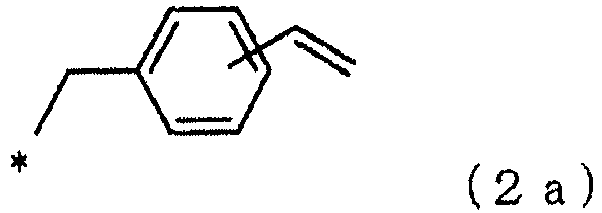

- In formula (2a) and formula (2b), * represents a binding portion.
- The number average molecular weight (Mn) of the polyphenylene ether used in the present invention is not particularly limited, but 1,000 to 100,000, 1,000 to 50,000, 1,000 to 30,000, 1,000 to 7,000, 1,000 to 5,000, 1,000 to 3,000, or the like may be exemplified. The number average molecular weight (Mn) is the value measured using gel permeation chromatography (GPC).
- As the intrinsic viscosity of the polyphenylene ether used in the present invention, 0.03 to 0.12 dl/g, 0.04 to 0.11 dl/g, 0.06 to 0.095 dl/g, or the like may be exemplified. The intrinsic viscosity is the intrinsic viscosity measured in methylene chloride at 25°C. More specifically, it is the value obtained by measuring a 0.18 g/45 ml methylene chloride solution (solution temperature: 25°C) with a viscometer.
- As the polyphenylene ether used in the present invention, known one or a commercial product may be used. In the case of synthesis, the polyphenylene ether may be synthesized by the method described in, for example,
WO 2014/203511 , or a method analogous thereto. - Component (B) used in the present invention is a block copolymer comprising a butadiene block and a styrene block. The styrene block is a block obtained by polymerizing styrene, and the butadiene block is a block obtained by polymerizing butadiene. As the block copolymer comprising a butadiene block and a styrene block, a styrene-butadiene block copolymer (SB), a styrene-butadiene-styrene block copolymer (SBS), a butadiene-styrene-butadiene block copolymer (BSB), or the like may be exemplified. Among these, the styrene-butadiene-styrene block copolymer (SBS) is preferable.
- The butadiene block consists only of the 1,2-bonding structure of formula (3), or consists of the 1,2-bonding structure of formula (3) and the 1,4-bonding structure of formula (4).

- The molar ratio of the 1,2-bonding structure of formula (3) to the 1,4-bonding structure of formula (4) comprised in the butadiene block in the block copolymer comprising the butadiene block and the styrene block used in the present invention is preferably 80:20 to 100:0.
- The weight ratio of the styrene block to the butadiene block in the block copolymer comprising the butadiene block and the styrene block is not particularly limited, but 10:90 to 80:20, 10:90 to 70:30, 10:90 to 60:40, 20:80 to 80:20, 30:70 to 80:20, 40:60 to 80:20, or the like may be exemplified. Among these, 10:90 to 80:20, 10:90 to 70:30, or 10:90 to 60:40 is preferable.
- The weight average molecular weight (Mw) of the block copolymer comprising the butadiene block and the styrene block is not particularly limited, but 2,000 to 100,000, 2,000 to 80,000, 2,000 to 60,000, 2,000 to 50,000, 2,000 to 40,000, or the like may be exemplified. The molecular weight distribution (Mw/Mn) of the block copolymer comprising the butadiene block and the styrene block is not particularly limited, but 1.00 to 3.00, 1.00 to 2.00, or the like may be exemplified. The weight average molecular weight (Mw) and the molecular weight distribution (Mw/Mn) are measured by gel permeation chromatography (GPC) using polystyrene as a standard substance. The measurement conditions are as follows: a mobile phase: THF (tetrahydrofuran), a mobile phase flow rate: 1 mL/min, a column temperature: 40°C, a sample injection volume: 40 µL, and a sample concentration: 2% by weight.
- A method for producing the block copolymer comprising the butadiene block and the styrene block used in the present invention is not particularly limited, but for example, the styrene-butadiene-styrene block copolymer may be produced by the method described in, for example,
Japanese unexamined Patent Application Publication No. 1994-192502 Japanese unexamined Patent Application Publication (Translation of PCT Application) No. 2000-514122 Japanese unexamined Patent Application Publication No. 2007-302901 - The polyphenylene ether resin composition of the present invention is a composition comprising polyphenylene ether (PPE) (component (A)), and a block copolymer comprising a butadiene block and a styrene block (component (B)).
- The content of the component (A) and the component (B) in the polyphenylene ether resin composition of the present invention is not particularly limited, but an amount in which the weight ratio of the component (A) and the component (B) is 5:95 to 95:5, 10:90 to 95:5, 15:85:95:5, 20:80 to 95:5, 25:75 to 95:5, 30:70 to 95:5, 35:65 to 95:5, 40:60 to 95:5, 45:55 to 95:5, 50:50 to 95:5, 55:65 to 95:5, 60:40 to 95:5, 65:35 to 95:5, 70:30 to 95:5, 70:30 to 90:10, or the like may be exemplified.
- Other additives may be appropriately added to the polyphenylene ether resin composition of the present invention, within a range not impairing the effects of the present invention. As other additives, an initiator, a crosslinking agent, a flame retardant, an inorganic filler, or the like may be exemplified.
- The initiator is not particularly limited. Specifically, benzoyl peroxide, cumene hydroperoxide, 2,5-dimethylhexane-2,5-dihydroperoxide, 2,5-dimethyl-2,5-di(t-butylperoxy)hexine-3, di-t-butyl peroxide, t-butylcumyl peroxide, α,α'-bis(t-butylperoxy-m-isopropyl)benzene, 2,5-dimethyl-2,5-di(t-butylperoxy)hexane, dicumyl peroxide, di-t-butyl peroxyisophthalate, t-butyl peroxybenzoate, 2,2-bis(t-butylperoxy)butane, 2,2-bis(t-butylperoxy)octane, 2,5-dimethyl-2,5-di(benzoylperoxy)hexane, di(trimethylsilyl)peroxide, trimethylsilyl triphenylsilyl peroxide, or the like may be exemplified.
- The added amount of the initiator is not particularly limited, but an amount of 0.1 to 10% by weight with respect to the combined amount of the component (A) and the component (B) may be exemplified.
- The crosslinking agent is not particularly limited. Specifically, divinylbenzene, triallyl isocyanurate, 1,4-polybutadiene, 1,2-polybutadiene, terminal acrylate-modified polybutadiene, terminal urethane methacrylate-modified polybutadiene, or the like may be exemplified. Among these, triallyl isocyanurate, or polybutadiene having a number average molecular weight (Mn) of about 100 to 4,000 is more preferably used.
- When the crosslinking agent is added, the added amount thereof is not particularly limited, but an amount of 1 to 50% by weight with respect to the total weight of the component (A) and the component (B) may be exemplified.
- The flame retardant is not particularly limited. Specifically, a halogen-based flame retardant such as a bromine-based flame retardant, a phosphorus-based flame retardant, or the like may be exemplified.
- As the halogen-based flame retardant, a bromine-based flame retardant such as pentabromodiphenyl ether, octabromodiphenyl ether, decabromodiphenyl ether, tetrabromobisphenol A, and hexabromocyclododecane, a chlorine-based flame retardant such as chlorinated paraffin, or the like may be exemplified.
- As the phosphorus-based flame retardant, a phosphoric acid ester such as a condensed phosphoric acid ester and a cyclic phosphoric acid ester, a phosphazene compound such as a cyclic phosphazene compound, a phosphinate-based flame retardant such as aluminum dialkyl phosphinate, a melamine-based flame retardant such as melamine phosphate and melamine polyphosphate, or the like may be exemplified.
- When the flame retardant is added, the added amount thereof is not particularly limited, but an amount of 1 to 20% by weight with respect to the total weight of the component (A) and the component (B) may be exemplified.
- As the inorganic filler, silica, alumina, talc, aluminum hydroxide, magnesium hydroxide, titanium oxide, mica, aluminum borate, barium sulfate, calcium carbonate, or the like may be exemplified.
- When the inorganic filler is added, the added amount thereof is not particularly limited, but an amount of 10 to 150% by weight with respect to the total weight of the component (A) and the component (B) may be exemplified.
- The method for producing the thermosetting composition of the present invention is not particularly limited. For example, a method in which the block copolymer comprising the butadiene block and the styrene block (B) and other components are added to the polyphenylene ether (A) and then kneaded with a kneading machine may be exemplified.
- When a prepreg is produced, the polyphenylene ether resin composition of the present invention is often used by being prepared in a varnish form to impregnate the composition in a base material (fibrous base material) for forming the prepreg. Such a resin varnish is, for example, prepared as follows.
- First, respective components that can be dissolved in an organic solvent are put in the organic solvent for dissolution. At this time, components may be heated, as needed. Thereafter, components that are used as needed and cannot be dissolved in the organic solvent, such as the inorganic filler, are added and dispersed using a ball mill, a bead mill, a planetary mixer, a roll mill, or the like until a predetermined dispersion state is achieved, whereby a resin varnish is prepared.
- As a method for producing a prepreg by using the obtained resin varnish, for example, a method in which the obtained resin varnish is impregnated in a fibrous base material and then dried may be exemplified.
- As the fibrous base material used for producing the prepreg, specifically, glass fiber cloth, aramid cloth, polyester cloth, glass nonwoven fabric, aramid nonwoven fabric, polyester nonwoven fabric, pulp paper, printer paper, or the like may be exemplified.
- The fibrous base material in which the resin varnish is impregnated is heated under desired heating conditions, for example, at 80 to 170°C for 1 to 10 minutes, to remove the solvent, whereby a prepreg in a semi-cured state (B stage) can be obtained.
- One or a plurality of the obtained prepregs are stacked, a metal foil such as copper foil is further stacked on both the top and bottom surfaces or on one surface of the prepreg or the prepreg stack, and this is integrally laminated by hot press molding, whereby a double-sided metal-clad or single-sided metal-clad laminate plate can be fabricated.
- The hot press conditions may be appropriately set according to the thickness of the laminate plate to be produced, the kind of resin composition of the prepreg, and the like. For example, the hot press conditions may be set such that the temperature is 170 to 210°C, the pressure is 1.5 to 4.0 MPa, and the time is 60 to 150 minutes.
- Hereinafter, the present invention will be described in detail by way of Examples, but the present invention is not limited to the scope of Examples.
- Into a 500 mL flask, 151.95 g of tetrahydrofuran (hereinafter, abbreviated as THF) and 19.65 g of hexane were added. After the mixture was cooled to -40°C, 2.28 g of n-butyllithium (a hexane solution with a concentration of 15.1% by weight) was added and stirred for 10 minutes, then 11.99 g of styrene was added dropwise, and the reaction was continued for 30 minutes. The solution was measured by gas chromatography (hereinafter, abbreviated as GC) and the disappearance of monomers was confirmed. Then, a mixed solution of 21.44 g of 1,3-butadiene, 23.43 g of THF, and 7.80 g of hexane was added dropwise, and the reaction was continued. After the solution was measured by GC and the disappearance of monomers was confirmed, 12.05 g of styrene was added dropwise, and after 30 minutes, 0.51 g of methanol was added to terminate the reaction.
- The copolymer obtained was analyzed by gel permeation chromatography (mobile phase: THF, polystyrene standards), and it was confirmed that the weight average molecular weight (Mw) was 24,300 and the molecular weight distribution (Mw/Mn) was 1.28. The copolymer obtained was a copolymer having a composition ratio of PS/PB/PS = 25/50/25% by weight. Note that PS means the styrene block and PB means the butadiene block. The same applies hereinafter.
- The reaction liquid was washed twice with water, and then the solvent was distilled off. This was reprecipitated in methanol, filtered off, and dried in vacuo to obtain a white powder. The 1,2-bonding structure in the butadiene block calculated by 1H-NMR was 93 mol%.
- Into a 500 mL flask, 149.37 g of THF and 17.53 g of hexane were added. After the mixture was cooled to -40°C, 5.21 g of n-butyllithium (a hexane solution with a concentration of 15.1% by weight) was added and stirred for 10 minutes, then 10.47 g of styrene was added dropwise, and the reaction was continued for 30 minutes. The solution was measured by gas chromatography (hereinafter, abbreviated as GC) and the disappearance of monomers was confirmed. Then, a mixed solution of 49.28 g of 1,3-butadiene and 49.28 g of THF was added dropwise and the reaction was continued. After the solution was measured by GC and the disappearance of monomers was confirmed, 10.66 g of styrene was added dropwise, and after 30 minutes, 1.12 g of methanol was added to terminate the reaction.
- The copolymer obtained was analyzed by gel permeation chromatography (mobile phase: THF, polystyrene standards), and it was confirmed that the molecular weight (Mw) was 14,200 and the molecular weight distribution (Mw/Mn) was 1.18. The copolymer obtained was a copolymer having a composition ratio of PS/PB/PS = 15/70/15% by weight.
- The reaction liquid was washed twice with water, and then the solvent was distilled off. This was reprecipitated in methanol, filtered off, and dried in vacuo to obtain a colorless and transparent viscous liquid. The 1,2-bonding structure in the butadiene block calculated by 1H-NMR was 94 mol%.
- Into a 500 mL flask, 155.90 g of cyclohexane and 20.10 g of THF were added. The mixture was warmed to 30°C, 1.95 g of n-butyllithium (a hexane solution with a concentration of 15.1% by weight) was added and stirred for 10 minutes, then 7.64 g of styrene was added dropwise, and the reaction was continued for 30 minutes. The solution was measured by gas chromatography (hereinafter, abbreviated as GC) and the disappearance of monomers was confirmed. Then, a mixed solution of 35.07 g of 1,3-butadiene and 35.07 g of cyclohexane was added dropwise and the reaction was continued. After the solution was measured by GC and the disappearance of monomers was confirmed, 7.78 g of styrene was added dropwise, and after 30 minutes, 0.40 g of methanol was added to terminate the reaction.
- The copolymer obtained was analyzed by gel permeation chromatography (mobile phase: THF, polystyrene standards), and it was confirmed that the molecular weight (Mw) was 17,400 and the molecular weight distribution (Mw/Mn) was 1.07. The copolymer obtained was a copolymer having a composition ratio of PS/PB/PS = 15/70/15% by weight.
- The reaction liquid was washed twice with water, and then the solvent was distilled off. This was reprecipitated in methanol, filtered off, and dried in vacuo to obtain a colorless and transparent viscous liquid. The 1,2-bonding structure in the butadiene block calculated by 1H-NMR was 89 mol%.
- Into a 5,000 mL flask, 1,212 g of THF and 132 g of hexane were added. After the mixture was cooled to -40°C, 98.58 g of n-butyllithium (a hexane solution with a concentration of 15.1% by weight) was added and stirred for 10 minutes, then 60.50 g of styrene was added dropwise, and the reaction was continued for 15 minutes. The solution was measured by gas chromatography (hereinafter, abbreviated as GC) and the disappearance of monomers was confirmed. Then, a mixed solution of 481.88 g of butadiene, 432.12 g of THF, and 48.08 g of hexane was added dropwise and the reaction was continued. After the solution was measured by GC and the disappearance of monomers was confirmed, 61.13 g of styrene was added dropwise, and after 30 minutes, 16.02 g of methanol was added to terminate the reaction.
- The copolymer obtained was analyzed by gel permeation chromatography (mobile phase: THF, polystyrene standards), and it was confirmed that the weight average molecular weight (Mw) was 4,742 and the molecular weight distribution (Mw/Mn) was 1.12. The copolymer obtained was a copolymer having a composition ratio of PS/PB/PS = 10/80/10% by weight.
- The reaction liquid was washed twice with water, and the solvent was distilled off to obtain a white viscous liquid. The 1,2-bonding structure in the butadiene unit calculated by 1H-NMR was 91%.
- A methacryl-modified polyphenylene ether (SA9000, manufactured by SABIC, Mn = 1700), the styrene-butadiene-styrene block copolymer obtained in Production Example 1, triallyl isocyanurate (manufactured by FUJIFILM Wako Pure Chemical Corporation), and dicumyl peroxide (manufactured by Aldrich) were mixed in an amount shown in Table 1 and dissolved in methyl ethyl ketone (hereinafter, referred to as MEK, manufactured by FUJIFILM Wako Pure Chemical Corporation) to obtain a varnish.
- A varnish was obtained in the same manner as in Example 1, except for using the styrene-butadiene-styrene block copolymer obtained in Production Example 4 instead of the styrene-butadiene-styrene block copolymer obtained in Production Example 1.
- A varnish was obtained in the same manner as in Example 1, except for using Ricon181 (manufactured by Cray Valley, styrene-butadiene random copolymer) instead of the styrene-butadiene-styrene block copolymer obtained in Production Example 1.
- 4 pieces of glass fiber cloth which were cut into 3 cm squares were sufficiently impregnated with the varnish and heated in an oven at 150°C for 10 minutes to fabricate prepregs. The rough surface of a copper foil having a thickness of 18 µm was applied to both surfaces of the obtained prepregs. Thereafter, this was sandwiched by polytetrafluoroethylene plates and hot-pressed using a press at 230°C under conditions of 3-4 MPa for 2 hours to obtain an evaluation substrate (copper-clad laminate plate).
- The solder heat-resistance test was measured in accordance with JIS C 6481. The solder heat resistance was evaluated by immersing the copper-clad laminate plate in solder at 260°C for 2 minutes and observing the peeling of the copper foil. When no peeling occurred, it was evaluated as "o," and when peeling occurred, it was evaluated as "×." The results are shown in Table 1.
- 10 pieces of glass fiber cloth which were cut into 10 cm squares were sufficiently impregnated with the varnish and heated in an oven at 150°C for 10 minutes to fabricate prepregs. 10 pieces of the prepregs obtained were laminated, and this was sandwiched by polytetrafluoroethylene plates and hot-pressed using a press at 230°C under conditions of 3-4 MPa for 2 hours to obtain an evaluation substrate (laminate plate).
- The Tg of the laminate plate was measured by using a dynamic viscoelasticity apparatus "RSA-G2" manufactured by TA Instruments. At this time, dynamic viscoelasticity measurement (DMA) was carried out with a bending module using a 30 mm dual cantilever as a jig at a frequency of 1 Hz, and the temperature at which the tanδ was maximum when the temperature was raised from -50°C to 270°C at a temperature rising rate of 5°C/min was determined as Tg. The results are shown in Table 1.
- Dynamic viscoelasticity measurement (DMA) was carried out using a dynamic viscoelasticity apparatus "RSA-G2" manufactured by TA Instruments with a bending module using a 30 mm dual cantilever as a jig at a frequency of 1 Hz, and when two cycles of measurements from -50°C to 270°C at a temperature rising rate of 5°C/min were carried out, the difference of Tg between the first cycle and the second cycle, ΔTg was evaluated. The temperature at which the tan5 was maximum was determined as Tg. The results are shown in Table 1.
- The relative dielectric constants (Dk) and dielectric loss tangents (Df) of the evaluation substrates at 10 GHz were measured by the resonant cavity perturbation method. Specifically, the relative dielectric constants and dielectric loss tangents of the test substrates at 10 GHz were measured using a network analyzer (MS46122B, manufactured by Anritsu Corporation). The results are shown in Table 1.
Table 1 Example 1 Example 2 Comparative Example 1 Composition (parts by weight) SA9000 50 50 50 Polymer synthesized in Production Example 1 10 Polymer synthesized in Production Example 4 10 Ricon181 10 TAIC 40 40 40 DCP 2 2 2 Evaluation Solder heat resistance o o o Tg (First cycle) (°C) 228.2 226.0 217.4 Tg (Second cycle) (°C) 229.6 232.9 236.1 ΔTg 1.5 6.9 18.7 Relative dielectric constant (Dk) 3.98 3.91 4.20 Dielectric loss tangent (Df) 0.0060 0.0057 0.0062 - These test results revealed that the laminate plate produced by using the composition of the present invention has low ΔTg and excellent heat resistance.
Claims (13)
- A polyphenylene ether resin composition comprising (A) polyphenylene ether, and (B) a block copolymer comprising a butadiene block having a molar ratio of a 1,2-bonding structure to a 1,4-bonding structure of 80:20 to 100:0, and a styrene block.
- A polyphenylene ether resin composition comprising (A) polyphenylene ether, and (B) a styrene-butadiene-styrene block copolymer (SBS) having a molar ratio of a 1,2-bonding structure to a 1,4-bonding structure in a butadiene block of 80:20 to 100:0.
- The polyphenylene ether resin composition according to claim 1 or 2, wherein a number average molecular weight (Mn) of the component (A) is 1,000 to 7,000.
- The polyphenylene ether resin composition according to any one of claims 1 to 3, wherein a weight ratio of the styrene block to the butadiene block in the component (B) is 10:90 to 80:20.
- The polyphenylene ether resin composition according to any one of claims 1 to 4, wherein a weight average molecular weight (Mw) of the component (B) is 2,000 to 100,000.
- The polyphenylene ether resin composition according to any one of claims 1 to 5, wherein a molecular weight distribution (Mw/Mn) of the component (B) is 1.00 to 3.00.
- The polyphenylene ether resin composition according to any one of claims 1 to 6, wherein a content ratio of the component (A) to the component (B) is component (A): component (B) = 5:95 to 95:5 in terms of weight ratio.
- The polyphenylene ether resin composition according to any one of claims 1 to 7, further comprising a crosslinking agent.
- The polyphenylene ether resin composition according to claim 8, wherein a content of the crosslinking agent is 1 to 50% by weight with respect to a total weight of the component (A) and the component (B).
- The polyphenylene ether resin composition according to any one of claims 1 to 9, further comprising a flame retardant.
- The polyphenylene ether resin composition according to claim 10, wherein a content of the flame retardant is 1 to 20% by weight with respect to a total weight of the component (A) and the component (B).
- A prepreg wherein the resin composition according to any one of claims 1 to 11 is impregnated in a base material.
- A metal-clad laminate plate produced by laminating the prepreg according to claim 12 and a metal foil by hot press molding.
Applications Claiming Priority (3)
| Application Number | Priority Date | Filing Date | Title |
|---|---|---|---|
| JP2019144191 | 2019-08-06 | ||
| JP2020031772 | 2020-02-27 | ||
| PCT/JP2020/026565 WO2021024679A1 (en) | 2019-08-06 | 2020-07-07 | Polyphenylene ether resin composition, prepreg, metal-clad laminate |
Publications (3)
| Publication Number | Publication Date |
|---|---|
| EP4011926A1 true EP4011926A1 (en) | 2022-06-15 |
| EP4011926A4 EP4011926A4 (en) | 2023-08-30 |
| EP4011926B1 EP4011926B1 (en) | 2025-12-03 |
Family
ID=74502927
Family Applications (1)
| Application Number | Title | Priority Date | Filing Date |
|---|---|---|---|
| EP20850936.4A Active EP4011926B1 (en) | 2019-08-06 | 2020-07-07 | Polyphenylene ether resin composition, prepreg, metal-clad laminate |
Country Status (9)
| Country | Link |
|---|---|
| US (1) | US11939443B2 (en) |
| EP (1) | EP4011926B1 (en) |
| JP (1) | JP7124227B2 (en) |
| KR (1) | KR102839591B1 (en) |
| CN (1) | CN114174434B (en) |
| DK (1) | DK4011926T3 (en) |
| PL (1) | PL4011926T3 (en) |
| TW (1) | TWI824165B (en) |
| WO (1) | WO2021024679A1 (en) |
Cited By (1)
| Publication number | Priority date | Publication date | Assignee | Title |
|---|---|---|---|---|
| EP4011619A4 (en) * | 2019-08-06 | 2023-09-06 | Nippon Soda Co., Ltd. | RESIN COMPOSITION FOR METAL BACKED LAMINATES, PREPREG AND METAL BACKED LAMINATES |
Families Citing this family (8)
| Publication number | Priority date | Publication date | Assignee | Title |
|---|---|---|---|---|
| TWI757173B (en) * | 2021-05-11 | 2022-03-01 | 台光電子材料股份有限公司 | Resin composition and its products |
| JPWO2023286713A1 (en) | 2021-07-14 | 2023-01-19 | ||
| JPWO2023286714A1 (en) | 2021-07-14 | 2023-01-19 | ||
| TWI823309B (en) * | 2022-03-28 | 2023-11-21 | 台光電子材料股份有限公司 | Resin compositions and products thereof |
| KR20240164888A (en) | 2022-03-29 | 2024-11-21 | 닛뽕소다 가부시키가이샤 | Thermosetting resin composition containing diphenyl(meth)acrylamide, and cured product thereof |
| CN114940816A (en) * | 2022-06-28 | 2022-08-26 | 上海载正化工科技发展有限公司 | Cross-linkable polyphenyl ether film and preparation method and application thereof |
| WO2024185371A1 (en) * | 2023-03-06 | 2024-09-12 | ナミックス株式会社 | Resin composition, and inter-layer insulating adhesive film, laminated circuit board, electronic component, and semiconductor device using same |
| WO2026054034A1 (en) * | 2024-09-05 | 2026-03-12 | ナミックス株式会社 | Resin composition, and insulating adhesive film, multilayer substrate, electronic component, and semiconductor device each using same |
Family Cites Families (28)
| Publication number | Priority date | Publication date | Assignee | Title |
|---|---|---|---|---|
| JPH06192502A (en) | 1992-12-25 | 1994-07-12 | Daicel Chem Ind Ltd | Thermosetting resin composition |
| US5571609A (en) | 1994-10-13 | 1996-11-05 | Rogers Corporation | Polybutadiene and polyisoprene based thermosetting compositions and method of manufacture thereof |
| JPH0977969A (en) * | 1995-09-14 | 1997-03-25 | Asahi Chem Ind Co Ltd | Polymer composition |
| DE69701399T2 (en) | 1996-07-03 | 2000-09-07 | Shell Internationale Research Maatschappij B.V., Den Haag | THERMOPLASTIC HIGH 1,2 - CONTAINING ELASTOMER OIL POLYOLEFIN COMPOSITION |
| US6376606B1 (en) * | 1998-01-06 | 2002-04-23 | General Electric Co. | Semi-transparent blends of polyphenylene ether and styrenic copolymers |
| JP4400902B2 (en) * | 1999-08-27 | 2010-01-20 | 旭化成ケミカルズ株式会社 | Polyphenylene ether resin composition having damping properties |
| US7413791B2 (en) | 2003-01-28 | 2008-08-19 | Matsushita Electric Works, Ltd. | Poly (phenylene ether) resin composition, prepreg, and laminated sheet |
| DE602004018017D1 (en) | 2003-09-30 | 2009-01-08 | Asahi Kasei Chemicals Corp | PROCESS FOR PREPARING A POLYPHENYLENETHERHARRENE COMPOSITION |
| JP4334392B2 (en) * | 2004-03-31 | 2009-09-30 | 旭化成ケミカルズ株式会社 | Thermoplastic resin composition |
| JP4138729B2 (en) * | 2004-11-01 | 2008-08-27 | 住友ゴム工業株式会社 | Rubber composition and tire comprising the same |
| US20060177666A1 (en) | 2005-02-08 | 2006-08-10 | Masanao Kawabe | Curable resin compositions |
| JP5104507B2 (en) * | 2007-04-26 | 2012-12-19 | 日立化成工業株式会社 | Process for producing resin varnish containing thermosetting resin of semi-IPN type composite, and resin varnish for printed wiring board, prepreg and metal-clad laminate using the same |
| JP5197463B2 (en) * | 2009-03-27 | 2013-05-15 | 旭化成ケミカルズ株式会社 | Resin composition and molded body thereof |
| FR2961818B1 (en) | 2010-06-23 | 2012-07-20 | Michelin Soc Tech | RUBBER COMPOSITION COMPRISING A THERMOPLASTIC LOAD AND COMPATIBILIZING AGENT |
| TWI471378B (en) | 2011-06-20 | 2015-02-01 | Asahi Kasei Chemicals Corp | Polyphenylene ether resin composition and method for producing the same |
| JP5901066B2 (en) * | 2012-04-27 | 2016-04-06 | 三井金属鉱業株式会社 | Resin composition, metal foil with resin layer, metal-clad laminate and printed wiring board |
| CN102807658B (en) | 2012-08-09 | 2014-06-11 | 广东生益科技股份有限公司 | Polyphenyl ether resin composite and prepreg and copper clad laminate made of polyphenyl ether resin composite |
| WO2014203511A1 (en) | 2013-06-18 | 2014-12-24 | パナソニックIpマネジメント株式会社 | Polyphenylene ether resin composition, prepreg, metal-clad laminate and printed wiring board |
| JP6175339B2 (en) * | 2013-10-01 | 2017-08-02 | 旭化成株式会社 | Resin composition and molded body thereof |
| US11041045B2 (en) * | 2015-04-30 | 2021-06-22 | Showa Denko Materials Co., Ltd. | Resin composition, prepreg, laminate and multilayer printed wiring board |
| FR3037591A1 (en) | 2015-06-18 | 2016-12-23 | Michelin & Cie | TIRE WITH A TREAD COMPRISING A DIENE ELASTOMER, A THERMOPLASTIC ELASTOMER AND A THERMOPLASTIC RESIN COMPRISING POLYPHENYLENE ETHER PATTERNS |
| CN110023403B (en) | 2017-01-24 | 2022-08-09 | 旭化成株式会社 | Thermoplastic elastomer composition, plug and container |
| WO2018164833A1 (en) * | 2017-03-07 | 2018-09-13 | Icl-Ip America Inc. | Non-migratory, high-melting/softening polymeric phosphorus-containing flame retardant for printed wiring boards |
| JP7051333B2 (en) * | 2017-08-25 | 2022-04-11 | 日鉄ケミカル&マテリアル株式会社 | Curable resin composition, its cured product, curable composite material, metal leaf with resin, and varnish for circuit board material |
| WO2019103048A1 (en) * | 2017-11-22 | 2019-05-31 | 株式会社クラレ | Block copolymer or hydrogenated product of same |
| JP6734583B2 (en) | 2018-02-23 | 2020-08-05 | 株式会社市川工務店 | Image processing system, image processing method and program for inspecting structures such as bridges |
| JP6902003B2 (en) | 2018-08-28 | 2021-07-14 | 株式会社メディカロイド | How to attach sterile drapes and surgical instruments |
| CN111253888A (en) | 2020-03-30 | 2020-06-09 | 广东生益科技股份有限公司 | Circuit material and circuit board comprising same |
-
2020
- 2020-07-07 PL PL20850936.4T patent/PL4011926T3/en unknown
- 2020-07-07 DK DK20850936.4T patent/DK4011926T3/en active
- 2020-07-07 KR KR1020227002849A patent/KR102839591B1/en active Active
- 2020-07-07 US US17/632,067 patent/US11939443B2/en active Active
- 2020-07-07 JP JP2021537630A patent/JP7124227B2/en active Active
- 2020-07-07 CN CN202080054607.1A patent/CN114174434B/en active Active
- 2020-07-07 WO PCT/JP2020/026565 patent/WO2021024679A1/en not_active Ceased
- 2020-07-07 EP EP20850936.4A patent/EP4011926B1/en active Active
- 2020-07-09 TW TW109123226A patent/TWI824165B/en active
Cited By (1)
| Publication number | Priority date | Publication date | Assignee | Title |
|---|---|---|---|---|
| EP4011619A4 (en) * | 2019-08-06 | 2023-09-06 | Nippon Soda Co., Ltd. | RESIN COMPOSITION FOR METAL BACKED LAMINATES, PREPREG AND METAL BACKED LAMINATES |
Also Published As
| Publication number | Publication date |
|---|---|
| US11939443B2 (en) | 2024-03-26 |
| WO2021024679A1 (en) | 2021-02-11 |
| TWI824165B (en) | 2023-12-01 |
| EP4011926B1 (en) | 2025-12-03 |
| DK4011926T3 (en) | 2025-12-22 |
| EP4011926A4 (en) | 2023-08-30 |
| KR20220025859A (en) | 2022-03-03 |
| JP7124227B2 (en) | 2022-08-23 |
| US20220251376A1 (en) | 2022-08-11 |
| KR102839591B1 (en) | 2025-07-28 |
| JPWO2021024679A1 (en) | 2021-02-11 |
| CN114174434A (en) | 2022-03-11 |
| TW202108695A (en) | 2021-03-01 |
| PL4011926T3 (en) | 2026-03-09 |
| CN114174434B (en) | 2024-03-08 |
Similar Documents
| Publication | Publication Date | Title |
|---|---|---|
| EP4011926B1 (en) | Polyphenylene ether resin composition, prepreg, metal-clad laminate | |
| EP4011619B1 (en) | Resin composition for metal-clad laminates, prepreg, and metal-clad laminate | |
| CN108473758B (en) | Polyphenylene ether resin composition, prepreg, metal-clad laminate, and printed wiring board | |
| TWI746758B (en) | Resin composition, prepreg, film with resin, metal foil with resin, metal-clad laminate and wiring board | |
| JP7316572B2 (en) | Resin composition, and prepreg, resin-coated film, resin-coated metal foil, metal-clad laminate, and wiring board using the same | |
| CN105358595B (en) | Polyphenyl ether resin composition, prepreg, metal-clad laminate and printed wiring board | |
| JP7081950B2 (en) | Resin composition, prepreg, metal-clad laminate, and printed wiring board | |
| CN109504062B (en) | Thermosetting resin composition | |
| CN105694425A (en) | Poly(phenylene ether) resin composition, prepreg, metal-clad laminate, and printed-wiring board | |
| JP2018095815A (en) | Thermosetting resin composition, and resin varnish, prepreg, metal foil with resin, resin film, metal-clad laminate and printed wiring board each using the same | |
| WO2019130735A1 (en) | Polyphenylene ether resin composition, prepreg using same, film with resin, metal foil with resin, metal-clad laminate and wiring board | |
| JP2026067886A (en) | Resin composition, and prepregs, resin-coated films, resin-coated metal foils, metal-clad laminates, and wiring boards using the same. | |
| WO2021166649A1 (en) | Curable resin composition, prepreg, metal-clad laminate, and printed wiring board | |
| TWI901388B (en) | Polymer composite, method using the same, low dielectric resin composition, prepreg, and metal foil laminated board | |
| TWI916663B (en) | Polyphenylene oxide resin compositions, and prepregs using the same, resin-coated films, resin-coated metal foils, metal-clad laminates, and wiring substrates. | |
| KR102756907B1 (en) | Terminal-modified polybutadiene, resin composition for metal-clad laminate, prepreg, and metal-clad laminate |
Legal Events
| Date | Code | Title | Description |
|---|---|---|---|
| STAA | Information on the status of an ep patent application or granted ep patent |
Free format text: STATUS: THE INTERNATIONAL PUBLICATION HAS BEEN MADE |
|
| PUAI | Public reference made under article 153(3) epc to a published international application that has entered the european phase |
Free format text: ORIGINAL CODE: 0009012 |
|
| STAA | Information on the status of an ep patent application or granted ep patent |
Free format text: STATUS: REQUEST FOR EXAMINATION WAS MADE |
|
| 17P | Request for examination filed |
Effective date: 20220128 |
|
| AK | Designated contracting states |
Kind code of ref document: A1 Designated state(s): AL AT BE BG CH CY CZ DE DK EE ES FI FR GB GR HR HU IE IS IT LI LT LU LV MC MK MT NL NO PL PT RO RS SE SI SK SM TR |
|
| DAV | Request for validation of the european patent (deleted) | ||
| DAX | Request for extension of the european patent (deleted) | ||
| A4 | Supplementary search report drawn up and despatched |
Effective date: 20230801 |
|
| RIC1 | Information provided on ipc code assigned before grant |
Ipc: C08F 236/10 20060101ALI20230726BHEP Ipc: H05K 1/03 20060101ALI20230726BHEP Ipc: B32B 15/08 20060101ALI20230726BHEP Ipc: C08J 5/24 20060101ALI20230726BHEP Ipc: C08L 71/12 20060101ALI20230726BHEP Ipc: C08L 53/02 20060101ALI20230726BHEP Ipc: C08F 297/04 20060101AFI20230726BHEP |
|
| RAP3 | Party data changed (applicant data changed or rights of an application transferred) |
Owner name: NIPPON SODA CO., LTD. |
|
| STAA | Information on the status of an ep patent application or granted ep patent |
Free format text: STATUS: EXAMINATION IS IN PROGRESS |
|
| 17Q | First examination report despatched |
Effective date: 20240710 |
|
| GRAP | Despatch of communication of intention to grant a patent |
Free format text: ORIGINAL CODE: EPIDOSNIGR1 |
|
| STAA | Information on the status of an ep patent application or granted ep patent |
Free format text: STATUS: GRANT OF PATENT IS INTENDED |
|
| INTG | Intention to grant announced |
Effective date: 20250709 |
|
| GRAS | Grant fee paid |
Free format text: ORIGINAL CODE: EPIDOSNIGR3 |
|
| GRAA | (expected) grant |
Free format text: ORIGINAL CODE: 0009210 |
|
| STAA | Information on the status of an ep patent application or granted ep patent |
Free format text: STATUS: THE PATENT HAS BEEN GRANTED |
|
| AK | Designated contracting states |
Kind code of ref document: B1 Designated state(s): AL AT BE BG CH CY CZ DE DK EE ES FI FR GB GR HR HU IE IS IT LI LT LU LV MC MK MT NL NO PL PT RO RS SE SI SK SM TR |
|
| REG | Reference to a national code |
Ref country code: CH Ref legal event code: F10 Free format text: ST27 STATUS EVENT CODE: U-0-0-F10-F00 (AS PROVIDED BY THE NATIONAL OFFICE) Effective date: 20251203 Ref country code: GB Ref legal event code: FG4D |
|
| REG | Reference to a national code |
Ref country code: DK Ref legal event code: T3 Effective date: 20251219 |
|
| REG | Reference to a national code |
Ref country code: DE Ref legal event code: R096 Ref document number: 602020063366 Country of ref document: DE |
|
| REG | Reference to a national code |
Ref country code: IE Ref legal event code: FG4D |
|
| REG | Reference to a national code |
Ref country code: NL Ref legal event code: FP |
|
| REG | Reference to a national code |
Ref country code: CH Ref legal event code: R17 Free format text: ST27 STATUS EVENT CODE: U-0-0-R10-R17 (AS PROVIDED BY THE NATIONAL OFFICE) Effective date: 20260108 |
|
| P01 | Opt-out of the competence of the unified patent court (upc) registered |
Free format text: CASE NUMBER: UPC_APP_0014926_4011926/2025 Effective date: 20251127 |
|
| PG25 | Lapsed in a contracting state [announced via postgrant information from national office to epo] |
Ref country code: ES Free format text: LAPSE BECAUSE OF FAILURE TO SUBMIT A TRANSLATION OF THE DESCRIPTION OR TO PAY THE FEE WITHIN THE PRESCRIBED TIME-LIMIT Effective date: 20251203 |
|
| REG | Reference to a national code |
Ref country code: LT Ref legal event code: MG9D |
|
| PG25 | Lapsed in a contracting state [announced via postgrant information from national office to epo] |
Ref country code: NO Free format text: LAPSE BECAUSE OF FAILURE TO SUBMIT A TRANSLATION OF THE DESCRIPTION OR TO PAY THE FEE WITHIN THE PRESCRIBED TIME-LIMIT Effective date: 20260303 |
|
| PG25 | Lapsed in a contracting state [announced via postgrant information from national office to epo] |
Ref country code: FI Free format text: LAPSE BECAUSE OF FAILURE TO SUBMIT A TRANSLATION OF THE DESCRIPTION OR TO PAY THE FEE WITHIN THE PRESCRIBED TIME-LIMIT Effective date: 20251203 Ref country code: HR Free format text: LAPSE BECAUSE OF FAILURE TO SUBMIT A TRANSLATION OF THE DESCRIPTION OR TO PAY THE FEE WITHIN THE PRESCRIBED TIME-LIMIT Effective date: 20251203 |
|
| PG25 | Lapsed in a contracting state [announced via postgrant information from national office to epo] |
Ref country code: RS Free format text: LAPSE BECAUSE OF FAILURE TO SUBMIT A TRANSLATION OF THE DESCRIPTION OR TO PAY THE FEE WITHIN THE PRESCRIBED TIME-LIMIT Effective date: 20260303 |
|
| PG25 | Lapsed in a contracting state [announced via postgrant information from national office to epo] |
Ref country code: LV Free format text: LAPSE BECAUSE OF FAILURE TO SUBMIT A TRANSLATION OF THE DESCRIPTION OR TO PAY THE FEE WITHIN THE PRESCRIBED TIME-LIMIT Effective date: 20251203 |
|
| PG25 | Lapsed in a contracting state [announced via postgrant information from national office to epo] |
Ref country code: BG Free format text: LAPSE BECAUSE OF FAILURE TO SUBMIT A TRANSLATION OF THE DESCRIPTION OR TO PAY THE FEE WITHIN THE PRESCRIBED TIME-LIMIT Effective date: 20251203 |