EP4011901B1 - Method for the fmoc group cleavage - Google Patents
Method for the fmoc group cleavage Download PDFInfo
- Publication number
- EP4011901B1 EP4011901B1 EP20213533.1A EP20213533A EP4011901B1 EP 4011901 B1 EP4011901 B1 EP 4011901B1 EP 20213533 A EP20213533 A EP 20213533A EP 4011901 B1 EP4011901 B1 EP 4011901B1
- Authority
- EP
- European Patent Office
- Prior art keywords
- fmoc
- peptide
- deapa
- dmf
- group
- Prior art date
- Legal status (The legal status is an assumption and is not a legal conclusion. Google has not performed a legal analysis and makes no representation as to the accuracy of the status listed.)
- Active
Links
Images


Classifications
-
- C—CHEMISTRY; METALLURGY
- C07—ORGANIC CHEMISTRY
- C07K—PEPTIDES
- C07K1/00—General methods for the preparation of peptides, i.e. processes for the organic chemical preparation of peptides or proteins of any length
- C07K1/06—General methods for the preparation of peptides, i.e. processes for the organic chemical preparation of peptides or proteins of any length using protecting groups or activating agents
- C07K1/061—General methods for the preparation of peptides, i.e. processes for the organic chemical preparation of peptides or proteins of any length using protecting groups or activating agents using protecting groups
- C07K1/063—General methods for the preparation of peptides, i.e. processes for the organic chemical preparation of peptides or proteins of any length using protecting groups or activating agents using protecting groups for alpha-amino functions
-
- C—CHEMISTRY; METALLURGY
- C07—ORGANIC CHEMISTRY
- C07K—PEPTIDES
- C07K1/00—General methods for the preparation of peptides, i.e. processes for the organic chemical preparation of peptides or proteins of any length
- C07K1/04—General methods for the preparation of peptides, i.e. processes for the organic chemical preparation of peptides or proteins of any length on carriers
-
- C—CHEMISTRY; METALLURGY
- C07—ORGANIC CHEMISTRY
- C07K—PEPTIDES
- C07K5/00—Peptides containing up to four amino acids in a fully defined sequence; Derivatives thereof
- C07K5/04—Peptides containing up to four amino acids in a fully defined sequence; Derivatives thereof containing only normal peptide links
- C07K5/08—Tripeptides
- C07K5/0802—Tripeptides with the first amino acid being neutral
- C07K5/0812—Tripeptides with the first amino acid being neutral and aromatic or cycloaliphatic
-
- C—CHEMISTRY; METALLURGY
- C07—ORGANIC CHEMISTRY
- C07K—PEPTIDES
- C07K7/00—Peptides having 5 to 20 amino acids in a fully defined sequence; Derivatives thereof
- C07K7/04—Linear peptides containing only normal peptide links
- C07K7/06—Linear peptides containing only normal peptide links having 5 to 11 amino acids
-
- C—CHEMISTRY; METALLURGY
- C07—ORGANIC CHEMISTRY
- C07K—PEPTIDES
- C07K7/00—Peptides having 5 to 20 amino acids in a fully defined sequence; Derivatives thereof
- C07K7/04—Linear peptides containing only normal peptide links
- C07K7/23—Luteinising hormone-releasing hormone [LHRH]; Related peptides
-
- A—HUMAN NECESSITIES
- A61—MEDICAL OR VETERINARY SCIENCE; HYGIENE
- A61K—PREPARATIONS FOR MEDICAL, DENTAL OR TOILETRY PURPOSES
- A61K38/00—Medicinal preparations containing peptides
-
- Y—GENERAL TAGGING OF NEW TECHNOLOGICAL DEVELOPMENTS; GENERAL TAGGING OF CROSS-SECTIONAL TECHNOLOGIES SPANNING OVER SEVERAL SECTIONS OF THE IPC; TECHNICAL SUBJECTS COVERED BY FORMER USPC CROSS-REFERENCE ART COLLECTIONS [XRACs] AND DIGESTS
- Y02—TECHNOLOGIES OR APPLICATIONS FOR MITIGATION OR ADAPTATION AGAINST CLIMATE CHANGE
- Y02P—CLIMATE CHANGE MITIGATION TECHNOLOGIES IN THE PRODUCTION OR PROCESSING OF GOODS
- Y02P20/00—Technologies relating to chemical industry
- Y02P20/50—Improvements relating to the production of bulk chemicals
- Y02P20/55—Design of synthesis routes, e.g. reducing the use of auxiliary or protecting groups
Definitions
- the invention relates to the field of amino function protection chemistry.
- it relates to a method for the cleavage of the Fmoc amino protective group.
- it relates to a method for cleaving the Fmoc amino protective group in the synthesis of peptides e.g. in solid phase peptide synthesis (SPPS).
- SPPS solid phase peptide synthesis
- the Fmoc group is one of the most commonly used amino protective groups.
- the most frequently used method for removing the Fmoc group is the treatment of the protected chemical compound with a piperidine solution in 1,1-dimethylformamide (DMF).
- the Fmoc group is one of the most commonly used alpha-amino protective groups in the synthesis of peptides. It is particularly common to use the Fmoc group as alpha-amino protective group in the elongation of sequences in SPPS.
- the standard procedure for removing the Fmoc group after each amide bond formation cycle of the stepwise peptide synthesis is the treatment of the growing peptide with a solution of 20% piperidine in DMF.
- piperidine is a controlled substance as it is employed as a precursor in the illicit synthesis of narcotic drugs and psychotropic substances, like fentanyl and phencyclidine (PCP, also referred to as "angel dust"), under international control. For this reason, it is included in the Red List of the International Narcotics Control Board (INCB, see 17th Ed, Jan 2020 ).
- PCP fentanyl and phencyclidine
- piperidine which needs to be used in high excess for cleavage of Fmoc, is a highly toxic compound.
- the acute oral toxicity is high in many species of test animals.
- the LD 50 values in mice, rabbits and rats are 30, 145 and 400 mg/kg, respectively.
- the problem is solved by the present invention, providing a method for cleaving Fmoc from one or more Fmoc protected amino groups, wherein the method comprises a step of contacting the Fmoc protected amino groups with a solution comprising 3-(diethylamino)propylamine, also known as DEAPA.
- the present invention further provides a method for the cleavage of the Fmoc amino protective group by using a solution comprising DEAPA in the synthesis of peptides, in particular in solid phase peptide synthesis.
- the present invention provides a method for the preparation of a peptide by Fmoc-based solid phase peptide synthesis, wherein the method comprises a step of contacting the Fmoc protected amino groups with a solution comprising 3-(diethylamino)propylamine, thereby cleaving the Fmoc from one or more Fmoc protected amino groups
- the present invention provides a method for the preparation of peptides using solid phase peptide synthesis, wherein the peptide comprises at least one aspartic acid amino acid, the method being characterized by using a solution comprising DEAPA for the cleavage of the Fmoc amino protective group. More particularly, the method is characterized by comprising a step of contacting the Fmoc protected amino group with a solution comprising DEAPA.
- the present invention provides a method for the preparation of degarelix in solid phase peptide synthesis, which is characterized by using a solution comprising DEAPA for the cleavage of one or more Fmoc amino protective groups.
- the methods according to the invention are characterized by using a 10% DEAPA solution for the cleavage of the Fmoc amino protective group. Even more preferably the solution is 10% DEAPA in DMF.
- the present invention provides a method for the preparation of a peptide in solid phase peptide synthesis, characterized by using a 10% DEAPA solution in DMF for cleaving Fmoc amino protective groups.
- Fmoc i.e. 9-fluorenylmethyloxycarbonyl, herein also referred to as Fmoc group
- Fmoc group is employed as a protecting group for amino functions.
- the standard agent for Fmoc cleavage is piperidine, and even though its toxicity and its status as a scheduled substance (controlled substance) have always been regarded to be disadvantageous, none of the bases which have been proposed for Fmoc cleavage so far became a new standard.
- amino function and “amino group” refer to any primary or secondary amines, including aliphatic - acyclic and cyclic - and aromatic amines, which can be protected by the Fmoc group.
- amino function is a primary aliphatic amine, more preferably the alpha-amino group of an amino acid or of a peptide.
- the Fmoc group is employed as protection for the alpha-amino group of the amino acids used as building blocks in the synthesis of peptides, both in liquid phase peptide synthesis (LPPS) and in SPPS.
- LPPS liquid phase peptide synthesis
- the chemical conditions required for its cleavage are generally orthogonal to the conditions required for the cleavage of the amino acids side-chain protecting groups. The latter are commonly removed after all the elongation steps of the peptide chain are concluded. This generally occurs with simultaneous cleavage of the peptide chain from the solid support when the peptide is synthesized in SPPS.
- Such peptide preparation in solid phase can be carried out either as a stepwise, or a fully Fmoc-based SPPS, wherein the amino acids are coupled one by one to the growing peptide sequence attached to a solid support, or as a Fmoc-based Convergent SPPS (CSPPS), wherein at least two peptide fragments, independently prepared, are coupled together to form amide bonds and longer peptide fragments, until the final sequence is finally obtained, wherein one of the two fragments involved in a coupling reaction is attached to a solid support.
- Fmoc-based SPPS Fmoc-based Convergent SPPS
- Fmoc-based SPPS or “Fmoc-based peptide synthesis” refer to a peptide synthesis wherein amino acids are employed, where the alpha-amino group is protected by the Fmoc group.
- the Fmoc group is also used as protection for amino functions in side-chains in a Boc-based SPPS, i.e. when amino acids are employed, whose alpha-amino group is protected by the Boc group.
- a Boc-based SPPS i.e. when amino acids are employed, whose alpha-amino group is protected by the Boc group.
- the protection of side-chains with Fmoc provides the required orthogonality for the deprotection of alpha-amino groups without removing the side-chain protections.
- DEAPA can be used to deprotect the side-chain amino function.
- peptide fragment and “fragment”, as used herein, describe a partial sequence of amino acids, with a minimum length of 2 amino acids, relative to the sequence of the target peptide.
- a peptide fragment is generally protected at the side-chain as well as at the N-terminal alpha-amino group not involved in a coupling reaction.
- the N-terminal alpha-amino group is preferably protected by Fmoc group.
- amine deprotecting agent and "Fmoc cleaving agent” are herein used as synonyms and refer to the reagents used in the present disclosure for the cleavage of Fmoc amino protective groups.
- the present invention thus provides a method for the preparation of a peptide, or a pharmaceutically acceptable salt thereof, by using solid phase peptide synthesis characterized by using a solution comprising DEAPA for cleaving Fmoc amino protective groups from Fmoc-protected alpha-amino groups.
- DEAPA has surprisingly proven to be suitable for the cleavage of Fmoc amino protective groups. It has been shown to be superior to the use of piperidine in peptide synthesis, wherein it can be used both in liquid and in solid phase, in particular in SPPS. It is a less toxic and more environmentally friendly chemical and proved to perform as a fast, safe and efficient reagent.
- the reaction rate of DEAPA and piperidine in the deprotection reaction removing Fmoc from a model amino acid like Fmoc-Phe-OH were compared in two different solvents, DMF and NBP (i.e. N-butyl-1-pyrrolidone), and at two different concentrations, 10% and 20%.
- DMF and NBP i.e. N-butyl-1-pyrrolidone
- Other amines were also tested, namely 1,1,3,3- tetramethylguanidine (TMG) and tert-butylamine (TBA).
- TMG 1,1,3,3- tetramethylguanidine
- TAA tert-butylamine
- DBF Dibenzofulvene
- DBF-A DBF-amine adduct
- piperidine and DEAPA were able to form the DBF-amine adduct, whereas TMG and TBA did not form the DBF adduct.
- DEAPA is therefore capable to act as a scavenging agent towards DBF and therefore prohibits side reactions caused by DBF.
- DEAPA surprisingly reacts in the same way as piperidine, the standard cleaving agent for Fmoc.
- DEAPA was further tested for any impact in racemization in Fmoc-based SPPS.
- Cysteine is known in the art to be extraordinarily prone to undergo racemization during peptide synthesis.
- H-Phe-L-Cys-Gly-OH and H-Phe-D-Cys-Gly-OH were prepared as standards, as described in Example 2.
- full Fmoc-based SPPS of H-Phe-L-Cys-Gly-OH was performed in parallel by using DEAPA or piperidine to remove the Fmoc groups (30% base solution), as described in Example 3. No substantial difference in the racemization ratio was observed between DEAPA and piperidine, as in both experiments the D/L ratio % (or racemization ratio %) was below 0.1.
- linear octreotide (II) i.e. H-D-Phe-Cys-Phe-D-Trp-Lys-Thr-Cys-Thr-ol (SEQ ID NO: 1)
- DEAPA linear octreotide
- SEQ ID NO: 1 linear octreotide
- aspartimide side-products One of the concerns in peptide synthesis is the formation of aspartimide side-products.
- Basic conditions which are mandatory for Fmoc group cleavage, may also favor the formation of unwanted aspartimide derivatives during Fmoc-based SPPS and their occurrence generally increases with the number of Fmoc cleavage cycles after the introduction of an aspartic acid residue (Asp) in the peptide chain.
- Asp aspartic acid residue
- the aspartimide ring in the side product may then be opened by nucleophilic attack with formation of further unwanted chemical species, as shown in the following scheme:
- the alpha-peptide may correspond to the target peptide, although racemization at Asp might occur.
- a model peptide was prepared and then contacted under the basic conditions either with piperidine, or another suitable amine, or with DEAPA for extended periods of time.
- the model hexapeptide H-Ala-Lys-Asp-Gly-Tyr-Ile-OH (III, SEQ ID NO: 2, Scheme 3) was prepared by full Fmoc-based SPPS by using 20% piperidine in DMF, and the aspartimide impurity (IV, Scheme 3) content was determined in the final compound, which was found to be 2.6 % (HPLC, Example 5).
- the formation of the aspartimide side-product may be followed by nucleophilic attack onto the aspartimide ring with formation of further by-products, like amine-adducts (amine-mediated ring-opening) and alpha- and beta-peptides (water-mediated ring-opening).
- ⁇ Asp indicates the amount of additional overall aspartimide impurities (comprising piperidides by-products) resulting from the stress test relative to the initial aspartimide amount (2.6%). This value proved to be lower when DEAPA was used, compared to the other tested amines, in the respective solvent.
- the purity of the target peptide (III) is higher in the samples treated with the DEAPA solution.
- the present invention provides a method for the cleavage of Fmoc amino protective groups characterized by using a solution comprising 3-(diethylamino)propylamine.
- the present invention also provides a method for the preparation of a peptide characterized by using a solution comprising 3-(diethylamino)propylamine for cleaving Fmoc amino protective groups.
- the present invention provides a method for the preparation of a peptide by solid phase peptide synthesis characterized by using a solution comprising 3-(diethylamino)propylamine for cleaving Fmoc amino protective groups.
- the concentration of DEAPA ranges from 5 to 30%, more preferably from 10 to 20%, most preferably it is 10%.
- the solvent is a polar aprotic solvent, more preferably it is selected from the group consisting of DMF, NBP, NMP (i.e. 1-methyl-2-pyrrolidone) or similar solvents, or mixtures thereof.
- the solution is a 10% concentration of DEAPA in DMF.
- the present invention provides a method for the cleavage of Fmoc amino protective groups characterized by using a 10% DEAPA solution in DMF.
- Degarelix is identified by the sequence: wherein the numbers indicate the amino acid (aa) positions, starting from N-terminal aa (D-Nal) to C-terminal aa (D-Ala).
- Degarelix was kept in a solution of 10% DEAPA in DMF for 24h to simulate conditions corresponding to those used for removal of Fmoc group during full SPPS. Samples were analyzed by HPLC at four checkpoints up to 24h and the four HPLC profiles obtained were compared as shown in Fig.3 and Fig.4 (for detailed experimental procedure, see Example 7).
- the present invention provides a method for the preparation of degarelix by solid phase peptide synthesis characterized by using a solution comprising DEAPA for cleaving Fmoc amino protective groups, wherein the solid phase synthesis is either a full SPPS or a CSPPS.
- the concentration of DEAPA ranges from 5 to 30%, more preferably from 10 to 20%, most preferably it is 10%.
- the solvent is a polar aprotic solvent, more preferably DMF, NBP, NMP (i.e. 1-methyl-2-pyrrolidone) or the like, or mixtures thereof.
- the present invention provides a method for the synthesis of degarelix characterized by using a 10% DEAPA solution in DMF for the cleavage of Fmoc amino protective groups.
- the synthesis of degarelix according to the present invention is performed by using at least one of the compounds selected from the group consisting of Fmoc-Aph(Hor)-OH, Fmoc-Aph(PG)-OH, Fmoc-Phe(NO 2 )-OH, Fmoc-D-Phe(NO 2 )-OH and a peptide fragment comprising one or more of Aph(Hor), Phe(NO 2 ) and D-Phe(NO 2 ).
- PG is an amino protective group selected from the group consisting of tert-butyloxycarbonyl, formyl, allyloxycarbonyl and benzyloxycarbonyl.
- the present invention provides a method for the preparation of degarelix by full Fmoc-based SPPS following the approach described in WO2017103275 , example 2, page 34, characterized by using a solution comprising DEAPA for cleaving Fmoc amino protective groups instead of piperidine.
- the present invention provides the use of 3-(diethylamino)propylamine for cleaving the Fmoc amino protective group.
- it provides the use of 3-(diethylamino)propylamine for cleaving the Fmoc amino protective group in peptide synthesis, preferably in solid phase peptide synthesis.
- Example 7 HPLC analyses were performed on Agilent 1260 Infinity II system, using columns Waters Cortecs C18 2.7 ⁇ m, 4.6 ⁇ 150 mm; temperature: 30°C; injection volume: 10 ⁇ L, UV: 245 nm; pH 5.5 Phosphate Buffer: 25 mM Potassium Phosphate to pH 5.5; pH 3.5 Phosphate Buffer: 25 mM Potassium Phosphate to pH 3.5; mobile phases: 75 % pH 5.5 Buffer: 25% CH 3 CN (A); 65 % pH 3.5 Buffer: 35% CH 3 CN (B); flow: 1.0 mL/min, sample concentration 0.5 mg/ml; gradient: 0-5 min 0% B, 5-45 min f0-100% B, 45-46 min 100-0% B, 46-60 min 0% B.
- Example 2 Full Fmoc-based SPPS of H-Phe-L-Cys-Gly-OH and H-Phe-D-Cys-Gly-OH in DMF as reference compounds for Cvs racemization tests
- the synthesis was carried out by using Fmoc-Gly-Trt-PS resin (200 mg, loading 1.1 mmol/g). After swelling of the resin in 2 mL of DMF, Fmoc protective group was removed by 20% piperidine in DMF (2 ⁇ 2 mL, 15 min each) and the resin was washed with DMF (4 ⁇ 2 mL).
- Fmoc-L-Cys(Trt)-OH (or Fmoc-D-Cys(Trt)-OH) and Fmoc-Phe-OH (three-fold excess with respect to the loading of the resin) were pre-activated by DIC and OxymaPure (three-fold excess of the reagents with respect to the loading of the resin) for 3 min and coupled to the resin in 60 min.
- the Fmoc protective group was removed by treating the peptide resin with a 20% piperidine in DMF (2 ⁇ 2 mL, 15 min each), and the resin was washed with DMF (4 ⁇ 2 mL).
- the peptide resin was washed with DMF (3 ⁇ 2 mL) and DCM (3 ⁇ 2 mL). Dry peptide resin was suspended in 5 mL of the mixture TFA/TIS/H 2 O/1-dodecanethiol (92.5/2.5/2.5/2.5 vlvlvlv) and stirred for 2 h. The resin was filtered off and diisopropylether (20 mL) cooled to 4°C was added to the solution. The peptide was filtered and dried in vacuo to obtain crude H-Phe-L-Cys-Gly-OH or H-Phe-D-Cys-Gly-OH as reference compounds for racemization tests.
- Racemization ratio (D/L %) in the preparation of H-Phe-Cys-Gly-OH was determined by HPLC % areas (A%) of the two diastereomers, and calculated as (H-Phe-D-Cys-Gly-OH A%)/(H-Phe-L-Cys-Gly-OH A%) ⁇ 100. D/L % was ⁇ 0.1 in both experiments.
- Example 4 Full Fmoc-based SPPS of H-D-Phe-Cys-Phe-D-Trp-Lys-Thr-Cys-Thr-ol (Linear Octreotide, II, SEQ ID NO: 1) with DEAPA or piperidine as Fmoc-cleaving agent
- the synthesis was carried out by using Fmoc-Thr(tBu)-ol-Trt-PS resin (200 mg, loading 1.1 mmol/g). After swelling of the resin in 2 mL of DMF or NBP, Fmoc protective group was removed by 10% DEAPA in DMF (or 20% piperidine in DMF or NBP) (2 ⁇ 2 mL, 15 min each) and the resin was washed with DMF or NBP (4 ⁇ 2 mL).
- the coupling was repeated a second time.
- the Fmoc protective group was removed by treating the peptide resin with 10% DEAPA in DMF (2 ⁇ 2 mL, 15 min each) or with 20% piperidine in DMF or NBP (2 ⁇ 2 mL, 15 min each), and the resin was washed with DMF or NBP (4 ⁇ 2 mL).
- the peptide resin was washed with DMF or NBP (3 ⁇ 2 mL) and DCM (3 ⁇ 2 mL).
- Example 5 Full Fmoc-based SPPS of H-Ala-Lys-Asp-Gly-Tyr-IIe-OH (III, SEQ ID NO: 2) with piperidine/DMF Fmoc cleavage for aspartimide formation detection
- the synthesis was carried out by using Fmoc-Ile-Trt-PS resin (800 mg, loading 1.1 mmol/g). After swelling of the resin in 2 mL of DMF, Fmoc protective group was removed by 20% piperidine in DMF (2 ⁇ 2 mL, 15 min each) and the resin was washed with DMF (4 ⁇ 2 mL).
- Fmoc-Tyr(tBu)-OH, Fmoc-Gly-OH, Fmoc-Asp(OtBu)-OH, Fmoc-Lys(Boc)-OH, Fmoc-Ala-OH were pre-activated by DIC and OxymaPure (three-fold excess of the reagents with respect to the loading of the resin) for 3 min and coupled to the resin for 60 min.
- the Fmoc protective group was removed by treating the peptide resin with 20% piperidine in DMF (2 ⁇ 2 mL, 15 min each), and the resin was washed with DMF (4 ⁇ 2 mL).
- Example 6 Stress stability test of H-Ala-Lys-Asp-Gly-Tyr-Ile-OH (II, SEQ ID NO: 2) with piperidine, DEAPA, TMG and TBA in DMF or NBP
- Dry peptide resin was suspended in 3 mL of the mixture TFA/TIS/H 2 O (90/5/5 v / v / v) and stirred for 2 h. The resin was filtered off and diisopropylether (10 mL) cooled to 4°C was added to the solution. The peptide was filtered and dried in vacuo to obtain crude H-Ala-Lys-Asp-Gly-Tyr-Ile-OH (II) and aspartimide impurity (III) in different ratios according to the used conditions.
- ⁇ Asp indicates the difference between the aspartimide amount formed after stress tests (including piperidides if present) and that arising from the hexapeptide synthesis (2.6%, see Example 2).
- Test 1 Profile not changed after 24 h. Only specified impurity RRT 0.85 (X, unknown), not present at t0, increased to a value of 0.06% at t3 (purity change from 99.17 to 99.10%).
- Hydantoin impurity (VI) at RRT 1.03 does not increase: 0.10% at both t0 and t3.
- Test 2 Profile not changed after 24 h. Only specified impurity RRT 0.85 (X, unknown), not present at t0, increased to a value of 0.04% at t3 (purity change from 99.18% to 99.10%).
- Hydantoin impurity (VI) at RRT 1.03 does not increase: 0.09% at both t0 and t3.
Landscapes
- Chemical & Material Sciences (AREA)
- Organic Chemistry (AREA)
- Health & Medical Sciences (AREA)
- General Health & Medical Sciences (AREA)
- Biochemistry (AREA)
- Biophysics (AREA)
- Life Sciences & Earth Sciences (AREA)
- Genetics & Genomics (AREA)
- Medicinal Chemistry (AREA)
- Molecular Biology (AREA)
- Proteomics, Peptides & Aminoacids (AREA)
- Analytical Chemistry (AREA)
- Endocrinology (AREA)
- Peptides Or Proteins (AREA)
Description
- The invention relates to the field of amino function protection chemistry. In particular, it relates to a method for the cleavage of the Fmoc amino protective group. More in particular, it relates to a method for cleaving the Fmoc amino protective group in the synthesis of peptides e.g. in solid phase peptide synthesis (SPPS).
- The Fmoc group is one of the most commonly used amino protective groups. The most frequently used method for removing the Fmoc group is the treatment of the protected chemical compound with a piperidine solution in 1,1-dimethylformamide (DMF). The Fmoc group is one of the most commonly used alpha-amino protective groups in the synthesis of peptides. It is particularly common to use the Fmoc group as alpha-amino protective group in the elongation of sequences in SPPS. The standard procedure for removing the Fmoc group after each amide bond formation cycle of the stepwise peptide synthesis is the treatment of the growing peptide with a solution of 20% piperidine in DMF.
- However, piperidine is a controlled substance as it is employed as a precursor in the illicit synthesis of narcotic drugs and psychotropic substances, like fentanyl and phencyclidine (PCP, also referred to as "angel dust"), under international control. For this reason, it is included in the Red List of the International Narcotics Control Board (INCB, see 17th Ed, Jan 2020).
- In addition, piperidine, which needs to be used in high excess for cleavage of Fmoc, is a highly toxic compound. The acute oral toxicity is high in many species of test animals. The LD50 values in mice, rabbits and rats are 30, 145 and 400 mg/kg, respectively.
- There is therefore a need for new synthesis routes addressing the drawbacks of using piperidine, which are amenable to the application in the manufacturing of chemicals, in particular of peptides, at an industrial scale and without any restrictions to its use.
- The problem is solved by the present invention, providing a method for cleaving Fmoc from one or more Fmoc protected amino groups, wherein the method comprises a step of contacting the Fmoc protected amino groups with a solution comprising 3-(diethylamino)propylamine, also known as DEAPA.
- The present invention further provides a method for the cleavage of the Fmoc amino protective group by using a solution comprising DEAPA in the synthesis of peptides, in particular in solid phase peptide synthesis.
- Further, the present invention provides a method for the preparation of a peptide by Fmoc-based solid phase peptide synthesis, wherein the method comprises a step of contacting the Fmoc protected amino groups with a solution comprising 3-(diethylamino)propylamine, thereby cleaving the Fmoc from one or more Fmoc protected amino groups
- Surprisingly, such methods provide peptides with an overall improved purity.
- In one embodiment, the present invention provides a method for the preparation of peptides using solid phase peptide synthesis, wherein the peptide comprises at least one aspartic acid amino acid, the method being characterized by using a solution comprising DEAPA for the cleavage of the Fmoc amino protective group. More particularly, the method is characterized by comprising a step of contacting the Fmoc protected amino group with a solution comprising DEAPA.
- In a further embodiment, the present invention provides a method for the preparation of degarelix in solid phase peptide synthesis, which is characterized by using a solution comprising DEAPA for the cleavage of one or more Fmoc amino protective groups.
- In preferred embodiments, the methods according to the invention are characterized by using a 10% DEAPA solution for the cleavage of the Fmoc amino protective group. Even more preferably the solution is 10% DEAPA in DMF.
- In particular, the present invention provides a method for the preparation of a peptide in solid phase peptide synthesis, characterized by using a 10% DEAPA solution in DMF for cleaving Fmoc amino protective groups.
-
-
Fig. 1 : 1H NMR after 20% DEAPA deprotection of Fmoc-Gly-Trt-PS resin in DMF-d6 (Example 1): the peak indicated with * corresponds to H1 signal of DBF-DEAPA adduct; the peak indicated with # corresponds to H2 signals of DBF; signals at 7.5-8.0 ppm are referred to a mixture of DBF and DBF-DEAPA aromatic protons. Calculated ratio of DBF/DBF-DEAPA adduct is 1/1.8. -
Fig. 2 : 1H NMR after 20% piperidine deprotection of Fmoc-Gly-Trt-PS resin in DMF-d6 (Example 1): the peak indicated with * corresponds to H1 signal of DBF-piperidine adduct; the peak indicated with # corresponds to H2 signals of DBF; signals at 7.5-8.0 ppm are referred to a mixture of DBF and DBF-piperidine aromatic protons. Calculated ratio of DBF/DBF-piperidine adduct is 1/7.7. -
Fig. 3 : Superimposed HPLC profiles of degarelix at t0, t1, t2 and t3 (Test 1, Example 7). -
Fig. 4 : Superimposed HPLC profiles of degarelix at t0, t2 and t3 (Test 2, Example 7). - Fmoc, i.e. 9-fluorenylmethyloxycarbonyl, herein also referred to as Fmoc group, is employed as a protecting group for amino functions. For decades the standard agent for Fmoc cleavage is piperidine, and even though its toxicity and its status as a scheduled substance (controlled substance) have always been regarded to be disadvantageous, none of the bases which have been proposed for Fmoc cleavage so far became a new standard.
- The terms "amino function" and "amino group" refer to any primary or secondary amines, including aliphatic - acyclic and cyclic - and aromatic amines, which can be protected by the Fmoc group. Preferably, such an amino function is a primary aliphatic amine, more preferably the alpha-amino group of an amino acid or of a peptide.
- In particular, the Fmoc group is employed as protection for the alpha-amino group of the amino acids used as building blocks in the synthesis of peptides, both in liquid phase peptide synthesis (LPPS) and in SPPS. The chemical conditions required for its cleavage are generally orthogonal to the conditions required for the cleavage of the amino acids side-chain protecting groups. The latter are commonly removed after all the elongation steps of the peptide chain are concluded. This generally occurs with simultaneous cleavage of the peptide chain from the solid support when the peptide is synthesized in SPPS.
- Such peptide preparation in solid phase can be carried out either as a stepwise, or a fully Fmoc-based SPPS, wherein the amino acids are coupled one by one to the growing peptide sequence attached to a solid support, or as a Fmoc-based Convergent SPPS (CSPPS), wherein at least two peptide fragments, independently prepared, are coupled together to form amide bonds and longer peptide fragments, until the final sequence is finally obtained, wherein one of the two fragments involved in a coupling reaction is attached to a solid support.
- The terms "Fmoc-based SPPS" or "Fmoc-based peptide synthesis" refer to a peptide synthesis wherein amino acids are employed, where the alpha-amino group is protected by the Fmoc group.
- The Fmoc group is also used as protection for amino functions in side-chains in a Boc-based SPPS, i.e. when amino acids are employed, whose alpha-amino group is protected by the Boc group. In this case, as the cleavage of Boc requires acidic conditions, the protection of side-chains with Fmoc provides the required orthogonality for the deprotection of alpha-amino groups without removing the side-chain protections. Also in this scenario DEAPA can be used to deprotect the side-chain amino function.
- The terms "peptide fragment" and "fragment", as used herein, describe a partial sequence of amino acids, with a minimum length of 2 amino acids, relative to the sequence of the target peptide. A peptide fragment is generally protected at the side-chain as well as at the N-terminal alpha-amino group not involved in a coupling reaction. The N-terminal alpha-amino group is preferably protected by Fmoc group.
- The terms "amine deprotecting agent" and "Fmoc cleaving agent" are herein used as synonyms and refer to the reagents used in the present disclosure for the cleavage of Fmoc amino protective groups.
- The terms "cleavage" and "removal", as well as the verbs "cleave" and "remove" are herein used as synonyms and refer to the breaking of the chemical bonds occurring during deprotection of Fmoc-protected amino groups.
- The present invention thus provides a method for the preparation of a peptide, or a pharmaceutically acceptable salt thereof, by using solid phase peptide synthesis characterized by using a solution comprising DEAPA for cleaving Fmoc amino protective groups from Fmoc-protected alpha-amino groups.
- DEAPA has surprisingly proven to be suitable for the cleavage of Fmoc amino protective groups. It has been shown to be superior to the use of piperidine in peptide synthesis, wherein it can be used both in liquid and in solid phase, in particular in SPPS. It is a less toxic and more environmentally friendly chemical and proved to perform as a fast, safe and efficient reagent.
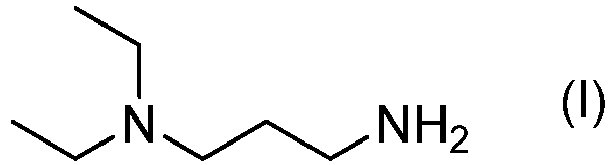
- 3-(diethylamino)propylamine (I) chemical structure is depicted below:
- The reaction rate of DEAPA and piperidine in the deprotection reaction removing Fmoc from a model amino acid like Fmoc-Phe-OH were compared in two different solvents, DMF and NBP (i.e. N-butyl-1-pyrrolidone), and at two different concentrations, 10% and 20%. Other amines were also tested, namely 1,1,3,3- tetramethylguanidine (TMG) and tert-butylamine (TBA). The results proved that DEAPA is as suitable for Fmoc cleavage as the other amines tested.
- The mechanism of Fmoc cleavage is depicted in the following:
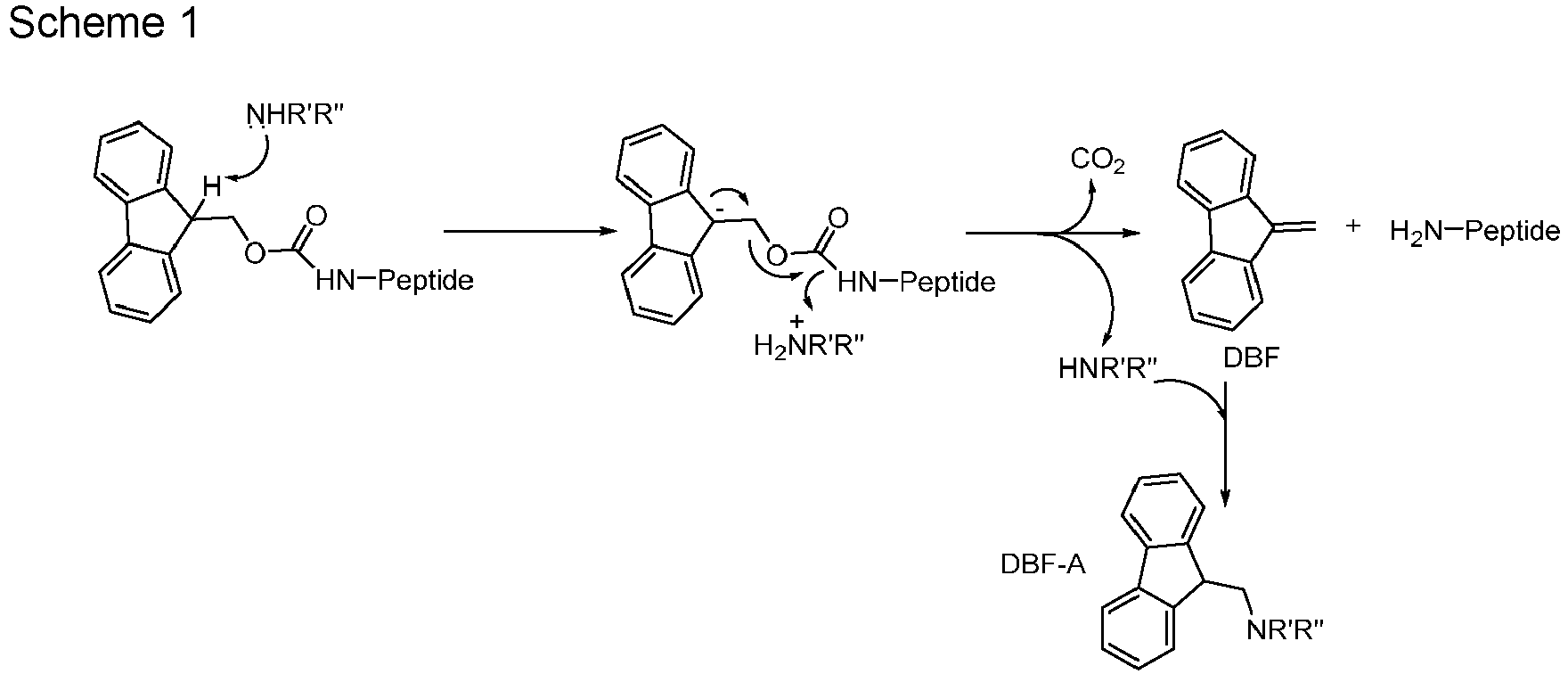
- Dibenzofulvene (DBF), which is formed in the first step, is a reactive species and can further react with the amine deprotecting agent to form a DBF-amine adduct (DBF-A). This prevents the possible side-reaction wherein DBF reacts with the free alpha-amino group of the peptide under preparation or with any other reactive species which might be present in the reaction mixture. It was surprisingly observed that piperidine and DEAPA were able to form the DBF-amine adduct, whereas TMG and TBA did not form the DBF adduct. DEAPA is therefore capable to act as a scavenging agent towards DBF and therefore prohibits side reactions caused by DBF. In this regard, DEAPA surprisingly reacts in the same way as piperidine, the standard cleaving agent for Fmoc.
- DEAPA was further tested for any impact in racemization in Fmoc-based SPPS. Cysteine is known in the art to be extraordinarily prone to undergo racemization during peptide synthesis. At first, H-Phe-L-Cys-Gly-OH and H-Phe-D-Cys-Gly-OH were prepared as standards, as described in Example 2. Then, full Fmoc-based SPPS of H-Phe-L-Cys-Gly-OH was performed in parallel by using DEAPA or piperidine to remove the Fmoc groups (30% base solution), as described in Example 3. No substantial difference in the racemization ratio was observed between DEAPA and piperidine, as in both experiments the D/L ratio % (or racemization ratio %) was below 0.1.
- In the following, the full Fmoc-based SPPS preparation of representative peptides by using DEAPA as a Fmoc cleaving agent is described.
- For example, linear octreotide (II), i.e. H-D-Phe-Cys-Phe-D-Trp-Lys-Thr-Cys-Thr-ol (SEQ ID NO: 1), was prepared in three different parallel experiments, by using 10% DEAPA in DMF, 20% piperidine in DMF or 20% piperidine in NBP for the cleavage of Fmoc groups. The final product obtained by using DEAPA showed an increased purity, as described in detail in Example 4.

- By analogue SPPS procedure, other peptides, like for instance glucagon, exenatide, etelcalcetide and the like, could be prepared by using the method according to the present invention.
- One of the concerns in peptide synthesis is the formation of aspartimide side-products. Basic conditions, which are mandatory for Fmoc group cleavage, may also favor the formation of unwanted aspartimide derivatives during Fmoc-based SPPS and their occurrence generally increases with the number of Fmoc cleavage cycles after the introduction of an aspartic acid residue (Asp) in the peptide chain. The aspartimide ring in the side product may then be opened by nucleophilic attack with formation of further unwanted chemical species, as shown in the following scheme:
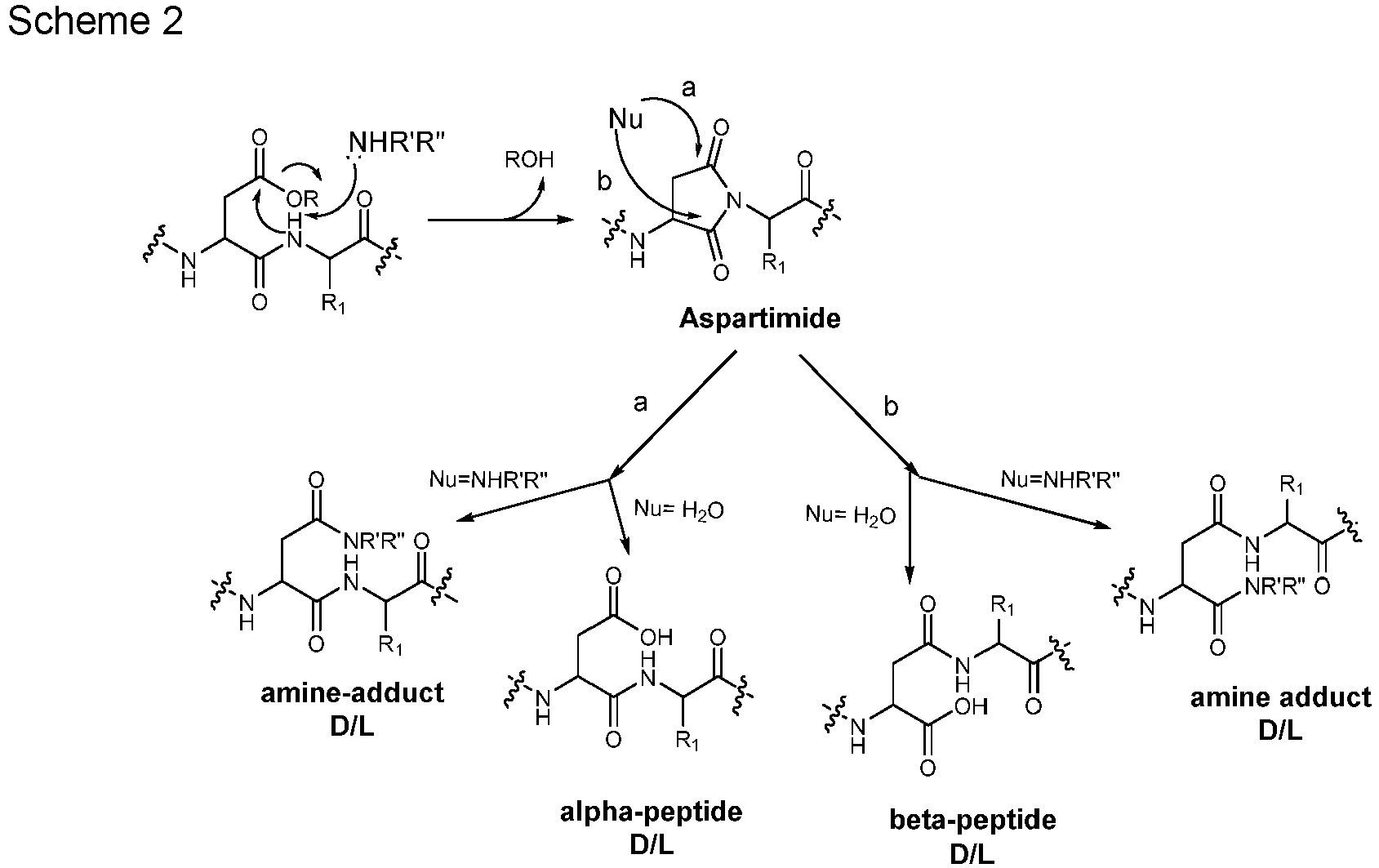
- The alpha-peptide may correspond to the target peptide, although racemization at Asp might occur.
- To analyze the suitability of DEAPA in such a scenario, a model peptide was prepared and then contacted under the basic conditions either with piperidine, or another suitable amine, or with DEAPA for extended periods of time.
- The model hexapeptide H-Ala-Lys-Asp-Gly-Tyr-Ile-OH (III, SEQ ID NO: 2, Scheme 3) was prepared by full Fmoc-based SPPS by using 20% piperidine in DMF, and the aspartimide impurity (IV, Scheme 3) content was determined in the final compound, which was found to be 2.6 % (HPLC, Example 5).

- A stress test was then performed whereby the model peptide was submitted to basic conditions to simulate repeated alpha-amino deprotection cycles. Resin-bound H-Ala-Lys-Asp-Gly-Tyr-Ile-OH (still bearing side-chain protections) was treated in parallel with 20% piperidine, 10% DEAPA, 5% TMG or 20% TBA solutions, in DMF or NBP, for 4h at RT.
- As shown in Scheme 2 above, the formation of the aspartimide side-product may be followed by nucleophilic attack onto the aspartimide ring with formation of further by-products, like amine-adducts (amine-mediated ring-opening) and alpha- and beta-peptides (water-mediated ring-opening).
- The hexapeptide samples obtained after such treatments with the Fmoc cleavage solutions were analyzed by HPLC and the results are shown in Table 1 (for detailed experimental procedure, see Example 6).
Table 1. HPLC purity (A %) of H-Ala-Lys-Asp-Gly-Tyr-Ile-OH (III, SEQ ID NO: 2) Entry Base Solvent III (A%) Aspartimide (IV) (A%) Piperidides (V) (A%) Δ Asp (A%) Starting point (after synthesis in DMF with 20% pip) 97.4 2.6 - 1 20 % piperidine DMF 86.5 7.2 6.3 10.9 2 10 % DEAPA DMF 89.9 10.1 - 7.5 3 5% TMG DMF 14.5a 85.5 - 82.9 4 20 % TBA DMF 70.7 29.3 - 26.7 5 20% piperidine NBP 90.0 7.1 2.9 7.4 6 10 % DEAPA NBP 95.8 4.2 - 1.6 7 5% TMG NBP 27.1a 72.9 - 70.3 8 TBA NBP 80.0 20.0 - 17.4 a sum of alpha- and beta-peptide - When piperidine was used, the formation of piperidides (V) was observed.

- The use of DEAPA resulted in the formation of the corresponding by-products in traces only, and those are not listed in Table 1.
- Cleavage with TMG resulted in the formation of the beta-peptide, co-eluting with the alpha-peptide, corresponding to the target peptide (III).
- In Table 1, Δ Asp indicates the amount of additional overall aspartimide impurities (comprising piperidides by-products) resulting from the stress test relative to the initial aspartimide amount (2.6%). This value proved to be lower when DEAPA was used, compared to the other tested amines, in the respective solvent.
- As a consequence, the purity of the target peptide (III) is higher in the samples treated with the DEAPA solution.
- Accordingly, the present invention provides a method for the cleavage of Fmoc amino protective groups characterized by using a solution comprising 3-(diethylamino)propylamine.
- The present invention also provides a method for the preparation of a peptide characterized by using a solution comprising 3-(diethylamino)propylamine for cleaving Fmoc amino protective groups.
- Furthermore, the present invention provides a method for the preparation of a peptide by solid phase peptide synthesis characterized by using a solution comprising 3-(diethylamino)propylamine for cleaving Fmoc amino protective groups.
- Preferably, the concentration of DEAPA ranges from 5 to 30%, more preferably from 10 to 20%, most preferably it is 10%. Preferably, the solvent is a polar aprotic solvent, more preferably it is selected from the group consisting of DMF, NBP, NMP (i.e. 1-methyl-2-pyrrolidone) or similar solvents, or mixtures thereof. In the most preferred embodiment, the solution is a 10% concentration of DEAPA in DMF.
- Wherein throughout the present disclosure concentration values are given in % these refer to vol%.
- In an especially preferred embodiment, the present invention provides a method for the cleavage of Fmoc amino protective groups characterized by using a 10% DEAPA solution in DMF.
- The use of DEAPA also proved to be advantageous in the synthesis of Degarelix (VI). Degarelix is identified by the sequence:wherein the numbers indicate the amino acid (aa) positions, starting from N-terminal aa (D-Nal) to C-terminal aa (D-Ala).


- One of the main problems in the preparation of degarelix is the high sensitivity of the (L)dihydroorotic acid (indicated as Hor) moiety of the Aph(Hor) residue in position 5 of the sequence in the presence of an aqueous basic solution. Under these conditions, a rapid rearrangement of the 6-membered Hor ring occurs, with formation of a 5-membered hydantoin ring.
- The stability of degarelix (VI) to hydantoin rearrangement was tested in a DEAPA solution to monitor any formation of its hydantoin impurity (VII).

- Degarelix was kept in a solution of 10% DEAPA in DMF for 24h to simulate conditions corresponding to those used for removal of Fmoc group during full SPPS. Samples were analyzed by HPLC at four checkpoints up to 24h and the four HPLC profiles obtained were compared as shown in
Fig.3 and Fig.4 (for detailed experimental procedure, see Example 7). - No significant degradation of degarelix was observed. In particular, no increase of hydantoin impurity (VI) was detected.
- Accordingly, the present invention provides a method for the preparation of degarelix by solid phase peptide synthesis characterized by using a solution comprising DEAPA for cleaving Fmoc amino protective groups, wherein the solid phase synthesis is either a full SPPS or a CSPPS.
- Preferably, in the preparation of degarelix the concentration of DEAPA ranges from 5 to 30%, more preferably from 10 to 20%, most preferably it is 10%. Preferably, the solvent is a polar aprotic solvent, more preferably DMF, NBP, NMP (i.e. 1-methyl-2-pyrrolidone) or the like, or mixtures thereof.
- In an especially preferred embodiment, the present invention provides a method for the synthesis of degarelix characterized by using a 10% DEAPA solution in DMF for the cleavage of Fmoc amino protective groups.
- In a preferred embodiment, the synthesis of degarelix according to the present invention is performed by using at least one of the compounds selected from the group consisting of Fmoc-Aph(Hor)-OH, Fmoc-Aph(PG)-OH, Fmoc-Phe(NO2)-OH, Fmoc-D-Phe(NO2)-OH and a peptide fragment comprising one or more of Aph(Hor), Phe(NO2) and D-Phe(NO2). PG is an amino protective group selected from the group consisting of tert-butyloxycarbonyl, formyl, allyloxycarbonyl and benzyloxycarbonyl. In particular, the present invention provides a method for the preparation of degarelix by full Fmoc-based SPPS following the approach described in
WO2017103275 , example 2, page 34, characterized by using a solution comprising DEAPA for cleaving Fmoc amino protective groups instead of piperidine. - In another embodiment, the present invention provides the use of 3-(diethylamino)propylamine for cleaving the Fmoc amino protective group. In particular, it provides the use of 3-(diethylamino)propylamine for cleaving the Fmoc amino protective group in peptide synthesis, preferably in solid phase peptide synthesis.
- Compared to piperidine which has been the standard cleaving agent for Fmoc for decades, DEAPA has a lower toxicity (LD50 rat = 830 mg/kg). It has shown mechanistic comparability to piperidine, allowing to extend the applicability of this method to Fmoc cleavage in general. In specific examples, DEAPA has shown superiority with regard to side reactions, resulting in products with higher purity. DEAPA is not in the list of controlled substances and even its price is lower than the price of piperidine.
-
- Aph
- p-amino-phenylalanine
- h
- hour
- min
- minutes
- GnRH
- Gonadotropin releasing hormone
- SPPS
- Solid phase peptide synthesis
- Fmoc-Aph(Hor)-OH
- 9-Fluorenylmethyloxycarbonyl-N(4)-(L-hydroorotyl)- 4-aminophenylalanine
- Fmoc-Phe-OH
- 9-Fluorenylmethyloxycarbonyl-L-phenylalanine
- Aph(Hor)
- N(4)-(L-hydroorotyl)-4-aminophenylalanine
- Hor
- Dihydroorotyl moiety
- Hor-OH
- (L)dihydroorotic acid
- Fmoc
- 9-Fluorenylmethyloxycarbonyl
- Boc
- t-Butyloxycarbonyl
- HPLC
- High performance liquid chromatography
- DIPEA/DIEA
- Diisopropylethylamine
- DEAPA
- 3-(Diethylamino)propylamine
- TFA
- Trifluoroacetic acid
- DMF
- N,N-dimethylformamide
- DMA
- N,N-dimethylacetamide
- NMP
- 1-methyl-2-pyrrolidone
- NBP
- 1-butyl-2-pyrrolidone
- ACN
- Acetonitrile
- DCM
- Dichloromethane
- DBF
- Dibenzofulvene
- DIC
- Diisopropylcarbodiimide
- TIS
- Tri-isopropylsilane
- OxymaPure
- Ethyl 2-cyano-2-hydroxyimino-acetate
- RRT
- Relative retention time
- RT
- Room temperature
- TM
- Target molecule
- Trt-PS resin
- Polystyrenic trityl resin
- The following examples provide detailed experimental conditions for the method of present invention and are intended to be illustrative and not limiting of all possible embodiments of the same.
- Unless otherwise noted, all materials, solvents and reagents were obtained from commercial suppliers, of the best grade, and used without further purification. Solid-phase synthesis of the peptides was carried out manually or using common peptide synthesizers, such as Biotage Syrowave instrument (automated syntheses) and Biotage MultiSynTech (semi automated syntheses).
- Examples 1-6: HPLC-MS analyses were performed on Agilent 1260 Infinity II system coupled to an electrospray ionization mass spectrometer (positive-ion mode, m/z = 100-1500, fragmentor 30 V), using columns Agilent Zorbax-SB-C18 5 µm, 250 × 4.6 mm or Phenomenex Luna C18 5 µm, 250 × 4.6 mm; temperature: 25°C; injection volume: 10 µL, UV: 220 nm, mobile phases: H2O+0.08%TFA (A) and CH3CN+0.08%TFA (B), flow: 0.5 mL/min or 1.0 mL/min.
- Example 7: HPLC analyses were performed on Agilent 1260 Infinity II system, using columns Waters Cortecs C18 2.7 µm, 4.6 × 150 mm; temperature: 30°C; injection volume: 10 µL, UV: 245 nm; pH 5.5 Phosphate Buffer: 25 mM Potassium Phosphate to pH 5.5; pH 3.5 Phosphate Buffer: 25 mM Potassium Phosphate to pH 3.5; mobile phases: 75 % pH 5.5 Buffer: 25% CH3CN (A); 65 % pH 3.5 Buffer: 35% CH3CN (B); flow: 1.0 mL/min, sample concentration 0.5 mg/ml; gradient: 0-5 min 0% B, 5-45 min f0-100% B, 45-46 min 100-0% B, 46-60 min 0% B.
- 50 mg of dry resin Fmoc-Gly-Trt-PS were swelled in 2 mL of DMF for 30 minutes. The resin was filtered and 0.75 mL 20% base solution (DEAPA, piperidine, TBA or TMG) in DMF-d6 was added on the resin and stirred for 30 min. The resin was filtered and the filtrate was straight analysed by 1H NMR spectroscopy in order to reveal the presence of DBF alone or the formation of the DBF-amine adduct (Scheme 1).
- 1H NMR spectra demonstrated the formation of DBF-DEAPA adduct (
Fig. 3 ) in DBF/DBF-DEAPA 1/1.8 ratio and the formation of DBF-piperidine adduct (Fig. 4 ) in ratio DBF/DBF-piperidine 1/7.7 ratio after 30 min. - No base-DBF adduct was observed with TBA or TMG.
- The synthesis was carried out by using Fmoc-Gly-Trt-PS resin (200 mg, loading 1.1 mmol/g). After swelling of the resin in 2 mL of DMF, Fmoc protective group was removed by 20% piperidine in DMF (2×2 mL, 15 min each) and the resin was washed with DMF (4×2 mL). Fmoc-L-Cys(Trt)-OH (or Fmoc-D-Cys(Trt)-OH) and Fmoc-Phe-OH (three-fold excess with respect to the loading of the resin) were pre-activated by DIC and OxymaPure (three-fold excess of the reagents with respect to the loading of the resin) for 3 min and coupled to the resin in 60 min. After each coupling step the Fmoc protective group was removed by treating the peptide resin with a 20% piperidine in DMF (2×2 mL, 15 min each), and the resin was washed with DMF (4×2 mL). After Fmoc-cleavage of N-terminal alpha-amino group the peptide resin was washed with DMF (3×2 mL) and DCM (3×2 mL). Dry peptide resin was suspended in 5 mL of the mixture TFA/TIS/H2O/1-dodecanethiol (92.5/2.5/2.5/2.5 vlvlvlv) and stirred for 2 h. The resin was filtered off and diisopropylether (20 mL) cooled to 4°C was added to the solution. The peptide was filtered and dried in vacuo to obtain crude H-Phe-L-Cys-Gly-OH or H-Phe-D-Cys-Gly-OH as reference compounds for racemization tests.
- HPLC-MS analysis gradient: 0-30 min 0-60% B; flow: 0.5 mL/min.
- Two SPPS of H-Phe-L-Cys-Gly-OH were conducted as reported above in Example 2, but using the following conditions for Fmoc group cleavage in parallel: 30% DEAPA or piperidine in DMF for 60 minutes.
- HPLC-MS analysis gradient: 0-30 min 0-60% B; flow: 0.5 mL/min.
- Racemization ratio (D/L %) in the preparation of H-Phe-Cys-Gly-OH was determined by HPLC % areas (A%) of the two diastereomers, and calculated as (H-Phe-D-Cys-Gly-OH A%)/(H-Phe-L-Cys-Gly-OH A%) × 100. D/L % was <0.1 in both experiments.
- The synthesis was carried out by using Fmoc-Thr(tBu)-ol-Trt-PS resin (200 mg, loading 1.1 mmol/g). After swelling of the resin in 2 mL of DMF or NBP, Fmoc protective group was removed by 10% DEAPA in DMF (or 20% piperidine in DMF or NBP) (2×2 mL, 15 min each) and the resin was washed with DMF or NBP (4×2 mL). Fmoc-Cys(Trt)-OH, Fmoc-Thr(tBu)-OH, Fmoc-Lys(Boc)-OH, Fmoc-D-Trp(Boc)-OH, Fmoc-Phe-OH, Fmoc-Cys(Trt)-OH, Fmoc-D-Phe-OH (three-fold excess with respect to the loading of the resin) were pre-activated by DIC and OxymaPure (three-fold excess of the reagents with respect to the loading of the resin) for 3 min and coupled to the resin in 60 min. In case of the first inserted Fmoc-Cys(Trt)-OH (Cys7 in the final sequence) the coupling was repeated a second time. After each coupling step the Fmoc protective group was removed by treating the peptide resin with 10% DEAPA in DMF (2×2 mL, 15 min each) or with 20% piperidine in DMF or NBP (2×2 mL, 15 min each), and the resin was washed with DMF or NBP (4×2 mL). After Fmoc cleavage of the N-terminal amino group the peptide resin was washed with DMF or NBP (3×2 mL) and DCM (3×2 mL). Dry peptide resin was suspended in 5 mL of the mixture TFA/TIS/1-dodecanethiol (90/5/5 v/v/v) and stirred for 4 h. The resin was filtered off and diisopropylether (20 mL) cooled to 4°C was added to the solution. The peptide was filtered and dried in vacuo to obtain crude linear octreotide (II). HPLC purities calculated as sum of all target molecule adducts are reported in Table 3. It is worth noticing that all the species reported in Table 3 are not impurities but precursors of the final Octreotide (TM = target molecule).
- HPLC-MS analysis gradient: 0-15 min 20-40% B; flow: 0.5 mL/min.
Table 2. HPLC Purity of Linear Octreotide (II) in DMF with 10% DEAPA in DMF or with 20% piperidine in DMF or NBP as deprotecting agent Compound RRT Fmoc cleavage conditions DMF 10% DEAPA DMF 20% Piperidine NBP 20% Piperidine Cyclized N,O shift 0,83 - 1.4 - Unknown 0.84 0.7 - Cyclized 0,88 0.7 3.8 2.4 TM-N, O shift 10,92 - - 0.7 TM-N,O shift 2 0,95 3.5 5.1 4.2 TM+CO2 0,97 - 9.5 4.7 TM 1,00 83.2 68.3 76.8 Unknown 1,09 - 1.2 0.5 TM+ tBu 1,14 9.0 9.5 7.2 TM+ tBu2 1,26 2.9 1.2 3.0 Product purity (%)a 99.3 98.8 99.0 Sum of unknown (%) 0.7 1.2 1.0 aHPLC purity calculated as sum of all target product adducts - The synthesis was carried out by using Fmoc-Ile-Trt-PS resin (800 mg, loading 1.1 mmol/g). After swelling of the resin in 2 mL of DMF, Fmoc protective group was removed by 20% piperidine in DMF (2×2 mL, 15 min each) and the resin was washed with DMF (4×2 mL). Fmoc-Tyr(tBu)-OH, Fmoc-Gly-OH, Fmoc-Asp(OtBu)-OH, Fmoc-Lys(Boc)-OH, Fmoc-Ala-OH (three-fold excess with respect to the loading of the resin) were pre-activated by DIC and OxymaPure (three-fold excess of the reagents with respect to the loading of the resin) for 3 min and coupled to the resin for 60 min. After each coupling step the Fmoc protective group was removed by treating the peptide resin with 20% piperidine in DMF (2×2 mL, 15 min each), and the resin was washed with DMF (4×2 mL). After Fmoc cleavage of N-terminal amino group the peptide resin was washed with DMF (3×2 mL) and DCM (3×2 mL). 100 mg dry peptide resin were suspended in 3 mL of the mixture TFA/TIS/H2O (90/5/5 vlvlv) and stirred for 2 h. The resin was filtered off and diisopropylether (10 mL) cooled to 4°C was added to the solution. The peptide was filtered and dried in vacuo to obtain crude H-Ala-Lys-Asp-Gly-Tyr-Ile-OH (II) with an HPLC purity of 97.4% and Aspartimide impurity (IV) of 2.6%.
- HPLC-MS analysis gradient: 0-30 min 10-40% B; flow: 0.5 mL/min.
- 100 mg of dry resin H-Ala-Lys-Asp-Gly-Tyr-Ile-Trt-PS (prepared as described in Example 2) were swelled in 2 mL of DMF or NBP for 30 minutes. The resin was filtered and a 2 mL solution of 10% DEAPA (or 20% piperidine, 5% TMG, 20% TBA) in DMF or NBP was added to the resin and stirred for 4 hours at RT. The resin was filtered, washed with DMF or NBP (3x2 mL) and with DCM (3x2 mL). Dry peptide resin was suspended in 3 mL of the mixture TFA/TIS/H2O (90/5/5 v/v/v) and stirred for 2 h. The resin was filtered off and diisopropylether (10 mL) cooled to 4°C was added to the solution. The peptide was filtered and dried in vacuo to obtain crude H-Ala-Lys-Asp-Gly-Tyr-Ile-OH (II) and aspartimide impurity (III) in different ratios according to the used conditions.
- Table 1 in the description lists the results. Δ Asp indicates the difference between the aspartimide amount formed after stress tests (including piperidides if present) and that arising from the hexapeptide synthesis (2.6%, see Example 2).
- HPLC-MS analysis gradient: 0-30 min 10-40% B; flow: 0.5 mL/min.
- A sample of degarelix, as a lyophilized powder of about 99% of purity, was dissolved in DMF with 10% of DEAPA at two different concentrations: about 170 g/L (Test 1) and about 17 g/L (Test 2). The stability at RT was followed for 24 h at four check points, i.e. t0, 1h (t1), 4h (t2) and 24h (t3).
- Superimposed HPLC profiles are shown in
Fig. 3 (Test 1) andFig. 4 (Test 2). - Test 1: Profile not changed after 24 h. Only specified impurity RRT 0.85 (X, unknown), not present at t0, increased to a value of 0.06% at t3 (purity change from 99.17 to 99.10%).
- Hydantoin impurity (VI) at RRT 1.03 does not increase: 0.10% at both t0 and t3.
- Test 2: Profile not changed after 24 h. Only specified impurity RRT 0.85 (X, unknown), not present at t0, increased to a value of 0.04% at t3 (purity change from 99.18% to 99.10%).
- Hydantoin impurity (VI) at RRT 1.03 does not increase: 0.09% at both t0 and t3.
Claims (15)
- A method for cleaving Fmoc from one or more Fmoc protected amino groups, wherein the method comprises a step of contacting the Fmoc protected amino groups with a solution comprising 3-(diethylamino)propylamine.
- The method according to claim 1, wherein the concentration of 3-(diethylamino)propylamine in the solution ranges from 5 to 30 vol% or from 10 to 20 vol%.
- The method according to any of the preceding claims, wherein the concentration of 3-(diethylamino)propylamine in the solution is 10 vol%.
- The method according to any of the preceding claims, wherein the solution further comprises a solvent selected from the group consisting of N,N-dimethylformamide, N-methylpyrrolidone, N-butylpyrrolidone and mixtures thereof.
- The method according to any of the preceding claims, wherein the solution consists of 10 vol% 3-(diethylamino)propylamine in N,N-dimethylformamide.
- The method according to any of the preceding claims, wherein the cleaving of the Fmoc is performed in peptide synthesis, preferably in solid phase peptide synthesis.
- The method according to claim 6, wherein the peptide comprises at least one aspartic acid amino acid.
- The method according to claim 6, wherein the peptide is selected from the group consisting of degarelix, octreotide, exenatide, etelcalcetide and glucagon.
- The method according to claim 8, wherein degarelix is prepared by using a protected amino acid selected from the group consisting of Fmoc-Aph(Hor)-OH, Fmoc-Aph(PG)-OH, Fmoc-Phe(NO2)-OH and Fmoc-D-Phe(NO2)-OH, wherein PG is an amino protective group selected from tert-butyloxycarbonyl, formyl, allyloxycarbonyl and benzyloxycarbonyl.
- A method for the preparation of a peptide by Fmoc-based solid phase peptide synthesis, wherein the method comprises a step of contacting the Fmoc protected amino groups with a solution comprising 3-(diethylamino)propylamine, thereby cleaving the Fmoc from one or more Fmoc protected amino groups.
- The method according to claim 10, wherein the concentration of 3-(diethylamino)propylamine in the solution is in the range from 5 to 30 vol% or from 10 to 20 vol%, or is 10 vol%.
- The method according to any of claims 10 and 11, wherein the solution further comprises a solvent selected from the group consisting of N,N-dimethylformamide, N-methylpyrrolidone, N-butylpyrrolidone and mixtures thereof.
- The method according to any of claims 10 to 12, wherein the peptide comprises at least one aspartic acid amino acid.
- The method according to any of claims 10 to 12, wherein the peptide is selected from the group consisting of degarelix, octreotide, exenatide, etelcalcetide and glucagon.
- Use of 3-(diethylamino)propylamine for cleaving the Fmoc amino protective group, wherein preferably the Fmoc amino protective group is employed in peptide synthesis, even more preferably in solid phase peptide synthesis.
Priority Applications (5)
| Application Number | Priority Date | Filing Date | Title |
|---|---|---|---|
| ES20213533T ES2957487T3 (en) | 2020-12-11 | 2020-12-11 | Method for excision of the Fmoc group |
| EP23194080.0A EP4296275A3 (en) | 2020-12-11 | 2020-12-11 | Method for the fmoc group cleavage |
| EP20213533.1A EP4011901B1 (en) | 2020-12-11 | 2020-12-11 | Method for the fmoc group cleavage |
| CN202111460637.5A CN115181158B (en) | 2020-12-11 | 2021-12-02 | FMOC group cleavage method |
| US17/547,076 US11692007B2 (en) | 2020-12-11 | 2021-12-09 | Amino deprotection using 3-(diethylamino)propylamine |
Applications Claiming Priority (1)
| Application Number | Priority Date | Filing Date | Title |
|---|---|---|---|
| EP20213533.1A EP4011901B1 (en) | 2020-12-11 | 2020-12-11 | Method for the fmoc group cleavage |
Related Child Applications (1)
| Application Number | Title | Priority Date | Filing Date |
|---|---|---|---|
| EP23194080.0A Division EP4296275A3 (en) | 2020-12-11 | 2020-12-11 | Method for the fmoc group cleavage |
Publications (3)
| Publication Number | Publication Date |
|---|---|
| EP4011901A1 EP4011901A1 (en) | 2022-06-15 |
| EP4011901B1 true EP4011901B1 (en) | 2023-08-30 |
| EP4011901C0 EP4011901C0 (en) | 2023-08-30 |
Family
ID=74124988
Family Applications (2)
| Application Number | Title | Priority Date | Filing Date |
|---|---|---|---|
| EP23194080.0A Pending EP4296275A3 (en) | 2020-12-11 | 2020-12-11 | Method for the fmoc group cleavage |
| EP20213533.1A Active EP4011901B1 (en) | 2020-12-11 | 2020-12-11 | Method for the fmoc group cleavage |
Family Applications Before (1)
| Application Number | Title | Priority Date | Filing Date |
|---|---|---|---|
| EP23194080.0A Pending EP4296275A3 (en) | 2020-12-11 | 2020-12-11 | Method for the fmoc group cleavage |
Country Status (4)
| Country | Link |
|---|---|
| US (1) | US11692007B2 (en) |
| EP (2) | EP4296275A3 (en) |
| CN (1) | CN115181158B (en) |
| ES (1) | ES2957487T3 (en) |
Families Citing this family (1)
| Publication number | Priority date | Publication date | Assignee | Title |
|---|---|---|---|---|
| CN119948044A (en) * | 2022-08-01 | 2025-05-06 | 伯尔尼大学 | Dipropylamine as a base for Fmoc deprotection in solid phase peptide synthesis |
Citations (1)
| Publication number | Priority date | Publication date | Assignee | Title |
|---|---|---|---|---|
| WO2012055903A1 (en) | 2010-10-27 | 2012-05-03 | Ferring B.V. | Process for the manufacture of degarelix and its intermediates |
Family Cites Families (4)
| Publication number | Priority date | Publication date | Assignee | Title |
|---|---|---|---|---|
| US20080287650A1 (en) * | 2007-03-01 | 2008-11-20 | Avi Tovi | High purity peptides |
| CN103992392B (en) * | 2014-05-19 | 2017-05-31 | 泰州启瑞医药科技有限公司 | A kind of solid phase synthesis process of Ac-D-2Nal-D-4Cpa-D-3Pal-Ser-4Aph(Hor)-D-4Aph(Cbm)-Leu-Lys(iPr)-Pro-D-Ala-NH2 |
| EP3390427B1 (en) | 2015-12-17 | 2021-08-25 | Fresenius Kabi iPSUM S.r.l. | Process for the manufacture of degarelix and its intermediates |
| CN106928313B (en) * | 2015-12-31 | 2020-12-11 | 深圳翰宇药业股份有限公司 | Synthesis method of C-terminal modified peptide |
-
2020
- 2020-12-11 ES ES20213533T patent/ES2957487T3/en active Active
- 2020-12-11 EP EP23194080.0A patent/EP4296275A3/en active Pending
- 2020-12-11 EP EP20213533.1A patent/EP4011901B1/en active Active
-
2021
- 2021-12-02 CN CN202111460637.5A patent/CN115181158B/en active Active
- 2021-12-09 US US17/547,076 patent/US11692007B2/en active Active
Patent Citations (1)
| Publication number | Priority date | Publication date | Assignee | Title |
|---|---|---|---|---|
| WO2012055903A1 (en) | 2010-10-27 | 2012-05-03 | Ferring B.V. | Process for the manufacture of degarelix and its intermediates |
Non-Patent Citations (11)
| Title |
|---|
| CARPINO L A , SADAT-AALAEE D, BEYERMANN M: "TRIS-2-AMINOETHYLAMINE AS A SUBSTITUTE FOR 4 AMINOMETHYLPIPERIDINE IN THE FMOC-POLYAMINE APPROACH TO RAPID PEPTIDE SYNTHESIS", THE JOURNAL OF ORGANIC CHEMISTRY, AMERICAN CHEMICAL SOCIETY, UNITED STATES, vol. 55, no. 5, 1 January 1990 (1990-01-01), United States, pages 1673 - 1675, XP002203969, ISSN: 0022-3263, DOI: 10.1021/jo00292a050 |
| GREEN T.W., WUTS P.G.M.: "PROTECTIVE GROUPS IN ORGANIC SYNTHESIS", 1 January 1999, JOHN WILEY & SONS, INC , Hoboken, NJ , ISBN: 978-0-471-22057-2, article GREENE T.W. AND WUTS P.G.M.: "PROTECTION FOR THE CARBOXYL GROUP", pages: 369 - 452, XP008127250, DOI: 10.1002/0471220574.ch5 |
| MARTIN FLEGEL, ZUZANA FLEGELOVá, PETR MALOň, VěRA KLENEROVá, SIXTUS HYNIE: "Fmoc deprotection by tert-butylamine and its comparison in solution and solid phase synthesis", COLLECTION SYMPOSIUM SERIES, INSTITUTE OF ORGANIC CHEMISTRY AND BIOCHEMISTRY, ACADEMY OF SCIENCES OF THE CZECH REPUBLIC, PRAGUE, 1 January 2011 (2011-01-01) - 29 April 2011 (2011-04-29), Prague , pages 41 - 44, XP055587062, ISBN: 978-80-86-24144-9, DOI: 10.1135/css201113041 |
| MERGLER M., DICK F., SAX B., STÄHELIN C., VORHERR T.: "The aspartimide problem in Fmoc‐based SPPS. Part II", JOURNAL OF PEPTIDE SIENCE, JOHN WILEY & SONS, INC., HOBOKEN, USA, vol. 9, no. 8, 1 August 2003 (2003-08-01), Hoboken, USA, pages 518 - 526, XP093191500, ISSN: 1075-2617, DOI: 10.1002/psc.473 |
| MIKLOS BODANSZKY: "Peptide Chemistry - A Practical Textbook", 1 January 1988, SPRINGER-VERLAG, ISBN: 978-3-540-18984-8, article BODANSZKY, MIKLOS: "Table of Contents", pages: 1 - 209, XP009556295 |
| OLEJNIK J ET AL: "Photocleavable peptide-DNA conjugates: synthesis and applications to DNA analysis using MALDI-MS.", NUCLEIC ACIDS RESEARCH, OXFORD UNIVERSITY PRESS, GB, vol. 27, no. 23, 1 December 1999 (1999-12-01), GB , pages 4626 - 4631, XP002220753, ISSN: 0305-1048, DOI: 10.1093/nar/27.23.4626 |
| PETER G. M. WUTS, THEODORA W. GREENE: "PROTECTIVE GROUPS IN ORGANIC SYNTHESIS, PAGES: 8, 10, 415: "Protective Groups in Organic Synthesis", 23 April 1999, WILEY, 9780471160199, ISBN: 9780471220572, article GREENE THEODORA W., WUTS PETER G. M.: "Chapter 6: Protection for the Thiol Group", pages: 454 - 493, XP009556324, DOI: 10.1002/0471220574.ch6 |
| RALHAN KRITTIKA, KRISHNAKUMAR V. GURU, GUPTA SHARAD: "Piperazine and DBU: a safer alternative for rapid and efficient Fmoc deprotection in solid phase peptide synthesis", RSC ADVANCES, ROYAL SOCIETY OF CHEMISTRY, GB, vol. 5, no. 126, 1 January 2015 (2015-01-01), GB , pages 104417 - 104425, XP093191499, ISSN: 2046-2069, DOI: 10.1039/C5RA23441G |
| STACEY A. PALASEK, COX ZACHARY J., COLLINS JONATHAN M.: "Limiting racemization and aspartimide formation in microwave-enhanced Fmoc solid phase peptide synthesis", JOURNAL OF PEPTIDE SCIENCE, JOHN WILEY & SONS, vol. 13, no. 3, 1 March 2007 (2007-03-01), pages 143 - 148, XP055209883, ISSN: 10752617, DOI: 10.1002/psc.804 |
| T.W. GREENE ET AL: "PROTECTIVE GROUPS IN ORGANIC SYNTHESIS, 3rd Edition", 9 April 1999, JOHN WILEY & SONS, INC. , New York , ISBN: 0-471-16019-9, article THEODORA W. GREENE; PETER G. M. WUTS: "Protection for the Amino Group", pages: 494 - 653, XP009527465, DOI: 10.1002/0471220574.ch7 |
| THEODORA W. GREENE , PETER G. M. WUTS: "PROTECTIVE GROUPS IN ORGANIC SYNTHESIS", 1 January 1999, JOHN WILEY & SONS, INC. , New York, NY [u.a.] , ISBN: 978-0-471-16019-9, article THEODORA W. GREENE, PETER G.M. WUTS: "CHAPTER 1: THE ROLE OF PROTECTIVE GROUPS IN ORGANICSYNTHESIS", pages: 1 - 16, XP009107133, DOI: 10.1002/0471220574.ch1 |
Also Published As
| Publication number | Publication date |
|---|---|
| EP4296275A3 (en) | 2024-03-13 |
| CN115181158A (en) | 2022-10-14 |
| US20220185842A1 (en) | 2022-06-16 |
| EP4011901A1 (en) | 2022-06-15 |
| ES2957487T3 (en) | 2024-01-19 |
| EP4296275A2 (en) | 2023-12-27 |
| CN115181158B (en) | 2025-06-13 |
| EP4011901C0 (en) | 2023-08-30 |
| US11692007B2 (en) | 2023-07-04 |
Similar Documents
| Publication | Publication Date | Title |
|---|---|---|
| Hojo et al. | Polypeptide synthesis using the S-alkyl thioester of a partially protected peptide segment. Synthesis of the DNA-binding domain of c-Myb protein (142-193)-NH2. | |
| Ralhan et al. | Piperazine and DBU: a safer alternative for rapid and efficient Fmoc deprotection in solid phase peptide synthesis | |
| EP1115739B1 (en) | Auxiliary for amide bond formation | |
| Schiller et al. | Synthesis of side‐chain to side‐chain cyclized peptide analogs on solid supports | |
| EP3266792A1 (en) | Peptide synthesis method | |
| KR20010071853A (en) | Processes for coupling amino acids using bis-(trichloromethyl) carbonate | |
| Mhidia et al. | Exploration of an imide capture/N, N-acyl shift sequence for asparagine native peptide bond formation | |
| US20250304642A1 (en) | Process for preparing a gip/glp1 dual agonist | |
| EP3405476B1 (en) | METHOD FOR PREPARATION OF PEPTIDES WITH psWANG LINKER | |
| US11692007B2 (en) | Amino deprotection using 3-(diethylamino)propylamine | |
| Moroder et al. | Studies on cytochrome c. Part II. Synthesis of the protected heptapeptide (sequence 17–23) of Baker's yeast iso‐1‐cytochrome c | |
| US20220177521A1 (en) | Process for the preparation of degarelix | |
| Nishiuchi et al. | Combined solid‐phase and solution approach for the synthesis of large peptides or proteins | |
| Katayama et al. | N-Methyl-phenacyloxycarbamidomethyl (Pocam) group: a novel thiol protecting group for solid-phase peptide synthesis and peptide condensation reactions | |
| EP3196206A1 (en) | Method for preparation of liraglutide | |
| EP4602064B1 (en) | Method of manufacturing a peptide with a lysine derivative | |
| Rzeszotarska et al. | Arginine, Histidine and Tryptophan in Peptide Synthesis. The Guanidino Function of Arginine | |
| Inui et al. | Synthesis of amyloid β-peptides in solution employing chloroform-phenol mixed solvent for facile segment condensation of sparingly soluble protected peptides | |
| AU2014234400A1 (en) | Synthesis of hydantoin containing peptide products | |
| US10450343B2 (en) | Synthesis of cyclic imide containing peptide products | |
| Ciszewska et al. | N‐(ureidoethyl) amides of cyclic enkephalin analogs | |
| Ösapay et al. | Synthesis and physicochemical characterization of the lanthionine analog of somatostatin [1–14] | |
| Procházka et al. | The analogs of oxytocin and D-homoarginine vasopressin with bulky substituted phenylalanine in position 2 | |
| Procházka et al. | The deamino-carba analogs of vasotocin. Synthesis and some biological properties | |
| AU6319699A (en) | Auxiliary for amide bond formation |
Legal Events
| Date | Code | Title | Description |
|---|---|---|---|
| PUAI | Public reference made under article 153(3) epc to a published international application that has entered the european phase |
Free format text: ORIGINAL CODE: 0009012 |
|
| STAA | Information on the status of an ep patent application or granted ep patent |
Free format text: STATUS: THE APPLICATION HAS BEEN PUBLISHED |
|
| AK | Designated contracting states |
Kind code of ref document: A1 Designated state(s): AL AT BE BG CH CY CZ DE DK EE ES FI FR GB GR HR HU IE IS IT LI LT LU LV MC MK MT NL NO PL PT RO RS SE SI SK SM TR |
|
| STAA | Information on the status of an ep patent application or granted ep patent |
Free format text: STATUS: REQUEST FOR EXAMINATION WAS MADE |
|
| 17P | Request for examination filed |
Effective date: 20220824 |
|
| RBV | Designated contracting states (corrected) |
Designated state(s): AL AT BE BG CH CY CZ DE DK EE ES FI FR GB GR HR HU IE IS IT LI LT LU LV MC MK MT NL NO PL PT RO RS SE SI SK SM TR |
|
| GRAP | Despatch of communication of intention to grant a patent |
Free format text: ORIGINAL CODE: EPIDOSNIGR1 |
|
| STAA | Information on the status of an ep patent application or granted ep patent |
Free format text: STATUS: GRANT OF PATENT IS INTENDED |
|
| INTG | Intention to grant announced |
Effective date: 20230330 |
|
| GRAS | Grant fee paid |
Free format text: ORIGINAL CODE: EPIDOSNIGR3 |
|
| GRAA | (expected) grant |
Free format text: ORIGINAL CODE: 0009210 |
|
| STAA | Information on the status of an ep patent application or granted ep patent |
Free format text: STATUS: THE PATENT HAS BEEN GRANTED |
|
| AK | Designated contracting states |
Kind code of ref document: B1 Designated state(s): AL AT BE BG CH CY CZ DE DK EE ES FI FR GB GR HR HU IE IS IT LI LT LU LV MC MK MT NL NO PL PT RO RS SE SI SK SM TR |
|
| REG | Reference to a national code |
Ref country code: GB Ref legal event code: FG4D |
|
| REG | Reference to a national code |
Ref country code: CH Ref legal event code: EP |
|
| REG | Reference to a national code |
Ref country code: DE Ref legal event code: R096 Ref document number: 602020016642 Country of ref document: DE |
|
| REG | Reference to a national code |
Ref country code: IE Ref legal event code: FG4D |
|
| U01 | Request for unitary effect filed |
Effective date: 20230927 |
|
| RAP4 | Party data changed (patent owner data changed or rights of a patent transferred) |
Owner name: ALMA MATER STUDIORUM - UNIVERSITA DI BOLOGNA Owner name: FRESENIUS KABI IPSUM S.R.L. |
|
| U07 | Unitary effect registered |
Designated state(s): AT BE BG DE DK EE FI FR IT LT LU LV MT NL PT SE SI Effective date: 20231025 |
|
| U20 | Renewal fee for the european patent with unitary effect paid |
Year of fee payment: 4 Effective date: 20231214 |
|
| PG25 | Lapsed in a contracting state [announced via postgrant information from national office to epo] |
Ref country code: GR Free format text: LAPSE BECAUSE OF FAILURE TO SUBMIT A TRANSLATION OF THE DESCRIPTION OR TO PAY THE FEE WITHIN THE PRESCRIBED TIME-LIMIT Effective date: 20231201 |
|
| REG | Reference to a national code |
Ref country code: ES Ref legal event code: FG2A Ref document number: 2957487 Country of ref document: ES Kind code of ref document: T3 Effective date: 20240119 |
|
| PG25 | Lapsed in a contracting state [announced via postgrant information from national office to epo] |
Ref country code: IS Free format text: LAPSE BECAUSE OF FAILURE TO SUBMIT A TRANSLATION OF THE DESCRIPTION OR TO PAY THE FEE WITHIN THE PRESCRIBED TIME-LIMIT Effective date: 20231230 |
|
| PG25 | Lapsed in a contracting state [announced via postgrant information from national office to epo] |
Ref country code: RS Free format text: LAPSE BECAUSE OF FAILURE TO SUBMIT A TRANSLATION OF THE DESCRIPTION OR TO PAY THE FEE WITHIN THE PRESCRIBED TIME-LIMIT Effective date: 20230830 Ref country code: NO Free format text: LAPSE BECAUSE OF FAILURE TO SUBMIT A TRANSLATION OF THE DESCRIPTION OR TO PAY THE FEE WITHIN THE PRESCRIBED TIME-LIMIT Effective date: 20231130 Ref country code: IS Free format text: LAPSE BECAUSE OF FAILURE TO SUBMIT A TRANSLATION OF THE DESCRIPTION OR TO PAY THE FEE WITHIN THE PRESCRIBED TIME-LIMIT Effective date: 20231230 Ref country code: HR Free format text: LAPSE BECAUSE OF FAILURE TO SUBMIT A TRANSLATION OF THE DESCRIPTION OR TO PAY THE FEE WITHIN THE PRESCRIBED TIME-LIMIT Effective date: 20230830 Ref country code: GR Free format text: LAPSE BECAUSE OF FAILURE TO SUBMIT A TRANSLATION OF THE DESCRIPTION OR TO PAY THE FEE WITHIN THE PRESCRIBED TIME-LIMIT Effective date: 20231201 |
|
| PG25 | Lapsed in a contracting state [announced via postgrant information from national office to epo] |
Ref country code: PL Free format text: LAPSE BECAUSE OF FAILURE TO SUBMIT A TRANSLATION OF THE DESCRIPTION OR TO PAY THE FEE WITHIN THE PRESCRIBED TIME-LIMIT Effective date: 20230830 |
|
| PG25 | Lapsed in a contracting state [announced via postgrant information from national office to epo] |
Ref country code: SM Free format text: LAPSE BECAUSE OF FAILURE TO SUBMIT A TRANSLATION OF THE DESCRIPTION OR TO PAY THE FEE WITHIN THE PRESCRIBED TIME-LIMIT Effective date: 20230830 Ref country code: RO Free format text: LAPSE BECAUSE OF FAILURE TO SUBMIT A TRANSLATION OF THE DESCRIPTION OR TO PAY THE FEE WITHIN THE PRESCRIBED TIME-LIMIT Effective date: 20230830 Ref country code: CZ Free format text: LAPSE BECAUSE OF FAILURE TO SUBMIT A TRANSLATION OF THE DESCRIPTION OR TO PAY THE FEE WITHIN THE PRESCRIBED TIME-LIMIT Effective date: 20230830 Ref country code: SK Free format text: LAPSE BECAUSE OF FAILURE TO SUBMIT A TRANSLATION OF THE DESCRIPTION OR TO PAY THE FEE WITHIN THE PRESCRIBED TIME-LIMIT Effective date: 20230830 |
|
| REG | Reference to a national code |
Ref country code: DE Ref legal event code: R026 Ref document number: 602020016642 Country of ref document: DE |
|
| PLBI | Opposition filed |
Free format text: ORIGINAL CODE: 0009260 |
|
| PLAX | Notice of opposition and request to file observation + time limit sent |
Free format text: ORIGINAL CODE: EPIDOSNOBS2 |
|
| 26 | Opposition filed |
Opponent name: HARBER IP S.R.O. Effective date: 20240530 |
|
| REG | Reference to a national code |
Ref country code: CH Ref legal event code: PL |
|
| PG25 | Lapsed in a contracting state [announced via postgrant information from national office to epo] |
Ref country code: MC Free format text: LAPSE BECAUSE OF FAILURE TO SUBMIT A TRANSLATION OF THE DESCRIPTION OR TO PAY THE FEE WITHIN THE PRESCRIBED TIME-LIMIT Effective date: 20230830 |
|
| PG25 | Lapsed in a contracting state [announced via postgrant information from national office to epo] |
Ref country code: MC Free format text: LAPSE BECAUSE OF FAILURE TO SUBMIT A TRANSLATION OF THE DESCRIPTION OR TO PAY THE FEE WITHIN THE PRESCRIBED TIME-LIMIT Effective date: 20230830 |
|
| REG | Reference to a national code |
Ref country code: IE Ref legal event code: MM4A |
|
| PG25 | Lapsed in a contracting state [announced via postgrant information from national office to epo] |
Ref country code: IE Free format text: LAPSE BECAUSE OF NON-PAYMENT OF DUE FEES Effective date: 20231211 |
|
| PLBB | Reply of patent proprietor to notice(s) of opposition received |
Free format text: ORIGINAL CODE: EPIDOSNOBS3 |
|
| PG25 | Lapsed in a contracting state [announced via postgrant information from national office to epo] |
Ref country code: CH Free format text: LAPSE BECAUSE OF NON-PAYMENT OF DUE FEES Effective date: 20231231 |
|
| PG25 | Lapsed in a contracting state [announced via postgrant information from national office to epo] |
Ref country code: IE Free format text: LAPSE BECAUSE OF NON-PAYMENT OF DUE FEES Effective date: 20231211 Ref country code: CH Free format text: LAPSE BECAUSE OF NON-PAYMENT OF DUE FEES Effective date: 20231231 |
|
| U20 | Renewal fee for the european patent with unitary effect paid |
Year of fee payment: 5 Effective date: 20241227 |
|
| PG25 | Lapsed in a contracting state [announced via postgrant information from national office to epo] |
Ref country code: CY Free format text: LAPSE BECAUSE OF FAILURE TO SUBMIT A TRANSLATION OF THE DESCRIPTION OR TO PAY THE FEE WITHIN THE PRESCRIBED TIME-LIMIT; INVALID AB INITIO Effective date: 20201211 |
|
| PG25 | Lapsed in a contracting state [announced via postgrant information from national office to epo] |
Ref country code: HU Free format text: LAPSE BECAUSE OF FAILURE TO SUBMIT A TRANSLATION OF THE DESCRIPTION OR TO PAY THE FEE WITHIN THE PRESCRIBED TIME-LIMIT; INVALID AB INITIO Effective date: 20201211 |
|
| PLCK | Communication despatched that opposition was rejected |
Free format text: ORIGINAL CODE: EPIDOSNREJ1 |
|
| APAH | Appeal reference modified |
Free format text: ORIGINAL CODE: EPIDOSCREFNO |
|
| APBP | Date of receipt of notice of appeal recorded |
Free format text: ORIGINAL CODE: EPIDOSNNOA2O |
|
| PG25 | Lapsed in a contracting state [announced via postgrant information from national office to epo] |
Ref country code: TR Free format text: LAPSE BECAUSE OF FAILURE TO SUBMIT A TRANSLATION OF THE DESCRIPTION OR TO PAY THE FEE WITHIN THE PRESCRIBED TIME-LIMIT Effective date: 20230830 |
|
| PGFP | Annual fee paid to national office [announced via postgrant information from national office to epo] |
Ref country code: GB Payment date: 20251229 Year of fee payment: 6 |
|
| APBU | Appeal procedure closed |
Free format text: ORIGINAL CODE: EPIDOSNNOA9O |
|
| U20 | Renewal fee for the european patent with unitary effect paid |
Year of fee payment: 6 Effective date: 20251205 |
|
| PLBN | Opposition rejected |
Free format text: ORIGINAL CODE: 0009273 |
|
| STAA | Information on the status of an ep patent application or granted ep patent |
Free format text: STATUS: OPPOSITION REJECTED |
|
| REG | Reference to a national code |
Ref country code: CH Ref legal event code: L18 Free format text: ST27 STATUS EVENT CODE: U-0-0-L10-L18 (AS PROVIDED BY THE NATIONAL OFFICE) Effective date: 20260121 |
|
| 27O | Opposition rejected |
Effective date: 20260112 |
|
| PGFP | Annual fee paid to national office [announced via postgrant information from national office to epo] |
Ref country code: ES Payment date: 20260114 Year of fee payment: 6 |