EP4011867B1 - Crystal forms c and e of pyrazin-2(1h)-one compound and preparation method therefor - Google Patents
Crystal forms c and e of pyrazin-2(1h)-one compound and preparation method therefor Download PDFInfo
- Publication number
- EP4011867B1 EP4011867B1 EP20850874.7A EP20850874A EP4011867B1 EP 4011867 B1 EP4011867 B1 EP 4011867B1 EP 20850874 A EP20850874 A EP 20850874A EP 4011867 B1 EP4011867 B1 EP 4011867B1
- Authority
- EP
- European Patent Office
- Prior art keywords
- compound
- formula
- crystal form
- present disclosure
- angles
- Prior art date
- Legal status (The legal status is an assumption and is not a legal conclusion. Google has not performed a legal analysis and makes no representation as to the accuracy of the status listed.)
- Active
Links
Images


Classifications
-
- C—CHEMISTRY; METALLURGY
- C07—ORGANIC CHEMISTRY
- C07D—HETEROCYCLIC COMPOUNDS
- C07D403/00—Heterocyclic compounds containing two or more hetero rings, having nitrogen atoms as the only ring hetero atoms, not provided for by group C07D401/00
- C07D403/14—Heterocyclic compounds containing two or more hetero rings, having nitrogen atoms as the only ring hetero atoms, not provided for by group C07D401/00 containing three or more hetero rings
-
- A—HUMAN NECESSITIES
- A61—MEDICAL OR VETERINARY SCIENCE; HYGIENE
- A61P—SPECIFIC THERAPEUTIC ACTIVITY OF CHEMICAL COMPOUNDS OR MEDICINAL PREPARATIONS
- A61P35/00—Antineoplastic agents
-
- A—HUMAN NECESSITIES
- A61—MEDICAL OR VETERINARY SCIENCE; HYGIENE
- A61K—PREPARATIONS FOR MEDICAL, DENTAL OR TOILETRY PURPOSES
- A61K31/00—Medicinal preparations containing organic active ingredients
- A61K31/33—Heterocyclic compounds
- A61K31/395—Heterocyclic compounds having nitrogen as a ring hetero atom, e.g. guanethidine or rifamycins
- A61K31/495—Heterocyclic compounds having nitrogen as a ring hetero atom, e.g. guanethidine or rifamycins having six-membered rings with two or more nitrogen atoms as the only ring heteroatoms, e.g. piperazine or tetrazines
- A61K31/4965—Non-condensed pyrazines
- A61K31/497—Non-condensed pyrazines containing further heterocyclic rings
-
- C—CHEMISTRY; METALLURGY
- C07—ORGANIC CHEMISTRY
- C07B—GENERAL METHODS OF ORGANIC CHEMISTRY; APPARATUS THEREFOR
- C07B2200/00—Indexing scheme relating to specific properties of organic compounds
- C07B2200/13—Crystalline forms, e.g. polymorphs
Definitions
- the present disclosure relates to a crystal form of a pyrazin-2(1H)-one compound and a preparation method therefor, specifically relates to a preparation method of a compound of formula (II) and a crystal form thereof.
- Fibroblast growth factor receptor is a receptor for fibroblast growth factor (FGF) signal transduction; the family of FGFR consists of four members (FGFR1, FGFR2, FGFR3, FGFR4), and FGFR is a glycoprotein consisting of an extracellular immunoglobulin (Ig)-like domain, a hydrophobic transmembrane region and an intracellular portion including a tyrosine kinase region. Fibroblast growth factor (FGF) plays an important role in many physiological regulatory processes such as cell proliferation, cell differentiation, cell migration and angiogenesis through these receptors (FGFR).
- FGF fibroblast growth factor
- the present disclosure provides a hydrochloride salt of a compound of formula (I)
- the hydrochloride salt of the compound of formula (I) has the structure shown in formula (III), wherein, n is selected from 0.6 to 2.
- the n is selected from 0.6, 0.7, 0.8, 0.9, 1, 1.1, 1.2, 1.3, 1.4, 1.5, 1.6, 1.7, 1.8, 1.9, and 2.
- the n is selected from 0.9, 1, and 1.1.
- the compound of formula (III) has the structure shown in formula (II)
- the present disclosure also provides a crystal form C of the compound of formula (II), and the X-ray powder diffraction pattern thereof comprises characteristic diffraction peaks at the following 2 ⁇ angles: 5.24 ⁇ 0.20°, 9.58 ⁇ 0.20°, and 10.45 ⁇ 0.20°.
- the X-ray powder diffraction pattern of the crystal form C of the compound of formula (II) comprises characteristic diffraction peaks at the following 2 ⁇ angles: 5.24 ⁇ 0.20°, 9.58 ⁇ 0.20°, 10.45 ⁇ 0.20°, 14.25 ⁇ 0.20°, 20.86 ⁇ 0.20°, 24.99 ⁇ 0.20°, 26.21 ⁇ 0.20°, and 27.71 ⁇ 0.20°.
- the X-ray powder diffraction pattern of the crystal form C of the compound of formula (II) comprises characteristic diffraction peaks at the following 2 ⁇ angles: 5.24 ⁇ 0.20°, 9.58 ⁇ 0.20°, 10.45 ⁇ 0.20°, 14.26 ⁇ 0.20°, 20.86 ⁇ 0.20°, 24.99 ⁇ 0.20°, 26.21 ⁇ 0.20°, and 27.71 ⁇ 0.20°.
- the X-ray powder diffraction pattern of the crystal form C of the compound of formula (II) comprises characteristic diffraction peaks at the following 2 ⁇ angles: 5.24°, 8.45°, 9.08°, 9.58°, 10.45°, 11.49°, 13.23°, 14.02°, 14.26°, 15.18°, 15.60°, 16.35°, 18.15°, 18.74°, 19.52°, 19.94°, 20.86°, 21.65°, 21.97°, 22.50°, 23.28°, 23.64°, 24.16°, 24.99°, 26.21°, 26.98°, 27.71°, 28.52°, 29.07°, 29.43°, 30.37°, 31.72°, 32.30°, 33.11°, 34.79°, and 36.78°.
- the XRPD pattern of the crystal form C of the compound of formula (II) is as shown in Fig. 1 .
- the analytical data of the XRPD pattern of the crystal form C of the compound of formula (II) are as shown in Table 1.
- Table 1 Analytical data of the XRPD pattern of the crystal form C of the compound of formula (II) No. Angle of 2 ⁇ (°) d-Spacing ( ⁇ ) Relative intensity (%) No.
- the differential scanning calorimetry curve of the crystal form C of the compound of formula (II) has an endothermic peak with an onset at 216.4 °C ⁇ 2.0 °C, and has an endothermic peak with an onset at 258.8 °C ⁇ 2.0 °C.
- the DSC pattern of the crystal form C of the compound of formula (II) is as shown in Fig. 2 .
- thermogravimetric analysis curve of the crystal form C of the compound of formula (II) shows a weight loss of 0.1380 % occurred at 118.6 °C ⁇ 3.0 °C, a weight loss of 6.7760 % occurred at 205.5 °C ⁇ 3.0 °C, and a weight loss of 9.2750 % occurred at 253.02 °C ⁇ 3.0 °C.
- the TGA pattern of the crystal form C of the compound of formula (II) is as shown in Fig. 3 .
- the present disclosure also provides a crystal form E of the compound of formula (II), and the X-ray powder diffraction pattern thereof comprises characteristic diffraction peaks at the following 2 ⁇ angles: 9.05 ⁇ 0.20°, 10.36 ⁇ 0.20°, and 14.66 ⁇ 0.20°.
- the X-ray powder diffraction pattern of the crystal form E of the compound of formula (II) comprises characteristic diffraction peaks at the following 2 ⁇ angles: 9.05 ⁇ 0.20°, 10.36 ⁇ 0.20°, 14.66 ⁇ 0.20°, 15.75 ⁇ 0.20°, 16.74 ⁇ 0.20°, 18.54 ⁇ 0.20°, 19.01 ⁇ 0.20°, 20.78 ⁇ 0.20°, 25.20 ⁇ 0.20°, and 26.65 ⁇ 0.20°.
- the X-ray powder diffraction pattern of the crystal form E of the compound of formula (II) comprises characteristic diffraction peaks at the following 2 ⁇ angles: 9.05 ⁇ 0.20°, 10.36 ⁇ 0.20°, 14.66 ⁇ 0.20°, 15.75 ⁇ 0.20°, 16.74 ⁇ 0.20°, 18.54 ⁇ 0.20°, 25.20 ⁇ 0.20°, 26.65 ⁇ 0.20°, 27.28 ⁇ 0.20°, and 27.94 ⁇ 0.20°.
- the X-ray powder diffraction pattern of the crystal form E of the compound of formula (II) comprises characteristic diffraction peaks at the following 2 ⁇ angles: 5.52°, 9.05°, 10.36°, 11.09°, 13.94°, 14.66°, 15.75°, 16.74°, 18.13°, 18.54°, 19.01°, 20.78°, 21.57°, 21.98°, 23.58°, 24.46°, 25.20°, 25.44°, 26.26°, 26.65°, 27.28°, 27.51°, 27.94°, 28.94°, 29.54°, 31.19°, 32.08°, 33.24°, 35.47°, 36.23°, 38.35°, and 39.34°.
- the XRPD pattern of the crystal form E of the compound of formula (II) is as shown in Fig. 4 .
- the analytical data of the XRPD pattern of the crystal form E of the compound of formula (II) are as shown in Table 2.
- Table 2 Analytical data of the XRPD pattern of the crystal form E of the compound of formula (II) No. Angle of 2 ⁇ (°) d-Spacing ( ⁇ ) Intensity Relative intensity (%) No.
- the differential scanning calorimetry curve of the crystal form E of the compound of formula (II) has an endothermic peak with an onset at 261.8 °C ⁇ 2.0 °C.
- the DSC pattern of the crystal form E of the compound of formula (II) is as shown in Fig. 5 .
- thermogravimetric analysis curve of the crystal form E of the compound of formula (II) shows a weight loss of 1.72 % occurred at 150.0 °C ⁇ 3.0 °C, a weight loss of 8.34 % occurred at 230.0 °C ⁇ 3.0 °C, and a weight loss of 9.41 % occurred at 280.0 °C ⁇ 3.0 °C.
- the TGA pattern of the crystal form E of the compound of formula (II) is as shown in Fig. 6 .
- the present disclosure also provides a use of the compound of formula (III), the compound of formula (II), the crystal form C and the crystal form E in the manufacture of a medicament for treating diseases related to FGFR.
- the crystal form E of the compound of formula (II) is stable and easy to form drugs. According to the experimental embodiments of the trifluoroacetate salt of the compound of formula (I), it can be seen that the crystal form E of the compound of formula (II) exhibits better inhibitory activity against wild-type FGFR, and the selectivity of FGFR2 and 3 against FGFR1 and 4 is higher. The pharmacokinetic index in mice of the crystal form E of the compound of formula (II) is good.
- the crystal form C of the compound of formula (II) is stable and easy to form drugs. According to the experimental embodiments of the trifluoroacetate salt of the compound of formula (I), it can be seen that the crystal form C of the compound of formula (II) exhibits better inhibitory activity against wild-type FGFR, and the selectivity of FGFR2 and 3 against FGFR1 and 4 is higher. The pharmacokinetic index in mice of the crystal form C of the compound of formula (II) is good.
- the trifluoroacetate salt of the compound of formula (I) exhibits better inhibitory activity against wild-type FGFR, and the selectivity of FGFR2 and 3 against FGFR1 and 4 is higher.
- the pharmacokinetic index in mice of the trifluoroacetate salt of the compound of formula (I) is good.
- the compounds of the present disclosure can be prepared by various synthetic methods known to those skilled in the art, including the embodiments described below, the embodiments formed by combining the embodiments described below with other chemical synthesis methods, and equivalent alternatives well-known to those skilled in the art.
- Preferred embodiments include, but are not limited to, the embodiments of the present disclosure.
- eq refers to equivalent, equivalents
- PE refers to petroleum ether
- DMSO dimethyl sulfoxide
- MeOH refers to methanol
- TFA trifluoroacetic acid
- each solvent can be mixed first and then added to the reaction solution; or each solvent can be added to the reaction solution in turn and mixed in the reaction system.
- XRPD X-ray powder diffractometer
- DSC Differential scanning calorimeter
- Samples (0.5 to 1 mg) were placed in a DSC aluminum crucible for testing, and the method was: 25 °C to 300 or 350 °C, 10 °C/min.
- TGA Thermal gravimetric analyzer
- Samples (2 to 5 mg) were placed in a TGA platinum crucible for testing, under the condition of 25 mL/min N 2 at a heating rate of 10 °C/min, the sample was heated from room temperature to 300 °C or until a weight loss of 20 %.
- Test conditions samples (10 mg to 15 mg) were placed in a DVS sample tray for testing.
- hygroscopicity was as follows: Classification of hygroscopicity ⁇ W% Deliquescence Absorbing sufficient water to form liquid Highly hygroscopic ⁇ W% ⁇ 15% hygroscopic 15% > ⁇ W% ⁇ 2% Slightly hygroscopic 2% > ⁇ W% ⁇ 0.2% non-hygroscopic or almost non-hygroscopic ⁇ W% ⁇ 0.2% Note: ⁇ W% refers to the hygroscopic weight gain of the test samples at 25 ⁇ 1°Cand 80 ⁇ 2% RH.
- compound BB-2-1 (2.0 g, 18.77 mmol, 2.17 mL, 1 eq, HCl) was dissolved in chlorobenzene (15.0 mL), and then compound BB-2-2 (8.3 g, 65.69 mmol, 5.8 mL, 3.5 eq) was added dropwise at 25 °C; the mixture was slowly heated to 90 °C and stirred for 16 hours. Water (30.0 mL) and ethyl acetate (30.0 mL) were added to the reaction system, and the mixture was stood and then the layers were separated, and the aqueous phase was extracted three times with ethyl acetate (20.0 mL, 20.0 mL, 20.0 mL).
- the compound of formula (I) (44.4 g, 94.89 mmol, 1 eq ) was dissolved in tetrahydrofuran (450 mL), followed by the dropwise addition of a solution of hydrogen chloride (4 M, 94.89 mL, 4 eq ) in ethyl acetate, and the mixture was stirred at 25 °C for 3 hours. The reaction mixture was filtered to obtain a yellow solid, which was pulled dry by an oil pump. The compound of formula (II) was obtained.
- the hygroscopic weight gain of the crystal form C of the compound of formula (II) is 1.1%, which is slightly hygroscopic.
- the hygroscopic weight gain of the crystal form E of the compound of formula (II) is 0.5 %, which is slightly hygroscopic.
- IC 50 values were measured by 33 P isotope-labeled kinase activity test (Reaction Biology Corp) to evaluate the inhibitory ability of the tested compounds on human FGFR1 and FGFR4.
- Buffer conditions 20 mM 4-(2-hydroxyethyl)-1-piperazineethanesulfonic acid (Hepes) (pH 7.5), 10 mM MgCl 2 , 1 mM ethylene glycol-bis-(2-aminoethyl ether) tetraacetic acid (EGTA), 0.02 % polyoxyethylene lauryl ether (Brij35), 0.02 mg/mL bovine serum albumin (BSA), 0.1 mM sodium vanadate (Na 3 VO 4 ), 2 mM dithiothreitol (DTT), 1 % DMSO.
- Hepes 4-(2-hydroxyethyl)-1-piperazineethanesulfonic acid
- MgCl 2 1 mM ethylene glycol-bis-(2-aminoethyl ether) tetraacetic acid
- EGTA ethylene glycol-bis-(2-aminoethyl ether) tetraacetic acid
- Experimental steps At room temperature, the tested compounds were dissolved in DMSO to prepare a 10 mM solution for later use.
- the substrate was dissolved in the freshly prepared buffer, and the tested kinase was added thereto and the mixture was mixed well.
- the DMSO solution dissolved with the tested compound was added to the above-mixed reaction mixture using acoustic technique (Echo 550).
- the concentrations of compounds in the reaction mixture were 10 ⁇ M, 3.33 ⁇ M, 1.11 ⁇ M, 0.370 ⁇ M, 0.123 ⁇ M, 41.2 nM, 13.7 nM, 4.57 nM, 1.52 nM, 0.508 nM, or 10 ⁇ M, 2.50 ⁇ M, 0.62 ⁇ M, 0.156 ⁇ M, 39.1 nM, 9.8 nM, 2.4 nM, 0.61 nM, 0.15 nM, 0.038 nM.
- 33 P-ATP activity 0.01 ⁇ Ci/ ⁇ L, corresponding concentrations listed in Table 3
- the supplier number, lot number and concentration information in the reaction mixture of FGFR1, FGFR4 and their substrates are listed in Table 3.
- the reaction mixture was deposited on P81 ion exchange filter paper (Whatman # 3698-915).
- the radioactivity of the phosphorylated substrate remaining on the filter paper was measured.
- the kinase activity data were expressed by the comparison of the kinase activity of the test compound with the kinase activity of the blank group (containing DMSO only).
- the IC 50 value was obtained by curve fitting with Prism4 software (GraphPad). The experimental results are shown in Table 4.
- the trifluoroacetate salt of the compound of formula (I) exhibites better inhibitory activity against wild-type FGFR, and the selectivity of FGFR2 and 3 against FGFR1 and 4 is higher.
- CD-1 mice male
- vehicle 0.5 % (w/v) methylcellulose
- % (v/v) Tween 80 aqueous solution 0.5 % (w/v) methylcellulose 0.5 % (v/v) Tween 80 aqueous solution
- trifluoroacetate salt of compound 0027 male
- vehicle 0.5 % (w/v) methylcellulose
- the vehicle was 0.5 % (w/v) methylcellulose and 0.5 % (v/v) Tween 80 aqueous solution, and the formulation was prepared according to the following procedure:
- Animals in groups 1 and 2 were given 5 mg/mL and 30 mg/mL compound by single intragastric administration, respectively, with a dose volume of 10 mL/kg.
- the animals were weighed before administration, and the administration volume was calculated according to the body weight.
- ND refers to: undetermined
Landscapes
- Chemical & Material Sciences (AREA)
- Organic Chemistry (AREA)
- Health & Medical Sciences (AREA)
- General Health & Medical Sciences (AREA)
- Pharmacology & Pharmacy (AREA)
- Life Sciences & Earth Sciences (AREA)
- Animal Behavior & Ethology (AREA)
- Medicinal Chemistry (AREA)
- Public Health (AREA)
- Veterinary Medicine (AREA)
- Epidemiology (AREA)
- Chemical Kinetics & Catalysis (AREA)
- General Chemical & Material Sciences (AREA)
- Nuclear Medicine, Radiotherapy & Molecular Imaging (AREA)
- Pharmaceuticals Containing Other Organic And Inorganic Compounds (AREA)
- Plural Heterocyclic Compounds (AREA)
Description
-
-
CN201910731661.4, August 8, 2019 -
CN201911059969.5, November 1, 2019 - The present disclosure relates to a crystal form of a pyrazin-2(1H)-one compound and a preparation method therefor, specifically relates to a preparation method of a compound of formula (II) and a crystal form thereof.
- Fibroblast growth factor receptor (FGFR) is a receptor for fibroblast growth factor (FGF) signal transduction; the family of FGFR consists of four members (FGFR1, FGFR2, FGFR3, FGFR4), and FGFR is a glycoprotein consisting of an extracellular immunoglobulin (Ig)-like domain, a hydrophobic transmembrane region and an intracellular portion including a tyrosine kinase region. Fibroblast growth factor (FGF) plays an important role in many physiological regulatory processes such as cell proliferation, cell differentiation, cell migration and angiogenesis through these receptors (FGFR). There is much evidence linking FGF signaling pathway abnormalities (high expression, gene amplification, gene mutations, chromosomal reorganization, etc.) directly to many pathological processes such as tumor cell proliferation, migration, invasion, and angiogenesis. Therefore, FGFR has emerged as an important class of therapeutic targets that has attracted extensive research and development interest. Document
WO 2017/070708 A1 discloses FGFR tyrosine kinase inhibitors. - The present disclosure provides a hydrochloride salt of a compound of formula (I)

- In some embodiments of the present disclosure, the hydrochloride salt of the compound of formula (I) has the structure shown in formula (III), wherein, n is selected from 0.6 to 2.

- In some embodiments of the present disclosure, the n is selected from 0.6, 0.7, 0.8, 0.9, 1, 1.1, 1.2, 1.3, 1.4, 1.5, 1.6, 1.7, 1.8, 1.9, and 2.
- In some embodiments of the present disclosure, the n is selected from 0.9, 1, and 1.1.
- In some embodiments of the present disclosure, the compound of formula (III) has the structure shown in formula (II)

- The present disclosure also provides a crystal form C of the compound of formula (II), and the X-ray powder diffraction pattern thereof comprises characteristic diffraction peaks at the following 2θ angles: 5.24 ± 0.20°, 9.58 ± 0.20°, and 10.45 ± 0.20°.
- In some embodiments of the present disclosure, the X-ray powder diffraction pattern of the crystal form C of the compound of formula (II) comprises characteristic diffraction peaks at the following 2θ angles: 5.24 ± 0.20°, 9.58 ± 0.20°, 10.45 ± 0.20°, 14.25 ± 0.20°, 20.86 ± 0.20°, 24.99 ± 0.20°, 26.21 ± 0.20°, and 27.71 ± 0.20°.
- In some embodiments of the present disclosure, the X-ray powder diffraction pattern of the crystal form C of the compound of formula (II) comprises characteristic diffraction peaks at the following 2θ angles: 5.24 ± 0.20°, 9.58 ± 0.20°, 10.45 ± 0.20°, 14.26 ± 0.20°, 20.86 ± 0.20°, 24.99 ± 0.20°, 26.21 ± 0.20°, and 27.71 ± 0.20°.
- In some embodiments of the present disclosure, the X-ray powder diffraction pattern of the crystal form C of the compound of formula (II) comprises characteristic diffraction peaks at the following 2θ angles: 5.24°, 8.45°, 9.08°, 9.58°, 10.45°, 11.49°, 13.23°, 14.02°, 14.26°, 15.18°, 15.60°, 16.35°, 18.15°, 18.74°, 19.52°, 19.94°, 20.86°, 21.65°, 21.97°, 22.50°, 23.28°, 23.64°, 24.16°, 24.99°, 26.21°, 26.98°, 27.71°, 28.52°, 29.07°, 29.43°, 30.37°, 31.72°, 32.30°, 33.11°, 34.79°, and 36.78°.
- In some embodiments of the present disclosure, the XRPD pattern of the crystal form C of the compound of formula (II) is as shown in
Fig. 1 . - In some embodiments of the present disclosure, the analytical data of the XRPD pattern of the crystal form C of the compound of formula (II) are as shown in Table 1.
Table 1: Analytical data of the XRPD pattern of the crystal form C of the compound of formula (II) No. Angle of 2θ (°) d-Spacing (Å) Relative intensity (%) No. Angle of 2θ (°) d-Spacing (Å) Relative intensity (%) 1 5.240 16.8515 100.0 19 21.970 4.0423 6.2 2 8.446 10.4606 1.5 20 22.504 3.9477 3.0 3 9.083 9.7286 4.8 21 23.284 3.8172 2.0 4 9.580 9.2247 31.6 22 23.641 3.7603 2.0 5 10.448 8.4598 16.6 23 24.158 3.6810 1.7 6 11.489 7.6957 5.0 24 24.986 3.5608 11.7 7 13.231 6.6862 6.5 25 26.210 3.3973 12.6 8 14.022 6.3109 7.4 26 26.980 3.3021 8.2 9 14.256 6.2075 12.3 27 27.707 3.2170 10.4 10 15.183 5.8307 7.2 28 28.518 3.1273 2.6 11 15.600 5.6757 5.0 29 29.071 3.0691 3.6 12 16.348 5.4176 3.5 30 29.426 3.0329 2.3 13 18.146 4.8848 10.0 31 30.372 2.9405 3.4 14 18.737 4.7320 5.0 32 31.719 2.8187 2.2 15 19.523 4.5431 6.1 33 32.305 2.7688 3.9 16 19.935 4.4502 5.9 34 33.111 2.7033 5.3 17 20.861 4.2546 10.1 35 34.786 2.5768 1.6 18 21.651 4.1012 2.8 36 36.785 2.4413 2.3 - In some embodiments of the present disclosure, the differential scanning calorimetry curve of the crystal form C of the compound of formula (II) has an endothermic peak with an onset at 216.4 °C ± 2.0 °C, and has an endothermic peak with an onset at 258.8 °C ± 2.0 °C.
- In some embodiments of the present disclosure, the DSC pattern of the crystal form C of the compound of formula (II) is as shown in
Fig. 2 . - In some embodiments of the present disclosure, the thermogravimetric analysis curve of the crystal form C of the compound of formula (II) shows a weight loss of 0.1380 % occurred at 118.6 °C ± 3.0 °C, a weight loss of 6.7760 % occurred at 205.5 °C ± 3.0 °C, and a weight loss of 9.2750 % occurred at 253.02 °C ± 3.0 °C.
- In some embodiments of the present disclosure, the TGA pattern of the crystal form C of the compound of formula (II) is as shown in
Fig. 3 . - The present disclosure also provides a crystal form E of the compound of formula (II), and the X-ray powder diffraction pattern thereof comprises characteristic diffraction peaks at the following 2θ angles: 9.05 ± 0.20°, 10.36 ± 0.20°, and 14.66 ± 0.20°.
- In some embodiments of the present disclosure, the X-ray powder diffraction pattern of the crystal form E of the compound of formula (II) comprises characteristic diffraction peaks at the following 2θ angles: 9.05 ± 0.20°, 10.36 ± 0.20°, 14.66 ± 0.20°, 15.75 ± 0.20°, 16.74 ± 0.20°, 18.54 ± 0.20°, 19.01 ± 0.20°, 20.78 ± 0.20°, 25.20 ± 0.20°, and 26.65 ± 0.20°.
- In some embodiments of the present disclosure, the X-ray powder diffraction pattern of the crystal form E of the compound of formula (II) comprises characteristic diffraction peaks at the following 2θ angles: 9.05 ± 0.20°, 10.36 ± 0.20°, 14.66 ± 0.20°, 15.75 ± 0.20°, 16.74 ± 0.20°, 18.54 ± 0.20°, 25.20 ± 0.20°, 26.65 ± 0.20°, 27.28 ± 0.20°, and 27.94 ± 0.20°.
- In some embodiments of the present disclosure, the X-ray powder diffraction pattern of the crystal form E of the compound of formula (II) comprises characteristic diffraction peaks at the following 2θ angles: 5.52°, 9.05°, 10.36°, 11.09°, 13.94°, 14.66°, 15.75°, 16.74°, 18.13°, 18.54°, 19.01°, 20.78°, 21.57°, 21.98°, 23.58°, 24.46°, 25.20°, 25.44°, 26.26°, 26.65°, 27.28°, 27.51°, 27.94°, 28.94°, 29.54°, 31.19°, 32.08°, 33.24°, 35.47°, 36.23°, 38.35°, and 39.34°.
- In some embodiments of the present disclosure, the XRPD pattern of the crystal form E of the compound of formula (II) is as shown in
Fig. 4 . - In some embodiments of the present disclosure, the analytical data of the XRPD pattern of the crystal form E of the compound of formula (II) are as shown in Table 2.
Table 2: Analytical data of the XRPD pattern of the crystal form E of the compound of formula (II) No. Angle of 2θ (°) d-Spacing (Å) Intensity Relative intensity (%) No. Angle of 2θ (°) d-Spacing (Å) Intensity Relative intensity (%) 1 5.52 16.01 226.78 6.77 17 25.20 3.53 978.53 29.23 2 9.05 9.77 3347.74 100.00 18 25.44 3.50 649.40 19.40 3 10.36 8.54 2325.54 69.47 19 26.26 3.39 1196.59 35.74 4 11.09 7.98 575.72 17.20 20 26.65 3.35 1599.69 47.78 5 13.94 6.35 431.88 12.90 21 27.28 3.27 1400.84 41.84 6 14.66 6.04 1373.83 41.04 22 27.51 3.24 1144.82 34.20 7 15.75 5.63 1030.20 30.77 23 27.94 3.19 895.54 26.75 8 16.74 5.30 842.46 25.17 24 28.94 3.09 295.33 8.82 9 18.13 4.89 233.95 6.99 25 29.54 3.02 140.69 4.20 10 18.54 4.78 894.13 26.71 26 31.19 2.87 590.45 17.64 11 19.01 4.67 1182.57 35.32 27 32.08 2.79 433.19 12.94 12 20.78 4.28 670.29 20.02 28 33.24 2.70 200.41 5.99 13 21.57 4.12 257.16 7.68 29 35.47 2.53 82.43 2.46 14 21.98 4.04 245.22 7.33 30 36.23 2.48 101.05 3.02 15 23.58 3.77 242.82 7.25 31 38.35 2.35 82.70 2.47 16 24.46 3.64 258.92 7.73 32 39.34 2.29 390.51 11.66 - In some embodiments of the present disclosure, the differential scanning calorimetry curve of the crystal form E of the compound of formula (II) has an endothermic peak with an onset at 261.8 °C ± 2.0 °C.
- In some embodiments of the present disclosure, the DSC pattern of the crystal form E of the compound of formula (II) is as shown in
Fig. 5 . - In some embodiments of the present disclosure, the thermogravimetric analysis curve of the crystal form E of the compound of formula (II) shows a weight loss of 1.72 % occurred at 150.0 °C ± 3.0 °C, a weight loss of 8.34 % occurred at 230.0 °C ± 3.0 °C, and a weight loss of 9.41 % occurred at 280.0 °C ± 3.0 °C.
- In some embodiments of the present disclosure, the TGA pattern of the crystal form E of the compound of formula (II) is as shown in
Fig. 6 . - The present disclosure also provides a use of the compound of formula (III), the compound of formula (II), the crystal form C and the crystal form E in the manufacture of a medicament for treating diseases related to FGFR.
- The crystal form E of the compound of formula (II) is stable and easy to form drugs. According to the experimental embodiments of the trifluoroacetate salt of the compound of formula (I), it can be seen that the crystal form E of the compound of formula (II) exhibits better inhibitory activity against wild-type FGFR, and the selectivity of FGFR2 and 3 against FGFR1 and 4 is higher. The pharmacokinetic index in mice of the crystal form E of the compound of formula (II) is good.
- The crystal form C of the compound of formula (II) is stable and easy to form drugs. According to the experimental embodiments of the trifluoroacetate salt of the compound of formula (I), it can be seen that the crystal form C of the compound of formula (II) exhibits better inhibitory activity against wild-type FGFR, and the selectivity of FGFR2 and 3 against FGFR1 and 4 is higher. The pharmacokinetic index in mice of the crystal form C of the compound of formula (II) is good.
- The trifluoroacetate salt of the compound of formula (I) exhibits better inhibitory activity against wild-type FGFR, and the selectivity of FGFR2 and 3 against FGFR1 and 4 is higher. The pharmacokinetic index in mice of the trifluoroacetate salt of the compound of formula (I) is good.
- Unless otherwise indicated, the following terms and phrases used in this document are intended to have the following meanings. A specific term or phrase should not be considered indefinite or unclear in the absence of a particular definition, but should be understood in the ordinary sense. When a trade name appears herein, it is intended to refer to its corresponding commodity or active ingredient thereof.
- The compounds of the present disclosure can be prepared by various synthetic methods known to those skilled in the art, including the embodiments described below, the embodiments formed by combining the embodiments described below with other chemical synthesis methods, and equivalent alternatives well-known to those skilled in the art. Preferred embodiments include, but are not limited to, the embodiments of the present disclosure.
- The chemical reactions of the embodiments of the present disclosure are carried out in a suitable solvent, and the solvent should be suitable for the chemical change of the present disclosure, and the reagents and materials required. In order to obtain the compounds of the present disclosure, it is sometimes necessary for those skilled in the art to modify or select the synthetic steps or reaction schemes based on the existing embodiments.
- The present disclosure will be specifically described below by way of embodiments, but the scope of the present disclosure is not limited thereto.
- All solvents used in the present disclosure are commercially available and can be directly used without further purification.
- The following abbreviations are used in the present disclosure: eq refers to equivalent, equivalents; PE refers to petroleum ether; DMSO refers to dimethyl sulfoxide; MeOH refers to methanol; and TFA refers to trifluoroacetic acid.
- The solvents used in the present disclosure are commercially available and the commercially available compounds use their vendor directory names. When the mixed solvents are added to the reaction solution, each solvent can be mixed first and then added to the reaction solution; or each solvent can be added to the reaction solution in turn and mixed in the reaction system.
- Compounds are named according to conventional naming principles in the field or by ChemDraw® software, and the commercially available compounds use their vendor directory names.
- About 10 to 20 mg of the sample was subjected to XRPD detection.
- Detailed XRPD parameters are as follows:
- X-ray tube: Cu, k2, (λ = 1.54056Ǻ)
- X-ray tube voltage: 40 kV, X-ray tube current: 40 mA
- Divergence slit: 0.60 mm
- Detector slit: 10.50 mm
- Anti-scattering slit: 7.10 mm
- Scanning range: 4-40 deg
- Step size: 0.02 deg
- Step time: 0.12 second
- Rotation speed of sample tray: 15 rpm
- Samples (0.5 to 1 mg) were placed in a DSC aluminum crucible for testing, and the method was: 25 °C to 300 or 350 °C, 10 °C/min.
- Samples (2 to 5 mg) were placed in a TGA platinum crucible for testing, under the condition of 25 mL/min N2 at a heating rate of 10 °C/min, the sample was heated from room temperature to 300 °C or until a weight loss of 20 %.
- Test conditions: samples (10 mg to 15 mg) were placed in a DVS sample tray for testing.
- Detailed DVS parameters are as follows:
- Temperature: 25 °C
- Balance: dm/dt=0.01 %/min (shortest: 10 min, longest: 180 min)
- Drying: 120 min under 0 % RH
- RH (%) test step: 10 %
- RH (%) test step range: 0 % to 90 % to 0 %
- The evaluation classification of hygroscopicity was as follows:
Classification of hygroscopicity ΔW% Deliquescence Absorbing sufficient water to form liquid Highly hygroscopic ΔW% ≥ 15% hygroscopic 15% > ΔW% ≥ 2% Slightly hygroscopic 2% > ΔW% ≥ 0.2% non-hygroscopic or almost non-hygroscopic ΔW% < 0.2% Note: ΔW% refers to the hygroscopic weight gain of the test samples at 25 ± 1° Cand 80 ± 2% RH. -
-
Fig. 1 is the XRPD pattern of the crystal form C of the compound of formula (II) measured by Cu-Kα radiation. -
Fig. 2 is the DSC pattern of the crystal form C of the compound of formula (II). -
Fig. 3 is the TGA pattern of the crystal form C of the compound of formula (II). -
Fig. 4 is the XRPD pattern of the crystal form E of the compound of formula (II) measured by Cu-Kα radiation. -
Fig. 5 is the DSC pattern of the crystal form E of the compound of formula (II). -
Fig. 6 is the TGA pattern of the crystal form E of the compound of formula (II). -
Fig. 7 is the DVS pattern of the crystal form C of the compound of formula (II). -
Fig. 8 is the DVS pattern of the crystal form E of the compound of formula (II). - The present disclosure is described in detail below by way of embodiments, but no adverse limitation of the disclosure is implied. The present disclosure has been described in detail herein, wherein specific embodiments thereof are also disclosed, and it will be apparent to those skilled in the art that various variations and improvements can be made to specific embodiments of the present disclosure without departing from the spirit and scope of the disclosure.
-


- Compound BB-1-2 (2.0 g, 11.49 mmol, 1 eq) and compound BB-1-1 (2.6 g, 11.49 mmol, 1 eq) were dissolved in water (6.0 mL) and dioxane (25.0 mL), followed by the addition of [1,1'-bis(diphenylphosphino)ferrocene] palladium dichloride (841 mg, 1.15 mmol, 0.1 eq) and potassium carbonate (4.8 g, 34.48 mmol, 3 eq), and the mixture was heated to 100 °C and reacted for 16 hours under the protection of nitrogen. The obtained reaction mixture was filtered under reduced pressure and evaporated to dryness by rotary evaporation, and the crude product was purified by column chromatography (petroleum ether: ethyl acetate =1:0 to 0:1) to obtain compound BB-1-3.
- MS (ESI) m/z: 190.0[M+H]+.
- Compound BB-1-3 (0.5 g, 2.64 mmol, 1 eq) and pyridine (209 mg, 2.64 mmol, 213.28 µL, 1 eq) were added to chloroform (20.0 mL), and the mixture was cooled to 0 °C, and then bromine (422 mg, 2.64 mmol, 136.22 µL, 1 eq) was added thereto. The reaction was carried out at room temperature of 28 °C for 18 hours. The reaction was quenched with sodium thiosulfate (1.0 mL), then filtered under reduced pressure, and the filtrate was concentrated, and then the crude product was purified by flash silica gel column chromatography (petroleum ether: ethyl acetate=1:0 to 1:1). Compound BB-1 was obtained. MS (ESI) m/z: 267.9[M+H]+.
- 1H NMR (400 MHz, CD3OD) δ: 8.12 (s, 1 H), 7.90 (s, 1 H), 3.86 (s, 3 H), 2.43 (s, 3 H).
- Under the protection of nitrogen, compound BB-2-1 (2.0 g, 18.77 mmol, 2.17 mL, 1 eq, HCl) was dissolved in chlorobenzene (15.0 mL), and then compound BB-2-2 (8.3 g, 65.69 mmol, 5.8 mL, 3.5 eq) was added dropwise at 25 °C; the mixture was slowly heated to 90 °C and stirred for 16 hours. Water (30.0 mL) and ethyl acetate (30.0 mL) were added to the reaction system, and the mixture was stood and then the layers were separated, and the aqueous phase was extracted three times with ethyl acetate (20.0 mL, 20.0 mL, 20.0 mL). The organic phases were combined, washed once with saturated sodium chloride solution (30.0 mL), and finally dried with anhydrous sodium sulfate, filtered and concentrated under reduced pressure. The crude product was separated and purified by column chromatography (petroleum ether: ethyl acetate =1:0 to 2:1) to obtain
compound 2. MS (ESI) m/z: 178.7[M+1]+. - 1H NMR (400MHz, CDCl3) δ: 7.26 (s, 1H), 3.61 (s, 3H).
- Compound 2 (0.2 g, 1.12 mmol, 1 eq) and compound 3 (213 mg, 1.17 mmol, 1.05 eq) were dissolved in a mixed solution of dioxane (1.5 mL) and water (1.5 mL) in a microwave tube under the protection of nitrogen, and tetrakis(triphenylphosphine)palladium (65 mg, 55.86 µmol, 0.05 eq) and sodium carbonate (130 mg, 1.23 mmol, 1.1 eq) were added, and the mixture was stirred at 120 °C for 30 minutes under microwave irradiation. The reaction mixture was concentrated directly. The crude product was separated by column chromatography (petroleum ether: ethyl acetate =1:0 to 0:1) (TLC detection petroleum ether: ethyl acetate=1:1) to obtain compound 4. MS (ESI) m/z: 281.0[M+1]+.
- 1H NMR (400MHz, CDCl3) δ: 7.64 (d, 2H), 7.28 (s, 1H), 6.59 (t, 1H), 3.86 (s, 6H), 3.61 (s, 3H).
- Compound 4 (250 mg, 890.61 µmol, 1 eq) was dissolved in a mixed solution of acetonitrile (20.0 mL) and dichloromethane (5.0 mL) under the protection of nitrogen; a solution of sulfonyl chloride (84 mg, 623.43 µmol, 62.33 µL, 0.7 eq) in acetonitrile (2.5 mL) was slowly added dropwise at 0 °C, and the mixture was stirred at 0 °C for 10 minutes. The reaction was quenched by adding methanol (5.0 mL) to the reaction mixture and then the reaction mixture was concentrated to dryness under reduced pressure. The crude product was separated by column chromatography (petroleum ether: ethyl acetate =1:0 to 1:1) (TLC detection petroleum ether: ethyl acetate = 1:1) to obtain compound 0027-1. MS (ESI) m/z: 314.9[M+H]+.
- In a three-necked flask, compound 0027-1 (59 mg, 186.49 µmol, 1 eq), bis(pinacolato)diboron (52 mg, 205.14 µmol, 1.1 eq), palladium acetate (5 mg, 20.51 µmol, 0.11 eq), 2-dicyclohexylphosphino-2,4,6-triisopropylbiphenyl (20 mg, 41.03 µmol, 0.22 eq), and potassium acetate (60 mg, 615.42 µmol, 3.3 eq) were added to a solution of dioxane (4.0 mL); the air in the reaction system was replaced with nitrogen; under nitrogen saturation, the reaction system was raised to 100 °C and stirred under reflux for 30 min, cooled to 25 °C, then compound BB-1 (50 mg, 186.49 µmol, 1 eq), dichloromethane complex of [1,1'-bis(diphenylphosphino)ferrocene] palladium dichloride (15 mg, 18.65 µmol, 0.1 eq), potassium carbonate (77 mg, 559.47 µmol, 3 eq), dioxane (4.0 mL) and water (2.0 mL) were added; the air in the reaction system was replaced with nitrogen; under nitrogen saturation, the temperature was raised to 100 °C and the mixture was stirred under reflux for 8 hours. The reaction mixture was concentrated directly. The obtained crude product was separated and purified by high performance liquid chromatography (chromatographic column:
Boston Green ODS 150 × 30mm 5 µm; mobile phase: [Water (0.1 % TFA)-ACN]; B %: 30 % to 60 %, 8 min), and the trifluoroacetate salt of the compound of formula (I) was obtained. MS (ESI) m/z: 468.2[M+H]+. 1H NMR (400MHz, CD3OD) δ: 8.79 (s, 1H), 8.09 (m, 2H), 6.76 (m, 2H), 3.93 (s, 3H), 3.89 (s, 3H), 3.84 (s, 3H), 3.80 (s, 3H), 2.54 (s, 3H). The salt was dissolved in dichloromethane, and the mixture was washed with saturated sodium carbonate; the organic phase was dried over anhydrous sodium sulfate, filtered, and the filtrate was evaporated to dryness by rotary evaporation to obtain the compound of formula (I). 1H NMR (400MHz, CDCl3) δ: 8.51 (s, 1H), 8.15 (s, 1H), 6.71 (d, J=2.8Hz, 1H), 6.63 (d, J=2.8Hz, 1H), 6.43 (brs, 2H), 3.94 (s, 3H), 3.92 (s, 3H), 3.84 (s, 3H), 3.79 (s, 3H), 2.55 (s, 3H). -

- The compound of formula (I) (44.4 g, 94.89 mmol, 1 eq) was dissolved in tetrahydrofuran (450 mL), followed by the dropwise addition of a solution of hydrogen chloride (4 M, 94.89 mL, 4 eq) in ethyl acetate, and the mixture was stirred at 25 °C for 3 hours. The reaction mixture was filtered to obtain a yellow solid, which was pulled dry by an oil pump. The compound of formula (II) was obtained. 1H NMR (400MHz, DMSO-d6 ) δ: 8.71 (s, 1H), 8.18 (s, 2H), 6.82 (d, J=2.8Hz, 1H), 6.75 (d, J=2.8Hz, 1H) 3.91 (s, 3H), 3.81 (s, 3H), 3.80 (s, 3H), 3.71 (s, 3H), 2.44 (s, 3H).
- 400 mg of the compound of formula (II) was weighed and placed into a 40 mL glass flask, and 20 mL of ethyl acetate was added thereto, and then the mixture was stirred to form a suspension. The sample was placed on a magnetic stirrer (50 °C) and was stirred for 60 hours (protected from light). The sample was centrifuged quickly, and the residual solid was put into a vacuum drying oven, and vacuum-dried at 45 °C overnight to remove the residual solvent to obtain solid 1. Approximately 50 mg of solid 1 was weighed in a sample vial, and 1 mLof ethanol solvent was added, and the suspension was stirred continuously at 50 °C for 48 hours; after centrifugation, the residual solid was placed in a vacuum drying oven and dried overnight at 50 °C under vacuum to remove the residual solvent to obtain the crystal form C of the compound of formula (II).
- 6.6 L of ethanol was added to a 10 L three-necked glass flask, and the mixture was stared to stir. 330 g of the compound of formula (II) was added to the three-necked glass flask, and the temperature was raised to 45 °C and the stirring was continued for 48 hours. Buchner funnel was used for suction filtration, and the filter cake was leached with
ethanol 200 mL × 2. The filter cake was collected and dried in a vacuum drying oven at 50 to 55°C for 14 to 20 hours to obtain the crystal form E of the compound of formula (II). - SMS DVS Advantage Dynamic Vapor Sorption Instrument
- 10 to 15 mg of the crystal form C of the compound of formula (II) was placed in the DVS sample tray for testing.
- The DVS pattern of the crystal form C of the compound of formula (II) is shown in the figure, ΔW =1.1 %.
- At 25 °C and 80 % RH, the hygroscopic weight gain of the crystal form C of the compound of formula (II) is 1.1%, which is slightly hygroscopic.
- SMS DVS Advantage Dynamic Vapor Sorption Instrument
- 10 to 15 mg of the crystal form E of the compound of formula (II) was placed in the DVS sample tray for testing.
- The DVS pattern of the crystal form E of the compound of formula (II) is shown in the figure, △W=0.5 %.
- At 25 °C and 80 % RH, the hygroscopic weight gain of the crystal form E of the compound of formula (II) is 0.5 %, which is slightly hygroscopic.
- The IC50 values were measured by 33P isotope-labeled kinase activity test (Reaction Biology Corp) to evaluate the inhibitory ability of the tested compounds on human FGFR1 and FGFR4.
- Buffer conditions: 20 mM 4-(2-hydroxyethyl)-1-piperazineethanesulfonic acid (Hepes) (pH 7.5), 10 mM MgCl2, 1 mM ethylene glycol-bis-(2-aminoethyl ether) tetraacetic acid (EGTA), 0.02 % polyoxyethylene lauryl ether (Brij35), 0.02 mg/mL bovine serum albumin (BSA), 0.1 mM sodium vanadate (Na3VO4), 2 mM dithiothreitol (DTT), 1 % DMSO.
- Experimental steps: At room temperature, the tested compounds were dissolved in DMSO to prepare a 10 mM solution for later use. The substrate was dissolved in the freshly prepared buffer, and the tested kinase was added thereto and the mixture was mixed well. The DMSO solution dissolved with the tested compound was added to the above-mixed reaction mixture using acoustic technique (Echo 550). The concentrations of compounds in the reaction mixture were 10 µM, 3.33 µM, 1.11 µM, 0.370 µM, 0.123 µM, 41.2 nM, 13.7 nM, 4.57 nM, 1.52 nM, 0.508 nM, or 10 µM, 2.50 µM, 0.62 µM, 0.156 µM, 39.1 nM, 9.8 nM, 2.4 nM, 0.61 nM, 0.15 nM, 0.038 nM. After 15 minutes of incubation, 33P-ATP (activity 0.01 µCi/µL, corresponding concentrations listed in Table 3) was added to start the reaction. The supplier number, lot number and concentration information in the reaction mixture of FGFR1, FGFR4 and their substrates are listed in Table 3. After incubating the kinase reaction for 120 minutes at room temperature, the reaction mixture was deposited on P81 ion exchange filter paper (Whatman # 3698-915). After repeatedly washing the filter paper with 0.75 % phosphoric acid solution, the radioactivity of the phosphorylated substrate remaining on the filter paper was measured. The kinase activity data were expressed by the comparison of the kinase activity of the test compound with the kinase activity of the blank group (containing DMSO only). The IC50 value was obtained by curve fitting with Prism4 software (GraphPad). The experimental results are shown in Table 4.

Table 4: Results of in vitro screening tests Compound IC50 (nM) Selectivity FGFR1 FGFR2 FGFR3 FGFR4 FGFR1/2 FGFR1/3 The trifluoroacetate salt of the compound of formula (I) 2.12 0.53 0.69 106 4.02 3.06 - Conclusion: The trifluoroacetate salt of the compound of formula (I) exhibites better inhibitory activity against wild-type FGFR, and the selectivity of FGFR2 and 3 against FGFR1 and 4 is higher.
- CD-1 mice (male), vehicle (0.5 % (w/v) methylcellulose 0.5 % (v/v)
Tween 80 aqueous solution), trifluoroacetate salt of compound 0027. - The vehicle was 0.5 % (w/v) methylcellulose and 0.5 % (v/v)
Tween 80 aqueous solution, and the formulation was prepared according to the following procedure: - a. About 50 % volume of pure water was added to a suitable container and heated to about 60 °C to 70 °C.
- b. When the water temperature reached the specified value range, the heater was turned off. The required amount of methylcellulose was slowly added to the container and the mixture was stirred continuously.
- c. The mixture was stirred continuously at 4 °C until the mixture was visually clarified.
- d. The required volume of
Tween 80 was added to the above solution. The mixture was stirred continuously untilTween 80 was uniformly dispersed and the mixture was visually clarified. - e. The above solution was fixed to a final volume with an appropriate amount of pure water.
- f. The mixture was stirred continuously until a homogeneous solution was formed.
- Preparation of formulation for intragastric administration:
- a. An appropriate amount of the test product was weighed into a glass flask;
- b. 70 % volume of vehicle (0.5 % (w/v) methylcellulose and 0.5 % (v/v)
Tween 80 aqueous solution) were added thereto; - c. the formulation was stirred until visually homogeneous, with water bath sonication when required;
- e. the remaining volume of 0.5 % methylcellulose and 0.5
% Tween 80 were supplemented and the mixture was stirred uniformly. - Animals in
groups 1 and 2 were given 5 mg/mL and 30 mg/mL compound by single intragastric administration, respectively, with a dose volume of 10 mL/kg. - The animals were weighed before administration, and the administration volume was calculated according to the body weight.
- Whole blood samples (30 µL) were collected at specified times (0.25, 0.5, 1, 2, 4, 6, 8, 24 hours) by saphenous vein collection and the actual time of collection was recorded in the test record. The acceptable error for the collection time points was ±1 minute for time points within 1 hour of administration and ±5 % of the theoretical time for other time points.
- All blood samples were immediately transferred to labeled commercial centrifuge tubes containing K2-EDTA. After blood samples were collected, the blood samples were centrifugated at 4 °C and 3200 rpm for 10 minutes, and the supernatant plasma was aspirated, and then quickly put into dry ice at a temperature of -20 °C or lower for LC-MS/MS analysis. And the pharmacokinetic parameters were calculated, experimental result: See Table 5.
Table 5 Results of the pharmacokinetics test Compound The trifluoroacetate salt of the compound of formula (I) Parameter\dosage 50 mpk 300 mpk Cmax (nM) 14800 42100 Tmax (hr) 1.00 7.00 T1/2 (hr) 2.46 ND Tlast (hr) ND 24.0 AUC0-last (nM.hr) 85826 699413 AUC0-inf (nM.hr) 95847 ND MRT0-last (h) 4.33 11.1 MRT0-inf (h) 5.39 ND - Conclusion: The pharmacokinetic index of the trifluoroacetate salt of the compound of formula (I) in mice is good.
Claims (15)
- A hydrochloride salt of a compound of formula (I)

- The hydrochloride salt of the compound of formula (I) as defined in claim 1, wherein the structure thereof is as shown in formula (III)
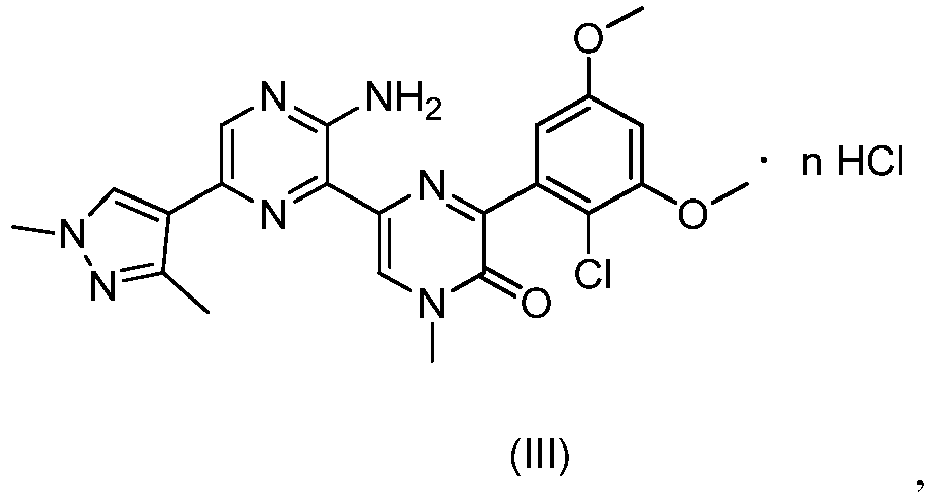
- The hydrochloride salt as defined in claim 2, wherein, n is selected from 0.6, 0.7, 0.8, 0.9, 1, 1.1, 1.2, 1.3, 1.4, 1.5, 1.6, 1.7, 1.8, 1.9 and 2.
- The hydrochloride salt as defined in claim 3, wherein n is selected from 0.9, 1 and 1.1.
- The hydrochloride salt as defined in claim 4, wherein the structure thereof is as shown in formula (II)

- A crystal form C of the hydrochloride salt as defined in any one of claims 3 to 5, wherein the X-ray powder diffraction pattern thereof comprises characteristic diffraction peaks at the following 2θ angles: 5.24 ± 0.20°, 9.58 ± 0.20°, and 10.45 ± 0.20°.
- The crystal form C as defined in claim 6, wherein the X-ray powder diffraction pattern thereof comprises characteristic diffraction peaks at the following 2θ angles: 5.24±0.20°, 9.58±0.20°, 10.45±0.20°, 14.26±0.20°, 20.86±0.20°, 24.99±0.20°, 26.21±0.20° and 27.71±0.20°.
- The crystal form C as defined in claim 7, wherein the X-ray powder diffraction pattern thereof comprises characteristic diffraction peaks at the following 2θ angles: 5.24°, 8.45°, 9.08°, 9.58°, 10.45°, 11.49°, 13.23°, 14.02°, 14.26°, 15.18°, 15.60°, 16.35°, 18.15°, 18.74°, 19.52°, 19.94°, 20.86°, 21.65°, 21.97°, 22.50°, 23.28°, 23.64°, 24.16°, 24.99°, 26.21°, 26.98°, 27.71°, 28.52°, 29.07°, 29.43°, 30.37°, 31.72°, 32.30°, 33.11°, 34.79° and 36.78°.
- The crystal form C as defined in claim 7 or 8, wherein the differential scanning calorimetry curve thereof has an endothermic peak with an onset at 216.4 °C ± 2.0 °C and has an endothermic peak with an onset at 258.8 °C ± 2.0 °C;
and/or, the thermogravimetric analysis curve thereof shows a weight loss of 0.1380 % occurred at 118.6 °C±3.0 °C, a weight loss of 6.7760 % occurred at 205.5 °C±3.0 °C and a weight loss of 9.2750 % occurred at 253.02 °C±3.0 °C. - A crystal form E of the hydrochloride salt as defined in any one of claims 3 to 5, wherein the X-ray powder diffraction pattern thereof comprises characteristic diffraction peaks at the following 2θ angles: 9.05 ± 0.20°, 10.36 ± 0.20°, and 14.66 ± 0.20°.
- The crystal form E as defined in claim 10, wherein the X-ray powder diffraction pattern thereof comprises characteristic diffraction peaks at the following 2θ angles: 9.05 ± 0.20°, 10.36 ± 0.20°, 14.66 ± 0.20°, 15.75 ± 0.20°, 16.74 ± 0.20°, 18.54 ± 0.20°, 19.01 ± 0.20°, 20.78 ± 0.20°, 25.20 ± 0.20°, and 26.65 ± 0.20°.
- The crystal form E as defined in claim 10, wherein the X-ray powder diffraction pattern thereof comprises characteristic diffraction peaks at the following 2θ angles: 9.05 ± 0.20°, 10.36 ± 0.20°, 14.66 ± 0.20°, 15.75 ± 0.20°, 16.74 ± 0.20°, 18.54±0.20°, 25.20 ± 0.20°, 26.65 ± 0.20°, 27.28 ± 0.20°, and 27.94 ± 0.20°.
- The crystal form E as defined in claim 11 or 12, wherein the X-ray powder diffraction pattern thereof comprises characteristic diffraction peaks at the following 2θ angles: 5.52°, 9.05°, 10.36°, 11.09°, 13.94°, 14.66°, 15.75°, 16.74°, 18.13°, 18.54°, 19.01°, 20.78°, 21.57°, 21.98°, 23.58°, 24.46°, 25.20°, 25.44°, 26.26°, 26.65°, 27.28°, 27.51°, 27.94°, 28.94°, 29.54°, 31.19°, 32.08°, 33.24°, 35.47°, 36.23°, 38.35°, 39.34°.
- The crystal form E as defined in any one of claims 11 to 13, wherein the differential scanning calorimetry curve thereof has an endothermic peak with an onset at 261.8 °C ± 2.0 °C.
- The crystal form E as defined in any one of claims 11 to 13, wherein the thermogravimetric analysis curve thereof shows a weight loss of 1.72 % occurred at 150.0 °C±3.0 °C, a weight loss of 8.34 % occurred at 230.0 °C±3.0 °C and a weight loss of 9.41 % occurred at 280.0 °C±3.0 °C.
Applications Claiming Priority (3)
| Application Number | Priority Date | Filing Date | Title |
|---|---|---|---|
| CN201910731661 | 2019-08-08 | ||
| CN201911059969 | 2019-11-01 | ||
| PCT/CN2020/106896 WO2021023194A1 (en) | 2019-08-08 | 2020-08-04 | Crystal forms c and e of pyrazin-2(1h)-one compound and preparation method therefor |
Publications (3)
| Publication Number | Publication Date |
|---|---|
| EP4011867A1 EP4011867A1 (en) | 2022-06-15 |
| EP4011867A4 EP4011867A4 (en) | 2022-11-09 |
| EP4011867B1 true EP4011867B1 (en) | 2023-08-23 |
Family
ID=74503321
Family Applications (1)
| Application Number | Title | Priority Date | Filing Date |
|---|---|---|---|
| EP20850874.7A Active EP4011867B1 (en) | 2019-08-08 | 2020-08-04 | Crystal forms c and e of pyrazin-2(1h)-one compound and preparation method therefor |
Country Status (6)
| Country | Link |
|---|---|
| US (1) | US11680061B2 (en) |
| EP (1) | EP4011867B1 (en) |
| JP (1) | JP7198387B2 (en) |
| CN (1) | CN114174271B (en) |
| ES (1) | ES2960702T3 (en) |
| WO (1) | WO2021023194A1 (en) |
Families Citing this family (3)
| Publication number | Priority date | Publication date | Assignee | Title |
|---|---|---|---|---|
| WO2021023192A1 (en) * | 2019-08-08 | 2021-02-11 | 漳州片仔癀药业股份有限公司 | A crystalline form and b crystalline form of pyrazine-2(1h)-ketone compound and preparation method thereof |
| US11680061B2 (en) * | 2019-08-08 | 2023-06-20 | Zhangzhou Pien Tze Huang Pharmaceutical Co., Ltd. | Crystal forms C and E of pyrazin-2(1H)-one compound and preparation method therefor |
| WO2021023195A1 (en) * | 2019-08-08 | 2021-02-11 | 漳州片仔癀药业股份有限公司 | Crystal form d of pyrazine-2(1h)-ketone compound and preparation method therefor |
Citations (1)
| Publication number | Priority date | Publication date | Assignee | Title |
|---|---|---|---|---|
| EP3750880A1 (en) * | 2018-02-08 | 2020-12-16 | Zhangzhou Pien Tze Huang Pharmaceutical Co., Ltd | Pyrazine-2(1h)-ketone compound acting as fgfr inhibitor |
Family Cites Families (9)
| Publication number | Priority date | Publication date | Assignee | Title |
|---|---|---|---|---|
| WO2009058076A1 (en) * | 2007-11-02 | 2009-05-07 | Astrazeneca Ab | 2-pyrazinone derivatives and their use as inhibitors of neutrophile elastase |
| GB201020179D0 (en) * | 2010-11-29 | 2011-01-12 | Astex Therapeutics Ltd | New compounds |
| CA2976790C (en) | 2015-02-20 | 2024-02-27 | Incyte Corporation | Bicyclic heterocycles as fgfr inhibitors |
| EP3365335B1 (en) | 2015-10-23 | 2024-02-14 | Array Biopharma, Inc. | 2-aryl- and 2-heteroaryl-substituted 2-pyridazin-3(2h)-one compounds as inhibitors of fgfr tyrosine kinases |
| KR20210071094A (en) * | 2018-11-19 | 2021-06-15 | 매슨 테크놀로지 인크 | Systems and methods for processing workpieces |
| WO2021023192A1 (en) | 2019-08-08 | 2021-02-11 | 漳州片仔癀药业股份有限公司 | A crystalline form and b crystalline form of pyrazine-2(1h)-ketone compound and preparation method thereof |
| WO2021023193A1 (en) | 2019-08-08 | 2021-02-11 | 漳州片仔癀药业股份有限公司 | Pyrazine-2(1h)-ketone compound preparation method |
| US11680061B2 (en) | 2019-08-08 | 2023-06-20 | Zhangzhou Pien Tze Huang Pharmaceutical Co., Ltd. | Crystal forms C and E of pyrazin-2(1H)-one compound and preparation method therefor |
| WO2021023195A1 (en) | 2019-08-08 | 2021-02-11 | 漳州片仔癀药业股份有限公司 | Crystal form d of pyrazine-2(1h)-ketone compound and preparation method therefor |
-
2020
- 2020-08-04 US US17/633,319 patent/US11680061B2/en active Active
- 2020-08-04 JP JP2022507752A patent/JP7198387B2/en active Active
- 2020-08-04 EP EP20850874.7A patent/EP4011867B1/en active Active
- 2020-08-04 CN CN202080054562.8A patent/CN114174271B/en active Active
- 2020-08-04 ES ES20850874T patent/ES2960702T3/en active Active
- 2020-08-04 WO PCT/CN2020/106896 patent/WO2021023194A1/en not_active Ceased
Patent Citations (1)
| Publication number | Priority date | Publication date | Assignee | Title |
|---|---|---|---|---|
| EP3750880A1 (en) * | 2018-02-08 | 2020-12-16 | Zhangzhou Pien Tze Huang Pharmaceutical Co., Ltd | Pyrazine-2(1h)-ketone compound acting as fgfr inhibitor |
Also Published As
| Publication number | Publication date |
|---|---|
| CN114174271A (en) | 2022-03-11 |
| JP2022536560A (en) | 2022-08-17 |
| ES2960702T3 (en) | 2024-03-06 |
| US20220289722A1 (en) | 2022-09-15 |
| JP7198387B2 (en) | 2022-12-28 |
| US11680061B2 (en) | 2023-06-20 |
| EP4011867A4 (en) | 2022-11-09 |
| WO2021023194A1 (en) | 2021-02-11 |
| EP4011867A1 (en) | 2022-06-15 |
| CN114174271B (en) | 2023-09-12 |
Similar Documents
| Publication | Publication Date | Title |
|---|---|---|
| EP3925960B1 (en) | Fgfr inhibitor compound in solid form and preparation method therefor | |
| EP4011867A1 (en) | Crystal forms c and e of pyrazin-2(1h)-one compound and preparation method therefor | |
| EP4248967A2 (en) | Synthesis method of furoimidazopyridine compound, crystal form of furoimidazopyridine compound, and crystal form of salt thereof | |
| EP4011868B1 (en) | Pyrazine-2(1h)-ketone compound preparation method | |
| EP4011866B1 (en) | Crystalline form a and crystalline form b of pyrazine-2(1h)-ketone compound and preparation method thereof | |
| EP4011869B1 (en) | Crystal form d of pyrazine-2(1h)-ketone compound and preparation method therefor | |
| EP3722282B1 (en) | Salt form and crystal form serving as fgfr and vegfr inhibitor compounds, and preparation method therefor | |
| JP7307817B2 (en) | Salt form, crystal form of mTORC1/2 dual kinase activity inhibitor and method for producing the same | |
| EP4089086B1 (en) | Crystal form of pyrrolidinyl urea derivative and application thereof | |
| EP4596538A1 (en) | Pharmaceutically acceptable salt and crystal form of tetrahydronaphthalene derivative, and preparation method | |
| EP4194455A1 (en) | Crystal forms of pyridopyrazole compounds and preparation method therefor | |
| HK40049698A (en) | Fgfr inhibitor compound in solid form and preparation method therefor |
Legal Events
| Date | Code | Title | Description |
|---|---|---|---|
| STAA | Information on the status of an ep patent application or granted ep patent |
Free format text: STATUS: THE INTERNATIONAL PUBLICATION HAS BEEN MADE |
|
| PUAI | Public reference made under article 153(3) epc to a published international application that has entered the european phase |
Free format text: ORIGINAL CODE: 0009012 |
|
| STAA | Information on the status of an ep patent application or granted ep patent |
Free format text: STATUS: REQUEST FOR EXAMINATION WAS MADE |
|
| 17P | Request for examination filed |
Effective date: 20220308 |
|
| AK | Designated contracting states |
Kind code of ref document: A1 Designated state(s): AL AT BE BG CH CY CZ DE DK EE ES FI FR GB GR HR HU IE IS IT LI LT LU LV MC MK MT NL NO PL PT RO RS SE SI SK SM TR |
|
| A4 | Supplementary search report drawn up and despatched |
Effective date: 20221012 |
|
| RIC1 | Information provided on ipc code assigned before grant |
Ipc: A61P 35/00 20060101ALI20221006BHEP Ipc: A61K 31/4965 20060101ALI20221006BHEP Ipc: C07D 403/04 20060101ALI20221006BHEP Ipc: C07D 401/04 20060101ALI20221006BHEP Ipc: C07D 241/20 20060101ALI20221006BHEP Ipc: C07D 241/08 20060101AFI20221006BHEP |
|
| DAV | Request for validation of the european patent (deleted) | ||
| DAX | Request for extension of the european patent (deleted) | ||
| REG | Reference to a national code |
Ref country code: DE Ref legal event code: R079 Free format text: PREVIOUS MAIN CLASS: C07D0241080000 Ipc: C07D0403140000 Ref document number: 602020016419 Country of ref document: DE |
|
| GRAP | Despatch of communication of intention to grant a patent |
Free format text: ORIGINAL CODE: EPIDOSNIGR1 |
|
| STAA | Information on the status of an ep patent application or granted ep patent |
Free format text: STATUS: GRANT OF PATENT IS INTENDED |
|
| RIC1 | Information provided on ipc code assigned before grant |
Ipc: A61K 31/497 20060101ALI20230210BHEP Ipc: C07D 403/14 20060101AFI20230210BHEP |
|
| INTG | Intention to grant announced |
Effective date: 20230316 |
|
| GRAS | Grant fee paid |
Free format text: ORIGINAL CODE: EPIDOSNIGR3 |
|
| GRAA | (expected) grant |
Free format text: ORIGINAL CODE: 0009210 |
|
| STAA | Information on the status of an ep patent application or granted ep patent |
Free format text: STATUS: THE PATENT HAS BEEN GRANTED |
|
| AK | Designated contracting states |
Kind code of ref document: B1 Designated state(s): AL AT BE BG CH CY CZ DE DK EE ES FI FR GB GR HR HU IE IS IT LI LT LU LV MC MK MT NL NO PL PT RO RS SE SI SK SM TR |
|
| REG | Reference to a national code |
Ref country code: GB Ref legal event code: FG4D |
|
| REG | Reference to a national code |
Ref country code: CH Ref legal event code: EP |
|
| REG | Reference to a national code |
Ref country code: DE Ref legal event code: R096 Ref document number: 602020016419 Country of ref document: DE |
|
| REG | Reference to a national code |
Ref country code: IE Ref legal event code: FG4D |
|
| REG | Reference to a national code |
Ref country code: LT Ref legal event code: MG9D |
|
| P01 | Opt-out of the competence of the unified patent court (upc) registered |
Effective date: 20231109 |
|
| REG | Reference to a national code |
Ref country code: NL Ref legal event code: MP Effective date: 20230823 |
|
| REG | Reference to a national code |
Ref country code: AT Ref legal event code: MK05 Ref document number: 1602484 Country of ref document: AT Kind code of ref document: T Effective date: 20230823 |
|
| PG25 | Lapsed in a contracting state [announced via postgrant information from national office to epo] |
Ref country code: GR Free format text: LAPSE BECAUSE OF FAILURE TO SUBMIT A TRANSLATION OF THE DESCRIPTION OR TO PAY THE FEE WITHIN THE PRESCRIBED TIME-LIMIT Effective date: 20231124 |
|
| PG25 | Lapsed in a contracting state [announced via postgrant information from national office to epo] |
Ref country code: IS Free format text: LAPSE BECAUSE OF FAILURE TO SUBMIT A TRANSLATION OF THE DESCRIPTION OR TO PAY THE FEE WITHIN THE PRESCRIBED TIME-LIMIT Effective date: 20231223 |
|
| PG25 | Lapsed in a contracting state [announced via postgrant information from national office to epo] |
Ref country code: SE Free format text: LAPSE BECAUSE OF FAILURE TO SUBMIT A TRANSLATION OF THE DESCRIPTION OR TO PAY THE FEE WITHIN THE PRESCRIBED TIME-LIMIT Effective date: 20230823 Ref country code: RS Free format text: LAPSE BECAUSE OF FAILURE TO SUBMIT A TRANSLATION OF THE DESCRIPTION OR TO PAY THE FEE WITHIN THE PRESCRIBED TIME-LIMIT Effective date: 20230823 Ref country code: PT Free format text: LAPSE BECAUSE OF FAILURE TO SUBMIT A TRANSLATION OF THE DESCRIPTION OR TO PAY THE FEE WITHIN THE PRESCRIBED TIME-LIMIT Effective date: 20231226 Ref country code: NO Free format text: LAPSE BECAUSE OF FAILURE TO SUBMIT A TRANSLATION OF THE DESCRIPTION OR TO PAY THE FEE WITHIN THE PRESCRIBED TIME-LIMIT Effective date: 20231123 Ref country code: NL Free format text: LAPSE BECAUSE OF FAILURE TO SUBMIT A TRANSLATION OF THE DESCRIPTION OR TO PAY THE FEE WITHIN THE PRESCRIBED TIME-LIMIT Effective date: 20230823 Ref country code: LV Free format text: LAPSE BECAUSE OF FAILURE TO SUBMIT A TRANSLATION OF THE DESCRIPTION OR TO PAY THE FEE WITHIN THE PRESCRIBED TIME-LIMIT Effective date: 20230823 Ref country code: LT Free format text: LAPSE BECAUSE OF FAILURE TO SUBMIT A TRANSLATION OF THE DESCRIPTION OR TO PAY THE FEE WITHIN THE PRESCRIBED TIME-LIMIT Effective date: 20230823 Ref country code: IS Free format text: LAPSE BECAUSE OF FAILURE TO SUBMIT A TRANSLATION OF THE DESCRIPTION OR TO PAY THE FEE WITHIN THE PRESCRIBED TIME-LIMIT Effective date: 20231223 Ref country code: HR Free format text: LAPSE BECAUSE OF FAILURE TO SUBMIT A TRANSLATION OF THE DESCRIPTION OR TO PAY THE FEE WITHIN THE PRESCRIBED TIME-LIMIT Effective date: 20230823 Ref country code: GR Free format text: LAPSE BECAUSE OF FAILURE TO SUBMIT A TRANSLATION OF THE DESCRIPTION OR TO PAY THE FEE WITHIN THE PRESCRIBED TIME-LIMIT Effective date: 20231124 Ref country code: FI Free format text: LAPSE BECAUSE OF FAILURE TO SUBMIT A TRANSLATION OF THE DESCRIPTION OR TO PAY THE FEE WITHIN THE PRESCRIBED TIME-LIMIT Effective date: 20230823 Ref country code: AT Free format text: LAPSE BECAUSE OF FAILURE TO SUBMIT A TRANSLATION OF THE DESCRIPTION OR TO PAY THE FEE WITHIN THE PRESCRIBED TIME-LIMIT Effective date: 20230823 |
|
| PG25 | Lapsed in a contracting state [announced via postgrant information from national office to epo] |
Ref country code: PL Free format text: LAPSE BECAUSE OF FAILURE TO SUBMIT A TRANSLATION OF THE DESCRIPTION OR TO PAY THE FEE WITHIN THE PRESCRIBED TIME-LIMIT Effective date: 20230823 |
|
| REG | Reference to a national code |
Ref country code: ES Ref legal event code: FG2A Ref document number: 2960702 Country of ref document: ES Kind code of ref document: T3 Effective date: 20240306 |
|
| PG25 | Lapsed in a contracting state [announced via postgrant information from national office to epo] |
Ref country code: SM Free format text: LAPSE BECAUSE OF FAILURE TO SUBMIT A TRANSLATION OF THE DESCRIPTION OR TO PAY THE FEE WITHIN THE PRESCRIBED TIME-LIMIT Effective date: 20230823 Ref country code: RO Free format text: LAPSE BECAUSE OF FAILURE TO SUBMIT A TRANSLATION OF THE DESCRIPTION OR TO PAY THE FEE WITHIN THE PRESCRIBED TIME-LIMIT Effective date: 20230823 Ref country code: EE Free format text: LAPSE BECAUSE OF FAILURE TO SUBMIT A TRANSLATION OF THE DESCRIPTION OR TO PAY THE FEE WITHIN THE PRESCRIBED TIME-LIMIT Effective date: 20230823 Ref country code: DK Free format text: LAPSE BECAUSE OF FAILURE TO SUBMIT A TRANSLATION OF THE DESCRIPTION OR TO PAY THE FEE WITHIN THE PRESCRIBED TIME-LIMIT Effective date: 20230823 Ref country code: CZ Free format text: LAPSE BECAUSE OF FAILURE TO SUBMIT A TRANSLATION OF THE DESCRIPTION OR TO PAY THE FEE WITHIN THE PRESCRIBED TIME-LIMIT Effective date: 20230823 Ref country code: SK Free format text: LAPSE BECAUSE OF FAILURE TO SUBMIT A TRANSLATION OF THE DESCRIPTION OR TO PAY THE FEE WITHIN THE PRESCRIBED TIME-LIMIT Effective date: 20230823 |
|
| REG | Reference to a national code |
Ref country code: DE Ref legal event code: R097 Ref document number: 602020016419 Country of ref document: DE |
|
| PLBE | No opposition filed within time limit |
Free format text: ORIGINAL CODE: 0009261 |
|
| STAA | Information on the status of an ep patent application or granted ep patent |
Free format text: STATUS: NO OPPOSITION FILED WITHIN TIME LIMIT |
|
| 26N | No opposition filed |
Effective date: 20240524 |
|
| PG25 | Lapsed in a contracting state [announced via postgrant information from national office to epo] |
Ref country code: SI Free format text: LAPSE BECAUSE OF FAILURE TO SUBMIT A TRANSLATION OF THE DESCRIPTION OR TO PAY THE FEE WITHIN THE PRESCRIBED TIME-LIMIT Effective date: 20230823 |
|
| PG25 | Lapsed in a contracting state [announced via postgrant information from national office to epo] |
Ref country code: BG Free format text: LAPSE BECAUSE OF FAILURE TO SUBMIT A TRANSLATION OF THE DESCRIPTION OR TO PAY THE FEE WITHIN THE PRESCRIBED TIME-LIMIT Effective date: 20230823 |
|
| PG25 | Lapsed in a contracting state [announced via postgrant information from national office to epo] |
Ref country code: BG Free format text: LAPSE BECAUSE OF FAILURE TO SUBMIT A TRANSLATION OF THE DESCRIPTION OR TO PAY THE FEE WITHIN THE PRESCRIBED TIME-LIMIT Effective date: 20230823 |
|
| REG | Reference to a national code |
Ref country code: CH Ref legal event code: PL |
|
| PG25 | Lapsed in a contracting state [announced via postgrant information from national office to epo] |
Ref country code: LU Free format text: LAPSE BECAUSE OF NON-PAYMENT OF DUE FEES Effective date: 20240804 |
|
| PG25 | Lapsed in a contracting state [announced via postgrant information from national office to epo] |
Ref country code: MC Free format text: LAPSE BECAUSE OF FAILURE TO SUBMIT A TRANSLATION OF THE DESCRIPTION OR TO PAY THE FEE WITHIN THE PRESCRIBED TIME-LIMIT Effective date: 20230823 Ref country code: CH Free format text: LAPSE BECAUSE OF NON-PAYMENT OF DUE FEES Effective date: 20240831 |
|
| REG | Reference to a national code |
Ref country code: BE Ref legal event code: MM Effective date: 20240831 |
|
| PG25 | Lapsed in a contracting state [announced via postgrant information from national office to epo] |
Ref country code: BE Free format text: LAPSE BECAUSE OF NON-PAYMENT OF DUE FEES Effective date: 20240831 |
|
| PG25 | Lapsed in a contracting state [announced via postgrant information from national office to epo] |
Ref country code: IE Free format text: LAPSE BECAUSE OF NON-PAYMENT OF DUE FEES Effective date: 20240804 |
|
| PGFP | Annual fee paid to national office [announced via postgrant information from national office to epo] |
Ref country code: ES Payment date: 20250908 Year of fee payment: 6 |
|
| PGFP | Annual fee paid to national office [announced via postgrant information from national office to epo] |
Ref country code: DE Payment date: 20250812 Year of fee payment: 6 |
|
| PGFP | Annual fee paid to national office [announced via postgrant information from national office to epo] |
Ref country code: IT Payment date: 20250808 Year of fee payment: 6 |
|
| PGFP | Annual fee paid to national office [announced via postgrant information from national office to epo] |
Ref country code: GB Payment date: 20250826 Year of fee payment: 6 |
|
| PGFP | Annual fee paid to national office [announced via postgrant information from national office to epo] |
Ref country code: FR Payment date: 20250828 Year of fee payment: 6 |
|
| PG25 | Lapsed in a contracting state [announced via postgrant information from national office to epo] |
Ref country code: CY Free format text: LAPSE BECAUSE OF FAILURE TO SUBMIT A TRANSLATION OF THE DESCRIPTION OR TO PAY THE FEE WITHIN THE PRESCRIBED TIME-LIMIT; INVALID AB INITIO Effective date: 20200804 |
|
| PG25 | Lapsed in a contracting state [announced via postgrant information from national office to epo] |
Ref country code: HU Free format text: LAPSE BECAUSE OF FAILURE TO SUBMIT A TRANSLATION OF THE DESCRIPTION OR TO PAY THE FEE WITHIN THE PRESCRIBED TIME-LIMIT; INVALID AB INITIO Effective date: 20200804 |
|
| PG25 | Lapsed in a contracting state [announced via postgrant information from national office to epo] |
Ref country code: TR Free format text: LAPSE BECAUSE OF FAILURE TO SUBMIT A TRANSLATION OF THE DESCRIPTION OR TO PAY THE FEE WITHIN THE PRESCRIBED TIME-LIMIT Effective date: 20230823 |