EP4011775B1 - Adjustable passenger seating arrangement - Google Patents
Adjustable passenger seating arrangement Download PDFInfo
- Publication number
- EP4011775B1 EP4011775B1 EP21211373.2A EP21211373A EP4011775B1 EP 4011775 B1 EP4011775 B1 EP 4011775B1 EP 21211373 A EP21211373 A EP 21211373A EP 4011775 B1 EP4011775 B1 EP 4011775B1
- Authority
- EP
- European Patent Office
- Prior art keywords
- seat rail
- seat
- seating arrangement
- locking assembly
- lever arm
- Prior art date
- Legal status (The legal status is an assumption and is not a legal conclusion. Google has not performed a legal analysis and makes no representation as to the accuracy of the status listed.)
- Active
Links
Images



Classifications
-
- B—PERFORMING OPERATIONS; TRANSPORTING
- B64—AIRCRAFT; AVIATION; COSMONAUTICS
- B64D—EQUIPMENT FOR FITTING IN OR TO AIRCRAFT; FLIGHT SUITS; PARACHUTES; ARRANGEMENT OR MOUNTING OF POWER PLANTS OR PROPULSION TRANSMISSIONS IN AIRCRAFT
- B64D11/00—Passenger or crew accommodation; Flight-deck installations not otherwise provided for
- B64D11/06—Arrangements of seats, or adaptations or details specially adapted for aircraft seats
- B64D11/0648—Lower frame constructions
-
- B—PERFORMING OPERATIONS; TRANSPORTING
- B60—VEHICLES IN GENERAL
- B60N—SEATS SPECIALLY ADAPTED FOR VEHICLES; VEHICLE PASSENGER ACCOMMODATION NOT OTHERWISE PROVIDED FOR
- B60N2/00—Seats specially adapted for vehicles; Arrangement or mounting of seats in vehicles
- B60N2/005—Arrangement or mounting of seats in vehicles, e.g. dismountable auxiliary seats
- B60N2/015—Attaching seats directly to vehicle chassis
- B60N2/01508—Attaching seats directly to vehicle chassis using quick release attachments
- B60N2/01516—Attaching seats directly to vehicle chassis using quick release attachments with locking mechanisms
- B60N2/01558—Attaching seats directly to vehicle chassis using quick release attachments with locking mechanisms with key and slot
- B60N2/01575—Attaching seats directly to vehicle chassis using quick release attachments with locking mechanisms with key and slot key sliding inside the vehicle floor or rail
-
- B—PERFORMING OPERATIONS; TRANSPORTING
- B60—VEHICLES IN GENERAL
- B60N—SEATS SPECIALLY ADAPTED FOR VEHICLES; VEHICLE PASSENGER ACCOMMODATION NOT OTHERWISE PROVIDED FOR
- B60N2/00—Seats specially adapted for vehicles; Arrangement or mounting of seats in vehicles
- B60N2/02—Seats specially adapted for vehicles; Arrangement or mounting of seats in vehicles the seat or part thereof being movable, e.g. adjustable
- B60N2/04—Seats specially adapted for vehicles; Arrangement or mounting of seats in vehicles the seat or part thereof being movable, e.g. adjustable the whole seat being movable
- B60N2/06—Seats specially adapted for vehicles; Arrangement or mounting of seats in vehicles the seat or part thereof being movable, e.g. adjustable the whole seat being movable slidable
- B60N2/08—Seats specially adapted for vehicles; Arrangement or mounting of seats in vehicles the seat or part thereof being movable, e.g. adjustable the whole seat being movable slidable characterised by the locking device
-
- B—PERFORMING OPERATIONS; TRANSPORTING
- B64—AIRCRAFT; AVIATION; COSMONAUTICS
- B64D—EQUIPMENT FOR FITTING IN OR TO AIRCRAFT; FLIGHT SUITS; PARACHUTES; ARRANGEMENT OR MOUNTING OF POWER PLANTS OR PROPULSION TRANSMISSIONS IN AIRCRAFT
- B64D11/00—Passenger or crew accommodation; Flight-deck installations not otherwise provided for
- B64D11/06—Arrangements of seats, or adaptations or details specially adapted for aircraft seats
- B64D11/0639—Arrangements of seats, or adaptations or details specially adapted for aircraft seats with features for adjustment or converting of seats
- B64D11/064—Adjustable inclination or position of seats
-
- B—PERFORMING OPERATIONS; TRANSPORTING
- B64—AIRCRAFT; AVIATION; COSMONAUTICS
- B64D—EQUIPMENT FOR FITTING IN OR TO AIRCRAFT; FLIGHT SUITS; PARACHUTES; ARRANGEMENT OR MOUNTING OF POWER PLANTS OR PROPULSION TRANSMISSIONS IN AIRCRAFT
- B64D11/00—Passenger or crew accommodation; Flight-deck installations not otherwise provided for
- B64D11/06—Arrangements of seats, or adaptations or details specially adapted for aircraft seats
- B64D11/0696—Means for fastening seats to floors, e.g. to floor rails
Definitions
- the present invention relates to an adjustable passenger seating arrangement, and more specifically to an adjustable seat support.
- the present invention relates to an adjustable passenger seating arrangement according to claim 1.
- FIG. 1 shows an adjustable passenger seating arrangement according to various embodiments of the present invention, without the presence of said two seat rails.
- the adjustable passenger seating arrangement comprises a seat support 100 adapted for supporting a passenger seat (not shown) and for sliding within or on said seat rails.
- the shown apparatus is configured for seat rails 50A, 50B ( Figures 6 and 7 ) that comprise walls with inwardly directed lips 52, and defining a central longitudinal guide channel 54 running along the length of the seat rail 50A, 50B, and a longitudinal guide slot 56 defined by said lips and running along the length of said seat rail.
- the guide slot 56 communicates with the guide channel 54 and has a width, which is narrower than said guide channel 54.
- the lips 52 are shaped with alternating protrusions 58 and recesses 59 along the length of the guide slot 56 ( Figure 6 ).
- the seat support 100 is therefore shown comprising a base part 104 with two pairs of guide pins 105 each comprising a head portion 106 and a neck portion 107 ( Figure 3 ).
- the head portion 106 is adapted for sliding within the guide channel 54 and the neck portion 107 is adapted for sliding within the guide slot 56.
- the head portion 106 is shaped with alternating protrusions 106 and recesses 109 along its length and configured such that the protrusions 106 may be aligned with the recesses 59 of the lips 52, and the protrusions 58 of the lips 52 may be aligned with the recesses 109 of the head portion 106, so that head portion 106 may be placed within the guide channel 54.
- the lips 52 are configured with a first contact surface 55 facing the guide channel 54, and a second contact surface 57 opposite said first contact surface 55 and facing away from said guide channel 54 ( Figure 7 ).
- a first 200 and a second 300 locking assembly are arranged in connection to said seat support 100 and are each adapted for releasably fastening of said seat support 100 to each seat rail 50.
- the locking assemblies 200, 300 each comprises a first mechanism adapted for engaging with each seat rail 50.
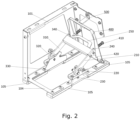
- the first mechanism comprises a lever arm 210, 310 pivotably connected to a side panel 101, 102 of the seat support 100 by hinges 220, 320 (best seen in Figure 2 ).
- both lever arms 210, 310 are jointly configured as a foot pedal 250 with a contact surface adapted for receiving a foot.
- the foot pedal 250 is here also configured as a handle for use in the situation where the foot pedal needs to be manually raised.
- the lever arms 210, 310 are adapted for moving between a lowered position to a raised position relative to the base part 104 of the seat support 100.
- the first mechanism further comprises a push plate 230, 330 operably connected to said lever arm 210, 310, said push plate 230, 330 being adapted for abutting or engaging with said second contact surface 57 when said lever arm 210, 310 is operated into a first position, thereby lifting said one or more guide pins 105 relative to said guide channel 54, and wherein said head portion 106 is adapted for abutting or engaging with said first contact surface 55 when said lever arm 210, 310 is operated into said first position.
- the push plate 230, 330 and the guide pins 105 clamp onto the seat rail 50 to engage the seat support 100 to the seat rail 50.
- the push plate 230, 330 is here shown with a locking pin 232, 332 (best seen in Figure 3 ) adapted for fitting within the above-mentioned recesses of the lips. This configuration prevents the push plate 230, 330 from displacing along the length of the seat rail.
- Two guide pins 105 are flanking the push plate 230, 330 on each side of the seat support 100. In general, such a configuration allows for an evenly distributed holding force on the seat support.
- the adjustable passenger seating arrangement also comprises a second mechanism adapted for engaging with said first mechanism, thereby keeping the first mechanism engaged with the seat rails, and adapted for disengaging from the first mechanism, thereby allowing said first mechanism to disengage from said seat rail.
- the second mechanism is adapted for engaging with said first mechanism when said lever arm 210, 310 is positioned in its lowered position.
- This mechanism may have multiple configurations but is here exemplified as a spring activated blocking unit 400.
- the spring activated blocking unit 400 is adapted for moving between a retracted position disengaged from said lever arm 210, 310 to a forwarded position engaged with said lever arm 210, 310.
- the blocking unit 400 and the lever arm 210, 310 is provided with protrusions 240, 430; 340, 440 that are configured to pairwise engage with one another when the blocking unit 400 is in its forwarded position and to disengage from one another when the spring activated blocking unit 400 is moved to its retracted position.
- the spring activated blocking unit 400 is shown pivotably connected to the panel sides 101, 102 of said seat support 100 and slidably connected to the lever arm 210, 310 ( Figures 2 and 5 ).
- the spring activated blocking unit 400 can manually be moved to its retracted position simply by pulling it in that direction.
- the first locking assembly further comprises a third mechanism adapted for engaging with said second mechanism, thereby keeping said second mechanism engaged with said first mechanism.
- This mechanism may have multiple configurations but is here exemplified as a plate hingedly coupled to the front panel 103 of the seat support 100 and configured to block the spring activated blocking unit 400 from being moved to its retracted position. The plate may be lifted by a finger just before the spring activated blocking unit 400 is manually retracted.
Landscapes
- Engineering & Computer Science (AREA)
- Aviation & Aerospace Engineering (AREA)
- Transportation (AREA)
- Mechanical Engineering (AREA)
- Seats For Vehicles (AREA)
Description
- The present invention relates to an adjustable passenger seating arrangement, and more specifically to an adjustable seat support.
- It is well-known to provide seats in a vehicle, such as a motor vehicle or airplane, that are mounted in position on rails, or which are adapted to engage a track on the floor of the vehicle and lockable in place by way of a pair of spaced apart plates, which may be moved apart to bias the plates in a locking position. However, the locking mechanisms often demand that the user applies substantial force to engage the locking mechanism. Furthermore, it is difficult to unlock the locking mechanism without having to lie on your knees.
- Documents
EP3100901 andUS2011278398 both disclose systems for fastening and adjusting seats on rails. - The present invention relates to an adjustable passenger seating arrangement according to claim 1.
- Further details are claimed in dependent claims 2-10.
-
-
Figure 1 shows an adjustable passenger seating arrangement according to various embodiments of the present invention, without the presence of two seat rails, and where the first and second locking assemblies are deactivated. -
Figure 2 shows the adjustable passenger seating arrangement ofFigure 1 , where a part of the seat support has been removed. -
Figure 3 shows a bottom view of a part of the adjustable passenger seating arrangement ofFigure 1 . -
Figure 4 shows an adjustable passenger seating arrangement according to various embodiments of the present invention, without the presence of two seat rails, and where the first and second locking assemblies are activated. -
Figure 5 shows the adjustable passenger seating arrangement ofFigure 3 , where a part of the seat support has been removed. -
Figure 6 shows a pair of seat rails generally known within the art. -
Figure 7 shows a cross-sectional view ofFigure 6 . - The following description is to be seen as a non-limiting example of an apparatus according to various embodiments of the present invention. The specific examples are intended for two parallel arranged
seat rails Figures 6 and7 ), but the invention contemplates embodiments suitable for a single seat rail or for multiple seat rails, such as three seat rails.Figure 1 shows an adjustable passenger seating arrangement according to various embodiments of the present invention, without the presence of said two seat rails. The adjustable passenger seating arrangement comprises aseat support 100 adapted for supporting a passenger seat (not shown) and for sliding within or on said seat rails. The shown apparatus is configured forseat rails Figures 6 and7 ) that comprise walls with inwardly directedlips 52, and defining a centrallongitudinal guide channel 54 running along the length of theseat rail longitudinal guide slot 56 defined by said lips and running along the length of said seat rail. Theguide slot 56 communicates with theguide channel 54 and has a width, which is narrower than saidguide channel 54. Thelips 52 are shaped withalternating protrusions 58 andrecesses 59 along the length of the guide slot 56 (Figure 6 ). Theseat support 100 is therefore shown comprising abase part 104 with two pairs ofguide pins 105 each comprising ahead portion 106 and a neck portion 107 (Figure 3 ). Thehead portion 106 is adapted for sliding within theguide channel 54 and theneck portion 107 is adapted for sliding within theguide slot 56. Thehead portion 106 is shaped withalternating protrusions 106 andrecesses 109 along its length and configured such that theprotrusions 106 may be aligned with therecesses 59 of thelips 52, and theprotrusions 58 of thelips 52 may be aligned with therecesses 109 of thehead portion 106, so thathead portion 106 may be placed within theguide channel 54. Thelips 52 are configured with afirst contact surface 55 facing theguide channel 54, and asecond contact surface 57 opposite saidfirst contact surface 55 and facing away from said guide channel 54 (Figure 7 ). - A first 200 and a second 300 locking assembly (
Figure 1 ) are arranged in connection to saidseat support 100 and are each adapted for releasably fastening of saidseat support 100 to each seat rail 50. The locking assemblies 200, 300 each comprises a first mechanism adapted for engaging with each seat rail 50. The first mechanism comprises alever arm side panel seat support 100 byhinges 220, 320 (best seen inFigure 2 ). Here, bothlever arms foot pedal 250 with a contact surface adapted for receiving a foot. Thefoot pedal 250 is here also configured as a handle for use in the situation where the foot pedal needs to be manually raised. Thelever arms base part 104 of theseat support 100. - The first mechanism further comprises a
push plate lever arm push plate second contact surface 57 when saidlever arm more guide pins 105 relative to saidguide channel 54, and wherein saidhead portion 106 is adapted for abutting or engaging with saidfirst contact surface 55 when saidlever arm push plate guide pins 105 clamp onto the seat rail 50 to engage theseat support 100 to the seat rail 50. Thepush plate locking pin 232, 332 (best seen inFigure 3 ) adapted for fitting within the above-mentioned recesses of the lips. This configuration prevents thepush plate guide pins 105 are flanking thepush plate seat support 100. In general, such a configuration allows for an evenly distributed holding force on the seat support. The adjustable passenger seating arrangement also comprises a second mechanism adapted for engaging with said first mechanism, thereby keeping the first mechanism engaged with the seat rails, and adapted for disengaging from the first mechanism, thereby allowing said first mechanism to disengage from said seat rail. The second mechanism is adapted for engaging with said first mechanism when saidlever arm blocking unit 400. The spring activatedblocking unit 400 is adapted for moving between a retracted position disengaged from saidlever arm lever arm blocking unit 400 and thelever arm protrusions blocking unit 400 is in its forwarded position and to disengage from one another when the spring activatedblocking unit 400 is moved to its retracted position. The spring activatedblocking unit 400 is shown pivotably connected to thepanel sides seat support 100 and slidably connected to thelever arm 210, 310 (Figures 2 and5 ). The spring activatedblocking unit 400 can manually be moved to its retracted position simply by pulling it in that direction. - As a further security measure, e.g. used as a child proof means, the first locking assembly further comprises a third mechanism adapted for engaging with said second mechanism, thereby keeping said second mechanism engaged with said first mechanism. This mechanism may have multiple configurations but is here exemplified as a plate hingedly coupled to the
front panel 103 of theseat support 100 and configured to block the spring activatedblocking unit 400 from being moved to its retracted position. The plate may be lifted by a finger just before the spring activatedblocking unit 400 is manually retracted. -
- 50
- Seat rail
- 52
- Lip
- 54
- Guide channel
- 56
- Guide slot
- 57
- First contact surface
- 58
- Protrusion
- 59
- Recess
- 100
- Seat support
- 101
- Left panel
- 102
- Right panel
- 103
- Front panel
- 104
- Base part
- 105
- Guide pin
- 106
- Protrusion
- 107
- Neck portion
- 108
- Head portion
- 109
- Recess
- 200
- First locking assembly
- 210
- Lever arm
- 220
- Hinge
- 230
- Push plate
- 232
- Locking pin
- 240
- Protrusion
- 250
- Foot pedal
- 300
- Second locking assembly
- 310
- Lever arm
- 320
- Hinge
- 330
- Push plate
- 332
- Locking pin
- 340
- Protrusion
- 400
- Blocking unit
- 410
- Spring
- 420
- Protrusion
Claims (10)
- An adjustable passenger seating arrangement comprising:- a first floor-mounted seat rail (50) adapted to extend through at least a portion of a passenger carrying compartment;- a seat support (100) adapted for supporting a passenger seat and for sliding within or on said seat rail (50); and- a first locking assembly arranged in connection to said seat support (100) and adapted for releasably fastening of said seat support (100) to said first seat rail (50);wherein said first locking assembly comprises a first mechanism adapted for engaging with said first seat rail (50), said first mechanism comprising a lever arm (210, 310) configured as a foot pedal (250) and pivotably connected to said seat support (100);wherein said first seat rail (50) comprises walls with inwardly directed lips (52), said walls defining a) a central longitudinal guide channel (54) running along the length of said seat rail (50), and b) a longitudinal guide slot (56) defined by said lips (52) and running along the length of said seat rail (50), wherein said guide slot (56) communicates with said guide channel (54) and has a width, which is narrower than said guide channel (54), wherein said lips (52) are configured with a first contact surface (55) facing said guide channel (54), and a second contact surface (57) opposite said first contact surface (55) and facing away from said guide channel (54), wherein said seat support (100) further comprises a base part (104) with a pair of guide pins (105) each with a head portion (108) and a neck portion (107), said head portion (108) adapted for sliding within said guide channel (54) and said neck portion (107) adapted for sliding within said guide slot (56);characterised in that said first mechanism further comprises a push plate (230) positioned in between said pair of guide pins (105) and being operably connected to said lever arm (210, 310), said push plate (230) being adapted for abutting or engaging with said second contact surface (57) when said lever arm (210, 310) is operated into a first position, thereby lifting said pair of guide pins (105) relative to said guide channel (54), and wherein the head portion (108) of each pair of guide pins (105) is adapted for abutting or engaging with said first contact surface (55) when said lever arm (210, 310) is operated into said first position.
- The adjustable passenger seating arrangement according to claim 1, wherein said first locking assembly further comprises a second mechanism adapted for engaging with said first mechanism, thereby keeping said first mechanism engaged with said first seat rail (50), and adapted for disengaging from said first mechanism, thereby allowing said first mechanism to disengage from said first seat rail (50).
- The adjustable passenger seating arrangement according to claim 2, wherein said lever arm (210, 310) is adapted for moving between a lowered position to a raised position relative to said base part (104), and wherein said second mechanism is adapted for engaging with said first mechanism when said lever arm (210, 310) is positioned in its lowered position.
- The adjustable passenger seating arrangement according to claim 3, wherein said second mechanism comprises a spring activated blocking unit (400).
- The adjustable passenger seating arrangement according to claim 4, wherein said spring activated blocking unit (400) is adapted for moving between a retracted position disengaged from said lever arm (210, 310) to a forwarded position engaged with said lever arm (210, 310).
- The adjustable passenger seating arrangement according to claim 5, wherein said spring activated blocking unit (400) is pivotably connected to said seat support (100) and slidably connected to said lever arm (210, 310).
- The adjustable passenger seating arrangement according to any one of the claims 2-6, wherein said first locking assembly further comprises a third mechanism adapted for engaging with said second mechanism, thereby keeping said second mechanism engaged with said first mechanism.
- The adjustable passenger seating arrangement according to any one of the claims 1-7, further comprising:- a second floor-mounted seat rail (50) adapted to extend through at least a portion of a passenger carrying compartment; and- a second locking assembly arranged in connection to said seat support and adapted for releasably fastening of said seat support (100) to said second seat rail (50);wherein said second locking assembly comprises a first mechanism similar with the first mechanism of the first locking assembly, but configured to operate in relation to said second seat rail (50) rather than said first seat rail (50); and wherein said first and second locking assemblies are jointly configured as a foot pedal (250).
- The adjustable passenger seating arrangement according to any one of the claims 2-7, further comprising:- a second floor-mounted seat rail (50) adapted to extend through at least a portion of a passenger carrying compartment; and- a second locking assembly arranged in connection to said seat support and adapted for releasably fastening of said seat support (100) to said second seat rail (50);wherein said second locking assembly comprises a first mechanism similar with the first mechanism of the first locking assembly, and a second mechanism similar with the second mechanism of the first locking assembly, but configured to operate in relation to said second seat rail (50) rather than said first seat rail (50); and wherein said first and second locking assemblies are jointly configured as a foot pedal (250).
- The adjustable passenger seating arrangement according to any one of the claims 1-9, wherein the lips (52) are shaped with alternating protrusions (58) and recesses (59) along the length of the guide slot (56), and wherein the push plate (230, 330) comprises a locking pin (232, 332) adapted for fitting within the recesses (59) of the lips (52).
Applications Claiming Priority (1)
| Application Number | Priority Date | Filing Date | Title |
|---|---|---|---|
| DKPA202001390A DK180913B1 (en) | 2020-12-10 | 2020-12-10 | Adjustable passenger seating arrangement |
Publications (3)
| Publication Number | Publication Date |
|---|---|
| EP4011775A1 EP4011775A1 (en) | 2022-06-15 |
| EP4011775C0 EP4011775C0 (en) | 2024-04-10 |
| EP4011775B1 true EP4011775B1 (en) | 2024-04-10 |
Family
ID=78819901
Family Applications (1)
| Application Number | Title | Priority Date | Filing Date |
|---|---|---|---|
| EP21211373.2A Active EP4011775B1 (en) | 2020-12-10 | 2021-11-30 | Adjustable passenger seating arrangement |
Country Status (4)
| Country | Link |
|---|---|
| EP (1) | EP4011775B1 (en) |
| DK (1) | DK180913B1 (en) |
| ES (1) | ES2982523T3 (en) |
| PL (1) | PL4011775T3 (en) |
Family Cites Families (2)
| Publication number | Priority date | Publication date | Assignee | Title |
|---|---|---|---|---|
| FR2957331B1 (en) * | 2010-03-12 | 2012-07-13 | Attax | SYSTEM FOR FASTENING A SEAT IN AN AIRCRAFT RAIL |
| GB201509451D0 (en) * | 2015-06-01 | 2015-07-15 | Nmi Safety Systems Ltd | Adaptable vehicle seat fitting |
-
2020
- 2020-12-10 DK DKPA202001390A patent/DK180913B1/en active IP Right Grant
-
2021
- 2021-11-30 EP EP21211373.2A patent/EP4011775B1/en active Active
- 2021-11-30 ES ES21211373T patent/ES2982523T3/en active Active
- 2021-11-30 PL PL21211373.2T patent/PL4011775T3/en unknown
Also Published As
| Publication number | Publication date |
|---|---|
| PL4011775T3 (en) | 2024-11-18 |
| EP4011775C0 (en) | 2024-04-10 |
| DK180913B1 (en) | 2022-06-23 |
| ES2982523T3 (en) | 2024-10-16 |
| DK202001390A1 (en) | 2022-06-17 |
| EP4011775A1 (en) | 2022-06-15 |
Similar Documents
| Publication | Publication Date | Title |
|---|---|---|
| US5605368A (en) | Seat sliding device for vehicle | |
| US6322036B1 (en) | Seat track assembly having a locking mechanism with infinite engagement | |
| CN103068621A (en) | Longitudinal adjusting device for a vehicle seat, comprising a separable upper and lower rail | |
| CA2846547C (en) | System for preventing accumulation of debris in rails carrying movable seats | |
| US20150041608A1 (en) | Adaptable vehicle seat fitting | |
| US10730413B1 (en) | Vehicle seat assembly with child car seat rail system | |
| KR20130139584A (en) | Auxiliary seat extension apparatus for automobile seat cushion | |
| GB2538981A (en) | Adapable vehicle seat fitting | |
| US20250326347A1 (en) | Quick-release track fittings | |
| US5937706A (en) | Carriage adapted to be slidably mounted on a track | |
| EP4011775B1 (en) | Adjustable passenger seating arrangement | |
| CN106166967A (en) | Center seat stop part controls device | |
| US10961065B2 (en) | Method of loading components into a vehicle | |
| EP3757008B1 (en) | Braking table system for an aircraft | |
| JP6714313B2 (en) | Vehicle structure | |
| US20210237619A1 (en) | Adaptable vehicle seat fitting | |
| US11731537B2 (en) | Passenger seat assembly with child car seat rail system | |
| US10556519B2 (en) | Vehicle cabin configuring apparatus | |
| EP2036765A2 (en) | A retaining arrangement | |
| CN117957143A (en) | Seat assembly, vehicle and installation method for docking other components in the interior space of the vehicle using an add-on part | |
| US20240343164A1 (en) | Device for Anchoring a Seat in a Motor Vehicle | |
| JP4047189B2 (en) | Walk-through vehicle seat structure | |
| KR20030041434A (en) | Apparatus for sliding a seat of an automobile | |
| JPH11310064A (en) | Front and rear adjustment device used for vehicle seats |
Legal Events
| Date | Code | Title | Description |
|---|---|---|---|
| PUAI | Public reference made under article 153(3) epc to a published international application that has entered the european phase |
Free format text: ORIGINAL CODE: 0009012 |
|
| STAA | Information on the status of an ep patent application or granted ep patent |
Free format text: STATUS: THE APPLICATION HAS BEEN PUBLISHED |
|
| AK | Designated contracting states |
Kind code of ref document: A1 Designated state(s): AL AT BE BG CH CY CZ DE DK EE ES FI FR GB GR HR HU IE IS IT LI LT LU LV MC MK MT NL NO PL PT RO RS SE SI SK SM TR |
|
| STAA | Information on the status of an ep patent application or granted ep patent |
Free format text: STATUS: REQUEST FOR EXAMINATION WAS MADE |
|
| 17P | Request for examination filed |
Effective date: 20221215 |
|
| RBV | Designated contracting states (corrected) |
Designated state(s): AL AT BE BG CH CY CZ DE DK EE ES FI FR GB GR HR HU IE IS IT LI LT LU LV MC MK MT NL NO PL PT RO RS SE SI SK SM TR |
|
| RAP1 | Party data changed (applicant data changed or rights of an application transferred) |
Owner name: AUTOPRODUCTS APS |
|
| GRAP | Despatch of communication of intention to grant a patent |
Free format text: ORIGINAL CODE: EPIDOSNIGR1 |
|
| STAA | Information on the status of an ep patent application or granted ep patent |
Free format text: STATUS: GRANT OF PATENT IS INTENDED |
|
| INTG | Intention to grant announced |
Effective date: 20231103 |
|
| GRAS | Grant fee paid |
Free format text: ORIGINAL CODE: EPIDOSNIGR3 |
|
| GRAA | (expected) grant |
Free format text: ORIGINAL CODE: 0009210 |
|
| STAA | Information on the status of an ep patent application or granted ep patent |
Free format text: STATUS: THE PATENT HAS BEEN GRANTED |
|
| AK | Designated contracting states |
Kind code of ref document: B1 Designated state(s): AL AT BE BG CH CY CZ DE DK EE ES FI FR GB GR HR HU IE IS IT LI LT LU LV MC MK MT NL NO PL PT RO RS SE SI SK SM TR |
|
| REG | Reference to a national code |
Ref country code: GB Ref legal event code: FG4D |
|
| REG | Reference to a national code |
Ref country code: CH Ref legal event code: EP |
|
| REG | Reference to a national code |
Ref country code: DE Ref legal event code: R096 Ref document number: 602021011587 Country of ref document: DE |
|
| REG | Reference to a national code |
Ref country code: IE Ref legal event code: FG4D |
|
| U01 | Request for unitary effect filed |
Effective date: 20240501 |
|
| U07 | Unitary effect registered |
Designated state(s): AT BE BG DE DK EE FI FR IT LT LU LV MT NL PT SE SI Effective date: 20240515 |
|
| PG25 | Lapsed in a contracting state [announced via postgrant information from national office to epo] |
Ref country code: IS Free format text: LAPSE BECAUSE OF FAILURE TO SUBMIT A TRANSLATION OF THE DESCRIPTION OR TO PAY THE FEE WITHIN THE PRESCRIBED TIME-LIMIT Effective date: 20240810 |
|
| PG25 | Lapsed in a contracting state [announced via postgrant information from national office to epo] |
Ref country code: HR Free format text: LAPSE BECAUSE OF FAILURE TO SUBMIT A TRANSLATION OF THE DESCRIPTION OR TO PAY THE FEE WITHIN THE PRESCRIBED TIME-LIMIT Effective date: 20240410 |
|
| PG25 | Lapsed in a contracting state [announced via postgrant information from national office to epo] |
Ref country code: GR Free format text: LAPSE BECAUSE OF FAILURE TO SUBMIT A TRANSLATION OF THE DESCRIPTION OR TO PAY THE FEE WITHIN THE PRESCRIBED TIME-LIMIT Effective date: 20240711 |
|
| REG | Reference to a national code |
Ref country code: ES Ref legal event code: FG2A Ref document number: 2982523 Country of ref document: ES Kind code of ref document: T3 Effective date: 20241016 |
|
| PG25 | Lapsed in a contracting state [announced via postgrant information from national office to epo] |
Ref country code: NO Free format text: LAPSE BECAUSE OF FAILURE TO SUBMIT A TRANSLATION OF THE DESCRIPTION OR TO PAY THE FEE WITHIN THE PRESCRIBED TIME-LIMIT Effective date: 20240710 Ref country code: IS Free format text: LAPSE BECAUSE OF FAILURE TO SUBMIT A TRANSLATION OF THE DESCRIPTION OR TO PAY THE FEE WITHIN THE PRESCRIBED TIME-LIMIT Effective date: 20240810 Ref country code: HR Free format text: LAPSE BECAUSE OF FAILURE TO SUBMIT A TRANSLATION OF THE DESCRIPTION OR TO PAY THE FEE WITHIN THE PRESCRIBED TIME-LIMIT Effective date: 20240410 Ref country code: GR Free format text: LAPSE BECAUSE OF FAILURE TO SUBMIT A TRANSLATION OF THE DESCRIPTION OR TO PAY THE FEE WITHIN THE PRESCRIBED TIME-LIMIT Effective date: 20240711 Ref country code: RS Free format text: LAPSE BECAUSE OF FAILURE TO SUBMIT A TRANSLATION OF THE DESCRIPTION OR TO PAY THE FEE WITHIN THE PRESCRIBED TIME-LIMIT Effective date: 20240710 |
|
| U20 | Renewal fee for the european patent with unitary effect paid |
Year of fee payment: 4 Effective date: 20241127 |
|
| REG | Reference to a national code |
Ref country code: DE Ref legal event code: R097 Ref document number: 602021011587 Country of ref document: DE |
|
| PG25 | Lapsed in a contracting state [announced via postgrant information from national office to epo] |
Ref country code: CZ Free format text: LAPSE BECAUSE OF FAILURE TO SUBMIT A TRANSLATION OF THE DESCRIPTION OR TO PAY THE FEE WITHIN THE PRESCRIBED TIME-LIMIT Effective date: 20240410 |
|
| PG25 | Lapsed in a contracting state [announced via postgrant information from national office to epo] |
Ref country code: SK Free format text: LAPSE BECAUSE OF FAILURE TO SUBMIT A TRANSLATION OF THE DESCRIPTION OR TO PAY THE FEE WITHIN THE PRESCRIBED TIME-LIMIT Effective date: 20240410 Ref country code: RO Free format text: LAPSE BECAUSE OF FAILURE TO SUBMIT A TRANSLATION OF THE DESCRIPTION OR TO PAY THE FEE WITHIN THE PRESCRIBED TIME-LIMIT Effective date: 20240410 |
|
| PG25 | Lapsed in a contracting state [announced via postgrant information from national office to epo] |
Ref country code: SM Free format text: LAPSE BECAUSE OF FAILURE TO SUBMIT A TRANSLATION OF THE DESCRIPTION OR TO PAY THE FEE WITHIN THE PRESCRIBED TIME-LIMIT Effective date: 20240410 |
|
| PG25 | Lapsed in a contracting state [announced via postgrant information from national office to epo] |
Ref country code: SM Free format text: LAPSE BECAUSE OF FAILURE TO SUBMIT A TRANSLATION OF THE DESCRIPTION OR TO PAY THE FEE WITHIN THE PRESCRIBED TIME-LIMIT Effective date: 20240410 Ref country code: SK Free format text: LAPSE BECAUSE OF FAILURE TO SUBMIT A TRANSLATION OF THE DESCRIPTION OR TO PAY THE FEE WITHIN THE PRESCRIBED TIME-LIMIT Effective date: 20240410 Ref country code: RO Free format text: LAPSE BECAUSE OF FAILURE TO SUBMIT A TRANSLATION OF THE DESCRIPTION OR TO PAY THE FEE WITHIN THE PRESCRIBED TIME-LIMIT Effective date: 20240410 Ref country code: CZ Free format text: LAPSE BECAUSE OF FAILURE TO SUBMIT A TRANSLATION OF THE DESCRIPTION OR TO PAY THE FEE WITHIN THE PRESCRIBED TIME-LIMIT Effective date: 20240410 |
|
| PLBE | No opposition filed within time limit |
Free format text: ORIGINAL CODE: 0009261 |
|
| STAA | Information on the status of an ep patent application or granted ep patent |
Free format text: STATUS: NO OPPOSITION FILED WITHIN TIME LIMIT |
|
| 26N | No opposition filed |
Effective date: 20250113 |
|
| REG | Reference to a national code |
Ref country code: CH Ref legal event code: PL |
|
| PG25 | Lapsed in a contracting state [announced via postgrant information from national office to epo] |
Ref country code: MC Free format text: LAPSE BECAUSE OF FAILURE TO SUBMIT A TRANSLATION OF THE DESCRIPTION OR TO PAY THE FEE WITHIN THE PRESCRIBED TIME-LIMIT Effective date: 20240410 |
|
| REG | Reference to a national code |
Ref country code: CH Ref legal event code: PL |
|
| PG25 | Lapsed in a contracting state [announced via postgrant information from national office to epo] |
Ref country code: CH Free format text: LAPSE BECAUSE OF NON-PAYMENT OF DUE FEES Effective date: 20241130 |
|
| PG25 | Lapsed in a contracting state [announced via postgrant information from national office to epo] |
Ref country code: IE Free format text: LAPSE BECAUSE OF NON-PAYMENT OF DUE FEES Effective date: 20241130 |
|
| U20 | Renewal fee for the european patent with unitary effect paid |
Year of fee payment: 5 Effective date: 20251126 |
|
| PGFP | Annual fee paid to national office [announced via postgrant information from national office to epo] |
Ref country code: GB Payment date: 20251127 Year of fee payment: 5 |
|
| PGFP | Annual fee paid to national office [announced via postgrant information from national office to epo] |
Ref country code: PL Payment date: 20251202 Year of fee payment: 5 |
|
| PGFP | Annual fee paid to national office [announced via postgrant information from national office to epo] |
Ref country code: ES Payment date: 20251201 Year of fee payment: 5 |
|
| PG25 | Lapsed in a contracting state [announced via postgrant information from national office to epo] |
Ref country code: CY Free format text: LAPSE BECAUSE OF FAILURE TO SUBMIT A TRANSLATION OF THE DESCRIPTION OR TO PAY THE FEE WITHIN THE PRESCRIBED TIME-LIMIT; INVALID AB INITIO Effective date: 20211130 |