EP4009477A1 - Antispark battery connector - Google Patents
Antispark battery connector Download PDFInfo
- Publication number
- EP4009477A1 EP4009477A1 EP21208868.6A EP21208868A EP4009477A1 EP 4009477 A1 EP4009477 A1 EP 4009477A1 EP 21208868 A EP21208868 A EP 21208868A EP 4009477 A1 EP4009477 A1 EP 4009477A1
- Authority
- EP
- European Patent Office
- Prior art keywords
- circuit
- battery
- coupled
- power
- load
- Prior art date
- Legal status (The legal status is an assumption and is not a legal conclusion. Google has not performed a legal analysis and makes no representation as to the accuracy of the status listed.)
- Pending
Links
Images



Classifications
-
- H—ELECTRICITY
- H01—ELECTRIC ELEMENTS
- H01R—ELECTRICALLY-CONDUCTIVE CONNECTIONS; STRUCTURAL ASSOCIATIONS OF A PLURALITY OF MUTUALLY-INSULATED ELECTRICAL CONNECTING ELEMENTS; COUPLING DEVICES; CURRENT COLLECTORS
- H01R13/00—Details of coupling devices of the kinds covered by groups H01R12/70 or H01R24/00 - H01R33/00
- H01R13/02—Contact members
- H01R13/20—Pins, blades, or sockets shaped, or provided with separate member, to retain co-operating parts together
-
- H—ELECTRICITY
- H02—GENERATION; CONVERSION OR DISTRIBUTION OF ELECTRIC POWER
- H02J—ELECTRIC POWER NETWORKS; CIRCUIT ARRANGEMENTS OR SYSTEMS FOR SUPPLYING OR DISTRIBUTING ELECTRIC POWER; SYSTEMS FOR STORING ELECTRIC ENERGY
- H02J7/00—Circuit arrangements for charging or discharging batteries or for supplying loads from batteries
- H02J7/70—Circuit arrangements for charging or discharging batteries or for supplying loads from batteries characterised by the mechanical construction
-
- B—PERFORMING OPERATIONS; TRANSPORTING
- B64—AIRCRAFT; AVIATION; COSMONAUTICS
- B64C—AEROPLANES; HELICOPTERS
- B64C27/00—Rotorcraft; Rotors peculiar thereto
- B64C27/04—Helicopters
-
- G—PHYSICS
- G01—MEASURING; TESTING
- G01K—MEASURING TEMPERATURE; MEASURING QUANTITY OF HEAT; THERMALLY-SENSITIVE ELEMENTS NOT OTHERWISE PROVIDED FOR
- G01K7/00—Measuring temperature based on the use of electric or magnetic elements directly sensitive to heat ; Power supply therefor, e.g. using thermoelectric elements
- G01K7/16—Measuring temperature based on the use of electric or magnetic elements directly sensitive to heat ; Power supply therefor, e.g. using thermoelectric elements using resistive elements
- G01K7/22—Measuring temperature based on the use of electric or magnetic elements directly sensitive to heat ; Power supply therefor, e.g. using thermoelectric elements using resistive elements the element being a non-linear resistance, e.g. thermistor
-
- G—PHYSICS
- G05—CONTROLLING; REGULATING
- G05D—SYSTEMS FOR CONTROLLING OR REGULATING NON-ELECTRIC VARIABLES
- G05D1/00—Control of position, course, altitude or attitude of land, water, air or space vehicles, e.g. using automatic pilots
- G05D1/08—Control of attitude, i.e. control of roll, pitch, or yaw
- G05D1/0808—Control of attitude, i.e. control of roll, pitch, or yaw specially adapted for aircraft
-
- G—PHYSICS
- G05—CONTROLLING; REGULATING
- G05D—SYSTEMS FOR CONTROLLING OR REGULATING NON-ELECTRIC VARIABLES
- G05D1/00—Control of position, course, altitude or attitude of land, water, air or space vehicles, e.g. using automatic pilots
- G05D1/40—Control within particular dimensions
- G05D1/46—Control of position or course in three dimensions [3D]
-
- H—ELECTRICITY
- H01—ELECTRIC ELEMENTS
- H01R—ELECTRICALLY-CONDUCTIVE CONNECTIONS; STRUCTURAL ASSOCIATIONS OF A PLURALITY OF MUTUALLY-INSULATED ELECTRICAL CONNECTING ELEMENTS; COUPLING DEVICES; CURRENT COLLECTORS
- H01R12/00—Structural associations of a plurality of mutually-insulated electrical connecting elements, specially adapted for printed circuits, e.g. printed circuit boards [PCB], flat or ribbon cables, or like generally planar structures, e.g. terminal strips, terminal blocks; Coupling devices specially adapted for printed circuits, flat or ribbon cables, or like generally planar structures; Terminals specially adapted for contact with, or insertion into, printed circuits, flat or ribbon cables, or like generally planar structures
- H01R12/70—Coupling devices
- H01R12/7088—Arrangements for power supply
-
- H—ELECTRICITY
- H01—ELECTRIC ELEMENTS
- H01R—ELECTRICALLY-CONDUCTIVE CONNECTIONS; STRUCTURAL ASSOCIATIONS OF A PLURALITY OF MUTUALLY-INSULATED ELECTRICAL CONNECTING ELEMENTS; COUPLING DEVICES; CURRENT COLLECTORS
- H01R43/00—Apparatus or processes specially adapted for manufacturing, assembling, maintaining, or repairing of line connectors or current collectors or for joining electric conductors
- H01R43/20—Apparatus or processes specially adapted for manufacturing, assembling, maintaining, or repairing of line connectors or current collectors or for joining electric conductors for assembling or disassembling contact members with insulating base, case or sleeve
- H01R43/205—Apparatus or processes specially adapted for manufacturing, assembling, maintaining, or repairing of line connectors or current collectors or for joining electric conductors for assembling or disassembling contact members with insulating base, case or sleeve with a panel or printed circuit board
-
- H—ELECTRICITY
- H01—ELECTRIC ELEMENTS
- H01R—ELECTRICALLY-CONDUCTIVE CONNECTIONS; STRUCTURAL ASSOCIATIONS OF A PLURALITY OF MUTUALLY-INSULATED ELECTRICAL CONNECTING ELEMENTS; COUPLING DEVICES; CURRENT COLLECTORS
- H01R9/00—Structural associations of a plurality of mutually-insulated electrical connecting elements, e.g. terminal strips or terminal blocks; Terminals or binding posts mounted upon a base or in a case; Bases therefor
- H01R9/22—Bases, e.g. strip, block, panel
- H01R9/24—Terminal blocks
- H01R9/2491—Terminal blocks structurally associated with plugs or sockets
-
- H—ELECTRICITY
- H02—GENERATION; CONVERSION OR DISTRIBUTION OF ELECTRIC POWER
- H02J—ELECTRIC POWER NETWORKS; CIRCUIT ARRANGEMENTS OR SYSTEMS FOR SUPPLYING OR DISTRIBUTING ELECTRIC POWER; SYSTEMS FOR STORING ELECTRIC ENERGY
- H02J7/00—Circuit arrangements for charging or discharging batteries or for supplying loads from batteries
- H02J7/60—Circuit arrangements for charging or discharging batteries or for supplying loads from batteries including safety or protection arrangements
- H02J7/64—Circuit arrangements for charging or discharging batteries or for supplying loads from batteries including safety or protection arrangements against overvoltage
-
- H—ELECTRICITY
- H01—ELECTRIC ELEMENTS
- H01R—ELECTRICALLY-CONDUCTIVE CONNECTIONS; STRUCTURAL ASSOCIATIONS OF A PLURALITY OF MUTUALLY-INSULATED ELECTRICAL CONNECTING ELEMENTS; COUPLING DEVICES; CURRENT COLLECTORS
- H01R12/00—Structural associations of a plurality of mutually-insulated electrical connecting elements, specially adapted for printed circuits, e.g. printed circuit boards [PCB], flat or ribbon cables, or like generally planar structures, e.g. terminal strips, terminal blocks; Coupling devices specially adapted for printed circuits, flat or ribbon cables, or like generally planar structures; Terminals specially adapted for contact with, or insertion into, printed circuits, flat or ribbon cables, or like generally planar structures
- H01R12/70—Coupling devices
- H01R12/71—Coupling devices for rigid printing circuits or like structures
- H01R12/72—Coupling devices for rigid printing circuits or like structures coupling with the edge of the rigid printed circuits or like structures
- H01R12/722—Coupling devices for rigid printing circuits or like structures coupling with the edge of the rigid printed circuits or like structures coupling devices mounted on the edge of the printed circuits
-
- H—ELECTRICITY
- H01—ELECTRIC ELEMENTS
- H01R—ELECTRICALLY-CONDUCTIVE CONNECTIONS; STRUCTURAL ASSOCIATIONS OF A PLURALITY OF MUTUALLY-INSULATED ELECTRICAL CONNECTING ELEMENTS; COUPLING DEVICES; CURRENT COLLECTORS
- H01R2201/00—Connectors or connections adapted for particular applications
- H01R2201/26—Connectors or connections adapted for particular applications for vehicles
Definitions
- Electrical connectors are electromechanical devices that join electrical conductors to create an electrical circuit. Some electrical connectors include a plug that connects to a corresponding socket. Electrical connectors may be removable or permanent. The use of removable connectors can help simplify assembly and disassembly of an electronic device.
- a battery connector includes: power terminals configured to be coupled to a load having an input capacitance; power pins electrically coupled to the power terminals; a charge pin, the charge pin being longer than each of the power pins; and an antispark circuit electrically interposed between the charge pin and the power terminals, the antispark circuit including: a dissipation circuit configured to charge the input capacitance of the load in response to a battery being coupled to the charge pin; and a delay circuit configured to delay charging of the input capacitance of the load for a predetermined duration after the battery is coupled to the charge pin.
- the dissipation circuit includes a resistor, the delay circuit includes a thermistor, and the resistor and the thermistor are each in series with the load.
- the dissipation circuit includes a first resistor, and the delay circuit includes: a switch connected in series with the battery, the first resistor, and the load; a timer circuit configured to produce a timer signal, where the timer signal begins increasing when the battery is coupled to the charge pin; a reference circuit configured to produce a reference signal; and a compare circuit coupled to the reference circuit, the timer circuit, and the switch, the compare circuit configured to turn off the switch when the timer signal is less than the reference signal, the compare circuit configured to turn on the switch when the timer signal is greater than the reference signal.
- the compare circuit is an op-amp
- the reference circuit is coupled to an inverting input of the op-amp
- the timer circuit is coupled to a non-inverting input of the op-amp.
- the switch is a MOSFET. In some embodiments of the battery connector, the switch is a mechanical relay.
- a rotorcraft includes: pilot flight controls; a flight control computer coupled to the pilot flight controls, the flight control computer configured to receive input signals from the pilot flight controls and generate control signals according to the input signals; an engine including an engine control computer and a power converter, the engine control computer coupled to the flight control computer, the flight control computer further configured to transmit the control signals to the engine control computer, the power converter including power terminals and a battery connector, the battery connector including: an antispark circuit coupled to the power terminals; a charge pin coupled to the antispark circuit; and power pins coupled to the power terminals, the charge pin being longer than each of the power pins.
- the flight control computer includes data terminals
- the battery connector further includes: data pins coupled to the data terminals, the data pins having a smaller width and a smaller spacing than the power pins.
- the battery connector further includes: a circuit board, where each of the data pins, the power pins, and the charge pin are attached to the circuit board; and a connector housing attached to the circuit board, where the data pins, the power pins, and the charge pin each extend from a same side of the connector housing.
- the data terminals are part of a serial communications bus for the flight control computer.
- the rotorcraft further includes: a battery connected to the power converter with the battery connector.
- the power converter has an input capacitance
- the antispark circuit includes: a resistor in series with the input capacitance, the resistor and the input capacitance forming a RC circuit having a transient response time of less than 250 ms.
- the antispark circuit further includes: a delay circuit in series with the resistor and the input capacitance, the delay circuit including passive devices and being free of active devices.
- the delay circuit includes a thermistor.
- the antispark circuit further includes: a delay circuit in series with the resistor and the input capacitance, the delay circuit including passive devices and active devices.
- the delay circuit includes: a switch connected in series with the resistor and the input capacitance; a timer circuit configured to produce a timer signal; a reference circuit configured to produce a reference signal; and a compare circuit coupled to the reference circuit, the timer circuit, and the switch, the compare circuit configured to turn off the switch the timer signal is less than the reference signal, the compare circuit configured to turn on the switch when the timer signal is greater than the reference signal.
- a method includes: inserting a charge pin of a battery connector into a socket of a battery, the charge pin coupled to an antispark circuit, the antispark circuit coupled to power terminals of a load; charging an input capacitance of the load with the antispark circuit; and after charging the input capacitance of the load, inserting power pins of the battery connector into the socket, the power pins directly coupled to the power terminals of the load, the charge pin being longer than the power pins.
- the method further includes: after charging the input capacitance of the load, inserting data pins of the battery connector into the socket, the data pins coupled to a computer . In some embodiments, the method further includes: delaying the charging the input capacitance of the load for a predetermined duration after inserting the charge pin into the socket. In some embodiments of the method, charging the input capacitance of the load includes dissipating energy from the battery in a resistor of the battery connector.
- a battery connector includes a charge pin that is longer than its power pins.
- the charge pin is coupled to an antispark circuit. Because the charge pin is longer than the power pins, it may be connected to a battery before the power pins, so that the antispark circuit may charge the input capacitance of a load powered by the battery before the power pins are connected to the battery. Sparking (or arcing) may thus be avoided (e.g., dampened or eliminated) during installation of the battery.
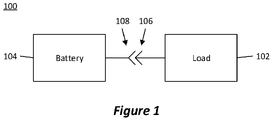
- FIG. 1 is a block diagram of aspects of an electronic device 100, according to some embodiments.
- the electronic device 100 includes a load 102 and a battery 104.
- the load 102 may be part of a vehicle, such as a power converter, which may be part of an engine or propulsion unit of the vehicle.
- the battery 104 is connected to the load 102 by a connector.
- the load 102 includes a battery connector 106 (e.g., a male connector) and the battery 104 includes a battery socket 108 (e.g., a female connector).
- Installing the battery 104 in the electronic device 100 includes inserting the battery connector 106 into the battery socket 108 to mechanically and electrically connect the battery 104 to the load 102.
- the load 102 includes a battery socket
- the battery 104 includes a battery connector.
- the battery connector 106 has power connections and data connections, so that a single connector may be used to carry power and data signals.
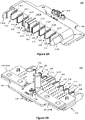
- Figures 2A and 2B are three-dimensional views of a battery connector 200, according to some embodiments.
- Figure 2A is a perspective view of the upper portion of the battery connector 200
- Figure 2B is a perspective view of the lower portion of the battery connector 200.
- the battery connector 200 is a male connector which can be part of a load or part of a battery, to facilitate installation of the battery in an electronic device.
- the battery connector 200 is part of a load, and includes features for mounting the battery connector 200 to the electronic device.
- the battery connector 200 includes a printed circuit board 202, power terminals 204, data terminals 206, an antispark circuit 208, a connector housing 210, a charge pin 212, power pins 214, and data pins 216.
- the printed circuit board 202 mechanically supports and electrically connects the components of the battery connector 200.
- the printed circuit board 202 includes one or more conductive traces among/on layers of an insulating material.
- Example insulating materials include a fiberglass resin, a bismaleimide-triazine resin, build up films, and the like.
- the conductive traces electrically interconnect the various components of the battery connector 200.
- the power terminals 204 are attached to the printed circuit board 202, such as to the bottom of the printed circuit board 202.
- the power terminals 204 can be formed of a metal such as copper, aluminum, gold, combinations thereof, or the like.
- the power terminals 204 are bolted to the printed circuit board 202, and are in physical contact with the conductive traces of the printed circuit board 202.
- the power terminals 204 are coupled to power connections of the electronic device for distributing power from a battery to the load after the battery is installed.
- the power terminals 204 of the battery connector 200 may be coupled to power terminals of a power converter.
- the power terminals 204 are wire lugs that are coupled to the power connections of the electronic device.
- the data terminals 206 are attached to the printed circuit board 202, such as to the top of the printed circuit board 202.
- the data terminals 206 can be push-pins in a housing.
- solder is used to physically and electrically couple the data terminals 206 to the conductive traces of the printed circuit board 202.
- the data terminals 206 are coupled to data connections of the electronic device for carrying control and/or sensor signals between the electronic device and a battery after the battery is installed.
- the data terminals 206 of the battery connector 200 may be coupled to data terminals of a computer in the electronic device.
- the data terminals 206 carry smaller signals (e.g., those of a lower current/voltage) than the power terminals 204, and so can have a smaller width and/or a smaller spacing than the power terminals 204.
- the data terminals 206 may be part of a serial communications bus for the computer.
- the antispark circuit 208 includes surface mount devices (SMDs) attached to the printed circuit board 202, such as to the top and/or the bottom of the printed circuit board 202.
- SMDs surface mount devices
- the antispark circuit 208 is coupled to the power terminals 204, and helps avoid sparking when installing a battery in the electronic device.
- Some loads, such as power converters, have a large input capacitance. Because an uncharged capacitor behaves as a short circuit, coupling the full voltage source of a battery to the load while the input capacitance of the load is uncharged can cause short-circuit induced sparking.
- the antispark circuit 208 (through the charge pin 212) at least partially charges the input capacitance of the load before the full voltage source of the battery is coupled to the load, thereby avoiding sparking when the battery is installed.
- the antispark circuit 208 includes passive devices, such as resistors, capacitors, inductors, and the like, and is free of active devices (e.g., solid state devices), such as transistors, diodes, operational amplifiers, and the like.
- the antispark circuit 208 includes both passive devices and active devices.
- the connector housing 210 protects and houses the components of the battery connector 200.
- the connector housing 210 has a main portion 210M, guiding portions 210G, a shell portion 210S, and projecting portions 210P.
- the main portion 210M is attached to the printed circuit board 202.
- the guiding portions 210G act as guide rails when inserting the battery connector 200 into a corresponding battery socket, and have tapered ends to assist with the initial insertion of the guiding portions 210G into the socket.
- the shell portion 210S surrounds and protects the data pins 216.
- the projecting portions 210P constitute portions of the charge pin 212 and the power pins 214, providing mechanical support to the pins.
- the connector housing 210 also includes mounting portions (not shown) for mounting the battery connector 200 to the electronic device.
- the battery connector 200 could be mounted to a frame of an engine or propulsion unit.
- the various portions of the connector housing 210 are formed of a continuous material and thus integrated together into a single element.
- the connector housing 210 is modular and includes a plurality of discrete components that interlock to form the connector housing 210.
- the connector housing 210 is formed of an insulating material, such as plastic, nylon, or the like, which can be molded into the shape of the connector housing 210 or the shape of the components of the connector housing 210.
- the charge pin 212 and the power pins 214 each extend away from a same side of the main portion 210M of the connector housing 210.
- the charge pin 212 and the power pins 214 are each split pins that include a projecting portion 210P of the connector housing 210 and two conductors 218, with the projecting portion 210P being disposed between the conductors 218.
- the conductors 218 can be formed of a metal such as copper, aluminum, gold, combinations thereof, or the like.
- the conductors 218 are attached to the printed circuit board 202. In some embodiments, solder is used to physically and electrically couple the conductors 218 to the conductive traces of the printed circuit board 202.
- the conductors 218 extend through openings in the side of the main portion 210M of the connector housing 210, with the openings being adjacent the projecting portion 210P of the connector housing 210.
- the conductors 218 of the power pins 214 are directly coupled to the power terminals 204 by the conductive traces of the printed circuit board 202. No intervening circuits are interposed between the conductors 218 of the power pins 214 and the power terminals 204.
- the conductors 218 of the charge pin 212 are indirectly coupled to the power terminals 204 by the conductive traces of the printed circuit board 202.
- the antispark circuit 208 is electrically interposed between the conductors 218 of the charge pin 212 and the power terminals 204.
- the power pins 214 will be coupled to the power output of the battery.
- the power pins 214 will may each have the same length, or may have different lengths. As will be discussed in greater detail below, the charge pin 212 is longer than each of the power pins 214.
- the charge pin 212 and the power pins 214 carry larger signals (e.g., those of a higher current/voltage) than the data pins 216, and so can have a larger width and/or a larger spacing than the data pins 216. Larger widths are used for signals of higher current. Larger spacings are used for signals of higher voltage.
- the charge pin 212 and the power pins 214 carry signals of larger voltage than the data pins 216, and so have at least a larger spacing than the data pins 216.
- the power pins 214 carry signals of larger current than the data pins 216, and so also have a larger width than the data pins 216.
- the charge pin 212 may (or may not) also have a larger width than the data pins 216.
- the data pins 216 each extend away from the same side of the main portion 210M of the connector housing 210 as the charge pin 212 and the power pins 214.
- the data pins 216 extend through openings in the side of the main portion 210M of the connector housing 210, with the openings being surrounded by the shell portion 210S of the connector housing 210. Because the data pins 216 share the connector housing 210 with the charge pin 212 and the power pins 214, all of the pins may thus be connected in a single step when a battery is installed in the electronic device. Installation procedures may thus be simplified for the operator.
- the data pins 216 are directly coupled to the data terminals 206 by the conductive traces of the printed circuit board 202. No intervening circuits are interposed between the data pins 216 and the data terminals 206. Further, the conductive traces of the printed circuit board 202 that couple the data pins 216 to the data terminals 206 can have a smaller width and/or a smaller spacing than the conductive traces of the printed circuit board 202 that couple the power pins 214 to the power terminals 204. During installation, the data pins 216 will be coupled to controllers and/or sensors of the battery. The data pins 216 may each have the same length, or may have different lengths.
- An operator may install a battery into an electronic device by initially inserting the guiding portions 210G of the connector housing 210 into a corresponding battery socket, and then pushing the charge pin 212 and the power pins 214 into the socket.
- the charge pin 212 is longer than each of the data pins 216 and the power pins 214. In other words, the charge pin 212 extends further away from the side of the connector housing 210 than each of the data pins 216 and the power pins 214.
- the charge pin 212 (and thus the antispark circuit 208) will be electrically coupled to the battery before the power pins 214 (and thus the power terminals 204) are electrically coupled to the battery.
- the difference in length between the charge pin 212 and the power pins 214 is selected so that a desired delay is achieved between connection of the charge pin 212 and connection of the power pins 214.
- the antispark circuit 208 charges the input capacitance of the load, thus avoiding sparking when the power pins 214 are coupled to the battery.
- the antispark circuit 208 is shorted out and is no longer coupled to the battery.
- a typical operator will insert the battery connector 200 into a corresponding battery socket at an insertion speed in the range of about 0.4 meters/second to about 0.6 meters/second.
- the charge pin 212 is at least about 2 mm longer than each of the power pins 214, such as from about 2 mm to about 10 mm longer than the power pins 214, achieving a connection delay of less than about 250 ms, such as a connection delay in the range of about 3 ms to about 250 ms at such an insertion speed.
- connection delays may be used based on the system and how the connector is installed. As will be discussed in greater detail below, such a connection delay is sufficient to allow the input capacitance of the load to be charged enough to avoid sparking. Avoid sparking helps increase operator safety and prolongs the lifespan of the power pins 214. For example, sparking can degrade the conductors 218 of the power pins 214, and so avoid sparking reduces degradation and increases their lifespan.
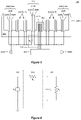
- FIG 3 is a schematic diagram of a battery connector 200, according to some embodiments. Specifically, a cross-sectional view of the battery connector 200 across the data pins 216, the charge pin 212, and the power pins 214 is shown, and details of the antispark circuit 208 are also shown. Some details of the battery connector 200 have been omitted for clarity of illustration.
- Figure 4 is a circuit diagram illustrating details of the antispark circuit 208 of Figure 3 , according to some embodiments. The combined circuit formed by a battery 104, an antispark circuit 208, and a load 102 is shown.
- a first subset of the power pins 214A (also referred to as positive power pins) are coupled to the positive power terminal 204A, and a second subset of the power pins 214B (also referred to as negative power pins) are coupled to the negative power terminal 204B.
- a first subset of the conductors 218A (also referred to as positive conductors) are coupled to the positive power terminal 204A, and each positive power pin 214A includes two positive conductors 218A, with a projecting portion 210P of the connector housing 210 disposed therebetween.
- each negative power pin 214B includes two negative conductors 218B, with a projecting portion 210P of the connector housing 210 disposed therebetween.
- the charge pin 212 is indirectly coupled to both the positive power terminal 204A and the negative power terminal 204B.
- the charge pin 212 includes a positive conductor 218A and a negative conductor 218B, with a projecting portion 210P of the connector housing 210 disposed therebetween.
- the positive conductor 218A, the negative conductor 218B, and the projecting portion 210P of the charge pin 212 are each long than the power pins 214.
- the positive power pins 214A are grouped together in one region of the battery connector 200, and the negative power pins 214B are grouped together in another region of the battery connector 200.
- the data pins 216 and the charge pin 212 are disposed between the group of the positive power pins 214A and the group of the negative power pins 214B. Specifically, the data pins 216 and the charge pin 212 are disposed at about the middle of the connector housing 210, the positive power pins 214A are disposed adjacent the charge pin 212, and the negative power pins 214B are disposed adjacent the data pins 216.
- the load 102 is modeled as a capacitor C L in parallel with a resistor R L .
- the capacitor C L and the resistor R L are large.
- the capacitance of the capacitor C L can be in the range of about 100 ⁇ F to about 1000 ⁇ F and the resistance of the resistor R L can be in the range of about 1 k ⁇ to about 100 k ⁇ .
- the antispark circuit 208 includes a first resistor R 1 and a second resistor R 2 .
- the first resistor R 1 is connected in series between the positive power terminal 204A and the positive conductor 218A of the charge pin 212
- the second resistor R 2 is connected in series between the negative power terminal 204B and the negative conductor 218B of the charge pin 212.
- the resistors R 1 , R 2 prevent the battery 104 from seeing a short circuit while the capacitor C L charges. As noted above, the delay between the connection of the charge pin 212 and the power pins 214 is sufficiently long to allow the capacitor C L to be charged.
- the resistance of the resistors R 1 , R 2 is selected so that the transient response time of the RC circuit formed by the resistors R 1 , R 2 and the capacitor C L is less than the connection delay.
- a transient response time of about five time constants of the RC circuit is sufficiently long to allow the capacitor C L to be charged and is also less than the connection delay.
- the resistors R 1 , R 2 each have a resistance of less than about 50 ⁇ , such as a resistance in the range of about 3 ⁇ to about 25 ⁇ .
- Such a resistance can achieve a transient response time that is less than the connection delay discussed above (e.g., less than about 250 ms). In other words, such a resistance can achieve sufficient charging of the capacitor C L during the connection delay.
- the resistors R 1 , R 2 are each small, and thus dissipate a large amount of energy while the capacitor C L charges. Because the resistors R 1 , R2 dissipate a large amount of energy, they are formed of a material that can dissipate the required amount of energy.
- the resistors R 1 , R 2 may be thick film resistors, ceramic resistors, or the like.
- the resistors R 1 , R 2 can be more generally referred to as a dissipation circuit that is configured to charge the capacitor C L in response to the battery 104 being coupled to the charge pin 212.
- FIG. 5 is a schematic diagram of a battery connector 200, according to some embodiments.
- Figure 6 is a circuit diagram illustrating details of the antispark circuit 208 of Figure 5 , according to some embodiments.
- the combined circuit formed by a battery 104, an antispark circuit 208, and a load 102 is shown.
- This embodiment is similar to that of Figures 3 and 4 , except the antispark circuit 208 includes a single resistor R 1 connected in series between the positive power terminal 204A and the positive conductor 218A of the charge pin 212.
- the single resistor R 1 can also have a small resistance, which may be equal to the sum of the resistors R 1 , R 2 of Figures 3 and 4 .
- the resistor R 1 has a resistance of less than about 50 ⁇ , such as a resistance in the range of about 6 ⁇ to about 50 ⁇ . Such a resistance can achieve sufficient charging of the capacitor C L during the connection delay discussed above (e.g., less than about 250 ms).
- FIG 7 is a schematic diagram of a battery connector 200, according to some embodiments.
- Figure 8 is a circuit diagram illustrating details of the antispark circuit 208 of Figure 7 , according to some embodiments.
- the combined circuit formed by a battery 104, an antispark circuit 208, and a load 102 is shown.
- This embodiment is similar to that of Figures 3 and 4 , except the antispark circuit 208 includes a single resistor R 1 connected in series between the negative power terminal 204B and the negative conductor 218B of the charge pin 212.
- the single resistor R 1 can also have a small resistance, which may be equal to the sum of the resistors R 1 , R 2 of Figures 3 and 4 .
- the resistor R 1 has a resistance of less than about 50 ⁇ , such as a resistance in the range of about 6 ⁇ to about 50 ⁇ . Such a resistance can achieve sufficient charging of the capacitor C L during the connection delay discussed above (e.g., less than about 250 ms).
- Figure 9 is a schematic diagram of a battery connector 200, according to some embodiments.
- Figure 10 is a circuit diagram illustrating details of the antispark circuit 208 of Figure 9 , according to some embodiments. The combined circuit formed by a battery 104, an antispark circuit 208, and a load 102 is shown.
- This embodiment is similar to that of Figures 7 and 8 , except the antispark circuit 208 further includes a thermistor R 2 in series with a resistor R 1 .
- the resistor R 1 and the thermistor R 2 are connected in series between the negative power terminal 204B and the negative conductor 218B of the charge pin 212 (in a similar manner as Figures 7 and 8 ).
- the resistor R 1 and the thermistor R 2 can be connected in series between the positive power terminal 204A and the positive conductor 218A of the charge pin 212 (in a similar manner as Figures 5 and 6 ).
- the resistor R 1 and the thermistor R2 can be split between the positive power terminal 204A and the negative power terminal 204B (in a similar manner as Figures 3 and 4 ).
- the resistor R 1 and the thermistor R 2 form a RC circuit with the capacitor C L , where the RC circuit has a transient response time that is less than the delay between the connection of the charge pin 212 and the power pins 214.
- the thermistor R 2 has a negative temperature coefficient (NTC), so that the resistance of the thermistor R 2 decreases as temperature rises.
- NTC negative temperature coefficient
- the thermistor R 2 can have a resistance in the range of about 22 k ⁇ to about 100 k ⁇ at initial connection, and can decrease to a resistance in the range of about 0 ⁇ to about 1 ⁇ after it warms.
- the thermistor R 2 thus acts as an inrush current limiter, so that little to no charging of the capacitor C L occurs until the thermistor R 2 warms.
- charging of the capacitor C L is effectively delayed for a brief period after charge pin 212 is connected, which can correct for bouncing at initial connection of the charge pin 212. Correcting for bouncing can help ensure that charging of the capacitor C L does not begin until mating of the charge pin 212 is complete, which can help further decrease sparking during connection.
- the thermistor R 2 can be more generally referred to as a delay circuit that is configured to delay charging of the capacitor C L for a predetermined duration after the battery 104 is coupled to the charge pin 212.
- FIG 11 is a schematic diagram of a battery connector 200, according to some embodiments.
- Figure 12 is a circuit diagram illustrating details of the antispark circuit 208 of Figure 11 , according to some embodiments.
- the combined circuit formed by a battery 104, an antispark circuit 208, and a load 102 is shown.
- This embodiment is similar to that of Figures 7 and 8 , except the antispark circuit 208 further includes a delay circuit 220 in series with a resistor R 1 .
- the resistor R 1 and the delay circuit 220 are connected in series between the negative power terminal 204B and the negative conductor 218B of the charge pin 212 (in a similar manner as Figures 7 and 8 ).
- the resistor R 1 and the delay circuit 220 can be connected in series between the positive power terminal 204A and the positive conductor 218A of the charge pin 212 (in a similar manner as Figures 5 and 6 ).
- the delay circuit 220 includes passive device and active devices, and can provide a more accurate delay before charging of the capacitor C L begins. Specifically, the delay circuit 220 does not use thermistors, and thus its operation is not temperature-dependent, thereby allowing for more consistent operation through varying temperatures.
- the delay circuit 220 can be an integrated circuit device formed on a single substrate, or can include devices on different substrates that are interconnected by the conductive traces of the printed circuit board 202 (see Figures 2A and 2B ).
- the delay circuit 220 includes a switch S 1 , a timer circuit 224, a reference circuit 226, a power supply circuit 228, and a compare circuit U 1 .
- the delay circuit 220 is configured to turn on the switch S 1 a predetermined amount of time after the battery 104 is connected to the delay circuit 220.
- the switch S 1 is turned on, the battery 104 is coupled to the load 102 and the resistor R 1 , and the antispark circuit 208 begins functioning in a manner similar as that described above for Figures 7 and 8 .
- the resistor R 1 prevents the battery 104 from seeing a short circuit while the capacitor C L charges and the resistor R 1 dissipates energy.
- the switch S 1 is connected in series with (e.g., between) the battery 104 and the load 102 so that the battery 104 is connected to the load 102 and the resistor R 1 when the switch S 1 is turned on and the battery 104 is disconnected from the load 102 and the resistor R 1 when the switch S 1 is turned off.
- the switch S 1 may be a MOSFET, a mechanical relay, or the like.
- the switch S 1 is a n-type MOSFET, and the source and the drain of the MOSFET are in series with the capacitor C L and the resistor R 1 .
- the timer circuit 224 is configured to produce a timer signal V SIG during operation.
- the timer circuit 224 includes a resistor R T1 , in parallel with a capacitor C T , and a resistor R T2 in series with each of the capacitor C T and the resistor R T1 .
- the capacitor C T and the resistors R T1 , R T2 form a voltage divider RC circuit, such that when the battery 104 is connected to the delay circuit 220 , the capacitor C T begins charging and the timer signal V SIG begins increasing. The timer signal V SIG increases until the capacitor C T is charged.
- the capacitor C T and the resistors R T1 , R T2 are selected so that the time constant of the RC circuit is a desired duration, and thus the timer signal V SIG increases over a predetermined duration. Larger time constants will result in the capacitor C T taking longer to charge, and thus increase the duration of the delay before the switch S 1 is turned on. In some embodiments, the delay is the range of about 10 ms to about 50 ms, which is sufficient to ensure bouncing of the charge pin 212 has ceased and mating is complete.
- the reference circuit 226 is configured to produce a constant reference signal V REF during operation.
- the reference circuit 226 includes a Zener diode D R in series with a resistor R R .
- the Zener diode D R and the resistor R R form a voltage regulator, such that the reference signal V REF equals the Zener voltage of the Zener diode D R (e.g., 10 V in some embodiments).
- the Zener diode D R is selected so that the reference signal V REF is less than the maximum value of the timer signal V SIG output by the timer circuit 224.
- the compare circuit U 1 is configured to compare the timer signal V SIG to the reference signal V REF and turn on the switch S 1 when the timer signal V SIG exceeds the reference signal V REF .
- the capacitor C T is uncharged, and so the timer signal V SIG is initially less than the reference signal V REF . However, once the capacitor C T is sufficiently charged, the timer signal V SIG is greater than the reference signal V REF . Thus, the switch S 1 is turned on a predetermined amount of time after the battery 104 is connected.
- the compare circuit U 1 may include an op-amp, a comparator, or the like.
- the switch S 1 is a n-type MOSFET, and the compare circuit U 1 includes an op-amp.
- the output of the op-amp is coupled to the gate of the MOSFET, with a resistor R G optionally interposed therebetween.
- the resistor R G helps limit the charge current required to charge the gate capacitance of the MOSFET.
- the op-amp receives the reference signal V REF at its inverting input, receives the timer signal V SIG at its non-inverting input, and produces a gate control signal V GATE at its output. When the timer signal V SIG is less than the reference signal V REF , the op-amp outputs a low gate control signal V GATE so that the MOSFET is turned off.
- the op-amp when the timer signal V SIG is greater than the reference signal V REF , the op-amp outputs a high gate control signal V GATE so that the MOSFET is turned on.
- the switch S 1 maybe another type of switch, such as a mechanical relay. Appropriate components may be included with or omitted from the delay circuit 220 as needed to control other types of switches.
- the power supply circuit 228 outputs a supply signal V DD used to power the compare circuit U 1 .
- the power supply circuit 228 includes a Zener diode D s in parallel with a capacitor Cs, and a resistor R s in series with each of the Zener diode D s and the capacitor Cs.
- the Zener diode D s and the resistor R s form a voltage regulator, such that the supply signal V DD equals the Zener voltage of the Zener diode D s (e.g., 15 V in some embodiments).
- the Zener diode D s is selected so that the supply signal V DD is greater than the reference signal V REF and the timer signal V SIG .
- the capacitor Cs helps stabilize the supply signal V DD .
- FIG. 13 is a block diagram of a battery installation method 300, according to some embodiments.
- the battery installation method 300 may be used to install a battery in an electronic device.
- a charge pin of a battery connector is inserted into a socket of a battery.
- the charge pin is coupled to an antispark circuit of the battery connector, which is coupled to power terminals of a load of the electronic device.
- the input capacitance of the load is charged with the antispark circuit.
- the charging the input capacitance is delayed for a predetermined duration after inserting the charge pin into the battery socket.
- the power pins of the battery connector are inserted into the battery socket after charging the input capacitance of the load.
- the power pins are directly coupled to the power terminals of the load, and the charge pin is longer than the power pins.
- the data pins of the battery connector are inserted into the battery socket, also after charging the input capacitance of the load.
- the data pins are coupled to a computer of the electronic device.
- the battery connector described herein may be used for connecting to a variety of electronic devices and load.
- the electronic device is a vehicle such as a rotorcraft
- the load is a device of the rotorcraft, such as a power converter, which may be part of an engine or propulsion unit of the rotorcraft.
- Figure 14 illustrates aspects of a rotorcraft 400, according to some embodiments.
- the rotorcraft 400 includes rotor blades 110, a powertrain 120, a fuselage 130, landing gear 140, an empennage 150, and rotorcraft computers 160. It should be appreciated that some of teachings from the rotorcraft 400 may apply to aircraft other than rotorcraft, such as airplanes, tilt rotor aircraft, unmanned aircraft, and the like.
- the rotor blades 110 include main rotor blades 110A and tail rotor blades 110B.
- the powertrain 120 rotates the main rotor blades 110A and optionally the tail rotor blades 110B.
- the powertrain 120 includes one or more engines 122, a rotor mast 124, and a drive shaft 126.
- the engines 122 supply torque to the rotor mast 124 via the drive shaft 126 to rotate the main rotor blades 110A.
- the engines 122 may also supply torque to the drive shaft 126 to rotate the tail rotor blades 110B.
- the fuselage 130 represents the body of the rotorcraft 400 and is coupled to the powertrain 120 such that the powertrain 120 and the rotor blades 110 move the fuselage 130 through the air during operation.
- the landing gear 140 supports the rotorcraft 400 when the rotorcraft 400 is grounded.
- the empennage 150 represents the tail section of the aircraft and is connected to the tail rotor blades 110B.
- the powertrain 120 and the tail rotor blades 110B may collectively provide thrust in the same direction as the rotation of the main rotor blades 110A, so as to counter torque effects created by the main rotor blades 110A.
- the rotorcraft 400 includes flight control devices operable to change the flight characteristics of the rotorcraft 400.
- the flight control devices can be part of the rotor blades 110, the powertrain 120, the fuselage 130, and the like.
- the flight control devices include mechanical and/or electrical systems operable to change, e.g., the positions or angle of attack of the rotor blades 110, the power output of the engines 122, and the like.
- the flight control devices include a swashplate for collectively or cyclically controlling the pitch of each of the main rotor blades 110A in order to selectively control direction, thrust, and lift of the rotorcraft 400.
- the flight control devices include a tail rotor actuator for collectively controlling the pitch of the tail rotor blades 110B in order to selectively control yaw of the rotorcraft 400.
- the flight control devices include an engine control computer for selectively varying the power output of the engines 122.
- Other examples of flight control devices include horizontal or vertical stabilizers, rudder, elevators, or other control or stabilizing surfaces that are used to control or stabilize flight of the rotorcraft 400.
- the rotorcraft computers 160 are operable to collect data about, or control flight of, the rotorcraft 400.
- the rotorcraft 400 is a fly-by-wire (FBW) rotorcraft
- the rotorcraft computers 160 include flight control computers (FCCs) operable to execute one or more control laws (CLAWS) that control flight of the rotorcraft 400.
- FCCs flight control computers
- CLAWS control laws
- the rotorcraft computers 160 can send electrical signals to the engines 122, the actuators for the swashplate, the tail rotor actuators, or the like to control flight of the rotorcraft 400.
- the rotorcraft computers 160 may be operable to perform sensor data collection and analysis as part of a health and usage monitoring system (HUMS), a flight control system, a sensor system, a monitoring system, or the like.
- HUMS health and usage monitoring system
- FIG. 15 is a block diagram of aspects of a rotorcraft 400, according to some embodiments. Specifically, features for controlling flight of the rotorcraft 400 are shown.
- the rotorcraft computers 160 can be part of a flight control system used to control the flight control devices 162 (described above), thus controlling flight of the rotorcraft 400.
- the rotorcraft computers 160 receive input signals from multiple sources, such as pilot flight controls 164 and aircraft sensors 166. Based on the input signals, the rotorcraft computers 160 transmit control signals to the flight control devices 162, which in some embodiments may be an engine control computer of an engine.
- the pilot flight controls 164 include manual controls that a pilot may manipulate to control flight of the rotorcraft 400.
- Examples of the pilot flight controls 164 include a cyclic stick, a collective stick, pedals, and the like.
- one or more of the pilot flight controls 164 include trim motors, which the rotorcraft computers 160 can command to move to a particular position, thereby providing flight control suggestions to the pilot.
- the aircraft sensors 166 include sensors for measuring a variety of rotorcraft systems, flight parameters, environmental conditions and the like.
- the aircraft sensors 166 may include sensors for measuring airspeed, altitude, attitude, position, orientation, temperature, airspeed, vertical speed, and the like.
- Other aircraft sensors 166 could include sensors relying upon data or signals originating external to the rotorcraft, such as a global positioning system (GPS) sensor, a VHF Omnidirectional Range sensor, Instrument Landing System (ILS), and the like.
- GPS global positioning system
- VHF Omnidirectional Range sensor Instrument Landing System
- the components of the rotorcraft 400 are powered by a battery 104.
- the battery 104 may be a rechargeable battery, such as a lithium-polymer battery, a lead-acid battery, or the like.
- the battery 104 may be charged onboard the rotorcraft 400 (e.g., by an alternator), or may be charged by an external battery charger that is not part of the rotorcraft 400.
- the battery 104 is part of (e.g., disposed/installed in) a propulsion unit of the rotorcraft 400 (e.g., an engine 122, see Figure 14 ).
- the battery 104 is part of other components of the rotorcraft 400.
- Charging of the battery 104 may be controlled by a battery management system (BMS).
- BMS battery management system
- the battery 104 may include a charging circuit that is controlled by the BMS. Parameters of the battery 104 may also be monitored by the BMS.
- the battery 104 may include sensors for monitoring the discharge rate, cell voltages, temperature, and the like of the battery 104, which the BMS receives signals from.
- the BMS may be partially or wholly embodied as software and/or hardware for performing the desired functionality.
- the BMS may be embodied as software executed by the rotorcraft computers 160, as hardware included with the rotorcraft computers 160, as a standalone management circuit/controller, or the like.
- the BMS is embodied as software executed by the rotorcraft computers 160.
- the battery 104 is connected to the components of the rotorcraft 400 (e.g., the flight control devices 162) by power connections 174, and the battery 104 is connected to the BMS (e.g., the rotorcraft computers 160) by data connections 176.
- the power connections 174 carry the power provided to the components of the rotorcraft 400.
- the data connections 176 carry data (e.g., control and/or sensor) signals communicated between the battery 104 and the rotorcraft computers 160.
- the data connections 176 may be connections for a serial communications protocol, such as PC, SPI, RS232, or the like.
- the power connections 174 may be larger (e.g., have a lower gauge) than the data connections 176.
- the battery 104 is installed in an engine of the rotorcraft 400.
- the engine can include a power converter having a battery connector, such as those described with respect to Figures 1 through 12 .
- the power connections 174 can be coupled to the power terminals 204 of a battery connector 200 (see Figures 2A and 2B ), and the data connections 176 can be coupled to the data terminals 206 of the battery connector 200.
- the power connections 174 and the data connections 176 are directly between the battery 104 and the engine it is installed in.
- the engine can have additional connections to other components of the rotorcraft 400 (e.g., the rotorcraft computers 160) for forwarding power/data signals to those other components.
- Embodiments may achieve advantages. Forming the charge pin of a battery connector to be longer than the power pins of the battery connector allows the charge pin (and associated antispark circuit) to be connected to an electronic device before the power pins are connected to the electronic device.
- the antispark circuit may thus charge the input capacitance of the load of the electronic device during the delay before the power pins are connected. Charging the input capacitance of the load before connecting the full voltage source of the battery to the load can avoid sparking. Avoid sparking helps increase operator safety and prolongs the lifespan of the battery connector.
Landscapes
- Engineering & Computer Science (AREA)
- Physics & Mathematics (AREA)
- Aviation & Aerospace Engineering (AREA)
- General Physics & Mathematics (AREA)
- Radar, Positioning & Navigation (AREA)
- Remote Sensing (AREA)
- Automation & Control Theory (AREA)
- Power Engineering (AREA)
- Manufacturing & Machinery (AREA)
- Mechanical Engineering (AREA)
- Nonlinear Science (AREA)
- Charge And Discharge Circuits For Batteries Or The Like (AREA)
Abstract
In an embodiment, a battery connector (106) includes: power terminals (204) configured to be coupled to a load (102) having an input capacitance; power pins (214) electrically coupled to the power terminals; a charge pin (212), the charge pin being longer than each of the power pins; and an antispark circuit (208) electrically interposed between the charge pin and the power terminals, the antispark circuit including: a dissipation circuit configured to charge the input capacitance of the load in response to a battery (104) being coupled to the charge pin; and a delay circuit (220) configured to delay charging of the input capacitance of the load for a predetermined duration after the battery is coupled to the charge pin.
Description
- Electrical connectors are electromechanical devices that join electrical conductors to create an electrical circuit. Some electrical connectors include a plug that connects to a corresponding socket. Electrical connectors may be removable or permanent. The use of removable connectors can help simplify assembly and disassembly of an electronic device.
- In an embodiment, a battery connector includes: power terminals configured to be coupled to a load having an input capacitance; power pins electrically coupled to the power terminals; a charge pin, the charge pin being longer than each of the power pins; and an antispark circuit electrically interposed between the charge pin and the power terminals, the antispark circuit including: a dissipation circuit configured to charge the input capacitance of the load in response to a battery being coupled to the charge pin; and a delay circuit configured to delay charging of the input capacitance of the load for a predetermined duration after the battery is coupled to the charge pin.
- In some embodiments of the battery connector, the dissipation circuit includes a resistor, the delay circuit includes a thermistor, and the resistor and the thermistor are each in series with the load. In some embodiments of the battery connector, the dissipation circuit includes a first resistor, and the delay circuit includes: a switch connected in series with the battery, the first resistor, and the load; a timer circuit configured to produce a timer signal, where the timer signal begins increasing when the battery is coupled to the charge pin; a reference circuit configured to produce a reference signal; and a compare circuit coupled to the reference circuit, the timer circuit, and the switch, the compare circuit configured to turn off the switch when the timer signal is less than the reference signal, the compare circuit configured to turn on the switch when the timer signal is greater than the reference signal. In some embodiments of the battery connector, the compare circuit is an op-amp, the reference circuit is coupled to an inverting input of the op-amp, the timer circuit is coupled to a non-inverting input of the op-amp. In some embodiments of the battery connector, the switch is a MOSFET. In some embodiments of the battery connector, the switch is a mechanical relay.
- In an embodiment, a rotorcraft includes: pilot flight controls; a flight control computer coupled to the pilot flight controls, the flight control computer configured to receive input signals from the pilot flight controls and generate control signals according to the input signals; an engine including an engine control computer and a power converter, the engine control computer coupled to the flight control computer, the flight control computer further configured to transmit the control signals to the engine control computer, the power converter including power terminals and a battery connector, the battery connector including: an antispark circuit coupled to the power terminals; a charge pin coupled to the antispark circuit; and power pins coupled to the power terminals, the charge pin being longer than each of the power pins.
- In some embodiments of the rotorcraft, the flight control computer includes data terminals, and the battery connector further includes: data pins coupled to the data terminals, the data pins having a smaller width and a smaller spacing than the power pins. In some embodiments of the rotorcraft, the battery connector further includes: a circuit board, where each of the data pins, the power pins, and the charge pin are attached to the circuit board; and a connector housing attached to the circuit board, where the data pins, the power pins, and the charge pin each extend from a same side of the connector housing. In some embodiments of the rotorcraft, the data terminals are part of a serial communications bus for the flight control computer. In some embodiments, the rotorcraft further includes: a battery connected to the power converter with the battery connector. In some embodiments of the rotorcraft, the power converter has an input capacitance, and the antispark circuit includes: a resistor in series with the input capacitance, the resistor and the input capacitance forming a RC circuit having a transient response time of less than 250 ms. In some embodiments of the rotorcraft, the antispark circuit further includes: a delay circuit in series with the resistor and the input capacitance, the delay circuit including passive devices and being free of active devices. In some embodiments of the rotorcraft, the delay circuit includes a thermistor. In some embodiments of the rotorcraft, the antispark circuit further includes: a delay circuit in series with the resistor and the input capacitance, the delay circuit including passive devices and active devices. In some embodiments of the rotorcraft, the delay circuit includes: a switch connected in series with the resistor and the input capacitance; a timer circuit configured to produce a timer signal; a reference circuit configured to produce a reference signal; and a compare circuit coupled to the reference circuit, the timer circuit, and the switch, the compare circuit configured to turn off the switch the timer signal is less than the reference signal, the compare circuit configured to turn on the switch when the timer signal is greater than the reference signal.
- In an embodiment, a method includes: inserting a charge pin of a battery connector into a socket of a battery, the charge pin coupled to an antispark circuit, the antispark circuit coupled to power terminals of a load; charging an input capacitance of the load with the antispark circuit; and after charging the input capacitance of the load, inserting power pins of the battery connector into the socket, the power pins directly coupled to the power terminals of the load, the charge pin being longer than the power pins.
- In some embodiments, the method further includes: after charging the input capacitance of the load, inserting data pins of the battery connector into the socket, the data pins coupled to a computer . In some embodiments, the method further includes: delaying the charging the input capacitance of the load for a predetermined duration after inserting the charge pin into the socket. In some embodiments of the method, charging the input capacitance of the load includes dissipating energy from the battery in a resistor of the battery connector.
- For a more complete understanding of the present invention, and the advantages thereof, reference is now made to the following descriptions taken in conjunction with the accompanying drawings, in which:
-
Figure 1 is a block diagram of aspects of an electronic device, according to some embodiments; -
Figures 2A and 2B are three-dimensional views of a battery connector, according to some embodiments; -
Figure 3 is a schematic diagram of a battery connector, according to some embodiments; -
Figure 4 is a circuit diagram illustrating details of an antispark circuit, according to some embodiments; -
Figure 5 is a schematic diagram of a battery connector, according to some embodiments; -
Figure 6 is a circuit diagram illustrating details of an antispark circuit, according to some embodiments; -
Figure 7 is a schematic diagram of a battery connector, according to some embodiments; -
Figure 8 is a circuit diagram illustrating details of an antispark circuit, according to some embodiments; -
Figure 9 is a schematic diagram of a battery connector, according to some embodiments; -
Figure 10 is a circuit diagram illustrating details of an antispark circuit, according to some embodiments; -
Figure 11 is a schematic diagram of a battery connector, according to some embodiments; -
Figure 12 is a circuit diagram illustrating details of an antispark circuit, according to some embodiments; -
Figure 13 is a block diagram of a battery installation method, according to some embodiments; -
Figure 14 illustrates a rotorcraft, according to some embodiments; and -
Figure 15 is a block diagram of aspects of a rotorcraft, according to some embodiments. - Illustrative embodiments of the system and method of the present disclosure are described below. In the interest of clarity, all features of an actual implementation may not be described in this specification. It will of course be appreciated that in the development of any such actual embodiment, numerous implementation-specific decisions may be made to achieve the developer's specific goals, such as compliance with system-related and business-related constraints, which will vary from one implementation to another. Moreover, it should be appreciated that such a development effort might be complex and time-consuming but would nevertheless be a routine undertaking for those of ordinary skill in the art having the benefit of this disclosure.
- Reference may be made herein to the spatial relationships between various components and to the spatial orientation of various aspects of components as the devices are depicted in the attached drawings. However, as will be recognized by those skilled in the art after a complete reading of the present disclosure, the devices, members, apparatuses, etc. described herein may be positioned in any desired orientation. Thus, the use of terms such as "above," "below," "upper," "lower," or other like terms to describe a spatial relationship between various components or to describe the spatial orientation of aspects of such components should be understood to describe a relative relationship between the components or a spatial orientation of aspects of such components, respectively, as the device described herein may be oriented in any desired direction.
- According to various embodiments, a battery connector includes a charge pin that is longer than its power pins. The charge pin is coupled to an antispark circuit. Because the charge pin is longer than the power pins, it may be connected to a battery before the power pins, so that the antispark circuit may charge the input capacitance of a load powered by the battery before the power pins are connected to the battery. Sparking (or arcing) may thus be avoided (e.g., dampened or eliminated) during installation of the battery.
-
Figure 1 is a block diagram of aspects of anelectronic device 100, according to some embodiments. Theelectronic device 100 includes aload 102 and abattery 104. As will be discussed in greater detail below, theload 102 may be part of a vehicle, such as a power converter, which may be part of an engine or propulsion unit of the vehicle. Thebattery 104 is connected to theload 102 by a connector. In this embodiment, theload 102 includes a battery connector 106 (e.g., a male connector) and thebattery 104 includes a battery socket 108 (e.g., a female connector). Installing thebattery 104 in theelectronic device 100 includes inserting thebattery connector 106 into thebattery socket 108 to mechanically and electrically connect thebattery 104 to theload 102. In another embodiment, theload 102 includes a battery socket, and thebattery 104 includes a battery connector. As will be discussed in greater detail below, thebattery connector 106 has power connections and data connections, so that a single connector may be used to carry power and data signals. -
Figures 2A and 2B are three-dimensional views of abattery connector 200, according to some embodiments.Figure 2A is a perspective view of the upper portion of thebattery connector 200, andFigure 2B is a perspective view of the lower portion of thebattery connector 200. Thebattery connector 200 is a male connector which can be part of a load or part of a battery, to facilitate installation of the battery in an electronic device. In this embodiment, thebattery connector 200 is part of a load, and includes features for mounting thebattery connector 200 to the electronic device. Thebattery connector 200 includes a printedcircuit board 202,power terminals 204,data terminals 206, anantispark circuit 208, aconnector housing 210, acharge pin 212, power pins 214, and data pins 216. - The printed
circuit board 202 mechanically supports and electrically connects the components of thebattery connector 200. The printedcircuit board 202 includes one or more conductive traces among/on layers of an insulating material. Example insulating materials include a fiberglass resin, a bismaleimide-triazine resin, build up films, and the like. The conductive traces electrically interconnect the various components of thebattery connector 200. - The
power terminals 204 are attached to the printedcircuit board 202, such as to the bottom of the printedcircuit board 202. Thepower terminals 204 can be formed of a metal such as copper, aluminum, gold, combinations thereof, or the like. In some embodiments, thepower terminals 204 are bolted to the printedcircuit board 202, and are in physical contact with the conductive traces of the printedcircuit board 202. Thepower terminals 204 are coupled to power connections of the electronic device for distributing power from a battery to the load after the battery is installed. For example, thepower terminals 204 of thebattery connector 200 may be coupled to power terminals of a power converter. In some embodiments, thepower terminals 204 are wire lugs that are coupled to the power connections of the electronic device. - The
data terminals 206 are attached to the printedcircuit board 202, such as to the top of the printedcircuit board 202. Thedata terminals 206 can be push-pins in a housing. In some embodiments, solder is used to physically and electrically couple thedata terminals 206 to the conductive traces of the printedcircuit board 202. Thedata terminals 206 are coupled to data connections of the electronic device for carrying control and/or sensor signals between the electronic device and a battery after the battery is installed. For example, thedata terminals 206 of thebattery connector 200 may be coupled to data terminals of a computer in the electronic device. Thedata terminals 206 carry smaller signals (e.g., those of a lower current/voltage) than thepower terminals 204, and so can have a smaller width and/or a smaller spacing than thepower terminals 204. Thedata terminals 206 may be part of a serial communications bus for the computer. - The
antispark circuit 208 includes surface mount devices (SMDs) attached to the printedcircuit board 202, such as to the top and/or the bottom of the printedcircuit board 202. Theantispark circuit 208 is coupled to thepower terminals 204, and helps avoid sparking when installing a battery in the electronic device. Some loads, such as power converters, have a large input capacitance. Because an uncharged capacitor behaves as a short circuit, coupling the full voltage source of a battery to the load while the input capacitance of the load is uncharged can cause short-circuit induced sparking. As will be discussed in greater detail below, the antispark circuit 208 (through the charge pin 212) at least partially charges the input capacitance of the load before the full voltage source of the battery is coupled to the load, thereby avoiding sparking when the battery is installed. Several antispark circuits are discussed in greater detail below. In some embodiments, theantispark circuit 208 includes passive devices, such as resistors, capacitors, inductors, and the like, and is free of active devices (e.g., solid state devices), such as transistors, diodes, operational amplifiers, and the like. In some embodiments, theantispark circuit 208 includes both passive devices and active devices. - The
connector housing 210 protects and houses the components of thebattery connector 200. Theconnector housing 210 has amain portion 210M, guidingportions 210G, ashell portion 210S, and projectingportions 210P. Themain portion 210M is attached to the printedcircuit board 202. The guidingportions 210G act as guide rails when inserting thebattery connector 200 into a corresponding battery socket, and have tapered ends to assist with the initial insertion of the guidingportions 210G into the socket. Theshell portion 210S surrounds and protects the data pins 216. The projectingportions 210P constitute portions of thecharge pin 212 and the power pins 214, providing mechanical support to the pins. In some embodiments, theconnector housing 210 also includes mounting portions (not shown) for mounting thebattery connector 200 to the electronic device. For example, thebattery connector 200 could be mounted to a frame of an engine or propulsion unit. In some embodiments, the various portions of theconnector housing 210 are formed of a continuous material and thus integrated together into a single element. In some embodiments, theconnector housing 210 is modular and includes a plurality of discrete components that interlock to form theconnector housing 210. Theconnector housing 210 is formed of an insulating material, such as plastic, nylon, or the like, which can be molded into the shape of theconnector housing 210 or the shape of the components of theconnector housing 210. - The
charge pin 212 and the power pins 214 each extend away from a same side of themain portion 210M of theconnector housing 210. Thecharge pin 212 and the power pins 214 are each split pins that include a projectingportion 210P of theconnector housing 210 and twoconductors 218, with the projectingportion 210P being disposed between theconductors 218. Theconductors 218 can be formed of a metal such as copper, aluminum, gold, combinations thereof, or the like. Theconductors 218 are attached to the printedcircuit board 202. In some embodiments, solder is used to physically and electrically couple theconductors 218 to the conductive traces of the printedcircuit board 202. Theconductors 218 extend through openings in the side of themain portion 210M of theconnector housing 210, with the openings being adjacent the projectingportion 210P of theconnector housing 210. - The
conductors 218 of the power pins 214 are directly coupled to thepower terminals 204 by the conductive traces of the printedcircuit board 202. No intervening circuits are interposed between theconductors 218 of the power pins 214 and thepower terminals 204. Theconductors 218 of thecharge pin 212 are indirectly coupled to thepower terminals 204 by the conductive traces of the printedcircuit board 202. Theantispark circuit 208 is electrically interposed between theconductors 218 of thecharge pin 212 and thepower terminals 204. During installation, thecharge pin 212 and the power pins 214 will be coupled to the power output of the battery. The power pins 214 will may each have the same length, or may have different lengths. As will be discussed in greater detail below, thecharge pin 212 is longer than each of the power pins 214. - The
charge pin 212 and the power pins 214 carry larger signals (e.g., those of a higher current/voltage) than the data pins 216, and so can have a larger width and/or a larger spacing than the data pins 216. Larger widths are used for signals of higher current. Larger spacings are used for signals of higher voltage. Thecharge pin 212 and the power pins 214 carry signals of larger voltage than the data pins 216, and so have at least a larger spacing than the data pins 216. The power pins 214 carry signals of larger current than the data pins 216, and so also have a larger width than the data pins 216. Thecharge pin 212 may (or may not) also have a larger width than the data pins 216. - The data pins 216 each extend away from the same side of the
main portion 210M of theconnector housing 210 as thecharge pin 212 and the power pins 214. The data pins 216 extend through openings in the side of themain portion 210M of theconnector housing 210, with the openings being surrounded by theshell portion 210S of theconnector housing 210. Because the data pins 216 share theconnector housing 210 with thecharge pin 212 and the power pins 214, all of the pins may thus be connected in a single step when a battery is installed in the electronic device. Installation procedures may thus be simplified for the operator. - The data pins 216 are directly coupled to the
data terminals 206 by the conductive traces of the printedcircuit board 202. No intervening circuits are interposed between the data pins 216 and thedata terminals 206. Further, the conductive traces of the printedcircuit board 202 that couple the data pins 216 to thedata terminals 206 can have a smaller width and/or a smaller spacing than the conductive traces of the printedcircuit board 202 that couple the power pins 214 to thepower terminals 204. During installation, the data pins 216 will be coupled to controllers and/or sensors of the battery. The data pins 216 may each have the same length, or may have different lengths. - An operator may install a battery into an electronic device by initially inserting the guiding
portions 210G of theconnector housing 210 into a corresponding battery socket, and then pushing thecharge pin 212 and the power pins 214 into the socket. Thecharge pin 212 is longer than each of the data pins 216 and the power pins 214. In other words, thecharge pin 212 extends further away from the side of theconnector housing 210 than each of the data pins 216 and the power pins 214. As such, when installing a battery in the electronic device, the charge pin 212 (and thus the antispark circuit 208) will be electrically coupled to the battery before the power pins 214 (and thus the power terminals 204) are electrically coupled to the battery. The difference in length between thecharge pin 212 and the power pins 214 is selected so that a desired delay is achieved between connection of thecharge pin 212 and connection of the power pins 214. During this connection delay, theantispark circuit 208 charges the input capacitance of the load, thus avoiding sparking when the power pins 214 are coupled to the battery. Once the power pins 214 are coupled to the battery, theantispark circuit 208 is shorted out and is no longer coupled to the battery. A typical operator will insert thebattery connector 200 into a corresponding battery socket at an insertion speed in the range of about 0.4 meters/second to about 0.6 meters/second. In some embodiments, thecharge pin 212 is at least about 2 mm longer than each of the power pins 214, such as from about 2 mm to about 10 mm longer than the power pins 214, achieving a connection delay of less than about 250 ms, such as a connection delay in the range of about 3 ms to about 250 ms at such an insertion speed. It should be appreciated that other connection delays may be used based on the system and how the connector is installed. As will be discussed in greater detail below, such a connection delay is sufficient to allow the input capacitance of the load to be charged enough to avoid sparking. Avoid sparking helps increase operator safety and prolongs the lifespan of the power pins 214. For example, sparking can degrade theconductors 218 of the power pins 214, and so avoid sparking reduces degradation and increases their lifespan. -
Figure 3 is a schematic diagram of abattery connector 200, according to some embodiments. Specifically, a cross-sectional view of thebattery connector 200 across the data pins 216, thecharge pin 212, and the power pins 214 is shown, and details of theantispark circuit 208 are also shown. Some details of thebattery connector 200 have been omitted for clarity of illustration.Figure 4 is a circuit diagram illustrating details of theantispark circuit 208 ofFigure 3 , according to some embodiments. The combined circuit formed by abattery 104, anantispark circuit 208, and aload 102 is shown. - A first subset of the power pins 214A (also referred to as positive power pins) are coupled to the
positive power terminal 204A, and a second subset of the power pins 214B (also referred to as negative power pins) are coupled to thenegative power terminal 204B. Specifically, a first subset of theconductors 218A (also referred to as positive conductors) are coupled to thepositive power terminal 204A, and eachpositive power pin 214A includes twopositive conductors 218A, with a projectingportion 210P of theconnector housing 210 disposed therebetween. Similarly, a second subset of theconductors 218B (also referred to as negative conductors) are coupled to thenegative power terminal 204B, and eachnegative power pin 214B includes twonegative conductors 218B, with a projectingportion 210P of theconnector housing 210 disposed therebetween. - The
charge pin 212 is indirectly coupled to both thepositive power terminal 204A and thenegative power terminal 204B. Specifically, thecharge pin 212 includes apositive conductor 218A and anegative conductor 218B, with a projectingportion 210P of theconnector housing 210 disposed therebetween. As more clearly illustrated, thepositive conductor 218A, thenegative conductor 218B, and the projectingportion 210P of thecharge pin 212 are each long than the power pins 214. - The
positive power pins 214A are grouped together in one region of thebattery connector 200, and the negative power pins 214B are grouped together in another region of thebattery connector 200. The data pins 216 and thecharge pin 212 are disposed between the group of thepositive power pins 214A and the group of the negative power pins 214B. Specifically, the data pins 216 and thecharge pin 212 are disposed at about the middle of theconnector housing 210, thepositive power pins 214A are disposed adjacent thecharge pin 212, and the negative power pins 214B are disposed adjacent the data pins 216. - The
load 102 is modeled as a capacitor CL in parallel with a resistor RL. The capacitor CL and the resistor RL are large. For example, the capacitance of the capacitor CL can be in the range of about 100 µF to about 1000 µF and the resistance of the resistor RL can be in the range of about 1 kΩ to about 100 kΩ. - In this embodiment, the
antispark circuit 208 includes a first resistor R1 and a second resistor R2. The first resistor R1 is connected in series between thepositive power terminal 204A and thepositive conductor 218A of thecharge pin 212, and the second resistor R2 is connected in series between thenegative power terminal 204B and thenegative conductor 218B of thecharge pin 212. The resistors R1, R2 prevent thebattery 104 from seeing a short circuit while the capacitor CL charges. As noted above, the delay between the connection of thecharge pin 212 and the power pins 214 is sufficiently long to allow the capacitor CL to be charged. The resistance of the resistors R1, R2 is selected so that the transient response time of the RC circuit formed by the resistors R1, R2 and the capacitor CL is less than the connection delay. A transient response time of about five time constants of the RC circuit is sufficiently long to allow the capacitor CL to be charged and is also less than the connection delay. In an embodiment, the resistors R1, R2 each have a resistance of less than about 50 Ω, such as a resistance in the range of about 3 Ω to about 25 Ω. Such a resistance can achieve a transient response time that is less than the connection delay discussed above (e.g., less than about 250 ms). In other words, such a resistance can achieve sufficient charging of the capacitor CL during the connection delay. The resistors R1, R2 are each small, and thus dissipate a large amount of energy while the capacitor CL charges. Because the resistors R1, R2 dissipate a large amount of energy, they are formed of a material that can dissipate the required amount of energy. For example, the resistors R1, R2 may be thick film resistors, ceramic resistors, or the like. Thus, the resistors R1, R2 can be more generally referred to as a dissipation circuit that is configured to charge the capacitor CL in response to thebattery 104 being coupled to thecharge pin 212. -
Figure 5 is a schematic diagram of abattery connector 200, according to some embodiments.Figure 6 is a circuit diagram illustrating details of theantispark circuit 208 ofFigure 5 , according to some embodiments. The combined circuit formed by abattery 104, anantispark circuit 208, and aload 102 is shown. This embodiment is similar to that ofFigures 3 and 4 , except theantispark circuit 208 includes a single resistor R1 connected in series between thepositive power terminal 204A and thepositive conductor 218A of thecharge pin 212. The single resistor R1 can also have a small resistance, which may be equal to the sum of the resistors R1, R2 ofFigures 3 and 4 . In an embodiment, the resistor R1 has a resistance of less than about 50 Ω, such as a resistance in the range of about 6 Ω to about 50 Ω. Such a resistance can achieve sufficient charging of the capacitor CL during the connection delay discussed above (e.g., less than about 250 ms). -
Figure 7 is a schematic diagram of abattery connector 200, according to some embodiments.Figure 8 is a circuit diagram illustrating details of theantispark circuit 208 ofFigure 7 , according to some embodiments. The combined circuit formed by abattery 104, anantispark circuit 208, and aload 102 is shown. This embodiment is similar to that ofFigures 3 and 4 , except theantispark circuit 208 includes a single resistor R1 connected in series between thenegative power terminal 204B and thenegative conductor 218B of thecharge pin 212. The single resistor R1 can also have a small resistance, which may be equal to the sum of the resistors R1, R2 ofFigures 3 and 4 . In an embodiment, the resistor R1 has a resistance of less than about 50 Ω, such as a resistance in the range of about 6 Ω to about 50 Ω. Such a resistance can achieve sufficient charging of the capacitor CL during the connection delay discussed above (e.g., less than about 250 ms). -
Figure 9 is a schematic diagram of abattery connector 200, according to some embodiments.Figure 10 is a circuit diagram illustrating details of theantispark circuit 208 ofFigure 9 , according to some embodiments. The combined circuit formed by abattery 104, anantispark circuit 208, and aload 102 is shown. This embodiment is similar to that ofFigures 7 and 8 , except theantispark circuit 208 further includes a thermistor R2 in series with a resistor R1. In this embodiment, the resistor R1 and the thermistor R2 are connected in series between thenegative power terminal 204B and thenegative conductor 218B of the charge pin 212 (in a similar manner asFigures 7 and 8 ). In another embodiment, the resistor R1 and the thermistor R2 can be connected in series between thepositive power terminal 204A and thepositive conductor 218A of the charge pin 212 (in a similar manner asFigures 5 and 6 ). In yet another embodiment, the resistor R1 and the thermistor R2 can be split between thepositive power terminal 204A and thenegative power terminal 204B (in a similar manner asFigures 3 and 4 ). - The resistor R1 and the thermistor R2 form a RC circuit with the capacitor CL, where the RC circuit has a transient response time that is less than the delay between the connection of the
charge pin 212 and the power pins 214. The thermistor R2 has a negative temperature coefficient (NTC), so that the resistance of the thermistor R2 decreases as temperature rises. For example, the thermistor R2 can have a resistance in the range of about 22 kΩ to about 100 kΩ at initial connection, and can decrease to a resistance in the range of about 0 Ω to about 1 Ω after it warms. The thermistor R2 thus acts as an inrush current limiter, so that little to no charging of the capacitor CL occurs until the thermistor R2 warms. As a result, charging of the capacitor CL is effectively delayed for a brief period aftercharge pin 212 is connected, which can correct for bouncing at initial connection of thecharge pin 212. Correcting for bouncing can help ensure that charging of the capacitor CL does not begin until mating of thecharge pin 212 is complete, which can help further decrease sparking during connection. Thus, the thermistor R2 can be more generally referred to as a delay circuit that is configured to delay charging of the capacitor CL for a predetermined duration after thebattery 104 is coupled to thecharge pin 212. -
Figure 11 is a schematic diagram of abattery connector 200, according to some embodiments.Figure 12 is a circuit diagram illustrating details of theantispark circuit 208 ofFigure 11 , according to some embodiments. The combined circuit formed by abattery 104, anantispark circuit 208, and aload 102 is shown. This embodiment is similar to that ofFigures 7 and 8 , except theantispark circuit 208 further includes adelay circuit 220 in series with a resistor R1. In this embodiment, the resistor R1 and thedelay circuit 220 are connected in series between thenegative power terminal 204B and thenegative conductor 218B of the charge pin 212 (in a similar manner asFigures 7 and 8 ). In another embodiment, the resistor R1 and thedelay circuit 220 can be connected in series between thepositive power terminal 204A and thepositive conductor 218A of the charge pin 212 (in a similar manner asFigures 5 and 6 ). Thedelay circuit 220 includes passive device and active devices, and can provide a more accurate delay before charging of the capacitor CL begins. Specifically, thedelay circuit 220 does not use thermistors, and thus its operation is not temperature-dependent, thereby allowing for more consistent operation through varying temperatures. Thedelay circuit 220 can be an integrated circuit device formed on a single substrate, or can include devices on different substrates that are interconnected by the conductive traces of the printed circuit board 202 (seeFigures 2A and 2B ). - The
delay circuit 220 includes a switch S1, atimer circuit 224, areference circuit 226, apower supply circuit 228, and a compare circuit U1. Thedelay circuit 220 is configured to turn on the switch S1 a predetermined amount of time after thebattery 104 is connected to thedelay circuit 220. When the switch S1 is turned on, thebattery 104 is coupled to theload 102 and the resistor R1, and theantispark circuit 208 begins functioning in a manner similar as that described above forFigures 7 and 8 . Specifically, the resistor R1 prevents thebattery 104 from seeing a short circuit while the capacitor CL charges and the resistor R1 dissipates energy. - The switch S1 is connected in series with (e.g., between) the
battery 104 and theload 102 so that thebattery 104 is connected to theload 102 and the resistor R1 when the switch S1 is turned on and thebattery 104 is disconnected from theload 102 and the resistor R1 when the switch S1 is turned off. The switch S1 may be a MOSFET, a mechanical relay, or the like. In this embodiment, the switch S1 is a n-type MOSFET, and the source and the drain of the MOSFET are in series with the capacitor CL and the resistor R1. - The
timer circuit 224 is configured to produce a timer signal VSIG during operation. Thetimer circuit 224 includes a resistor RT1, in parallel with a capacitor CT, and a resistor RT2 in series with each of the capacitor CT and the resistor RT1. The capacitor CT and the resistors RT1, RT2 form a voltage divider RC circuit, such that when thebattery 104 is connected to the delay circuit 220, the capacitor CT begins charging and the timer signal VSIG begins increasing. The timer signal VSIG increases until the capacitor CT is charged. The capacitor CT and the resistors RT1, RT2 are selected so that the time constant of the RC circuit is a desired duration, and thus the timer signal VSIG increases over a predetermined duration. Larger time constants will result in the capacitor CT taking longer to charge, and thus increase the duration of the delay before the switch S1 is turned on. In some embodiments, the delay is the range of about 10 ms to about 50 ms, which is sufficient to ensure bouncing of thecharge pin 212 has ceased and mating is complete. - The
reference circuit 226 is configured to produce a constant reference signal VREF during operation. Thereference circuit 226 includes a Zener diode DR in series with a resistor RR. The Zener diode DR and the resistor RR form a voltage regulator, such that the reference signal VREF equals the Zener voltage of the Zener diode DR (e.g., 10 V in some embodiments). The Zener diode DR is selected so that the reference signal VREF is less than the maximum value of the timer signal VSIG output by thetimer circuit 224. - The compare circuit U1 is configured to compare the timer signal VSIG to the reference signal VREF and turn on the switch S1 when the timer signal VSIG exceeds the reference signal VREF. During operation, the capacitor CT is uncharged, and so the timer signal VSIG is initially less than the reference signal VREF. However, once the capacitor CT is sufficiently charged, the timer signal VSIG is greater than the reference signal VREF. Thus, the switch S1 is turned on a predetermined amount of time after the
battery 104 is connected. The compare circuit U1 may include an op-amp, a comparator, or the like. In this embodiment, the switch S1 is a n-type MOSFET, and the compare circuit U1 includes an op-amp. The output of the op-amp is coupled to the gate of the MOSFET, with a resistor RG optionally interposed therebetween. The resistor RG helps limit the charge current required to charge the gate capacitance of the MOSFET. The op-amp receives the reference signal VREF at its inverting input, receives the timer signal VSIG at its non-inverting input, and produces a gate control signal VGATE at its output. When the timer signal VSIG is less than the reference signal VREF, the op-amp outputs a low gate control signal VGATE so that the MOSFET is turned off. Similarly, when the timer signal VSIG is greater than the reference signal VREF, the op-amp outputs a high gate control signal VGATE so that the MOSFET is turned on. It should be appreciated that other types of compare circuits and/or switches may be used. For example, as noted above, the switch S1 maybe another type of switch, such as a mechanical relay. Appropriate components may be included with or omitted from thedelay circuit 220 as needed to control other types of switches. - The
power supply circuit 228 outputs a supply signal VDD used to power the compare circuit U1. Thepower supply circuit 228 includes a Zener diode Ds in parallel with a capacitor Cs, and a resistor Rs in series with each of the Zener diode Ds and the capacitor Cs. The Zener diode Ds and the resistor Rs form a voltage regulator, such that the supply signal VDD equals the Zener voltage of the Zener diode Ds (e.g., 15 V in some embodiments). The Zener diode Ds is selected so that the supply signal VDD is greater than the reference signal VREF and the timer signal VSIG. The capacitor Cs helps stabilize the supply signal VDD. -
Figure 13 is a block diagram of abattery installation method 300, according to some embodiments. Thebattery installation method 300 may be used to install a battery in an electronic device. Inoperation 302, a charge pin of a battery connector is inserted into a socket of a battery. As noted above, the charge pin is coupled to an antispark circuit of the battery connector, which is coupled to power terminals of a load of the electronic device. Inoperation 304, the input capacitance of the load is charged with the antispark circuit. Optionally, the charging the input capacitance is delayed for a predetermined duration after inserting the charge pin into the battery socket. Inoperation 306, the power pins of the battery connector are inserted into the battery socket after charging the input capacitance of the load. As noted above, the power pins are directly coupled to the power terminals of the load, and the charge pin is longer than the power pins. Inoperation 308, the data pins of the battery connector are inserted into the battery socket, also after charging the input capacitance of the load. As noted above, the data pins are coupled to a computer of the electronic device. - The battery connector described herein may be used for connecting to a variety of electronic devices and load. In some embodiments, the electronic device is a vehicle such as a rotorcraft, and the load is a device of the rotorcraft, such as a power converter, which may be part of an engine or propulsion unit of the rotorcraft.
-
Figure 14 illustrates aspects of arotorcraft 400, according to some embodiments. Therotorcraft 400 includesrotor blades 110, apowertrain 120, afuselage 130,landing gear 140, anempennage 150, androtorcraft computers 160. It should be appreciated that some of teachings from therotorcraft 400 may apply to aircraft other than rotorcraft, such as airplanes, tilt rotor aircraft, unmanned aircraft, and the like. - The
rotor blades 110 includemain rotor blades 110A andtail rotor blades 110B. Thepowertrain 120 rotates themain rotor blades 110A and optionally thetail rotor blades 110B. Thepowertrain 120 includes one ormore engines 122, arotor mast 124, and adrive shaft 126. Theengines 122 supply torque to therotor mast 124 via thedrive shaft 126 to rotate themain rotor blades 110A. Theengines 122 may also supply torque to thedrive shaft 126 to rotate thetail rotor blades 110B. - The
fuselage 130 represents the body of therotorcraft 400 and is coupled to thepowertrain 120 such that thepowertrain 120 and therotor blades 110 move thefuselage 130 through the air during operation. Thelanding gear 140 supports therotorcraft 400 when therotorcraft 400 is grounded. Theempennage 150 represents the tail section of the aircraft and is connected to thetail rotor blades 110B. Thepowertrain 120 and thetail rotor blades 110B may collectively provide thrust in the same direction as the rotation of themain rotor blades 110A, so as to counter torque effects created by themain rotor blades 110A. - The
rotorcraft 400 includes flight control devices operable to change the flight characteristics of therotorcraft 400. The flight control devices can be part of therotor blades 110, thepowertrain 120, thefuselage 130, and the like. The flight control devices include mechanical and/or electrical systems operable to change, e.g., the positions or angle of attack of therotor blades 110, the power output of theengines 122, and the like. In some embodiments, the flight control devices include a swashplate for collectively or cyclically controlling the pitch of each of themain rotor blades 110A in order to selectively control direction, thrust, and lift of therotorcraft 400. In some embodiments, the flight control devices include a tail rotor actuator for collectively controlling the pitch of thetail rotor blades 110B in order to selectively control yaw of therotorcraft 400. In some embodiments, the flight control devices include an engine control computer for selectively varying the power output of theengines 122. Other examples of flight control devices include horizontal or vertical stabilizers, rudder, elevators, or other control or stabilizing surfaces that are used to control or stabilize flight of therotorcraft 400. - The
rotorcraft computers 160 are operable to collect data about, or control flight of, therotorcraft 400. In some embodiments, therotorcraft 400 is a fly-by-wire (FBW) rotorcraft, and therotorcraft computers 160 include flight control computers (FCCs) operable to execute one or more control laws (CLAWS) that control flight of therotorcraft 400. For example, therotorcraft computers 160 can send electrical signals to theengines 122, the actuators for the swashplate, the tail rotor actuators, or the like to control flight of therotorcraft 400. Therotorcraft computers 160 may be operable to perform sensor data collection and analysis as part of a health and usage monitoring system (HUMS), a flight control system, a sensor system, a monitoring system, or the like. -
Figure 15 is a block diagram of aspects of arotorcraft 400, according to some embodiments. Specifically, features for controlling flight of therotorcraft 400 are shown. Therotorcraft computers 160 can be part of a flight control system used to control the flight control devices 162 (described above), thus controlling flight of therotorcraft 400. Therotorcraft computers 160 receive input signals from multiple sources, such as pilot flight controls 164 andaircraft sensors 166. Based on the input signals, therotorcraft computers 160 transmit control signals to theflight control devices 162, which in some embodiments may be an engine control computer of an engine. - The pilot flight controls 164 include manual controls that a pilot may manipulate to control flight of the
rotorcraft 400. Examples of the pilot flight controls 164 include a cyclic stick, a collective stick, pedals, and the like. In some embodiments, one or more of the pilot flight controls 164 include trim motors, which therotorcraft computers 160 can command to move to a particular position, thereby providing flight control suggestions to the pilot. - The
aircraft sensors 166 include sensors for measuring a variety of rotorcraft systems, flight parameters, environmental conditions and the like. For example, theaircraft sensors 166 may include sensors for measuring airspeed, altitude, attitude, position, orientation, temperature, airspeed, vertical speed, and the like.Other aircraft sensors 166 could include sensors relying upon data or signals originating external to the rotorcraft, such as a global positioning system (GPS) sensor, a VHF Omnidirectional Range sensor, Instrument Landing System (ILS), and the like. - The components of the rotorcraft 400 (e.g., the
rotorcraft computers 160, theflight control devices 162, etc.) are powered by abattery 104. Thebattery 104 may be a rechargeable battery, such as a lithium-polymer battery, a lead-acid battery, or the like. Thebattery 104 may be charged onboard the rotorcraft 400 (e.g., by an alternator), or may be charged by an external battery charger that is not part of therotorcraft 400. In some embodiments, thebattery 104 is part of (e.g., disposed/installed in) a propulsion unit of the rotorcraft 400 (e.g., anengine 122, seeFigure 14 ). In another embodiment, thebattery 104 is part of other components of therotorcraft 400. - Charging of the
battery 104 may be controlled by a battery management system (BMS). For example, thebattery 104 may include a charging circuit that is controlled by the BMS. Parameters of thebattery 104 may also be monitored by the BMS. For example, thebattery 104 may include sensors for monitoring the discharge rate, cell voltages, temperature, and the like of thebattery 104, which the BMS receives signals from. The BMS may be partially or wholly embodied as software and/or hardware for performing the desired functionality. For example, the BMS may be embodied as software executed by therotorcraft computers 160, as hardware included with therotorcraft computers 160, as a standalone management circuit/controller, or the like. In the illustrated embodiment, the BMS is embodied as software executed by therotorcraft computers 160. - The
battery 104 is connected to the components of the rotorcraft 400 (e.g., the flight control devices 162) bypower connections 174, and thebattery 104 is connected to the BMS (e.g., the rotorcraft computers 160) bydata connections 176. Thepower connections 174 carry the power provided to the components of therotorcraft 400. Thedata connections 176 carry data (e.g., control and/or sensor) signals communicated between thebattery 104 and therotorcraft computers 160. Thedata connections 176 may be connections for a serial communications protocol, such as PC, SPI, RS232, or the like. Thepower connections 174 may be larger (e.g., have a lower gauge) than thedata connections 176. - As noted above, in some embodiments, the
battery 104 is installed in an engine of therotorcraft 400. The engine can include a power converter having a battery connector, such as those described with respect toFigures 1 through 12 . For example, thepower connections 174 can be coupled to thepower terminals 204 of a battery connector 200 (seeFigures 2A and 2B ), and thedata connections 176 can be coupled to thedata terminals 206 of thebattery connector 200. In such embodiments, thepower connections 174 and thedata connections 176 are directly between thebattery 104 and the engine it is installed in. The engine can have additional connections to other components of the rotorcraft 400 (e.g., the rotorcraft computers 160) for forwarding power/data signals to those other components. - Embodiments may achieve advantages. Forming the charge pin of a battery connector to be longer than the power pins of the battery connector allows the charge pin (and associated antispark circuit) to be connected to an electronic device before the power pins are connected to the electronic device. The antispark circuit may thus charge the input capacitance of the load of the electronic device during the delay before the power pins are connected. Charging the input capacitance of the load before connecting the full voltage source of the battery to the load can avoid sparking. Avoid sparking helps increase operator safety and prolongs the lifespan of the battery connector.
- Although this invention has been described with reference to illustrative embodiments, this description is not intended to be construed in a limiting sense. Various modifications and combinations of the illustrative embodiments, as well as other embodiments of the invention, will be apparent to persons skilled in the art upon reference to the description. It is therefore intended that the appended claims encompass any such modifications or embodiments.
Claims (15)
- A battery connector comprising:power terminals configured to be coupled to a load having an input capacitance;power pins electrically coupled to the power terminals;a charge pin, the charge pin being longer than each of the power pins; andan antispark circuit electrically interposed between the charge pin and the power terminals, the antispark circuit comprising:a dissipation circuit configured to charge the input capacitance of the load in response to a battery being coupled to the charge pin; anda delay circuit configured to delay charging of the input capacitance of the load for a predetermined duration after the battery is coupled to the charge pin.
- The battery connector of claim 1, wherein the dissipation circuit comprises a resistor, wherein the delay circuit comprises a thermistor, and wherein the resistor and the thermistor are each in series with the load.
- The battery connector of claim 1 or claim 2, wherein the dissipation circuit comprises a first resistor, and wherein the delay circuit comprises:a switch connected in series with the battery, the first resistor, and the load;a timer circuit configured to produce a timer signal, wherein the timer signal begins increasing when the battery is coupled to the charge pin;a reference circuit configured to produce a reference signal; anda compare circuit coupled to the reference circuit, the timer circuit, and the switch, the compare circuit configured to turn off the switch when the timer signal is less than the reference signal, the compare circuit configured to turn on the switch when the timer signal is greater than the reference signal.
- The battery connector of claim 3, wherein the compare circuit is an op-amp, the reference circuit is coupled to an inverting input of the op-amp, the timer circuit is coupled to a non-inverting input of the op-amp.
- The battery connector of claim 3 or claim 4, wherein the switch is a MOSFET or . is a mechanical relay.
- A rotorcraft comprising:pilot flight controls;a flight control computer coupled to the pilot flight controls, the flight control computer configured to receive input signals from the pilot flight controls and generate control signals according to the input signals;an engine comprising an engine control computer and a power converter, the engine control computer coupled to the flight control computer, the flight control computer further configured to transmit the control signals to the engine control computer, the power converter comprising power terminals and a battery connector, the battery connector comprising:an antispark circuit coupled to the power terminals;a charge pin coupled to the antispark circuit; andpower pins coupled to the power terminals, the charge pin being longer than each of the power pins.
- The rotorcraft of claim 6, wherein the flight control computer comprises data terminals, and the battery connector further comprises:
data pins coupled to the data terminals, the data pins having a smaller width and a smaller spacing than the power pins. - The rotorcraft of claim 7, wherein the battery connector further comprises:a circuit board, wherein each of the data pins, the power pins, and the charge pin are attached to the circuit board; anda connector housing attached to the circuit board, wherein the data pins, the power pins, and the charge pin each extend from a same side of the connector housing.
- The rotorcraft of claim 7 or claim 8, wherein the data terminals are part of a serial communications bus for the flight control computer.
- The rotorcraft of any one of claims 6 to 9, further comprising:
a battery connected to the power converter with the battery connector. - The rotorcraft of any one of claims 6 to 10, wherein the power converter has an input capacitance, and the antispark circuit comprises:
a resistor in series with the input capacitance, the resistor and the input capacitance forming a RC circuit having a transient response time of less than 250 ms. - The rotorcraft of claim 11, wherein the antispark circuit further comprises:
a delay circuit in series with the resistor and the input capacitance, the delay circuit comprising passive devices and being free of active devices; and optionally or preferably, wherein the delay circuit comprises a thermistor. - The rotorcraft of claim 11, wherein the antispark circuit further comprises:
a delay circuit in series with the resistor and the input capacitance, the delay circuit comprising passive devices and active devices; and optionally or preferably, wherein the delay circuit comprises:a switch connected in series with the resistor and the input capacitance;a timer circuit configured to produce a timer signal;a reference circuit configured to produce a reference signal; anda compare circuit coupled to the reference circuit, the timer circuit, and the switch, the compare circuit configured to turn off the switch the timer signal is less than the reference signal, the compare circuit configured to turn on the switch when the timer signal is greater than the reference signal. - A method comprising:inserting a charge pin of a battery connector into a socket of a battery, the charge pin coupled to an antispark circuit, the antispark circuit coupled to power terminals of a load;charging an input capacitance of the load with the antispark circuit; andafter charging the input capacitance of the load, inserting power pins of the battery connector into the socket, the power pins directly coupled to the power terminals of the load, the charge pin being longer than the power pins.
- The method of claim 14 further comprising:after charging the input capacitance of the load, inserting data pins of the battery connector into the socket, the data pins coupled to a computer; and/ordelaying the charging the input capacitance of the load for a predetermined duration after inserting the charge pin into the socket; and/orwherein charging the input capacitance of the load comprises dissipating energy from the battery in a resistor of the battery connector.
Applications Claiming Priority (1)
| Application Number | Priority Date | Filing Date | Title |
|---|---|---|---|
| US17/108,116 US11791581B2 (en) | 2020-12-01 | 2020-12-01 | Antispark battery connector |
Publications (1)
| Publication Number | Publication Date |
|---|---|
| EP4009477A1 true EP4009477A1 (en) | 2022-06-08 |
Family
ID=78789630
Family Applications (1)
| Application Number | Title | Priority Date | Filing Date |
|---|---|---|---|
| EP21208868.6A Pending EP4009477A1 (en) | 2020-12-01 | 2021-11-17 | Antispark battery connector |
Country Status (2)
| Country | Link |
|---|---|
| US (2) | US11791581B2 (en) |
| EP (1) | EP4009477A1 (en) |
Families Citing this family (2)
| Publication number | Priority date | Publication date | Assignee | Title |
|---|---|---|---|---|
| US11791581B2 (en) | 2020-12-01 | 2023-10-17 | Textron Innovations Inc. | Antispark battery connector |
| US12170419B2 (en) * | 2022-06-05 | 2024-12-17 | Austin Lai | Electrical connector |
Citations (2)
| Publication number | Priority date | Publication date | Assignee | Title |
|---|---|---|---|---|
| US20110028012A1 (en) * | 2009-07-31 | 2011-02-03 | American Power Conversion Corporation | Sparkless electrical connector |
| US20130233977A1 (en) * | 2012-03-06 | 2013-09-12 | Sikorsky Aircraft Corporation | Engine Starting System For Rotorcraft In Flight |
Family Cites Families (21)
| Publication number | Priority date | Publication date | Assignee | Title |
|---|---|---|---|---|
| US4396881A (en) * | 1982-09-16 | 1983-08-02 | Century Mfg. Co. | Means indicating a condition of charge in a battery charger |
| US6416356B1 (en) * | 2000-06-02 | 2002-07-09 | Astec International Limited | AC interface for electrical equipment racks |
| US6426606B1 (en) * | 2000-10-10 | 2002-07-30 | Purkey Electrical Consulting | Apparatus for providing supplemental power to an electrical system and related methods |
| US6961592B2 (en) * | 2001-02-13 | 2005-11-01 | O'connor Gavin Paul | Battery protection circuit |
| US7612524B2 (en) * | 2006-09-29 | 2009-11-03 | International Truck Intellectual Property Company, Llc | Motor vehicle battery disconnect circuit having electronic disconnects |
| US8324846B2 (en) * | 2008-09-15 | 2012-12-04 | Caterpillar Inc. | Electric drive retarding system and method |
| US10033207B2 (en) * | 2012-02-09 | 2018-07-24 | JPM Networks LLC | Mobile device charging stations and methods for making same |
| US20150047947A1 (en) * | 2013-04-15 | 2015-02-19 | Battery Fueling Limited | Electric Vehicle Refueling System |
| KR102121856B1 (en) * | 2013-09-03 | 2020-06-11 | 삼성전자주식회사 | Charge controlling apparatus and method for the same |
| KR102107250B1 (en) * | 2014-04-14 | 2020-05-06 | 엘에스이브이코리아 주식회사 | Service Plug Unit, Device Unit And Power Disconnecting System For Electric Automobile Having The Same |
| US10075001B2 (en) * | 2014-06-03 | 2018-09-11 | Traxxas, LP | Battery connection method and apparatus |
| US10075000B2 (en) * | 2014-09-09 | 2018-09-11 | Halo International SEZC Ltd. | Safety circuit for multi-function portable power charger |
| US11721989B2 (en) * | 2014-09-09 | 2023-08-08 | Bollinger Industries, Inc. | Multi-functional portable power charger |
| US10141755B2 (en) * | 2014-09-09 | 2018-11-27 | Halo International SEZC Ltd. | Multi-functional portable power charger |
| US10250056B2 (en) * | 2014-09-09 | 2019-04-02 | Halo International SEZC Ltd. | Multi-function external attachment and safety circuit for a portable power charger |
| US9825461B2 (en) * | 2015-02-18 | 2017-11-21 | Liteideas, Llc | Modular direct current power distribution network, and a method for its use |
| CN105552673A (en) * | 2016-02-05 | 2016-05-04 | 无锡知谷网络科技有限公司 | Connector, safety control device, charging device and mobile device |
| CN112448199B (en) | 2016-02-29 | 2022-08-19 | 深圳市大疆创新科技有限公司 | Electrical connector |
| US10727685B2 (en) * | 2017-01-27 | 2020-07-28 | Otoy, Inc. | Drone-based VR/AR device recharging system |
| US11394216B2 (en) * | 2017-10-27 | 2022-07-19 | Positec Power Tools (Suzhou) Co., Ltd. | Automatic working system |
| US11791581B2 (en) * | 2020-12-01 | 2023-10-17 | Textron Innovations Inc. | Antispark battery connector |
-
2020
- 2020-12-01 US US17/108,116 patent/US11791581B2/en active Active
-
2021
- 2021-11-17 EP EP21208868.6A patent/EP4009477A1/en active Pending
-
2023
- 2023-09-11 US US18/464,868 patent/US12149017B2/en active Active
Patent Citations (2)
| Publication number | Priority date | Publication date | Assignee | Title |
|---|---|---|---|---|
| US20110028012A1 (en) * | 2009-07-31 | 2011-02-03 | American Power Conversion Corporation | Sparkless electrical connector |
| US20130233977A1 (en) * | 2012-03-06 | 2013-09-12 | Sikorsky Aircraft Corporation | Engine Starting System For Rotorcraft In Flight |
Also Published As
| Publication number | Publication date |
|---|---|
| US12149017B2 (en) | 2024-11-19 |
| US20230420878A1 (en) | 2023-12-28 |
| US11791581B2 (en) | 2023-10-17 |
| US20220173542A1 (en) | 2022-06-02 |
Similar Documents
| Publication | Publication Date | Title |
|---|---|---|
| US12149017B2 (en) | Antispark battery connector | |
| CN113165551B (en) | Power communication to regulate the charging of drones | |
| US10822082B2 (en) | Distributed-battery aerial vehicle and a powering method therefor | |
| US11465776B2 (en) | Charging system for autonomous drones | |
| US10148121B2 (en) | Solar power system and method thereof | |
| EP3398243B1 (en) | Multi-battery system and management thereof | |
| US20080210809A1 (en) | Electrical system for unmanned vehicles | |
| CN110662696A (en) | Airframes, Arms, Rotor Assemblies, Racks, and Multi-rotor UAVs | |
| CN105517902A (en) | UAV motor drive intelligent power control system and method and UAV | |
| WO2020119722A1 (en) | Protection circuit, battery and aircraft | |
| EP3369658A1 (en) | Unmanned aerial vehicle | |
| CN110011281A (en) | The anti-locking apparatus of battery overcharge | |
| US12565163B2 (en) | High voltage distribution module for electric vehicle | |
| US12258133B2 (en) | Low profile pass-through electrical connector | |
| EP3621421A1 (en) | Power modules for power distribution assemblies | |
| US20210249174A1 (en) | Power control module | |
| EP2629584A1 (en) | Electric heater | |
| EP4737324A1 (en) | Systems and methods for identification assignment | |
| WO2020092436A1 (en) | Electric motor with sensors | |
| EP4235903A1 (en) | Detachable power supply for uav | |
| CN107069361A (en) | A kind of power distribution device and unmanned plane | |
| CN120376802A (en) | Battery pack for vehicle and vehicle | |
| JPH10290888A (en) | Power source unit and radio-controlled model device |
Legal Events
| Date | Code | Title | Description |
|---|---|---|---|
| PUAI | Public reference made under article 153(3) epc to a published international application that has entered the european phase |
Free format text: ORIGINAL CODE: 0009012 |
|
| STAA | Information on the status of an ep patent application or granted ep patent |
Free format text: STATUS: EXAMINATION IS IN PROGRESS |
|
| 17P | Request for examination filed |
Effective date: 20211117 |
|
| AK | Designated contracting states |
Kind code of ref document: A1 Designated state(s): AL AT BE BG CH CY CZ DE DK EE ES FI FR GB GR HR HU IE IS IT LI LT LU LV MC MK MT NL NO PL PT RO RS SE SI SK SM TR |