EP4009409A2 - Apparatus for the manufacture of battery components - Google Patents
Apparatus for the manufacture of battery components Download PDFInfo
- Publication number
- EP4009409A2 EP4009409A2 EP22151891.3A EP22151891A EP4009409A2 EP 4009409 A2 EP4009409 A2 EP 4009409A2 EP 22151891 A EP22151891 A EP 22151891A EP 4009409 A2 EP4009409 A2 EP 4009409A2
- Authority
- EP
- European Patent Office
- Prior art keywords
- plates
- battery
- stack
- battery plates
- work surface
- Prior art date
- Legal status (The legal status is an assumption and is not a legal conclusion. Google has not performed a legal analysis and makes no representation as to the accuracy of the status listed.)
- Withdrawn
Links
Images





Classifications
-
- H—ELECTRICITY
- H01—ELECTRIC ELEMENTS
- H01M—PROCESSES OR MEANS, e.g. BATTERIES, FOR THE DIRECT CONVERSION OF CHEMICAL ENERGY INTO ELECTRICAL ENERGY
- H01M10/00—Secondary cells; Manufacture thereof
- H01M10/04—Construction or manufacture in general
- H01M10/0404—Machines for assembling batteries
-
- B—PERFORMING OPERATIONS; TRANSPORTING
- B65—CONVEYING; PACKING; STORING; HANDLING THIN OR FILAMENTARY MATERIAL
- B65G—TRANSPORT OR STORAGE DEVICES, e.g. CONVEYORS FOR LOADING OR TIPPING, SHOP CONVEYOR SYSTEMS OR PNEUMATIC TUBE CONVEYORS
- B65G59/00—De-stacking of articles
-
- B—PERFORMING OPERATIONS; TRANSPORTING
- B65—CONVEYING; PACKING; STORING; HANDLING THIN OR FILAMENTARY MATERIAL
- B65G—TRANSPORT OR STORAGE DEVICES, e.g. CONVEYORS FOR LOADING OR TIPPING, SHOP CONVEYOR SYSTEMS OR PNEUMATIC TUBE CONVEYORS
- B65G59/00—De-stacking of articles
- B65G59/08—De-stacking after preliminary tilting of the stack
-
- B—PERFORMING OPERATIONS; TRANSPORTING
- B65—CONVEYING; PACKING; STORING; HANDLING THIN OR FILAMENTARY MATERIAL
- B65H—HANDLING THIN OR FILAMENTARY MATERIAL, e.g. SHEETS, WEBS, CABLES
- B65H31/00—Pile receivers
- B65H31/30—Arrangements for removing completed piles
- B65H31/3036—Arrangements for removing completed piles by gripping the pile
-
- B—PERFORMING OPERATIONS; TRANSPORTING
- B65—CONVEYING; PACKING; STORING; HANDLING THIN OR FILAMENTARY MATERIAL
- B65H—HANDLING THIN OR FILAMENTARY MATERIAL, e.g. SHEETS, WEBS, CABLES
- B65H31/00—Pile receivers
- B65H31/34—Apparatus for squaring-up piled articles
-
- H—ELECTRICITY
- H01—ELECTRIC ELEMENTS
- H01M—PROCESSES OR MEANS, e.g. BATTERIES, FOR THE DIRECT CONVERSION OF CHEMICAL ENERGY INTO ELECTRICAL ENERGY
- H01M10/00—Secondary cells; Manufacture thereof
- H01M10/06—Lead-acid accumulators
- H01M10/12—Construction or manufacture
- H01M10/14—Assembling a group of electrodes or separators
-
- B—PERFORMING OPERATIONS; TRANSPORTING
- B65—CONVEYING; PACKING; STORING; HANDLING THIN OR FILAMENTARY MATERIAL
- B65H—HANDLING THIN OR FILAMENTARY MATERIAL, e.g. SHEETS, WEBS, CABLES
- B65H2301/00—Handling processes for sheets or webs
- B65H2301/40—Type of handling process
- B65H2301/42—Piling, depiling, handling piles
- B65H2301/422—Handling piles, sets or stacks of articles
- B65H2301/4224—Gripping piles, sets or stacks of articles
-
- B—PERFORMING OPERATIONS; TRANSPORTING
- B65—CONVEYING; PACKING; STORING; HANDLING THIN OR FILAMENTARY MATERIAL
- B65H—HANDLING THIN OR FILAMENTARY MATERIAL, e.g. SHEETS, WEBS, CABLES
- B65H2301/00—Handling processes for sheets or webs
- B65H2301/40—Type of handling process
- B65H2301/42—Piling, depiling, handling piles
- B65H2301/422—Handling piles, sets or stacks of articles
- B65H2301/4224—Gripping piles, sets or stacks of articles
- B65H2301/42242—Gripping piles, sets or stacks of articles by acting on the outermost articles of the pile for clamping the pile
-
- B—PERFORMING OPERATIONS; TRANSPORTING
- B65—CONVEYING; PACKING; STORING; HANDLING THIN OR FILAMENTARY MATERIAL
- B65H—HANDLING THIN OR FILAMENTARY MATERIAL, e.g. SHEETS, WEBS, CABLES
- B65H2301/00—Handling processes for sheets or webs
- B65H2301/40—Type of handling process
- B65H2301/42—Piling, depiling, handling piles
- B65H2301/422—Handling piles, sets or stacks of articles
- B65H2301/4224—Gripping piles, sets or stacks of articles
- B65H2301/42244—Sets in which articles are offset to each other
-
- H—ELECTRICITY
- H01—ELECTRIC ELEMENTS
- H01M—PROCESSES OR MEANS, e.g. BATTERIES, FOR THE DIRECT CONVERSION OF CHEMICAL ENERGY INTO ELECTRICAL ENERGY
- H01M4/00—Electrodes
- H01M4/02—Electrodes composed of, or comprising, active material
- H01M4/06—Electrodes for primary cells
-
- H—ELECTRICITY
- H01—ELECTRIC ELEMENTS
- H01M—PROCESSES OR MEANS, e.g. BATTERIES, FOR THE DIRECT CONVERSION OF CHEMICAL ENERGY INTO ELECTRICAL ENERGY
- H01M4/00—Electrodes
- H01M4/02—Electrodes composed of, or comprising, active material
- H01M4/64—Carriers or collectors
- H01M4/66—Selection of materials
- H01M4/68—Selection of materials for use in lead-acid accumulators
-
- Y—GENERAL TAGGING OF NEW TECHNOLOGICAL DEVELOPMENTS; GENERAL TAGGING OF CROSS-SECTIONAL TECHNOLOGIES SPANNING OVER SEVERAL SECTIONS OF THE IPC; TECHNICAL SUBJECTS COVERED BY FORMER USPC CROSS-REFERENCE ART COLLECTIONS [XRACs] AND DIGESTS
- Y10—TECHNICAL SUBJECTS COVERED BY FORMER USPC
- Y10S—TECHNICAL SUBJECTS COVERED BY FORMER USPC CROSS-REFERENCE ART COLLECTIONS [XRACs] AND DIGESTS
- Y10S414/00—Material or article handling
- Y10S414/10—Associated with forming or dispersing groups of intersupporting articles, e.g. stacking patterns
- Y10S414/12—Associated with forming or dispersing groups of intersupporting articles, e.g. stacking patterns including means pressing against top or end of group
Definitions
- the present invention relates to an apparatus for manufacturing battery components and a method of manufacture for battery components.
- battery is used herein to include accumulators.
- accumulators In a conventional lead-acid battery it is customary to connect together the plates of each stack by means of a lead strap or post which is fixed to aligned lugs or tabs on the plates.
- battery plates are manufactured by known methods, formed into stacks or groups and then dried or cured. As a result of the drying or curing process, adjacent plates in the stacks (groups) may become stuck or bonded together.
- each individual plate is encased in an envelope or wrapper before the plates are placed in the battery casing.
- a separator layer may be placed between adjacent plates.
- enveloping this is generally an automated process, carried out in an enveloping machine which takes individual plates one at time from a stack and places each one in an envelope or wrapper. If adjacent plates are stuck or bonded together it can be difficult or impossible for the enveloping machine to pick up a single plate.
- an operator has to manually separate the plates prior to loading the plate stack in the post processing apparatus, for example prior to loading onto a conveyor for onward transport to the enveloping machine.
- the operator must first pick up each battery plate stack and drop it onto a conveyor belt, or other work surface, so that the lower edges of the plates impact the work surface. This impact breaks some of the bonds.
- the operator then manually manipulates the stack of so that the plates move relative to each other which further separates adjacent plates. The operator must then form the plates into a neatly aligned stack for further processing.
- the lead plates are coated in lead oxide paste, and each time that the plates are manipulated, particularly when they are impacted on a work surface, particles of lead oxide dust are released into the air.
- suitable Personal Protective Equipment such as masks and eye protection.
- Embodiments of the invention seek to provide apparatus which overcome some of these problems.
- an apparatus for separating battery plates comprising:
- a stack of battery plates is positioned above the work surface, and aligned with lower edges of the plates facing the work surface. Then the stack is placed or dropped so that the lower edges of the plates impact the inclined work surface and adjacent battery plates are vertically displaced relative to each other.
- the work surface may be pivotable about an axis extending parallel to one side edge of the work surface.
- the work surface may be pivotable about an axis provided towards one side of the work surface.
- the work surface may be pivotable about an axis extending through a centre of the work surface.
- the apparatus may be provided with at least one actuator for moving the work surface between the first and second positions.
- the actuator may be a hydraulic actuator.
- the actuator may be provided below the work surface.
- the apparatus may be provided with two work surfaces. Each work surface may be provided with a respective alignment mechanism.
- the apparatus may be configured such that the first and second work surfaces are moved into horizontal alignment simultaneously or sequentially.
- the apparatus may be configured such that the alignment mechanisms operate simultaneously or sequentially.
- the or each work surface may be provided with a displacement mechanism for laterally displacing the plates of the stack relative to each other.
- the displacement mechanism may displace the plates substantially horizontally.
- the or each displacement mechanism may include two opposing blocks provided on or above the or each work surface.
- the blocks may be moveable between a retracted position and an operational position, such that in use in the operational position the blocks contact the side edges of the battery plates.
- the two opposing blocks may act as jaws.
- the blocks may be provided above the work surface, such that in use, when they are in their retracted position they are located to each side of stack on the work surface.
- the or each displacement mechanism may include one moveable block, and one stationary block.
- the blocks may be provided at opposite sides of the work surface, such that in use, the blocks are facing the side edges of the battery plates.
- Opposing surfaces of the blocks may have corresponding profiles.
- the profiles may be non-perpendicular to the block movement direction, such that as the blocks move to their operational position the opposing surfaces cause each battery plate to move substantially horizontally by a different amount to its adjacent plate(s).
- a first block may have a convex profile, and the opposing block may have a corresponding convex profile.
- the blocks may have arrow-shaped profiles.
- the blocks may have curved or saw-tooth profiles.
- the blocks may have planar profiles extending at an angle with respect to the movement direction.
- the blocks may be provided with any suitable profiles which when moved into the operational position can contact the side edges of the battery plates and cause each battery plate to move substantially horizontally by a different amount to its adjacent plate(s).
- the or each alignment mechanism may be provided on or above the or each work surface.
- the alignment mechanism may be moveable between an open position and a closed position, in which in use, it contacts the sides of the battery plates and moves them into an aligned stack.
- the alignment mechanism may move the battery plates into a neatly aligned stack, so that the stack can be moved on to a subsequent manufacturing station or apparatus.
- the alignment mechanism may include a pair of blocks having opposing flat surfaces, which in use face the side edges of the battery plates.
- the alignment blocks may be provided above or below the displacement mechanism. In the closed position, the alignment blocks may be spaced apart by a distance substantially equal to a battery plate width.
- the alignment mechanism may comprise two moveable alignment blocks, which move towards each other to the closed position.
- the alignment mechanism may include a stationary alignment block, and a moveable alignment block.
- the or each work surface may be provided with an agitator for vibrating a stack of plates on the work surface.
- the agitator may vibrate the work surface when it is in its second position.
- the agitator may be a vibration mechanism provided on or associated with the work surface, for vibrating the work surface.
- the or each work surface may be provided with a second displacement mechanism for displacing the plates of the stack relative to each other in a direction opposite to the displacement caused by the first displacement mechanism.
- the second displacement mechanism may comprise two opposing blocks (or jaws) provided on or above the or each work surface, the blocks being moveable between a retracted position and an operational position, such that in use in the operational position the blocks contact the side edges of the battery plates
- a first block may have a convex profile, and the opposing block may have a corresponding convex profile.
- the blocks may have arrow-shaped profiles.
- the blocks may have curved or saw-tooth profiles.
- the blocks may have planar profiles extending at an angle with respect to the movement direction.
- the blocks may be provided with any suitable profiles which when moved into the operational position can contact the side edges of the battery plates and cause each battery plate to move substantially horizontally by a different amount to its adjacent plate(s).
- step (a) the at least one stack of battery plates is oriented with the bases (lower edges) of the plates facing downwards, so that the bases of the plates impact on the inclined work surface as the stack is dropped and adjacent battery plates are displaced relative to each other.
- the method may also including after step (b), a step (b1) operating a displacement mechanism to laterally displace the plates of the at least one stack relative to each other.
- Step (b1) may include displacing the plates in a substantially horizontal direction, such that each battery plate moves substantially horizontally by a different amount to its adjacent plate(s).
- the plates may be displaced in a horizontal direction by moving a pair of blocks having opposing surfaces from a retracted position into an operational position.
- Step (b) may further include vibrating the work surface.
- Step (b) may include vibrating or agitating the work surface when it is in its substantially horizontal orientation.
- an apparatus for separating battery plates comprising:
- the first displacement mechanism may shear the plates substantially vertically.
- the apparatus may also comprise a second displacement mechanism configured to shear the plates of a stack relative to each other in a second direction.
- the second displacement mechanism may be configured to displace the plates in a direction which is substantially perpendicular to the first direction.
- the first displacement mechanism may shear the plates substantially vertically.
- the second displacement mechanism may shear the plates substantially horizontally.
- the first displacement mechanism may displace the plates in a substantially horizontal direction, such that each battery plate moves horizontally by a different amount to its adjacent plate(s displacing the plates in a substantially horizontal direction, such that each battery plate moves horizontally by a different amount to its adjacent plate(s)
- the first displacement mechanism may comprise a mechanism for moving the work surface between
- the movement of the work surface between the first and second positions displaces the plates vertically with respect to each other.
- the apparatus may include a third displacement mechanism.
- the third displacement mechanism may in use displace the plates substantially horizontally, in a direction opposite to that caused by the second displacement mechanism.
- an apparatus for processing battery plates comprising:
- the battery plate separator apparatus may further comprise an alignment mechanism for aligning the battery plates neatly in a stack.
- the supply mechanism may be a conveyor belt for moving stacks of plates to a further processing apparatus, for example a plate enveloping apparatus.
- the feed mechanism may transfer the stacks of plates from the plate separator apparatus to the supply mechanism after separation.
- the feed mechanism may comprise at least one robot.
- the robot may include at least one gripper mechanism configured to pick up a stack of battery plates.
- the robot arm may include two gripper mechanisms, each configured to pick up a stack of battery plates.
- the robot may pick up two stacks simultaneously.
- the robot arm may pick up a first stack.
- the robot may be provided with a sensor for detecting the presence or position of a stack of plates for processing.
- the sensor may be an optical sensor or a vision system.
- the apparatus for processing battery plates may include a battery plate separator apparatus as described above.
- the apparatus may include two battery plate separator apparatuses.
- the feed mechanism may be configured to simultaneously move two stacks of battery plates.
- the supply of plates may be provided on a pallet containing a plurality of stacks and the sensor identifies at least one datum point on the pallet.
- the sensor may identify an edge or corner of the pallet.
- the sensor may use the datum point to determine alignment and/or position of the stack or stacks of plates on the pallet.
- a method of separating battery plates comprising:
- the automated feed mechanism of step (a) may also act as the automated transfer mechanism of step (d).
- the battery plate separator apparatus may include some or all of the features as described above.
- Step (a) may include dropping the least one stack of battery plates onto a work surface on the battery separator apparatus.
- Step (a) may comprise moving two stacks of battery plates.
- Step (a) may comprise moving the feed mechanism, for example a robot, to a first position to pick up a first stack of battery plates, then moving the arm to a second position to pick up a second stack.
- the feed mechanism for example a robot, may pick up two stacks simultaneously.
- the at least one stack of batter plates may be received on an inclined work surface of the battery plate separator apparatus.
- Step (b) may include operating the battery plate separator to move the work surface to a substantially horizontal orientation, thereby displacing the battery plates vertically relative to each other.
- step (b) may include displacing the plates of the at least one stack of battery plates relative to each other in a generally horizontal direction.
- Step (b) may include displacing the battery plates in a substantially horizontal direction. Step (b) may further include displacing the plates in an opposite horizontal direction.
- a robot head arrangement for transferring stacks of battery plates, the head comprising a plurality of grippers, each gripper comprising a pair of opposed gripping members arranged in a substantially parallel alignment and an actuator for displacing at least one of the gripper members towards the opposing member.
- the robot head may comprise a pair of grippers arranged on opposing sides of the head.
- the grippers may be controlled by independent actuators.
- a pallet for the supply of battery plates comprising at least one surface for receiving a plurality of stacks of battery plates, wherein the surface of the pallet is provided with a ribbed profile.
- the ribs may help with pre alignment of the battery plates.
- the ribs may extend substantially parallel to one of the sides of the pallet.
- the ribs may be defined by a plurality of parallel square profiled grooves.
- the ribs may comprise a plurality of equally spaced bars extending across a length or width of the pallet.
- a pallet for the supply of stacks of battery plates with an apparatus as described above, the pallet comprising a surface including at least one indicator for the alignment of the or each stack of plates
- the ribs may allow, allow the gripper members to be positioned relative to the stack so as to pick the stack from the pallet and may be used as datum points by the automated transfer member.
- the pallet may have a ribbed upper surface.
- the ribbed upper surface may include with parallel grooves which aid alignment and also aid pick up.
- the pallet may have predesignated positions for stacks marked. The pre-designated positions could be different for different types/sizes of plat.
- the pallet may have at least one datum, for example a corner post.
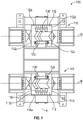
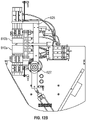
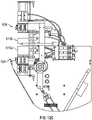
- Figure 1 shows a plan view of an apparatus 100 for separating battery plates according to an embodiment of the invention.
- the apparatus 100 for separating battery plates also referred to as a battery plate separator 100 includes two work stations 110.
- Each work station 110 includes a platform 112 having essentially flat upper surface 114 configured to receive a stack of battery plates 10.
- the battery plates 10 are aligned with upper edges having tabs 12 facing upwards (shown, for example in Figure 4b ) and their lower edges 14 resting on the upper surface 114.
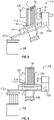
- Each work station 110 is provided with an actuator 120, which is operable to move the platform 112 between an inclined orientation (shown in Figure 3 ) and a substantially horizontal orientation (shown in Figure 3 ).
- the platform 112 is pivotable about an axis provided towards a first side 112a of the platform 112, and an actuator 120 is provided at a second opposite side 112b.
- the second edge 112b of the platform is moved up and down by the actuator 120 as it moves between an extended ( Figure 2 ) and a retracted position ( Figure 3 ).
- a stop 116 is provided on the upper surface 114 towards the side 112b. The stop 116 acts to prevent the stack of battery plates 10 sliding off the surface 114 or moving out of essentially vertical alignment.
- the platform is pivotable about a central axis, and actuator(s) are provided on one or both sides of the central axis. It will be appreciated that any suitable actuating mechanism can be provided which is operable to move the platform.
- Each work station 110 also includes two guides 130, provided above the first and second sides of the platform, the guides 130 having essentially flat vertical inward facing surfaces, which act to guide the stacks of battery plates 10 onto the upper surface 112. It will be appreciated that the separation of the guides 130 can be adjusted as required, depending on the size of stack to be processed, i.e. the number of battery plates within a stack to be separated.
- the guides 130 move inwards when the platform is moved into its horizontal (as shown in Figure 3 ) to provide vertical support to the battery plates during further operation of the apparatus (described in detail below). In an alternative embodiment (not shown), the guides can be fixed during operation of the work station.
- Each work station 110 includes an agitator 140, which is operable to vibrate the platform 112.
- Each work station 110 is provided with a first displacement mechanism 150, a second displacement mechanism 160 and an alignment mechanism 170. In the embodiment shown, these mechanisms are all provided along the axis B on third 112c and fourth 114d sides of the platform 112.
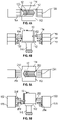
- the first displacement mechanism 150 includes first and second opposing blocks or jaws 152, 153 which are moveable between an operational position ( Figure 4a and 4b ) and retracted position (for example in Figure 5b ).
- the first displacement mechanism 150 includes an actuator 154 for moving the blocks 152, 153.
- the first and second opposing blocks 152, 153 have opposing surfaces, which face the side edges of the battery plates loaded onto the work surface 112.
- the first block 153 has a projecting arrow head profile and the second block 152 has a corresponding concave arrow head shaped profile.
- the second displacement mechanism 160 includes third and fourth opposing blocks or jaws 152, 153 which are provided below first and second blocks (of the first displacement mechanism).
- the first and second blocks which are moveable between an operational position ( Figure 5a and 5b ) and retracted position (for example, Figure 4b ).
- the mechanism 160 includes an actuator 164 for moving the blocks 152, 153.
- the third and fourth opposing blocks 162, 163 have opposing surfaces, which in use face the side edges of the battery plates loaded onto the work surface 112.
- the third block 162 has a concave arrow head shaped profile and the fourth block 162 has a corresponding projecting arrow head profile and.
- the alignment mechanism 170 includes a pair of blocks 172, 173 having opposing flat surfaces, which in use face the side edges of the battery plates in the stack 10.
- the alignment blocks 172, 173 are provided below the second displacement mechanism 160.
- the alignment blocks 172, 173 are moveable between an open position ( Figure 4a ) and a closed position ( Figures 6a and 6b ) in which the blocks are spaced apart by a distance substantially equal to a battery plate width. As the alignment blocks 172, 173 move to the closed position, the battery plates in the stack 10 are pushed into alignment.
- Figures 7 to 8c show a robot 200 which can be used to load the battery plate separator 100 described above.
- the robot 200 is an articulated arm 202 having a lower section 220 and an upper section 230.
- the upper section 230 is rotatably attached to the lower arm 220 at 222.
- the robot 200 is rotatable about a base 210.
- the upper section 230 includes an arm 232 and a head 230 having two grippers 240.
- Each gripper 240 includes a pair of opposed gripping members 242, 244 arranged in a substantially parallel alignment.
- Each gripper 240 includes an actuator 246 for displacing an inner gripper member 242 towards an opposing, outer gripper member 244.
- the inner gripping member 242 is moveable between a closed orientation, in which the gripping members securely hold a stack of battery plates 10, and an open orientation. The separation of the gripping members in the closed orientation can be programmed as necessary depending on the size of stack to be processed.
- Each gripper member comprises a pair of spaced jaws (not shown in figures).
- Figure 9 shows an apparatus 1 for manufacturing battery plates, including the plate separator 100, the robot 200, a pallet 300, a conveyor apparatus 400 and a further processing station 500.
- the pallet 300 includes a base 310 having a ribbed upper surface.
- the ribbed upper surface is formed by parallel cross beams 312 extending across a width or length.
- the cross beams 312 each have a width x are spaced apart by a distance y.
- the dimensions x and y are determined by the size and number of the robot gripper member, so that in use one gripping member (of an opposing pair) can be inserted into the grove/space under a stack and the pair of gripping members closed to pick the stack from the pallet.
- the ribbed surface is formed by parallel grooves formed in a solid surface.
- stacks of battery plates 10 are loaded onto the pallet 300 following the curing process.
- Figure 9 two rows of battery plate stacks 10 are shown loaded on the pallet.
- the stacks 10 are positioned so as to be aligned with the cross beams 312 such that the gripper mechanisms can be inserted into the grooves or spaces under each stack, allowing the gripper jaws to close around the stack.
- the conveyor apparatus 400 includes two conveyor belts 410 provided side by side, which extend in a generally horizontal plane.
- the belts 410 carry stacks of battery plates to a further processing station 500, which could be for example an enveloping machine.
- the conveyor apparatus 400 includes at least one cut out (not shown) under the upper section of the belt at a loading position. The cut out(s) have dimensions corresponding to the jaw(s) of the robot gripper mechanism to allow the robot to place the separated stacks of battery plates onto the conveyor belt.
- the robot 200 rotates about its base 210 to a position adjacent to the pallet 300.
- the upper section 230 rotates about the point 222 to align one of the gripper mechanisms with a stack 10 on the pallet 300.
- the robot moves into position, the gripper mechanism 240 closes around the first stack 10 and removes the stack from the pallet.
- the upper section rotates 180 degrees and the arm moves to align the other gripper mechanism 240 with a second stack 10 on the pallet 300.
- the robot 200 Once the robot 200 has picked up the second stack 10 (as shown in Figure 8a ), it rotates about its base 210 to a position adjacent to the battery plate separator 100.
- each gripper 240 is positioned above the platform 112 of a work station (shown in Figure 8b ).
- the platform 112 of the work station 100 is in its inclined position and the stops 130 are open.
- the gripper mechanism 240 opens, thereby releasing the stack which drops down onto the work surface 114.
- reference 10 1 shows the stack falling.
- the plates within the stack fall essentially vertically until they impact on the work surface (shown by reference 10 2 ). Since the work surface 114 is inclined, the battery places move downwards by different amounts with the plate closest to the stop 116 moving furthest ( Figure 8b and Figure 2 ). This means that the battery plates displace vertically with respect to their adjacent plate(s). This shearing action breaks some or all of the bonds created between plates during curing and separates the plates.
- the platform 112 is then moved to its horizontal position (shown in Figure 3 and 8c ) and the stops 130 are moved inwards.
- the agitator 140 operates to vibrate the platform 112.
- the first displacement mechanism 150 is operated.
- the first and second blocks 153, 152 move to their operational position to displace the battery plates in the stack relative to each other in a first, essentially horizontal or lateral direction ( Figures 4a and 4b ); and are then retracted.
- the second displacement mechanism 160 is operated operates to displace the plates relative to each other in an opposite lateral direction ( Figures 4a and 4b ).
- the alignment mechanism 170 operates to push the battery plates back into alignment to form a neat stack.
- the robot 200 may drop both stacks of battery places simultaneously onto respective platforms 112, or the robot 200 may drop the stacks sequentially.
- the work stations may operate simultaneously, or independently.
- the robot 200 picks up the two stacks. It rotates about its base to a third position adjacent to the conveyor apparatus 400 and places a stack on each conveyor belt 410.
- the feed mechanism could be a single robot having one gripper mechanism or multiple robots (for example two) each having a single gripper mechanism.
- a feed mechanism could be provided for moving the stacks from the pallet to the battery plate separator, and a different transfer mechanism could be provided for moving the stacks from the battery plate separator to the next work station.
Landscapes
- Engineering & Computer Science (AREA)
- Manufacturing & Machinery (AREA)
- Chemical & Material Sciences (AREA)
- Chemical Kinetics & Catalysis (AREA)
- Electrochemistry (AREA)
- General Chemical & Material Sciences (AREA)
- Mechanical Engineering (AREA)
- Secondary Cells (AREA)
Abstract
Description
- The present invention relates to an apparatus for manufacturing battery components and a method of manufacture for battery components.
- The term "battery" is used herein to include accumulators. In a conventional lead-acid battery it is customary to connect together the plates of each stack by means of a lead strap or post which is fixed to aligned lugs or tabs on the plates.
- In the manufacture of batteries, particularly for example lead acid batteries, battery plates are manufactured by known methods, formed into stacks or groups and then dried or cured. As a result of the drying or curing process, adjacent plates in the stacks (groups) may become stuck or bonded together.
- Following plate production and curing, each individual plate is encased in an envelope or wrapper before the plates are placed in the battery casing. Alternatively, a separator layer may be placed between adjacent plates. In the case of enveloping, this is generally an automated process, carried out in an enveloping machine which takes individual plates one at time from a stack and places each one in an envelope or wrapper. If adjacent plates are stuck or bonded together it can be difficult or impossible for the enveloping machine to pick up a single plate.
- To overcome this problem, an operator has to manually separate the plates prior to loading the plate stack in the post processing apparatus, for example prior to loading onto a conveyor for onward transport to the enveloping machine. The operator must first pick up each battery plate stack and drop it onto a conveyor belt, or other work surface, so that the lower edges of the plates impact the work surface. This impact breaks some of the bonds. The operator then manually manipulates the stack of so that the plates move relative to each other which further separates adjacent plates. The operator must then form the plates into a neatly aligned stack for further processing.
- The manual plate separation or plate breaking is physically demanding work for the operator because each stack of plates can weigh in excess of 8Kg. Medium to long term working in such a role can lead to repetitive stress injuries.
- Further, the lead plates are coated in lead oxide paste, and each time that the plates are manipulated, particularly when they are impacted on a work surface, particles of lead oxide dust are released into the air. Naturally operators working in such an environment are generally provided with suitable Personal Protective Equipment such as masks and eye protection. However, there is still an inherent risk to health and safety working in such an environment.
- Embodiments of the invention seek to provide apparatus which overcome some of these problems.
- According to a first aspect of the present invention there is provided an apparatus for separating battery plates comprising:
- a work surface for receiving a stack of battery plates, the work surface being moveable between
- ∘ a first position in which it is angled with respect to a horizontal plane; and
- ∘ a second position in which it is substantially aligned with the horizontal plane such that in use, when the work surface moves between the first and second position adjacent battery plates of the stack are displaced relative to each other; and
- an alignment mechanism for aligning the battery plates on the work surface.
- In use, a stack of battery plates is positioned above the work surface, and aligned with lower edges of the plates facing the work surface. Then the stack is placed or dropped so that the lower edges of the plates impact the inclined work surface and adjacent battery plates are vertically displaced relative to each other.
- The work surface may be pivotable about an axis extending parallel to one side edge of the work surface. The work surface may be pivotable about an axis provided towards one side of the work surface. The work surface may be pivotable about an axis extending through a centre of the work surface.
- The apparatus may be provided with at least one actuator for moving the work surface between the first and second positions. The actuator may be a hydraulic actuator. The actuator may be provided below the work surface.
- The apparatus may be provided with two work surfaces. Each work surface may be provided with a respective alignment mechanism.
- The apparatus may be configured such that the first and second work surfaces are moved into horizontal alignment simultaneously or sequentially.
- The apparatus may be configured such that the alignment mechanisms operate simultaneously or sequentially.
- The or each work surface may be provided with a displacement mechanism for laterally displacing the plates of the stack relative to each other.
- The displacement mechanism may displace the plates substantially horizontally.
- The or each displacement mechanism may include two opposing blocks provided on or above the or each work surface. The blocks may be moveable between a retracted position and an operational position, such that in use in the operational position the blocks contact the side edges of the battery plates.
- The two opposing blocks may act as jaws. The blocks may be provided above the work surface, such that in use, when they are in their retracted position they are located to each side of stack on the work surface.
- Alternatively, the or each displacement mechanism may include one moveable block, and one stationary block.
- The blocks may be provided at opposite sides of the work surface, such that in use, the blocks are facing the side edges of the battery plates.
- Opposing surfaces of the blocks may have corresponding profiles. The profiles may be non-perpendicular to the block movement direction, such that as the blocks move to their operational position the opposing surfaces cause each battery plate to move substantially horizontally by a different amount to its adjacent plate(s).
- A first block may have a convex profile, and the opposing block may have a corresponding convex profile. The blocks may have arrow-shaped profiles. The blocks may have curved or saw-tooth profiles. The blocks may have planar profiles extending at an angle with respect to the movement direction. The blocks may be provided with any suitable profiles which when moved into the operational position can contact the side edges of the battery plates and cause each battery plate to move substantially horizontally by a different amount to its adjacent plate(s).
- The or each alignment mechanism may be provided on or above the or each work surface. The alignment mechanism may be moveable between an open position and a closed position, in which in use, it contacts the sides of the battery plates and moves them into an aligned stack. The alignment mechanism may move the battery plates into a neatly aligned stack, so that the stack can be moved on to a subsequent manufacturing station or apparatus.
- The alignment mechanism may include a pair of blocks having opposing flat surfaces, which in use face the side edges of the battery plates.
- The alignment blocks may be provided above or below the displacement mechanism. In the closed position, the alignment blocks may be spaced apart by a distance substantially equal to a battery plate width. The alignment mechanism may comprise two moveable alignment blocks, which move towards each other to the closed position. Alternatively, the alignment mechanism may include a stationary alignment block, and a moveable alignment block.
- The or each work surface may be provided with an agitator for vibrating a stack of plates on the work surface.
- The agitator may vibrate the work surface when it is in its second position. The agitator may be a vibration mechanism provided on or associated with the work surface, for vibrating the work surface.
- The or each work surface may be provided with a second displacement mechanism for displacing the plates of the stack relative to each other in a direction opposite to the displacement caused by the first displacement mechanism.
- The second displacement mechanism may comprise two opposing blocks (or jaws) provided on or above the or each work surface, the blocks being moveable between a retracted position and an operational position, such that in use in the operational position the blocks contact the side edges of the battery plates
- A first block may have a convex profile, and the opposing block may have a corresponding convex profile. The blocks may have arrow-shaped profiles. The blocks may have curved or saw-tooth profiles. The blocks may have planar profiles extending at an angle with respect to the movement direction. The blocks may be provided with any suitable profiles which when moved into the operational position can contact the side edges of the battery plates and cause each battery plate to move substantially horizontally by a different amount to its adjacent plate(s).
- According to a further aspect of the present invention, there is provided a method of separating battery plates comprising
- (a) dropping at least one stack of battery plates onto an inclined work surface;
- (b) moving the work surface to a substantially horizontal orientation; and
- (c) operating an alignment mechanism to align the plates of the at least one stack.
- In step (a) the at least one stack of battery plates is oriented with the bases (lower edges) of the plates facing downwards, so that the bases of the plates impact on the inclined work surface as the stack is dropped and adjacent battery plates are displaced relative to each other.
- The method may also including after step (b), a step (b1) operating a displacement mechanism to laterally displace the plates of the at least one stack relative to each other.
- Step (b1) may include displacing the plates in a substantially horizontal direction, such that each battery plate moves substantially horizontally by a different amount to its adjacent plate(s).
- The plates may be displaced in a horizontal direction by moving a pair of blocks having opposing surfaces from a retracted position into an operational position.
- Step (b) may further include vibrating the work surface.
- Step (b) may include vibrating or agitating the work surface when it is in its substantially horizontal orientation.
- According to a further aspect of the present invention, there is provided an apparatus for separating battery plates comprising:
- a work surface for receiving a stack of battery plates;
- a first displacement mechanism configured to shear the plates of the stack relative to each other in a first direction; and
- an alignment mechanism for aligning the battery plates in a stack.
- The first displacement mechanism may shear the plates substantially vertically.
- The apparatus may also comprise a second displacement mechanism configured to shear the plates of a stack relative to each other in a second direction.
- The second displacement mechanism may be configured to displace the plates in a direction which is substantially perpendicular to the first direction.
- The first displacement mechanism may shear the plates substantially vertically. The second displacement mechanism may shear the plates substantially horizontally.
- The first displacement mechanism may displace the plates in a substantially horizontal direction, such that each battery plate moves horizontally by a different amount to its adjacent plate(s displacing the plates in a substantially horizontal direction, such that each battery plate moves horizontally by a different amount to its adjacent plate(s)
- The first displacement mechanism may comprise a mechanism for moving the work surface between
- a first position in which it is angled with respect to a horizontal plane; and
- a second position in which it is substantially aligned with the horizontal plane.
- In use, the movement of the work surface between the first and second positions displaces the plates vertically with respect to each other.
- The apparatus may include a third displacement mechanism.
- The third displacement mechanism may in use displace the plates substantially horizontally, in a direction opposite to that caused by the second displacement mechanism.
- According to a further aspect of the present invention, there is provided an apparatus for processing battery plates comprising:
- an automatic feed mechanism for transferring an individual stack of battery plates from a supply of battery plates:
- a battery plate separator apparatus for receiving the stack of battery plates, the apparatus including:
- ∘ a work surface for receiving in use at least one stack of battery plates, and
- ∘ a displacement mechanism for separating the battery plates within the or each stack of plates; and
- a supply mechanism for transferring a separated stack of plates for subsequent processing.
- The battery plate separator apparatus may further comprise an alignment mechanism for aligning the battery plates neatly in a stack.
- The supply mechanism may be a conveyor belt for moving stacks of plates to a further processing apparatus, for example a plate enveloping apparatus.
- The feed mechanism may transfer the stacks of plates from the plate separator apparatus to the supply mechanism after separation.
- The feed mechanism may comprise at least one robot.
- The robot may include at least one gripper mechanism configured to pick up a stack of battery plates. The robot arm may include two gripper mechanisms, each configured to pick up a stack of battery plates. The robot may pick up two stacks simultaneously. The robot arm may pick up a first stack.
- The robot may be provided with a sensor for detecting the presence or position of a stack of plates for processing. The sensor may be an optical sensor or a vision system.
- The apparatus for processing battery plates may include a battery plate separator apparatus as described above. The apparatus may include two battery plate separator apparatuses. The feed mechanism may be configured to simultaneously move two stacks of battery plates.
- The supply of plates may be provided on a pallet containing a plurality of stacks and the sensor identifies at least one datum point on the pallet.
- The sensor may identify an edge or corner of the pallet. The sensor may use the datum point to determine alignment and/or position of the stack or stacks of plates on the pallet.
- According to a further aspect of the present invention, there is provided a method of separating battery plates comprising:
- (a) moving at least one stack of battery plates with an automated feed mechanism from a supply station to a battery plate separator apparatus;
- (b) operating the battery plate separator apparatus to displace the plates of the at least one stack of battery plates relative to each other, thereby separating adjacent battery plates;
- (c) aligning the stack of battery plates;
- (d) moving the at least one stack of battery plates with an automated transfer mechanism from the battery plate separator apparatus to an end station for further processing.
- The automated feed mechanism of step (a) may also act as the automated transfer mechanism of step (d).
- The battery plate separator apparatus may include some or all of the features as described above.
- Step (a) may include dropping the least one stack of battery plates onto a work surface on the battery separator apparatus. Step (a) may comprise moving two stacks of battery plates. Step (a) may comprise moving the feed mechanism, for example a robot, to a first position to pick up a first stack of battery plates, then moving the arm to a second position to pick up a second stack. Alternatively, the feed mechanism, for example a robot, may pick up two stacks simultaneously.
- The at least one stack of batter plates may be received on an inclined work surface of the battery plate separator apparatus. Step (b) may include operating the battery plate separator to move the work surface to a substantially horizontal orientation, thereby displacing the battery plates vertically relative to each other.
- Following the vertical displacement, step (b) may include displacing the plates of the at least one stack of battery plates relative to each other in a generally horizontal direction.
- Step (b) may include displacing the battery plates in a substantially horizontal direction. Step (b) may further include displacing the plates in an opposite horizontal direction.
- According to a further aspect of the present invention, there is provided a robot head arrangement for transferring stacks of battery plates, the head comprising a plurality of grippers, each gripper comprising a pair of opposed gripping members arranged in a substantially parallel alignment and an actuator for displacing at least one of the gripper members towards the opposing member.
- The robot head may comprise a pair of grippers arranged on opposing sides of the head. The grippers may be controlled by independent actuators.
- According to a further aspect of the present invention, there is provided a pallet for the supply of battery plates, the pallet comprising at least one surface for receiving a plurality of stacks of battery plates, wherein the surface of the pallet is provided with a ribbed profile.
- The ribs may help with pre alignment of the battery plates.
- The ribs may extend substantially parallel to one of the sides of the pallet. The ribs may be defined by a plurality of parallel square profiled grooves. The ribs may comprise a plurality of equally spaced bars extending across a length or width of the pallet.
- According to a further aspect of the present invention, there is provided a pallet for the supply of stacks of battery plates with an apparatus as described above, the pallet comprising a surface including at least one indicator for the alignment of the or each stack of plates The ribs may allow, allow the gripper members to be positioned relative to the stack so as to pick the stack from the pallet and may be used as datum points by the automated transfer member. The pallet may have a ribbed upper surface. The ribbed upper surface may include with parallel grooves which aid alignment and also aid pick up. The pallet may have predesignated positions for stacks marked. The pre-designated positions could be different for different types/sizes of plat. The pallet may have at least one datum, for example a corner post.
- Whilst the invention has been described above, it extends to any inventive combination of features set out above or in the following description or drawings.
- Specific embodiments of the invention will now be described in detail by way of example only and with reference to the accompanying drawings in which:
-
Figure 1 is a schematic representation of a plan view of an apparatus for separating battery plates according to an embodiment of the invention; -
Figure 2 is a schematic cross-sectional view, taken through line A, of a work station of the apparatus ofFigure 1 , with the platform in an inclined position; -
Figure 3 is a schematic cross-sectional view, taken through line A, of a work station of the apparatus ofFigure 1 , with the platform in a substantially horizontal position; -
Figure 4a is schematic plan view of a work station of the apparatus ofFigure 1 with a first displacement mechanism in its operational position, andFigure 4b is a schematic cross-sectional view throughFigure 4a ; -
Figure 5a is schematic plan view of a work station of the apparatus ofFigure 1 with a second displacement mechanism in its operational position, andFigure 5b is a schematic cross-sectional view throughFigure 4a ; -
Figure 6 is schematic plan view of a work station of the apparatus ofFigure 1 with a first displacement mechanism in its closed position, andFigure 6b is a schematic cross-sectional view throughFigure 4a ;; -
Figure 7 is a plan view of a feed mechanism according to an embodiment of the invention; -
Figures 8a, 8b and8c are schematic side views of the feed mechanism ofFigure 7 in operational positions; and -
Figure 9 is a schematic plan view of an apparatus for manufacturing battery plates according to an embodiment of the invention. -
Figure 1 shows a plan view of anapparatus 100 for separating battery plates according to an embodiment of the invention. - The
apparatus 100 for separating battery plates, also referred to as abattery plate separator 100 includes twowork stations 110. Eachwork station 110 includes aplatform 112 having essentially flatupper surface 114 configured to receive a stack ofbattery plates 10. In use, thebattery plates 10 are aligned with upperedges having tabs 12 facing upwards (shown, for example inFigure 4b ) and theirlower edges 14 resting on theupper surface 114. - Each
work station 110 is provided with anactuator 120, which is operable to move theplatform 112 between an inclined orientation (shown inFigure 3 ) and a substantially horizontal orientation (shown inFigure 3 ). In the embodiment shown, theplatform 112 is pivotable about an axis provided towards afirst side 112a of theplatform 112, and anactuator 120 is provided at a secondopposite side 112b. Thesecond edge 112b of the platform is moved up and down by theactuator 120 as it moves between an extended (Figure 2 ) and a retracted position (Figure 3 ). Astop 116 is provided on theupper surface 114 towards theside 112b. Thestop 116 acts to prevent the stack ofbattery plates 10 sliding off thesurface 114 or moving out of essentially vertical alignment. - In other embodiments (not show), the platform is pivotable about a central axis, and actuator(s) are provided on one or both sides of the central axis. It will be appreciated that any suitable actuating mechanism can be provided which is operable to move the platform.
- Each
work station 110 also includes twoguides 130, provided above the first and second sides of the platform, theguides 130 having essentially flat vertical inward facing surfaces, which act to guide the stacks ofbattery plates 10 onto theupper surface 112. It will be appreciated that the separation of theguides 130 can be adjusted as required, depending on the size of stack to be processed, i.e. the number of battery plates within a stack to be separated. Theguides 130 move inwards when the platform is moved into its horizontal (as shown inFigure 3 ) to provide vertical support to the battery plates during further operation of the apparatus (described in detail below). In an alternative embodiment (not shown), the guides can be fixed during operation of the work station. - Each
work station 110 includes anagitator 140, which is operable to vibrate theplatform 112. - Each
work station 110 is provided with afirst displacement mechanism 150, asecond displacement mechanism 160 and analignment mechanism 170. In the embodiment shown, these mechanisms are all provided along the axis B on third 112c and fourth 114d sides of theplatform 112. - As can be seen in
Figure 4a , thefirst displacement mechanism 150 includes first and second opposing blocks orjaws Figure 4a and 4b ) and retracted position (for example inFigure 5b ). Thefirst displacement mechanism 150 includes anactuator 154 for moving theblocks blocks work surface 112. Thefirst block 153 has a projecting arrow head profile and thesecond block 152 has a corresponding concave arrow head shaped profile. - As can be seen in
Figure 5a , thesecond displacement mechanism 160 includes third and fourth opposing blocks orjaws Figure 5a and 5b ) and retracted position (for example,Figure 4b ). Themechanism 160 includes an actuator 164 for moving theblocks work surface 112. The third block 162 has a concave arrow head shaped profile and the fourth block 162 has a corresponding projecting arrow head profile and. - As can be seen in
Figure 6a , thealignment mechanism 170 includes a pair ofblocks stack 10. The alignment blocks 172, 173 are provided below thesecond displacement mechanism 160. The alignment blocks 172, 173 are moveable between an open position (Figure 4a ) and a closed position (Figures 6a and 6b ) in which the blocks are spaced apart by a distance substantially equal to a battery plate width. As the alignment blocks 172, 173 move to the closed position, the battery plates in thestack 10 are pushed into alignment. -
Figures 7 to 8c show arobot 200 which can be used to load thebattery plate separator 100 described above. - The
robot 200 is an articulatedarm 202 having alower section 220 and anupper section 230. Theupper section 230 is rotatably attached to thelower arm 220 at 222. Therobot 200 is rotatable about abase 210. - The
upper section 230 includes an arm 232 and ahead 230 having twogrippers 240. Eachgripper 240 includes a pair of opposed grippingmembers gripper 240 includes anactuator 246 for displacing aninner gripper member 242 towards an opposing,outer gripper member 244. The innergripping member 242 is moveable between a closed orientation, in which the gripping members securely hold a stack ofbattery plates 10, and an open orientation. The separation of the gripping members in the closed orientation can be programmed as necessary depending on the size of stack to be processed. Each gripper member comprises a pair of spaced jaws (not shown in figures). -
Figure 9 shows anapparatus 1 for manufacturing battery plates, including theplate separator 100, therobot 200, apallet 300, aconveyor apparatus 400 and afurther processing station 500. - In the embodiment shown, the
pallet 300 includes a base 310 having a ribbed upper surface. In this embodiment the ribbed upper surface is formed by parallel cross beams 312 extending across a width or length. The cross beams 312 each have a width x are spaced apart by a distance y. The dimensions x and y are determined by the size and number of the robot gripper member, so that in use one gripping member (of an opposing pair) can be inserted into the grove/space under a stack and the pair of gripping members closed to pick the stack from the pallet. - In an alternative embodiment of a pallet (not shown), the ribbed surface is formed by parallel grooves formed in a solid surface.
- In use, stacks of
battery plates 10 are loaded onto thepallet 300 following the curing process. InFigure 9 , two rows of battery plate stacks 10 are shown loaded on the pallet. Thestacks 10 are positioned so as to be aligned with the cross beams 312 such that the gripper mechanisms can be inserted into the grooves or spaces under each stack, allowing the gripper jaws to close around the stack. - In the embodiment the pallet has a generally square form. However, it will be appreciated any suitable shape of pallet can be used, since the robot can be programmed as necessary using the datum points (corner posts and/or ribbed upper surface) to pick up the loaded stacks The
conveyor apparatus 400 includes twoconveyor belts 410 provided side by side, which extend in a generally horizontal plane. Thebelts 410 carry stacks of battery plates to afurther processing station 500, which could be for example an enveloping machine. Theconveyor apparatus 400 includes at least one cut out (not shown) under the upper section of the belt at a loading position. The cut out(s) have dimensions corresponding to the jaw(s) of the robot gripper mechanism to allow the robot to place the separated stacks of battery plates onto the conveyor belt. - In use the
robot 200 rotates about itsbase 210 to a position adjacent to thepallet 300. Theupper section 230 rotates about thepoint 222 to align one of the gripper mechanisms with astack 10 on thepallet 300. The robot moves into position, thegripper mechanism 240 closes around thefirst stack 10 and removes the stack from the pallet. The upper section rotates 180 degrees and the arm moves to align theother gripper mechanism 240 with asecond stack 10 on thepallet 300. Once therobot 200 has picked up the second stack 10 (as shown inFigure 8a ), it rotates about itsbase 210 to a position adjacent to thebattery plate separator 100. - The
robot 200 moves to position, such that eachgripper 240 is positioned above theplatform 112 of a work station (shown inFigure 8b ). At this stage, theplatform 112 of thework station 100 is in its inclined position and thestops 130 are open. Thegripper mechanism 240 opens, thereby releasing the stack which drops down onto thework surface 114. InFigure 8b ,reference 101 shows the stack falling. The plates within the stack fall essentially vertically until they impact on the work surface (shown by reference 102). Since thework surface 114 is inclined, the battery places move downwards by different amounts with the plate closest to thestop 116 moving furthest (Figure 8b andFigure 2 ). This means that the battery plates displace vertically with respect to their adjacent plate(s). This shearing action breaks some or all of the bonds created between plates during curing and separates the plates. - The
platform 112 is then moved to its horizontal position (shown inFigure 3 and8c ) and thestops 130 are moved inwards. Theagitator 140 operates to vibrate theplatform 112. - Once the
platform 112 is in its horizontal position, thefirst displacement mechanism 150 is operated. The first andsecond blocks Figures 4a and 4b ); and are then retracted. Then thesecond displacement mechanism 160 is operated operates to displace the plates relative to each other in an opposite lateral direction (Figures 4a and 4b ). Finally, thealignment mechanism 170 operates to push the battery plates back into alignment to form a neat stack. - With regard to the two work stations, it will be appreciated that the
robot 200 may drop both stacks of battery places simultaneously ontorespective platforms 112, or therobot 200 may drop the stacks sequentially. The work stations may operate simultaneously, or independently. - As shown in
figure 8c , once stacks of aligned, separated battery plates (shown by reference 103) have been formed on thework stations 112, therobot 200 picks up the two stacks. It rotates about its base to a third position adjacent to theconveyor apparatus 400 and places a stack on eachconveyor belt 410. - Whilst a robot with two gripper mechanisms has been described, it will be appreciated that alternative feed arrangements can be provided for use with the battery plate separator. For example the feed mechanism could be a single robot having one gripper mechanism or multiple robots (for example two) each having a single gripper mechanism. Alternatively, a feed mechanism could be provided for moving the stacks from the pallet to the battery plate separator, and a different transfer mechanism could be provided for moving the stacks from the battery plate separator to the next work station.
- While the invention has been described above with reference to one or more preferred embodiments, it will be appreciated that various changes or modifications may be made without departing from the scope of the invention as defined in the appended claims.
- Also disclosed herein are the following clauses:
- 1. An apparatus for separating battery plates comprising:
- a work surface for receiving a stack of battery plates, the work surface being moveable between
- ∘ a first position in which it is angled with respect to a horizontal plane; and
- ∘ a second position in which it is substantially aligned with the horizontal plane such that in use, when the work surface moves between the first and second position adjacent battery plates of the stack are displaced relative to each other; and
- an alignment mechanism for aligning the battery plates on the work surface.
- a work surface for receiving a stack of battery plates, the work surface being moveable between
- 2. An apparatus according to
clause 1, wherein the apparatus further comprises a loading mechanism. - 3. An apparatus according to clause 2, the loading mechanism comprises an arm coupled to the work surface, and which is pivotable around an axis between a substantially horizontal and a substantially vertical position.
- 4. An apparatus according to clause 3, wherein in the substantially vertical position, two opposing blocks move from a retracted position to an operational position to clamp the stack of battery plates.
- 5. An apparatus according to any preceding clause, wherein the apparatus is provided with two work surfaces, each work surface being provided with a respective alignment mechanism.
- 6. An apparatus according to any preceding clause, wherein the or each work surface is provided with a displacement mechanism for laterally displacing the plates of the stack relative to each other.
- 7. An apparatus according to clause 6, wherein the or each displacement mechanism includes two opposing blocks provided on or above the or each work surface, the blocks being moveable between a retracted position and an operational position, such that in use in the operational position the blocks contact the side edges of the battery plates.
- 8. An apparatus according to clause 6 or clause 7, wherein the blocks are provided at opposite sides of the work surface, such that in use, the blocks are facing the side edges of the battery plates.
- 9. An apparatus according to any of clauses 6 to 8, wherein opposing surfaces of the blocks have corresponding profiles, the profiles being non-perpendicular to the block movement direction, such that as the blocks move to their operational position the opposing surfaces cause each battery plate to move substantially horizontally by a different amount to its adjacent plate(s).
- 10. An apparatus according to any of the previous clauses, wherein the or each alignment mechanism is provided on or above the or each work surface,
the alignment mechanism being moveable between an open position and a closed position, in which in use, it contacts the sides of the battery plates and moves them into an aligned stack. - 11. An apparatus according to
clause 10, wherein the alignment mechanism includes a pair of blocks having opposing flat surfaces, which in use face the side edges of the battery plates. - 12. An apparatus according to any of the previous clauses, wherein the or each work surface is provided with an agitator for vibrating a stack of plates on the work surface.
- 13. An apparatus according to any of clauses 6 to 12, wherein the or each work surface is provided with a second displacement mechanism for displacing the plates of the stack relative to each other in a direction opposite to the displacement caused by the first displacement mechanism.
- 14. An apparatus according to clause 13, wherein the or each work surface is provided with a splitting mechanism for laterally breaking the separated stack of battery plates into a plurality of stacks.
- 15. An apparatus according to
clause 14, wherein the splitting mechanism comprises a vertical rod moveable between a stored position below the top of the work surface, and a splitting position where the rod breaks the stack of plates into two. - 16. A method of separating battery plates comprising
- (a) dropping at least one stack of battery plates onto an inclined work surface;
- (b) moving the work surface to a substantially horizontal orientation; and
- (c) operating an alignment mechanism to align the plates of the at least one stack.
- 17. A method according to clause 16, further including after step (b)
(b1) operating a displacement mechanism to laterally displace the plates of the at least one stack relative to each other. - 18. A method according to
clause 17, wherein step (b1) includes displacing the plates in a substantially horizontal direction, such that each battery plate moves substantially horizontally by a different amount to its adjacent plate(s). - 19. A method according to any of clauses 16 to 18, wherein step (b) further includes vibrating the work surface.
- 20. A method according to any of clauses 16 to 19, wherein the method further comprises step (d) splitting the at least one stack of battery plates into a plurality of stacks.
- 21. An apparatus for separating battery plates comprising:
- a work surface for receiving a stack of battery plates;
- a first displacement mechanism configured to shear the plates of the stack relative to each other in a first direction; and
- an alignment mechanism for aligning the battery plates in a stack.
- 22. An apparatus according to clause 21, further comprising a second displacement mechanism configured to shear the plates of a stack relative to each other in a second direction.
- 23. An apparatus according to clause 22, wherein the second displacement mechanism is configured to displace the plates in a direction which is substantially perpendicular to the first direction.
- 24. An apparatus according to clauses 22 or 23, wherein the first displacement mechanism shears the plates substantially vertically, and the second displacement mechanism shears the plates substantially horizontally.
- 25. An apparatus according to any of clauses 21 to 23, wherein the first displacement mechanism comprises a mechanism for moving the work surface between
- a first position in which it is angled with respect to a horizontal plane; and
- a second position in which it is substantially aligned with the horizontal plane.
- 26. An apparatus according to any of clauses 21 to 25 including a third displacement mechanism.
- 27. An apparatus according to any of clauses 21 to 26, wherein the apparatus further includes a splitting mechanism, and wherein the splitting mechanism in use laterally breaks the stack of battery plates into a plurality of stacks.
- 28. An apparatus for processing battery plates comprising:
- an automatic feed mechanism for transferring an individual stack of battery plates from a supply of battery plates;
- a battery plate separator apparatus for receiving the stack of battery plates, the apparatus including:
- ∘ a work surface for receiving in use at least one stack of battery plates, and
- ∘ a displacement mechanism for separating the battery plates within the or each stack of plates; and
- a supply mechanism for transferring a separated stack of plates for subsequent processing.
- 29. An apparatus according to clause 28, wherein the feed mechanism transfers the stacks of plates from the plate separator apparatus to the supply mechanism after separation.
- 30. An apparatus for processing battery plates according to clause 28 or clause 29, wherein the feed mechanism comprises a robot.
- 31. An apparatus for processing battery plates according to clause 29, wherein the robot is provided with a sensor for detecting the presence or position of a stack of plates for processing.
- 32. An apparatus for processing battery plates according to any of clauses 28 to 31, wherein the battery plate separator apparatus comprises an apparatus as according to any of
clauses 1 to 15 or 21 to 27. - 33. An apparatus for processing battery plates according to any of clauses 24 to 32, wherein two battery plate separator apparatuses are provided; and
wherein the feed mechanism is configured to simultaneously move two stacks of battery plates. - 34. An apparatus for processing battery plates according to clause 33, wherein the supply of plates are provided on a pallet containing a plurality of stacks and the sensor identifies at least one datum point on the pallet.
- 35. A method of separating battery plates comprising:
- (a) moving at least one stack of battery plates with an automated feed mechanism from a supply station to a battery plate separator apparatus;
- (b) operating the battery plate separator apparatus to displace the plates of the at least one stack of battery plates relative to each other, thereby separating adjacent battery plates;
- (c) aligning the stack of battery plates;
- (d) moving the at least one stack of battery plates with an automated transfer mechanism from the battery plate separator apparatus to an end station for further processing.
- 36. A method according to clause 35, wherein step (a) includes pivoting an arm from a substantially vertical position to the substantially horizontal position.
- 37. A method according to clause 35 or clause 36, wherein step (a) includes dropping the least one stack of battery plates onto a work surface on the battery separator apparatus.
- 38. A method according to any of clauses 35 to 37, wherein the at least one stack of battery plates is received on an inclined work surface of the battery plate separator apparatus, and
step (b) includes operating the battery plate separator to move the work surface to a substantially horizontal orientation, thereby displacing the battery plates vertically relative to each other. - 39. A method according to any of clauses 35 to 38, wherein step (b) includes displacing the battery plates in a substantially horizontal direction.
- 40. A method according to any of clauses 35 to 39, wherein the method further includes step (c1) splitting the stack of battery plates into a plurality of stacks if the dimensions of the stack are found to exceed set specified values.
- 41. A method according to any of clauses 35 to 40, wherein step (d) include pivoting an arm from the substantially horizontal position to the substantially vertical position to remove the one or more stacks from the battery plate separator apparatus for further processing.
- 42. A robot head arrangement for transferring stacks of battery plates, the head comprising a plurality of grippers, each gripper comprising a pair of opposed gripping members arranged in a substantially parallel alignment and an actuator for displacing at least one of the gripper members towards the opposing member.
- 43. A robot head arrangement according to clause 42, wherein the robot head comprises a pair of grippers arranged on opposing sides of the head.
- 44. A pallet for the supply of battery plates, the pallet comprising at least one surface for receiving a plurality of stacks of battery plates, wherein the surface of the pallet is provided with a ribbed profile.
- 45. A pallet according to clause 44, wherein the ribs extend substantially parallel to one of the sides of the pallet.
- 46. A pallet for the supply of stacks of battery plates with an apparatus according to any of clauses 24 to 34, the pallet comprising a surface including at least one indicator for the alignment of the or each stack of plates
- 47. A system for separating battery plates, the system comprising:
- a pallet for the supply of battery plates;
- a battery plate separator apparatus for receiving the stack of battery plates;
- a robot, having a head arrangement for transferring stacks of battery plates; and
- a supply mechanism for transferring a separated stack of plates for subsequent processing.
Claims (15)
- An apparatus for separating battery plates comprising:- a work surface for receiving a stack of battery plates;- a first displacement mechanism configured to shear the plates of the stack relative to each other in a first direction; and- an alignment mechanism for aligning the battery plates in a stack.
- An apparatus according to claim 1, further comprising a second displacement mechanism configured to shear the plates of a stack relative to each other in a second direction; optionally wherein the second displacement mechanism is configured to displace the plates in a direction which is substantially perpendicular to the first direction.
- An apparatus according to claim 2, wherein the first displacement mechanism shears the plates substantially vertically, and the second displacement mechanism shears the plates substantially horizontally.
- An apparatus according to claim 1 or 2, wherein the work surface comprises a mechanism for moving the work surface between- a first position in which it is angled with respect to a horizontal plane; and- a second position in which it is substantially aligned with the horizontal plane.
- An apparatus according to claim 2 or 3, including a third displacement mechanism.
- An apparatus for processing battery plates comprising:- an automatic feed mechanism for transferring an individual stack of battery plates from a supply of battery plates;- a battery plate separator apparatus for receiving the stack of battery plates, the apparatus including:∘ a work surface for receiving in use at least one stack of battery plates, and∘ a displacement mechanism for separating the battery plates within the or each stack of plates; and- a supply mechanism for transferring a separated stack of plates for subsequent processing;- optionally, wherein the battery plate separator apparatus comprises an apparatus as claimed in any of claims 1 to 5.
- An apparatus according to claim 6, wherein the feed mechanism transfers the stacks of plates from the plate separator apparatus to the supply mechanism after separation; optionally wherein the feed mechanism comprises a robot.
- An apparatus for processing battery plates according to claim 7, wherein the robot is provided with a sensor for detecting the presence or position of a stack of plates for processing.
- An apparatus for processing battery plates according to any of claims 6 to 8,wherein the first displacement mechanism shears the plates substantially vertically, and the second displacement mechanism shears the plates substantially horizontallywherein two battery plate separator apparatuses are provided; andwherein the feed mechanism is configured to simultaneously move two stacks of battery plates;optionally wherein the supply of plates are provided on a pallet containing a plurality of stacks and the sensor identifies at least one datum point on the pallet.
- A method of separating battery plates comprising:(a) moving at least one stack of battery plates with an automated feed mechanism from a supply station to a battery plate separator apparatus;(b) operating the battery plate separator apparatus to displace the plates of the at least one stack of battery plates relative to each other, thereby separating adjacent battery plates;(c) aligning the stack of battery plates;(d) moving the at least one stack of battery plates with an automated transfer mechanism from the battery plate separator apparatus to an end station for further processing;optionally wherein step (a) includes dropping the least one stack of battery plates onto a work surface on the battery separator apparatus.
- A method according to claim 10, wherein the at least one stack of battery plates is received on an inclined work surface of the battery plate separator apparatus, and
step (b) includes operating the battery plate separator to move the work surface to a substantially horizontal orientation, thereby displacing the battery plates vertically relative to each other. - A method according to claim 10 or 11, wherein step (b) includes displacing the battery plates in a substantially horizontal direction.
- A robot head arrangement for transferring stacks of battery plates, the head comprising a plurality of grippers, each gripper comprising a pair of opposed gripping members arranged in a substantially parallel alignment and an actuator for displacing at least one of the gripper members towards the opposing member; optionally wherein the robot head comprises a pair of grippers arranged on opposing sides of the head.
- A pallet for the supply of battery plates, the pallet comprising at least one surface for receiving a plurality of stacks of battery plates, wherein the surface of the pallet is provided with a ribbed profile; optionally wherein the ribs extend substantially parallel to one of the sides of the pallet.
- A pallet for the supply of stacks of battery plates with an apparatus as claimed in any of claims 3 or 5 to 9, the pallet comprising a surface including at least one indicator for the alignment of the or each stack of plates.
Applications Claiming Priority (3)
| Application Number | Priority Date | Filing Date | Title |
|---|---|---|---|
| GB1521536.1A GB2545180B (en) | 2015-12-07 | 2015-12-07 | Apparatus for the manufacture of battery components |
| PCT/GB2016/053852 WO2017098240A1 (en) | 2015-12-07 | 2016-12-07 | Apparatus for the manufacture of battery components |
| EP16813124.1A EP3387694B1 (en) | 2015-12-07 | 2016-12-07 | Battery plate separator apparatus and method of separating battery plates |
Related Parent Applications (1)
| Application Number | Title | Priority Date | Filing Date |
|---|---|---|---|
| EP16813124.1A Division EP3387694B1 (en) | 2015-12-07 | 2016-12-07 | Battery plate separator apparatus and method of separating battery plates |
Publications (2)
| Publication Number | Publication Date |
|---|---|
| EP4009409A2 true EP4009409A2 (en) | 2022-06-08 |
| EP4009409A3 EP4009409A3 (en) | 2022-09-14 |
Family
ID=55234513
Family Applications (2)
| Application Number | Title | Priority Date | Filing Date |
|---|---|---|---|
| EP16813124.1A Active EP3387694B1 (en) | 2015-12-07 | 2016-12-07 | Battery plate separator apparatus and method of separating battery plates |
| EP22151891.3A Withdrawn EP4009409A3 (en) | 2015-12-07 | 2016-12-07 | Apparatus for the manufacture of battery components |
Family Applications Before (1)
| Application Number | Title | Priority Date | Filing Date |
|---|---|---|---|
| EP16813124.1A Active EP3387694B1 (en) | 2015-12-07 | 2016-12-07 | Battery plate separator apparatus and method of separating battery plates |
Country Status (7)
| Country | Link |
|---|---|
| US (2) | US10826105B2 (en) |
| EP (2) | EP3387694B1 (en) |
| ES (1) | ES2908329T3 (en) |
| GB (1) | GB2545180B (en) |
| PL (1) | PL3387694T3 (en) |
| TW (1) | TW201721934A (en) |
| WO (1) | WO2017098240A1 (en) |
Families Citing this family (13)
| Publication number | Priority date | Publication date | Assignee | Title |
|---|---|---|---|---|
| CN107283164A (en) * | 2017-08-04 | 2017-10-24 | 广东利元亨智能装备有限公司 | A kind of power battery assembling equipment |
| WO2019204686A1 (en) | 2018-04-19 | 2019-10-24 | The Research Foundation For The State University Of New York | Solderless circuit connector |
| GB2577119A (en) * | 2018-09-14 | 2020-03-18 | Tbs Eng Ltd | Battery plate loading mechanism |
| CN110481980B (en) * | 2019-08-09 | 2024-08-13 | 苏州富强科技有限公司 | Plug-in type baffle positioner |
| CN110436172B (en) * | 2019-08-09 | 2024-08-02 | 苏州富强科技有限公司 | Jacking type material taking-out device |
| EP3960669A1 (en) * | 2020-08-28 | 2022-03-02 | G.J. Hollestelle Beheer B.V. | Stack manipulating system and corresponding method |
| CN112259709B (en) * | 2020-10-21 | 2021-07-27 | 骆驼集团(安徽)再生资源有限公司 | Production process of lead-acid storage battery pole plate |
| EP4057408A3 (en) * | 2021-03-09 | 2023-02-22 | SK On Co., Ltd. | Apparatus for manufacturing battery cell |
| CN114300801B (en) * | 2021-12-31 | 2022-08-23 | 东莞哈工自控科技有限公司 | Battery cell packaging device |
| GB2618601A (en) | 2022-05-12 | 2023-11-15 | Tbs Eng Ltd | Battery plate alignment system and method |
| CN116387642B (en) * | 2023-04-23 | 2024-09-10 | 江苏超威电源有限公司 | A high-activity lead-acid battery assembly device |
| WO2024241228A1 (en) * | 2023-05-24 | 2024-11-28 | Cps科技控股有限公司 | Electrode plate loading system |
| AT527322B1 (en) * | 2024-01-25 | 2025-01-15 | Rosendahl Nextrom Gmbh | Method and device for separating battery plates |
Citations (1)
| Publication number | Priority date | Publication date | Assignee | Title |
|---|---|---|---|---|
| EP1018909B1 (en) * | 1997-09-30 | 2006-01-25 | Daramic, LLC | Battery plate feeding and handling apparatus |
Family Cites Families (18)
| Publication number | Priority date | Publication date | Assignee | Title |
|---|---|---|---|---|
| US3052968A (en) * | 1959-12-23 | 1962-09-11 | Electric Storage Battery Co | Battery separator positioning machine |
| US3799321A (en) * | 1972-02-22 | 1974-03-26 | Yuasa Battery Co Ltd | Apparatus for assembling groups of storage battery plates |
| CA1020483A (en) * | 1975-05-29 | 1977-11-08 | Frederick L. Connon | Apparatus for discharge handling of metal sheets |
| DE3049633A1 (en) * | 1979-06-13 | 1982-02-25 | G Byrt | Sheet stacking apparatus |
| US4664581A (en) * | 1984-12-10 | 1987-05-12 | Mechanical Separations, Inc. | Sheet handling and separator apparatus and method |
| US4710089A (en) * | 1986-05-29 | 1987-12-01 | Velten & Pulver, Inc. | Article unstacking system |
| DE3625841A1 (en) * | 1986-07-30 | 1988-02-11 | Gabler Gmbh Maschbau | STACKING DEVICE FOR, IN PARTICULAR MANUFACTURED IN A THERMOFORMING MACHINE, PLASTIC DRAWING PARTS |
| US4824307A (en) * | 1988-02-11 | 1989-04-25 | Tekmax Inc. | Apparatus for vertically stacking battery plates |
| DE3921886A1 (en) * | 1989-07-04 | 1991-01-17 | Wolfgang Mohr | DEVICE FOR CUTTING STACKED, SHEET-SHAPED GOODS |
| JP3094446B2 (en) * | 1990-11-30 | 2000-10-03 | 松下電器産業株式会社 | Stack plate separation apparatus and separation method |
| US5129643A (en) * | 1990-12-17 | 1992-07-14 | Neids, Inc. | Apparatus for stacking pasted battery plates |
| EP0561069B2 (en) | 1992-03-18 | 2000-04-05 | Matsushita Electric Industrial Co., Ltd. | Method of stacking and transferring lead storage battery plates and apparatus. |
| DE59807671D1 (en) * | 1998-12-28 | 2003-04-30 | Mohr Adolf Maschf | Process for the formation and processing of small stacks of sheets |
| JP3862973B2 (en) * | 2001-06-28 | 2006-12-27 | 古河電池株式会社 | Electrode separation and supply device for electrode laminate |
| JP5116281B2 (en) * | 2006-10-27 | 2013-01-09 | 古河電池株式会社 | Separation and alignment apparatus and separation and alignment method for battery electrode plate |
| DE502007004682D1 (en) * | 2007-01-04 | 2010-09-16 | Bm Battery Machines Gmbh | DEVICE FOR THE ASSEMBLY OF PLATFORM OBJECTS |
| DE102010049376A1 (en) * | 2010-10-26 | 2012-04-26 | Heidelberger Druckmaschinen Ag | Apparatus and method for turning stacks of sheet material |
| JP6003812B2 (en) * | 2013-06-06 | 2016-10-05 | トヨタ自動車株式会社 | Manufacturing method of fuel cell |
-
2015
- 2015-12-07 GB GB1521536.1A patent/GB2545180B/en active Active
-
2016
- 2016-12-07 WO PCT/GB2016/053852 patent/WO2017098240A1/en not_active Ceased
- 2016-12-07 EP EP16813124.1A patent/EP3387694B1/en active Active
- 2016-12-07 US US16/060,258 patent/US10826105B2/en active Active
- 2016-12-07 PL PL16813124T patent/PL3387694T3/en unknown
- 2016-12-07 TW TW105140379A patent/TW201721934A/en unknown
- 2016-12-07 EP EP22151891.3A patent/EP4009409A3/en not_active Withdrawn
- 2016-12-07 ES ES16813124T patent/ES2908329T3/en active Active
-
2020
- 2020-06-15 US US16/902,052 patent/US11495823B2/en active Active
Patent Citations (1)
| Publication number | Priority date | Publication date | Assignee | Title |
|---|---|---|---|---|
| EP1018909B1 (en) * | 1997-09-30 | 2006-01-25 | Daramic, LLC | Battery plate feeding and handling apparatus |
Also Published As
| Publication number | Publication date |
|---|---|
| EP3387694B1 (en) | 2022-01-19 |
| US20180366766A1 (en) | 2018-12-20 |
| PL3387694T3 (en) | 2022-05-09 |
| ES2908329T3 (en) | 2022-04-28 |
| EP3387694A1 (en) | 2018-10-17 |
| WO2017098240A1 (en) | 2017-06-15 |
| GB201521536D0 (en) | 2016-01-20 |
| GB2545180B (en) | 2018-08-29 |
| US10826105B2 (en) | 2020-11-03 |
| EP4009409A3 (en) | 2022-09-14 |
| TW201721934A (en) | 2017-06-16 |
| US20200335812A1 (en) | 2020-10-22 |
| US11495823B2 (en) | 2022-11-08 |
| GB2545180A (en) | 2017-06-14 |
Similar Documents
| Publication | Publication Date | Title |
|---|---|---|
| US11495823B2 (en) | Apparatus for the manufacture of battery components | |
| EP3624245B1 (en) | Battery plate loading mechanism | |
| DE102007031117B4 (en) | Device and method for machine handling of trays | |
| US5970834A (en) | Depalletizer and hopper feeder | |
| US20140290453A1 (en) | Discharging Workpieces | |
| US20150311561A1 (en) | Device and method for processing battery plates and arranging them in wet or agm battery cases for cars or trucks | |
| GB2561325B (en) | Apparatus for the manufacture of battery components | |
| US12110196B2 (en) | Stack manipulating system and corresponding method | |
| EP3841232B1 (en) | Stripping of metal from cathodes | |
| EP4276042A1 (en) | Battery plate alignment system and method | |
| EP3723936B1 (en) | Method of and system for handling beam-cut parts by the provision of a gripper | |
| CN109731998B (en) | Processing equipment for bottom plate of circuit breaker | |
| US9802765B2 (en) | Transfer apparatus and method of transferring a plurality of discrete articles | |
| CN219151406U (en) | Automatic material machine of receiving of punching press | |
| CN121536719A (en) | Rice seedling tray clamp | |
| CN121990363A (en) | A PLC-controlled material handling and stacking device | |
| EP1541256B1 (en) | Automatic feeder for electrowelded metal nets | |
| CN120791421A (en) | Copper plate tearing method | |
| JPH0793136B2 (en) | Transfer method of electrode plates for battery storage | |
| DE19543833A1 (en) | Loading and unloading device for fired ceramic articles |
Legal Events
| Date | Code | Title | Description |
|---|---|---|---|
| PUAI | Public reference made under article 153(3) epc to a published international application that has entered the european phase |
Free format text: ORIGINAL CODE: 0009012 |
|
| STAA | Information on the status of an ep patent application or granted ep patent |
Free format text: STATUS: THE APPLICATION HAS BEEN PUBLISHED |
|
| AC | Divisional application: reference to earlier application |
Ref document number: 3387694 Country of ref document: EP Kind code of ref document: P |
|
| AK | Designated contracting states |
Kind code of ref document: A2 Designated state(s): AL AT BE BG CH CY CZ DE DK EE ES FI FR GB GR HR HU IE IS IT LI LT LU LV MC MK MT NL NO PL PT RO RS SE SI SK SM TR |
|
| RIC1 | Information provided on ipc code assigned before grant |
Ipc: H01M 10/14 20060101ALI20220511BHEP Ipc: H01M 4/68 20060101ALI20220511BHEP Ipc: H01M 4/06 20060101ALI20220511BHEP Ipc: B65G 59/00 20060101ALI20220511BHEP Ipc: H01M 10/04 20060101AFI20220511BHEP |
|
| PUAL | Search report despatched |
Free format text: ORIGINAL CODE: 0009013 |
|
| AK | Designated contracting states |
Kind code of ref document: A3 Designated state(s): AL AT BE BG CH CY CZ DE DK EE ES FI FR GB GR HR HU IE IS IT LI LT LU LV MC MK MT NL NO PL PT RO RS SE SI SK SM TR |
|
| RIC1 | Information provided on ipc code assigned before grant |
Ipc: H01M 10/14 20060101ALI20220811BHEP Ipc: H01M 4/68 20060101ALI20220811BHEP Ipc: H01M 4/06 20060101ALI20220811BHEP Ipc: B65G 59/00 20060101ALI20220811BHEP Ipc: H01M 10/04 20060101AFI20220811BHEP |
|
| STAA | Information on the status of an ep patent application or granted ep patent |
Free format text: STATUS: REQUEST FOR EXAMINATION WAS MADE |
|
| 17P | Request for examination filed |
Effective date: 20230221 |
|
| RBV | Designated contracting states (corrected) |
Designated state(s): AL AT BE BG CH CY CZ DE DK EE ES FI FR GB GR HR HU IE IS IT LI LT LU LV MC MK MT NL NO PL PT RO RS SE SI SK SM TR |
|
| STAA | Information on the status of an ep patent application or granted ep patent |
Free format text: STATUS: THE APPLICATION IS DEEMED TO BE WITHDRAWN |
|
| 18D | Application deemed to be withdrawn |
Effective date: 20230701 |