EP4009056B1 - Wireless sensing device - Google Patents
Wireless sensing device Download PDFInfo
- Publication number
- EP4009056B1 EP4009056B1 EP20211013.6A EP20211013A EP4009056B1 EP 4009056 B1 EP4009056 B1 EP 4009056B1 EP 20211013 A EP20211013 A EP 20211013A EP 4009056 B1 EP4009056 B1 EP 4009056B1
- Authority
- EP
- European Patent Office
- Prior art keywords
- core
- strap
- sensing device
- connection mechanism
- sensing
- Prior art date
- Legal status (The legal status is an assumption and is not a legal conclusion. Google has not performed a legal analysis and makes no representation as to the accuracy of the status listed.)
- Active
Links
Images
Classifications
-
- G—PHYSICS
- G01—MEASURING; TESTING
- G01R—MEASURING ELECTRIC VARIABLES; MEASURING MAGNETIC VARIABLES
- G01R31/00—Arrangements for testing electric properties; Arrangements for locating electric faults; Arrangements for electrical testing characterised by what is being tested not provided for elsewhere
-
- G—PHYSICS
- G01—MEASURING; TESTING
- G01R—MEASURING ELECTRIC VARIABLES; MEASURING MAGNETIC VARIABLES
- G01R15/00—Details of measuring arrangements of the types provided for in groups G01R17/00 - G01R29/00, G01R33/00 - G01R33/26 or G01R35/00
- G01R15/14—Adaptations providing voltage or current isolation, e.g. for high-voltage or high-current networks
- G01R15/18—Adaptations providing voltage or current isolation, e.g. for high-voltage or high-current networks using inductive devices, e.g. transformers
-
- G—PHYSICS
- G01—MEASURING; TESTING
- G01R—MEASURING ELECTRIC VARIABLES; MEASURING MAGNETIC VARIABLES
- G01R15/00—Details of measuring arrangements of the types provided for in groups G01R17/00 - G01R29/00, G01R33/00 - G01R33/26 or G01R35/00
- G01R15/14—Adaptations providing voltage or current isolation, e.g. for high-voltage or high-current networks
- G01R15/20—Adaptations providing voltage or current isolation, e.g. for high-voltage or high-current networks using galvano-magnetic devices, e.g. Hall-effect devices, i.e. measuring a magnetic field via the interaction between a current and a magnetic field, e.g. magneto resistive or Hall effect devices
-
- G—PHYSICS
- G01—MEASURING; TESTING
- G01D—MEASURING NOT SPECIALLY ADAPTED FOR A SPECIFIC VARIABLE; ARRANGEMENTS FOR MEASURING TWO OR MORE VARIABLES NOT COVERED IN A SINGLE OTHER SUBCLASS; TARIFF METERING APPARATUS; MEASURING OR TESTING NOT OTHERWISE PROVIDED FOR
- G01D11/00—Component parts of measuring arrangements not specially adapted for a specific variable
- G01D11/30—Supports specially adapted for an instrument; Supports specially adapted for a set of instruments
-
- G—PHYSICS
- G01—MEASURING; TESTING
- G01R—MEASURING ELECTRIC VARIABLES; MEASURING MAGNETIC VARIABLES
- G01R1/00—Details of instruments or arrangements of the types included in groups G01R5/00 - G01R13/00 and G01R31/00
- G01R1/02—General constructional details
- G01R1/18—Screening arrangements against electric or magnetic fields, e.g. against earth's field
-
- G—PHYSICS
- G01—MEASURING; TESTING
- G01R—MEASURING ELECTRIC VARIABLES; MEASURING MAGNETIC VARIABLES
- G01R15/00—Details of measuring arrangements of the types provided for in groups G01R17/00 - G01R29/00, G01R33/00 - G01R33/26 or G01R35/00
- G01R15/14—Adaptations providing voltage or current isolation, e.g. for high-voltage or high-current networks
- G01R15/18—Adaptations providing voltage or current isolation, e.g. for high-voltage or high-current networks using inductive devices, e.g. transformers
- G01R15/183—Adaptations providing voltage or current isolation, e.g. for high-voltage or high-current networks using inductive devices, e.g. transformers using transformers with a magnetic core
-
- G—PHYSICS
- G01—MEASURING; TESTING
- G01R—MEASURING ELECTRIC VARIABLES; MEASURING MAGNETIC VARIABLES
- G01R15/00—Details of measuring arrangements of the types provided for in groups G01R17/00 - G01R29/00, G01R33/00 - G01R33/26 or G01R35/00
- G01R15/14—Adaptations providing voltage or current isolation, e.g. for high-voltage or high-current networks
- G01R15/20—Adaptations providing voltage or current isolation, e.g. for high-voltage or high-current networks using galvano-magnetic devices, e.g. Hall-effect devices, i.e. measuring a magnetic field via the interaction between a current and a magnetic field, e.g. magneto resistive or Hall effect devices
- G01R15/207—Constructional details independent of the type of device used
-
- G—PHYSICS
- G01—MEASURING; TESTING
- G01R—MEASURING ELECTRIC VARIABLES; MEASURING MAGNETIC VARIABLES
- G01R19/00—Arrangements for measuring currents or voltages or for indicating presence or sign thereof
- G01R19/25—Arrangements for measuring currents or voltages or for indicating presence or sign thereof using digital measurement techniques
- G01R19/2513—Arrangements for monitoring electric power systems, e.g. power lines or loads; Logging
-
- G—PHYSICS
- G01—MEASURING; TESTING
- G01R—MEASURING ELECTRIC VARIABLES; MEASURING MAGNETIC VARIABLES
- G01R33/00—Arrangements or instruments for measuring magnetic variables
- G01R33/12—Measuring magnetic properties of articles or specimens of solids or fluids
-
- H—ELECTRICITY
- H02—GENERATION; CONVERSION OR DISTRIBUTION OF ELECTRIC POWER
- H02J—ELECTRIC POWER NETWORKS; CIRCUIT ARRANGEMENTS OR SYSTEMS FOR SUPPLYING OR DISTRIBUTING ELECTRIC POWER; SYSTEMS FOR STORING ELECTRIC ENERGY
- H02J50/00—Circuit arrangements or systems for wireless supply or distribution of electric power
- H02J50/001—Energy harvesting or scavenging
-
- H—ELECTRICITY
- H02—GENERATION; CONVERSION OR DISTRIBUTION OF ELECTRIC POWER
- H02J—ELECTRIC POWER NETWORKS; CIRCUIT ARRANGEMENTS OR SYSTEMS FOR SUPPLYING OR DISTRIBUTING ELECTRIC POWER; SYSTEMS FOR STORING ELECTRIC ENERGY
- H02J13/00—Circuit arrangements for providing remote monitoring or remote control of equipment in a power distribution network
- H02J13/13—Circuit arrangements for providing remote monitoring or remote control of equipment in a power distribution network characterised by the transmission of data to equipment in the power network
- H02J13/1331—Circuit arrangements for providing remote monitoring or remote control of equipment in a power distribution network characterised by the transmission of data to equipment in the power network using wireless data transmission
-
- Y—GENERAL TAGGING OF NEW TECHNOLOGICAL DEVELOPMENTS; GENERAL TAGGING OF CROSS-SECTIONAL TECHNOLOGIES SPANNING OVER SEVERAL SECTIONS OF THE IPC; TECHNICAL SUBJECTS COVERED BY FORMER USPC CROSS-REFERENCE ART COLLECTIONS [XRACs] AND DIGESTS
- Y02—TECHNOLOGIES OR APPLICATIONS FOR MITIGATION OR ADAPTATION AGAINST CLIMATE CHANGE
- Y02E—REDUCTION OF GREENHOUSE GAS [GHG] EMISSIONS, RELATED TO ENERGY GENERATION, TRANSMISSION OR DISTRIBUTION
- Y02E60/00—Enabling technologies; Technologies with a potential or indirect contribution to GHG emissions mitigation
Definitions
- the present disclosure relates to a sensing device for monitoring an electrical component or apparatus.
- Embodiments relate to a sensing system and to a switchgear apparatus.
- Wireless sensing devices can be used for monitoring electrical components or apparatus like switchgear apparatus.
- the sensing devices may for example provide connectivity or enable proactive maintenance. Due to harsh environmental conditions and high costs associated with a maintenance of battery-operated devices, using an energy harvesting solution for powering wireless sensing devices is beneficial.
- energy can be harvested from an alternating magnetic field surrounding an electrical conductor like a busbar. The harvested energy can be used to power the sensing operation and wireless communication of the sensing device.
- Energy harvesting solutions of typical wireless sensing devices are designed for limited ranges of electrical currents and for specific geometrical configurations. In industrial environments including a plurality of different electrical components or apparatus, use of a variety of different sensing devices can be required. Adaptability and installation efficiency of existing sensing devices may be limited.
- Document US 2006/0076838 A1 pertains to a self-powered bus sensor employing wireless communication.
- a sensing device for monitoring an electrical component or apparatus.
- the sensing device is attachable to an electrical conductor and includes a sensor for measuring at least one physical property, a wireless communication unit for transmitting measurement data to a receiver, and an energy harvesting unit configured to harvest energy from a current flowing through the electrical conductor.
- the energy harvesting unit includes an electromagnetic coil wound around a core.
- the sensing device further includes a connection mechanism to make the core connectable to a strap including a material having a high magnetic permeability.
- the sensing device is configured to be operable when no strap is connected to the core and energy is harvested via an open magnetic circuit as well as when a strap is connected to the core and energy is harvested via a closed magnetic circuit.
- a sensing system in embodiments, includes a sensing device according to embodiments described herein and a strap.
- the strap is connectable to the core via the connection mechanism.
- a switchgear apparatus in embodiments, includes a sensing device according to embodiments described herein.
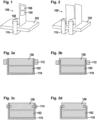
- Fig. 1 is a schematic view of a sensing device according to embodiments of the present disclosure.
- the sensing device 100 is for monitoring an electrical component or apparatus.
- the component or apparatus may be for example a switchgear apparatus, a busbar, a busbar joint, a motor, a generator, a motor drive, or a converter.
- the sensing device is a wireless sensing device. Wireless monitoring of an electrical component or apparatus can be enabled.
- the sensing device 100 is attachable to an electrical conductor 102, particularly a busbar.
- the sensing device may be attachable to the electrical conductor via a double-sided tape, a glue, or a fastening element like a bolt.
- the sensing device 100 includes a sensor 104 for measuring at least one physical property.
- the physical property may be for example a temperature, a humidity, a gas concentration, a concentration of particulates like dust, a vibrational amplitude, or an electrical current, particularly an electrical current flowing through the electrical conductor 102.
- the gas concentration may be a concentration of a gas like for example ozone or CO 2 .
- the sensing device includes a plurality of sensors.
- the sensing device may include for example at least 2, 3 or 4 sensors, particularly different sensors.
- the sensing device 100 includes a wireless communication unit 106 for transmitting measurement data to a receiver.
- a wireless communication unit 106 for transmitting measurement data to a receiver.
- a plurality of sensing devices according to the present disclosure may communicate with a common receiver.
- Comprehensive monitoring of electrical components or apparatus can be provided.
- the sensing device includes an energy harvesting unit configured to harvest energy from a current, particularly an alternating current, flowing through the electrical conductor 102, more particularly by way of the alternating magnetic field surrounding the electrical conductor.
- the energy harvesting unit is configured to harvest energy for powering the sensing device, more particularly for powering the sensor and the wireless communication unit.
- the energy harvesting unit includes an electromagnetic coil wound around a core 108.
- the core 108 includes a material having a high magnetic permeability.
- a high magnetic permeability is particularly to be understood as a relative permeability higher than for example 10, 50, 300, or 1000 at a magnetic field strength H between 1 and 1000 A/m, for example at magnetic field strength of 10 A/m.
- the material's permeability may be understood as an effective permeability, i.e. a permeability of a hypothetical homogeneous material having magnetic characteristic of the composite.
- the core includes a ferrite or a high-permeability material like soft iron.
- the core may include an alloy like for example mu-metal.
- mu-metal is a soft ferromagnetic nickel-iron alloy with a high magnetic permeability.
- the core may include a polymer filled with a material having a high magnetic permeability. In the figures, only the cores of the electromagnetic coils are shown, while the windings have been omitted to enhance clarity.
- the core may have a cylindrical shape, as particularly shown in Fig. 1 , or for example a flattened or rectangular shape.
- the core has a rectangular cross-section in a direction perpendicular to a length direction of the core.
- a length direction of a component is particularly to be understood as a main direction of extension of the component.
- a flattened or particularly a rectangular core can increase an amount of collected magnetic flux, particularly since the electromagnetic coil can be positioned closer to the electrical conductor. An energy harvesting efficiency can be enhanced.
- the sensing device 100 is to be attached to the electrical conductor 102 such that the magnetic axis of the electromagnetic coil wound around the core 108 is perpendicular to the current flow.
- An enclosure of the sensing device may be provided with markings to aid in correct positioning of the device.
- the sensing device 100 includes a connection mechanism to make the core 108 connectable to a strap 110 including, particularly consisting of, a material having a high magnetic permeability.
- a material having a high magnetic permeability is particularly to be understood as described above with respect to the core.
- the strap may be releasably connectable to the core.
- the strap may be a flexible strap.
- a composite material may be used for the strap. The composite material can be used particularly for the purpose of a reduced magnetic reluctance around the electrical conductor, while providing a desired mechanical property, particularly flexibility, to the strap.
- connection mechanism may include contact surfaces provided on the core for making the strap connectable to the core via an adhesive.
- the sensing device is configured to be operable in a first configuration and in a second configuration.
- the sensing device can be limited to high-current applications when no strap is connected to the core.
- a high current is particularly to be understood as a current higher than for example 100, 350, 500, 650, or 2000 A flowing through the electrical conductor.
- the sensing device may have a reduced performance, like for example a reduced sample rate or a reduced accuracy, in the first configuration.
- a strap is connected to the core and energy is harvested via a closed magnetic circuit.
- the strap and the core form a closed loop around the electrical conductor for providing the closed magnetic circuit.
- a closed magnetic circuit has the advantage that the sensing device can have any of the following properties: a faster start, a start with a lower current, or a better performance. The reason is particularly that at a given conductor current, a larger magnetic flux can be channeled through the core. Accordingly, a higher power may be harvested.
- the sensing device may be usable for low-current applications when the strap is connected to the core.
- a low current is particularly to be understood as a current lower than for example 30, 20, 10, or 1 A flowing through the conductor.
- the strap is an optional add-on for the sensing device. Using the strap increases an energy harvesting efficiency. Accordingly, the sensing device can be upgraded easily to provide a substantially improved performance in case it is beneficial for the particular use. For example, the sensing device can be beneficial in an industrial environment where a mixture of low current and high current switchgear apparatus are deployed.
- connection mechanism and the strap are separate and independent from an attachment mechanism for making the sensing device attachable to the electrical conductor.
- the sensing device can be attached to the electrical conductor and used without connecting a strap to the core.
- connection mechanism can provide a low magnetic resistance between the core and the strap in a connected state.
- the low magnetic resistance may be enabled for example by any of a large contact area or a tight connection between the strap and the core.
- An improved energy harvesting efficiency in the connected state can be provided without compromising the often-sufficient energy harvesting efficiency without the strap.
- the connection mechanism of sensing devices according to the present disclosure can provide a mechanically highly stable connection between the core and the strap.
- the strap can be a one-piece component or can include at least two parts.
- the strap may include L- or J-shaped parts.
- the parts may be attachable to each other to provide a closed magnetic circuit in conjunction with the core.
- the parts may be attached to each other for example by at least one fastening element like a bolt.
- Sensing devices may include two or more electromagnetic coils wound around a respective core.
- An example of a sensing device 100 including two electromagnetic coils is shown in Fig. 2 .
- the two electromagnetic coils are wired in series. More particularly, the electromagnetic coils are positioned such that a direction of flux movement is identical for both coils.
- the cores may for example each be connectable to a separate strap, as shown in Fig. 2 , or to a single common strap.
- the remaining features of the sensing device shown in Fig. 2 may be at least substantially identical to the features described above with regard to Fig. 1 .
- Figs. 3a - f are schematic, cross-sectional views of sensing devices according to embodiments of the present disclosure, illustrating examples of how a strap may be connected to the core of the energy harvesting unit.
- connection mechanisms as described herein, an air gap between the strap and the core may be minimized.
- a large overlap area between the strap and the core can be provided.
- a connection having a particularly low magnetic resistance can be achieved.
- the connection mechanism of the sensing device may include a permanent magnet 112 for connecting the strap 110 to the core 108.
- the strap 110 is held between the permanent magnet 112 and the core 108 in a connected state.
- the connection mechanism includes a first permanent magnet for attaching the strap to the core from a first side and a second permanent magnet for attaching the strap to the core from a second side.
- the core 108 may include a recess, as shown for example in Fig. 3b , for providing an offset connection surface.
- the connection surface of the core 108 is to be in contact with the strap 110 in a connected state.
- the connection mechanism includes a bore, particularly a threaded bore, provided in the core 108.
- the bore is for connecting the strap 110 to the core 108 via a fastening element 114, particularly via a bolt.
- the core 108 includes a first bore fore for connecting the strap to the core from a first side and a second bore for connecting the strap to the core from a second side. Connecting the strap via a fastening element can minimize an air gap between the strap and the core.
- the fastening elements may include, particularly consist of, a plastic or a metal.
- the fastening element 114 includes, particularly consist of, a material having a high magnetic permeability.
- a low magnetic resistance between the fastening element and the core can be achieved.
- the fastening element can be in contact with the strap from a second side opposite a side where the strap is in contact with the core. An increased effective contact surface between the strap and the core can be provided. A particularly low magnetic resistance between the strap and the core can be achieved.
- the fastening element or the fastening elements are included in the connection mechanism.
- the connection mechanism includes a recess provided in the core 108.
- the recess may be shaped for snap-in attachment of a strap 110 having a correspondingly shaped end section.
- the end section may have a larger volume than the recess.
- the volume may be for example more than 3 or 6 % larger than the volume of the recess.
- the volume may be for example less than 15 or 10 % larger than the volume of the recess.
- the strap can be insertable into the recess due to the strap's flexibility. In particular, the strap may undergo an elastic deformation on insertion into the recess. An airgap between the strap and the core can be minimized.
- a connection between the strap and the core having a particularly low magnetic resistance can be provided.
- the connection mechanism includes a recess provided in the core 108 for inserting an end of the strap 110.
- a part of the strap to be inserted into the recess may have a larger volume than the recess.
- the volume may be for example more than 3 or 6 % larger than the volume of the recess.
- the volume may be for example less than 15 or 10% larger than the volume of the recess.
- a connection between the strap and the core having a particularly low magnetic resistance can be provided.
- the recess extends along more than for example 10, 20, or 40% of a length of the core.
- the recess may extend along more than 50% of a length of the core 108.
- a large contact area between the strap and the core can be provided.
- a connection having a particularly low magnetic resistance can be achieved.
- connection mechanism includes a through-hole provided in the core.
- the through-hole is for passing the strap 110 through the core 108.
- the through-hole extends along a length direction of the core 108.
- the through-hole may include at least one ridge.
- the through-hole may include at least 3, 5, or 6 ridges.
- the diameter of the through-hole is effectively reduced.
- the strap may be chosen such that a dimension of the strap is larger than a dimension of the through-hole at the position of the at least one ridge. An air gap between the strap and the core can be minimized, particularly at the position of the at least one ridge.
- connection mechanism of sensing devices makes it possible to use straps of different sizes, particularly different lengths, depending on the application.
- the strap can be chosen depending on a perimeter of the electrical conductor or a total perimeter of a set of electrical conductors.
- the strap can be chosen depending on a geometry of the electrical conductor or set of electrical conductors.
- the strap may be chosen so as to fit on a set including 2, 3, or more busbars running in parallel.
- sensing devices according to the present disclosure can be used on electrical conductors or electrical conductor assemblies having varying geometrical configurations.
- sensing devices are attached to three busbars running in parallel.
- a strap 110 is connected to the core 108 via permanent magnets 112.
- the strap may also be connected to the core via any of the mechanisms described above with regard to Figs. 3a - 3f .
- Cores 108 of varying lengths can be used.
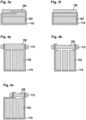
- the core 108 can span the full width of the three busbars 102, as shown in Figs. 4a and 4b , or can be substantially shorter, as shown in Fig. 4c .
- the difference can be compensated by using a strap 110 having an appropriate length to provide a closed magnetic circuit.
- the core 108 can be a bobbin, particularly a bobbin including two flanges.
- the present disclosure further relates to a sensing system.
- the sensing system includes a sensing device according embodiments of the present disclosure.
- the sensing system further includes a strap including a material having a high magnetic permeability as described herein.
- the strap is connectable to the core of the energy harvesting unit via the connection mechanism.
- the strap includes any of ferrite or a metal composite.
- the present disclosure further relates to a switchgear apparatus.
- the switchgear apparatus includes a sensing device as described herein.
- the sensing device is attached to a busbar of the switchgear apparatus.
- the present disclosure further relates to a method of monitoring an electrical component or apparatus.
- the method includes attaching a sensing device as described herein to an electrical conductor of the electrical component or apparatus.
Landscapes
- Physics & Mathematics (AREA)
- General Physics & Mathematics (AREA)
- Engineering & Computer Science (AREA)
- Power Engineering (AREA)
- Computer Networks & Wireless Communication (AREA)
- Condensed Matter Physics & Semiconductors (AREA)
- Measuring Instrument Details And Bridges, And Automatic Balancing Devices (AREA)
Description
- The present disclosure relates to a sensing device for monitoring an electrical component or apparatus. Embodiments relate to a sensing system and to a switchgear apparatus.
- Wireless sensing devices can be used for monitoring electrical components or apparatus like switchgear apparatus. The sensing devices may for example provide connectivity or enable proactive maintenance. Due to harsh environmental conditions and high costs associated with a maintenance of battery-operated devices, using an energy harvesting solution for powering wireless sensing devices is beneficial. In particular, energy can be harvested from an alternating magnetic field surrounding an electrical conductor like a busbar. The harvested energy can be used to power the sensing operation and wireless communication of the sensing device. Energy harvesting solutions of typical wireless sensing devices are designed for limited ranges of electrical currents and for specific geometrical configurations. In industrial environments including a plurality of different electrical components or apparatus, use of a variety of different sensing devices can be required. Adaptability and installation efficiency of existing sensing devices may be limited.
- With respect to the prior art reference is made to document
US 2006/0076838 A1 . DocumentUS 2006/0076838 A1 pertains to a self-powered bus sensor employing wireless communication. - It is therefore an object of the present disclosure to overcome at least some of the above-mentioned problems in the prior art at least partially.
- In view of the above, a sensing device for monitoring an electrical component or apparatus is provided. The sensing device is attachable to an electrical conductor and includes a sensor for measuring at least one physical property, a wireless communication unit for transmitting measurement data to a receiver, and an energy harvesting unit configured to harvest energy from a current flowing through the electrical conductor. The energy harvesting unit includes an electromagnetic coil wound around a core. The sensing device further includes a connection mechanism to make the core connectable to a strap including a material having a high magnetic permeability. The sensing device is configured to be operable when no strap is connected to the core and energy is harvested via an open magnetic circuit as well as when a strap is connected to the core and energy is harvested via a closed magnetic circuit.
- In embodiments, a sensing system is provided. The sensing system includes a sensing device according to embodiments described herein and a strap. The strap is connectable to the core via the connection mechanism.
- In embodiments, a switchgear apparatus is provided. The switchgear apparatus includes a sensing device according to embodiments described herein.
- Further advantages, features, aspects and details that can be combined with embodiments described herein are evident from the dependent claims, claim combinations, the description and the drawings.
- The details will be described in the following with reference to the figures, wherein
- Fig. 1
- is a schematic view of a sensing device according to embodiments of the present disclosure;
- Fig. 2
- is a schematic view of a sensing device according to embodiments of the present disclosure;
- Figs. 3a-f
- are schematic, cross-sectional views of sensing devices according to embodiments of the present disclosure; and
- Figs. 4a - c
- are schematic cross-sectional views of sensing devices according to embodiments of the present disclosure.
- Reference will now be made in detail to the various embodiments, one or more examples of which are illustrated in each figure. Each example is provided by way of explanation and is not meant as a limitation. For example, features illustrated or described as part of one embodiment can be used on or in conjunction with any other embodiment to yield yet a further embodiment. It is intended that the present disclosure includes such modifications and variations.
- Within the following description of the drawings, the same reference numbers refer to the same or to similar components. Generally, only the differences with respect to the individual embodiments are described. Unless specified otherwise, the description of a part or aspect in one embodiment can be applied to a corresponding part or aspect in another embodiment as well.
-
Fig. 1 is a schematic view of a sensing device according to embodiments of the present disclosure. Thesensing device 100 is for monitoring an electrical component or apparatus. The component or apparatus may be for example a switchgear apparatus, a busbar, a busbar joint, a motor, a generator, a motor drive, or a converter. In particular, the sensing device is a wireless sensing device. Wireless monitoring of an electrical component or apparatus can be enabled. - The
sensing device 100 is attachable to anelectrical conductor 102, particularly a busbar. For example, the sensing device may be attachable to the electrical conductor via a double-sided tape, a glue, or a fastening element like a bolt. - The
sensing device 100 includes asensor 104 for measuring at least one physical property. The physical property may be for example a temperature, a humidity, a gas concentration, a concentration of particulates like dust, a vibrational amplitude, or an electrical current, particularly an electrical current flowing through theelectrical conductor 102. The gas concentration may be a concentration of a gas like for example ozone or CO2. In embodiments, the sensing device includes a plurality of sensors. The sensing device may include for example at least 2, 3 or 4 sensors, particularly different sensors. - The
sensing device 100 includes awireless communication unit 106 for transmitting measurement data to a receiver. For example, a plurality of sensing devices according to the present disclosure may communicate with a common receiver. Comprehensive monitoring of electrical components or apparatus can be provided. - The sensing device includes an energy harvesting unit configured to harvest energy from a current, particularly an alternating current, flowing through the
electrical conductor 102, more particularly by way of the alternating magnetic field surrounding the electrical conductor. In particular, the energy harvesting unit is configured to harvest energy for powering the sensing device, more particularly for powering the sensor and the wireless communication unit. - The energy harvesting unit includes an electromagnetic coil wound around a
core 108. In particular, thecore 108 includes a material having a high magnetic permeability. In the context of the present disclosure, a high magnetic permeability is particularly to be understood as a relative permeability higher than for example 10, 50, 300, or 1000 at a magnetic field strength H between 1 and 1000 A/m, for example at magnetic field strength of 10 A/m. More particularly, if the material is a composite, the material's permeability may be understood as an effective permeability, i.e. a permeability of a hypothetical homogeneous material having magnetic characteristic of the composite. - In embodiments, the core includes a ferrite or a high-permeability material like soft iron. The core may include an alloy like for example mu-metal. In particular, mu-metal is a soft ferromagnetic nickel-iron alloy with a high magnetic permeability. The core may include a polymer filled with a material having a high magnetic permeability. In the figures, only the cores of the electromagnetic coils are shown, while the windings have been omitted to enhance clarity.
- The core may have a cylindrical shape, as particularly shown in
Fig. 1 , or for example a flattened or rectangular shape. In embodiments, the core has a rectangular cross-section in a direction perpendicular to a length direction of the core. In the context of the present disclosure, a length direction of a component is particularly to be understood as a main direction of extension of the component. A flattened or particularly a rectangular core can increase an amount of collected magnetic flux, particularly since the electromagnetic coil can be positioned closer to the electrical conductor. An energy harvesting efficiency can be enhanced. - For operation, the
sensing device 100 is to be attached to theelectrical conductor 102 such that the magnetic axis of the electromagnetic coil wound around thecore 108 is perpendicular to the current flow. An enclosure of the sensing device may be provided with markings to aid in correct positioning of the device. - The
sensing device 100 includes a connection mechanism to make thecore 108 connectable to astrap 110 including, particularly consisting of, a material having a high magnetic permeability. A material having a high magnetic permeability is particularly to be understood as described above with respect to the core. The strap may be releasably connectable to the core. The strap may be a flexible strap. A composite material may be used for the strap. The composite material can be used particularly for the purpose of a reduced magnetic reluctance around the electrical conductor, while providing a desired mechanical property, particularly flexibility, to the strap. - Various examples of possible connection mechanisms according to the present disclosure are illustrated in
Figs. 3a - f and described in detail below. Additionally or alternatively, the connection mechanism may include contact surfaces provided on the core for making the strap connectable to the core via an adhesive. - The sensing device is configured to be operable in a first configuration and in a second configuration. In the first configuration, no strap is connected to the core and energy is harvested via an open magnetic circuit. In particular, the sensing device can be limited to high-current applications when no strap is connected to the core. A high current is particularly to be understood as a current higher than for example 100, 350, 500, 650, or 2000 A flowing through the electrical conductor. When the current flowing through the electrical conductor is low, the sensing device may have a reduced performance, like for example a reduced sample rate or a reduced accuracy, in the first configuration.
- In the second configuration, a strap is connected to the core and energy is harvested via a closed magnetic circuit. In particular, the strap and the core form a closed loop around the electrical conductor for providing the closed magnetic circuit. A closed magnetic circuit has the advantage that the sensing device can have any of the following properties: a faster start, a start with a lower current, or a better performance. The reason is particularly that at a given conductor current, a larger magnetic flux can be channeled through the core. Accordingly, a higher power may be harvested. The sensing device may be usable for low-current applications when the strap is connected to the core. A low current is particularly to be understood as a current lower than for example 30, 20, 10, or 1 A flowing through the conductor.
- The strap is an optional add-on for the sensing device. Using the strap increases an energy harvesting efficiency. Accordingly, the sensing device can be upgraded easily to provide a substantially improved performance in case it is beneficial for the particular use. For example, the sensing device can be beneficial in an industrial environment where a mixture of low current and high current switchgear apparatus are deployed.
- In particular, the connection mechanism and the strap are separate and independent from an attachment mechanism for making the sensing device attachable to the electrical conductor.
- More particularly, the sensing device can be attached to the electrical conductor and used without connecting a strap to the core.
- The connection mechanism can provide a low magnetic resistance between the core and the strap in a connected state. The low magnetic resistance may be enabled for example by any of a large contact area or a tight connection between the strap and the core. An improved energy harvesting efficiency in the connected state can be provided without compromising the often-sufficient energy harvesting efficiency without the strap. The connection mechanism of sensing devices according to the present disclosure can provide a mechanically highly stable connection between the core and the strap.
- The strap can be a one-piece component or can include at least two parts. For example, the strap may include L- or J-shaped parts. The parts may be attachable to each other to provide a closed magnetic circuit in conjunction with the core. The parts may be attached to each other for example by at least one fastening element like a bolt.
- Sensing devices according to the present disclosure may include two or more electromagnetic coils wound around a respective core. An example of a
sensing device 100 including two electromagnetic coils is shown inFig. 2 . In particular, the two electromagnetic coils are wired in series. More particularly, the electromagnetic coils are positioned such that a direction of flux movement is identical for both coils. The cores may for example each be connectable to a separate strap, as shown inFig. 2 , or to a single common strap. The remaining features of the sensing device shown inFig. 2 may be at least substantially identical to the features described above with regard toFig. 1 . -
Figs. 3a - f are schematic, cross-sectional views of sensing devices according to embodiments of the present disclosure, illustrating examples of how a strap may be connected to the core of the energy harvesting unit. With connection mechanisms as described herein, an air gap between the strap and the core may be minimized. In embodiments, a large overlap area between the strap and the core can be provided. A connection having a particularly low magnetic resistance can be achieved. - In embodiments, for example as shown in
Fig. 3a , the connection mechanism of the sensing device may include apermanent magnet 112 for connecting thestrap 110 to thecore 108. In particular, thestrap 110 is held between thepermanent magnet 112 and thecore 108 in a connected state. More particularly, the connection mechanism includes a first permanent magnet for attaching the strap to the core from a first side and a second permanent magnet for attaching the strap to the core from a second side. Thecore 108 may include a recess, as shown for example inFig. 3b , for providing an offset connection surface. In particular, the connection surface of thecore 108 is to be in contact with thestrap 110 in a connected state. - In embodiments, for example as shown in
Fig. 3c , the connection mechanism includes a bore, particularly a threaded bore, provided in thecore 108. The bore is for connecting thestrap 110 to thecore 108 via afastening element 114, particularly via a bolt. In particular, thecore 108 includes a first bore fore for connecting the strap to the core from a first side and a second bore for connecting the strap to the core from a second side. Connecting the strap via a fastening element can minimize an air gap between the strap and the core. The fastening elements may include, particularly consist of, a plastic or a metal. - In embodiments, the
fastening element 114 includes, particularly consist of, a material having a high magnetic permeability. When the fastening element is screwed into the bore, a low magnetic resistance between the fastening element and the core can be achieved. The fastening element can be in contact with the strap from a second side opposite a side where the strap is in contact with the core. An increased effective contact surface between the strap and the core can be provided. A particularly low magnetic resistance between the strap and the core can be achieved. In embodiments, the fastening element or the fastening elements are included in the connection mechanism. - In embodiments, for example as shown in
Fig. 3d , the connection mechanism includes a recess provided in thecore 108. The recess may be shaped for snap-in attachment of astrap 110 having a correspondingly shaped end section. The end section may have a larger volume than the recess. The volume may be for example more than 3 or 6 % larger than the volume of the recess. The volume may be for example less than 15 or 10 % larger than the volume of the recess. The strap can be insertable into the recess due to the strap's flexibility. In particular, the strap may undergo an elastic deformation on insertion into the recess. An airgap between the strap and the core can be minimized. A connection between the strap and the core having a particularly low magnetic resistance can be provided. - In embodiments, for example as shown in
Fig. 3e , the connection mechanism includes a recess provided in thecore 108 for inserting an end of thestrap 110. A part of the strap to be inserted into the recess may have a larger volume than the recess. The volume may be for example more than 3 or 6 % larger than the volume of the recess. The volume may be for example less than 15 or 10% larger than the volume of the recess. Similarly as described above with regard toFig. 3d , a connection between the strap and the core having a particularly low magnetic resistance can be provided. - In embodiments, the recess extends along more than for example 10, 20, or 40% of a length of the core. For example as shown in
Fig. 3e , the recess may extend along more than 50% of a length of thecore 108. A large contact area between the strap and the core can be provided. A connection having a particularly low magnetic resistance can be achieved. - In embodiments, for example as shown in
Fig. 3f , the connection mechanism includes a through-hole provided in the core. The through-hole is for passing thestrap 110 through thecore 108. In particular, the through-hole extends along a length direction of thecore 108. - The through-hole may include at least one ridge. For example, the through-hole may include at least 3, 5, or 6 ridges. At the at least one ridge, the diameter of the through-hole is effectively reduced. In particular, the strap may be chosen such that a dimension of the strap is larger than a dimension of the through-hole at the position of the at least one ridge. An air gap between the strap and the core can be minimized, particularly at the position of the at least one ridge.
- The connection mechanism of sensing devices according to the present disclosure makes it possible to use straps of different sizes, particularly different lengths, depending on the application. In particular, the strap can be chosen depending on a perimeter of the electrical conductor or a total perimeter of a set of electrical conductors. Generally, the strap can be chosen depending on a geometry of the electrical conductor or set of electrical conductors. For example, the strap may be chosen so as to fit on a set including 2, 3, or more busbars running in parallel. Accordingly, sensing devices according to the present disclosure can be used on electrical conductors or electrical conductor assemblies having varying geometrical configurations.
- In the examples depicted in
Figs. 4a - c , sensing devices according to the present disclosure are attached to three busbars running in parallel. In the examples, astrap 110 is connected to thecore 108 viapermanent magnets 112. However, the strap may also be connected to the core via any of the mechanisms described above with regard toFigs. 3a - 3f .Cores 108 of varying lengths can be used. For example, thecore 108 can span the full width of the threebusbars 102, as shown inFigs. 4a and 4b , or can be substantially shorter, as shown inFig. 4c . - The difference can be compensated by using a
strap 110 having an appropriate length to provide a closed magnetic circuit. As shown inFigs. 4b and 4c , thecore 108 can be a bobbin, particularly a bobbin including two flanges. - The present disclosure further relates to a sensing system. The sensing system includes a sensing device according embodiments of the present disclosure. The sensing system further includes a strap including a material having a high magnetic permeability as described herein. The strap is connectable to the core of the energy harvesting unit via the connection mechanism. In embodiments, the strap includes any of ferrite or a metal composite.
- The present disclosure further relates to a switchgear apparatus. The switchgear apparatus includes a sensing device as described herein. In embodiments, the sensing device is attached to a busbar of the switchgear apparatus.
- The present disclosure further relates to a method of monitoring an electrical component or apparatus. The method includes attaching a sensing device as described herein to an electrical conductor of the electrical component or apparatus.
Claims (14)
- Sensing device (100) for monitoring an electrical component or apparatus, the sensing device being attachable to an electrical conductor (102) and comprising:a sensor (104) for measuring at least one physical property;a wireless communication unit (106) for transmitting measurement data to a receiver;an energy harvesting unit configured to harvest energy from a current flowing through the electrical conductor and comprising an electromagnetic coil wound around a core (108); anda connection mechanism to make the core connectable to a strap (110) comprising a material having a high magnetic permeability, characterized inthe sensing device (100) being configured to be operable when no strap (110) is connected to the core and energy is harvested via an open magnetic circuit, as well as when a strap is connected to the core and energy is harvested via a closed magnetic circuit.
- Sensing device (100) according to claim 1, wherein the connection mechanism comprises a permanent magnet (112) for attaching the strap (110) to the core.
- Sensing device (100) according to any of the preceding claims, wherein the connection mechanism comprises a bore provided in the core for connecting the strap (110) to the core via a fastening element (114).
- Sensing device (100) according to any of the preceding claims, wherein the connection mechanism comprises a recess provided in the core for inserting an end of the strap (110).
- Sensing device (100) according to claim 4, wherein the recess extends along more than 10% of a length of the core.
- Sensing device (100) according to claim 4, wherein the recess is shaped for snap-in attachment of a strap (110) having a correspondingly shaped end section.
- Sensing device (100) according to any of the preceding claims, wherein the connection mechanism comprises a through-hole provided in the core for passing the strap (110) through the core and wherein the through-hole extends along a length direction of the core.
- Sensing device (100) according to any of the preceding claims, wherein the core has a rectangular cross-section in a direction perpendicular to a length direction of the core.
- Sensing device (100) according to any of the preceding claims, wherein the physical property is a temperature, a humidity, a gas concentration, a vibrational amplitude, or an electrical current.
- Sensing system, comprising a sensing device (100) according to any of the preceding claims and a strap (110), wherein the strap (110) is connectable to the core via the connection mechanism.
- Sensing system according to claim 10, wherein the strap (110) has a relative permeability higher than 10 at a magnetic field strength between 1 and 1000 A/m.
- Switchgear apparatus, comprising a sensing device (100) according to any of claims 1 to 9.
- Switchgear apparatus according to claim 12, wherein the sensing device (100) is attached to a busbar of the switchgear apparatus.
- Method of monitoring an electrical component or apparatus, the method comprising: attaching a sensing device (100) according to any of claims 1 to 9 to an electrical conductor of the electrical component or apparatus.
Priority Applications (4)
| Application Number | Priority Date | Filing Date | Title |
|---|---|---|---|
| PL20211013.6T PL4009056T3 (en) | 2020-12-01 | 2020-12-01 | Wireless sensing device |
| EP20211013.6A EP4009056B1 (en) | 2020-12-01 | 2020-12-01 | Wireless sensing device |
| CN202111430249.2A CN114578149A (en) | 2020-12-01 | 2021-11-29 | Wireless sensing device |
| US17/539,908 US11953525B2 (en) | 2020-12-01 | 2021-12-01 | Wireless sensing device |
Applications Claiming Priority (1)
| Application Number | Priority Date | Filing Date | Title |
|---|---|---|---|
| EP20211013.6A EP4009056B1 (en) | 2020-12-01 | 2020-12-01 | Wireless sensing device |
Publications (2)
| Publication Number | Publication Date |
|---|---|
| EP4009056A1 EP4009056A1 (en) | 2022-06-08 |
| EP4009056B1 true EP4009056B1 (en) | 2024-08-28 |
Family
ID=73694727
Family Applications (1)
| Application Number | Title | Priority Date | Filing Date |
|---|---|---|---|
| EP20211013.6A Active EP4009056B1 (en) | 2020-12-01 | 2020-12-01 | Wireless sensing device |
Country Status (4)
| Country | Link |
|---|---|
| US (1) | US11953525B2 (en) |
| EP (1) | EP4009056B1 (en) |
| CN (1) | CN114578149A (en) |
| PL (1) | PL4009056T3 (en) |
Families Citing this family (3)
| Publication number | Priority date | Publication date | Assignee | Title |
|---|---|---|---|---|
| DE202019100449U1 (en) * | 2019-01-25 | 2020-04-30 | Wago Verwaltungsgesellschaft Mbh | Bracket device, control cabinet and readout device |
| EP4692735A1 (en) | 2024-08-09 | 2026-02-11 | Abb Schweiz Ag | Sensor module and measuring device |
| EP4692734A1 (en) | 2024-08-09 | 2026-02-11 | Abb Schweiz Ag | Energy harvesting sensor as well as method of measuring physical quantity with an energy harvesting sensor |
Family Cites Families (15)
| Publication number | Priority date | Publication date | Assignee | Title |
|---|---|---|---|---|
| US4754218A (en) * | 1985-02-21 | 1988-06-28 | Soft Wire Ltd. | Current sensing apparatus |
| US6642704B2 (en) * | 2001-09-28 | 2003-11-04 | Eaton Corporation | Device for sensing electrical current and housing therefor |
| US6731105B1 (en) * | 2002-09-03 | 2004-05-04 | Lockheed Martin Corporation | Current sensor with correction for transverse installation misalignment |
| US7145322B2 (en) * | 2004-10-12 | 2006-12-05 | Eaton Corporation | Self-powered power bus sensor employing wireless communication |
| JP2008101914A (en) * | 2006-10-17 | 2008-05-01 | Fuji Electric Systems Co Ltd | Current sensor and electronic energy meter |
| US7909508B2 (en) * | 2007-12-04 | 2011-03-22 | Eaton Corporation | Sensor assembly for a power bus |
| CN103250060A (en) * | 2010-08-10 | 2013-08-14 | 库柏技术公司 | Apparatus and method for mounting an overhead device |
| US9088209B2 (en) * | 2011-05-17 | 2015-07-21 | Eaton Corporation | Parasitic power supply and sensor apparatus including a power supply |
| JP2013122400A (en) * | 2011-12-09 | 2013-06-20 | Aisin Seiki Co Ltd | Current sensor |
| CN102638090A (en) * | 2012-04-16 | 2012-08-15 | 江苏大学 | Temperature measurement wireless node power supply capable of collecting AC (alternating current)-bus surrounding magnetic field energy |
| KR101517609B1 (en) * | 2013-09-17 | 2015-05-07 | 한국과학기술원 | Wireless Electric Power Supply Apparatus |
| US9217762B2 (en) * | 2014-02-07 | 2015-12-22 | Smart Wires Inc. | Detection of geomagnetically-induced currents with power line-mounted devices |
| US20160225520A1 (en) * | 2015-02-02 | 2016-08-04 | Electrical Grid Monitoring Ltd. | Device and method for releasing a magnetic core mounted around a current carrying electric conductor |
| CN105182060B (en) * | 2015-10-08 | 2018-07-24 | 三峡大学 | A kind of self-powered distributed wireless current sensor |
| US20180211774A1 (en) * | 2017-01-25 | 2018-07-26 | Sky Sight Technologies, Llc | Method and Apparatus for Harvesting Electrical Energy from Current Carrying Elongate Conductors |
-
2020
- 2020-12-01 EP EP20211013.6A patent/EP4009056B1/en active Active
- 2020-12-01 PL PL20211013.6T patent/PL4009056T3/en unknown
-
2021
- 2021-11-29 CN CN202111430249.2A patent/CN114578149A/en active Pending
- 2021-12-01 US US17/539,908 patent/US11953525B2/en active Active
Also Published As
| Publication number | Publication date |
|---|---|
| PL4009056T3 (en) | 2025-01-20 |
| CN114578149A (en) | 2022-06-03 |
| US20220170962A1 (en) | 2022-06-02 |
| EP4009056A1 (en) | 2022-06-08 |
| US11953525B2 (en) | 2024-04-09 |
Similar Documents
| Publication | Publication Date | Title |
|---|---|---|
| US11953525B2 (en) | Wireless sensing device | |
| EP2144070B1 (en) | Sensor for high voltage environment | |
| EP2924451B1 (en) | Current transducer | |
| US8324883B2 (en) | Rogowski current sensor | |
| US20120039062A1 (en) | Apparatus for Mounting an Overhead Monitoring Device | |
| US20100001715A1 (en) | Folding current sensor | |
| CN105004897A (en) | Toroidal Fluxgate Current Transducer | |
| JP2013061329A (en) | Sensor devices and methods for use in sensing current through conductor | |
| CN107918105B (en) | Current measuring device | |
| EP2860535B1 (en) | Hall effect sensor core with multiple air gaps | |
| EP2688075A1 (en) | High efficiency energy harvester and methods thereof | |
| EP2400308A1 (en) | Wireless current measuring device | |
| EP2948779A1 (en) | Flexible magnetic field sensor | |
| CN114876955A (en) | Magnetic suspension bearing and compressor | |
| CN210272055U (en) | Combined electricity-taking measuring mutual inductor | |
| CN201203665Y (en) | Magnetic measurement square loop | |
| EP3982381A1 (en) | Power transformer | |
| CN207264896U (en) | An assembled electronic current transformer | |
| FI954140A0 (en) | Electric current transducer, especially for electronic electricity meters | |
| CN215894661U (en) | Magnetoelectric sensor | |
| KR101677965B1 (en) | Step motor | |
| WO2001040812A2 (en) | Current sensor and method of manufacturing same | |
| CN210807003U (en) | Speed measuring structure integrated motor | |
| RU2074487C1 (en) | Magnetoelectric transducer | |
| WO2026083438A1 (en) | Sensor assembly |
Legal Events
| Date | Code | Title | Description |
|---|---|---|---|
| PUAI | Public reference made under article 153(3) epc to a published international application that has entered the european phase |
Free format text: ORIGINAL CODE: 0009012 |
|
| STAA | Information on the status of an ep patent application or granted ep patent |
Free format text: STATUS: THE APPLICATION HAS BEEN PUBLISHED |
|
| AK | Designated contracting states |
Kind code of ref document: A1 Designated state(s): AL AT BE BG CH CY CZ DE DK EE ES FI FR GB GR HR HU IE IS IT LI LT LU LV MC MK MT NL NO PL PT RO RS SE SI SK SM TR |
|
| STAA | Information on the status of an ep patent application or granted ep patent |
Free format text: STATUS: REQUEST FOR EXAMINATION WAS MADE |
|
| 17P | Request for examination filed |
Effective date: 20221114 |
|
| RBV | Designated contracting states (corrected) |
Designated state(s): AL AT BE BG CH CY CZ DE DK EE ES FI FR GB GR HR HU IE IS IT LI LT LU LV MC MK MT NL NO PL PT RO RS SE SI SK SM TR |
|
| RIC1 | Information provided on ipc code assigned before grant |
Ipc: H02J 50/00 20160101ALI20240307BHEP Ipc: G01R 19/25 20060101ALI20240307BHEP Ipc: G01R 15/18 20060101AFI20240307BHEP |
|
| GRAP | Despatch of communication of intention to grant a patent |
Free format text: ORIGINAL CODE: EPIDOSNIGR1 |
|
| STAA | Information on the status of an ep patent application or granted ep patent |
Free format text: STATUS: GRANT OF PATENT IS INTENDED |
|
| INTG | Intention to grant announced |
Effective date: 20240416 |
|
| GRAS | Grant fee paid |
Free format text: ORIGINAL CODE: EPIDOSNIGR3 |
|
| GRAA | (expected) grant |
Free format text: ORIGINAL CODE: 0009210 |
|
| STAA | Information on the status of an ep patent application or granted ep patent |
Free format text: STATUS: THE PATENT HAS BEEN GRANTED |
|
| RIN1 | Information on inventor provided before grant (corrected) |
Inventor name: HENCKEN, KAI Inventor name: MARET, YANNICK Inventor name: SUTTON, FELIX |
|
| AK | Designated contracting states |
Kind code of ref document: B1 Designated state(s): AL AT BE BG CH CY CZ DE DK EE ES FI FR GB GR HR HU IE IS IT LI LT LU LV MC MK MT NL NO PL PT RO RS SE SI SK SM TR |
|
| REG | Reference to a national code |
Ref country code: CH Ref legal event code: EP |
|
| REG | Reference to a national code |
Ref country code: DE Ref legal event code: R096 Ref document number: 602020036573 Country of ref document: DE |
|
| REG | Reference to a national code |
Ref country code: IE Ref legal event code: FG4D |
|
| REG | Reference to a national code |
Ref country code: LT Ref legal event code: MG9D |
|
| PG25 | Lapsed in a contracting state [announced via postgrant information from national office to epo] |
Ref country code: NO Free format text: LAPSE BECAUSE OF FAILURE TO SUBMIT A TRANSLATION OF THE DESCRIPTION OR TO PAY THE FEE WITHIN THE PRESCRIBED TIME-LIMIT Effective date: 20241128 |
|
| REG | Reference to a national code |
Ref country code: AT Ref legal event code: MK05 Ref document number: 1718510 Country of ref document: AT Kind code of ref document: T Effective date: 20240828 |
|
| PG25 | Lapsed in a contracting state [announced via postgrant information from national office to epo] |
Ref country code: NL Free format text: LAPSE BECAUSE OF FAILURE TO SUBMIT A TRANSLATION OF THE DESCRIPTION OR TO PAY THE FEE WITHIN THE PRESCRIBED TIME-LIMIT Effective date: 20240828 Ref country code: FI Free format text: LAPSE BECAUSE OF FAILURE TO SUBMIT A TRANSLATION OF THE DESCRIPTION OR TO PAY THE FEE WITHIN THE PRESCRIBED TIME-LIMIT Effective date: 20240828 Ref country code: PT Free format text: LAPSE BECAUSE OF FAILURE TO SUBMIT A TRANSLATION OF THE DESCRIPTION OR TO PAY THE FEE WITHIN THE PRESCRIBED TIME-LIMIT Effective date: 20241230 Ref country code: GR Free format text: LAPSE BECAUSE OF FAILURE TO SUBMIT A TRANSLATION OF THE DESCRIPTION OR TO PAY THE FEE WITHIN THE PRESCRIBED TIME-LIMIT Effective date: 20241129 |
|
| PG25 | Lapsed in a contracting state [announced via postgrant information from national office to epo] |
Ref country code: BG Free format text: LAPSE BECAUSE OF FAILURE TO SUBMIT A TRANSLATION OF THE DESCRIPTION OR TO PAY THE FEE WITHIN THE PRESCRIBED TIME-LIMIT Effective date: 20240828 |
|
| PG25 | Lapsed in a contracting state [announced via postgrant information from national office to epo] |
Ref country code: LV Free format text: LAPSE BECAUSE OF FAILURE TO SUBMIT A TRANSLATION OF THE DESCRIPTION OR TO PAY THE FEE WITHIN THE PRESCRIBED TIME-LIMIT Effective date: 20240828 |
|
| REG | Reference to a national code |
Ref country code: NL Ref legal event code: MP Effective date: 20240828 |
|
| PG25 | Lapsed in a contracting state [announced via postgrant information from national office to epo] |
Ref country code: AT Free format text: LAPSE BECAUSE OF FAILURE TO SUBMIT A TRANSLATION OF THE DESCRIPTION OR TO PAY THE FEE WITHIN THE PRESCRIBED TIME-LIMIT Effective date: 20240828 Ref country code: IS Free format text: LAPSE BECAUSE OF FAILURE TO SUBMIT A TRANSLATION OF THE DESCRIPTION OR TO PAY THE FEE WITHIN THE PRESCRIBED TIME-LIMIT Effective date: 20241228 |
|
| PG25 | Lapsed in a contracting state [announced via postgrant information from national office to epo] |
Ref country code: HR Free format text: LAPSE BECAUSE OF FAILURE TO SUBMIT A TRANSLATION OF THE DESCRIPTION OR TO PAY THE FEE WITHIN THE PRESCRIBED TIME-LIMIT Effective date: 20240828 |
|
| PG25 | Lapsed in a contracting state [announced via postgrant information from national office to epo] |
Ref country code: RS Free format text: LAPSE BECAUSE OF FAILURE TO SUBMIT A TRANSLATION OF THE DESCRIPTION OR TO PAY THE FEE WITHIN THE PRESCRIBED TIME-LIMIT Effective date: 20241128 Ref country code: ES Free format text: LAPSE BECAUSE OF FAILURE TO SUBMIT A TRANSLATION OF THE DESCRIPTION OR TO PAY THE FEE WITHIN THE PRESCRIBED TIME-LIMIT Effective date: 20240828 |
|
| PG25 | Lapsed in a contracting state [announced via postgrant information from national office to epo] |
Ref country code: RS Free format text: LAPSE BECAUSE OF FAILURE TO SUBMIT A TRANSLATION OF THE DESCRIPTION OR TO PAY THE FEE WITHIN THE PRESCRIBED TIME-LIMIT Effective date: 20241128 Ref country code: PT Free format text: LAPSE BECAUSE OF FAILURE TO SUBMIT A TRANSLATION OF THE DESCRIPTION OR TO PAY THE FEE WITHIN THE PRESCRIBED TIME-LIMIT Effective date: 20241230 Ref country code: NO Free format text: LAPSE BECAUSE OF FAILURE TO SUBMIT A TRANSLATION OF THE DESCRIPTION OR TO PAY THE FEE WITHIN THE PRESCRIBED TIME-LIMIT Effective date: 20241128 Ref country code: NL Free format text: LAPSE BECAUSE OF FAILURE TO SUBMIT A TRANSLATION OF THE DESCRIPTION OR TO PAY THE FEE WITHIN THE PRESCRIBED TIME-LIMIT Effective date: 20240828 Ref country code: LV Free format text: LAPSE BECAUSE OF FAILURE TO SUBMIT A TRANSLATION OF THE DESCRIPTION OR TO PAY THE FEE WITHIN THE PRESCRIBED TIME-LIMIT Effective date: 20240828 Ref country code: IS Free format text: LAPSE BECAUSE OF FAILURE TO SUBMIT A TRANSLATION OF THE DESCRIPTION OR TO PAY THE FEE WITHIN THE PRESCRIBED TIME-LIMIT Effective date: 20241228 Ref country code: HR Free format text: LAPSE BECAUSE OF FAILURE TO SUBMIT A TRANSLATION OF THE DESCRIPTION OR TO PAY THE FEE WITHIN THE PRESCRIBED TIME-LIMIT Effective date: 20240828 Ref country code: GR Free format text: LAPSE BECAUSE OF FAILURE TO SUBMIT A TRANSLATION OF THE DESCRIPTION OR TO PAY THE FEE WITHIN THE PRESCRIBED TIME-LIMIT Effective date: 20241129 Ref country code: FI Free format text: LAPSE BECAUSE OF FAILURE TO SUBMIT A TRANSLATION OF THE DESCRIPTION OR TO PAY THE FEE WITHIN THE PRESCRIBED TIME-LIMIT Effective date: 20240828 Ref country code: ES Free format text: LAPSE BECAUSE OF FAILURE TO SUBMIT A TRANSLATION OF THE DESCRIPTION OR TO PAY THE FEE WITHIN THE PRESCRIBED TIME-LIMIT Effective date: 20240828 Ref country code: BG Free format text: LAPSE BECAUSE OF FAILURE TO SUBMIT A TRANSLATION OF THE DESCRIPTION OR TO PAY THE FEE WITHIN THE PRESCRIBED TIME-LIMIT Effective date: 20240828 Ref country code: AT Free format text: LAPSE BECAUSE OF FAILURE TO SUBMIT A TRANSLATION OF THE DESCRIPTION OR TO PAY THE FEE WITHIN THE PRESCRIBED TIME-LIMIT Effective date: 20240828 |
|
| PG25 | Lapsed in a contracting state [announced via postgrant information from national office to epo] |
Ref country code: SM Free format text: LAPSE BECAUSE OF FAILURE TO SUBMIT A TRANSLATION OF THE DESCRIPTION OR TO PAY THE FEE WITHIN THE PRESCRIBED TIME-LIMIT Effective date: 20240828 Ref country code: RO Free format text: LAPSE BECAUSE OF FAILURE TO SUBMIT A TRANSLATION OF THE DESCRIPTION OR TO PAY THE FEE WITHIN THE PRESCRIBED TIME-LIMIT Effective date: 20240828 Ref country code: DK Free format text: LAPSE BECAUSE OF FAILURE TO SUBMIT A TRANSLATION OF THE DESCRIPTION OR TO PAY THE FEE WITHIN THE PRESCRIBED TIME-LIMIT Effective date: 20240828 |
|
| PG25 | Lapsed in a contracting state [announced via postgrant information from national office to epo] |
Ref country code: EE Free format text: LAPSE BECAUSE OF FAILURE TO SUBMIT A TRANSLATION OF THE DESCRIPTION OR TO PAY THE FEE WITHIN THE PRESCRIBED TIME-LIMIT Effective date: 20240828 |
|
| PG25 | Lapsed in a contracting state [announced via postgrant information from national office to epo] |
Ref country code: SK Free format text: LAPSE BECAUSE OF FAILURE TO SUBMIT A TRANSLATION OF THE DESCRIPTION OR TO PAY THE FEE WITHIN THE PRESCRIBED TIME-LIMIT Effective date: 20240828 |
|
| REG | Reference to a national code |
Ref country code: DE Ref legal event code: R097 Ref document number: 602020036573 Country of ref document: DE |
|
| PLBE | No opposition filed within time limit |
Free format text: ORIGINAL CODE: 0009261 |
|
| STAA | Information on the status of an ep patent application or granted ep patent |
Free format text: STATUS: NO OPPOSITION FILED WITHIN TIME LIMIT |
|
| PG25 | Lapsed in a contracting state [announced via postgrant information from national office to epo] |
Ref country code: MC Free format text: LAPSE BECAUSE OF FAILURE TO SUBMIT A TRANSLATION OF THE DESCRIPTION OR TO PAY THE FEE WITHIN THE PRESCRIBED TIME-LIMIT Effective date: 20240828 |
|
| REG | Reference to a national code |
Ref country code: CH Ref legal event code: PL |
|
| 26N | No opposition filed |
Effective date: 20250530 |
|
| PG25 | Lapsed in a contracting state [announced via postgrant information from national office to epo] |
Ref country code: LU Free format text: LAPSE BECAUSE OF NON-PAYMENT OF DUE FEES Effective date: 20241201 |
|
| GBPC | Gb: european patent ceased through non-payment of renewal fee |
Effective date: 20241201 |
|
| PG25 | Lapsed in a contracting state [announced via postgrant information from national office to epo] |
Ref country code: SE Free format text: LAPSE BECAUSE OF FAILURE TO SUBMIT A TRANSLATION OF THE DESCRIPTION OR TO PAY THE FEE WITHIN THE PRESCRIBED TIME-LIMIT Effective date: 20240828 |
|
| REG | Reference to a national code |
Ref country code: BE Ref legal event code: MM Effective date: 20241231 |
|
| PG25 | Lapsed in a contracting state [announced via postgrant information from national office to epo] |
Ref country code: BE Free format text: LAPSE BECAUSE OF NON-PAYMENT OF DUE FEES Effective date: 20241231 Ref country code: GB Free format text: LAPSE BECAUSE OF NON-PAYMENT OF DUE FEES Effective date: 20241201 |
|
| PG25 | Lapsed in a contracting state [announced via postgrant information from national office to epo] |
Ref country code: CH Free format text: LAPSE BECAUSE OF NON-PAYMENT OF DUE FEES Effective date: 20241231 |
|
| PG25 | Lapsed in a contracting state [announced via postgrant information from national office to epo] |
Ref country code: IE Free format text: LAPSE BECAUSE OF NON-PAYMENT OF DUE FEES Effective date: 20241201 |
|
| PGFP | Annual fee paid to national office [announced via postgrant information from national office to epo] |
Ref country code: DE Payment date: 20251211 Year of fee payment: 6 |
|
| PGFP | Annual fee paid to national office [announced via postgrant information from national office to epo] |
Ref country code: IT Payment date: 20251223 Year of fee payment: 6 |
|
| PGFP | Annual fee paid to national office [announced via postgrant information from national office to epo] |
Ref country code: FR Payment date: 20251229 Year of fee payment: 6 |
|
| PGFP | Annual fee paid to national office [announced via postgrant information from national office to epo] |
Ref country code: CZ Payment date: 20251125 Year of fee payment: 6 |
|
| PGFP | Annual fee paid to national office [announced via postgrant information from national office to epo] |
Ref country code: PL Payment date: 20251124 Year of fee payment: 6 |
|
| PG25 | Lapsed in a contracting state [announced via postgrant information from national office to epo] |
Ref country code: CY Free format text: LAPSE BECAUSE OF FAILURE TO SUBMIT A TRANSLATION OF THE DESCRIPTION OR TO PAY THE FEE WITHIN THE PRESCRIBED TIME-LIMIT; INVALID AB INITIO Effective date: 20201201 |