EP4008915B1 - A fastening arrangement and a vehicle arrangement - Google Patents
A fastening arrangement and a vehicle arrangement Download PDFInfo
- Publication number
- EP4008915B1 EP4008915B1 EP20211910.3A EP20211910A EP4008915B1 EP 4008915 B1 EP4008915 B1 EP 4008915B1 EP 20211910 A EP20211910 A EP 20211910A EP 4008915 B1 EP4008915 B1 EP 4008915B1
- Authority
- EP
- European Patent Office
- Prior art keywords
- fastening arrangement
- curved member
- elongated leg
- mechanical part
- arrangement according
- Prior art date
- Legal status (The legal status is an assumption and is not a legal conclusion. Google has not performed a legal analysis and makes no representation as to the accuracy of the status listed.)
- Active
Links
Images


Classifications
-
- F—MECHANICAL ENGINEERING; LIGHTING; HEATING; WEAPONS; BLASTING
- F16—ENGINEERING ELEMENTS AND UNITS; GENERAL MEASURES FOR PRODUCING AND MAINTAINING EFFECTIVE FUNCTIONING OF MACHINES OR INSTALLATIONS; THERMAL INSULATION IN GENERAL
- F16B—DEVICES FOR FASTENING OR SECURING CONSTRUCTIONAL ELEMENTS OR MACHINE PARTS TOGETHER, e.g. NAILS, BOLTS, CIRCLIPS, CLAMPS, CLIPS OR WEDGES; JOINTS OR JOINTING
- F16B7/00—Connections of rods or tubes, e.g. of non-circular section, mutually, including resilient connections
- F16B7/04—Clamping or clipping connections
- F16B7/044—Clamping or clipping connections for rods or tubes being in angled relationship
- F16B7/048—Clamping or clipping connections for rods or tubes being in angled relationship for rods or for tubes without using the innerside thereof
- F16B7/0493—Clamping or clipping connections for rods or tubes being in angled relationship for rods or for tubes without using the innerside thereof forming a crossed-over connection
-
- B—PERFORMING OPERATIONS; TRANSPORTING
- B60—VEHICLES IN GENERAL
- B60G—VEHICLE SUSPENSION ARRANGEMENTS
- B60G11/00—Resilient suspensions characterised by arrangement, location or kind of springs
- B60G11/02—Resilient suspensions characterised by arrangement, location or kind of springs having leaf springs only
- B60G11/10—Resilient suspensions characterised by arrangement, location or kind of springs having leaf springs only characterised by means specially adapted for attaching the spring to axle or sprung part of the vehicle
- B60G11/113—Mountings on the axle
-
- B—PERFORMING OPERATIONS; TRANSPORTING
- B60—VEHICLES IN GENERAL
- B60G—VEHICLE SUSPENSION ARRANGEMENTS
- B60G2200/00—Indexing codes relating to suspension types
- B60G2200/30—Rigid axle suspensions
- B60G2200/31—Rigid axle suspensions with two trailing arms rigidly connected to the axle
-
- B—PERFORMING OPERATIONS; TRANSPORTING
- B60—VEHICLES IN GENERAL
- B60G—VEHICLE SUSPENSION ARRANGEMENTS
- B60G2202/00—Indexing codes relating to the type of spring, damper or actuator
- B60G2202/10—Type of spring
- B60G2202/11—Leaf spring
- B60G2202/112—Leaf spring longitudinally arranged
-
- B—PERFORMING OPERATIONS; TRANSPORTING
- B60—VEHICLES IN GENERAL
- B60G—VEHICLE SUSPENSION ARRANGEMENTS
- B60G2204/00—Indexing codes related to suspensions per se or to auxiliary parts
- B60G2204/10—Mounting of suspension elements
- B60G2204/12—Mounting of springs or dampers
- B60G2204/121—Mounting of leaf springs
-
- B—PERFORMING OPERATIONS; TRANSPORTING
- B60—VEHICLES IN GENERAL
- B60G—VEHICLE SUSPENSION ARRANGEMENTS
- B60G2204/00—Indexing codes related to suspensions per se or to auxiliary parts
- B60G2204/40—Auxiliary suspension parts; Adjustment of suspensions
- B60G2204/43—Fittings, brackets or knuckles
- B60G2204/4306—Bracket or knuckle for rigid axles, e.g. for clamping
-
- B—PERFORMING OPERATIONS; TRANSPORTING
- B60—VEHICLES IN GENERAL
- B60G—VEHICLE SUSPENSION ARRANGEMENTS
- B60G2204/00—Indexing codes related to suspensions per se or to auxiliary parts
- B60G2204/40—Auxiliary suspension parts; Adjustment of suspensions
- B60G2204/44—Centering or positioning means
-
- B—PERFORMING OPERATIONS; TRANSPORTING
- B60—VEHICLES IN GENERAL
- B60G—VEHICLE SUSPENSION ARRANGEMENTS
- B60G2300/00—Indexing codes relating to the type of vehicle
- B60G2300/02—Trucks; Load vehicles
- B60G2300/026—Heavy duty trucks
-
- F—MECHANICAL ENGINEERING; LIGHTING; HEATING; WEAPONS; BLASTING
- F16—ENGINEERING ELEMENTS AND UNITS; GENERAL MEASURES FOR PRODUCING AND MAINTAINING EFFECTIVE FUNCTIONING OF MACHINES OR INSTALLATIONS; THERMAL INSULATION IN GENERAL
- F16B—DEVICES FOR FASTENING OR SECURING CONSTRUCTIONAL ELEMENTS OR MACHINE PARTS TOGETHER, e.g. NAILS, BOLTS, CIRCLIPS, CLAMPS, CLIPS OR WEDGES; JOINTS OR JOINTING
- F16B2/00—Friction-grip releasable fastenings
- F16B2/02—Clamps, i.e. with gripping action effected by positive means other than the inherent resistance to deformation of the material of the fastening
- F16B2/06—Clamps, i.e. with gripping action effected by positive means other than the inherent resistance to deformation of the material of the fastening external, i.e. with contracting action
- F16B2/065—Clamps, i.e. with gripping action effected by positive means other than the inherent resistance to deformation of the material of the fastening external, i.e. with contracting action using screw-thread elements
-
- F—MECHANICAL ENGINEERING; LIGHTING; HEATING; WEAPONS; BLASTING
- F16—ENGINEERING ELEMENTS AND UNITS; GENERAL MEASURES FOR PRODUCING AND MAINTAINING EFFECTIVE FUNCTIONING OF MACHINES OR INSTALLATIONS; THERMAL INSULATION IN GENERAL
- F16B—DEVICES FOR FASTENING OR SECURING CONSTRUCTIONAL ELEMENTS OR MACHINE PARTS TOGETHER, e.g. NAILS, BOLTS, CIRCLIPS, CLAMPS, CLIPS OR WEDGES; JOINTS OR JOINTING
- F16B35/00—Screw-bolts; Stay-bolts; Screw-threaded studs; Screws; Set screws
- F16B35/04—Screw-bolts; Stay-bolts; Screw-threaded studs; Screws; Set screws with specially-shaped head or shaft in order to fix the bolt on or in an object
-
- F—MECHANICAL ENGINEERING; LIGHTING; HEATING; WEAPONS; BLASTING
- F16—ENGINEERING ELEMENTS AND UNITS; GENERAL MEASURES FOR PRODUCING AND MAINTAINING EFFECTIVE FUNCTIONING OF MACHINES OR INSTALLATIONS; THERMAL INSULATION IN GENERAL
- F16B—DEVICES FOR FASTENING OR SECURING CONSTRUCTIONAL ELEMENTS OR MACHINE PARTS TOGETHER, e.g. NAILS, BOLTS, CIRCLIPS, CLAMPS, CLIPS OR WEDGES; JOINTS OR JOINTING
- F16B7/00—Connections of rods or tubes, e.g. of non-circular section, mutually, including resilient connections
- F16B7/18—Connections of rods or tubes, e.g. of non-circular section, mutually, including resilient connections using screw-thread elements
Definitions
- the present disclosure relates to a fastening arrangement for retaining at least a first and a second mechanical part to each other.
- the present disclosure also relates to a vehicle arrangement and a vehicle.
- the fastening arrangement and vehicle arrangement will mainly be described in relation to a heavy-duty vehicle, i.e. a truck, they may also be applicable for other types of vehicles where at least two mechanical parts are retained to each other.
- the frame axle suspension is often connected to a frame axle using e.g. a U-bolt.
- the U-bolt is connecting the suspension to the axle by surrounding these parts and fixated by two nuts on each leg of the U-bolt.
- CN 205478795 presents such a conventional U-bolt for connecting mechanical parts to each other.
- the U-bolt in CN 205478795 comprises two longitudinally extending legs which are adapted to receive a nut, or similar, for fixating the mechanical parts within the u-shaped portion.
- the conventional U-bolt in CN 205478795 solves the overall problem of robustly fixating mechanical parts to each other, it is still in need of further improvements.
- the U-bolt in CN 205478795 is in many applications in need of reducing generated stresses and strains, as this type of fastening arrangement is exposed to rather severe loads during operation of the vehicle.
- JP H09 39533 A also relates to a U-bolt.
- the U-bolt is used for suspending a leaf spring arrangement of a vehicle.
- the U-bolt providing a structure capable of changing the fitting angle of inclination of the U-bolt.
- a fastening arrangement for retaining at least a first mechanical part and a second mechanical part to each other, the fastening arrangement comprising a first elongated leg member, a second elongated leg member and a curved member extending between the first and second elongated leg members, wherein the first elongated leg member, the second elongated leg member and the curved member form an inner space arranged to accommodate at least a part of the first and second mechanical parts, the curved member comprises an inner surface arranged to face a surface of the first mechanical part, the inner surface being formed by an inner portion, a first outer portion and a second outer portion, wherein the first outer portion is arranged between the inner portion and the first elongated leg member, and the second outer portion is arranged between the inner portion and the second elongated leg member, wherein each of the first and second elongated leg members comprises a portion arranged to receive a respective tightening element for retaining the first and second mechanical parts to each
- the curved member should preferably be construed as forming an integral part with the first and second elongated leg members.
- the portion arranged to receive the tightening element is arranged on an opposite end of the elongated leg members compared to the curved member.
- the curved member may be arranged in different forms as will be evident below with the description of example embodiments.
- the curved member thus, as is described above, comprises an outer surface and an inner surface, where the inner surface, together with the longitudinal extending legs, forms the inner space accommodating the mechanical parts to retain.
- the outer surface is on the other hand positioned at an opposite side of the curved member, and has a surface normal directed away from the first mechanical part in an assembled configuration.
- the concave surface portion of the curved member may be formed in a number of different manners.
- the concave surface portion should also be construed as a geometry where, as seen in the transversal cross-section, the center is located further away from the first mechanical part compared to the longitudinal edge portions of the curved member.
- a fastening arrangement of the type described above i.e. a fastening arrangement comprising a curved member with an inner surface that assumes a concave geometric configuration
- a fastening arrangement comprising a curved member with an inner surface that assumes a concave geometric configuration
- Stress concentrations are critical and should preferably be avoided for increasing the overall operational lifetime of the fastening elements, as stress concentrations are a major contributor to fatigue cracks, etc.
- the stresses exposed to the fastening arrangement will, by this inventive configuration, be more evenly distributed over a larger contact area along the length of the curved member.
- the present configuration presents a fastening arrangement which is less sensitive to the loads it is exposed to when tightening the tightening elements. Contact pressure arising at the inner surface when connecting the fastening element to the first mechanical part and actual tension, generated due to operation of the vehicle, of the curved member can be clearly separated from each other.
- the present disclosure thus presents a more robust fastening arrangement.
- the curved member may be semi-circular along its extension.
- the stress distribution can be even further improved, thus reducing stress concentrations at critical areas.
- the curved member may be U-shaped along its extension. Hence, the U-shape extends from the first elongated leg member to the second elongated leg member.
- the fastening arrangement may further comprise a mating support element, the mating support element comprising a first surface arranged in abutment with the inner surface of the curved member, and a second surface configured to abut the surface of the first mechanical member.
- the mating support element should be construed as an intermediate member arranged between the curved member and the first mechanical part.
- the first surface of the mating support element may comprise a convex surface portion.
- the convex surface portion may have a shape fitting the shape of the concave surface portion of the curved member.
- stress concentrations are even further reduced.
- the radius of the convex surface portion should be smaller compared to the radius of the convex surface portion, for properly fitting the surface portions to each other.
- the concave surface portion may extend between transversal end positions of the curved member.
- the transversal end positions should be construed as the outer end portions on the left- and right hand side of the inner surface of the curved member as seen in the cross-section transverse to the extension of the curved member.
- the longitudinally extending legs may each be arranged with a circular cross-section.
- the portion of the first and second elongated leg members may be a threaded portion.
- the tightening element may be a nut arranged to be tightened on the thread portion.
- a vehicle arrangement comprising a first mechanical part, a second mechanical part and a fastening arrangement retaining the first and second mechanical part to each other, the fastening arrangement being according to the first aspect.
- a vehicle comprising a first and a second mechanical part, and a fastening arrangement according to any one of the embodiments described above in relation to the first aspect, wherein the fastening arrangement is retaining the first and second mechanical parts to each other.
- the first mechanical part may be a wheel axle suspension component and the second mechanical part may be a wheel axle.
- a vehicle 1 in the form of a truck.
- the vehicle 1 comprises wheels 2, 4 arranged on a respective wheel axle 20.
- the vehicle 1 further comprises a wheel axle suspension arrangement 10.
- the wheel axle 20 and the wheel axle suspension arrangement 30 thus form mechanical parts of the vehicle.
- the wheel axle 20 is retained to the wheel axle suspension arrangement 10 by means of a fastening arrangement 100 (see Figs. 2a-4b ).
- the vehicle 1 hereby comprises a vehicle arrangement 600 which comprises the wheel axle 20, the wheel axle suspension arrangement 30 and the fastening arrangement 100.
- the fastening arrangement 100 comprises a first 102 and a second 104 elongated leg member and a curved member 106 extending between the elongated leg members.
- the curved member 106 is in the examples depicted as being U-shaped along its extension between the first 102 and second 104 leg members, although the curved member can be arranged in other semi-circular configurations.
- Each leg member further comprises a portion 14, preferably threads, arranged to receive a tightening element 30, preferably a nut, for retaining the wheel axle 20 and the wheel axle suspension arrangement 10 to each other.
- the U-shaped curved member 106 together with the elongated leg members 102, 104 surrounds the wheel axle 20 and the wheel axle suspension arrangement 10, whereby the nuts, which are arranged on an opposite end of the fastening arrangement 100 compared to the U-shaped curved member, are tightened to provide a compression force between the wheel axle 20 and the wheel axle suspension arrangement 10, thereby fixating the wheel axle 20 and the wheel axle suspension arrangement 10 to each other.
- the elongated leg members are directed through openings/holes 55 of the wheel axle 20.
- the fastening arrangement 100 depicted in the example embodiment of Figs. 2a - 2b further comprises a mating support element 150.
- the mating support element 150 is positioned between the U-shaped curved member 106 and the wheel axle suspension arrangement 10.
- the mating support element comprises a first surface 152 arranged in abutment with an inner surface 110 of the curved member, and a second surface 154 arranged in abutment with an upward facing surface 12 of the wheel axle suspension arrangement 10.
- Figs. 3a - 3b illustrate exploded views of the fastening arrangement 100 according to an example embodiment not according to the invention.
- first elongated leg member 102, the second elongated leg member 104 and the U-shaped curved member 106 form an inner space 108 arranged to accommodate a portion of the wheel axle 20 and the wheel axle suspension arrangement 10, respectively.
- the curved member 106 comprises the above described inner surface 110 facing the upward surface 12 of the wheel axle suspension arrangement 10 when retaining the wheel axle suspension arrangement 10 and the wheel axle 20 to each other.
- the inner surface 110 of the U-shaped curved member 106 comprises a concave surface portion 112.
- the inner surface 110 is thus concave as seen in a cross-section which is transverse to the extension 500 of the U-shaped curved member 106, i.e. transverse to the extension between the first elongated leg member 102 and the second elongated leg member 104.
- the in the example embodiment depicted in Fig. 3a the entire inner surface 110 along the extension 500 of the U-shaped curved member 106 is concave, which concave configuration is also detailed in the cross-section A - A of Fig. 3a .
- other configurations are according to the invention as will be evident with reference to the below description in relation to Figs. 4a - 4b .
- the concave surface portion 112 preferably extends between transversal end 70, 72 positions of the U-shaped curved member 106.
- the curvature of the concave surface portion 112 is initiated at a first transversal end position 70 and ends at an oppositely located second transversal end portion 72.
- the concave surface portion 112 preferably extends between the transversal end 70, 72 positions along the entire inner surface 110.
- the mating support element 150 comprises a convex surface portion 158.
- the first surface 152 of the mating support element 150 comprises the convex surface portion 158.
- the convex surface portion 158 is configured to mate with the convex surface portion 112 of the U-shaped curved member.
- the shape of the convex surface portion 158 should thus preferably be designed to fit the shape of the concave surface portion. Hereby, local stress concentrations can be avoided.
- the radius of the convex surface portion should be substantially the same as the radius of the convex surface portion. More preferably, the radius of the convex surface portion should be smaller compared to the radius of the convex surface portion.
- the fastening arrangement 100 can be arranged to retain the wheel axle 20 and the wheel axle suspension arrangement 10 without the use of the mating support element 150.
- the inner surface 110 of the U-shaped curved member 106 is arranged in abutment with the upward facing surface 12 of the wheel axle suspension arrangement 10.
- the upward facing surface 12 of the wheel axle suspension arrangement 10 in such a case comprises a convex surface portion fitting the shape of the convex surface portion 112 of the U-shaped curved member 106.
- inner surface 110 comprises a concave surface portion at a first longitudinal outer end portion 402 and a second longitudinal outer end portion 404, while the inner surface 110 at an inner longitudinal portion 406 is substantially flat.
- the first 402 and second 404 longitudinal outer end portions should be construed as end portions as seen along the extension of the U-shaped curved member 106, while the inner longitudinal portion 406 is arranged between the first 402 and second 404 longitudinal outer end portions.
- the concave shape is here preferably gradually reduced from the elongated leg towards the inner longitudinal portion 406.
- the wheel axle suspension arrangement 10 and the wheel axle 20 may be arranged on opposite sides to each other compared to the illustrated example embodiments, i.e. the wheel axle 20 is arranged above the wheel axle suspension arrangement 10, whereby the concave surface portion or the mating support element 150 is arranged in abutment with the wheel axle 20 instead of the wheel axle suspension arrangement 10.
Landscapes
- Engineering & Computer Science (AREA)
- General Engineering & Computer Science (AREA)
- Mechanical Engineering (AREA)
- Vehicle Body Suspensions (AREA)
Description
- The present disclosure relates to a fastening arrangement for retaining at least a first and a second mechanical part to each other. The present disclosure also relates to a vehicle arrangement and a vehicle. Although the fastening arrangement and vehicle arrangement will mainly be described in relation to a heavy-duty vehicle, i.e. a truck, they may also be applicable for other types of vehicles where at least two mechanical parts are retained to each other.
- Mechanical parts, such as e.g. frame axle suspension installations of a vehicle, are often subjected to high stresses and strains in different directions during operation of the vehicle. The frame axle suspension is often connected to a frame axle using e.g. a U-bolt. Hereby, the U-bolt is connecting the suspension to the axle by surrounding these parts and fixated by two nuts on each leg of the U-bolt.
-
CN 205478795 presents such a conventional U-bolt for connecting mechanical parts to each other. The U-bolt inCN 205478795 comprises two longitudinally extending legs which are adapted to receive a nut, or similar, for fixating the mechanical parts within the u-shaped portion. - Although the conventional U-bolt in
CN 205478795 solves the overall problem of robustly fixating mechanical parts to each other, it is still in need of further improvements. In particular, the U-bolt inCN 205478795 is in many applications in need of reducing generated stresses and strains, as this type of fastening arrangement is exposed to rather severe loads during operation of the vehicle. - Furthermore,
JP H09 39533 A - It is an object of the present disclosure to describe a fastening arrangement which at least partially overcomes the above described deficiencies. This is achieved by a fastening arrangement according to
claim 1. - According to a first aspect, there is provided a fastening arrangement for retaining at least a first mechanical part and a second mechanical part to each other, the fastening arrangement comprising a first elongated leg member, a second elongated leg member and a curved member extending between the first and second elongated leg members, wherein the first elongated leg member, the second elongated leg member and the curved member form an inner space arranged to accommodate at least a part of the first and second mechanical parts, the curved member comprises an inner surface arranged to face a surface of the first mechanical part, the inner surface being formed by an inner portion, a first outer portion and a second outer portion, wherein the first outer portion is arranged between the inner portion and the first elongated leg member, and the second outer portion is arranged between the inner portion and the second elongated leg member, wherein each of the first and second elongated leg members comprises a portion arranged to receive a respective tightening element for retaining the first and second mechanical parts to each other, wherein the first and second outer end portions of the inner surface of the curved member comprises a concave surface portion as seen in a cross-section transverse to the extension of the curved member, and wherein the inner portion of the inner surface of the curved member comprises a flat surface portion as seen in the cross-section transverse to the extension of the curved member.
- The curved member should preferably be construed as forming an integral part with the first and second elongated leg members. Thus, the portion arranged to receive the tightening element is arranged on an opposite end of the elongated leg members compared to the curved member. The curved member may be arranged in different forms as will be evident below with the description of example embodiments.
- The curved member thus, as is described above, comprises an outer surface and an inner surface, where the inner surface, together with the longitudinal extending legs, forms the inner space accommodating the mechanical parts to retain. The outer surface is on the other hand positioned at an opposite side of the curved member, and has a surface normal directed away from the first mechanical part in an assembled configuration.
- The concave surface portion of the curved member may be formed in a number of different manners. The concave surface portion should also be construed as a geometry where, as seen in the transversal cross-section, the center is located further away from the first mechanical part compared to the longitudinal edge portions of the curved member.
- The inventors of the present disclosure have unexpectedly realized that a fastening arrangement of the type described above, i.e. a fastening arrangement comprising a curved member with an inner surface that assumes a concave geometric configuration, is able to substantially reduce stress- and strain concentrations at the relatively exposed curved member. Stress concentrations are critical and should preferably be avoided for increasing the overall operational lifetime of the fastening elements, as stress concentrations are a major contributor to fatigue cracks, etc. The stresses exposed to the fastening arrangement will, by this inventive configuration, be more evenly distributed over a larger contact area along the length of the curved member. Also, the present configuration presents a fastening arrangement which is less sensitive to the loads it is exposed to when tightening the tightening elements. Contact pressure arising at the inner surface when connecting the fastening element to the first mechanical part and actual tension, generated due to operation of the vehicle, of the curved member can be clearly separated from each other. The present disclosure thus presents a more robust fastening arrangement.
- According to an example embodiment, the curved member may be semi-circular along its extension. Hereby, compared to a substantially flat configuration, the stress distribution can be even further improved, thus reducing stress concentrations at critical areas. According to a still further example embodiment, the curved member may be U-shaped along its extension. Hence, the U-shape extends from the first elongated leg member to the second elongated leg member.
- According to an example embodiment, the fastening arrangement may further comprise a mating support element, the mating support element comprising a first surface arranged in abutment with the inner surface of the curved member, and a second surface configured to abut the surface of the first mechanical member. Accordingly, the mating support element should be construed as an intermediate member arranged between the curved member and the first mechanical part. By means of the mating support element, an improved connection is provided for properly securing the first and second mechanical parts to each other.
- According to an example embodiment, the first surface of the mating support element may comprise a convex surface portion. According to an example embodiment, the convex surface portion may have a shape fitting the shape of the concave surface portion of the curved member. Hereby, stress concentrations are even further reduced. Preferably, the radius of the convex surface portion should be smaller compared to the radius of the convex surface portion, for properly fitting the surface portions to each other.
- According to an example embodiment, the concave surface portion may extend between transversal end positions of the curved member. The transversal end positions should be construed as the outer end portions on the left- and right hand side of the inner surface of the curved member as seen in the cross-section transverse to the extension of the curved member.
- According to an example embodiment, the longitudinally extending legs may each be arranged with a circular cross-section. According to an example embodiment, the portion of the first and second elongated leg members may be a threaded portion. According to an example embodiment, the tightening element may be a nut arranged to be tightened on the thread portion. Hereby, a well-defined interface is provided for tightening the fastening arrangement such that the first and second mechanical parts are properly retained to each other.
- According to a second aspect, there is provided a vehicle arrangement comprising a first mechanical part, a second mechanical part and a fastening arrangement retaining the first and second mechanical part to each other, the fastening arrangement being according to the first aspect.
- Effects and features of the second aspect are largely analogous to those described above in relation to the first aspect.
- According to a third aspect, there is provided a vehicle comprising a first and a second mechanical part, and a fastening arrangement according to any one of the embodiments described above in relation to the first aspect, wherein the fastening arrangement is retaining the first and second mechanical parts to each other.
- According to an example embodiment, the first mechanical part may be a wheel axle suspension component and the second mechanical part may be a wheel axle.
- Effects and features of the third aspect are largely analogous to those described above in relation to the first aspect.
- Further features of, and advantages will become apparent when studying the appended claims and the following description. The skilled person will realize that different features may be combined to create embodiments other than those described in the following, without departing from the scope of the present disclosure.
- The above, as well as additional objects, features and advantages, will be better understood through the following illustrative and non-limiting detailed description of exemplary embodiments, wherein:
-
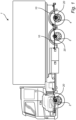
Fig. 1 is a lateral side view illustrating a vehicle comprising mechanical parts particularly suitably retained by the fastening arrangement according to an example embodiment; -
Figs. 2a - 2b are perspective views of the fastening arrangement retaining two mechanical parts to each other according to an example embodiment; -
Figs. 3a - 3b are exploded views of the fastening arrangement according to an example embodiment not according to the invention; and -
Figs. 4a - 4b are perspective views of the fastening arrangement according to an example embodiment according to the invention. - The present disclosure will now be described more fully hereinafter with reference to the accompanying drawings, in which exemplary embodiments are shown. The disclosure may, however, be embodied in many different forms and should not be construed as limited to the embodiments set forth herein; rather, these embodiments are provided for thoroughness and completeness. Like reference character refer to like elements throughout the description.
- With particular reference to
Fig. 1 , there is provided avehicle 1 in the form of a truck. Thevehicle 1 compriseswheels 2, 4 arranged on arespective wheel axle 20. Thevehicle 1 further comprises a wheelaxle suspension arrangement 10. Thewheel axle 20 and the wheelaxle suspension arrangement 30 thus form mechanical parts of the vehicle. According to an example embodiment described in further detail below with reference toFigs. 2a - 2b , thewheel axle 20 is retained to the wheelaxle suspension arrangement 10 by means of a fastening arrangement 100 (seeFigs. 2a-4b ). Thevehicle 1 hereby comprises avehicle arrangement 600 which comprises thewheel axle 20, the wheelaxle suspension arrangement 30 and thefastening arrangement 100. - In order to describe the
fastening arrangement 100 and its interconnection to the mechanical parts, i.e. thewheel axle 20 and the wheelaxle suspension arrangement 10 reference is made toFigs. 2a - 2b . As can be seen, thefastening arrangement 100 comprises a first 102 and a second 104 elongated leg member and acurved member 106 extending between the elongated leg members. Thecurved member 106 is in the examples depicted as being U-shaped along its extension between the first 102 and second 104 leg members, although the curved member can be arranged in other semi-circular configurations. Each leg member further comprises aportion 14, preferably threads, arranged to receive a tighteningelement 30, preferably a nut, for retaining thewheel axle 20 and the wheelaxle suspension arrangement 10 to each other. In detail, the U-shapedcurved member 106 together with theelongated leg members wheel axle 20 and the wheelaxle suspension arrangement 10, whereby the nuts, which are arranged on an opposite end of thefastening arrangement 100 compared to the U-shaped curved member, are tightened to provide a compression force between thewheel axle 20 and the wheelaxle suspension arrangement 10, thereby fixating thewheel axle 20 and the wheelaxle suspension arrangement 10 to each other. According to the example embodiment depicted inFigs 2a - 2b , the elongated leg members are directed through openings/holes 55 of thewheel axle 20. - The
fastening arrangement 100 depicted in the example embodiment ofFigs. 2a - 2b further comprises amating support element 150. Themating support element 150 is positioned between the U-shapedcurved member 106 and the wheelaxle suspension arrangement 10. In particular, the mating support element comprises afirst surface 152 arranged in abutment with aninner surface 110 of the curved member, and asecond surface 154 arranged in abutment with an upward facingsurface 12 of the wheelaxle suspension arrangement 10. - In order to describe the U-shaped
curved portion 106 and themating support element 150 in further detail, reference is now made toFigs. 3a - 3b which illustrate exploded views of thefastening arrangement 100 according to an example embodiment not according to the invention. - As can be seen, the first
elongated leg member 102, the secondelongated leg member 104 and the U-shapedcurved member 106 form aninner space 108 arranged to accommodate a portion of thewheel axle 20 and the wheelaxle suspension arrangement 10, respectively. Thecurved member 106 comprises the above describedinner surface 110 facing theupward surface 12 of the wheelaxle suspension arrangement 10 when retaining the wheelaxle suspension arrangement 10 and thewheel axle 20 to each other. - As can be seen in detail in
Fig. 3a , theinner surface 110 of the U-shapedcurved member 106 comprises aconcave surface portion 112. Theinner surface 110 is thus concave as seen in a cross-section which is transverse to theextension 500 of the U-shapedcurved member 106, i.e. transverse to the extension between the firstelongated leg member 102 and the second elongated leg member 104.The In the example embodiment depicted inFig. 3a , the entireinner surface 110 along theextension 500 of the U-shapedcurved member 106 is concave, which concave configuration is also detailed in the cross-section A - A ofFig. 3a . However, other configurations are according to the invention as will be evident with reference to the below description in relation toFigs. 4a - 4b . - Furthermore, the
concave surface portion 112 preferably extends betweentransversal end curved member 106. Thus, the curvature of theconcave surface portion 112 is initiated at a firsttransversal end position 70 and ends at an oppositely located secondtransversal end portion 72. With the configuration depicted inFig. 3a , i.e. with a concave shape along the entireinner surface 110, theconcave surface portion 112 preferably extends between thetransversal end inner surface 110. - With particular reference to
Fig. 3b , themating support element 150 comprises aconvex surface portion 158. In particular, thefirst surface 152 of themating support element 150 comprises theconvex surface portion 158. Theconvex surface portion 158 is configured to mate with theconvex surface portion 112 of the U-shaped curved member. The shape of theconvex surface portion 158 should thus preferably be designed to fit the shape of the concave surface portion. Hereby, local stress concentrations can be avoided. For simplifying the connection between the convex surface portion and the convex surface portion, the radius of the convex surface portion should be substantially the same as the radius of the convex surface portion. More preferably, the radius of the convex surface portion should be smaller compared to the radius of the convex surface portion. - However, as is readily understood, the
fastening arrangement 100 can be arranged to retain thewheel axle 20 and the wheelaxle suspension arrangement 10 without the use of themating support element 150. In such a case, theinner surface 110 of the U-shapedcurved member 106 is arranged in abutment with the upward facingsurface 12 of the wheelaxle suspension arrangement 10. Preferably, the upward facingsurface 12 of the wheelaxle suspension arrangement 10 in such a case comprises a convex surface portion fitting the shape of theconvex surface portion 112 of the U-shapedcurved member 106. - In order to describe an example embodiment of the
fastening arrangement 100 according to the invention, reference is made toFigs. 4a - 4b . In comparison to the illustration ofFigs. 3a - 3b , and which was described above, theconcave surface portion 112 is not arranged at the entire inner surface of the U-shapedcurved member 106. Conversely,inner surface 110 comprises a concave surface portion at a first longitudinalouter end portion 402 and a second longitudinalouter end portion 404, while theinner surface 110 at an innerlongitudinal portion 406 is substantially flat. The first 402 and second 404 longitudinal outer end portions should be construed as end portions as seen along the extension of the U-shapedcurved member 106, while the innerlongitudinal portion 406 is arranged between the first 402 and second 404 longitudinal outer end portions. The concave shape is here preferably gradually reduced from the elongated leg towards the innerlongitudinal portion 406. - It is to be understood that the present disclosure is not limited to the embodiments described above and illustrated in the drawings; rather, the skilled person will recognize that many changes and modifications may be made within the scope of the appended claims. For example, the wheel
axle suspension arrangement 10 and thewheel axle 20 may be arranged on opposite sides to each other compared to the illustrated example embodiments, i.e. thewheel axle 20 is arranged above the wheelaxle suspension arrangement 10, whereby the concave surface portion or themating support element 150 is arranged in abutment with thewheel axle 20 instead of the wheelaxle suspension arrangement 10.
Claims (13)
- A fastening arrangement (100) for retaining at least a first mechanical part (10) and a second mechanical part (20) to each other, the fastening arrangement comprising a first elongated leg member (102), a second elongated leg member (104) and a curved member (106) extending between the first and second elongated leg members, wherein the first elongated leg member, the second elongated leg member and the curved member form an inner space (108) arranged to accommodate at least a part of the first and second mechanical parts, the curved member comprises an inner surface (110) arranged to face a surface (12) of the first mechanical part, the inner surface being formed by an inner portion (406), a first outer portion (402) and a second outer portion (404), wherein the first outer portion (402) is arranged between the inner portion (406) and the first elongated leg member (102), and the second outer portion (404) is arranged between the inner portion (406) and the second elongated leg member (104), wherein each of the first and second elongated leg members comprises a portion (14) arranged to receive a respective tightening element (30) for retaining the first and second mechanical parts to each other, characterized in that the first (402) and second (404) outer end portions of the inner surface (110) of the curved member comprises a concave surface portion (112) as seen in a cross-section transverse to the extension of the curved member, and wherein the inner portion (406) of the inner surface (110) of the curved member comprises a flat surface portion as seen in the cross-section transverse to the extension of the curved member.
- The fastening arrangement according to claim 1, wherein the curved member is semi-circular along its extension.
- The fastening arrangement according to any one of claims 1 or 2, wherein the curved member is U-shaped along its extension.
- The fastening arrangement according to any one of the preceding claims, wherein the fastening arrangement further comprises a mating support element (150), the mating support element comprising a first surface (152) arranged in abutment with the inner surface of the curved member, and a second surface (154) configured to abut the surface (12) of the first mechanical member.
- The fastening arrangement according to claim 4, wherein the first surface of the mating support element comprises a convex surface portion.
- The fastening arrangement according to claim 5, wherein the convex surface portion has a shape fitting the shape of the concave surface portion of the curved member.
- The fastening arrangement according to any one of the preceding claims, wherein the concave surface portion extends between transversal end positions of the curved member.
- The fastening arrangement according to any one of the preceding claims, wherein the first and second elongated leg members are each arranged with a circular cross-section.
- The fastening arrangement according to any one of the preceding claims, wherein the portion (14) of the first and second elongated leg members is a threaded portion.
- The fastening arrangement according to claim 9, wherein the tightening element (30) is a nut arranged to be tightened on the thread portion.
- A vehicle arrangement (600) comprising a first mechanical part, a second mechanical part and a fastening arrangement according to any one of the preceding claims retaining the first and second mechanical part to each other.
- A vehicle comprising a first (10) and a second (20) mechanical part, and a fastening arrangement (100) according to any one of claims 1 - 10, wherein the fastening arrangement (100) is retaining the first and second mechanical parts to each other.
- The vehicle according to claim 12, wherein the first mechanical part is a wheel axle suspension component and the second mechanical part is a wheel axle.
Priority Applications (1)
| Application Number | Priority Date | Filing Date | Title |
|---|---|---|---|
| EP20211910.3A EP4008915B1 (en) | 2020-12-04 | 2020-12-04 | A fastening arrangement and a vehicle arrangement |
Applications Claiming Priority (1)
| Application Number | Priority Date | Filing Date | Title |
|---|---|---|---|
| EP20211910.3A EP4008915B1 (en) | 2020-12-04 | 2020-12-04 | A fastening arrangement and a vehicle arrangement |
Publications (3)
| Publication Number | Publication Date |
|---|---|
| EP4008915A1 EP4008915A1 (en) | 2022-06-08 |
| EP4008915B1 true EP4008915B1 (en) | 2024-03-06 |
| EP4008915C0 EP4008915C0 (en) | 2024-03-06 |
Family
ID=74186417
Family Applications (1)
| Application Number | Title | Priority Date | Filing Date |
|---|---|---|---|
| EP20211910.3A Active EP4008915B1 (en) | 2020-12-04 | 2020-12-04 | A fastening arrangement and a vehicle arrangement |
Country Status (1)
| Country | Link |
|---|---|
| EP (1) | EP4008915B1 (en) |
Citations (4)
| Publication number | Priority date | Publication date | Assignee | Title |
|---|---|---|---|---|
| JP2014076787A (en) * | 2012-10-12 | 2014-05-01 | Moonface Inc | U-bolt for suspension of automobile |
| US20150322981A1 (en) * | 2014-05-06 | 2015-11-12 | Clamps Inc. | U-bolt assembly |
| CN205478795U (en) * | 2016-03-15 | 2016-08-17 | 安徽安凯汽车股份有限公司 | Integral type U -bolt structure |
| CN210343977U (en) * | 2019-05-17 | 2020-04-17 | 福建省晋江市励精汽配有限公司 | U-shaped bolt |
Family Cites Families (1)
| Publication number | Priority date | Publication date | Assignee | Title |
|---|---|---|---|---|
| JPH0939533A (en) * | 1995-08-04 | 1997-02-10 | Nissan Diesel Motor Co Ltd | Leaf spring fitting structure in trunnion suspension device |
-
2020
- 2020-12-04 EP EP20211910.3A patent/EP4008915B1/en active Active
Patent Citations (4)
| Publication number | Priority date | Publication date | Assignee | Title |
|---|---|---|---|---|
| JP2014076787A (en) * | 2012-10-12 | 2014-05-01 | Moonface Inc | U-bolt for suspension of automobile |
| US20150322981A1 (en) * | 2014-05-06 | 2015-11-12 | Clamps Inc. | U-bolt assembly |
| CN205478795U (en) * | 2016-03-15 | 2016-08-17 | 安徽安凯汽车股份有限公司 | Integral type U -bolt structure |
| CN210343977U (en) * | 2019-05-17 | 2020-04-17 | 福建省晋江市励精汽配有限公司 | U-shaped bolt |
Also Published As
| Publication number | Publication date |
|---|---|
| EP4008915A1 (en) | 2022-06-08 |
| EP4008915C0 (en) | 2024-03-06 |
Similar Documents
| Publication | Publication Date | Title |
|---|---|---|
| US5328159A (en) | Axle housing attachment assembly | |
| US9156324B2 (en) | Vehicle axle suspension, and vehicle comprising such vehicle axle suspension | |
| EP3461653B1 (en) | Axle clamping arrangement | |
| US20100044991A1 (en) | Tubular axle beam suspension mount | |
| US8973909B2 (en) | Cross arm bushing assembly useful for vehicle suspension | |
| US4976417A (en) | Wrap spring end attachment assembly for a twisted rope torsion bar | |
| US20150145228A1 (en) | Axle Attachment | |
| CN108602406A (en) | shaft unit | |
| KR102334719B1 (en) | Anti-vibration nut set | |
| JP6169090B2 (en) | Truss end pad fitting | |
| EP3250401B1 (en) | A bush pin and a mounting assembly for a v-stay for a vehicle | |
| EP4008915B1 (en) | A fastening arrangement and a vehicle arrangement | |
| JP3963593B2 (en) | Bar material slip prevention structure | |
| US6511037B1 (en) | Elastomeric mounting (c) | |
| US6443439B1 (en) | Elastomeric mounting (B) | |
| US5000430A (en) | Thrust stop end attachment assembly for a twisted rope torsion bar | |
| CN108698439B (en) | Axle system and method for producing an axle system | |
| CN108621783B (en) | Fixtures and motor vehicles having such fixtures | |
| KR20190115829A (en) | Anti-loosening Fastening Member | |
| US20080036166A1 (en) | Self-locking sleeve for stabilizer bar | |
| CN106687310B (en) | shaft unit | |
| EP3859174B1 (en) | Nut comprising a pivoting washer having an off-centre opening for movement, bolt comprising said nut and assembly comprising at least one such bolt | |
| CN117320890A (en) | Mounting structure for composite wheels | |
| CN121738987A (en) | Locking device for a structural joint in an aircraft | |
| US20230235770A1 (en) | A fastening element and a vehicle arrangement |
Legal Events
| Date | Code | Title | Description |
|---|---|---|---|
| PUAI | Public reference made under article 153(3) epc to a published international application that has entered the european phase |
Free format text: ORIGINAL CODE: 0009012 |
|
| STAA | Information on the status of an ep patent application or granted ep patent |
Free format text: STATUS: THE APPLICATION HAS BEEN PUBLISHED |
|
| AK | Designated contracting states |
Kind code of ref document: A1 Designated state(s): AL AT BE BG CH CY CZ DE DK EE ES FI FR GB GR HR HU IE IS IT LI LT LU LV MC MK MT NL NO PL PT RO RS SE SI SK SM TR |
|
| STAA | Information on the status of an ep patent application or granted ep patent |
Free format text: STATUS: REQUEST FOR EXAMINATION WAS MADE |
|
| 17P | Request for examination filed |
Effective date: 20220909 |
|
| RBV | Designated contracting states (corrected) |
Designated state(s): AL AT BE BG CH CY CZ DE DK EE ES FI FR GB GR HR HU IE IS IT LI LT LU LV MC MK MT NL NO PL PT RO RS SE SI SK SM TR |
|
| GRAP | Despatch of communication of intention to grant a patent |
Free format text: ORIGINAL CODE: EPIDOSNIGR1 |
|
| STAA | Information on the status of an ep patent application or granted ep patent |
Free format text: STATUS: GRANT OF PATENT IS INTENDED |
|
| RIC1 | Information provided on ipc code assigned before grant |
Ipc: F16B 7/18 20060101ALN20230918BHEP Ipc: F16B 35/04 20060101ALN20230918BHEP Ipc: F16B 2/06 20060101ALN20230918BHEP Ipc: F16B 7/04 20060101AFI20230918BHEP |
|
| INTG | Intention to grant announced |
Effective date: 20231004 |
|
| GRAS | Grant fee paid |
Free format text: ORIGINAL CODE: EPIDOSNIGR3 |
|
| GRAA | (expected) grant |
Free format text: ORIGINAL CODE: 0009210 |
|
| STAA | Information on the status of an ep patent application or granted ep patent |
Free format text: STATUS: THE PATENT HAS BEEN GRANTED |
|
| AK | Designated contracting states |
Kind code of ref document: B1 Designated state(s): AL AT BE BG CH CY CZ DE DK EE ES FI FR GB GR HR HU IE IS IT LI LT LU LV MC MK MT NL NO PL PT RO RS SE SI SK SM TR |
|
| REG | Reference to a national code |
Ref country code: CH Ref legal event code: EP |
|
| REG | Reference to a national code |
Ref country code: IE Ref legal event code: FG4D |
|
| REG | Reference to a national code |
Ref country code: DE Ref legal event code: R096 Ref document number: 602020026732 Country of ref document: DE |
|
| U01 | Request for unitary effect filed |
Effective date: 20240311 |
|
| U07 | Unitary effect registered |
Designated state(s): AT BE BG DE DK EE FI FR IT LT LU LV MT NL PT SE SI Effective date: 20240319 |
|
| PG25 | Lapsed in a contracting state [announced via postgrant information from national office to epo] |
Ref country code: GR Free format text: LAPSE BECAUSE OF FAILURE TO SUBMIT A TRANSLATION OF THE DESCRIPTION OR TO PAY THE FEE WITHIN THE PRESCRIBED TIME-LIMIT Effective date: 20240607 |
|
| PG25 | Lapsed in a contracting state [announced via postgrant information from national office to epo] |
Ref country code: RS Free format text: LAPSE BECAUSE OF FAILURE TO SUBMIT A TRANSLATION OF THE DESCRIPTION OR TO PAY THE FEE WITHIN THE PRESCRIBED TIME-LIMIT Effective date: 20240606 Ref country code: HR Free format text: LAPSE BECAUSE OF FAILURE TO SUBMIT A TRANSLATION OF THE DESCRIPTION OR TO PAY THE FEE WITHIN THE PRESCRIBED TIME-LIMIT Effective date: 20240306 |
|
| PG25 | Lapsed in a contracting state [announced via postgrant information from national office to epo] |
Ref country code: ES Free format text: LAPSE BECAUSE OF FAILURE TO SUBMIT A TRANSLATION OF THE DESCRIPTION OR TO PAY THE FEE WITHIN THE PRESCRIBED TIME-LIMIT Effective date: 20240306 |
|
| PG25 | Lapsed in a contracting state [announced via postgrant information from national office to epo] |
Ref country code: RS Free format text: LAPSE BECAUSE OF FAILURE TO SUBMIT A TRANSLATION OF THE DESCRIPTION OR TO PAY THE FEE WITHIN THE PRESCRIBED TIME-LIMIT Effective date: 20240606 Ref country code: NO Free format text: LAPSE BECAUSE OF FAILURE TO SUBMIT A TRANSLATION OF THE DESCRIPTION OR TO PAY THE FEE WITHIN THE PRESCRIBED TIME-LIMIT Effective date: 20240606 Ref country code: HR Free format text: LAPSE BECAUSE OF FAILURE TO SUBMIT A TRANSLATION OF THE DESCRIPTION OR TO PAY THE FEE WITHIN THE PRESCRIBED TIME-LIMIT Effective date: 20240306 Ref country code: GR Free format text: LAPSE BECAUSE OF FAILURE TO SUBMIT A TRANSLATION OF THE DESCRIPTION OR TO PAY THE FEE WITHIN THE PRESCRIBED TIME-LIMIT Effective date: 20240607 Ref country code: ES Free format text: LAPSE BECAUSE OF FAILURE TO SUBMIT A TRANSLATION OF THE DESCRIPTION OR TO PAY THE FEE WITHIN THE PRESCRIBED TIME-LIMIT Effective date: 20240306 |
|
| PG25 | Lapsed in a contracting state [announced via postgrant information from national office to epo] |
Ref country code: IS Free format text: LAPSE BECAUSE OF FAILURE TO SUBMIT A TRANSLATION OF THE DESCRIPTION OR TO PAY THE FEE WITHIN THE PRESCRIBED TIME-LIMIT Effective date: 20240706 |
|
| PG25 | Lapsed in a contracting state [announced via postgrant information from national office to epo] |
Ref country code: SM Free format text: LAPSE BECAUSE OF FAILURE TO SUBMIT A TRANSLATION OF THE DESCRIPTION OR TO PAY THE FEE WITHIN THE PRESCRIBED TIME-LIMIT Effective date: 20240306 |
|
| PG25 | Lapsed in a contracting state [announced via postgrant information from national office to epo] |
Ref country code: CZ Free format text: LAPSE BECAUSE OF FAILURE TO SUBMIT A TRANSLATION OF THE DESCRIPTION OR TO PAY THE FEE WITHIN THE PRESCRIBED TIME-LIMIT Effective date: 20240306 |
|
| PG25 | Lapsed in a contracting state [announced via postgrant information from national office to epo] |
Ref country code: PL Free format text: LAPSE BECAUSE OF FAILURE TO SUBMIT A TRANSLATION OF THE DESCRIPTION OR TO PAY THE FEE WITHIN THE PRESCRIBED TIME-LIMIT Effective date: 20240306 |
|
| PG25 | Lapsed in a contracting state [announced via postgrant information from national office to epo] |
Ref country code: SK Free format text: LAPSE BECAUSE OF FAILURE TO SUBMIT A TRANSLATION OF THE DESCRIPTION OR TO PAY THE FEE WITHIN THE PRESCRIBED TIME-LIMIT Effective date: 20240306 |
|
| PG25 | Lapsed in a contracting state [announced via postgrant information from national office to epo] |
Ref country code: SM Free format text: LAPSE BECAUSE OF FAILURE TO SUBMIT A TRANSLATION OF THE DESCRIPTION OR TO PAY THE FEE WITHIN THE PRESCRIBED TIME-LIMIT Effective date: 20240306 Ref country code: SK Free format text: LAPSE BECAUSE OF FAILURE TO SUBMIT A TRANSLATION OF THE DESCRIPTION OR TO PAY THE FEE WITHIN THE PRESCRIBED TIME-LIMIT Effective date: 20240306 Ref country code: RO Free format text: LAPSE BECAUSE OF FAILURE TO SUBMIT A TRANSLATION OF THE DESCRIPTION OR TO PAY THE FEE WITHIN THE PRESCRIBED TIME-LIMIT Effective date: 20240306 Ref country code: PL Free format text: LAPSE BECAUSE OF FAILURE TO SUBMIT A TRANSLATION OF THE DESCRIPTION OR TO PAY THE FEE WITHIN THE PRESCRIBED TIME-LIMIT Effective date: 20240306 Ref country code: IS Free format text: LAPSE BECAUSE OF FAILURE TO SUBMIT A TRANSLATION OF THE DESCRIPTION OR TO PAY THE FEE WITHIN THE PRESCRIBED TIME-LIMIT Effective date: 20240706 Ref country code: CZ Free format text: LAPSE BECAUSE OF FAILURE TO SUBMIT A TRANSLATION OF THE DESCRIPTION OR TO PAY THE FEE WITHIN THE PRESCRIBED TIME-LIMIT Effective date: 20240306 |
|
| REG | Reference to a national code |
Ref country code: DE Ref legal event code: R097 Ref document number: 602020026732 Country of ref document: DE |
|
| PLBE | No opposition filed within time limit |
Free format text: ORIGINAL CODE: 0009261 |
|
| STAA | Information on the status of an ep patent application or granted ep patent |
Free format text: STATUS: NO OPPOSITION FILED WITHIN TIME LIMIT |
|
| U20 | Renewal fee for the european patent with unitary effect paid |
Year of fee payment: 5 Effective date: 20241225 |
|
| 26N | No opposition filed |
Effective date: 20241209 |
|
| PG25 | Lapsed in a contracting state [announced via postgrant information from national office to epo] |
Ref country code: MC Free format text: LAPSE BECAUSE OF FAILURE TO SUBMIT A TRANSLATION OF THE DESCRIPTION OR TO PAY THE FEE WITHIN THE PRESCRIBED TIME-LIMIT Effective date: 20240306 |
|
| REG | Reference to a national code |
Ref country code: CH Ref legal event code: PL |
|
| GBPC | Gb: european patent ceased through non-payment of renewal fee |
Effective date: 20241204 |
|
| PG25 | Lapsed in a contracting state [announced via postgrant information from national office to epo] |
Ref country code: GB Free format text: LAPSE BECAUSE OF NON-PAYMENT OF DUE FEES Effective date: 20241204 |
|
| PG25 | Lapsed in a contracting state [announced via postgrant information from national office to epo] |
Ref country code: CH Free format text: LAPSE BECAUSE OF NON-PAYMENT OF DUE FEES Effective date: 20241231 |
|
| PG25 | Lapsed in a contracting state [announced via postgrant information from national office to epo] |
Ref country code: IE Free format text: LAPSE BECAUSE OF NON-PAYMENT OF DUE FEES Effective date: 20241204 |
|
| PG25 | Lapsed in a contracting state [announced via postgrant information from national office to epo] |
Ref country code: CY Free format text: LAPSE BECAUSE OF FAILURE TO SUBMIT A TRANSLATION OF THE DESCRIPTION OR TO PAY THE FEE WITHIN THE PRESCRIBED TIME-LIMIT; INVALID AB INITIO Effective date: 20201204 |