EP4008788A1 - Lentiviral vector technology for inner ear gene therapy - Google Patents
Lentiviral vector technology for inner ear gene therapy Download PDFInfo
- Publication number
- EP4008788A1 EP4008788A1 EP20211616.6A EP20211616A EP4008788A1 EP 4008788 A1 EP4008788 A1 EP 4008788A1 EP 20211616 A EP20211616 A EP 20211616A EP 4008788 A1 EP4008788 A1 EP 4008788A1
- Authority
- EP
- European Patent Office
- Prior art keywords
- composition
- cells
- cell
- lentiviral vector
- receptor
- Prior art date
- Legal status (The legal status is an assumption and is not a legal conclusion. Google has not performed a legal analysis and makes no representation as to the accuracy of the status listed.)
- Withdrawn
Links
- 239000013598 vector Substances 0.000 title claims abstract description 223
- 210000003027 ear inner Anatomy 0.000 title claims abstract description 104
- 238000001415 gene therapy Methods 0.000 title abstract description 33
- 101150083557 Ear gene Proteins 0.000 title description 5
- 238000005516 engineering process Methods 0.000 title description 4
- 239000000203 mixture Substances 0.000 claims abstract description 165
- 230000014509 gene expression Effects 0.000 claims abstract description 76
- 206010011891 Deafness neurosensory Diseases 0.000 claims abstract description 69
- 208000009966 Sensorineural Hearing Loss Diseases 0.000 claims abstract description 69
- 231100000879 sensorineural hearing loss Toxicity 0.000 claims abstract description 69
- 208000023573 sensorineural hearing loss disease Diseases 0.000 claims abstract description 69
- 102000000853 LDL receptors Human genes 0.000 claims abstract description 44
- 108010001831 LDL receptors Proteins 0.000 claims abstract description 44
- 108010003533 Viral Envelope Proteins Proteins 0.000 claims abstract description 40
- 238000000034 method Methods 0.000 claims abstract description 38
- 102000005962 receptors Human genes 0.000 claims abstract description 26
- 108020003175 receptors Proteins 0.000 claims abstract description 26
- 208000024891 symptom Diseases 0.000 claims abstract description 19
- 239000002679 microRNA Substances 0.000 claims abstract description 18
- 101150054854 POU1F1 gene Proteins 0.000 claims abstract description 12
- 108091027967 Small hairpin RNA Proteins 0.000 claims abstract description 12
- 101150056399 slc20a1 gene Proteins 0.000 claims abstract description 12
- 239000004055 small Interfering RNA Substances 0.000 claims abstract description 11
- 108091070501 miRNA Proteins 0.000 claims abstract description 5
- 108700026220 vif Genes Proteins 0.000 claims abstract description 5
- 108091027544 Subgenomic mRNA Proteins 0.000 claims abstract 2
- 210000004027 cell Anatomy 0.000 claims description 241
- 108090000623 proteins and genes Proteins 0.000 claims description 91
- 210000002768 hair cell Anatomy 0.000 claims description 62
- 238000004806 packaging method and process Methods 0.000 claims description 44
- 210000003477 cochlea Anatomy 0.000 claims description 29
- 238000002347 injection Methods 0.000 claims description 26
- 239000007924 injection Substances 0.000 claims description 26
- 210000002569 neuron Anatomy 0.000 claims description 26
- 108010009047 Myosin VIIa Proteins 0.000 claims description 25
- 239000003623 enhancer Substances 0.000 claims description 24
- 241000700605 Viruses Species 0.000 claims description 21
- 150000007523 nucleic acids Chemical class 0.000 claims description 21
- 210000002985 organ of corti Anatomy 0.000 claims description 21
- 108091032973 (ribonucleotides)n+m Proteins 0.000 claims description 19
- 230000008093 supporting effect Effects 0.000 claims description 17
- 239000007943 implant Substances 0.000 claims description 15
- 230000001105 regulatory effect Effects 0.000 claims description 15
- 230000001720 vestibular Effects 0.000 claims description 15
- 108700039691 Genetic Promoter Regions Proteins 0.000 claims description 14
- 210000001323 spiral ganglion Anatomy 0.000 claims description 14
- 241000713772 Human immunodeficiency virus 1 Species 0.000 claims description 12
- 210000004498 neuroglial cell Anatomy 0.000 claims description 11
- 102100033885 Collagen alpha-2(XI) chain Human genes 0.000 claims description 10
- 101000710619 Homo sapiens Collagen alpha-2(XI) chain Proteins 0.000 claims description 10
- 108090000715 Brain-derived neurotrophic factor Proteins 0.000 claims description 8
- 102000004219 Brain-derived neurotrophic factor Human genes 0.000 claims description 8
- 102000024452 GDNF Human genes 0.000 claims description 8
- 108091010837 Glial cell line-derived neurotrophic factor Proteins 0.000 claims description 8
- 101000599951 Homo sapiens Insulin-like growth factor I Proteins 0.000 claims description 8
- 101000701142 Homo sapiens Transcription factor ATOH1 Proteins 0.000 claims description 8
- 102100037852 Insulin-like growth factor I Human genes 0.000 claims description 8
- -1 MET Proteins 0.000 claims description 8
- 108090000742 Neurotrophin 3 Proteins 0.000 claims description 8
- 108020005067 RNA Splice Sites Proteins 0.000 claims description 8
- 102100029373 Transcription factor ATOH1 Human genes 0.000 claims description 8
- 210000001062 endolymphatic sac Anatomy 0.000 claims description 8
- 210000000645 stria vascularis Anatomy 0.000 claims description 8
- 108020003589 5' Untranslated Regions Proteins 0.000 claims description 7
- 101000572950 Homo sapiens POU domain, class 3, transcription factor 4 Proteins 0.000 claims description 7
- 101001094737 Homo sapiens POU domain, class 4, transcription factor 3 Proteins 0.000 claims description 7
- 102100026450 POU domain, class 3, transcription factor 4 Human genes 0.000 claims description 7
- 102100035398 POU domain, class 4, transcription factor 3 Human genes 0.000 claims description 7
- 230000001124 posttranscriptional effect Effects 0.000 claims description 7
- 241000713730 Equine infectious anemia virus Species 0.000 claims description 6
- 238000001471 micro-filtration Methods 0.000 claims description 6
- 238000012545 processing Methods 0.000 claims description 6
- 210000002205 spiral ligament of cochlea Anatomy 0.000 claims description 6
- 102100033350 ATP-dependent translocase ABCB1 Human genes 0.000 claims description 5
- 102100030374 Actin, cytoplasmic 2 Human genes 0.000 claims description 5
- 102100039677 Adenylate cyclase type 1 Human genes 0.000 claims description 5
- 102100040191 Alpha-tectorin Human genes 0.000 claims description 5
- 101000798762 Anguilla anguilla Troponin C, skeletal muscle Proteins 0.000 claims description 5
- 101000686547 Arabidopsis thaliana 30S ribosomal protein S1, chloroplastic Proteins 0.000 claims description 5
- 102100026376 Artemin Human genes 0.000 claims description 5
- 102100025359 Barttin Human genes 0.000 claims description 5
- 101150115448 CABP2 gene Proteins 0.000 claims description 5
- 102100022509 Cadherin-23 Human genes 0.000 claims description 5
- 102100032220 Calcium and integrin-binding family member 2 Human genes 0.000 claims description 5
- 102100030049 Calcium-binding protein 2 Human genes 0.000 claims description 5
- 102100035445 Carcinoembryonic antigen-related cell adhesion molecule 16 Human genes 0.000 claims description 5
- 108010005939 Ciliary Neurotrophic Factor Proteins 0.000 claims description 5
- 102100031614 Ciliary neurotrophic factor Human genes 0.000 claims description 5
- 102100039537 Claudin-14 Human genes 0.000 claims description 5
- 102100040996 Cochlin Human genes 0.000 claims description 5
- 102100024133 Coiled-coil domain-containing protein 50 Human genes 0.000 claims description 5
- 108010069176 Connexin 30 Proteins 0.000 claims description 5
- 102100027591 Copper-transporting ATPase 2 Human genes 0.000 claims description 5
- 102100029792 Dentin sialophosphoprotein Human genes 0.000 claims description 5
- 102100037070 Doublecortin domain-containing protein 2 Human genes 0.000 claims description 5
- 102100025734 Dual specificity protein phosphatase CDC14A Human genes 0.000 claims description 5
- 102100027108 ELMO domain-containing protein 3 Human genes 0.000 claims description 5
- 102000020045 EPS8 Human genes 0.000 claims description 5
- 108091016436 EPS8 Proteins 0.000 claims description 5
- 102100035218 Epidermal growth factor receptor kinase substrate 8-like protein 2 Human genes 0.000 claims description 5
- 102100031809 Espin Human genes 0.000 claims description 5
- 102100030863 Eyes absent homolog 1 Human genes 0.000 claims description 5
- 102100030910 Eyes absent homolog 4 Human genes 0.000 claims description 5
- 102100023941 G-protein-signaling modulator 2 Human genes 0.000 claims description 5
- 102100039397 Gap junction beta-3 protein Human genes 0.000 claims description 5
- 102100037391 Gasdermin-E Human genes 0.000 claims description 5
- 102100023697 Glutaredoxin domain-containing cysteine-rich protein 1 Human genes 0.000 claims description 5
- 102100023695 Glutaredoxin domain-containing cysteine-rich protein 2 Human genes 0.000 claims description 5
- 102100034227 Grainyhead-like protein 2 homolog Human genes 0.000 claims description 5
- 208000031886 HIV Infections Diseases 0.000 claims description 5
- 102100037931 Harmonin Human genes 0.000 claims description 5
- 102100021866 Hepatocyte growth factor Human genes 0.000 claims description 5
- 102100029279 Homeobox protein SIX1 Human genes 0.000 claims description 5
- 101000773237 Homo sapiens Actin, cytoplasmic 2 Proteins 0.000 claims description 5
- 101000959343 Homo sapiens Adenylate cyclase type 1 Proteins 0.000 claims description 5
- 101000889766 Homo sapiens Alpha-tectorin Proteins 0.000 claims description 5
- 101000785776 Homo sapiens Artemin Proteins 0.000 claims description 5
- 101000934823 Homo sapiens Barttin Proteins 0.000 claims description 5
- 101000899442 Homo sapiens Cadherin-23 Proteins 0.000 claims description 5
- 101000943456 Homo sapiens Calcium and integrin-binding family member 2 Proteins 0.000 claims description 5
- 101000737645 Homo sapiens Carcinoembryonic antigen-related cell adhesion molecule 16 Proteins 0.000 claims description 5
- 101000906624 Homo sapiens Chloride intracellular channel protein 5 Proteins 0.000 claims description 5
- 101000906631 Homo sapiens Chloride intracellular channel protein 6 Proteins 0.000 claims description 5
- 101000888570 Homo sapiens Claudin-14 Proteins 0.000 claims description 5
- 101000748988 Homo sapiens Cochlin Proteins 0.000 claims description 5
- 101000910772 Homo sapiens Coiled-coil domain-containing protein 50 Proteins 0.000 claims description 5
- 101000936280 Homo sapiens Copper-transporting ATPase 2 Proteins 0.000 claims description 5
- 101000865404 Homo sapiens Dentin sialophosphoprotein Proteins 0.000 claims description 5
- 101000954709 Homo sapiens Doublecortin domain-containing protein 2 Proteins 0.000 claims description 5
- 101000932600 Homo sapiens Dual specificity protein phosphatase CDC14A Proteins 0.000 claims description 5
- 101001057868 Homo sapiens ELMO domain-containing protein 3 Proteins 0.000 claims description 5
- 101000876686 Homo sapiens Epidermal growth factor receptor kinase substrate 8-like protein 2 Proteins 0.000 claims description 5
- 101000920837 Homo sapiens Espin Proteins 0.000 claims description 5
- 101000938435 Homo sapiens Eyes absent homolog 1 Proteins 0.000 claims description 5
- 101000938422 Homo sapiens Eyes absent homolog 4 Proteins 0.000 claims description 5
- 101000904754 Homo sapiens G-protein-signaling modulator 2 Proteins 0.000 claims description 5
- 101000889136 Homo sapiens Gap junction beta-3 protein Proteins 0.000 claims description 5
- 101001026269 Homo sapiens Gasdermin-E Proteins 0.000 claims description 5
- 101000829459 Homo sapiens Glutaredoxin domain-containing cysteine-rich protein 1 Proteins 0.000 claims description 5
- 101000829452 Homo sapiens Glutaredoxin domain-containing cysteine-rich protein 2 Proteins 0.000 claims description 5
- 101001069929 Homo sapiens Grainyhead-like protein 2 homolog Proteins 0.000 claims description 5
- 101000805947 Homo sapiens Harmonin Proteins 0.000 claims description 5
- 101000898034 Homo sapiens Hepatocyte growth factor Proteins 0.000 claims description 5
- 101000634171 Homo sapiens Homeobox protein SIX1 Proteins 0.000 claims description 5
- 101001010610 Homo sapiens Immunoglobulin-like domain-containing receptor 1 Proteins 0.000 claims description 5
- 101001076292 Homo sapiens Insulin-like growth factor II Proteins 0.000 claims description 5
- 101001076408 Homo sapiens Interleukin-6 Proteins 0.000 claims description 5
- 101000981537 Homo sapiens LHFPL tetraspan subfamily member 5 protein Proteins 0.000 claims description 5
- 101001043326 Homo sapiens Lipoxygenase homology domain-containing protein 1 Proteins 0.000 claims description 5
- 101100400377 Homo sapiens MARVELD2 gene Proteins 0.000 claims description 5
- 101000588964 Homo sapiens Myosin-14 Proteins 0.000 claims description 5
- 101000958744 Homo sapiens Myosin-7B Proteins 0.000 claims description 5
- 101001030232 Homo sapiens Myosin-9 Proteins 0.000 claims description 5
- 101000635935 Homo sapiens Myosin-IIIa Proteins 0.000 claims description 5
- 101100241084 Homo sapiens NRTN gene Proteins 0.000 claims description 5
- 101000640295 Homo sapiens Nesprin-4 Proteins 0.000 claims description 5
- 101001134172 Homo sapiens Otoancorin Proteins 0.000 claims description 5
- 101001134169 Homo sapiens Otoferlin Proteins 0.000 claims description 5
- 101001134210 Homo sapiens Otogelin-like protein Proteins 0.000 claims description 5
- 101000614335 Homo sapiens P2X purinoceptor 2 Proteins 0.000 claims description 5
- 101000886826 Homo sapiens PDZ domain-containing protein GIPC3 Proteins 0.000 claims description 5
- 101001001817 Homo sapiens Pejvakin Proteins 0.000 claims description 5
- 101000591234 Homo sapiens Phosphatidylinositol phosphatase PTPRQ Proteins 0.000 claims description 5
- 101001066878 Homo sapiens Polyribonucleotide nucleotidyltransferase 1, mitochondrial Proteins 0.000 claims description 5
- 101000994648 Homo sapiens Potassium voltage-gated channel subfamily KQT member 4 Proteins 0.000 claims description 5
- 101000640325 Homo sapiens Probable asparagine-tRNA ligase, mitochondrial Proteins 0.000 claims description 5
- 101000928791 Homo sapiens Protein diaphanous homolog 1 Proteins 0.000 claims description 5
- 101001072259 Homo sapiens Protocadherin-15 Proteins 0.000 claims description 5
- 101001110308 Homo sapiens Radixin Proteins 0.000 claims description 5
- 101000591236 Homo sapiens Receptor-type tyrosine-protein phosphatase R Proteins 0.000 claims description 5
- 101000704874 Homo sapiens Rho family-interacting cell polarization regulator 2 Proteins 0.000 claims description 5
- 101001125551 Homo sapiens Ribose-phosphate pyrophosphokinase 1 Proteins 0.000 claims description 5
- 101000836066 Homo sapiens Serpin B6 Proteins 0.000 claims description 5
- 101001133085 Homo sapiens Sialomucin core protein 24 Proteins 0.000 claims description 5
- 101000868152 Homo sapiens Son of sevenless homolog 1 Proteins 0.000 claims description 5
- 101000693262 Homo sapiens Sphingosine 1-phosphate receptor 2 Proteins 0.000 claims description 5
- 101000585180 Homo sapiens Stereocilin Proteins 0.000 claims description 5
- 101000851696 Homo sapiens Steroid hormone receptor ERR2 Proteins 0.000 claims description 5
- 101000788505 Homo sapiens TBC1 domain family member 24 Proteins 0.000 claims description 5
- 101000713234 Homo sapiens TRIO and F-actin-binding protein Proteins 0.000 claims description 5
- 101000801710 Homo sapiens Taperin Proteins 0.000 claims description 5
- 101000666340 Homo sapiens Tenascin Proteins 0.000 claims description 5
- 101000612980 Homo sapiens Thrombospondin-type laminin G domain and EAR repeat-containing protein Proteins 0.000 claims description 5
- 101000796134 Homo sapiens Thymidine phosphorylase Proteins 0.000 claims description 5
- 101000933296 Homo sapiens Transcription factor TFIIIB component B'' homolog Proteins 0.000 claims description 5
- 101000801040 Homo sapiens Transmembrane channel-like protein 1 Proteins 0.000 claims description 5
- 101000764625 Homo sapiens Transmembrane inner ear expressed protein Proteins 0.000 claims description 5
- 101000798700 Homo sapiens Transmembrane protease serine 3 Proteins 0.000 claims description 5
- 101000798702 Homo sapiens Transmembrane protease serine 4 Proteins 0.000 claims description 5
- 101000787968 Homo sapiens Transmembrane protein 132E Proteins 0.000 claims description 5
- 101001087412 Homo sapiens Tyrosine-protein phosphatase non-receptor type 18 Proteins 0.000 claims description 5
- 101000982055 Homo sapiens Unconventional myosin-Ia Proteins 0.000 claims description 5
- 101000585635 Homo sapiens Unconventional myosin-XV Proteins 0.000 claims description 5
- 101000805941 Homo sapiens Usherin Proteins 0.000 claims description 5
- 101000666127 Homo sapiens Whirlin Proteins 0.000 claims description 5
- 101000803332 Homo sapiens Wolframin Proteins 0.000 claims description 5
- 101001059220 Homo sapiens Zinc finger protein Gfi-1 Proteins 0.000 claims description 5
- 101000856554 Homo sapiens Zinc finger protein Gfi-1b Proteins 0.000 claims description 5
- 241000713340 Human immunodeficiency virus 2 Species 0.000 claims description 5
- 102100030713 Immunoglobulin-like domain-containing receptor 1 Human genes 0.000 claims description 5
- 102100025947 Insulin-like growth factor II Human genes 0.000 claims description 5
- 108091007984 KARS Proteins 0.000 claims description 5
- 108010011185 KCNQ1 Potassium Channel Proteins 0.000 claims description 5
- 102100024110 LHFPL tetraspan subfamily member 5 protein Human genes 0.000 claims description 5
- 101150116611 LRRC51 gene Proteins 0.000 claims description 5
- 102100022186 Leucine-rich repeat-containing protein 51 Human genes 0.000 claims description 5
- 102100021959 Lipoxygenase homology domain-containing protein 1 Human genes 0.000 claims description 5
- 102100035529 Lysine-tRNA ligase Human genes 0.000 claims description 5
- 102000049280 MARVEL Domain Containing 2 Human genes 0.000 claims description 5
- 108700008222 MARVEL Domain Containing 2 Proteins 0.000 claims description 5
- 101150082088 MSRB3 gene Proteins 0.000 claims description 5
- 108010047230 Member 1 Subfamily B ATP Binding Cassette Transporter Proteins 0.000 claims description 5
- 102100028720 Methionine-R-sulfoxide reductase B3 Human genes 0.000 claims description 5
- 108091027559 Mir-96 microRNA Proteins 0.000 claims description 5
- 102100021339 Multidrug resistance-associated protein 1 Human genes 0.000 claims description 5
- 102100032972 Myosin-14 Human genes 0.000 claims description 5
- 102100038938 Myosin-9 Human genes 0.000 claims description 5
- 102100030743 Myosin-IIIa Human genes 0.000 claims description 5
- 102100033921 Nesprin-4 Human genes 0.000 claims description 5
- 102100029268 Neurotrophin-3 Human genes 0.000 claims description 5
- 102100021584 Neurturin Human genes 0.000 claims description 5
- 102100034199 Otoancorin Human genes 0.000 claims description 5
- 102100034198 Otoferlin Human genes 0.000 claims description 5
- 102100034206 Otogelin-like protein Human genes 0.000 claims description 5
- 102100040479 P2X purinoceptor 2 Human genes 0.000 claims description 5
- 102100039982 PDZ domain-containing protein GIPC3 Human genes 0.000 claims description 5
- 102100036328 Pejvakin Human genes 0.000 claims description 5
- 102100035278 Pendrin Human genes 0.000 claims description 5
- 102100034410 Polyribonucleotide nucleotidyltransferase 1, mitochondrial Human genes 0.000 claims description 5
- 102100037444 Potassium voltage-gated channel subfamily KQT member 1 Human genes 0.000 claims description 5
- 102100034363 Potassium voltage-gated channel subfamily KQT member 4 Human genes 0.000 claims description 5
- 102100035276 Prestin Human genes 0.000 claims description 5
- 102100033917 Probable asparagine-tRNA ligase, mitochondrial Human genes 0.000 claims description 5
- 102100036490 Protein diaphanous homolog 1 Human genes 0.000 claims description 5
- 102100036382 Protocadherin-15 Human genes 0.000 claims description 5
- 102100022127 Radixin Human genes 0.000 claims description 5
- 101100135885 Rattus norvegicus Pdia4 gene Proteins 0.000 claims description 5
- 102100032023 Rho family-interacting cell polarization regulator 2 Human genes 0.000 claims description 5
- 102100029508 Ribose-phosphate pyrophosphokinase 1 Human genes 0.000 claims description 5
- 108091006282 SLC17A8 Proteins 0.000 claims description 5
- 108091006737 SLC22A4 Proteins 0.000 claims description 5
- 108091006507 SLC26A4 Proteins 0.000 claims description 5
- 108091006506 SLC26A5 Proteins 0.000 claims description 5
- 102100025512 Serpin B6 Human genes 0.000 claims description 5
- 102100034258 Sialomucin core protein 24 Human genes 0.000 claims description 5
- 102100036928 Solute carrier family 22 member 4 Human genes 0.000 claims description 5
- 102100025749 Sphingosine 1-phosphate receptor 2 Human genes 0.000 claims description 5
- 102100029924 Stereocilin Human genes 0.000 claims description 5
- 102100036831 Steroid hormone receptor ERR2 Human genes 0.000 claims description 5
- 102100025233 TBC1 domain family member 24 Human genes 0.000 claims description 5
- 102100036855 TRIO and F-actin-binding protein Human genes 0.000 claims description 5
- 102100033600 Taperin Human genes 0.000 claims description 5
- 102100038126 Tenascin Human genes 0.000 claims description 5
- 102100040887 Thrombospondin-type laminin G domain and EAR repeat-containing protein Human genes 0.000 claims description 5
- 102100031372 Thymidine phosphorylase Human genes 0.000 claims description 5
- 101150104365 Tomt gene Proteins 0.000 claims description 5
- 102100033690 Transmembrane channel-like protein 1 Human genes 0.000 claims description 5
- 102100026225 Transmembrane inner ear expressed protein Human genes 0.000 claims description 5
- 102100032454 Transmembrane protease serine 3 Human genes 0.000 claims description 5
- 102100025899 Transmembrane protein 132E Human genes 0.000 claims description 5
- 102100033018 Tyrosine-protein phosphatase non-receptor type 18 Human genes 0.000 claims description 5
- 102100026773 Unconventional myosin-Ia Human genes 0.000 claims description 5
- 102100031834 Unconventional myosin-VI Human genes 0.000 claims description 5
- 102100029836 Unconventional myosin-XV Human genes 0.000 claims description 5
- 102100037930 Usherin Human genes 0.000 claims description 5
- 102100038033 Vesicular glutamate transporter 3 Human genes 0.000 claims description 5
- 102100038102 Whirlin Human genes 0.000 claims description 5
- 102100036022 Wolframin Human genes 0.000 claims description 5
- 241001492404 Woodchuck hepatitis virus Species 0.000 claims description 5
- 102100029004 Zinc finger protein Gfi-1 Human genes 0.000 claims description 5
- 102100025531 Zinc finger protein Gfi-1b Human genes 0.000 claims description 5
- 108700004025 env Genes Proteins 0.000 claims description 5
- 108091086713 miR-96 stem-loop Proteins 0.000 claims description 5
- 108091070961 miR-96-3 stem-loop Proteins 0.000 claims description 5
- 108010066052 multidrug resistance-associated protein 1 Proteins 0.000 claims description 5
- 108010049787 myosin VI Proteins 0.000 claims description 5
- 208000003098 Ganglion Cysts Diseases 0.000 claims description 4
- 208000005400 Synovial Cyst Diseases 0.000 claims description 4
- 210000000630 fibrocyte Anatomy 0.000 claims description 4
- 210000004307 hair cells vestibular Anatomy 0.000 claims description 4
- 102000039446 nucleic acids Human genes 0.000 claims description 4
- 108020004707 nucleic acids Proteins 0.000 claims description 4
- 238000004587 chromatography analysis Methods 0.000 claims description 3
- 238000002298 density-gradient ultracentrifugation Methods 0.000 claims description 3
- 238000001556 precipitation Methods 0.000 claims description 3
- 238000000746 purification Methods 0.000 claims description 3
- 238000000108 ultra-filtration Methods 0.000 claims description 3
- 102100023503 Chloride intracellular channel protein 5 Human genes 0.000 claims 1
- 102100037156 Gap junction beta-2 protein Human genes 0.000 claims 1
- 102100039401 Gap junction beta-6 protein Human genes 0.000 claims 1
- 101000954092 Homo sapiens Gap junction beta-2 protein Proteins 0.000 claims 1
- 102100034101 Receptor-type tyrosine-protein phosphatase R Human genes 0.000 claims 1
- 102100031835 Unconventional myosin-VIIa Human genes 0.000 claims 1
- 102000003886 Glycoproteins Human genes 0.000 abstract description 42
- 108090000288 Glycoproteins Proteins 0.000 abstract description 42
- 230000003612 virological effect Effects 0.000 abstract description 38
- 238000011282 treatment Methods 0.000 abstract description 14
- 230000002265 prevention Effects 0.000 abstract description 2
- 239000002245 particle Substances 0.000 description 55
- 238000010361 transduction Methods 0.000 description 46
- 230000026683 transduction Effects 0.000 description 44
- 239000013612 plasmid Substances 0.000 description 33
- 206010011878 Deafness Diseases 0.000 description 32
- 208000016354 hearing loss disease Diseases 0.000 description 31
- 231100000888 hearing loss Toxicity 0.000 description 29
- 230000010370 hearing loss Effects 0.000 description 29
- 102100034349 Integrase Human genes 0.000 description 28
- 102000026889 Myosin VIIa Human genes 0.000 description 24
- 102000004169 proteins and genes Human genes 0.000 description 20
- 230000001953 sensory effect Effects 0.000 description 20
- 108700019146 Transgenes Proteins 0.000 description 19
- 235000018102 proteins Nutrition 0.000 description 19
- 230000013707 sensory perception of sound Effects 0.000 description 19
- 238000012384 transportation and delivery Methods 0.000 description 19
- 101710121417 Envelope glycoprotein Proteins 0.000 description 18
- 108091028043 Nucleic acid sequence Proteins 0.000 description 18
- 238000001727 in vivo Methods 0.000 description 18
- 241001485018 Baboon endogenous virus Species 0.000 description 15
- 108700011259 MicroRNAs Proteins 0.000 description 15
- 241000699670 Mus sp. Species 0.000 description 15
- 229940079593 drug Drugs 0.000 description 15
- 239000003814 drug Substances 0.000 description 15
- 241000701022 Cytomegalovirus Species 0.000 description 14
- 210000000262 cochlear duct Anatomy 0.000 description 14
- 239000013603 viral vector Substances 0.000 description 14
- 241000725303 Human immunodeficiency virus Species 0.000 description 13
- 230000001413 cellular effect Effects 0.000 description 13
- 238000011161 development Methods 0.000 description 13
- 230000018109 developmental process Effects 0.000 description 13
- 241000711975 Vesicular stomatitis virus Species 0.000 description 12
- 230000006870 function Effects 0.000 description 12
- 239000002609 medium Substances 0.000 description 12
- 238000012546 transfer Methods 0.000 description 12
- JKMHFZQWWAIEOD-UHFFFAOYSA-N 2-[4-(2-hydroxyethyl)piperazin-1-yl]ethanesulfonic acid Chemical compound OCC[NH+]1CCN(CCS([O-])(=O)=O)CC1 JKMHFZQWWAIEOD-UHFFFAOYSA-N 0.000 description 11
- 108091023040 Transcription factor Proteins 0.000 description 11
- 102000040945 Transcription factor Human genes 0.000 description 11
- 125000003275 alpha amino acid group Chemical group 0.000 description 11
- 108010048367 enhanced green fluorescent protein Proteins 0.000 description 11
- 238000003306 harvesting Methods 0.000 description 11
- 239000007995 HEPES buffer Substances 0.000 description 10
- 241000713666 Lentivirus Species 0.000 description 10
- 210000003060 endolymph Anatomy 0.000 description 10
- 238000000684 flow cytometry Methods 0.000 description 10
- 230000002068 genetic effect Effects 0.000 description 10
- 108020004414 DNA Proteins 0.000 description 9
- 241001529936 Murinae Species 0.000 description 9
- 241000700159 Rattus Species 0.000 description 9
- 238000004458 analytical method Methods 0.000 description 9
- 210000004369 blood Anatomy 0.000 description 9
- 239000008280 blood Substances 0.000 description 9
- 238000001476 gene delivery Methods 0.000 description 9
- 239000005090 green fluorescent protein Substances 0.000 description 9
- 208000015181 infectious disease Diseases 0.000 description 9
- 238000002360 preparation method Methods 0.000 description 9
- 101710149951 Protein Tat Proteins 0.000 description 8
- 238000012217 deletion Methods 0.000 description 8
- 230000037430 deletion Effects 0.000 description 8
- 239000013613 expression plasmid Substances 0.000 description 8
- 239000001963 growth medium Substances 0.000 description 8
- 230000001404 mediated effect Effects 0.000 description 8
- 230000035772 mutation Effects 0.000 description 8
- 231100000199 ototoxic Toxicity 0.000 description 8
- 230000002970 ototoxic effect Effects 0.000 description 8
- 241000713813 Gibbon ape leukemia virus Species 0.000 description 7
- 241000699666 Mus <mouse, genus> Species 0.000 description 7
- 238000013461 design Methods 0.000 description 7
- 231100001261 hazardous Toxicity 0.000 description 7
- 210000001079 scala tympani Anatomy 0.000 description 7
- 210000002480 semicircular canal Anatomy 0.000 description 7
- 102000055974 Connexin 26 Human genes 0.000 description 6
- 108010069156 Connexin 26 Proteins 0.000 description 6
- 241000702421 Dependoparvovirus Species 0.000 description 6
- 101000724418 Homo sapiens Neutral amino acid transporter B(0) Proteins 0.000 description 6
- 241001465754 Metazoa Species 0.000 description 6
- 241000714177 Murine leukemia virus Species 0.000 description 6
- 241000288906 Primates Species 0.000 description 6
- 210000004556 brain Anatomy 0.000 description 6
- 210000000354 cell of hensen Anatomy 0.000 description 6
- 239000003795 chemical substances by application Substances 0.000 description 6
- 238000003745 diagnosis Methods 0.000 description 6
- 230000001965 increasing effect Effects 0.000 description 6
- 230000001939 inductive effect Effects 0.000 description 6
- 210000004379 membrane Anatomy 0.000 description 6
- 239000012528 membrane Substances 0.000 description 6
- 108020004999 messenger RNA Proteins 0.000 description 6
- 238000010172 mouse model Methods 0.000 description 6
- 210000004049 perilymph Anatomy 0.000 description 6
- 230000002829 reductive effect Effects 0.000 description 6
- 210000002966 serum Anatomy 0.000 description 6
- 230000004083 survival effect Effects 0.000 description 6
- 238000001890 transfection Methods 0.000 description 6
- 230000010415 tropism Effects 0.000 description 6
- 238000005199 ultracentrifugation Methods 0.000 description 6
- 241001128034 Amphotropic murine leukemia virus Species 0.000 description 5
- 241000700199 Cavia porcellus Species 0.000 description 5
- 108020004635 Complementary DNA Proteins 0.000 description 5
- 241000713800 Feline immunodeficiency virus Species 0.000 description 5
- 241000282412 Homo Species 0.000 description 5
- 108010061833 Integrases Proteins 0.000 description 5
- 108700005075 Regulator Genes Proteins 0.000 description 5
- 241000714474 Rous sarcoma virus Species 0.000 description 5
- 241000713311 Simian immunodeficiency virus Species 0.000 description 5
- 241000713880 Spleen focus-forming virus Species 0.000 description 5
- 210000000721 basilar membrane Anatomy 0.000 description 5
- 238000010804 cDNA synthesis Methods 0.000 description 5
- 210000000238 cell of claudius Anatomy 0.000 description 5
- 239000002299 complementary DNA Substances 0.000 description 5
- 230000002950 deficient Effects 0.000 description 5
- 239000012530 fluid Substances 0.000 description 5
- 239000003102 growth factor Substances 0.000 description 5
- 238000000338 in vitro Methods 0.000 description 5
- 230000002779 inactivation Effects 0.000 description 5
- 230000010354 integration Effects 0.000 description 5
- 239000003550 marker Substances 0.000 description 5
- 238000010839 reverse transcription Methods 0.000 description 5
- 239000000126 substance Substances 0.000 description 5
- 238000001356 surgical procedure Methods 0.000 description 5
- 210000003454 tympanic membrane Anatomy 0.000 description 5
- 108091033409 CRISPR Proteins 0.000 description 4
- 102100023506 Chloride intracellular channel protein 6 Human genes 0.000 description 4
- 102000001051 Connexin 30 Human genes 0.000 description 4
- 102000007330 LDL Lipoproteins Human genes 0.000 description 4
- 108010007622 LDL Lipoproteins Proteins 0.000 description 4
- 108010015372 Low Density Lipoprotein Receptor-Related Protein-2 Proteins 0.000 description 4
- 102100021922 Low-density lipoprotein receptor-related protein 2 Human genes 0.000 description 4
- 241000829100 Macaca mulatta polyomavirus 1 Species 0.000 description 4
- 241000124008 Mammalia Species 0.000 description 4
- 108090001074 Nucleocapsid Proteins Proteins 0.000 description 4
- 102100034105 Phosphatidylinositol phosphatase PTPRQ Human genes 0.000 description 4
- 108060002241 SLC1A5 Proteins 0.000 description 4
- 102000012987 SLC1A5 Human genes 0.000 description 4
- FAPWRFPIFSIZLT-UHFFFAOYSA-M Sodium chloride Chemical compound [Na+].[Cl-] FAPWRFPIFSIZLT-UHFFFAOYSA-M 0.000 description 4
- 238000013459 approach Methods 0.000 description 4
- 230000015556 catabolic process Effects 0.000 description 4
- 210000003169 central nervous system Anatomy 0.000 description 4
- 230000006378 damage Effects 0.000 description 4
- 238000006731 degradation reaction Methods 0.000 description 4
- 230000001419 dependent effect Effects 0.000 description 4
- 230000004064 dysfunction Effects 0.000 description 4
- 210000000959 ear middle Anatomy 0.000 description 4
- 230000007613 environmental effect Effects 0.000 description 4
- 238000011156 evaluation Methods 0.000 description 4
- 230000033001 locomotion Effects 0.000 description 4
- 210000000056 organ Anatomy 0.000 description 4
- 230000008569 process Effects 0.000 description 4
- 230000008929 regeneration Effects 0.000 description 4
- 238000011069 regeneration method Methods 0.000 description 4
- 230000010076 replication Effects 0.000 description 4
- 210000001605 scala vestibuli Anatomy 0.000 description 4
- DAEPDZWVDSPTHF-UHFFFAOYSA-M sodium pyruvate Chemical compound [Na+].CC(=O)C([O-])=O DAEPDZWVDSPTHF-UHFFFAOYSA-M 0.000 description 4
- UCSJYZPVAKXKNQ-HZYVHMACSA-N streptomycin Chemical compound CN[C@H]1[C@H](O)[C@@H](O)[C@H](CO)O[C@H]1O[C@@H]1[C@](C=O)(O)[C@H](C)O[C@H]1O[C@@H]1[C@@H](NC(N)=N)[C@H](O)[C@@H](NC(N)=N)[C@H](O)[C@H]1O UCSJYZPVAKXKNQ-HZYVHMACSA-N 0.000 description 4
- 241001430294 unidentified retrovirus Species 0.000 description 4
- 108091003079 Bovine Serum Albumin Proteins 0.000 description 3
- UXVMQQNJUSDDNG-UHFFFAOYSA-L Calcium chloride Chemical compound [Cl-].[Cl-].[Ca+2] UXVMQQNJUSDDNG-UHFFFAOYSA-L 0.000 description 3
- 108091006146 Channels Proteins 0.000 description 3
- 206010010356 Congenital anomaly Diseases 0.000 description 3
- 101100118093 Drosophila melanogaster eEF1alpha2 gene Proteins 0.000 description 3
- 239000006144 Dulbecco’s modified Eagle's medium Substances 0.000 description 3
- 241000711549 Hepacivirus C Species 0.000 description 3
- 101000579123 Homo sapiens Phosphoglycerate kinase 1 Proteins 0.000 description 3
- 101000662049 Homo sapiens Polyubiquitin-C Proteins 0.000 description 3
- 101000869719 Homo sapiens Sodium-dependent phosphate transporter 2 Proteins 0.000 description 3
- 101150002793 MYO7A gene Proteins 0.000 description 3
- 241001372913 Maraba virus Species 0.000 description 3
- 241000713883 Myeloproliferative sarcoma virus Species 0.000 description 3
- 101001055320 Myxine glutinosa Insulin-like growth factor Proteins 0.000 description 3
- 206010028980 Neoplasm Diseases 0.000 description 3
- 108010025020 Nerve Growth Factor Proteins 0.000 description 3
- 102000007072 Nerve Growth Factors Human genes 0.000 description 3
- KJWZYMMLVHIVSU-IYCNHOCDSA-N PGK1 Chemical compound CCCCC[C@H](O)\C=C\[C@@H]1[C@@H](CCCCCCC(O)=O)C(=O)CC1=O KJWZYMMLVHIVSU-IYCNHOCDSA-N 0.000 description 3
- 102100028251 Phosphoglycerate kinase 1 Human genes 0.000 description 3
- 102100037935 Polyubiquitin-C Human genes 0.000 description 3
- 102100032419 Sodium-dependent phosphate transporter 2 Human genes 0.000 description 3
- 102100032889 Sortilin Human genes 0.000 description 3
- 108091046869 Telomeric non-coding RNA Proteins 0.000 description 3
- 239000004098 Tetracycline Substances 0.000 description 3
- 208000014769 Usher Syndromes Diseases 0.000 description 3
- 241000711970 Vesiculovirus Species 0.000 description 3
- 230000000903 blocking effect Effects 0.000 description 3
- 201000011510 cancer Diseases 0.000 description 3
- 230000000295 complement effect Effects 0.000 description 3
- 231100000135 cytotoxicity Toxicity 0.000 description 3
- 230000003013 cytotoxicity Effects 0.000 description 3
- 230000007812 deficiency Effects 0.000 description 3
- 230000007850 degeneration Effects 0.000 description 3
- 230000004069 differentiation Effects 0.000 description 3
- 238000012377 drug delivery Methods 0.000 description 3
- 230000000694 effects Effects 0.000 description 3
- 210000002919 epithelial cell Anatomy 0.000 description 3
- 210000000981 epithelium Anatomy 0.000 description 3
- 239000012091 fetal bovine serum Substances 0.000 description 3
- 210000005260 human cell Anatomy 0.000 description 3
- 230000006872 improvement Effects 0.000 description 3
- 238000004519 manufacturing process Methods 0.000 description 3
- 239000000463 material Substances 0.000 description 3
- 239000003900 neurotrophic factor Substances 0.000 description 3
- 230000002093 peripheral effect Effects 0.000 description 3
- 230000000750 progressive effect Effects 0.000 description 3
- 230000035755 proliferation Effects 0.000 description 3
- 210000001525 retina Anatomy 0.000 description 3
- 210000003583 retinal pigment epithelium Anatomy 0.000 description 3
- 210000001050 stape Anatomy 0.000 description 3
- 229960002180 tetracycline Drugs 0.000 description 3
- 229930101283 tetracycline Natural products 0.000 description 3
- 235000019364 tetracycline Nutrition 0.000 description 3
- 150000003522 tetracyclines Chemical class 0.000 description 3
- 238000013518 transcription Methods 0.000 description 3
- 230000035897 transcription Effects 0.000 description 3
- 238000013519 translation Methods 0.000 description 3
- 210000001213 vestibule labyrinth Anatomy 0.000 description 3
- 210000000752 vestibulocochlear nerve Anatomy 0.000 description 3
- 230000029812 viral genome replication Effects 0.000 description 3
- WHTVZRBIWZFKQO-AWEZNQCLSA-N (S)-chloroquine Chemical compound ClC1=CC=C2C(N[C@@H](C)CCCN(CC)CC)=CC=NC2=C1 WHTVZRBIWZFKQO-AWEZNQCLSA-N 0.000 description 2
- 108020005345 3' Untranslated Regions Proteins 0.000 description 2
- 239000013607 AAV vector Substances 0.000 description 2
- 108700028369 Alleles Proteins 0.000 description 2
- 201000004384 Alopecia Diseases 0.000 description 2
- 108050005273 Amino acid transporters Proteins 0.000 description 2
- 102000034263 Amino acid transporters Human genes 0.000 description 2
- 101150002428 Atoh1 gene Proteins 0.000 description 2
- 101000796998 Bacillus subtilis (strain 168) Methylated-DNA-protein-cysteine methyltransferase, inducible Proteins 0.000 description 2
- 108010077544 Chromatin Proteins 0.000 description 2
- 241000501789 Cocal virus Species 0.000 description 2
- 101100007328 Cocos nucifera COS-1 gene Proteins 0.000 description 2
- 102100031096 Cubilin Human genes 0.000 description 2
- 206010061818 Disease progression Diseases 0.000 description 2
- KCXVZYZYPLLWCC-UHFFFAOYSA-N EDTA Chemical compound OC(=O)CN(CC(O)=O)CCN(CC(O)=O)CC(O)=O KCXVZYZYPLLWCC-UHFFFAOYSA-N 0.000 description 2
- 101710091045 Envelope protein Proteins 0.000 description 2
- 241000282326 Felis catus Species 0.000 description 2
- 241000710781 Flaviviridae Species 0.000 description 2
- 108020005004 Guide RNA Proteins 0.000 description 2
- 102100031573 Hematopoietic progenitor cell antigen CD34 Human genes 0.000 description 2
- 101000777663 Homo sapiens Hematopoietic progenitor cell antigen CD34 Proteins 0.000 description 2
- 101000655246 Homo sapiens Neutral amino acid transporter A Proteins 0.000 description 2
- 108091092195 Intron Proteins 0.000 description 2
- 241000713821 Mason-Pfizer monkey virus Species 0.000 description 2
- 102000012750 Membrane Glycoproteins Human genes 0.000 description 2
- 108010090054 Membrane Glycoproteins Proteins 0.000 description 2
- 102100025825 Methylated-DNA-protein-cysteine methyltransferase Human genes 0.000 description 2
- 230000004988 N-glycosylation Effects 0.000 description 2
- 108010088373 Neurofilament Proteins Proteins 0.000 description 2
- 102000008763 Neurofilament Proteins Human genes 0.000 description 2
- 102100032884 Neutral amino acid transporter A Human genes 0.000 description 2
- 102100028267 Neutral amino acid transporter B(0) Human genes 0.000 description 2
- 241001504519 Papio ursinus Species 0.000 description 2
- 102000011384 Pendrin Human genes 0.000 description 2
- 108050001616 Pendrin Proteins 0.000 description 2
- 229930182555 Penicillin Natural products 0.000 description 2
- JGSARLDLIJGVTE-MBNYWOFBSA-N Penicillin G Chemical compound N([C@H]1[C@H]2SC([C@@H](N2C1=O)C(O)=O)(C)C)C(=O)CC1=CC=CC=C1 JGSARLDLIJGVTE-MBNYWOFBSA-N 0.000 description 2
- 108091005804 Peptidases Proteins 0.000 description 2
- KPKZJLCSROULON-QKGLWVMZSA-N Phalloidin Chemical compound N1C(=O)[C@@H]([C@@H](O)C)NC(=O)[C@H](C)NC(=O)[C@H](C[C@@](C)(O)CO)NC(=O)[C@H](C2)NC(=O)[C@H](C)NC(=O)[C@@H]3C[C@H](O)CN3C(=O)[C@@H]1CSC1=C2C2=CC=CC=C2N1 KPKZJLCSROULON-QKGLWVMZSA-N 0.000 description 2
- 241000711965 Piry virus Species 0.000 description 2
- 102000011383 Prestin Human genes 0.000 description 2
- 108050001617 Prestin Proteins 0.000 description 2
- 101710188315 Protein X Proteins 0.000 description 2
- LOUPRKONTZGTKE-WZBLMQSHSA-N Quinine Chemical compound C([C@H]([C@H](C1)C=C)C2)C[N@@]1[C@@H]2[C@H](O)C1=CC=NC2=CC=C(OC)C=C21 LOUPRKONTZGTKE-WZBLMQSHSA-N 0.000 description 2
- 108010092799 RNA-directed DNA polymerase Proteins 0.000 description 2
- 238000011529 RT qPCR Methods 0.000 description 2
- 108091027981 Response element Proteins 0.000 description 2
- 108050002653 Retinoblastoma protein Proteins 0.000 description 2
- 240000004808 Saccharomyces cerevisiae Species 0.000 description 2
- 101100269369 Saccharomyces cerevisiae (strain ATCC 204508 / S288c) AGE1 gene Proteins 0.000 description 2
- 210000001744 T-lymphocyte Anatomy 0.000 description 2
- 108090000631 Trypsin Proteins 0.000 description 2
- 102000004142 Trypsin Human genes 0.000 description 2
- 208000036956 Usher syndrome type 1B Diseases 0.000 description 2
- 241000251539 Vertebrata <Metazoa> Species 0.000 description 2
- 230000036982 action potential Effects 0.000 description 2
- 235000001014 amino acid Nutrition 0.000 description 2
- 229940024606 amino acid Drugs 0.000 description 2
- 150000001413 amino acids Chemical class 0.000 description 2
- 230000003190 augmentative effect Effects 0.000 description 2
- 208000031514 autosomal recessive nonsyndromic hearing loss 1A Diseases 0.000 description 2
- 230000009286 beneficial effect Effects 0.000 description 2
- 230000003115 biocidal effect Effects 0.000 description 2
- 230000005540 biological transmission Effects 0.000 description 2
- 230000015572 biosynthetic process Effects 0.000 description 2
- 210000003995 blood forming stem cell Anatomy 0.000 description 2
- 210000000133 brain stem Anatomy 0.000 description 2
- 239000000872 buffer Substances 0.000 description 2
- 239000001110 calcium chloride Substances 0.000 description 2
- 229910001628 calcium chloride Inorganic materials 0.000 description 2
- 210000000234 capsid Anatomy 0.000 description 2
- 238000005119 centrifugation Methods 0.000 description 2
- 229960003677 chloroquine Drugs 0.000 description 2
- WHTVZRBIWZFKQO-UHFFFAOYSA-N chloroquine Natural products ClC1=CC=C2C(NC(C)CCCN(CC)CC)=CC=NC2=C1 WHTVZRBIWZFKQO-UHFFFAOYSA-N 0.000 description 2
- HVYWMOMLDIMFJA-DPAQBDIFSA-N cholesterol Chemical compound C1C=C2C[C@@H](O)CC[C@]2(C)[C@@H]2[C@@H]1[C@@H]1CC[C@H]([C@H](C)CCCC(C)C)[C@@]1(C)CC2 HVYWMOMLDIMFJA-DPAQBDIFSA-N 0.000 description 2
- 210000003483 chromatin Anatomy 0.000 description 2
- 230000004186 co-expression Effects 0.000 description 2
- 210000000860 cochlear nerve Anatomy 0.000 description 2
- 239000012141 concentrate Substances 0.000 description 2
- ALEXXDVDDISNDU-JZYPGELDSA-N cortisol 21-acetate Chemical compound C1CC2=CC(=O)CC[C@]2(C)[C@@H]2[C@@H]1[C@@H]1CC[C@@](C(=O)COC(=O)C)(O)[C@@]1(C)C[C@@H]2O ALEXXDVDDISNDU-JZYPGELDSA-N 0.000 description 2
- 210000005220 cytoplasmic tail Anatomy 0.000 description 2
- 230000001687 destabilization Effects 0.000 description 2
- 238000006471 dimerization reaction Methods 0.000 description 2
- LOKCTEFSRHRXRJ-UHFFFAOYSA-I dipotassium trisodium dihydrogen phosphate hydrogen phosphate dichloride Chemical compound P(=O)(O)(O)[O-].[K+].P(=O)(O)([O-])[O-].[Na+].[Na+].[Cl-].[K+].[Cl-].[Na+] LOKCTEFSRHRXRJ-UHFFFAOYSA-I 0.000 description 2
- 230000005750 disease progression Effects 0.000 description 2
- 210000000883 ear external Anatomy 0.000 description 2
- 108010027225 gag-pol Fusion Proteins Proteins 0.000 description 2
- 230000003394 haemopoietic effect Effects 0.000 description 2
- 210000002266 hair cells auditory Anatomy 0.000 description 2
- 230000003676 hair loss Effects 0.000 description 2
- 210000003958 hematopoietic stem cell Anatomy 0.000 description 2
- 102000044939 human SLC1A5 Human genes 0.000 description 2
- 230000002055 immunohistochemical effect Effects 0.000 description 2
- 230000001976 improved effect Effects 0.000 description 2
- 238000011534 incubation Methods 0.000 description 2
- 239000000411 inducer Substances 0.000 description 2
- 230000002458 infectious effect Effects 0.000 description 2
- 238000001802 infusion Methods 0.000 description 2
- 208000014674 injury Diseases 0.000 description 2
- 210000000067 inner hair cell Anatomy 0.000 description 2
- 239000012212 insulator Substances 0.000 description 2
- 238000007912 intraperitoneal administration Methods 0.000 description 2
- 238000001990 intravenous administration Methods 0.000 description 2
- 108010003082 intrinsic factor-cobalamin receptor Proteins 0.000 description 2
- 150000002500 ions Chemical class 0.000 description 2
- 208000032839 leukemia Diseases 0.000 description 2
- 230000004807 localization Effects 0.000 description 2
- 208000018883 loss of balance Diseases 0.000 description 2
- 210000004698 lymphocyte Anatomy 0.000 description 2
- 210000004962 mammalian cell Anatomy 0.000 description 2
- 239000011159 matrix material Substances 0.000 description 2
- 238000009126 molecular therapy Methods 0.000 description 2
- 239000013642 negative control Substances 0.000 description 2
- 230000001537 neural effect Effects 0.000 description 2
- 210000005044 neurofilament Anatomy 0.000 description 2
- 230000008689 nuclear function Effects 0.000 description 2
- 244000052769 pathogen Species 0.000 description 2
- 229940049954 penicillin Drugs 0.000 description 2
- 239000002953 phosphate buffered saline Substances 0.000 description 2
- 239000011148 porous material Substances 0.000 description 2
- 238000004445 quantitative analysis Methods 0.000 description 2
- 239000013646 rAAV2 vector Substances 0.000 description 2
- 238000009256 replacement therapy Methods 0.000 description 2
- 230000002629 repopulating effect Effects 0.000 description 2
- 230000008672 reprogramming Effects 0.000 description 2
- 230000000284 resting effect Effects 0.000 description 2
- 230000001177 retroviral effect Effects 0.000 description 2
- 230000002441 reversible effect Effects 0.000 description 2
- 150000003839 salts Chemical class 0.000 description 2
- 239000011780 sodium chloride Substances 0.000 description 2
- 229940054269 sodium pyruvate Drugs 0.000 description 2
- 239000000243 solution Substances 0.000 description 2
- 230000000087 stabilizing effect Effects 0.000 description 2
- 229960005322 streptomycin Drugs 0.000 description 2
- 239000006228 supernatant Substances 0.000 description 2
- 230000009897 systematic effect Effects 0.000 description 2
- 230000009885 systemic effect Effects 0.000 description 2
- 230000008685 targeting Effects 0.000 description 2
- 210000002489 tectorial membrane Anatomy 0.000 description 2
- 238000002560 therapeutic procedure Methods 0.000 description 2
- 210000001519 tissue Anatomy 0.000 description 2
- 230000002103 transcriptional effect Effects 0.000 description 2
- 230000002463 transducing effect Effects 0.000 description 2
- 230000032258 transport Effects 0.000 description 2
- IEDVJHCEMCRBQM-UHFFFAOYSA-N trimethoprim Chemical compound COC1=C(OC)C(OC)=CC(CC=2C(=NC(N)=NC=2)N)=C1 IEDVJHCEMCRBQM-UHFFFAOYSA-N 0.000 description 2
- 239000012588 trypsin Substances 0.000 description 2
- 230000006490 viral transcription Effects 0.000 description 2
- 210000005253 yeast cell Anatomy 0.000 description 2
- MTCFGRXMJLQNBG-REOHCLBHSA-N (2S)-2-Amino-3-hydroxypropansäure Chemical compound OC[C@H](N)C(O)=O MTCFGRXMJLQNBG-REOHCLBHSA-N 0.000 description 1
- SGKRLCUYIXIAHR-AKNGSSGZSA-N (4s,4ar,5s,5ar,6r,12ar)-4-(dimethylamino)-1,5,10,11,12a-pentahydroxy-6-methyl-3,12-dioxo-4a,5,5a,6-tetrahydro-4h-tetracene-2-carboxamide Chemical compound C1=CC=C2[C@H](C)[C@@H]([C@H](O)[C@@H]3[C@](C(O)=C(C(N)=O)C(=O)[C@H]3N(C)C)(O)C3=O)C3=C(O)C2=C1O SGKRLCUYIXIAHR-AKNGSSGZSA-N 0.000 description 1
- 102000040650 (ribonucleotides)n+m Human genes 0.000 description 1
- FWBHETKCLVMNFS-UHFFFAOYSA-N 4',6-Diamino-2-phenylindol Chemical compound C1=CC(C(=N)N)=CC=C1C1=CC2=CC=C(C(N)=N)C=C2N1 FWBHETKCLVMNFS-UHFFFAOYSA-N 0.000 description 1
- FWMNVWWHGCHHJJ-SKKKGAJSSA-N 4-amino-1-[(2r)-6-amino-2-[[(2r)-2-[[(2r)-2-[[(2r)-2-amino-3-phenylpropanoyl]amino]-3-phenylpropanoyl]amino]-4-methylpentanoyl]amino]hexanoyl]piperidine-4-carboxylic acid Chemical compound C([C@H](C(=O)N[C@H](CC(C)C)C(=O)N[C@H](CCCCN)C(=O)N1CCC(N)(CC1)C(O)=O)NC(=O)[C@H](N)CC=1C=CC=CC=1)C1=CC=CC=C1 FWMNVWWHGCHHJJ-SKKKGAJSSA-N 0.000 description 1
- 108010085238 Actins Proteins 0.000 description 1
- 102000007469 Actins Human genes 0.000 description 1
- 206010002091 Anaesthesia Diseases 0.000 description 1
- 208000002267 Anti-neutrophil cytoplasmic antibody-associated vasculitis Diseases 0.000 description 1
- DCXYFEDJOCDNAF-UHFFFAOYSA-N Asparagine Natural products OC(=O)C(N)CC(N)=O DCXYFEDJOCDNAF-UHFFFAOYSA-N 0.000 description 1
- 241000271566 Aves Species 0.000 description 1
- 102100035875 C-C chemokine receptor type 5 Human genes 0.000 description 1
- 101710149870 C-C chemokine receptor type 5 Proteins 0.000 description 1
- 102100031650 C-X-C chemokine receptor type 4 Human genes 0.000 description 1
- 108010040467 CRISPR-Associated Proteins Proteins 0.000 description 1
- 238000010453 CRISPR/Cas method Methods 0.000 description 1
- 239000004215 Carbon black (E152) Substances 0.000 description 1
- 208000005623 Carcinogenesis Diseases 0.000 description 1
- 108010078791 Carrier Proteins Proteins 0.000 description 1
- 241000700198 Cavia Species 0.000 description 1
- 102000000844 Cell Surface Receptors Human genes 0.000 description 1
- 108010001857 Cell Surface Receptors Proteins 0.000 description 1
- 235000001258 Cinchona calisaya Nutrition 0.000 description 1
- 108091026890 Coding region Proteins 0.000 description 1
- 102000029816 Collagenase Human genes 0.000 description 1
- 108060005980 Collagenase Proteins 0.000 description 1
- 108091029523 CpG island Proteins 0.000 description 1
- 241000938605 Crocodylia Species 0.000 description 1
- 108090000695 Cytokines Proteins 0.000 description 1
- 102000004127 Cytokines Human genes 0.000 description 1
- 102000053602 DNA Human genes 0.000 description 1
- 206010011882 Deafness congenital Diseases 0.000 description 1
- 102100024746 Dihydrofolate reductase Human genes 0.000 description 1
- 102100038132 Endogenous retrovirus group K member 6 Pro protein Human genes 0.000 description 1
- 101710126503 Envelope glycoprotein G Proteins 0.000 description 1
- 102000004190 Enzymes Human genes 0.000 description 1
- 108090000790 Enzymes Proteins 0.000 description 1
- 241000588724 Escherichia coli Species 0.000 description 1
- 108700039887 Essential Genes Proteins 0.000 description 1
- 206010063602 Exposure to noise Diseases 0.000 description 1
- 241000714162 Feline endogenous virus Species 0.000 description 1
- 102000020897 Formins Human genes 0.000 description 1
- 101710177291 Gag polyprotein Proteins 0.000 description 1
- 101000834253 Gallus gallus Actin, cytoplasmic 1 Proteins 0.000 description 1
- 241000237858 Gastropoda Species 0.000 description 1
- 108700028146 Genetic Enhancer Elements Proteins 0.000 description 1
- 229940123611 Genome editing Drugs 0.000 description 1
- 101150023475 Gfi1 gene Proteins 0.000 description 1
- 102100021519 Hemoglobin subunit beta Human genes 0.000 description 1
- 108091005904 Hemoglobin subunit beta Proteins 0.000 description 1
- 101000756632 Homo sapiens Actin, cytoplasmic 1 Proteins 0.000 description 1
- 101000922348 Homo sapiens C-X-C chemokine receptor type 4 Proteins 0.000 description 1
- 101001128468 Homo sapiens Unconventional myosin-VIIa Proteins 0.000 description 1
- 241000701024 Human betaherpesvirus 5 Species 0.000 description 1
- DGAQECJNVWCQMB-PUAWFVPOSA-M Ilexoside XXIX Chemical compound C[C@@H]1CC[C@@]2(CC[C@@]3(C(=CC[C@H]4[C@]3(CC[C@@H]5[C@@]4(CC[C@@H](C5(C)C)OS(=O)(=O)[O-])C)C)[C@@H]2[C@]1(C)O)C)C(=O)O[C@H]6[C@@H]([C@H]([C@@H]([C@H](O6)CO)O)O)O.[Na+] DGAQECJNVWCQMB-PUAWFVPOSA-M 0.000 description 1
- 206010061598 Immunodeficiency Diseases 0.000 description 1
- 208000029462 Immunodeficiency disease Diseases 0.000 description 1
- 208000026350 Inborn Genetic disease Diseases 0.000 description 1
- YQEZLKZALYSWHR-UHFFFAOYSA-N Ketamine Chemical compound C=1C=CC=C(Cl)C=1C1(NC)CCCCC1=O YQEZLKZALYSWHR-UHFFFAOYSA-N 0.000 description 1
- DCXYFEDJOCDNAF-REOHCLBHSA-N L-asparagine Chemical compound OC(=O)[C@@H](N)CC(N)=O DCXYFEDJOCDNAF-REOHCLBHSA-N 0.000 description 1
- AYFVYJQAPQTCCC-GBXIJSLDSA-N L-threonine Chemical compound C[C@@H](O)[C@H](N)C(O)=O AYFVYJQAPQTCCC-GBXIJSLDSA-N 0.000 description 1
- NNJVILVZKWQKPM-UHFFFAOYSA-N Lidocaine Chemical compound CCN(CC)CC(=O)NC1=C(C)C=CC=C1C NNJVILVZKWQKPM-UHFFFAOYSA-N 0.000 description 1
- 101710125418 Major capsid protein Proteins 0.000 description 1
- 241000878128 Malleus Species 0.000 description 1
- 108091022875 Microtubule Proteins 0.000 description 1
- 102000029749 Microtubule Human genes 0.000 description 1
- 108090001040 Microtubule-associated protein 1B Proteins 0.000 description 1
- 102000004866 Microtubule-associated protein 1B Human genes 0.000 description 1
- 241000122159 Modiolus Species 0.000 description 1
- 102100032063 Neurogenic differentiation factor 1 Human genes 0.000 description 1
- 108050000588 Neurogenic differentiation factor 1 Proteins 0.000 description 1
- 108010036505 Neutral Amino Acid Transport Systems Proteins 0.000 description 1
- 102000012106 Neutral Amino Acid Transport Systems Human genes 0.000 description 1
- 241000283973 Oryctolagus cuniculus Species 0.000 description 1
- 206010033109 Ototoxicity Diseases 0.000 description 1
- 229910019142 PO4 Inorganic materials 0.000 description 1
- 208000004843 Pendred Syndrome Diseases 0.000 description 1
- 102100027913 Peptidyl-prolyl cis-trans isomerase FKBP1A Human genes 0.000 description 1
- 108010009711 Phalloidine Proteins 0.000 description 1
- 108010092528 Phosphate Transport Proteins Proteins 0.000 description 1
- 102000016462 Phosphate Transport Proteins Human genes 0.000 description 1
- 101150015197 Pou3f4 gene Proteins 0.000 description 1
- 206010036626 Presbyacusis Diseases 0.000 description 1
- 239000004365 Protease Substances 0.000 description 1
- 101710150344 Protein Rev Proteins 0.000 description 1
- 108700020978 Proto-Oncogene Proteins 0.000 description 1
- 102000052575 Proto-Oncogene Human genes 0.000 description 1
- 101800001693 R-peptide Proteins 0.000 description 1
- 238000002123 RNA extraction Methods 0.000 description 1
- 238000012228 RNA interference-mediated gene silencing Methods 0.000 description 1
- 101100247004 Rattus norvegicus Qsox1 gene Proteins 0.000 description 1
- 241001068263 Replication competent viruses Species 0.000 description 1
- 108700008625 Reporter Genes Proteins 0.000 description 1
- 108700025701 Retinoblastoma Genes Proteins 0.000 description 1
- 241000283984 Rodentia Species 0.000 description 1
- 241000710799 Rubella virus Species 0.000 description 1
- MTCFGRXMJLQNBG-UHFFFAOYSA-N Serine Natural products OCC(N)C(O)=O MTCFGRXMJLQNBG-UHFFFAOYSA-N 0.000 description 1
- 241000700584 Simplexvirus Species 0.000 description 1
- 208000027077 Stickler syndrome Diseases 0.000 description 1
- 101800000483 Surface protein gp120 Proteins 0.000 description 1
- 108010006877 Tacrolimus Binding Protein 1A Proteins 0.000 description 1
- AYFVYJQAPQTCCC-UHFFFAOYSA-N Threonine Natural products CC(O)C(N)C(O)=O AYFVYJQAPQTCCC-UHFFFAOYSA-N 0.000 description 1
- 239000004473 Threonine Substances 0.000 description 1
- 108010022394 Threonine synthase Proteins 0.000 description 1
- 241000223997 Toxoplasma gondii Species 0.000 description 1
- 108091027070 Trans-activation response element (TAR) Proteins 0.000 description 1
- 101800001690 Transmembrane protein gp41 Proteins 0.000 description 1
- 241000700618 Vaccinia virus Species 0.000 description 1
- 108010067390 Viral Proteins Proteins 0.000 description 1
- 108020000999 Viral RNA Proteins 0.000 description 1
- 208000026724 Waardenburg syndrome Diseases 0.000 description 1
- 208000027418 Wounds and injury Diseases 0.000 description 1
- 230000001594 aberrant effect Effects 0.000 description 1
- NOSIYYJFMPDDSA-UHFFFAOYSA-N acepromazine Chemical compound C1=C(C(C)=O)C=C2N(CCCN(C)C)C3=CC=CC=C3SC2=C1 NOSIYYJFMPDDSA-UHFFFAOYSA-N 0.000 description 1
- 229960005054 acepromazine Drugs 0.000 description 1
- 210000000577 adipose tissue Anatomy 0.000 description 1
- 230000032683 aging Effects 0.000 description 1
- 230000001668 ameliorated effect Effects 0.000 description 1
- 125000000539 amino acid group Chemical group 0.000 description 1
- 239000002647 aminoglycoside antibiotic agent Substances 0.000 description 1
- 230000003321 amplification Effects 0.000 description 1
- 238000001949 anaesthesia Methods 0.000 description 1
- 230000037005 anaesthesia Effects 0.000 description 1
- 239000003242 anti bacterial agent Substances 0.000 description 1
- 229940088710 antibiotic agent Drugs 0.000 description 1
- 239000000427 antigen Substances 0.000 description 1
- 108091007433 antigens Proteins 0.000 description 1
- 102000036639 antigens Human genes 0.000 description 1
- 239000002246 antineoplastic agent Substances 0.000 description 1
- 229960001230 asparagine Drugs 0.000 description 1
- 235000009582 asparagine Nutrition 0.000 description 1
- 210000003926 auditory cortex Anatomy 0.000 description 1
- 210000000706 auditory epithelial cell Anatomy 0.000 description 1
- 210000003050 axon Anatomy 0.000 description 1
- 230000004888 barrier function Effects 0.000 description 1
- 238000005452 bending Methods 0.000 description 1
- 230000008901 benefit Effects 0.000 description 1
- 230000033228 biological regulation Effects 0.000 description 1
- 210000000988 bone and bone Anatomy 0.000 description 1
- 210000005013 brain tissue Anatomy 0.000 description 1
- 238000004364 calculation method Methods 0.000 description 1
- 230000036952 cancer formation Effects 0.000 description 1
- 231100000504 carcinogenesis Toxicity 0.000 description 1
- 230000003197 catalytic effect Effects 0.000 description 1
- 238000004113 cell culture Methods 0.000 description 1
- 230000024245 cell differentiation Effects 0.000 description 1
- 230000003915 cell function Effects 0.000 description 1
- 210000003986 cell retinal photoreceptor Anatomy 0.000 description 1
- 230000004640 cellular pathway Effects 0.000 description 1
- 229940116592 central nervous system diagnostic radiopharmaceuticals Drugs 0.000 description 1
- 230000008859 change Effects 0.000 description 1
- 238000006243 chemical reaction Methods 0.000 description 1
- 230000000973 chemotherapeutic effect Effects 0.000 description 1
- 238000002512 chemotherapy Methods 0.000 description 1
- 235000012000 cholesterol Nutrition 0.000 description 1
- 210000004081 cilia Anatomy 0.000 description 1
- LOUPRKONTZGTKE-UHFFFAOYSA-N cinchonine Natural products C1C(C(C2)C=C)CCN2C1C(O)C1=CC=NC2=CC=C(OC)C=C21 LOUPRKONTZGTKE-UHFFFAOYSA-N 0.000 description 1
- 230000006395 clathrin-mediated endocytosis Effects 0.000 description 1
- 229960002424 collagenase Drugs 0.000 description 1
- 230000004154 complement system Effects 0.000 description 1
- 239000002131 composite material Substances 0.000 description 1
- 239000000470 constituent Substances 0.000 description 1
- 238000012937 correction Methods 0.000 description 1
- 210000004748 cultured cell Anatomy 0.000 description 1
- 238000005520 cutting process Methods 0.000 description 1
- 229940127089 cytotoxic agent Drugs 0.000 description 1
- 230000006837 decompression Effects 0.000 description 1
- 230000007423 decrease Effects 0.000 description 1
- 230000003247 decreasing effect Effects 0.000 description 1
- 230000007547 defect Effects 0.000 description 1
- 210000001787 dendrite Anatomy 0.000 description 1
- 238000001514 detection method Methods 0.000 description 1
- 238000009792 diffusion process Methods 0.000 description 1
- 230000029087 digestion Effects 0.000 description 1
- 102000004419 dihydrofolate reductase Human genes 0.000 description 1
- 108020001096 dihydrofolate reductase Proteins 0.000 description 1
- 201000010099 disease Diseases 0.000 description 1
- 208000037265 diseases, disorders, signs and symptoms Diseases 0.000 description 1
- BNIILDVGGAEEIG-UHFFFAOYSA-L disodium hydrogen phosphate Chemical compound [Na+].[Na+].OP([O-])([O-])=O BNIILDVGGAEEIG-UHFFFAOYSA-L 0.000 description 1
- 229910000397 disodium phosphate Inorganic materials 0.000 description 1
- 238000009826 distribution Methods 0.000 description 1
- 239000002934 diuretic Substances 0.000 description 1
- 229940030606 diuretics Drugs 0.000 description 1
- 231100000673 dose–response relationship Toxicity 0.000 description 1
- 229960003722 doxycycline Drugs 0.000 description 1
- 230000008482 dysregulation Effects 0.000 description 1
- 230000003028 elevating effect Effects 0.000 description 1
- 230000012202 endocytosis Effects 0.000 description 1
- 210000003196 endolymphatic duct Anatomy 0.000 description 1
- 230000002255 enzymatic effect Effects 0.000 description 1
- 229940088598 enzyme Drugs 0.000 description 1
- 230000006718 epigenetic regulation Effects 0.000 description 1
- 238000011124 ex vivo culture Methods 0.000 description 1
- 238000002474 experimental method Methods 0.000 description 1
- 210000001723 extracellular space Anatomy 0.000 description 1
- 210000000256 facial nerve Anatomy 0.000 description 1
- 210000003754 fetus Anatomy 0.000 description 1
- 230000003176 fibrotic effect Effects 0.000 description 1
- 239000000945 filler Substances 0.000 description 1
- 238000011049 filling Methods 0.000 description 1
- 238000000799 fluorescence microscopy Methods 0.000 description 1
- 108020001507 fusion proteins Proteins 0.000 description 1
- 102000037865 fusion proteins Human genes 0.000 description 1
- 238000003209 gene knockout Methods 0.000 description 1
- 230000030279 gene silencing Effects 0.000 description 1
- 230000009368 gene silencing by RNA Effects 0.000 description 1
- 230000004077 genetic alteration Effects 0.000 description 1
- 230000009395 genetic defect Effects 0.000 description 1
- 208000016361 genetic disease Diseases 0.000 description 1
- 238000010362 genome editing Methods 0.000 description 1
- ZDXPYRJPNDTMRX-UHFFFAOYSA-N glutamine Natural products OC(=O)C(N)CCC(N)=O ZDXPYRJPNDTMRX-UHFFFAOYSA-N 0.000 description 1
- 210000003128 head Anatomy 0.000 description 1
- 230000036541 health Effects 0.000 description 1
- 239000005556 hormone Substances 0.000 description 1
- 229940088597 hormone Drugs 0.000 description 1
- 102000048893 human MYO7A Human genes 0.000 description 1
- 238000003365 immunocytochemistry Methods 0.000 description 1
- 230000007813 immunodeficiency Effects 0.000 description 1
- 238000010820 immunofluorescence microscopy Methods 0.000 description 1
- 238000011532 immunohistochemical staining Methods 0.000 description 1
- 230000001771 impaired effect Effects 0.000 description 1
- 210000001785 incus Anatomy 0.000 description 1
- 230000002401 inhibitory effect Effects 0.000 description 1
- 238000013101 initial test Methods 0.000 description 1
- 230000000977 initiatory effect Effects 0.000 description 1
- 238000003780 insertion Methods 0.000 description 1
- 230000037431 insertion Effects 0.000 description 1
- 238000010253 intravenous injection Methods 0.000 description 1
- 229960003299 ketamine Drugs 0.000 description 1
- 210000003734 kidney Anatomy 0.000 description 1
- 210000002429 large intestine Anatomy 0.000 description 1
- 239000003446 ligand Substances 0.000 description 1
- 239000007788 liquid Substances 0.000 description 1
- 210000004185 liver Anatomy 0.000 description 1
- 238000002690 local anesthesia Methods 0.000 description 1
- 210000004072 lung Anatomy 0.000 description 1
- 230000001926 lymphatic effect Effects 0.000 description 1
- 210000002331 malleus Anatomy 0.000 description 1
- 230000025609 melanosome localization Effects 0.000 description 1
- 230000028161 membrane depolarization Effects 0.000 description 1
- 210000004779 membrane envelope Anatomy 0.000 description 1
- 230000034217 membrane fusion Effects 0.000 description 1
- 230000004060 metabolic process Effects 0.000 description 1
- 210000003632 microfilament Anatomy 0.000 description 1
- 238000000520 microinjection Methods 0.000 description 1
- 210000004688 microtubule Anatomy 0.000 description 1
- 210000000110 microvilli Anatomy 0.000 description 1
- 230000004048 modification Effects 0.000 description 1
- 238000012986 modification Methods 0.000 description 1
- 210000001616 monocyte Anatomy 0.000 description 1
- 230000004899 motility Effects 0.000 description 1
- 239000003471 mutagenic agent Substances 0.000 description 1
- 231100000707 mutagenic chemical Toxicity 0.000 description 1
- 230000003505 mutagenic effect Effects 0.000 description 1
- 210000000653 nervous system Anatomy 0.000 description 1
- 239000002858 neurotransmitter agent Substances 0.000 description 1
- 230000007935 neutral effect Effects 0.000 description 1
- 229940021182 non-steroidal anti-inflammatory drug Drugs 0.000 description 1
- 238000010899 nucleation Methods 0.000 description 1
- 238000003199 nucleic acid amplification method Methods 0.000 description 1
- 239000002773 nucleotide Substances 0.000 description 1
- 125000003729 nucleotide group Chemical group 0.000 description 1
- 210000004789 organ system Anatomy 0.000 description 1
- 231100000262 ototoxicity Toxicity 0.000 description 1
- 230000036961 partial effect Effects 0.000 description 1
- 239000008188 pellet Substances 0.000 description 1
- 230000010412 perfusion Effects 0.000 description 1
- 239000008194 pharmaceutical composition Substances 0.000 description 1
- NBIIXXVUZAFLBC-UHFFFAOYSA-K phosphate Chemical compound [O-]P([O-])([O-])=O NBIIXXVUZAFLBC-UHFFFAOYSA-K 0.000 description 1
- 239000010452 phosphate Substances 0.000 description 1
- 210000000608 photoreceptor cell Anatomy 0.000 description 1
- 108700004029 pol Genes Proteins 0.000 description 1
- 101150088264 pol gene Proteins 0.000 description 1
- 230000008488 polyadenylation Effects 0.000 description 1
- 230000002980 postoperative effect Effects 0.000 description 1
- 101150016977 pou4f3 gene Proteins 0.000 description 1
- 208000009800 presbycusis Diseases 0.000 description 1
- ZLIBICFPKPWGIZ-UHFFFAOYSA-N pyrimethanil Chemical compound CC1=CC(C)=NC(NC=2C=CC=CC=2)=N1 ZLIBICFPKPWGIZ-UHFFFAOYSA-N 0.000 description 1
- 229960000948 quinine Drugs 0.000 description 1
- 230000001172 regenerating effect Effects 0.000 description 1
- 230000008439 repair process Effects 0.000 description 1
- 230000000717 retained effect Effects 0.000 description 1
- 210000003705 ribosome Anatomy 0.000 description 1
- 230000003248 secreting effect Effects 0.000 description 1
- 230000036421 sense of balance Effects 0.000 description 1
- 238000000926 separation method Methods 0.000 description 1
- 210000002027 skeletal muscle Anatomy 0.000 description 1
- 239000011734 sodium Substances 0.000 description 1
- 229910052708 sodium Inorganic materials 0.000 description 1
- 239000007787 solid Substances 0.000 description 1
- 238000010186 staining Methods 0.000 description 1
- 210000000130 stem cell Anatomy 0.000 description 1
- 239000008223 sterile water Substances 0.000 description 1
- 230000004936 stimulating effect Effects 0.000 description 1
- 230000000638 stimulation Effects 0.000 description 1
- 238000013268 sustained release Methods 0.000 description 1
- 239000012730 sustained-release form Substances 0.000 description 1
- 210000000225 synapse Anatomy 0.000 description 1
- 238000012385 systemic delivery Methods 0.000 description 1
- 238000012360 testing method Methods 0.000 description 1
- 210000001550 testis Anatomy 0.000 description 1
- 230000001225 therapeutic effect Effects 0.000 description 1
- 210000001578 tight junction Anatomy 0.000 description 1
- 231100000331 toxic Toxicity 0.000 description 1
- 230000002588 toxic effect Effects 0.000 description 1
- 238000003146 transient transfection Methods 0.000 description 1
- 230000008733 trauma Effects 0.000 description 1
- 229960001082 trimethoprim Drugs 0.000 description 1
- 231100000588 tumorigenic Toxicity 0.000 description 1
- 230000000381 tumorigenic effect Effects 0.000 description 1
- 229910021642 ultra pure water Inorganic materials 0.000 description 1
- 239000012498 ultrapure water Substances 0.000 description 1
- 241000701161 unidentified adenovirus Species 0.000 description 1
- 238000011144 upstream manufacturing Methods 0.000 description 1
- 210000005166 vasculature Anatomy 0.000 description 1
- 230000007502 viral entry Effects 0.000 description 1
- 210000002845 virion Anatomy 0.000 description 1
- 230000007923 virulence factor Effects 0.000 description 1
- 239000000304 virulence factor Substances 0.000 description 1
- 230000029302 virus maturation Effects 0.000 description 1
- 208000029257 vision disease Diseases 0.000 description 1
- 230000000007 visual effect Effects 0.000 description 1
- 230000004393 visual impairment Effects 0.000 description 1
- XLYOFNOQVPJJNP-UHFFFAOYSA-N water Chemical compound O XLYOFNOQVPJJNP-UHFFFAOYSA-N 0.000 description 1
- 229940072358 xylocaine Drugs 0.000 description 1
Images


Classifications
-
- A—HUMAN NECESSITIES
- A61—MEDICAL OR VETERINARY SCIENCE; HYGIENE
- A61K—PREPARATIONS FOR MEDICAL, DENTAL OR TOILETRY PURPOSES
- A61K48/00—Medicinal preparations containing genetic material which is inserted into cells of the living body to treat genetic diseases; Gene therapy
- A61K48/005—Medicinal preparations containing genetic material which is inserted into cells of the living body to treat genetic diseases; Gene therapy characterised by an aspect of the 'active' part of the composition delivered, i.e. the nucleic acid delivered
-
- A—HUMAN NECESSITIES
- A61—MEDICAL OR VETERINARY SCIENCE; HYGIENE
- A61K—PREPARATIONS FOR MEDICAL, DENTAL OR TOILETRY PURPOSES
- A61K48/00—Medicinal preparations containing genetic material which is inserted into cells of the living body to treat genetic diseases; Gene therapy
- A61K48/0075—Medicinal preparations containing genetic material which is inserted into cells of the living body to treat genetic diseases; Gene therapy characterised by an aspect of the delivery route, e.g. oral, subcutaneous
-
- A—HUMAN NECESSITIES
- A61—MEDICAL OR VETERINARY SCIENCE; HYGIENE
- A61K—PREPARATIONS FOR MEDICAL, DENTAL OR TOILETRY PURPOSES
- A61K9/00—Medicinal preparations characterised by special physical form
- A61K9/0012—Galenical forms characterised by the site of application
- A61K9/0046—Ear
-
- A—HUMAN NECESSITIES
- A61—MEDICAL OR VETERINARY SCIENCE; HYGIENE
- A61P—SPECIFIC THERAPEUTIC ACTIVITY OF CHEMICAL COMPOUNDS OR MEDICINAL PREPARATIONS
- A61P27/00—Drugs for disorders of the senses
- A61P27/16—Otologicals
-
- C—CHEMISTRY; METALLURGY
- C12—BIOCHEMISTRY; BEER; SPIRITS; WINE; VINEGAR; MICROBIOLOGY; ENZYMOLOGY; MUTATION OR GENETIC ENGINEERING
- C12N—MICROORGANISMS OR ENZYMES; COMPOSITIONS THEREOF; PROPAGATING, PRESERVING, OR MAINTAINING MICROORGANISMS; MUTATION OR GENETIC ENGINEERING; CULTURE MEDIA
- C12N15/00—Mutation or genetic engineering; DNA or RNA concerning genetic engineering, vectors, e.g. plasmids, or their isolation, preparation or purification; Use of hosts therefor
- C12N15/09—Recombinant DNA-technology
- C12N15/63—Introduction of foreign genetic material using vectors; Vectors; Use of hosts therefor; Regulation of expression
- C12N15/79—Vectors or expression systems specially adapted for eukaryotic hosts
- C12N15/85—Vectors or expression systems specially adapted for eukaryotic hosts for animal cells
- C12N15/86—Viral vectors
-
- C—CHEMISTRY; METALLURGY
- C12—BIOCHEMISTRY; BEER; SPIRITS; WINE; VINEGAR; MICROBIOLOGY; ENZYMOLOGY; MUTATION OR GENETIC ENGINEERING
- C12N—MICROORGANISMS OR ENZYMES; COMPOSITIONS THEREOF; PROPAGATING, PRESERVING, OR MAINTAINING MICROORGANISMS; MUTATION OR GENETIC ENGINEERING; CULTURE MEDIA
- C12N7/00—Viruses; Bacteriophages; Compositions thereof; Preparation or purification thereof
-
- C—CHEMISTRY; METALLURGY
- C12—BIOCHEMISTRY; BEER; SPIRITS; WINE; VINEGAR; MICROBIOLOGY; ENZYMOLOGY; MUTATION OR GENETIC ENGINEERING
- C12N—MICROORGANISMS OR ENZYMES; COMPOSITIONS THEREOF; PROPAGATING, PRESERVING, OR MAINTAINING MICROORGANISMS; MUTATION OR GENETIC ENGINEERING; CULTURE MEDIA
- C12N2740/00—Reverse transcribing RNA viruses
- C12N2740/00011—Details
- C12N2740/10011—Retroviridae
- C12N2740/16011—Human Immunodeficiency Virus, HIV
- C12N2740/16022—New viral proteins or individual genes, new structural or functional aspects of known viral proteins or genes
-
- C—CHEMISTRY; METALLURGY
- C12—BIOCHEMISTRY; BEER; SPIRITS; WINE; VINEGAR; MICROBIOLOGY; ENZYMOLOGY; MUTATION OR GENETIC ENGINEERING
- C12N—MICROORGANISMS OR ENZYMES; COMPOSITIONS THEREOF; PROPAGATING, PRESERVING, OR MAINTAINING MICROORGANISMS; MUTATION OR GENETIC ENGINEERING; CULTURE MEDIA
- C12N2740/00—Reverse transcribing RNA viruses
- C12N2740/00011—Details
- C12N2740/10011—Retroviridae
- C12N2740/16011—Human Immunodeficiency Virus, HIV
- C12N2740/16041—Use of virus, viral particle or viral elements as a vector
- C12N2740/16043—Use of virus, viral particle or viral elements as a vector viral genome or elements thereof as genetic vector
-
- C—CHEMISTRY; METALLURGY
- C12—BIOCHEMISTRY; BEER; SPIRITS; WINE; VINEGAR; MICROBIOLOGY; ENZYMOLOGY; MUTATION OR GENETIC ENGINEERING
- C12N—MICROORGANISMS OR ENZYMES; COMPOSITIONS THEREOF; PROPAGATING, PRESERVING, OR MAINTAINING MICROORGANISMS; MUTATION OR GENETIC ENGINEERING; CULTURE MEDIA
- C12N2740/00—Reverse transcribing RNA viruses
- C12N2740/00011—Details
- C12N2740/10011—Retroviridae
- C12N2740/16011—Human Immunodeficiency Virus, HIV
- C12N2740/16041—Use of virus, viral particle or viral elements as a vector
- C12N2740/16045—Special targeting system for viral vectors
-
- C—CHEMISTRY; METALLURGY
- C12—BIOCHEMISTRY; BEER; SPIRITS; WINE; VINEGAR; MICROBIOLOGY; ENZYMOLOGY; MUTATION OR GENETIC ENGINEERING
- C12N—MICROORGANISMS OR ENZYMES; COMPOSITIONS THEREOF; PROPAGATING, PRESERVING, OR MAINTAINING MICROORGANISMS; MUTATION OR GENETIC ENGINEERING; CULTURE MEDIA
- C12N2740/00—Reverse transcribing RNA viruses
- C12N2740/00011—Details
- C12N2740/10011—Retroviridae
- C12N2740/16011—Human Immunodeficiency Virus, HIV
- C12N2740/16051—Methods of production or purification of viral material
-
- C—CHEMISTRY; METALLURGY
- C12—BIOCHEMISTRY; BEER; SPIRITS; WINE; VINEGAR; MICROBIOLOGY; ENZYMOLOGY; MUTATION OR GENETIC ENGINEERING
- C12N—MICROORGANISMS OR ENZYMES; COMPOSITIONS THEREOF; PROPAGATING, PRESERVING, OR MAINTAINING MICROORGANISMS; MUTATION OR GENETIC ENGINEERING; CULTURE MEDIA
- C12N2760/00—MICROORGANISMS OR ENZYMES; COMPOSITIONS THEREOF; PROPAGATING, PRESERVING, OR MAINTAINING MICROORGANISMS; MUTATION OR GENETIC ENGINEERING; CULTURE MEDIA ssRNA viruses negative-sense
- C12N2760/00011—Details
- C12N2760/20011—Rhabdoviridae
- C12N2760/20211—Vesiculovirus, e.g. vesicular stomatitis Indiana virus
- C12N2760/20222—New viral proteins or individual genes, new structural or functional aspects of known viral proteins or genes
-
- C—CHEMISTRY; METALLURGY
- C12—BIOCHEMISTRY; BEER; SPIRITS; WINE; VINEGAR; MICROBIOLOGY; ENZYMOLOGY; MUTATION OR GENETIC ENGINEERING
- C12N—MICROORGANISMS OR ENZYMES; COMPOSITIONS THEREOF; PROPAGATING, PRESERVING, OR MAINTAINING MICROORGANISMS; MUTATION OR GENETIC ENGINEERING; CULTURE MEDIA
- C12N2810/00—Vectors comprising a targeting moiety
- C12N2810/50—Vectors comprising as targeting moiety peptide derived from defined protein
- C12N2810/60—Vectors comprising as targeting moiety peptide derived from defined protein from viruses
- C12N2810/6072—Vectors comprising as targeting moiety peptide derived from defined protein from viruses negative strand RNA viruses
- C12N2810/6081—Vectors comprising as targeting moiety peptide derived from defined protein from viruses negative strand RNA viruses rhabdoviridae, e.g. VSV
-
- C—CHEMISTRY; METALLURGY
- C12—BIOCHEMISTRY; BEER; SPIRITS; WINE; VINEGAR; MICROBIOLOGY; ENZYMOLOGY; MUTATION OR GENETIC ENGINEERING
- C12N—MICROORGANISMS OR ENZYMES; COMPOSITIONS THEREOF; PROPAGATING, PRESERVING, OR MAINTAINING MICROORGANISMS; MUTATION OR GENETIC ENGINEERING; CULTURE MEDIA
- C12N2830/00—Vector systems having a special element relevant for transcription
- C12N2830/48—Vector systems having a special element relevant for transcription regulating transport or export of RNA, e.g. RRE, PRE, WPRE, CTE
Definitions
- the present invention relates to the field of gene therapy for the treatment of sensorineural hearing loss.
- the invention discloses a composition comprising a 3 rd generation lentiviral vector pseudotyped with a viral envelope glycoprotein capable of binding to a receptor expressed in a cell of the inner ear for use in the treatment or prevention of sensorineural hearing loss, wherein said composition has a viral titer of at least 10 7 TU/mL and is administered to the inner ear of a subject suffering from or in danger to undergo sensorineural hearing loss.
- the viral envelope glycoprotein is capable of binding to a receptor selected from the group consisting of the LDL-receptor (LDL-R) and LDL-R family members, the SLC1A5-receptor, the Pit1/2-receptor and the PIRYV-G-receptor.
- LDL-R LDL-receptor
- the viral glycoprotein is MARAV-G, COCV-G, VSV-G, VSV-G ts, or PIRYV-G.
- the lentiviral vector further comprises a cargo sequence comprising, e.g.
- the invention further discloses a method for treating sensorineural hearing loss in a subject in need thereof.
- Sensorineural hearing loss is caused by dysfunction or degeneration of structures of the inner ear, including hair cells (HC), spiral ganglion neurons (SGN), supporting cells, the tectorial membrane and the stria vascularis.
- HC inner and outer HC, residing in the Organ of Corti
- SGN both of which are part of the sensory epithelium of the cochlea
- genetic protection may be a suitable means to protect against or prevent the occurrence of acquired forms of SNHL, such as those caused by drug-induced, e.g., chemotherapeutic- or antibiotic-induced ototoxicity.
- Cell type-specific protein expression may be achieved by use of cell-specific promoters, specific viral subtypes, or a combination of both.
- vectors derived from adenovirus, adeno-associated virus (AAV), herpes simplex virus, vaccinia virus, helper-dependent virus and retrovirus have been tested for targeted gene delivery into the cochlea ( Izumikawa et al., 2005, Auditory hair cell replacement and hearing improvement by Atoh1 gene therapy in deaf mammals. Nature Medicine 11(3), 271-276 , Tao et al., 2018, Delivery of Adeno-Associated Virus Vectors in Adult Mammalian Inner-Ear Cell Subtypes Without Auditory Dysfunction. Human Gene Therapy 29(4), 492-506 , Blanc et al., 2020).
- AAV adeno-associated virus
- initial proof-of-concept of successful in vivo delivery of marker and therapeutic genes into the inner ear has been provided with AAV vector technology, and a first in-human inner ear gene therapy clinical trial using an adenoviral vector expressing ATOH1 has been launched.
- the inner ear is an enclosed organ system that is filled with endolymph and perilymph, thus enabling local restriction of the vector particles upon their injection, with no spread to other tissues expected, and a distribution of the vector within this fluid upon administration, it appears a well-suited target for gene therapy.
- the number of cells to be treated is comparatively low, so that minimal vector quantities are expected to achieve a significant effect.
- AAV and adenoviral vector systems face the limitation of a restricted coding capacity (below 5 kb), which is too small for several genes identified to be mutated in SNHL ( Dong et al., 1996, Quantitative Analysis of the Packaging Capacity of Recombinant Adeno-Associated Virus. Human Gene Therapy 7, 2101-2112 ).
- Lentiviral vectors are capable of mediating efficient gene deliveries to a variety of cell types in vitro and in vivo, and profit from increased cargo capacities of 10 kb or higher ( Kumar et al., 2001, Systematic Determination of the Packaging Limit of Lentiviral Vectors. Human Gene Threapy 12, 1893-1905 ). Lentiviruses furthermore came into focus as potential gene vectors because of their ability to transduce non-dividing cells ( Schambach et al., 2013, Biosafety Features of Lentiviral Vectors, Human Gene Therapy ).
- lentiviral vectors may be used to treat visual symptoms of Usher syndrome in the shaker1 mouse model carrying a null mutation in the MYO7A gene.
- Usher syndrome is a rare genetic disorder that causes a combination of hearing loss and visual impairments in humans and may arise due to mutations in any one of at least 11 genes, amongst them MYO7A.
- MYO7A -deficient mice are deaf and exhibit defective melanosome localization and motility in the retinal pigment epithelium (RPE) as well as an excess of opsin in cilia of their photoreceptor cells.
- RPE retinal pigment epithelium
- VSV HIV-1-derived vesicular stomatitis virus
- 3 rd generation lentiviral vectors to successfully deliver cDNA of full length human MYO7A to the RPE and photoreceptor cells.
- VSV HIV-1-derived vesicular stomatitis virus
- the authors claimed that the 6962 bp MYO7A cDNA attached to an at least 600 bp promoter sequence constituted the largest transgene ever expressed by a viral vector in the retina.
- This study served as a proof-of-principle that lentiviral vectors are suitable for delivering large genes to particular cells of interest.
- the present invention provides a composition for use in treating sensorineural hearing loss in a subject, wherein the composition comprises a 3 rd generation lentiviral vector pseudotyped with a viral envelope glycoprotein capable of binding to a receptor expressed in a cell of the inner ear, wherein said composition has a titer of at least 10 7 TU/mL and is administered to the inner ear of the subject.
- the inner ear refers to the innermost part of the vertebrate ear and is responsible for sound detection and balance.
- the mammalian inner ear consists of the bony labyrinth comprising the cochlea, which is required for hearing, and the vestibular system that is dedicated to balance (cf. Fig. 9 ).
- the cochlea is a spiral or snail shaped structure containing three fluid filled compartments or scalae.
- the scala vestibuli (vestibular duct) is filled with Na + -rich and K + -low perilymph and terminates at the oval window.
- the scala tympani tympanic duct
- the scala media Located between the scala vestibule and the scala tympani is the scala media (cochlear duct). It contains endolymph, which is low in Na + and high in K + .
- the stria vascularis which forms the outer wall of the scala media, pumps Na + and K + against their concentration gradients to create an electrical potential between endo- and perilymph known as endocochlear potential.
- the scala media furthermore contains the organ of Corti that sits on top of the basilar membrane, which separates the scala media from the scala tympani.
- the organ of Corti consists of mechanosensory epithelial cells known as inner and outer hair cells as well as the rods of Corti and a variety of supporting cells ( Morgan et al., 2020, Gene therapy as a possible option to treat hereditary hearing loss. Medizinische Genetik ).
- SNHL Sensorineural hearing loss
- SNHL is a type of hearing loss that is associated with defects in the inner ear, in particular the cochlea or the vestibulocochlear nerve.
- SNHL can be acquired or may originate from genetic causes. Recent estimates suggest that approximately 80% of all SNHL cases arise due to genetic factors, wherein merely 20% are due to environmental causes (Blanc et al., 2020).
- Connexin 26 deafness also known as GJB2-related deafness
- GJB2 Gap junction beta-2 protein
- Other syndromic forms of hearing impairment include Stickler syndrome, Waardenburg syndrome, Pendred syndrome or the aforementioned Usher syndrome.
- Congenital forms of hearing loss may also arise due to infections with rubella virus, cytomegalovirus or toxoplasma gondii.
- Age-related hearing loss or Presbycusis results from the degeneration of the cochlea or associated structures of the inner ear or auditory nerves and arises due to a combination of genetic and environmental factors.
- the main environmental stimulus for inducing hearing loss is continuous exposure to loud noise, which gradually damages the sensory and neuronal apparatus of hearing in the inner ear.
- Other environmental factors that may impair hearing include the use of ototoxic drugs, including cancer chemotherapy and aminoglycoside antibiotics.
- the composition of the invention may be used to effectively treat SNHL that has arisen from genetic causes.
- the hearing loss to be treated with the composition of the invention may for instance be caused by a mutation in a gene selected from the group comprising MYO7A, GJB2, OTOF, ATOH1, SLC26A4, TMC1, TMPRSS3, GIPC3, USH1C, RDX, CLDN14, WHRN, ESPN, ILDR1, SERPINB6, KCNQ4, POU4F3, SIX1, CCDC50, MIR96, POU3F4, EYA1, KCNQ1, GJB6, STRC, TECTA, GJB3, PRPS1, CDH23, GRXCR2, CABP2, GRXCR1, SYNE4, COL11A2, LRTOMT, BSND, PJVK, CIB2, CEACAM16, TMIE, NARS2, LHFPL5, MARVELD2, SLC22A4, KARS, SLC26A5, TPRN, ELMOD3, GPS
- the composition of the invention may be suitable to effectively improve or even eliminate at least a symptom of a subject suffering from a genetically-induced form of hearing loss, e.g., it may restore hearing capabilities to a level similar to that of a healthy subject not suffering from genetically-induced hearing loss.
- the composition may not be able to improve or eliminate a symptom associated with SNHL, but it may at least significantly slow down or even terminate disease progression, i.e. the symptom does not worsen over time.
- composition of the invention may also be used to treat or to prevent hearing loss in patients with haploinsufficiency or with compound heterozygous mutations.
- composition of the invention may however also effectively improve or completely eliminate at least a symptom of a subject suffering from a non-genetic form of hearing loss, e.g. by stimulating the regeneration of hair cells or auditory neurons damaged due to exposure to noise or ototoxic drugs. Alternatively, it may at least significantly slow down or even terminate disease progression.
- the composition may also be for use in preventing sensorineural hearing loss in a subject, e.g., by protecting cells of the inner ear from hazardous agents, such as ototoxic drugs (e.g., diuretics, non-steroidal anti-inflammatory drugs, antibiotics, chemotherapeutic agents, or quinine) or noise. Preventing includes reducing the severity of potential future sensorineural hearing loss or developing sensorineural hearing loss.
- ototoxic drugs e.g., diuretics, non-steroidal anti-inflammatory drugs, antibiotics, chemotherapeutic agents, or quinine
- the composition may also be for use in increasing survival of inner ear cells that have been damaged by such a hazardous agent.
- the composition of the invention may be for use in protecting from non-genetically-induced hearing loss, e.g., by delivery of a gene or multiple genes selected from the group comprising BDNF, GDNF, NT-3, IGF1, IGF2, CNTF, ARTN, NRTN, ATP7B, MRP1, MRP2 and MDR1.
- BDNF, GDNF, NT-3, IGF1, IGF2, CNTF, ARTN, and/or NRTN may stimulate regeneration or increase survival.
- ATP7B, MRP1, MRP2 and MDR1 may prevent damage of inner ear cells upon therapy with ototoxic drugs.
- the invention likewise provides a method for treating or preventing sensorineural hearing loss in a subject in need thereof, comprising the step of administering an effective amount of the composition according to the invention to said subject.
- the composition of the invention comprises a 3 rd generation lentiviral vector.
- lentivirus refers to a genus of retroviruses comprising e.g. human immunodeficiency virus (HIV), simian immunodeficiency virus (SIV), feline immunodeficiency virus (FIV) or equine infectious anemia virus (EIAV).
- the genome of lentiviruses consists of a single-stranded (ss) positive sense RNA.
- ss single-stranded
- ds double-stranded
- the reverse transcribed lentiviral dsDNA is subsequently integrated into the host cell's genome, which in turn replicates and transcribes the integrated lentiviral genes along with its own genes to produce new viral particles.
- the lentiviral vector according to the invention may thus be derived from a lentivirus selected from the group comprising HIV-1, HIV-2, SIV, FIV or EIAV.
- the lentiviral vector is derived from HIV-1.
- the lentiviral, e.g., HIV-1, genome comprises three major structural genes: gag, pol and env.
- gag encodes the viral matrix (MA), capsid (CA) and nucleocapsid (NC), which collectively facilitate the assembly and release of the virus particles.
- the pol gene encodes the viral enzymes protease (PR), reverse transcriptase (RT) and integrase (IN), which govern viral replication.
- the HIV-1 env encodes the viral surface glycoprotein gp160, which is subsequently cleaved to form the surface protein gp120 and the transmembrane protein gp41 during viral maturation.
- the HIV-1 genome furthermore comprises the two regulatory genes tat and rev as well as the four accessory genes vif, vpr, vpu and nef .
- tat encodes a transactivator required for viral transcription
- rev encodes a protein that controls both splicing and export of viral transcripts.
- the four accessory genes are considered non-essential for viral replication, but are believed to increase its efficiency ( German Advisory Committee Blood (Arbeits Vietnamese Blut), Subgroup 'Assessment of Pathogens Transmissible by Blood', 2016, Human Immunodeficiency Virus (HIV). Transfus Med Hemother. 43(3), 203-222 ).
- Naldini et al. reported the use of an HIV-based vector for in vivo gene delivery and stable transduction of non-dividing cells ( Naldini et al., 1996, In vivo gene delivery and stable transduction of nondividing cells by a lentiviral vector. Science 272(5259). 263-267 ).
- Use of HIV-1-derived lentiviral vectors for in vivo gene transfer was however associated with considerable health risks.
- the first generation of lentiviral vector systems split the viral genome into three separate plasmids to avoid the formation of replication-competent viruses. The first plasmid encoded the actual vector that was to be integrated into the host cell's genome.
- the transgene of interest functionally linked to a suitable promoter sequence as well as cis -elements necessary for polyadenylation, integration, initiation of reverse transcription and packaging (e.g., the long-terminal repeats, the packaging signal, the primer binding site, the polypurine tract or the Rev-responsive element).
- the second plasmid known as packaging plasmid, comprised the genes encoding the viral proteins that contribute to packaging, reverse transcription and integration of the viral genome, i.e., gag, pol, the regulatory genes tat and rev as well as the four accessory genes vif, vpu, vpr and nef.
- the third plasmid (Env plasmid) expressed the viral glycoprotein for host cell receptor binding. Due to the physical separation of the packaging genes from the rest of the viral genome, this split genome design prevented viral replication after infection of the host cell.
- the transgene cassette of the provirus comprising the gene of interest is flanked by two long terminal repeats (LTRs).
- LTRs long terminal repeats
- the presence of these LTRs may promote the emergence of potentially harmful replication-competent recombinants.
- viral promoter/enhancer regions located in the LTRs could induce the expression of adjacent host genes, with potentially tumorigenic consequences.
- the promoter/enhancer regions in these LTRs can transcriptionally interfere with the promoter driving the transgene as well as the neighboring genes.
- promoter/enhancer sequences of the viral 3' LTR were removed by deleting a particular region inside the LTR (U3) from the DNA that was used to produce the viral RNA. Deletion of the U3 region effectively abolished the transcriptional activity of the LTR. Furthermore, tat, a regulatory gene driving viral transcription, was deleted from the packaging plasmid, whereas the second regulatory gene rev was provided from another separate, fourth, plasmid ( Zufferey et al., 1998, Self-Inactivating Lentivirus Vector for Safe and Efficient in Vivo Gene Delivery. J Virol 72(12), 9873-9880 ; Schambach et al., 2013, Biosafety Features of Lentiviral Vectors. Human Gene Therapy 24, 132-142 ). In case the 5' promoter driving the viral genomic mRNA is not HIV-derived and substituted by a CMV or RSV promoter, an extra tat plasmid may be omitted.
- the lentiviral vector according to the invention is replication incompetent due to the split packaging design and self-inactivating (SIN) due to a deletion in the U3 region of the 3' LTR. It further lacks the genes vif, vpr, vpu, nef, and, optionally, tat.
- the lentiviral vector according to the invention comprises the following features
- the splice acceptor site is optional.
- the splice donor site is important, but vectors lacking it are functional.
- Presence of RNA processing elements such as a Woodchuck hepatitis virus posttranscriptional regulatory element (PRE) contribute to efficiency, and vectors without them are typically not generated in high titers. However, they can be concentrated.
- PRE Woodchuck hepatitis virus posttranscriptional regulatory element
- Suitable 3 rd generation lentiviral vectors are e.g., known in the art and/or can be prepared by the skilled person.
- An exemplary lentiviral vector that can be used in the invention comprises a nucleic acid sequence of SEQ ID NO: 1.
- the lentiviral vector may also comprise a nucleic acid sequence having at least 80%, at least 85%, at least 90%, at least 95%, at least 96%, at least 97%, at least 98%, or at least 99% sequence identity to SEQ ID NO: 1. It may also consist of SEQ ID NO: 1.
- the lentiviral vector according to the invention may comprise a different promoter region than SEQ ID NO:1, e.g., another suitable promotor as taught herein.
- the viral enhancer/promoter regions located at the U3 position of the 5' LTR in the lentiviral vector may be replaced by a heterologous promoter to enhance expression of genomic RNA and to compensate for the loss of the lentiviral Tat protein.
- the heterologous promoter preferably is a strong promoter, i.e., it drives constitutive expression of genes under its control.
- It may be selected from the group comprising a Rous sarcoma virus (RSV) promoter, a human cytomegalovirus (CMV) promoter, an HIV promoter (in case a lentiviral vector is used that is not derived from HIV-1 or HIV-2) or a eukaryotic promoter such as e.g., EF1a, PGK1, UBC, or human beta actin. It may also be an inducible promoter that only drives gene expression in the presence or absence of a certain stimulus, in particular, when expression of the vector would be toxic for the packaging cell.
- RSV Rous sarcoma virus
- CMV human cytomegalovirus
- HIV promoter in case a lentiviral vector is used that is not derived from HIV-1 or HIV-2
- a eukaryotic promoter such as e.g., EF1a, PGK1, UBC, or human beta actin. It may also be an inducible promoter that only drives gene expression in the presence
- Tet-regulated promoter i.e., it may comprise a tetracycline response element (TRE) that can be bound by a tetracycline transactivator (tTA) protein in the presence of tetracycline or an analogue thereof, e.g. doxycycline.
- TRE tetracycline response element
- tTA tetracycline transactivator
- the heterologous promoter is a constitutively active promoter derived from RSV or CMV.
- the 5' UTR packaging signal ( ⁇ ) interacts with the nucleocapsid (NC) of the assembling Gag proteins to mediate packaging.
- Optimal packaging furthermore requires the trans-activation response element (TAR), U5, the primer binding site (PBS) and the group-specific antigen (Gag).
- the Rev protein additionally enhances the encapsidation of RNA containing the Rev-responsive element (RRE).
- the RRE also allows for higher expression of the viral genome and may suppress aberrant splice events (Schambach et al., 2013).
- the 5' UTR may, optionally, further comprise multiple splice sites.
- the lentiviral vector may comprise a 5'UTR splice donor (SD) site and, optionally, a splice acceptor site (SA).
- the 5' UTR may further comprise a polypurine tract (PPT) region, preferably downstream of the RRE.
- PPT polypurine tract
- the PPT region is thought to increase the efficiency of reverse transcription and may even mediate nuclear entry of the lentiviral pre-integration complex, which forms after uncoating of the viral particle upon entry into the host cell (Schambach et al., 2013).
- the internal promoter/enhancer region is preferably a strong promoter, i.e., it drives constitutive expression of the cargo sequence under its control. It may be a promoter selected from the group comprising a viral promoter, a cellular promoter, a cell-specific promoter, an inducible promoter or a synthetic promoter.
- the internal promoter is a promoter derived from CMV or SFFV, most preferably from CMV.
- the promoter may also be a CAG promoter, i.e. a composite construct consisting of the CMV enhancer fused to the chicken beta-actin promoter and the rabbit beta-Globin splice acceptor site.
- the internal promoter/enhancer region may alternatively be a cellular promoter selected from the group comprising EF1a, PGK1 and UBC. It may also be a promoter that enables expression of the cargo sequence in a cell-specific manner. It may, e.g., be a hair cell-specific promoter selected from the group comprising POU4F3, POU3F4, ATOH1, Prestin, Pendrin and MYO7A or an SGN-specific promoter selected from the group comprising e.g. MAP1B, SYN, and NSE.
- the internal promoter/enhancer may also be an inducible promoter, especially, if expression of the cargo sequence may lead to cytotoxicity.
- the promoter may thus be selected from the group comprising a TET-inducible promoter, a Cumate-inducible promoter, an electrosensitive promoter and an optogenetic switch. Electrosensitive promoters or optogenetic switches may be especially useful when expression of the cargo sequence is to be controlled by a cochlea implant.
- the internal promoter/enhancer region may also be a hybrid or a synthetic promoter selected from the group comprising CAG and MND.
- a hybrid promoter is composed of several regulatory elements from different promoters/enhancers, which are joined to build a new promoter combining the desired features.
- a synthetic promoter essentially consists of an array of transcription factor binding sites fused to a minimal promoter.
- a preferred hybrid promoter used for driving cargo sequence expression is CAG.
- the internal enhancer/promoter region may comprise a chromatin opening element, i.e., a DNA sequence consisting of methylation-free CpG islands that either encompasses a housekeeping gene promoter or is operably linked to a heterologous promoter to confer reproducible, stable transgene expression.
- a chromatin opening element i.e., a DNA sequence consisting of methylation-free CpG islands that either encompasses a housekeeping gene promoter or is operably linked to a heterologous promoter to confer reproducible, stable transgene expression.
- the 3' UTR of the lentiviral vector according to the invention may comprise an RNA processing element, e.g., a Woodchuck hepatitis virus posttranscriptional regulatory element (PRE).
- the PRE may enhance cargo sequence expression by up to 10-fold and contributes to high virus titers. It also improves mRNA stability as well as translation efficiency and reduces read-through transcription into adjacent cellular sequences (Schambach et al., 2013).
- the 3' end of the lentiviral vector may comprise upstream sequence elements (USE) that can be inserted into the 3' U3 region to improve 3' end processing and transcriptional termination.
- USE upstream sequence elements
- the USE is a recombinant direct repeat of the USE derived from SV40 (2xSV USE).
- the 3' UTR may, optionally, further comprise target sites for differentiation-specific cellular miRNAs to enable post-transcriptional targeting of the vector mRNA.
- the vector may act as a mutagen that dysregulates the gene's expression.
- the space created by deletion of the U3 region in the 3'LTR of the lentiviral vector may therefore comprise an insulator sequence. Insulator sequences constitute barriers between regulator gene regions and thus may prevent vector-driven dysregulation of adjacent proto-oncogenes, i.e., cellular genes whose erroneous expression may provoke tumorigenesis (Schambach et al., 2013).
- the packaging plasmid encoding for Gag-Pol may be designed to comprise an inhibitory mutation in the pol region encoding for the integrase protein to render the lentiviral vector integration-deficient.
- Possible mutations may alter a triad of amino acid residues at the catalytic core of the integrase enzyme, e.g., D64, D116 and E152.
- amino acid changes may be introduced into the integrase DNA attachment site e.g.
- the lentiviral vector according to the invention is a non-integrating lentiviral vector.
- the lentiviral vector of the composition for use according to the invention furthermore comprises a cargo sequence, wherein expression of said cargo sequence in said cell of the inner ear is capable of reducing, eliminating or preventing at least a symptom of sensorineural hearing loss in the subject.
- the cargo sequence is operably linked to the internal promoter/enhancer region. It comprises a nucleic acid selected from the group comprising a protein-coding gene, a miRNA, an shRNA or a IncRNA.
- the cargo sequence is a protein-coding gene, wherein a reduced or erroneous expression of said gene is associated with the development of the sensorineural hearing loss in the subject.
- the cargo sequence may be an intact copy of any gene known to drive SNHL when being mutated.
- the gene may, e.g., be a transcription factor or a combination of several different transcription factors that induce(s) transdifferentiation of a given cell into a cell required for hearing.
- expression of one or more transcription factors in the inner ear may induce the differentiation of glial cells within the organ of Corti into auditory neurons.
- expression of one or more transcription factor(s) such as, e.g., Atoh1, Gfi1, Pou4f3 or Pou3f4 may induce differentiation of non-sensory auditory epithelial cells into new functional hair cells.
- expression of the transcription factors Sox2, NeuroG1 or NeuroD1 may drive the differentiation of cells into SGN.
- the composition of the invention may furthermore comprise growth factors, e.g. a neurotrophic factor such as BDNF, GDNF, NT3 or IGF.
- the cargo sequence may encode said growth factors.
- the coding sequence may be designed to further encode an instable degradation or destabilization domain.
- the cargo sequence may for instance encode a rapidly degradable E. coli- derived dihydrofolate reductase (ecDHFR)-domain fused to the protein of interest.
- ecDHFR-domain can be stabilized in a reversible and dose-dependent manner by the small antibiotic ligand trimethoprim (TMP).
- the cargo sequence preferably is a complementary DNA (cDNA) that has been generated via reverse transcription from messenger RNA (mRNA) transcribed from the gene of interest and that lacks introns normally present in the gene of interest. Alternatively, it may be the complete gene of interest comprising introns and, optionally, regulatory regions provided that the length of the cargo sequence does not exceed the packaging limit of the lentiviral vector.
- the cargo sequence may alternatively be synthetically engineered, it may, e.g., be codon-optimized to ensure efficient expression of the gene of interest in the subject, e.g., codon-optimized for expression in human cells.
- the cargo sequence may, optionally, further comprise an internal ribosomal entry site (IRES), i.e. an RNA element that mediates mRNA translation in the absence of a 5' cap and allows for co-expression of multiple genes under the control of a single promoter.
- IRS internal ribosomal entry site
- the cargo sequence may be transcribed into a regulatory RNA selected from the group comprising a microRNA, a short hairpin RNA or a long non-coding RNA.
- the cargo sequence is transcribed into a microRNA (miRNA), i.e., a regulatory RNA molecule that is originally transcribed as a hairpin stem loop before being processed into a short single-stranded 20-25 nt RNA molecule capable of post-transcriptionally silencing gene expression.
- miRNA microRNA
- Endogenously transcribed miRNAs are estimated to regulate more than 60 % of all protein coding genes and to modulate virtually every cellular pathway ( Catalanotto et al., 2016, MicroRNA in Control of Gene Expression: An Overview of Nuclear Functions.
- the cargo regulatory RNA e.g., miRNA
- the cargo regulatory RNA may be an RNA whose reduced or erroneous expression is associated with the development of SNHL in a subject.
- the cargo regulatory RNA, e.g., miRNA may also be an RNA that targets a gene whose elevated or erroneous expression is associated with the development of SNHL in a subject.
- the cargo sequence of the invention may be transcribed into a short hairpin RNA (shRNA).
- shRNAs are synthetic RNA molecules that, similar to miRNAs, can silence gene expression via RNA interference.
- the cargo shRNA according to the invention may target a gene whose elevated or erroneous expression is associated with the development of the sensorineural hearing loss in the subject.
- the cargo sequence may also be transcribed into a long non-coding RNA (IncRNA).
- LncRNAs are non-coding transcripts larger than 200 nt that may fulfill diverse functions, e.g., in regulation of gene transcription, splicing, translation or epigenetic regulation.
- the cargo IncRNA according to the invention may be a IncRNA whose reduced or erroneous expression is associated with the development of the sensorineural hearing loss in the subject, or wherein said IncRNA may regulate expression of a gene whose elevated or erroneous expression is associated with the development of the sensorineural hearing loss in the subject.
- the cargo sequence may encode a Cas, e.g., Cas9 protein, and further comprise a single guide RNA (sgRNA) for efficient CRISPR/Cas delivery to inner ear cells.
- sgRNA single guide RNA
- the clustered regularly interspaced palindromic repeats (CRISPR)/CRISPR associated protein (Cas), e.g., Cas9 system may be used for targeted genome-editing.
- the expressed sgRNA finds and binds to a specific sequence in the host cell's DNA and the Cas enzyme subsequently introduces double or single stranded cuts into specific adjacent DNA regions. Repair of these cuts may result in target gene knock-out due to introduction of insertions or deletions.
- the system may be used to introduce a stretch of DNA into the cutting site, e.g. an intact copy of a mutated gene.
- expression of the cargo sequence in a cell of the inner ear may also treat or prevent hearing loss arising from a non-genetic cause.
- Cargo sequence expression in a cell of the inner ear may, for instance, compensate for the loss of hair cells due to infection or exposure to loud noise, ototoxic drugs or mechanical trauma.
- the cargo sequence may, e.g., be a gene or multiple genes selected from the group comprising BDNF, GDNF, NT-3, IGF1, IGF2, CNTF, ARTN, and NRTN. It may also be a regulatory RNA (e.g., a miRNA) that cell-specifically silences the expression of a gene that normally prevents regeneration of sensory hair cells in the organ of Corti.
- Rb1 retinoblastoma gene
- Previous reports have demonstrated that targeted deletion of Rb1 may trigger proliferation of functional hair cells in vivo ( Sage et al., 2005, Proliferation of functional hair cells in vivo in the absence of the retinoblastoma protein. Science 307(5712), 1056-1058 .).
- the cargo sequence may also encode, e.g., a transcription factor that induces transdifferentiation of cells into sensory hair cells or SGNs, a growth factor, or a molecular drug pump / transporter that actively exports and thereby removes a hazardous agent, e.g., an ototoxic drug from a cell of the inner ear, e.g., a gene or multiple genes selected from the group comprising ATP7B, MRP1, MRP2 and MDR1.
- a transcription factor that induces transdifferentiation of cells into sensory hair cells or SGNs
- a growth factor e.g., a growth factor
- a molecular drug pump / transporter that actively exports and thereby removes a hazardous agent, e.g., an ototoxic drug from a cell of the inner ear, e.g., a gene or multiple genes selected from the group comprising ATP7B, MRP1, MRP2 and MDR1.
- expression of the cargo sequence according to the invention in a cell of the inner ear is capable of reducing, eliminating or preventing at least a symptom of sensorineural hearing loss in the subject.
- "reducing a symptom” means that the severity of a symptom may be alleviated, e.g. upon administration of the composition, the condition of a subject with severe hearing impairments may be ameliorated to an extent to which his/her hearing capabilities have been significantly improved compared to the hearing capabilities prior to administration.
- a symptom of sensorineural hearing loss may even be completely eliminated in a subject upon expression of the cargo sequence, i.e., the subject suffering from SNHL may have his/her hearing capabilities fully restored upon administration of the composition according to the invention.
- the expression of the cargo sequence may prevent a symptom of SNHL in a subject, e.g., completely prevent or reduce the incidence or severity of said symptom.
- the composition according to the invention may be administered to a fetus that has been diagnosed with a genetic deficiency associated with a later on-set development of SNHL. Expression of the cargo sequence may compensate for the genetic defects and thus prevent the emergence of SNHL in later life. Preventing a symptom of SNHL may also refer to protecting a subject from the hazardous effects of external stimuli. Preventing includes reducing the severity and/or incidence of potential future sensorineural hearing loss or developing sensorineural hearing loss. Expression of the cargo sequence in a sensory hair cell or auditory neuronal cell may, e.g., confer resistance to specific ototoxic drugs that are employed during chemotherapeutic treatment of a cancer patient.
- the lentiviral vector according to the invention is pseudotyped with a viral envelope glycoprotein capable of binding to a receptor expressed in a cell of the inner ear.
- pseudotyping refers to the generation of viral vectors that carry foreign viral envelope proteins on their surface. Viral surface glycoproteins modulate viral entry into the host cell by interacting with particular cellular receptors to induce membrane fusion. For instance, the native HIV envelope glycoprotein specifically binds the receptor CD4 as well as co-receptors CXCR4 or CCR5, which effectively limits the potential target cells of HIV to CD4 + T-cells and monocytes. To change or broaden the selection of cells that may be transduced, lentiviral vectors are therefore usually pseudotyped with heterologous envelope glycoproteins both from related and unrelated viruses. Dependent on the choice of glycoprotein used for pseudotyping, the tropism of the virus, i.e., the range of host cells that can be infected by the lentivirus, can thus be either expanded or directed to particular cell types of interest.
- the tropism of the virus i.e., the range of host cells that can be infected by the lentivirus, can thus be either expanded or directed to particular cell
- the lentiviral vector is pseudotyped with a viral envelope glycoprotein capable of binding to a receptor selected from the group consisting of the LDL-receptor and LDL-R family members, the SLC1A5-receptor, the Pit1/2-receptor and the PIRYV-G-receptor.
- said receptor is an LDL-receptor or LDL-R family member, e.g., an LDL-receptor.
- LDL Low-Density Lipoprotein
- the evolutionary conserved Low-Density Lipoprotein (LDL) receptor is a cell surface receptor that mediates endocytosis of cholesterol-rich LDL. It is ubiquitously expressed in all nucleated cells, in particular inside the liver where it removes the majority of LDL from the circulation.
- the LDL-receptor serves as an entry site for a wide variety of viruses, including Hepatitis C virus ( Agnello et al., 1999, Hepatitis C virus and other flaviviridae viruses enter cells via a low density lipoprotein receptor. Proc Natl Acad Sci 96(22), 12766-12771 ). In 2013, Finkelshtein et al.
- VSV vesicular stomatitis virus
- VSV-G VSV envelope glycoprotein G
- PNAS 110(18), 7306-7311 LDL receptor and its family members serve as the cellular receptors for vesicular stomatitis virus.
- the LDL-receptor family member megalin was found to be expressed in various cell types of the cochlea.
- the viral envelope glycoprotein capable of binding the LDL-receptor or LDL-R family members may be, e.g., MARAV-G, COCV-G, VSV-G or VSV-G ts.
- VSV-G vesicular stomatitis virus envelope glycoprotein
- the VSV-G envelope confers a very broad tropism to viral vectors.
- the virion is taken up by the host cell via clathrin-mediated endocytosis.
- VSV-G furthermore significantly increases the stability of the lentiviral vector, which allows for efficient concentration of viral titers by centrifugation, another essential feature for effective, virus-mediated gene transfer.
- pseudotyping of lentiviral vectors with VSV-G allows for robust transduction into a wide range of different cell types.
- the inventors were able to transduce the auditory, hair-cell-like cell line HEI-OC1 as well as primary dissociated SGNs with VSV-G-pseudotyped lentiviral vectors.
- the inventors could further prevent progressive hearing loss in a MYO7A-deficient shaker-1 mouse model by injecting a VSV-G-pseudotyped lentiviral vector into the vestibular labyrinth of the inner ear.
- the lentiviral vector of the invention is pseudotyped with VSV-G, e.g., wild-type VSV-G or a VSV-G derivative capable of binding to the LDL-receptor or LDL-R family members.
- VSV-G is a glycoprotein derived from the Indiana VSV serotype and has an amino acid sequence having at least 80%, preferably at least 85%, at least 90%, at least 95%, at least 96%, at least 97%, at least 98%, at least 99% or 100% sequence identity to SEQ ID NO: 21.
- nucleic acid sequence having at least 80%, preferably at least 85%, at least 90%, at least 95%, at least 96%, at least 97%, at least 98%, at least 99% or 100% sequence identity to SEQ ID NO: 20. It may also be derived from the New Jersey VSV serotype and have an amino acid sequence having at least 80%, preferably at least 85%, at least 90%, at least 95%, at least 96%, at least 97%, at least 98%, at least 99% or 100% sequence identity to SEQ ID NO: 23.
- VSV-G ts thermostable and complement-resistant VSV-G glycoprotein
- nucleic acid sequence having at least 80%, preferably at least 85%, at least 90%, at least 95%, at least 96%, at least 97%, at least 98%, at least 99% or 100% sequence identity to SEQ ID NO: 2, and capable of binding to the LDL-R or LDL-R family members.
- the lentiviral vector according to the invention is pseudotyped with a COCV-G glycoprotein, i.e., a glycoprotein derived from Cocal virus.
- COCV-G is capable of binding to the LDL-receptor and it may, e.g., have an amino acid sequence having at least 80%, preferably at least 85%, at least 90%, at least 95%, at least 96%, at least 97%, at least 98%, at least 99% or 100% sequence identity to SEQ ID NO: 5.
- COCV-G may be encoded by a nucleic acid sequence having at least 80%, preferably at least 85%, at least 90%, at least 95%, at least 96%, at least 97%, at least 98%, at least 99% or 100% sequence identity to SEQ ID NO: 4.
- Trobridge et al. addressed some of the disadvantages of VSV-G-pseudotyped lentiviral vectors, including the aforementioned cytotoxicity associated with constitutive VSV-G expression, but also the inactivation of VSV-G-pseudotyped vectors by human serum complement.
- lentiviral vectors pseudotyped with COCV-G glycoprotein derived from Cocal virus could be produced at titers as high as VSV-G-pseudotyped vectors, and exhibited both broad tropism and high stability.
- pseudotyping with COCV-G also confers resistance to viral inactivation by human serum ( Trobridge et al., 2010, Cocal-pseudotyped Lentiviral Vectors Resist Inactivation by Human Serum and Efficiently Transduce Primate Hematopoietic Repopulating Cells. Molecular Therapy 18(4), 725-733 ).
- the present inventors made the surprising discovery that lentiviral vectors pseudotyped with COCV-G transduced the murine inner-ear-derived hair-cell-like cell line HEI-OC1 with even higher efficiency than vectors pseudotyped with VSV-G ( Fig. 4 ).
- the glycoprotein used for pseudotyping the lentiviral vector of the invention capable of binding to the LDL-receptor is MARAV-G.
- MARAV-G may, e.g., have an amino acid sequence having at least 80%, preferably at least 85%, at least 90%, at least 95%, at least 96%, at least 97%, at least 98%, at least 99% or 100% sequence identity to SEQ ID NO: 7.
- it may be encoded by a nucleic acid sequence having at least 80%, preferably at least 85%, at least 90%, at least 95%, at least 96%, at least 97%, at least 98%, at least 99% or 100% sequence identity to SEQ ID NO: 6.
- MARAV-G is an envelope glycoprotein derived from Maraba virus.
- Maraba virus is a rhabdovirus best known for displaying broad tropism for both human and murine cancer cells.
- the inventors could show that the use of lentiviral vectors pseudotyped with MARAV-G allows for an unexpectedly efficient transduction of both HEI-OC1 cells as well as dissociated primary SGNs.
- MARAV-G-pseudotyped lentiviral vectors performed significantly better than their VSV-G- or COCV-G-pseudotyped counterparts ( Fig. 4 and Fig. 7 ).
- the lentiviral vector according to the invention may also be pseudotyped with a viral envelope glycoprotein capable of binding the SLC1A5-receptor.
- SLC1A5 was originally identified as a neutral amino acid transporter that exchanges glutamine with other neutral amino acids such as serine, asparagine or threonine in a Na + -dependent manner ( Scalise et al., 2018, The Human SLC1A5 (ASCT2) Amino Acid Transporter: From Function to Structure and Role in Cell Biology. Front Cell Dev Biol. ). Expression of SLC1A5 was reported for lung, skeletal muscle, large intestine, kidney, testis, T-cells, brain and adipose tissue (Scalise et al., 2018).
- SLC1A5 is, however, also used as a common entry port by a group of retroviruses, including the feline endogenous virus (RD114) and baboon endogenous virus (BaEV) ( Marin et al., 2003, N-Linked Glycosylation and Sequence Changes in a Critical Negative Control Region of the ASCT1 and ASCT2 Neutral Amino Acid Transporters Determine Their Retroviral Receptor Functions. Journal of Virology 77(5), 2936-2945 ).
- RD114 feline endogenous virus
- BaEV baboon endogenous virus
- the lentiviral vector of the invention may also be pseudotyped with a viral envelope glycoprotein derived from RD114 glycoprotein (GP) that is capable of binding the SLC1A5-receptor.
- a glycoprotein may have an amino acid sequence having at least 80%, preferably at least 85%, at least 90%, at least 95%, at least 96%, at least 97%, at least 98%, at least 99% or 100% sequence identity to SEQ ID NO: 9.
- it may be encoded by a nucleic acid sequence having at least 80%, preferably at least 85%, at least 90%, at least 95%, at least 96%, at least 97%, at least 98%, at least 99% or 100% sequence identity to SEQ ID NO: 8.
- a suitable RD114 GP derivative may, e.g., be RD114 ⁇ TR, which has been modified to comprise a cytoplasmic tail (designated TR) of amphotropic murine leukemia virus (MLV-A) glycoprotein in its intracytoplasmic domain ( Sandrin et al., 2002, Lentiviral vectors pseudotyped with a modified RD114 envelope glycoprotein show increased stability in sera and augmented transduction of primary lymphocytes and CD34+ cells derived from human and nonhuman primates. Blood 100(3), 823-32 ). It may also be a glycoprotein derived from BaEV GP that is capable of binding the SLC1A5-receptor.
- TR cytoplasmic tail
- MMV-A amphotropic murine leukemia virus
- Such a glycoprotein may, e.g., have an amino acid sequence having at least 80%, preferably at least 85%, at least 90%, at least 95%, at least 96%, at least 97%, at least 98%, at least 99% or 100% sequence identity to SEQ ID NO: 11.
- it may be encoded by a nucleic acid sequence having at least 80%, preferably at least 85%, at least 90%, at least 95%, at least 96%, at least 97%, at least 98%, at least 99% or 100% sequence identity to SEQ ID NO: 10.
- Suitable BaEV GP derivatives may, e.g., be BaEV ⁇ TR or BaEV ⁇ Rless.
- the lentiviral vector of the invention may also be pseudotyped with a viral envelope glycoprotein capable of binding the Pit1/2-receptor.
- Pit1 and Pit2 are sodium-dependent phosphate transporters that play a vital role in phosphate transport to ensure normal cellular function.
- Pit1 and Pit2 serve also as receptors for the gibbon ape leukemia virus (GALV) and the amphotropic murine leukemia virus (A-MuLV), respectively ( Leverett et al., 1998, Entry of amphotropic murine leukemia virus is influenced by residues in the putative second extracellular domain of its receptor, Pit2. J Virol. 72(6), 4956-61 ). Therefore, the viral envelope glycoprotein may be derived from GALV.
- GALV gibbon ape leukemia virus
- A-MuLV amphotropic murine leukemia virus
- GALV GP is capable of binding the Pit1/2-receptor, and it may, e.g., have an amino acid sequence having at least 80%, preferably at least 85%, at least 90%, at least 95%, at least 96%, at least 97%, at least 98%, at least 99% or 100% sequence identity to SEQ ID NO: 13.
- it may be encoded by a nucleic acid sequence having at least 80%, preferably at least 85%, at least 90%, at least 95%, at least 96%, at least 97%, at least 98%, at least 99% or 100% sequence identity to SEQ ID NO: 12.
- the viral glycoprotein may be alternatively derived from A-MuLV/Ampho.
- Such an Ampho GP is capable of binding the Pit1/2-receptor, and it may, e.g., have an amino acid sequence having at least 80%, preferably at least 85%, at least 90%, at least 95%, at least 96%, at least 97%, at least 98%, at least 99% or 100% sequence identity to SEQ ID NO: 15.
- it may be encoded by a nucleic acid sequence having at least 80%, preferably at least 85%, at least 90%, at least 95%, at least 96%, at least 97%, at least 98%, at least 99% or 100% sequence identity to SEQ ID NO: 14.
- glycoprotein capable of binding the Pit1/2-receptor and derived from 10A1 MLV having an amino acid sequence having at least 80%, preferably at least 85%, at least 90%, at least 95%, at least 96%, at least 97%, at least 98%, at least 99% or 100% sequence identity to SEQ ID NO: 17.
- the glycoprotein may, optionally, be encoded by a nucleic acid sequence having at least 80%, preferably at least 85%, at least 90%, at least 95%, at least 96%, at least 97%, at least 98%, at least 99% or 100% sequence identity to SEQ ID NO: 16.
- the lentiviral vector of the invention may be alternatively pseudotyped with PIRYV-G having an amino acid sequence having at least 80%, preferably at least 85%, at least 90%, at least 95%, at least 96%, at least 97%, at least 98%, at least 99% or 100% sequence identity to SEQ ID NO: 19.
- it may be encoded by a nucleic acid sequence having at least 80%, preferably at least 85%, at least 90%, at least 95%, at least 96%, at least 97%, at least 98%, at least 99% or 100% sequence identity to SEQ ID NO: 18.
- the glycoprotein is thus capable of mediating entry into a host cell that can be entered by PIRYV-G having SEQ ID NO: 19.
- PIRYV-G is derived from the Piry virus, which, like VSV, MARAV and COCV, belongs to the genus vesiculovirus. Similar to COCV-G, PIRYV-G was shown to be more resistant to complement-mediated inactivation by mammalian sera than VSV-G ( Tijani et al., 2018, Lentivector Producer Cell Lines with Stably Expressed Vesiculovirus Envelopes. Mol Ther Methods Clin Dev. 10, 303-312 ). However, the cellular surface receptor facilitating the entry of Piry virus into a host cell is currently unknown.
- the lentiviral vector may be pseudotyped with more than one type of heterologous glycoprotein. It may, e.g., be pseudotyped with two different glycoproteins targeting the same receptor protein, such as VSV-G and COCV-G. Alternatively, the lentiviral vector may be pseudotyped with a mixture of glycoproteins that bind to at least two, i.e. two, three or four different receptor proteins. It may, e.g., be simultaneously pseudotyped with COCV-G binding to the LDL receptor and RD114 binding to SLC1A5.
- the composition of the invention is obtainable from packaging the lentiviral vector, preferably, in a process comprising providing at least four distinct expression plasmids.
- the lentiviral particles may be provided from a vector plasmid encoding the lentiviral vector genome itself as described above, a packaging plasmid coding for Gag and Pol, a plasmid encoding Rev and a plasmid encoding at least one of the herein mentioned envelope glycoproteins, e.g., as disclosed by Schambach et al., 2006 (Equal potency of gammaretroviral and lentiviral SIN vectors for expression of O6-methylguanine-DNA methyltransferase in hematopoietic cells. Mol.
- the vector plasmid may e.g. comprise a nucleic acid sequence of SEQ ID NO: 24 or having at least 80%, at least 85%, at least 90%, at least 95%, at least 96%, at least 97%, at least 98%, or at least 99% sequence identity thereto.
- Different promotor and/or enhancer and/or resistance elements may be used if desired.
- the packaging plasmid may e.g. comprise a nucleic acid sequence of SEQ ID NO: 25, or having at least 80%, at least 85%, at least 90%, at least 95%, at least 96%, at least 97%, at least 98%, or at least 99% sequence identity thereto.
- a different promotor may also be used.
- the Rev-encoding plasmid may e.g. comprise a nucleic acid sequence of SEQ ID NO: 26 or having at least 80%, at least 85%, at least 90%, at least 95%, at least 96%, at least 97%, at least 98%, or at least 99% sequence identity thereto.
- the Env-encoding plasmid may e.g. comprise a nucleic acid sequence of SEQ ID NO: 27 or having at least 80%, at least 85%, at least 90%, at least 95%, at least 96%, at least 97%, at least 98%, or at least 99% sequence identity thereto.
- a different promotor may also be used. Suitable promotors or other functional elements are e.g., taught herein.
- the packaging cell may be selected from the group comprising a HEK293T cell, a HEK293 cell, a NIH3T3 cell, a HeLa cell, an HT1080 cell, a COS-1 cell and an AGE1.CR cell.
- the packaging cell is a human cell, most preferably a HEK293T or HEK293 cell.
- the ratio of the Gag/Pol encoding packaging construct, the Env plasmid, the Rev plasmid and the vector plasmid may be 10-20 : 1-10: 5-10: 5:10, preferably 13-16 : 1-7: 6-8 : 6-8.
- the amount of Env-encoding plasmid may vary considerably depending on the selection of the glycoprotein for lentiviral vector pseudotyping.
- the medium comprising the produced lentiviral particles may be harvested 25-40 h, e.g. 30-36 h post-transfection of the packaging cells.
- a second harvest of newly generated lentiviral particles may be performed 40-60 h, e.g. 48-54 h post-transfection.
- the medium comprising the lentiviral particles is filtered using a 0.22 ⁇ m pore size filter.
- Media comprising virus particles obtained from subsequent harvests may be pooled and, optionally, stored, e.g., at -80 °C.
- Co-expression of multiple plasmids in a single packaging cell such as a HEK293T cell according to the invention enables the production of lentiviral particles at high titers.
- the inner ear is a rather small and highly secluded organ that is difficult to access, only small volumes of the composition according to the invention can be applied to a subject (up to about 20 ⁇ L for humans and about 1 ⁇ L for mice).
- the efficiency of gene transfer and in turn of gene expression however, largely depends on the total number of vector particles delivered per target cell (Zhang et al, 2001).
- the composition of the invention therefore, needs to possess a virus titer high enough to deliver a sufficient amount of lentiviral particles to facilitate effective transduction of inner ear cells.
- the viral titer of a composition is most accurately provided as functional titer, i.e. it describes how many viral particles have actually infected a target cell. It is, therefore, also designated an infectious titer. It is commonly expressed as transduction units per mL (TU/mL) and can be assessed after transduction of a cell, e.g., by PCR-based methods or flow cytometry.
- the final virus titer of the present composition should be of a magnitude of at least 10 6 , preferably of at least 10 7 , most preferably of at least 10 8 TU/mL. It may even be higher, e.g., at least 10 9 TU/mL or even at least 10 10 TU/mL.
- the lentiviral vector titer of the composition according to the invention may be further concentrated after harvesting of the lentiviral particles from packaging cells, e.g., using ultracentifugation.
- the lentiviral vector titer is concentrated using ultracentrifugation, wherein the viral vector particles are centrifuged at at least 10,000 x g for at least 1 h, at least 1.5 h or, preferably, for at least 2 h, at least 2.5 h, at least 3 h, at least 3.5 h or at least 4 h (Zhang et al., 2001,).
- the speed and duration of centrifugation depend on the respective pseudotype of the viral vector particle.
- VSV-G-pseudotyped lentiviral vector particles may, for instance, be centrifuged at 82,740 x g for 2 h.
- vector particles pseudotyped with RD114, GALV or BaEV may be centrifuged at about 13,238 x g, but for longer time periods, e.g., at least 4 h, preferably overnight.
- the virus titer of the composition of the invention by at least 10 fold, by at least 20 fold, by at least 30 fold, by at least 40 fold, by at least 50 fold, by at least 60 fold, by at least 70 fold, by at least 80 fold, by at least 90 fold, by at least 100 fold, by at least 150 fold, by at least 200 fold, by at least 250 fold, or even by at least 300 fold.
- the method is associated with certain draw-backs:
- the rotors that may be used at such speed usually have only a small volume capacity and the attainment of large volumes of high-titer viral vectors thus is very time-consuming (Zhang et al., 2001).
- Ultracentrifugation further requires the virus particles to exhibit sufficient stability, e.g., due to pseudotyping of the viral envelope. Therefore, in another embodiment, the virus titer may also be concentrated by any other suitable purification method known from the state of the art, such as microfiltration, ultrafiltration, chromatography, density gradient ultracentrifugation, tangential flow microfiltration, or precipitation.
- the viral particles After concentrating the lentiviral particles of the invention by performing ultracentrifugation or any other suitable method from the state of the art, the viral particles have to be reconstituted in a suitable medium.
- the medium should have a physiological salt concentration and, preferably, a physiological pH.
- PBS phosphate-buffered saline
- HEPES 4-(2-hydroxyethyl)-1-piperazineethanesulfonic acid
- the viral particles are preferably re-suspended in a medium comprising PBS (pH 7.2-7.4) and 1-50 mM, e.g., 1-10 mM, 20-30 mM, 30-40 mM, 40-50 mM, or, preferably, 10-20 mM HEPES.
- PBS pH 7.2-7.4
- 1-50 mM e.g., 1-10 mM, 20-30 mM, 30-40 mM, 40-50 mM, or, preferably, 10-20 mM HEPES.
- the medium used for reconstituting the concentrated viral particles does not contain any serum, hormones or cytokines to avoid any external biological stimulus on inner ear cells.
- the medium may also be serum or blood. It may also be a lymphatic liquid of the inner ear, e.g., perilymph or endolymph.
- the composition of the invention may be stored for up 1-4 weeks, e.g., 1 week, 2 weeks, 3 weeks or 4 weeks at temperatures around 4°C.
- the composition is stored in a frozen state, most preferably at about -80°C.
- the composition may be stored for at least 6, at least 12, at least 24, or at least 36 months prior to being administered to the subject.
- the cell of the inner ear that is to be transduced by the lentiviral vector according to the invention is a cell selected from the group consisting of cells of the organ of Corti, including inner and outer hair cells, spiral ganglion neurons and glial cells, cells of the stria vascularis and spiral ligament and lateral wall fibrocytes.
- the cell is a hair cell or a spiral ganglion neuron. Hair cells constitute the sensory cells required for hearing and are located within the organ of Corti. They are arranged into one row of inner hair cells followed by three rows of outer hair cells.
- Hair cells possess apical modifications, so-called stereocilia, which are in contact with the fluid filling the scala media, the endolymph, and interdigitate with a variety of supporting cells. Unlike, e.g., birds or reptiles, mammals are incapable of naturally regenerating damaged or lost hair cells. Accordingly, hair cell degeneration may lead to permanent hearing loss if left untreated.
- Spiral ganglion neurons are located within the modiolus, i.e., the central axis of the cochlea. Their dendrites form synapses with the base of hair cells and their axons run into the eighth cranial nerve, also known as the vestibulocochlear nerve. SGNs are the first neurons in the auditory systems that fire action potentials upon perception of sound. Glial cells are non-neuronal cells that do not produce electrical impulses and act as supporting cells of the nervous system.
- Glial cells have the potential to become reprogrammed into primary auditory neurons (PANs) through artificial expression of certain transcription factors (Meas et al., 2018, Reprogramming Glia Into Neurons in the Peripheral Auditory System as a Solution for Sensorineural Hearing Loss: Lessons From the Central Nervous System. Front Mol Neurosci. 11: 77). Glial cells thus represent an attractive target for lentiviral gene transfer to compensate for the loss of neurons in the peripheral auditory system.
- the stria vascularis consists of epithelial cells and forms the outer wall of the scala media. It furthermore produces the endolymph of the scala media.
- the spiral ligament secures the membranous scalar media to the spiral canal of the cochlea.
- the inner ear cell transduced according to the invention may alternatively be type I and II vestibular hair cells, vestibular supporting cells and vestibular ganglion neurons.
- the vestibular system is the sensory system of the inner ear that facilitates the sense of balance and spatial orientation for coordinated movement. Accordingly, the composition according to the invention may also be suitable to alleviate symptoms associated with vestibular disturbances.
- the cell of the inner ear may also be a supporting cell selected from the group comprising a Boettcher cell, a Claudius cell, a Deiters' cell, a Hensen's cell or a pillar cell.
- Boettcher cells are located on the basilar membrane in the lower turn of the cochlea where they project microvilli into the intercellular space and may perform both secretory and absorptive functions.
- Claudius cells are located immediately above the Boettcher cells and are in direct contact with the endolymph. The formation of tight junctions between adjacent Claudius cells prevents the leakage of endolymph out of the scala media.
- Deiters' cells are arranged in up to 5 rows and sit directly on the basilar membrane of the cochlea. They form long, apical cell extensions that extend to the reticular lamina of the inner ear.
- the tall Hensen's cells are located adjacent to the outer row of Deiters' cells within the organ of Corti where they may mediate ion metabolism. Hensen's cells are a particularly interesting target for gene therapy as they are believed to have retained a capacity to regenerate hair cells ( Malgrange et al., 2002, Epithelial supporting cells can differentiate into outer hair cells and Deiters' cells in the cultured organ of Corti. Cellular and Molecular Life Sciences. 59, 1744-1757 ).
- a cargo nucleic acid may stimulate the regeneration of hair cells by Hensen's cells.
- Pillar cells can be divided in outer and inner pillar cells. Both types form numerous cross-linked microtubules and actin filaments. Pillar cells obtained their name because the outer cells are free standing and form contacts to adjacent cells only at their bases and apices.
- the composition of the invention may be administered to the subject by any method suitable for delivering a substance to cells of the inner ear.
- the method for delivering the composition to a subject may, for instance, be a method selected from the group comprising a cochlea implant route, round window injection, oval window injection, canalostomy, cochleostomy as well as injection into the endolymphatic sac.
- a cochlea implant route for round window injection, a long needle is inserted through the outer ear and punctures the eardrum to inject the composition of the invention through the round window located in the medial wall of the middle ear into the scala tympani.
- Oval window injection involves injection of the composition through the oval window into the scala vestibuli.
- the composition may be injected into the endolymphatic sac, a small pouch connected via the endolymphatic duct to the endolymph-containing scala media and, thus, the compartment harboring the organ of Corti.
- injection into the endolymphatic sac requires a mastoidectomy that is associated with a large decompression of the posterior fossa plate.
- Cochleostomy is a method where the viral vector is injected directly into the cochlea. As previously described, direct injection into the cochlea harbors the risk of mechanically damaging sensory hair cells, leading to a decline in hearing function.
- a hole is drilled into one of the semicircular canals of the vestibular organ and the composition is injected directly into the vestibular labyrinth.
- Mechanical damage to the cells of the inner ear e.g., sensory hair cells, should be avoided in the context of the invention, especially in treatment of a human patient.
- the amount of the composition injected, as well as the pressure associated with the injection should be minimized.
- a high titer and a high efficiency, which can be reached according to the invention are of particular importance for treatment of humans.
- the inventors could demonstrate that delivery of the composition into the mouse inner ear via canalostomy resulted in effective transduction of sensory hair cells and SGN. Therefore, if the subject according to the invention is a mouse or another rodent such as a guinea pig or a rat, the composition of the invention is preferably administered via canalostomy, in particular by injecting it into the posterior semicircular canal. Because a canalostomy does not disturb the middle ear during surgery and prevents injury of hair cells, it may also be suitable for vector delivery into the human inner ear (Blanc et al., 2020). Nevertheless, the method is associated with the risk of opening the membranous labyrinth and of a post-operative obstruction of the canal by fibrotic tissue.
- Improvements in the surgical techniques used, e.g., via the help of robotic assistance, may greatly reduce some of the risks associated with this method (Blanc et al., 2020).
- the surgical procedure conducted for canalostomy resembles that of a cochlear implant surgery (Blanc et al., 2020).
- a cochlea implant is a device that is surgically introduced into the inner ear.
- Conventional cochlear implants consist of an external and an internal part.
- the external part is comprised of a microphone, a sound processor and a battery.
- the internal, transplanted part directs the signals received by the external part via an array of electrodes into the cochlea to directly stimulate the SGNs, thus circumventing the need for sensory hair cells to perceive sound.
- the implant may further be equipped with a reservoir chamber comprised of the composition of the invention as well as drug delivery channels that transport the composition from the reservoir chamber to the tips of the electrodes for targeted delivery into the cochlea.
- the implant may optionally be designed to allow for sustained release of the composition.
- cochlea implants and other auditory prostheses capable of delivering drugs to the inner ear have been developed and may be suitable for administering the composition of the invention to a subject (Hendricks et al., 2008, Localized Cell and Drug Delivery for Auditory Prostheses. Hear Res. 242(1-2), 117-131).
- the composition is administered using a cochlear implant.
- the cochlear implant may also deliver a growth factor, e.g., a neurotrophic factor such as BDNF, GDNF, NT3 or IGF that may support, e.g., transdifferentiation of cells into sensory hair cells or SGNs.
- a growth factor e.g., a neurotrophic factor such as BDNF, GDNF, NT3 or IGF that may support, e.g., transdifferentiation of cells into sensory hair cells or SGNs.
- composition according to the invention may also be administered to the subject by other suitable methods, including known pump-catheter systems or round window membrane diffusion, the latter comprising the use of, e.g., a collagenase for partial digestion of the round window membrane. It is also possible that the composition of the invention is for use in administration to the subject via the systemic route. Intravenous injection of the composition under local anesthesia would constitute an atraumatic and easy alternative to the other methods discussed herein. Administration via the systemic route has already been successfully applied for delivery of AAVs into the murine inner ear ( Shibata et al., 2017, Intravenous rAAV2/9 injection for murine cochlear gene delivery. Sci. Rep. 7, 9609 ). However, systemic delivery of the composition according to the invention would harbor the risk of off-target transduction and requires very high composition volumes and virus titers.
- the composition of the invention has a viral transduction efficiency in spiral ganglion neurons and hair cells of at least 10%, preferably, at least 30%.
- the transduction efficiency may be at least 35%, at least 40%, at least 50%, at least 55%, at least 60%, at least 65%.
- the subject to be treated can be a human or non-human animal, preferably a vertebrate, e.g. a mammal such as a human, a primate, a dog, a cat, a rat, a guinea pig or a mouse.
- the subject is a human being, e.g., a human having sensorineural hearing loss or in danger of developing sensorineural hearing loss.
- the invention provides the following embodiments:
- the invention teaches a composition comprising a third generation lentiviral vector for use in treating sensorineural hearing loss in a subject.
- the inventors were able, for the first time, to transduce sensory hair cells and SGNs in the inner ear of mice with efficiencies sufficiently high enough to result in correction of inner ear function or protection from progressive loss of inner ear function by combining an up-to-date lentiviral vector generation with an optimized production protocol and the reconstitution of viral vector in a defined-particle stabilizing medium.
- the present invention demonstrates that lentiviral vectors have the potential to be successfully applied in gene therapy to treat sensorineural hearing loss in human patients.
- the viral vector preparation is loaded into SW28 polyallomer ultracentrifuge tubes • For concentration, the viral vector particles are spun at 4°C at different speeds and runtimes, depending on the pseudotype (see table) Envelope glycoprotein (Env GP) Env GP packaging plasmid VSV-G pMD.G VSV-G ts CMV.VSVg_thermos.IRES.Puro COCV-G CMV.MPMV.ASLV.CocaIV MARAV-G phCMV-Maraba-G PIRYV-G phCMV.PIRYV-G.iPuro 2 Ampho phCMV-A-MLVenv BaEV pcDNA3.BaEV BaEV/TR pcDNA3.BaEV-TR RD114 phCMV-RD114 RD114/TR phCMV-RD114-TR • The supernatant is decanted off and the pellet containing the viral particles is resuspended in reconstitution buffer consisting of
- mice are anesthetized with an intraperitoneal (IP) injection of a mixture of ketamine (150 mg/kg), xylocaine (6 mg/kg) and acepromazine (2 mg/kg) in sodium chloride 0.9%.
- IP intraperitoneal
- ketamine 150 mg/kg
- xylocaine 6 mg/kg
- acepromazine 2 mg/kg
- a dorsal postauricular incision is made, and the posterior semicircular canal exposed.
- a canalostomy is created, exposing the perilymphatic space.
- 1 ⁇ L of vector is injected using a Hamilton microsyringe with 0.1 ⁇ L graduations and a 36 gauge needle.
- the canalostomy is sealed with bone wax, and the animals are allowed to recover for 72 hours.
- the mice showed no signs of vestibular dysfunction or head tilt postoperatively.
- Vector can be delivered through the stapes footplate using standard stapedectomy approaches. This delivers to the vestibular organ and scala vestibuli. After elevating the tympanic membrane, the stapes footplate is visualized. Using a CO 2 laser, a 250 ⁇ m hole is created in the footplate. An infusion catheter is placed into the stapedotomy not exceeding a depth of 0.5 mm. Infusion of vector at speeds not exceeding 10 ⁇ L/min is carried out.
- Injections into the round window can be accomplished using middle ear based or posterior tympanotomy approaches. This allows delivery into the scala tympani.
- the middle ear approach the tympanic membrane is elevated, and the bony round window overhang removed with a microdrill. The round window pseudo membrane is removed. At this point, the round window can be injected.
- microinjection devices as well as a cochlear catheter developed by MedEI GmbH may be used.
- delivery could also be carried out into the scala media by injecting into the endolymphatic sac. After completing a mastoidectomy, the facial nerve and posterior semicircular canal are identified. The endolymphatic sac is identified and can then be accessed. All of these approaches are based on standardized ontological surgical procedures and use standard operating room equipment and anaesthesia.
- the improved lentiviral vector system illustrated in Figure 1 was used to efficiently transduce HEI-OC1 cells, which are a cochlear HC-like cell line ( Figure 2 ). Transduction efficiencies of over 40% and 80% were achieved with low MOI (multiplicities of infection) and transgene expression was stable over at least 39 days ( Figure 2 ).
- Lentiviral vector particles can be efficiently pseudotyped with different envelope glycoproteins, including VSV-G, VSV-Gts, COCV-G, MARAV-G, PIRYV-G, EboZ and Ampho ( Figure 3 ).
- envelope glycoproteins including VSV-G, VSV-Gts, COCV-G, MARAV-G, PIRYV-G, EboZ and Ampho ( Figure 3 ).
- dTomato fluorescence protein as a reporter for cell transduction efficiency
- lentiviral vector particles pseudotyped with the above named envelope glycoproteins were directly compared in HEI-OC1 cells.
- lentiviral vector particles pseudotyped with different envelope glycoproteins differed in their transduction efficiencies, in descending order of cell transduction efficiency (% dTomato expressing cells) and transgene expression level (MFI of dTomato in dTomato + cells): MARAV-G, COCV-G, VSV-G, VSV-Gts, PIRYV-G, Ampho and EboZ ( Figure 4 ).
- LDL-R LDL-receptor
- Lentiviral vector particles engineered to express EGFP and pseudotyped with the VSV-G envelope glycoprotein efficiently transduced primary rat SGN in vitro, with transduction of over 20% of SGN at low MOI and over 80% at higher MOI as demonstrated by flow cytometric analyses of EGFP ( Figure 6A ). Furthermore, EGFP transgene expression in transduced SGN is clearly shown by immunofluorescence microscopy ( Figure 6B ). Immunohistochemical staining for the SGN marker neurofilament showed successful transduction of SGN with a lentiviral vector designed to express dTomato ( Figure 6C ).
- lentiviral vectors that encode the dTomato fluorescence protein as a reporter for cell transduction efficiency transduced primary SGN ex vivo cultures with different efficiency depending upon the envelope glycoprotein used to pseudotype the lentiviral vector particles ( Figure 7 ).
- lentiviral vector particles pseudotyped with different envelope glycoproteins had good transduction efficiencies, except for those pseudotyped with the EboZ glycoprotein, but resulted in different levels of transgene expression, with highest transgene expression with MARAV-G pseudotyped particles, followed by those pseudotyped with VSV-G, COCV-G, VSV-Gts, PIRYV-G, Ampho and EboZ envelope glycoproteins ( Figure 7 ).
- Lentiviral vector particles designed to deliver the human Myosin VIIa ( MYO7A ) as a transgene to treat hearing loss due to Myosin VIIa deficiency were successfully produced ( Figure 11 ).
- Lentiviral vector titers ranged from 1 x 10 7 - 3x10 7 TU/mL and 2 x 10 7 -4x10 7 IG/mL ( Figure 11 ).
- Murine inner ear cells including IHC and OHC, were efficiently transduced with lentiviral vector particles engineered to express MYO7A as a transgene with dTomato as a reporter ( Figure 12 ).
- Lentiviral particles were administered in vivo via canalostomy and transgene expression was driven by the CAGs promoter. Lentiviral delivery of MYO7A led to increased survival of inner ear hair cells in the Shaker-1 mouse model of hearing loss due to Myo7a knock-out ( Figure 13 ), which further demonstrates the gene therapy potential of lentiviral vector particles.
- Amelioration of the Shaker-1 mouse phenotype by lentiviral vector delivery of MYO7A was demonstrated by auditory brainstem recordings (ABR) to determine the hearing level (e.g. threshold dB) at various sound frequencies.
- a lower threshold dB indicates a better hearing capacity at a given frequency.
- Shaker-1 mice treated with the MYO7A-expressing lentiviral vector (i91) had vastly better hearing as compared to the untreated controls, indicating that the gene transfer inhibited the progressive hearing loss common to these mice ( Figure 14 ).
- lentiviral vector gene therapy to deliver MYO7A arrested the loss of balance function as treated animals were able to balance on a rotarod approximately two times longer than untreated mice ( Figure 15 ).
Landscapes
- Health & Medical Sciences (AREA)
- Life Sciences & Earth Sciences (AREA)
- Genetics & Genomics (AREA)
- Chemical & Material Sciences (AREA)
- Engineering & Computer Science (AREA)
- General Health & Medical Sciences (AREA)
- Biotechnology (AREA)
- Bioinformatics & Cheminformatics (AREA)
- Organic Chemistry (AREA)
- Medicinal Chemistry (AREA)
- Zoology (AREA)
- Wood Science & Technology (AREA)
- Public Health (AREA)
- Veterinary Medicine (AREA)
- Animal Behavior & Ethology (AREA)
- Pharmacology & Pharmacy (AREA)
- Biomedical Technology (AREA)
- Molecular Biology (AREA)
- General Engineering & Computer Science (AREA)
- Epidemiology (AREA)
- Virology (AREA)
- Microbiology (AREA)
- Biochemistry (AREA)
- Plant Pathology (AREA)
- Physics & Mathematics (AREA)
- Biophysics (AREA)
- Chemical Kinetics & Catalysis (AREA)
- Immunology (AREA)
- General Chemical & Material Sciences (AREA)
- Nuclear Medicine, Radiotherapy & Molecular Imaging (AREA)
- Medicines Containing Material From Animals Or Micro-Organisms (AREA)
- Medicines That Contain Protein Lipid Enzymes And Other Medicines (AREA)
- Pharmaceuticals Containing Other Organic And Inorganic Compounds (AREA)
- Peptides Or Proteins (AREA)
Abstract
The present invention relates to the field of gene therapy for the treatment of sensorineural hearing loss. In particular, the invention discloses a composition comprising a 3rd generation lentiviral vector pseudotyped with a viral envelope glycoprotein capable of binding to a receptor expressed in a cell of the inner ear for use in the treatment or prevention of sensorineural hearing loss, wherein said composition has a viral titer of at least 107TU/mL and is administered to the inner ear of a subject suffering from or in danger to undergo sensorineural hearing loss. The viral envelope glycoprotein is capable of binding to a receptor selected from the group consisting of the LDL-receptor and LDL-R family members, the SLC1A5-receptor, the Pit1/2-receptor and the PIRYV-G-receptor. Preferably, the viral glycoprotein is MARAV-G, COCV-G, VSV-G, VSV-G ts or PIRYV-G, most preferably, MARAV-G. The lentiviral vector further comprises a cargo sequence comprising, e.g. a protein-coding gene, a miRNA, an shRNA, a IncRNA or an sgRNA, wherein expression of said cargo sequence in the cell of the inner ear is capable of reducing, eliminating or preventing at least a symptom of sensorineural hearing loss in the subject. The invention further discloses a method for treating sensorineural hearing loss in a subject in need thereof.
Description
- The present invention relates to the field of gene therapy for the treatment of sensorineural hearing loss. In particular, the invention discloses a composition comprising a 3rd generation lentiviral vector pseudotyped with a viral envelope glycoprotein capable of binding to a receptor expressed in a cell of the inner ear for use in the treatment or prevention of sensorineural hearing loss, wherein said composition has a viral titer of at least 107TU/mL and is administered to the inner ear of a subject suffering from or in danger to undergo sensorineural hearing loss. The viral envelope glycoprotein is capable of binding to a receptor selected from the group consisting of the LDL-receptor (LDL-R) and LDL-R family members, the SLC1A5-receptor, the Pit1/2-receptor and the PIRYV-G-receptor. Preferably, the viral glycoprotein is MARAV-G, COCV-G, VSV-G, VSV-G ts, or PIRYV-G. The lentiviral vector further comprises a cargo sequence comprising, e.g. a protein-coding gene, a miRNA, an shRNA, a IncRNA or an sgRNA, wherein expression of said cargo sequence in the cell of the inner ear is capable of reducing, eliminating or preventing at least a symptom of sensorineural hearing loss in the subject. The invention further discloses a method for treating sensorineural hearing loss in a subject in need thereof.
- Approximately 466 million people suffer from disabling hearing loss, with substantial social and economic consequences (Blanc et al., 2020, rAAV-Mediated Cochlear Gene Therapy: Prospects and Challenges for Clinical Application. J. Clin Med. 9(2), 589). Sensorineural hearing loss (SNHL) is caused by dysfunction or degeneration of structures of the inner ear, including hair cells (HC), spiral ganglion neurons (SGN), supporting cells, the tectorial membrane and the stria vascularis. Especially HC (inner and outer HC, residing in the Organ of Corti) and SGN, both of which are part of the sensory epithelium of the cochlea, play important roles in the transduction of an acoustic stimulus from a mechanical vibration into neural impulses and the transmission of the latter to the primary auditory cortex in the brain.
- Current treatment options for SNHL are limited to the use of medical devices. These are based on physico-mechanical amplification of sound (hearing aid) or direct stimulation of SGN (cochlear implant). While these treatment options provide benefit to a great proportion of patients, they are not applicable to all patients, as their use is restricted if cell types relevant for transmission of the signal to the brain are too damaged or degenerated. Furthermore, hearing aids and cochlear implants do not result in a hearing quality comparable to unaffected individuals, and the resolution achieved with a cochlear implant is often only suboptimal (Blanc et al., 2020). As a large percentage of SNHL cases are due to genetic aberrations, gene therapy to provide an intact copy of the defective gene in relevant cell types of the inner ear is a highly attractive alternative to current treatment options, or even the only treatment option in some cases. Moreover, genetic protection may be a suitable means to protect against or prevent the occurrence of acquired forms of SNHL, such as those caused by drug-induced, e.g., chemotherapeutic- or antibiotic-induced ototoxicity. Cell type-specific protein expression may be achieved by use of cell-specific promoters, specific viral subtypes, or a combination of both.
- At present, vectors derived from adenovirus, adeno-associated virus (AAV), herpes simplex virus, vaccinia virus, helper-dependent virus and retrovirus have been tested for targeted gene delivery into the cochlea (Izumikawa et al., 2005, Auditory hair cell replacement and hearing improvement by Atoh1 gene therapy in deaf mammals. Nature Medicine 11(3), 271-276, Tao et al., 2018, Delivery of Adeno-Associated Virus Vectors in Adult Mammalian Inner-Ear Cell Subtypes Without Auditory Dysfunction. Human Gene Therapy 29(4), 492-506, Blanc et al., 2020). In particular, initial proof-of-concept of successful in vivo delivery of marker and therapeutic genes into the inner ear has been provided with AAV vector technology, and a first in-human inner ear gene therapy clinical trial using an adenoviral vector expressing ATOH1 has been launched. As the inner ear is an enclosed organ system that is filled with endolymph and perilymph, thus enabling local restriction of the vector particles upon their injection, with no spread to other tissues expected, and a distribution of the vector within this fluid upon administration, it appears a well-suited target for gene therapy. Furthermore, the number of cells to be treated is comparatively low, so that minimal vector quantities are expected to achieve a significant effect. Nevertheless, AAV and adenoviral vector systems face the limitation of a restricted coding capacity (below 5 kb), which is too small for several genes identified to be mutated in SNHL (Dong et al., 1996, Quantitative Analysis of the Packaging Capacity of Recombinant Adeno-Associated Virus. Human Gene Therapy 7, 2101-2112).
- As an alternative, scientists have turned to lentiviral vectors, which have already been successfully applied in the clinics for other, non-inner-ear-related disease entities (i.e., immuno-deficiencies) (Milone and O'Doherty, 2018, Clinical use of lentiviral vectors. Leukemia 32, 1529-1542). Lentiviral vectors are capable of mediating efficient gene deliveries to a variety of cell types in vitro and in vivo, and profit from increased cargo capacities of 10 kb or higher (Kumar et al., 2001, Systematic Determination of the Packaging Limit of Lentiviral Vectors. Human Gene Threapy 12, 1893-1905). Lentiviruses furthermore came into focus as potential gene vectors because of their ability to transduce non-dividing cells (Schambach et al., 2013, Biosafety Features of Lentiviral Vectors, Human Gene Therapy).
- Hashimoto et al. demonstrated that lentiviral vectors may be used to treat visual symptoms of Usher syndrome in the shaker1 mouse model carrying a null mutation in the MYO7A gene. Usher syndrome is a rare genetic disorder that causes a combination of hearing loss and visual impairments in humans and may arise due to mutations in any one of at least 11 genes, amongst them MYO7A. MYO7A-deficient mice are deaf and exhibit defective melanosome localization and motility in the retinal pigment epithelium (RPE) as well as an excess of opsin in cilia of their photoreceptor cells. The authors of this study used HIV-1-derived vesicular stomatitis virus (VSV) -G-pseudotyped, 3rd generation lentiviral vectors to successfully deliver cDNA of full length human MYO7A to the RPE and photoreceptor cells. At that time, the authors claimed that the 6962 bp MYO7A cDNA attached to an at least 600 bp promoter sequence constituted the largest transgene ever expressed by a viral vector in the retina. This study served as a proof-of-principle that lentiviral vectors are suitable for delivering large genes to particular cells of interest. However, the study did not address the question of whether these lentiviral vectors could also be successfully delivered to cells of the inner ear (Hashimoto et al., 2007, Lentiviral gene replacement therapy of retinas in a mouse model for Usher syndrome type 1B. Gene Therapy).
- Indeed, due to the inaccessible location and the blood-labyrinth-barrier which separates the vasculature from fluids of the inner ear, successful delivery of lentiviral vectors to sensory cells of the inner ear has so far represented an insurmountable challenge.
- In 1999, Han et al. attempted to deliver a second generation HIV-based, GFP-expressing and VSV-G-pseudotyped lentiviral vector via intracochlear perfusion into cells of the inner ear of guinea pigs. Their analysis of cochlear sections from these lentiviral vector-GFP-infused animals revealed fluorescence in cells bordering the periphery of the perilymphatic space into which the vector was infused as well as the spiral ligament, with fluorescence extending from the base of the cochlea to its apex with decreasing intensity. Importantly, however, the organ of Corti, which contains the sensory hair cells, and the spiral limbus were entirely free of GFP. Only upon in vitro infection of cochlear explants with lentiviral vector-GFP, did the authors observe the transduction of spiral ganglion neuros, glial cells as well as supporting cells surrounding sensory hair cells. Nevertheless, transduction of the sensory inner ear cells themselves was not detected. (Han et al., 1999, Transgene Expression in the Guinea Pig Cochlea Mediated by a Lentivirus-Derived Gene Transfer Vector. Human Gene Therapy).
- Similarly, Pietola et al. injected second generation, self-inactivating, VSV-G-pseudotyped and GFP-expressing lentiviral vectors through the round window membrane (RMW) into the inner ear of mice and observed fluorescence in epithelial cells surrounding the scala vestibuli and scala tympani. Again, no GFP expression was observed in the organ of Corti and the tectorial membrane (Pietola et al., 2009, HOX-GFP and WOX-GFP lentivirus vectors for inner ear gene transfer. Acta Oto-Laryngologica).
- Yan Wei et al. tested the feasibility of introducing EGFP-expressing lentiviral vectors via cochleostomy through the post-auricular route in rats. Using this delivery strategy, the authors for the first time observed EGFP fluorescence in marginal cells of the stria vascularis, the organ of Corti, the spiral nerve and spiral ganglion cells. However, successful transfection of the sensory hair cells located within the organ of Corti was not reported. In fact, injection via cochleostomy into the scala media resulted in a loss of outer hair cells at the sites of injection, which significantly impaired auditory function of the tested rats (Yan Wei et al., 2013, Effect of lentiviruses carrying enhanced green fluorescent protein injected into the scala media through a cochleostomy in rats).
- Collectively, the transduction rates for inner ear cell types determined in the studies described above were not sufficient to recommend the lentiviral vector technology for gene therapy against SNHL. While the use of AAV vector technology in inner ear gene therapy has delivered promising results, the lack of corresponding data for lentiviral vectors therefore has so far prevented their testing in clinical trials. Therefore, the prior art documents do not teach a lentiviral vector system that is capable of reliably transducing cells of the sensory epithelium of the cochlea, in particular both inner and outer hair cells, and that may thus come into use in human gene therapies for treating symptoms of SNHL. This problem is solved by the present invention, in particular by the subject matter of the claims.
- The present invention provides a composition for use in treating sensorineural hearing loss in a subject, wherein the composition comprises a 3rd generation lentiviral vector pseudotyped with a viral envelope glycoprotein capable of binding to a receptor expressed in a cell of the inner ear, wherein said composition has a titer of at least 107 TU/mL and is administered to the inner ear of the subject.
- The inner ear refers to the innermost part of the vertebrate ear and is responsible for sound detection and balance. The mammalian inner ear consists of the bony labyrinth comprising the cochlea, which is required for hearing, and the vestibular system that is dedicated to balance (cf.
Fig. 9 ). The cochlea is a spiral or snail shaped structure containing three fluid filled compartments or scalae. The scala vestibuli (vestibular duct) is filled with Na+-rich and K+-low perilymph and terminates at the oval window. The scala tympani (tympanic duct) is also filled with perilymph and abuts the round window. Located between the scala vestibule and the scala tympani is the scala media (cochlear duct). It contains endolymph, which is low in Na+ and high in K+. The stria vascularis, which forms the outer wall of the scala media, pumps Na+ and K+ against their concentration gradients to create an electrical potential between endo- and perilymph known as endocochlear potential. The scala media furthermore contains the organ of Corti that sits on top of the basilar membrane, which separates the scala media from the scala tympani. The organ of Corti consists of mechanosensory epithelial cells known as inner and outer hair cells as well as the rods of Corti and a variety of supporting cells (Morgan et al., 2020, Gene therapy as a possible option to treat hereditary hearing loss. Medizinische Genetik). - When sound waves reach the outer ear, air pressure pushes against the eardrum (tympanic membrane) and induces mechanical movement of the three ossicles malleus, incus and stapes, which in turn transmit vibrations to the oval window. The pressure applied to the oval membrane triggers movement of the perilymph and endolymph within the cochlea. Motion of these inner ear fluids results in the bending of the basilar membrane and causes a plurality of stereocilia on top of the hair cells to deflect. In consequence, mechanically gated K+ channels open to allow small positive ions to enter, thereby causing depolarization of the hair cells. The hair cells subsequently release neurotransmitters that bind to receptors of spiral ganglion neurons (SGN). The SGN in turn fire action potentials to the brain via the cochlear nerve (Morgan et al., 2020, Gene therapy as a possible option to treat hereditary hearing loss. Medizinische Genetik).
- Sensorineural hearing loss (SNHL) is a type of hearing loss that is associated with defects in the inner ear, in particular the cochlea or the vestibulocochlear nerve. SNHL can be acquired or may originate from genetic causes. Recent estimates suggest that approximately 80% of all SNHL cases arise due to genetic factors, wherein merely 20% are due to environmental causes (Blanc et al., 2020). More than 500 syndromic and non-syndromic genetic loci have been described to be associated with predispositions to hearing loss (ACMG Working Group on Update of Genetics Evaluation Guidelines for the Etiologic Diagnosis of Congenital Hearing Loss; for the Professional Practice and Guidelines Committee, 2014, American College of Medical Genetics and Genomics guideline for the clinical evaluation and etiologic diagnosis of hearing loss. Genetics in Medicine 16, 347-355). The most common form of congenital deafness in developed countries is Connexin 26 deafness (also known as GJB2-related deafness) that arises from mutations in the gene encoding Gap junction beta-2 protein (GJB2) (Cabanillas et al., 2018, Comprehensive genomic diagnosis of non-syndromic and syndromic hereditary loss in Spanish patients. BMC Medical Genomics 11, 58). Other syndromic forms of hearing impairment include Stickler syndrome, Waardenburg syndrome, Pendred syndrome or the aforementioned Usher syndrome. Congenital forms of hearing loss may also arise due to infections with rubella virus, cytomegalovirus or toxoplasma gondii. Furthermore, the process of ageing can significantly contribute to SNHL, in particular in industrialized societies. Age-related hearing loss or Presbycusis results from the degeneration of the cochlea or associated structures of the inner ear or auditory nerves and arises due to a combination of genetic and environmental factors. The main environmental stimulus for inducing hearing loss is continuous exposure to loud noise, which gradually damages the sensory and neuronal apparatus of hearing in the inner ear. Other environmental factors that may impair hearing include the use of ototoxic drugs, including cancer chemotherapy and aminoglycoside antibiotics.
- The composition of the invention may be used to effectively treat SNHL that has arisen from genetic causes. The hearing loss to be treated with the composition of the invention may for instance be caused by a mutation in a gene selected from the group comprising MYO7A, GJB2, OTOF, ATOH1, SLC26A4, TMC1, TMPRSS3, GIPC3, USH1C, RDX, CLDN14, WHRN, ESPN, ILDR1, SERPINB6, KCNQ4, POU4F3, SIX1, CCDC50, MIR96, POU3F4, EYA1, KCNQ1, GJB6, STRC, TECTA, GJB3, PRPS1, CDH23, GRXCR2, CABP2, GRXCR1, SYNE4, COL11A2, LRTOMT, BSND, PJVK, CIB2, CEACAM16, TMIE, NARS2, LHFPL5, MARVELD2, SLC22A4, KARS, SLC26A5, TPRN, ELMOD3, GPSM2, COCH, ESRRB, ADCY1, EPS8L2, CD164, OTOA, S1PR2, LOXHD1, TSPEAR, EPS8, CDC14A, MSRB3, DCDC2, PNPT1, TMEM132E, FAM65B, MYO3A, CLIC5, HGF, USH2A, TBC1D24, MET, PCDH15, PTPRQ, OTOGL, MYO6, TNC, TRIOBP, BDP1, MYO15A, DIAPH1, MYH14, DFNA5, WFS1, EYA4, COL11A2, MYH9, ACTG1, SLC17A8, GRHL2, DSPP, P2RX2, MYO1A, GFI1, TYMP and GFI1B. Accordingly, the composition of the invention may be suitable to effectively improve or even eliminate at least a symptom of a subject suffering from a genetically-induced form of hearing loss, e.g., it may restore hearing capabilities to a level similar to that of a healthy subject not suffering from genetically-induced hearing loss. In some embodiments, the composition may not be able to improve or eliminate a symptom associated with SNHL, but it may at least significantly slow down or even terminate disease progression, i.e. the symptom does not worsen over time.
- The composition of the invention may also be used to treat or to prevent hearing loss in patients with haploinsufficiency or with compound heterozygous mutations.
- The composition of the invention may however also effectively improve or completely eliminate at least a symptom of a subject suffering from a non-genetic form of hearing loss, e.g. by stimulating the regeneration of hair cells or auditory neurons damaged due to exposure to noise or ototoxic drugs. Alternatively, it may at least significantly slow down or even terminate disease progression. The composition may also be for use in preventing sensorineural hearing loss in a subject, e.g., by protecting cells of the inner ear from hazardous agents, such as ototoxic drugs (e.g., diuretics, non-steroidal anti-inflammatory drugs, antibiotics, chemotherapeutic agents, or quinine) or noise. Preventing includes reducing the severity of potential future sensorineural hearing loss or developing sensorineural hearing loss. The composition may also be for use in increasing survival of inner ear cells that have been damaged by such a hazardous agent. Accordingly, the composition of the invention may be for use in protecting from non-genetically-induced hearing loss, e.g., by delivery of a gene or multiple genes selected from the group comprising BDNF, GDNF, NT-3, IGF1, IGF2, CNTF, ARTN, NRTN, ATP7B, MRP1, MRP2 and MDR1. In particular, BDNF, GDNF, NT-3, IGF1, IGF2, CNTF, ARTN, and/or NRTN may stimulate regeneration or increase survival. ATP7B, MRP1, MRP2 and MDR1 may prevent damage of inner ear cells upon therapy with ototoxic drugs.
- The invention likewise provides a method for treating or preventing sensorineural hearing loss in a subject in need thereof, comprising the step of administering an effective amount of the composition according to the invention to said subject.
- The composition of the invention comprises a 3rd generation lentiviral vector. The term "lentivirus" refers to a genus of retroviruses comprising e.g. human immunodeficiency virus (HIV), simian immunodeficiency virus (SIV), feline immunodeficiency virus (FIV) or equine infectious anemia virus (EIAV). Like that of other retroviruses, the genome of lentiviruses consists of a single-stranded (ss) positive sense RNA. During replication, the lentiviral ssRNA genome is converted into double-stranded (ds) DNA by a process known as reverse transcription. The reverse transcribed lentiviral dsDNA is subsequently integrated into the host cell's genome, which in turn replicates and transcribes the integrated lentiviral genes along with its own genes to produce new viral particles.
- The lentiviral vector according to the invention may thus be derived from a lentivirus selected from the group comprising HIV-1, HIV-2, SIV, FIV or EIAV. In a preferred embodiment, the lentiviral vector is derived from HIV-1.
- The lentiviral, e.g., HIV-1, genome comprises three major structural genes: gag, pol and env. gag encodes the viral matrix (MA), capsid (CA) and nucleocapsid (NC), which collectively facilitate the assembly and release of the virus particles. The pol gene encodes the viral enzymes protease (PR), reverse transcriptase (RT) and integrase (IN), which govern viral replication. The HIV-1 env encodes the viral surface glycoprotein gp160, which is subsequently cleaved to form the surface protein gp120 and the transmembrane protein gp41 during viral maturation. In addition to the structural genes gag, pol and env, the HIV-1 genome furthermore comprises the two regulatory genes tat and rev as well as the four accessory genes vif, vpr, vpu and nef. Whereas tat encodes a transactivator required for viral transcription, rev encodes a protein that controls both splicing and export of viral transcripts. The four accessory genes are considered non-essential for viral replication, but are believed to increase its efficiency (German Advisory Committee Blood (Arbeitskreis Blut), Subgroup 'Assessment of Pathogens Transmissible by Blood', 2016, Human Immunodeficiency Virus (HIV). Transfus Med Hemother. 43(3), 203-222).
- In 1996, Naldini et al. reported the use of an HIV-based vector for in vivo gene delivery and stable transduction of non-dividing cells (Naldini et al., 1996, In vivo gene delivery and stable transduction of nondividing cells by a lentiviral vector. Science 272(5259). 263-267). Use of HIV-1-derived lentiviral vectors for in vivo gene transfer was however associated with considerable health risks. To meet these biosafety concerns, the first generation of lentiviral vector systems split the viral genome into three separate plasmids to avoid the formation of replication-competent viruses. The first plasmid encoded the actual vector that was to be integrated into the host cell's genome. It comprised the transgene of interest functionally linked to a suitable promoter sequence as well as cis-elements necessary for polyadenylation, integration, initiation of reverse transcription and packaging (e.g., the long-terminal repeats, the packaging signal, the primer binding site, the polypurine tract or the Rev-responsive element). The second plasmid, known as packaging plasmid, comprised the genes encoding the viral proteins that contribute to packaging, reverse transcription and integration of the viral genome, i.e., gag, pol, the regulatory genes tat and rev as well as the four accessory genes vif, vpu, vpr and nef. The third plasmid (Env plasmid) expressed the viral glycoprotein for host cell receptor binding. Due to the physical separation of the packaging genes from the rest of the viral genome, this split genome design prevented viral replication after infection of the host cell.
- To further improve the safety of lentiviral vectors, a second generation system was established by removing all accessory genes from the packaging plasmid, as they were found to constitute crucial virulence factors.
- With the third generation of lentiviral vector systems, so-called self-inactivating (SIN) vectors were introduced. When lentiviral vectors are integrated into a host cell genome, the transgene cassette of the provirus comprising the gene of interest is flanked by two long terminal repeats (LTRs). The presence of these LTRs may promote the emergence of potentially harmful replication-competent recombinants. In addition, viral promoter/enhancer regions located in the LTRs could induce the expression of adjacent host genes, with potentially tumorigenic consequences. Moreover, the promoter/enhancer regions in these LTRs can transcriptionally interfere with the promoter driving the transgene as well as the neighboring genes. Therefore, promoter/enhancer sequences of the viral 3' LTR were removed by deleting a particular region inside the LTR (U3) from the DNA that was used to produce the viral RNA. Deletion of the U3 region effectively abolished the transcriptional activity of the LTR. Furthermore, tat, a regulatory gene driving viral transcription, was deleted from the packaging plasmid, whereas the second regulatory gene rev was provided from another separate, fourth, plasmid (Zufferey et al., 1998, Self-Inactivating Lentivirus Vector for Safe and Efficient in Vivo Gene Delivery. J Virol 72(12), 9873-9880; Schambach et al., 2013, Biosafety Features of Lentiviral Vectors. Human Gene Therapy 24, 132-142). In case the 5' promoter driving the viral genomic mRNA is not HIV-derived and substituted by a CMV or RSV promoter, an extra tat plasmid may be omitted.
- Accordingly, the lentiviral vector according to the invention is replication incompetent due to the split packaging design and self-inactivating (SIN) due to a deletion in the U3 region of the 3' LTR. It further lacks the genes vif, vpr, vpu, nef, and, optionally, tat.
- Therefore, the lentiviral vector according to the invention comprises the following features
- a) a 5' LTR comprising a constitutively active heterologous promoter at the U3 position, a repeat region (R) and a U5 region,
- b) a 5' UTR comprising a primer binding site (PBS), a splice donor site (SD), a packaging signal (ψ), a Rev-responsive element, and, optionally, a splice acceptor (SA) site,
- c) an internal enhancer/promoter region operably linked to a cargo sequence,
- d) RNA processing elements optionally comprising a Woodchuck hepatitis virus posttranscriptional regulatory element (PRE), and
- e) a 3' LTR with a deleted (SIN) U3 region, a repeat region (R) and a U5 region.
- The splice acceptor site is optional. The splice donor site is important, but vectors lacking it are functional. Presence of RNA processing elements such as a Woodchuck hepatitis virus posttranscriptional regulatory element (PRE) contribute to efficiency, and vectors without them are typically not generated in high titers. However, they can be concentrated.
- Suitable 3rd generation lentiviral vectors are e.g., known in the art and/or can be prepared by the skilled person. An exemplary lentiviral vector that can be used in the invention comprises a nucleic acid sequence of SEQ ID NO: 1. The lentiviral vector may also comprise a nucleic acid sequence having at least 80%, at least 85%, at least 90%, at least 95%, at least 96%, at least 97%, at least 98%, or at least 99% sequence identity to SEQ ID NO: 1. It may also consist of SEQ ID NO: 1. Alternatively, the lentiviral vector according to the invention may comprise a different promoter region than SEQ ID NO:1, e.g., another suitable promotor as taught herein.
- Optionally, the viral enhancer/promoter regions located at the U3 position of the 5' LTR in the lentiviral vector may be replaced by a heterologous promoter to enhance expression of genomic RNA and to compensate for the loss of the lentiviral Tat protein. Therefore, the heterologous promoter preferably is a strong promoter, i.e., it drives constitutive expression of genes under its control. It may be selected from the group comprising a Rous sarcoma virus (RSV) promoter, a human cytomegalovirus (CMV) promoter, an HIV promoter (in case a lentiviral vector is used that is not derived from HIV-1 or HIV-2) or a eukaryotic promoter such as e.g., EF1a, PGK1, UBC, or human beta actin. It may also be an inducible promoter that only drives gene expression in the presence or absence of a certain stimulus, in particular, when expression of the vector would be toxic for the packaging cell. It may, e.g., be a Tet-regulated promoter, i.e., it may comprise a tetracycline response element (TRE) that can be bound by a tetracycline transactivator (tTA) protein in the presence of tetracycline or an analogue thereof, e.g. doxycycline. Preferably, the heterologous promoter is a constitutively active promoter derived from RSV or CMV.
- The 5' UTR packaging signal (ψ) interacts with the nucleocapsid (NC) of the assembling Gag proteins to mediate packaging. Optimal packaging furthermore requires the trans-activation response element (TAR), U5, the primer binding site (PBS) and the group-specific antigen (Gag). The Rev protein additionally enhances the encapsidation of RNA containing the Rev-responsive element (RRE). The RRE also allows for higher expression of the viral genome and may suppress aberrant splice events (Schambach et al., 2013). The 5' UTR may, optionally, further comprise multiple splice sites. In particular, the lentiviral vector may comprise a 5'UTR splice donor (SD) site and, optionally, a splice acceptor site (SA). In an optional embodiment, the 5' UTR may further comprise a polypurine tract (PPT) region, preferably downstream of the RRE. The PPT region is thought to increase the efficiency of reverse transcription and may even mediate nuclear entry of the lentiviral pre-integration complex, which forms after uncoating of the viral particle upon entry into the host cell (Schambach et al., 2013).
- The internal promoter/enhancer region is preferably a strong promoter, i.e., it drives constitutive expression of the cargo sequence under its control. It may be a promoter selected from the group comprising a viral promoter, a cellular promoter, a cell-specific promoter, an inducible promoter or a synthetic promoter.
- It may, e.g., be a viral promoter selected from the group comprising a promoter derived from CMV, spleen focus-forming virus (SFFV), myeloproliferative sarcoma virus (MPSV), murine embryonal stem cell virus (MESV), murine leukemia virus (MLV) and simian virus 40 (SV40). Preferably, the internal promoter is a promoter derived from CMV or SFFV, most preferably from CMV. In another preferred embodiment, the promoter may also be a CAG promoter, i.e. a composite construct consisting of the CMV enhancer fused to the chicken beta-actin promoter and the rabbit beta-Globin splice acceptor site. The internal promoter/enhancer region may alternatively be a cellular promoter selected from the group comprising EF1a, PGK1 and UBC. It may also be a promoter that enables expression of the cargo sequence in a cell-specific manner. It may, e.g., be a hair cell-specific promoter selected from the group comprising POU4F3, POU3F4, ATOH1, Prestin, Pendrin and MYO7A or an SGN-specific promoter selected from the group comprising e.g. MAP1B, SYN, and NSE.
- The internal promoter/enhancer may also be an inducible promoter, especially, if expression of the cargo sequence may lead to cytotoxicity. The promoter may thus be selected from the group comprising a TET-inducible promoter, a Cumate-inducible promoter, an electrosensitive promoter and an optogenetic switch. Electrosensitive promoters or optogenetic switches may be especially useful when expression of the cargo sequence is to be controlled by a cochlea implant.
- The internal promoter/enhancer region may also be a hybrid or a synthetic promoter selected from the group comprising CAG and MND. A hybrid promoter is composed of several regulatory elements from different promoters/enhancers, which are joined to build a new promoter combining the desired features. In contrast, a synthetic promoter essentially consists of an array of transcription factor binding sites fused to a minimal promoter. A preferred hybrid promoter used for driving cargo sequence expression is CAG.
- Finally, the internal enhancer/promoter region may comprise a chromatin opening element, i.e., a DNA sequence consisting of methylation-free CpG islands that either encompasses a housekeeping gene promoter or is operably linked to a heterologous promoter to confer reproducible, stable transgene expression.
- The 3' UTR of the lentiviral vector according to the invention may comprise an RNA processing element, e.g., a Woodchuck hepatitis virus posttranscriptional regulatory element (PRE). The PRE may enhance cargo sequence expression by up to 10-fold and contributes to high virus titers. It also improves mRNA stability as well as translation efficiency and reduces read-through transcription into adjacent cellular sequences (Schambach et al., 2013).
- To further prevent read-through transcription, the 3' end of the lentiviral vector may comprise upstream sequence elements (USE) that can be inserted into the 3' U3 region to improve 3' end processing and transcriptional termination. Preferably, the USE is a recombinant direct repeat of the USE derived from SV40 (2xSV USE). The 3' UTR may, optionally, further comprise target sites for differentiation-specific cellular miRNAs to enable post-transcriptional targeting of the vector mRNA.
- Upon random or semi-random integration of a lentiviral vector into or next to a host cell's gene, the vector may act as a mutagen that dysregulates the gene's expression. In an optional embodiment, the space created by deletion of the U3 region in the 3'LTR of the lentiviral vector may therefore comprise an insulator sequence. Insulator sequences constitute barriers between regulator gene regions and thus may prevent vector-driven dysregulation of adjacent proto-oncogenes, i.e., cellular genes whose erroneous expression may provoke tumorigenesis (Schambach et al., 2013).
- To further increase biosafety of the composition according to the invention, the packaging plasmid encoding for Gag-Pol may be designed to comprise an inhibitory mutation in the pol region encoding for the integrase protein to render the lentiviral vector integration-deficient. Possible mutations may alter a triad of amino acid residues at the catalytic core of the integrase enzyme, e.g., D64, D116 and E152. Alternatively, amino acid changes may be introduced into the integrase DNA attachment site e.g. by mutating nucleotides within a 12 base-pair (bp) region of the vector 5' LTR U3 region or an 11 bp region of the 3'LTR U5 region (Shaw and Cornetta, 2014, Design and Potential of Non-Integrating Lentiviral Vectors. Biomedicines 2(1), 14-35). Therefore, in an optional embodiment, the lentiviral vector according to the invention is a non-integrating lentiviral vector.
- The lentiviral vector of the composition for use according to the invention furthermore comprises a cargo sequence, wherein expression of said cargo sequence in said cell of the inner ear is capable of reducing, eliminating or preventing at least a symptom of sensorineural hearing loss in the subject. The cargo sequence is operably linked to the internal promoter/enhancer region. It comprises a nucleic acid selected from the group comprising a protein-coding gene, a miRNA, an shRNA or a IncRNA.
- Preferably, the cargo sequence is a protein-coding gene, wherein a reduced or erroneous expression of said gene is associated with the development of the sensorineural hearing loss in the subject. Accordingly, the cargo sequence may be an intact copy of any gene known to drive SNHL when being mutated. It may, for instance, be a gene such as MYO7A, GJB2, OTOF, ATOH1, SLC26A4, TMC1, TMPRSS3, GIPC3, USH1C, RDX, CLDN14, WHRN, ESPN, ILDR1, SERPINB6, KCNQ4, POU4F3, SIX1, CCDC50, MIR96, POU3F4, EYA1, KCNQ1, GJB6, STRC, TECTA, GJB3, PRPS1, CDH23, GRXCR2, CABP2, GRXCR1, SYNE4, COL11A2, LRTOMT, BSND, PJVK, CIB2, CEACAM16, TMIE, NARS2, LHFPL5, MARVELD2, SLC22A4, KARS, SLC26A5, TPRN, ELMOD3, GPSM2, COCH, ESRRB, ADCY1, EPS8L2, CD164, OTOA, S1PR2, LOXHD1, TSPEAR, EPS8, CDC14A, MSRB3, DCDC2, PNPT1, TMEM132E, FAM65B, MYO3A, CLIC5, HGF, USH2A, TBC1D24, MET, PCDH15, PTPRQ, OTOGL, MYO6, TNC, TRIOBP, BDP1, MYO15A, DIAPH1, MYH14, DFNA5, WFS1, EYA4, COL11A2, MYH9, ACTG1, SLC17A8, GRHL2, DSPP, P2RX2, MYO1A, GFI1, TYMP, or GFI1B.
- The gene may, e.g., be a transcription factor or a combination of several different transcription factors that induce(s) transdifferentiation of a given cell into a cell required for hearing. For example, expression of one or more transcription factors in the inner ear may induce the differentiation of glial cells within the organ of Corti into auditory neurons. Alternatively, expression of one or more transcription factor(s) such as, e.g., Atoh1, Gfi1, Pou4f3 or Pou3f4 may induce differentiation of non-sensory auditory epithelial cells into new functional hair cells. Similarly, expression of the transcription factors Sox2, NeuroG1 or NeuroD1 may drive the differentiation of cells into SGN. For this purpose, the composition of the invention may furthermore comprise growth factors, e.g. a neurotrophic factor such as BDNF, GDNF, NT3 or IGF. Alternatively, the cargo sequence may encode said growth factors.
- Under certain circumstances, it may be beneficial to inactivate the translated protein encoded by the cargo sequence after a given time, e.g., due to arising cytotoxicity. Therefore, the coding sequence may be designed to further encode an instable degradation or destabilization domain. The cargo sequence may for instance encode a rapidly degradable E. coli-derived dihydrofolate reductase (ecDHFR)-domain fused to the protein of interest. The ecDHFR-domain can be stabilized in a reversible and dose-dependent manner by the small antibiotic ligand trimethoprim (TMP). Upon withholding TMP from the transduced cell, the instability of the ecDHFR-domain is conferred to the fused protein of interest, causing rapid degradation of the entire fusion protein (Iwamoto et al., 2010, A general chemical method to regulate protein stability in the mammalian central nervous system. Chem Biol. 17(9), 981-988). A person skilled in the art may select another destabilization domain, e.g. that has been engineered in the past (derived, e.g., from DHFR, FRB or FKBP12) and that may be similarly used to control the stability of the protein encoded by the cargo sequence (Levy et al., 1999, Analysis of a conditional degradation signal in yeast and mammalian cells. Eur J Biochem. 259(1-2), 244-252; Stankunas et al., 2003, Conditional protein alleles using knockin mice and a chemical inducer of dimerization. Mol Cell. 12(6), 1615-1624).
- The cargo sequence preferably is a complementary DNA (cDNA) that has been generated via reverse transcription from messenger RNA (mRNA) transcribed from the gene of interest and that lacks introns normally present in the gene of interest. Alternatively, it may be the complete gene of interest comprising introns and, optionally, regulatory regions provided that the length of the cargo sequence does not exceed the packaging limit of the lentiviral vector. The cargo sequence may alternatively be synthetically engineered, it may, e.g., be codon-optimized to ensure efficient expression of the gene of interest in the subject, e.g., codon-optimized for expression in human cells. The cargo sequence may, optionally, further comprise an internal ribosomal entry site (IRES), i.e. an RNA element that mediates mRNA translation in the absence of a 5' cap and allows for co-expression of multiple genes under the control of a single promoter.
- In an alternative embodiment, the cargo sequence may be transcribed into a regulatory RNA selected from the group comprising a microRNA, a short hairpin RNA or a long non-coding RNA. Preferably, the cargo sequence is transcribed into a microRNA (miRNA), i.e., a regulatory RNA molecule that is originally transcribed as a hairpin stem loop before being processed into a short single-stranded 20-25 nt RNA molecule capable of post-transcriptionally silencing gene expression. Endogenously transcribed miRNAs are estimated to regulate more than 60 % of all protein coding genes and to modulate virtually every cellular pathway (Catalanotto et al., 2016, MicroRNA in Control of Gene Expression: An Overview of Nuclear Functions. International journal of molecular sciences, 17(10), 1712). Therefore, the cargo regulatory RNA, e.g., miRNA, according to the invention may be an RNA whose reduced or erroneous expression is associated with the development of SNHL in a subject. Alternatively, the cargo regulatory RNA, e.g., miRNA, according to the invention may also be an RNA that targets a gene whose elevated or erroneous expression is associated with the development of SNHL in a subject.
- In yet another embodiment, the cargo sequence of the invention may be transcribed into a short hairpin RNA (shRNA). shRNAs are synthetic RNA molecules that, similar to miRNAs, can silence gene expression via RNA interference. The cargo shRNA according to the invention may target a gene whose elevated or erroneous expression is associated with the development of the sensorineural hearing loss in the subject.
- Alternatively, the cargo sequence may also be transcribed into a long non-coding RNA (IncRNA). LncRNAs are non-coding transcripts larger than 200 nt that may fulfill diverse functions, e.g., in regulation of gene transcription, splicing, translation or epigenetic regulation. The cargo IncRNA according to the invention may be a IncRNA whose reduced or erroneous expression is associated with the development of the sensorineural hearing loss in the subject, or wherein said IncRNA may regulate expression of a gene whose elevated or erroneous expression is associated with the development of the sensorineural hearing loss in the subject.
- In yet another embodiment, the cargo sequence may encode a Cas, e.g., Cas9 protein, and further comprise a single guide RNA (sgRNA) for efficient CRISPR/Cas delivery to inner ear cells. The clustered regularly interspaced palindromic repeats (CRISPR)/CRISPR associated protein (Cas), e.g., Cas9 system may be used for targeted genome-editing. The expressed sgRNA finds and binds to a specific sequence in the host cell's DNA and the Cas enzyme subsequently introduces double or single stranded cuts into specific adjacent DNA regions. Repair of these cuts may result in target gene knock-out due to introduction of insertions or deletions. Alternatively, the system may be used to introduce a stretch of DNA into the cutting site, e.g. an intact copy of a mutated gene.
- In one embodiment, expression of the cargo sequence in a cell of the inner ear may also treat or prevent hearing loss arising from a non-genetic cause. Cargo sequence expression in a cell of the inner ear may, for instance, compensate for the loss of hair cells due to infection or exposure to loud noise, ototoxic drugs or mechanical trauma. The cargo sequence may, e.g., be a gene or multiple genes selected from the group comprising BDNF, GDNF, NT-3, IGF1, IGF2, CNTF, ARTN, and NRTN. It may also be a regulatory RNA (e.g., a miRNA) that cell-specifically silences the expression of a gene that normally prevents regeneration of sensory hair cells in the organ of Corti. It may, e.g., be a miRNA that targets the retinoblastoma gene (Rb1), which was reported to maintain hair cells and supporting cells in a post-mitotic state. Previous reports have demonstrated that targeted deletion of Rb1 may trigger proliferation of functional hair cells in vivo (Sage et al., 2005, Proliferation of functional hair cells in vivo in the absence of the retinoblastoma protein. Science 307(5712), 1056-1058.). The cargo sequence may also encode, e.g., a transcription factor that induces transdifferentiation of cells into sensory hair cells or SGNs, a growth factor, or a molecular drug pump / transporter that actively exports and thereby removes a hazardous agent, e.g., an ototoxic drug from a cell of the inner ear, e.g., a gene or multiple genes selected from the group comprising ATP7B, MRP1, MRP2 and MDR1.
- Preferably, expression of the cargo sequence according to the invention in a cell of the inner ear is capable of reducing, eliminating or preventing at least a symptom of sensorineural hearing loss in the subject. In the context of the invention, "reducing a symptom" means that the severity of a symptom may be alleviated, e.g. upon administration of the composition, the condition of a subject with severe hearing impairments may be ameliorated to an extent to which his/her hearing capabilities have been significantly improved compared to the hearing capabilities prior to administration. In another embodiment, a symptom of sensorineural hearing loss may even be completely eliminated in a subject upon expression of the cargo sequence, i.e., the subject suffering from SNHL may have his/her hearing capabilities fully restored upon administration of the composition according to the invention. In yet another embodiment, the expression of the cargo sequence may prevent a symptom of SNHL in a subject, e.g., completely prevent or reduce the incidence or severity of said symptom. For instance, the composition according to the invention may be administered to a fetus that has been diagnosed with a genetic deficiency associated with a later on-set development of SNHL. Expression of the cargo sequence may compensate for the genetic defects and thus prevent the emergence of SNHL in later life. Preventing a symptom of SNHL may also refer to protecting a subject from the hazardous effects of external stimuli. Preventing includes reducing the severity and/or incidence of potential future sensorineural hearing loss or developing sensorineural hearing loss. Expression of the cargo sequence in a sensory hair cell or auditory neuronal cell may, e.g., confer resistance to specific ototoxic drugs that are employed during chemotherapeutic treatment of a cancer patient.
- The lentiviral vector according to the invention is pseudotyped with a viral envelope glycoprotein capable of binding to a receptor expressed in a cell of the inner ear.
- The term pseudotyping refers to the generation of viral vectors that carry foreign viral envelope proteins on their surface. Viral surface glycoproteins modulate viral entry into the host cell by interacting with particular cellular receptors to induce membrane fusion. For instance, the native HIV envelope glycoprotein specifically binds the receptor CD4 as well as co-receptors CXCR4 or CCR5, which effectively limits the potential target cells of HIV to CD4+ T-cells and monocytes. To change or broaden the selection of cells that may be transduced, lentiviral vectors are therefore usually pseudotyped with heterologous envelope glycoproteins both from related and unrelated viruses. Dependent on the choice of glycoprotein used for pseudotyping, the tropism of the virus, i.e., the range of host cells that can be infected by the lentivirus, can thus be either expanded or directed to particular cell types of interest.
- Preferably, in the context of the invention, the lentiviral vector is pseudotyped with a viral envelope glycoprotein capable of binding to a receptor selected from the group consisting of the LDL-receptor and LDL-R family members, the SLC1A5-receptor, the Pit1/2-receptor and the PIRYV-G-receptor.
- Most preferably, said receptor is an LDL-receptor or LDL-R family member, e.g., an LDL-receptor.
- The evolutionary conserved Low-Density Lipoprotein (LDL) receptor is a cell surface receptor that mediates endocytosis of cholesterol-rich LDL. It is ubiquitously expressed in all nucleated cells, in particular inside the liver where it removes the majority of LDL from the circulation. In addition, the LDL-receptor serves as an entry site for a wide variety of viruses, including Hepatitis C virus (Agnello et al., 1999, Hepatitis C virus and other flaviviridae viruses enter cells via a low density lipoprotein receptor. Proc Natl Acad Sci 96(22), 12766-12771). In 2013, Finkelshtein et al. identified the LDL-receptor as the major entry port of vesicular stomatitis virus (VSV), which explained why viruses and viral vectors pseudotyped with the VSV envelope glycoprotein G (VSV-G) displayed an extraordinarily broad tropism (Finkelshtein et al., 2013, LDL receptor and its family members serve as the cellular receptors for vesicular stomatitis virus. PNAS 110(18), 7306-7311). The LDL-receptor family member megalin was found to be expressed in various cell types of the cochlea. However, no evidence for megalin expression was found in SGNs or inner and outer hair cells or supporting cells in the organ of Corti (Hosokawa et al., 2018, Immunohistochemical localization of megalin and cubilin in the human inner ear. Brain Res. 1701, 153-160). The present inventors unexpectedly found that the LDL receptor is expressed in inner ear cells, for example, in inner and outer hair cells as well as in SGNs. Accordingly, these cells can be transduced by viruses pseudotyped with VSV-G.
- The viral envelope glycoprotein capable of binding the LDL-receptor or LDL-R family members may be, e.g., MARAV-G, COCV-G, VSV-G or VSV-G ts.
- Lentiviral vectors are most commonly pseudotyped with vesicular stomatitis virus envelope glycoprotein (VSV-G). As the broadly expressed LDL-receptor and other LDL-receptor family members serve as entry sites for VSV, the VSV-G envelope confers a very broad tropism to viral vectors. Upon binding of VSV-G to the LDL-receptor, the virion is taken up by the host cell via clathrin-mediated endocytosis. Besides providing high tropism, VSV-G furthermore significantly increases the stability of the lentiviral vector, which allows for efficient concentration of viral titers by centrifugation, another essential feature for effective, virus-mediated gene transfer. Accordingly, pseudotyping of lentiviral vectors with VSV-G allows for robust transduction into a wide range of different cell types. Using the composition of the invention, the inventors were able to transduce the auditory, hair-cell-like cell line HEI-OC1 as well as primary dissociated SGNs with VSV-G-pseudotyped lentiviral vectors. The inventors could further prevent progressive hearing loss in a MYO7A-deficient shaker-1 mouse model by injecting a VSV-G-pseudotyped lentiviral vector into the vestibular labyrinth of the inner ear. Subsequent analysis revealed, for the first time, successful transduction of cochlear cells, including inner and outer hair cells and SGNs with lentiviral vectors. Therefore, in one embodiment, the lentiviral vector of the invention is pseudotyped with VSV-G, e.g., wild-type VSV-G or a VSV-G derivative capable of binding to the LDL-receptor or LDL-R family members. Preferably, the wild type VSV-G is a glycoprotein derived from the Indiana VSV serotype and has an amino acid sequence having at least 80%, preferably at least 85%, at least 90%, at least 95%, at least 96%, at least 97%, at least 98%, at least 99% or 100% sequence identity to SEQ ID NO: 21. Optionally, it is encoded by a nucleic acid sequence having at least 80%, preferably at least 85%, at least 90%, at least 95%, at least 96%, at least 97%, at least 98%, at least 99% or 100% sequence identity to SEQ ID NO: 20. It may also be derived from the New Jersey VSV serotype and have an amino acid sequence having at least 80%, preferably at least 85%, at least 90%, at least 95%, at least 96%, at least 97%, at least 98%, at least 99% or 100% sequence identity to SEQ ID NO: 23. Optionally, it is encoded by a nucleic acid sequence having at least 80%, preferably at least 85%, at least 90%, at least 95%, at least 96%, at least 97%, at least 98%, at least 99% or 100% sequence identity to SEQ ID NO: 22. To achieve higher particle stability upon in-vivo administration and to evade potential recognition by the host's complement system, a thermostable and complement-resistant VSV-G glycoprotein (VSV-G ts) may alternatively be used, which may have an amino acid sequence having at least 80%, preferably at least 85%, at least 90%, at least 95%, at least 96%, at least 97%, at least 98%, at least 99% or 100% sequence identity to SEQ ID NO: 3. It may, optionally, be encoded by a nucleic acid sequence having at least 80%, preferably at least 85%, at least 90%, at least 95%, at least 96%, at least 97%, at least 98%, at least 99% or 100% sequence identity to SEQ ID NO: 2, and capable of binding to the LDL-R or LDL-R family members.
- However, in a preferred embodiment, the lentiviral vector according to the invention is pseudotyped with a COCV-G glycoprotein, i.e., a glycoprotein derived from Cocal virus. COCV-G is capable of binding to the LDL-receptor and it may, e.g., have an amino acid sequence having at least 80%, preferably at least 85%, at least 90%, at least 95%, at least 96%, at least 97%, at least 98%, at least 99% or 100% sequence identity to SEQ ID NO: 5. Optionally, COCV-G may be encoded by a nucleic acid sequence having at least 80%, preferably at least 85%, at least 90%, at least 95%, at least 96%, at least 97%, at least 98%, at least 99% or 100% sequence identity to SEQ ID NO: 4. In 2010, Trobridge et al. addressed some of the disadvantages of VSV-G-pseudotyped lentiviral vectors, including the aforementioned cytotoxicity associated with constitutive VSV-G expression, but also the inactivation of VSV-G-pseudotyped vectors by human serum complement. The authors of this study demonstrated that lentiviral vectors pseudotyped with COCV-G glycoprotein derived from Cocal virus could be produced at titers as high as VSV-G-pseudotyped vectors, and exhibited both broad tropism and high stability. Importantly, pseudotyping with COCV-G also confers resistance to viral inactivation by human serum (Trobridge et al., 2010, Cocal-pseudotyped Lentiviral Vectors Resist Inactivation by Human Serum and Efficiently Transduce Primate Hematopoietic Repopulating Cells. Molecular Therapy 18(4), 725-733). The present inventors made the surprising discovery that lentiviral vectors pseudotyped with COCV-G transduced the murine inner-ear-derived hair-cell-like cell line HEI-OC1 with even higher efficiency than vectors pseudotyped with VSV-G (
Fig. 4 ). - In a particularly preferred embodiment, the glycoprotein used for pseudotyping the lentiviral vector of the invention capable of binding to the LDL-receptor is MARAV-G. MARAV-G may, e.g., have an amino acid sequence having at least 80%, preferably at least 85%, at least 90%, at least 95%, at least 96%, at least 97%, at least 98%, at least 99% or 100% sequence identity to SEQ ID NO: 7. Optionally, it may be encoded by a nucleic acid sequence having at least 80%, preferably at least 85%, at least 90%, at least 95%, at least 96%, at least 97%, at least 98%, at least 99% or 100% sequence identity to SEQ ID NO: 6. MARAV-G is an envelope glycoprotein derived from Maraba virus. Maraba virus is a rhabdovirus best known for displaying broad tropism for both human and murine cancer cells. The inventors could show that the use of lentiviral vectors pseudotyped with MARAV-G allows for an unexpectedly efficient transduction of both HEI-OC1 cells as well as dissociated primary SGNs. In fact, in both cell types, MARAV-G-pseudotyped lentiviral vectors performed significantly better than their VSV-G- or COCV-G-pseudotyped counterparts (
Fig. 4 andFig. 7 ). - Alternatively, the lentiviral vector according to the invention may also be pseudotyped with a viral envelope glycoprotein capable of binding the SLC1A5-receptor. SLC1A5 was originally identified as a neutral amino acid transporter that exchanges glutamine with other neutral amino acids such as serine, asparagine or threonine in a Na+-dependent manner (Scalise et al., 2018, The Human SLC1A5 (ASCT2) Amino Acid Transporter: From Function to Structure and Role in Cell Biology. Front Cell Dev Biol.). Expression of SLC1A5 was reported for lung, skeletal muscle, large intestine, kidney, testis, T-cells, brain and adipose tissue (Scalise et al., 2018). SLC1A5 is, however, also used as a common entry port by a group of retroviruses, including the feline endogenous virus (RD114) and baboon endogenous virus (BaEV) (Marin et al., 2003, N-Linked Glycosylation and Sequence Changes in a Critical Negative Control Region of the ASCT1 and ASCT2 Neutral Amino Acid Transporters Determine Their Retroviral Receptor Functions. Journal of Virology 77(5), 2936-2945).
- Accordingly, the lentiviral vector of the invention may also be pseudotyped with a viral envelope glycoprotein derived from RD114 glycoprotein (GP) that is capable of binding the SLC1A5-receptor. Such a glycoprotein may have an amino acid sequence having at least 80%, preferably at least 85%, at least 90%, at least 95%, at least 96%, at least 97%, at least 98%, at least 99% or 100% sequence identity to SEQ ID NO: 9. Optionally, it may be encoded by a nucleic acid sequence having at least 80%, preferably at least 85%, at least 90%, at least 95%, at least 96%, at least 97%, at least 98%, at least 99% or 100% sequence identity to SEQ ID NO: 8. It thus may also be RD114 GP. A suitable RD114 GP derivative may, e.g., be RD114\TR, which has been modified to comprise a cytoplasmic tail (designated TR) of amphotropic murine leukemia virus (MLV-A) glycoprotein in its intracytoplasmic domain (Sandrin et al., 2002, Lentiviral vectors pseudotyped with a modified RD114 envelope glycoprotein show increased stability in sera and augmented transduction of primary lymphocytes and CD34+ cells derived from human and nonhuman primates. Blood 100(3), 823-32). It may also be a glycoprotein derived from BaEV GP that is capable of binding the SLC1A5-receptor. Such a glycoprotein may, e.g., have an amino acid sequence having at least 80%, preferably at least 85%, at least 90%, at least 95%, at least 96%, at least 97%, at least 98%, at least 99% or 100% sequence identity to SEQ ID NO: 11. Optionally, it may be encoded by a nucleic acid sequence having at least 80%, preferably at least 85%, at least 90%, at least 95%, at least 96%, at least 97%, at least 98%, at least 99% or 100% sequence identity to SEQ ID NO: 10. It thus may also be BaEV GP. Suitable BaEV GP derivatives may, e.g., be BaEV\TR or BaEV\Rless. The latter harbors a specific deletion of the R peptide sequence in its cytoplasmic tail (Girard-Gagnepain et al., 2014, Baboon envelope pseudotyped LVs outperform VSV-G-LVs for gene transfer into early-cytokine-stimulated and resting HSCs. Blood 124(8), 1221-1231).
- The lentiviral vector of the invention may also be pseudotyped with a viral envelope glycoprotein capable of binding the Pit1/2-receptor. Pit1 and Pit2 are sodium-dependent phosphate transporters that play a vital role in phosphate transport to ensure normal cellular function. Pit1 and Pit2 serve also as receptors for the gibbon ape leukemia virus (GALV) and the amphotropic murine leukemia virus (A-MuLV), respectively (Leverett et al., 1998, Entry of amphotropic murine leukemia virus is influenced by residues in the putative second extracellular domain of its receptor, Pit2. J Virol. 72(6), 4956-61). Therefore, the viral envelope glycoprotein may be derived from GALV. GALV GP is capable of binding the Pit1/2-receptor, and it may, e.g., have an amino acid sequence having at least 80%, preferably at least 85%, at least 90%, at least 95%, at least 96%, at least 97%, at least 98%, at least 99% or 100% sequence identity to SEQ ID NO: 13. Optionally, it may be encoded by a nucleic acid sequence having at least 80%, preferably at least 85%, at least 90%, at least 95%, at least 96%, at least 97%, at least 98%, at least 99% or 100% sequence identity to SEQ ID NO: 12. The viral glycoprotein may be alternatively derived from A-MuLV/Ampho. Such an Ampho GP is capable of binding the Pit1/2-receptor, and it may, e.g., have an amino acid sequence having at least 80%, preferably at least 85%, at least 90%, at least 95%, at least 96%, at least 97%, at least 98%, at least 99% or 100% sequence identity to SEQ ID NO: 15. Optionally, it may be encoded by a nucleic acid sequence having at least 80%, preferably at least 85%, at least 90%, at least 95%, at least 96%, at least 97%, at least 98%, at least 99% or 100% sequence identity to SEQ ID NO: 14. It may also be pseudotyped with a glycoprotein capable of binding the Pit1/2-receptor and derived from 10A1 MLV having an amino acid sequence having at least 80%, preferably at least 85%, at least 90%, at least 95%, at least 96%, at least 97%, at least 98%, at least 99% or 100% sequence identity to SEQ ID NO: 17. Thus, the glycoprotein may, optionally, be encoded by a nucleic acid sequence having at least 80%, preferably at least 85%, at least 90%, at least 95%, at least 96%, at least 97%, at least 98%, at least 99% or 100% sequence identity to SEQ ID NO: 16.
- The lentiviral vector of the invention may be alternatively pseudotyped with PIRYV-G having an amino acid sequence having at least 80%, preferably at least 85%, at least 90%, at least 95%, at least 96%, at least 97%, at least 98%, at least 99% or 100% sequence identity to SEQ ID NO: 19. Optionally, it may be encoded by a nucleic acid sequence having at least 80%, preferably at least 85%, at least 90%, at least 95%, at least 96%, at least 97%, at least 98%, at least 99% or 100% sequence identity to SEQ ID NO: 18. The glycoprotein is thus capable of mediating entry into a host cell that can be entered by PIRYV-G having SEQ ID NO: 19. PIRYV-G is derived from the Piry virus, which, like VSV, MARAV and COCV, belongs to the genus vesiculovirus. Similar to COCV-G, PIRYV-G was shown to be more resistant to complement-mediated inactivation by mammalian sera than VSV-G (Tijani et al., 2018, Lentivector Producer Cell Lines with Stably Expressed Vesiculovirus Envelopes. Mol Ther Methods Clin Dev. 10, 303-312). However, the cellular surface receptor facilitating the entry of Piry virus into a host cell is currently unknown.
- Optionally, the lentiviral vector may be pseudotyped with more than one type of heterologous glycoprotein. It may, e.g., be pseudotyped with two different glycoproteins targeting the same receptor protein, such as VSV-G and COCV-G. Alternatively, the lentiviral vector may be pseudotyped with a mixture of glycoproteins that bind to at least two, i.e. two, three or four different receptor proteins. It may, e.g., be simultaneously pseudotyped with COCV-G binding to the LDL receptor and RD114 binding to SLC1A5.
- The composition of the invention is obtainable from packaging the lentiviral vector, preferably, in a process comprising providing at least four distinct expression plasmids. The lentiviral particles may be provided from a vector plasmid encoding the lentiviral vector genome itself as described above, a packaging plasmid coding for Gag and Pol, a plasmid encoding Rev and a plasmid encoding at least one of the herein mentioned envelope glycoproteins, e.g., as disclosed by Schambach et al., 2006 (Equal potency of gammaretroviral and lentiviral SIN vectors for expression of O6-methylguanine-DNA methyltransferase in hematopoietic cells. Mol. Ther. 13(2), 391-400). The vector plasmid may e.g. comprise a nucleic acid sequence of SEQ ID NO: 24 or having at least 80%, at least 85%, at least 90%, at least 95%, at least 96%, at least 97%, at least 98%, or at least 99% sequence identity thereto. Different promotor and/or enhancer and/or resistance elements may be used if desired. The packaging plasmid may e.g. comprise a nucleic acid sequence of SEQ ID NO: 25, or having at least 80%, at least 85%, at least 90%, at least 95%, at least 96%, at least 97%, at least 98%, or at least 99% sequence identity thereto. A different promotor may also be used. The Rev-encoding plasmid may e.g. comprise a nucleic acid sequence of SEQ ID NO: 26 or having at least 80%, at least 85%, at least 90%, at least 95%, at least 96%, at least 97%, at least 98%, or at least 99% sequence identity thereto. The Env-encoding plasmid may e.g. comprise a nucleic acid sequence of SEQ ID NO: 27 or having at least 80%, at least 85%, at least 90%, at least 95%, at least 96%, at least 97%, at least 98%, or at least 99% sequence identity thereto. A different promotor may also be used. Suitable promotors or other functional elements are e.g., taught herein.
- Because the split genome design of lentiviral vectors effectively prevents the replication of lentiviral vectors, they need to be generated by co-expressing the different viral constituents in a single packaging cell. The at least four distinct expression plasmids are therefore co-transfected into a packaging cell to produce the lentiviral vector at sufficiently high titer. The packaging cell may be selected from the group comprising a HEK293T cell, a HEK293 cell, a NIH3T3 cell, a HeLa cell, an HT1080 cell, a COS-1 cell and an AGE1.CR cell. Preferably, the packaging cell is a human cell, most preferably a HEK293T or HEK293 cell. The ratio of the Gag/Pol encoding packaging construct, the Env plasmid, the Rev plasmid and the vector plasmid may be 10-20 : 1-10: 5-10: 5:10, preferably 13-16 : 1-7: 6-8 : 6-8. Especially the amount of Env-encoding plasmid may vary considerably depending on the selection of the glycoprotein for lentiviral vector pseudotyping. The medium comprising the produced lentiviral particles may be harvested 25-40 h, e.g. 30-36 h post-transfection of the packaging cells. Optionally, a second harvest of newly generated lentiviral particles may be performed 40-60 h, e.g. 48-54 h post-transfection. Preferably, the medium comprising the lentiviral particles is filtered using a 0.22 µm pore size filter. Media comprising virus particles obtained from subsequent harvests may be pooled and, optionally, stored, e.g., at -80 °C.
- Co-expression of multiple plasmids in a single packaging cell such as a HEK293T cell according to the invention enables the production of lentiviral particles at high titers. Because the inner ear is a rather small and highly secluded organ that is difficult to access, only small volumes of the composition according to the invention can be applied to a subject (up to about 20 µL for humans and about 1 µL for mice). The efficiency of gene transfer and in turn of gene expression, however, largely depends on the total number of vector particles delivered per target cell (Zhang et al, 2001). The composition of the invention, therefore, needs to possess a virus titer high enough to deliver a sufficient amount of lentiviral particles to facilitate effective transduction of inner ear cells. The viral titer of a composition is most accurately provided as functional titer, i.e. it describes how many viral particles have actually infected a target cell. It is, therefore, also designated an infectious titer. It is commonly expressed as transduction units per mL (TU/mL) and can be assessed after transduction of a cell, e.g., by PCR-based methods or flow cytometry. The final virus titer of the present composition should be of a magnitude of at least 106, preferably of at least 107, most preferably of at least 108 TU/mL. It may even be higher, e.g., at least 109 TU/mL or even at least 1010 TU/mL.
- To reach a functional titer of the above mentioned magnitude, the lentiviral vector titer of the composition according to the invention may be further concentrated after harvesting of the lentiviral particles from packaging cells, e.g., using ultracentifugation. In a preferred embodiment, the lentiviral vector titer is concentrated using ultracentrifugation, wherein the viral vector particles are centrifuged at at least 10,000 x g for at least 1 h, at least 1.5 h or, preferably, for at least 2 h, at least 2.5 h, at least 3 h, at least 3.5 h or at least 4 h (Zhang et al., 2001,). The speed and duration of centrifugation depend on the respective pseudotype of the viral vector particle. VSV-G-pseudotyped lentiviral vector particles may, for instance, be centrifuged at 82,740 x g for 2 h. In contrast, vector particles pseudotyped with RD114, GALV or BaEV may be centrifuged at about 13,238 x g, but for longer time periods, e.g., at least 4 h, preferably overnight. Using ultracentrifugation, it is possible to concentrate the virus titer of the composition of the invention by at least 10 fold, by at least 20 fold, by at least 30 fold, by at least 40 fold, by at least 50 fold, by at least 60 fold, by at least 70 fold, by at least 80 fold, by at least 90 fold, by at least 100 fold, by at least 150 fold, by at least 200 fold, by at least 250 fold, or even by at least 300 fold. However, even though ultracentrifugation has proven highly effective for harvesting lentiviral vectors, the method is associated with certain draw-backs: The rotors that may be used at such speed usually have only a small volume capacity and the attainment of large volumes of high-titer viral vectors thus is very time-consuming (Zhang et al., 2001). Ultracentrifugation further requires the virus particles to exhibit sufficient stability, e.g., due to pseudotyping of the viral envelope. Therefore, in another embodiment, the virus titer may also be concentrated by any other suitable purification method known from the state of the art, such as microfiltration, ultrafiltration, chromatography, density gradient ultracentrifugation, tangential flow microfiltration, or precipitation.
- After concentrating the lentiviral particles of the invention by performing ultracentrifugation or any other suitable method from the state of the art, the viral particles have to be reconstituted in a suitable medium. The medium should have a physiological salt concentration and, preferably, a physiological pH. The inventors unexpectedly found that a defined mixture of phosphate-buffered saline (PBS) and 4-(2-hydroxyethyl)-1-piperazineethanesulfonic acid (HEPES) constituted a particularly beneficial medium for reconstituting and stabilizing virus particles. Therefore, the viral particles are preferably re-suspended in a medium comprising PBS (pH 7.2-7.4) and 1-50 mM, e.g., 1-10 mM, 20-30 mM, 30-40 mM, 40-50 mM, or, preferably, 10-20 mM HEPES. The present inventors found the addition of HEPES to be advantageous for maintaining the stability of the lentiviral particles of the invention, even after repeated Freeze-Thaw circles. Preferably, the medium used for reconstituting the concentrated viral particles does not contain any serum, hormones or cytokines to avoid any external biological stimulus on inner ear cells. Optionally, the medium may also be serum or blood. It may also be a lymphatic liquid of the inner ear, e.g., perilymph or endolymph.
- The composition of the invention may be stored for up 1-4 weeks, e.g., 1 week, 2 weeks, 3 weeks or 4 weeks at temperatures around 4°C. Preferably, the composition is stored in a frozen state, most preferably at about -80°C. When frozen, the composition may be stored for at least 6, at least 12, at least 24, or at least 36 months prior to being administered to the subject.
- Preferably, the cell of the inner ear that is to be transduced by the lentiviral vector according to the invention is a cell selected from the group consisting of cells of the organ of Corti, including inner and outer hair cells, spiral ganglion neurons and glial cells, cells of the stria vascularis and spiral ligament and lateral wall fibrocytes. Preferably, the cell is a hair cell or a spiral ganglion neuron. Hair cells constitute the sensory cells required for hearing and are located within the organ of Corti. They are arranged into one row of inner hair cells followed by three rows of outer hair cells. Hair cells possess apical modifications, so-called stereocilia, which are in contact with the fluid filling the scala media, the endolymph, and interdigitate with a variety of supporting cells. Unlike, e.g., birds or reptiles, mammals are incapable of naturally regenerating damaged or lost hair cells. Accordingly, hair cell degeneration may lead to permanent hearing loss if left untreated.
- Spiral ganglion neurons (SGNs) are located within the modiolus, i.e., the central axis of the cochlea. Their dendrites form synapses with the base of hair cells and their axons run into the eighth cranial nerve, also known as the vestibulocochlear nerve. SGNs are the first neurons in the auditory systems that fire action potentials upon perception of sound. Glial cells are non-neuronal cells that do not produce electrical impulses and act as supporting cells of the nervous system. Glial cells have the potential to become reprogrammed into primary auditory neurons (PANs) through artificial expression of certain transcription factors (Meas et al., 2018, Reprogramming Glia Into Neurons in the Peripheral Auditory System as a Solution for Sensorineural Hearing Loss: Lessons From the Central Nervous System. Front Mol Neurosci. 11: 77). Glial cells thus represent an attractive target for lentiviral gene transfer to compensate for the loss of neurons in the peripheral auditory system. The stria vascularis consists of epithelial cells and forms the outer wall of the scala media. It furthermore produces the endolymph of the scala media. The spiral ligament secures the membranous scalar media to the spiral canal of the cochlea.
- The inner ear cell transduced according to the invention may alternatively be type I and II vestibular hair cells, vestibular supporting cells and vestibular ganglion neurons.The vestibular system is the sensory system of the inner ear that facilitates the sense of balance and spatial orientation for coordinated movement. Accordingly, the composition according to the invention may also be suitable to alleviate symptoms associated with vestibular disturbances.
- In another embodiment, the cell of the inner ear may also be a supporting cell selected from the group comprising a Boettcher cell, a Claudius cell, a Deiters' cell, a Hensen's cell or a pillar cell. Boettcher cells are located on the basilar membrane in the lower turn of the cochlea where they project microvilli into the intercellular space and may perform both secretory and absorptive functions. Claudius cells are located immediately above the Boettcher cells and are in direct contact with the endolymph. The formation of tight junctions between adjacent Claudius cells prevents the leakage of endolymph out of the scala media. Deiters' cells are arranged in up to 5 rows and sit directly on the basilar membrane of the cochlea. They form long, apical cell extensions that extend to the reticular lamina of the inner ear. The tall Hensen's cells are located adjacent to the outer row of Deiters' cells within the organ of Corti where they may mediate ion metabolism. Hensen's cells are a particularly interesting target for gene therapy as they are believed to have retained a capacity to regenerate hair cells (Malgrange et al., 2002, Epithelial supporting cells can differentiate into outer hair cells and Deiters' cells in the cultured organ of Corti. Cellular and Molecular Life Sciences. 59, 1744-1757). For example, a cargo nucleic acid may stimulate the regeneration of hair cells by Hensen's cells. Pillar cells can be divided in outer and inner pillar cells. Both types form numerous cross-linked microtubules and actin filaments. Pillar cells obtained their name because the outer cells are free standing and form contacts to adjacent cells only at their bases and apices.
- The composition of the invention may be administered to the subject by any method suitable for delivering a substance to cells of the inner ear. The method for delivering the composition to a subject may, for instance, be a method selected from the group comprising a cochlea implant route, round window injection, oval window injection, canalostomy, cochleostomy as well as injection into the endolymphatic sac. For round window injection, a long needle is inserted through the outer ear and punctures the eardrum to inject the composition of the invention through the round window located in the medial wall of the middle ear into the scala tympani. Oval window injection involves injection of the composition through the oval window into the scala vestibuli. Alternatively, the composition may be injected into the endolymphatic sac, a small pouch connected via the endolymphatic duct to the endolymph-containing scala media and, thus, the compartment harboring the organ of Corti. However, injection into the endolymphatic sac requires a mastoidectomy that is associated with a large decompression of the posterior fossa plate. Thus, there is a risk associated with injection into the endolymphatic sac (Blanc et al., 2020). Cochleostomy is a method where the viral vector is injected directly into the cochlea. As previously described, direct injection into the cochlea harbors the risk of mechanically damaging sensory hair cells, leading to a decline in hearing function. During canalostomy, a hole is drilled into one of the semicircular canals of the vestibular organ and the composition is injected directly into the vestibular labyrinth. Mechanical damage to the cells of the inner ear, e.g., sensory hair cells, should be avoided in the context of the invention, especially in treatment of a human patient. Thus, the amount of the composition injected, as well as the pressure associated with the injection, should be minimized. Thus, a high titer and a high efficiency, which can be reached according to the invention, are of particular importance for treatment of humans.
- The inventors could demonstrate that delivery of the composition into the mouse inner ear via canalostomy resulted in effective transduction of sensory hair cells and SGN. Therefore, if the subject according to the invention is a mouse or another rodent such as a guinea pig or a rat, the composition of the invention is preferably administered via canalostomy, in particular by injecting it into the posterior semicircular canal. Because a canalostomy does not disturb the middle ear during surgery and prevents injury of hair cells, it may also be suitable for vector delivery into the human inner ear (Blanc et al., 2020). Nevertheless, the method is associated with the risk of opening the membranous labyrinth and of a post-operative obstruction of the canal by fibrotic tissue. Improvements in the surgical techniques used, e.g., via the help of robotic assistance, may greatly reduce some of the risks associated with this method (Blanc et al., 2020). The surgical procedure conducted for canalostomy resembles that of a cochlear implant surgery (Blanc et al., 2020).
- A cochlea implant is a device that is surgically introduced into the inner ear. Conventional cochlear implants consist of an external and an internal part. The external part is comprised of a microphone, a sound processor and a battery. The internal, transplanted part directs the signals received by the external part via an array of electrodes into the cochlea to directly stimulate the SGNs, thus circumventing the need for sensory hair cells to perceive sound. The implant may further be equipped with a reservoir chamber comprised of the composition of the invention as well as drug delivery channels that transport the composition from the reservoir chamber to the tips of the electrodes for targeted delivery into the cochlea. The implant may optionally be designed to allow for sustained release of the composition. Several types of cochlea implants and other auditory prostheses capable of delivering drugs to the inner ear have been developed and may be suitable for administering the composition of the invention to a subject (Hendricks et al., 2008, Localized Cell and Drug Delivery for Auditory Prostheses. Hear Res. 242(1-2), 117-131). Preferably, when the subject is a human, the composition is administered using a cochlear implant. In a further embodiment, the cochlear implant may also deliver a growth factor, e.g., a neurotrophic factor such as BDNF, GDNF, NT3 or IGF that may support, e.g., transdifferentiation of cells into sensory hair cells or SGNs.
- The composition according to the invention may also be administered to the subject by other suitable methods, including known pump-catheter systems or round window membrane diffusion, the latter comprising the use of, e.g., a collagenase for partial digestion of the round window membrane. It is also possible that the composition of the invention is for use in administration to the subject via the systemic route. Intravenous injection of the composition under local anesthesia would constitute an atraumatic and easy alternative to the other methods discussed herein. Administration via the systemic route has already been successfully applied for delivery of AAVs into the murine inner ear (Shibata et al., 2017, Intravenous rAAV2/9 injection for murine cochlear gene delivery. Sci. Rep. 7, 9609). However, systemic delivery of the composition according to the invention would harbor the risk of off-target transduction and requires very high composition volumes and virus titers.
- The inventors have shown that a high transduction efficiency or transduction rate can be obtained using the composition of the invention. Thus, preferably, the composition of the invention has a viral transduction efficiency in spiral ganglion neurons and hair cells of at least 10%, preferably, at least 30%. E.g., the transduction efficiency may be at least 35%, at least 40%, at least 50%, at least 55%, at least 60%, at least 65%.
- The subject to be treated can be a human or non-human animal, preferably a vertebrate, e.g. a mammal such as a human, a primate, a dog, a cat, a rat, a guinea pig or a mouse. Preferably, the subject is a human being, e.g., a human having sensorineural hearing loss or in danger of developing sensorineural hearing loss.
- In particular, the invention provides the following embodiments:
- 1. A composition for use in treating or preventing sensorineural hearing loss in a subject, wherein the composition has a titer of at least 107 TU/mL and comprises a 3rd generation lentiviral vector pseudotyped with a viral envelope glycoprotein capable of binding to a receptor expressed in a cell of the inner ear, wherein said composition is administered to the inner ear of the subject.
- 2. The composition for use of
embodiment 1, wherein the lentiviral vector is pseudotyped with a viral envelope glycoprotein capable of binding to a receptor selected from the group consisting of the LDL-receptor and LDL-R family members, the SLC1A5-receptor, the Pit1/2-receptor and the PIRYV-G-receptor. - 3. The composition for use of any of embodiments 1-2 wherein the lentiviral vector is pseudotyped with a viral envelope glycoprotein capable of binding the LDL-receptor or LDL-R family members, optionally, the LDL-receptor.
- 4. The composition for use of any of
embodiments - 5. The composition for use of embodiment 4, wherein the viral envelope glycoprotein is MARAV-G.
- 6. The composition for use of embodiment 4, wherein the viral envelope glycoprotein is COCV-G.
- 7. The composition for use of embodiment 6, wherein the viral envelope glycoprotein is VSV-G.
- 8. The composition for use of embodiment 4, wherein the viral envelope glycoprotein is VSV-G ts.
- 9. The composition for use of any of embodiments 1-2, wherein the lentiviral vector is pseudotyped with a viral envelope glycoprotein capable of binding the SLC1A5-receptor.
- 10. The composition for use of any of
embodiments 1 or 9, wherein the viral envelope glycoprotein is selected from the group consisting of RD114 GP and derivatives thereof and BaEV GP and derivatives thereof. - 11. The composition for use of
embodiment 10, wherein the viral envelope glycoprotein is RD114 GP. - 12. The composition for use of
embodiment 10, wherein the viral envelope glycoprotein is derived from RD114 GP. - 13. The composition for use of
embodiment 10, wherein the viral envelope glycoprotein is BaEV GP. - 14. The composition for use of
embodiment 10, wherein the viral envelope glycoprotein is derived from BaEV GP. - 15. The composition for use of any of embodiments 1-2, wherein the lentiviral vector is pseudotyped with a viral envelope glycoprotein capable of binding the Pit1/2-receptor.
- 16. The composition for use of any of
embodiments - 17. The composition for use of embodiment 16, wherein the viral envelope glycoprotein is derived from GALV.
- 18. The composition for use of embodiment 16, wherein the viral envelope glycoprotein is derived from 10A1 MLV.
- 19. The composition for use of any of embodiments 1-2, wherein the lentiviral vector is pseudotyped with PIRYV-G capable of binding a PIRYV-G-receptor.
- 20. The composition for use of any of embodiments 1-19, wherein the lentiviral vector comprises a cargo sequence comprising a nucleic acid selected from the group comprising a protein-coding gene, a miRNA, an shRNA, a IncRNA and an sgRNA,
wherein expression of said cargo sequence in said cell of the inner ear is capable of reducing, eliminating or preventing at least a symptom of sensorineural hearing loss in the subject. - 21. The composition for use of
embodiment 20, wherein the cargo sequence is a protein-coding gene, wherein a reduced or erroneous expression of said gene is associated with the development of the sensorineural hearing loss in the subject. - 22. The composition for use of any of
embodiments 20 or 21, wherein the cargo sequence is a protein-coding gene encoding a growth factor selected from the group comprising a neurotrophic factor such as BDNF, GDNF, NT3, IGF. - 23. The composition for use of any of
embodiments 20 to 22, wherein the cargo sequence is a protein-coding gene, wherein expression of said gene may compensate for a non-genetic cause of sensorineural hearing loss in the subject, optionally, by protecting inner ear cells from a hazardous agent or by increasing survival of inner ear cells that have been damaged by a hazardous agent, wherein the hazardous agent is selected from the group comprising noise and ototoxic drugs. - 24. The composition for use of
embodiment 20, wherein the cargo sequence is a miRNA, wherein a reduced or erroneous expression of said miRNA is associated with the development of the sensorineural hearing loss in the subject, or wherein said miRNA targets a gene whose elevated or erroneous expression is associated with the development of the sensorineural hearing loss in the subject. - 25. The composition for use of
embodiment 20, wherein the cargo sequence is an shRNA, wherein said shRNA targets a gene whose elevated or erroneous expression is associated with the development of the sensorineural hearing loss in the subject. - 26. The composition for use of
embodiment 20, wherein the cargo sequence is a IncRNA, wherein a reduced or erroneous expression of said IncRNA is associated with the development of the sensorineural hearing loss in the subject, or wherein said IncRNA regulates a gene whose elevated or erroneous expression is associated with the development of the sensorineural hearing loss in the subject. - 27. The composition for use of
embodiment 20, wherein the cargo sequence encodes a Cas9 protein and further comprises a single guide RNA for CRISPR/Cas9 delivery to a cell of the inner ear. - 28. The composition for use of any of embodiments 1-27, wherein the hearing loss is caused by a mutation in a gene selected from the group comprising MYO7A, GJB2, OTOF, ATOH1, SLC26A4, TMC1, TMPRSS3, GIPC3, USH1C, RDX, CLDN14, WHRN, ESPN, ILDR1, SERPINB6, KCNQ4, POU4F3, SIX1, CCDC50, MIR96, POU3F4, EYA1, KCNQ1, GJB6, STRC, TECTA, GJB3, PRPS1, CDH23, GRXCR2, CABP2, GRXCR1, SYNE4, COL11A2, LRTOMT, BSND, PJVK, CIB2, CEACAM16, TMIE, NARS2, LHFPL5, MARVELD2, SLC22A4, KARS, SLC26A5, TPRN, ELMOD3, GPSM2, COCH, ESRRB, ADCY1, EPS8L2, CD164, OTOA, S1PR2, LOXHD1, TSPEAR, EPS8, CDC14A, MSRB3, DCDC2, PNPT1, TMEM132E, FAM65B, MYO3A, CLIC5, HGF, USH2A, TBC1D24, MET, PCDH15, PTPRQ, OTOGL, MYO6, TNC, TRIOBP, BDP1, MYO15A, DIAPH1, MYH14, DFNA5, WFS1, EYA4, COL11A2, MYH9, ACTG1, SLC17A8, GRHL2, DSPP, P2RX2, MYO1A, GFI1, TYMP and GFI1B.
- 29. The composition for use of any of embodiments 1-21, wherein the cargo sequence is a gene selected from the group comprising MYO7A, GJB2, OTOF ATOH1, SLC26A4, TMC1, TMPRSS3, GIPC3, USH1C, RDX, CLDN14, WHRN, ESPN, ILDR1, SERPINB6, KCNQ4, POU4F3, SIX1, CCDC50, MIR96, POU3F4, EYA1, KCNQ1, GJB6, STRC, TECTA, GJB3, PRPS1, CDH23, GRXCR2, CABP2, GRXCR1, SYNE4, COL11A2, LRTOMT, BSND, PJVK, CIB2, CEACAM16, TMIE, NARS2, LHFPL5, MARVELD2, SLC22A4, KARS, SLC26A5, TPRN, ELMOD3, GPSM2, COCH, ESRRB, ADCY1, EPS8L2, CD164, OTOA, S1PR2, LOXHD1, TSPEAR, EPS8, CDC14A, MSRB3, DCDC2, PNPT1, TMEM132E, FAM65B, MYO3A, CLIC5, HGF, USH2A, TBC1D24, MET, PCDH15, PTPRQ, OTOGL, MYO6, TNC, TRIOBP, BDP1, MYO15A, DIAPH1, MYH14, DFNA5, WFS1, EYA4, COL11A2, MYH9, ACTG1, SLC17A8, GRHL2, DSPP, P2RX2, MYO1A, GFI1, TYMP, GFI1B, BDNF, GDNF, NT-3, IGF1, IGF2, CNTF, ARTN, NRTN, ATP7B, MRP1, MRP2 and MDR1.
- 30. The composition for use of any of embodiments 1-29, wherein the lentiviral vector is derived from a virus selected from the group comprising HIV-1, HIV-2, SIV, FIV or EIAV.
- 31. The composition for use of
embodiment 30, wherein the lentiviral vector is derived from HIV-1. - 32. The composition for use of
embodiment 30, wherein the lentiviral vector is derived from HIV-2. - 33. The composition for use of
embodiment 30, wherein the lentiviral vector is derived from SIV. - 34. The composition for use of
embodiment 30, wherein the lentiviral vector is derived from FIV. - 35. The composition for use of
embodiment 30, wherein the lentiviral vector is derived from EIAV. - 36. The composition for use of any of embodiments 1-35, wherein the composition is obtainable from packaging the lentiviral vector in a process comprising providing at least four distinct expression plasmids.
- 37. The composition for use of embodiment 36, obtainable from a method wherein the at least four distinct expression plasmids are co-transfected into a packaging cell to produce the lentiviral vector particles, wherein the packaging cell is selected from the group comprising a HEK293T cell, a HEK293 cell, an NIH3T3 cell, a HeLa cell, an HT1080 cell, a COS-1 cell and an AGE1.CR cell to produce the lentiviral vector, preferably, a human cell line.
- 38. The composition for use of any of embodiments 36 or 37, wherein the ratio of the Gag/Pol packaging construct, the Env plasmid, the Rev plasmid and the vector plasmid is 7-16:1-7:3-8:4-10.
- 39. The composition for use of any of embodiments 1-38, wherein the lentiviral vector is replication incompetent due to the split packaging design and self-inactivating due to a deletion in the U3 region of the 3' LTR.
- 40. The composition for use of any of embodiments 1-39, wherein the lentiviral vector lacks the genes vif, vpr, vpu, nef, and, optionally, tat.
- 41. The composition for use of any of embodiments 1-40, wherein the lentiviral vector comprises
- a) a 5' LTR comprising a constitutively active heterologous promoter at the U3 position, a repeat region (R) and a U5 region,
- b) a 5' UTR comprising a primer binding site (PBS), a splice donor site (SD), a packaging signal (ψ), a Rev-responsive element and, optionally, a splice acceptor (SA) site,
- c) an internal enhancer/promoter region operably linked to a cargo sequence,
- d) RNA processing elements optionally comprising a Woodchuck hepatitis virus post-transcriptional regulatory element (PRE), and
- e) a 3' LTR with a deleted (SIN) U3 region, a repeat region (R) and a U5 region.
- 42. The composition for use of embodiment 41, wherein the heterologous promoter at the U3 position of the 5' LTR is selected from the group comprising an RSV promoter, a CMV promoter, an HIV promoter, a eukaryotic promoter and a Tet-regulated promoter.
- 43. The composition for use of embodiment 41, wherein the internal enhancer/promoter region is selected from the group comprising a viral promoter, a cellular promoter, a cell-specific promoter, an inducible promoter, a hybrid promoter, and a synthetic promoter.
- 44. The composition for use of any of embodiments 41 or 43, wherein the internal enhancer/promoter region is a viral promoter selected from the group comprising SFFV, MPSV, MND, MESV, CMV, MLV and SV40.
- 45. The composition for use of any of embodiments 41 or 43, wherein the internal enhancer/promoter region is a cellular promoter selected from the group comprising EF1a, PGK1 and UBC.
- 46. The composition for use of any of embodiments 41 or 43, wherein the internal enhancer/promoter region is a hair cell-specific promoter and/or enhancer selected from the group comprising POU4F3, POU3F4, ATOH1, Prestin, Pendrin and MYO7A.
- 47. The composition for use of any of embodiments 41 or 43, wherein the internal enhancer/promoter region is an inducible promoter selected from the group comprising a TET-inducible promoter, a Cumate-inducible promoter, an electrosensitive promoter and an optogenetic switch.
- 48. The composition for use of any of embodiments 41 or 43, wherein the internal enhancer/promoter region is the hybrid promoter CAG.
- 49. The composition for use of any of embodiments 41 or 43, wherein the internal enhancer/promoter region is a synthetic promoter.
- 50. The composition for use of embodiment 41, wherein the internal enhancer/promoter region comprises a chromatin opening element.
- 51. The composition for use of any of embodiments 1-50, wherein the lentiviral vector is a non-integrating lentiviral vector.
- 52. The composition for use of any of embodiments 1-51, wherein the cell of the inner ear is a cell selected from the group consisting of cells of the organ of Corti, including supporting cells as well as inner and outer hair cells, spiral ganglion neurons and glial cells, cells of the stria vascularis and spiral ligament, lateral wall fibrocytes, type I and II vestibular hair cells, vestibular supporting cells and vestibular ganglion neurons.
- 53. The composition for use of embodiment 52, wherein the cell of the inner ear is a hair cell.
- 54. The composition for use of embodiment 52, wherein the cell of the inner ear is a spiral ganglion neuron.
- 55. The composition for use of embodiment 52, wherein the cell of the inner ear is a glial cell.
- 56. The composition for use of embodiment 52, wherein the cell of the inner ear is a cell of the stria vascularis.
- 57. The composition for use of embodiment 52, wherein the cell of the inner ear is a cell of the spiral ligament.
- 58. The composition for use of embodiment 52, wherein the cell of the inner ear is a lateral wall fibrocyte.
- 59. The composition for use of embodiment 52, wherein the cell of the inner ear is a type I or II vestibular hair cell.
- 60. The composition for use of embodiment 52, wherein the cell of the inner ear is a vestibular supporting cell.
- 61. The composition for use of embodiment 52, wherein the cell of the inner ear is a vestibular ganglion neuron.
- 62. The composition for use of any of embodiments 1-51, wherein the cell of the inner ear is a supporting cell selected from the group comprising a Boettcher cell, a Claudius cell, a Deiters' cell, a Hensen's cell or a pillar cell.
- 63. The composition for use of embodiment 62 wherein the cell of the inner ear is a Boettcher cell.
- 64. The composition for use of embodiment 62, wherein the cell of the inner ear is a Claudius cell.
- 65. The composition for use of embodiment 62, wherein the cell of the inner ear is a Deiters' cell.
- 66. The composition for use of embodiment 62, wherein the cell of the inner ear is a Hensen's cell.
- 67. The composition for use of embodiment 62, wherein the cell of the inner ear is a pillar cell.
- 68. The composition for use of any of embodiments 1-67, wherein the lentiviral vector titer is concentrated using ultracentifugation or other purification methods, incl. microfiltration, ultrafiltration, chromatography, density gradient ultracentrifugation, tangential flow microfiltration, or precipitation.
- 69. The composition for use of any of embodiments 1-68 that comprises a buffer having a physiological salt concentration and pH selected from the group comprising PBS with 10-20 mM HEPES.
- 70. The composition for use of any of embodiments 1-69, wherein the pharmaceutical composition is administered to the subject by a method selected from the group comprising a cochlea implant route, round window injection, oval window injection, canalostomy, cochleostomy as well as injection into the endolymphatic sac.
- 71. The composition for use of any of embodiments 1-70, wherein the composition is delivered to cells of the inner ear by injection into one of the semicircular canals of the vestibular labyrinth (canalostomy), wherein, preferably, the subject is a mouse.
- 72. The composition for use of any of embodiments 1-71, wherein the viral transduction efficiency in spiral ganglion neurons is at least 10%, optionally, at least 30%.
- 73. The composition for use of any of embodiments 1-72, wherein the subject is a human, a primate, a dog, a cat, a rat, a guinea pig or a mouse.
- 74. The composition for use of any of embodiments 1-73, wherein the subject is a human.
- 75. The composition for use of any of embodiments 1-74 which is for treating sensorineural hearing loss in a subject.
- 76. The composition for use of any of embodiments 1-74 which is for preventing sensorineural hearing loss in a subject.
- 77. A method for treating sensorineural hearing loss in a subject in need thereof, comprising the step of administering an effective amount of the composition of any of embodiments 1-76 to said subject.
- 78. A method for preventing sensorineural hearing loss in a subject in need thereof, comprising the step of administering an effective amount of the composition of any of embodiments 1-76 to said subject.
- In summary, the invention teaches a composition comprising a third generation lentiviral vector for use in treating sensorineural hearing loss in a subject. The inventors were able, for the first time, to transduce sensory hair cells and SGNs in the inner ear of mice with efficiencies sufficiently high enough to result in correction of inner ear function or protection from progressive loss of inner ear function by combining an up-to-date lentiviral vector generation with an optimized production protocol and the reconstitution of viral vector in a defined-particle stabilizing medium. In doing so, the present invention demonstrates that lentiviral vectors have the potential to be successfully applied in gene therapy to treat sensorineural hearing loss in human patients.
- Throughout the invention, the term "about" is intended to be understood as "+/- 10%". If "about" relates to a range, it refers to both lower and upper limits of the range. "A" is intended to mean "one or more", if not explicitly mentioned otherwise.
- All literature cited herein is herewith fully incorporated. The present invention is further illustrated, but not limited, by the following examples.
-
- Fig. 1
- Third-generation lentiviral vector system with split-packaging design and self-inactivating vector architecture (A) Schematic depiction of the lentiviral vector architecture. SIN: self-inactivating; LTR: long terminal repeat, ΔU3: unique 3' region with self-inactivating deletion; R: repeat region; U5: unique 5' region; PBS: primer binding site; RRE: Rev-response element; cPPT: central polypurine tract; Prom.: promoter; GOI: gene of interest; PPT: polypurine tract; PRE: post-transcriptional regulatory element. (B) Four expression plasmids to provide the genomic vector information and all required structural and enzymatic (Gag-Pol, Env and Rev) components are transiently co-transfected into packaging cells, e.g., 293T cells, to produce vector particles.
- Fig. 2
- Efficient transduction of the HEI-OC1 cell line with lentiviral vectors pseudotyped with VSV-G. HEI-OC1 (a cochlear HC-like conditionally transformed cell line) were transduced with lentiviral vector preparations encoding for a dTomato reporter protein and analyzed by flow cytometry. (A) Two different multiplicities of infection (MOI) were tested. Analysis was performed on day 6 post-transduction, n=3 independent vector batches. Mean + SD. (B) Expression kinetics analysis. A great proportion of the successfully transduced, reporter-positive cells was stably maintained until the final time point of analysis (39 days). n=2 independent vector batches (dots and squares indicate separate batches).
- Fig. 3
- Selected envelope glycoproteins efficiently pseudotype lentiviral vectors. Multiple batches were produced with each pseudotype to package a dTomato-reporter-encoding lentiviral vector. Titers were assessed as the number of particles present per milliliter of supernatant by RNA extraction followed by qRT-PCR. Symbols indicate different batches.
- Fig. 4
- Lentiviral vectors encoding a dTomato reporter protein and pseudotyped with different envelope proteins transduce the auditory cell line HEI-OC1 with different efficiency. Analysis was carried out by flow cytometry to determine (A) the percentage of dTomato-positive cells as well as the mean fluorescence intensity (MFI) of dTomato within the population of dTomato-positive cells. (B) Calculation of the relative expression of dTomato combines the two relevant parameters transduction efficiency (percentage of dTomato-positive cells) and expression level (MFI) as a correlate of the number of integrated vector copies per cell.
- Fig. 5
- The pseudotypes VSV-G, VSV-G ts, COCV-G and MARAV-G use the LDL-receptor (LDL-R) for cell entry while PIRYV-G-mediated cell entry does not involve LDL-R. Soluble LDL-R protein (5µg/mL) was added to HEI-OC1 cells prior to transduction with a lentiviral vector encoding a dTomato reporter protein, packaged with different pseudotypes. Cell entry of the vector particles in the presence or absence (no blocking) of soluble LDL-R was monitored by flow-cytometry two days post-transduction, to determine the percentage of dTomato-positive cells. Values were normalized to the respective "no blocking" control.
- Fig. 6
- Efficient transduction of dissociated primary SGN with lentiviral vector preparations pseudotyped with VSV-G. (A) Rat SGN were extracted, dissociated, seeded in in-vitro cultures and transduced at different multiplicities of infection (MOI) with a lentiviral vector carrying an EGFP marker gene. Flow cytometry revealed efficient transduction, with a low MOI of 1 already yielding more than 20% of EGFP-positive cells. (B) SGN culture transduced with a lentiviral vector expressing an EGFP reporter. Top: brightfield; bottom: EGFP channel. (C) Immunocytochemistry of SGN transduced with a lentiviral vector expressing a dTomato reporter gene. Neurofilament: marker for SGN.
- Fig. 7
- Lentiviral vectors encoding a dTomato reporter protein and pseudotyped with different envelope proteins transduce primary dissociated SGN cultures with different efficiency. Analysis was carried out by flow cytometry to determine (A) the percentage of dTomato-positive cells as well as the mean fluorescence intensity (MFI) of dTomato within the population of dTomato-positive cells and to calculate (B) the relative expression of dTomato, combining the two relevant parameters transduction efficiency (percentage of dTomato-positive cells) and expression level (MFI) as a correlate of the number of integrated vector copies per cell.
- Fig. 8
- Efficient transduction of primary organ of Corti explants with VSV-G pseudotyped lentiviral vector preparations. Rat organs of Corti were explanted and cultured in vitro. Transduction of these cultures with (A) an EGFP-expressing or (B) a dTomato-expressing lentiviral vector yielded a high transduction efficiency throughout the explant.
- Fig. 9
- Inner ear architecture and canalostomy. (A) The inner ear contains the labyrinth, including three semicircular canals, and the cochlea. Viral particles can be administered via canalostomy through a hole drilled into the posterior semicircular canal. (B) Cochlea cut in cross section. The organ of Corti (black box) sits on the basilar membrane, a membrane which separates the scala tympani from the scala media. (C) The organ of Corti contains inner and outer hair cells. Spiral ganglion neurons (SGN) project the generated electrical signal to the brain.
- Fig. 10
- Efficient transduction of SGN and HC upon in-vivo lentiviral vector injection. A lentiviral vector encoding for a dTomato reporter protein was administered in vivo to adult mice through canalostomy. Animals were sacrificed on
day 30. Epithelium, spiral ganglion neurons (SGN) and hair cells (HC) were highly positive for the marker protein. Red signal: dTomato; blue signal: DAPI. (A) Exemplary section of the cochlea. (B) Higher magnification of the section highlighted in A by a white box (the organ of Corti), to better identify inner (IHC) and outer (OHC) hair cells. - Fig. 11
- Lentiviral particles delivering a human Myosin VIIa transgene can be successfully produced. (A) Schematic depiction of the vector to treat hearing loss due to Myosin VIIa deficiency. Expression of the human Myosin VIIa (hMYO7A) cDNA sequence is driven by either an SFFV or a CAGs promoter. For initial tests, the transgene is combined with a dTomato reporter via an IRES sequence (i2.dTomato) to facilitate identification of transduced cells. (B) Titer of VSV-G pseudotyped particles produced with the vector variants shown in A. Titers were determined based on flow cytometry of transduced cells, expressed as transducing units per milliliter (TU/mL), for preparations including the dTomato reporter, and based on qPCR quantifying the number of vector copies in transduced cells, expressed as infectious genomes per milliliter (IG/mL), for preparations devoid of the dTomato reporter.
- Fig. 12
- LV vector particles delivering MYO7A efficiently transduce the murine inner ear. (A) VSV-G pseudotyped particles delivering hMYO7A linked to a dTomato reporter, with their expression driven by the CAGs promoter (see
figure 11 ), were administered via canalostomy. The cochleae were removed at 2 months post-delivery, cleared and expression of the dTomato protein determined to characterize the transduction pattern. Both inner and outer hair cells and SGN are dTomato-positive, indicating successful transduction. (B) Untreated control processed analogously to the cochleae of treated animals. Some false-positive cells are present in the stria vascularis. - Fig. 13
- Lentiviral delivery of MYO7A results in survival of hair cells in a murine Myo7a knock-out (KO) hearing loss mouse model. Shaker-1 mice were injected with VSV-G pseudotyped lentiviral particles delivering hMYO7A at day 21 of age. Cochleae were removed at 2 months of age. (A-C) Confocal image of phalloidin staining of actin in inner hair cells of midturn whole mount cochleae. (A) Shaker-1 +/- (heterozygous for Myosin VIIa KO); (B) Shaker-1 -/- (homozygous KO), untreated: a complete loss of hair cells is seen; (C) Shaker-1 -/- (homozygous KO), lentivirally treated:survival of hair cells upon LV therapy.
- Fig. 14
- LV MYO7A gene therapy arrests hearing loss progression. Shaker-1 mice were injected with VSV-G pseudotyped lentiviral particles delivering hMYO7A (i91) or left untreated. Auditory brainstem recordings (ABR) were performed to determine the threshold dB at different sound frequencies. Circles: heterozygous Shaker-1 +/-, 1 month old; squares: homozygous KO Shaker-1 -/- treated at 21 days of age, 1 month post-treatment; triangles: untreated homozygous KO Shaker-1 -/-, 50 days old. n=3 within each group.
- Fig. 15
- LV MYO7A gene therapy arrests loss of balance function. Homozygous KO Shaker1 -/- mice were injected with VSV-G pseudotyped lentiviral particles delivering hMYO7A or left untreated. Balance was tested on a rotarod, expressed as the time (sec) animals managed to stay on the rotarod. Dotted bar: untreated at
day 50 of age; black, solid bar: treated at day 21 of age and analyzed 1 month post-treatment. n=12 per group. - In the following example, the preparation of pseudotyped lentiviral vectors and their use for effective transduction of sensory hair cells and spiral ganglion neurons are demonstrated.
-
Basic culture medium Dulbecco's Modified Eagle's Medium (DMEM) Fetal bovine serum (FBS) heat-inactivated (h.i.) for 30min @ 56°C Penicillin/Streptomycin (Pen/Strep) 10,000 U Penicillin; 10mg/ml Streptomycin Sodium pyruvate 100mM Phosphate-buffered saline (PBS) 1x Trypsin / EDTA [10x] 0.5% / 0.2% in PBS Complete culture medium DMEM+10% (v/v) h.i. FBS+1% (v/v) Pen/Strep +1% (v/v) sodium pyruvate -
- HEK293T cells are kept in complete culture medium at 37°C in the presence of 5% CO2
- Cells are passaged every 2nd - 3rd day
- cells are rinsed with 1xPBS
- cells are detached by treatment with 1x trypsin/EDTA and incubation for min @ 37°C
- the reaction is stopped with standard culture medium
- the culture is split at the respective ratio (usually 1:8-1:12)
-
HEPES 1M Chloroquine 25mM HeBS (2x) Ultra-pure water, 50mM HEPES, 280mM NaCl, 1.5mM Na2HPO4 Calcium chloride (CaCl2) 2.5M Lentiviral vector transfer plasmid according to the vector to be packaged Lentiviral Gag/Pol expression plasmid pcDNA3.GP.4xCTE Envelope glycoprotein expression plasmid see list of Env GPs Rev expression plasmid pRSV-Rev Filters Millex-GP syringe filter (0.22 µm) Envelope glycoprotein (EnvGP) Env GP packaging plasmid VSV-G pMD.G VSV-G ts CMV.VSVg_thermos.IRES.Puro COCV-G CMV.MPMV.ASLV.CocaIV MARAV-G phCMV-Maraba-G PIRYV-G phCMV.PIRYV-G.iPuro 2 Ampho phCMV-A-MLVenv BaEV pcDNA3.BaEV BaEV\TR pcDNA3.BaEV-TR RD114 phCMV-RD114 RD114\TR phCMV-RD114-TR -
- Day 0: Cell seeding
HEK293T cells are seeded on tissue-culture-grade plastic dishes in standard culture medium - Day 1: Transient transfection of packaging components
- All packaging components are combined in sterile water with the Gag/Pol packaging construct, the Env plasmid, the Rev plasmid and the vector plasmid in a ratio of 13-16 : 1-7 : 6-8 : 6-8
- 10% (v/v) [250 mM] calcium chloride are added and mixed well
- the DNA/CaCl2 mixture is added dropwise to an equal volume of 2xHeBS while generating air bubbles with an electronic pipette filler, during addition of the DNA mix and for another 30 seconds
- the mixture is incubated for 15-20 minutes at room temperature
- meanwhile, the medium on the cultured cells is replaced by fresh complete culture medium supplemented with 1-2% (v/v) [10-20 mM] of HEPES and 0.1% (v/v) [25 µM] chloroquine
- after the 20 min incubation, the transfection mix is dropwise added to the cells
- the cells are cultured at 37°C and 5% CO2
- 6-16 hours post-transfection, the medium is replaced by fresh complete culture medium supplemented with 10-20 mM HEPES
- Day 3: Harvest I
- 30-36 hours post-transfection, the medium containing produced lentiviral particles is harvested and passed through a 0.22 µM pore size filter
- fresh complete culture medium supplemented with 10-20 mM HEPES is to the transfected cells for a second harvest
- Day 4: Harvest II
- 48-54 hours post-transfection, the second harvest is accomplished as per the procedure of the first harvest
- the two harvests (I and II) from each plate are pooled
- the viral vector preparation is either immediately frozen at -80°C without further concentration or concentrated using ultracentrifugation
- • The viral vector preparation is loaded into SW28 polyallomer ultracentrifuge tubes
• For concentration, the viral vector particles are spun at 4°C at different speeds and runtimes, depending on the pseudotype (see table)Envelope glycoprotein (Env GP) Env GP packaging plasmid VSV-G pMD.G VSV-G ts CMV.VSVg_thermos.IRES.Puro COCV-G CMV.MPMV.ASLV.CocaIV MARAV-G phCMV-Maraba-G PIRYV-G phCMV.PIRYV-G.iPuro 2 Ampho phCMV-A-MLVenv BaEV pcDNA3.BaEV BaEV/TR pcDNA3.BaEV-TR RD114 phCMV-RD114 RD114/TR phCMV-RD114-TR
• The volume used for resuspension is usually chosen to concentrate the vector preparation 50-300 fold
• Aliquots are prepared and stored at -80°C until further usage - Adult mice are anesthetized with an intraperitoneal (IP) injection of a mixture of ketamine (150 mg/kg), xylocaine (6 mg/kg) and acepromazine (2 mg/kg) in sodium chloride 0.9%. A dorsal postauricular incision is made, and the posterior semicircular canal exposed. Using a microdrill, a canalostomy is created, exposing the perilymphatic space. Subsequently, 1 µL of vector is injected using a Hamilton microsyringe with 0.1 µL graduations and a 36 gauge needle. The canalostomy is sealed with bone wax, and the animals are allowed to recover for 72 hours. The mice showed no signs of vestibular dysfunction or head tilt postoperatively.
- Three main routes can be considered for delivery into the inner ear in humans. Vector can be delivered through the stapes footplate using standard stapedectomy approaches. This delivers to the vestibular organ and scala vestibuli. After elevating the tympanic membrane, the stapes footplate is visualized. Using a CO2 laser, a 250 µm hole is created in the footplate. An infusion catheter is placed into the stapedotomy not exceeding a depth of 0.5 mm. Infusion of vector at speeds not exceeding 10 µL/min is carried out.
- Injections into the round window can be accomplished using middle ear based or posterior tympanotomy approaches. This allows delivery into the scala tympani. For the middle ear approach, the tympanic membrane is elevated, and the bony round window overhang removed with a microdrill. The round window pseudo membrane is removed. At this point, the round window can be injected. For the round window, microinjection devices as well as a cochlear catheter developed by MedEI GmbH may be used.
- Finally, in humans, delivery could also be carried out into the scala media by injecting into the endolymphatic sac. After completing a mastoidectomy, the facial nerve and posterior semicircular canal are identified. The endolymphatic sac is identified and can then be accessed. All of these approaches are based on standardized ontological surgical procedures and use standard operating room equipment and anaesthesia.
- The improved lentiviral vector system illustrated in
Figure 1 was used to efficiently transduce HEI-OC1 cells, which are a cochlear HC-like cell line (Figure 2 ). Transduction efficiencies of over 40% and 80% were achieved with low MOI (multiplicities of infection) and transgene expression was stable over at least 39 days (Figure 2 ). - Lentiviral vector particles can be efficiently pseudotyped with different envelope glycoproteins, including VSV-G, VSV-Gts, COCV-G, MARAV-G, PIRYV-G, EboZ and Ampho (
Figure 3 ). Using the dTomato fluorescence protein as a reporter for cell transduction efficiency, lentiviral vector particles pseudotyped with the above named envelope glycoproteins were directly compared in HEI-OC1 cells. Flow cytometric analyses showed that lentiviral vector particles pseudotyped with different envelope glycoproteins differed in their transduction efficiencies, in descending order of cell transduction efficiency (% dTomato expressing cells) and transgene expression level (MFI of dTomato in dTomato+ cells): MARAV-G, COCV-G, VSV-G, VSV-Gts, PIRYV-G, Ampho and EboZ (Figure 4 ). - Cell entry blocking experiments demonstrated that lentiviral particles pseudotyped with VSV-G, VSV-G ts, COCV-G and MARAV-G use the LDL-receptor (LDL-R) for cell entry while PIRYV-G-mediated cell entry may not involve LDL-R (
Figure 5 ). - Lentiviral vector particles engineered to express EGFP and pseudotyped with the VSV-G envelope glycoprotein efficiently transduced primary rat SGN in vitro, with transduction of over 20% of SGN at low MOI and over 80% at higher MOI as demonstrated by flow cytometric analyses of EGFP (
Figure 6A ). Furthermore, EGFP transgene expression in transduced SGN is clearly shown by immunofluorescence microscopy (Figure 6B ). Immunohistochemical staining for the SGN marker neurofilament showed successful transduction of SGN with a lentiviral vector designed to express dTomato (Figure 6C ). - Similarly to the data shown above in
Figure 4 , lentiviral vectors that encode the dTomato fluorescence protein as a reporter for cell transduction efficiency transduced primary SGN ex vivo cultures with different efficiency depending upon the envelope glycoprotein used to pseudotype the lentiviral vector particles (Figure 7 ). Flow cytometric analyses showed that lentiviral vector particles pseudotyped with different envelope glycoproteins had good transduction efficiencies, except for those pseudotyped with the EboZ glycoprotein, but resulted in different levels of transgene expression, with highest transgene expression with MARAV-G pseudotyped particles, followed by those pseudotyped with VSV-G, COCV-G, VSV-Gts, PIRYV-G, Ampho and EboZ envelope glycoproteins (Figure 7 ). - VSV-G pseudotyped lentiviral vectors containing either EGFP or dTomato as transgene efficiently transduced primary rat organ of Corti explants as shown by fluorescence microscopy photographs (
Figure 8 ). Note that EGFP and dTomato are strongly expressed throughout the respective explants (Figure 8 ). - Efficient in vivo transduction of mouse SGN and HC was observed upon in vivo injection of a lentiviral vector encoding a dTomato reporter protein as transgene (
Figure 10 ). - Lentiviral vector particles designed to deliver the human Myosin VIIa (MYO7A) as a transgene to treat hearing loss due to Myosin VIIa deficiency were successfully produced (
Figure 11 ). Lentiviral vector titers ranged from 1 x 10⁷- 3x10⁷ TU/mL and 2 x 10⁷-4x10⁷ IG/mL (Figure 11 ). - Murine inner ear cells, including IHC and OHC, were efficiently transduced with lentiviral vector particles engineered to express MYO7A as a transgene with dTomato as a reporter (
Figure 12 ). Lentiviral particles were administered in vivo via canalostomy and transgene expression was driven by the CAGs promoter. Lentiviral delivery of MYO7A led to increased survival of inner ear hair cells in the Shaker-1 mouse model of hearing loss due to Myo7a knock-out (Figure 13 ), which further demonstrates the gene therapy potential of lentiviral vector particles. Amelioration of the Shaker-1 mouse phenotype by lentiviral vector delivery of MYO7A was demonstrated by auditory brainstem recordings (ABR) to determine the hearing level (e.g. threshold dB) at various sound frequencies. A lower threshold dB indicates a better hearing capacity at a given frequency. Shaker-1 mice treated with the MYO7A-expressing lentiviral vector (i91) had vastly better hearing as compared to the untreated controls, indicating that the gene transfer inhibited the progressive hearing loss common to these mice (Figure 14 ). Additionally, lentiviral vector gene therapy to deliver MYO7A arrested the loss of balance function as treated animals were able to balance on a rotarod approximately two times longer than untreated mice (Figure 15 ). -
- Blanc et al. (2020) rAAV-Mediated Cochlear Gene Therapy: Prospects and Challenges for Clinical Application. J. Clin Med. 9(2), 589.
- Izumikawa et al. (2005) Auditory hair cell replacement and hearing improvement by Atoh1 gene therapy in deaf mammals. Nature Medicine 11(3), 271-276.
- Tao et al. (2018) Delivery of Adeno-Associated Virus Vectors in Adult Mammalian Inner-Ear Cell Subtypes Without Auditory Dysfunction. Human Gene Therapy 29(4), 492-506.
- Dong et al. (1996) Quantitative Analysis of the Packaging Capacity of Recombinant Adeno-Associated Virus. Human Gene Therapy 7, 2101-2112.
- Milone and O'Doherty (2018) Clinical use of lentiviral vectors. Leukemia 32, 1529-1542. Kumar et al. (2001) Systematic Determination of the Packaging Limit of Lentiviral Vectors. Human Gene Threapy 12, 1893-1905.
- Schambach et al. (2013) Biosafety Features of Lentiviral Vectors. Human Gene Therapy 24, 132-142.
- Zhang et al. (2001) A highly efficient and consistent method for harvesting large volumes of high-titre lentiviral vectors. Gene Therapy 8, 1745-1751.
- Hashimoto et al. (2007) Lentiviral gene replacement therapy of retinas in a mouse model for Usher syndrome type 1B. Gene Therapy 14, 584-594.
- Han et al. (1999) Transgene Expression in the Guinea Pig Cochlea Mediated by a Lentivirus-Derived Gene Transfer Vector. .
- Pietola et al. (2009) HOX-GFP and WOX-GFP lentivirus vectors for inner ear gene transfer. Acta Oto-Laryngologica, 128, 613-620.
- Yan Wei et al. (2013) Effect of lentiviruses carrying enhanced green fluorescent protein injected into the scala media through a cochleostomy in rats. American Journal of Otolaryngology-Head and Neck Medicine and Surgery 34, 301-307.
- Morgan et al. (2020) Gene therapy as a possible option to treat hereditary hearing loss. Medizinische Genetik.
- ACMG Working Group on Update of Genetics Evaluation Guidelines for the Etiologic Diagnosis of Congenital Hearing Loss; for the Professional Practice and Guidelines Committee (2014) American College of Medical Genetics and Genomics guideline for the clinical evaluation and etiologic diagnosis of hearing loss. Genetics in Medicine 16, 347-355.
- Cabanillas et al. (2018) Comprehensive genomic diagnosis of non-syndromic and syndromic hereditary loss in Spanish patients. BMC Medical Genomics 11, 58.
- German Advisory Committee Blood (Arbeitskreis Blut), Subgroup 'Assessment of Pathogens Transmissible by Blood' (2016) Human Immunodeficiency Virus (HIV). Transfus Med Hemother. 43(3), 203-222.
- Naldini et al., (1996) In vivo gene delivery and stable transduction of nondividing cells by a lentiviral vector. Science 272(5259). 263-267.
- Zufferey et al. (1998) Self-Inactivating Lentivirus Vector for Safe and Efficient in Vivo Gene Delivery. J Virol 72(12), 9873-9880.
- Iwamoto et al. (2010) A general chemical method to regulate protein stability in the mammalian centralnervous system. Chem Biol. 17(9), 981-988.
- Levy et al. (1999) Analysis of a conditional degradation signal in yeast and mammalian cells. Eur J Biochem. 259(1-2), 244-252.
- Stankunas et al. (2003) Conditional protein alleles using knockin mice and a chemical inducer of dimerization. Mol Cell. 12(6), 1615-1624.
- Catalanotto et al. (2016) MicroRNA in Control of Gene Expression: An Overview of Nuclear Functions. International journal of molecular sciences, 17(10), 1712.
- Sage et al. (2005) Proliferation of functional hair cells in vivo in the absence of the retinoblastoma protein. Science 307(5712) 1056-1058.
- Shaw and Cornetta (2014) Design and Potential of Non-Integrating Lentiviral Vectors. Biomedicines 2(1), 14-35.
- Agnello et al. (1999) Hepatitis C virus and other flaviviridae viruses enter cells via a low density lipoprotein receptor. Proc Natl Acad Sci 96(22), 12766-12771.
- Finkelshtein et al. (2013) LDL receptor and its family members serve as the cellular receptors for vesicular stomatitis virus. PNAS 110(18), 7306-7311.
- Hosokawa et al. (2018) Immunohistochemical localization of megalin and cubilin in the human inner ear. Brain Res. 1701, 153-160.
- Trobridge et al. (2010) Cocal-pseudotyped Lentiviral Vectors Resist Inactivation by Human Serum and Efficiently Transduce Primate Hematopoietic Repopulating Cells. Molecular Therapy 18(4), 725-733.
- Scalise et al. (2018) The Human SLC1A5 (ASCT2) Amino Acid Transporter: FROM Function to Structure and Role in Cell Biology. Front Cell Dev Biol. 6(96).
- Marin et al. (2003) N-Linked Glycosylation and Sequence Changes in a Critical Negative Control Region of the ASCT1 and ASCT2 Neutral Amino Acid Transporters Determine Their Retroviral Receptor Functions. Journal of Virology 77(5), 2936-2945.
- Sandrin et al. (2002) Lentiviral vectors pseudotyped with a modified RD114 envelope glycoprotein show increased stability in sera and augmented transduction of primary lymphocytes and CD34+ cells derived from human and nonhuman primates. Blood 100(3), 823-32.
- Girard-Gagnepain et al. (2014) Baboon envelope pseudotyped LVs outperform VSV-G-LVs for gene transfer into early-cytokine-stimulated and resting HSCs. Blood 124(8), 1221-1231.
- Tijani et al. (2018) Lentivector Producer Cell Lines with Stably Expressed Vesiculovirus Envelopes. Mol Ther Methods Clin Dev. 10, 303-312.
- Schambach et al. (2006) Equal potency of gammaretroviral and lentiviral SIN vectors for expression of O6-methylguanine-DNA methyltransferase in hematopoietic cells. Mol. Ther. 13(2), 391-400.
- Meas et al. (2018) Reprogramming Glia Into Neurons in the Peripheral Auditory System as a Solution for Sensorineural Hearing Loss: Lessons From the Central Nervous System. Front Mol Neurosci. 11: 77.
- Malgrange et al. (2002) Epithelial supporting cells can differentiate into outer hair cells and Deiters' cells in the cultured organ of Corti. Cellular and Molecular Life Sciences 59, 1744-1757.
- Hendricks et al. (2008) Localized Cell and Drug Delivery for Auditory Prostheses. Hear Res. 242(1-2), 117-131.
- Shibata et al. (2017) Intravenous rAAV2/9 injection for murine cochlear gene delivery. Sci. Rep. 7, 9609.

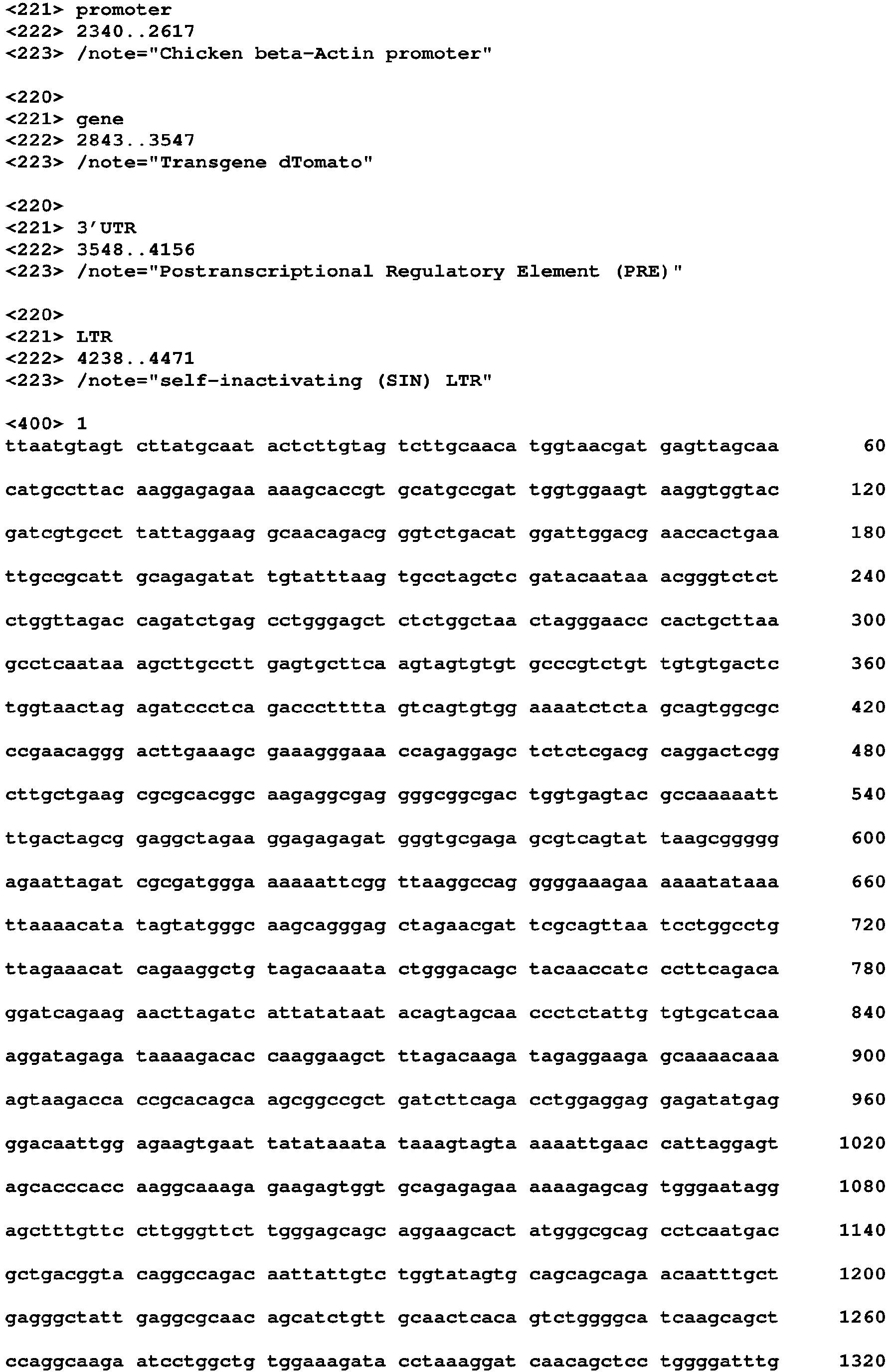


Claims (15)
- A composition for use in treating sensorineural hearing loss in a subject, wherein the composition comprises a 3rd generation lentiviral vector pseudotyped with a viral envelope glycoprotein capable of binding to a receptor expressed in a cell of the inner ear, wherein said composition has a titer of at least 107TU/mL and is administered to the inner ear of the subject.
- The composition for use of claim 1, wherein the lentiviral vector is pseudotyped with a viral envelope glycoprotein capable of binding to a receptor selected from the group consisting of the LDL-receptor and LDL-R family members, the SLC1A5-receptor, the Pit1/2-receptor and the PIRYV-G-receptor.
- The composition for use of any of claims 1-2 wherein the lentiviral vector is pseudotyped with a viral envelope glycoprotein capable of binding the LDL-receptor, wherein the viral envelope glycoprotein is selected from the group comprising MARAV-G, COCV-G, VSV-G and VSV-G ts.
- The composition for use of claim 3, wherein the viral envelope glycoprotein is MARAV-G.
- The composition for use of claim 3, wherein the viral envelope glycoprotein is COCV-G.
- The composition for use of claim 3, wherein the viral envelope glycoprotein is VSV-G, such as wild-type VSV-G or VSV-G ts.
- The composition for use of any of the preceding claims, wherein the lentiviral vector comprises a cargo sequence comprising a nucleic acid selected from the group comprising a protein-coding gene, a miRNA, an shRNA, a IncRNA, or an sgRNA,
wherein expression of said cargo sequence in said cell of the inner ear is capable of reducing or eliminating at least a symptom of sensorineural hearing loss in the subject. - The composition for use of any of the preceding claims, wherein the cargo sequence is a gene selected from the group comprising MYO7A, GJB2, OTOF, ATOH1, SLC26A4, TMC1, TMPRSS3, GIPC3, USH1C, RDX, CLDN14, WHRN, ESPN, ILDR1, SERPINB6, KCNQ4, POU4F3, SIX1, CCDC50, MIR96, POU3F4, EYA1, KCNQ1, GJB6, STRC, TECTA, GJB3, PRPS1, CDH23, GRXCR2, CABP2, GRXCR1, SYNE4, COL11A2, LRTOMT, BSND, PJVK, CIB2, CEACAM16, TMIE, NARS2, LHFPL5, MARVELD2, SLC22A4, KARS, SLC26A5, TPRN, ELMOD3, GPSM2, COCH, ESRRB, ADCY1, EPS8L2, CD164, OTOA, S1PR2, LOXHD1, TSPEAR, EPS8, CDC14A, MSRB3, DCDC2, PNPT1, TMEM132E, FAM65B, MYO3A, CLIC5, HGF, USH2A, TBC1D24, MET, PCDH15, PTPRQ, OTOGL, MYO6, TNC, TRIOBP, BDP1, MYO15A, DIAPH1, MYH14, DFNA5, WFS1, EYA4, COL11A2, MYH9, ACTG1, SLC17A8, GRHL2, DSPP, P2RX2, MYO1A, GFI1, TYMP, GFI1B, BDNF, GDNF, NT-3, IGF1, IGF2, CNTF, ARTN, NRTN, ATP7B, MRP1, MRP2 and MDR1.
- The composition for use of any of the preceding claims, wherein the lentiviral vector is derived from a virus selected from the group comprising HIV-1, HIV-2, SIV, FIV and EIAV, wherein, preferably, the lentiviral vector is derived from HIV-1.
- The composition for use of any of the preceding claims, wherein the lentiviral vector comprisesa) a 5' LTR comprising a constitutively active heterologous promoter at the U3 position, a repeat region (R) and a U5 region,b) a 5' UTR comprising a primer binding site (PBS), a splice donor site (SD), a packaging signal (ψ), a Rev-responsive element, and, optionally, a splice acceptor (SA) site.c) an internal enhancer/promoter region operably linked to a cargo sequence,d) RNA processing elements optionally comprising a Woodchuck hepatitis virus posttranscriptional regulatory element (PRE), ande) a 3' LTR with a deleted U3 (SIN) region, a repeat region (R) and a U5 region.
- The composition for use of any of the preceding claims, wherein the cell of the inner ear is a cell selected from the group consisting of cells of the organ of Corti including supporting cells as well as inner and outer hair cells, spiral ganglion neurons and glial cells, cells of the stria vascularis and spiral ligament, lateral wall fibrocytes, type I and II vestibular hair cells, vestibular supporting cells and vestibular ganglion neurons.
- The composition for use of any of the preceding claims, wherein the lentiviral vector titer is concentrated using ultracentifugation or other purification methods, incl. microfiltration, ultrafiltration, chromatography, density gradient ultracentrifugation, tangential flow microfiltration, and precipitation.
- The composition for use of any of the preceding claims, wherein the composition is administered to the subject by a method selected from the group comprising a cochlea implant route, round window injection, oval window injection, canalostomy, cochleostomy and injection into the endolymphatic sac.
- The composition for use of any of the preceding claims, wherein the lentiviral vector is a non-integrating lentiviral vector.
- A method for treating sensorineural hearing loss in a subject in need thereof, comprising the step of administering an effective amount of the composition of any of claims 1-14 to said subject.
Priority Applications (6)
| Application Number | Priority Date | Filing Date | Title |
|---|---|---|---|
| EP20211616.6A EP4008788A1 (en) | 2020-12-03 | 2020-12-03 | Lentiviral vector technology for inner ear gene therapy |
| EP21838991.4A EP4256064A1 (en) | 2020-12-03 | 2021-12-03 | Lentiviral vector technology for inner ear gene therapy |
| US18/254,669 US20240299581A1 (en) | 2020-12-03 | 2021-12-03 | Lentiviral vector technology for inner ear gene therapy |
| CA3202078A CA3202078A1 (en) | 2020-12-03 | 2021-12-03 | Lentiviral vector technology for inner ear gene therapy |
| PCT/EP2021/084131 WO2022117797A1 (en) | 2020-12-03 | 2021-12-03 | Lentiviral vector technology for inner ear gene therapy |
| JP2023534114A JP2024500314A (en) | 2020-12-03 | 2021-12-03 | Lentiviral vector technology for inner ear gene therapy |
Applications Claiming Priority (1)
| Application Number | Priority Date | Filing Date | Title |
|---|---|---|---|
| EP20211616.6A EP4008788A1 (en) | 2020-12-03 | 2020-12-03 | Lentiviral vector technology for inner ear gene therapy |
Publications (1)
| Publication Number | Publication Date |
|---|---|
| EP4008788A1 true EP4008788A1 (en) | 2022-06-08 |
Family
ID=73698677
Family Applications (2)
| Application Number | Title | Priority Date | Filing Date |
|---|---|---|---|
| EP20211616.6A Withdrawn EP4008788A1 (en) | 2020-12-03 | 2020-12-03 | Lentiviral vector technology for inner ear gene therapy |
| EP21838991.4A Pending EP4256064A1 (en) | 2020-12-03 | 2021-12-03 | Lentiviral vector technology for inner ear gene therapy |
Family Applications After (1)
| Application Number | Title | Priority Date | Filing Date |
|---|---|---|---|
| EP21838991.4A Pending EP4256064A1 (en) | 2020-12-03 | 2021-12-03 | Lentiviral vector technology for inner ear gene therapy |
Country Status (5)
| Country | Link |
|---|---|
| US (1) | US20240299581A1 (en) |
| EP (2) | EP4008788A1 (en) |
| JP (1) | JP2024500314A (en) |
| CA (1) | CA3202078A1 (en) |
| WO (1) | WO2022117797A1 (en) |
Cited By (3)
| Publication number | Priority date | Publication date | Assignee | Title |
|---|---|---|---|---|
| US20240299581A1 (en) * | 2020-12-03 | 2024-09-12 | Medizinische Hochschule Hannover | Lentiviral vector technology for inner ear gene therapy |
| EP4337269A4 (en) * | 2021-05-14 | 2025-04-23 | Rescue Hearing Inc | Gene therapy constructs and methods for treatment of hearing loss |
| WO2024243434A3 (en) * | 2023-05-24 | 2025-05-01 | Interius Biotherapeutics, Inc. | Gene editing compositions of polypeptides and nucleic acids, and uses thereof |
Families Citing this family (3)
| Publication number | Priority date | Publication date | Assignee | Title |
|---|---|---|---|---|
| CN116096905A (en) | 2020-02-21 | 2023-05-09 | 阿库斯股份有限公司 | Compositions and methods for treating non-age-related hearing impairment in human subjects |
| WO2024258863A1 (en) * | 2023-06-12 | 2024-12-19 | Interius Biotherapeutics, Inc. | Pseudotyped viral particles, compositions comprising the same, and uses thereof |
| CN119351399B (en) * | 2024-10-14 | 2025-08-29 | 中国科学院成都生物研究所 | Lhfpl5 gene enhancer and use thereof |
Citations (2)
| Publication number | Priority date | Publication date | Assignee | Title |
|---|---|---|---|---|
| US20150182617A1 (en) * | 2012-07-25 | 2015-07-02 | Theravectys | Glycoproteins for pseudotyping lentivectors |
| WO2018170402A1 (en) * | 2017-03-17 | 2018-09-20 | Rescue Hearing Inc | Gene therapy constructs and methods for treatment of hearing loss |
Family Cites Families (1)
| Publication number | Priority date | Publication date | Assignee | Title |
|---|---|---|---|---|
| EP4008788A1 (en) * | 2020-12-03 | 2022-06-08 | Medizinische Hochschule Hannover | Lentiviral vector technology for inner ear gene therapy |
-
2020
- 2020-12-03 EP EP20211616.6A patent/EP4008788A1/en not_active Withdrawn
-
2021
- 2021-12-03 EP EP21838991.4A patent/EP4256064A1/en active Pending
- 2021-12-03 WO PCT/EP2021/084131 patent/WO2022117797A1/en not_active Ceased
- 2021-12-03 CA CA3202078A patent/CA3202078A1/en active Pending
- 2021-12-03 US US18/254,669 patent/US20240299581A1/en active Pending
- 2021-12-03 JP JP2023534114A patent/JP2024500314A/en active Pending
Patent Citations (2)
| Publication number | Priority date | Publication date | Assignee | Title |
|---|---|---|---|---|
| US20150182617A1 (en) * | 2012-07-25 | 2015-07-02 | Theravectys | Glycoproteins for pseudotyping lentivectors |
| WO2018170402A1 (en) * | 2017-03-17 | 2018-09-20 | Rescue Hearing Inc | Gene therapy constructs and methods for treatment of hearing loss |
Non-Patent Citations (47)
| Title |
|---|
| AGNELLO ET AL.: "Hepatitis C virus and other flaviviridae viruses enter cells via a low density lipoprotein receptor", PROC NATL ACAD SCI, vol. 96, no. 22, 1999, pages 12766 - 12771, XP002174322, DOI: 10.1073/pnas.96.22.12766 |
| BLANC ET AL.: "rAAV-Mediated Cochlear Gene Therapy: Prospects and Challenges for Clinical Application", J. CLIN MED., vol. 9, no. 2, 2020, pages 589 |
| CABANILLAS ET AL.: "Comprehensive genomic diagnosis of non-syndromic and syndromic hereditary loss in Spanish patients", BMC MEDICAL GENOMICS, vol. 11, 2018, pages 58 |
| CATALANOTTO ET AL.: "MicroRNA in Control of Gene Expression: An Overview of Nuclear Functions", INTERNATIONAL JOURNAL OF MOLECULAR SCIENCES, vol. 17, no. 10, 2016, pages 1712 |
| D. FINKELSHTEIN ET AL: "LDL receptor and its family members serve as the cellular receptors for vesicular stomatitis virus", PROCEEDINGS OF THE NATIONAL ACADEMY OF SCIENCES, vol. 110, no. 18, 15 April 2013 (2013-04-15), US, pages 7306 - 7311, XP055436675, ISSN: 0027-8424, DOI: 10.1073/pnas.1214441110 * |
| DONG ET AL.: "Quantitative Analysis of the Packaging Capacity of Recombinant Adeno-Associated Virus", HUMAN GENE THERAPY, vol. 7, 1996, pages 2101 - 2112, XP000985472 |
| FINKELSHTEIN ET AL.: "LDL receptor and its family members serve as the cellular receptors for vesicular stomatitis virus", PNAS, vol. 110, no. 18, 2013, pages 7306 - 7311, XP055436675, DOI: 10.1073/pnas.1214441110 |
| GERMAN ADVISORY COMMITTEE BLOODSUBGROUP ASSESSMENT OF PATHOGENS TRANSMISSIBLE BY BLOOD: "Human Immunodeficiency Virus (HIV", TRANSFUS MED HEMOTHER, vol. 43, no. 3, 2016, pages 203 - 222 |
| GIRARD-GAGNEPAIN ET AL.: "Baboon envelope pseudotyped LVs outperform VSV-G-LVs for gene transfer into early-cytokine-stimulated and resting HSCs", BLOOD, vol. 124, no. 8, 2014, pages 1221 - 1231 |
| GRANT D TROBRIDGE ET AL: "Cocal-pseudotyped lentiviral vectors resist inactivation by human serum and efficiently transduce primate hematopoietic repopulating cells", MOLECULAR THERAPY, ELSEVIER INC, US, vol. 18, no. 4, 1 April 2010 (2010-04-01), pages 725 - 733, XP008155389, ISSN: 1525-0016, [retrieved on 20091208], DOI: 10.1038/MT.2009.282 * |
| HAN ET AL.: "Transgene Expression in the Guinea Pig Cochlea Mediated by a Lentivirus-Derived Gene Transfer Vector", HUMAN GENE THERAPY, vol. 10, 1999, pages 1867 - 1873, XP001028603, DOI: 10.1089/10430349950017545 |
| HAN J J ET AL: "TRANSGENE EXPRESSION IN THE GUINEA PIG COCHLEA MEDIATED BY A LENTIVIRUS-DERIVED GENE TRANSFER VECTOR", HUMAN GENE THERAPY, MARY ANN LIEBERT, INC. PUBLISHERS, GB, vol. 10, no. 11, 20 July 1999 (1999-07-20), pages 1867 - 1873, XP001028603, ISSN: 1043-0342, DOI: 10.1089/10430349950017545 * |
| HASHIMOTO ET AL.: "Lentiviral gene replacement therapy of retinas in a mouse model for Usher syndrome type 1 B", GENE THERAPY, vol. 14, 2007, pages 584 - 594, XP002538488, DOI: 10.1038/SJ.GT.3302897 |
| HASHIMOTO T ET AL: "Lentiviral gene replacement therapy of retinas in a mouse model for Usher syndrome type 1B", GENE THERAPY, vol. 14, no. 7, 1 April 2007 (2007-04-01), pages 584 - 594, XP002538488, ISSN: 0969-7128, [retrieved on 20070201], DOI: 10.1038/SJ.GT.3302897 * |
| HENDRICKS ET AL.: "Localized Cell and Drug Delivery for Auditory Prostheses", HEAR RES, vol. 242, no. 1-2, 2008, pages 117 - 131, XP023610894, DOI: 10.1016/j.heares.2008.06.003 |
| HOSOKAWA ET AL.: "Immunohistochemical localization of megalin and cubilin in the human inner ear", BRAIN RES, vol. 1701, 2018, pages 153 - 160 |
| IWAMOTO ET AL.: "A general chemical method to regulate protein stability in the mammalian central nervous system", CHEM BIOL, vol. 17, no. 9, 2010, pages 981 - 988, XP055552908, DOI: 10.1016/j.chembiol.2010.07.009 |
| IZUMIKAWA ET AL.: "Auditory hair cell replacement and hearing improvement by Atoh1 gene therapy in deaf mammals", NATURE MEDICINE, vol. 11, no. 3, 2005, pages 271 - 276, XP008109775, DOI: 10.1038/nm1193 |
| KUMAR ET AL.: "Systematic Determination of the Packaging Limit of Lentiviral Vectors", HUMAN GENE THREAPY, vol. 12, 2001, pages 1893 - 1905, XP002565043, DOI: 10.1089/104303401753153947 |
| LEVERETT: "Entry of amphotropic murine leukemia virus is influenced by residues in the putative second extracellular domain of its receptor, Pit2", J VIROL, vol. 72, no. 6, 1998, pages 4956 - 61, XP000961040 |
| LEVY ET AL.: "Analysis of a conditional degradation signal in yeast and mammalian cells", EUR J BIOCHEM, vol. 259, no. 1-2, 1999, pages 244 - 252 |
| MALGRANGE ET AL.: "Epithelial supporting cells can differentiate into outer hair cells and Deiters' cells in the cultured organ of Corti", CELLULAR AND MOLECULAR LIFE SCIENCES, vol. 59, 2002, pages 1744 - 1757 |
| MARIN ET AL.: "N-Linked Glycosylation and Sequence Changes in a Critical Negative Control Region of the ASCT1 and ASCT2 Neutral Amino Acid Transporters Determine Their Retroviral Receptor Functions", JOURNAL OF VIROLOGY, vol. 77, no. 5, 2003, pages 2936 - 2945, XP055019013, DOI: 10.1128/JVI.77.5.2936-2945.2003 |
| MEAS ET AL.: "Reprogramming Glia Into Neurons in the Peripheral Auditory System as a Solution for Sensorineural Hearing Loss: Lessons From the Central Nervous System", FRONT MOL NEUROSCI, vol. 11, 2018, pages 77 |
| MILONEO'DOHERTY: "Clinical use of lentiviral vectors", LEUKEMIA, vol. 32, 2018, pages 1529 - 1542 |
| MORGAN ET AL.: "Gene therapy as a possible option to treat hereditary hearing loss", MEDIZINISCHE GENETIK, 2020 |
| MORGAN MICHAEL ET AL: "Gene therapy as a possible option to treat hereditary hearing loss", MEDIZINISCHE GENETIK, 26 August 2020 (2020-08-26), pages 149 - 159, XP055802928, Retrieved from the Internet <URL:https://www.degruyter.com/document/doi/10.1515/medgen-2020-2021/html> [retrieved on 20210510], DOI: 10.1515/medgen-2020-2021 * |
| NALDINI ET AL.: "In vivo gene delivery and stable transduction of nondividing cells by a lentiviral vector", SCIENCE, vol. 272, no. 5259, 1996, pages 263 - 267, XP000583652, DOI: 10.1126/science.272.5259.263 |
| PAN SONG; ZHANG SONG; ZHOU JUN; XIONG WU; YU KUNFEI WAN JINGZHI LIU SHAOSHENG XIONG HAO FU YONG: "Lentivirus carrying the Atoh1 gene infects normal rat cochlea.", NEURAL REGENERATION RESEARCH, vol. 8, no. 17, 15 June 2013 (2013-06-15), pages 1551 - 1559, XP009527424, Retrieved from the Internet <URL:https://www.ncbi.nlm.nih.gov/pmc/articles/PMC4145961/> DOI: doi.org/10.3969/j.issn.1673-5374.2013.17.002 * |
| PIETOLA ET AL.: "HOX-GFP and WOX-GFP lentivirus vectors for inner ear gene transfer", ACTA OTO-LARYNGOLOGICA, vol. 128, 2009, pages 613 - 620 |
| PROFESSIONAL PRACTICE AND GUIDELINES COMMITTEE: "American College of Medical Genetics and Genomics guideline for the clinical evaluation and etiologic diagnosis of hearing loss", GENETICS IN MEDICINE, vol. 16, 2014, pages 347 - 355 |
| SAGE ET AL.: "Proliferation of functional hair cells in vivo in the absence of the retinoblastoma protein", SCIENCE, vol. 307, no. 5712, 2005, pages 1056 - 1058 |
| SANDRIN ET AL.: "Lentiviral vectors pseudotyped with a modified RD114 envelope glycoprotein show increased stability in sera and augmented transduction of primary lymphocytes and CD34+ cells derived from human and nonhuman primates", BLOOD, vol. 100, no. 3, 2002, pages 823 - 32, XP055715223, DOI: 10.1182/blood-2001-11-0042 |
| SCALISE ET AL.: "The Human SLC1A5 (ASCT2) Amino Acid Transporter: From Function to Structure and Role in Cell Biology", FRONT CELL DEV BIOL, 2018 |
| SCALISE ET AL.: "The Human SLC1A5 (ASCT2) Amino Acid Transporter: FROM Function to Structure and Role in Cell Biology", FRONT CELL DEV BIOL, vol. 6, no. 96, 2018 |
| SCHAMBACH ET AL.: "Biosafety Features of Lentiviral Vectors", HUMAN GENE THERAPY, vol. 24, 2013, pages 132 - 142, XP055660095, DOI: 10.1089/hum.2012.229 |
| SCHAMBACH ET AL.: "Equal potency of gammaretroviral and lentiviral SIN vectors for expression of 06-methylguanine-DNA methyltransferase in hematopoietic cells", MOL. THER., vol. 13, no. 2, 2006, pages 391 - 400, XP005252899, DOI: 10.1016/j.ymthe.2005.08.012 |
| SHAWCORNETTA: "Design and Potential of Non-Integrating Lentiviral Vectors", BIOMEDICINES, vol. 2, no. 1, 2014, pages 14 - 35, XP055683355, DOI: 10.3390/biomedicines2010014 |
| SHIBATA ET AL.: "Intravenous rAAV2/9 injection for murine cochlear gene delivery", SCI. REP., vol. 7, 2017, pages 9609 |
| STANKUNAS ET AL.: "Conditional protein alleles using knockin mice and a chemical inducer of dimerization", MOL CELL, vol. 12, no. 6, 2003, pages 1615 - 1624, XP003003206, DOI: 10.1016/S1097-2765(03)00491-X |
| TAO ET AL.: "Delivery of Adeno-Associated Virus Vectors in Adult Mammalian Inner-Ear Cell Subtypes Without Auditory Dysfunction", HUMAN GENE THERAPY, vol. 29, no. 4, 2018, pages 492 - 506 |
| TIJANI ET AL.: "Lentivector Producer Cell Lines with Stably Expressed Vesiculovirus Envelopes", MOL THER METHODS CLIN DEV, vol. 10, 2018, pages 303 - 312 |
| TROBRIDGE ET AL.: "Cocal-pseudotyped Lentiviral Vectors Resist Inactivation by Human Serum and Efficiently Transduce Primate Hematopoietic Repopulating Cells", MOLECULAR THERAPY, vol. 18, no. 4, 2010, pages 725 - 733, XP008155389, DOI: 10.1038/mt.2009.282 |
| WEI YAN ET AL: "Effect of lentiviruses carrying enhanced green fluorescent protein injected into the scala media through a cochleostomy in rats", AMERICAN JOURNAL OF OTOLARYNGOLOGY., vol. 34, no. 4, 1 July 2013 (2013-07-01), US, pages 301 - 307, XP055803118, ISSN: 0196-0709, DOI: 10.1016/j.amjoto.2012.12.011 * |
| YAN WEI ET AL.: "Effect of lentiviruses carrying enhanced green fluorescent protein injected into the scala media through a cochleostomy in rats", AMERICAN JOURNAL OF OTOLARYN-GOLOGY-HEAD AND NECK MEDICINE AND SURGERY, vol. 34, 2013, pages 301 - 307 |
| ZHANG ET AL.: "A highly efficient and consistent method for harvesting large volumes of high-titre lentiviral vectors", GENE THERAPY, vol. 8, 2001, pages 1745 - 1751 |
| ZUFFEREY ET AL.: "Self-Inactivating Lentivirus Vector for Safe and Efficient in Vivo Gene Delivery", J VIROL, vol. 72, no. 12, 1998, pages 9873 - 9880 |
Cited By (3)
| Publication number | Priority date | Publication date | Assignee | Title |
|---|---|---|---|---|
| US20240299581A1 (en) * | 2020-12-03 | 2024-09-12 | Medizinische Hochschule Hannover | Lentiviral vector technology for inner ear gene therapy |
| EP4337269A4 (en) * | 2021-05-14 | 2025-04-23 | Rescue Hearing Inc | Gene therapy constructs and methods for treatment of hearing loss |
| WO2024243434A3 (en) * | 2023-05-24 | 2025-05-01 | Interius Biotherapeutics, Inc. | Gene editing compositions of polypeptides and nucleic acids, and uses thereof |
Also Published As
| Publication number | Publication date |
|---|---|
| JP2024500314A (en) | 2024-01-09 |
| WO2022117797A1 (en) | 2022-06-09 |
| EP4256064A1 (en) | 2023-10-11 |
| CA3202078A1 (en) | 2022-06-09 |
| US20240299581A1 (en) | 2024-09-12 |
Similar Documents
| Publication | Publication Date | Title |
|---|---|---|
| US20240299581A1 (en) | Lentiviral vector technology for inner ear gene therapy | |
| US11993777B2 (en) | Compositions and methods for treating non-age-associated hearing impairment in a human subject | |
| AU2019224121B2 (en) | Compositions and methods for treating non-age-associated hearing impairment in a human subject | |
| Han et al. | Transgene expression in the guinea pig cochlea mediated by a lentivirus-derived gene transfer vector | |
| Delenda | Lentiviral vectors: optimization of packaging, transduction and gene expression | |
| US12305191B2 (en) | Compositions and methods for treating non-age-associated hearing impairment in a human subject | |
| JP4190579B2 (en) | Vectors and methods of use for delivery of nucleic acids to non-dividing cells | |
| PT1076715E (en) | Lentiviral packaging cells | |
| US20240252681A1 (en) | Gene therapy constructs and methods for treatment of hearing loss | |
| WO2005038035A2 (en) | Methods for producing and using in vivo pseudotyped retroviruses | |
| CN118043468A (en) | Compositions and methods for cell type specific gene expression in the inner ear | |
| US20250121093A1 (en) | Lentiviral gene therapy rescues function in a mouse model of usher 1b |
Legal Events
| Date | Code | Title | Description |
|---|---|---|---|
| PUAI | Public reference made under article 153(3) epc to a published international application that has entered the european phase |
Free format text: ORIGINAL CODE: 0009012 |
|
| STAA | Information on the status of an ep patent application or granted ep patent |
Free format text: STATUS: THE APPLICATION HAS BEEN PUBLISHED |
|
| AK | Designated contracting states |
Kind code of ref document: A1 Designated state(s): AL AT BE BG CH CY CZ DE DK EE ES FI FR GB GR HR HU IE IS IT LI LT LU LV MC MK MT NL NO PL PT RO RS SE SI SK SM TR |
|
| STAA | Information on the status of an ep patent application or granted ep patent |
Free format text: STATUS: THE APPLICATION IS DEEMED TO BE WITHDRAWN |
|
| 18D | Application deemed to be withdrawn |
Effective date: 20221209 |