EP4007229A1 - Bandwidth determination method and apparatus, and terminal, and storage medium - Google Patents
Bandwidth determination method and apparatus, and terminal, and storage medium Download PDFInfo
- Publication number
- EP4007229A1 EP4007229A1 EP20942343.3A EP20942343A EP4007229A1 EP 4007229 A1 EP4007229 A1 EP 4007229A1 EP 20942343 A EP20942343 A EP 20942343A EP 4007229 A1 EP4007229 A1 EP 4007229A1
- Authority
- EP
- European Patent Office
- Prior art keywords
- bandwidth
- pictures
- group
- bandwidths
- target
- Prior art date
- Legal status (The legal status is an assumption and is not a legal conclusion. Google has not performed a legal analysis and makes no representation as to the accuracy of the status listed.)
- Withdrawn
Links
Images



Classifications
-
- H—ELECTRICITY
- H04—ELECTRIC COMMUNICATION TECHNIQUE
- H04L—TRANSMISSION OF DIGITAL INFORMATION, e.g. TELEGRAPHIC COMMUNICATION
- H04L65/00—Network arrangements, protocols or services for supporting real-time applications in data packet communication
- H04L65/60—Network streaming of media packets
- H04L65/75—Media network packet handling
-
- H—ELECTRICITY
- H04—ELECTRIC COMMUNICATION TECHNIQUE
- H04L—TRANSMISSION OF DIGITAL INFORMATION, e.g. TELEGRAPHIC COMMUNICATION
- H04L65/00—Network arrangements, protocols or services for supporting real-time applications in data packet communication
- H04L65/60—Network streaming of media packets
- H04L65/61—Network streaming of media packets for supporting one-way streaming services, e.g. Internet radio
- H04L65/613—Network streaming of media packets for supporting one-way streaming services, e.g. Internet radio for the control of the source by the destination
-
- H—ELECTRICITY
- H04—ELECTRIC COMMUNICATION TECHNIQUE
- H04L—TRANSMISSION OF DIGITAL INFORMATION, e.g. TELEGRAPHIC COMMUNICATION
- H04L65/00—Network arrangements, protocols or services for supporting real-time applications in data packet communication
- H04L65/10—Architectures or entities
- H04L65/1059—End-user terminal functionalities specially adapted for real-time communication
-
- H—ELECTRICITY
- H04—ELECTRIC COMMUNICATION TECHNIQUE
- H04L—TRANSMISSION OF DIGITAL INFORMATION, e.g. TELEGRAPHIC COMMUNICATION
- H04L65/00—Network arrangements, protocols or services for supporting real-time applications in data packet communication
- H04L65/60—Network streaming of media packets
- H04L65/70—Media network packetisation
-
- H—ELECTRICITY
- H04—ELECTRIC COMMUNICATION TECHNIQUE
- H04L—TRANSMISSION OF DIGITAL INFORMATION, e.g. TELEGRAPHIC COMMUNICATION
- H04L65/00—Network arrangements, protocols or services for supporting real-time applications in data packet communication
- H04L65/60—Network streaming of media packets
- H04L65/75—Media network packet handling
- H04L65/752—Media network packet handling adapting media to network capabilities
-
- H—ELECTRICITY
- H04—ELECTRIC COMMUNICATION TECHNIQUE
- H04L—TRANSMISSION OF DIGITAL INFORMATION, e.g. TELEGRAPHIC COMMUNICATION
- H04L65/00—Network arrangements, protocols or services for supporting real-time applications in data packet communication
- H04L65/60—Network streaming of media packets
- H04L65/75—Media network packet handling
- H04L65/764—Media network packet handling at the destination
-
- H—ELECTRICITY
- H04—ELECTRIC COMMUNICATION TECHNIQUE
- H04L—TRANSMISSION OF DIGITAL INFORMATION, e.g. TELEGRAPHIC COMMUNICATION
- H04L65/00—Network arrangements, protocols or services for supporting real-time applications in data packet communication
- H04L65/80—Responding to QoS
-
- H—ELECTRICITY
- H04—ELECTRIC COMMUNICATION TECHNIQUE
- H04N—PICTORIAL COMMUNICATION, e.g. TELEVISION
- H04N21/00—Selective content distribution, e.g. interactive television or video on demand [VOD]
- H04N21/20—Servers specifically adapted for the distribution of content, e.g. VOD servers; Operations thereof
- H04N21/23—Processing of content or additional data; Elementary server operations; Server middleware
- H04N21/234—Processing of video elementary streams, e.g. splicing of video streams or manipulating encoded video stream scene graphs
- H04N21/2343—Processing of video elementary streams, e.g. splicing of video streams or manipulating encoded video stream scene graphs involving reformatting operations of video signals for distribution or compliance with end-user requests or end-user device requirements
- H04N21/23439—Processing of video elementary streams, e.g. splicing of video streams or manipulating encoded video stream scene graphs involving reformatting operations of video signals for distribution or compliance with end-user requests or end-user device requirements for generating different versions
-
- H—ELECTRICITY
- H04—ELECTRIC COMMUNICATION TECHNIQUE
- H04N—PICTORIAL COMMUNICATION, e.g. TELEVISION
- H04N21/00—Selective content distribution, e.g. interactive television or video on demand [VOD]
- H04N21/40—Client devices specifically adapted for the reception of or interaction with content, e.g. set-top-box [STB]; Operations thereof
- H04N21/43—Processing of content or additional data, e.g. demultiplexing additional data from a digital video stream; Elementary client operations, e.g. monitoring of home network or synchronising decoder's clock; Client middleware
- H04N21/442—Monitoring of processes or resources, e.g. detecting the failure of a recording device, monitoring the downstream bandwidth, the number of times a movie has been viewed, the storage space available from the internal hard disk
- H04N21/44209—Monitoring of downstream path of the transmission network originating from a server, e.g. bandwidth variations of a wireless network
-
- H—ELECTRICITY
- H04—ELECTRIC COMMUNICATION TECHNIQUE
- H04N—PICTORIAL COMMUNICATION, e.g. TELEVISION
- H04N21/00—Selective content distribution, e.g. interactive television or video on demand [VOD]
- H04N21/40—Client devices specifically adapted for the reception of or interaction with content, e.g. set-top-box [STB]; Operations thereof
- H04N21/45—Management operations performed by the client for facilitating the reception of or the interaction with the content or administrating data related to the end-user or to the client device itself, e.g. learning user preferences for recommending movies, resolving scheduling conflicts
- H04N21/462—Content or additional data management e.g. creating a master electronic programme guide from data received from the Internet and a Head-end or controlling the complexity of a video stream by scaling the resolution or bit-rate based on the client capabilities
- H04N21/4621—Controlling the complexity of the content stream or additional data, e.g. lowering the resolution or bit-rate of the video stream for a mobile client with a small screen
-
- H—ELECTRICITY
- H04—ELECTRIC COMMUNICATION TECHNIQUE
- H04N—PICTORIAL COMMUNICATION, e.g. TELEVISION
- H04N21/00—Selective content distribution, e.g. interactive television or video on demand [VOD]
- H04N21/60—Network structure or processes for video distribution between server and client or between remote clients; Control signalling between clients, server and network components; Transmission of management data between server and client, e.g. sending from server to client commands for recording incoming content stream; Communication details between server and client
- H04N21/65—Transmission of management data between client and server
- H04N21/658—Transmission by the client directed to the server
- H04N21/6587—Control parameters, e.g. trick play commands, viewpoint selection
-
- H—ELECTRICITY
- H04—ELECTRIC COMMUNICATION TECHNIQUE
- H04N—PICTORIAL COMMUNICATION, e.g. TELEVISION
- H04N21/00—Selective content distribution, e.g. interactive television or video on demand [VOD]
- H04N21/80—Generation or processing of content or additional data by content creator independently of the distribution process; Content per se
- H04N21/83—Generation or processing of protective or descriptive data associated with content; Content structuring
- H04N21/845—Structuring of content, e.g. decomposing content into time segments
- H04N21/8456—Structuring of content, e.g. decomposing content into time segments by decomposing the content in the time domain, e.g. in time segments
Definitions
- the present disclosure relates to the field of multimedia technologies, and in particular, relates to a method and an apparatus for determining a bandwidth, a terminal, and a storage medium.
- the multi-bit-rate adaptive strategy is a common strategy for improving the user's viewing experience.
- This multi-bitrate adaptive strategy refers to selecting the best video bitrate and resolution for playing by estimating a bandwidth at a client-side and combining the characteristics of a terminal and a player, thereby dynamically compromising the conflicts between the playing lag and the definition. Therefore, how to accurately estimate the bandwidth of the terminal is a challenging problem.
- a common method for estimating the bandwidth includes: counting the total volume of data received by the terminal in a period of time, and then taking a ratio of the total volume of data to the period of time as the bandwidth of the terminal.
- the present disclosure provides a method and an apparatus for determining a bandwidth, a terminal, and a storage medium.
- the technical solutions of the present disclosure are as follows.
- a method for determining a bandwidth includes:
- an apparatus for determining a bandwidth includes:
- the first determining unit is configured to acquire at least one first bandwidth not less than the second bandwidth from the at least two first bandwidths; and acquire an average value of the at least one first bandwidth, and determine the average value as the third bandwidth of the group of pictures.
- the second determining unit is configured to determine a weighted average value of the third bandwidths of the at least two groups of pictures, and determine the weighted average value as the target bandwidth of the terminal.
- the apparatus further includes: a third determining unit, configured to determine, during reception of a video stream from a server, at least two first bandwidths corresponding to the group of pictures and a second bandwidth corresponding to the group of pictures in response to one group of pictures being received, wherein the video stream includes a plurality of groups of pictures.
- a third determining unit configured to determine, during reception of a video stream from a server, at least two first bandwidths corresponding to the group of pictures and a second bandwidth corresponding to the group of pictures in response to one group of pictures being received, wherein the video stream includes a plurality of groups of pictures.
- the apparatus further includes:
- a terminal includes:
- the one or more processors are configured to execute the at least one instruction to perform:
- the one or more processors are configured to execute the at least one instruction to perform: determining a weighted average value of the third bandwidths of the at least two groups of pictures, and determining the weighted average value as the target bandwidth of the terminal.
- the one or more processors are configured to execute the at least one instruction to perform: determining, during reception of a video stream from a server, at least two first bandwidths corresponding to the group of pictures and a second bandwidth corresponding to the group of pictures in response to one group of pictures being received, wherein the video stream includes a plurality of groups of pictures.
- the one or more processors are configured to execute the at least one instruction to perform:
- a storage medium storing at least one instruction.
- the at least one instruction when executed by a processor of a terminal, enables the terminal to perform:
- the one or more processors are configured to execute the at least one instruction to perform:
- the one or more processors are configured to execute the at least one instruction to perform: determining a weighted average value of the third bandwidths of the at least two groups of pictures, and determining the weighted average value as the target bandwidth of the terminal.
- the one or more processors are configured to execute the at least one instruction to perform: determining, during reception of a video stream from a server, at least two first bandwidths corresponding to the group of pictures and a second bandwidth corresponding to the group of pictures in response to one group of pictures being received, wherein the video stream includes a plurality of groups of pictures.
- the one or more processors are configured to execute the at least one instruction to perform:
- an application program product stores one or more instructions, which is executed by a processor of a terminal to perform:
- the one or more processors are configured to execute the at least one instruction to perform:
- the one or more processors are configured to execute the at least one instruction to perform: determining a weighted average value of the third bandwidths of the at least two groups of pictures, and determining the weighted average value as the target bandwidth of the terminal.
- the one or more processors are configured to execute the at least one instruction to perform: determining, during reception of a video stream from a server, at least two first bandwidths corresponding to the group of pictures and a second bandwidth corresponding to the group of pictures in response to one group of pictures being received, wherein the video stream includes a plurality of groups of pictures.
- the one or more processors are configured to execute the at least one instruction to perform:
- User information involved in the present disclosure may be information authorized by users or fully authorized by various parties.
- GOP Group of pictures
- MPEG Moving picture experts group
- I-frame represents an intra-coded frame
- P-frame represents a forward predictive frame
- B-frame represents a bidirectional interpolation frame.
- I-frame is an entire picture
- P-frame and B-frame record changes relative to the I-frame. Without the I-frame, neither the P-frame nor the B-frame can be decoded. This is the reason why the MPEG format is difficult to accurately clip.
- this combination of consecutive frames of pictures is the GOP.
- An embodiment of the present disclosure provides a method for determining a bandwidth, which is applicable to a scenario where a user watches live streaming via a terminal.
- the user may send a playing request to the server via the terminal, and the playing request may carry a video identifier and a video bitrate of a requested video.
- a video provided by the server will be transcoded into a variety of different video bitrates.
- the video bitrate requested by the terminal is high, and the terminal has a poor network condition or a small bandwidth, the video would be lagged in response to the terminal playing the video, leading to poor user experience.
- a third bandwidth of a group of pictures can be determined based on a first bandwidth that is not less than a second bandwidth of the group of pictures in at least two first bandwidths of the group of pictures, such that the third bandwidth can well reflect a bandwidth at which the group of pictures is downloaded; and then, a target bandwidth can be determined based on third bandwidths of at least two groups of pictures, such that the determined target bandwidth can be closer to an actual bandwidth of a terminal.
- the terminal can request a video having a corresponding video bitrate based on the target bandwidth, such that the resolution of the video still is also high under the condition of ensuring no lag.
- FIG. 1 is a schematic diagram of an implementation environment of a method for determining a bandwidth according to an exemplary embodiment.
- the implementation environment includes: a terminal 101 and a server 102.
- the terminal 101 may be at least one of devices such as a smartphone, a smartwatch, a desktop computer, a portable computer, a Moving Picture Experts Group Audio Layer III (MP3) player, a Moving Picture Experts Group Audio Layer IV (MP4) player, and a laptop portable computer.
- An application program that supports the playing of live streaming may be installed and run on the terminal 101, and a user may log in to the application program via the terminal 101 to acquire a service provided by the application program.
- the terminal 101 may be connected to the server 102 via a wireless or wired network, and then send a live-streaming acquisition request to the server 102 to acquire live-streaming data returned by the server 102.
- the terminal 101 may refer to one of a plurality of terminals in a general sense, and this embodiment only takes the terminal 101 as an example for illustration. Those skilled in the art may know that the number of the above terminal may be more or less. For example, there may be only several, tens, or hundreds of, or more terminals above. The number and device type of the terminal are not limited in the embodiments of the present disclosure.
- the server 102 may be at least one of a server, a plurality of servers, a cloud computing platform, and a virtualization center.
- the server 102 may be connected to the terminal 101 and other terminals via a wireless or wired network; and the server 102 may receive a playing request sent by the terminal 101, and return a video stream to the terminal 101 via a data center based on the playing request.
- the number of the above server may be more or less, which is not limited in the embodiments of the present disclosure.
- the server 102 may further include other functional servers to provide more comprehensive and diversified services.
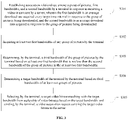
- FIG. 2 is a flowchart of a method for determining a bandwidth according to an exemplary embodiment. Referring to FIG. 2 , the method is executed by a terminal and specifically includes the following processes.
- the terminal acquires at least two first bandwidths of any group of pictures, wherein the first bandwidth is an average download rate acquired every target time interval in response to the group of pictures being downloaded.
- the video stream received by the terminal is composed of a plurality of groups of pictures.
- the average download rate for every target time interval is taken as the first bandwidth.
- the average download rate of the acquired group of pictures is taken as a second bandwidth. Since the time required for the terminal to download any group of pictures may be greater than at least two target time intervals, the terminal may determine, for any group of pictures, at least two first bandwidths corresponding to the group of pictures.
- the terminal determines a third bandwidth of the group of pictures based on at least one first bandwidth that is not less than a second bandwidth of the group of pictures in the at least two first bandwidths, wherein the second bandwidth is an average download rate acquired in response to the group of pictures being downloaded.
- the terminal may take the average download rate acquired in response to downloading each group of pictures, as the second bandwidth of the group of pictures. Due to the presence of network fluctuations, the first bandwidth may be greater than, or smaller than, or equal to the second bandwidth. The larger the first bandwidth, the closer to the actual bandwidth of the terminal. Therefore, a third bandwidth of the group of pictures may be preliminarily estimated based on the at least two first bandwidths and the second bandwidth of the group of pictures as defined above, and the third bandwidth is closer to the actual bandwidth of the terminal.
- the terminal determines a target bandwidth of the terminal based on third bandwidths of at least two groups of pictures.
- the at least two groups of pictures may be consecutive groups of pictures, or groups of pictures acquired at intervals, or randomly selected groups of pictures.
- the terminal may calculate the target bandwidth of the terminal by acquiring third bandwidths of at least two groups of pictures, such that the target bandwidth is a relatively stable bandwidth for a period of time.
- the target bandwidth is close to the actual bandwidth of the terminal and is relatively stable.
- a third bandwidth of a group of pictures is determined based on the first bandwidth that is not less than a second bandwidth of the group of pictures in the at least two first bandwidths of the group of pictures, such that the third bandwidth can well reflect a bandwidth at which the group of pictures is downloaded; and then, a target bandwidth can be determined based on third bandwidths of at least two groups of pictures, such that the determined target bandwidth can be closer to an actual bandwidth of a terminal.
- determining the third bandwidth of the group of pictures based on the at least two first bandwidths and the second bandwidth of the group of pictures includes:
- the calculated third bandwidth may reflect the bandwidth that is relatively stable and has a higher value in response to the group of pictures being downloaded.
- determining the target bandwidth of the terminal based on the third bandwidths of the at least two groups of pictures includes: determining a weighted average value of the third bandwidths of the at least two groups of pictures, and determining the weighted average value as the target bandwidth of the terminal.
- the target bandwidth may reflect the bandwidth that is relatively stable in a period of time and has a high value, for the terminal.
- the method prior to acquiring the at least two first bandwidths of any group of pictures, the method further includes: determining, during reception of a video stream from a server, at least two first bandwidths corresponding to the group of pictures and a second bandwidth corresponding to the group of pictures in response to one group of pictures being received, wherein the video stream includes a plurality of groups of pictures.
- the terminal may acquire the first and second bandwidths of any group of pictures based on the established association relationship.
- the method upon determining the target bandwidth of the terminal based on the third bandwidths of the at least two groups of pictures, the method further includes:
- the target video bitrate matching with the target bandwidth is selected based on the target bandwidth, the video bitrate of the video stream requested by the terminal is closer to the actual bandwidth of the terminal, thereby avoiding bandwidth waste.
- FIG. 3 is a flowchart of another method for determining a bandwidth according to an exemplary embodiment. Referring to FIG. 3 , the method includes the following processes.
- a terminal establishes association relationships among a group of pictures, first bandwidths, and a second bandwidth in response to receiving a video stream sent by a server, wherein the first bandwidth is an average download rate acquired every target time interval in response to the group of pictures being downloaded, and the second bandwidth is an average download rate acquired in response to the group of pictures being downloaded.
- the terminal may receive the video stream sent by the server, and the video stream includes at least two groups of pictures. Each time one group of pictures is received, the terminal may acquire the average download rate in response to downloading the group of pictures, and takes the average download rate as the second bandwidth of the group of pictures.
- the terminal may also acquire a first bandwidth every target time interval in response to receiving the video stream, wherein the first bandwidth is a ratio of the volume of data downloaded at the target time interval to the target time interval, that is, one single average download rate within the target time interval.
- the target time interval is smaller than the time required to download one group of pictures, and a corresponding terminal may acquire at least two first bandwidths each time one group of pictures is received.
- one group of pictures corresponds to at least two first bandwidths and one second bandwidth.
- the terminal may establish an association relationship among the group of pictures, at least two first bandwidths of the group of pictures, and a second bandwidth of the group of pictures.
- the first bandwidth may also be referred to as bandwidth information on time granularity
- the second bandwidth may also be referred to as bandwidth information on GOP granularity. Since the first bandwidth and the second bandwidth are determined in the case that the video stream is acquired, the terminal may acquire the first and second bandwidths of any group of pictures based on the established association relationship.
- bw gop may be used to represent the bandwidth information on GOP granularity.
- bw i gop may represent a second bandwidth of an i th GOP among the second bandwidths of at least two GOPs acquired by the terminal.
- the terminal acquires at least two first bandwidths of any group of pictures.
- the target time interval is generally smaller than the time required to download one group of pictures. Therefore, the terminal may acquire at least two first bandwidths in response to downloading one group of pictures.
- the target time interval may be 200 milliseconds, 500 milliseconds, 1000 milliseconds, or the like, which is not limited in the embodiment of the present disclosure.
- the time required to download one group of pictures may be 1 second, 2 seconds, 3 seconds, or the like, which is not limited in the embodiment of the present disclosure.
- the terminal may acquire at least two first bandwidths of the group of pictures based on the association relationship between the group of pictures and the first bandwidths.
- the terminal acquires N first bandwidths in response to acquiring the i th GOP, wherein N is a positive integer greater than or equal to 2.
- the N first bandwidths may be denoted as bw 0 i , bw 1 i , ... , bw N ⁇ 1 i .
- the terminal determines a third bandwidth of the group of pictures based on at least one first bandwidth that is not less than the second bandwidth of the group of pictures in the at least two first bandwidths.
- the download rate of the terminal in response to downloading the group of pictures is unstable due to the presence of network fluctuations, therefore, the first bandwidth acquired by the terminal may be greater than, or smaller than, or equal to the second bandwidth.
- the terminal may acquire at least one first bandwidth that is not less than the second bandwidth from the at least two first bandwidths. Then, the terminal may acquire an average value of the at least one first bandwidth and take the average value as the third bandwidth of the group of pictures. Since the first bandwidths that are not less than the second bandwidth are selected first, and then an average value of the first bandwidths is calculated, the calculated third bandwidth may reflect the bandwidth that is relatively stable and has a higher value in response to the group of pictures being downloaded.
- the terminal determines a target bandwidth of the terminal based on third bandwidths of at least two groups of pictures.
- the terminal may take the third bandwidth of the above group of pictures as the target bandwidth of the terminal, and may also determine the target bandwidth of the terminal based on the third bandwidths of at least two groups of pictures.
- the terminal may select M consecutive groups of pictures by sliding a window, acquire a bandwidth weight corresponding to each of the M consecutive groups of pictures, and then determine a weighted average value of third bandwidths of the M consecutive groups of pictures, taking the weighted average value as the target bandwidth of the terminal.
- M is a positive integer greater than or equal to 2.
- the target bandwidth of the terminal is determined based on the M consecutive groups of pictures and may be updated in real time based on a third bandwidth of a new group of pictures, such that the target bandwidth is smoother and may reflect the actual bandwidth of the terminal.
- the terminal may randomly select M groups of pictures from a plurality of groups of pictures acquired in a preset period of time every a preset time interval, acquire a bandwidth weight corresponding to each of the M groups of pictures, and then determine a weighted average value of third bandwidths of the M groups of pictures, taking the weighted average value as the target bandwidth of the terminal. Then, the average value of the target bandwidth is updated in the next preset period of time.
- the preset period of time may be 30 seconds, 1 minute, 2 minutes, or the like, which is not limited in the embodiment of the present disclosure.
- the target bandwidth is determined based on the third bandwidths of the groups of pictures within a preset time period.
- the target bandwidth may be determined once every a preset period of time to reduce the load of calculation and save the computing resources of the terminal.
- the third bandwidths of the M groups of pictures acquired by the terminal may be expressed as bw k est , b k + 1 est , ... , bw k + M ⁇ 1 est .
- the terminal selects a target video bitrate matching with the target bandwidth from a plurality of video bitrates based on the target bandwidth and sends a video acquisition request carrying the target video bitrate to the server.
- the terminal may select the target video bitrate matching with the target bandwidth from the plurality of bitrates corresponding to a currently viewed video based on a matching relationship between the bandwidth and the video bitrate. Then, a video acquisition request carrying the target video bitrate is sent to the server to acquire a video stream at the target video bitrate.
- a third bandwidth of a group of pictures is determined based on a first bandwidth that is not less than a second bandwidth of the group of pictures in at least two first bandwidths of the group of pictures, such that the third bandwidth can well reflect a bandwidth at which the group of pictures is downloaded; and then, a target bandwidth can be determined based on third bandwidths of at least two groups of pictures, such that the determined target bandwidth can be closer to a actual bandwidth of a terminal.
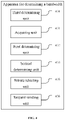
- FIG. 4 is a block diagram of an apparatus for determining a bandwidth according to an exemplary embodiment.
- the apparatus includes an acquiring unit 401, a first determining unit 402, and a second determining unit 403.
- the acquiring unit 401 is configured to acquire at least two first bandwidths of any group of pictures, wherein the first bandwidth is an average download rate acquired every target time interval in response to the group of pictures being downloaded.
- the first determining unit 402 is configured to determine a third bandwidth of the group of pictures based on at least one first bandwidth that is not less than a second bandwidth of the group of pictures in the at least two first bandwidths, wherein the second bandwidth is an average download rate acquired in response to the group of pictures being downloaded.
- the second determining unit 403 is configured to determine a target bandwidth of a terminal based on third bandwidths of at least two groups of pictures.
- a third bandwidth of a group of pictures is determined based on a first bandwidth that is not less than a second bandwidth of the group of pictures in at least two first bandwidths of the group of pictures, such that the third bandwidth can well reflect a bandwidth at which the group of pictures is downloaded; and then, a target bandwidth can be determined based on third bandwidths of at least two groups of pictures, such that the determined target bandwidth may be closer to an actual bandwidth of a terminal.
- the first determining unit 402 is configured to acquire at least one first bandwidth not less than the second bandwidth from the at least two first bandwidths; and acquiring an average value of the at least one first bandwidth, and determine the average value as the third bandwidth of the group of pictures.
- the second determining unit 403 is configured to determine a weighted average value of the third bandwidths of the at least two groups of pictures, and determine the weighted average value as the target bandwidth of the terminal.
- the apparatus further includes: a third determining unit 404 configured to determine, during reception of a video stream from a server, at least two first bandwidths corresponding to the group of pictures and a second bandwidth corresponding to the group of pictures in response to one group of pictures being received, wherein the video stream includes a plurality of groups of pictures.
- a third determining unit 404 configured to determine, during reception of a video stream from a server, at least two first bandwidths corresponding to the group of pictures and a second bandwidth corresponding to the group of pictures in response to one group of pictures being received, wherein the video stream includes a plurality of groups of pictures.
- the apparatus further includes:
- the apparatus for determining the bandwidth provided by the above embodiments only takes the division of all the functional units as an example for explanation during the determining of the bandwidth.
- the above functions may be finished by the different functional units as required. That is, the internal structure of the terminal is divided into different functional units to finish all or part of the functions described above.
- the apparatus for determining the bandwidth provided by the above embodiments is derived from the same concept as the method for determining the bandwidth provided by the above embodiments. Reference may be made to the method embodiment for the specific implementation process, which is not repeated here.
- FIG. 5 is a structural block diagram of a terminal 500 according to an exemplary embodiment.
- the terminal 500 may be a smartphone, a tablet computer, a moving picture experts group audio layer III (MP3) player, a moving picture experts group audio layer IV (MP4) player, a notebook computer, or a desktop computer.
- MP3 moving picture experts group audio layer III
- MP4 moving picture experts group audio layer IV
- the terminal 500 may also be called user equipment, a portable terminal, a laptop terminal, a desktop terminal, or the like.
- the terminal 500 includes a processor 501 and a memory 502.
- the processor 501 may include one or more processing cores, such as 4-core processors or 8-core processors.
- the processor 501 may be implemented by at least one of the hardware forms of a digital signal processor (DSP), a field-programmable gate array (FPGA), and a programmable logic array (PLA).
- DSP digital signal processor
- FPGA field-programmable gate array
- PDA programmable logic array
- the processor 501 may further include a main processor and a co-processor.
- the main processor is configured to process data in an awake state and is also called a central processing unit (CPU); and the co-processor is a low-power-consumption processor configured to process data in a standby state.
- the processor 501 may be integrated with a graphic processing unit (GPU), which is configured to render and draw the content that needs to be displayed on a display screen.
- the processor 501 may further include an artificial intelligence (AI) processor configured to process computational operations related to machine learning.
- AI artificial intelligence
- the memory 502 may include one or more computer-readable storage media, which may be non-transitory.
- the memory 502 may further include a high-speed random-access memory, and a non-volatile memory, such as one or more magnetic disk storage devices and flash storage devices.
- the non-transitory computer-readable storage medium in the memory 502 is configured to store at least one instruction executed by the processor 501 for performing:
- the processor is configured to execute the at least one instruction to perform:
- the processor is configured to execute the at least one instruction to perform: determining a weighted average value of the third bandwidths of the at least two groups of pictures, and determining the weighted average value as the target bandwidth of the terminal.
- the processor is configured to execute the at least one instruction to perform: determining, during reception of a video stream from a server, at least two first bandwidths corresponding to the group of pictures and a second bandwidth corresponding to the group of pictures in response to one group of pictures being received, wherein the video stream includes a plurality of groups of pictures.
- the processor is configured to execute the at least one instruction to perform:
- the terminal 500 may further optionally include a peripheral device interface 503 and at least one peripheral device.
- the processor 501, the memory 502, and the peripheral device interface 503 may be connected to each other by buses or signal lines.
- Each peripheral device may be connected to the peripheral device interface 503 via a bus, a signal line, or a circuit board.
- the peripheral device includes at least one of a radio-frequency circuit 504, a display screen 505, a camera assembly 506, an audio circuit 507, a positioning assembly 508, and a power source 509.
- the peripheral device interface 503 may be configured to connect at least one peripheral device associated with an input/output (I/O) to the processor 501 and the memory 502.
- the processor 501, the memory 502 and the peripheral device interface 503 are integrated on the same chip or circuit board.
- any one or two of the processor 501, the memory 502 and the peripheral device interface 503 may be implemented on a separate chip or circuit board, which is not limited in the present disclosure.
- the radio-frequency circuit 504 is configured to receive and transmit a radio frequency (RF) signal, which is also referred to as an electromagnetic signal.
- the radio-frequency circuit 504 is communicated with a communication network and other communication devices via the electromagnetic signal.
- the radio-frequency circuit 504 converts an electrical signal into the electromagnetic signal for transmission or converts the received electromagnetic signals into the electrical signal.
- the radio-frequency circuit 504 includes an antenna system, an RF transceiver, one or more amplifiers, a tuner, an oscillator, a digital signal processor, a codec chipset, a user identity module card, or the like.
- the radio-frequency circuit 504 may be communicated with other terminals through at least one wireless communication protocol.
- the wireless communication protocol includes but is not limited to, a metropolitan area network, various generations of mobile communication networks (2G, 3G, 4G, and 5G), a wireless local area network, and/or a wireless fidelity (Wi-Fi)) network.
- the radio-frequency circuit 504 may further include a circuit related to the near-field communication (NFC), which is not limited in the present disclosure.
- the display screen 505 is configured to display a user interface (UI).
- the UI may include graphics, text, icons, videos, and any combination thereof.
- the display screen 505 is further capable of acquiring a touch signal on or over a surface of the display screen 505.
- the touch signal may be input into the processor 501 as a control signal for processing.
- the display screen 505 may be further configured to provide virtual buttons and/or a virtual keyboard, which is/are also referred to as soft buttons and/or a soft keyboard.
- one display screen 505 may be disposed on a front panel of the terminal 500.
- At least two display screens 505 may be disposed on different surfaces of the terminal 500 or in a folded design.
- the display screen 505 may be a flexible display screen disposed on a bending or folded surface of the terminal 500.
- the display screen 505 may have an irregular shape other than rectangle, that is, an irregularly-shaped screen.
- the display screen 505 may be made from materials such as a liquid crystal display (LCD) and an organic light-emitting diode (OLED).
- the camera assembly 506 is configured to capture images or videos.
- the camera assembly 506 includes a front camera and a rear camera.
- the front camera is disposed on a front panel of the terminal, and the rear camera is disposed on the back of the terminal.
- at least two rear cameras are disposed, each of which is at least one of a main camera, a depth-of-field camera, a wide-angle camera, and a telephoto camera, to realize a background blurring function achieved by fusion of the main camera and the depth-of-field camera, panoramic shooting and virtual reality (VR) shooting functions achieved by fusion of the main camera and the wide-angle camera, or other fusion shooting functions.
- the camera assembly 506 may further include a flashlight.
- the flashlight may be a monochromatic-temperature flashlight or a dichromatic-temperature flashlight.
- the dichromatic-temperature flashlight refers to a combination of a warm-light flashlight and a cold-light flashlight and may serve to compensate light at different chromatic temperatures.
- the audio circuit 507 may include a microphone and a loudspeaker.
- the microphone is configured to capture sound waves from users and environments, and convert the sound waves into electrical signals, which are then input to the processor 501 to be processed, or input to the radio-frequency circuit 504 for voice communication. For stereo acquisition or noise reduction, there are a plurality of microphones disposed at different parts of the terminal 500.
- the microphone may also be an array microphone or an omnidirectional acquisition type microphone.
- the loudspeaker is configured to convert electrical signals from the processor 501 or the radio-frequency circuit 504 into sound waves.
- the loudspeaker may be a traditional thinfilm loudspeaker or a piezoelectric ceramic loudspeaker.
- the electrical signals may be converted into sound waves not only human-audible sound waves, but also the sound waves which are inaudible to human beings for distance measurement and the like.
- the audio circuit 507 may further include a headphone jack.
- the positioning assembly 508 is configured to position a current geographic location of the terminal 500 to implement navigation or a location based service (LBS).
- LBS location based service
- the positioning assembly 508 may be the United States' Global Positioning System (GPS), Russia's Global Navigation Satellite System (GLONASS), China's BeiDou Navigation Satellite System (BDS), and the European Union's Galileo Satellite Navigation System (Galileo).
- GPS Global Positioning System
- GLONASS Global Navigation Satellite System
- BDS BeiDou Navigation Satellite System
- Galileo European Union's Galileo Satellite Navigation System
- the power source 509 is configured to supply power for various components in the terminal 500.
- the power supply 509 may be an alternating current, a direct current, a disposable battery, or a rechargeable battery.
- the rechargeable battery may support wired charging or wireless charging.
- the rechargeable battery may be further configured to support the fast charging technology.
- the terminal 500 may further include one or more sensors 510.
- the one or more sensors 510 include, but are not limited to, an acceleration sensor 511, a gyro sensor 512, a pressure sensor 513, a fingerprint sensor 514, an optical sensor 515, and a proximity sensor 516.
- the acceleration sensor 511 may detect magnitudes of accelerations on three coordinate axes of a coordinate system established based on the terminal 500.
- the acceleration sensor 511 may be configured to detect components of a gravitational acceleration on three coordinate axes.
- the processor 501 may control the display screen 505 to display a user interface in a landscape view or a portrait view based on a gravity acceleration signal acquired by the acceleration sensor 511.
- the acceleration sensor 511 may be further configured to acquire motion data of a game or a user.
- the gyro sensor 512 may detect a body direction and a rotation angle of the terminal 500 and cooperate with the acceleration sensor 511 to acquire a 3D motion of the user on the terminal 500. Based on the data acquired by the gyro sensor 512, the processor 501 may achieve the following functions: motion sensing (for example, changing the UI according to a user's tilt operation), image stabilization during shooting, game control, and inertial navigation.
- motion sensing for example, changing the UI according to a user's tilt operation
- image stabilization during shooting for example, game control, and inertial navigation.
- the pressure sensor 513 may be disposed on a side frame of the terminal 500 and/or at a lower layer of the display screen 505.
- a user's holding signal to the terminal 500 may be detected, and the processor 501 performs left-right hand recognition or shortcut operation according to the holding signal acquired by the pressure sensor 513.
- the processor 501 controls an operable control on the UI according to a user's press operation on the display screen 505.
- the operable control includes at least one of a button control, a scroll bar control, an icon control, and a menu control.
- the fingerprint sensor 514 is configured to acquire a user's fingerprint.
- the processor 501 recognizes the user's identity based on the fingerprint acquired by the fingerprint sensor 514, or the fingerprint sensor 514 recognizes the user's identity based on the acquired fingerprint. In the case that the user's identity is recognized as trusted, the processor 501 authorizes the user to perform related sensitive operations, which include unlocking the screen, viewing encrypted information, downloading software, paying, changing settings, and the like.
- the fingerprint sensor 514 may be disposed on the front, the back, or the side of the terminal 500. In the case that a physical button or a manufacturer's logo is disposed on the terminal 500, the fingerprint sensor 514 may be integrated with the physical button or the manufacturer's logo.
- the optical sensor 515 is configured to acquire ambient light intensity.
- the processor 501 may control the display brightness of the display screen 505 based on the ambient light intensity acquired by the optical sensor 515. In some embodiments, in the case that the intensity of ambient light is high, the display brightness of the display screen 505 is increased; and in the case that the intensity of ambient light is low, the display brightness of the display screen 505 is decreased. In another embodiment, the processor 501 may also dynamically adjust shooting parameters of the camera assembly 506 based on the ambient light intensity acquired by the optical sensor 515.
- the proximity sensor 516 also referred to as a distance sensor, is usually disposed on the front panel of the terminal 500.
- the proximity sensor 516 is configured to acquire a distance between a user and a front surface of the terminal 500.
- the processor 501 controls the display screen 505 to switch from a screen-on state to a screen-off state; and in response to the proximity sensor 516 detecting the distance between the user and the front of the terminal 500 gradually increases, the processor 501 controls the display screen 505 to switch from the screen-off state to the screen-on state.
- terminal 500 is not limited by the structure illustrated in FIG. 5 , and may include more or fewer assemblies than those illustrated, or a combination of assemblies, or assemblies arranged differently.
- An exemplary embodiment of the present disclosure further provides a storage medium including at least one instruction, for example, a memory including at least one instruction.
- the at least one instruction may be executed by the processor to perform:
- the processor is configured to execute the at least one instruction to perform: determining, during reception of a video stream from a server, at least two first bandwidths corresponding to the group of pictures and a second bandwidth corresponding to the group of pictures in response to one group of pictures being received, wherein the video stream includes a plurality of groups of pictures.
- the processor is configured to execute the at least one instruction to perform:
- the storage medium may be a non-transitory computer-readable storage medium.
- the computer-readable storage medium may be a read-only memory (ROM), a random-access memory (RAM), a compact disc read-only memory (CD-ROM), a magnetic tape, a floppy disk, an optical data storage device, or the like.
- an application program product is further provided.
- the application program product stores one or more instructions, which may be executed by a processor of a terminal to perform:
- the processor is configured to execute the at least one instruction to perform:
- the processor is configured to execute the at least one instruction to perform: determining a weighted average value of the third bandwidths of the at least two groups of pictures, and determining the weighted average value as the target bandwidth of the terminal.
- the processor is configured to execute the at least one instruction to perform: determining, during reception of a video stream from a server, at least two first bandwidths corresponding to the group of pictures and a second bandwidth corresponding to the group of pictures in response to one group of pictures being received, wherein the video stream includes a plurality of groups of pictures.
- the processor is configured to execute the at least one instruction to perform:
Landscapes
- Engineering & Computer Science (AREA)
- Multimedia (AREA)
- Signal Processing (AREA)
- Computer Networks & Wireless Communication (AREA)
- Databases & Information Systems (AREA)
- Two-Way Televisions, Distribution Of Moving Picture Or The Like (AREA)
Abstract
Description
- The present disclosure claims priority to
Chinese Patent Application No. 202010588541.6, filed on June 24, 2020 - The present disclosure relates to the field of multimedia technologies, and in particular, relates to a method and an apparatus for determining a bandwidth, a terminal, and a storage medium.
- In the process of streaming media transmission, the multi-bit-rate adaptive strategy is a common strategy for improving the user's viewing experience. This multi-bitrate adaptive strategy refers to selecting the best video bitrate and resolution for playing by estimating a bandwidth at a client-side and combining the characteristics of a terminal and a player, thereby dynamically compromising the conflicts between the playing lag and the definition. Therefore, how to accurately estimate the bandwidth of the terminal is a challenging problem.
- At present, a common method for estimating the bandwidth includes: counting the total volume of data received by the terminal in a period of time, and then taking a ratio of the total volume of data to the period of time as the bandwidth of the terminal.
- The present disclosure provides a method and an apparatus for determining a bandwidth, a terminal, and a storage medium. The technical solutions of the present disclosure are as follows.
- According to an aspect of the embodiments of the present disclosure, a method for determining a bandwidth is provided. The method includes:
- acquiring at least two first bandwidths of any group of pictures, wherein the first bandwidth is an average download rate acquired every target time interval in response to the group of pictures being downloaded;
- determining a third bandwidth of the group of pictures based on at least one first bandwidth that is not less than a second bandwidth of the group of pictures in the at least two first bandwidths, wherein the second bandwidth is an average download rate acquired in response to the group of pictures being downloaded; and
- determining a target bandwidth of a terminal based on third bandwidths of at least two groups of pictures.
- According to a second aspect of the embodiments of the present disclosure, an apparatus for determining a bandwidth is provided. The apparatus includes:
- an acquiring unit, configured to acquire at least two first bandwidths of any group of pictures, wherein the first bandwidth is an average download rate acquired every target time interval in response to the group of pictures being downloaded;
- a first determining unit, configured to determine a third bandwidth of the group of pictures based on at least one first bandwidth that is not less than a second bandwidth of the group of pictures in the at least two first bandwidths, wherein the second bandwidth is an average download rate acquired in response to the group of pictures being downloaded; and
- a second determining unit, configured to determine a target bandwidth of a terminal based on third bandwidths of at least two groups of pictures.
- In some embodiments, the first determining unit is configured to acquire at least one first bandwidth not less than the second bandwidth from the at least two first bandwidths; and acquire an average value of the at least one first bandwidth, and determine the average value as the third bandwidth of the group of pictures.
- In some embodiments, the second determining unit is configured to determine a weighted average value of the third bandwidths of the at least two groups of pictures, and determine the weighted average value as the target bandwidth of the terminal.
- In some embodiments, the apparatus further includes:
a third determining unit, configured to determine, during reception of a video stream from a server, at least two first bandwidths corresponding to the group of pictures and a second bandwidth corresponding to the group of pictures in response to one group of pictures being received, wherein the video stream includes a plurality of groups of pictures. - In some embodiments, the apparatus further includes:
- a bitrate selecting unit, configured to select a target video bitrate matching with the target bandwidth from a plurality of video bitrates based on the target bandwidth; and
- a request sending unit, configured to send a video acquisition request carrying the target video bitrate to the server.
- According to another aspect of the embodiments of the present disclosure, a terminal is provided. The terminal includes:
- one or more processors; and
- a memory configured to store at least one instruction executable by the one or more processors;
- wherein the one or more processors are configured to execute the at least one instruction to perform:
- acquiring at least two first bandwidths of any group of pictures, wherein the first bandwidth is an average download rate acquired every target time interval in response to the group of pictures being downloaded;
- determining a third bandwidth of the group of pictures based on at least one first bandwidth that is not less than a second bandwidth of the group of pictures in the at least two first bandwidths, wherein the second bandwidth is an average download rate acquired in response to the group of pictures being downloaded; and
- determining a target bandwidth of a terminal based on third bandwidths of at least two groups of pictures.
- In some embodiments, the one or more processors are configured to execute the at least one instruction to perform:
- acquiring at least one first bandwidth not less than the second bandwidth from the at least two first bandwidths; and
- acquiring an average value of the at least one first bandwidth, and determining the average value as the third bandwidth of the group of pictures.
- In some embodiments, the one or more processors are configured to execute the at least one instruction to perform:
determining a weighted average value of the third bandwidths of the at least two groups of pictures, and determining the weighted average value as the target bandwidth of the terminal. - In some embodiments, the one or more processors are configured to execute the at least one instruction to perform:
determining, during reception of a video stream from a server, at least two first bandwidths corresponding to the group of pictures and a second bandwidth corresponding to the group of pictures in response to one group of pictures being received, wherein the video stream includes a plurality of groups of pictures. - In some embodiments, the one or more processors are configured to execute the at least one instruction to perform:
- selecting a target video bitrate matching with the target bandwidth from a plurality of video bitrates based on the target bandwidth; and
- sending a video acquisition request carrying the target video bitrate to the server.
- According to another aspect of the embodiments of the present disclosure, a storage medium storing at least one instruction is provided. The at least one instruction, when executed by a processor of a terminal, enables the terminal to perform:
- acquiring at least two first bandwidths of any group of pictures, wherein the first bandwidth is an average download rate acquired every target time interval in response to the group of pictures being downloaded;
- determining a third bandwidth of the group of pictures based on at least one first bandwidth that is not less than a second bandwidth of the group of pictures in the at least two first bandwidths, wherein the second bandwidth is an average download rate acquired in response to the group of pictures being downloaded; and
- determining a target bandwidth of a terminal based on third bandwidths of at least two groups of pictures.
- In some embodiments, the one or more processors are configured to execute the at least one instruction to perform:
- acquiring at least one first bandwidth not less than the second bandwidth from the at least two first bandwidths; and
- acquiring an average value of the at least one first bandwidth, and determining the average value as the third bandwidth of the group of pictures.
- In some embodiments, the one or more processors are configured to execute the at least one instruction to perform:
determining a weighted average value of the third bandwidths of the at least two groups of pictures, and determining the weighted average value as the target bandwidth of the terminal. - In some embodiments, the one or more processors are configured to execute the at least one instruction to perform:
determining, during reception of a video stream from a server, at least two first bandwidths corresponding to the group of pictures and a second bandwidth corresponding to the group of pictures in response to one group of pictures being received, wherein the video stream includes a plurality of groups of pictures. - In some embodiments, the one or more processors are configured to execute the at least one instruction to perform:
- selecting a target video bitrate matching with the target bandwidth from a plurality of video bitrates based on the target bandwidth; and
- sending a video acquisition request carrying the target video bitrate to the server.
- According to another aspect of the embodiments of the present disclosure, an application program product is provided. The application program product stores one or more instructions, which is executed by a processor of a terminal to perform:
- acquiring at least two first bandwidths of any group of pictures, wherein the first bandwidth is an average download rate acquired every target time interval in response to the group of pictures being downloaded;
- determining a third bandwidth of the group of pictures based on at least one first bandwidth that is not less than a second bandwidth of the group of pictures in the at least two first bandwidths, wherein the second bandwidth is an average download rate acquired in response to the group of pictures being downloaded; and
- determining a target bandwidth of a terminal based on third bandwidths of at least two groups of pictures.
- In some embodiments, the one or more processors are configured to execute the at least one instruction to perform:
- acquiring at least one first bandwidth not less than the second bandwidth from the at least two first bandwidths; and
- acquiring an average value of the at least one first bandwidth, and determining the average value as the third bandwidth of the group of pictures.
- In some embodiments, the one or more processors are configured to execute the at least one instruction to perform:
determining a weighted average value of the third bandwidths of the at least two groups of pictures, and determining the weighted average value as the target bandwidth of the terminal. - In some embodiments, the one or more processors are configured to execute the at least one instruction to perform:
determining, during reception of a video stream from a server, at least two first bandwidths corresponding to the group of pictures and a second bandwidth corresponding to the group of pictures in response to one group of pictures being received, wherein the video stream includes a plurality of groups of pictures. - In some embodiments, the one or more processors are configured to execute the at least one instruction to perform:
- selecting a target video bitrate matching with the target bandwidth from a plurality of video bitrates based on the target bandwidth; and
sending a video acquisition request carrying the target video bitrate to the server. - It should be understood that the above general descriptions and the following detailed descriptions are only exemplary and illustrative, and not intended to limit the present disclosure.
- The accompanying drawings, which are incorporated into and constitute a part of this specification, illustrate embodiments of the present disclosure and together with the present disclosure, serve to explain the principles of the present disclosure, but do constitute any improper limitation on the present disclosure.
-
FIG. 1 is a schematic diagram of an implementation environment of a method for determining a bandwidth according to an exemplary embodiment; -
FIG. 2 is a flowchart of a method for determining a bandwidth according to an exemplary embodiment; -
FIG. 3 is a flowchart of another method for determining a bandwidth according to an exemplary embodiment; -
FIG. 4 is a block diagram of an apparatus for determining a bandwidth according to an exemplary embodiment; and -
FIG. 5 is a structural block diagram of a terminal according to an exemplary embodiment. - To make those of ordinary skills in the art better understand the technical solutions of the present disclosure, the following clearly and completely describes the technical solutions in embodiments of the present disclosure with reference to the accompanying drawings.
- It should be noted that the terms "first," "second," and the like in the specification and claims of the present disclosure and the accompanying drawings are configured to distinguish between similar objects but do not necessarily indicate a specific order or sequence. It should be understood that the data used in such a way may be exchanged under proper conditions to make it possible to implement the described embodiments of the present disclosure in sequences except those illustrated or described herein. The details described in the following exemplary embodiments do not represent all embodiments consistent with the present disclosure. On the contrary, these embodiments are only embodiments of a device and a method detailed in the appended claims and consistent with some aspects of the present disclosure.
- User information involved in the present disclosure may be information authorized by users or fully authorized by various parties.
- The terms that may be involved in the embodiments of the present disclosure will be explained below.
- Group of pictures (GOP): a GOP is a group of consecutive pictures. Moving picture experts group (MPEG): a picture (i.e., a frame) is divided by coding into three types: I-frame, P-frame, and B-frame, wherein I-frame represents an intra-coded frame; P-frame represents a forward predictive frame; and B-frame represents a bidirectional interpolation frame. In short, the I-frame is an entire picture, and the P-frame and B-frame record changes relative to the I-frame. Without the I-frame, neither the P-frame nor the B-frame can be decoded. This is the reason why the MPEG format is difficult to accurately clip. In the case of an arrangement pattern of IBBPBBPBBPBBPBBP..., this combination of consecutive frames of pictures is the GOP.
- An embodiment of the present disclosure provides a method for determining a bandwidth, which is applicable to a scenario where a user watches live streaming via a terminal. For example, the user may send a playing request to the server via the terminal, and the playing request may carry a video identifier and a video bitrate of a requested video. Generally, a video provided by the server will be transcoded into a variety of different video bitrates. In the case that the video bitrate requested by the terminal is high, and the terminal has a poor network condition or a small bandwidth, the video would be lagged in response to the terminal playing the video, leading to poor user experience. In the case that the video bitrate requested by the terminal is low, and the terminal has a good network condition and a large bandwidth, the resolution of the video would be low in response to the terminal playing the video, leading to poor user experience as well. According to the method for determining the bandwidth according to the embodiment of the present disclosure, a third bandwidth of a group of pictures can be determined based on a first bandwidth that is not less than a second bandwidth of the group of pictures in at least two first bandwidths of the group of pictures, such that the third bandwidth can well reflect a bandwidth at which the group of pictures is downloaded; and then, a target bandwidth can be determined based on third bandwidths of at least two groups of pictures, such that the determined target bandwidth can be closer to an actual bandwidth of a terminal. After the target bandwidth is determined, the terminal can request a video having a corresponding video bitrate based on the target bandwidth, such that the resolution of the video still is also high under the condition of ensuring no lag.
-
FIG. 1 is a schematic diagram of an implementation environment of a method for determining a bandwidth according to an exemplary embodiment. Referring toFIG. 1 , the implementation environment includes: a terminal 101 and aserver 102. - The terminal 101 may be at least one of devices such as a smartphone, a smartwatch, a desktop computer, a portable computer, a Moving Picture Experts Group Audio Layer III (MP3) player, a Moving Picture Experts Group Audio Layer IV (MP4) player, and a laptop portable computer. An application program that supports the playing of live streaming may be installed and run on the terminal 101, and a user may log in to the application program via the terminal 101 to acquire a service provided by the application program. The terminal 101 may be connected to the
server 102 via a wireless or wired network, and then send a live-streaming acquisition request to theserver 102 to acquire live-streaming data returned by theserver 102. - The terminal 101 may refer to one of a plurality of terminals in a general sense, and this embodiment only takes the terminal 101 as an example for illustration. Those skilled in the art may know that the number of the above terminal may be more or less. For example, there may be only several, tens, or hundreds of, or more terminals above. The number and device type of the terminal are not limited in the embodiments of the present disclosure.
- The
server 102 may be at least one of a server, a plurality of servers, a cloud computing platform, and a virtualization center. Theserver 102 may be connected to the terminal 101 and other terminals via a wireless or wired network; and theserver 102 may receive a playing request sent by the terminal 101, and return a video stream to the terminal 101 via a data center based on the playing request. The number of the above server may be more or less, which is not limited in the embodiments of the present disclosure. In addition, theserver 102 may further include other functional servers to provide more comprehensive and diversified services. - There is a large gap between a bandwidth determined in the related art and an actual bandwidth of the terminal, resulting in a low accuracy rate for determining the bitrate adaptation based on the bandwidth determined in the method of the related art.
-
FIG. 2 is a flowchart of a method for determining a bandwidth according to an exemplary embodiment. Referring toFIG. 2 , the method is executed by a terminal and specifically includes the following processes. - In S201, the terminal acquires at least two first bandwidths of any group of pictures, wherein the first bandwidth is an average download rate acquired every target time interval in response to the group of pictures being downloaded.
- In the embodiment of the present disclosure, the video stream received by the terminal is composed of a plurality of groups of pictures. In response to receiving the video stream by the terminal, the average download rate for every target time interval is taken as the first bandwidth. At the same time, each time a group of pictures is acquired, the average download rate of the acquired group of pictures is taken as a second bandwidth. Since the time required for the terminal to download any group of pictures may be greater than at least two target time intervals, the terminal may determine, for any group of pictures, at least two first bandwidths corresponding to the group of pictures.
- In S202, the terminal determines a third bandwidth of the group of pictures based on at least one first bandwidth that is not less than a second bandwidth of the group of pictures in the at least two first bandwidths, wherein the second bandwidth is an average download rate acquired in response to the group of pictures being downloaded.
- In the embodiment of the present disclosure, the terminal may take the average download rate acquired in response to downloading each group of pictures, as the second bandwidth of the group of pictures. Due to the presence of network fluctuations, the first bandwidth may be greater than, or smaller than, or equal to the second bandwidth. The larger the first bandwidth, the closer to the actual bandwidth of the terminal. Therefore, a third bandwidth of the group of pictures may be preliminarily estimated based on the at least two first bandwidths and the second bandwidth of the group of pictures as defined above, and the third bandwidth is closer to the actual bandwidth of the terminal.
- In S203, the terminal determines a target bandwidth of the terminal based on third bandwidths of at least two groups of pictures.
- In the embodiment of the present disclosure, the at least two groups of pictures may be consecutive groups of pictures, or groups of pictures acquired at intervals, or randomly selected groups of pictures. The terminal may calculate the target bandwidth of the terminal by acquiring third bandwidths of at least two groups of pictures, such that the target bandwidth is a relatively stable bandwidth for a period of time. The target bandwidth is close to the actual bandwidth of the terminal and is relatively stable.
- In the solution according to the embodiment of the present disclosure, a third bandwidth of a group of pictures is determined based on the first bandwidth that is not less than a second bandwidth of the group of pictures in the at least two first bandwidths of the group of pictures, such that the third bandwidth can well reflect a bandwidth at which the group of pictures is downloaded; and then, a target bandwidth can be determined based on third bandwidths of at least two groups of pictures, such that the determined target bandwidth can be closer to an actual bandwidth of a terminal.
- In some embodiments, determining the third bandwidth of the group of pictures based on the at least two first bandwidths and the second bandwidth of the group of pictures includes:
- acquiring at least one first bandwidth not less than the second bandwidth from the at least two first bandwidths; and
- acquiring an average value of the at least one first bandwidth, and determining the average value as the third bandwidth of the group of pictures.
- Since the first bandwidths that are not less than the second bandwidth are selected first, and then an average value of the first bandwidths is calculated, the calculated third bandwidth may reflect the bandwidth that is relatively stable and has a higher value in response to the group of pictures being downloaded.
- In some embodiments, determining the target bandwidth of the terminal based on the third bandwidths of the at least two groups of pictures includes:
determining a weighted average value of the third bandwidths of the at least two groups of pictures, and determining the weighted average value as the target bandwidth of the terminal. - Since the weighted average value of the third bandwidths of the at least two groups of pictures is taken as the target bandwidth of the terminal, the target bandwidth may reflect the bandwidth that is relatively stable in a period of time and has a high value, for the terminal.
- In some embodiments, prior to acquiring the at least two first bandwidths of any group of pictures, the method further includes:
determining, during reception of a video stream from a server, at least two first bandwidths corresponding to the group of pictures and a second bandwidth corresponding to the group of pictures in response to one group of pictures being received, wherein the video stream includes a plurality of groups of pictures. - Since the first bandwidth and the second bandwidth are determined in the case that the video stream is acquired, the terminal may acquire the first and second bandwidths of any group of pictures based on the established association relationship.
- In some embodiments, upon determining the target bandwidth of the terminal based on the third bandwidths of the at least two groups of pictures, the method further includes:
- selecting a target video bitrate matching with the target bandwidth from a plurality of video bitrates based on the target bandwidth; and
- sending a video acquisition request carrying the target video bitrate to the server.
- Since the target video bitrate matching with the target bandwidth is selected based on the target bandwidth, the video bitrate of the video stream requested by the terminal is closer to the actual bandwidth of the terminal, thereby avoiding bandwidth waste.
- The above
FIG. 2 only illustrates the basic process of the present disclosure. The solution according to the present disclosure will be further set forth based on a specific embodiment below.FIG. 3 is a flowchart of another method for determining a bandwidth according to an exemplary embodiment. Referring toFIG. 3 , the method includes the following processes. - In S301, a terminal establishes association relationships among a group of pictures, first bandwidths, and a second bandwidth in response to receiving a video stream sent by a server, wherein the first bandwidth is an average download rate acquired every target time interval in response to the group of pictures being downloaded, and the second bandwidth is an average download rate acquired in response to the group of pictures being downloaded.
- In the embodiment of the present disclosure, the terminal may receive the video stream sent by the server, and the video stream includes at least two groups of pictures. Each time one group of pictures is received, the terminal may acquire the average download rate in response to downloading the group of pictures, and takes the average download rate as the second bandwidth of the group of pictures. The terminal may also acquire a first bandwidth every target time interval in response to receiving the video stream, wherein the first bandwidth is a ratio of the volume of data downloaded at the target time interval to the target time interval, that is, one single average download rate within the target time interval. The target time interval is smaller than the time required to download one group of pictures, and a corresponding terminal may acquire at least two first bandwidths each time one group of pictures is received. That is, one group of pictures corresponds to at least two first bandwidths and one second bandwidth. For each group of pictures, the terminal may establish an association relationship among the group of pictures, at least two first bandwidths of the group of pictures, and a second bandwidth of the group of pictures. The first bandwidth may also be referred to as bandwidth information on time granularity, and the second bandwidth may also be referred to as bandwidth information on GOP granularity. Since the first bandwidth and the second bandwidth are determined in the case that the video stream is acquired, the terminal may acquire the first and second bandwidths of any group of pictures based on the established association relationship.
- It should be noted that, for each GOP, bwgop may be used to represent the bandwidth information on GOP granularity.

- In S302, the terminal acquires at least two first bandwidths of any group of pictures.
- In the embodiment of the present disclosure, the target time interval is generally smaller than the time required to download one group of pictures. Therefore, the terminal may acquire at least two first bandwidths in response to downloading one group of pictures. The target time interval may be 200 milliseconds, 500 milliseconds, 1000 milliseconds, or the like, which is not limited in the embodiment of the present disclosure. The time required to download one group of pictures may be 1 second, 2 seconds, 3 seconds, or the like, which is not limited in the embodiment of the present disclosure. The terminal may acquire at least two first bandwidths of the group of pictures based on the association relationship between the group of pictures and the first bandwidths.
- It should be noted that continuing to take the above i th GOP as an example, it is assumed that the terminal acquires N first bandwidths in response to acquiring the i th GOP, wherein N is a positive integer greater than or equal to 2. Then, the N first bandwidths may be denoted as

- In S303, the terminal determines a third bandwidth of the group of pictures based on at least one first bandwidth that is not less than the second bandwidth of the group of pictures in the at least two first bandwidths.
- In the embodiment of the present disclosure, the download rate of the terminal in response to downloading the group of pictures is unstable due to the presence of network fluctuations, therefore, the first bandwidth acquired by the terminal may be greater than, or smaller than, or equal to the second bandwidth. For any group of pictures, the terminal may acquire at least one first bandwidth that is not less than the second bandwidth from the at least two first bandwidths. Then, the terminal may acquire an average value of the at least one first bandwidth and take the average value as the third bandwidth of the group of pictures. Since the first bandwidths that are not less than the second bandwidth are selected first, and then an average value of the first bandwidths is calculated, the calculated third bandwidth may reflect the bandwidth that is relatively stable and has a higher value in response to the group of pictures being downloaded.
- It should be noted that the above third bandwidth may be calculated by the following formula (1):

wherein


- It should be noted that in the case that the first bandwidth is smaller than the second bandwidth, that is,


- In S304, the terminal determines a target bandwidth of the terminal based on third bandwidths of at least two groups of pictures.
- In the embodiment of the present disclosure, the terminal may take the third bandwidth of the above group of pictures as the target bandwidth of the terminal, and may also determine the target bandwidth of the terminal based on the third bandwidths of at least two groups of pictures.
- In some embodiments, the terminal may select M consecutive groups of pictures by sliding a window, acquire a bandwidth weight corresponding to each of the M consecutive groups of pictures, and then determine a weighted average value of third bandwidths of the M consecutive groups of pictures, taking the weighted average value as the target bandwidth of the terminal. M is a positive integer greater than or equal to 2. The target bandwidth of the terminal is determined based on the M consecutive groups of pictures and may be updated in real time based on a third bandwidth of a new group of pictures, such that the target bandwidth is smoother and may reflect the actual bandwidth of the terminal.
- In some embodiments, the terminal may randomly select M groups of pictures from a plurality of groups of pictures acquired in a preset period of time every a preset time interval, acquire a bandwidth weight corresponding to each of the M groups of pictures, and then determine a weighted average value of third bandwidths of the M groups of pictures, taking the weighted average value as the target bandwidth of the terminal. Then, the average value of the target bandwidth is updated in the next preset period of time. The preset period of time may be 30 seconds, 1 minute, 2 minutes, or the like, which is not limited in the embodiment of the present disclosure. The target bandwidth is determined based on the third bandwidths of the groups of pictures within a preset time period. The target bandwidth may be determined once every a preset period of time to reduce the load of calculation and save the computing resources of the terminal.
- It should be noted that the third bandwidths of the M groups of pictures acquired by the terminal may be expressed as


wherein
- In S305, the terminal selects a target video bitrate matching with the target bandwidth from a plurality of video bitrates based on the target bandwidth and sends a video acquisition request carrying the target video bitrate to the server.
- In the embodiment of the present disclosure, after acquiring the above target bandwidth, the terminal may select the target video bitrate matching with the target bandwidth from the plurality of bitrates corresponding to a currently viewed video based on a matching relationship between the bandwidth and the video bitrate. Then, a video acquisition request carrying the target video bitrate is sent to the server to acquire a video stream at the target video bitrate.
- In the embodiment of the present disclosure, a third bandwidth of a group of pictures is determined based on a first bandwidth that is not less than a second bandwidth of the group of pictures in at least two first bandwidths of the group of pictures, such that the third bandwidth can well reflect a bandwidth at which the group of pictures is downloaded; and then, a target bandwidth can be determined based on third bandwidths of at least two groups of pictures, such that the determined target bandwidth can be closer to a actual bandwidth of a terminal.
-
FIG. 4 is a block diagram of an apparatus for determining a bandwidth according to an exemplary embodiment. Referring toFIG. 4 , the apparatus includes an acquiringunit 401, a first determiningunit 402, and a second determiningunit 403. - The acquiring
unit 401 is configured to acquire at least two first bandwidths of any group of pictures, wherein the first bandwidth is an average download rate acquired every target time interval in response to the group of pictures being downloaded. - The first determining
unit 402 is configured to determine a third bandwidth of the group of pictures based on at least one first bandwidth that is not less than a second bandwidth of the group of pictures in the at least two first bandwidths, wherein the second bandwidth is an average download rate acquired in response to the group of pictures being downloaded. - The second determining
unit 403 is configured to determine a target bandwidth of a terminal based on third bandwidths of at least two groups of pictures. - In the embodiment of the present disclosure, a third bandwidth of a group of pictures is determined based on a first bandwidth that is not less than a second bandwidth of the group of pictures in at least two first bandwidths of the group of pictures, such that the third bandwidth can well reflect a bandwidth at which the group of pictures is downloaded; and then, a target bandwidth can be determined based on third bandwidths of at least two groups of pictures, such that the determined target bandwidth may be closer to an actual bandwidth of a terminal.
- In some embodiments, the first determining
unit 402 is configured to acquire at least one first bandwidth not less than the second bandwidth from the at least two first bandwidths; and acquiring an average value of the at least one first bandwidth, and determine the average value as the third bandwidth of the group of pictures. - In some embodiments, the second determining
unit 403 is configured to determine a weighted average value of the third bandwidths of the at least two groups of pictures, and determine the weighted average value as the target bandwidth of the terminal. - In some embodiments, the apparatus further includes:
a third determiningunit 404 configured to determine, during reception of a video stream from a server, at least two first bandwidths corresponding to the group of pictures and a second bandwidth corresponding to the group of pictures in response to one group of pictures being received, wherein the video stream includes a plurality of groups of pictures. - In some embodiments, the apparatus further includes:
- a
bitrate selecting unit 405 configured to select a target video bitrate matching with the target bandwidth from a plurality of video bitrates based on the target bandwidth; and - a
request sending unit 406 configured to send a video acquisition request carrying the target video bitrate to the server. - It should be noted that the apparatus for determining the bandwidth provided by the above embodiments only takes the division of all the functional units as an example for explanation during the determining of the bandwidth. In practice, the above functions may be finished by the different functional units as required. That is, the internal structure of the terminal is divided into different functional units to finish all or part of the functions described above. In addition, the apparatus for determining the bandwidth provided by the above embodiments is derived from the same concept as the method for determining the bandwidth provided by the above embodiments. Reference may be made to the method embodiment for the specific implementation process, which is not repeated here.
- For the apparatus in the embodiments above, the specific manner in which each module performs the operations has been described in detail in the embodiments of the related method, and will not be described in detail here.
-
FIG. 5 is a structural block diagram of a terminal 500 according to an exemplary embodiment. The terminal 500 may be a smartphone, a tablet computer, a moving picture experts group audio layer III (MP3) player, a moving picture experts group audio layer IV (MP4) player, a notebook computer, or a desktop computer. The terminal 500 may also be called user equipment, a portable terminal, a laptop terminal, a desktop terminal, or the like. - Usually, the terminal 500 includes a
processor 501 and amemory 502. - The
processor 501 may include one or more processing cores, such as 4-core processors or 8-core processors. Theprocessor 501 may be implemented by at least one of the hardware forms of a digital signal processor (DSP), a field-programmable gate array (FPGA), and a programmable logic array (PLA). Theprocessor 501 may further include a main processor and a co-processor. The main processor is configured to process data in an awake state and is also called a central processing unit (CPU); and the co-processor is a low-power-consumption processor configured to process data in a standby state. In some embodiments, theprocessor 501 may be integrated with a graphic processing unit (GPU), which is configured to render and draw the content that needs to be displayed on a display screen. In some embodiments, theprocessor 501 may further include an artificial intelligence (AI) processor configured to process computational operations related to machine learning. - The
memory 502 may include one or more computer-readable storage media, which may be non-transitory. Thememory 502 may further include a high-speed random-access memory, and a non-volatile memory, such as one or more magnetic disk storage devices and flash storage devices. In some embodiments, the non-transitory computer-readable storage medium in thememory 502 is configured to store at least one instruction executed by theprocessor 501 for performing: - acquiring at least two first bandwidths of any group of pictures, wherein the first bandwidth is an average download rate acquired every target time interval in response to the group of pictures being downloaded;
- determining a third bandwidth of the group of pictures based on at least one first bandwidth that is not less than a second bandwidth of the group of pictures in the at least two first bandwidths, wherein the second bandwidth is an average download rate acquired in response to the group of pictures being downloaded; and
- determining a target bandwidth of a terminal based on third bandwidths of at least two groups of pictures.
- In some embodiments, the processor is configured to execute the at least one instruction to perform:
- acquiring at least one first bandwidth not less than the second bandwidth from the at least two first bandwidths; and
- acquiring an average value of the at least one first bandwidth, and determining the average value as the third bandwidth of the group of pictures.
- In some embodiments, the processor is configured to execute the at least one instruction to perform:
determining a weighted average value of the third bandwidths of the at least two groups of pictures, and determining the weighted average value as the target bandwidth of the terminal. - In some embodiments, the processor is configured to execute the at least one instruction to perform:
determining, during reception of a video stream from a server, at least two first bandwidths corresponding to the group of pictures and a second bandwidth corresponding to the group of pictures in response to one group of pictures being received, wherein the video stream includes a plurality of groups of pictures. - In some embodiments, the processor is configured to execute the at least one instruction to perform:
- selecting a target video bitrate matching with the target bandwidth from a plurality of video bitrates based on the target bandwidth; and
- sending a video acquisition request carrying the target video bitrate to the server.
- In some embodiments, the terminal 500 may further optionally include a
peripheral device interface 503 and at least one peripheral device. Theprocessor 501, thememory 502, and theperipheral device interface 503 may be connected to each other by buses or signal lines. Each peripheral device may be connected to theperipheral device interface 503 via a bus, a signal line, or a circuit board. In some embodiments, the peripheral device includes at least one of a radio-frequency circuit 504, adisplay screen 505, acamera assembly 506, anaudio circuit 507, apositioning assembly 508, and apower source 509. - The
peripheral device interface 503 may be configured to connect at least one peripheral device associated with an input/output (I/O) to theprocessor 501 and thememory 502. In some embodiments, theprocessor 501, thememory 502 and theperipheral device interface 503 are integrated on the same chip or circuit board. In some other embodiments, any one or two of theprocessor 501, thememory 502 and theperipheral device interface 503 may be implemented on a separate chip or circuit board, which is not limited in the present disclosure. - The radio-
frequency circuit 504 is configured to receive and transmit a radio frequency (RF) signal, which is also referred to as an electromagnetic signal. The radio-frequency circuit 504 is communicated with a communication network and other communication devices via the electromagnetic signal. The radio-frequency circuit 504 converts an electrical signal into the electromagnetic signal for transmission or converts the received electromagnetic signals into the electrical signal. For example, the radio-frequency circuit 504 includes an antenna system, an RF transceiver, one or more amplifiers, a tuner, an oscillator, a digital signal processor, a codec chipset, a user identity module card, or the like. The radio-frequency circuit 504 may be communicated with other terminals through at least one wireless communication protocol. The wireless communication protocol includes but is not limited to, a metropolitan area network, various generations of mobile communication networks (2G, 3G, 4G, and 5G), a wireless local area network, and/or a wireless fidelity (Wi-Fi)) network. In some embodiments, the radio-frequency circuit 504 may further include a circuit related to the near-field communication (NFC), which is not limited in the present disclosure. - The
display screen 505 is configured to display a user interface (UI). The UI may include graphics, text, icons, videos, and any combination thereof. In the case that thedisplay screen 505 is a touch display screen, thedisplay screen 505 is further capable of acquiring a touch signal on or over a surface of thedisplay screen 505. The touch signal may be input into theprocessor 501 as a control signal for processing. In this case, thedisplay screen 505 may be further configured to provide virtual buttons and/or a virtual keyboard, which is/are also referred to as soft buttons and/or a soft keyboard. In some embodiments, onedisplay screen 505 may be disposed on a front panel of the terminal 500. In some other embodiments, at least twodisplay screens 505 may be disposed on different surfaces of the terminal 500 or in a folded design. In still other embodiments, thedisplay screen 505 may be a flexible display screen disposed on a bending or folded surface of the terminal 500. Moreover, thedisplay screen 505 may have an irregular shape other than rectangle, that is, an irregularly-shaped screen. Thedisplay screen 505 may be made from materials such as a liquid crystal display (LCD) and an organic light-emitting diode (OLED). - The
camera assembly 506 is configured to capture images or videos. For example, thecamera assembly 506 includes a front camera and a rear camera. Usually, the front camera is disposed on a front panel of the terminal, and the rear camera is disposed on the back of the terminal. In some embodiments, at least two rear cameras are disposed, each of which is at least one of a main camera, a depth-of-field camera, a wide-angle camera, and a telephoto camera, to realize a background blurring function achieved by fusion of the main camera and the depth-of-field camera, panoramic shooting and virtual reality (VR) shooting functions achieved by fusion of the main camera and the wide-angle camera, or other fusion shooting functions. In some embodiments, thecamera assembly 506 may further include a flashlight. The flashlight may be a monochromatic-temperature flashlight or a dichromatic-temperature flashlight. The dichromatic-temperature flashlight refers to a combination of a warm-light flashlight and a cold-light flashlight and may serve to compensate light at different chromatic temperatures. - The
audio circuit 507 may include a microphone and a loudspeaker. The microphone is configured to capture sound waves from users and environments, and convert the sound waves into electrical signals, which are then input to theprocessor 501 to be processed, or input to the radio-frequency circuit 504 for voice communication. For stereo acquisition or noise reduction, there are a plurality of microphones disposed at different parts of the terminal 500. The microphone may also be an array microphone or an omnidirectional acquisition type microphone. The loudspeaker is configured to convert electrical signals from theprocessor 501 or the radio-frequency circuit 504 into sound waves. The loudspeaker may be a traditional thinfilm loudspeaker or a piezoelectric ceramic loudspeaker. In the case that loudspeaker is the piezoelectric ceramic loudspeaker, the electrical signals may be converted into sound waves not only human-audible sound waves, but also the sound waves which are inaudible to human beings for distance measurement and the like. In some embodiments, theaudio circuit 507 may further include a headphone jack. - The
positioning assembly 508 is configured to position a current geographic location of the terminal 500 to implement navigation or a location based service (LBS). Thepositioning assembly 508 may be the United States' Global Positioning System (GPS), Russia's Global Navigation Satellite System (GLONASS), China's BeiDou Navigation Satellite System (BDS), and the European Union's Galileo Satellite Navigation System (Galileo). - The
power source 509 is configured to supply power for various components in theterminal 500. Thepower supply 509 may be an alternating current, a direct current, a disposable battery, or a rechargeable battery. In the case that thepower supply 509 includes the rechargeable battery, the rechargeable battery may support wired charging or wireless charging. The rechargeable battery may be further configured to support the fast charging technology. - In some embodiments, the terminal 500 may further include one or
more sensors 510. The one ormore sensors 510 include, but are not limited to, an acceleration sensor 511, agyro sensor 512, apressure sensor 513, afingerprint sensor 514, anoptical sensor 515, and aproximity sensor 516. - The acceleration sensor 511 may detect magnitudes of accelerations on three coordinate axes of a coordinate system established based on the
terminal 500. For example, the acceleration sensor 511 may be configured to detect components of a gravitational acceleration on three coordinate axes. Theprocessor 501 may control thedisplay screen 505 to display a user interface in a landscape view or a portrait view based on a gravity acceleration signal acquired by the acceleration sensor 511. The acceleration sensor 511 may be further configured to acquire motion data of a game or a user. - The
gyro sensor 512 may detect a body direction and a rotation angle of the terminal 500 and cooperate with the acceleration sensor 511 to acquire a 3D motion of the user on theterminal 500. Based on the data acquired by thegyro sensor 512, theprocessor 501 may achieve the following functions: motion sensing (for example, changing the UI according to a user's tilt operation), image stabilization during shooting, game control, and inertial navigation. - The
pressure sensor 513 may be disposed on a side frame of the terminal 500 and/or at a lower layer of thedisplay screen 505. In the case that thepressure sensor 513 is disposed on the side frame of the terminal 500, a user's holding signal to the terminal 500 may be detected, and theprocessor 501 performs left-right hand recognition or shortcut operation according to the holding signal acquired by thepressure sensor 513. In the case that thepressure sensor 513 is disposed on the lower layer of thedisplay screen 505, theprocessor 501 controls an operable control on the UI according to a user's press operation on thedisplay screen 505. The operable control includes at least one of a button control, a scroll bar control, an icon control, and a menu control. - The
fingerprint sensor 514 is configured to acquire a user's fingerprint. Theprocessor 501 recognizes the user's identity based on the fingerprint acquired by thefingerprint sensor 514, or thefingerprint sensor 514 recognizes the user's identity based on the acquired fingerprint. In the case that the user's identity is recognized as trusted, theprocessor 501 authorizes the user to perform related sensitive operations, which include unlocking the screen, viewing encrypted information, downloading software, paying, changing settings, and the like. Thefingerprint sensor 514 may be disposed on the front, the back, or the side of the terminal 500. In the case that a physical button or a manufacturer's logo is disposed on the terminal 500, thefingerprint sensor 514 may be integrated with the physical button or the manufacturer's logo. - The
optical sensor 515 is configured to acquire ambient light intensity. In one embodiment, theprocessor 501 may control the display brightness of thedisplay screen 505 based on the ambient light intensity acquired by theoptical sensor 515. In some embodiments, in the case that the intensity of ambient light is high, the display brightness of thedisplay screen 505 is increased; and in the case that the intensity of ambient light is low, the display brightness of thedisplay screen 505 is decreased. In another embodiment, theprocessor 501 may also dynamically adjust shooting parameters of thecamera assembly 506 based on the ambient light intensity acquired by theoptical sensor 515. - The
proximity sensor 516, also referred to as a distance sensor, is usually disposed on the front panel of the terminal 500. Theproximity sensor 516 is configured to acquire a distance between a user and a front surface of the terminal 500. In some embodiments, in response to theproximity sensor 516 detecting that the distance between the user and the front of the terminal 500 gradually decreases, theprocessor 501 controls thedisplay screen 505 to switch from a screen-on state to a screen-off state; and in response to theproximity sensor 516 detecting the distance between the user and the front of the terminal 500 gradually increases, theprocessor 501 controls thedisplay screen 505 to switch from the screen-off state to the screen-on state. - Those skilled in the art may understand that the terminal 500 is not limited by the structure illustrated in
FIG. 5 , and may include more or fewer assemblies than those illustrated, or a combination of assemblies, or assemblies arranged differently. - An exemplary embodiment of the present disclosure further provides a storage medium including at least one instruction, for example, a memory including at least one instruction. The at least one instruction may be executed by the processor to perform:
- acquiring at least two first bandwidths of any group of pictures, wherein the first bandwidth is an average download rate acquired every target time interval in response to the group of pictures being downloaded;
- determining a third bandwidth of the group of pictures based on at least one first bandwidth that is not less than a second bandwidth of the group of pictures in the at least two first bandwidths, wherein the second bandwidth is an average download rate acquired in response to the group of pictures being downloaded; and
- determining a target bandwidth of a terminal based on third bandwidths of at least two groups of pictures.
- In some embodiments, the processor is configured to execute the at least one instruction to perform:
- acquiring at least one first bandwidth not less than the second bandwidth from the at least two first bandwidths; and
- acquiring an average value of the at least one first bandwidth, and determining the average value as the third bandwidth of the group of pictures.
- In some embodiments, the processor is configured to execute the at least one instruction to perform:
- determining a weighted average value of the third bandwidths of the at least two groups of pictures, and determining the weighted average value as the target bandwidth of the terminal.
- In some embodiments, the processor is configured to execute the at least one instruction to perform:
determining, during reception of a video stream from a server, at least two first bandwidths corresponding to the group of pictures and a second bandwidth corresponding to the group of pictures in response to one group of pictures being received, wherein the video stream includes a plurality of groups of pictures. - In some embodiments, the processor is configured to execute the at least one instruction to perform:
- selecting a target video bitrate matching with the target bandwidth from a plurality of video bitrates based on the target bandwidth; and
- sending a video acquisition request carrying the target video bitrate to the server.
- In some embodiments, the storage medium may be a non-transitory computer-readable storage medium. For example, the computer-readable storage medium may be a read-only memory (ROM), a random-access memory (RAM), a compact disc read-only memory (CD-ROM), a magnetic tape, a floppy disk, an optical data storage device, or the like.
- In an exemplary embodiment, an application program product is further provided. The application program product stores one or more instructions, which may be executed by a processor of a terminal to perform:
- acquiring at least two first bandwidths of any group of pictures, wherein the first bandwidth is an average download rate acquired every target time interval in response to the group of pictures being downloaded;
- determining a third bandwidth of the group of pictures based on at least one first bandwidth that is not less than a second bandwidth of the group of pictures in the at least two first bandwidths, wherein the second bandwidth is an average download rate acquired in response to the group of pictures being downloaded; and
- determining a target bandwidth of a terminal based on third bandwidths of at least two groups of pictures.
- In some embodiments, the processor is configured to execute the at least one instruction to perform:
- acquiring at least one first bandwidth not less than the second bandwidth from the at least two first bandwidths; and
- acquiring an average value of the at least one first bandwidth, and determining the average value as the third bandwidth of the group of pictures.
- In some embodiments, the processor is configured to execute the at least one instruction to perform:
determining a weighted average value of the third bandwidths of the at least two groups of pictures, and determining the weighted average value as the target bandwidth of the terminal. - In some embodiments, the processor is configured to execute the at least one instruction to perform:
determining, during reception of a video stream from a server, at least two first bandwidths corresponding to the group of pictures and a second bandwidth corresponding to the group of pictures in response to one group of pictures being received, wherein the video stream includes a plurality of groups of pictures. - In some embodiments, the processor is configured to execute the at least one instruction to perform:
- selecting a target video bitrate matching with the target bandwidth from a plurality of video bitrates based on the target bandwidth; and
- sending a video acquisition request carrying the target video bitrate to the server.
- Other embodiments of the present disclosure will be apparent to those skilled in the art from consideration of the specification and practice of the present disclosure. The present disclosure is intended to cover any variations, uses, or adaptive changes of the present disclosure. These variations, uses, or adaptive changes follow the general principle of the present disclosure and include common knowledge or conventional technical means in the technical field, which are not disclosed in the present disclosure. The specification and embodiments are to be considered as exemplary only, and the true scope and spirit of the present disclosure are as indicated by the appended claims.
- It will be understood that the present disclosure is not limited to the precise structures described above and illustrated in the accompanying drawings, and that various modifications and changes may be made without departing from the scope thereof. The scope of the present disclosure is limited only by the appended claims.
Claims (20)
- A method for determining a bandwidth, comprising:acquiring at least two first bandwidths of any group of pictures, wherein the first bandwidth is an average download rate acquired every target time interval in response to the group of pictures being downloaded;determining a third bandwidth of the group of pictures based on at least one first bandwidth that is not less than a second bandwidth of the group of pictures in the at least two first bandwidths, wherein the second bandwidth is an average download rate acquired in response to the group of pictures being downloaded; anddetermining a target bandwidth of a terminal based on third bandwidths of at least two groups of pictures.
- The method according to claim 1, wherein said determining the third bandwidth of the group of pictures based on at least one first bandwidth that is not less than a second bandwidth of the group of pictures in the at least two first bandwidths comprises:acquiring at least one first bandwidth not less than the second bandwidth from the at least two first bandwidths; andacquiring an average value of the at least one first bandwidth, and determining the average value as the third bandwidth of the group of pictures.
- The method according to claim 1, wherein said determining the target bandwidth of the terminal based on the third bandwidths of the at least two groups of pictures comprises:
determining a weighted average value of the third bandwidths of the at least two groups of pictures, and determining the weighted average value as the target bandwidth of the terminal. - The method according to claim 1, wherein prior to said acquiring the at least two first bandwidths of any group of pictures, the method further comprises:
determining, during reception of a video stream from a server, at least two first bandwidths corresponding to the group of pictures and a second bandwidth corresponding to the group of pictures in response to one group of pictures being received, wherein the video stream comprises a plurality of groups of pictures. - The method according to claim 1, wherein upon said determining the target bandwidth of the terminal based on the third bandwidths of the at least two groups of pictures, the method further comprises:selecting a target video bitrate matching with the target bandwidth from a plurality of video bitrates based on the target bandwidth; andsending a video acquisition request carrying the target video bitrate to a server.
- An apparatus for determining a bandwidth, comprising:an acquiring unit, configured to acquire at least two first bandwidths of any group of pictures, wherein the first bandwidth is an average download rate acquired every target time interval in response to the group of pictures being downloaded;a first determining unit, configured to determine a third bandwidth of the group of pictures based on at least one first bandwidth that is not less than a second bandwidth of the group of pictures in the at least two first bandwidths, wherein the second bandwidth is an average download rate acquired in response to the group of pictures being downloaded; anda second determining unit, configured to determine a target bandwidth of a terminal based on third bandwidths of at least two groups of pictures.
- The apparatus according to claim 6, wherein the first determining unit is configured to acquire at least one first bandwidth not less than the second bandwidth from the at least two first bandwidths; and acquire an average value of the at least one first bandwidth, and determine the average value as the third bandwidth of the group of pictures.
- The apparatus according to claim 6, wherein the second determining unit is configured to determine a weighted average value of the third bandwidths of the at least two groups of pictures, and determine the weighted average value as the target bandwidth of the terminal.
- The apparatus according to claim 6, further comprising:
a third determining unit, configured to determine, during reception of a video stream from a server, at least two first bandwidths corresponding to the group of pictures and a second bandwidth corresponding to the group of pictures in response to one group of pictures being received, wherein the video stream comprises a plurality of groups of pictures. - The apparatus according to claim 1, further comprising:a bitrate selecting unit, configured to select a target video bitrate matching with the target bandwidth from a plurality of video bitrates based on the target bandwidth; anda request sending unit, configured to send a video acquisition request carrying the target video bitrate to a server.
- A terminal, comprising:one or more processors; anda memory configured to store at least one instruction executable by the one or more processors,wherein the one or more processors are configured to execute the at least one instruction to perform:acquiring at least two first bandwidths of any group of pictures, wherein the first bandwidth is an average download rate acquired every target time interval in response to the group of pictures being downloaded;determining a third bandwidth of the group of pictures based on at least one first bandwidth that is not less than a second bandwidth of the group of pictures in the at least two first bandwidths, wherein the second bandwidth is an average download rate acquired in response to the group of pictures being downloaded; anddetermining a target bandwidth of a terminal based on third bandwidths of at least two groups of pictures.
- The terminal according to claim 11, wherein the one or more processors are configured to execute the at least one instruction to perform:acquiring at least one first bandwidth not less than the second bandwidth from the at least two first bandwidths; andacquiring an average value of the at least one first bandwidth, and determining the average value as the third bandwidth of the group of pictures.
- The terminal according to claim 11, wherein the one or more processors are configured to execute the at least one instruction to perform:
determining a weighted average value of the third bandwidths of the at least two groups of pictures, and determining the weighted average value as the target bandwidth of the terminal. - The terminal according to claim 11, wherein the one or more processors are configured to execute the at least one instruction to perform:
determining, during reception of a video stream from a server, at least two first bandwidths corresponding to the group of pictures and a second bandwidth corresponding to the group of pictures in response to one group of pictures being received, wherein the video stream comprises a plurality of groups of pictures. - The terminal according to claim 11, wherein the one or more processors are configured to execute the at least one instruction to perform:selecting a target video bitrate matching with the target bandwidth from a plurality of video bitrates based on the target bandwidth; andsending a video acquisition request carrying the target video bitrate to the server.
- A storage medium storing at least one instruction therein, wherein the at least one instruction, when executed by a processor of a terminal, causes the terminal to perform:acquiring at least two first bandwidths of any group of pictures, wherein the first bandwidth is an average download rate acquired every target time interval in response to the group of pictures being downloaded;determining a third bandwidth of the group of pictures based on at least one first bandwidth that is not less than a second bandwidth of the group of pictures in the at least two first bandwidths, wherein the second bandwidth is an average download rate acquired in response to the group of pictures being downloaded; anddetermining a target bandwidth of a terminal based on third bandwidths of at least two groups of pictures.
- The storage medium according to claim 16, wherein the processor is configured to execute the at least one instruction to perform:acquiring at least one first bandwidth not less than the second bandwidth from the at least two first bandwidths; andacquiring an average value of the at least one first bandwidth, and determining the average value as the third bandwidth of the group of pictures.
- The storage medium according to claim 16, wherein the processor is configured to execute the at least one instruction to perform:
determining a weighted average value of the third bandwidths of the at least two groups of pictures, and determining the weighted average value as the target bandwidth of the terminal. - The storage medium according to claim 16, wherein the processor is configured to execute the at least one instruction to perform:
determining, during reception of a video stream from a server, at least two first bandwidths corresponding to the group of pictures and a second bandwidth corresponding to the group of pictures in response to one group of pictures being received, wherein the video stream comprises a plurality of groups of pictures. - The storage medium according to claim 16, wherein the processor is configured to execute the at least one instruction to perform:selecting a target video bitrate matching with the target bandwidth from a plurality of video bitrates based on the target bandwidth; andsending a video acquisition request carrying the target video bitrate to the server.
Applications Claiming Priority (2)
| Application Number | Priority Date | Filing Date | Title |
|---|---|---|---|
| CN202010588541.6A CN111698262B (en) | 2020-06-24 | 2020-06-24 | Bandwidth determination method, device, terminal and storage medium |
| PCT/CN2020/127448 WO2021258608A1 (en) | 2020-06-24 | 2020-11-09 | Bandwidth determination method and apparatus, and terminal, and storage medium |
Publications (2)
| Publication Number | Publication Date |
|---|---|
| EP4007229A1 true EP4007229A1 (en) | 2022-06-01 |
| EP4007229A4 EP4007229A4 (en) | 2022-11-30 |
Family
ID=72483256
Family Applications (1)
| Application Number | Title | Priority Date | Filing Date |
|---|---|---|---|
| EP20942343.3A Withdrawn EP4007229A4 (en) | 2020-06-24 | 2020-11-09 | Bandwidth determination method and apparatus, and terminal, and storage medium |
Country Status (4)
| Country | Link |
|---|---|
| US (1) | US20220174356A1 (en) |
| EP (1) | EP4007229A4 (en) |
| CN (1) | CN111698262B (en) |
| WO (1) | WO2021258608A1 (en) |
Families Citing this family (1)
| Publication number | Priority date | Publication date | Assignee | Title |
|---|---|---|---|---|
| CN111698262B (en) * | 2020-06-24 | 2021-07-16 | 北京达佳互联信息技术有限公司 | Bandwidth determination method, device, terminal and storage medium |
Family Cites Families (24)
| Publication number | Priority date | Publication date | Assignee | Title |
|---|---|---|---|---|
| CN103458272B (en) * | 2012-05-30 | 2017-04-12 | 中国电信股份有限公司 | Method, device and server for determining video streaming pushing code rate |
| US9300710B2 (en) * | 2013-03-07 | 2016-03-29 | Qualcomm Innovation Center, Inc. | Adaptive bandwidth switching via short-circuitable download |
| CN104170315B (en) * | 2013-03-07 | 2018-05-29 | 华为技术有限公司 | Method and video gateway for allocating bandwidth |
| CN105744371B (en) * | 2014-12-09 | 2019-05-10 | 深圳Tcl数字技术有限公司 | Method and device for playing streaming media data |
| WO2016164910A1 (en) * | 2015-04-09 | 2016-10-13 | Arris Enterprises Llc | Method and apparatus for automatic discovery of elements in a system of encoders |
| CN105847442B (en) * | 2016-05-27 | 2019-04-02 | 腾讯科技(深圳)有限公司 | A download speed adjustment method, background server, terminal and system |
| EP3556092A1 (en) * | 2016-12-19 | 2019-10-23 | Telicomm City Connect, Ltd. | Predictive network management for real-time video with varying video and network conditions |
| CN106791575B (en) * | 2016-12-22 | 2019-11-15 | 上海寰视网络科技有限公司 | A kind of control method and equipment that data are sent |
| CN107071529B (en) * | 2017-03-29 | 2018-10-26 | 咪咕视讯科技有限公司 | A kind of HLS video broadcasting methods, terminal and server |
| US10771789B2 (en) * | 2017-05-19 | 2020-09-08 | Google Llc | Complexity adaptive rate control |
| US12028397B2 (en) * | 2017-08-29 | 2024-07-02 | Comcast Cable Communications, Llc | Bandwidth reduction through duration averaging |
| US10484730B1 (en) * | 2018-01-24 | 2019-11-19 | Twitch Interactive, Inc. | Chunked transfer mode bandwidth estimation |
| CN109379632B (en) * | 2018-10-25 | 2020-02-14 | 中国地质大学(武汉) | Code rate gradual switching method and system for dynamic self-adaptive HTTP (hyper text transport protocol) stream |
| CN109714631A (en) * | 2019-02-26 | 2019-05-03 | 华南理工大学 | One kind being based on HTTP video flowing dynamic self-adaptation bit-rate selection method |
| CN110213131B (en) * | 2019-06-05 | 2022-01-11 | 腾讯科技(深圳)有限公司 | Bandwidth determination method and device, computer equipment and storage medium |
| CN110430453B (en) * | 2019-08-28 | 2022-03-25 | 咪咕视讯科技有限公司 | Video multi-rate switching processing method, device, electronic device and storage medium |
| CN110474815B (en) * | 2019-09-23 | 2021-08-13 | 北京达佳互联信息技术有限公司 | Bandwidth prediction method, device, electronic device and storage medium |
| CN110662093A (en) * | 2019-10-17 | 2020-01-07 | 北京达佳互联信息技术有限公司 | Initial code rate determination method and device, electronic equipment and storage medium |
| CN111130923B (en) * | 2019-11-29 | 2021-07-09 | 北京达佳互联信息技术有限公司 | Network bandwidth determining method and device, electronic equipment and storage medium |
| CN111193924B (en) * | 2019-12-26 | 2022-01-25 | 腾讯科技(深圳)有限公司 | Method and device for determining video code rate, computer equipment and storage medium |
| CN111277870B (en) * | 2020-03-05 | 2022-09-30 | 广州市百果园信息技术有限公司 | Bandwidth prediction method, device, server and storage medium |
| CN111698262B (en) * | 2020-06-24 | 2021-07-16 | 北京达佳互联信息技术有限公司 | Bandwidth determination method, device, terminal and storage medium |
| JP7562485B2 (en) * | 2021-07-01 | 2024-10-07 | 株式会社東芝 | Streaming server, transmission method and program |
| EP4152747B1 (en) * | 2021-09-16 | 2023-08-16 | Axis AB | Methods and devices for controlling a transmission of a video stream |
-
2020
- 2020-06-24 CN CN202010588541.6A patent/CN111698262B/en active Active
- 2020-11-09 WO PCT/CN2020/127448 patent/WO2021258608A1/en not_active Ceased
- 2020-11-09 EP EP20942343.3A patent/EP4007229A4/en not_active Withdrawn
-
2022
- 2022-02-16 US US17/673,576 patent/US20220174356A1/en not_active Abandoned
Also Published As
| Publication number | Publication date |
|---|---|
| CN111698262B (en) | 2021-07-16 |
| CN111698262A (en) | 2020-09-22 |
| EP4007229A4 (en) | 2022-11-30 |
| WO2021258608A1 (en) | 2021-12-30 |
| US20220174356A1 (en) | 2022-06-02 |
Similar Documents
| Publication | Publication Date | Title |
|---|---|---|
| CN112291583B (en) | Live broadcast and microphone connecting method and device, server, terminal and storage medium | |
| US11388403B2 (en) | Video encoding method and apparatus, storage medium, and device | |
| CN108966008B (en) | Live video playback method and device | |
| CN110022363B (en) | Method, device, device and storage medium for correcting motion state of virtual object | |
| CN111093108B (en) | Sound and picture synchronization judgment method and device, terminal and computer readable storage medium | |
| JP7361890B2 (en) | Call methods, call devices, call systems, servers and computer programs | |
| US11962897B2 (en) | Camera movement control method and apparatus, device, and storage medium | |
| CN109951398B (en) | Data sending method and device and computer equipment | |
| CN111586431B (en) | Method, device and equipment for live broadcast processing and storage medium | |
| CN113573122B (en) | Audio and video playing method and device | |
| CN110868642B (en) | Video playing method, device and storage medium | |
| CN108427630A (en) | Performance information acquisition methods, device, terminal and computer readable storage medium | |
| CN111010588B (en) | Live broadcast processing method, device, storage medium and device | |
| CN111083162B (en) | Multimedia stream pause detection method and device | |
| CN111083554A (en) | Method and device for displaying live gift | |
| US20220174356A1 (en) | Method for determining bandwidth, terminal, and storage medium | |
| CN107888975B (en) | Video playing method, device and storage medium | |
| CN110113669A (en) | Obtain method, apparatus, electronic equipment and the storage medium of video data | |
| EP3968651A1 (en) | Bitrate switching method and device | |
| CN109688064B (en) | Data transmission method and device, electronic equipment and storage medium | |
| WO2019128430A1 (en) | Method, apparatus and device for determining bandwidth, and storage medium | |
| CN110996115B (en) | Live video playing method, device, equipment, storage medium and program product | |
| CN112260845B (en) | Method and device for accelerating data transmission | |
| CN116366885B (en) | Method, device, electronic device and storage medium for determining code rate of multimedia resources | |
| CN114071224A (en) | Video data processing method and device, computer equipment and storage medium |
Legal Events
| Date | Code | Title | Description |
|---|---|---|---|
| STAA | Information on the status of an ep patent application or granted ep patent |
Free format text: STATUS: THE INTERNATIONAL PUBLICATION HAS BEEN MADE |
|
| PUAI | Public reference made under article 153(3) epc to a published international application that has entered the european phase |
Free format text: ORIGINAL CODE: 0009012 |
|
| STAA | Information on the status of an ep patent application or granted ep patent |
Free format text: STATUS: REQUEST FOR EXAMINATION WAS MADE |
|
| 17P | Request for examination filed |
Effective date: 20220222 |
|
| AK | Designated contracting states |
Kind code of ref document: A1 Designated state(s): AL AT BE BG CH CY CZ DE DK EE ES FI FR GB GR HR HU IE IS IT LI LT LU LV MC MK MT NL NO PL PT RO RS SE SI SK SM TR |
|
| REG | Reference to a national code |
Ref country code: DE Ref legal event code: R079 Free format text: PREVIOUS MAIN CLASS: H04L0029060000 Ipc: H04N0021442000 |
|
| A4 | Supplementary search report drawn up and despatched |
Effective date: 20221103 |
|
| RIC1 | Information provided on ipc code assigned before grant |
Ipc: H04N 21/2343 20110101ALI20221027BHEP Ipc: H04N 21/6587 20110101ALI20221027BHEP Ipc: H04N 21/845 20110101ALI20221027BHEP Ipc: H04N 21/442 20110101AFI20221027BHEP |
|
| DAV | Request for validation of the european patent (deleted) | ||
| DAX | Request for extension of the european patent (deleted) | ||
| STAA | Information on the status of an ep patent application or granted ep patent |
Free format text: STATUS: THE APPLICATION IS DEEMED TO BE WITHDRAWN |
|
| 18D | Application deemed to be withdrawn |
Effective date: 20230603 |