EP4007026A1 - Rechargeable battery - Google Patents
Rechargeable battery Download PDFInfo
- Publication number
- EP4007026A1 EP4007026A1 EP21209286.0A EP21209286A EP4007026A1 EP 4007026 A1 EP4007026 A1 EP 4007026A1 EP 21209286 A EP21209286 A EP 21209286A EP 4007026 A1 EP4007026 A1 EP 4007026A1
- Authority
- EP
- European Patent Office
- Prior art keywords
- rechargeable battery
- tab
- connection
- flange part
- conductive double
- Prior art date
- Legal status (The legal status is an assumption and is not a legal conclusion. Google has not performed a legal analysis and makes no representation as to the accuracy of the status listed.)
- Pending
Links
Images


Classifications
-
- H—ELECTRICITY
- H01—ELECTRIC ELEMENTS
- H01M—PROCESSES OR MEANS, e.g. BATTERIES, FOR THE DIRECT CONVERSION OF CHEMICAL ENERGY INTO ELECTRICAL ENERGY
- H01M50/00—Constructional details or processes of manufacture of the non-active parts of electrochemical cells other than fuel cells, e.g. hybrid cells
- H01M50/50—Current conducting connections for cells or batteries
- H01M50/531—Electrode connections inside a battery casing
-
- H—ELECTRICITY
- H01—ELECTRIC ELEMENTS
- H01M—PROCESSES OR MEANS, e.g. BATTERIES, FOR THE DIRECT CONVERSION OF CHEMICAL ENERGY INTO ELECTRICAL ENERGY
- H01M10/00—Secondary cells; Manufacture thereof
- H01M10/04—Construction or manufacture in general
- H01M10/0422—Cells or battery with cylindrical casing
-
- H—ELECTRICITY
- H01—ELECTRIC ELEMENTS
- H01M—PROCESSES OR MEANS, e.g. BATTERIES, FOR THE DIRECT CONVERSION OF CHEMICAL ENERGY INTO ELECTRICAL ENERGY
- H01M10/00—Secondary cells; Manufacture thereof
- H01M10/04—Construction or manufacture in general
- H01M10/0422—Cells or battery with cylindrical casing
- H01M10/0427—Button cells
-
- H—ELECTRICITY
- H01—ELECTRIC ELEMENTS
- H01M—PROCESSES OR MEANS, e.g. BATTERIES, FOR THE DIRECT CONVERSION OF CHEMICAL ENERGY INTO ELECTRICAL ENERGY
- H01M10/00—Secondary cells; Manufacture thereof
- H01M10/04—Construction or manufacture in general
- H01M10/0431—Cells with wound or folded electrodes
-
- H—ELECTRICITY
- H01—ELECTRIC ELEMENTS
- H01M—PROCESSES OR MEANS, e.g. BATTERIES, FOR THE DIRECT CONVERSION OF CHEMICAL ENERGY INTO ELECTRICAL ENERGY
- H01M10/00—Secondary cells; Manufacture thereof
- H01M10/05—Accumulators with non-aqueous electrolyte
- H01M10/058—Construction or manufacture
- H01M10/0587—Construction or manufacture of accumulators having only wound construction elements, i.e. wound positive electrodes, wound negative electrodes and wound separators
-
- H—ELECTRICITY
- H01—ELECTRIC ELEMENTS
- H01M—PROCESSES OR MEANS, e.g. BATTERIES, FOR THE DIRECT CONVERSION OF CHEMICAL ENERGY INTO ELECTRICAL ENERGY
- H01M50/00—Constructional details or processes of manufacture of the non-active parts of electrochemical cells other than fuel cells, e.g. hybrid cells
- H01M50/10—Primary casings; Jackets or wrappings
- H01M50/102—Primary casings; Jackets or wrappings characterised by their shape or physical structure
- H01M50/109—Primary casings; Jackets or wrappings characterised by their shape or physical structure of button or coin shape
-
- H—ELECTRICITY
- H01—ELECTRIC ELEMENTS
- H01M—PROCESSES OR MEANS, e.g. BATTERIES, FOR THE DIRECT CONVERSION OF CHEMICAL ENERGY INTO ELECTRICAL ENERGY
- H01M50/00—Constructional details or processes of manufacture of the non-active parts of electrochemical cells other than fuel cells, e.g. hybrid cells
- H01M50/10—Primary casings; Jackets or wrappings
- H01M50/147—Lids or covers
- H01M50/148—Lids or covers characterised by their shape
- H01M50/153—Lids or covers characterised by their shape for button or coin cells
-
- H—ELECTRICITY
- H01—ELECTRIC ELEMENTS
- H01M—PROCESSES OR MEANS, e.g. BATTERIES, FOR THE DIRECT CONVERSION OF CHEMICAL ENERGY INTO ELECTRICAL ENERGY
- H01M50/00—Constructional details or processes of manufacture of the non-active parts of electrochemical cells other than fuel cells, e.g. hybrid cells
- H01M50/10—Primary casings; Jackets or wrappings
- H01M50/172—Arrangements of electric connectors penetrating the casing
- H01M50/174—Arrangements of electric connectors penetrating the casing adapted for the shape of the cells
- H01M50/181—Arrangements of electric connectors penetrating the casing adapted for the shape of the cells for button or coin cells
-
- H—ELECTRICITY
- H01—ELECTRIC ELEMENTS
- H01M—PROCESSES OR MEANS, e.g. BATTERIES, FOR THE DIRECT CONVERSION OF CHEMICAL ENERGY INTO ELECTRICAL ENERGY
- H01M50/00—Constructional details or processes of manufacture of the non-active parts of electrochemical cells other than fuel cells, e.g. hybrid cells
- H01M50/10—Primary casings; Jackets or wrappings
- H01M50/183—Sealing members
-
- H—ELECTRICITY
- H01—ELECTRIC ELEMENTS
- H01M—PROCESSES OR MEANS, e.g. BATTERIES, FOR THE DIRECT CONVERSION OF CHEMICAL ENERGY INTO ELECTRICAL ENERGY
- H01M50/00—Constructional details or processes of manufacture of the non-active parts of electrochemical cells other than fuel cells, e.g. hybrid cells
- H01M50/10—Primary casings; Jackets or wrappings
- H01M50/183—Sealing members
- H01M50/186—Sealing members characterised by the disposition of the sealing members
-
- H—ELECTRICITY
- H01—ELECTRIC ELEMENTS
- H01M—PROCESSES OR MEANS, e.g. BATTERIES, FOR THE DIRECT CONVERSION OF CHEMICAL ENERGY INTO ELECTRICAL ENERGY
- H01M50/00—Constructional details or processes of manufacture of the non-active parts of electrochemical cells other than fuel cells, e.g. hybrid cells
- H01M50/10—Primary casings; Jackets or wrappings
- H01M50/183—Sealing members
- H01M50/19—Sealing members characterised by the material
- H01M50/197—Sealing members characterised by the material having a layered structure
-
- H—ELECTRICITY
- H01—ELECTRIC ELEMENTS
- H01M—PROCESSES OR MEANS, e.g. BATTERIES, FOR THE DIRECT CONVERSION OF CHEMICAL ENERGY INTO ELECTRICAL ENERGY
- H01M50/00—Constructional details or processes of manufacture of the non-active parts of electrochemical cells other than fuel cells, e.g. hybrid cells
- H01M50/50—Current conducting connections for cells or batteries
- H01M50/528—Fixed electrical connections, i.e. not intended for disconnection
-
- H—ELECTRICITY
- H01—ELECTRIC ELEMENTS
- H01M—PROCESSES OR MEANS, e.g. BATTERIES, FOR THE DIRECT CONVERSION OF CHEMICAL ENERGY INTO ELECTRICAL ENERGY
- H01M50/00—Constructional details or processes of manufacture of the non-active parts of electrochemical cells other than fuel cells, e.g. hybrid cells
- H01M50/50—Current conducting connections for cells or batteries
- H01M50/531—Electrode connections inside a battery casing
- H01M50/533—Electrode connections inside a battery casing characterised by the shape of the leads or tabs
-
- H—ELECTRICITY
- H01—ELECTRIC ELEMENTS
- H01M—PROCESSES OR MEANS, e.g. BATTERIES, FOR THE DIRECT CONVERSION OF CHEMICAL ENERGY INTO ELECTRICAL ENERGY
- H01M50/00—Constructional details or processes of manufacture of the non-active parts of electrochemical cells other than fuel cells, e.g. hybrid cells
- H01M50/50—Current conducting connections for cells or batteries
- H01M50/543—Terminals
- H01M50/552—Terminals characterised by their shape
- H01M50/559—Terminals adapted for cells having curved cross-section, e.g. round, elliptic or button cells
-
- H—ELECTRICITY
- H01—ELECTRIC ELEMENTS
- H01M—PROCESSES OR MEANS, e.g. BATTERIES, FOR THE DIRECT CONVERSION OF CHEMICAL ENERGY INTO ELECTRICAL ENERGY
- H01M2220/00—Batteries for particular applications
- H01M2220/30—Batteries in portable systems, e.g. mobile phone, laptop
-
- Y—GENERAL TAGGING OF NEW TECHNOLOGICAL DEVELOPMENTS; GENERAL TAGGING OF CROSS-SECTIONAL TECHNOLOGIES SPANNING OVER SEVERAL SECTIONS OF THE IPC; TECHNICAL SUBJECTS COVERED BY FORMER USPC CROSS-REFERENCE ART COLLECTIONS [XRACs] AND DIGESTS
- Y02—TECHNOLOGIES OR APPLICATIONS FOR MITIGATION OR ADAPTATION AGAINST CLIMATE CHANGE
- Y02E—REDUCTION OF GREENHOUSE GAS [GHG] EMISSIONS, RELATED TO ENERGY GENERATION, TRANSMISSION OR DISTRIBUTION
- Y02E60/00—Enabling technologies; Technologies with a potential or indirect contribution to GHG emissions mitigation
- Y02E60/10—Energy storage using batteries
-
- Y—GENERAL TAGGING OF NEW TECHNOLOGICAL DEVELOPMENTS; GENERAL TAGGING OF CROSS-SECTIONAL TECHNOLOGIES SPANNING OVER SEVERAL SECTIONS OF THE IPC; TECHNICAL SUBJECTS COVERED BY FORMER USPC CROSS-REFERENCE ART COLLECTIONS [XRACs] AND DIGESTS
- Y02—TECHNOLOGIES OR APPLICATIONS FOR MITIGATION OR ADAPTATION AGAINST CLIMATE CHANGE
- Y02P—CLIMATE CHANGE MITIGATION TECHNOLOGIES IN THE PRODUCTION OR PROCESSING OF GOODS
- Y02P70/00—Climate change mitigation technologies in the production process for final industrial or consumer products
- Y02P70/50—Manufacturing or production processes characterised by the final manufactured product
Definitions
- the present invention relates to a rechargeable battery. More particularly, the present invention relates to an ultra-small rechargeable battery.
- a rechargeable battery can be repeatedly charged and discharged.
- a low capacity rechargeable battery has been used for small electronic devices such as a mobile phone, a laptop computer, and a camcorder, and a large capacity battery has been widely used as a power source for driving a motor of a hybrid vehicle.
- a representative rechargeable battery includes a nickel-cadmium (Ni-Cd) battery, a nickel-hydrogen (Ni-MH) battery, a lithium (Li) battery, and a lithium ion (Li-ion) rechargeable battery.
- the lithium ion secondary battery has a higher operation voltage than the nickel-cadmium battery or the nickel-hydrogen battery that is mainly used as a portable electric equipment power source by about three times.
- the lithium ion secondary battery is widely used in an aspect that energy density per unit weight is high.
- the ultra-small rechargeable battery has important tasks of securing required electrical capacity within a limited size, implementing an efficient structure while improving an effective low weight, and improving structural stability.
- One aspect of the present invention is to provide a rechargeable battery that has a simplified process of connecting an electrode tab of an electrode assembly to a terminal plate or a case. Also, one aspect of the present invention is to provide a rechargeable battery that has a simplified process of connecting an external tab of the rechargeable battery to a set.
- a rechargeable battery includes: an electrode assembly having a first electrode tab and a second electrode tab; a case accommodating the electrode assembly and electrically connected to the first electrode tab; a cap assembly including a cap plate coupled to the opening of the case and a terminal plate coupled to the cap plate in an insulating state and electrically connected to the second electrode tab; and a conductive double-sided adhesive member applied to at least one of a first connection of the first electrode tab and the case and a second connection of the second electrode tab and the terminal plate.
- the conductive double-sided adhesive member may be formed of a conductive double-sided tape.
- the conductive double-sided tape may include a conductive mesh part formed in a mesh structure with conductivity, and a rubber adhesive filled around the conductive mesh part to form the first connection and the second connection.
- the conductive double-sided adhesive member may be formed of an anisotropic conductive film.
- the first connection may electrically and mechanically connect both with a first conductive double-sided tape interposed between the lower surface of the first electrode tab and the inner surface of the case facing each other.
- the second connection may electrically and mechanically connect both with a second conductive double-sided tape interposed between the upper surface of the second electrode tab and the lower surface of the terminal plate facing each other.
- the terminal plate may include a flange part disposed on the outside (e.g. in relation to the rechargeable battery (or an internal part thereof)) of the cap plate, and electrically insulated and attached to the outer surface (e.g. in relation to the rechargeable battery) of the cap plate by interposing a thermal fusion member.
- the terminal plate may include a tab connection part protruded from the center of the flange part to the inside (e.g. of the flange part or the rechargeable battery, respectively) and protruded toward the electrode assembly through a through hole of the thermal fusion member and a terminal hole of the cap plate.
- the second conductive double-sided tape may be electrically and mechanically connected between the second electrode tab and the inner surface (e.g. in relation to the rechargeable battery) of the tab connection part.
- the terminal plate may include a flange part disposed on the inside (e.g. in relation to the rechargeable battery) of the cap plate and electrically insulatingly attached to the inner surface (e.g. in relation to the rechargeable battery) of the cap plate through a thermal fusion member interposed therebetween.
- the terminal plate may include a protruded terminal protruded from the center of the flange part to the outside (e.g. of the flange part or the rechargeable battery, respectively) and passed through a through hole of the thermal fusion member and a terminal hole of the cap plate.
- the second conductive double-sided tape may be mechanically and electrically connected between the second electrode tab and the inner surface (e.g. in relation to the rechargeable battery) of the flange part.
- the terminal plate may include a flange part disposed on the outside (e.g. in relation to the rechargeable battery) of the cap plate, and electrically insulated and attached to the outer surface (e.g. in relation to the rechargeable battery) of the cap plate by interposing a thermal fusion member.
- the terminal plate may include a tab connection part protruded from the center of the flange part to the inside of the flange part (e.g. or the rechargeable battery, respectively) and protruded toward the electrode assembly through a through hole of the thermal fusion member and a terminal hole of the cap plate.
- a conductive double-sided adhesive member may be connected between a first external tab connected to the outer surface (e.g. in relation to the rechargeable battery) of the flange part and the set.
- the terminal plate may include a flange part disposed on the inside (e.g. in relation to the rechargeable battery) of the cap plate and electrically insulated and attached to the inner surface (e.g. in relation to the rechargeable battery) of the cap plate through a thermal fusion member interposed therebetween
- the terminal plate may include a protruded terminal protruded from the center of the flange part to the outside (e.g. of the flange part or the rechargeable battery, respectively) and passed through a through hole of the thermal fusion member and a terminal hole of the cap plate.
- a conductive double-sided adhesive member may be connected between the first external tab connected to the outer surface (e.g. in relation to the rechargeable battery) of the protruded terminal and the set.
- a conductive double-sided adhesive member may be connected between a second external tab connected to the outer surface of the case (e.g. in relation to the rechargeable battery) and the set.
- the rechargeable battery according to an embodiment of the present invention applies the conductive double-sided adhesive member to at least one of the first connection of the first electrode tab and the case and the second connection of the second electrode tab and the terminal plate, so the process of connecting the first and second electrode tabs to the terminal plate or the case may be simplified.
- the rechargeable battery of an embodiment applies the conductive double-sided adhesive member to the connection between the external tab of the rechargeable battery and the set, the process of connecting the external tab to the set may be simplified.
- a rechargeable battery according to an embodiment of the present invention which is an ultra-compact battery, may be a coin cell or a button cell.
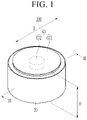
- the coin cell or the button cell is a thin coin-type or button-type cell, and means a battery having a ratio (H/D) of a height (H) to a diameter (D) of 1 or less (referring to FIG. 1 ).
- a horizontal cross-section is circular, but the present invention is not limited thereto, and a horizontal cross-section may be oval or polygonal.
- a diameter is determined as a maximum distance of a housing (or a case) exterior circumference based on the horizontal direction of the battery
- a height is determined as a maximum distance (a distance from the flat bottom to the flat top cross-section) based on the vertical direction of the battery.
- the present invention is not limited to the coin cell or the button cell that is an example of the present invention, and a battery of the present invention may be a cylindrical-type or pin-type battery.
- a rechargeable battery according to an embodiment of the present invention is a coin cell or a button cell will be exemplarily described in detail.
- FIG. 1 is a perspective view showing a rechargeable battery according to a first embodiment of the present invention
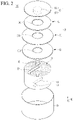
- FIG. 2 is an exploded perspective view of a rechargeable battery of FIG. 1
- FIG. 3 is a cross-sectional view taken along a line III-III of FIG. 1 .
- the rechargeable battery 100 of the first embodiment includes an electrode assembly 10, a case 20, a cap assembly 60, and a conductive double-sided adhesive member 40.
- the cap assembly 60 includes a cap plate 31 and a terminal plate 63 that are coupled together.
- the cap plate 31 and the terminal plate 63 are heat-sealed by a thermal fusion member 34 that is disposed between them.
- the thermal fusion member 34 acts as a mediator for bonding the cap plate 31 and the terminal plate 63 to each other.
- the thermal fusion member 34 may be formed of an electrically insulating material such as a polymer, and may be melted using a laser or the like and fused to the cap plate 31 and the terminal plate 63.
- the first embodiment may form a stable sealing and bonding structure while effectively insulating between terminal plate 63 and cap plate 31 without adding a separate insulating configuration by combining the terminal plate 63 to the cap plate 31 with the thermal fusion member 34.
- the electrode assembly 10 includes a first electrode (11, for example, a negative electrode) and a second electrode (12, for example, a positive electrode) provided on respective surfaces of a separator 13, which is an electrical insulating material, and is formed by winding the first electrode 11, the separator 13, and the second electrode 12. Accordingly, the electrode assembly 10 may be formed as a jelly-roll type. Although not shown separately, the electrode assembly may be formed as a stack type.
- the electrode assembly 10 is configured to charge and discharge a current, and in the electrode assembly 10, the wound axis may be arranged parallel to the height direction of the case 20 (an up and down direction in FIG. 1 to FIG. 3 ).
- the first end (a lower cross-section of the electrode assembly) 101 and the second end (an upper cross-section of the electrode assembly) 102 of the electrode assembly 10 may be flat and parallel to each other.
- the electrode assembly 10 is not provided with a center pin, but may be provided with a center pin (not shown) at the position of the wound axis.
- the case 20 accommodates the electrode assembly 10 while facing the first end 101 of both ends of the electrode assembly 10 with the bottom inner surface. At this time, the electrode assembly 10 is coated with an insulating sheet 14 on the first and second ends 101 and 102 and the sides and is embedded with an electrolyte solution in the case 20.
- case 20 is formed as a cylinder accommodating the electrode assembly 10 of a jelly-roll type, and the cap assembly 60 closes and seals the opening 21 of the cylindrical case 20.
- the electrode assembly 10 includes a first electrode tab 51 connected to the first electrode 11 and a second electrode tab 52 connected to the second electrode 12, and draws out the first and second electrodes 11 and 12 into the first and second ends 101 and 102, respectively.
- the first electrode tab 51 is firstly electrically and mechanically connected to the bottom inner surface of the case 20
- the second electrode tab 52 is secondly electrically and mechanically connected to the inner surface of the terminal plate 63 of the cap assembly 60.
- the cap plate 31 of the cap assembly 60 is coupled to the case 20 while facing the second end 102 of both ends of the electrode assembly 10 to cover the opening 21.
- the terminal plate 63 is secondly connected to the second electrode tab 52 in the state that it is coupled to the cap plate 31 with the thermal fusion member 34.
- the first connection connects the first electrode tab 51 and the case 20 to each other through a conductive double-sided adhesive member 40.
- the second connection connects the second electrode tab 52 and the terminal plate 63 to each other through a conductive double-sided adhesive member 40.
- the conductive double-sided adhesive member 40 may be formed of a conductive double-sided tape or an anisotropic conductive film (ACF), which facilitates the process of the first and second connections.
- ACF anisotropic conductive film
- the conductive double-sided tape is used as an example.
- first electrode 11 and the second electrode 12 are the negative electrode and the positive electrode is described as an example, but the present invention is not limited thereto, and the first electrode 11 and the second electrode 12 may be the positive electrode and the negative electrode, respectively.
- the first electrode (the negative electrode) 11 is formed in a long extending strip shape, and includes a negative electrode coated portion that is a region in which a negative electrode active material layer is coated to a current collector of a metal foil (for example, a Cu foil) and a negative electrode uncoated portion that is a region in which an active material is not coated.
- the negative electrode uncoated portion may be disposed at one end portion in a length direction of the negative electrode.
- the second electrode (positive electrode) 12 is formed in a long extending strip shape, and includes a positive electrode coated portion that is a region in which a positive electrode active material layer is coated to a current collector of a metal foil (for example, an AI foil) and a positive electrode uncoated portion that is a region in which an active material is not coated.
- the positive electrode uncoated portion may be disposed at one end portion in a length direction of the positive electrode.
- the case 20 allows the electrode assembly 10 to be inserted into the opening 21 formed at one side thereof, and has a space for accommodating the electrode assembly 10 and an electrolyte therein.
- the case 20 is formed in a cylindrical shape having a lower height H than a diameter D thereof, and has a circular opening 21 so that the cylindrical electrode assembly 10 corresponding to an inner space thereof is inserted.
- the terminal plate 63 of the cap assembly 60 includes a flange part 631 and a tab connection part 632.
- the flange part 631 is disposed to the outside of the cap plate 31 and is electrically insulated and attached to the outer surface of the cap plate 31 by interposing a thermal fusion member 34 therebetween.
- the tab connection part 632 is protruded from the center of the flange part 631 to the inside, and passes through the through hole 341 of the thermal fusion member 34 and the terminal hole 311 of the cap plate 31 to be protruded toward the electrode assembly 10, and the second electrode tab 52 is electrically and mechanically connected to the inner surface of the tab connection part 632.
- the first connection electrically and mechanically connects them with the first conductive double-sided tape 41 interposed between the lower surface of the first electrode tab 51 and the inner surface of the case 20 facing each other.
- the first conductive double-sided tape 41 makes the process of the first connection simple and convenient, and improves the deterioration of electrical characteristics due to poor welding.
- the second connection electrically and mechanically connects them with a second conductive double-sided tape 42 interposed between the upper surface of the second electrode tab 52 and the lower surface of the terminal plate 63 facing each other. That is, the second connection is made of a second conductive double-sided tape 42 interposed between the upper surface of the second electrode tab 52 and the lower surface of the tab connection part 632 facing each other.
- the second conductive double-sided tape 42 makes the process of the second connection simple and convenient, and improves the deterioration of electrical characteristics due to poor welding.
- the first and second connections using the first and second conductive double-sided tapes 41 and 42 prevent a metal welding foreign substance and heat that may occur during laser welding, ultrasonic welding, or resistance welding, thus eliminating the risk of safety inside the battery.
- the first and second connections prevent the deterioration of the battery characteristics due to poor welding according to a condition state of the case 20 and the cap assembly 60 during the welding process.
- the first and second connections are possible with a degree of supplying the first and second conductive double-sided tapes 41 and 42 through feeders and using an attachment jig, so a simpler facility is required compared to an existing welding facility.
- FIG. 4 is an enlarged cross-sectional view of a part for an electrical and mechanical connection between a second electrode tab and a terminal plate with a second conductive double-sided tape applied to FIG. 2 and FIG. 3 .
- the first and second connections form the same configuration, so the second connection is described with reference to FIG. 4 .
- the second conductive double-sided tape 42 includes a conductive mesh part 421 having conductivity and formed into a mesh structure, and a rubber adhesive 422 filled around the conductive mesh part 421 to form the second connection. Since the rubber adhesive 422 does not react with the electrolyte solution, the second connection may be maintained continuously.
- the insulating member 61 is provided between the second electrode tab 52 and the cap plate 31.
- the insulating member 61 is disposed on the upper side of the second electrode tab 52 and is attached to the inner surface of the cap plate 31.
- the insulating member 61 may form an electrically insulating structure between the cap plate 31 and the second electrode tab 52 and between the cap plate 31 and the electrode assembly 10.
- the insulating member 61 has a through hole 611 corresponding to the terminal hole 311 of the cap plate 31. Therefore, the tab connection part 632 is protruded from the center to the inside of the flange part 631 and passes through the terminal hole 311 of the cap plate 31 and the through hole 611 of the insulating member 61 to be protruded toward the electrode assembly 10, and the second electrode tab 52 is electrically and mechanically connected to the inner surface of the tab connection part 632 with a second conductive double-sided tape 42 interposed therebetween.
- the rechargeable battery 100 of the first embodiment in the state of closing and sealing the opening 21 of the case 20 with the cap assembly 60, the height H is set as the distance between the outer planes of the case 20 and the flange part 631, and the battery diameter D is set with the exterior circumference of the case 20. At this time, the ratio of the height H to the battery diameter D is 1 or less (H/D ⁇ 1). Therefore, the rechargeable battery 100 of the first embodiment may form a thin coin or button type as a coin-type battery or a button-type battery.
- FIG. 5 is a perspective view showing a rechargeable battery according to a second embodiment of the present invention
- FIG. 6 is an exploded perspective view of a rechargeable battery of FIG. 5
- FIG. 7 is a cross-sectional view taken along a line VII-VII of FIG. 5 .
- the terminal plate 33 includes a flange part 331 and a protruded terminal 332.
- the flange part 331 is disposed between the cap plate 31 and the electrode assembly 10, disposed inside the step 621 of the insulating member 62, and electrically insulated and attached to the inner surface of the cap plate 31 with the thermal fusion member 34 interposed therebetween.
- the protruded terminal 332 is protruded from the center to the outside of the flange part 331 to pass through the through hole 341 of the thermal fusion member 34 and the terminal hole 311 of the cap plate 31, and the second electrode tab 52 is electrically and mechanically connected to the inner surface of the flange part 331 with the second conductive double-sided tape 42 interposed therebetween.
- the second connection is electrically and mechanically connected with a second conductive double-sided tape 42 interposed between the upper surface of the second electrode tab 52 and the lower surface of the terminal plate 63 facing each other. That is, the second connection is made with the second conductive double-sided tape 42 interposed between the upper surface of the second electrode tab 52 and the lower surface of the flange part 331 facing each other.
- the second conductive double-sided tape 42 makes the process of second connection simple and convenient, and improves the deterioration of electrical characteristics due to poor welding.
- the insulating member 62 is disposed on the upper side of the second electrode tab 52, is attached to the inner surface of the cap plate 31, and further extends to the inner surface of the flange part 331.
- the insulating member 62 may form an electrically insulating structure between the cap plate 31 and the second electrode tab 52, between the cap plate 31 and the electrode assembly 10, and between the flange part 331 and the electrode assembly 10.
- the insulating member 62 has the step 621 corresponding to the exterior diameter of the thermal fusion member 34. Therefore, the protruded terminal 332 is protruded outward from the center of the flange part 331 and protruded outward through the through hole 341 of the thermal fusion member 34 and the terminal hole 311 of the cap plate 31.
- the flange part 331 is electrically and mechanically connected to the second electrode tab 52 with the second conductive double-sided tape 42 on the opened inner surface through the through hole 622 of the insulating member 62.
- FIG. 8 is a cross-sectional view of electrically connecting an external tab and a set of a rechargeable battery of a first embodiment.
- the third connection and the fourth connection electrically connect the first external tab 53 and the second external tab 54 of the rechargeable battery 100 to the set S, respectively.
- the third connection connects the terminal plate 63 to the set S, specifically, the conductive double-sided adhesive member, that is, the third conductive double-sided tape 43 is connected between the first external tab 53 connected to the outer surface of the flange part 631 and the set S.
- the fourth connection connects the case 20 to the set S, specifically the conductive double-sided adhesive member, that is, a fourth conductive double-sided tape 44 is connected between the second external tab 54 connected to the outer surface of the case 20 and the set S.
- the third and fourth conductive double-sided tapes 43 and 44 simplify and make the process of the third and fourth connection connecting the first and second external tab 53 and 54 of the rechargeable battery 100 to the set S convenient, and improve the deterioration of the electrical characteristics due to poor welding.
- third and fourth connections are possible to the extent of supplying the third and fourth conductive double-sided tape 43 and 44 through the feeder and using an attachment jig, so a simpler facility is required compared to the existing welding facility.
- FIG. 9 is a cross-sectional view of electrically connecting an external tab and a set of a rechargeable battery of a second embodiment.
- the third connection connects the terminal plate 33 to the set S, in detail, the conductive double-sided adhesive member, that is, the third conductive double-sided tape 243 is connected between the first external tab 253 connected to the outer surface of the protruded terminal 332 and the set S.
- the third conductive double-sided tape 243 makes the process of the third connection connecting the first external tab 253 of the rechargeable battery 200 to the set S simple and convenient, and improves the deterioration of electrical characteristics due to poor welding.
- electrode assembly 11 first electrode (negative electrode) 12: second electrode (positive electrode) 13: separator 20: case 21: opening 30, 60: cap assembly 31: cap plate 33, 63: terminal plate 34: thermal fusion member 40: conductive double-sided adhesive member sidedtape 41: first conductive double- 42: second conductive double-sided tape 43, 243: third conductive double-sided tape 44: fourth conductive double-sided tape 51: first electrode tab 52: second electrode tab 53, 253: first external tab 54: second external tab 61, 62: insulating member 100, 200: rechargeable battery 101: first end (lower cross-section) 102: second end (upper cross-section) 311: terminal hole 331, 631: flange part 332: protruded terminal 341: through hole 421: conductive mesh part 422: rubber adhesive 611, 622: through hole 621: step 632: tab connection part D: battery diameter
Landscapes
- Chemical & Material Sciences (AREA)
- Chemical Kinetics & Catalysis (AREA)
- Electrochemistry (AREA)
- General Chemical & Material Sciences (AREA)
- Engineering & Computer Science (AREA)
- Manufacturing & Machinery (AREA)
- Connection Of Batteries Or Terminals (AREA)
- Sealing Battery Cases Or Jackets (AREA)
Abstract
One aspect of the present invention is to provide a rechargeable battery (100, 200) that simplifies a process of connecting an electrode tab (51, 52) of an electrode assembly (10) to a terminal plate (33, 63) or a case (20). A rechargeable battery (100, 200) according to an embodiment of the present invention includes: an electrode assembly (10) having a first electrode tab (51) and a second electrode tab (52); a case (20) accommodating the electrode assembly (10) and electrically connected to the first electrode tab (51); a cap assembly (30, 60) including a cap plate (31) coupled to the opening of the case (20) and a terminal plate (33, 63) coupled to the cap plate (31) in an insulating state and electrically connected to the second electrode tab (52); and a conductive double-sided adhesive member (40) applied to at least one of a first connection of the first electrode tab (51) and the case (20) and a second connection of the second electrode tab (52) and the terminal plate (33, 63).
Description
- The present invention relates to a rechargeable battery. More particularly, the present invention relates to an ultra-small rechargeable battery.
- Unlike a primary battery that is incapable of being recharged, a rechargeable battery can be repeatedly charged and discharged. A low capacity rechargeable battery has been used for small electronic devices such as a mobile phone, a laptop computer, and a camcorder, and a large capacity battery has been widely used as a power source for driving a motor of a hybrid vehicle.
- A representative rechargeable battery includes a nickel-cadmium (Ni-Cd) battery, a nickel-hydrogen (Ni-MH) battery, a lithium (Li) battery, and a lithium ion (Li-ion) rechargeable battery. Particularly, the lithium ion secondary battery has a higher operation voltage than the nickel-cadmium battery or the nickel-hydrogen battery that is mainly used as a portable electric equipment power source by about three times. Also, the lithium ion secondary battery is widely used in an aspect that energy density per unit weight is high.
- In particular, as a demand for wearable devices such as headphones, earphones, smartwatches, and body-mounted medical devices which use Bluetooth has increased, the need for rechargeable batteries of which energy density is high and is ultra-small is increasing.
- The ultra-small rechargeable battery has important tasks of securing required electrical capacity within a limited size, implementing an efficient structure while improving an effective low weight, and improving structural stability.
- The above information disclosed in this Background section is only for enhancement of understanding of the background of the invention, and therefore it may contain information that does not form the prior art that is already known in this country to a person of ordinary skill in the art.
- One aspect of the present invention is to provide a rechargeable battery that has a simplified process of connecting an electrode tab of an electrode assembly to a terminal plate or a case. Also, one aspect of the present invention is to provide a rechargeable battery that has a simplified process of connecting an external tab of the rechargeable battery to a set.
- A rechargeable battery according to an embodiment of the present invention includes: an electrode assembly having a first electrode tab and a second electrode tab; a case accommodating the electrode assembly and electrically connected to the first electrode tab; a cap assembly including a cap plate coupled to the opening of the case and a terminal plate coupled to the cap plate in an insulating state and electrically connected to the second electrode tab; and a conductive double-sided adhesive member applied to at least one of a first connection of the first electrode tab and the case and a second connection of the second electrode tab and the terminal plate.
- The conductive double-sided adhesive member may be formed of a conductive double-sided tape.
- The conductive double-sided tape may include a conductive mesh part formed in a mesh structure with conductivity, and a rubber adhesive filled around the conductive mesh part to form the first connection and the second connection.
- The conductive double-sided adhesive member may be formed of an anisotropic conductive film.
- The first connection may electrically and mechanically connect both with a first conductive double-sided tape interposed between the lower surface of the first electrode tab and the inner surface of the case facing each other.
- The second connection may electrically and mechanically connect both with a second conductive double-sided tape interposed between the upper surface of the second electrode tab and the lower surface of the terminal plate facing each other.
- The terminal plate may include a flange part disposed on the outside (e.g. in relation to the rechargeable battery (or an internal part thereof)) of the cap plate, and electrically insulated and attached to the outer surface (e.g. in relation to the rechargeable battery) of the cap plate by interposing a thermal fusion member. The terminal plate may include a tab connection part protruded from the center of the flange part to the inside (e.g. of the flange part or the rechargeable battery, respectively) and protruded toward the electrode assembly through a through hole of the thermal fusion member and a terminal hole of the cap plate. The second conductive double-sided tape may be electrically and mechanically connected between the second electrode tab and the inner surface (e.g. in relation to the rechargeable battery) of the tab connection part.
- The terminal plate may include a flange part disposed on the inside (e.g. in relation to the rechargeable battery) of the cap plate and electrically insulatingly attached to the inner surface (e.g. in relation to the rechargeable battery) of the cap plate through a thermal fusion member interposed therebetween. The terminal plate may include a protruded terminal protruded from the center of the flange part to the outside (e.g. of the flange part or the rechargeable battery, respectively) and passed through a through hole of the thermal fusion member and a terminal hole of the cap plate. The second conductive double-sided tape may be mechanically and electrically connected between the second electrode tab and the inner surface (e.g. in relation to the rechargeable battery) of the flange part.
- The terminal plate may include a flange part disposed on the outside (e.g. in relation to the rechargeable battery) of the cap plate, and electrically insulated and attached to the outer surface (e.g. in relation to the rechargeable battery) of the cap plate by interposing a thermal fusion member. The terminal plate may include a tab connection part protruded from the center of the flange part to the inside of the flange part (e.g. or the rechargeable battery, respectively) and protruded toward the electrode assembly through a through hole of the thermal fusion member and a terminal hole of the cap plate. In a third connection connecting the terminal plate to a set, a conductive double-sided adhesive member may be connected between a first external tab connected to the outer surface (e.g. in relation to the rechargeable battery) of the flange part and the set.
- The terminal plate may include a flange part disposed on the inside (e.g. in relation to the rechargeable battery) of the cap plate and electrically insulated and attached to the inner surface (e.g. in relation to the rechargeable battery) of the cap plate through a thermal fusion member interposed therebetween The terminal plate may include a protruded terminal protruded from the center of the flange part to the outside (e.g. of the flange part or the rechargeable battery, respectively) and passed through a through hole of the thermal fusion member and a terminal hole of the cap plate. In a third connection connecting the terminal plate to a set, a conductive double-sided adhesive member may be connected between the first external tab connected to the outer surface (e.g. in relation to the rechargeable battery) of the protruded terminal and the set.
- In a fourth connection that connects the case to the set, a conductive double-sided adhesive member may be connected between a second external tab connected to the outer surface of the case (e.g. in relation to the rechargeable battery) and the set.
- As such, the rechargeable battery according to an embodiment of the present invention applies the conductive double-sided adhesive member to at least one of the first connection of the first electrode tab and the case and the second connection of the second electrode tab and the terminal plate, so the process of connecting the first and second electrode tabs to the terminal plate or the case may be simplified.
- In addition, since the rechargeable battery of an embodiment applies the conductive double-sided adhesive member to the connection between the external tab of the rechargeable battery and the set, the process of connecting the external tab to the set may be simplified.
- All embodiments described in this specification may be advantageously combined with one another to the extent that their respective features are compatible. In particular, the expression "according to an embodiment" means that the respective features may or may not be part of specific embodiments of the present invention.
-
-
FIG. 1 is a perspective view showing a rechargeable battery according to a first embodiment of the present invention. -
FIG. 2 is an exploded perspective view of a rechargeable battery ofFIG. 1 . -
FIG. 3 is a cross-sectional view taken along a line III-III ofFIG. 1 . -
FIG. 4 is an enlarged cross-sectional view of a part electrically and mechanically connecting a second electrode tab and a terminal plate with a second conductive double-sided tape applied toFIG. 2 andFIG. 3 . -
FIG. 5 is a perspective view showing a rechargeable battery according to a second embodiment of the present invention. -
FIG. 6 is an exploded perspective view of a rechargeable battery ofFIG. 5 . -
FIG. 7 is a cross-sectional view taken along a line VII-VII ofFIG. 5 . -
FIG. 8 is a cross-sectional view of electrically connecting an external tab and a set of a rechargeable battery of a first embodiment. -
FIG. 9 is a cross-sectional view of electrically connecting an external tab and a set of a rechargeable battery of a second embodiment. - The present invention will be described more fully hereinafter with reference to the accompanying drawings, in which embodiments of the invention are shown. As those skilled in the art would realize, the described embodiments may be modified in various different ways, all without departing from the scope of the present invention. The drawings and description are to be regarded as illustrative in nature and not restrictive. Like reference numerals designate like elements throughout the specification.
- A rechargeable battery according to an embodiment of the present invention, which is an ultra-compact battery, may be a coin cell or a button cell. Here, the coin cell or the button cell is a thin coin-type or button-type cell, and means a battery having a ratio (H/D) of a height (H) to a diameter (D) of 1 or less (referring to
FIG. 1 ). - Since the coin cell or the button cell is mainly cylindrical, a horizontal cross-section is circular, but the present invention is not limited thereto, and a horizontal cross-section may be oval or polygonal. In this case, a diameter is determined as a maximum distance of a housing (or a case) exterior circumference based on the horizontal direction of the battery, and a height is determined as a maximum distance (a distance from the flat bottom to the flat top cross-section) based on the vertical direction of the battery.
- However, the present invention is not limited to the coin cell or the button cell that is an example of the present invention, and a battery of the present invention may be a cylindrical-type or pin-type battery. Hereinafter, a case in which a rechargeable battery according to an embodiment of the present invention is a coin cell or a button cell will be exemplarily described in detail.
-
FIG. 1 is a perspective view showing a rechargeable battery according to a first embodiment of the present invention,FIG. 2 is an exploded perspective view of a rechargeable battery ofFIG. 1 , andFIG. 3 is a cross-sectional view taken along a line III-III ofFIG. 1 . Referring toFIG. 1 to FIG. 3 , therechargeable battery 100 of the first embodiment includes anelectrode assembly 10, acase 20, acap assembly 60, and a conductive double-sidedadhesive member 40. - The
cap assembly 60 includes acap plate 31 and aterminal plate 63 that are coupled together. As an example, thecap plate 31 and theterminal plate 63 are heat-sealed by athermal fusion member 34 that is disposed between them. - The
thermal fusion member 34 acts as a mediator for bonding thecap plate 31 and theterminal plate 63 to each other. For example, thethermal fusion member 34 may be formed of an electrically insulating material such as a polymer, and may be melted using a laser or the like and fused to thecap plate 31 and theterminal plate 63. - The first embodiment may form a stable sealing and bonding structure while effectively insulating between
terminal plate 63 andcap plate 31 without adding a separate insulating configuration by combining theterminal plate 63 to thecap plate 31 with thethermal fusion member 34. - The
electrode assembly 10 includes a first electrode (11, for example, a negative electrode) and a second electrode (12, for example, a positive electrode) provided on respective surfaces of aseparator 13, which is an electrical insulating material, and is formed by winding thefirst electrode 11, theseparator 13, and thesecond electrode 12. Accordingly, theelectrode assembly 10 may be formed as a jelly-roll type. Although not shown separately, the electrode assembly may be formed as a stack type. - The
electrode assembly 10 is configured to charge and discharge a current, and in theelectrode assembly 10, the wound axis may be arranged parallel to the height direction of the case 20 (an up and down direction inFIG. 1 to FIG. 3 ). - The first end (a lower cross-section of the electrode assembly) 101 and the second end (an upper cross-section of the electrode assembly) 102 of the
electrode assembly 10 may be flat and parallel to each other. In the first embodiment, theelectrode assembly 10 is not provided with a center pin, but may be provided with a center pin (not shown) at the position of the wound axis. - The
case 20 accommodates theelectrode assembly 10 while facing thefirst end 101 of both ends of theelectrode assembly 10 with the bottom inner surface. At this time, theelectrode assembly 10 is coated with an insulatingsheet 14 on the first and second ends 101 and 102 and the sides and is embedded with an electrolyte solution in thecase 20. As an example,case 20 is formed as a cylinder accommodating theelectrode assembly 10 of a jelly-roll type, and thecap assembly 60 closes and seals theopening 21 of thecylindrical case 20. - The
electrode assembly 10 includes afirst electrode tab 51 connected to thefirst electrode 11 and asecond electrode tab 52 connected to thesecond electrode 12, and draws out the first andsecond electrodes - In the state that the
electrode assembly 10 is accommodated in thecase 20, thefirst electrode tab 51 is firstly electrically and mechanically connected to the bottom inner surface of thecase 20, and thesecond electrode tab 52 is secondly electrically and mechanically connected to the inner surface of theterminal plate 63 of thecap assembly 60. - And the
cap plate 31 of thecap assembly 60 is coupled to thecase 20 while facing thesecond end 102 of both ends of theelectrode assembly 10 to cover theopening 21. At this time, theterminal plate 63 is secondly connected to thesecond electrode tab 52 in the state that it is coupled to thecap plate 31 with thethermal fusion member 34. - The first connection connects the
first electrode tab 51 and thecase 20 to each other through a conductive double-sided adhesive member 40. The second connection connects thesecond electrode tab 52 and theterminal plate 63 to each other through a conductive double-sided adhesive member 40. - The conductive double-
sided adhesive member 40 may be formed of a conductive double-sided tape or an anisotropic conductive film (ACF), which facilitates the process of the first and second connections. For convenience, the conductive double-sided tape is used as an example. - Hereinafter, the case where the
first electrode 11 and thesecond electrode 12 are the negative electrode and the positive electrode is described as an example, but the present invention is not limited thereto, and thefirst electrode 11 and thesecond electrode 12 may be the positive electrode and the negative electrode, respectively. - The first electrode (the negative electrode) 11 is formed in a long extending strip shape, and includes a negative electrode coated portion that is a region in which a negative electrode active material layer is coated to a current collector of a metal foil (for example, a Cu foil) and a negative electrode uncoated portion that is a region in which an active material is not coated. The negative electrode uncoated portion may be disposed at one end portion in a length direction of the negative electrode.
- The second electrode (positive electrode) 12 is formed in a long extending strip shape, and includes a positive electrode coated portion that is a region in which a positive electrode active material layer is coated to a current collector of a metal foil (for example, an AI foil) and a positive electrode uncoated portion that is a region in which an active material is not coated. The positive electrode uncoated portion may be disposed at one end portion in a length direction of the positive electrode.
- The
case 20 allows theelectrode assembly 10 to be inserted into theopening 21 formed at one side thereof, and has a space for accommodating theelectrode assembly 10 and an electrolyte therein. For example, thecase 20 is formed in a cylindrical shape having a lower height H than a diameter D thereof, and has acircular opening 21 so that thecylindrical electrode assembly 10 corresponding to an inner space thereof is inserted. - The
terminal plate 63 of thecap assembly 60 includes aflange part 631 and atab connection part 632. Theflange part 631 is disposed to the outside of thecap plate 31 and is electrically insulated and attached to the outer surface of thecap plate 31 by interposing athermal fusion member 34 therebetween. - In the
terminal plate 63, thetab connection part 632 is protruded from the center of theflange part 631 to the inside, and passes through the throughhole 341 of thethermal fusion member 34 and theterminal hole 311 of thecap plate 31 to be protruded toward theelectrode assembly 10, and thesecond electrode tab 52 is electrically and mechanically connected to the inner surface of thetab connection part 632. - More specifically, the first connection electrically and mechanically connects them with the first conductive double-
sided tape 41 interposed between the lower surface of thefirst electrode tab 51 and the inner surface of thecase 20 facing each other. The first conductive double-sided tape 41 makes the process of the first connection simple and convenient, and improves the deterioration of electrical characteristics due to poor welding. - The second connection electrically and mechanically connects them with a second conductive double-
sided tape 42 interposed between the upper surface of thesecond electrode tab 52 and the lower surface of theterminal plate 63 facing each other. That is, the second connection is made of a second conductive double-sided tape 42 interposed between the upper surface of thesecond electrode tab 52 and the lower surface of thetab connection part 632 facing each other. The second conductive double-sided tape 42 makes the process of the second connection simple and convenient, and improves the deterioration of electrical characteristics due to poor welding. - The first and second connections using the first and second conductive double-
sided tapes case 20 and thecap assembly 60 during the welding process. The first and second connections are possible with a degree of supplying the first and second conductive double-sided tapes -
FIG. 4 is an enlarged cross-sectional view of a part for an electrical and mechanical connection between a second electrode tab and a terminal plate with a second conductive double-sided tape applied toFIG. 2 andFIG. 3 . The first and second connections form the same configuration, so the second connection is described with reference toFIG. 4 . - As an example, the second conductive double-
sided tape 42 includes aconductive mesh part 421 having conductivity and formed into a mesh structure, and a rubber adhesive 422 filled around theconductive mesh part 421 to form the second connection. Since therubber adhesive 422 does not react with the electrolyte solution, the second connection may be maintained continuously. - Meanwhile, the insulating
member 61 is provided between thesecond electrode tab 52 and thecap plate 31. As an example, the insulatingmember 61 is disposed on the upper side of thesecond electrode tab 52 and is attached to the inner surface of thecap plate 31. The insulatingmember 61 may form an electrically insulating structure between thecap plate 31 and thesecond electrode tab 52 and between thecap plate 31 and theelectrode assembly 10. - As an example, the insulating
member 61 has a throughhole 611 corresponding to theterminal hole 311 of thecap plate 31. Therefore, thetab connection part 632 is protruded from the center to the inside of theflange part 631 and passes through theterminal hole 311 of thecap plate 31 and the throughhole 611 of the insulatingmember 61 to be protruded toward theelectrode assembly 10, and thesecond electrode tab 52 is electrically and mechanically connected to the inner surface of thetab connection part 632 with a second conductive double-sided tape 42 interposed therebetween. - On the other hand, referring to
FIG. 1 , in therechargeable battery 100 of the first embodiment, in the state of closing and sealing theopening 21 of thecase 20 with thecap assembly 60, the height H is set as the distance between the outer planes of thecase 20 and theflange part 631, and the battery diameter D is set with the exterior circumference of thecase 20. At this time, the ratio of the height H to the battery diameter D is 1 or less (H/D≤1). Therefore, therechargeable battery 100 of the first embodiment may form a thin coin or button type as a coin-type battery or a button-type battery. - Hereinafter, a second embodiment of the present invention is described. Comparing the first and second embodiments, the same configurations are omitted, and different configurations are described in the second embodiment.
-
FIG. 5 is a perspective view showing a rechargeable battery according to a second embodiment of the present invention,FIG. 6 is an exploded perspective view of a rechargeable battery ofFIG. 5 , andFIG. 7 is a cross-sectional view taken along a line VII-VII ofFIG. 5 . - Referring to
FIG. 5 to FIG. 7 , in thecap assembly 30 of therechargeable battery 200 according to the second embodiment, theterminal plate 33 includes aflange part 331 and aprotruded terminal 332. Theflange part 331 is disposed between thecap plate 31 and theelectrode assembly 10, disposed inside thestep 621 of the insulatingmember 62, and electrically insulated and attached to the inner surface of thecap plate 31 with thethermal fusion member 34 interposed therebetween. - In the
terminal plate 33, the protrudedterminal 332 is protruded from the center to the outside of theflange part 331 to pass through the throughhole 341 of thethermal fusion member 34 and theterminal hole 311 of thecap plate 31, and thesecond electrode tab 52 is electrically and mechanically connected to the inner surface of theflange part 331 with the second conductive double-sided tape 42 interposed therebetween. - The second connection is electrically and mechanically connected with a second conductive double-
sided tape 42 interposed between the upper surface of thesecond electrode tab 52 and the lower surface of theterminal plate 63 facing each other. That is, the second connection is made with the second conductive double-sided tape 42 interposed between the upper surface of thesecond electrode tab 52 and the lower surface of theflange part 331 facing each other. The second conductive double-sided tape 42 makes the process of second connection simple and convenient, and improves the deterioration of electrical characteristics due to poor welding. - The insulating
member 62 is disposed on the upper side of thesecond electrode tab 52, is attached to the inner surface of thecap plate 31, and further extends to the inner surface of theflange part 331. The insulatingmember 62 may form an electrically insulating structure between thecap plate 31 and thesecond electrode tab 52, between thecap plate 31 and theelectrode assembly 10, and between theflange part 331 and theelectrode assembly 10. - As an example, the insulating
member 62 has thestep 621 corresponding to the exterior diameter of thethermal fusion member 34. Therefore, the protrudedterminal 332 is protruded outward from the center of theflange part 331 and protruded outward through the throughhole 341 of thethermal fusion member 34 and theterminal hole 311 of thecap plate 31. Theflange part 331 is electrically and mechanically connected to thesecond electrode tab 52 with the second conductive double-sided tape 42 on the opened inner surface through the throughhole 622 of the insulatingmember 62. - Hereinafter, embodiments for simplifying the process of connecting the external tab of the rechargeable battery to the set are described.
-
FIG. 8 is a cross-sectional view of electrically connecting an external tab and a set of a rechargeable battery of a first embodiment. Referring toFIG. 8 , the third connection and the fourth connection electrically connect the firstexternal tab 53 and the secondexternal tab 54 of therechargeable battery 100 to the set S, respectively. - The third connection connects the
terminal plate 63 to the set S, specifically, the conductive double-sided adhesive member, that is, the third conductive double-sided tape 43 is connected between the firstexternal tab 53 connected to the outer surface of theflange part 631 and the set S. - The fourth connection connects the
case 20 to the set S, specifically the conductive double-sided adhesive member, that is, a fourth conductive double-sided tape 44 is connected between the secondexternal tab 54 connected to the outer surface of thecase 20 and the set S. - The third and fourth conductive double-
sided tapes external tab rechargeable battery 100 to the set S convenient, and improve the deterioration of the electrical characteristics due to poor welding. - In addition, the third and fourth connections are possible to the extent of supplying the third and fourth conductive double-
sided tape -
FIG. 9 is a cross-sectional view of electrically connecting an external tab and a set of a rechargeable battery of a second embodiment. Referring toFIG. 9 , the third connection connects theterminal plate 33 to the set S, in detail, the conductive double-sided adhesive member, that is, the third conductive double-sided tape 243 is connected between the firstexternal tab 253 connected to the outer surface of the protrudedterminal 332 and the set S. - The third conductive double-
sided tape 243 makes the process of the third connection connecting the firstexternal tab 253 of therechargeable battery 200 to the set S simple and convenient, and improves the deterioration of electrical characteristics due to poor welding. - While this invention has been described in connection with what is presently considered to be practical embodiments, it is to be understood that the invention is not limited to the disclosed embodiments. On the contrary, it is intended to cover various modifications and equivalent arrangements included within the scope of the appended claims.
- It is clear for a person skilled in the art that the disclosed embodiments can also be combined where possible.
<Description of symbols> 10: electrode assembly 11: first electrode (negative electrode) 12: second electrode (positive electrode) 13: separator 20: case 21: opening 30, 60: cap assembly 31: cap plate 33, 63: terminal plate 34: thermal fusion member 40: conductive double-sided adhesive member sidedtape 41: first conductive double- 42: second conductive double- sided tape 43, 243: third conductive double-sided tape 44: fourth conductive double-sided tape 51: first electrode tab 52: second electrode tab 53, 253: first external tab 54: second external tab 61, 62: insulating member 100, 200: rechargeable battery 101: first end (lower cross-section) 102: second end (upper cross-section) 311: terminal hole 331, 631: flange part 332: protruded terminal 341: through hole 421: conductive mesh part 422: rubber adhesive 611, 622: through hole 621: step 632: tab connection part D: battery diameter H: height S: set
Claims (12)
- A rechargeable battery (100, 200) comprising:an electrode assembly (10) having a first electrode tab (51) and a second electrode tab (52);a case (20) accommodating the electrode assembly (10) and electrically connected to the first electrode tab (51);a cap assembly (30, 60) including a cap plate (31) coupled to the opening of the case (20) and a terminal plate (33, 63) coupled to the cap plate (31) in an insulating state and electrically connected to the second electrode tab (52); anda conductive double-sided adhesive member (40) applied to at least one of a first connection of the first electrode tab (51) and the case (20) and a second connection of the second electrode tab (52) and the terminal plate (33, 63).
- The rechargeable battery (100, 200) of claim 1, wherein
the conductive double-sided adhesive member (40) is formed of a conductive double-sided tape (41, 42). - The rechargeable battery (100, 200) of claim 2, whereinthe conductive double-sided tape (41, 42) includesa conductive mesh part (421) formed in a mesh structure with conductivity, anda rubber adhesive (422) filled around the conductive mesh part (421) to form the first connection and the second connection.
- The rechargeable battery (100, 200) of claim 1, wherein
the conductive double-sided adhesive member (40) is formed of an anisotropic conductive film. - The rechargeable battery (100, 200) of any one of the preceding claims, wherein
the first connection electrically and mechanically connects both with a first conductive double-sided tape (41) interposed between the lower surface of the first electrode tab (51) and the inner surface of the case (20) facing each other. - The rechargeable battery (100, 200) of any one of the preceding claims, wherein
the second connection electrically and mechanically connects both with a second conductive double-sided tape (42) interposed between the upper surface of the second electrode tab (52) and the lower surface of the terminal plate (33, 63) facing each other. - The rechargeable battery (100) of any one of claims 1 to 6, whereinthe terminal plate (63) includesa flange part (631) disposed on an outside of the cap plate (31), and electrically insulated and attached to an outer surface of the cap plate (31) by interposing a thermal fusion member (34), anda tab connection part (632) protruded from a center of the flange part (631) to an inside of the flange part (631) and protruded toward the electrode assembly (10) through a through hole (341) of the thermal fusion member (34) and a terminal hole (311) of the cap plate (31), andthe second conductive double-sided tape (42) is electrically and mechanically connected between the second electrode tab (52) and an inner surface of the tab connection part (632).
- The rechargeable battery (200) of any one of claims 1 to 6, whereinthe terminal plate (33) includesa flange part (331) disposed on an inside of the cap plate (31) and electrically insulatingly attached to an inner surface of the cap plate (31) through a thermal fusion member (34) interposed therebetween, anda protruded terminal (332) protruded from a center of the flange part (331) to an outside of the flange part (331) and passed through a through hole (341) of the thermal fusion member (34) and a terminal hole (311) of the cap plate (31), andthe second conductive double-sided tape (42) is mechanically and electrically connected between the second electrode tab (52) and an inner surface of the flange part (331).
- The rechargeable battery (100) of any of one of claims 1 to 6, wherein
the terminal plate (63) includesa flange part (631) disposed on an outside of the cap plate (31), and electrically insulated and attached to an outer surface of the cap plate (31) by interposing a thermal fusion member (34), anda tab connection part (632) protruded from a center of the flange part (631) to an inside of the flange part (631) and protruded toward the electrode assembly (10) through a through hole (341) of the thermal fusion member (34) and a terminal hole of the cap plate (31), wherein
a conductive double-sided adhesive member (40, 43) is connected between a first external tab (53) connected to an outer surface of the flange part (631) and a set (S) in a third connection connecting the terminal plate (63) to the set (S). - The rechargeable battery (100) of claim 9, wherein
a conductive double-sided adhesive member (40, 44) is connected between a second external tab (54) connected to an outer surface of the case (20) and the set (S) in a fourth connection that connects the case (20) to the set (S). - The rechargeable battery (200) of any one of claims 1 to 6, wherein
the terminal plate (33) includesa flange part (331) disposed on an inside of the cap plate (31) and electrically insulated and attached to an inner surface of the cap plate (31) through a thermal fusion member (34) interposed therebetween, anda protruded terminal (332) protruded from a center of the flange part (331) to an outside of the flange part (331) and passed through a through hole (341) of the thermal fusion member (34) and a terminal hole of the cap plate (31), wherein
a conductive double-sided adhesive member (40, 243) is connected between the first external tab (253) connected to an outer surface of the protruded terminal (332) and a set (S) in a third connection connecting the terminal plate (33) to the set (S). - The rechargeable battery (200) of claim 11, wherein
a conductive double-sided adhesive member (40, 44) is connected between a second external tab (54) connected to an outer surface of the case (20) and the set (S) in a fourth connection that connects the case (20) to the set (S).
Applications Claiming Priority (1)
| Application Number | Priority Date | Filing Date | Title |
|---|---|---|---|
| KR1020200160188A KR20220072503A (en) | 2020-11-25 | 2020-11-25 | Rechargeable battery |
Publications (1)
| Publication Number | Publication Date |
|---|---|
| EP4007026A1 true EP4007026A1 (en) | 2022-06-01 |
Family
ID=78709307
Family Applications (1)
| Application Number | Title | Priority Date | Filing Date |
|---|---|---|---|
| EP21209286.0A Pending EP4007026A1 (en) | 2020-11-25 | 2021-11-19 | Rechargeable battery |
Country Status (4)
| Country | Link |
|---|---|
| US (1) | US20220166050A1 (en) |
| EP (1) | EP4007026A1 (en) |
| KR (1) | KR20220072503A (en) |
| CN (1) | CN114552079B (en) |
Cited By (1)
| Publication number | Priority date | Publication date | Assignee | Title |
|---|---|---|---|---|
| EP4152491A4 (en) * | 2021-07-30 | 2023-05-03 | Contemporary Amperex Technology Co., Limited | BATTERY CELL, BATTERY, POWER CONSUMING DEVICE, AND METHOD AND DEVICE FOR MAKING BATTERY CELL |
Families Citing this family (2)
| Publication number | Priority date | Publication date | Assignee | Title |
|---|---|---|---|---|
| KR102471745B1 (en) | 2020-02-03 | 2022-11-25 | 삼성에스디아이 주식회사 | Rechargeable battery |
| KR102847216B1 (en) * | 2022-06-08 | 2025-08-14 | 삼성에스디아이 주식회사 | Battery |
Citations (2)
| Publication number | Priority date | Publication date | Assignee | Title |
|---|---|---|---|---|
| CN111082156A (en) * | 2019-12-30 | 2020-04-28 | 漳州万宝能源科技股份有限公司 | Button cell and manufacturing method thereof |
| EP3680956A1 (en) * | 2018-05-30 | 2020-07-15 | Lg Chem, Ltd. | Cylindrical secondary battery for preventing overcharging |
Family Cites Families (12)
| Publication number | Priority date | Publication date | Assignee | Title |
|---|---|---|---|---|
| JPS62133664A (en) * | 1985-12-05 | 1987-06-16 | Toshiba Battery Co Ltd | Manufacture of button type alkaline battery |
| US7341802B1 (en) * | 2004-03-25 | 2008-03-11 | Quallion Llc | Feedthrough assembly and method |
| KR100929033B1 (en) * | 2007-10-05 | 2009-11-26 | 삼성에스디아이 주식회사 | Cap assembly and secondary battery having the same |
| JP5147365B2 (en) * | 2007-11-15 | 2013-02-20 | 株式会社日立製作所 | Metal container sealing method |
| JP2009289732A (en) * | 2008-01-31 | 2009-12-10 | Panasonic Corp | Secondary battery |
| CN101694881B (en) * | 2009-10-19 | 2012-06-27 | 惠州亿纬锂能股份有限公司 | Safe cylindrical lithium-manganese dioxide battery |
| WO2012121468A1 (en) * | 2011-03-10 | 2012-09-13 | 신흥에스이씨주식회사 | Secondary battery having cap assembly with which components are bonded |
| KR102235281B1 (en) * | 2014-09-12 | 2021-04-02 | 삼성에스디아이 주식회사 | Rechargeable battery |
| JP6394448B2 (en) * | 2015-03-16 | 2018-09-26 | 豊田合成株式会社 | Battery module and manufacturing method thereof |
| KR102606637B1 (en) * | 2016-04-22 | 2023-11-27 | 삼성에스디아이 주식회사 | Secondary battery |
| CN210897346U (en) * | 2019-06-21 | 2020-06-30 | 苏州安靠电源有限公司 | Battery with a battery cell |
| CN111933831A (en) * | 2020-09-10 | 2020-11-13 | 珠海汉格能源科技有限公司 | Button lithium battery and preparation method thereof |
-
2020
- 2020-11-25 KR KR1020200160188A patent/KR20220072503A/en active Pending
-
2021
- 2021-11-18 CN CN202111367483.5A patent/CN114552079B/en active Active
- 2021-11-19 US US17/531,185 patent/US20220166050A1/en active Pending
- 2021-11-19 EP EP21209286.0A patent/EP4007026A1/en active Pending
Patent Citations (2)
| Publication number | Priority date | Publication date | Assignee | Title |
|---|---|---|---|---|
| EP3680956A1 (en) * | 2018-05-30 | 2020-07-15 | Lg Chem, Ltd. | Cylindrical secondary battery for preventing overcharging |
| CN111082156A (en) * | 2019-12-30 | 2020-04-28 | 漳州万宝能源科技股份有限公司 | Button cell and manufacturing method thereof |
Cited By (2)
| Publication number | Priority date | Publication date | Assignee | Title |
|---|---|---|---|---|
| EP4152491A4 (en) * | 2021-07-30 | 2023-05-03 | Contemporary Amperex Technology Co., Limited | BATTERY CELL, BATTERY, POWER CONSUMING DEVICE, AND METHOD AND DEVICE FOR MAKING BATTERY CELL |
| US12603364B2 (en) | 2021-07-30 | 2026-04-14 | Contemporary Amperex Technology (Hong Kong) Limited | Battery cell, battery, electrical device, and manufacturing method and device for battery cell |
Also Published As
| Publication number | Publication date |
|---|---|
| US20220166050A1 (en) | 2022-05-26 |
| CN114552079B (en) | 2025-08-29 |
| KR20220072503A (en) | 2022-06-02 |
| CN114552079A (en) | 2022-05-27 |
Similar Documents
| Publication | Publication Date | Title |
|---|---|---|
| US12555852B2 (en) | Rechargeable battery | |
| US12261308B2 (en) | Button cell | |
| US12347891B2 (en) | Button cell comprising a direction determining member | |
| KR102593582B1 (en) | Rechargeable battery | |
| US20220223984A1 (en) | Rechargeable battery | |
| US20250266540A1 (en) | Button cell | |
| EP4020647A1 (en) | Rechargeable battery | |
| US12224459B2 (en) | Button cell | |
| US20240274992A1 (en) | Rechargeable battery | |
| EP4007026A1 (en) | Rechargeable battery | |
| EP4145597A1 (en) | Rechargeable battery | |
| KR102960973B1 (en) | Rechargeable battery | |
| US20220216550A1 (en) | Rechargeable battery |
Legal Events
| Date | Code | Title | Description |
|---|---|---|---|
| PUAI | Public reference made under article 153(3) epc to a published international application that has entered the european phase |
Free format text: ORIGINAL CODE: 0009012 |
|
| STAA | Information on the status of an ep patent application or granted ep patent |
Free format text: STATUS: REQUEST FOR EXAMINATION WAS MADE |
|
| 17P | Request for examination filed |
Effective date: 20211119 |
|
| AK | Designated contracting states |
Kind code of ref document: A1 Designated state(s): AL AT BE BG CH CY CZ DE DK EE ES FI FR GB GR HR HU IE IS IT LI LT LU LV MC MK MT NL NO PL PT RO RS SE SI SK SM TR |
|
| STAA | Information on the status of an ep patent application or granted ep patent |
Free format text: STATUS: EXAMINATION IS IN PROGRESS |
|
| 17Q | First examination report despatched |
Effective date: 20240925 |