EP4007010A1 - Nonaqueous electrolyte secondary battery - Google Patents
Nonaqueous electrolyte secondary battery Download PDFInfo
- Publication number
- EP4007010A1 EP4007010A1 EP20844763.1A EP20844763A EP4007010A1 EP 4007010 A1 EP4007010 A1 EP 4007010A1 EP 20844763 A EP20844763 A EP 20844763A EP 4007010 A1 EP4007010 A1 EP 4007010A1
- Authority
- EP
- European Patent Office
- Prior art keywords
- positive electrode
- particles
- resin
- metal
- secondary battery
- Prior art date
- Legal status (The legal status is an assumption and is not a legal conclusion. Google has not performed a legal analysis and makes no representation as to the accuracy of the status listed.)
- Pending
Links
- 239000011255 nonaqueous electrolyte Substances 0.000 title claims abstract description 57
- 239000002245 particle Substances 0.000 claims abstract description 144
- 229920005989 resin Polymers 0.000 claims abstract description 82
- 239000011347 resin Substances 0.000 claims abstract description 82
- 229910052751 metal Inorganic materials 0.000 claims abstract description 47
- 239000002184 metal Substances 0.000 claims abstract description 45
- 239000000203 mixture Substances 0.000 claims abstract description 41
- 239000011230 binding agent Substances 0.000 claims abstract description 18
- 239000007774 positive electrode material Substances 0.000 claims abstract description 12
- 239000000945 filler Substances 0.000 claims abstract description 10
- 239000002923 metal particle Substances 0.000 claims abstract description 8
- 239000011817 metal compound particle Substances 0.000 claims abstract description 6
- 239000000758 substrate Substances 0.000 claims description 33
- 229910052802 copper Inorganic materials 0.000 claims description 20
- 239000000155 melt Substances 0.000 claims description 10
- 229910052718 tin Inorganic materials 0.000 claims description 8
- 229910052725 zinc Inorganic materials 0.000 claims description 6
- 238000000576 coating method Methods 0.000 abstract description 12
- 239000011248 coating agent Substances 0.000 abstract description 11
- 239000000463 material Substances 0.000 abstract description 6
- 239000010410 layer Substances 0.000 description 116
- -1 polytetrafluoroethylene Polymers 0.000 description 29
- 230000000052 comparative effect Effects 0.000 description 27
- 239000010949 copper Substances 0.000 description 27
- 239000004698 Polyethylene Substances 0.000 description 25
- RYGMFSIKBFXOCR-UHFFFAOYSA-N Copper Chemical compound [Cu] RYGMFSIKBFXOCR-UHFFFAOYSA-N 0.000 description 17
- 239000010408 film Substances 0.000 description 17
- PNEYBMLMFCGWSK-UHFFFAOYSA-N aluminium oxide Inorganic materials [O-2].[O-2].[O-2].[Al+3].[Al+3] PNEYBMLMFCGWSK-UHFFFAOYSA-N 0.000 description 14
- 229920000573 polyethylene Polymers 0.000 description 13
- 238000002360 preparation method Methods 0.000 description 13
- 229910052593 corundum Inorganic materials 0.000 description 12
- 238000000034 method Methods 0.000 description 12
- 238000007789 sealing Methods 0.000 description 12
- 229910001845 yogo sapphire Inorganic materials 0.000 description 12
- 239000002002 slurry Substances 0.000 description 10
- 229920001577 copolymer Polymers 0.000 description 9
- 229910001416 lithium ion Inorganic materials 0.000 description 9
- 239000011135 tin Substances 0.000 description 9
- 239000004020 conductor Substances 0.000 description 8
- 229920013716 polyethylene resin Polymers 0.000 description 8
- 229920001684 low density polyethylene Polymers 0.000 description 7
- 239000011701 zinc Substances 0.000 description 7
- 239000004702 low-density polyethylene Substances 0.000 description 6
- 239000011148 porous material Substances 0.000 description 6
- OKTJSMMVPCPJKN-UHFFFAOYSA-N Carbon Chemical group [C] OKTJSMMVPCPJKN-UHFFFAOYSA-N 0.000 description 5
- KMTRUDSVKNLOMY-UHFFFAOYSA-N Ethylene carbonate Chemical compound O=C1OCCO1 KMTRUDSVKNLOMY-UHFFFAOYSA-N 0.000 description 5
- 239000003125 aqueous solvent Substances 0.000 description 5
- 229910003002 lithium salt Inorganic materials 0.000 description 5
- 159000000002 lithium salts Chemical group 0.000 description 5
- 238000002844 melting Methods 0.000 description 5
- 230000008018 melting Effects 0.000 description 5
- 239000007773 negative electrode material Substances 0.000 description 5
- 229920000098 polyolefin Polymers 0.000 description 5
- 239000002244 precipitate Substances 0.000 description 5
- 230000004044 response Effects 0.000 description 5
- 150000003839 salts Chemical class 0.000 description 5
- 229920002134 Carboxymethyl cellulose Polymers 0.000 description 4
- YCKRFDGAMUMZLT-UHFFFAOYSA-N Fluorine atom Chemical compound [F] YCKRFDGAMUMZLT-UHFFFAOYSA-N 0.000 description 4
- 239000002033 PVDF binder Substances 0.000 description 4
- 239000004372 Polyvinyl alcohol Substances 0.000 description 4
- ATJFFYVFTNAWJD-UHFFFAOYSA-N Tin Chemical compound [Sn] ATJFFYVFTNAWJD-UHFFFAOYSA-N 0.000 description 4
- 229910052731 fluorine Inorganic materials 0.000 description 4
- 239000011737 fluorine Substances 0.000 description 4
- 229920002451 polyvinyl alcohol Polymers 0.000 description 4
- 229920002981 polyvinylidene fluoride Polymers 0.000 description 4
- 238000005096 rolling process Methods 0.000 description 4
- 229920003048 styrene butadiene rubber Polymers 0.000 description 4
- XLYOFNOQVPJJNP-UHFFFAOYSA-N water Substances O XLYOFNOQVPJJNP-UHFFFAOYSA-N 0.000 description 4
- UZKWTJUDCOPSNM-UHFFFAOYSA-N 1-ethenoxybutane Chemical compound CCCCOC=C UZKWTJUDCOPSNM-UHFFFAOYSA-N 0.000 description 3
- WEVYAHXRMPXWCK-UHFFFAOYSA-N Acetonitrile Chemical compound CC#N WEVYAHXRMPXWCK-UHFFFAOYSA-N 0.000 description 3
- RTZKZFJDLAIYFH-UHFFFAOYSA-N Diethyl ether Chemical compound CCOCC RTZKZFJDLAIYFH-UHFFFAOYSA-N 0.000 description 3
- XEKOWRVHYACXOJ-UHFFFAOYSA-N Ethyl acetate Chemical compound CCOC(C)=O XEKOWRVHYACXOJ-UHFFFAOYSA-N 0.000 description 3
- 229910001290 LiPF6 Inorganic materials 0.000 description 3
- ZMXDDKWLCZADIW-UHFFFAOYSA-N N,N-Dimethylformamide Chemical compound CN(C)C=O ZMXDDKWLCZADIW-UHFFFAOYSA-N 0.000 description 3
- VYPSYNLAJGMNEJ-UHFFFAOYSA-N Silicium dioxide Chemical compound O=[Si]=O VYPSYNLAJGMNEJ-UHFFFAOYSA-N 0.000 description 3
- HCHKCACWOHOZIP-UHFFFAOYSA-N Zinc Chemical compound [Zn] HCHKCACWOHOZIP-UHFFFAOYSA-N 0.000 description 3
- 229910052782 aluminium Inorganic materials 0.000 description 3
- IEJIGPNLZYLLBP-UHFFFAOYSA-N dimethyl carbonate Chemical compound COC(=O)OC IEJIGPNLZYLLBP-UHFFFAOYSA-N 0.000 description 3
- 238000001035 drying Methods 0.000 description 3
- 150000002170 ethers Chemical class 0.000 description 3
- 239000011888 foil Substances 0.000 description 3
- 150000004678 hydrides Chemical class 0.000 description 3
- 239000011244 liquid electrolyte Substances 0.000 description 3
- 229910052744 lithium Inorganic materials 0.000 description 3
- 230000004048 modification Effects 0.000 description 3
- 238000012986 modification Methods 0.000 description 3
- 229920002239 polyacrylonitrile Polymers 0.000 description 3
- 229920001343 polytetrafluoroethylene Polymers 0.000 description 3
- 239000004810 polytetrafluoroethylene Substances 0.000 description 3
- YLQBMQCUIZJEEH-UHFFFAOYSA-N tetrahydrofuran Natural products C=1C=COC=1 YLQBMQCUIZJEEH-UHFFFAOYSA-N 0.000 description 3
- 239000004711 α-olefin Substances 0.000 description 3
- DHKHKXVYLBGOIT-UHFFFAOYSA-N 1,1-Diethoxyethane Chemical compound CCOC(C)OCC DHKHKXVYLBGOIT-UHFFFAOYSA-N 0.000 description 2
- VAYTZRYEBVHVLE-UHFFFAOYSA-N 1,3-dioxol-2-one Chemical compound O=C1OC=CO1 VAYTZRYEBVHVLE-UHFFFAOYSA-N 0.000 description 2
- VQKFNUFAXTZWDK-UHFFFAOYSA-N 2-Methylfuran Chemical compound CC1=CC=CO1 VQKFNUFAXTZWDK-UHFFFAOYSA-N 0.000 description 2
- YEJRWHAVMIAJKC-UHFFFAOYSA-N 4-Butyrolactone Chemical compound O=C1CCCO1 YEJRWHAVMIAJKC-UHFFFAOYSA-N 0.000 description 2
- SBLRHMKNNHXPHG-UHFFFAOYSA-N 4-fluoro-1,3-dioxolan-2-one Chemical compound FC1COC(=O)O1 SBLRHMKNNHXPHG-UHFFFAOYSA-N 0.000 description 2
- 229920000178 Acrylic resin Polymers 0.000 description 2
- 239000004925 Acrylic resin Substances 0.000 description 2
- OIFBSDVPJOWBCH-UHFFFAOYSA-N Diethyl carbonate Chemical compound CCOC(=O)OCC OIFBSDVPJOWBCH-UHFFFAOYSA-N 0.000 description 2
- XTHFKEDIFFGKHM-UHFFFAOYSA-N Dimethoxyethane Chemical compound COCCOC XTHFKEDIFFGKHM-UHFFFAOYSA-N 0.000 description 2
- WEEGYLXZBRQIMU-UHFFFAOYSA-N Eucalyptol Chemical compound C1CC2CCC1(C)OC2(C)C WEEGYLXZBRQIMU-UHFFFAOYSA-N 0.000 description 2
- HBBGRARXTFLTSG-UHFFFAOYSA-N Lithium ion Chemical compound [Li+] HBBGRARXTFLTSG-UHFFFAOYSA-N 0.000 description 2
- RJUFJBKOKNCXHH-UHFFFAOYSA-N Methyl propionate Chemical compound CCC(=O)OC RJUFJBKOKNCXHH-UHFFFAOYSA-N 0.000 description 2
- SECXISVLQFMRJM-UHFFFAOYSA-N N-Methylpyrrolidone Chemical compound CN1CCCC1=O SECXISVLQFMRJM-UHFFFAOYSA-N 0.000 description 2
- 229920003171 Poly (ethylene oxide) Polymers 0.000 description 2
- 239000004962 Polyamide-imide Substances 0.000 description 2
- 239000004642 Polyimide Substances 0.000 description 2
- 239000004743 Polypropylene Substances 0.000 description 2
- WYURNTSHIVDZCO-UHFFFAOYSA-N Tetrahydrofuran Chemical compound C1CCOC1 WYURNTSHIVDZCO-UHFFFAOYSA-N 0.000 description 2
- 229910021627 Tin(IV) chloride Inorganic materials 0.000 description 2
- XLOMVQKBTHCTTD-UHFFFAOYSA-N Zinc monoxide Chemical compound [Zn]=O XLOMVQKBTHCTTD-UHFFFAOYSA-N 0.000 description 2
- 239000011149 active material Substances 0.000 description 2
- XAGFODPZIPBFFR-UHFFFAOYSA-N aluminium Chemical compound [Al] XAGFODPZIPBFFR-UHFFFAOYSA-N 0.000 description 2
- RDOXTESZEPMUJZ-UHFFFAOYSA-N anisole Chemical compound COC1=CC=CC=C1 RDOXTESZEPMUJZ-UHFFFAOYSA-N 0.000 description 2
- 229910002113 barium titanate Inorganic materials 0.000 description 2
- JHXKRIRFYBPWGE-UHFFFAOYSA-K bismuth chloride Chemical compound Cl[Bi](Cl)Cl JHXKRIRFYBPWGE-UHFFFAOYSA-K 0.000 description 2
- 229910000380 bismuth sulfate Inorganic materials 0.000 description 2
- 239000006229 carbon black Substances 0.000 description 2
- 239000003575 carbonaceous material Substances 0.000 description 2
- 229920002678 cellulose Polymers 0.000 description 2
- 239000001913 cellulose Substances 0.000 description 2
- 239000002131 composite material Substances 0.000 description 2
- MHDVGSVTJDSBDK-UHFFFAOYSA-N dibenzyl ether Chemical compound C=1C=CC=CC=1COCC1=CC=CC=C1 MHDVGSVTJDSBDK-UHFFFAOYSA-N 0.000 description 2
- HNPSIPDUKPIQMN-UHFFFAOYSA-N dioxosilane;oxo(oxoalumanyloxy)alumane Chemical compound O=[Si]=O.O=[Al]O[Al]=O HNPSIPDUKPIQMN-UHFFFAOYSA-N 0.000 description 2
- USIUVYZYUHIAEV-UHFFFAOYSA-N diphenyl ether Chemical compound C=1C=CC=CC=1OC1=CC=CC=C1 USIUVYZYUHIAEV-UHFFFAOYSA-N 0.000 description 2
- 239000003792 electrolyte Substances 0.000 description 2
- 238000010828 elution Methods 0.000 description 2
- 150000002148 esters Chemical class 0.000 description 2
- FJKIXWOMBXYWOQ-UHFFFAOYSA-N ethenoxyethane Chemical compound CCOC=C FJKIXWOMBXYWOQ-UHFFFAOYSA-N 0.000 description 2
- JBTWLSYIZRCDFO-UHFFFAOYSA-N ethyl methyl carbonate Chemical compound CCOC(=O)OC JBTWLSYIZRCDFO-UHFFFAOYSA-N 0.000 description 2
- FKRCODPIKNYEAC-UHFFFAOYSA-N ethyl propionate Chemical compound CCOC(=O)CC FKRCODPIKNYEAC-UHFFFAOYSA-N 0.000 description 2
- GAEKPEKOJKCEMS-UHFFFAOYSA-N gamma-valerolactone Chemical compound CC1CCC(=O)O1 GAEKPEKOJKCEMS-UHFFFAOYSA-N 0.000 description 2
- 229910052736 halogen Inorganic materials 0.000 description 2
- 150000002367 halogens Chemical group 0.000 description 2
- 230000010220 ion permeability Effects 0.000 description 2
- JEIPFZHSYJVQDO-UHFFFAOYSA-N iron(III) oxide Inorganic materials O=[Fe]O[Fe]=O JEIPFZHSYJVQDO-UHFFFAOYSA-N 0.000 description 2
- HWSZZLVAJGOAAY-UHFFFAOYSA-L lead(II) chloride Chemical compound Cl[Pb]Cl HWSZZLVAJGOAAY-UHFFFAOYSA-L 0.000 description 2
- AMXOYNBUYSYVKV-UHFFFAOYSA-M lithium bromide Chemical compound [Li+].[Br-] AMXOYNBUYSYVKV-UHFFFAOYSA-M 0.000 description 2
- KWGKDLIKAYFUFQ-UHFFFAOYSA-M lithium chloride Chemical compound [Li+].[Cl-] KWGKDLIKAYFUFQ-UHFFFAOYSA-M 0.000 description 2
- SWAIALBIBWIKKQ-UHFFFAOYSA-N lithium titanium Chemical compound [Li].[Ti] SWAIALBIBWIKKQ-UHFFFAOYSA-N 0.000 description 2
- 229910052748 manganese Inorganic materials 0.000 description 2
- 239000002905 metal composite material Substances 0.000 description 2
- 229940017219 methyl propionate Drugs 0.000 description 2
- 239000012046 mixed solvent Substances 0.000 description 2
- 229910052759 nickel Inorganic materials 0.000 description 2
- 229920001200 poly(ethylene-vinyl acetate) Polymers 0.000 description 2
- 229920002312 polyamide-imide Polymers 0.000 description 2
- 229920000728 polyester Polymers 0.000 description 2
- 229920001721 polyimide Polymers 0.000 description 2
- 229920001155 polypropylene Polymers 0.000 description 2
- 229920002620 polyvinyl fluoride Polymers 0.000 description 2
- 239000000047 product Substances 0.000 description 2
- RUOJZAUFBMNUDX-UHFFFAOYSA-N propylene carbonate Chemical compound CC1COC(=O)O1 RUOJZAUFBMNUDX-UHFFFAOYSA-N 0.000 description 2
- 229910052710 silicon Inorganic materials 0.000 description 2
- 229910000108 silver(I,III) oxide Inorganic materials 0.000 description 2
- 239000002904 solvent Substances 0.000 description 2
- 238000006467 substitution reaction Methods 0.000 description 2
- 239000002344 surface layer Substances 0.000 description 2
- 229910052623 talc Inorganic materials 0.000 description 2
- ZUHZGEOKBKGPSW-UHFFFAOYSA-N tetraglyme Chemical compound COCCOCCOCCOCCOC ZUHZGEOKBKGPSW-UHFFFAOYSA-N 0.000 description 2
- 229910000375 tin(II) sulfate Inorganic materials 0.000 description 2
- HPGGPRDJHPYFRM-UHFFFAOYSA-J tin(iv) chloride Chemical compound Cl[Sn](Cl)(Cl)Cl HPGGPRDJHPYFRM-UHFFFAOYSA-J 0.000 description 2
- ABDKAPXRBAPSQN-UHFFFAOYSA-N veratrole Chemical compound COC1=CC=CC=C1OC ABDKAPXRBAPSQN-UHFFFAOYSA-N 0.000 description 2
- 238000003466 welding Methods 0.000 description 2
- 239000011592 zinc chloride Substances 0.000 description 2
- JIAARYAFYJHUJI-UHFFFAOYSA-L zinc dichloride Chemical compound [Cl-].[Cl-].[Zn+2] JIAARYAFYJHUJI-UHFFFAOYSA-L 0.000 description 2
- NWONKYPBYAMBJT-UHFFFAOYSA-L zinc sulfate Chemical compound [Zn+2].[O-]S([O-])(=O)=O NWONKYPBYAMBJT-UHFFFAOYSA-L 0.000 description 2
- 229910000368 zinc sulfate Inorganic materials 0.000 description 2
- 239000011686 zinc sulphate Substances 0.000 description 2
- RBACIKXCRWGCBB-UHFFFAOYSA-N 1,2-Epoxybutane Chemical compound CCC1CO1 RBACIKXCRWGCBB-UHFFFAOYSA-N 0.000 description 1
- ZZXUZKXVROWEIF-UHFFFAOYSA-N 1,2-butylene carbonate Chemical compound CCC1COC(=O)O1 ZZXUZKXVROWEIF-UHFFFAOYSA-N 0.000 description 1
- LZDKZFUFMNSQCJ-UHFFFAOYSA-N 1,2-diethoxyethane Chemical compound CCOCCOCC LZDKZFUFMNSQCJ-UHFFFAOYSA-N 0.000 description 1
- BGJSXRVXTHVRSN-UHFFFAOYSA-N 1,3,5-trioxane Chemical compound C1OCOCO1 BGJSXRVXTHVRSN-UHFFFAOYSA-N 0.000 description 1
- VDFVNEFVBPFDSB-UHFFFAOYSA-N 1,3-dioxane Chemical compound C1COCOC1 VDFVNEFVBPFDSB-UHFFFAOYSA-N 0.000 description 1
- WNXJIVFYUVYPPR-UHFFFAOYSA-N 1,3-dioxolane Chemical compound C1COCO1 WNXJIVFYUVYPPR-UHFFFAOYSA-N 0.000 description 1
- RYHBNJHYFVUHQT-UHFFFAOYSA-N 1,4-Dioxane Chemical compound C1COCCO1 RYHBNJHYFVUHQT-UHFFFAOYSA-N 0.000 description 1
- GDXHBFHOEYVPED-UHFFFAOYSA-N 1-(2-butoxyethoxy)butane Chemical compound CCCCOCCOCCCC GDXHBFHOEYVPED-UHFFFAOYSA-N 0.000 description 1
- GEWWCWZGHNIUBW-UHFFFAOYSA-N 1-(4-nitrophenyl)propan-2-one Chemical compound CC(=O)CC1=CC=C([N+]([O-])=O)C=C1 GEWWCWZGHNIUBW-UHFFFAOYSA-N 0.000 description 1
- DURPTKYDGMDSBL-UHFFFAOYSA-N 1-butoxybutane Chemical compound CCCCOCCCC DURPTKYDGMDSBL-UHFFFAOYSA-N 0.000 description 1
- RRQYJINTUHWNHW-UHFFFAOYSA-N 1-ethoxy-2-(2-ethoxyethoxy)ethane Chemical compound CCOCCOCCOCC RRQYJINTUHWNHW-UHFFFAOYSA-N 0.000 description 1
- UALKQROXOHJHFG-UHFFFAOYSA-N 1-ethoxy-3-methylbenzene Chemical compound CCOC1=CC=CC(C)=C1 UALKQROXOHJHFG-UHFFFAOYSA-N 0.000 description 1
- BPIUIOXAFBGMNB-UHFFFAOYSA-N 1-hexoxyhexane Chemical compound CCCCCCOCCCCCC BPIUIOXAFBGMNB-UHFFFAOYSA-N 0.000 description 1
- IXPNQXFRVYWDDI-UHFFFAOYSA-N 1-methyl-2,4-dioxo-1,3-diazinane-5-carboximidamide Chemical compound CN1CC(C(N)=N)C(=O)NC1=O IXPNQXFRVYWDDI-UHFFFAOYSA-N 0.000 description 1
- CRWNQZTZTZWPOF-UHFFFAOYSA-N 2-methyl-4-phenylpyridine Chemical compound C1=NC(C)=CC(C=2C=CC=CC=2)=C1 CRWNQZTZTZWPOF-UHFFFAOYSA-N 0.000 description 1
- LPLLVINFLBSFRP-UHFFFAOYSA-N 2-methylamino-1-phenylpropan-1-one Chemical compound CNC(C)C(=O)C1=CC=CC=C1 LPLLVINFLBSFRP-UHFFFAOYSA-N 0.000 description 1
- JWUJQDFVADABEY-UHFFFAOYSA-N 2-methyltetrahydrofuran Chemical compound CC1CCCO1 JWUJQDFVADABEY-UHFFFAOYSA-N 0.000 description 1
- UNDXPKDBFOOQFC-UHFFFAOYSA-N 4-[2-nitro-4-(trifluoromethyl)phenyl]morpholine Chemical compound [O-][N+](=O)C1=CC(C(F)(F)F)=CC=C1N1CCOCC1 UNDXPKDBFOOQFC-UHFFFAOYSA-N 0.000 description 1
- SBUOHGKIOVRDKY-UHFFFAOYSA-N 4-methyl-1,3-dioxolane Chemical compound CC1COCO1 SBUOHGKIOVRDKY-UHFFFAOYSA-N 0.000 description 1
- HRPVXLWXLXDGHG-UHFFFAOYSA-N Acrylamide Chemical compound NC(=O)C=C HRPVXLWXLXDGHG-UHFFFAOYSA-N 0.000 description 1
- 229910052580 B4C Inorganic materials 0.000 description 1
- 229910052582 BN Inorganic materials 0.000 description 1
- PZNSFCLAULLKQX-UHFFFAOYSA-N Boron nitride Chemical compound N#B PZNSFCLAULLKQX-UHFFFAOYSA-N 0.000 description 1
- 229910020596 CmF2m+1SO2 Inorganic materials 0.000 description 1
- 244000293323 Cosmos caudatus Species 0.000 description 1
- 235000005956 Cosmos caudatus Nutrition 0.000 description 1
- 229920000089 Cyclic olefin copolymer Polymers 0.000 description 1
- ZAFNJMIOTHYJRJ-UHFFFAOYSA-N Diisopropyl ether Chemical compound CC(C)OC(C)C ZAFNJMIOTHYJRJ-UHFFFAOYSA-N 0.000 description 1
- 229920002907 Guar gum Polymers 0.000 description 1
- 229910011131 Li2B4O7 Inorganic materials 0.000 description 1
- 229910001357 Li2MPO4F Inorganic materials 0.000 description 1
- 229910000552 LiCF3SO3 Inorganic materials 0.000 description 1
- 229910001305 LiMPO4 Inorganic materials 0.000 description 1
- 229910013406 LiN(SO2CF3)2 Inorganic materials 0.000 description 1
- 229910002995 LiNi0.8Co0.15Al0.05O2 Inorganic materials 0.000 description 1
- 229910012161 LiPF6-x Inorganic materials 0.000 description 1
- 229910012171 LiPF6−x Inorganic materials 0.000 description 1
- WHXSMMKQMYFTQS-UHFFFAOYSA-N Lithium Chemical compound [Li] WHXSMMKQMYFTQS-UHFFFAOYSA-N 0.000 description 1
- 229910001091 LixCoO2 Inorganic materials 0.000 description 1
- 229910016780 LixCoyM1-yOz Inorganic materials 0.000 description 1
- 229910016784 LixCoyM1−yOz Inorganic materials 0.000 description 1
- 229910016819 LixCoyNi1-yO2 Inorganic materials 0.000 description 1
- 229910016818 LixCoyNi1−yO2 Inorganic materials 0.000 description 1
- 229910015220 LixMn2-yMyO4 Inorganic materials 0.000 description 1
- 229910015329 LixMn2O4 Inorganic materials 0.000 description 1
- 229910015283 LixMn2−yMyO4 Inorganic materials 0.000 description 1
- 229910003007 LixMnO2 Inorganic materials 0.000 description 1
- 229910014240 LixNi1-yMyOz Inorganic materials 0.000 description 1
- 229910014052 LixNi1−yMyOz Inorganic materials 0.000 description 1
- 229910014149 LixNiO2 Inorganic materials 0.000 description 1
- BPQQTUXANYXVAA-UHFFFAOYSA-N Orthosilicate Chemical compound [O-][Si]([O-])([O-])[O-] BPQQTUXANYXVAA-UHFFFAOYSA-N 0.000 description 1
- 239000004696 Poly ether ether ketone Substances 0.000 description 1
- 229920001145 Poly(N-vinylacetamide) Polymers 0.000 description 1
- 229920002319 Poly(methyl acrylate) Polymers 0.000 description 1
- 239000004952 Polyamide Substances 0.000 description 1
- 239000004695 Polyether sulfone Substances 0.000 description 1
- 239000004697 Polyetherimide Substances 0.000 description 1
- 239000004734 Polyphenylene sulfide Substances 0.000 description 1
- 239000004793 Polystyrene Substances 0.000 description 1
- XBDQKXXYIPTUBI-UHFFFAOYSA-M Propionate Chemical compound CCC([O-])=O XBDQKXXYIPTUBI-UHFFFAOYSA-M 0.000 description 1
- GOOHAUXETOMSMM-UHFFFAOYSA-N Propylene oxide Chemical compound CC1CO1 GOOHAUXETOMSMM-UHFFFAOYSA-N 0.000 description 1
- 229910052581 Si3N4 Inorganic materials 0.000 description 1
- XUIMIQQOPSSXEZ-UHFFFAOYSA-N Silicon Chemical compound [Si] XUIMIQQOPSSXEZ-UHFFFAOYSA-N 0.000 description 1
- 229920002125 Sokalan® Polymers 0.000 description 1
- GWEVSGVZZGPLCZ-UHFFFAOYSA-N Titan oxide Chemical compound O=[Ti]=O GWEVSGVZZGPLCZ-UHFFFAOYSA-N 0.000 description 1
- NRTOMJZYCJJWKI-UHFFFAOYSA-N Titanium nitride Chemical compound [Ti]#N NRTOMJZYCJJWKI-UHFFFAOYSA-N 0.000 description 1
- 229910021536 Zeolite Inorganic materials 0.000 description 1
- BEKPOUATRPPTLV-UHFFFAOYSA-N [Li].BCl Chemical compound [Li].BCl BEKPOUATRPPTLV-UHFFFAOYSA-N 0.000 description 1
- KXKVLQRXCPHEJC-UHFFFAOYSA-N acetic acid trimethyl ester Natural products COC(C)=O KXKVLQRXCPHEJC-UHFFFAOYSA-N 0.000 description 1
- 239000006230 acetylene black Substances 0.000 description 1
- XECAHXYUAAWDEL-UHFFFAOYSA-N acrylonitrile butadiene styrene Chemical compound C=CC=C.C=CC#N.C=CC1=CC=CC=C1 XECAHXYUAAWDEL-UHFFFAOYSA-N 0.000 description 1
- 239000004676 acrylonitrile butadiene styrene Substances 0.000 description 1
- 229920000122 acrylonitrile butadiene styrene Polymers 0.000 description 1
- 229910000323 aluminium silicate Inorganic materials 0.000 description 1
- 150000001408 amides Chemical class 0.000 description 1
- 229910052787 antimony Inorganic materials 0.000 description 1
- 229910021383 artificial graphite Inorganic materials 0.000 description 1
- JRPBQTZRNDNNOP-UHFFFAOYSA-N barium titanate Chemical compound [Ba+2].[Ba+2].[O-][Ti]([O-])([O-])[O-] JRPBQTZRNDNNOP-UHFFFAOYSA-N 0.000 description 1
- 229910052796 boron Inorganic materials 0.000 description 1
- INAHAJYZKVIDIZ-UHFFFAOYSA-N boron carbide Chemical compound B12B3B4C32B41 INAHAJYZKVIDIZ-UHFFFAOYSA-N 0.000 description 1
- 150000001642 boronic acid derivatives Chemical class 0.000 description 1
- YFNONBGXNFCTMM-UHFFFAOYSA-N butoxybenzene Chemical compound CCCCOC1=CC=CC=C1 YFNONBGXNFCTMM-UHFFFAOYSA-N 0.000 description 1
- 239000002134 carbon nanofiber Substances 0.000 description 1
- 229910021393 carbon nanotube Inorganic materials 0.000 description 1
- 239000002041 carbon nanotube Substances 0.000 description 1
- 239000001768 carboxy methyl cellulose Substances 0.000 description 1
- 235000010948 carboxy methyl cellulose Nutrition 0.000 description 1
- 239000008112 carboxymethyl-cellulose Substances 0.000 description 1
- 229920001525 carrageenan Polymers 0.000 description 1
- 239000003638 chemical reducing agent Substances 0.000 description 1
- 229910052804 chromium Inorganic materials 0.000 description 1
- 239000011247 coating layer Substances 0.000 description 1
- 229910052681 coesite Inorganic materials 0.000 description 1
- 238000010280 constant potential charging Methods 0.000 description 1
- 238000010277 constant-current charging Methods 0.000 description 1
- 239000011889 copper foil Substances 0.000 description 1
- PMHQVHHXPFUNSP-UHFFFAOYSA-M copper(1+);methylsulfanylmethane;bromide Chemical compound Br[Cu].CSC PMHQVHHXPFUNSP-UHFFFAOYSA-M 0.000 description 1
- 229910052906 cristobalite Inorganic materials 0.000 description 1
- 150000003983 crown ethers Chemical class 0.000 description 1
- 150000004292 cyclic ethers Chemical class 0.000 description 1
- 229940019778 diethylene glycol diethyl ether Drugs 0.000 description 1
- SBZXBUIDTXKZTM-UHFFFAOYSA-N diglyme Chemical compound COCCOCCOC SBZXBUIDTXKZTM-UHFFFAOYSA-N 0.000 description 1
- NKDDWNXOKDWJAK-UHFFFAOYSA-N dimethoxymethane Chemical compound COCOC NKDDWNXOKDWJAK-UHFFFAOYSA-N 0.000 description 1
- POLCUAVZOMRGSN-UHFFFAOYSA-N dipropyl ether Chemical compound CCCOCCC POLCUAVZOMRGSN-UHFFFAOYSA-N 0.000 description 1
- 238000009826 distribution Methods 0.000 description 1
- 230000000694 effects Effects 0.000 description 1
- 229920001971 elastomer Polymers 0.000 description 1
- 125000002573 ethenylidene group Chemical group [*]=C=C([H])[H] 0.000 description 1
- 229940093499 ethyl acetate Drugs 0.000 description 1
- CYEDOLFRAIXARV-UHFFFAOYSA-N ethyl propyl carbonate Chemical compound CCCOC(=O)OCC CYEDOLFRAIXARV-UHFFFAOYSA-N 0.000 description 1
- 229920006228 ethylene acrylate copolymer Polymers 0.000 description 1
- 229920000840 ethylene tetrafluoroethylene copolymer Polymers 0.000 description 1
- 229920006244 ethylene-ethyl acrylate Polymers 0.000 description 1
- 229920006225 ethylene-methyl acrylate Polymers 0.000 description 1
- 238000009472 formulation Methods 0.000 description 1
- 239000007789 gas Substances 0.000 description 1
- 229910021389 graphene Inorganic materials 0.000 description 1
- 239000010439 graphite Substances 0.000 description 1
- 229910002804 graphite Inorganic materials 0.000 description 1
- 238000007646 gravure printing Methods 0.000 description 1
- 239000000665 guar gum Substances 0.000 description 1
- 235000010417 guar gum Nutrition 0.000 description 1
- 229960002154 guar gum Drugs 0.000 description 1
- 125000005843 halogen group Chemical group 0.000 description 1
- 230000020169 heat generation Effects 0.000 description 1
- 238000010438 heat treatment Methods 0.000 description 1
- 238000009396 hybridization Methods 0.000 description 1
- 125000004435 hydrogen atom Chemical group [H]* 0.000 description 1
- 229910052500 inorganic mineral Inorganic materials 0.000 description 1
- 229910052742 iron Inorganic materials 0.000 description 1
- 229920003049 isoprene rubber Polymers 0.000 description 1
- 239000003273 ketjen black Substances 0.000 description 1
- 229910052745 lead Inorganic materials 0.000 description 1
- 229910001547 lithium hexafluoroantimonate(V) Inorganic materials 0.000 description 1
- 229910001540 lithium hexafluoroarsenate(V) Inorganic materials 0.000 description 1
- MHCFAGZWMAWTNR-UHFFFAOYSA-M lithium perchlorate Chemical compound [Li+].[O-]Cl(=O)(=O)=O MHCFAGZWMAWTNR-UHFFFAOYSA-M 0.000 description 1
- 229910001486 lithium perchlorate Inorganic materials 0.000 description 1
- 229910001537 lithium tetrachloroaluminate Inorganic materials 0.000 description 1
- 229910001496 lithium tetrafluoroborate Inorganic materials 0.000 description 1
- HSFDLPWPRRSVSM-UHFFFAOYSA-M lithium;2,2,2-trifluoroacetate Chemical compound [Li+].[O-]C(=O)C(F)(F)F HSFDLPWPRRSVSM-UHFFFAOYSA-M 0.000 description 1
- QSZMZKBZAYQGRS-UHFFFAOYSA-N lithium;bis(trifluoromethylsulfonyl)azanide Chemical compound [Li+].FC(F)(F)S(=O)(=O)[N-]S(=O)(=O)C(F)(F)F QSZMZKBZAYQGRS-UHFFFAOYSA-N 0.000 description 1
- 229910052749 magnesium Inorganic materials 0.000 description 1
- 239000011777 magnesium Substances 0.000 description 1
- CPLXHLVBOLITMK-UHFFFAOYSA-N magnesium oxide Inorganic materials [Mg]=O CPLXHLVBOLITMK-UHFFFAOYSA-N 0.000 description 1
- 239000000395 magnesium oxide Substances 0.000 description 1
- AXZKOIWUVFPNLO-UHFFFAOYSA-N magnesium;oxygen(2-) Chemical compound [O-2].[Mg+2] AXZKOIWUVFPNLO-UHFFFAOYSA-N 0.000 description 1
- 238000005259 measurement Methods 0.000 description 1
- 230000007246 mechanism Effects 0.000 description 1
- 150000001247 metal acetylides Chemical class 0.000 description 1
- 229910044991 metal oxide Inorganic materials 0.000 description 1
- 150000004706 metal oxides Chemical class 0.000 description 1
- 150000002739 metals Chemical class 0.000 description 1
- VNWKTOKETHGBQD-UHFFFAOYSA-N methane Chemical class C VNWKTOKETHGBQD-UHFFFAOYSA-N 0.000 description 1
- MHAIQPNJLRLFLO-UHFFFAOYSA-N methyl 2-fluoropropanoate Chemical compound COC(=O)C(C)F MHAIQPNJLRLFLO-UHFFFAOYSA-N 0.000 description 1
- 229920000609 methyl cellulose Polymers 0.000 description 1
- RCIJMMSZBQEWKW-UHFFFAOYSA-N methyl propan-2-yl carbonate Chemical compound COC(=O)OC(C)C RCIJMMSZBQEWKW-UHFFFAOYSA-N 0.000 description 1
- KKQAVHGECIBFRQ-UHFFFAOYSA-N methyl propyl carbonate Chemical compound CCCOC(=O)OC KKQAVHGECIBFRQ-UHFFFAOYSA-N 0.000 description 1
- 239000001923 methylcellulose Substances 0.000 description 1
- 235000010981 methylcellulose Nutrition 0.000 description 1
- 239000011707 mineral Substances 0.000 description 1
- YKYONYBAUNKHLG-UHFFFAOYSA-N n-Propyl acetate Natural products CCCOC(C)=O YKYONYBAUNKHLG-UHFFFAOYSA-N 0.000 description 1
- 229910021382 natural graphite Inorganic materials 0.000 description 1
- PXHVJJICTQNCMI-UHFFFAOYSA-N nickel Substances [Ni] PXHVJJICTQNCMI-UHFFFAOYSA-N 0.000 description 1
- 150000004767 nitrides Chemical class 0.000 description 1
- 150000002825 nitriles Chemical class 0.000 description 1
- 239000004745 nonwoven fabric Substances 0.000 description 1
- TWNQGVIAIRXVLR-UHFFFAOYSA-N oxo(oxoalumanyloxy)alumane Chemical compound O=[Al]O[Al]=O TWNQGVIAIRXVLR-UHFFFAOYSA-N 0.000 description 1
- SIWVEOZUMHYXCS-UHFFFAOYSA-N oxo(oxoyttriooxy)yttrium Chemical compound O=[Y]O[Y]=O SIWVEOZUMHYXCS-UHFFFAOYSA-N 0.000 description 1
- RVTZCBVAJQQJTK-UHFFFAOYSA-N oxygen(2-);zirconium(4+) Chemical compound [O-2].[O-2].[Zr+4] RVTZCBVAJQQJTK-UHFFFAOYSA-N 0.000 description 1
- HPUOAJPGWQQRNT-UHFFFAOYSA-N pentoxybenzene Chemical compound CCCCCOC1=CC=CC=C1 HPUOAJPGWQQRNT-UHFFFAOYSA-N 0.000 description 1
- 230000002093 peripheral effect Effects 0.000 description 1
- DLRJIFUOBPOJNS-UHFFFAOYSA-N phenetole Chemical compound CCOC1=CC=CC=C1 DLRJIFUOBPOJNS-UHFFFAOYSA-N 0.000 description 1
- 229920002492 poly(sulfone) Polymers 0.000 description 1
- 229920002647 polyamide Polymers 0.000 description 1
- 229920002857 polybutadiene Polymers 0.000 description 1
- 229920006393 polyether sulfone Polymers 0.000 description 1
- 229920002530 polyetherether ketone Polymers 0.000 description 1
- 229920001601 polyetherimide Polymers 0.000 description 1
- 229920000120 polyethyl acrylate Polymers 0.000 description 1
- 229920001955 polyphenylene ether Polymers 0.000 description 1
- 229920000069 polyphenylene sulfide Polymers 0.000 description 1
- 229920002223 polystyrene Polymers 0.000 description 1
- 229920002689 polyvinyl acetate Polymers 0.000 description 1
- 239000011118 polyvinyl acetate Substances 0.000 description 1
- 235000019422 polyvinyl alcohol Nutrition 0.000 description 1
- 239000004800 polyvinyl chloride Substances 0.000 description 1
- 229920000915 polyvinyl chloride Polymers 0.000 description 1
- 230000008569 process Effects 0.000 description 1
- 229940090181 propyl acetate Drugs 0.000 description 1
- 239000005060 rubber Substances 0.000 description 1
- 229910052706 scandium Inorganic materials 0.000 description 1
- 239000010703 silicon Substances 0.000 description 1
- 229910010271 silicon carbide Inorganic materials 0.000 description 1
- HBMJWWWQQXIZIP-UHFFFAOYSA-N silicon carbide Chemical compound [Si+]#[C-] HBMJWWWQQXIZIP-UHFFFAOYSA-N 0.000 description 1
- 239000000377 silicon dioxide Substances 0.000 description 1
- HQVNEWCFYHHQES-UHFFFAOYSA-N silicon nitride Chemical compound N12[Si]34N5[Si]62N3[Si]51N64 HQVNEWCFYHHQES-UHFFFAOYSA-N 0.000 description 1
- 229910052814 silicon oxide Inorganic materials 0.000 description 1
- 239000002356 single layer Substances 0.000 description 1
- 229910052708 sodium Inorganic materials 0.000 description 1
- 239000011734 sodium Substances 0.000 description 1
- 235000010413 sodium alginate Nutrition 0.000 description 1
- 239000000661 sodium alginate Substances 0.000 description 1
- 229940005550 sodium alginate Drugs 0.000 description 1
- 239000007787 solid Substances 0.000 description 1
- 229910052682 stishovite Inorganic materials 0.000 description 1
- VEALVRVVWBQVSL-UHFFFAOYSA-N strontium titanate Chemical compound [Sr+2].[O-][Ti]([O-])=O VEALVRVVWBQVSL-UHFFFAOYSA-N 0.000 description 1
- 239000000454 talc Substances 0.000 description 1
- 239000010409 thin film Substances 0.000 description 1
- OGIDPMRJRNCKJF-UHFFFAOYSA-N titanium oxide Inorganic materials [Ti]=O OGIDPMRJRNCKJF-UHFFFAOYSA-N 0.000 description 1
- 229910052905 tridymite Inorganic materials 0.000 description 1
- YFNKIDBQEZZDLK-UHFFFAOYSA-N triglyme Chemical compound COCCOCCOCCOC YFNKIDBQEZZDLK-UHFFFAOYSA-N 0.000 description 1
- NQPDZGIKBAWPEJ-UHFFFAOYSA-N valeric acid Chemical compound CCCCC(O)=O NQPDZGIKBAWPEJ-UHFFFAOYSA-N 0.000 description 1
- 239000002759 woven fabric Substances 0.000 description 1
- 239000000230 xanthan gum Substances 0.000 description 1
- 235000010493 xanthan gum Nutrition 0.000 description 1
- 229920001285 xanthan gum Polymers 0.000 description 1
- 229940082509 xanthan gum Drugs 0.000 description 1
- 229910052727 yttrium Inorganic materials 0.000 description 1
- 239000010457 zeolite Substances 0.000 description 1
- 239000011787 zinc oxide Substances 0.000 description 1
- 229910001928 zirconium oxide Inorganic materials 0.000 description 1
Images

Classifications
-
- H—ELECTRICITY
- H01—ELECTRIC ELEMENTS
- H01M—PROCESSES OR MEANS, e.g. BATTERIES, FOR THE DIRECT CONVERSION OF CHEMICAL ENERGY INTO ELECTRICAL ENERGY
- H01M50/00—Constructional details or processes of manufacture of the non-active parts of electrochemical cells other than fuel cells, e.g. hybrid cells
- H01M50/40—Separators; Membranes; Diaphragms; Spacing elements inside cells
- H01M50/409—Separators, membranes or diaphragms characterised by the material
- H01M50/449—Separators, membranes or diaphragms characterised by the material having a layered structure
-
- H—ELECTRICITY
- H01—ELECTRIC ELEMENTS
- H01M—PROCESSES OR MEANS, e.g. BATTERIES, FOR THE DIRECT CONVERSION OF CHEMICAL ENERGY INTO ELECTRICAL ENERGY
- H01M4/00—Electrodes
- H01M4/02—Electrodes composed of, or comprising, active material
- H01M4/36—Selection of substances as active materials, active masses, active liquids
- H01M4/362—Composites
- H01M4/364—Composites as mixtures
-
- H—ELECTRICITY
- H01—ELECTRIC ELEMENTS
- H01M—PROCESSES OR MEANS, e.g. BATTERIES, FOR THE DIRECT CONVERSION OF CHEMICAL ENERGY INTO ELECTRICAL ENERGY
- H01M10/00—Secondary cells; Manufacture thereof
- H01M10/05—Accumulators with non-aqueous electrolyte
- H01M10/052—Li-accumulators
-
- H—ELECTRICITY
- H01—ELECTRIC ELEMENTS
- H01M—PROCESSES OR MEANS, e.g. BATTERIES, FOR THE DIRECT CONVERSION OF CHEMICAL ENERGY INTO ELECTRICAL ENERGY
- H01M10/00—Secondary cells; Manufacture thereof
- H01M10/05—Accumulators with non-aqueous electrolyte
- H01M10/052—Li-accumulators
- H01M10/0525—Rocking-chair batteries, i.e. batteries with lithium insertion or intercalation in both electrodes; Lithium-ion batteries
-
- H—ELECTRICITY
- H01—ELECTRIC ELEMENTS
- H01M—PROCESSES OR MEANS, e.g. BATTERIES, FOR THE DIRECT CONVERSION OF CHEMICAL ENERGY INTO ELECTRICAL ENERGY
- H01M10/00—Secondary cells; Manufacture thereof
- H01M10/05—Accumulators with non-aqueous electrolyte
- H01M10/058—Construction or manufacture
-
- H—ELECTRICITY
- H01—ELECTRIC ELEMENTS
- H01M—PROCESSES OR MEANS, e.g. BATTERIES, FOR THE DIRECT CONVERSION OF CHEMICAL ENERGY INTO ELECTRICAL ENERGY
- H01M10/00—Secondary cells; Manufacture thereof
- H01M10/05—Accumulators with non-aqueous electrolyte
- H01M10/058—Construction or manufacture
- H01M10/0587—Construction or manufacture of accumulators having only wound construction elements, i.e. wound positive electrodes, wound negative electrodes and wound separators
-
- H—ELECTRICITY
- H01—ELECTRIC ELEMENTS
- H01M—PROCESSES OR MEANS, e.g. BATTERIES, FOR THE DIRECT CONVERSION OF CHEMICAL ENERGY INTO ELECTRICAL ENERGY
- H01M10/00—Secondary cells; Manufacture thereof
- H01M10/42—Methods or arrangements for servicing or maintenance of secondary cells or secondary half-cells
- H01M10/4235—Safety or regulating additives or arrangements in electrodes, separators or electrolyte
-
- H—ELECTRICITY
- H01—ELECTRIC ELEMENTS
- H01M—PROCESSES OR MEANS, e.g. BATTERIES, FOR THE DIRECT CONVERSION OF CHEMICAL ENERGY INTO ELECTRICAL ENERGY
- H01M4/00—Electrodes
- H01M4/02—Electrodes composed of, or comprising, active material
- H01M4/36—Selection of substances as active materials, active masses, active liquids
- H01M4/362—Composites
- H01M4/366—Composites as layered products
-
- H—ELECTRICITY
- H01—ELECTRIC ELEMENTS
- H01M—PROCESSES OR MEANS, e.g. BATTERIES, FOR THE DIRECT CONVERSION OF CHEMICAL ENERGY INTO ELECTRICAL ENERGY
- H01M4/00—Electrodes
- H01M4/02—Electrodes composed of, or comprising, active material
- H01M4/36—Selection of substances as active materials, active masses, active liquids
- H01M4/48—Selection of substances as active materials, active masses, active liquids of inorganic oxides or hydroxides
- H01M4/52—Selection of substances as active materials, active masses, active liquids of inorganic oxides or hydroxides of nickel, cobalt or iron
- H01M4/525—Selection of substances as active materials, active masses, active liquids of inorganic oxides or hydroxides of nickel, cobalt or iron of mixed oxides or hydroxides containing iron, cobalt or nickel for inserting or intercalating light metals, e.g. LiNiO2, LiCoO2 or LiCoOxFy
-
- H—ELECTRICITY
- H01—ELECTRIC ELEMENTS
- H01M—PROCESSES OR MEANS, e.g. BATTERIES, FOR THE DIRECT CONVERSION OF CHEMICAL ENERGY INTO ELECTRICAL ENERGY
- H01M4/00—Electrodes
- H01M4/02—Electrodes composed of, or comprising, active material
- H01M4/62—Selection of inactive substances as ingredients for active masses, e.g. binders, fillers
-
- H—ELECTRICITY
- H01—ELECTRIC ELEMENTS
- H01M—PROCESSES OR MEANS, e.g. BATTERIES, FOR THE DIRECT CONVERSION OF CHEMICAL ENERGY INTO ELECTRICAL ENERGY
- H01M50/00—Constructional details or processes of manufacture of the non-active parts of electrochemical cells other than fuel cells, e.g. hybrid cells
- H01M50/40—Separators; Membranes; Diaphragms; Spacing elements inside cells
- H01M50/409—Separators, membranes or diaphragms characterised by the material
- H01M50/431—Inorganic material
- H01M50/434—Ceramics
-
- H—ELECTRICITY
- H01—ELECTRIC ELEMENTS
- H01M—PROCESSES OR MEANS, e.g. BATTERIES, FOR THE DIRECT CONVERSION OF CHEMICAL ENERGY INTO ELECTRICAL ENERGY
- H01M50/00—Constructional details or processes of manufacture of the non-active parts of electrochemical cells other than fuel cells, e.g. hybrid cells
- H01M50/40—Separators; Membranes; Diaphragms; Spacing elements inside cells
- H01M50/409—Separators, membranes or diaphragms characterised by the material
- H01M50/443—Particulate material
-
- H—ELECTRICITY
- H01—ELECTRIC ELEMENTS
- H01M—PROCESSES OR MEANS, e.g. BATTERIES, FOR THE DIRECT CONVERSION OF CHEMICAL ENERGY INTO ELECTRICAL ENERGY
- H01M4/00—Electrodes
- H01M4/02—Electrodes composed of, or comprising, active material
- H01M2004/021—Physical characteristics, e.g. porosity, surface area
-
- H—ELECTRICITY
- H01—ELECTRIC ELEMENTS
- H01M—PROCESSES OR MEANS, e.g. BATTERIES, FOR THE DIRECT CONVERSION OF CHEMICAL ENERGY INTO ELECTRICAL ENERGY
- H01M4/00—Electrodes
- H01M4/02—Electrodes composed of, or comprising, active material
- H01M2004/026—Electrodes composed of, or comprising, active material characterised by the polarity
- H01M2004/028—Positive electrodes
-
- Y—GENERAL TAGGING OF NEW TECHNOLOGICAL DEVELOPMENTS; GENERAL TAGGING OF CROSS-SECTIONAL TECHNOLOGIES SPANNING OVER SEVERAL SECTIONS OF THE IPC; TECHNICAL SUBJECTS COVERED BY FORMER USPC CROSS-REFERENCE ART COLLECTIONS [XRACs] AND DIGESTS
- Y02—TECHNOLOGIES OR APPLICATIONS FOR MITIGATION OR ADAPTATION AGAINST CLIMATE CHANGE
- Y02E—REDUCTION OF GREENHOUSE GAS [GHG] EMISSIONS, RELATED TO ENERGY GENERATION, TRANSMISSION OR DISTRIBUTION
- Y02E60/00—Enabling technologies; Technologies with a potential or indirect contribution to GHG emissions mitigation
- Y02E60/10—Energy storage using batteries
Definitions
- the present disclosure relates to a non-aqueous electrolyte secondary battery.
- Non-aqueous electrolyte secondary batteries that are charged or discharged when, for example, lithium ions move between positive and negative electrodes are widely used as high power and high energy density secondary batteries.
- Patent Document 1 discloses a non-aqueous electrolyte secondary battery in which a positive electrode containing a reducing agent including a material which reduces a positive electrode active material that is in a charged state at a temperature above 60°C and which is coated with a resin that melts at a predetermined temperature above 60°C is used. Patent Document 1 further discloses that the non-aqueous electrolyte secondary battery can ensure safety of the battery even when it is exposed to a high-temperature environment in a charged state.
- the present disclosure is directed toward suppressing an increase in battery temperature of a non-aqueous electrolyte secondary battery exposed to a high-temperature environment in a charged state.
- a non-aqueous electrolyte secondary battery comprising an electrode assembly comprising a positive electrode, a negative electrode, and a separator, the separator comprising a heat-resistant layer and a substrate layer that are disposed between the positive electrode and the negative electrode; and a non-aqueous electrolyte, wherein the positive electrode comprises a positive electrode mixture layer that contains a positive electrode active material and resin-coated particles including metal-based particles coated with a resin that melts at 100°C to 150°C, wherein the metal-based particles comprise at least either of metal particles and metal compound particles that elute into the non-aqueous electrolyte at 4.3 V (vs.
- the metal-based particles have an average particle size of greater than 1 ⁇ m, and the content of the resin-coated particles is from 0.5% by mass to less than 10% by mass relative to the total amount of the positive electrode mixture layer, and wherein the heat-resistant layer contains a filler and a binder.
- An aspect of the present disclosure enables suppressing an increase in battery temperature of a non-aqueous electrolyte secondary battery exposed to a high-temperature environment in a charged state.
- a non-aqueous electrolyte secondary battery comprising an electrode assembly comprising a positive electrode, a negative electrode, and a separator, the separator comprising a heat-resistant layer and a substrate layer that are disposed between the positive electrode and the negative electrode; and a non-aqueous electrolyte, wherein the positive electrode comprises a positive electrode mixture layer that contains a positive electrode active material and resin-coated particles including metal-based particles coated with a resin that melts at 100°C to 150°C, wherein the metal-based particles comprise at least either of metal particles and metal compound particles that elute into the non-aqueous electrolyte at 4.3 V (vs.
- the metal-based particles have an average particle size of greater than 1 ⁇ m, and the content of the resin-coated particles is from 0.5% by mass to less than 10% by mass relative to the total amount of the positive electrode mixture layer, and wherein the heat-resistant layer contains a filler and a binder.
- a non-aqueous electrolyte secondary battery enables suppressing an increase in battery temperature that would occur when exposed to a high-temperature environment in a charged state. It is inferred that the mechanism behind this effect is as follows. When the battery disclosed herein is exposed to a high-temperature environment (for example, 100°C or higher) in a charged state, the resin in the resin-coated particles melts, and the metal-based particles are exposed. The metal-based particles elute into the non-aqueous electrolyte at the potential of the positive electrode in the charged state and precipitate on the opposing negative electrode.
- a high-temperature environment for example, 100°C or higher
- the micro-short circuits gradually lower the energy of the charged state battery and suppress an increase in battery temperature under a high-temperature environment.
- the separator does not include a heat-resistant layer, the separator melts due to a short circuit current that flows between the positive and negative electrodes when short circuiting occurs, resulting in a greater short circuit area between the positive and negative electrodes. As a result, because the short circuit current increases, the battery generates heat, and an increase in battery temperature cannot be suppressed sufficiently.
- the separator in the battery disclosed herein includes a heat-resistant layer, the melting of the separator due to a short circuit current that flows between the positive and negative electrodes when short circuiting occurs is suppressed, and the increase in the short circuit current is suppressed.
- the present disclosure is based on the idea of controlling the degree of short circuiting not only by establishing short circuits between the positive and negative electrodes using the resin-coated particles but also by combining them with the separator that includes a heat-resistant layer. This idea has heretofore been unknown and is remarkable.
- the present disclosure also controls the degree of short circuiting between the positive and negative electrodes by adjusting the elution potential and the average particle size of the metal-based particles and the content of the resin-coated particles.
- metal-based particles that do not elute at 4.3 V (vs. Li/Li + ) or less are difficult to elute from the positive electrode even when the battery is exposed to a high-temperature environment in a charged state, and deposits are difficult to precipitate on the opposing negative electrode.
- micro-short circuits are difficult to occur between the positive and negative electrodes.
- metal-based particles that are small particles with an average particle size of 1 ⁇ m or less do not allow deposits that precipitate on the negative electrode to grow to reach the positive electrode.
- micro-short circuits are difficult to occur between the positive and negative electrodes.
- deposits that have precipitated on the negative electrode cause micro-short circuits between the positive and negative electrodes at few locations, hampering efficient short circuiting.
- deposits that have precipitated on the negative electrode cause micro-short circuits between the positive and negative electrodes at too many locations, increasing the short circuit current. In any of these cases, the degree of short circuiting cannot be controlled, leading to an increase in battery temperature under a high-temperature environment.
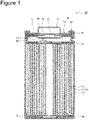
- FIG. 1 is a cross-sectional view of a non-aqueous electrolyte secondary battery according to an example embodiment.
- the non-aqueous electrolyte secondary battery 10 illustrated in FIG. 1 includes a wound electrode assembly 14 in which a positive electrode 11 and a negative electrode 12 are wound with a separator 13 therebetween; a non-aqueous electrolyte; insulating plates 18 and 19 that are respectively disposed on upper and lower sides of the electrode assembly 14; and a battery case 15 that houses these components.
- the battery case 15 includes a case body 16 having a cylindrical shape with a closed bottom and a sealing structure 17 covering the opening of the case body 16.
- the wound electrode assembly 14 may be replaced with another form of electrode assembly, such as a laminated electrode assembly that includes positive electrodes and negative electrodes alternately laminated with a separator therebetween.
- the battery case 15 include a metal case having a cylindrical, rectangular, coin, button, or another shape and a resin case composed of a laminated resin sheet (laminated battery).
- the case body 16 is, for example, a metal container having a cylindrical shape with a closed bottom.
- a gasket 28 is provided between the case body 16 and the sealing structure 17, thereby maintaining airtightness of the space inside the battery.
- the case body 16 has, for example, a protrusion 22, which is an inwardly protruding portion of the side surface of the case body 16 for supporting the sealing structure 17.
- the protrusion 22 preferably has an annular shape extending along the circumference of the case body 16, and supports the sealing structure 17 on its upper surface.
- the sealing structure 17 has a configuration in which a filter 23, a lower valve element 24, an insulating member 25, an upper valve element 26, and a cap 27 are stacked in that order from the side on which the electrode assembly 14 is located.
- the components of the sealing structure 17 have, for example, either a disc shape or a ring shape and are, except for the insulating member 25, electrically connected to each other.
- the lower valve element 24 and the upper valve element 26 are connected to each other at their center portions, and the insulating member 25 is interposed between their peripheral portions.
- the lower valve element 24 breaks as it is deformed so as to push the upper valve element 26 toward the cap 27, resulting in an interruption of the current path between the lower valve element 24 and the upper valve element 26.
- the upper valve element 26 breaks, letting gas escape through an opening of the cap 27.
- a positive electrode lead 20 attached to the positive electrode 11 passes through a through hole in the insulating plate 18 and extends toward the sealing structure 17, and a negative electrode lead 21 attached to the negative electrode 12 passes outside the insulating plate 19 and extends toward the bottom of the case body 16.
- the positive electrode lead 20 is connected to an underside of the filter 23, which is the bottom plate of the sealing structure 17, by, for example, welding, and the cap 27, which is the top plate of the sealing structure 17 electrically connected to the filter 23, serves as a positive electrode terminal.
- the negative electrode lead 21 is connected to an inner surface of the bottom of the case body 16 by, for example, welding, and the case body 16 serves as a negative electrode terminal.
- FIG. 2 is a partially enlarged cross-sectional view illustrating an example electrode assembly for use in the non-aqueous electrolyte secondary battery illustrated in FIG. 1 .
- the positive electrode, the negative electrode, and the separator will be described below with reference to FIG. 2 .
- the positive electrode 11 includes a positive electrode collector and a positive electrode mixture layer that is disposed on the collector.
- the positive electrode collector include foil of metal that is stable in a potential range of the positive electrode 11, such as aluminum, and a film having such metal disposed in its surface layer.
- the positive electrode mixture layer contains a positive electrode active material and resin-coated particles, and preferably further contains a conductive material and a binder.
- the positive electrode mixture layer is preferably formed on both sides of the positive electrode collector.
- the positive electrode 11 can be prepared by, for example, applying positive electrode mixture slurry containing, for example, a positive electrode active material, resin-coated particles, a conductive material, and a binder to the positive electrode collector, drying the coating, and then rolling it to form the positive electrode mixture layer on both sides of the positive electrode collector.
- the positive electrode mixture layer preferably has a density of 3.6 g/cc or greater and more preferably has a density of from 3.6 g/cc to 4.0 g/cc.
- the positive electrode active material examples include a lithium metal composite oxide containing one or more metal elements such as Co, Mn, Ni, or Al.
- the lithium metal composite oxide include Li x CoO 2 , Li x NiO 2 , Li x MnO 2 , Li x Co y Ni 1-y O 2 , Li x Co y M 1-y O z , Li x Ni 1-y M y O z , Li x Mn 2 O 4 , Li x Mn 2-y M y O 4 , LiMPO 4 , and Li 2 MPO 4 F (where M represents at least one of Na, Mg, Sc, Y, Mn, Fe, Co, Ni, Cu, Zn, Al, Cr, Pb, Sb, and B, and where 0.95 ⁇ x ⁇ 1.2, 0.8 ⁇ y ⁇ 0.95, and 2.0 ⁇ z ⁇ 2.3).
- the resin-coated particles include metal-based particles and a resin layer that covers a surface of each of the metal-based particles.
- the resin layer contains a resin that melts at 100°C to 150°C.
- the metal-based particles comprise at least either of metal particles and metal compound particles that elute at 4.3 V (vs. Li/Li + ) or less.
- Examples of the metal particles and the metal compound particles that elute at 4.3 V (vs. Li/Li + ) or less include particles of Cu, Sn, SnSO 4 , SnCl 4 , Bi, Bi 2 (SO 4 ) 3 , BiCl 3 , Zn, ZnCl 2 , ZnSO 4 , Co, Ag 2 O, Pb, PbCl 2 , Fe, and Fe 2 O 3 .
- Cu, Sn, and Zn are preferable as they, for example, elute rapidly and can cause micro-short circuits to occur early between the positive and negative electrodes.
- the metal-based particles have an average particle size of greater than 1 ⁇ m to cause micro-short circuits between the positive and negative electrodes, preferably of from 5 ⁇ m to 50 ⁇ m, and more preferably of from 10 ⁇ m to 50 ⁇ m. It should be noted that, even when the average particle size is greater than 50 ⁇ m, micro-short circuits occur between the positive and negative electrodes. However, in that case, as the electrical resistance of the positive electrode increases, the performance of the battery during normal operation may drop.
- the average particle size of the metal-based particles represents a volume average particle size (Dv50) at which the volume total is 50% in a particle size distribution as measured using laser diffraction scattering.
- the resin that melts at 100°C to 150°C is a resin having a melting point in a range of from 100°C to 150°C, and examples of such a resin include polyimides, polyether ether ketones, polyamideimides, low density polyethylenes, ethylene- ⁇ -olefin copolymers, ethylene-vinyl acetate copolymers, ethylene-ethyl acrylate copolymers, ethylene-methyl acrylate copolymers, ethylene-glycidyl methacrylate copolymers, ethylene-acrylate copolymers, and ethylene-propylene copolymers. It is to be understood that the melting point of a resin can be changed depending on, for example, crystallinity, molecular weight, branching, or density.
- the resin may melt during normal operation of the battery, so that the metal-based particles are exposed, causing micro-short circuits between the positive and negative electrodes. If a resin that melts at a temperature above 150°C is used, the melting of the resin and the resulting elution of the metal-based particles in response to exposure of the battery to a high-temperature environment may occur with a delay, causing the battery to generate heat before micro-short circuits occur between the positive and negative electrodes.
- the thickness of the resin that covers the metal-based particles is preferably from 0.05 ⁇ m to 10 ⁇ m and more preferably from 0.1 ⁇ m to 8 ⁇ m.
- the content of the resin-coated particles is from 0.5% by mass to 10% by mass relative to the total amount of the positive electrode mixture layer to cause micro-short circuits between the positive and negative electrodes, preferably in a range of from 1% by mass to 9% by mass, and more preferably in a range of from 2% by mass to 8% by mass.
- the resin-coated particles may be prepared by any method that enables coating of the surfaces of the metal-based particles with a resin.
- the resin-coated particles with the surfaces of the metal-based particles coated with a resin can be prepared by using, for example, a surface modification device to which a high-speed airflow impact method is applied, such as a hybridization system (from Nara Machinery Co., Ltd.), a Kryptron Cosmos system (from Kawasaki Heavy Industries, Ltd.), or an Inomizer system (from Hosokawa Micron Group), a surface modification device to which a dry mechanochemical method is applied, such as a mechanofusion system (from Hosokawa Micron Group) or a mechanomill (from Okada Seiko Co., Ltd.), or a surface modification device to which a wet coating method is applied, such as Dispercoat (from Nisshin Engineering Inc.) or Coatmizer (from Freund Corporation).
- a surface modification device to which a high-speed airflow impact method such as
- Examples of the conductive material contained in the positive electrode mixture layer include carbon materials such as carbon black, acetylene black, Ketjen black, graphite, carbon nanotubes, carbon nanofibers, and graphene.
- Examples of the binder contained in the positive electrode mixture layer include polytetrafluoroethylene (PTFE), polyvinylidene fluoride (PVdF), and other fluorine-containing resins, polyacrylonitrile (PAN), polyimides, acrylic resins, polyolefins, carboxymethyl cellulose (CMC) or salts thereof, styrene-butadiene rubber (SBR), polyacrylic acid (PAA) or salts thereof, polyvinyl alcohol (PVA), and polyethylene oxide (PEO).
- PTFE polytetrafluoroethylene
- PVdF polyvinylidene fluoride
- PAN polyacrylonitrile
- PAN polyimides
- acrylic resins polyolefins
- CMC carboxymethyl cellulose
- the negative electrode 12 includes a negative electrode collector and a negative electrode mixture layer that is disposed on the collector.
- the negative electrode collector include foil of metal that is stable in a potential range of the negative electrode 12, such as copper, and a film having such metal disposed in its surface layer.
- the negative electrode mixture layer contains, for example, a negative electrode active material and a binder and is preferably formed on both sides of the negative electrode collector.
- the negative electrode 12 can be prepared by applying negative electrode mixture slurry containing, for example, a negative electrode active material and a binder on the negative electrode collector, drying the coating, and then rolling it to form the negative electrode mixture layer on both sides of the negative electrode collector.
- the negative electrode active material is not particularly limited and may be any active material that can reversibly occlude and release lithium ions, and examples of such an active material include carbon materials such as natural graphite and artificial graphite, metals such as silicon (Si) and tin (Sn) that can be alloyed with Li, oxides containing one or more metal elements such as Si and Sn, and lithium titanium composite oxides.
- the negative electrode mixture layer preferably contains a conductive material such as carbon black.
- a material that is similar to that used in the positive electrode 11 is used.
- the separator 13 includes a substrate layer 30 and a heat-resistant layer 32 that is disposed on the substrate layer 30.
- the heat-resistant layer 32 contains a filler and a binder.
- the substrate layer 30 and the heat-resistant layer 32 illustrated in FIG. 2 are disposed between the positive electrode 11 and the negative electrode 12.
- the heat-resistant layer 32 is disposed on a surface of the substrate layer 30 that is opposed to the positive electrode 11. In other words, the heat-resistant layer 32 is disposed between the substrate layer 30 and the positive electrode 11.
- the manner in which the heat-resistant layer 32 is disposed is not limited to the above-described example, and the heat-resistant layer 32 may be disposed on, for example, a surface of the substrate layer 30 that is opposed to the negative electrode 12 (in other words, the heat-resistant layer 32 may be disposed between the substrate layer 30 and the negative electrode 12).
- the heat-resistant layer 32 may be disposed on, for example, both sides of the substrate layer 30 (in other words, the heat-resistant layer 32 may be disposed between the substrate layer 30 and the positive electrode 11 and between the substrate layer 30 and the negative electrode 12). While it is preferable to form the heat-resistant layer 32 on the substrate layer 30 to be opposed to an electrode, the heat-resistant layer 32 may be formed on either the positive electrode 11 or the negative electrode 12 to be opposed to the substrate layer 30. In any case, the heat-resistant layer 32 and the substrate layer 30 are disposed between the positive electrode 11 and the negative electrode 12 when they are assembled into the electrode assembly 14.
- the substrate layer 30 is composed of a porous sheet having ion permeability and insulating properties, such as a microporous thin film, woven fabric, or nonwoven fabric.
- the resin that forms the substrate layer 30 include polyethylene, polypropylene, copolymers of polyethylene and ⁇ -olefins and other polyolefins, acrylic resins, polystyrene, polyester, and cellulose.
- the substrate layer 30 is, for example, composed predominantly of a polyolefin and may be composed substantially of only a polyolefin.
- the substrate layer 30 may have either a single-layer structure or a laminated structure.
- the thickness of the substrate layer 30 is not particularly limited and is, for example, preferably from 3 ⁇ m to 20 ⁇ m.
- the average pore size of the substrate layer 30 is, for example, preferably from 0.02 ⁇ m to 0.5 ⁇ m and more preferably from 0.03 ⁇ m to 0.3 ⁇ m.
- the average pore size of the substrate layer 30 is measured using a palm porometer (from Seika Corporation) that is capable of pore diameter measurement by the bubble point method (JIS K3832, ASTM F316-86).
- the heat-resistant layer 32 is a component that suppresses melting of the substrate layer 30 with heat, and is disposed on the substrate layer 30.
- the filler contained in the heat-resistant layer 32 is composed of a material having a higher heat resistance than the material used for the substrate layer 30 and, in particular, is preferably composed of a material that is stably present at the working voltage of the non-aqueous electrolyte secondary battery.
- the property of being stably present at the working voltage of the non-aqueous electrolyte secondary battery indicates that it completely does not elute at the working voltage or does not elute to the extent that it degrades the function of the non-aqueous electrolyte secondary battery.
- the filler examples include metal oxides such as aluminum oxide (alumina), magnesium oxide, titanium oxide, zirconium oxide, silicon oxide, yttrium oxide, and zinc oxide, metal nitrides such as silicon nitride, aluminum nitride, boron nitride, and titanium nitride, and metal carbides such as silicon carbide and boron carbide.
- metal oxides such as aluminum oxide (alumina), magnesium oxide, titanium oxide, zirconium oxide, silicon oxide, yttrium oxide, and zinc oxide
- metal nitrides such as silicon nitride, aluminum nitride, boron nitride, and titanium nitride
- metal carbides such as silicon carbide and boron carbide.
- the filler may also be, for example, a porous aluminosilicate such as zeolite (M 2 / n O ⁇ Al 2 O 3 ⁇ SiO 2 ⁇ yH 2 O, where M is a metal element, x ⁇ 2, and y ⁇ 0), a layered silicate such as talc (Mg 3 Si 4 O 10 (OH) 2 ), or a mineral such as barium titanate (BaTiO 3 ) or strontium titanate (SrTiO 3 ).
- a porous aluminosilicate such as zeolite (M 2 / n O ⁇ Al 2 O 3 ⁇ SiO 2 ⁇ yH 2 O, where M is a metal element, x ⁇ 2, and y ⁇ 0)
- a layered silicate such as talc (Mg 3 Si 4 O 10 (OH) 2 )
- a mineral such as barium titanate (BaTiO 3 ) or strontium titanate (SrTiO
- the content of the filler in the heat-resistant layer 32 is preferably 20% by mass or higher and preferably 50% by mass or higher.
- the upper limit value is not particularly limited and is preferably 90% by mass or lower and more preferably 80% by mass or lower.
- the thickness of the heat-resistant layer 32 is, for example, preferably 5 ⁇ m or less, more preferably from 1 ⁇ m to 5 ⁇ m, and, in particular, more preferably from 1 ⁇ m to 4 ⁇ m.
- binder contained in the heat-resistant layer 32 examples include polyethylene, polypropylene, copolymers of polyethylene and ⁇ -olefins and other polyolefins, PVdF, PTFE, polyvinyl fluoride (PVF), and other fluorine-containing resins, vinylidene fluoride-hexafluoropropylene-tetrafluoroethylene copolymers, ethylene-tetrafluoroethylene copolymers, and other fluorine-containing rubbers, styrene-butadiene copolymers and hydrides thereof, acrylonitrile-butadiene copolymers and hydrides thereof, acrylonitrile-butadiene-styrene copolymers and hydrides thereof, methacrylate-acrylate copolymers, styrene-acrylate copolymers, acrylonitrile-acrylate copolymers, polyvinyl acetate, polyphenylene ether, polysulf
- the content of the binder in the heat-resistant layer 32 is preferably 1% by mass or higher and more preferably 2% by mass or higher.
- the upper limit is not particularly limited and is, for example, preferably 20% by mass or lower and more preferably 10% by mass or lower.
- the heat-resistant layer 32 is, for example, formed by applying slurry containing, for example, a filler and a binder to a surface of the substrate layer 30 and drying the coating.
- the slurry may be applied by any conventionally known method, such as gravure printing.
- the non-aqueous electrolyte includes a non-aqueous solvent and an electrolyte salt dissolved in the non-aqueous solvent.
- the non-aqueous solvent include esters, ethers, nitriles such as acetonitrile, amides such as dimethylformamide, and mixed solvents of two or more thereof.
- the non-aqueous solvent may contain a halogen substitution product in which at least one hydrogen atom of the solvent is substituted with a halogen atom, such as fluorine.
- esters examples include cyclic carbonate esters such as ethylene carbonate (EC), propylene carbonate (PC), and butylene carbonate, chain carbonate esters such as dimethyl carbonate (DMC), ethyl methyl carbonate (EMC), diethyl carbonate (DEC), methyl propyl carbonate, ethyl propyl carbonate, and methyl isopropyl carbonate, cyclic carboxylate esters such as ⁇ -butyrolactone (GBL) and ⁇ -valerolactone (GVL), and chain carboxylate esters such as methyl acetate, ethyl acetate, propyl acetate, methyl propionate (MP), ethyl propionate, and ⁇ -butyrolactone.
- cyclic carbonate esters such as ethylene carbonate (EC), propylene carbonate (PC), and butylene carbonate
- chain carbonate esters such as dimethyl carbonate (DMC), ethyl methyl carbonate
- ethers examples include cyclic ethers such as 1,3-dioxolane, 4-methyl-1,3-dioxolane, tetrahydrofuran, 2-methyltetrahydrofuran, propylene oxide, 1,2-butylene oxide, 1,3-dioxane, 1,4-dioxane, 1,3,5-trioxane, furan, 2-methylfuran, 1,8-cineole, and crown ethers, and chain ethers such as 1,2-dimethoxyethane, diethyl ether, dipropyl ether, diisopropyl ether, dibutyl ether, dihexyl ether, ethyl vinyl ether, butyl vinyl ether, methyl phenyl ether, ethyl phenyl ether, butyl phenyl ether, pentyl phenyl ether, methoxytoluene, benzyl ethyl ether, di
- a fluorinated cyclic carbonate ester such as fluoroethylene carbonate (FEC), a fluorinated chain carbonate ester, and a fluorinated chain carboxylate ester such as methyl fluoropropionate (FMP) are preferably used.
- FEC fluoroethylene carbonate
- FMP fluorinated chain carboxylate ester
- the electrolyte salt is preferably a lithium salt.
- the lithium salt include LiBF 4 , LiClO 4 , LiPF 6 , LiAsF 6 , LiSbF 6 , LiAlCl 4 , LiSCN, LiCF 3 SO 3 , LiCF 3 CO 2 , Li(P(C 2 O 4 )F 4 ), LiPF 6-x (C n F 2n+1 ) x (where 1 ⁇ x ⁇ 6, and n is 1 or 2), LiBioClio, LiCl, LiBr, Lil, lithium chloroborane, lithium lower aliphatic carboxylates, borates such as Li 2 B 4 O 7 and Li(B(C 2 O 4 )F 2 ), and imide salts such as LiN(SO 2 CF 3 ) 2 and LiN(C 1 F 21+1 SO 2 )(C m F 2m+1 SO 2 ) ⁇ where 1 and m are integers of 0 or greater ⁇ .
- LiPF 6 is preferably used in terms of, for example, ionic conductivity and electrochemical stability.
- concentration of the lithium salt is preferably 0.8 to 1.8 mol per liter of the non-aqueous solvent.
- the surfaces of copper particles having a particle size of 5 ⁇ m were coated with a low density polyethylene resin using a high-speed airflow impact method to form a polyethylene layer having a thickness of 3 ⁇ m.
- the resulting particles were used as the resin-coated particles.
- NMP N-methylpyrrolidone
- LiNi 0.8 Co 0.15 Al 0 . 05 O 2 serving as the positive electrode active material
- carbon black serving as the conductive material
- PVDF with an average molecular weight of 1,100,000
- This positive electrode mixture slurry was applied to both sides of a positive electrode collector consisting of aluminum foil, and the coating was dried and then rolled using a rolling mill to prepare a positive electrode having a positive electrode mixture layer on both sides of the positive electrode collector.
- EC ethylene carbonate
- DMC dimethyl carbonate
- LiPF 6 lithium hexafluorophosphate
- Alumina (Al 2 O 3 ) having a particle size of 0.5 ⁇ m, carboxymethyl cellulose (CMC), styrene-butadiene rubber (SBR), and water were mixed in a mass ratio of 30:3:0.2:66.8 to prepare slurry.
- One of the surfaces of polyethylene microporous film (with a thickness of 16 ⁇ m, a Gurley value of 156 s/100 mL, and a pore size of 0.06 ⁇ m) serving as the substrate layer was coated with the above-described slurry by a gravure process, and then the coating was dried to remove the water content to prepare a separator having a heat-resistant layer on one of the surfaces of the substrate layer.
- the thickness of the heat-resistant layer was 2 ⁇ m.
- a lead terminal was attached to each of the above-described positive electrode and the above-described negative electrode, and then the positive electrode and the negative electrode were wound with the above-described separator interposed therebetween so as to have the heat-resistant layer of the separator opposed to the positive electrode to prepare a wound electrode assembly.
- This electrode assembly was placed in a case body, the lead terminal attached to the negative electrode was welded to the bottom of the case body, and the lead terminal attached to the positive electrode was welded to the sealing structure. Subsequently, the case body was filled with the above-described liquid electrolyte, and then the case body was hermetically sealed by the sealing structure to prepare a non-aqueous electrolyte secondary battery.
- the battery capacity of the prepared non-aqueous electrolyte secondary battery was 2500 mAh.
- the surfaces of copper particles having a particle size of 10 ⁇ m were coated with a low density polyethylene resin using a high-speed airflow impact method to form a polyethylene layer having a thickness of 3 ⁇ m.
- a non-aqueous electrolyte secondary battery was prepared in a similar manner to Example 1 except that the resulting particles were used as the resin-coated particles.
- the surfaces of copper particles having a particle size of 50 ⁇ m were coated with a low density polyethylene resin using a high-speed airflow impact method to form a polyethylene layer having a thickness of 3 ⁇ m.
- a non-aqueous electrolyte secondary battery was prepared in a similar manner to Example 1 except that the resulting particles were used as the resin-coated particles.
- a non-aqueous electrolyte secondary battery was prepared in a similar manner to Example 1 except that the resin-coated particles prepared in Example 2 were used, and that polyethylene microporous film (with a thickness of 16 ⁇ m, a Gurley value of 156 s/100 mL, and a pore size of 0.06 ⁇ m) on which the heat-resistant layer was not formed was used as the separator.
- a non-aqueous electrolyte secondary battery was prepared in a similar manner to Example 1 except that the resin-coated particles were not used.
- a non-aqueous electrolyte secondary battery was prepared in a similar manner to Example 1 except that the resin-coated particles were not used, and that polyethylene microporous film (with a thickness of 16 ⁇ m, a Gurley value of 156 s/100 mL, and a pore size of 0.06 ⁇ m) on which the heat-resistant layer was not formed was used as the separator.
- the surfaces of copper particles having a particle size of 1 ⁇ m were coated with a low density polyethylene resin using a high-speed airflow impact method to form a polyethylene layer having a thickness of 3 ⁇ m.
- a non-aqueous electrolyte secondary battery was prepared in a similar manner to Example 1 except that the resulting particles were used as the resin-coated particles.
- the surfaces of zinc particles having a particle size of 10 ⁇ m were coated with a low density polyethylene resin using a high-speed airflow impact method to form a polyethylene layer having a thickness of 3 ⁇ m.
- a non-aqueous electrolyte secondary battery was prepared in a similar manner to Example 1 except that the resulting particles were used as the resin-coated particles.
- a non-aqueous electrolyte secondary battery was prepared in a similar manner to Example 1 except that, in the preparation of the positive electrode, a positive electrode active material, a conductive material, a binder, and the resin-coated particles prepared in Example 2 were mixed in a mass ratio of 94.5:2.5:2.5:0.5.
- a non-aqueous electrolyte secondary battery was prepared in a similar manner to Example 1 except that, in the preparation of the positive electrode, a positive electrode active material, a conductive material, a binder, and the resin-coated particles prepared in Example 2 were mixed in a mass ratio of 94.9:2.5:2.5:0.1.
- a non-aqueous electrolyte secondary battery was prepared in a similar manner to Example 1 except that, in the preparation of the positive electrode, a positive electrode active material, a conductive material, a binder, and the resin-coated particles prepared in Example 2 were mixed in a mass ratio of 85:2.5:2.5:10.
- the surfaces of tin particles having a particle size of 10 ⁇ m were coated with a low density polyethylene resin using a high-speed airflow impact method to form a polyethylene layer having a thickness of 3 ⁇ m.
- a non-aqueous electrolyte secondary battery was prepared in a similar manner to Example 1 except that the resulting particles were used as the resin-coated particles.
- the batteries of the examples and the comparative examples underwent constant current charging at a current of 0.3 C (750 mA) to a battery voltage of 4.2 V and subsequently underwent constant voltage charging at a constant voltage of 4.2 V to a current value of 1/20 C (125 mA).
- the charged batteries were left at rest in a thermostat chamber, and the temperature within the thermostat chamber was heated to 150°C. Subsequently, the battery temperature at a battery side surface portion was measured to determine the number of degrees Celsius by which the temperature was higher than the temperature of the thermostat chamber (overshoot). The results are given in Table 1.
- Example 2 in which the positive electrode mixture layer contained 5% by mass of the resin-coated particles with copper particles having a particle size of 10 ⁇ m coated with a polyethylene resin, the overshoot temperature was suppressed to be low in Example 2 in which the separator including the heat-resistant layer and the substrate layer was used, but the overshoot temperature in Comparative Example 1 in which only the substrate layer, without the heat-resistant layer, was used as the separator was significantly higher than in Example 2.
- Example 2 suppressed an increase in battery temperature of a non-aqueous electrolyte secondary battery exposed to a high-temperature environment in a charged state.
- Example 2 copper particles eluted from the positive electrode, and deposits that precipitated on the negative electrode caused micro-short circuits between the positive and negative electrodes. It is believed that as a result, the energy of the battery was gradually lowered, and the overshoot temperature was suppressed to be low. In contrast, although deposits that precipitated on the negative electrode caused short circuits between the positive and negative electrodes in Comparative Example 1 as well, because the separator that did not include the heat-resistant layer was used, the separator melted due to a short circuit current that flowed between the positive and negative electrodes when short circuiting occurred, resulting in a greater short circuit area between the positive and negative electrodes. It is inferred that as a result, because the short circuit current increased, the battery generated heat, and the overshoot temperature increased.
- the overshoot temperature was higher than in Example 2.
- the resin-coated particles are absent, because micro-short circuits do not occur between the positive and negative electrodes, the battery is kept at a high temperature when it is at a high voltage. It is inferred that as a result, the positive electrode generated heat, and the overshoot temperature increased.
- Example 1 The overshoot temperature was suppressed to be low in Example 1 in which the positive electrode mixture layer contained 5% by mass of the resin-coated particles with copper particles having a particle size of 5 ⁇ m coated with a polyethylene resin, but the overshoot temperature in Comparative Example 4 in which the positive electrode mixture layer contained 5% by mass of the coating resin with copper particles having a particle size of 1 ⁇ m coated with a polyethylene resin was higher than in Example 1.
- Example 1 copper particles have a large particle size, copper particles elute from the positive electrode, and deposits that precipitate on the negative electrode cause micro-short circuits between the positive and negative electrodes, but when, as in Comparative Example 4, copper particles have a small particle size that is 1 ⁇ m or smaller, because deposits that precipitate on the negative electrode are unable to grow to reach the positive electrode and micro-short circuits do not occur between the positive and negative electrodes, the battery is kept at a high temperature when it is at a high voltage. It is inferred that as a result, in Comparative Example 4, the positive electrode generated heat, and the overshoot temperature increased.
- Example 5 The overshoot temperature was suppressed to be low in Example 5 in which the positive electrode mixture layer contained 0.5% by mass of the resin-coated particles with copper particles having a particle size of 5 ⁇ m coated with a polyethylene resin, but the overshoot temperature in Comparative Example 5 in which the positive electrode mixture layer contained 0.1% by mass of the coating resin with copper particles having a particle size of 5 ⁇ m coated with a polyethylene resin, and in Comparative Example 6 in which the positive electrode mixture layer contained 10% by mass of the coating resin with copper particles having a particle size of 5 ⁇ m coated with a polyethylene resin, was higher than in Example 5 (and Example 1).
- the content of the resin-coated particles is as low as 0.1% by mass, deposits cause micro-short circuits between the positive and negative electrodes at few locations, hampering efficient short circuiting. As such, the battery is kept at a high temperature when it is at a high voltage. It is inferred that as a result, in Comparative Example 5, the positive electrode generated heat, and the overshoot temperature increased. Further, when, as in Comparative Example 6, the content of the resin-coated particles is as high as 10% by mass or higher, deposits cause micro-short circuits between the positive and negative electrodes at too many locations, increasing the short circuit current. It is inferred that as a result, in Comparative Example 6, the battery generated heat, and the overshoot temperature increased.
- Example 4 in which the positive electrode mixture layer contained 5% by mass of the resin-coated particles with zinc particles having a particle size of 10 ⁇ m coated with a polyethylene resin
- Example 6 in which the positive electrode mixture layer contained 5% by mass of the resin-coated particles with tin particles having a particle size of 10 ⁇ m coated with a polyethylene resin, in a similar manner to other examples in which copper particles were used.
- zinc particles or tin particles eluted from the positive electrode, and deposits that precipitated on the negative electrode caused micro-short circuits between the positive and negative electrodes.
- the overshoot temperature can be suppressed to be low when metal-based particles that elute at 4.3 V (vs. Li/Li + ) or less are used as the metal-based particles included in the resin-coated particles.
- metal-based particles that elute at 4.3 V vs. Li/Li +
- metal-based particles that elute at 4.3 V vs.
- Li/Li + ) or less include particles of SnSO 4 , SnCl 4 , Bi, Bi 2 (SO 4 ) 3 , BiCl 3 , ZnCl 2 , ZnSO 4 , Co, Ag 2 O, Pb, PbCl 2 , Fe, and Fe 2 O 3 , for which it should also be noted that results of tests similar to the examples confirmed that the overshoot temperature was suppressed to be low.
Landscapes
- Chemical & Material Sciences (AREA)
- Chemical Kinetics & Catalysis (AREA)
- Electrochemistry (AREA)
- General Chemical & Material Sciences (AREA)
- Engineering & Computer Science (AREA)
- Manufacturing & Machinery (AREA)
- Composite Materials (AREA)
- Inorganic Chemistry (AREA)
- Ceramic Engineering (AREA)
- Materials Engineering (AREA)
- Battery Electrode And Active Subsutance (AREA)
- Secondary Cells (AREA)
- Cell Separators (AREA)
Abstract
Description
- The present disclosure relates to a non-aqueous electrolyte secondary battery.
- Non-aqueous electrolyte secondary batteries that are charged or discharged when, for example, lithium ions move between positive and negative electrodes are widely used as high power and high energy density secondary batteries.
- For example, Patent Document 1 discloses a non-aqueous electrolyte secondary battery in which a positive electrode containing a reducing agent including a material which reduces a positive electrode active material that is in a charged state at a temperature above 60°C and which is coated with a resin that melts at a predetermined temperature above 60°C is used. Patent Document 1 further discloses that the non-aqueous electrolyte secondary battery can ensure safety of the battery even when it is exposed to a high-temperature environment in a charged state.
- PATENT LITERATURE 1: International Publication No.
WO 2012/137376 - In recent years, demands for ensuring higher safety arise in response to the increases in, for example, the capacity and energy density of non-aqueous electrolyte secondary batteries. To ensure higher safety, further improvements are needed in terms of suppressing an increase in battery temperature of a non-aqueous electrolyte secondary battery exposed to a high-temperature environment in a charged state.
- In consideration of the above, the present disclosure is directed toward suppressing an increase in battery temperature of a non-aqueous electrolyte secondary battery exposed to a high-temperature environment in a charged state.
- According to an aspect of the present disclosure, there is provided a non-aqueous electrolyte secondary battery comprising an electrode assembly comprising a positive electrode, a negative electrode, and a separator, the separator comprising a heat-resistant layer and a substrate layer that are disposed between the positive electrode and the negative electrode; and a non-aqueous electrolyte, wherein the positive electrode comprises a positive electrode mixture layer that contains a positive electrode active material and resin-coated particles including metal-based particles coated with a resin that melts at 100°C to 150°C, wherein the metal-based particles comprise at least either of metal particles and metal compound particles that elute into the non-aqueous electrolyte at 4.3 V (vs. Li/Li+) or less, wherein the metal-based particles have an average particle size of greater than 1 µm, and the content of the resin-coated particles is from 0.5% by mass to less than 10% by mass relative to the total amount of the positive electrode mixture layer, and wherein the heat-resistant layer contains a filler and a binder.
- An aspect of the present disclosure enables suppressing an increase in battery temperature of a non-aqueous electrolyte secondary battery exposed to a high-temperature environment in a charged state.
-
-
FIG. 1 is a cross-sectional view of a non-aqueous electrolyte secondary battery according to an example embodiment. -
FIG. 2 is a partially enlarged cross-sectional view illustrating an example electrode assembly for use in the non-aqueous electrolyte secondary battery illustrated inFIG. 1 . - According to an aspect of the present disclosure, there is provided a non-aqueous electrolyte secondary battery comprising an electrode assembly comprising a positive electrode, a negative electrode, and a separator, the separator comprising a heat-resistant layer and a substrate layer that are disposed between the positive electrode and the negative electrode; and a non-aqueous electrolyte, wherein the positive electrode comprises a positive electrode mixture layer that contains a positive electrode active material and resin-coated particles including metal-based particles coated with a resin that melts at 100°C to 150°C, wherein the metal-based particles comprise at least either of metal particles and metal compound particles that elute into the non-aqueous electrolyte at 4.3 V (vs. Li/Li+) or less, wherein the metal-based particles have an average particle size of greater than 1 µm, and the content of the resin-coated particles is from 0.5% by mass to less than 10% by mass relative to the total amount of the positive electrode mixture layer, and wherein the heat-resistant layer contains a filler and a binder.
- A non-aqueous electrolyte secondary battery according to an aspect of the present disclosure enables suppressing an increase in battery temperature that would occur when exposed to a high-temperature environment in a charged state. It is inferred that the mechanism behind this effect is as follows. When the battery disclosed herein is exposed to a high-temperature environment (for example, 100°C or higher) in a charged state, the resin in the resin-coated particles melts, and the metal-based particles are exposed. The metal-based particles elute into the non-aqueous electrolyte at the potential of the positive electrode in the charged state and precipitate on the opposing negative electrode. Deposits that precipitate on the negative electrode grow, pass through the separator, and reach the positive electrode, causing micro-short circuits between the positive and negative electrodes. The micro-short circuits gradually lower the energy of the charged state battery and suppress an increase in battery temperature under a high-temperature environment.
- If the separator does not include a heat-resistant layer, the separator melts due to a short circuit current that flows between the positive and negative electrodes when short circuiting occurs, resulting in a greater short circuit area between the positive and negative electrodes. As a result, because the short circuit current increases, the battery generates heat, and an increase in battery temperature cannot be suppressed sufficiently. In contrast, because the separator in the battery disclosed herein includes a heat-resistant layer, the melting of the separator due to a short circuit current that flows between the positive and negative electrodes when short circuiting occurs is suppressed, and the increase in the short circuit current is suppressed. In other words, the present disclosure is based on the idea of controlling the degree of short circuiting not only by establishing short circuits between the positive and negative electrodes using the resin-coated particles but also by combining them with the separator that includes a heat-resistant layer. This idea has heretofore been unknown and is remarkable.
- Further, the present disclosure also controls the degree of short circuiting between the positive and negative electrodes by adjusting the elution potential and the average particle size of the metal-based particles and the content of the resin-coated particles. For example, metal-based particles that do not elute at 4.3 V (vs. Li/Li+) or less are difficult to elute from the positive electrode even when the battery is exposed to a high-temperature environment in a charged state, and deposits are difficult to precipitate on the opposing negative electrode. As such, micro-short circuits are difficult to occur between the positive and negative electrodes. Further, for example, metal-based particles that are small particles with an average particle size of 1 µm or less do not allow deposits that precipitate on the negative electrode to grow to reach the positive electrode. As such, micro-short circuits are difficult to occur between the positive and negative electrodes. Further, for example, when the content of resin-coated particles is as low as 0.1% by mass, deposits that have precipitated on the negative electrode cause micro-short circuits between the positive and negative electrodes at few locations, hampering efficient short circuiting. Further, for example, when the content of resin-coated particles is as high as 10% by mass or higher, deposits that have precipitated on the negative electrode cause micro-short circuits between the positive and negative electrodes at too many locations, increasing the short circuit current. In any of these cases, the degree of short circuiting cannot be controlled, leading to an increase in battery temperature under a high-temperature environment.
- An example embodiment of a non-aqueous electrolyte secondary battery according to the present disclosure will be described in detail below.
-
FIG. 1 is a cross-sectional view of a non-aqueous electrolyte secondary battery according to an example embodiment. The non-aqueous electrolytesecondary battery 10 illustrated inFIG. 1 includes awound electrode assembly 14 in which apositive electrode 11 and anegative electrode 12 are wound with aseparator 13 therebetween; a non-aqueous electrolyte;insulating plates electrode assembly 14; and abattery case 15 that houses these components. Thebattery case 15 includes acase body 16 having a cylindrical shape with a closed bottom and asealing structure 17 covering the opening of thecase body 16. Thewound electrode assembly 14 may be replaced with another form of electrode assembly, such as a laminated electrode assembly that includes positive electrodes and negative electrodes alternately laminated with a separator therebetween. Examples of thebattery case 15 include a metal case having a cylindrical, rectangular, coin, button, or another shape and a resin case composed of a laminated resin sheet (laminated battery). - The
case body 16 is, for example, a metal container having a cylindrical shape with a closed bottom. Agasket 28 is provided between thecase body 16 and thesealing structure 17, thereby maintaining airtightness of the space inside the battery. Thecase body 16 has, for example, a protrusion 22, which is an inwardly protruding portion of the side surface of thecase body 16 for supporting thesealing structure 17. The protrusion 22 preferably has an annular shape extending along the circumference of thecase body 16, and supports thesealing structure 17 on its upper surface. - The
sealing structure 17 has a configuration in which afilter 23, alower valve element 24, aninsulating member 25, anupper valve element 26, and acap 27 are stacked in that order from the side on which theelectrode assembly 14 is located. The components of thesealing structure 17 have, for example, either a disc shape or a ring shape and are, except for the insulatingmember 25, electrically connected to each other. Thelower valve element 24 and theupper valve element 26 are connected to each other at their center portions, and theinsulating member 25 is interposed between their peripheral portions. In response to an increase in internal pressure of the non-aqueous electrolytesecondary battery 10 due to heat generation caused by, for example, internal short circuits, for example, thelower valve element 24 breaks as it is deformed so as to push theupper valve element 26 toward thecap 27, resulting in an interruption of the current path between thelower valve element 24 and theupper valve element 26. In response to a further increase in internal pressure, theupper valve element 26 breaks, letting gas escape through an opening of thecap 27. - In the non-aqueous electrolyte
secondary battery 10 illustrated inFIG. 1 , apositive electrode lead 20 attached to thepositive electrode 11 passes through a through hole in theinsulating plate 18 and extends toward thesealing structure 17, and anegative electrode lead 21 attached to thenegative electrode 12 passes outside theinsulating plate 19 and extends toward the bottom of thecase body 16. Thepositive electrode lead 20 is connected to an underside of thefilter 23, which is the bottom plate of thesealing structure 17, by, for example, welding, and thecap 27, which is the top plate of thesealing structure 17 electrically connected to thefilter 23, serves as a positive electrode terminal. Thenegative electrode lead 21 is connected to an inner surface of the bottom of thecase body 16 by, for example, welding, and thecase body 16 serves as a negative electrode terminal. -
FIG. 2 is a partially enlarged cross-sectional view illustrating an example electrode assembly for use in the non-aqueous electrolyte secondary battery illustrated inFIG. 1 . The positive electrode, the negative electrode, and the separator will be described below with reference toFIG. 2 . - The
positive electrode 11 includes a positive electrode collector and a positive electrode mixture layer that is disposed on the collector. Examples of the positive electrode collector include foil of metal that is stable in a potential range of thepositive electrode 11, such as aluminum, and a film having such metal disposed in its surface layer. The positive electrode mixture layer contains a positive electrode active material and resin-coated particles, and preferably further contains a conductive material and a binder. The positive electrode mixture layer is preferably formed on both sides of the positive electrode collector. Thepositive electrode 11 can be prepared by, for example, applying positive electrode mixture slurry containing, for example, a positive electrode active material, resin-coated particles, a conductive material, and a binder to the positive electrode collector, drying the coating, and then rolling it to form the positive electrode mixture layer on both sides of the positive electrode collector. To achieve an increased capacity of the battery, the positive electrode mixture layer preferably has a density of 3.6 g/cc or greater and more preferably has a density of from 3.6 g/cc to 4.0 g/cc. - Examples of the positive electrode active material include a lithium metal composite oxide containing one or more metal elements such as Co, Mn, Ni, or Al. Examples of the lithium metal composite oxide include LixCoO2, LixNiO2, LixMnO2, LixCoyNi1-yO2, LixCoyM1-yOz, LixNi1-yMyOz, LixMn2O4, LixMn2-yMyO4, LiMPO4, and Li2MPO4F (where M represents at least one of Na, Mg, Sc, Y, Mn, Fe, Co, Ni, Cu, Zn, Al, Cr, Pb, Sb, and B, and where 0.95≤x≤1.2, 0.8<y≤0.95, and 2.0≤z≤2.3).
- The resin-coated particles include metal-based particles and a resin layer that covers a surface of each of the metal-based particles. The resin layer contains a resin that melts at 100°C to 150°C. The metal-based particles comprise at least either of metal particles and metal compound particles that elute at 4.3 V (vs. Li/Li+) or less.
- Examples of the metal particles and the metal compound particles that elute at 4.3 V (vs. Li/Li+) or less include particles of Cu, Sn, SnSO4, SnCl4, Bi, Bi2(SO4)3, BiCl3, Zn, ZnCl2, ZnSO4, Co, Ag2O, Pb, PbCl2, Fe, and Fe2O3. Among these, Cu, Sn, and Zn are preferable as they, for example, elute rapidly and can cause micro-short circuits to occur early between the positive and negative electrodes.
- The metal-based particles have an average particle size of greater than 1 µm to cause micro-short circuits between the positive and negative electrodes, preferably of from 5 µm to 50 µm, and more preferably of from 10 µm to 50 µm. It should be noted that, even when the average particle size is greater than 50 µm, micro-short circuits occur between the positive and negative electrodes. However, in that case, as the electrical resistance of the positive electrode increases, the performance of the battery during normal operation may drop. The average particle size of the metal-based particles represents a volume average particle size (Dv50) at which the volume total is 50% in a particle size distribution as measured using laser diffraction scattering.
- The resin that melts at 100°C to 150°C is a resin having a melting point in a range of from 100°C to 150°C, and examples of such a resin include polyimides, polyether ether ketones, polyamideimides, low density polyethylenes, ethylene-α-olefin copolymers, ethylene-vinyl acetate copolymers, ethylene-ethyl acrylate copolymers, ethylene-methyl acrylate copolymers, ethylene-glycidyl methacrylate copolymers, ethylene-acrylate copolymers, and ethylene-propylene copolymers. It is to be understood that the melting point of a resin can be changed depending on, for example, crystallinity, molecular weight, branching, or density.
- If a resin that melts below 100°C is used, the resin may melt during normal operation of the battery, so that the metal-based particles are exposed, causing micro-short circuits between the positive and negative electrodes. If a resin that melts at a temperature above 150°C is used, the melting of the resin and the resulting elution of the metal-based particles in response to exposure of the battery to a high-temperature environment may occur with a delay, causing the battery to generate heat before micro-short circuits occur between the positive and negative electrodes.
- To, for example, allow the metal-based particles to be exposed without delay in response to exposure of the battery to a high-temperature environment, the thickness of the resin that covers the metal-based particles (that is, the thickness of the coating layer) is preferably from 0.05 µm to 10 µm and more preferably from 0.1 µm to 8 µm.
- The content of the resin-coated particles is from 0.5% by mass to 10% by mass relative to the total amount of the positive electrode mixture layer to cause micro-short circuits between the positive and negative electrodes, preferably in a range of from 1% by mass to 9% by mass, and more preferably in a range of from 2% by mass to 8% by mass.
- The resin-coated particles may be prepared by any method that enables coating of the surfaces of the metal-based particles with a resin. For example, the resin-coated particles with the surfaces of the metal-based particles coated with a resin can be prepared by using, for example, a surface modification device to which a high-speed airflow impact method is applied, such as a hybridization system (from Nara Machinery Co., Ltd.), a Kryptron Cosmos system (from Kawasaki Heavy Industries, Ltd.), or an Inomizer system (from Hosokawa Micron Group), a surface modification device to which a dry mechanochemical method is applied, such as a mechanofusion system (from Hosokawa Micron Group) or a mechanomill (from Okada Seiko Co., Ltd.), or a surface modification device to which a wet coating method is applied, such as Dispercoat (from Nisshin Engineering Inc.) or Coatmizer (from Freund Corporation).
- Examples of the conductive material contained in the positive electrode mixture layer include carbon materials such as carbon black, acetylene black, Ketjen black, graphite, carbon nanotubes, carbon nanofibers, and graphene. Examples of the binder contained in the positive electrode mixture layer include polytetrafluoroethylene (PTFE), polyvinylidene fluoride (PVdF), and other fluorine-containing resins, polyacrylonitrile (PAN), polyimides, acrylic resins, polyolefins, carboxymethyl cellulose (CMC) or salts thereof, styrene-butadiene rubber (SBR), polyacrylic acid (PAA) or salts thereof, polyvinyl alcohol (PVA), and polyethylene oxide (PEO).
- The
negative electrode 12 includes a negative electrode collector and a negative electrode mixture layer that is disposed on the collector. Examples of the negative electrode collector include foil of metal that is stable in a potential range of thenegative electrode 12, such as copper, and a film having such metal disposed in its surface layer. The negative electrode mixture layer contains, for example, a negative electrode active material and a binder and is preferably formed on both sides of the negative electrode collector. Thenegative electrode 12 can be prepared by applying negative electrode mixture slurry containing, for example, a negative electrode active material and a binder on the negative electrode collector, drying the coating, and then rolling it to form the negative electrode mixture layer on both sides of the negative electrode collector. - The negative electrode active material is not particularly limited and may be any active material that can reversibly occlude and release lithium ions, and examples of such an active material include carbon materials such as natural graphite and artificial graphite, metals such as silicon (Si) and tin (Sn) that can be alloyed with Li, oxides containing one or more metal elements such as Si and Sn, and lithium titanium composite oxides. When a lithium titanium composite oxide is used, the negative electrode mixture layer preferably contains a conductive material such as carbon black. For the binder contained in the negative electrode mixture layer, a material that is similar to that used in the
positive electrode 11 is used. - As illustrated in
FIG. 2 , theseparator 13 includes a substrate layer 30 and a heat-resistant layer 32 that is disposed on the substrate layer 30. The heat-resistant layer 32 contains a filler and a binder. - The substrate layer 30 and the heat-
resistant layer 32 illustrated inFIG. 2 are disposed between thepositive electrode 11 and thenegative electrode 12. The heat-resistant layer 32 is disposed on a surface of the substrate layer 30 that is opposed to thepositive electrode 11. In other words, the heat-resistant layer 32 is disposed between the substrate layer 30 and thepositive electrode 11. The manner in which the heat-resistant layer 32 is disposed is not limited to the above-described example, and the heat-resistant layer 32 may be disposed on, for example, a surface of the substrate layer 30 that is opposed to the negative electrode 12 (in other words, the heat-resistant layer 32 may be disposed between the substrate layer 30 and the negative electrode 12). Further, the heat-resistant layer 32 may be disposed on, for example, both sides of the substrate layer 30 (in other words, the heat-resistant layer 32 may be disposed between the substrate layer 30 and thepositive electrode 11 and between the substrate layer 30 and the negative electrode 12). While it is preferable to form the heat-resistant layer 32 on the substrate layer 30 to be opposed to an electrode, the heat-resistant layer 32 may be formed on either thepositive electrode 11 or thenegative electrode 12 to be opposed to the substrate layer 30. In any case, the heat-resistant layer 32 and the substrate layer 30 are disposed between thepositive electrode 11 and thenegative electrode 12 when they are assembled into theelectrode assembly 14. - The substrate layer 30 is composed of a porous sheet having ion permeability and insulating properties, such as a microporous thin film, woven fabric, or nonwoven fabric. Examples of the resin that forms the substrate layer 30 include polyethylene, polypropylene, copolymers of polyethylene and α-olefins and other polyolefins, acrylic resins, polystyrene, polyester, and cellulose. The substrate layer 30 is, for example, composed predominantly of a polyolefin and may be composed substantially of only a polyolefin. The substrate layer 30 may have either a single-layer structure or a laminated structure. The thickness of the substrate layer 30 is not particularly limited and is, for example, preferably from 3 µm to 20 µm.
- In terms of, for example, ion permeability, the average pore size of the substrate layer 30 is, for example, preferably from 0.02 µm to 0.5 µm and more preferably from 0.03 µm to 0.3 µm. The average pore size of the substrate layer 30 is measured using a palm porometer (from Seika Corporation) that is capable of pore diameter measurement by the bubble point method (JIS K3832, ASTM F316-86).
- The heat-
resistant layer 32 is a component that suppresses melting of the substrate layer 30 with heat, and is disposed on the substrate layer 30. The filler contained in the heat-resistant layer 32 is composed of a material having a higher heat resistance than the material used for the substrate layer 30 and, in particular, is preferably composed of a material that is stably present at the working voltage of the non-aqueous electrolyte secondary battery. The property of being stably present at the working voltage of the non-aqueous electrolyte secondary battery indicates that it completely does not elute at the working voltage or does not elute to the extent that it degrades the function of the non-aqueous electrolyte secondary battery. - Examples of the filler include metal oxides such as aluminum oxide (alumina), magnesium oxide, titanium oxide, zirconium oxide, silicon oxide, yttrium oxide, and zinc oxide, metal nitrides such as silicon nitride, aluminum nitride, boron nitride, and titanium nitride, and metal carbides such as silicon carbide and boron carbide. The filler may also be, for example, a porous aluminosilicate such as zeolite (M2/nO·Al2O3·SiO2·yH2O, where M is a metal element, x≥2, and y≥0), a layered silicate such as talc (Mg3Si4O10(OH)2), or a mineral such as barium titanate (BaTiO3) or strontium titanate (SrTiO3).
- To, for example, improve the heat resistance, the content of the filler in the heat-
resistant layer 32 is preferably 20% by mass or higher and preferably 50% by mass or higher. The upper limit value is not particularly limited and is preferably 90% by mass or lower and more preferably 80% by mass or lower. - The thickness of the heat-
resistant layer 32 is, for example, preferably 5 µm or less, more preferably from 1 µm to 5 µm, and, in particular, more preferably from 1 µm to 4 µm. - Examples of the binder contained in the heat-
resistant layer 32 include polyethylene, polypropylene, copolymers of polyethylene and α-olefins and other polyolefins, PVdF, PTFE, polyvinyl fluoride (PVF), and other fluorine-containing resins, vinylidene fluoride-hexafluoropropylene-tetrafluoroethylene copolymers, ethylene-tetrafluoroethylene copolymers, and other fluorine-containing rubbers, styrene-butadiene copolymers and hydrides thereof, acrylonitrile-butadiene copolymers and hydrides thereof, acrylonitrile-butadiene-styrene copolymers and hydrides thereof, methacrylate-acrylate copolymers, styrene-acrylate copolymers, acrylonitrile-acrylate copolymers, polyvinyl acetate, polyphenylene ether, polysulfone, polyether sulfone, polyphenylene sulfide, polyetherimide, polyamideimide, polyamide, poly-N-vinylacetamide, polyester, polyacrylonitrile, cellulose, ethylene-vinyl acetate copolymers, polyvinyl chloride, isoprene rubbers, butadiene rubbers, polymethyl acrylate, polyethyl acrylate, polyvinyl alcohol, CMC, acrylamide, PVA, methyl cellulose, guar gum, sodium alginate, carageenan, xanthan gum, and salts thereof. - To, for example, increase the mechanical strength and adhesion of the heat-
resistant layer 32, the content of the binder in the heat-resistant layer 32 is preferably 1% by mass or higher and more preferably 2% by mass or higher. The upper limit is not particularly limited and is, for example, preferably 20% by mass or lower and more preferably 10% by mass or lower. - The heat-
resistant layer 32 is, for example, formed by applying slurry containing, for example, a filler and a binder to a surface of the substrate layer 30 and drying the coating. The slurry may be applied by any conventionally known method, such as gravure printing. - The non-aqueous electrolyte includes a non-aqueous solvent and an electrolyte salt dissolved in the non-aqueous solvent. Examples of the non-aqueous solvent include esters, ethers, nitriles such as acetonitrile, amides such as dimethylformamide, and mixed solvents of two or more thereof. The non-aqueous solvent may contain a halogen substitution product in which at least one hydrogen atom of the solvent is substituted with a halogen atom, such as fluorine.
- Examples of the esters include cyclic carbonate esters such as ethylene carbonate (EC), propylene carbonate (PC), and butylene carbonate, chain carbonate esters such as dimethyl carbonate (DMC), ethyl methyl carbonate (EMC), diethyl carbonate (DEC), methyl propyl carbonate, ethyl propyl carbonate, and methyl isopropyl carbonate, cyclic carboxylate esters such as γ-butyrolactone (GBL) and γ-valerolactone (GVL), and chain carboxylate esters such as methyl acetate, ethyl acetate, propyl acetate, methyl propionate (MP), ethyl propionate, and γ-butyrolactone.
- Examples of the ethers include cyclic ethers such as 1,3-dioxolane, 4-methyl-1,3-dioxolane, tetrahydrofuran, 2-methyltetrahydrofuran, propylene oxide, 1,2-butylene oxide, 1,3-dioxane, 1,4-dioxane, 1,3,5-trioxane, furan, 2-methylfuran, 1,8-cineole, and crown ethers, and chain ethers such as 1,2-dimethoxyethane, diethyl ether, dipropyl ether, diisopropyl ether, dibutyl ether, dihexyl ether, ethyl vinyl ether, butyl vinyl ether, methyl phenyl ether, ethyl phenyl ether, butyl phenyl ether, pentyl phenyl ether, methoxytoluene, benzyl ethyl ether, diphenyl ether, dibenzyl ether, o-dimethoxybenzene, 1,2-diethoxyethane, 1,2-dibutoxyethane, diethylene glycol dimethyl ether, diethylene glycol diethyl ether, diethylene glycol dibutyl ether, 1,1-dimethoxymethane, 1,1-diethoxyethane, triethylene glycol dimethyl ether, and tetraethylene glycol dimethyl ether.
- As the halogen substitution product, a fluorinated cyclic carbonate ester such as fluoroethylene carbonate (FEC), a fluorinated chain carbonate ester, and a fluorinated chain carboxylate ester such as methyl fluoropropionate (FMP) are preferably used.
- The electrolyte salt is preferably a lithium salt. Examples of the lithium salt include LiBF4, LiClO4, LiPF6, LiAsF6, LiSbF6, LiAlCl4, LiSCN, LiCF3SO3, LiCF3CO2, Li(P(C2O4)F4), LiPF6-x(CnF2n+1)x (where 1<x<6, and n is 1 or 2), LiBioClio, LiCl, LiBr, Lil, lithium chloroborane, lithium lower aliphatic carboxylates, borates such as Li2B4O7 and Li(B(C2O4)F2), and imide salts such as LiN(SO2CF3)2 and LiN(C1F21+1SO2)(CmF2m+1SO2) {where 1 and m are integers of 0 or greater}. One of these lithium salts may be used alone, or two or more of these lithium salts may be used as a mixture. Among these, LiPF6 is preferably used in terms of, for example, ionic conductivity and electrochemical stability. The concentration of the lithium salt is preferably 0.8 to 1.8 mol per liter of the non-aqueous solvent.
- The present disclosure will be further described below with reference to examples, but the present disclosure is not limited to these examples.
- The surfaces of copper particles having a particle size of 5 µm were coated with a low density polyethylene resin using a high-speed airflow impact method to form a polyethylene layer having a thickness of 3 µm. The resulting particles were used as the resin-coated particles.
- In an N-methylpyrrolidone (NMP) solvent, LiNi0.8Co0.15Al0.05O2 serving as the positive electrode active material, carbon black serving as the conductive material, PVDF (with an average molecular weight of 1,100,000) serving as the binder, and the above-described resin-coated particles were mixed in a mass ratio of 90:2.5:2.5:5 to prepare positive electrode mixture slurry with the solid content of 70%. This positive electrode mixture slurry was applied to both sides of a positive electrode collector consisting of aluminum foil, and the coating was dried and then rolled using a rolling mill to prepare a positive electrode having a positive electrode mixture layer on both sides of the positive electrode collector.
- 95 parts by mass of graphite powder serving as the negative electrode active material, 5 parts by mass of a Si oxide serving as the negative electrode active material, 1 part by mass of carboxymethyl cellulose (CMC), and an appropriate amount of water were mixed. To this mixture, 1.2 parts by mass of styrene-butadiene rubber (SBR) and an appropriate amount of water were added and mixed to prepare negative electrode mixture slurry. This negative electrode mixture slurry was applied to both sides of a negative electrode collector consisting of copper foil, and the coating was dried and then rolled using a rolling mill to prepare a negative electrode having a negative electrode mixture layer on both sides of the negative electrode collector.
- To 100 parts by mass of a mixed solvent consisting of ethylene carbonate (EC) and dimethyl carbonate (DMC) (with the volume ratio of EC:DMC = 1:3), 5 parts by mass of vinylene carbonate (VC) was added, and 1 mole/liter of lithium hexafluorophosphate (LiPF6) was further dissolved to prepare a liquid electrolyte.
- Alumina (Al2O3) having a particle size of 0.5 µm, carboxymethyl cellulose (CMC), styrene-butadiene rubber (SBR), and water were mixed in a mass ratio of 30:3:0.2:66.8 to prepare slurry. One of the surfaces of polyethylene microporous film (with a thickness of 16 µm, a Gurley value of 156 s/100 mL, and a pore size of 0.06 µm) serving as the substrate layer was coated with the above-described slurry by a gravure process, and then the coating was dried to remove the water content to prepare a separator having a heat-resistant layer on one of the surfaces of the substrate layer. The thickness of the heat-resistant layer was 2 µm.
- A lead terminal was attached to each of the above-described positive electrode and the above-described negative electrode, and then the positive electrode and the negative electrode were wound with the above-described separator interposed therebetween so as to have the heat-resistant layer of the separator opposed to the positive electrode to prepare a wound electrode assembly. This electrode assembly was placed in a case body, the lead terminal attached to the negative electrode was welded to the bottom of the case body, and the lead terminal attached to the positive electrode was welded to the sealing structure. Subsequently, the case body was filled with the above-described liquid electrolyte, and then the case body was hermetically sealed by the sealing structure to prepare a non-aqueous electrolyte secondary battery. The battery capacity of the prepared non-aqueous electrolyte secondary battery was 2500 mAh.
- In the preparation of the resin-coated particles, the surfaces of copper particles having a particle size of 10 µm were coated with a low density polyethylene resin using a high-speed airflow impact method to form a polyethylene layer having a thickness of 3 µm. A non-aqueous electrolyte secondary battery was prepared in a similar manner to Example 1 except that the resulting particles were used as the resin-coated particles.
- In the preparation of the resin-coated particles, the surfaces of copper particles having a particle size of 50 µm were coated with a low density polyethylene resin using a high-speed airflow impact method to form a polyethylene layer having a thickness of 3 µm. A non-aqueous electrolyte secondary battery was prepared in a similar manner to Example 1 except that the resulting particles were used as the resin-coated particles.
- A non-aqueous electrolyte secondary battery was prepared in a similar manner to Example 1 except that the resin-coated particles prepared in Example 2 were used, and that polyethylene microporous film (with a thickness of 16 µm, a Gurley value of 156 s/100 mL, and a pore size of 0.06 µm) on which the heat-resistant layer was not formed was used as the separator.
- A non-aqueous electrolyte secondary battery was prepared in a similar manner to Example 1 except that the resin-coated particles were not used.
- A non-aqueous electrolyte secondary battery was prepared in a similar manner to Example 1 except that the resin-coated particles were not used, and that polyethylene microporous film (with a thickness of 16 µm, a Gurley value of 156 s/100 mL, and a pore size of 0.06 µm) on which the heat-resistant layer was not formed was used as the separator.
- In the preparation of the resin-coated particles, the surfaces of copper particles having a particle size of 1 µm were coated with a low density polyethylene resin using a high-speed airflow impact method to form a polyethylene layer having a thickness of 3 µm. A non-aqueous electrolyte secondary battery was prepared in a similar manner to Example 1 except that the resulting particles were used as the resin-coated particles.
- In the preparation of the resin-coated particles, the surfaces of zinc particles having a particle size of 10 µm were coated with a low density polyethylene resin using a high-speed airflow impact method to form a polyethylene layer having a thickness of 3 µm. A non-aqueous electrolyte secondary battery was prepared in a similar manner to Example 1 except that the resulting particles were used as the resin-coated particles.
- A non-aqueous electrolyte secondary battery was prepared in a similar manner to Example 1 except that, in the preparation of the positive electrode, a positive electrode active material, a conductive material, a binder, and the resin-coated particles prepared in Example 2 were mixed in a mass ratio of 94.5:2.5:2.5:0.5.
- A non-aqueous electrolyte secondary battery was prepared in a similar manner to Example 1 except that, in the preparation of the positive electrode, a positive electrode active material, a conductive material, a binder, and the resin-coated particles prepared in Example 2 were mixed in a mass ratio of 94.9:2.5:2.5:0.1.
- A non-aqueous electrolyte secondary battery was prepared in a similar manner to Example 1 except that, in the preparation of the positive electrode, a positive electrode active material, a conductive material, a binder, and the resin-coated particles prepared in Example 2 were mixed in a mass ratio of 85:2.5:2.5:10.
- In the preparation of the resin-coated particles, the surfaces of tin particles having a particle size of 10 µm were coated with a low density polyethylene resin using a high-speed airflow impact method to form a polyethylene layer having a thickness of 3 µm. A non-aqueous electrolyte secondary battery was prepared in a similar manner to Example 1 except that the resulting particles were used as the resin-coated particles.
- Under an environment of 25°C, the batteries of the examples and the comparative examples underwent constant current charging at a current of 0.3 C (750 mA) to a battery voltage of 4.2 V and subsequently underwent constant voltage charging at a constant voltage of 4.2 V to a current value of 1/20 C (125 mA). The charged batteries were left at rest in a thermostat chamber, and the temperature within the thermostat chamber was heated to 150°C. Subsequently, the battery temperature at a battery side surface portion was measured to determine the number of degrees Celsius by which the temperature was higher than the temperature of the thermostat chamber (overshoot). The results are given in Table 1.
Table 1 RESIN-COATED PARTICLES SEPARATOR OVERSHOOT METAL-BASED PARTICLES CONTENT (wt%) TYPE OF METAL PARTICLE DIAMETER (µm) Example 1 Cu 5 5 PE film + Al2O3 layer + 2°C Example 2 Cu 10 5 PE film + Al2O3 layer + 3°C Example 3 Cu 50 5 PE film + Al2O3 layer + 5°C Comparative Example 1 Cu 10 5 PE film + 25°C Comparative Example 2 - - - PE film + Al2O3 layer + 15°C Comparative Example 3 - - - PE film + 26°C Comparative Example 4 Cu 1 5 PE film + Al2O3 layer + 18°C Example 4 Zn 10 5 PE film + Al2O3 layer + 4°C Example 5 Cu 10 0.5 PE film + Al2O3 layer + 3°C Comparative Example 5 Cu 10 0.1 PE film + Al2O3 layer + 16°C Comparative Example 6 Cu 10 10 PE film + Al2O3 layer + 21°C Example 6 Sn 10 5 PE film + Al2O3 layer + 4°C - Referring to Example 2 and Comparative Example 1, in which the positive electrode mixture layer contained 5% by mass of the resin-coated particles with copper particles having a particle size of 10 µm coated with a polyethylene resin, the overshoot temperature was suppressed to be low in Example 2 in which the separator including the heat-resistant layer and the substrate layer was used, but the overshoot temperature in Comparative Example 1 in which only the substrate layer, without the heat-resistant layer, was used as the separator was significantly higher than in Example 2. In other words, Example 2 suppressed an increase in battery temperature of a non-aqueous electrolyte secondary battery exposed to a high-temperature environment in a charged state. In Example 2, copper particles eluted from the positive electrode, and deposits that precipitated on the negative electrode caused micro-short circuits between the positive and negative electrodes. It is believed that as a result, the energy of the battery was gradually lowered, and the overshoot temperature was suppressed to be low. In contrast, although deposits that precipitated on the negative electrode caused short circuits between the positive and negative electrodes in Comparative Example 1 as well, because the separator that did not include the heat-resistant layer was used, the separator melted due to a short circuit current that flowed between the positive and negative electrodes when short circuiting occurred, resulting in a greater short circuit area between the positive and negative electrodes. It is inferred that as a result, because the short circuit current increased, the battery generated heat, and the overshoot temperature increased.
- Also, in Comparative Example 2 in which the positive electrode mixture layer did not contain the resin-coated particles, and in which the separator including the heat-resistant layer and the substrate layer was used, the overshoot temperature was higher than in Example 2. When, as in Comparative Example 2, the resin-coated particles are absent, because micro-short circuits do not occur between the positive and negative electrodes, the battery is kept at a high temperature when it is at a high voltage. It is inferred that as a result, the positive electrode generated heat, and the overshoot temperature increased.
- The overshoot temperature was suppressed to be low in Example 1 in which the positive electrode mixture layer contained 5% by mass of the resin-coated particles with copper particles having a particle size of 5 µm coated with a polyethylene resin, but the overshoot temperature in Comparative Example 4 in which the positive electrode mixture layer contained 5% by mass of the coating resin with copper particles having a particle size of 1 µm coated with a polyethylene resin was higher than in Example 1. When, as in Example 1, copper particles have a large particle size, copper particles elute from the positive electrode, and deposits that precipitate on the negative electrode cause micro-short circuits between the positive and negative electrodes, but when, as in Comparative Example 4, copper particles have a small particle size that is 1 µm or smaller, because deposits that precipitate on the negative electrode are unable to grow to reach the positive electrode and micro-short circuits do not occur between the positive and negative electrodes, the battery is kept at a high temperature when it is at a high voltage. It is inferred that as a result, in Comparative Example 4, the positive electrode generated heat, and the overshoot temperature increased.
- The overshoot temperature was suppressed to be low in Example 5 in which the positive electrode mixture layer contained 0.5% by mass of the resin-coated particles with copper particles having a particle size of 5 µm coated with a polyethylene resin, but the overshoot temperature in Comparative Example 5 in which the positive electrode mixture layer contained 0.1% by mass of the coating resin with copper particles having a particle size of 5 µm coated with a polyethylene resin, and in Comparative Example 6 in which the positive electrode mixture layer contained 10% by mass of the coating resin with copper particles having a particle size of 5 µm coated with a polyethylene resin, was higher than in Example 5 (and Example 1). When, as in Comparative Example 5, the content of the resin-coated particles is as low as 0.1% by mass, deposits cause micro-short circuits between the positive and negative electrodes at few locations, hampering efficient short circuiting. As such, the battery is kept at a high temperature when it is at a high voltage. It is inferred that as a result, in Comparative Example 5, the positive electrode generated heat, and the overshoot temperature increased. Further, when, as in Comparative Example 6, the content of the resin-coated particles is as high as 10% by mass or higher, deposits cause micro-short circuits between the positive and negative electrodes at too many locations, increasing the short circuit current. It is inferred that as a result, in Comparative Example 6, the battery generated heat, and the overshoot temperature increased.
- The overshoot temperature was suppressed to be low in Example 4 in which the positive electrode mixture layer contained 5% by mass of the resin-coated particles with zinc particles having a particle size of 10 µm coated with a polyethylene resin, and in Example 6 in which the positive electrode mixture layer contained 5% by mass of the resin-coated particles with tin particles having a particle size of 10 µm coated with a polyethylene resin, in a similar manner to other examples in which copper particles were used. In Examples 4 and 5 as well, zinc particles or tin particles eluted from the positive electrode, and deposits that precipitated on the negative electrode caused micro-short circuits between the positive and negative electrodes. It is believed that as a result, the energy of the battery was gradually lowered, and the overshoot temperature was suppressed to be low. As described above, the overshoot temperature can be suppressed to be low when metal-based particles that elute at 4.3 V (vs. Li/Li+) or less are used as the metal-based particles included in the resin-coated particles. Other than the metal-based particles used in the examples, metal-based particles that elute at 4.3 V (vs. Li/Li+) or less include particles of SnSO4, SnCl4, Bi, Bi2(SO4)3, BiCl3, ZnCl2, ZnSO4, Co, Ag2O, Pb, PbCl2, Fe, and Fe2O3, for which it should also be noted that results of tests similar to the examples confirmed that the overshoot temperature was suppressed to be low.
-
- 10
- NON-AQUEOUS ELECTROLYTE SECONDARY BATTERY
- 11
- POSITIVE ELECTRODE
- 12
- NEGATIVE ELECTRODE
- 13
- SEPARATOR
- 14
- ELECTRODE ASSEMBLY
- 15
- BATTERY CASE
- 16
- CASE BODY
- 17
- SEALING STRUCTURE
- 18, 19
- INSULATING PLATE
- 20
- POSITIVE ELECTRODE LEAD
- 21
- NEGATIVE ELECTRODE LEAD
- 22
- PROTRUSION
- 23
- FILTER
- 24
- LOWER VALVE ELEMENT
- 25
- INSULATING MEMBER
- 26
- UPPER VALVE ELEMENT
- 27
- CAP
- 28
- GASKET
- 30
- SUBSTRATE LAYER
- 32
- HEAT-RESISTANT LAYER
Claims (4)
- A non-aqueous electrolyte secondary battery comprising:an electrode assembly comprising a positive electrode, a negative electrode, and a separator, the separator comprising a heat-resistant layer and a substrate layer that are disposed between the positive electrode and the negative electrode; anda non-aqueous electrolyte,wherein the positive electrode comprises a positive electrode mixture layer that contains a positive electrode active material and resin-coated particles including metal-based particles coated with a resin that melts at 100°C to 150°C,wherein the metal-based particles comprise at least either of metal particles and metal compound particles that elute into the non-aqueous electrolyte at 4.3 V (vs. Li/Li+) or less,wherein the metal-based particles have an average particle size of greater than 1 µm, and the content of the resin-coated particles is from 0.5% by mass to less than 10% by mass relative to the total amount of the positive electrode mixture layer, andwherein the heat-resistant layer contains a filler and a binder.
- The non-aqueous electrolyte secondary battery according to claim 1, wherein the metal-based particles have an average particle size of from 5 µm to 50 µm.
- The non-aqueous electrolyte secondary battery according to claim 1 or 2, wherein the resin that covers the metal-based particles has a thickness of from 0.05 µm to 10 µm.
- The non-aqueous electrolyte secondary battery according to any one of claims 1 to 3, wherein the metal-based particles comprise metal particles of at least one of Cu, Sn, and Zn.
Applications Claiming Priority (2)
| Application Number | Priority Date | Filing Date | Title |
|---|---|---|---|
| JP2019136301 | 2019-07-24 | ||
| PCT/JP2020/028031 WO2021015157A1 (en) | 2019-07-24 | 2020-07-20 | Nonaqueous electrolyte secondary battery |
Publications (2)
| Publication Number | Publication Date |
|---|---|
| EP4007010A1 true EP4007010A1 (en) | 2022-06-01 |
| EP4007010A4 EP4007010A4 (en) | 2023-04-12 |
Family
ID=74192464
Family Applications (1)
| Application Number | Title | Priority Date | Filing Date |
|---|---|---|---|
| EP20844763.1A Pending EP4007010A4 (en) | 2019-07-24 | 2020-07-20 | Nonaqueous electrolyte secondary battery |
Country Status (5)
| Country | Link |
|---|---|
| US (1) | US12155064B2 (en) |
| EP (1) | EP4007010A4 (en) |
| JP (1) | JP7539887B2 (en) |
| CN (1) | CN114175348A (en) |
| WO (1) | WO2021015157A1 (en) |
Family Cites Families (17)
| Publication number | Priority date | Publication date | Assignee | Title |
|---|---|---|---|---|
| JP3480190B2 (en) | 1996-08-23 | 2003-12-15 | 松下電器産業株式会社 | Non-aqueous electrolyte secondary battery |
| JP2001202965A (en) * | 2000-01-20 | 2001-07-27 | Japan Storage Battery Co Ltd | Non-aqueous electrolyte secondary battery |
| JP2002329495A (en) | 2001-05-01 | 2002-11-15 | Matsushita Electric Ind Co Ltd | Lithium secondary battery and method of manufacturing the same |
| JP4026587B2 (en) * | 2003-11-28 | 2007-12-26 | 新神戸電機株式会社 | Lithium ion battery |
| KR20090007710A (en) | 2006-03-17 | 2009-01-20 | 산요덴키가부시키가이샤 | Nonaqueous Electrolyte Battery and Manufacturing Method Thereof |
| JP4958484B2 (en) | 2006-03-17 | 2012-06-20 | 三洋電機株式会社 | Non-aqueous electrolyte battery and manufacturing method thereof |
| JP5079025B2 (en) * | 2010-01-04 | 2012-11-21 | 日立マクセルエナジー株式会社 | Non-aqueous secondary battery |
| US9583769B2 (en) * | 2010-08-19 | 2017-02-28 | Toyota Jidosha Kabushiki Kaisha | Non-aqueous electrolyte secondary battery including a porous layer having filler particles and method of making thereof |
| EP2696393B1 (en) | 2011-04-08 | 2016-03-30 | Teijin Limited | Nonaqueous secondary battery separator and nonaqueous secondary battery |
| JP5906698B2 (en) * | 2011-12-01 | 2016-04-20 | 株式会社Gsユアサ | Nonaqueous electrolyte secondary battery |
| JP2013196806A (en) * | 2012-03-16 | 2013-09-30 | Hitachi Ltd | Nonaqueous electrolytic secondary battery, and control method of nonaqueous electrolytic secondary battery |
| JP6384729B2 (en) | 2014-10-17 | 2018-09-05 | トヨタ自動車株式会社 | Non-aqueous electrolyte secondary battery and manufacturing method thereof |
| JP6399921B2 (en) * | 2014-12-22 | 2018-10-03 | 三星エスディアイ株式会社Samsung SDI Co., Ltd. | Non-aqueous electrolyte secondary battery electrode winding element, non-aqueous electrolyte secondary battery using the same, and non-aqueous electrolyte secondary battery electrode winding element manufacturing method |
| JP2017091701A (en) * | 2015-11-06 | 2017-05-25 | 株式会社デンソー | Non-aqueous electrolyte secondary battery manufacturing method, non-aqueous electrolyte secondary battery electrode, and non-aqueous electrolyte secondary battery |
| JP2018125216A (en) * | 2017-02-02 | 2018-08-09 | トヨタ自動車株式会社 | Lithium ion secondary battery |
| CN106848383A (en) * | 2017-03-06 | 2017-06-13 | 曙鹏科技(深圳)有限公司 | A kind of lithium ion battery of high security and preparation method thereof |
| KR102362799B1 (en) * | 2017-11-14 | 2022-02-15 | 주식회사 엘지에너지솔루션 | Positive electrode for secondary battery, and secondary battery comprising the same |
-
2020
- 2020-07-20 JP JP2021534018A patent/JP7539887B2/en active Active
- 2020-07-20 US US17/628,422 patent/US12155064B2/en active Active
- 2020-07-20 WO PCT/JP2020/028031 patent/WO2021015157A1/en not_active Ceased
- 2020-07-20 CN CN202080052593.XA patent/CN114175348A/en active Pending
- 2020-07-20 EP EP20844763.1A patent/EP4007010A4/en active Pending
Also Published As
| Publication number | Publication date |
|---|---|
| JPWO2021015157A1 (en) | 2021-01-28 |
| US12155064B2 (en) | 2024-11-26 |
| EP4007010A4 (en) | 2023-04-12 |
| US20220271273A1 (en) | 2022-08-25 |
| JP7539887B2 (en) | 2024-08-26 |
| WO2021015157A1 (en) | 2021-01-28 |
| CN114175348A (en) | 2022-03-11 |
Similar Documents
| Publication | Publication Date | Title |
|---|---|---|
| TWI705594B (en) | Battery module for starting a power equipment | |
| US11742481B2 (en) | Nonaqueous electrolyte secondary battery | |
| US11201334B2 (en) | Nonaqueous electrolyte secondary battery positive electrode and nonaqueous electrolyte secondary battery | |
| EP3719867B1 (en) | Non-aqueous electrolyte secondary battery | |
| JP2021099939A (en) | Anode for non-aqueous electrolyte secondary battery and non-aqueous electrolyte secondary battery | |
| JP7720254B2 (en) | Nonaqueous electrolyte secondary battery | |
| CN111033820B (en) | Positive electrode for nonaqueous electrolyte secondary battery and nonaqueous electrolyte secondary battery | |
| JP7843471B2 (en) | Positive electrode for non-aqueous electrolyte secondary battery, and non-aqueous electrolyte secondary battery | |
| JP7745182B2 (en) | Positive electrode active material for non-aqueous electrolyte secondary battery and non-aqueous electrolyte secondary battery | |
| US12155064B2 (en) | Nonaqueous electrolyte secondary battery | |
| JP2021099948A (en) | Anode for non-aqueous electrolyte secondary battery and non-aqueous electrolyte secondary battery | |
| JP2021132020A (en) | Negative electrode for lithium secondary battery, and lithium secondary battery | |
| JP7734326B2 (en) | Nonaqueous electrolyte secondary battery | |
| KR100881643B1 (en) | Lithium Secondary Battery with Improved Safety | |
| US12191472B2 (en) | Electrode structure and non-aqueous electrolyte secondary battery | |
| CN119318025A (en) | Non-aqueous electrolyte secondary battery | |
| CN119072798A (en) | Negative electrode active material for nonaqueous electrolyte secondary battery and nonaqueous electrolyte secondary battery | |
| WO2025070166A1 (en) | Non-aqueous electrolyte secondary battery | |
| CN119325649A (en) | Negative electrode for nonaqueous electrolyte secondary battery and nonaqueous electrolyte secondary battery | |
| WO2025159013A1 (en) | Non-aqueous electrolyte secondary battery | |
| JP2025523149A (en) | Electrode assembly and lithium secondary battery including the same | |
| CN118451565A (en) | Positive electrode active material for nonaqueous electrolyte secondary battery and nonaqueous electrolyte secondary battery | |
| WO2021261358A1 (en) | Negative electrode for non-aqueous electrolyte secondary battery, and non-aqueous electrolyte secondary battery |
Legal Events
| Date | Code | Title | Description |
|---|---|---|---|
| STAA | Information on the status of an ep patent application or granted ep patent |
Free format text: STATUS: THE INTERNATIONAL PUBLICATION HAS BEEN MADE |
|
| PUAI | Public reference made under article 153(3) epc to a published international application that has entered the european phase |
Free format text: ORIGINAL CODE: 0009012 |
|
| STAA | Information on the status of an ep patent application or granted ep patent |
Free format text: STATUS: REQUEST FOR EXAMINATION WAS MADE |
|
| 17P | Request for examination filed |
Effective date: 20220121 |
|
| AK | Designated contracting states |
Kind code of ref document: A1 Designated state(s): AL AT BE BG CH CY CZ DE DK EE ES FI FR GB GR HR HU IE IS IT LI LT LU LV MC MK MT NL NO PL PT RO RS SE SI SK SM TR |
|
| DAV | Request for validation of the european patent (deleted) | ||
| DAX | Request for extension of the european patent (deleted) | ||
| REG | Reference to a national code |
Ref country code: DE Ref legal event code: R079 Free format text: PREVIOUS MAIN CLASS: H01M0004130000 Ipc: H01M0004525000 |
|
| A4 | Supplementary search report drawn up and despatched |
Effective date: 20230315 |
|
| RIC1 | Information provided on ipc code assigned before grant |
Ipc: H01M 4/02 20060101ALI20230309BHEP Ipc: H01M 50/449 20210101ALI20230309BHEP Ipc: H01M 50/443 20210101ALI20230309BHEP Ipc: H01M 50/434 20210101ALI20230309BHEP Ipc: H01M 10/42 20060101ALI20230309BHEP Ipc: H01M 4/36 20060101ALI20230309BHEP Ipc: H01M 10/0587 20100101ALI20230309BHEP Ipc: H01M 10/052 20100101ALI20230309BHEP Ipc: H01M 4/62 20060101ALI20230309BHEP Ipc: H01M 4/525 20100101AFI20230309BHEP |