EP4006569B1 - Two-way signal positioning method and two-way signal positioning system thereof - Google Patents
Two-way signal positioning method and two-way signal positioning system thereof Download PDFInfo
- Publication number
- EP4006569B1 EP4006569B1 EP21155768.1A EP21155768A EP4006569B1 EP 4006569 B1 EP4006569 B1 EP 4006569B1 EP 21155768 A EP21155768 A EP 21155768A EP 4006569 B1 EP4006569 B1 EP 4006569B1
- Authority
- EP
- European Patent Office
- Prior art keywords
- signals
- positioning
- measured
- signal strength
- locating devices
- Prior art date
- Legal status (The legal status is an assumption and is not a legal conclusion. Google has not performed a legal analysis and makes no representation as to the accuracy of the status listed.)
- Active
Links
Images





Classifications
-
- H—ELECTRICITY
- H04—ELECTRIC COMMUNICATION TECHNIQUE
- H04W—WIRELESS COMMUNICATION NETWORKS
- H04W64/00—Locating users or terminals or network equipment for network management purposes, e.g. mobility management
- H04W64/006—Locating users or terminals or network equipment for network management purposes, e.g. mobility management with additional information processing, e.g. for direction or speed determination
-
- G—PHYSICS
- G01—MEASURING; TESTING
- G01S—RADIO DIRECTION-FINDING; RADIO NAVIGATION; DETERMINING DISTANCE OR VELOCITY BY USE OF RADIO WAVES; LOCATING OR PRESENCE-DETECTING BY USE OF THE REFLECTION OR RERADIATION OF RADIO WAVES; ANALOGOUS ARRANGEMENTS USING OTHER WAVES
- G01S5/00—Position-fixing by co-ordinating two or more direction or position line determinations; Position-fixing by co-ordinating two or more distance determinations
- G01S5/02—Position-fixing by co-ordinating two or more direction or position line determinations; Position-fixing by co-ordinating two or more distance determinations using radio waves
- G01S5/0278—Position-fixing by co-ordinating two or more direction or position line determinations; Position-fixing by co-ordinating two or more distance determinations using radio waves involving statistical or probabilistic considerations
-
- G—PHYSICS
- G01—MEASURING; TESTING
- G01C—MEASURING DISTANCES, LEVELS OR BEARINGS; SURVEYING; NAVIGATION; GYROSCOPIC INSTRUMENTS; PHOTOGRAMMETRY OR VIDEOGRAMMETRY
- G01C21/00—Navigation; Navigational instruments not provided for in groups G01C1/00 - G01C19/00
- G01C21/20—Instruments for performing navigational calculations
- G01C21/206—Instruments for performing navigational calculations specially adapted for indoor navigation
-
- G—PHYSICS
- G01—MEASURING; TESTING
- G01S—RADIO DIRECTION-FINDING; RADIO NAVIGATION; DETERMINING DISTANCE OR VELOCITY BY USE OF RADIO WAVES; LOCATING OR PRESENCE-DETECTING BY USE OF THE REFLECTION OR RERADIATION OF RADIO WAVES; ANALOGOUS ARRANGEMENTS USING OTHER WAVES
- G01S5/00—Position-fixing by co-ordinating two or more direction or position line determinations; Position-fixing by co-ordinating two or more distance determinations
- G01S5/02—Position-fixing by co-ordinating two or more direction or position line determinations; Position-fixing by co-ordinating two or more distance determinations using radio waves
- G01S5/0205—Details
-
- G—PHYSICS
- G01—MEASURING; TESTING
- G01S—RADIO DIRECTION-FINDING; RADIO NAVIGATION; DETERMINING DISTANCE OR VELOCITY BY USE OF RADIO WAVES; LOCATING OR PRESENCE-DETECTING BY USE OF THE REFLECTION OR RERADIATION OF RADIO WAVES; ANALOGOUS ARRANGEMENTS USING OTHER WAVES
- G01S5/00—Position-fixing by co-ordinating two or more direction or position line determinations; Position-fixing by co-ordinating two or more distance determinations
- G01S5/02—Position-fixing by co-ordinating two or more direction or position line determinations; Position-fixing by co-ordinating two or more distance determinations using radio waves
- G01S5/0257—Hybrid positioning
-
- G—PHYSICS
- G01—MEASURING; TESTING
- G01S—RADIO DIRECTION-FINDING; RADIO NAVIGATION; DETERMINING DISTANCE OR VELOCITY BY USE OF RADIO WAVES; LOCATING OR PRESENCE-DETECTING BY USE OF THE REFLECTION OR RERADIATION OF RADIO WAVES; ANALOGOUS ARRANGEMENTS USING OTHER WAVES
- G01S5/00—Position-fixing by co-ordinating two or more direction or position line determinations; Position-fixing by co-ordinating two or more distance determinations
- G01S5/02—Position-fixing by co-ordinating two or more direction or position line determinations; Position-fixing by co-ordinating two or more distance determinations using radio waves
- G01S5/14—Determining absolute distances from a plurality of spaced points of known location
-
- H—ELECTRICITY
- H04—ELECTRIC COMMUNICATION TECHNIQUE
- H04W—WIRELESS COMMUNICATION NETWORKS
- H04W24/00—Supervisory, monitoring or testing arrangements
- H04W24/10—Scheduling measurement reports ; Arrangements for measurement reports
Definitions
- the present invention relates generally to a two-way signal positioning method and a two-way signal positioning system thereof, and more particularly to a two-way signal positioning method and a two-way signal positioning system thereof that conduct positioning through the transmission and reception of signals of different powers.
- US 2019/331 760 A1 discloses a signal positioning system to identify a device location of a locating device to be measured in a specific space, the specific space including a plurality of known locating devices, and the system includes a transmitter that transmits a first signal with a first strength and at a first incidence and that transmits a second signal with a second strength, which is greater than the first strength, and at a second incidence, which is lower than the first incidence, a plurality of receivers that are installed at known positions different from each other and that measure signal strengths of the first signal and the second signal, and a calculator that performs first processing in which the position of the transmitter is detected on the basis of a signal strength of the first signal measured by one of the receivers and second processing in which the position of the transmitter is detected on the basis of signal strengths of the second beacon signal measured by two or more of the receivers.
- the main object of the present invention is to provide a two-way signal positioning method, which can achieve the effect of positioning through the transmission and reception of signals of different powers.
- the other object of the present invention is to provide a two-way signal positioning system that uses the above method.
- a two-way signal positioning method according to claim 1 and a two-way signal positioning system according to claim 6 are provided.
- the two-way signal positioning method disclosed by claim 1 is used for a two-way signal positioning system to identify a device location of a locating device to be measured in a specific space, the specific space including a plurality of known locating devices.
- the dependent claims show further embodiments of the said two-way signal positioning method and the two-way signal positioning system, respectively.
- Fig. 1 is a system construction diagram showing settings of the two-way signal positioning system of the present invention.
- the two-way signal positioning system 1 includes a processing module 11, a database 12, and a computing module 13, electronically connected to one another.
- the two-way signal positioning system 1 is used to identify the location of a locating device to be measured 40 in a specific space using known locating devices 50 (as shown in Fig. 3 ).
- the two-way signal positioning system 1 can also create the data needed for the signal strength-distance function and the signal strength-distance standard deviation function using the transmission device to be tested 20 and the receiving device 30, but the present invention is not limited to this.
- the transmission device to be tested 20, the receiving device 30, the locating device to be measured 40, and the known locating devices 50 can all send and receive wireless signals.
- the wireless signals can be Bluetooth signals.
- the transmission device to be tested 20, the receiving device 30, the locating device to be measured 40, and the known locating devices 50 can also be identical or different household appliances, computer devices or mobile devices, but the present invention is not limited to this.
- the various modules existing in the two-way signal positioning system 1 can be constructed of hardware devices, a combination of software applications and hardware devices, or a combination of firmware and hardware devices.
- a computer program product can be stored in a computer-accessible medium for reading and execution to accomplish the various functions of the present invention, but the present invention is not limited to the above method.
- the present embodiment is just an example of preferred embodiments of the present invention, and to avoid superfluous descriptions.
- each of the above modules or components may not be necessary. All modules or components can be omitted or modified as needed, and there may be other modules or components between any two modules.
- the processing module 11, database 12 or computing module 13 can be configured in the same device or in different devices, or they can be configured in any one of the transmission device to be tested 20, the receiving device 30, the locating device to be measured 40, or the known locating devices 50, but the present invention is not limited to this.
- the processing module 11 is for setting the plurality of transmission powers for the transmission device to be tested 20 so that the transmission device to be tested 20 can transmit a plurality of testing signals. Then the receiving device 30 receives the plurality of testing signals at a plurality of corresponding distances from the transmission device to be tested 20. For example, at different distances such as 10 cm or 20 cm, or different distances from 1 m to 6 m, different testing signals are transmitted with different transmission powers, but the present invention is not limited to these values. In this way, the processing module 11 detects the strengths of the plurality of testing signals received by the receiving device 30 and records the strengths of the plurality of testing signals and the plurality of corresponding distances to the database 12. In the end, the computing module 13 computes the data values in the database 12 and obtains the signal strength-distance function and the signal strength-distance standard deviation function and stores them in the database 12.
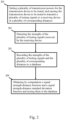
- Fig. 2 a flowchart of the steps of the data setting process of the present invention. It should be noted here that although the two-way signal positioning system 1 described above is employed as an example to illustrate the data setting process of the present invention, the data setting process of the present invention is not limited to a two-way signal positioning system 1 using the same structure as described above.
- Step 201 Setting a plurality of transmission powers for the transmission device to be tested, and causing the transmission device to be tested to transmit a plurality of testing signals to a receiving device at a plurality of corresponding distances.
- the processing module 11 sets the plurality of transmission powers for the transmission device to be tested 20.
- the transmission device to be tested 20 can transmit a plurality of testing signals.
- the receiving device 30 receives the plurality of testing signals at a plurality of corresponding distances from the transmission device to be tested 20, such as 10 cm, 20 cm, or different distances from 1 m to 6 m.
- Step 202 Detecting the strengths of the plurality of testing signals received by the receiving device.
- the processing module 11 detects the signal strengths of all signals received by the receiving device 30.
- Step 203 Recording the strengths of the plurality of testing signals and the plurality of corresponding distances to a database.
- the processing module 11 stores the signal strengths of all the testing signals received by the receiving device 30 and the distances corresponding to the testing signals in the database 12.
- Step 204 Obtaining by computation a signal strength-distance function and a signal strength-distance standard deviation function and storing them in the database.
- the computing module 13 computes the above-mentioned signal strengths of all the signals and the corresponding distances and obtains the signal strength-distance function and the signal strength-distance standard deviation function for each different transmission power, and it then deduces the correlation between the strengths of the signals received by the receiving device 30 and the transmission device to be tested 20 and its standard deviation.
- the data are then stored in the database 12. At this point, the data setting process of the present invention is completed.
- Fig. 3 a system construction diagram showing the positioning of the two-way signal positioning system of the present invention.
- the two-way signal positioning system 1 can use the known locating devices 50 to identify a device location of a locating device to be measured 40 in a specific space.
- the signal strength-distance function and the signal strength-distance standard deviation function is obtained through an initial direct data setting process, the present invention is not limited to executing the data setting process each time to recreate the signal strength-distance function and the signal strength-distance standard deviation function in the database 12.
- the signal strength-distance function and signal strength-distance standard deviation function can be preset in the locating device to be measured 40 or the known locating devices 50.
- the processing module 11 can control the locating device to be measured 40 to transmit a plurality of positioning signals of a plurality of transmission powers and cause the plurality of known locating devices 50 to receive the plurality of positioning signals and then cause the plurality of known locating devices 50 to send back a plurality of response signals to the locating device to be measured 40.
- the processing module 11 can record the strengths of the plurality of positioning signals, the strengths of the plurality of response signals, the plurality of corresponding receiving times and the locations of a plurality of known locating devices 50 to the database 12.
- the plurality of known locating devices 50 will also receive an identification code of the locating device to be measured 40 for identification of the locating device to be measured 40. This identification code will also be stored in the database 12.
- the processing module 11 identifies the devices corresponding to the stronger signals among the plurality of positioning signals received and the plurality of response signals, such as the known locating devices 51, 52, 53.
- the computing module 13 can identify the device location of the locating device to be measured 40 based on the locations of the known locating devices 51, 52, 53 and the signal strength-distance function and the signal strength-distance standard deviation function.
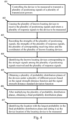
- Fig. 4 is a flowchart of the steps of the first embodiment of the device positioning process according to the present invention.
- Step 401 Controlling the device to be measured to transmit a plurality of positioning signals of a plurality of transmission powers.
- the processing module 11 When a locating device to be measured 40 enters a specific space, the processing module 11 must first control the locating device to be measured 40 to transmit positioning signals with different transmission powers.
- Step 402 Causing the plurality of known locating devices to receive the plurality of positioning signals and return a plurality of response signals to the device to be measured.
- the different known locating devices 50 receive the positioning signals of the locating device to be measured 40.
- the processing module 11 controls the different known locating devices 50 to send back a plurality of response signals to the locating device to be measured 40.
- the plurality of known locating devices 50 will also receive an identification code of the locating device to be measured 40.
- Step 403 Recording the strengths of the plurality of positioning signals, the strengths of the plurality of response signals, the plurality of corresponding receiving times and the coordinates of the plurality of known locating devices.
- the known locating devices 50 Since the locating device to be measured 40 transmits positioning signals with different transmission powers, then after the known locating devices 50 receive the positioning signals and send back response signals, the known locating devices 50 will send back data of all positioning signals, the corresponding receiving times and the coordinates of the known locating devices 50 to the database 12, and the locating device to be measured 40 will send back data of all the response signals to the database 12.
- Step 404 Identifying the known locating devices corresponding to the stronger signals among the plurality of positioning signals received and the plurality of response signals.
- the processing module 11 will identify a plurality of positioning signals and the locating devices corresponding to the stronger signals among the plurality of response signals 51, 52, 53 from the data in the database 12.
- Step 405 Obtaining a plurality of probability distribution planes of the devices under a plurality of different powers based on the signal strength-distance function and the signal strength-distance standard deviation function.
- the computing module 13 can inquire the signal strength-distance function and the signal strength-distance standard deviation function based on the strengths of the plurality of positioning signals, the strengths of the plurality of response signals, the plurality of corresponding receiving times and the known locating devices corresponding to the stronger signals, and the coordinates of the fixing points of the known locating devices 51, 52, 53 are used as circle centers to obtain the distance under this signal strength according to the signal strength-distance function. This distance is set as a basic radius. Then the signal strength-distance standard deviation function is used to obtain the distance standard deviation under this signal strength. This standard deviation is set as the basis for radius adjustment. In this way, a plurality of probability distribution planes for the known locating devices 51, 52, 53 under different powers are calculated.
- Fig. 5 is based on Fig. 4 and shows a schematic view of the probability distribution according to the first embodiment of the device positioning process according to the present invention.
- 9 probability distribution planes can be obtained from the positioning signals received by the known locating devices 51, 52, 53, and 9 probability distribution planes can also be obtained from the response signals.
- Fig. 5 uses only the 9 probability distribution planes obtained from the positioning signals received by the known locating devices 51, 52, 53 as examples for the purpose of description. As shown in Fig.
- the probability distribution planes A1, A2, A3 can be obtained from the positioning signals received by the known locating devices 51, 52, 53; under the medium power, the probability distribution planes A4, A5, A6 can be obtained from the positioning signals received by the known locating devices 51, 52, 53; under the low power, the probability distribution planes A7, A8, A9 can be obtained from the positioning signals received by the known locating devices 51, 52, 53.
- Step 406 After multiplying the plurality of probability distribution planes, obtaining a final probability distribution plane.
- the computing module 13 multiplies the obtained probability distribution planes A1 to A9 and obtains the final probability distribution plane.
- Step 407 Identifying the location with the largest probability in the final probability distribution plane and setting it as the device location of the locating device to be measured.
- the computing module 13 identifies the location with the largest probability in the probability distribution planes and sets the location with the largest probability as the device location 41 of the locating device to be measured 40, thereby obtaining the coordinates of the locating device to be measured 40.
- Fig. 6 Please refer to Fig. 6 for a flowchart of the steps of the second embodiment of the device positioning process according to the present invention.
- Step 601 Controlling the device to be measured to transmit a plurality of positioning signals of a plurality of transmission powers.
- the process further executes Step 602: Causing the plurality of known locating devices to receive the plurality of positioning signals and return a plurality of response signals to the device to be measured.
- the process continues with Step 603: Recording the strengths of the plurality of positioning signals, the strengths of the plurality of response signals, the plurality of corresponding receiving times and the coordinates of the plurality of known locating devices, and Step 604: Identifying the known locating devices corresponding to the stronger signals among the plurality of positioning signals received and the plurality of response signals.
- Step 601 to Step 604 are identical to those of Step 401 to Step 404, the details are not repeated herein.
- Step 605 According to a plurality of power groups, setting the plurality of known locating devices as circle centers, using the signal strength-distance function to obtain distances, using the signal strength-distance standard deviation function to obtain standard deviations to draw a plurality of circles, and obtaining a plurality of intersection points of a plurality of circles.
- the computing module 13 can, based on the strengths of the plurality of positioning signals, the strengths of the plurality of response signals, the plurality of corresponding receiving times and the known locating devices corresponding to the stronger signals, inquire the signal strength-distance function and the signal strength-distance standard deviation function and then group the known locating devices transmitting signals of different powers. Under the same power, the positioning signals and response signals with the highest strengths detected by the locating device to be measured 40 may be transmitted by the same known locating device. Therefore, under the same power, only one coordinate is maintained as the circle center. Thus, in this embodiment, under high, medium and low powers, a maximum of 18 coordinates and a minimum of 9 coordinates of the known locating devices can be obtained.
- the signal strength-distance function is used to obtain the distance corresponding to this signal strength, and this distance is set as the basic radius.
- the signal strength-distance standard deviation function is used to obtain the distance standard deviation corresponding to this signal strength and this standard deviation is set as the basis for adjustment of the radius.
- Figs. 7A-7B are based on Fig. 6 and show a schematic view of the concentric circles under different transmission powers in the second embodiment of the device positioning process according to the present invention.
- Figs. 7A-7B the identification of coordinates of three known locating devices 51, 52, 53 is used as an example for the purpose of description, but the present invention is not limited to this number. Therefore, in the present invention, the coordinates of the fixed points of known locating devices 51, 52, 53 are used as circle centers to draw a plurality of circles and obtain intersection points based on each two fixed points.
- Fig. 7A first, the original radius reduced by 0.67 standard deviation is set as the minimum radius, and the original radius increased by 0.67 standard deviation is set as the maximum radius. If two circles intersect or are tangential to each other, the process ends.
- FIG. 7B shows a schematic view of intersection points of circles centered on the known locating devices 51, 52, 53 computed under another power. Therefore, in Fig. 7B , 6 intersection points g to 1 can be obtained for the known locating devices 51, 52, 53 under another power.
- Step 606 Using the plurality of intersection points for trilateration to obtain a plurality of triangles.
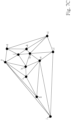
- Fig. 7C is based on Fig. 6 and shows the schematic view of the trilateration of the intersection points in the device positioning process of the second embodiment of the present invention.
- the computing module 13 After the removal of outliers for all the intersection points a to 1, the computing module 13 conducts a Delaunay triangulation process to obtain a plurality of triangles.
- a Delaunay triangulation process it is assumed that 12 intersection points a to 1 are obtained and computed, but the present invention is not limited to this. When more coordinates are identified, more intersection points can be obtained, and with more intersection points, more accurate results can be obtained.
- Step 607 Finding the triangle with the smallest circumradius among the plurality of triangles and setting the circumcenter as the device location of the locating device to be measured.
- Fig. 7D is based on Fig. 6 and shows a schematic view of identification of the smallest concentric circle in the device positioning process of the second embodiment according to the present invention.
- the computing module 13 further finds the circumcenter of the triangle with the smallest circumradius.
- the center of the smallest circumcircle is set as device location 41 of the locating device to be measured 40, and thus the coordinates of the locating device to be measured 40 are known.
- the triangle formed by the intersection points i, h, k is the triangle with the smallest circumradius. Therefore, the coordinates of its circumcenter define the device location 41.
- the two-way signal positioning method disclosed in the present invention is not limited to the above-mentioned sequence of steps.
- the location of the locating device to be measured 40 can be effectively identified, without the need to equip additional sensors.
Landscapes
- Engineering & Computer Science (AREA)
- Radar, Positioning & Navigation (AREA)
- Remote Sensing (AREA)
- Physics & Mathematics (AREA)
- General Physics & Mathematics (AREA)
- Signal Processing (AREA)
- Computer Networks & Wireless Communication (AREA)
- Probability & Statistics with Applications (AREA)
- Automation & Control Theory (AREA)
- Position Fixing By Use Of Radio Waves (AREA)
- Radar Systems Or Details Thereof (AREA)
- Quality & Reliability (AREA)
- Electromagnetism (AREA)
- Communication Control (AREA)
Description
- The present invention relates generally to a two-way signal positioning method and a two-way signal positioning system thereof, and more particularly to a two-way signal positioning method and a two-way signal positioning system thereof that conduct positioning through the transmission and reception of signals of different powers.
-
US 2019/331 760 A1 discloses a signal positioning system to identify a device location of a locating device to be measured in a specific space, the specific space including a plurality of known locating devices, and the system includes a transmitter that transmits a first signal with a first strength and at a first incidence and that transmits a second signal with a second strength, which is greater than the first strength, and at a second incidence, which is lower than the first incidence, a plurality of receivers that are installed at known positions different from each other and that measure signal strengths of the first signal and the second signal, and a calculator that performs first processing in which the position of the transmitter is detected on the basis of a signal strength of the first signal measured by one of the receivers and second processing in which the position of the transmitter is detected on the basis of signal strengths of the second beacon signal measured by two or more of the receivers. Another, signal positioning system is known from Jeong Jaehoon (Paul) et al: "SALA: Smartphone-Assisted Localization Algorithm for Positioning Indoor IoT Devices", wireless networks, ACM, 2 Penn Plaza, Suite 701 - NEW YORK USA, vol. 24, no. 1, 10 June 2016 (2016-06-10), pages 27-47, XP036405908.
One of the most used conventional positioning methods for indoor devices is trilateration. The distances needed by trilateration are usually obtained through computation of strengths of signals or times of arrival (ToA). Therefore, the accuracy in the computations of strengths of signals or times of arrival will greatly affect the deduced distances and consequently affect the accuracy of the trilateration. In the prior art, the positioning only relies on a fixed power to transmit signals. As the positioning is based on signal transmissions using a fixed power, the accuracy of positioning is limited by the form of attenuation of the single-power signals. - Nowadays, mobile devices such as mobile phones are usually equipped with sensors of various functions. The combination of such sensors as gyroscopes or e-compasses can effectively promote and improve the accuracy of positioning. However, in consideration of costs, indoor positioning devices are unlikely to be equipped with various sensors. Without other auxiliary sensors, indoor positioning can rely on only the strengths of signals to deduce the distances and use the data of distances for positioning. However, in the prior art, the strengths of signals from Bluetooth devices may vary significantly, resulting in considerable positioning errors.
- Therefore, there is a necessity to invent a new two-way signal positioning method and a two-way signal positioning system thereof to solve the problems existing in the prior art.
- The main object of the present invention is to provide a two-way signal positioning method, which can achieve the effect of positioning through the transmission and reception of signals of different powers.
- The other object of the present invention is to provide a two-way signal positioning system that uses the above method.
- To accomplish the above objects, a two-way signal positioning method according to
claim 1 and a two-way signal positioning system according to claim 6 are provided. The two-way signal positioning method disclosed byclaim 1 is used for a two-way signal positioning system to identify a device location of a locating device to be measured in a specific space, the specific space including a plurality of known locating devices. The dependent claims show further embodiments of the said two-way signal positioning method and the two-way signal positioning system, respectively. - -
-
-
Fig. 1 is a system construction diagram showing settings of the two-way signal positioning system of the present invention. -
Fig. 2 is a flowchart of the steps of the data setting process of the present invention. -
Fig. 3 is a system construction diagram showing the positioning of the two-way signal positioning system of the present invention. -
Fig. 4 is a flowchart of the steps of the first embodiment of a two-way signal positioning method of the present invention. -
Fig. 5 is based onFig. 4 and shows a schematic view of the probability distribution according to the first embodiment of a two-way signal positioning method of the present invention. -
Fig. 6 is a flowchart of the steps of a second embodiment of a two-way signal positioning method of the present invention. -
Figs. 7A-7B are based onFig. 6 and show the schematic view of the concentric circles in the second embodiment of a two-way signal positioning method of the present invention under different transmission powers. -
Fig. 7C is based onFig. 6 and shows a schematic view of the triangulation of intersection points according to the second embodiment of a two-way signal positioning method of the present invention. -
Fig. 7D is based onFig. 6 and shows a schematic view of identifying the smallest concentric circle according to the second embodiment of a two-way signal positioning method of the present invention. - In order to better understand the technical contents of the present invention, detailed descriptions are provided below with reference to preferred embodiments as examples.
- First, please refer to
Fig. 1 , which is a system construction diagram showing settings of the two-way signal positioning system of the present invention. - In one embodiment of the present invention, the two-way
signal positioning system 1 includes aprocessing module 11, adatabase 12, and acomputing module 13, electronically connected to one another. The two-waysignal positioning system 1 is used to identify the location of a locating device to be measured 40 in a specific space using known locating devices 50 (as shown inFig. 3 ). Before identifying the locating device to be measured 40, the two-waysignal positioning system 1 can also create the data needed for the signal strength-distance function and the signal strength-distance standard deviation function using the transmission device to be tested 20 and thereceiving device 30, but the present invention is not limited to this. In the system, the transmission device to be tested 20, thereceiving device 30, the locating device to be measured 40, and the known locatingdevices 50 can all send and receive wireless signals. The wireless signals can be Bluetooth signals. The transmission device to be tested 20, thereceiving device 30, the locating device to be measured 40, and the known locatingdevices 50 can also be identical or different household appliances, computer devices or mobile devices, but the present invention is not limited to this. - It is to be noted that the various modules existing in the two-way
signal positioning system 1 can be constructed of hardware devices, a combination of software applications and hardware devices, or a combination of firmware and hardware devices. For example, a computer program product can be stored in a computer-accessible medium for reading and execution to accomplish the various functions of the present invention, but the present invention is not limited to the above method. Also, it is to be noted that the present embodiment is just an example of preferred embodiments of the present invention, and to avoid superfluous descriptions. However, it can be readily understood by those skilled in the art that each of the above modules or components may not be necessary. All modules or components can be omitted or modified as needed, and there may be other modules or components between any two modules. Theprocessing module 11,database 12 orcomputing module 13 can be configured in the same device or in different devices, or they can be configured in any one of the transmission device to be tested 20, thereceiving device 30, the locating device to be measured 40, or the known locatingdevices 50, but the present invention is not limited to this. - In one embodiment of the present invention, the
processing module 11 is for setting the plurality of transmission powers for the transmission device to be tested 20 so that the transmission device to be tested 20 can transmit a plurality of testing signals. Then thereceiving device 30 receives the plurality of testing signals at a plurality of corresponding distances from the transmission device to be tested 20. For example, at different distances such as 10 cm or 20 cm, or different distances from 1 m to 6 m, different testing signals are transmitted with different transmission powers, but the present invention is not limited to these values. In this way, theprocessing module 11 detects the strengths of the plurality of testing signals received by thereceiving device 30 and records the strengths of the plurality of testing signals and the plurality of corresponding distances to thedatabase 12. In the end, thecomputing module 13 computes the data values in thedatabase 12 and obtains the signal strength-distance function and the signal strength-distance standard deviation function and stores them in thedatabase 12. - Next, please refer to
Fig. 2 for a flowchart of the steps of the data setting process of the present invention. It should be noted here that although the two-waysignal positioning system 1 described above is employed as an example to illustrate the data setting process of the present invention, the data setting process of the present invention is not limited to a two-waysignal positioning system 1 using the same structure as described above. - First, the process executes Step 201: Setting a plurality of transmission powers for the transmission device to be tested, and causing the transmission device to be tested to transmit a plurality of testing signals to a receiving device at a plurality of corresponding distances.
- The
processing module 11 sets the plurality of transmission powers for the transmission device to be tested 20. Thus, the transmission device to be tested 20 can transmit a plurality of testing signals. Then thereceiving device 30 receives the plurality of testing signals at a plurality of corresponding distances from the transmission device to be tested 20, such as 10 cm, 20 cm, or different distances from 1 m to 6 m. - Then the process executes Step 202: Detecting the strengths of the plurality of testing signals received by the receiving device.
- The
processing module 11 detects the signal strengths of all signals received by the receivingdevice 30. - Then follows Step 203: Recording the strengths of the plurality of testing signals and the plurality of corresponding distances to a database.
- The
processing module 11 stores the signal strengths of all the testing signals received by the receivingdevice 30 and the distances corresponding to the testing signals in thedatabase 12. - Finally, the process executes Step 204: Obtaining by computation a signal strength-distance function and a signal strength-distance standard deviation function and storing them in the database.
- The
computing module 13 computes the above-mentioned signal strengths of all the signals and the corresponding distances and obtains the signal strength-distance function and the signal strength-distance standard deviation function for each different transmission power, and it then deduces the correlation between the strengths of the signals received by the receivingdevice 30 and the transmission device to be tested 20 and its standard deviation. The data are then stored in thedatabase 12. At this point, the data setting process of the present invention is completed. - Please refer to
Fig. 3 for a system construction diagram showing the positioning of the two-way signal positioning system of the present invention. - After the creation of the signal strength-distance function and the signal strength-distance standard deviation function in the
database 12, the two-waysignal positioning system 1 can use the known locatingdevices 50 to identify a device location of a locating device to be measured 40 in a specific space. It is to be noted that, although in one embodiment of the present invention, the signal strength-distance function and the signal strength-distance standard deviation function is obtained through an initial direct data setting process, the present invention is not limited to executing the data setting process each time to recreate the signal strength-distance function and the signal strength-distance standard deviation function in thedatabase 12. The signal strength-distance function and signal strength-distance standard deviation function can be preset in the locating device to be measured 40 or the known locatingdevices 50. - In this way, the
processing module 11 can control the locating device to be measured 40 to transmit a plurality of positioning signals of a plurality of transmission powers and cause the plurality of known locatingdevices 50 to receive the plurality of positioning signals and then cause the plurality of known locatingdevices 50 to send back a plurality of response signals to the locating device to be measured 40. Theprocessing module 11 can record the strengths of the plurality of positioning signals, the strengths of the plurality of response signals, the plurality of corresponding receiving times and the locations of a plurality of known locatingdevices 50 to thedatabase 12. The plurality of known locatingdevices 50 will also receive an identification code of the locating device to be measured 40 for identification of the locating device to be measured 40. This identification code will also be stored in thedatabase 12. In this way, theprocessing module 11 identifies the devices corresponding to the stronger signals among the plurality of positioning signals received and the plurality of response signals, such as the known locatingdevices computing module 13 can identify the device location of the locating device to be measured 40 based on the locations of the known locatingdevices - As regards the detailed method for identifying the device location of the locating device to be measured 40, please refer to
Fig. 4 , which is a flowchart of the steps of the first embodiment of the device positioning process according to the present invention. - First, the process executes Step 401: Controlling the device to be measured to transmit a plurality of positioning signals of a plurality of transmission powers.
- When a locating device to be measured 40 enters a specific space, the
processing module 11 must first control the locating device to be measured 40 to transmit positioning signals with different transmission powers. - Then the process executes Step 402: Causing the plurality of known locating devices to receive the plurality of positioning signals and return a plurality of response signals to the device to be measured.
- In this step, the different known locating
devices 50 receive the positioning signals of the locating device to be measured 40. Theprocessing module 11 then controls the different known locatingdevices 50 to send back a plurality of response signals to the locating device to be measured 40. Now, the plurality of known locatingdevices 50 will also receive an identification code of the locating device to be measured 40. - Further, the process executes Step 403: Recording the strengths of the plurality of positioning signals, the strengths of the plurality of response signals, the plurality of corresponding receiving times and the coordinates of the plurality of known locating devices.
- Since the locating device to be measured 40 transmits positioning signals with different transmission powers, then after the known locating
devices 50 receive the positioning signals and send back response signals, the known locatingdevices 50 will send back data of all positioning signals, the corresponding receiving times and the coordinates of the known locatingdevices 50 to thedatabase 12, and the locating device to be measured 40 will send back data of all the response signals to thedatabase 12. - Then follows Step 404: Identifying the known locating devices corresponding to the stronger signals among the plurality of positioning signals received and the plurality of response signals.
- The
processing module 11 will identify a plurality of positioning signals and the locating devices corresponding to the stronger signals among the plurality of response signals 51, 52, 53 from the data in thedatabase 12. - Then the process executes Step 405: Obtaining a plurality of probability distribution planes of the devices under a plurality of different powers based on the signal strength-distance function and the signal strength-distance standard deviation function.
- The
computing module 13 can inquire the signal strength-distance function and the signal strength-distance standard deviation function based on the strengths of the plurality of positioning signals, the strengths of the plurality of response signals, the plurality of corresponding receiving times and the known locating devices corresponding to the stronger signals, and the coordinates of the fixing points of the known locatingdevices devices - Please refer also to
Fig. 5 , which is based onFig. 4 and shows a schematic view of the probability distribution according to the first embodiment of the device positioning process according to the present invention. - In this embodiment, under high, medium and low powers, 9 probability distribution planes can be obtained from the positioning signals received by the known locating
devices Fig. 5 uses only the 9 probability distribution planes obtained from the positioning signals received by the known locatingdevices Fig. 5 , under the high power, the probability distribution planes A1, A2, A3 can be obtained from the positioning signals received by the known locatingdevices devices devices - The process continues with Step 406: After multiplying the plurality of probability distribution planes, obtaining a final probability distribution plane.
- Then the
computing module 13 multiplies the obtained probability distribution planes A1 to A9 and obtains the final probability distribution plane. - Last, the process executes Step 407: Identifying the location with the largest probability in the final probability distribution plane and setting it as the device location of the locating device to be measured.
- Finally, the
computing module 13 identifies the location with the largest probability in the probability distribution planes and sets the location with the largest probability as thedevice location 41 of the locating device to be measured 40, thereby obtaining the coordinates of the locating device to be measured 40. - Please refer to
Fig. 6 for a flowchart of the steps of the second embodiment of the device positioning process according to the present invention. - First, the process executes Step 601: Controlling the device to be measured to transmit a plurality of positioning signals of a plurality of transmission powers. The process further executes Step 602: Causing the plurality of known locating devices to receive the plurality of positioning signals and return a plurality of response signals to the device to be measured. The process continues with Step 603: Recording the strengths of the plurality of positioning signals, the strengths of the plurality of response signals, the plurality of corresponding receiving times and the coordinates of the plurality of known locating devices, and Step 604: Identifying the known locating devices corresponding to the stronger signals among the plurality of positioning signals received and the plurality of response signals.
- As the techniques of the
above Step 601 to Step 604 are identical to those ofStep 401 to Step 404, the details are not repeated herein. - Then the process executes Step 605: According to a plurality of power groups, setting the plurality of known locating devices as circle centers, using the signal strength-distance function to obtain distances, using the signal strength-distance standard deviation function to obtain standard deviations to draw a plurality of circles, and obtaining a plurality of intersection points of a plurality of circles.
- Further, the
computing module 13 can, based on the strengths of the plurality of positioning signals, the strengths of the plurality of response signals, the plurality of corresponding receiving times and the known locating devices corresponding to the stronger signals, inquire the signal strength-distance function and the signal strength-distance standard deviation function and then group the known locating devices transmitting signals of different powers. Under the same power, the positioning signals and response signals with the highest strengths detected by the locating device to be measured 40 may be transmitted by the same known locating device. Therefore, under the same power, only one coordinate is maintained as the circle center. Thus, in this embodiment, under high, medium and low powers, a maximum of 18 coordinates and a minimum of 9 coordinates of the known locating devices can be obtained. Then the signal strength-distance function is used to obtain the distance corresponding to this signal strength, and this distance is set as the basic radius. Then the signal strength-distance standard deviation function is used to obtain the distance standard deviation corresponding to this signal strength and this standard deviation is set as the basis for adjustment of the radius. - Please refer also to
Figs. 7A-7B , which are based onFig. 6 and show a schematic view of the concentric circles under different transmission powers in the second embodiment of the device positioning process according to the present invention. - In
Figs. 7A-7B , the identification of coordinates of three known locatingdevices devices Fig. 7A , first, the original radius reduced by 0.67 standard deviation is set as the minimum radius, and the original radius increased by 0.67 standard deviation is set as the maximum radius. If two circles intersect or are tangential to each other, the process ends. If there are no intersections between two circles, another 0.0134 (i.e., (0.67*2)/100) standard deviation is added until there are intersection points with another circle. In this way, a plurality of intersection points a to f between a plurality of circles can be obtained; i.e., the circles of the known locatingdevices devices devices devices Fig. 7B shows a schematic view of intersection points of circles centered on the known locatingdevices Fig. 7B ,6 intersection points g to 1 can be obtained for the known locatingdevices - Further, the process executes Step 606: Using the plurality of intersection points for trilateration to obtain a plurality of triangles.
- Please refer to
Fig. 7C , which is based onFig. 6 and shows the schematic view of the trilateration of the intersection points in the device positioning process of the second embodiment of the present invention. - After the removal of outliers for all the intersection points a to 1, the
computing module 13 conducts a Delaunay triangulation process to obtain a plurality of triangles. In the present embodiment, it is assumed that 12 intersection points a to 1 are obtained and computed, but the present invention is not limited to this. When more coordinates are identified, more intersection points can be obtained, and with more intersection points, more accurate results can be obtained. - Last, the process executes Step 607: Finding the triangle with the smallest circumradius among the plurality of triangles and setting the circumcenter as the device location of the locating device to be measured.
- Please refer to
Fig. 7D , which is based onFig. 6 and shows a schematic view of identification of the smallest concentric circle in the device positioning process of the second embodiment according to the present invention. - Finally, the
computing module 13 further finds the circumcenter of the triangle with the smallest circumradius. The center of the smallest circumcircle is set asdevice location 41 of the locating device to be measured 40, and thus the coordinates of the locating device to be measured 40 are known. For example, inFig. 7D , the triangle formed by the intersection points i, h, k is the triangle with the smallest circumradius. Therefore, the coordinates of its circumcenter define thedevice location 41. - It is to be noted that the two-way signal positioning method disclosed in the present invention is not limited to the above-mentioned sequence of steps.
- Through the two-way signal positioning method and two-way
signal positioning system 1 thereof disclosed in the present invention, the location of the locating device to be measured 40 can be effectively identified, without the need to equip additional sensors. - To conclude, the present invention differs substantially from the characteristics of the prior art in all aspects of objects, means and efficacies. Although the present invention has been explained in relation to its preferred embodiment, it is to be understood that many other possible modifications and variations can be made without departing from the scope of the present invention as hereinafter claimed.
Claims (10)
- A two-way signal positioning method, used by a two-way signal positioning system (1) to identify a device location (41) of a locating device to be measured (40) in a specific space, the specific space including a plurality of known locating devices (50), and the method including the following steps:controlling the locating device to be measured (40) to transmit a plurality of positioning signals of a plurality of transmission powers;causing the plurality of known locating devices (50) to receive the plurality of positioning signals and return a plurality of response signals to the device to be measured;recording the strengths of the plurality of positioning signals, the strengths of the plurality of response signals, and the coordinates of the plurality of known locating devices (50) to a database (12);identifying the known locating devices (50) corresponding to the stronger signals among the plurality of positioning signals received and the plurality of response signals;obtaining a signal strength-distance function and a signal strength-distance standard deviation function from the database (12);using coordinates of the known locating devices (50) corresponding to the stronger signals as circle centers;obtaining a basic radius under the strengths of the plurality of positioning signals and the strengths of the plurality of response signals according to the signal strength-distance function;obtaining a basis for radius adjustment according to the signal strength-distance standard deviation function; andidentifying the device location (41) of the locating device to be measured (40) based on the signal strength-distance function and the signal strength-distance standard deviation function.
- The two-way signal positioning method as claimed in Claim 1, which further includes the following steps:based on the signal strength-distance function and the signal strength-distance standard deviation function, obtaining a plurality of probability distribution planes (A1) of the plurality of known locating devices (50) corresponding to the stronger signals under the plurality of different transmission powers;multiplying the plurality of probability distribution planes (A1) to obtain a final probability distribution plane (A1); andidentifying the location with the largest probability in the final probability distribution plane (A1) and setting it as the device location (41) of the locating device to be measured (40).
- The two-way signal positioning method as claimed in Claim 1, which further includes the following steps:according to a plurality of transmission power groups, setting the plurality of known locating devices (50) as circle centers and using the signal strength-distance function to obtain the distances, and using the signal strength-distance standard deviation function to obtain the standard deviation to draw a plurality of circles;obtaining a plurality of intersection points (a) of a plurality of circles;using the plurality of intersection points (a) for a trilateration process to obtain a plurality of triangles; andfinding the triangle with the smallest circumradius among the plurality of triangles and setting the circumcenter as the device location (41) of the locating device to be measured (40).
- The two-way signal positioning method as claimed in any of Claims 1 to 3, which further includes a step to identify three known locating devices (50) with stronger positioning signals and three known locating devices (50) with stronger response signals.
- The two-way signal positioning method as claimed in Claim 1, which further includes executing a step of receiving, by the plurality of known locating devices (50), an identification code for the locating device to be measured (40).
- A two-way signal positioning system (1), configured to identify a device location (41) of a locating device to be measured (40) in a specific space, the specific space including a plurality of known locating devices (50), and the two-way signal positioning system (1) including:a processing module (11), configured for controlling the device to be measured to transmit a plurality of positioning signals of a plurality of transmission powers, causing the plurality of known locating devices (50) to receive the plurality of positioning signals and return a plurality of response signals to the device to be measured;a database (12), electronically connected to the processing module (11), configured for storing a signal strength-distance function and a signal strength-distance standard deviation function; after the plurality of known locating devices (50) receive the plurality of positioning signals, the database (12) is configured for recording the strengths of the plurality of positioning signals, the strengths of the plurality of response signals, and the coordinates of the plurality of known locating devices (50); thus, the processing module (11) is configured for identifying the known locating devices (50) corresponding to the stronger signals among the plurality of positioning signals received and the plurality of response signals; anda computing module (13), electronically connected to the database (12), configured to use coordinates of the known locating devices (50) corresponding to the stronger signals as circle centers, obtain a basic radius under the strengths of the plurality of positioning signals and the strengths of the plurality of response signals according to the signal strength-distance function, and obtain a basis for radius adjustment according to the signal strength-distance standard deviation function so as to obtain a plurality of probability distribution planes (A1) of the locating devices to be measured (40) under the plurality of positioning signals of the plurality of different transmission powers to identify the device location (41) of the locating device to be measured (40).
- The two-way signal positioning system (1) as claimed in Claim 6, wherein the computing module (13) is configured to multiply the plurality of probability distribution planes (A1) to obtain a final probability distribution plane (A1), finds the location with the largest probability in the final probability distribution plane (A1), and to set it as the device location (41) of the locating device to be measured (40).
- The two-way signal positioning system (1) as claimed in Claim 6, wherein according to a plurality of transmission power groups, the processing module (11) is configured to set the plurality of known locating devices (50) as circle centers, to use the signal strength-distance function to obtain the distances, and to use uses the signal strength-distance standard deviation function to obtain the standard deviation to draw a plurality of circles, and finally to obtain a plurality of intersection points (a) of the plurality of circles; thus, the computing module (13) is configured to conduct a trilateration process for the plurality of intersection points (a) to find the circumcenter of the triangle with smallest circumradius and sets it as the device location (41) of the locating device to be measured (40).
- The two-way signal positioning system (1) as claimed in any of Claims 6 to 8, wherein the processing module (11) is configured for identifying three known locating devices (50) with stronger positioning signals and three locating devices with stronger response signals.
- The two-way signal positioning system (1) as claimed in Claim 6, wherein the plurality of known locating devices (50) is further configured to receive an identification code for the locating device to be measured (40).
Applications Claiming Priority (1)
| Application Number | Priority Date | Filing Date | Title |
|---|---|---|---|
| TW109141634A TWI774140B (en) | 2020-11-26 | 2020-11-26 | Two-way signal positioning method and two-way signal positioning system thereof |
Publications (2)
| Publication Number | Publication Date |
|---|---|
| EP4006569A1 EP4006569A1 (en) | 2022-06-01 |
| EP4006569B1 true EP4006569B1 (en) | 2023-12-27 |
Family
ID=74561771
Family Applications (1)
| Application Number | Title | Priority Date | Filing Date |
|---|---|---|---|
| EP21155768.1A Active EP4006569B1 (en) | 2020-11-26 | 2021-02-08 | Two-way signal positioning method and two-way signal positioning system thereof |
Country Status (5)
| Country | Link |
|---|---|
| US (1) | US11553451B2 (en) |
| EP (1) | EP4006569B1 (en) |
| JP (1) | JP7264922B2 (en) |
| CN (1) | CN114543804B (en) |
| TW (1) | TWI774140B (en) |
Families Citing this family (1)
| Publication number | Priority date | Publication date | Assignee | Title |
|---|---|---|---|---|
| CN121075000A (en) * | 2024-06-05 | 2025-12-05 | 英业达科技有限公司 | Intelligent inspection device and operation method thereof |
Family Cites Families (14)
| Publication number | Priority date | Publication date | Assignee | Title |
|---|---|---|---|---|
| EP1445970B1 (en) * | 2003-02-05 | 2009-04-01 | Cambridge Positioning Systems Limited | A method and system for locating a mobile radio receiver in a radio system with multiple tranmitters |
| JP5263318B2 (en) * | 2004-10-07 | 2013-08-14 | 日本電気株式会社 | Position information recognition system and method, and portable terminal and program thereof |
| US8243136B2 (en) * | 2008-03-11 | 2012-08-14 | Panasonic Corporation | Tag sensor system and sensor device, and object position estimating device and object position estimating method |
| JP2010204028A (en) * | 2009-03-05 | 2010-09-16 | Oki Electric Ind Co Ltd | Management server, facility system for estimating position, and position estimation system |
| CN102761913B (en) * | 2011-04-26 | 2014-12-17 | 航天信息股份有限公司 | Positioning method of wireless signal transmission parameter determination based on area division |
| NL2008683C2 (en) * | 2012-04-23 | 2013-10-28 | Gerald Jules Rudolf Taunay | Method, system and computer program for determining distances and positions. |
| CN203086745U (en) * | 2013-02-26 | 2013-07-24 | 中国矿业大学(北京) | Personnel positioning system used for underground coal mine |
| JP6610035B2 (en) * | 2015-07-01 | 2019-11-27 | トヨタ自動車株式会社 | Location information provision system |
| CN106019225A (en) * | 2016-05-11 | 2016-10-12 | 深圳云之家网络有限公司 | IBeacon-based positioning method and system |
| GB2551347B (en) * | 2016-06-13 | 2020-04-15 | Toshiba Kk | Indoor localisation using received signal quality weights |
| US10129700B2 (en) * | 2016-11-14 | 2018-11-13 | WiSilica Inc. | Prediction algorithm for location estimation |
| JP6597918B2 (en) * | 2017-01-20 | 2019-10-30 | 株式会社村田製作所 | Position detection system |
| US10986505B2 (en) * | 2018-08-29 | 2021-04-20 | Qualcomm Incorporated | Spatial reuse for WLAN networks |
| TWI708957B (en) * | 2019-12-12 | 2020-11-01 | 聚眾聯合科技股份有限公司 | Dynamic power positioning method and dynamic power positioning system thereof |
-
2020
- 2020-11-26 TW TW109141634A patent/TWI774140B/en active
- 2020-12-17 CN CN202011501685.XA patent/CN114543804B/en active Active
-
2021
- 2021-01-27 US US17/159,588 patent/US11553451B2/en active Active
- 2021-02-04 JP JP2021016174A patent/JP7264922B2/en active Active
- 2021-02-08 EP EP21155768.1A patent/EP4006569B1/en active Active
Also Published As
| Publication number | Publication date |
|---|---|
| TW202221353A (en) | 2022-06-01 |
| JP7264922B2 (en) | 2023-04-25 |
| EP4006569A1 (en) | 2022-06-01 |
| JP2022084502A (en) | 2022-06-07 |
| TWI774140B (en) | 2022-08-11 |
| CN114543804A (en) | 2022-05-27 |
| US11553451B2 (en) | 2023-01-10 |
| CN114543804B (en) | 2025-01-24 |
| US20220167304A1 (en) | 2022-05-26 |
Similar Documents
| Publication | Publication Date | Title |
|---|---|---|
| TWI720758B (en) | Power positioning method and power positioning device thereof | |
| US11770723B2 (en) | Sensor-assisted technique for RF power normalization in locationing applications | |
| US9681268B2 (en) | Mobile device position detection | |
| US9660740B2 (en) | Signal strength distribution establishing method and wireless positioning system | |
| EP2909648B1 (en) | Ultrasonic locationing system using only time difference of arrival measurements | |
| CN111829525A (en) | UWB indoor and outdoor integrated intelligent navigation and positioning method and system | |
| EP3835808B1 (en) | Dynamic power positioning method and dynamic power positioning system | |
| US11553451B2 (en) | Two-way signal positioning method and two-way signal positioning system thereof | |
| CN114339599A (en) | Positioning calibration method, positioning device, storage medium and electronic equipment | |
| US11454695B2 (en) | Dynamic power positioning method and dynamic power positioning system thereof | |
| CN113009415A (en) | Dynamic power positioning method and dynamic power positioning system thereof | |
| US11265677B2 (en) | Power positioning method and power positioning device thereof | |
| US20230358851A1 (en) | System and method for determining the orientation in space of a linear array of radio receviers | |
| CN113050033B (en) | Power positioning method and power positioning device | |
| CN118393432B (en) | Passive RFID positioning method for quantifying transmitting power | |
| US11460534B2 (en) | Identifying client device locations through group-based access point voting | |
| CN119322309A (en) | Robot positioning method and device, computer readable storage medium and robot | |
| CN121771941A (en) | Unmanned aerial vehicle positioning method, unmanned aerial vehicle positioning device, computer equipment and storage medium |
Legal Events
| Date | Code | Title | Description |
|---|---|---|---|
| PUAI | Public reference made under article 153(3) epc to a published international application that has entered the european phase |
Free format text: ORIGINAL CODE: 0009012 |
|
| STAA | Information on the status of an ep patent application or granted ep patent |
Free format text: STATUS: REQUEST FOR EXAMINATION WAS MADE |
|
| 17P | Request for examination filed |
Effective date: 20220421 |
|
| AK | Designated contracting states |
Kind code of ref document: A1 Designated state(s): AL AT BE BG CH CY CZ DE DK EE ES FI FR GB GR HR HU IE IS IT LI LT LU LV MC MK MT NL NO PL PT RO RS SE SI SK SM TR |
|
| GRAP | Despatch of communication of intention to grant a patent |
Free format text: ORIGINAL CODE: EPIDOSNIGR1 |
|
| STAA | Information on the status of an ep patent application or granted ep patent |
Free format text: STATUS: GRANT OF PATENT IS INTENDED |
|
| INTG | Intention to grant announced |
Effective date: 20230831 |
|
| GRAS | Grant fee paid |
Free format text: ORIGINAL CODE: EPIDOSNIGR3 |
|
| GRAA | (expected) grant |
Free format text: ORIGINAL CODE: 0009210 |
|
| STAA | Information on the status of an ep patent application or granted ep patent |
Free format text: STATUS: THE PATENT HAS BEEN GRANTED |
|
| AK | Designated contracting states |
Kind code of ref document: B1 Designated state(s): AL AT BE BG CH CY CZ DE DK EE ES FI FR GB GR HR HU IE IS IT LI LT LU LV MC MK MT NL NO PL PT RO RS SE SI SK SM TR |
|
| REG | Reference to a national code |
Ref country code: GB Ref legal event code: FG4D |
|
| REG | Reference to a national code |
Ref country code: CH Ref legal event code: EP |
|
| REG | Reference to a national code |
Ref country code: DE Ref legal event code: R096 Ref document number: 602021007967 Country of ref document: DE |
|
| REG | Reference to a national code |
Ref country code: IE Ref legal event code: FG4D |
|
| PG25 | Lapsed in a contracting state [announced via postgrant information from national office to epo] |
Ref country code: GR Free format text: LAPSE BECAUSE OF FAILURE TO SUBMIT A TRANSLATION OF THE DESCRIPTION OR TO PAY THE FEE WITHIN THE PRESCRIBED TIME-LIMIT Effective date: 20240328 |
|
| REG | Reference to a national code |
Ref country code: LT Ref legal event code: MG9D |
|
| PG25 | Lapsed in a contracting state [announced via postgrant information from national office to epo] |
Ref country code: LT Free format text: LAPSE BECAUSE OF FAILURE TO SUBMIT A TRANSLATION OF THE DESCRIPTION OR TO PAY THE FEE WITHIN THE PRESCRIBED TIME-LIMIT Effective date: 20231227 |
|
| PG25 | Lapsed in a contracting state [announced via postgrant information from national office to epo] |
Ref country code: ES Free format text: LAPSE BECAUSE OF FAILURE TO SUBMIT A TRANSLATION OF THE DESCRIPTION OR TO PAY THE FEE WITHIN THE PRESCRIBED TIME-LIMIT Effective date: 20231227 |
|
| PG25 | Lapsed in a contracting state [announced via postgrant information from national office to epo] |
Ref country code: LT Free format text: LAPSE BECAUSE OF FAILURE TO SUBMIT A TRANSLATION OF THE DESCRIPTION OR TO PAY THE FEE WITHIN THE PRESCRIBED TIME-LIMIT Effective date: 20231227 Ref country code: GR Free format text: LAPSE BECAUSE OF FAILURE TO SUBMIT A TRANSLATION OF THE DESCRIPTION OR TO PAY THE FEE WITHIN THE PRESCRIBED TIME-LIMIT Effective date: 20240328 Ref country code: FI Free format text: LAPSE BECAUSE OF FAILURE TO SUBMIT A TRANSLATION OF THE DESCRIPTION OR TO PAY THE FEE WITHIN THE PRESCRIBED TIME-LIMIT Effective date: 20231227 Ref country code: ES Free format text: LAPSE BECAUSE OF FAILURE TO SUBMIT A TRANSLATION OF THE DESCRIPTION OR TO PAY THE FEE WITHIN THE PRESCRIBED TIME-LIMIT Effective date: 20231227 Ref country code: BG Free format text: LAPSE BECAUSE OF FAILURE TO SUBMIT A TRANSLATION OF THE DESCRIPTION OR TO PAY THE FEE WITHIN THE PRESCRIBED TIME-LIMIT Effective date: 20240327 |
|
| PGFP | Annual fee paid to national office [announced via postgrant information from national office to epo] |
Ref country code: DE Payment date: 20240201 Year of fee payment: 4 |
|
| REG | Reference to a national code |
Ref country code: NL Ref legal event code: MP Effective date: 20231227 |
|
| REG | Reference to a national code |
Ref country code: AT Ref legal event code: MK05 Ref document number: 1645026 Country of ref document: AT Kind code of ref document: T Effective date: 20231227 |
|
| PG25 | Lapsed in a contracting state [announced via postgrant information from national office to epo] |
Ref country code: NL Free format text: LAPSE BECAUSE OF FAILURE TO SUBMIT A TRANSLATION OF THE DESCRIPTION OR TO PAY THE FEE WITHIN THE PRESCRIBED TIME-LIMIT Effective date: 20231227 |
|
| PG25 | Lapsed in a contracting state [announced via postgrant information from national office to epo] |
Ref country code: SE Free format text: LAPSE BECAUSE OF FAILURE TO SUBMIT A TRANSLATION OF THE DESCRIPTION OR TO PAY THE FEE WITHIN THE PRESCRIBED TIME-LIMIT Effective date: 20231227 Ref country code: RS Free format text: LAPSE BECAUSE OF FAILURE TO SUBMIT A TRANSLATION OF THE DESCRIPTION OR TO PAY THE FEE WITHIN THE PRESCRIBED TIME-LIMIT Effective date: 20231227 Ref country code: NO Free format text: LAPSE BECAUSE OF FAILURE TO SUBMIT A TRANSLATION OF THE DESCRIPTION OR TO PAY THE FEE WITHIN THE PRESCRIBED TIME-LIMIT Effective date: 20240327 Ref country code: NL Free format text: LAPSE BECAUSE OF FAILURE TO SUBMIT A TRANSLATION OF THE DESCRIPTION OR TO PAY THE FEE WITHIN THE PRESCRIBED TIME-LIMIT Effective date: 20231227 Ref country code: LV Free format text: LAPSE BECAUSE OF FAILURE TO SUBMIT A TRANSLATION OF THE DESCRIPTION OR TO PAY THE FEE WITHIN THE PRESCRIBED TIME-LIMIT Effective date: 20231227 Ref country code: HR Free format text: LAPSE BECAUSE OF FAILURE TO SUBMIT A TRANSLATION OF THE DESCRIPTION OR TO PAY THE FEE WITHIN THE PRESCRIBED TIME-LIMIT Effective date: 20231227 |
|
| PGFP | Annual fee paid to national office [announced via postgrant information from national office to epo] |
Ref country code: FR Payment date: 20240222 Year of fee payment: 4 |
|
| PG25 | Lapsed in a contracting state [announced via postgrant information from national office to epo] |
Ref country code: IS Free format text: LAPSE BECAUSE OF FAILURE TO SUBMIT A TRANSLATION OF THE DESCRIPTION OR TO PAY THE FEE WITHIN THE PRESCRIBED TIME-LIMIT Effective date: 20240427 |
|
| PG25 | Lapsed in a contracting state [announced via postgrant information from national office to epo] |
Ref country code: CZ Free format text: LAPSE BECAUSE OF FAILURE TO SUBMIT A TRANSLATION OF THE DESCRIPTION OR TO PAY THE FEE WITHIN THE PRESCRIBED TIME-LIMIT Effective date: 20231227 Ref country code: AT Free format text: LAPSE BECAUSE OF FAILURE TO SUBMIT A TRANSLATION OF THE DESCRIPTION OR TO PAY THE FEE WITHIN THE PRESCRIBED TIME-LIMIT Effective date: 20231227 |
|
| PG25 | Lapsed in a contracting state [announced via postgrant information from national office to epo] |
Ref country code: SK Free format text: LAPSE BECAUSE OF FAILURE TO SUBMIT A TRANSLATION OF THE DESCRIPTION OR TO PAY THE FEE WITHIN THE PRESCRIBED TIME-LIMIT Effective date: 20231227 |
|
| PG25 | Lapsed in a contracting state [announced via postgrant information from national office to epo] |
Ref country code: SM Free format text: LAPSE BECAUSE OF FAILURE TO SUBMIT A TRANSLATION OF THE DESCRIPTION OR TO PAY THE FEE WITHIN THE PRESCRIBED TIME-LIMIT Effective date: 20231227 Ref country code: SK Free format text: LAPSE BECAUSE OF FAILURE TO SUBMIT A TRANSLATION OF THE DESCRIPTION OR TO PAY THE FEE WITHIN THE PRESCRIBED TIME-LIMIT Effective date: 20231227 Ref country code: RO Free format text: LAPSE BECAUSE OF FAILURE TO SUBMIT A TRANSLATION OF THE DESCRIPTION OR TO PAY THE FEE WITHIN THE PRESCRIBED TIME-LIMIT Effective date: 20231227 Ref country code: IT Free format text: LAPSE BECAUSE OF FAILURE TO SUBMIT A TRANSLATION OF THE DESCRIPTION OR TO PAY THE FEE WITHIN THE PRESCRIBED TIME-LIMIT Effective date: 20231227 Ref country code: IS Free format text: LAPSE BECAUSE OF FAILURE TO SUBMIT A TRANSLATION OF THE DESCRIPTION OR TO PAY THE FEE WITHIN THE PRESCRIBED TIME-LIMIT Effective date: 20240427 Ref country code: EE Free format text: LAPSE BECAUSE OF FAILURE TO SUBMIT A TRANSLATION OF THE DESCRIPTION OR TO PAY THE FEE WITHIN THE PRESCRIBED TIME-LIMIT Effective date: 20231227 Ref country code: CZ Free format text: LAPSE BECAUSE OF FAILURE TO SUBMIT A TRANSLATION OF THE DESCRIPTION OR TO PAY THE FEE WITHIN THE PRESCRIBED TIME-LIMIT Effective date: 20231227 Ref country code: AT Free format text: LAPSE BECAUSE OF FAILURE TO SUBMIT A TRANSLATION OF THE DESCRIPTION OR TO PAY THE FEE WITHIN THE PRESCRIBED TIME-LIMIT Effective date: 20231227 |
|
| PG25 | Lapsed in a contracting state [announced via postgrant information from national office to epo] |
Ref country code: PL Free format text: LAPSE BECAUSE OF FAILURE TO SUBMIT A TRANSLATION OF THE DESCRIPTION OR TO PAY THE FEE WITHIN THE PRESCRIBED TIME-LIMIT Effective date: 20231227 Ref country code: PT Free format text: LAPSE BECAUSE OF FAILURE TO SUBMIT A TRANSLATION OF THE DESCRIPTION OR TO PAY THE FEE WITHIN THE PRESCRIBED TIME-LIMIT Effective date: 20240429 |
|
| PG25 | Lapsed in a contracting state [announced via postgrant information from national office to epo] |
Ref country code: PT Free format text: LAPSE BECAUSE OF FAILURE TO SUBMIT A TRANSLATION OF THE DESCRIPTION OR TO PAY THE FEE WITHIN THE PRESCRIBED TIME-LIMIT Effective date: 20240429 Ref country code: PL Free format text: LAPSE BECAUSE OF FAILURE TO SUBMIT A TRANSLATION OF THE DESCRIPTION OR TO PAY THE FEE WITHIN THE PRESCRIBED TIME-LIMIT Effective date: 20231227 |
|
| PG25 | Lapsed in a contracting state [announced via postgrant information from national office to epo] |
Ref country code: MC Free format text: LAPSE BECAUSE OF FAILURE TO SUBMIT A TRANSLATION OF THE DESCRIPTION OR TO PAY THE FEE WITHIN THE PRESCRIBED TIME-LIMIT Effective date: 20231227 |
|
| REG | Reference to a national code |
Ref country code: DE Ref legal event code: R097 Ref document number: 602021007967 Country of ref document: DE Ref country code: CH Ref legal event code: PL |
|
| PG25 | Lapsed in a contracting state [announced via postgrant information from national office to epo] |
Ref country code: DK Free format text: LAPSE BECAUSE OF FAILURE TO SUBMIT A TRANSLATION OF THE DESCRIPTION OR TO PAY THE FEE WITHIN THE PRESCRIBED TIME-LIMIT Effective date: 20231227 |
|
| PG25 | Lapsed in a contracting state [announced via postgrant information from national office to epo] |
Ref country code: LU Free format text: LAPSE BECAUSE OF NON-PAYMENT OF DUE FEES Effective date: 20240208 |
|
| PG25 | Lapsed in a contracting state [announced via postgrant information from national office to epo] |
Ref country code: CH Free format text: LAPSE BECAUSE OF NON-PAYMENT OF DUE FEES Effective date: 20240229 |
|
| PG25 | Lapsed in a contracting state [announced via postgrant information from national office to epo] |
Ref country code: LU Free format text: LAPSE BECAUSE OF NON-PAYMENT OF DUE FEES Effective date: 20240208 Ref country code: DK Free format text: LAPSE BECAUSE OF FAILURE TO SUBMIT A TRANSLATION OF THE DESCRIPTION OR TO PAY THE FEE WITHIN THE PRESCRIBED TIME-LIMIT Effective date: 20231227 Ref country code: CH Free format text: LAPSE BECAUSE OF NON-PAYMENT OF DUE FEES Effective date: 20240229 |
|
| PLBE | No opposition filed within time limit |
Free format text: ORIGINAL CODE: 0009261 |
|
| STAA | Information on the status of an ep patent application or granted ep patent |
Free format text: STATUS: NO OPPOSITION FILED WITHIN TIME LIMIT |
|
| 26N | No opposition filed |
Effective date: 20240930 |
|
| REG | Reference to a national code |
Ref country code: BE Ref legal event code: MM Effective date: 20240229 |
|
| PG25 | Lapsed in a contracting state [announced via postgrant information from national office to epo] |
Ref country code: BE Free format text: LAPSE BECAUSE OF NON-PAYMENT OF DUE FEES Effective date: 20240229 |
|
| PG25 | Lapsed in a contracting state [announced via postgrant information from national office to epo] |
Ref country code: IE Free format text: LAPSE BECAUSE OF NON-PAYMENT OF DUE FEES Effective date: 20240208 |
|
| PG25 | Lapsed in a contracting state [announced via postgrant information from national office to epo] |
Ref country code: IE Free format text: LAPSE BECAUSE OF NON-PAYMENT OF DUE FEES Effective date: 20240208 Ref country code: BE Free format text: LAPSE BECAUSE OF NON-PAYMENT OF DUE FEES Effective date: 20240229 |
|
| PG25 | Lapsed in a contracting state [announced via postgrant information from national office to epo] |
Ref country code: SI Free format text: LAPSE BECAUSE OF FAILURE TO SUBMIT A TRANSLATION OF THE DESCRIPTION OR TO PAY THE FEE WITHIN THE PRESCRIBED TIME-LIMIT Effective date: 20231227 |
|
| PG25 | Lapsed in a contracting state [announced via postgrant information from national office to epo] |
Ref country code: CY Free format text: LAPSE BECAUSE OF FAILURE TO SUBMIT A TRANSLATION OF THE DESCRIPTION OR TO PAY THE FEE WITHIN THE PRESCRIBED TIME-LIMIT; INVALID AB INITIO Effective date: 20210208 |
|
| REG | Reference to a national code |
Ref country code: DE Ref legal event code: R119 Ref document number: 602021007967 Country of ref document: DE |
|
| PG25 | Lapsed in a contracting state [announced via postgrant information from national office to epo] |
Ref country code: HU Free format text: LAPSE BECAUSE OF FAILURE TO SUBMIT A TRANSLATION OF THE DESCRIPTION OR TO PAY THE FEE WITHIN THE PRESCRIBED TIME-LIMIT; INVALID AB INITIO Effective date: 20210208 |
|
| GBPC | Gb: european patent ceased through non-payment of renewal fee |
Effective date: 20250208 |
|
| PG25 | Lapsed in a contracting state [announced via postgrant information from national office to epo] |
Ref country code: TR Free format text: LAPSE BECAUSE OF FAILURE TO SUBMIT A TRANSLATION OF THE DESCRIPTION OR TO PAY THE FEE WITHIN THE PRESCRIBED TIME-LIMIT Effective date: 20231227 |
|
| PG25 | Lapsed in a contracting state [announced via postgrant information from national office to epo] |
Ref country code: DE Free format text: LAPSE BECAUSE OF NON-PAYMENT OF DUE FEES Effective date: 20250902 |
|
| PG25 | Lapsed in a contracting state [announced via postgrant information from national office to epo] |
Ref country code: GB Free format text: LAPSE BECAUSE OF NON-PAYMENT OF DUE FEES Effective date: 20250208 |
|
| PG25 | Lapsed in a contracting state [announced via postgrant information from national office to epo] |
Ref country code: FR Free format text: LAPSE BECAUSE OF NON-PAYMENT OF DUE FEES Effective date: 20250228 |