EP4006220B1 - Multilayer fabric - Google Patents
Multilayer fabric Download PDFInfo
- Publication number
- EP4006220B1 EP4006220B1 EP20871440.2A EP20871440A EP4006220B1 EP 4006220 B1 EP4006220 B1 EP 4006220B1 EP 20871440 A EP20871440 A EP 20871440A EP 4006220 B1 EP4006220 B1 EP 4006220B1
- Authority
- EP
- European Patent Office
- Prior art keywords
- layer fabric
- fabric
- weave
- plain weave
- region
- Prior art date
- Legal status (The legal status is an assumption and is not a legal conclusion. Google has not performed a legal analysis and makes no representation as to the accuracy of the status listed.)
- Active
Links
Images
Classifications
-
- D—TEXTILES; PAPER
- D03—WEAVING
- D03D—WOVEN FABRICS; METHODS OF WEAVING; LOOMS
- D03D11/00—Double or multi-ply fabrics not otherwise provided for
- D03D11/02—Fabrics formed with pockets, tubes, loops, folds, tucks or flaps
-
- D—TEXTILES; PAPER
- D03—WEAVING
- D03D—WOVEN FABRICS; METHODS OF WEAVING; LOOMS
- D03D11/00—Double or multi-ply fabrics not otherwise provided for
-
- B—PERFORMING OPERATIONS; TRANSPORTING
- B60—VEHICLES IN GENERAL
- B60R—VEHICLES, VEHICLE FITTINGS, OR VEHICLE PARTS, NOT OTHERWISE PROVIDED FOR
- B60R21/00—Arrangements or fittings on vehicles for protecting or preventing injuries to occupants or pedestrians in case of accidents or other traffic risks
- B60R21/02—Occupant safety arrangements or fittings, e.g. crash pads
- B60R21/16—Inflatable occupant restraints or confinements designed to inflate upon impact or impending impact, e.g. air bags
-
- B—PERFORMING OPERATIONS; TRANSPORTING
- B60—VEHICLES IN GENERAL
- B60R—VEHICLES, VEHICLE FITTINGS, OR VEHICLE PARTS, NOT OTHERWISE PROVIDED FOR
- B60R21/00—Arrangements or fittings on vehicles for protecting or preventing injuries to occupants or pedestrians in case of accidents or other traffic risks
- B60R21/02—Occupant safety arrangements or fittings, e.g. crash pads
- B60R21/16—Inflatable occupant restraints or confinements designed to inflate upon impact or impending impact, e.g. air bags
- B60R21/23—Inflatable members
- B60R21/235—Inflatable members characterised by their material
-
- D—TEXTILES; PAPER
- D03—WEAVING
- D03D—WOVEN FABRICS; METHODS OF WEAVING; LOOMS
- D03D1/00—Woven fabrics designed to make specified articles
- D03D1/02—Inflatable articles
-
- D—TEXTILES; PAPER
- D03—WEAVING
- D03D—WOVEN FABRICS; METHODS OF WEAVING; LOOMS
- D03D13/00—Woven fabrics characterised by the special disposition of the warp or weft threads, e.g. with curved weft threads, with discontinuous warp threads, with diagonal warp or weft
- D03D13/004—Woven fabrics characterised by the special disposition of the warp or weft threads, e.g. with curved weft threads, with discontinuous warp threads, with diagonal warp or weft with weave pattern being non-standard or providing special effects
-
- D—TEXTILES; PAPER
- D03—WEAVING
- D03D—WOVEN FABRICS; METHODS OF WEAVING; LOOMS
- D03D15/00—Woven fabrics characterised by the material, structure or properties of the fibres, filaments, yarns, threads or other warp or weft elements used
- D03D15/20—Woven fabrics characterised by the material, structure or properties of the fibres, filaments, yarns, threads or other warp or weft elements used characterised by the material of the fibres or filaments constituting the yarns or threads
- D03D15/283—Woven fabrics characterised by the material, structure or properties of the fibres, filaments, yarns, threads or other warp or weft elements used characterised by the material of the fibres or filaments constituting the yarns or threads synthetic polymer-based, e.g. polyamide or polyester fibres
-
- D—TEXTILES; PAPER
- D03—WEAVING
- D03D—WOVEN FABRICS; METHODS OF WEAVING; LOOMS
- D03D15/00—Woven fabrics characterised by the material, structure or properties of the fibres, filaments, yarns, threads or other warp or weft elements used
- D03D15/50—Woven fabrics characterised by the material, structure or properties of the fibres, filaments, yarns, threads or other warp or weft elements used characterised by the properties of the yarns or threads
- D03D15/573—Tensile strength
-
- B—PERFORMING OPERATIONS; TRANSPORTING
- B60—VEHICLES IN GENERAL
- B60R—VEHICLES, VEHICLE FITTINGS, OR VEHICLE PARTS, NOT OTHERWISE PROVIDED FOR
- B60R21/00—Arrangements or fittings on vehicles for protecting or preventing injuries to occupants or pedestrians in case of accidents or other traffic risks
- B60R21/02—Occupant safety arrangements or fittings, e.g. crash pads
- B60R21/16—Inflatable occupant restraints or confinements designed to inflate upon impact or impending impact, e.g. air bags
- B60R21/23—Inflatable members
- B60R21/235—Inflatable members characterised by their material
- B60R2021/23533—Inflatable members characterised by their material characterised by the manufacturing process
- B60R2021/23542—Weaving
- B60R2021/23547—Weaving one piece weaving
-
- D—TEXTILES; PAPER
- D10—INDEXING SCHEME ASSOCIATED WITH SUBLASSES OF SECTION D, RELATING TO TEXTILES
- D10B—INDEXING SCHEME ASSOCIATED WITH SUBLASSES OF SECTION D, RELATING TO TEXTILES
- D10B2401/00—Physical properties
- D10B2401/06—Load-responsive characteristics
- D10B2401/063—Load-responsive characteristics high strength
-
- D—TEXTILES; PAPER
- D10—INDEXING SCHEME ASSOCIATED WITH SUBLASSES OF SECTION D, RELATING TO TEXTILES
- D10B—INDEXING SCHEME ASSOCIATED WITH SUBLASSES OF SECTION D, RELATING TO TEXTILES
- D10B2505/00—Industrial
- D10B2505/12—Vehicles
- D10B2505/124—Air bags
Definitions
- the present disclosure relates to a multi-layer fabric.
- a sensor of an airbag detects the impact that a transportation vehicle receives during a head-on collision or a side collision, and the airbag is rapidly deployed and inflated by introducing gas from an inflator into inflatable bubbles. Then, the airbag protects the human body by alleviating the impact that the driver or passenger will receive with cushioning properties of the inflated bubbles.
- airbags were installed on the front part such as on the driver's seat or on the driver's seat and the front passenger's seat, and were mainly installed to protect the face and upper body of a passenger in the case of a head-on collision.
- curtain-type airbags capable of responding to a side-on collision or rollover of the vehicle have also been developed.
- JP2017193319A for example discloses a fabric for a curtain-type airbag comprising a bag weave portion having two layers of woven fabric layers woven so as to be separable from each other and a plurality of component yarns arranged on the outer periphery of the bag weave portion, the fabric having a woven closing part, wherein each of said fabric layers has a first region and a second region having a different warp density or weft density from said first region.
- the different warp and weft density can be achieved by employing a 1/1 plain weave and a 2/1 twill weave.
- Further examples of airbag fabrics are disclosed in JP2018114958A , DE10142130A1 or KR20160148384A .
- This curtain-type airbag is designed to be stored in the area from a front pillar to a rear pillar along a roof rail of the side wall of a vehicle, and to inflate and deploy along the side window in the event of a collision.
- the curtain-type airbag is required to have excellent storage capacity (it should be compactly foldable).
- the curtain-type airbag is required to inflate and deploy quickly.
- the airbag is required to maintain a certain internal pressure for several seconds after deployment in the event of a rollover.
- a multi-layer fabric capable of minimizing damage caused by broken glass fragments.
- an airbag formed of the multi-layer fabric there is also provided an airbag formed of the multi-layer fabric.
- the multi-layer fabric is manufactured without a sewing part by a one-piece woven method, and may be a one-piece woven fabric including an inflating part having a structure of two or more separated layers and a co-woven part surrounding the inflating part.
- the multi-layer fabric can be inflated by the airframe, so it is being used in vehicle airbags and life jackets.
- the multi-layer fabric used in the vehicle airbag needs to remain inflated to protect the driver or passenger when the vehicle rolls over.
- the multi-layer fabric used for the airbag is torn by broken glass fragments of the vehicle, and thus does not sufficiently protect the driver or passenger.
- the inflating part of the multi-layer fabric has a structure of two or more separated layers, and for example, may have a structure of two layers, a structure of three layers, or a structure of four layers.
- the layer constituting the inflating part is a fabric, and may be referred to as a fabric layer in the present disclosure.
- the inflating part is closed by a co-woven part surrounding it, so that when gas is supplied to the inflating part, the supplied gas may be confined and the inflating part may inflate.
- the multi-layer fabric is a one-piece woven fabric manufactured by a one-piece woven method
- the co-woven part may refer to a group of woven points (co-woven points) formed along the edge of the inflating part by crossing the yarn (warp or weft) of one fabric layer constituting the inflating part with the yarn (weft or warp) of another fabric layer.
- the co-woven part may be a group of woven points formed along the edge of the inflating part by crossing the warp of one fabric layer constituting the inflating part with the weft of another fabric layer, or a group of woven points by crossing the warp and weft of one fabric layer constituting the inflating part with the weft and warp of another fabric layer, respectively.
- the multi-layer fabric includes the inflating part having a structure of three or more separated layers, the yarns of the two outermost fabric layers are crossed to form woven points along the edge of the inflating part to close the inflating part.
- a part for introducing a configuration necessary in the art such as an inlet for supplying gas to the inflating part, may be manufactured in an unclosed state.
- a double-layer fabric having a structure of two layers will be described in detail as the multi-layer fabric, but these contents may be applied to a multi-layer fabric having a structure of three or more layers as it is.
- the multi-layer fabric may be a double-layer fabric having a structure in which two separated fabric layers and outer periphery of the two fabric layers are co-woven by a co-woven part.
- the multi-layer fabric according to the embodiment includes a first region in which at least one layer constituting the inflating part is formed of two or more types of weaves including 1/1 plain weave.
- Fabrics woven with 1/1 plain weave tend to have high tensile strength but low tear strength because the yarns are densely filled. Tear strength in fabrics means a strength of the force required to break the yarns forming the warp or weft. When a force is applied to only one strand of yarn, the yarn is momentarily broken, but when the same force is applied to two or more yarns, the yarn is pushed out by the force rather than being broken. This yarn movement occurs more frequently in other weaves than in 1/1 plain weave, so fabrics woven with weaves other than 1/1 plain weave can exhibit relatively high tear strength compared to fabrics woven with 1/1 plain weave. However, fabrics woven with weaves other than 1/1 plain weave have very low tensile strength compared to fabrics woven with 1/1 plain weave, so they are not suitable for airbag fabrics.
- the multi-layer fabric according to the embodiment includes a first region in which at least one layer constituting the inflating part is formed of two or more types of weaves including 1/1 plain weave, so that it is not easily torn by sharp objects such as broken glass fragments and exhibits excellent mechanical properties such as tensile strength.
- the remaining area excluding the first area in the layer constituting the inflating part may be composed of a second area formed of 1/1 plain weave.
- the multi-layer fabric exhibits excellent tensile strength similar to that of 1/1 plain weave fabric and significantly improved tear strength compared to 1/1 plain weave fabric, so that it can be suitably used for curtain-type airbags stored in locations that are easily torn by glass fragments.
- a weave other than 1/1 plain weave is inserted every 2 to 5 1/1 plain weave, so that the multi-layer fabric exhibits excellent tensile strength similar to that of 1/1 plain weave, and significantly improved tear strength compared to 1/1 plain weave.
- the first region is woven in a pattern in which a weave other than 1/1 plain weave is inserted every 2 to 5, 3 to 5, or about 5 1/1 plain weave.
- the multi-layer fabric including the first region may exhibit significantly improved tear strength compared to general OPW fabric formed of only 1/1 plain weave, and the airbag manufactured from this multi-layer fabric may exhibit excellent airtightness even after deployment.
- the weave other than 1/1 plain weave may be inserted every above-described predetermined number of 1/1 plain weave in the warp direction of the fabric layer, every above-described predetermined number of 1/1 plain weave in the weft direction, or every above-described predetermined number of 1/1 plain weave in both warp and weft directions.
- 1 to 5, 1 to 3, 1 to 2, or 1 weave other than 1/1 plain weave may be inserted every above-described predetermined number of 1/1 plain weave. Within this range, it is possible to improve tear strength while maintaining excellent overall properties of the multi-layer fabric.
- At least one layer of the inflating part may include the first region in an area ratio of 5% to 50% of a total area of the corresponding layer. Within this range, a sufficient effect of improving tear strength may be exhibited, and excellent airtightness may be exhibited even when the inflating part is rapidly deployed due to a sudden inflow of air.
- Two or more types of weaves including 1/1 plain weave are 1/1 plain weave and 2/1 twill weave.
- the tear strength may increase, but it may be difficult to use it for airbags due to deterioration in various characteristics such as elongation and airtightness, which are essential as airbag fabrics.
- a different weave such as 2/1 twill weave, 3/1 satin weave, 2/2 basket weave, 3/3 basket weave, or rip-stop may be implemented at a point where the weave other than 1/1 plain weave crosses.
- the first region may be inserted into the outermost fabric layer of the multi-layer fabric to effectively prevent the multi-layer fabric from being torn by an external sharp object.
- the first region may be inserted into both fabric layers, and when the multi-layer fabric is a multi-layer fabric having three or more fabric layers, the first region may be inserted into the outer two fabric layers.
- the yarn for weaving the multi-layer fabric may be, for example, nylon 66, nylon 6, nylon 46, nylon 610, or nylon 612 alone, or a polyamide fiber obtained by copolymerization or mixing thereof; or polyethylene terephthalate, polytrimethylene terephthalate, polybutylene terephthalate, or polyethylene naphthalate alone, or a polyester fiber obtained by copolymerization or mixing thereof.
- the fineness of the yarn for weaving the multi-layer fabric may be 300 to 700 dtex. Within this range, it can inflate into a desired shape while satisfying the characteristics required for deployment and expansion, and the bubble becomes flexible to improve storage properties, resulting in high-speed deployment.
- the multi-layer fabric may exhibit excellent tear strength by including the inflating part woven in the above-described characteristic pattern.
- the tear strength in the warp direction measured according to ISO 13937-2 may be 300 to 800 N, 400 to 750 N, 500 to 700 N, 550 to 650 N, or 600 to 650 N
- the tear strength in the weft direction may be 350 to 900 N, 450 to 850 N, 500 to 800 N, 600 to 800 N, 650 to 750 N, or 700 to 750 N.
- the multi-layer fabric exhibits excellent tear strength, it can exhibit high tensile strength and elongation similar to those of a conventional 1/1 plain weave fabric.
- the tensile strength in the warp direction measured according to ISO 13934-1 may be 3200 to 3500 N/5cm, 3300 to 3500 N/5cm or 3400 to 3500 N/5cm
- the tensile strength in the weft direction may be 2800 to 3300 N/5cm, 3000 to 3300 N/5cm, 3050 to 3300 N/5cm, or 3100 to 3300 N/5cm.
- the elongation in the warp direction measured according to ISO 13934-1 may be 25% to 45%, 30% to 45% or 35% to 45%, and the elongation in the weft direction may be 20% to 40%, 25% to 40% or 27% to 40%.
- the methods of measuring the tear strength, tensile strength, and elongation are specified in Test Examples to be described later.
- the multi-layer fabric When the multi-layer fabric is used in an airbag for a vehicle, one or both surfaces of the multi-layer fabric may be coated to prevent air leakage through gaps in the fabric.
- the multi-layer fabric may be coated with a resin typically used for fiber coating, and may be coated with, but not limited to, a silicone resin, a urethane-based resin, an olefin-based resin, or a mixture thereof.
- the multi-layer fabric may be coated with the resin by a knife coating method, a doctor blade method, a spray coating method, or the like, and the resin may preferably be coated by a knife coating method.
- the coating of the multi-layer fabric may be performed by a multi-step coating method of coating two or more times.
- a multi-step coating method When using such a multi-step coating method, airtightness can be improved and flexibility can be secured by reducing a thickness of the fabric compared to the coating amount.
- the coating amount of the resin may be adjusted to about 30 g/m 2 to 150 g/m 2 , about 50 g/m 2 to 150 g/m 2 , about 60 g/m 2 to 150 g/m 2 , or about 70 g/m 2 to 150 g/m 2 . Accordingly, it is possible to provide a lightweight multi-layer fabric having excellent air pressure resistance and storage properties without causing problems such as a decrease in blocking resistance due to surface stickiness or an increase in cost.
- the above-described effect may be further maximized by adjusting the coating amount of the base coating layer to 60 g/m 2 to 75 g/m 2 .
- an airbag formed of the multi-layer fabric exhibits not only excellent properties of a one-piece woven fabric, but also significantly improved tear strength with the specific weave pattern described above, and thus is not easily torn by broken glass fragments. Accordingly, the airbag formed of the multi-layer fabric can sufficiently protect a driver or a passenger from broken glass fragments even when the vehicle is overturned.
- the multi-layer fabric according to an embodiment of the present disclosure can provide an airbag capable of sufficiently protecting a driver or a passenger by minimizing damage caused by broken glass fragments when a vehicle is overturned.
- a double-layer fabric was prepared on a jacquard machine using 470 dtex of polyamide (nylon 66) yarn.
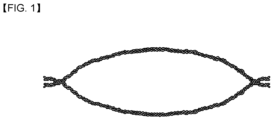
- the double-layer fabric as shown in FIG. 1 , has a structure in which two separate fabric layers and outer periphery of the two fabric layers are co-woven, and was woven at a time by a one-piece woven method.
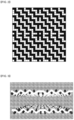
- the two fabric layers separated from each other were prepared to include a first region woven such that 2/1 twill weave was placed every three 1/1 plain weave in both warp and weft directions, respectively, as shown in FIGs. 2 and 3 .
- the temperature was gradually raised to 90 °C to 150 °C to perform primary curing, followed by heat-treatment at 180 °C to prepare a coated double-layer fabric.
- a coated double-layer fabric was prepared in the same manner as in Example 1, except that the first region was woven such that 2/1 twill weave was placed every five 1/1 plain weave in both warp and weft directions.
- a coated double-layer fabric was prepared in the same manner as in Example 1, except that the first region was woven such that 2/1 twill weave was placed every eleven 1/1 plain weave in both warp and weft directions.
- a coated double-layer fabric was prepared in the same manner as in Example 1, except that the first region was woven such that 2/1 twill weave was placed every thirteen 1/1 plain weave in both warp and weft directions.
- a coated double-layer fabric was prepared in the same manner as in Example 2, except that the weave pattern was changed such that 3/1 satin weave was placed instead of 2/1 twill weave in the first region of Example 2.
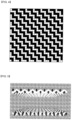
- a coated double-layer fabric was prepared in the same manner as in Example 1, except that the double-layer fabric was prepared by weaving only 1/1 plain weave as shown in FIGs. 4 and 5 .
- the tear strength in the warp direction and the tear strength in the weft direction of the prepared samples were measured.
- the tear strength was measured according to ISO 13937-2 after the sample was left at room temperature for 24 hours, and the tear strength in the warp direction and the tear strength in the weft direction were measured, respectively, followed by obtaining an average value thereof.
- the elongation in the warp direction and the elongation in the weft direction of the prepared samples were measured.
- the elongation was measured according to ISO 13934-1 after the sample was left at room temperature for 24 hours, and the elongation in the warp direction and the elongation in the weft direction were measured, respectively, followed by obtaining an average value thereof.
- the tensile strength in the warp direction and the tensile strength in the weft direction of the prepared samples were measured.
- the tensile strength was measured according to ISO 13934-1 after the sample was left at room temperature for 24 hours, and the tensile strength in the warp direction and the tensile strength in the weft direction were measured, respectively, followed by obtaining an average value thereof.
- the multi-layer fabric according to an embodiment of the present disclosure is formed of two or more types of weaves including 1/1 plain weave, the multi-layer fabric exhibits significantly improved tear strength while exhibiting elongation and tensile strength almost equal to those of the double-layer fabric (Comparative Example 1) formed only with 1/1 plain weave. Accordingly, it has been confirmed that the multi-layer fabric according to the embodiment can provide an airbag that is not damaged or can minimize damage by broken glass fragments.
Landscapes
- Engineering & Computer Science (AREA)
- Textile Engineering (AREA)
- Mechanical Engineering (AREA)
- Woven Fabrics (AREA)
- Air Bags (AREA)
Description
- This application claims the benefits of
Korean Patent Applications No. 10-2019-0121187 filed on September 30, 2019 10-2020-0125231 filed on September 25, 2020 - The present disclosure relates to a multi-layer fabric.
- In recent years, there has been a demand for improvement in the safety of a driver or a passenger in the event of a traffic collision such as a motor vehicle collision, and thus various airbags are being installed more frequently. A sensor of an airbag detects the impact that a transportation vehicle receives during a head-on collision or a side collision, and the airbag is rapidly deployed and inflated by introducing gas from an inflator into inflatable bubbles. Then, the airbag protects the human body by alleviating the impact that the driver or passenger will receive with cushioning properties of the inflated bubbles.
- In the past, airbags were installed on the front part such as on the driver's seat or on the driver's seat and the front passenger's seat, and were mainly installed to protect the face and upper body of a passenger in the case of a head-on collision. However, in recent years, curtain-type airbags capable of responding to a side-on collision or rollover of the vehicle have also been developed.
JP2017193319A JP2018114958A DE10142130A1 orKR20160148384A - This curtain-type airbag is designed to be stored in the area from a front pillar to a rear pillar along a roof rail of the side wall of a vehicle, and to inflate and deploy along the side window in the event of a collision. The curtain-type airbag is required to have excellent storage capacity (it should be compactly foldable). In addition, since a distance between the passenger's head and the side glass is short, it is necessary to momentarily pinch between the passenger's head and the glass to protect the head in the event of a side collision, so the curtain-type airbag is required to inflate and deploy quickly. Further, the airbag is required to maintain a certain internal pressure for several seconds after deployment in the event of a rollover. However, it is very rare that the side glass does not break when the vehicle is overturned, and the airbag is easily torn by the broken side glass fragments, making it difficult to protect passengers.
- In the present disclosure, there is provided a multi-layer fabric capable of minimizing damage caused by broken glass fragments.
- In the present disclosure, there is also provided an airbag formed of the multi-layer fabric.
- Hereinafter, a multi-layer fabric and an airbag formed using the same according to specific embodiments of the present invention will be described.
- According to an embodiment of the present disclosure, there is provided a multi-layer fabric according to
claim 1. - The multi-layer fabric is manufactured without a sewing part by a one-piece woven method, and may be a one-piece woven fabric including an inflating part having a structure of two or more separated layers and a co-woven part surrounding the inflating part.
- The multi-layer fabric can be inflated by the airframe, so it is being used in vehicle airbags and life jackets. In particular, the multi-layer fabric used in the vehicle airbag needs to remain inflated to protect the driver or passenger when the vehicle rolls over. However, there is a problem in that the multi-layer fabric used for the airbag is torn by broken glass fragments of the vehicle, and thus does not sufficiently protect the driver or passenger.
- It has been found that the introduction of a specific weave pattern to the multi-layer fabric can minimize the damage by broken glass fragments while maintaining superior properties of the one-piece woven fabric, thereby completing the present invention.
- The inflating part of the multi-layer fabric has a structure of two or more separated layers, and for example, may have a structure of two layers, a structure of three layers, or a structure of four layers. In addition, the layer constituting the inflating part is a fabric, and may be referred to as a fabric layer in the present disclosure.
- The inflating part is closed by a co-woven part surrounding it, so that when gas is supplied to the inflating part, the supplied gas may be confined and the inflating part may inflate.
- The multi-layer fabric is a one-piece woven fabric manufactured by a one-piece woven method, and the co-woven part may refer to a group of woven points (co-woven points) formed along the edge of the inflating part by crossing the yarn (warp or weft) of one fabric layer constituting the inflating part with the yarn (weft or warp) of another fabric layer. More specifically, the co-woven part may be a group of woven points formed along the edge of the inflating part by crossing the warp of one fabric layer constituting the inflating part with the weft of another fabric layer, or a group of woven points by crossing the warp and weft of one fabric layer constituting the inflating part with the weft and warp of another fabric layer, respectively. When the multi-layer fabric includes the inflating part having a structure of three or more separated layers, the yarns of the two outermost fabric layers are crossed to form woven points along the edge of the inflating part to close the inflating part. Of course, a part for introducing a configuration necessary in the art, such as an inlet for supplying gas to the inflating part, may be manufactured in an unclosed state.
- In the present disclosure, a double-layer fabric having a structure of two layers will be described in detail as the multi-layer fabric, but these contents may be applied to a multi-layer fabric having a structure of three or more layers as it is.
- The multi-layer fabric, as shown in
FIG. 1 , may be a double-layer fabric having a structure in which two separated fabric layers and outer periphery of the two fabric layers are co-woven by a co-woven part. - The multi-layer fabric according to the embodiment includes a first region in which at least one layer constituting the inflating part is formed of two or more types of weaves including 1/1 plain weave.
- Fabrics woven with 1/1 plain weave tend to have high tensile strength but low tear strength because the yarns are densely filled. Tear strength in fabrics means a strength of the force required to break the yarns forming the warp or weft. When a force is applied to only one strand of yarn, the yarn is momentarily broken, but when the same force is applied to two or more yarns, the yarn is pushed out by the force rather than being broken. This yarn movement occurs more frequently in other weaves than in 1/1 plain weave, so fabrics woven with weaves other than 1/1 plain weave can exhibit relatively high tear strength compared to fabrics woven with 1/1 plain weave. However, fabrics woven with weaves other than 1/1 plain weave have very low tensile strength compared to fabrics woven with 1/1 plain weave, so they are not suitable for airbag fabrics.
- Accordingly, the multi-layer fabric according to the embodiment includes a first region in which at least one layer constituting the inflating part is formed of two or more types of weaves including 1/1 plain weave, so that it is not easily torn by sharp objects such as broken glass fragments and exhibits excellent mechanical properties such as tensile strength.
- In addition, the remaining area excluding the first area in the layer constituting the inflating part may be composed of a second area formed of 1/1 plain weave.
- As a result, the multi-layer fabric exhibits excellent tensile strength similar to that of 1/1 plain weave fabric and significantly improved tear strength compared to 1/1 plain weave fabric, so that it can be suitably used for curtain-type airbags stored in locations that are easily torn by glass fragments.
- In particular, in the first region, a weave other than 1/1 plain weave is inserted every 2 to 5 1/1 plain weave, so that the multi-layer fabric exhibits excellent tensile strength similar to that of 1/1 plain weave, and significantly improved tear strength compared to 1/1 plain weave.
- More specifically, the first region is woven in a pattern in which a weave other than 1/1 plain weave is inserted every 2 to 5, 3 to 5, or about 5 1/1 plain weave. The multi-layer fabric including the first region may exhibit significantly improved tear strength compared to general OPW fabric formed of only 1/1 plain weave, and the airbag manufactured from this multi-layer fabric may exhibit excellent airtightness even after deployment.
- The weave other than 1/1 plain weave may be inserted every above-described predetermined number of 1/1 plain weave in the warp direction of the fabric layer, every above-described predetermined number of 1/1 plain weave in the weft direction, or every above-described predetermined number of 1/1 plain weave in both warp and weft directions.
- Among them, it is advantageous to insert the weave other than 1/1 plain weave every above-described predetermined number of 1/1 plain weave in both the warp and weft directions of the fabric layer, as it is possible to further improve tear strength while maintaining excellent durability of the multi-layer fabric.
- 1 to 5, 1 to 3, 1 to 2, or 1 weave other than 1/1 plain weave may be inserted every above-described predetermined number of 1/1 plain weave. Within this range, it is possible to improve tear strength while maintaining excellent overall properties of the multi-layer fabric.
- At least one layer of the inflating part may include the first region in an area ratio of 5% to 50% of a total area of the corresponding layer. Within this range, a sufficient effect of improving tear strength may be exhibited, and excellent airtightness may be exhibited even when the inflating part is rapidly deployed due to a sudden inflow of air.
- Two or more types of weaves including 1/1 plain weave are 1/1 plain weave and 2/1 twill weave.
- When the weave other than 1/1 plain weave is 4/1, 5/1, or 4/4 weave other than the above-mentioned weave, the tear strength may increase, but it may be difficult to use it for airbags due to deterioration in various characteristics such as elongation and airtightness, which are essential as airbag fabrics.
- It is advantageous to apply the 1/1 plain weave and 2/1 twill weave as the two or more types of weaves including 1/1 plain weave, because the tear strength can be improved while maintaining excellent durability of the multi-layer fabric. In particular, it is possible to provide a multi-layer fabric having excellent tear strength and durability by applying 1/1 plain weave and 2/1 twill weave as the two or more types of weaves including 1/1 plain weave.
- Meanwhile, when the weave other than 1/1 plain weave is inserted in both the warp and weft directions of the fabric layer, a different weave such as 2/1 twill weave, 3/1 satin weave, 2/2 basket weave, 3/3 basket weave, or rip-stop may be implemented at a point where the weave other than 1/1 plain weave crosses.
- For example, as shown in
FIG. 2 , when 2/1 twill weave is inserted every certain number of 1/1 plain weave in both the warp and weft directions, 2/2 basket weave will be implemented at the point where the 2/1 twill weave crosses. - The first region may be inserted into the outermost fabric layer of the multi-layer fabric to effectively prevent the multi-layer fabric from being torn by an external sharp object. When the multi-layer fabric is a double-layer fabric, the first region may be inserted into both fabric layers, and when the multi-layer fabric is a multi-layer fabric having three or more fabric layers, the first region may be inserted into the outer two fabric layers.
- The yarn for weaving the multi-layer fabric may be, for example, nylon 66, nylon 6, nylon 46, nylon 610, or nylon 612 alone, or a polyamide fiber obtained by copolymerization or mixing thereof; or polyethylene terephthalate, polytrimethylene terephthalate, polybutylene terephthalate, or polyethylene naphthalate alone, or a polyester fiber obtained by copolymerization or mixing thereof.
- The fineness of the yarn for weaving the multi-layer fabric may be 300 to 700 dtex. Within this range, it can inflate into a desired shape while satisfying the characteristics required for deployment and expansion, and the bubble becomes flexible to improve storage properties, resulting in high-speed deployment.
- The multi-layer fabric may exhibit excellent tear strength by including the inflating part woven in the above-described characteristic pattern. In particular, in the first region of the multi-layer fabric, the tear strength in the warp direction measured according to ISO 13937-2 may be 300 to 800 N, 400 to 750 N, 500 to 700 N, 550 to 650 N, or 600 to 650 N, and the tear strength in the weft direction may be 350 to 900 N, 450 to 850 N, 500 to 800 N, 600 to 800 N, 650 to 750 N, or 700 to 750 N.
- In addition, although the multi-layer fabric exhibits excellent tear strength, it can exhibit high tensile strength and elongation similar to those of a conventional 1/1 plain weave fabric. In particular, in the first region of the multi-layer fabric, the tensile strength in the warp direction measured according to ISO 13934-1 may be 3200 to 3500 N/5cm, 3300 to 3500 N/5cm or 3400 to 3500 N/5cm, and the tensile strength in the weft direction may be 2800 to 3300 N/5cm, 3000 to 3300 N/5cm, 3050 to 3300 N/5cm, or 3100 to 3300 N/5cm. In addition, in the first region of the multi-layer fabric, the elongation in the warp direction measured according to ISO 13934-1 may be 25% to 45%, 30% to 45% or 35% to 45%, and the elongation in the weft direction may be 20% to 40%, 25% to 40% or 27% to 40%. The methods of measuring the tear strength, tensile strength, and elongation are specified in Test Examples to be described later.
- When the multi-layer fabric is used in an airbag for a vehicle, one or both surfaces of the multi-layer fabric may be coated to prevent air leakage through gaps in the fabric. The multi-layer fabric may be coated with a resin typically used for fiber coating, and may be coated with, but not limited to, a silicone resin, a urethane-based resin, an olefin-based resin, or a mixture thereof. The multi-layer fabric may be coated with the resin by a knife coating method, a doctor blade method, a spray coating method, or the like, and the resin may preferably be coated by a knife coating method.
- The coating of the multi-layer fabric may be performed by a multi-step coating method of coating two or more times. When using such a multi-step coating method, airtightness can be improved and flexibility can be secured by reducing a thickness of the fabric compared to the coating amount.
- The coating amount of the resin may be adjusted to about 30 g/m2 to 150 g/m2, about 50 g/m2 to 150 g/m2, about 60 g/m2 to 150 g/m2, or about 70 g/m2 to 150 g/m2. Accordingly, it is possible to provide a lightweight multi-layer fabric having excellent air pressure resistance and storage properties without causing problems such as a decrease in blocking resistance due to surface stickiness or an increase in cost.
- When the resin is coated in a multi-step coating method, the above-described effect may be further maximized by adjusting the coating amount of the base coating layer to 60 g/m2 to 75 g/m2.
- Meanwhile, according to another embodiment of the present disclosure, there is provided an airbag formed of the multi-layer fabric. The multi-layer fabric exhibits not only excellent properties of a one-piece woven fabric, but also significantly improved tear strength with the specific weave pattern described above, and thus is not easily torn by broken glass fragments. Accordingly, the airbag formed of the multi-layer fabric can sufficiently protect a driver or a passenger from broken glass fragments even when the vehicle is overturned.
- The multi-layer fabric according to an embodiment of the present disclosure can provide an airbag capable of sufficiently protecting a driver or a passenger by minimizing damage caused by broken glass fragments when a vehicle is overturned.
-
-
FIG. 1 shows a cross-section of a double-layer fabric according to an embodiment of the present disclosure. -
FIG. 2 is a weave diagram of the first region in which 2/1 twill weave is inserted into 1/1 plain weave according to an embodiment of the present disclosure. -
FIG. 3 shows a weave structure of a double-layer fabric including the first region ofFIG. 2 -
FIG. 4 is a weave diagram of a fabric showing 1/1 plain weave of Comparative Example 1. -
FIG. 5 shows a weave structure of a double-layer fabric according to the weave diagram of the fabric ofFIG. 4 . - Hereinafter, the function and effect of the present invention will be described in more detail through specific examples. However, these examples are for illustrative purposes only, and the invention is not intended to be limited by these examples.
- A double-layer fabric was prepared on a jacquard machine using 470 dtex of polyamide (nylon 66) yarn.
- The double-layer fabric, as shown in
FIG. 1 , has a structure in which two separate fabric layers and outer periphery of the two fabric layers are co-woven, and was woven at a time by a one-piece woven method. - The two fabric layers separated from each other were prepared to include a first region woven such that 2/1 twill weave was placed every three 1/1 plain weave in both warp and weft directions, respectively, as shown in
FIGs. 2 and 3 . - After coating 75 g/m2 of silicone resin on both sides of the prepared double-layer fabric using a knife, the temperature was gradually raised to 90 °C to 150 °C to perform primary curing, followed by heat-treatment at 180 °C to prepare a coated double-layer fabric.
- A coated double-layer fabric was prepared in the same manner as in Example 1, except that the first region was woven such that 2/1 twill weave was placed every five 1/1 plain weave in both warp and weft directions.
- A coated double-layer fabric was prepared in the same manner as in Example 1, except that the first region was woven such that 2/1 twill weave was placed every eleven 1/1 plain weave in both warp and weft directions.
- A coated double-layer fabric was prepared in the same manner as in Example 1, except that the first region was woven such that 2/1 twill weave was placed every thirteen 1/1 plain weave in both warp and weft directions.
- A coated double-layer fabric was prepared in the same manner as in Example 2, except that the weave pattern was changed such that 3/1 satin weave was placed instead of 2/1 twill weave in the first region of Example 2.
- A coated double-layer fabric was prepared in the same manner as in Example 1, except that the double-layer fabric was prepared by weaving only 1/1 plain weave as shown in
FIGs. 4 and 5 . - Five samples were prepared in each of the first regions of the double-layer fabrics prepared in Examples 1 to 5, and 5 samples were prepared in the double-layer fabric prepared in Comparative Example 1. Then, physical properties of the prepared samples were evaluated by the method described below, and the average value was obtained and shown in Table 1.
- The tear strength in the warp direction and the tear strength in the weft direction of the prepared samples were measured. The tear strength was measured according to ISO 13937-2 after the sample was left at room temperature for 24 hours, and the tear strength in the warp direction and the tear strength in the weft direction were measured, respectively, followed by obtaining an average value thereof.
- The elongation in the warp direction and the elongation in the weft direction of the prepared samples were measured. The elongation was measured according to ISO 13934-1 after the sample was left at room temperature for 24 hours, and the elongation in the warp direction and the elongation in the weft direction were measured, respectively, followed by obtaining an average value thereof.
- The tensile strength in the warp direction and the tensile strength in the weft direction of the prepared samples were measured. The tensile strength was measured according to ISO 13934-1 after the sample was left at room temperature for 24 hours, and the tensile strength in the warp direction and the tensile strength in the weft direction were measured, respectively, followed by obtaining an average value thereof.
[Table 1] Insertion spacing of weave other than 1/1 plain weave Tear strength (warp direction, N) Tear strength (weft direction, N) Elongation (warp direction, %) Elongation (weft direction, %) Tensile strength (warp direction, N/5cm) Tensile strength (weft direction, N/5cm) Example 1 3 589 700 36 27 3405 3309 Example 2 5 614 708 38 29 3440 3057 Example 3 11 410 458 39 30 3395 3128 Example 4 13 307 366 40 30 3426 3196 Example 5 5 525 494 28 25 3201 2863 Comparati ve Example 1 0 256 305 41 32 3453 3271 - Referring to Table 1, it has been confirmed that even if the first region of the multi-layer fabric according to an embodiment of the present disclosure is formed of two or more types of weaves including 1/1 plain weave, the multi-layer fabric exhibits significantly improved tear strength while exhibiting elongation and tensile strength almost equal to those of the double-layer fabric (Comparative Example 1) formed only with 1/1 plain weave. Accordingly, it has been confirmed that the multi-layer fabric according to the embodiment can provide an airbag that is not damaged or can minimize damage by broken glass fragments.
Claims (9)
- A multi-layer fabric comprising an inflating part; and a co-woven part surrounding the inflating part,wherein at least one layer of the inflating part comprises a first region formed of two or more types of weaves comprising 1/1 plain weave,wherein the first region is formed by inserting a weave other than 1/1 plain weave every 2 to 5 1/1 plain weave,wherein the first region is formed of 1/1 plain weave and 2/1 twill weave.
- The multi-layer fabric of Claim 1,
wherein the first region is formed by inserting a weave other than 1/1 plain weave every 2 to 5 1/1 plain weave in both warp and weft directions. - The multi-layer fabric of Claim 1,
wherein the first region is formed by inserting 1 to 5 weaves other than 1/1 plain weave every 2 to 5 1/1 plain weave. - The multi-layer fabric of Claim 1,
wherein the first region is included in an area ratio of 5% to 50% of a total area of the layer. - The multi-layer fabric of Claim 1,
wherein a region other than the first region is a second region formed of 1/1 plain weave. - The multi-layer fabric of Claim 1,
wherein the first region has tear strength of 300 to 800 N in the warp direction and tear strength of 350 N to 900 N in the weft direction, measured according to ISO 13937-2. - The multi-layer fabric of Claim 1,
wherein the first region has tensile strength of 3200 to 3500 N/5cm in the warp direction and tensile strength of 2800 to 3300 N/5cm in the weft direction, measured according to ISO 13934-1. - The multi-layer fabric of Claim 1,
wherein the first region has elongation in the warp direction of 25% to 45% and elongation in the weft direction of 20% to 40%, measured according to ISO 13934-1. - An airbag formed of the multi-layer fabric of Claim 1.
Priority Applications (2)
| Application Number | Priority Date | Filing Date | Title |
|---|---|---|---|
| RS20241195A RS66107B1 (en) | 2019-09-30 | 2020-09-28 | Multilayer fabric |
| HRP20241470TT HRP20241470T1 (en) | 2019-09-30 | 2020-09-28 | MULTILAYER FABRIC |
Applications Claiming Priority (3)
| Application Number | Priority Date | Filing Date | Title |
|---|---|---|---|
| KR20190121187 | 2019-09-30 | ||
| KR1020200125231A KR102473618B1 (en) | 2019-09-30 | 2020-09-25 | Multi-layer fabric |
| PCT/KR2020/013176 WO2021066439A1 (en) | 2019-09-30 | 2020-09-28 | Multilayer fabric |
Publications (3)
| Publication Number | Publication Date |
|---|---|
| EP4006220A1 EP4006220A1 (en) | 2022-06-01 |
| EP4006220A4 EP4006220A4 (en) | 2023-08-23 |
| EP4006220B1 true EP4006220B1 (en) | 2024-10-23 |
Family
ID=75338319
Family Applications (1)
| Application Number | Title | Priority Date | Filing Date |
|---|---|---|---|
| EP20871440.2A Active EP4006220B1 (en) | 2019-09-30 | 2020-09-28 | Multilayer fabric |
Country Status (10)
| Country | Link |
|---|---|
| US (1) | US11920265B2 (en) |
| EP (1) | EP4006220B1 (en) |
| JP (1) | JP7445747B2 (en) |
| CN (1) | CN114514345B (en) |
| ES (1) | ES2994579T3 (en) |
| HR (1) | HRP20241470T1 (en) |
| MX (1) | MX2022003831A (en) |
| PL (1) | PL4006220T3 (en) |
| RS (1) | RS66107B1 (en) |
| WO (1) | WO2021066439A1 (en) |
Families Citing this family (1)
| Publication number | Priority date | Publication date | Assignee | Title |
|---|---|---|---|---|
| US11920265B2 (en) | 2019-09-30 | 2024-03-05 | Kolon Industries, Inc. | Multi-layer fabric |
Family Cites Families (31)
| Publication number | Priority date | Publication date | Assignee | Title |
|---|---|---|---|---|
| DE3644554C1 (en) * | 1986-12-24 | 1988-04-21 | Daimler Benz Ag | Gas cushion impact protection device for the occupants of a motor vehicle with a filter for cleaning the propellant gas |
| US4977016B1 (en) * | 1988-10-28 | 1998-03-03 | Stern & Stern Ind Inc | Low permeability fabric and method of making same |
| JP3222158B2 (en) * | 1990-09-08 | 2001-10-22 | アクゾ ノーベル ナムローゼ フェンノートシャップ | Method of manufacturing a woven fabric for the filter part of an airbag |
| US5615758A (en) * | 1994-09-30 | 1997-04-01 | Nels; Terry E. | Fabric arrangement and method for controlling fluid flow |
| US6632754B1 (en) | 1997-01-16 | 2003-10-14 | Precision Fabrics Group, Inc. | Unbalanced twill weave fabric and airbag device |
| US6334467B1 (en) * | 1999-12-08 | 2002-01-01 | Astenjohnson, Inc. | Forming fabric |
| GB0005344D0 (en) * | 2000-03-06 | 2000-04-26 | Stone Richard | Forming fabric with machine side layer weft binder yarns |
| DE10142130A1 (en) * | 2001-08-30 | 2003-03-20 | Berger Seiba Technotex Verwaltungs Gmbh & Co | Weaving process, is for one-piece woven (OPW) airbags with sections with one layer, two layers and several layers |
| JP3766806B2 (en) * | 2002-03-15 | 2006-04-19 | トヨタ紡織株式会社 | Bag woven airbag |
| KR100853117B1 (en) | 2002-11-06 | 2008-08-21 | 주식회사 코오롱 | Double fabric with pneumatic properties |
| US6978808B2 (en) * | 2003-07-17 | 2005-12-27 | Milliken & Company | Bias-woven side curtain airbag |
| JP5595637B2 (en) * | 2004-11-10 | 2014-09-24 | インヴィスタ テクノロジーズ エスアエルエル | Method for producing an elastic shirt fabric comprising spandex and hard yarn |
| US20070259583A1 (en) * | 2004-11-10 | 2007-11-08 | Invista North America S.A R.L. | Elastic fabric including elastic fiber and hard yarn and methods for making |
| CN101283130B (en) * | 2005-10-07 | 2012-11-14 | 可隆株式会社 | Two-layer fabric capable of being air-filled with air |
| JP4884192B2 (en) | 2006-12-11 | 2012-02-29 | 住商エアバッグ・システムズ株式会社 | Gas distribution member for curtain bags |
| KR101200902B1 (en) | 2007-12-28 | 2012-11-13 | 코오롱인더스트리 주식회사 | An inflatable fabrics and an air-bag |
| EP2227577A4 (en) * | 2007-12-28 | 2012-04-04 | Kolon Inc | An inflatable fabrics and an air-bag |
| CA2634432A1 (en) * | 2008-06-09 | 2009-12-09 | Richard Stone | High fiber support intrinsic warp tied composite forming fabric |
| KR20100117527A (en) | 2009-04-24 | 2010-11-03 | 주식회사 코오롱 | Tube typed fabric substrate for introducing gas into airbag and preparation method thereof |
| KR20120112219A (en) | 2011-03-31 | 2012-10-11 | 코오롱인더스트리 주식회사 | An inflatable fabrics and preparation method thereof |
| JP2014113989A (en) | 2012-12-12 | 2014-06-26 | Toyota Boshoku Corp | Air bag |
| KR101590152B1 (en) * | 2012-12-31 | 2016-01-29 | 코오롱인더스트리 주식회사 | Fabric for airbag including laminated layers |
| KR101995477B1 (en) * | 2013-09-03 | 2019-07-02 | 코오롱인더스트리 주식회사 | Airbag and process for preparing the same |
| KR102111608B1 (en) | 2015-06-16 | 2020-05-15 | 코오롱인더스트리 주식회사 | Airbag Fabric and Method for Manufacturing The Same |
| EP3440250B1 (en) * | 2016-04-07 | 2022-01-05 | Nicolon Corporation doing business as Tencate Geosynthetics North America | Woven fabric with comparable tensile strength in warp and weft directions |
| JP6740692B2 (en) | 2016-04-22 | 2020-08-19 | トヨタ紡織株式会社 | Airbag |
| JP6760101B2 (en) | 2017-01-20 | 2020-09-23 | トヨタ紡織株式会社 | Bag woven airbag |
| CN107119371B (en) * | 2017-06-14 | 2019-09-27 | 东华大学 | Locally reinforced tubular fabric covering for in-situ fenestration and preparation method thereof |
| CN208087828U (en) * | 2018-03-19 | 2018-11-13 | 广东前进牛仔布有限公司 | A kind of skeleton yarn and denim fabric |
| US20210010170A1 (en) * | 2019-07-11 | 2021-01-14 | K. G. Denim Limited | Triblend cotton fabric |
| US11920265B2 (en) | 2019-09-30 | 2024-03-05 | Kolon Industries, Inc. | Multi-layer fabric |
-
2020
- 2020-09-28 US US17/629,808 patent/US11920265B2/en active Active
- 2020-09-28 WO PCT/KR2020/013176 patent/WO2021066439A1/en not_active Ceased
- 2020-09-28 HR HRP20241470TT patent/HRP20241470T1/en unknown
- 2020-09-28 MX MX2022003831A patent/MX2022003831A/en unknown
- 2020-09-28 EP EP20871440.2A patent/EP4006220B1/en active Active
- 2020-09-28 CN CN202080067061.3A patent/CN114514345B/en active Active
- 2020-09-28 JP JP2022514002A patent/JP7445747B2/en active Active
- 2020-09-28 ES ES20871440T patent/ES2994579T3/en active Active
- 2020-09-28 PL PL20871440.2T patent/PL4006220T3/en unknown
- 2020-09-28 RS RS20241195A patent/RS66107B1/en unknown
Also Published As
| Publication number | Publication date |
|---|---|
| WO2021066439A1 (en) | 2021-04-08 |
| PL4006220T3 (en) | 2025-01-07 |
| ES2994579T3 (en) | 2025-01-28 |
| CN114514345B (en) | 2024-02-23 |
| JP2022545977A (en) | 2022-11-01 |
| HRP20241470T1 (en) | 2025-01-03 |
| RS66107B1 (en) | 2024-11-29 |
| EP4006220A1 (en) | 2022-06-01 |
| JP7445747B2 (en) | 2024-03-07 |
| CA3149662A1 (en) | 2021-04-08 |
| MX2022003831A (en) | 2022-05-12 |
| CN114514345A (en) | 2022-05-17 |
| US20220251740A1 (en) | 2022-08-11 |
| EP4006220A4 (en) | 2023-08-23 |
| US11920265B2 (en) | 2024-03-05 |
Similar Documents
| Publication | Publication Date | Title |
|---|---|---|
| EP2692920A2 (en) | Two-layer fabric which can be inflated with air, and method for producing same | |
| EP3020607B1 (en) | Air-bag | |
| US20100253047A1 (en) | Inflatable fabrics and an air-bag | |
| US6488311B2 (en) | Integrally woven airbag | |
| KR20090102707A (en) | A side curtain typed airbag and airbag system including it | |
| KR20160000443A (en) | A method of preparation polyester fabrics for airbag | |
| EP2842816A1 (en) | Bag body | |
| EP3222474B1 (en) | Air-bag | |
| EP3418129B1 (en) | Bag body | |
| EP1957699B1 (en) | Inflatable two-layer fabrics by gas | |
| US7635144B2 (en) | Inflatable two-layer fabrics | |
| EP4006220B1 (en) | Multilayer fabric | |
| CA3149662C (en) | Multi-layer fabric | |
| KR102473618B1 (en) | Multi-layer fabric | |
| KR102349085B1 (en) | OPW Side Curtain Airbag | |
| EP3680136B1 (en) | Airbag | |
| EP4234780A1 (en) | Two layer fabric and articles comprising same | |
| JP2004270053A (en) | Hollow-woven air bag substrate, air bag and air bag device | |
| KR20160063159A (en) | A method of preparation polyester fabrics for airbag |
Legal Events
| Date | Code | Title | Description |
|---|---|---|---|
| REG | Reference to a national code |
Ref country code: HR Ref legal event code: TUEP Ref document number: P20241470T Country of ref document: HR |
|
| STAA | Information on the status of an ep patent application or granted ep patent |
Free format text: STATUS: THE INTERNATIONAL PUBLICATION HAS BEEN MADE |
|
| PUAI | Public reference made under article 153(3) epc to a published international application that has entered the european phase |
Free format text: ORIGINAL CODE: 0009012 |
|
| STAA | Information on the status of an ep patent application or granted ep patent |
Free format text: STATUS: REQUEST FOR EXAMINATION WAS MADE |
|
| 17P | Request for examination filed |
Effective date: 20220211 |
|
| AK | Designated contracting states |
Kind code of ref document: A1 Designated state(s): AL AT BE BG CH CY CZ DE DK EE ES FI FR GB GR HR HU IE IS IT LI LT LU LV MC MK MT NL NO PL PT RO RS SE SI SK SM TR |
|
| DAV | Request for validation of the european patent (deleted) | ||
| DAX | Request for extension of the european patent (deleted) | ||
| A4 | Supplementary search report drawn up and despatched |
Effective date: 20230720 |
|
| RIC1 | Information provided on ipc code assigned before grant |
Ipc: D03D 15/573 20210101ALI20230714BHEP Ipc: D03D 13/00 20060101ALI20230714BHEP Ipc: B60R 21/235 20060101ALI20230714BHEP Ipc: D03D 1/02 20060101ALI20230714BHEP Ipc: D03D 11/02 20060101AFI20230714BHEP |
|
| GRAP | Despatch of communication of intention to grant a patent |
Free format text: ORIGINAL CODE: EPIDOSNIGR1 |
|
| STAA | Information on the status of an ep patent application or granted ep patent |
Free format text: STATUS: GRANT OF PATENT IS INTENDED |
|
| INTG | Intention to grant announced |
Effective date: 20240426 |
|
| GRAS | Grant fee paid |
Free format text: ORIGINAL CODE: EPIDOSNIGR3 |
|
| GRAA | (expected) grant |
Free format text: ORIGINAL CODE: 0009210 |
|
| STAA | Information on the status of an ep patent application or granted ep patent |
Free format text: STATUS: THE PATENT HAS BEEN GRANTED |
|
| AK | Designated contracting states |
Kind code of ref document: B1 Designated state(s): AL AT BE BG CH CY CZ DE DK EE ES FI FR GB GR HR HU IE IS IT LI LT LU LV MC MK MT NL NO PL PT RO RS SE SI SK SM TR |
|
| REG | Reference to a national code |
Ref country code: GB Ref legal event code: FG4D |
|
| REG | Reference to a national code |
Ref country code: CH Ref legal event code: EP |
|
| REG | Reference to a national code |
Ref country code: DE Ref legal event code: R096 Ref document number: 602020040074 Country of ref document: DE |
|
| REG | Reference to a national code |
Ref country code: SE Ref legal event code: TRGR |
|
| REG | Reference to a national code |
Ref country code: IE Ref legal event code: FG4D |
|
| REG | Reference to a national code |
Ref country code: HR Ref legal event code: T1PR Ref document number: P20241470 Country of ref document: HR |
|
| REG | Reference to a national code |
Ref country code: SK Ref legal event code: T3 Ref document number: E 45372 Country of ref document: SK |
|
| REG | Reference to a national code |
Ref country code: ES Ref legal event code: FG2A Ref document number: 2994579 Country of ref document: ES Kind code of ref document: T3 Effective date: 20250128 |
|
| REG | Reference to a national code |
Ref country code: LT Ref legal event code: MG9D |
|
| REG | Reference to a national code |
Ref country code: NL Ref legal event code: MP Effective date: 20241023 |
|
| REG | Reference to a national code |
Ref country code: AT Ref legal event code: MK05 Ref document number: 1734907 Country of ref document: AT Kind code of ref document: T Effective date: 20241023 |
|
| PG25 | Lapsed in a contracting state [announced via postgrant information from national office to epo] |
Ref country code: NL Free format text: LAPSE BECAUSE OF FAILURE TO SUBMIT A TRANSLATION OF THE DESCRIPTION OR TO PAY THE FEE WITHIN THE PRESCRIBED TIME-LIMIT Effective date: 20241023 |
|
| PG25 | Lapsed in a contracting state [announced via postgrant information from national office to epo] |
Ref country code: NL Free format text: LAPSE BECAUSE OF FAILURE TO SUBMIT A TRANSLATION OF THE DESCRIPTION OR TO PAY THE FEE WITHIN THE PRESCRIBED TIME-LIMIT Effective date: 20241023 |
|
| PG25 | Lapsed in a contracting state [announced via postgrant information from national office to epo] |
Ref country code: PT Free format text: LAPSE BECAUSE OF FAILURE TO SUBMIT A TRANSLATION OF THE DESCRIPTION OR TO PAY THE FEE WITHIN THE PRESCRIBED TIME-LIMIT Effective date: 20250224 Ref country code: IS Free format text: LAPSE BECAUSE OF FAILURE TO SUBMIT A TRANSLATION OF THE DESCRIPTION OR TO PAY THE FEE WITHIN THE PRESCRIBED TIME-LIMIT Effective date: 20250223 |
|
| PG25 | Lapsed in a contracting state [announced via postgrant information from national office to epo] |
Ref country code: FI Free format text: LAPSE BECAUSE OF FAILURE TO SUBMIT A TRANSLATION OF THE DESCRIPTION OR TO PAY THE FEE WITHIN THE PRESCRIBED TIME-LIMIT Effective date: 20241023 |
|
| PG25 | Lapsed in a contracting state [announced via postgrant information from national office to epo] |
Ref country code: BG Free format text: LAPSE BECAUSE OF FAILURE TO SUBMIT A TRANSLATION OF THE DESCRIPTION OR TO PAY THE FEE WITHIN THE PRESCRIBED TIME-LIMIT Effective date: 20241023 |
|
| PG25 | Lapsed in a contracting state [announced via postgrant information from national office to epo] |
Ref country code: NO Free format text: LAPSE BECAUSE OF FAILURE TO SUBMIT A TRANSLATION OF THE DESCRIPTION OR TO PAY THE FEE WITHIN THE PRESCRIBED TIME-LIMIT Effective date: 20250123 |
|
| PG25 | Lapsed in a contracting state [announced via postgrant information from national office to epo] |
Ref country code: LV Free format text: LAPSE BECAUSE OF FAILURE TO SUBMIT A TRANSLATION OF THE DESCRIPTION OR TO PAY THE FEE WITHIN THE PRESCRIBED TIME-LIMIT Effective date: 20241023 Ref country code: AT Free format text: LAPSE BECAUSE OF FAILURE TO SUBMIT A TRANSLATION OF THE DESCRIPTION OR TO PAY THE FEE WITHIN THE PRESCRIBED TIME-LIMIT Effective date: 20241023 Ref country code: GR Free format text: LAPSE BECAUSE OF FAILURE TO SUBMIT A TRANSLATION OF THE DESCRIPTION OR TO PAY THE FEE WITHIN THE PRESCRIBED TIME-LIMIT Effective date: 20250124 |
|
| PG25 | Lapsed in a contracting state [announced via postgrant information from national office to epo] |
Ref country code: SM Free format text: LAPSE BECAUSE OF FAILURE TO SUBMIT A TRANSLATION OF THE DESCRIPTION OR TO PAY THE FEE WITHIN THE PRESCRIBED TIME-LIMIT Effective date: 20241023 |
|
| PG25 | Lapsed in a contracting state [announced via postgrant information from national office to epo] |
Ref country code: DK Free format text: LAPSE BECAUSE OF FAILURE TO SUBMIT A TRANSLATION OF THE DESCRIPTION OR TO PAY THE FEE WITHIN THE PRESCRIBED TIME-LIMIT Effective date: 20241023 |
|
| PG25 | Lapsed in a contracting state [announced via postgrant information from national office to epo] |
Ref country code: EE Free format text: LAPSE BECAUSE OF FAILURE TO SUBMIT A TRANSLATION OF THE DESCRIPTION OR TO PAY THE FEE WITHIN THE PRESCRIBED TIME-LIMIT Effective date: 20241023 |
|
| REG | Reference to a national code |
Ref country code: DE Ref legal event code: R097 Ref document number: 602020040074 Country of ref document: DE |
|
| PG25 | Lapsed in a contracting state [announced via postgrant information from national office to epo] |
Ref country code: IT Free format text: LAPSE BECAUSE OF FAILURE TO SUBMIT A TRANSLATION OF THE DESCRIPTION OR TO PAY THE FEE WITHIN THE PRESCRIBED TIME-LIMIT Effective date: 20241023 |
|
| PLBE | No opposition filed within time limit |
Free format text: ORIGINAL CODE: 0009261 |
|
| STAA | Information on the status of an ep patent application or granted ep patent |
Free format text: STATUS: NO OPPOSITION FILED WITHIN TIME LIMIT |
|
| 26N | No opposition filed |
Effective date: 20250724 |
|
| PGFP | Annual fee paid to national office [announced via postgrant information from national office to epo] |
Ref country code: DE Payment date: 20250805 Year of fee payment: 6 |
|
| REG | Reference to a national code |
Ref country code: HR Ref legal event code: ODRP Ref document number: P20241470 Country of ref document: HR Payment date: 20250811 Year of fee payment: 6 |
|
| PGFP | Annual fee paid to national office [announced via postgrant information from national office to epo] |
Ref country code: PL Payment date: 20250806 Year of fee payment: 6 |
|
| PGFP | Annual fee paid to national office [announced via postgrant information from national office to epo] |
Ref country code: GB Payment date: 20250805 Year of fee payment: 6 |
|
| PGFP | Annual fee paid to national office [announced via postgrant information from national office to epo] |
Ref country code: HR Payment date: 20250811 Year of fee payment: 6 |
|
| PGFP | Annual fee paid to national office [announced via postgrant information from national office to epo] |
Ref country code: FR Payment date: 20250807 Year of fee payment: 6 |
|
| PGFP | Annual fee paid to national office [announced via postgrant information from national office to epo] |
Ref country code: SE Payment date: 20250806 Year of fee payment: 6 |
|
| PGFP | Annual fee paid to national office [announced via postgrant information from national office to epo] |
Ref country code: RS Payment date: 20250804 Year of fee payment: 6 Ref country code: CZ Payment date: 20250808 Year of fee payment: 6 |
|
| PGFP | Annual fee paid to national office [announced via postgrant information from national office to epo] |
Ref country code: RO Payment date: 20250902 Year of fee payment: 6 |
|
| PGFP | Annual fee paid to national office [announced via postgrant information from national office to epo] |
Ref country code: SK Payment date: 20250912 Year of fee payment: 6 |
|
| PGFP | Annual fee paid to national office [announced via postgrant information from national office to epo] |
Ref country code: ES Payment date: 20251008 Year of fee payment: 6 |
|
| REG | Reference to a national code |
Ref country code: CH Ref legal event code: H13 Free format text: ST27 STATUS EVENT CODE: U-0-0-H10-H13 (AS PROVIDED BY THE NATIONAL OFFICE) Effective date: 20260425 |