EP4006204A1 - Composition, method for roughening stainless steel surface using same, roughened stainless steel, and method for producing said roughened stainless steel - Google Patents
Composition, method for roughening stainless steel surface using same, roughened stainless steel, and method for producing said roughened stainless steel Download PDFInfo
- Publication number
- EP4006204A1 EP4006204A1 EP20846179.8A EP20846179A EP4006204A1 EP 4006204 A1 EP4006204 A1 EP 4006204A1 EP 20846179 A EP20846179 A EP 20846179A EP 4006204 A1 EP4006204 A1 EP 4006204A1
- Authority
- EP
- European Patent Office
- Prior art keywords
- stainless steel
- roughening
- roughened
- roughening treatment
- composition
- Prior art date
- Legal status (The legal status is an assumption and is not a legal conclusion. Google has not performed a legal analysis and makes no representation as to the accuracy of the status listed.)
- Pending
Links
Images
Classifications
-
- C—CHEMISTRY; METALLURGY
- C23—COATING METALLIC MATERIAL; COATING MATERIAL WITH METALLIC MATERIAL; CHEMICAL SURFACE TREATMENT; DIFFUSION TREATMENT OF METALLIC MATERIAL; COATING BY VACUUM EVAPORATION, BY SPUTTERING, BY ION IMPLANTATION OR BY CHEMICAL VAPOUR DEPOSITION, IN GENERAL; INHIBITING CORROSION OF METALLIC MATERIAL OR INCRUSTATION IN GENERAL
- C23F—NON-MECHANICAL REMOVAL OF METALLIC MATERIAL FROM SURFACE; INHIBITING CORROSION OF METALLIC MATERIAL OR INCRUSTATION IN GENERAL; MULTI-STEP PROCESSES FOR SURFACE TREATMENT OF METALLIC MATERIAL INVOLVING AT LEAST ONE PROCESS PROVIDED FOR IN CLASS C23 AND AT LEAST ONE PROCESS COVERED BY SUBCLASS C21D OR C22F OR CLASS C25
- C23F1/00—Etching metallic material by chemical means
- C23F1/10—Etching compositions
- C23F1/14—Aqueous compositions
- C23F1/16—Acidic compositions
- C23F1/28—Acidic compositions for etching iron group metals
-
- H—ELECTRICITY
- H01—ELECTRIC ELEMENTS
- H01M—PROCESSES OR MEANS, e.g. BATTERIES, FOR THE DIRECT CONVERSION OF CHEMICAL ENERGY INTO ELECTRICAL ENERGY
- H01M4/00—Electrodes
- H01M4/02—Electrodes composed of, or comprising, active material
- H01M4/64—Carriers or collectors
- H01M4/66—Selection of materials
- H01M4/665—Composites
- H01M4/667—Composites in the form of layers, e.g. coatings
-
- H—ELECTRICITY
- H01—ELECTRIC ELEMENTS
- H01M—PROCESSES OR MEANS, e.g. BATTERIES, FOR THE DIRECT CONVERSION OF CHEMICAL ENERGY INTO ELECTRICAL ENERGY
- H01M4/00—Electrodes
- H01M4/02—Electrodes composed of, or comprising, active material
- H01M4/64—Carriers or collectors
- H01M4/66—Selection of materials
- H01M4/669—Steels
-
- H—ELECTRICITY
- H01—ELECTRIC ELEMENTS
- H01M—PROCESSES OR MEANS, e.g. BATTERIES, FOR THE DIRECT CONVERSION OF CHEMICAL ENERGY INTO ELECTRICAL ENERGY
- H01M4/00—Electrodes
- H01M4/02—Electrodes composed of, or comprising, active material
- H01M4/64—Carriers or collectors
- H01M4/70—Carriers or collectors characterised by shape or form
-
- Y—GENERAL TAGGING OF NEW TECHNOLOGICAL DEVELOPMENTS; GENERAL TAGGING OF CROSS-SECTIONAL TECHNOLOGIES SPANNING OVER SEVERAL SECTIONS OF THE IPC; TECHNICAL SUBJECTS COVERED BY FORMER USPC CROSS-REFERENCE ART COLLECTIONS [XRACs] AND DIGESTS
- Y02—TECHNOLOGIES OR APPLICATIONS FOR MITIGATION OR ADAPTATION AGAINST CLIMATE CHANGE
- Y02E—REDUCTION OF GREENHOUSE GAS [GHG] EMISSIONS, RELATED TO ENERGY GENERATION, TRANSMISSION OR DISTRIBUTION
- Y02E60/00—Enabling technologies; Technologies with a potential or indirect contribution to GHG emissions mitigation
- Y02E60/10—Energy storage using batteries
Definitions
- the present invention relates to a composition, in particular, a composition to be used for treating the surface of stainless steel, a method for roughening the surface of stainless steel, etc.
- the present inventors diligently made researches in order to solve the above-described problems and found that the surface of stainless steel can be adequately roughened in an efficient manner with few steps by using a composition having a specific composition, and thus the present invention was achieved.
- the present invention is as described below.
- the surface of stainless steel can be adequately roughened by an efficient method with a small number of steps.
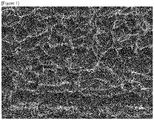
- FIG. 1 is a scanning electron microscope (SEM) image showing the surface of stainless steel after the roughening treatment in Example.
- composition of the present invention is suitably used for the roughening treatment of metal surfaces, that is, the treatment in which metal surfaces are roughened to increase roughness.
- materials to be subjected to the roughening treatment using the composition of the present invention include various metals and alloys, and preferred examples thereof include various stainless steels which will be described in detail later.
- the composition of the present invention comprises 0.1 to 25% by mass of at least one selected from the group consisting of persulfuric acid and a persulfuric acid salt and 1 to 30% by mass of halide ions with reference to the total amount of the composition.
- the composition is preferably water soluble, and is particularly preferably an aqueous composition which comprises water, in particular, ion-exchanged water or ultrapure water in addition to the above-described components.
- composition of the present invention preferably an aqueous composition
- the composition of the present invention comprises at least one selected from the group consisting of persulfuric acid and a persulfuric acid salt.
- persulfuric acid and a persulfuric acid salt are selected from the group consisting of persulfuric acid and a persulfuric acid salt.
- persulfuric acid salt one type of a persulfuric acid salt may be used solely, or two or more types of persulfuric acid salts may be used in combination.
- persulfuric acid H 2 SO 5
- sulfuric acid or chlorosulfuric acid a publicly-known technique, for example, by reacting sulfuric acid or chlorosulfuric acid with a peroxide, can be used.
- the persulfuric acid salt for example, one that is produced by adding a compound containing a predetermined counterion to persulfuric acid can be used. Further, it can be obtained by reacting an electrolyte of ammonium sulfate with sodium hydroxide as described in Japanese Patent No. 3778238 .
- the persulfuric acid salt is not particularly limited as long as it is a salt of persulfuric acid, and examples thereof include a metal salt of persulfuric acid and a salt of another inorganic compound. Among them, a metal salt of persulfuric acid is preferred.
- an alkali metal salt and an alkaline earth metal salt are preferred, and an alkali metal salt is more preferred. More preferred specific examples thereof include sodium persulfate, potassium persulfate and potassium hydrogen monopersulfate composite salt (2KHSO 5 ⁇ KHSO 4 ⁇ K 2 SO 4 ; Oxone), and among them, sodium persulfate and potassium persulfate are even more preferred, and sodium persulfate is particularly preferred.
- Examples of the salt of the inorganic compound of persulfuric acid include ammonium persulfate.
- persulfuric acid and persulfuric acid salt are sometimes collectively referred to as a persulfuric acid component.
- the content of the persulfuric acid component in the composition of the present invention (the total content of at least one selected from the group consisting of persulfuric acid and a persulfuric acid salt) is 0.1 to 25% by mass, preferably 1.0 to 25% by mass, more preferably 1.0 to 20% by mass or 2.0 to 22.5% by mass, even more preferably 2.0 to 15% by mass or 2.5 to 20% by mass, still more preferably 3.0 to 16% by mass, and particularly preferably 4.0 to 12% by mass with reference to the total amount of the composition.
- the lower limit of the concentration of the persulfuric acid component contained in the composition may be, for example, 1.0% by mass, 1.5% by mass, 2.0% by mass, 2.5% by mass, 3.0% by mass, 3.5% by mass, 4.0% by mass, 4.5% by mass, 5.0% by mass or the like
- the upper limit of the concentration of the persulfuric acid component contained in the composition may be, for example, 22.5% by mass, 21% by mass, 20% by mass, 19% by mass, 18% by mass, 17% by mass, 16% by mass, 15% by mass, 14% by mass, 13% by mass, 12% by mass or the like.
- the content (concentration) of the persulfuric acid component in particular, the content (concentration) of sodium persulfate in the composition is within the above-described range, the solubility of the persulfuric acid component is satisfactory and the efficiency of the roughening treatment can be improved.
- the range of the content of the persulfuric acid component may include the above-described upper limit and lower limit (i.e., a range of the upper limit or less or the lower limit or more), and the range may exclude the upper limit and lower limit (i.e., a range of less than the upper limit or more than the lower limit). The same applies to ranges other than the range of the content of the persulfuric acid component.
- the persulfuric acid component is preferably used, but a peroxide that is different from the persulfuric acid component (a compound having a -O-O- structure in the molecule; in this regard, O represents an oxygen atom) can be used together with or instead of the persulfuric acid component.
- a peroxide that is different from the persulfuric acid component include peracetic acid, a peracetic acid salt, percarbonic acid, a percarbonic acid salt, perbenzoic acid, a perbenzoic acid salt and meta-chloroperbenzoic acid.
- the total content of the peroxide in the composition is preferably the same as the content of the persulfuric acid component described above.
- Halide ions (halogen ions)
- the type of the halide ions contained in the composition of the present invention is not particularly limited.
- the halide ions may be fluoride ions, chloride ions, bromide ions or iodide ions, but from the viewpoint of ease of handling, efficiency of the roughening treatment and economic efficiency, chloride ions are more preferred.
- the compound for supplying the halide ions is not particularly limited, and examples thereof include hydrogen halide, a halide of an alkali metal such as sodium halide and potassium halide, a halide of an alkaline earth metal such as calcium halide, ammonium halide and copper halide.
- hydrogen halide or a halide of an alkali metal is preferred, and at least one selected from the group consisting of hydrochloric acid (hydrogen chloride), sodium chloride and potassium chloride is more preferred.
- hydrochloric acid hydrogen chloride
- sodium chloride and potassium chloride is more preferred.
- the concentration of the halide ions contained in the composition is 1 to 30% by mass, but it is preferably 2.0 to 25% by mass, more preferably 2.0 to 20% by mass or 3.0 to 20% by mass, particularly preferably 4.0 to 18% by mass or 5.0 to 15% by mass, and even more preferably 5.0 to 17% by mass, 7.0 to 15% by mass, 7.0 to 12% by mass, 8.0 to 15% by mass or 8.0 to 12% by mass.
- the range of the content of the halide ions may include the above-described upper limit and lower limit (i.e., a range of the upper limit or less or the lower limit or more), and the range may exclude the upper limit and lower limit (i.e., a range of less than the upper limit or more than the lower limit).
- the lower limit of the concentration of the halide ions contained in the composition may be, for example, 1.5% by mass, 2.0% by mass, 3.0% by mass, 4.0% by mass, 5.0% by mass, 6.0% by mass, 7.0% by mass, 8.0% by mass, 9.0% by mass or the like
- the upper limit of the concentration of the halide ions contained in the composition may be, for example, 27% by mass, 25% by mass, 22% by mass, 20% by mass, 19% by mass, 18% by mass, 17% by mass, 16% by mass, 15% by mass, 14% by mass, 13% by mass, 12% by mass or the like.
- the composition of the present invention may comprise water and preferably comprises water.
- Water is not particularly limited, but is preferably water from which metal ions, organic impurities, particles, etc. have been removed by distillation, ion exchange treatment, filtering treatment, adsorption treatment or the like. Pure water is more preferred, and ultrapure water is particularly preferred.
- the content of water in the composition of the present invention is not particularly limited, but is preferably 45 to 98.9% by mass, more preferably 55 to 97% by mass, even more preferably 65 to 95% by mass, and particularly preferably 75 to 90% by mass with reference to the total amount of the composition.
- composition of the present invention is preferably a solution, and it is preferred that the composition does not contain a component that is insoluble in the composition as the solution, for example, solid particles such as abrasive particles.
- an active component other than the above-described persulfuric acid component, peroxide and halide ions may be added.
- an active component other than the above-described persulfuric acid component, peroxide and halide ions may be added.
- copper ions may be added to the composition.
- the type of the copper ion source is not particularly limited as long as it is a copper compound that can supply copper ions in the composition.
- Examples of the copper compound that can supply copper ions include copper sulfate such as copper (II) sulfate, copper chloride such as copper (II) chloride, copper tetrafluoroborate, copper (II) bromide, copper (II) oxide, copper phosphate, copper acetate, copper formate and copper nitrate, which may be an anhydride or a hydrate (e.g., a pentahydrate).
- copper sulfate or copper chloride is preferred, copper (II) sulfate or copper (II) chloride is more preferred, and copper (II) sulfate is even more preferred.
- copper sulfate such as copper (II) sulfate
- copper chloride such as copper (II) chloride, copper tetrafluoroborate, copper (II) bromide, copper (II) oxide, copper phosphate, copper acetate, copper formate and copper nitrate, which may be an an
- the concentration of the copper ions contained in the composition is 0.25 to 40% by mass, but it is preferably 1.0 to 30% by mass, more preferably 3.0 to 25% by mass, and particularly preferably 5.0 to 20% by mass.
- the copper compound may overlap with the above-described compound for supplying the halide ions.
- said copper halide also corresponds to the above-described halide ion source.
- copper chloride is preferred.
- composition of the present invention may comprise an additive as a component other than the above-described active components, such as persulfuric acid component and halide ions within a range in which the effects of the present invention are exerted.
- the additive examples include a heterocyclic nitrogen compound (azole-based compound) and an organic solvent. These additives may be used solely, or two or more of them may be used in combination. Examples of the additive also include a surfactant and a pH adjuster, but it is better that these materials are not contained in the composition of the present invention.
- the concentration of the additive that may be contained in the composition is preferably 10% by mass or less, more preferably 5.0% by mass or less, even more preferably 2.0% by mass or less, and particularly preferably 1.0% by mass or less based on the total amount of the composition.
- composition comprising the above-described components functions as described below in the roughening treatment of the surface of stainless steel.
- the halide ions play a role to cause pitting corrosion of an oxide film usually formed on the surface of stainless steel.
- the persulfuric acid component plays a role to oxidize and ionize a metal component of stainless steel in an acidic aqueous solution to cause a corrosion reaction. When the corrosion reaction occurs irregularly on stainless steel, a roughened form is obtained. Further, it is considered that a peroxide other than the persulfuric acid component, for example, peracetic acid can play the same role as that of the persulfuric acid component.
- composition of the present invention is prepared by adding the above-described persulfuric acid component, component for supplying the halide ions and water, and according to need, other components and stirring the mixture until it becomes homogeneous.
- Characteristics of the composition are not particularly limited, but the pH value is preferably -1.5 to 4.0, more preferably -1.0 to 3.0, even more preferably -0.75 to 2.5, and particularly preferably -0.5 to 2.0.
- the pH value of the composition is for example, less than 1.0.
- the pH value can be measured by the method described in the Examples.
- a roughening step in which a roughening treatment of the surface of stainless steel is performed by using the above-described composition is carried out.
- the roughening treatment carried out in the present invention includes a step in which the above-described composition is brought into contact with the stainless steel.
- the method for bringing the composition into contact with the stainless steel is not particularly limited.
- a method in which a stainless steel subjected to the treatment is immersed in the composition of the present invention a method in which the composition of the present invention is dropped on a stainless steel subjected to the treatment (wafer spin process), a method in which the composition of the present invention is sprayed on a stainless steel subjected to the treatment (spray treatment) or the like can be employed.
- any of such methods may be employed.
- Examples of such methods include a method in which the composition of the present invention is sprayed on a processed stainless steel having a specific shape to obtain a roughened stainless steel, and a method in which: a dropping apparatus, spraying apparatus or immersion apparatus for the composition of the present invention is placed between rolls for a stainless steel foil; using a roll-to-roll technique, an untreated stainless steel foil is spread from a roll around which it is wound and moved; during the movement, the stainless steel foil is passed through an area near the above-described apparatus to supply the composition; and the roughened stainless steel foil is wound around another roll, thereby obtaining it.
- the temperature for the roughening treatment is preferably 20 to 60°C, more preferably 25 to 55°C, and particularly preferably 30 to 50°C.
- the method for roughening stainless steel of the present invention is excellent on the point that roughening of the surface of stainless steel is progressed even if the temperature is not so high, for example, even at 20 to 30°C.
- the temperature for the roughening treatment means a temperature at which the composition is brought into contact with the surface of stainless steel, in particular, a solution temperature of the composition to be brought into contact with the surface of stainless steel.
- the time for the roughening treatment is preferably 30 seconds to 180 seconds, more preferably 30 seconds to 120 seconds, even more preferably 40 seconds to 100 seconds, and particularly preferably 50 seconds to 90 seconds.
- the method for roughening stainless steel of the present invention is excellent on the point that roughening of stainless steel is progressed even if the time is not so long.
- the time for the roughening treatment means the time during which the composition is brought into contact with the surface of stainless steel. For example, it is the time during which stainless steel is immersed in the composition, or the time from when the composition is sprayed on the surface of stainless steel till when the composition is removed with water or the like.
- the maximum height (Rz) of the surface of stainless steel subjected to the roughening treatment (in this specification, it is also referred to as a "roughened stainless steel", and a stainless steel foil (film or sheet) subjected to the roughening treatment is also included in the stainless steel) can be set to be 1.0 ⁇ m or more, for example, 1.5 ⁇ m or more, or 2.0 ⁇ m or more.
- the maximum height (Rz) of the surface of stainless steel can be set to be preferably 3.0 ⁇ m or more, or 4.0 ⁇ m or more, more preferably 4.5 ⁇ m or more, even more preferably 5.0 ⁇ m or more, and particularly preferably 5.5 ⁇ m or more.
- the upper limit of the maximum height (Rz) of the surface of stainless steel subjected to the roughening treatment is not particularly limited, but for example, it is 10.0 ⁇ m or less, and it may be 7.0 ⁇ m or less, or 5.0 ⁇ m or less.
- the maximum height (Rz) of the surface of stainless steel not subjected to the roughening treatment is not particularly limited, but for example, it is 0.1 to 2.0 ⁇ m, 0.2 to 2.0 ⁇ m, 0.4 to 2.0 ⁇ m, 1.0 to 1.5 ⁇ m, or the like.
- a surface of the roughened stainless steel can have a value of the maximum height (Rz) which is at least 1.0 ⁇ m larger than the value of the maximum height (Rz) of the surface of untreated stainless steel, it is preferably at least 1.5 ⁇ m larger or 2.0 ⁇ m larger than untreated stainless steel, and more preferably at least 3.0 ⁇ m larger than untreated stainless steel.
- the arithmetic average roughness (Ra) of the surface of the roughened stainless steel can be set to be 0.1 ⁇ m or more, for example, 0.2 ⁇ m or more.
- the arithmetic average roughness (Ra) of the surface of the roughened stainless steel can be set to be preferably 0.3 ⁇ m or more, more preferably 0.4 ⁇ m or more, even more preferably 0.6 ⁇ m or more, and particularly preferably 0.8 ⁇ m or more.
- the upper limit of the arithmetic average roughness (Ra) of the surface of the roughened stainless steel is not particularly limited, but for example, it is 2.0 ⁇ m or less, and it may be 1.5 ⁇ m or less, or 1.0 ⁇ m or less.
- the arithmetic average roughness (Ra) of untreated stainless steel is not particularly limited, but for example, it is 0.01 to 0.3 ⁇ m or 0.05 to 0.3 ⁇ m .
- the arithmetic average roughness (Ra) of the surface of the roughened stainless steel can be set to be at least 0.05 ⁇ m larger than the arithmetic average roughness (Ra) of the surface of untreated stainless steel, and it is preferably at least 0.1 ⁇ m or 0.2 ⁇ m, and more preferably at least 0.3 ⁇ m larger than untreated stainless steel.
- the above-described maximum height (Rz) and arithmetic average roughness (Ra) are calculated in accordance with JIS B 0601-2001.
- the apparatus to be used for the measurement is not particularly limited, but for example, a laser microscope can be used.
- the etching rate of stainless steel in the roughening treatment is not particularly limited, but for example, it is 0.1 ⁇ m/min or higher, and it is preferably 0.5 ⁇ m/min or higher, more preferably 0.7 ⁇ m/min or higher, even more preferably 1.0 ⁇ m/min or higher, still more preferably 1.2 ⁇ m/min or higher, and particularly preferably 1.4 ⁇ m/min or higher.
- a stainless steel in which the surface roughness is increased can be obtained only by a substantially one-step treatment, that is, the roughening treatment in which the composition of the present invention is brought into contact with the surface of stainless steel to be treated, or according to need, additionally performing washing adequately (e.g., washing with water). Further, since the treatment conditions in the roughening treatment are moderate and the required time is short as described above, according to the present invention, the roughening treatment of stainless steel can be efficiently carried out.
- the surface of stainless steel can be roughened rapidly by a more convenient method.
- the type of stainless steel to be subjected to the roughening treatment using the composition of the present invention is not particularly limited, and examples thereof include: a chrome-nickel stainless steel including SUS304, SUS316, SUS321, SUS347 and SUS329J1; a martensite stainless steel (chrome stainless steel) including SUS403, SUS410, SUS420J1, SUS420J2, SUS440A, SUS440B and SUS440C; a ferritic stainless steel (chrome stainless steel) including SUS405, SUS430, SUS434, SUS444, SUS447 and SUSXM27; and a precipitation hardening type (chrome-nickel stainless steel) including SUS630, SUS631 and SUH660, which are defined by JISG4305.
- the size, thickness and shape of stainless steel to be subjected to the roughening treatment are not particularly limited, and for example, a stainless steel foil can be subjected to the roughening treatment.
- the thickness of the stainless steel foil to be subjected to the roughening treatment is not particularly limited, but for example, it is 1 ⁇ m to 500 ⁇ m, and it is preferably 10 ⁇ m to 100 ⁇ m.
- composition of the present invention surfaces of a wide variety of stainless steels can be roughened as described above. Further, by using the composition of the present invention, a solid stainless steel such as SUS444 which cannot be roughened by an aqueous composition containing hydrogen peroxide, hydrochloric acid, etc. as active components can also be roughened.
- the maximum height (Rz) of the surface of stainless steel subjected to the roughening treatment is, for example, 0.5 ⁇ m or more, and it is preferably 1.0 ⁇ m or more, more preferably 1.5 ⁇ m or more, even more preferably 2.0 ⁇ m or more, and particularly preferably 2.4 ⁇ m or more.
- the upper limit of the maximum height (Rz) of the surface of stainless steel subjected to the roughening treatment is not particularly limited, but for example, it is 10.0 ⁇ m or less, and it may be 7.0 ⁇ m or less, 5.0 ⁇ m or less, or 4.0 ⁇ m or less.
- the arithmetic average roughness (Ra) of the surface of the roughened stainless steel is, for example, 0.1 ⁇ m or more, and it is preferably 0.15 ⁇ m or more, more preferably 0.2 ⁇ m or more, even more preferably 0.3 ⁇ m or more, and particularly preferably 0.4 ⁇ m or more.
- the upper limit of the arithmetic average roughness (Ra) of the surface of the roughened stainless steel is not particularly limited, but for example, it is 0.70 ⁇ m or less, and it may be 0.50 ⁇ m or less.
- the method for producing stainless steel of the present invention has at least the above-described roughening step. According to the method for producing stainless steel of the present invention, a stainless steel whose surface is rougher than that before the roughening treatment, i.e., a stainless steel having a surface in which the roughness is increased when compared to that of the surface before the treatment, can be produced.
- the stainless steel to be used in the method for producing stainless steel of the present invention is as described in [3. Stainless steel] above.
- the maximum height (Rz) and arithmetic average roughness (Ra) of the surface of stainless steel subjected to the roughening treatment obtained by the method for producing stainless steel of the present invention are as described in [2. Method for roughening stainless steel] or [3. Stainless steel] above.
- the stainless steel subjected to the roughening treatment obtained by the method for producing stainless steel of the present invention can be used for applications including a current collector foil for batteries such as solid state batteries and lithium ion batteries, a solar cell substrate, a flexible substrate for electronic devices, a substrate for power storage devices, a carrier for an exhaust gas purification catalyst or the like, an electromagnetic wave shielding member, a heat dissipation member, etc.
- the stainless steel foil subjected to the roughening treatment obtained by the method for producing stainless steel of the present invention is suitably used, for example, as a current collector foil for batteries.
- the maximum height (Rz) and arithmetic average roughness (Ra) in accordance with JIS B 0601-2001 were measured by using a laser microscope (manufactured by KEYENCE CORPORATION, product name: VK-X250).
- the pH value of each composition in the Examples and Comparative Examples was measured by using a pH meter (pH meter F-52 manufactured by HORIBA, Ltd.) at 25°C.
- the difference in mass (D) of the stainless steel foil before and after the treatment with the composition was divided by the area S of the used stainless steel foil (area of the treatment with the composition), the density (p) of the stainless steel foil and the treatment time (T) to obtain the value of E.R. ( ⁇ m/min).
- a stainless steel foil made of SUS444 having a thickness of 20 ⁇ m, a longitudinal length of 30 mm and a lateral length of 30 mm was prepared.
- Rz and Ra of the stainless steel foil were measured according to "Measurement of surface roughness of stainless steel foil" above. Rz was 0.48 ⁇ m and Ra was 0.07 ⁇ m.
- the stainless steel foil was immersed in the above-described composition at a solution temperature of 45°C for 60 seconds.
- the stainless steel foil after immersion was adequately washed with ultrapure water and then adequately dried to obtain a surface-treated foil.
- the obtained surface-treated foil was observed according to "Observation of surface of stainless steel foil” above. A microscopic image thereof is shown in Figure 1 .
- the maximum height of the surface of the obtained surface-treated foil was measured according to "Measurement of surface roughness of stainless steel foil” above.
- the value of Rz was 2.41 ⁇ m and that of Ra was 0.46 ⁇ m.
- the etching rate was 1.05 ⁇ m/min .
- the surface of a stainless steel foil was treated in a manner similar to that in Example 1, except that the concentrations of sodium persulfate and chloride ions (Cl - ) in the composition were changed as shown in Table 1 below, and the surface roughness and the etching rate were measured.
- the values of Rz, Ra and the etching rate are as described in Table 1.
- the surface of a stainless steel foil was treated in a manner similar to that in Example 1, except that the stainless steel foil to be subjected to the roughening treatment was changed as shown in Table 1 below, and the surface roughness and the etching rate were measured.
- the values of Rz, Ra and the etching rate are as described in Table 1.
- a stainless steel foil made of SUS444 having a thickness of 20 ⁇ m, a longitudinal length of 30 mm and a lateral length of 30 mm was prepared.
- the stainless steel foil was immersed in the composition at a solution temperature of 45°C for 60 seconds.
- the stainless steel foil after immersion was adequately washed with ultrapure water and then adequately dried to obtain a surface-treated foil.
- the maximum height of the surface of the obtained surface-treated foil was measured according to "Measurement of surface roughness of stainless steel foil" above. No roughened state of the surface was seen, and the values of Ra and Rz were not changed from those before the treatment.
- a stainless steel foil made of SUS444 having a thickness of 20 ⁇ m, a longitudinal length of 30 mm and a lateral length of 30 mm was prepared.
- the stainless steel foil was immersed in the composition at a solution temperature of 45°C for 60 seconds.
- the stainless steel foil after immersion was adequately washed with ultrapure water and then adequately dried to obtain a surface-treated foil.
- the maximum height of the surface of the obtained surface-treated foil was measured according to "Measurement of surface roughness of stainless steel foil" above. No roughened state of the surface was seen, and the values of Ra and Rz were not changed from those before the treatment.
- the surface of a stainless steel foil was treated in a manner similar to that in the above-described comparative example, except that the concentrations of sodium persulfate and chloride ions (Cl - ) in the composition were changed as shown in Table 1 below.
- Example 1 Composition (% by mass) Roughening treatment Treatment solution pH Stainless steel Ra ( ⁇ m) Rz ( ⁇ m) Etching rate Sodium persulfate Halogen ions Pure water Before treatment After treatment Before treatment After treatment t ⁇ m/min
- Example 1 7.0 10 Remainder -0.33 SUS444 0.07 0.46 0.48 2.41 1.05
- Example 2 3.0 10 Remainder less than 1 SUS444 0.07 0.38 0.48 1.63 0.43
- Example 3 16 10 Remainder less than 1 SUS444 0.07 0.41 0.48 2.64 1.60
- Example 4 7.0 8.0 Remainder less than 1 SUS444 0.07 0.42 0.48 1.96 0.64
- Example 5 7.0 15 Remainder less than 1 SUS444 0.07 0.41 0.48 2.26 1.00
- Example 6 7.0 10 Remainder less than 1 SUS304 0.04 0.70 0.28 4.04 1.53 Comparative Example 1 - 10 Remainder less than 1 SUS304 0.04 0.70 0.28 4.04 1.53 Comparative Example 1
- stainless steel can be efficiently roughened by the aqueous composition in which the persulfuric acid component and the halide ions whose contents are within predetermined ranges are used in combination.
- the surface of stainless steel can be adequately roughened in an efficient manner with few steps in a short time. Further, when using the stainless steel whose surface is roughened for a current collector foil for batteries, a case for automobile components or the like, a dielectric material and an organic substance can be effectively adhered and held. Further, the stainless steel whose surface is roughened can also be suitably used for a heat dissipation member.
- the present invention is industrially applicable in the field of the roughening treatment of the surface of a member of a material, for example, stainless steel to be used in the above-described products.
Landscapes
- Chemical & Material Sciences (AREA)
- Chemical Kinetics & Catalysis (AREA)
- General Chemical & Material Sciences (AREA)
- Engineering & Computer Science (AREA)
- Materials Engineering (AREA)
- Electrochemistry (AREA)
- Mechanical Engineering (AREA)
- Metallurgy (AREA)
- Organic Chemistry (AREA)
- Composite Materials (AREA)
- ing And Chemical Polishing (AREA)
Abstract
Description
- The present invention relates to a composition, in particular, a composition to be used for treating the surface of stainless steel, a method for roughening the surface of stainless steel, etc.
- Recently, use of stainless steel in various fields has been examined because of its excellent durability and weather resistance. For example, use of stainless steel in electronic components, current collector foils for batteries and cases for automobile components has been promoted. Specifically, when using stainless steel in current collector foils for batteries and cases for automobile components, the surface of stainless steel is roughened for the purpose of adhering a dielectric material and an organic substance. Further, when using stainless steel for heat dissipation, the surface of stainless steel is roughened for the purpose of promoting heat dissipation.
- When stainless steel is used in respective products for such applications, it is desired to increase the surface area. In this regard, for example, a method in which the surface of stainless steel is treated with a treatment solution containing iron chloride, etc. are known (e.g., Patent Document 1). However, according to this treatment method, many smooth portions exist even on the surface of stainless steel after the treatment, and therefore it cannot be necessarily said that stainless steel is adequately roughened to be used for the above-described applications.
- As a method for roughening the surface of stainless steel, a method in which wet peening is combined with a roughening treatment using a chemical solution has been found (e.g., Patent Document 2), but according to the method, a plurality of steps are required. For this reason, there is a room for improvement with respect to promoting efficiency of the roughening treatment.
-
- Patent Document 1:
Japanese Laid-Open Patent Publication No. 2011-168017 - Patent Document 2:
Japanese Laid-Open Patent Publication No. 2015-183239 - As described above, in the conventional roughening treatment of the surface of stainless steel, the level of roughening is not necessarily sufficient, and the treatment time and the cost are increased because a complicated process is required. In such circumstances, it has been desired to develop a method by which the surface of stainless steel can be adequately roughened in an efficient manner with a simple process.
- The present inventors diligently made researches in order to solve the above-described problems and found that the surface of stainless steel can be adequately roughened in an efficient manner with few steps by using a composition having a specific composition, and thus the present invention was achieved.
- Specifically, the present invention is as described below.
- [1] A composition for roughening the surface of stainless steel, which comprises:
- 0.1 to 25% by mass of at least one selected from the group consisting of persulfuric acid and a persulfuric acid salt with reference to the total amount of the composition; and
- 1 to 30% by mass of halide ions with reference to the total amount of the composition.
- [2] The composition according to item [1], wherein the persulfuric acid salt includes an alkali metal salt of persulfuric acid.
- [3] The composition according to item [2], wherein the alkali metal salt of persulfuric acid includes at least one of sodium persulfate and potassium persulfate.
- [4] The composition according to any one of items [1] to [3], which comprises at least one selected from the group consisting of hydrochloric acid, sodium chloride and potassium chloride as a compound for supplying the halide ions.
- [5] The composition according to any one of items [1] to [4], which further comprises water and has a pH value of -1.5 to 4.0.
- [6] The composition according to any one of items [1] to [5], which further comprises copper ions.
- [7] A method for roughening stainless steel, which includes a roughening step in which a roughening treatment of the surface of stainless steel is performed by using the composition according to any one of items [1] to [6].
- [8] The method for roughening stainless steel according to item [7], wherein the temperature for the roughening treatment is 20 to 60°C.
- [9] The method for roughening stainless steel according to item [7] or [8], wherein the time for the roughening treatment is 30 seconds to 180 seconds.
- [10] The method for roughening stainless steel according to any one of items [7] to [9], wherein the surface of stainless steel subjected to the roughening treatment has a maximum height (Rz) that is defined by JIS B 0601-2001 of 1.0 µm or more.
- [11] The method for roughening stainless steel according to any one of items [7] to [10], wherein the surface of stainless steel subjected to the roughening treatment has a maximum height (Rz) that is defined by JIS B 0601-2001 of 5.0 µm or less.
- [12] The method for roughening stainless steel according to any one of items [7] to [11], wherein the value of the maximum height (Rz) that is defined by JIS B 0601-2001 of the surface of stainless steel subjected to the roughening treatment is at least 0.5 µm larger than the value of the maximum height (Rz) of the surface of untreated stainless steel.
- [13] The method for roughening stainless steel according to any one of items [7] to [12], wherein the surface of stainless steel subjected to the roughening treatment has an arithmetic average roughness (Ra) that is defined by JIS B 0601-2001 of 0.1 µm or more.
- [14] The method for roughening stainless steel according to any one of items [7] to [13], wherein the surface of stainless steel subjected to the roughening treatment has an arithmetic average roughness (Ra) that is defined by JIS B 0601-2001 of 2.0 µm or less.
- [15] The method for roughening stainless steel according to any one of items [7] to [14], wherein the arithmetic average roughness (Ra) that is defined by JIS B 0601-2001 of the surface of stainless steel subjected to the roughening treatment is at least 0.05 µm larger than the arithmetic average roughness (Ra) of the surface of untreated stainless steel.
- [16] The method for roughening stainless steel according to any one of items [7] to [15], wherein the etching rate of said stainless steel in the roughening treatment is 0.1 µm/min or higher.
- [17] A stainless steel, wherein the surface thereof is subjected to a roughening treatment by using the composition according to any one of items [1] to [6].
- [18] The stainless steel according to item [17], wherein the surface of stainless steel subjected to the roughening treatment has a maximum height (Rz) that is defined by JIS B 0601-2001 of 1.0 µm or more.
- [19] The stainless steel according to item [17] or [18], wherein the surface of stainless steel subjected to the roughening treatment has a maximum height (Rz) that is defined by JIS B 0601-2001 of 5.0 µm or less.
- [20] The roughened stainless steel according to any one of items [17] to [19], wherein the surface of stainless steel subjected to the roughening treatment has an arithmetic average roughness (Ra) that is defined by JIS B 0601-2001 of 0.1 µm or more.
- [21] The roughened stainless steel according to any one of items [17] to [20], wherein the surface of stainless steel subjected to the roughening treatment has an arithmetic average roughness (Ra) that is defined by JIS B 0601-2001 of 2.0 µm or less.
- [22] The stainless steel according to any one of items [17] to [21], which is at least one of:
- a chrome-nickel stainless steel including SUS304, SUS316, SUS321, SUS347 and SUS329J1;
- a martensite stainless steel (chrome stainless steel) including SUS403, SUS410, SUS420J1, SUS420J2, SUS440A, SUS440B and SUS440C;
- a ferritic stainless steel (chrome stainless steel) including SUS405, SUS430, SUS434, SUS444, SUS447 and SUSXM27; and
- a precipitation hardening type (chrome-nickel stainless steel) including SUS630, SUS631 and SUH660, which are defined by JISG4305.
- [23] The roughened stainless steel according to any one of items [17] to [22], which is a stainless steel foil.
- [24] A current collector foil for batteries, a solar cell substrate, a flexible substrate for electronic devices, a substrate for power storage devices, a catalyst carrier, an electromagnetic wave shielding member or a heat dissipation member, which includes the roughened stainless steel according to any one of items [17] to [21].
- [25] A method for producing a roughened stainless steel whose surface is roughened, which has a roughening step in which a roughening treatment of the surface of stainless steel is performed by using the composition according to any one of items [1] to [6].
- [26] The method for producing a roughened stainless steel according to item [25], wherein the surface of stainless steel subjected to the roughening treatment has a maximum height (Rz) that is defined by JIS B 0601-2001 of 1.0 µm or more.
- [27] The method for producing a roughened stainless steel according to item [25] or [26], wherein the surface of stainless steel subjected to the roughening treatment has a maximum height (Rz) that is defined by JIS B 0601-2001 of 5.0 µm or less.
- [28] The method for producing a roughened stainless steel according to any one of items [25] to [27], wherein the surface of stainless steel subjected to the roughening treatment has an arithmetic average roughness (Ra) that is defined by JIS B 0601-2001 of 0.1 µm or more.
- [29] The method for producing a roughened stainless steel according to any one of items [25] to [28], wherein the surface of stainless steel subjected to the roughening treatment has an arithmetic average roughness (Ra) that is defined by JIS B 0601-2001 of 2.0 µm or less.
- [30] The method for producing a roughened stainless steel according to any one of items [25] to [29], wherein the arithmetic average roughness (Ra) of the surface of stainless steel subjected to the roughening treatment is at least 0.05 µm larger than the arithmetic average roughness (Ra) that is defined by JIS B 0601-2001 of the surface of untreated stainless steel.
- [31] The method for producing a roughened stainless steel according to any one of items [25] to [30], wherein the etching rate of said stainless steel in the roughening treatment is 0.1 µm/min or higher.
- [32] The method for producing a roughened stainless steel according to any one of items [25] to [31], wherein said stainless steel is at least one of:
- a chrome-nickel stainless steel including SUS304, SUS316, SUS321, SUS347 and SUS329J1;
- a martensite stainless steel (chrome stainless steel) including SUS403, SUS410, SUS420J1, SUS420J2, SUS440A, SUS440B and SUS440C;
- a ferritic stainless steel (chrome stainless steel) including SUS405, SUS430, SUS434, SUS444, SUS447 and SUSXM27; and
- a precipitation hardening type (chrome-nickel stainless steel) including SUS630, SUS631 and SUH660, which are defined by JISG4305.
- [33] The method for producing a roughened stainless steel according to any one of items [25] to [32], wherein said stainless steel is a stainless steel foil.
- [34] A current collector foil for batteries, a solar cell substrate, a flexible substrate for electronic devices, a substrate for power storage devices, a catalyst carrier, an electromagnetic wave shielding member or a heat dissipation member, which includes a roughened stainless steel produced by the production method according to any one of items [25] to [33].
- According to the present invention, the surface of stainless steel can be adequately roughened by an efficient method with a small number of steps.
-
FIG. 1 is a scanning electron microscope (SEM) image showing the surface of stainless steel after the roughening treatment in Example. - Hereinafter, the present invention will be described in detail, but the present invention is not limited to the below-described matters and can be variously modified without departing from the gist of the present invention.
- The composition of the present invention is suitably used for the roughening treatment of metal surfaces, that is, the treatment in which metal surfaces are roughened to increase roughness. Examples of materials to be subjected to the roughening treatment using the composition of the present invention include various metals and alloys, and preferred examples thereof include various stainless steels which will be described in detail later.
- The composition of the present invention comprises 0.1 to 25% by mass of at least one selected from the group consisting of persulfuric acid and a persulfuric acid salt and 1 to 30% by mass of halide ions with reference to the total amount of the composition. The composition is preferably water soluble, and is particularly preferably an aqueous composition which comprises water, in particular, ion-exchanged water or ultrapure water in addition to the above-described components.
- Hereinafter, respective components of the composition of the present invention (preferably an aqueous composition) will be described.
- The composition of the present invention comprises at least one selected from the group consisting of persulfuric acid and a persulfuric acid salt. Specifically, in the composition, only one of persulfuric acid and the persulfuric acid salt may be used, and alternatively, persulfuric acid and one type of a persulfuric acid salt may be used. Moreover, regarding the persulfuric acid salt, one type of a persulfuric acid salt may be used solely, or two or more types of persulfuric acid salts may be used in combination.
- As persulfuric acid (H2SO5), one that is produced by a publicly-known technique, for example, by reacting sulfuric acid or chlorosulfuric acid with a peroxide, can be used.
- As the persulfuric acid salt, for example, one that is produced by adding a compound containing a predetermined counterion to persulfuric acid can be used. Further, it can be obtained by reacting an electrolyte of ammonium sulfate with sodium hydroxide as described in
Japanese Patent No. 3778238 - The persulfuric acid salt is not particularly limited as long as it is a salt of persulfuric acid, and examples thereof include a metal salt of persulfuric acid and a salt of another inorganic compound. Among them, a metal salt of persulfuric acid is preferred.
- As the metal salt of persulfuric acid, an alkali metal salt and an alkaline earth metal salt are preferred, and an alkali metal salt is more preferred. More preferred specific examples thereof include sodium persulfate, potassium persulfate and potassium hydrogen monopersulfate composite salt (2KHSO5 · KHSO4 · K2SO4; Oxone), and among them, sodium persulfate and potassium persulfate are even more preferred, and sodium persulfate is particularly preferred.
- Examples of the salt of the inorganic compound of persulfuric acid include ammonium persulfate.
- In this specification, the above-described persulfuric acid and persulfuric acid salt are sometimes collectively referred to as a persulfuric acid component.
- The content of the persulfuric acid component in the composition of the present invention (the total content of at least one selected from the group consisting of persulfuric acid and a persulfuric acid salt) is 0.1 to 25% by mass, preferably 1.0 to 25% by mass, more preferably 1.0 to 20% by mass or 2.0 to 22.5% by mass, even more preferably 2.0 to 15% by mass or 2.5 to 20% by mass, still more preferably 3.0 to 16% by mass, and particularly preferably 4.0 to 12% by mass with reference to the total amount of the composition. Further, the lower limit of the concentration of the persulfuric acid component contained in the composition may be, for example, 1.0% by mass, 1.5% by mass, 2.0% by mass, 2.5% by mass, 3.0% by mass, 3.5% by mass, 4.0% by mass, 4.5% by mass, 5.0% by mass or the like, and the upper limit of the concentration of the persulfuric acid component contained in the composition may be, for example, 22.5% by mass, 21% by mass, 20% by mass, 19% by mass, 18% by mass, 17% by mass, 16% by mass, 15% by mass, 14% by mass, 13% by mass, 12% by mass or the like.
- When the content (concentration) of the persulfuric acid component, in particular, the content (concentration) of sodium persulfate in the composition is within the above-described range, the solubility of the persulfuric acid component is satisfactory and the efficiency of the roughening treatment can be improved.
- Note that the range of the content of the persulfuric acid component may include the above-described upper limit and lower limit (i.e., a range of the upper limit or less or the lower limit or more), and the range may exclude the upper limit and lower limit (i.e., a range of less than the upper limit or more than the lower limit). The same applies to ranges other than the range of the content of the persulfuric acid component.
- Thus, in the composition of the present invention, the persulfuric acid component is preferably used, but a peroxide that is different from the persulfuric acid component (a compound having a -O-O- structure in the molecule; in this regard, O represents an oxygen atom) can be used together with or instead of the persulfuric acid component. Specific examples of the peroxide that is different from the persulfuric acid component include peracetic acid, a peracetic acid salt, percarbonic acid, a percarbonic acid salt, perbenzoic acid, a perbenzoic acid salt and meta-chloroperbenzoic acid.
- Further, when using the peroxide that is different from the persulfuric acid component, the total content of the peroxide in the composition is preferably the same as the content of the persulfuric acid component described above.
- The type of the halide ions contained in the composition of the present invention is not particularly limited. For example, the halide ions may be fluoride ions, chloride ions, bromide ions or iodide ions, but from the viewpoint of ease of handling, efficiency of the roughening treatment and economic efficiency, chloride ions are more preferred.
- The compound for supplying the halide ions is not particularly limited, and examples thereof include hydrogen halide, a halide of an alkali metal such as sodium halide and potassium halide, a halide of an alkaline earth metal such as calcium halide, ammonium halide and copper halide. Among them, from the viewpoint of more effective and secure exertion of the effects of the present invention, hydrogen halide or a halide of an alkali metal is preferred, and at least one selected from the group consisting of hydrochloric acid (hydrogen chloride), sodium chloride and potassium chloride is more preferred. These materials may be used solely, or two or more of them may be used in combination.
- The concentration of the halide ions contained in the composition is 1 to 30% by mass, but it is preferably 2.0 to 25% by mass, more preferably 2.0 to 20% by mass or 3.0 to 20% by mass, particularly preferably 4.0 to 18% by mass or 5.0 to 15% by mass, and even more preferably 5.0 to 17% by mass, 7.0 to 15% by mass, 7.0 to 12% by mass, 8.0 to 15% by mass or 8.0 to 12% by mass. Note that the range of the content of the halide ions may include the above-described upper limit and lower limit (i.e., a range of the upper limit or less or the lower limit or more), and the range may exclude the upper limit and lower limit (i.e., a range of less than the upper limit or more than the lower limit).
- Further, the lower limit of the concentration of the halide ions contained in the composition may be, for example, 1.5% by mass, 2.0% by mass, 3.0% by mass, 4.0% by mass, 5.0% by mass, 6.0% by mass, 7.0% by mass, 8.0% by mass, 9.0% by mass or the like, and the upper limit of the concentration of the halide ions contained in the composition may be, for example, 27% by mass, 25% by mass, 22% by mass, 20% by mass, 19% by mass, 18% by mass, 17% by mass, 16% by mass, 15% by mass, 14% by mass, 13% by mass, 12% by mass or the like. When the content (concentration) of the halide ions in the composition is within the above-described range, the efficiency of the roughening treatment can be improved.
- The composition of the present invention may comprise water and preferably comprises water. Water is not particularly limited, but is preferably water from which metal ions, organic impurities, particles, etc. have been removed by distillation, ion exchange treatment, filtering treatment, adsorption treatment or the like. Pure water is more preferred, and ultrapure water is particularly preferred.
- The content of water in the composition of the present invention is not particularly limited, but is preferably 45 to 98.9% by mass, more preferably 55 to 97% by mass, even more preferably 65 to 95% by mass, and particularly preferably 75 to 90% by mass with reference to the total amount of the composition.
- Note that the composition of the present invention is preferably a solution, and it is preferred that the composition does not contain a component that is insoluble in the composition as the solution, for example, solid particles such as abrasive particles.
- To the composition of the present invention, an active component other than the above-described persulfuric acid component, peroxide and halide ions may be added. For example, as a component that can cause a substitution reaction with respect to nickel and chrome that are components of stainless steel, copper ions may be added to the composition. The type of the copper ion source is not particularly limited as long as it is a copper compound that can supply copper ions in the composition.
- Examples of the copper compound that can supply copper ions include copper sulfate such as copper (II) sulfate, copper chloride such as copper (II) chloride, copper tetrafluoroborate, copper (II) bromide, copper (II) oxide, copper phosphate, copper acetate, copper formate and copper nitrate, which may be an anhydride or a hydrate (e.g., a pentahydrate). Among them, copper sulfate or copper chloride is preferred, copper (II) sulfate or copper (II) chloride is more preferred, and copper (II) sulfate is even more preferred. These materials may be used solely, or two or more of them may be used in combination.
- The concentration of the copper ions contained in the composition is 0.25 to 40% by mass, but it is preferably 1.0 to 30% by mass, more preferably 3.0 to 25% by mass, and particularly preferably 5.0 to 20% by mass.
- Note that the copper compound may overlap with the above-described compound for supplying the halide ions. For example, when using a copper halide as a source of the copper ions, said copper halide also corresponds to the above-described halide ion source. As the copper halide, copper chloride is preferred.
- The composition of the present invention may comprise an additive as a component other than the above-described active components, such as persulfuric acid component and halide ions within a range in which the effects of the present invention are exerted.
- Examples of the additive include a heterocyclic nitrogen compound (azole-based compound) and an organic solvent. These additives may be used solely, or two or more of them may be used in combination. Examples of the additive also include a surfactant and a pH adjuster, but it is better that these materials are not contained in the composition of the present invention.
- The concentration of the additive that may be contained in the composition is preferably 10% by mass or less, more preferably 5.0% by mass or less, even more preferably 2.0% by mass or less, and particularly preferably 1.0% by mass or less based on the total amount of the composition.
- It is considered that the composition comprising the above-described components functions as described below in the roughening treatment of the surface of stainless steel.
- The halide ions play a role to cause pitting corrosion of an oxide film usually formed on the surface of stainless steel.
- The persulfuric acid component plays a role to oxidize and ionize a metal component of stainless steel in an acidic aqueous solution to cause a corrosion reaction. When the corrosion reaction occurs irregularly on stainless steel, a roughened form is obtained. Further, it is considered that a peroxide other than the persulfuric acid component, for example, peracetic acid can play the same role as that of the persulfuric acid component.
- The composition of the present invention is prepared by adding the above-described persulfuric acid component, component for supplying the halide ions and water, and according to need, other components and stirring the mixture until it becomes homogeneous.
- Characteristics of the composition are not particularly limited, but the pH value is preferably -1.5 to 4.0, more preferably -1.0 to 3.0, even more preferably -0.75 to 2.5, and particularly preferably -0.5 to 2.0. The pH value of the composition is for example, less than 1.0. The pH value can be measured by the method described in the Examples.
- In the method for roughening stainless steel of the present invention, a roughening step in which a roughening treatment of the surface of stainless steel is performed by using the above-described composition is carried out.
- Specifically, the roughening treatment carried out in the present invention includes a step in which the above-described composition is brought into contact with the stainless steel. The method for bringing the composition into contact with the stainless steel is not particularly limited. For example, a method in which a stainless steel subjected to the treatment is immersed in the composition of the present invention, a method in which the composition of the present invention is dropped on a stainless steel subjected to the treatment (wafer spin process), a method in which the composition of the present invention is sprayed on a stainless steel subjected to the treatment (spray treatment) or the like can be employed. In the present invention, any of such methods may be employed. Examples of such methods include a method in which the composition of the present invention is sprayed on a processed stainless steel having a specific shape to obtain a roughened stainless steel, and a method in which: a dropping apparatus, spraying apparatus or immersion apparatus for the composition of the present invention is placed between rolls for a stainless steel foil; using a roll-to-roll technique, an untreated stainless steel foil is spread from a roll around which it is wound and moved; during the movement, the stainless steel foil is passed through an area near the above-described apparatus to supply the composition; and the roughened stainless steel foil is wound around another roll, thereby obtaining it.
- In the roughening step, the temperature for the roughening treatment is preferably 20 to 60°C, more preferably 25 to 55°C, and particularly preferably 30 to 50°C. Thus, the method for roughening stainless steel of the present invention is excellent on the point that roughening of the surface of stainless steel is progressed even if the temperature is not so high, for example, even at 20 to 30°C. In this regard, the temperature for the roughening treatment means a temperature at which the composition is brought into contact with the surface of stainless steel, in particular, a solution temperature of the composition to be brought into contact with the surface of stainless steel.
- Further, in the roughening step, the time for the roughening treatment is preferably 30 seconds to 180 seconds, more preferably 30 seconds to 120 seconds, even more preferably 40 seconds to 100 seconds, and particularly preferably 50 seconds to 90 seconds. Thus, the method for roughening stainless steel of the present invention is excellent on the point that roughening of stainless steel is progressed even if the time is not so long. In this regard, the time for the roughening treatment means the time during which the composition is brought into contact with the surface of stainless steel. For example, it is the time during which stainless steel is immersed in the composition, or the time from when the composition is sprayed on the surface of stainless steel till when the composition is removed with water or the like.
- According to the method for roughening stainless steel of the present invention, the maximum height (Rz) of the surface of stainless steel subjected to the roughening treatment (in this specification, it is also referred to as a "roughened stainless steel", and a stainless steel foil (film or sheet) subjected to the roughening treatment is also included in the stainless steel) can be set to be 1.0 µm or more, for example, 1.5 µm or more, or 2.0 µm or more. According to the method for roughening stainless steel of the present invention, the maximum height (Rz) of the surface of stainless steel can be set to be preferably 3.0 µm or more, or 4.0 µm or more, more preferably 4.5 µm or more, even more preferably 5.0 µm or more, and particularly preferably 5.5 µm or more.
- Further, the upper limit of the maximum height (Rz) of the surface of stainless steel subjected to the roughening treatment is not particularly limited, but for example, it is 10.0 µm or less, and it may be 7.0 µm or less, or 5.0 µm or less.
- Note that the maximum height (Rz) of the surface of stainless steel not subjected to the roughening treatment (untreated stainless steel) is not particularly limited, but for example, it is 0.1 to 2.0 µm, 0.2 to 2.0 µm, 0.4 to 2.0 µm, 1.0 to 1.5 µm, or the like.
- According to the method for roughening stainless steel of the present invention, a surface of the roughened stainless steel can have a value of the maximum height (Rz) which is at least 1.0 µm larger than the value of the maximum height (Rz) of the surface of untreated stainless steel, it is preferably at least 1.5 µm larger or 2.0 µm larger than untreated stainless steel, and more preferably at least 3.0 µm larger than untreated stainless steel.
- According to the method for roughening stainless steel of the present invention, the arithmetic average roughness (Ra) of the surface of the roughened stainless steel can be set to be 0.1 µm or more, for example, 0.2 µm or more. According to the method for roughening stainless steel of the present invention, the arithmetic average roughness (Ra) of the surface of the roughened stainless steel can be set to be preferably 0.3 µm or more, more preferably 0.4 µm or more, even more preferably 0.6 µm or more, and particularly preferably 0.8 µm or more.
- Further, the upper limit of the arithmetic average roughness (Ra) of the surface of the roughened stainless steel is not particularly limited, but for example, it is 2.0 µm or less, and it may be 1.5 µm or less, or 1.0 µm or less.
- Note that the arithmetic average roughness (Ra) of untreated stainless steel is not particularly limited, but for example, it is 0.01 to 0.3 µm or 0.05 to 0.3 µm .
- According to the method for roughening stainless steel of the present invention, the arithmetic average roughness (Ra) of the surface of the roughened stainless steel can be set to be at least 0.05 µm larger than the arithmetic average roughness (Ra) of the surface of untreated stainless steel, and it is preferably at least 0.1 µm or 0.2 µm, and more preferably at least 0.3 µm larger than untreated stainless steel.
- The above-described maximum height (Rz) and arithmetic average roughness (Ra) are calculated in accordance with JIS B 0601-2001. The apparatus to be used for the measurement is not particularly limited, but for example, a laser microscope can be used.
- The etching rate of stainless steel in the roughening treatment is not particularly limited, but for example, it is 0.1 µm/min or higher, and it is preferably 0.5 µm/min or higher, more preferably 0.7 µm/min or higher, even more preferably 1.0 µm/min or higher, still more preferably 1.2 µm/min or higher, and particularly preferably 1.4 µm/min or higher.
- According to the above-described method for roughening stainless steel, a stainless steel in which the surface roughness is increased can be obtained only by a substantially one-step treatment, that is, the roughening treatment in which the composition of the present invention is brought into contact with the surface of stainless steel to be treated, or according to need, additionally performing washing adequately (e.g., washing with water). Further, since the treatment conditions in the roughening treatment are moderate and the required time is short as described above, according to the present invention, the roughening treatment of stainless steel can be efficiently carried out.
- According to the present invention which does not require a treatment such as wet peening that is for fining of a crystal forming the surface of stainless steel, the surface of stainless steel can be roughened rapidly by a more convenient method.
- The type of stainless steel to be subjected to the roughening treatment using the composition of the present invention is not particularly limited, and examples thereof include: a chrome-nickel stainless steel including SUS304, SUS316, SUS321, SUS347 and SUS329J1; a martensite stainless steel (chrome stainless steel) including SUS403, SUS410, SUS420J1, SUS420J2, SUS440A, SUS440B and SUS440C; a ferritic stainless steel (chrome stainless steel) including SUS405, SUS430, SUS434, SUS444, SUS447 and SUSXM27; and a precipitation hardening type (chrome-nickel stainless steel) including SUS630, SUS631 and SUH660, which are defined by JISG4305.
- Further, the size, thickness and shape of stainless steel to be subjected to the roughening treatment are not particularly limited, and for example, a stainless steel foil can be subjected to the roughening treatment. The thickness of the stainless steel foil to be subjected to the roughening treatment is not particularly limited, but for example, it is 1 µm to 500 µm, and it is preferably 10 µm to 100 µm.
- By using the composition of the present invention, surfaces of a wide variety of stainless steels can be roughened as described above. Further, by using the composition of the present invention, a solid stainless steel such as SUS444 which cannot be roughened by an aqueous composition containing hydrogen peroxide, hydrochloric acid, etc. as active components can also be roughened.
- Further, as described above, the maximum height (Rz) of the surface of stainless steel subjected to the roughening treatment is, for example, 0.5 µm or more, and it is preferably 1.0 µm or more, more preferably 1.5 µm or more, even more preferably 2.0 µm or more, and particularly preferably 2.4 µm or more.
- The upper limit of the maximum height (Rz) of the surface of stainless steel subjected to the roughening treatment is not particularly limited, but for example, it is 10.0 µm or less, and it may be 7.0 µm or less, 5.0 µm or less, or 4.0 µm or less.
- The arithmetic average roughness (Ra) of the surface of the roughened stainless steel is, for example, 0.1 µm or more, and it is preferably 0.15 µm or more, more preferably 0.2 µm or more, even more preferably 0.3 µm or more, and particularly preferably 0.4 µm or more.
- The upper limit of the arithmetic average roughness (Ra) of the surface of the roughened stainless steel is not particularly limited, but for example, it is 0.70 µm or less, and it may be 0.50 µm or less.
- The method for producing stainless steel of the present invention has at least the above-described roughening step. According to the method for producing stainless steel of the present invention, a stainless steel whose surface is rougher than that before the roughening treatment, i.e., a stainless steel having a surface in which the roughness is increased when compared to that of the surface before the treatment, can be produced.
- The stainless steel to be used in the method for producing stainless steel of the present invention is as described in [3. Stainless steel] above.
- The maximum height (Rz) and arithmetic average roughness (Ra) of the surface of stainless steel subjected to the roughening treatment obtained by the method for producing stainless steel of the present invention are as described in [2. Method for roughening stainless steel] or [3. Stainless steel] above.
- The stainless steel subjected to the roughening treatment obtained by the method for producing stainless steel of the present invention can be used for applications including a current collector foil for batteries such as solid state batteries and lithium ion batteries, a solar cell substrate, a flexible substrate for electronic devices, a substrate for power storage devices, a carrier for an exhaust gas purification catalyst or the like, an electromagnetic wave shielding member, a heat dissipation member, etc. The stainless steel foil subjected to the roughening treatment obtained by the method for producing stainless steel of the present invention is suitably used, for example, as a current collector foil for batteries.
- Hereinafter, the present invention will be described in more detail based on working examples, but the present invention is not limited thereto.
- With respect to a stainless steel foil as a raw material and the surface-treated foils obtained in the Examples and Comparative Examples, the maximum height (Rz) and arithmetic average roughness (Ra) in accordance with JIS B 0601-2001 were measured by using a laser microscope (manufactured by KEYENCE CORPORATION, product name: VK-X250).
- With respect to the surface-treated foils obtained in the Examples and Comparative Examples, the surface shape was observed by using a scanning electron microscope (manufactured by Hitachi High-Technologies Corporation, product name: S-3400N).
- The pH value of each composition in the Examples and Comparative Examples was measured by using a pH meter (pH meter F-52 manufactured by HORIBA, Ltd.) at 25°C.
- With respect to the surface-treated foils obtained in the Examples and Comparative Examples, the difference in mass (D) of the stainless steel foil before and after the treatment with the composition was divided by the area S of the used stainless steel foil (area of the treatment with the composition), the density (p) of the stainless steel foil and the treatment time (T) to obtain the value of E.R. (µm/min).
- This is as expressed by formula (1) below. Note that the unit of the value of E.R. directly calculated from formula (1) is "cm/min", and that the values with the unit of "µm/min" obtained by conversion are shown in Table 1, etc. below.

- A stainless steel foil made of SUS444 having a thickness of 20 µm, a longitudinal length of 30 mm and a lateral length of 30 mm was prepared. Rz and Ra of the stainless steel foil were measured according to "Measurement of surface roughness of stainless steel foil" above. Rz was 0.48 µm and Ra was 0.07 µm.
- To 129 ml of ultrapure water, 7% by mass (14 g) of sodium persulfate and 28% by mass (57 g) of 35 wt% aqueous solution of hydrochloric acid were added to prepare a composition. The concentration of halide ions (Cl-) derived from hydrochloric acid was 10% by mass with reference to the total amount of the composition.
- Firstly, the stainless steel foil was immersed in the above-described composition at a solution temperature of 45°C for 60 seconds. Next, the stainless steel foil after immersion was adequately washed with ultrapure water and then adequately dried to obtain a surface-treated foil. The obtained surface-treated foil was observed according to "Observation of surface of stainless steel foil" above. A microscopic image thereof is shown in
Figure 1 . Further, the maximum height of the surface of the obtained surface-treated foil was measured according to "Measurement of surface roughness of stainless steel foil" above. The value of Rz was 2.41 µm and that of Ra was 0.46 µm.The etching rate was 1.05 µm/min . - The surface of a stainless steel foil was treated in a manner similar to that in Example 1, except that the concentrations of sodium persulfate and chloride ions (Cl-) in the composition were changed as shown in Table 1 below, and the surface roughness and the etching rate were measured. The values of Rz, Ra and the etching rate are as described in Table 1.
- The surface of a stainless steel foil was treated in a manner similar to that in Example 1, except that the stainless steel foil to be subjected to the roughening treatment was changed as shown in Table 1 below, and the surface roughness and the etching rate were measured. The values of Rz, Ra and the etching rate are as described in Table 1.
- A stainless steel foil made of SUS444 having a thickness of 20 µm, a longitudinal length of 30 mm and a lateral length of 30 mm was prepared.
- To 143 ml of ultrapure water, 28% by mass (57 g) of 35 wt% aqueous solution of hydrochloric acid was added to prepare a composition.
- Firstly, the stainless steel foil was immersed in the composition at a solution temperature of 45°C for 60 seconds. Next, the stainless steel foil after immersion was adequately washed with ultrapure water and then adequately dried to obtain a surface-treated foil. Further, the maximum height of the surface of the obtained surface-treated foil was measured according to "Measurement of surface roughness of stainless steel foil" above. No roughened state of the surface was seen, and the values of Ra and Rz were not changed from those before the treatment.
- A stainless steel foil made of SUS444 having a thickness of 20 µm, a longitudinal length of 30 mm and a lateral length of 30 mm was prepared.
- To 186 ml of ultrapure water, 7% by mass (14 g) of sodium persulfate was added to prepare a composition.
- Firstly, the stainless steel foil was immersed in the composition at a solution temperature of 45°C for 60 seconds. Next, the stainless steel foil after immersion was adequately washed with ultrapure water and then adequately dried to obtain a surface-treated foil. Further, the maximum height of the surface of the obtained surface-treated foil was measured according to "Measurement of surface roughness of stainless steel foil" above. No roughened state of the surface was seen, and the values of Ra and Rz were not changed from those before the treatment.
- The surface of a stainless steel foil was treated in a manner similar to that in the above-described comparative example, except that the concentrations of sodium persulfate and chloride ions (Cl-) in the composition were changed as shown in Table 1 below.
- As a result, no roughened state of the surface was seen, and the values of Ra and Rz were not changed from those before the treatment.
[Table 1] Composition (% by mass) Roughening treatment Treatment solution pH Stainless steel Ra (µm) Rz (µm) Etching rate Sodium persulfate Halogen ions Pure water Before treatment After treatment Before treatment After treatment t µm/min Example 1 7.0 10 Remainder -0.33 SUS444 0.07 0.46 0.48 2.41 1.05 Example 2 3.0 10 Remainder less than 1 SUS444 0.07 0.38 0.48 1.63 0.43 Example 3 16 10 Remainder less than 1 SUS444 0.07 0.41 0.48 2.64 1.60 Example 4 7.0 8.0 Remainder less than 1 SUS444 0.07 0.42 0.48 1.96 0.64 Example 5 7.0 15 Remainder less than 1 SUS444 0.07 0.41 0.48 2.26 1.00 Example 6 7.0 10 Remainder less than 1 SUS304 0.04 0.70 0.28 4.04 1.53 Comparative Example 1 - 10 Remainder 0.19 SUS444 0.07 0.07 0.48 0.48 - Comparative Example 2 7.0 - Remainder 4.06 SUS444 0.07 0.07 0.48 0.48 - Comparative Example 3 0.05 0.5 Remainder 1.40 SUS444 0.07 0.07 0.48 0.48 - - As is clear from Table 1, stainless steel can be efficiently roughened by the aqueous composition in which the persulfuric acid component and the halide ions whose contents are within predetermined ranges are used in combination.
- According to the present invention, by using a composition having a specific composition, the surface of stainless steel can be adequately roughened in an efficient manner with few steps in a short time. Further, when using the stainless steel whose surface is roughened for a current collector foil for batteries, a case for automobile components or the like, a dielectric material and an organic substance can be effectively adhered and held. Further, the stainless steel whose surface is roughened can also be suitably used for a heat dissipation member.
- Further, according to the present invention, efficient roughening is realized by a composition containing relatively fewer types of active components, and therefore the cost for treating stainless can be reduced.
- Accordingly, the present invention is industrially applicable in the field of the roughening treatment of the surface of a member of a material, for example, stainless steel to be used in the above-described products.
Claims (34)
- A composition for roughening the surface of stainless steel, which comprises:0.1 to 25% by mass of at least one selected from the group consisting of persulfuric acid and a persulfuric acid salt with reference to the total amount of the composition; and1 to 30% by mass of halide ions with reference to the total amount of the composition.
- The composition according to claim 1, wherein the persulfuric acid salt includes an alkali metal salt of persulfuric acid.
- The composition according to claim 2, wherein the alkali metal salt of persulfuric acid includes at least one of sodium persulfate and potassium persulfate.
- The composition according to any one of claims 1 to 3, which comprises at least one selected from the group consisting of hydrochloric acid, sodium chloride and potassium chloride as a compound for supplying the halide ions.
- The composition according to any one of claims 1 to 4, which further comprises water and has a pH value of -1.5 to 4.0.
- The composition according to any one of claims 1 to 5, which further comprises copper ions.
- A method for roughening stainless steel, which includes a roughening step in which a roughening treatment of the surface of stainless steel is performed by using the composition according to any one of claims 1 to 6.
- The method for roughening stainless steel according to claim 7, wherein the temperature for the roughening treatment is 20 to 60°C.
- The method for roughening stainless steel according to claim 7 or 8, wherein the time for the roughening treatment is 30 seconds to 180 seconds.
- The method for roughening stainless steel according to any one of claims 7 to 9, wherein the surface of stainless steel subjected to the roughening treatment has a maximum height (Rz) that is defined by JIS B 0601-2001 of 1.0 µm or more.
- The method for roughening stainless steel according to any one of claims 7 to 10, wherein the surface of stainless steel subjected to the roughening treatment has a maximum height (Rz) that is defined by JIS B 0601-2001 of 5.0 µm or less.
- The method for roughening stainless steel according to any one of claims 7 to 11, wherein the value of the maximum height (Rz) that is defined by JIS B 0601-2001 of the surface of stainless steel subjected to the roughening treatment is at least 0.5 µm larger than the value of the maximum height (Rz) of the surface of untreated stainless steel.
- . The method for roughening stainless steel according to any one of claims 7 to 12, wherein the surface of stainless steel subjected to the roughening treatment has an arithmetic average roughness (Ra) that is defined by JIS B 0601-2001 of 0.1 µm or more.
- The method for roughening stainless steel according to any one of claims 7 to 13, wherein the surface of stainless steel subjected to the roughening treatment has an arithmetic average roughness (Ra) that is defined by JIS B 0601-2001 of 2.0 µm or less.
- The method for roughening stainless steel according to any one of claims 7 to 14, wherein the arithmetic average roughness (Ra) that is defined by JIS B 0601-2001 of the surface of stainless steel subjected to the roughening treatment is at least 0.05 µm larger than the arithmetic average roughness (Ra) of the surface of untreated stainless steel.
- The method for roughening stainless steel according to any one of claims 7 to 15, wherein the etching rate of said stainless steel in the roughening treatment is 0.1 µm/min or higher.
- A roughened stainless steel, wherein the surface thereof is subjected to a roughening treatment by using the composition according to any one of claims 1 to 6.
- The roughened stainless steel according to claim 17, wherein the surface of stainless steel subjected to the roughening treatment has a maximum height (Rz) that is defined by JIS B 0601-2001 of 1.0 µm or more.
- The roughened stainless steel according to claim 17 or 18, wherein the surface of stainless steel subjected to the roughening treatment has a maximum height (Rz) that is defined by JIS B 0601-2001 of 5.0 µm or less.
- The roughened stainless steel according to any one of claims 17 to 19, wherein the surface of stainless steel subjected to the roughening treatment has an arithmetic average roughness (Ra) that is defined by JIS B 0601-2001 of 0.1 µm or more.
- The roughened stainless steel according to any one of claims 17 to 20, wherein the surface of stainless steel subjected to the roughening treatment has an arithmetic average roughness (Ra) that is defined by JIS B 0601-2001 of 2.0 µm or less.
- The roughened stainless steel according to any one of claims 17 to 21, which is at least one of:a chrome-nickel stainless steel including SUS304, SUS316, SUS321, SUS347 and SUS329J1;a martensite stainless steel (chrome stainless steel) including SUS403, SUS410, SUS420J1, SUS420J2, SUS440A, SUS440B and SUS440C;a ferritic stainless steel (chrome stainless steel) including SUS405, SUS430, SUS434, SUS444, SUS447 and SUSXM27; anda precipitation hardening type (chrome-nickel stainless steel) including SUS630, SUS631 and SUH660, which are defined by JISG4305.
- The roughened stainless steel according to any one of claims 17 to 22, which is a stainless steel foil.
- A current collector foil for batteries, a solar cell substrate, a flexible substrate for electronic devices, a substrate for power storage devices, a catalyst carrier, an electromagnetic wave shielding member or a heat dissipation member, which includes the roughened stainless steel according to any one of claims 17 to 23.
- A method for producing a roughened stainless steel whose surface is roughened, which has a roughening step in which a roughening treatment of the surface of stainless steel is performed by using the composition according to any one of claims 1 to 6.
- The method for producing a roughened stainless steel according to claim 25, wherein the surface of stainless steel subjected to the roughening treatment has a maximum height (Rz) that is defined by JIS B 0601-2001 of 1.0 µm or more.
- The method for producing a roughened stainless steel according to claim 25 or 26, wherein the surface of stainless steel subjected to the roughening treatment has a maximum height (Rz) that is defined by JIS B 0601-2001 of 5.0 µm or less.
- The method for producing a roughened stainless steel according to any one of claims 25 to 27, wherein the surface of stainless steel subjected to the roughening treatment has an arithmetic average roughness (Ra) that is defined by JIS B 0601-2001 of 0.1 µm or more.
- The method for producing a roughened stainless steel according to any one of claims 25 to 28, wherein the surface of stainless steel subjected to the roughening treatment has an arithmetic average roughness (Ra) that is defined by JIS B 0601-2001 of 2.0 µm or less.
- The method for producing a roughened stainless steel according to any one of claims 25 to 29, wherein the arithmetic average roughness (Ra) that is defined by JIS B 0601-2001 of the surface of stainless steel subjected to the roughening treatment is at least 0.05 µm larger than the arithmetic average roughness (Ra) of the surface of untreated stainless steel.
- The method for producing a roughened stainless steel according to any one of claims 25 to 30, wherein the etching rate of said stainless steel in the roughening treatment is 0.1 µm/min or higher.
- The method for producing a roughened stainless steel according to any one of claims 25 to 31, wherein said stainless steel is at least one of:a chrome-nickel stainless steel including SUS304, SUS316, SUS321, SUS347 and SUS329J1;a martensite stainless steel (chrome stainless steel) including SUS403, SUS410, SUS420J1, SUS420J2, SUS440A, SUS440B and SUS440C;a ferritic stainless steel (chrome stainless steel) including SUS405, SUS430, SUS434, SUS444, SUS447 and SUSXM27; anda precipitation hardening type (chrome-nickel stainless steel) including SUS630, SUS631 and SUH660, which are defined by JISG4305.
- The method for producing a roughened stainless steel according to any one of claims 25 to 32, wherein said stainless steel is a stainless steel foil.
- A current collector foil for batteries, a solar cell substrate, a flexible substrate for electronic devices, a substrate for power storage devices, a catalyst carrier, an electromagnetic wave shielding member or a heat dissipation member, which includes a roughened stainless steel produced by the production method according to any one of claims 25 to 33.
Applications Claiming Priority (2)
| Application Number | Priority Date | Filing Date | Title |
|---|---|---|---|
| JP2019139697 | 2019-07-30 | ||
| PCT/JP2020/028359 WO2021020253A1 (en) | 2019-07-30 | 2020-07-22 | Composition, method for roughening stainless steel surface using same, roughened stainless steel, and method for producing said roughened stainless steel |
Publications (2)
| Publication Number | Publication Date |
|---|---|
| EP4006204A1 true EP4006204A1 (en) | 2022-06-01 |
| EP4006204A4 EP4006204A4 (en) | 2023-06-21 |
Family
ID=74228567
Family Applications (1)
| Application Number | Title | Priority Date | Filing Date |
|---|---|---|---|
| EP20846179.8A Pending EP4006204A4 (en) | 2019-07-30 | 2020-07-22 | COMPOSITION, METHOD OF RUGOSIFYING THE STAINLESS STEEL SURFACE USING THEREOF, RUGOSIFIED STAINLESS STEEL AND METHOD FOR PRODUCING THE SAME RUGOSIFIED STAINLESS STEEL |
Country Status (6)
| Country | Link |
|---|---|
| US (2) | US20220251714A1 (en) |
| EP (1) | EP4006204A4 (en) |
| JP (1) | JP7673638B2 (en) |
| KR (1) | KR20220038075A (en) |
| CN (1) | CN114174557A (en) |
| WO (1) | WO2021020253A1 (en) |
Families Citing this family (2)
| Publication number | Priority date | Publication date | Assignee | Title |
|---|---|---|---|---|
| EP4265823A4 (en) | 2020-12-15 | 2024-07-03 | Mitsubishi Gas Chemical Company, Inc. | Aqueous composition, stainless steel surface roughening method using same, and method for manufacturing roughened stainless steel |
| US12351922B2 (en) | 2020-12-15 | 2025-07-08 | Mitsubishi Gas Chemical Company, Inc. | Roughening treatment method for stainless steel surface, method for manufacturing roughened stainless steel, and aqueous composition used in said methods |
Family Cites Families (20)
| Publication number | Priority date | Publication date | Assignee | Title |
|---|---|---|---|---|
| JPS5020951B1 (en) * | 1970-06-08 | 1975-07-18 | ||
| JPS58124468U (en) * | 1982-02-19 | 1983-08-24 | 日本電気株式会社 | permalloy etching liquid |
| JPH04246177A (en) * | 1991-01-30 | 1992-09-02 | Toppan Printing Co Ltd | Method of partial plating and roughening treatment of lead frame |
| JP3778238B2 (en) | 1997-12-24 | 2006-05-24 | 三菱瓦斯化学株式会社 | Method for producing sodium persulfate |
| IT1312556B1 (en) * | 1999-05-03 | 2002-04-22 | Henkel Kgaa | STAINLESS STEEL PICKLING PROCESS IN THE ABSENCE OF ACIDONITRICO AND IN THE PRESENCE OF CHLORIDE IONS |
| US8192556B2 (en) * | 2002-10-15 | 2012-06-05 | Henkel Kgaa | Pickling or brightening/passivating solution and process for steel and stainless steel |
| JP4864356B2 (en) * | 2005-06-22 | 2012-02-01 | 新日本製鐵株式会社 | Separator for polymer electrolyte fuel cell made of stainless steel, titanium or titanium alloy, its manufacturing method, and method of evaluating separator warpage and twist |
| CN101445931A (en) * | 2007-07-06 | 2009-06-03 | 德普伊产品公司 | Microtextured implants and methods of making same |
| US20090008365A1 (en) * | 2007-07-06 | 2009-01-08 | Depuy Products, Inc. | Microtextured Implants and Methods of Making Same |
| KR20100101136A (en) * | 2008-01-15 | 2010-09-16 | 미쓰비시 세이시 가부시키가이샤 | Etchant for copper or copper alloy, liquid for etching pretreatment, and etching method |
| US20100252530A1 (en) * | 2009-04-03 | 2010-10-07 | E. I. Du Pont De Nemours And Company | Etchant composition and method |
| US8512504B2 (en) * | 2009-05-06 | 2013-08-20 | Steven A. Castaldi | Process for improving adhesion of polymeric materials to metal surfaces |
| KR101271414B1 (en) * | 2010-02-15 | 2013-06-05 | 미쯔비시 가스 케미칼 컴파니, 인코포레이티드 | Etching solution for multilayer thin film having copper layer and molybdenum layer contained therein |
| JP5501026B2 (en) | 2010-02-22 | 2014-05-21 | 日新製鋼株式会社 | Composite in which stainless steel plate and thermoplastic resin composition are joined, and method for producing the same |
| JP6047515B2 (en) * | 2014-03-25 | 2016-12-21 | 株式会社日立製作所 | Surface treatment method of stainless steel and heat exchanger using the same |
| CN104149480B (en) * | 2014-08-18 | 2015-10-21 | 兴科电子科技有限公司 | The preparation method of the stainless steel of a kind of gum-free, high-bond and the complex of plastics |
| CN104233302B (en) * | 2014-09-15 | 2016-09-14 | 南通万德科技有限公司 | A kind of etching solution and application thereof |
| KR101963179B1 (en) * | 2015-07-30 | 2019-03-29 | 삼성디스플레이 주식회사 | Etchant and manufacturing method of thin film transistor substrate using the same |
| CN105039987B (en) * | 2015-08-18 | 2018-08-21 | 广东富行洗涤剂科技有限公司 | A kind of etchant of stainless steel |
| KR101715106B1 (en) * | 2015-11-18 | 2017-03-10 | 두산중공업 주식회사 | Etching solution for exposure of grain size, and method for exposure of grain size using them |
-
2020
- 2020-07-22 US US17/630,093 patent/US20220251714A1/en not_active Abandoned
- 2020-07-22 KR KR1020227003243A patent/KR20220038075A/en not_active Ceased
- 2020-07-22 CN CN202080054240.3A patent/CN114174557A/en active Pending
- 2020-07-22 JP JP2021536986A patent/JP7673638B2/en active Active
- 2020-07-22 EP EP20846179.8A patent/EP4006204A4/en active Pending
- 2020-07-22 WO PCT/JP2020/028359 patent/WO2021020253A1/en not_active Ceased
-
2025
- 2025-03-04 US US19/069,452 patent/US20250198009A1/en active Pending
Also Published As
| Publication number | Publication date |
|---|---|
| JP7673638B2 (en) | 2025-05-09 |
| KR20220038075A (en) | 2022-03-25 |
| US20220251714A1 (en) | 2022-08-11 |
| JPWO2021020253A1 (en) | 2021-02-04 |
| EP4006204A4 (en) | 2023-06-21 |
| US20250198009A1 (en) | 2025-06-19 |
| CN114174557A (en) | 2022-03-11 |
| WO2021020253A1 (en) | 2021-02-04 |
Similar Documents
| Publication | Publication Date | Title |
|---|---|---|
| US11926904B2 (en) | Aqueous composition, method for roughening stainless steel surface in which same is used, roughened stainless steel, and method for manufacturing same | |
| US20250198009A1 (en) | Composition, method for roughening stainless steel surface using same, roughened stainless steel, and method for producing said roughened stainless steel | |
| US12590373B2 (en) | Aqueous composition, stainless steel surface roughening method using same, and method for manufacturing roughened stainless steel | |
| US3756957A (en) | Solutions for chemical dissolution treatment of metallic materials | |
| EP4589049A1 (en) | Method for producing stainless steel, weight reduction processing method, stainless steel and aqueous composition | |
| WO2024058250A1 (en) | Aqueous composition, and manufacturing method and thinning processing method for stainless steel using same | |
| US12351922B2 (en) | Roughening treatment method for stainless steel surface, method for manufacturing roughened stainless steel, and aqueous composition used in said methods | |
| JP6100281B2 (en) | Use of nitrogen compounds in pickling stainless steel. | |
| JP7279993B2 (en) | Method for treating nitrogen oxides | |
| WO2026014395A1 (en) | Aqueous composition, perforated stainless steel foil, and method for producing same | |
| WO2026014394A1 (en) | Aqueous composition, perforated stainless steel foil, and method for producing same | |
| CN120589873A (en) | Electrode material, preparation method and application thereof | |
| JP2003089900A (en) | Descaling method of metal strip |
Legal Events
| Date | Code | Title | Description |
|---|---|---|---|
| STAA | Information on the status of an ep patent application or granted ep patent |
Free format text: STATUS: THE INTERNATIONAL PUBLICATION HAS BEEN MADE |
|
| PUAI | Public reference made under article 153(3) epc to a published international application that has entered the european phase |
Free format text: ORIGINAL CODE: 0009012 |
|
| STAA | Information on the status of an ep patent application or granted ep patent |
Free format text: STATUS: REQUEST FOR EXAMINATION WAS MADE |
|
| 17P | Request for examination filed |
Effective date: 20220224 |
|
| AK | Designated contracting states |
Kind code of ref document: A1 Designated state(s): AL AT BE BG CH CY CZ DE DK EE ES FI FR GB GR HR HU IE IS IT LI LT LU LV MC MK MT NL NO PL PT RO RS SE SI SK SM TR |
|
| DAV | Request for validation of the european patent (deleted) | ||
| DAX | Request for extension of the european patent (deleted) | ||
| A4 | Supplementary search report drawn up and despatched |
Effective date: 20230524 |
|
| RIC1 | Information provided on ipc code assigned before grant |
Ipc: H01M 4/66 20060101ALI20230517BHEP Ipc: C23F 1/28 20060101AFI20230517BHEP |
|
| STAA | Information on the status of an ep patent application or granted ep patent |
Free format text: STATUS: EXAMINATION IS IN PROGRESS |
|
| 17Q | First examination report despatched |
Effective date: 20260105 |
|
| GRAP | Despatch of communication of intention to grant a patent |
Free format text: ORIGINAL CODE: EPIDOSNIGR1 |
|
| STAA | Information on the status of an ep patent application or granted ep patent |
Free format text: STATUS: GRANT OF PATENT IS INTENDED |