EP4006014A1 - Pyrimidine compound acting on egfr and erbb2 - Google Patents
Pyrimidine compound acting on egfr and erbb2 Download PDFInfo
- Publication number
- EP4006014A1 EP4006014A1 EP20848095.4A EP20848095A EP4006014A1 EP 4006014 A1 EP4006014 A1 EP 4006014A1 EP 20848095 A EP20848095 A EP 20848095A EP 4006014 A1 EP4006014 A1 EP 4006014A1
- Authority
- EP
- European Patent Office
- Prior art keywords
- compound
- egfr
- nmr
- mhz
- tumor
- Prior art date
- Legal status (The legal status is an assumption and is not a legal conclusion. Google has not performed a legal analysis and makes no representation as to the accuracy of the status listed.)
- Granted
Links
Images
Classifications
-
- C—CHEMISTRY; METALLURGY
- C07—ORGANIC CHEMISTRY
- C07D—HETEROCYCLIC COMPOUNDS
- C07D403/00—Heterocyclic compounds containing two or more hetero rings, having nitrogen atoms as the only ring hetero atoms, not provided for by group C07D401/00
- C07D403/02—Heterocyclic compounds containing two or more hetero rings, having nitrogen atoms as the only ring hetero atoms, not provided for by group C07D401/00 containing two hetero rings
- C07D403/04—Heterocyclic compounds containing two or more hetero rings, having nitrogen atoms as the only ring hetero atoms, not provided for by group C07D401/00 containing two hetero rings directly linked by a ring-member-to-ring-member bond
-
- A—HUMAN NECESSITIES
- A61—MEDICAL OR VETERINARY SCIENCE; HYGIENE
- A61K—PREPARATIONS FOR MEDICAL, DENTAL OR TOILETRY PURPOSES
- A61K31/00—Medicinal preparations containing organic active ingredients
- A61K31/33—Heterocyclic compounds
- A61K31/395—Heterocyclic compounds having nitrogen as a ring hetero atom, e.g. guanethidine or rifamycins
- A61K31/495—Heterocyclic compounds having nitrogen as a ring hetero atom, e.g. guanethidine or rifamycins having six-membered rings with two or more nitrogen atoms as the only ring heteroatoms, e.g. piperazine or tetrazines
- A61K31/505—Pyrimidines; Hydrogenated pyrimidines, e.g. trimethoprim
- A61K31/506—Pyrimidines; Hydrogenated pyrimidines, e.g. trimethoprim not condensed and containing further heterocyclic rings
-
- A—HUMAN NECESSITIES
- A61—MEDICAL OR VETERINARY SCIENCE; HYGIENE
- A61P—SPECIFIC THERAPEUTIC ACTIVITY OF CHEMICAL COMPOUNDS OR MEDICINAL PREPARATIONS
- A61P35/00—Antineoplastic agents
Definitions
- the present disclosure relates to a class of pyrimidine compounds and pharmaceutically acceptable salts thereof that act on EGFR exon 20 insertion mutations and ERBB2 exon 20 insertion mutations.
- NSCLC Non-small cell lung cancer
- EGFR is a major member of the ErbB family of tyrosine kinase receptors, the ErbB family includes ErbB1 (EGFR or HER1), ErbB2 (HER2), ErbB3 (HER3) and ErbB4 (HER4).
- EGFR consists of an extracellular ligand-binding domain, an ⁇ -helical transmembrane domain, an intracellular tyrosine kinase domain, and a carboxy-terminal region containing an autophosphorylation site.
- the ligand When the ligand binds to the receptor, it causes EGFR dimerization, activates intracellular protein tyrosine kinase activity, causes autophosphorylation of tyrosine residues, recruits related signaling proteins, and causes activation of downstream ERK/MAPK, PI3K/Akt and STAT signaling pathway, thereby regulating tumor cell proliferation, survival, differentiation, metastasis and tumor angiogenesis. Therefore, targeted therapy against EGFR can inhibit the transmission of downstream signaling pathways to inhibit tumor growth and differentiation.
- EGFR Exon 20 insertion mutation is the third largest series of EGFR gene mutations in NSCLC, accounting for about 4 %-7 % of the entire EGFR mutations, and the amino acid sites translated in exon 20 are 762-823.
- the glutamate Glu762 starting at the N-terminus is an important catalytic site, followed by Ala763-Met766, the C-helix of the EGFR tyrosine kinase domain, which plays an important role in phosphate transfer.
- EGFR exon 20 insertion mutations mostly occur in Asian, female, non-smoking, and adenocarcinoma populations, and have the same clinical and pathological features as classical EGFR mutations.
- the most common type of mutation in exon 20 is Asp770_Asn771insSerValAsp, followed by Val769_Asp770insAlaSerVal, Asp770_Asn771insSerValAsp, Ala767_Val769dupAlaSerVal, Val769_Asp770insAlaSerVa and Ser768 _Asp770dupSerValAsp, they have similar insertion sequence, accounting for 36 % of the exon 20 mutations.
- the main mutation type is His773_Val774insAsnProHis, accounting for about 14% of exon 20 mutations.
- HER2 Exon 20 insertion mutations account for more than 95% of all HER2 mutation types, wherein among HER2 exon 20 insertion mutation types, A775_G776_ins YVMA accounting for 85%, which is the most common mutation type.
- Second-generation EGFR inhibitors such as afatinib and dacomitinib, have also been clinically reported to be less effective against exon 20 insertion mutations, so there is a large unmet clinical need for EGFR and HER2 exon 20 insertion mutations.
- the EGFR and HER2 exon 20 insertion mutation inhibitor TAK788 developed by Japan's Takeda Pharmaceutical has shown good efficacy in preclinical and clinical phase I/II for non-small cell lung cancer with EGFR and HER2 exon 20 insertion mutation. According to clinical reports, the objective response rate of TAK788 is 43% and the disease control rate of TAK788 is 86%. The safety is similar to other marketed EGFR-TKIs, and TAK788 has a good prospect for the treatment of EGFR and HER2 exon 20 insertion mutations.
- the present disclosure provides a compound represented by formula (I) or a pharmaceutically acceptable salt thereof,
- the R 1 is selected from methyl, ethyl and isopropyl, and other variables are as defined herein.
- the R 2 is selected from H, Cl and cyclopropyl, and other variables are as defined herein.
- the present disclosure also provides a compound represented by the following formula or a pharmaceutically acceptable salt thereof,
- the pharmaceutically acceptable salt thereof is selected from
- the present disclosure also provides a pharmaceutical composition
- a pharmaceutical composition comprising a therapeutically effective amount of the compound or the pharmaceutically acceptable salt thereof as the active ingredient and a pharmaceutically acceptable carrier.
- the present disclosure also provides a use of the compound or the pharmaceutically acceptable salt thereof or the pharmaceutical composition in the manufacture of a medicament for diseases related to EGFR or ERBB2.
- the present disclosure also provides a use of the compound or the pharmaceutically acceptable salt thereof or the pharmaceutical composition in the manufacture of a medicament for the treatment of cancer.
- the compounds of the present disclosure show better activity against EGFR and ERBB2 exon 20 insertion mutation, and may provide more effective treatment for diseases caused by abnormality of epidermal growth factor receptor enzyme.
- pharmaceutically acceptable is used herein in terms of those compounds, materials, compositions, and/or dosage forms, which are suitable for use in contact with human and animal tissues within the scope of reliable medical judgment, with no excessive toxicity, irritation, an allergic reaction or other problems or complications, commensurate with a reasonable benefit/risk ratio.
- pharmaceutically acceptable salt refers to a salt of the compound of the present disclosure that is prepared by reacting the compound having a specific substituent of the present disclosure with a relatively non-toxic acid or base.
- a base addition salt can be obtained by bringing the neutral form of the compound into contact with a sufficient amount of base in a pure solution or a suitable inert solvent.
- the pharmaceutically acceptable base addition salt includes a salt of sodium, potassium, calcium, ammonium, organic amine or magnesium, or similar salts.
- an acid addition salt can be obtained by bringing the neutral form of the compound into contact with a sufficient amount of acid in a pure solution or a suitable inert solvent.
- the pharmaceutically acceptable acid addition salt include an inorganic acid salt, wherein the inorganic acid includes, for example, hydrochloric acid, hydrobromic acid, nitric acid, carbonic acid, bicarbonate, phosphoric acid, monohydrogen phosphate, dihydrogen phosphate, sulfuric acid, hydrogen sulfate, hydroiodic acid, phosphorous acid, and the like; and an organic acid salt, wherein the organic acid includes, for example, acetic acid, propionic acid, isobutyric acid, maleic acid, malonic acid, benzoic acid, succinic acid, suberic acid, fumaric acid, lactic acid, mandelic acid, phthalic acid, benzenesulfonic acid, p -toluenesulfonic acid, citric
- the pharmaceutically acceptable salt of the present disclosure can be prepared from the parent compound that contains an acidic or basic moiety by conventional chemical method.
- such salt can be prepared by reacting the free acid or base form of the compound with a stoichiometric amount of an appropriate base or acid in water or an organic solvent or a mixture thereof.
- the term "effective amount” or “therapeutically effective amount” refers to an amount that is nontoxic but achieves the desired effect. The determination of the effective amount varies from person to person, depends on the age and general condition of the recipient, and also depends on the specific active substance, and the appropriate effective amount in individual cases can be determined by those skilled in the art based on routine experiments.
- C 1-3 alkyl refers to a linear or branched saturated hydrocarbon group containing 1 to 3 carbon atoms.
- the C 1-3 alkyl group includes C 1-2 and C 2-3 alkyl groups and the like; it can be monovalent (such as methyl), divalent (such as methylene) or multivalent (such as methine).
- Examples of C 1-3 alkyl include but are not limited to methyl (Me), ethyl (Et), propyl (including n- and isopropyl) and the like.
- the solvents used in the present disclosure are commercially available.
- DMF refers to N,N- dimethylformamide
- TsOH.H 2 O refers to p -toluenesulfonic acid monohydrate
- EDCI refers to 1-ethyl-3-(3-dimethylpropylamino)carbodiimide
- DBU refers to 1,8-diazabicycloundec-7-ene
- DIPEA refers to N,N -diisopropylethylamine
- NaH refers to sodium hydrogen
- EtONa refers to sodium ethoxide
- m -CPBA refers to m -chloroperoxybenzoic acid
- DCM refers to dichloromethane
- NH 4 Cl refers to ammonium chloride
- NaOH refers to sodium hydroxide
- DMF-DMA refers to N,N -dimethylformamide dimethyl acetal
- MgCl 2 refers to magnesium chloride
- CDI refers to carbonyl diimi
- the filler used in the column chromatography separation of the present disclosure are silica gel without special description; the filler used in the thin layer chromatography separation of the present disclosure is silica gel without special description.
- the compounds of the present disclosure are named according to the conventional naming principles in the art or by ChemDraw ® software, and the commercially available compounds use the supplier catalog names.
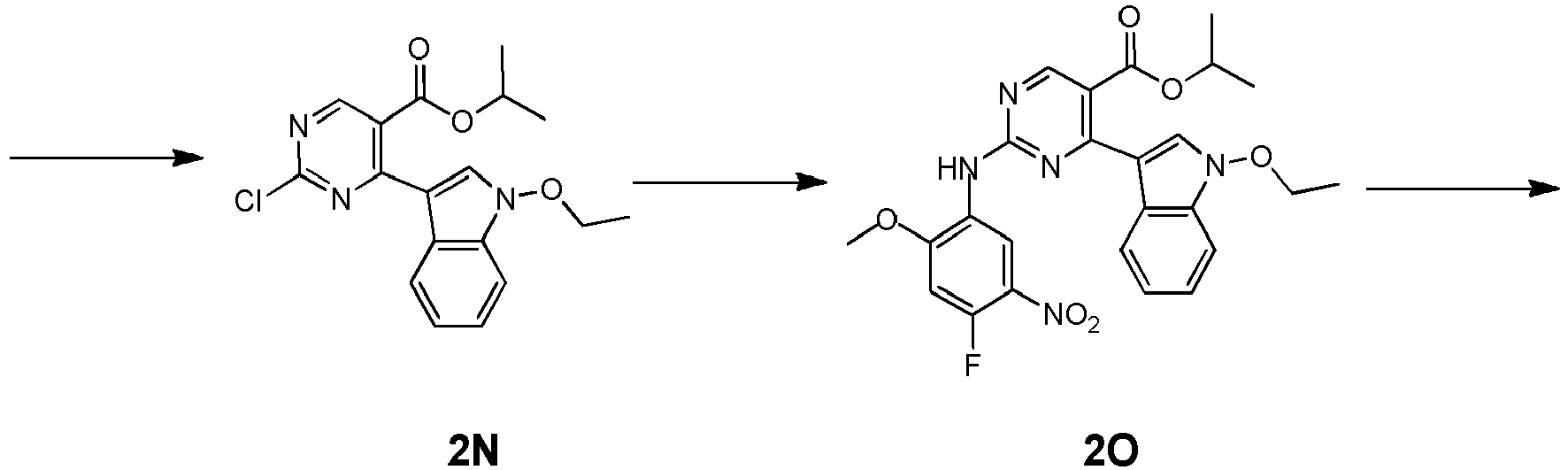
- This compound was prepared according to the method of compound 1B in Embodiment 1, replacing compound 1A with compound 2A.
- This compound was prepared according to the method of compound 1C in Embodiment 1, replacing compound 1B with compound 2B.
- This compound was prepared according to the method of compound 1H in Embodiment 1, replacing compound 1G with compound 2G.
- the present compound was prepared according to the method of compound 1 in Embodiment 1, replacing compound 1O with compound 2R to obtain the title compound.
- This compound was prepared according to the method of compound 1B in Embodiment 1, replacing compound 1A with compound 3A.
- This compound was prepared according to the method of compound 1C in Embodiment 1, replacing compound 1B with compound 3B.
- This compound was prepared according to the method of compound 1H in Embodiment 1, replacing compound 1G with compound 3G.
- This compound was prepared according to the method of compound 1H in Embodiment 1, replacing compound 1G with compound 4F.
- This compound was prepared according to the method of compound IN in Embodiment 1, replacing compound 1M with compound 4O.
- This compound was prepared according to the method of compound 1O in Embodiment 1, replacing compound IN with compound 4P.
- This compound was prepared according to the method of compound 1H in Embodiment 1, replacing compound 1G with compound 5F.
- This compound was prepared according to the method of compound 1O in Embodiment 1, replacing compound IN with compound 5Q.
- mice, SD rat, Beagle, cynomolgus monkey and human plasma were used as materials to investigate the stability of the tested compounds in the plasma of the above five species.
- Propantheline, Enalapril, Bisacodyl and Procaine were used as control compounds.
- the mixed frozen plasma was thawed in a 37 °C water bath prior to the experiment. Plasma was centrifuged at 4000 rpm for 5 minutes and cleared if there was a clot. The pH will be adjusted to 7.4 ⁇ 0.1 if required.
- the intermediate solution of 1 mM compound and positive control was prepared by diluting 10 mM stock solution with 90 ⁇ L of dimethyl sulfoxide. 100 ⁇ M solution was prepared by diluting 20 ⁇ L of intermediate solution (1 mM) with 180 ⁇ L of 45 % methanol/water.
- sample plate was centrifuged at 4000 rpm for 10 minutes. A small portion of the supernatant (50 ⁇ L) was transfered from each well and mixed with 100 ⁇ L of ultrapure water. Samples were vibrated at 800 rpm for approximately 10 minutes prior to LC-MS/MS analysis.
- %residual amount (peak area ratio of control to internal standard at any time point / peak area ratio of control to internal standard at 0 min) ⁇ 100%.
- Table 1 In vitro plasma stability of compounds In vitro plasma stability (Residual percentage at different time points) Compound 1 Human 120 minutes 19% Monkey 120 minutes 93.7% Dog 120 minutes 101.7% Rat 120 minutes 87.9% Mouse 120 minutes 45%
- Table 2 In vitro plasma half-life of compounds Half-life of different species T 1/2 (min) Compound 1 Human T 1/2 51.6 Monkey T 1/2 >289.1 Dog T 1/2 >289.1 Rat T 1/2 >289.1 Mouse T 1/2 108.8
- the compounds of the present disclosure have better plasma stability in different species.
- EGFR WT Invitrogen, Cat. No. PR7295B
- EGFR [L858R] Invitrogen, Cat. No. PR7447A
- EGFR [d746-750] Invitrogen, Cat. No. PV6179
- ATP Sigma, Cat. No. A7699-1G
- DMSO Sigma, Cat. No. D2650
- DTT Sigma, Cat. No. 43815
- 384-well plate compound dilution plate (Greiner, Cat. No. 781280), 384-well plate, test plate (Perkin Elmer, Cat. No. 6007299), HTRF KinEASE TK Kit (Cisbio, Cat. No.
- Final test concentrations of compounds The final test concentrations of the test compounds ranged from 10 ⁇ M to 0.17 nM in 3-fold gradient dilutions at 11 concentrations.
- kinase assay The preparation of the buffer, 50 mM HEPES (pH 7.5), 0.01% BSA, 5 mM MgCl 2 , and 0.1 mM Orthovanadate were contained in the buffer. After the preparation of the buffer, the enzyme and substrate were mixed with pre-diluted prepared compounds of different concentrations, and the mixture was placed at room temperature for 15 minutes. The reaction was initiated by adding ATP and incubated for 60 min at room temperature (wherein negative and positive control were set). 2.5 ⁇ L of compound, 5 ⁇ L of enzyme and substrate mixture and 2.5 ⁇ L of ATP were contained in the 10 ⁇ L reaction system. After the reaction was completed, the antibody was added to the assay, incubated at room temperature for 60 minutes and then detected by Envision (plate reading instrument), and data were collected. Data analysis and plotting were performed according to XLfit5 software (data analysis software).
- a cell counter was used for cell counting, and cell viability was detected to ensure that the viability of each cell line was above 90 %.
- Cell suspension was added to a 96-well plate to bring the cell density to the specified concentration and incubated overnight at 37 °C, 5% CO 2 and 95% humidity.
- the culture medium was added to the T0 plate, the CTG reagent was melted and the cell plate was equilibrated at room temperature.
- CTG solution was added to each well.
- the cell plate was vibrated to lyse the cells and the cold light values were read.
- the compound to be test and the control drug were diluted in a gradient to obtain a 10-fold solution.
- RPMI1640 medium FBS fetal bovine serum, trypsin-EDTA, were all purchased from Giboco.
- DPBS was purchased from Corning
- penicillin/streptomycin solution was purchased from Hyclone
- Cell-Titer Glo reagent was purchased from Promega (1kit, Cat. No. G7571). Plate reading instrument: Envision (PerkinElmer).
- the compounds of the present disclosure have very good anti-proliferation activity against H1975 (L858R/T790M) cells, LU0387 EGFR-H773_V774insNPH (exon 20 insertion mutation), and weak inhibitory effect against A431 (EGFR wild type), indicating that the compounds of the present disclosure has better selectivity.
- RPMI1640 medium was purchased from Hyclone
- FBS fetal bovine serum was purchased from GBICO
- trypsin-EDTA were both purchased from Giboco.
- DPBS was purchased from Corning
- penicillin/streptomycin solution was purchased from Hyclone
- Cell-Titer Glo reagent was purchased from Promega (Cat. No. G7572).
- the cells in the 96-well plates added with drugs were placed at 37 °C, 5 % CO 2 , 95 % humidity and continued to incubate for 72 hours, after which CTG analysis was performed and the cells were vibrated on an orbital shaker to lyse the cells.
- the cell plate was placed at room temperature to stabilize the cold light signal, and the cold light values were read.
- the data were analyzed using GraphPad Prism 7.0 software, and a nonlinear S-curve regression was used to fit the data to derive the dose-effect curve from which the IC 50 values were calculated.
- the IC 50 of anti-proliferation activity against Ba/F3 Exon20 insertion mutant cells of the compounds of the present disclosure is shown in Table 5.
- Table 5 Anti-proliferation activity data of compounds against Ba/F3 exon 20 insertion mutant cells Mutant cells ICso(nM) Compound 1 Compound 2 Compound 3 Compound 4 Compound 5 Ba/F3 EGFR-D770_N771insSVD 27 24 27 54 33 58 Ba/F3 EGFR-H773_V774insNPH / 15 / / / / Ba/F3 EGFR-V769_D770insASV / 7 / / / / BaF3 ERBB2 A775 _G776 ins YVMA / 37 / / / / /
- Ba/F3 exon 20 insertion mutant cells are cell lines with SVD, NPH, ASV, and YVMA insertion mutations artificially constructed using mouse B cells, and it can be seen from Table 5 that the compounds of the present disclosure have better cellular anti-proliferation activity against the more frequent exon 20 insertion mutations such as SVD, NPH, ASV, and YVMA, and also show better anti-proliferation activity against common exon 20 insertion mutations such as SVD mutation.
- mice BALB/c nude mice, female, 6-8 weeks old, weighing 18-22 g. Provided by Shanghai Xipuer-Bikai Laboratory Animal Co., Ltd. or other qualified suppliers.
- Tumor inoculation Tumor tissue was collected from H1975 tumor-bearing mice of human lung cancer xenograft model, cut into 2-3 mm diameter tumor blocks and inoculated subcutaneously at the right anterior scapula of Balb/c nude mice. When the average tumor volume was 145 mm 3 , the tumors were randomly grouped according to their size, and the day of grouping was defined as day 0.
- the antitumor efficacy of the compounds was evaluated by TGI (%) or relative tumor proliferation rate T/C (%). TGI (%), reflecting the tumor growth inhibition rate.
- TGI (%) [(1-(average tumor volume at the end of administration of a treatment group - average tumor volume at the beginning of administration of this treatment group))/(average tumor volume at the end of treatment in the solvent control group - average tumor volume at the beginning of treatment of the solvent control group)] ⁇ 100%.
- Relative tumor proliferation rate T/C (%): The calculation formula was as follows: T/C % T RTV / C RTV ⁇ 100 % (T RTV : RTV in the treatment group; C RTV : RTV in the negative control group).
- Ba/F3 (EGFR-D770 _N771insSVD) cells were artificially constructed cell lines with EGFR-D770_N771insSVD insertion mutation using mouse B cells.
- the CDX model established by this cell line was used to evaluate the inhibitory effect of preferred compounds on Exon 20 EGFR-D770_N771insSVD insertion mutation in animals.
- Tumor diameters were measured with vernier calipers twice a week.
- the antitumor efficacy of the compounds was evaluated by TGI (%) or relative tumor proliferation rate T/C (%).
- T/C (%) T RTV / C RTV ⁇ 100 % (T RTV : mean RTV in the treatment group; C RTV : mean RTV in the solvent control group).
- the relative tumor volume (RTV) was calculated according to the results of tumor measurement.
- T RTV and C RTV were taken on the same day.
- TGI (%) reflecting the tumor growth inhibition rate.
- TGI (%) [(1-(average tumor volume at the end of administration of a treatment group - average tumor volume at the beginning of administration of this treatment group))/(average tumor volume at the end of treatment in the solvent control group - average tumor volume at the beginning of treatment of the solvent control group)] ⁇ 100%.
- T and C represented the tumor weight of the administration group and the solvent control group, respectively.
- Table 7 Inhibitory effect of compounds against Ba/F3 (EGFR-D770_N771insSVD) subcutaneous allograft tumor model Groups Tumor volume (mm 3 ) a (Day 0) Tumor volume (mm 3 ) a (Day 14) RTV TGI (%) T/C (%) Blank 133.5 ⁇ 7.6 1734.7 ⁇ 281.7 13.0 -- -- Compound 1 133.2 ⁇ 8.2 259.1 ⁇ 35.2 1.9 92.1 14.9
- mice BALB/c Nude mice, female, 7-8 weeks, HuPrime ® lung cancer xenograft model LU0387 tumor-bearing mouse tumor tissue.
- mice were subcutaneously inoculated with HuPrime ® model LU0387 tumor blocks to establish a human lung cancer subcutaneous transplantation tumor model.
- the test was divided into a solvent control group and a test drug group.
- the drug was administered by gavage, once daily for 21 days.
- Efficacy was evaluated based on relative tumor inhibition rate (TGI), and the safety was evaluated based on animal weight change and mortality.
- TGI tumor inhibition rate
- Tumor diameters were measured with vernier calipers twice a week.
- the antitumor efficacy of the compounds was evaluated by TGI (%) or relative tumor proliferation rate T/C (%).
- T/C (%) T RTV / C RTV ⁇ 100 % (T RTV : mean RTV in the treatment group; C RTV : mean RTV in the solvent control group).
- the relative tumor volume (RTV) was calculated according to the results of tumor measurement.
- T RTV and C RTV were taken on the same day.
- TGI % 1 ⁇ average tumor volume at the end of administration of a treatment group ⁇ average tumor volume at the beginning of administration of this treatment group / average tumor volume at the end of treatment in the solvent control group ⁇ average tumor volume at the beginning of treatment of the solvent control group ⁇ 100 % .
- T and C represented the tumor weight of the administration group and the solvent control group, respectively.
- Pharmacokinetic data analysis The plasma drug concentration data of the compounds were processed using pharmacokinetic software with a non-compartmental model. The peak concentration (C max ) and time to peak (T max ), as well as the quantifiable end time were obtained directly from the plasma concentration-time curve. The following pharmacokinetic parameters were calculated using the log-linear trapezoidal method: half-life (T 1/2 ), apparent volume of distribution (V dss ), and clearance (Cl), area under the time-plasma concentration curve from point 0 to the end time point (AUC 0-last ), and initial concentration (Co).
- mice Compound 1 Intravenous injection Dose (mg/kg/day) 2 Cl (mL/kg/min) 57.7 V dss (L/kg) 6.95 Exposure of AUC (nmol ⁇ h/L) 884 T 1/2 (h) 1.76 Oral Dose (mg/kg/day) 10 C max (nmol) 300 T max (h) 2.00 Exposure of AUC 0-last (nmol ⁇ h /L): 1421 Oral bioavailability (%) 22.1 Table 9-2 Pharmacokinetic parameters of single intravenous and oral administration of different doses in rats Administration method PK parameters in rats Compound 1 Intravenous injection Dose (mg/kg/day) 2 Cl (mL/kg/min) 90.5 V dss (L/kg) 18.0 Exposure of AUC (nmol ⁇ h
- the compounds of the present disclosure has good oral absorption, high exposure, good bioavailability and good PK property in mice, rats and dogs.
Landscapes
- Chemical & Material Sciences (AREA)
- Organic Chemistry (AREA)
- Health & Medical Sciences (AREA)
- Life Sciences & Earth Sciences (AREA)
- General Health & Medical Sciences (AREA)
- Veterinary Medicine (AREA)
- Public Health (AREA)
- Pharmacology & Pharmacy (AREA)
- Medicinal Chemistry (AREA)
- Animal Behavior & Ethology (AREA)
- Chemical Kinetics & Catalysis (AREA)
- General Chemical & Material Sciences (AREA)
- Nuclear Medicine, Radiotherapy & Molecular Imaging (AREA)
- Epidemiology (AREA)
- Pharmaceuticals Containing Other Organic And Inorganic Compounds (AREA)
- Plural Heterocyclic Compounds (AREA)
- Nitrogen Condensed Heterocyclic Rings (AREA)
Abstract

Description
-
CN201910684658.1, filed on July 26, 2019 - The present disclosure relates to a class of pyrimidine compounds and pharmaceutically acceptable salts thereof that act on EGFR exon 20 insertion mutations and
ERBB2 exon 20 insertion mutations. - Lung cancer is one of the most common malignancies, with 1.6 million new lung cancer cases worldwide each year, accounting for 13 % of all malignancies, and there are1.4 million deaths due to lung cancer each year. As the world's leading cancer killer, the incidence of lung cancer is still on the rise worldwide in recent years. Non-small cell lung cancer (NSCLC) accounts for approximately 85 % of all lung cancers. Since patients with NSCLC do not have distinctive features in the early stages, most patients are already at an advanced stage at the time of diagnosis, and 65 % of NSCLC are already lost the opportunity to surgery at the time of diagnosis. Therefore, drug therapy, namely chemotherapy and targeted therapy, is essential for the treatment of patients with advanced NSCLC.
- EGFR is a major member of the ErbB family of tyrosine kinase receptors, the ErbB family includes ErbB1 (EGFR or HER1), ErbB2 (HER2), ErbB3 (HER3) and ErbB4 (HER4). EGFR consists of an extracellular ligand-binding domain, an α-helical transmembrane domain, an intracellular tyrosine kinase domain, and a carboxy-terminal region containing an autophosphorylation site. When the ligand binds to the receptor, it causes EGFR dimerization, activates intracellular protein tyrosine kinase activity, causes autophosphorylation of tyrosine residues, recruits related signaling proteins, and causes activation of downstream ERK/MAPK, PI3K/Akt and STAT signaling pathway, thereby regulating tumor cell proliferation, survival, differentiation, metastasis and tumor angiogenesis. Therefore, targeted therapy against EGFR can inhibit the transmission of downstream signaling pathways to inhibit tumor growth and differentiation.
- EGFR Exon 20 insertion mutation is the third largest series of EGFR gene mutations in NSCLC, accounting for about 4 %-7 % of the entire EGFR mutations, and the amino acid sites translated in
exon 20 are 762-823. The glutamate Glu762 starting at the N-terminus is an important catalytic site, followed by Ala763-Met766, the C-helix of the EGFR tyrosine kinase domain, which plays an important role in phosphate transfer. EGFRexon 20 insertion mutations mostly occur in Asian, female, non-smoking, and adenocarcinoma populations, and have the same clinical and pathological features as classical EGFR mutations. The most common type of mutation inexon 20 is Asp770_Asn771insSerValAsp, followed by Val769_Asp770insAlaSerVal, Asp770_Asn771insSerValAsp, Ala767_Val769dupAlaSerVal, Val769_Asp770insAlaSerVa and Ser768 _Asp770dupSerValAsp, they have similar insertion sequence, accounting for 36 % of theexon 20 mutations. In addition, the main mutation type is His773_Val774insAsnProHis, accounting for about 14% ofexon 20 mutations. - HER2 Exon 20 insertion mutations account for more than 95% of all HER2 mutation types, wherein among
HER2 exon 20 insertion mutation types, A775_G776_ins YVMA accounting for 85%, which is the most common mutation type. - There are currently no targeted drugs on the market that effectively inhibit EGFR and HER2 exon20 insertion mutations. In clinical studies, the marketed EGFR TKIs such as (Erlotinib/Gefitinib/Afatinib) lack efficacy and have low response rates against either EGFR or HER2 Exon20 insertion mutations. For example, the PFS of patients with EGFR Exon20 insertion mutation is only 2 months, which is much lower than that of patients with traditional mutations (Exon19 deletion & L858R). Second-generation EGFR inhibitors, such as afatinib and dacomitinib, have also been clinically reported to be less effective against
exon 20 insertion mutations, so there is a large unmet clinical need for EGFR andHER2 exon 20 insertion mutations. - The EGFR and
HER2 exon 20 insertion mutation inhibitor TAK788 developed by Japan's Takeda Pharmaceutical has shown good efficacy in preclinical and clinical phase I/II for non-small cell lung cancer with EGFR andHER2 exon 20 insertion mutation. According to clinical reports, the objective response rate of TAK788 is 43% and the disease control rate of TAK788 is 86%. The safety is similar to other marketed EGFR-TKIs, and TAK788 has a good prospect for the treatment of EGFR and HER2 exon 20 insertion mutations. - The present disclosure provides a compound represented by formula (I) or a pharmaceutically acceptable salt thereof,

- wherein,
- R1 is selected from C1-3 alkyl,
- R2 is selected from H, F, Cl, Br, I, C1-3 alkyl and cyclopropyl.
- In some embodiments of the present disclosure, the R1 is selected from methyl, ethyl and isopropyl, and other variables are as defined herein.
- In some embodiments of the present disclosure, the R2 is selected from H, Cl and cyclopropyl, and other variables are as defined herein.
- There are still some solutions of the present disclosure which are obtained by any combination of the above variables.
- The present disclosure also provides a compound represented by the following formula or a pharmaceutically acceptable salt thereof,


- In some embodiments of the present disclosure, the pharmaceutically acceptable salt thereof is selected from


- The present disclosure also provides a pharmaceutical composition comprising a therapeutically effective amount of the compound or the pharmaceutically acceptable salt thereof as the active ingredient and a pharmaceutically acceptable carrier.
- The present disclosure also provides a use of the compound or the pharmaceutically acceptable salt thereof or the pharmaceutical composition in the manufacture of a medicament for diseases related to EGFR or ERBB2.
- The present disclosure also provides a use of the compound or the pharmaceutically acceptable salt thereof or the pharmaceutical composition in the manufacture of a medicament for the treatment of cancer.
- The compounds of the present disclosure show better activity against EGFR and
ERBB2 exon 20 insertion mutation, and may provide more effective treatment for diseases caused by abnormality of epidermal growth factor receptor enzyme. - Unless otherwise specified, the following terms and phrases when used herein have the following meanings. A specific term or phrase should not be considered indefinite or unclear in the absence of a particular definition, but should be understood in the ordinary sense. When a trading name appears herein, it is intended to refer to its corresponding commodity or active ingredient thereof.
- The term "pharmaceutically acceptable" is used herein in terms of those compounds, materials, compositions, and/or dosage forms, which are suitable for use in contact with human and animal tissues within the scope of reliable medical judgment, with no excessive toxicity, irritation, an allergic reaction or other problems or complications, commensurate with a reasonable benefit/risk ratio.
- The term "pharmaceutically acceptable salt" refers to a salt of the compound of the present disclosure that is prepared by reacting the compound having a specific substituent of the present disclosure with a relatively non-toxic acid or base. When the compound of the present disclosure contains a relatively acidic functional group, a base addition salt can be obtained by bringing the neutral form of the compound into contact with a sufficient amount of base in a pure solution or a suitable inert solvent. The pharmaceutically acceptable base addition salt includes a salt of sodium, potassium, calcium, ammonium, organic amine or magnesium, or similar salts. When the compound of the present disclosure contains a relatively basic functional group, an acid addition salt can be obtained by bringing the neutral form of the compound into contact with a sufficient amount of acid in a pure solution or a suitable inert solvent. Examples of the pharmaceutically acceptable acid addition salt include an inorganic acid salt, wherein the inorganic acid includes, for example, hydrochloric acid, hydrobromic acid, nitric acid, carbonic acid, bicarbonate, phosphoric acid, monohydrogen phosphate, dihydrogen phosphate, sulfuric acid, hydrogen sulfate, hydroiodic acid, phosphorous acid, and the like; and an organic acid salt, wherein the organic acid includes, for example, acetic acid, propionic acid, isobutyric acid, maleic acid, malonic acid, benzoic acid, succinic acid, suberic acid, fumaric acid, lactic acid, mandelic acid, phthalic acid, benzenesulfonic acid, p-toluenesulfonic acid, citric acid, tartaric acid, and methanesulfonic acid, and the like; and salts of amino acid (such as arginine and the like), and a salt of an organic acid such as glucuronic acid and the like. Certain specific compounds of the present disclosure contain both basic and acidic functional groups, thus can be converted to any base or acid addition salt.
- The pharmaceutically acceptable salt of the present disclosure can be prepared from the parent compound that contains an acidic or basic moiety by conventional chemical method. Generally, such salt can be prepared by reacting the free acid or base form of the compound with a stoichiometric amount of an appropriate base or acid in water or an organic solvent or a mixture thereof.
- Unless otherwise specified, the term "effective amount" or "therapeutically effective amount" refers to an amount that is nontoxic but achieves the desired effect. The determination of the effective amount varies from person to person, depends on the age and general condition of the recipient, and also depends on the specific active substance, and the appropriate effective amount in individual cases can be determined by those skilled in the art based on routine experiments.
- Unless otherwise specified, the term "C1-3 alkyl" refers to a linear or branched saturated hydrocarbon group containing 1 to 3 carbon atoms. The C1-3 alkyl group includes C1-2 and C2-3 alkyl groups and the like; it can be monovalent (such as methyl), divalent (such as methylene) or multivalent (such as methine). Examples of C1-3 alkyl include but are not limited to methyl (Me), ethyl (Et), propyl (including n- and isopropyl) and the like.
- The solvents used in the present disclosure are commercially available.
- The following abbreviations are used in the present disclosure: DMF refers to N,N-dimethylformamide; TsOH.H2O refers to p-toluenesulfonic acid monohydrate; EDCI refers to 1-ethyl-3-(3-dimethylpropylamino)carbodiimide; DBU refers to 1,8-diazabicycloundec-7-ene; DIPEA refers to N,N-diisopropylethylamine; NaH refers to sodium hydrogen; EtONa refers to sodium ethoxide; m-CPBA refers to m-chloroperoxybenzoic acid; DCM refers to dichloromethane; NH4Cl refers to ammonium chloride; NaOH refers to sodium hydroxide; DMF-DMA refers to N,N-dimethylformamide dimethyl acetal; MgCl2 refers to magnesium chloride; CDI refers to carbonyl diimidazole; THF refers to tetrahydrofuran; NaH2PO4 refers to potassium dihydrogen phosphate; t-BuOH refers to tert-butanol; POCl3 refers to phosphorus trichloroxide; NaClO2 refers to sodium chlorite; TOMAC refers to trioctyl methyl ammonium chloride; MTBE refers to methyl tert-butyl ether.
- The filler used in the column chromatography separation of the present disclosure are silica gel without special description; the filler used in the thin layer chromatography separation of the present disclosure is silica gel without special description.
- The compounds of the present disclosure are named according to the conventional naming principles in the art or by ChemDraw® software, and the commercially available compounds use the supplier catalog names.
-
-
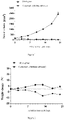
Figure 1 shows the tumor growth curve of human lung cancer NCI-H1975 mice subcutaneous xenograft tumor model. -
Figure 2 shows the weight changes of tumor-bearing mice in human lung cancer NCI-H1975 mice subcutaneous xenograft tumor model during administration. -
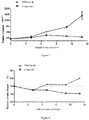
Figure 3 shows the tumor growth curve of Ba/F3 EGFR D770_N771 ins SVD subcutaneous allograft tumor model. -
Figure 4 shows the weight changes of tumor-bearing mice in Ba/F3 EGFR D770_N771 ins SVD subcutaneous allograft tumor model during administration. -
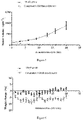
Figure 5 shows the tumor growth curve of HuPrime lung cancer LU0387 mice subcutaneous xenograft tumor model. -
Figure 6 shows the weight changes of tumor-bearing mice in HuPrime lung cancer LU0387 mice subcutaneous xenograft tumor model during administration. - The present disclosure is described in detail by the embodiments below, but it does not mean that there are any adverse restrictions on the present disclosure. The compounds of the present disclosure can be prepared by a variety of synthetic methods known to those skilled in the art, including the specific embodiments listed below, embodiments resulting from their combination with other chemical synthesis methods, and equivalent substitutions known to those skilled in the art, preferred embodiments including, but not limited to, embodiments of the present disclosure. It will be apparent to those skilled in the art that various variations and improvements can be made to specific embodiments of the present disclosure without departing from the spirit and scope of the present disclosure.
-


- To a solution of compound 1A (12.3 g, 89.69 mmol) in DMF (100 mL) were added DBU (1.37 g, 8.97 mmol) and DMF-DMA(26.91 g, 225.83 mmol). The mixture was stirred at 120-130 °C for 16 hours, and the reaction was completed. The reaction solution was concentrated to obtain the title compound.

- To a solution of compound 1B (17.24 g, 89.69 mmol) in MTBE (300 mL) were added zinc powder (70 g, 1.07 mol) and aqueous solution (60 mL) of ammonium chloride (19 g, 355.20 mol) in batches under nitrogen protection. The mixture was stirred at 20-30 °C for 4 hours. The reaction was completed. The reaction solution was filtered under reduced pressure, and the filter cake was washed with MTBE (50 mL), then the filtrates were combined and washed with saturated sodium bicarbonate aqueous solution (50 mL × 2) and dried over anhydrous sodium sulfate to obtain a solution of the title compound, which can be directly used in the next reaction step. LCMS (ESI): m/z: 134.6 [M+1].

- To a solution of compound 1C (11.94 g, 89.68 mmol) in MTBE (350 mL) were added iodomethane (68.40 g, 481.9 mmol), NaOH aqueous solution (2.5 M, 300 mL) and TOMAC (1.81 g, 4.48 mmol). The mixture was stirred at 20-30 °C for 12 hours, and the reaction was completed. The phases of the reaction solution were seaparated, and the lower aqueous phase was extracted with ethyl acetate (100 mL), then the organic phases were combined, dried with anhydrous sodium sulfate, filtered and concentrated. The crude product was separated and purified by silica gel column chromatography (petroleum ether: ethyl acetate = 80:1, v/v) to obtain the title compound. 1H NMR (400 MHz, CDCl3-d) δ = 7.62 - 7.57 (m, 1H), 7.45 (dd, J = 0.9, 8.2 Hz, 1H), 7.27 (d, J = 3.4 Hz, 1H), 7.26 - 7.23 (m, 1H), 7.11 (ddd, J = 1.0, 7.0, 7.9 Hz, 1H), 6.36 (dd, J= 0.7, 3.4 Hz, 1H), 4.09 (s, 3H). LCMS (ESI) m/z: 148.6 [M+1].

- Under nitrogen protection, POCl3 (4.7 g, 30.65 mmol, 2.85 mL) was slowly added dropwise to DMF (20 mL) solution at 0-10 °C, and after stirring for 15 minutes, compound 1D (2.3 g, 15.63 mmol) was added, and the mixture was stirred at 20-30 °C for 2 hours. The reaction solution was quenched by adding 15% NaOH (20 mL) aqueous solution, and the reaction solution was extracted by adding ethyl acetate (20 mL × 3). The combined organic phases were dried with anhydrous sodium sulfate, filtered and concentrated. The crude product was separated and purified by silica gel column chromatography (petroleum ether: ethyl acetate = 10: 1 v/v) to obtain the title compound. 1H NMR (400 MHz, CDCl3-d) δ = 9.99 (s, 1H), 8.36 - 8.31 (m, 1H), 7.91 (s, 1H), 7.53 - 7.48 (m, 1H), 7.40 (dt, J = 1.3, 7.6 Hz, 1H), 7.38 - 7.33 (m, 1H), 4.21 (s, 3H).

- To a solution of compound 1E (2.6 g, 14.84 mmol) in t-BuOH (120 mL) and 2-methyl-2-butene (120 mL) was added aqueous solution (150 mL) of NaClO2 (26.85 g, 296.83 mmol) and NaH2PO4 (26.71 g, 222.62 mmol) in batches at 0 °C, and the mixture was stirred at 20-30 °C for 24 hours. The reaction solution was extracted by adding ethyl acetate (300 mL), and the organic phase was dried with anhydrous sodium sulfate, filtered, and the filtrate was concentrated to obtain the title compound. 1H NMR (400 MHz, CDCl3-d) δ = 8.18 - 8.14 (m, 1H), 7.99 (s, 1H), 7.45 - 7.39 (m, 1H), 7.26 (d, J = 1.1, 7.3 Hz, 2H), 4.11 (s, 3H). LCMS (ESI) m/z: 192.5 [M+1].

- Compound 1F (2.8 g, 14.65 mmol) and CDI (3.56 g, 21.97 mmol) were dissolved in THF (50 mL) and the mixture was stirred at 20 °C for 2 hours. To the mixture were added the potassium salt of monoethyl malonate (3.74 g, 21.97 mmol) and MgCl2 (2.79 g, 29.29 mmol); and the reaction solution was stirred at 20-30 °C for 18 hours. Ethyl acetate (60 mL) was added to the reaction mixture, and the reaction solution was washed with water (50 mL), then the aqueous phase was extracted with ethyl acetate (50 mL), and the organic phases were combined, dried over anhydrous sodium sulfate, filtered and concentrated. The crude product was purified by silica gel column chromatography (petroleum ether: ethyl acetate = 10: 1 v/v) to obtain the title compound. 1H NMR (400 MHz, CDCl3-d) δ = 8.33 - 8.28 (m, 1H), 7.92 (s, 1H), 7.42 - 7.38 (m, 1H), 7.27 (dtd, J= 1.2, 7.3, 16.3 Hz, 2H), 4.18 - 4.12 (m, 2H), 4.11 (s, 3H), 3.78 (s, 2H), 1.20 (t, J= 7.2 Hz, 3H). LCMS (ESI) m/z: 262.1 [M+1].


- Compound 1G (0.5 g, 1.91 mmol) was added to DMF-DMA(0.26 g, 2.18 mmol) and the reaction solution was stirred at 80-90 °C for 1 hour. The reaction solution was concentrated to obtain the title compound. The crude product can be used directly in the next reaction step.

- Compound 1H (605 mg, 1.91 mmol) was dissolved in ethanol (6 mL), then EtONa (0.27 g, 3.97 mmol) and S-methylisothiourea sulfate (300 mg, 1.08 mmol) were added slowly, the mixture was stirred at 30 °C for 12 hours. The reaction solution was concentrated, and ethyl acetate (30 mL) was added to the mixture, then the reaction solution was washed with saturated saline (20 mL), and the organic phase was dried with anhydrous sodium sulfate, filtered and concentrated. The crude product was separated and purified by silica gel preparative thin layer chromatography plates (petroleum ether: ethyl acetate = 5:1) to obtain the title compound. 1H NMR (400 MHz, CDCl3-d) 8 = 8.86 (s, 1H), 8.18 - 8.14 (m, 1H), 8.09 (s, 1H), 7.51 (td, J = 0.9, 8.1 Hz, 1H), 7.37 - 7.32 (m, 1H), 7.29 - 7.24 (m, 1H), 4.31 (q, J = 7.1 Hz, 2H), 4.19 (s, 3H), 2.70 (s, 3H), 1.23 (t, J= 7.1 Hz, 3H). LCMS (ESI) m/z: 344.2 [M+1].

- Compound 1I (180 mg, 0.524 mmol) was dissolved in DCM (5 mL), and m-CPBA (226 mg, 1.05 mmol, 80% purity) was added to the mixture; and the reaction solution was stirred at 25 °C for 5 hours. The reaction solution was quenched by adding saturated sodium sulfite solution (20 mL), extracted by adding DCM (50 mL), and the organic phase was dried with anhydrous sodium sulfate, filtered and concentrated to obtain the title compound. LCMS (ESI) m/z: 376.0 [M+1].

- To a solution of compound 1J (300 mg, 0.8 µmol) and 4-fluoro-2-methoxy-5-nitroaniline (179 mg, 0.961 mmol) in dioxane (10 mL) was added TsOH.H2O (456 mg, 2.40 mmol), and the reaction solution was stirred at 100 °C for 16 hours. The reaction mixture was extracted by adding ethyl acetate (50 mL), and the organic phase was washed with saturated sodium bicarbonate (30 mL), then the organic phase was separated and dried with anhydrous sodium sulfate, filtered and concentrated to obtain a crude product, which was separated and purified by silica gel preparative thin layer chromatography (petroleum ether: ethyl acetate = 2:1) to obtain the title compound. LCMS (ESI) m/z: 482.1 [M+1].

- To a solution of compound 1K (150 mg, 311.57 µmol) in DMF (2 mL) were added N,N,N-trimethylethylenediamine (58 mg, 567.6 µmol) and DIPEA (82.14 mg, 0.635 mmol). The reaction solution was stirred at 100 °C for 0.5 hours. The reaction solution was cooled to room temperature, then purified water (20 mL) was added, and a solid was precipitated from the solution, then the mixture was filtered under reduced pressure, and the filter cake was dried to obtain the title compound. LCMS (ESI) m/z: 564.2 [M+1].

- NaH (47 mg, 1.18 mmol, 60% purity) was added to isopropanol (1 mL) under nitrogen protection, and the reaction solution was stirred at 25 °C for 15 min. A solution of compound 1L (130 mg, 230.66 µmol) in THF (0.5 mL) was added dropwise to the above solution. The reaction solution was stirred at 80° C for 1 hour. The reaction solution was quenched by adding purified water (30 mL), and the aqueous phase was extracted with DCM (60 mL), then the organic phase was dried and concentrated to obtain the title compound. LCMS (ESI) m/z: 578.0 [M+1].

- To a solution of compound 1M (89 mg, 0.154 mmol) in ethanol (3 mL) and purified water (1 mL) were added zinc powder (101 mg, 1.54 mmol) and NH4Cl (83 mg, 1.55 mmol) under nitrogen protection, and the reaction solution was stirred at 25 °C for 1 hour. The reaction solution was filtered under reduced pressure, and the filtrate was added with purified water (20 mL), then the filtrate was extracted by adding DCM (45 mL), and the organic phase was dried and concentrated to obtain the title compound. LCMS (ESI) m/z: 548.2 [M+1].

- To a solution of compound 1O (84 mg, 153,38 µmol) and acrylic acid (17 mg, 0.236 mmol) in dichloromethane (2 mL) were added EDCI (44 mg, 229 µmol) and DIPEA (40 mg, 309 µmol), and the reaction solution was stirred at 25 °C for 1 hour. Water (10 mL) was added to the reaction mixture, then the mixture was extracted with DCM (15 mL × 2), and the organic phase was separated and dried with anhydrous sodium sulfate, filtered and concentrated to obtain a crude product, which was separated and purified by silica gel preparative thin layer chromatography plate (DCM: MeOH = 10:1) to obtain the title compound. 1H NMR (400 MHz, Methanol-d 4) δ = 9.31 - 9.13 (m, 1H), 8.85 - 8.76 (m, 1H), 8.47 (br d, J = 5.6 Hz, 1H), 7.73 - 7.63 (m, 1H), 7.51 (d, J = 8.3 Hz, 1H), 7.31 - 7.23 (m, 1H), 7.17 - 7.08 (m, 1H), 6.99 (s, 1H), 6.66 - 6.34 (m, 2H), 5.97 - 5.74 (m, 1H), 5.04 - 4.96 (m, 1H), 4.59 (br s, 3H), 4.20 (s, 3H), 3.95 (s, 3H), 3.15 - 3.05 (m, 2H), 2.71 (s, 3H), 2.58 - 2.45 (m, 2H), 2.35 (br s, 3H), 1.08 (d, J = 6.1 Hz, 6H). LCMS (ESI) m/z: 602.3 [M+1].


- To a solution of compound 1O (15 mg, 24.93 µmol) in acetonitrile (0.5 mL) and water (10 mL) was added methanesulfonic acid (2.40 mg, 24.93 µmol). The mixture was freezedried to obtain the title compound. 1H NMR (400 MHz, Methanol-d 4) δ = 9.18 - 8.95 (m, 1H), 8.79 (s, 1H), 8.44 - 8.29 (m, 1H), 7.73 (br d, J = 7.3 Hz, 1H), 7.51 (d, J = 8.3 Hz, 1H), 7.26 (t, J = 7.6 Hz, 1H), 7.17 - 7.08 (m, 1H), 6.97 (s, 1H), 6.58 - 6.31 (m, 2H), 5.83 (dd, J = 2.1, 9.6 Hz, 1H), 5.00 (quin, J = 6.3 Hz, 1H), 4.57 (br s, 3H), 4.19 (s, 3H), 3.96 (s, 3H), 3.25 - 3.10 (m, 2H), 2.77 - 2.62 (m, 6H), 2.48 (br s, 5H), 1.09 (d, J = 6.3 Hz, 6H). LCMS (ESI) m/z: 602.3 [M+1].
-




- This compound was prepared according to the method of compound 1B in
Embodiment 1, replacing compound 1A with compound 2A.
- This compound was prepared according to the method of compound 1C in
Embodiment 1, replacing compound 1B with compound 2B.
- To a solution of compound 2C (11.08 g, 83.22 mmol) in 2-MeTHF (400 mL) were added ethyl iodide (65.13 g, 417.59 mmol), NaOH aqueous solution (2 M, 400 mL) and TOMAC (1.67 g, 4.14 mmol). The mixture was stirred at 20-30 °C for 12 hours. The reaction was completed. The phases of the reaction solution were separated and the lower aqueous phase was extracted with ethyl acetate (200 mL × 2), then the organic phases were combined, dried with anhydrous sodium sulfate, filtered and concentrated. The crude product was purified by silica gel column chromatography (petroleum ether: ethyl acetate = 1:0, v/v) to obtain the title compound. 1H NMR (400 MHz, CDCl3-d) δ = 7.51 (td, J = 0.9, 8.0 Hz, 1H), 7.35 (dd, J = 0.9, 8.2 Hz, 1H), 7.18 - 7.13 (m, 2H), 7.02 (ddd, J = 1.1, 7.0, 8.0 Hz, 1H), 6.27 (dd, J = 1.0, 3.4 Hz, 1H), 4.24 (q,J = 7.1 Hz, 2H), 1.33 (t,J = 7.1 Hz, 3H). LCMS (ESI) m/z: 162.5 [M+1].

- This compound was prepared according to the method of compound 1E in
Embodiment 1, replacing compound 1D with compound 2D. 1H NMR (400 MHz, CDCl3-d) δ = 9.89 (s, 1H), 8.26 - 8.21 (m, 1H), 7.79 (s, 1H), 7.41 - 7.37 (m, 1H), 7.32 - 7.27 (m, 1H), 7.27-7.23 (m, 1H), 4.32 (q, J = 7.0 Hz, 2H), 1.38 (t, J = 7.1 Hz, 3H). LCMS (ESI) m/z: 190.1 [M+1].
- This compound was prepared according to the method of compound 1F in
Embodiment 1, replacing compound 1E with compound 2E. 1H NMR (400 MHz, CDCl3-d) δ = 8.28 - 8.23 (m, 1H), 8.07 (s, 1H), 7.52 - 7.48 (m, 1H), 7.39 - 7.31 (m, 2H), 4.41 (q, J = 7.1 Hz, 2H), 1.47 (t, J= 7.1 Hz, 3H). LCMS (ESI) m/z: 205.8 [M+1].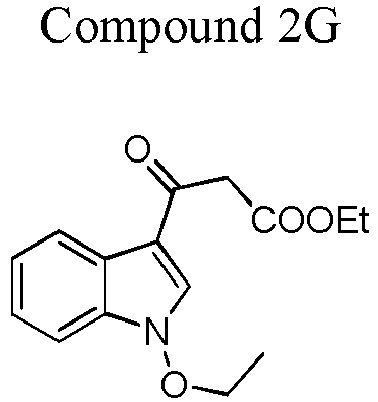
- This compound was prepared according to the method of compound 1G in
Embodiment 1, replacing compound 1F with compound 2F. 1H NMR (400 MHz, CDCl3-d) δ = 8.32 - 8.29 (m, 1H), 7.90 (s, 1H), 7.40 - 7.36 (m, 1H), 7.30 - 7.22 (m, 2H), 4.32 (q, J= 6.9 Hz, 2H), 4.14 (q, J = 7.1 Hz, 2H), 3.78 (s, 2H), 1.38 (t, J = 7.1 Hz, 3H), 1.20 (t, J = 7.1 Hz, 3H). LCMS (ESI) m/z: 276.4 [M+1].
- This compound was prepared according to the method of compound 1H in
Embodiment 1, replacing compound 1G with compound 2G.

- This compound was prepared according to the method of compound 1I in
Embodiment 1, replacing compound 1H with compound 2H. 1H NMR (400 MHz, CDCl3-d) δ = 8.76 (s, 1H), 8.08 (d, J = 8.0 Hz, 1H), 7.97 (s, 1H), 7.40 (d, J = 8.0 Hz, 1H), 7.27 - 7.21 (m, 1H), 7.19 - - 7.14 (m, 1H), 4.32 (q, J = 7.1 Hz, 2H), 4.21 (q, J = 7.1 Hz, 2H), 2.61 (s, 3H), 1.38 (t, J = 7.0 Hz, 3H), 1.14 (t, J = 7.1 Hz, 3H). LCMS (ESI) m/z: 358.2 [M+1].

- Compound 21 (0.74 g, 2.07 mmol) was dissolved in ethanol (8 mL) and sodium hydroxide aqueous solution (2 M, 4 mL) was added. The reaction system was stirred for 1 hour at 20-30 °C. LCMS was used to monitor the end of the reaction. The reaction solution was adjusted to pH 3-4 with hydrochloric acid aqueous solution (2 M), then extracted with ethyl acetate (10 mL × 3). The combined organic phases were dried with anhydrous sodium sulfate and concentrated under reduced pressure to obtain the title compound. 1H NMR (400 MHz, CDCl3-d) δ = 8.90 (s, 1H), 8.15 (d, J = 8.0 Hz, 1H), 8.03 (s, 1H), 7.42 - 7.38 (m, 1H), 7.24 (dt, J = 1.1, 7.6 Hz, 1H), 7.19 - 7.16 (m, 1H), 4.30 (q, J = 7.1 Hz, 2H), 2.62 (s, 3H), 1.36 (t, J = 7.1 Hz, 3H). LCMS (ESI) m/z: 330.3 [M+1].

- Compound 2J (0.66 g, 2.00 mmol) and 2-iodopropane (1.70 g, 10.00 mmol) were dissolved in N,N-dimethylformamide (7 mL), and cesium carbonate (1.31 g, 4.01 mmol) was added. The mixture was stirred for 1 hour at an internal temperature of 40-50 °C. Ethyl acetate (30 mL) was added to the reaction solution, and the mixture was filtered. The filtrate was washed with saturated NaCl aqueous solution (7 mL × 1). The washed aqueous phase was extracted with ethyl acetate (7 mL × 2). The combined organic phases were dried with anhydrous sodium sulfate and concentrated under reduced pressure to obtain the title compound. 1H NMR (400 MHz, CDCl3-d) δ = 8.73 (s, 1H), 8.06 (d, J= 8.1 Hz, 1H), 7.97 (s, 1H), 7.40 (d, J = 8.1 Hz, 1H), 7.26 - 7.21 (m, 1H), 7.19 - 7.13 (m, 1H), 5.07 (spt, J = 6.2 Hz, 1H), 4.31 (q, J= 7.1 Hz, 2H), 2.60 (s, 3H), 1.38 (t, J = 7.1 Hz, 3H), 1.14 (d, J= 6.4 Hz, 6H). LCMS (ESI) m/z: 372.3 [M+1].
- This compound was prepared according to the method of compound 1J in
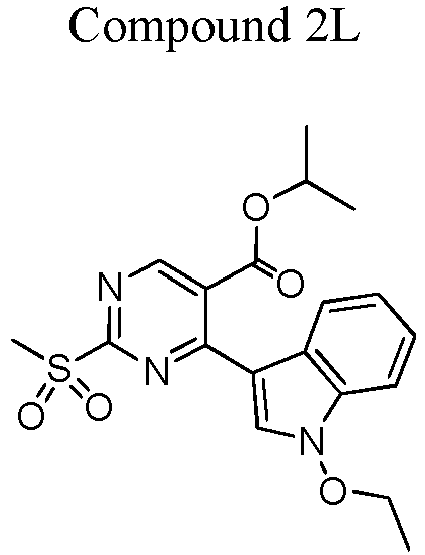
Embodiment 1, replacing compound 1I with compound 2K. 1H NMR (400 MHz, CDCl3-d) δ = 9.00 (s, 1H), 8.40 - 8.35 (m, 1H), 8.22 (s, 1H), 7.54 - 7.49 (m, 1H), 7.41 - 7.32 (m, 2H), 5.29 (m, 1H), 4.43 (q, J = 7.1 Hz, 2H), 3.43 (s, 3H), 1.48 (t, J = 7.1 Hz, 3H), 1.32 (d, J= 6.4 Hz, 6H). LCMS (ESI) m/z: 404.2 [M+1].
- Compound 2L (760 mg, 1.88 mmol) was dissolved in tetrahydrofuran (10 mL), and sodium tert-butoxide (905.17 mg, 9.42 mmol) was added and the reaction was stirred for 1 hour at 25 °C. The end of the reaction was monitor by LCMS. Water (20 mL) was added to the reaction solution and the mixture was extracted with dichloromethane (20 mL × 3 times). The combined organic phases were washed with saturated saline (20 mL × 2 times), the phases were separated, and the organic phase was dried with anhydrous sodium sulfate and filtered, and the filtrate was evaporated to dryness by rotary evaporation to obtain the title compound. 1H NMR (400 MHz, DMSO-d6 ) δ = 8.51 (s, 1H), 7.98 (s, 1H), 7.72 (d, J =8.0 Hz, 1H), 7.47 (d, J =8.2 Hz, 1H), 7.26 - 7.18 (m, 1H), 7.14 - 7.03 (m, 1H), 4.82 - 4.71 (m, 1H), 4.40 - 4.28 (m, 2H), 1.34 (t, J = 7.0 Hz, 3H), 0.96 (d, J = 6.3 Hz, 6H).

- Compound 2M (640 mg, 1.87 mmol) was added to POCl3 (13.20 g, 86.09 mmol) for 1 hour at 80 °C with stirring. The reaction solution was concentrated under reduced pressure and the remaining residue was added with ethyl acetate (20 mL) and saturated sodium bicarbonate aqueous solution (10 mL) at 0 °C. The phases were separated, and the organic phase was washed with saturated saline (20 mL 1), then the phases were separated. The organic phase was dried and concentrated to obtain the title compound. 1H NMR (400 MHz, DMSO-d6 ) δ = 8.91 (s, 1H), 8.35 (s, 1H), 8.12 (d, J =8.0 Hz, 1H), 7.67 - 7.55 (m, 1H), 7.39 - 7.33 (m, 1H), 7.32 - 7.25 (m, 1H), 5.14 (spt, J =6.3 Hz, 1H), 4.42 (q, J = 7.0 Hz, 2H), 1.35 (t, J = 7.0 Hz, 3H), 1.21 (d, J =6.3 Hz, 6H).

- This compound was prepared according to the method of compound 1K in
Embodiment 1, replacing compound 1J with compound 2N. 1H NMR (400 MHz, DMSO-d6 ) δ = 9.12 (s, 1H), 8.82 (d, J =8.4 Hz, 1H), 8.78 (s, 1H), 8.21 (s, 1H), 7.84 (br d, J =7.3 Hz, 1H), 7.60 - 7.49 (m, 1H), 7.41 (d, J =13.4 Hz, 1H), 7.33 - 7.25 (m, 1H), 7.10 (t, J =7.4 Hz, 1H), 5.10 - 4.95 (m, 1H), 4.40 (q, J =7.0 Hz, 2H), 3.99 (s, 3H), 1.38 - 1.34 (m, 3H), 1.15 (d, J =6.2 Hz, 6H).
- This compound was prepared according to the method of compound 1L in
Embodiment 1, replacing compound 1K with compound 2O. 1H NMR (400 MHz, DMSO-d6 ) δ = 8.93 (s, 1H), 8.75 - 8.68 (m, 1H), 8.28 (s, 1H), 8.17 (s, 1H), 7.85 (br s, 1H), 7.55 - 7.49 (m, 1H), 7.25 (t, J =7.6 Hz, 1H), 7.07 (br d, J =7.8 Hz, 1H), 6.88 - 6.76 (m, 1H), 5.02 (td, J =6.3, 12.4 Hz, 1H), 4.41 - 4.35 (m, 2H), 3.94 - 3.89 (m, 3H), 3.30 - 3.27 (m, 2H), 2.86 (s, 3H), 2.48 - 2.47 (m, 2H), 2.15 (s, 6H), 1.36 - 1.32 (m, 3H), 1.18 - 1.14 (m, 6H).
- This compound was prepared according to the method of compound IN in
Embodiment 1, replacing compound 1M with compound 2P. 1H NMR (400 MHz, DMSO-d6 ) δ = 8.74 - 8.65 (m, 2H), 8.01 -7.87 (m, 2H), 7.51 (d, J =8.2 Hz,1H), 0 7.25 (br t, J =7.4 Hz, J =7.0 Hz, 2H), 3.71 (s, 3H), 2.95 - 2.90 (m, 2H), 2.65 (s, 3H), 2.40 (br d, J =6.4 Hz, 2H), 2.20 (s, 6H), 1.34 (t, J =7.0 Hz, 3H), 1.15 (d, J =6.2 Hz, 6H).
- This compound was prepared according to the method of compound 1O in
Embodiment 1, replacing compound IN with compound 2Q. LCMS (ESI) m/z: 616.2 [M+1].
- The present compound was prepared according to the method of
compound 1 inEmbodiment 1, replacing compound 1O with compound 2R to obtain the title compound. 1H NMR (400 MHz, Methanol-d 4) δ = 8.80 (s, 1H), 8.56 (s, 1H), 8.11 (s, 1H), 7.90 (d, J =8.0 Hz, 1H), 7.50 (d, J =8.3 Hz, 1H), 7.25 (t, J =7.3 Hz, 1H), 7.16 - 7.08 (m, 1H), 6.96 (s, 1H), 6.50 - 6.41 (m, 2H), 5.93 - 5.76 (m, 1H), 5.06 (td, J =6.2, 12.5 Hz, 1H), 4.41 (q, J =7.0 Hz, 2H), 4.01 (s, 3H), 3.52 - 3.44 (m, 2H), 3.28 - 3.25 (m, 2H), 2.86 (s, 6H), 2.70 (d, J =3.0 Hz, 6H), 1.43 (t, J =7.0 Hz, 3H), 1.16 (d, J =6.3 Hz, 6H). -


- This compound was prepared according to the method of compound 1B in
Embodiment 1, replacing compound 1A with compound 3A.
- This compound was prepared according to the method of compound 1C in
Embodiment 1, replacing compound 1B with compound 3B.
- To a solution of compound 3C (1.39 g, 10.44 mmol) in 2-MeTHF (50 mL) were added 2-iodopropane (8.50 g, 50 mmol), NaOH aqueous solution (2 M, 50 mL) and TOMAC (210 mg, 519.60 µmol). The mixture was stirred at 20-30 °C for 48 hours. The reaction was completed. The phases of the reaction solution were separated and the lower aqueous phase was extracted with ethyl acetate (20 mL × 2), then the organic phases were combined, dried with anhydrous sodium sulfate, filtered and concentrated. The crude product was purified by silica gel column chromatography (petroleum ether: ethyl acetate = 1:0, v/v) to obtain the title compound. 1H NMR (400 MHz, CDCl3-d) δ = 7.51 (d, J = 7.8 Hz, 1H), 7.33 (dd, J = 0.9, 8.2 Hz, 1H), 7.17 - 7.11 (m, 2H), 7.01 (dt, J = 1.0, 7.6 Hz, 1H), 6.26 (dd, J = 0.7, 3.4 Hz, 1H), 4.47 (spt, J = 6.2 Hz, 1H), 1.29 (d, J = 6.4 Hz, 6H). LCMS (ESI) m/z: 176.5 [M+1].

- This compound was prepared according to the method of compound 1E in
Embodiment 1, replacing compound 1D with compound 3D. 1H NMR (400 MHz, CDCl3-d) δ = 9.99 (s, 1H), 8.32 (d, J = 7.6 Hz, 1H), 7.85 (s, 1H), 7.50 - 7.45 (m, 1H), 7.41 - 7.31 (m, 2H), 4.65 (spt, J = 6.2 Hz, 1H), 1.42 (d, J = 6.1 Hz, 6H). LCMS (ESI) m/z: 204.5 [M+1].
- This compound was prepared according to the method of compound 1F in
Embodiment 1, replacing compound 1E with compound 3E. 1H NMR (400 MHz, CDCl3-d) δ = 8.29 - 8.23 (m, 1H), 8.04 (s, 1H), 7.51 - 7.46 (m, 1H), 7.38 - 7.30 (m, 2H), 4.65 (spt, J = 6.1 Hz, 1H), 1.42 (d, J= 6.3 Hz, 6H). LCMS (ESI) m/z: 220.4 [M+1].
- This compound was prepared according to the method of compound 1G in
Embodiment 1, replacing compound 1F with compound 3F. 1H NMR (400 MHz, CDCl3-d) δ = 8.42 - 8.37 (m, 1H), 7.95 (s, 1H), 7.47 - 7.43 (m, 1H), 7.38 - 7.30 (m, 2H), 4.69 - 4.60 (m, 1H), 4.23 (q, J = 7.2 Hz, 2H), 3.87 (s, 2H), 1.42 (d, J = 6.4 Hz, 6H), 1.29 (t, J = 7.2 Hz, 3H). LCMS (ESI) m/z: 289.9 [M+1].
- This compound was prepared according to the method of compound 1H in
Embodiment 1, replacing compound 1G with compound 3G.
- This compound was prepared according to the method of compound 1I in
Embodiment 1, replacing compound 1H with compound 3H. 1H NMR (400 MHz, CDCl3-d) δ = 8.84 (s, 1H), 8.18 (d, J = 8.0 Hz, 1H), 8.02 (s, 1H), 7.47 (d, J = 8.0 Hz, 1H), 7.32 (dt, J = 1.1, 7.6 Hz, 1H), 7.28 - 7.23 (m, 1H), 4.64 (spt, J = 6.2 Hz, 1H), 4.30 (q, J= 7.3 Hz, 2H), 2.70 (s, 3H), 1.43 (d, J = 6.3 Hz, 6H), 1.22 (t, J = 7.2 Hz, 3H). LCMS (ESI) m/z: 372.3 [M+1].
- This compound was prepared according to the method of compound 2J in Embodiment 2, replacing
compound 21 with compound 31. 1H NMR (400 MHz, CDCl3-d) δ = 8.87 (s, 1H), 8.24 (d, J = 7.8 Hz, 1H), 8.02 (s, 1H), 7.41 (d, J = 8.1 Hz, 1H), 7.28 - 7.19 (m, 2H), 4.59 - 4.49 (m, 1H), 2.68 (s, 3H), 1.32 (d, J = 5.9 Hz, 6H). LCMS (ESI) m/z: 344.2 [M+1].
- This compound was prepared according to the method of compound 2K in Embodiment 2, replacing compound 2J with compound 3J. 1H NMR (400 MHz, CDCl3-d) δ = 8.81 (s, 1H), 8.19 - 8.13 (m, 1H), 8.03 (s, 1H), 7.47 (d, J = 8.1 Hz, 1H), 7.32 (dt, J = 1.1, 7.6 Hz, 1H), 7.27 - 7.22 (m, 1H), 5.16 (spt, J = 6.3 Hz, 1H), 4.63 (spt, J = 6.2 Hz, 1H), 2.69 (s, 3H), 1.43 (d, J = 6.1 Hz, 6H), 1.23 (d, J = 6.1 Hz, 6H). LCMS (ESI) m/z: 386.3 [M+1].

- This compound was prepared according to the method of compound 1J in
Embodiment 1, replacing compound 1I with compound 3K. 1H NMR (400 MHz, CDCl3-d) δ = 9.00 (s, 1H), 8.41 - 8.36 (m, 1H), 8.17 (s, 1H), 7.52 - 7.48 (m, 1H), 7.41 - 7.31 (m, 2H), 5.38 (spt, J = 6.2 Hz, 1H), 4.66 (spt, J = 6.2 Hz, 1H), 3.43 (s, 3H), 1.43 (d, J = 6.4 Hz, 6H), 1.32 (d, J = 6.4 Hz, 6H). LCMS (ESI) m/z: 418.2 [M+1].
- This compound was prepared according to the method of compound 1K in
Embodiment 1, replacing compound 1J with compound 3L. 1H NMR (400 MHz, CDCl3-d) δ = 9.53 (d, J = 8.3 Hz, 1H), 8.83 (s, 1H), 8.04 (s, 1H), 7.79 (s, 1H), 7.76 (br d, J = 8.1 Hz, 1H), 7.40 (d, J = 8.1 Hz, 1H), 7.24 - 7.19 (m, 1H), 7.12 (dt, J = 1.0, 7.6 Hz, 1H), 6.70 (d, J = 12.2 Hz, 1H), 4.95-5.02 (m, 1H), 4.68 - 4.58 (m, 1H), 3.96 (s, 3H), 1.36 (d, J = 6.1 Hz, 6H), 1.03 (d, J = 6.1 Hz, 6H). LCMS (ESI) m/z: 524.2 [M+1].

- This compound was prepared according to the method of compound 1L in
Embodiment 1, replacing compound 1K with compound 3M. 1H NMR (400 MHz, CDCl3-d) δ = 9.19 (s, 1H), 8.80 (s, 1H), 8.02 (s, 1H), 7.80 - 7.72 (m, 1H), 7.68 (s, 1H), 7.38 ( d, J = 8.0 Hz, 1H), 7.18 (br d, J = 1.0 Hz, 1H), 7.15 - 7.07 (m, 1H), 6.60 (s, 1H), 4.97 (quin, J = 6.2 Hz, 1H), 4.62 (td, J = 6.2, 12.4 Hz, 1H), 3.91 (s, 3H), 3.25 - 3.19 (m, 2H), 2.81 (s, 3H), 2.54 - 2.47 (m, 2H), 2.20 (s, 6H), 1.35 (d, J = 6.0 Hz, 6H), 1.02 (d, J = 6.3 Hz, 6H). LCMS (ESI) m/z: 606.2 [M+1].
- This compound was prepared according to the method of compound IN in
Embodiment 1, replacing compound 1M with compound 3N. LCMS (ESI) m/z: 576.3 [M+1].

- This compound was prepared according to the method of compound 1O in
Embodiment 1, replacing compound IN with compound 30. LCMS (ESI) m/z: 630.2 [M+1].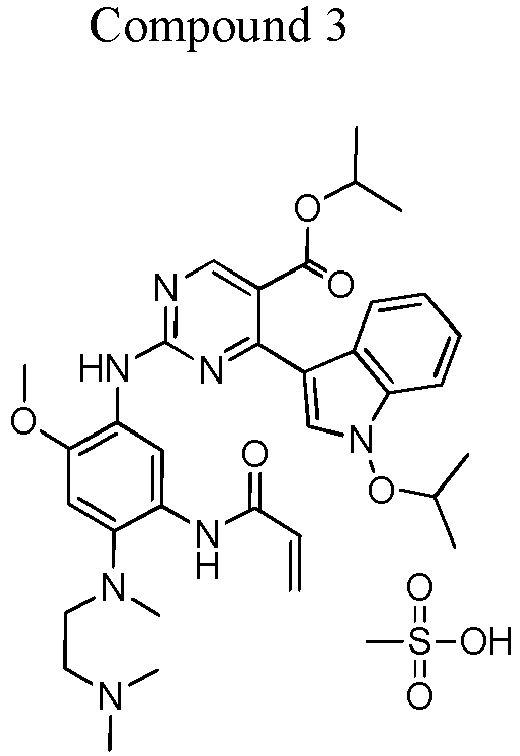
- This compound was prepared according to the method of
compound 1 inEmbodiment 1, replacing compound 1O with compound 3P. 1H NMR (400 MHz, Methanol-d 4) δ = 8.69 (s, 1H), 8.47 (s, 1H), 7.97 (s, 1H), 7.79 (d, J = 8.1 Hz, 1H), 7.38 (d, J = 8.3 Hz, 1H), 7.17 - 7.10 (m, 1H), 7.04 - 6.98 (m, 1H), 6.86 (s, 1H), 6.37 (s, 1H), 6.35 (d, J= 2.7 Hz, 1H), 5.79 - 5.73 (m, 1H), 4.95 (spt, J = 6.2 Hz, 1H), 4.57 (spt, J= 6.1 Hz, 1H), 3.90 (s, 3H), 3.38 (t, J= 5.6 Hz, 2H)), 3.17 (t, J= 5.6 Hz, 2H), 2.76 (s, 6H), 2.62 - 2.58 (m, 6H), 1.29 (d, J= 6.1 Hz, 6H), 1.05 (d, J= 6.1 Hz, 6H). LCMS (ESI) m/z: 630.2 [M+1]. -


- Compound 4A(10.5 g, 69.26 mmol) was dissolved in acetic acid (50 mL), and sodium cyanoborohydride (13.06 g, 207.79 mmol) was added with an internal temperature controlled at 10 °C. The reaction solution was stirred at 25 °C for 1 hour. The complete consumption of raw materials was monitored by TLC (PE/EA=1/0). Water (30.0 mL) was added to the reaction solution, and the pH of the reaction solution was adjusted to 7-8 with sodium hydroxide aqueous solution (2M), the mixture was extracted with ethyl acetate (80 mL × 3 times), then the organic phases were combined, dried with anhydrous sodium sulfate and concentrated under reduced pressure. The crude product was purified by column chromatography (SiO2, petroleum ether: ethyl acetate = 1: 0) to obtain the title compound. 1H NMR (400 MHz, CDCl3-d) δ: 6.96 - 7.05 (m, 2 H), 6.63 (t, J =7.64 Hz, 1 H), 4.00 (br s, 1 H), 3.63 (t, J =8.44 Hz, 2 H), 3.12 (t, J =8.44 Hz, 2 H).

- Sodium tungstate (2.26 g, 6.86 mmol) was dissolved in water (30 mL), and the mixture was added dropwise to a solution of compound 4B (6.2 g, 40.36 mmol) in methanol (300 mL) at -20 °C. Hydrogen peroxide (39.35 g, 347.12 mmol, 30% content) was dissolved in methanol (100 mL), and the mixture was added slowly dropwise to the reaction solution. After dropwise addition was completed, the reaction solution was stirred for 3 hours at 25 °C. Potassium carbonate (44.63 g, 322.90 mmol) and dimethyl sulfate (8.15 g, 64.58 mmol) were added to the reaction solution, and the mixture was stirred for 15 min at 25 °C. TLC (petroleum ether: ethyl acetate = 20:1) showed that the raw material was completely consumed. The reaction solution was filtered and the filtrate was added with water (200.0 mL) and extracted with ethyl acetate (300 mL × 3 times), and the combined organic phases were dried with anhydrous sodium sulfate and concentrated under reduced pressure. The residue was purified by column chromatography (SiO2, petroleum ether: ethyl acetate=1/0) to obtain the title compound. 1H NMR (400 MHz, CDCl3-d) δ 7.48 (dd, J =7.97, 0.82 Hz, 1 H), 7.28 (d, J =3.39 Hz, 1 H), 7.22 (dd, J =7.65, 0.63 Hz, 1 H), 7.00 - 7.06 (m, 1 H), 6.39 (d, J = 3.51 Hz, 1 H), 4.13 (s, 3 H).

- This compound was prepared according to the method of compound 1E in
Embodiment 1, replacing compound 1D with compound 4C. 1H NMR (400 MHz, CDCl3-d) δ 9.98 (s, 1 H), 8.22 - 8.28 (m, 1 H), 7.91 (s, 1 H), 7.33 - 7.37 (m, 1 H), 7.21 - 7.27 (m, 1 H), 4.22 (s, 3 H).
- This compound was prepared according to the method of compound 1F in
Embodiment 1, replacing compound 1E for compound 4D. 1H NMR (400 MHz, CDCl3-d) δ 8.17 (dd, J = 8.01, 0.79 Hz, 1 H), 8.08 (s, 1 H), 7.30 - 7.34 (m, 1 H), 7.20 - 7.26 (m, 1 H), 4.21 (s, 3H).
- This compound was prepared according to the method of compound 1G in
Embodiment 1, replacing compound 1F with compound 4E. 1H NMR (400 MHz, CDCl3-d) δ 8.34 (dd, J =8.00, 1.00 Hz, 1 H), 8.00 (s, 1 H), 7.31 - 7.34 (m, 1 H), 7.20 - 7.25 (m, 1 H), 4.22 - 4.26 (m, 2 H), 4.21 (s, 3 H), 3.85 (s, 2 H), 1.27 - 1.31 (m, 3 H).
- This compound was prepared according to the method of compound 1H in
Embodiment 1, replacing compound 1G with compound 4F.

- This compound was prepared according to the method of compound 1I in
Embodiment 1, replacing compound 1H with compound 4G. 1H NMR (400 MHz, CDCl3-d) δ 8.88 (s, 1 H), 7.93 - 8.11 (m, 2 H), 7.29 (dd, J =7.75, 0.75 Hz, 1 H), 7.09 - 7.22 (m, 1 H), 4.29 (q, J =7.13 Hz, 2 H), 4.20 (s, 3 H), 2.66 (s, 3 H), 1.25 - 1.33 (m, 3 H).
- This compound was prepared according to the method of compound 2J in Embodiment 2, replacing
compound 21 with compound 4H. 1H NMR (400 MHz, CDCl3-d) δ 9.00 (s, 1 H), 8.05 - 8.10 (m, 2 H), 7.29 (dd, J =7.75, 0.75 Hz, 1 H), 7.13 - 7.19 (m, 1 H), 4.19 (s, 3 H), 2.67 (s, 3 H).
- This compound was prepared according to the method of compound 2K in Embodiment 2, replacing compound 2J with compound 41. 1H NMR (400 MHz, CDCl3-d) δ 8.85 (s, 1 H), 7.98 - 8.05 (m, 2 H), 7.27 - 7.30 (m, 1 H), 7.12 - 7.17 (m, 1 H), 5.15 (m, 1 H), 4.20 (s, 3 H), 2.66 (s, 3 H), 1.24 (s, 3 H), 1.23 (s, 3 H).


- This compound was prepared according to the method of compound 1J in
Embodiment 1, replacing compound 1I with compound 4J. 1H NMR (400 MHz, CDCl3-d) δ 9.03 (s, 1 H), 8.28 (d, J =8.07 Hz, 1 H),8.20 (s, 1 H), 7.34 (d, J =7.58 Hz, 1 H), 7.21 - 7.26 (m, 1 H), 5.28 (m, 1 H), 4.22 (s, 3 H), 3.41 (s, 3 H), 1.33 (s, 3 H),1.32 (s, 3 H).
- This compound was prepared according to the method of compound 2M in Embodiment 2, replacing compound 2L with compound 4K. 1H NMR (400 MHz, CDCl3-d) δ 8.37 - 8.94 (m, 1 H), 8.17 (s, 1 H), 7.78 - 8.04 (m, 1 H), 7.29 (br d, J =7.70 Hz, 1 H), 7.15 (br t, J =7.89 Hz, 1 H), 5.03 - 5.12 (m, 1 H), 4.23 (s, 3 H), 1.20 (br s, 3 H), 1.18 (br s, 3 H).

- This compound was prepared according to the method of compound 2N in Embodiment 2, replacing compound 2M with compound 4L. 1H NMR (400 MHz, CDCl3-d) δ 8.85 (s, 1 H), 8.15 (s, 1 H), 8.13 (dd, J =8.13, 1.00 Hz, 1 H), 7.32 (dd, J =7.69, 0.81 Hz, 1 H), 7.18 - 7.23 (m, 1 H), 5.21 (m, 1 H), 4.20 (s, 3 H), 1.29 (s, 3 H), 1.27 (s, 3 H).


- This compound was prepared according to the method of compound 1K in
Embodiment 1, replacing compound 1J with compound 4M. 1H NMR (400 MHz, CDCl3-d) δ 9.65 (d, J =8.25 Hz, 1 H), 8.95 (s, 1 H), 8.12 (s, 1 H), 7.90 (s, 1 H), 7.68 (br d, J =8.25 Hz, 1 H), 7.29 (d, J =0.75 Hz, 1 H), 7.11 (t, J =7.88 Hz, 1 H), 6.79 (d, J =12.01 Hz, 1 H), 5.07 (m, 1 H), 4.27 (s, 3 H), 4.05 (s, 3 H), 1.15 (s, 3 H),1.14 (s, 3 H)
- This compound was prepared according to the method of compound 1L in
Embodiment 1, replacing compound 1K with compound 4N. 1H NMR (400 MHz, CDCl3-d) δ 9.34 (s, 1 H), 8.93 (s, 1 H), 8.09 (s, 1 H), 7.85 (s, 1 H), 7.70 (br d, J =5.62 Hz, 1 H), 7.24 - 7.26 (m, 1 H), 7.08 - 7.14 (m, 1 H), 6.80 - 6.87 (m, 1 H), 5.07 (m, 1 H), 4.26 (s, 3 H), 4.05 (s, 3 H), 3.50 (s, 4 H), 2.91 (s, 3 H), 2.44 - 2.68 (m, 6 H), 1.15 (s, 3 H), 1.14 (s, 3 H).

- This compound was prepared according to the method of compound IN in
Embodiment 1, replacing compound 1M with compound 4O.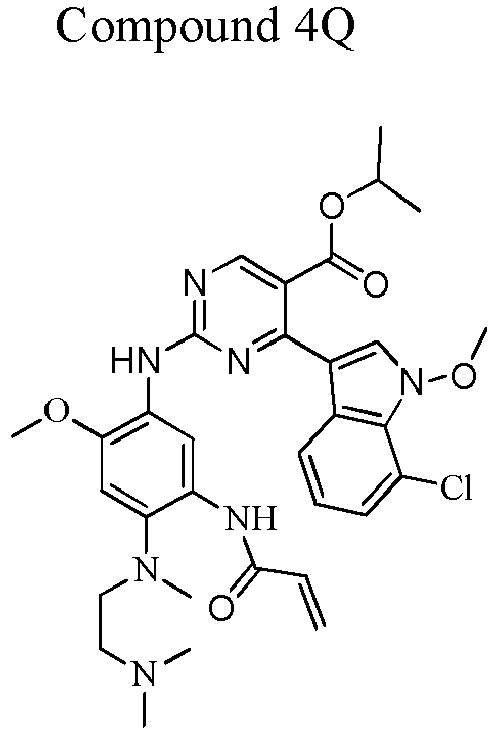
- This compound was prepared according to the method of compound 1O in
Embodiment 1, replacing compound IN with compound 4P.
- This compound was prepared according to the method of
compound 1 inEmbodiment 1, replacing compound 1O with compound 4Q. 1H NMR (400 MHz, Methanol-d 4) δ 9.06 (br s, 1 H), 8.83 (d, J =0.88 Hz, 1 H), 8.39 (br s, 1 H), 7.65 (br d, J =6.88 Hz, 1 H), 7.23 (br d, J =7.63 Hz, 1 H), 7.06 (br t, J =7.82 Hz, 1 H), 6.97 (br s, 1 H), 6.50 - 6.58 (m, 1 H), 6.40 - 6.47 (m, 1 H), 5.83 (br d, J =9.76 Hz, 1 H), 4.96 - 5.07 (m, 1 H), 4.19 (s, 3 H), 3.95 (s, 3 H), 3.16 (br s, 2 H), 2.65 - 2.70 (m, 5 H), 2.44 (s, 6 H), 1.43 (t, J =7.0 Hz, 3H), 1.12 (s, 3 H),1.10 (s, 3 H). -


- This compound was prepared according to the method of compound 4B in Embodiment 4, replacing compound 4A with compound 5A. 1H NMR (400 MHz, CDCl3-d) δ = 7.17 (dd, J =0.6, 8.1 Hz, 1H), 7.04 (dd, J =1.1, 7.2 Hz, 1H), 6.62 - 6.52 (m, 1H), 4.08 - 3.71 (m, 1H), 3.62 (t, J =8.5 Hz, 2H), 3.16 (t, J =8.5 Hz, 2H).

- This compound was prepared according to the method of compound 4C in Embodiment 4, replacing compound 4B with compound 5B. 1H NMR (400 MHz, CDCl3-d) δ = 7.53 (dd, J =0.8, 7.9 Hz, 1H), 7.41 (d, J =7.6 Hz, 1H), 7.30 (d, J =3.5 Hz, 1H), 6.98 (t, J =7.8 Hz, 1H), 6.39 (d, J =3.5 Hz, 1H), 4.11 (s, 3H).


- This compound was prepared according to the method of compound 1E in
Embodiment 1, replacing compound 1D with compound 5C. 1H NMR (400 MHz, CDCl3-d) δ = 10.02 - 9.84 (m, 1H), 8.28 (dd, J =0.8, 7.9 Hz, 1H), 8.01 (s, 1H), 7.55 - 7.46 (m, 1H), 7.16 (t, J =7.8 Hz, 1H), 4.20 (s, 3H).
- This compound was prepared according to the method of compound 1F in
Embodiment 1, replacing compound 1E with compound 5D. 1H NMR (400 MHz, CDCl3-d) δ = 8.22 (d, J =7.9 Hz, 1H), 8.09 (s, 1H), 7.50 (d, J =7.5 Hz, 1H), 7.16 (t, J =7.9 Hz, 1H), 4.25 (s, 3H).
- This compound was prepared according to the method of compound 1G in
Embodiment 1, replacing compound 1F with compound 5E. 1H NMR (400 MHz, CDCl3-d) δ = 8.40 (d, J = 0.9, 8.1 Hz, 1H), 8.02 (s, 1H), 7.51 (d, J = 0.7, 7.6 Hz, 1H), 7.17 (t, J = 7.9 Hz, 1H), 4.25 - 4.20 (m, 5H), 3.85 (s, 2H), 1.32 - 1.27 (m, 3H). LCMS (ESI) m/z: 342.1 [M+1].

- This compound was prepared according to the method of compound 1H in
Embodiment 1, replacing compound 1G with compound 5F.
- This compound was prepared according to the method of compound 1I in
Embodiment 1, replacing compound 1H with compound 5G. 1H NMR (400 MHz, CDCl3-d) δ = 8.88 (s, 1H), 8.32 - 7.96 (m, 2H), 7.67 - 7.37 (m, 1H), 7.09 (t, J= 7.9 Hz, 1H), 4.29 (q, J= 7.1 Hz, 2H), 4.19 (s, 3H), 2.66 (s, 3H), 1.24 (t, J = 7.1 Hz, 3H). LCMS (ESI) m/z: 421.9 [M+1].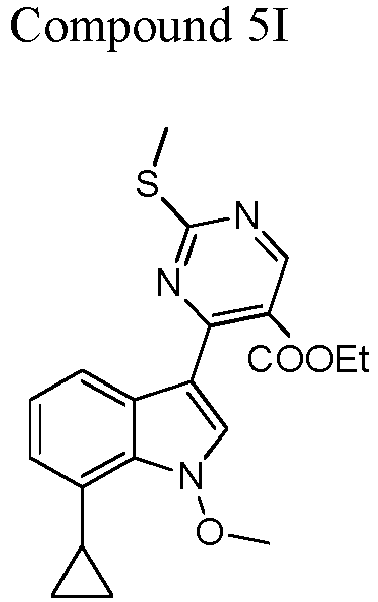
- Compound 5H (1 g, 2.37 mmol) and cyclopropylboronic acid (407 mg, 4.74 mmol) were dissolved in toluene (5 mL) and water (5 mL); and cesium carbonate (926 mg, 2.84 mmol) and Pd(dppf)Cl2.CH2Cl2 (200 mg, 244.91 µmol) were added and the mixture was stirred under nitrogen protection at 100 °C for 16 hours. The reaction solution was concentrated under reduced pressure, and water (10 mL) was added to the residue and the mixture was extracted with ethyl acetate (10 mL × 2 times). The organic phases were combined, dried with anhydrous sodium sulfate and concentrated under reduced pressure, and the crude product was purified by column chromatography (SiO2, petroleum ether: ethyl acetate = 50:1 to 20:1) to obtain the title compound. 1H NMR (400 MHz, CDCl3-d) δ = 8.83 (s, 1H), 8.00 (s, 1H), 7.94 (d, J =8.0 Hz, 1H), 7.14 (t, J =7.7 Hz, 1H), 6.87 (d, J =7.4 Hz, 1H), 4.29 (q, J =7.2 Hz, 2H), 4.18 (s, 3H), 2.67 (s, 3H), 1.27 (s, 1H), 1.22 (t, J =7.1 Hz, 3H), 1.08 - 1.03 (m, 2H), 0.89 - 0.86 (m, 2H).

- This compound was prepared according to the method of compound 2J in Embodiment 2, replacing
compound 21 with compound 51. 1H NMR (400 MHz, Methanol-d 4) δ = 8.80 (s, 1H), 8.22 - 8.13 (m, 1H), 8.01 (dd, J =0.8, 8.1 Hz, 1H), 7.11 (t, J =7.8 Hz, 1H), 6.88 (d, J =7.4 Hz, 1H), 4.20 (s, 3H), 2.67 (s, 3H), 1.21 - 1.16 (m, 1H), 1.10 - 1.04 (m, 2H), 0.88 - 0.83 (m, 2H).
- This compound was prepared according to the method of compound 2K in Embodiment 2, replacing compound 2J with compound 5J. 1H NMR (400 MHz, CDCl3-d) δ = 8.82 - 8.77 (m, 1H), 8.00 (s, 1H), 7.92 (dd, J =0.7, 8.1 Hz, 1H), 7.13 (t, J =7.8 Hz, 1H), 6.87 (d, J =7.4 Hz, 1H), 5.14 (m, 1H), 4.17 (s, 3H), 2.67 (s, 3H), 1.28 - 1.25 (m, 1H), 1.22 (d, J = 6.3 Hz, 6H), 1.07 - 1.01 (m, 2H), 0.90 - 0.84 (m, 2H).


- This compound was prepared according to the method of compound 1J in
Embodiment 1, replacing compound 1I with compound 5K. 1H NMR (400 MHz, CDCl3-d) δ = 8.99 (s, 1H), 8.15 (s, 1H), 8.12 (d, J =7.6 Hz, 1H), 7.22 (t, J =7.8 Hz, 1H), 6.92 (d, J =7.5 Hz, 1H), 5.26 (m, 1H), 4.20 (s, 3H), 3.41 (s, 3H), 2.67 (tt, J =5.3, 8.4 Hz, 1H), 1.33 - 1.28 (m, 6H), 1.10 - 1.05 (m, 2H), 0.91 - 0.86 (m, 2H).
- This compound was prepared according to the method of compound 2M in Embodiment 2, replacing compound 2L with compound 5L. 1H NMR (400 MHz, CDCl3-d) δ = 9.01 - 8.60 (m, 1H), 8.14 (br s, 1H), 7.81 - 7.33 (m, 1H), 7.09 (br t, J =7.4 Hz, 1H), 6.85 (br d, J =7.3 Hz, 1H), 5.09 - 4.95 (m, 1H), 4.29 (s, 3H), 2.71 - 2.60 (m, 1H), 1.12 (br d, J =5.6 Hz, 6H), 1.04 (br d, J =8.2 Hz, 2H), 0.85 (br d, J =4.8 Hz, 2H).

- This compound was prepared according to the method of compound 2N in Embodiment 2, replacing compound 2M with compound 5M. 1H NMR (400 MHz, CDCl3-d) δ = 8.84 - 8.76 (m, 1H), 8.17 - 8.09 (m, 1H), 8.00 (dd, J =0.7, 8.1 Hz, 1H), 7.18 (t, J =7.8 Hz, 1H), 6.90 (d, J =7.4 Hz, 1H), 5.19 (spt, J = 6.3 Hz, 1H), 4.19 (s, 3H), 2.67 (tt, J =5.3, 8.4 Hz, 1H), 1.26 (d, J =6.4 Hz, 6H), 1.08 - 1.03 (m, 2H), 0.90 - 0.85 (m, 2H).

- This compound was prepared according to the method of compound 1K in
Embodiment 1, replacing compound 1J with compound 5N. 1H NMR (400 MHz, CDCl3-d) δ = 9.71 (d, J =8.3 Hz, 1H), 8.91 (s, 1H), 8.13 (s, 1H), 7.87 (s, 1H), 7.61 - 7.50 (m, 1H), 6.85 (d, J =7.3 Hz, 1H), 6.78 (d, J =12.0 Hz, 1H), 5.05 (td, J =6.3, 12.5 Hz, 1H), 4.26 (s, 3H), 4.04 (s, 3H), 2.75 - 2.65 (m, 1H), 1.11 (d, J =6.1 Hz, 6H), 1.07 - 1.04 (m, 2H), 0.89 - 0.85 (m, 2H).
- This compound was prepared according to the method of compound 1L in
Embodiment 1, replacing compound 1K with compound 5O. 1H NMR (400 MHz, CDCl3-d) δ = 9.38 (br s, 1H), 8.88 (s, 1H), 8.12 (s, 1H), 7.78 (s, 1H), 7.54 (br d, J =5.9 Hz, 1H), 7.08 (t, J =7.7 Hz, 1H), 6.84 (d, J =7.4 Hz, 1H), 6.67 ( s, 1H), 5.03 (td, J =6.3, 12.5 Hz, 1H), 4.25 (s, 3H), 3.98 (s, 3H), 3.32 - 3.27 (m, 2H), 2.90 (s, 3H), 2.74 - 2.67 (m, 1H), 2.58 (t, J =7.1 Hz, 2H), 2.27 (s, 6H), 1.10 (br d, J =6.3 Hz, 6H), 1.06 - 1.01 (m, 2H), 0.87 - 0.83 (m, 2H).

- This compound was prepared according to the method of compound IN in
Embodiment 1, replacing compound 1M with compound 5P. 1H NMR (400 MHz, CDCl3-d) δ = 8.88 (s, 2H), 8.17 (br d, J =13.3 Hz, 1H), 7.98 (br s, 3H), 7.17 (br s, 1H), 7.05 - 6.96 (m, 1H), 6.89 (br d, J =16.5 Hz, 1H), 6.73 (br s, 1H), 5.11 (br d, J =6.3 Hz, 1H), 4.19 (br s, 3H), 3.85 (br s, 3H), 2.78 (br s, 2H), 2.56 (br s, 6H), 2.42 (br s, 2H), 2.27 (br s, 3H), 1.24 (br s, 6H), 1.07 - 1.03 (m, 2H), 0.83 - 0.76 (m, 2H).
- This compound was prepared according to the method of compound 1O in
Embodiment 1, replacing compound IN with compound 5Q.
- This compound was prepared according to the method of
compound 1 inEmbodiment 1, replacing compound 1O with compound 5R. 1H NMR (400 MHz, Methanol-d 4) δ = 8.77 (s, 1H), 8.46 (br s, 1H), 8.13 (s, 1H), 7.71 (d, J =7.9 Hz, 1H), 7.01 (t, J =7.8 Hz, 1H), 6.96 (s, 1H), 6.82 (d, J =7.6 Hz, 1H), 6.48 - 6.42 (m, 2H), 5.91 - 5.77 (m, 1H), 5.07 (td,J =6.2, 12.5 Hz, 1H), 4.18 (s, 3H), 3.99 (s, 3H), 3.52 - 3.46 (m, 2H), 3.27 - 3.24 (m, 2H), 2.86 (s, 6H), 2.70 (d, J =4.8 Hz, 6H), 1.28 (s, 1H), 1.17 (d,J =6.2 Hz, 6H), 1.10 - 1.04 (m, 2H), 0.85 - 0.80 (m, 2H). - In this study, mouse, SD rat, Beagle, cynomolgus monkey and human plasma were used as materials to investigate the stability of the tested compounds in the plasma of the above five species. Propantheline, Enalapril, Bisacodyl and Procaine were used as control compounds.
- The experimental conditions for the test compounds were as follows:
- test concentration: 2 µM (DMSO ≤ 0.5%);
- incubation times: 0, 10, 30, 60 and 120 minutes;
- frozen plasma (from multiple species) was used in the test system;
- incubation conditions: 37°C.
- The mixed frozen plasma was thawed in a 37 °C water bath prior to the experiment. Plasma was centrifuged at 4000 rpm for 5 minutes and cleared if there was a clot. The pH will be adjusted to 7.4 ± 0.1 if required.
- The intermediate solution of 1 mM compound and positive control was prepared by diluting 10 mM stock solution with 90 µL of dimethyl sulfoxide. 100 µM solution was prepared by diluting 20 µL of intermediate solution (1 mM) with 180 µL of 45 % methanol/water.
- 2 µL of 100 µM solution was added to 98 µL of blank plasma to achieve a final concentration of 2 µM (in duplicate) of the sample, and the sample was incubated in a 37 °C water bath. At each time point (0, 10, 30, 60 and 120 min), 400 µL of termination solution (200 ng/mL toluenesulfonylurea and 200 ng/mL labetalol, 50% ACN/MeOH) was added to precipitate the proteins and mixed thoroughly.
- The sample plate was centrifuged at 4000 rpm for 10 minutes. A small portion of the supernatant (50 µL) was transfered from each well and mixed with 100 µL of ultrapure water. Samples were vibrated at 800 rpm for approximately 10 minutes prior to LC-MS/MS analysis.
- The formula used for data processing was as follows:
%residual amount = (peak area ratio of control to internal standard at any time point / peak area ratio of control to internal standard at 0 min) × 100%. Experimental results: see Tables 1 and 2.Table 1 In vitro plasma stability of compounds In vitro plasma stability (Residual percentage at different time points) Compound 1Human 120 minutes19 % Monkey 120 minutes 93.7 % Dog 120 minutes 101.7 % Rat 120 minutes 87.9 % Mouse 120 minutes 45% Table 2 In vitro plasma half-life of compounds Half-life of different species T1/2 (min) Compound 1Human T1/2 51.6 Monkey T1/2 >289.1 Dog T1/2 >289.1 Rat T1/2 >289.1 Mouse T1/2 108.8 - As can be seen from Tables 1 and 2, the compounds of the present disclosure have better plasma stability in different species.
- Experimental purposes: To detect the inhibitory effect of compounds on EGFR WT, EGFR (D770_N771insNPG), ERBB2 (V777_G778ins>CG), EGFR T790M/L858R enzyme activities
- Experimental material:
EGFR WT (Invitrogen, Cat. No. PR7295B), EGFR [L858R] (Invitrogen, Cat. No. PR7447A), EGFR [d746-750] (Invitrogen, Cat. No. PV6179), ATP (Sigma, Cat. No. A7699-1G), DMSO (Sigma, Cat. No. D2650), DTT (Sigma, Cat. No. 43815), 384-well plate, compound dilution plate (Greiner, Cat. No. 781280), 384-well plate, test plate (Perkin Elmer, Cat. No. 6007299), HTRF KinEASE TK Kit (Cisbio, Cat. No. 62TK0PEB), magnesium chloride (Sigma, Cat. No. M1028), Orthovanadate (Sigma, Cat. No. S6508), BSA(Sigma, Cat. No. A7030), HEPES (Life technology, Cat. No. 11344-041). - Experimental methods:
Final test concentrations of compounds:
The final test concentrations of the test compounds ranged from 10 µM to 0.17 nM in 3-fold gradient dilutions at 11 concentrations. - Kinase assay:
The preparation of the buffer, 50 mM HEPES (pH 7.5), 0.01% BSA, 5 mM MgCl2, and 0.1 mM Orthovanadate were contained in the buffer. After the preparation of the buffer, the enzyme and substrate were mixed with pre-diluted prepared compounds of different concentrations, and the mixture was placed at room temperature for 15 minutes. The reaction was initiated by adding ATP and incubated for 60 min at room temperature (wherein negative and positive control were set). 2.5 µL of compound, 5 µL of enzyme and substrate mixture and 2.5 µL of ATP were contained in the 10 µL reaction system. After the reaction was completed, the antibody was added to the assay, incubated at room temperature for 60 minutes and then detected by Envision (plate reading instrument), and data were collected. Data analysis and plotting were performed according to XLfit5 software (data analysis software). - Experimental results: see Table 3.
Table 3 Inhibitory activity of compounds on enzymes Enzyme ICso(nM) Compound 1Wild-type EGFR enzymes / 0.39 EGFR exon 20 insertion (D770_N771insNPG) enzyme0.8 0.7 EGFR L858R/T790M double mutant enzyme 3.71 / HER2 exon 20 insertion (V777_G778ins>CG) enzyme1.86 / - Note: "/" means not tested.
- Experimental conclusions:
The compounds of the present disclosure have better enzyme activity against bothEGFR exon 20 insertion mutation andERBB2 exon 20 insertion mutation, as well as against L858R and T790M double mutations. - Experimental materials:
Fetal bovine serum FBS, CellTiter Glo® luminescent cell activity assay, 96-well clear flat-bottomed black-walled plate - Experimental instruments:
- EnVision Multilabel Microplate Detector, PerkinElmer Instrument Co., Ltd, model: 2104-0010A;
- CO2 incubator, Thermo Fisher Scientific, model: 3100 Series;
- Biological Safety Cabinet, Thermo Fisher Scientific, model: 1300 Series A2;
- Inverted microscope, Olympus, model: CKX41 SF;
- Electronic balance, METTLER TOLEDO, model: AL-104;
- Refrigerator, Siemens, model: KK25E76TI.
- Experimental steps:
A cell counter was used for cell counting, and cell viability was detected to ensure that the viability of each cell line was above 90 %. Cell suspension was added to a 96-well plate to bring the cell density to the specified concentration and incubated overnight at 37 °C, 5% CO2 and 95% humidity. The culture medium was added to the T0 plate, the CTG reagent was melted and the cell plate was equilibrated at room temperature. CTG solution was added to each well. The cell plate was vibrated to lyse the cells and the cold light values were read. The compound to be test and the control drug were diluted in a gradient to obtain a 10-fold solution. 10 µL of drug solution was added to each well of a 96-well plate that had been inoculated with cells. The incubation was continued at 37 °C, 5 % CO2, 95 % humidity for 4 days, and CTG analysis was performed and cold light values were read separately. The data were analyzed using GraphPad Prism 5.0 software and IC50 values were calculated. - Experimental results: The IC50 data of the compounds of the present disclosure against
EGFR exon 20 insertion mutation NPH inLU-0387 - Experimental conclusions: The compounds of the present disclosure exhibit better inhibitory activity against
EGFR exon 20 insertion mutations. - Experimental materials:
RPMI1640 medium, FBS fetal bovine serum, trypsin-EDTA, were all purchased from Giboco. DPBS was purchased from Corning, penicillin/streptomycin solution was purchased from Hyclone, and Cell-Titer Glo reagent was purchased from Promega (1kit, Cat. No. G7571). Plate reading instrument: Envision (PerkinElmer). - Experimental methods:
384-well plates incolumns 1, 2, and 24 were added with 45 µL of medium, and the cell suspension was dispensed with Multi-drop at 45 µL per well (1000 cells) and incubated overnight in an incubator. The compound was added to the source plate according to the Echo dispensing requirements, the compound in the source plate was added to the inter plate and diluted to an intermediate concentration, then the compound in the source plate and the inter plate was added to the cell plate, and the cells were continued to be incubated in a incubator for 72 hours. After 72 hours, Cell-Titer Glo reagent and cells were removed and equilibrated at room temperature for 30 min. 25 µL of Cell-Titer Glo reagent was dispensed into 384-well plates with Multi-drop, the cell plate was vibrated at medium speed for 3 min, centrifuged at 1000 rpm for 2 min, and stood for 10 min. The plate was read by Envision (Luminescence). [0178] The data of the anti-proliferation activity IC50 against H1975 cells and the anti-proliferation activity IC50 against A431 cells of the compounds of the present disclosure are shown in Table 4.Table 4 Anti-proliferation activity data of compounds against cells Cell ICso(nM) LU0387 EGFR-H773 V774insNPH H1975 (L858R/T790M) A431 Compound 1 25.6 15.3 335 - Experimental results:
The compounds of the present disclosure have very good anti-proliferation activity against H1975 (L858R/T790M) cells, LU0387 EGFR-H773_V774insNPH (exon 20 insertion mutation), and weak inhibitory effect against A431 (EGFR wild type), indicating that the compounds of the present disclosure has better selectivity. - Experimental material:
RPMI1640 medium was purchased from Hyclone, FBS fetal bovine serum was purchased from GBICO, and trypsin-EDTA were both purchased from Giboco. DPBS was purchased from Corning, penicillin/streptomycin solution was purchased from Hyclone, and Cell-Titer Glo reagent was purchased from Promega (Cat. No. G7572). Ba/F3 EGFR-D770_N771insSVD, Ba/F3 EGFR-H773_V774insNPH, Ba/F3 EGFR-V769_D770insASV, BaF3 ERBB2 A775_G776 ins YVMA, the cell lines were constructed by Beijing Kang Yuan Bochuang Biotechnology Co., Ltd. Plate reading instrument: Envision (PerkinElmer). - Experimental methods:
Cells in logarithmic growth phase were harvested and cell counts were performed using a platelet counter. Cell viability was detected by the Taipan Blue rejection assay. The cell concentration was adjusted; the cell suspension was added to a 96-well plate separately. Cells in 96-well plates were incubated overnight at 37 °C, 5 % CO2, and 95 % humidity. To prepare the drug solution, 10 µL of drug solution was added to each well of the 96-well plate inoculated with cells, and three replicate wells were set up for each drug concentration. The cells in the 96-well plates added with drugs were placed at 37 °C, 5 % CO2, 95 % humidity and continued to incubate for 72 hours, after which CTG analysis was performed and the cells were vibrated on an orbital shaker to lyse the cells. The cell plate was placed at room temperature to stabilize the cold light signal, and the cold light values were read. The data were analyzed using GraphPad Prism 7.0 software, and a nonlinear S-curve regression was used to fit the data to derive the dose-effect curve from which the IC50 values were calculated. - The IC50 of anti-proliferation activity against Ba/F3 Exon20 insertion mutant cells of the compounds of the present disclosure is shown in Table 5.
Table 5 Anti-proliferation activity data of compounds against Ba/ F3 exon 20 insertion mutant cellsMutant cells ICso(nM) Compound 1Compound 2 Compound 3Compound 4 Compound 5Ba/F3 EGFR-D770_N771insSVD 27 24 27 54 33 58 Ba/F3 EGFR-H773_V774insNPH / 15 / / / / Ba/F3 EGFR-V769_D770insASV / 7 / / / / BaF3 ERBB2 A775 _G776 ins YVMA / 37 / / / / - Note: "/" means not tested.
- Experimental conclusions:
Ba/F3 exon 20 insertion mutant cells are cell lines with SVD, NPH, ASV, and YVMA insertion mutations artificially constructed using mouse B cells, and it can be seen from Table 5 that the compounds of the present disclosure have better cellular anti-proliferation activity against the morefrequent exon 20 insertion mutations such as SVD, NPH, ASV, and YVMA, and also show better anti-proliferation activity againstcommon exon 20 insertion mutations such as SVD mutation. - Cell culture:
Human lung cancer NCI-H1975 cells were cultured in vitro in a monolayer under the conditions of 1640 medium with 10 % fetal bovine serum, 1 % double antibodies and incubated at 37 °C in a 5 % CO2 incubator. Routine treatment passages were performed twice a week. When the cell saturation was 80%-90% and the number reached the required level, the cells were collected, counted, and inoculated. - Animals:
BALB/c nude mice, female, 6-8 weeks old, weighing 18-22 g. Provided by Shanghai Xipuer-Bikai Laboratory Animal Co., Ltd. or other qualified suppliers. - Tumor inoculation:
Tumor tissue was collected from H1975 tumor-bearing mice of human lung cancer xenograft model, cut into 2-3 mm diameter tumor blocks and inoculated subcutaneously at the right anterior scapula of Balb/c nude mice. When the average tumor volume was 145 mm3, the tumors were randomly grouped according to their size, and the day of grouping was defined asday 0. - Tumor measurements and experimental indexes:
The experimental index was to examine whether tumor growth was inhibited, delayed or cured. Tumor diameters were measured with vernier calipers twice a week. The calculation formula of tumor volume was: V = 0.5α × b 2, wherein α and b represented the long and short diameters of the tumor, respectively. The antitumor efficacy of the compounds was evaluated by TGI (%) or relative tumor proliferation rate T/C (%). TGI (%), reflecting the tumor growth inhibition rate. Calculation of TGI (%): TGI (%) = [(1-(average tumor volume at the end of administration of a treatment group - average tumor volume at the beginning of administration of this treatment group))/(average tumor volume at the end of treatment in the solvent control group - average tumor volume at the beginning of treatment of the solvent control group)] × 100%. Relative tumor proliferation rate T/C (%): The calculation formula was as follows: T/C % = TRTV / CRTV × 100 % (TRTV: RTV in the treatment group; CRTV: RTV in the negative control group). The relative tumor volume (RTV) was calculated according to the results of tumor measurement, and the formula was RTV = Vt / V0, wherein V0 was the average tumor volume measured at the time of group administration (i.e., do), and Vt was the average tumor volume at a certain measurement, TRTV and CRTV were taken on the same day. After the experiment, the tumor weight will be detected, and the percentage of T/Cweight will be calculated. Tweight and Cweight represented the tumor weight of the administration group and the solvent control group, respectively. - Experimental results: see
Figures 1, 2 and Table 6. - Experimental conclusions:
FromFigures 1, 2 and the tumor volume data in Table 6, it can be seen that the compounds of the present disclosure have significant anti-tumor efficacy, and the TGI can reach 105 %, achieving the effect of shrinking tumors.Table 6 Inhibitory effect of compounds against human lung cancer cell H1975 subcutaneous xenograft tumor model Groups Tumor volume (mm3)a (Day 0) Tumor volume (mm3)a (Day 20) RTV TGI (%) T/C (%) Blank 153±6 2419±196 16.01±1.72 -- -- Compound 1153±7 33±16 0.20±0.10 105.3 1.35 % - Notes: a. Mean ± standard error, n = 6.
- Experimental purposes:
Ba/F3 (EGFR-D770 _N771insSVD) cells were artificially constructed cell lines with EGFR-D770_N771insSVD insertion mutation using mouse B cells. The CDX model established by this cell line was used to evaluate the inhibitory effect of preferred compounds onExon 20 EGFR-D770_N771insSVD insertion mutation in animals. - Experimental materials:
Nude mouse (BALB/c Nude), Ba/F3 (EGFR-D770_N771insSVD) cell line - Experimental method:
- 1. Cell culture: cells were cultured in vitro in monolayer, culture conditions were RPMI-1640 (cell culture medium) with 10 % fetal bovine serum, 100 U/mL penicillin and 100 µg/mL streptomycin, the cells were cultured at a 37 °C, 5 % CO2 incubator. Conventional digestion with trypsin-EDTA was performed twice a week for passage. When the saturation of Ba/F3 (EGFR-D770_N771insSVD) cell was 80 %-90 %, and the number reached the requirement, the cells were harvested and counted. The density was 5 × 10⁶ cells.
- 2. Cell inoculation: 0.2 mL (containing 5 × 10⁶ cells) of Ba/F3 (EGFR-D770_N771insSVD) cell suspension (PBS: Matrigel = 1:1) was inoculated subcutaneously on the right back of each mouse, for a total of 64 mice. On the 7th day after inoculation, when the average tumor volume reached 133 mm3, the randomized stratified grouping method was used to start the grouping administration according to the tumor volume and animal weight. PBS was phosphate buffer and Matrigel was matrix.
- 3. Administration: The dose was 0-7 days: 10 mg/kg, 8-21 days: 40 mg/kg; oral administration; administration frequency: once a day × 3 weeks.
- Tumor diameters were measured with vernier calipers twice a week. The calculation formula of tumor volume was: V = 0.5a × b 2, wherein a and b represented the long and short diameters of the tumor, respectively.
- The antitumor efficacy of the compounds was evaluated by TGI (%) or relative tumor proliferation rate T/C (%).
- Relative tumor proliferation rate T/C (%) = TRTV / CRTV × 100 % (TRTV: mean RTV in the treatment group; CRTV: mean RTV in the solvent control group).
- The relative tumor volume (RTV) was calculated according to the results of tumor measurement. The calculation formula was RTV = Vt / Vo, wherein Vo was the tumor volume measured at the time of group administration (i.e., Do), and Vt was the tumor volume corresponding to a certain measurement. TRTV and CRTV were taken on the same day.
- TGI (%), reflecting the tumor growth inhibition rate. TGI (%)=[(1-(average tumor volume at the end of administration of a treatment group - average tumor volume at the beginning of administration of this treatment group))/(average tumor volume at the end of treatment in the solvent control group - average tumor volume at the beginning of treatment of the solvent control group)] × 100%.
- After the experiment, the tumor weight will be detected, and T/C (%) will be calculated. T and C represented the tumor weight of the administration group and the solvent control group, respectively.
- Experimental results: see Table 7 and
Figures 3 and 4 .Table 7 Inhibitory effect of compounds against Ba/F3 (EGFR-D770_N771insSVD) subcutaneous allograft tumor model Groups Tumor volume (mm3)a (Day 0) Tumor volume (mm3)a (Day 14) RTV TGI (%) T/C (%) Blank 133.5±7.6 1734.7 ±281.7 13.0 -- -- Compound 1133.2±8.2 259.1±35.2 1.9 92.1 14.9 - Notes: a. Mean ± standard error, n = 6.
- Experimental comclusions:
As seen inFigures 3 and 4 and the tumor volume data in Table 7, the compounds of the present disclosure have significant inhibition effect on tumor growth in an in vivo pharmacodynamic model of Ba/F3 (EGFR-D770_N771insSVD) subcutaneous allograft tumors. - Experimental purposes:
The antitumor effects of the test drug in HuPrime® lung cancer LU0387 subcutaneous xenograft BALB/C nude mouse were evaluated. - Experimental materials:
BALB/c Nude mice, female, 7-8 weeks, HuPrime® lung cancer xenograft model LU0387 tumor-bearing mouse tumor tissue. - Experimental methods:
BALB/c nude mice were subcutaneously inoculated with HuPrime® model LU0387 tumor blocks to establish a human lung cancer subcutaneous transplantation tumor model. The test was divided into a solvent control group and a test drug group. The drug was administered by gavage, once daily for 21 days. Efficacy was evaluated based on relative tumor inhibition rate (TGI), and the safety was evaluated based on animal weight change and mortality. - Tumor diameters were measured with vernier calipers twice a week. The calculation formula of tumor volume was: V = 0.5a × b 2, wherein a and b represented the long and short diameters of the tumor, respectively.
- The antitumor efficacy of the compounds was evaluated by TGI (%) or relative tumor proliferation rate T/C (%).
- Relative tumor proliferation rate T/C (%) = TRTV / CRTV × 100 % (TRTV: mean RTV in the treatment group; CRTV: mean RTV in the solvent control group).
- The relative tumor volume (RTV) was calculated according to the results of tumor measurement. The calculation formula was RTV = Vt / Vo, wherein Vo was the tumor volume measured at the time of group administration (i.e., Do), and Vt was the tumor volume corresponding to a certain measurement. TRTV and CRTV were taken on the same day.

- After the experiment, the tumor weight will be detected, and T/C (%) will be calculated. T and C represented the tumor weight of the administration group and the solvent control group, respectively.
- Experimental results: see Table 8 and
Figures 5 and 6 . - Experimental comclusions:
As seen inFigures 5 and 6 and the tumor volume data in Table 8, the compounds of the present disclosure have significant growth inhibition in tumor against HuPrime® lung cancer LU0387 subcutaneous xenograft BALB/c nude mice animal model with TGI = 114 %, achieving a tumor shrinking effect.Table 8 Tumor inhibition effect against HuPrime® lung cancer LU0387 model Groups Tumor volume (mm3)3 (Day 0) Tumor volume (mm3)3 (Day 20) RTV TGI (%) T/C (%) Blank 120.20±4.06 883.6±175.2 7.38±1.51 -- -- Compound 1122.13±3.12 16.97±10.54 0.14±0.08 114 2 - Experimental purposes:
The purpose of this experiment was to investigate the pharmacokinetics (PK) of the compounds in different species after single intravenous and single oral administration of the test compounds. - Sample collection and preparation:
After intravenous or oral administration, blood samples were collected from the animals, and the actual time of blood collection was recorded. After the blood samples were collected, the samples were immediately transferred to the labelled centrifuge tube containing K2-EDTA, and then centrifuged to obtain plasma. Plasma was transferred to pre-cooled centrifuge tubes, quick-frozen in dry ice and stored in an ultra-low temperature refrigerator at -70±10 °C until LC-MS/MS analysis was performed. - Pharmacokinetic data analysis:
The plasma drug concentration data of the compounds were processed using pharmacokinetic software with a non-compartmental model. The peak concentration (Cmax) and time to peak (Tmax), as well as the quantifiable end time were obtained directly from the plasma concentration-time curve. The following pharmacokinetic parameters were calculated using the log-linear trapezoidal method: half-life (T1/2), apparent volume of distribution (Vdss), and clearance (Cl), area under the time-plasma concentration curve frompoint 0 to the end time point (AUC0-last), and initial concentration (Co). - Experimental results: see Table 9-1, Table 9-2, Table 9-3
Table 9-1 Pharmacokinetic parameters of single intravenous and oral administration of different doses in mice Administration method PK parameters in mice Compound 1 Intravenous injection Dose (mg/kg/day) 2 Cl (mL/kg/min) 57.7 Vdss (L/kg) 6.95 Exposure of AUC (nmol∗h/L) 884 T1/2 (h) 1.76 Oral Dose (mg/kg/day) 10 Cmax (nmol) 300 Tmax (h) 2.00 Exposure of AUC0-last (nmol∗h /L): 1421 Oral bioavailability (%) 22.1 Table 9-2 Pharmacokinetic parameters of single intravenous and oral administration of different doses in rats Administration method PK parameters in rats Compound 1 Intravenous injection Dose (mg/kg/day) 2 Cl (mL/kg/min) 90.5 Vdss (L/kg) 18.0 Exposure of AUC (nmol∗h/L) 548 T1/2 (h) 2.62 Oral Dose (mg/kg/day) 10 20 50 200 Exposure of AUC0-last (nmol∗h/L) 593 3132 9394 18913 Oral bioavailability (%) 21.6 57.1 68.6 34.5 Table 9-3 Pharmacokinetic parameters of single intravenous and oral administration of different doses in Beagle dogs Administration method PK parameters in Beagle dogs Compound 1 Intravenous injection Dose (mg/kg/day) 2 Cl (mL/kg/min) 12.7 Vdss (L/kg) 7.98 Exposure of AUC (nmol∗h/L) 3854 T1/2 (h) 8.79 Oral Dose (mg/kg/day) 10 50 Exposure of AUC0-last (nmol∗h/L) 10307 35292 Oral Bioavailability (%) 53.5 36.6 - Experimental conclusion:
The compounds of the present disclosure has good oral absorption, high exposure, good bioavailability and good PK property in mice, rats and dogs.
Claims (8)
- A compound represented by formula (I) or a pharmaceutically acceptable salt thereof,
 wherein,R1 is selected from C1-3 alkyl,R2 is selected from H, F, Cl, Br, I, C1-3 alkyl and cyclopropyl.
 - The compound or the pharmaceutically acceptable salt thereof according to claim 1, wherein, R1 is selected from methyl, ethyl and isopropyl.
- The compound or the pharmaceutically acceptable salt thereof according to claim 1 or 2, wherein, R2 is selected from H, Cl and cyclopropyl.
- A compound represented by the following formula or a pharmaceutically acceptable salt thereof,


- The compound or the pharmaceutically acceptable salt thereof according to claim 4, wherein, the pharmaceutically acceptable salt thereof is selected from


- A pharmaceutical composition comprising a therapeutically effective amount of the compound or the pharmaceutically acceptable salt thereof according to any one of claims 1 to 5 as the active ingredient and a pharmaceutically acceptable carrier.
- A use of the compound or the pharmaceutically acceptable salt thereof according to any one of claims 1 to 5 or the pharmaceutical composition according to claim 6 in the manufacture of a medicament for diseases related to EGFR or ERBB2.
- A use of the compound or the pharmaceutically acceptable salt thereof according to any one of claims 1 to 5 or the pharmaceutical composition according to claim 6 in the manufacture of a medicament for the treatment of cancer.
Applications Claiming Priority (2)
| Application Number | Priority Date | Filing Date | Title |
|---|---|---|---|
| CN201910684658 | 2019-07-26 | ||
| PCT/CN2020/103985 WO2021018017A1 (en) | 2019-07-26 | 2020-07-24 | Pyrimidine compound acting on egfr and erbb2 |
Publications (3)
| Publication Number | Publication Date |
|---|---|
| EP4006014A1 true EP4006014A1 (en) | 2022-06-01 |
| EP4006014A4 EP4006014A4 (en) | 2022-09-07 |
| EP4006014B1 EP4006014B1 (en) | 2023-10-11 |
Family
ID=74228352
Family Applications (1)
| Application Number | Title | Priority Date | Filing Date |
|---|---|---|---|
| EP20848095.4A Active EP4006014B1 (en) | 2019-07-26 | 2020-07-24 | Pyrimidine compound acting on egfr and erbb2 |
Country Status (8)
| Country | Link |
|---|---|
| US (1) | US11530196B2 (en) |
| EP (1) | EP4006014B1 (en) |
| JP (1) | JP7154455B2 (en) |
| KR (1) | KR102470980B1 (en) |
| CN (1) | CN114174269B (en) |
| AU (1) | AU2020322881B2 (en) |
| CA (1) | CA3145686C (en) |
| WO (1) | WO2021018017A1 (en) |
Families Citing this family (3)
| Publication number | Priority date | Publication date | Assignee | Title |
|---|---|---|---|---|
| EP4119553A4 (en) * | 2020-03-13 | 2023-12-20 | TYK Medicines (Zhengzhou), Inc. | COMPOUND USED AS KINASE INHIBITOR AND ITS USE |
| CN117327055A (en) * | 2022-06-23 | 2024-01-02 | 中国医药研究开发中心有限公司 | Crystal form of EGFR tyrosine kinase inhibitor and preparation method and application thereof |
| CN119014415B (en) * | 2024-08-19 | 2025-09-05 | 浙江大学 | Use of 1-methoxyindole in repelling and/or killing pests |
Family Cites Families (11)
| Publication number | Priority date | Publication date | Assignee | Title |
|---|---|---|---|---|
| CN1989112A (en) * | 2004-06-03 | 2007-06-27 | 史密丝克莱恩比彻姆(科克)有限公司 | Cancer treatment method |
| PL1948180T3 (en) * | 2005-11-11 | 2013-09-30 | Boehringer Ingelheim Int | Combination treatment of cancer comprising egfr/her2 inhibitors |
| CN101723936B (en) * | 2008-10-27 | 2014-01-15 | 上海睿星基因技术有限公司 | Kinase suppressor and pharmaceutical application thereof |
| JP5918693B2 (en) * | 2009-05-05 | 2016-05-18 | ダナ ファーバー キャンサー インスティテュート インコーポレイテッド | EGFR inhibitor and disease treatment method |
| CN103539780A (en) * | 2012-07-16 | 2014-01-29 | 广东东阳光药业有限公司 | Substituted pyrazolone compounds and methods and uses thereof |
| MY186839A (en) * | 2014-06-19 | 2021-08-25 | Takeda Pharmaceuticals Co | Heteroaryl compounds for kinase inhibition |
| CN105001208A (en) * | 2015-08-06 | 2015-10-28 | 南京雷科星生物技术有限公司 | EGFR inhibitor and preparing method and application thereof |
| TWI726968B (en) | 2016-01-07 | 2021-05-11 | 開曼群島商Cs醫藥技術公司 | Selective inhibitors of clinically important mutants of the egfr tyrosine kinase |
| CN106083736A (en) * | 2016-06-21 | 2016-11-09 | 郑州泰基鸿诺医药股份有限公司 | A kind of pyrimidines, EGFR inhibitor and application thereof |
| CN106995452B (en) * | 2016-12-22 | 2018-03-16 | 湖北民族学院 | Double target spot inhibitor of a kind of thieno [3,2 d] miazines EGFR/ErbB2 and its production and use |
| CN108503627A (en) * | 2017-04-19 | 2018-09-07 | 郑州泰基鸿诺医药股份有限公司 | 2,4- disubstituted benzenes -1,5- diamine derivatives as EGFR inhibitor and its application |
-
2020
- 2020-07-24 AU AU2020322881A patent/AU2020322881B2/en active Active
- 2020-07-24 JP JP2022505482A patent/JP7154455B2/en active Active
- 2020-07-24 CA CA3145686A patent/CA3145686C/en active Active
- 2020-07-24 CN CN202080054120.3A patent/CN114174269B/en active Active
- 2020-07-24 KR KR1020227006548A patent/KR102470980B1/en active Active
- 2020-07-24 EP EP20848095.4A patent/EP4006014B1/en active Active
- 2020-07-24 WO PCT/CN2020/103985 patent/WO2021018017A1/en not_active Ceased
- 2020-07-24 US US17/629,844 patent/US11530196B2/en active Active
Also Published As
| Publication number | Publication date |
|---|---|
| CA3145686A1 (en) | 2021-02-04 |
| EP4006014A4 (en) | 2022-09-07 |
| JP7154455B2 (en) | 2022-10-17 |
| JP2022533473A (en) | 2022-07-22 |
| KR20220088407A (en) | 2022-06-27 |
| CN114174269A (en) | 2022-03-11 |
| KR102470980B1 (en) | 2022-11-25 |
| AU2020322881B2 (en) | 2023-08-10 |
| AU2020322881A1 (en) | 2022-03-10 |
| US20220289714A1 (en) | 2022-09-15 |
| EP4006014B1 (en) | 2023-10-11 |
| CA3145686C (en) | 2023-03-21 |
| US11530196B2 (en) | 2022-12-20 |
| CN114174269B (en) | 2023-07-18 |
| WO2021018017A1 (en) | 2021-02-04 |
Similar Documents
| Publication | Publication Date | Title |
|---|---|---|
| US9073916B2 (en) | Prodrug forms of kinase inhibitors and their use in therapy | |
| KR20230044416A (en) | Determination of indolo heptamyl oxime analogs as PARP inhibitors and method for their preparation | |
| EP2716633B1 (en) | Quinazoline derivative as tyrosine-kinase inhibitor, preparation method therefor and application thereof | |
| EP3312180A1 (en) | Use of pteridinone derivative serving as egfr inhibitor | |
| EP4006014B1 (en) | Pyrimidine compound acting on egfr and erbb2 | |
| EP3181553B1 (en) | Quinazoline derivative, preparation method therefor, and pharmaceutical composition and application thereof | |
| EP3050880A1 (en) | Quinazoline derivative and preparation method therefor | |
| JP2006508953A (en) | Combined product of an inhibitor of the Src family of non-receptor tyrosine kinases and gemcitabine | |
| JP2009533472A (en) | Cancer treatment | |
| US7700608B2 (en) | Quinazoline derivatives and their use in the treatment of thrombocythemia | |
| US9388160B2 (en) | Quinazoline derivatives as kinases inhibitors and methods of use thereof | |
| EP4148055A1 (en) | Crystal form of macrocyclic tyrosine kinase inhibitor and preparation method therefor | |
| CN115785107B (en) | A substituted 8,9-dihydropyrimido[5,4-b]indolizine compound, pharmaceutical composition and use thereof | |
| US20230000876A1 (en) | Treating cancers with a cyclin-dependent kinase inhibitor | |
| JP2010510990A (en) | How to treat cancer | |
| EP4316491A1 (en) | Application of compound in preparation of inhibitory drug targeting erbb2 mutant | |
| KR101480481B1 (en) | Quinazoline compounds | |
| US12421221B2 (en) | Heterocyclic-substituted pyrimidine derivative exhibiting cancer cell growth inhibitory effect, and pharmaceutical composition containing same | |
| HK40070614A (en) | Pyrimidine compound acting on egfr and erbb2 | |
| EP4385510A1 (en) | Use of ensartinib or salt thereof in treatment of disease carrying met 14 exon skipping mutation | |
| RU2799006C2 (en) | ANTITUMOR EFFECT STRENGTHENING AGENT USING PYRAZOLO[3,4-d]PYRIMIDINE COMPOUND | |
| CN120192251A (en) | A sulfonamide compound for treating prostate cancer and its application | |
| WO2022242688A1 (en) | Crystal form of cyano-substituted macrocyclic compound and preparation method therefor |
Legal Events
| Date | Code | Title | Description |
|---|---|---|---|
| STAA | Information on the status of an ep patent application or granted ep patent |
Free format text: STATUS: THE INTERNATIONAL PUBLICATION HAS BEEN MADE |
|
| PUAI | Public reference made under article 153(3) epc to a published international application that has entered the european phase |
Free format text: ORIGINAL CODE: 0009012 |
|
| STAA | Information on the status of an ep patent application or granted ep patent |
Free format text: STATUS: REQUEST FOR EXAMINATION WAS MADE |
|
| 17P | Request for examination filed |
Effective date: 20220215 |
|
| AK | Designated contracting states |
Kind code of ref document: A1 Designated state(s): AL AT BE BG CH CY CZ DE DK EE ES FI FR GB GR HR HU IE IS IT LI LT LU LV MC MK MT NL NO PL PT RO RS SE SI SK SM TR |
|
| A4 | Supplementary search report drawn up and despatched |
Effective date: 20220805 |
|
| RIC1 | Information provided on ipc code assigned before grant |
Ipc: A61P 35/00 20060101ALI20220801BHEP Ipc: A61K 31/505 20060101ALI20220801BHEP Ipc: C07D 403/04 20060101AFI20220801BHEP |
|
| RAP1 | Party data changed (applicant data changed or rights of an application transferred) |
Owner name: CHINA RESOURCES PHARMACEUTICAL HOLDINGS COMPANY LIMITED |
|
| DAV | Request for validation of the european patent (deleted) | ||
| DAX | Request for extension of the european patent (deleted) | ||
| REG | Reference to a national code |
Ref country code: DE Ref legal event code: R079 Free format text: PREVIOUS MAIN CLASS: C07D0239480000 Ipc: C07D0403040000 Ref country code: DE Ref legal event code: R079 Ref document number: 602020019252 Country of ref document: DE Free format text: PREVIOUS MAIN CLASS: C07D0239480000 Ipc: C07D0403040000 |
|
| GRAP | Despatch of communication of intention to grant a patent |
Free format text: ORIGINAL CODE: EPIDOSNIGR1 |
|
| STAA | Information on the status of an ep patent application or granted ep patent |
Free format text: STATUS: GRANT OF PATENT IS INTENDED |
|
| INTG | Intention to grant announced |
Effective date: 20230605 |
|
| RIC1 | Information provided on ipc code assigned before grant |
Ipc: A61P 35/00 20060101ALI20230522BHEP Ipc: A61K 31/505 20060101ALI20230522BHEP Ipc: C07D 403/04 20060101AFI20230522BHEP |
|
| GRAS | Grant fee paid |
Free format text: ORIGINAL CODE: EPIDOSNIGR3 |
|
| GRAA | (expected) grant |
Free format text: ORIGINAL CODE: 0009210 |
|
| STAA | Information on the status of an ep patent application or granted ep patent |
Free format text: STATUS: THE PATENT HAS BEEN GRANTED |
|
| AK | Designated contracting states |
Kind code of ref document: B1 Designated state(s): AL AT BE BG CH CY CZ DE DK EE ES FI FR GB GR HR HU IE IS IT LI LT LU LV MC MK MT NL NO PL PT RO RS SE SI SK SM TR |
|
| REG | Reference to a national code |
Ref country code: GB Ref legal event code: FG4D |
|
| REG | Reference to a national code |
Ref country code: CH Ref legal event code: EP |
|
| REG | Reference to a national code |
Ref country code: DE Ref legal event code: R096 Ref document number: 602020019252 Country of ref document: DE |
|
| REG | Reference to a national code |
Ref country code: IE Ref legal event code: FG4D |
|
| REG | Reference to a national code |
Ref country code: LT Ref legal event code: MG9D |
|
| REG | Reference to a national code |
Ref country code: NL Ref legal event code: MP Effective date: 20231011 |
|
| REG | Reference to a national code |
Ref country code: AT Ref legal event code: MK05 Ref document number: 1620137 Country of ref document: AT Kind code of ref document: T Effective date: 20231011 |
|
| PG25 | Lapsed in a contracting state [announced via postgrant information from national office to epo] |
Ref country code: NL Free format text: LAPSE BECAUSE OF FAILURE TO SUBMIT A TRANSLATION OF THE DESCRIPTION OR TO PAY THE FEE WITHIN THE PRESCRIBED TIME-LIMIT Effective date: 20231011 |
|
| PG25 | Lapsed in a contracting state [announced via postgrant information from national office to epo] |
Ref country code: GR Free format text: LAPSE BECAUSE OF FAILURE TO SUBMIT A TRANSLATION OF THE DESCRIPTION OR TO PAY THE FEE WITHIN THE PRESCRIBED TIME-LIMIT Effective date: 20240112 |
|
| PG25 | Lapsed in a contracting state [announced via postgrant information from national office to epo] |
Ref country code: IS Free format text: LAPSE BECAUSE OF FAILURE TO SUBMIT A TRANSLATION OF THE DESCRIPTION OR TO PAY THE FEE WITHIN THE PRESCRIBED TIME-LIMIT Effective date: 20240211 |
|
| PG25 | Lapsed in a contracting state [announced via postgrant information from national office to epo] |
Ref country code: LT Free format text: LAPSE BECAUSE OF FAILURE TO SUBMIT A TRANSLATION OF THE DESCRIPTION OR TO PAY THE FEE WITHIN THE PRESCRIBED TIME-LIMIT Effective date: 20231011 |
|
| PG25 | Lapsed in a contracting state [announced via postgrant information from national office to epo] |
Ref country code: AT Free format text: LAPSE BECAUSE OF FAILURE TO SUBMIT A TRANSLATION OF THE DESCRIPTION OR TO PAY THE FEE WITHIN THE PRESCRIBED TIME-LIMIT Effective date: 20231011 |
|
| PG25 | Lapsed in a contracting state [announced via postgrant information from national office to epo] |
Ref country code: ES Free format text: LAPSE BECAUSE OF FAILURE TO SUBMIT A TRANSLATION OF THE DESCRIPTION OR TO PAY THE FEE WITHIN THE PRESCRIBED TIME-LIMIT Effective date: 20231011 |
|
| PG25 | Lapsed in a contracting state [announced via postgrant information from national office to epo] |
Ref country code: LT Free format text: LAPSE BECAUSE OF FAILURE TO SUBMIT A TRANSLATION OF THE DESCRIPTION OR TO PAY THE FEE WITHIN THE PRESCRIBED TIME-LIMIT Effective date: 20231011 Ref country code: IS Free format text: LAPSE BECAUSE OF FAILURE TO SUBMIT A TRANSLATION OF THE DESCRIPTION OR TO PAY THE FEE WITHIN THE PRESCRIBED TIME-LIMIT Effective date: 20240211 Ref country code: GR Free format text: LAPSE BECAUSE OF FAILURE TO SUBMIT A TRANSLATION OF THE DESCRIPTION OR TO PAY THE FEE WITHIN THE PRESCRIBED TIME-LIMIT Effective date: 20240112 Ref country code: ES Free format text: LAPSE BECAUSE OF FAILURE TO SUBMIT A TRANSLATION OF THE DESCRIPTION OR TO PAY THE FEE WITHIN THE PRESCRIBED TIME-LIMIT Effective date: 20231011 Ref country code: BG Free format text: LAPSE BECAUSE OF FAILURE TO SUBMIT A TRANSLATION OF THE DESCRIPTION OR TO PAY THE FEE WITHIN THE PRESCRIBED TIME-LIMIT Effective date: 20240111 Ref country code: AT Free format text: LAPSE BECAUSE OF FAILURE TO SUBMIT A TRANSLATION OF THE DESCRIPTION OR TO PAY THE FEE WITHIN THE PRESCRIBED TIME-LIMIT Effective date: 20231011 Ref country code: PT Free format text: LAPSE BECAUSE OF FAILURE TO SUBMIT A TRANSLATION OF THE DESCRIPTION OR TO PAY THE FEE WITHIN THE PRESCRIBED TIME-LIMIT Effective date: 20240212 |
|
| PG25 | Lapsed in a contracting state [announced via postgrant information from national office to epo] |
Ref country code: SE Free format text: LAPSE BECAUSE OF FAILURE TO SUBMIT A TRANSLATION OF THE DESCRIPTION OR TO PAY THE FEE WITHIN THE PRESCRIBED TIME-LIMIT Effective date: 20231011 Ref country code: RS Free format text: LAPSE BECAUSE OF FAILURE TO SUBMIT A TRANSLATION OF THE DESCRIPTION OR TO PAY THE FEE WITHIN THE PRESCRIBED TIME-LIMIT Effective date: 20231011 Ref country code: PL Free format text: LAPSE BECAUSE OF FAILURE TO SUBMIT A TRANSLATION OF THE DESCRIPTION OR TO PAY THE FEE WITHIN THE PRESCRIBED TIME-LIMIT Effective date: 20231011 Ref country code: NO Free format text: LAPSE BECAUSE OF FAILURE TO SUBMIT A TRANSLATION OF THE DESCRIPTION OR TO PAY THE FEE WITHIN THE PRESCRIBED TIME-LIMIT Effective date: 20240111 Ref country code: LV Free format text: LAPSE BECAUSE OF FAILURE TO SUBMIT A TRANSLATION OF THE DESCRIPTION OR TO PAY THE FEE WITHIN THE PRESCRIBED TIME-LIMIT Effective date: 20231011 Ref country code: HR Free format text: LAPSE BECAUSE OF FAILURE TO SUBMIT A TRANSLATION OF THE DESCRIPTION OR TO PAY THE FEE WITHIN THE PRESCRIBED TIME-LIMIT Effective date: 20231011 |
|
| PG25 | Lapsed in a contracting state [announced via postgrant information from national office to epo] |
Ref country code: DK Free format text: LAPSE BECAUSE OF FAILURE TO SUBMIT A TRANSLATION OF THE DESCRIPTION OR TO PAY THE FEE WITHIN THE PRESCRIBED TIME-LIMIT Effective date: 20231011 |
|
| REG | Reference to a national code |
Ref country code: DE Ref legal event code: R097 Ref document number: 602020019252 Country of ref document: DE |
|
| PG25 | Lapsed in a contracting state [announced via postgrant information from national office to epo] |
Ref country code: CZ Free format text: LAPSE BECAUSE OF FAILURE TO SUBMIT A TRANSLATION OF THE DESCRIPTION OR TO PAY THE FEE WITHIN THE PRESCRIBED TIME-LIMIT Effective date: 20231011 |
|
| PG25 | Lapsed in a contracting state [announced via postgrant information from national office to epo] |
Ref country code: SK Free format text: LAPSE BECAUSE OF FAILURE TO SUBMIT A TRANSLATION OF THE DESCRIPTION OR TO PAY THE FEE WITHIN THE PRESCRIBED TIME-LIMIT Effective date: 20231011 |
|
| PG25 | Lapsed in a contracting state [announced via postgrant information from national office to epo] |
Ref country code: SM Free format text: LAPSE BECAUSE OF FAILURE TO SUBMIT A TRANSLATION OF THE DESCRIPTION OR TO PAY THE FEE WITHIN THE PRESCRIBED TIME-LIMIT Effective date: 20231011 Ref country code: SK Free format text: LAPSE BECAUSE OF FAILURE TO SUBMIT A TRANSLATION OF THE DESCRIPTION OR TO PAY THE FEE WITHIN THE PRESCRIBED TIME-LIMIT Effective date: 20231011 Ref country code: RO Free format text: LAPSE BECAUSE OF FAILURE TO SUBMIT A TRANSLATION OF THE DESCRIPTION OR TO PAY THE FEE WITHIN THE PRESCRIBED TIME-LIMIT Effective date: 20231011 Ref country code: IT Free format text: LAPSE BECAUSE OF FAILURE TO SUBMIT A TRANSLATION OF THE DESCRIPTION OR TO PAY THE FEE WITHIN THE PRESCRIBED TIME-LIMIT Effective date: 20231011 Ref country code: EE Free format text: LAPSE BECAUSE OF FAILURE TO SUBMIT A TRANSLATION OF THE DESCRIPTION OR TO PAY THE FEE WITHIN THE PRESCRIBED TIME-LIMIT Effective date: 20231011 Ref country code: DK Free format text: LAPSE BECAUSE OF FAILURE TO SUBMIT A TRANSLATION OF THE DESCRIPTION OR TO PAY THE FEE WITHIN THE PRESCRIBED TIME-LIMIT Effective date: 20231011 Ref country code: CZ Free format text: LAPSE BECAUSE OF FAILURE TO SUBMIT A TRANSLATION OF THE DESCRIPTION OR TO PAY THE FEE WITHIN THE PRESCRIBED TIME-LIMIT Effective date: 20231011 |
|
| PLBE | No opposition filed within time limit |
Free format text: ORIGINAL CODE: 0009261 |
|
| STAA | Information on the status of an ep patent application or granted ep patent |
Free format text: STATUS: NO OPPOSITION FILED WITHIN TIME LIMIT |
|
| 26N | No opposition filed |
Effective date: 20240712 |
|
| PG25 | Lapsed in a contracting state [announced via postgrant information from national office to epo] |
Ref country code: SI Free format text: LAPSE BECAUSE OF FAILURE TO SUBMIT A TRANSLATION OF THE DESCRIPTION OR TO PAY THE FEE WITHIN THE PRESCRIBED TIME-LIMIT Effective date: 20231011 |
|
| PG25 | Lapsed in a contracting state [announced via postgrant information from national office to epo] |
Ref country code: SI Free format text: LAPSE BECAUSE OF FAILURE TO SUBMIT A TRANSLATION OF THE DESCRIPTION OR TO PAY THE FEE WITHIN THE PRESCRIBED TIME-LIMIT Effective date: 20231011 |
|
| PG25 | Lapsed in a contracting state [announced via postgrant information from national office to epo] |
Ref country code: MC Free format text: LAPSE BECAUSE OF FAILURE TO SUBMIT A TRANSLATION OF THE DESCRIPTION OR TO PAY THE FEE WITHIN THE PRESCRIBED TIME-LIMIT Effective date: 20231011 |
|
| REG | Reference to a national code |
Ref country code: CH Ref legal event code: PL |
|
| PG25 | Lapsed in a contracting state [announced via postgrant information from national office to epo] |
Ref country code: LU Free format text: LAPSE BECAUSE OF NON-PAYMENT OF DUE FEES Effective date: 20240724 |
|
| PG25 | Lapsed in a contracting state [announced via postgrant information from national office to epo] |
Ref country code: LU Free format text: LAPSE BECAUSE OF NON-PAYMENT OF DUE FEES Effective date: 20240724 |
|
| PG25 | Lapsed in a contracting state [announced via postgrant information from national office to epo] |
Ref country code: BE Free format text: LAPSE BECAUSE OF NON-PAYMENT OF DUE FEES Effective date: 20240731 Ref country code: CH Free format text: LAPSE BECAUSE OF NON-PAYMENT OF DUE FEES Effective date: 20240731 |
|
| REG | Reference to a national code |
Ref country code: BE Ref legal event code: MM Effective date: 20240731 |
|
| PG25 | Lapsed in a contracting state [announced via postgrant information from national office to epo] |
Ref country code: IE Free format text: LAPSE BECAUSE OF NON-PAYMENT OF DUE FEES Effective date: 20240724 |
|
| PG25 | Lapsed in a contracting state [announced via postgrant information from national office to epo] |
Ref country code: FI Free format text: LAPSE BECAUSE OF FAILURE TO SUBMIT A TRANSLATION OF THE DESCRIPTION OR TO PAY THE FEE WITHIN THE PRESCRIBED TIME-LIMIT Effective date: 20231011 |
|
| PGFP | Annual fee paid to national office [announced via postgrant information from national office to epo] |
Ref country code: DE Payment date: 20250722 Year of fee payment: 6 |
|
| PGFP | Annual fee paid to national office [announced via postgrant information from national office to epo] |
Ref country code: GB Payment date: 20250716 Year of fee payment: 6 |
|
| PGFP | Annual fee paid to national office [announced via postgrant information from national office to epo] |
Ref country code: FR Payment date: 20250716 Year of fee payment: 6 |
|
| PG25 | Lapsed in a contracting state [announced via postgrant information from national office to epo] |
Ref country code: CY Free format text: LAPSE BECAUSE OF FAILURE TO SUBMIT A TRANSLATION OF THE DESCRIPTION OR TO PAY THE FEE WITHIN THE PRESCRIBED TIME-LIMIT; INVALID AB INITIO Effective date: 20200724 |
|
| PG25 | Lapsed in a contracting state [announced via postgrant information from national office to epo] |
Ref country code: HU Free format text: LAPSE BECAUSE OF FAILURE TO SUBMIT A TRANSLATION OF THE DESCRIPTION OR TO PAY THE FEE WITHIN THE PRESCRIBED TIME-LIMIT; INVALID AB INITIO Effective date: 20200724 |