EP4004996B1 - Solid-state sodium battery - Google Patents
Solid-state sodium battery Download PDFInfo
- Publication number
- EP4004996B1 EP4004996B1 EP20743727.8A EP20743727A EP4004996B1 EP 4004996 B1 EP4004996 B1 EP 4004996B1 EP 20743727 A EP20743727 A EP 20743727A EP 4004996 B1 EP4004996 B1 EP 4004996B1
- Authority
- EP
- European Patent Office
- Prior art keywords
- solid
- compound
- equal
- sodium
- battery according
- Prior art date
- Legal status (The legal status is an assumption and is not a legal conclusion. Google has not performed a legal analysis and makes no representation as to the accuracy of the status listed.)
- Active
Links
Images


Classifications
-
- H—ELECTRICITY
- H01—ELECTRIC ELEMENTS
- H01M—PROCESSES OR MEANS, e.g. BATTERIES, FOR THE DIRECT CONVERSION OF CHEMICAL ENERGY INTO ELECTRICAL ENERGY
- H01M4/00—Electrodes
- H01M4/02—Electrodes composed of, or comprising, active material
- H01M4/13—Electrodes for accumulators with non-aqueous electrolyte, e.g. for lithium-accumulators; Processes of manufacture thereof
- H01M4/131—Electrodes based on mixed oxides or hydroxides, or on mixtures of oxides or hydroxides, e.g. LiCoOx
-
- H—ELECTRICITY
- H01—ELECTRIC ELEMENTS
- H01M—PROCESSES OR MEANS, e.g. BATTERIES, FOR THE DIRECT CONVERSION OF CHEMICAL ENERGY INTO ELECTRICAL ENERGY
- H01M10/00—Secondary cells; Manufacture thereof
- H01M10/05—Accumulators with non-aqueous electrolyte
- H01M10/054—Accumulators with insertion or intercalation of metals other than lithium, e.g. with magnesium or aluminium
-
- H—ELECTRICITY
- H01—ELECTRIC ELEMENTS
- H01M—PROCESSES OR MEANS, e.g. BATTERIES, FOR THE DIRECT CONVERSION OF CHEMICAL ENERGY INTO ELECTRICAL ENERGY
- H01M10/00—Secondary cells; Manufacture thereof
- H01M10/05—Accumulators with non-aqueous electrolyte
- H01M10/056—Accumulators with non-aqueous electrolyte characterised by the materials used as electrolytes, e.g. mixed inorganic/organic electrolytes
- H01M10/0561—Accumulators with non-aqueous electrolyte characterised by the materials used as electrolytes, e.g. mixed inorganic/organic electrolytes the electrolyte being constituted of inorganic materials only
- H01M10/0562—Solid materials
-
- H—ELECTRICITY
- H01—ELECTRIC ELEMENTS
- H01M—PROCESSES OR MEANS, e.g. BATTERIES, FOR THE DIRECT CONVERSION OF CHEMICAL ENERGY INTO ELECTRICAL ENERGY
- H01M4/00—Electrodes
- H01M4/02—Electrodes composed of, or comprising, active material
- H01M4/36—Selection of substances as active materials, active masses, active liquids
- H01M4/38—Selection of substances as active materials, active masses, active liquids of elements or alloys
- H01M4/381—Alkaline or alkaline earth metals elements
-
- H—ELECTRICITY
- H01—ELECTRIC ELEMENTS
- H01M—PROCESSES OR MEANS, e.g. BATTERIES, FOR THE DIRECT CONVERSION OF CHEMICAL ENERGY INTO ELECTRICAL ENERGY
- H01M4/00—Electrodes
- H01M4/02—Electrodes composed of, or comprising, active material
- H01M4/36—Selection of substances as active materials, active masses, active liquids
- H01M4/48—Selection of substances as active materials, active masses, active liquids of inorganic oxides or hydroxides
- H01M4/52—Selection of substances as active materials, active masses, active liquids of inorganic oxides or hydroxides of nickel, cobalt or iron
- H01M4/525—Selection of substances as active materials, active masses, active liquids of inorganic oxides or hydroxides of nickel, cobalt or iron of mixed oxides or hydroxides containing iron, cobalt or nickel for inserting or intercalating light metals, e.g. LiNiO2, LiCoO2 or LiCoOxFy
-
- H—ELECTRICITY
- H01—ELECTRIC ELEMENTS
- H01M—PROCESSES OR MEANS, e.g. BATTERIES, FOR THE DIRECT CONVERSION OF CHEMICAL ENERGY INTO ELECTRICAL ENERGY
- H01M4/00—Electrodes
- H01M4/02—Electrodes composed of, or comprising, active material
- H01M4/62—Selection of inactive substances as ingredients for active masses, e.g. binders, fillers
- H01M4/621—Binders
- H01M4/622—Binders being polymers
-
- H—ELECTRICITY
- H01—ELECTRIC ELEMENTS
- H01M—PROCESSES OR MEANS, e.g. BATTERIES, FOR THE DIRECT CONVERSION OF CHEMICAL ENERGY INTO ELECTRICAL ENERGY
- H01M4/00—Electrodes
- H01M4/02—Electrodes composed of, or comprising, active material
- H01M4/64—Carriers or collectors
- H01M4/66—Selection of materials
- H01M4/661—Metal or alloys, e.g. alloy coatings
-
- Y—GENERAL TAGGING OF NEW TECHNOLOGICAL DEVELOPMENTS; GENERAL TAGGING OF CROSS-SECTIONAL TECHNOLOGIES SPANNING OVER SEVERAL SECTIONS OF THE IPC; TECHNICAL SUBJECTS COVERED BY FORMER USPC CROSS-REFERENCE ART COLLECTIONS [XRACs] AND DIGESTS
- Y02—TECHNOLOGIES OR APPLICATIONS FOR MITIGATION OR ADAPTATION AGAINST CLIMATE CHANGE
- Y02E—REDUCTION OF GREENHOUSE GAS [GHG] EMISSIONS, RELATED TO ENERGY GENERATION, TRANSMISSION OR DISTRIBUTION
- Y02E60/00—Enabling technologies; Technologies with a potential or indirect contribution to GHG emissions mitigation
- Y02E60/10—Energy storage using batteries
Definitions
- NBBs There are mainly two types of NBBs that have been widely studied, based on the particular cathode material: ZEBRA battery and sodium-sulfur battery.
- ZEBRA battery a low-temperature sodium ceramic electrolyte battery comprising an alkali metal salt-based catholyte
- EP 3010079 A1 a low-temperature sodium ceramic electrolyte battery comprising an alkali metal salt-based catholyte
- the low mass loading is primarily due to the inability to obtain thicker electrodes (thicker than 100-200 ⁇ m) using the conventional slurry coating procedure. This is not a trivial task as one might think, and in reality the electrode thickness is not a design parameter that can be arbitrarily and freely varied for the purpose of optimizing the cell performance. Moreover, the formation of soft dendrites during the charging process, due to the high currents required for high loading cathode containing cells, also hindered the use of this kind of cathode. The low areal densities and low volume densities (related to thin electrodes and poor packing density) result in relatively low capacities and low energy densities of SSBs.
- the authors of the present invention have developed a solid-state sodium battery showing improved electrochemical performance at high active material mass loadings. Particularly, and according to the results provided in the experimental part, the authors of the present invention have observed that when using in the positive compartment a compound of formula NaFe x Mn y Ni z O 2 , wherein x is more than 0 and equal or less than 1, y is more than 0 and equal or less than 1, and z is more than 0 and less or equal than 1, and wherein said compound is a neutral oxide with high active material mass loading in combination with specific sodium salts and a polymer, the battery of the invention exhibits good charge/discharge profile at high areal capacities (higher than 1.0 mAh ⁇ cm -2 ) compared to cells described in the literature.
- a first aspect of the present invention refers to a solid-state sodium battery comprising:
- Another aspect of the present invention refers to a module system which comprises at least two stacked batteries as defined above.
- a further aspect of the present invention relates to the use of the solid-state sodium battery as defined above or to the module system as defined above as energy storage device.
- the present invention provides a solid-state sodium battery which exhibits expected charge/discharge profile at high active material mass loading (higher than 1.0 mAh ⁇ cm -2 ).
- the positive electrode compartment comprising a positive electrode and a catholyte.
- Said positive electrode comprising a compound of formula NaFe x Mn y Ni z O 2 , wherein x is more than 0 and equal or less than 1, y is more than 0 and equal or less than 1, and z is more than 0 and less or equal than 1, and wherein said compound is a neutral oxide.
- Said catholyte comprising a salt of formula NaX, wherein Na is a sodium cation and X is an anion selected from the group consisting of bis(trifluoromethanesulfonyl) imide; (fluorosulfonyl)(trifluoromethanesulfonyl)imide; and a polymer selected from a polyether, polyester, polyethylene, polycarbonates, phosphazene, siloxanes and mixtures thereof; the negative electrode compartment comprising a negative electrode; said negative electrode comprising solid metallic sodium or an alloy comprising solid metallic sodium; and an electrolyte composition; wherein the mass loading of the compound of formula NaFe x Mn y Ni z O 2 , wherein x is more than 0 and equal or less than 1, y is more than 0 and equal or less than 1, and z is more than 0 and less or equal than 1, and wherein said compound is a neutral oxide, is equal or higher than 1.0 mAh ⁇ cm -2 ,
- the electrolyte composition of the battery of the present invention preferably comprises a solid sodium-ion conductive composition that conducts sodium ions during use between the negative and the positive electrodes.
- the battery of the present invention can be used as a primary battery but also as secondary battery capable of being charged or discharged through electrode chemical reactions generated during the electrochemical operation of the battery.
- the battery transports sodium ions which diffuse through the solid electrolyte located between both electrode compartments.
- sodium ions diffuse from Na-insertion cathode (positive electrode compartment comprising a compound of formula NaFe x Mn y Ni z O 2 , wherein x is more than 0 and equal or less than 1, y is more than 0 and equal or less than 1, and z is more than 0 and less or equal than 1, and wherein said compound is a neutral oxide, as active material) to the anode (negative electrode compartment) through the electrolyte where they take an electron from the external circuit and are reduced to sodium metal.
- Na-insertion cathode positive electrode compartment comprising a compound of formula NaFe x Mn y Ni z O 2 , wherein x is more than 0 and equal or less than 1, y is more than 0 and equal or less than 1, and z is more than 0 and less or equal than 1, and wherein said compound is a neutral oxide, as active material
- the positive electrode compartment hosts the positive electrode which constitutes the cathode of the battery of the invention.
- This positive electrode comprises a compound of formula NaFe x Mn y Ni z O 2 , wherein x is more than 0 and equal or less than 1, y is more than 0 and equal or less than 1, and z is more than 0 and less or equal than 1 and wherein said compound is a neutral oxide, which is a sodium-insertion compound.
- Said compound can be synthesized by any method known by a skilled person as those mentioned in the following publications: Yuan, D. et al., J. Mater. Chem. A, 2013, 1, 3895-3899 ; Yuan, D.D. et al., ACS Appl. Mater. Interfaces, 2015, 7 (16), 8585-8591 ; Kim, D. et al., Electrochemistry Communications, 2012, 18, 66-69 .
- Compounds of formula NaFe x Mn y Ni z O 2 , wherein x is more than 0 and equal or less than 1, y is more than 0 and equal or less than 1, and z is more than 0 and less or equal than 1 and wherein said compound is a neutral oxide, are transition metal oxides presenting a single phase O3 crystal structure, also known as pristine O3-layered crystal structure.
- the expression "mass loading (mAh ⁇ cm -2 )" regarding the active material i.e. the compound of formula NaFe x Mn y Ni z O 2 wherein x is more than 0 and equal or less than 1, y is more than 0 and equal or less than 1, and z is more than 0 and less or equal than 1, and wherein said compound is a neutral oxide
- the active material i.e. the compound of formula NaFe x Mn y Ni z O 2 wherein x is more than 0 and equal or less than 1, y is more than 0 and equal or less than 1, and z is more than 0 and less or equal than 1, and wherein said compound is a neutral oxide
- the amount of the compound of formula NaFe x Mn y Ni z O 2 per area of the positive electrode is equal or higher than 8 mg/cm 2 .
- the term "active material mass loading” is the amount of active materials per electrode cross-sectional area along the electrode thickness direction expressed in units of mAh ⁇ cm -2 .
- the compounds of formula NaFe x Mn y Ni z O 2 , wherein x is more than 0 and equal or less than 1, y is more than 0 and equal or less than 1, and z is more than 0 and less or equal than 1 and wherein said compounds are neutral oxide are in an amount per area equal or higher than 8 mg/cm 2 .
- the volume percentage of the compound formula NaFe x Mn y Ni z O 2 , wherein x is more than 0 and equal or less than 1, y is more than 0 and equal or less than 1, and z is more than 0 and less or equal than 1 and wherein said compounds are neutral oxides, respect to the total volume of positive electrode is between 30% and 75%, preferably between 35% and 60%, more preferably about 40%.
- a more preferred compound within the compounds above is compound NaFe 0.4 Mn 0.3 Ni 0.3 O 2 .
- the positive electrode compartment of the battery of the present invention further comprises an electrolyte composition, also known as catholyte, in contact with the positive electrode.
- catholyte comprises:
- the salt of formula NaX is NaFTFSI.
- suitable polymers for the catholyte composition may be those suitable to dissolve sodium salts; in particular a salt of formula NaX, wherein Na is a sodium cation and X is an anion; preferably wherein the anion is selected from the group consisting of bis(trifluoromethanesulfonyl) imide (hereinafter referred to as "TFSI anion”); (fluorosulfonyl) (trifluoromethanesulfonyl) imide (hereinafter referred to as "FTFSI anion”).
- the polymer of the present invention is selected preferably from polyethylene polymers or mixtures thereof; more preferably polyethylene based polymers or mixtures thereof.
- the polymer is selected from polypropylene oxide (PPO), poly[bis(methoxy-ethoxy)phosphazene] (MEEP), polysiloxane (Psi), poly(ethylene oxide) (PEO), polycarbonate and mixtures thereof.
- PPO polypropylene oxide
- MEEP poly[bis(methoxy-ethoxy)phosphazene]
- Psi polysiloxane
- PEO poly(ethylene oxide)
- polycarbonate polycarbonate
- the polymer is poly(ethylene oxide) (PEO).
- the polymer used in the catholyte composition can also act as binder. Nevertheless, an additional binder compound could be added to securely adhere the compound of formula NaFe x Mn y Ni z O 2 , wherein x is more than 0 and equal or less than 1, y is more than 0 and equal or less than 1, and z is more than 0 and less or equal than 1, and wherein said compound is a neutral oxide, and the catholyte to each other.
- PTFE polytetrafluoroethylene
- PVDF polyvinylidene fluoride
- EPDM polyethylene-propylene-diene where the diene content is 10% or lower known as EPDM are preferred additional binder compounds.
- the volume percentage of catholyte respect to the total volume of positive electrode is between 25% and 70%, preferably between 35 and 60 %, more preferably 50%.
- the molar ratio of the catholyte between the monomer in the polymer and sodium in the salt of formula NaX is between 6:1 and 30:1, preferably between 10:1 and 25:1; more preferably 20:1.
- a typical positive electrode compartment in a solid-state battery preferably also comprises a current collector which can be made of an aluminum or copper foil covered by a film containing the cathode active material.
- said film also comprises a conductive additive.
- conductive additives include carbon black, for example C65, carbon nanotubes, graphene or acetylene black.
Landscapes
- Chemical & Material Sciences (AREA)
- General Chemical & Material Sciences (AREA)
- Chemical Kinetics & Catalysis (AREA)
- Electrochemistry (AREA)
- Engineering & Computer Science (AREA)
- Materials Engineering (AREA)
- Inorganic Chemistry (AREA)
- Manufacturing & Machinery (AREA)
- General Physics & Mathematics (AREA)
- Condensed Matter Physics & Semiconductors (AREA)
- Physics & Mathematics (AREA)
- Secondary Cells (AREA)
- Battery Electrode And Active Subsutance (AREA)
Description
- This invention relates to the field of all-solid state batteries. More particularly, the invention relates to high energy density sodium solid-state batteries with high active material loading electrodes.
- In recent years, numerous efforts to develop all-solid state batteries (SSBs), which utilize solid electrolytes in place of liquid electrolytes, have been made. SSBs provide potential solutions to the primary problems encountered in traditional batteries, which employ flammable liquid electrolytes, such as poor safety or energy density. SSBs are therefore expected to outperform current technologies, especially in the context of large-scale energy storage such as in electrical vehicle applications or in grid energy storage.
- Since Armand et al. proposed the use of solid polymer electrolytes (SPEs) for Li batteries [M. Armand et al., "Fast ion transport in solids", North-Holland, New York, 1979, pp. 131-136], SPEs for solvent-free lithium-ion batteries (LIBs) have gained increasing attention for their clear and potential advantages, such as safety, excellent flexibility, and ease of packaging [Y.-S. Hu, Nat. Energy 2016, 1, 16042].
- Compared with LIBs, research of SPEs in sodium-ion batteries (SIBs) is at an early stage and experimental SPE/SIB batteries usually consist of Na salts and a polymer matrix (mostly poly(ethylene oxide), PEO) [A. Boschin, P. Johansson, Electrochim. Acta 2015, 175, 124]. The ionic conductivities of Na salts/PEO-based SPEs are comparable with the analogous Li salts in LIBs. The sodium bis(trifluorosulfonyl) imide (NaTFSI)/PEO electrolyte system has been investigated thoroughly by M. Armand and co-workers [J. Serra Moreno et al., J. Power Sources 2014, 248, 695]. Gerbaldi and co-workers reported a sodium carboxymethyl cellulose blended NaClO4/PEO composite with improved mechanical properties without hampering the ionic conductivity and thermal stability [F. Colo et al., Electrochim. Acta 2015, 174, 185]. Solid ceramic electrolytes have also been proposed due to their being more stable over a wider voltage and temperature range, as well as in highly oxidizing and reducing environments. Moreover, they constitute a physical dense barrier against positive and negative electrode contact due to Na dendrite formation or accidental temperature increase and Na melting. In particular, sodium-beta alumina batteries (NBBs), based on a molten Na anode and beta-alumina solid electrolyte, have gained increasing interest. There are mainly two types of NBBs that have been widely studied, based on the particular cathode material: ZEBRA battery and sodium-sulfur battery. However, one of the major failures of these systems are due to the breaking of alumina ceramics as a result of the operating temperatures. In this sense, the authors of the present invention previously developed a low-temperature sodium ceramic electrolyte battery comprising an alkali metal salt-based catholyte [
EP 3010079 A1 ]. Ding. D. Yuan et al. describe the electrochemical performance of Fe substituted NaNi0.5Mn0.5O2 cathode materials in sodium-ion batteries [ACS Applied Materials & Interfaces, vol. 7, n° 16, pages 8585-8591]. Document [US2016/0156067A1 ] describes non-aqueous electrolytic solution and a secondary cell using the same. Document [CN108933282A ] describes a NASICON structure sodium ion solid electrolyte. Despite all of the above, SSBs still face many challenges before the technology is ready to be commercialized. In particular, high active mass loading needs to be considered for SSBs so as to achieve favorable energy densities. - Most SSBs in the literature [Y. Kato et al., Nature Energy, 2016, 1, (4), 16030; J. Auvergniot et al., Chem. Mater., 2017, 29, (9), 3883; R. Koerver et al., Chem. Mater., 2017, 29, (13), 5574-5582; W. Zhang et al., ACS Appl. Mater. Interfaces, 2017, 9, (21), 17835] exhibit too low areal capacity, less than 1.0 mAh·cm-2 and operate at a C-rate around 0.1C, particularly for charging. Commercial Li-ion battery electrodes for cell assembly with liquid electrolytes can attain capacities over 2.0 mAh cm-2 and C-rates of 0.2C. This implies that the performance of SSBs is limited conceivably by kinetics or mass transfer.
- The low mass loading is primarily due to the inability to obtain thicker electrodes (thicker than 100-200 µm) using the conventional slurry coating procedure. This is not a trivial task as one might think, and in reality the electrode thickness is not a design parameter that can be arbitrarily and freely varied for the purpose of optimizing the cell performance. Moreover, the formation of soft dendrites during the charging process, due to the high currents required for high loading cathode containing cells, also hindered the use of this kind of cathode. The low areal densities and low volume densities (related to thin electrodes and poor packing density) result in relatively low capacities and low energy densities of SSBs.
- With the growing demand for high energy density storage systems, there is keen interest to increase the utilization of the volume of the devices. Novel electrode materials and designs that enable high mass loadings are essential to achieving improved charge and discharge profiles and energy densities. Therefore, there is a clear and urgent need for developing high energy density sodium solid-state batteries with high active material loading electrodes.
- The present invention is defined by the features of the appended claims.
- The authors of the present invention have developed a solid-state sodium battery showing improved electrochemical performance at high active material mass loadings. Particularly, and according to the results provided in the experimental part, the authors of the present invention have observed that when using in the positive compartment a compound of formula NaFexMnyNizO2, wherein x is more than 0 and equal or less than 1, y is more than 0 and equal or less than 1, and z is more than 0 and less or equal than 1, and wherein said compound is a neutral oxide with high active material mass loading in combination with specific sodium salts and a polymer, the battery of the invention exhibits good charge/discharge profile at high areal capacities (higher than 1.0 mAh·cm-2) compared to cells described in the literature.
- Thus, a first aspect of the present invention refers to a solid-state sodium battery comprising:
- a) a positive compartment comprising:
- a.1) a positive electrode, said positive electrode comprising a compound of formula NaFexMnyNizO2, wherein x is more than 0 and equal or less than 1, y is more than 0 and equal or less than 1, and z is more than 0 and less or equal than 1, and wherein said compound is a neutral oxide; and
- a.2) a catholyte comprising:
- a salt of formula NaX, wherein Na is a sodium cation and X is an anion selected from the group consisting of bis(trifluoromethanesulfonyl)imide; (fluorosulfonyl)(trifluoromethanesulfonyl)imide; and
- a polymer, wherein the polymer is selected from a polyether, polyester, polyethylene, polycarbonates, phosphazene, siloxanes and mixtures thereof;
- b) a negative compartment comprising a negative electrode, said negative electrode comprising solid metallic sodium or an alloy comprising solid metallic sodium; and
- c) an electrolyte composition; wherein said electrolyte composition comprises a solid sodium-ion conductive composition that conducts sodium ions during use between the negative and the positive electrodes;
- Another aspect of the present invention refers to a module system which comprises at least two stacked batteries as defined above.
- A further aspect of the present invention relates to the use of the solid-state sodium battery as defined above or to the module system as defined above as energy storage device.
-
-
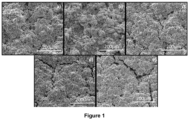
Figure 1 . SEM micrographs of cathodes containing different sodium salts. a) NaFSI; b) NaTFSI; c) NaFTFSI; d) NaClO4; and e) NaPF6. -
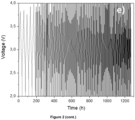
Figure 2 . Plots of voltage as a function of time for different sodium salt containing cells. a) NaClO4; b) NaPF6; c) NaFSI; d) NaTFSI; and e) NaFTFSI. -
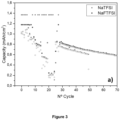
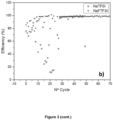
Figure 3 . Rate capability plots for NaTFSI and NaFTFSI containing cells. a) Charge and discharge capacity; and b) Coulombic efficiency. - In a first aspect, the present invention provides a solid-state sodium battery which exhibits expected charge/discharge profile at high active material mass loading (higher than 1.0 mAh·cm-2).
- In particular, the solid-state sodium battery of the present invention comprises a positive compartment, a negative compartment and an electrolyte composition.
- The positive electrode compartment comprising a positive electrode and a catholyte. Said positive electrode comprising a compound of formula NaFexMnyNizO2, wherein x is more than 0 and equal or less than 1, y is more than 0 and equal or less than 1, and z is more than 0 and less or equal than 1, and wherein said compound is a neutral oxide. Said catholyte comprising a salt of formula NaX, wherein Na is a sodium cation and X is an anion selected from the group consisting of bis(trifluoromethanesulfonyl) imide; (fluorosulfonyl)(trifluoromethanesulfonyl)imide; and a polymer selected from a polyether, polyester, polyethylene, polycarbonates, phosphazene, siloxanes and mixtures thereof; the negative electrode compartment comprising a negative electrode; said negative electrode comprising solid metallic sodium or an alloy comprising solid metallic sodium; and an electrolyte composition; wherein the mass loading of the compound of formula NaFexMnyNizO2, wherein x is more than 0 and equal or less than 1, y is more than 0 and equal or less than 1, and z is more than 0 and less or equal than 1, and wherein said compound is a neutral oxide, is equal or higher than 1.0 mAh·cm-2, wherein the mass loading being equal or higher than 1.0 mAh·cm-2 was calculated by multiplying the amount of said compound of formula NaFexMnyNizO2 per area of the positive electrode (g/cm2) by the expected capacity for said compound (mAh/g); and wherein the expected capacity is 130 mAh/g at a C-rate of C/10.
- The electrolyte composition of the battery of the present invention preferably comprises a solid sodium-ion conductive composition that conducts sodium ions during use between the negative and the positive electrodes.
- The battery of the present invention can be used as a primary battery but also as secondary battery capable of being charged or discharged through electrode chemical reactions generated during the electrochemical operation of the battery. The battery transports sodium ions which diffuse through the solid electrolyte located between both electrode compartments.
- More specifically, during charge, sodium ions diffuse from Na-insertion cathode (positive electrode compartment comprising a compound of formula NaFexMnyNizO2, wherein x is more than 0 and equal or less than 1, y is more than 0 and equal or less than 1, and z is more than 0 and less or equal than 1, and wherein said compound is a neutral oxide, as active material) to the anode (negative electrode compartment) through the electrolyte where they take an electron from the external circuit and are reduced to sodium metal.
- On discharge, sodium is oxidized to sodium ions at the negative electrode, giving up an electron to the external circuit to generate power. The sodium ions diffuse to the positive electrode side, spontaneously driven by the electrochemical reaction.
- The positive electrode compartment hosts the positive electrode which constitutes the cathode of the battery of the invention. This positive electrode comprises a compound of formula NaFexMnyNizO2, wherein x is more than 0 and equal or less than 1, y is more than 0 and equal or less than 1, and z is more than 0 and less or equal than 1 and wherein said compound is a neutral oxide, which is a sodium-insertion compound. Said compound can be synthesized by any method known by a skilled person as those mentioned in the following publications: Yuan, D. et al., J. Mater. Chem. A, 2013, 1, 3895-3899; Yuan, D.D. et al., ACS Appl. Mater. Interfaces, 2015, 7 (16), 8585-8591; Kim, D. et al., Electrochemistry Communications, 2012, 18, 66-69.
- Compounds of formula NaFexMnyNizO2, wherein x is more than 0 and equal or less than 1, y is more than 0 and equal or less than 1, and z is more than 0 and less or equal than 1 and wherein said compound is a neutral oxide, are transition metal oxides presenting a single phase O3 crystal structure, also known as pristine O3-layered crystal structure.
- In the context of the present invention the expression "mass loading (mAh·cm-2)" regarding the active material (i.e. the compound of formula NaFexMnyNizO2 wherein x is more than 0 and equal or less than 1, y is more than 0 and equal or less than 1, and z is more than 0 and less or equal than 1, and wherein said compound is a neutral oxide) was calculated by multiplying the amount of the compound of formula NaFexMnyNizO2 per area of the positive electrode (g/cm2) by the expected capacity for said compound (mAh/g), particularly assuming the expected capacity for the active material of the invention being 130 mAh/g.
- In an embodiment, the amount of the compound of formula NaFexMnyNizO2 per area of the positive electrode is equal or higher than 8 mg/cm2.
- In another embodiment, the compound of formula NaFexMnyNizO2 wherein x is more than 0 and equal or less than 1, y is more than 0 and equal or less than 1, and z is more than 0 and less or equal than 1, and wherein said compound is a neutral oxide is in an amount per area equal or higher than 8 mg/cm2; preferably in in an amount per electrode cross-sectional area along the electrode thickness equal or higher than 8 mg/cm2.
- In a particular embodiment, the term "active material mass loading" is the amount of active materials per electrode cross-sectional area along the electrode thickness direction expressed in units of mAh·cm-2. In the battery of the present invention, the mass loading of the compounds of formula NaFexMnyNizO2, wherein x is more than 0 and equal or less than 1, y is more than 0 and equal or less than 1, and z is more than 0 and less or equal than 1 and wherein said compounds are neutral oxides, is equal or higher than 1.0 mAh·cm-2.
- In a particular embodiment, the compounds of formula NaFexMnyNizO2, wherein x is more than 0 and equal or less than 1, y is more than 0 and equal or less than 1, and z is more than 0 and less or equal than 1 and wherein said compounds are neutral oxide are in an amount per area equal or higher than 8 mg/cm2.
- In a particular embodiment, the volume percentage of the compound formula NaFexMnyNizO2, wherein x is more than 0 and equal or less than 1, y is more than 0 and equal or less than 1, and z is more than 0 and less or equal than 1 and wherein said compounds are neutral oxides, respect to the total volume of positive electrode is between 30% and 75%, preferably between 35% and 60%, more preferably about 40%.
- Preferred compounds within the compounds of formula NaFexMnyNizO2, wherein x is more than 0 and equal or less than 1, y is more than 0 and equal or less than 1, and z is more than 0 and less or equal than 1 and wherein said compounds are neutral oxides, are compounds of formula NaFexMnyNizO2, wherein x = 0.05 to 0.8, y = 0.01 to 0.7, and z = 0.01 to 0.7; preferably wherein x = 0.1 to 0.7, y = 0.05 to 0.6, and z = 0.05 to 0.6; more preferably wherein x = 0.2 to 0.6, y = 0.1 to 0.5, and z = 0.1 to 0.5; even more preferably are wherein x = 0.3 to 0.5, y = 0.2 to 0.4, and z = 0.2 to 0.4. A more preferred compound within the compounds above is compound NaFe0.4Mn0.3Ni0.3O2.
- As defined above, the positive electrode compartment of the battery of the present invention further comprises an electrolyte composition, also known as catholyte, in contact with the positive electrode. Said catholyte comprises:
- a salt of formula NaX, wherein Na is a sodium cation and X is an anion selected from the group consisting of bis(trifluoromethanesulfonyl) imide (hereinafter referred to as "TFSI anion"); (fluorosulfonyl)(trifluoromethanesulfonyl)imide (hereinafter referred to as "FTFSI anion"); and
- a polymer selected from a polyether, polyester, polyethylene, polycarbonates, phosphazene, siloxanes and mixtures thereof.
- In a preferred embodiment, the salt of formula NaX is NaFTFSI.
- In the present invention, suitable polymers for the catholyte composition may be those suitable to dissolve sodium salts; in particular a salt of formula NaX, wherein Na is a sodium cation and X is an anion; preferably wherein the anion is selected from the group consisting of bis(trifluoromethanesulfonyl) imide (hereinafter referred to as "TFSI anion"); (fluorosulfonyl) (trifluoromethanesulfonyl) imide (hereinafter referred to as "FTFSI anion").
- In an embodiment, the polymer of the present invention is selected preferably from polyethylene polymers or mixtures thereof; more preferably polyethylene based polymers or mixtures thereof.
- In a particular embodiment, the polymer is selected from polypropylene oxide (PPO), poly[bis(methoxy-ethoxy)phosphazene] (MEEP), polysiloxane (Psi), poly(ethylene oxide) (PEO), polycarbonate and mixtures thereof.
- In a preferred embodiment, the polymer is poly(ethylene oxide) (PEO).
- The polymer used in the catholyte composition can also act as binder. Nevertheless, an additional binder compound could be added to securely adhere the compound of formula NaFexMnyNizO2, wherein x is more than 0 and equal or less than 1, y is more than 0 and equal or less than 1, and z is more than 0 and less or equal than 1, and wherein said compound is a neutral oxide, and the catholyte to each other. Polytetrafluoroethylene (PTFE), polyvinylidene fluoride (PVDF), polyethylene-propylene-diene where the diene content is 10% or lower known as EPDM are preferred additional binder compounds.
- In a particular embodiment, the volume percentage of catholyte respect to the total volume of positive electrode is between 25% and 70%, preferably between 35 and 60 %, more preferably 50%.
- In another particular embodiment, the molar ratio of the catholyte between the monomer in the polymer and sodium in the salt of formula NaX is between 6:1 and 30:1, preferably between 10:1 and 25:1; more preferably 20:1.
- A typical positive electrode compartment in a solid-state battery preferably also comprises a current collector which can be made of an aluminum or copper foil covered by a film containing the cathode active material. In the present case said material comprises a compound of formula NaFexMnyNizO2, wherein x is more than 0 and equal or less than 1, y is more than 0 and equal or less than 1, and z is more than 0 and less or equal than 1, and wherein said compound is a neutral oxide, preferably a compound of formula NaFexMnyNizO2, wherein x = 0.3 to 0.5, y = 0.2 to 0.4, and z = 0.2 to 0.4, and wherein said compound is a neutral oxide, or preferably compound NaFe0.4Mn0.3Ni0.3O2.
- In a particular embodiment, said film also comprises a conductive additive. Examples of conductive additives include carbon black, for example C65, carbon nanotubes, graphene or acetylene black.
- In a particular embodiment, the volume percentage of conductive additive respect to the total volume of positive electrode is between 5% and 20%, preferably 10%.
- In a particular embodiment, the catholyte of the present invention comprises fillers. In a particular embodiment, the fillers are selected from metal oxides, sodium ion conductive fillers and combinations thereof. In a more particular embodiment, the metal oxides are selected from SiO2, Al2O3, TiO2, BaTiO3, MgO, ZrO2, sulphate-promoted superacid ZrO2, Zr-O-SO4, CeO2, NiO, CuO, ZnO, Sm2O3, Y2O3, Fe2O3, Fe3O4, Co3O4 and combinations thereof; preferably SiO2, Al2O3, TiO2, BaTiO3, and combinations thereof. In a more particular embodiment, the sodium ion conductive fillers are selected from NASICON-type materials such as Na3Zr2Si2PO12 or Na3.4Zr1.8Mg0.2Si2PO12; β'-Al2O3; β"-Al2O3 and combinations thereof.
- In the context of the invention NASICON materials are NASICON-type materials are materials isostructural with NaZr2(PO4)3 such as Na3Zr2Si2PO12 or Na3.4Zr1.8Mg0.2Si2PO12.
- In a particular embodiment, the catholyte of the present invention comprises additives such as metallic salts. In a more particular embodiment, the metallic salts are selected from KFTFSI, CsFTFSI, KTFSI, CsTFSI and combinations thereof. In the context of the present invention, bis(trifluoromethanesulfonyl) imide anion is hereinafter referred to as "TFSI" and (fluorosulfonyl) (trifluoromethanesulfonyl) imide anion hereinafter referred to as "FTFSI".
- The positive electrode or cathode can be prepared by solvent-casting a slurry comprising a compound of formula NaFexMnyNizO2, wherein x is more than 0 and equal or less than 1, y is more than 0 and equal or less than 1, and z is more than 0 and less or equal than 1, and wherein said compound is a neutral oxide, preferably a compound of formula NaFexMnyNizO2, wherein x = 0.3 to 0.5, y = 0.2 to 0.4, and z = 0.2 to 0.4, and wherein said compound is a neutral oxide, or the most preferred compound NaFe0.4Mn0.3Ni0.3O2, the catholyte composition, the conductive additive and a solvent. Examples of suitable solvents include an organic solvent, such as acetonitrile. The slurry is then cast onto the aluminum or copper foil and a free-standing cathode film is formed as the solvent evaporates. The cathode is then dried further at about 50 °C. Alternatively, the slurry containing the compound of formula NaFexMnyNizO2, wherein x is more than 0 and equal or less than 1, y is more than 0 and equal or less than 1, and z is more than 0 and less or equal than 1, and wherein said compound is a neutral oxide, preferably the compound of formula NaFexMnyNizO2, wherein x = 0.3 to 0.5, y = 0.2 to 0.4, and z = 0.2 to 0.4, and wherein said compound is a neutral oxide, or the most preferred compound NaFe0.4Mn0.3Ni0.3O2, the catholyte composition, the conductive additive and the solvent can be cast onto a glass substrate and, subsequently the current collector can be applied.
- The negative electrode constitutes the anode of the battery of the present invention and comprises, as the main component, solid metallic sodium or an alloy comprising solid metallic sodium which is in the form of a foil.
- As will be appreciated by the context of the present disclosure, the negative electrode is located within the negative electrode compartment in fluid communication with the solid electrolyte. As the battery of the invention, allows working below the melting point of the metallic sodium, it remains in solid state at operating conditions. Thus, the use of solid metallic sodium is advantageous with respect to molten sodium as it considerably improves the battery safety. Indeed, molten sodium behaves as a liquid and leakage and short circuit may happen due to the high reactivity of this alkali metal.
- In a preferred embodiment, the negative electrode does not comprise a current collector.
- In an embodiment, the negative electrode of the solid-state sodium battery of the invention further comprises a layer of a material; preferably a passivation layer; more preferably a passivation solid electrolyte interphase (SEI) layer; even more preferably wherein said passivation solid electrolyte interphase (SEI) layer comprises a material selected from metal-organic framework (MOFs) compounds, NaBr, NaF, Al2O3, SnSe, graphene, silicene, phosphorene, stanene, germanene, SnS, hexagonal boron nitride and combinations thereof; preferably selected from NaBr, NaF, Al2O3, SnSe, graphene, silicene, phosphorene, stanene, germanene, SnS, hexagonal boron nitride and combinations thereof.
- In the context of the present invention, the expression metal-organic framework (MOFs) compounds is directed to compounds comprising metal ions or clusters coordinated to organic ligands as known in the art.
- The electrolyte composition of the battery of the present invention preferably comprises a solid sodium-ion conductive composition that conducts sodium ions during use between the negative and the positive electrodes. This electrolyte has a cathode side defining the positive electrode compartment and an anode side defining the negative electrode compartment. Therefore, the solid electrolyte acts as separator of the positive and the negative electrode compartments.
- In a preferred embodiment, the electrolyte composition of the battery of the present invention is the same as the catholyte composition, that is, a salt of formula NaX, wherein Na is a sodium cation and X is an anion selected from the group consisting of bis(trifluoromethanesulfonyl) imide; (fluorosulfonyl) (trifluoromethanesulfonyl) imide; and a polymer.
- Suitable salts of formula NaX for the electrolyte composition of the battery are those defined above for the catholyte, preferably NaFTFSI.
- Suitable polymers for the electrolyte are of the battery are those defined above for the catholyte, preferably poly(ethylene oxide) (PEO).
- In a particular embodiment, the electrolyte of the present invention comprises fillers. In a particular embodiment, the fillers are selected from metal oxides, sodium ion conductive fillers and combinations thereof. In a more particular embodiment, the metal oxides are selected from SiO2, Al2O3, TiO2, BaTiO3, MgO, ZrO2, sulphate-promoted superacid ZrO2, Zr-O-SO4, CeO2, NiO, CuO, ZnO, Sm2O3, Y2O3, Fe2O3, Fe3O4, Co3O4 and combinations thereof; preferably SiO2, Al2O3, TiO2, BaTiO3, and combinations thereof. In a more particular embodiment, the sodium ion conductive fillers are selected from NASICON-type materials such as Na3Zr2Si2PO12 or Na3.4Zr1.8Mg0.2Si2PO12; β'-Al2O3; β"-Al2O3 and combinations thereof.
- In the context of the invention NASICON materials are NASICON-type materials are materials isostructural with NaZr2(PO4)3 such as Na3Zr2Si2PO12 or Na3.4Zr1.8Mg0.2Si2PO12.
- In a particular embodiment, the electrolyte of the present invention comprises additives such as metallic salts. In a more particular embodiment, the metallic salts are selected from KFTFSI, CsFTFSI, KTFSI, CsTFSI and combinations thereof. In the context of the present invention, bis(trifluoromethanesulfonyl) imide anion is hereinafter referred to as "TFSI" and (fluorosulfonyl) (trifluoromethanesulfonyl) imide anion hereinafter referred to as "FTFSI".
- The electrolyte can comprise further suitable materials including β-alumina, β'-alumina, β"-alumina. Preferably, β"-alumina.
- The solid-state sodium battery of the present invention exhibits expected charge/discharge profile for compounds of formula NaFexMnyNizO2, wherein x is more than 0 and equal or less than 1, y is more than 0 and equal or less than 1, and z is more than 0 and less or equal than 1, and wherein said compound is a neutral oxide, preferably for compounds of formula NaFexMnyNizO2, wherein x = 0.3 to 0.5, y = 0.2 to 0.4, and z = 0.2 to 0.4, and wherein said compound is a neutral oxide, or for the most preferred compound NaFe0.4Mn0.3Ni0.3O2, at high active material mass loading (higher than 1.0 mAh·cm-2). As it is shown in the experimental part and contrary of what it would be expected, not all the alkali metal salts usually employed in liquid electrolyte batteries present expected charge/discharge profiles at high active material mass loading (
Figure 2 ). - As it has been mentioned above, it is extensively reported that most of SSBs exhibit too low areal capacity, less than 1.0 mAh·cm-2 and operate at a C-rate around 0.1C, particularly for charging. Commercial Li-ion battery electrodes for cell assembly with liquid electrolytes can attain capacities over 2.0 mAh cm-2 and C-rates of 0.2C. This implies that the performance of SSBs is limited conceivably by kinetics or mass transfer.
- As already mentioned, the solid-state sodium battery of the present invention presents a capacity equal than 130 mAh/g at a C-rate of C/10.
- In the context of the present invention the term "capacity" related to the solid-state sodium battery of the present invention refers to the capacity values expressed as mAh/g or mAh/cm2 obtained experimentally by multiplying the current (in mA) at which the cells are cycled by the time (in hours) that takes them to fully charge/discharge and divided by the area (in cm2) or the mass (in g) of the cathode active material at a certain C-rate. As known in the art, these values are strongly dependent on the cycling rate (mA) at which the cells are tested.
- In an embodiment, the capacity expressed as mAh/g or mAh/cm2 is obtained experimentally by multiplying the current (in mA) at which the battery are cycled by the time (in hours) that takes them to fully charge/discharge and divided by the area (in cm2) or the mass (in g) of the cathode active material at a certain C-rate.
- Without being bound to any theory in particular, the authors of the present invention believe that the improved cyclability of the cell of the present invention for high active material mass loadings (equal or higher than 1.0 mAh·cm-2) is due to an improved SEI layer that prevents soft-dendrite formation in the anode and subsequent internal shorts that hinder the expected cell performance.
- In a particular embodiment, the negative electrode compartment, the electrolyte composition and the positive electrode compartment are incorporated in a battery case. This battery case includes electrode terminals which are extended from the inside to the outside of the battery case.
- In a particular embodiment, the solid-state sodium battery of the present invention is a high energy density battery having an energy density of up to 300 Wh·L-1.
- The combination of safety and higher energy density in the solid-state sodium battery of the present invention translates into lower costs by eliminating many of the over-engineered safety features that are necessary with liquid systems today and size reduction and easier integration since it is capable of delivering the required energy and power for a smaller system.
- As will be appreciated by those skilled in the art, the solid-state sodium battery of the present invention may be implemented in a variety of configurations and designs. For example, it can take a planar configuration or a tubular configuration in which the different components are contained inside a tubular assembly or housing to form the battery.
- Multiple batteries can be stacked to form a stack or module system. Therefore, another aspect of the present invention refers to a module system which comprises at least two stacked batteries as defined above. This system comprises battery repeating units stacked into a module with a variable power output depending upon the final application.
- In addition, the high energy density of the solid-state sodium battery of the invention makes it very suitable for use as an energy storage device. This is due to the fact that energy storage devices are desired to be portable and compact by having a minimum weight and volume. To this end, capacity for power and energy density of batteries have to be maximized. The amount of energy stored and the peak power capability are principle parameters of energy storage devices.
- Thus, the solid-state sodium battery of the invention can be used as an energy storage device, being rechargeable over a plurality of charge-discharge cycles.
- Poly(ethylene oxide) (PEO) (Mw= 106 g mol-1) was dried at 50 °C overnight under dynamic vacuum prior to use. NaTFSI, NaFTFSI, NaClO4 and NaPF6 were dried at 100 °C overnight under dynamic vacuum, and NaFSI was dried at 50 °C. Anhydrous acetonitrile (ACN, 99.8%) was used as a solvent. NaFe0.4Mn0.3Ni0.3O2, dried at 120 °C overnight under dynamic vacuum, was used as active material (AM). Carbon black (CB, C65), dried at 120°C overnight under dynamic vacuum, was used as a conductive additive. Metallic sodium was used as anode.
- For the electrolyte preparation the PEO and NaX (X = FSI, TFSI, FTFSI, ClO4 and PF6) were mixed according to a EO:Na molar ratio of 20:1. The mixtures of the polymer and the salts were done in anhydrous acetonitrile using a magnetic stirrer for 24 h. The weight ratio of ACN to PEO was fixed to 50:1 to get a well dissolved and well dispersed slurry. After that, the slurries were cast inside a Teflon die and left until the total evaporation of the ACN (12 h, under Dry Room conditions). Once the membranes were dried they were hot pressed (80 °C) in order to get, non-porous and ~ 60 µm thick membranes. Before using them, the membranes were dried at 50 °C overnight under dynamic vacuum.
- The cathode is composed of a catholyte, composed by PEO and the same salt as that in the electrolyte, a conductive additive (CB) and an active material. All the cathodes were formulated with a 50% vol of catholyte, 40% of active material and 10% of conductive additive. First of all, the catholyte was mixed according to a EO:Na molar ratio of 20:1 in acetonitrile stirring it overnight. Acetonitrile was added according to a weight ratio of ACN:SC (SC = PEO + NaX + AM + CB) of 4:1. The active material and carbon black were premixed in an agate mortar. Powder mixture and catholyte solution were mixed in a planetary ball milling (Micro Pulverisette 7 premium, Fritsch), with 5 mm ZrO2 balls, using a Balls:SC ratio of 30:1. The obtained slurry was cast onto aluminum foil. All laminates were cast with a known gap, in order to get an active material loading corresponding to 1 mAh·cm-2. The laminates were then dried at 50 °C overnight under dynamic vacuum.
- The active material mass loading (mAh·cm-2) was calculated during the fabrication of the electrode. Since the percentage of active material with respect to the conductive additive and the catholyte were known and the mass in mg/cm2 of the AI foil was also a known, then, the active material loading in mg/cm2 was known. This value was translated into mAh/cm2 loading values by multiplying it by the expected capacity for NaFe0.4Mn0.3Ni0.3O2, (130 mAh/g). That is, no charge/discharge experiments were performed to calculate active material mass loading (mAh·cm-2). Thus, since the active material loading value is based on the active material amount and expected capacity for the active material (130 mAh/g), it does not depend on the C-rate.
- The table below shows the calculated active material loadings in mAh/cm2 for different NaFe0.4Mn0.3Ni0.3O2 loadings in mg/cm2 during the fabrication of the positive electrode, assuming the expected capacity for this active material being 130 mAh/g.
mg/cm2 mAh/cm2 1 0.13 2 0.26 3 0.39 4 0.52 5 0.65 6 0.78 7 0.91 8 1.04 9 1.17 10 1.3 11 1.43 - The morphological characterization was conducted via scanning electron microscopy (SEM) with a FEI Quanta 200F FEG-SEM using an acceleration voltage in the range between 20 and 30 keV using either secondary electron (SE) or backscattered electron (BSE) detectors.
- The microstructure of the NaFe0.4Mn0.3Ni0.3O2 electrodes with different catholyte compositions was characterized by SEM. No clear differences were detected depending on the catholyte composition (see
Figure 1 ). - To evaluate the electrochemical performance of the different cell compositions, CR2032 coin cells were assembled in argon glove box with a cathode disk, a membrane and Na disk. The Na ingot was rolled in order to get homogeneous thickness. Before cycling, the cells were conditioned at 70 °C for 24 h to ensure good interfacial contact.
- The cycling performance of the cells with different catholyte and electrolyte compositions (
Figure 2 ) shows that not all the NaX salts that work as a liquid electrolyte can be used in an all solid state cell to build cells that cycle stably in the voltage range of interest, when the active material loading is as high as 1 mAh·cm-2. Voltage profiles inFigure 2.a-c (corresponding to NaClO4, NaPF6 and NaFSI as catholyte and electrolyte) show that voltage does not reach the upper cut-off voltage (4 V for NaFe0.4Mn0.3Ni0.3O2). During the charging process "soft dendrites" are generated and these dendrites create small and localized short circuits, impeding the voltage to reach the upper cut-off limit. - Opposite to this, when NaTFSI and NaFTFSI are used as catholyte/electrolyte (
Figure 2.d and2.e ), the voltage profile expected for NaFe0.4Mn0.3Ni0.3O2 can be observed. Therefore, those two salts enable expected cell performance in solid-state cell configuration. Moreover, better cycling performance is observed for the cells with NaFTFSI as catholyte/electrolyte (Figure 3 ). - The areal capacity values (mAh/cm2) were obtained experimentally (plotted in
Figure 3 ). They were calculated by multiplying the current (in mA) at which the cells were cycled by the time (in hours) that takes them to fully charge/discharge and divided by the area (in cm2) of the electrodes. These values are strongly dependent on the cycling rate (mA) at which the cells are tested. In the present experiment, a rate capability test was performed (5 cycles at C/20, 5 cycles at C/10, 5 cycles at C/5, 5 cycles at C/2 and 5 cycles at 1C) before launching the stability test. The cycling rates at which the areal capacity is higher than 1 mAh/cm2 are those measured at low rates (C/10 or lower). - Results reported in the literature showed that when using catholyte salts such as NaClO4, NaPF6 or NaFSI, good cycling performance was observed when the active material mass loading of the positive electrode was close to 2 mg/cm2 (corresponding to 0.2-0.3 mAh/cm2). However, surprisingly, when the active material loading was in the range of 8 mg/cm2 or above (corresponding to 1 mAh/cm2 or more) only the cells with NaTFSI and NaFTFSI as catholyte salts showed good cycling performance.
wherein the mass loading being equal or higher than 1.0 mAh·cm-2 was calculated by multiplying the amount of said compound of formula NaFexMnyNizO2 per area of the positive electrode (g/cm2) by the expected capacity for said compound (mAh/g); and
wherein the expected capacity is 130 mAh/g at a C-rate of C/10.
Claims (15)
- A solid-state sodium battery comprising:a) a positive compartment comprising:a.1) a positive electrode, said positive electrode comprising a compound of formula NaFexMnyNizO2, whereinx is more than 0 and equal or less than 1,y is more than 0 and equal or less than 1,z is more than 0 and less or equal than 1, andwherein said compound is a neutral oxide; anda.2) a catholyte comprising:- a salt of formula NaX, wherein Na is a sodium cation and X is an anion selected from the group consisting of bis(trifluoromethanesulfonyl)imide; (fluorosulfonyl)(trifluoromethanesulfonyl)imide; and- a polymer, wherein the polymer is selected from a polyether, polyester, polyethylene, polycarbonates, phosphazene, siloxanes and mixtures thereof;b) a negative compartment comprising a negative electrode, said negative electrode comprising solid metallic sodium or an alloy comprising solid metallic sodium; andc) an electrolyte composition; wherein said electrolyte composition comprises a solid sodium-ion conductive composition that conducts sodium ions during use between the negative and the positive electrodes;wherein the mass loading of said compound of formula NaFexMnyNizO2 is equal or higher than 1.0 mAh·cm-2;wherein the mass loading being equal or higher than 1.0 mAh·cm-2 was calculated by multiplying the amount of said compound of formula NaFexMnyNizO2 per area of the positive electrode (g/cm2) by the expected capacity for said compound (mAh/g); andwherein the expected capacity is 130 mAh/g at a C-rate of C/10.
- The solid-state sodium battery according to claim 1, wherein in the compound of formula NaFexMnyNizO2, wherein x = 0.3 to 0.5, y = 0.2 to 0.4, and z = 0.2 to 0.4, and wherein said compound is a neutral oxide.
- The solid-state sodium battery according to any of claims 1 or 2, wherein the compound of formula NaFexMnyNizO2 is NaFe0.4Mn0.3Ni0.3O2.
- The solid-state sodium battery according to any of claims 1 to 3, wherein the salt of formula NaX is sodium(fluorosulfonyl)(trifluoromethanesulfonyl)imide.
- The solid-state sodium battery according to any of claims 1 to 4, wherein the polymer is selected from polypropylene oxide (PPO), poly[bis(methoxy-ethoxy)phosphazene] (MEEP), polysiloxane (PSi), poly(ethylene oxide) (PEO), polycarbonate and mixtures thereof; preferably wherein the polymer is poly(ethylene oxide).
- The solid-state sodium battery according to any of claims 1 to 5, wherein the catholyte further comprises a binder, said binder being preferably selected from polytetrafluoroethylene (PTFE), polyvinylidene fluoride (PVDF), polyethylene-propylene-diene where the diene content is 10% or lower (EPDM).
- The solid-state sodium battery according to any one of claims 1 to 6, wherein the positive electrode compartment further comprises a current collector made of an aluminum or copper foil; and/or wherein the positive electrode further comprises a conductive additive.
- The solid-state sodium battery according to any of claims 1 to 7, wherein the negative electrode further comprises a passivation solid electrolyte interphase (SEI) layer and optionally, wherein the passivation solid electrolyte interphase (SEI) layer comprises a material selected from metal-organic framework compounds, NaBr, NaF, Al2O3, SnSe, graphene, silicene, phosphorene, stanene, germanene, SnS, hexagonal boron nitride and combinations thereof.
- The solid-state sodium battery according to any of claims 1 to 8, wherein the electrolyte composition comprises:- a salt of formula NaX, wherein Na is a sodium cation and X is an anion selected from the group consisting of bis(trifluoromethanesulfonyl)imide; (fluorosulfonyl) (trifluoromethanesulfonyl)imide; and- a polymer selected from polypropylene oxide (PPO), poly[bis(methoxy-ethoxy)phosphazene] (MEEP), polysiloxane (PSi), poly(ethylene oxide) (PEO), polycarbonate and mixtures thereof; preferably wherein the polymer is poly(ethylene oxide).
- The solid-state sodium battery according to any of claims 1 to 9, wherein the electrolyte composition further comprises a filler selected from metal oxides, sodium ion conductive materials, and combinations thereof; preferably wherein the filler is selected from SiO2, Al2O3, TiO2, BaTiO3, Na3Zr2Si2PO12 Na3.4Zr1.8Mg0.2Si2PO12, β'-Al2O3, β"-Al2O3, and a combination thereof.
- The solid-state sodium battery according to any of claims 1 to 10, wherein the electrolyte composition further comprises metallic salts, preferably wherein the metallic salts are selected from KFTFSI, CsFTFSI, KTFSI, CsTFSI and combinations thereof.
- The solid-state sodium battery according to any of claims 1 to 11; wherein the amount of the compound of formula NaFexMnyNizO2 per area of the positive electrode is equal or higher than 8 mg/cm2.
- A module system which comprises at least two stacked batteries as defined in any of claims 1 to 12.
- Use of the solid-state sodium battery as defined in any of claims 1 to 12 as an energy storage device.
- Use of the module system as defined in claim 13 as an energy storage device.
Applications Claiming Priority (2)
| Application Number | Priority Date | Filing Date | Title |
|---|---|---|---|
| EP19382651.8A EP3772125A1 (en) | 2019-07-29 | 2019-07-29 | Solid-state sodium battery |
| PCT/EP2020/071257 WO2021018886A1 (en) | 2019-07-29 | 2020-07-28 | Solid-state sodium battery |
Publications (2)
| Publication Number | Publication Date |
|---|---|
| EP4004996A1 EP4004996A1 (en) | 2022-06-01 |
| EP4004996B1 true EP4004996B1 (en) | 2025-03-05 |
Family
ID=67514508
Family Applications (2)
| Application Number | Title | Priority Date | Filing Date |
|---|---|---|---|
| EP19382651.8A Withdrawn EP3772125A1 (en) | 2019-07-29 | 2019-07-29 | Solid-state sodium battery |
| EP20743727.8A Active EP4004996B1 (en) | 2019-07-29 | 2020-07-28 | Solid-state sodium battery |
Family Applications Before (1)
| Application Number | Title | Priority Date | Filing Date |
|---|---|---|---|
| EP19382651.8A Withdrawn EP3772125A1 (en) | 2019-07-29 | 2019-07-29 | Solid-state sodium battery |
Country Status (3)
| Country | Link |
|---|---|
| EP (2) | EP3772125A1 (en) |
| ES (1) | ES3032325T3 (en) |
| WO (1) | WO2021018886A1 (en) |
Families Citing this family (2)
| Publication number | Priority date | Publication date | Assignee | Title |
|---|---|---|---|---|
| CN115395092A (en) * | 2021-05-24 | 2022-11-25 | 新加坡国立大学 | All-solid-state rechargeable battery and method for manufacturing electrolyte thereof |
| CN119864368B (en) * | 2023-10-19 | 2026-04-03 | 溧阳天目先导电池材料科技有限公司 | A composite negative electrode for sodium batteries and its preparation method |
Family Cites Families (3)
| Publication number | Priority date | Publication date | Assignee | Title |
|---|---|---|---|---|
| JP6339076B2 (en) * | 2013-07-19 | 2018-06-06 | パナソニック株式会社 | Nonaqueous electrolyte and nonaqueous electrolyte secondary battery using the same |
| ES2631077T3 (en) | 2014-10-14 | 2017-08-28 | Fundación Centro de Investigación Cooperativa de Energías Alternativas, CIC Energigune Fundazioa | Sodium battery with ceramic electrolyte |
| CN108933282B (en) * | 2018-07-11 | 2021-01-22 | 中国科学院宁波材料技术与工程研究所 | NASICON structure sodium ion solid electrolyte, its preparation method and solid state sodium ion battery |
-
2019
- 2019-07-29 EP EP19382651.8A patent/EP3772125A1/en not_active Withdrawn
-
2020
- 2020-07-28 EP EP20743727.8A patent/EP4004996B1/en active Active
- 2020-07-28 WO PCT/EP2020/071257 patent/WO2021018886A1/en not_active Ceased
- 2020-07-28 ES ES20743727T patent/ES3032325T3/en active Active
Also Published As
| Publication number | Publication date |
|---|---|
| ES3032325T3 (en) | 2025-07-17 |
| WO2021018886A1 (en) | 2021-02-04 |
| EP4004996A1 (en) | 2022-06-01 |
| EP3772125A1 (en) | 2021-02-03 |
Similar Documents
| Publication | Publication Date | Title |
|---|---|---|
| Huang et al. | Solid‐state electrolytes for lithium metal batteries: state‐of‐the‐art and perspectives | |
| Zhao et al. | Research progress on the solid electrolyte of solid-state sodium-ion batteries | |
| US12283655B2 (en) | High-ionic conductivity ceramic-polymer nanocomposite solid state electrolyte | |
| Gao et al. | A sodium‐ion battery with a low‐cost cross‐linked gel‐polymer electrolyte | |
| Zhang et al. | Recent advances in electrolytes for lithium–sulfur batteries | |
| US11145895B2 (en) | Multilayer electrolyte cell, secondary battery comprising multilayer electrolyte cell and manufacturing method therefor | |
| Jeong et al. | Multifunctional TiO 2 coating for a SiO anode in Li-ion batteries | |
| US8216722B2 (en) | Solid electrolyte for alkali-metal-ion batteries | |
| EP3531491B1 (en) | Electrolyte for lithium secondary battery and lithium secondary battery comprising the same | |
| US20220263129A1 (en) | Non-flammable solvate ionic liquid electrolyte with diluters | |
| CN110010954A (en) | Without cathode lithium metal battery and its manufacturing method | |
| CN112615068A (en) | Additives for ceramic ion-conducting materials to mitigate the resistive effects of surface carbonates and hydroxides | |
| Cao et al. | Sodium-ion batteries using ion exchange membranes as electrolytes and separators | |
| KR20170092327A (en) | Solid electrolyte, lithium battery comprising solid electrolyte | |
| EP2866291A1 (en) | Battery system, method for manufacturing battery system, and battery control apparatus | |
| De Luna et al. | All-solid lithium-sulfur batteries: Present situation and future progress | |
| KR102896841B1 (en) | Solid ion conductor, solid electrolyte comprising the conductor, lithium battery comprising the electrolyte, and preparation method thereof | |
| KR20180036410A (en) | All solid state battery | |
| US20210102063A1 (en) | Low-Temperature ceramic-polymer nanocomposite solid state electrolyte | |
| EP3010079A1 (en) | Sodium battery with ceramic electrolyte | |
| Tamainato et al. | Composite polymer electrolytes for lithium batteries | |
| Sivakumaran et al. | High ionic conducting rare-earth silicate electrolytes for sodium metal batteries | |
| Inoishi et al. | A single-phase all-solid-state lithium battery based on Li 1.5 Cr 0.5 Ti 1.5 (PO 4) 3 for high rate capability and low temperature operation | |
| Afrifah et al. | Bikitaite composite polymer electrolyte for high-performance solid-state lithium metal battery | |
| Rajsundar et al. | Rational engineering of electrolytes for lithium–sulfur batteries |
Legal Events
| Date | Code | Title | Description |
|---|---|---|---|
| STAA | Information on the status of an ep patent application or granted ep patent |
Free format text: STATUS: UNKNOWN |
|
| STAA | Information on the status of an ep patent application or granted ep patent |
Free format text: STATUS: THE INTERNATIONAL PUBLICATION HAS BEEN MADE |
|
| PUAI | Public reference made under article 153(3) epc to a published international application that has entered the european phase |
Free format text: ORIGINAL CODE: 0009012 |
|
| STAA | Information on the status of an ep patent application or granted ep patent |
Free format text: STATUS: REQUEST FOR EXAMINATION WAS MADE |
|
| 17P | Request for examination filed |
Effective date: 20220120 |
|
| AK | Designated contracting states |
Kind code of ref document: A1 Designated state(s): AL AT BE BG CH CY CZ DE DK EE ES FI FR GB GR HR HU IE IS IT LI LT LU LV MC MK MT NL NO PL PT RO RS SE SI SK SM TR |
|
| DAV | Request for validation of the european patent (deleted) | ||
| DAX | Request for extension of the european patent (deleted) | ||
| P01 | Opt-out of the competence of the unified patent court (upc) registered |
Effective date: 20230424 |
|
| GRAP | Despatch of communication of intention to grant a patent |
Free format text: ORIGINAL CODE: EPIDOSNIGR1 |
|
| STAA | Information on the status of an ep patent application or granted ep patent |
Free format text: STATUS: GRANT OF PATENT IS INTENDED |
|
| INTG | Intention to grant announced |
Effective date: 20240409 |
|
| GRAJ | Information related to disapproval of communication of intention to grant by the applicant or resumption of examination proceedings by the epo deleted |
Free format text: ORIGINAL CODE: EPIDOSDIGR1 |
|
| STAA | Information on the status of an ep patent application or granted ep patent |
Free format text: STATUS: REQUEST FOR EXAMINATION WAS MADE |
|
| INTC | Intention to grant announced (deleted) | ||
| GRAP | Despatch of communication of intention to grant a patent |
Free format text: ORIGINAL CODE: EPIDOSNIGR1 |
|
| STAA | Information on the status of an ep patent application or granted ep patent |
Free format text: STATUS: GRANT OF PATENT IS INTENDED |
|
| INTG | Intention to grant announced |
Effective date: 20241004 |
|
| GRAS | Grant fee paid |
Free format text: ORIGINAL CODE: EPIDOSNIGR3 |
|
| GRAA | (expected) grant |
Free format text: ORIGINAL CODE: 0009210 |
|
| STAA | Information on the status of an ep patent application or granted ep patent |
Free format text: STATUS: THE PATENT HAS BEEN GRANTED |
|
| AK | Designated contracting states |
Kind code of ref document: B1 Designated state(s): AL AT BE BG CH CY CZ DE DK EE ES FI FR GB GR HR HU IE IS IT LI LT LU LV MC MK MT NL NO PL PT RO RS SE SI SK SM TR |
|
| RAP3 | Party data changed (applicant data changed or rights of an application transferred) |
Owner name: ORMAZABAL ELECTRIC, S.L.U. Owner name: FUNDACION CENTRO DE INVESTIGACION COOPERATIVA DEENERGIAS ALTERNATIVAS, CIC ENERGIGUNE FUNDAZIOA |
|
| REG | Reference to a national code |
Ref country code: GB Ref legal event code: FG4D |
|
| RIN1 | Information on inventor provided before grant (corrected) |
Inventor name: GILBERT, IAN PAUL Inventor name: BUANNIC, LUCIENNE Inventor name: MORANT MINANA, MARIA CARMEN Inventor name: QUINTELA ZUMETA, AMAIA Inventor name: VILLAVERDE OREJON, AITOR Inventor name: OTAEGUI AMEZTEGUI, LAIDA |
|
| REG | Reference to a national code |
Ref country code: CH Ref legal event code: EP |
|
| REG | Reference to a national code |
Ref country code: IE Ref legal event code: FG4D |
|
| REG | Reference to a national code |
Ref country code: DE Ref legal event code: R096 Ref document number: 602020047221 Country of ref document: DE |
|
| PG25 | Lapsed in a contracting state [announced via postgrant information from national office to epo] |
Ref country code: RS Free format text: LAPSE BECAUSE OF FAILURE TO SUBMIT A TRANSLATION OF THE DESCRIPTION OR TO PAY THE FEE WITHIN THE PRESCRIBED TIME-LIMIT Effective date: 20250605 |
|
| PG25 | Lapsed in a contracting state [announced via postgrant information from national office to epo] |
Ref country code: FI Free format text: LAPSE BECAUSE OF FAILURE TO SUBMIT A TRANSLATION OF THE DESCRIPTION OR TO PAY THE FEE WITHIN THE PRESCRIBED TIME-LIMIT Effective date: 20250305 |
|
| REG | Reference to a national code |
Ref country code: NL Ref legal event code: MP Effective date: 20250305 |
|
| REG | Reference to a national code |
Ref country code: LT Ref legal event code: MG9D |
|
| PG25 | Lapsed in a contracting state [announced via postgrant information from national office to epo] |
Ref country code: NO Free format text: LAPSE BECAUSE OF FAILURE TO SUBMIT A TRANSLATION OF THE DESCRIPTION OR TO PAY THE FEE WITHIN THE PRESCRIBED TIME-LIMIT Effective date: 20250605 |
|
| PG25 | Lapsed in a contracting state [announced via postgrant information from national office to epo] |
Ref country code: HR Free format text: LAPSE BECAUSE OF FAILURE TO SUBMIT A TRANSLATION OF THE DESCRIPTION OR TO PAY THE FEE WITHIN THE PRESCRIBED TIME-LIMIT Effective date: 20250305 |
|
| PG25 | Lapsed in a contracting state [announced via postgrant information from national office to epo] |
Ref country code: LV Free format text: LAPSE BECAUSE OF FAILURE TO SUBMIT A TRANSLATION OF THE DESCRIPTION OR TO PAY THE FEE WITHIN THE PRESCRIBED TIME-LIMIT Effective date: 20250305 |
|
| REG | Reference to a national code |
Ref country code: ES Ref legal event code: FG2A Ref document number: 3032325 Country of ref document: ES Kind code of ref document: T3 Effective date: 20250717 |
|
| PG25 | Lapsed in a contracting state [announced via postgrant information from national office to epo] |
Ref country code: BG Free format text: LAPSE BECAUSE OF FAILURE TO SUBMIT A TRANSLATION OF THE DESCRIPTION OR TO PAY THE FEE WITHIN THE PRESCRIBED TIME-LIMIT Effective date: 20250305 Ref country code: GR Free format text: LAPSE BECAUSE OF FAILURE TO SUBMIT A TRANSLATION OF THE DESCRIPTION OR TO PAY THE FEE WITHIN THE PRESCRIBED TIME-LIMIT Effective date: 20250606 |
|
| REG | Reference to a national code |
Ref country code: AT Ref legal event code: MK05 Ref document number: 1773788 Country of ref document: AT Kind code of ref document: T Effective date: 20250305 |
|
| PG25 | Lapsed in a contracting state [announced via postgrant information from national office to epo] |
Ref country code: NL Free format text: LAPSE BECAUSE OF FAILURE TO SUBMIT A TRANSLATION OF THE DESCRIPTION OR TO PAY THE FEE WITHIN THE PRESCRIBED TIME-LIMIT Effective date: 20250305 |
|
| PG25 | Lapsed in a contracting state [announced via postgrant information from national office to epo] |
Ref country code: SE Free format text: LAPSE BECAUSE OF FAILURE TO SUBMIT A TRANSLATION OF THE DESCRIPTION OR TO PAY THE FEE WITHIN THE PRESCRIBED TIME-LIMIT Effective date: 20250305 |
|
| PG25 | Lapsed in a contracting state [announced via postgrant information from national office to epo] |
Ref country code: SM Free format text: LAPSE BECAUSE OF FAILURE TO SUBMIT A TRANSLATION OF THE DESCRIPTION OR TO PAY THE FEE WITHIN THE PRESCRIBED TIME-LIMIT Effective date: 20250305 |
|
| PG25 | Lapsed in a contracting state [announced via postgrant information from national office to epo] |
Ref country code: PT Free format text: LAPSE BECAUSE OF FAILURE TO SUBMIT A TRANSLATION OF THE DESCRIPTION OR TO PAY THE FEE WITHIN THE PRESCRIBED TIME-LIMIT Effective date: 20250707 |
|
| PGFP | Annual fee paid to national office [announced via postgrant information from national office to epo] |
Ref country code: ES Payment date: 20250827 Year of fee payment: 6 |
|
| PG25 | Lapsed in a contracting state [announced via postgrant information from national office to epo] |
Ref country code: IT Free format text: LAPSE BECAUSE OF FAILURE TO SUBMIT A TRANSLATION OF THE DESCRIPTION OR TO PAY THE FEE WITHIN THE PRESCRIBED TIME-LIMIT Effective date: 20250305 Ref country code: PL Free format text: LAPSE BECAUSE OF FAILURE TO SUBMIT A TRANSLATION OF THE DESCRIPTION OR TO PAY THE FEE WITHIN THE PRESCRIBED TIME-LIMIT Effective date: 20250305 |
|
| PGFP | Annual fee paid to national office [announced via postgrant information from national office to epo] |
Ref country code: GB Payment date: 20250728 Year of fee payment: 6 |
|
| PG25 | Lapsed in a contracting state [announced via postgrant information from national office to epo] |
Ref country code: AT Free format text: LAPSE BECAUSE OF FAILURE TO SUBMIT A TRANSLATION OF THE DESCRIPTION OR TO PAY THE FEE WITHIN THE PRESCRIBED TIME-LIMIT Effective date: 20250305 |
|
| PGFP | Annual fee paid to national office [announced via postgrant information from national office to epo] |
Ref country code: FR Payment date: 20250728 Year of fee payment: 6 |
|
| PG25 | Lapsed in a contracting state [announced via postgrant information from national office to epo] |
Ref country code: CZ Free format text: LAPSE BECAUSE OF FAILURE TO SUBMIT A TRANSLATION OF THE DESCRIPTION OR TO PAY THE FEE WITHIN THE PRESCRIBED TIME-LIMIT Effective date: 20250305 Ref country code: EE Free format text: LAPSE BECAUSE OF FAILURE TO SUBMIT A TRANSLATION OF THE DESCRIPTION OR TO PAY THE FEE WITHIN THE PRESCRIBED TIME-LIMIT Effective date: 20250305 |
|
| PG25 | Lapsed in a contracting state [announced via postgrant information from national office to epo] |
Ref country code: RO Free format text: LAPSE BECAUSE OF FAILURE TO SUBMIT A TRANSLATION OF THE DESCRIPTION OR TO PAY THE FEE WITHIN THE PRESCRIBED TIME-LIMIT Effective date: 20250305 |
|
| PG25 | Lapsed in a contracting state [announced via postgrant information from national office to epo] |
Ref country code: SK Free format text: LAPSE BECAUSE OF FAILURE TO SUBMIT A TRANSLATION OF THE DESCRIPTION OR TO PAY THE FEE WITHIN THE PRESCRIBED TIME-LIMIT Effective date: 20250305 |
|
| PG25 | Lapsed in a contracting state [announced via postgrant information from national office to epo] |
Ref country code: IS Free format text: LAPSE BECAUSE OF FAILURE TO SUBMIT A TRANSLATION OF THE DESCRIPTION OR TO PAY THE FEE WITHIN THE PRESCRIBED TIME-LIMIT Effective date: 20250705 |
|
| REG | Reference to a national code |
Ref country code: DE Ref legal event code: R097 Ref document number: 602020047221 Country of ref document: DE |
|
| PLBE | No opposition filed within time limit |
Free format text: ORIGINAL CODE: 0009261 |
|
| STAA | Information on the status of an ep patent application or granted ep patent |
Free format text: STATUS: NO OPPOSITION FILED WITHIN TIME LIMIT |
|
| PG25 | Lapsed in a contracting state [announced via postgrant information from national office to epo] |
Ref country code: DK Free format text: LAPSE BECAUSE OF FAILURE TO SUBMIT A TRANSLATION OF THE DESCRIPTION OR TO PAY THE FEE WITHIN THE PRESCRIBED TIME-LIMIT Effective date: 20250305 |
|
| REG | Reference to a national code |
Ref country code: CH Ref legal event code: L10 Free format text: ST27 STATUS EVENT CODE: U-0-0-L10-L00 (AS PROVIDED BY THE NATIONAL OFFICE) Effective date: 20260114 |
|
| REG | Reference to a national code |
Ref country code: DE Ref legal event code: R119 Ref document number: 602020047221 Country of ref document: DE |
|
| 26N | No opposition filed |
Effective date: 20251208 |
|
| REG | Reference to a national code |
Ref country code: CH Ref legal event code: H13 Free format text: ST27 STATUS EVENT CODE: U-0-0-H10-H13 (AS PROVIDED BY THE NATIONAL OFFICE) Effective date: 20260224 |
|
| PG25 | Lapsed in a contracting state [announced via postgrant information from national office to epo] |
Ref country code: LU Free format text: LAPSE BECAUSE OF NON-PAYMENT OF DUE FEES Effective date: 20250728 |
|
| REG | Reference to a national code |
Ref country code: BE Ref legal event code: MM Effective date: 20250731 |
|
| PG25 | Lapsed in a contracting state [announced via postgrant information from national office to epo] |
Ref country code: DE Free format text: LAPSE BECAUSE OF NON-PAYMENT OF DUE FEES Effective date: 20260203 |
|
| PG25 | Lapsed in a contracting state [announced via postgrant information from national office to epo] |
Ref country code: BE Free format text: LAPSE BECAUSE OF NON-PAYMENT OF DUE FEES Effective date: 20250731 |
|
| PG25 | Lapsed in a contracting state [announced via postgrant information from national office to epo] |
Ref country code: CH Free format text: LAPSE BECAUSE OF NON-PAYMENT OF DUE FEES Effective date: 20250731 |