EP4004628B1 - Method of making optical aberration compensation lens using glass-ceramics. - Google Patents
Method of making optical aberration compensation lens using glass-ceramics. Download PDFInfo
- Publication number
- EP4004628B1 EP4004628B1 EP20844611.2A EP20844611A EP4004628B1 EP 4004628 B1 EP4004628 B1 EP 4004628B1 EP 20844611 A EP20844611 A EP 20844611A EP 4004628 B1 EP4004628 B1 EP 4004628B1
- Authority
- EP
- European Patent Office
- Prior art keywords
- glass
- lens
- heat treatment
- dispersion
- compensate
- Prior art date
- Legal status (The legal status is an assumption and is not a legal conclusion. Google has not performed a legal analysis and makes no representation as to the accuracy of the status listed.)
- Active
Links
Images






Classifications
-
- G—PHYSICS
- G02—OPTICS
- G02B—OPTICAL ELEMENTS, SYSTEMS OR APPARATUS
- G02B27/00—Optical systems or apparatus not provided for by any of the groups G02B1/00 - G02B26/00, G02B30/00
- G02B27/0025—Optical systems or apparatus not provided for by any of the groups G02B1/00 - G02B26/00, G02B30/00 for optical correction, e.g. distorsion, aberration
-
- C—CHEMISTRY; METALLURGY
- C03—GLASS; MINERAL OR SLAG WOOL
- C03B—MANUFACTURE, SHAPING, OR SUPPLEMENTARY PROCESSES
- C03B25/00—Annealing glass products
- C03B25/02—Annealing glass products in a discontinuous way
-
- C—CHEMISTRY; METALLURGY
- C03—GLASS; MINERAL OR SLAG WOOL
- C03B—MANUFACTURE, SHAPING, OR SUPPLEMENTARY PROCESSES
- C03B32/00—Thermal after-treatment of glass products not provided for in groups C03B19/00, C03B25/00 - C03B31/00 or C03B37/00, e.g. crystallisation, eliminating gas inclusions or other impurities; Hot-pressing vitrified, non-porous, shaped glass products
- C03B32/02—Thermal crystallisation, e.g. for crystallising glass bodies into glass-ceramic articles
-
- C—CHEMISTRY; METALLURGY
- C03—GLASS; MINERAL OR SLAG WOOL
- C03C—CHEMICAL COMPOSITION OF GLASSES, GLAZES OR VITREOUS ENAMELS; SURFACE TREATMENT OF GLASS; SURFACE TREATMENT OF FIBRES OR FILAMENTS MADE FROM GLASS, MINERALS OR SLAGS; JOINING GLASS TO GLASS OR OTHER MATERIALS
- C03C10/00—Devitrified glass ceramics, i.e. glass ceramics having a crystalline phase dispersed in a glassy phase and constituting at least 50% by weight of the total composition
-
- C—CHEMISTRY; METALLURGY
- C03—GLASS; MINERAL OR SLAG WOOL
- C03C—CHEMICAL COMPOSITION OF GLASSES, GLAZES OR VITREOUS ENAMELS; SURFACE TREATMENT OF GLASS; SURFACE TREATMENT OF FIBRES OR FILAMENTS MADE FROM GLASS, MINERALS OR SLAGS; JOINING GLASS TO GLASS OR OTHER MATERIALS
- C03C4/00—Compositions for glass with special properties
- C03C4/10—Compositions for glass with special properties for infrared transmitting glass
-
- G—PHYSICS
- G02—OPTICS
- G02B—OPTICAL ELEMENTS, SYSTEMS OR APPARATUS
- G02B1/00—Optical elements characterised by the material of which they are made; Optical coatings for optical elements
-
- G—PHYSICS
- G02—OPTICS
- G02B—OPTICAL ELEMENTS, SYSTEMS OR APPARATUS
- G02B13/00—Optical objectives specially designed for the purposes specified below
- G02B13/14—Optical objectives specially designed for the purposes specified below for use with infrared or ultraviolet radiation
-
- G—PHYSICS
- G02—OPTICS
- G02B—OPTICAL ELEMENTS, SYSTEMS OR APPARATUS
- G02B3/00—Simple or compound lenses
-
- C—CHEMISTRY; METALLURGY
- C03—GLASS; MINERAL OR SLAG WOOL
- C03C—CHEMICAL COMPOSITION OF GLASSES, GLAZES OR VITREOUS ENAMELS; SURFACE TREATMENT OF GLASS; SURFACE TREATMENT OF FIBRES OR FILAMENTS MADE FROM GLASS, MINERALS OR SLAGS; JOINING GLASS TO GLASS OR OTHER MATERIALS
- C03C2204/00—Glasses, glazes or enamels with special properties
-
- G—PHYSICS
- G02—OPTICS
- G02B—OPTICAL ELEMENTS, SYSTEMS OR APPARATUS
- G02B2207/00—Coding scheme for general features or characteristics of optical elements and systems of subclass G02B, but not including elements and systems which would be classified in G02B6/00 and subgroups
- G02B2207/101—Nanooptics
Definitions
- the embodiments relate to methods of making optical aberration compensation lenses, and in particular methods of making optical aberration compensation lens using glass-ceramics.
- FIG. 1 illustrates a lens 10 generating chromatic dispersion with deviations in the light paths 12 of differing colors propagated through the lens 10 to produce a chromatic aberration at an imaging plane 14.
- crown glass and flint glass are typically combined (e.g., achromatic doublet with concave flint lens and convex crown lens) to form a pair of glasses that serves to compensate for chromatic aberrations.
- Each element possesses different refractive index and dispersion properties, such that the dispersion of these glasses partially compensate for each other.
- crown and flint glasses are typically based on oxide materials and operate in the visible spectrum, and cannot operate or transmit infrared.
- Similar materials are needed in the infrared spectrum, especially to compensate for chromatic aberrations throughout the entire infrared spectrum, e.g., from short wave infrared (SWIR) to long wave infrared (LWIR) (e.g., from 1 to 12 ⁇ m).
- SWIR short wave infrared
- LWIR long wave infrared
- infrared optical systems tend to require many lenses to compensate for aberrations, such as chromatic and monochromatic (e.g., spherical, coma, astigmatism, etc.) aberrations, making such systems large, bulky, and cumbersome.
- chalcogenide glass materials of interest are discussed in MYUNGKOO KANG ET AL: "Ultralow Dispersion Multicomponent Thin-Film Chalcogenide Glass for Broadband Gradient-Index Optics",ADVANCED MATERIALS, VCH PUBLISHERS, DE, vol. 30, no. 39, 13 August 2018 (2018-08-13 ).
- the method of manufacturing the optical aberration compensation lens includes applying at least one heat treatment to a base glass material of a base composition (i.e., starting composition) to form a glass-ceramic material with a volume filling fraction of one or more species of nanocrystals.
- This process is glass composition agnostic (e.g., oxide, non-oxide, etc.) and can be applied to generate any glass-ceramic composition formed through controlled nucleation and growth.
- the species and/or volume filling fraction of nanocrystals determines the resulting index of refraction and dispersion characteristic (e.g., constringence).
- an optical aberration compensation lens includes a glass-ceramic material having a volume filling fraction of one or more species of nanocrystals configured to compensate for at least one aberration of at least one lens.
- the glass-ceramic material includes an index of refraction and a dispersion characteristic configured to compensate for the one or more chromatic aberrations.
- a method of manufacturing an optical aberration compensation lens includes applying a first heat treatment to a first starting base glass material of a base composition to form a first glass-ceramic material with a first volume filling fraction of one or more first species of nanocrystals configured to compensate for at least one first aberration of at least one first lens.
- the method of manufacturing the optical aberration compensation lens includes applying at least one heat treatment to a starting base glass material of a base composition (i.e., starting composition) to form a glass-ceramic material with a volume filling fraction of one or more species of nanocrystals.
- This process is glass composition agnostic and can be applied to generate any glass-ceramic composition formed through controlled nucleation and growth.
- the species and/or volume filling fraction of nanocrystals determines the resulting index of refraction and dispersion characteristic (e.g., constringence).
- volume filling fraction refers to the volume of a constituent (e.g., nanocrystal seeds, crystals, etc.) divided by the volume of the whole (e.g., the constituent and the residual glass).
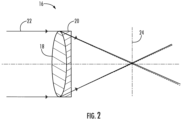
- FIG. 2 is a side view of a lens assembly 16 including a first lens 18 and an optical aberration compensation lens 20 (e.g., a dispersion-correction lens) to compensate (e.g., reduce or eliminate) for the aberration (e.g., chromatic aberration, monochromatic aberration, etc.) formed by the first lens 18.
- the first lens 18 generates chromatic dispersion such that deviations in the light paths 22 of differing colors propagated through the first lens 18 produce an optical aberration (e.g., a chromatic aberration) at an imaging plane 24 (e.g., an intermediate imaging plane, a focal plane array, etc.).
- an imaging plane 24 e.g., an intermediate imaging plane, a focal plane array, etc.
- the optical aberration compensation lens 20 redirects these light paths so that the light paths of these differing colors are redirected to reduce or eliminate any optical aberration (e.g., chromatic aberration) at the imaging plane 24.
- the first lens 18 and the optical aberration compensation lens 20 of FIG. 2 produce far less dispersion at the imaging plane 24 then the lens 10 used in FIG. 1 .
- the first lens 18 includes at least one of an objective lens, an imager, a re-imager, or a telescope.
- the lens assembly 16 includes a doublet made of two lenses paired together, which may allow more optical surfaces, thicknesses, and/or formulations.
- the lens assembly includes a lens subassembly having a plurality of lenses.
- the optical aberration compensation lens 20 is configured to compensate (e.g., reduce or eliminate) for the aberration (e.g., chromatic aberration) of the lens subassembly. In other words, the optical aberration compensation lens 20 redirects the light paths to prevent deviations so that the light paths (e.g., of the differing colors) intersect at the imaging plane 24.
- the glass-ceramic material is transparent (e.g., translucent).
- the glass-ceramic material includes an infrared material configured to transmit infrared wavelengths (e.g., between 1-12 microns), such as at least one of short-wave infrared (SWIR), mid-wave infrared (MWIR), or long-wave infrared (LWIR).
- SWIR short-wave infrared
- MWIR mid-wave infrared
- LWIR long-wave infrared
- the optical aberration compensation lens 20 includes a glass-ceramic material having a volume filling fraction of one or more species of nanocrystals (e.g., relative to the residual glass) configured to compensate for one or more aberrations (e.g., chromatic or monochromatic (e.g., spherical, coma, astigmatism, etc.)), such as from dispersion of the first lens 18.
- the glass-ceramic material includes a homogenous volume filling fraction of the nanocrystals. In other words, the volume filling fraction is generally the same throughout the optical aberration compensation lens 20.
- the glass-ceramic material includes optical characteristics including an index of refraction and a dispersion characteristic (e.g., Abbe number, V-number, partial dispersion, constringence, etc.).
- the dispersion characteristic is configured to compensate for the one or more chromatic aberrations.
- the volume filling fraction of the one or more species of nanocrystals is configured to compensate for the one or more chromatic aberrations throughout a band of infrared wavelengths (e.g., between 1-12 microns), such as at least one of SWIR, MWIR, or LWIR. It is noted that the processes and functions described herein can be applied to other spectral regions.
- FIG. 3 is a flowchart illustrating a method of manufacturing the optical aberration compensation lens 20.
- the method includes fabricating a first starting base glass material of a base composition.
- the method includes annealing the first starting base glass material. Annealing includes heating the first starting base glass material and then cooling slowly to remove internal stresses and toughen the material.
- the method includes applying a first heat treatment to the first starting base glass material of the base composition to form a first glass-ceramic material with a first volume filling fraction of one or more first species of nanocrystals (e.g., relative to the residual glass) configured to correct for a first aberration (e.g., chromatic aberration from dispersion, monochromatic aberration, etc.) of at least one first lens.
- This first heat treatment may be applied using a furnace, electricity, and/or laser.
- a furnace is used to apply the first heat treatment to manufacture the first glass-ceramic material in bulk.
- the first heat treatment includes a nucleation step where heat is applied to a first starting base glass material of a base composition to form a first crystal nuclei with a first volume filling fraction of one or more first species of nanocrystal seeds.
- the first heat treatment includes a nucleation heat treatment including nucleating the first starting base glass material at a nucleating temperature and/or time to form nanocrystal seeds.
- the first heat treatment further includes a growth step where heat is applied to the first crystal nuclei to form a first glass-ceramic material with a first volume filling fraction of one or more first species of nanocrystals configured to correct for a first aberration of at least one first lens.
- the first heat treatment includes a growth heat treatment including growing one or more species of nanocrystals in the first starting base glass material at a growth temperature and/or time to form the first glass-ceramic material with the first volume filling fraction of the one or more species of nanocrystals.
- the first glass-ceramic material includes a first index of refraction and a first dispersion characteristic configured to compensate for the first chromatic aberration.
- the first glass-ceramic material is chemically and optically homogenous. Such a configuration facilitates producing the first glass-ceramic material in bulk.
- the first glass-ceramic material includes an infrared material (e.g., an infrared composite material) configured to transmit infrared wavelengths. Accordingly, the infrared material may be made in bulk.
- the method includes processing the glass-ceramic material to form an optical aberration compensation lens to compensate for at least one first aberration of the at least one first lens.
- the method includes assembling the optical aberration compensation lens with the at least one first lens to form a lens assembly.
- the method includes applying a second heat treatment to a second starting base glass material of the base composition to form a second glass-ceramic material with a second volume filling fraction of one or more second species of nanocrystals configured to compensate for at least one second aberration (e.g., a chromatic aberration from dispersion, monochromatic aberration, etc.) of at least one second lens.
- the second heat treatment includes a same nucleating heat treatment as the first heat treatment and a different growth heat treatment from the first heat treatment.
- the second heat treatment includes a different nucleating heat treatment and a different growth heat treatment from the first heat treatment.
- the second glass-ceramic material includes a second index of refraction different from the first index of refraction and/or a second dispersion characteristic different from the first dispersion characteristic.
- the first heat treatment and/or second heat treatment are preconfigured to produce a glass-ceramic material with a predetermined dispersion characteristic (e.g., an index of refraction and/or dispersion) based on a desired optical aberration compensation.
- a predetermined dispersion characteristic e.g., an index of refraction and/or dispersion
- the heat treatments can be specifically preconfigured to produce a material with dispersion characteristics designed to correct for such known optical aberrations. This is made possible by knowing certain properties of a material and how those properties vary as a function of temperature (e.g., intensity and/or duration). Such properties may include crystal type formation, nucleation rate, and/or crystal growth rate, etc.
- FIG. 4 is a chart illustrating the nucleation rate and crystal growth rate as a function of temperature.
- the nucleation rate determines the density of nanocrystal seeds.
- the crystal growth rate determines the growth and volume filling fraction of the different nanocrystals formed during the nucleation step.
- controlling the temperature the nucleation rate and/or the crystal growth rate are also controllable.
- controlling the crystal growth rate (and using the same nucleation rate) is used to produce a glass-ceramic material with predetermined dispersion characteristics. Knowledge of the crystal growth rates and thus, required heat treatment times defines the resulting volume filling fraction of resulting crystalline phase(s).
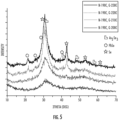
- FIG. 5 is a chart illustrating increasing crystal growth rate as the growth temperature increases. As shown, certain types of crystals form in certain volume filling fractions (e.g., densities) at certain temperatures. As a result, by controlling the temperature, the types and/or volume filling fraction are also controllable. Further, the types of crystals and/or the volume filling fraction affects the optical properties of the glass-ceramic material.
- volume filling fractions e.g., densities
- knowing the crystal type formation, nucleation rate, and/or crystal growth rate for a given material and/or given various temperatures allows for the production of ceramic-glass materials with predetermined dispersion characteristics.
- FIG. 6 is a chart (i.e., Abbe diagram) illustrating changes in the index of refraction and changes in an Abbe number (a quantity to describe the dispersion properties of materials) of various medium wave infrared materials as a result of applying varying heat treatments.
- the chart includes base materials 38 and materials subject to the heat treatments 40.
- the heat treatments depend on the base glass material's thermal properties, which vary with composition, and the resulting Abbe number is dictated by the heat treatment conditions.
- FIG. 7 is a chart (i.e., Abbe diagram) illustrating changes in the index of refraction and changes in an Abbe number of various large wave infrared materials as a result of applying varying heat treatments.
- the chart includes base materials 42 and materials subject to the heat treatments 44.
- the heat treatments depend on the base glass material's thermal properties, which vary with composition, and the resulting Abbe number is dictated by the heat treatment conditions.
- the optical properties vary by applying different heat treatments (e.g., nucleation temperature and/or growth temperature).
- the Abbe number of the resulting heat treated composition varies relative to the Abbe number of the corresponding base composition.
- the same base composition produces different compositions with differing Abbe numbers.
- a specific heat treatment can be applied to a starting base glass material to achieve differing specific optical characteristics (such as to compensate for chromatic aberrations in a lens (e.g., for infrared wavelengths) of the resulting glass-ceramic material without having to alter the composition of the starting base glass material).
- This specific heat treatment varies with base glass composition and each glass material's respective thermal properties.
- the system and method disclosed herein expands the single point solution of materials subject to heat treatments. This is due to the transformation of a glass-ceramic composition from glass (amorphous phase) to various levels of crystallinity (glass-ceramic), expanding the single dot solution that is currently achievable into enlarged lines, circles, and/or elliptical representations, now achievable with single glass compositions (e.g., infrared glass composition), such as AMTIR glasses, Schott IRG glasses, Umicore materials, or crystalline materials like ZnSe, ZnS, Silicon, Germanium, BaF 2 , etc.
- single glass compositions e.g., infrared glass composition
- the broad index variations of these glass-ceramic materials are tailored. As a result, one material can be used (instead of many materials) to compensate for aberrations (e.g., chromatic or monochromatic aberrations), such as from dispersion.
- aberrations e.g., chromatic or monochromatic aberrations
- infrared (IR) materials may be created with better index and dispersion variations.
- the tailored ceramization process to create different volume filling fractions of crystals and/or different crystal species inside the starting base glass material e.g., base glass matrix
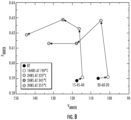
- FIG. 8 shows an example of a sequential, multi-step heat treatment protocol and its impact on the modification of index dispersion in the MWIR.
- FIG. 8 represents a discrete singular protocol of time and temperature of nucleation and growth and the resulting dispersion in a single glass composition. If the composition changes, the times, temperatures, and dispersion values will also change. In other words, the resulting product is dependent on the time, temperature, and/or composition. Further, the heat treatment can be stopped at any step to obtain a product with specific characteristics, or continue with further steps to obtain a product with different characteristics.
- This tailored ceramization process is what allows a (generally continuous) linear, circular, and/or elliptical area on the Abbe diagram. Effectively, this increases the number of materials that can be used and paired for lens system design, especially in infrared applications, where the number of commercially available compositions may be very limited due to the high manufacturing costs of making and optimizing infrared compositions.
- the base material includes GeSe 2 -As 2 Se 3 -PbSe (GAP-Se) glass, which may be used for chromatic correction in all three IR bands (i.e., SWIR, MWIR, LWIR) using heat treatment protocols.
- GAP-Se GeSe 2 -As 2 Se 3 -PbSe
- the Abbe numbers in the ranges of SWIR, MWIR, and LWIR decrease with the addition of PbSe up to a level of about 25 - 30 mol% PbSe.
- the Abbe number may be significantly reduced (and the dispersion higher) when Pb is a dominant species in the matrix of the parent glass. The dispersion further decreases upon heat treatment and is impacted by the types of crystals formed.
- the Pb-content variation in the GAP-Se glass series may provide a range of Abbe numbers for the optical designer to choose from for chromatic correction. In the paraxial regime, the axial chromatic aberration may be mitigated with a doublet when the magnitude of the Abbe number difference between the two lenses is maximized.
- controlled nucleation and growth can be used to create a desired profile.
- quantified induced optical modification and function as quenched and nucleated, 20 mol% PbSe GAP-Se glass undergoes heat treatment (growth) within a furnace (e.g., between 225.6 - 263.2°C).
- the heat treatment protocol induces a refractive index of about 0.2 and a MWIR Abbe number of about 35.
- the heat treatment protocol results in a refractive index between 0.1 and 0.9, between 0.1 and 0.5, between 0.1 and 0.3.
- the Abbe number is between 1 and 50, between 10 and 40, between 30 and 40.
- FIG. 9 shows a refractive index dispersion map illustrating dispersion engineering by processes disclosed herein.
- the refractive index dispersion map 46 includes groups of optical and IR materials including chalcogenides, III-V and IV semiconductors, II-VI semiconductors, fluorides, oxides, and alkali halides.
- the map is constructed by Abbe number and partial refractive index.
- the map illustrates that each group of materials can be characterized by specific locations due to intrinsically-similar electronic structures and resulting light-matter interactions within each group.
- most material systems have a single V MWIR - P MWIR signature, indicating that the materials are bound to very narrow ranges of dispersion.
- the dispersive nature of the GAP-Se system shown herein can be simply tuned by converting it to a glass-ceramic optical composite. Variation in the extent of crystal phase formation allows altering the composite's effective index and dispersion.
- Subsection 48 illustrates tunability of dispersive properties for GAP-Se upon heat treatment where the polygons correspond to the ranges of V MWIR - P MWIR values enabled by heat treatment protocols applied to two exemplary compositions including 20 mol% and 40 mol% PbSe.
- alternative protocols may translate or expand the polygons, further widening the dispersion tunability.
- the tailored ceramization process discussed herein provides a single composition that can provide a range of refractive indices and dispersion values. This alleviates the fabrication cost of multiple compositions, as the ceramization process is less costly and time consuming than the base glass fabrication process.
- the tailored ceramization process opens up the list of available material pairs for system designs (e.g., infrared systems) and/or makes such system designs more compact (e.g., with fewer optical elements). In certain embodiments, this may reduce the size, weight, power, and/or cost of infrared systems. This can additionally be made into GRIN components following GRIN processes.
- the system and method of the present disclosure allows manufacture of one bulk material (e.g., starting base glass material) and then changing the index of refraction and/or the dispersion characteristic (e.g., Abbe number) of that one bulk material. This provides more degrees of freedom for optical designers (e.g., to achieve short, mid, and/or long wave achromats).
- one bulk material can be made, and then 1,000 different heat treatments can be applied, to produce 1,000 different glass ceramic materials, each having different optical properties (e.g., different refractive index and/or dispersion characteristic combinations) and/or each having the same or similar thermomechanical properties.
- the heat treatment e.g., homogenous heat treatment
- the bulk material is chemically and optically homogenous
- the glass ceramic material is chemically and optically heterogeneous.
Landscapes
- Chemical & Material Sciences (AREA)
- Physics & Mathematics (AREA)
- Engineering & Computer Science (AREA)
- General Physics & Mathematics (AREA)
- Optics & Photonics (AREA)
- Materials Engineering (AREA)
- Organic Chemistry (AREA)
- Crystallography & Structural Chemistry (AREA)
- Geochemistry & Mineralogy (AREA)
- General Chemical & Material Sciences (AREA)
- Chemical Kinetics & Catalysis (AREA)
- Life Sciences & Earth Sciences (AREA)
- Ceramic Engineering (AREA)
- Dispersion Chemistry (AREA)
- Toxicology (AREA)
- Health & Medical Sciences (AREA)
- Thermal Sciences (AREA)
- Glass Compositions (AREA)
Description
- This application claims the benefit of
U.S. Provisional Application No. 62/877,523, filed on July 23, 2019 - The embodiments relate to methods of making optical aberration compensation lenses, and in particular methods of making optical aberration compensation lens using glass-ceramics.
- Lenses with different dispersion properties (e.g., change in refractive index as a function of wavelength) are typically combined to reduce or eliminate aberrations (e.g., wavelength related aberrations), such as shown in
FIG. 1 . In particular,FIG. 1 illustrates alens 10 generating chromatic dispersion with deviations in thelight paths 12 of differing colors propagated through thelens 10 to produce a chromatic aberration at animaging plane 14. - For example, crown glass and flint glass are typically combined (e.g., achromatic doublet with concave flint lens and convex crown lens) to form a pair of glasses that serves to compensate for chromatic aberrations. Each element possesses different refractive index and dispersion properties, such that the dispersion of these glasses partially compensate for each other. However, crown and flint glasses are typically based on oxide materials and operate in the visible spectrum, and cannot operate or transmit infrared.
- Similar materials are needed in the infrared spectrum, especially to compensate for chromatic aberrations throughout the entire infrared spectrum, e.g., from short wave infrared (SWIR) to long wave infrared (LWIR) (e.g., from 1 to 12µm). However, there are few materials that can transmit over this entire range. As a result, manufacturing such materials can be complicated and expensive. Also, complications and costs associated with scaling up of multiple infrared materials can be very high. Further, infrared optical systems tend to require many lenses to compensate for aberrations, such as chromatic and monochromatic (e.g., spherical, coma, astigmatism, etc.) aberrations, making such systems large, bulky, and cumbersome. chalcogenide glass materials of interest are discussed in MYUNGKOO KANG ET AL: "Ultralow Dispersion Multicomponent Thin-Film Chalcogenide Glass for Broadband Gradient-Index Optics",ADVANCED MATERIALS, VCH PUBLISHERS, DE, vol. 30, no. 39, 13 August 2018 (2018-08-13).
- Disclosed herein is an optical aberration compensation lens using glass-ceramics and a method of making the same. The method of manufacturing the optical aberration compensation lens includes applying at least one heat treatment to a base glass material of a base composition (i.e., starting composition) to form a glass-ceramic material with a volume filling fraction of one or more species of nanocrystals. This process is glass composition agnostic (e.g., oxide, non-oxide, etc.) and can be applied to generate any glass-ceramic composition formed through controlled nucleation and growth. In certain embodiments, the species and/or volume filling fraction of nanocrystals determines the resulting index of refraction and dispersion characteristic (e.g., constringence). Accordingly, application of different heat treatments (e.g., nucleation temperature, growth temperature, and/or treatment times) to the same base glass material produces different glass-ceramic materials with different optical properties (e.g., index of refraction and/or dispersion characteristic).
- In one embodiment, an optical aberration compensation lens includes a glass-ceramic material having a volume filling fraction of one or more species of nanocrystals configured to compensate for at least one aberration of at least one lens. In certain embodiments, the glass-ceramic material includes an index of refraction and a dispersion characteristic configured to compensate for the one or more chromatic aberrations.
- In another embodiment, a method of manufacturing an optical aberration compensation lens includes applying a first heat treatment to a first starting base glass material of a base composition to form a first glass-ceramic material with a first volume filling fraction of one or more first species of nanocrystals configured to compensate for at least one first aberration of at least one first lens.
- Those skilled in the art will appreciate the scope of the disclosure and realize additional aspects thereof after reading the following detailed description of the embodiments in association with the accompanying drawing figures.
- The accompanying drawing figures incorporated in and forming a part of this specification illustrate several aspects of the disclosure and, together with the description, serve to explain the principles of the disclosure.
-
FIG. 1 is a side view of a lens illustrating formation of a chromatic aberration; -
FIG. 2 is a side view of a lens assembly including a first lens and an optical aberration compensation lens to compensate for the chromatic aberration formed by the first lens; -
FIG. 3 is a flowchart illustrating a method of manufacturing an optical aberration compensation lens; -
FIG. 4 is a chart illustrating the nucleation rate and crystal growth rate as a function of temperature; -
FIG. 5 is a chart illustrating increasing crystal growth rate as the growth temperature increases; -
FIG. 6 is a chart illustrating changes in the index of refraction and changes in an Abbe number of various medium wave infrared materials as a result of applying a heat treatment protocol (e.g., a series of heat treatments); -
FIG. 7 is a chart illustrating changes in the index of refraction and changes in an Abbe number of various large wave infrared materials as a result of applying a heat treatment protocol (e.g., a series of heat treatments); -
FIG. 8 is a diagram illustrating the tailorability of mid wave infrared (MWIR) index dispersive properties for two representative compositions enabled by cumulative heat treatment protocols; and -
FIG. 9 illustrates a refractive index dispersion map of dispersion engineering enabled by processes disclosed herein. - The embodiments set forth below represent the information to enable those skilled in the art to practice the embodiments and illustrate the best mode of practicing the embodiments. Upon reading the following description in light of the accompanying drawing figures, those skilled in the art will understand the concepts of the disclosure and will recognize applications of these concepts not particularly addressed herein. It should be understood that these concepts and applications fall within the scope of the disclosure and the accompanying claims.
- Any flowcharts discussed herein are necessarily discussed in some sequence for purposes of illustration, but unless otherwise explicitly indicated, the embodiments are not limited to any particular sequence of steps. The use herein of ordinals in conjunction with an element is solely for distinguishing what might otherwise be similar or identical labels, such as "first message" and "second message," and does not imply a priority, a type, an importance, or other attribute, unless otherwise stated herein. The term "about" used herein in conjunction with a numeric value means any value that is within a range of ten percent greater than or ten percent less than the numeric value.
- As used herein and in the claims, the articles "a" and "an" in reference to an element refers to "one or more" of the element unless otherwise explicitly specified. The word "or" as used herein and in the claims is inclusive unless contextually impossible. As an example, the recitation of A or B means A, or B, or both A and B.
- Disclosed herein is an optical aberration compensation lens using glass-ceramics and a method of making the same. The method of manufacturing the optical aberration compensation lens includes applying at least one heat treatment to a starting base glass material of a base composition (i.e., starting composition) to form a glass-ceramic material with a volume filling fraction of one or more species of nanocrystals. This process is glass composition agnostic and can be applied to generate any glass-ceramic composition formed through controlled nucleation and growth. In certain embodiments, the species and/or volume filling fraction of nanocrystals determines the resulting index of refraction and dispersion characteristic (e.g., constringence). Accordingly, application of different heat treatments (e.g., nucleation temperature and/or growth temperature and/or treatment times of each) to the same starting base glass material produces different glass-ceramic materials with different optical properties (e.g., index of refraction and/or dispersion characteristic).
- As used herein, "volume filling fraction" refers to the volume of a constituent (e.g., nanocrystal seeds, crystals, etc.) divided by the volume of the whole (e.g., the constituent and the residual glass).
-
FIG. 2 is a side view of alens assembly 16 including afirst lens 18 and an optical aberration compensation lens 20 (e.g., a dispersion-correction lens) to compensate (e.g., reduce or eliminate) for the aberration (e.g., chromatic aberration, monochromatic aberration, etc.) formed by thefirst lens 18. In particular, for example, thefirst lens 18 generates chromatic dispersion such that deviations in thelight paths 22 of differing colors propagated through thefirst lens 18 produce an optical aberration (e.g., a chromatic aberration) at an imaging plane 24 (e.g., an intermediate imaging plane, a focal plane array, etc.). However, the opticalaberration compensation lens 20 redirects these light paths so that the light paths of these differing colors are redirected to reduce or eliminate any optical aberration (e.g., chromatic aberration) at theimaging plane 24. As shown, thefirst lens 18 and the opticalaberration compensation lens 20 ofFIG. 2 produce far less dispersion at theimaging plane 24 then thelens 10 used inFIG. 1 . - In certain embodiments, the
first lens 18 includes at least one of an objective lens, an imager, a re-imager, or a telescope. In certain embodiments, thelens assembly 16 includes a doublet made of two lenses paired together, which may allow more optical surfaces, thicknesses, and/or formulations. In certain embodiments, the lens assembly includes a lens subassembly having a plurality of lenses. In such a configuration, the opticalaberration compensation lens 20 is configured to compensate (e.g., reduce or eliminate) for the aberration (e.g., chromatic aberration) of the lens subassembly. In other words, the opticalaberration compensation lens 20 redirects the light paths to prevent deviations so that the light paths (e.g., of the differing colors) intersect at theimaging plane 24. - In certain embodiments, the glass-ceramic material is transparent (e.g., translucent). In certain embodiments, the glass-ceramic material includes an infrared material configured to transmit infrared wavelengths (e.g., between 1-12 microns), such as at least one of short-wave infrared (SWIR), mid-wave infrared (MWIR), or long-wave infrared (LWIR).
- The optical
aberration compensation lens 20 includes a glass-ceramic material having a volume filling fraction of one or more species of nanocrystals (e.g., relative to the residual glass) configured to compensate for one or more aberrations (e.g., chromatic or monochromatic (e.g., spherical, coma, astigmatism, etc.)), such as from dispersion of thefirst lens 18. In certain embodiments, the glass-ceramic material includes a homogenous volume filling fraction of the nanocrystals. In other words, the volume filling fraction is generally the same throughout the opticalaberration compensation lens 20. The glass-ceramic material includes optical characteristics including an index of refraction and a dispersion characteristic (e.g., Abbe number, V-number, partial dispersion, constringence, etc.). In certain embodiments, the dispersion characteristic is configured to compensate for the one or more chromatic aberrations. In certain embodiments, the volume filling fraction of the one or more species of nanocrystals is configured to compensate for the one or more chromatic aberrations throughout a band of infrared wavelengths (e.g., between 1-12 microns), such as at least one of SWIR, MWIR, or LWIR. It is noted that the processes and functions described herein can be applied to other spectral regions. -
FIG. 3 is a flowchart illustrating a method of manufacturing the opticalaberration compensation lens 20. Instep 26, the method includes fabricating a first starting base glass material of a base composition. Instep 28, the method includes annealing the first starting base glass material. Annealing includes heating the first starting base glass material and then cooling slowly to remove internal stresses and toughen the material. - In
step 30, the method includes applying a first heat treatment to the first starting base glass material of the base composition to form a first glass-ceramic material with a first volume filling fraction of one or more first species of nanocrystals (e.g., relative to the residual glass) configured to correct for a first aberration (e.g., chromatic aberration from dispersion, monochromatic aberration, etc.) of at least one first lens. This first heat treatment may be applied using a furnace, electricity, and/or laser. In certain embodiments, a furnace is used to apply the first heat treatment to manufacture the first glass-ceramic material in bulk. - In certain embodiments, the first heat treatment includes a nucleation step where heat is applied to a first starting base glass material of a base composition to form a first crystal nuclei with a first volume filling fraction of one or more first species of nanocrystal seeds. In other words, the first heat treatment includes a nucleation heat treatment including nucleating the first starting base glass material at a nucleating temperature and/or time to form nanocrystal seeds. In certain embodiments, the first heat treatment further includes a growth step where heat is applied to the first crystal nuclei to form a first glass-ceramic material with a first volume filling fraction of one or more first species of nanocrystals configured to correct for a first aberration of at least one first lens. In other words, the first heat treatment includes a growth heat treatment including growing one or more species of nanocrystals in the first starting base glass material at a growth temperature and/or time to form the first glass-ceramic material with the first volume filling fraction of the one or more species of nanocrystals.
- In certain embodiments, the first glass-ceramic material includes a first index of refraction and a first dispersion characteristic configured to compensate for the first chromatic aberration. In certain embodiments, the first glass-ceramic material is chemically and optically homogenous. Such a configuration facilitates producing the first glass-ceramic material in bulk. In certain embodiments, the first glass-ceramic material includes an infrared material (e.g., an infrared composite material) configured to transmit infrared wavelengths. Accordingly, the infrared material may be made in bulk.
- In
step 32, the method includes processing the glass-ceramic material to form an optical aberration compensation lens to compensate for at least one first aberration of the at least one first lens. Instep 34, the method includes assembling the optical aberration compensation lens with the at least one first lens to form a lens assembly. - In
step 36, the method, according to the invention, includes applying a second heat treatment to a second starting base glass material of the base composition to form a second glass-ceramic material with a second volume filling fraction of one or more second species of nanocrystals configured to compensate for at least one second aberration (e.g., a chromatic aberration from dispersion, monochromatic aberration, etc.) of at least one second lens. In certain embodiments, the second heat treatment includes a same nucleating heat treatment as the first heat treatment and a different growth heat treatment from the first heat treatment. In certain embodiments, the second heat treatment includes a different nucleating heat treatment and a different growth heat treatment from the first heat treatment. In certain embodiments, the second glass-ceramic material includes a second index of refraction different from the first index of refraction and/or a second dispersion characteristic different from the first dispersion characteristic. - In certain embodiments, the first heat treatment and/or second heat treatment are preconfigured to produce a glass-ceramic material with a predetermined dispersion characteristic (e.g., an index of refraction and/or dispersion) based on a desired optical aberration compensation. In other words, given a known optical aberration compensation of a lens or lens assembly, the heat treatments can be specifically preconfigured to produce a material with dispersion characteristics designed to correct for such known optical aberrations. This is made possible by knowing certain properties of a material and how those properties vary as a function of temperature (e.g., intensity and/or duration). Such properties may include crystal type formation, nucleation rate, and/or crystal growth rate, etc.
-
FIG. 4 is a chart illustrating the nucleation rate and crystal growth rate as a function of temperature. The nucleation rate determines the density of nanocrystal seeds. The crystal growth rate determines the growth and volume filling fraction of the different nanocrystals formed during the nucleation step. As a result, by controlling the temperature, the nucleation rate and/or the crystal growth rate are also controllable. In certain embodiments, controlling the crystal growth rate (and using the same nucleation rate) is used to produce a glass-ceramic material with predetermined dispersion characteristics. Knowledge of the crystal growth rates and thus, required heat treatment times defines the resulting volume filling fraction of resulting crystalline phase(s). -
FIG. 5 is a chart illustrating increasing crystal growth rate as the growth temperature increases. As shown, certain types of crystals form in certain volume filling fractions (e.g., densities) at certain temperatures. As a result, by controlling the temperature, the types and/or volume filling fraction are also controllable. Further, the types of crystals and/or the volume filling fraction affects the optical properties of the glass-ceramic material. - Accordingly, knowing the crystal type formation, nucleation rate, and/or crystal growth rate for a given material and/or given various temperatures allows for the production of ceramic-glass materials with predetermined dispersion characteristics.
-
FIG. 6 is a chart (i.e., Abbe diagram) illustrating changes in the index of refraction and changes in an Abbe number (a quantity to describe the dispersion properties of materials) of various medium wave infrared materials as a result of applying varying heat treatments. The chart includesbase materials 38 and materials subject to theheat treatments 40. The heat treatments depend on the base glass material's thermal properties, which vary with composition, and the resulting Abbe number is dictated by the heat treatment conditions. -
FIG. 7 is a chart (i.e., Abbe diagram) illustrating changes in the index of refraction and changes in an Abbe number of various large wave infrared materials as a result of applying varying heat treatments. The chart includesbase materials 42 and materials subject to the heat treatments 44. The heat treatments depend on the base glass material's thermal properties, which vary with composition, and the resulting Abbe number is dictated by the heat treatment conditions. - In each of
FIGS. 6 and7 , the optical properties (e.g., index of refraction and/or Abbe number) vary by applying different heat treatments (e.g., nucleation temperature and/or growth temperature). In other words, for example, the Abbe number of the resulting heat treated composition varies relative to the Abbe number of the corresponding base composition. Further, depending on the heat treatment, the same base composition produces different compositions with differing Abbe numbers. As a result, a specific heat treatment can be applied to a starting base glass material to achieve differing specific optical characteristics (such as to compensate for chromatic aberrations in a lens (e.g., for infrared wavelengths) of the resulting glass-ceramic material without having to alter the composition of the starting base glass material). This specific heat treatment varies with base glass composition and each glass material's respective thermal properties. - The system and method disclosed herein expands the single point solution of materials subject to heat treatments. This is due to the transformation of a glass-ceramic composition from glass (amorphous phase) to various levels of crystallinity (glass-ceramic), expanding the single dot solution that is currently achievable into enlarged lines, circles, and/or elliptical representations, now achievable with single glass compositions (e.g., infrared glass composition), such as AMTIR glasses, Schott IRG glasses, Umicore materials, or crystalline materials like ZnSe, ZnS, Silicon, Germanium, BaF2, etc.
- The broad index variations of these glass-ceramic materials (e.g., infrared glass-ceramic materials) are tailored. As a result, one material can be used (instead of many materials) to compensate for aberrations (e.g., chromatic or monochromatic aberrations), such as from dispersion. In certain embodiments, infrared (IR) materials may be created with better index and dispersion variations. The tailored ceramization process to create different volume filling fractions of crystals and/or different crystal species inside the starting base glass material (e.g., base glass matrix) can be achieved, for example, in a furnace, electrically, and/or optically via a laser.
-
FIG. 8 shows an example of a sequential, multi-step heat treatment protocol and its impact on the modification of index dispersion in the MWIR.FIG. 8 represents a discrete singular protocol of time and temperature of nucleation and growth and the resulting dispersion in a single glass composition. If the composition changes, the times, temperatures, and dispersion values will also change. In other words, the resulting product is dependent on the time, temperature, and/or composition. Further, the heat treatment can be stopped at any step to obtain a product with specific characteristics, or continue with further steps to obtain a product with different characteristics. This tailored ceramization process is what allows a (generally continuous) linear, circular, and/or elliptical area on the Abbe diagram. Effectively, this increases the number of materials that can be used and paired for lens system design, especially in infrared applications, where the number of commercially available compositions may be very limited due to the high manufacturing costs of making and optimizing infrared compositions. - In the invention, the base material includes GeSe2-As2Se3-PbSe (GAP-Se) glass, which may be used for chromatic correction in all three IR bands (i.e., SWIR, MWIR, LWIR) using heat treatment protocols. This means that modification to the base glass value (through a change to either the nucleation, growth time, and/or temperature) will alter the Abbe number and/or refractive index of the glass ceramic material.
- In certain embodiments, the Abbe numbers in the ranges of SWIR, MWIR, and LWIR decrease with the addition of PbSe up to a level of about 25 - 30 mol% PbSe. The Abbe number may be significantly reduced (and the dispersion higher) when Pb is a dominant species in the matrix of the parent glass. The dispersion further decreases upon heat treatment and is impacted by the types of crystals formed. The Pb-content variation in the GAP-Se glass series may provide a range of Abbe numbers for the optical designer to choose from for chromatic correction. In the paraxial regime, the axial chromatic aberration may be mitigated with a doublet when the magnitude of the Abbe number difference between the two lenses is maximized.
- In certain embodiments, controlled nucleation and growth can be used to create a desired profile. For example, in the invention, quantified induced optical modification and function, as quenched and nucleated, 20 mol% PbSe GAP-Se glass undergoes heat treatment (growth) within a furnace (e.g., between 225.6 - 263.2°C). In certain embodiments, the heat treatment protocol induces a refractive index of about 0.2 and a MWIR Abbe number of about 35. In certain embodiments, the heat treatment protocol results in a refractive index between 0.1 and 0.9, between 0.1 and 0.5, between 0.1 and 0.3. In certain embodiments, the Abbe number is between 1 and 50, between 10 and 40, between 30 and 40.
-
FIG. 9 shows a refractive index dispersion map illustrating dispersion engineering by processes disclosed herein. In particular, the refractiveindex dispersion map 46 includes groups of optical and IR materials including chalcogenides, III-V and IV semiconductors, II-VI semiconductors, fluorides, oxides, and alkali halides. To correctly represent the curvature of index dispersion along two orthogonal directions in a 2-D space, the map is constructed by Abbe number and partial refractive index. - It is noted that the Abbe numbers may be calculated as follows:


- The MWIR partial refractive index is defined by the following equation:

- The map illustrates that each group of materials can be characterized by specific locations due to intrinsically-similar electronic structures and resulting light-matter interactions within each group. However, most material systems have a single V MWIR-P MWIR signature, indicating that the materials are bound to very narrow ranges of dispersion. Unlike these homogenous optical materials, the dispersive nature of the GAP-Se system shown herein can be simply tuned by converting it to a glass-ceramic optical composite. Variation in the extent of crystal phase formation allows altering the composite's effective index and dispersion.
-
Subsection 48 illustrates tunability of dispersive properties for GAP-Se upon heat treatment where the polygons correspond to the ranges of V MWIR-P MWIR values enabled by heat treatment protocols applied to two exemplary compositions including 20 mol% and 40 mol% PbSe. In certain embodiments, alternative protocols may translate or expand the polygons, further widening the dispersion tunability. - The tailored ceramization process discussed herein provides a single composition that can provide a range of refractive indices and dispersion values. This alleviates the fabrication cost of multiple compositions, as the ceramization process is less costly and time consuming than the base glass fabrication process. The tailored ceramization process opens up the list of available material pairs for system designs (e.g., infrared systems) and/or makes such system designs more compact (e.g., with fewer optical elements). In certain embodiments, this may reduce the size, weight, power, and/or cost of infrared systems. This can additionally be made into GRIN components following GRIN processes.
- Instead of making multiple compositions (e.g., GAP-Se0, GAP-Se10, GAP-Se20, GAP-Se30, and GAP-Se40), the system and method of the present disclosure allows manufacture of one bulk material (e.g., starting base glass material) and then changing the index of refraction and/or the dispersion characteristic (e.g., Abbe number) of that one bulk material. This provides more degrees of freedom for optical designers (e.g., to achieve short, mid, and/or long wave achromats). In other words, for example, one bulk material can be made, and then 1,000 different heat treatments can be applied, to produce 1,000 different glass ceramic materials, each having different optical properties (e.g., different refractive index and/or dispersion characteristic combinations) and/or each having the same or similar thermomechanical properties. It is noted that the heat treatment (e.g., homogenous heat treatment) is applied over the entire bulk material. In certain embodiments the bulk material is chemically and optically homogenous, and the glass ceramic material is chemically and optically heterogeneous.
- The invention is defined by the appended claims.
Claims (7)
- A method comprising:manufacturing a first optical aberration compensation lens, comprising:providing a first starting base glass material of a base composition comprising GeSe2-As2Se3-PbSe, GAP-Se, glass; andapplying a first heat treatment to the first starting base glass material to form a first glass-ceramic material with a first volume filling fraction of one or more first species of nanocrystals configured to compensate for at leastone first aberration of at least one first lens; andmanufacturing a second optical aberration compensation lens, comprising:providing the first starting base glass material; andapplying a second heat treatment, different from the first heat treatment, to the first starting base glass material to form a second glass-ceramic material with a second volume filling fraction of the one or more first species of nanocrystals configured to compensate for at least one second aberration of at least one second lens.
- The method of claim 1, wherein the first and second glass-ceramic materials comprise respective first and second indices of refraction and respective first and second dispersion characteristics configured to compensate for the respective at least one first and second aberrations, wherein the at least one first and second aberrations comprise one or more chromatic aberrations.
- The method of claim 1, further comprising:
annealing the first starting base glass material. - The method of claim 1, wherein each of the first and second heat treatments comprise either:a nucleating heat treatment including nucleating the first starting base glass material at a nucleating temperature to form nanocrystal seeds; ora growth heat treatment including growing one or more species of nanocrystals in the first starting base glass material at a growth temperature to form the respective first or second glass-ceramic material with the associated volume filling fraction of the one or more first species of nanocrystals.
- The method of claim 1, further comprising processing the glass-ceramic material to form the first or second optical aberration compensation lens to compensate for the at least one first or second aberration of the at least one first or second lens.
- The method of claim 1, further comprising assembling the first or second optical aberration compensation lens with a respective first or second lens to form a lens assembly.
- The method of claim 1, wherein the at least one first or second lens comprises an objective lens, an imager, a re-imager, or a telescope.
Applications Claiming Priority (2)
| Application Number | Priority Date | Filing Date | Title |
|---|---|---|---|
| US201962877523P | 2019-07-23 | 2019-07-23 | |
| PCT/US2020/043016 WO2021016318A1 (en) | 2019-07-23 | 2020-07-22 | Optical aberration compensation lens using glass-ceramics and method of making |
Publications (3)
| Publication Number | Publication Date |
|---|---|
| EP4004628A1 EP4004628A1 (en) | 2022-06-01 |
| EP4004628A4 EP4004628A4 (en) | 2023-09-06 |
| EP4004628B1 true EP4004628B1 (en) | 2025-04-02 |
Family
ID=74194249
Family Applications (1)
| Application Number | Title | Priority Date | Filing Date |
|---|---|---|---|
| EP20844611.2A Active EP4004628B1 (en) | 2019-07-23 | 2020-07-22 | Method of making optical aberration compensation lens using glass-ceramics. |
Country Status (4)
| Country | Link |
|---|---|
| US (1) | US12393023B2 (en) |
| EP (1) | EP4004628B1 (en) |
| JP (1) | JP2022541642A (en) |
| WO (1) | WO2021016318A1 (en) |
Families Citing this family (1)
| Publication number | Priority date | Publication date | Assignee | Title |
|---|---|---|---|---|
| TWI910648B (en) | 2023-05-26 | 2026-01-01 | 美商瓦迪恩光學有限責任公司 | Method of additive manufacture of application-specific inorganic optical elements |
Family Cites Families (7)
| Publication number | Priority date | Publication date | Assignee | Title |
|---|---|---|---|---|
| US9709699B2 (en) * | 2012-02-03 | 2017-07-18 | Raytheon Company | Nano-nano-composite optical ceramic lenses |
| US9187360B2 (en) * | 2012-04-20 | 2015-11-17 | Schott Corporation | Glasses for the correction of chromatic and thermal optical aberations for lenses transmitting in the near, mid, and far-infrared sprectrums |
| US9340446B1 (en) * | 2013-02-04 | 2016-05-17 | Lockheed Martin Corporation | Optical apparatus and method of forming a gradient index device |
| US20150219893A1 (en) | 2013-02-07 | 2015-08-06 | Liqxtal Technology Inc. | Optical system and its display system |
| JP2017521699A (en) * | 2014-06-16 | 2017-08-03 | エレメント シックス テクノロジーズ リミテッド | Synthetic diamond optical element |
| US9969647B2 (en) * | 2016-05-17 | 2018-05-15 | Lockheed Martin Energy, Llc | Glass composites having a gradient index of refraction and methods for production thereof |
| EP3311993B1 (en) | 2016-10-20 | 2019-03-27 | Carl Zeiss Vision International GmbH | Spectacle glass and method for its production |
-
2020
- 2020-07-22 US US17/628,720 patent/US12393023B2/en active Active
- 2020-07-22 EP EP20844611.2A patent/EP4004628B1/en active Active
- 2020-07-22 JP JP2022504674A patent/JP2022541642A/en active Pending
- 2020-07-22 WO PCT/US2020/043016 patent/WO2021016318A1/en not_active Ceased
Also Published As
| Publication number | Publication date |
|---|---|
| JP2022541642A (en) | 2022-09-26 |
| EP4004628A1 (en) | 2022-06-01 |
| WO2021016318A1 (en) | 2021-01-28 |
| US12393023B2 (en) | 2025-08-19 |
| EP4004628A4 (en) | 2023-09-06 |
| US20220260830A1 (en) | 2022-08-18 |
Similar Documents
| Publication | Publication Date | Title |
|---|---|---|
| EP0367197B1 (en) | Dual band/dual FOV infrared telescope | |
| Sisken et al. | Infrared glass–ceramics with multidispersion and gradient refractive index attributes | |
| Gibson et al. | Diffusion-based gradient index optics for infrared imaging | |
| US5504628A (en) | Passive athermalization of optics | |
| CN107479171B (en) | Long-wave infrared zoom lens | |
| US20150057142A1 (en) | Ir heavy metal oxide glasses | |
| EP3458422B1 (en) | Glass composites having a gradient index of refraction and methods for production thereof | |
| US11119298B2 (en) | Infrared imaging lens system | |
| US7369303B2 (en) | Dual band lens system incorporating molded chalcogenide | |
| US12393023B2 (en) | Optical aberration compensation lens using glass-ceramics and method of making | |
| Zheng et al. | Broadband achromatic metalens in the long-wave infrared regime | |
| US20140268315A1 (en) | Glass selection for infrared lens design | |
| Graham et al. | Low-cost infrared glass for IR imaging applications | |
| US12292547B2 (en) | Athermal infrared optical telescope and method for manufacturing | |
| Ren et al. | Thermal compensation design of achromatic and apochromatic optical systems using<? TeX\break?> a 3D glass chart | |
| Tong et al. | Design of minimalist broadband infrared optical system based on cemented chalcogenide glasses | |
| Ramsey et al. | Comparison study of a multispectral zoom lens using standard and novel optical materials | |
| RU2645446C1 (en) | Three-linear americanized camera lens for the ir-region of the spectrum | |
| Schwertz et al. | Advantages of using engineered chalcogenide glass for color corrected, passively athermalized LWIR imaging systems | |
| Carlie | Instantaneous dispersion: a window into property relationships for optical glass | |
| Lidwell | Diffractive lenses for dual-waveband IR | |
| US6049434A (en) | Afocal telescopes | |
| Kosan et al. | Role of thermal history in the formation of commercial‐scale, infrared glass‐ceramics | |
| US20240059603A1 (en) | Chalcogenide glass composition including silicon, gallium and tellurium, and infrared transmitting lens including the same | |
| Fuller | Mid‐infrared fiber optics |
Legal Events
| Date | Code | Title | Description |
|---|---|---|---|
| STAA | Information on the status of an ep patent application or granted ep patent |
Free format text: STATUS: THE INTERNATIONAL PUBLICATION HAS BEEN MADE |
|
| PUAI | Public reference made under article 153(3) epc to a published international application that has entered the european phase |
Free format text: ORIGINAL CODE: 0009012 |
|
| STAA | Information on the status of an ep patent application or granted ep patent |
Free format text: STATUS: REQUEST FOR EXAMINATION WAS MADE |
|
| 17P | Request for examination filed |
Effective date: 20211216 |
|
| AK | Designated contracting states |
Kind code of ref document: A1 Designated state(s): AL AT BE BG CH CY CZ DE DK EE ES FI FR GB GR HR HU IE IS IT LI LT LU LV MC MK MT NL NO PL PT RO RS SE SI SK SM TR |
|
| DAV | Request for validation of the european patent (deleted) | ||
| DAX | Request for extension of the european patent (deleted) | ||
| A4 | Supplementary search report drawn up and despatched |
Effective date: 20230803 |
|
| RIC1 | Information provided on ipc code assigned before grant |
Ipc: G02B 3/00 20060101ALI20230728BHEP Ipc: G02B 1/00 20060101ALI20230728BHEP Ipc: G02B 7/02 20210101ALI20230728BHEP Ipc: G02B 27/00 20060101AFI20230728BHEP |
|
| GRAP | Despatch of communication of intention to grant a patent |
Free format text: ORIGINAL CODE: EPIDOSNIGR1 |
|
| STAA | Information on the status of an ep patent application or granted ep patent |
Free format text: STATUS: GRANT OF PATENT IS INTENDED |
|
| INTG | Intention to grant announced |
Effective date: 20241022 |
|
| GRAS | Grant fee paid |
Free format text: ORIGINAL CODE: EPIDOSNIGR3 |
|
| GRAA | (expected) grant |
Free format text: ORIGINAL CODE: 0009210 |
|
| STAA | Information on the status of an ep patent application or granted ep patent |
Free format text: STATUS: THE PATENT HAS BEEN GRANTED |
|
| AK | Designated contracting states |
Kind code of ref document: B1 Designated state(s): AL AT BE BG CH CY CZ DE DK EE ES FI FR GB GR HR HU IE IS IT LI LT LU LV MC MK MT NL NO PL PT RO RS SE SI SK SM TR |
|
| REG | Reference to a national code |
Ref country code: GB Ref legal event code: FG4D |
|
| REG | Reference to a national code |
Ref country code: CH Ref legal event code: EP |
|
| REG | Reference to a national code |
Ref country code: IE Ref legal event code: FG4D |
|
| REG | Reference to a national code |
Ref country code: DE Ref legal event code: R096 Ref document number: 602020048862 Country of ref document: DE |
|
| REG | Reference to a national code |
Ref country code: NL Ref legal event code: MP Effective date: 20250402 |
|
| PG25 | Lapsed in a contracting state [announced via postgrant information from national office to epo] |
Ref country code: NL Free format text: LAPSE BECAUSE OF FAILURE TO SUBMIT A TRANSLATION OF THE DESCRIPTION OR TO PAY THE FEE WITHIN THE PRESCRIBED TIME-LIMIT Effective date: 20250402 |
|
| REG | Reference to a national code |
Ref country code: AT Ref legal event code: MK05 Ref document number: 1781821 Country of ref document: AT Kind code of ref document: T Effective date: 20250402 |
|
| PG25 | Lapsed in a contracting state [announced via postgrant information from national office to epo] |
Ref country code: ES Free format text: LAPSE BECAUSE OF FAILURE TO SUBMIT A TRANSLATION OF THE DESCRIPTION OR TO PAY THE FEE WITHIN THE PRESCRIBED TIME-LIMIT Effective date: 20250402 Ref country code: PT Free format text: LAPSE BECAUSE OF FAILURE TO SUBMIT A TRANSLATION OF THE DESCRIPTION OR TO PAY THE FEE WITHIN THE PRESCRIBED TIME-LIMIT Effective date: 20250804 Ref country code: FI Free format text: LAPSE BECAUSE OF FAILURE TO SUBMIT A TRANSLATION OF THE DESCRIPTION OR TO PAY THE FEE WITHIN THE PRESCRIBED TIME-LIMIT Effective date: 20250402 |
|
| PGFP | Annual fee paid to national office [announced via postgrant information from national office to epo] |
Ref country code: DE Payment date: 20250729 Year of fee payment: 6 |
|
| REG | Reference to a national code |
Ref country code: LT Ref legal event code: MG9D |
|
| PG25 | Lapsed in a contracting state [announced via postgrant information from national office to epo] |
Ref country code: NO Free format text: LAPSE BECAUSE OF FAILURE TO SUBMIT A TRANSLATION OF THE DESCRIPTION OR TO PAY THE FEE WITHIN THE PRESCRIBED TIME-LIMIT Effective date: 20250702 Ref country code: GR Free format text: LAPSE BECAUSE OF FAILURE TO SUBMIT A TRANSLATION OF THE DESCRIPTION OR TO PAY THE FEE WITHIN THE PRESCRIBED TIME-LIMIT Effective date: 20250703 |
|
| PG25 | Lapsed in a contracting state [announced via postgrant information from national office to epo] |
Ref country code: PL Free format text: LAPSE BECAUSE OF FAILURE TO SUBMIT A TRANSLATION OF THE DESCRIPTION OR TO PAY THE FEE WITHIN THE PRESCRIBED TIME-LIMIT Effective date: 20250402 |
|
| PG25 | Lapsed in a contracting state [announced via postgrant information from national office to epo] |
Ref country code: BG Free format text: LAPSE BECAUSE OF FAILURE TO SUBMIT A TRANSLATION OF THE DESCRIPTION OR TO PAY THE FEE WITHIN THE PRESCRIBED TIME-LIMIT Effective date: 20250402 |
|
| PG25 | Lapsed in a contracting state [announced via postgrant information from national office to epo] |
Ref country code: HR Free format text: LAPSE BECAUSE OF FAILURE TO SUBMIT A TRANSLATION OF THE DESCRIPTION OR TO PAY THE FEE WITHIN THE PRESCRIBED TIME-LIMIT Effective date: 20250402 |
|
| PG25 | Lapsed in a contracting state [announced via postgrant information from national office to epo] |
Ref country code: AT Free format text: LAPSE BECAUSE OF FAILURE TO SUBMIT A TRANSLATION OF THE DESCRIPTION OR TO PAY THE FEE WITHIN THE PRESCRIBED TIME-LIMIT Effective date: 20250402 |
|
| PGFP | Annual fee paid to national office [announced via postgrant information from national office to epo] |
Ref country code: FR Payment date: 20250725 Year of fee payment: 6 |
|
| PG25 | Lapsed in a contracting state [announced via postgrant information from national office to epo] |
Ref country code: RS Free format text: LAPSE BECAUSE OF FAILURE TO SUBMIT A TRANSLATION OF THE DESCRIPTION OR TO PAY THE FEE WITHIN THE PRESCRIBED TIME-LIMIT Effective date: 20250702 |
|
| PG25 | Lapsed in a contracting state [announced via postgrant information from national office to epo] |
Ref country code: IS Free format text: LAPSE BECAUSE OF FAILURE TO SUBMIT A TRANSLATION OF THE DESCRIPTION OR TO PAY THE FEE WITHIN THE PRESCRIBED TIME-LIMIT Effective date: 20250802 |
|
| PG25 | Lapsed in a contracting state [announced via postgrant information from national office to epo] |
Ref country code: LV Free format text: LAPSE BECAUSE OF FAILURE TO SUBMIT A TRANSLATION OF THE DESCRIPTION OR TO PAY THE FEE WITHIN THE PRESCRIBED TIME-LIMIT Effective date: 20250402 |
|
| REG | Reference to a national code |
Ref country code: DE Ref legal event code: R097 Ref document number: 602020048862 Country of ref document: DE |
|
| PG25 | Lapsed in a contracting state [announced via postgrant information from national office to epo] |
Ref country code: SM Free format text: LAPSE BECAUSE OF FAILURE TO SUBMIT A TRANSLATION OF THE DESCRIPTION OR TO PAY THE FEE WITHIN THE PRESCRIBED TIME-LIMIT Effective date: 20250402 Ref country code: DK Free format text: LAPSE BECAUSE OF FAILURE TO SUBMIT A TRANSLATION OF THE DESCRIPTION OR TO PAY THE FEE WITHIN THE PRESCRIBED TIME-LIMIT Effective date: 20250402 |
|
| PG25 | Lapsed in a contracting state [announced via postgrant information from national office to epo] |
Ref country code: CZ Free format text: LAPSE BECAUSE OF FAILURE TO SUBMIT A TRANSLATION OF THE DESCRIPTION OR TO PAY THE FEE WITHIN THE PRESCRIBED TIME-LIMIT Effective date: 20250402 |
|
| PG25 | Lapsed in a contracting state [announced via postgrant information from national office to epo] |
Ref country code: EE Free format text: LAPSE BECAUSE OF FAILURE TO SUBMIT A TRANSLATION OF THE DESCRIPTION OR TO PAY THE FEE WITHIN THE PRESCRIBED TIME-LIMIT Effective date: 20250402 |
|
| PG25 | Lapsed in a contracting state [announced via postgrant information from national office to epo] |
Ref country code: SK Free format text: LAPSE BECAUSE OF FAILURE TO SUBMIT A TRANSLATION OF THE DESCRIPTION OR TO PAY THE FEE WITHIN THE PRESCRIBED TIME-LIMIT Effective date: 20250402 Ref country code: RO Free format text: LAPSE BECAUSE OF FAILURE TO SUBMIT A TRANSLATION OF THE DESCRIPTION OR TO PAY THE FEE WITHIN THE PRESCRIBED TIME-LIMIT Effective date: 20250402 |
|
| PG25 | Lapsed in a contracting state [announced via postgrant information from national office to epo] |
Ref country code: IT Free format text: LAPSE BECAUSE OF FAILURE TO SUBMIT A TRANSLATION OF THE DESCRIPTION OR TO PAY THE FEE WITHIN THE PRESCRIBED TIME-LIMIT Effective date: 20250402 |
|
| PLBE | No opposition filed within time limit |
Free format text: ORIGINAL CODE: 0009261 |
|
| STAA | Information on the status of an ep patent application or granted ep patent |
Free format text: STATUS: NO OPPOSITION FILED WITHIN TIME LIMIT |
|
| REG | Reference to a national code |
Ref country code: CH Ref legal event code: L10 Free format text: ST27 STATUS EVENT CODE: U-0-0-L10-L00 (AS PROVIDED BY THE NATIONAL OFFICE) Effective date: 20260211 |
|
| REG | Reference to a national code |
Ref country code: CH Ref legal event code: H13 Free format text: ST27 STATUS EVENT CODE: U-0-0-H10-H13 (AS PROVIDED BY THE NATIONAL OFFICE) Effective date: 20260224 |
|
| 26N | No opposition filed |
Effective date: 20260105 |
|
| PG25 | Lapsed in a contracting state [announced via postgrant information from national office to epo] |
Ref country code: LU Free format text: LAPSE BECAUSE OF NON-PAYMENT OF DUE FEES Effective date: 20250722 |
|
| GBPC | Gb: european patent ceased through non-payment of renewal fee |
Effective date: 20250722 |
|
| REG | Reference to a national code |
Ref country code: BE Ref legal event code: MM Effective date: 20250731 |
|
| PG25 | Lapsed in a contracting state [announced via postgrant information from national office to epo] |
Ref country code: GB Free format text: LAPSE BECAUSE OF NON-PAYMENT OF DUE FEES Effective date: 20250722 |
|
| PG25 | Lapsed in a contracting state [announced via postgrant information from national office to epo] |
Ref country code: BE Free format text: LAPSE BECAUSE OF NON-PAYMENT OF DUE FEES Effective date: 20250731 |
|
| PG25 | Lapsed in a contracting state [announced via postgrant information from national office to epo] |
Ref country code: CH Free format text: LAPSE BECAUSE OF NON-PAYMENT OF DUE FEES Effective date: 20250731 |