EP4002215B1 - Method to improve scale consistency and/or scale awareness in a model of self-supervised depth and ego-motion prediction neural networks - Google Patents
Method to improve scale consistency and/or scale awareness in a model of self-supervised depth and ego-motion prediction neural networks Download PDFInfo
- Publication number
- EP4002215B1 EP4002215B1 EP20207576.8A EP20207576A EP4002215B1 EP 4002215 B1 EP4002215 B1 EP 4002215B1 EP 20207576 A EP20207576 A EP 20207576A EP 4002215 B1 EP4002215 B1 EP 4002215B1
- Authority
- EP
- European Patent Office
- Prior art keywords
- depth
- scale
- ego
- gps
- loss
- Prior art date
- Legal status (The legal status is an assumption and is not a legal conclusion. Google has not performed a legal analysis and makes no representation as to the accuracy of the status listed.)
- Active
Links
Images

Classifications
-
- G—PHYSICS
- G06—COMPUTING OR CALCULATING; COUNTING
- G06T—IMAGE DATA PROCESSING OR GENERATION, IN GENERAL
- G06T3/00—Geometric image transformations in the plane of the image
- G06T3/40—Scaling of whole images or parts thereof, e.g. expanding or contracting
- G06T3/4046—Scaling of whole images or parts thereof, e.g. expanding or contracting using neural networks
-
- G—PHYSICS
- G06—COMPUTING OR CALCULATING; COUNTING
- G06T—IMAGE DATA PROCESSING OR GENERATION, IN GENERAL
- G06T7/00—Image analysis
- G06T7/20—Analysis of motion
- G06T7/207—Analysis of motion for motion estimation over a hierarchy of resolutions
-
- B—PERFORMING OPERATIONS; TRANSPORTING
- B60—VEHICLES IN GENERAL
- B60W—CONJOINT CONTROL OF VEHICLE SUB-UNITS OF DIFFERENT TYPE OR DIFFERENT FUNCTION; CONTROL SYSTEMS SPECIALLY ADAPTED FOR HYBRID VEHICLES; ROAD VEHICLE DRIVE CONTROL SYSTEMS FOR PURPOSES NOT RELATED TO THE CONTROL OF A PARTICULAR SUB-UNIT
- B60W60/00—Drive control systems specially adapted for autonomous road vehicles
- B60W60/001—Planning or execution of driving tasks
-
- G—PHYSICS
- G06—COMPUTING OR CALCULATING; COUNTING
- G06F—ELECTRIC DIGITAL DATA PROCESSING
- G06F18/00—Pattern recognition
- G06F18/20—Analysing
- G06F18/21—Design or setup of recognition systems or techniques; Extraction of features in feature space; Blind source separation
- G06F18/214—Generating training patterns; Bootstrap methods, e.g. bagging or boosting
- G06F18/2148—Generating training patterns; Bootstrap methods, e.g. bagging or boosting characterised by the process organisation or structure, e.g. boosting cascade
-
- G—PHYSICS
- G06—COMPUTING OR CALCULATING; COUNTING
- G06N—COMPUTING ARRANGEMENTS BASED ON SPECIFIC COMPUTATIONAL MODELS
- G06N3/00—Computing arrangements based on biological models
- G06N3/02—Neural networks
- G06N3/04—Architecture, e.g. interconnection topology
-
- G—PHYSICS
- G06—COMPUTING OR CALCULATING; COUNTING
- G06N—COMPUTING ARRANGEMENTS BASED ON SPECIFIC COMPUTATIONAL MODELS
- G06N3/00—Computing arrangements based on biological models
- G06N3/02—Neural networks
- G06N3/04—Architecture, e.g. interconnection topology
- G06N3/045—Combinations of networks
-
- G—PHYSICS
- G06—COMPUTING OR CALCULATING; COUNTING
- G06N—COMPUTING ARRANGEMENTS BASED ON SPECIFIC COMPUTATIONAL MODELS
- G06N3/00—Computing arrangements based on biological models
- G06N3/02—Neural networks
- G06N3/04—Architecture, e.g. interconnection topology
- G06N3/0464—Convolutional networks [CNN, ConvNet]
-
- G—PHYSICS
- G06—COMPUTING OR CALCULATING; COUNTING
- G06N—COMPUTING ARRANGEMENTS BASED ON SPECIFIC COMPUTATIONAL MODELS
- G06N3/00—Computing arrangements based on biological models
- G06N3/02—Neural networks
- G06N3/08—Learning methods
-
- G—PHYSICS
- G06—COMPUTING OR CALCULATING; COUNTING
- G06N—COMPUTING ARRANGEMENTS BASED ON SPECIFIC COMPUTATIONAL MODELS
- G06N3/00—Computing arrangements based on biological models
- G06N3/02—Neural networks
- G06N3/08—Learning methods
- G06N3/0895—Weakly supervised learning, e.g. semi-supervised or self-supervised learning
-
- G—PHYSICS
- G06—COMPUTING OR CALCULATING; COUNTING
- G06T—IMAGE DATA PROCESSING OR GENERATION, IN GENERAL
- G06T3/00—Geometric image transformations in the plane of the image
- G06T3/40—Scaling of whole images or parts thereof, e.g. expanding or contracting
- G06T3/4038—Image mosaicing, e.g. composing plane images from plane sub-images
-
- G—PHYSICS
- G06—COMPUTING OR CALCULATING; COUNTING
- G06T—IMAGE DATA PROCESSING OR GENERATION, IN GENERAL
- G06T7/00—Image analysis
- G06T7/50—Depth or shape recovery
-
- G—PHYSICS
- G06—COMPUTING OR CALCULATING; COUNTING
- G06T—IMAGE DATA PROCESSING OR GENERATION, IN GENERAL
- G06T7/00—Image analysis
- G06T7/50—Depth or shape recovery
- G06T7/55—Depth or shape recovery from multiple images
-
- G—PHYSICS
- G06—COMPUTING OR CALCULATING; COUNTING
- G06T—IMAGE DATA PROCESSING OR GENERATION, IN GENERAL
- G06T7/00—Image analysis
- G06T7/50—Depth or shape recovery
- G06T7/55—Depth or shape recovery from multiple images
- G06T7/579—Depth or shape recovery from multiple images from motion
-
- G—PHYSICS
- G06—COMPUTING OR CALCULATING; COUNTING
- G06V—IMAGE OR VIDEO RECOGNITION OR UNDERSTANDING
- G06V20/00—Scenes; Scene-specific elements
- G06V20/40—Scenes; Scene-specific elements in video content
- G06V20/41—Higher-level, semantic clustering, classification or understanding of video scenes, e.g. detection, labelling or Markovian modelling of sport events or news items
-
- G—PHYSICS
- G06—COMPUTING OR CALCULATING; COUNTING
- G06T—IMAGE DATA PROCESSING OR GENERATION, IN GENERAL
- G06T2207/00—Indexing scheme for image analysis or image enhancement
- G06T2207/10—Image acquisition modality
- G06T2207/10016—Video; Image sequence
-
- G—PHYSICS
- G06—COMPUTING OR CALCULATING; COUNTING
- G06T—IMAGE DATA PROCESSING OR GENERATION, IN GENERAL
- G06T2207/00—Indexing scheme for image analysis or image enhancement
- G06T2207/10—Image acquisition modality
- G06T2207/10024—Color image
-
- G—PHYSICS
- G06—COMPUTING OR CALCULATING; COUNTING
- G06T—IMAGE DATA PROCESSING OR GENERATION, IN GENERAL
- G06T2207/00—Indexing scheme for image analysis or image enhancement
- G06T2207/20—Special algorithmic details
- G06T2207/20081—Training; Learning
-
- G—PHYSICS
- G06—COMPUTING OR CALCULATING; COUNTING
- G06T—IMAGE DATA PROCESSING OR GENERATION, IN GENERAL
- G06T2207/00—Indexing scheme for image analysis or image enhancement
- G06T2207/20—Special algorithmic details
- G06T2207/20084—Artificial neural networks [ANN]
-
- G—PHYSICS
- G06—COMPUTING OR CALCULATING; COUNTING
- G06T—IMAGE DATA PROCESSING OR GENERATION, IN GENERAL
- G06T2207/00—Indexing scheme for image analysis or image enhancement
- G06T2207/20—Special algorithmic details
- G06T2207/20228—Disparity calculation for image-based rendering
-
- G—PHYSICS
- G06—COMPUTING OR CALCULATING; COUNTING
- G06T—IMAGE DATA PROCESSING OR GENERATION, IN GENERAL
- G06T2207/00—Indexing scheme for image analysis or image enhancement
- G06T2207/30—Subject of image; Context of image processing
- G06T2207/30241—Trajectory
-
- G—PHYSICS
- G06—COMPUTING OR CALCULATING; COUNTING
- G06T—IMAGE DATA PROCESSING OR GENERATION, IN GENERAL
- G06T2207/00—Indexing scheme for image analysis or image enhancement
- G06T2207/30—Subject of image; Context of image processing
- G06T2207/30244—Camera pose
Definitions
- the invention relates to a method to improve scale consistency and/or scale awareness in a model of self-supervised depth and ego-motion prediction neural networks processing a video stream of monocular images.
- the preamble of the main claim corresponds to existing approaches to monocular dense depth and ego-motion estimation which utilize a photometric loss for training [see Lit. 35, 36, 37].
- Lit. 35 uses a combination of intensity and colour of images (photometric) with the epi-polar geometry (feature points extraction from images) to improve ego-motion estimation.
- Their output is defined up to scale.
- Their evaluation involves scaling the output using the median predicted depth and ground truth depth.
- Lit. 36 attempts to solve this previous problem of scale inconsistency by enforcing pose consistency between the triplet of frames under consideration, and enforcing that the scale of depth between adjacent frames is same.
- Lit. 37 relates to a semi-supervised method that uses sparse ground truth LiDAR depth to predict the dense depth that is not only consistent but also scale-aware.
- training of the neural networks is performed in accordance with one or more of the appended claims, in particular according to claim 1.
- Essential to the invention is that in the training of the neural networks complementary GPS coordinates are synchronized with the images and are used to calculate a 'GPS-to-scale loss' (G2S) to enforce the scale-consistency and/or -awareness on the monocular self-supervised ego-motion and depth estimation.
- G2S 'GPS-to-scale loss'
- the depth and ego-motion prediction neural networks are trained using an appearance-based photometric loss between real and synthesized target images, as well as a smoothness loss on the depth predictions.
- a final loss function is calculated comprising the appearance based photometric loss and smoothness loss, plus the GPS-to-scale loss function times the relative weight.
- the accuracy of the 'GPS-to-scale loss' may be improved by arranging that the GPS coordinates comprising latitude, longitude and optionally altitude are converted into local coordinates.
- the calculation of the GPS to scale loss utilizes a ratio of a relative translation measured by the GPS and a relative translation predicted by the networks. By forming this loss upon the translation magnitude instead of on the individual translation components, account is taken for any noise or systemic bias that may be present in the GPS measurements
- inputs for the neural networks are a sequence of temporally consecutive image triplets ⁇ I - 1 , I 0 , I 1 ⁇ ⁇ R H ⁇ W ⁇ 3 and the synced GPS coordinates ⁇ G -1 , G 0 , G 1 ⁇ ⁇ R 3 .
- a center image of the image triplets is target and the model is arranged to synthesize a target image from the first and last source images of the image triplets, whereafter the original center target image and the synthesized target image are compared to train the network.
- the depth neural network learns the model f D : R H ⁇ W ⁇ 3 ⁇ R H ⁇ W to output dense depth or disparity for each pixel coordinate p of a single image.
- the ego-motion neural network learns the mdoel f E : R 2 ⁇ H ⁇ W ⁇ 3 ⁇ R 6 to output relative translation ( t x , t y , t z ) and rotation ( r x , r y , r z ) forming an affine transformation R ⁇ T ⁇ 0 1 ⁇ SE 3 between a pair of overlapping images.
- the depth neural network and the ego-motion neural network operate simultaneously.
- the output dense depth D ⁇ or disparity of the depth neural network and the ego-motion T ⁇ derived from the ego-motion neural network are linked together via a projection model that warps the source images I s ⁇ ⁇ I -1 , I 1 ⁇ to the target image I t ⁇ ⁇ I 0 ) ⁇ .
- the invention is also embodied in a method of planning and navigation in an autopilot, wherein to improve scale consistency and/or scale awareness of scene understanding, positioning is executed using a depth estimation according to a training method as described herein.
- the invention will hereinafter be further elucidated with reference to the drawing relating to features of the method according to the invention that is not limiting as to the appended claims.
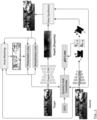
- Figure 1 illustrates the network architecture that uses the proposed dynamically weighted g2s loss according to the invention.
- the inputs to the networks are a sequence of temporally consecutive (RGB) image triplets [ I -1 , I 0 , I 1 ⁇ ⁇ R H ⁇ W ⁇ 3 and the synced GPS coordinates ⁇ G -1 , G 0, G 1 ⁇ ⁇ R 3 .
- the depth network learns the model f n : R H ⁇ W ⁇ 3 ⁇ R H ⁇ W to output dense depth (or disparity) for each pixel coordinate p of a single image.
- the ego-motion network learns the model f R : R 2 ⁇ H ⁇ W ⁇ 3 ⁇ R 6 to output relative translation ( t x , t y , t z ) and rotation ( r x ,r y ,r z ) forming the affine transformation R ⁇ T ⁇ 0 1 ⁇ SE 3 between a pair of overlapping images.
- the predicted depth D ⁇ and ego-motion T ⁇ are linked together via a perspective projection model [lit. 7] that warps the source images I s ⁇ ⁇ I - 1 , I 1 ⁇ to the target image I t ⁇ ⁇ I 0 ⁇ , given the camera intrinsics K .
- the networks are then trained using the appearance-based photometric loss between the real and synthesized target images, as well as a smoothness loss on the depth predictions [6].
- the proposed exponentially weighted g2s loss is added to the previously mentioned losses which enforces scale-consistency and/or -awareness using the ratio of the measured and estimated translations.
- the GPS-to-Scale (g2s) loss introduced by the invention provides an independent cross-modal signal leading to scale-consistent and -aware estimates.
- the GPS information ubiquitously co-present with videos, consists of the latitude, longitude, and optionally the altitude of the vehicle.
- the networks learn to synthesize more plausible views of the target images by improving their depth and ego-motion predictions over the training epochs.
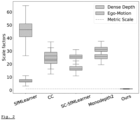
- Figure 2 provides a box-plot visualizing the mean and standard deviation of scale factors for dense depth and ego-motion estimation. Depth has been estimated on the test set of Eigen split [lit. 11]. Ego-motion has been estimated on the test Sequence 10 of Odometry split [lit. 7].
- Prior art methods scaled the estimated depth and ego-motion using the ground truth for evaluation.
- the invention allows to consistently estimate depth and ego-motion at metric scale.
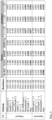
- Figure 3 shows quantitative results of per-image scaled dense depth prediction (without post-processing) on KITTI Original [lit. 14] and Improved [lit. 15] ground truth depths for the Eigen split. Best results for each metric are in bold. The second best results are underlined. * denotes results when trained on Cityscapes along with KITTI.
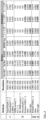
- Figure 4 shows quantitative results of unscaled dense depth prediction on KITTI Original [lit. 14] ground truth depths for the Eigen split.
- M and HR denote methods trained on monocular image sequences and high resolution images respectively.
- 'S' denotes stereo-unsupervised methods that produce depth at scale.
- ⁇ pp' [lit. 6] represents post-processing during inference. Best results for each metric are in bold. The second best results are underlined. * denotes results when trained on Cityscapes along with KITTI.
- Figure 5 shows quantitative comparison of Ego-Motion Estimation on scaled and unscaled trajectories from the KITTI odometry split [lit. 7]. Results include the mean and standard deviation of the ATE-5. Results on multi-view-geometry based ORB-SLAM [lit. 4] have been provided for comparison.
Landscapes
- Engineering & Computer Science (AREA)
- Theoretical Computer Science (AREA)
- Physics & Mathematics (AREA)
- General Physics & Mathematics (AREA)
- Artificial Intelligence (AREA)
- Evolutionary Computation (AREA)
- Data Mining & Analysis (AREA)
- Computational Linguistics (AREA)
- General Engineering & Computer Science (AREA)
- Life Sciences & Earth Sciences (AREA)
- Software Systems (AREA)
- Biomedical Technology (AREA)
- General Health & Medical Sciences (AREA)
- Molecular Biology (AREA)
- Computing Systems (AREA)
- Mathematical Physics (AREA)
- Health & Medical Sciences (AREA)
- Biophysics (AREA)
- Computer Vision & Pattern Recognition (AREA)
- Multimedia (AREA)
- Bioinformatics & Cheminformatics (AREA)
- Evolutionary Biology (AREA)
- Bioinformatics & Computational Biology (AREA)
- Automation & Control Theory (AREA)
- Human Computer Interaction (AREA)
- Transportation (AREA)
- Mechanical Engineering (AREA)
- Image Analysis (AREA)
Description
- The invention relates to a method to improve scale consistency and/or scale awareness in a model of self-supervised depth and ego-motion prediction neural networks processing a video stream of monocular images.
- The preamble of the main claim corresponds to existing approaches to monocular dense depth and ego-motion estimation which utilize a photometric loss for training [see Lit. 35, 36, 37]. Therein, Lit. 35 uses a combination of intensity and colour of images (photometric) with the epi-polar geometry (feature points extraction from images) to improve ego-motion estimation. Their output is defined up to scale. Their evaluation involves scaling the output using the median predicted depth and ground truth depth.
- Lit. 36 attempts to solve this previous problem of scale inconsistency by enforcing pose consistency between the triplet of frames under consideration, and enforcing that the scale of depth between adjacent frames is same.
- Instead, Lit. 37 relates to a semi-supervised method that uses sparse ground truth LiDAR depth to predict the dense depth that is not only consistent but also scale-aware.
- Autonomous driving systems require scene-understanding for planning and navigation. Therefore, spatial perception through depth and ego-motion estimation is essential for enabling complex behaviours in unconstrained environments. Even though sensors such as LiDARs can perceive depth and can be utilized to compute ego-motion at metric-scale [lit. 1, 2], their output depth is sparse, and they are expensive to use. In contrast, monocular colour cameras are compact, low-cost, and consume less energy. While traditional camera-based approaches rely upon hand-crafted features from multiple views [lit. 3, 4], deep learning based approaches can predict depth from a single image. Traditional approaches solve this by utilizing disparity across multiple views within a non-linear optimization framework [lit. 3, 4]. Supervised methods that produce high-quality estimates from a single image [lit. 8, 9, 10] necessitate the availability of accurate ground truth and cross-calibration of sensors for training. Instead, using view-synthesis as a signal, self-supervised methods produce accurate depth maps from stereo image pairs [lit. 24, 25] or from monocular video snippets [lit. 5, 6, 7].
- A problem with the latter approach is however that monocular vision inherently suffers from scale ambiguity. Additionally, the self-supervised approaches introduce scale-inconsistency in estimated depth and ego-motion across different video snippets [lit. 12]. This is because most existing monocular approaches utilize only appearance-based losses with the assumption of brightness consistency that limits training on small video sub-sequences without any long sequence constraints.
- It is therefore an objective of the invention to solve the problem of scale-inconsistency and to introduce scale-awareness in the monocular self-supervised depth and ego-motion estimation.
- According to the method of the invention training of the neural networks is performed in accordance with one or more of the appended claims, in particular according to
claim 1. - Essential to the invention is that in the training of the neural networks complementary GPS coordinates are synchronized with the images and are used to calculate a 'GPS-to-scale loss' (G2S) to enforce the scale-consistency and/or -awareness on the monocular self-supervised ego-motion and depth estimation.
- It is found that best results may be achieved when a relative weight assigned to the 'GPS to-scale-loss' exponentially increases as training progresses.
- Suitably the depth and ego-motion prediction neural networks are trained using an appearance-based photometric loss between real and synthesized target images, as well as a smoothness loss on the depth predictions. Preferably a final loss function is calculated comprising the appearance based photometric loss and smoothness loss, plus the GPS-to-scale loss function times the relative weight.
- The accuracy of the 'GPS-to-scale loss' (G2S) may be improved by arranging that the GPS coordinates comprising latitude, longitude and optionally altitude are converted into local coordinates.
- Suitably the calculation of the GPS to scale loss utilizes a ratio of a relative translation measured by the GPS and a relative translation predicted by the networks. By forming this loss upon the translation magnitude instead of on the individual translation components, account is taken for any noise or systemic bias that may be present in the GPS measurements
- In a preferred embodiment inputs for the neural networks are a sequence of temporally consecutive image triplets {I -1,I 0,I 1} ∈ R H×W×3 and the synced GPS coordinates {G-1,G 0,G 1} ∈ R 3 .
- Suitably a center image of the image triplets is target and the model is arranged to synthesize a target image from the first and last source images of the image triplets, whereafter the original center target image and the synthesized target image are compared to train the network.
- Preferably the depth neural network learns the model fD : R H×W×3 → R H ×W to output dense depth or disparity for each pixel coordinate p of a single image.
- Preferably further the ego-motion neural network learns the mdoel fE :R 2×H×W×3 → R 6 to output relative translation (tx , ty , tz ) and rotation (rx ,ry ,rz ) forming an affine transformation

- Advantageously the depth neural network and the ego-motion neural network operate simultaneously.
- Further suitably the output dense depth D̂ or disparity of the depth neural network and the ego-motion T̂ derived from the ego-motion neural network are linked together via a projection model that warps the source images Is ∈ {I -1,I 1} to the target image It ∈ {I 0)}.
- The invention is also embodied in a method of planning and navigation in an autopilot, wherein to improve scale consistency and/or scale awareness of scene understanding, positioning is executed using a depth estimation according to a training method as described herein.The invention will hereinafter be further elucidated with reference to the drawing relating to features of the method according to the invention that is not limiting as to the appended claims.
- In the drawing:
-
figure 1 shows a network architecture that uses the dynamically weighted g2s loss according to the invention; -
figure 2 shows a box-plot visualizing the mean and standard deviation of scale factors for dense depth and ego-motion estimation; -
figure 3 shows quantitative results of per-image scaled dense depth predictions without post-processing; -
figure 4 shows quantitative results of unscaled dense depth predictions; and -
figure 5 shows a quantitative comparison of Ego-Motion Estimation on scaled and unscaled trajectories. -
Figure 1 illustrates the network architecture that uses the proposed dynamically weighted g2s loss according to the invention. Given a set of n images from a video sequence, and m loosely corresponding GPS coordinates, the inputs to the networks are a sequence of temporally consecutive (RGB) image triplets [I -1,I 0,I 1} ∈ R H×W×3 and the synced GPS coordinates {G -1,G 0, G 1} ∈ R 3. - The depth network learns the model fn :R H×W×3 → R H×W to output dense depth (or disparity) for each pixel coordinate p of a single image. Simultaneously, the ego-motion network learns the model fR :R 2×H×W×3 → R 6 to output relative translation (tx ,ty ,tz ) and rotation (rx,ry,rz ) forming the affine transformation

- The predicted depth D̂ and ego-motion T̂ are linked together via a perspective projection model [lit. 7] that warps the source images Is ∈ {I -1,I 1} to the target image It ∈ {I 0}, given the camera intrinsics K. The networks are then trained using the appearance-based photometric loss between the real and synthesized target images, as well as a smoothness loss on the depth predictions [6]. To this end, the proposed exponentially weighted g2s loss is added to the previously mentioned losses which enforces scale-consistency and/or -awareness using the ratio of the measured and estimated translations.
- It is remarked that appearance-based losses provide supervisory signal on short monocular sub-sequences. This leads to scale-inconsistency of the predicted depth and ego-motion across long videos. Nevertheless, approaches addressing this problem through 3D-geometry-based losses provide a signal that depends upon the camera setup and the scene distribution [lit. 12, 13]. The GPS-to-Scale (g2s) loss introduced by the invention provides an independent cross-modal signal leading to scale-consistent and -aware estimates. The GPS information, ubiquitously co-present with videos, consists of the latitude, longitude, and optionally the altitude of the vehicle. First, these geodetic coordinates are converted to local coordinates using the Mercator projection such that:


- Utilizing the ratio of the relative distance measured by the GPS and the relative distance predicted by the network, an additional loss is imposed given by,

- The networks learn to synthesize more plausible views of the target images by improving their depth and ego-motion predictions over the training epochs.
- It has been observed that training with Stochastic Gradient Descent (SGD) and its variants biases neural networks to learn simpler functions [lit. 17]. Since the g2s loss (Eq. 4) of the invention is much simpler than the complex appearance-based losses, heavily penalizing the networks for the incorrect scales during the early training can interfere with the learning of individual translations, rotations, and pixel-wise depths.
- Instead, in the invention dynamically weighing of the g2s loss is applied in an exponential manner to provide a scale signal that is low in the beginning and increases as the training progresses. Hence, the weight w to the g2s loss L g2s is given by

- The final training loss is a sum of the appearance based losses [6] and the proposed exponentially weighted g2s loss

-
Figure 2 provides a box-plot visualizing the mean and standard deviation of scale factors for dense depth and ego-motion estimation. Depth has been estimated on the test set of Eigen split [lit. 11]. Ego-motion has been estimated on thetest Sequence 10 of Odometry split [lit. 7]. - Prior art methods scaled the estimated depth and ego-motion using the ground truth for evaluation. The invention allows to consistently estimate depth and ego-motion at metric scale.
-
Figure 3 shows quantitative results of per-image scaled dense depth prediction (without post-processing) on KITTI Original [lit. 14] and Improved [lit. 15] ground truth depths for the Eigen split. Best results for each metric are in bold. The second best results are underlined. * denotes results when trained on Cityscapes along with KITTI. -
Figure 4 shows quantitative results of unscaled dense depth prediction on KITTI Original [lit. 14] ground truth depths for the Eigen split. M and HR denote methods trained on monocular image sequences and high resolution images respectively. 'S' denotes stereo-unsupervised methods that produce depth at scale. `pp' [lit. 6] represents post-processing during inference. Best results for each metric are in bold. The second best results are underlined. * denotes results when trained on Cityscapes along with KITTI. -
Figure 5 shows quantitative comparison of Ego-Motion Estimation on scaled and unscaled trajectories from the KITTI odometry split [lit. 7]. Results include the mean and standard deviation of the ATE-5. Results on multi-view-geometry based ORB-SLAM [lit. 4] have been provided for comparison. -
- [1] Ioan Andrei Barsan, Shenlong Wang, Andrei Pokrovsky, and Raquel Urtasun. Learning to localize using a lidar intensity map. In Conference on Robot Learning (CoRL), pages 605-616, 2018.
- [2] Ji Zhang and Sanjiv Singh. Loam: Lidar odometry and mapping in real-time. In Robotics: Science and Systems, 2014.
- [3] Kevin Karsch, Ce Liu, and Sing Bing Kang. Depth extraction from video using non-parametric sampling. In European Conference on Computer Vision, pages 775-788. Springer, 2012.
- [4] Paul Mur-Artal, Jose Maria Martinez Montiel, and Juan D Tar-dos. Orb-slam: a versatile and accurate monocular slam system. IEEE transactions on robotics, 31(5) :1147-1163, 2015.
- [5] Vincent Casser, Soeren Pirk, Reza Mahjourian, and Anelia Angelova. Depth prediction without the sensors: Leveraging structure for unsupervised learning from monocular videos. In Proceedings of the AAAI Conference on Artificial Intelligence, volume 33, pages 8001-8008, 2019.
- [6] Clement Godard, Oisin Mac Aodha, Michael Firman, and Gabriel J Brostow. Digging into self-supervised monocular depth estimation. In Proceedings of the IEEE international conference on computer vision, pages 3828-3838, 2019.
- [7] Tinghui Zhou, Matthew Brown, Noah Snavely, and David G. Lowe. Unsupervised learning of depth and egomotion from video, 2017.
- [8] Huan Fu, Mingming Gong, Chaohui Wang, Kayhan Batmanghelich, and Dacheng Tao. Deep ordinal regression network for monocular depth estimation. In Proceedings of the IEEE Conference on Computer Vision and Pattern Recognition, pages 2002-2011, 2018.
- [9] Chengzhou Tang and Ping Tan. Ba-net: Dense bundle adjustment network. arXiv preprint arXiv:1806.04807, 2018.
- [10] Huizhong Zhou, Benjamin Ummenhofer, and Thomas Brox. Deep-tam: Deep tracking and mapping. In Proceedings of the European conference on computer vision (ECCV), pages 822-838, 2018.
- [11] David Eigen, Christian Puhrsch, and Rob Fergus. Depth map prediction from a single image using a multi-scale deep network. In Advances in neural information processing systems, pages 2366-2374, 2014.
- [12] Jiawang Bian, Zhichao Li, Naiyan Wang, Huangying Zhan, Chunhua Shen, Ming-Ming Cheng, and Ian Reid. Unsupervised scale-consistent depth and ego-motion learning from monocular video. In Advances in Neural Information Processing Systems, pages 35-45, 2019.
- [13] Reza Mahjourian, Martin Wicke, and Anelia Angelova. Unsupervised learning of depth and ego-motion from monocular video using 3d geometric constraints. In Proceedings of the IEEE Conference on Computer Vision and Pattern Recognition, pages 5667-5675, 2018.
- [14] Andreas Geiger, Philip Lenz, Christoph Stiller, and Raquel Urtasun. Vision meets robotics: The kitti dataset. The International Journal of Robotics Research, 32(11) :1231-1237, 2013.
- [15] Jonas Uhrig, Nick Schneider, Lukas Schneider, Uwe Franke, Thomas Brox, and Andreas Geiger. Sparsity invariant cnns. In International Conference on 3D Vision (3DV), 2017.
- [16] Anweshan Das and Gijs Dubbelman. An experimental study on relative and absolute pose graph fusion for vehicle localization. In 2018 IEEE Intelligent Vehicles Symposium (IV), pages 630-635. IEEE, 2018.
- [17] Robert Geirhos, Jorn-Henrik Jacobsen, Claudio Michaelis, Richard Zemel, Wieland Brendel, Matthias Bethge, and Felix A Wichmann. Shortcut learning in deep neural networks. arXiv preprint arXiv:2004.07780, 2020.
- [18] Hemang Chawla, Matti Jukola, Terence Brouns, Elahe Arani, and Bahram Zonooz. Crowdsourced 3d mapping: A combined multi-view geometry and self-supervised learning approach. In 2020 IEEE/RSJ International Conference on Intelligent Robots and Systems(IROS) . IEEE, 2020.
- [19] Ariel Gordon, Hanhan Li, Rico Jonschkowski, and Anelia Angelova. Depth from videos in the wild: Unsupervised monocular depth learning from unknown cameras, 2019.
- [20] Andreas Geiger, Philip Lenz, Christoph Stiller, and Raquel Urtasun. Vision meets robotics: The kitti dataset. The International Journal of Robotics Research, 32(11):1231-1237, 2013.
- [21] Jonas Uhrig, Nick Schneider, Lukas Schneider, Uwe Franke, Thomas Brox, and Andreas Geiger. Sparsity invariant cnns. In International Conference on 3D Vision (3DV), 2017.
- [22] Ashutosh Saxena, Min Sun, and Andrew Y Ng. Make3d: Learning 3d scene structure from a single still image. IEEE transactions on pattern analysis and machine intelligence, 31(5):824-840, 2008.
- [23] Marius Cordts, Mohamed Omran, Sebastian Ramos, Timo Rehfeld, Markus Enzweiler, Rodrigo Benenson, Uwe Franke, Stefan Roth, and Bernt Schiele. The cityscapes dataset for semantic urban scene understanding. In Proceedings of the IEEE conference on computer vision and pattern recognition, pages 3213-3223, 2016.
- [24] Ravi Garg, Vijay Kumar BG, Gustavo Carneiro, and Ian Reid. Unsupervised cnn for single view depth estimation: Geometry to the rescue. In European Conference on Computer Vision, pages 740-756. Springer, 2016.
- [25] Clement Godard, Oisin Mac Aodha, and Gabriel J Brostow. Unsupervised monocular depth estimation with left-right consistency. In Proceedings of the IEEE Conference on Computer Vision and Pattern Recognition, pages 270-279, 2017.
- [26] Vitor Guizilini, Rares Ambrus, Sudeep Pillai, Allan Raven-tos, and Adrien Gaidon. 3d packing for self-supervisedmonocular depth estimation. In Proceedings of the IEEE/CVF Conference on Computer Vision and Pattern Recognition, pages 2485-2494, 2020.
- [27] Anweshan Das and Gijs Dubbelman. An experimental study on relative and absolute pose graph fusion for vehicle localization. In 2018 IEEE Intelligent Vehicles Symposium (IV), pages 630-635. IEEE, 2018.
- [28] Jason Jo and Yoshua Bengio. Measuring the tendency of cnns to learn surface statistical regularities. ArXiv preprint arXiv:1711.11561, 2017.
- [29] Robert Geirhos, Jorn-Henrik Jacobsen, Claudio Michaelis, Richard Zemel, Wieland Brendel, Matthias Bethge, and Felix A Wichmann. Shortcut learning in deep neural networks. arXiv preprint arXiv:2004.07780, 2020.
- [30] Zhichao Yin and Jianping Shi. Geonet: Unsupervised learning of dense depth, optical flow and camera pose. In Proceedings of the IEEE Conference on Computer Vision and Pattern Recognition, pages 1983-1992, 2018.
- [31] Anurag Ranjan, Varun Jampani, Lukas Balles, Kihwan Kim, Deqing Sun, Jonas Wulff, and Michael J Black. Competitive collaboration: Joint unsupervised learning of depth, camera motion, optical flow and motion segmentation. In Proceedings of the IEEE conference on computer vision and pattern recognition, pages 12240-12249, 2019.
- [32] Marvin Klingner, Jan-Aike Termohlen, Jonas Mikolajczyk, and Tim Fingscheidt. Self-Supervised Monocular Depth Estimation: Solving the Dynamic Object Problem by Semantic Guidance. In ECCV, 2020.
- [33] Sudeep Pillai, Rares, Ambrus, and Adrien Gaidon. Super-depth: Self-supervised, super-resolved monocular depth estimation. In 2019 International Conference on Robotics and Automation (ICRA), pages 9250-9256. IEEE, 2019.
- [34] Matan Goldman, Tal Hassner, and Shai Avidan. Learn stereo, infer mono: Siamese networks for self-supervised, monocular, depth estimation. In Proceedings of the IEEE Conference on Computer Vision and Pattern Recognition Workshops, 2019.
- [35] Shen Tianwei, et al.: Beyond Photometric Loss for Self-Supervised Ego-Motion Estimation", 2019 International Conference on Robotics and Automation (ICRA), p. 6359-6365, IEEE, 2019
- [36] Xion Minkang et al.: Self-Supervised Monocular Depth and Visual Odometry Learning with Scale-Consistent Geometric Constraints. Proceedings of the 29th Joint international conference on artificial intelligence, p. 963-969. 2020
- [37] Victor Guizilini et al.: Robust Semi-supervised Monocular Depth Estimation With Reprojected Distances. In Conference on robot learning (pp. 503-512). PMLR. 2020.
Claims (5)
- A computer-implemented method of simultaneously operating self-supervised depth and ego-motion prediction neural networks processing a video stream of monocular images, whereina. the depth neural network learns to output dense depth or disparity for each pixel coordinate of a single image andb. the ego-motion neural network learns to output relative translation and rotation forming an affine transformation between a pair of overlapping images,c. wherein the inputs for the neural networks are a sequence of temporally consecutive image triplets, andd. the output dense depth or disparity of the depth neural network and the relative transformation derived from the ego-motion neural network are linked together via a perspective projection model that performs view synthesis to warp the source images to the target image, such that the center image of the image triplets is target and the model is arranged to synthesize a target image from the first and last source images of the image triplets,e. whereafter the original center target image and the synthesized target image are compared to train the depth and ego-motion prediction neural networks using an appearance-based photometric loss between real and synthesized target images, as well as a smoothness loss on the depth predictions, characterized in thatf. complementary Global Positioning System (GPS) coordinates synchronized with the images are used to calculate a "GPS-to-scale loss" that utilizes a ratio of a relative translation measured by the GPS and a relative translation predicted by the ego-motion network, andg. the final loss function is calculated comprising the appearance based photometric loss and smoothness loss, plus the GPS-to-scale loss function times a relative weight to enforce the scale-consistency and/or -awareness on the monocular self-supervised ego-motion and depth estimation.
- The method of claim 1, further characterized in that the relative weight assigned to the GPS-to-scale loss exponentially increases as training progresses.
- The method of any one of claims 1-2, further characterized in that the GPS coordinates comprising latitude, longitude and optionally altitude are converted into local coordinates.
- The method of any one of claims 1-3, further characterized in that the calculation of the GPS-to-scale loss utilizes a ratio of a relative translation measuring using the GPS and the relative translation predicted by the ego-motion neural network according to

- A method of planning and navigation in an autopilot, wherein to improve the scale consistency and/or scale awareness of scene understanding, positioning is executed using a depth estimation according to a training method pursuant to claim 1.
Priority Applications (3)
| Application Number | Priority Date | Filing Date | Title |
|---|---|---|---|
| EP20207576.8A EP4002215B1 (en) | 2020-11-13 | 2020-11-13 | Method to improve scale consistency and/or scale awareness in a model of self-supervised depth and ego-motion prediction neural networks |
| CN202110593639.5A CN114494331B (en) | 2020-11-13 | 2021-05-28 | Methods for improving scale consistency and/or scale awareness in self-supervised deep and ego-motion prediction neural network models |
| US17/402,349 US11948272B2 (en) | 2020-11-13 | 2021-08-13 | Computer-implemented method to improve scale consistency and/or scale awareness in a model of self-supervised depth and ego-motion prediction neural networks |
Applications Claiming Priority (1)
| Application Number | Priority Date | Filing Date | Title |
|---|---|---|---|
| EP20207576.8A EP4002215B1 (en) | 2020-11-13 | 2020-11-13 | Method to improve scale consistency and/or scale awareness in a model of self-supervised depth and ego-motion prediction neural networks |
Publications (2)
| Publication Number | Publication Date |
|---|---|
| EP4002215A1 EP4002215A1 (en) | 2022-05-25 |
| EP4002215B1 true EP4002215B1 (en) | 2024-08-21 |
Family
ID=73448952
Family Applications (1)
| Application Number | Title | Priority Date | Filing Date |
|---|---|---|---|
| EP20207576.8A Active EP4002215B1 (en) | 2020-11-13 | 2020-11-13 | Method to improve scale consistency and/or scale awareness in a model of self-supervised depth and ego-motion prediction neural networks |
Country Status (3)
| Country | Link |
|---|---|
| US (1) | US11948272B2 (en) |
| EP (1) | EP4002215B1 (en) |
| CN (1) | CN114494331B (en) |
Families Citing this family (4)
| Publication number | Priority date | Publication date | Assignee | Title |
|---|---|---|---|---|
| US11688090B2 (en) * | 2021-03-16 | 2023-06-27 | Toyota Research Institute, Inc. | Shared median-scaling metric for multi-camera self-supervised depth evaluation |
| US12555255B2 (en) | 2023-03-08 | 2026-02-17 | Samsung Electronics Co., Ltd. | Absolute depth estimation from a single image using online depth scale transfer |
| US20240362807A1 (en) * | 2023-04-28 | 2024-10-31 | Qualcomm Incorporated | Self-supervised multi-frame depth estimation with odometry fusion |
| FR3167233A1 (en) * | 2024-10-08 | 2026-04-10 | Stellantis Auto Sas | Method and device for learning a model for predicting the positions of three-dimensional points associated with a vision system. |
Family Cites Families (11)
| Publication number | Priority date | Publication date | Assignee | Title |
|---|---|---|---|---|
| US9361943B2 (en) * | 2006-11-07 | 2016-06-07 | The Board Of Trustees Of The Leland Stanford Jr. University | System and method for tagging objects in a panoramic video and associating functions and indexing panoramic images with same |
| WO2017035663A1 (en) * | 2015-09-03 | 2017-03-09 | Miovision Technologies Incorporated | System and method for detecting and tracking objects |
| WO2019094843A1 (en) * | 2017-11-10 | 2019-05-16 | Nvidia Corporation | Systems and methods for safe and reliable autonomous vehicles |
| CN108765479A (en) * | 2018-04-04 | 2018-11-06 | 上海工程技术大学 | Using deep learning to monocular view estimation of Depth optimization method in video sequence |
| US11107230B2 (en) * | 2018-09-14 | 2021-08-31 | Toyota Research Institute, Inc. | Systems and methods for depth estimation using monocular images |
| CN110969064B (en) * | 2018-09-30 | 2023-10-27 | 北京四维图新科技股份有限公司 | An image detection method, device and storage device based on monocular vision |
| US11144818B2 (en) * | 2019-07-05 | 2021-10-12 | Toyota Research Institute, Inc. | Network architecture for ego-motion estimation |
| US11138751B2 (en) * | 2019-07-06 | 2021-10-05 | Toyota Research Institute, Inc. | Systems and methods for semi-supervised training using reprojected distance loss |
| US11176709B2 (en) * | 2019-10-17 | 2021-11-16 | Toyota Research Institute, Inc. | Systems and methods for self-supervised scale-aware training of a model for monocular depth estimation |
| CN111652124A (en) * | 2020-06-02 | 2020-09-11 | 电子科技大学 | A Construction Method of Human Action Recognition Model Based on Graph Convolutional Network |
| CN111739078B (en) * | 2020-06-15 | 2022-11-18 | 大连理工大学 | A Monocular Unsupervised Depth Estimation Method Based on Contextual Attention Mechanism |
-
2020
- 2020-11-13 EP EP20207576.8A patent/EP4002215B1/en active Active
-
2021
- 2021-05-28 CN CN202110593639.5A patent/CN114494331B/en active Active
- 2021-08-13 US US17/402,349 patent/US11948272B2/en active Active
Also Published As
| Publication number | Publication date |
|---|---|
| CN114494331A (en) | 2022-05-13 |
| EP4002215A1 (en) | 2022-05-25 |
| US11948272B2 (en) | 2024-04-02 |
| US20220156882A1 (en) | 2022-05-19 |
| CN114494331B (en) | 2024-12-20 |
Similar Documents
| Publication | Publication Date | Title |
|---|---|---|
| EP4002215B1 (en) | Method to improve scale consistency and/or scale awareness in a model of self-supervised depth and ego-motion prediction neural networks | |
| US12260575B2 (en) | Scale-aware monocular localization and mapping | |
| US11436743B2 (en) | Systems and methods for semi-supervised depth estimation according to an arbitrary camera | |
| US11948309B2 (en) | Systems and methods for jointly training a machine-learning-based monocular optical flow, depth, and scene flow estimator | |
| US10803360B2 (en) | Situation awareness method and device using image segmentation | |
| Chawla et al. | Multimodal scale consistency and awareness for monocular self-supervised depth estimation | |
| EP2948927B1 (en) | A method of detecting structural parts of a scene | |
| Sun et al. | Mm3dgs slam: Multi-modal 3d gaussian splatting for slam using vision, depth, and inertial measurements | |
| Vatavu et al. | Stereovision-based multiple object tracking in traffic scenarios using free-form obstacle delimiters and particle filters | |
| Wang et al. | Unsupervised learning of 3d scene flow from monocular camera | |
| Milli et al. | Multi-modal multi-task (3mt) road segmentation | |
| Tarrio et al. | Realtime edge based visual inertial odometry for MAV teleoperation in indoor environments | |
| Musleh et al. | Visual ego motion estimation in urban environments based on uv disparity | |
| EP4205077B1 (en) | Sampling based self-supervised depth and pose estimation | |
| Choi et al. | Selftune: Metrically scaled monocular depth estimation through self-supervised learning | |
| Buck et al. | Capturing uncertainty in monocular depth estimation: Towards fuzzy voxel maps | |
| Kulawik | Estimating the distance to an object from grayscale stereo images using deep learning | |
| Mauri et al. | A Comparative Study of Deep Learning-based Depth Estimation Approaches: Application to Smart Mobility | |
| Wolcott et al. | Probabilistic Obstacle Partitioning of Monocular Video for Autonomous Vehicles. | |
| Azevedo et al. | Real-time road surface mapping using stereo matching, v-disparity and machine learning | |
| Petrescu et al. | Self-supervised learning of depth maps for autonomous cars | |
| Melbouci et al. | Bundle adjustment revisited for SLAM with RGBD sensors | |
| Valente et al. | Grid matching localization on evidential SLAM | |
| Chen et al. | The obstacles detection for outdoor robot based on computer vision in deep learning | |
| Bora et al. | ViM-Disparity: Bridging the Gap of Speed, Accuracy and Memory for Disparity Map Generation |
Legal Events
| Date | Code | Title | Description |
|---|---|---|---|
| PUAI | Public reference made under article 153(3) epc to a published international application that has entered the european phase |
Free format text: ORIGINAL CODE: 0009012 |
|
| STAA | Information on the status of an ep patent application or granted ep patent |
Free format text: STATUS: THE APPLICATION HAS BEEN PUBLISHED |
|
| AK | Designated contracting states |
Kind code of ref document: A1 Designated state(s): AL AT BE BG CH CY CZ DE DK EE ES FI FR GB GR HR HU IE IS IT LI LT LU LV MC MK MT NL NO PL PT RO RS SE SI SK SM TR |
|
| STAA | Information on the status of an ep patent application or granted ep patent |
Free format text: STATUS: REQUEST FOR EXAMINATION WAS MADE |
|
| 17P | Request for examination filed |
Effective date: 20221125 |
|
| RBV | Designated contracting states (corrected) |
Designated state(s): AL AT BE BG CH CY CZ DE DK EE ES FI FR GB GR HR HU IE IS IT LI LT LU LV MC MK MT NL NO PL PT RO RS SE SI SK SM TR |
|
| GRAP | Despatch of communication of intention to grant a patent |
Free format text: ORIGINAL CODE: EPIDOSNIGR1 |
|
| STAA | Information on the status of an ep patent application or granted ep patent |
Free format text: STATUS: GRANT OF PATENT IS INTENDED |
|
| RIC1 | Information provided on ipc code assigned before grant |
Ipc: G06N 3/045 20230101ALI20240411BHEP Ipc: G06T 7/579 20170101ALI20240411BHEP Ipc: G06T 7/55 20170101ALI20240411BHEP Ipc: G06N 3/08 20060101ALI20240411BHEP Ipc: G06N 3/04 20060101AFI20240411BHEP |
|
| INTG | Intention to grant announced |
Effective date: 20240424 |
|
| GRAS | Grant fee paid |
Free format text: ORIGINAL CODE: EPIDOSNIGR3 |
|
| GRAA | (expected) grant |
Free format text: ORIGINAL CODE: 0009210 |
|
| STAA | Information on the status of an ep patent application or granted ep patent |
Free format text: STATUS: THE PATENT HAS BEEN GRANTED |
|
| AK | Designated contracting states |
Kind code of ref document: B1 Designated state(s): AL AT BE BG CH CY CZ DE DK EE ES FI FR GB GR HR HU IE IS IT LI LT LU LV MC MK MT NL NO PL PT RO RS SE SI SK SM TR |
|
| REG | Reference to a national code |
Ref country code: GB Ref legal event code: FG4D |
|
| REG | Reference to a national code |
Ref country code: CH Ref legal event code: EP |
|
| REG | Reference to a national code |
Ref country code: IE Ref legal event code: FG4D |
|
| REG | Reference to a national code |
Ref country code: DE Ref legal event code: R096 Ref document number: 602020036104 Country of ref document: DE |
|
| REG | Reference to a national code |
Ref country code: LT Ref legal event code: MG9D |
|
| REG | Reference to a national code |
Ref country code: NL Ref legal event code: MP Effective date: 20240821 |
|
| PG25 | Lapsed in a contracting state [announced via postgrant information from national office to epo] |
Ref country code: NO Free format text: LAPSE BECAUSE OF FAILURE TO SUBMIT A TRANSLATION OF THE DESCRIPTION OR TO PAY THE FEE WITHIN THE PRESCRIBED TIME-LIMIT Effective date: 20241121 |
|
| REG | Reference to a national code |
Ref country code: AT Ref legal event code: MK05 Ref document number: 1716222 Country of ref document: AT Kind code of ref document: T Effective date: 20240821 |
|
| PG25 | Lapsed in a contracting state [announced via postgrant information from national office to epo] |
Ref country code: NL Free format text: LAPSE BECAUSE OF FAILURE TO SUBMIT A TRANSLATION OF THE DESCRIPTION OR TO PAY THE FEE WITHIN THE PRESCRIBED TIME-LIMIT Effective date: 20240821 Ref country code: GR Free format text: LAPSE BECAUSE OF FAILURE TO SUBMIT A TRANSLATION OF THE DESCRIPTION OR TO PAY THE FEE WITHIN THE PRESCRIBED TIME-LIMIT Effective date: 20241122 Ref country code: PT Free format text: LAPSE BECAUSE OF FAILURE TO SUBMIT A TRANSLATION OF THE DESCRIPTION OR TO PAY THE FEE WITHIN THE PRESCRIBED TIME-LIMIT Effective date: 20241223 Ref country code: FI Free format text: LAPSE BECAUSE OF FAILURE TO SUBMIT A TRANSLATION OF THE DESCRIPTION OR TO PAY THE FEE WITHIN THE PRESCRIBED TIME-LIMIT Effective date: 20240821 Ref country code: PL Free format text: LAPSE BECAUSE OF FAILURE TO SUBMIT A TRANSLATION OF THE DESCRIPTION OR TO PAY THE FEE WITHIN THE PRESCRIBED TIME-LIMIT Effective date: 20240821 |
|
| PG25 | Lapsed in a contracting state [announced via postgrant information from national office to epo] |
Ref country code: BG Free format text: LAPSE BECAUSE OF FAILURE TO SUBMIT A TRANSLATION OF THE DESCRIPTION OR TO PAY THE FEE WITHIN THE PRESCRIBED TIME-LIMIT Effective date: 20240821 |
|
| PG25 | Lapsed in a contracting state [announced via postgrant information from national office to epo] |
Ref country code: LV Free format text: LAPSE BECAUSE OF FAILURE TO SUBMIT A TRANSLATION OF THE DESCRIPTION OR TO PAY THE FEE WITHIN THE PRESCRIBED TIME-LIMIT Effective date: 20240821 |
|
| PG25 | Lapsed in a contracting state [announced via postgrant information from national office to epo] |
Ref country code: AT Free format text: LAPSE BECAUSE OF FAILURE TO SUBMIT A TRANSLATION OF THE DESCRIPTION OR TO PAY THE FEE WITHIN THE PRESCRIBED TIME-LIMIT Effective date: 20240821 Ref country code: IS Free format text: LAPSE BECAUSE OF FAILURE TO SUBMIT A TRANSLATION OF THE DESCRIPTION OR TO PAY THE FEE WITHIN THE PRESCRIBED TIME-LIMIT Effective date: 20241221 |
|
| PG25 | Lapsed in a contracting state [announced via postgrant information from national office to epo] |
Ref country code: HR Free format text: LAPSE BECAUSE OF FAILURE TO SUBMIT A TRANSLATION OF THE DESCRIPTION OR TO PAY THE FEE WITHIN THE PRESCRIBED TIME-LIMIT Effective date: 20240821 |
|
| PG25 | Lapsed in a contracting state [announced via postgrant information from national office to epo] |
Ref country code: ES Free format text: LAPSE BECAUSE OF FAILURE TO SUBMIT A TRANSLATION OF THE DESCRIPTION OR TO PAY THE FEE WITHIN THE PRESCRIBED TIME-LIMIT Effective date: 20240821 Ref country code: RS Free format text: LAPSE BECAUSE OF FAILURE TO SUBMIT A TRANSLATION OF THE DESCRIPTION OR TO PAY THE FEE WITHIN THE PRESCRIBED TIME-LIMIT Effective date: 20241121 |
|
| PG25 | Lapsed in a contracting state [announced via postgrant information from national office to epo] |
Ref country code: RS Free format text: LAPSE BECAUSE OF FAILURE TO SUBMIT A TRANSLATION OF THE DESCRIPTION OR TO PAY THE FEE WITHIN THE PRESCRIBED TIME-LIMIT Effective date: 20241121 Ref country code: PT Free format text: LAPSE BECAUSE OF FAILURE TO SUBMIT A TRANSLATION OF THE DESCRIPTION OR TO PAY THE FEE WITHIN THE PRESCRIBED TIME-LIMIT Effective date: 20241223 Ref country code: PL Free format text: LAPSE BECAUSE OF FAILURE TO SUBMIT A TRANSLATION OF THE DESCRIPTION OR TO PAY THE FEE WITHIN THE PRESCRIBED TIME-LIMIT Effective date: 20240821 Ref country code: NO Free format text: LAPSE BECAUSE OF FAILURE TO SUBMIT A TRANSLATION OF THE DESCRIPTION OR TO PAY THE FEE WITHIN THE PRESCRIBED TIME-LIMIT Effective date: 20241121 Ref country code: NL Free format text: LAPSE BECAUSE OF FAILURE TO SUBMIT A TRANSLATION OF THE DESCRIPTION OR TO PAY THE FEE WITHIN THE PRESCRIBED TIME-LIMIT Effective date: 20240821 Ref country code: LV Free format text: LAPSE BECAUSE OF FAILURE TO SUBMIT A TRANSLATION OF THE DESCRIPTION OR TO PAY THE FEE WITHIN THE PRESCRIBED TIME-LIMIT Effective date: 20240821 Ref country code: IS Free format text: LAPSE BECAUSE OF FAILURE TO SUBMIT A TRANSLATION OF THE DESCRIPTION OR TO PAY THE FEE WITHIN THE PRESCRIBED TIME-LIMIT Effective date: 20241221 Ref country code: HR Free format text: LAPSE BECAUSE OF FAILURE TO SUBMIT A TRANSLATION OF THE DESCRIPTION OR TO PAY THE FEE WITHIN THE PRESCRIBED TIME-LIMIT Effective date: 20240821 Ref country code: GR Free format text: LAPSE BECAUSE OF FAILURE TO SUBMIT A TRANSLATION OF THE DESCRIPTION OR TO PAY THE FEE WITHIN THE PRESCRIBED TIME-LIMIT Effective date: 20241122 Ref country code: FI Free format text: LAPSE BECAUSE OF FAILURE TO SUBMIT A TRANSLATION OF THE DESCRIPTION OR TO PAY THE FEE WITHIN THE PRESCRIBED TIME-LIMIT Effective date: 20240821 Ref country code: ES Free format text: LAPSE BECAUSE OF FAILURE TO SUBMIT A TRANSLATION OF THE DESCRIPTION OR TO PAY THE FEE WITHIN THE PRESCRIBED TIME-LIMIT Effective date: 20240821 Ref country code: BG Free format text: LAPSE BECAUSE OF FAILURE TO SUBMIT A TRANSLATION OF THE DESCRIPTION OR TO PAY THE FEE WITHIN THE PRESCRIBED TIME-LIMIT Effective date: 20240821 Ref country code: AT Free format text: LAPSE BECAUSE OF FAILURE TO SUBMIT A TRANSLATION OF THE DESCRIPTION OR TO PAY THE FEE WITHIN THE PRESCRIBED TIME-LIMIT Effective date: 20240821 |
|
| PG25 | Lapsed in a contracting state [announced via postgrant information from national office to epo] |
Ref country code: DK Free format text: LAPSE BECAUSE OF FAILURE TO SUBMIT A TRANSLATION OF THE DESCRIPTION OR TO PAY THE FEE WITHIN THE PRESCRIBED TIME-LIMIT Effective date: 20240821 Ref country code: RO Free format text: LAPSE BECAUSE OF FAILURE TO SUBMIT A TRANSLATION OF THE DESCRIPTION OR TO PAY THE FEE WITHIN THE PRESCRIBED TIME-LIMIT Effective date: 20240821 Ref country code: SM Free format text: LAPSE BECAUSE OF FAILURE TO SUBMIT A TRANSLATION OF THE DESCRIPTION OR TO PAY THE FEE WITHIN THE PRESCRIBED TIME-LIMIT Effective date: 20240821 |
|
| PG25 | Lapsed in a contracting state [announced via postgrant information from national office to epo] |
Ref country code: EE Free format text: LAPSE BECAUSE OF FAILURE TO SUBMIT A TRANSLATION OF THE DESCRIPTION OR TO PAY THE FEE WITHIN THE PRESCRIBED TIME-LIMIT Effective date: 20240821 |
|
| PG25 | Lapsed in a contracting state [announced via postgrant information from national office to epo] |
Ref country code: CZ Free format text: LAPSE BECAUSE OF FAILURE TO SUBMIT A TRANSLATION OF THE DESCRIPTION OR TO PAY THE FEE WITHIN THE PRESCRIBED TIME-LIMIT Effective date: 20240821 |
|
| PG25 | Lapsed in a contracting state [announced via postgrant information from national office to epo] |
Ref country code: IT Free format text: LAPSE BECAUSE OF FAILURE TO SUBMIT A TRANSLATION OF THE DESCRIPTION OR TO PAY THE FEE WITHIN THE PRESCRIBED TIME-LIMIT Effective date: 20240821 Ref country code: SK Free format text: LAPSE BECAUSE OF FAILURE TO SUBMIT A TRANSLATION OF THE DESCRIPTION OR TO PAY THE FEE WITHIN THE PRESCRIBED TIME-LIMIT Effective date: 20240821 |
|
| REG | Reference to a national code |
Ref country code: DE Ref legal event code: R097 Ref document number: 602020036104 Country of ref document: DE |
|
| REG | Reference to a national code |
Ref country code: DE Ref legal event code: R119 Ref document number: 602020036104 Country of ref document: DE |
|
| PLBE | No opposition filed within time limit |
Free format text: ORIGINAL CODE: 0009261 |
|
| STAA | Information on the status of an ep patent application or granted ep patent |
Free format text: STATUS: NO OPPOSITION FILED WITHIN TIME LIMIT |
|
| REG | Reference to a national code |
Ref country code: CH Ref legal event code: PL |
|
| PG25 | Lapsed in a contracting state [announced via postgrant information from national office to epo] |
Ref country code: MC Free format text: LAPSE BECAUSE OF FAILURE TO SUBMIT A TRANSLATION OF THE DESCRIPTION OR TO PAY THE FEE WITHIN THE PRESCRIBED TIME-LIMIT Effective date: 20240821 |
|
| PG25 | Lapsed in a contracting state [announced via postgrant information from national office to epo] |
Ref country code: LU Free format text: LAPSE BECAUSE OF NON-PAYMENT OF DUE FEES Effective date: 20241113 |
|
| REG | Reference to a national code |
Ref country code: CH Ref legal event code: PL |
|
| GBPC | Gb: european patent ceased through non-payment of renewal fee |
Effective date: 20241121 |
|
| PG25 | Lapsed in a contracting state [announced via postgrant information from national office to epo] |
Ref country code: CH Free format text: LAPSE BECAUSE OF NON-PAYMENT OF DUE FEES Effective date: 20241130 |
|
| 26N | No opposition filed |
Effective date: 20250522 |
|
| REG | Reference to a national code |
Ref country code: BE Ref legal event code: MM Effective date: 20241130 |
|
| PG25 | Lapsed in a contracting state [announced via postgrant information from national office to epo] |
Ref country code: SE Free format text: LAPSE BECAUSE OF FAILURE TO SUBMIT A TRANSLATION OF THE DESCRIPTION OR TO PAY THE FEE WITHIN THE PRESCRIBED TIME-LIMIT Effective date: 20240821 |
|
| PG25 | Lapsed in a contracting state [announced via postgrant information from national office to epo] |
Ref country code: DE Free format text: LAPSE BECAUSE OF NON-PAYMENT OF DUE FEES Effective date: 20250603 |
|
| PG25 | Lapsed in a contracting state [announced via postgrant information from national office to epo] |
Ref country code: BE Free format text: LAPSE BECAUSE OF NON-PAYMENT OF DUE FEES Effective date: 20241130 Ref country code: GB Free format text: LAPSE BECAUSE OF NON-PAYMENT OF DUE FEES Effective date: 20241121 |
|
| PG25 | Lapsed in a contracting state [announced via postgrant information from national office to epo] |
Ref country code: FR Free format text: LAPSE BECAUSE OF NON-PAYMENT OF DUE FEES Effective date: 20241130 |
|
| PG25 | Lapsed in a contracting state [announced via postgrant information from national office to epo] |
Ref country code: IE Free format text: LAPSE BECAUSE OF NON-PAYMENT OF DUE FEES Effective date: 20241113 |
|
| PG25 | Lapsed in a contracting state [announced via postgrant information from national office to epo] |
Ref country code: HU Free format text: LAPSE BECAUSE OF FAILURE TO SUBMIT A TRANSLATION OF THE DESCRIPTION OR TO PAY THE FEE WITHIN THE PRESCRIBED TIME-LIMIT; INVALID AB INITIO Effective date: 20201113 |
|
| PG25 | Lapsed in a contracting state [announced via postgrant information from national office to epo] |
Ref country code: CY Free format text: LAPSE BECAUSE OF FAILURE TO SUBMIT A TRANSLATION OF THE DESCRIPTION OR TO PAY THE FEE WITHIN THE PRESCRIBED TIME-LIMIT; INVALID AB INITIO Effective date: 20201113 |