EP4002209A1 - Internet of things label for factory and warehouse applications - Google Patents
Internet of things label for factory and warehouse applications Download PDFInfo
- Publication number
- EP4002209A1 EP4002209A1 EP21190741.5A EP21190741A EP4002209A1 EP 4002209 A1 EP4002209 A1 EP 4002209A1 EP 21190741 A EP21190741 A EP 21190741A EP 4002209 A1 EP4002209 A1 EP 4002209A1
- Authority
- EP
- European Patent Office
- Prior art keywords
- sensor readings
- protocol
- label
- microcontroller
- sensor
- Prior art date
- Legal status (The legal status is an assumption and is not a legal conclusion. Google has not performed a legal analysis and makes no representation as to the accuracy of the status listed.)
- Granted
Links
Images


Classifications
-
- G—PHYSICS
- G06—COMPUTING OR CALCULATING; COUNTING
- G06K—GRAPHICAL DATA READING; PRESENTATION OF DATA; RECORD CARRIERS; HANDLING RECORD CARRIERS
- G06K19/00—Record carriers for use with machines and with at least a part designed to carry digital markings
- G06K19/06—Record carriers for use with machines and with at least a part designed to carry digital markings characterised by the kind of the digital marking, e.g. shape, nature, code
- G06K19/067—Record carriers with conductive marks, printed circuits or semiconductor circuit elements, e.g. credit or identity cards also with resonating or responding marks without active components
- G06K19/07—Record carriers with conductive marks, printed circuits or semiconductor circuit elements, e.g. credit or identity cards also with resonating or responding marks without active components with integrated circuit chips
- G06K19/0723—Record carriers with conductive marks, printed circuits or semiconductor circuit elements, e.g. credit or identity cards also with resonating or responding marks without active components with integrated circuit chips the record carrier comprising an arrangement for non-contact communication, e.g. wireless communication circuits on transponder cards, non-contact smart cards or RFIDs
-
- G—PHYSICS
- G08—SIGNALLING
- G08B—SIGNALLING SYSTEMS, e.g. PERSONAL CALLING SYSTEMS; ORDER TELEGRAPHS; ALARM SYSTEMS
- G08B13/00—Burglar, theft or intruder alarms
- G08B13/22—Electrical actuation
- G08B13/24—Electrical actuation by interference with electromagnetic field distribution
- G08B13/2402—Electronic Article Surveillance [EAS], i.e. systems using tags for detecting removal of a tagged item from a secure area, e.g. tags for detecting shoplifting
- G08B13/2428—Tag details
-
- H—ELECTRICITY
- H04—ELECTRIC COMMUNICATION TECHNIQUE
- H04Q—SELECTING
- H04Q9/00—Arrangements in telecontrol or telemetry systems for selectively calling a substation from a main station, in which substation desired apparatus is selected for applying a control signal thereto or for obtaining measured values therefrom
-
- G—PHYSICS
- G09—EDUCATION; CRYPTOGRAPHY; DISPLAY; ADVERTISING; SEALS
- G09F—DISPLAYING; ADVERTISING; SIGNS; LABELS OR NAME-PLATES; SEALS
- G09F3/00—Labels, tag tickets, or similar identification or indication means; Seals; Postage or like stamps
- G09F3/02—Forms or constructions
-
- G—PHYSICS
- G01—MEASURING; TESTING
- G01H—MEASUREMENT OF MECHANICAL VIBRATIONS OR ULTRASONIC, SONIC OR INFRASONIC WAVES
- G01H17/00—Measuring mechanical vibrations or ultrasonic, sonic or infrasonic waves, not provided for in the other groups of this subclass
-
- G—PHYSICS
- G01—MEASURING; TESTING
- G01K—MEASURING TEMPERATURE; MEASURING QUANTITY OF HEAT; THERMALLY-SENSITIVE ELEMENTS NOT OTHERWISE PROVIDED FOR
- G01K1/00—Details of thermometers not specially adapted for particular types of thermometer
- G01K1/02—Means for indicating or recording specially adapted for thermometers
-
- G—PHYSICS
- G01—MEASURING; TESTING
- G01L—MEASURING FORCE, STRESS, TORQUE, WORK, MECHANICAL POWER, MECHANICAL EFFICIENCY, OR FLUID PRESSURE
- G01L5/00—Apparatus for, or methods of, measuring force, work, mechanical power, or torque, specially adapted for specific purposes
- G01L5/0052—Apparatus for, or methods of, measuring force, work, mechanical power, or torque, specially adapted for specific purposes measuring forces due to impact
-
- G—PHYSICS
- G06—COMPUTING OR CALCULATING; COUNTING
- G06K—GRAPHICAL DATA READING; PRESENTATION OF DATA; RECORD CARRIERS; HANDLING RECORD CARRIERS
- G06K19/00—Record carriers for use with machines and with at least a part designed to carry digital markings
- G06K19/06—Record carriers for use with machines and with at least a part designed to carry digital markings characterised by the kind of the digital marking, e.g. shape, nature, code
- G06K19/067—Record carriers with conductive marks, printed circuits or semiconductor circuit elements, e.g. credit or identity cards also with resonating or responding marks without active components
- G06K19/0672—Record carriers with conductive marks, printed circuits or semiconductor circuit elements, e.g. credit or identity cards also with resonating or responding marks without active components with resonating marks
-
- G—PHYSICS
- G06—COMPUTING OR CALCULATING; COUNTING
- G06K—GRAPHICAL DATA READING; PRESENTATION OF DATA; RECORD CARRIERS; HANDLING RECORD CARRIERS
- G06K19/00—Record carriers for use with machines and with at least a part designed to carry digital markings
- G06K19/06—Record carriers for use with machines and with at least a part designed to carry digital markings characterised by the kind of the digital marking, e.g. shape, nature, code
- G06K19/067—Record carriers with conductive marks, printed circuits or semiconductor circuit elements, e.g. credit or identity cards also with resonating or responding marks without active components
- G06K19/07—Record carriers with conductive marks, printed circuits or semiconductor circuit elements, e.g. credit or identity cards also with resonating or responding marks without active components with integrated circuit chips
- G06K19/077—Constructional details, e.g. mounting of circuits in the carrier
- G06K19/0772—Physical layout of the record carrier
-
- G—PHYSICS
- G06—COMPUTING OR CALCULATING; COUNTING
- G06K—GRAPHICAL DATA READING; PRESENTATION OF DATA; RECORD CARRIERS; HANDLING RECORD CARRIERS
- G06K19/00—Record carriers for use with machines and with at least a part designed to carry digital markings
- G06K19/06—Record carriers for use with machines and with at least a part designed to carry digital markings characterised by the kind of the digital marking, e.g. shape, nature, code
- G06K19/067—Record carriers with conductive marks, printed circuits or semiconductor circuit elements, e.g. credit or identity cards also with resonating or responding marks without active components
- G06K19/07—Record carriers with conductive marks, printed circuits or semiconductor circuit elements, e.g. credit or identity cards also with resonating or responding marks without active components with integrated circuit chips
- G06K19/077—Constructional details, e.g. mounting of circuits in the carrier
- G06K19/07749—Constructional details, e.g. mounting of circuits in the carrier the record carrier being capable of non-contact communication, e.g. constructional details of the antenna of a non-contact smart card
-
- G—PHYSICS
- G06—COMPUTING OR CALCULATING; COUNTING
- G06Q—INFORMATION AND COMMUNICATION TECHNOLOGY [ICT] SPECIALLY ADAPTED FOR ADMINISTRATIVE, COMMERCIAL, FINANCIAL, MANAGERIAL OR SUPERVISORY PURPOSES; SYSTEMS OR METHODS SPECIALLY ADAPTED FOR ADMINISTRATIVE, COMMERCIAL, FINANCIAL, MANAGERIAL OR SUPERVISORY PURPOSES, NOT OTHERWISE PROVIDED FOR
- G06Q10/00—Administration; Management
- G06Q10/08—Logistics, e.g. warehousing, loading or distribution; Inventory or stock management
- G06Q10/087—Inventory or stock management, e.g. order filling, procurement or balancing against orders
- G06Q10/0875—Itemisation or classification of parts, supplies or services, e.g. bill of materials
-
- H—ELECTRICITY
- H01—ELECTRIC ELEMENTS
- H01Q—ANTENNAS, i.e. RADIO AERIALS
- H01Q1/00—Details of, or arrangements associated with, antennas
- H01Q1/12—Supports; Mounting means
- H01Q1/22—Supports; Mounting means by structural association with other equipment or articles
- H01Q1/2208—Supports; Mounting means by structural association with other equipment or articles associated with components used in interrogation type services, i.e. in systems for information exchange between an interrogator/reader and a tag/transponder, e.g. in Radio Frequency Identification [RFID] systems
- H01Q1/2225—Supports; Mounting means by structural association with other equipment or articles associated with components used in interrogation type services, i.e. in systems for information exchange between an interrogator/reader and a tag/transponder, e.g. in Radio Frequency Identification [RFID] systems used in active tags, i.e. provided with its own power source or in passive tags, i.e. deriving power from RF signal
-
- H—ELECTRICITY
- H04—ELECTRIC COMMUNICATION TECHNIQUE
- H04L—TRANSMISSION OF DIGITAL INFORMATION, e.g. TELEGRAPHIC COMMUNICATION
- H04L67/00—Network arrangements or protocols for supporting network services or applications
- H04L67/01—Protocols
- H04L67/12—Protocols specially adapted for proprietary or special-purpose networking environments, e.g. medical networks, sensor networks, networks in vehicles or remote metering networks
-
- H—ELECTRICITY
- H04—ELECTRIC COMMUNICATION TECHNIQUE
- H04L—TRANSMISSION OF DIGITAL INFORMATION, e.g. TELEGRAPHIC COMMUNICATION
- H04L67/00—Network arrangements or protocols for supporting network services or applications
- H04L67/50—Network services
- H04L67/55—Push-based network services
-
- H—ELECTRICITY
- H04—ELECTRIC COMMUNICATION TECHNIQUE
- H04W—WIRELESS COMMUNICATION NETWORKS
- H04W4/00—Services specially adapted for wireless communication networks; Facilities therefor
- H04W4/30—Services specially adapted for particular environments, situations or purposes
- H04W4/38—Services specially adapted for particular environments, situations or purposes for collecting sensor information
-
- H—ELECTRICITY
- H04—ELECTRIC COMMUNICATION TECHNIQUE
- H04W—WIRELESS COMMUNICATION NETWORKS
- H04W4/00—Services specially adapted for wireless communication networks; Facilities therefor
- H04W4/70—Services for machine-to-machine communication [M2M] or machine type communication [MTC]
-
- H—ELECTRICITY
- H04—ELECTRIC COMMUNICATION TECHNIQUE
- H04W—WIRELESS COMMUNICATION NETWORKS
- H04W4/00—Services specially adapted for wireless communication networks; Facilities therefor
- H04W4/80—Services using short range communication, e.g. near-field communication [NFC], radio-frequency identification [RFID] or low energy communication
-
- G—PHYSICS
- G09—EDUCATION; CRYPTOGRAPHY; DISPLAY; ADVERTISING; SEALS
- G09F—DISPLAYING; ADVERTISING; SIGNS; LABELS OR NAME-PLATES; SEALS
- G09F3/00—Labels, tag tickets, or similar identification or indication means; Seals; Postage or like stamps
- G09F3/02—Forms or constructions
- G09F2003/0214—Stock management
-
- H—ELECTRICITY
- H04—ELECTRIC COMMUNICATION TECHNIQUE
- H04Q—SELECTING
- H04Q2209/00—Arrangements in telecontrol or telemetry systems
- H04Q2209/40—Arrangements in telecontrol or telemetry systems using a wireless architecture
-
- H—ELECTRICITY
- H04—ELECTRIC COMMUNICATION TECHNIQUE
- H04Q—SELECTING
- H04Q2209/00—Arrangements in telecontrol or telemetry systems
- H04Q2209/70—Arrangements in the main station, i.e. central controller
- H04Q2209/75—Arrangements in the main station, i.e. central controller by polling or interrogating the sub-stations
-
- H—ELECTRICITY
- H04—ELECTRIC COMMUNICATION TECHNIQUE
- H04Q—SELECTING
- H04Q2209/00—Arrangements in telecontrol or telemetry systems
- H04Q2209/80—Arrangements in the sub-station, i.e. sensing device
- H04Q2209/84—Measuring functions
Definitions
- Embodiments generally relate to object labeling. More particularly, embodiments relate to an Internet of Things (IoT) label for factory and warehouse applications.
- IoT Internet of Things
- Traditional tracking of objects within factories may be heavily reliant on manual processes, which can be costly and time consuming. While more recent smart tracking solutions may have reduced the reliance on manual processes, there remains considerable room for improvement.
- passive technology such as RFID (radio frequency identifier) tags or NFC (near field communications) modules may provide for only intermittent tracking in response to an interrogation of the passive device.
- active technology may have an insufficient communications infrastructure and a form factor (e.g., rigid printed circuit board placed in a traditional plastic enclosure) that limits the technology to tracking large bulk items (e.g., pallets).
- conventional passive and active tracking solutions may be vulnerable to package tampering.
- a label comprises a flexible substrate and a flexible circuit coupled to the flexible substrate, the flexible circuit including a power source, a microcontroller, a plurality of sensors, one or more transceivers, and an antenna, wherein the microcontroller is to identify sensor readings in one or more signals from the plurality of sensors and send the sensor readings to one or more of a central computer or a computer network via one or more standard wireless transmission protocols, wherein at least one of the sensor readings is sent in a push communication.
- a method of operating a microcontroller comprises identifying sensor readings in one or more signals from a plurality of sensors in a flexible label and sending the sensor readings to one or more of a central computer or a computer network via one or more standard wireless transmission protocols, wherein at least one of the sensor readings is sent in a push communication.
- a method of fabricating a label comprises coupling a flexible circuit to a flexible substrate, the flexible substrate including a power source, a microcontroller, a plurality of sensors, one or more transceivers, and an antenna, and programming the microcontroller to identify sensor readings in one or more signals from the plurality of sensors, and send the sensor readings to one or more of a central computer or a computer network via one or more standard wireless transmission protocols, wherein at least one of the sensor readings is sent in a push communication.
- a flexible label 10 wirelessly communicates sensor readings via a cellular network 12 to a computer network 14 (e.g., including a cloud computing infrastructure and/or cloud server).
- the computer network 14 communicates with one or more remote devices 16 (16a-16c, e.g., central computers) via a wireless network 18 (e.g., operating on a cellular or other wireless protocol).
- the flexible label 10 may include a flexible circuit 20 (20a-20h) coupled to a flexible substrate 22 (e.g., polymer with an adhesive backing).
- the flexible circuit 20 includes a flexible printed circuit board (PCB) 20a (e.g., containing electrical traces printed on one or both sides), a microcontroller 20b, a motion sensor 20c (e.g., accelerometer that detects shock, vibration and/or tampering), an ultraviolet (UV) light sensor 20d, a UV index (e.g., visible light) sensor 20e, an environmental sensor 20f (e.g., having temperature, relative humidity and/or pressure sensing capabilities), a flexible power source such as a battery 20g, and an antenna 20h.
- PCB flexible printed circuit board
- a microcontroller 20b e.g., containing electrical traces printed on one or both sides
- a motion sensor 20c e.g., accelerometer that detects shock, vibration and/or tampering
- an ultraviolet (UV) light sensor 20d e.g., a UV index (e.g., visible light) sensor 20e
- an environmental sensor 20f e.g., having temperature
- the microcontroller 20b may be programmed to identify sensor readings in one or more signals (e.g., temperature signals, relative humidity/RH signals, location signals, motion signals, etc.) from the sensors 20c-20f and send the sensor readings to the computer network 14, a tablet device 16a, a smart phone 16b and/or a workstation 16c.
- one or more of the sensor readings may be sent in a push communication that is not in response to a request or interrogation from an external device. Rather, the microcontroller 20b may generate the push communication in accordance with a programmable time interval, in response to an event associated with the sensor readings, etc., or any combination thereof.
- the event might correspond to a temperature measurement crossing a temperature threshold, a humidity measurement crossing a humidity threshold, a vibration event, an impact event, a tampering event, and so forth.
- the microcontroller 20b may extend battery life by powering down when not communicating with the sensors 20c-20f or the computer network 14.
- the illustrated flexible label 10 is therefore enhanced relative to conventional active, passive and manual solutions at least to the extent that it enables proactive tracking, a robust communications infrastructure, the ability to track relatively small items/assets and/or less vulnerability to package tampering.
- the label 10 may be useful in applications outside the warehouse/factory context.
- the label 10 might be used to monitor the state of household objects such as a coffee mug (e.g., monitoring surface temperature and/or condensation), tools such as a drill (e.g., monitoring oscillation frequency and/or strength over time), and so forth.
- FIG. 2 shows a 3D sensor geometry 30 in which a first sensor (sensor "A”) is placed on a first surface of an object (e.g., in the x-plane), a second sensor (sensor “B”) is placed on a second surface of the object (e.g., in the y-plane), and a third sensor (sensor "C”) is placed in a third surface of the object (e.g., in the z-plane).
- the sensors A, B and C are incorporated into a flexible label such as the flexible label 10 ( FIG. 1 ), already discussed.
- another 3D sensor geometry 32 may include a first sensor (sensor "A”), a second sensor (sensor “B”), and a third sensor (sensor "C”) that are placed on a curved surface of an object.
- the 3D sensor geometries 30, 32 therefore demonstrate the form factor advantages of flexible sensors as described herein.
- the illustrated label 40 which may be readily substituted for the label 10 ( FIG. 1 ), already discussed, includes a flexible substrate 42 (e.g., with a "peel and stick") backing and a flexible circuit 44 coupled to the flexible substrate 42.
- the flexible circuit 44 includes a power source 46, a microcontroller 48, a plurality of sensors 50 (50a-50f), one or more transceivers 52, and a flexible antenna 54.
- the microcontroller 48 may be programmed to identify sensor readings in one or more signals from the plurality of sensors 50 and send the sensor readings to one or more of a central computer or a computer network via one or more standard wireless transmission protocols.
- the one or more signals may include a temperature signal (e.g., containing a temperature measurement), a relative humidity signal (e.g., containing a humidity measurement), a location signal (e.g., containing a location measurement based on triangulation or other suitable technology), a motion signal (e.g., containing a motion measurement), etc.
- a temperature signal e.g., containing a temperature measurement
- a relative humidity signal e.g., containing a humidity measurement
- a location signal e.g., containing a location measurement based on triangulation or other suitable technology
- a motion signal e.g., containing a motion measurement
- At least one of the sensor readings indicates one or more of a temperature measurement crossing a temperature threshold (e.g., exceeding an upper temperature threshold or falling below a lower temperature threshold), a humidity (e.g., RH) measurement crossing a humidity threshold (e.g., exceeding an upper humidity threshold or falling below a lower humidity threshold), a vibration event (e.g., during vehicle transit), an impact event (e.g., during warehouse storage), a tampering event (e.g., attempted removal), etc., or any combination thereof.
- the microcontroller 48 may generate the push communication in response to an event (e.g., temperature, humidity, vibration, impact and/or tampering event) associated with the sensor readings.
- the microcontroller 48 generates the push communication in accordance with a programmable time interval (e.g., every thirty seconds to five minutes). At least one of the sensor readings may also be sent in response to a request (e.g., interrogation).
- a programmable time interval e.g., every thirty seconds to five minutes.
- At least one of the sensor readings may also be sent in response to a request (e.g., interrogation).
- the illustrated label 40 also includes an encapsulant 56 to provide environmental protection to the flexible circuit 44. Accordingly, the label 40 may withstand broad temperature ranges within warehouse environments as well as the vibration and shot typical of current package handling practices.
- the power source 46 is replaceable. Additionally, the power source 46 may be rigid or flexible, depending on the circumstances.
- the microcontroller 48 encrypts the sensor readings prior to transmission (e.g., data is encrypted in motion).
- the sensor readings may be sent to the central computer and/or the computer network via an identity verified network communication link to further protect against tampering.
- software trust may be verified at a hardware level to protect against software binary and configuration compromises.
- the standard wireless transmission protocols may include a cellular IoT protocol, a wireless protocol, an ultra-wideband (UWB) protocol, a BLUETOOTH low energy (BLE) protocol, a wireless mesh network protocol, a 5G (fifth generation) network protocol (e.g., 5G New Radio/NR), a wireless network communication protocol, a cellular network communication protocol, etc., or any combination thereof.
- the flexible circuit 44 includes a flexible PCB 59.
- the flexible PCB 59 may include laser cut vias (not shown) and electrical traces (not shown) printed on both sides of the flexible PCB 59.
- additional external sensors may also be connected to the flexible PCB 59 via a multi-wire interface such as, for example, an I 2 C (inter-integrated circuit), I 2 S (inter-integrated chip sound) and/or SPI (serial peripheral interconnect) interface.
- the flexible circuit 44 also includes one or more balancing circuits 58 to ensure that the signal lines between the microcontroller 48 and the sensors 50 are of a matched impedance.
- the balancing circuits 58 may be in the form of passive components, active (e.g., requiring power) or passive packaged parts, or alternatively be incorporated into the microcontroller 48.
- FIG. 4 demonstrates that the microcontroller 48 may include one or more instructions 51, which when executable by the microcontroller 48, cause the microcontroller 48 to identify sensor readings in one or more signals from the plurality of sensors 50 and send the sensor readings to one or more of a central computer or a computer network via one or more standard wireless transmission protocols. As already noted, at least one of the sensor readings may be sent in a push communication.
- FIG. 5 shows an environment in which secure IoT labels such as a label 70 are mounted to various packages 76 in an automated warehouse 72.
- the label 70 is similar to the label 10 ( FIG. 1 ) and/or the label 40 ( FIG. 3 ), already discussed.
- the label 70 may send push communications to a directional antenna 74 such as, for example, a large multiple input multiple output (MIMO) signal collection antenna that improves connectivity and provides a tracking resolution on the order of 0.15 meters (6 inches).
- MIMO multiple input multiple output
- the directional antenna 74 communicates with a cellular (e.g., LTE-M (Long Term Evolution Category Mobile 1), LTE NB-IoT (Narrow Band Internet of Things), or 5G New Radio) core system 78, which in turn communicates with a cellular secure authentication (SA) core system 80 (e.g., enforcing zero trust mobile constraints and/or identity verified network communication links).
- SA secure authentication
- the identity verified network communication links may involve a trust handshake protocol between the cellular SA core system 80 and the cellular core system 78 (e.g., non-SA).
- the cellular SA core system 80 also communicates with an accountable property system of record APSR 82 and an antenna 84 that receives signals from one or more cameras 86 that are mounted within the automated warehouse 72, allowing for visual imagery data to be added to the APSR. Accordingly, warehouse operations personnel 88 may be automatically alerted to conditions such as a temperature measurement crossing a temperature threshold, a humidity measurement crossing a humidity threshold, a vibration event, an impact event, a tampering event, visual imagery, and so forth.
- the label 70 may enhance incoming and outgoing logistics by enabling localized data collection in trucks 90, shipyard docks 92, and containers 94.
- slicing may be used in a 5G RAN (radio access network) 96.
- the original network architecture may be expanded and potentially "sliced" across different frequency bands in multiple logical and independent networks that are configured to effectively meet various service requirements.
- the following techniques are employed:
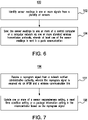
- FIG. 6 shows a method 100 of operating a microcontroller.
- the method 100 may generally be implemented in a microcontroller such as, for example, the microcontroller 20b ( FIG. 1 ) and/or the instructions 51 of the microcontroller 48 ( FIGs. 3 and 4 ), already discussed.
- the method 100 may be implemented in one or more modules as a set of logic instructions stored in a machine- or computer-readable storage medium such as random access memory (RAM), read only memory (ROM), programmable ROM (PROM), firmware, flash memory, etc., in configurable logic such as, for example, programmable logic arrays (PLAs), field programmable gate arrays (FPGAs), complex programmable logic devices (CPLDs), in fixed-functionality hardware logic using circuit technology such as, for example, application specific integrated circuit (ASIC), complementary metal oxide semiconductor (CMOS) or transistor-transistor logic (TTL) technology, or any combination thereof.
- RAM random access memory
- ROM read only memory
- PROM programmable ROM
- firmware flash memory
- PLAs programmable logic arrays
- FPGAs field programmable gate arrays
- CPLDs complex programmable logic devices
- ASIC application specific integrated circuit
- CMOS complementary metal oxide semiconductor
- TTL transistor-transistor logic
- Illustrated processing block 102 provides for identifying sensor readings in one or more signals from a plurality of sensors in a flexible label.
- the sensor readings may indicate, for example, a temperature measurement crossing a temperature threshold, a humidity measurement crossing a humidity threshold, a vibration event, an impact event, a tampering event, etc., or any combination thereof.
- Block 102 may include comparing measurements to thresholds (e.g., programmable thresholds) and/or detecting one or more warning messages in the signal(s) (e.g., with the sensors performing the comparisons).
- Block 104 may provide for sending the sensor readings to one or more of a central computer or a computer network via one or more standard wireless transmission protocols such as, for example, a cellular IoT protocol, a wireless protocol, a UWB protocol, a BLE protocol, a wireless mesh network protocol, a 5G network protocol, a wireless network communication protocol, a cellular network communication protocol, and so forth.
- a cellular IoT protocol such as, for example, a cellular IoT protocol, a wireless protocol, a UWB protocol, a BLE protocol, a wireless mesh network protocol, a 5G network protocol, a wireless network communication protocol, a cellular network communication protocol, and so forth.
- a cellular IoT protocol such as, for example, a cellular IoT protocol, a wireless protocol, a UWB protocol, a BLE protocol, a wireless mesh network protocol, a 5G network protocol, a wireless network communication protocol, a cellular network communication protocol, and so forth.
- the push communication may be generated in multiple ways. For example, the push communication may be generated in response to an event (e.g., temperature event, humidity event, motion event, vibration event, impact event) associated with the sensor readings. Additionally, the push communication may be generated in accordance with a programmable time interval (e.g., periodically). In an embodiment, at least one of the sensor readings is sent in response to a request. In one example, block 104 also provides for encrypting the sensor readings, wherein the encrypted sensor readings are sent to the central computer and/or computer network via an identity verified network communication link. The illustrated method 100 therefore enhances performance at least to the extent that it enables proactive tracking, a robust communications infrastructure, the ability to track relatively small items and/or less vulnerability to package tampering.
- an event e.g., temperature event, humidity event, motion event, vibration event, impact event
- a programmable time interval e.g., periodically.
- at least one of the sensor readings is sent in response to a request.
- FIG. 7 shows a method 106 of reprogramming a microcontroller such as, for example, the microcontroller 20b ( FIG. 1 ) and/or the instructions 51 of the microcontroller 48 ( FIGs. 3 and 4 ), already discussed.
- the method 106 may be implemented in one or more modules as a set of logic instructions stored in a machine- or computer-readable storage medium such as RAM, ROM, PROM, firmware, flash memory, etc., in configurable logic such as, for example, PLAs, FPGAs, CPLDs, in fixed-functionality hardware logic using circuit technology such as, for example, ASIC, CMOS or TTL technology, or any combination thereof.
- Illustrated processing block 107 provides for receiving a reprogram signal from a network verified administrative authority, wherein the reprogram signal is received via an APSR and a wireless communication link.
- block 108 updates one or more of a sensor responsiveness setting, a reset time condition setting or a package information setting in the microcontroller based on the reprogram signal.
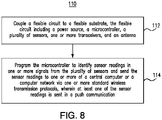
- FIG. 8 shows a method 110 of fabricating a label such as, for example, the label 10 ( FIG. 1 ), the label 40 ( FIG. 3 ) and/or the label 70 ( FIG. 5 ).
- the method 110 may be implemented in one or more modules as a set of logic instructions stored in a machine- or computer-readable storage medium such as RAM, ROM, PROM, firmware, flash memory, etc., in configurable logic such as, for example, PLAs, FPGAs, CPLDs, in fixed-functionality hardware logic using circuit technology such as, for example, ASIC, CMOS or TTL technology, or any combination thereof.
- Illustrated processing block 112 provides for coupling a flexible circuit to a flexible substrate, where the flexible circuit includes a power source, a microcontroller, a plurality of sensors, one or more transceivers, and an antenna.
- the plurality of sensors include a temperature sensor, a relative humidity sensor, a location sensor, and a motion sensor (e.g., to detect vibration, shock, tampering, etc.).
- One or more of the sensors may also be combined into a shared package (e.g., combined temperature and RH sensor).
- the flexible circuit further includes a flexible PCB and one or more balancing circuits. Additionally, block 112 may further include laser cutting vias in the flexible PCB, printing electrical traces on the flexible PCB, and molding an encapsulant substantially around the flexible circuit.
- Block 114 may provide for programming the microcontroller to identify sensor readings in one or more signals from the plurality of sensors and send the sensor readings to one or more of a central computer or a computer network via one or more standard wireless transmission protocols.
- at least one of the sensor readings is to be sent in a push communication.
- the illustrated method 110 therefore produces a label that enables proactive tracking, a robust communications infrastructure, the ability to track relatively small items and/or less vulnerability to package tampering.
- Example one includes a label comprising a flexible substrate, and a flexible circuit coupled to the flexible substrate, the flexible circuit including a power source, a microcontroller, a plurality of sensors, one or more transceivers, and an antenna, wherein the microcontroller is to: identify sensor readings in one or more signals from the plurality of sensors, and send the sensor readings to one or more of a central computer or a computer network via one or more standard wireless transmission protocols, wherein at least one of the sensor readings is sent in a push communication.
- Example two includes the label of Example one, wherein the sensor readings are to indicate one or more of a temperature measurement crossing a temperature threshold, a humidity measurement crossing a humidity threshold, a vibration event, an impact event or a tampering event.
- Example three includes the label of Example one, wherein the microcontroller is to generate the push communication in response to an event associated with the sensor readings.
- Example four includes the label of Example one, wherein the microcontroller is to generate the push communication in accordance with a programmable time interval.
- Example five includes the label of Example one, wherein at least one of the sensor readings are sent in response to a request.
- Example six includes the label of Example one, wherein the one or more signals include a temperature signal, a relative humidity signal, a location signal and a motion signal.
- Example seven includes the label of Example one, further including an encapsulant substantially surrounding the flexible circuit.
- Example eight includes the label of Example one, wherein the microcontroller is to encrypt the sensor readings, and the encrypted sensor readings are to be sent to one or more of the central computer or the computer network via an identity verified network communication link.
- Example nine includes the label of Example one, wherein the standard wireless transmission protocols include one or more of a cellular Internet of Things (IoT) protocol, a wireless protocol, an ultra-wideband protocol, a BLUETOOTH low energy protocol, a wireless mesh network protocol, a 5G network protocol, a wireless network communication protocol, or a cellular network communication protocol.
- IoT Internet of Things
- Example ten includes the label of Example one, wherein the flexible circuit further includes a flexible printed circuit board and one or more balancing circuits.
- Example eleven includes a method of operating a microcontroller, the method comprising identifying sensor readings in one or more signals from a plurality of sensors in a flexible label, and sending the sensor readings to one or more of a central computer or a computer network via one or more standard wireless transmission protocols, wherein at least one of the sensor readings is sent in a push communication.
- Example twelve includes the method of Example eleven, wherein the sensor readings indicate one or more of a temperature measurement crossing a temperature threshold, a humidity measurement crossing a humidity threshold, a motion event, a vibration event, an impact event or a tampering event.
- Example thirteen includes the method of Example eleven, further including generating the push communication in response to an event associated with the sensor readings.
- Example fourteen includes the method of Example eleven, further including generating the push communication in accordance with a programmable time interval.
- Example fifteen includes the method of Example eleven, wherein at least one of the sensor readings are sent in response to a request.
- Example sixteen includes the method of Example eleven, further including encrypting the sensor readings, wherein the encrypted sensor readings are sent to one or more of the central computer or the computer network via an identity verified network communication link.
- Example seventeen includes the method of Example eleven, wherein the standard wireless transmission protocols include one or more of a cellular Internet of Things (IoT) protocol, a wireless protocol, an ultra-wideband protocol, a BLUETOOTH low energy protocol, a wireless mesh network protocol, a 5G network protocol, a wireless network communication protocol, or a cellular network communication protocol.
- IoT Internet of Things
- Example eighteen includes the method of Example eleven, further including updating one or more of a sensor responsiveness setting, a reset time condition setting or a package information setting in the microcontroller based on a reprogram signal from a network verified administrative authority, wherein the reprogram signal is received via an accountable property system of record and a wireless communication link.
- Example nineteen includes a method of fabricating a label, the method comprising coupling a flexible circuit to a flexible substrate, the flexible circuit including a power source, a microcontroller, a plurality of sensors, one or more transceivers, and an antenna, and programming the microcontroller to identify sensor readings in one or more signals from the plurality of sensors and send the sensor readings to one or more of a central computer or a computer network via one or more standard wireless transmission protocols, wherein at least one of the sensor readings is sent in a push communication.
- Example twenty includes the method of Example nineteen, further including molding an encapsulant substantially around the flexible circuit.
- Example twenty-one includes the method of Example nineteen, wherein the plurality of sensors include a temperature sensor, a relative humidity sensor, a location sensor and a motion sensor, and wherein the flexible circuit further includes a flexible printed circuit board and one or more balancing circuits.
- Embodiments are applicable for use with all types of semiconductor integrated circuit (“IC") chips.
- IC semiconductor integrated circuit
- Examples of these IC chips include but are not limited to processors, controllers, chipset components, programmable logic arrays (PLAs), memory chips, network chips, systems on chip (SoCs), SSD (solid state drive)/NAND controller ASICs, and the like.
- PLAs programmable logic arrays
- SoCs systems on chip
- SSD (solid state drive)/NAND controller ASICs solid state drive)/NAND controller ASICs, and the like.
- signal conductor lines are represented with lines. Some may be different, to indicate more constituent signal paths, have a number label, to indicate a number of constituent signal paths, and/or have arrows at one or more ends, to indicate primary information flow direction. This, however, should not be construed in a limiting manner.
- Any represented signal lines may actually comprise one or more signals that may travel in multiple directions and may be implemented with any suitable type of signal scheme, e.g., digital or analog lines implemented with differential pairs, optical fiber lines, and/or single-ended lines.
- Example sizes/models/values/ranges may have been given, although embodiments are not limited to the same. As manufacturing techniques (e.g., photolithography) mature over time, it is expected that devices of smaller size could be manufactured.
- well known power/ground connections to IC chips and other components may or may not be shown within the figures, for simplicity of illustration and discussion, and so as not to obscure certain aspects of the embodiments. Further, arrangements may be shown in block diagram form in order to avoid obscuring embodiments, and also in view of the fact that specifics with respect to implementation of such block diagram arrangements are highly dependent upon the platform within which the embodiment is to be implemented, i.e., such specifics should be well within purview of one skilled in the art.
- Coupled may be used herein to refer to any type of relationship, direct or indirect, between the components in question, and may apply to electrical, mechanical, fluid, optical, electromagnetic, electromechanical or other connections.
- first”, second, etc. may be used herein only to facilitate discussion, and carry no particular temporal or chronological significance unless otherwise indicated.
Landscapes
- Engineering & Computer Science (AREA)
- Physics & Mathematics (AREA)
- Computer Networks & Wireless Communication (AREA)
- General Physics & Mathematics (AREA)
- Signal Processing (AREA)
- Theoretical Computer Science (AREA)
- Business, Economics & Management (AREA)
- Computer Hardware Design (AREA)
- Microelectronics & Electronic Packaging (AREA)
- Economics (AREA)
- Health & Medical Sciences (AREA)
- Computing Systems (AREA)
- Medical Informatics (AREA)
- General Health & Medical Sciences (AREA)
- Marketing (AREA)
- Accounting & Taxation (AREA)
- Operations Research (AREA)
- Quality & Reliability (AREA)
- Strategic Management (AREA)
- Tourism & Hospitality (AREA)
- General Business, Economics & Management (AREA)
- Development Economics (AREA)
- Human Resources & Organizations (AREA)
- Entrepreneurship & Innovation (AREA)
- Finance (AREA)
- Automation & Control Theory (AREA)
- Computer Security & Cryptography (AREA)
- Electromagnetism (AREA)
- Arrangements For Transmission Of Measured Signals (AREA)
- Position Fixing By Use Of Radio Waves (AREA)
Abstract
Description
- Embodiments generally relate to object labeling. More particularly, embodiments relate to an Internet of Things (IoT) label for factory and warehouse applications. Traditional tracking of objects within factories may be heavily reliant on manual processes, which can be costly and time consuming. While more recent smart tracking solutions may have reduced the reliance on manual processes, there remains considerable room for improvement. For example, passive technology such as RFID (radio frequency identifier) tags or NFC (near field communications) modules may provide for only intermittent tracking in response to an interrogation of the passive device. Moreover, active technology may have an insufficient communications infrastructure and a form factor (e.g., rigid printed circuit board placed in a traditional plastic enclosure) that limits the technology to tracking large bulk items (e.g., pallets). Additionally, conventional passive and active tracking solutions may be vulnerable to package tampering.
- In accordance with one or more embodiments, a label comprises a flexible substrate and a flexible circuit coupled to the flexible substrate, the flexible circuit including a power source, a microcontroller, a plurality of sensors, one or more transceivers, and an antenna, wherein the microcontroller is to identify sensor readings in one or more signals from the plurality of sensors and send the sensor readings to one or more of a central computer or a computer network via one or more standard wireless transmission protocols, wherein at least one of the sensor readings is sent in a push communication.
- In accordance with one or more embodiments, a method of operating a microcontroller comprises identifying sensor readings in one or more signals from a plurality of sensors in a flexible label and sending the sensor readings to one or more of a central computer or a computer network via one or more standard wireless transmission protocols, wherein at least one of the sensor readings is sent in a push communication.
- In accordance with one or more embodiments, a method of fabricating a label comprises coupling a flexible circuit to a flexible substrate, the flexible substrate including a power source, a microcontroller, a plurality of sensors, one or more transceivers, and an antenna, and programming the microcontroller to identify sensor readings in one or more signals from the plurality of sensors, and send the sensor readings to one or more of a central computer or a computer network via one or more standard wireless transmission protocols, wherein at least one of the sensor readings is sent in a push communication.
- The various advantages of the embodiments will become apparent to one skilled in the art by reading the following specification and appended claims, and by referencing the following drawings, in which:
-
FIG. 1 is an illustration of an example of a communications architecture for a flexible label according to an embodiment; -
FIG. 2 is an illustration of multiple examples of 3D (three-dimensional) sensor geometries according to embodiments; -
FIG. 3 is a side view of an example of a flexible label according to an embodiment; -
FIG. 4 is a block diagram of an example of a flexible circuit according to an embodiment; -
FIG. 5 is an illustration of an example of a deployment of flexible labels in a warehouse application according to an embodiment; -
FIG. 6 is a flowchart of an example of a method of operating a microcontroller according to an embodiment; -
FIG. 7 is a flowchart of an example of a method of reprogramming a microcontroller according to an embodiment; and -
FIG. 8 is a flowchart of an example of a method of fabricating a label according to an embodiment. - Turning now to
FIG. 1 , an IoT communications architecture is shown in which aflexible label 10 wirelessly communicates sensor readings via acellular network 12 to a computer network 14 (e.g., including a cloud computing infrastructure and/or cloud server). In an embodiment, thecomputer network 14 communicates with one or more remote devices 16 (16a-16c, e.g., central computers) via a wireless network 18 (e.g., operating on a cellular or other wireless protocol). As will be discussed in greater detail, theflexible label 10 may include a flexible circuit 20 (20a-20h) coupled to a flexible substrate 22 (e.g., polymer with an adhesive backing). In one example, theflexible circuit 20 includes a flexible printed circuit board (PCB) 20a (e.g., containing electrical traces printed on one or both sides), amicrocontroller 20b, amotion sensor 20c (e.g., accelerometer that detects shock, vibration and/or tampering), an ultraviolet (UV)light sensor 20d, a UV index (e.g., visible light)sensor 20e, an environmental sensor 20f (e.g., having temperature, relative humidity and/or pressure sensing capabilities), a flexible power source such as abattery 20g, and anantenna 20h. - The
microcontroller 20b may be programmed to identify sensor readings in one or more signals (e.g., temperature signals, relative humidity/RH signals, location signals, motion signals, etc.) from thesensors 20c-20f and send the sensor readings to thecomputer network 14, atablet device 16a, asmart phone 16b and/or aworkstation 16c. Of particular note is that one or more of the sensor readings may be sent in a push communication that is not in response to a request or interrogation from an external device. Rather, themicrocontroller 20b may generate the push communication in accordance with a programmable time interval, in response to an event associated with the sensor readings, etc., or any combination thereof. For example, the event might correspond to a temperature measurement crossing a temperature threshold, a humidity measurement crossing a humidity threshold, a vibration event, an impact event, a tampering event, and so forth. With respect to the programmable time interval, themicrocontroller 20b may extend battery life by powering down when not communicating with thesensors 20c-20f or thecomputer network 14. The illustratedflexible label 10 is therefore enhanced relative to conventional active, passive and manual solutions at least to the extent that it enables proactive tracking, a robust communications infrastructure, the ability to track relatively small items/assets and/or less vulnerability to package tampering. - Indeed, the
label 10 may be useful in applications outside the warehouse/factory context. For example, thelabel 10 might be used to monitor the state of household objects such as a coffee mug (e.g., monitoring surface temperature and/or condensation), tools such as a drill (e.g., monitoring oscillation frequency and/or strength over time), and so forth. -
FIG. 2 shows a3D sensor geometry 30 in which a first sensor (sensor "A") is placed on a first surface of an object (e.g., in the x-plane), a second sensor (sensor "B") is placed on a second surface of the object (e.g., in the y-plane), and a third sensor (sensor "C") is placed in a third surface of the object (e.g., in the z-plane). In an embodiment, the sensors A, B and C are incorporated into a flexible label such as the flexible label 10 (FIG. 1 ), already discussed. Similarly, another3D sensor geometry 32 may include a first sensor (sensor "A"), a second sensor (sensor "B"), and a third sensor (sensor "C") that are placed on a curved surface of an object. The3D sensor geometries - Turning now to
FIG. 3 , alabel 40 is shown. The illustratedlabel 40, which may be readily substituted for the label 10 (FIG. 1 ), already discussed, includes a flexible substrate 42 (e.g., with a "peel and stick") backing and aflexible circuit 44 coupled to theflexible substrate 42. In an embodiment, theflexible circuit 44 includes apower source 46, amicrocontroller 48, a plurality of sensors 50 (50a-50f), one ormore transceivers 52, and aflexible antenna 54. As already noted, themicrocontroller 48 may be programmed to identify sensor readings in one or more signals from the plurality ofsensors 50 and send the sensor readings to one or more of a central computer or a computer network via one or more standard wireless transmission protocols. - For example, the one or more signals may include a temperature signal (e.g., containing a temperature measurement), a relative humidity signal (e.g., containing a humidity measurement), a location signal (e.g., containing a location measurement based on triangulation or other suitable technology), a motion signal (e.g., containing a motion measurement), etc. In an embodiment, at least one of the sensor readings indicates one or more of a temperature measurement crossing a temperature threshold (e.g., exceeding an upper temperature threshold or falling below a lower temperature threshold), a humidity (e.g., RH) measurement crossing a humidity threshold (e.g., exceeding an upper humidity threshold or falling below a lower humidity threshold), a vibration event (e.g., during vehicle transit), an impact event (e.g., during warehouse storage), a tampering event (e.g., attempted removal), etc., or any combination thereof. Additionally, the
microcontroller 48 may generate the push communication in response to an event (e.g., temperature, humidity, vibration, impact and/or tampering event) associated with the sensor readings. In one example, themicrocontroller 48 generates the push communication in accordance with a programmable time interval (e.g., every thirty seconds to five minutes). At least one of the sensor readings may also be sent in response to a request (e.g., interrogation). - The illustrated
label 40 also includes anencapsulant 56 to provide environmental protection to theflexible circuit 44. Accordingly, thelabel 40 may withstand broad temperature ranges within warehouse environments as well as the vibration and shot typical of current package handling practices. In one example, thepower source 46 is replaceable. Additionally, thepower source 46 may be rigid or flexible, depending on the circumstances. - In an embodiment, the
microcontroller 48 encrypts the sensor readings prior to transmission (e.g., data is encrypted in motion). In such a case, the sensor readings may be sent to the central computer and/or the computer network via an identity verified network communication link to further protect against tampering. Additionally, software trust may be verified at a hardware level to protect against software binary and configuration compromises. The standard wireless transmission protocols may include a cellular IoT protocol, a wireless protocol, an ultra-wideband (UWB) protocol, a BLUETOOTH low energy (BLE) protocol, a wireless mesh network protocol, a 5G (fifth generation) network protocol (e.g., 5G New Radio/NR), a wireless network communication protocol, a cellular network communication protocol, etc., or any combination thereof. - In the illustrated example, the
flexible circuit 44 includes aflexible PCB 59. Theflexible PCB 59 may include laser cut vias (not shown) and electrical traces (not shown) printed on both sides of theflexible PCB 59. Although the illustratedsensors 50 are mounted to theflexible PCB 59, additional external sensors may also be connected to theflexible PCB 59 via a multi-wire interface such as, for example, an I2C (inter-integrated circuit), I2S (inter-integrated chip sound) and/or SPI (serial peripheral interconnect) interface. In an embodiment, theflexible circuit 44 also includes one or more balancingcircuits 58 to ensure that the signal lines between themicrocontroller 48 and thesensors 50 are of a matched impedance. Thebalancing circuits 58 may be in the form of passive components, active (e.g., requiring power) or passive packaged parts, or alternatively be incorporated into themicrocontroller 48. -
FIG. 4 demonstrates that themicrocontroller 48 may include one ormore instructions 51, which when executable by themicrocontroller 48, cause themicrocontroller 48 to identify sensor readings in one or more signals from the plurality ofsensors 50 and send the sensor readings to one or more of a central computer or a computer network via one or more standard wireless transmission protocols. As already noted, at least one of the sensor readings may be sent in a push communication. -
FIG. 5 shows an environment in which secure IoT labels such as alabel 70 are mounted tovarious packages 76 in anautomated warehouse 72. In an embodiment, thelabel 70 is similar to the label 10 (FIG. 1 ) and/or the label 40 (FIG. 3 ), already discussed. Thelabel 70 may send push communications to adirectional antenna 74 such as, for example, a large multiple input multiple output (MIMO) signal collection antenna that improves connectivity and provides a tracking resolution on the order of 0.15 meters (6 inches). In one example, thedirectional antenna 74 communicates with a cellular (e.g., LTE-M (Long Term Evolution Category Mobile 1), LTE NB-IoT (Narrow Band Internet of Things), or 5G New Radio)core system 78, which in turn communicates with a cellular secure authentication (SA) core system 80 (e.g., enforcing zero trust mobile constraints and/or identity verified network communication links). For example, the identity verified network communication links may involve a trust handshake protocol between the cellularSA core system 80 and the cellular core system 78 (e.g., non-SA). In an embodiment, the cellularSA core system 80 also communicates with an accountable property system ofrecord APSR 82 and anantenna 84 that receives signals from one ormore cameras 86 that are mounted within the automatedwarehouse 72, allowing for visual imagery data to be added to the APSR. Accordingly,warehouse operations personnel 88 may be automatically alerted to conditions such as a temperature measurement crossing a temperature threshold, a humidity measurement crossing a humidity threshold, a vibration event, an impact event, a tampering event, visual imagery, and so forth. - Indeed, the
label 70 may enhance incoming and outgoing logistics by enabling localized data collection intrucks 90,shipyard docks 92, andcontainers 94. In such a case, slicing may be used in a 5G RAN (radio access network) 96. More particularly, the original network architecture may be expanded and potentially "sliced" across different frequency bands in multiple logical and independent networks that are configured to effectively meet various service requirements. In an embodiment, the following techniques are employed: - Network functions express elementary network functionalities that are used as "building blocks" to create every network slice;
- Virtualization provides an abstract representation of the physical resources under a unified and homogeneous scheme and enables a scalable slice deployment relying on NFV (network function virtualization), where each network function instance is decoupled from the network hardware running the instance;
- Orchestration is a process that enables coordination of the different network components that are involved in the life-cycle of each network slice. In this context, SDN (Software-Defined Networking) may be used to enable a dynamic and flexible slice configuration.
-
FIG. 6 shows amethod 100 of operating a microcontroller. Themethod 100 may generally be implemented in a microcontroller such as, for example, themicrocontroller 20b (FIG. 1 ) and/or theinstructions 51 of the microcontroller 48 (FIGs. 3 and 4 ), already discussed. More particularly, themethod 100 may be implemented in one or more modules as a set of logic instructions stored in a machine- or computer-readable storage medium such as random access memory (RAM), read only memory (ROM), programmable ROM (PROM), firmware, flash memory, etc., in configurable logic such as, for example, programmable logic arrays (PLAs), field programmable gate arrays (FPGAs), complex programmable logic devices (CPLDs), in fixed-functionality hardware logic using circuit technology such as, for example, application specific integrated circuit (ASIC), complementary metal oxide semiconductor (CMOS) or transistor-transistor logic (TTL) technology, or any combination thereof. - Illustrated
processing block 102 provides for identifying sensor readings in one or more signals from a plurality of sensors in a flexible label. The sensor readings may indicate, for example, a temperature measurement crossing a temperature threshold, a humidity measurement crossing a humidity threshold, a vibration event, an impact event, a tampering event, etc., or any combination thereof.Block 102 may include comparing measurements to thresholds (e.g., programmable thresholds) and/or detecting one or more warning messages in the signal(s) (e.g., with the sensors performing the comparisons). -
Block 104 may provide for sending the sensor readings to one or more of a central computer or a computer network via one or more standard wireless transmission protocols such as, for example, a cellular IoT protocol, a wireless protocol, a UWB protocol, a BLE protocol, a wireless mesh network protocol, a 5G network protocol, a wireless network communication protocol, a cellular network communication protocol, and so forth. In the illustrated example, at least one of the sensor readings is sent in a push communication. Alternatively, the sensor readings may be sent over a wired link. - The push communication may be generated in multiple ways. For example, the push communication may be generated in response to an event (e.g., temperature event, humidity event, motion event, vibration event, impact event) associated with the sensor readings. Additionally, the push communication may be generated in accordance with a programmable time interval (e.g., periodically). In an embodiment, at least one of the sensor readings is sent in response to a request. In one example, block 104 also provides for encrypting the sensor readings, wherein the encrypted sensor readings are sent to the central computer and/or computer network via an identity verified network communication link. The illustrated
method 100 therefore enhances performance at least to the extent that it enables proactive tracking, a robust communications infrastructure, the ability to track relatively small items and/or less vulnerability to package tampering. -
FIG. 7 shows amethod 106 of reprogramming a microcontroller such as, for example, themicrocontroller 20b (FIG. 1 ) and/or theinstructions 51 of the microcontroller 48 (FIGs. 3 and 4 ), already discussed. Themethod 106 may be implemented in one or more modules as a set of logic instructions stored in a machine- or computer-readable storage medium such as RAM, ROM, PROM, firmware, flash memory, etc., in configurable logic such as, for example, PLAs, FPGAs, CPLDs, in fixed-functionality hardware logic using circuit technology such as, for example, ASIC, CMOS or TTL technology, or any combination thereof. - Illustrated
processing block 107 provides for receiving a reprogram signal from a network verified administrative authority, wherein the reprogram signal is received via an APSR and a wireless communication link. In an embodiment, block 108 updates one or more of a sensor responsiveness setting, a reset time condition setting or a package information setting in the microcontroller based on the reprogram signal. -
FIG. 8 shows amethod 110 of fabricating a label such as, for example, the label 10 (FIG. 1 ), the label 40 (FIG. 3 ) and/or the label 70 (FIG. 5 ). Themethod 110 may be implemented in one or more modules as a set of logic instructions stored in a machine- or computer-readable storage medium such as RAM, ROM, PROM, firmware, flash memory, etc., in configurable logic such as, for example, PLAs, FPGAs, CPLDs, in fixed-functionality hardware logic using circuit technology such as, for example, ASIC, CMOS or TTL technology, or any combination thereof. - Illustrated
processing block 112 provides for coupling a flexible circuit to a flexible substrate, where the flexible circuit includes a power source, a microcontroller, a plurality of sensors, one or more transceivers, and an antenna. In an embodiment, the plurality of sensors include a temperature sensor, a relative humidity sensor, a location sensor, and a motion sensor (e.g., to detect vibration, shock, tampering, etc.). One or more of the sensors may also be combined into a shared package (e.g., combined temperature and RH sensor). In one example, the flexible circuit further includes a flexible PCB and one or more balancing circuits. Additionally, block 112 may further include laser cutting vias in the flexible PCB, printing electrical traces on the flexible PCB, and molding an encapsulant substantially around the flexible circuit. -
Block 114 may provide for programming the microcontroller to identify sensor readings in one or more signals from the plurality of sensors and send the sensor readings to one or more of a central computer or a computer network via one or more standard wireless transmission protocols. In the illustrated example, at least one of the sensor readings is to be sent in a push communication. The illustratedmethod 110 therefore produces a label that enables proactive tracking, a robust communications infrastructure, the ability to track relatively small items and/or less vulnerability to package tampering. - Example one includes a label comprising a flexible substrate, and a flexible circuit coupled to the flexible substrate, the flexible circuit including a power source, a microcontroller, a plurality of sensors, one or more transceivers, and an antenna, wherein the microcontroller is to: identify sensor readings in one or more signals from the plurality of sensors, and send the sensor readings to one or more of a central computer or a computer network via one or more standard wireless transmission protocols, wherein at least one of the sensor readings is sent in a push communication.
- Example two includes the label of Example one, wherein the sensor readings are to indicate one or more of a temperature measurement crossing a temperature threshold, a humidity measurement crossing a humidity threshold, a vibration event, an impact event or a tampering event.
- Example three includes the label of Example one, wherein the microcontroller is to generate the push communication in response to an event associated with the sensor readings.
- Example four includes the label of Example one, wherein the microcontroller is to generate the push communication in accordance with a programmable time interval.
- Example five includes the label of Example one, wherein at least one of the sensor readings are sent in response to a request.
- Example six includes the label of Example one, wherein the one or more signals include a temperature signal, a relative humidity signal, a location signal and a motion signal.
- Example seven includes the label of Example one, further including an encapsulant substantially surrounding the flexible circuit.
- Example eight includes the label of Example one, wherein the microcontroller is to encrypt the sensor readings, and the encrypted sensor readings are to be sent to one or more of the central computer or the computer network via an identity verified network communication link.
- Example nine includes the label of Example one, wherein the standard wireless transmission protocols include one or more of a cellular Internet of Things (IoT) protocol, a wireless protocol, an ultra-wideband protocol, a BLUETOOTH low energy protocol, a wireless mesh network protocol, a 5G network protocol, a wireless network communication protocol, or a cellular network communication protocol.
- Example ten includes the label of Example one, wherein the flexible circuit further includes a flexible printed circuit board and one or more balancing circuits.
- Example eleven includes a method of operating a microcontroller, the method comprising identifying sensor readings in one or more signals from a plurality of sensors in a flexible label, and sending the sensor readings to one or more of a central computer or a computer network via one or more standard wireless transmission protocols, wherein at least one of the sensor readings is sent in a push communication.
- Example twelve includes the method of Example eleven, wherein the sensor readings indicate one or more of a temperature measurement crossing a temperature threshold, a humidity measurement crossing a humidity threshold, a motion event, a vibration event, an impact event or a tampering event.
- Example thirteen includes the method of Example eleven, further including generating the push communication in response to an event associated with the sensor readings.
- Example fourteen includes the method of Example eleven, further including generating the push communication in accordance with a programmable time interval.
- Example fifteen includes the method of Example eleven, wherein at least one of the sensor readings are sent in response to a request.
- Example sixteen includes the method of Example eleven, further including encrypting the sensor readings, wherein the encrypted sensor readings are sent to one or more of the central computer or the computer network via an identity verified network communication link.
- Example seventeen includes the method of Example eleven, wherein the standard wireless transmission protocols include one or more of a cellular Internet of Things (IoT) protocol, a wireless protocol, an ultra-wideband protocol, a BLUETOOTH low energy protocol, a wireless mesh network protocol, a 5G network protocol, a wireless network communication protocol, or a cellular network communication protocol.
- Example eighteen includes the method of Example eleven, further including updating one or more of a sensor responsiveness setting, a reset time condition setting or a package information setting in the microcontroller based on a reprogram signal from a network verified administrative authority, wherein the reprogram signal is received via an accountable property system of record and a wireless communication link.
- Example nineteen includes a method of fabricating a label, the method comprising coupling a flexible circuit to a flexible substrate, the flexible circuit including a power source, a microcontroller, a plurality of sensors, one or more transceivers, and an antenna, and programming the microcontroller to identify sensor readings in one or more signals from the plurality of sensors and send the sensor readings to one or more of a central computer or a computer network via one or more standard wireless transmission protocols, wherein at least one of the sensor readings is sent in a push communication.
- Example twenty includes the method of Example nineteen, further including molding an encapsulant substantially around the flexible circuit.
- Example twenty-one includes the method of Example nineteen, wherein the plurality of sensors include a temperature sensor, a relative humidity sensor, a location sensor and a motion sensor, and wherein the flexible circuit further includes a flexible printed circuit board and one or more balancing circuits.
- Embodiments are applicable for use with all types of semiconductor integrated circuit ("IC") chips. Examples of these IC chips include but are not limited to processors, controllers, chipset components, programmable logic arrays (PLAs), memory chips, network chips, systems on chip (SoCs), SSD (solid state drive)/NAND controller ASICs, and the like. In addition, in some of the drawings, signal conductor lines are represented with lines. Some may be different, to indicate more constituent signal paths, have a number label, to indicate a number of constituent signal paths, and/or have arrows at one or more ends, to indicate primary information flow direction. This, however, should not be construed in a limiting manner. Rather, such added detail may be used in connection with one or more exemplary embodiments to facilitate easier understanding of a circuit. Any represented signal lines, whether or not having additional information, may actually comprise one or more signals that may travel in multiple directions and may be implemented with any suitable type of signal scheme, e.g., digital or analog lines implemented with differential pairs, optical fiber lines, and/or single-ended lines.
- Further, the disclosure comprises the following examples, whereby the scope of protection is provided by the claims.
- Example 1. A label comprising: a flexible substrate; and a flexible circuit coupled to the flexible substrate, the flexible circuit including a power source, a microcontroller, a plurality of sensors, one or more transceivers, and an antenna, wherein the microcontroller is to: identify sensor readings in one or more signals from the plurality of sensors, and send the sensor readings to one or more of a central computer or a computer network via one or more standard wireless transmission protocols, wherein at least one of the sensor readings is sent in a push communication.
- Example 2. The label of example 1, wherein the sensor readings are to indicate one or more of a temperature measurement crossing a temperature threshold, a humidity measurement crossing a humidity threshold, a vibration event, an impact event or a tampering event.
- Example 3. The label of any of examples 1-2, wherein the microcontroller is to generate the push communication in response to an event associated with the sensor readings.
- Example 4. The label of any of examples 1-3, wherein the microcontroller is to generate the push communication in accordance with a programmable time interval.
- Example 5. The label of any of examples 1-4, wherein at least one of the sensor readings are sent in response to a request.
- Example 6. The label of any of examples 1-5, wherein the one or more signals include a temperature signal, a relative humidity signal, a location signal and a motion signal.
- Example 7. The label of any of examples 1-6, further including an encapsulant substantially surrounding the flexible circuit.
- Example 8. The label of any of examples 1-7, wherein the microcontroller is to encrypt the sensor readings, and the encrypted sensor readings are to be sent to one or more of the central computer or the computer network via an identity verified network communication link.
- Example 9. The label of any of examples 1-8, wherein the standard wireless transmission protocols include one or more of a cellular Internet of Things (IoT) protocol, a wireless protocol, an ultra-wideband protocol, a BLUETOOTH low energy protocol, a wireless mesh network protocol, a 5G network protocol, a wireless network communication protocol, or a cellular network communication protocol.
- Example 10. The label of any of examples 1-9, wherein the flexible circuit further includes a flexible printed circuit board and one or more balancing circuits.
- Example 11. A method of operating a microcontroller, the method comprising: identifying sensor readings in one or more signals from a plurality of sensors in a flexible label; and sending the sensor readings to one or more of a central computer or a computer network via one or more standard wireless transmission protocols, wherein at least one of the sensor readings is sent in a push communication.
- Example 12. The method of example 11, wherein the sensor readings indicate one or more of a temperature measurement crossing a temperature threshold, a humidity measurement crossing a humidity threshold, a motion event, a vibration event, an impact event or a tampering event.
- Example 13. The method of any of examples 11-12, further including generating the push communication in response to an event associated with the sensor readings.
- Example 14. The method of any of examples 11-13, further including generating the push communication in accordance with a programmable time interval.
- Example 15. The method of any of examples 11-14, wherein at least one of the sensor readings are sent in response to a request.
- Example 16. The method of any of examples 11-15, further including encrypting the sensor readings, wherein the encrypted sensor readings are sent to one or more of the central computer or the computer network via an identity verified network communication link.
- Example 17. The method of any of examples 11-16, wherein the standard wireless transmission protocols include one or more of a cellular Internet of Things (IoT) protocol, a wireless protocol, an ultra-wideband protocol, a BLUETOOTH low energy protocol, a wireless mesh network protocol, a 5G network protocol, a wireless network communication protocol, or a cellular network communication protocol.
- Example 18. The method of any of examples 11-17, further including updating one or more of a sensor responsiveness setting, a reset time condition setting or a package information setting in the microcontroller based on a reprogram signal from a network verified administrative authority, wherein the reprogram signal is received via an accountable property system of record and a wireless communication link.
- Example 19. A method of fabricating a label, the method comprising: coupling a flexible circuit to a flexible substrate, the flexible circuit including a power source, a microcontroller, a plurality of sensors, one or more transceivers, and an antenna; and programming the microcontroller to identify sensor readings in one or more signals from the plurality of sensors and send the sensor readings to one or more of a central computer or a computer network via one or more standard wireless transmission protocols, wherein at least one of the sensor readings is sent in a push communication.
- Example 20. The method of example 19, further including molding an encapsulant substantially around the flexible circuit.
- Example 21. The method of any of examples 19-20, wherein the plurality of sensors include a temperature sensor, a relative humidity sensor, a location sensor and a motion sensor, and wherein the flexible circuit further includes a flexible printed circuit board and one or more balancing circuits.
- Example sizes/models/values/ranges may have been given, although embodiments are not limited to the same. As manufacturing techniques (e.g., photolithography) mature over time, it is expected that devices of smaller size could be manufactured. In addition, well known power/ground connections to IC chips and other components may or may not be shown within the figures, for simplicity of illustration and discussion, and so as not to obscure certain aspects of the embodiments. Further, arrangements may be shown in block diagram form in order to avoid obscuring embodiments, and also in view of the fact that specifics with respect to implementation of such block diagram arrangements are highly dependent upon the platform within which the embodiment is to be implemented, i.e., such specifics should be well within purview of one skilled in the art. Where specific details (e.g., circuits) are set forth in order to describe example embodiments, it should be apparent to one skilled in the art that embodiments can be practiced without, or with variation of, these specific details. The description is thus to be regarded as illustrative instead of limiting.
- The term "coupled" may be used herein to refer to any type of relationship, direct or indirect, between the components in question, and may apply to electrical, mechanical, fluid, optical, electromagnetic, electromechanical or other connections. In addition, the terms "first", "second", etc. may be used herein only to facilitate discussion, and carry no particular temporal or chronological significance unless otherwise indicated.
- As used in this application and in the claims, a list of items joined by the term "one or more of' may mean any combination of the listed terms. For example, the phrases "one or more of A, B or C" may mean A; B; C; A and B; A and C; B and C; or A, B and C.
- Those skilled in the art will appreciate from the foregoing description that the broad techniques of the embodiments can be implemented in a variety of forms. Therefore, while the embodiments have been described in connection with particular examples thereof, the true scope of the embodiments should not be so limited since other modifications will become apparent to the skilled practitioner upon a study of the drawings, specification, and following claims.
Claims (15)
- A label comprising:a flexible substrate; anda flexible circuit coupled to the flexible substrate, the flexible circuit including a power source, a microcontroller, a plurality of sensors, one or more transceivers, and an antenna, wherein the microcontroller is to:identify sensor readings in one or more signals from the plurality of sensors, andsend the sensor readings to one or more of a central computer or a computer network via one or more standard wireless transmission protocols, wherein at least one of the sensor readings is sent in a push communication.
- The label of claim 1, wherein the sensor readings are to indicate one or more of a temperature measurement crossing a temperature threshold, a humidity measurement crossing a humidity threshold, a vibration event, an impact event or a tampering event.
- The label of any of claims 1-2, wherein the microcontroller is to at least one of:generate the push communication in response to an event associated with the sensor readings;generate the push communication in accordance with a programmable time interval;encrypt the sensor readings, and the encrypted sensor readings are to be sent to one or more of the central computer or the computer network via an identity verified network communication link..
- The label of any of claims 1-3, wherein at least one of the sensor readings are sent in response to a request.
- The label of any of claims 1-4, wherein the one or more signals include a temperature signal, a relative humidity signal, a location signal and a motion signal.
- The label of any of claims 1-5, further including an encapsulant substantially surrounding the flexible circuit.
- The label of any of claims 1-6, wherein the standard wireless transmission protocols include one or more of a cellular Internet of Things (IoT) protocol, a wireless protocol, an ultra-wideband protocol, a BLUETOOTH low energy protocol, a wireless mesh network protocol, a 5G network protocol, a wireless network communication protocol, or a cellular network communication protocol.
- The label of any of claims 1-7, wherein the flexible circuit further includes a flexible printed circuit board and one or more balancing circuits.
- A method of operating a microcontroller, the method comprising:identifying sensor readings in one or more signals from a plurality of sensors in a flexible label; andsending the sensor readings to one or more of a central computer or a computer network via one or more standard wireless transmission protocols, wherein at least one of the sensor readings is sent in a push communication.
- The method of claim 9, wherein the sensor readings indicate one or more of a temperature measurement crossing a temperature threshold, a humidity measurement crossing a humidity threshold, a motion event, a vibration event, an impact event or a tampering event.
- The method of any of claims 9-10, further including at least one of:generating the push communication in response to an event associated with the sensor readings;generating the push communication in accordance with a programmable time interval;encrypting the sensor readings, wherein the encrypted sensor readings are sent to one or more of the central computer or the computer network via an identity verified network communication link; andupdating one or more of a sensor responsiveness setting, a reset time condition setting or a package information setting in the microcontroller based on a reprogram signal from a network verified administrative authority, wherein the reprogram signal is received via an accountable property system of record and a wireless communication link
- The method of any of claims 9-11, wherein at least one of the sensor readings are sent in response to a request.
- The method of any of claims 9-12, wherein the standard wireless transmission protocols include one or more of a cellular Internet of Things (IoT) protocol, a wireless protocol, an ultra-wideband protocol, a BLUETOOTH low energy protocol, a wireless mesh network protocol, a 5G network protocol, a wireless network communication protocol, or a cellular network communication protocol.
- A method of fabricating a label, the method comprising:coupling a flexible circuit to a flexible substrate, the flexible circuit including a power source, a microcontroller, a plurality of sensors, one or more transceivers, and an antenna; andprogramming the microcontroller to identify sensor readings in one or more signals from the plurality of sensors and send the sensor readings to one or more of a central computer or a computer network via one or more standard wireless transmission protocols, wherein at least one of the sensor readings is sent in a push communication,wherein the plurality of sensors include a temperature sensor, a relative humidity sensor, a location sensor and a motion sensor, and wherein the flexible circuit further includes a flexible printed circuit board and one or more balancing circuits.
- The method of claim 14, further including molding an encapsulant substantially around the flexible circuit.
Applications Claiming Priority (1)
| Application Number | Priority Date | Filing Date | Title |
|---|---|---|---|
| US202063113795P | 2020-11-13 | 2020-11-13 |
Publications (2)
| Publication Number | Publication Date |
|---|---|
| EP4002209A1 true EP4002209A1 (en) | 2022-05-25 |
| EP4002209B1 EP4002209B1 (en) | 2024-04-24 |
Family
ID=77595270
Family Applications (1)
| Application Number | Title | Priority Date | Filing Date |
|---|---|---|---|
| EP21190741.5A Active EP4002209B1 (en) | 2020-11-13 | 2021-08-11 | Internet of things label for factory and warehouse applications |
Country Status (8)
| Country | Link |
|---|---|
| US (1) | US20220159354A1 (en) |
| EP (1) | EP4002209B1 (en) |
| JP (1) | JP7712140B2 (en) |
| KR (1) | KR20220065668A (en) |
| CN (1) | CN114501175A (en) |
| AU (1) | AU2021266327A1 (en) |
| BR (1) | BR102021015823A2 (en) |
| CA (1) | CA3128356A1 (en) |
Families Citing this family (4)
| Publication number | Priority date | Publication date | Assignee | Title |
|---|---|---|---|---|
| CN115327998B (en) * | 2022-09-08 | 2025-03-14 | 蔚来汽车科技(安徽)有限公司 | Mobile terminal for industrial human-machine interface and method of using the same |
| US20250237561A1 (en) * | 2023-01-13 | 2025-07-24 | Reelables, Inc. | Thin film wireless label with integrated temperature sensor |
| CN119012123B (en) * | 2023-05-22 | 2026-04-28 | 华为技术有限公司 | Service delivery methods, electronic devices, systems, and storage media |
| CN117160915B (en) * | 2023-08-09 | 2026-02-24 | 华南理工大学 | Vibration measurement and control device and method of multistage flexible coupling vibration reduction structure |
Citations (3)
| Publication number | Priority date | Publication date | Assignee | Title |
|---|---|---|---|---|
| US20130161400A1 (en) * | 2011-12-21 | 2013-06-27 | Avery Dennison Corporation | Radio Frequency Identification Sensor Assembly |
| US20190327306A1 (en) * | 2017-08-28 | 2019-10-24 | Shoof Technologies, Inc. | Collaborative Sensor Network |
| EP3720151A1 (en) * | 2017-12-01 | 2020-10-07 | Mysphera, S.L. | Position-locating arrangement |
Family Cites Families (18)
| Publication number | Priority date | Publication date | Assignee | Title |
|---|---|---|---|---|
| US8280682B2 (en) * | 2000-12-15 | 2012-10-02 | Tvipr, Llc | Device for monitoring movement of shipped goods |
| JP2000302211A (en) | 1999-04-19 | 2000-10-31 | Shin Sangyo Souzou Kenkyu Kiko | Data carrier and quality assurance method in physical distribution process |
| WO2002012907A2 (en) | 2000-08-03 | 2002-02-14 | Qualcomm Incorporated | System, method, and apparatus for electromagnetic compatibility-driven product design |
| MXPA06012818A (en) | 2004-05-06 | 2007-08-17 | Ut Battelle Llc | Marine asset security and tracking (mast) system. |
| JP4236203B2 (en) | 2005-11-15 | 2009-03-11 | 日本電信電話株式会社 | Acoustic element |
| JP2007324945A (en) | 2006-06-01 | 2007-12-13 | Dainippon Printing Co Ltd | Mobile object management system |
| JP2008299564A (en) | 2007-05-31 | 2008-12-11 | Dainippon Printing Co Ltd | Display management system |
| JP2011223843A (en) | 2010-04-14 | 2011-11-04 | Seiko Epson Corp | Actuator and method of driving actuator |
| JP5637004B2 (en) | 2011-02-23 | 2014-12-10 | 株式会社村田製作所 | Semiconductor integrated circuit module, wireless communication module, and wireless communication device |
| JP2014119645A (en) * | 2012-12-18 | 2014-06-30 | Toshiba Corp | Label and label printer |
| JP5781117B2 (en) * | 2013-03-29 | 2015-09-16 | 京セラドキュメントソリューションズ株式会社 | Impact detection device |
| CN105335533B (en) * | 2014-06-03 | 2020-03-24 | 联想(北京)有限公司 | Electronic equipment |
| US10115051B2 (en) | 2015-08-06 | 2018-10-30 | Thin Film Electronics Asa | Humidity sensor, wireless device including the same, and methods of making and using the same |
| KR20170089340A (en) * | 2016-01-26 | 2017-08-03 | 엘지전자 주식회사 | Flexible sensor module and manufacturing method thereof |
| CN108475122B (en) * | 2016-11-30 | 2020-07-07 | 华为技术有限公司 | Method for controlling terminal equipment and terminal equipment |
| JP7136448B2 (en) | 2018-11-22 | 2022-09-13 | パイクリスタル株式会社 | Process unit, electronic tag and manufacturing method thereof |
| JP7287079B2 (en) | 2019-04-11 | 2023-06-06 | 大日本印刷株式会社 | CONVERSION PROGRAM, CONVERSION APPARATUS AND CONVERSION METHOD |
| US11961037B2 (en) * | 2019-04-30 | 2024-04-16 | Global Sticks Express, LLC | Shipping items using an electronic shipping label device |
-
2021
- 2021-08-11 EP EP21190741.5A patent/EP4002209B1/en active Active
- 2021-08-11 US US17/399,809 patent/US20220159354A1/en not_active Abandoned
- 2021-08-11 BR BR102021015823-9A patent/BR102021015823A2/en unknown
- 2021-08-12 JP JP2021131660A patent/JP7712140B2/en active Active
- 2021-08-16 CA CA3128356A patent/CA3128356A1/en active Pending
- 2021-10-13 KR KR1020210135905A patent/KR20220065668A/en active Pending
- 2021-10-15 CN CN202111203291.0A patent/CN114501175A/en active Pending
- 2021-11-12 AU AU2021266327A patent/AU2021266327A1/en active Pending
Patent Citations (3)
| Publication number | Priority date | Publication date | Assignee | Title |
|---|---|---|---|---|
| US20130161400A1 (en) * | 2011-12-21 | 2013-06-27 | Avery Dennison Corporation | Radio Frequency Identification Sensor Assembly |
| US20190327306A1 (en) * | 2017-08-28 | 2019-10-24 | Shoof Technologies, Inc. | Collaborative Sensor Network |
| EP3720151A1 (en) * | 2017-12-01 | 2020-10-07 | Mysphera, S.L. | Position-locating arrangement |
Also Published As
| Publication number | Publication date |
|---|---|
| EP4002209B1 (en) | 2024-04-24 |
| JP2022078939A (en) | 2022-05-25 |
| US20220159354A1 (en) | 2022-05-19 |
| CN114501175A (en) | 2022-05-13 |
| CA3128356A1 (en) | 2022-05-13 |
| AU2021266327A1 (en) | 2022-06-02 |
| BR102021015823A2 (en) | 2022-05-31 |
| KR20220065668A (en) | 2022-05-20 |
| JP7712140B2 (en) | 2025-07-23 |
Similar Documents
| Publication | Publication Date | Title |
|---|---|---|
| US20220159354A1 (en) | Internet of things label for factory and warehouse applications | |
| US11856493B2 (en) | Self-directing node | |
| US20230370812A1 (en) | Intelligent tracking system and methods and systems therefor | |
| KR101625370B1 (en) | Rfid device with wide area connectivity | |
| CN103475475B (en) | Has the transceiver of controller for authentication | |
| WO2020243557A1 (en) | An intelligent tracking system and methods and systems therefor | |
| US8766777B2 (en) | RFID marking of units in a space | |
| US20120161924A1 (en) | Automatic Authentication of Electronic Devices | |
| US20200402389A1 (en) | Container security system | |
| CN103093172B (en) | A label reading device and label identification system | |
| US20220207937A1 (en) | System and method for monitoring access to a residential structure | |
| WO2023086248A1 (en) | An intelligent tracking system and methods and systems therefor | |
| CN108490397A (en) | Positioning system and method | |
| WO2024196913A1 (en) | Pallet monitoring | |
| Lin | Design and realization of the logistic storage temperature control Unified Information System based on Internet of Things | |
| CN112313920A (en) | Providing connectivity for multiple IOT devices |
Legal Events
| Date | Code | Title | Description |
|---|---|---|---|
| PUAI | Public reference made under article 153(3) epc to a published international application that has entered the european phase |
Free format text: ORIGINAL CODE: 0009012 |
|
| STAA | Information on the status of an ep patent application or granted ep patent |
Free format text: STATUS: THE APPLICATION HAS BEEN PUBLISHED |
|
| AK | Designated contracting states |
Kind code of ref document: A1 Designated state(s): AL AT BE BG CH CY CZ DE DK EE ES FI FR GB GR HR HU IE IS IT LI LT LU LV MC MK MT NL NO PL PT RO RS SE SI SK SM TR |
|
| STAA | Information on the status of an ep patent application or granted ep patent |
Free format text: STATUS: REQUEST FOR EXAMINATION WAS MADE |
|
| 17P | Request for examination filed |
Effective date: 20221123 |
|
| RBV | Designated contracting states (corrected) |
Designated state(s): AL AT BE BG CH CY CZ DE DK EE ES FI FR GB GR HR HU IE IS IT LI LT LU LV MC MK MT NL NO PL PT RO RS SE SI SK SM TR |
|
| RAP3 | Party data changed (applicant data changed or rights of an application transferred) |
Owner name: THE BOEING COMPANY |
|
| GRAP | Despatch of communication of intention to grant a patent |
Free format text: ORIGINAL CODE: EPIDOSNIGR1 |
|
| STAA | Information on the status of an ep patent application or granted ep patent |
Free format text: STATUS: GRANT OF PATENT IS INTENDED |
|
| INTG | Intention to grant announced |
Effective date: 20231128 |
|
| GRAS | Grant fee paid |
Free format text: ORIGINAL CODE: EPIDOSNIGR3 |
|
| GRAA | (expected) grant |
Free format text: ORIGINAL CODE: 0009210 |
|
| STAA | Information on the status of an ep patent application or granted ep patent |
Free format text: STATUS: THE PATENT HAS BEEN GRANTED |
|
| P01 | Opt-out of the competence of the unified patent court (upc) registered |
Effective date: 20240228 |
|
| AK | Designated contracting states |
Kind code of ref document: B1 Designated state(s): AL AT BE BG CH CY CZ DE DK EE ES FI FR GB GR HR HU IE IS IT LI LT LU LV MC MK MT NL NO PL PT RO RS SE SI SK SM TR |
|
| REG | Reference to a national code |
Ref country code: GB Ref legal event code: FG4D |
|
| REG | Reference to a national code |
Ref country code: CH Ref legal event code: EP |
|
| REG | Reference to a national code |
Ref country code: DE Ref legal event code: R096 Ref document number: 602021012170 Country of ref document: DE |
|
| REG | Reference to a national code |
Ref country code: IE Ref legal event code: FG4D |
|
| REG | Reference to a national code |
Ref country code: LT Ref legal event code: MG9D |
|
| REG | Reference to a national code |
Ref country code: NL Ref legal event code: MP Effective date: 20240424 |
|
| REG | Reference to a national code |
Ref country code: AT Ref legal event code: MK05 Ref document number: 1680417 Country of ref document: AT Kind code of ref document: T Effective date: 20240424 |
|
| PG25 | Lapsed in a contracting state [announced via postgrant information from national office to epo] |
Ref country code: NL Free format text: LAPSE BECAUSE OF FAILURE TO SUBMIT A TRANSLATION OF THE DESCRIPTION OR TO PAY THE FEE WITHIN THE PRESCRIBED TIME-LIMIT Effective date: 20240424 |
|
| PG25 | Lapsed in a contracting state [announced via postgrant information from national office to epo] |
Ref country code: NL Free format text: LAPSE BECAUSE OF FAILURE TO SUBMIT A TRANSLATION OF THE DESCRIPTION OR TO PAY THE FEE WITHIN THE PRESCRIBED TIME-LIMIT Effective date: 20240424 |
|
| PG25 | Lapsed in a contracting state [announced via postgrant information from national office to epo] |
Ref country code: IS Free format text: LAPSE BECAUSE OF FAILURE TO SUBMIT A TRANSLATION OF THE DESCRIPTION OR TO PAY THE FEE WITHIN THE PRESCRIBED TIME-LIMIT Effective date: 20240824 |
|
| PG25 | Lapsed in a contracting state [announced via postgrant information from national office to epo] |
Ref country code: BG Free format text: LAPSE BECAUSE OF FAILURE TO SUBMIT A TRANSLATION OF THE DESCRIPTION OR TO PAY THE FEE WITHIN THE PRESCRIBED TIME-LIMIT Effective date: 20240424 |
|
| PG25 | Lapsed in a contracting state [announced via postgrant information from national office to epo] |
Ref country code: HR Free format text: LAPSE BECAUSE OF FAILURE TO SUBMIT A TRANSLATION OF THE DESCRIPTION OR TO PAY THE FEE WITHIN THE PRESCRIBED TIME-LIMIT Effective date: 20240424 Ref country code: FI Free format text: LAPSE BECAUSE OF FAILURE TO SUBMIT A TRANSLATION OF THE DESCRIPTION OR TO PAY THE FEE WITHIN THE PRESCRIBED TIME-LIMIT Effective date: 20240424 |
|
| PG25 | Lapsed in a contracting state [announced via postgrant information from national office to epo] |
Ref country code: GR Free format text: LAPSE BECAUSE OF FAILURE TO SUBMIT A TRANSLATION OF THE DESCRIPTION OR TO PAY THE FEE WITHIN THE PRESCRIBED TIME-LIMIT Effective date: 20240725 |
|
| PG25 | Lapsed in a contracting state [announced via postgrant information from national office to epo] |
Ref country code: PT Free format text: LAPSE BECAUSE OF FAILURE TO SUBMIT A TRANSLATION OF THE DESCRIPTION OR TO PAY THE FEE WITHIN THE PRESCRIBED TIME-LIMIT Effective date: 20240826 |
|
| PG25 | Lapsed in a contracting state [announced via postgrant information from national office to epo] |
Ref country code: ES Free format text: LAPSE BECAUSE OF FAILURE TO SUBMIT A TRANSLATION OF THE DESCRIPTION OR TO PAY THE FEE WITHIN THE PRESCRIBED TIME-LIMIT Effective date: 20240424 |
|
| PG25 | Lapsed in a contracting state [announced via postgrant information from national office to epo] |
Ref country code: AT Free format text: LAPSE BECAUSE OF FAILURE TO SUBMIT A TRANSLATION OF THE DESCRIPTION OR TO PAY THE FEE WITHIN THE PRESCRIBED TIME-LIMIT Effective date: 20240424 |
|
| PG25 | Lapsed in a contracting state [announced via postgrant information from national office to epo] |
Ref country code: PL Free format text: LAPSE BECAUSE OF FAILURE TO SUBMIT A TRANSLATION OF THE DESCRIPTION OR TO PAY THE FEE WITHIN THE PRESCRIBED TIME-LIMIT Effective date: 20240424 |
|
| PG25 | Lapsed in a contracting state [announced via postgrant information from national office to epo] |
Ref country code: LV Free format text: LAPSE BECAUSE OF FAILURE TO SUBMIT A TRANSLATION OF THE DESCRIPTION OR TO PAY THE FEE WITHIN THE PRESCRIBED TIME-LIMIT Effective date: 20240424 |
|
| PG25 | Lapsed in a contracting state [announced via postgrant information from national office to epo] |
Ref country code: PT Free format text: LAPSE BECAUSE OF FAILURE TO SUBMIT A TRANSLATION OF THE DESCRIPTION OR TO PAY THE FEE WITHIN THE PRESCRIBED TIME-LIMIT Effective date: 20240826 Ref country code: PL Free format text: LAPSE BECAUSE OF FAILURE TO SUBMIT A TRANSLATION OF THE DESCRIPTION OR TO PAY THE FEE WITHIN THE PRESCRIBED TIME-LIMIT Effective date: 20240424 Ref country code: NO Free format text: LAPSE BECAUSE OF FAILURE TO SUBMIT A TRANSLATION OF THE DESCRIPTION OR TO PAY THE FEE WITHIN THE PRESCRIBED TIME-LIMIT Effective date: 20240724 Ref country code: LV Free format text: LAPSE BECAUSE OF FAILURE TO SUBMIT A TRANSLATION OF THE DESCRIPTION OR TO PAY THE FEE WITHIN THE PRESCRIBED TIME-LIMIT Effective date: 20240424 Ref country code: IS Free format text: LAPSE BECAUSE OF FAILURE TO SUBMIT A TRANSLATION OF THE DESCRIPTION OR TO PAY THE FEE WITHIN THE PRESCRIBED TIME-LIMIT Effective date: 20240824 Ref country code: HR Free format text: LAPSE BECAUSE OF FAILURE TO SUBMIT A TRANSLATION OF THE DESCRIPTION OR TO PAY THE FEE WITHIN THE PRESCRIBED TIME-LIMIT Effective date: 20240424 Ref country code: GR Free format text: LAPSE BECAUSE OF FAILURE TO SUBMIT A TRANSLATION OF THE DESCRIPTION OR TO PAY THE FEE WITHIN THE PRESCRIBED TIME-LIMIT Effective date: 20240725 Ref country code: FI Free format text: LAPSE BECAUSE OF FAILURE TO SUBMIT A TRANSLATION OF THE DESCRIPTION OR TO PAY THE FEE WITHIN THE PRESCRIBED TIME-LIMIT Effective date: 20240424 Ref country code: ES Free format text: LAPSE BECAUSE OF FAILURE TO SUBMIT A TRANSLATION OF THE DESCRIPTION OR TO PAY THE FEE WITHIN THE PRESCRIBED TIME-LIMIT Effective date: 20240424 Ref country code: BG Free format text: LAPSE BECAUSE OF FAILURE TO SUBMIT A TRANSLATION OF THE DESCRIPTION OR TO PAY THE FEE WITHIN THE PRESCRIBED TIME-LIMIT Effective date: 20240424 Ref country code: AT Free format text: LAPSE BECAUSE OF FAILURE TO SUBMIT A TRANSLATION OF THE DESCRIPTION OR TO PAY THE FEE WITHIN THE PRESCRIBED TIME-LIMIT Effective date: 20240424 Ref country code: RS Free format text: LAPSE BECAUSE OF FAILURE TO SUBMIT A TRANSLATION OF THE DESCRIPTION OR TO PAY THE FEE WITHIN THE PRESCRIBED TIME-LIMIT Effective date: 20240724 |
|
| PG25 | Lapsed in a contracting state [announced via postgrant information from national office to epo] |
Ref country code: DK Free format text: LAPSE BECAUSE OF FAILURE TO SUBMIT A TRANSLATION OF THE DESCRIPTION OR TO PAY THE FEE WITHIN THE PRESCRIBED TIME-LIMIT Effective date: 20240424 |
|
| PG25 | Lapsed in a contracting state [announced via postgrant information from national office to epo] |
Ref country code: EE Free format text: LAPSE BECAUSE OF FAILURE TO SUBMIT A TRANSLATION OF THE DESCRIPTION OR TO PAY THE FEE WITHIN THE PRESCRIBED TIME-LIMIT Effective date: 20240424 |
|
| PG25 | Lapsed in a contracting state [announced via postgrant information from national office to epo] |
Ref country code: CZ Free format text: LAPSE BECAUSE OF FAILURE TO SUBMIT A TRANSLATION OF THE DESCRIPTION OR TO PAY THE FEE WITHIN THE PRESCRIBED TIME-LIMIT Effective date: 20240424 |
|
| PG25 | Lapsed in a contracting state [announced via postgrant information from national office to epo] |
Ref country code: SK Free format text: LAPSE BECAUSE OF FAILURE TO SUBMIT A TRANSLATION OF THE DESCRIPTION OR TO PAY THE FEE WITHIN THE PRESCRIBED TIME-LIMIT Effective date: 20240424 Ref country code: RO Free format text: LAPSE BECAUSE OF FAILURE TO SUBMIT A TRANSLATION OF THE DESCRIPTION OR TO PAY THE FEE WITHIN THE PRESCRIBED TIME-LIMIT Effective date: 20240424 |
|
| REG | Reference to a national code |
Ref country code: DE Ref legal event code: R097 Ref document number: 602021012170 Country of ref document: DE |
|
| PG25 | Lapsed in a contracting state [announced via postgrant information from national office to epo] |
Ref country code: SM Free format text: LAPSE BECAUSE OF FAILURE TO SUBMIT A TRANSLATION OF THE DESCRIPTION OR TO PAY THE FEE WITHIN THE PRESCRIBED TIME-LIMIT Effective date: 20240424 |
|
| PG25 | Lapsed in a contracting state [announced via postgrant information from national office to epo] |
Ref country code: SM Free format text: LAPSE BECAUSE OF FAILURE TO SUBMIT A TRANSLATION OF THE DESCRIPTION OR TO PAY THE FEE WITHIN THE PRESCRIBED TIME-LIMIT Effective date: 20240424 Ref country code: SK Free format text: LAPSE BECAUSE OF FAILURE TO SUBMIT A TRANSLATION OF THE DESCRIPTION OR TO PAY THE FEE WITHIN THE PRESCRIBED TIME-LIMIT Effective date: 20240424 Ref country code: RO Free format text: LAPSE BECAUSE OF FAILURE TO SUBMIT A TRANSLATION OF THE DESCRIPTION OR TO PAY THE FEE WITHIN THE PRESCRIBED TIME-LIMIT Effective date: 20240424 Ref country code: EE Free format text: LAPSE BECAUSE OF FAILURE TO SUBMIT A TRANSLATION OF THE DESCRIPTION OR TO PAY THE FEE WITHIN THE PRESCRIBED TIME-LIMIT Effective date: 20240424 Ref country code: DK Free format text: LAPSE BECAUSE OF FAILURE TO SUBMIT A TRANSLATION OF THE DESCRIPTION OR TO PAY THE FEE WITHIN THE PRESCRIBED TIME-LIMIT Effective date: 20240424 Ref country code: CZ Free format text: LAPSE BECAUSE OF FAILURE TO SUBMIT A TRANSLATION OF THE DESCRIPTION OR TO PAY THE FEE WITHIN THE PRESCRIBED TIME-LIMIT Effective date: 20240424 |
|
| PLBE | No opposition filed within time limit |
Free format text: ORIGINAL CODE: 0009261 |
|
| STAA | Information on the status of an ep patent application or granted ep patent |
Free format text: STATUS: NO OPPOSITION FILED WITHIN TIME LIMIT |
|
| REG | Reference to a national code |
Ref country code: CH Ref legal event code: PL |
|
| 26N | No opposition filed |
Effective date: 20250127 |
|
| PG25 | Lapsed in a contracting state [announced via postgrant information from national office to epo] |
Ref country code: LU Free format text: LAPSE BECAUSE OF NON-PAYMENT OF DUE FEES Effective date: 20240811 |
|
| PG25 | Lapsed in a contracting state [announced via postgrant information from national office to epo] |
Ref country code: SI Free format text: LAPSE BECAUSE OF FAILURE TO SUBMIT A TRANSLATION OF THE DESCRIPTION OR TO PAY THE FEE WITHIN THE PRESCRIBED TIME-LIMIT Effective date: 20240424 Ref country code: MC Free format text: LAPSE BECAUSE OF FAILURE TO SUBMIT A TRANSLATION OF THE DESCRIPTION OR TO PAY THE FEE WITHIN THE PRESCRIBED TIME-LIMIT Effective date: 20240424 Ref country code: CH Free format text: LAPSE BECAUSE OF NON-PAYMENT OF DUE FEES Effective date: 20240831 |
|
| REG | Reference to a national code |
Ref country code: BE Ref legal event code: MM Effective date: 20240831 |
|
| PG25 | Lapsed in a contracting state [announced via postgrant information from national office to epo] |
Ref country code: BE Free format text: LAPSE BECAUSE OF NON-PAYMENT OF DUE FEES Effective date: 20240831 |
|
| PG25 | Lapsed in a contracting state [announced via postgrant information from national office to epo] |
Ref country code: IE Free format text: LAPSE BECAUSE OF NON-PAYMENT OF DUE FEES Effective date: 20240811 |
|
| PG25 | Lapsed in a contracting state [announced via postgrant information from national office to epo] |
Ref country code: SE Free format text: LAPSE BECAUSE OF FAILURE TO SUBMIT A TRANSLATION OF THE DESCRIPTION OR TO PAY THE FEE WITHIN THE PRESCRIBED TIME-LIMIT Effective date: 20240424 |
|
| PGFP | Annual fee paid to national office [announced via postgrant information from national office to epo] |
Ref country code: DE Payment date: 20250827 Year of fee payment: 5 |
|
| PGFP | Annual fee paid to national office [announced via postgrant information from national office to epo] |
Ref country code: GB Payment date: 20250827 Year of fee payment: 5 |
|
| PGFP | Annual fee paid to national office [announced via postgrant information from national office to epo] |
Ref country code: FR Payment date: 20250825 Year of fee payment: 5 |
|
| PG25 | Lapsed in a contracting state [announced via postgrant information from national office to epo] |
Ref country code: IT Free format text: LAPSE BECAUSE OF FAILURE TO SUBMIT A TRANSLATION OF THE DESCRIPTION OR TO PAY THE FEE WITHIN THE PRESCRIBED TIME-LIMIT Effective date: 20240424 Ref country code: CY Free format text: LAPSE BECAUSE OF FAILURE TO SUBMIT A TRANSLATION OF THE DESCRIPTION OR TO PAY THE FEE WITHIN THE PRESCRIBED TIME-LIMIT; INVALID AB INITIO Effective date: 20210811 |
|
| PG25 | Lapsed in a contracting state [announced via postgrant information from national office to epo] |
Ref country code: HU Free format text: LAPSE BECAUSE OF FAILURE TO SUBMIT A TRANSLATION OF THE DESCRIPTION OR TO PAY THE FEE WITHIN THE PRESCRIBED TIME-LIMIT; INVALID AB INITIO Effective date: 20210811 |