EP4002044A1 - Vehicle, methods, computer programs, and apparatuses for tele-operated driving - Google Patents
Vehicle, methods, computer programs, and apparatuses for tele-operated driving Download PDFInfo
- Publication number
- EP4002044A1 EP4002044A1 EP20207663.4A EP20207663A EP4002044A1 EP 4002044 A1 EP4002044 A1 EP 4002044A1 EP 20207663 A EP20207663 A EP 20207663A EP 4002044 A1 EP4002044 A1 EP 4002044A1
- Authority
- EP
- European Patent Office
- Prior art keywords
- vehicle
- timing
- information
- delay
- remote control
- Prior art date
- Legal status (The legal status is an assumption and is not a legal conclusion. Google has not performed a legal analysis and makes no representation as to the accuracy of the status listed.)
- Granted
Links
Images



Classifications
-
- G—PHYSICS
- G05—CONTROLLING; REGULATING
- G05D—SYSTEMS FOR CONTROLLING OR REGULATING NON-ELECTRIC VARIABLES
- G05D1/00—Control of position, course, altitude or attitude of land, water, air or space vehicles, e.g. using automatic pilots
- G05D1/0011—Control of position, course, altitude or attitude of land, water, air or space vehicles, e.g. using automatic pilots associated with a remote control arrangement
- G05D1/0022—Control of position, course, altitude or attitude of land, water, air or space vehicles, e.g. using automatic pilots associated with a remote control arrangement characterised by the communication link
-
- H—ELECTRICITY
- H04—ELECTRIC COMMUNICATION TECHNIQUE
- H04L—TRANSMISSION OF DIGITAL INFORMATION, e.g. TELEGRAPHIC COMMUNICATION
- H04L67/00—Network arrangements or protocols for supporting network services or applications
- H04L67/01—Protocols
- H04L67/12—Protocols specially adapted for proprietary or special-purpose networking environments, e.g. medical networks, sensor networks, networks in vehicles or remote metering networks
-
- H—ELECTRICITY
- H04—ELECTRIC COMMUNICATION TECHNIQUE
- H04W—WIRELESS COMMUNICATION NETWORKS
- H04W4/00—Services specially adapted for wireless communication networks; Facilities therefor
- H04W4/30—Services specially adapted for particular environments, situations or purposes
- H04W4/40—Services specially adapted for particular environments, situations or purposes for vehicles, e.g. vehicle-to-pedestrians [V2P]
- H04W4/44—Services specially adapted for particular environments, situations or purposes for vehicles, e.g. vehicle-to-pedestrians [V2P] for communication between vehicles and infrastructures, e.g. vehicle-to-cloud [V2C] or vehicle-to-home [V2H]
Definitions
- the present invention relates to a vehicle, methods, computer programs, and apparatuses for tele-operated driving, and in particular but not exclusively, to a concept for controlling a vehicle based on information on a timing of a predictable traffic event and a delay in controlling the vehicle from remote.
- Tele-operated driving might become a key technology in order to solve issues with L4/L5 (L4: highly automatic, L5: fully automatic) driven vehicles, such as interpretation issues or deadlocks (situations, which cannot be resolved by autonomous or automatic control mechanisms only).
- L4/L5 L4: highly automatic, L5: fully automatic
- AV automatic driven vehicles
- CC remote control center
- a ToD vehicle will be driven remotely in a ToD session by the CC and an operator therein, respectively.
- ToD The main concept of ToD is that the AV is remotely driven the CC.
- CC and AV may be far away from each other. They are connected via a radio communication system (e.g. 4 th , 5 th Generation mobile communication systems (4G, 5G)) and its backhaul. Therefore, a certain end-to-end (E2E) delay and data rate are to be expected.
- E2E end-to-end
- the AV may react delayed to traffic situations and, thus, impair a traffic flow when being controlled from remote.
- Document US 2017/0084172 A1 discloses a traffic control system including a plurality of traffic lights. Further, this document provides a concept for controlling a vehicle based on information on a signal status of a traffic light and without human interaction.
- Document CN 102122441 A relates to a concept for an intelligent traffic light backup system comprising a traffic lights control box and an onboard wireless module for a vehicle.
- the concept particularly provides for transmitting a traffic lights signal from the traffic lights control box to the onboard wireless module to inform a driver of the vehicle about a phase of traffic lights.
- the concept provides for sending a clear and melodious prompt tone for reminding the driver to prepare for starting the vehicle.
- Embodiments of the present disclosure are based on the finding that in tele-operated driving, instructions for a reaction of a vehicle to a predictable traffic event can be initiated by a remote control center before the traffic event occurs under consideration of a delay in controlling the vehicle from remote to reduce a delay of the vehicle in reacting to the predictable traffic event.
- Embodiments provide a method for a remote control center and for controlling a vehicle from remote.
- the method comprises establishing a tele-operated driving session between the vehicle and the remote control center. Further, the method comprises obtaining information on a timing of a predictable traffic event. The method also comprises determining a delay in controlling the vehicle in the tele-operated driving session. The method further comprises controlling the vehicle in the tele-operated driving session based on the information on the timing and the delay. For example, the remote control center instructs the vehicle to react to the predictable traffic situation.
- the above method may serve to reduce a delay of the vehicle in reacting to the predictable traffic event.
- the information comprises information on a timing of a traffic light. This may allow the vehicle to react to actions of the traffic light with less delay.
- the predictable event for example, comprises an action of a traffic light.
- the predictable traffic event comprises a change of the traffic light from “red” to "green”.
- the information on the timing may such indicate phase changes when the traffic light changes its phase, e.g. to "green” or “red”. This, e.g., enables the vehicle to react to phase changes with less delay or even before they occur.
- controlling the vehicle comprises instructing the vehicle, based on the information on the timing and the delay, to stop at the traffic light or to drive past the traffic light.
- the vehicle may be instructed by the remote control center to start braking or accelerating based on or with respect to the timing of phase changes of the traffic light, e.g., to stop at or drive past the traffic light, in the sense of cross/pass/travel through an traffic area (e.g. an intersection or a road constriction) coordinated/controlled by the traffic light. This may lead to an improved traffic flow at the traffic light.
- controlling the vehicle comprises instructing the vehicle, based on the timing and the delay, to start the vehicle at the traffic light. This, e.g., enables the vehicle to start with less delay when the traffic light turns "green". This allows an improved traffic flow.
- the information on the timing comprises a signal phase and timing (SPaT) message.
- SPaT signal phase and timing
- obtaining the information on the timing comprises receiving the information on the timing from the vehicle, another vehicle, or an infrastructure object.
- an (already) established communication link between the remote control center and the vehicle, another vehicle, or the infrastructure object for other uses may be reused for an improved efficiency.
- determining the delay comprises determining a latency of communication between the remote control center and the vehicle. Determining the delay may further comprise receiving from the vehicle a reaction delay in controlling the vehicle in the tele-operated driving session and determining the delay in controlling the vehicle using the latency and the reaction delay.
- the latency may comprise a duration for transmitting an instruction from the remote control center to the vehicle and the reaction delay may relate to a duration between receiving the instruction at the vehicle and executing the instruction by the vehicle.
- the remote control center can determine an end-to-end delay for the delay in controlling the vehicle. This may further reduce the delay of the vehicle in reacting on the traffic event. In particular, this may allow the vehicle to react to the traffic event instantly when it occurs. E.g. the vehicle can be started instantly, when a traffic light turns "green".
- the method further comprises storing the information on the timing of the predictable traffic event.
- This may allow the remote control center to reuse the information.
- the information on the timing may be reusable if the predictable traffic event occurs repeatedly and/or periodically like, e.g., phase changes of a traffic light.
- the remote control center e.g., may use the information on the timing again for controlling the vehicle or other vehicles when the predictable traffic event occurs again.
- the remote control center may then not need to receive the information on the timing again from any other entity (e.g. the vehicle, another vehicle, or an infrastructure object).
- Embodiments of the present disclosure also provide a method for a vehicle.
- the method comprises establishing a tele-operated driving session between the vehicle and a remote control center.
- the method also comprises obtaining information on a timing of a predictable traffic event.
- the method comprises determining a reaction delay for a reaction of the vehicle to a situation in the environment in the tele-operated driving session.
- the method comprises transmitting the information on the timing and the reaction delay to the remote control center for controlling the vehicle in the tele-operated driving session based on the information on the timing and the reaction delay. Controlling the vehicle based on the information and the timing allows the remote control center to reduce a delay of the vehicle in reacting to the predictable traffic event when controlling the vehicle from remote.
- obtaining information on the timing comprises receiving the information on the timing from another vehicle or an infrastructure object.
- an (already) established communication link for other uses or services between the vehicle and another vehicle, or the infrastructure object may be efficiently reused.
- the method further comprises storing the information on the timing in a local database on the vehicle.
- the vehicle is enabled to reuse the information on the timing, e.g., when the vehicle faces the similar predictable traffic event (e.g. a periodically occurring traffic event) later again.
- the apparatus comprises one or more interfaces configured to communicate in a communication network and a data processing circuit configured to control the one or more interfaces.
- the data processing circuit is further configured to execute one of the methods for a vehicle.
- inventions provide an apparatus for a remote control center.
- the apparatus comprises one or more interfaces configured to communicate in a communication network and a data processing circuit configured to control the one or more interfaces.
- the data processing circuit is further configured to execute one of the methods for a remote control center.
- the term “or” refers to a non-exclusive or, unless otherwise indicated (e.g., “or else” or “or in the alternative”).
- words used to describe a relationship between elements should be broadly construed to include a direct relationship or the presence of intervening elements unless otherwise indicated. For example, when an element is referred to as being “connected” or “coupled” to another element, the element may be directly connected or coupled to the other element or intervening elements may be present. In contrast, when an element is referred to as being “directly connected” or “directly coupled” to another element, there are no intervening elements present. Similarly, words such as “between”, “adjacent”, and the like should be interpreted in a like fashion.
- Tele-operated Driving is becoming a key enabler for automated driving. ToD may help to solve deadlock situations which cannot be solved by an automated driving vehicle itself. ToD may also become a legal requirement for automated driving in an increasing number of countries.
- E2E end-to-end
- Fig. 1 schematically illustrates a timing of a traffic light and a remotely controlled vehicle in known concepts.
- Fig. 1 illustrates a scenario where a remote control center 103 remotely instructs a vehicle to start at a traffic light 110, e.g., because the vehicle is an autonomously/automatically driving vehicle and is not able to solve the current situation automatically.
- the vehicle may record image data of the traffic light 110 using a camera and provide the remote control center 103 with the image data of the traffic light 110.
- the operator of the control center can see when the traffic light 110 turns green and start the vehicle from remote after the traffic light 110 turned green.
- Fig. 1 further shows a timing diagram illustrating a timing of a red phase 114 and a green phase 116 of the traffic light 110 (i.e. when the traffic light 110 is turned “red” or "green”) over time.
- the vehicle is stationary during the red phase 114 of the traffic light 110 and the operator may send a command or instruction to start the vehicle at time 120 when the traffic light 110 switches from the red phase 114 to the green phase 116. Due to latencies of communication between the remote control center 103 and the vehicle, the vehicle may receive the command or instruction later at time 130. By reason of further latencies for processing the command or instruction, the vehicle may start even later at time 140. Thus, the latencies may cause a total-delay 150 from sending the command at time 120 to executing the command 140. Therefore, a start of the vehicle after the traffic light is turned green may be delayed and the vehicle may impair a traffic flow.
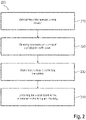
- Fig. 2 illustrates a flowchart of an embodiment of a method 200 for a remote control center.
- the method 200 comprises establishing 210 a tele-operated driving session between the vehicle and the remote control center.
- the tele-operated driving session can be understood as a part or the entirety of acts for controlling the vehicle from remote and for communicating between the vehicle and the remote control center.
- Establishing 210 the tele-operated driving session e.g., comprises establishing a communication link to the vehicle and/or taking (at least partially) control over the vehicle.
- the vehicle may be a car, a truck, a bus, or the like which is equipped for ToD.
- the vehicle may be an autonomously/automatically or at least semi-autonomously/semiautomatically driving vehicle.
- method 200 comprises obtaining 220 information on a timing of a predictable traffic event.
- the predictable traffic event e.g., corresponds or comprises predictable and/or predetermined maneuvers of autonomously or semi-autonomously driving vehicles in the environment of the vehicle controlled by the remote control center.
- the information on the timing may comprise a timing of such a vehicle and/or, e.g., information on a maneuver and/or a timing of the maneuver.
- the information on the timing thus may indicate whether and/or when another vehicle turns right or left, accelerates or brakes.
- the information on the timing optionally may comprise other or further information on a maneuver and/or a position of a vehicle or other traffic participants in the environment of the (remotely controlled) vehicle.
- the predictable traffic event comprises one or more actions of a traffic light and/or of a barrier.
- the information on the timing may comprise a timing of a traffic light, e.g., when the traffic light changes between phases (e.g. "green”, “yellow”, and “red") of the traffic light, or of a barriers, e.g., when the barrier opens or closes.
- the information on the timing comprises a signal phase and timing (SPaT) message which may comprise the timing of the traffic light.
- SPaT signal phase and timing
- Obtaining 220 the information on the timing may comprise receiving the information from the vehicle, from another vehicle, and/or from an infrastructure object.
- the infrastructure object e.g., is a server for communication with vehicles and/or other infrastructure objects (e.g. a traffic light) or the infrastructure object is an entity which comprises and/or has control over the traffic light and/or one or more barriers.
- the remote control center may use one or a combination of different technologies, networks (e.g. wireless local area network or cellular network) and/or different standards (e.g. from 3 rd Generation Partnership Project, 3GPP, or Institute of Electrical and Electronics Engineers, IEEE) for receiving the information on the timing.
- method 200 comprises determining 230 a delay in controlling the vehicle in the tele-operated driving session.
- the delay in controlling the vehicle comprises one or a combination of latencies in generating, processing, transmitting, and executing one or more instructions/commands of the remote control center for controlling the vehicle.
- the delay may comprise a latency for generating such an instruction and for processing the instruction at the remote control center, transmitting the instruction, and processing and executing the instruction at the (remotely controlled) vehicle.
- the latency for processing and executing the instruction at the vehicle can be also referred to as reaction delay.
- determining 230 the delay comprises determining a latency of communication between the remote control center and the vehicle, receiving from the vehicle the reaction delay in controlling the vehicle in the tele-operated driving session and determining the delay in controlling the vehicle using the latency and the reaction delay.
- the remote control center e.g., may take measurements, e.g., round-trip-time (RTT) or time-to-first-byte (TTFB) measurements, to determine the latency of the communication.
- the vehicle can determine the reaction delay, e.g., based on measurements of a delay for processing and executing previous instructions from the remote control center.
- the remote control center receives the latency of the communication
- the delay comprises an end-to-end delay which is a combination of delays from initiating the instruction at the remote control center and executing the instruction.
- the delay in controlling the vehicle may comprise a reaction time of the operator at the remote control center for reacting to the traffic event and inputting the instruction.
- method 200 comprises controlling 240 the vehicle in the tele-operated driving session based on the information on the timing and the delay.
- Controlling 240 the vehicle e.g., comprises initiating an instruction for the vehicle by a duration of the delay before the predictable traffic event occurs in accordance with the information on the timing. In this way, a delay in reacting to the predictable traffic event may be reduced.
- Controlling 240 the vehicle e.g., comprises instructing the vehicle, based on the information on the timing and the delay, to stop at the traffic light or to drive past the traffic light, in the sense of proceeding or starting the vehicle to drive past the traffic light.
- the remote control center may instruct the vehicle, based on the timing and the delay, to react, e.g. to start, accelerate, or brake, to changes of a phase of the traffic light (e.g. from "red” to "green” or “yellow” or vice versa).
- This may enable less abrupt braking maneuvers and starting the vehicle with less delay after the traffic light turns green.
- the proposed concept may enable the vehicle to start instantly when the traffic light turns green. In this way, also a traffic flow may be enhanced.
- the proposed concept also applies to traffic lights using other colors, signs, or equivalent measures for instructing vehicles and/or traffic participants to drive past or to stop at the traffic light.
- the method 200 may further comprise storing the information on the timing of the predictable traffic event, e.g., to enable the remote control center to reuse the information on the timing.
- the information on the timing e.g., comprises a schedule indicating changes of phases of the traffic light for one or more hours or days and the remote control center may reuse the schedule for controlling the vehicle or other vehicles in the environment of the traffic light later again based on the schedule.
- Method 200 can be performed by an apparatus as described below.
- Fig. 3 illustrates a block diagram of an embodiment of an apparatus 310 for a remote control center.
- the apparatus 310 comprises one or more interfaces 312 configured to communicate in a communication network and a data processing circuit 314 configured to control the one or more interfaces 312
- the data processing circuit 314 is configured to execute the proposed method for a remote control center.
- the apparatus 310 may optionally be installed at a remote control center 300 for controlling a vehicle from remote.
- the one or more interfaces 312 may correspond to any means for obtaining, receiving, transmitting or providing analog or digital signals or information, e.g. any connector, contact, pin, register, input port, output port, conductor, lane, etc. which allows providing or obtaining a signal or information.
- An interface may be wireless or wireline and it may be configured to communicate, i.e. transmit or receive signals, information with further internal or external components.
- the one or more interfaces 312 may comprise further components to enable according communication with the vehicle and/or infrastructure object and/or traffic entities.
- Such components may include transceiver (transmitter and/or receiver) components, such as one or more Low-Noise Amplifiers (LNAs), one or more Power-Amplifiers (PAs), one or more duplexers, one or more diplexers, one or more filters or filter circuitry, one or more converters, one or more mixers, accordingly adapted radio frequency components, etc.
- the one or more interfaces 312 may be coupled to one or more antennas, which may correspond to any transmit and/or receive antennas, such as horn antennas, dipole antennas, patch antennas, sector antennas etc.
- the one or more interfaces 312 may serve the purpose of establishing the tele-operated driving session and communicating with the vehicle in the tele-operated driving session.
- the one or more interfaces 312 may serve as means for obtaining the information on the timing of the predictable traffic event and the delay in controlling the vehicle (e.g. in the manner described above in connection with method 200).
- the respective one or more interfaces 312 are coupled to the data processing circuit 314 of the apparatus 310.
- the communication circuit 314 may be implemented using one or more processing units, one or more processing devices, any means for processing, such as a processor, a computer or a programmable hardware component being operable with accordingly adapted software.
- the described functions of the data processing circuit 314 may as well be implemented in software, which is then executed on one or more programmable hardware components.
- Such hardware components may comprise a general-purpose processor, a Digital Signal Processor (DSP), a micro-controller, etc.
- DSP Digital Signal Processor
- the remote control center 300 can also comprise further means (e.g. one or more displays, speakers, cameras, and/or microphones) for communication between an operator and the vehicle.
- further means e.g. one or more displays, speakers, cameras, and/or microphones
- method 200 remote control center 300, and/or apparatus 310, involve interaction with a concept implemented in the (remotely controlled) vehicle. Such a concept is described below with reference to Fig. 4 .
- Fig. 4 illustrates a flowchart of an embodiment of a method 400 for a vehicle.
- Method 400 comprises establishing 410 a tele-operated driving session between the vehicle and a remote control center.
- Establishing 410 the tele-operated driving session e.g., comprises establishing a communication link to the remote control center and/or transferring (at least partially) control over the vehicle to the remote control center.
- method 400 comprises obtaining 420 information on a timing of a predictable traffic event.
- Obtaining 420 information on the timing e.g., comprises receiving the information on the timing from another vehicle or an infrastructure object.
- the vehicle e.g., receives the information on the timing via communication with one or more other vehicles and/or with the infrastructure object using one or a combination of different technologies, networks and/or different standards (e.g. from the 3 rd Generation Partnership Project, 3GPP, or the Institute of Electrical and Electronics Engineers, IEEE).
- the predictable traffic event may comprise one or more predictable and/or predetermined maneuvers of one or more other vehicles and/or traffic participants and/or the predictable traffic event may comprise one or more actions of one or more traffic lights and/or barriers.
- method 400 comprises determining 430 a reaction delay for a reaction of the vehicle to a situation in the environment in the tele-operated driving session.
- the reaction delay may comprise a duration between receiving an instruction from the remote control center at the vehicle and executing the instruction by the vehicle.
- the vehicle e.g., determines the reaction delay from one or more measurements of this duration for one or more previously received instructions from the remote control center.
- method 400 comprises transmitting 440 the information on the timing and the reaction delay to the remote control center for controlling the vehicle in the tele-operated driving session based on the information on the timing and the reaction delay.
- the vehicle e.g., enables the remote control center to provide the vehicle with instructions before the predictable traffic event and with respect to the reaction delay in order to reduced a delay of the vehicle in reacting to the predictable traffic event.
- Method 400 may further comprise storing the information on the timing in a local database on the vehicle. This allows the vehicle to reuse the information on the timing and may avoid communicating the information repeatedly, as outlined above in connection with method 200.
- Method 400 e.g., is executed by an apparatus, as described below.
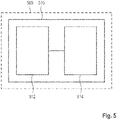
- Fig. 5 illustrates a block diagram of an embodiment of an apparatus 510.
- the apparatus 510 comprises one or more interfaces 512 configured to communicate in a communication network. Also, the apparatus 510 comprises a data processing circuit 514 configured to control the one or more interfaces 512. The data processing circuit 514 is further configured to execute method 500.
- the apparatus 510 may optionally be installed on a vehicle 500.
- the one or more interfaces 512 may correspond to any means for obtaining, receiving, transmitting or providing analog or digital signals or information, e.g. any connector, contact, pin, register, input port, output port, conductor, lane, etc. which allows providing or obtaining a signal or information.
- An interface may be wireless or wireline and it may be configured to communicate, i.e. transmit or receive signals, information with further internal or external components.
- the one or more interfaces 512 may comprise further components to enable in accordance with an embodiment of method 500 communication with the remote control center, one or more other vehicles and/or an infrastructure object and/or traffic entities.
- Such components may include transceiver (transmitter and/or receiver) components, such as one or more LNAs, one or more PAs, one or more duplexers, one or more diplexers, one or more filters or filter circuitry, one or more converters, one or more mixers, accordingly adapted radio frequency components, etc.
- the one or more interfaces 512 may be coupled to one or more antennas, which may correspond to any transmit and/or receive antennas, such as horn antennas, dipole antennas, patch antennas, sector antennas etc.
- the one or more interfaces 512 may serve the purpose of establishing the tele-operated driving session and communicating with the remote control center in the tele-operated driving session.
- the one or more interfaces 512 may serve as means for obtaining the information on the timing of the predictable traffic event and the reaction delay (e.g. in the manner described above in connection with method 500).
- the respective one or more interfaces 512 are coupled to the data processing circuit 514 of the apparatus 510.
- the communication circuit 514 may be implemented using one or more processing units, one or more processing devices, any means for processing, such as a processor, a computer or a programmable hardware component being operable with accordingly adapted software.
- the described functions of the data processing circuit 514 may as well be implemented in software, which is then executed on one or more programmable hardware components.
- Such hardware components may comprise a general-purpose processor, a DSP, a micro-controller, etc.
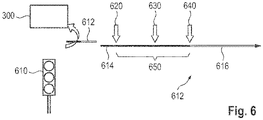
- Fig. 6 schematically illustrates an application of the proposed concept (e.g. of the proposed methods, computer programs, and/or apparatuses).
- FIG. 6 illustrates an exemplary scenario where a (autonomously/automatically driving) vehicle is controlled a traffic light 610 by tele-operated driving, e.g., due to a deadlock situation for the vehicle.
- the vehicle and a remote control center may establish a tele-operated driving session and transfer control over the vehicle to the remote control center 300 in response to detecting the deadlock situation.
- the vehicle detects the deadlock situation and triggers the tele-operated driving session, which lead to a connection to the remote control center 300.
- the remote control center 300 can receive information 612 on a timing of the traffic light 610.
- the remote control center 300 e.g., receives the information 612 from the traffic light 610 or an entity/server which has control over the traffic light 610.
- the vehicle may obtain the information 612 (e.g. from the traffic light 610 or the entity/server) and forwards the information 612 to the remote control center 300.
- the information in particular indicates a timing of a red phase 614 and a green phase 616 of the traffic light 610.
- the timing of the red phase 614 and the green phase 616 is plotted over time in Fig. 6 .
- the traffic light 610 switches from the red phase 614 to the green phase 616.
- the phase change can be understood as a predictable traffic event.
- the information 612 on the timing of the traffic light 610 may particularly indicate when (i.e. at which point in time) the traffic light 610 switches from the red phase 614 to the green phase 616.
- the information 612 may comprise a SPaT message.
- the information 612 on the timing and/or the SPaT message may also or alternatively indicate a schedule and/or a periodicity of phase changes and/or phases of the traffic light 610 within one or more hours or days.
- the remote control center 300 may further obtain the delay in the above mentioned manner.
- the remote control center 300 may obtain a total delay 650 including a duration from sending a command/instruction at time 620 to receiving the command/instruction at time 630 and the reaction delay of the vehicle including a duration from receiving the command/instruction at time 630 to executing the command/instruction by the vehicle at time 640.
- the vehicle may (regularly) send an estimate of its internal delay (e.g. the duration from time 630 to time 640) to the remote control center 300 and the remote control center 300 may estimate the latency/delay of communication of the command/instruction between time 620 and 630 (Downlink: remote control center -> vehicle).
- the remote control center 300 can compute the total delay 650 and can prepare instructing the vehicle and use the total delay 650 to "compensate" it.
- the command/instruction may be configured to cause the vehicle to start.
- the remote control center 300 may send the command/instruction before the phase change to reduce the delay of the vehicle in reacting to the phase change.
- the remote control center 300 may send the command/instruction by or within the total delay 650 before the phase change.
- the delay of the vehicle in reacting to the phase change may be reduced.
- the remote control center 300 sends the command/instruction by the total delay 650 before the phase change to cause the vehicle to start instantly at the phase change.
- the remote control center 300 e.g., is configured to indicate to the operator, e.g. using a signal, when the operator should trigger the command/instruction to start the vehicle such that the vehicle starts when the traffic light 610 switches from the red phase 614 to the green phase 616, i.e. when the traffic light 610 turns "green".
- the remote control center 300 may further store the information 612 on the timing and/or reuse the information 612 for controlling one or more other vehicles according to the proposed concept.
- program storage devices e.g., digital data storage media, which are machine or computer readable and encode machine-executable or computer-executable programs of instructions where said instructions perform some or all of the steps of methods described herein.
- the program storage devices may be, e.g., digital memories, magnetic storage media such as magnetic disks and magnetic tapes, hard drives, or optically readable digital data storage media.
- the embodiments are also intended to cover computers programmed to perform said steps of methods described herein or (field) programmable logic arrays ((F)PLAs) or (field) programmable gate arrays ((F)PGAs), programmed to perform said steps of the above-described methods.
- processor When provided by a processor, the functions may be provided by a single dedicated processor, by a single shared processor, or by a plurality of individual processors, some of which may be shared.
- explicit use of the term "processor” or “controller” should not be construed to refer exclusively to hardware capable of executing software, and may implicitly include, without limitation, Digital Signal Processor (DSP) hardware, network processor, application specific integrated circuit (ASIC), field programmable gate array (FPGA), read only memory (ROM) for storing software, random access memory (RAM), and non-volatile storage. Other hardware, conventional or custom, may also be included. Their function may be carried out through the operation of program logic, through dedicated logic, through the interaction of program control and dedicated logic, or even manually, the particular technique being selectable by the implementer as more specifically understood from the context.
- DSP Digital Signal Processor
- ASIC application specific integrated circuit
- FPGA field programmable gate array
- ROM read only memory
- RAM random access memory
- non-volatile storage Other hardware
- any block diagrams herein represent conceptual views of illustrative circuitry embodying the principles of the invention.
- any flow charts, flow diagrams, state transition diagrams, pseudo code, and the like represent various processes which may be substantially represented in computer readable medium and so executed by a computer or processor, whether or not such computer or processor is explicitly shown.
- each claim may stand on its own as a separate embodiment. While each claim may stand on its own as a separate embodiment, it is to be noted that - although a dependent claim may refer in the claims to a specific combination with one or more other claims - other embodiments may also include a combination of the dependent claim with the subject matter of each other dependent claim. Such combinations are proposed herein unless it is stated that a specific combination is not intended. Furthermore, it is intended to include also features of a claim to any other independent claim even if this claim is not directly made dependent to the independent claim.
Landscapes
- Engineering & Computer Science (AREA)
- Signal Processing (AREA)
- Computer Networks & Wireless Communication (AREA)
- Automation & Control Theory (AREA)
- Physics & Mathematics (AREA)
- General Physics & Mathematics (AREA)
- Remote Sensing (AREA)
- Radar, Positioning & Navigation (AREA)
- Aviation & Aerospace Engineering (AREA)
- Health & Medical Sciences (AREA)
- Computing Systems (AREA)
- General Health & Medical Sciences (AREA)
- Medical Informatics (AREA)
- Traffic Control Systems (AREA)
Abstract
Description
- The present invention relates to a vehicle, methods, computer programs, and apparatuses for tele-operated driving, and in particular but not exclusively, to a concept for controlling a vehicle based on information on a timing of a predictable traffic event and a delay in controlling the vehicle from remote.
- Tele-operated driving (ToD) might become a key technology in order to solve issues with L4/L5 (L4: highly automatic, L5: fully automatic) driven vehicles, such as interpretation issues or deadlocks (situations, which cannot be resolved by autonomous or automatic control mechanisms only). These issues occur when automatic driven vehicles (AV) are not able to interpret and to solve a situation (deadlock) due to unclear traffic conditions, e.g. an accident or a construction site. These vehicles may need external instruction from someone else to solve the situation, which can be a remote control center (CC). A ToD vehicle will be driven remotely in a ToD session by the CC and an operator therein, respectively.
- The main concept of ToD is that the AV is remotely driven the CC. CC and AV may be far away from each other. They are connected via a radio communication system (e.g. 4th, 5th Generation mobile communication systems (4G, 5G)) and its backhaul. Therefore, a certain end-to-end (E2E) delay and data rate are to be expected. Hence, the AV may react delayed to traffic situations and, thus, impair a traffic flow when being controlled from remote.
- Document
US 2017/0084172 A1 discloses a traffic control system including a plurality of traffic lights. Further, this document provides a concept for controlling a vehicle based on information on a signal status of a traffic light and without human interaction. - Document
US 2012/0026014 A1 discloses a roadside equipment system for controlling traffic signals and other equipment. In particular, this concept provides for controlling traffic signals under consideration of vehicles in the environment. - Document
CN 102122441 A relates to a concept for an intelligent traffic light backup system comprising a traffic lights control box and an onboard wireless module for a vehicle. The concept particularly provides for transmitting a traffic lights signal from the traffic lights control box to the onboard wireless module to inform a driver of the vehicle about a phase of traffic lights. Also, the concept provides for sending a clear and melodious prompt tone for reminding the driver to prepare for starting the vehicle. - None of the aforementioned documents deals with a solution to reduce the above delay of a remotely controlled vehicle in reacting to traffic situations.
- Hence, there may be a demand for an improved concept for tele-operated driving.
- Embodiments of the present disclosure are based on the finding that in tele-operated driving, instructions for a reaction of a vehicle to a predictable traffic event can be initiated by a remote control center before the traffic event occurs under consideration of a delay in controlling the vehicle from remote to reduce a delay of the vehicle in reacting to the predictable traffic event.
- Embodiments provide a method for a remote control center and for controlling a vehicle from remote. The method comprises establishing a tele-operated driving session between the vehicle and the remote control center. Further, the method comprises obtaining information on a timing of a predictable traffic event. The method also comprises determining a delay in controlling the vehicle in the tele-operated driving session. The method further comprises controlling the vehicle in the tele-operated driving session based on the information on the timing and the delay. For example, the remote control center instructs the vehicle to react to the predictable traffic situation. The above method may serve to reduce a delay of the vehicle in reacting to the predictable traffic event.
- In some embodiments, the information comprises information on a timing of a traffic light. This may allow the vehicle to react to actions of the traffic light with less delay.
- The predictable event, for example, comprises an action of a traffic light. For example, the predictable traffic event comprises a change of the traffic light from "red" to "green". Accordingly, the information on the timing may such indicate phase changes when the traffic light changes its phase, e.g. to "green" or "red". This, e.g., enables the vehicle to react to phase changes with less delay or even before they occur.
- In some embodiments, controlling the vehicle comprises instructing the vehicle, based on the information on the timing and the delay, to stop at the traffic light or to drive past the traffic light. For example, the vehicle may be instructed by the remote control center to start braking or accelerating based on or with respect to the timing of phase changes of the traffic light, e.g., to stop at or drive past the traffic light, in the sense of cross/pass/travel through an traffic area (e.g. an intersection or a road constriction) coordinated/controlled by the traffic light. This may lead to an improved traffic flow at the traffic light.
- In some embodiments, controlling the vehicle comprises instructing the vehicle, based on the timing and the delay, to start the vehicle at the traffic light. This, e.g., enables the vehicle to start with less delay when the traffic light turns "green". This allows an improved traffic flow.
- In some embodiments, the information on the timing comprises a signal phase and timing (SPaT) message. In this way, the SPaT message, which may be already used by the vehicle for safety or other applications, may be efficiently reused to obtain the timing of the traffic light.
- In some embodiments, obtaining the information on the timing comprises receiving the information on the timing from the vehicle, another vehicle, or an infrastructure object. In this way, e.g., an (already) established communication link between the remote control center and the vehicle, another vehicle, or the infrastructure object for other uses may be reused for an improved efficiency.
- In some embodiments, determining the delay comprises determining a latency of communication between the remote control center and the vehicle. Determining the delay may further comprise receiving from the vehicle a reaction delay in controlling the vehicle in the tele-operated driving session and determining the delay in controlling the vehicle using the latency and the reaction delay. The latency may comprise a duration for transmitting an instruction from the remote control center to the vehicle and the reaction delay may relate to a duration between receiving the instruction at the vehicle and executing the instruction by the vehicle. Aware of the latency and the reaction delay, the remote control center can determine an end-to-end delay for the delay in controlling the vehicle. This may further reduce the delay of the vehicle in reacting on the traffic event. In particular, this may allow the vehicle to react to the traffic event instantly when it occurs. E.g. the vehicle can be started instantly, when a traffic light turns "green".
- In some embodiments, the method further comprises storing the information on the timing of the predictable traffic event. This may allow the remote control center to reuse the information. In particular, the information on the timing may be reusable if the predictable traffic event occurs repeatedly and/or periodically like, e.g., phase changes of a traffic light. For such predictable traffic events, the remote control center, e.g., may use the information on the timing again for controlling the vehicle or other vehicles when the predictable traffic event occurs again. In particular, the remote control center may then not need to receive the information on the timing again from any other entity (e.g. the vehicle, another vehicle, or an infrastructure object).
- Embodiments of the present disclosure also provide a method for a vehicle. The method comprises establishing a tele-operated driving session between the vehicle and a remote control center. The method also comprises obtaining information on a timing of a predictable traffic event. Further, the method comprises determining a reaction delay for a reaction of the vehicle to a situation in the environment in the tele-operated driving session. Also, the method comprises transmitting the information on the timing and the reaction delay to the remote control center for controlling the vehicle in the tele-operated driving session based on the information on the timing and the reaction delay. Controlling the vehicle based on the information and the timing allows the remote control center to reduce a delay of the vehicle in reacting to the predictable traffic event when controlling the vehicle from remote.
- In some embodiments, obtaining information on the timing comprises receiving the information on the timing from another vehicle or an infrastructure object. In this way, e.g., an (already) established communication link for other uses or services between the vehicle and another vehicle, or the infrastructure object may be efficiently reused.
- In some embodiments, the method further comprises storing the information on the timing in a local database on the vehicle. In this way, the vehicle is enabled to reuse the information on the timing, e.g., when the vehicle faces the similar predictable traffic event (e.g. a periodically occurring traffic event) later again.
- Further embodiments provide a computer program having a program code for performing at least one of the methods proposed herein, when the computer program is executed on a computer, a processor, or a programmable hardware component. A further embodiment is a computer readable storage medium storing instructions which, when executed by a computer, processor, or programmable hardware component, cause the computer to implement one of the methods described herein.
- Further embodiments provide an apparatus for a vehicle. The apparatus comprises one or more interfaces configured to communicate in a communication network and a data processing circuit configured to control the one or more interfaces. The data processing circuit is further configured to execute one of the methods for a vehicle.
- Further embodiments provide an apparatus for a remote control center. The apparatus comprises one or more interfaces configured to communicate in a communication network and a data processing circuit configured to control the one or more interfaces. The data processing circuit is further configured to execute one of the methods for a remote control center.
- Further embodiments provide a vehicle comprising the proposed apparatus for a vehicle.
- Some other features or aspects will be described using the following non-limiting embodiments of apparatuses or methods or computer programs or computer program products by way of example only, and with reference to the accompanying figures, in which:
-
Fig. 1 schematically illustrates a timing of a traffic light and a remotely controlled vehicle in known concepts; -
Fig. 2 illustrates a flowchart of an embodiment of a method for a remote control center; -
Fig. 3 illustrates a block diagram of an embodiment of an apparatus for a remote control center; -
Fig. 4 illustrates a flowchart of an embodiment of a method for a vehicle; -
Fig. 5 illustrates a block diagram of an embodiment of an apparatus for a vehicle; and -
Fig. 6 schematically illustrates an application of the proposed concept. - Various example embodiments will now be described more fully with reference to the accompanying drawings in which some example embodiments are illustrated. In the figures, the thicknesses of lines, layers or regions may be exaggerated for clarity. Optional components may be illustrated using broken, dashed, or dotted lines.
- Accordingly, while example embodiments are capable of various modifications and alternative forms, embodiments thereof are shown by way of example in the figures and will herein be described in detail. It should be understood, however, that there is no intent to limit example embodiments to the particular forms disclosed, but on the contrary, example embodiments are to cover all modifications, equivalents, and alternatives falling within the scope of the invention. Like numbers refer to like or similar elements throughout the description of the figures.
- As used herein, the term "or" refers to a non-exclusive or, unless otherwise indicated (e.g., "or else" or "or in the alternative"). Furthermore, as used herein, words used to describe a relationship between elements should be broadly construed to include a direct relationship or the presence of intervening elements unless otherwise indicated. For example, when an element is referred to as being "connected" or "coupled" to another element, the element may be directly connected or coupled to the other element or intervening elements may be present. In contrast, when an element is referred to as being "directly connected" or "directly coupled" to another element, there are no intervening elements present. Similarly, words such as "between", "adjacent", and the like should be interpreted in a like fashion.
- The terminology used herein is for the purpose of describing particular embodiments only and is not intended to be limiting of example embodiments. As used herein, the singular forms "a", "an" and "the" are intended to include the plural forms as well, unless the context clearly indicates otherwise. It will be further understood that the terms "comprises", "comprising", "includes" or "including", when used herein, specify the presence of stated features, integers, steps, operations, elements or components, but do not preclude the presence or addition of one or more other features, integers, steps, operations, elements, components or groups thereof.
- Unless otherwise defined, all terms (including technical and scientific terms) used herein have the same meaning as commonly understood by one of ordinary skill in the art to which example embodiments belong. It will be further understood that terms, e.g., those defined in commonly used dictionaries, should be interpreted as having a meaning that is consistent with their meaning in the context of the relevant art and will not be interpreted in an idealized or overly formal sense unless expressly so defined herein.
- Tele-operated Driving (ToD) is becoming a key enabler for automated driving. ToD may help to solve deadlock situations which cannot be solved by an automated driving vehicle itself. ToD may also become a legal requirement for automated driving in an increasing number of countries.
- Due to latencies in communication and processing commands/instructions in ToD, a certain end-to-end (E2E) delay is to be expected. As schematically shown in
Fig. 1 , this may yield delays of a remotely controlled vehicle in reacting to a traffic event in the environment. -
Fig. 1 schematically illustrates a timing of a traffic light and a remotely controlled vehicle in known concepts. In particular,Fig. 1 illustrates a scenario where aremote control center 103 remotely instructs a vehicle to start at atraffic light 110, e.g., because the vehicle is an autonomously/automatically driving vehicle and is not able to solve the current situation automatically. In order to enable the operator to control the vehicle, the vehicle may record image data of thetraffic light 110 using a camera and provide theremote control center 103 with the image data of thetraffic light 110. Thus, the operator of the control center can see when thetraffic light 110 turns green and start the vehicle from remote after thetraffic light 110 turned green. -
Fig. 1 further shows a timing diagram illustrating a timing of ared phase 114 and agreen phase 116 of the traffic light 110 (i.e. when thetraffic light 110 is turned "red" or "green") over time. - In the scenario of
Fig. 1 , the vehicle is stationary during thered phase 114 of thetraffic light 110 and the operator may send a command or instruction to start the vehicle attime 120 when thetraffic light 110 switches from thered phase 114 to thegreen phase 116. Due to latencies of communication between theremote control center 103 and the vehicle, the vehicle may receive the command or instruction later attime 130. By reason of further latencies for processing the command or instruction, the vehicle may start even later attime 140. Thus, the latencies may cause a total-delay 150 from sending the command attime 120 to executing thecommand 140. Therefore, a start of the vehicle after the traffic light is turned green may be delayed and the vehicle may impair a traffic flow. - Hence, there is a demand for an improved concept for controlling a vehicle from remote.
- This demand may be satisfied by the embodiments described below.
-
Fig. 2 illustrates a flowchart of an embodiment of amethod 200 for a remote control center. - The
method 200 comprises establishing 210 a tele-operated driving session between the vehicle and the remote control center. The tele-operated driving session can be understood as a part or the entirety of acts for controlling the vehicle from remote and for communicating between the vehicle and the remote control center. Establishing 210 the tele-operated driving session, e.g., comprises establishing a communication link to the vehicle and/or taking (at least partially) control over the vehicle. - The vehicle may be a car, a truck, a bus, or the like which is equipped for ToD. In particular, the vehicle may be an autonomously/automatically or at least semi-autonomously/semiautomatically driving vehicle.
- Further,
method 200 comprises obtaining 220 information on a timing of a predictable traffic event. The predictable traffic event, e.g., corresponds or comprises predictable and/or predetermined maneuvers of autonomously or semi-autonomously driving vehicles in the environment of the vehicle controlled by the remote control center. Accordingly, the information on the timing may comprise a timing of such a vehicle and/or, e.g., information on a maneuver and/or a timing of the maneuver. The information on the timing thus may indicate whether and/or when another vehicle turns right or left, accelerates or brakes. The skilled person having benefit from the present disclosure will appreciate that the information on the timing optionally may comprise other or further information on a maneuver and/or a position of a vehicle or other traffic participants in the environment of the (remotely controlled) vehicle. Optionally, the predictable traffic event comprises one or more actions of a traffic light and/or of a barrier. Accordingly, the information on the timing may comprise a timing of a traffic light, e.g., when the traffic light changes between phases (e.g. "green", "yellow", and "red") of the traffic light, or of a barriers, e.g., when the barrier opens or closes. In some embodiments, the information on the timing comprises a signal phase and timing (SPaT) message which may comprise the timing of the traffic light. - Obtaining 220 the information on the timing may comprise receiving the information from the vehicle, from another vehicle, and/or from an infrastructure object. The infrastructure object, e.g., is a server for communication with vehicles and/or other infrastructure objects (e.g. a traffic light) or the infrastructure object is an entity which comprises and/or has control over the traffic light and/or one or more barriers. The remote control center may use one or a combination of different technologies, networks (e.g. wireless local area network or cellular network) and/or different standards (e.g. from 3rd Generation Partnership Project, 3GPP, or Institute of Electrical and Electronics Engineers, IEEE) for receiving the information on the timing.
- Also,
method 200 comprises determining 230 a delay in controlling the vehicle in the tele-operated driving session. The delay in controlling the vehicle comprises one or a combination of latencies in generating, processing, transmitting, and executing one or more instructions/commands of the remote control center for controlling the vehicle. In particular, the delay may comprise a latency for generating such an instruction and for processing the instruction at the remote control center, transmitting the instruction, and processing and executing the instruction at the (remotely controlled) vehicle. The latency for processing and executing the instruction at the vehicle can be also referred to as reaction delay. - In some embodiments, determining 230 the delay comprises determining a latency of communication between the remote control center and the vehicle, receiving from the vehicle the reaction delay in controlling the vehicle in the tele-operated driving session and determining the delay in controlling the vehicle using the latency and the reaction delay. The remote control center, e.g., may take measurements, e.g., round-trip-time (RTT) or time-to-first-byte (TTFB) measurements, to determine the latency of the communication. The vehicle can determine the reaction delay, e.g., based on measurements of a delay for processing and executing previous instructions from the remote control center.
- In some embodiments, the remote control center receives the latency of the communication
- Optionally, the delay comprises an end-to-end delay which is a combination of delays from initiating the instruction at the remote control center and executing the instruction. Optionally, the delay in controlling the vehicle may comprise a reaction time of the operator at the remote control center for reacting to the traffic event and inputting the instruction.
- Further,
method 200 comprises controlling 240 the vehicle in the tele-operated driving session based on the information on the timing and the delay. Controlling 240 the vehicle, e.g., comprises initiating an instruction for the vehicle by a duration of the delay before the predictable traffic event occurs in accordance with the information on the timing. In this way, a delay in reacting to the predictable traffic event may be reduced. - Controlling 240 the vehicle, e.g., comprises instructing the vehicle, based on the information on the timing and the delay, to stop at the traffic light or to drive past the traffic light, in the sense of proceeding or starting the vehicle to drive past the traffic light. E.g., the remote control center may instruct the vehicle, based on the timing and the delay, to react, e.g. to start, accelerate, or brake, to changes of a phase of the traffic light (e.g. from "red" to "green" or "yellow" or vice versa). This may enable less abrupt braking maneuvers and starting the vehicle with less delay after the traffic light turns green. In particular, the proposed concept may enable the vehicle to start instantly when the traffic light turns green. In this way, also a traffic flow may be enhanced. The skilled person having benefit from the present disclosure will appreciate that the proposed concept also applies to traffic lights using other colors, signs, or equivalent measures for instructing vehicles and/or traffic participants to drive past or to stop at the traffic light.
- The
method 200 may further comprise storing the information on the timing of the predictable traffic event, e.g., to enable the remote control center to reuse the information on the timing. The information on the timing, e.g., comprises a schedule indicating changes of phases of the traffic light for one or more hours or days and the remote control center may reuse the schedule for controlling the vehicle or other vehicles in the environment of the traffic light later again based on the schedule. -
Method 200 can be performed by an apparatus as described below. -
Fig. 3 illustrates a block diagram of an embodiment of anapparatus 310 for a remote control center. - The
apparatus 310 comprises one ormore interfaces 312 configured to communicate in a communication network and adata processing circuit 314 configured to control the one ormore interfaces 312 Thedata processing circuit 314 is configured to execute the proposed method for a remote control center. As indicated by dashed lines inFig. 3 , theapparatus 310 may optionally be installed at aremote control center 300 for controlling a vehicle from remote. - In embodiments, the one or
more interfaces 312 may correspond to any means for obtaining, receiving, transmitting or providing analog or digital signals or information, e.g. any connector, contact, pin, register, input port, output port, conductor, lane, etc. which allows providing or obtaining a signal or information. An interface may be wireless or wireline and it may be configured to communicate, i.e. transmit or receive signals, information with further internal or external components. The one ormore interfaces 312 may comprise further components to enable according communication with the vehicle and/or infrastructure object and/or traffic entities. Such components may include transceiver (transmitter and/or receiver) components, such as one or more Low-Noise Amplifiers (LNAs), one or more Power-Amplifiers (PAs), one or more duplexers, one or more diplexers, one or more filters or filter circuitry, one or more converters, one or more mixers, accordingly adapted radio frequency components, etc. The one ormore interfaces 312 may be coupled to one or more antennas, which may correspond to any transmit and/or receive antennas, such as horn antennas, dipole antennas, patch antennas, sector antennas etc. In some examples the one ormore interfaces 312 may serve the purpose of establishing the tele-operated driving session and communicating with the vehicle in the tele-operated driving session. Also, the one ormore interfaces 312 may serve as means for obtaining the information on the timing of the predictable traffic event and the delay in controlling the vehicle (e.g. in the manner described above in connection with method 200). - As shown in
Fig. 3 the respective one ormore interfaces 312 are coupled to thedata processing circuit 314 of theapparatus 310. In embodiments thecommunication circuit 314 may be implemented using one or more processing units, one or more processing devices, any means for processing, such as a processor, a computer or a programmable hardware component being operable with accordingly adapted software. In other words, the described functions of thedata processing circuit 314 may as well be implemented in software, which is then executed on one or more programmable hardware components. Such hardware components may comprise a general-purpose processor, a Digital Signal Processor (DSP), a micro-controller, etc. - The
remote control center 300 can also comprise further means (e.g. one or more displays, speakers, cameras, and/or microphones) for communication between an operator and the vehicle. - Some applications of
method 200,remote control center 300, and/orapparatus 310, involve interaction with a concept implemented in the (remotely controlled) vehicle. Such a concept is described below with reference toFig. 4 . -
Fig. 4 illustrates a flowchart of an embodiment of amethod 400 for a vehicle. -
Method 400 comprises establishing 410 a tele-operated driving session between the vehicle and a remote control center. Establishing 410 the tele-operated driving session, e.g., comprises establishing a communication link to the remote control center and/or transferring (at least partially) control over the vehicle to the remote control center. - Further,
method 400 comprises obtaining 420 information on a timing of a predictable traffic event. Obtaining 420 information on the timing, e.g., comprises receiving the information on the timing from another vehicle or an infrastructure object. The vehicle, e.g., receives the information on the timing via communication with one or more other vehicles and/or with the infrastructure object using one or a combination of different technologies, networks and/or different standards (e.g. from the 3rd Generation Partnership Project, 3GPP, or the Institute of Electrical and Electronics Engineers, IEEE). As outlined above, the predictable traffic event may comprise one or more predictable and/or predetermined maneuvers of one or more other vehicles and/or traffic participants and/or the predictable traffic event may comprise one or more actions of one or more traffic lights and/or barriers. - Also,
method 400 comprises determining 430 a reaction delay for a reaction of the vehicle to a situation in the environment in the tele-operated driving session. As outlined above, the reaction delay may comprise a duration between receiving an instruction from the remote control center at the vehicle and executing the instruction by the vehicle. The vehicle, e.g., determines the reaction delay from one or more measurements of this duration for one or more previously received instructions from the remote control center. - Further,
method 400 comprises transmitting 440 the information on the timing and the reaction delay to the remote control center for controlling the vehicle in the tele-operated driving session based on the information on the timing and the reaction delay. In this way, the vehicle, e.g., enables the remote control center to provide the vehicle with instructions before the predictable traffic event and with respect to the reaction delay in order to reduced a delay of the vehicle in reacting to the predictable traffic event. -
Method 400 may further comprise storing the information on the timing in a local database on the vehicle. This allows the vehicle to reuse the information on the timing and may avoid communicating the information repeatedly, as outlined above in connection withmethod 200. -
Method 400, e.g., is executed by an apparatus, as described below. -
Fig. 5 illustrates a block diagram of an embodiment of anapparatus 510. - The
apparatus 510 comprises one ormore interfaces 512 configured to communicate in a communication network. Also, theapparatus 510 comprises adata processing circuit 514 configured to control the one ormore interfaces 512. Thedata processing circuit 514 is further configured to executemethod 500. - As indicated by dashed lines in
Fig. 5 , theapparatus 510 may optionally be installed on avehicle 500. - In embodiments, the one or
more interfaces 512 may correspond to any means for obtaining, receiving, transmitting or providing analog or digital signals or information, e.g. any connector, contact, pin, register, input port, output port, conductor, lane, etc. which allows providing or obtaining a signal or information. An interface may be wireless or wireline and it may be configured to communicate, i.e. transmit or receive signals, information with further internal or external components. The one ormore interfaces 512 may comprise further components to enable in accordance with an embodiment ofmethod 500 communication with the remote control center, one or more other vehicles and/or an infrastructure object and/or traffic entities. Such components may include transceiver (transmitter and/or receiver) components, such as one or more LNAs, one or more PAs, one or more duplexers, one or more diplexers, one or more filters or filter circuitry, one or more converters, one or more mixers, accordingly adapted radio frequency components, etc. The one ormore interfaces 512 may be coupled to one or more antennas, which may correspond to any transmit and/or receive antennas, such as horn antennas, dipole antennas, patch antennas, sector antennas etc. In some examples the one ormore interfaces 512 may serve the purpose of establishing the tele-operated driving session and communicating with the remote control center in the tele-operated driving session. Also, the one ormore interfaces 512 may serve as means for obtaining the information on the timing of the predictable traffic event and the reaction delay (e.g. in the manner described above in connection with method 500). - As shown in
Fig. 5 the respective one ormore interfaces 512 are coupled to thedata processing circuit 514 of theapparatus 510. In embodiments thecommunication circuit 514 may be implemented using one or more processing units, one or more processing devices, any means for processing, such as a processor, a computer or a programmable hardware component being operable with accordingly adapted software. In other words, the described functions of thedata processing circuit 514 may as well be implemented in software, which is then executed on one or more programmable hardware components. Such hardware components may comprise a general-purpose processor, a DSP, a micro-controller, etc. -
Fig. 6 schematically illustrates an application of the proposed concept (e.g. of the proposed methods, computer programs, and/or apparatuses). - More precisely,
Fig. 6 illustrates an exemplary scenario where a (autonomously/automatically driving) vehicle is controlled atraffic light 610 by tele-operated driving, e.g., due to a deadlock situation for the vehicle. - To this end, the vehicle and a remote control center (e.g. remote control center 300) may establish a tele-operated driving session and transfer control over the vehicle to the
remote control center 300 in response to detecting the deadlock situation. For example, the vehicle detects the deadlock situation and triggers the tele-operated driving session, which lead to a connection to theremote control center 300. - According to the proposed concept, the
remote control center 300 can receiveinformation 612 on a timing of thetraffic light 610. As can be seen fromFig. 6 , theremote control center 300, e.g., receives theinformation 612 from thetraffic light 610 or an entity/server which has control over thetraffic light 610. Alternatively, the vehicle may obtain the information 612 (e.g. from thetraffic light 610 or the entity/server) and forwards theinformation 612 to theremote control center 300. - The information in particular indicates a timing of a
red phase 614 and agreen phase 616 of thetraffic light 610. By way of illustration the timing of thered phase 614 and thegreen phase 616 is plotted over time inFig. 6 . As one can see fromFig. 6 , thetraffic light 610 switches from thered phase 614 to thegreen phase 616. In practice, such a phase change from thered phase 614 to thegreen phase 616 happens at a predetermined point in time. That is, the phase change can be understood as a predictable traffic event. Theinformation 612 on the timing of thetraffic light 610 may particularly indicate when (i.e. at which point in time) thetraffic light 610 switches from thered phase 614 to thegreen phase 616. In particular, theinformation 612 may comprise a SPaT message. Theinformation 612 on the timing and/or the SPaT message may also or alternatively indicate a schedule and/or a periodicity of phase changes and/or phases of thetraffic light 610 within one or more hours or days. - The
remote control center 300 may further obtain the delay in the above mentioned manner. Thus, theremote control center 300 may obtain atotal delay 650 including a duration from sending a command/instruction attime 620 to receiving the command/instruction attime 630 and the reaction delay of the vehicle including a duration from receiving the command/instruction attime 630 to executing the command/instruction by the vehicle attime 640. To this end, the vehicle may (regularly) send an estimate of its internal delay (e.g. the duration fromtime 630 to time 640) to theremote control center 300 and theremote control center 300 may estimate the latency/delay of communication of the command/instruction betweentime 620 and 630 (Downlink: remote control center -> vehicle). Thus, theremote control center 300 can compute thetotal delay 650 and can prepare instructing the vehicle and use thetotal delay 650 to "compensate" it. - In the scenario of
Fig. 6 , the command/instruction may be configured to cause the vehicle to start. Considering thetotal delay 650, theremote control center 300 may send the command/instruction before the phase change to reduce the delay of the vehicle in reacting to the phase change. In particular, theremote control center 300 may send the command/instruction by or within thetotal delay 650 before the phase change. Thus, the delay of the vehicle in reacting to the phase change may be reduced. Preferably, theremote control center 300 sends the command/instruction by thetotal delay 650 before the phase change to cause the vehicle to start instantly at the phase change. - The
remote control center 300, e.g., is configured to indicate to the operator, e.g. using a signal, when the operator should trigger the command/instruction to start the vehicle such that the vehicle starts when thetraffic light 610 switches from thered phase 614 to thegreen phase 616, i.e. when thetraffic light 610 turns "green". - The
remote control center 300 may further store theinformation 612 on the timing and/or reuse theinformation 612 for controlling one or more other vehicles according to the proposed concept. - The skilled person having benefit from the present disclosure will appreciate that the concept described by reference to
Fig. 6 also applies to other predictable traffic events, other traffic lights, other information on the timing, and/or other delays in controlling the vehicle. - A person of skill in the art would readily recognize that steps of various above-described methods can be performed by programmed computers, for example, positions of slots may be determined or calculated. Herein, some embodiments are also intended to cover program storage devices, e.g., digital data storage media, which are machine or computer readable and encode machine-executable or computer-executable programs of instructions where said instructions perform some or all of the steps of methods described herein. The program storage devices may be, e.g., digital memories, magnetic storage media such as magnetic disks and magnetic tapes, hard drives, or optically readable digital data storage media. The embodiments are also intended to cover computers programmed to perform said steps of methods described herein or (field) programmable logic arrays ((F)PLAs) or (field) programmable gate arrays ((F)PGAs), programmed to perform said steps of the above-described methods.
- The description and drawings merely illustrate the principles of the invention. It will thus be appreciated that those skilled in the art will be able to devise various arrangements that, although not explicitly described or shown herein, embody the principles of the invention and are included within its spirit and scope. Furthermore, all examples recited herein are principally intended expressly to be only for pedagogical purposes to aid the reader in understanding the principles of the invention and the concepts contributed by the inventor(s) to furthering the art and are to be construed as being without limitation to such specifically recited examples and conditions. Moreover, all statements herein reciting principles, aspects, and embodiments of the invention, as well as specific examples thereof, are intended to encompass equivalents thereof.
- When provided by a processor, the functions may be provided by a single dedicated processor, by a single shared processor, or by a plurality of individual processors, some of which may be shared. Moreover, explicit use of the term "processor" or "controller" should not be construed to refer exclusively to hardware capable of executing software, and may implicitly include, without limitation, Digital Signal Processor (DSP) hardware, network processor, application specific integrated circuit (ASIC), field programmable gate array (FPGA), read only memory (ROM) for storing software, random access memory (RAM), and non-volatile storage. Other hardware, conventional or custom, may also be included. Their function may be carried out through the operation of program logic, through dedicated logic, through the interaction of program control and dedicated logic, or even manually, the particular technique being selectable by the implementer as more specifically understood from the context.
- It should be appreciated by those skilled in the art that any block diagrams herein represent conceptual views of illustrative circuitry embodying the principles of the invention. Similarly, it will be appreciated that any flow charts, flow diagrams, state transition diagrams, pseudo code, and the like represent various processes which may be substantially represented in computer readable medium and so executed by a computer or processor, whether or not such computer or processor is explicitly shown.
- Furthermore, the following claims are hereby incorporated into the detailed description, where each claim may stand on its own as a separate embodiment. While each claim may stand on its own as a separate embodiment, it is to be noted that - although a dependent claim may refer in the claims to a specific combination with one or more other claims - other embodiments may also include a combination of the dependent claim with the subject matter of each other dependent claim. Such combinations are proposed herein unless it is stated that a specific combination is not intended. Furthermore, it is intended to include also features of a claim to any other independent claim even if this claim is not directly made dependent to the independent claim.
- It is further to be noted that methods disclosed in the specification or in the claims may be implemented by a device having means for performing each of the respective steps of these methods.
-
- 103
- remote control center
- 110
- traffic light
- 114
- red phase
- 116
- green phase
- 120
- time
- 130
- time
- 140
- time
- 150
- total delay
- 200
- method for a remote control center
- 210
- establishing a tele-operated driving session
- 220
- obtaining information on a timing of a predictable traffic event
- 230
- determining a delay in controlling the vehicle
- 240
- controlling the vehicle based on the information on the timing and the delay
- 300
- remote control center
- 310
- apparatus for a remote control center
- 312
- one or more interfaces
- 314
- data processing circuit
- 400
- method for a vehicle
- 410
- establishing a tele-operated driving session
- 420
- obtaining information on a timing of a predictable traffic event
- 430
- determining a reaction delay of the vehicle to a situation in the environment
- 440
- transmitting the information on the timing and the reaction delay to the remote control center
- 500
- vehicle
- 510
- apparatus for a vehicle
- 512
- one or more interfaces
- 514
- data processing circuit
- 610
- traffic light
- 612
- information on a timing of the traffic light
- 614
- red phase
- 616
- green phase
- 620
- time
- 630
- time
- 640
- time
- 650
- total delay
Claims (15)
- A method (200) for a remote control center (300) and for controlling a vehicle from remote, the method (200) comprising:establishing (210) a tele-operated driving session between the vehicle and the remote control center (200);obtaining (220) information (612) on a timing of a predictable traffic event;determining (230) a delay in controlling the vehicle in the tele-operated driving session; andcontrolling (240) the vehicle in the tele-operated driving session based on the information (612) on the timing and the delay.
- The method (200) of claim 1, wherein the information (612) on the timing comprises information on a timing of a traffic light (610).
- The method (200) of claim 2, wherein controlling (240) the vehicle comprises instructing the vehicle, based on the information (612) on the timing and the delay, to stop at the traffic light (610) or to drive past the traffic light (610).
- The method (200) of claim 2 or 3, wherein controlling (240) the vehicle comprises instructing the vehicle, based on the information (612) on the timing and the delay, to start the vehicle at the traffic light (610).
- The method (200) of any one of claims 2 to 4, wherein the information (612) on the timing comprises a signal phase and timing, SPaT, message.
- The method (200) of any one of the preceding claims, wherein obtaining (220) the information (612) on the timing comprises receiving the information (612) on the timing from the vehicle, another vehicle, or an infrastructure object.
- The method (200) of any one of the preceding claims, wherein determining (230) the delay comprises:determining a latency of communication between the remote control center (300) and the vehicle;receiving from the vehicle a reaction delay in controlling the vehicle in the tele-operated driving session; anddetermining the delay in controlling the vehicle using the latency and the reaction delay.
- The method (200) of any one of the preceding claims, wherein the method (200) further comprises storing the information (612) on the timing of the predictable traffic event.
- A method (400) for a vehicle, the method (400) comprising:establishing (410) a tele-operated driving session between the vehicle and a remote control center (300);obtaining (420) information (612) on a timing of a predictable traffic event;determining (430) a reaction delay for a reaction of the vehicle to a situation in the environment in the tele-operated driving session; andtransmitting (440) the information (612) on the timing and the reaction delay to the remote control center (300) for controlling the vehicle in the tele-operated driving session based on the information (612) on the timing and the reaction delay.
- The method (400) of claim 9, wherein obtaining (420) information (612) on the timing comprises receiving the information (612) on the timing from another vehicle or an infrastructure object.
- The method (400) of claim 9 or 10, wherein the method (400) further comprises storing the information (612) on the timing in a local database on the vehicle.
- A computer program having a program code for performing at least one of the methods (200, 400) of claims 1 to 11, when the computer program is executed on a computer, a processor, or a programmable hardware component.
- An apparatus (310) for a remote control center (300), the apparatus (310) comprising:one or more interfaces (312) configured to communicate in a communication network; anda data processing circuit (314) configured to control the one or more interfaces (312),
wherein the data processing circuit (314) is further configured to execute one of the methods (200) of claims 1 to 8. - An apparatus (510) for a vehicle (500), the apparatus (510) comprising:one or more interfaces (512) configured to communicate in a communication network; anda data processing circuit (514) configured to control the one or more interfaces (512),
wherein the data processing circuit (514) is further configured to execute one of the methods (400) of claims 9 to 11. - A vehicle (500) comprising the apparatus (510) of claim 14.
Priority Applications (1)
| Application Number | Priority Date | Filing Date | Title |
|---|---|---|---|
| EP20207663.4A EP4002044B1 (en) | 2020-11-13 | 2020-11-13 | Methods, computer programs, and apparatuses for tele-operated driving |
Applications Claiming Priority (1)
| Application Number | Priority Date | Filing Date | Title |
|---|---|---|---|
| EP20207663.4A EP4002044B1 (en) | 2020-11-13 | 2020-11-13 | Methods, computer programs, and apparatuses for tele-operated driving |
Publications (2)
| Publication Number | Publication Date |
|---|---|
| EP4002044A1 true EP4002044A1 (en) | 2022-05-25 |
| EP4002044B1 EP4002044B1 (en) | 2024-05-22 |
Family
ID=73455509
Family Applications (1)
| Application Number | Title | Priority Date | Filing Date |
|---|---|---|---|
| EP20207663.4A Active EP4002044B1 (en) | 2020-11-13 | 2020-11-13 | Methods, computer programs, and apparatuses for tele-operated driving |
Country Status (1)
| Country | Link |
|---|---|
| EP (1) | EP4002044B1 (en) |
Citations (8)
| Publication number | Priority date | Publication date | Assignee | Title |
|---|---|---|---|---|
| CN102122441A (en) | 2011-03-15 | 2011-07-13 | 上海交通大学 | Intelligent traffic light auxiliary system based on vehicle road coordination technology |
| US20120026014A1 (en) | 2010-08-02 | 2012-02-02 | Siemens Industry, Inc. | System and Method for Traffic-Control Phase Change Warnings |
| US20170084172A1 (en) | 2015-09-21 | 2017-03-23 | Urban Software Institute GmbH | Monitoring of a traffic system |
| US20190122548A1 (en) * | 2017-10-19 | 2019-04-25 | Toyota Jidosha Kabushiki Kaisha | Traffic Light Information Providing System and Traffic Light Information Providing Method, and Server Used Therefor |
| WO2019180700A1 (en) * | 2018-03-18 | 2019-09-26 | Liveu Ltd. | Device, system, and method of autonomous driving and tele-operated vehicles |
| EP3618022A1 (en) * | 2018-08-31 | 2020-03-04 | Baidu Online Network Technology (Beijing) Co., Ltd. | Remote control device and remote control method for automatic driving vehicle, and server |
| EP3706454A1 (en) * | 2019-03-08 | 2020-09-09 | Volkswagen Aktiengesellschaft | Apparatus, method and computer program for determining a duplex resource scheme for a localized communication in a mobile communication system |
| EP3772226A1 (en) * | 2019-07-30 | 2021-02-03 | Volkswagen AG | Methods, computer programs, and apparatuses for a command center and a vehicle, a vehicle and a command center for delay compensation in teleoperated driving |
-
2020
- 2020-11-13 EP EP20207663.4A patent/EP4002044B1/en active Active
Patent Citations (8)
| Publication number | Priority date | Publication date | Assignee | Title |
|---|---|---|---|---|
| US20120026014A1 (en) | 2010-08-02 | 2012-02-02 | Siemens Industry, Inc. | System and Method for Traffic-Control Phase Change Warnings |
| CN102122441A (en) | 2011-03-15 | 2011-07-13 | 上海交通大学 | Intelligent traffic light auxiliary system based on vehicle road coordination technology |
| US20170084172A1 (en) | 2015-09-21 | 2017-03-23 | Urban Software Institute GmbH | Monitoring of a traffic system |
| US20190122548A1 (en) * | 2017-10-19 | 2019-04-25 | Toyota Jidosha Kabushiki Kaisha | Traffic Light Information Providing System and Traffic Light Information Providing Method, and Server Used Therefor |
| WO2019180700A1 (en) * | 2018-03-18 | 2019-09-26 | Liveu Ltd. | Device, system, and method of autonomous driving and tele-operated vehicles |
| EP3618022A1 (en) * | 2018-08-31 | 2020-03-04 | Baidu Online Network Technology (Beijing) Co., Ltd. | Remote control device and remote control method for automatic driving vehicle, and server |
| EP3706454A1 (en) * | 2019-03-08 | 2020-09-09 | Volkswagen Aktiengesellschaft | Apparatus, method and computer program for determining a duplex resource scheme for a localized communication in a mobile communication system |
| EP3772226A1 (en) * | 2019-07-30 | 2021-02-03 | Volkswagen AG | Methods, computer programs, and apparatuses for a command center and a vehicle, a vehicle and a command center for delay compensation in teleoperated driving |
Non-Patent Citations (1)
| Title |
|---|
| UNKNOWN: "The AASHTO National Connected Vehicle SPaT Deployment Challenge Implementation Guidance", 20 October 2017 (2017-10-20), pages 1 - 8, XP055795388, Retrieved from the Internet <URL:https://transportationops.org/sites/transops/files/SPaT%20Implementation%20Guidance%20%20Draft%20ver%202.13%2010202017.pdf> [retrieved on 20210414] * |
Also Published As
| Publication number | Publication date |
|---|---|
| EP4002044B1 (en) | 2024-05-22 |
Similar Documents
| Publication | Publication Date | Title |
|---|---|---|
| US11912312B2 (en) | System, vehicle, network component, apparatuses, methods, and computer programs for a transportation vehicle and a network component | |
| KR102135259B1 (en) | Method and apparatus for moving a parking vehicle for an emegency vehicle in autonomous driving system | |
| US11844004B2 (en) | Method, computer program, apparatus, vehicle and network component for controlling a communication link used for tele-operating a vehicle | |
| EP3992743B1 (en) | Vehicle, apparatus for a vehicle, computer program, and method for processing information for communication in a tele-operated driving session | |
| US20200256697A1 (en) | System, transportation vehicle, network component, apparatuses, methods, and computer programs for a transportation vehicle and a network component | |
| EP3964909B1 (en) | Methods, computer programs, apparatuses for a vehicle and a control center for resolving a deadlock traffic situation of an automatically operated vehicle | |
| EP3614357B1 (en) | Vehicles, network component, apparatuses, methods and computer programs for a vehicle, for a platooning vehicle, and for a network component | |
| EP4002044B1 (en) | Methods, computer programs, and apparatuses for tele-operated driving | |
| EP3614354A1 (en) | Apparatus, method and computer program for a leading vehicle and a vehicle of a group of vehicles | |
| US12008897B2 (en) | Methods, computer programs, apparatuses, vehicle and control center for resolving a deadlock traffic situation of a vehicle | |
| EP3979027A1 (en) | Methods, computer programs, communication circuits for communicating in a tele-operated driving session, vehicle and remote control center for controlling a vehicle from remote | |
| US12394305B2 (en) | Vehicles, methods, computer programs, and apparatuses for resolving a deadlock traffic situation of an automatically operated vehicle | |
| US20240233533A9 (en) | Computer program, apparatus, and method for a remote control center and for operating a vehicle from remote | |
| WO2023135779A1 (en) | Information communication device, information communication system, information communication method, and program | |
| CN113781789A (en) | Vehicle, method, equipment and control center for taking over control of vehicle to be controlled | |
| EP3599596A1 (en) | Vehicle, apparatus, method, and computer program for monitoring a vehicle, application server, apparatus, method, and computer program for an application server, mobile transceiver, apparatus, method, and computer program for an mobile transceiver | |
| EP4040254A1 (en) | Vehicle, infrastructure component, apparatus, computer program, and method for a vehicle |
Legal Events
| Date | Code | Title | Description |
|---|---|---|---|
| PUAI | Public reference made under article 153(3) epc to a published international application that has entered the european phase |
Free format text: ORIGINAL CODE: 0009012 |
|
| STAA | Information on the status of an ep patent application or granted ep patent |
Free format text: STATUS: THE APPLICATION HAS BEEN PUBLISHED |
|
| AK | Designated contracting states |
Kind code of ref document: A1 Designated state(s): AL AT BE BG CH CY CZ DE DK EE ES FI FR GB GR HR HU IE IS IT LI LT LU LV MC MK MT NL NO PL PT RO RS SE SI SK SM TR |
|
| STAA | Information on the status of an ep patent application or granted ep patent |
Free format text: STATUS: REQUEST FOR EXAMINATION WAS MADE |
|
| 17P | Request for examination filed |
Effective date: 20221125 |
|
| RBV | Designated contracting states (corrected) |
Designated state(s): AL AT BE BG CH CY CZ DE DK EE ES FI FR GB GR HR HU IE IS IT LI LT LU LV MC MK MT NL NO PL PT RO RS SE SI SK SM TR |
|
| STAA | Information on the status of an ep patent application or granted ep patent |
Free format text: STATUS: EXAMINATION IS IN PROGRESS |
|
| 17Q | First examination report despatched |
Effective date: 20230329 |
|
| REG | Reference to a national code |
Ref country code: DE Ref legal event code: R079 Free format text: PREVIOUS MAIN CLASS: G05D0001000000 Ipc: H04W0004440000 Ref document number: 602020031223 Country of ref document: DE |
|
| RIC1 | Information provided on ipc code assigned before grant |
Ipc: G08G 1/09 20060101ALI20240125BHEP Ipc: H04W 4/44 20180101AFI20240125BHEP |
|
| GRAP | Despatch of communication of intention to grant a patent |
Free format text: ORIGINAL CODE: EPIDOSNIGR1 |
|
| STAA | Information on the status of an ep patent application or granted ep patent |
Free format text: STATUS: GRANT OF PATENT IS INTENDED |
|
| INTG | Intention to grant announced |
Effective date: 20240306 |
|
| GRAS | Grant fee paid |
Free format text: ORIGINAL CODE: EPIDOSNIGR3 |
|
| P01 | Opt-out of the competence of the unified patent court (upc) registered |
Effective date: 20240311 |
|
| GRAA | (expected) grant |
Free format text: ORIGINAL CODE: 0009210 |
|
| STAA | Information on the status of an ep patent application or granted ep patent |
Free format text: STATUS: THE PATENT HAS BEEN GRANTED |
|
| AK | Designated contracting states |
Kind code of ref document: B1 Designated state(s): AL AT BE BG CH CY CZ DE DK EE ES FI FR GB GR HR HU IE IS IT LI LT LU LV MC MK MT NL NO PL PT RO RS SE SI SK SM TR |
|
| REG | Reference to a national code |
Ref country code: GB Ref legal event code: FG4D |
|
| REG | Reference to a national code |
Ref country code: CH Ref legal event code: EP |
|
| REG | Reference to a national code |
Ref country code: DE Ref legal event code: R096 Ref document number: 602020031223 Country of ref document: DE |
|
| REG | Reference to a national code |
Ref country code: IE Ref legal event code: FG4D |
|
| REG | Reference to a national code |
Ref country code: LT Ref legal event code: MG9D |
|
| REG | Reference to a national code |
Ref country code: NL Ref legal event code: MP Effective date: 20240522 |
|
| PG25 | Lapsed in a contracting state [announced via postgrant information from national office to epo] |
Ref country code: IS Free format text: LAPSE BECAUSE OF FAILURE TO SUBMIT A TRANSLATION OF THE DESCRIPTION OR TO PAY THE FEE WITHIN THE PRESCRIBED TIME-LIMIT Effective date: 20240922 |
|
| PG25 | Lapsed in a contracting state [announced via postgrant information from national office to epo] |
Ref country code: BG Free format text: LAPSE BECAUSE OF FAILURE TO SUBMIT A TRANSLATION OF THE DESCRIPTION OR TO PAY THE FEE WITHIN THE PRESCRIBED TIME-LIMIT Effective date: 20240522 |
|
| PG25 | Lapsed in a contracting state [announced via postgrant information from national office to epo] |
Ref country code: FI Free format text: LAPSE BECAUSE OF FAILURE TO SUBMIT A TRANSLATION OF THE DESCRIPTION OR TO PAY THE FEE WITHIN THE PRESCRIBED TIME-LIMIT Effective date: 20240522 Ref country code: HR Free format text: LAPSE BECAUSE OF FAILURE TO SUBMIT A TRANSLATION OF THE DESCRIPTION OR TO PAY THE FEE WITHIN THE PRESCRIBED TIME-LIMIT Effective date: 20240522 |
|
| PG25 | Lapsed in a contracting state [announced via postgrant information from national office to epo] |
Ref country code: GR Free format text: LAPSE BECAUSE OF FAILURE TO SUBMIT A TRANSLATION OF THE DESCRIPTION OR TO PAY THE FEE WITHIN THE PRESCRIBED TIME-LIMIT Effective date: 20240823 |
|
| PG25 | Lapsed in a contracting state [announced via postgrant information from national office to epo] |
Ref country code: PT Free format text: LAPSE BECAUSE OF FAILURE TO SUBMIT A TRANSLATION OF THE DESCRIPTION OR TO PAY THE FEE WITHIN THE PRESCRIBED TIME-LIMIT Effective date: 20240923 |
|
| REG | Reference to a national code |
Ref country code: AT Ref legal event code: MK05 Ref document number: 1689724 Country of ref document: AT Kind code of ref document: T Effective date: 20240522 |
|
| PG25 | Lapsed in a contracting state [announced via postgrant information from national office to epo] |
Ref country code: NL Free format text: LAPSE BECAUSE OF FAILURE TO SUBMIT A TRANSLATION OF THE DESCRIPTION OR TO PAY THE FEE WITHIN THE PRESCRIBED TIME-LIMIT Effective date: 20240522 |
|
| PG25 | Lapsed in a contracting state [announced via postgrant information from national office to epo] |
Ref country code: ES Free format text: LAPSE BECAUSE OF FAILURE TO SUBMIT A TRANSLATION OF THE DESCRIPTION OR TO PAY THE FEE WITHIN THE PRESCRIBED TIME-LIMIT Effective date: 20240522 |
|
| PG25 | Lapsed in a contracting state [announced via postgrant information from national office to epo] |
Ref country code: AT Free format text: LAPSE BECAUSE OF FAILURE TO SUBMIT A TRANSLATION OF THE DESCRIPTION OR TO PAY THE FEE WITHIN THE PRESCRIBED TIME-LIMIT Effective date: 20240522 |
|
| PG25 | Lapsed in a contracting state [announced via postgrant information from national office to epo] |
Ref country code: PL Free format text: LAPSE BECAUSE OF FAILURE TO SUBMIT A TRANSLATION OF THE DESCRIPTION OR TO PAY THE FEE WITHIN THE PRESCRIBED TIME-LIMIT Effective date: 20240522 |
|
| PG25 | Lapsed in a contracting state [announced via postgrant information from national office to epo] |
Ref country code: LV Free format text: LAPSE BECAUSE OF FAILURE TO SUBMIT A TRANSLATION OF THE DESCRIPTION OR TO PAY THE FEE WITHIN THE PRESCRIBED TIME-LIMIT Effective date: 20240522 |
|
| PG25 | Lapsed in a contracting state [announced via postgrant information from national office to epo] |
Ref country code: PT Free format text: LAPSE BECAUSE OF FAILURE TO SUBMIT A TRANSLATION OF THE DESCRIPTION OR TO PAY THE FEE WITHIN THE PRESCRIBED TIME-LIMIT Effective date: 20240923 Ref country code: PL Free format text: LAPSE BECAUSE OF FAILURE TO SUBMIT A TRANSLATION OF THE DESCRIPTION OR TO PAY THE FEE WITHIN THE PRESCRIBED TIME-LIMIT Effective date: 20240522 Ref country code: NO Free format text: LAPSE BECAUSE OF FAILURE TO SUBMIT A TRANSLATION OF THE DESCRIPTION OR TO PAY THE FEE WITHIN THE PRESCRIBED TIME-LIMIT Effective date: 20240822 Ref country code: NL Free format text: LAPSE BECAUSE OF FAILURE TO SUBMIT A TRANSLATION OF THE DESCRIPTION OR TO PAY THE FEE WITHIN THE PRESCRIBED TIME-LIMIT Effective date: 20240522 Ref country code: LV Free format text: LAPSE BECAUSE OF FAILURE TO SUBMIT A TRANSLATION OF THE DESCRIPTION OR TO PAY THE FEE WITHIN THE PRESCRIBED TIME-LIMIT Effective date: 20240522 Ref country code: IS Free format text: LAPSE BECAUSE OF FAILURE TO SUBMIT A TRANSLATION OF THE DESCRIPTION OR TO PAY THE FEE WITHIN THE PRESCRIBED TIME-LIMIT Effective date: 20240922 Ref country code: HR Free format text: LAPSE BECAUSE OF FAILURE TO SUBMIT A TRANSLATION OF THE DESCRIPTION OR TO PAY THE FEE WITHIN THE PRESCRIBED TIME-LIMIT Effective date: 20240522 Ref country code: GR Free format text: LAPSE BECAUSE OF FAILURE TO SUBMIT A TRANSLATION OF THE DESCRIPTION OR TO PAY THE FEE WITHIN THE PRESCRIBED TIME-LIMIT Effective date: 20240823 Ref country code: FI Free format text: LAPSE BECAUSE OF FAILURE TO SUBMIT A TRANSLATION OF THE DESCRIPTION OR TO PAY THE FEE WITHIN THE PRESCRIBED TIME-LIMIT Effective date: 20240522 Ref country code: ES Free format text: LAPSE BECAUSE OF FAILURE TO SUBMIT A TRANSLATION OF THE DESCRIPTION OR TO PAY THE FEE WITHIN THE PRESCRIBED TIME-LIMIT Effective date: 20240522 Ref country code: BG Free format text: LAPSE BECAUSE OF FAILURE TO SUBMIT A TRANSLATION OF THE DESCRIPTION OR TO PAY THE FEE WITHIN THE PRESCRIBED TIME-LIMIT Effective date: 20240522 Ref country code: AT Free format text: LAPSE BECAUSE OF FAILURE TO SUBMIT A TRANSLATION OF THE DESCRIPTION OR TO PAY THE FEE WITHIN THE PRESCRIBED TIME-LIMIT Effective date: 20240522 Ref country code: RS Free format text: LAPSE BECAUSE OF FAILURE TO SUBMIT A TRANSLATION OF THE DESCRIPTION OR TO PAY THE FEE WITHIN THE PRESCRIBED TIME-LIMIT Effective date: 20240822 |
|
| PG25 | Lapsed in a contracting state [announced via postgrant information from national office to epo] |
Ref country code: DK Free format text: LAPSE BECAUSE OF FAILURE TO SUBMIT A TRANSLATION OF THE DESCRIPTION OR TO PAY THE FEE WITHIN THE PRESCRIBED TIME-LIMIT Effective date: 20240522 |
|
| PG25 | Lapsed in a contracting state [announced via postgrant information from national office to epo] |
Ref country code: EE Free format text: LAPSE BECAUSE OF FAILURE TO SUBMIT A TRANSLATION OF THE DESCRIPTION OR TO PAY THE FEE WITHIN THE PRESCRIBED TIME-LIMIT Effective date: 20240522 |
|
| PG25 | Lapsed in a contracting state [announced via postgrant information from national office to epo] |
Ref country code: CZ Free format text: LAPSE BECAUSE OF FAILURE TO SUBMIT A TRANSLATION OF THE DESCRIPTION OR TO PAY THE FEE WITHIN THE PRESCRIBED TIME-LIMIT Effective date: 20240522 |
|
| PG25 | Lapsed in a contracting state [announced via postgrant information from national office to epo] |
Ref country code: SK Free format text: LAPSE BECAUSE OF FAILURE TO SUBMIT A TRANSLATION OF THE DESCRIPTION OR TO PAY THE FEE WITHIN THE PRESCRIBED TIME-LIMIT Effective date: 20240522 Ref country code: RO Free format text: LAPSE BECAUSE OF FAILURE TO SUBMIT A TRANSLATION OF THE DESCRIPTION OR TO PAY THE FEE WITHIN THE PRESCRIBED TIME-LIMIT Effective date: 20240522 |
|
| PG25 | Lapsed in a contracting state [announced via postgrant information from national office to epo] |
Ref country code: SM Free format text: LAPSE BECAUSE OF FAILURE TO SUBMIT A TRANSLATION OF THE DESCRIPTION OR TO PAY THE FEE WITHIN THE PRESCRIBED TIME-LIMIT Effective date: 20240522 |
|
| PG25 | Lapsed in a contracting state [announced via postgrant information from national office to epo] |
Ref country code: SM Free format text: LAPSE BECAUSE OF FAILURE TO SUBMIT A TRANSLATION OF THE DESCRIPTION OR TO PAY THE FEE WITHIN THE PRESCRIBED TIME-LIMIT Effective date: 20240522 Ref country code: SK Free format text: LAPSE BECAUSE OF FAILURE TO SUBMIT A TRANSLATION OF THE DESCRIPTION OR TO PAY THE FEE WITHIN THE PRESCRIBED TIME-LIMIT Effective date: 20240522 Ref country code: RO Free format text: LAPSE BECAUSE OF FAILURE TO SUBMIT A TRANSLATION OF THE DESCRIPTION OR TO PAY THE FEE WITHIN THE PRESCRIBED TIME-LIMIT Effective date: 20240522 Ref country code: EE Free format text: LAPSE BECAUSE OF FAILURE TO SUBMIT A TRANSLATION OF THE DESCRIPTION OR TO PAY THE FEE WITHIN THE PRESCRIBED TIME-LIMIT Effective date: 20240522 Ref country code: DK Free format text: LAPSE BECAUSE OF FAILURE TO SUBMIT A TRANSLATION OF THE DESCRIPTION OR TO PAY THE FEE WITHIN THE PRESCRIBED TIME-LIMIT Effective date: 20240522 Ref country code: CZ Free format text: LAPSE BECAUSE OF FAILURE TO SUBMIT A TRANSLATION OF THE DESCRIPTION OR TO PAY THE FEE WITHIN THE PRESCRIBED TIME-LIMIT Effective date: 20240522 |
|
| PG25 | Lapsed in a contracting state [announced via postgrant information from national office to epo] |
Ref country code: IT Free format text: LAPSE BECAUSE OF FAILURE TO SUBMIT A TRANSLATION OF THE DESCRIPTION OR TO PAY THE FEE WITHIN THE PRESCRIBED TIME-LIMIT Effective date: 20240522 |
|
| REG | Reference to a national code |
Ref country code: DE Ref legal event code: R097 Ref document number: 602020031223 Country of ref document: DE |
|
| PLBE | No opposition filed within time limit |
Free format text: ORIGINAL CODE: 0009261 |
|
| STAA | Information on the status of an ep patent application or granted ep patent |
Free format text: STATUS: NO OPPOSITION FILED WITHIN TIME LIMIT |
|
| PG25 | Lapsed in a contracting state [announced via postgrant information from national office to epo] |
Ref country code: SI Free format text: LAPSE BECAUSE OF FAILURE TO SUBMIT A TRANSLATION OF THE DESCRIPTION OR TO PAY THE FEE WITHIN THE PRESCRIBED TIME-LIMIT Effective date: 20240522 |
|
| 26N | No opposition filed |
Effective date: 20250225 |
|
| REG | Reference to a national code |
Ref country code: CH Ref legal event code: PL |
|
| PG25 | Lapsed in a contracting state [announced via postgrant information from national office to epo] |
Ref country code: MC Free format text: LAPSE BECAUSE OF FAILURE TO SUBMIT A TRANSLATION OF THE DESCRIPTION OR TO PAY THE FEE WITHIN THE PRESCRIBED TIME-LIMIT Effective date: 20240522 |
|
| PG25 | Lapsed in a contracting state [announced via postgrant information from national office to epo] |
Ref country code: LU Free format text: LAPSE BECAUSE OF NON-PAYMENT OF DUE FEES Effective date: 20241113 |
|
| REG | Reference to a national code |
Ref country code: CH Ref legal event code: PL |
|
| PG25 | Lapsed in a contracting state [announced via postgrant information from national office to epo] |
Ref country code: CH Free format text: LAPSE BECAUSE OF NON-PAYMENT OF DUE FEES Effective date: 20241130 |
|
| REG | Reference to a national code |
Ref country code: BE Ref legal event code: MM Effective date: 20241130 |
|
| PG25 | Lapsed in a contracting state [announced via postgrant information from national office to epo] |
Ref country code: SE Free format text: LAPSE BECAUSE OF FAILURE TO SUBMIT A TRANSLATION OF THE DESCRIPTION OR TO PAY THE FEE WITHIN THE PRESCRIBED TIME-LIMIT Effective date: 20240522 |
|
| PG25 | Lapsed in a contracting state [announced via postgrant information from national office to epo] |
Ref country code: BE Free format text: LAPSE BECAUSE OF NON-PAYMENT OF DUE FEES Effective date: 20241130 |
|
| PG25 | Lapsed in a contracting state [announced via postgrant information from national office to epo] |
Ref country code: IE Free format text: LAPSE BECAUSE OF NON-PAYMENT OF DUE FEES Effective date: 20241113 |
|
| PGFP | Annual fee paid to national office [announced via postgrant information from national office to epo] |
Ref country code: DE Payment date: 20251130 Year of fee payment: 6 |
|
| PGFP | Annual fee paid to national office [announced via postgrant information from national office to epo] |
Ref country code: GB Payment date: 20251125 Year of fee payment: 6 |
|
| PGFP | Annual fee paid to national office [announced via postgrant information from national office to epo] |
Ref country code: FR Payment date: 20251124 Year of fee payment: 6 |
|
| PG25 | Lapsed in a contracting state [announced via postgrant information from national office to epo] |
Ref country code: HU Free format text: LAPSE BECAUSE OF FAILURE TO SUBMIT A TRANSLATION OF THE DESCRIPTION OR TO PAY THE FEE WITHIN THE PRESCRIBED TIME-LIMIT; INVALID AB INITIO Effective date: 20201113 |
|
| PG25 | Lapsed in a contracting state [announced via postgrant information from national office to epo] |
Ref country code: CY Free format text: LAPSE BECAUSE OF FAILURE TO SUBMIT A TRANSLATION OF THE DESCRIPTION OR TO PAY THE FEE WITHIN THE PRESCRIBED TIME-LIMIT; INVALID AB INITIO Effective date: 20201113 |