EP4001626B1 - Tail cone ejector for power cable cooling system in a gas turbine engine - Google Patents
Tail cone ejector for power cable cooling system in a gas turbine engine Download PDFInfo
- Publication number
- EP4001626B1 EP4001626B1 EP21184728.0A EP21184728A EP4001626B1 EP 4001626 B1 EP4001626 B1 EP 4001626B1 EP 21184728 A EP21184728 A EP 21184728A EP 4001626 B1 EP4001626 B1 EP 4001626B1
- Authority
- EP
- European Patent Office
- Prior art keywords
- air flow
- tail cone
- gas turbine
- ejector
- turbine engine
- Prior art date
- Legal status (The legal status is an assumption and is not a legal conclusion. Google has not performed a legal analysis and makes no representation as to the accuracy of the status listed.)
- Active
Links
Images




Classifications
-
- F—MECHANICAL ENGINEERING; LIGHTING; HEATING; WEAPONS; BLASTING
- F02—COMBUSTION ENGINES; HOT-GAS OR COMBUSTION-PRODUCT ENGINE PLANTS
- F02K—JET-PROPULSION PLANTS
- F02K1/00—Plants characterised by the form or arrangement of the jet pipe or nozzle; Jet pipes or nozzles peculiar thereto
- F02K1/36—Plants characterised by the form or arrangement of the jet pipe or nozzle; Jet pipes or nozzles peculiar thereto having an ejector
-
- F—MECHANICAL ENGINEERING; LIGHTING; HEATING; WEAPONS; BLASTING
- F02—COMBUSTION ENGINES; HOT-GAS OR COMBUSTION-PRODUCT ENGINE PLANTS
- F02C—GAS-TURBINE PLANTS; AIR INTAKES FOR JET-PROPULSION PLANTS; CONTROLLING FUEL SUPPLY IN AIR-BREATHING JET-PROPULSION PLANTS
- F02C7/00—Features, components parts, details or accessories, not provided for in, or of interest apart form groups F02C1/00 - F02C6/00; Air intakes for jet-propulsion plants
- F02C7/12—Cooling of plants
- F02C7/16—Cooling of plants characterised by cooling medium
- F02C7/18—Cooling of plants characterised by cooling medium the medium being gaseous, e.g. air
-
- F—MECHANICAL ENGINEERING; LIGHTING; HEATING; WEAPONS; BLASTING
- F02—COMBUSTION ENGINES; HOT-GAS OR COMBUSTION-PRODUCT ENGINE PLANTS
- F02K—JET-PROPULSION PLANTS
- F02K1/00—Plants characterised by the form or arrangement of the jet pipe or nozzle; Jet pipes or nozzles peculiar thereto
- F02K1/04—Mounting of an exhaust cone in the jet pipe
-
- F—MECHANICAL ENGINEERING; LIGHTING; HEATING; WEAPONS; BLASTING
- F01—MACHINES OR ENGINES IN GENERAL; ENGINE PLANTS IN GENERAL; STEAM ENGINES
- F01D—NON-POSITIVE DISPLACEMENT MACHINES OR ENGINES, e.g. STEAM TURBINES
- F01D15/00—Adaptations of machines or engines for special use; Combinations of engines with devices driven thereby
- F01D15/10—Adaptations for driving, or combinations with, electric generators
-
- F—MECHANICAL ENGINEERING; LIGHTING; HEATING; WEAPONS; BLASTING
- F02—COMBUSTION ENGINES; HOT-GAS OR COMBUSTION-PRODUCT ENGINE PLANTS
- F02C—GAS-TURBINE PLANTS; AIR INTAKES FOR JET-PROPULSION PLANTS; CONTROLLING FUEL SUPPLY IN AIR-BREATHING JET-PROPULSION PLANTS
- F02C7/00—Features, components parts, details or accessories, not provided for in, or of interest apart form groups F02C1/00 - F02C6/00; Air intakes for jet-propulsion plants
- F02C7/32—Arrangement, mounting, or driving, of auxiliaries
-
- F—MECHANICAL ENGINEERING; LIGHTING; HEATING; WEAPONS; BLASTING
- F02—COMBUSTION ENGINES; HOT-GAS OR COMBUSTION-PRODUCT ENGINE PLANTS
- F02K—JET-PROPULSION PLANTS
- F02K1/00—Plants characterised by the form or arrangement of the jet pipe or nozzle; Jet pipes or nozzles peculiar thereto
- F02K1/38—Introducing air inside the jet
-
- F—MECHANICAL ENGINEERING; LIGHTING; HEATING; WEAPONS; BLASTING
- F05—INDEXING SCHEMES RELATING TO ENGINES OR PUMPS IN VARIOUS SUBCLASSES OF CLASSES F01-F04
- F05D—INDEXING SCHEME FOR ASPECTS RELATING TO NON-POSITIVE-DISPLACEMENT MACHINES OR ENGINES, GAS-TURBINES OR JET-PROPULSION PLANTS
- F05D2220/00—Application
- F05D2220/30—Application in turbines
- F05D2220/32—Application in turbines in gas turbines
-
- F—MECHANICAL ENGINEERING; LIGHTING; HEATING; WEAPONS; BLASTING
- F05—INDEXING SCHEMES RELATING TO ENGINES OR PUMPS IN VARIOUS SUBCLASSES OF CLASSES F01-F04
- F05D—INDEXING SCHEME FOR ASPECTS RELATING TO NON-POSITIVE-DISPLACEMENT MACHINES OR ENGINES, GAS-TURBINES OR JET-PROPULSION PLANTS
- F05D2220/00—Application
- F05D2220/70—Application in combination with
- F05D2220/76—Application in combination with an electrical generator
-
- F—MECHANICAL ENGINEERING; LIGHTING; HEATING; WEAPONS; BLASTING
- F05—INDEXING SCHEMES RELATING TO ENGINES OR PUMPS IN VARIOUS SUBCLASSES OF CLASSES F01-F04
- F05D—INDEXING SCHEME FOR ASPECTS RELATING TO NON-POSITIVE-DISPLACEMENT MACHINES OR ENGINES, GAS-TURBINES OR JET-PROPULSION PLANTS
- F05D2260/00—Function
- F05D2260/20—Heat transfer, e.g. cooling
- F05D2260/201—Heat transfer, e.g. cooling by impingement of a fluid
-
- F—MECHANICAL ENGINEERING; LIGHTING; HEATING; WEAPONS; BLASTING
- F05—INDEXING SCHEMES RELATING TO ENGINES OR PUMPS IN VARIOUS SUBCLASSES OF CLASSES F01-F04
- F05D—INDEXING SCHEME FOR ASPECTS RELATING TO NON-POSITIVE-DISPLACEMENT MACHINES OR ENGINES, GAS-TURBINES OR JET-PROPULSION PLANTS
- F05D2260/00—Function
- F05D2260/60—Fluid transfer
- F05D2260/601—Fluid transfer using an ejector or a jet pump
-
- Y—GENERAL TAGGING OF NEW TECHNOLOGICAL DEVELOPMENTS; GENERAL TAGGING OF CROSS-SECTIONAL TECHNOLOGIES SPANNING OVER SEVERAL SECTIONS OF THE IPC; TECHNICAL SUBJECTS COVERED BY FORMER USPC CROSS-REFERENCE ART COLLECTIONS [XRACs] AND DIGESTS
- Y02—TECHNOLOGIES OR APPLICATIONS FOR MITIGATION OR ADAPTATION AGAINST CLIMATE CHANGE
- Y02T—CLIMATE CHANGE MITIGATION TECHNOLOGIES RELATED TO TRANSPORTATION
- Y02T50/00—Aeronautics or air transport
- Y02T50/60—Efficient propulsion technologies, e.g. for aircraft
Definitions
- the present disclosure relates to gas turbine engines, and, more specifically, to cooling systems for conductive cables in gas turbine engines.
- a turbofan engine typically includes a fan section, a compressor section, a combustor section and a turbine section. Air entering the compressor section is compressed and delivered into the combustion section where it is mixed with fuel and ignited to generate a high-energy exhaust gas flow. The high-energy exhaust gas flow expands through the turbine section to drive the compressor and the fan section.
- Electric power for the engine is typically provided by a motor/generator driven through a tower shaft driven by a main engine shaft.
- Motor/generators and electric motors are typically stand-alone devices that are coupled to an external accessory gearbox. Alternate motor/generator and motor configurations and placements may provide increased engine efficiencies and accommodate increasing demands for electric power.
- US 9 644 538 B2 discloses a passive cooling system for an auxiliary power unit (APU) installation on an aircraft.
- the system is for an auxiliary power unit having at least a compressor portion of a gas turbine engine and an oil cooler contained separately within a nacelle.
- an ejector assembly for a cooling system of a gas turbine engine as claimed in claim 1.
- the nozzle section is defined by a nozzle portion of the ejector body and the tail cone.
- the ejector body may further comprise a scoop defining an inlet to the nozzle section.
- a throat of the nozzle section is disposed forward of the tail cone outlet.
- the cooling air flow may be from an external air source disposed radially outward from a bypass air flow path of the gas turbine engine.
- the tail cone may comprise a scoop configured to divert the exhaust air flow of the gas turbine engine internal to the tail cone.
- the tail cone may further comprise a channel extending through the tail cone and in fluid communication with the exhaust air flow, the channel defining a throat at a nozzle portion of the channel.
- a cooling air flow path may be defined radially outward from the channel and between the channel and the ejector body.
- the ejector body may be coupled to the tail cone at the tail cone outlet.
- a cooling assembly may include the ejector assembly, the electric motor disposed in the tail cone, a conduit in fluid communication with the electric motor and the ejector assembly, and a plurality of conductive cables extending through the conduit and coupled to the electric motor.
- the cooling air flow may be configured to cool the plurality of conductive cables.
- the exhaust air flow is disposed radially outward of the cooling air flow.
- Entraining the cooling air flow may further comprise pulling the cooling air flow through the outlet of the tail cone.
- the exhaust air flow may be diverted via a scoop proximate a nozzle of the gas turbine engine.
- the method may further comprise flowing the cooling air flow over a plurality of conductive cables prior to entraining the cooling air flow.
- the method may further comprise pulling the cooling air flow from an external source prior to flowing the cooling air flow over the plurality of conductive cables.
- Aft includes the direction associated with the tail (e.g., the back end) of an aircraft, or generally, to the direction of exhaust of a gas turbine engine.
- Forward includes the direction associated with the intake (e.g., the front end) of a gas turbine engine.
- a first component that is "radially outward” of a second component means that the first component is positioned at a greater distance away from a central longitudinal axis of the gas turbine engine.
- a first component that is “radially inward” of a second component means that the first component is positioned closer to the engine central longitudinal axis than the second component.
- the terminology “radially outward” and “radially inward” may also be used relative to references other than the engine central longitudinal axis.
- Nacelle 10 for a gas turbine engine is illustrated according to various embodiments.
- Nacelle 10 may comprise an inlet 12, a fan cowl 14, and a thrust reverser 16.
- Nacelle 10 may be coupled to a pylon 20.
- Pylon 20 may mount nacelle 10, and a gas turbine engine located within nacelle 10, to an aircraft wing or aircraft body.
- an exhaust system 18 may extend from the gas turbine engine mounted within nacelle 10.
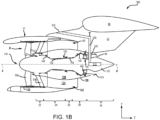
- FIG. 1B illustrates a cross-sectional view of a gas turbine engine 110 located within nacelle 10, in accordance with various embodiments.
- Gas turbine engine 110 may include a core engine 120.
- Core engine 120 may include an inlet section 22, a compressor section 24, a combustor section 26, and a turbine section 28.
- a fan 114 drives fluid (e.g., air) along a bypass flow-path B while compressor section 24 can drive air along a core flow-path C for compression and communication into combustor section 26 then expansion through turbine section 28.
- core engine 120 generally comprises a low speed spool and a high speed spool mounted for rotation about an engine central longitudinal axis A-A'.
- Low speed spool may generally comprise a shaft that interconnects fan 114, a low pressure compressor 144, and a low pressure turbine 146.
- the high speed spool may comprise a shaft that interconnects a high pressure compressor 152 and high pressure turbine 154.
- a combustor may be located between high pressure compressor 152 and high pressure turbine 154.
- a "high pressure" compressor or turbine experiences a higher pressure than a corresponding "low pressure” compressor or turbine.
- gas turbine engine 110 is illustrated as a turbofan engine herein, it should be understood that the concepts described herein are not limited in use to turbofans as the teachings may be applied to other types of engines including turboprop and turboshaft engines.
- core engine 120 may be depicted as a two-spool architecture herein, it should be understood that the concepts described herein are not limited in use to two-spool gas turbine engines as the teachings may be applied to other types of engines including engines having more than or less than two spools.
- Core engine 120 drives fan 114 of gas turbine engine 110.
- the air flow in core flow path C may be compressed by low pressure compressor 144 then high pressure compressor 152, mixed and burned with fuel in the combustor section 26, then expanded through high pressure turbine 154 and low pressure turbine 146.
- Turbines 146, 154 rotationally drive their respective low speed spool and high speed spool in response to the expansion.
- Bypass air flow B driven by fan 114, flows in the aft direction through bypass flow path 124. At least a portion of bypass flow path 124 may be defined by nacelle 10 and an inner fixed structure (IFS) 126.
- IFS inner fixed structure
- An upper bifurcation 143 and a lower bifurcation 142 may extend radially between the nacelle 10 and IFS 126 in locations opposite one another.
- Engine components such as wires and fluids, for example, may be accommodated in upper bifurcation 143 and lower bifurcation 142.
- IFS 126 surrounds core engine 120 and provides core compartment 128.
- Various components may be provided in core compartment 128 such as fluid conduits and/or compressed air ducts.
- a portion BCORE of bypass air flow B may flow between core engine 120 and IFS 126 in core compartment 128.
- a fan case 132 may surround fan 114. Fan case 132 may be housed within nacelle 10.
- Fan case 132 may provide a mounting structure for securing gas turbine engine 110 to pylon 20, with momentary reference to FIG. 1A .
- one or more fan exit guide vanes 116 may extend radially between core engine 120 and fan case 132.
- Exhaust system 18 is located aft of turbine section 28. Core air flow C flows through core engine 120 and is expelled through an exhaust outlet 118 of exhaust system 18.
- Exhaust outlet 118 may comprise an aerodynamic tail cone 122.
- a primary nozzle 123 may be located radially outward of tail cone 122. Primary nozzle 123 and tail cone 122 may define exhaust outlet 118.
- Exhaust outlet 118 provides an exhaust path for core air flow C exiting turbine section 28 of core engine 120.
- a secondary nozzle may be located radially outward of primary nozzle 123. Primary nozzle 123 and the secondary nozzle may define an exit flow path for bypass air flow B exiting core compartment 128 and/or bypass flow path 124.
- a plurality of turbine exit guide vanes (TEGVs) 150 may be located circumferentially about engine central longitudinal axis A-A' and proximate an aft end 145 of low pressure turbine 146.
- TEGVs turbine exit guide vanes
- an electric motor 210 is disposed in tail cone 122.
- the electric motor 210 may be mechanically coupled to a low speed spool in core engine 120.
- Electric motor 210 may comprise an electric generator, an electric motor, a combination of the two, or the like.
- Electric motor 210 may be electrically coupled to a juncture box, or any other electrical device known in the art.
- the electrical device may be disposed radially outward from IFS 126 of gas turbine engine 110 in a wing 30 of an aircraft, in the pylon 20 of the aircraft, or the like.
- Conductive cables may extend from the electric motor 210 to the electric device external to gas turbine engine 110.
- the conductive cables may extend radially outward from electric motor 210 through a strut 220, through the pylon 20 and to an electrical device in the wing 30, or any other location external or internal to IFS 126.
- the strut 220 extends from the tail cone 122 beyond the IFS 126.
- the strut may be disposed aft of the aft end 145 of low pressure compressor turbine 146 and forward of exhaust outlet 118. Due to the conductive cables proximity to exhaust outlet 118, the conductive cables may experience relatively high temperatures from air flow in core air flow path C.
- the conductive cables may be disposed in a conduit 230 extending radially outward from tail cone 122 through strut 220 and into the pylon 20.
- the conduit 230 may be fluidly coupled to an external air source by any method known in the art, such as a scoop, a vent, or the like.
- the external air source 232 may be disposed radially outward from nacelle 10. In this regard, the external air source 232 may receive colder temperature air relative to bypass air flow B.
- external air source 232 is illustrated forward of the electric motor 210 on the pylon, the application is not limited in this regard.
- the external air source 232 may be aft of the electric motor 210.
- bleed air from the core air flow path C may be diverted aft of the fan as a cooling source.
- bleed air may increase the mass flow and/or reduce efficiency of gas turbine engine 110.
- ambient air may be pulled from external to gas turbine engine 110, which may reduce or eliminate utilizing bleed air for the cooling of conductive power cables.
- bypass air from bypass air flow path B may be diverted to act as a cooling source for cooling of conductive cables.
- bypass air may be limited to use while the gas turbine engine 110 is in operation. In this regard, bypass air may provide insufficient cooling after engine shutdown, or the like.
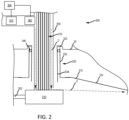
- the conductive cable cooling system 300 comprises a plurality of conductive cables 310.
- the conductive cables 310 are extending from an electric motor 210 disposed in a tail cone 122.
- the electric motor 210 is operably coupled to a low speed spool 302 of a gas turbine engine (e.g., gas turbine engine 110 from FIG. 1B ).
- the conductive cable cooling system 300 further comprises a strut 220 extending from a radially outer surface 312 of tail cone 122 to a radially inner surface 322 of pylon 20.
- the strut 220 may comprise an outer strut shell 332 and an inner strut shell 334.
- the outer strut shell 332 may be exposed to air flow from core air flow path C in FIG. 1B during operation of the gas turbine engine 110.
- the conductive cable cooling system 300 may further comprise an air seal 340 disposed between inner strut shell 334 and outer strut shell 332. In this regard, the air seal 340 may ensure that the plurality of conductive cables 310 are sealed from air from core air flow path C.
- the conductive cable cooling system 300 further comprises a conduit 350.
- the conduit 350 may be configured to house the plurality of conductive cables 310 through strut 220.
- the conduit 350 may be flexible or rigid.
- the conduit 350 may comprise a woven fiberglass sleeve, or the like.
- the conduit 350 may protect the plurality of conductive cables 310 from contacting strut 220 during operation of the gas turbine engine 110 from FIG. 1 .
- the conduit 350 may further provide a cooling passageway for cooling air to flow from the external air source 232 from FIG. 1 .
- the conductive cable cooling system 300 further comprises an electric fan 360 in fluid communication with the conduit 350 and a vent 370.
- the electric fan 360 may be configured to actively cool the plurality of conductive cables 310.
- the vent 370 may be configured to open or close.
- the electric fan 360 may be configured to receive cooling air flow from ambient air (e.g., an external air source from the nacelle, such as external air source 232).
- the electric fan 360 and the vent 370 may be electrically coupled to a processor 390.
- processor 390 may be in electrical communication with electric fan 360.
- the processor 390 may be configured to activate, increase, or decrease a speed of the electric fan in response to various operation conditions of the gas turbine engine.
- vent 370 may be modulated in response to changes in various operation conditions of gas turbine engine.
- the processor 390 may be configured to detect an engine shutdown. In response to the engine shutdown, processor 390 may command vent 370 to open and command the electric fan to activate and begin rotating. In various embodiments, vent 370 may already be open at engine shutdown, and the processor may command the electric fan to increase a rotation speed or begin to rotate. In various embodiments, vent 370 may be commanded to operate between open and closed during operation in response to a desired air flow desired in conduit 350.
- the electric fan 360 and the vent 370 are illustrated as being forward of the electric motor 210, the disclosure is not limited int his regard. For example, in various embodiments, the electric fan 360 and the vent 370 are disposed aft of the electric motor 210.
- the vent 370 may assume a closed configuration, an open configuration (100% open), and/or a partially open configuration (ranging between the open configuration and the closed configuration) as commanded by a controller.
- the closed configuration may comprise the vent 370 being approximately 0% percent open (e.g., between 0% and 2% open), which may be set at any desired percent open.
- the minimum percent open for the closed configuration is 0% open but in some embodiments may also be different values (e.g., 5% or other small openings that may allow passage of small amounts of air).
- the vent actuator may cause the vent 370 to become more open or less open, at any time before, during, or after operation of the gas turbine engine 110 from FIG. 1B to assume the open configuration, a partially open configuration, and/or the closed configuration.
- processor 390 may be integrated into computer systems onboard an aircraft, such as, for example, a full authority digital engine control (FADEC), an engine-indicating and crew-alerting system (EICAS), and/or the like.
- Processor 390 may include one or more processors and/or one or more tangible, non-transitory memories and be capable of implementing logic.
- Each processor can be a general purpose processor, a digital signal processor (DSP), an application specific integrated circuit (ASIC), a field programmable gate array (FPGA) or other programmable logic device, discrete gate or transistor logic, discrete hardware components, or any combination thereof.
- DSP digital signal processor
- ASIC application specific integrated circuit
- FPGA field programmable gate array
- processor 390 may comprise a processor configured to implement various logical operations in response to execution of instructions, for example, instructions stored on a non-transitory, tangible, computer-readable medium.
- non-transitory is to be understood to remove only propagating transitory signals per se from the claim scope and does not relinquish rights to all standard computer-readable media that are not only propagating transitory signals per se.
- processor 390 may be configured to control conductive cable cooling system 300.
- processor 390 may be configured to transfer a control signal to electric fan to actively control cooling of the plurality of conductive cables 310.
- Processor 390 may generate and transmit the control signal based on an input received from FADEC or an electronic engine control in response to gas turbine engine shutting down.
- conductive cable cooling system 300 may allow for active cooling of the plurality of conductive cables 310 after engine shutdown.
- the excitation control signal may further comprise electronic instructions configured to cause the electric fan 360 to rotate and provide cooling air in response to a temperature in conduit 350 exceeding a predetermined threshold.
- a temperature sensor may be disposed in conduit 350 in electrical communication with the processor 390.
- electric fan 360 may be active.
- processor 390 may be configured to transmit a control signal to rotate electric fan 360 during operation of gas turbine engine 110 from FIG. 1 .
- electric fan 360 may drive air from external air source 232 (e.g., ambient air).
- the external air source 232 may provide colder air relative to bypass air flow, core air flow or the like and/or provide better cooling to the plurality of conductive cables than typic cable cooling systems.
- the cooling air provided by electric fan 360 may travel along cooling path D through the pylon 20 and strut 220 into the tail cone 122 and exit out a tail cone ejector disposed at an aft end of tail cone 122 as described further herein.
- Tail cone ejector assembly 400 includes a nozzle section 402, a mixing section 404, a constant area section 406, and a diffuser section 408.
- the ejector assembly 400 comprises a tail cone 410 and an ejector body 420.
- the tail cone 410 may be a part of tail cone 122 from FIGs. 1B and 2 .
- an entrained flow may travel through a flow path defined by a wall 412 of a tail cone 410 and a primary flow may travel between the wall 412 and a nozzle portion 422 of an ejector body 420.
- the nozzle portion 422 may be a portion of the ejector body within the nozzle section 402 of the tail cone ejector assembly 400.
- the wall 412 may further define cooling path D, and the wall 412 and the nozzle portion 422 of the ejector body 420 may further define core-flow path C.
- Fluid e.g., air
- the choke area is a constriction area along core-flow path C and may be a minimum constriction area.
- the velocity of the air flow traveling along core-flow path C increases aft of the choke area.
- a tail cone ejector assembly 400 may include a non-choked ejector without a choke area (e.g., throat A*) resulting in a subsonic exit velocity of the ejector assembly.
- the electric fan 360 from FIG. 2 may be sized and configured to actively cool the conductive cables 310 after an engine shutdown when an airplane having the gas turbine engine is on the ground. During operation of the gas turbine engine, the electric fan 360 may not provide enough pressure to eject air out the tail cone 410 on its own. For example, without the ejector assembly 400, air traveling along cooling flow path D may be subject to reverse. In various embodiments, by having an ejector assembly 400 a size of the electric fan 360 from FIG. 2 may be reduced as the air traveling along the core flow path C of the ejector assembly 400 may entrain the cooling air traveling along cooling flow path D in the mixing section 404 of the ejector assembly 400.
- the ejector body 420 further comprises a scoop 424 disposed at a forward end of the ejector body 420.
- the scoop 424 is configured to scoop exhaust flow from the gas-turbine engine into the outer annulus defined by the wall 412 of the tail cone 410 and the ejector body 420 where the exhaust flow acts as the primary air flow of the ejector assembly 400.
- the tail cone 410 further comprises a tail cone outlet 414 disposed aft of the scoop 424 of the ejector body 420.
- the tail cone outlet 414 is also aft of the throat A* of the ejector assembly 400 and adjacent to the mixing section 404 of the ejector assembly.
- the ejector assembly 400 may be referred to as a critical or a non-critical ejector assembly.
- a critical ejector assembly means that the ejector assembly is designed to accommodate fluid velocity along the core flow path C prior to the throat A* that is sonic
- a non-critical ejector assembly means ejector assembly that is designed to accommodate a fluid velocity along the core flow path C prior to the throat A* as being subsonic.
- the ejector assembly 400 when the ejector assembly 400 is a critical design, the ejector assembly 400 may be sensitive to operating conditions other than those for which the ejector assembly 400 is designed.
- the motivating pressure e.g., the air flow through core flow path C
- suction capacity of the ejector assembly 400 does not increase without changing the internal physical dimensions of the ejector assembly 400.
- the suction capacity may actually be lowered by increasing the motivating pressure. Since the nozzle portion 422 of the ejector body 420 is a fixed orifice metering device any change in the motivating pressure is accompanied by a proportionate change in the quantity of motive fluid.
- the conductive cable cooling system 600 is in accordance with the conductive cable cooling system 300 except as further described herein.
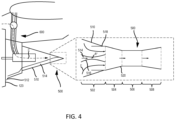
- the tail cone 510 comprises a scoop 512 proximate primary nozzle 123.
- the scoop 512 may be configured to direct a portion of exhaust flow from core flow path C from FIG. 1B internal to the tail cone 510 along a channel 514.
- the channel 514 is in fluid communication with an ejector body 520 of the ejector assembly 500.
- the channel 514 may direct exhaust air from core flow path C through the choke area (e.g., throat A*), and entrain cooling flow traveling along cooling flow path E.
- the cooling flow path E may be radially outward from the channel 514.
- ejector assembly 500 comprises a nozzle section 502, a mixing section 504, a constant area section 506, and a diffuser section 508.
- the nozzle section 502 includes a nozzle portion 516 of the ejector assembly 500.
- the cooling flow path E is disposed between the nozzle portion 516 and the ejector body 520. In various embodiments, the cooling flow path E is the secondary flow path, and the channel 514 defines the primary flow path.
- an ejector assembly in accordance with ejector assembly 500 may be more complicated from a manufacturing standpoint for a tail cone ejector relative to an ejector assembly in accordance with the ejector assembly 400. However, an ejector assembly in accordance with ejector assembly 500 may be slightly more efficient relative to an ejector assembly in accordance with ejector assembly 400 from FIG. 3 .
- the ejector body 520 may be coupled to the tail cone 510 proximate a tail cone outlet 518.
- the channel 514 may be a fluid conduit disposed within the tail cone 510.
- the ejector body 520 and the tail cone 510 may be a monolithic component. In various embodiments, the ejector body 520 and the tail cone may be distinct components.
- the tail cone ejector assembly 400 in accordance with various embodiments, is illustrated.
- the ejector assembly 400 further comprises a motive fluid inlet scoop 712.
- the ejector assembly 400 may include any number of motive fluid inlet scoops (e.g., one single inlet scoop that sweeps a circumference of less than 360 degrees that is non-axisymmetric, a plurality of motive inlet scoops disposed symmetrically proximate the tail cone outlet 414 of the tail cone 410, or a plurality of asymmetric motive inlet scoops disposed proximate the tail cone outlet 414).
- the motive fluid inlet scoop 712 may provide a lip height that is larger to avoid clogging of the ejector assembly 400.
- the method 800 comprises diverting an exhaust air flow from a gas turbine engine proximate a tail cone (step 802).
- the exhaust air flow may be diverted by a scoop, such as scoop 512 from FIG. 4 or scoop 424 from FIG. 3 .
- the exhaust air flow may be diverted internal to the tail cone, as illustrated in FIG. 4 , or between the tail cone and an ejector body as illustrated in FIG. 3 .
- the method 800 further comprises choking the exhaust air flow proximate an outlet of the tail cone (step 804).
- the exhaust air flow may be subsonic prior to being choked and sonic after being choked.
- the exhaust air flow is choked forward of a tail cone outlet.
- the method 800 further comprises entraining a cooling air flow from the outlet of the tail cone (step 806).
- the cooling air flow may be an air flow of a conductive power cable cooling system.
- the cooling air flow may be an air flow that is pulled from an external air source from ambient air through a conduit and internal to the tail cone.
- the cooling air flow may be pulled out the outlet of the tail cone in response entraining the cooling air flow.
Landscapes
- Engineering & Computer Science (AREA)
- Chemical & Material Sciences (AREA)
- Combustion & Propulsion (AREA)
- Mechanical Engineering (AREA)
- General Engineering & Computer Science (AREA)
- Structures Of Non-Positive Displacement Pumps (AREA)
Description
- The present disclosure relates to gas turbine engines, and, more specifically, to cooling systems for conductive cables in gas turbine engines.
- A turbofan engine typically includes a fan section, a compressor section, a combustor section and a turbine section. Air entering the compressor section is compressed and delivered into the combustion section where it is mixed with fuel and ignited to generate a high-energy exhaust gas flow. The high-energy exhaust gas flow expands through the turbine section to drive the compressor and the fan section.
- Electric power for the engine is typically provided by a motor/generator driven through a tower shaft driven by a main engine shaft. Motor/generators and electric motors are typically stand-alone devices that are coupled to an external accessory gearbox. Alternate motor/generator and motor configurations and placements may provide increased engine efficiencies and accommodate increasing demands for electric power.
-
US 9 644 538 B2 - According to an aspect of the invention, there is provided an ejector assembly for a cooling system of a gas turbine engine as claimed in
claim 1. - In various embodiments, the nozzle section is defined by a nozzle portion of the ejector body and the tail cone. The ejector body may further comprise a scoop defining an inlet to the nozzle section. A throat of the nozzle section is disposed forward of the tail cone outlet. The cooling air flow may be from an external air source disposed radially outward from a bypass air flow path of the gas turbine engine. The tail cone may comprise a scoop configured to divert the exhaust air flow of the gas turbine engine internal to the tail cone. The tail cone may further comprise a channel extending through the tail cone and in fluid communication with the exhaust air flow, the channel defining a throat at a nozzle portion of the channel. A cooling air flow path may be defined radially outward from the channel and between the channel and the ejector body. The ejector body may be coupled to the tail cone at the tail cone outlet. A cooling assembly may include the ejector assembly, the electric motor disposed in the tail cone, a conduit in fluid communication with the electric motor and the ejector assembly, and a plurality of conductive cables extending through the conduit and coupled to the electric motor. The cooling air flow may be configured to cool the plurality of conductive cables.
- According to a further aspect of the invention, there is provided a method of exhausting a cooling air flow from a tail cone of a gas turbine engine as claimed in
claim 10. - In various embodiments, the exhaust air flow is disposed radially outward of the cooling air flow. Entraining the cooling air flow may further comprise pulling the cooling air flow through the outlet of the tail cone. The exhaust air flow may be diverted via a scoop proximate a nozzle of the gas turbine engine. The method may further comprise flowing the cooling air flow over a plurality of conductive cables prior to entraining the cooling air flow. The method may further comprise pulling the cooling air flow from an external source prior to flowing the cooling air flow over the plurality of conductive cables.
- These features and elements as well as the operation thereof will become more apparent in light of the following description and the accompanying drawings. It should be understood, however, the following description and drawings are intended to be exemplary in nature and non-limiting.
- The subject matter of the present disclosure is particularly pointed out and distinctly claimed in the concluding portion of the specification. A more complete understanding of the present disclosure, however, may best be obtained by referring to the detailed description and claims when considered in connection with the figures, wherein like numerals denote like elements.
-
FIG. 1A illustrates a nacelle for a gas turbine engine, in accordance with various embodiments; -
FIG. 1B illustrates a cross-sectional view of a gas turbine engine having a fluid injection system, in accordance with various embodiments; -
FIG. 2 illustrates a schematic view of cooling system of a gas turbine engine, in accordance with various embodiments; -
FIG. 3 illustrates a schematic view of an ejector assembly for use in a cooling system of a gas turbine engine, in accordance with various embodiments; and -
FIG. 4 illustrates a schematic view of an ejector assembly for use in a cooling system of a gas turbine engine, in accordance with various embodiments; -
FIG. 5 illustrates a schematic view of an ejector assembly for use in a cooling system of a gas turbine engine, in accordance with various embodiments; and -
FIG. 6 illustrates a method of entraining a cooling air flow from a tail cone of a gas turbine engine. - The detailed description of exemplary embodiments herein makes reference to the accompanying drawings, which show exemplary embodiments by way of illustration. Thus, the detailed description herein is presented for purposes of illustration only and not limitation. The steps recited in any of the method or process descriptions may be executed in any order and are not necessarily limited to the order presented.
- Throughout the present disclosure, like reference numbers denote like elements. Accordingly, elements with like element numbering may be shown in the figures, but may not necessarily be repeated herein for the sake of clarity. Surface shading lines and/or cross-hatching may be used throughout the figures to denote different parts but not necessarily to denote the same or different materials.
- Aft includes the direction associated with the tail (e.g., the back end) of an aircraft, or generally, to the direction of exhaust of a gas turbine engine. Forward includes the direction associated with the intake (e.g., the front end) of a gas turbine engine.
- A first component that is "radially outward" of a second component means that the first component is positioned at a greater distance away from a central longitudinal axis of the gas turbine engine. A first component that is "radially inward" of a second component means that the first component is positioned closer to the engine central longitudinal axis than the second component. The terminology "radially outward" and "radially inward" may also be used relative to references other than the engine central longitudinal axis.
- With reference to
FIG. 1A , anacelle 10 for a gas turbine engine is illustrated according to various embodiments.Nacelle 10 may comprise aninlet 12, afan cowl 14, and a thrust reverser 16.Nacelle 10 may be coupled to apylon 20. Pylon 20 may mountnacelle 10, and a gas turbine engine located withinnacelle 10, to an aircraft wing or aircraft body. In various embodiments, anexhaust system 18 may extend from the gas turbine engine mounted withinnacelle 10. -
FIG. 1B illustrates a cross-sectional view of agas turbine engine 110 located withinnacelle 10, in accordance with various embodiments.Gas turbine engine 110 may include acore engine 120.Core engine 120 may include an inlet section 22, acompressor section 24, acombustor section 26, and aturbine section 28. In operation, afan 114 drives fluid (e.g., air) along a bypass flow-path B whilecompressor section 24 can drive air along a core flow-path C for compression and communication intocombustor section 26 then expansion throughturbine section 28. In various embodiments,core engine 120 generally comprises a low speed spool and a high speed spool mounted for rotation about an engine central longitudinal axis A-A'. Low speed spool may generally comprise a shaft that interconnectsfan 114, alow pressure compressor 144, and alow pressure turbine 146. The high speed spool may comprise a shaft that interconnects ahigh pressure compressor 152 andhigh pressure turbine 154. A combustor may be located betweenhigh pressure compressor 152 andhigh pressure turbine 154. As used herein, a "high pressure" compressor or turbine experiences a higher pressure than a corresponding "low pressure" compressor or turbine. Although depictedgas turbine engine 110 is illustrated as a turbofan engine herein, it should be understood that the concepts described herein are not limited in use to turbofans as the teachings may be applied to other types of engines including turboprop and turboshaft engines. Althoughcore engine 120 may be depicted as a two-spool architecture herein, it should be understood that the concepts described herein are not limited in use to two-spool gas turbine engines as the teachings may be applied to other types of engines including engines having more than or less than two spools. -
Core engine 120 drivesfan 114 ofgas turbine engine 110. The air flow in core flow path C may be compressed bylow pressure compressor 144 thenhigh pressure compressor 152, mixed and burned with fuel in thecombustor section 26, then expanded throughhigh pressure turbine 154 andlow pressure turbine 146.Turbines fan 114, flows in the aft direction throughbypass flow path 124. At least a portion ofbypass flow path 124 may be defined bynacelle 10 and an inner fixed structure (IFS) 126. - An
upper bifurcation 143 and alower bifurcation 142 may extend radially between thenacelle 10 andIFS 126 in locations opposite one another. Engine components such as wires and fluids, for example, may be accommodated inupper bifurcation 143 andlower bifurcation 142.IFS 126 surroundscore engine 120 and providescore compartment 128. Various components may be provided incore compartment 128 such as fluid conduits and/or compressed air ducts. For example, a portion BCORE of bypass air flow B may flow betweencore engine 120 andIFS 126 incore compartment 128. Afan case 132 may surroundfan 114.Fan case 132 may be housed withinnacelle 10.Fan case 132 may provide a mounting structure for securinggas turbine engine 110 topylon 20, with momentary reference toFIG. 1A . According to various embodiments, one or more fanexit guide vanes 116 may extend radially betweencore engine 120 andfan case 132. -
Exhaust system 18 is located aft ofturbine section 28. Core air flow C flows throughcore engine 120 and is expelled through anexhaust outlet 118 ofexhaust system 18.Exhaust outlet 118 may comprise anaerodynamic tail cone 122. Aprimary nozzle 123 may be located radially outward oftail cone 122.Primary nozzle 123 andtail cone 122 may defineexhaust outlet 118.Exhaust outlet 118 provides an exhaust path for core air flow C exitingturbine section 28 ofcore engine 120. A secondary nozzle may be located radially outward ofprimary nozzle 123.Primary nozzle 123 and the secondary nozzle may define an exit flow path for bypass air flow B exitingcore compartment 128 and/orbypass flow path 124. A plurality of turbine exit guide vanes (TEGVs) 150 may be located circumferentially about engine central longitudinal axis A-A' and proximate anaft end 145 oflow pressure turbine 146. - In various embodiments, an
electric motor 210 is disposed intail cone 122. Theelectric motor 210 may be mechanically coupled to a low speed spool incore engine 120.Electric motor 210 may comprise an electric generator, an electric motor, a combination of the two, or the like.Electric motor 210 may be electrically coupled to a juncture box, or any other electrical device known in the art. The electrical device may be disposed radially outward fromIFS 126 ofgas turbine engine 110 in awing 30 of an aircraft, in thepylon 20 of the aircraft, or the like. Conductive cables may extend from theelectric motor 210 to the electric device external togas turbine engine 110. The conductive cables (e.g., copper wires or the like) may extend radially outward fromelectric motor 210 through astrut 220, through thepylon 20 and to an electrical device in thewing 30, or any other location external or internal toIFS 126. Thestrut 220 extends from thetail cone 122 beyond theIFS 126. The strut may be disposed aft of theaft end 145 of lowpressure compressor turbine 146 and forward ofexhaust outlet 118. Due to the conductive cables proximity toexhaust outlet 118, the conductive cables may experience relatively high temperatures from air flow in core air flow path C. - In various embodiments, the conductive cables may be disposed in a
conduit 230 extending radially outward fromtail cone 122 throughstrut 220 and into thepylon 20. Theconduit 230 may be fluidly coupled to an external air source by any method known in the art, such as a scoop, a vent, or the like. Theexternal air source 232 may be disposed radially outward fromnacelle 10. In this regard, theexternal air source 232 may receive colder temperature air relative to bypass air flow B. Althoughexternal air source 232 is illustrated forward of theelectric motor 210 on the pylon, the application is not limited in this regard. For example, in various embodiments, theexternal air source 232 may be aft of theelectric motor 210. - In various embodiments, bleed air from the core air flow path C may be diverted aft of the fan as a cooling source. However, bleed air may increase the mass flow and/or reduce efficiency of
gas turbine engine 110. To address this, ambient air may be pulled from external togas turbine engine 110, which may reduce or eliminate utilizing bleed air for the cooling of conductive power cables. In various embodiments, bypass air from bypass air flow path B may be diverted to act as a cooling source for cooling of conductive cables. However, bypass air may be limited to use while thegas turbine engine 110 is in operation. In this regard, bypass air may provide insufficient cooling after engine shutdown, or the like. - Referring now to
FIG. 2 , a schematic view of a conductivecable cooling system 300, in accordance with various embodiments, is illustrated. The conductivecable cooling system 300 comprises a plurality ofconductive cables 310. Theconductive cables 310 are extending from anelectric motor 210 disposed in atail cone 122. Theelectric motor 210 is operably coupled to alow speed spool 302 of a gas turbine engine (e.g.,gas turbine engine 110 fromFIG. 1B ). The conductivecable cooling system 300 further comprises astrut 220 extending from a radiallyouter surface 312 oftail cone 122 to a radiallyinner surface 322 ofpylon 20. Thestrut 220 may comprise anouter strut shell 332 and aninner strut shell 334. Theouter strut shell 332 may be exposed to air flow from core air flow path C inFIG. 1B during operation of thegas turbine engine 110. The conductivecable cooling system 300 may further comprise anair seal 340 disposed betweeninner strut shell 334 andouter strut shell 332. In this regard, theair seal 340 may ensure that the plurality ofconductive cables 310 are sealed from air from core air flow path C. - In various embodiments, the conductive
cable cooling system 300 further comprises aconduit 350. Theconduit 350 may be configured to house the plurality ofconductive cables 310 throughstrut 220. Theconduit 350 may be flexible or rigid. Theconduit 350 may comprise a woven fiberglass sleeve, or the like. Theconduit 350 may protect the plurality ofconductive cables 310 from contactingstrut 220 during operation of thegas turbine engine 110 fromFIG. 1 . Theconduit 350 may further provide a cooling passageway for cooling air to flow from theexternal air source 232 fromFIG. 1 . - In various embodiments, the conductive
cable cooling system 300 further comprises anelectric fan 360 in fluid communication with theconduit 350 and avent 370. Theelectric fan 360 may be configured to actively cool the plurality ofconductive cables 310. Thevent 370 may be configured to open or close. Theelectric fan 360 may be configured to receive cooling air flow from ambient air (e.g., an external air source from the nacelle, such as external air source 232). Theelectric fan 360 and thevent 370 may be electrically coupled to aprocessor 390. In various embodiments,processor 390 may be in electrical communication withelectric fan 360. Theprocessor 390 may be configured to activate, increase, or decrease a speed of the electric fan in response to various operation conditions of the gas turbine engine. Similarly, thevent 370 may be modulated in response to changes in various operation conditions of gas turbine engine. Theprocessor 390 may be configured to detect an engine shutdown. In response to the engine shutdown,processor 390 may command vent 370 to open and command the electric fan to activate and begin rotating. In various embodiments, vent 370 may already be open at engine shutdown, and the processor may command the electric fan to increase a rotation speed or begin to rotate. In various embodiments, vent 370 may be commanded to operate between open and closed during operation in response to a desired air flow desired inconduit 350. Although theelectric fan 360 and thevent 370 are illustrated as being forward of theelectric motor 210, the disclosure is not limited int his regard. For example, in various embodiments, theelectric fan 360 and thevent 370 are disposed aft of theelectric motor 210. - The
vent 370 may assume a closed configuration, an open configuration (100% open), and/or a partially open configuration (ranging between the open configuration and the closed configuration) as commanded by a controller. In various embodiments, the closed configuration may comprise thevent 370 being approximately 0% percent open (e.g., between 0% and 2% open), which may be set at any desired percent open. For the sake of simplicity, in this disclosure, the minimum percent open for the closed configuration is 0% open but in some embodiments may also be different values (e.g., 5% or other small openings that may allow passage of small amounts of air). In various embodiments, the vent actuator may cause thevent 370 to become more open or less open, at any time before, during, or after operation of thegas turbine engine 110 fromFIG. 1B to assume the open configuration, a partially open configuration, and/or the closed configuration. - In various embodiments,
processor 390 may be integrated into computer systems onboard an aircraft, such as, for example, a full authority digital engine control (FADEC), an engine-indicating and crew-alerting system (EICAS), and/or the like.Processor 390 may include one or more processors and/or one or more tangible, non-transitory memories and be capable of implementing logic. Each processor can be a general purpose processor, a digital signal processor (DSP), an application specific integrated circuit (ASIC), a field programmable gate array (FPGA) or other programmable logic device, discrete gate or transistor logic, discrete hardware components, or any combination thereof. - In various embodiments,
processor 390 may comprise a processor configured to implement various logical operations in response to execution of instructions, for example, instructions stored on a non-transitory, tangible, computer-readable medium. As used herein, the term "non-transitory" is to be understood to remove only propagating transitory signals per se from the claim scope and does not relinquish rights to all standard computer-readable media that are not only propagating transitory signals per se. - In various embodiments,
processor 390 may be configured to control conductivecable cooling system 300. For example,processor 390 may be configured to transfer a control signal to electric fan to actively control cooling of the plurality ofconductive cables 310.Processor 390 may generate and transmit the control signal based on an input received from FADEC or an electronic engine control in response to gas turbine engine shutting down. In this regard, conductivecable cooling system 300 may allow for active cooling of the plurality ofconductive cables 310 after engine shutdown. The excitation control signal may further comprise electronic instructions configured to cause theelectric fan 360 to rotate and provide cooling air in response to a temperature inconduit 350 exceeding a predetermined threshold. For example, a temperature sensor may be disposed inconduit 350 in electrical communication with theprocessor 390. In response to the temperature sensor detecting a conduit temperature above a threshold level,electric fan 360 may be active. In various embodiments,processor 390 may be configured to transmit a control signal to rotateelectric fan 360 during operation ofgas turbine engine 110 fromFIG. 1 . In this regard,electric fan 360 may drive air from external air source 232 (e.g., ambient air). Theexternal air source 232 may provide colder air relative to bypass air flow, core air flow or the like and/or provide better cooling to the plurality of conductive cables than typic cable cooling systems. - In various embodiments, the cooling air provided by
electric fan 360 may travel along cooling path D through thepylon 20 and strut 220 into thetail cone 122 and exit out a tail cone ejector disposed at an aft end oftail cone 122 as described further herein. - Referring now to
FIG. 3 , a schematic view of a tailcone ejector assembly 400 for use in a conductivecable cooling system 300, in accordance with various embodiments, is illustrated. Tailcone ejector assembly 400 includes anozzle section 402, amixing section 404, aconstant area section 406, and adiffuser section 408. In various embodiments, theejector assembly 400 comprises atail cone 410 and anejector body 420. Thetail cone 410 may be a part oftail cone 122 fromFIGs. 1B and2 . In operation, an entrained flow may travel through a flow path defined by awall 412 of atail cone 410 and a primary flow may travel between thewall 412 and anozzle portion 422 of anejector body 420. Thenozzle portion 422 may be a portion of the ejector body within thenozzle section 402 of the tailcone ejector assembly 400. Thewall 412 may further define cooling path D, and thewall 412 and thenozzle portion 422 of theejector body 420 may further define core-flow path C. Fluid (e.g., air) is driven through core-flow path C as described previously herein, which is configured to entrain cooling flow along cooling flow path D. For example, a drop in pressure of the fluid traveling along core-flow path C caused by an increase in velocity after the flow along core-flow path C is choked at the choke area (e.g., the throat A*) pulls in (e.g., entrains) the cooling air flow through the cooling flow path D. The choke area is a constriction area along core-flow path C and may be a minimum constriction area. By choking the flow at the choke area, the velocity of the air flow traveling along core-flow path C increases aft of the choke area. Although described herein as an ejector assembly with choked flow resulting in a sonic exit velocity, the present disclosure is not limited in this regard. For example, a tailcone ejector assembly 400 may include a non-choked ejector without a choke area (e.g., throat A*) resulting in a subsonic exit velocity of the ejector assembly. - In various embodiments, the
electric fan 360 fromFIG. 2 may be sized and configured to actively cool theconductive cables 310 after an engine shutdown when an airplane having the gas turbine engine is on the ground. During operation of the gas turbine engine, theelectric fan 360 may not provide enough pressure to eject air out thetail cone 410 on its own. For example, without theejector assembly 400, air traveling along cooling flow path D may be subject to reverse. In various embodiments, by having an ejector assembly 400 a size of theelectric fan 360 fromFIG. 2 may be reduced as the air traveling along the core flow path C of theejector assembly 400 may entrain the cooling air traveling along cooling flow path D in themixing section 404 of theejector assembly 400. - In various embodiments, the
ejector body 420 further comprises ascoop 424 disposed at a forward end of theejector body 420. Thescoop 424 is configured to scoop exhaust flow from the gas-turbine engine into the outer annulus defined by thewall 412 of thetail cone 410 and theejector body 420 where the exhaust flow acts as the primary air flow of theejector assembly 400. In various embodiments, thetail cone 410 further comprises atail cone outlet 414 disposed aft of thescoop 424 of theejector body 420. Thetail cone outlet 414 is also aft of the throat A* of theejector assembly 400 and adjacent to themixing section 404 of the ejector assembly. - In various embodiments, the
ejector assembly 400 may be referred to as a critical or a non-critical ejector assembly. In various embodiments, a critical ejector assembly means that the ejector assembly is designed to accommodate fluid velocity along the core flow path C prior to the throat A* that is sonic, whereas a non-critical ejector assembly means ejector assembly that is designed to accommodate a fluid velocity along the core flow path C prior to the throat A* as being subsonic. In various embodiments, when theejector assembly 400 is a critical design, theejector assembly 400 may be sensitive to operating conditions other than those for which theejector assembly 400 is designed. With a critical ejector assembly, it is possible to decrease the motivating pressure (e.g., the air flow through core flow path C) without a resulting change in the suction pressure if the discharge pressure is also decreased. The relation of change between the motivating pressure and the discharge pressure depends on the characteristics of the design of theejector assembly 400. Since an ejector may have an optimal design point for a certain throat profile, once theejector assembly 400 is designed and built to definite specifications of motivating pressure, discharge pressure and suction pressure, suction capacity of theejector assembly 400 does not increase without changing the internal physical dimensions of theejector assembly 400. The suction capacity may actually be lowered by increasing the motivating pressure. Since thenozzle portion 422 of theejector body 420 is a fixed orifice metering device any change in the motivating pressure is accompanied by a proportionate change in the quantity of motive fluid. - In various embodiments, when the
ejector assembly 400 is a non-critical design, changes in the motivating pressure and discharge pressure cause gradual changes in the suction pressure and capacity. Suction capacity does not increase in proportion to motivating pressure increases. - Referring now to
FIG. 4 , a schematic view of a tailcone ejector assembly 500 for use in a conductivecable cooling system 600, in accordance with various embodiments, is illustrated. In various embodiments, the conductivecable cooling system 600 is in accordance with the conductivecable cooling system 300 except as further described herein. In various embodiments, thetail cone 510 comprises ascoop 512 proximateprimary nozzle 123. In this regard, thescoop 512 may be configured to direct a portion of exhaust flow from core flow path C fromFIG. 1B internal to thetail cone 510 along achannel 514. - In various embodiments, the
channel 514 is in fluid communication with anejector body 520 of theejector assembly 500. For example, thechannel 514 may direct exhaust air from core flow path C through the choke area (e.g., throat A*), and entrain cooling flow traveling along cooling flow path E. In various embodiments, the cooling flow path E may be radially outward from thechannel 514. Similar toejector assembly 400 fromFIG. 3 ,ejector assembly 500 comprises anozzle section 502, amixing section 504, aconstant area section 506, and adiffuser section 508. Thenozzle section 502 includes anozzle portion 516 of theejector assembly 500. In various embodiments, the cooling flow path E is disposed between thenozzle portion 516 and theejector body 520. In various embodiments, the cooling flow path E is the secondary flow path, and thechannel 514 defines the primary flow path. In various embodiments, an ejector assembly in accordance withejector assembly 500 may be more complicated from a manufacturing standpoint for a tail cone ejector relative to an ejector assembly in accordance with theejector assembly 400. However, an ejector assembly in accordance withejector assembly 500 may be slightly more efficient relative to an ejector assembly in accordance withejector assembly 400 fromFIG. 3 . - In various embodiments, the
ejector body 520 may be coupled to thetail cone 510 proximate atail cone outlet 518. In various embodiments, thechannel 514 may be a fluid conduit disposed within thetail cone 510. In various embodiments, theejector body 520 and thetail cone 510 may be a monolithic component. In various embodiments, theejector body 520 and the tail cone may be distinct components. - Referring now to
FIG. 5 , the tailcone ejector assembly 400 in accordance with various embodiments, is illustrated. In various embodiments, theejector assembly 400 further comprises a motivefluid inlet scoop 712. Although illustrated as comprising three motive fluid inlet scoops, theejector assembly 400 is not limited in this regard. For example, theejector assembly 400 may include any number of motive fluid inlet scoops (e.g., one single inlet scoop that sweeps a circumference of less than 360 degrees that is non-axisymmetric, a plurality of motive inlet scoops disposed symmetrically proximate thetail cone outlet 414 of thetail cone 410, or a plurality of asymmetric motive inlet scoops disposed proximate the tail cone outlet 414). In various embodiments, the motivefluid inlet scoop 712 may provide a lip height that is larger to avoid clogging of theejector assembly 400. - Referring now to
FIG. 6 , amethod 800 of using a tail cone ejector assembly (e.g., tailcone ejector assembly 400, 500), in accordance with various embodiments, is illustrated. In various embodiments, themethod 800 comprises diverting an exhaust air flow from a gas turbine engine proximate a tail cone (step 802). The exhaust air flow may be diverted by a scoop, such asscoop 512 fromFIG. 4 or scoop 424 fromFIG. 3 . The exhaust air flow may be diverted internal to the tail cone, as illustrated inFIG. 4 , or between the tail cone and an ejector body as illustrated inFIG. 3 . - In various embodiments, the
method 800 further comprises choking the exhaust air flow proximate an outlet of the tail cone (step 804). In various embodiments, the exhaust air flow may be subsonic prior to being choked and sonic after being choked. In various embodiments, the exhaust air flow is choked forward of a tail cone outlet. In various embodiments, themethod 800 further comprises entraining a cooling air flow from the outlet of the tail cone (step 806). The cooling air flow may be an air flow of a conductive power cable cooling system. For example, the cooling air flow may be an air flow that is pulled from an external air source from ambient air through a conduit and internal to the tail cone. In various embodiments, the cooling air flow may be pulled out the outlet of the tail cone in response entraining the cooling air flow. - The scope of the disclosures is accordingly to be limited by nothing other than the appended claims, in which reference to an element in the singular is not intended to mean "one and only one" unless explicitly so stated, but rather "one or more." After reading the description, it will be apparent to one skilled in the relevant art(s) how to implement the disclosure in alternative embodiments.
Claims (15)
- An ejector assembly (400; 500) for a cooling system (300; 600) of a gas turbine engine (110), the ejector assembly comprising:a tail cone (410; 510) having a tail cone outlet (414; 518) in fluid communication with a cooling air flow of the cooling system;an ejector body (420; 520) defining a mixing section (404; 504), a constant area section (406; 506), and a diffuser section (408; 508); anda nozzle section (402; 502) in fluid communication with an exhaust air flow of the gas turbine engine, the ejector assembly configured to entrain the cooling air flow via the exhaust air flow.
- The ejector assembly (400; 500) of claim 1, wherein the nozzle section (402; 502) is defined by a nozzle portion (422; 516) of the ejector body (420; 520) and the tail cone (410; 510).
- The ejector assembly (400; 500) of claim 1 or 2, wherein the ejector body (420; 520) further comprises a scoop (424; 512) defining an inlet to the nozzle section (402; 502).
- The ejector assembly (400; 500) of claim 1, 2 or 3, wherein a throat (A*) of the nozzle section (402; 502) is disposed forward of the tail cone outlet (414; 518).
- The ejector assembly (400; 500) of any preceding claim, wherein, in use, the cooling air flow is from an external air source (232) disposed radially outward from a bypass air flow path (B) of the gas turbine engine (110).
- The ejector assembly (500) of any preceding claim, wherein:the tail cone (510) comprises a scoop (512) configured to divert the exhaust air flow of the gas turbine engine (110) internal to the tail cone;the tail cone further comprises a channel (514) extending through the tail cone and in fluid communication with the exhaust air flow, the channel defining a throat (A*) at a nozzle portion (516) of the channel.
- The ejector assembly (500) of claim 6, wherein a cooling air flow path is defined radially outward from the channel (514) and between the channel and the ejector body (520); and
the ejector body is coupled to the tail cone (510) at the tail cone outlet (518). - A cooling assembly, comprising:the ejector assembly (400; 500) of any preceding claim;an electric motor (210) disposed in the tail cone (122; 410; 510);a conduit (230; 350) in fluid communication with the electric motor and the ejector assembly; anda plurality of conductive cables (310) extending through the conduit and coupled to the electric motor.
- The cooling assembly of claim 8, wherein the cooling air flow is configured to cool the plurality of conductive cables (310).
- A method (800) of exhausting a cooling air flow from a tail cone (410; 510) of a gas turbine engine (110), the method comprising:diverting an exhaust air flow from the gas turbine engine;choking the exhaust air flow forward of an outlet (414; 518) of the tail cone; and entraining the cooling air flow from the outlet of the tail cone.
- The method (800) of claim 10, wherein the exhaust air flow is disposed radially outward of the cooling air flow.
- The method (800) of claim 10 or 11, wherein entraining the cooling air flow further comprises pulling the cooling air flow through the outlet (414; 518) of the tail cone (410; 510).
- The method (800) of claim 10, 11 or 12, wherein the exhaust air flow is diverted via a scoop (512) proximate a nozzle (123) of the gas turbine engine (110).
- The method (800) of any of claims 10 to 13, further comprising flowing the cooling air flow over a plurality of conductive cables (310) prior to entraining the cooling air flow.
- The method (800) of claim 14, further comprising pulling the cooling air flow from an external source prior to flowing the cooling air flow over the plurality of conductive cables (310).
Priority Applications (1)
| Application Number | Priority Date | Filing Date | Title |
|---|---|---|---|
| EP23153166.6A EP4194679B1 (en) | 2020-09-11 | 2021-07-09 | Tail cone ejector for power cable cooling system in a gas turbine engine |
Applications Claiming Priority (1)
| Application Number | Priority Date | Filing Date | Title |
|---|---|---|---|
| US17/018,795 US11585291B2 (en) | 2020-09-11 | 2020-09-11 | Tail cone ejector for power cable cooling system in a gas turbine engine |
Related Child Applications (2)
| Application Number | Title | Priority Date | Filing Date |
|---|---|---|---|
| EP23153166.6A Division-Into EP4194679B1 (en) | 2020-09-11 | 2021-07-09 | Tail cone ejector for power cable cooling system in a gas turbine engine |
| EP23153166.6A Division EP4194679B1 (en) | 2020-09-11 | 2021-07-09 | Tail cone ejector for power cable cooling system in a gas turbine engine |
Publications (2)
| Publication Number | Publication Date |
|---|---|
| EP4001626A1 EP4001626A1 (en) | 2022-05-25 |
| EP4001626B1 true EP4001626B1 (en) | 2024-11-20 |
Family
ID=76859474
Family Applications (2)
| Application Number | Title | Priority Date | Filing Date |
|---|---|---|---|
| EP23153166.6A Active EP4194679B1 (en) | 2020-09-11 | 2021-07-09 | Tail cone ejector for power cable cooling system in a gas turbine engine |
| EP21184728.0A Active EP4001626B1 (en) | 2020-09-11 | 2021-07-09 | Tail cone ejector for power cable cooling system in a gas turbine engine |
Family Applications Before (1)
| Application Number | Title | Priority Date | Filing Date |
|---|---|---|---|
| EP23153166.6A Active EP4194679B1 (en) | 2020-09-11 | 2021-07-09 | Tail cone ejector for power cable cooling system in a gas turbine engine |
Country Status (2)
| Country | Link |
|---|---|
| US (1) | US11585291B2 (en) |
| EP (2) | EP4194679B1 (en) |
Families Citing this family (5)
| Publication number | Priority date | Publication date | Assignee | Title |
|---|---|---|---|---|
| PL435035A1 (en) * | 2020-08-20 | 2022-02-21 | General Electric Company Polska Spółka Z Ograniczoną Odpowiedzialnością | Gas turbine engines containing embedded electrical machines and associated cooling systems |
| US11578657B2 (en) * | 2020-10-27 | 2023-02-14 | Raytheon Technologies Corporation | Power cable cooling system in a gas turbine engine |
| US12595765B2 (en) * | 2024-02-02 | 2026-04-07 | Rtx Corporation | Bifurcation integrated electrical system for hybrid aircraft propulsion system |
| US12553384B2 (en) * | 2024-08-02 | 2026-02-17 | Rtx Corporation | High pressure cooling systems for hybrid and conventional engines |
| US12577924B1 (en) * | 2024-12-19 | 2026-03-17 | Rtx Corporation | Tailcone and conduit ventilation system with variable internal flow distribution |
Family Cites Families (37)
| Publication number | Priority date | Publication date | Assignee | Title |
|---|---|---|---|---|
| GB865838A (en) * | 1958-05-31 | 1961-04-19 | Walter Eberspacher | Jet propulsion nozzle for jet propulsion power plants |
| US4055041A (en) | 1974-11-08 | 1977-10-25 | The United States Of America As Represented By The Administrator Of The National Aeronautics And Space Administration | Integrated gas turbine engine-nacelle |
| US5154052A (en) * | 1990-05-07 | 1992-10-13 | General Electric Company | Exhaust assembly for a high speed civil transport aircraft engine |
| US5435127A (en) * | 1993-11-15 | 1995-07-25 | General Electric Company | Method and apparatus for boosting ram airflow to an ejection nozzle |
| JP2001078344A (en) | 1999-09-06 | 2001-03-23 | Hitachi Cable Ltd | Power cable air cooling system in the tunnel |
| US6651929B2 (en) | 2001-10-29 | 2003-11-25 | Pratt & Whitney Canada Corp. | Passive cooling system for auxiliary power unit installation |
| JP2004076703A (en) | 2002-08-22 | 2004-03-11 | Toshiba Corp | Wiring cooling structure |
| US6895756B2 (en) * | 2002-09-13 | 2005-05-24 | The Boeing Company | Compact swirl augmented afterburners for gas turbine engines |
| US7284364B2 (en) | 2003-09-08 | 2007-10-23 | Northrop Grumman Ship Systems, Inc. | Passive exhaust suppressor and method |
| US6931856B2 (en) | 2003-09-12 | 2005-08-23 | Mes International, Inc. | Multi-spool turbogenerator system and control method |
| US20050091963A1 (en) * | 2003-10-30 | 2005-05-05 | Gongling Li | Aircraft turbine engine and an air ejection assembly for use therewith |
| US7134271B2 (en) * | 2004-11-05 | 2006-11-14 | General Electric Company | Thrust vectoring aft FLADE engine |
| GB0702997D0 (en) | 2007-02-16 | 2007-03-28 | Rolls Royce Plc | A cooling arrangement of an electrical machine |
| DE102007036527B4 (en) * | 2007-08-02 | 2009-07-09 | Eads Deutschland Gmbh | Nozzle arrangement for a gas turbine engine |
| GB201112319D0 (en) | 2011-07-18 | 2011-08-31 | Rolls Royce Plc | A electromagnetic component for a stator segment of an electrical machine |
| US9003811B2 (en) * | 2011-11-28 | 2015-04-14 | Pratt & Whitney Canada Corp. | Support for electric machine in a turbine engine |
| US9879600B2 (en) | 2012-04-30 | 2018-01-30 | General Electric Company | Turbine component cooling system |
| US9097134B2 (en) | 2012-09-14 | 2015-08-04 | Pratt & Whitney Canada Corp. | Air cooling design for tail-cone generator installation |
| WO2014123850A1 (en) * | 2013-02-06 | 2014-08-14 | United Technologies Corporation | Gas turbine engine component with upstream-directed cooling film holes |
| US8829702B1 (en) | 2013-03-11 | 2014-09-09 | Pratt & Whitney Canada Corp | Gas turbine engine with internal electromechanical device |
| US20140321981A1 (en) | 2013-04-26 | 2014-10-30 | Jose L. Rodriguez | Turbine engine shutdown temperature control system |
| GB201417320D0 (en) | 2014-10-01 | 2014-11-12 | Rolls Royce Plc | A mounting arrangement for an electrical harness |
| US9917490B2 (en) | 2014-11-21 | 2018-03-13 | Hamilton Sundstrand Corporation | Tail cone generator with integral speed increasing gearbox |
| US20160258358A1 (en) | 2015-03-02 | 2016-09-08 | Sikorsky Aircraft Corporation | High turning angle ejector cooled turbine engine exhaust duct |
| US9976484B2 (en) | 2015-12-28 | 2018-05-22 | United Technologies Corporation | Core compartment ventilation devices for nacelles of gas turbine engines for cooling a core compartment of a gas turbine engine |
| US11105340B2 (en) | 2016-08-19 | 2021-08-31 | General Electric Company | Thermal management system for an electric propulsion engine |
| US10071811B2 (en) | 2016-08-22 | 2018-09-11 | General Electric Company | Embedded electric machine |
| US10308366B2 (en) | 2016-08-22 | 2019-06-04 | General Electric Company | Embedded electric machine |
| US10487839B2 (en) | 2016-08-22 | 2019-11-26 | General Electric Company | Embedded electric machine |
| EP3382160B1 (en) | 2017-03-28 | 2020-10-21 | Ge Avio S.r.l. | Gas turbine engine turning system and operating method thereof |
| US10427632B2 (en) | 2017-03-31 | 2019-10-01 | The Boeing Company | Bowed rotor nacelle cooling |
| US11371379B2 (en) | 2017-08-22 | 2022-06-28 | General Electric Company | Turbomachine with alternatingly spaced turbine rotor blades |
| US10801410B2 (en) | 2018-04-12 | 2020-10-13 | Raytheon Technologies Corporation | Thermal management of tail cone mounted generator |
| JP7143904B2 (en) * | 2019-02-13 | 2022-09-29 | 株式会社Ihi | Cooling system for aircraft gas turbine engine |
| US20210018008A1 (en) | 2019-07-15 | 2021-01-21 | United Technologies Corporation | Thermally protected motor/generator for gas turbine engine |
| WO2021014667A1 (en) | 2019-07-24 | 2021-01-28 | 株式会社Ihi | Generator cooling system of turbo fan engine |
| US11047306B1 (en) | 2020-02-25 | 2021-06-29 | General Electric Company | Gas turbine engine reverse bleed for coking abatement |
-
2020
- 2020-09-11 US US17/018,795 patent/US11585291B2/en active Active
-
2021
- 2021-07-09 EP EP23153166.6A patent/EP4194679B1/en active Active
- 2021-07-09 EP EP21184728.0A patent/EP4001626B1/en active Active
Also Published As
| Publication number | Publication date |
|---|---|
| US20220082052A1 (en) | 2022-03-17 |
| US11585291B2 (en) | 2023-02-21 |
| EP4194679B1 (en) | 2024-11-20 |
| EP4194679A1 (en) | 2023-06-14 |
| EP4001626A1 (en) | 2022-05-25 |
Similar Documents
| Publication | Publication Date | Title |
|---|---|---|
| EP3862542B1 (en) | Cooling system for power cables in a gas turbine engine | |
| EP4001626B1 (en) | Tail cone ejector for power cable cooling system in a gas turbine engine | |
| US11578657B2 (en) | Power cable cooling system in a gas turbine engine | |
| US11506131B2 (en) | Thermal management system | |
| CN114991962B (en) | Gas turbine engine thermal management | |
| US5265408A (en) | Exhaust eductor cooling system | |
| US10829232B2 (en) | Aircraft comprising a propulsion assembly including a fan on the rear of the fuselage | |
| US12123359B2 (en) | Controlling a compressor of a turbine engine | |
| CN114922732B (en) | Heat Exchangers and Flow Conditioning Systems | |
| EP2060489A2 (en) | Nacelle flow assembly | |
| EP3290659B1 (en) | Supplemental cooling air for turbine exhaust components and surfaces | |
| US12188414B2 (en) | Reverse flow gas turbine engine having electric machine | |
| US11674438B1 (en) | Thermal management system | |
| RU2522208C1 (en) | Gas turbine engine pylon assembly and gas turbine engine system | |
| US12416262B2 (en) | Reverse flow gas turbine engine having electric machine | |
| US12416261B2 (en) | Gas turbine engine | |
| CN118532280A (en) | Engine with open fan to reduce boundary layer induced distortion | |
| US12618368B2 (en) | Gas turbine engine | |
| US20240110518A1 (en) | Gas turbine engine | |
| CN120701459A (en) | gas turbine engines | |
| CN117846782A (en) | Heat exchangers for gas turbine engines |
Legal Events
| Date | Code | Title | Description |
|---|---|---|---|
| PUAI | Public reference made under article 153(3) epc to a published international application that has entered the european phase |
Free format text: ORIGINAL CODE: 0009012 |
|
| STAA | Information on the status of an ep patent application or granted ep patent |
Free format text: STATUS: THE APPLICATION HAS BEEN PUBLISHED |
|
| AK | Designated contracting states |
Kind code of ref document: A1 Designated state(s): AL AT BE BG CH CY CZ DE DK EE ES FI FR GB GR HR HU IE IS IT LI LT LU LV MC MK MT NL NO PL PT RO RS SE SI SK SM TR |
|
| STAA | Information on the status of an ep patent application or granted ep patent |
Free format text: STATUS: REQUEST FOR EXAMINATION WAS MADE |
|
| 17P | Request for examination filed |
Effective date: 20221125 |
|
| RBV | Designated contracting states (corrected) |
Designated state(s): AL AT BE BG CH CY CZ DE DK EE ES FI FR GB GR HR HU IE IS IT LI LT LU LV MC MK MT NL NO PL PT RO RS SE SI SK SM TR |
|
| RAP3 | Party data changed (applicant data changed or rights of an application transferred) |
Owner name: RTX CORPORATION |
|
| GRAP | Despatch of communication of intention to grant a patent |
Free format text: ORIGINAL CODE: EPIDOSNIGR1 |
|
| GRAP | Despatch of communication of intention to grant a patent |
Free format text: ORIGINAL CODE: EPIDOSNIGR1 |
|
| STAA | Information on the status of an ep patent application or granted ep patent |
Free format text: STATUS: GRANT OF PATENT IS INTENDED |
|
| INTG | Intention to grant announced |
Effective date: 20240614 |
|
| GRAS | Grant fee paid |
Free format text: ORIGINAL CODE: EPIDOSNIGR3 |
|
| GRAA | (expected) grant |
Free format text: ORIGINAL CODE: 0009210 |
|
| STAA | Information on the status of an ep patent application or granted ep patent |
Free format text: STATUS: THE PATENT HAS BEEN GRANTED |
|
| AK | Designated contracting states |
Kind code of ref document: B1 Designated state(s): AL AT BE BG CH CY CZ DE DK EE ES FI FR GB GR HR HU IE IS IT LI LT LU LV MC MK MT NL NO PL PT RO RS SE SI SK SM TR |
|
| REG | Reference to a national code |
Ref country code: GB Ref legal event code: FG4D |
|
| REG | Reference to a national code |
Ref country code: CH Ref legal event code: EP |
|
| REG | Reference to a national code |
Ref country code: DE Ref legal event code: R096 Ref document number: 602021021987 Country of ref document: DE |
|
| REG | Reference to a national code |
Ref country code: IE Ref legal event code: FG4D |
|
| REG | Reference to a national code |
Ref country code: LT Ref legal event code: MG9D |
|
| REG | Reference to a national code |
Ref country code: NL Ref legal event code: MP Effective date: 20241120 |
|
| PG25 | Lapsed in a contracting state [announced via postgrant information from national office to epo] |
Ref country code: PT Free format text: LAPSE BECAUSE OF FAILURE TO SUBMIT A TRANSLATION OF THE DESCRIPTION OR TO PAY THE FEE WITHIN THE PRESCRIBED TIME-LIMIT Effective date: 20250320 Ref country code: IS Free format text: LAPSE BECAUSE OF FAILURE TO SUBMIT A TRANSLATION OF THE DESCRIPTION OR TO PAY THE FEE WITHIN THE PRESCRIBED TIME-LIMIT Effective date: 20250320 Ref country code: HR Free format text: LAPSE BECAUSE OF FAILURE TO SUBMIT A TRANSLATION OF THE DESCRIPTION OR TO PAY THE FEE WITHIN THE PRESCRIBED TIME-LIMIT Effective date: 20241120 |
|
| PG25 | Lapsed in a contracting state [announced via postgrant information from national office to epo] |
Ref country code: FI Free format text: LAPSE BECAUSE OF FAILURE TO SUBMIT A TRANSLATION OF THE DESCRIPTION OR TO PAY THE FEE WITHIN THE PRESCRIBED TIME-LIMIT Effective date: 20241120 Ref country code: NL Free format text: LAPSE BECAUSE OF FAILURE TO SUBMIT A TRANSLATION OF THE DESCRIPTION OR TO PAY THE FEE WITHIN THE PRESCRIBED TIME-LIMIT Effective date: 20241120 |
|
| REG | Reference to a national code |
Ref country code: AT Ref legal event code: MK05 Ref document number: 1743782 Country of ref document: AT Kind code of ref document: T Effective date: 20241120 |
|
| PG25 | Lapsed in a contracting state [announced via postgrant information from national office to epo] |
Ref country code: BG Free format text: LAPSE BECAUSE OF FAILURE TO SUBMIT A TRANSLATION OF THE DESCRIPTION OR TO PAY THE FEE WITHIN THE PRESCRIBED TIME-LIMIT Effective date: 20241120 |
|
| PG25 | Lapsed in a contracting state [announced via postgrant information from national office to epo] |
Ref country code: ES Free format text: LAPSE BECAUSE OF FAILURE TO SUBMIT A TRANSLATION OF THE DESCRIPTION OR TO PAY THE FEE WITHIN THE PRESCRIBED TIME-LIMIT Effective date: 20241120 |
|
| PG25 | Lapsed in a contracting state [announced via postgrant information from national office to epo] |
Ref country code: NO Free format text: LAPSE BECAUSE OF FAILURE TO SUBMIT A TRANSLATION OF THE DESCRIPTION OR TO PAY THE FEE WITHIN THE PRESCRIBED TIME-LIMIT Effective date: 20250220 |
|
| PG25 | Lapsed in a contracting state [announced via postgrant information from national office to epo] |
Ref country code: LV Free format text: LAPSE BECAUSE OF FAILURE TO SUBMIT A TRANSLATION OF THE DESCRIPTION OR TO PAY THE FEE WITHIN THE PRESCRIBED TIME-LIMIT Effective date: 20241120 Ref country code: GR Free format text: LAPSE BECAUSE OF FAILURE TO SUBMIT A TRANSLATION OF THE DESCRIPTION OR TO PAY THE FEE WITHIN THE PRESCRIBED TIME-LIMIT Effective date: 20250221 Ref country code: AT Free format text: LAPSE BECAUSE OF FAILURE TO SUBMIT A TRANSLATION OF THE DESCRIPTION OR TO PAY THE FEE WITHIN THE PRESCRIBED TIME-LIMIT Effective date: 20241120 |
|
| PG25 | Lapsed in a contracting state [announced via postgrant information from national office to epo] |
Ref country code: PL Free format text: LAPSE BECAUSE OF FAILURE TO SUBMIT A TRANSLATION OF THE DESCRIPTION OR TO PAY THE FEE WITHIN THE PRESCRIBED TIME-LIMIT Effective date: 20241120 |
|
| PG25 | Lapsed in a contracting state [announced via postgrant information from national office to epo] |
Ref country code: RS Free format text: LAPSE BECAUSE OF FAILURE TO SUBMIT A TRANSLATION OF THE DESCRIPTION OR TO PAY THE FEE WITHIN THE PRESCRIBED TIME-LIMIT Effective date: 20250220 |
|
| PG25 | Lapsed in a contracting state [announced via postgrant information from national office to epo] |
Ref country code: SM Free format text: LAPSE BECAUSE OF FAILURE TO SUBMIT A TRANSLATION OF THE DESCRIPTION OR TO PAY THE FEE WITHIN THE PRESCRIBED TIME-LIMIT Effective date: 20241120 |
|
| PG25 | Lapsed in a contracting state [announced via postgrant information from national office to epo] |
Ref country code: DK Free format text: LAPSE BECAUSE OF FAILURE TO SUBMIT A TRANSLATION OF THE DESCRIPTION OR TO PAY THE FEE WITHIN THE PRESCRIBED TIME-LIMIT Effective date: 20241120 |
|
| PGFP | Annual fee paid to national office [announced via postgrant information from national office to epo] |
Ref country code: GB Payment date: 20250619 Year of fee payment: 5 |
|
| PG25 | Lapsed in a contracting state [announced via postgrant information from national office to epo] |
Ref country code: EE Free format text: LAPSE BECAUSE OF FAILURE TO SUBMIT A TRANSLATION OF THE DESCRIPTION OR TO PAY THE FEE WITHIN THE PRESCRIBED TIME-LIMIT Effective date: 20241120 |
|
| PGFP | Annual fee paid to national office [announced via postgrant information from national office to epo] |
Ref country code: FR Payment date: 20250620 Year of fee payment: 5 |
|
| PG25 | Lapsed in a contracting state [announced via postgrant information from national office to epo] |
Ref country code: RO Free format text: LAPSE BECAUSE OF FAILURE TO SUBMIT A TRANSLATION OF THE DESCRIPTION OR TO PAY THE FEE WITHIN THE PRESCRIBED TIME-LIMIT Effective date: 20241120 |
|
| PG25 | Lapsed in a contracting state [announced via postgrant information from national office to epo] |
Ref country code: SK Free format text: LAPSE BECAUSE OF FAILURE TO SUBMIT A TRANSLATION OF THE DESCRIPTION OR TO PAY THE FEE WITHIN THE PRESCRIBED TIME-LIMIT Effective date: 20241120 |
|
| PG25 | Lapsed in a contracting state [announced via postgrant information from national office to epo] |
Ref country code: CZ Free format text: LAPSE BECAUSE OF FAILURE TO SUBMIT A TRANSLATION OF THE DESCRIPTION OR TO PAY THE FEE WITHIN THE PRESCRIBED TIME-LIMIT Effective date: 20241120 |
|
| PG25 | Lapsed in a contracting state [announced via postgrant information from national office to epo] |
Ref country code: IT Free format text: LAPSE BECAUSE OF FAILURE TO SUBMIT A TRANSLATION OF THE DESCRIPTION OR TO PAY THE FEE WITHIN THE PRESCRIBED TIME-LIMIT Effective date: 20241120 |
|
| REG | Reference to a national code |
Ref country code: DE Ref legal event code: R097 Ref document number: 602021021987 Country of ref document: DE |
|
| PG25 | Lapsed in a contracting state [announced via postgrant information from national office to epo] |
Ref country code: SE Free format text: LAPSE BECAUSE OF FAILURE TO SUBMIT A TRANSLATION OF THE DESCRIPTION OR TO PAY THE FEE WITHIN THE PRESCRIBED TIME-LIMIT Effective date: 20241120 |
|
| PLBE | No opposition filed within time limit |
Free format text: ORIGINAL CODE: 0009261 |
|
| STAA | Information on the status of an ep patent application or granted ep patent |
Free format text: STATUS: NO OPPOSITION FILED WITHIN TIME LIMIT |
|
| PGFP | Annual fee paid to national office [announced via postgrant information from national office to epo] |
Ref country code: DE Payment date: 20250620 Year of fee payment: 5 |
|
| 26N | No opposition filed |
Effective date: 20250821 |
|
| REG | Reference to a national code |
Ref country code: CH Ref legal event code: H13 Free format text: ST27 STATUS EVENT CODE: U-0-0-H10-H13 (AS PROVIDED BY THE NATIONAL OFFICE) Effective date: 20260224 |
|
| PG25 | Lapsed in a contracting state [announced via postgrant information from national office to epo] |
Ref country code: LU Free format text: LAPSE BECAUSE OF NON-PAYMENT OF DUE FEES Effective date: 20250709 |
|
| REG | Reference to a national code |
Ref country code: BE Ref legal event code: MM Effective date: 20250731 |
|
| PG25 | Lapsed in a contracting state [announced via postgrant information from national office to epo] |
Ref country code: BE Free format text: LAPSE BECAUSE OF NON-PAYMENT OF DUE FEES Effective date: 20250731 |
|
| PG25 | Lapsed in a contracting state [announced via postgrant information from national office to epo] |
Ref country code: CH Free format text: LAPSE BECAUSE OF NON-PAYMENT OF DUE FEES Effective date: 20250731 |