EP4001470A1 - Functionalized silver-copper catalysts for electrochemical conversion of co2 to small molecules - Google Patents
Functionalized silver-copper catalysts for electrochemical conversion of co2 to small molecules Download PDFInfo
- Publication number
- EP4001470A1 EP4001470A1 EP20306391.2A EP20306391A EP4001470A1 EP 4001470 A1 EP4001470 A1 EP 4001470A1 EP 20306391 A EP20306391 A EP 20306391A EP 4001470 A1 EP4001470 A1 EP 4001470A1
- Authority
- EP
- European Patent Office
- Prior art keywords
- group
- compound according
- formula
- copper
- silver
- Prior art date
- Legal status (The legal status is an assumption and is not a legal conclusion. Google has not performed a legal analysis and makes no representation as to the accuracy of the status listed.)
- Withdrawn
Links
- 239000003054 catalyst Substances 0.000 title claims abstract description 37
- 150000003384 small molecules Chemical class 0.000 title claims abstract description 17
- 238000006243 chemical reaction Methods 0.000 title claims abstract description 16
- NEIHULKJZQTQKJ-UHFFFAOYSA-N [Cu].[Ag] Chemical compound [Cu].[Ag] NEIHULKJZQTQKJ-UHFFFAOYSA-N 0.000 title 1
- 239000010949 copper Substances 0.000 claims abstract description 50
- 150000001875 compounds Chemical class 0.000 claims abstract description 44
- LFQSCWFLJHTTHZ-UHFFFAOYSA-N Ethanol Chemical compound CCO LFQSCWFLJHTTHZ-UHFFFAOYSA-N 0.000 claims abstract description 42
- 229910052802 copper Inorganic materials 0.000 claims abstract description 35
- 229910052709 silver Inorganic materials 0.000 claims abstract description 29
- RYGMFSIKBFXOCR-UHFFFAOYSA-N Copper Chemical compound [Cu] RYGMFSIKBFXOCR-UHFFFAOYSA-N 0.000 claims abstract description 28
- 238000000034 method Methods 0.000 claims abstract description 28
- 230000008569 process Effects 0.000 claims abstract description 24
- BQCADISMDOOEFD-UHFFFAOYSA-N Silver Chemical compound [Ag] BQCADISMDOOEFD-UHFFFAOYSA-N 0.000 claims abstract description 20
- 238000004519 manufacturing process Methods 0.000 claims abstract description 17
- 239000004332 silver Substances 0.000 claims abstract description 17
- BDAGIHXWWSANSR-UHFFFAOYSA-N methanoic acid Natural products OC=O BDAGIHXWWSANSR-UHFFFAOYSA-N 0.000 claims abstract description 14
- 125000005842 heteroatom Chemical group 0.000 claims abstract description 11
- 125000003118 aryl group Chemical group 0.000 claims abstract description 8
- OSWFIVFLDKOXQC-UHFFFAOYSA-N 4-(3-methoxyphenyl)aniline Chemical compound COC1=CC=CC(C=2C=CC(N)=CC=2)=C1 OSWFIVFLDKOXQC-UHFFFAOYSA-N 0.000 claims abstract description 7
- 235000019253 formic acid Nutrition 0.000 claims abstract description 7
- 238000004070 electrodeposition Methods 0.000 claims description 10
- 238000007306 functionalization reaction Methods 0.000 claims description 8
- OKTJSMMVPCPJKN-UHFFFAOYSA-N Carbon Chemical compound [C] OKTJSMMVPCPJKN-UHFFFAOYSA-N 0.000 claims description 7
- 229910052799 carbon Inorganic materials 0.000 claims description 7
- 238000009792 diffusion process Methods 0.000 claims description 7
- 125000000219 ethylidene group Chemical group [H]C(=[*])C([H])([H])[H] 0.000 claims description 7
- 239000003960 organic solvent Substances 0.000 claims description 6
- 150000003852 triazoles Chemical class 0.000 claims description 4
- JYEUMXHLPRZUAT-UHFFFAOYSA-N 1,2,3-triazine Chemical class C1=CN=NN=C1 JYEUMXHLPRZUAT-UHFFFAOYSA-N 0.000 claims description 3
- WTKZEGDFNFYCGP-UHFFFAOYSA-N Pyrazole Chemical class C=1C=NNC=1 WTKZEGDFNFYCGP-UHFFFAOYSA-N 0.000 claims description 3
- 125000000217 alkyl group Chemical group 0.000 claims description 3
- 125000003368 amide group Chemical group 0.000 claims description 3
- 125000003277 amino group Chemical group 0.000 claims description 3
- 125000002843 carboxylic acid group Chemical group 0.000 claims description 3
- 125000001424 substituent group Chemical group 0.000 claims description 3
- VLLMWSRANPNYQX-UHFFFAOYSA-N thiadiazole Chemical class C1=CSN=N1.C1=CSN=N1 VLLMWSRANPNYQX-UHFFFAOYSA-N 0.000 claims description 3
- 125000003396 thiol group Chemical group [H]S* 0.000 claims description 3
- 238000005406 washing Methods 0.000 claims description 2
- 239000002904 solvent Substances 0.000 claims 1
- VGGSQFUCUMXWEO-UHFFFAOYSA-N Ethene Chemical compound C=C VGGSQFUCUMXWEO-UHFFFAOYSA-N 0.000 abstract description 12
- 239000005977 Ethylene Substances 0.000 abstract description 12
- VNWKTOKETHGBQD-UHFFFAOYSA-N methane Chemical compound C VNWKTOKETHGBQD-UHFFFAOYSA-N 0.000 abstract description 12
- 230000009467 reduction Effects 0.000 abstract description 6
- 229930195733 hydrocarbon Natural products 0.000 abstract description 5
- 150000002430 hydrocarbons Chemical class 0.000 abstract description 5
- 239000007788 liquid Substances 0.000 abstract description 5
- 230000003197 catalytic effect Effects 0.000 abstract description 2
- CURLTUGMZLYLDI-UHFFFAOYSA-N Carbon dioxide Chemical compound O=C=O CURLTUGMZLYLDI-UHFFFAOYSA-N 0.000 description 18
- 229910002092 carbon dioxide Inorganic materials 0.000 description 17
- 239000001569 carbon dioxide Substances 0.000 description 17
- SQGYOTSLMSWVJD-UHFFFAOYSA-N silver(1+) nitrate Chemical compound [Ag+].[O-]N(=O)=O SQGYOTSLMSWVJD-UHFFFAOYSA-N 0.000 description 14
- 239000007789 gas Substances 0.000 description 7
- UGFAIRIUMAVXCW-UHFFFAOYSA-N Carbon monoxide Chemical compound [O+]#[C-] UGFAIRIUMAVXCW-UHFFFAOYSA-N 0.000 description 6
- XOJVVFBFDXDTEG-UHFFFAOYSA-N Norphytane Natural products CC(C)CCCC(C)CCCC(C)CCCC(C)C XOJVVFBFDXDTEG-UHFFFAOYSA-N 0.000 description 6
- 229910002091 carbon monoxide Inorganic materials 0.000 description 6
- ARUVKPQLZAKDPS-UHFFFAOYSA-L copper(II) sulfate Chemical compound [Cu+2].[O-][S+2]([O-])([O-])[O-] ARUVKPQLZAKDPS-UHFFFAOYSA-L 0.000 description 6
- 238000000151 deposition Methods 0.000 description 5
- 239000003792 electrolyte Substances 0.000 description 5
- 229910052751 metal Inorganic materials 0.000 description 5
- 239000002184 metal Substances 0.000 description 5
- 239000000047 product Substances 0.000 description 5
- 229910000366 copper(II) sulfate Inorganic materials 0.000 description 4
- 239000010411 electrocatalyst Substances 0.000 description 4
- 125000000524 functional group Chemical group 0.000 description 4
- 238000006722 reduction reaction Methods 0.000 description 4
- PIICEJLVQHRZGT-UHFFFAOYSA-N Ethylenediamine Chemical compound NCCN PIICEJLVQHRZGT-UHFFFAOYSA-N 0.000 description 3
- OKKJLVBELUTLKV-UHFFFAOYSA-N Methanol Chemical compound OC OKKJLVBELUTLKV-UHFFFAOYSA-N 0.000 description 3
- QAOWNCQODCNURD-UHFFFAOYSA-N Sulfuric acid Chemical compound OS(O)(=O)=O QAOWNCQODCNURD-UHFFFAOYSA-N 0.000 description 3
- BFNBIHQBYMNNAN-UHFFFAOYSA-N ammonium sulfate Chemical compound N.N.OS(O)(=O)=O BFNBIHQBYMNNAN-UHFFFAOYSA-N 0.000 description 3
- 125000004429 atom Chemical group 0.000 description 3
- 229910052739 hydrogen Inorganic materials 0.000 description 3
- 239000001257 hydrogen Substances 0.000 description 3
- 238000001878 scanning electron micrograph Methods 0.000 description 3
- BIGYLAKFCGVRAN-UHFFFAOYSA-N 1,3,4-thiadiazolidine-2,5-dithione Chemical group S=C1NNC(=S)S1 BIGYLAKFCGVRAN-UHFFFAOYSA-N 0.000 description 2
- GDGIVSREGUOIJZ-UHFFFAOYSA-N 5-amino-3h-1,3,4-thiadiazole-2-thione Chemical group NC1=NN=C(S)S1 GDGIVSREGUOIJZ-UHFFFAOYSA-N 0.000 description 2
- BDAGIHXWWSANSR-UHFFFAOYSA-M Formate Chemical compound [O-]C=O BDAGIHXWWSANSR-UHFFFAOYSA-M 0.000 description 2
- 229910021607 Silver chloride Inorganic materials 0.000 description 2
- 238000003917 TEM image Methods 0.000 description 2
- 238000004833 X-ray photoelectron spectroscopy Methods 0.000 description 2
- 229910052921 ammonium sulfate Inorganic materials 0.000 description 2
- 239000011449 brick Substances 0.000 description 2
- 125000003917 carbamoyl group Chemical group [H]N([H])C(*)=O 0.000 description 2
- 230000000052 comparative effect Effects 0.000 description 2
- QTMDXZNDVAMKGV-UHFFFAOYSA-L copper(ii) bromide Chemical compound [Cu+2].[Br-].[Br-] QTMDXZNDVAMKGV-UHFFFAOYSA-L 0.000 description 2
- 230000008021 deposition Effects 0.000 description 2
- 230000000694 effects Effects 0.000 description 2
- 239000002659 electrodeposit Substances 0.000 description 2
- 125000004435 hydrogen atom Chemical class [H]* 0.000 description 2
- 229920006395 saturated elastomer Polymers 0.000 description 2
- HKZLPVFGJNLROG-UHFFFAOYSA-M silver monochloride Chemical compound [Cl-].[Ag+] HKZLPVFGJNLROG-UHFFFAOYSA-M 0.000 description 2
- AFBBKYQYNPNMAT-UHFFFAOYSA-N 1h-1,2,4-triazol-1-ium-3-thiolate Chemical compound SC=1N=CNN=1 AFBBKYQYNPNMAT-UHFFFAOYSA-N 0.000 description 1
- FPVUWZFFEGYCGB-UHFFFAOYSA-N 5-methyl-3h-1,3,4-thiadiazole-2-thione Chemical compound CC1=NN=C(S)S1 FPVUWZFFEGYCGB-UHFFFAOYSA-N 0.000 description 1
- 239000004215 Carbon black (E152) Substances 0.000 description 1
- 229910021590 Copper(II) bromide Inorganic materials 0.000 description 1
- 229910021592 Copper(II) chloride Inorganic materials 0.000 description 1
- UFHFLCQGNIYNRP-UHFFFAOYSA-N Hydrogen Chemical compound [H][H] UFHFLCQGNIYNRP-UHFFFAOYSA-N 0.000 description 1
- 238000004458 analytical method Methods 0.000 description 1
- 230000015572 biosynthetic process Effects 0.000 description 1
- 125000004432 carbon atom Chemical group C* 0.000 description 1
- 239000007795 chemical reaction product Substances 0.000 description 1
- 239000011248 coating agent Substances 0.000 description 1
- 238000000576 coating method Methods 0.000 description 1
- 229940125904 compound 1 Drugs 0.000 description 1
- ORTQZVOHEJQUHG-UHFFFAOYSA-L copper(II) chloride Chemical compound Cl[Cu]Cl ORTQZVOHEJQUHG-UHFFFAOYSA-L 0.000 description 1
- 239000013078 crystal Substances 0.000 description 1
- 210000001787 dendrite Anatomy 0.000 description 1
- 230000007613 environmental effect Effects 0.000 description 1
- 239000000446 fuel Substances 0.000 description 1
- 230000003993 interaction Effects 0.000 description 1
- 238000013507 mapping Methods 0.000 description 1
- 239000000463 material Substances 0.000 description 1
- 230000007246 mechanism Effects 0.000 description 1
- 150000002739 metals Chemical class 0.000 description 1
- 239000011736 potassium bicarbonate Substances 0.000 description 1
- 229910000028 potassium bicarbonate Inorganic materials 0.000 description 1
- TYJJADVDDVDEDZ-UHFFFAOYSA-M potassium hydrogencarbonate Chemical compound [K+].OC([O-])=O TYJJADVDDVDEDZ-UHFFFAOYSA-M 0.000 description 1
- 238000002360 preparation method Methods 0.000 description 1
- 238000004064 recycling Methods 0.000 description 1
- 230000002441 reversible effect Effects 0.000 description 1
- 238000004544 sputter deposition Methods 0.000 description 1
- 150000003573 thiols Chemical class 0.000 description 1
Images




Classifications
-
- C—CHEMISTRY; METALLURGY
- C25—ELECTROLYTIC OR ELECTROPHORETIC PROCESSES; APPARATUS THEREFOR
- C25B—ELECTROLYTIC OR ELECTROPHORETIC PROCESSES FOR THE PRODUCTION OF COMPOUNDS OR NON-METALS; APPARATUS THEREFOR
- C25B1/00—Electrolytic production of inorganic compounds or non-metals
- C25B1/01—Products
- C25B1/23—Carbon monoxide or syngas
-
- C—CHEMISTRY; METALLURGY
- C25—ELECTROLYTIC OR ELECTROPHORETIC PROCESSES; APPARATUS THEREFOR
- C25B—ELECTROLYTIC OR ELECTROPHORETIC PROCESSES FOR THE PRODUCTION OF COMPOUNDS OR NON-METALS; APPARATUS THEREFOR
- C25B11/00—Electrodes; Manufacture thereof not otherwise provided for
- C25B11/02—Electrodes; Manufacture thereof not otherwise provided for characterised by shape or form
- C25B11/03—Electrodes; Manufacture thereof not otherwise provided for characterised by shape or form perforated or foraminous
- C25B11/031—Porous electrodes
- C25B11/032—Gas diffusion electrodes
-
- C—CHEMISTRY; METALLURGY
- C25—ELECTROLYTIC OR ELECTROPHORETIC PROCESSES; APPARATUS THEREFOR
- C25B—ELECTROLYTIC OR ELECTROPHORETIC PROCESSES FOR THE PRODUCTION OF COMPOUNDS OR NON-METALS; APPARATUS THEREFOR
- C25B11/00—Electrodes; Manufacture thereof not otherwise provided for
- C25B11/04—Electrodes; Manufacture thereof not otherwise provided for characterised by the material
- C25B11/051—Electrodes formed of electrocatalysts on a substrate or carrier
- C25B11/052—Electrodes comprising one or more electrocatalytic coatings on a substrate
-
- C—CHEMISTRY; METALLURGY
- C25—ELECTROLYTIC OR ELECTROPHORETIC PROCESSES; APPARATUS THEREFOR
- C25B—ELECTROLYTIC OR ELECTROPHORETIC PROCESSES FOR THE PRODUCTION OF COMPOUNDS OR NON-METALS; APPARATUS THEREFOR
- C25B11/00—Electrodes; Manufacture thereof not otherwise provided for
- C25B11/04—Electrodes; Manufacture thereof not otherwise provided for characterised by the material
- C25B11/051—Electrodes formed of electrocatalysts on a substrate or carrier
- C25B11/055—Electrodes formed of electrocatalysts on a substrate or carrier characterised by the substrate or carrier material
- C25B11/057—Electrodes formed of electrocatalysts on a substrate or carrier characterised by the substrate or carrier material consisting of a single element or compound
- C25B11/065—Carbon
-
- C—CHEMISTRY; METALLURGY
- C25—ELECTROLYTIC OR ELECTROPHORETIC PROCESSES; APPARATUS THEREFOR
- C25B—ELECTROLYTIC OR ELECTROPHORETIC PROCESSES FOR THE PRODUCTION OF COMPOUNDS OR NON-METALS; APPARATUS THEREFOR
- C25B11/00—Electrodes; Manufacture thereof not otherwise provided for
- C25B11/04—Electrodes; Manufacture thereof not otherwise provided for characterised by the material
- C25B11/051—Electrodes formed of electrocatalysts on a substrate or carrier
- C25B11/073—Electrodes formed of electrocatalysts on a substrate or carrier characterised by the electrocatalyst material
- C25B11/075—Electrodes formed of electrocatalysts on a substrate or carrier characterised by the electrocatalyst material consisting of a single catalytic element or catalytic compound
- C25B11/085—Organic compound
-
- C—CHEMISTRY; METALLURGY
- C25—ELECTROLYTIC OR ELECTROPHORETIC PROCESSES; APPARATUS THEREFOR
- C25B—ELECTROLYTIC OR ELECTROPHORETIC PROCESSES FOR THE PRODUCTION OF COMPOUNDS OR NON-METALS; APPARATUS THEREFOR
- C25B3/00—Electrolytic production of organic compounds
- C25B3/01—Products
- C25B3/03—Acyclic or carbocyclic hydrocarbons
-
- C—CHEMISTRY; METALLURGY
- C25—ELECTROLYTIC OR ELECTROPHORETIC PROCESSES; APPARATUS THEREFOR
- C25B—ELECTROLYTIC OR ELECTROPHORETIC PROCESSES FOR THE PRODUCTION OF COMPOUNDS OR NON-METALS; APPARATUS THEREFOR
- C25B3/00—Electrolytic production of organic compounds
- C25B3/01—Products
- C25B3/07—Oxygen containing compounds
-
- C—CHEMISTRY; METALLURGY
- C25—ELECTROLYTIC OR ELECTROPHORETIC PROCESSES; APPARATUS THEREFOR
- C25B—ELECTROLYTIC OR ELECTROPHORETIC PROCESSES FOR THE PRODUCTION OF COMPOUNDS OR NON-METALS; APPARATUS THEREFOR
- C25B3/00—Electrolytic production of organic compounds
- C25B3/20—Processes
- C25B3/25—Reduction
- C25B3/26—Reduction of carbon dioxide
-
- C—CHEMISTRY; METALLURGY
- C25—ELECTROLYTIC OR ELECTROPHORETIC PROCESSES; APPARATUS THEREFOR
- C25D—PROCESSES FOR THE ELECTROLYTIC OR ELECTROPHORETIC PRODUCTION OF COATINGS; ELECTROFORMING; APPARATUS THEREFOR
- C25D5/00—Electroplating characterised by the process; Pretreatment or after-treatment of workpieces
- C25D5/10—Electroplating with more than one layer of the same or of different metals
-
- C—CHEMISTRY; METALLURGY
- C25—ELECTROLYTIC OR ELECTROPHORETIC PROCESSES; APPARATUS THEREFOR
- C25D—PROCESSES FOR THE ELECTROLYTIC OR ELECTROPHORETIC PRODUCTION OF COATINGS; ELECTROFORMING; APPARATUS THEREFOR
- C25D5/00—Electroplating characterised by the process; Pretreatment or after-treatment of workpieces
- C25D5/18—Electroplating using modulated, pulsed or reversing current
-
- C—CHEMISTRY; METALLURGY
- C25—ELECTROLYTIC OR ELECTROPHORETIC PROCESSES; APPARATUS THEREFOR
- C25D—PROCESSES FOR THE ELECTROLYTIC OR ELECTROPHORETIC PRODUCTION OF COATINGS; ELECTROFORMING; APPARATUS THEREFOR
- C25D5/00—Electroplating characterised by the process; Pretreatment or after-treatment of workpieces
- C25D5/48—After-treatment of electroplated surfaces
-
- C—CHEMISTRY; METALLURGY
- C25—ELECTROLYTIC OR ELECTROPHORETIC PROCESSES; APPARATUS THEREFOR
- C25D—PROCESSES FOR THE ELECTROLYTIC OR ELECTROPHORETIC PRODUCTION OF COATINGS; ELECTROFORMING; APPARATUS THEREFOR
- C25D3/00—Electroplating: Baths therefor
- C25D3/02—Electroplating: Baths therefor from solutions
- C25D3/38—Electroplating: Baths therefor from solutions of copper
-
- C—CHEMISTRY; METALLURGY
- C25—ELECTROLYTIC OR ELECTROPHORETIC PROCESSES; APPARATUS THEREFOR
- C25D—PROCESSES FOR THE ELECTROLYTIC OR ELECTROPHORETIC PRODUCTION OF COATINGS; ELECTROFORMING; APPARATUS THEREFOR
- C25D3/00—Electroplating: Baths therefor
- C25D3/02—Electroplating: Baths therefor from solutions
- C25D3/46—Electroplating: Baths therefor from solutions of silver
Definitions
- the present invention belongs to the field of catalytic chemistry, and more specifically to catalysed reduction chemical reactions, preferably of CO 2 into small molecules.
- the present invention relates to a new catalyst compound comprising a silver (Ag) layer and a copper (Cu) layer, wherein the copper layer is functionalized with at least one group of formula I: -S-R (Formula I), wherein R is an optionally substituted, four-, five- or six-membered aromatic ring comprising at least one heteroatom chosen in the group comprising N and S and its use thereof in a reduction chemical reaction, preferably in reduction of CO 2 into CO or other small molecules such as gaseous hydrocarbons (methane, ethylene) or liquid molecules (ethanol, formic acid).
- the invention also relates to the process of manufacture of said catalyst compound and to a process electrochemical conversion of CO 2 to small molecules.
- CO 2 carbon dioxide
- the present invention deals with a new catalyst compound, its manufacture process and its applications, such as a method to convert CO 2 into small molecules at room temperature and atmospheric pressure. Being able to produce such small molecules at room temperature and atmospheric pressure in large quantities is, to the knowledge of Applicant, something that was not observed in the art.
- the catalyst compound of the invention is based on copper (Cu) and silver (Ag) crystals grown on a conducting support (typically a commercial carbon support such as a gas diffusion electrode) via electrodeposition and then functionalized with various organic molecules.
- a conducting support typically a commercial carbon support such as a gas diffusion electrode
- the catalyst compound of the invention may present a fern-like dendritic morphology.
- a first object of the invention is a catalyst compound comprising a silver (Ag) layer and a copper (Cu) layer, wherein the copper layer is functionalized with at least one group of formula I: -S-R Formula I, wherein R is an optionally substituted, four-, five- or six-membered aromatic ring comprising at least one heteroatom chosen in the group comprising N and S. Preferably, 2 or 3 members of the ring are heteroatoms.
- the copper and silver layers may be the result of a coating via sputtering or electrodeposition (usually on a conducting support) and may have a thickness from 1 to 2 ⁇ m.
- the compound according to the invention has a copper layer functionalized with at least one group of formula I as described above.
- R may be an optionally substituted, four-, five- or six-membered aromatic ring comprising at least one heteroatom chosen in the group comprising N and S.
- the R group may be an optionally substituted diazole, thiadiazole, triazole or triazine ring.
- the substituents may preferably be chosen in the group comprising an amine group (for example NH 2 ), a thiol group, an amide group (for example CONH 2 ), a carboxylic acid group and a short linear or branched C 1 to C 3 alkyl chain.
- -S-R may be chosen in the group comprising: wherein represents the point of attachment to the copper.
- -S-R may be chosen in the group comprising: wherein represents the point of attachment to the copper.
- the metal ratio of the compound according the invention may comprise from 50% to 95 at.% of copper atoms, preferably 70 at.% to 90 at.% of copper atoms, with regards to the total number of metal atoms (100 at.%) in the compound.
- the metal ratio of the compound according to the invention may comprise from 5 to 50 at.% of silver atoms, preferably 10 at.% to 30 at.% of silver atoms, with regards to the total number of metal atoms (100 at.%) in the compound. The sum of silver and copper atoms gives 100 at.%.
- the compound according the invention may comprise a S/Cu atomic surface ratio from 0.2 to 2, preferably from 0.35 and 1.2. It is meant by atomic surface ratio, the estimated S/Cu ratio (in number of atoms) from the top 5 nm of the surface of the compound and measured by X-ray photoelectron spectroscopy.
- the compound according the invention may further comprise a conducting support.
- the conducting support may be a commercial carbon-based gas diffusion electrode.
- the catalyst compound according to the invention may thus be a functionalized AgCu electrode.
- the compound according the invention can have a porous tree-like structure (or dendrite structure).
- This tree-like structure may be obtained by controlling the deposition current and the pulse parameters for the electrodeposition.
- Ag and Cu may be successively electrodeposited using a current density comprised from 10 mA.cm -2 to 20 mA.cm -2 , preferably from 12 mA.cm -2 to 17 mA.cm -2 .
- the quantity of deposited Ag and Cu may be comprised from 15 C.cm -2 to 35 C.cm -2 , preferably from 20 C.cm -2 to 30 C.cm -2 .
- the silver may be grown in the form of a tree-like structure using a pulse deposition methods where the applied current is pulsed every 0.1 to 1 second, preferably every 0.25 second to 0.5 second and more preferably every 0.25 second.
- the invention also relates to a process of manufacture of a catalyst compound according to the invention, comprising the steps:
- the R group may be an optionally substituted diazole, thiadiazole, triazole or triazine ring.
- the substituents may preferably be chosen in the group comprising an amine group (for example NH 2 ), a thiol group, an amide group (for example CONH 2 ), a carboxylic acid group and a short linear or branched C 1 to C 3 alkyl chain.
- H-S-R may be chosen in the group comprising:
- H-S-R may be chosen in the group comprising:
- step a) and/or step b) of the process according to the invention may be conducted using a potentiostat.
- the conductive support may be a commercial carbon-based gas diffusion electrode.
- step a) and/or step b) of the process according to the invention may be conducted under a current density from 5 mA.cm -2 and 50 mA.cm -2 , preferably from 10 mA.cm -2 and 20 mA.cm -2 .
- the quantity of deposited Ag and Cu may be from 0.5 C.cm -2 and 50 C.cm -2 , preferably between 15 C.cm -2 and 35 C.cm -2 .
- step a) and/or step b) of the process according to the invention may be done under pulse deposition methods.
- the applied current is pulsed every 0.1 to 1 seconds, more preferably every 0.25 second to 0.5 second and even more preferably every 0.25 second.
- the source of silver (Ag) may be AgNO 3 or CH 3 COOAg.
- the source of silver may be an electrolyte comprising AgNO 3 , (NH 4 ) 2 SO 4 and ethylene diamine.
- the electrodeposition of silver may be done using a carbon based-gas diffusion layer (GDL), a Pt plate, and Ag/AgCl (saturated with KCI) respectively as the working, counter, and reference electrodes, respectively.
- the process can be done using a 2-electrode configuration using a carbon based-gas diffusion layer (GDL) and a Pt plate respectively as the working and counter electrodes, respectively.
- the source of copper (Cu) may be chosen in the group comprising CuSO 4 , CuCl 2 and CuBr 2 .
- the source of copper may be an electrolyte comprising H 2 SO 4 and CuSO 4 .
- the step c) of the process according to the invention may be performed in an organic solvent.
- the concentration of the molecule of formula II in the organic solvent may be from 1 to 100 mM, preferably from 2 to 10 mM.
- the concentration may be 5 mM or when HS-R is 1,3,4-thiadiazole-2,5-dithiol , the concentration may be 2 mM.
- the step c) of the process according to the invention may have a duration of from 5 seconds to 12 hours, preferably from 1 minutes to 30 minutes, more preferably 5 minutes to 15 minutes and even more preferably 10 minutes.
- Step c) may be performed at a temperature from 5 to 80 °C, preferably at room temperature (i.e. from 15 to 30 °C).
- the process according to the invention may further comprise a step d) of washing the obtained catalyst compound with an organic solvent, preferably ethanol.
- the invention further relates to the use of the catalyst compound according to the invention as a catalyst, preferably to convert CO 2 into small molecules. It is meant by small molecules, molecules such as C 2 H 4 , C 2 H 5 OH, CO, formic acid, as well as small amount of H 2
- the invention further relates to a process of conversion of CO 2 into small molecules comprising a step of contacting CO 2 (gas) with a catalyst compound according to the invention.
- the conversion reaction of CO 2 may be done under atmospheric pressure and at room temperature.
- Example 1 Preparation of a catalyst compound 1 according to the invention
- the electrodeposition of Cu and Ag were conducted using a potentiostat.
- Electrodeposit Ag an electrolyte composed of 0.01 M AgNO 3 (99%, CAS: 7761-88-8 ), 0.6 M (NH 4 ) 2 SO4 (99%, CAS: 7783-20-2 ), and 0.04 M ethylene diamine (99.5%, CAS: 107-15-3 ) was prepared.
- an electrolyte composed of 1.5 M H 2 SO 4 ( CAS: 7664-93-9 ) and 0.2 M CuSO 4 ( CAS: 7758-98-7 ) was prepared.
- a carbon based-gas diffusion layer (GDL), Pt plate, and Ag/AgCl (saturated with KCI) were used as the working, counter, and reference electrodes, respectively.
- Ag and Cu were successively electrodeposited on the support by controlling the voltage or the current density in order to control the morphology of the deposited.
- Ag and Cu were successively electrodeposited using a current density comprised between 10 mA.cm -2 and 20 mA.cm -2 , preferably between 12 mA.cm -2 and 17 mA.cm -2 .
- the loading of Ag and Cu are comprised between 15 C.cm -2 and 35 C.cm -2 , preferably between 20 C.cm -2 and 30 C.cm -2 .
- a traditional electrochemical workstation (potentiostat/galvanostat) was used for the deposition.
- Example 2 Performances of the catalyst compounds (functionalized 15at.%AgCu electrodes) compared to pristine 15at.%AgCu electrodes (comparative example)
- 15at.%AgCu electrodes as prepared above were then functionalized with various functional groups to obtain catalyst compound according to the invention.
- the structure of the Ag and Cu layers are not modified after the functionalization reaction ( Figures 2 , 3 ).
- Various -S-R groups were attached on the electrodes, essentially on the copper atoms ( Figure 4 , 5 ).
- the various HS-R molecules that have been tested are shown table 3 below.
- the functionalization of the 15at.%AgCu electrodes was performed in ethanol at a concentration of 5 mM. The total time for each reaction was about 10 minutes at room temperature. The electrodes were washed with ethanol and dried with Ar.
- the S/Cu measured by XPS analyses after the functionalization reaction is presented in Table 3, below.
- Table 3 Label, code, HSR molecule and S/Cu ratio of catalyst compounds of example 2.
- Label Code S-R-Molecule S/Cu ratio A Non-functionalized 0 B N2C 0.98 5-Methyl-1 ,3,4-thiadiazole-2-thiol (N 2 C) C N2S 1.02 1,3,4-Thiadiazole-2,5-dithiol (N 2 S) D N2N 1.2 5-Amino-1,3,4-thiadiazole-2-thiol (N 2 N) E N3S 0.62 1H-1,2,4-Triazole-3-thiol (N 3 S)
- the electrodes were functionalized using the same optimized conditions in order to compare the performance of the different functional groups and the performances were recorded under the exact same conditions (electrolyte, temperature, time).
- the results shown in tables 3 and 4 demonstrate that both the current density and the Faradaic efficiency are both strongly improved after functionalization.
- Triadiazole and triazole groups gave the best results and the selectivity towards the formation of C2 can reach 60% at -1.2 V vs.
- RHE compare to ⁇ 16 % for pristine 15at.%AgCu ( Figure 6 ).
- the results show that the specific current density for ethylene and ethanol can be as high as 20.38 mA cm -2 and 17.61 mA cm -2 respectively from 15at.%AgCu-N2N ( Figure 7 ). These values correspond to a production of ⁇ 32 mL of ethanol and 21 L of ethylene per m 2 per hour of electrode for an applied potential of -1.2 V vs. RHE. C2 products are detected at potential as low as -0.3 V vs. RHE with a Faradaic efficiency as high as 5 % towards C 2 H 4 .
- 15at.%AgCu translates into 1) high activity (higher current density), 2) higher efficiency towards the conversion of CO 2 , 2) High activity towards the production of C2 products (C 2 H 4 , ethanol and C 2 H 6 ) over C1 as demonstrated by the ratio of the specific current density for C2+ and C1 ( Figures 9 ).
- the catalysts according to the invention prepared and tested in the example allowed improving the performance towards the production of C2 molecules (notably ethanol and ethylene) at room temperature and atmospheric pressure.
- C2 molecules notably ethanol and ethylene
- the specific current density for C2 products is increase by a factor of 7.
- the new electrocatalysts according to the invention are more energy efficiency.
Landscapes
- Chemical & Material Sciences (AREA)
- Organic Chemistry (AREA)
- Engineering & Computer Science (AREA)
- Chemical Kinetics & Catalysis (AREA)
- Electrochemistry (AREA)
- Materials Engineering (AREA)
- Metallurgy (AREA)
- Inorganic Chemistry (AREA)
- Electrodes For Compound Or Non-Metal Manufacture (AREA)
- Catalysts (AREA)
Abstract
Description
- The present invention belongs to the field of catalytic chemistry, and more specifically to catalysed reduction chemical reactions, preferably of CO2 into small molecules.
- The present invention relates to a new catalyst compound comprising a silver (Ag) layer and a copper (Cu) layer, wherein the copper layer is functionalized with at least one group of formula I: -S-R (Formula I), wherein R is an optionally substituted, four-, five- or six-membered aromatic ring comprising at least one heteroatom chosen in the group comprising N and S and its use thereof in a reduction chemical reaction, preferably in reduction of CO2 into CO or other small molecules such as gaseous hydrocarbons (methane, ethylene) or liquid molecules (ethanol, formic acid). The invention also relates to the process of manufacture of said catalyst compound and to a process electrochemical conversion of CO2 to small molecules.
- In the description below, references between [] refer to the list of references at the end of the examples.
- The release of carbon dioxide (CO2) is a major concern for the environment. Its capture and recycling into small organic bricks such as carbon monoxide (CO), formic acid, methane or methanol could prove to be very advantageous.
- Particularly, the conversion of CO2 into small molecules such as gaseous hydrocarbons (methane, ethylene) or liquid molecules (ethanol, formic acid) is an attractive method as these molecules can be used as fuels or organic bricks for the production of longer hydrocarbon molecules [1-3]. Currently only copper-based catalysts (Cu) can convert CO2 in small organic molecules but their efficiency is still limited - preventing its use in industrial process [4,5].
- Therefore, there is a critical necessity to explore for an easier and cheaper way to produce small molecules such as gaseous hydrocarbons (methane, ethylene) or liquid molecules (ethanol, formic acid) from CO2 in a cheap and environmental friendly procedure.
- Applicant has developed a new catalyst compound that solves all of the problems listed above.
- The present invention deals with a new catalyst compound, its manufacture process and its applications, such as a method to convert CO2 into small molecules at room temperature and atmospheric pressure. Being able to produce such small molecules at room temperature and atmospheric pressure in large quantities is, to the knowledge of Applicant, something that was not observed in the art.
- Applicant surprisingly found out that using a functionalized AgCu catalyst according to the invention gives very good yields in conversion of CO2 into small molecules. Specifically, it was identified that the performance is considerably improved by grafting specific functional groups on the surface of inorganic electro-catalysts. The functional groups allow increasing the current density and improving the selectivity of the reaction towards the production of C2 molecules (mainly ethylene and ethanol) up to > 60 % at -1.2 V versus RHE.
- The catalyst compound of the invention is based on copper (Cu) and silver (Ag) crystals grown on a conducting support (typically a commercial carbon support such as a gas diffusion electrode) via electrodeposition and then functionalized with various organic molecules. The catalyst compound of the invention may present a fern-like dendritic morphology.
- A first object of the invention is a catalyst compound comprising a silver (Ag) layer and a copper (Cu) layer, wherein the copper layer is functionalized with at least one group of formula I:
-S-R Formula I,
wherein R is an optionally substituted, four-, five- or six-membered aromatic ring comprising at least one heteroatom chosen in the group comprising N and S. Preferably, 2 or 3 members of the ring are heteroatoms. - In particular, some advantages of the catalyst compound according to the invention are listed below:
- the catalyst compound according to the invention have increased current density and improved selectivity of the reaction towards the production of C2 molecules (mainly ethylene and ethanol) up to -70 mA.cm-2 and > 60 % at -1.2 V compared to -32 mA.cm-2 and ~15 % for pristine non-functionalized Cu-based electrocatalyst when measured in a 3-electrode configuration;
- the catalyst compound according to the invention can be easily obtained by electrodepositing Cu and Ag metals in the form of a porous structure for larger active surface;
- the functionalization is easy and cheap as the molecules needed are very common and easily obtainable;
- the catalyst compound according to the invention allows the production of liquid and gaseous product, notably C2 molecules with high added values
- the catalyst compound according to the invention have a total current density over 800 A m-2 at -1.2 V vs RHE in a 3-electrode configuration;
- the catalyst compound according to the invention have a specific current density over 300 A m-2 for ethanol for CO2 at -1.2 V vs RHE, which means 0.7 L m-2h-1 (658 g m-2h-1) of ethanol;
- the electrode can be integrated in a 2-electrode electrolyser for continuous operation with a 40% selectivity for ethylene and 360 A m-2 at 4 V, which means 253 L m-2.h-1 (316 g m-2.h-1) of ethylene at atmospheric pressure.
- According to the invention, the copper and silver layers may be the result of a coating via sputtering or electrodeposition (usually on a conducting support) and may have a thickness from 1 to 2 µm.
- Advantageously, the compound according to the invention has a copper layer functionalized with at least one group of formula I as described above. R may be an optionally substituted, four-, five- or six-membered aromatic ring comprising at least one heteroatom chosen in the group comprising N and S. Preferably, 2 or 3 members of the ring are heteroatoms.
- Advantageously, the R group may be an optionally substituted diazole, thiadiazole, triazole or triazine ring. The substituents may preferably be chosen in the group comprising an amine group (for example NH2), a thiol group, an amide group (for example CONH2), a carboxylic acid group and a short linear or branched C1 to C3 alkyl chain.
- Advantageously, -S-R may be chosen in the group comprising:


- Advantageously, -S-R may be chosen in the group comprising:


- Advantageously, the metal ratio of the compound according the invention may comprise from 50% to 95 at.% of copper atoms, preferably 70 at.% to 90 at.% of copper atoms, with regards to the total number of metal atoms (100 at.%) in the compound.
- Advantageously, the metal ratio of the compound according to the invention may comprise from 5 to 50 at.% of silver atoms, preferably 10 at.% to 30 at.% of silver atoms, with regards to the total number of metal atoms (100 at.%) in the compound. The sum of silver and copper atoms gives 100 at.%.
- Advantageously, the compound according the invention may comprise a S/Cu atomic surface ratio from 0.2 to 2, preferably from 0.35 and 1.2. It is meant by atomic surface ratio, the estimated S/Cu ratio (in number of atoms) from the
top 5 nm of the surface of the compound and measured by X-ray photoelectron spectroscopy. - Advantageously, the compound according the invention may further comprise a conducting support. Preferably the conducting support may be a commercial carbon-based gas diffusion electrode. The catalyst compound according to the invention may thus be a functionalized AgCu electrode.
- Advantageously, the compound according the invention can have a porous tree-like structure (or dendrite structure). This tree-like structure may be obtained by controlling the deposition current and the pulse parameters for the electrodeposition.
- Advantageously, Ag and Cu may be successively electrodeposited using a current density comprised from 10 mA.cm-2 to 20 mA.cm-2, preferably from 12 mA.cm-2 to 17 mA.cm-2. The quantity of deposited Ag and Cu may be comprised from 15 C.cm-2 to 35 C.cm-2, preferably from 20 C.cm-2 to 30 C.cm-2. The silver may be grown in the form of a tree-like structure using a pulse deposition methods where the applied current is pulsed every 0.1 to 1 second, preferably every 0.25 second to 0.5 second and more preferably every 0.25 second.
- The invention also relates to a process of manufacture of a catalyst compound according to the invention, comprising the steps:
- a) electrodeposition of the silver layer on a conductive support,
- b) electrodeposition of the copper layer on the support obtained in step a), the copper being essentially deposited on the silver,
- c) functionalization of the support obtained in step b) by contacting with molecule of formula II:
H-S-R Formula II,
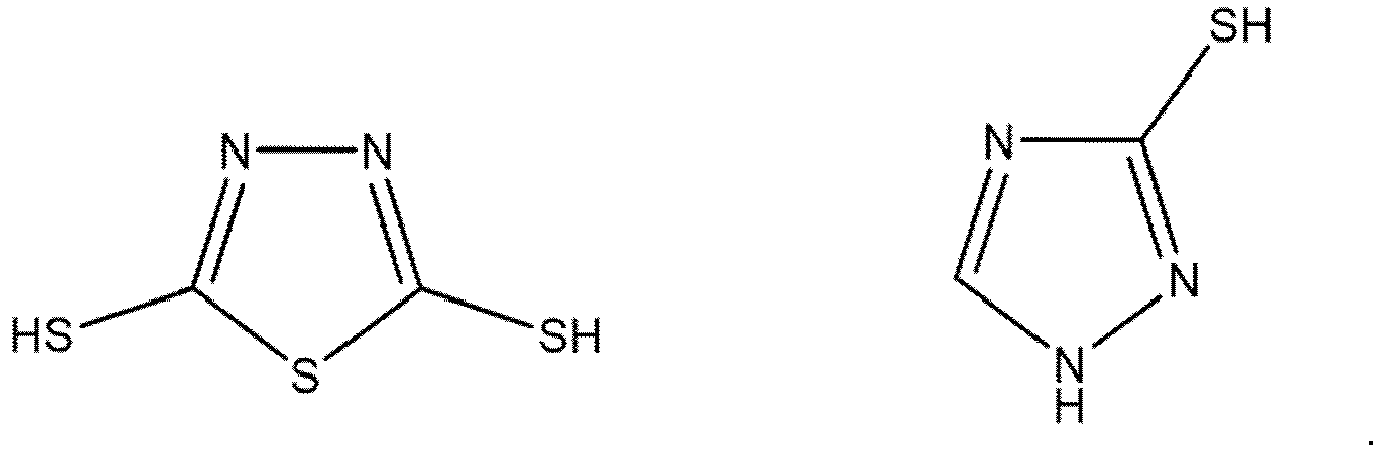
wherein R is an optionally substituted, four-, five- or six-membered aromatic ring comprising at least one heteroatom chosen in the group comprising N and S. Preferably, 2 or 3 members of the ring are heteroatoms. - Advantageously, the R group may be an optionally substituted diazole, thiadiazole, triazole or triazine ring. The substituents may preferably be chosen in the group comprising an amine group (for example NH2), a thiol group, an amide group (for example CONH2), a carboxylic acid group and a short linear or branched C1 to C3 alkyl chain.
- Advantageously, H-S-R may be chosen in the group comprising:


- Advantageously, H-S-R may be chosen in the group comprising:

- Advantageously, step a) and/or step b) of the process according to the invention may be conducted using a potentiostat.
- Advantageously, the conductive support may be a commercial carbon-based gas diffusion electrode.
- Advantageously, step a) and/or step b) of the process according to the invention may be conducted under a current density from 5 mA.cm-2 and 50 mA.cm-2, preferably from 10 mA.cm-2 and 20 mA.cm-2.
- Advantageously, in step a) and/or step b) of the process according to the invention, the quantity of deposited Ag and Cu may be from 0.5 C.cm-2 and 50 C.cm-2, preferably between 15 C.cm-2 and 35 C.cm-2.
- Advantageously, step a) and/or step b) of the process according to the invention may be done under pulse deposition methods. Preferably, the applied current is pulsed every 0.1 to 1 seconds, more preferably every 0.25 second to 0.5 second and even more preferably every 0.25 second.
- Advantageously, in step a) of the process according to the invention, the source of silver (Ag) may be AgNO3 or CH3COOAg. The source of silver may be an electrolyte comprising AgNO3, (NH4)2SO4 and ethylene diamine.
- Advantageously, in step a) of the process according to the invention, the electrodeposition of silver may be done using a carbon based-gas diffusion layer (GDL), a Pt plate, and Ag/AgCl (saturated with KCI) respectively as the working, counter, and reference electrodes, respectively. Alternatively, the process can be done using a 2-electrode configuration using a carbon based-gas diffusion layer (GDL) and a Pt plate respectively as the working and counter electrodes, respectively.
- Advantageously, in step b) the source of copper (Cu) may be chosen in the group comprising CuSO4, CuCl2 and CuBr2. The source of copper may be an electrolyte comprising H2SO4 and CuSO4.
- Advantageously, the step c) of the process according to the invention may be performed in an organic solvent. The concentration of the molecule of formula II in the organic solvent may be from 1 to 100 mM, preferably from 2 to 10 mM. For example, when HS-R is 5-amino-1,3,4-thiadiazole-2-thiol, the concentration may be 5 mM or when HS-R is 1,3,4-thiadiazole-2,5-dithiol , the concentration may be 2 mM.
- Advantageously, the step c) of the process according to the invention may have a duration of from 5 seconds to 12 hours, preferably from 1 minutes to 30 minutes, more preferably 5 minutes to 15 minutes and even more preferably 10 minutes. Step c) may be performed at a temperature from 5 to 80 °C, preferably at room temperature (i.e. from 15 to 30 °C).
- Advantageously, the process according to the invention may further comprise a step d) of washing the obtained catalyst compound with an organic solvent, preferably ethanol.
- The invention further relates to the use of the catalyst compound according to the invention as a catalyst, preferably to convert CO2 into small molecules. It is meant by small molecules, molecules such as C2H4, C2H5OH, CO, formic acid, as well as small amount of H2
- The invention further relates to a process of conversion of CO2 into small molecules comprising a step of contacting CO2 (gas) with a catalyst compound according to the invention. The conversion reaction of CO2 may be done under atmospheric pressure and at room temperature.
-
-
Figure 1 represents the SEM images of different atomic ratios of AgCu (a) 10at.%AGCu, (b) 15at.%AGCu, (c) 25at.%AGCu and (d) 50at. %AGCu. -
Figure 2 represents SEM images of non-functionalized 15at.%AgCu (a), N2C-15at.%AgCu (b), N2S-15at.%AgCu (c), N2N-15at.%AgCu (d) and N3S-15at.%AgCu (e), respectively. -
Figure 3 represents the dark field (a) and bright field (b) TEM images of 15at.%AgCu. The bright field TEM image allow the identification of the Ag and Cu domains. -
Figure 4 represents the SEM images and the corresponding EDX mappings of 15at.%AgCu showing the presence of the Ag, Cu and C atoms. -
Figure 5 represents the proposed interaction mechanism between thiol and pristine material (15at.%AgCu). -
Figure 6 represents the Faradaic efficiencies for each CO2 reduction reaction product and H2 on non-functionalized 15at.%AgCu (A) and different functionalized 15at.%AgCu electrodes (B: N2C, C: N2S, D: N2N and E: N3S) at various potentials ranging from -0.3 to -1.2 V versus RHE in 0.5M KHCO3. -
Figure 7 represents the evolution of the total current density (a), and the specific current density for the production of C2: C2H4, ethanol and C2H6 (b), the specific current density for the production of C1: CH4, CO, formiate (c) and hydrogen (d) of different atomic ratios AgCu catalysts. -
Figure 8 represents the evolution of the total current density (a), and the specific current density for the production of C2: C2H4, ethanol and C2H6 (b), the specific current density for the production of C1: CH4, CO, formate (c) and hydrogen (d) of various functionalised 15at.%AgCu catalysts (respectively N2C, N2S, N2N and N3S) vs. non-functionalised 15at.%AgCu catalyst. -
Figure 9 represents the ratio of the specific current density for C2+ and C1: JC2+/JC1 for the pristine and various functionalized 15at.%AgCu (respectively N2C, N2S, N2N and N3S). Ratio values (JC2/JC1) as a function of potential vs. RHE (V). - The electrodeposition of Cu and Ag were conducted using a potentiostat.
- Firstly, to electrodeposit Ag, an electrolyte composed of 0.01 M AgNO3 (99%, CAS: 7761-88-8), 0.6 M (NH4)2SO4 (99%, CAS: 7783-20-2), and 0.04 M ethylene diamine (99.5%, CAS: 107-15-3) was prepared. To electrodeposit Cu, an electrolyte composed of 1.5 M H2SO4 (CAS: 7664-93-9) and 0.2 M CuSO4 (CAS: 7758-98-7) was prepared. A carbon based-gas diffusion layer (GDL), Pt plate, and Ag/AgCl (saturated with KCI) were used as the working, counter, and reference electrodes, respectively.
- Ag and Cu were successively electrodeposited on the support by controlling the voltage or the current density in order to control the morphology of the deposited. Ag and Cu were successively electrodeposited using a current density comprised between 10 mA.cm-2 and 20 mA.cm-2, preferably between 12 mA.cm-2 and 17 mA.cm-2. The loading of Ag and Cu are comprised between 15 C.cm-2 and 35 C.cm-2, preferably between 20 C.cm-2 and 30 C.cm-2. A traditional electrochemical workstation (potentiostat/galvanostat) was used for the deposition. Good performances are obtained when the silver is grown in the form of a tree-like structure using a pulse deposition methods where the applied current is pulsed every 0.25 seconds (
Figure 1 ). The source of Ag and Cu used for the electrodeposition are AgNO3 (CAS: 7761-88-8) and CuSO4 (CAS: 7758-98-7). - A series of electrodes where prepared with Ag:Cu atomic ratios varying from 10 up to 50 at.% were prepared following the procedure described above (see table 1 below and the electrocatalytic performance have been systematically recorded. Theses electrodes are not functionalized and thus are comparative examples. By comparing the performance in term of selectivity of the reaction (FE), the results showed that 15 at.% of Ag (15at.%AgCu) gives the highest performance with 18.3 % of C2 products (ethylene and ethanol) at a potential of -1.2 V vs. Reversible Hydrogen Electrode (RHE) (Table 2).


- 15at.%AgCu electrodes as prepared above were then functionalized with various functional groups to obtain catalyst compound according to the invention. The structure of the Ag and Cu layers are not modified after the functionalization reaction (
Figures 2 ,3 ). Various -S-R groups were attached on the electrodes, essentially on the copper atoms (Figure 4 ,5 ). The various HS-R molecules that have been tested are shown table 3 below. The functionalization of the 15at.%AgCu electrodes was performed in ethanol at a concentration of 5 mM. The total time for each reaction was about 10 minutes at room temperature. The electrodes were washed with ethanol and dried with Ar. The S/Cu measured by XPS analyses after the functionalization reaction is presented in Table 3, below.Table 3: Label, code, HSR molecule and S/Cu ratio of catalyst compounds of example 2. Label Code S-R-Molecule S/Cu ratio A Non-functionalized 0 B N2C 
0.98 5-Methyl-1 ,3,4-thiadiazole-2-thiol (N2C) C N2S 
1.02 1,3,4-Thiadiazole-2,5-dithiol (N2S) D N2N 
1.2 5-Amino-1,3,4-thiadiazole-2-thiol (N2N) E N3S 
0.62 1H-1,2,4-Triazole-3-thiol (N3S) - The results obtained with the functionalized 15at.%AgCu electrodes are shown in tables 4 and 5 below:


- The electrodes were functionalized using the same optimized conditions in order to compare the performance of the different functional groups and the performances were recorded under the exact same conditions (electrolyte, temperature, time). The results shown in tables 3 and 4 demonstrate that both the current density and the Faradaic efficiency are both strongly improved after functionalization. Triadiazole and triazole groups gave the best results and the selectivity towards the formation of C2 can reach 60% at -1.2 V vs. RHE compare to < 16 % for pristine 15at.%AgCu (
Figure 6 ). By taking into account the current density, the results show that the specific current density for ethylene and ethanol can be as high as 20.38 mA cm-2 and 17.61 mA cm-2 respectively from 15at.%AgCu-N2N (Figure 7 ). These values correspond to a production of ~ 32 mL of ethanol and 21 L of ethylene per m2 per hour of electrode for an applied potential of -1.2 V vs. RHE. C2 products are detected at potential as low as -0.3 V vs. RHE with a Faradaic efficiency as high as 5 % towards C2H4. - Importantly the functionalization of 15at.%AgCu translates into 1) high activity (higher current density), 2) higher efficiency towards the conversion of CO2, 2) High activity towards the production of C2 products (C2H4, ethanol and C2H6) over C1 as demonstrated by the ratio of the specific current density for C2+ and C1 (
Figures 9 ). - The catalysts according to the invention prepared and tested in the example allowed improving the performance towards the production of C2 molecules (notably ethanol and ethylene) at room temperature and atmospheric pressure. Compared to pristine 15at.%AgCu electrocatalyst, the specific current density for C2 products (C2H4, ethanol and C2H6) is increase by a factor of 7. The new electrocatalysts according to the invention are more energy efficiency.
-
- [1] Whipple D T, Kenis P J A. Prospects of CO2 utilization via direct heterogeneous electrochemical reduction[J]. The Journal of Physical Chemistry Letters, 2010, 1(24): 3451-3458.
- [2] Xia C, Zhu P, Jiang Q, et al. Continuous production of pure liquid fuel solutions via electrocatalytic CO2 reduction using solid-electrolyte devices[J]. Nature Energy, 2019, 4(9): 776-785.
- [3] Hernandez S, Farkhondehfal M A, Sastre F, et al. Syngas production from electrochemical reduction of CO2: current status and prospective implementation[J]. Green Chemistry, 2017, 19(10): 2326-2346.
- [4] Hori Y, Wakebe H, Tsukamoto T, et al. Electrocatalytic process of CO selectivity in electrochemical reduction of CO2 at metal electrodes in aqueous media[J]. Electrochimica Acta, 1994, 39(11-12): 1833-1839.
- [5] Bagger A, Ju W, Varela A S, et al. Electrochemical CO2 reduction: a classification problem[J]. ChemPhysChem, 2017, 18(22): 3266-3273.
Claims (16)
- A catalyst compound comprising a silver layer and a copper layer, wherein the copper layer is functionalized with at least one group of formula I:
-S-R Formula I,
wherein R is an optionally substituted, four-, five- or six-membered aromatic ring comprising at least one heteroatom chosen in the group comprising N and S. - The compound according to claim 1 having a fern-like dendritic morphology.
- The compound according to claim 1 or 2 wherein R is an optionally substituted diazole, thiadiazole, triazole or triazine ring, the substituents being preferably chosen in the group comprising an amine group, a thiol group, an amide group, a carboxylic acid group and a short linear or branched C1 to C3 alkyl chain.
- The compound according to the preceding claim, wherein -S-R is chosen in the group comprising:


- The compound according to any of preceding claims, comprising from 70 to 90 at.% of copper atoms, preferably 85 at.%.
- The compound according to any of preceding claims, comprising from 10 to 30 at.% of silver atoms, preferably 15 at.%.
- The compound according to any of preceding claims, wherein the S/Cu atomic surface ratio is from 0.2 to 0.6.
- The compound according to any of preceding claims, further comprising a conducting support, preferably a commercial carbon-based gas diffusion electrode.
- Use of the compound according to any of preceding claims as a catalyst, preferably to convert CO2 into small molecules, preferably C2H4, C2H5OH, CO, formic acid, as well as small amount of H2.
- A process of manufacture of a catalyst compound comprising a silver layer and a copper layer, wherein the copper layer is functionalized with groups of formula I:
-S-R Formula I,
wherein R is an optionally substituted, four-, five- or six-membered aromatic ring comprising at least one heteroatom chosen in the group comprising N and S,
comprising the steps:a) electrodeposition of silver on a conductive support,b) electrodeposition of copper on the support obtained in step a), the copper being essentially deposited on the silver,c) functionalization of the support obtained in step b) by contacting with molecule of formula II:
H-S-R Formula II,
wherein R is an optionally substituted, four-, five- or six-membered aromatic ring comprising at least one heteroatom chosen in the group comprising N and S. - The process according to the preceding claim, wherein step c) is performed in an organic solvent.
- The process according to claim 10 or 11, wherein the concentration of the molecule of formula II in the organic solvent is from 1 to 100 mM.
- The process according to any of claims 10 to 12, wherein step c) lasts from 5 seconds to 12 hours, and is preferably done at room temperature.
- The process according to any of claims 10 to 13, further comprising a step d) of washing the catalyst compound with an organic solvent, the solvent preferably being ethanol.
- A process of conversion of CO2 into small molecules comprising a step of contacting CO2 (gas) with a catalyst compound according to any of claims 1 to 8.
- The process according to the preceding claim, wherein the conversion reaction of CO2 is done under atmospheric pressure and at room temperature.
Priority Applications (2)
| Application Number | Priority Date | Filing Date | Title |
|---|---|---|---|
| EP20306391.2A EP4001470A1 (en) | 2020-11-16 | 2020-11-16 | Functionalized silver-copper catalysts for electrochemical conversion of co2 to small molecules |
| PCT/EP2021/080671 WO2022101086A1 (en) | 2020-11-16 | 2021-11-04 | Functionalized silver-copper catalysts for electrochemical conversion of co2 to small molecules |
Applications Claiming Priority (1)
| Application Number | Priority Date | Filing Date | Title |
|---|---|---|---|
| EP20306391.2A EP4001470A1 (en) | 2020-11-16 | 2020-11-16 | Functionalized silver-copper catalysts for electrochemical conversion of co2 to small molecules |
Publications (1)
| Publication Number | Publication Date |
|---|---|
| EP4001470A1 true EP4001470A1 (en) | 2022-05-25 |
Family
ID=73554404
Family Applications (1)
| Application Number | Title | Priority Date | Filing Date |
|---|---|---|---|
| EP20306391.2A Withdrawn EP4001470A1 (en) | 2020-11-16 | 2020-11-16 | Functionalized silver-copper catalysts for electrochemical conversion of co2 to small molecules |
Country Status (2)
| Country | Link |
|---|---|
| EP (1) | EP4001470A1 (en) |
| WO (1) | WO2022101086A1 (en) |
Cited By (1)
| Publication number | Priority date | Publication date | Assignee | Title |
|---|---|---|---|---|
| WO2024184700A1 (en) * | 2023-03-08 | 2024-09-12 | Totalenergies Onetech | In situ electrodeposited catalyst promoting co2 and/or co electroreduction to hydrocarbon products in acidic conditions |
Citations (4)
| Publication number | Priority date | Publication date | Assignee | Title |
|---|---|---|---|---|
| WO2016134952A1 (en) * | 2015-02-24 | 2016-09-01 | Siemens Aktiengesellschaft | Deposition of a hydrocarbon-generating, copper-containing electrocatalyst onto non-copper substrates |
| US20180209053A1 (en) * | 2017-01-25 | 2018-07-26 | Kabushiki Kaisha Toshiba | Reduction catalyst, and chemical reactor, reduction method and reduction product-producing system employing the catalyst |
| US20180291515A1 (en) * | 2017-04-10 | 2018-10-11 | The California Institute Of Technology | Product selectivity for co2 reduction |
| WO2020157151A1 (en) * | 2019-01-29 | 2020-08-06 | Paris Sciences Et Lettres-Quartier Latin | Surface-modified electrodes and their use in co2 and co reduction |
-
2020
- 2020-11-16 EP EP20306391.2A patent/EP4001470A1/en not_active Withdrawn
-
2021
- 2021-11-04 WO PCT/EP2021/080671 patent/WO2022101086A1/en not_active Ceased
Patent Citations (4)
| Publication number | Priority date | Publication date | Assignee | Title |
|---|---|---|---|---|
| WO2016134952A1 (en) * | 2015-02-24 | 2016-09-01 | Siemens Aktiengesellschaft | Deposition of a hydrocarbon-generating, copper-containing electrocatalyst onto non-copper substrates |
| US20180209053A1 (en) * | 2017-01-25 | 2018-07-26 | Kabushiki Kaisha Toshiba | Reduction catalyst, and chemical reactor, reduction method and reduction product-producing system employing the catalyst |
| US20180291515A1 (en) * | 2017-04-10 | 2018-10-11 | The California Institute Of Technology | Product selectivity for co2 reduction |
| WO2020157151A1 (en) * | 2019-01-29 | 2020-08-06 | Paris Sciences Et Lettres-Quartier Latin | Surface-modified electrodes and their use in co2 and co reduction |
Non-Patent Citations (5)
| Title |
|---|
| BAGGER AJU WVARELA A S ET AL.: "Electrochemical C0 reduction: a classification problem[J", CHEMPHYSCHEM, vol. 18, no. 22, 2017, pages 3266 - 3273 |
| HERNANDEZ SFARKHONDEHFAL M ASASTRE F ET AL.: "Syngas production from electrochemical reduction of C0 : current status and prospective implementation[J", GREEN CHEMISTRY, vol. 19, no. 10, 2017, pages 2326 - 2346 |
| HORI YWAKEBE HTSUKAMOTO T ET AL.: "Electrocatalytic process of CO selectivity in electrochemical reduction of C0 at metal electrodes in aqueous media[J", ELECTROCHIMICA ACTA, vol. 39, no. 11-12, 1994, pages 1833 - 1839, XP026551584, DOI: 10.1016/0013-4686(94)85172-7 |
| WHIPPLE D TKENIS P J A: "Prospects of C0 utilization via direct heterogeneous electrochemical reduction[J", THE JOURNAL OF PHYSICAL CHEMISTRY LETTERS, vol. 1, no. 24, 2010, pages 3451 - 3458, XP055599832, DOI: 10.1021/jz1012627 |
| XIA CZHU PJIANG Q ET AL.: "Continuous production of pure liquid fuel solutions via electrocatalytic C0 reduction using solid-electrolyte devices[J", NATURE ENERGY, vol. 4, no. 9, 2019, pages 776 - 785 |
Cited By (1)
| Publication number | Priority date | Publication date | Assignee | Title |
|---|---|---|---|---|
| WO2024184700A1 (en) * | 2023-03-08 | 2024-09-12 | Totalenergies Onetech | In situ electrodeposited catalyst promoting co2 and/or co electroreduction to hydrocarbon products in acidic conditions |
Also Published As
| Publication number | Publication date |
|---|---|
| WO2022101086A9 (en) | 2022-07-07 |
| WO2022101086A1 (en) | 2022-05-19 |
Similar Documents
| Publication | Publication Date | Title |
|---|---|---|
| Karapinar et al. | Electrochemical CO2 reduction to ethanol with copper-based catalysts | |
| US11524280B2 (en) | Low-platinum catalyst based on nitride nanoparticles and preparation method thereof | |
| Li et al. | MnO2 electrocatalysts coordinating alcohol oxidation for ultra‐durable hydrogen and chemical productions in acidic solutions | |
| Xue et al. | 2D metal–organic framework-based materials for electrocatalytic, photocatalytic and thermocatalytic applications | |
| Pan et al. | Designing CO 2 reduction electrode materials by morphology and interface engineering | |
| Pei et al. | Recent developments of transition metal phosphides as catalysts in the energy conversion field | |
| Chang et al. | The tunable and highly selective reduction products on Ag@ Cu bimetallic catalysts toward CO2 electrochemical reduction reaction | |
| JP4908846B2 (en) | Carbon nanotube-containing fuel cell electrode | |
| Yang et al. | Triggering the intrinsic catalytic activity of Ni-doped molybdenum oxides via phase engineering for hydrogen evolution and application in Mg/seawater batteries | |
| Öznülüer et al. | Fabrication of underpotentially deposited Cu monolayer/electrochemically reduced graphene oxide layered nanocomposites for enhanced ethanol electro-oxidation | |
| Nourmohammadi Khiarak et al. | Efficient electrocatalytic overall water splitting on a copper-rich alloy: an electrochemical study | |
| de Luna et al. | In situ development of a 3D Cu-CeO2 Catalyst selective in the electrocatalytic hydrogenation of biomass furanic compounds | |
| Ahn et al. | Amorphous MoS2 nanosheets grown on copper@ nickel-phosphorous dendritic structures for hydrogen evolution reaction | |
| US20240141517A1 (en) | Improvements in electrochemical reduction of carbon dioxide | |
| Sirisomboonchai et al. | Efficient CO2 electrochemical reduction by a robust electrocatalyst fabricated by electrodeposition of indium and zinc over copper foam | |
| Zhang et al. | Dense nanopore reconstruction of hexagonal PdCu superstructure for robust methanol electrooxidation | |
| CN117165994A (en) | Preparation method of electrolytic water catalyst suitable for the whole pH range | |
| Chen et al. | Modulating oxygen affinity to enhance liquid products for the electrochemical reduction of carbon monoxide | |
| Samanta et al. | Stabilization of Nickel-Doped Iron-oxy-hydroxide Core in Water by Heptamolybdate Ions to Improve the Electrochemical Oxygen Evolution Reaction | |
| Salman et al. | Synergistic engineering of CoFe-thiophene based metal-organic framework with in-situ decoration of g-C3N4 for enhanced electrocatalytic oxygen evolution reaction | |
| Thienprasert et al. | Improving the roughness of copper working electrode through electroless deposition for carbon dioxide reduction reaction | |
| WO2022101086A1 (en) | Functionalized silver-copper catalysts for electrochemical conversion of co2 to small molecules | |
| JP2023102374A (en) | Cathode electrode and composite of cathode electrode and substrate | |
| Al-Akraa et al. | A Competent MWCNT‐Grafted MnOx/Pt Nanoanode for the Direct Formic Acid Fuel Cells | |
| Jiang et al. | Modulating the MOF coordination environment to derive nanoparticles for CO2 electroreduction to formate |
Legal Events
| Date | Code | Title | Description |
|---|---|---|---|
| PUAI | Public reference made under article 153(3) epc to a published international application that has entered the european phase |
Free format text: ORIGINAL CODE: 0009012 |
|
| STAA | Information on the status of an ep patent application or granted ep patent |
Free format text: STATUS: THE APPLICATION HAS BEEN PUBLISHED |
|
| AK | Designated contracting states |
Kind code of ref document: A1 Designated state(s): AL AT BE BG CH CY CZ DE DK EE ES FI FR GB GR HR HU IE IS IT LI LT LU LV MC MK MT NL NO PL PT RO RS SE SI SK SM TR |
|
| STAA | Information on the status of an ep patent application or granted ep patent |
Free format text: STATUS: REQUEST FOR EXAMINATION WAS MADE |
|
| 17P | Request for examination filed |
Effective date: 20221124 |
|
| RBV | Designated contracting states (corrected) |
Designated state(s): AL AT BE BG CH CY CZ DE DK EE ES FI FR GB GR HR HU IE IS IT LI LT LU LV MC MK MT NL NO PL PT RO RS SE SI SK SM TR |
|
| STAA | Information on the status of an ep patent application or granted ep patent |
Free format text: STATUS: THE APPLICATION IS DEEMED TO BE WITHDRAWN |
|
| 18D | Application deemed to be withdrawn |
Effective date: 20240601 |