EP4001276B1 - Aurora kinase inhibitor and use thereof - Google Patents
Aurora kinase inhibitor and use thereof Download PDFInfo
- Publication number
- EP4001276B1 EP4001276B1 EP20840146.3A EP20840146A EP4001276B1 EP 4001276 B1 EP4001276 B1 EP 4001276B1 EP 20840146 A EP20840146 A EP 20840146A EP 4001276 B1 EP4001276 B1 EP 4001276B1
- Authority
- EP
- European Patent Office
- Prior art keywords
- methyl
- methylpiperidine
- compound
- pyridin
- fluoro
- Prior art date
- Legal status (The legal status is an assumption and is not a legal conclusion. Google has not performed a legal analysis and makes no representation as to the accuracy of the status listed.)
- Active
Links
Classifications
-
- C—CHEMISTRY; METALLURGY
- C07—ORGANIC CHEMISTRY
- C07D—HETEROCYCLIC COMPOUNDS
- C07D471/00—Heterocyclic compounds containing nitrogen atoms as the only ring hetero atoms in the condensed system, at least one ring being a six-membered ring with one nitrogen atom, not provided for by groups C07D451/00 - C07D463/00
- C07D471/12—Heterocyclic compounds containing nitrogen atoms as the only ring hetero atoms in the condensed system, at least one ring being a six-membered ring with one nitrogen atom, not provided for by groups C07D451/00 - C07D463/00 in which the condensed system contains three hetero rings
- C07D471/14—Ortho-condensed systems
-
- A—HUMAN NECESSITIES
- A61—MEDICAL OR VETERINARY SCIENCE; HYGIENE
- A61K—PREPARATIONS FOR MEDICAL, DENTAL OR TOILETRY PURPOSES
- A61K31/00—Medicinal preparations containing organic active ingredients
- A61K31/33—Heterocyclic compounds
- A61K31/395—Heterocyclic compounds having nitrogen as a ring hetero atom, e.g. guanethidine or rifamycins
- A61K31/435—Heterocyclic compounds having nitrogen as a ring hetero atom, e.g. guanethidine or rifamycins having six-membered rings with one nitrogen as the only ring hetero atom
- A61K31/44—Non condensed pyridines; Hydrogenated derivatives thereof
- A61K31/445—Non condensed piperidines, e.g. piperocaine
- A61K31/4523—Non condensed piperidines, e.g. piperocaine containing further heterocyclic ring systems
- A61K31/4545—Non condensed piperidines, e.g. piperocaine containing further heterocyclic ring systems containing a six-membered ring with nitrogen as a ring hetero atom, e.g. pipamperone, anabasine
-
- A—HUMAN NECESSITIES
- A61—MEDICAL OR VETERINARY SCIENCE; HYGIENE
- A61P—SPECIFIC THERAPEUTIC ACTIVITY OF CHEMICAL COMPOUNDS OR MEDICINAL PREPARATIONS
- A61P35/00—Antineoplastic agents
-
- A—HUMAN NECESSITIES
- A61—MEDICAL OR VETERINARY SCIENCE; HYGIENE
- A61P—SPECIFIC THERAPEUTIC ACTIVITY OF CHEMICAL COMPOUNDS OR MEDICINAL PREPARATIONS
- A61P35/00—Antineoplastic agents
- A61P35/02—Antineoplastic agents specific for leukemia
-
- C—CHEMISTRY; METALLURGY
- C07—ORGANIC CHEMISTRY
- C07D—HETEROCYCLIC COMPOUNDS
- C07D401/00—Heterocyclic compounds containing two or more hetero rings, having nitrogen atoms as the only ring hetero atoms, at least one ring being a six-membered ring with only one nitrogen atom
- C07D401/14—Heterocyclic compounds containing two or more hetero rings, having nitrogen atoms as the only ring hetero atoms, at least one ring being a six-membered ring with only one nitrogen atom containing three or more hetero rings
-
- C—CHEMISTRY; METALLURGY
- C07—ORGANIC CHEMISTRY
- C07D—HETEROCYCLIC COMPOUNDS
- C07D417/00—Heterocyclic compounds containing two or more hetero rings, at least one ring having nitrogen and sulfur atoms as the only ring hetero atoms, not provided for by group C07D415/00
- C07D417/14—Heterocyclic compounds containing two or more hetero rings, at least one ring having nitrogen and sulfur atoms as the only ring hetero atoms, not provided for by group C07D415/00 containing three or more hetero rings
-
- C—CHEMISTRY; METALLURGY
- C07—ORGANIC CHEMISTRY
- C07B—GENERAL METHODS OF ORGANIC CHEMISTRY; APPARATUS THEREFOR
- C07B2200/00—Indexing scheme relating to specific properties of organic compounds
- C07B2200/05—Isotopically modified compounds, e.g. labelled
Definitions
- the invention relates to the fields of pharmaceuticals, medicinal chemistry and pharmacology, and more specifically, relates to a kind of aurora kinase inhibitors and the preparation methods thereof.
- Aurora kinase are serine/threonine kinases that play essential roles in centrosome duplication, spindle formation, chromosome segregation and spindle assembly checkpoint during mitosis [ Cancer Metastasis Rev., 2003, 22, 451 ].
- Aurora-A localizes next to the centrosome during early mitosis, and associates with spindle microtubules and mitotic poles through metaphase and telophase. It is required for centrosome duplication, maturation and separation, and the formation of bipolar spindles, and orchestrates the entry and exit of mitosis [ Nat. Rev. Cancer, 2005, 5, 42 ].
- Aurora-B localizes to the centrosome around the chromatin in early mitosis, and to the mitotic spindle in anaphase. It is a key player in centrosome function, chromosome alignment and separation, spindle checkpoint, and cytokinesis [ Mol. Cancer Ther., 2009, 8, 2046-2056 ]. Roles of Aurora-C in mitosis is poorly defined. It is expressed at a high level in testis and may play a specialized role in male animals [ Proc Natl Acad Sci USA, 2002, 99 (24): 15440-15445 ].
- Aurora-A maps to 20q13.2, a region that is frequently amplified in cancers including breast cancer, colon cancer, ovarian cancer and thyroid cancer. Ectopic expression of Aurora A in normal cells resulted in centrosome amplification, aneuploidy, chromosome instability, and telomere elongation, characteristics associated with transformed cells [ J. Cell Sci., 2007, 120, 2987 ]. Overexpression of Aurora-A or its activating partner TPX-2 is believed to contribute to chromosome instability in human cancer. In addition, Aurora-A regulates the function of tumor suppressors and pro-apoptotic proteins such as p53. For example, phosphorylation of p53 at Ser215 and Ser351 by Aurora A promotes its functional inactivation and degradation, respectively.
- Aurora-B maps to 17p13.1, a chromosome region that is sometimes deleted or amplified in certain cancer [ J. Clin. Pathol., 2007, 60 (2): 218-221 ]. Elevated expression of Aurora-B mRNA and protein is observed in colon cancer, oral cancer and nonsmall cell lung cancer.
- Aurora-B is a subunit of chromosome passenger complex (CPC). Aurora-B regulates mitosis through phosphorylation of INCENP, CENP-A and Survivin. In addition, overexpression of Aurora-B was also shown to enhance ras signaling.
- Aurora kinases have become drug-targets for anti-cancer therapeutics due to their oncogenic property.
- Aurora kinase inhibitors have been developed as novel anti-cancer agents, among which LY-3295668 with a pyridine core is an Aurora A specific inhibitor in phase I development [ WO2016077161 ].
- the structure of LY-3295668 is listed below.
- LY-3295668 and other Aurora-A inhibitors are invariably associated with weak activity, poor oral bioavailability or moderate in vivo efficacy. Therefore, development of novel Aurora inhibitors with improved in vitro and in vivo activity is warranted.
- WO 2021/147974 discloses known kinase inhibitors.
- the present invention provides a novel kinase inhibitor of general formula (1), an optical isomer, a crystalline form, a pharmaceutically acceptable salt thereof:
- R 1 is wherein X is NH, O or S, R c and R d are independently H, halogen, C1-C3 alkyl, C1-C3 alkoxyl, halogen substituted C1-C3 alkyl or halogen substituted C1-C3 alkoxyl.
- R 1 is
- W is:
- the compound of general formula (1) is selected from the compounds listed in Table 1.
- Table 1 Compounds of the Invention No. Structure Name 1 1-(3-chloro-2-fluorobenzyl)-4-((3-fluoro-6-(thiazol-2-ylamino)pyridin-2-yl)methyl)-2-methylpiperidine-4-carboxylic acid 2 4-((3-fluoro-6-(thiazol-2-ylamino)pyridin-2-yl)methyl)-1-((3-fluoropyridin-4-yl)methyl)-2-methylpiperidine-4-carboxylic acid 3 1-((2-chloro-3-fluoropyridin-4-yl)methyl)-4-((3-fluoro-6-(thiazol-2-ylamino)pyridin-2-yl)methyl)-2-methylpiperidine-4-carboxylic acid 4 1-((3-fluoro-2-(2,2,2-trifluoroethoxy)pyridin-4
- the invention provides a combination pharmaceutical composition, which contains a pharmacologically acceptable excipient or carrier, and the compound of formula (1) of the present invention, an optical isomer, or a pharmaceutically acceptable salt thereof, as an active ingredient.
- the invention provides the compound of formula (1), an optical isomer, a crystalline form, or pharmaceutically acceptable salt thereof, for use as an Aurora kinase inhibitor in the treatment of cancer.
- the compounds of formula (1) described above may be synthesized using standard synthesis techniques, well-known techniques or combination of the methods herein.
- the solvents, temperatures and other reaction conditions mentioned herein may vary.
- Starting materials for the synthesis of the compound of formula (1) may be synthesized or obtained from commercial sources such as, but not limited to, Aldrich Chemical Co. (Milwaukee, Wis.) or Sigma Chemical Co. (St. Louis, Mo.).
- the compounds described herein and other related compounds having different substituents may be synthesized using well-known techniques and starting materials, including those found in March, ADVANCED ORGANIC CHEMISTRY 4th Ed. (Wiley 1992 ); Carey and Sundberg, ADVANCED ORGANIC CHEMISTRY 4th Ed., Vols.
- the compounds described herein are obtained according to the well-known methods.
- the conditions of the process such as reactants, solvents, bases, amounts of compound used, reaction temperatures, time required for the reactions, and the like are not limited to the following explanations.
- the compounds of the invention may also be conveniently prepared, optionally in combination with various synthetic methods described in this specification or well-known methods, such combinations being readily carried out by those skilled in the art.
- the invention also provides the preparation methods of the compounds shown in the general formula (1), which are prepared by the following method A or method B:
- Method A contains the following steps: First, starting materials A and B are conducted to coupling reaction to afford compound C under the basic condition with palladium catalyst and ligand, Second, Compound C is de-protected Boc group under acidic condition to get compound D, then compound D react with R 1 -L-X to get compound E, and finally compound E is hydrolyzed under acidic or basic condition to give the compound of formula (1a).
- R 1 , R 2 , R 3 , R a and L have the same definitions as defined above, X is selected from Br, Cl, OTf or OH.
- Method B contains the following steps: First, starting materials F react with B to afford compound G, Second, compound G and H are conducted to coupling reaction to afford compound I under the basic condition with palladium catalyst and ligand, and finally compound I is hydrolyzed under strong acidic condition to give the compound of formula (1b).
- R 1 , R 2 , R 3 , R a and L have the same definitions as defined above, X is selected from Br, Cl, OTf or OH.
- the term "pharmaceutically acceptable salt” refers to a form of a compound that does not cause significant irritation to the administered subject and does not eliminate the biological activities and properties of the compound.
- the salt of the compound of the present invention refers to a salt conventionally used in the field of organic chemistry, and can be, for example, a salt of a base addition salt wherein the compound having a carboxyl group, or a salt of an acid addition salt wherein the compound having an amine group or a basic heterocyclic group.
- Example of that base addition salt includes alkali metal salt such as sodium salt and potassium salt, alkaline earth metal salt such as calcium and magnesium salts; ammonium salt such as trimethylamine salt, triethylamine salt, dicyclohexylamine salt, ethanolamine salt, diethanolamine salt, triethanolamine salt, procaine salt, N , N '-dibenzylethylenediamine salt, and the like.
- alkali metal salt such as sodium salt and potassium salt
- alkaline earth metal salt such as calcium and magnesium salts
- ammonium salt such as trimethylamine salt, triethylamine salt, dicyclohexylamine salt, ethanolamine salt, diethanolamine salt, triethanolamine salt, procaine salt, N , N '-dibenzylethylenediamine salt, and the like.
- Example of that acid addition salt includes inorganic acid salt such as hydrochloride, sulfate, nitric acid, and phosphate; organic acid salt such as acetate, formate, maleate, fumarate, citrate, oxalate, ascorbate and other organic acid salt; sulfonate such as methane sulfonate, benzenesulfonate, p-toluenesulfonate, and that like.
- inorganic acid salt such as hydrochloride, sulfate, nitric acid, and phosphate
- organic acid salt such as acetate, formate, maleate, fumarate, citrate, oxalate, ascorbate and other organic acid salt
- sulfonate such as methane sulfonate, benzenesulfonate, p-toluenesulfonate, and that like.
- pharmaceutically acceptable salts include solvent addition forms or crystalline forms, especially solvates or polymorphs.
- Solvates contain stoichiometric or non-stoichiometric solvents and are selectively formed during crystallization with pharmaceutically acceptable solvents such as water and ethanol. Hydrates are formed when the solvent is water, or alcoholates are formed when the solvent is ethanol.
- the solvates of the compound of formula (1) can be conveniently prepared or formed according to the method described herein.
- the hydrate of the compound of formula (1) is conveniently prepared by recrystallization from a mixed solvent of water/organic solvent, and the organic solvent used includes but is not limited to dioxane, tetrahydrofuran, ethanol or methanol.
- the compounds mentioned here can exist in non-solvated or solvated forms. In summary, for the purposes of the compounds and methods provided herein, the solvated forms are considered to be equivalent to the non-solvated forms.
- the compounds of formula (1) are prepared in different forms, including but not limited to amorphous, pulverized and nano-particle size forms.
- the compounds of formula (1) include crystalline forms and polymorphic forms. Polymorphic forms include different lattice arrangements of the same element composition of the compounds. Polymorphs usually have different X- ray diffraction patterns, infrared spectra, melting points, density, hardness, crystalline forms, optical and electrical properties, stability and solubility. Different factors, such as recrystallization solvent, crystallization rate and storage temperature, may cause specific crystalline formed dominantly.
- the compounds of formula (1) have one or more stereocenters, and thus appear in the forms of racemate, racemic mixture, single enantiomer, diastereomer compound and single diastereomer.
- the asymmetric centers that can exist depend on the properties of various substituents on the molecule. Each such asymmetric center will independently produce two optical isomers, and all possible optical isomers and diastereomer mixtures and pure or partially pure compounds are included in the scope of the present invention. The present invention is meant to include all such isomeric forms of these compounds.
- the compound of the present invention and its pharmaceutically acceptable salts can be made into various preparations, which contain the compound of the present invention or its pharmaceutically acceptable salts and pharmaceutically acceptable excipients or carriers in a safe and effective amount range.
- safe and effective amount means that the amount of the compound is capable of obviously improving the condition without causing serious side effects.
- the safe and effective dose of the compound is determined according to the age, illness, course of treatment and other specific conditions of the subject.
- “Pharmaceutically acceptable excipient or carrier” refers to one or more compatible solid or liquid fillers or gel substances, which are suitable for human use and must have sufficient purity and low toxicity. "Compatibility” here means that each component in the composition can be mixed with the compounds of the present invention and between them, without significantly reducing the efficacy of the compound.
- Examples of pharmaceutically acceptable excipients or carriers include cellulose and its derivatives (such as sodium carboxymethyl cellulose, sodium ethyl cellulose, cellulose acetate, etc.), gelatin, talc, solid lubricants (such as stearic acid and magnesium stearate), calcium sulfate, vegetable oils (such as soybean oil, sesame oil, peanut oil, olive oil, etc.), polyols (such as propylene glycol, glycerol, mannitol, sorbitol, etc.), emulsifiers (such as Tween), wetting agent (such as sodium dodecyl sulfate), coloring agent, flavoring agent, stabilizer, antioxidant, preservative, pyrogenfree water, etc.
- cellulose and its derivatives such as sodium carboxymethyl cellulose, sodium ethyl cellulose, cellulose acetate, etc.
- gelatin such as talc
- solid lubricants such as stearic acid and magnesium stearate
- the compounds of the present invention can be administered orally, rectally, parenterally (intravenously, intramuscularly or subcutaneously) or topically.
- Solid dosage forms for oral administration include capsules, tablets, pills, powders and granules.
- that active compound is mixed with at least one conventional inert excipient (or carry), such as sodium citrate or dicalcium phosphate, or with: (a) a filler or compatibilizer, such as starch, lactose, sucrose, glucose, mannitol, and silicic acid; (b) binders such as hydroxymethyl cellulose, alginates, gelatin, polyvinyl pyrrolidone, sucrose and acacia; (c) humectant, such as glycerol; (d) disintegrant such as agar, calcium carbonate, potato or tapioca starch, alginic acid, certain complex silicates, and sodium carbonate; (e) slow solvents, such as paraffin; (f) an absorption accelerator, such as a quaternary amine compound; (g) wetting agents, such as cetyl alcohol and glyceryl monostea, or
- Liquid dosage forms for oral administration include pharmaceutically acceptable emulsions, solutions, suspensions, syrups or tinctures.
- the liquid dosage form may comprise inert diluents conventionally used in the art, such as water or other solvents, solubilizers and emulsifiers, for example ethanol, isopropanol, ethyl carbonate, ethyl acetate, propylene glycol, 1,3-butanediol, dimethylformamide and oils, particularly cottonseed oil, peanut oil, corn germ oil, olive oil, castor oil, sesame oil or mixtures of these and the like.
- inert diluents conventionally used in the art, such as water or other solvents, solubilizers and emulsifiers, for example ethanol, isopropanol, ethyl carbonate, ethyl acetate, propylene glycol, 1,3-butanediol, dimethylformamide and oils, particularly
- composition may also contain adjuvants such as wetting agents, emulsifiers and suspending agents, sweeteners, flavoring agents and flavorants.
- adjuvants such as wetting agents, emulsifiers and suspending agents, sweeteners, flavoring agents and flavorants.
- 1-(3-chloro-2-fluorophenyl)cyclopropan-1-ol 400 mg, 2.145 mmol was added to a 100 mL flask, followed by adding dry DCM (10 mL) and DIPEA (692 mg, 5.362 mmol), cooled to -45 °C under Ar protection, then added Tf 2 O (726 mg, 2.574 mmol, in 10 mL DCM), the mixture was stirred 2 h under -50 to -40 °C.
- the target compound was obtained by the same synthetic method in example 1.
- the target compound was obtained by the same synthetic method in example 1.
- Methyl 3-chloro-2-fluorobenzoate (658 mg, 3.49 mmol) and THF (dry, 10 mL) was added to a 100 mL flask, LiAlD 4 (146 mg, 3.49 mmol) was added dropwise under ice-bath, further stirred about 0.5 h.
- the target compound was obtained by the same synthetic method in example 1.
- the Caliper mobility shift assay was used to measure compound activity towards aurora kinase. 10 different concentrations of compounds were prepared by three-fold serial dilutions. Recombinant Aurora kinases in kinase buffer (20 mM HEPES, pH 7.5, 0.01% Triton X-100) were incubated with compounds for 10 minutes at room temperature. FAM labeled peptide substrates were subsequently added to initiate the reaction at 25 °C. Conversion rates were measured by caliper after the reactions were terminated. LY-3295668 was used as positive control. Data were normalized to that of the vehicle control, and percentage of inhibition and IC 50 were calculated. Results were listed in Table 2.
- H1975 cells growing in logarithmic phase were trypsinized, triturated into single cell suspensions and seeded in 384 plates at a density of 5 ⁇ 10 3 /well in 50 mL. Cells were allowed to attach overnight and compounds were added to the cells for a further incubation of 72 hours. 50 mL of CTL was added afterwards to measure cell survival through ATP quantification. IC 50 was calculated with GRAPHPAD and listed in Table 2. Table 2.
- optical isomers in this disclosure exhibit differential activities from the racemic mixtures.
- the optical isomer, compound 1-1 is more potent than its racemic mixture, compound 1.
- the activities of other optical isomers of the present disclosure can be similarly measured and may exceed that of compound 1-1.
- H1975 cells were cultured in 1640 medium containing 10% FBS at 37°C and with 5% CO 2 . Cells were passaged and harvested by trypsinization. 8 ⁇ 10 6 cells were implanted in the left armpit of nude mice. Mice were randomized into four groups of 6 mice each when the tumor volume reaches about 80 mm 3 , and were dosed with vehicle, and 6 mg/ml LY-3295668, compound 13 and compound 23 at 0.1 mg/10g respectively by oral gavage. Tumor volume and body weight were monitored every other day. Mice were sacrificed on day 21 of treatment. Relative tumor volume (RTV) and tumor growth (T/C), and tumor growth inhibition (TGI) were calculated and analyzed. The result is listed in Table 3.
- RTV Relative tumor volume
- T/C tumor growth
- TGI tumor growth inhibition
- H69 cells were cultured in 1640 medium containing 10% FBS at 37°C and with 5% CO 2 . Cells were passaged and harvested by trypsinization. 1 ⁇ 10 7 H69 cells were implanted in the left armpit of nude mouse. Mice were randomly allocated to four groups of 8 mice each when the tumor volume reaches about 290 mm 3 , and were orally given vehicle (0.5% MC), and 2.5 mg/kg, 5 mg/kg and 10 mg/kg compound 1-1 twice daily respectively. Tumor volume and body weight were measured every other day. Mice were sacrificed on day 21 of treatment. Relative tumor volume (RTV) and tumor growth (T/C), and tumor growth inhibition (TGI) were calculated and analyzed statistically. Results are listed below.
- compound 1-1 blocks H69 tumor growth in a dose dependent manner with markedly improved efficacy compared to LY-3295668.
Landscapes
- Chemical & Material Sciences (AREA)
- Organic Chemistry (AREA)
- Health & Medical Sciences (AREA)
- General Health & Medical Sciences (AREA)
- Veterinary Medicine (AREA)
- Pharmacology & Pharmacy (AREA)
- Life Sciences & Earth Sciences (AREA)
- Animal Behavior & Ethology (AREA)
- Medicinal Chemistry (AREA)
- Public Health (AREA)
- Chemical Kinetics & Catalysis (AREA)
- General Chemical & Material Sciences (AREA)
- Nuclear Medicine, Radiotherapy & Molecular Imaging (AREA)
- Hematology (AREA)
- Oncology (AREA)
- Epidemiology (AREA)
- Pharmaceuticals Containing Other Organic And Inorganic Compounds (AREA)
- Plural Heterocyclic Compounds (AREA)
Description
- The invention relates to the fields of pharmaceuticals, medicinal chemistry and pharmacology, and more specifically, relates to a kind of aurora kinase inhibitors and the preparation methods thereof.
- Aurora kinase are serine/threonine kinases that play essential roles in centrosome duplication, spindle formation, chromosome segregation and spindle assembly checkpoint during mitosis [Cancer Metastasis Rev., 2003, 22, 451]. There are three structurally and functionally related aurora kinases, Aurora-A, Aurora-B and Aurora-C. Aurora-A localizes next to the centrosome during early mitosis, and associates with spindle microtubules and mitotic poles through metaphase and telophase. It is required for centrosome duplication, maturation and separation, and the formation of bipolar spindles, and orchestrates the entry and exit of mitosis [Nat. Rev. Cancer, 2005, 5, 42]. Aurora-B localizes to the centrosome around the chromatin in early mitosis, and to the mitotic spindle in anaphase. It is a key player in centrosome function, chromosome alignment and separation, spindle checkpoint, and cytokinesis [Mol. Cancer Ther., 2009, 8, 2046-2056]. Roles of Aurora-C in mitosis is poorly defined. It is expressed at a high level in testis and may play a specialized role in male animals [Proc Natl Acad Sci USA, 2002, 99 (24): 15440-15445].
- The gene encoding Aurora-A maps to 20q13.2, a region that is frequently amplified in cancers including breast cancer, colon cancer, ovarian cancer and thyroid cancer. Ectopic expression of Aurora A in normal cells resulted in centrosome amplification, aneuploidy, chromosome instability, and telomere elongation, characteristics associated with transformed cells [J. Cell Sci., 2007, 120, 2987]. Overexpression of Aurora-A or its activating partner TPX-2 is believed to contribute to chromosome instability in human cancer. In addition, Aurora-A regulates the function of tumor suppressors and pro-apoptotic proteins such as p53. For example, phosphorylation of p53 at Ser215 and Ser351 by Aurora A promotes its functional inactivation and degradation, respectively.
- The gene encoding Aurora-B maps to 17p13.1, a chromosome region that is sometimes deleted or amplified in certain cancer [J. Clin. Pathol., 2007, 60 (2): 218-221]. Elevated expression of Aurora-B mRNA and protein is observed in colon cancer, oral cancer and nonsmall cell lung cancer. Aurora-B is a subunit of chromosome passenger complex (CPC). Aurora-B regulates mitosis through phosphorylation of INCENP, CENP-A and Survivin. In addition, overexpression of Aurora-B was also shown to enhance ras signaling.
- Aurora kinases have become drug-targets for anti-cancer therapeutics due to their oncogenic property. Aurora kinase inhibitors have been developed as novel anti-cancer agents, among which LY-3295668 with a pyridine core is an Aurora A specific inhibitor in phase I development [
WO2016077161 ]. The structure of LY-3295668 is listed below.
- However, LY-3295668 and other Aurora-A inhibitors are invariably associated with weak activity, poor oral bioavailability or moderate in vivo efficacy. Therefore, development of novel Aurora inhibitors with improved in vitro and in vivo activity is warranted.
-
- The present invention provides a novel kinase inhibitor of general formula (1), an optical isomer, a crystalline form, a pharmaceutically acceptable salt thereof:

- In formula (1):
- R1 is aryl, heteroaryl,

- R2 is H or methyl;
- R3 is H or F;
- Wis

- L is CH2, CO, CD2, CH(Me), C(Me)2,

- In another preferred embodiment, in formula (1), R1 is


- In another preferred embodiment, in formula (1), R1 is


- In another preferred embodiment, in formula (1), W is:


- Through synthesizing and carefully studying of a variety of new compounds involving inhibition of aurora kinase, the inventors have found that for the compounds of the general formula (1), when -L- group is changed from CH2 to an appropriate size group, such as CD2, and/or when W is

- In another preferred embodiment, the compound of general formula (1) is selected from the compounds listed in Table 1.
Table 1: Compounds of the Invention No. Structure Name 1 
1-(3-chloro-2-fluorobenzyl)-4-((3-fluoro-6-(thiazol-2-ylamino)pyridin-2-yl)methyl)-2-methylpiperidine-4-carboxylic acid 2 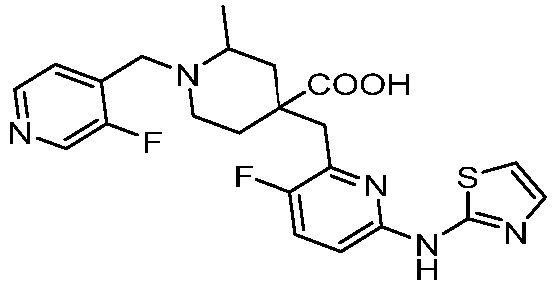
4-((3-fluoro-6-(thiazol-2-ylamino)pyridin-2-yl)methyl)-1-((3-fluoropyridin-4-yl)methyl)-2-methylpiperidine-4-carboxylic acid 3 
1-((2-chloro-3-fluoropyridin-4-yl)methyl)-4-((3-fluoro-6-(thiazol-2-ylamino)pyridin-2-yl)methyl)-2-methylpiperidine-4-carboxylic acid 4 
1-((3-fluoro-2-(2,2,2-trifluoroethoxy)pyridin-4-yl)methyl)-4-((3-fluoro-6-(thiazol-2-ylamino)pyridin-2-yl)methyl)-2-methylpiperidine-4-carboxylic acid 5 
1-((5-chlorothiophen-2-yl)methyl)-4-((3-fluoro-6-(thiazol-2-ylamino)pyridin-2-yl)methyl)-2-methylpiperidine-4-carboxylic acid 6 
1-(benzofuran-4-ylmethyl)-4-((3-fluoro-6-(thiazol-2-ylamino)pyridin-2-yl)methyl)-2-methylpiperidine-4-carboxylic acid 7 
1-((2,2-difluorobenzo[d][1,3]dioxol-4-yl)methyl)-4-((3-fluoro-6-(thiazol-2-ylamino)pyridin-2-yl)methyl)-2-methylpiperidine-4-carboxylic acid 8 
1-((2,2-difluoro-2,3-dihydro-1H-inden-4-yl)methyl)-4-((3-fluoro-6-(thiazol-2-ylamino)pyridin-2-yl)methyl)-2-methylpiperidine-4-carboxylic acid 9 
1-(1-(3-chloro-2-fluorophenyl)ethyl)-4-((3-fluoro-6-(thiazol-2-ylamino)pyridin-2-yl)methyl)-2-methylpiperidine-4-carboxylic acid 10 
1-(1-(3-chloro-2-fluorophenyl)cyclopropyl)-4-((3-fluoro-6-(thiazol-2-ylamino)pyridin-2-yl)methyl)-2-methylpiperidine-4-carboxylic acid 11 
1-(3-(3-chloro-2-fluorophenyl)oxetan-3-yl)-4-((3-fluoro-6-(thiazol-2-ylamino)pyridin-2-yl)methyl)-2-methylpiperidine-4-carboxylic acid 12 
1-(3-chloro-2-fluorobenzoyl)-4-((3-fluoro-6-(thiazol-2-ylamino)pyridin-2-yl)methyl)-2-methylpiperidine-4-carboxylic acid 13 
1-((3-chloro-2-fluorophenyl)methyl-d2)-4-((3-fluoro-6-(thiazol-2-ylamino)pyridin-2-yl)methyl)-2-methylpiperidine-4-carboxylic acid 14 
1-(3-chloro-2-fluorobenzyl)-2-methyl-4-((6-(thiazol-2-ylamino)pyridin-2-yl)methyl)piperidine-4-carboxylic acid 15 
1-((3-chloro-2-fluorophenyl)methyl-d 2)-2-methyl-4-((6-(thiazol-2-ylamino)pyridin-2-yl)methyl)piperidine-4-carboxylic acid 16 
1-(3-chloro-2-fluorobenzyl)-4-((3-fluoro-6-((5-methylthiazol-2-yl)amino)pyridin-2-yl)methyl)-2-methylpiperidine-4-carboxylic acid 17 
1-((3-chloro-2-fluorophenyl)methyl-d 2)-4-((3-fluoro-6-((5-methylthiazol-2-yl)amino)pyridin-2-yl)methyl)-2-methylpiperidine-4-carboxylic acid 18 
1-(3-chloro-2-fluorobenzyl)-4-((3-fluoro-6-((4-methylthiazol-2-yl)amino)pyridin-2-yl)methyl)-2-methylpiperidine-4-carboxylic acid 19 
1-((3-chloro-2-fluorophenyl)methyl-d 2)-4-((3-fluoro-6-((4-methylthiazol-2-yl)amino)pyridin-2-yl)methyl)-2-methylpiperidine-4-carboxylic acid 20 
1-(3-chloro-2-fluorobenzyl)-4-((3-fluoro-6-(thiazol-2-ylamino)pyridin-2-yl)methyl)-2,2-dimethylpiperidine-4-carboxylic acid 21 
1-((3-chloro-2-fluorophenyl)methyl-d 2)-4-((3-fluoro-6-(thiazol-2-ylamino)pyridin-2-yl)methyl)-2,2-dimethylpiperidine-4-carboxylic acid - In another embodiment, the invention provides a combination pharmaceutical composition, which contains a pharmacologically acceptable excipient or carrier, and the compound of formula (1) of the present invention, an optical isomer, or a pharmaceutically acceptable salt thereof, as an active ingredient.
- In another embodiment, the invention provides the compound of formula (1), an optical isomer, a crystalline form, or pharmaceutically acceptable salt thereof, for use as an Aurora kinase inhibitor in the treatment of cancer.
- The preparation methods of the compounds of the general formula (1) are described specifically in following part, but these specific methods do not constitute any limitations of the present invention.
- The compounds of formula (1) described above may be synthesized using standard synthesis techniques, well-known techniques or combination of the methods herein. In addition, the solvents, temperatures and other reaction conditions mentioned herein may vary. Starting materials for the synthesis of the compound of formula (1) may be synthesized or obtained from commercial sources such as, but not limited to, Aldrich Chemical Co. (Milwaukee, Wis.) or Sigma Chemical Co. (St. Louis, Mo.). The compounds described herein and other related compounds having different substituents may be synthesized using well-known techniques and starting materials, including those found in March, ADVANCED ORGANIC CHEMISTRY 4th Ed. (Wiley 1992); Carey and Sundberg, ADVANCED ORGANIC CHEMISTRY 4th Ed., Vols. A and B (Plenum 2000, 2001), Green and Wuts, PROTECTIVE GROUPS IN ORGANIC SYNTHESIS 3rd Ed., (Wiley 1999). The general methods for the preparation of the compounds can be varied by using suitable reagents and conditions for introducing different groups in the molecular formulas provided herein.
- In one aspect, the compounds described herein are obtained according to the well-known methods. However, the conditions of the process such as reactants, solvents, bases, amounts of compound used, reaction temperatures, time required for the reactions, and the like are not limited to the following explanations. The compounds of the invention may also be conveniently prepared, optionally in combination with various synthetic methods described in this specification or well-known methods, such combinations being readily carried out by those skilled in the art. On the other aspect, the invention also provides the preparation methods of the compounds shown in the general formula (1), which are prepared by the following method A or method B:
Method A contains the following steps: First, starting materials A and B are conducted to coupling reaction to afford compound C under the basic condition with palladium catalyst and ligand, Second, Compound C is de-protected Boc group under acidic condition to get compound D, then compound D react with R1-L-X to get compound E, and finally compound E is hydrolyzed under acidic or basic condition to give the compound of formula (1a).
- In the above reaction, R1, R2, R3, Ra and L have the same definitions as defined above, X is selected from Br, Cl, OTf or OH.
- Method B contains the following steps: First, starting materials F react with B to afford compound G, Second, compound G and H are conducted to coupling reaction to afford compound I under the basic condition with palladium catalyst and ligand, and finally compound I is hydrolyzed under strong acidic condition to give the compound of formula (1b).

- In the above reaction, R1, R2, R3, Ra and L have the same definitions as defined above, X is selected from Br, Cl, OTf or OH.
- The term "pharmaceutically acceptable salt" refers to a form of a compound that does not cause significant irritation to the administered subject and does not eliminate the biological activities and properties of the compound. The salt of the compound of the present invention refers to a salt conventionally used in the field of organic chemistry, and can be, for example, a salt of a base addition salt wherein the compound having a carboxyl group, or a salt of an acid addition salt wherein the compound having an amine group or a basic heterocyclic group.
- Example of that base addition salt includes alkali metal salt such as sodium salt and potassium salt, alkaline earth metal salt such as calcium and magnesium salts; ammonium salt such as trimethylamine salt, triethylamine salt, dicyclohexylamine salt, ethanolamine salt, diethanolamine salt, triethanolamine salt, procaine salt, N,N'-dibenzylethylenediamine salt, and the like.
- Example of that acid addition salt includes inorganic acid salt such as hydrochloride, sulfate, nitric acid, and phosphate; organic acid salt such as acetate, formate, maleate, fumarate, citrate, oxalate, ascorbate and other organic acid salt; sulfonate such as methane sulfonate, benzenesulfonate, p-toluenesulfonate, and that like.
- It should be understood that pharmaceutically acceptable salts include solvent addition forms or crystalline forms, especially solvates or polymorphs. Solvates contain stoichiometric or non-stoichiometric solvents and are selectively formed during crystallization with pharmaceutically acceptable solvents such as water and ethanol. Hydrates are formed when the solvent is water, or alcoholates are formed when the solvent is ethanol. The solvates of the compound of formula (1) can be conveniently prepared or formed according to the method described herein. For example, the hydrate of the compound of formula (1) is conveniently prepared by recrystallization from a mixed solvent of water/organic solvent, and the organic solvent used includes but is not limited to dioxane, tetrahydrofuran, ethanol or methanol. In addition, the compounds mentioned here can exist in non-solvated or solvated forms. In summary, for the purposes of the compounds and methods provided herein, the solvated forms are considered to be equivalent to the non-solvated forms.
- In other specific embodiments, the compounds of formula (1) are prepared in different forms, including but not limited to amorphous, pulverized and nano-particle size forms. In addition, the compounds of formula (1) include crystalline forms and polymorphic forms. Polymorphic forms include different lattice arrangements of the same element composition of the compounds. Polymorphs usually have different X- ray diffraction patterns, infrared spectra, melting points, density, hardness, crystalline forms, optical and electrical properties, stability and solubility. Different factors, such as recrystallization solvent, crystallization rate and storage temperature, may cause specific crystalline formed dominantly.
- On the other aspect, the compounds of formula (1) have one or more stereocenters, and thus appear in the forms of racemate, racemic mixture, single enantiomer, diastereomer compound and single diastereomer. The asymmetric centers that can exist depend on the properties of various substituents on the molecule. Each such asymmetric center will independently produce two optical isomers, and all possible optical isomers and diastereomer mixtures and pure or partially pure compounds are included in the scope of the present invention. The present invention is meant to include all such isomeric forms of these compounds.
- The compound of the present invention and its pharmaceutically acceptable salts can be made into various preparations, which contain the compound of the present invention or its pharmaceutically acceptable salts and pharmaceutically acceptable excipients or carriers in a safe and effective amount range. Among them, "safe and effective amount" means that the amount of the compound is capable of obviously improving the condition without causing serious side effects. The safe and effective dose of the compound is determined according to the age, illness, course of treatment and other specific conditions of the subject.
- "Pharmaceutically acceptable excipient or carrier" refers to one or more compatible solid or liquid fillers or gel substances, which are suitable for human use and must have sufficient purity and low toxicity. "Compatibility" here means that each component in the composition can be mixed with the compounds of the present invention and between them, without significantly reducing the efficacy of the compound. Examples of pharmaceutically acceptable excipients or carriers include cellulose and its derivatives (such as sodium carboxymethyl cellulose, sodium ethyl cellulose, cellulose acetate, etc.), gelatin, talc, solid lubricants (such as stearic acid and magnesium stearate), calcium sulfate, vegetable oils (such as soybean oil, sesame oil, peanut oil, olive oil, etc.), polyols (such as propylene glycol, glycerol, mannitol, sorbitol, etc.), emulsifiers (such as Tween), wetting agent (such as sodium dodecyl sulfate), coloring agent, flavoring agent, stabilizer, antioxidant, preservative, pyrogenfree water, etc.
- The compounds of the present invention can be administered orally, rectally, parenterally (intravenously, intramuscularly or subcutaneously) or topically.
- Solid dosage forms for oral administration include capsules, tablets, pills, powders and granules. In these solid dosage forms, that active compound is mixed with at least one conventional inert excipient (or carry), such as sodium citrate or dicalcium phosphate, or with: (a) a filler or compatibilizer, such as starch, lactose, sucrose, glucose, mannitol, and silicic acid; (b) binders such as hydroxymethyl cellulose, alginates, gelatin, polyvinyl pyrrolidone, sucrose and acacia; (c) humectant, such as glycerol; (d) disintegrant such as agar, calcium carbonate, potato or tapioca starch, alginic acid, certain complex silicates, and sodium carbonate; (e) slow solvents, such as paraffin; (f) an absorption accelerator, such as a quaternary amine compound; (g) wetting agents, such as cetyl alcohol and glyceryl monostearate; (h) adsorbent, such as kaolin; And (i) a lubricant such as talc, calcium stearate, magnesium stearate, solid polyethylene glycol, sodium lauryl sulfate, or mixtures thereof. In capsule, tablets and pill, the dosage form may also contain a buffer.
- Solid dosage forms such as tablets, sugar pills, capsules, pills and granules may be prepared using coatings and shell materials such as casings and other materials well-known in the art. They may comprise an opacifying agent and the release of the active compound or compound in such a composition may be released in a delayed manner in a portion of the digestive tract. Examples of embedding components that may be used are polymeric substances and waxes. If desired, the active compound may also form microcapsules with one or more of the above excipients.
- Liquid dosage forms for oral administration include pharmaceutically acceptable emulsions, solutions, suspensions, syrups or tinctures. In addition to the active compound, the liquid dosage form may comprise inert diluents conventionally used in the art, such as water or other solvents, solubilizers and emulsifiers, for example ethanol, isopropanol, ethyl carbonate, ethyl acetate, propylene glycol, 1,3-butanediol, dimethylformamide and oils, particularly cottonseed oil, peanut oil, corn germ oil, olive oil, castor oil, sesame oil or mixtures of these and the like.
- In addition to these inert diluents, the composition may also contain adjuvants such as wetting agents, emulsifiers and suspending agents, sweeteners, flavoring agents and flavorants.
- In addition to the active compounds, the suspension may comprise suspending agents such as ethoxylated isostearyl alcohol, polyoxyethylene sorbitol and sorbitan esters, microcrystalline cellulose, aluminum methoxide, agar or mixtures of these and the like.
- The composition for parenteral injection may comprise a physiologically acceptable sterile aqueous or non-aqueous solution, dispersion, suspension or emulsion, and a sterile powder for reconstitution into a sterile injectable solution or dispersion. Suitable aqueous and non-aqueous carriers, diluents, solvents or excipients include water, ethanol, polyols and suitable mixtures thereof.
- Dosage forms of the compounds of the invention for topical administration include ointments, powders, patches, sprays and inhalants. The active ingredient is mixed under sterile conditions with a physiologically acceptable carrier and any preservatives, buffers, or propellants as may be required.
- The compound of the invention may be administered alone or in combination with other pharmaceutically acceptable compounds.
- When a pharmaceutical composition is used, a safe and effective amount of a compound of the invention is applied to a mammal (e.g., a human) in need of treatment, wherein the dose at the time of administration is a pharmaceutically acceptable effective dose, and for a human of 60 kg body weight, the daily dose is generally 1 to 1000 mg, preferably 10 to 500 mg. Of course, specific dose should also take into account factors such as route of administration, patient health, etc., which are within the skill of a skilled physician.
- The above features mentioned in the present invention, or the features mentioned in the embodiments, may be combined at random. All of the features disclosed in this specification may be used in any composition form and the various features disclosed in the specification may be replaced with any alternative feature that provides the same, equivalent, or similar purpose. Thus, unless otherwise specified, the disclosed features are merely generic examples of equivalent or similar features.
- Various specific aspects, features and advantages of the above compounds, methods, and pharmaceutical compositions will be set forth in detail as following. It is to be understood that the following detailed description and examples describe specific embodiments for reference only. Various changes or modifications may occur to those skilled in the art after reading the description of the invention, and such equivalents fall within the scope of the application.
- In all examples, 1H-NMR was recorded with a Varian Mercury 400 NMR spectrometer and that chemical shift was expressed as δ (ppm); Silica gel for separation is 200-300 mesh without specific statement, and the ratio of eluents is volume ratio.
- Abbreviations of the invention are as following: ACN represents acetonitrile; Ar represents argon; CBr4 represents carbon tetrabromide; CDCl3 represents deuterated chloroform; CD3OD represents deuterated methanol; DCM represents dichloromethane; DIPEA represents diisopropylethylamine; Diox represents 1,4-dioxane; DMF represents dimethylformamide; DMSO represents dimethyl sulfoxide; EArepresents ethyl acetate; EDCl represents 1-(3-Dimethylaminopropyl)-3-ethylcarbodiimide hydrochloride; h represents hour; HOBt represents 1-hydroxybenzotriazole; K2CO3 represents potassium carbonate; KI represents potassium iodide; K3PO4 represents potassium phosphate; LC-MS represents Liquid-mass spectrum; LiAlD4 represents lithium aluminum deuteride; LiOH represents lithium hydroxide; mL represents millilitre; MeOH represents methanol; mins represent minutes; MS represents mass spectrum; NMR represents nuclear magnetic resonance; Pd2(dba)3 represents tris(dibenzylideneacetone)dipalladium; PE represents petroleum ether; PPh3 represents triphenylphosphine; Tf2O represents trifluoromethanesulfonic anhydride; Xantphos represents 9,9-dimethyl-4,5-bis(diphenylphosphino)xanthene.
-

- 1-(tert-Butyl) 4-methyl 4-((6-bromo-3-fluoropyridin-2-yl)methyl)-2-methylpiperidine-1,4-dicarboxylate (5 g, 11.23 mmol, it was synthesized by referring to the method in patent
WO2016077161 ), thiazol-2-amine (956 mg, 9.55 mmol), anhydrous potassium phosphate (6 g, 28.08 mmol), Xantphos (650 mg, 1.123 mmol) and dioxane (100 mL) was added to a 250 mL flask, Pd2(dba)3 (514 mg, 0.562 mmol) was added after the replacement the air by Ar, heated to the refluxing temperature and further reacted for 5 h under the protection of Ar. After the completion of the reaction determined by LC-MS, it was concentrated under reduced pressure, and further purified by column chromatography (DCM/MeOH = 50/0 to 50/1) to offer the desired product as a yellow solid (4.0 g, yield 89%), ESI-MS m/z: 465.2 [M+H]+. - 1-(tert-butyl) 4-methyl 4-((3-fluoro-6-(thiazol-2-ylamino)pyridin-2-yl)methyl)-2-methylpiperidine-1,4-dicarboxylate (4 g, 8.61 mmol) was added to a 100 mL flask, DCM (20 mL) and HCl/Dioxane (22 mL, 4 M, 88 mmol) was added too, followed by stirring at room temperature for 20 h. After the completion of the reaction determined by LC-MS, concentrated, EA (30 mL) was add to the residual and further stirring 30 min, filtered and dried to obtain the target compound as a yellow solid (4.1 g, yield 100%), ESI-MS m/z: 365.2 [M+H]+.
- Methyl 4-((3-fluoro-6-(thiazol-2-ylamino)pyridin-2-yl)methyl)-2-methylpiperidine-4-carboxylate (800 mg, 1.83 mmol), 1-(bromomethyl)-3-chloro-2-fluorobenzene (500 mg, 2.19 mmol), K2CO3 (1.264 g, 9.15 mmol), KI (20 mg) and ACN (20 mL) was added to a 100 mL flask, then the mixture reacted at room temperature for 2 h. After the completion of the reaction determined by LC-MS, water (100 mL) was added to precipatate the solid, followed by filtration. The filter cake was washed twice with water (20 mL*2) and then slurried with PE (50 mL). After filtration, the filter cake was washed twice with PE (20 mL*2) and dried to obtain the crude product methyl 1-(3-chloro-2-fluorobenzyl)-4-((3-fluoro-6-(thiazol-2-ylamino)pyridin-2-yl)methyl)-2-methylpiperidine-4-carboxylate (935 mg, yield 100% ), which was conducted to the next step without further purification. ESI-MS m/z: 510.2 [M+H]+.
- Methyl 1-(3-chloro-2-fluorobenzyl)-4-((3-fluoro-6-(thiazol-2-ylamino)pyridin-2-yl)methyl)-2-methylpiperidine-4-carboxylate (935 mg, 1.83 mmol) was added to a 100 mL flask, then water (15 mL) and con. HCl (15 mL) was added, heated to the refluxing temperature and further reacted for 5 h. After the completion of the reaction determined by LC-MS, it was concentrated and the residual was slurried with ACN (30 mL) at room temperature. After filtration, the filter cake was washed with ACN (5 mL*2), and dried to obtain the desired yellow powder (818 mg, yield 90%).
- 1H NMR (400 MHz, DMSO-d 6) δ: 11.68 (s, 1H), 10.59 (s, 1H), 7.76 (t, J = 7.2 Hz, 1H), 7.73-7.68 (m, 1H), 7.61 (t, J = 9.2 Hz, 1H), 7.43 (d, J = 3.7 Hz, 1H), 7.34 (t, J = 7.9 Hz, 1H), 7.01 (q, J = 3.9 Hz, 2H), 4.72 (d, J = 13.3 Hz, 1H), 4.36 (dd, J = 13.6, 8.3 Hz, 1H), 3.88 (s, 2H), 3.26-3.21 (m, 2H), 3.09 (d, J = 12.9 Hz, 1H), 2.16-1.95 (m, 4H), 1.50 (d, J = 6.0 Hz, 3H); ESI-MS m/z: 493.1 [M+H]+.
- Through the synthesis from different chiral raw materials or separation by chiral SFC, four different optical isomers of compound 1 can be obtained, and the structures are as follows:


- Compounds 1-1, 1-2, 1-3 and 1-4 are designated as follows:
- 1-1: (2R,4R)-1-(3-chloro-2-fluorobenzyl)-4-((3-fluoro-6-(thiazol-2-ylamino)pyridin-2-yl)methyl)-2-methylpiperidine-4-carboxylic acid;
- 1-2: (2S,4S)-1-(3-chloro-2-fluorobenzyl)-4-((3-fluoro-6-(thiazol-2-ylamino)pyridin-2-yl)methyl)-2-methylpiperidine-4-carboxylic acid;
- 1-3: (2R,4S)-1-(3-chloro-2-fluorobenzyl)-4-((3-fluoro-6-(thiazol-2-ylamino)pyridin-2-yl)methyl)-2-methylpiperidine-4-carboxylic acid;
- 1-4: (2S,4R)-1-(3-chloro-2-fluorobenzyl)-4-((3-fluoro-6-(thiazol-2-ylamino)pyridin-2-yl)methyl)-2-methylpiperidine-4-carboxylic acid.
- Other compounds in the present application can also be used to separate the corresponding optical isomers by the same method.
-

- Using methyl 4-((3-fluoro-6-(thiazol-2-ylamino)pyridin-2-yl)methyl)-2-methylpiperidine-4-carboxylate hydrochloride and 4-(bromomethyl)-3-fluoropyridine as starting materials, the target compound was obtained by the same synthetic method in example 1.
- 1H NMR (400 MHz, DMSO-d 6) δ: 12.45 (s, 1H), 11.45 (s, 1H), 8.74 (d, J = 1.4 Hz, 1H), 8.54 (d, J = 4.9 Hz, 1H), 8.03 (t, J = 5.7 Hz, 1H), 7.68 (t, J = 9.1 Hz, 1H), 7.50 (d, J = 4.0 Hz, 1H), 7.13 (q, J = 3.7, 3.3 Hz, 2H), 4.71 (d, J = 13.3 Hz, 1H), 4.43 (dd, J = 13.5, 7.9 Hz, 1H), 3.93 (s, 1H), 3.39 (dt, J = 14.8, 9.1 Hz, 1H), 3.30-3.23 (m, 2H), 3.09 (d, J = 13.1 Hz, 1H), 2.08 (t, J = 15.2 Hz, 3H), 1.92 (d, J = 15.2 Hz, 1H), 1.51 (d, J = 6.2 Hz, 3H); ESI-MS m/z: 460.2 [M+H]+.
-

- Using methyl 4-((3-fluoro-6-(thiazol-2-ylamino)pyridin-2-yl)methyl)-2-methylpiperidine-4-carboxylate hydrochloride and 4-(bromomethyl)-2-chloro-3-fluoropyridine as starting materials, the target compound was obtained by the same synthetic method in example 1.
- 1H NMR (400 MHz, DMSO-d 6) δ: 11.22 (s, 1H), 9.82 (s, 1H), 8.39 (s, 1H), 7.68 (s, 1H), 7.57 (t, J = 9.1 Hz, 1H), 7.37 (d, J = 3.6 Hz, 1H), 6.98-6.89 (m, 2H), 4.76 (m, 1H), 4.41 (m, 1H), 3.89 (s, 2H), 3.23 (m, 3H), 2.13 (m, 2H), 1.82 (m, 2H), 1.36 (d, J = 6.4 Hz, 3H); ESI-MS m/z: 494.1 [M+H]+.
-

- Using methyl 4-((3-fluoro-6-(thiazol-2-ylamino)pyridin-2-yl)methyl)-2-methylpiperidine-4-carboxylate hydrochloride and 4-(bromomethyl)-3-fluoro-2-(2,2,2-trifluoroethoxy)pyridine as starting materials, the target compound was obtained by the same synthetic method in example 1.
- 1H NMR (400 MHz, Methanol-d 4) δ: 7.64 (dd, J = 8.3, 7.4 Hz, 1H), 7.32-7.27 (m, 2H), 7.23 (t, J = 7.9 Hz, 1H), 7.17 (dd, J = 7.8, 1.5 Hz, 1H), 7.02 (d, J = 7.2 Hz, 1H), 6.90- 6.86 (m, 2H), 3.84-3.77 (m, 2H), 3.73 (s, 2H), 3.44 (t, J = 5.1 Hz, 2H), 2.69 (t, J = 5.1 Hz, 2H), 2.64-2.58 (m, 3H), 1.53 (d, J = 6.0 Hz, 3H); ESI-MS m/z: 558.2 [M+H]+.
-

- Using methyl 4-((3-fluoro-6-(thiazol-2-ylamino)pyridin-2-yl)methyl)-2-methylpiperidine-4-carboxylate hydrochloride and 2-(bromomethyl)-5-chlorothiophene as starting materials, the target compound was obtained by the same synthetic method in example 1.
- 1H NMR (400 MHz, Methanol-d 4) δ: 7.69 (t, J = 8.7 Hz, 1H), 7.58 (s, 1H), 7.25 (q, J = 9.5, 7.5 Hz, 2H), 7.15 (dd, J = 9.0, 3.0 Hz, 1H), 7.00 (dd, J = 30.0, 3.5 Hz, 1H), 4.62-4.37 (m, 2H), 3.80 (d, J = 26.4 Hz, 2H), 3.39 (d, J = 6.4 Hz, 2H), 3.21-3.11 (m, 1H), 2.33-1.98 (m, 4H), 1.45 (d, J = 6.0 Hz, 3H); ESI-MS m/z: 481.1 [M+H]+.
-

- Using methyl 4-((3-fluoro-6-(thiazol-2-ylamino)pyridin-2-yl)methyl)-2-methylpiperidine-4-carboxylate hydrochloride and 4-(bromomethyl)benzofuran as starting materials, the target compound was obtained by the same synthetic method in example 1.
- 1H NMR (400 MHz, DMSO-d 6) δ: 7.62 (d, J = 7.2 Hz, 1H), 7.50 (t, J = 9.1 Hz, 1H), 7.32 (d, J = 3.4 Hz, 1H), 7.24 (dd, J = 7.1, 2.1 Hz, 1H), 7.19-7.11 (m, 2H), 6.89 (d, J = 5.1 Hz, 2H), 6.65 (d, J = 7.2 Hz, 1), 3.84 (d, J = 14.1 Hz, 1H), 3.69 (d, J = 14.2 Hz, 1H), 3.05 (s, 2H), 2.77-2.73 (m, 1H), 2.65-2.57 (m, 1H), 2.49- 2.42 (m, 1H), 1.84-1.75 (m, 1H), 1.72 - 1.63 (m, 2H), 1.57 (t, J = 11.9 Hz, 1H), 1.16 (d, J = 6.0 Hz, 3H); ESI-MS m/z: 481.2 [M+H]+.
-

- Using methyl 4-((3-fluoro-6-(thiazol-2-ylamino)pyridin-2-yl)methyl)-2-methylpiperidine-4-carboxylate hydrochloride and 4-(bromomethyl)-2,2-difluorobenzo[d][1,3]dioxole as starting materials to get the intermediate methyl 1-((2,2-difluorobenzo[d][1,3]dioxol-4-yl)methyl)-4-((3-fluoro-6-(thiazol-2-ylamino)pyridin-2-yl)methyl)-2-methylpiperidine-4-carboxylate.
- The abovementioned intermediate added to a 100 mL flask, followed by adding THF (10 mL), H2O (5 mL) and LiOH-H2O (79 mg, 1.88 mmol), then heated to 60 °C and stirred for 5 h under the protection of Ar. After the completion of the reaction determined by LC-MS, it was concentrated to the volume about 7.5 mL, the residual was purified by reverse phase flash to obtain the target compound (60 mg, yield 62%).
- 1H NMR (400 MHz, DMSO-d 6) δ: 7.50 (t, J = 9.1 Hz, 1H), 7.32 (d, J = 3.4 Hz, 1H), 7.24 (dd, J = 7.1, 2.1 Hz, 1H), 7.19-7.11 (m, 2H), 6.89 (d, J = 5.1 Hz, 2H), 3.94 (d, J = 14.1 Hz, 1H), 3.39 (d, J = 14.2 Hz, 1H), 3.05 (s, 2H), 2.75-2.71 (m, 1H), 2.61-2.52 (m, 1H), 2.45-2.40 (m, 1H), 1.83-1.79 (m, 1H), 1.75-1.62 (m, 2H), 1.54 (t, J = 11.9 Hz, 1H), 1.06 (d, J = 6.0 Hz, 3H); ESI-MS m/z: 521.2 [M+H]+.
-

- Using methyl 4-((3-fluoro-6-(thiazol-2-ylamino)pyridin-2-yl)methyl)-2-methylpiperidine-4-carboxylate hydrochloride and 4-(bromomethyl)-2,2-difluoro-2,3-dihydro-1H-indene as starting materials, the target compound was obtained by the same synthetic method in example 1.
- 1H NMR (400 MHz, DMSO-d 6) δ: 7.52 (t, J = 9.1 Hz, 1H), 7.30 (d, J = 3.4 Hz, 1H), 7.23 (dd, J = 7.1, 2.1 Hz, 1H), 7.19-7.11 (m, 2H), 6.89 (d, J = 5.0 Hz, 2H), 5.34-5.21 (m, 4H), 3.94 (d, J = 14.1 Hz, 1H), 3.39 (d, J = 14.2 Hz, 1H), 3.05 (s, 2H), 2.75-2.71 (m, 1H), 2.61-2.50 (m, 1H), 2.45-2.40 (m, 1H), 1.83-1.79 (m, 1H), 1.75-1.65 (m, 2H), 1.54 (t, J = 11.9 Hz, 1H), 1.07 (d, J = 6.0 Hz, 3H); ESI-MS m/z: 517.2 [M+H]+.
-

- Using methyl 4-((3-fluoro-6-(thiazol-2-ylamino)pyridin-2-yl)methyl)-2-methylpiperidine-4-carboxylate hydrochloride and 1-(1-bromoethyl)-3-chloro-2-fluorobenzene as starting materials, the target compound was obtained by the same synthetic method in example 1.
- 1H NMR (400 MHz, DMSO-d 6) δ: 12.27 (s, 1H), 11.15 (s, 1H), 7.55 (d, J = 8.1 Hz, 1H), 7.49-7.34 (m, 2H), 7.18 (t, J = 7.8 Hz, 1H), 7.02 (s, 1H), 6.86 (d, J = 8.3 Hz, 1H), 6.67 (d, J = 7.3 Hz, 1H), 4.41 (m, 1H), 3.11 (d, J = 16.6 Hz, 2H), 3.02 (m, 2H), 2.85 (m, 1H), 1.76-1.52 (m, 4H), 1.30 (d, J = 6.7 Hz, 3H), 1.06 (q, J = 7.1, 6.4 Hz, 3H); ESI-MS m/z: 507.2 [M+H]+.
-

- 1-(3-chloro-2-fluorophenyl)cyclopropan-1-ol (400 mg, 2.145 mmol) was added to a 100 mL flask, followed by adding dry DCM (10 mL) and DIPEA (692 mg, 5.362 mmol), cooled to -45 °C under Ar protection, then added Tf2O (726 mg, 2.574 mmol, in 10 mL DCM), the mixture was stirred 2 h under -50 to -40 °C. Methyl 4-((6-bromo-3-fluoropyridin-2-yl)methyl)-2-methylpiperidine-4-carboxylate (444 mg, 1.287 mmol, in 10 mL CH3CN) was added, increased the temperature to room temperature and stirred for 2 h. After the completion of the reaction determined by LC-MS, it was quenched with water (20 mL), separated the organic phase, extracted with DCM (20 mL), combined the organic phase and concentrated, the residual was purified by column chromatography to obtain the target compound (284 mg, yield 43%), ESI-MS m/z: 533.2 [M+H]+.
- Using Methyl 4-((6-bromo-3-fluoropyridin-2-yl)methyl)-1-(1-(3-chloro-2-fluorophenyl)cyclopropyl)-2-methylpiperidine-4-carboxylate as starting materials, the target compound was obtained by the same synthetic method in example 1.
- 1H NMR (400 MHz, DMSO-d 6) δ: 12.11 (s, 1H), 11.02 (s, 1H), 7.57 (d, J = 8.1 Hz, 1H), 7.43-7.33 (m, 2H), 7.15 (t, J = 7.8 Hz, 1H), 7.02 (s, 1H), 6.84 (d, J = 8.3 Hz, 1H), 6.65 (d, J = 7.3 Hz, 1H), 3.41 (d, J = 16.6 Hz, 2H), 3.02 (m, 3H), 2.23-1.89 (m, 4H), 1.30 (d, J = 6.7 Hz, 3H), 0.75-0.62 (m, 4H); ESI-MS m/z: 519.2 [M+H]+.
-

- Using methyl 4-((6-bromo-3-fluoropyridin-2-yl)methyl)-2-methylpiperidine-4-carboxylate and 3-(3-chloro-2-fluorophenyl)oxetan-3-ol as starting materials, intermediate methyl 4-((6-bromo-3-fluoropyridin-2-yl)methyl)-1-(3-(3-chloro-2-fluorophenyl)oxetan-3-yl)-2-methylpiperidine-4-carboxylate was obtained by the same synthetic method in example 10.
- Using abovementioned intermediate and thiazol-2-amine as starting materials, the target compound was obtained by the same synthetic method in example 1.
- 1H NMR (400 MHz, CD3OD) δ: 7.46 (m, 2H), 7.35-7.16 (m, 3H), 6.93 (dt, J = 8.9, 3.3 Hz, 1H), 6.87 (t, J = 4.1 Hz, 1H), 4.77 (s, 1H), 4.70-4.47 (m, 2H), 4.31 (d, J = 12.2 Hz, 1H), 4.14 (d, J = 8.0 Hz, 1H), 3.98 (ab, J = 29.9, 12.4 Hz, 1H), 3.67 (t, J = 11.3 Hz, 1H), 3.17-2.96 (m, 2H), 2.50-2.13 (m, 3H), 2.08-1.95 (m, 1H), 1.89 (d, J = 12.4 Hz, 1H), 1.41 (d, J = 6.9 Hz, 3H); ESI-MS m/z: 535.2 [M+H]+.
-

- 3-Chloro-2-fluorobenzoic acid (262 mg, 1.50 mmol), DMF (20 mL), EDCI (431 mg, 2.25 mmol), HOBt (304 mg, 2.25 mmol) and DIPEA (970 mg, 7.52 mmol) was added to a 100 mL flask, the mixture was stirred at room temperature for 30 min under the protection of Ar, methyl 4-((3-fluoro-6-(thiazol-2-ylamino)pyridin-2-yl)methyl)-2-methylpiperidine-4-carboxylate hydrochloride (437 mg, 1.0 mmol) was added, then stirred at room temperature for 20 h, After the completion of the reaction determined by LC-MS, quenched with water (40 mL), exacted with EA (50 mL* 2), combined with the organic phase and washed with saturated NaCl solution, concentrated, the residual was purified by column chromatography to obtain the desired intermediate (365 mg, yield 70%).
- Using abovementioned intermediate as starting materials, the target compound was obtained by the same synthetic method in example 1.
- 1H NMR (400 MHz, CD3OD) δ: 7.68 (t, J = 9.0 Hz, 1H), 7.62-7.52 (m, 2H), 7.43 (dt, J = 12.0, 7.9 Hz, 1H), 7.27 (d, J = 7.5 Hz, 1H), 7.21 (d, J = 4.3 Hz, 1H), 7.12 (dd, J = 8.9, 3.0 Hz, 1H), 3.73 (s, 2H), 3.22-3.12 (m, 3H), 2.13-1.88 (m, 4H), 1.45 (d, J = 6.0 Hz, 3H); ESI-MS m/z: 475.2 [M+H]+.
-
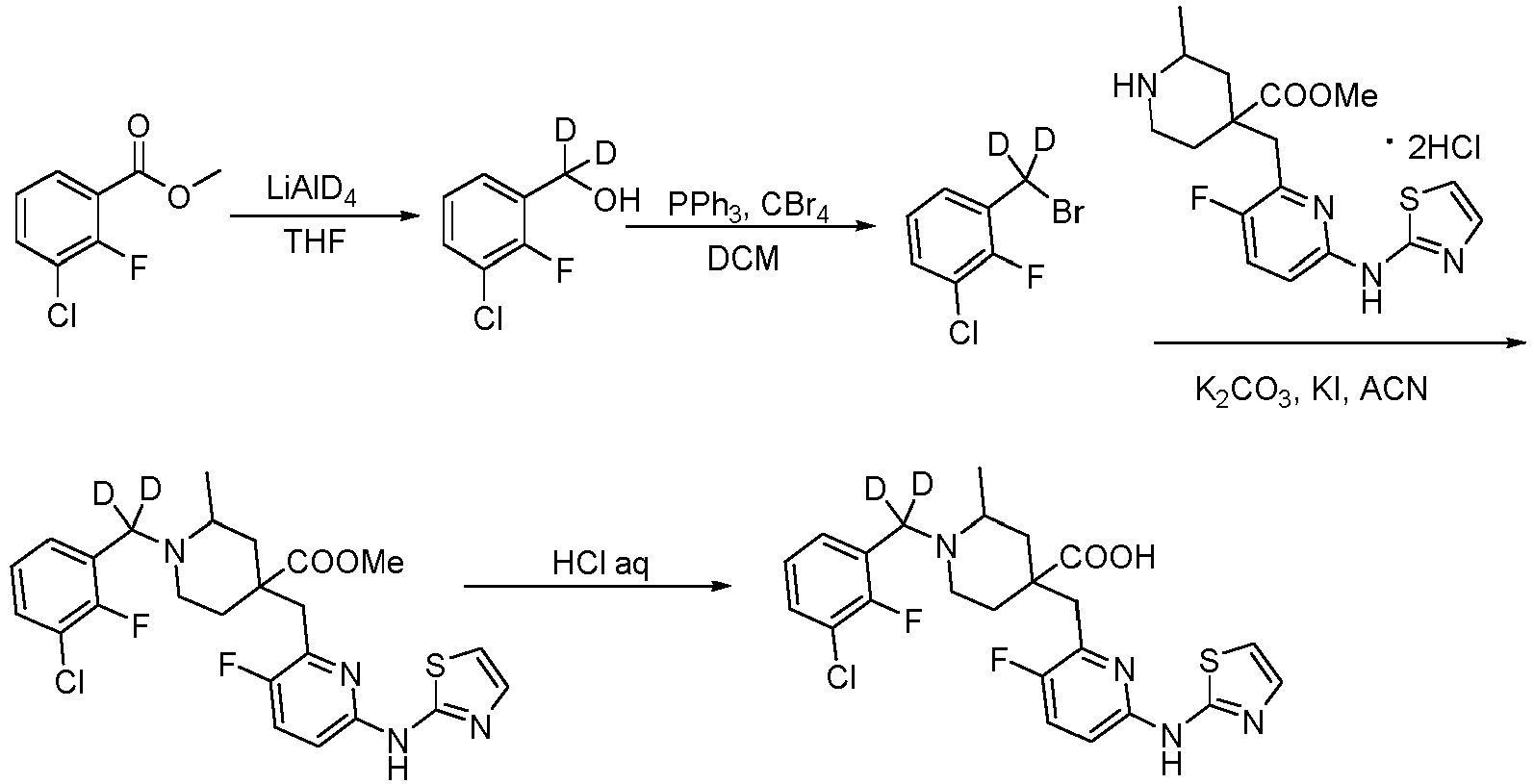
- Methyl 3-chloro-2-fluorobenzoate (658 mg, 3.49 mmol) and THF (dry, 10 mL) was added to a 100 mL flask, LiAlD4 (146 mg, 3.49 mmol) was added dropwise under ice-bath, further stirred about 0.5 h. After the complection of the reaction based on TLC (PE/EA= 10/1), quenched with water (20 mL) under ice-bath, saturated NaCl solution (20 mL) was added, exacted with EA (20 mL*2), combined the organic phase and dried over anhydrous sodium sulfate, filtered and concentrated to obtained crude intermediate (3-chloro-2-fluorophenyl)methan-d 2-ol, which was used to the next step without further purification.
- (3-chloro-2-fluorophenyl)methan-d 2-ol, DCM (20 mL) and CBr4 (2 g, 6.03 mmol) was added to a 100 mL flask, PPh3 (1.371 g, 5.23 mmol) was added dropwise, stirred at roomtemperature for about 1 h. After the complection of the reaction determined by TLC (PE/EA = 10/1), concentrated and the residual was purified by column chromatography (PE, 800 mL) to obtain 1-(bromomethyl-d 2)-3-chloro-2-fluorobenzene as colorless liquid (921 mg, yield 100%).
- 1H NMR (400 MHz, CDCl3) δ 7.34 (ddd, J = 8.3, 6.9, 1.7 Hz, 1H), 7.27 (ddd, J = 7.9, 6.5, 1.7 Hz, 1H), 7.05 (td, J = 7.9, 1.2 Hz, 1H).
- Methyl 4-((3-fluoro-6-(thiazol-2-ylamino)pyridin-2-yl)methyl)-2-methylpiperidine-4-carboxylate hydrochloride (800 mg, 1.83 mmol), 1-(bromomethyl-d 2)-3-chloro-2-fluorobenzene (495 mg, 2.19 mmol), K2CO3 (1.264 g, 9.15 mmol), KI (20 mg) and ACN (20 mL) was added to a 100 mL flask, stirred at roomtemperature for about 2 h. After the complection of the reaction determined by TLC, water (100 mL) was added to precipatate the solid, followed by filtration. The filter cake was washed twice with water (20 mL*2) and then slurried with PE (50 mL). After filtration, the filter cake was washed with PE (20 mL*2) and dried to obtain the crude product methyl 1-((3-chloro-2-fluorophenyl)methyl-d 2)-4-((3-fluoro-6-(thiazol-2-ylamino)pyridin-2-yl)methyl)-2-methylpiperidine-4-carboxylate (931 mg, yield 100% ), which was used to the next step without further purification. ESI-MS m/z: 509.2 [M+H]+.
- Methyl 1-((3-chloro-2-fluorophenyl)methyl-d 2)-4-((3-fluoro-6-(thiazol-2-ylamino)-pyridin-2-yl)methyl)-2-methylpiperidine-4-carboxylate (931 mg, 1.83 mmol) was added to a 100 mL flask, then water (15 mL) and con. HCl (15 mL) was added, heated to 105 °C under refluxing temperature and further reacted for 5 h. After the completion of the reaction determined by LC-MS, it was concentrated and the residual was slurried with ACN (30 mL) at room temperature. After filtration, the filter cake was washed with ACN (5 mL*2), and dried to obtain the desired target compound as yellow powder (815 mg, yield 90%).
- 1H NMR (400 MHz, CD3OD) δ: 7.73 (t, J = 8.7 Hz, 1H), 7.70-7.55 (m, 3H), 7.36-7.24 (m, 2H), 7.20 (dd, J = 8.8, 2.9 Hz, 1H), 3.96 (s, 2H), 3.57-3.44 (m, 2H), 3.36 (s, 1H), 2.41-1.96 (m, 4H), 1.53 (m, 3H); ESI-MS m/z: 495.1 [M+H]+.
- Through the synthesis from different chiral raw materials or separation by chiral SFC, four different optical isomers of compound 13 can be obtained, and the structures are as follows:


- Compounds 13-1, 13-2, 13-3 and 13-4 are designated as follows:
- 13-1: (2R,4R)-1-((3-chloro-2-fluorophenyl)methyl-d 2)-4-((3-fluoro-6-(thiazol-2-ylamino)pyridin-2-yl)methyl)-2-methylpiperidine-4-carboxylic acid;
- 13-2: (2S,4S)-1-((3-chloro-2-fluorophenyl)methyl-d 2)-4-((3-fluoro-6-(thiazol-2-ylamino)pyridin-2-yl)methyl)-2-methylpiperidine-4-carboxylic acid;
- 13-3: (2R,4S)-1-((3-chloro-2-fluorophenyl)methyl-d 2)-4-((3-fluoro-6-(thiazol-2-ylamino)pyridin-2-yl)methyl)-2-methylpiperidine-4-carboxylic acid;
- 13-4: (2S,4R)-1-((3-chloro-2-fluorophenyl)methyl-d 2)-4-((3-fluoro-6-(thiazol-2-ylamino)pyridin-2-yl)methyl)-2-methylpiperidine-4-carboxylic acid.
-

- Using methyl 4-((3-fluoro-6-(thiazol-2-ylamino)pyridin-2-yl)methyl)-2-methylpiperidine-4-carboxylate hydrochloride and 1-(bromomethyl)-3-chloro-2-fluorobenzene as starting materials, the target compound was obtained by the same synthetic method in example 1.
- 1H NMR (400 MHz, DMSO-d 6) δ: 11.88 (s, 1H), 10.79 (s, 1H), 7.74 (t, J = 7.2 Hz, 1H), 7.72-7.63 (m, 2H), 7.55 (t, J = 9.2 Hz, 1H), 7.41 (d, J = 3.7 Hz, 1H), 7.32 (t, J = 7.9 Hz, 1H), 7. 06 (q, J = 3.9 Hz, 2H), 4.73 (d, J = 13.3 Hz, 1H), 4.38 (dd, J = 13.6, 8.3 Hz, 1H), 3.68 (s, 2H), 3.26-3.24 (m, 2H), 3.02 (d, J = 12.9 Hz, 1H), 2.15-1.91 (m, 4H), 1.52 (d, J = 6.0 Hz, 3H); ESI-MS m/z: 507.1 [M+H]+.
-
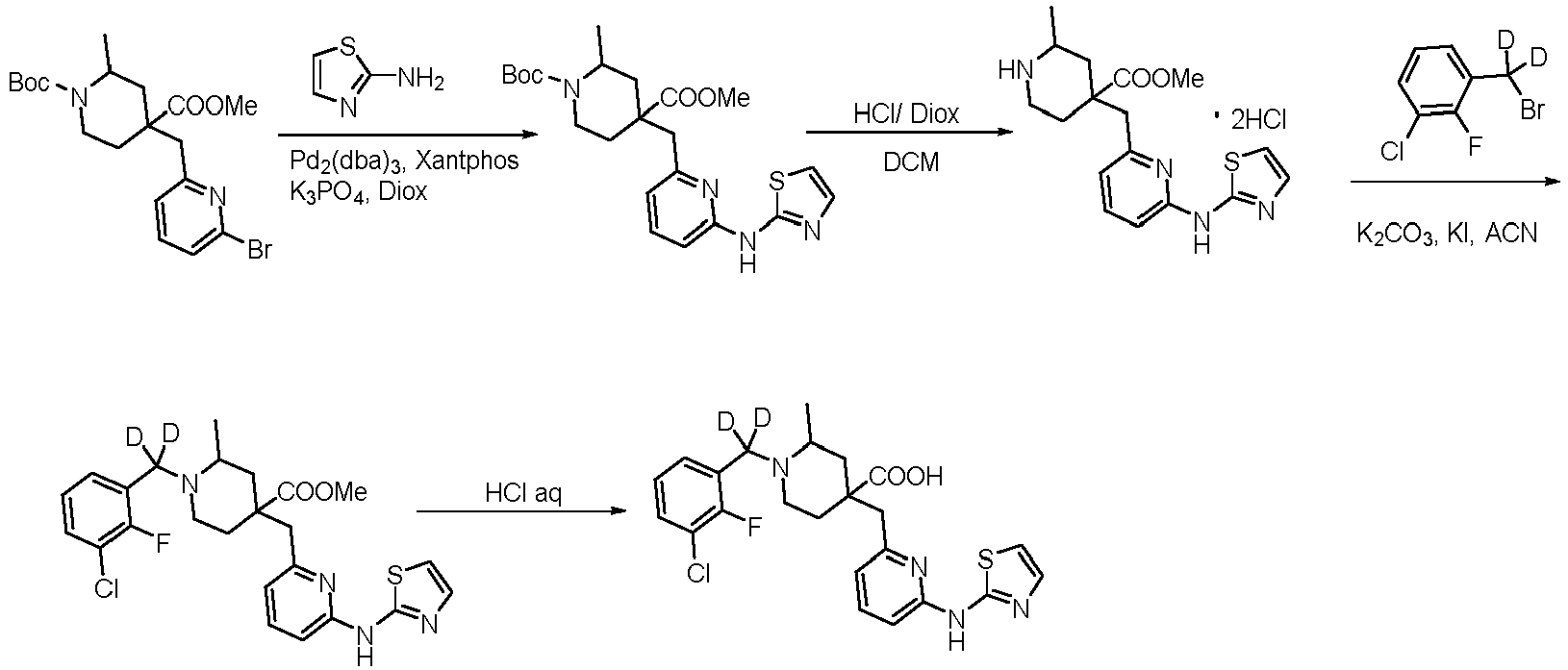
- Using methyl 1-(tert-butyl) 4-methyl 4-((6-bromo-3-fluoropyridin-2-yl)methyl)-2-methylpiperidine-1,4-dicarboxylate and thiazol-2-amine as starting materials, the target compound was obtained by the same synthetic method in example 1.
- 1H NMR (400 MHz, CD3OD) δ: 7.78 (t, J = 8.7 Hz, 1H), 7.70-7.55 (m, 3H), 7.36-7.24 (m, 3H), 7.23 (dd, J = 8.8, 2.9 Hz, 1H), 3.92 (s, 2H), 3.57-3.44 (m, 2H), 3.36 (m, 1H), 2.41-1.96 (m, 4H), 1.55 (m, 3H); ESI-MS m/z: 477.1 [M+H]+.
-

- Using 1-(tert-butyl) 4-methyl 4-((6-bromo-3-fluoropyridin-2-yl)methyl)-2-methylpiperidine-1,4-dicarboxylate and 5-methylthiazol-2-amine as starting materials, the target compound was obtained by the same synthetic method in example 1.
- 1H NMR (400 MHz, DMSO-d 6) δ: 11.66 (s, 1H), 10.59 (s, 1H), 7.76 (t, J = 7.2 Hz, 1H), 7.72-7.66 (m, 2H), 7.55 (t, J = 9.2 Hz, 1H), 7.34 (t, J = 7.9 Hz, 1H), 7.01 (m, 1H), 4.72 (d, J = 13.3 Hz, 1H), 4.36 (dd, J = 13.6, 8.3 Hz, 1H), 3.88 (s, 2H), 3.26-3.21 (m, 2H), 3.09 (d, J = 12.9 Hz, 1H), 2.27 (s, 3H), 2.16-1.95 (m, 4H), 1.50 (d, J = 6.0 Hz, 3H); ESI-MS m/z: 508.1 [M+H]+.
-

- Using methyl 4-((3-fluoro-6-(thiazol-2-ylamino)pyridin-2-yl)methyl)-2-methylpiperidine-4-carboxylate hydrochloride and 1-(bromomethyl-d 2)-3-chloro-2-fluorobenzene as starting materials, the target compound was obtained by the same synthetic method in example 1.
- 1H NMR (400 MHz, CD3OD) δ: 7.75 (t, J = 8.7 Hz, 1H), 7.72-7.56 (m, 3H), 7.28 (s, 1H), 7.20 (dd, J = 8.8, 2.9 Hz, 1H), 3.96 (s, 2H), 3.57-3.44 (m, 2H), 3.36 (s, 1H), 2.57 (s, 3H), 2.41-1.96 (m, 4H), 1.53 (m, 3H); ESI-MS m/z: 510.0 [M+H]+.
-

- Using 1-(tert-butyl) 4-methyl 4-((6-bromo-3-fluoropyridin-2-yl)methyl)-2-methylpiperidine-1,4-dicarboxylate and 4-methylthiazol-2-amine as starting materials, the target compound was obtained by the same synthetic method in example 1.
- 1H NMR (400 MHz, DMSO-d 6) δ: 11.64 (s, 1H), 10.53 (s, 1H), 7.73 (t, J = 7.2 Hz, 1H), 7.70-7.66 (m, 2H), 7.55 (t, J = 9.2 Hz, 1H), 7.34 (t, J = 7.9 Hz, 1H), 6.56 (s, 1H), 4.68 (d, J = 13.3 Hz, 1H), 4.37 (dd, J = 13.6, 8.3 Hz, 1H), 3.83 (s, 2H), 3.26-3.21 (m, 2H), 3.06 (d, J = 12.9 Hz, 1H), 2.17 (s, 3H), 2.14-1.93 (m, 4H), 1.51 (d, J = 6.0 Hz, 3H); ESI-MS m/z: 508.1 [M+H]+.
-

- Using methyl 4-((3-fluoro-6-(thiazol-2-ylamino)pyridin-2-yl)methyl)-2-methylpiperidine-4-carboxylate hydrochloride and 1-(bromomethyl-d 2)-3-chloro-2-fluorobenzene as starting materials, the target compound was obtained by the same synthetic method in example 1.
- 1H NMR (400 MHz, CD3OD) δ: 7.76 (t, J = 8.7 Hz, 1H), 7.73-7.57 (m, 3H), 7.22 (dd, J = 8.8, 2.9 Hz, 1H), 6.58 (s, 1H), 3.92 (s, 2H), 3.44-3.31 (m, 2H), 3.16 (m, 1H), 2.19 (s, 3H), 2.15-1.86 (m, 4H), 1.51 (m, 3H); ESI-MS m/z: 510.0 [M+H]+.
-

- Using 1-(tert-butyl) 4-methyl 4-((6-bromo-3-fluoropyridin-2-yl)methyl)-2,2-dimethylpiperidine-1,4-dicarboxylate and thiazol-2-amine as starting materials, the target compound was obtained by the same synthetic method in example 1.
- 1H NMR (400 MHz, CD3OD) δ: 7.76 (t, J = 8.7 Hz, 1H), 7.70-7.51 (m, 3H), 7.35-7.24 (m, 2H), 7.18 (dd, J = 8.8, 2.9 Hz, 1H), 4.61 (d, J = 13.3 Hz, 1H), 4.32 (dd, J = 13.6, 8.3 Hz, 1H), 3.94 (s, 2H), 3.34-3.22 (m, 2H), 2.31 (s, 2H), 2.02-1.81 (m, 2H), 1.45 (s, 6H); ESI-MS m/z: 508.2 [M+H]+.
-

- Using 1-(tert-butyl) 4-methyl 4-((6-bromo-3-fluoropyridin-2-yl)methyl)-2,2-dimethylpiperidine-1,4-dicarboxylate and thiazol-2-amine as starting materials, the target compound was obtained by the same synthetic method in example 1.
- 1H NMR (400 MHz, CD3OD) δ: 7.75 (t, J = 8.7 Hz, 1H), 7.70-7.55 (m, 3H), 7.37-7.26 (m, 2H), 7.20 (dd, J = 8.8, 2.9 Hz, 1H), 3.96 (s, 2H), 3.57-3.44 (m, 2H), 2.32 (s, 2H), 2.02-1.85 (m, 2H), 1.43 (s, 6H); ESI-MS m/z: 509.2 [M+H]+.
-

- 3-Chloro-2-fluorobenzoic acid (262 mg, 1.50 mmol), DMF (20 mL), EDCI (431 mg, 2.25 mmol), HOBt (304 mg, 2.25 mmol) and DIPEA(970 mg, 7.52 mmol) was added to a 100 mL flask, the mixture was stirred at room temperature for 30 min under the protection of Ar, methyl 4-((3-fluoro-6-(thiazol-2-ylamino)pyridin-2-yl)methyl)-2-methylpiperidine-4-carboxylate (345 mg, 1.0 mmol) was added, then stirred at room temperature for 20 h, After the completion of the reaction by LC-MS monitoring, quench with water (40 mL), exacted with EA (50 mL* 2), combined with the organic phase and washed with saturated NaCl solution, concentrated, the residual was purified by column chromatography to obtain the desired intermediate (426 mg, yield 85%), ESI-MS m/z: 501.1/503.1 [M+H]+.
- Methyl 4-((6-bromo-3-fluoropyridin-2-yl)methyl)-1-(3-chloro-2-fluorobenzoyl)-2-methylpiperidine-4-carboxylate (426 mg, 0.85 mmol), tert-butyl 3-amino-5-methyl-1H-pyrazole-1-carboxylate (201 mg, 1.02 mmol), Pd2(dba)3 (92 mg, 0.10 mmol), Xantphos (116 mg, 0.20 mmol), K3PO4 (96 mg, 0.45 mmol) and 1,4-dioxane (10 mL) were added to a 100 mL flask, heated to 100 °C and further reacted for about 5 h under the protection of Ar. After the completion of the reaction determined by LC-MS, it was concentrated under reduced pressure, and further purified by column chromatography (DCM/MeOH = 10/0 to 5/1) to offer the desired product as a yellow foam (394 mg, yield 75%), ESI-MS m/z: 618.1 [M+H]+.
- Using abovementioned intermediate as starting materials, the target compound was obtained by the same synthetic method in example 1.
- 1H NMR (400 MHz, CD3OD) δ: 7.65 (dt, J = 16.0, 8.4 Hz, 3H), 7.35 (t, J = 7.9 Hz, 1H), 6.92 (dd, J = 9.0, 3.1 Hz, 1H), 6.14-6.05 (m, 1H), 3.93 (dd, J = 11.5, 6.1 Hz, 1H), 2.57-2.49 (m, 3H), 2.40 (s, 3H), 2.23-2.00 (m, 4H), 1.61-1.48 (m, 3H); ESI-MS m/z: 504.2 [M+H]+.
-

- 1-(tert-Butyl) 4-methyl 4-((6-bromo-3-fluoropyridin-2-yl)methyl)-2-methylpiperidine-1,4-dicarboxylate (1 g, 2.62 mmol, it was synthesized by referring to the method in patent
WO2016077161 ), 1-(bromomethyl-d 2)-3-chloro-2-fluorobenzene (650 mg, 2.88 mmol), K2CO3 (1.811 g, 13.1 mmol), KI (10 mg) and ACN (20 mL) were added to a 100 mL flask, stirred at room temperature for about 2 h. After the completion of the reaction determined by LC-MS, concentrated and further purified by column chromatography (PE/EA = 20/1 to 8/1) to offer methyl 4-((6-bromo-3-fluoropyridin-2-yl)methyl)-1-((3-chloro-2-fluorophenyl)-methyl-d2)-2-methylpiperidine-4-carboxylate (985 mg, yield 77%) as colorless oil, ESI-MS m/z: 489.1/491.1 [M+H]+. - Methyl 4-((6-bromo-3-fluoropyridin-2-yl)methyl)-1-((3-chloro-2-fluorophenyl)-methyl-d2)-2-methylpiperidine-4-carboxylate (985 mg, 2.01 mmol), tert-butyl 3-amino-5-methyl-1H-pyrazole-1-carboxylate (476 mg, 2.41 mmol), Pd2(dba)3 (92 mg, 0.10 mmol), Xantphos (116 mg, 0.20 mmol), K3PO4 (1.067 mmol) and 1,4-dioxane (20 mL) were added to a 100 mL flask, heated to 100 °C and further reacted for 5 h under the protection of Ar. After the completion of the reaction determined by LC-MS, it was concentrated and further purified by column chromatography (PE/EA = 10/1 to 5/1) to offer the desired intermediate as yellow forma (1.03 g, yield 84%), ESI-MS m/z: 605.3 [M+H]+.
- Methyl 4-((6-((1-(tert-butoxycarbonyl)-5-methyl-1H-pyrazol-3-yl)amino)-3-fluoropyridin-2-yl)methyl)-1-((3-chloro-2-fluorophenyl)methyl-d 2)-2-methylpiperidine-4-carboxylate (1.03 g, 1.70 mmol) was added to a 100 mL flask, then water (15 mL) and con. HCl (15 mL) were added, heated to 105 °C and refluxed for 5 h. After the completion of the reaction determined by LC-MS, it was concentrated and the residual was slurred with ACN (30 mL) at room temperature. After filtration, the filter cake was washed with ACN (5 mL*2), and dried to obtain the desired yellow powder (844 mg, yield 88%).
- 1H NMR (400 MHz, CD3OD) δ: 7.63 (dt, J = 16.0, 8.4 Hz, 3H), 7.32 (t, J = 7.9 Hz, 1H), 6.90 (dd, J = 9.0, 3.1 Hz, 1H), 6.04-6.01 (m, 1H), 3.96 (dd, J = 11.5, 6.1 Hz, 1H), 3.58-3.30 (m, 4H), 2.40 (s, 3H), 2.23-2.00 (m, 5H), 1.61-1.48 (m, 3H); ESI-MS m/z: 492.2 [M+H]+.
-

- Using methyl 4-((6-bromo-3-fluoropyridin-2-yl)methyl)-2-methylpiperidine-4-carboxylate and 1-(bromomethyl)-3-chloro-2-fluorobenzene as starting materials, the target compound was obtained by the same synthetic method in example 23.
- 1H NMR (400 MHz, CD3OD) δ: 7.61 (dt, J = 16.0, 8.4 Hz, 3H), 7.34 (t, J = 7.9 Hz, 1H), 6.85 (dd, J = 9.0, 3.1 Hz, 1H), 6.01-5.95 (m, 1H), 4.56 (d, J = 13.3 Hz, 1H), 4.13 (dd, J = 13.6, 8.3 Hz, 1H), 3.93 (dd, J= 11.5, 6.1 Hz, 1H), 3.68-3.41 (m, 4H), 2.23-2.00 (m, 4H), 1.61-1.48 (m, 4H), 0.85-0.67 (m, 4H); ESI-MS m/z: 516.2 [M+H]+.
- The Caliper mobility shift assay was used to measure compound activity towards aurora kinase. 10 different concentrations of compounds were prepared by three-fold serial dilutions. Recombinant Aurora kinases in kinase buffer (20 mM HEPES, pH 7.5, 0.01% Triton X-100) were incubated with compounds for 10 minutes at room temperature. FAM labeled peptide substrates were subsequently added to initiate the reaction at 25 °C. Conversion rates were measured by caliper after the reactions were terminated. LY-3295668 was used as positive control. Data were normalized to that of the vehicle control, and percentage of inhibition and IC50 were calculated. Results were listed in Table 2.
- H1975 cells growing in logarithmic phase were trypsinized, triturated into single cell suspensions and seeded in 384 plates at a density of 5×10³/well in 50 mL. Cells were allowed to attach overnight and compounds were added to the cells for a further incubation of 72 hours. 50 mL of CTL was added afterwards to measure cell survival through ATP quantification. IC50 was calculated with GRAPHPAD and listed in Table 2.
Table 2. IC50 Values for Aurora kinase Inhibition and anti-Proliferation of H1975 Compound Aurora IC50 (nM) H1975 IC50 (µM) A B 1 0.64 20 0.022 1-1 0.4 16 0.012 3 0.73 321 0.195 7 1.10 822 0.099 9 0.98 126 0.081 13 0.74 15 0.025 20 1.42 435 0.156 22 1.21 1142 0.155 23 0.66 1955 0.415 LY-3295668 0.86 1440 0.102 - As listed above, compounds of general formula (1), wherein L is of proper size such as CD2 instead of CH2 and/or W is

- H1975 cells were cultured in 1640 medium containing 10% FBS at 37°C and with 5% CO2. Cells were passaged and harvested by trypsinization. 8×10⁶ cells were implanted in the left armpit of nude mice. Mice were randomized into four groups of 6 mice each when the tumor volume reaches about 80 mm3, and were dosed with vehicle, and 6 mg/ml LY-3295668, compound 13 and compound 23 at 0.1 mg/10g respectively by oral gavage. Tumor volume and body weight were monitored every other day. Mice were sacrificed on day 21 of treatment. Relative tumor volume (RTV) and tumor growth (T/C), and tumor growth inhibition (TGI) were calculated and analyzed. The result is listed in Table 3.
Table 3 in vivo efficacy in mouse H1975 xenograft models Compound Dosage Schedul e Body weight (g) Tumor volume (mm3) RTV T/C TGI (%) D1 D21 D1 D21 Vehicle control (-) qd*21 17.63 ±0.52 19.37 ±0.59 82.94 ±6.96 1621.28 ±215.82 19.57 ±2.67 (-) (-) LY-3295668 60 qd*21 17.85 ±0.45 18.58 ±0.46 82.56 ±7.60 611.95 ±80.83** 7.66± 1.16** 39.17 65.59 13 60 qd*21 17.82 ±0.45 19.00 ±0.68 82.50 ±7.11 373.74 ±35.20*** 4.72± 0.59*** 24.11 81.07 23 60 qd*21 18.10 ±0.22 18.47 ±0.21 82.75 ±6.63 590.77±8 6.75** 6.98± 0.58*** 35.65 66.98 * : P < 0.05 vs control, ** : P < 0.01 vs control, *** : P < 0.001 vs control, ****: P < 0.0001 vs control; D1: first day of treatment; D21: the last day of treatment; qd*21: once per day for 21 days: RTV: Relative tumor volume: RTV = Vt / V0; T/C (%) = TRTV / CRTV X 100; TRTV : relative tumor volume (RTV) of the treatment group; CRTV: relative tumor volume (RTV) of the vehicle control group. TGI: tumor growth inhibition (%); T/C (%) > 60%: ineffective; T/C (%) ≤ 60% and P < 0.05: effective. - As listed in Table 3, compared with LY-3295668, compound 13 shows greater activity in vivo, suggesting that compounds of general formula (1), wherein L is of proper size such as CD2, and /or W is

- H69 cells were cultured in 1640 medium containing 10% FBS at 37°C and with 5% CO2. Cells were passaged and harvested by trypsinization. 1×10⁷ H69 cells were implanted in the left armpit of nude mouse. Mice were randomly allocated to four groups of 8 mice each when the tumor volume reaches about 290 mm3, and were orally given vehicle (0.5% MC), and 2.5 mg/kg, 5 mg/kg and 10 mg/kg compound 1-1 twice daily respectively. Tumor volume and body weight were measured every other day. Mice were sacrificed on day 21 of treatment. Relative tumor volume (RTV) and tumor growth (T/C), and tumor growth inhibition (TGI) were calculated and analyzed statistically. Results are listed below.
Table 4 in vivo efficacy in mouse H69 xenograft models Compound Dosage (mg/kg) Schedule Body weight (g) Tumor volume (mm3) RTV T/C TGI (%) D1 D21 D1 D21 Vehicle (-) bid*21 15.56 ±0.16 17.57 ±0.26 292.98 ±17.27 1250.29 ±81.43 3.30 ±0.7 (-) (-) LY-3295668 10 bid*21 16.70 ±0.41 17.03 ±0.36 289.65 ±17.05 516.75 ±108.38 1.74 ±0.94**** 0.53 76.28 1-1 2.5 bid*21 15.99 ±0.27 16.73 ±0.40 287.46 ±16.23 180.58 ±30.15 0.65 ±0.38**** 0.20 111.16 1-1 5 bid*21 15.91 ±0.25 16.01 ±0.38 284.84 ±20.53 90.43 ±13.11 0.33 ±0.17**** 0.10 120.31 1-1 10 bid*21 16.16 ±0.41 16.19 ±0.55 287.92 ±21.01 93.16 ±18.83 0.37 ±0.16**** 0.11 120.34 * : P < 0.05 vs control, ** : P < 0.01 vs control, *** : P < 0.001 vs control, ****: P
< 0.0001 vs control; D1: first day of treatment; D21: the last day of treatment; qd*21: once per day for 21 days; RTV: Relative tumor volume: RTV = Vt / V0; T/C (%) = TRTV / CRTV X 100; TRTV: relative tumor volume (RTV) of the treatment group; CRTV: relative tumor volume (RTV) of the vehicle control group; TGI: tumor growth inhibition (%); T/C (%) > 60%: ineffective; T/C (%) ≤ 60% and P < 0.05: effective. - As presented in Table 4, compound 1-1 blocks H69 tumor growth in a dose dependent manner with markedly improved efficacy compared to LY-3295668.
Claims (7)
- A compound of formula (1), an optical isomer, a crystalline form, or a pharmaceutically acceptable salt thereof:
 R1 is aryl, heteroaryl,
 wherein the aryl and the heteroaryl is optionally substituted by 1-3 groups selecting from the group consisting of halogen, C1-C3 alkyl, C1-C3 alkoxyl, halogen substituted C1-C3 alkyl or halogen substituted C1-C3 alkoxyl;R2 is H or methyl;R3 is H or F;W is
 and Ra is H, C1-C3 alkyl or C3-C6 cycloalkyl; andL is CH2, CO, CD2, CH(Me), C(Me)2,
- The compound according to claim 1, wherein in formula (1), R1 is


- The compound according to claim 2, wherein in formula (1), R1 is


- The compound according to claim 1, wherein in the formula (1),
W is:

- The compound according to claims 1-4, or a pharmaceutically acceptable salt thereof, wherein the compound is:


- A combination pharmaceutical composition, comprising the compound according to any one of claims 1-5 as an active ingredient, and a pharmaceutically acceptable carrier or diluent.
- The compound according to any one of claims 1-5, an optical isomer, a crystalline form or a pharmaceutically acceptable salt thereof, for use as an Aurora kinase inhibitor in the treatment of cancer.
Applications Claiming Priority (2)
| Application Number | Priority Date | Filing Date | Title |
|---|---|---|---|
| CN201910643061.2A CN112239465A (en) | 2019-07-16 | 2019-07-16 | Aurora kinase inhibitor and use thereof |
| PCT/CN2020/098775 WO2021008338A1 (en) | 2019-07-16 | 2020-06-29 | Aurora kinase inhibitor and use thereof |
Publications (3)
| Publication Number | Publication Date |
|---|---|
| EP4001276A1 EP4001276A1 (en) | 2022-05-25 |
| EP4001276A4 EP4001276A4 (en) | 2023-09-13 |
| EP4001276B1 true EP4001276B1 (en) | 2025-06-25 |
Family
ID=74166907
Family Applications (1)
| Application Number | Title | Priority Date | Filing Date |
|---|---|---|---|
| EP20840146.3A Active EP4001276B1 (en) | 2019-07-16 | 2020-06-29 | Aurora kinase inhibitor and use thereof |
Country Status (10)
| Country | Link |
|---|---|
| US (1) | US12351582B2 (en) |
| EP (1) | EP4001276B1 (en) |
| JP (1) | JP7787063B2 (en) |
| KR (1) | KR102939341B1 (en) |
| CN (2) | CN112239465A (en) |
| AU (1) | AU2020314910B2 (en) |
| BR (1) | BR112021023765A2 (en) |
| CA (1) | CA3142069A1 (en) |
| MX (1) | MX2021013981A (en) |
| WO (1) | WO2021008338A1 (en) |
Families Citing this family (21)
| Publication number | Priority date | Publication date | Assignee | Title |
|---|---|---|---|---|
| CN112898292A (en) | 2019-12-03 | 2021-06-04 | 微境生物医药科技(上海)有限公司 | Novel aurora kinase inhibitor and use thereof |
| TWI785474B (en) * | 2020-01-22 | 2022-12-01 | 大陸商北京加科思新藥研發有限公司 | Novel heterocyclic compounds useful as selective aurora a inhibitors |
| TW202321215A (en) * | 2021-07-28 | 2023-06-01 | 大陸商北京加科思新藥研發有限公司 | Polymorphic forms of aurora a selective inhibitors and uses thereof |
| CN121712509A (en) | 2023-05-04 | 2026-03-20 | 锐新医药公司 | Combination therapy for RAS related diseases or conditions |
| CN121039117A (en) * | 2023-05-05 | 2025-11-28 | 苏州信诺维医药科技股份有限公司 | Heterocyclic compounds, their pharmaceutical compositions and their applications |
| US20250049810A1 (en) | 2023-08-07 | 2025-02-13 | Revolution Medicines, Inc. | Methods of treating a ras protein-related disease or disorder |
| IL327306A (en) | 2023-10-12 | 2026-05-01 | Revolution Medicines Inc | Macrocyclic ras inhibitors |
| WO2025171296A1 (en) | 2024-02-09 | 2025-08-14 | Revolution Medicines, Inc. | Ras inhibitors |
| WO2025240847A1 (en) | 2024-05-17 | 2025-11-20 | Revolution Medicines, Inc. | Ras inhibitors |
| WO2025255438A1 (en) | 2024-06-07 | 2025-12-11 | Revolution Medicines, Inc. | Methods of treating a ras protein-related disease or disorder |
| WO2025265060A1 (en) | 2024-06-21 | 2025-12-26 | Revolution Medicines, Inc. | Therapeutic compositions and methods for managing treatment-related effects |
| WO2026006747A1 (en) | 2024-06-28 | 2026-01-02 | Revolution Medicines, Inc. | Ras inhibitors |
| WO2026015825A1 (en) | 2024-07-12 | 2026-01-15 | Revolution Medicines, Inc. | Use of ras inhibitor for treating pancreatic cancer |
| WO2026015790A1 (en) | 2024-07-12 | 2026-01-15 | Revolution Medicines, Inc. | Methods of treating a ras related disease or disorder |
| WO2026015801A1 (en) | 2024-07-12 | 2026-01-15 | Revolution Medicines, Inc. | Methods of treating a ras related disease or disorder |
| WO2026015796A1 (en) | 2024-07-12 | 2026-01-15 | Revolution Medicines, Inc. | Methods of treating a ras related disease or disorder |
| WO2026050446A1 (en) | 2024-08-29 | 2026-03-05 | Revolution Medicines, Inc. | Ras inhibitors |
| WO2026072904A2 (en) | 2024-09-26 | 2026-04-02 | Revolution Medicines, Inc. | Compositions and methods for treating lung cancer |
| WO2026090116A2 (en) | 2024-10-21 | 2026-04-30 | Revolution Medicines, Inc. | Ras inhibitors |
| WO2026090245A1 (en) | 2024-10-22 | 2026-04-30 | Revolution Medicines, Inc. | Use of ras inhibitors for treating cancer |
| US20260108528A1 (en) | 2024-10-22 | 2026-04-23 | Revolution Medicines, Inc. | Methods of treating a ras protein-related disease or disorder |
Family Cites Families (7)
| Publication number | Priority date | Publication date | Assignee | Title |
|---|---|---|---|---|
| EP1963315B1 (en) | 2005-12-22 | 2014-10-08 | Cancer Research Technology Limited | Enzyme inhibitors |
| JP5411152B2 (en) | 2008-02-22 | 2014-02-12 | Msd株式会社 | Novel aminopyridine derivatives having selective inhibition of Aurora A |
| TWI485146B (en) * | 2012-02-29 | 2015-05-21 | Taiho Pharmaceutical Co Ltd | Novel piperidine compounds or salts thereof |
| US9012475B2 (en) * | 2013-08-27 | 2015-04-21 | Taiho Pharmaceutical Co., Ltd. | Method for enhancing anti-tumor effect of a microtubule-targeting drug, and a method for treatment of tumor |
| TWI693218B (en) * | 2014-11-14 | 2020-05-11 | 美商美國禮來大藥廠 | Aurora A kinase inhibitor |
| JP6937322B2 (en) * | 2016-12-22 | 2021-09-22 | 大鵬薬品工業株式会社 | Salt of substituted piperidine compound |
| TWI785474B (en) * | 2020-01-22 | 2022-12-01 | 大陸商北京加科思新藥研發有限公司 | Novel heterocyclic compounds useful as selective aurora a inhibitors |
-
2019
- 2019-07-16 CN CN201910643061.2A patent/CN112239465A/en not_active Withdrawn
-
2020
- 2020-06-29 AU AU2020314910A patent/AU2020314910B2/en active Active
- 2020-06-29 BR BR112021023765A patent/BR112021023765A2/en unknown
- 2020-06-29 EP EP20840146.3A patent/EP4001276B1/en active Active
- 2020-06-29 CA CA3142069A patent/CA3142069A1/en active Pending
- 2020-06-29 MX MX2021013981A patent/MX2021013981A/en unknown
- 2020-06-29 KR KR1020217036790A patent/KR102939341B1/en active Active
- 2020-06-29 JP JP2022502476A patent/JP7787063B2/en active Active
- 2020-06-29 WO PCT/CN2020/098775 patent/WO2021008338A1/en not_active Ceased
- 2020-06-29 CN CN202080005314.4A patent/CN114072400B/en active Active
-
2021
- 2021-03-14 US US17/200,854 patent/US12351582B2/en active Active
Also Published As
| Publication number | Publication date |
|---|---|
| BR112021023765A2 (en) | 2022-01-25 |
| KR102939341B1 (en) | 2026-03-16 |
| EP4001276A1 (en) | 2022-05-25 |
| MX2021013981A (en) | 2022-01-18 |
| AU2020314910B2 (en) | 2025-06-26 |
| JP2022541467A (en) | 2022-09-26 |
| US20210198261A1 (en) | 2021-07-01 |
| AU2020314910A1 (en) | 2022-01-27 |
| CN112239465A (en) | 2021-01-19 |
| US12351582B2 (en) | 2025-07-08 |
| KR20220035031A (en) | 2022-03-21 |
| EP4001276A4 (en) | 2023-09-13 |
| JP7787063B2 (en) | 2025-12-16 |
| CN114072400B (en) | 2023-04-07 |
| CN114072400A (en) | 2022-02-18 |
| CA3142069A1 (en) | 2021-01-21 |
| WO2021008338A1 (en) | 2021-01-21 |
Similar Documents
| Publication | Publication Date | Title |
|---|---|---|
| US12351582B2 (en) | Aurora kinase inhibitors and uses thereof | |
| JP7777528B2 (en) | Novel aurora kinase inhibitors and uses thereof | |
| JP7850663B2 (en) | Spiro ring-containing quinazoline compounds | |
| CN114901661B (en) | Novel K-Ras G12C inhibitors | |
| JP7112755B2 (en) | JAK enzyme inhibitor and its production method and use | |
| KR20220007111A (en) | Compounds used as kinase inhibitors and their applications | |
| KR20180114227A (en) | Crystalline Forms of Mesylate Salts of Pyridinyl Aminopyrimidine Derivatives, Their Preparation, and Their Uses | |
| WO1996028447A1 (en) | Pyrrolocarbazole derivatives | |
| CN113880804A (en) | Novel benzimidazole compounds | |
| US20230095530A1 (en) | Compound used as ret kinase inhibitor and application thereof | |
| RU2822464C2 (en) | Aurora kinase inhibitors and use thereof | |
| RU2835080C1 (en) | Novel aurora kinase inhibitor and use thereof | |
| CN114736203A (en) | Heterocyclic compounds as BCL-2 inhibitors | |
| RU2851633C1 (en) | Hynazoline connections containing spiro ring | |
| WO2006110447A2 (en) | Pyrimidine derivatives and their use in the treatment of cancer | |
| HK40088129A (en) | Crystalline form of compound | |
| HK40063463A (en) | Compound used as kinase inhibitor and application thereof | |
| HK1203504B (en) | Pyridone derivative | |
| HK1203504A1 (en) | Pyridone derivative |
Legal Events
| Date | Code | Title | Description |
|---|---|---|---|
| STAA | Information on the status of an ep patent application or granted ep patent |
Free format text: STATUS: THE INTERNATIONAL PUBLICATION HAS BEEN MADE |
|
| PUAI | Public reference made under article 153(3) epc to a published international application that has entered the european phase |
Free format text: ORIGINAL CODE: 0009012 |
|
| STAA | Information on the status of an ep patent application or granted ep patent |
Free format text: STATUS: REQUEST FOR EXAMINATION WAS MADE |
|
| 17P | Request for examination filed |
Effective date: 20220120 |
|
| AK | Designated contracting states |
Kind code of ref document: A1 Designated state(s): AL AT BE BG CH CY CZ DE DK EE ES FI FR GB GR HR HU IE IS IT LI LT LU LV MC MK MT NL NO PL PT RO RS SE SI SK SM TR |
|
| DAV | Request for validation of the european patent (deleted) | ||
| DAX | Request for extension of the european patent (deleted) | ||
| REG | Reference to a national code |
Ref country code: DE Ref legal event code: R079 Free format text: PREVIOUS MAIN CLASS: C07D0417140000 Ipc: C07D0401140000 Ref document number: 602020053446 Country of ref document: DE |
|
| RIC1 | Information provided on ipc code assigned before grant |
Ipc: A61P 35/00 20060101ALI20230509BHEP Ipc: A61P 35/02 20060101ALI20230509BHEP Ipc: A61K 31/4545 20060101ALI20230509BHEP Ipc: C07D 417/14 20060101ALI20230509BHEP Ipc: C07D 401/14 20060101AFI20230509BHEP |
|
| A4 | Supplementary search report drawn up and despatched |
Effective date: 20230816 |
|
| RIC1 | Information provided on ipc code assigned before grant |
Ipc: A61P 35/00 20060101ALI20230809BHEP Ipc: A61P 35/02 20060101ALI20230809BHEP Ipc: A61K 31/4545 20060101ALI20230809BHEP Ipc: C07D 417/14 20060101ALI20230809BHEP Ipc: C07D 401/14 20060101AFI20230809BHEP |
|
| STAA | Information on the status of an ep patent application or granted ep patent |
Free format text: STATUS: EXAMINATION IS IN PROGRESS |
|
| 17Q | First examination report despatched |
Effective date: 20240606 |
|
| GRAP | Despatch of communication of intention to grant a patent |
Free format text: ORIGINAL CODE: EPIDOSNIGR1 |
|
| STAA | Information on the status of an ep patent application or granted ep patent |
Free format text: STATUS: GRANT OF PATENT IS INTENDED |
|
| INTG | Intention to grant announced |
Effective date: 20250127 |
|
| GRAS | Grant fee paid |
Free format text: ORIGINAL CODE: EPIDOSNIGR3 |
|
| GRAA | (expected) grant |
Free format text: ORIGINAL CODE: 0009210 |
|
| STAA | Information on the status of an ep patent application or granted ep patent |
Free format text: STATUS: THE PATENT HAS BEEN GRANTED |
|
| AK | Designated contracting states |
Kind code of ref document: B1 Designated state(s): AL AT BE BG CH CY CZ DE DK EE ES FI FR GB GR HR HU IE IS IT LI LT LU LV MC MK MT NL NO PL PT RO RS SE SI SK SM TR |
|
| REG | Reference to a national code |
Ref country code: GB Ref legal event code: FG4D |
|
| REG | Reference to a national code |
Ref country code: CH Ref legal event code: EP |
|
| PGFP | Annual fee paid to national office [announced via postgrant information from national office to epo] |
Ref country code: DE Payment date: 20250625 Year of fee payment: 6 |
|
| REG | Reference to a national code |
Ref country code: DE Ref legal event code: R096 Ref document number: 602020053446 Country of ref document: DE |
|
| REG | Reference to a national code |
Ref country code: CH Ref legal event code: EP |
|
| REG | Reference to a national code |
Ref country code: IE Ref legal event code: FG4D |
|
| PGFP | Annual fee paid to national office [announced via postgrant information from national office to epo] |
Ref country code: FR Payment date: 20250609 Year of fee payment: 6 |
|
| PG25 | Lapsed in a contracting state [announced via postgrant information from national office to epo] |
Ref country code: FI Free format text: LAPSE BECAUSE OF FAILURE TO SUBMIT A TRANSLATION OF THE DESCRIPTION OR TO PAY THE FEE WITHIN THE PRESCRIBED TIME-LIMIT Effective date: 20250625 |
|
| REG | Reference to a national code |
Ref country code: LT Ref legal event code: MG9D |
|
| PG25 | Lapsed in a contracting state [announced via postgrant information from national office to epo] |
Ref country code: NO Free format text: LAPSE BECAUSE OF FAILURE TO SUBMIT A TRANSLATION OF THE DESCRIPTION OR TO PAY THE FEE WITHIN THE PRESCRIBED TIME-LIMIT Effective date: 20250925 Ref country code: GR Free format text: LAPSE BECAUSE OF FAILURE TO SUBMIT A TRANSLATION OF THE DESCRIPTION OR TO PAY THE FEE WITHIN THE PRESCRIBED TIME-LIMIT Effective date: 20250926 |
|
| PG25 | Lapsed in a contracting state [announced via postgrant information from national office to epo] |
Ref country code: BG Free format text: LAPSE BECAUSE OF FAILURE TO SUBMIT A TRANSLATION OF THE DESCRIPTION OR TO PAY THE FEE WITHIN THE PRESCRIBED TIME-LIMIT Effective date: 20250625 |
|
| PGFP | Annual fee paid to national office [announced via postgrant information from national office to epo] |
Ref country code: GB Payment date: 20250703 Year of fee payment: 6 |
|
| PG25 | Lapsed in a contracting state [announced via postgrant information from national office to epo] |
Ref country code: HR Free format text: LAPSE BECAUSE OF FAILURE TO SUBMIT A TRANSLATION OF THE DESCRIPTION OR TO PAY THE FEE WITHIN THE PRESCRIBED TIME-LIMIT Effective date: 20250625 |
|
| PG25 | Lapsed in a contracting state [announced via postgrant information from national office to epo] |
Ref country code: RS Free format text: LAPSE BECAUSE OF FAILURE TO SUBMIT A TRANSLATION OF THE DESCRIPTION OR TO PAY THE FEE WITHIN THE PRESCRIBED TIME-LIMIT Effective date: 20250925 |
|
| PG25 | Lapsed in a contracting state [announced via postgrant information from national office to epo] |
Ref country code: LV Free format text: LAPSE BECAUSE OF FAILURE TO SUBMIT A TRANSLATION OF THE DESCRIPTION OR TO PAY THE FEE WITHIN THE PRESCRIBED TIME-LIMIT Effective date: 20250625 |
|
| REG | Reference to a national code |
Ref country code: NL Ref legal event code: MP Effective date: 20250625 |
|
| PG25 | Lapsed in a contracting state [announced via postgrant information from national office to epo] |
Ref country code: NL Free format text: LAPSE BECAUSE OF FAILURE TO SUBMIT A TRANSLATION OF THE DESCRIPTION OR TO PAY THE FEE WITHIN THE PRESCRIBED TIME-LIMIT Effective date: 20250625 |
|
| PG25 | Lapsed in a contracting state [announced via postgrant information from national office to epo] |
Ref country code: PT Free format text: LAPSE BECAUSE OF FAILURE TO SUBMIT A TRANSLATION OF THE DESCRIPTION OR TO PAY THE FEE WITHIN THE PRESCRIBED TIME-LIMIT Effective date: 20251027 |
|
| REG | Reference to a national code |
Ref country code: AT Ref legal event code: MK05 Ref document number: 1806354 Country of ref document: AT Kind code of ref document: T Effective date: 20250625 |
|
| PG25 | Lapsed in a contracting state [announced via postgrant information from national office to epo] |
Ref country code: IS Free format text: LAPSE BECAUSE OF FAILURE TO SUBMIT A TRANSLATION OF THE DESCRIPTION OR TO PAY THE FEE WITHIN THE PRESCRIBED TIME-LIMIT Effective date: 20251025 |
|
| PG25 | Lapsed in a contracting state [announced via postgrant information from national office to epo] |
Ref country code: AT Free format text: LAPSE BECAUSE OF FAILURE TO SUBMIT A TRANSLATION OF THE DESCRIPTION OR TO PAY THE FEE WITHIN THE PRESCRIBED TIME-LIMIT Effective date: 20250625 Ref country code: SM Free format text: LAPSE BECAUSE OF FAILURE TO SUBMIT A TRANSLATION OF THE DESCRIPTION OR TO PAY THE FEE WITHIN THE PRESCRIBED TIME-LIMIT Effective date: 20250625 |
|
| PG25 | Lapsed in a contracting state [announced via postgrant information from national office to epo] |
Ref country code: CZ Free format text: LAPSE BECAUSE OF FAILURE TO SUBMIT A TRANSLATION OF THE DESCRIPTION OR TO PAY THE FEE WITHIN THE PRESCRIBED TIME-LIMIT Effective date: 20250625 |
|
| PG25 | Lapsed in a contracting state [announced via postgrant information from national office to epo] |
Ref country code: PL Free format text: LAPSE BECAUSE OF FAILURE TO SUBMIT A TRANSLATION OF THE DESCRIPTION OR TO PAY THE FEE WITHIN THE PRESCRIBED TIME-LIMIT Effective date: 20250625 |
|
| PG25 | Lapsed in a contracting state [announced via postgrant information from national office to epo] |
Ref country code: EE Free format text: LAPSE BECAUSE OF FAILURE TO SUBMIT A TRANSLATION OF THE DESCRIPTION OR TO PAY THE FEE WITHIN THE PRESCRIBED TIME-LIMIT Effective date: 20250625 |
|
| PG25 | Lapsed in a contracting state [announced via postgrant information from national office to epo] |
Ref country code: SK Free format text: LAPSE BECAUSE OF FAILURE TO SUBMIT A TRANSLATION OF THE DESCRIPTION OR TO PAY THE FEE WITHIN THE PRESCRIBED TIME-LIMIT Effective date: 20250625 |
|
| REG | Reference to a national code |
Ref country code: CH Ref legal event code: H13 Free format text: ST27 STATUS EVENT CODE: U-0-0-H10-H13 (AS PROVIDED BY THE NATIONAL OFFICE) Effective date: 20260127 |
|
| PG25 | Lapsed in a contracting state [announced via postgrant information from national office to epo] |
Ref country code: ES Free format text: LAPSE BECAUSE OF FAILURE TO SUBMIT A TRANSLATION OF THE DESCRIPTION OR TO PAY THE FEE WITHIN THE PRESCRIBED TIME-LIMIT Effective date: 20250625 |
|
| PG25 | Lapsed in a contracting state [announced via postgrant information from national office to epo] |
Ref country code: LU Free format text: LAPSE BECAUSE OF NON-PAYMENT OF DUE FEES Effective date: 20250629 |
|
| REG | Reference to a national code |
Ref country code: BE Ref legal event code: MM Effective date: 20250630 |
|
| PG25 | Lapsed in a contracting state [announced via postgrant information from national office to epo] |
Ref country code: RO Free format text: LAPSE BECAUSE OF FAILURE TO SUBMIT A TRANSLATION OF THE DESCRIPTION OR TO PAY THE FEE WITHIN THE PRESCRIBED TIME-LIMIT Effective date: 20250625 |
|
| REG | Reference to a national code |
Ref country code: DE Ref legal event code: R097 Ref document number: 602020053446 Country of ref document: DE |
|
| PG25 | Lapsed in a contracting state [announced via postgrant information from national office to epo] |
Ref country code: MC Free format text: LAPSE BECAUSE OF FAILURE TO SUBMIT A TRANSLATION OF THE DESCRIPTION OR TO PAY THE FEE WITHIN THE PRESCRIBED TIME-LIMIT Effective date: 20250625 |
|
| PG25 | Lapsed in a contracting state [announced via postgrant information from national office to epo] |
Ref country code: DK Free format text: LAPSE BECAUSE OF FAILURE TO SUBMIT A TRANSLATION OF THE DESCRIPTION OR TO PAY THE FEE WITHIN THE PRESCRIBED TIME-LIMIT Effective date: 20250625 Ref country code: IE Free format text: LAPSE BECAUSE OF NON-PAYMENT OF DUE FEES Effective date: 20250629 |
|
| PG25 | Lapsed in a contracting state [announced via postgrant information from national office to epo] |
Ref country code: BE Free format text: LAPSE BECAUSE OF NON-PAYMENT OF DUE FEES Effective date: 20250630 Ref country code: IT Free format text: LAPSE BECAUSE OF FAILURE TO SUBMIT A TRANSLATION OF THE DESCRIPTION OR TO PAY THE FEE WITHIN THE PRESCRIBED TIME-LIMIT Effective date: 20250625 |
|
| PG25 | Lapsed in a contracting state [announced via postgrant information from national office to epo] |
Ref country code: CH Free format text: LAPSE BECAUSE OF NON-PAYMENT OF DUE FEES Effective date: 20250630 |
|
| PLBE | No opposition filed within time limit |
Free format text: ORIGINAL CODE: 0009261 |
|
| STAA | Information on the status of an ep patent application or granted ep patent |
Free format text: STATUS: NO OPPOSITION FILED WITHIN TIME LIMIT |
|
| REG | Reference to a national code |
Ref country code: CH Ref legal event code: L10 Free format text: ST27 STATUS EVENT CODE: U-0-0-L10-L00 (AS PROVIDED BY THE NATIONAL OFFICE) Effective date: 20260507 |