EP4001032B1 - Flow control valve and brake system - Google Patents
Flow control valve and brake system Download PDFInfo
- Publication number
- EP4001032B1 EP4001032B1 EP21206701.1A EP21206701A EP4001032B1 EP 4001032 B1 EP4001032 B1 EP 4001032B1 EP 21206701 A EP21206701 A EP 21206701A EP 4001032 B1 EP4001032 B1 EP 4001032B1
- Authority
- EP
- European Patent Office
- Prior art keywords
- valve element
- pressure
- valve
- chamber
- flow control
- Prior art date
- Legal status (The legal status is an assumption and is not a legal conclusion. Google has not performed a legal analysis and makes no representation as to the accuracy of the status listed.)
- Active
Links
Images





Classifications
-
- B—PERFORMING OPERATIONS; TRANSPORTING
- B60—VEHICLES IN GENERAL
- B60T—VEHICLE BRAKE CONTROL SYSTEMS OR PARTS THEREOF; BRAKE CONTROL SYSTEMS OR PARTS THEREOF, IN GENERAL; ARRANGEMENT OF BRAKING ELEMENTS ON VEHICLES IN GENERAL; PORTABLE DEVICES FOR PREVENTING UNWANTED MOVEMENT OF VEHICLES; VEHICLE MODIFICATIONS TO FACILITATE COOLING OF BRAKES
- B60T15/00—Construction arrangement, or operation of valves incorporated in power brake systems and not covered by groups B60T11/00 or B60T13/00
- B60T15/02—Application and release valves
-
- B—PERFORMING OPERATIONS; TRANSPORTING
- B61—RAILWAYS
- B61H—BRAKES OR OTHER RETARDING DEVICES SPECIALLY ADAPTED FOR RAIL VEHICLES; ARRANGEMENT OR DISPOSITION THEREOF IN RAIL VEHICLES
- B61H13/00—Actuating rail-vehicle brakes
- B61H13/20—Transmitting mechanisms
- B61H13/30—Transmitting mechanisms adjustable to take account of variation of vehicle weight
-
- B—PERFORMING OPERATIONS; TRANSPORTING
- B60—VEHICLES IN GENERAL
- B60T—VEHICLE BRAKE CONTROL SYSTEMS OR PARTS THEREOF; BRAKE CONTROL SYSTEMS OR PARTS THEREOF, IN GENERAL; ARRANGEMENT OF BRAKING ELEMENTS ON VEHICLES IN GENERAL; PORTABLE DEVICES FOR PREVENTING UNWANTED MOVEMENT OF VEHICLES; VEHICLE MODIFICATIONS TO FACILITATE COOLING OF BRAKES
- B60T11/00—Transmitting braking action from initiating means to ultimate brake actuator without power assistance or drive or where such assistance or drive is irrelevant
- B60T11/10—Transmitting braking action from initiating means to ultimate brake actuator without power assistance or drive or where such assistance or drive is irrelevant transmitting by fluid means, e.g. hydraulic
- B60T11/16—Master control, e.g. master cylinders
- B60T11/236—Piston sealing arrangements
-
- B—PERFORMING OPERATIONS; TRANSPORTING
- B60—VEHICLES IN GENERAL
- B60T—VEHICLE BRAKE CONTROL SYSTEMS OR PARTS THEREOF; BRAKE CONTROL SYSTEMS OR PARTS THEREOF, IN GENERAL; ARRANGEMENT OF BRAKING ELEMENTS ON VEHICLES IN GENERAL; PORTABLE DEVICES FOR PREVENTING UNWANTED MOVEMENT OF VEHICLES; VEHICLE MODIFICATIONS TO FACILITATE COOLING OF BRAKES
- B60T15/00—Construction arrangement, or operation of valves incorporated in power brake systems and not covered by groups B60T11/00 or B60T13/00
- B60T15/02—Application and release valves
- B60T15/021—Railway control or brake valves
-
- B—PERFORMING OPERATIONS; TRANSPORTING
- B60—VEHICLES IN GENERAL
- B60T—VEHICLE BRAKE CONTROL SYSTEMS OR PARTS THEREOF; BRAKE CONTROL SYSTEMS OR PARTS THEREOF, IN GENERAL; ARRANGEMENT OF BRAKING ELEMENTS ON VEHICLES IN GENERAL; PORTABLE DEVICES FOR PREVENTING UNWANTED MOVEMENT OF VEHICLES; VEHICLE MODIFICATIONS TO FACILITATE COOLING OF BRAKES
- B60T15/00—Construction arrangement, or operation of valves incorporated in power brake systems and not covered by groups B60T11/00 or B60T13/00
- B60T15/02—Application and release valves
- B60T15/021—Railway control or brake valves
- B60T15/022—Railway control or brake valves with one slide valve, e.g. an emergency slide valve
-
- B—PERFORMING OPERATIONS; TRANSPORTING
- B60—VEHICLES IN GENERAL
- B60T—VEHICLE BRAKE CONTROL SYSTEMS OR PARTS THEREOF; BRAKE CONTROL SYSTEMS OR PARTS THEREOF, IN GENERAL; ARRANGEMENT OF BRAKING ELEMENTS ON VEHICLES IN GENERAL; PORTABLE DEVICES FOR PREVENTING UNWANTED MOVEMENT OF VEHICLES; VEHICLE MODIFICATIONS TO FACILITATE COOLING OF BRAKES
- B60T15/00—Construction arrangement, or operation of valves incorporated in power brake systems and not covered by groups B60T11/00 or B60T13/00
- B60T15/02—Application and release valves
- B60T15/021—Railway control or brake valves
- B60T15/022—Railway control or brake valves with one slide valve, e.g. an emergency slide valve
- B60T15/024—Railway control or brake valves with one slide valve, e.g. an emergency slide valve with quick braking action and evacuation of air to a reservoir, to the atmosphere or to the brake cylinder
-
- B—PERFORMING OPERATIONS; TRANSPORTING
- B60—VEHICLES IN GENERAL
- B60T—VEHICLE BRAKE CONTROL SYSTEMS OR PARTS THEREOF; BRAKE CONTROL SYSTEMS OR PARTS THEREOF, IN GENERAL; ARRANGEMENT OF BRAKING ELEMENTS ON VEHICLES IN GENERAL; PORTABLE DEVICES FOR PREVENTING UNWANTED MOVEMENT OF VEHICLES; VEHICLE MODIFICATIONS TO FACILITATE COOLING OF BRAKES
- B60T15/00—Construction arrangement, or operation of valves incorporated in power brake systems and not covered by groups B60T11/00 or B60T13/00
- B60T15/02—Application and release valves
- B60T15/025—Electrically controlled valves
- B60T15/027—Electrically controlled valves in pneumatic systems
-
- B—PERFORMING OPERATIONS; TRANSPORTING
- B60—VEHICLES IN GENERAL
- B60T—VEHICLE BRAKE CONTROL SYSTEMS OR PARTS THEREOF; BRAKE CONTROL SYSTEMS OR PARTS THEREOF, IN GENERAL; ARRANGEMENT OF BRAKING ELEMENTS ON VEHICLES IN GENERAL; PORTABLE DEVICES FOR PREVENTING UNWANTED MOVEMENT OF VEHICLES; VEHICLE MODIFICATIONS TO FACILITATE COOLING OF BRAKES
- B60T15/00—Construction arrangement, or operation of valves incorporated in power brake systems and not covered by groups B60T11/00 or B60T13/00
- B60T15/02—Application and release valves
- B60T15/04—Driver's valves
- B60T15/048—Controlling pressure brakes of railway vehicles
-
- B—PERFORMING OPERATIONS; TRANSPORTING
- B60—VEHICLES IN GENERAL
- B60T—VEHICLE BRAKE CONTROL SYSTEMS OR PARTS THEREOF; BRAKE CONTROL SYSTEMS OR PARTS THEREOF, IN GENERAL; ARRANGEMENT OF BRAKING ELEMENTS ON VEHICLES IN GENERAL; PORTABLE DEVICES FOR PREVENTING UNWANTED MOVEMENT OF VEHICLES; VEHICLE MODIFICATIONS TO FACILITATE COOLING OF BRAKES
- B60T15/00—Construction arrangement, or operation of valves incorporated in power brake systems and not covered by groups B60T11/00 or B60T13/00
- B60T15/02—Application and release valves
- B60T15/18—Triple or other relay valves which allow step-wise application or release and which are actuated by brake-pipe pressure variation to connect brake cylinders or equivalent to compressed air or vacuum source or atmosphere
- B60T15/184—Railway control or brake valves
-
- B—PERFORMING OPERATIONS; TRANSPORTING
- B60—VEHICLES IN GENERAL
- B60T—VEHICLE BRAKE CONTROL SYSTEMS OR PARTS THEREOF; BRAKE CONTROL SYSTEMS OR PARTS THEREOF, IN GENERAL; ARRANGEMENT OF BRAKING ELEMENTS ON VEHICLES IN GENERAL; PORTABLE DEVICES FOR PREVENTING UNWANTED MOVEMENT OF VEHICLES; VEHICLE MODIFICATIONS TO FACILITATE COOLING OF BRAKES
- B60T15/00—Construction arrangement, or operation of valves incorporated in power brake systems and not covered by groups B60T11/00 or B60T13/00
- B60T15/02—Application and release valves
- B60T15/18—Triple or other relay valves which allow step-wise application or release and which are actuated by brake-pipe pressure variation to connect brake cylinders or equivalent to compressed air or vacuum source or atmosphere
- B60T15/184—Railway control or brake valves
- B60T15/185—Railway control or brake valves with one slide valve
- B60T15/187—Railway control or brake valves with one slide valve with a slide valve for initiation and a second slide valve for control of the braking
-
- B—PERFORMING OPERATIONS; TRANSPORTING
- B60—VEHICLES IN GENERAL
- B60T—VEHICLE BRAKE CONTROL SYSTEMS OR PARTS THEREOF; BRAKE CONTROL SYSTEMS OR PARTS THEREOF, IN GENERAL; ARRANGEMENT OF BRAKING ELEMENTS ON VEHICLES IN GENERAL; PORTABLE DEVICES FOR PREVENTING UNWANTED MOVEMENT OF VEHICLES; VEHICLE MODIFICATIONS TO FACILITATE COOLING OF BRAKES
- B60T15/00—Construction arrangement, or operation of valves incorporated in power brake systems and not covered by groups B60T11/00 or B60T13/00
- B60T15/02—Application and release valves
- B60T15/18—Triple or other relay valves which allow step-wise application or release and which are actuated by brake-pipe pressure variation to connect brake cylinders or equivalent to compressed air or vacuum source or atmosphere
- B60T15/184—Railway control or brake valves
- B60T15/185—Railway control or brake valves with one slide valve
- B60T15/188—Railway control or brake valves with one slide valve with a slide valve for initiation and annular valves for control of the braking
-
- B—PERFORMING OPERATIONS; TRANSPORTING
- B60—VEHICLES IN GENERAL
- B60T—VEHICLE BRAKE CONTROL SYSTEMS OR PARTS THEREOF; BRAKE CONTROL SYSTEMS OR PARTS THEREOF, IN GENERAL; ARRANGEMENT OF BRAKING ELEMENTS ON VEHICLES IN GENERAL; PORTABLE DEVICES FOR PREVENTING UNWANTED MOVEMENT OF VEHICLES; VEHICLE MODIFICATIONS TO FACILITATE COOLING OF BRAKES
- B60T15/00—Construction arrangement, or operation of valves incorporated in power brake systems and not covered by groups B60T11/00 or B60T13/00
- B60T15/02—Application and release valves
- B60T15/18—Triple or other relay valves which allow step-wise application or release and which are actuated by brake-pipe pressure variation to connect brake cylinders or equivalent to compressed air or vacuum source or atmosphere
- B60T15/20—Triple or other relay valves which allow step-wise application or release and which are actuated by brake-pipe pressure variation to connect brake cylinders or equivalent to compressed air or vacuum source or atmosphere controlled by two fluid pressures
-
- B—PERFORMING OPERATIONS; TRANSPORTING
- B60—VEHICLES IN GENERAL
- B60T—VEHICLE BRAKE CONTROL SYSTEMS OR PARTS THEREOF; BRAKE CONTROL SYSTEMS OR PARTS THEREOF, IN GENERAL; ARRANGEMENT OF BRAKING ELEMENTS ON VEHICLES IN GENERAL; PORTABLE DEVICES FOR PREVENTING UNWANTED MOVEMENT OF VEHICLES; VEHICLE MODIFICATIONS TO FACILITATE COOLING OF BRAKES
- B60T15/00—Construction arrangement, or operation of valves incorporated in power brake systems and not covered by groups B60T11/00 or B60T13/00
- B60T15/02—Application and release valves
- B60T15/18—Triple or other relay valves which allow step-wise application or release and which are actuated by brake-pipe pressure variation to connect brake cylinders or equivalent to compressed air or vacuum source or atmosphere
- B60T15/24—Triple or other relay valves which allow step-wise application or release and which are actuated by brake-pipe pressure variation to connect brake cylinders or equivalent to compressed air or vacuum source or atmosphere controlled by three fluid pressures
- B60T15/30—Triple or other relay valves which allow step-wise application or release and which are actuated by brake-pipe pressure variation to connect brake cylinders or equivalent to compressed air or vacuum source or atmosphere controlled by three fluid pressures with a quick braking action
- B60T15/302—Railway control or brake valves with evacuation of air to a reservoir, to the atmosphere or to the brake cylinder
-
- B—PERFORMING OPERATIONS; TRANSPORTING
- B60—VEHICLES IN GENERAL
- B60T—VEHICLE BRAKE CONTROL SYSTEMS OR PARTS THEREOF; BRAKE CONTROL SYSTEMS OR PARTS THEREOF, IN GENERAL; ARRANGEMENT OF BRAKING ELEMENTS ON VEHICLES IN GENERAL; PORTABLE DEVICES FOR PREVENTING UNWANTED MOVEMENT OF VEHICLES; VEHICLE MODIFICATIONS TO FACILITATE COOLING OF BRAKES
- B60T15/00—Construction arrangement, or operation of valves incorporated in power brake systems and not covered by groups B60T11/00 or B60T13/00
- B60T15/02—Application and release valves
- B60T15/18—Triple or other relay valves which allow step-wise application or release and which are actuated by brake-pipe pressure variation to connect brake cylinders or equivalent to compressed air or vacuum source or atmosphere
- B60T15/34—Triple or other relay valves which allow step-wise application or release and which are actuated by brake-pipe pressure variation to connect brake cylinders or equivalent to compressed air or vacuum source or atmosphere controlled alternatively by two or three fluid pressures
-
- B—PERFORMING OPERATIONS; TRANSPORTING
- B60—VEHICLES IN GENERAL
- B60T—VEHICLE BRAKE CONTROL SYSTEMS OR PARTS THEREOF; BRAKE CONTROL SYSTEMS OR PARTS THEREOF, IN GENERAL; ARRANGEMENT OF BRAKING ELEMENTS ON VEHICLES IN GENERAL; PORTABLE DEVICES FOR PREVENTING UNWANTED MOVEMENT OF VEHICLES; VEHICLE MODIFICATIONS TO FACILITATE COOLING OF BRAKES
- B60T15/00—Construction arrangement, or operation of valves incorporated in power brake systems and not covered by groups B60T11/00 or B60T13/00
- B60T15/02—Application and release valves
- B60T15/36—Other control devices or valves characterised by definite functions
-
- B—PERFORMING OPERATIONS; TRANSPORTING
- B60—VEHICLES IN GENERAL
- B60T—VEHICLE BRAKE CONTROL SYSTEMS OR PARTS THEREOF; BRAKE CONTROL SYSTEMS OR PARTS THEREOF, IN GENERAL; ARRANGEMENT OF BRAKING ELEMENTS ON VEHICLES IN GENERAL; PORTABLE DEVICES FOR PREVENTING UNWANTED MOVEMENT OF VEHICLES; VEHICLE MODIFICATIONS TO FACILITATE COOLING OF BRAKES
- B60T17/00—Component parts, details, or accessories of power brake systems not covered by groups B60T8/00, B60T13/00 or B60T15/00, or presenting other characteristic features
- B60T17/04—Arrangements of piping, valves in the piping, e.g. cut-off valves, couplings or air hoses
-
- B—PERFORMING OPERATIONS; TRANSPORTING
- B60—VEHICLES IN GENERAL
- B60T—VEHICLE BRAKE CONTROL SYSTEMS OR PARTS THEREOF; BRAKE CONTROL SYSTEMS OR PARTS THEREOF, IN GENERAL; ARRANGEMENT OF BRAKING ELEMENTS ON VEHICLES IN GENERAL; PORTABLE DEVICES FOR PREVENTING UNWANTED MOVEMENT OF VEHICLES; VEHICLE MODIFICATIONS TO FACILITATE COOLING OF BRAKES
- B60T17/00—Component parts, details, or accessories of power brake systems not covered by groups B60T8/00, B60T13/00 or B60T15/00, or presenting other characteristic features
- B60T17/18—Safety devices; Monitoring
- B60T17/22—Devices for monitoring or checking brake systems; Signal devices
- B60T17/228—Devices for monitoring or checking brake systems; Signal devices for railway vehicles
Definitions
- the present invention relates to a flow control valve according to the preamble of independent claim 1 and a brake system according to the preamble of independent claim 8.
- a grease retaining cavity between a wear band and a sealing ring.
- This cavity is partially formed by an annular recess in a face of the piston seal and partially by a shape of a rear face of the wear band.
- An operation mechanism for a parking brake pedal shown in GB 2 188 712 A comprises an annular cup seal disposed within an annular groove which is formed in an outer periphery of a piston to store therein lubricant such as grease for sealing the piston.
- the piston is formed therein with a passage for communication between front and rear air chambers and is further formed therein with an end bore in communication with the passage.
- US 4 432 586 A discloses a brake control system for a motor vehicle comprising a power piston having a blind bore formed therein. At least one axial groove filled with lubricant grease is formed in an internal surface of said blind bore and extends throughout the full length of said blind bore for continuous communication of an interior of said blind bore with a chamber.
- JP 2004 262405 A provides an example of such a valve.
- an intake-exhaust valve shaft moves up or down depending on a pilot pressure supplied from a solenoid valve, and this vertical movement of the intake-exhaust valve shaft causes a feed valve to move up or down to open or close a channel between an air supply chamber and an output chamber. In this way, the valve outputs the high-pressure air at a large flow rate from the air supply chamber to the output chamber.
- a sealing member may be provided between the valve that opens and closes between the air supply chamber and the output chamber, such as the air supply valve of JP 2004 262405 A , and a guide section for guiding the vertical movement of the valve. In this case, there is a risk of early deterioration of the sealing member due to drying and the like.
- the present invention has been made in view of such circumstances, and an object of the invention is to prevent deterioration of the sealing member.
- a flow control valve for brakes comprises: an introduction chamber into which fluid is introduced from a pressure fluid source; an output chamber connected to a brake device, the output chamber communicating with the introduction chamber through a passage; an input chamber to which a commanded pressure for generating a target braking force in the brake device is supplied; a first valve element moving depending on a differential pressure between the command pressure and a pressure in the output chamber to open and close the passage, the first valve element closing the passage at least when the pressure in the output chamber is equal to or greater than the command pressure; a guiding portion guiding movement of the first valve element; a sealing member provided between the first valve element and the guiding portion, the sealing member preventing the fluid from passing between the first valve element and the guiding portion; and a retaining portion provided in at least one of the first valve element or the guiding portion, the retaining portion retaining lubricant supplied to a contacting surface between the first valve element and the guiding portion, wherein a distance between the sealing member and the retaining portion in
- the sealing member and the retaining portion may be provided on a same side of the first valve element or the guiding portion.
- the first valve element and the guiding portion may be made of brass or aluminum.
- high-pressure air generated by an oilless air compressor may be introduced into the introduction chamber as the fluid.
- the flow control valve may further comprise a second valve element moving depending on a differential pressure between the command pressure and the pressure in the output chamber to move the first valve element.
- the second valve element may move away from the first valve element to cause an atmospheric open state in which the first valve element closes the passage and the output chamber is opened to atmosphere, and the second valve element may contact the first valve element from the atmospheric open state and move the first valve element to cause an open state in which the first valve element opens the passage and the output chamber is shut off from the atmosphere.
- the second valve element may contact the first valve element from the atmospheric open state and move the first valve element to cause a close state in which the first valve element closes the passage and the output chamber is shut off from the atmosphere.
- the sealing member may seal off the introduction chamber from the atmosphere.
- a brake system for railway vehicles according to the invention is defined in claim 8.
- the brake system for railway vehicles may further comprise an oilless air compressor generating high-pressure air that is to be introduced into the introduction chamber as the fluid.
- Fig. 1 is a configuration diagram of a brake system 1 equipped with a flow control valve 10.
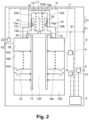
- Fig. 2 is a schematic sectional view of the flow control valve 10 showing other components of the brake system 1 together.
- the brake system 1 in this embodiment is a brake system for railroad vehicles.
- the flow control valves 10 may be provided respectively for each single bogie of a railroad vehicle, or for each single wheel.
- the brake system 1 includes a brake device for braking the railroad vehicle, a commanded-pressure supply valve 4 and a commanded-pressure exhaust valve 5, and a brake control unit (control circuit) 6 that controls the commanded-pressure supply valve 4 and the commanded-pressure exhaust valve 5.
- the brake device includes a brake cylinder 2 and is driven by supply of a high-pressure fluid into the brake cylinder 2 when braking a railroad vehicle.
- the commanded-pressure supply valve 4 and the commanded-pressure exhaust valve 5 are solenoid valves. Materials for the components of the commanded-pressure supply valve 4 and the commanded-pressure exhaust valve 5 are, for example, pure iron or stainless steel.
- the commanded-pressure exhaust valve 5 is not shown in Fig. 1 .
- the brake system 1 according to the embodiment also includes an air compressor 3 that generates high-pressure air. Thus, the high-pressure air is supplied to the brake cylinder 2 to drive the brake system.
- the brake system 1 includes a housing 8 as shown in Fig. 2 , and the flow control valve 10, the commanded-pressure supply valve 4, the commanded-pressure exhaust valve 5, and the brake control unit 6 are disposed in the housing 8.
- the housing 8 has an air supply port P1 to which high-pressure air compressed by the air compressor 3 is supplied, and an output port P2 connected to the brake cylinder 2.
- the air supply port P1 is connected to the air compressor 3 via a tank 9, for example, thereby the high-pressure air compressed by the air compressor 3 is supplied to the air supply port P1.
- the air supply port P1 is also connected to the commanded-pressure supply valve 4 through an air supply passage S1. This allows the high-pressure air compressed by the air compressor 3 to be supplied to the commanded-pressure supply valve 4.
- the flow control valve 10 supplies an introduced high-pressure air to the brake cylinder 2 upon receiving a brake command signal from a brake controller 7 installed in, for example, a driver's seat of the railroad vehicle.
- the flow control valve 10 includes an input chamber 10A, an introduction chamber 10B, an output chamber 10C, a first valve element 12, a second valve element 13, a guiding portion 14, a sealing member 15, and a retaining portion 16.
- the flow control valve 10 has a main body 11.
- the input chamber 10A, the introduction chamber 10B, and the output chamber 10C are formed in the main body 11.
- An atmospheric open chamber 10D that is open to the atmosphere is further formed in the main body 11.
- a feedback chamber 10E connected to the output chamber 10C is formed in the main body 11.
- the input chamber 10A and the feedback chamber 10E are separated by a diaphragm 18.
- a commanded pressure for generating a target braking force in the brake device is supplied to the input chamber 10A.
- the commanded-pressure supply valve 4 supplies the commanded pressure to the input chamber 10A.
- the commanded-pressure exhaust valve 5 discharges the commanded pressure from the input chamber 10A.
- the commanded-pressure supply valve 4 and the commanded-pressure exhaust valve 5 are opened and closed under the control of the brake control unit 6 to adjust the pressure in the input chamber 10A.
- the brake system 1 also includes an air compressor 3 that generates high-pressure air.
- the high-pressure air generated by the air compressor 3 is introduced into the introduction chamber 10B.
- the pressure fluid source for introduces the fluid into the introduction chamber 10B also introduces the fluid into the input chamber 10A to achieve the commanded pressure in the input chamber 10A.
- the air supply port P1 is connected to the commanded-pressure supply valve 4 as described above via the air supply passage S1, and also to the introduction chamber 10B.
- the high-pressure air generated by the air compressor 3 is introduced into the introduction chamber 10B.
- the fluid introduced into the input chamber 10A to realize the commanded pressure in the input chamber 10A and the fluid introduced into the introduction chamber 10B are both high-pressure air generated by the air compressor 3.
- the fluid introduced into the input chamber 10A for realizing the commanded pressure in the input chamber 10A and the fluid introduced into the introduction chamber 10B are not limited to the air.
- the commanded pressure inputted to the input chamber 10A and the pressure outputted to the brake cylinder 2 through the introduction chamber 10B and the output chamber 10C may be hydraulic pressure. Unless otherwise specified, the embodiment is described based on the case where the fluid introduced into the input chamber 10A and the fluid introduced into the introduction chamber 10B are both the air.
- the output chamber 10C is connected to the brake device and also communicates with the introduction chamber 10B through a passage.
- the output chamber 10C communicates with the brake cylinder 2 in the brake device.
- the output port P2 is connected to the output chamber 10C via the output passage S2.
- the output chamber 10C communicates with the brake cylinder 2 via the output port P2 and the output passage S2.
- the first valve element 12 is a member that opens and closes the passage that connects the introduction chamber 10B and the output chamber 10C.
- the first valve element 12 has a cylindrical lateral portion 121 and a bottom portion 122 provided at one end of the lateral portion 121.
- An opening 122a is formed at the center of the bottom portion 122.
- the flow control valve 10 includes a valve seat 20 and a spring 19a.
- the valve seat 20 is connected to the main body 11, and the valve seat 20 and the main body 11 define the introduction chamber 10B and the output chamber 10C.
- the valve seat 20 is formed integrally with the main body 11.
- the first valve element 12 opens the passage between the introduction chamber 10B and the output chamber 10C by moving away from the valve seat 20, and closes the passage by contacting the valve seat 20.
- the valve seat 20 faces the bottom portion 122 of the first valve element 12, and the passage is closed when the bottom portion 122 contacts the valve seat 20.
- the first valve element 12 is biased by the spring 19a in a direction toward the valve seat 20 (lower side in Fig.
- the spring 19a causes the first valve element 12 to contact the valve seat 20 to close the passage between the supply chamber 10B and the output chamber 10C.
- the material of the first valve element 12 contains brass or aluminum.
- the first valve element 12 is made of brass or aluminum.
- the second valve element 13 is a member that moves depending on a differential pressure (pressure difference) between the commanded pressure and the pressure in the output chamber 10C.
- the second valve element 13 has an cylindrical shape extending in a direction in which the lateral portion 121 of the first valve element 12 extends.
- the second valve element 13 has open ends at the side where the first valve element 12 is situated and on the other side opposite to the side where the first valve element 12 is situated.
- one end of the second valve element 13 opposes the bottom portion 122 of the first valve element 12.
- the second valve element 13 has a hollow portion 10F thereinside.
- the hollow portion 10F is open to the atmosphere since it is connected to the atmospheric open chamber 10D.
- the second valve element 13 is connected to the diaphragm 18.
- the flow control valve 10 further includes a spring 19b that biases the diaphragm 18 connected to the second valve element 13 toward the side opposite (lower side in Fig. 2 ) to the side where the first valve element 12 is situated.
- the second valve element 13 moves away from the first valve element 12 since the diaphragm 18 is moved away from the first valve element 12 by the spring 19b.
- a pressure difference between the input chamber 10A and the feedback chamber 10E causes the diaphragm 18 to move toward the side where the first valve element 12 is situated (upper side in Fig. 2 ) such that the input chamber 10A is expanded.
- the second valve element 13 also moves to the side where the first valve element 12 is situated following the movement of the diaphragm 18. Since the feedback chamber 10E communicates with the output chamber 10C, it can be said that the second valve element 13 moves depending on the differential pressure (pressure difference) between the commanded pressure or the pressure in the input chamber 10A adjusted by the command pressure supply valve 4 and the pressure in the output chamber 10C communicated with the feedback chamber 10E.
- the first valve element 12 moves depending on the differential pressure (pressure difference) between the commanded pressure and the pressure in the output chamber 10C to open and close the passage between the introduction chamber 10B and the output chamber 10C.
- the second valve element 13 moves depending on the differential pressure between the commanded pressure and the pressure in the output chamber 10C and the second valve element 13 contacts the first valve element 12 to move the first valve element 13, thereby opening and closing the passage.
- the second valve element 13 moves to cause an open state and an atmospheric open state.
- the second valve element 13 also moves to cause a close state.
- the flow control valve 10 of Fig. 2 is in the atmospheric open state.
- Fig. 3 shows the area enclosed by the double-dotted line and designated as III in Fig. 2 .
- the second valve element 13 is separated from the first element 12. Since the second valve element 13 is separated from the first element 12, the first element 12 closes the passage between the introduction chamber 10B and the output chamber 10C, and the output chamber 10C is opened to the atmosphere. This allows the high-pressure air to be exhausted from the brake cylinder 2.
- the second valve element 13 is separated from the first element 12, thus the output chamber 10C is connected to the hollow portion 10F through the space between the first element 12 and the second element 13. Consequently, the output chamber 10C is connected to the atmospheric open chamber 10D through the hollow portion 10F, and the high-pressure air is exhausted from the brake cylinder 2 connected to the output chamber 10C.
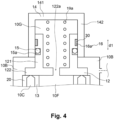
- Fig. 4 illustrates the flow control valve 10 in the close state.
- the second valve element contacts the first valve element 12 from the atmospheric open state, it causes the close state in which the first valve element 12 closes the passage between the introduction chamber 10B and the output chamber 10C and the output chamber 10C is shut off from the atmosphere, i.e., from the space outside the flow control valve 10.
- the second valve element 13 contacts the bottom portion 122 of the first valve element 12.
- the second valve element 13 moves following the movement of the diaphragm 18 to contact the first valve element 12.
- the output chamber 10C is disconnected from the hollow portion 10F that connects with the atmospheric open chamber 10D.
- the close state the high-pressure air is not supplied to the output chamber 10C and the high-pressure air is not exhausted from the output chamber 10C, so the pressure in the output chamber 10C and brake cylinder 2 is maintained at a constant level.
- Fig. 5 illustrates the flow control valve 10 in the open state.
- the second valve 13 contacts the first valve element 12 to move the first valve element 12 from the atmospheric open state, it causes the open state in which the first valve element 12 opens the passage between the introduction chamber 10B and the output chamber 10C and the output chamber 10C is shut off from the atmosphere. This allows the high-pressure air to be supplied to the brake cylinder 2.
- the second valve element 13 moves following the movement of the diaphragm 18 to contact the first valve element 12 and further pushes the first valve element 12 against the biasing force of the spring 19a.
- first valve element 12 This causes the first valve element 12 to separate from the valve seat 20, and the introduction chamber 10B and the output chamber 10C are connected to each other through the passage between the first valve element 12 and the valve seat 20.
- the second valve element 13 contacts the first valve element 12, so that the output chamber 10C is disconnected from the hollow portion 10F that communicates with the atmospheric open chamber 10D.
- the direction in which the first valve element 12 is pushed and moved by the second valve element 13 is hereunder referred to as a moving direction d1 of the first valve element 12.
- the first valve element 12 closes the passage between the introduction chamber 10B and the output chamber 10C at least when the pressure in the output chamber 10C is equal to or greater than the commanded pressure.
- the second valve element 13 of the flow control valve 10 in the open state as shown in Fig. 5 moves away from the first valve element 12 (lower side in Fig. 5 ) by the biasing force of the spring 19a and spring 19b, at least when the pressure in the output chamber 10C is equal to or greater than the commanded pressure.
- the first valve element 12 then moves to the side where the second valve element 13 is situated (lower side in Fig. 5 ) by the biasing force of the spring 19a because it is no longer supported by the second valve element 13.
- first valve element 12 in the embodiment is configured to close the passage between the introduction chamber 10B and the output chamber 10C at least when the pressure in the output chamber 10C is equal to or greater than the commanded pressure.
- the flow control valve 10 having the first valve element 12 and the second valve element 13 according to the embodiment is able to brake and release the brake on the railway vehicle by switching between the three states: the atmospheric open state, the close state, and the open state.
- the command pressure is supplied to the input chamber 10A using the commanded-pressure supply valve 4 and the second valve element 13 is moved to switch the atmospheric open state to the open state.
- the high-pressure air is supplied to the brake cylinder 2 to apply the brake on the railway vehicle.
- the introduction of the fluid into the input chamber 10A using the commanded-pressure supply valve 4 and the exhaust of the fluid from the input chamber 10A using the commanded-pressure exhaust valve 5 may be repeatedly performed to adjust the pressure in the input chamber 10A or the pressure in the output chamber 10C till it reaches a desired value corresponding to the intensity of the brake to be applied. As shown in Figs.
- the brake system 1 is also equipped with a sensor 21 for detecting the pressure in the input chamber 10A and a sensor 22 for detecting the pressure in the output chamber 10C.
- the brake control unit 6 may utilize results of detections performed by the sensors 21 and 22 to control the commanded-pressure supply valve 4 and the commanded-pressure exhaust valve 5 such that the pressure in the input chamber 10A or the pressure in the output chamber 10C achieves a desired value.
- the diaphragm 18 moves to the side opposite to where the first valve element 12 is situated such that the output chamber 10C is expanded due to the increased pressure in the output chamber 10C and in the feedback chamber 10E connected to the output chamber 10C.
- the second valve element 13 moves following the movement of the diaphragm 18, the first valve element 12 is pushed by the biasing force of the spring 19a to contact the valve seat 20 again, thereby the flow control valve 10 is switched from the open state to the close state.
- the close state the pressure in the output chamber 10C and the pressure in the brake cylinder 2 are maintained at constant levels, and the brake is kept applying on the railway vehicle.
- the commanded-pressure exhaust valve 5 When releasing the brake, the commanded-pressure exhaust valve 5 is used to exhaust the air from the input chamber 10A, and the second valve element 13 is moved to switch the flow control valve 10 to the atmospheric open state. As a result, the air is exhausted from the output chamber 10C connected to the brake cylinder 2, thereby the brake applied to the railway vehicle is released.
- the mode of the flow control valve 10 can be switched to apply or release the brake depending on the pressure in the input chamber 10A.
- the mode of the flow control valve 10 can be switched to apply or release the brake depending on the pressure in the input chamber 10A.
- a command pressure with a small flow rate to the input chamber 10A, it is possible to cause a high pressure fluid with a large flow rate to flow from the introduction chamber 10B to the output chamber 10C.
- the flow control valve 10 includes the guiding portion 14 for guiding the movement of the first valve element 12.
- the guiding portion 14 has a guiding lateral portion 142 having a substantially cylindrical shape, and a guiding bottom portion 141 provided at one end of the guiding lateral portion 142 opposite to the end facing the bottom portion 122 of the first valve element 12.
- the guiding portion 14 is a member that guides the movement of the first valve element 12 when the first valve element 12 is pushed by the second valve element 13 or by the biasing force of the spring 19a as described above.
- at least a part of the lateral portion 121 of the first valve element 12 is inserted in the guiding lateral portion 142.
- the guiding portion 14 guides the movement of the first valve element 12 along the inner surface of the guiding lateral portion 142.
- the first valve element 12 and the guiding portion 14 are partially in contact with each other.
- the first valve element 12 and the guiding portion 14 may be in contact with each other via a lubricant, which will be described later.
- a lubricant which will be described later.
- the outer surface of the lateral portion 121 of the first valve element 12 and the inner surface of the guiding lateral portion 142 of the guiding portion 14 are partially in contact with each other.
- the material of the guiding portion 14 contains brass or aluminum.
- the guiding portion 14 is made of brass or aluminum.
- the first valve element 12 and the guiding portion 14 define a guiding chamber 10G.
- the guiding chamber 10G is a space enclosed by the lateral portion 121, the bottom portion 122, the guiding lateral portion 142, and the guiding bottom portion 141.
- the guiding chamber 10G always communicates with the atmospheric open chamber 10D through the opening 122a in the bottom portion 122 and the hollow portion 10F, regardless of which state the flow control valve 10 is in: the open, closed, or atmospheric open state. Therefore, the first valve element 12 is able to move relative to the guiding portion 14 without resistance of the pressure in the guiding chamber 10G.
- the sealing member 15 is a member that prevents flow of the fluid between the first valve element 12 and the guide portion 14. As shown in Fig. 2 , the sealing member 15 is disposed between the first valve element 12 and the guiding portion 14. In the example shown in Fig. 2 , the sealing member 15 is an O-ring provided between the lateral portion 121 of the first valve element 12 and the guiding lateral portion 142 of the guiding portion 14. Although not shown in the drawing, the sealing member 15 may be a packing provided between the first valve element 12 and the guiding portion 14. In this case, the packing has an annular shape, for example, and is disposed between the lateral portion 121 of the first valve element 12 and the guiding lateral portion 142 of the guiding portion 14.
- the material for the sealing member 15 is not particularly limited and may be any material generally used for O-rings or the like. For example, the material of the sealing member 15 is rubber.
- the sealing member 15 is provided in the first valve element 12.
- a groove 15a is formed in the lateral portion 121 of the first valve element 12.
- the groove 15a has an annular shape about an axis line L1 of the first valve element 12 that extends parallel to the moving direction d1 of the first valve element 12.
- the sealing member 15 is provided in the first valve element 12 by being at least partially disposed in the groove 15a.
- the sealing member 15 seals off the introduction chamber 10B from the atmosphere.
- the sealing member 15 shown in Fig. 2 is situated between the first valve element 12 and the guiding portion 14 to prevent the introduction chamber 10B from communicating with the guiding chamber 10G via the first valve element 12 and the guiding portion 14.
- the sealing member 15 prevents the introduction chamber 10B from communicating with the atmospheric open chamber 10D via the guiding chamber 10G, thereby sealing off the introduction chamber 10B from the atmosphere.
- the sealing member 15 seals off the introduction chamber 10B from the atmosphere, thereby preventing the high-pressure fluid in the introduction chamber 10B from flowing out to the outside of the flow control valve 10.
- the retaining portion 16 retains the lubricant 30 supplied to the contacting surface between the first valve element 12 and the guiding portion 14.
- the retaining portion 16 is provided on at least one of the first valve element 12 or the guiding portion 14.
- the retaining portion 16 is provided on the first valve element 12.
- the retaining portion 16 is a groove 16a formed in the lateral portion 121 of the first valve element 12. In this case, as shown in Fig. 2 , the lubricant 30 can be retained in the retaining portion 16 by supplying the lubricant 30 into the groove 16a, which serves as the retaining portion 16.
- the sealing member 15 and the retaining portion 16 are provided on the same side of the first valve element 12 or the guiding portion 14. In the example shown in Fig. 2 , the sealing member 15 and the retaining portion 16 are both provided in the first valve element 12. Although not shown in the Fig. 2 , the sealing member 15 may be provided in the first valve element 12 and the retaining portion 16 may be provided in the guide portion 14, or the sealing member 15 may be provided in the guide portion 14 and the retaining portion 16 may be provided in the first valve element 12. In the example shown in Fig. 2 , the retaining portion 16 is situated on the opposite side (upper side in Fig. 2 ) to the side where the second valve element 13 is situated with reference to the position of the sealing member 15.
- the lubricant 30 retained in the retaining portion 16 spreads between the first valve element 12 and the guiding portion 14 and is supplied to the sealing member 15. Since the lubricant 30 is applied to the sealing member 15, it is possible to prevent the sealing member 15 from drying out and deteriorating due to friction caused by the relative movement of the first valve element 12 against the guiding portion 14. In particular, ozone degradation of the sealing member 15 can be prevented.
- the lubricant 30 in the retaining portion 16 is not limited to any particular lubricant and can be any lubricant provided that it can be supplied to the sealing member 15 to prevent the deterioration of the sealing member 15.
- the lubricant 30 is, for example, grease.
- the grease is defined according to the description in Japanese Industrial Standards, JIS K 2220: 2013. In other words, the grease is a semi-solid or solid form of a raw base oil in which thickener is dispersed.
- the configuration of the retaining portion 16 is not limited provided that the lubricant 30 in the retaining portion 16 is supplied to the contacting surface between the first valve element 12 and the guiding portion 14.
- the groove 16a is preferably provided such that it circles about the axis line L1 of the first valve element 12 which extends parallel to the movement direction d1 of the first valve element 12.
- the groove portion 16a which is the retaining portion 16 circles the axis line L1
- the retaining portion 16 has an annular shape surrounding the axis line L1.
- Fig. 6 is the enlarged sectional view of the flow control valve 10 shown in Fig. 2 for showing the portion where the sealing member 15 and the retaining portion 16 are provided.
- the section of the groove 16a, which is the retaining portion 16 has a rectangular shape.
- a dimension w1 of the groove 16a in the moving direction d1 is preferably larger than a dimension w2 of the groove portion 16a in the direction perpendicular to the moving direction d1.
- the dimension w1 of the groove 16a, which is the retaining portion 16, in the moving direction d1 is between 0.1 to 0.4 (both inclusive) times of a dimension w3 of the contacting surface between the first valve element 12 and the guiding portion 14 in the moving direction d1 when the flow control valve 10 is in the open state.
- the volume of the groove 16a which is the retaining portion 16, is preferably between 50% and 200% (both inclusive) of the volume of the groove 15a receiving the sealing member 15 therein minus the volume of the sealing member 15.
- the sealing member 15 is provided in the flow control valve 10 to prevent the fluid from passing between the first valve element 12 and the guiding portion 14, and in particular to disconnect the introduction chamber 10B with the atmospheric open chamber 10D.
- the sealing member 15 may dry out and deteriorate due to friction caused by the movement of the first valve element 12 relative to the guide portion 14.
- the sealing member 15 may deteriorate due to ozone.
- a lubricant may be applied on the sealing member 15 in advance.
- the applied lubricant may evaporate due to friction caused by the relative movement of the first valve element 12 against the guiding portion 14, and the sealing member 15 may deteriorate.
- the sealing member 15 in the flow control valve 10 for brakes tends to deteriorate for the following reason.
- the pressure in the introduction chamber 10A is controlled to switch the state of the flow control valve 10 by moving the first valve element 12 due to the pressure difference between the introduction chamber 10A and the output chamber 10C, thereby the pressure of the high-pressure air supplied to the brake cylinder 2 is adjusted to activate the brake.
- the first valve element 12 may be moved back and forth multiple times in order to activate the brake one time.
- the pressure in the input chamber 10A or output chamber 10C may be detected using the sensors 21, 22, and adjusted such that the pressure in the input chamber 10A or output chamber 10C becomes a predetermined value corresponding to the desired force.
- the first valve element 12 may move back and forth more than one time since the pressure in the input chamber 10A or output chamber 10C is adjusted to the predetermined value.
- the first valve element 12 is a component that is likely to move back and forth a relatively large number of times. As described above, such a reciprocating movement of the first valve element 12 is considered to promotes deterioration of the sealing material 15 due to drying, etc.
- the lubricant 30 is supplied to the sealing member 15 from the retainer 16.
- the lubricant 30 in the retaining portion 16 is supplied to the sealing member 15 in small amounts over a long period of time as the first valve element 12 moves back and forth. This prevents the sealing member 15 from drying out and deteriorating due to evaporation of the lubricant 30.
- an oilless compressor may be used as the air compressor 3 that generates the high-pressure air to be introduced into the introduction chamber 10B.
- the high-pressure air generated by the oilless air compressor is introduced into the introduction chamber 10B as the fluid.
- the oilless air compressor produces a dry high-pressure air with a lower oil concentration than the oil-injected compressor.
- the term "oilless air compressor” herein refers to an air compressor in which, for example, lubricating oil or the like is not supplied to sliding or rotating parts in the air compressor.
- the lubricant 30 is supplied from the retaining portion 16 to the contacting surface between the first valve element 12 and the guiding portion 14, thereby reducing loads on the first valve element 12 and the guiding portion 14 and also suppressing wear of the first valve element 12 and the guiding portion 14.
- friction-resistant materials such as pure iron and stainless steel may be used for the components of the solenoid valves employed as the commanded-pressure supply valve 4 and the commanded-pressure exhaust valve 5 in the embodiment
- brass or aluminum which are relatively weak against friction, may be used for the first valve element 12 and the guiding portion 14 of the flow control valve 10.
- the retaining portion 16 can suppress wear of the first valve element 12 and the guiding portion 14 even when the first valve element 12 and the guiding portion 14 are made of brass or aluminum.
- the feature of the flow control valve 10 having the retaining portion 16 is particularly effective when the first valve element 12 and the guiding portion 14 are made of brass or aluminum.
- the sealing member 15 and the retaining portion 16 are provided on the same side of the first valve element 12 or the guiding portion 14. In the example shown in Fig. 2 , the sealing member 15 and the retaining portion 16 are both provided in the first valve element 12. An advantageous effect of this configuration will now be explained. If one of the sealing member 15 or the retaining portion 16 is provided in the first valve element 12 and the other is provided in the guiding portion 14, there is a possibility that sealing by the sealing member 15 may break when the sealing member 15 and the retaining portion 16 face each other depending on the shape of the retaining portion 16.
- the sealing member 15 and the retaining portion 16 will not face each other depending on the movement of the first valve element 12.
- the sealing member 15 and the retaining portion 16 never face each other and the sealing by the sealing member 15 will not break. Therefore, the shape of the retaining portion 16 can be freely designed. For example, the volume and dimension w1 of the groove 16a, which is the retaining portion 16, may be increased so that a larger amount of the lubricant 30 is retained therein.
- a distance w4 between the sealing member 15 and the retaining portion 16 in the moving direction d1 of the first valve element 12 shown in Fig. 6 is equal to or smaller than a movable distance of the first valve element 12.
- the double-dotted line L2 in Fig. 6 is an imaginary line that indicates the position of the first valve element 12 when it is pushed by the second element 13 and is displaced the longest distance from the position in the atmospheric open state.
- the distance w5 shown in Fig. 6 is the movable distance of the first valve element 12.
- the sealing member 15 comes into direct contact with the portion of the first valve element 12 or the guiding portion 14 that contacts the retaining portion 16. Consequently, the lubricant 30 can be efficiently supplied to the sealing member 15.
- the sealing member 15 and the retaining portion 16 are both provided in the first valve element 12 as one example of the case where the sealing member 15 and the retaining portion 16 are both provided on the same side of the first valve element 12 or the guiding portion 14.
- the configuration of the sealing member 15 and the retaining portion 16 is not limited to this.
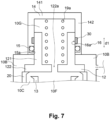
- Fig. 7 shows a sectional view of the flow control valve 10 in a first modification example.
- the sealing member 15 and the retaining portion 16 are both provided in the guiding portion 14.
- the sealing member 15 is disposed in the groove 15a formed in the guiding portion 14.
- the retaining portion 16 is a groove 16a formed in the guiding portion 14.
- the sealing member 15 and the retaining portion 16 be both provided in the first valve element 12 rather than both being provided in the guiding portion 14.
- Fig. 8 is a sectional view of the flow control valve 10 according to a second modification example.
- the retaining portion 16 is situated on the side (lower side in Fig. 8 ) where the second valve element 13 is situated with reference to the position of the sealing member 15. Even in this case, it is possible to spread the lubricant 30 in the retaining portion 16 on the surface between the first valve element 12 and the guide portion 14 to supply the lubricant 30 to the sealing member 15.
- the retaining portion 16 may be provided both on the side where the second valve element 13 is situated and on the opposite side to where the second valve element 13 is situated with reference to the position of the sealing member 15.
- an object that are composed of multiple components may be integrated into a single body object, or conversely, an object composed of a single component may be divided into multiple components. As long as it is configured such that the purpose of the invention can be achieved, such components may be integrated or separately provided.
Landscapes
- Engineering & Computer Science (AREA)
- Mechanical Engineering (AREA)
- Transportation (AREA)
- Physics & Mathematics (AREA)
- Fluid Mechanics (AREA)
- Valves And Accessory Devices For Braking Systems (AREA)
- Regulating Braking Force (AREA)
- Braking Systems And Boosters (AREA)
Description
- The present invention relates to a flow control valve according to the preamble of independent claim 1 and a brake system according to the preamble of
independent claim 8. - Such a flow control valve and such a brake system are known from
JP 2004 262405 A - In a piston sealing arrangement according to
GB 2 114 265 A - An operation mechanism for a parking brake pedal shown in
GB 2 188 712 A -
US 4 432 586 A discloses a brake control system for a motor vehicle comprising a power piston having a blind bore formed therein. At least one axial groove filled with lubricant grease is formed in an internal surface of said blind bore and extends throughout the full length of said blind bore for continuous communication of an interior of said blind bore with a chamber. - Flow control valves outputting, in response to input of a commanded pressure, a high-pressure fluid with a pressure corresponding to the commanded pressure and a flow rate greater than a flow rate that causes the commanded pressure have been known.
JP 2004 262405 A JP 2004 262405 A - Between the valve that opens and closes between the air supply chamber and the output chamber, such as the air supply valve of
JP 2004 262405 A - The present invention has been made in view of such circumstances, and an object of the invention is to prevent deterioration of the sealing member.
- A flow control valve for brakes according to the invention defined in independent claim 1 comprises: an introduction chamber into which fluid is introduced from a pressure fluid source; an output chamber connected to a brake device, the output chamber communicating with the introduction chamber through a passage; an input chamber to which a commanded pressure for generating a target braking force in the brake device is supplied; a first valve element moving depending on a differential pressure between the command pressure and a pressure in the output chamber to open and close the passage, the first valve element closing the passage at least when the pressure in the output chamber is equal to or greater than the command pressure; a guiding portion guiding movement of the first valve element; a sealing member provided between the first valve element and the guiding portion, the sealing member preventing the fluid from passing between the first valve element and the guiding portion; and a retaining portion provided in at least one of the first valve element or the guiding portion, the retaining portion retaining lubricant supplied to a contacting surface between the first valve element and the guiding portion, wherein a distance between the sealing member and the retaining portion in a moving direction of the first valve element is equal to or smaller than a movable distance of the first valve element.
- In the flow control valve for brakes, the sealing member and the retaining portion may be provided on a same side of the first valve element or the guiding portion.
- In the flow control valve for brakes, the first valve element and the guiding portion may be made of brass or aluminum.
- In the flow control valve for brakes, high-pressure air generated by an oilless air compressor may be introduced into the introduction chamber as the fluid.
- The flow control valve may further comprise a second valve element moving depending on a differential pressure between the command pressure and the pressure in the output chamber to move the first valve element. The second valve element may move away from the first valve element to cause an atmospheric open state in which the first valve element closes the passage and the output chamber is opened to atmosphere, and the second valve element may contact the first valve element from the atmospheric open state and move the first valve element to cause an open state in which the first valve element opens the passage and the output chamber is shut off from the atmosphere.
- In the flow control valve for brakes, the second valve element may contact the first valve element from the atmospheric open state and move the first valve element to cause a close state in which the first valve element closes the passage and the output chamber is shut off from the atmosphere.
- In the flow control valve for brakes, the sealing member may seal off the introduction chamber from the atmosphere.
- A brake system for railway vehicles according to the invention is defined in
claim 8. - The brake system for railway vehicles may further comprise an oilless air compressor generating high-pressure air that is to be introduced into the introduction chamber as the fluid.
- According to the aspects of the invention, it is possible to prevent deterioration of the sealing member.
-
-
Fig. 1 is a configuration diagram of a brake system equipped with a flow control valve according to an embodiment. -
Fig. 2 is a schematic sectional view of the flow control valve according to the embodiment. -
Fig. 3 is an enlarged schematic sectional view of a portion enclosed by the double-dotted line and designated as III inFig. 2 , according to the embodiment. -
Fig. 4 is a schematic sectional view of the flow control valve in a close state according to the embodiment. -
Fig. 5 is a schematic sectional view of the flow control valve in an open state according to the embodiment illustrating its configuration. -
Fig. 6 is an enlarged schematic sectional view of asealing member 15 and aretainer 16 according to the embodiment. -
Fig. 7 is a schematic sectional view of a flow control valve according to a first modification example. -
Fig. 8 is a schematic sectional view of a flow control valve according to a second modification example. - Embodiments of the present invention will now be described with reference to the appended drawings.
Fig. 1 is a configuration diagram of a brake system 1 equipped with aflow control valve 10.Fig. 2 is a schematic sectional view of theflow control valve 10 showing other components of the brake system 1 together. - This embodiment describes a case where the
flow control valve 10 is a brakeflow control valve 10 provided in the brake system 1. The brake system 1 in this embodiment is a brake system for railroad vehicles. In the brake system for railroad vehicles, theflow control valves 10 may be provided respectively for each single bogie of a railroad vehicle, or for each single wheel. In addition to theflow control valve 10, the brake system 1 includes a brake device for braking the railroad vehicle, a commanded-pressure supply valve 4 and a commanded-pressure exhaust valve 5, and a brake control unit (control circuit) 6 that controls the commanded-pressure supply valve 4 and the commanded-pressure exhaust valve 5. The brake device includes abrake cylinder 2 and is driven by supply of a high-pressure fluid into thebrake cylinder 2 when braking a railroad vehicle. In the embodiment, the commanded-pressure supply valve 4 and the commanded-pressure exhaust valve 5 are solenoid valves. Materials for the components of the commanded-pressure supply valve 4 and the commanded-pressure exhaust valve 5 are, for example, pure iron or stainless steel. The commanded-pressure exhaust valve 5 is not shown inFig. 1 . The brake system 1 according to the embodiment also includes an air compressor 3 that generates high-pressure air. Thus, the high-pressure air is supplied to thebrake cylinder 2 to drive the brake system. - The brake system 1 according to the embodiment includes a
housing 8 as shown inFig. 2 , and theflow control valve 10, the commanded-pressure supply valve 4, the commanded-pressure exhaust valve 5, and thebrake control unit 6 are disposed in thehousing 8. Thehousing 8 has an air supply port P1 to which high-pressure air compressed by the air compressor 3 is supplied, and an output port P2 connected to thebrake cylinder 2. The air supply port P1 is connected to the air compressor 3 via atank 9, for example, thereby the high-pressure air compressed by the air compressor 3 is supplied to the air supply port P1. The air supply port P1 is also connected to the commanded-pressure supply valve 4 through an air supply passage S1. This allows the high-pressure air compressed by the air compressor 3 to be supplied to the commanded-pressure supply valve 4. - The
flow control valve 10 supplies an introduced high-pressure air to thebrake cylinder 2 upon receiving a brake command signal from a brake controller 7 installed in, for example, a driver's seat of the railroad vehicle. In the example shown inFig. 2 , theflow control valve 10 includes aninput chamber 10A, anintroduction chamber 10B, anoutput chamber 10C, afirst valve element 12, asecond valve element 13, a guidingportion 14, asealing member 15, and aretaining portion 16. - In the example shown in
Fig. 2 , theflow control valve 10 has amain body 11. Theinput chamber 10A, theintroduction chamber 10B, and theoutput chamber 10C are formed in themain body 11. An atmosphericopen chamber 10D that is open to the atmosphere is further formed in themain body 11. In addition, afeedback chamber 10E connected to theoutput chamber 10C is formed in themain body 11. In the example shown inFig. 2 , theinput chamber 10A and thefeedback chamber 10E are separated by adiaphragm 18. - A commanded pressure for generating a target braking force in the brake device is supplied to the
input chamber 10A. In this system, the commanded-pressure supply valve 4 supplies the commanded pressure to theinput chamber 10A. The commanded-pressure exhaust valve 5 discharges the commanded pressure from theinput chamber 10A. The commanded-pressure supply valve 4 and the commanded-pressure exhaust valve 5 are opened and closed under the control of thebrake control unit 6 to adjust the pressure in theinput chamber 10A. - Fluid is introduced into the
introduction chamber 10B from a pressure fluid source. The brake system 1 according to the embodiment also includes an air compressor 3 that generates high-pressure air. In this case, as the fluid, the high-pressure air generated by the air compressor 3 is introduced into theintroduction chamber 10B. - In the embodiment, the pressure fluid source for introduces the fluid into the
introduction chamber 10B also introduces the fluid into theinput chamber 10A to achieve the commanded pressure in theinput chamber 10A. In the embodiment, the air supply port P1 is connected to the commanded-pressure supply valve 4 as described above via the air supply passage S1, and also to theintroduction chamber 10B. Thus, the high-pressure air generated by the air compressor 3 is introduced into theintroduction chamber 10B. In the embodiment, the fluid introduced into theinput chamber 10A to realize the commanded pressure in theinput chamber 10A and the fluid introduced into theintroduction chamber 10B are both high-pressure air generated by the air compressor 3. The fluid introduced into theinput chamber 10A for realizing the commanded pressure in theinput chamber 10A and the fluid introduced into theintroduction chamber 10B are not limited to the air. Another example of the fluid is a liquid. The commanded pressure inputted to theinput chamber 10A and the pressure outputted to thebrake cylinder 2 through theintroduction chamber 10B and theoutput chamber 10C may be hydraulic pressure. Unless otherwise specified, the embodiment is described based on the case where the fluid introduced into theinput chamber 10A and the fluid introduced into theintroduction chamber 10B are both the air. - The
output chamber 10C is connected to the brake device and also communicates with theintroduction chamber 10B through a passage. In this embodiment, theoutput chamber 10C communicates with thebrake cylinder 2 in the brake device. In the embodiment, the output port P2 is connected to theoutput chamber 10C via the output passage S2. Thus, theoutput chamber 10C communicates with thebrake cylinder 2 via the output port P2 and the output passage S2. - The
first valve element 12 is a member that opens and closes the passage that connects theintroduction chamber 10B and theoutput chamber 10C. In the example shown inFig. 2 , thefirst valve element 12 has a cylindricallateral portion 121 and abottom portion 122 provided at one end of thelateral portion 121. Anopening 122a is formed at the center of thebottom portion 122. - In the example of
Fig. 2 , theflow control valve 10 includes avalve seat 20 and aspring 19a. Thevalve seat 20 is connected to themain body 11, and thevalve seat 20 and themain body 11 define theintroduction chamber 10B and theoutput chamber 10C. As an example, thevalve seat 20 is formed integrally with themain body 11. Thefirst valve element 12 opens the passage between theintroduction chamber 10B and theoutput chamber 10C by moving away from thevalve seat 20, and closes the passage by contacting thevalve seat 20. In the example ofFig. 2 , thevalve seat 20 faces thebottom portion 122 of thefirst valve element 12, and the passage is closed when thebottom portion 122 contacts thevalve seat 20. Thefirst valve element 12 is biased by thespring 19a in a direction toward the valve seat 20 (lower side inFig. 2 ). In the state illustrated inFig. 2 , thespring 19a causes thefirst valve element 12 to contact thevalve seat 20 to close the passage between thesupply chamber 10B and theoutput chamber 10C. As an example, the material of thefirst valve element 12 contains brass or aluminum. For example, thefirst valve element 12 is made of brass or aluminum. - The
second valve element 13 is a member that moves depending on a differential pressure (pressure difference) between the commanded pressure and the pressure in theoutput chamber 10C. In the example ofFig. 2 , thesecond valve element 13 has an cylindrical shape extending in a direction in which thelateral portion 121 of thefirst valve element 12 extends. Thesecond valve element 13 has open ends at the side where thefirst valve element 12 is situated and on the other side opposite to the side where thefirst valve element 12 is situated. In the example shown inFig. 2 , one end of thesecond valve element 13 opposes thebottom portion 122 of thefirst valve element 12. Thesecond valve element 13 has ahollow portion 10F thereinside. Thehollow portion 10F is open to the atmosphere since it is connected to the atmosphericopen chamber 10D. - In the example shown in
Fig. 2 , thesecond valve element 13 is connected to thediaphragm 18. Thus, thesecond valve element 13 moves in the vertical direction inFig. 2 following the movement of thediaphragm 18. Theflow control valve 10 further includes aspring 19b that biases thediaphragm 18 connected to thesecond valve element 13 toward the side opposite (lower side inFig. 2 ) to the side where thefirst valve element 12 is situated. In the state illustrated inFig. 2 , thesecond valve element 13 moves away from thefirst valve element 12 since thediaphragm 18 is moved away from thefirst valve element 12 by thespring 19b. - When the fluid is introduced from the commanded-
pressure supply valve 4 to theinput chamber 10A and the commanded pressure is realized, a pressure difference between theinput chamber 10A and thefeedback chamber 10E causes thediaphragm 18 to move toward the side where thefirst valve element 12 is situated (upper side inFig. 2 ) such that theinput chamber 10A is expanded. Thesecond valve element 13 also moves to the side where thefirst valve element 12 is situated following the movement of thediaphragm 18. Since thefeedback chamber 10E communicates with theoutput chamber 10C, it can be said that thesecond valve element 13 moves depending on the differential pressure (pressure difference) between the commanded pressure or the pressure in theinput chamber 10A adjusted by the commandpressure supply valve 4 and the pressure in theoutput chamber 10C communicated with thefeedback chamber 10E. - The
first valve element 12 moves depending on the differential pressure (pressure difference) between the commanded pressure and the pressure in theoutput chamber 10C to open and close the passage between theintroduction chamber 10B and theoutput chamber 10C. In the embodiment, thesecond valve element 13 moves depending on the differential pressure between the commanded pressure and the pressure in theoutput chamber 10C and thesecond valve element 13 contacts thefirst valve element 12 to move thefirst valve element 13, thereby opening and closing the passage. - The
second valve element 13 moves to cause an open state and an atmospheric open state. Thesecond valve element 13 also moves to cause a close state. Theflow control valve 10 ofFig. 2 is in the atmospheric open state.Fig. 3 shows the area enclosed by the double-dotted line and designated as III inFig. 2 . As shown inFig. 3 , in the atmospheric open state, thesecond valve element 13 is separated from thefirst element 12. Since thesecond valve element 13 is separated from thefirst element 12, thefirst element 12 closes the passage between theintroduction chamber 10B and theoutput chamber 10C, and theoutput chamber 10C is opened to the atmosphere. This allows the high-pressure air to be exhausted from thebrake cylinder 2. In the example shown inFigs. 2 and3 , thesecond valve element 13 is separated from thefirst element 12, thus theoutput chamber 10C is connected to thehollow portion 10F through the space between thefirst element 12 and thesecond element 13. Consequently, theoutput chamber 10C is connected to the atmosphericopen chamber 10D through thehollow portion 10F, and the high-pressure air is exhausted from thebrake cylinder 2 connected to theoutput chamber 10C. -
Fig. 4 illustrates theflow control valve 10 in the close state. When the second valve element contacts thefirst valve element 12 from the atmospheric open state, it causes the close state in which thefirst valve element 12 closes the passage between theintroduction chamber 10B and theoutput chamber 10C and theoutput chamber 10C is shut off from the atmosphere, i.e., from the space outside theflow control valve 10. In the close state and the open state described below, thesecond valve element 13 contacts thebottom portion 122 of thefirst valve element 12. In the embodiment, when the commanded pressure is supplied to theinput chamber 10A, thesecond valve element 13 moves following the movement of thediaphragm 18 to contact thefirst valve element 12. As a result, theoutput chamber 10C is disconnected from thehollow portion 10F that connects with the atmosphericopen chamber 10D. In the close state, the high-pressure air is not supplied to theoutput chamber 10C and the high-pressure air is not exhausted from theoutput chamber 10C, so the pressure in theoutput chamber 10C andbrake cylinder 2 is maintained at a constant level. -
Fig. 5 illustrates theflow control valve 10 in the open state. When thesecond valve 13 contacts thefirst valve element 12 to move thefirst valve element 12 from the atmospheric open state, it causes the open state in which thefirst valve element 12 opens the passage between theintroduction chamber 10B and theoutput chamber 10C and theoutput chamber 10C is shut off from the atmosphere. This allows the high-pressure air to be supplied to thebrake cylinder 2. In the embodiment, when a sufficiently large commanded pressure is supplied to theinput chamber 10A of theflow control valve 10 in the atmospheric open state shown inFig. 3 , thesecond valve element 13 moves following the movement of thediaphragm 18 to contact thefirst valve element 12 and further pushes thefirst valve element 12 against the biasing force of thespring 19a. This causes thefirst valve element 12 to separate from thevalve seat 20, and theintroduction chamber 10B and theoutput chamber 10C are connected to each other through the passage between thefirst valve element 12 and thevalve seat 20. At the same time, thesecond valve element 13 contacts thefirst valve element 12, so that theoutput chamber 10C is disconnected from thehollow portion 10F that communicates with the atmosphericopen chamber 10D. The direction in which thefirst valve element 12 is pushed and moved by thesecond valve element 13 is hereunder referred to as a moving direction d1 of thefirst valve element 12. - The
first valve element 12 closes the passage between theintroduction chamber 10B and theoutput chamber 10C at least when the pressure in theoutput chamber 10C is equal to or greater than the commanded pressure. In this embodiment, thesecond valve element 13 of theflow control valve 10 in the open state as shown inFig. 5 moves away from the first valve element 12 (lower side inFig. 5 ) by the biasing force of thespring 19a andspring 19b, at least when the pressure in theoutput chamber 10C is equal to or greater than the commanded pressure. Thefirst valve element 12 then moves to the side where thesecond valve element 13 is situated (lower side inFig. 5 ) by the biasing force of thespring 19a because it is no longer supported by thesecond valve element 13. The movements of thefirst valve element 12 and thesecond valve element 13 continue at least until thefirst valve element 12 contacts thevalve seat 20 and the passage between theintroduction chamber 10B and theoutput chamber 10C is closed to discontinue the introduction of the fluid into theoutput chamber 10C. Thus, it can be said that thefirst valve element 12 in the embodiment is configured to close the passage between theintroduction chamber 10B and theoutput chamber 10C at least when the pressure in theoutput chamber 10C is equal to or greater than the commanded pressure. - The
flow control valve 10 having thefirst valve element 12 and thesecond valve element 13 according to the embodiment is able to brake and release the brake on the railway vehicle by switching between the three states: the atmospheric open state, the close state, and the open state. - When applying the brake, the command pressure is supplied to the
input chamber 10A using the commanded-pressure supply valve 4 and thesecond valve element 13 is moved to switch the atmospheric open state to the open state. In the open state, the high-pressure air is supplied to thebrake cylinder 2 to apply the brake on the railway vehicle. When applying the brake, the introduction of the fluid into theinput chamber 10A using the commanded-pressure supply valve 4 and the exhaust of the fluid from theinput chamber 10A using the commanded-pressure exhaust valve 5 may be repeatedly performed to adjust the pressure in theinput chamber 10A or the pressure in theoutput chamber 10C till it reaches a desired value corresponding to the intensity of the brake to be applied. As shown inFigs. 1 and2 , the brake system 1 is also equipped with asensor 21 for detecting the pressure in theinput chamber 10A and asensor 22 for detecting the pressure in theoutput chamber 10C. In this case, thebrake control unit 6 may utilize results of detections performed by thesensors pressure supply valve 4 and the commanded-pressure exhaust valve 5 such that the pressure in theinput chamber 10A or the pressure in theoutput chamber 10C achieves a desired value. - When the pressure in the
output chamber 10C and the pressure in thebrake cylinder 2 become sufficiently high, thediaphragm 18 moves to the side opposite to where thefirst valve element 12 is situated such that theoutput chamber 10C is expanded due to the increased pressure in theoutput chamber 10C and in thefeedback chamber 10E connected to theoutput chamber 10C. As thesecond valve element 13 moves following the movement of thediaphragm 18, thefirst valve element 12 is pushed by the biasing force of thespring 19a to contact thevalve seat 20 again, thereby theflow control valve 10 is switched from the open state to the close state. In the close state, the pressure in theoutput chamber 10C and the pressure in thebrake cylinder 2 are maintained at constant levels, and the brake is kept applying on the railway vehicle. - When releasing the brake, the commanded-
pressure exhaust valve 5 is used to exhaust the air from theinput chamber 10A, and thesecond valve element 13 is moved to switch theflow control valve 10 to the atmospheric open state. As a result, the air is exhausted from theoutput chamber 10C connected to thebrake cylinder 2, thereby the brake applied to the railway vehicle is released. - As described above, by controlling the pressure in the
input chamber 10A using the commanded-pressure supply valve 4 and the commanded-pressure exhaust valve 5, the mode of theflow control valve 10 can be switched to apply or release the brake depending on the pressure in theinput chamber 10A. In particular, by supplying a command pressure with a small flow rate to theinput chamber 10A, it is possible to cause a high pressure fluid with a large flow rate to flow from theintroduction chamber 10B to theoutput chamber 10C. - The
flow control valve 10 includes the guidingportion 14 for guiding the movement of thefirst valve element 12. In the example shown inFig. 2 , the guidingportion 14 has a guidinglateral portion 142 having a substantially cylindrical shape, and a guidingbottom portion 141 provided at one end of the guidinglateral portion 142 opposite to the end facing thebottom portion 122 of thefirst valve element 12. - The guiding
portion 14 is a member that guides the movement of thefirst valve element 12 when thefirst valve element 12 is pushed by thesecond valve element 13 or by the biasing force of thespring 19a as described above. In the example shown inFig. 2 , at least a part of thelateral portion 121 of thefirst valve element 12 is inserted in the guidinglateral portion 142. The guidingportion 14 guides the movement of thefirst valve element 12 along the inner surface of the guidinglateral portion 142. Thefirst valve element 12 and the guidingportion 14 are partially in contact with each other. Here, thefirst valve element 12 and the guidingportion 14 may be in contact with each other via a lubricant, which will be described later. In the example shown inFig. 2 , the outer surface of thelateral portion 121 of thefirst valve element 12 and the inner surface of the guidinglateral portion 142 of the guidingportion 14 are partially in contact with each other. As an example, the material of the guidingportion 14 contains brass or aluminum. For example, the guidingportion 14 is made of brass or aluminum. - The
first valve element 12 and the guidingportion 14 define a guidingchamber 10G. In the example shown inFig. 2 , the guidingchamber 10G is a space enclosed by thelateral portion 121, thebottom portion 122, the guidinglateral portion 142, and the guidingbottom portion 141. As shown inFigs. 2-5 , the guidingchamber 10G always communicates with the atmosphericopen chamber 10D through theopening 122a in thebottom portion 122 and thehollow portion 10F, regardless of which state theflow control valve 10 is in: the open, closed, or atmospheric open state. Therefore, thefirst valve element 12 is able to move relative to the guidingportion 14 without resistance of the pressure in the guidingchamber 10G. - The sealing
member 15 is a member that prevents flow of the fluid between thefirst valve element 12 and theguide portion 14. As shown inFig. 2 , the sealingmember 15 is disposed between thefirst valve element 12 and the guidingportion 14. In the example shown inFig. 2 , the sealingmember 15 is an O-ring provided between thelateral portion 121 of thefirst valve element 12 and the guidinglateral portion 142 of the guidingportion 14. Although not shown in the drawing, the sealingmember 15 may be a packing provided between thefirst valve element 12 and the guidingportion 14. In this case, the packing has an annular shape, for example, and is disposed between thelateral portion 121 of thefirst valve element 12 and the guidinglateral portion 142 of the guidingportion 14. The material for the sealingmember 15 is not particularly limited and may be any material generally used for O-rings or the like. For example, the material of the sealingmember 15 is rubber. - In this embodiment, the sealing
member 15 is provided in thefirst valve element 12. In the example ofFig, 2 , agroove 15a is formed in thelateral portion 121 of thefirst valve element 12. Thegroove 15a has an annular shape about an axis line L1 of thefirst valve element 12 that extends parallel to the moving direction d1 of thefirst valve element 12. The sealingmember 15 is provided in thefirst valve element 12 by being at least partially disposed in thegroove 15a. - The sealing
member 15 seals off theintroduction chamber 10B from the atmosphere. The sealingmember 15 shown inFig. 2 is situated between thefirst valve element 12 and the guidingportion 14 to prevent theintroduction chamber 10B from communicating with the guidingchamber 10G via thefirst valve element 12 and the guidingportion 14. As described above, the sealingmember 15 prevents theintroduction chamber 10B from communicating with the atmosphericopen chamber 10D via the guidingchamber 10G, thereby sealing off theintroduction chamber 10B from the atmosphere. The sealingmember 15 seals off theintroduction chamber 10B from the atmosphere, thereby preventing the high-pressure fluid in theintroduction chamber 10B from flowing out to the outside of theflow control valve 10. Therefore, when the high-pressure fluid is supplied from theintroduction chamber 10B to thebrake cylinder 2 via theoutput chamber 10C in the open state, it is possible to prevent the high-pressure fluid from flowing out of theflow control valve 10 and prevent a reduced efficiency of pressure increase in thebrake cylinder 2. - The retaining
portion 16 retains thelubricant 30 supplied to the contacting surface between thefirst valve element 12 and the guidingportion 14. The retainingportion 16 is provided on at least one of thefirst valve element 12 or the guidingportion 14. In the example shown inFig. 2 , the retainingportion 16 is provided on thefirst valve element 12. In the example shown inFig. 2 , the retainingportion 16 is agroove 16a formed in thelateral portion 121 of thefirst valve element 12. In this case, as shown inFig. 2 , thelubricant 30 can be retained in the retainingportion 16 by supplying thelubricant 30 into thegroove 16a, which serves as the retainingportion 16. - In the example shown in
Fig. 2 , the sealingmember 15 and the retainingportion 16 are provided on the same side of thefirst valve element 12 or the guidingportion 14. In the example shown inFig. 2 , the sealingmember 15 and the retainingportion 16 are both provided in thefirst valve element 12. Although not shown in theFig. 2 , the sealingmember 15 may be provided in thefirst valve element 12 and the retainingportion 16 may be provided in theguide portion 14, or the sealingmember 15 may be provided in theguide portion 14 and the retainingportion 16 may be provided in thefirst valve element 12. In the example shown inFig. 2 , the retainingportion 16 is situated on the opposite side (upper side inFig. 2 ) to the side where thesecond valve element 13 is situated with reference to the position of the sealingmember 15. - With the retaining
portion 16, when thefirst valve element 12 is guided by the guidingportion 14 and moves relative to the guidingportion 14, thelubricant 30 retained in the retainingportion 16 spreads between thefirst valve element 12 and the guidingportion 14 and is supplied to the sealingmember 15. Since thelubricant 30 is applied to the sealingmember 15, it is possible to prevent the sealingmember 15 from drying out and deteriorating due to friction caused by the relative movement of thefirst valve element 12 against the guidingportion 14. In particular, ozone degradation of the sealingmember 15 can be prevented. - The
lubricant 30 in the retainingportion 16 is not limited to any particular lubricant and can be any lubricant provided that it can be supplied to the sealingmember 15 to prevent the deterioration of the sealingmember 15. Thelubricant 30 is, for example, grease. Here, the grease is defined according to the description in Japanese Industrial Standards, JIS K 2220: 2013. In other words, the grease is a semi-solid or solid form of a raw base oil in which thickener is dispersed. - The configuration of the retaining
portion 16 is not limited provided that thelubricant 30 in the retainingportion 16 is supplied to the contacting surface between thefirst valve element 12 and the guidingportion 14. When the retainingportion 16 is thegroove 16a as shown inFig. 2 , thegroove 16a is preferably provided such that it circles about the axis line L1 of thefirst valve element 12 which extends parallel to the movement direction d1 of thefirst valve element 12. By the fact that thegroove portion 16a, which is the retainingportion 16, circles the axis line L1, it is possible to retain thelubricant 30 over the entire circumference in the circumferential direction of the axis line L1 and to supply thelubricant 30 to the sealingmember 15 in the entire circumference in the circumferential direction of the axis line L1. In the example shown inFig. 2 , the retainingportion 16 has an annular shape surrounding the axis line L1. -
Fig. 6 is the enlarged sectional view of theflow control valve 10 shown inFig. 2 for showing the portion where the sealingmember 15 and the retainingportion 16 are provided. In the example shown inFig. 6 , the section of thegroove 16a, which is the retainingportion 16, has a rectangular shape. A dimension w1 of thegroove 16a in the moving direction d1 is preferably larger than a dimension w2 of thegroove portion 16a in the direction perpendicular to the moving direction d1. With this configuration, it is possible to increase the contacting area between thelubricant 30 in thegroove 16a and thefirst valve element 12 or the guidingportion 14 that faces thegroove 16a, allowing thelubricant 30 to be supplied to the contacting surface between thefirst valve element 12 and the guidingportion 14 more efficiently. - The dimension w1 of the
groove 16a, which is the retainingportion 16, in the moving direction d1 is between 0.1 to 0.4 (both inclusive) times of a dimension w3 of the contacting surface between thefirst valve element 12 and the guidingportion 14 in the moving direction d1 when theflow control valve 10 is in the open state. By setting the dimension w1 to 0.1 times or more of the dimension w3, it is possible to increase the contacting area between thelubricant 30 in thegroove 16a and thefirst valve element 12 or the guidingportion 14 that faces thegroove 16a, thereby thelubricant 30 can be more efficiently supplied to the contacting surface between thefirst valve element 12 and the guidingportion 14. If the dimension w1 is larger than 0.4 times of the dimension w3, a large amount of thelubricant 30 is supplied to the contacting surface between thefirst valve element 12 and the guidingportion 14, which increases the moving resistance for thefirst valve element 12 due to the viscosity of thelubricant 30. Further, if the dimension w1 is too large and the area of the contacting surface between thefirst valve element 12 and the guidingportion 14 becomes small, load generated when thefirst valve element 12 moves while contacting the guidingportion 14 may concentrate in a small area. By setting the dimension w1 to 0.4 times or less of the dimension w3, these drawbacks are prevented. The volume of thegroove 16a, which is the retainingportion 16, is preferably between 50% and 200% (both inclusive) of the volume of thegroove 15a receiving the sealingmember 15 therein minus the volume of the sealingmember 15. - Advantageous effects of the
control flow valve 10 according to the embodiment will be now described. The sealingmember 15 is provided in theflow control valve 10 to prevent the fluid from passing between thefirst valve element 12 and the guidingportion 14, and in particular to disconnect theintroduction chamber 10B with the atmosphericopen chamber 10D. However, there is a concern that the sealingmember 15 may dry out and deteriorate due to friction caused by the movement of thefirst valve element 12 relative to theguide portion 14. In particular, there is a concern that the sealingmember 15 may deteriorate due to ozone. In order to prevent such deterioration of the sealingmember 15, a lubricant may be applied on the sealingmember 15 in advance. However, even in this case, there is a concern that the applied lubricant may evaporate due to friction caused by the relative movement of thefirst valve element 12 against the guidingportion 14, and the sealingmember 15 may deteriorate. - The sealing
member 15 in theflow control valve 10 for brakes tends to deteriorate for the following reason. The pressure in theintroduction chamber 10A is controlled to switch the state of theflow control valve 10 by moving thefirst valve element 12 due to the pressure difference between theintroduction chamber 10A and theoutput chamber 10C, thereby the pressure of the high-pressure air supplied to thebrake cylinder 2 is adjusted to activate the brake. Here, thefirst valve element 12 may be moved back and forth multiple times in order to activate the brake one time. For example, in order to actuate the brake with a desired braking force, the pressure in theinput chamber 10A oroutput chamber 10C may be detected using thesensors input chamber 10A oroutput chamber 10C becomes a predetermined value corresponding to the desired force. In this case, thefirst valve element 12 may move back and forth more than one time since the pressure in theinput chamber 10A oroutput chamber 10C is adjusted to the predetermined value. Thus, in theflow control valve 10 for brakes, it can be said that thefirst valve element 12 is a component that is likely to move back and forth a relatively large number of times. As described above, such a reciprocating movement of thefirst valve element 12 is considered to promotes deterioration of the sealingmaterial 15 due to drying, etc. - Whereas in the
flow control valve 10 according to the embodiment, thelubricant 30 is supplied to the sealingmember 15 from theretainer 16. Thelubricant 30 in the retainingportion 16 is supplied to the sealingmember 15 in small amounts over a long period of time as thefirst valve element 12 moves back and forth. This prevents the sealingmember 15 from drying out and deteriorating due to evaporation of thelubricant 30. In particular, even when the number of reciprocating movements of thefirst valve element 12 is increased in theflow control valve 10 for brakes, it is possible to prevent the sealingmember 15 from drying out and deteriorating. - In some cases, to reduce the time and effort required to refuel the air compressor and to reduce the environmental impact, an oilless compressor may be used as the air compressor 3 that generates the high-pressure air to be introduced into the
introduction chamber 10B. In this case, the high-pressure air generated by the oilless air compressor is introduced into theintroduction chamber 10B as the fluid. The oilless air compressor produces a dry high-pressure air with a lower oil concentration than the oil-injected compressor. In theflow control valve 10 according to the embodiment, even when particularly dry high-pressure air is introduced into theintroduction chamber 10B since such an oilless air compressor is used, it is still possible to deterioration of the sealingmember 15 caused by drying. The term "oilless air compressor" herein refers to an air compressor in which, for example, lubricating oil or the like is not supplied to sliding or rotating parts in the air compressor. - According to the embodiment, the
lubricant 30 is supplied from the retainingportion 16 to the contacting surface between thefirst valve element 12 and the guidingportion 14, thereby reducing loads on thefirst valve element 12 and the guidingportion 14 and also suppressing wear of thefirst valve element 12 and the guidingportion 14. While friction-resistant materials such as pure iron and stainless steel may be used for the components of the solenoid valves employed as the commanded-pressure supply valve 4 and the commanded-pressure exhaust valve 5 in the embodiment, brass or aluminum, which are relatively weak against friction, may be used for thefirst valve element 12 and the guidingportion 14 of theflow control valve 10. The retainingportion 16 can suppress wear of thefirst valve element 12 and the guidingportion 14 even when thefirst valve element 12 and the guidingportion 14 are made of brass or aluminum. As discussed above, the feature of theflow control valve 10 having the retainingportion 16 is particularly effective when thefirst valve element 12 and the guidingportion 14 are made of brass or aluminum. - In the example shown in
Fig. 2 , the sealingmember 15 and the retainingportion 16 are provided on the same side of thefirst valve element 12 or the guidingportion 14. In the example shown inFig. 2 , the sealingmember 15 and the retainingportion 16 are both provided in thefirst valve element 12. An advantageous effect of this configuration will now be explained. If one of the sealingmember 15 or the retainingportion 16 is provided in thefirst valve element 12 and the other is provided in the guidingportion 14, there is a possibility that sealing by the sealingmember 15 may break when the sealingmember 15 and the retainingportion 16 face each other depending on the shape of the retainingportion 16. Whereas when the sealingmember 15 and the retainingportion 16 are provided on the same side, the sealingmember 15 and the retainingportion 16 will not face each other depending on the movement of thefirst valve element 12. In this case, regardless of the shape of the retainingportion 16, the sealingmember 15 and the retainingportion 16 never face each other and the sealing by the sealingmember 15 will not break. Therefore, the shape of the retainingportion 16 can be freely designed. For example, the volume and dimension w1 of thegroove 16a, which is the retainingportion 16, may be increased so that a larger amount of thelubricant 30 is retained therein. - A distance w4 between the sealing
member 15 and the retainingportion 16 in the moving direction d1 of thefirst valve element 12 shown inFig. 6 is equal to or smaller than a movable distance of thefirst valve element 12. In the state shown inFig. 6 , theflow control valve 10 is open to the atmosphere and thefirst valve element 12 is not pushed by thesecond valve element 13. The double-dotted line L2 inFig. 6 is an imaginary line that indicates the position of thefirst valve element 12 when it is pushed by thesecond element 13 and is displaced the longest distance from the position in the atmospheric open state. Here, the distance w5 shown inFig. 6 is the movable distance of thefirst valve element 12. - When the distance w4 is smaller than the movable distance w5, the sealing
member 15 comes into direct contact with the portion of thefirst valve element 12 or the guidingportion 14 that contacts the retainingportion 16. Consequently, thelubricant 30 can be efficiently supplied to the sealingmember 15. - While the foregoing has described the embodiment with reference to specific examples, these specific examples are not intended to limit the embodiment.
- With reference to the appended drawings, the following describes a modification example. In the following description and the drawings used therein, parts that can be configured in a similar manner to those in the foregoing specific example are denoted by the same reference signs as those in the foregoing specific example and are not described again.
- In the above embodiment, the sealing
member 15 and the retainingportion 16 are both provided in thefirst valve element 12 as one example of the case where the sealingmember 15 and the retainingportion 16 are both provided on the same side of thefirst valve element 12 or the guidingportion 14. However, the configuration of the sealingmember 15 and the retainingportion 16 is not limited to this.Fig. 7 shows a sectional view of theflow control valve 10 in a first modification example. In the example shown inFig. 7 , the sealingmember 15 and the retainingportion 16 are both provided in the guidingportion 14. In particular, in the example shown inFig. 7 , the sealingmember 15 is disposed in thegroove 15a formed in the guidingportion 14. The retainingportion 16 is agroove 16a formed in the guidingportion 14. From the viewpoint of facilitating installation of the sealingmember 15 in thegroove 15a and the supply oflubricant 30 to the retainingportion 16, it is preferable that the sealingmember 15 and the retainingportion 16 be both provided in thefirst valve element 12 rather than both being provided in the guidingportion 14. - In the above embodiment and modification example, the retaining
portion 16 is situated on the opposite to thesecond valve element 13 with reference to the position of the sealingmember 15. However, the arrangement of the retainingportion 16 is not limited to this.Fig. 8 is a sectional view of theflow control valve 10 according to a second modification example. In the example shown inFig. 8 , the retainingportion 16 is situated on the side (lower side inFig. 8 ) where thesecond valve element 13 is situated with reference to the position of the sealingmember 15. Even in this case, it is possible to spread thelubricant 30 in the retainingportion 16 on the surface between thefirst valve element 12 and theguide portion 14 to supply thelubricant 30 to the sealingmember 15. Although not shown, the retainingportion 16 may be provided both on the side where thesecond valve element 13 is situated and on the opposite side to where thesecond valve element 13 is situated with reference to the position of the sealingmember 15. - In the embodiments disclosed herein, an object that are composed of multiple components may be integrated into a single body object, or conversely, an object composed of a single component may be divided into multiple components. As long as it is configured such that the purpose of the invention can be achieved, such components may be integrated or separately provided.
-
- 1
- brake system
- 2
- brake cylinder
- 3
- air compressor
- 4
- commanded-pressure supply valve
- 5
- commanded-pressure exhaust valve
- 6
- brake control unit (control circuit)
- 10
- flow control valve
- 10A
- input chamber
- 10B
- introduction chamber
- 10C
- output chamber
- 10D
- atmospheric open chamber
- 11
- main body
- 12
- first valve element
- 13
- second valve element
- 14
- guiding portion
- 15
- sealing member
- 16
- retaining portion
- 18
- diaphragm
- 20
- valve seat
- 21, 22
- sensor
- 30
- lubricant
Claims (9)
- A flow control valve (10) for brakes, comprising:an introduction chamber (10B) into which fluid is introduced from a pressure fluid source;an output chamber (10C) connected to a brake device, the output chamber (10C) communicating with the introduction chamber (10B) through a passage;an input chamber (10A) to which a commanded pressure for generating a target braking force in the brake device is supplied;a first valve element (12) moving depending on a differential pressure between the command pressure and a pressure in the output chamber (10C) to open and close the passage, the first valve element (12) closing the passage at least when the pressure in the output chamber (10C) is equal to or greater than the command pressure;a guiding portion (14) guiding movement of the first valve element (12); anda sealing member (15) provided between the first valve element (12) and the guiding portion (14), the sealing member (15) preventing the fluid from passing between the first valve element (12) and the guiding portion (14),characterized by further comprising:
a retaining portion (16) provided in at least one of the first valve element (12) or the guiding portion (14), the retaining portion (16) retaining lubricant supplied to a contacting surface between the first valve element (12) and the guiding portion (14), wherein a distance (w4) between the sealing member (15) and the retaining portion (16) in a moving direction (d1) of the first valve element (12) is equal to or smaller than a movable distance (w5) of the first valve element (12). - The flow control valve (10) according to claim 1, wherein the sealing member (15) and the retaining portion (16) are provided on a same side of the first valve element (12) or the guiding portion (14).
- The flow control valve (10) according to claim 1 or 2, wherein the first valve element (12) and the guiding portion (14) are made of brass or aluminum.
- The flow control valve (10) according to any one of claims 1 to 3, wherein high-pressure air generated by an oilless air compressor is introduced into the introduction chamber (10B) as the fluid.
- The flow control valve (10) according to any one of claims 1 to 4, further comprising:a second valve element (13) moving depending on a differential pressure between the command pressure and the pressure in the output chamber (10C) to move the first valve element (12),wherein the second valve element (13) moves away from the first valve element (12) to cause an atmospheric open state in which the first valve element (12) closes the passage and the output chamber (10C) is opened to atmosphere, andwherein the second valve element (13) contacts the first valve element (12) from the atmospheric open state and moves the first valve element (12) to cause an open state in which the first valve element (12) opens the passage and the output chamber (10C) is shut off from the atmosphere.
- The flow control valve (10) according to claim 5, wherein the second valve element (13) contacts the first valve element (12) from the atmospheric open state and moves the first valve element (12) to cause a close state in which the first valve element (12) closes the passage and the output chamber (10C) is shut off from the atmosphere.
- The flow control valve (10) according to any one of claims 1 to 6, wherein the sealing member (15) seals off the introduction chamber (10B) from the atmosphere.
- A brake system (1) for railway vehicles, comprising:a brake device for braking a railway vehicle;characterized by further comprising a flow control valve (10) according to claim 1 and commanded-pressure supply valve (4) for supplying the commanded pressure to the flow control valve input chamber (10A); anda commanded-pressure exhaust valve (5) for discharging the commanded pressure from the flow control valve input chamber (10A),
- The brake system (1) according to claim 8, further comprising an oilless air compressor generating high-pressure air that is to be introduced into the introduction chamber (10B) as the fluid.
Applications Claiming Priority (1)
| Application Number | Priority Date | Filing Date | Title |
|---|---|---|---|
| JP2020190439A JP7565195B2 (en) | 2020-11-16 | 2020-11-16 | Flow control valve and brake system |
Publications (2)
| Publication Number | Publication Date |
|---|---|
| EP4001032A1 EP4001032A1 (en) | 2022-05-25 |
| EP4001032B1 true EP4001032B1 (en) | 2024-01-03 |
Family
ID=78536040
Family Applications (1)
| Application Number | Title | Priority Date | Filing Date |
|---|---|---|---|
| EP21206701.1A Active EP4001032B1 (en) | 2020-11-16 | 2021-11-05 | Flow control valve and brake system |
Country Status (3)
| Country | Link |
|---|---|
| EP (1) | EP4001032B1 (en) |
| JP (1) | JP7565195B2 (en) |
| CN (1) | CN114506363B (en) |
Family Cites Families (14)
| Publication number | Priority date | Publication date | Assignee | Title |
|---|---|---|---|---|
| JPS5647341A (en) * | 1979-09-26 | 1981-04-30 | Aisin Seiki Co Ltd | Actuator for antiskid brake control |
| GB2114265B (en) * | 1982-01-29 | 1986-01-22 | Westinghouse Brake & Signal | Sealing/centering pneumatic brake piston |
| JPH0450211Y2 (en) * | 1986-02-27 | 1992-11-26 | ||
| US5340203A (en) * | 1993-06-11 | 1994-08-23 | Westinghouse Air Brake Company | Variable load control valve with dual diaphragms reinforced by washers and spacer members |
| JP2857068B2 (en) * | 1994-08-30 | 1999-02-10 | 株式会社ナブコ | Brake equipment |
| JP3378980B2 (en) * | 1998-04-30 | 2003-02-17 | 株式会社泉精器製作所 | Dustproof mechanism of hydraulic breaker |
| JP4516721B2 (en) * | 2003-03-04 | 2010-08-04 | ナブテスコ株式会社 | Valve device with variable load function |
| JP5135143B2 (en) | 2008-09-22 | 2013-01-30 | ナブテスコ株式会社 | Brake control device |
| DE102014112780A1 (en) * | 2014-09-04 | 2016-03-10 | Knorr-Bremse Systeme für Schienenfahrzeuge GmbH | Control valve for automatic air brakes with a special valve body |
| CN106640055B (en) * | 2016-11-21 | 2017-11-17 | 中国科学院地质与地球物理研究所 | It is a kind of to be applied to the reception device for boring orientation acoustic logging |
| US10059320B2 (en) * | 2017-01-25 | 2018-08-28 | Westinghouse Air Brake Technologies Corporation | Automatic retainer valve |
| CN207584006U (en) * | 2017-12-08 | 2018-07-06 | 新立行科技浙江有限公司 | Piston lubricating structure |
| CN209124063U (en) * | 2018-11-22 | 2019-07-19 | 三门峡市天康成套设备有限责任公司 | Horizontal ball mill feeding device |
| CN210662238U (en) * | 2019-09-22 | 2020-06-02 | 无锡斯麦特自动化科技有限公司 | Multi-stroke cylinder lubricating structure |
-
2020
- 2020-11-16 JP JP2020190439A patent/JP7565195B2/en active Active
-
2021
- 2021-11-05 CN CN202111305204.2A patent/CN114506363B/en active Active
- 2021-11-05 EP EP21206701.1A patent/EP4001032B1/en active Active
Also Published As
| Publication number | Publication date |
|---|---|
| EP4001032A1 (en) | 2022-05-25 |
| JP7565195B2 (en) | 2024-10-10 |
| CN114506363B (en) | 2025-10-28 |
| JP2022079317A (en) | 2022-05-26 |
| CN114506363A (en) | 2022-05-17 |
Similar Documents
| Publication | Publication Date | Title |
|---|---|---|
| US7517027B2 (en) | Hydraulic brake device | |
| US6233956B1 (en) | Expansion valve | |
| US20130175851A1 (en) | Hydraulic booster and hydraulic brake system using the same | |
| KR102810620B1 (en) | Hydraulic block for hydraulic unit of hydraulic vehicle braking system | |
| US5148834A (en) | Piston-type pressure accumulator for traction slip controlled brake systems and switching arrangement for same | |
| KR20010079496A (en) | Hydraulic control unit for a motor-vehicle braking system | |
| JPH02102901A (en) | Method and device for filling hydropneumatic intensifying type pressure transducer with pressure oil | |
| US5375506A (en) | Hydraulic pressure control apparatus | |
| EP4001032B1 (en) | Flow control valve and brake system | |
| US5613519A (en) | Operating valve assembly with pressure compensation valve | |
| US5186525A (en) | Hydraulic braking pressure control system for vehicle | |
| US6332477B1 (en) | Piston-type accumulator for a hydraulic fluid to be supplied to a consumer in a hydraulic installation | |
| US5921281A (en) | Hydraulic fluid passage switching valve | |
| US4390213A (en) | Deceleration-sensitive braking pressure control device | |
| US6065279A (en) | Master cylinder | |
| US4658850A (en) | Flow control valve with switching valve | |
| US4600245A (en) | Liquid pressure control device for anti-lock brake system | |
| US4356694A (en) | Master cylinder having a fluid pressure control valve mechanism | |
| CN117584911A (en) | Parking brake module with relay valve and safety piston | |
| US7231865B2 (en) | Swiveling motor | |
| EP4563424A1 (en) | Combined service brake and parking brake cylinder and pneumatic or electro-pneumatic vehicle brake | |
| US5685399A (en) | Hydraulic brake slack adjuster | |
| EP4286232A1 (en) | Combined service brake and spring brake cylinder with service brake cylinder mounted inside the spring brake cylinder | |
| US6185937B1 (en) | Master cylinder with hydraulic reaction independent of viscosity | |
| KR100466660B1 (en) | Hydraulic shuttle valve of brake traction control system |
Legal Events
| Date | Code | Title | Description |
|---|---|---|---|
| PUAI | Public reference made under article 153(3) epc to a published international application that has entered the european phase |
Free format text: ORIGINAL CODE: 0009012 |
|
| STAA | Information on the status of an ep patent application or granted ep patent |
Free format text: STATUS: REQUEST FOR EXAMINATION WAS MADE |
|
| 17P | Request for examination filed |
Effective date: 20211105 |
|
| AK | Designated contracting states |
Kind code of ref document: A1 Designated state(s): AL AT BE BG CH CY CZ DE DK EE ES FI FR GB GR HR HU IE IS IT LI LT LU LV MC MK MT NL NO PL PT RO RS SE SI SK SM TR |
|
| P01 | Opt-out of the competence of the unified patent court (upc) registered |
Effective date: 20230523 |
|
| GRAP | Despatch of communication of intention to grant a patent |
Free format text: ORIGINAL CODE: EPIDOSNIGR1 |
|
| STAA | Information on the status of an ep patent application or granted ep patent |
Free format text: STATUS: GRANT OF PATENT IS INTENDED |
|
| RIC1 | Information provided on ipc code assigned before grant |
Ipc: B60T 17/22 20060101ALI20230531BHEP Ipc: B60T 17/04 20060101ALI20230531BHEP Ipc: B60T 15/36 20060101ALI20230531BHEP Ipc: B60T 15/34 20060101ALI20230531BHEP Ipc: B60T 15/30 20060101ALI20230531BHEP Ipc: B60T 15/20 20060101ALI20230531BHEP Ipc: B60T 15/18 20060101ALI20230531BHEP Ipc: B60T 15/04 20060101ALI20230531BHEP Ipc: B60T 15/02 20060101ALI20230531BHEP Ipc: B60T 11/236 20060101AFI20230531BHEP |
|
| INTG | Intention to grant announced |
Effective date: 20230630 |
|
| GRAS | Grant fee paid |
Free format text: ORIGINAL CODE: EPIDOSNIGR3 |
|
| GRAA | (expected) grant |
Free format text: ORIGINAL CODE: 0009210 |
|
| STAA | Information on the status of an ep patent application or granted ep patent |
Free format text: STATUS: THE PATENT HAS BEEN GRANTED |
|
| AK | Designated contracting states |
Kind code of ref document: B1 Designated state(s): AL AT BE BG CH CY CZ DE DK EE ES FI FR GB GR HR HU IE IS IT LI LT LU LV MC MK MT NL NO PL PT RO RS SE SI SK SM TR |
|
| REG | Reference to a national code |
Ref country code: GB Ref legal event code: FG4D |
|
| REG | Reference to a national code |
Ref country code: CH Ref legal event code: EP |
|
| REG | Reference to a national code |
Ref country code: DE Ref legal event code: R096 Ref document number: 602021008287 Country of ref document: DE |
|
| REG | Reference to a national code |
Ref country code: IE Ref legal event code: FG4D |
|
| REG | Reference to a national code |
Ref country code: LT Ref legal event code: MG9D |
|
| PG25 | Lapsed in a contracting state [announced via postgrant information from national office to epo] |
Ref country code: ES Free format text: LAPSE BECAUSE OF FAILURE TO SUBMIT A TRANSLATION OF THE DESCRIPTION OR TO PAY THE FEE WITHIN THE PRESCRIBED TIME-LIMIT Effective date: 20240103 |
|
| PG25 | Lapsed in a contracting state [announced via postgrant information from national office to epo] |
Ref country code: ES Free format text: LAPSE BECAUSE OF FAILURE TO SUBMIT A TRANSLATION OF THE DESCRIPTION OR TO PAY THE FEE WITHIN THE PRESCRIBED TIME-LIMIT Effective date: 20240103 |
|
| REG | Reference to a national code |
Ref country code: NL Ref legal event code: MP Effective date: 20240103 |
|
| REG | Reference to a national code |
Ref country code: AT Ref legal event code: MK05 Ref document number: 1646503 Country of ref document: AT Kind code of ref document: T Effective date: 20240103 |
|
| PG25 | Lapsed in a contracting state [announced via postgrant information from national office to epo] |
Ref country code: NL Free format text: LAPSE BECAUSE OF FAILURE TO SUBMIT A TRANSLATION OF THE DESCRIPTION OR TO PAY THE FEE WITHIN THE PRESCRIBED TIME-LIMIT Effective date: 20240103 |
|
| PG25 | Lapsed in a contracting state [announced via postgrant information from national office to epo] |
Ref country code: NL Free format text: LAPSE BECAUSE OF FAILURE TO SUBMIT A TRANSLATION OF THE DESCRIPTION OR TO PAY THE FEE WITHIN THE PRESCRIBED TIME-LIMIT Effective date: 20240103 |
|
| PG25 | Lapsed in a contracting state [announced via postgrant information from national office to epo] |
Ref country code: IS Free format text: LAPSE BECAUSE OF FAILURE TO SUBMIT A TRANSLATION OF THE DESCRIPTION OR TO PAY THE FEE WITHIN THE PRESCRIBED TIME-LIMIT Effective date: 20240503 |
|
| PG25 | Lapsed in a contracting state [announced via postgrant information from national office to epo] |
Ref country code: LT Free format text: LAPSE BECAUSE OF FAILURE TO SUBMIT A TRANSLATION OF THE DESCRIPTION OR TO PAY THE FEE WITHIN THE PRESCRIBED TIME-LIMIT Effective date: 20240103 |
|
| PG25 | Lapsed in a contracting state [announced via postgrant information from national office to epo] |
Ref country code: GR Free format text: LAPSE BECAUSE OF FAILURE TO SUBMIT A TRANSLATION OF THE DESCRIPTION OR TO PAY THE FEE WITHIN THE PRESCRIBED TIME-LIMIT Effective date: 20240404 |
|
| PG25 | Lapsed in a contracting state [announced via postgrant information from national office to epo] |
Ref country code: HR Free format text: LAPSE BECAUSE OF FAILURE TO SUBMIT A TRANSLATION OF THE DESCRIPTION OR TO PAY THE FEE WITHIN THE PRESCRIBED TIME-LIMIT Effective date: 20240103 Ref country code: RS Free format text: LAPSE BECAUSE OF FAILURE TO SUBMIT A TRANSLATION OF THE DESCRIPTION OR TO PAY THE FEE WITHIN THE PRESCRIBED TIME-LIMIT Effective date: 20240403 |
|
| PG25 | Lapsed in a contracting state [announced via postgrant information from national office to epo] |
Ref country code: CZ Free format text: LAPSE BECAUSE OF FAILURE TO SUBMIT A TRANSLATION OF THE DESCRIPTION OR TO PAY THE FEE WITHIN THE PRESCRIBED TIME-LIMIT Effective date: 20240103 Ref country code: AT Free format text: LAPSE BECAUSE OF FAILURE TO SUBMIT A TRANSLATION OF THE DESCRIPTION OR TO PAY THE FEE WITHIN THE PRESCRIBED TIME-LIMIT Effective date: 20240103 |
|
| PG25 | Lapsed in a contracting state [announced via postgrant information from national office to epo] |
Ref country code: RS Free format text: LAPSE BECAUSE OF FAILURE TO SUBMIT A TRANSLATION OF THE DESCRIPTION OR TO PAY THE FEE WITHIN THE PRESCRIBED TIME-LIMIT Effective date: 20240403 Ref country code: NO Free format text: LAPSE BECAUSE OF FAILURE TO SUBMIT A TRANSLATION OF THE DESCRIPTION OR TO PAY THE FEE WITHIN THE PRESCRIBED TIME-LIMIT Effective date: 20240403 Ref country code: LT Free format text: LAPSE BECAUSE OF FAILURE TO SUBMIT A TRANSLATION OF THE DESCRIPTION OR TO PAY THE FEE WITHIN THE PRESCRIBED TIME-LIMIT Effective date: 20240103 Ref country code: IS Free format text: LAPSE BECAUSE OF FAILURE TO SUBMIT A TRANSLATION OF THE DESCRIPTION OR TO PAY THE FEE WITHIN THE PRESCRIBED TIME-LIMIT Effective date: 20240503 Ref country code: HR Free format text: LAPSE BECAUSE OF FAILURE TO SUBMIT A TRANSLATION OF THE DESCRIPTION OR TO PAY THE FEE WITHIN THE PRESCRIBED TIME-LIMIT Effective date: 20240103 Ref country code: GR Free format text: LAPSE BECAUSE OF FAILURE TO SUBMIT A TRANSLATION OF THE DESCRIPTION OR TO PAY THE FEE WITHIN THE PRESCRIBED TIME-LIMIT Effective date: 20240404 Ref country code: CZ Free format text: LAPSE BECAUSE OF FAILURE TO SUBMIT A TRANSLATION OF THE DESCRIPTION OR TO PAY THE FEE WITHIN THE PRESCRIBED TIME-LIMIT Effective date: 20240103 Ref country code: BG Free format text: LAPSE BECAUSE OF FAILURE TO SUBMIT A TRANSLATION OF THE DESCRIPTION OR TO PAY THE FEE WITHIN THE PRESCRIBED TIME-LIMIT Effective date: 20240103 Ref country code: AT Free format text: LAPSE BECAUSE OF FAILURE TO SUBMIT A TRANSLATION OF THE DESCRIPTION OR TO PAY THE FEE WITHIN THE PRESCRIBED TIME-LIMIT Effective date: 20240103 |
|
| PG25 | Lapsed in a contracting state [announced via postgrant information from national office to epo] |
Ref country code: PT Free format text: LAPSE BECAUSE OF FAILURE TO SUBMIT A TRANSLATION OF THE DESCRIPTION OR TO PAY THE FEE WITHIN THE PRESCRIBED TIME-LIMIT Effective date: 20240503 Ref country code: PL Free format text: LAPSE BECAUSE OF FAILURE TO SUBMIT A TRANSLATION OF THE DESCRIPTION OR TO PAY THE FEE WITHIN THE PRESCRIBED TIME-LIMIT Effective date: 20240103 |
|
| PG25 | Lapsed in a contracting state [announced via postgrant information from national office to epo] |
Ref country code: SE Free format text: LAPSE BECAUSE OF FAILURE TO SUBMIT A TRANSLATION OF THE DESCRIPTION OR TO PAY THE FEE WITHIN THE PRESCRIBED TIME-LIMIT Effective date: 20240103 Ref country code: PT Free format text: LAPSE BECAUSE OF FAILURE TO SUBMIT A TRANSLATION OF THE DESCRIPTION OR TO PAY THE FEE WITHIN THE PRESCRIBED TIME-LIMIT Effective date: 20240503 Ref country code: PL Free format text: LAPSE BECAUSE OF FAILURE TO SUBMIT A TRANSLATION OF THE DESCRIPTION OR TO PAY THE FEE WITHIN THE PRESCRIBED TIME-LIMIT Effective date: 20240103 Ref country code: LV Free format text: LAPSE BECAUSE OF FAILURE TO SUBMIT A TRANSLATION OF THE DESCRIPTION OR TO PAY THE FEE WITHIN THE PRESCRIBED TIME-LIMIT Effective date: 20240103 |
|
| REG | Reference to a national code |
Ref country code: DE Ref legal event code: R097 Ref document number: 602021008287 Country of ref document: DE |
|
| PG25 | Lapsed in a contracting state [announced via postgrant information from national office to epo] |
Ref country code: DK Free format text: LAPSE BECAUSE OF FAILURE TO SUBMIT A TRANSLATION OF THE DESCRIPTION OR TO PAY THE FEE WITHIN THE PRESCRIBED TIME-LIMIT Effective date: 20240103 |
|
| PG25 | Lapsed in a contracting state [announced via postgrant information from national office to epo] |
Ref country code: SM Free format text: LAPSE BECAUSE OF FAILURE TO SUBMIT A TRANSLATION OF THE DESCRIPTION OR TO PAY THE FEE WITHIN THE PRESCRIBED TIME-LIMIT Effective date: 20240103 |
|
| PG25 | Lapsed in a contracting state [announced via postgrant information from national office to epo] |
Ref country code: EE Free format text: LAPSE BECAUSE OF FAILURE TO SUBMIT A TRANSLATION OF THE DESCRIPTION OR TO PAY THE FEE WITHIN THE PRESCRIBED TIME-LIMIT Effective date: 20240103 |
|
| PG25 | Lapsed in a contracting state [announced via postgrant information from national office to epo] |
Ref country code: SK Free format text: LAPSE BECAUSE OF FAILURE TO SUBMIT A TRANSLATION OF THE DESCRIPTION OR TO PAY THE FEE WITHIN THE PRESCRIBED TIME-LIMIT Effective date: 20240103 |
|
| PG25 | Lapsed in a contracting state [announced via postgrant information from national office to epo] |
Ref country code: SM Free format text: LAPSE BECAUSE OF FAILURE TO SUBMIT A TRANSLATION OF THE DESCRIPTION OR TO PAY THE FEE WITHIN THE PRESCRIBED TIME-LIMIT Effective date: 20240103 Ref country code: SK Free format text: LAPSE BECAUSE OF FAILURE TO SUBMIT A TRANSLATION OF THE DESCRIPTION OR TO PAY THE FEE WITHIN THE PRESCRIBED TIME-LIMIT Effective date: 20240103 Ref country code: RO Free format text: LAPSE BECAUSE OF FAILURE TO SUBMIT A TRANSLATION OF THE DESCRIPTION OR TO PAY THE FEE WITHIN THE PRESCRIBED TIME-LIMIT Effective date: 20240103 Ref country code: EE Free format text: LAPSE BECAUSE OF FAILURE TO SUBMIT A TRANSLATION OF THE DESCRIPTION OR TO PAY THE FEE WITHIN THE PRESCRIBED TIME-LIMIT Effective date: 20240103 Ref country code: DK Free format text: LAPSE BECAUSE OF FAILURE TO SUBMIT A TRANSLATION OF THE DESCRIPTION OR TO PAY THE FEE WITHIN THE PRESCRIBED TIME-LIMIT Effective date: 20240103 |
|
| PLBE | No opposition filed within time limit |
Free format text: ORIGINAL CODE: 0009261 |
|
| STAA | Information on the status of an ep patent application or granted ep patent |
Free format text: STATUS: NO OPPOSITION FILED WITHIN TIME LIMIT |
|
| PG25 | Lapsed in a contracting state [announced via postgrant information from national office to epo] |
Ref country code: IT Free format text: LAPSE BECAUSE OF FAILURE TO SUBMIT A TRANSLATION OF THE DESCRIPTION OR TO PAY THE FEE WITHIN THE PRESCRIBED TIME-LIMIT Effective date: 20240103 |
|
| 26N | No opposition filed |
Effective date: 20241007 |
|
| PG25 | Lapsed in a contracting state [announced via postgrant information from national office to epo] |
Ref country code: IT Free format text: LAPSE BECAUSE OF FAILURE TO SUBMIT A TRANSLATION OF THE DESCRIPTION OR TO PAY THE FEE WITHIN THE PRESCRIBED TIME-LIMIT Effective date: 20240103 |
|
| PG25 | Lapsed in a contracting state [announced via postgrant information from national office to epo] |
Ref country code: SI Free format text: LAPSE BECAUSE OF FAILURE TO SUBMIT A TRANSLATION OF THE DESCRIPTION OR TO PAY THE FEE WITHIN THE PRESCRIBED TIME-LIMIT Effective date: 20240103 |
|
| REG | Reference to a national code |
Ref country code: CH Ref legal event code: PL |
|
| PG25 | Lapsed in a contracting state [announced via postgrant information from national office to epo] |
Ref country code: MC Free format text: LAPSE BECAUSE OF FAILURE TO SUBMIT A TRANSLATION OF THE DESCRIPTION OR TO PAY THE FEE WITHIN THE PRESCRIBED TIME-LIMIT Effective date: 20240103 |
|
| PG25 | Lapsed in a contracting state [announced via postgrant information from national office to epo] |
Ref country code: LU Free format text: LAPSE BECAUSE OF NON-PAYMENT OF DUE FEES Effective date: 20241105 |
|
| REG | Reference to a national code |
Ref country code: CH Ref legal event code: PL |
|
| PG25 | Lapsed in a contracting state [announced via postgrant information from national office to epo] |
Ref country code: CH Free format text: LAPSE BECAUSE OF NON-PAYMENT OF DUE FEES Effective date: 20241130 |
|
| REG | Reference to a national code |
Ref country code: BE Ref legal event code: MM Effective date: 20241130 |
|
| PG25 | Lapsed in a contracting state [announced via postgrant information from national office to epo] |
Ref country code: FI Free format text: LAPSE BECAUSE OF FAILURE TO SUBMIT A TRANSLATION OF THE DESCRIPTION OR TO PAY THE FEE WITHIN THE PRESCRIBED TIME-LIMIT Effective date: 20240103 |
|
| PG25 | Lapsed in a contracting state [announced via postgrant information from national office to epo] |
Ref country code: BE Free format text: LAPSE BECAUSE OF NON-PAYMENT OF DUE FEES Effective date: 20241130 |
|
| PG25 | Lapsed in a contracting state [announced via postgrant information from national office to epo] |
Ref country code: IE Free format text: LAPSE BECAUSE OF NON-PAYMENT OF DUE FEES Effective date: 20241105 |
|
| PGFP | Annual fee paid to national office [announced via postgrant information from national office to epo] |
Ref country code: DE Payment date: 20251119 Year of fee payment: 5 |
|
| PGFP | Annual fee paid to national office [announced via postgrant information from national office to epo] |
Ref country code: GB Payment date: 20251121 Year of fee payment: 5 |
|
| PGFP | Annual fee paid to national office [announced via postgrant information from national office to epo] |
Ref country code: FR Payment date: 20251126 Year of fee payment: 5 |
|
| PG25 | Lapsed in a contracting state [announced via postgrant information from national office to epo] |
Ref country code: HU Free format text: LAPSE BECAUSE OF FAILURE TO SUBMIT A TRANSLATION OF THE DESCRIPTION OR TO PAY THE FEE WITHIN THE PRESCRIBED TIME-LIMIT; INVALID AB INITIO Effective date: 20211105 |
|
| PG25 | Lapsed in a contracting state [announced via postgrant information from national office to epo] |
Ref country code: CY Free format text: LAPSE BECAUSE OF FAILURE TO SUBMIT A TRANSLATION OF THE DESCRIPTION OR TO PAY THE FEE WITHIN THE PRESCRIBED TIME-LIMIT; INVALID AB INITIO Effective date: 20211105 |