EP3999375B1 - Base and contact system for recharging energy accumulator in mobile devices - Google Patents
Base and contact system for recharging energy accumulator in mobile devices Download PDFInfo
- Publication number
- EP3999375B1 EP3999375B1 EP20742938.2A EP20742938A EP3999375B1 EP 3999375 B1 EP3999375 B1 EP 3999375B1 EP 20742938 A EP20742938 A EP 20742938A EP 3999375 B1 EP3999375 B1 EP 3999375B1
- Authority
- EP
- European Patent Office
- Prior art keywords
- terminals
- primary terminals
- mobile device
- primary
- contact
- Prior art date
- Legal status (The legal status is an assumption and is not a legal conclusion. Google has not performed a legal analysis and makes no representation as to the accuracy of the status listed.)
- Active
Links
Images



Classifications
-
- B—PERFORMING OPERATIONS; TRANSPORTING
- B60—VEHICLES IN GENERAL
- B60L—PROPULSION OF ELECTRICALLY-PROPELLED VEHICLES; SUPPLYING ELECTRIC POWER FOR AUXILIARY EQUIPMENT OF ELECTRICALLY-PROPELLED VEHICLES; ELECTRODYNAMIC BRAKE SYSTEMS FOR VEHICLES IN GENERAL; MAGNETIC SUSPENSION OR LEVITATION FOR VEHICLES; MONITORING OPERATING VARIABLES OF ELECTRICALLY-PROPELLED VEHICLES; ELECTRIC SAFETY DEVICES FOR ELECTRICALLY-PROPELLED VEHICLES
- B60L53/00—Methods of charging batteries, specially adapted for electric vehicles; Charging stations or on-board charging equipment therefor; Exchange of energy storage elements in electric vehicles
- B60L53/10—Methods of charging batteries, specially adapted for electric vehicles; Charging stations or on-board charging equipment therefor; Exchange of energy storage elements in electric vehicles characterised by the energy transfer between the charging station and the vehicle
- B60L53/11—DC charging controlled by the charging station, e.g. mode 4
-
- B—PERFORMING OPERATIONS; TRANSPORTING
- B60—VEHICLES IN GENERAL
- B60L—PROPULSION OF ELECTRICALLY-PROPELLED VEHICLES; SUPPLYING ELECTRIC POWER FOR AUXILIARY EQUIPMENT OF ELECTRICALLY-PROPELLED VEHICLES; ELECTRODYNAMIC BRAKE SYSTEMS FOR VEHICLES IN GENERAL; MAGNETIC SUSPENSION OR LEVITATION FOR VEHICLES; MONITORING OPERATING VARIABLES OF ELECTRICALLY-PROPELLED VEHICLES; ELECTRIC SAFETY DEVICES FOR ELECTRICALLY-PROPELLED VEHICLES
- B60L53/00—Methods of charging batteries, specially adapted for electric vehicles; Charging stations or on-board charging equipment therefor; Exchange of energy storage elements in electric vehicles
- B60L53/10—Methods of charging batteries, specially adapted for electric vehicles; Charging stations or on-board charging equipment therefor; Exchange of energy storage elements in electric vehicles characterised by the energy transfer between the charging station and the vehicle
- B60L53/14—Conductive energy transfer
- B60L53/16—Connectors, e.g. plugs or sockets, specially adapted for charging electric vehicles
-
- B—PERFORMING OPERATIONS; TRANSPORTING
- B60—VEHICLES IN GENERAL
- B60L—PROPULSION OF ELECTRICALLY-PROPELLED VEHICLES; SUPPLYING ELECTRIC POWER FOR AUXILIARY EQUIPMENT OF ELECTRICALLY-PROPELLED VEHICLES; ELECTRODYNAMIC BRAKE SYSTEMS FOR VEHICLES IN GENERAL; MAGNETIC SUSPENSION OR LEVITATION FOR VEHICLES; MONITORING OPERATING VARIABLES OF ELECTRICALLY-PROPELLED VEHICLES; ELECTRIC SAFETY DEVICES FOR ELECTRICALLY-PROPELLED VEHICLES
- B60L53/00—Methods of charging batteries, specially adapted for electric vehicles; Charging stations or on-board charging equipment therefor; Exchange of energy storage elements in electric vehicles
- B60L53/30—Constructional details of charging stations
- B60L53/305—Communication interfaces
-
- B—PERFORMING OPERATIONS; TRANSPORTING
- B60—VEHICLES IN GENERAL
- B60L—PROPULSION OF ELECTRICALLY-PROPELLED VEHICLES; SUPPLYING ELECTRIC POWER FOR AUXILIARY EQUIPMENT OF ELECTRICALLY-PROPELLED VEHICLES; ELECTRODYNAMIC BRAKE SYSTEMS FOR VEHICLES IN GENERAL; MAGNETIC SUSPENSION OR LEVITATION FOR VEHICLES; MONITORING OPERATING VARIABLES OF ELECTRICALLY-PROPELLED VEHICLES; ELECTRIC SAFETY DEVICES FOR ELECTRICALLY-PROPELLED VEHICLES
- B60L53/00—Methods of charging batteries, specially adapted for electric vehicles; Charging stations or on-board charging equipment therefor; Exchange of energy storage elements in electric vehicles
- B60L53/30—Constructional details of charging stations
- B60L53/35—Means for automatic or assisted adjustment of the relative position of charging devices and vehicles
-
- B—PERFORMING OPERATIONS; TRANSPORTING
- B60—VEHICLES IN GENERAL
- B60L—PROPULSION OF ELECTRICALLY-PROPELLED VEHICLES; SUPPLYING ELECTRIC POWER FOR AUXILIARY EQUIPMENT OF ELECTRICALLY-PROPELLED VEHICLES; ELECTRODYNAMIC BRAKE SYSTEMS FOR VEHICLES IN GENERAL; MAGNETIC SUSPENSION OR LEVITATION FOR VEHICLES; MONITORING OPERATING VARIABLES OF ELECTRICALLY-PROPELLED VEHICLES; ELECTRIC SAFETY DEVICES FOR ELECTRICALLY-PROPELLED VEHICLES
- B60L53/00—Methods of charging batteries, specially adapted for electric vehicles; Charging stations or on-board charging equipment therefor; Exchange of energy storage elements in electric vehicles
- B60L53/60—Monitoring or controlling charging stations
- B60L53/65—Monitoring or controlling charging stations involving identification of vehicles or their battery types
-
- H—ELECTRICITY
- H02—GENERATION; CONVERSION OR DISTRIBUTION OF ELECTRIC POWER
- H02J—ELECTRIC POWER NETWORKS; CIRCUIT ARRANGEMENTS OR SYSTEMS FOR SUPPLYING OR DISTRIBUTING ELECTRIC POWER; SYSTEMS FOR STORING ELECTRIC ENERGY
- H02J50/00—Circuit arrangements or systems for wireless supply or distribution of electric power
- H02J50/001—Energy harvesting or scavenging
-
- B—PERFORMING OPERATIONS; TRANSPORTING
- B60—VEHICLES IN GENERAL
- B60L—PROPULSION OF ELECTRICALLY-PROPELLED VEHICLES; SUPPLYING ELECTRIC POWER FOR AUXILIARY EQUIPMENT OF ELECTRICALLY-PROPELLED VEHICLES; ELECTRODYNAMIC BRAKE SYSTEMS FOR VEHICLES IN GENERAL; MAGNETIC SUSPENSION OR LEVITATION FOR VEHICLES; MONITORING OPERATING VARIABLES OF ELECTRICALLY-PROPELLED VEHICLES; ELECTRIC SAFETY DEVICES FOR ELECTRICALLY-PROPELLED VEHICLES
- B60L58/00—Methods or circuit arrangements for monitoring or controlling batteries or fuel cells, specially adapted for electric vehicles
- B60L58/10—Methods or circuit arrangements for monitoring or controlling batteries or fuel cells, specially adapted for electric vehicles for monitoring or controlling batteries
- B60L58/18—Methods or circuit arrangements for monitoring or controlling batteries or fuel cells, specially adapted for electric vehicles for monitoring or controlling batteries of two or more battery modules
- B60L58/22—Balancing the charge of battery modules
-
- H—ELECTRICITY
- H02—GENERATION; CONVERSION OR DISTRIBUTION OF ELECTRIC POWER
- H02J—ELECTRIC POWER NETWORKS; CIRCUIT ARRANGEMENTS OR SYSTEMS FOR SUPPLYING OR DISTRIBUTING ELECTRIC POWER; SYSTEMS FOR STORING ELECTRIC ENERGY
- H02J2207/00—Details of circuit arrangements for charging or discharging batteries or supplying loads from batteries
- H02J2207/10—Control circuit supply, e.g. means for supplying power to the control circuit
-
- Y—GENERAL TAGGING OF NEW TECHNOLOGICAL DEVELOPMENTS; GENERAL TAGGING OF CROSS-SECTIONAL TECHNOLOGIES SPANNING OVER SEVERAL SECTIONS OF THE IPC; TECHNICAL SUBJECTS COVERED BY FORMER USPC CROSS-REFERENCE ART COLLECTIONS [XRACs] AND DIGESTS
- Y02—TECHNOLOGIES OR APPLICATIONS FOR MITIGATION OR ADAPTATION AGAINST CLIMATE CHANGE
- Y02T—CLIMATE CHANGE MITIGATION TECHNOLOGIES RELATED TO TRANSPORTATION
- Y02T10/00—Road transport of goods or passengers
- Y02T10/60—Other road transportation technologies with climate change mitigation effect
- Y02T10/70—Energy storage systems for electromobility, e.g. batteries
-
- Y—GENERAL TAGGING OF NEW TECHNOLOGICAL DEVELOPMENTS; GENERAL TAGGING OF CROSS-SECTIONAL TECHNOLOGIES SPANNING OVER SEVERAL SECTIONS OF THE IPC; TECHNICAL SUBJECTS COVERED BY FORMER USPC CROSS-REFERENCE ART COLLECTIONS [XRACs] AND DIGESTS
- Y02—TECHNOLOGIES OR APPLICATIONS FOR MITIGATION OR ADAPTATION AGAINST CLIMATE CHANGE
- Y02T—CLIMATE CHANGE MITIGATION TECHNOLOGIES RELATED TO TRANSPORTATION
- Y02T10/00—Road transport of goods or passengers
- Y02T10/60—Other road transportation technologies with climate change mitigation effect
- Y02T10/7072—Electromobility specific charging systems or methods for batteries, ultracapacitors, supercapacitors or double-layer capacitors
-
- Y—GENERAL TAGGING OF NEW TECHNOLOGICAL DEVELOPMENTS; GENERAL TAGGING OF CROSS-SECTIONAL TECHNOLOGIES SPANNING OVER SEVERAL SECTIONS OF THE IPC; TECHNICAL SUBJECTS COVERED BY FORMER USPC CROSS-REFERENCE ART COLLECTIONS [XRACs] AND DIGESTS
- Y02—TECHNOLOGIES OR APPLICATIONS FOR MITIGATION OR ADAPTATION AGAINST CLIMATE CHANGE
- Y02T—CLIMATE CHANGE MITIGATION TECHNOLOGIES RELATED TO TRANSPORTATION
- Y02T90/00—Enabling technologies or technologies with a potential or indirect contribution to GHG emissions mitigation
- Y02T90/10—Technologies relating to charging of electric vehicles
- Y02T90/12—Electric charging stations
-
- Y—GENERAL TAGGING OF NEW TECHNOLOGICAL DEVELOPMENTS; GENERAL TAGGING OF CROSS-SECTIONAL TECHNOLOGIES SPANNING OVER SEVERAL SECTIONS OF THE IPC; TECHNICAL SUBJECTS COVERED BY FORMER USPC CROSS-REFERENCE ART COLLECTIONS [XRACs] AND DIGESTS
- Y02—TECHNOLOGIES OR APPLICATIONS FOR MITIGATION OR ADAPTATION AGAINST CLIMATE CHANGE
- Y02T—CLIMATE CHANGE MITIGATION TECHNOLOGIES RELATED TO TRANSPORTATION
- Y02T90/00—Enabling technologies or technologies with a potential or indirect contribution to GHG emissions mitigation
- Y02T90/10—Technologies relating to charging of electric vehicles
- Y02T90/14—Plug-in electric vehicles
-
- Y—GENERAL TAGGING OF NEW TECHNOLOGICAL DEVELOPMENTS; GENERAL TAGGING OF CROSS-SECTIONAL TECHNOLOGIES SPANNING OVER SEVERAL SECTIONS OF THE IPC; TECHNICAL SUBJECTS COVERED BY FORMER USPC CROSS-REFERENCE ART COLLECTIONS [XRACs] AND DIGESTS
- Y02—TECHNOLOGIES OR APPLICATIONS FOR MITIGATION OR ADAPTATION AGAINST CLIMATE CHANGE
- Y02T—CLIMATE CHANGE MITIGATION TECHNOLOGIES RELATED TO TRANSPORTATION
- Y02T90/00—Enabling technologies or technologies with a potential or indirect contribution to GHG emissions mitigation
- Y02T90/10—Technologies relating to charging of electric vehicles
- Y02T90/16—Information or communication technologies improving the operation of electric vehicles
-
- Y—GENERAL TAGGING OF NEW TECHNOLOGICAL DEVELOPMENTS; GENERAL TAGGING OF CROSS-SECTIONAL TECHNOLOGIES SPANNING OVER SEVERAL SECTIONS OF THE IPC; TECHNICAL SUBJECTS COVERED BY FORMER USPC CROSS-REFERENCE ART COLLECTIONS [XRACs] AND DIGESTS
- Y02—TECHNOLOGIES OR APPLICATIONS FOR MITIGATION OR ADAPTATION AGAINST CLIMATE CHANGE
- Y02T—CLIMATE CHANGE MITIGATION TECHNOLOGIES RELATED TO TRANSPORTATION
- Y02T90/00—Enabling technologies or technologies with a potential or indirect contribution to GHG emissions mitigation
- Y02T90/10—Technologies relating to charging of electric vehicles
- Y02T90/16—Information or communication technologies improving the operation of electric vehicles
- Y02T90/167—Systems integrating technologies related to power network operation and communication or information technologies for supporting the interoperability of electric or hybrid vehicles, i.e. smartgrids as interface for battery charging of electric vehicles [EV] or hybrid vehicles [HEV]
-
- Y—GENERAL TAGGING OF NEW TECHNOLOGICAL DEVELOPMENTS; GENERAL TAGGING OF CROSS-SECTIONAL TECHNOLOGIES SPANNING OVER SEVERAL SECTIONS OF THE IPC; TECHNICAL SUBJECTS COVERED BY FORMER USPC CROSS-REFERENCE ART COLLECTIONS [XRACs] AND DIGESTS
- Y04—INFORMATION OR COMMUNICATION TECHNOLOGIES HAVING AN IMPACT ON OTHER TECHNOLOGY AREAS
- Y04S—SYSTEMS INTEGRATING TECHNOLOGIES RELATED TO POWER NETWORK OPERATION, COMMUNICATION OR INFORMATION TECHNOLOGIES FOR IMPROVING THE ELECTRICAL POWER GENERATION, TRANSMISSION, DISTRIBUTION, MANAGEMENT OR USAGE, i.e. SMART GRIDS
- Y04S30/00—Systems supporting specific end-user applications in the sector of transportation
- Y04S30/10—Systems supporting the interoperability of electric or hybrid vehicles
- Y04S30/14—Details associated with the interoperability, e.g. vehicle recognition, authentication, identification or billing
Definitions
- the present invention belongs to the field of systems for charging electrical energy accumulators used for feeding mobile devices such as, for example, ground or aerial vehicles.
- the need arises from the possibility to connect and recharge the batteries used for driving autonomously-piloted mobile devices without human intervention or moving mechanical parts.
- the need concerns the possibility of recharging mobile vehicles in an automatized way, without moving mechanisms or parts, with a multi-functional apparatus suited for several kinds of vehicles and accumulators.
- the solution has the following aims: overcoming the drawbacks of the above shown currently used methods, with improvements in operability, lack of moving parts and automatization of energy supply for a wide range of mobile devices, in an efficient, reliable and cheap way.
- the system consists of a conductive base provided with a set of electrically conductive primary terminals arranged on a plane and electrically insulated with one another, a supply and control subsystem connected to the primary terminals, and a subsystem installed on board of the energy-absorber mobile device (hereinafter also indicated with “contact kit”) composed of secondary terminals, an identification circuit, and possibly circuits to control the batteries.
- the base supplies energy when all the following conditions are fulfilled:
- the primary terminals positioned on the upper plane of the base are mutually insulated by non-conductive materials and are connected to the supply and control subsystem.
- the secondary terminals and the primary terminals have such predefined mutual geometric relations as to prevent that all secondary terminals installed on board of the mobile device simultaneously touch one single contact of the base.
- the secondary terminals on board of the mobile device have a bigger contact dimension compared with the non-conductive materials that electrically separates the primary terminals.
- the primary terminals through which the exchange of electrical energy occurs are being identified when the mobile device is positioned on the base and the secondary terminals of the mobile device contact the primary terminals.
- the identification of the primary terminals contacting the secondary terminals occurs by means of the identification apparatus on board of the mobile device and the line selector component of the base that cyclically applies a voltage difference to all possible pairs of primary terminals and detects the possible closure of a circuit between the primary terminals pairs under tension. If, consequently to the closure of the circuit, a characteristic current, predefined or falling within predefined thresholds, is detected, the primary terminals are considered to be identified.
- the line selector After identifying the primary terminals, the line selector applies to the identified primary terminals a voltage having a sign that is opposite to the previous one, and that originates a current that, if falling within predefined thresholds, allows to identify the right polarity to be supplied to the mobile device during the subsequent transfer of energy.
- the base delivers electrical energy to the mobile device through the identified primary terminals and according to management criteria that are configured in the supply and control subsystem.
- the solution is suitable to several embodiments that may differ in shape, dimensions and mode of electric insulation between the primary terminals.
- the primary terminals are organized in groups of adjacent primary terminals having the same number of primary terminals and in which each terminal of the group is connected in parallel with a corresponding terminal of another group. Each parallel of the primary terminals is thus connected to the supply and control subsystem.
- the number of conductors outgoing from the base is limited and does not vary with, and is independent of, the total number of primary terminals used to make a base; this expedient allows to increase the number of primary terminals at will, without increasing manufacturing complexity and relating costs.
- the geometrical relations between the secondary terminals of the mobile device and of the base shall be such as to prevent that the secondary terminals, installed on board of the mobile device, from simultaneously contacting primary terminals mutually connected in parallel when the mobile device is positioned on the base.
- the identification of the primary terminals occurs as previously illustrated by means of the identification apparatus on board of the mobile device and the line selector component that cyclically applies a voltage difference to all possible pairs of groups of primary terminals and detects the possible closure of a circuit having a predefined characteristic current or falling within predefined thresholds.
- the identification of the secondary terminals of the mobile device may be achieved through the exchange, between the contact kit of the mobile device and the supply and control subsystem, of a unique identifier.
- the contact kit is provided with its own microprocessor, having non-volatile memory with configuration data.
- multiple secondary contacts may be used that have different geometric relations between primary and secondary contacts, with detection and identification techniques similar to those previously described.
- the solution that is provided consists in an electrical connection system between a conducting base and an energy-absorber mobile device, and in the management of electrical energy supply from the base towards the energy-absorber mobile device.
- the base of contact 100 represented in figure 1 and figure 2 is composed by a set of primary terminals 101 mutually electrically insulated and aligned to the upper plane of a base made of a non-conductive material.
- the primary terminals 101 are shaped as square tiles constituted by electrically conductive material and are mutually separated by non-conductive materials 102.
- the primary terminals are grouped in multiple sets of primary terminals mutually connected in parallel through parallel conductors 401 that, in turn, are connected to outputs 701 of the line selector component 702, also called multiplexer.
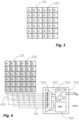
- Figure 3 shows the arrangement of the primary terminals 101 in groups of nine primary terminals in which each primary terminal belongs to a set called set "A", set "B", etc.
- the number of conductors outgoing from the base is equal to the number of sets of primary terminals that, in the embodiment shown, are nine. In that way, it is possible to make bases having several or many primary terminals with a limited number of conductors connecting the base to the supply and control subsystem.
- the number of groups of primary terminals and the shape of the primary terminals may be different, for example in the case of the primary terminals having hexagonal shape, the groups of primary terminals are seven, as well as the conductors outgoing from the base for connecting to the line selector; otherwise, the groups of primary terminals contain a single contact that is connected directly to a line of the line selector: in the latter case, the line selector has a number of lines equal to the number of primary terminals. Further configurations and shapes are possible, while keeping the same rationals as above illustrated.
- the supply and control subsystem 700 is composed of: a line selector component 702, a programmable electrical AC/DC supply stage 703 and a mini-processor 704 provided with suitable software and non-volatile memory for storing data and configurations of the system. These components are mutually connected through data connections 707 and with external data connections 706 towards networks or other processors according to the schematic view of figure 7 .
- the multiplexer 702 connects two direct current supply inlets 705 with outlets 701 that in turn are connected to the nine sets of primary terminals "A", "B", etc., until a set "I".
- the supply stage provides the conversion between alternate to direct current and the electrical power; moreover, it has the possibility of programming voltage and outlet direct current through commands from microprocessor 704 by means of data connection 707.
- Microprocessor 704 communicates with line selector 702 and with contact and identification subsystem 800 on board of the mobile device to acquire data, monitor energy transmission and send commands through wired or radio-frequency connections, with commercial standardized protocols.
- Contact and identification subsystem 800 installed on board of the mobile device is composed of: a detection circuit 803 having detection, identification and protection purposes, a support 801 with two secondary terminals 802.
- Figure 8 also shows an energy absorber 804 and a management circuit 805 to control the electric power absorber, for example constituted by a Battery Management System (BMS) connected to the battery 804 through balance cables 806 and power cables 807, as schematically shown by non limiting example in the figure.
- BMS Battery Management System
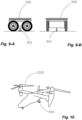
- a mobile device is represented in lateral and front views, that is constituted of an unmanned ground vehicle (UGV) on which the support 801 for the secondary terminals 802 is installed.
- UUV unmanned ground vehicle
- a mobile device is represented that is constituted of a vertical takeoff plane 1000 on which the support 801 for the secondary terminals 802 is installed on one of the supporting legs.
- the dimensions of the two secondary terminals 802 installed on board of the mobile device are geometrically correlated to the dimension and the shape of the primary terminals 101 of the base and of the distance of electrical insulation 102 interposed between the primary terminals 101 of the base.
- the example illustrated in figures 5 and 6 in which the primary terminals have square shape, evidences the minimum dimensions 501 and maximum dimensions 502 of the distances that may exist between the secondary terminals of the mobile device, as well as the minimum dimension of the contact area 601 of a single secondary contact.
- the dimension of a single secondary contact 802 of the contact kit installed on the mobile device has a contact surface 601 that, preferably, shall have a diameter bigger than the insulation space 102.
- the distance between the secondary terminals 802 of the contact kit installed on the mobile device shall be, preferably:
- the secondary terminals 802 of the mobile device may be made through spring pressure with cylindrical or spherical head, through conducting wheels, through tinned copper braids, through graphite or any other shape and material that is suitable to ensure an adequate electric contact and the required flow of current; they may be individually constituted by one or by multiple contact points.
- Support 801, or secondary terminals 802 individually may be installed on the mobile device either rigidly or on elastic supports or on movable and controllably operable arms.
- the distances between the secondary terminals 802 and the dimensions of the contact area 601 of the mobile device and the corresponding geometrical relations with the primary terminals may be different compared to the ones previously mentioned, based on the shapes of the primary terminals and the distances of electrical insulation interposed between the primary terminals.
- the secondary terminals 802 installed on board of the mobile device are in electrical connection with two or more primary terminals 101 of the base belonging to different sets of primary terminals.
- the line selector component cyclically scans all possible pairs of primary terminals 101 connected to different sets of primary terminals and, when it connects the first pair of primary terminals in electrical contact with the secondary terminals 802, it closes an electric circuit towards the detection circuit 803 and measures a current. If the measured current falls within predefined thresholds, the primary terminals 101 of the base, that are in contact with the secondary terminals 802, are identified.
- the supply and control subsystem 700 identifies the primary terminals 101 connected to the secondary terminals 802 of the mobile device. Preferably, by a subsequent identification phase through inversion of the polarity of the applied voltage, the supply and control subsystem 700 measures a second current. The different values of those two currents is used to indicate to the system the polarity to be applied to the primary terminals 101 for the subsequent energy transfer.
- the aforementioned subsequent identification phase is not performed and the right polarity is inferred directly from the value of the current detected during the first scan phase.
- the supply and control system applies the working voltage to the identified primary terminals that are connected to the secondary terminals 802 and to the conductors 809 entering the detection circuit 803; the detection circuit 803, on detecting the said inlet voltage, opens the connection on the energy absorber side, thus connecting the input cables 809 with the output cables 808 hence starting the energy transfer with the preset parameters.
- the supply and control subsystem 700 cyclically scans all pairs of primary terminals 101 connected to distinct sets of primary terminals, by applying a test voltage; if the electric circuit of a pair of primary terminals 101 belonging to different sets of primary terminals 101 is open, the supply and control subsystem 700 goes on to check the subsequent pair of primary terminals 101.
- the supply and control subsystem 700 stops the scan and passes directly to the next phases as soon as it detects a short circuit condition at a pair of primary terminals 101.
- the supply and control subsystem 700 before passing to the next phases the supply and control subsystem 700 performs the scan of all the aforementioned pairs of primary terminals 101 and saves the currents detected for each pair or the corresponding circuit conditions.
- the sequence of pairs of primary terminal 101 that are scanned may be defined so as to comprise all the possible pairs of primary terminals 101, where each pair is used twice, with inverted orders. Hence, such a sequence coincides with the set of dispositions without repetition of 2 elements out of the set of primary terminals 101, that, as known, has a cardinality equal to N x ( N - 1), where N is the number of primary terminals 101. In that way, each pair of primary terminals 101 is selected twice in the sequence, respectively with opposite polarities.
- the sequence of pairs of primary terminals 101 is defined so as to comprise all possible pairs of primary terminals 101, but without the above inversion of their order. Such a sequence coincides with the set of combinations without repetition of 2 elements out of the set of primary terminals 101, that, as known, has a cardinality equal to half of that of the preceding embodiment.
- the right polarity to be applied is established after identifying the pair of primary terminals 101 connected to the secondary terminals 802, according to what will be described later on.
- this variant embodiment allows to perform the scan in a shorter time compared to the previous embodiment.
- a voltage is applied having inverted polarity, which originates a current having a different value due to a different impedance of the detection circuit 803 when it is subjected to currents of opposite side. If also the said value falls within the preset thresholds the system is able to determine the right polarity to be applied to the primary terminals 101, hence identifying the contact kit and thus the mobile device on which it is installed.
- the above mentioned inversion of polarity at the primary terminals 101 does not occur, and the right polarity is inferred from the values of detected currents, depending on whether the said values fall within a first interval of currents, in which case a the right polarity is identified as a first polarity, or they fall within a second interval of currents, in which case the right polarity is identified as the polarity opposite the above first polarity.
- the possible inversion of polarity does not occur at the level of the primary terminals 101, but rather at the level of the contact and identification subsystem 800 of the mobile device 1000, which comprises a polarity control device, not shown in the drawings but in itself known, for example integrated in the detection circuit 803 or, in any case, interposed between the secondary terminals 802 and the energy absorber 804.
- the above polarity control device is configured to determine the polarity of the voltage difference present at the secondary terminals 802 due to the connection with the two identified primary terminals 101 and to exchange the connections between the secondary terminals 802 and the energy absorber 804 in case the above polarity does not correspond to the right one for supplying the energy absorber 804.
- the working voltage with the right polarity is applied to the contact kit; the delay so introduced allows to possibly cooling the energy absorbers and it may be correlated to a temperature signal transmitted be the mobile device.
- the supply and control subsystem 700 applies the working voltage to the primary terminals connected to the secondary terminals, hence putting the inlet conductors 809 of the detection circuit 803 under tension; when the detection circuit 803 detects that voltage, it opens the electrical connection outgoing towards the energy absorber, which begins to absorb electric current; the supply and control subsystem 700 detects that current and switches to supply status. If, subsequently, the electric circuit is opened, the supply and control subsystem 700 switches back to the scan status.
- the supply and control subsystem suspends the supply of energy and the subsequent scan phase for a predefined time interval that can be and customized, with the aim of optimizing the operating lifespan of the batteries.
- test voltage and the working voltage are not supplied by the same power supply 703, that is controlled by the microprocessor 704 to supply each of the two voltages when needed.
- the aforementioned two voltages may be supplied by two distinct power supplies, both controlled by the microprocessor 704.
- the above disclosed operation may be carried out using, instead of the characteristic current values, digital signals suited to detect and identify the mobile device, monitor and send commands or effecting preset instructions.
- the detection circuit 803 installed on board of the mobile device, has a microprocessor and non-volatile memory suited to store software programs and parameters, among which a unique identifier.
- the identification phase previously disclosed may be performed by the supply and control subsystem through establishing a dialogue with the identification circuit 803 and acquiring its unique identifier.
- the control and supply subsystem When in scan status, the control and supply subsystem cyclically connects the primary terminal pairs as above illustrated and, in each connection, waits for a preset time a data packet transmitted by the detection circuit 803, which performs the function of identifying the primary terminals and identifying the contact kit installed on board of the mobile device.
- a data packet transmitted by the detection circuit 803 which performs the function of identifying the primary terminals and identifying the contact kit installed on board of the mobile device.
- the possible anomaly for example due to a short circuit between two primary terminals, will be reported, will not be blocking and the scan will proceed for searching a possible primary terminal pair providing the data packet hence allowing the subsequent energy exchange.
- the above operating mode allows to activate the energy supply with specific parameters, linked to the identifier associated to the mobile device. For example it will be possible to set, from time to time, the values of voltage and electric power to be activated as a function of the specific mobile device which stations on the base and to detect parameters transmitted by the mobile device to the supply and control sub
- the supply and control subsystem 700 through the mini-processor component 704, also makes it available commands to control and set all operating parameters; it provides a monitoring of the supplied energy suited to detect possible abnormal conductive events due to the presence, between the primary terminals 101, of conductive or partially conductive materials or of short circuits, for example due to foreign conductive materials arranged on the base, for the sake of safety and integrity of the apparatuses.
- the monitoring of the supplied energy allows to: determining the accumulator charge status and determining the completion of the charge, performing economic estimations of the transferred energy, verifying the state of health of an accumulator for example through the analysis of the history of the charging sequences and the indirect measurement of the internal impedance of the accumulator.
- the operation of the base is intrinsically safe due to the absence of moving mechanisms or parts, due to the presence of low voltages and limited energy for the very short time intervals during the scan phase.
- the subsystem on board of the mobile device avoids that the secondary terminals 802 of the mobile device are under tension when, at the inlet of the detection circuit 803, the working voltage is not present.
- that expedient avoids that the battery voltage is brought on the secondary terminals 802 that otherwise would be dangerously exposed when the mobile device is not positioned on the base.
- the industrial use of the present system for the supply of electrical energy to recharge accumulators of a mobile device is applicable, in a simple way and at low costs, to a number of devices operating with energy sources provided by accumulators, such as for example:
Landscapes
- Engineering & Computer Science (AREA)
- Power Engineering (AREA)
- Transportation (AREA)
- Mechanical Engineering (AREA)
- Computer Networks & Wireless Communication (AREA)
- Charge And Discharge Circuits For Batteries Or The Like (AREA)
- Current-Collector Devices For Electrically Propelled Vehicles (AREA)
- Electric Propulsion And Braking For Vehicles (AREA)
Description
- The present invention belongs to the field of systems for charging electrical energy accumulators used for feeding mobile devices such as, for example, ground or aerial vehicles.
- The need arises from the possibility to connect and recharge the batteries used for driving autonomously-piloted mobile devices without human intervention or moving mechanical parts. The need concerns the possibility of recharging mobile vehicles in an automatized way, without moving mechanisms or parts, with a multi-functional apparatus suited for several kinds of vehicles and accumulators.
- Currently the recharge of the batteries of mobile devices is made in several ways, mainly based on proprietary systems dedicated to the specific device whose batteries are to be charged.
- Currently, the main ways that are used are as follows:
- manual or automatized connection of a supply cable;
- automatized replacement of the batteries with possible mechanical positioning of the mobile device;
- displacement of the mobile device towards fixed charging contacts;
- displacement of the charging contacts towards the mobile device;
- displacement of a single charging contact towards the mobile device;
- positioning systems of the mobile device with forced guides;
- charging by conductive surfaces and multiple electrical contacts on the support base of the mobile device;
- charging through magnetic induction.
- The main limitations of the currently used solutions are:
- the electromechanical complexity in coupling the contacts or in automatized replacing of the batteries;
- the need for a precise spacial positioning of the mobile device and of the contact system;
- the limited amount of energy that can be transferred;
- the presence of conductive surfaces that are non-insulated and permanently under tension;
- the presence on the mobile device of battery terminals that are exposed and under tension;
- the protection from undesired contacts or short circuits;
- the need of specific layouts for supplying different voltages and powers to different mobile devices.
- Bases and contact systems according to the prior art are disclosed in documents
JP 2014 150642 A RU 2 523 420 C1 WO 2008/020463 A2 ,WO 2017/161394 , andWO 2019/052961 . - The solution has the following aims: overcoming the drawbacks of the above shown currently used methods, with improvements in operability, lack of moving parts and automatization of energy supply for a wide range of mobile devices, in an efficient, reliable and cheap way.
- The aforementioned aims are achieved by a system according to claim 1 and by a corresponding method according to claim 11. Further details of the invention are specified in the corresponding dependent claims.
- The system consists of a conductive base provided with a set of electrically conductive primary terminals arranged on a plane and electrically insulated with one another, a supply and control subsystem connected to the primary terminals, and a subsystem installed on board of the energy-absorber mobile device (hereinafter also indicated with "contact kit") composed of secondary terminals, an identification circuit, and possibly circuits to control the batteries.
- The base supplies energy when all the following conditions are fulfilled:
- the mobile device is positioned on the base and the secondary terminals are in electrical contact with primary terminals;
- the mobile device is detected by the supply and control subsystem through the contact kit of the mobile device;
- the preset management rules for supplying energy to the mobile device through the supply and control subsystem are fulfilled.
- The primary terminals positioned on the upper plane of the base are mutually insulated by non-conductive materials and are connected to the supply and control subsystem. The secondary terminals and the primary terminals have such predefined mutual geometric relations as to prevent that all secondary terminals installed on board of the mobile device simultaneously touch one single contact of the base. Moreover, the secondary terminals on board of the mobile device have a bigger contact dimension compared with the non-conductive materials that electrically separates the primary terminals.
- The primary terminals through which the exchange of electrical energy occurs are being identified when the mobile device is positioned on the base and the secondary terminals of the mobile device contact the primary terminals. The identification of the primary terminals contacting the secondary terminals occurs by means of the identification apparatus on board of the mobile device and the line selector component of the base that cyclically applies a voltage difference to all possible pairs of primary terminals and detects the possible closure of a circuit between the primary terminals pairs under tension. If, consequently to the closure of the circuit, a characteristic current, predefined or falling within predefined thresholds, is detected, the primary terminals are considered to be identified. After identifying the primary terminals, the line selector applies to the identified primary terminals a voltage having a sign that is opposite to the previous one, and that originates a current that, if falling within predefined thresholds, allows to identify the right polarity to be supplied to the mobile device during the subsequent transfer of energy.
- In case the closure of the circuit between two primary terminals under tension is due, for example, to a foreign conductive body, the currents detected do not fall within the expected characteristic thresholds, hence the system reports an anomaly. Following detection and subsequent identification of the mobile device, the base delivers electrical energy to the mobile device through the identified primary terminals and according to management criteria that are configured in the supply and control subsystem.
- The solution is suitable to several embodiments that may differ in shape, dimensions and mode of electric insulation between the primary terminals.
- In a further embodiment, having the purpose of limiting the number of conductors outgoing from the base, the primary terminals are organized in groups of adjacent primary terminals having the same number of primary terminals and in which each terminal of the group is connected in parallel with a corresponding terminal of another group. Each parallel of the primary terminals is thus connected to the supply and control subsystem.
- In that way, the number of conductors outgoing from the base is limited and does not vary with, and is independent of, the total number of primary terminals used to make a base; this expedient allows to increase the number of primary terminals at will, without increasing manufacturing complexity and relating costs. In this case, the geometrical relations between the secondary terminals of the mobile device and of the base shall be such as to prevent that the secondary terminals, installed on board of the mobile device, from simultaneously contacting primary terminals mutually connected in parallel when the mobile device is positioned on the base. The identification of the primary terminals occurs as previously illustrated by means of the identification apparatus on board of the mobile device and the line selector component that cyclically applies a voltage difference to all possible pairs of groups of primary terminals and detects the possible closure of a circuit having a predefined characteristic current or falling within predefined thresholds.
- In another embodiment the identification of the secondary terminals of the mobile device may be achieved through the exchange, between the contact kit of the mobile device and the supply and control subsystem, of a unique identifier. In the embodiment, the contact kit is provided with its own microprocessor, having non-volatile memory with configuration data.
- In another embodiment, multiple secondary contacts may be used that have different geometric relations between primary and secondary contacts, with detection and identification techniques similar to those previously described.
- The main advantages of the solution are:
- the free positioning of the mobile device on the plane of the base;
- the independence from the type of mobile device;
- the efficient energy transfer, because there are no limits in the current that can be transported or in the voltage that can be applied;
- the dimensional scalability and the flexibility of adaptation to different executive embodiments for specific needs;
- the safety in operation;
- the lack of mechanical parts in motion and the limited manufacturing cost.
- Hereinafter the illustrative drawings referenced in the "Description of the execution" are described. The mobile devices represented in the drawings are an unmanned ground vehicle (UGV) and a vertical takeoff airplane, but they may be different kind of mobile devices as well. The features and advantages of the present invention will be described by reference to a preferred practical embodiment, illustrated by way of non-limiting example in the attached drawings, in which:
-
Figure 1 represents a perspective view of the base; -
Figure 2 represents an orthogonal view of the upper surface of the base; -
Figure 3 represents an orthogonal view of the upper surface of the base indicating the sets of primary terminals; -
Figure 4 represents the connection of the primary terminals to the line selector component of the supply and control subsystem; -
Figure 5 represents an orthogonal view of the upper surface of the base indicating the dimensional relations between the secondary terminals of the mobile device and the primary terminals; -
Figure 6 represents a detail of some primary terminals indicating the dimensions of contact of the secondary terminals of the mobile device in relation to the insulation spaces between the primary terminals; -
Figure 7 represents the supply and control subsystem of the base; -
Figure 8 represents the components of the subsystem on board of the mobile device; -
Figure 9-A represents a lateral view of a mobile device constituted of an unmanned ground vehicle having secondary terminals installed in ventral position; -
Figure 9-B represents a front view of a mobile device constituted of an unmanned ground vehicle having secondary terminals installed in ventral position; -
Figure 10 represents a perspective view of a mobile device constituted of a vertical takeoff plane having secondary terminals installed on the support foot. - The elements in the figures are illustrated to ease understanding of the text and are not necessarily represented in scale. For example, dimensions and relative positions of some elements in the figures may be exaggerated compared to other elements in order to improve understanding of the different embodiments allowed by the present invention. Moreover, common and well known elements in the technique, needed in the commercial manufacturing, may not be disclosed or represented, to render the context of the invention simpler and clear. Certain actions or steps may be disclosed or shown in a particular order, yet understandable by the experts in the field. Terms and expressions that are used have the meaning that is common in the technique when used by technical experts, except where different specific meanings are specified.
- The solution that is provided consists in an electrical connection system between a conducting base and an energy-absorber mobile device, and in the management of electrical energy supply from the base towards the energy-absorber mobile device.
- The components of the system, described in the following, are:
- A) a base of contact;
- B) a supply and control subsystem;
- C) a contact and identification subsystem installed on board of the mobile device;
- The base of
contact 100 represented infigure 1 and figure 2 , is composed by a set ofprimary terminals 101 mutually electrically insulated and aligned to the upper plane of a base made of a non-conductive material. - In an exemplary embodiment illustrated in
figures 1 and 2 , theprimary terminals 101 are shaped as square tiles constituted by electrically conductive material and are mutually separated bynon-conductive materials 102. Making reference tofigures 3 and 4 , the primary terminals are grouped in multiple sets of primary terminals mutually connected in parallel throughparallel conductors 401 that, in turn, are connected tooutputs 701 of theline selector component 702, also called multiplexer.Figure 3 shows the arrangement of theprimary terminals 101 in groups of nine primary terminals in which each primary terminal belongs to a set called set "A", set "B", etc. until set "I"; all primary terminals of a set are connected on the lower side tocables 401, or tracks of a printed circuit, and are mutually arranged in parallel; the parallel of each group of primary terminals is hence connected to one of the nineoutputs 701 of theline selector 702 as schematically shown infigure 4 . Through the mentioned expedients, the number of conductors outgoing from the base is equal to the number of sets of primary terminals that, in the embodiment shown, are nine. In that way, it is possible to make bases having several or many primary terminals with a limited number of conductors connecting the base to the supply and control subsystem. - In further possible embodiments, the number of groups of primary terminals and the shape of the primary terminals may be different, for example in the case of the primary terminals having hexagonal shape, the groups of primary terminals are seven, as well as the conductors outgoing from the base for connecting to the line selector; otherwise, the groups of primary terminals contain a single contact that is connected directly to a line of the line selector: in the latter case, the line selector has a number of lines equal to the number of primary terminals. Further configurations and shapes are possible, while keeping the same rationals as above illustrated.
- The supply and
control subsystem 700, represented infigure 7 , is composed of: aline selector component 702, a programmable electrical AC/DC supply stage 703 and a mini-processor 704 provided with suitable software and non-volatile memory for storing data and configurations of the system. These components are mutually connected throughdata connections 707 and withexternal data connections 706 towards networks or other processors according to the schematic view offigure 7 . As shown infigure 4 , themultiplexer 702 connects two directcurrent supply inlets 705 withoutlets 701 that in turn are connected to the nine sets of primary terminals "A", "B", etc., until a set "I". The supply stage provides the conversion between alternate to direct current and the electrical power; moreover, it has the possibility of programming voltage and outlet direct current through commands frommicroprocessor 704 by means ofdata connection 707. -
Microprocessor 704 communicates withline selector 702 and with contact andidentification subsystem 800 on board of the mobile device to acquire data, monitor energy transmission and send commands through wired or radio-frequency connections, with commercial standardized protocols. - Contact and
identification subsystem 800 installed on board of the mobile device, represented infigure 8 , is composed of: adetection circuit 803 having detection, identification and protection purposes, asupport 801 with twosecondary terminals 802.Figure 8 also shows anenergy absorber 804 and amanagement circuit 805 to control the electric power absorber, for example constituted by a Battery Management System (BMS) connected to thebattery 804 throughbalance cables 806 andpower cables 807, as schematically shown by non limiting example in the figure. Infigures 9-A and 9-B a mobile device is represented in lateral and front views, that is constituted of an unmanned ground vehicle (UGV) on which thesupport 801 for thesecondary terminals 802 is installed. Infigure 10 a mobile device is represented that is constituted of avertical takeoff plane 1000 on which thesupport 801 for thesecondary terminals 802 is installed on one of the supporting legs. - Making reference to
figures 5 and 6 , the dimensions of the twosecondary terminals 802 installed on board of the mobile device, i.e. their mutual distance and the diameter of thecontact area 601 of asingle contact 802, are geometrically correlated to the dimension and the shape of theprimary terminals 101 of the base and of the distance ofelectrical insulation 102 interposed between theprimary terminals 101 of the base. The example illustrated infigures 5 and 6 , in which the primary terminals have square shape, evidences theminimum dimensions 501 andmaximum dimensions 502 of the distances that may exist between the secondary terminals of the mobile device, as well as the minimum dimension of thecontact area 601 of a single secondary contact. As evidenced infigure 6 , the dimension of a singlesecondary contact 802 of the contact kit installed on the mobile device has acontact surface 601 that, preferably, shall have a diameter bigger than theinsulation space 102. - In the above exemplary execution, still making reference to
figures 5 and 6 , in which the primary terminals have square shape, the distance between thesecondary terminals 802 of the contact kit installed on the mobile device shall be, preferably: - bigger than or equal to the sum of the diagonal of a primary terminal and of twice the diagonal of an insulation space, identified in
figure 5 as 501; - smaller or equal to twice the sum of the length of a side of a
primary terminal 101 and of aninsulation space 102, identified infigure 5 as 502. - The
secondary terminals 802 of the mobile device may be made through spring pressure with cylindrical or spherical head, through conducting wheels, through tinned copper braids, through graphite or any other shape and material that is suitable to ensure an adequate electric contact and the required flow of current; they may be individually constituted by one or by multiple contact points.Support 801, orsecondary terminals 802 individually, may be installed on the mobile device either rigidly or on elastic supports or on movable and controllably operable arms. The distances between thesecondary terminals 802 and the dimensions of thecontact area 601 of the mobile device and the corresponding geometrical relations with the primary terminals may be different compared to the ones previously mentioned, based on the shapes of the primary terminals and the distances of electrical insulation interposed between the primary terminals. - When the
mobile device base 100, due to the dimensional relations between theprimary terminals 101 of the base and thesecondary terminals 802 of the mobile device, thesecondary terminals 802 installed on board of the mobile device are in electrical connection with two or moreprimary terminals 101 of the base belonging to different sets of primary terminals. The line selector component cyclically scans all possible pairs ofprimary terminals 101 connected to different sets of primary terminals and, when it connects the first pair of primary terminals in electrical contact with thesecondary terminals 802, it closes an electric circuit towards thedetection circuit 803 and measures a current. If the measured current falls within predefined thresholds, theprimary terminals 101 of the base, that are in contact with thesecondary terminals 802, are identified. - In this way the supply and
control subsystem 700 identifies theprimary terminals 101 connected to thesecondary terminals 802 of the mobile device. Preferably, by a subsequent identification phase through inversion of the polarity of the applied voltage, the supply andcontrol subsystem 700 measures a second current. The different values of those two currents is used to indicate to the system the polarity to be applied to theprimary terminals 101 for the subsequent energy transfer. - According to a variant embodiment, the aforementioned subsequent identification phase is not performed and the right polarity is inferred directly from the value of the current detected during the first scan phase.
- Following the identification of the
primary terminals 101 and of the direction of polarity of the voltage to be applied to the mobile device, the supply and control system applies the working voltage to the identified primary terminals that are connected to thesecondary terminals 802 and to theconductors 809 entering thedetection circuit 803; thedetection circuit 803, on detecting the said inlet voltage, opens the connection on the energy absorber side, thus connecting theinput cables 809 with theoutput cables 808 hence starting the energy transfer with the preset parameters. - In the following, the operating methodologies are disclosed in detail, making reference to the statuses of the supply and
control subsystem 700. - The supply and
control subsystem 700 cyclically scans all pairs ofprimary terminals 101 connected to distinct sets of primary terminals, by applying a test voltage; if the electric circuit of a pair ofprimary terminals 101 belonging to different sets ofprimary terminals 101 is open, the supply andcontrol subsystem 700 goes on to check the subsequent pair ofprimary terminals 101. - In this phase, to the involved primary terminals 101 a voltage is applied only for the duration of the scan (some milliseconds), moreover for safety reasons the applied voltage is very low (some volts) and the power that can be supplied is limited. If the electric circuit of a pair of
primary terminals 101 belonging to a different sets is closed, a current consequently transit which the supply andcontrol subsystem 700 analyzes, changing its state if necessary. - Preferably, the supply and
control subsystem 700 stops the scan and passes directly to the next phases as soon as it detects a short circuit condition at a pair ofprimary terminals 101. - According to a variant embodiment of the invention, before passing to the next phases the supply and
control subsystem 700 performs the scan of all the aforementioned pairs ofprimary terminals 101 and saves the currents detected for each pair or the corresponding circuit conditions. - The sequence of pairs of
primary terminal 101 that are scanned may be defined so as to comprise all the possible pairs ofprimary terminals 101, where each pair is used twice, with inverted orders. Hence, such a sequence coincides with the set of dispositions without repetition of 2 elements out of the set ofprimary terminals 101, that, as known, has a cardinality equal to N x (N - 1), where N is the number ofprimary terminals 101. In that way, each pair ofprimary terminals 101 is selected twice in the sequence, respectively with opposite polarities. - According to a variant embodiment, the sequence of pairs of
primary terminals 101 is defined so as to comprise all possible pairs ofprimary terminals 101, but without the above inversion of their order. Such a sequence coincides with the set of combinations without repetition of 2 elements out of the set ofprimary terminals 101, that, as known, has a cardinality equal to half of that of the preceding embodiment. In the latter embodiment, the right polarity to be applied is established after identifying the pair ofprimary terminals 101 connected to thesecondary terminals 802, according to what will be described later on. Advantageously, this variant embodiment allows to perform the scan in a shorter time compared to the previous embodiment. - Evidently, if the
primary terminals 101 are connected in parallel so as to define the above mentioned sets A - I, what disclosed above shall be modified so that, during each pass of the scan, a set A - I ofprimary terminals 101 is selected instead of a singleprimary terminal 101. - If current values are detected that are above or under the expected thresholds, due for example to the presence of foreign bodies, conductive or partially conductive, the system switches to anomaly status, hence temporarily suspending the scan.
- If current values are detected falling within the preset thresholds, the
primary terminals 101 are correctly identified. - To the previously identified primary terminals 101 a voltage is applied having inverted polarity, which originates a current having a different value due to a different impedance of the
detection circuit 803 when it is subjected to currents of opposite side. If also the said value falls within the preset thresholds the system is able to determine the right polarity to be applied to theprimary terminals 101, hence identifying the contact kit and thus the mobile device on which it is installed. - According to a variant embodiment of the invention, the above mentioned inversion of polarity at the
primary terminals 101 does not occur, and the right polarity is inferred from the values of detected currents, depending on whether the said values fall within a first interval of currents, in which case a the right polarity is identified as a first polarity, or they fall within a second interval of currents, in which case the right polarity is identified as the polarity opposite the above first polarity. - According to a further variant embodiment of the invention, the possible inversion of polarity does not occur at the level of the
primary terminals 101, but rather at the level of the contact andidentification subsystem 800 of themobile device 1000, which comprises a polarity control device, not shown in the drawings but in itself known, for example integrated in thedetection circuit 803 or, in any case, interposed between thesecondary terminals 802 and theenergy absorber 804. The above polarity control device is configured to determine the polarity of the voltage difference present at thesecondary terminals 802 due to the connection with the two identifiedprimary terminals 101 and to exchange the connections between thesecondary terminals 802 and theenergy absorber 804 in case the above polarity does not correspond to the right one for supplying theenergy absorber 804. - After the identification phase and after a preset time interval, the working voltage with the right polarity is applied to the contact kit; the delay so introduced allows to possibly cooling the energy absorbers and it may be correlated to a temperature signal transmitted be the mobile device.
- The supply and
control subsystem 700 applies the working voltage to the primary terminals connected to the secondary terminals, hence putting theinlet conductors 809 of thedetection circuit 803 under tension; when thedetection circuit 803 detects that voltage, it opens the electrical connection outgoing towards the energy absorber, which begins to absorb electric current; the supply andcontrol subsystem 700 detects that current and switches to supply status. If, subsequently, the electric circuit is opened, the supply andcontrol subsystem 700 switches back to the scan status. - When the charge of the battery is considered complete, the supply and control subsystem suspends the supply of energy and the subsequent scan phase for a predefined time interval that can be and customized, with the aim of optimizing the operating lifespan of the batteries.
- According to a variant embodiment of the invention, the test voltage and the working voltage are not supplied by the
same power supply 703, that is controlled by themicroprocessor 704 to supply each of the two voltages when needed. - According to a variant embodiments of the invention, not shown in the drawings, the aforementioned two voltages may be supplied by two distinct power supplies, both controlled by the
microprocessor 704. - In further embodiments, the above disclosed operation may be carried out using, instead of the characteristic current values, digital signals suited to detect and identify the mobile device, monitor and send commands or effecting preset instructions. In that case the
detection circuit 803, installed on board of the mobile device, has a microprocessor and non-volatile memory suited to store software programs and parameters, among which a unique identifier. - The identification phase previously disclosed may be performed by the supply and control subsystem through establishing a dialogue with the
identification circuit 803 and acquiring its unique identifier. - When in scan status, the control and supply subsystem cyclically connects the primary terminal pairs as above illustrated and, in each connection, waits for a preset time a data packet transmitted by the
detection circuit 803, which performs the function of identifying the primary terminals and identifying the contact kit installed on board of the mobile device. Using such an operating mode the possible anomaly, for example due to a short circuit between two primary terminals, will be reported, will not be blocking and the scan will proceed for searching a possible primary terminal pair providing the data packet hence allowing the subsequent energy exchange. The above operating mode allows to activate the energy supply with specific parameters, linked to the identifier associated to the mobile device. For example it will be possible to set, from time to time, the values of voltage and electric power to be activated as a function of the specific mobile device which stations on the base and to detect parameters transmitted by the mobile device to the supply andcontrol subsystem 700. - The supply and
control subsystem 700, through themini-processor component 704, also makes it available commands to control and set all operating parameters; it provides a monitoring of the supplied energy suited to detect possible abnormal conductive events due to the presence, between theprimary terminals 101, of conductive or partially conductive materials or of short circuits, for example due to foreign conductive materials arranged on the base, for the sake of safety and integrity of the apparatuses. The monitoring of the supplied energy allows to: determining the accumulator charge status and determining the completion of the charge, performing economic estimations of the transferred energy, verifying the state of health of an accumulator for example through the analysis of the history of the charging sequences and the indirect measurement of the internal impedance of the accumulator. - The operation of the base is intrinsically safe due to the absence of moving mechanisms or parts, due to the presence of low voltages and limited energy for the very short time intervals during the scan phase. Moreover the subsystem on board of the mobile device avoids that the
secondary terminals 802 of the mobile device are under tension when, at the inlet of thedetection circuit 803, the working voltage is not present. For example, in case of an energy absorber constituted of a battery, that expedient avoids that the battery voltage is brought on thesecondary terminals 802 that otherwise would be dangerously exposed when the mobile device is not positioned on the base. - The salient aspects of the present solution are:
- the freedom in positioning the mobile device with respect of the plane of the base;
- the independence of the contact system from the kind of mobile vehicle;
- the efficient energy transfer, because there are no limits in the power that can be transported or in the voltage that can be applied;
- the complete automation in establishing a contact between mobile vehicle and charging station and of the subsequent energy transfer, with remote control and monitoring;
- the operational safety;
- the dimensional scalability and the flexibility to be adapted to different embodiments for specific needs;
- the absence of moving parts and the low manufacturing cost.
- The industrial use of the present system for the supply of electrical energy to recharge accumulators of a mobile device is applicable, in a simple way and at low costs, to a number of devices operating with energy sources provided by accumulators, such as for example:
- ground vehicles (e.g.: UGV);
- aircrafts;
- robots;
- industrial handling systems.
Claims (15)
- A system for supplying electrical energy to an energy-absorber mobile device (900; 1000) comprising two electrically conductive secondary terminals (802), said system comprising:- a power-source base (100) consisting of a plurality of electrically conductive primary terminals (101), positioned on the upper surface of said base (100) and separated by electrically non-conductive materials (102), said primary terminals (101) being suited to be arranged in contact with said two secondary terminals (802) when said mobile device (900; 1000) is positioned on said base (100);- a supply and control subsystem (700) comprising a line selector (702) whose outputs (701) are connected to said primary terminals (101), a rectifier and programmable power supply (703) which supplies energy and a mini-processor (704) connected to said line selector (702) and to said rectifier and programmable power supply (703) for exchange of data and commands,said system further comprising said mobile device (900; 1000) and a contact and identification subsystem (800) installed on board of said mobile device (900; 1000), said contact and identification subsystem (800) comprising an energy absorber (804) and said two secondary terminals (802), said mobile device (900; 1000) being suited to absorb energy while stationing on said base (100) irrespective of its positioning on the plane of said base (100),wherein the said contact and identification subsystem (800) comprises a detection circuit (803) towards which said line selector (702) closes an electric circuit when said outputs (701) are connected to a pair of said primary terminals (101) in electric contact with said two secondary terminals (802), in such a way that said line selector (702) can measure a current, said detection circuit (803) being configured to establish the connection towards the side of said energy absorber (804) when it detects a working voltage at its inlet to start transferring energy towards said energy absorber (804), so as to prevent said secondary terminals (802) to be under battery voltage if at said inlet of said detection circuit (803) said working voltage is not present,characterized in that the said line selector (702) has two input lines (705) between which a voltage difference higher than zero is applied and is configured to apply said voltage difference cyclically to all possible pairs of said output lines (701) and, consequently, to the corresponding pairs of primary terminals (703), based on said commands received from said mini-processor (704).
- A system according to claim 1 characterized in that said mini-processor (704) is configured to operate said power supply (703) so as to invert the polarity of said voltage difference when it detects the closure of an electric circuit between one of said pair of primary terminals (101).
- A system according to any claims 1 or 2 characterized in that said supply and control subsystem (700) is configured to:- applying said voltage difference to said pairs of said output lines (701) until detecting that the two primary terminals (101) of the corresponding pair are connected to said two secondary terminals (802), hence are identified;- applying to said two primary terminals (101) a working voltage different than said voltage difference.
- A system according to claim 3 characterized in that said supply and control subsystem (700) is configured to apply said working voltage with a predefined delay after said two primary terminals (101) have been identified.
- A system according to any preceding claim characterized in that said primary terminals (101) are grouped in multiple sets (A - I) of primary terminals (101) connected in parallel with each other and connected to said output lines (701) of said line selector (702).
- A system according to any preceding claim characterized in that said contact and identification subsystem (800) comprises a polarity control device configured to determine the polarity of said voltage difference and to exchange the connections between said secondary terminals (802) and said energy absorber (804) if said polarity does no correspond to the correct one for supplying said energy absorber (804).
- A system according to any preceding claim characterized in that each secondary terminal (802) has a support section (601) whose dimension is greater than the non-conductive space between two mutually adjacent primary terminals (101).
- A system according to claim 5 characterized in that said secondary terminals (802) are dimensionally correlated to said primary terminals (101), in such a way as to prevent them from simultaneously contacting primary terminals (101) belonging to the same of said sets (A - I) of primary terminals (101).
- A system according to any preceding claim characterized in that said supply and control subsystem (700) is configured to dialogue with said detection circuit (803) to identify the pair of primary terminals (101) in electrical contact with said secondary terminals (802) and to identify the polarity of the electrical voltage to be applied to said secondary terminals (802).
- A system according to any preceding claim characterized in that said contact and identification subsystem (800) comprises an identification circuit provided with a unique identifier to distinguish it, said supply and control subsystem (700) being configured to acquire from said identification circuit said unique identifier through the electrical connection established between said base (100) and said contact and identification subsystem (800) or by radio-frequency connection, said supply and control subsystem (700) being further configured to supply energy to said mobile device (900; 1000) with values of voltage and electric current that are predefined or correlated to the unique identifier acquired by the identification circuit.
- A method for operating a system according to any preceding claim characterized in that it comprises the following operations:- performing a cyclic scan of all possible pairs of outputs (701) of said line selector (702), by applying to each of said pairs, and consequently to a corresponding one of said pairs of primary terminals (101), a voltage difference that is greater than zero;- detecting a first current due to the closure of the circuit between said pairs of outputs (701) of said line selector (702) that are electrically connected to said primary terminals (101) to which said voltage difference was applied;- analyzing said first current and determining whether its value falls within a range of characteristic values that indicate the closure of the circuit on said secondary terminals (802) and hence identifies said pair of primary terminals (101) in contact with said secondary terminals (802);- applying to said identified primary terminals (101) a working voltage;- enabling the connection of said energy absorber (804) with said secondary terminals (802) when a voltage difference is detected at its input on the side of said secondary terminals (802) and when said contact and identification subsystem (800) is correctly identified, in order to supply energy to said mobile device (900; 1000).
- A method according to claim 11 characterized in that it comprises the operation of applying to said identified pair of primary terminals (101) a voltage difference having a sign opposite to the voltage difference applied during said operation of cyclic scan so as to obtain a second current and comparing the value of said second current with that of said first current to identify a right polarity for said working voltage.
- A method according to any claims from 11 to 12 characterized in that said system is according to claim 10 and in that said operation of applying said working voltage to said identified pair of primary terminals (101) comprises the following sub-operations:- acquiring said unique identifier from said identification circuit (803) through the electrical connection established between said two primary terminals (101) and said secondary terminals (802) or via radio connection;- supplying said electric energy from said base (101) to said mobile device (900; 1000) by supplying said working voltage and the power based on preset parameters or based on the parameters correlated to the identification of said contact and identification subsystem (800).
- A method according to any claims from 11 to 13 characterized in that said operation of performing said cyclic scan comprises, after each application of said voltage difference to each one of said pairs of primary terminals (101), waiting for a predefined time, by said supply and control subsystem (700), for a data packet transmitted by said detection circuit (803) and suited to identify said contact and identification subsystem (800).
- A method according to any claims from 11 to 14 characterized in that said operation of analyzing said first current and, if applicable, said second current, occurs after completion of said cyclic scan on all possible pairs of said outputs (701) of said line selector (702) according to a predefined sequence.
Applications Claiming Priority (2)
| Application Number | Priority Date | Filing Date | Title |
|---|---|---|---|
| IT102019000012207A IT201900012207A1 (en) | 2019-07-17 | 2019-07-17 | BASE AND CONTACT SYSTEM FOR CHARGING ENERGY ACCUMULATORS OF MOBILE DEVICES |
| PCT/IB2020/056675 WO2021009699A1 (en) | 2019-07-17 | 2020-07-16 | Base and contact system for recharging energy accumulator in mobile devices |
Publications (3)
| Publication Number | Publication Date |
|---|---|
| EP3999375A1 EP3999375A1 (en) | 2022-05-25 |
| EP3999375C0 EP3999375C0 (en) | 2024-09-25 |
| EP3999375B1 true EP3999375B1 (en) | 2024-09-25 |
Family
ID=68582210
Family Applications (1)
| Application Number | Title | Priority Date | Filing Date |
|---|---|---|---|
| EP20742938.2A Active EP3999375B1 (en) | 2019-07-17 | 2020-07-16 | Base and contact system for recharging energy accumulator in mobile devices |
Country Status (7)
| Country | Link |
|---|---|
| US (1) | US12227095B2 (en) |
| EP (1) | EP3999375B1 (en) |
| JP (1) | JP7670338B2 (en) |
| ES (1) | ES2996961T3 (en) |
| IT (1) | IT201900012207A1 (en) |
| PL (1) | PL3999375T3 (en) |
| WO (1) | WO2021009699A1 (en) |
Families Citing this family (2)
| Publication number | Priority date | Publication date | Assignee | Title |
|---|---|---|---|---|
| DE102021111481A1 (en) | 2021-05-04 | 2022-11-10 | Easelink Gmbh | ground contact unit |
| DE202022103788U1 (en) | 2022-04-04 | 2023-07-06 | Easelink Gmbh | System for checking a ground contact unit and electrical charging infrastructure |
Family Cites Families (9)
| Publication number | Priority date | Publication date | Assignee | Title |
|---|---|---|---|---|
| ITTO20060610A1 (en) * | 2006-08-17 | 2008-02-18 | Sequoia Automation Srl | ENERGY BIBERONAGE SYSTEM WITH A QUICK RELEASE OF AN ELECTRIC TRACTION MEDIUM, MADE OF EVERY STOP FROM THE VEHICLE BY MEANS OF A DIRECTLY AND AUTOMATICALLY CONNECTED CONNECTION |
| CN102638115B (en) | 2012-04-24 | 2014-12-17 | 深圳市非凡创新实业有限公司 | Wireless charging method and device |
| RU2523420C1 (en) * | 2013-01-09 | 2014-07-20 | Федеральное государственное бюджетное образовательное учреждение высшего профессионального образования "Уфимский государственный авиационный технический университет" | Recharger system for batteries of electric drones |
| JP5951516B2 (en) * | 2013-01-31 | 2016-07-13 | 株式会社東芝 | Charging system |
| JP2016063685A (en) | 2014-09-19 | 2016-04-25 | 国立大学法人九州工業大学 | Charging device and electrode member |
| AT518327B1 (en) | 2016-03-25 | 2017-12-15 | Ing Hermann Stockinger Dipl | Contacting system for establishing an electrical connection between a primary device and a secondary device |
| CN206349796U (en) | 2016-10-17 | 2017-07-21 | 北京地平线信息技术有限公司 | Charging end equipment, be electrically charged end equipment and charging system |
| US20180191181A1 (en) | 2017-01-04 | 2018-07-05 | Sphero, Inc. | Charging unit for mobile device |
| CN111344186B (en) * | 2017-09-12 | 2024-12-03 | 易链接有限责任公司 | Vehicle contact unit, floor contact unit, vehicle coupling system, and method for checking contact and correlation of contact parts |
-
2019
- 2019-07-17 IT IT102019000012207A patent/IT201900012207A1/en unknown
-
2020
- 2020-07-16 EP EP20742938.2A patent/EP3999375B1/en active Active
- 2020-07-16 JP JP2021577883A patent/JP7670338B2/en active Active
- 2020-07-16 ES ES20742938T patent/ES2996961T3/en active Active
- 2020-07-16 PL PL20742938.2T patent/PL3999375T3/en unknown
- 2020-07-16 US US17/623,535 patent/US12227095B2/en active Active
- 2020-07-16 WO PCT/IB2020/056675 patent/WO2021009699A1/en not_active Ceased
Also Published As
| Publication number | Publication date |
|---|---|
| EP3999375C0 (en) | 2024-09-25 |
| US12227095B2 (en) | 2025-02-18 |
| JP2022541390A (en) | 2022-09-26 |
| PL3999375T3 (en) | 2025-02-24 |
| ES2996961T3 (en) | 2025-02-13 |
| JP7670338B2 (en) | 2025-04-30 |
| US20220355683A1 (en) | 2022-11-10 |
| IT201900012207A1 (en) | 2021-01-17 |
| WO2021009699A1 (en) | 2021-01-21 |
| EP3999375A1 (en) | 2022-05-25 |
Similar Documents
| Publication | Publication Date | Title |
|---|---|---|
| US5914609A (en) | Method and system for battery charging and testing with semi-automatic calibration | |
| US9851405B2 (en) | Method and apparatus for detecting state of relay | |
| CN102457109B (en) | Method for controlling wireless power signal in wireless power transmission device, and wireless power transmission device | |
| CN103781653B (en) | Battery management system, battery and motor vehicle having a battery management system, and method for monitoring a battery | |
| KR101456552B1 (en) | Battery with cell balancing | |
| US9291681B2 (en) | Monitoring apparatus and method of battery contact point in charge/discharge system with batteries connected in series | |
| KR101403255B1 (en) | Battery module charging system | |
| EP3999375B1 (en) | Base and contact system for recharging energy accumulator in mobile devices | |
| EP3848252B1 (en) | System for obtaining battery state information | |
| KR20150110427A (en) | Battrery pack, cell module and cell module assembly | |
| CN110999023A (en) | Method and apparatus for balancing the state of charge of individual cells of a battery system | |
| US20190212397A1 (en) | Deterioration determination device for secondary battery | |
| CN106536261A (en) | Battery system and method for operating same | |
| US20150224892A1 (en) | Integrated voltage sense and bus bar system and method for vehicles having a traction battery | |
| KR102449819B1 (en) | Battery apparatus having galvanic isolation communication architecture | |
| EP3176856A1 (en) | Storage battery system, storage battery unit, and computer program product | |
| EP3543720B1 (en) | System and method for diagnosing low-voltage battery state | |
| CN115911602A (en) | Systems and methods for battery management | |
| US20220283241A1 (en) | Battery Management Apparatus | |
| CN102998508A (en) | Arrangement and method for measurements on HV battery | |
| EP4521129A1 (en) | System for testing charging and discharging of battery module, and method therefor | |
| CN110816327B (en) | A Contact UAV Autonomous Charging System | |
| GB2602000A (en) | Improvements in and relating to electrical testing | |
| CN107210405B (en) | Method for monitoring a state variable of at least one battery cell of a battery | |
| CN110816363B (en) | Device, charging station and method for detecting the state of a motor vehicle battery pack |
Legal Events
| Date | Code | Title | Description |
|---|---|---|---|
| STAA | Information on the status of an ep patent application or granted ep patent |
Free format text: STATUS: UNKNOWN |
|
| STAA | Information on the status of an ep patent application or granted ep patent |
Free format text: STATUS: THE INTERNATIONAL PUBLICATION HAS BEEN MADE |
|
| PUAI | Public reference made under article 153(3) epc to a published international application that has entered the european phase |
Free format text: ORIGINAL CODE: 0009012 |
|
| STAA | Information on the status of an ep patent application or granted ep patent |
Free format text: STATUS: REQUEST FOR EXAMINATION WAS MADE |
|
| 17P | Request for examination filed |
Effective date: 20220210 |
|
| AK | Designated contracting states |
Kind code of ref document: A1 Designated state(s): AL AT BE BG CH CY CZ DE DK EE ES FI FR GB GR HR HU IE IS IT LI LT LU LV MC MK MT NL NO PL PT RO RS SE SI SK SM TR |
|
| DAV | Request for validation of the european patent (deleted) | ||
| DAX | Request for extension of the european patent (deleted) | ||
| GRAP | Despatch of communication of intention to grant a patent |
Free format text: ORIGINAL CODE: EPIDOSNIGR1 |
|
| STAA | Information on the status of an ep patent application or granted ep patent |
Free format text: STATUS: GRANT OF PATENT IS INTENDED |
|
| INTG | Intention to grant announced |
Effective date: 20240515 |
|
| GRAS | Grant fee paid |
Free format text: ORIGINAL CODE: EPIDOSNIGR3 |
|
| GRAA | (expected) grant |
Free format text: ORIGINAL CODE: 0009210 |
|
| STAA | Information on the status of an ep patent application or granted ep patent |
Free format text: STATUS: THE PATENT HAS BEEN GRANTED |
|
| AK | Designated contracting states |
Kind code of ref document: B1 Designated state(s): AL AT BE BG CH CY CZ DE DK EE ES FI FR GB GR HR HU IE IS IT LI LT LU LV MC MK MT NL NO PL PT RO RS SE SI SK SM TR |
|
| REG | Reference to a national code |
Ref country code: GB Ref legal event code: FG4D |
|
| REG | Reference to a national code |
Ref country code: CH Ref legal event code: EP |
|
| REG | Reference to a national code |
Ref country code: DE Ref legal event code: R096 Ref document number: 602020038312 Country of ref document: DE |
|
| RAP4 | Party data changed (patent owner data changed or rights of a patent transferred) |
Owner name: SKYCHARGE GMBH |
|
| REG | Reference to a national code |
Ref country code: IE Ref legal event code: FG4D |
|
| U01 | Request for unitary effect filed |
Effective date: 20240925 |
|
| U07 | Unitary effect registered |
Designated state(s): AT BE BG DE DK EE FI FR IT LT LU LV MT NL PT RO SE SI Effective date: 20240930 |
|
| PG25 | Lapsed in a contracting state [announced via postgrant information from national office to epo] |
Ref country code: NO Free format text: LAPSE BECAUSE OF FAILURE TO SUBMIT A TRANSLATION OF THE DESCRIPTION OR TO PAY THE FEE WITHIN THE PRESCRIBED TIME-LIMIT Effective date: 20241225 |
|
| PG25 | Lapsed in a contracting state [announced via postgrant information from national office to epo] |
Ref country code: GR Free format text: LAPSE BECAUSE OF FAILURE TO SUBMIT A TRANSLATION OF THE DESCRIPTION OR TO PAY THE FEE WITHIN THE PRESCRIBED TIME-LIMIT Effective date: 20241226 |
|
| PG25 | Lapsed in a contracting state [announced via postgrant information from national office to epo] |
Ref country code: RS Free format text: LAPSE BECAUSE OF FAILURE TO SUBMIT A TRANSLATION OF THE DESCRIPTION OR TO PAY THE FEE WITHIN THE PRESCRIBED TIME-LIMIT Effective date: 20241225 |
|
| PG25 | Lapsed in a contracting state [announced via postgrant information from national office to epo] |
Ref country code: RS Free format text: LAPSE BECAUSE OF FAILURE TO SUBMIT A TRANSLATION OF THE DESCRIPTION OR TO PAY THE FEE WITHIN THE PRESCRIBED TIME-LIMIT Effective date: 20241225 Ref country code: NO Free format text: LAPSE BECAUSE OF FAILURE TO SUBMIT A TRANSLATION OF THE DESCRIPTION OR TO PAY THE FEE WITHIN THE PRESCRIBED TIME-LIMIT Effective date: 20241225 Ref country code: GR Free format text: LAPSE BECAUSE OF FAILURE TO SUBMIT A TRANSLATION OF THE DESCRIPTION OR TO PAY THE FEE WITHIN THE PRESCRIBED TIME-LIMIT Effective date: 20241226 |
|
| REG | Reference to a national code |
Ref country code: ES Ref legal event code: FG2A Ref document number: 2996961 Country of ref document: ES Kind code of ref document: T3 Effective date: 20250213 |
|
| PG25 | Lapsed in a contracting state [announced via postgrant information from national office to epo] |
Ref country code: IS Free format text: LAPSE BECAUSE OF FAILURE TO SUBMIT A TRANSLATION OF THE DESCRIPTION OR TO PAY THE FEE WITHIN THE PRESCRIBED TIME-LIMIT Effective date: 20250125 |
|
| PG25 | Lapsed in a contracting state [announced via postgrant information from national office to epo] |
Ref country code: SM Free format text: LAPSE BECAUSE OF FAILURE TO SUBMIT A TRANSLATION OF THE DESCRIPTION OR TO PAY THE FEE WITHIN THE PRESCRIBED TIME-LIMIT Effective date: 20240925 |
|
| PG25 | Lapsed in a contracting state [announced via postgrant information from national office to epo] |
Ref country code: CZ Free format text: LAPSE BECAUSE OF FAILURE TO SUBMIT A TRANSLATION OF THE DESCRIPTION OR TO PAY THE FEE WITHIN THE PRESCRIBED TIME-LIMIT Effective date: 20240925 |
|
| PG25 | Lapsed in a contracting state [announced via postgrant information from national office to epo] |
Ref country code: SK Free format text: LAPSE BECAUSE OF FAILURE TO SUBMIT A TRANSLATION OF THE DESCRIPTION OR TO PAY THE FEE WITHIN THE PRESCRIBED TIME-LIMIT Effective date: 20240925 |
|
| PLBE | No opposition filed within time limit |
Free format text: ORIGINAL CODE: 0009261 |
|
| STAA | Information on the status of an ep patent application or granted ep patent |
Free format text: STATUS: NO OPPOSITION FILED WITHIN TIME LIMIT |
|
| U20 | Renewal fee for the european patent with unitary effect paid |
Year of fee payment: 6 Effective date: 20250711 |
|
| 26N | No opposition filed |
Effective date: 20250626 |
|
| PGFP | Annual fee paid to national office [announced via postgrant information from national office to epo] |
Ref country code: ES Payment date: 20250827 Year of fee payment: 6 |
|
| PGFP | Annual fee paid to national office [announced via postgrant information from national office to epo] |
Ref country code: PL Payment date: 20250704 Year of fee payment: 6 |
|
| PGFP | Annual fee paid to national office [announced via postgrant information from national office to epo] |
Ref country code: GB Payment date: 20250722 Year of fee payment: 6 |
|
| PGFP | Annual fee paid to national office [announced via postgrant information from national office to epo] |
Ref country code: CH Payment date: 20250801 Year of fee payment: 6 |
|
| PG25 | Lapsed in a contracting state [announced via postgrant information from national office to epo] |
Ref country code: HR Free format text: LAPSE BECAUSE OF FAILURE TO SUBMIT A TRANSLATION OF THE DESCRIPTION OR TO PAY THE FEE WITHIN THE PRESCRIBED TIME-LIMIT Effective date: 20240925 |
|
| PGFP | Annual fee paid to national office [announced via postgrant information from national office to epo] |
Ref country code: IE Payment date: 20251007 Year of fee payment: 6 |