EP3998646B1 - Sheet-shaped flexible electrode and method for producing the same - Google Patents
Sheet-shaped flexible electrode and method for producing the same Download PDFInfo
- Publication number
- EP3998646B1 EP3998646B1 EP21761140.9A EP21761140A EP3998646B1 EP 3998646 B1 EP3998646 B1 EP 3998646B1 EP 21761140 A EP21761140 A EP 21761140A EP 3998646 B1 EP3998646 B1 EP 3998646B1
- Authority
- EP
- European Patent Office
- Prior art keywords
- sheet
- thermoplastic elastomer
- shaped flexible
- flexible electrode
- less
- Prior art date
- Legal status (The legal status is an assumption and is not a legal conclusion. Google has not performed a legal analysis and makes no representation as to the accuracy of the status listed.)
- Active
Links
Images
Classifications
-
- H—ELECTRICITY
- H01—ELECTRIC ELEMENTS
- H01M—PROCESSES OR MEANS, e.g. BATTERIES, FOR THE DIRECT CONVERSION OF CHEMICAL ENERGY INTO ELECTRICAL ENERGY
- H01M4/00—Electrodes
- H01M4/02—Electrodes composed of, or comprising, active material
- H01M4/62—Selection of inactive substances as ingredients for active masses, e.g. binders, fillers
- H01M4/621—Binders
- H01M4/622—Binders being polymers
-
- C—CHEMISTRY; METALLURGY
- C08—ORGANIC MACROMOLECULAR COMPOUNDS; THEIR PREPARATION OR CHEMICAL WORKING-UP; COMPOSITIONS BASED THEREON
- C08J—WORKING-UP; GENERAL PROCESSES OF COMPOUNDING; AFTER-TREATMENT NOT COVERED BY SUBCLASSES C08B, C08C, C08F, C08G or C08H
- C08J5/00—Manufacture of articles or shaped materials containing macromolecular substances
- C08J5/18—Manufacture of films or sheets
-
- G—PHYSICS
- G01—MEASURING; TESTING
- G01D—MEASURING NOT SPECIALLY ADAPTED FOR A SPECIFIC VARIABLE; ARRANGEMENTS FOR MEASURING TWO OR MORE VARIABLES NOT COVERED IN A SINGLE OTHER SUBCLASS; TARIFF METERING APPARATUS; MEASURING OR TESTING NOT OTHERWISE PROVIDED FOR
- G01D11/00—Component parts of measuring arrangements not specially adapted for a specific variable
-
- G—PHYSICS
- G01—MEASURING; TESTING
- G01D—MEASURING NOT SPECIALLY ADAPTED FOR A SPECIFIC VARIABLE; ARRANGEMENTS FOR MEASURING TWO OR MORE VARIABLES NOT COVERED IN A SINGLE OTHER SUBCLASS; TARIFF METERING APPARATUS; MEASURING OR TESTING NOT OTHERWISE PROVIDED FOR
- G01D5/00—Mechanical means for transferring the output of a sensing member; Means for converting the output of a sensing member to another variable where the form or nature of the sensing member does not constrain the means for converting; Transducers not specially adapted for a specific variable
- G01D5/12—Mechanical means for transferring the output of a sensing member; Means for converting the output of a sensing member to another variable where the form or nature of the sensing member does not constrain the means for converting; Transducers not specially adapted for a specific variable using electric or magnetic means
- G01D5/14—Mechanical means for transferring the output of a sensing member; Means for converting the output of a sensing member to another variable where the form or nature of the sensing member does not constrain the means for converting; Transducers not specially adapted for a specific variable using electric or magnetic means influencing the magnitude of a current or voltage
- G01D5/24—Mechanical means for transferring the output of a sensing member; Means for converting the output of a sensing member to another variable where the form or nature of the sensing member does not constrain the means for converting; Transducers not specially adapted for a specific variable using electric or magnetic means influencing the magnitude of a current or voltage by varying capacitance
- G01D5/2403—Mechanical means for transferring the output of a sensing member; Means for converting the output of a sensing member to another variable where the form or nature of the sensing member does not constrain the means for converting; Transducers not specially adapted for a specific variable using electric or magnetic means influencing the magnitude of a current or voltage by varying capacitance by moving plates, not forming part of the capacitor itself, e.g. shields
-
- G—PHYSICS
- G01—MEASURING; TESTING
- G01D—MEASURING NOT SPECIALLY ADAPTED FOR A SPECIFIC VARIABLE; ARRANGEMENTS FOR MEASURING TWO OR MORE VARIABLES NOT COVERED IN A SINGLE OTHER SUBCLASS; TARIFF METERING APPARATUS; MEASURING OR TESTING NOT OTHERWISE PROVIDED FOR
- G01D5/00—Mechanical means for transferring the output of a sensing member; Means for converting the output of a sensing member to another variable where the form or nature of the sensing member does not constrain the means for converting; Transducers not specially adapted for a specific variable
- G01D5/12—Mechanical means for transferring the output of a sensing member; Means for converting the output of a sensing member to another variable where the form or nature of the sensing member does not constrain the means for converting; Transducers not specially adapted for a specific variable using electric or magnetic means
- G01D5/14—Mechanical means for transferring the output of a sensing member; Means for converting the output of a sensing member to another variable where the form or nature of the sensing member does not constrain the means for converting; Transducers not specially adapted for a specific variable using electric or magnetic means influencing the magnitude of a current or voltage
- G01D5/24—Mechanical means for transferring the output of a sensing member; Means for converting the output of a sensing member to another variable where the form or nature of the sensing member does not constrain the means for converting; Transducers not specially adapted for a specific variable using electric or magnetic means influencing the magnitude of a current or voltage by varying capacitance
- G01D5/241—Mechanical means for transferring the output of a sensing member; Means for converting the output of a sensing member to another variable where the form or nature of the sensing member does not constrain the means for converting; Transducers not specially adapted for a specific variable using electric or magnetic means influencing the magnitude of a current or voltage by varying capacitance by relative movement of capacitor electrodes
-
- H—ELECTRICITY
- H01—ELECTRIC ELEMENTS
- H01B—CABLES; CONDUCTORS; INSULATORS; SELECTION OF MATERIALS FOR THEIR CONDUCTIVE, INSULATING OR DIELECTRIC PROPERTIES
- H01B1/00—Conductors or conductive bodies characterised by the conductive materials; Selection of materials as conductors
- H01B1/20—Conductive material dispersed in non-conductive organic material
- H01B1/24—Conductive material dispersed in non-conductive organic material the conductive material comprising carbon-silicon compounds, carbon or silicon
-
- H—ELECTRICITY
- H01—ELECTRIC ELEMENTS
- H01M—PROCESSES OR MEANS, e.g. BATTERIES, FOR THE DIRECT CONVERSION OF CHEMICAL ENERGY INTO ELECTRICAL ENERGY
- H01M4/00—Electrodes
- H01M4/02—Electrodes composed of, or comprising, active material
- H01M4/04—Processes of manufacture in general
- H01M4/0402—Methods of deposition of the material
- H01M4/0411—Methods of deposition of the material by extrusion
-
- H—ELECTRICITY
- H01—ELECTRIC ELEMENTS
- H01M—PROCESSES OR MEANS, e.g. BATTERIES, FOR THE DIRECT CONVERSION OF CHEMICAL ENERGY INTO ELECTRICAL ENERGY
- H01M4/00—Electrodes
- H01M4/02—Electrodes composed of, or comprising, active material
- H01M4/62—Selection of inactive substances as ingredients for active masses, e.g. binders, fillers
- H01M4/624—Electric conductive fillers
- H01M4/625—Carbon or graphite
-
- H—ELECTRICITY
- H10—SEMICONDUCTOR DEVICES; ELECTRIC SOLID-STATE DEVICES NOT OTHERWISE PROVIDED FOR
- H10N—ELECTRIC SOLID-STATE DEVICES NOT OTHERWISE PROVIDED FOR
- H10N30/00—Piezoelectric or electrostrictive devices
- H10N30/01—Manufacture or treatment
- H10N30/06—Forming electrodes or interconnections, e.g. leads or terminals
-
- H—ELECTRICITY
- H10—SEMICONDUCTOR DEVICES; ELECTRIC SOLID-STATE DEVICES NOT OTHERWISE PROVIDED FOR
- H10N—ELECTRIC SOLID-STATE DEVICES NOT OTHERWISE PROVIDED FOR
- H10N30/00—Piezoelectric or electrostrictive devices
- H10N30/80—Constructional details
- H10N30/87—Electrodes or interconnections, e.g. leads or terminals
-
- H—ELECTRICITY
- H10—SEMICONDUCTOR DEVICES; ELECTRIC SOLID-STATE DEVICES NOT OTHERWISE PROVIDED FOR
- H10N—ELECTRIC SOLID-STATE DEVICES NOT OTHERWISE PROVIDED FOR
- H10N30/00—Piezoelectric or electrostrictive devices
- H10N30/80—Constructional details
- H10N30/87—Electrodes or interconnections, e.g. leads or terminals
- H10N30/877—Conductive materials
- H10N30/878—Conductive materials the principal material being non-metallic, e.g. oxide or carbon based
-
- C—CHEMISTRY; METALLURGY
- C08—ORGANIC MACROMOLECULAR COMPOUNDS; THEIR PREPARATION OR CHEMICAL WORKING-UP; COMPOSITIONS BASED THEREON
- C08J—WORKING-UP; GENERAL PROCESSES OF COMPOUNDING; AFTER-TREATMENT NOT COVERED BY SUBCLASSES C08B, C08C, C08F, C08G or C08H
- C08J2353/00—Characterised by the use of block copolymers containing at least one sequence of a polymer obtained by reactions only involving carbon-to-carbon unsaturated bonds; Derivatives of such polymers
- C08J2353/02—Characterised by the use of block copolymers containing at least one sequence of a polymer obtained by reactions only involving carbon-to-carbon unsaturated bonds; Derivatives of such polymers of vinyl aromatic monomers and conjugated dienes
-
- C—CHEMISTRY; METALLURGY
- C08—ORGANIC MACROMOLECULAR COMPOUNDS; THEIR PREPARATION OR CHEMICAL WORKING-UP; COMPOSITIONS BASED THEREON
- C08J—WORKING-UP; GENERAL PROCESSES OF COMPOUNDING; AFTER-TREATMENT NOT COVERED BY SUBCLASSES C08B, C08C, C08F, C08G or C08H
- C08J2423/00—Characterised by the use of homopolymers or copolymers of unsaturated aliphatic hydrocarbons having only one carbon-to-carbon double bond; Derivatives of such polymers
- C08J2423/02—Characterised by the use of homopolymers or copolymers of unsaturated aliphatic hydrocarbons having only one carbon-to-carbon double bond; Derivatives of such polymers not modified by chemical after treatment
- C08J2423/04—Homopolymers or copolymers of ethene
- C08J2423/08—Copolymers of ethene
-
- C—CHEMISTRY; METALLURGY
- C08—ORGANIC MACROMOLECULAR COMPOUNDS; THEIR PREPARATION OR CHEMICAL WORKING-UP; COMPOSITIONS BASED THEREON
- C08J—WORKING-UP; GENERAL PROCESSES OF COMPOUNDING; AFTER-TREATMENT NOT COVERED BY SUBCLASSES C08B, C08C, C08F, C08G or C08H
- C08J2423/00—Characterised by the use of homopolymers or copolymers of unsaturated aliphatic hydrocarbons having only one carbon-to-carbon double bond; Derivatives of such polymers
- C08J2423/02—Characterised by the use of homopolymers or copolymers of unsaturated aliphatic hydrocarbons having only one carbon-to-carbon double bond; Derivatives of such polymers not modified by chemical after treatment
- C08J2423/10—Homopolymers or copolymers of propene
- C08J2423/12—Polypropene
-
- C—CHEMISTRY; METALLURGY
- C08—ORGANIC MACROMOLECULAR COMPOUNDS; THEIR PREPARATION OR CHEMICAL WORKING-UP; COMPOSITIONS BASED THEREON
- C08K—Use of inorganic or non-macromolecular organic substances as compounding ingredients
- C08K2201/00—Specific properties of additives
- C08K2201/001—Conductive additives
-
- C—CHEMISTRY; METALLURGY
- C08—ORGANIC MACROMOLECULAR COMPOUNDS; THEIR PREPARATION OR CHEMICAL WORKING-UP; COMPOSITIONS BASED THEREON
- C08K—Use of inorganic or non-macromolecular organic substances as compounding ingredients
- C08K3/00—Use of inorganic substances as compounding ingredients
- C08K3/02—Elements
- C08K3/04—Carbon
-
- H—ELECTRICITY
- H01—ELECTRIC ELEMENTS
- H01M—PROCESSES OR MEANS, e.g. BATTERIES, FOR THE DIRECT CONVERSION OF CHEMICAL ENERGY INTO ELECTRICAL ENERGY
- H01M4/00—Electrodes
- H01M4/02—Electrodes composed of, or comprising, active material
- H01M2004/021—Physical characteristics, e.g. porosity, surface area
Definitions
- the present invention relates to a sheet-shaped electrode that is used in flexible piezoelectric sensors, capacitance sensors and the like.
- Patent Literature 1 describes an electrode in which a conductive material such as a carbon material is blended with an elastomer as an electrode that configures a sensor. The electrode is produced by applying a conductive paint containing the elastomer and the carbon material onto a substrate.
- a carbon material is dispersed in a polymer solution containing an elastomer dissolved in an organic solvent to prepare the conductive paint. Therefore, a long time is required for producing the electrode, and it is also difficult to apply the conductive paint thinly with favorable dimension accuracy.
- an organic solvent is used at the time of preparing the conductive paint, but there is a demand for suppressing the discharge of volatile organic compounds (VOCs) as an environmental measure. Additionally, there is another need to consider the influence of the organic solvent component on other members adjacent to the electrode.
- Patent Literature 2 describes the production of an electrode having a conductive portion containing an elastomer and a carbon material by extrusion molding. Extrusion molding enables continuous production and improves productivity.
- a raw material a composition containing the elastomer, the carbon material, and the like kneaded therein
- electrodes need to be highly conductive in order to increase the detection accuracy of sensors. Therefore, there is a need to blend a relatively large amount of the conductive material with the elastomer; however, in such a case, the molding processability deteriorates due to an increase in the viscosity or the like.
- Patent Literature 3 describes the production of an electrode wire by extruding a composition containing a styrene-based thermoplastic elastomer and carbon so as to coat the circumference of a core wire (paragraph [0033]).
- extrusion molding is used for the production of a conductor, but the conductor is not molded into a sheet shape.
- Patent Literature 4 describes the production of an electrode for a pressure-sensitive switch from a composition containing a styrene-based thermoplastic elastomer, a propylene-based elastomer, carbon black and a process oil.
- Patent Literature 4 Extrusion molding is exemplified as one of molding methods of the composition, but there are no specific studies for the production of sheet-shaped electrodes.
- a sheet for evaluation that is 100 mm in length, 100 mm in width and 1 mm in thickness, but this sheet is produced by the hot pressing of a composition that has been kneaded with an open roll (paragraph [0063] of Patent Literature 4).
- Patent Literature 4 contains a description that blending of a highly crystalline resin such as polypropylene is excluded from the viewpoint of flexibility and wear resistance at low temperatures.
- the conductors (compacts) are allowed to contain a large amount of the process oil.
- Patent Literature 7 shows a positive electrode for lithium secondary battery made of an isoprene styrene block copolymer mixed with carbon black.
- Patent Literature 8 a conductive resin sheet where a resin composition contains a styrene resin, a electrically conductive agent such as carbon black, and olefin type thermoplastic elastomer is disclosed and in Patent Literature 9 a conductive resin molded body containing a conductive filler such as carbon black and a conductive resin composition such as a ABS resin is revealed.
- the present invention has been made in consideration of such circumstances, and an object of the present invention is to provide a thin sheet-shaped flexible electrode having good conductive properties, and a method for producing the same with excellent productivity.
- thermoplastic elastomer that configures the sheet-shaped flexible electrode of the present invention satisfies the following two requirements (a) and (b).
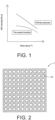
- Fig. 1 schematically shows the relationship between the melt viscosity and shear rate of polymers.
- the melt viscosity of polymers increases as the shear rate decreases.
- the melt viscosity is low and less likely to change even when the shear rate decreases.
- the above-described requirement (a) indicates that the melt viscosity is low in the low shear region, and the requirement (b) indicates that the melt viscosity is low and less likely to change even when the shear rate is slow.
- the low shear region with a shear rate of 60 s -1 or more and 200 s -1 or less corresponds to the shear rate at the time of extrusion molding. That is, the melt viscosity of the thermoplastic elastomer that is used in the sheet-shaped flexible electrode of the present invention is low under conditions where extrusion molding is carried out.
- the use of such a thermoplastic elastomer decreases the viscosity of an elastomer composition for forming the electrode and makes it possible to produce sheet-shaped electrodes with favorable qualities by not only extrusion molding but also injection molding or the like.
- the melt viscosity of the thermoplastic elastomer is less likely to change (stable) in the low shear region.
- thermoplastic elastomer the variation in the viscosity of the elastomer composition depending on conditions such as the molding rate becomes small, and the molding processability improves.
- the elastomer composition is produced by the kneading or the like of a predetermined material, since the condition dependency is small even during this kneading, and thus the robustness becomes favorable.
- melt flow rate is an index that indicates the fluidity of polymers, but a difference in flowability with respect to shear rates cannot be indicated with this index. Therefore, in the present invention, the difference in flowability with respect to shear rates is regulated with the melt viscosity.
- the sheet-shaped flexible electrode of the present invention has carbon black by which the amount of dibutyl phthalate (DBP) absorbed is 300 cm 3 /100 g or more as a conductive material.
- the amount of DBP absorbed is an index that indicates the degree of development of structures, and, as the amount of DBP absorbed increases, structures further develop. In a case where the amount of DBP absorbed by the carbon black is 300 cm 3 /100 g or more, since the structure has already developed, conductive properties are likely to be exhibited.
- condition dependency also becomes small in terms of conductive properties, and the robustness becomes favorable.
- the sheet-shaped flexible electrode of the present invention it is possible to satisfy flexibility, conductive properties and molding processability.
- the thickness of the sheet-shaped flexible electrode of the present invention is 50 ⁇ m or more and 500 ⁇ m or less. Since the thickness is relatively thin, the flexibility is excellent, and subjects are less likely to feel discomfort even when touching the sheet-shaped flexible electrode. In addition, as described above, since the elastomer composition for forming the electrode has excellent molding processability, it is possible to continuously produce uniform sheet-shaped electrodes at a thickness of 500 ⁇ m or less. As described above, the sheet-shaped flexible electrode of the present invention is also suitable for continuous production.
- Patent Literature 5 describes a conductive sheet containing a styrene-based block copolymer and a carbon nanomaterial that is intended to improve conductive properties and antistatic properties.
- a melt extrusion method is exemplified as one of molding methods, but there are no specific studies for the production of sheet-shaped electrodes.
- a conductive sheet is produced by the hot pressing of a composition in which configuration materials of the conductive sheet have been kneaded (Paragraph [0047] of Patent Literature 5).
- Patent Literature 6 describes an electromagnetic wave-suppressing sheet containing a styrene-based thermoplastic elastomer and carbon black.
- Patent Literature 6 only a method in which a solution of a resin composition (conductive paint) is applied and dried is described as a method for producing the electromagnetic wave-suppressing sheet, and the production of the sheet by extrusion molding or the like is not assumed.
- an elastomer composition having a predetermined thermoplastic elastomer and a conductive material containing carbon black is produced in the elastomer composition production step.
- the elastomer composition is excellent in terms of molding processability. Therefore, in the next molding step, thin sheet-shaped flexible electrodes having high conductive properties can be easily produced by the extrusion molding or injection molding of the elastomer composition.
- the production rate can be increased, and no organic solvent is used.
- extrusion molding or injection molding is employed, continuous production becomes possible, and productivity can be enhanced.
- the sheet-shaped flexible electrode of the present invention includes: a thermoplastic elastomer including a styrene-based thermoplastic elastomer or including a styrene-based thermoplastic elastomer and an olefin-based thermoplastic elastomer, and a conductive material containing carbon black.
- the thermoplastic elastomer contains a styrene-based thermoplastic elastomer.
- the styrene-based thermoplastic elastomer is a block copolymer or random copolymer having a polymer block composed of polystyrene (hard segment) and a polymer block composed of polyolefin (soft segment).
- Examples thereof include a styrene-butadiene-styrene block copolymer (SBS), a styrene-ethylene-butylene-styrene block copolymer (SEBS), a styrene-ethylene-propylene-styrene block copolymer (SEPS), a styrene-ethylene-ethylene-propylene-styrene block copolymer (SEEPS) and the like.
- SBS styrene-butadiene-styrene block copolymer
- SEBS styrene-ethylene-butylene-styrene block copolymer
- SEPS styrene-ethylene-propylene-styrene block copolymer
- SEEPS styrene-ethylene-ethylene-propylene-styrene block copolymer
- SEEPS styrene-ethylene-ethylene-propylene-st
- the conductive properties further improve as the styrene content increases.
- the styrene content increases, the styrene-based thermoplastic elastomer becomes hard, and molding processability deteriorates.
- the styrene content is desirably 35 mass% or less.
- the styrene content is desirably less than 30 mass% and, furthermore, less than 25 mass%.
- the styrene content refers to the mass proportion of a structural unit derived from styrene in the entire copolymer.
- the thermoplastic elastomer may be only the styrene-based thermoplastic elastomer or may be both the styrene-based thermoplastic elastomer and an olefin-based thermoplastic elastomer.
- the olefin-based thermoplastic elastomer as well, one olefin-based thermoplastic elastomer may be singly used or two or more olefin-based thermoplastic elastomers may be jointly used.
- the thermoplastic elastomer contains the olefin-based thermoplastic elastomer, physical properties are less likely to deteriorate even when the content of carbon black is relatively large.
- the content of the olefin-based thermoplastic elastomer is desirably set to 50 parts by mass or less in a case where all of the thermoplastic elastomers are set to 100 parts by mass.
- the content of the olefin-based thermoplastic elastomer is more preferably set to 25 parts by mass or less or 10 parts by mass or less.
- the main elastomer component is the above-described thermoplastic elastomers, but the sheet-shaped flexible electrode of the present invention may have a different elastomer in addition to the thermoplastic elastomers as long as desired properties are not impaired.
- thermoplastic elastomers satisfy the above-described two requirements (a) and (b) regarding the melt viscosity.
- the melt viscosity at 200°C in the low shear region is desirably 500 Pa ⁇ s or less
- the ratio between the melt viscosity (melt viscosity in low shear region/melt viscosity in high shear region) is desirably 3.5 times or less and, furthermore, 3.2 times or less.
- the type-A durometer hardness of the thermoplastic elastomer is preferably less than 60.
- the sheet-shaped flexible electrode of the present invention has carbon black by which the amount of DBP absorbed is 300 cm 3 /100 g or more as the conductive material. In a case where the amount of DBP absorbed is less than 300 cm 3 /100 g, since the structure does not sufficiently develop, it is difficult to realize desired conductive properties with an amount of the carbon black blended at which the flexibility can be maintained.
- the sheet-shaped flexible electrode of the present invention may have, in addition to the carbon black, a different material that imparts conductive properties as long as desired flexibility and conductive properties can be realized. Examples thereof include carbon materials such as graphite, carbon nanotubes and carbon nanofibers or metal materials such as silver, gold, copper, platinum and nickel. Among these, graphite is relatively inexpensive and highly conductive and is thus preferable. As the graphite, ordinary powdered graphite, expanded graphite, flake graphite, graphene and the like are exemplary examples.
- the content of the conductive material is preferably 10 parts by mass or more and 100 parts by mass or less with respect to 100 parts by mass of the thermoplastic elastomer.
- the content of the conductive material is set to 50 parts by mass or less and, furthermore, 30 parts by mass or less, it is possible to further enhance flexibility.
- the sheet-shaped flexible electrode of the present invention may contain, in addition to the elastomer component such as the thermoplastic elastomers and the conductive material, a resin, a lubricant, a plasticizer, a reinforcing material, an anti-aging agent, a colorant or the like.
- the sheet-shaped flexible electrode of the present invention desirably contains no oil components.
- the content thereof is desirably 10 parts by mass or less in a case where all of the elastomer components are set to 100 parts by mass.
- a lubricant When a lubricant is blended, since it is possible to weaken a shearing force even when a load is applied to the electrode due to press molding or the like, the structure of the carbon black is less likely to collapse. Therefore, it is possible to decrease a load-induced change in conductive properties.
- the lubricant one or more selected from fatty acids and fatty acid compounds are desirably used. Among them, bis-stearamide is preferable from the viewpoint of the electric resistance stabilization and processability stabilization of the sheet-shaped flexible electrode.
- the sheet-shaped flexible electrode of the present invention contains a resin
- elastomer portions and resin portions form a sea-island structure. Since the resin portions on the island side play a cushion role, different parts in contact with each other of the electrode are less likely to stick to each other, and handleability improves. In addition, the thickness is less likely to change even when a load is applied. In addition, the carbon black is unevenly distributed in the elastomer portions on the sea side. Therefore, even when a load is applied to the electrode, the form of the carbon black is less likely to change, and the structure is also less likely to collapse. As a result, it is possible to decrease a load-induced change in conductive properties.
- the resin to be contained is desirably a relatively hard resin.
- a resin having a type-A durometer hardness of 80 or more is desirable.
- a preferable resin include polyethylene, polypropylene, polyamide, polyethylene terephthalate, polycarbonate and the like. One of these may be used singly or two or more thereof may be jointly used.
- the content of the resin is preferably set to 1 part by mass or more, 3 parts by mass or more or 5 parts by mass or more with respect to 100 parts by mass of the thermoplastic elastomers.
- the content of the resin is preferably set to 20 parts by mass or less or 10 parts by mass or less with respect to 100 parts by mass of the thermoplastic elastomers.
- the thickness of the sheet-shaped flexible electrode of the present invention is 50 ⁇ m or more and 500 ⁇ m or less.
- the sheet-shaped flexible electrode of the present invention may exhibit a uniform planar shape or may exhibit a mesh shape having openings.
- Fig. 2 shows a schematic plan view of a sheet-shaped flexible electrode having a mesh shape as one form of the sheet-shaped flexible electrode of the present invention. In Fig. 2 , a portion other than openings is hatched for the convenience of description. As shown in Fig. 2 , a sheet-shaped flexible electrode 1 exhibits a mesh shape having a number of circular openings 10.
- the sheet-shaped flexible electrode 1 is formed by extruding an elastomer composition containing carbon black dispersed in a predetermined styrene-based thermoplastic elastomer and then carrying out drilling.
- the sheet-shaped flexible electrode of the present invention has a mesh shape
- the widths of lines that configure the mesh, the cross-sectional shapes and pitches of the lines, the shapes of the openings and the like are not limited. These may be appropriately determined in consideration of flexibility, conductive properties, sensing performance, shape-retaining properties and the like.
- the planar shape of the opening may be a polygon other than a circle such as an oval, a rectangle or a rhombic.
- the volume resistivity of the sheet-shaped flexible electrode of the present invention is desirably 10 ⁇ cm or less.
- the volume resistivity is more preferably 5 ⁇ cm or less.
- the type-A durometer hardness of the sheet-shaped flexible electrode of the present invention is desirably less than 92.
- the type-A durometer hardness is more preferably 90 or less.
- the sheet-shaped flexible electrode of the present invention is not particularly limited, and the sheet-shaped flexible electrode of the present invention is preferable as electrodes in piezoelectric sensors, capacitance sensors and the like.
- the sheet-shaped flexible electrodes of the present invention may be disposed with a piezoelectric layer containing an elastomer, piezoelectric particles or the like interposed therebetween.
- the sheet-shaped flexible electrodes of the present invention may be disposed with an insulating layer containing an elastomer or the like interposed therebetween.
- the capacitance sensors may be a sensor that detects electrostatic capacitance between two electrodes that are disposed with an insulating layer interposed therebetween or may be a sensor in which one is a detection electrode, the other is a shield electrode that shields noise to the detection electrode, and electrostatic capacitance generated between the detection electrode and a detection target is detected.
- a method for producing the sheet-shaped flexible electrode of the present invention has an elastomer composition production step and a molding step.
- the present step is a step of producing an elastomer composition including a thermoplastic elastomer and a conductive material containing carbon black, wherein the thermoplastic elastomer includes a styrene-based thermoplastic elastomer or includes a styrene-based thermoplastic elastomer and an olefin-based thermoplastic elastomer and satisfies the above-described two requirements (a) and (b) regarding the melt viscosity, and the amount of DBP absorbed by the carbon black is 300 cm 3 /100 g or more.
- a conductive material containing predetermined carbon black and, as necessary, a resin, a lubricant or the like are added to and kneaded with a predetermined thermoplastic elastomer, thereby producing an elastomer composition.
- a device that is ordinarily used such as a Banbury mixer, a kneader, a twin-screw kneader or a twin-screw extruder may be used.
- the temperature during the kneading is preferably set to, for example, approximately 180°C to 220°C in consideration of the softening point of the elastomer component or the like.
- the elastomer composition produced in the prior step is molded into a sheet shape by injection or extrusion.
- an injection molding machine or an extrusion molding machine a device that is ordinarily used may be used.
- the temperature during the molding is preferably set to, for example, approximately 180°C to 220°C in consideration of the softening point of the elastomer component or the like.
- a rolling step, a pressing step or the like may be carried out.
- a rolling step, a pressing step or the like is continuously carried out after the present step, the productivity further improves.
- a sheet member obtained in the present step is rolled or pressed, it is possible to make the thickness thinner and uniform.
- the elastomer composition may be molded into a mesh shape while being extruded in the present step by employing rotary extrusion molding or the like or the elastomer composition may be molded into a sheet shape in the present step and then drilled.
- predetermined raw materials were blended in amounts shown in Table 1 and Table 2 to be shown below and kneaded at a temperature of 200°C with a twin screw extruder for compounding ("TEX (registered trademark) 25 ⁇ III” produced by The Japan Steel Works, Ltd.), thereby producing a pellet-shaped elastomer composition.
- T-die extrusion was carried out on the elastomer composition with a single screw extruder ("UT-25" manufactured by Research Laboratory of Plastics Technology Co., Ltd.) at a temperature of 200°C and a rotation speed of 100 rpm, thereby producing a conductive sheet that was 150 mm in width and 500 ⁇ m in thickness.
- the produced conductive sheet was hot-pressed to produce a thin film having a thickness of 150 ⁇ m.
- the hot pressing was carried out as described below.
- the produced conductive sheet was cut into a square shape that was 50 mm in length and 50 mm in width and sandwiched by release films ("CERAPEEL (registered trademark)" produced by Toray Industries, Inc.) from both sides in the thickness direction.
- the conductive sheet was installed in a press molding machine (150-ton pressing machine manufactured by Sanyu Industries Co., Ltd.) into which a 150 ⁇ m-thick SUS spacer had been put, the temperature was adjusted at 200°C for five minutes, and then the conductive sheet was hot-pressed at a load of 50 tons.
- the conductive sheet was cooled, and the release films were peeled off.
- the thickness of a spacer that was installed in the press molding machine was set to 30 ⁇ m, thereby producing a thin film having a thickness of 30 ⁇ m.
- the conductive sheets of Examples 1 to 8 are included in the concept of the sheet-shaped flexible electrode in the present invention. The details of the raw materials used were as described below.
- Ethylene-octene copolymer "ENGAGE (registered trademark) 8137" produced by Dow.
- Homopolymer-polypropylene "Sumitomo NOBLEN H501" produced by Sumitomo Chemical Co., Ltd., type-A durometer hardness: 95 or more.
- Paraffin oil "DIANA (registered trademark) process oil PW-380" produced by Idemitsu Kosan Co., Ltd.
- Stearamide "ARMOSLIP (registered trademark) HT” produced by Lion Specialty Chemicals Co., Ltd.
- the melt viscosity of the thermoplastic elastomers used was measured using "CAPILOGRAPH (registered trademark) 1DPMD-C” manufactured by Toyo Seiki Seisaku-sho, Ltd. (based on JIS K 7199: 1999).
- the melt viscosity in a low shear region was measured under conditions of a temperature of 200°C and a shear rate of 61 s -1 .
- the melt viscosity in a high shear region was measured under conditions of a temperature of 200°C and a shear rate of 1216 s -1 .
- thermoplastic elastomers ⁇ Type-A durometer hardness of thermoplastic elastomers>
- the type-A durometer hardness of the thermoplastic elastomers used was measured using a hardness meter based on JIS K 6253-3: 2012 ("ASKERP1-A type” manufactured by Kobunshi Keiki Co., Ltd.).
- the type-A durometer hardness was measured by overlaying three test pieces having a thickness of 1 mm, and a value after 15 seconds from the contact between the press needle and the test piece was employed.
- the 500 ⁇ m-thick conductive sheet that was yet to be hot-pressed was cut out as much as 2 g and used as a test piece.
- the test piece was sandwiched by release films (same as above) and installed in the press molding machine (same as above), the temperature was adjusted at 200°C for five minutes, and then the test piece was hot-pressed at a load of 50 tons.
- the test piece was removed and left to stand for 15 seconds, then, the release films were peeled off, and the test piece was folded into halves. After that, the folded test piece was immediately placed on a flat plate at normal temperature, a 2.5 kg weight board was placed thereon, and the test piece was left to stand for five minutes.
- the folded test piece was removed, and, in a case where different parts in contact with each other of the folded sheet did not stick to each other, the sheet was evaluated as being not fused (indicated by ' ⁇ ' in the tables to be shown), in a case where different parts in contact with each other of the folded sheet stuck to each other, but could be peeled off from each other, the sheet was evaluated as being slightly fused (indicated by 'O' in the same tables), and, in a case where different parts in contact with each other of the folded sheet stuck to each other and could not be peeled off from each other or the sheet ruptured while the parts in contact with each other were attempted to be peeled off from each other, the sheet was evaluated as being fused (indicated by 'X' in the same tables).
- the volume resistivity of the 150 ⁇ m-thick conductive sheets (the thickness was 30 ⁇ m in Comparative Example 1) were measured using a low resistivity meter "LORESTA (registered trademark) GP" (voltage: 5 V, based on JIS K 7194: 1994) manufactured by Nittoseiko Analytech Co., Ltd.
- LORESTA registered trademark
- GP low resistivity meter
- the 150 ⁇ m-thick conductive sheets (the thickness was 30 ⁇ m in Comparative Example 1) were cut into a rectangular shape that was 50 mm in length and 80 mm in width and used as test pieces, and the electric resistances on the surfaces of the test pieces were measured using a tester ("MODEL 3021" manufactured by Hioki E.E. Corporation). The electric resistance was measured by hitting the surface of the test piece with a pair of measuring needles perpendicularly. The measuring points hit by the measuring needles were points that were in the central portion (points 25 mm apart from both end portions, respectively) in the vertical direction and were 5 mm apart from both end portions in the transverse direction, respectively (the interval between the pair of measuring points was 70 mm).
- the conductive sheet was evaluated as excellent in terms of electrode performance (indicated by 'O' in the tables to be shown), in a case where the electric resistance was 500 ⁇ or more and less than 1000 ⁇ , the conductive sheet was evaluated as available as an electrode (indicated by ' ⁇ ' in the same tables), and, in a case where the electric resistance was 1000 ⁇ or more, the conductive sheet was evaluated as unavailable as an electrode (indicated by 'X' in the same tables).
- the 500 ⁇ m-thick conductive sheets were cut into a square shape that was 50 mm in length and 50 mm in width and used as test pieces. These test pieces were installed in the press molding machine (same as above) and hot-pressed to a thickness of 150 ⁇ m at a load of 50 tons under two conditions of 100°C (low temperature) and 200°C (high temperature), respectively.
- resistance ratio volume resistivity of test piece pressed at low temperature / volume resistivity of test piece pressed at high temperature.
- the processability was evaluated as extremely high (indicated by ' ⁇ ' in the tables to be shown), in a case where the resistance ratio was 2.5 or more and less than 5.0, the processability was evaluated as favorable (indicated by 'O' in the same tables), and, in a case where the resistance ratio was 5.0 or more, the processability was evaluated as poor (indicated by 'X' in the same tables).
- the flexibility of the conductive sheets was evaluated with the value of type-A durometer hardness.
- a test piece a laminate of three 1 mm-thick sheets produced from the same material as each conductive sheet was used, and the type-A durometer hardness of the test piece was measured using the above-described hardness meter. At this time, a value after 15 seconds from the contact between the press needle and the test piece was employed as the type-A durometer hardness.
- the conductive sheet was evaluated as flexible (indicated by O mark in the tables to be shown), and, in a case where the type-A durometer hardness was 92 or more, the conductive sheet was evaluated as not flexible (indicated by X mark in the same tables).
- the 150 ⁇ m-thick conductive sheets were cut into a rectangular shape that was 50 mm in length and 80 mm in width and used as test pieces.
- the insulating sheet was placed on a flat plate at normal temperature, the test piece was overlaid on the insulating sheet, furthermore, a 2.5 kg weight board was placed thereon, and the test piece was left to stand at normal temperature for one week. After that, the test piece and the insulating sheet were removed, and the masses thereof were measured. In addition, in a case where the masses of both the test piece and the insulating sheet did not change, bleeding was evaluated as not occurring (indicated by O mark in the tables to be shown), and, in a case where the mass of the test piece decreased, but the mass of the insulating sheet increased, bleeding was evaluated as occurring (indicated by X mark in the same tables).
- Example 1 Example 2
- Example 3 Example 4
- Example 5 Example 6
- Example 7 Example 8
- Styrene-based thermoplastic elastomers Styrene-based elastomer 1 100 - 95 100 100 95 - - Styrene-based elastomer 2 - 100 - - - - - - Styrene-based elastomer 3 - - - - - - 75 75
- Styrene-based elastomer 4 - - - - - - - - - Styrene-based elastomer 5 - - - - - - - -
- Styrene-based elastomer 6 - - - - - - - - - Olefin-based thermoplastic elastomer
- the conductive sheets of Examples 1 to 8 had a thermoplastic elastomer that satisfied the above-described two requirements (a) and (b) regarding the melt viscosity and carbon black by which the amount of DBP absorbed was 300 cm 3 /100 g or more. Therefore, it was possible to continuously mold the conductive sheets in a sheet shape by extrusion molding, and the problem of the fusion of the obtained sheets was also not on a problematic level. Particularly, in the conductive sheet of Example 3 with which the resin was blended, different parts in contact with each other did not stick to each other, and it was confirmed that the conductive sheet was less likely to be fused.
- the conductive sheets of Examples 7 and 8 in which the styrene-based thermoplastic elastomer and the olefin-based thermoplastic elastomer were jointly used and the amount of the olefin-based thermoplastic elastomer blended was relatively large, the structure was less likely to change even when the amount of the carbon black blended was increased. Therefore, it was possible to realize high conductive properties, the resistance ratio became significantly small, and the processability improved. Furthermore, since the conductive sheets of Examples 1 to 8 contained no oils, bleeding did not occur even when the conductive sheet was laminated with a different member (insulating sheet).
- thermoplastic elastomers used did not satisfy the above-described two requirements (a) and (b) regarding the melt viscosity.
- the styrene-based elastomer 6 used in the conductive sheets of Comparative Examples 6 and 7 did not flow under predetermined conditions, which made it impossible to measure the melt viscosity. Therefore, it was not possible to continuously mold these conductive sheets into a 500 ⁇ m-thick sheet shape by extrusion molding, and consequently, the molding processability deteriorated.
- the conductive sheet of Comparative Example 8 only the olefin-based thermoplastic elastomer was used.
- thermoplastic elastomer used satisfied, between the above-described two requirements regarding the melt viscosity, (a) but failed to satisfy (b). Therefore, it was not possible to continuously mold the conductive sheet into a 500 [ ⁇ m-thick sheet shape by extrusion molding, and consequently, the molding processability deteriorated. In addition, in the conductive sheet of Comparative Example 5, the flexibility also deteriorated.
- Sheet-shaped flexible electrode 10 Opening
Landscapes
- Chemical & Material Sciences (AREA)
- Engineering & Computer Science (AREA)
- Chemical Kinetics & Catalysis (AREA)
- Physics & Mathematics (AREA)
- Manufacturing & Machinery (AREA)
- General Chemical & Material Sciences (AREA)
- Electrochemistry (AREA)
- General Physics & Mathematics (AREA)
- Power Engineering (AREA)
- Health & Medical Sciences (AREA)
- Organic Chemistry (AREA)
- Polymers & Plastics (AREA)
- Medicinal Chemistry (AREA)
- Materials Engineering (AREA)
- Dispersion Chemistry (AREA)
- Spectroscopy & Molecular Physics (AREA)
- Compositions Of Macromolecular Compounds (AREA)
- Conductive Materials (AREA)
Description
- The present invention relates to a sheet-shaped electrode that is used in flexible piezoelectric sensors, capacitance sensors and the like.
- Amid the rapid expansion of the Internet of Things (IOT), there is an increasing demand for biological information sensors that measure respiratory statuses, heart rates and the like in the fields of nursing care, healthcare and training. In addition, a variety of sensors such as steering sensors and seat sensors are also mounted in vehicles such as automobiles in order to detect the statuses of passengers. For these sensors, in some cases, flexible materials such as elastomers are used from the viewpoint of enhancing followability to the motions of subjects or reducing discomfort. For example,
Patent Literature 1 describes an electrode in which a conductive material such as a carbon material is blended with an elastomer as an electrode that configures a sensor. The electrode is produced by applying a conductive paint containing the elastomer and the carbon material onto a substrate. -
- Patent Literature 1:
JP2016153729A - Patent Literature 2:
JP2012181084A - Patent Literature 3:
WO2015140943A1 - Patent Literature 4:
JP2017066346A - Patent Literature 5:
JP2015183016A - Patent Literature 6:
JP2017059627A - Patent Literature 7:
JP2013093171 A - Patent Literature 8:
JP2002292805 A - Patent Literature 9:
JP2018123266 A - According to the method for producing an electrode by applying and drying a conductive paint as described in
Patent Literature 1, a carbon material is dispersed in a polymer solution containing an elastomer dissolved in an organic solvent to prepare the conductive paint. Therefore, a long time is required for producing the electrode, and it is also difficult to apply the conductive paint thinly with favorable dimension accuracy. In addition, an organic solvent is used at the time of preparing the conductive paint, but there is a demand for suppressing the discharge of volatile organic compounds (VOCs) as an environmental measure. Additionally, there is another need to consider the influence of the organic solvent component on other members adjacent to the electrode. - Due to these points, Patent Literature 2 describes the production of an electrode having a conductive portion containing an elastomer and a carbon material by extrusion molding. Extrusion molding enables continuous production and improves productivity. However, a raw material (a composition containing the elastomer, the carbon material, and the like kneaded therein) needs to have molding processability in order for thin and uniform sheet materials to be continuously produced. For example, electrodes need to be highly conductive in order to increase the detection accuracy of sensors. Therefore, there is a need to blend a relatively large amount of the conductive material with the elastomer; however, in such a case, the molding processability deteriorates due to an increase in the viscosity or the like. Even when extrusion molding is carried out on such a raw material, cracks or tears are caused, and it is not possible to obtain thin and uniform sheet materials. Therefore, it is difficult to continuously produce thin sheet-shaped electrodes by extrusion molding with conventional compositions in which a carbon material is simply blended with an elastomer.
- For example, Patent Literature 3 describes the production of an electrode wire by extruding a composition containing a styrene-based thermoplastic elastomer and carbon so as to coat the circumference of a core wire (paragraph [0033]). In Patent Literature 3, extrusion molding is used for the production of a conductor, but the conductor is not molded into a sheet shape. In addition, Patent Literature 4 describes the production of an electrode for a pressure-sensitive switch from a composition containing a styrene-based thermoplastic elastomer, a propylene-based elastomer, carbon black and a process oil. In paragraph [0040] of Patent Literature 4, extrusion molding is exemplified as one of molding methods of the composition, but there are no specific studies for the production of sheet-shaped electrodes. In the examples, there is a description of a sheet for evaluation that is 100 mm in length, 100 mm in width and 1 mm in thickness, but this sheet is produced by the hot pressing of a composition that has been kneaded with an open roll (paragraph [0063] of Patent Literature 4). In addition, Patent Literature 4 contains a description that blending of a highly crystalline resin such as polypropylene is excluded from the viewpoint of flexibility and wear resistance at low temperatures. Furthermore, in Patent Literature 3 and 4, the conductors (compacts) are allowed to contain a large amount of the process oil. In this case, there is a concern that the oil component may bleed out from the conductor and affect other members or detection accuracy. Moreover, Patent Literature 7 shows a positive electrode for lithium secondary battery made of an isoprene styrene block copolymer mixed with carbon black. In Patent Literature 8 a conductive resin sheet where a resin composition contains a styrene resin, a electrically conductive agent such as carbon black, and olefin type thermoplastic elastomer is disclosed and in Patent Literature 9 a conductive resin molded body containing a conductive filler such as carbon black and a conductive resin composition such as a ABS resin is revealed.
- The present invention has been made in consideration of such circumstances, and an object of the present invention is to provide a thin sheet-shaped flexible electrode having good conductive properties, and a method for producing the same with excellent productivity. Solution to Problem
- (1) In order to solve the above-described problem, a sheet-shaped flexible electrode of the present invention includes a thermoplastic elastomer including a styrene-based thermoplastic elastomer or including a styrene-based thermoplastic elastomer and an olefin-based thermoplastic elastomer, and a conductive material containing carbon black, wherein the melt viscosity of the thermoplastic elastomer at 200°C in a low shear region with a shear rate of 60 s-1 or more and 200 s-1 or less is 100 Pa-s or more and 800 Pa·s or less, and is four times or less the melt viscosity of the thermoplastic elastomer at the same temperature in a high shear region with a shear rate of 1000 s-1 or more and 1220 s-1 or less, an amount of dibutyl phthalate (DBP) absorbed by the carbon black is 300 cm3/100 g or more, and the thickness of the sheet-shaped flexible electrode is 50 µm or more and 500 µm or less.
- (2) In order to solve the above-described problem, the method for producing a sheet-shaped flexible electrode of the present invention is for producing the sheet-shaped flexible electrode of the present invention having the configuration of the above-described (1), the method including:
- an elastomer composition production step of producing an elastomer composition including a thermoplastic elastomer and a conductive material, wherein the thermoplastic elastomer includes a styrene-based thermoplastic elastomer or includes a styrene-based thermoplastic elastomer and an olefin-based thermoplastic elastomer, the conductive material contains carbon black, the melt viscosity of the thermoplastic elastomer at 200°C in a low shear region with a shear rate of 60 s-1 or more and 200 s-1 or less is 100 Pa·s or more and 800 Pa·s or less, and is four times or less the melt viscosity of the thermoplastic elastomer at the same temperature in a high shear region with a shear rate of 1000 s-1 or more and 1220 s-1 or less, and the amount of DBP absorbed by the carbon black is 300 cm3/100 g or more; and
- a molding step of molding the elastomer composition into a sheet shape by injecting or extruding.
-
- (1) The sheet-shaped flexible electrode of the present invention contains the thermoplastic elastomer as the base material and is thus flexible. The thermoplastic elastomer contains the styrene-based thermoplastic elastomer. The styrene-based thermoplastic elastomer has a high affinity to a carbon material such as carbon black due to a π-π interaction attributed to an aromatic ring. Therefore, the styrene-based thermoplastic elastomer is considered to be highly effective for enhancing conductive properties compared with, for example, olefin-based thermoplastic elastomers. In addition, when the softening point of the elastomer component is low, there is a problem in that different parts in contact with each other of the sheet are likely to stick to each other or the like. Regarding this point, the styrene-based thermoplastic elastomer has a higher softening point than olefin-based thermoplastic elastomers and is thus excellent in terms of handleability and molding processability. The thermoplastic elastomer may contain, in addition to the styrene-based thermoplastic elastomer, an olefin-based thermoplastic elastomer. In a case where the thermoplastic elastomer contains an olefin-based thermoplastic elastomer, physical properties are less likely to deteriorate even when the content of carbon black is relatively large. Therefore, the joint use of the olefin-based thermoplastic elastomer is capable of improving the conductive properties and processability of the sheet-shaped flexible electrode by increasing the content of carbon black.
- The thermoplastic elastomer that configures the sheet-shaped flexible electrode of the present invention satisfies the following two requirements (a) and (b).
- (a) The melt viscosity at 200°C in a low shear region with a shear rate of 60 s-1 or more and 200 s-1 or less is 100 Pa·s or more and 800 Pa-s or less.
- (b) The melt viscosity at 200°C in the low shear region with a shear rate of 60 s-1 or more and 200 s-1 or less is four times or less the melt viscosity at the same temperature in a high shear region with a shear rate of 1000 s-1 or more and 1220 s-1 or less.
- First, the relationship between the melt viscosity and shear rate of polymers will be described.
Fig. 1 schematically shows the relationship between the melt viscosity and shear rate of polymers. As shown by the solid line inFig. 1 , normally, the melt viscosity of polymers increases as the shear rate decreases. In contrast, in the case of the thermoplastic elastomer that is used in the sheet-shaped flexible electrode of the present invention, as shown by the broken line inFig. 1 , the melt viscosity is low and less likely to change even when the shear rate decreases. The above-described requirement (a) indicates that the melt viscosity is low in the low shear region, and the requirement (b) indicates that the melt viscosity is low and less likely to change even when the shear rate is slow. - The low shear region with a shear rate of 60 s-1 or more and 200 s-1 or less corresponds to the shear rate at the time of extrusion molding. That is, the melt viscosity of the thermoplastic elastomer that is used in the sheet-shaped flexible electrode of the present invention is low under conditions where extrusion molding is carried out. The use of such a thermoplastic elastomer decreases the viscosity of an elastomer composition for forming the electrode and makes it possible to produce sheet-shaped electrodes with favorable qualities by not only extrusion molding but also injection molding or the like. In addition, the melt viscosity of the thermoplastic elastomer is less likely to change (stable) in the low shear region. Therefore, according to the thermoplastic elastomer, the variation in the viscosity of the elastomer composition depending on conditions such as the molding rate becomes small, and the molding processability improves. In addition, while the elastomer composition is produced by the kneading or the like of a predetermined material, since the condition dependency is small even during this kneading, and thus the robustness becomes favorable.
- The melt flow rate (MFR) is an index that indicates the fluidity of polymers, but a difference in flowability with respect to shear rates cannot be indicated with this index. Therefore, in the present invention, the difference in flowability with respect to shear rates is regulated with the melt viscosity.
- The sheet-shaped flexible electrode of the present invention has carbon black by which the amount of dibutyl phthalate (DBP) absorbed is 300 cm3/100 g or more as a conductive material. The amount of DBP absorbed is an index that indicates the degree of development of structures, and, as the amount of DBP absorbed increases, structures further develop. In a case where the amount of DBP absorbed by the carbon black is 300 cm3/100 g or more, since the structure has already developed, conductive properties are likely to be exhibited. In addition, while the structure changes during kneading or extrusion molding, when the carbon black is combined with the thermoplastic elastomer that satisfies the aforementioned two requirements (a) and (b), condition dependency also becomes small in terms of conductive properties, and the robustness becomes favorable. As described above, with the sheet-shaped flexible electrode of the present invention, it is possible to satisfy flexibility, conductive properties and molding processability.
- The thickness of the sheet-shaped flexible electrode of the present invention is 50 µm or more and 500 µm or less. Since the thickness is relatively thin, the flexibility is excellent, and subjects are less likely to feel discomfort even when touching the sheet-shaped flexible electrode. In addition, as described above, since the elastomer composition for forming the electrode has excellent molding processability, it is possible to continuously produce uniform sheet-shaped electrodes at a thickness of 500 µm or less. As described above, the sheet-shaped flexible electrode of the present invention is also suitable for continuous production.
- That is, Patent Literature 5 describes a conductive sheet containing a styrene-based block copolymer and a carbon nanomaterial that is intended to improve conductive properties and antistatic properties. In Paragraph [0031] of Patent Literature 5, a melt extrusion method is exemplified as one of molding methods, but there are no specific studies for the production of sheet-shaped electrodes. In the examples, a conductive sheet is produced by the hot pressing of a composition in which configuration materials of the conductive sheet have been kneaded (Paragraph [0047] of Patent Literature 5). In addition, Patent Literature 6 describes an electromagnetic wave-suppressing sheet containing a styrene-based thermoplastic elastomer and carbon black. However, in Patent Literature 6, only a method in which a solution of a resin composition (conductive paint) is applied and dried is described as a method for producing the electromagnetic wave-suppressing sheet, and the production of the sheet by extrusion molding or the like is not assumed.
- (2) According to the method for producing a sheet-shaped flexible electrode of the present invention, first, an elastomer composition having a predetermined thermoplastic elastomer and a conductive material containing carbon black is produced in the elastomer composition production step. As described above, the elastomer composition is excellent in terms of molding processability. Therefore, in the next molding step, thin sheet-shaped flexible electrodes having high conductive properties can be easily produced by the extrusion molding or injection molding of the elastomer composition. In addition, since no conductive paint is used, the production rate can be increased, and no organic solvent is used. In addition, since extrusion molding or injection molding is employed, continuous production becomes possible, and productivity can be enhanced.
-
-
Fig. 1 is an explanatory view showing the relationship between the melt viscosity and shear rate of polymers. -
Fig. 2 is a schematic plan view of an aspect of a sheet-shaped flexible electrode of the present invention. - Hereinafter, a sheet-shaped flexible electrode of the present invention and a method for producing the same will be described in detail.
- The sheet-shaped flexible electrode of the present invention includes: a thermoplastic elastomer including a styrene-based thermoplastic elastomer or including a styrene-based thermoplastic elastomer and an olefin-based thermoplastic elastomer, and a conductive material containing carbon black.
- The thermoplastic elastomer contains a styrene-based thermoplastic elastomer. The styrene-based thermoplastic elastomer is a block copolymer or random copolymer having a polymer block composed of polystyrene (hard segment) and a polymer block composed of polyolefin (soft segment). Examples thereof include a styrene-butadiene-styrene block copolymer (SBS), a styrene-ethylene-butylene-styrene block copolymer (SEBS), a styrene-ethylene-propylene-styrene block copolymer (SEPS), a styrene-ethylene-ethylene-propylene-styrene block copolymer (SEEPS) and the like. As the styrene-based thermoplastic elastomer, one species may be singly used or two or more species may be jointly used.
- In the styrene-based thermoplastic elastomer, due to the above-described π-π interaction attributed to an aromatic ring, the conductive properties further improve as the styrene content increases. However, when the styrene content increases, the styrene-based thermoplastic elastomer becomes hard, and molding processability deteriorates. Additionally, in a case where the electrode is molded into a sheet shape, then, wound and stored in a roll shape, different parts in contact with each other of the sheet are likely to stick to each other. Therefore, when conductive properties, molding processability, handleability and the like are taken into account, the styrene content is desirably 35 mass% or less. In a case where molding processability is more emphasized, the styrene content is desirably less than 30 mass% and, furthermore, less than 25 mass%. The styrene content refers to the mass proportion of a structural unit derived from styrene in the entire copolymer.
- The thermoplastic elastomer may be only the styrene-based thermoplastic elastomer or may be both the styrene-based thermoplastic elastomer and an olefin-based thermoplastic elastomer. As the olefin-based thermoplastic elastomer as well, one olefin-based thermoplastic elastomer may be singly used or two or more olefin-based thermoplastic elastomers may be jointly used. In a case where the thermoplastic elastomer contains the olefin-based thermoplastic elastomer, physical properties are less likely to deteriorate even when the content of carbon black is relatively large. Therefore, when both the styrene-based thermoplastic elastomer and the olefin-based thermoplastic elastomer are used, it is possible to improve the conductive properties and processability of sheet-shaped flexible electrodes by increasing the content of the carbon black. The content of the olefin-based thermoplastic elastomer is desirably set to 50 parts by mass or less in a case where all of the thermoplastic elastomers are set to 100 parts by mass. The content of the olefin-based thermoplastic elastomer is more preferably set to 25 parts by mass or less or 10 parts by mass or less. In the sheet-shaped flexible electrode of the present invention, the main elastomer component is the above-described thermoplastic elastomers, but the sheet-shaped flexible electrode of the present invention may have a different elastomer in addition to the thermoplastic elastomers as long as desired properties are not impaired.
- The thermoplastic elastomers satisfy the above-described two requirements (a) and (b) regarding the melt viscosity. From the viewpoint of further improving molding processability, regarding the requirement (a), the melt viscosity at 200°C in the low shear region is desirably 500 Pa·s or less, and, regarding the requirement (b), the ratio between the melt viscosity (melt viscosity in low shear region/melt viscosity in high shear region) is desirably 3.5 times or less and, furthermore, 3.2 times or less. In addition, from the viewpoint of making the sheet-shaped flexible electrode of the present invention flexible, the type-A durometer hardness of the thermoplastic elastomer is preferably less than 60.
- The sheet-shaped flexible electrode of the present invention has carbon black by which the amount of DBP absorbed is 300 cm3/100 g or more as the conductive material. In a case where the amount of DBP absorbed is less than 300 cm3/100 g, since the structure does not sufficiently develop, it is difficult to realize desired conductive properties with an amount of the carbon black blended at which the flexibility can be maintained. The sheet-shaped flexible electrode of the present invention may have, in addition to the carbon black, a different material that imparts conductive properties as long as desired flexibility and conductive properties can be realized. Examples thereof include carbon materials such as graphite, carbon nanotubes and carbon nanofibers or metal materials such as silver, gold, copper, platinum and nickel. Among these, graphite is relatively inexpensive and highly conductive and is thus preferable. As the graphite, ordinary powdered graphite, expanded graphite, flake graphite, graphene and the like are exemplary examples.
- In the sheet-shaped flexible electrode of the present invention, from the viewpoint of satisfying both flexibility and conductive properties, the content of the conductive material is preferably 10 parts by mass or more and 100 parts by mass or less with respect to 100 parts by mass of the thermoplastic elastomer. When the content of the conductive material is set to 50 parts by mass or less and, furthermore, 30 parts by mass or less, it is possible to further enhance flexibility.
- The sheet-shaped flexible electrode of the present invention may contain, in addition to the elastomer component such as the thermoplastic elastomers and the conductive material, a resin, a lubricant, a plasticizer, a reinforcing material, an anti-aging agent, a colorant or the like. However, there is a concern that, when configuring sensors or the like, an oil component such as a process oil may bleed out and affect other adjacent members or the detection accuracy of the sensors. Therefore, the sheet-shaped flexible electrode of the present invention desirably contains no oil components. In a case where the sheet-shaped flexible electrode contains an oil component, the content thereof is desirably 10 parts by mass or less in a case where all of the elastomer components are set to 100 parts by mass.
- When a lubricant is blended, since it is possible to weaken a shearing force even when a load is applied to the electrode due to press molding or the like, the structure of the carbon black is less likely to collapse. Therefore, it is possible to decrease a load-induced change in conductive properties. As the lubricant, one or more selected from fatty acids and fatty acid compounds are desirably used. Among them, bis-stearamide is preferable from the viewpoint of the electric resistance stabilization and processability stabilization of the sheet-shaped flexible electrode.
- In a case where the sheet-shaped flexible electrode of the present invention contains a resin, elastomer portions and resin portions form a sea-island structure. Since the resin portions on the island side play a cushion role, different parts in contact with each other of the electrode are less likely to stick to each other, and handleability improves. In addition, the thickness is less likely to change even when a load is applied. In addition, the carbon black is unevenly distributed in the elastomer portions on the sea side. Therefore, even when a load is applied to the electrode, the form of the carbon black is less likely to change, and the structure is also less likely to collapse. As a result, it is possible to decrease a load-induced change in conductive properties.
- The resin to be contained is desirably a relatively hard resin. For example, a resin having a type-A durometer hardness of 80 or more is desirable. Examples of a preferable resin include polyethylene, polypropylene, polyamide, polyethylene terephthalate, polycarbonate and the like. One of these may be used singly or two or more thereof may be jointly used. In order to exhibit an effect of the addition of the resin, the content of the resin is preferably set to 1 part by mass or more, 3 parts by mass or more or 5 parts by mass or more with respect to 100 parts by mass of the thermoplastic elastomers. On the other hand, when the content of the resin becomes large, there is a concern that the sheet-shaped flexible electrode may become hard and the flexibility may be impaired. Therefore, when the flexibility is taken into account, the content of the resin is preferably set to 20 parts by mass or less or 10 parts by mass or less with respect to 100 parts by mass of the thermoplastic elastomers.
- The thickness of the sheet-shaped flexible electrode of the present invention is 50 µm or more and 500 µm or less. The sheet-shaped flexible electrode of the present invention may exhibit a uniform planar shape or may exhibit a mesh shape having openings.
Fig. 2 shows a schematic plan view of a sheet-shaped flexible electrode having a mesh shape as one form of the sheet-shaped flexible electrode of the present invention. InFig. 2 , a portion other than openings is hatched for the convenience of description. As shown inFig. 2 , a sheet-shapedflexible electrode 1 exhibits a mesh shape having a number ofcircular openings 10. The sheet-shapedflexible electrode 1 is formed by extruding an elastomer composition containing carbon black dispersed in a predetermined styrene-based thermoplastic elastomer and then carrying out drilling. In a case where the sheet-shaped flexible electrode of the present invention has a mesh shape, the widths of lines that configure the mesh, the cross-sectional shapes and pitches of the lines, the shapes of the openings and the like are not limited. These may be appropriately determined in consideration of flexibility, conductive properties, sensing performance, shape-retaining properties and the like. For example, when the pitches are large, since the ratio of the openings (opening ratio) increases (meshes become coarse), in the case of configuring, for example, a capacitance sensor, which will be described below, it is easy to embed and integrate the sheet-shaped flexible electrode into an insulating layer. The planar shape of the opening may be a polygon other than a circle such as an oval, a rectangle or a rhombic. - From the viewpoint of having preferable conductive properties as electrodes, the volume resistivity of the sheet-shaped flexible electrode of the present invention is desirably 10 Ω·cm or less. The volume resistivity is more preferably 5 Ω·cm or less. In addition, from the viewpoint of flexibility, the type-A durometer hardness of the sheet-shaped flexible electrode of the present invention is desirably less than 92. The type-A durometer hardness is more preferably 90 or less.
- The application of the sheet-shaped flexible electrode of the present invention is not particularly limited, and the sheet-shaped flexible electrode of the present invention is preferable as electrodes in piezoelectric sensors, capacitance sensors and the like. For example, in the former case, the sheet-shaped flexible electrodes of the present invention may be disposed with a piezoelectric layer containing an elastomer, piezoelectric particles or the like interposed therebetween. In the latter case, the sheet-shaped flexible electrodes of the present invention may be disposed with an insulating layer containing an elastomer or the like interposed therebetween. The capacitance sensors may be a sensor that detects electrostatic capacitance between two electrodes that are disposed with an insulating layer interposed therebetween or may be a sensor in which one is a detection electrode, the other is a shield electrode that shields noise to the detection electrode, and electrostatic capacitance generated between the detection electrode and a detection target is detected.
- A method for producing the sheet-shaped flexible electrode of the present invention has an elastomer composition production step and a molding step.
- The present step is a step of producing an elastomer composition including a thermoplastic elastomer and a conductive material containing carbon black, wherein the thermoplastic elastomer includes a styrene-based thermoplastic elastomer or includes a styrene-based thermoplastic elastomer and an olefin-based thermoplastic elastomer and satisfies the above-described two requirements (a) and (b) regarding the melt viscosity, and the amount of DBP absorbed by the carbon black is 300 cm3/100 g or more.
- In the present step, a conductive material containing predetermined carbon black and, as necessary, a resin, a lubricant or the like are added to and kneaded with a predetermined thermoplastic elastomer, thereby producing an elastomer composition. For the kneading, a device that is ordinarily used such as a Banbury mixer, a kneader, a twin-screw kneader or a twin-screw extruder may be used. The temperature during the kneading is preferably set to, for example, approximately 180°C to 220°C in consideration of the softening point of the elastomer component or the like.
- In the present step, the elastomer composition produced in the prior step is molded into a sheet shape by injection or extrusion. As an injection molding machine or an extrusion molding machine, a device that is ordinarily used may be used. The temperature during the molding is preferably set to, for example, approximately 180°C to 220°C in consideration of the softening point of the elastomer component or the like.
- After the present step, a rolling step, a pressing step or the like may be carried out. When a rolling step, a pressing step or the like is continuously carried out after the present step, the productivity further improves. In addition, when a sheet member obtained in the present step is rolled or pressed, it is possible to make the thickness thinner and uniform. In the case of molding the elastomer composition into a mesh shape, the elastomer composition may be molded into a mesh shape while being extruded in the present step by employing rotary extrusion molding or the like or the elastomer composition may be molded into a sheet shape in the present step and then drilled.
- Next, the present invention will be more specifically described with examples.
- First, predetermined raw materials were blended in amounts shown in Table 1 and Table 2 to be shown below and kneaded at a temperature of 200°C with a twin screw extruder for compounding ("TEX (registered trademark) 25αIII" produced by The Japan Steel Works, Ltd.), thereby producing a pellet-shaped elastomer composition. Next, T-die extrusion was carried out on the elastomer composition with a single screw extruder ("UT-25" manufactured by Research Laboratory of Plastics Technology Co., Ltd.) at a temperature of 200°C and a rotation speed of 100 rpm, thereby producing a conductive sheet that was 150 mm in width and 500 µm in thickness. Subsequently, the produced conductive sheet was hot-pressed to produce a thin film having a thickness of 150 µm. The hot pressing was carried out as described below. First, the produced conductive sheet was cut into a square shape that was 50 mm in length and 50 mm in width and sandwiched by release films ("CERAPEEL (registered trademark)" produced by Toray Industries, Inc.) from both sides in the thickness direction. The conductive sheet was installed in a press molding machine (150-ton pressing machine manufactured by Sanyu Industries Co., Ltd.) into which a 150 µm-thick SUS spacer had been put, the temperature was adjusted at 200°C for five minutes, and then the conductive sheet was hot-pressed at a load of 50 tons. After that, the conductive sheet was cooled, and the release films were peeled off. Regarding a conductive sheet of Comparative Example 1 to be described below, the thickness of a spacer that was installed in the press molding machine was set to 30 µm, thereby producing a thin film having a thickness of 30 µm. The conductive sheets of Examples 1 to 8 are included in the concept of the sheet-shaped flexible electrode in the present invention. The details of the raw materials used were as described below.
-
- Styrene-based elastomer 1: "KRATON (registered trademark) MD1648" produced by KRATON Corporation, styrene content: 20 mass%.
- Styrene-based elastomer 2: "KRATON (registered trademark) MD6951" produced by KRATON Corporation, styrene content: 34 mass%.
- Styrene-based elastomer 3: "TUFTEC (registered trademark) H1221" produced by Asahi Kasei Corporation, styrene content: 30 mass%.
- Styrene-based elastomer 4: "TUFTEC (registered trademark) H1043" produced by Asahi Kasei Corporation, styrene content: 67 mass%.
- Styrene-based elastomer 5: "KRATON (registered trademark) G1726" produced by KRATON Corporation, styrene content: 30 mass%.
- Styrene-based elastomer 6: "SEPTON (registered trademark) G4055" produced by Kuraray Co., Ltd., styrene content: 30 mass%.
- Ethylene-octene copolymer: "ENGAGE (registered trademark) 8137" produced by Dow.
- Homopolymer-polypropylene: "Sumitomo NOBLEN H501" produced by Sumitomo Chemical Co., Ltd., type-A durometer hardness: 95 or more.
- Paraffin oil: "DIANA (registered trademark) process oil PW-380" produced by Idemitsu Kosan Co., Ltd.
-
- Conductive carbon black 1: "KETJENBLACK® EC600JD" produced by Lion Specialty Chemicals Co., Ltd., amount of DBP absorbed: 495 cm3/100 g.
- Conductive carbon black 2: "KETJENBLACK® EC300J" produced by Lion Specialty Chemicals Co., Ltd., amount of DBP absorbed: 360 cm3/100 g.
- Conductive carbon black 3: "DENKA BLACK® granule product" produced by Denka Company Limited, amount of DBP absorbed: 160 cm3/100 g.
- Flake graphite: "CMX40" produced by Nippon Kokuen Group.
- Stearamide: "ARMOSLIP (registered trademark) HT" produced by Lion Specialty Chemicals Co., Ltd.
- The melt viscosity of the thermoplastic elastomers used was measured using "CAPILOGRAPH (registered trademark) 1DPMD-C" manufactured by Toyo Seiki Seisaku-sho, Ltd. (based on JIS K 7199: 1999). The melt viscosity in a low shear region was measured under conditions of a temperature of 200°C and a shear rate of 61 s-1. The melt viscosity in a high shear region was measured under conditions of a temperature of 200°C and a shear rate of 1216 s-1. In addition, the melt viscosity in the low shear region was divided by the melt viscosity in the high shear region, thereby calculating the ratio of the melt viscosity (ratio between melt viscosity = melt viscosity in low shear region / melt viscosity in high shear region).
- The type-A durometer hardness of the thermoplastic elastomers used was measured using a hardness meter based on JIS K 6253-3: 2012 ("ASKERP1-A type" manufactured by Kobunshi Keiki Co., Ltd.). The type-A durometer hardness was measured by overlaying three test pieces having a thickness of 1 mm, and a value after 15 seconds from the contact between the press needle and the test piece was employed.
- Whether or not the produced elastomer compositions could be molded into a sheet shape by continuous extrusion was inspected. Elastomer compositions from which a favorable sheet could be continuously molded in the production of the above-described conductive sheets (thickness: 500 µm) were evaluated as continuously extrudable (indicated by O mark in the tables to be shown), and elastomer compositions from which a favorable sheet could not be molded were evaluated as continuously unextrudable (indicated by X mark in the same tables). "Elastomer compositions from which a favorable sheet could be continuously molded" refer to cases where a practical sheet that was 1 m or longer in the extrusion direction could be molded, and "elastomer compositions from which a favorable sheet could not be molded" refer to cases where sheets failed to come out from the front end ejection portion of the single screw extruder, sheets cracked from an end portion, holes were opened in sheets or a streak or pattern was formed on the sheet surfaces. For reference, Table 1 and Table 2 to be shown show the results in a case where the thickness of the sheet was set to 1000 µm.
- In a case where a sheet is wound and stored in a roll shape after extrusion molding and a case where heat used during molding remains in the sheet or the sheet is placed at high temperatures, different parts in contact with each other of the sheet are likely to stick to each other. This state was reproduced as described below, and the fusibility of the sheet was inspected.
- First, the 500 µm-thick conductive sheet that was yet to be hot-pressed was cut out as much as 2 g and used as a test piece. The test piece was sandwiched by release films (same as above) and installed in the press molding machine (same as above), the temperature was adjusted at 200°C for five minutes, and then the test piece was hot-pressed at a load of 50 tons. The test piece was removed and left to stand for 15 seconds, then, the release films were peeled off, and the test piece was folded into halves. After that, the folded test piece was immediately placed on a flat plate at normal temperature, a 2.5 kg weight board was placed thereon, and the test piece was left to stand for five minutes. After that, the folded test piece was removed, and, in a case where different parts in contact with each other of the folded sheet did not stick to each other, the sheet was evaluated as being not fused (indicated by '⊙' in the tables to be shown), in a case where different parts in contact with each other of the folded sheet stuck to each other, but could be peeled off from each other, the sheet was evaluated as being slightly fused (indicated by 'O' in the same tables), and, in a case where different parts in contact with each other of the folded sheet stuck to each other and could not be peeled off from each other or the sheet ruptured while the parts in contact with each other were attempted to be peeled off from each other, the sheet was evaluated as being fused (indicated by 'X' in the same tables).
- The properties of the produced conductive sheets were evaluated. Measurement items and measurement methods are as described below.
- The volume resistivity of the 150 µm-thick conductive sheets (the thickness was 30 µm in Comparative Example 1) were measured using a low resistivity meter "LORESTA (registered trademark) GP" (voltage: 5 V, based on JIS K 7194: 1994) manufactured by Nittoseiko Analytech Co., Ltd. In a case where the volume resistivity was 10 Ω·cm or less, the conductive properties were evaluated as favorable (indicated by O mark in the tables to be shown), and, in a case where the volume resistivity was more than 10 Ω·cm, the conductive properties were evaluated as poor (indicated by X mark in the same tables).
- The 150 µm-thick conductive sheets (the thickness was 30 µm in Comparative Example 1) were cut into a rectangular shape that was 50 mm in length and 80 mm in width and used as test pieces, and the electric resistances on the surfaces of the test pieces were measured using a tester ("MODEL 3021" manufactured by Hioki E.E. Corporation). The electric resistance was measured by hitting the surface of the test piece with a pair of measuring needles perpendicularly. The measuring points hit by the measuring needles were points that were in the central portion (points 25 mm apart from both end portions, respectively) in the vertical direction and were 5 mm apart from both end portions in the transverse direction, respectively (the interval between the pair of measuring points was 70 mm). In addition, in a case where the electric resistance was less than 500 Ω, the conductive sheet was evaluated as excellent in terms of electrode performance (indicated by 'O' in the tables to be shown), in a case where the electric resistance was 500 Ω or more and less than 1000 Ω, the conductive sheet was evaluated as available as an electrode (indicated by 'Δ' in the same tables), and, in a case where the electric resistance was 1000 Ω or more, the conductive sheet was evaluated as unavailable as an electrode (indicated by 'X' in the same tables).
- In the case of being used as, for example, an electrode for sensors, there are cases where a load is applied to the conductive sheet in the thickness direction at lower temperatures than during extrusion molding when the conductive sheet is laminated on an insulating layer or the like, the surface shape is treated, or the like. At this time, there is a concern that the structure of carbon black may collapse or the conductive properties may deteriorate (the volume resistivity may increase). Therefore, a load was applied under two conditions of a low temperature and a high temperature, and the volume resistivity at those times were measured, thereby evaluating the processability of the conductive sheet.
- First, the 500 µm-thick conductive sheets were cut into a square shape that was 50 mm in length and 50 mm in width and used as test pieces. These test pieces were installed in the press molding machine (same as above) and hot-pressed to a thickness of 150 µm at a load of 50 tons under two conditions of 100°C (low temperature) and 200°C (high temperature), respectively. Next, the volume resistivity of the test pieces was measured using the above-described low resistivity meter, and the volume resistivity of each test piece pressed at a low temperature was divided by the volume resistivity of each test piece pressed at a high temperature, thereby calculating the resistance ratio (resistance ratio = volume resistivity of test piece pressed at low temperature / volume resistivity of test piece pressed at high temperature). In this case, as the resistance ratio decreases, the change in the volume resistivity depending on temperatures, that is, the change in conductive properties decreases. In addition, in a case where the resistance ratio was less than 2.5, the processability was evaluated as extremely high (indicated by '⊙' in the tables to be shown), in a case where the resistance ratio was 2.5 or more and less than 5.0, the processability was evaluated as favorable (indicated by 'O' in the same tables), and, in a case where the resistance ratio was 5.0 or more, the processability was evaluated as poor (indicated by 'X' in the same tables).
- The flexibility of the conductive sheets was evaluated with the value of type-A durometer hardness. As a test piece, a laminate of three 1 mm-thick sheets produced from the same material as each conductive sheet was used, and the type-A durometer hardness of the test piece was measured using the above-described hardness meter. At this time, a value after 15 seconds from the contact between the press needle and the test piece was employed as the type-A durometer hardness. In addition, in a case where the type-A durometer hardness was less than 92, the conductive sheet was evaluated as flexible (indicated by O mark in the tables to be shown), and, in a case where the type-A durometer hardness was 92 or more, the conductive sheet was evaluated as not flexible (indicated by X mark in the same tables).
- First, the 150 µm-thick conductive sheets were cut into a rectangular shape that was 50 mm in length and 80 mm in width and used as test pieces. Next, a composition having 100 parts by mass of the above-described styrene-based elastomer 3 ("TUFTEC (registered trademark) H1221" produced by Asahi Kasei Corporation"), 50 parts by mass of an olefin-based thermoplastic elastomer ("ENGAGE (registered trademark) XLT8677" produced by Dow) and 200 parts by mass of magnesium oxide powder ("RF-50SC" produced by Ube Material Industries, Ltd.) was extruded, thereby producing an insulating sheet. The masses of the test piece and the insulating sheet were measured in advance. Subsequently, the insulating sheet was placed on a flat plate at normal temperature, the test piece was overlaid on the insulating sheet, furthermore, a 2.5 kg weight board was placed thereon, and the test piece was left to stand at normal temperature for one week. After that, the test piece and the insulating sheet were removed, and the masses thereof were measured. In addition, in a case where the masses of both the test piece and the insulating sheet did not change, bleeding was evaluated as not occurring (indicated by O mark in the tables to be shown), and, in a case where the mass of the test piece decreased, but the mass of the insulating sheet increased, bleeding was evaluated as occurring (indicated by X mark in the same tables).
- The raw materials of the produced conductive sheets, the measurement results of the properties and the like are summarized in Table 1 and Table 2. In Table 2, the hardness of the ethylene-based elastomer 4 of Comparative Example 4 indicated by * mark is the type D durometer hardness.
Table 1 Example 1 Example 2 Example 3 Example 4 Example 5 Example 6 Example 7 Example 8 Raw materials (unit: parts by mass) Styrene-based thermoplastic elastomers Styrene-based elastomer 1100 - 95 100 100 95 - - Styrene-based elastomer 2 - 100 - - - - - - Styrene-based elastomer 3 - - - - - - 75 75 Styrene-based elastomer 4 - - - - - - - - Styrene-based elastomer 5 - - - - - - - - Styrene-based elastomer 6 - - - - - - - - Olefin-based thermoplastic elastomer Ethylene-octene copolymer - - - - - 5 25 25 Resin Homopolymer-polypropylene - - 5 - - - - - Oil Paraffin oil - - - - - - - - Conductive materials Conductive carbon black 117 17 17 - 17 17 20 23 Conductive carbon black 2 - - - 17 - - - - Conductive carbon black 3 - - - - - - - - Flake graphite - - - - 5 - - - Lubricant Stearamide 2 2 2 2 2 2 2 2 Physical properties and the like of thermoplastic elastomers Melt viscosity in low shear region [Pa·s] 193 668 193 193 193 180 656 656 Ratio between melt viscosity 2.4 3.2 2.4 2.4 2.4 2.4 2.4 2.4 Type-A dur ometer hardness 52 45 52 52 52 52 42 42 Styrene content [mass%] 20 34 20 20 20 20 12 12 Amount of DBP absorbed by carbon black [cm3/100 g] 495 495 495 360 495 495 495 495 Molding processability of elastomer compositions Capability of 500 µm sheet continuous extrusion ○ ○ ○ ○ ○ ○ ○ ○ Capability of 1000 µm sheet continuous extrusion ○ ○ ○ ○ ○ ○ ○ ○ Fusibility of sheets ○ ○ ⊙ ○ ○ ○ ○ ○ Physical properties of conductive sheets Volume resistivity [Ω·cm] ○ 2.0 ○ 2.1 ○ 1.9 ○ 4.8 ○ 1.0 ○ 2.0 ○ 0.8 ○ 0.5 Electric resistance [Ω] ○ 300 ○ 310 ○ 280 Δ 950 ○ 100 ○ 300 ○ 80 ○ 50 Resistance ratio ○ 3.0 ○ 3.6 ⊙ 2.2 - ○ 3.4 ○ 3.0 ⊙ 0.9 ⊙ 0.6 Type-A durometer hardness (flexibility) ○ 83 ○ 89 ○ 88 ○ 82 ○ 88 ○ 81 ○ 90 ○ 91 Presence or absence of bleeding ○ ○ ○ ○ ○ ○ ○ ○ Table 2 Comparative Example 1 Comparative Example 2 Comparative Example 3 Comparative Example 4 Comparative Example 5 Comparative Example 6 Comparative Example 7 Comparative Example 8 Comparative Example 9 Comparative Example 10 Raw materials (unit: parts by mass) Styrene-based thermoplastic elastomers Styrene-based elastomer 1 100 - - - - - - - - - Styrene-based elastomer 2 - - - - - - - - - Styrene-based elastomer 3 - 100 80 - - - - - - - Styrene-based elastomer 4 - - - 100 - - - - - - Styrene-based elastomer 5 - - - - 100 - - - - - Styrene-based elastomer 6 - - - - - 100 50 - - - Olefin-based thermoplastic elastomer Ethylene-octene copolymer - - - - - - - 100 - - Resin Homopolymer-polypropylene - - - - - - - - - - Oil Paraffin oil - - 20 - - 50 - - - Conductive materials Conductive carbon black 1 17 17 17 17 17 17 17 17 - - Conductive carbon black 2 - - - - - - - - - - Conductive carbon black 3 - - - - - - - - 17 50 Flake graphite - - - - - - - - - - Lubricant Stearamide 2 2 2 2 2 2 2 2 2 2 Physical properties and the like of thermoplastic elastomers Melt viscosity in low shear region [Pa·s] 193 2026 2026 1202 380 Unmeasurable Unmeasurable 525 193 193 Ratio between melt viscosity 2.4 7.1 7.1 5.2 4.1 3.3 2.4 2.4 Type-A durometer hardness 52 42 42 72* 70 60 52 52 Styrene content [mass%] 20 12 12 67 30 30 30 - 20 20 Amount of DBP absorbed by carbon black [cm'/100 g] 495 495 495 495 495 495 495 495 160 160 Molding processability of elastomer compositions Capability of 500 µm sheet continuous extrusion ○ X X X X X X ○ ○ X Capability of 1000 µm sheet continuous extrusion ○ ○ ○ X ○ X X ○ ○ ○ Fusibility of sheets - ○ ○ - ○ - - X ○ ○ Physical properties of conductive sheets Volume resistivity [Ω·cm] ○ 2.0 ○ 2.0 ○ 2.1 - ○ 2.0 - - ○ 3.5 X > 1 × 103 X 5 × 101 Electric resistance [Ω] C 1400 ○ 295 ○ 310 - ○ 300 - - Δ 800 X > 1 × 105 X 5 × 103 Resistance ratio - X 6.8 - - - - - ○ 78 - - Type-A durometer hardness (flexibility) ○ 83 ○ 81 ○ 73 - X 93 - - ○ 78 - - Presence or absence of bleeding ○ ○ X - ○ - - ○ - - - As shown in Table 1, the conductive sheets of Examples 1 to 8 had a thermoplastic elastomer that satisfied the above-described two requirements (a) and (b) regarding the melt viscosity and carbon black by which the amount of DBP absorbed was 300 cm3/100 g or more. Therefore, it was possible to continuously mold the conductive sheets in a sheet shape by extrusion molding, and the problem of the fusion of the obtained sheets was also not on a problematic level. Particularly, in the conductive sheet of Example 3 with which the resin was blended, different parts in contact with each other did not stick to each other, and it was confirmed that the conductive sheet was less likely to be fused. In addition, it was confirmed that all of the conductive sheets of Examples 1 to 8 had a thin thickness of 150 µm and were excellent in terms of conductive properties and flexibility. Particularly, in the conductive sheet of Example 5 containing not only carbon black but also graphite as the conductive material, the conductive properties became favorable. In addition, in the conductive sheet of Example 3 with which the resin was blended, the resistance ratio became small, and it was confirmed that the change in the conductive properties was small in a case where the conductive sheet was processed at low temperatures during molding. In addition, in the conductive sheets of Examples 7 and 8 in which the styrene-based thermoplastic elastomer and the olefin-based thermoplastic elastomer were jointly used and the amount of the olefin-based thermoplastic elastomer blended was relatively large, the structure was less likely to change even when the amount of the carbon black blended was increased. Therefore, it was possible to realize high conductive properties, the resistance ratio became significantly small, and the processability improved. Furthermore, since the conductive sheets of Examples 1 to 8 contained no oils, bleeding did not occur even when the conductive sheet was laminated with a different member (insulating sheet).
- In contrast, as shown in Table 2, according to the conductive sheets of Comparative Examples 1, 9 and 10, it was confirmed that containing the thermoplastic elastomer that satisfies the above-described two requirements (a) and (b) regarding the melt viscosity is not enough to obtain desired conductive properties and molding processability. That is, in the conductive sheet of Comparative Example 1, since the thickness was too thin (30 µm), the electric resistance on the surface became large, and it was not possible to realize conductive properties favorable enough for die conductive sheet to be used as electrodes. In the conductive sheets of Comparative Examples 9 and 10, since the amount of DBP absorbed by the carbon black used was small (was not 300 cm3/100 g or more), the conductive properties became low. In the conductive sheet of Comparative Example 10, since the amount of the carbon black blended was large, the molding processability also deteriorated.
- In the conductive sheets of Comparative Examples 2 to 4, 6 and 7, the thermoplastic elastomers used did not satisfy the above-described two requirements (a) and (b) regarding the melt viscosity. Among them, the styrene-based elastomer 6 used in the conductive sheets of Comparative Examples 6 and 7 did not flow under predetermined conditions, which made it impossible to measure the melt viscosity. Therefore, it was not possible to continuously mold these conductive sheets into a 500 µm-thick sheet shape by extrusion molding, and consequently, the molding processability deteriorated. In the conductive sheet of Comparative Example 8, only the olefin-based thermoplastic elastomer was used. Therefore, different parts in contact with each other of the obtained sheet were fused to each other in the end. In the conductive sheet of Comparative Example 5, the thermoplastic elastomer used satisfied, between the above-described two requirements regarding the melt viscosity, (a) but failed to satisfy (b). Therefore, it was not possible to continuously mold the conductive sheet into a 500 [µm-thick sheet shape by extrusion molding, and consequently, the molding processability deteriorated. In addition, in the conductive sheet of Comparative Example 5, the flexibility also deteriorated.
-
1: Sheet-shaped flexible electrode 10: Opening
Claims (14)
- A sheet-shaped flexible electrode, comprising:a thermoplastic elastomer, including a styrene-based thermoplastic elastomer, or including a styrene-based thermoplastic elastomer and an olefin-based thermoplastic elastomer; anda conductive material containing carbon black,wherein a melt viscosity of the thermoplastic elastomer at 200°C in a low shear region with a shear rate of 60 s-1 or more and 200 s-1 or less is 100 Pa·s or more and 800 Pa·s or less, and is four times or less a melt viscosity of the thermoplastic elastomer at 200°C in a high shear region with a shear rate of 1000 s-1 or more and 1220 s-1 or less,an amount of dibutyl phthalate (DBP) absorbed by the carbon black is 300 cm3/100 g or more, anda thickness of the sheet-shaped flexible electrode is 50 µm or more and 500 µm or less.
- The sheet-shaped flexible electrode according to claim 1, wherein the styrene-based thermoplastic elastomer has a styrene content of 35 mass% or less.
- The sheet-shaped flexible electrode according to claim 1 or 2, wherein the thermoplastic elastomer has a type-A durometer hardness of less than 60.
- The sheet-shaped flexible electrode according to any one of claims 1 to 3, wherein the conductive material further contains graphite.
- The sheet-shaped flexible electrode according to any one of claims 1 to 4, wherein a content of the conductive material is 10 parts by mass or more and 100 parts by mass or less with respect to 100 parts by mass of the thermoplastic elastomer.
- The sheet-shaped flexible electrode according to any one of claims 1 to 5, further comprising a resin having a type-A durometer hardness of 80 or more.
- The sheet-shaped flexible electrode according to claim 6, wherein a content of the resin is 1 part by mass or more and 20 parts by mass or less with respect to 100 parts by mass of the thermoplastic elastomer.
- The sheet-shaped flexible electrode according to claim 6 or 7, wherein the resin is one or more selected from the group consisting of polyethylene, polypropylene, polyamide, polyethylene terephthalate and polycarbonate.
- The sheet-shaped flexible electrode according to any one of claims 1 to 8, wherein a volume resistivity of the sheet-shaped flexible electrode is 10 Ω·cm or less.
- The sheet-shaped flexible electrode according to any one of claims 1 to 9, which is used as an electrode of a capacitance sensor.
- The sheet-shaped flexible electrode according to any one of claims 1 to 10, which has a mesh shape.
- The sheet-shaped flexible electrode according to any one of claims 1 to 11, further comprising one or more selected from the group consisting of a fatty acid and a fatty acid compound.
- The sheet-shaped flexible electrode according to any one of claims 1 to 12, wherein a resistance ratio of the sheet-shaped flexible electrode that is calculated with equation (i) below in a case of being pressed under the same conditions except temperature is less than 5,
resistance ratio = (volume resistivity in the case of being pressed at 100°C)/(volume resistivity in the case of being pressed at 200°C) - A method for producing the sheet-shaped flexible electrode according to any one of claims 1 to 13, comprising:an elastomer composition production step of producing an elastomer composition, wherein the elastomer composition includesa thermoplastic elastomer, including a styrene-based thermoplastic elastomer, or including a styrene-based thermoplastic elastomer and an olefin-based thermoplastic elastomer, wherein a melt viscosity of the thermoplastic elastomer at 200°C in a low shear region with a shear rate of 60 s-1 or more and 200 s-1 or less is 100 Pa·s or more and 800 Pa-s or less, and is four times or less a melt viscosity of the thermoplastic elastomer at 200°C in a high shear region with a shear rate of 1000 s-1 or more and 1220 s-1 or less, anda conductive material containing carbon black, wherein an amount of dibutyl phthalate (DBP) absorbed by the carbon black is 300 cm3/100 g or more; anda molding step of molding the elastomer composition into a sheet shape by injecting or extruding.
Applications Claiming Priority (2)
| Application Number | Priority Date | Filing Date | Title |
|---|---|---|---|
| JP2020033346 | 2020-02-28 | ||
| PCT/JP2021/007086 WO2021172425A1 (en) | 2020-02-28 | 2021-02-25 | Sheet-like flexible electrode and method for producing same |
Publications (3)
| Publication Number | Publication Date |
|---|---|
| EP3998646A1 EP3998646A1 (en) | 2022-05-18 |
| EP3998646A4 EP3998646A4 (en) | 2023-05-03 |
| EP3998646B1 true EP3998646B1 (en) | 2024-05-01 |
Family
ID=77490207
Family Applications (1)
| Application Number | Title | Priority Date | Filing Date |
|---|---|---|---|
| EP21761140.9A Active EP3998646B1 (en) | 2020-02-28 | 2021-02-25 | Sheet-shaped flexible electrode and method for producing the same |
Country Status (5)
| Country | Link |
|---|---|
| US (1) | US20220093928A1 (en) |
| EP (1) | EP3998646B1 (en) |
| JP (1) | JP6975365B1 (en) |
| CN (1) | CN114555700B (en) |
| WO (1) | WO2021172425A1 (en) |
Families Citing this family (2)
| Publication number | Priority date | Publication date | Assignee | Title |
|---|---|---|---|---|
| WO2022138908A1 (en) * | 2020-12-25 | 2022-06-30 | 住友理工株式会社 | Electrically conductive composition, sheet-form flexible electrode using same, and method for producing said electrode |
| WO2023221063A1 (en) * | 2022-05-19 | 2023-11-23 | 深圳市韶音科技有限公司 | Piezoelectric transducer, acoustic output device and sound transmission device |
Family Cites Families (23)
| Publication number | Priority date | Publication date | Assignee | Title |
|---|---|---|---|---|
| JPH10226742A (en) * | 1996-12-13 | 1998-08-25 | Mitsubishi Chem Corp | Resin composition, conductive roller formed by molding the same, and cartridge for electrophotography |
| JP2002203749A (en) * | 2000-12-28 | 2002-07-19 | Daiso Co Ltd | Multilayer electric double layer capacitor |
| JP2002292805A (en) * | 2001-03-30 | 2002-10-09 | Daicel Polymer Ltd | Conductive resin sheet |
| JP2004255774A (en) * | 2003-02-27 | 2004-09-16 | Daicel Polymer Ltd | Conductive composite plastic sheet |
| JP5152711B2 (en) * | 2007-07-06 | 2013-02-27 | 独立行政法人産業技術総合研究所 | Structure composed of filler and incompatible resin or elastomer, production method thereof and use thereof |
| JP5167719B2 (en) * | 2007-08-08 | 2013-03-21 | 横浜ゴム株式会社 | Thermoplastic elastomer composition and glazing gasket using the same |
| EP2539904A4 (en) * | 2010-02-27 | 2018-01-10 | Innova Dynamics, Inc. | Structures with surface-embedded additives and related manufacturing methods |
| JP5893001B2 (en) * | 2011-02-25 | 2016-03-23 | 昭和電工株式会社 | Moisture-proof insulation material |
| JP2012181084A (en) | 2011-03-01 | 2012-09-20 | Tokai Rubber Ind Ltd | Capacitance type planar sensor and manufacturing method thereof |
| WO2013011683A1 (en) * | 2011-07-19 | 2013-01-24 | パナソニック株式会社 | Method for producing membrane electrode assembly and method for producing gas diffusion layer |
| JP2013093171A (en) * | 2011-10-25 | 2013-05-16 | Mitsubishi Chemicals Corp | Positive electrode for lithium secondary battery and lithium secondary battery using the same |
| JP2015061891A (en) * | 2012-01-27 | 2015-04-02 | 昭和電工株式会社 | Production method of conductive resin composition master batch and master batch |
| JPWO2013125495A1 (en) * | 2012-02-23 | 2015-07-30 | 東レ株式会社 | Thermoplastic resin composition and molded article |
| US9991022B2 (en) | 2014-03-18 | 2018-06-05 | Hitachi Metals, Ltd. | Electroconductive resin composition and pressure sensor |
| JP6325859B2 (en) | 2014-03-20 | 2018-05-16 | リンテック株式会社 | Conductive resin sheet |
| WO2016103559A1 (en) * | 2014-12-25 | 2016-06-30 | 日本ゼオン株式会社 | Composition for nonaqueous secondary battery function layers, separator for nonaqueous secondary batteries, and nonaqueous secondary battery |
| JP2016153729A (en) * | 2015-02-20 | 2016-08-25 | 住友理工株式会社 | Deformation amount measuring structure |
| JP6443175B2 (en) * | 2015-03-27 | 2018-12-26 | Mcppイノベーション合同会社 | Thermoplastic elastomer composition, molded body and airbag storage cover |
| JP2017059627A (en) | 2015-09-15 | 2017-03-23 | 日本合成化学工業株式会社 | Electromagnetic wave suppression sheet, electromagnetic wave suppression adhesive sheet arranged by use thereof, resin composition for electromagnetic wave suppression, and electromagnetic wave suppression layer |
| JP6686355B2 (en) | 2015-10-02 | 2020-04-22 | 日立金属株式会社 | Conductive elastomer composition and molded article made of the same |
| JP6718603B2 (en) * | 2016-10-11 | 2020-07-08 | 株式会社東海理化電機製作所 | Connection structure and touch sensor |
| JP2018123266A (en) * | 2017-02-02 | 2018-08-09 | 古河電気工業株式会社 | Conductive resin molded body and conductive resin composition |
| KR102555891B1 (en) * | 2017-03-13 | 2023-07-14 | 니폰 제온 가부시키가이샤 | Binder composition for nonaqueous secondary battery electrode, slurry composition for nonaqueous secondary battery electrode, nonaqueous secondary battery electrode, nonaqueous secondary battery negative electrode and nonaqueous secondary battery, and manufacturing method of nonaqueous secondary battery electrode |
-
2021
- 2021-02-25 EP EP21761140.9A patent/EP3998646B1/en active Active
- 2021-02-25 JP JP2021535111A patent/JP6975365B1/en active Active
- 2021-02-25 WO PCT/JP2021/007086 patent/WO2021172425A1/en not_active Ceased
- 2021-02-25 CN CN202180005812.3A patent/CN114555700B/en active Active
- 2021-12-07 US US17/543,745 patent/US20220093928A1/en not_active Abandoned
Also Published As
| Publication number | Publication date |
|---|---|
| EP3998646A1 (en) | 2022-05-18 |
| JP6975365B1 (en) | 2021-12-01 |
| US20220093928A1 (en) | 2022-03-24 |
| JPWO2021172425A1 (en) | 2021-09-02 |
| EP3998646A4 (en) | 2023-05-03 |
| WO2021172425A1 (en) | 2021-09-02 |
| CN114555700A (en) | 2022-05-27 |
| CN114555700B (en) | 2023-08-22 |
Similar Documents
| Publication | Publication Date | Title |
|---|---|---|
| EP3998646B1 (en) | Sheet-shaped flexible electrode and method for producing the same | |
| JP7473763B2 (en) | Conductive hot melt adhesive composition and laminate | |
| CA2763067A1 (en) | Force sensing compositions, devices and methods | |
| CN105765668A (en) | Stretchable electrodes, sensing sheets, and electrostatic capacitive sensors | |
| KR102564612B1 (en) | Surface conductive laminated sheet and electronic component packaging container | |
| JP2010043881A (en) | Capacitive surface pressure distribution sensor | |
| JP2015059900A (en) | Conductive member for pressure sensor and pressure sensor | |
| US10794779B2 (en) | Pressure sensor | |
| EP3486281A1 (en) | Electrically conductive resin composition and method of preparing the same | |
| JP2023047486A (en) | Conductive resin composition, sheet, and method for producing conductive resin composition | |
| WO2018088435A1 (en) | Pressure-sensitive sensor | |
| JP5263682B2 (en) | Pressure sensitive conductive material | |
| CN116420196B (en) | Conductive composition, sheet-like flexible electrode using same, and method for producing same | |
| JP7309444B2 (en) | RESIN COMPOSITION, RESIN MOLDED PRODUCT, RESIN LAMINATED BODY, CARTRIDGE, IMAGE FORMING APPARATUS, METHOD FOR MANUFACTURING RESIN MOLDED BODY, METHOD FOR MANUFACTURING RESIN LAMINATED BODY, AND METHOD FOR MANUFACTURING CARTRIDGE | |
| KR20070061533A (en) | Conductive composite sheet | |
| JP2025124232A (en) | Conductive thermoplastic elastomer composition, conductive sheet using same, and method for manufacturing conductive sheet | |
| JPH10329278A (en) | Conductive composite plastic sheet | |
| JP2024016644A (en) | Resin composition and molded body | |
| JP2025128622A (en) | Conductive resin composition, sheet, molded body, and method for producing conductive resin composition | |
| JP4360111B2 (en) | Surface conductive composite plastic sheet and electronic component transport container | |
| CN110684266B (en) | Resin molded body and method for producing same, resin laminate and method for producing same, cartridge and method for producing same, and image forming apparatus | |
| JP2001247772A (en) | Conductive resin molded product and method for producing the same | |
| JPH1120069A (en) | Conductive composite plastic sheet | |
| JP6435085B1 (en) | Conductive sheet and embossed carrier tape | |
| JP2002208313A (en) | Conductive resin composition |
Legal Events
| Date | Code | Title | Description |
|---|---|---|---|
| STAA | Information on the status of an ep patent application or granted ep patent |
Free format text: STATUS: THE INTERNATIONAL PUBLICATION HAS BEEN MADE |
|
| PUAI | Public reference made under article 153(3) epc to a published international application that has entered the european phase |
Free format text: ORIGINAL CODE: 0009012 |
|
| STAA | Information on the status of an ep patent application or granted ep patent |
Free format text: STATUS: REQUEST FOR EXAMINATION WAS MADE |
|
| 17P | Request for examination filed |
Effective date: 20220208 |
|
| AK | Designated contracting states |
Kind code of ref document: A1 Designated state(s): AL AT BE BG CH CY CZ DE DK EE ES FI FR GB GR HR HU IE IS IT LI LT LU LV MC MK MT NL NO PL PT RO RS SE SI SK SM TR |
|
| REG | Reference to a national code |
Ref country code: DE Ref legal event code: R079 Ref country code: DE Ref legal event code: R079 Ref document number: 602021012811 Country of ref document: DE Free format text: PREVIOUS MAIN CLASS: H01L0041047000 Ipc: H10N0030870000 |
|
| A4 | Supplementary search report drawn up and despatched |
Effective date: 20230403 |
|
| RIC1 | Information provided on ipc code assigned before grant |
Ipc: H01B 1/24 20060101ALI20230328BHEP Ipc: H01B 1/20 20060101ALI20230328BHEP Ipc: H10N 30/06 20230101ALI20230328BHEP Ipc: H10N 30/87 20230101AFI20230328BHEP |
|
| DAV | Request for validation of the european patent (deleted) | ||
| DAX | Request for extension of the european patent (deleted) | ||
| GRAP | Despatch of communication of intention to grant a patent |
Free format text: ORIGINAL CODE: EPIDOSNIGR1 |
|
| STAA | Information on the status of an ep patent application or granted ep patent |
Free format text: STATUS: GRANT OF PATENT IS INTENDED |
|
| INTG | Intention to grant announced |
Effective date: 20231220 |
|
| GRAS | Grant fee paid |
Free format text: ORIGINAL CODE: EPIDOSNIGR3 |
|
| GRAA | (expected) grant |
Free format text: ORIGINAL CODE: 0009210 |
|
| STAA | Information on the status of an ep patent application or granted ep patent |
Free format text: STATUS: THE PATENT HAS BEEN GRANTED |
|
| AK | Designated contracting states |
Kind code of ref document: B1 Designated state(s): AL AT BE BG CH CY CZ DE DK EE ES FI FR GB GR HR HU IE IS IT LI LT LU LV MC MK MT NL NO PL PT RO RS SE SI SK SM TR |
|
| REG | Reference to a national code |
Ref country code: GB Ref legal event code: FG4D |
|
| REG | Reference to a national code |
Ref country code: CH Ref legal event code: EP |
|
| REG | Reference to a national code |
Ref country code: IE Ref legal event code: FG4D |
|
| REG | Reference to a national code |
Ref country code: DE Ref legal event code: R096 Ref document number: 602021012811 Country of ref document: DE |
|
| REG | Reference to a national code |
Ref country code: LT Ref legal event code: MG9D |
|
| REG | Reference to a national code |
Ref country code: NL Ref legal event code: MP Effective date: 20240501 |
|
| PG25 | Lapsed in a contracting state [announced via postgrant information from national office to epo] |
Ref country code: IS Free format text: LAPSE BECAUSE OF FAILURE TO SUBMIT A TRANSLATION OF THE DESCRIPTION OR TO PAY THE FEE WITHIN THE PRESCRIBED TIME-LIMIT Effective date: 20240901 |
|
| PG25 | Lapsed in a contracting state [announced via postgrant information from national office to epo] |
Ref country code: BG Free format text: LAPSE BECAUSE OF FAILURE TO SUBMIT A TRANSLATION OF THE DESCRIPTION OR TO PAY THE FEE WITHIN THE PRESCRIBED TIME-LIMIT Effective date: 20240501 |
|
| PG25 | Lapsed in a contracting state [announced via postgrant information from national office to epo] |
Ref country code: HR Free format text: LAPSE BECAUSE OF FAILURE TO SUBMIT A TRANSLATION OF THE DESCRIPTION OR TO PAY THE FEE WITHIN THE PRESCRIBED TIME-LIMIT Effective date: 20240501 Ref country code: FI Free format text: LAPSE BECAUSE OF FAILURE TO SUBMIT A TRANSLATION OF THE DESCRIPTION OR TO PAY THE FEE WITHIN THE PRESCRIBED TIME-LIMIT Effective date: 20240501 |
|
| PG25 | Lapsed in a contracting state [announced via postgrant information from national office to epo] |
Ref country code: GR Free format text: LAPSE BECAUSE OF FAILURE TO SUBMIT A TRANSLATION OF THE DESCRIPTION OR TO PAY THE FEE WITHIN THE PRESCRIBED TIME-LIMIT Effective date: 20240802 |
|
| PG25 | Lapsed in a contracting state [announced via postgrant information from national office to epo] |
Ref country code: PT Free format text: LAPSE BECAUSE OF FAILURE TO SUBMIT A TRANSLATION OF THE DESCRIPTION OR TO PAY THE FEE WITHIN THE PRESCRIBED TIME-LIMIT Effective date: 20240902 |
|
| REG | Reference to a national code |
Ref country code: AT Ref legal event code: MK05 Ref document number: 1684199 Country of ref document: AT Kind code of ref document: T Effective date: 20240501 |
|
| PG25 | Lapsed in a contracting state [announced via postgrant information from national office to epo] |
Ref country code: NL Free format text: LAPSE BECAUSE OF FAILURE TO SUBMIT A TRANSLATION OF THE DESCRIPTION OR TO PAY THE FEE WITHIN THE PRESCRIBED TIME-LIMIT Effective date: 20240501 |
|
| PG25 | Lapsed in a contracting state [announced via postgrant information from national office to epo] |
Ref country code: ES Free format text: LAPSE BECAUSE OF FAILURE TO SUBMIT A TRANSLATION OF THE DESCRIPTION OR TO PAY THE FEE WITHIN THE PRESCRIBED TIME-LIMIT Effective date: 20240501 |
|
| PG25 | Lapsed in a contracting state [announced via postgrant information from national office to epo] |
Ref country code: AT Free format text: LAPSE BECAUSE OF FAILURE TO SUBMIT A TRANSLATION OF THE DESCRIPTION OR TO PAY THE FEE WITHIN THE PRESCRIBED TIME-LIMIT Effective date: 20240501 |
|
| PG25 | Lapsed in a contracting state [announced via postgrant information from national office to epo] |
Ref country code: PL Free format text: LAPSE BECAUSE OF FAILURE TO SUBMIT A TRANSLATION OF THE DESCRIPTION OR TO PAY THE FEE WITHIN THE PRESCRIBED TIME-LIMIT Effective date: 20240501 |
|
| PG25 | Lapsed in a contracting state [announced via postgrant information from national office to epo] |
Ref country code: LV Free format text: LAPSE BECAUSE OF FAILURE TO SUBMIT A TRANSLATION OF THE DESCRIPTION OR TO PAY THE FEE WITHIN THE PRESCRIBED TIME-LIMIT Effective date: 20240501 |
|
| PG25 | Lapsed in a contracting state [announced via postgrant information from national office to epo] |
Ref country code: PT Free format text: LAPSE BECAUSE OF FAILURE TO SUBMIT A TRANSLATION OF THE DESCRIPTION OR TO PAY THE FEE WITHIN THE PRESCRIBED TIME-LIMIT Effective date: 20240902 Ref country code: PL Free format text: LAPSE BECAUSE OF FAILURE TO SUBMIT A TRANSLATION OF THE DESCRIPTION OR TO PAY THE FEE WITHIN THE PRESCRIBED TIME-LIMIT Effective date: 20240501 Ref country code: NO Free format text: LAPSE BECAUSE OF FAILURE TO SUBMIT A TRANSLATION OF THE DESCRIPTION OR TO PAY THE FEE WITHIN THE PRESCRIBED TIME-LIMIT Effective date: 20240801 Ref country code: NL Free format text: LAPSE BECAUSE OF FAILURE TO SUBMIT A TRANSLATION OF THE DESCRIPTION OR TO PAY THE FEE WITHIN THE PRESCRIBED TIME-LIMIT Effective date: 20240501 Ref country code: LV Free format text: LAPSE BECAUSE OF FAILURE TO SUBMIT A TRANSLATION OF THE DESCRIPTION OR TO PAY THE FEE WITHIN THE PRESCRIBED TIME-LIMIT Effective date: 20240501 Ref country code: IS Free format text: LAPSE BECAUSE OF FAILURE TO SUBMIT A TRANSLATION OF THE DESCRIPTION OR TO PAY THE FEE WITHIN THE PRESCRIBED TIME-LIMIT Effective date: 20240901 Ref country code: HR Free format text: LAPSE BECAUSE OF FAILURE TO SUBMIT A TRANSLATION OF THE DESCRIPTION OR TO PAY THE FEE WITHIN THE PRESCRIBED TIME-LIMIT Effective date: 20240501 Ref country code: GR Free format text: LAPSE BECAUSE OF FAILURE TO SUBMIT A TRANSLATION OF THE DESCRIPTION OR TO PAY THE FEE WITHIN THE PRESCRIBED TIME-LIMIT Effective date: 20240802 Ref country code: FI Free format text: LAPSE BECAUSE OF FAILURE TO SUBMIT A TRANSLATION OF THE DESCRIPTION OR TO PAY THE FEE WITHIN THE PRESCRIBED TIME-LIMIT Effective date: 20240501 Ref country code: ES Free format text: LAPSE BECAUSE OF FAILURE TO SUBMIT A TRANSLATION OF THE DESCRIPTION OR TO PAY THE FEE WITHIN THE PRESCRIBED TIME-LIMIT Effective date: 20240501 Ref country code: BG Free format text: LAPSE BECAUSE OF FAILURE TO SUBMIT A TRANSLATION OF THE DESCRIPTION OR TO PAY THE FEE WITHIN THE PRESCRIBED TIME-LIMIT Effective date: 20240501 Ref country code: AT Free format text: LAPSE BECAUSE OF FAILURE TO SUBMIT A TRANSLATION OF THE DESCRIPTION OR TO PAY THE FEE WITHIN THE PRESCRIBED TIME-LIMIT Effective date: 20240501 Ref country code: RS Free format text: LAPSE BECAUSE OF FAILURE TO SUBMIT A TRANSLATION OF THE DESCRIPTION OR TO PAY THE FEE WITHIN THE PRESCRIBED TIME-LIMIT Effective date: 20240801 |
|
| PG25 | Lapsed in a contracting state [announced via postgrant information from national office to epo] |
Ref country code: DK Free format text: LAPSE BECAUSE OF FAILURE TO SUBMIT A TRANSLATION OF THE DESCRIPTION OR TO PAY THE FEE WITHIN THE PRESCRIBED TIME-LIMIT Effective date: 20240501 |
|
| PG25 | Lapsed in a contracting state [announced via postgrant information from national office to epo] |
Ref country code: EE Free format text: LAPSE BECAUSE OF FAILURE TO SUBMIT A TRANSLATION OF THE DESCRIPTION OR TO PAY THE FEE WITHIN THE PRESCRIBED TIME-LIMIT Effective date: 20240501 |
|
| PG25 | Lapsed in a contracting state [announced via postgrant information from national office to epo] |
Ref country code: CZ Free format text: LAPSE BECAUSE OF FAILURE TO SUBMIT A TRANSLATION OF THE DESCRIPTION OR TO PAY THE FEE WITHIN THE PRESCRIBED TIME-LIMIT Effective date: 20240501 |
|
| PG25 | Lapsed in a contracting state [announced via postgrant information from national office to epo] |
Ref country code: SK Free format text: LAPSE BECAUSE OF FAILURE TO SUBMIT A TRANSLATION OF THE DESCRIPTION OR TO PAY THE FEE WITHIN THE PRESCRIBED TIME-LIMIT Effective date: 20240501 Ref country code: RO Free format text: LAPSE BECAUSE OF FAILURE TO SUBMIT A TRANSLATION OF THE DESCRIPTION OR TO PAY THE FEE WITHIN THE PRESCRIBED TIME-LIMIT Effective date: 20240501 |
|
| PG25 | Lapsed in a contracting state [announced via postgrant information from national office to epo] |
Ref country code: SM Free format text: LAPSE BECAUSE OF FAILURE TO SUBMIT A TRANSLATION OF THE DESCRIPTION OR TO PAY THE FEE WITHIN THE PRESCRIBED TIME-LIMIT Effective date: 20240501 |
|
| PG25 | Lapsed in a contracting state [announced via postgrant information from national office to epo] |
Ref country code: SM Free format text: LAPSE BECAUSE OF FAILURE TO SUBMIT A TRANSLATION OF THE DESCRIPTION OR TO PAY THE FEE WITHIN THE PRESCRIBED TIME-LIMIT Effective date: 20240501 Ref country code: SK Free format text: LAPSE BECAUSE OF FAILURE TO SUBMIT A TRANSLATION OF THE DESCRIPTION OR TO PAY THE FEE WITHIN THE PRESCRIBED TIME-LIMIT Effective date: 20240501 Ref country code: RO Free format text: LAPSE BECAUSE OF FAILURE TO SUBMIT A TRANSLATION OF THE DESCRIPTION OR TO PAY THE FEE WITHIN THE PRESCRIBED TIME-LIMIT Effective date: 20240501 Ref country code: EE Free format text: LAPSE BECAUSE OF FAILURE TO SUBMIT A TRANSLATION OF THE DESCRIPTION OR TO PAY THE FEE WITHIN THE PRESCRIBED TIME-LIMIT Effective date: 20240501 Ref country code: DK Free format text: LAPSE BECAUSE OF FAILURE TO SUBMIT A TRANSLATION OF THE DESCRIPTION OR TO PAY THE FEE WITHIN THE PRESCRIBED TIME-LIMIT Effective date: 20240501 Ref country code: CZ Free format text: LAPSE BECAUSE OF FAILURE TO SUBMIT A TRANSLATION OF THE DESCRIPTION OR TO PAY THE FEE WITHIN THE PRESCRIBED TIME-LIMIT Effective date: 20240501 |
|
| REG | Reference to a national code |
Ref country code: DE Ref legal event code: R097 Ref document number: 602021012811 Country of ref document: DE |
|
| PG25 | Lapsed in a contracting state [announced via postgrant information from national office to epo] |
Ref country code: IT Free format text: LAPSE BECAUSE OF FAILURE TO SUBMIT A TRANSLATION OF THE DESCRIPTION OR TO PAY THE FEE WITHIN THE PRESCRIBED TIME-LIMIT Effective date: 20240501 |
|
| PLBE | No opposition filed within time limit |
Free format text: ORIGINAL CODE: 0009261 |
|
| STAA | Information on the status of an ep patent application or granted ep patent |
Free format text: STATUS: NO OPPOSITION FILED WITHIN TIME LIMIT |
|
| 26N | No opposition filed |
Effective date: 20250204 |
|
| PG25 | Lapsed in a contracting state [announced via postgrant information from national office to epo] |
Ref country code: SI Free format text: LAPSE BECAUSE OF FAILURE TO SUBMIT A TRANSLATION OF THE DESCRIPTION OR TO PAY THE FEE WITHIN THE PRESCRIBED TIME-LIMIT Effective date: 20240501 |
|
| PG25 | Lapsed in a contracting state [announced via postgrant information from national office to epo] |
Ref country code: SE Free format text: LAPSE BECAUSE OF FAILURE TO SUBMIT A TRANSLATION OF THE DESCRIPTION OR TO PAY THE FEE WITHIN THE PRESCRIBED TIME-LIMIT Effective date: 20240501 |
|
| PG25 | Lapsed in a contracting state [announced via postgrant information from national office to epo] |
Ref country code: MC Free format text: LAPSE BECAUSE OF FAILURE TO SUBMIT A TRANSLATION OF THE DESCRIPTION OR TO PAY THE FEE WITHIN THE PRESCRIBED TIME-LIMIT Effective date: 20240501 |
|
| REG | Reference to a national code |
Ref country code: CH Ref legal event code: PL |
|
| PG25 | Lapsed in a contracting state [announced via postgrant information from national office to epo] |
Ref country code: LU Free format text: LAPSE BECAUSE OF NON-PAYMENT OF DUE FEES Effective date: 20250225 |
|
| PG25 | Lapsed in a contracting state [announced via postgrant information from national office to epo] |
Ref country code: CH Free format text: LAPSE BECAUSE OF NON-PAYMENT OF DUE FEES Effective date: 20250228 |
|
| GBPC | Gb: european patent ceased through non-payment of renewal fee |
Effective date: 20250225 |
|
| REG | Reference to a national code |
Ref country code: BE Ref legal event code: MM Effective date: 20250228 |
|
| PG25 | Lapsed in a contracting state [announced via postgrant information from national office to epo] |
Ref country code: GB Free format text: LAPSE BECAUSE OF NON-PAYMENT OF DUE FEES Effective date: 20250225 |
|
| PG25 | Lapsed in a contracting state [announced via postgrant information from national office to epo] |
Ref country code: FR Free format text: LAPSE BECAUSE OF NON-PAYMENT OF DUE FEES Effective date: 20250228 |
|
| PG25 | Lapsed in a contracting state [announced via postgrant information from national office to epo] |
Ref country code: BE Free format text: LAPSE BECAUSE OF NON-PAYMENT OF DUE FEES Effective date: 20250228 |
|
| PG25 | Lapsed in a contracting state [announced via postgrant information from national office to epo] |
Ref country code: IE Free format text: LAPSE BECAUSE OF NON-PAYMENT OF DUE FEES Effective date: 20250225 |
|
| PGFP | Annual fee paid to national office [announced via postgrant information from national office to epo] |
Ref country code: DE Payment date: 20260102 Year of fee payment: 6 |