EP3998552A1 - Image processing method and apparatus, and electronic device - Google Patents
Image processing method and apparatus, and electronic device Download PDFInfo
- Publication number
- EP3998552A1 EP3998552A1 EP20866551.3A EP20866551A EP3998552A1 EP 3998552 A1 EP3998552 A1 EP 3998552A1 EP 20866551 A EP20866551 A EP 20866551A EP 3998552 A1 EP3998552 A1 EP 3998552A1
- Authority
- EP
- European Patent Office
- Prior art keywords
- image
- feature
- reflective
- word vector
- image feature
- Prior art date
- Legal status (The legal status is an assumption and is not a legal conclusion. Google has not performed a legal analysis and makes no representation as to the accuracy of the status listed.)
- Pending
Links
Images



Classifications
-
- G—PHYSICS
- G06—COMPUTING OR CALCULATING; COUNTING
- G06F—ELECTRIC DIGITAL DATA PROCESSING
- G06F40/00—Handling natural language data
- G06F40/30—Semantic analysis
-
- G—PHYSICS
- G06—COMPUTING OR CALCULATING; COUNTING
- G06V—IMAGE OR VIDEO RECOGNITION OR UNDERSTANDING
- G06V10/00—Arrangements for image or video recognition or understanding
- G06V10/40—Extraction of image or video features
-
- G—PHYSICS
- G06—COMPUTING OR CALCULATING; COUNTING
- G06F—ELECTRIC DIGITAL DATA PROCESSING
- G06F40/00—Handling natural language data
- G06F40/10—Text processing
-
- G—PHYSICS
- G06—COMPUTING OR CALCULATING; COUNTING
- G06F—ELECTRIC DIGITAL DATA PROCESSING
- G06F18/00—Pattern recognition
- G06F18/20—Analysing
- G06F18/21—Design or setup of recognition systems or techniques; Extraction of features in feature space; Blind source separation
- G06F18/214—Generating training patterns; Bootstrap methods, e.g. bagging or boosting
-
- G—PHYSICS
- G06—COMPUTING OR CALCULATING; COUNTING
- G06F—ELECTRIC DIGITAL DATA PROCESSING
- G06F18/00—Pattern recognition
- G06F18/20—Analysing
- G06F18/29—Graphical models, e.g. Bayesian networks
-
- G—PHYSICS
- G06—COMPUTING OR CALCULATING; COUNTING
- G06F—ELECTRIC DIGITAL DATA PROCESSING
- G06F40/00—Handling natural language data
- G06F40/40—Processing or translation of natural language
-
- G—PHYSICS
- G06—COMPUTING OR CALCULATING; COUNTING
- G06V—IMAGE OR VIDEO RECOGNITION OR UNDERSTANDING
- G06V10/00—Arrangements for image or video recognition or understanding
- G06V10/40—Extraction of image or video features
- G06V10/50—Extraction of image or video features by performing operations within image blocks; by using histograms, e.g. histogram of oriented gradients [HoG]; by summing image-intensity values; Projection analysis
-
- G—PHYSICS
- G06—COMPUTING OR CALCULATING; COUNTING
- G06V—IMAGE OR VIDEO RECOGNITION OR UNDERSTANDING
- G06V10/00—Arrangements for image or video recognition or understanding
- G06V10/70—Arrangements for image or video recognition or understanding using pattern recognition or machine learning
- G06V10/82—Arrangements for image or video recognition or understanding using pattern recognition or machine learning using neural networks
-
- G—PHYSICS
- G06—COMPUTING OR CALCULATING; COUNTING
- G06V—IMAGE OR VIDEO RECOGNITION OR UNDERSTANDING
- G06V10/00—Arrangements for image or video recognition or understanding
- G06V10/94—Hardware or software architectures specially adapted for image or video understanding
- G06V10/95—Hardware or software architectures specially adapted for image or video understanding structured as a network, e.g. client-server architectures
Definitions
- the present disclosure relates to the technical field of artificial intelligence, and in particular to an image processing method, an image description generation apparatus, and an electronic device.
- Image description generation is an analytical research of generating, for a picture, a natural language description that can express meanings of the picture, and has a wide application prospect. For example, a person with visual impairment may be helped to quickly and accurately understand image content by generating a text description of a picture. In the preschool education field, better enlightenment may be provided to children by generating intuitive and accurate descriptions of pictures for the children.
- image text descriptions are generated based on a neural network model in many existing methods.
- an image is encoded into a fixed vector expression by using a convolutional neural network, and then the fixed vector expression is directly decoded, by using a recurrent neural network, to obtain a sentence description.
- an existing decoding model is relatively simple, resulting in an effect of the model degrades apparently when a sentence is relatively long or a sentence structure is relatively complex.
- an image processing method an image processing apparatus, and an electronic device are provided, so that natural language information included in an image can be accurately and effectively extracted to some extent, and a more accurate and fluent text description is generated.
- an image processing method includes: obtaining an input image and encoding objects included in image regions in the input image to obtain a first image feature; processing pixels in the first image feature according to a preset rule, and determining a second image feature according to the processed pixels; and decoding, based on the second image feature and an initial word vector, region features corresponding to the image regions in the first image feature at different time instants, to obtain word vectors corresponding to the image regions, and generating a text description corresponding to the input image according to the word vectors.
- the initial word vector is an initial tag of the text description.
- an image processing apparatus includes: a feature extraction module, configured to obtain an input image and encode objects included in image regions in the input image to obtain a first image feature; a feature conversion module, configured to process pixels in the first image feature according to a preset rule, and determine a second image feature according to the processed pixels; and a description generation module, configured to decode, based on the second image feature and an initial word vector, region features of the image regions in the first image feature at different time instants, to obtain word vectors corresponding to the image regions, and generate a text description corresponding to the input image according to the word vectors.
- the initial word vector is an initial tag of the text description.
- image features corresponding to the input image are decoded by using a decoding network model, so that on one hand, natural language information included in the input image can be extracted more accurately and effectively; and on the other hand, the decoding network model is also applicable when a sentence is relatively long or a sentence structure is relatively complex, thereby improving the accuracy and fluency of the text description.
- the block diagrams shown in the accompanying drawings merely represent functional entities and do not necessarily correspond to physically independent entities. That is, the functional entities may be implemented in a software form, or in one or more hardware modules or integrated circuits, or in different networks and/or processor apparatuses and/or microcontroller apparatuses.
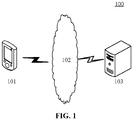
- FIG. 1 is a schematic diagram of an exemplary system architecture to which a technical solution according to an embodiment of the present disclosure is applicable.
- a system architecture 100 includes a terminal device 101, a network 102, and a server 103.
- the network 102 is configured to provide a medium of a communication link between the terminal device 101 and the server 103.
- the network 102 includes various connection types, for example, a wired communication link and a wireless communication link.
- the numbers of terminal devices, networks, and servers in FIG. 1 are merely exemplary.
- the system architecture may have any number of terminal devices, networks, and servers according to an actual requirement.
- the server 103 may be a server cluster including multiple servers.
- the terminal device 101 transmits an image to the server 103 through the network 102.
- the server 103 first divides the input image into multiple image regions, perform feature extraction on objects in the image regions by using an encoding network model to obtain region features of the image regions, and then obtain a first image feature corresponding to the input image according to the region features of the image regions. Then, the server processes pixels in the first image feature according to a preset rule, and determines a second image feature corresponding to the input image according to the processed pixels.
- the server then inputs the first image feature, the second image feature, and an initial word vector into a reflective decoding network model, decodes the first image feature by using the reflective decoding network model to obtain word vectors corresponding to the image regions, and then generates a text description corresponding to the input image according to the word vectors corresponding to the image regions.
- the image processing method provided in the embodiments of the present disclosure is generally performed by a server, and correspondingly, an image processing apparatus is generally arranged in the server. However, in other embodiments of the present disclosure, the image processing method provided in the embodiments of the present disclosure may be performed by a terminal device.
- FIG. 2 is a schematic flowchart of an image processing method in the related art.
- an image 201 is inputted into an encoding network model 202.
- the encoding network model 202 includes a Faster R-CNN network and a ResNet-101 network.
- Local feature information of objects in the input image is obtained by performing feature extraction on the input image by using the Faster R-CNN network, and global feature information of the input image is obtained by performing feature extraction on the input image by using the ResNet-101 network.
- the local feature information and the global feature information are then inputted into a decoding network model 203.
- the decoding network model 203 includes multiple repeated network structures, and the network structure is an attention-based recurrent neural network.
- the global feature information is inputted into a first layer of LSTM, and feature extraction is performed on the global feature information by using the first layer of LSTM, to output a first hidden state.
- the first hidden state and the local feature information are then inputted into an attention mechanism network layer, to output a hybrid feature by using the attention mechanism network layer.
- the hybrid feature and the first hidden state are then processed jointly by using a second layer of LSTM, to output a second hidden state.
- softmax processing is performed on the second hidden state, to obtain a predicted word vector.
- an image description generation algorithm shown in FIG. 2 can obtain a better effect, the algorithm still has limitations. Specifically, the model effect can be improved only by extracting more representative image features whose fine granularity is given for a single object, and attention on a language model is ignored.
- the decoding network model is relatively simple, and consequently an effect of the model degrades apparently when a sentence is relatively long or a sentence structure is relatively complex.
- AI artificial intelligence
- AI is a theory, a method, a technology, and an application system that use a digital computer or a machine controlled by the digital computer to simulate, extend, and expand human intelligence, perceive an environment, obtain knowledge, and use knowledge to obtain an optimal result.
- AI is a comprehensive technology in computer science and attempts to understand the essence of intelligence and produce a new intelligent machine that can react in a manner similar to human intelligence.
- AI is to study the design principles and implementation methods of various intelligent machines, to enable the machines to have the functions of perception, reasoning, and decision-making.
- the AI technology is a comprehensive discipline, and relates to a wide range of fields including both hardware-level technologies and software-level technologies.
- the basic AI technologies generally include technologies such as a sensor, a dedicated AI chip, cloud computing, distributed storage, a big data processing technology, an operating/interaction system, and electromechanical integration.
- AI software technologies mainly include a computer vision technology, a speech processing technology, a natural language processing technology, and machine learning/deep learning.
- the computer vision (CV) technology is a technology that studies how to use a machine to "see”, and furthermore, that uses a camera and a computer to perform machine vision operations such as recognition, tracking, and measurement on a target, and further perform graphic processing, so that the computer processes the target into an image more suitable for human eyes to observe, or an image transmitted to an instrument for detection.
- CV studies related theories and technologies and attempts to establish an AI system that can obtain information from images or multidimensional data.
- the CV technologies generally include image processing, image recognition, image semantic understanding, image retrieval, OCR, video processing, video semantic understanding, video content/behavior recognition, three-dimensional object reconstruction, a 3D technology, virtual reality, augmented reality, synchronous positioning, and map construction, and further include biometric feature recognition technologies such as common face recognition and fingerprint recognition.
- the machine learning (ML) is a multi-field interdiscipline, and relates to multiple disciplines such as the probability theory, statistics, the approximation theory, convex analysis, and the algorithm complexity theory.
- the ML specializes in studying how a computer simulates or implements a human learning behavior to obtain new knowledge or skills, and reorganize an existing knowledge structure, so as to keep improving its performance.
- the ML is the core of AI, is a basic way to make the computer intelligent, and is applied to various fields of AI.
- the ML and deep learning generally include an artificial neural network, a belief network, reinforcement learning, transfer learning, inductive learning, and learning from instruction.
- the AI technology is studied and applied in multiple fields such as a common smart home, a smart wearable device, a virtual assistant, a smart speaker, smart marketing, unmanned driving, automatic driving, an unmanned aerial vehicle, a robot, smart medical care, and smart customer service. It is believed that with the development of technologies, the AI technology will be applied to more fields, and play an increasingly important role.
- An image processing method is provided according to an embodiment of the present disclosure.
- the image processing method is applicable to fields such as early childhood education, image retrieval, and navigation for a blind person. Implementation details of the technical solution of the embodiment of the present disclosure are described in detail below.
- FIG. 3 is a flowchart of an image processing method according to an embodiment of the present disclosure.
- the image processing method may be performed by one or more computing devices, and the one or more computing devices may be the terminal device 101 and/or server 103 shown in FIG. 1 .
- the image processing method includes at least steps S310 to S330.
- step S310 an input image is obtained and objects included in image regions in the input image are encoded to obtain a first image feature.
- the input image may be an image downloaded from a network, an image locally stored in the terminal device 101, or an image obtained by a user by using a photographing apparatus, for example, a terminal including a photographing unit, such as a camera, a video camera, or a smartphone. After an image for which a text description needs to be generated is determined, the image may be transmitted to the server 103 through the terminal device 101.
- the terminal device 101 may be any terminal device including a display screen, such as a smartphone, a notebook computer, or a desktop computer. A type of the terminal device 101 is not limited in the embodiments of the present disclosure.
- the input image may be divided into multiple image regions.
- the input image may be divided according to the number of pixels, or may be divided according to different objects in the image.
- encoding that is, feature extraction
- the multiple image regions are generated by dividing the input image, encoding, that is, feature extraction, may be performed on objects in the image regions. For example, a scene represented by an image is a child bouncing a ball in a yard, objects in the image are the child, the ball, and a grassland, while the background such as a sky and birds in the image may be ignored, and it is unnecessary to perform feature extraction on the background.
- the objects in the image regions are encoded by using network structures such as Faster R-CNN, ResNet, and VGG as an encoding network model.
- Feature extraction is performed on the objects in the image regions by using the encoding network model, to obtain region features corresponding to the image regions.
- the region feature is essentially a fixed vector expression corresponding to an image region. Further, a first image feature corresponding to the input image may be obtained according to the region features corresponding to the image regions.
- step S320 pixels in the first image feature are processed according to a preset rule, and a second image feature is determined according to the processed pixels.
- pixel values in the second image feature are determined according to pixel values of the pixels in the first image feature. Specifically, a pixel average value of all pixels in the first image feature is calculated, and the pixel average value serves as a pixel value of each pixel in the second image feature.
- the second image feature serves as an input feature and is inputted into a reflective decoding network model, to cause the reflective decoding network model to decode the first image feature according to the second image feature and an initial word vector, so as to predict word vectors corresponding to the image regions in the first image feature.
- the initial word vector in the embodiments of the present disclosure may be any character without substantial semantics.
- the initial word vector may be an initial tag such as #, or may be an initial token word such as BN.
- a type of the initial word vector is not limited in the embodiments of the present disclosure.
- step S330 based on the second image feature and an initial word vector, region features corresponding to the image regions in the first image feature are decoded, to obtain word vectors corresponding to the image regions; and a text description corresponding to the input image is generated according to the word vectors.
- the initial word vector is an initial tag of the text description.
- step S330 the region features corresponding to the image regions in the first image feature are decoded at different time instants, and a current region feature is decoded by using a region feature that is decoded previously.
- the second image feature serves as an input feature and is inputted into the reflective decoding network model; and the initial word vector is also inputted into the reflective decoding network model, so that the reflective decoding network model decodes the region features of the image regions in the first image feature at different time instants, to obtain the word vectors corresponding to the image regions.
- FIG. 4 is a schematic structural diagram of a reflective decoding network model.
- the reflective decoding network model includes multiple reflective decoding subnetworks arranged sequentially.
- the reflective decoding subnetworks decode region features of image regions in a first image feature at different time instants, to obtain word vectors corresponding to the image regions.
- the second image feature and the initial word vector serve as input features and are inputted into the first reflective decoding subnetwork.
- a target region feature in the first image feature is decoded based on the second image feature and the initial word vector by using the first reflective decoding subnetwork, to obtain a word vector corresponding to the target region feature.
- the second image feature and a word vector that is outputted by an M-th reflective decoding subnetwork are inputted into an (M+1)-th reflective decoding subnetwork.
- the target region feature in the first image feature is decoded by using the (M+1)-th reflective decoding subnetwork, to obtain a word vector corresponding to the target region feature.
- M is a positive integer.
- each reflective decoding subnetwork includes three parts: a visual attention module, a reflective attention module (RAM), and a reflective position module (RPM).
- the visual attention module mainly focuses on visual features of an encoding network model.
- the reflective attention module establishes a model, based on output information of the visual attention module, for a degree of matching between the output information of the visual attention module at a current time instant and a past time instant according to a text attention mechanism, to obtain a context vector, so as to generate a word at the current time instant, thereby capturing more comprehensive historical word information.
- Relative position information of each word in a generated text description is introduced into the reflective position module. While predicting words, the reflective decoding network model predicts a relative position of a current word in the text description, thereby assisting the reflective decoding network model to perceive a syntactic structure of a sentence.
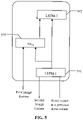
- FIG. 5 is a schematic structural diagram of a visual attention module.
- the visual attention module 500 includes a first LSTM network (LSTM-1) 501, a second LSTM network (LSTM-2) 502, and an attention mechanism network (Att vis ) 503.
- the first LSTM network 501 is configured to perform feature extraction according to a second image feature and a word vector obtained at a previous time instant.
- the second LSTM network 502 is configured to perform feature extraction according to output information of the first LSTM network 501 and output information of the attention mechanism network 503.
- the attention mechanism network 503 is configured to perform feature extraction according to a first image feature and the output information of the first LSTM network 501.
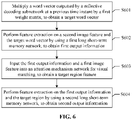
- FIG. 6 is a schematic diagram of a processing procedure of a visual attention module.
- the processing procedure of the visual attention module includes at least steps S601 to S604.
- step S601 a word vector outputted by a reflective decoding subnetwork at a previous time instant is multiplied by a first weight matrix, to obtain a target word vector.
- FIG. 7 is a schematic flowchart of image processing.
- the second image feature r determined according to the first image feature and a word vector outputted by a reflective decoding subnetwork at a previous time instant are input features of the LSTM-1.
- dimension adjustment is performed on an input word vector feature of each reflective decoding subnetwork.
- the first weight matrix W e is shared by all input features O t , so that only one parameter needs to be trained for the first weight matrix W e during model training.
- step S602 feature extraction is performed on the second image feature and the target word vector by using the first LSTM network, to obtain first output information.
- the LSTM-1 processes the target word vector and the second image feature to output first output information.
- the first output information is essentially a hidden state outputted by the LSTM-1, as h 1 1 shown in FIG. 7 .
- step S603 the first output information and the first image feature are inputted into the attention mechanism network for visual matching, to obtain a target region feature.
- an attention mechanism is similar to human vision.
- the attention mechanism a part of all information is selected for attention and other visible information is ignored.
- the first output information and the first image feature are inputted into the attention mechanism network simultaneously, and visual matching is performed between the first output information and the first image feature by using the attention mechanism network Att vis , to determine a degree of matching between each region feature in the first image feature and the first output information.
- a region feature with a highest matching degree, as r ⁇ t shown in FIG. 7 is finally outputted as a target region feature from the attention mechanism network.
- step S604 feature extraction is performed on the first output information and the target region feature by using the second LSTM network, to obtain second output information.
- the target region feature and the first output information serve as input features and are inputted into the LSTM-2.
- the LSTM-2 performs feature extraction on the first output information and the target region feature, to obtain second output information corresponding to the target region feature.
- the second output information is a hidden state outputted by the LSTM-2, as h 1 2 shown in FIG. 7 .
- the LSTM in the embodiments of the present disclosure may be replaced with another recurrent neural network, and further, the LSTM-1 and LSTM-2 in the embodiments of the present disclosure may be replaced with different types of recurrent neural networks.
- the LSTM is a time recursive neural network and is suitable for processing and predicting important events with a relatively long interval and latency in a time sequence. Therefore, to predict words more accurately and generate a coherent text description, the image processing method in the embodiments of the present disclosure predicts words by mainly using the LSTM.
- a word vector corresponding to the target region feature is determined according to the first hidden state and the second hidden state.
- a sentence when a sentence is relatively long or a sentence structure is relatively complex, matching is performed between a hidden state at a current time instant and a hidden states at a past time instant by using the reflective attention module based on the text attention mechanism, to improve a decoding effect. As shown in FIG.
- a reflective attention module (RAM) in a t-th reflective decoding subnetwork further receives second output information outputted by an LSTM-2 in a first reflective decoding subnetwork to an LSTM-2 in a (t-1)-th reflective decoding subnetwork and first output information outputted by an LSTM-1 corresponding to the RAM, in addition to receiving second output information outputted by an LSTM-2 corresponding to the RAM, to determine third output information corresponding to the target region feature at the current time instant according to the second output information at the past time instants and the first output information and the second output information at the current time instant.
- RAM reflective attention module
- FIG. 8 is a schematic diagram of a processing procedure of a reflective attention module. As shown in FIG. 8 , the processing procedure includes at least steps S801 to S805.
- step S801 a target matrix is determined according to all second output information at past time instants and second output information at a current time instant.
- FIG. 9 shows a schematic structural diagram of a reflective attention module according to an embodiment of the present disclosure.
- cylinders at the top left corner represent second output information, and a target matrix having certain dimensions, for example, a 1000 ⁇ 1 target matrix, is formed according to the second output information h 1 2 , h 2 2 , ..., and h t ⁇ 1 2 at the past time instants and the second output information h t 2 at the current time instant.
- step S802 dimension reduction is performed on the target matrix to obtain first feature information, and dimension reduction is performed on first output information at the current time instant to obtain second feature information.
- the first feature information and the second feature information have same dimensions.
- dimension reduction is performed on the target matrix and the first output information at the current time instant, to obtain the first feature information and the second feature information having the same dimensions.
- the target matrix and the first output information at the current moment each are multiplied by a 512-dimensional weight matrix, to reduce dimensions of the target matrix and dimensions of the first output information from 1000 to 512, thereby greatly improving the processing efficiency.
- step S803 the first feature information is added to the second feature information based on an attention mechanism to obtain third feature information.
- the first feature information and the second feature information may be accordingly processed, as Attref shown in FIG. 9 .
- the first feature information and the second feature information are added.
- the processing manner is not limited in the embodiments of the present disclosure.
- step S804 weighting processing and normalization processing are performed on the third feature information to obtain a second weight matrix.
- the third feature information is multiplied by a reflective attention weight W r to obtain a feature matrix.
- the number of information included in the feature matrix is the same as the number of second output information in the target matrix, the number being t.
- softmax processing namely, normalization processing, is performed on the feature matrix to calculate a ratio of each piece of information relative to all information, and a second weight matrix is determined according to a ratio corresponding to each piece of second output information.
- step S805 the first feature information is multiplied by the second weight matrix and a sum of products of the multiplication is calculated, to obtain third output information.
- the first feature information determined according to all the second output information is multiplied by the second weight matrix and a sum of products of the multiplication is calculated, to obtain the third output information, namely, as a right cylinder h ⁇ t 2 shown in FIG. 9 .
- the third output information is multiplied by a third weight matrix W s to obtain a word vector corresponding to the target region feature r ⁇ t , as S t shown in FIG. 7 .
- the word vector S t outputted at a time instant t is an input vector O t+1 at a time instant t+1.
- the third output information is inputted into the reflective position module.
- the reflective position module predicts a relative position of a word vector outputted at the current time instant in the text description according to the third output information.
- the reflective position module includes a fully connected layer and a compression layer. After the third output information is inputted into the reflective position module, full connection is first performed through the fully connected layer, to convert the 512 ⁇ 1 dimensional h ⁇ t 2 into a 1 ⁇ 1 dimensional vector. Then, the vector outputted by the fully connected layer is compressed through the compression layer according to a corresponding compression function, to obtain a relative position.
- a result outputted by the compression layer is a number between 0 and 1, which represents a position of the word vector in the text description. For example, if the text description is a sentence including 10 words and the number outputted by the compression layer is 0.6, the word vector S t outputted by the t-th reflective decoding subnetwork is located at a sixth position in the sentence.
- the region features corresponding to the image regions in the first image feature are decoded by using the multiple reflective decoding subnetworks arranged sequentially in the reflective decoding network model.
- Generation of word vectors is stopped when a punctuation at a sentence end is encountered.
- word vectors ⁇ S 1 , S 2 , ..., S T ⁇ corresponding to the image regions are obtained, these word vectors are connected in series sequentially to form the text description corresponding to the input image.
- the reflective decoding network model needs to be trained before the text description is generated by performing word prediction on the first image feature by using the reflective decoding network model. Specifically, an image sample and a text description sample corresponding to the image sample are first obtained; the image sample is then inputted into a to-be-trained reflective decoding network model to generate a corresponding text description; and model parameters are adjusted according to a degree of matching between the generated text description and the corresponding text description sample, until a loss function of the to-be-trained reflective decoding network model is minimized.
- the loss function of the reflective decoding network model includes two parts: a cross entropy loss function and a position-perceptive loss function.
- the cross entropy loss function indicates a correct probability of a text description generated by the to-be-trained reflective decoding network model and corresponding to the image sample.
- the position-perceptive loss function indicates a distance between a real position and a predicted position of a word vector outputted by the to-be-trained reflective decoding network model at a current time instant in the text description sample.
- I represents the input image
- ⁇ represents a parameter of the reflective decoding network model and includes the weight matrices W e , W s , and W r in the foregoing embodiments
- S represents a correct unfixed-length text description corresponding to the input image and may represent any sentence.
- Any word vector in the text description S depends on a previous word vector adjacent to the word vector, so that a model is established, by using a chain rule, on a joint probability distribution of word vectors S 1 , S 2 , ..., and S T forming the sentence.
- the cross entropy loss function L xe may be determined based on formula (1), as shown by the following formula (2): log p S
- N represents the number of words included in the generated text description
- S t represents a word vector generated at a time instant t.
- (S, I) is a trained image sentence pair, and a sum of log probabilities in formula (2) may be optimized through a stochastic gradient descent (SGD) method.
- SGD stochastic gradient descent
- a position-perceptive loss is determined by the reflective position module.
- FIG. 10 shows a schematic flowchart of determining a position-perceptive loss by a reflective position module.
- full connection is performed, through the fully connected layer, on the third output information outputted by the reflective attention module, to generate full connection information.
- the full connection information may be a 1 ⁇ 1 vector.
- Compression processing is then performed on the full connection information according to a preset compression function corresponding to the compression layer, to obtain a predicted position of a word vector corresponding to the third output information, namely, a relative position I p t of a predicted word vector in the text description.
- a position-perceptive loss is determined according to the predicted position and a real position of the word vector corresponding to the third output information in the text description sample.
- a real position I r t of a word in a sentence is obtained according to the number of words included in the text description sample and a position of a word corresponding to a target region feature in the text description sample, and the position-perceptive loss L pos is determined according to the real position I r t and the relative position I p t .
- I r t and I p t respectively represent a real position and a predicted relative position of a word vector in a sentence at a current time instant, and a distance between the two positions is reduced by minimizing L pos .
- the parameter ⁇ is used for balancing an effect of the loss function in the entire optimization process of the reflective decoding network model, and may be set according to an actual requirement.
- a value of ⁇ is not limited in the embodiments of the present disclosure.
- a person with visual impairment may wear a smart device, and the smart device may be smart glasses, a portable smart camera, or the like.
- the smart device may be smart glasses, a portable smart camera, or the like.
- an image of a road ahead may be acquired in real time, and the image is then analyzed by an image description generation apparatus carried in the smart device to obtain a corresponding text description.
- the text description may be outputted by using a corresponding voice output device, to cause the person with visual impairment to know road conditions in real time and avoid obstacles.
- an image acquisition unit of the smart device may obtain an image including a signal light, a zebra crossing, and traffic conditions.
- a first image feature is obtained by encoding the signal light, the zebra crossing, and vehicles in the image; a second image feature is then determined according to a pixel average value of all pixels in the first image feature; the first image feature, the second image feature, and an initial word vector are then inputted into a reflective decoding network model, and text prediction is performed on the signal light, the zebra crossing, and the vehicles in the image sequentially by using reflective decoding subnetworks in the reflective decoding network model.
- texts “signal light and red light” may be outputted according to the signal light
- information such as “zebra crossing, there are vehicles, and there is no pedestrian”
- a text description "the signal light is a red light, there are vehicles on the zebra crossing, and pedestrians cannot pass” may be finally generated according to word vectors corresponding to image regions.
- the text description may be transmitted to the person with visual impairment in real time, to remind the person to wait for a green light and then pass.
- a photographing apparatus carried in the book may obtain the picture, and input the picture into an image processing unit to obtain a corresponding text description.
- a picture of each page in the story book may be stored in advance; and when a child watches a picture of one page, the picture of the page is inputted into the image processing unit to obtain a corresponding text description.
- the image processing unit may segment the picture and encode objects in image regions to obtain a first image feature; then calculate an average value of all pixels in the first image feature, and replace pixel values of all the pixels with the pixel average value to generate a second image feature; and then input the first image feature, the second image feature, and an initial word vector into a reflective decoding network model, so as to generate a word at a current time instant according to a context vector by using the reflective decoding network model and predict a relative position of the word in a sentence at the current time instant.
- word vectors such as one, lamb, hillside, and eating grass may be generated sequentially by using a reflective attention module, and a final text description of "one lamb eating grass on a hillside" may be obtained according to these word vectors.
- the text description may be played through a voice output unit, to help the child to understand content of the picture and improve cognition of the child for things.
- the first image feature encoded by the encoding network model is decoded by using the reflective decoding network model; matching is performed between the hidden state at the current time instant and the hidden states at the past time instants by using the reflective attention module to obtain a context vector to generate a word vector at the current time instant; and a relative position of the word vector at the current time instant in the text description is predicted by using the reflective position module, thereby enhancing context association and sequential logic of a sentence, further improving the decoding capability of a language model, and ensuring the stability of the model performance in a case that the sentence is relatively long or complex, and thus generating a more natural and accurate image text description.
- the embodiment of the present disclosure mainly focuses on improving a decoding input part of a long short-term sequence module by introducing the reflective attention module and the reflective position module, other reinforcement learning, graph conventional neural network, and generative adversarial network technologies may be also improved by using the technical solution described in in the present disclosure, to further improve the quality of the generated image description.
- Apparatus embodiments of the present disclosure are described below, and the apparatus embodiments may be used for performing the image processing method in the foregoing embodiments of the present disclosure. For details not disclosed in the apparatus embodiments of the present disclosure, one may refer to the foregoing embodiments of the image processing method of the present disclosure.
- FIG. 11 is a block diagram of an image processing apparatus according to an embodiment of the present disclosure.
- an image processing apparatus 1100 includes: a feature extraction module 1101, a feature conversion module 1102, and a description generation module 1103.
- the feature extraction module 1101 is configured to obtain an input image and encode objects included in image regions in the input image to obtain a first image feature.
- the feature conversion module 1102 is configured to process pixels in the first image feature according to a preset rule, and determine a second image feature according to the processed pixels.
- the description generation module 1103 is configured to decode, based on the second image feature and an initial word vector, region features corresponding to the image regions in the first image feature at different time instants, to obtain word vectors corresponding to the image regions, and generate a text description corresponding to the input image according to the word vectors.
- the initial word vector is an initial tag of the text description.
- the feature extraction module 1101 is configured to: divide the input image into multiple image regions; perform feature extraction on objects in the image regions by using an encoding network model, to obtain region features corresponding to the image regions; and generate the first image feature according to the region features.
- the feature conversion module 1102 is configured to: obtain a pixel average value of all pixels in the first image feature, and generate the second image feature by using the pixel average value as pixel values of all the pixels.
- the description generation module 1103 is configured to: decode, based on the second image feature and the initial word vector, the region features corresponding to the image regions in the first image feature at different time instants by using a reflective decoding network model, to obtain the word vectors corresponding to the image regions.
- the reflective decoding network model includes multiple reflective decoding subnetworks arranged sequentially.
- the description generation module 1103 is configured to: input the second image feature and a word vector that is outputted by an M-th reflective decoding subnetwork into an (M+1)-th reflective decoding subnetwork; and decode a target region feature in the first image feature by using the (M+1)-th reflective decoding subnetwork, to obtain a word vector corresponding to the target region feature.
- M is a positive integer.
- the description generation module 1103 is configured to: input the second image feature and the initial word vector into a first reflective decoding subnetwork, and decode the target region feature in the first image feature by using the first reflective decoding subnetwork, to obtain the word vector corresponding to the target region feature.
- the reflective decoding subnetwork includes a visual attention module, a reflective attention module, and a reflective position module.
- the reflective position module is configured to predict a relative position of a word vector outputted by the reflective decoding subnetwork at a current time instant in the text description.
- the visual attention module includes a first LSTM network, a second LSTM network, and an attention mechanism network.
- the image processing apparatus 1100 is configured to: multiply a word vector outputted by the reflective decoding subnetwork at a previous time instant by a first weight matrix, to obtain a target word vector; perform feature extraction on the second image feature and the target word vector by using the first LSTM network to obtain first output information; input the first output information and the first image feature into the attention mechanism network for visual matching, to obtain a target region feature; and perform feature extraction on the first output information and the target region feature by using the second LSTM network, to obtain second output information.
- the image processing apparatus 1100 further includes: a word vector generation module, configured to determine third output information corresponding to the target region feature at a current time instant according to the second output information at a past time instant and the first output information and the second output information at the current time instant by using the reflective attention module.
- a word vector generation module configured to determine third output information corresponding to the target region feature at a current time instant according to the second output information at a past time instant and the first output information and the second output information at the current time instant by using the reflective attention module.
- the word vector generation module is configured to: determine a target matrix according to all the second output information at the past time instants and the second output information at the current time instant; perform dimension reduction on the target matrix to obtain first feature information, and perform dimension reduction on the first output information at the current time instant to obtain second feature information, the first feature information and the second feature information having the same dimensions; add the first feature information to the second feature information based on an attention mechanism to obtain third feature information; perform weighting processing and normalization processing on the third feature information to obtain a second weight matrix; and multiply the first feature information by the second weight matrix and calculate a sum of products of the multiplication, to obtain the third output information.
- the description generation module 1103 is configured to: multiply the third output information by a third weight matrix, to obtain the word vector corresponding to the target region feature.
- the image processing apparatus 1100 further includes: a sample obtaining module, configured to obtain an image sample and a text description sample corresponding to the image sample; a model training module, configured to train a to-be-trained reflective decoding network model according to the image sample and the text description sample until a loss function corresponding to the to-be-trained reflective decoding network model is minimized.
- the loss function includes a cross entropy loss function and a position-perceptive loss function.
- the cross entropy loss function indicates a correct probability of a text description generated by the to-be-trained reflective decoding network model and corresponding to the image sample; and the position-perceptive loss function indicates a distance between a real position and a predicted position of a word vector outputted by the to-be-trained reflective decoding network model at a current time instant in the text description sample.
- a position-perceptive loss corresponding to the position-perceptive loss function is determined by the reflective position module.
- the image processing apparatus 1100 is configured to: perform, through a fully connected layer, full connection on features outputted by the reflective attention module, to generate full connection information; compress the full connection information according to a preset compression function, to obtain information about predicted positions of word vectors corresponding to the features outputted by the reflective attention module; and determine the position-perceptive loss according to the information about the predicted positions and information about real positions of the word vectors corresponding to the features outputted by the reflective attention module in the text description sample.
- FIG. 12 is a schematic structural diagram of a computer system of an electronic device configured to implement an embodiment of the present disclosure.
- the computer system 1200 of the electronic device shown in FIG. 12 is merely schematic, and is not intended to impose any limitation on a function and use scope of the embodiments of the present disclosure.
- the computer system 1200 includes a central processing unit (CPU) 1201, which may perform various suitable actions and processing based on a program stored in a read-only memory (ROM) 1202 or a program loaded from a storage part 1208 into a random access memory (RAM) 1203, to implement the image processing method described in the foregoing embodiments.
- the RAM 1203 further stores various programs and data required for system operations.
- the CPU 1201, the ROM 1202, and the RAM 1203 are connected to each other through a bus 1204.
- An input/output (I/O) interface 1205 is also connected to the bus 1204.
- the following components are connected to the I/O interface 1205: an input part 1206 including a keyboard, a mouse, or the like; an output part 1207 including a cathode ray tube (CRT), a liquid crystal display (LCD), a speaker, or the like; a storage part 1208 including a hard disk, or the like; and a communication part 1209 including a network interface card such as a local area network (LAN) card or a modem.
- the communication part 1209 performs communication processing by using a network such as the Internet.
- a drive 1210 is also connected to the I/O interface 1205 as required.
- a removable medium 1211 such as a magnetic disk, an optical disc, a magneto-optical disk, or a semiconductor memory, is installed on the drive 1210 as required, so that a computer program read from the removable medium is installed into the storage part 1208 as required.
- the processes described below by referring to the flowcharts may be implemented as computer software programs.
- the embodiments of the present disclosure include a computer program product, including a computer program carried on a computer-readable medium.
- the computer program includes program codes for performing the method shown in the flowchart.
- the computer program may be downloaded and installed from a network, and/or installed from the removable medium 1211.
- the various functions defined in the system of the present disclosure are executed.
- the computer-readable medium shown in the embodiments of the present disclosure may be a computer-readable signal medium or a computer-readable storage medium or any combination thereof.
- the computer-readable storage medium may be, for example, but is not limited to, an electric, magnetic, optical, electromagnetic, infrared, or semi-conductive system, apparatus, or component, or any combination of the above.
- a more specific example of the computer-readable storage medium may include but is not limited to: an electrical connection having one or more wires, a portable computer magnetic disk, a hard disk, a RAM, a ROM, an erasable programmable ROM (EPROM), a flash memory, an optical fiber, a compact disk ROM (CD-ROM), an optical storage device, a magnetic storage device, or any appropriate combination thereof.
- the computer-readable storage medium may be any tangible medium including or storing a program, and the program may be used by or in combination with an instruction execution system, apparatus, or device.
- the computer-readable signal medium may include a data signal included in a baseband or propagated as a part of a carrier, the data signal carrying computer-readable program code.
- a data signal propagated in such a way may include multiple forms, including, but not limited to, an electromagnetic signal, an optical signal, or any appropriate combination thereof.
- the computer-readable signal medium may be further any computer-readable medium in addition to a computer-readable storage medium.
- the computer-readable medium may send, propagate, or transmit a program that is used by or used in conjunction with an instruction execution system, an apparatus, or a device.
- the program code included in the computer-readable medium may be transmitted by using any suitable medium, including but not limited to: a wireless medium, a wired medium, or the like, or any suitable combination thereof.
- each box in a flowchart or a block diagram may represent a module, a program segment, or a part of code.
- the module, the program segment, or the part of code includes one or more executable instructions used for implementing designated logic functions.
- functions annotated in boxes may be performed in a sequence different from that annotated in an accompanying drawing. For example, operations in two boxes shown in succession may be performed basically in parallel, and sometimes operations in the two boxes may be performed in a reverse sequence, depending on a related function.
- Each box in a block diagram and/or a flowchart and a combination of boxes in the block diagram and/or the flowchart may be implemented by using a dedicated hardware-based system configured to perform a specified function or operation, or may be implemented by using a combination of dedicated hardware and a computer instruction.
- the units described in the embodiments of the present disclosure may be implemented in a software manner, or may be implemented in a hardware manner.
- the described units may be arranged in a processor. Names of the units do not constitute a limitation on the units in a specific case.
- a computer-readable medium is further provided according to the present disclosure.
- the computer-readable medium may be the computer-readable medium included in the image processing apparatus described in the foregoing embodiments, or a stand-alone computer-readable medium not assembled into the electronic device.
- the computer-readable medium carries one or more programs. The one or more programs, when executed by the electronic device, cause the electronic device to implement the method described in the foregoing embodiments.
- the software product may be stored in a non-volatile storage medium (which may be a CD-ROM, a USB flash drive, a removable hard disk, or the like) or a network, and includes several instructions for instructing a computing device (which may be a personal computer, a server, a touch terminal, a network device, or the like) to perform the method according to the implementations of the present disclosure.
- a non-volatile storage medium which may be a CD-ROM, a USB flash drive, a removable hard disk, or the like
- a computing device which may be a personal computer, a server, a touch terminal, a network device, or the like
Landscapes
- Engineering & Computer Science (AREA)
- Theoretical Computer Science (AREA)
- General Physics & Mathematics (AREA)
- Physics & Mathematics (AREA)
- Artificial Intelligence (AREA)
- General Engineering & Computer Science (AREA)
- General Health & Medical Sciences (AREA)
- Health & Medical Sciences (AREA)
- Multimedia (AREA)
- Data Mining & Analysis (AREA)
- Evolutionary Computation (AREA)
- Audiology, Speech & Language Pathology (AREA)
- Computational Linguistics (AREA)
- Computer Vision & Pattern Recognition (AREA)
- Bioinformatics & Computational Biology (AREA)
- Software Systems (AREA)
- Evolutionary Biology (AREA)
- Bioinformatics & Cheminformatics (AREA)
- Life Sciences & Earth Sciences (AREA)
- Databases & Information Systems (AREA)
- Computing Systems (AREA)
- Medical Informatics (AREA)
- Image Analysis (AREA)
Abstract
Description
- This application claims priority to
Chinese Patent Application No. 201910872478.6, titled "IMAGE DESCRIPTION GENERATION METHOD AND APPARATUS, AND ELECTRONIC DEVICE", and filed with the China National Intellectual Property Administration on September 16, 2019 - The present disclosure relates to the technical field of artificial intelligence, and in particular to an image processing method, an image description generation apparatus, and an electronic device.
- Image description generation is an analytical research of generating, for a picture, a natural language description that can express meanings of the picture, and has a wide application prospect. For example, a person with visual impairment may be helped to quickly and accurately understand image content by generating a text description of a picture. In the preschool education field, better enlightenment may be provided to children by generating intuitive and accurate descriptions of pictures for the children.
- Inspired by successful applications of neural networks in image recognition and machine translation, image text descriptions are generated based on a neural network model in many existing methods. Currently, in the image description generation, an image is encoded into a fixed vector expression by using a convolutional neural network, and then the fixed vector expression is directly decoded, by using a recurrent neural network, to obtain a sentence description. However, an existing decoding model is relatively simple, resulting in an effect of the model degrades apparently when a sentence is relatively long or a sentence structure is relatively complex.
- The information disclosed in the background part is used only for enhancing the understanding of the background of the present disclosure, and therefore may include information that does not constitute the related art known to a person of ordinary skill in the art.
- According to embodiments of the present disclosure, an image processing method, an image processing apparatus, and an electronic device are provided, so that natural language information included in an image can be accurately and effectively extracted to some extent, and a more accurate and fluent text description is generated.
- Other characteristics and advantages of the present disclosure become apparent from the following detailed description, or may be learned in part through the practice of the present disclosure.
- According to one aspect of the embodiments of the present disclosure, an image processing method is provided. The method includes: obtaining an input image and encoding objects included in image regions in the input image to obtain a first image feature; processing pixels in the first image feature according to a preset rule, and determining a second image feature according to the processed pixels; and decoding, based on the second image feature and an initial word vector, region features corresponding to the image regions in the first image feature at different time instants, to obtain word vectors corresponding to the image regions, and generating a text description corresponding to the input image according to the word vectors. The initial word vector is an initial tag of the text description.
- According to another aspect of the embodiments of the present disclosure, an image processing apparatus is provided. The apparatus includes: a feature extraction module, configured to obtain an input image and encode objects included in image regions in the input image to obtain a first image feature; a feature conversion module, configured to process pixels in the first image feature according to a preset rule, and determine a second image feature according to the processed pixels; and a description generation module, configured to decode, based on the second image feature and an initial word vector, region features of the image regions in the first image feature at different time instants, to obtain word vectors corresponding to the image regions, and generate a text description corresponding to the input image according to the word vectors. The initial word vector is an initial tag of the text description.
- In the technical solutions of the present disclosure, image features corresponding to the input image are decoded by using a decoding network model, so that on one hand, natural language information included in the input image can be extracted more accurately and effectively; and on the other hand, the decoding network model is also applicable when a sentence is relatively long or a sentence structure is relatively complex, thereby improving the accuracy and fluency of the text description.
- It is to be understood that the above general descriptions and the following detailed descriptions are merely for exemplary and explanatory purposes, and are not intended to limit the present disclosure.
- The accompanying drawings herein, which are incorporated in the specification as a part of the specification, show embodiments in accordance with the present disclosure, and together with the specification are used to explain the principle of the present disclosure. Apparently, the accompanying drawings in the following description show merely some embodiments of the present disclosure, and a person of ordinary skill in the art may still derive other accompanying drawings from these accompanying drawings without creative efforts. In the accompanying drawings:
-
FIG. 1 is a schematic diagram of an exemplary system architecture to which a technical solution according to an embodiment of the present disclosure is applicable. -
FIG. 2 is a schematic flowchart of an image processing method in the related art. -
FIG. 3 is a schematic flowchart of an image processing method according to an embodiment of the present disclosure. -
FIG. 4 is a schematic structural diagram of a reflective decoding network model according to an embodiment of the present disclosure. -
FIG. 5 is a schematic structural diagram of a visual attention module according to an embodiment of the present disclosure. -
FIG. 6 is a schematic diagram of a processing procedure of a visual attention module according to an embodiment of the present disclosure. -
FIG. 7 is a schematic flowchart of image processing according to an embodiment of the present disclosure. -
FIG. 8 is a schematic diagram of a processing procedure of a reflective attention module according to an embodiment of the present disclosure. -
FIG. 9 is a schematic structural diagram of a reflective attention module according to an embodiment of the present disclosure. -
FIG. 10 is a schematic flowchart of determining a position-perceptive loss by a reflective position module according to an embodiment of the present disclosure. -
FIG. 11 is a block diagram of an image processing apparatus according to an embodiment of the present disclosure. -
FIG. 12 is a schematic structural diagram of a computer system of an image processing apparatus configured to implement an embodiment of the present disclosure. - Exemplary implementations are described more thoroughly now with reference to the accompanying drawings. However, the exemplary implementations can be implemented in various forms and are not to be construed as being limited to the examples set forth herein. Instead, the implementations are provided so that the present disclosure can be more comprehensive and complete, and the concepts of the exemplary implementations are fully conveyed to a person skilled in the art.
- In addition, the described features, structures, or characteristics may be combined in one or more embodiments in any appropriate manner. In the following descriptions, many specific details are provided to obtain a thorough understanding of the embodiments of the present disclosure. However, a person skilled in the art is to be aware that, the technical solutions of the present disclosure may be implemented without one or more specific details, or another method, component, apparatus, step, and the like may be used. In other cases, well-known methods, apparatuses, implementations, or operations are not shown or described in detail to avoid obscuring aspects of the present disclosure.
- The block diagrams shown in the accompanying drawings merely represent functional entities and do not necessarily correspond to physically independent entities. That is, the functional entities may be implemented in a software form, or in one or more hardware modules or integrated circuits, or in different networks and/or processor apparatuses and/or microcontroller apparatuses.
- The flowcharts shown in the accompanying drawings are merely exemplary descriptions, do not need to include all content and operations/steps, and do not need to be performed in the described orders either. For example, some operations/steps may be further divided, while some operations/steps may be combined or partially combined. Therefore, an actual execution order may change according to an actual case.
-
FIG. 1 is a schematic diagram of an exemplary system architecture to which a technical solution according to an embodiment of the present disclosure is applicable. - As shown in
FIG. 1 , asystem architecture 100 includes aterminal device 101, anetwork 102, and aserver 103. Thenetwork 102 is configured to provide a medium of a communication link between theterminal device 101 and theserver 103. Thenetwork 102 includes various connection types, for example, a wired communication link and a wireless communication link. - It is to be understood that the numbers of terminal devices, networks, and servers in
FIG. 1 are merely exemplary. The system architecture may have any number of terminal devices, networks, and servers according to an actual requirement. For example, theserver 103 may be a server cluster including multiple servers. - In an embodiment of the present disclosure, the
terminal device 101 transmits an image to theserver 103 through thenetwork 102. After obtaining the input image, theserver 103 first divides the input image into multiple image regions, perform feature extraction on objects in the image regions by using an encoding network model to obtain region features of the image regions, and then obtain a first image feature corresponding to the input image according to the region features of the image regions. Then, the server processes pixels in the first image feature according to a preset rule, and determines a second image feature corresponding to the input image according to the processed pixels. The server then inputs the first image feature, the second image feature, and an initial word vector into a reflective decoding network model, decodes the first image feature by using the reflective decoding network model to obtain word vectors corresponding to the image regions, and then generates a text description corresponding to the input image according to the word vectors corresponding to the image regions. According to the technical solution of this embodiment of the present disclosure, the performance of a model when a sentence is relatively long or a sentence structure is relatively complex can be ensured, and thus natural language information included in the image can be extracted more accurately and effectively, thereby generating a more accurate and fluent text description. - The image processing method provided in the embodiments of the present disclosure is generally performed by a server, and correspondingly, an image processing apparatus is generally arranged in the server. However, in other embodiments of the present disclosure, the image processing method provided in the embodiments of the present disclosure may be performed by a terminal device.
- In the related art in this field, a text description of an image is generated mainly by using an encoder-decoder framework.
FIG. 2 is a schematic flowchart of an image processing method in the related art. As shown inFIG. 2 , animage 201 is inputted into anencoding network model 202. Theencoding network model 202 includes a Faster R-CNN network and a ResNet-101 network. Local feature information of objects in the input image is obtained by performing feature extraction on the input image by using the Faster R-CNN network, and global feature information of the input image is obtained by performing feature extraction on the input image by using the ResNet-101 network. The local feature information and the global feature information are then inputted into adecoding network model 203. Thedecoding network model 203 includes multiple repeated network structures, and the network structure is an attention-based recurrent neural network. Specifically, the global feature information is inputted into a first layer of LSTM, and feature extraction is performed on the global feature information by using the first layer of LSTM, to output a first hidden state. The first hidden state and the local feature information are then inputted into an attention mechanism network layer, to output a hybrid feature by using the attention mechanism network layer. The hybrid feature and the first hidden state are then processed jointly by using a second layer of LSTM, to output a second hidden state. Finally, softmax processing is performed on the second hidden state, to obtain a predicted word vector. - Although an image description generation algorithm shown in
FIG. 2 can obtain a better effect, the algorithm still has limitations. Specifically, the model effect can be improved only by extracting more representative image features whose fine granularity is given for a single object, and attention on a language model is ignored. The decoding network model is relatively simple, and consequently an effect of the model degrades apparently when a sentence is relatively long or a sentence structure is relatively complex. - An image processing method is provided according to embodiments of the present disclosure. The image processing method relates to the field of artificial intelligence (AI). AI is a theory, a method, a technology, and an application system that use a digital computer or a machine controlled by the digital computer to simulate, extend, and expand human intelligence, perceive an environment, obtain knowledge, and use knowledge to obtain an optimal result. In other words, AI is a comprehensive technology in computer science and attempts to understand the essence of intelligence and produce a new intelligent machine that can react in a manner similar to human intelligence. AI is to study the design principles and implementation methods of various intelligent machines, to enable the machines to have the functions of perception, reasoning, and decision-making.
- The AI technology is a comprehensive discipline, and relates to a wide range of fields including both hardware-level technologies and software-level technologies. The basic AI technologies generally include technologies such as a sensor, a dedicated AI chip, cloud computing, distributed storage, a big data processing technology, an operating/interaction system, and electromechanical integration. AI software technologies mainly include a computer vision technology, a speech processing technology, a natural language processing technology, and machine learning/deep learning.
- The computer vision (CV) technology is a technology that studies how to use a machine to "see", and furthermore, that uses a camera and a computer to perform machine vision operations such as recognition, tracking, and measurement on a target, and further perform graphic processing, so that the computer processes the target into an image more suitable for human eyes to observe, or an image transmitted to an instrument for detection. As a scientific discipline, the CV studies related theories and technologies and attempts to establish an AI system that can obtain information from images or multidimensional data. The CV technologies generally include image processing, image recognition, image semantic understanding, image retrieval, OCR, video processing, video semantic understanding, video content/behavior recognition, three-dimensional object reconstruction, a 3D technology, virtual reality, augmented reality, synchronous positioning, and map construction, and further include biometric feature recognition technologies such as common face recognition and fingerprint recognition.
- The machine learning (ML) is a multi-field interdiscipline, and relates to multiple disciplines such as the probability theory, statistics, the approximation theory, convex analysis, and the algorithm complexity theory. The ML specializes in studying how a computer simulates or implements a human learning behavior to obtain new knowledge or skills, and reorganize an existing knowledge structure, so as to keep improving its performance. The ML is the core of AI, is a basic way to make the computer intelligent, and is applied to various fields of AI. The ML and deep learning generally include an artificial neural network, a belief network, reinforcement learning, transfer learning, inductive learning, and learning from instruction.
- With the research and progress of the AI technology, the AI technology is studied and applied in multiple fields such as a common smart home, a smart wearable device, a virtual assistant, a smart speaker, smart marketing, unmanned driving, automatic driving, an unmanned aerial vehicle, a robot, smart medical care, and smart customer service. It is believed that with the development of technologies, the AI technology will be applied to more fields, and play an increasingly important role.
- The solutions provided in the embodiments of the present disclosure relate to the image semantic understanding technology of AI, and are described by using the following embodiments.
- An image processing method is provided according to an embodiment of the present disclosure. The image processing method is applicable to fields such as early childhood education, image retrieval, and navigation for a blind person. Implementation details of the technical solution of the embodiment of the present disclosure are described in detail below.
-
FIG. 3 is a flowchart of an image processing method according to an embodiment of the present disclosure. The image processing method may be performed by one or more computing devices, and the one or more computing devices may be theterminal device 101 and/orserver 103 shown inFIG. 1 . Referring toFIG. 3 , the image processing method includes at least steps S310 to S330. - In step S310, an input image is obtained and objects included in image regions in the input image are encoded to obtain a first image feature.
- In an embodiment of the present disclosure, the input image may be an image downloaded from a network, an image locally stored in the
terminal device 101, or an image obtained by a user by using a photographing apparatus, for example, a terminal including a photographing unit, such as a camera, a video camera, or a smartphone. After an image for which a text description needs to be generated is determined, the image may be transmitted to theserver 103 through theterminal device 101. Further, theterminal device 101 may be any terminal device including a display screen, such as a smartphone, a notebook computer, or a desktop computer. A type of theterminal device 101 is not limited in the embodiments of the present disclosure. - In an embodiment of the present disclosure, after an input image is received, the input image may be divided into multiple image regions. The input image may be divided according to the number of pixels, or may be divided according to different objects in the image. After the multiple image regions are generated by dividing the input image, encoding, that is, feature extraction, may be performed on objects in the image regions. For example, a scene represented by an image is a child bouncing a ball in a yard, objects in the image are the child, the ball, and a grassland, while the background such as a sky and birds in the image may be ignored, and it is unnecessary to perform feature extraction on the background. The objects in the image regions are encoded by using network structures such as Faster R-CNN, ResNet, and VGG as an encoding network model. Feature extraction is performed on the objects in the image regions by using the encoding network model, to obtain region features corresponding to the image regions. The region feature is essentially a fixed vector expression corresponding to an image region. Further, a first image feature corresponding to the input image may be obtained according to the region features corresponding to the image regions.
- In step S320, pixels in the first image feature are processed according to a preset rule, and a second image feature is determined according to the processed pixels.
- In an embodiment of the present disclosure, after the first image feature is obtained by performing feature extraction on the image regions in the input image, pixel values in the second image feature are determined according to pixel values of the pixels in the first image feature. Specifically, a pixel average value of all pixels in the first image feature is calculated, and the pixel average value serves as a pixel value of each pixel in the second image feature. The second image feature serves as an input feature and is inputted into a reflective decoding network model, to cause the reflective decoding network model to decode the first image feature according to the second image feature and an initial word vector, so as to predict word vectors corresponding to the image regions in the first image feature. The initial word vector in the embodiments of the present disclosure may be any character without substantial semantics. For example, the initial word vector may be an initial tag such as #, or may be an initial token word such as BN. A type of the initial word vector is not limited in the embodiments of the present disclosure.
- In step S330, based on the second image feature and an initial word vector, region features corresponding to the image regions in the first image feature are decoded, to obtain word vectors corresponding to the image regions; and a text description corresponding to the input image is generated according to the word vectors. The initial word vector is an initial tag of the text description.
- In step S330, the region features corresponding to the image regions in the first image feature are decoded at different time instants, and a current region feature is decoded by using a region feature that is decoded previously.
- In an embodiment of the present disclosure, after the second image feature is obtained, the second image feature serves as an input feature and is inputted into the reflective decoding network model; and the initial word vector is also inputted into the reflective decoding network model, so that the reflective decoding network model decodes the region features of the image regions in the first image feature at different time instants, to obtain the word vectors corresponding to the image regions.
-
FIG. 4 is a schematic structural diagram of a reflective decoding network model. As shown inFIG. 4 , the reflective decoding network model includes multiple reflective decoding subnetworks arranged sequentially. The reflective decoding subnetworks decode region features of image regions in a first image feature at different time instants, to obtain word vectors corresponding to the image regions. The second image feature and the initial word vector serve as input features and are inputted into the first reflective decoding subnetwork. A target region feature in the first image feature is decoded based on the second image feature and the initial word vector by using the first reflective decoding subnetwork, to obtain a word vector corresponding to the target region feature. The second image feature and a word vector that is outputted by an M-th reflective decoding subnetwork are inputted into an (M+1)-th reflective decoding subnetwork. The target region feature in the first image feature is decoded by using the (M+1)-th reflective decoding subnetwork, to obtain a word vector corresponding to the target region feature. M is a positive integer. - The method according to this embodiments of the present disclosure may include:
- obtaining an input image and extracting region features of image regions in the input image to obtain a first image feature;
- processing pixels in the first image feature according to a preset rule, and determining a second image feature according to the processed pixels; and
- determining, based on the second image feature and at least one word vector that is determined for the input image, word vectors corresponding to the region features of the image regions in the first image feature at different time instants, predicting positions of the word vectors in a text description, and generating the text description corresponding to the input image according to the word vectors and the positions.
- In an embodiment of the present disclosure, all the reflective decoding subnetworks have a same structure, and each reflective decoding subnetwork includes three parts: a visual attention module, a reflective attention module (RAM), and a reflective position module (RPM). The visual attention module mainly focuses on visual features of an encoding network model. The reflective attention module establishes a model, based on output information of the visual attention module, for a degree of matching between the output information of the visual attention module at a current time instant and a past time instant according to a text attention mechanism, to obtain a context vector, so as to generate a word at the current time instant, thereby capturing more comprehensive historical word information. Relative position information of each word in a generated text description is introduced into the reflective position module. While predicting words, the reflective decoding network model predicts a relative position of a current word in the text description, thereby assisting the reflective decoding network model to perceive a syntactic structure of a sentence.
-
FIG. 5 is a schematic structural diagram of a visual attention module. As shown inFIG. 5 , the visual attention module 500 includes a first LSTM network (LSTM-1) 501, a second LSTM network (LSTM-2) 502, and an attention mechanism network (Attvis) 503. Thefirst LSTM network 501 is configured to perform feature extraction according to a second image feature and a word vector obtained at a previous time instant. Thesecond LSTM network 502 is configured to perform feature extraction according to output information of thefirst LSTM network 501 and output information of theattention mechanism network 503. Theattention mechanism network 503 is configured to perform feature extraction according to a first image feature and the output information of thefirst LSTM network 501. -
FIG. 6 is a schematic diagram of a processing procedure of a visual attention module. For ease of understanding, a description is made by using a processing procedure of a visual attention module in a t-th reflective decoding subnetwork as an example in an embodiment of the present disclosure. As shown inFIG. 6 , the processing procedure of the visual attention module includes at least steps S601 to S604. - In step S601, a word vector outputted by a reflective decoding subnetwork at a previous time instant is multiplied by a first weight matrix, to obtain a target word vector.
- In an embodiment of the present disclosure,
FIG. 7 is a schematic flowchart of image processing. As shown inFIG. 7 , for an LSTM-1, the second image featurer determined according to the first image feature and a word vector outputted by a reflective decoding subnetwork at a previous time instant are input features of the LSTM-1. To ensure that dimensions of the inputted word vector are equal to dimensions of data processed by the LSTM-1, dimension adjustment is performed on an input word vector feature of each reflective decoding subnetwork. Specifically, an input word vector feature Ot (t=1, ..., T) is multiplied by a first weight matrix We, to obtain a target word vector, so as to change dimensions of the input feature Ot. The first weight matrix We is shared by all input features Ot, so that only one parameter needs to be trained for the first weight matrix We during model training. - In step S602, feature extraction is performed on the second image feature and the target word vector by using the first LSTM network, to obtain first output information.
- In an embodiment of the present disclosure, after the second image feature and the target word vector are inputted into the LSTM-1, the LSTM-1 processes the target word vector and the second image feature to output first output information. The first output information is essentially a hidden state outputted by the LSTM-1, as

FIG. 7 . - In step S603, the first output information and the first image feature are inputted into the attention mechanism network for visual matching, to obtain a target region feature.
- In an embodiment of the present disclosure, an attention mechanism is similar to human vision. In the attention mechanism, a part of all information is selected for attention and other visible information is ignored. Before decoding is performed by using a reflective decoding network model, feature extraction is performed on the input image by using a convolutional neural network such as Faster R-CNN, to obtain a first image feature {ri} (i=1, ..., k). Then, after the first output information outputted by the LSTM-1 is obtained, the first output information and the first image feature are inputted into the attention mechanism network simultaneously, and visual matching is performed between the first output information and the first image feature by using the attention mechanism network Attvis, to determine a degree of matching between each region feature in the first image feature and the first output information. A region feature with a highest matching degree, as r̂ t shown in
FIG. 7 , is finally outputted as a target region feature from the attention mechanism network. - In step S604, feature extraction is performed on the first output information and the target region feature by using the second LSTM network, to obtain second output information.
- In an embodiment of the present disclosure, after the target region feature is obtained, the target region feature and the first output information serve as input features and are inputted into the LSTM-2. The LSTM-2 performs feature extraction on the first output information and the target region feature, to obtain second output information corresponding to the target region feature. The second output information is a hidden state outputted by the LSTM-2, as

FIG. 7 . The LSTM in the embodiments of the present disclosure may be replaced with another recurrent neural network, and further, the LSTM-1 and LSTM-2 in the embodiments of the present disclosure may be replaced with different types of recurrent neural networks. However, the LSTM is a time recursive neural network and is suitable for processing and predicting important events with a relatively long interval and latency in a time sequence. Therefore, to predict words more accurately and generate a coherent text description, the image processing method in the embodiments of the present disclosure predicts words by mainly using the LSTM. - Subsequently, in some embodiments, a word vector corresponding to the target region feature is determined according to the first hidden state and the second hidden state.
- In an embodiment of the present disclosure, when a sentence is relatively long or a sentence structure is relatively complex, matching is performed between a hidden state at a current time instant and a hidden states at a past time instant by using the reflective attention module based on the text attention mechanism, to improve a decoding effect. As shown in
FIG. 7 , a reflective attention module (RAM) in a t-th reflective decoding subnetwork further receives second output information outputted by an LSTM-2 in a first reflective decoding subnetwork to an LSTM-2 in a (t-1)-th reflective decoding subnetwork and first output information outputted by an LSTM-1 corresponding to the RAM, in addition to receiving second output information outputted by an LSTM-2 corresponding to the RAM, to determine third output information corresponding to the target region feature at the current time instant according to the second output information at the past time instants and the first output information and the second output information at the current time instant. -
FIG. 8 is a schematic diagram of a processing procedure of a reflective attention module. As shown inFIG. 8 , the processing procedure includes at least steps S801 to S805. - In step S801, a target matrix is determined according to all second output information at past time instants and second output information at a current time instant.
-
FIG. 9 shows a schematic structural diagram of a reflective attention module according to an embodiment of the present disclosure. As shown inFIG. 9 , cylinders at the top left corner represent second output information, and a target matrix having certain dimensions, for example, a 1000×1 target matrix, is formed according to the secondoutput information 


information 
- In step S802, dimension reduction is performed on the target matrix to obtain first feature information, and dimension reduction is performed on first output information at the current time instant to obtain second feature information. The first feature information and the second feature information have same dimensions.
- In an embodiment of the present disclosure, to improve the calculation efficiency, dimension reduction is performed on the target matrix and the first output information at the current time instant, to obtain the first feature information and the second feature information having the same dimensions. As shown in
FIG. 9 , the target matrix and the first output information at the current moment each are multiplied by a 512-dimensional weight matrix, to reduce dimensions of the target matrix and dimensions of the first output information from 1000 to 512, thereby greatly improving the processing efficiency. - In step S803, the first feature information is added to the second feature information based on an attention mechanism to obtain third feature information.
- In an embodiment of the present disclosure, based on the text attention mechanism, the first feature information and the second feature information may be accordingly processed, as Attref shown in
FIG. 9 . Specifically, the first feature information and the second feature information are added. Certainly, other processing manners may be used. The processing manner is not limited in the embodiments of the present disclosure. After the first feature information and the second feature information are added, third feature information combining the hidden states at the past time instants and the hidden state at the current time instant is obtained. - In step S804, weighting processing and normalization processing are performed on the third feature information to obtain a second weight matrix.
- In an embodiment of the present disclosure, after the third feature information is obtained, the third feature information is multiplied by a reflective attention weight Wr to obtain a feature matrix. The number of information included in the feature matrix is the same as the number of second output information in the target matrix, the number being t. Then softmax processing, namely, normalization processing, is performed on the feature matrix to calculate a ratio of each piece of information relative to all information, and a second weight matrix is determined according to a ratio corresponding to each piece of second output information.
- In step S805, the first feature information is multiplied by the second weight matrix and a sum of products of the multiplication is calculated, to obtain third output information.
- In an embodiment of the present disclosure, after the second weight matrix including the ratios corresponding to all the second output information is obtained, the first feature information determined according to all the second output information is multiplied by the second weight matrix and a sum of products of the multiplication is calculated, to obtain the third output information, namely, as a right cylinder

FIG. 9 . - In an embodiment of the present disclosure, after the third output information outputted by the reflective attention module is obtained, the third output information is multiplied by a third weight matrix Ws to obtain a word vector corresponding to the target region feature r̂ t, as St shown in
FIG. 7 . The word vector St outputted at a time instant t is an input vector Ot+1 at a timeinstant t+ 1. - In an embodiment of the present disclosure, as shown in
FIG. 7 , after the reflective attention module outputs the third output information, the third output information is inputted into the reflective position module. The reflective position module predicts a relative position of a word vector outputted at the current time instant in the text description according to the third output information. Specifically, the reflective position module includes a fully connected layer and a compression layer. After the third output information is inputted into the reflective position module, full connection is first performed through the fully connected layer, to convert the 512×1 dimensional
- In an embodiment of the present disclosure, the region features corresponding to the image regions in the first image feature are decoded by using the multiple reflective decoding subnetworks arranged sequentially in the reflective decoding network model. Generation of word vectors is stopped when a punctuation at a sentence end is encountered. After word vectors {S1, S2, ..., ST} corresponding to the image regions are obtained, these word vectors are connected in series sequentially to form the text description corresponding to the input image.
- In an embodiment of the present disclosure, before the text description is generated by performing word prediction on the first image feature by using the reflective decoding network model, the reflective decoding network model needs to be trained. Specifically, an image sample and a text description sample corresponding to the image sample are first obtained; the image sample is then inputted into a to-be-trained reflective decoding network model to generate a corresponding text description; and model parameters are adjusted according to a degree of matching between the generated text description and the corresponding text description sample, until a loss function of the to-be-trained reflective decoding network model is minimized. In the embodiments of the present disclosure, the loss function of the reflective decoding network model includes two parts: a cross entropy loss function and a position-perceptive loss function. The cross entropy loss function indicates a correct probability of a text description generated by the to-be-trained reflective decoding network model and corresponding to the image sample. The position-perceptive loss function indicates a distance between a real position and a predicted position of a word vector outputted by the to-be-trained reflective decoding network model at a current time instant in the text description sample.
- In an embodiment of the present disclosure, to minimize the loss function of the reflective decoding network model, it needs to be ensured that the cross entropy loss function is maximized and the position-perceptive loss function is minimized. The cross entropy loss function may be determined according to formula (1), as follows:

- In which, I represents the input image; θ represents a parameter of the reflective decoding network model and includes the weight matrices We, Ws, and Wr in the foregoing embodiments; and S represents a correct unfixed-length text description corresponding to the input image and may represent any sentence.
- Any word vector in the text description S depends on a previous word vector adjacent to the word vector, so that a model is established, by using a chain rule, on a joint probability distribution of word vectors S1, S2, ..., and ST forming the sentence. The cross entropy loss function Lxe may be determined based on formula (1), as shown by the following formula (2):

- In which, N represents the number of words included in the generated text description, and St represents a word vector generated at a time instant t.
- In a training stage, (S, I) is a trained image sentence pair, and a sum of log probabilities in formula (2) may be optimized through a stochastic gradient descent (SGD) method.
- In an embodiment of the present disclosure, a position-perceptive loss is determined by the reflective position module.
FIG. 10 shows a schematic flowchart of determining a position-perceptive loss by a reflective position module. As shown inFIG. 10 , full connection is performed, through the fully connected layer, on the third output information outputted by the reflective attention module, to generate full connection information. The full connection information may be a 1×1 vector. Compression processing is then performed on the full connection information according to a preset compression function corresponding to the compression layer, to obtain a predicted position of a word vector corresponding to the third output information, namely, a relative position


- In which,


- Further, after a cross entropy loss and the position-perceptive loss are obtained, a size of the loss function corresponding to the reflective decoding network model is determined according to formula (4) as follows:

- In which, the parameter λ is used for balancing an effect of the loss function in the entire optimization process of the reflective decoding network model, and may be set according to an actual requirement. A value of λ is not limited in the embodiments of the present disclosure.
- Next, the technical solutions in the embodiments of the present disclosure are described by using navigation for a blind person as an example. A person with visual impairment may wear a smart device, and the smart device may be smart glasses, a portable smart camera, or the like. In a movement process of the person with visual impairment, an image of a road ahead may be acquired in real time, and the image is then analyzed by an image description generation apparatus carried in the smart device to obtain a corresponding text description. Further, the text description may be outputted by using a corresponding voice output device, to cause the person with visual impairment to know road conditions in real time and avoid obstacles. For example, when the person with visual impairment walks to a crossroads and a red light is on, an image acquisition unit of the smart device may obtain an image including a signal light, a zebra crossing, and traffic conditions. A first image feature is obtained by encoding the signal light, the zebra crossing, and vehicles in the image; a second image feature is then determined according to a pixel average value of all pixels in the first image feature; the first image feature, the second image feature, and an initial word vector are then inputted into a reflective decoding network model, and text prediction is performed on the signal light, the zebra crossing, and the vehicles in the image sequentially by using reflective decoding subnetworks in the reflective decoding network model. For example, texts "signal light and red light" may be outputted according to the signal light, information such as "zebra crossing, there are vehicles, and there is no pedestrian" may be outputted according to the zebra crossing, and a text description "the signal light is a red light, there are vehicles on the zebra crossing, and pedestrians cannot pass" may be finally generated according to word vectors corresponding to image regions. The text description may be transmitted to the person with visual impairment in real time, to remind the person to wait for a green light and then pass.
- Taking early childhood education as an example, when a child looks through a story book, the child may be attracted by various patterns; and when the child watches a picture, a photographing apparatus carried in the book may obtain the picture, and input the picture into an image processing unit to obtain a corresponding text description. In addition, a picture of each page in the story book may be stored in advance; and when a child watches a picture of one page, the picture of the page is inputted into the image processing unit to obtain a corresponding text description. For example, if a picture of one page in the story book shows one lamb eating grass on a hillside, the image processing unit may segment the picture and encode objects in image regions to obtain a first image feature; then calculate an average value of all pixels in the first image feature, and replace pixel values of all the pixels with the pixel average value to generate a second image feature; and then input the first image feature, the second image feature, and an initial word vector into a reflective decoding network model, so as to generate a word at a current time instant according to a context vector by using the reflective decoding network model and predict a relative position of the word in a sentence at the current time instant. For example, word vectors such as one, lamb, hillside, and eating grass may be generated sequentially by using a reflective attention module, and a final text description of "one lamb eating grass on a hillside" may be obtained according to these word vectors. When a child watches the picture, the text description may be played through a voice output unit, to help the child to understand content of the picture and improve cognition of the child for things.
- According to the image processing method in the present disclosure, the first image feature encoded by the encoding network model is decoded by using the reflective decoding network model; matching is performed between the hidden state at the current time instant and the hidden states at the past time instants by using the reflective attention module to obtain a context vector to generate a word vector at the current time instant; and a relative position of the word vector at the current time instant in the text description is predicted by using the reflective position module, thereby enhancing context association and sequential logic of a sentence, further improving the decoding capability of a language model, and ensuring the stability of the model performance in a case that the sentence is relatively long or complex, and thus generating a more natural and accurate image text description.
- Although the embodiment of the present disclosure mainly focuses on improving a decoding input part of a long short-term sequence module by introducing the reflective attention module and the reflective position module, other reinforcement learning, graph conventional neural network, and generative adversarial network technologies may be also improved by using the technical solution described in in the present disclosure, to further improve the quality of the generated image description.
- Apparatus embodiments of the present disclosure are described below, and the apparatus embodiments may be used for performing the image processing method in the foregoing embodiments of the present disclosure. For details not disclosed in the apparatus embodiments of the present disclosure, one may refer to the foregoing embodiments of the image processing method of the present disclosure.
-
FIG. 11 is a block diagram of an image processing apparatus according to an embodiment of the present disclosure. - Referring to
FIG. 11 , animage processing apparatus 1100 according to an embodiment of the present disclosure includes: afeature extraction module 1101, afeature conversion module 1102, and adescription generation module 1103. - The
feature extraction module 1101 is configured to obtain an input image and encode objects included in image regions in the input image to obtain a first image feature. Thefeature conversion module 1102 is configured to process pixels in the first image feature according to a preset rule, and determine a second image feature according to the processed pixels. Thedescription generation module 1103 is configured to decode, based on the second image feature and an initial word vector, region features corresponding to the image regions in the first image feature at different time instants, to obtain word vectors corresponding to the image regions, and generate a text description corresponding to the input image according to the word vectors. The initial word vector is an initial tag of the text description. - In an embodiment of the present disclosure, the
feature extraction module 1101 is configured to: divide the input image into multiple image regions; perform feature extraction on objects in the image regions by using an encoding network model, to obtain region features corresponding to the image regions; and generate the first image feature according to the region features. - In an embodiment of the present disclosure, the
feature conversion module 1102 is configured to: obtain a pixel average value of all pixels in the first image feature, and generate the second image feature by using the pixel average value as pixel values of all the pixels. - In an embodiment of the present disclosure, the
description generation module 1103 is configured to: decode, based on the second image feature and the initial word vector, the region features corresponding to the image regions in the first image feature at different time instants by using a reflective decoding network model, to obtain the word vectors corresponding to the image regions. - In an embodiment of the present disclosure, the reflective decoding network model includes multiple reflective decoding subnetworks arranged sequentially. The
description generation module 1103 is configured to: input the second image feature and a word vector that is outputted by an M-th reflective decoding subnetwork into an (M+1)-th reflective decoding subnetwork; and decode a target region feature in the first image feature by using the (M+1)-th reflective decoding subnetwork, to obtain a word vector corresponding to the target region feature. M is a positive integer. - In an embodiment of the present disclosure, the
description generation module 1103 is configured to: input the second image feature and the initial word vector into a first reflective decoding subnetwork, and decode the target region feature in the first image feature by using the first reflective decoding subnetwork, to obtain the word vector corresponding to the target region feature. - In an embodiment of the present disclosure, the reflective decoding subnetwork includes a visual attention module, a reflective attention module, and a reflective position module. The reflective position module is configured to predict a relative position of a word vector outputted by the reflective decoding subnetwork at a current time instant in the text description.
- In an embodiment of the present disclosure, the visual attention module includes a first LSTM network, a second LSTM network, and an attention mechanism network. The
image processing apparatus 1100 is configured to: multiply a word vector outputted by the reflective decoding subnetwork at a previous time instant by a first weight matrix, to obtain a target word vector; perform feature extraction on the second image feature and the target word vector by using the first LSTM network to obtain first output information; input the first output information and the first image feature into the attention mechanism network for visual matching, to obtain a target region feature; and perform feature extraction on the first output information and the target region feature by using the second LSTM network, to obtain second output information. - In an embodiment of the present disclosure, the
image processing apparatus 1100 further includes: a word vector generation module, configured to determine third output information corresponding to the target region feature at a current time instant according to the second output information at a past time instant and the first output information and the second output information at the current time instant by using the reflective attention module. - In an embodiment of the present disclosure, the word vector generation module is configured to: determine a target matrix according to all the second output information at the past time instants and the second output information at the current time instant; perform dimension reduction on the target matrix to obtain first feature information, and perform dimension reduction on the first output information at the current time instant to obtain second feature information, the first feature information and the second feature information having the same dimensions; add the first feature information to the second feature information based on an attention mechanism to obtain third feature information; perform weighting processing and normalization processing on the third feature information to obtain a second weight matrix; and multiply the first feature information by the second weight matrix and calculate a sum of products of the multiplication, to obtain the third output information.
- In an embodiment of the present disclosure, the
description generation module 1103 is configured to: multiply the third output information by a third weight matrix, to obtain the word vector corresponding to the target region feature. - In an embodiment of the present disclosure, the
image processing apparatus 1100 further includes: a sample obtaining module, configured to obtain an image sample and a text description sample corresponding to the image sample; a model training module, configured to train a to-be-trained reflective decoding network model according to the image sample and the text description sample until a loss function corresponding to the to-be-trained reflective decoding network model is minimized. The loss function includes a cross entropy loss function and a position-perceptive loss function. - In an embodiment of the present disclosure, the cross entropy loss function indicates a correct probability of a text description generated by the to-be-trained reflective decoding network model and corresponding to the image sample; and the position-perceptive loss function indicates a distance between a real position and a predicted position of a word vector outputted by the to-be-trained reflective decoding network model at a current time instant in the text description sample.
- In an embodiment of the present disclosure, a position-perceptive loss corresponding to the position-perceptive loss function is determined by the reflective position module. The
image processing apparatus 1100 is configured to: perform, through a fully connected layer, full connection on features outputted by the reflective attention module, to generate full connection information; compress the full connection information according to a preset compression function, to obtain information about predicted positions of word vectors corresponding to the features outputted by the reflective attention module; and determine the position-perceptive loss according to the information about the predicted positions and information about real positions of the word vectors corresponding to the features outputted by the reflective attention module in the text description sample. -
FIG. 12 is a schematic structural diagram of a computer system of an electronic device configured to implement an embodiment of the present disclosure. - The
computer system 1200 of the electronic device shown inFIG. 12 is merely schematic, and is not intended to impose any limitation on a function and use scope of the embodiments of the present disclosure. - As shown in
FIG. 12 , thecomputer system 1200 includes a central processing unit (CPU) 1201, which may perform various suitable actions and processing based on a program stored in a read-only memory (ROM) 1202 or a program loaded from astorage part 1208 into a random access memory (RAM) 1203, to implement the image processing method described in the foregoing embodiments. TheRAM 1203 further stores various programs and data required for system operations. TheCPU 1201, theROM 1202, and theRAM 1203 are connected to each other through abus 1204. An input/output (I/O)interface 1205 is also connected to thebus 1204. - The following components are connected to the I/O interface 1205: an
input part 1206 including a keyboard, a mouse, or the like; anoutput part 1207 including a cathode ray tube (CRT), a liquid crystal display (LCD), a speaker, or the like; astorage part 1208 including a hard disk, or the like; and acommunication part 1209 including a network interface card such as a local area network (LAN) card or a modem. Thecommunication part 1209 performs communication processing by using a network such as the Internet. Adrive 1210 is also connected to the I/O interface 1205 as required. A removable medium 1211, such as a magnetic disk, an optical disc, a magneto-optical disk, or a semiconductor memory, is installed on thedrive 1210 as required, so that a computer program read from the removable medium is installed into thestorage part 1208 as required. - Particularly, according to an embodiment of the present disclosure, the processes described below by referring to the flowcharts may be implemented as computer software programs. For example, the embodiments of the present disclosure include a computer program product, including a computer program carried on a computer-readable medium. The computer program includes program codes for performing the method shown in the flowchart. In such an embodiment, by using the
communication part 1209, the computer program may be downloaded and installed from a network, and/or installed from theremovable medium 1211. When the computer program is executed by theCPU 1201, the various functions defined in the system of the present disclosure are executed. - The computer-readable medium shown in the embodiments of the present disclosure may be a computer-readable signal medium or a computer-readable storage medium or any combination thereof. The computer-readable storage medium may be, for example, but is not limited to, an electric, magnetic, optical, electromagnetic, infrared, or semi-conductive system, apparatus, or component, or any combination of the above. A more specific example of the computer-readable storage medium may include but is not limited to: an electrical connection having one or more wires, a portable computer magnetic disk, a hard disk, a RAM, a ROM, an erasable programmable ROM (EPROM), a flash memory, an optical fiber, a compact disk ROM (CD-ROM), an optical storage device, a magnetic storage device, or any appropriate combination thereof. In the present disclosure, the computer-readable storage medium may be any tangible medium including or storing a program, and the program may be used by or in combination with an instruction execution system, apparatus, or device. In the present disclosure, the computer-readable signal medium may include a data signal included in a baseband or propagated as a part of a carrier, the data signal carrying computer-readable program code. A data signal propagated in such a way may include multiple forms, including, but not limited to, an electromagnetic signal, an optical signal, or any appropriate combination thereof. The computer-readable signal medium may be further any computer-readable medium in addition to a computer-readable storage medium. The computer-readable medium may send, propagate, or transmit a program that is used by or used in conjunction with an instruction execution system, an apparatus, or a device. The program code included in the computer-readable medium may be transmitted by using any suitable medium, including but not limited to: a wireless medium, a wired medium, or the like, or any suitable combination thereof.
- Flowcharts and block diagrams in the drawings illustrate architectures, functions, and operations that may be implemented by using the system, the method, and the computer program product according to the various embodiments of the present disclosure. In this regard, each box in a flowchart or a block diagram may represent a module, a program segment, or a part of code. The module, the program segment, or the part of code includes one or more executable instructions used for implementing designated logic functions. In some implementations, functions annotated in boxes may be performed in a sequence different from that annotated in an accompanying drawing. For example, operations in two boxes shown in succession may be performed basically in parallel, and sometimes operations in the two boxes may be performed in a reverse sequence, depending on a related function. Each box in a block diagram and/or a flowchart and a combination of boxes in the block diagram and/or the flowchart may be implemented by using a dedicated hardware-based system configured to perform a specified function or operation, or may be implemented by using a combination of dedicated hardware and a computer instruction.
- The units described in the embodiments of the present disclosure may be implemented in a software manner, or may be implemented in a hardware manner. The described units may be arranged in a processor. Names of the units do not constitute a limitation on the units in a specific case.
- In another aspect, a computer-readable medium is further provided according to the present disclosure. The computer-readable medium may be the computer-readable medium included in the image processing apparatus described in the foregoing embodiments, or a stand-alone computer-readable medium not assembled into the electronic device. The computer-readable medium carries one or more programs. The one or more programs, when executed by the electronic device, cause the electronic device to implement the method described in the foregoing embodiments.
- Although multiple modules or units of a device configured to perform actions are discussed in detail in the foregoing detailed description, such division is not mandatory. In practice, according to the implementations of the present disclosure, the features and functions of two or more modules or units described above may be embodied in one module or unit. On the contrary, the features and functions of one module or unit described above may be implemented by multiple modules or units.
- According to the foregoing descriptions of the implementations, a person skilled in the art may readily understand that the exemplary implementations described herein may be implemented by using software, or may be implemented by combining software and necessary hardware. Therefore, the technical solutions according to the implementations of the present disclosure may be implemented in the form of a software product. The software product may be stored in a non-volatile storage medium (which may be a CD-ROM, a USB flash drive, a removable hard disk, or the like) or a network, and includes several instructions for instructing a computing device (which may be a personal computer, a server, a touch terminal, a network device, or the like) to perform the method according to the implementations of the present disclosure.
- After considering the specification and practicing the present disclosure, a person skilled in the art can easily conceive of other implementations of the present disclosure. The present disclosure is intended to cover any variation, use, or adaptive change of the present disclosure. These variations, uses, or adaptive changes follow the general principles of the present disclosure and include common general knowledge or common technical means in the art, which are not disclosed in the present disclosure.
- It is to be understood that the present disclosure is not limited to the precise structures described above and shown in the accompanying drawings, and various modifications and changes can be made without departing from the scope of the present disclosure. The scope of the present disclosure is defined only by the appended claims.
Claims (15)
- An image processing method, performed by one or more computing devices, the method comprising:obtaining an input image and extracting region features of image regions in the input image to obtain a first image feature;processing pixels in the first image feature according to a preset rule, and determining a second image feature according to the processed pixels; anddetermining, based on the second image feature and at least one word vector that is determined for the input image, word vectors corresponding to the region features of the image regions in the first image feature at different time instants; andpredicting positions of the word vectors in a text description, and generating the text description corresponding to the input image according to the word vectors and the positions.
- The method according to claim 1, wherein the extracting region features of image regions in the input image to obtain a first image feature comprises:
dividing the input image to generate a plurality of image regions;performing feature extraction on objects in the image regions by using an encoding network model, to obtain region features corresponding to the objects in the image regions; andgenerating the first image feature according to the region features. - The method according to claim 1, wherein the determining, based on the second image feature and at least one word vector that is determined for the input image, word vectors corresponding to the region features of the image regions in the first image feature at different time instants comprises:
determining, based on the second image feature and the at least one word vector that is determined for the input image, the word vectors corresponding to the region features of the image regions in the first image feature at different time instants by using a reflective decoding network model. - The method according to claim 3, wherein the reflective decoding network model comprises a plurality of reflective decoding subnetworks arranged sequentially; and
wherein the determining, based on the second image feature and the at least one word vector that is determined for the input image, the word vectors corresponding to the region features of the image regions in the first image feature at different time instants by using a reflective decoding network model comprises:inputting the second image feature and a word vector outputted by an M-th reflective decoding subnetwork into an (M+1)-th reflective decoding subnetwork; anddetermining a word vector corresponding to a target region feature in the first image feature by using the (M+1)-th reflective decoding subnetwork, wherein M is a positive integer. - The method according to claim 3, wherein the determining, based on the second image feature and the at least one word vector that is determined for the input image, the word vectors corresponding to the region features of the image regions in the first image feature at different time instants by using a reflective decoding network model comprises:
inputting the second image feature and an initial word vector into a first reflective decoding subnetwork, and determining a word vector corresponding to a target region feature in the first image feature based on the second image feature and the initial word vector by using the first reflective decoding subnetwork, wherein the initial word vector is an initial tag of the text description. - The method according to claim 4, wherein the reflective decoding subnetwork comprises a reflective position module, and the reflective position module is configured to predict a relative position of a word vector outputted by the reflective decoding subnetwork at a current time instant in the text description.
- The method according to claim 4, wherein the reflective decoding subnetwork further comprises a visual attention module, and the visual attention module comprises a first long short-term memory (LSTM) network, a second LSTM network, and an attention mechanism network; and
wherein the determining a word vector corresponding to a target region feature in the first image feature by using the (M+1)-th reflective decoding subnetwork comprises:multiplying a word vector outputted by the (M+1)-th reflective decoding subnetwork at a previous time instant by a first weight matrix, to obtain a target word vector;performing feature extraction on the second image feature and the target word vector by using the first LSTM network, to determine a first hidden state of the first LSTM network;inputting the first hidden state and the first image feature into the attention mechanism network for visual matching, to obtain the target region feature;performing feature extraction on the first hidden state and the target region feature by using the second LSTM network, to determine a second hidden state of the second LSTM network; anddetermining the word vector corresponding to the target region feature according to the first hidden state and the second hidden state. - The method according to claim 7, wherein the reflective decoding subnetwork further comprises a reflective attention module; and
wherein the determining the word vector corresponding to the target region feature according to the first hidden state and the second hidden state comprises:determining third output information corresponding to the target region feature at a current time instant according to a second hidden state at a past time instant and the first hidden state and the second hidden state at the current time instant by using the reflective attention module; andmultiplying the third output information by a third weight matrix, to obtain the word vector corresponding to the target region feature. - The method according to claim 8, wherein the determining third output information corresponding to the target region feature at a current time instant comprises:determining a target matrix according to all second hidden states at past time instants and the second hidden state at the current time instant;performing dimension reduction on the target matrix to obtain first feature information, and performing dimension reduction on the first hidden state at the current time instant to obtain second feature information, wherein the first feature information and the second feature information have same dimensions;adding the first feature information to the second feature information based on an attention mechanism to obtain third feature information;performing weighting processing and normalization processing on the third feature information to obtain a second weight matrix; andmultiplying the first feature information by the second weight matrix and calculating a sum of products of the multiplication, to obtain the third output information.
- The method according to claim 3, wherein before the obtaining an input image, the method further comprises:
obtaining an image sample and a text description sample corresponding to the image sample; andtraining a to-be-trained reflective decoding network model according to the image sample and the text description sample until a loss function corresponding to the to-be-trained reflective decoding network model is minimized,wherein the loss function comprises a cross entropy loss function and a position-perceptive loss function. - The method according to claim 10, wherein the cross entropy loss function indicates a correct probability of a text description generated by the to-be-trained reflective decoding network model and corresponding to the image sample; and the position-perceptive loss function indicates a distance between a real position and a predicted position of a word vector outputted by the to-be-trained reflective decoding network model at a current time instant in the text description sample.
- The method according to claim 11, wherein a position-perceptive loss corresponding to the position-perceptive loss function is determined by the reflective position module; and
wherein the method further comprises:performing, through a fully connected layer, full connection on features outputted by the reflective attention module, to generate full connection information;compressing the full connection information according to a preset compression function, to obtain predicted positions of word vectors corresponding to the features outputted by the reflective attention module; anddetermining the position-perceptive loss according to the predicted positions and real positions of the word vectors corresponding to the features outputted by the reflective attention module in the text description sample. - An image processing apparatus, comprising:a feature extraction module, configured to obtain an input image and extract region features of image regions in the input image to obtain a first image feature;a feature conversion module, configured to process pixels in the first image feature according to a preset rule, and determine a second image feature according to the processed pixels; anda description generation module, configured to determine, based on the second image feature and at least one word vector that is determined for the input image, word vectors corresponding to the region features of the image regions in the first image feature at different time instants, predict positions of the word vectors in a text description, and generate the text description corresponding to the input image according to the word vectors and the positions.
- An electronic device, comprising:one or more processors; anda storage apparatus, configured to store one or more programs, wherein the one or more programs, when executed by the one or more processors, cause the one or more processors to implement the image processing method according to any one of claims 1 to 12.
- A computer-readable storage medium, storing one or more computer-readable instructions, wherein the instructions are executed by one or more processors, to implement the image processing method according to any one of claims 1 to 12.
Applications Claiming Priority (2)
| Application Number | Priority Date | Filing Date | Title |
|---|---|---|---|
| CN201910872478.6A CN110717498A (en) | 2019-09-16 | 2019-09-16 | Image description generation method and device and electronic equipment |
| PCT/CN2020/115559 WO2021052358A1 (en) | 2019-09-16 | 2020-09-16 | Image processing method and apparatus, and electronic device |
Publications (2)
| Publication Number | Publication Date |
|---|---|
| EP3998552A1 true EP3998552A1 (en) | 2022-05-18 |
| EP3998552A4 EP3998552A4 (en) | 2022-11-02 |
Family
ID=69210507
Family Applications (1)
| Application Number | Title | Priority Date | Filing Date |
|---|---|---|---|
| EP20866551.3A Pending EP3998552A4 (en) | 2019-09-16 | 2020-09-16 | METHOD AND APPARATUS FOR IMAGE PROCESSING AND ELECTRONIC DEVICE |
Country Status (5)
| Country | Link |
|---|---|
| US (1) | US11907637B2 (en) |
| EP (1) | EP3998552A4 (en) |
| JP (1) | JP7164252B2 (en) |
| CN (1) | CN110717498A (en) |
| WO (1) | WO2021052358A1 (en) |
Families Citing this family (65)
| Publication number | Priority date | Publication date | Assignee | Title |
|---|---|---|---|---|
| CN110717498A (en) * | 2019-09-16 | 2020-01-21 | 腾讯科技(深圳)有限公司 | Image description generation method and device and electronic equipment |
| CN111259672A (en) * | 2020-02-12 | 2020-06-09 | 新疆大学 | Chinese tourism field named entity identification method based on graph convolution neural network |
| US11442986B2 (en) * | 2020-02-15 | 2022-09-13 | International Business Machines Corporation | Graph convolutional networks for video grounding |
| CN111324752B (en) * | 2020-02-20 | 2023-06-16 | 中国科学技术大学 | Image and Text Retrieval Method Based on Graph Neural Network Structure Modeling |
| CN111414852B (en) * | 2020-03-19 | 2025-07-15 | 驭势科技(浙江)有限公司 | Image prediction and vehicle behavior planning method, device, system and storage medium |
| CN111597819B (en) * | 2020-05-08 | 2021-01-26 | 河海大学 | Dam defect image description text generation method based on keywords |
| CN111916050A (en) * | 2020-08-03 | 2020-11-10 | 北京字节跳动网络技术有限公司 | Speech synthesis method, speech synthesis device, storage medium and electronic equipment |
| CN112016493B (en) * | 2020-09-03 | 2024-08-23 | 科大讯飞股份有限公司 | Image description method, device, electronic device and storage medium |
| CN112232149B (en) * | 2020-09-28 | 2024-04-16 | 北京易道博识科技有限公司 | Document multimode information and relation extraction method and system |
| US11625925B2 (en) * | 2021-01-05 | 2023-04-11 | GM Global Technology Operations LLC | Remote segmentation under limited computational resources and rate constraints |
| CN113569068B (en) * | 2021-01-19 | 2023-09-29 | 腾讯科技(深圳)有限公司 | Descriptive content generation method, visual content encoding and decoding method and device |
| CN112819012B (en) * | 2021-01-29 | 2022-05-03 | 厦门大学 | An image description generation method based on multi-source collaborative features |
| CN113221872B (en) * | 2021-05-28 | 2022-09-20 | 北京理工大学 | False news detection method for generating convergence of countermeasure network and multi-mode |
| CN113313650B (en) * | 2021-06-09 | 2023-10-13 | 北京百度网讯科技有限公司 | Image quality enhancement methods, devices, equipment and media |
| CN113377986B (en) * | 2021-06-23 | 2023-11-07 | 泰康保险集团股份有限公司 | Image retrieval method and device |
| CN113343664B (en) * | 2021-06-29 | 2023-08-08 | 京东科技信息技术有限公司 | Method and device for determining matching degree between image and text |
| CN113435357B (en) * | 2021-06-30 | 2022-09-02 | 平安科技(深圳)有限公司 | Voice broadcasting method, device, equipment and storage medium |
| CN113515951B (en) * | 2021-07-19 | 2022-07-05 | 同济大学 | A story description generation method based on knowledge-augmented attention network and group-level semantics |
| CN113468357B (en) * | 2021-07-21 | 2023-07-11 | 北京邮电大学 | Image description text generation method and device |
| JP7603948B2 (en) * | 2021-08-18 | 2024-12-23 | 日本電信電話株式会社 | Speech synthesis device, speech synthesis method, and speech synthesis program |
| TWI779815B (en) * | 2021-09-03 | 2022-10-01 | 瑞昱半導體股份有限公司 | Face recognition network model with face alignment based on knowledge distillation |
| CN113889074A (en) * | 2021-09-27 | 2022-01-04 | 平安科技(深圳)有限公司 | Voice generation method, device, equipment and medium |
| US12164559B2 (en) * | 2021-10-05 | 2024-12-10 | Naver Corporation | Systems and methods for image retrieval using super features |
| CN114170592B (en) * | 2021-11-26 | 2026-01-09 | 珠海格力电器股份有限公司 | Methods, devices, electronic devices and storage media for positioning text boxes |
| CN114357986B (en) * | 2021-12-07 | 2025-01-03 | 北京水滴科技集团有限公司 | A transaction data extraction method, device terminal and storage medium |
| CN114220107A (en) * | 2021-12-14 | 2022-03-22 | 北京有竹居网络技术有限公司 | An image processing method and device |
| CN114495101A (en) * | 2022-01-12 | 2022-05-13 | 北京百度网讯科技有限公司 | Text detection method, and training method and device of text detection network |
| CN114663650B (en) * | 2022-03-22 | 2024-07-19 | 平安科技(深圳)有限公司 | Image description generation method and device, electronic equipment and readable storage medium |
| CN114677520B (en) * | 2022-03-22 | 2025-03-11 | 平安科技(深圳)有限公司 | Image description method and device, computer equipment, and storage medium |
| CN114782702A (en) * | 2022-03-23 | 2022-07-22 | 成都瑞数猛兽科技有限公司 | Image semantic understanding algorithm based on three-layer LSTM (least Square TM) push network |
| CN114627354A (en) * | 2022-03-24 | 2022-06-14 | Oppo广东移动通信有限公司 | Target detection method and device, storage medium and electronic equipment |
| CN114972774B (en) * | 2022-04-20 | 2024-07-12 | 平安科技(深圳)有限公司 | Method, device, equipment and storage medium for generating image description of specific area |
| CN114743056B (en) * | 2022-04-25 | 2025-07-29 | 中国科学院计算技术研究所 | Image description generation model based on dynamic early-back and model training method |
| CN117197853B (en) * | 2022-05-31 | 2025-10-10 | 青岛云天励飞科技有限公司 | Face angle prediction method, device, equipment and readable storage medium |
| CN114862666B (en) * | 2022-06-22 | 2022-10-04 | 阿里巴巴达摩院(杭州)科技有限公司 | Image conversion system, method, storage medium and electronic device |
| CN115099854B (en) * | 2022-06-23 | 2025-02-11 | 广州华多网络科技有限公司 | Advertising copywriting creation method and its device, equipment, medium and product |
| CN115273810A (en) * | 2022-07-04 | 2022-11-01 | 成都理工大学 | Multimodal image speech interpretation method and system based on deep learning |
| CN115240218B (en) * | 2022-07-06 | 2025-08-19 | 南京辰光融信技术有限公司 | Scanned image processing method, apparatus and storage medium |
| CN115376137B (en) * | 2022-08-02 | 2023-09-26 | 北京百度网讯科技有限公司 | Optical character recognition processing, text recognition model training method and device |
| CN115408563B (en) * | 2022-08-18 | 2025-08-08 | 同济大学 | A method for automatically generating news video descriptions |
| CN115359323B (en) * | 2022-08-31 | 2023-04-25 | 北京百度网讯科技有限公司 | Text information generation method of image and training method of deep learning model |
| CN115187996B (en) * | 2022-09-09 | 2023-01-06 | 中电科新型智慧城市研究院有限公司 | Semantic recognition method, device, terminal device and storage medium |
| US12079948B2 (en) * | 2022-09-09 | 2024-09-03 | Adobe Inc. | Multidimentional image editing from an input image |
| CN115953590B (en) * | 2022-12-12 | 2024-01-30 | 之江实验室 | A segmented fine-grained product image description generation method, device and medium |
| CN116309111A (en) * | 2023-01-10 | 2023-06-23 | 上海科技大学 | Image processing method, device, electronic device and storage medium |
| CN116310333B (en) * | 2023-03-10 | 2025-07-25 | 上海皓桦科技股份有限公司 | Image key point identification method, image segmentation method, device and medium |
| CN116347093A (en) * | 2023-03-21 | 2023-06-27 | 复旦大学 | An image transmission method based on multiple artificial intelligence algorithms |
| CN116453120B (en) * | 2023-04-19 | 2024-04-05 | 浪潮智慧科技有限公司 | Image description method, device and medium based on time sequence scene graph attention mechanism |
| CN116543396A (en) * | 2023-05-06 | 2023-08-04 | 华能招标有限公司 | Document processing method, device, equipment and storage medium |
| CN116597454B (en) * | 2023-05-24 | 2024-07-12 | 北京百度网讯科技有限公司 | Image processing method, image processing model training method and device |
| US20240394936A1 (en) * | 2023-05-26 | 2024-11-28 | Qualcomm Incorporated | Teaching language models to draw sketches |
| CN116704477A (en) * | 2023-06-14 | 2023-09-05 | 北京百度网讯科技有限公司 | Automatic driving scene image generation method, training method, device and equipment |
| KR20240176676A (en) * | 2023-06-16 | 2024-12-24 | 현대자동차주식회사 | Method of detecting video anomaly and apparatus for carrying out the same |
| JP7733695B2 (en) * | 2023-06-19 | 2025-09-03 | ソフトバンクグループ株式会社 | Behavior Control System |
| CN116912629B (en) * | 2023-09-04 | 2023-12-29 | 小舟科技有限公司 | General image text description generation method and related device based on multi-task learning |
| CN119942492A (en) * | 2023-11-03 | 2025-05-06 | 中兴通讯股份有限公司 | Obstacle detection method, electronic device and storage medium |
| US20250292574A1 (en) * | 2024-03-13 | 2025-09-18 | International Business Machines Corporation | Scene parsing |
| CN118827896B (en) * | 2024-06-24 | 2026-04-21 | 维沃移动通信有限公司 | Method, apparatus, device, storage medium and program product for storing multimedia resources |
| CN119206452A (en) * | 2024-09-05 | 2024-12-27 | 华中科技大学 | A method and system for removing reflection interference based on reflection area detection and edge attention |
| CN119359548B (en) * | 2024-12-27 | 2025-06-03 | 齐鲁工业大学(山东省科学院) | Scene text image super-resolution method and system based on semantic perception interaction |
| CN119580228B (en) * | 2025-01-24 | 2025-05-09 | 北京大象科技有限公司 | Identification attack method for train beacon image |
| CN120216713A (en) * | 2025-02-25 | 2025-06-27 | 华中科技大学 | A method for constructing a text-based image pedestrian retrieval model and an image pedestrian retrieval method |
| CN119904872A (en) * | 2025-04-01 | 2025-04-29 | 中国传媒大学 | Intelligent integrated reading system and method |
| CN120472196B (en) * | 2025-07-15 | 2025-09-23 | 中国人民解放军国防科技大学 | Image-text matching and grayscale sensitivity detection method, device and equipment |
| JP7838169B1 (en) * | 2025-09-25 | 2026-03-31 | Kddi株式会社 | Image transmission and reception system, transmitter, receiver, computer program, and image transmission and reception method |
Family Cites Families (21)
| Publication number | Priority date | Publication date | Assignee | Title |
|---|---|---|---|---|
| JP2006113776A (en) | 2004-10-14 | 2006-04-27 | Konica Minolta Photo Imaging Inc | Image processing system and image processing program |
| JP5521881B2 (en) | 2010-08-12 | 2014-06-18 | 富士ゼロックス株式会社 | Image identification information addition program and image identification information addition device |
| JP2013021482A (en) | 2011-07-11 | 2013-01-31 | Nippon Telegr & Teleph Corp <Ntt> | Image annotation application apparatus and operation method thereof |
| EP3451343B1 (en) | 2013-09-25 | 2021-02-24 | Heartflow, Inc. | Systems and methods for validating and correcting automated medical image annotations |
| US10192129B2 (en) * | 2015-11-18 | 2019-01-29 | Adobe Systems Incorporated | Utilizing interactive deep learning to select objects in digital visual media |
| ES2961578T3 (en) * | 2016-05-29 | 2024-03-12 | Stratasys Ltd | Additive manufacturing of rubber-like materials |
| CN106265004A (en) * | 2016-10-08 | 2017-01-04 | 西安电子科技大学 | Multi-sensor intelligent blind person's guiding method and device |
| CN106389078A (en) * | 2016-11-24 | 2017-02-15 | 贵州大学 | Intelligent blind guiding glass system and blind guiding method thereof |
| CN106777125B (en) * | 2016-12-16 | 2020-10-23 | 广东顺德中山大学卡内基梅隆大学国际联合研究院 | Image description generation method based on neural network and image attention point |
| JP6867153B2 (en) | 2016-12-21 | 2021-04-28 | ホーチキ株式会社 | Abnormality monitoring system |
| CN206460410U (en) * | 2017-02-04 | 2017-09-01 | 上海肇观电子科技有限公司 | Smart machine with augmented reality |
| WO2018170671A1 (en) * | 2017-03-20 | 2018-09-27 | Intel Corporation | Topic-guided model for image captioning system |
| US11113599B2 (en) * | 2017-06-22 | 2021-09-07 | Adobe Inc. | Image captioning utilizing semantic text modeling and adversarial learning |
| CN107562812B (en) * | 2017-08-11 | 2021-01-15 | 北京大学 | Cross-modal similarity learning method based on specific modal semantic space modeling |
| CN110110145B (en) * | 2018-01-29 | 2023-08-22 | 腾讯科技(深圳)有限公司 | Descriptive text generation method and device |
| JP2019135636A (en) | 2018-02-05 | 2019-08-15 | 株式会社あのころコミュニケーションズ | Personal history generation support system |
| CN109190619A (en) * | 2018-08-23 | 2019-01-11 | 重庆大学 | A kind of Image Description Methods based on target exposure mask |
| CN110119754B (en) * | 2019-02-27 | 2022-03-29 | 北京邮电大学 | Image generation description method, device and model |
| CN110111399B (en) * | 2019-04-24 | 2023-06-30 | 上海理工大学 | A Visual Attention-Based Image-to-Text Generation Method |
| CN110210499B (en) * | 2019-06-03 | 2023-10-13 | 中国矿业大学 | An adaptive generation system for image semantic description |
| CN110717498A (en) * | 2019-09-16 | 2020-01-21 | 腾讯科技(深圳)有限公司 | Image description generation method and device and electronic equipment |
-
2019
- 2019-09-16 CN CN201910872478.6A patent/CN110717498A/en active Pending
-
2020
- 2020-09-16 JP JP2021564175A patent/JP7164252B2/en active Active
- 2020-09-16 WO PCT/CN2020/115559 patent/WO2021052358A1/en not_active Ceased
- 2020-09-16 EP EP20866551.3A patent/EP3998552A4/en active Pending
-
2021
- 2021-11-02 US US17/517,004 patent/US11907637B2/en active Active
Also Published As
| Publication number | Publication date |
|---|---|
| US11907637B2 (en) | 2024-02-20 |
| EP3998552A4 (en) | 2022-11-02 |
| WO2021052358A1 (en) | 2021-03-25 |
| JP7164252B2 (en) | 2022-11-01 |
| JP2022530785A (en) | 2022-07-01 |
| CN110717498A (en) | 2020-01-21 |
| US20220058332A1 (en) | 2022-02-24 |
Similar Documents
| Publication | Publication Date | Title |
|---|---|---|
| US11907637B2 (en) | Image processing method and apparatus, and storage medium | |
| US12008810B2 (en) | Video sequence selection method, computer device, and storage medium | |
| EP3951654B1 (en) | Image classification model training method, and image processing method and device | |
| EP4592866A1 (en) | Data processing method and apparatus | |
| JP7179183B2 (en) | VIDEO CAPTION GENERATION METHOD, APPARATUS, DEVICE AND COMPUTER PROGRAM | |
| EP4336378A1 (en) | Data processing method and related device | |
| EP4150556B1 (en) | Image super-resolution | |
| CN111898696A (en) | Method, device, medium and equipment for generating pseudo label and label prediction model | |
| CN111932529A (en) | Image segmentation method, device and system | |
| CN117033609A (en) | Text visual question-answering method, device, computer equipment and storage medium | |
| CN110489582A (en) | Personalization shows the generation method and device, electronic equipment of image | |
| CN116980541B (en) | Video editing method, device, electronic equipment and storage medium | |
| CN114611672A (en) | Model training method, face recognition method and device | |
| CN113761153A (en) | Question and answer processing method and device based on picture, readable medium and electronic equipment | |
| CN113297370A (en) | End-to-end multi-modal question-answering method and system based on multi-interaction attention | |
| CN114715145B (en) | Trajectory prediction method, device and equipment and automatic driving vehicle | |
| CN117745944A (en) | Pre-training model determining method, device, equipment and storage medium | |
| CN115292439A (en) | A data processing method and related equipment | |
| CN110781413A (en) | Interest point determining method and device, storage medium and electronic equipment | |
| CN117034133A (en) | A data processing method, device, equipment and medium | |
| CN115482353A (en) | Training method for reconstruction network, reconstruction method, device, equipment and medium | |
| CN113766310A (en) | Video generation method, device, equipment and computer readable storage medium | |
| CN117333886A (en) | Method, device, electronic equipment and storage medium for matching regular text for image | |
| CN116363662A (en) | Training method of target detection model, target detection method and device | |
| CN113850012B (en) | Data processing model generation method, device, medium and electronic equipment |
Legal Events
| Date | Code | Title | Description |
|---|---|---|---|
| STAA | Information on the status of an ep patent application or granted ep patent |
Free format text: STATUS: THE INTERNATIONAL PUBLICATION HAS BEEN MADE |
|
| PUAI | Public reference made under article 153(3) epc to a published international application that has entered the european phase |
Free format text: ORIGINAL CODE: 0009012 |
|
| STAA | Information on the status of an ep patent application or granted ep patent |
Free format text: STATUS: REQUEST FOR EXAMINATION WAS MADE |
|
| 17P | Request for examination filed |
Effective date: 20210927 |
|
| AK | Designated contracting states |
Kind code of ref document: A1 Designated state(s): AL AT BE BG CH CY CZ DE DK EE ES FI FR GB GR HR HU IE IS IT LI LT LU LV MC MK MT NL NO PL PT RO RS SE SI SK SM TR |
|
| RAP3 | Party data changed (applicant data changed or rights of an application transferred) |
Owner name: TENCENT TECHNOLOGY (SHENZHEN) COMPANY LIMITED |
|
| REG | Reference to a national code |
Ref country code: DE Ref legal event code: R079 Free format text: PREVIOUS MAIN CLASS: G06K0009460000 Ipc: G06F0040300000 |
|
| A4 | Supplementary search report drawn up and despatched |
Effective date: 20220929 |
|
| RIC1 | Information provided on ipc code assigned before grant |
Ipc: G06V 10/82 20220101ALI20220923BHEP Ipc: G06F 40/30 20200101AFI20220923BHEP |
|
| DAV | Request for validation of the european patent (deleted) | ||
| DAX | Request for extension of the european patent (deleted) | ||
| STAA | Information on the status of an ep patent application or granted ep patent |
Free format text: STATUS: EXAMINATION IS IN PROGRESS |
|
| 17Q | First examination report despatched |
Effective date: 20240812 |