EP3997697B1 - Method and system for coding metadata in audio streams and for efficient bitrate allocation to audio streams coding - Google Patents
Method and system for coding metadata in audio streams and for efficient bitrate allocation to audio streams coding Download PDFInfo
- Publication number
- EP3997697B1 EP3997697B1 EP20836269.9A EP20836269A EP3997697B1 EP 3997697 B1 EP3997697 B1 EP 3997697B1 EP 20836269 A EP20836269 A EP 20836269A EP 3997697 B1 EP3997697 B1 EP 3997697B1
- Authority
- EP
- European Patent Office
- Prior art keywords
- bit
- audio
- coding
- budget
- metadata
- Prior art date
- Legal status (The legal status is an assumption and is not a legal conclusion. Google has not performed a legal analysis and makes no representation as to the accuracy of the status listed.)
- Active
Links
Images




Classifications
-
- G—PHYSICS
- G10—MUSICAL INSTRUMENTS; ACOUSTICS
- G10L—SPEECH ANALYSIS TECHNIQUES OR SPEECH SYNTHESIS; SPEECH RECOGNITION; SPEECH OR VOICE PROCESSING TECHNIQUES; SPEECH OR AUDIO CODING OR DECODING
- G10L19/00—Speech or audio signals analysis-synthesis techniques for redundancy reduction, e.g. in vocoders; Coding or decoding of speech or audio signals, using source filter models or psychoacoustic analysis
- G10L19/002—Dynamic bit allocation
-
- G—PHYSICS
- G10—MUSICAL INSTRUMENTS; ACOUSTICS
- G10L—SPEECH ANALYSIS TECHNIQUES OR SPEECH SYNTHESIS; SPEECH RECOGNITION; SPEECH OR VOICE PROCESSING TECHNIQUES; SPEECH OR AUDIO CODING OR DECODING
- G10L19/00—Speech or audio signals analysis-synthesis techniques for redundancy reduction, e.g. in vocoders; Coding or decoding of speech or audio signals, using source filter models or psychoacoustic analysis
- G10L19/04—Speech or audio signals analysis-synthesis techniques for redundancy reduction, e.g. in vocoders; Coding or decoding of speech or audio signals, using source filter models or psychoacoustic analysis using predictive techniques
- G10L19/16—Vocoder architecture
- G10L19/167—Audio streaming, i.e. formatting and decoding of an encoded audio signal representation into a data stream for transmission or storage purposes
-
- G—PHYSICS
- G10—MUSICAL INSTRUMENTS; ACOUSTICS
- G10L—SPEECH ANALYSIS TECHNIQUES OR SPEECH SYNTHESIS; SPEECH RECOGNITION; SPEECH OR VOICE PROCESSING TECHNIQUES; SPEECH OR AUDIO CODING OR DECODING
- G10L25/00—Speech or voice analysis techniques not restricted to a single one of groups G10L15/00 - G10L21/00
- G10L25/78—Detection of presence or absence of voice signals
-
- G—PHYSICS
- G10—MUSICAL INSTRUMENTS; ACOUSTICS
- G10L—SPEECH ANALYSIS TECHNIQUES OR SPEECH SYNTHESIS; SPEECH RECOGNITION; SPEECH OR VOICE PROCESSING TECHNIQUES; SPEECH OR AUDIO CODING OR DECODING
- G10L19/00—Speech or audio signals analysis-synthesis techniques for redundancy reduction, e.g. in vocoders; Coding or decoding of speech or audio signals, using source filter models or psychoacoustic analysis
- G10L19/008—Multichannel audio signal coding or decoding using interchannel correlation to reduce redundancy, e.g. joint-stereo, intensity-coding or matrixing
Definitions
- the present disclosure relates to sound coding, more specifically to a technique for digitally coding object-based audio, for example speech, music or general audio sound.
- the present disclosure relates to a system and method for coding and a system and method for decoding an object-based audio signal comprising audio objects in response to audio streams with associated metadata.
- immersive audio also called 3D audio
- the sound image is reproduced in all 3 dimensions around the listener taking into account a wide range of sound characteristics like timbre, directivity, reverberation, transparency and accuracy of (auditory) spaciousness.
- Immersive audio is produced for given reproduction systems, i.e. loudspeaker configurations, integrated reproduction systems (sound bars) or headphones.
- interactivity of an audio reproduction system can include e.g. an ability to adjust sound levels, change positions of sounds, or select different languages for the reproduction.
- a first approach is a channel-based audio where multiple spaced microphones are used to capture sounds from different directions while one microphone corresponds to one audio channel in a specific loudspeaker layout. Each recorded channel is supplied to a loudspeaker in a particular location. Examples of channel-based audio comprise, for example, stereo, 5.1 surround, 5.1+4 etc.
- a second approach is a scene-based audio which represents a desired sound field over a localized space as a function of time by a combination of dimensional components.
- the signals representing the scene-based audio are independent of the audio sources positions while the sound field has to be transformed to a chosen loudspeakers layout at the rendering reproduction system.
- An example of scene-based audio is ambisonics.
- a third, last immersive audio approach is an object-based audio which represents an auditory scene as a set of individual audio elements (for example singer, drums, guitar) accompanied by information about, for example their position in the audio scene, so that they can be rendered at the reproduction system to their intended locations.
- Each of the above described audio formats has its pros and cons. It is thus common that not only one specific format is used in an audio system, but they might be combined in a complex audio system to create an immersive auditory scene.
- An example can be a system that combines a scene-based or channel-based audio with an object-based audio, e.g. ambisonics with few discrete audio objects.
- the U.S. patent application No. US 2017/365262 A1 discloses an audio decoding device.
- An input signal includes a channel-based audio signal and an object-based audio signal
- an audio encoding device includes an audio scene analysis unit configured to determine an audio scene from the input signal and detect audio scene information; a channel-based encoder that encodes the channel-based audio signal output from the audio scene analysis unit; an object-based encoder that encodes the object-based audio signal output from the audio scene analysis unit; and an audio scene encoding unit configured to encode the audio scene information.
- the Canadian patent application No. CA 3 074 750 A1 discloses a method and device for efficiently distributing a bit-budget in a CELP codec.
- a method and device allocate a bit-budget to a plurality of first parts of a CELP core module of (a) an encoder for encoding a sound signal or (b) a decoder for decoding the sound signal.
- bit-budget allocation tables assign, for each of a plurality of intermediate bit rates, respective bit-budgets to the first CELP core module parts.
- a CELP core module bit rate is determined and one of the intermediate bit rates is selected based on the determined CELP core module bit rate.
- the respective bit-budgets assigned by the bit-budget allocation tables for the selected intermediate bit rate are allocated to the first CELP core module parts.
- US 2015/255076 A1 discloses a post-encoding bitrate reduction of multiple object audio.
- This prior art document more particularly discloses post-encoding bitrate reduction system and method for generating one more scaled compressed bitstreams from a single encoded plenary file.
- the plenary file contains multiple audio object files that were encoded separately using a scalable encoding process having fine-grained scalability.
- Activity in the data frames of the encoded audio object files at a time period are compared with each other to obtain a data frame activity comparison.
- Bits from an available bitpool are assigned to all of the data frames based on the data frame activity comparison and corresponding hierarchical metadata.
- the plenary file is scaled down by truncating bits in the data frames to conform to the bit allocation.
- frame activity is compared to a silence threshold and the data frame contains silence if the frame activity is less than or equal to the threshold and minimal bits are used to represent the silent frame.
- the present disclosure presents in the following description a framework to encode and decode object-based audio.
- Such framework can be a standalone system for object-based audio format coding, or it could form part of a complex immersive codec that may contain coding of other audio formats and/or combination thereof.
- the present disclosure provides a system for coding an object-based audio signal according to claim 1.
- the present disclosure also provides a method for coding an object-based audio signal according to claim 20.
- Embodiments related to systems and method for decoding audio objects are not encompassed by the wording of the claims but are considered as useful for understanding the invention.
- the present disclosure provides an example of mechanism for coding the metadata.
- the present disclosure also provides a mechanism for flexible intra-object and inter-object bitrate adaptation, i.e. a mechanism that distributes the available bitrate as efficiently as possible.
- the bitrate is fixed (constant).
- an adaptive bitrate for example (a) in an adaptive bitrate-based codec or (b) as a result of coding a combination of audio formats coded otherwise at a fixed total bitrate.
- the core-encoder for coding one audio stream can be an arbitrary mono codec using adaptive bitrate coding.
- An example is a codec based on the EVS codec as described in Reference [1] with a fluctuating bit-budget that is flexibly and efficiently distributed between modules of the core-encoder, for example as described in Reference [2].
- the present disclosure considers a framework that supports simultaneous coding of several audio objects (for example up to 16 audio objects) while a fixed constant ISm total bitrate, referred to as ism_total_brate, is considered for coding the audio objects, including the audio streams with their associated metadata.
- the metadata are not necessarily transmitted for at least some of the audio objects, for example in the case of non-diegetic content.
- Non-diegetic sounds in movies, TV shows and other videos are sound that the characters cannot hear. Soundtracks are an example of non-diegetic sound, since the audience members are the only ones to hear the music.
- codec_total_brate In the case of coding a combination of audio formats in the framework, for example an ambisonics audio format with two (2) audio objects, the constant total codec bitrate, referred to as codec_total_brate, then represents a sum of the ambisonics audio format bitrate (i. e. the bitrate to encode the ambisonics audio format) and the ISm total bitrate ism_total_brate (i.e. the sum of bitrates to code the audio objects, i.e. the audio streams with the associated metadata).
- the present disclosure considers a basic non-limitative example of input metadata consisting of two parameters, namely azimuth and elevation, which are stored per audio frame for each object.
- an elevation range of [-90 0 , 90 0 ] is considered.
- Figure 1 is a schematic block diagram illustrating concurrently the system 100, comprising several processing blocks, for coding an object-based audio signal and the corresponding method 150 for coding the object-based audio signal.
- the method 150 for coding the object-based audio signal comprises an operation of input buffering 151.
- the system 100 for coding the object-based audio signal comprises an input buffer 101.
- the input buffer 101 buffers a number N of input audio objects 102, i.e. a number N of audio streams with the associated respective N metadata.
- the N input audio objects 102 including the N audio streams and the N metadata associated to each of these N audio streams are buffered for one frame, for example a 20 ms long frame.
- the sound signal is sampled at a given sampling frequency and processed by successive blocks of these samples called "frames" each divided into a number of "sub-frames.”
- the method 150 for coding the object-based audio signal comprises an operation of analysis and front pre-processing 153 of the N audio streams.
- the system 100 for coding the object-based audio signal comprises an audio stream processor 103 to analyze and front pre-process, for example in parallel, the buffered N audio streams transmitted from the input buffer 101 to the audio stream processor 103 through a number N of transport channels 104, respectively.
- the analysis and front pre-processing operation 153 performed by the audio stream processor 103 may comprise, for example, at least one of the following sub-operations: time-domain transient detection, spectral analysis, long-term prediction analysis, pitch tracking and voicing analysis, voice/sound activity detection (VAD/SAD), bandwidth detection, noise estimation and signal classification (which may include in a non-limitative embodiment (a) core-encoder selection between, for example, ACELP core-encoder, TCX core-encoder, HQ core-encoder, etc., (b) signal type classification between, for example, inactive core-encoder type, unvoiced core-encoder type, voiced core-encoder type, generic core-encoder type, transition core-encoder type, and audio core-encoder type, etc., (c) speech/music classification, etc.).
- Information obtained from the analysis and front pre-processing operation 153 is supplied to a configuration and decision processor 106 through la line 121. Examples of the foregoing sub-operations are described in Reference [1] in relation to the EVS codec and, therefore, will not be further described in the present disclosure.
- the method 150 of Figure 1 for coding the object-based audio signal comprises an operation of metadata analysis, quantization and coding 155.
- the system 100 for coding the object-based audio signal comprises a metadata processor 105.
- Signal classification information 120 (for example VAD or localVAD flag as used in the EVS codec (See Reference [1]) from the audio stream processor 103 is supplied to the metadata processor 105.
- the metadata processor 105 of Figure 1 quantizes and codes the metadata of the N audio objects, in the described non-restrictive illustrative embodiments, sequentially in a loop while a certain dependency can be employed between quantization of audio objects and the metadata parameters of these audio objects.
- the metadata processor 105 comprises a quantizer (not shown) of the following metadata parameter indexes using the following example resolution to reduce the number of bits being used:
- a total metadata bit-budget for coding the N metadata and a total number quantization bits for quantizing the metadata parameter indexes may be made dependent on the bitrate(s) codec_total_brate, ism_total_brate and/or element_brate (the latter resulting from a sum of a metadata bit-budget and/or a core-encoder bit-budget related to one audio object).
- the azimuth and elevation parameters can be represented as one parameter, for example by a point on a sphere. In such a case, it is within the scope of the present disclosure to implement different metadata including two or more parameters.
- Both azimuth and elevation indexes can be coded by a metadata encoder (not shown) of the metadata processor 105 using either absolute or differential coding.
- absolute coding means that a current value of a parameter is coded.
- Differential coding means that a difference between a current value and a previous value of a parameter is coded.
- absolute coding may be used, for example in the following instances:
- the metadata encoder produces a 1-bit absolute coding flag, flag abs , to distinguish between absolute and differential coding.
- the coding flag, flag abs is set to 1, and is followed by the B az -bit (or B el -bit) index coded using absolute coding, where B az and B el refer to the above mentioned indexes of the azimuth and elevation parameters to be coded, respectively.
- the 1-bit coding flag, flag abs is set to 0 and is followed by a 1-bit zero coding flag, flag zero , signaling a difference ⁇ between the B az -bit indexes (respectively the B el - bit indices) in the current and previous frames equal to 0. If the difference ⁇ is not equal to 0, the metadata encoder continues coding by producing a 1-bit sign flag, flag sign , followed by a difference index, of which the number of bits is adaptive, in a form of, for example, a unary code indicative of the value of the difference ⁇ .
- Figure 2 is a diagram showing different scenarios of bit-stream coding of one metadata parameter.
- the logic used to set absolute or differential coding may be further extended by an intra-object metadata coding logic.
- the metadata encoder limits absolute coding in a given frame to one, or generally to a number as low as possible of, metadata parameters.
- the metadata encoder uses a logic that avoids absolute coding of the elevation index in a given frame if the azimuth index was already coded using absolute coding in the same frame.
- the azimuth and elevation parameters of one audio object are (practically) never both coded using absolute coding in a same frame.
- the absolute coding flag, flag abs.ele for the elevation parameter is not transmitted in the audio object bit-stream if the absolute coding flag, flag abs.azi , for the azimuth parameter is equal to 1.
- both the absolute coding flag, flag abs.ele , for the elevation parameter and the absolute coding flag, flag abs.azi , for the azimuth parameter can be transmitted in a same frame is the bitrate is sufficiently large.
- the metadata encoder may apply a similar logic to metadata coding of different audio objects.
- the implemented inter-object metadata coding logic minimizes the number of metadata parameters of different audio objects coded using absolute coding in a current frame. This is achieved by the metadata encoder mainly by controlling frame counters of metadata parameters coded using absolute coding chosen from robustness purposes and represented by the parameter ⁇ . As a non-limitative example, a scenario where the metadata parameters of the audio objects evolve slowly and smoothly is considered.
- the azimuth B az -bit index of audio object #1 is coded using absolute coding in frame M
- the elevation B el - bit index of audio object #1 is coded using absolute coding in frame M+1
- the azimuth B az -bit index of audio object #2 is encoded using absolute coding in frame M+2
- the elevation B el - bit index of object #2 is coded using absolute coding in frame M+3, etc.
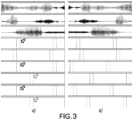
- Figure 3a is a graph showing values of the absolute coding flag, flag abs , for metadata parameters of three (3) audio objects without using the inter-object metadata coding logic
- Figure 3b is a graph showing values of the absolute coding flag, flag abs , for the metadata parameters of the three (3) audio objects using the inter-object metadata coding logic.
- the arrows indicate frames where the value of several absolute coding flags is equal to 1.
- Figure 3a shows the values of the absolute coding flag, flag abs , for two metadata parameters (azimuth and elevation in this particular example) for the audio objects without using the inter-object metadata coding logic
- Figure 3b shows the same values but with the inter-object metadata coding logic implemented.
- the graphs of Figures 3a and 3b correspond to (from top to bottom):
- Figure 3a shows that several flag abs may have a value equal to 1 (see the arrows) in a same frame when the inter-object metadata coding logic is not used.
- Figure 3b shows that only one absolute flag, flag abs , may have a value equal to 1 in a given frame when the inter-object metadata coding logic is used.
- the inter-object metadata coding logic may also be made bitrate dependent. In this case, for example, more that one absolute flag, flag abs , may have a value equal to 1 in a given frame even when the inter-object metadata coding logic is used, if the bitrate is sufficiently large.
- a technical advantage of the inter-object metadata coding logic and the intra-object metadata coding logic is to limit a range of fluctuation of the metadata coding bit-budget between frames. Another technical advantage is to increase robustness of the codec in a noisy channel; when a frame is lost, then only a limited number of metadata parameters from the audio objects coded using absolute coding is lost. Consequently, any error propagated from a lost frame affects only a small number of metadata parameters across the audio objects and thus does not affect the whole audio scene (or several different channels).
- a global technical advantage of analyzing, quantizing and coding the metadata separately from the audio streams is, as described hereinabove, to enable processing specially adapted to the metadata and more efficient in terms of metadata coding bitrate, metadata coding bit-budget fluctuation, robustness in noisy channel, and error propagation due to lost frames.
- the quantized and coded metadata 112 from the metadata processor 105 are supplied to a multiplexer 110 for insertion into an output bit-stream 111 transmitted to a distant decoder 700 ( Figure 7 ).
- information 107 from the metadata processor 105 about the bit-budget for the coding of the metadata per audio object is supplied to a configuration and decision processor 106 (bit-budget allocator) described in more detail in the following section 2.4.
- bit-budget allocator the configuration and bitrate distribution between the audio streams is completed in processor 106 (bit-budget allocator)
- the coding continues with further pre-processing 158 to be described later.
- the N audio streams are encoded using an encoder comprising, for example, N fluctuating bitrate core-encoders 109, such as mono core-encoders.
- the method 150 of Figure 1 for coding the object-based audio signal comprises an operation 156 of configuration and decision about bitrates per transport channel 104.
- the system 100 for coding the object-based audio signal comprises the configuration and decision processor 106 forming a bit-budget allocator.
- the configuration and decision processor 106 uses a bitrate adaptation algorithm to distribute the available bit-budget for core-encoding the N audio streams in the N transport channels 104.
- the bitrate adaptation algorithm of the configuration and decision operation 156 comprises the following sub-operations 1-6 performed by the bit-budget allocator 106:
- the audio streams are all in an inactive segment (or are without meaningful content)
- the above last two sub-operations 5 and 6 may be skipped. Accordingly, the bitrate adaptation algorithms described in following sections 2.4.1 and 2.4.2 are employed when at least one audio stream has active content.
- the total bitrate, total_brate is lowered and the saved bit-budget is redistributed, for example equally between the audio streams in active frames (VAD ⁇ 0).
- the assumption is that waveform coding of an audio stream in frames which are classified as inactive is not required; the audio object may be muted.
- the logic, used in every frame, can be expressed by the following sub-operations 1-3:
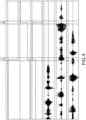
- Figure 4 is a graph illustrating an example of bitrate adaptation for three (3) core-encoders.
- the first line shows the core-encoder total bitrate, total_brate, for audio stream #1
- the second line shows the core-encoder total bitrate, total_brate, for audio stream #2
- the third line shows the core-encoder total bitrate, total_brate, for audio stream #3
- line 4 is the audio stream #1
- line 5 is the audio stream #2
- line 4 is the audio stream #3.
- the adaptation of the total bitrate, total_brate, for the three (3) core-encoder is based on VAD activity (active/inactive frames).
- VAD activity active/inactive frames.
- instance A) corresponds to a frame where the audio stream #1 VAD activity changes from 1 (active) to 0 (inactive).
- a minimum core-encoder total bitrate, total_brate is assigned to audio object #1 while the core-encoder total bitrates, total_brate, for active audio objects #2 and #3 are increased.
- Instance B) corresponds to a frame where the VAD activity of the audio stream #3 changes from 1 (active) to 0 (inactive) while the VAD activity of the audio stream #1 remains to 0.
- a minimum core-encoder total bitrate, total_brate is assigned to audio streams #1 and #3 while the core-encoder total bitrate, total_brate, of the active audio stream #2 is further increased.
- the above logic of section 2.4.1 can be made dependent from the total bitrate ism_total_brate.
- the bit-budget B VAD 0 in the above sub-operation 1 can be set higher for a higher total bitrate ism_total_brate, and lower for a lower total bitrate ism_total_brate.
- the classification of ISm importance can be based on several parameters and/or combination of parameters, for example core-encoder type ( coder_type), FEC (Forward Error Correction), sound signal classification (class), speech/music classification decision, and/or SNR (Signal-to-Noise Ratio) estimate from the open-loop ACELP/TCX (Algebraic Code-Excited Linear Prediction/Transform-Coded eXcitation) core decision module ( snr_celp, snr_tcx ) as described in Reference [1].
- Other parameters can possibly be used for determining the classification of ISm importance.
- a simple classification of ISm importance is based on the core-encoder type as defined in Reference [1] is implemented.
- the bit-budget allocator 106 of Figure 1 comprises a classifier (not shown) for rating the importance of a particular ISm stream.
- class ISm four (4) distinct ISm importance classes, class ISm , are defined:
- the ISm importance class is then used by the bit-budget allocator 106, in the bitrate adaptation algorithm (See above Section 2.4, sub-operation 6) to assign a higher bit-budget to audio streams with a higher ISm importance and a lower bit-budget to audio streams with a lower ISm importance.
- the bit-budget allocator 106 uses the bitrate adaptation algorithm to assign a higher bit-budget to audio streams with a higher ISm importance and a lower bit-budget to audio streams with a lower ISm importance.
- Figure 5 is a graph illustrating an example of bitrate adaptation based on ISm importance logic. From top to bottom, the graph of Figure 5 illustrates, in time:
- the core-encoder total bitrate, total_brate, in active frames of audio object #1 fluctuates between 23.45 kbps and 23.65 kbps when the bitrate adaptation algorithm is not used while it fluctuates between 19.15 kbps and 28.05 kbps when the bitrate adaptation algorithm is used.
- the core-encoder total bitrate, total_brate, in active frames of audio object #2 fluctuates between 23.40 kbps and 23.65 kbps without using the bitrate adaptation algorithm and between 19.10 kbps and 28.05 kbps with the bitrate adaptation algorithm. A better, more efficient distribution of the available bit-budget between the audio streams is thereby obtained.
- the method 150 for coding the object-based audio signal comprises an operation of pre-processing 158 of the N audio streams conveyed through the N transport channels 104 from the configuration and decision processor 106 (bit-budget allocator).
- the system 100 for coding the object-based audio signal comprises a pre-processor 108.
- the pre-processor 108 performs sequential further pre-processing 158 on each of the N audio streams.
- Such pre-processing 158 may comprise, for example, further signal classification, further core-encoder selection (for example selection between ACELP core, TCX core, and HQ core), other resampling at a different internal sampling frequency F s adapted to the bitrate to be used for core-encoding, etc. Examples of such pre-processing can be found, for example, in Reference [1] in relation to the EVS codec and, therefore, will not be further described in the present disclosure.
- the method 150 for coding the object-based audio signal comprises an operation of core-encoding 159.
- the system 100 for coding the object-based audio signal comprises the above mentioned encoder of the N audio streams including, for example, a number N of core-encoders 109 to respectively code the N audio streams conveyed through the N transport channels 104 from the pre-processor 108.
- the N audio streams are encoded using N fluctuating bitrate core-encoders 109, for example mono core-encoders.
- the bitrate used by each of the N core-encoders is the bitrate selected by the configuration and decision processor 106 (bit-budget allocator) for the corresponding audio stream.
- core-encoders as described in Reference [1] can be used as core-encoders 109.
- the method 150 for coding the object-based audio signal comprises an operation of multiplexing 160.
- the system 100 for coding the object-based audio signal comprises a multiplexer 110.
- Figure 6 is a schematic diagram illustrating, for a frame, the structure of the bit-stream 111 produced by the multiplexer 110 and transmitted from the coding system 100 of Figure 1 to the decoding system 700 of Figure 7 . Regardless whether metadata are present and transmitted or not, the structure of the bit-stream 111 may be structured as illustrated in Figure 6 .
- the multiplexer 110 writes the indices of the N audio streams from the beginning of the bit-stream 111 while the indices of ISm common signaling 113 from the configuration and decision processor 106 (bit-budget allocator) and metadata 112 from the metadata processor 105 are written from the end of the bit-stream 111.
- the multiplexer writes the ISm common signaling 113 from the end of the bit-stream 111.
- the ISm common signaling is produced by the configuration and decision processor 106 (bit-budget allocator) and comprises a variable number of bits representing:
- the metadata bit-budget for each audio object is not constant but rather inter-object and inter-frame adaptive. Different metadata format scenarios are shown in Figure 2 .
- the multiplexer 110 receives the N audio streams 114 coded by the N core encoders 109 through the N transport channels 104, and writes the audio streams payload sequentially for the N audio streams in chronological order from the beginning of the bit-stream 111 (See Figure 6 ).
- the respective bit-budgets of the N audio streams are fluctuating as a result of the bitrate adaptation algorithm described in section 2.4.
- Figure 7 is a schematic block diagram illustrating concurrently the system 700 for decoding audio objects in response to audio streams with associated metadata and the corresponding method 750 for decoding the audio objects.
- the method 750 for decoding audio objects in response to audio streams with associated metadata comprises an operation of demultiplexing 755.
- the system 700 for decoding audio objects in response to audio streams with associated metadata comprises a demultiplexer 705.
- the demultiplexer receive a bit-stream 701 transmitted from the coding system 100 of Figure 1 to the decoding system 700 of Figure 7 .
- the bit-stream 701 of Figure 7 corresponds to the bit-stream 111 of Figure 1 .
- the demultiplexer 110 extracts from the bit-stream 701 (a) the coded N audio streams 114, (b) the coded metadata 112 for the N audio objects, and (c) the ISm common signaling 113 read from the end of the received bit-stream 701.
- the method 750 for decoding audio objects in response to audio streams with associated metadata comprises an operation 756 of metadata decoding and dequantization.
- the system 700 for decoding audio objects in response to audio streams with associated metadata comprises a metadata decoding and dequantization processor 706.
- the metadata decoding and dequantization processor 706 is supplied with the coded metadata 112 for the transmitted audio objects, the ISm common signaling 113, and an output set-up 709 to decode and dequantize the metadata for the audio streams/objects with active contents.
- the output set-up 709 is a command line parameter about the number M of decoded audio objects/transport channels and/or audio formats, which can be equal to or different from the number N of coded audio objects/transport channels.
- the metadata decoding and dequantization processor 706 produces decoded metadata 704 for the M audio objects/transport channels, and supplies information about the respective bit-budgets for the M decoded metadata on line 708.
- the decoding and dequantization performed by the processor 706 is the inverse of the quantization and coding performed by the metadata processor 105 of Figure 1 .
- the method 750 for decoding audio objects in response to audio streams with associated metadata comprises an operation 757 of configuration and decision about bitrates per channel.
- the system 700 for decoding audio objects in response to audio streams with associated metadata comprises a configuration and decision processor 707 (bit-budget allocator).
- the bit-budget allocator 707 receives (a) the information about the respective bit-budgets for the M decoded metadata on line 708 and (b) the ISm importance class, class ISm , from the common signaling 113, and determine the core-decoder bitrates per audio stream, total_brate[n].
- the bit-budget allocator 707 uses the same procedure as in the bit-budget allocator 106 of Figure 1 to determine the core-decoder bitrates (see section 2.4).
- the method 750 for decoding audio objects in response to audio streams with associated metadata comprises an operation of core-decoding 760.
- the system 700 for decoding audio objects in response to audio streams with associated metadata comprises a decoder of the N audio streams 114 including a number N of core-decoders 710, for example N fluctuating bitrate core-decoders.
- the N audio streams 114 from the demultiplexer 705 are decoded, for example sequentially decoded in the number N of fluctuating bitrate core decoders 710 at their respective core-decoder bitrates as determined by the bit-budget allocator 707.
- M the number of decoded audio objects
- M ⁇ N the number of transport channels
- not all metadata payloads may be decoded in such a case.
- the core-decoders 710 In response to the N audio streams 114 from the demultiplexer 705, the core-decoder bitrates as determined by the bit-budget allocator 707, and the output set-up 709, the core-decoders 710 produces a number M of decoded audio streams 703 on respective M transport channels.
- a renderer 711 of audio objects transforms the M decoded metadata 704 and the M decoded audio streams 703 into a number of output audio channels 702, taking into consideration an output set-up 712 indicative of the number and contents of output audio channels to be produced.
- the number of output audio channels 702 may be equal to or different from the number M.
- the renderer 761 may be designed in a variety of different structures to obtain the desired output audio channels. For that reason, the renderer will not be further described in the present disclosure.
- the system and method for coding an object-based audio signal as disclosed in the foregoing description may be implemented by the following source code (expressed in C-code) given herein below as additional disclosure.
- Figure 8 is a simplified block diagram of an example configuration of hardware components forming the above described coding and decoding systems and methods.
- Each of the coding and decoding systems may be implemented as a part of a mobile terminal, as a part of a portable media player, or in any similar device.
- Each of the coding and decoding systems (identified as 1200 in Figure 8 ) comprises an input 1202, an output 1204, a processor 1206 and a memory 1208.
- the input 1202 is configured to receive the input signal(s), e.g. the N audio objects 102 (N audio streams with the corresponding N metadata) of Figure 1 or the bit-stream 701 of Figure 7 , in digital or analog form.
- the output 1204 is configured to supply the output signal(s), e.g. the bit-stream 111 of Figure 1 or the M decoded audio channels 703 and the M decoded metadata 704 of Figure 7 .
- the input 1202 and the output 1204 may be implemented in a common module, for example a serial input/output device.
- the processor 1206 is operatively connected to the input 1202, to the output 1204, and to the memory 1208.
- the processor 1206 is realized as one or more processors for executing code instructions in support of the functions of the various processors and other modules of Figures 1 and 7 .
- the memory 1208 may comprise a non-transient memory for storing code instructions executable by the processor(s) 1206, specifically, a processor-readable memory comprising non-transitory instructions that, when executed, cause a processor(s) to implement the operations and processors/modules of the coding and decoding systems and methods as described in the present disclosure.
- the memory 1208 may also comprise a random access memory or buffer(s) to store intermediate processing data from the various functions performed by the processor(s) 1206.
- processors/modules, processing operations, and/or data structures described herein may be implemented using various types of operating systems, computing platforms, network devices, computer programs, and/or general purpose machines.
- devices of a less general purpose nature such as hardwired devices, field programmable gate arrays (FPGAs), application specific integrated circuits (ASICs), or the like, may also be used.
- FPGAs field programmable gate arrays
- ASICs application specific integrated circuits
- a method comprising a series of operations and sub-operations is implemented by a processor, computer or a machine and those operations and sub-operations may be stored as a series of non-transitory code instructions readable by the processor, computer or machine, they may be stored on a tangible and/or non-transient medium.
- the coding and decoding systems and methods as described herein may use software, firmware, hardware, or any combination(s) of software, firmware, or hardware suitable for the purposes described herein.
- the various operations and sub-operations may be performed in various orders and some of the operations and sub-operations may be optional.
Landscapes
- Engineering & Computer Science (AREA)
- Physics & Mathematics (AREA)
- Computational Linguistics (AREA)
- Signal Processing (AREA)
- Health & Medical Sciences (AREA)
- Audiology, Speech & Language Pathology (AREA)
- Human Computer Interaction (AREA)
- Acoustics & Sound (AREA)
- Multimedia (AREA)
- Mathematical Physics (AREA)
- Compression, Expansion, Code Conversion, And Decoders (AREA)
Applications Claiming Priority (2)
| Application Number | Priority Date | Filing Date | Title |
|---|---|---|---|
| US201962871253P | 2019-07-08 | 2019-07-08 | |
| PCT/CA2020/050944 WO2021003570A1 (en) | 2019-07-08 | 2020-07-07 | Method and system for coding metadata in audio streams and for efficient bitrate allocation to audio streams coding |
Publications (3)
| Publication Number | Publication Date |
|---|---|
| EP3997697A1 EP3997697A1 (en) | 2022-05-18 |
| EP3997697A4 EP3997697A4 (en) | 2023-09-06 |
| EP3997697B1 true EP3997697B1 (en) | 2025-05-28 |
Family
ID=74113835
Family Applications (2)
| Application Number | Title | Priority Date | Filing Date |
|---|---|---|---|
| EP20836269.9A Active EP3997697B1 (en) | 2019-07-08 | 2020-07-07 | Method and system for coding metadata in audio streams and for efficient bitrate allocation to audio streams coding |
| EP20836995.9A Pending EP3997698A4 (en) | 2019-07-08 | 2020-07-07 | METHOD AND SYSTEM FOR ENCODING METADATA INTO AUDIO STREAMS AND FLEXIBLE INTRA-OBJECT AND INTER-OBJECT BIT RATE ADAPTATION |
Family Applications After (1)
| Application Number | Title | Priority Date | Filing Date |
|---|---|---|---|
| EP20836995.9A Pending EP3997698A4 (en) | 2019-07-08 | 2020-07-07 | METHOD AND SYSTEM FOR ENCODING METADATA INTO AUDIO STREAMS AND FLEXIBLE INTRA-OBJECT AND INTER-OBJECT BIT RATE ADAPTATION |
Country Status (10)
| Country | Link |
|---|---|
| US (2) | US12154582B2 (https=) |
| EP (2) | EP3997697B1 (https=) |
| JP (3) | JP7739255B2 (https=) |
| KR (2) | KR20220034102A (https=) |
| CN (2) | CN114097028B (https=) |
| AU (2) | AU2020310952A1 (https=) |
| BR (2) | BR112021026678A2 (https=) |
| ES (1) | ES3035091T3 (https=) |
| MX (2) | MX2021015476A (https=) |
| WO (2) | WO2021003570A1 (https=) |
Families Citing this family (9)
| Publication number | Priority date | Publication date | Assignee | Title |
|---|---|---|---|---|
| AU2020310952A1 (en) * | 2019-07-08 | 2022-01-20 | Voiceage Corporation | Method and system for coding metadata in audio streams and for efficient bitrate allocation to audio streams coding |
| GB2614482A (en) * | 2020-09-25 | 2023-07-05 | Apple Inc | Seamless scalable decoding of channels, objects, and hoa audio content |
| JP7663418B2 (ja) * | 2021-06-09 | 2025-04-16 | 日本放送協会 | 音響メタデータ処理装置及びプログラム |
| US20250225988A1 (en) * | 2021-10-12 | 2025-07-10 | Nokia Technologies Oy | Delayed orientation signalling for immersive communications |
| EP4421804A4 (en) * | 2021-10-21 | 2024-10-30 | Beijing Xiaomi Mobile Software Co., Ltd. | METHOD AND DEVICE FOR SIGNAL CODING AND DECODING AS WELL AS CODING DEVICE, DECODING DEVICE AND STORAGE MEDIUM |
| EP4428857A4 (en) * | 2021-11-02 | 2024-10-30 | Beijing Xiaomi Mobile Software Co., Ltd. | METHOD AND DEVICE FOR SIGNAL CODING AND DECODING AS WELL AS USER DEVICE, NETWORK-SIDE DEVICE AND STORAGE MEDIUM |
| GB2628410B (en) * | 2023-03-24 | 2025-09-17 | Nokia Technologies Oy | Low coding rate parametric spatial audio encoding |
| US12518772B2 (en) | 2023-08-01 | 2026-01-06 | Samsung Electronics Co., Ltd. | Codec bitrate selection in audio object coding |
| CN120435737A (zh) * | 2024-01-04 | 2025-08-05 | 北京小米移动软件有限公司 | 编码和解码方法、设备及存储介质 |
Family Cites Families (40)
| Publication number | Priority date | Publication date | Assignee | Title |
|---|---|---|---|---|
| US5630011A (en) * | 1990-12-05 | 1997-05-13 | Digital Voice Systems, Inc. | Quantization of harmonic amplitudes representing speech |
| US5311520A (en) * | 1991-08-29 | 1994-05-10 | At&T Bell Laboratories | Method and apparatus for programmable memory control with error regulation and test functions |
| US7657427B2 (en) * | 2002-10-11 | 2010-02-02 | Nokia Corporation | Methods and devices for source controlled variable bit-rate wideband speech coding |
| US9626973B2 (en) | 2005-02-23 | 2017-04-18 | Telefonaktiebolaget L M Ericsson (Publ) | Adaptive bit allocation for multi-channel audio encoding |
| EP1866913B1 (en) | 2005-03-30 | 2008-08-27 | Koninklijke Philips Electronics N.V. | Audio encoding and decoding |
| US8798776B2 (en) * | 2008-09-30 | 2014-08-05 | Dolby International Ab | Transcoding of audio metadata |
| EP2375409A1 (en) | 2010-04-09 | 2011-10-12 | Fraunhofer-Gesellschaft zur Förderung der angewandten Forschung e.V. | Audio encoder, audio decoder and related methods for processing multi-channel audio signals using complex prediction |
| KR102185941B1 (ko) * | 2011-07-01 | 2020-12-03 | 돌비 레버러토리즈 라이쎈싱 코오포레이션 | 적응형 오디오 신호 생성, 코딩 및 렌더링을 위한 시스템 및 방법 |
| EP2873074A4 (en) * | 2012-07-12 | 2016-04-13 | Nokia Technologies Oy | VECTORIAL QUANTIFICATION |
| MY178710A (en) * | 2012-12-21 | 2020-10-20 | Fraunhofer Ges Forschung | Comfort noise addition for modeling background noise at low bit-rates |
| US9715880B2 (en) | 2013-02-21 | 2017-07-25 | Dolby International Ab | Methods for parametric multi-channel encoding |
| US9852735B2 (en) | 2013-05-24 | 2017-12-26 | Dolby International Ab | Efficient coding of audio scenes comprising audio objects |
| TWI615834B (zh) | 2013-05-31 | 2018-02-21 | Sony Corp | 編碼裝置及方法、解碼裝置及方法、以及程式 |
| EP2830047A1 (en) * | 2013-07-22 | 2015-01-28 | Fraunhofer-Gesellschaft zur Förderung der angewandten Forschung e.V. | Apparatus and method for low delay object metadata coding |
| WO2015056383A1 (ja) * | 2013-10-17 | 2015-04-23 | パナソニック株式会社 | オーディオエンコード装置及びオーディオデコード装置 |
| US9564136B2 (en) * | 2014-03-06 | 2017-02-07 | Dts, Inc. | Post-encoding bitrate reduction of multiple object audio |
| WO2015150480A1 (en) | 2014-04-02 | 2015-10-08 | Dolby International Ab | Exploiting metadata redundancy in immersive audio metadata |
| FR3020732A1 (fr) | 2014-04-30 | 2015-11-06 | Orange | Correction de perte de trame perfectionnee avec information de voisement |
| EP2963949A1 (en) | 2014-07-02 | 2016-01-06 | Thomson Licensing | Method and apparatus for decoding a compressed HOA representation, and method and apparatus for encoding a compressed HOA representation |
| WO2016013164A1 (ja) | 2014-07-25 | 2016-01-28 | パナソニック インテレクチュアル プロパティ コーポレーション オブ アメリカ | 音響信号符号化装置、音響信号復号装置、音響信号符号化方法および音響信号復号方法 |
| WO2016138502A1 (en) * | 2015-02-27 | 2016-09-01 | Arris Enterprises, Inc. | Adaptive joint bitrate allocation |
| WO2016162283A1 (en) * | 2015-04-07 | 2016-10-13 | Dolby International Ab | Audio coding with range extension |
| US9866596B2 (en) * | 2015-05-04 | 2018-01-09 | Qualcomm Incorporated | Methods and systems for virtual conference system using personal communication devices |
| US10395664B2 (en) * | 2016-01-26 | 2019-08-27 | Dolby Laboratories Licensing Corporation | Adaptive Quantization |
| US10573324B2 (en) * | 2016-02-24 | 2020-02-25 | Dolby International Ab | Method and system for bit reservoir control in case of varying metadata |
| FR3048808A1 (fr) * | 2016-03-10 | 2017-09-15 | Orange | Codage et decodage optimise d'informations de spatialisation pour le codage et le decodage parametrique d'un signal audio multicanal |
| EP3605531B1 (en) | 2017-03-28 | 2024-08-21 | Sony Group Corporation | Information processing device, information processing method, and program |
| US10354660B2 (en) | 2017-04-28 | 2019-07-16 | Cisco Technology, Inc. | Audio frame labeling to achieve unequal error protection for audio frames of unequal importance |
| JP7045266B2 (ja) | 2017-06-09 | 2022-03-31 | 日本放送協会 | 音響信号補助情報変換伝送装置及びプログラム |
| US10885921B2 (en) * | 2017-07-07 | 2021-01-05 | Qualcomm Incorporated | Multi-stream audio coding |
| WO2019023488A1 (en) | 2017-07-28 | 2019-01-31 | Dolby Laboratories Licensing Corporation | METHOD AND SYSTEM FOR PROVIDING MULTIMEDIA CONTENT TO A CUSTOMER |
| KR20250016479A (ko) | 2017-09-20 | 2025-02-03 | 보이세지 코포레이션 | 씨이엘피 코덱에 있어서 비트-예산을 효율적으로 분배하는 방법 및 디바이스 |
| US10854209B2 (en) | 2017-10-03 | 2020-12-01 | Qualcomm Incorporated | Multi-stream audio coding |
| CN111164679B (zh) | 2017-10-05 | 2024-04-09 | 索尼公司 | 编码装置和方法、解码装置和方法以及程序 |
| US10999693B2 (en) * | 2018-06-25 | 2021-05-04 | Qualcomm Incorporated | Rendering different portions of audio data using different renderers |
| GB2575305A (en) * | 2018-07-05 | 2020-01-08 | Nokia Technologies Oy | Determination of spatial audio parameter encoding and associated decoding |
| US10359827B1 (en) * | 2018-08-15 | 2019-07-23 | Qualcomm Incorporated | Systems and methods for power conservation in an audio bus |
| US11683487B2 (en) | 2019-03-26 | 2023-06-20 | Qualcomm Incorporated | Block-based adaptive loop filter (ALF) with adaptive parameter set (APS) in video coding |
| KR102717379B1 (ko) * | 2019-03-29 | 2024-10-15 | 텔레폰악티에볼라겟엘엠에릭슨(펍) | 멀티 채널 오디오 프레임에서 예측적인 코딩에서 에러 복구를 위한 방법 및 장치 |
| AU2020310952A1 (en) | 2019-07-08 | 2022-01-20 | Voiceage Corporation | Method and system for coding metadata in audio streams and for efficient bitrate allocation to audio streams coding |
-
2020
- 2020-07-07 AU AU2020310952A patent/AU2020310952A1/en not_active Abandoned
- 2020-07-07 JP JP2022500960A patent/JP7739255B2/ja active Active
- 2020-07-07 BR BR112021026678A patent/BR112021026678A2/pt unknown
- 2020-07-07 EP EP20836269.9A patent/EP3997697B1/en active Active
- 2020-07-07 KR KR1020227000308A patent/KR20220034102A/ko active Pending
- 2020-07-07 AU AU2020310084A patent/AU2020310084B2/en active Active
- 2020-07-07 ES ES20836269T patent/ES3035091T3/es active Active
- 2020-07-07 BR BR112021025420A patent/BR112021025420A2/pt unknown
- 2020-07-07 KR KR1020227000309A patent/KR20220034103A/ko active Pending
- 2020-07-07 MX MX2021015476A patent/MX2021015476A/es unknown
- 2020-07-07 WO PCT/CA2020/050944 patent/WO2021003570A1/en not_active Ceased
- 2020-07-07 EP EP20836995.9A patent/EP3997698A4/en active Pending
- 2020-07-07 US US17/596,567 patent/US12154582B2/en active Active
- 2020-07-07 CN CN202080049817.1A patent/CN114097028B/zh active Active
- 2020-07-07 MX MX2021015660A patent/MX2021015660A/es unknown
- 2020-07-07 WO PCT/CA2020/050943 patent/WO2021003569A1/en not_active Ceased
- 2020-07-07 CN CN202080050126.3A patent/CN114072874B/zh active Active
- 2020-07-07 US US17/596,566 patent/US12387734B2/en active Active
- 2020-07-07 JP JP2022500962A patent/JP7699095B2/ja active Active
-
2025
- 2025-07-10 JP JP2025116659A patent/JP2025133926A/ja active Pending
Also Published As
| Publication number | Publication date |
|---|---|
| BR112021026678A2 (pt) | 2022-02-15 |
| MX2021015660A (es) | 2022-02-03 |
| JP2022539884A (ja) | 2022-09-13 |
| CA3145047A1 (en) | 2021-01-14 |
| BR112021025420A2 (pt) | 2022-02-01 |
| KR20220034102A (ko) | 2022-03-17 |
| MX2021015476A (es) | 2022-01-24 |
| US20220319524A1 (en) | 2022-10-06 |
| JP2022539608A (ja) | 2022-09-12 |
| EP3997697A1 (en) | 2022-05-18 |
| WO2021003570A1 (en) | 2021-01-14 |
| WO2021003569A1 (en) | 2021-01-14 |
| JP7739255B2 (ja) | 2025-09-16 |
| AU2020310084A1 (en) | 2022-01-20 |
| US12154582B2 (en) | 2024-11-26 |
| CN114097028A (zh) | 2022-02-25 |
| CA3145045A1 (en) | 2021-01-14 |
| CN114072874B (zh) | 2025-10-17 |
| EP3997698A1 (en) | 2022-05-18 |
| US12387734B2 (en) | 2025-08-12 |
| JP7699095B2 (ja) | 2025-06-26 |
| AU2020310084B2 (en) | 2025-12-04 |
| JP2025133926A (ja) | 2025-09-11 |
| EP3997697A4 (en) | 2023-09-06 |
| CN114097028B (zh) | 2025-10-17 |
| AU2020310952A1 (en) | 2022-01-20 |
| CN114072874A (zh) | 2022-02-18 |
| US20220238127A1 (en) | 2022-07-28 |
| ES3035091T3 (en) | 2025-08-28 |
| EP3997698A4 (en) | 2023-07-19 |
| KR20220034103A (ko) | 2022-03-17 |
Similar Documents
| Publication | Publication Date | Title |
|---|---|---|
| EP3997697B1 (en) | Method and system for coding metadata in audio streams and for efficient bitrate allocation to audio streams coding | |
| CA3145045C (en) | Method and system for coding metadata in audio streams and for flexible intra-object and inter-object bitrate adaptation | |
| CA3145047C (en) | Method and system for coding metadata in audio streams and for efficient bitrate allocation to audio streams coding | |
| HK40069013A (en) | Method and system for coding metadata in audio streams and for efficient bitrate allocation to audio streams coding | |
| HK40069813A (en) | Method and system for coding metadata in audio streams and for flexible intra-object and inter-object bitrate adaptation | |
| HK40069813B (zh) | 用於编解码音频流中的元数据及用於灵活对象内和对象间比特率适配的方法和系统 | |
| HK40069013B (zh) | 用於编解码音频流中的元数据和用於对音频流编解码的有效比特率分配的方法和系统 | |
| JP2025536102A (ja) | オブジェクトベースオーディオコーデックにおける不連続送信のための方法およびデバイス | |
| KR20250065890A (ko) | 메타데이터가 있는 매개 변수적으로 코딩된 독립 스트림의 불연속 전송을 위한 디코더 및 디코딩 방법 | |
| KR20250067870A (ko) | 메타데이터가 있는 매개 변수적으로 코딩된 독립 스트림의 불연속 전송을 위한 인코더 및 인코딩 방법 |
Legal Events
| Date | Code | Title | Description |
|---|---|---|---|
| STAA | Information on the status of an ep patent application or granted ep patent |
Free format text: STATUS: THE INTERNATIONAL PUBLICATION HAS BEEN MADE |
|
| PUAI | Public reference made under article 153(3) epc to a published international application that has entered the european phase |
Free format text: ORIGINAL CODE: 0009012 |
|
| STAA | Information on the status of an ep patent application or granted ep patent |
Free format text: STATUS: REQUEST FOR EXAMINATION WAS MADE |
|
| 17P | Request for examination filed |
Effective date: 20211210 |
|
| AK | Designated contracting states |
Kind code of ref document: A1 Designated state(s): AL AT BE BG CH CY CZ DE DK EE ES FI FR GB GR HR HU IE IS IT LI LT LU LV MC MK MT NL NO PL PT RO RS SE SI SK SM TR |
|
| DAV | Request for validation of the european patent (deleted) | ||
| DAX | Request for extension of the european patent (deleted) | ||
| REG | Reference to a national code |
Ref country code: DE Ref legal event code: R079 Free format text: PREVIOUS MAIN CLASS: G10L0019000000 Ipc: G10L0019002000 Ref country code: DE Ref legal event code: R079 Ref document number: 602020052081 Country of ref document: DE Free format text: PREVIOUS MAIN CLASS: G10L0019000000 Ipc: G10L0019002000 |
|
| A4 | Supplementary search report drawn up and despatched |
Effective date: 20230804 |
|
| RIC1 | Information provided on ipc code assigned before grant |
Ipc: G10L 25/78 20130101ALN20230731BHEP Ipc: G10L 19/16 20130101ALN20230731BHEP Ipc: G10L 19/008 20130101ALI20230731BHEP Ipc: G10L 19/002 20130101AFI20230731BHEP |
|
| GRAP | Despatch of communication of intention to grant a patent |
Free format text: ORIGINAL CODE: EPIDOSNIGR1 |
|
| STAA | Information on the status of an ep patent application or granted ep patent |
Free format text: STATUS: GRANT OF PATENT IS INTENDED |
|
| RIC1 | Information provided on ipc code assigned before grant |
Ipc: G10L 25/78 20130101ALN20250213BHEP Ipc: G10L 19/16 20130101ALN20250213BHEP Ipc: G10L 19/008 20130101ALI20250213BHEP Ipc: G10L 19/002 20130101AFI20250213BHEP |
|
| INTG | Intention to grant announced |
Effective date: 20250220 |
|
| GRAS | Grant fee paid |
Free format text: ORIGINAL CODE: EPIDOSNIGR3 |
|
| GRAA | (expected) grant |
Free format text: ORIGINAL CODE: 0009210 |
|
| STAA | Information on the status of an ep patent application or granted ep patent |
Free format text: STATUS: THE PATENT HAS BEEN GRANTED |
|
| AK | Designated contracting states |
Kind code of ref document: B1 Designated state(s): AL AT BE BG CH CY CZ DE DK EE ES FI FR GB GR HR HU IE IS IT LI LT LU LV MC MK MT NL NO PL PT RO RS SE SI SK SM TR |
|
| REG | Reference to a national code |
Ref country code: GB Ref legal event code: FG4D |
|
| REG | Reference to a national code |
Ref country code: CH Ref legal event code: EP |
|
| REG | Reference to a national code |
Ref country code: DE Ref legal event code: R096 Ref document number: 602020052081 Country of ref document: DE |
|
| REG | Reference to a national code |
Ref country code: IE Ref legal event code: FG4D |
|
| P01 | Opt-out of the competence of the unified patent court (upc) registered |
Free format text: CASE NUMBER: APP_26323/2025 Effective date: 20250603 |
|
| REG | Reference to a national code |
Ref country code: NL Ref legal event code: FP |
|
| PGFP | Annual fee paid to national office [announced via postgrant information from national office to epo] |
Ref country code: NL Payment date: 20250728 Year of fee payment: 6 |
|
| REG | Reference to a national code |
Ref country code: ES Ref legal event code: FG2A Ref document number: 3035091 Country of ref document: ES Kind code of ref document: T3 Effective date: 20250828 |
|
| PG25 | Lapsed in a contracting state [announced via postgrant information from national office to epo] |
Ref country code: FI Free format text: LAPSE BECAUSE OF FAILURE TO SUBMIT A TRANSLATION OF THE DESCRIPTION OR TO PAY THE FEE WITHIN THE PRESCRIBED TIME-LIMIT Effective date: 20250528 |
|
| PGFP | Annual fee paid to national office [announced via postgrant information from national office to epo] |
Ref country code: ES Payment date: 20250805 Year of fee payment: 6 |
|
| PGFP | Annual fee paid to national office [announced via postgrant information from national office to epo] |
Ref country code: DE Payment date: 20250728 Year of fee payment: 6 |
|
| REG | Reference to a national code |
Ref country code: LT Ref legal event code: MG9D |
|
| PG25 | Lapsed in a contracting state [announced via postgrant information from national office to epo] |
Ref country code: GR Free format text: LAPSE BECAUSE OF FAILURE TO SUBMIT A TRANSLATION OF THE DESCRIPTION OR TO PAY THE FEE WITHIN THE PRESCRIBED TIME-LIMIT Effective date: 20250829 Ref country code: NO Free format text: LAPSE BECAUSE OF FAILURE TO SUBMIT A TRANSLATION OF THE DESCRIPTION OR TO PAY THE FEE WITHIN THE PRESCRIBED TIME-LIMIT Effective date: 20250828 |
|
| PG25 | Lapsed in a contracting state [announced via postgrant information from national office to epo] |
Ref country code: PL Free format text: LAPSE BECAUSE OF FAILURE TO SUBMIT A TRANSLATION OF THE DESCRIPTION OR TO PAY THE FEE WITHIN THE PRESCRIBED TIME-LIMIT Effective date: 20250528 |
|
| PGFP | Annual fee paid to national office [announced via postgrant information from national office to epo] |
Ref country code: TR Payment date: 20250721 Year of fee payment: 6 Ref country code: IT Payment date: 20250728 Year of fee payment: 6 |
|
| PG25 | Lapsed in a contracting state [announced via postgrant information from national office to epo] |
Ref country code: BG Free format text: LAPSE BECAUSE OF FAILURE TO SUBMIT A TRANSLATION OF THE DESCRIPTION OR TO PAY THE FEE WITHIN THE PRESCRIBED TIME-LIMIT Effective date: 20250528 |
|
| PGFP | Annual fee paid to national office [announced via postgrant information from national office to epo] |
Ref country code: BE Payment date: 20250729 Year of fee payment: 6 Ref country code: GB Payment date: 20250729 Year of fee payment: 6 |
|
| PG25 | Lapsed in a contracting state [announced via postgrant information from national office to epo] |
Ref country code: HR Free format text: LAPSE BECAUSE OF FAILURE TO SUBMIT A TRANSLATION OF THE DESCRIPTION OR TO PAY THE FEE WITHIN THE PRESCRIBED TIME-LIMIT Effective date: 20250528 |
|
| PGFP | Annual fee paid to national office [announced via postgrant information from national office to epo] |
Ref country code: FR Payment date: 20250729 Year of fee payment: 6 |
|
| PG25 | Lapsed in a contracting state [announced via postgrant information from national office to epo] |
Ref country code: RS Free format text: LAPSE BECAUSE OF FAILURE TO SUBMIT A TRANSLATION OF THE DESCRIPTION OR TO PAY THE FEE WITHIN THE PRESCRIBED TIME-LIMIT Effective date: 20250828 |
|
| PG25 | Lapsed in a contracting state [announced via postgrant information from national office to epo] |
Ref country code: IS Free format text: LAPSE BECAUSE OF FAILURE TO SUBMIT A TRANSLATION OF THE DESCRIPTION OR TO PAY THE FEE WITHIN THE PRESCRIBED TIME-LIMIT Effective date: 20250928 |
|
| PG25 | Lapsed in a contracting state [announced via postgrant information from national office to epo] |
Ref country code: LV Free format text: LAPSE BECAUSE OF FAILURE TO SUBMIT A TRANSLATION OF THE DESCRIPTION OR TO PAY THE FEE WITHIN THE PRESCRIBED TIME-LIMIT Effective date: 20250528 |
|
| REG | Reference to a national code |
Ref country code: AT Ref legal event code: MK05 Ref document number: 1799103 Country of ref document: AT Kind code of ref document: T Effective date: 20250528 |
|
| PG25 | Lapsed in a contracting state [announced via postgrant information from national office to epo] |
Ref country code: DK Free format text: LAPSE BECAUSE OF FAILURE TO SUBMIT A TRANSLATION OF THE DESCRIPTION OR TO PAY THE FEE WITHIN THE PRESCRIBED TIME-LIMIT Effective date: 20250528 Ref country code: AT Free format text: LAPSE BECAUSE OF FAILURE TO SUBMIT A TRANSLATION OF THE DESCRIPTION OR TO PAY THE FEE WITHIN THE PRESCRIBED TIME-LIMIT Effective date: 20250528 Ref country code: SM Free format text: LAPSE BECAUSE OF FAILURE TO SUBMIT A TRANSLATION OF THE DESCRIPTION OR TO PAY THE FEE WITHIN THE PRESCRIBED TIME-LIMIT Effective date: 20250528 |
|
| PG25 | Lapsed in a contracting state [announced via postgrant information from national office to epo] |
Ref country code: CZ Free format text: LAPSE BECAUSE OF FAILURE TO SUBMIT A TRANSLATION OF THE DESCRIPTION OR TO PAY THE FEE WITHIN THE PRESCRIBED TIME-LIMIT Effective date: 20250528 |
|
| PG25 | Lapsed in a contracting state [announced via postgrant information from national office to epo] |
Ref country code: EE Free format text: LAPSE BECAUSE OF FAILURE TO SUBMIT A TRANSLATION OF THE DESCRIPTION OR TO PAY THE FEE WITHIN THE PRESCRIBED TIME-LIMIT Effective date: 20250528 |
|
| PG25 | Lapsed in a contracting state [announced via postgrant information from national office to epo] |
Ref country code: SK Free format text: LAPSE BECAUSE OF FAILURE TO SUBMIT A TRANSLATION OF THE DESCRIPTION OR TO PAY THE FEE WITHIN THE PRESCRIBED TIME-LIMIT Effective date: 20250528 |
|
| REG | Reference to a national code |
Ref country code: CH Ref legal event code: H13 Free format text: ST27 STATUS EVENT CODE: U-0-0-H10-H13 (AS PROVIDED BY THE NATIONAL OFFICE) Effective date: 20260224 |
|
| REG | Reference to a national code |
Ref country code: DE Ref legal event code: R097 Ref document number: 602020052081 Country of ref document: DE |
|
| PG25 | Lapsed in a contracting state [announced via postgrant information from national office to epo] |
Ref country code: LU Free format text: LAPSE BECAUSE OF NON-PAYMENT OF DUE FEES Effective date: 20250707 Ref country code: RO Free format text: LAPSE BECAUSE OF FAILURE TO SUBMIT A TRANSLATION OF THE DESCRIPTION OR TO PAY THE FEE WITHIN THE PRESCRIBED TIME-LIMIT Effective date: 20250528 |
|
| PLBE | No opposition filed within time limit |
Free format text: ORIGINAL CODE: 0009261 |
|
| STAA | Information on the status of an ep patent application or granted ep patent |
Free format text: STATUS: NO OPPOSITION FILED WITHIN TIME LIMIT |
|
| REG | Reference to a national code |
Ref country code: CH Ref legal event code: L10 Free format text: ST27 STATUS EVENT CODE: U-0-0-L10-L00 (AS PROVIDED BY THE NATIONAL OFFICE) Effective date: 20260409 |