EP3996458A1 - Communication method and communication apparatus - Google Patents
Communication method and communication apparatus Download PDFInfo
- Publication number
- EP3996458A1 EP3996458A1 EP19940457.5A EP19940457A EP3996458A1 EP 3996458 A1 EP3996458 A1 EP 3996458A1 EP 19940457 A EP19940457 A EP 19940457A EP 3996458 A1 EP3996458 A1 EP 3996458A1
- Authority
- EP
- European Patent Office
- Prior art keywords
- time
- compensation amount
- signal
- time compensation
- doppler
- Prior art date
- Legal status (The legal status is an assumption and is not a legal conclusion. Google has not performed a legal analysis and makes no representation as to the accuracy of the status listed.)
- Granted
Links
Images

Classifications
-
- H—ELECTRICITY
- H04—ELECTRIC COMMUNICATION TECHNIQUE
- H04W—WIRELESS COMMUNICATION NETWORKS
- H04W56/00—Synchronisation arrangements
- H04W56/0055—Synchronisation arrangements determining timing error of reception due to propagation delay
-
- H—ELECTRICITY
- H04—ELECTRIC COMMUNICATION TECHNIQUE
- H04B—TRANSMISSION
- H04B7/00—Radio transmission systems, i.e. using radiation field
- H04B7/14—Relay systems
- H04B7/15—Active relay systems
- H04B7/185—Space-based or airborne stations; Stations for satellite systems
- H04B7/1851—Systems using a satellite or space-based relay
- H04B7/18513—Transmission in a satellite or space-based system
-
- H—ELECTRICITY
- H04—ELECTRIC COMMUNICATION TECHNIQUE
- H04W—WIRELESS COMMUNICATION NETWORKS
- H04W56/00—Synchronisation arrangements
- H04W56/0035—Synchronisation arrangements detecting errors in frequency or phase
-
- H—ELECTRICITY
- H04—ELECTRIC COMMUNICATION TECHNIQUE
- H04W—WIRELESS COMMUNICATION NETWORKS
- H04W56/00—Synchronisation arrangements
- H04W56/0005—Synchronisation arrangements synchronizing of arrival of multiple uplinks
-
- H—ELECTRICITY
- H04—ELECTRIC COMMUNICATION TECHNIQUE
- H04W—WIRELESS COMMUNICATION NETWORKS
- H04W56/00—Synchronisation arrangements
- H04W56/004—Synchronisation arrangements compensating for timing error of reception due to propagation delay
-
- H—ELECTRICITY
- H04—ELECTRIC COMMUNICATION TECHNIQUE
- H04W—WIRELESS COMMUNICATION NETWORKS
- H04W56/00—Synchronisation arrangements
- H04W56/004—Synchronisation arrangements compensating for timing error of reception due to propagation delay
- H04W56/0045—Synchronisation arrangements compensating for timing error of reception due to propagation delay compensating for timing error by altering transmission time
-
- H—ELECTRICITY
- H04—ELECTRIC COMMUNICATION TECHNIQUE
- H04W—WIRELESS COMMUNICATION NETWORKS
- H04W84/00—Network topologies
- H04W84/02—Hierarchically pre-organised networks, e.g. paging networks, cellular networks, WLAN [Wireless Local Area Network] or WLL [Wireless Local Loop]
- H04W84/04—Large scale networks; Deep hierarchical networks
- H04W84/06—Airborne or Satellite Networks
Definitions
- the present disclosure relates to communication technology, and more particularly, to a communication method and a communication apparatus.
- the Non-Terrestrial Network is a communication scenario of the 5 th Generation (5G) mobile communication system.
- 5G 5 th Generation
- a network device that receives signals transmitted by a terminal device is no longer a base station fixed on the ground, but a network device in the air, such as a satellite.
- the moving speed of the satellite is very high, resulting the distance between the satellite and the terminal device located on the ground varying very quickly.
- the rate of change of the distance between a Low Earth Orbit (LEO) satellite and a terminal device be up to 7 kilometers per second (km/s). Therefore, the signal received by the receiver in the NTN will have a strong Doppler effect, i.e., the time length of the signal received by the receiver will be compressed or stretched when compared with the time length of the signal transmitted by the transmitter.
- LEO Low Earth Orbit
- one method is for the terminal device to estimate a change value of the time length of the signal based on orbit information of the satellite, so as to facilitate time compensation for the uplink signal.
- the above method requires the terminal device to have advanced timing capabilities and positioning capabilities, which brings a significant burden to the terminal device.
- the present disclosure provides a communication method and a communication apparatus, capable of reducing the burden of calculating time compensation at a terminal device or a network device.
- a communication method includes: receiving a Doppler parameter; and determining a time compensation amount of a signal according to the Doppler parameter.
- a communication apparatus configured to perform the method in the above first aspect.
- the communication apparatus may include functional modules configured to perform the method in the above first aspect.
- a terminal device in a third aspect, includes a processor and a memory.
- the memory is configured to store a computer program
- the processor is configured to invoke and execute the computer program stored in the memory to perform the method in the above first aspect.
- a network device in a fourth aspect, includes a processor and a memory.
- the memory is configured to store a computer program
- the processor is configured to invoke and execute the computer program stored in the memory to perform the method in the above first aspect.
- the network device may be, for example, a satellite.
- a chip is provided for implementing the method in the above first aspect.
- the chip includes a processor configured to invoke and execute a computer program from a memory, to cause a device provided with the chip to perform the method in the above first aspect.
- a computer-readable storage medium stores a computer program that causes a computer to perform the method in the above first aspect.
- a computer program product includes computer program instructions that cause a computer to perform the method in the first aspect.
- a computer program when executed on a computer, causes the computer to perform the method in the above first aspect.
- FIG. 1 is a schematic diagram of a communication system where the present disclosure can be applied.
- the communication system 100 includes a network device 110 and a terminal device 120.
- the network device 110 is a network device in the air, which may be a High Altitude Platform Station (HAPS) with a wireless communication function.
- the HAPS may be a hot air balloon, an airplane, a satellite, or any other aerial vehicle.
- the network device 110 can be an LEO satellite, a Medium Earth Orbit (MEO) satellite, or a Geostationary Earth Orbit (GEO) satellite.
- the LEO satellite and the MEO satellite have operation periods different from the rotation period of the earth and cannot remain relatively stationary with respect to the earth. Therefore, the LEO satellite and the MEO satellite can also be referred to as Non-Geostationary Earth Orbit (NGEO) satellites.
- NGEO Non-Geostationary Earth Orbit
- the terminal device 120 may be a mobile terminal device or a fixed terminal device.
- the terminal device 120 may be a handheld device with a wireless communication function, a vehicle-mounted device, a wearable device, a computing device, or any other processing device connected to a wireless modem, including for example, a User Equipment (UE) defined by the 3 rd Generation Partnership Project (3GPP), a Mobile Station (MS), a soft terminal, a home gateway, a set-top box, etc.
- UE User Equipment
- 3GPP 3 rd Generation Partnership Project
- MS Mobile Station
- soft terminal a home gateway
- set-top box a set-top box
- the bidirectional arrow line in FIG. 1 indicates signals between the network device 110 and the terminal device 120.
- the satellite can transmit downlink data to the terminal device 120.
- the downlink data can be transmitted to the terminal device 120 after channel coding, modulation, and mapping.
- the terminal device 120 can also transmit uplink data to the satellite base station.
- the uplink data can also be transmitted to the satellite after channel coding, modulation, and mapping.
- the present disclosure is not limited to any communication mode between the network device 110 and the terminal device 120.
- the location of the network device 110 may be referred to as a space segment, and the location of the terminal device 120 may be referred to as a user segment.
- the communication system 100 may also include a ground segment (not shown in FIG. 1 ), such as a satellite measurement and control center, a Network Control Center (NCC), various gateways, and so on.
- NCC Network Control Center
- the satellite measurement and control center has functions such as maintaining, monitoring, and controlling the satellite's orbital position and attitude, and managing the satellite's ephemeris.
- the NCC has network management functions to handle user registration, identity verification, billing, and the like. In some satellite communication systems, the satellite measurement and control center and the NCC may be combined into one.
- the gateways have functions such as call processing, switching, and interfacing with a ground communication network.
- the ground communication network is a component of the ground segment, and is configured to transmit satellite data packets to the terminal device 120 via a core network. That is, the satellite can communicate with the terminal device 120 directly, or indirectly via the ground segment.
- the ground communication network can be a Public Switched Telephone Network (PSTN), a Public Land Mobile Network (PLMN) or any other private network. Different ground communication networks require gateways to have different gateway functions.
- PSTN Public Switched Telephone Network
- PLMN Public Land Mobile Network
- the space segment of the satellite communication system can have a multi-layer structure composed of a management satellite and one or more service satellites.
- the space segment can include one or more management satellites and service satellites managed by the management satellites.
- the satellites as used in the present disclosure are not limited to management satellites or service satellites.
- FIG. 2 is a schematic diagram of a Doppler effect.
- a network device and a terminal device will be described without reference numerals.
- a time length of an uplink signal transmitted by a terminal device is one time slot, as shown in time slot i.
- time slot i When a satellite is moving towards the terminal device, the distance between the satellite and the terminal device gradually decreases, and the time length for the uplink signal to reach the satellite is compressed.
- the time length of the signal received by the terminal device is smaller than one time slot, and the difference is shown as ⁇ Ta in FIG. 2 . This effect is the Doppler compression effect.
- FIG. 2 also shows an influence of the Doppler effect on a Timing Advance (TA).
- TA Timing Advance
- the uplink signal in time slot i+1 will arrive at the satellite in advance. If the satellite detects the uplink signal at the predetermined time (the time at which the uplink signal would arrive at the satellite without the Doppler effect), it will miss a part of the uplink signal, which may cause data transmission failure.
- the distance between the satellite and the terminal device gradually increases, and the time length for the uplink signal to reach the satellite is stretched.
- the time length of the signal received by the terminal device is greater than one time slot. This effect is the Doppler stretch effect or the inverse Doppler compression effect. This is not shown in FIG. 2 .
- the Doppler effect will result in a degradation of the time accuracy of the signal, or even communication failure.
- a communication method i.e., a method for time compensation for a signal in an NTN, according to the present disclosure, will be introduced in detail.
- a method 300 includes:
- the Doppler parameter refers to a parameter related to a Doppler effect, including for example, a change amount of a distance between a satellite and a terminal device per time unit, or a change amount of a phase of the signal between the satellite and the terminal device per time unit, or a change amount of a time length of the signal between the satellite and the terminal device per time unit.
- the apparatus performing the method 300 can determine the change amount of the time length of the signal per time unit based on the received Doppler parameter, determine the time compensation amount for the signal based on the change amount, and transmit or receive the signal.
- a predetermined time length (or "nominal time length") of an uplink signal is one time slot (slot).
- the time length of the received uplink signal is compressed, and the terminal device can perform time compensation for the uplink signal, i.e., to increase the signal time length of the uplink signal to ensure that the time length of the uplink signal received by the satellite is one time slot.
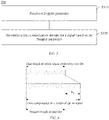
- This scheme is shown in FIG. 4 .
- the time compensation amount is ⁇ Ta .
- the terminal device can perform time compensation for the uplink signal, i.e., to decrease the signal time length of the uplink signal to ensure that the time length of the uplink signal received by the satellite is one time slot.
- a predetermined time length of a downlink signal is one time slot.
- the time length of the downlink signal received by the terminal device is compressed, and the satellite can perform time compensation for the downlink signal, i.e., to increase the signal time length of the downlink signal to ensure that the time length of the downlink signal received by the terminal device is one time slot.
- the satellite When the satellite is moving from the perigee of its orbit towards the apogee, the time length of the downlink signal received by the terminal device is stretched, and the satellite can perform time compensation for the downlink signal, i.e., to decrease the signal time length of the downlink signal to ensure that the time length of the downlink signal received by the terminal device is one time slot.
- the terminal device can perform time compensation for the TA of the uplink signal, i.e., to decrease the TA of the uplink signal to ensure that the uplink signal can arrive at the satellite at the predetermined time.
- the terminal device can perform time compensation for the TA of the uplink signal, i.e., to increase the TA of the uplink signal to ensure that the uplink signal can arrive at the satellite at the predetermined time.
- the satellite when the satellite is moving from the apogee of its orbit towards the perigee, the time for one of two downlink signals that is transmitted later to reach the terminal device becomes shorter, and the satellite can perform time compensation for the TA of the downlink signal that is transmitted later, i.e., to decrease the TA of the downlink signal that is transmitted later to ensure that the downlink signal that is later transmitted can arrive at the terminal device at the predetermined time.
- the satellite When the satellite is moving from the perigee of its orbit to the apogee, the time for one of two downlink signals that is transmitted later to reach the terminal device becomes longer, and the satellite can perform time compensation for the TA of the downlink signal that is transmitted later, i.e., to increase the TA of the downlink signal that is transmitted later to ensure that the downlink signal that is transmitted later can arrive at the terminal device at the predetermined time.
- the transmitter in the NTN determines the time compensation amount for the signal and compensates the signal.
- the receiver in the NTN can determine the time compensation amount for the signal and compensate the signal.
- the satellite when the satellite is moving from the apogee of its orbit towards the perigee, the time for the uplink signal to reach the satellite becomes shorter, and the satellite can perform time compensation for the uplink signal, i.e., to detect the uplink signal earlier, or to increase a time window for detecting the uplink signal to avoid missing the uplink signal.
- the satellite When the satellite is moving from the perigee of its orbit to the apogee, the time for the uplink signal to reach the satellite becomes longer, and the satellite can perform time compensation for the uplink signal, i.e., to delay detection of the uplink signal, or to increase a time window for detecting the uplink signal to avoid missing the uplink signal.
- the terminal device can perform time compensation for the downlink signal that is transmitted later, i.e., to detect the downlink signal that is transmitted later earlier, or to increase a time window for detecting the downlink signal that is transmitted later to avoid missing the downlink signal that is transmitted later.
- the terminal device can perform time compensation for the downlink signal transmitted later, i.e., to delay detection of the downlink signal that is transmitted later, or to increase the time window for detecting the downlink signal that is transmitted later to avoid missing the downlink signal that is transmitted later.
- the apparatus performing the method 300 may be a terminal device (or a chip in the terminal device), or a network device (or a chip in the network device).
- the terminal device can receive the Doppler parameter from a satellite or a ground segment (for example, a satellite measurement and control center).
- the performing apparatus is a network device
- the network device can receive the Doppler parameter from a ground segment (for example, a satellite measurement and control center). Therefore, the apparatus performing the method 300 does not need to calculate the Doppler parameter locally, thereby reducing the burden on the performing apparatus.
- the Doppler parameter received by the apparatus performing the method 300 may include one or more parameters.
- the above Doppler parameter may include a first parameter which is proportional to a change amount of a time length of the signal per time unit.
- the time unit is one time slot
- the time length of the signal transmitted by the transmitter is 1 millisecond (ms)
- the time length of the signal received by the receiver is 0.98ms
- the change amount of the time length of the signal is 0.02ms.
- the time length of one time slot is 0.5ms
- a change rate of the time length of the signal is O.Olms/time slot
- the first parameter can be k ⁇ 0.01ms/time slot, where k is a positive number.
- the first parameter represents the change rate of the time length of the signal, i.e., the change value of the time length of the signal arriving at the receiver compared with the time length of the signal transmitted by the transmitter per time unit.
- the time unit is one time slot T s
- a TA of a first time slot is 0.05ms
- a TA of the second time slot is 0.06 ms
- the first time slot and the second time slot are two adjacent time slots
- the change value ⁇ Ta of the TA between the two adjacent time slots is 0.01ms
- the first parameter may be ⁇ Ta / T s , that is, 0.01 ms/time slot.
- the first parameter represents the change rate of the TA, that is, how much TA should be increased or decreased per time unit to ensure that the uplink signal can reach the satellite at the predetermined time.
- the time length of the time slot may be 0.5ms or any other time length, and the present disclosure is not limited to this.
- the terminal device or the satellite can determine the time compensation amount for the signal to ensure that the time length of the signal arriving at the receiver is a predetermined length, and/or that the time at which the signal arrives at the receiver is the predetermined time.
- the Doppler parameter may further include a second parameter, which is a change rate of a change amount of a time length of the signal, and the step S320 may include:
- the two signals may be, for example, a first signal and a second signal.
- the first signal may be transmitted at a start time domain position of a first time slot
- the second signal may be transmitted at a start time domain position of a second time slot.
- the first time slot is adjacent to the second time slot, and the first time slot occurs earlier than the second time slot.
- the change rate of the change amount of the time length of the signal may be, for example, 0.01 ms/time slot. That is, the change mount of the time length of the signal in each time slot is 0.01ms more than the change amount of the time length of the signal in the immediately previous time slot.
- the change amount of the time length of the first signal is 0.02ms (the signal time length is stretched by 0.02ms), and the change rate of the change amount of the signal time length is O.Olms/time slot.
- the time interval between the first signal and the second signal is one time slot.
- the change amount of the time length of the second signal is 0.03ms. If the time length of one time slot is 0.5ms, the transmitter needs to transmit the second signal on a time domain resource having a time length of 0.47ms, so as to ensure that the time length of the second signal received by the receiver is 0.5ms.
- 0.02ms is an example of the first time compensation amount
- the interval between the first signal and the second signal is an example of the time interval
- 0.01ms is an example of the change amount of the time length
- 0.03ms is an example of the second time compensation amount.
- the change amount of the TA of the first signal is 0.03ms (the TA time length is stretched by 0.03ms), and the change rate of the change amount of the signal time length is O.Olms/time slot.
- the time interval between the first signal and the second signal is one time slot.
- the change amount of the TA of the second signal is 0.04ms. Since the TA time length is stretched, the terminal device needs to transmit the uplink signal earlier. If the reference TA (TA without Doppler effect) is 0.05ms, the transmitter needs to transmit the second signal 0.09ms (i.e., 0.05ms+0.04ms) earlier to ensure that the second signal can arrive at the receiver at the predetermined time.
- 0.03ms is an example of the first time compensation amount
- the interval between the first signal and the second signal is an example of the time interval
- 0.01ms is an example of the change amount of the time length
- 0.04ms is an example of the second time compensation amount.
- a new time compensation amount (i.e., the second time compensation amount) is determined based on an old time compensation amount (i.e., the first time compensation amount) and a change rate of the change amount of the signal time length, such that the adverse impact of the motion of the satellite with variable speed on the time accuracy of the signal can be reduced, especially for scenarios where the satellite is accelerating or decelerating.
- Doppler new is the second parameter used for determining the second time compensation amount
- Doppler old is the second parameter used for determining the first time compensation amount
- C is a coefficient
- T s is one time slot
- ⁇ ' Ta is a change value of the TA per time unit
- T ⁇ is the time interval between the first signal and the second signal
- n is a positive integer.
- T c 480 T c
- ⁇ ' Ta T c
- T s 480 ⁇ 4096 T c (i.e., one time slot)
- C 1
- T ⁇ 480 ⁇ 10 ⁇ 4096 T c (i.e., ten time slots)
- T c is the minimum time unit used by the physical layer interface, which can be equal to 0.509ns (i.e., 1 480 ⁇ 10 3 ⁇ 4096 ).
- the terminal device may receive first indication information from the satellite or the ground segment, and determine which equation to use according to the first indication information.
- the satellite may receive the first indication information from the ground segment, and determine which equation to use according to the first indication information.
- the first indication information may indicate the value of n or an identifier of the equation.
- the apparatus performing the method 300 also needs to receive a third parameter, which is an adjustment value for the time compensation amount in S320.
- the terminal device or the satellite can adjust the time compensation amount based on the received adjustment value.
- the above adjustment value can be one of - T c / T s , 0, T c / T s , 2 T c / T s , where T c is the minimum time unit required by the physical layer interface, which can be equal to 0.509ns (i.e., 1 480 ⁇ 10 3 ⁇ 4096 ), a multiple of 0.509ns,, or another value, and T s is one time slot.
- the adjustment value When the adjustment value has a positive sign, it means to increase the time compensation amount; whereas when the adjustment value has a negative sign, it means to decrease the time compensation amount.
- the time compensation amount is 0.03ms
- the terminal device can determine a time compensation amount of 0.04ms based on the adjustment value
- the terminal device can determine a time compensation amount of 0.02ms based on the adjustment value.
- the satellite can indicate the specific value of the adjustment value via two bits in first Downlink Control Information (DCI). For example, the above two bits being “00” indicates the adjustment value of - T c / T s ; the above two bits being “01” indicates the adjustment value of 0; the above two bits being “10” indicates the adjustment value of T c / T s ; and the above two bits being "11” indicates the adjustment value of 2 T c / T s .
- DCI Downlink Control Information
- the satellite can determine the value of the adjustment value based on the first indication information transmitted by the satellite measurement and control center.
- the adjustment value can also be a non-negative number.
- the adjustment value may be one of 0,
- the satellite may indicate the sign of the adjustment value via second DCI (for example, 1 bit).
- the terminal device can determine the current adjustment value as -
- the terminal device may determine the current adjustment value as
- the terminal device may determine the current adjustment value as
- the terminal device may not switch the sign of the adjustment value when the second indication information is received, and switch the sign of the adjustment value when the second indication information is not received.
- the satellite can also determine the sign of the adjustment value based on whether the second indication information transmitted by the satellite measurement and control center is received.
- the solution described above uses a new time compensation amount when determining the TA of the second signal. If the transmitter of the signal does not obtain the new time compensation amount when determining the TA of the second signal, the terminal device can determine the TA of the second signal based on the time compensation amount for the first signal.
- the time interval between the first signal and the second signal is two time slots, i.e., x is equal to 2.
- TA 1 equals to 0.05ms
- ⁇ " Ta equals to 0.01ms
- TA 2 equals to 0.07ms (0.05ms+2 ⁇ 0.01ms).
- ⁇ " Ta is the change value of the TA of the first signal relative to the TA of a third signal, which is a signal adjacent to the time domain position of the first signal. The time domain position of the third signal is earlier than the time domain position of the first signal.
- the method 300 may further include: determining a value range of the time compensation amount.
- the value range of the time compensation amount can be defined in a communication protocol, or can be dynamically indicated.
- the terminal device may receive third indication information from the satellite.
- the third indication information may indicate the value range of the time compensation amount, and the terminal device may determine the value range of the time compensation amount based on the third indication information.
- the satellite may also receive the third indication information from the satellite measurement and control center.
- the third indication information may indicate the value range of the time compensation amount, and the satellite may determine the value range of the time compensation amount based on the third indication information.
- the value range of the time compensation amount can be greater than or equal to -40 microseconds per second ( ⁇ s/sec), and smaller than or equal to 40 ⁇ s/sec.
- the value range of the time compensation amount can be greater than or equal to -20 ⁇ s/sec, and smaller than or equal to 20 ⁇ s/sec.
- the satellite can be switched.
- the terminal device can switch the base station satellite.
- the terminal device may also search for a new base station satellite and prepare to switch the base station satellite when the determined time compensation amount for the LEO base station satellite is close to -20 ⁇ s/sec.
- the terminal device may determine the time compensation amount when the satellite is switched as an upper bound of the value range.
- the terminal device can determine that 15 ⁇ s/sec is the upper bound of the value range of the current time compensation amount.
- the communication apparatus may include hardware structures and/or software modules corresponding to the respective functions.
- the present disclosure can be implemented in the form of hardware or a combination of hardware and computer software. Whether a certain function is performed by hardware or computer software that drives hardware depends on the specific application and design constraint conditions of the technical solution. Those skilled in the art can use different methods to implement the described functions for each specific application, and such implementation should not be considered as beyond the scope of the present disclosure.
- the communication apparatus may be divided into functional units according to the above method example.
- the functions may be divided into functional units, or two or more functions may be integrated into one functional unit.
- the above functional units can be implemented in the form of hardware or software. It is to be noted that the division of units in the present disclosure is illustrative only, and is only a logical function based division, and there may be other divisions in actual implementations.
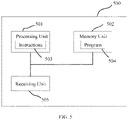
- FIG. 5 shows a schematic structural diagram of a communication apparatus according to the present disclosure.
- the dotted line in FIG. 5 indicates that a unit is an optional unit.
- the apparatus 500 may be configured to implement the method described in the above method embodiment.
- the apparatus 500 may be a software module, a chip, a terminal device, or any other electronic device.
- the apparatus 500 includes one or more processing units 501, which can cause the apparatus 500 to implement the method in the method embodiment corresponding to FIG. 3 .
- the processing unit 501 may be a software processing unit, a general-purpose processor, or a special-purpose processor.
- the processing unit 501 may be configured to control the apparatus 500, execute a software program (for example, a software program including the method 300), and process data (for example, determine a time compensation amount based on a Doppler parameter).
- the apparatus 500 may further include a receiving unit 505 configured to receive a signal (input).
- the apparatus 500 may be a software module, and the receiving unit 505 may be an interface function of the software module.
- the software module can run on the processor or a control circuit.
- the apparatus 500 may be a chip, and the receiving unit 505 may be an input circuit of the chip, or the receiving unit 505 may be a communication interface of the chip.
- the chip may be a component of the terminal device or any other electronic device.
- the receiving unit 505 may be configured to receive a Doppler parameter.
- the processing unit 501 may be configured to determine a time compensation amount for a signal based on the Doppler parameter.
- the Doppler parameter may include a first parameter which is proportional to a change amount of a time length of the signal per time unit.
- the Doppler parameter includes a first parameter, which is ⁇ Ta / T s , where T s is one time slot and ⁇ Ta is a change value of a Timing Advance (TA) between two adjacent time slots.
- TA Timing Advance
- the Doppler parameter may include a second parameter, which is a change rate of a change amount of a time length of the signal, and the processing unit 501 may be configured to:
- a second time compensation amount based on a first time compensation amount and the change amount of the time length, the first time compensation amount corresponding to one of the two signals that has an earlier time domain position, and the second time compensation amount corresponding to one of the two signals that has a later time domain position.
- Doppler new is the second parameter used for determining the second time compensation amount
- Doppler old is the second parameter used for determining the first time compensation amount
- C is a coefficient
- T s is one time slot
- ⁇ ' Ta is a change value of a TA per time unit
- T ⁇ is the time interval
- n is a positive integer.
- the receiving unit 505 may be further configured to receive first indication information indicating the equation.
- the Doppler parameter may include a third parameter which is an adjustment value for the time compensation amount.
- the adjustment value may be one of - T c / T s , 0, T c / T s and 2 T c / T s , where T c is a minimum time unit required by a physical layer interface and T s is a time slot.
- the processing unit 501 may be further configured to determine a sign of the adjustment value based on whether second indication information is received, the sign being a positive sign or a negative sign.
- the processing unit 501 may be configured to: determine that the sign of the adjustment value is the positive sign when the second indication information is not received; or switch the sign of the adjustment value when the second indication information is received.
- the adjustment value may be one of 0,
- the processing unit 501 may be further configured to determine a value range of the time compensation amount.
- the receiving unit 505 may be further configured to receive third indication information indicating the value range of the time compensation amount.
- the value range of the time compensation amount may be greater than or equal to -40 microseconds per second ( ⁇ s/sec), and smaller than or equal to 40 ⁇ s/sec.
- the value range of the time compensation amount may be greater than or equal to -20 ⁇ s/sec, and smaller than or equal to 20 ⁇ s/sec.
- the processing unit 501 may be configured to determine a time compensation amount when the satellite is switched as an upper bound of the value range.
- the processing unit 501 may be further configured to switch the satellite when the time compensation amount exceeds a lower bound of the value range.
- the processing unit 501 may be further configured to determine a TA of the first signal based on the time compensation amount.
- the processing unit 501 may be further configured to determine a TA of the second signal based on the time compensation amount when the time compensation amount is not updated.
- the first signal may be in a time slot i
- the second signal may be in a time slot i+x, where i and x are both integers greater than or equal to 0, and the TA of the second signal may be determined according to an equation of:
- TA 2 TA 1 + x ⁇ " Ta , where TA 2 is the TA of the second signal, TA 1 is the TA of the first signal, and ⁇ " Ta is the time compensation amount for the first signal.
- the above steps may be implemented by a logic circuit in the form of hardware or instructions in the form of software.
- the processing unit 501 may be a Central Processing Unit (CPU), a Digital Signal Processor (DSP), an Application Specific Integrated Circuit (ASIC), a Field Programmable Gate Array (FPGA), or any other programmable logic device, such as a discrete gate, a transistor logic device, or a discrete hardware component.
- the apparatus 500 may include one or more memory units 502, in which a program 504 (for example, a software program including the method 300) is stored.
- the program 504 may be executed by the processing unit 501 to generate instructions 503, such that the processing unit 501 can perform the method described in the above method embodiment according to the instructions 503.
- the memory unit 502 may also store data (for example, the received Doppler parameter).
- the processing unit 501 may also read the data stored in the memory unit 502, and the data may be stored at the same storage address as the program 504, or the data may be stored at a different storage address from the program 504.
- the processing unit 501 and the memory unit 502 may be provided separately or integrated, for example, integrated on a single board or a System on Chip (SOC).
- SOC System on Chip
- the present disclosure also provides a computer program product which, when executed by the processing unit 501, implements the method described in any embodiment of the present disclosure.
- the computer program product may be stored in the memory unit 502.
- it may be the program 504, which may be finally converted into an executable object file that can be executed by the processing unit 501 after subjected to processes such as preprocessing, compilation, assembly, and linking.
- the computer program product can be transmitted from one computer-readable storage medium to another.
- it can be transmitted from one website, computer, server, or data center to another website, computer, server or data center via a wired communication (such as coaxial cable, optical fiber, Digital subscriber line (DSL)) or a wireless connection (such as infrared, radio, microwave, etc.)
- a wired communication such as coaxial cable, optical fiber, Digital subscriber line (DSL)
- DSL Digital subscriber line
- a wireless connection such as infrared, radio, microwave, etc.
- the present disclosure also provides a computer-readable storage medium (for example, the memory unit 502) having a computer program stored thereon.
- the computer program when executed by a computer, implements the method described in any of the embodiments of the present disclosure.
- the computer program can be a high-level language program or an executable object program.
- the computer-readable storage medium may be a magnetic medium (for example, a floppy disk, a hard disk, or a magnetic tape), an optical medium (for example, a Digital Video Disc (DVD)), or a semiconductor medium (for example, a Solid State Disk (SSD)).
- the computer-readable storage medium may be a transitory memory or a non-transitory memory, or the computer-readable storage medium may include both transitory and non-transitory memories.
- the non-transitory memory may be a Read-Only Memory (ROM), a Programmable ROM (PROM), an Erasable PROM (EPROM), an Electrically EPROM (EEPROM), or a flash memory.
- the transitory memory may be a Random Access Memory (RAM), which can be used as an external cache.
- RAM Random Access Memory
- various forms of RAMs are available, such as Static RAM (SRAM), Dynamic RAM (DRAM), Synchronous DRAM (SDRAM), Double Data Rate SDRAM (DDR SDRAM), Enhanced SDRAM (ESDRAM), Synchlink DRAM (SLDRAM), or Direct Rambus RAM (DR RAM).
- SRAM Static RAM
- DRAM Dynamic RAM
- SDRAM Synchronous DRAM
- DDR SDRAM Double Data Rate SDRAM
- ESDRAM Enhanced SDRAM
- SLDRAM Synchlink DRAM
- DR RAM Direct Rambus RAM
- the systems, apparatuses, and methods according to the embodiments of the present disclosure may be implemented in other ways. For example, some features in the above described method embodiments can be ignored or omitted.
- the apparatus embodiments described above are illustrative only.
- the divisions of the units are only divisions based on logical functions, and there may be other divisions in actual implementations.
- more than one unit or component may be combined or integrated into another system.
- the coupling between the units or between the components may be direct coupling or indirect coupling, which may be electrical, mechanical, or in any other forms.
Landscapes
- Engineering & Computer Science (AREA)
- Computer Networks & Wireless Communication (AREA)
- Signal Processing (AREA)
- Physics & Mathematics (AREA)
- Astronomy & Astrophysics (AREA)
- General Physics & Mathematics (AREA)
- Aviation & Aerospace Engineering (AREA)
- Radio Relay Systems (AREA)
- Mobile Radio Communication Systems (AREA)
Abstract
Description
- The present disclosure relates to communication technology, and more particularly, to a communication method and a communication apparatus.
- The Non-Terrestrial Network (NTN) is a communication scenario of the 5th Generation (5G) mobile communication system. In the NTN, a network device that receives signals transmitted by a terminal device is no longer a base station fixed on the ground, but a network device in the air, such as a satellite.
- The moving speed of the satellite is very high, resulting the distance between the satellite and the terminal device located on the ground varying very quickly. For example, the rate of change of the distance between a Low Earth Orbit (LEO) satellite and a terminal device be up to 7 kilometers per second (km/s). Therefore, the signal received by the receiver in the NTN will have a strong Doppler effect, i.e., the time length of the signal received by the receiver will be compressed or stretched when compared with the time length of the signal transmitted by the transmitter.
- In order to reduce the adverse impact of the Doppler effect on the time accuracy of the signal, one method is for the terminal device to estimate a change value of the time length of the signal based on orbit information of the satellite, so as to facilitate time compensation for the uplink signal. In addition to requiring the terminal device to perform complex calculations based on the orbit information, the above method requires the terminal device to have advanced timing capabilities and positioning capabilities, which brings a significant burden to the terminal device.
- The present disclosure provides a communication method and a communication apparatus, capable of reducing the burden of calculating time compensation at a terminal device or a network device.
- In a first aspect, a communication method is provided. The communication method includes: receiving a Doppler parameter; and determining a time compensation amount of a signal according to the Doppler parameter.
- In a second aspect, a communication apparatus is provided. The communication apparatus is configured to perform the method in the above first aspect.
- In particular, the communication apparatus may include functional modules configured to perform the method in the above first aspect.
- In a third aspect, a terminal device is provided. The terminal device includes a processor and a memory. The memory is configured to store a computer program, and the processor is configured to invoke and execute the computer program stored in the memory to perform the method in the above first aspect.
- In a fourth aspect, a network device is provided. The network device includes a processor and a memory. The memory is configured to store a computer program, and the processor is configured to invoke and execute the computer program stored in the memory to perform the method in the above first aspect. The network device may be, for example, a satellite.
- In a fifth aspect, a chip is provided for implementing the method in the above first aspect.
- In particular, the chip includes a processor configured to invoke and execute a computer program from a memory, to cause a device provided with the chip to perform the method in the above first aspect.
- In a sixth aspect, a computer-readable storage medium is provided. The computer-readable storage medium stores a computer program that causes a computer to perform the method in the above first aspect.
- In a seventh aspect, a computer program product is provided. The computer program product includes computer program instructions that cause a computer to perform the method in the first aspect.
- In an eighth aspect, a computer program is provided. The computer program, when executed on a computer, causes the computer to perform the method in the above first aspect.
-
-
FIG. 1 is a schematic diagram showing a communication system where the present disclosure can be applied. -
FIG. 2 is a schematic diagram showing a Doppler effect. -
FIG. 3 is a schematic diagram showing a communication method according to the present disclosure. -
FIG. 4 is a schematic diagram showing a method for time compensation for a signal according to the present disclosure. -
FIG. 5 is a schematic diagram showing a communication apparatus according to the present disclosure. - The technical solutions in the embodiments of the present disclosure will be described below with reference to the drawings in the embodiments of the present disclosure. Obviously, the described embodiments are a part of the embodiments of the present disclosure, not all of the embodiments. Based on the embodiments in the present disclosure, all other embodiments obtained by those of ordinary skill in the art without inventive efforts shall fall within the scope of the present disclosure.
-
FIG. 1 is a schematic diagram of a communication system where the present disclosure can be applied. The communication system 100 includes anetwork device 110 and aterminal device 120. - The
network device 110 is a network device in the air, which may be a High Altitude Platform Station (HAPS) with a wireless communication function. The HAPS may be a hot air balloon, an airplane, a satellite, or any other aerial vehicle. When thenetwork device 110 is a satellite for example, thenetwork device 110 can be an LEO satellite, a Medium Earth Orbit (MEO) satellite, or a Geostationary Earth Orbit (GEO) satellite. Among them, the LEO satellite and the MEO satellite have operation periods different from the rotation period of the earth and cannot remain relatively stationary with respect to the earth. Therefore, the LEO satellite and the MEO satellite can also be referred to as Non-Geostationary Earth Orbit (NGEO) satellites. - The
terminal device 120 may be a mobile terminal device or a fixed terminal device. For example, theterminal device 120 may be a handheld device with a wireless communication function, a vehicle-mounted device, a wearable device, a computing device, or any other processing device connected to a wireless modem, including for example, a User Equipment (UE) defined by the 3rd Generation Partnership Project (3GPP), a Mobile Station (MS), a soft terminal, a home gateway, a set-top box, etc. - The bidirectional arrow line in
FIG. 1 indicates signals between thenetwork device 110 and theterminal device 120. When thenetwork device 110 is a satellite, the satellite can transmit downlink data to theterminal device 120. Here, the downlink data can be transmitted to theterminal device 120 after channel coding, modulation, and mapping. Theterminal device 120 can also transmit uplink data to the satellite base station. The uplink data can also be transmitted to the satellite after channel coding, modulation, and mapping. The present disclosure is not limited to any communication mode between thenetwork device 110 and theterminal device 120. - The location of the
network device 110 may be referred to as a space segment, and the location of theterminal device 120 may be referred to as a user segment. Optionally, the communication system 100 may also include a ground segment (not shown inFIG. 1 ), such as a satellite measurement and control center, a Network Control Center (NCC), various gateways, and so on. - The satellite measurement and control center has functions such as maintaining, monitoring, and controlling the satellite's orbital position and attitude, and managing the satellite's ephemeris. The NCC has network management functions to handle user registration, identity verification, billing, and the like. In some satellite communication systems, the satellite measurement and control center and the NCC may be combined into one. The gateways have functions such as call processing, switching, and interfacing with a ground communication network. The ground communication network is a component of the ground segment, and is configured to transmit satellite data packets to the
terminal device 120 via a core network. That is, the satellite can communicate with theterminal device 120 directly, or indirectly via the ground segment. The ground communication network can be a Public Switched Telephone Network (PSTN), a Public Land Mobile Network (PLMN) or any other private network. Different ground communication networks require gateways to have different gateway functions. - In some satellite communication systems, the space segment of the satellite communication system can have a multi-layer structure composed of a management satellite and one or more service satellites. In the network of a multi-layered satellite communication system, the space segment can include one or more management satellites and service satellites managed by the management satellites. The satellites as used in the present disclosure are not limited to management satellites or service satellites.
-
FIG. 2 is a schematic diagram of a Doppler effect. For simplicity, hereinafter, a network device and a terminal device will be described without reference numerals. - A time length of an uplink signal transmitted by a terminal device is one time slot, as shown in time slot i. When a satellite is moving towards the terminal device, the distance between the satellite and the terminal device gradually decreases, and the time length for the uplink signal to reach the satellite is compressed. The time length of the signal received by the terminal device is smaller than one time slot, and the difference is shown as Δ Ta in
FIG. 2 . This effect is the Doppler compression effect. - In addition,
FIG. 2 also shows an influence of the Doppler effect on a Timing Advance (TA). Assuming that the TA of the uplink signal in time slot i is equal to 0, due to the existence of the Doppler compression effect, the uplink signal in time slot i+1 will arrive at the satellite in advance. If the satellite detects the uplink signal at the predetermined time (the time at which the uplink signal would arrive at the satellite without the Doppler effect), it will miss a part of the uplink signal, which may cause data transmission failure. - Similarly, if the satellite is moving away from the terminal device, the distance between the satellite and the terminal device gradually increases, and the time length for the uplink signal to reach the satellite is stretched. The time length of the signal received by the terminal device is greater than one time slot. This effect is the Doppler stretch effect or the inverse Doppler compression effect. This is not shown in
FIG. 2 . - In either case, the Doppler effect will result in a degradation of the time accuracy of the signal, or even communication failure. In order to reduce the adverse impact of the Doppler effect on the time accuracy of the signal, it is necessary to perform time compensation for the signal at the transmitter or the receiver.
- In the following, a communication method, i.e., a method for time compensation for a signal in an NTN, according to the present disclosure, will be introduced in detail.
- As shown in
FIG. 3 , amethod 300 includes: - at S310, receiving a Doppler parameter; and
- at S320, determining a time compensation amount for a signal based on the Doppler parameter.
- In the present disclosure, the Doppler parameter refers to a parameter related to a Doppler effect, including for example, a change amount of a distance between a satellite and a terminal device per time unit, or a change amount of a phase of the signal between the satellite and the terminal device per time unit, or a change amount of a time length of the signal between the satellite and the terminal device per time unit.
- The apparatus performing the
method 300 can determine the change amount of the time length of the signal per time unit based on the received Doppler parameter, determine the time compensation amount for the signal based on the change amount, and transmit or receive the signal. - For example, a predetermined time length (or "nominal time length") of an uplink signal is one time slot (slot). When the satellite is moving from the apogee of its orbit towards the perigee, the time length of the received uplink signal is compressed, and the terminal device can perform time compensation for the uplink signal, i.e., to increase the signal time length of the uplink signal to ensure that the time length of the uplink signal received by the satellite is one time slot. This scheme is shown in
FIG. 4 . InFIG. 4 , the time compensation amount is Δ Ta. When the satellite is moving from the perigee of its orbit towards the apogee, the time length of the received uplink signal is stretched, and the terminal device can perform time compensation for the uplink signal, i.e., to decrease the signal time length of the uplink signal to ensure that the time length of the uplink signal received by the satellite is one time slot. - As another example, a predetermined time length of a downlink signal is one time slot. When the satellite is moving from the apogee of its orbit towards the perigee, the time length of the downlink signal received by the terminal device is compressed, and the satellite can perform time compensation for the downlink signal, i.e., to increase the signal time length of the downlink signal to ensure that the time length of the downlink signal received by the terminal device is one time slot. When the satellite is moving from the perigee of its orbit towards the apogee, the time length of the downlink signal received by the terminal device is stretched, and the satellite can perform time compensation for the downlink signal, i.e., to decrease the signal time length of the downlink signal to ensure that the time length of the downlink signal received by the terminal device is one time slot.
- In another example, when the satellite is moving from the apogee of its orbit towards the perigee, the time for the uplink signal to reach the satellite becomes shorter, and the terminal device can perform time compensation for the TA of the uplink signal, i.e., to decrease the TA of the uplink signal to ensure that the uplink signal can arrive at the satellite at the predetermined time. When the satellite is moving from the perigee of its orbit towards the apogee, the time for the uplink signal to reach the satellite becomes longer, and the terminal device can perform time compensation for the TA of the uplink signal, i.e., to increase the TA of the uplink signal to ensure that the uplink signal can arrive at the satellite at the predetermined time.
- In yet another example, when the satellite is moving from the apogee of its orbit towards the perigee, the time for one of two downlink signals that is transmitted later to reach the terminal device becomes shorter, and the satellite can perform time compensation for the TA of the downlink signal that is transmitted later, i.e., to decrease the TA of the downlink signal that is transmitted later to ensure that the downlink signal that is later transmitted can arrive at the terminal device at the predetermined time. When the satellite is moving from the perigee of its orbit to the apogee, the time for one of two downlink signals that is transmitted later to reach the terminal device becomes longer, and the satellite can perform time compensation for the TA of the downlink signal that is transmitted later, i.e., to increase the TA of the downlink signal that is transmitted later to ensure that the downlink signal that is transmitted later can arrive at the terminal device at the predetermined time.
- The above examples are all examples in which the transmitter in the NTN determines the time compensation amount for the signal and compensates the signal. Alternatively, the receiver in the NTN can determine the time compensation amount for the signal and compensate the signal.
- For example, when the satellite is moving from the apogee of its orbit towards the perigee, the time for the uplink signal to reach the satellite becomes shorter, and the satellite can perform time compensation for the uplink signal, i.e., to detect the uplink signal earlier, or to increase a time window for detecting the uplink signal to avoid missing the uplink signal. When the satellite is moving from the perigee of its orbit to the apogee, the time for the uplink signal to reach the satellite becomes longer, and the satellite can perform time compensation for the uplink signal, i.e., to delay detection of the uplink signal, or to increase a time window for detecting the uplink signal to avoid missing the uplink signal.
- In another example, when the satellite is moving from the apogee of its orbit towards the perigee, the time for one of two downlink signals that is transmitted later to reach the terminal device becomes shorter, and the terminal device can perform time compensation for the downlink signal that is transmitted later, i.e., to detect the downlink signal that is transmitted later earlier, or to increase a time window for detecting the downlink signal that is transmitted later to avoid missing the downlink signal that is transmitted later. When the satellite is moving from the perigee of its orbit to the apogee, the time for one of two downlink signals that is transmitted later to reach the terminal device becomes longer, and the terminal device can perform time compensation for the downlink signal transmitted later, i.e., to delay detection of the downlink signal that is transmitted later, or to increase the time window for detecting the downlink signal that is transmitted later to avoid missing the downlink signal that is transmitted later.
- It can be seen from the above examples that the apparatus performing the
method 300 may be a terminal device (or a chip in the terminal device), or a network device (or a chip in the network device). - When the performing apparatus is a terminal device, the terminal device can receive the Doppler parameter from a satellite or a ground segment (for example, a satellite measurement and control center). When the performing apparatus is a network device, the network device can receive the Doppler parameter from a ground segment (for example, a satellite measurement and control center). Therefore, the apparatus performing the
method 300 does not need to calculate the Doppler parameter locally, thereby reducing the burden on the performing apparatus. - The Doppler parameter received by the apparatus performing the
method 300 may include one or more parameters. For example, the above Doppler parameter may include a first parameter which is proportional to a change amount of a time length of the signal per time unit. - For example, if the time unit is one time slot, the time length of the signal transmitted by the transmitter is 1 millisecond (ms), and the time length of the signal received by the receiver is 0.98ms, the change amount of the time length of the signal is 0.02ms. If the time length of one time slot is 0.5ms, a change rate of the time length of the signal is O.Olms/time slot, and the first parameter can be k∗0.01ms/time slot, where k is a positive number. In this example, the first parameter represents the change rate of the time length of the signal, i.e., the change value of the time length of the signal arriving at the receiver compared with the time length of the signal transmitted by the transmitter per time unit.
- In another example, if the time unit is one time slot Ts , a TA of a first time slot is 0.05ms, a TA of the second time slot is 0.06 ms, and the first time slot and the second time slot are two adjacent time slots, then the change value Δ Ta of the TA between the two adjacent time slots is 0.01ms, and the first parameter may be Δ Ta /Ts , that is, 0.01 ms/time slot. In this example, the first parameter represents the change rate of the TA, that is, how much TA should be increased or decreased per time unit to ensure that the uplink signal can reach the satellite at the predetermined time.
- In the present disclosure, the time length of the time slot may be 0.5ms or any other time length, and the present disclosure is not limited to this.
- With the first parameter, the terminal device or the satellite can determine the time compensation amount for the signal to ensure that the time length of the signal arriving at the receiver is a predetermined length, and/or that the time at which the signal arrives at the receiver is the predetermined time.
- Optionally, the Doppler parameter may further include a second parameter, which is a change rate of a change amount of a time length of the signal, and the step S320 may include:
- determining the change amount of the time length based on the change rate and a time interval between two signals; and
- determining a second time compensation amount based on a first time compensation amount and the change amount of the time length, the first time compensation amount corresponding to one of the two signals that has an earlier time domain position, and the second time compensation amount corresponding to one of the two signals that has a later time domain position.
- The two signals may be, for example, a first signal and a second signal. The first signal may be transmitted at a start time domain position of a first time slot, and the second signal may be transmitted at a start time domain position of a second time slot. The first time slot is adjacent to the second time slot, and the first time slot occurs earlier than the second time slot.
- The change rate of the change amount of the time length of the signal may be, for example, 0.01 ms/time slot. That is, the change mount of the time length of the signal in each time slot is 0.01ms more than the change amount of the time length of the signal in the immediately previous time slot.
- For example, in the first time slot, the change amount of the time length of the first signal is 0.02ms (the signal time length is stretched by 0.02ms), and the change rate of the change amount of the signal time length is O.Olms/time slot. The time interval between the first signal and the second signal is one time slot. Then in the second time slot, the change amount of the time length of the second signal is 0.03ms. If the time length of one time slot is 0.5ms, the transmitter needs to transmit the second signal on a time domain resource having a time length of 0.47ms, so as to ensure that the time length of the second signal received by the receiver is 0.5ms.
- In the above example, 0.02ms is an example of the first time compensation amount, the interval between the first signal and the second signal (one time slot) is an example of the time interval, 0.01ms is an example of the change amount of the time length, and 0.03ms is an example of the second time compensation amount.
- In another example, in the first time slot, the change amount of the TA of the first signal is 0.03ms (the TA time length is stretched by 0.03ms), and the change rate of the change amount of the signal time length is O.Olms/time slot. The time interval between the first signal and the second signal is one time slot. Then in the second time slot, the change amount of the TA of the second signal is 0.04ms. Since the TA time length is stretched, the terminal device needs to transmit the uplink signal earlier. If the reference TA (TA without Doppler effect) is 0.05ms, the transmitter needs to transmit the second signal 0.09ms (i.e., 0.05ms+0.04ms) earlier to ensure that the second signal can arrive at the receiver at the predetermined time.
- In the above example, 0.03ms is an example of the first time compensation amount, the interval between the first signal and the second signal (one time slot) is an example of the time interval, 0.01ms is an example of the change amount of the time length, and 0.04ms is an example of the second time compensation amount.
- In the above solution, a new time compensation amount (i.e., the second time compensation amount) is determined based on an old time compensation amount (i.e., the first time compensation amount) and a change rate of the change amount of the signal time length, such that the adverse impact of the motion of the satellite with variable speed on the time accuracy of the signal can be reduced, especially for scenarios where the satellite is accelerating or decelerating.
- Optionally, the second parameter used for determining the second time compensation amount (i.e., the change rate of the change amount of the signal time length) may be determined according to an equation of:

- where Dopplernew is the second parameter used for determining the second time compensation amount, Dopplerold is the second parameter used for determining the first time compensation amount, C is a coefficient, Ts is one time slot, Δ' Ta is a change value of the TA per time unit, T Δ is the time interval between the first signal and the second signal, and n is a positive integer.
- In the above equation, examples of the values of the respective parameters may be as follows:
- Δ Ta = 480Tc , Δ' Ta = Tc , Ts = 480·4096Tc (i.e., one time slot), C = 1, and T Δ = 480·10·4096Tc (i.e., ten time slots), where Tc is the minimum time unit used by the physical layer interface, which can be equal to 0.509ns (i.e.,

- In the above equation, for different values of n, the equation corresponding to the second parameter is different. The terminal device may receive first indication information from the satellite or the ground segment, and determine which equation to use according to the first indication information. Alternatively, the satellite may receive the first indication information from the ground segment, and determine which equation to use according to the first indication information. The first indication information may indicate the value of n or an identifier of the equation.
- In some cases, the apparatus performing the
method 300 also needs to receive a third parameter, which is an adjustment value for the time compensation amount in S320. - For example, if the satellite is hit by space junk and needs to perform an orbit change operation, the terminal device or the satellite can adjust the time compensation amount based on the received adjustment value.
- The above adjustment value can be one of -Tc / Ts , 0, Tc / Ts , 2Tc / Ts , where Tc is the minimum time unit required by the physical layer interface, which can be equal to 0.509ns (i.e.,

- When the adjustment value has a positive sign, it means to increase the time compensation amount; whereas when the adjustment value has a negative sign, it means to decrease the time compensation amount. For example, assuming that the time compensation amount is 0.03ms, when the adjustment value is 0.01ms, the terminal device can determine a time compensation amount of 0.04ms based on the adjustment value, and when the adjustment value is -0.01ms, the terminal device can determine a time compensation amount of 0.02ms based on the adjustment value.
- The satellite can indicate the specific value of the adjustment value via two bits in first Downlink Control Information (DCI). For example, the above two bits being "00" indicates the adjustment value of -Tc / Ts ; the above two bits being "01" indicates the adjustment value of 0; the above two bits being "10" indicates the adjustment value of Tc / Ts ; and the above two bits being "11" indicates the adjustment value of 2Tc / Ts .
- Similarly, the satellite can determine the value of the adjustment value based on the first indication information transmitted by the satellite measurement and control center.
- The adjustment value can also be a non-negative number. For example, the adjustment value may be one of 0, |Tc / Ts | and |2Tc / Ts |. The satellite may indicate the sign of the adjustment value via second DCI (for example, 1 bit).
- For example, assuming that the adjustment value previously determined by the terminal device is |Tc / Ts |, if the terminal device currently receives the second DCI, the terminal device can determine the current adjustment value as -|Tc / Ts |. That is, when the second indication information is received, the sign of the adjustment value can be switched.
- In another example, assuming that the adjustment value previously determined by the terminal device is |Tc / Ts |, if the terminal device does not receive the second DCI currently, the terminal device may determine the current adjustment value as |Tc / Ts |. That is, when the second indication information is not received (default state), the sign of the adjustment value is not switched.
- In another example, assuming that the adjustment value previously determined by the terminal device is - |Tc / Ts |, if the terminal device does not receive the second DCI currently, the terminal device may determine the current adjustment value as |Tc / Ts |. That is, when the second indication information is not received (default status), the sign of the adjustment value may be determined as positive (or "negative").
- Optionally, the terminal device may not switch the sign of the adjustment value when the second indication information is received, and switch the sign of the adjustment value when the second indication information is not received.
- Similarly, the satellite can also determine the sign of the adjustment value based on whether the second indication information transmitted by the satellite measurement and control center is received.
- The solution described above uses a new time compensation amount when determining the TA of the second signal. If the transmitter of the signal does not obtain the new time compensation amount when determining the TA of the second signal, the terminal device can determine the TA of the second signal based on the time compensation amount for the first signal.
- For example, when the terminal device does not receive the first indication information and cannot determine which equation to use to calculate the new time compensation amount, or when the terminal device does not receive the third parameter and cannot determine the new time compensation amount based on the adjustment value, the terminal device can determine the TA of the second signal according to TA 2 = TA 1 + x·Δ" Ta , where, TA 2 is the TA of the second signal, TA 1 is the TA of the first signal, Δ" Ta is the time compensation amount for the first signal, and x is the number of time slots between the first signal and the second signal.
- If the first signal is in time slot 0 and the second signal is in
time slot 1, the time interval between the first signal and the second signal is two time slots, i.e., x is equal to 2. If TA 1 equals to 0.05ms, Δ" Ta equals to 0.01ms, then TA 2 equals to 0.07ms (0.05ms+2∗0.01ms). Here, Δ" Ta is the change value of the TA of the first signal relative to the TA of a third signal, which is a signal adjacent to the time domain position of the first signal. The time domain position of the third signal is earlier than the time domain position of the first signal. - Optionally, the
method 300 may further include: determining a value range of the time compensation amount. - The value range of the time compensation amount can be defined in a communication protocol, or can be dynamically indicated.
- For example, the terminal device may receive third indication information from the satellite. The third indication information may indicate the value range of the time compensation amount, and the terminal device may determine the value range of the time compensation amount based on the third indication information. The satellite may also receive the third indication information from the satellite measurement and control center. The third indication information may indicate the value range of the time compensation amount, and the satellite may determine the value range of the time compensation amount based on the third indication information.
- For a LEO transparent transmission satellite, the value range of the time compensation amount can be greater than or equal to -40 microseconds per second (µs/sec), and smaller than or equal to 40µs/sec.
- For a LEO base station satellite, the value range of the time compensation amount can be greater than or equal to -20µs/sec, and smaller than or equal to 20µs/sec.
- For the terminal device, if the determined time compensation amount exceeds a lower bound of the value range, the satellite can be switched.
- For example, if the time compensation amount for the LEO base station satellite determined by the terminal device is smaller than -20 µs/sec, the terminal device can switch the base station satellite. Alternatively, the terminal device may also search for a new base station satellite and prepare to switch the base station satellite when the determined time compensation amount for the LEO base station satellite is close to -20 µs/sec.
- Optionally, the terminal device may determine the time compensation amount when the satellite is switched as an upper bound of the value range.
- For example, if the initial time compensation amount after the terminal device switches from Satellite A to Satellite B is 15 µs/sec, then the terminal device can determine that 15 µs/sec is the upper bound of the value range of the current time compensation amount.
- The example of the communication method according to the present disclosure has been described in detail above. It can be appreciated that, in order to achieve the above functions, the communication apparatus may include hardware structures and/or software modules corresponding to the respective functions. It can be appreciated by those skilled in the art that, given the units and algorithm steps of the examples described in the embodiments disclosed herein, the present disclosure can be implemented in the form of hardware or a combination of hardware and computer software. Whether a certain function is performed by hardware or computer software that drives hardware depends on the specific application and design constraint conditions of the technical solution. Those skilled in the art can use different methods to implement the described functions for each specific application, and such implementation should not be considered as beyond the scope of the present disclosure.
- In the present disclosure, the communication apparatus may be divided into functional units according to the above method example. For example, the functions may be divided into functional units, or two or more functions may be integrated into one functional unit. The above functional units can be implemented in the form of hardware or software. It is to be noted that the division of units in the present disclosure is illustrative only, and is only a logical function based division, and there may be other divisions in actual implementations.
-
FIG. 5 shows a schematic structural diagram of a communication apparatus according to the present disclosure. The dotted line inFIG. 5 indicates that a unit is an optional unit. Theapparatus 500 may be configured to implement the method described in the above method embodiment. Theapparatus 500 may be a software module, a chip, a terminal device, or any other electronic device. - The
apparatus 500 includes one ormore processing units 501, which can cause theapparatus 500 to implement the method in the method embodiment corresponding toFIG. 3 . Theprocessing unit 501 may be a software processing unit, a general-purpose processor, or a special-purpose processor. Theprocessing unit 501 may be configured to control theapparatus 500, execute a software program (for example, a software program including the method 300), and process data (for example, determine a time compensation amount based on a Doppler parameter). Theapparatus 500 may further include a receivingunit 505 configured to receive a signal (input). - For example, the
apparatus 500 may be a software module, and the receivingunit 505 may be an interface function of the software module. The software module can run on the processor or a control circuit. - In another example, the
apparatus 500 may be a chip, and the receivingunit 505 may be an input circuit of the chip, or the receivingunit 505 may be a communication interface of the chip. The chip may be a component of the terminal device or any other electronic device. - In the
apparatus 500, the receivingunit 505 may be configured to receive a Doppler parameter. - The
processing unit 501 may be configured to determine a time compensation amount for a signal based on the Doppler parameter. - Optionally, the Doppler parameter may include a first parameter which is proportional to a change amount of a time length of the signal per time unit.
- Optionally, the Doppler parameter includes a first parameter, which is Δ Ta /Ts , where Ts is one time slot and Δ Ta is a change value of a Timing Advance (TA) between two adjacent time slots.
- Optionally, the Doppler parameter may include a second parameter, which is a change rate of a change amount of a time length of the signal, and the
processing unit 501 may be configured to: - determine the change amount of the time length based on the change rate and a time interval between two signals; and
- determine a second time compensation amount based on a first time compensation amount and the change amount of the time length, the first time compensation amount corresponding to one of the two signals that has an earlier time domain position, and the second time compensation amount corresponding to one of the two signals that has a later time domain position.
- Optionally, the second parameter used for determining the second time compensation amount may be determined according to an equation of:

- where Dopplernew is the second parameter used for determining the second time compensation amount, Dopplerold is the second parameter used for determining the first time compensation amount, C is a coefficient, Ts is one time slot, Δ' Ta is a change value of a TA per time unit, T Δ is the time interval, and n is a positive integer.
- Optionally, the receiving
unit 505 may be further configured to receive first indication information indicating the equation. - Optionally, the Doppler parameter may include a third parameter which is an adjustment value for the time compensation amount.
- Optionally, the adjustment value may be one of -Tc / Ts , 0, Tc / Ts and 2Tc / Ts , where Tc is a minimum time unit required by a physical layer interface and Ts is a time slot.
- Optionally, the
processing unit 501 may be further configured to determine a sign of the adjustment value based on whether second indication information is received, the sign being a positive sign or a negative sign. - Optionally, the
processing unit 501 may be configured to: determine that the sign of the adjustment value is the positive sign when the second indication information is not received; or switch the sign of the adjustment value when the second indication information is received. - Optionally, the adjustment value may be one of 0, |Tc / Ts | and |2Tc / Ts |.
- Optionally, the
processing unit 501 may be further configured to determine a value range of the time compensation amount. - Optionally, the receiving
unit 505 may be further configured to receive third indication information indicating the value range of the time compensation amount. - Optionally, the value range of the time compensation amount may be greater than or equal to -40 microseconds per second (µs/sec), and smaller than or equal to 40 µs/sec.
- Optionally, the value range of the time compensation amount may be greater than or equal to -20µs/sec, and smaller than or equal to 20µs/sec.
- Optionally, the
processing unit 501 may be configured to determine a time compensation amount when the satellite is switched as an upper bound of the value range. - Optionally, the
processing unit 501 may be further configured to switch the satellite when the time compensation amount exceeds a lower bound of the value range. - Optionally, the
processing unit 501 may be further configured to determine a TA of the first signal based on the time compensation amount. - Optionally, the
processing unit 501 may be further configured to determine a TA of the second signal based on the time compensation amount when the time compensation amount is not updated. - Optionally, the first signal may be in a time slot i, and the second signal may be in a time slot i+x, where i and x are both integers greater than or equal to 0, and the TA of the second signal may be determined according to an equation of:
- TA2 = TA1 + x·Δ"Ta, where TA 2 is the TA of the second signal, TA 1 is the TA of the first signal, and Δ" Ta is the time compensation amount for the first signal.
- As an optional implementation, the above steps may be implemented by a logic circuit in the form of hardware or instructions in the form of software. For example, the
processing unit 501 may be a Central Processing Unit (CPU), a Digital Signal Processor (DSP), an Application Specific Integrated Circuit (ASIC), a Field Programmable Gate Array (FPGA), or any other programmable logic device, such as a discrete gate, a transistor logic device, or a discrete hardware component. - The
apparatus 500 may include one ormore memory units 502, in which a program 504 (for example, a software program including the method 300) is stored. Theprogram 504 may be executed by theprocessing unit 501 to generateinstructions 503, such that theprocessing unit 501 can perform the method described in the above method embodiment according to theinstructions 503. Optionally, thememory unit 502 may also store data (for example, the received Doppler parameter). Optionally, theprocessing unit 501 may also read the data stored in thememory unit 502, and the data may be stored at the same storage address as theprogram 504, or the data may be stored at a different storage address from theprogram 504. - The
processing unit 501 and thememory unit 502 may be provided separately or integrated, for example, integrated on a single board or a System on Chip (SOC). - The present disclosure also provides a computer program product which, when executed by the
processing unit 501, implements the method described in any embodiment of the present disclosure. - The computer program product may be stored in the
memory unit 502. For example, it may be theprogram 504, which may be finally converted into an executable object file that can be executed by theprocessing unit 501 after subjected to processes such as preprocessing, compilation, assembly, and linking. - The computer program product can be transmitted from one computer-readable storage medium to another. For example, it can be transmitted from one website, computer, server, or data center to another website, computer, server or data center via a wired communication (such as coaxial cable, optical fiber, Digital subscriber line (DSL)) or a wireless connection (such as infrared, radio, microwave, etc.)
- The present disclosure also provides a computer-readable storage medium (for example, the memory unit 502) having a computer program stored thereon. The computer program, when executed by a computer, implements the method described in any of the embodiments of the present disclosure. The computer program can be a high-level language program or an executable object program.
- The computer-readable storage medium may be a magnetic medium (for example, a floppy disk, a hard disk, or a magnetic tape), an optical medium (for example, a Digital Video Disc (DVD)), or a semiconductor medium (for example, a Solid State Disk (SSD)). For example, the computer-readable storage medium may be a transitory memory or a non-transitory memory, or the computer-readable storage medium may include both transitory and non-transitory memories. Here, the non-transitory memory may be a Read-Only Memory (ROM), a Programmable ROM (PROM), an Erasable PROM (EPROM), an Electrically EPROM (EEPROM), or a flash memory. The transitory memory may be a Random Access Memory (RAM), which can be used as an external cache. As non-limiting examples, various forms of RAMs are available, such as Static RAM (SRAM), Dynamic RAM (DRAM), Synchronous DRAM (SDRAM), Double Data Rate SDRAM (DDR SDRAM), Enhanced SDRAM (ESDRAM), Synchlink DRAM (SLDRAM), or Direct Rambus RAM (DR RAM).
- It can be appreciated that, in the various embodiments of the present disclosure, the values of the sequence numbers of the above processes does not mean the order in which they are performed. The order in which the respective processes are to be performed should be determined by their functions and internal logics, and should not constitute any limitation on the implementation of the embodiments of the present disclosure.
- The term "and/or" as used herein only represents a relationship between correlated objects, including three relationships. For example, "A and/or B" may mean A only, B only, or both A and B. In addition, the symbol "/" as used herein represents an "or" relationship between the correlated objects preceding and succeeding the symbol.
- The systems, apparatuses, and methods according to the embodiments of the present disclosure may be implemented in other ways. For example, some features in the above described method embodiments can be ignored or omitted. The apparatus embodiments described above are illustrative only. For example, the divisions of the units are only divisions based on logical functions, and there may be other divisions in actual implementations. For example, more than one unit or component may be combined or integrated into another system. In addition, the coupling between the units or between the components may be direct coupling or indirect coupling, which may be electrical, mechanical, or in any other forms.
- In summary, while some embodiments of the present disclosure have been described above, they are not intended to limit the scope of the present disclosure. Any modifications, equivalents and improvements that are made without departing from the spirit and principle of the present disclosure are to be encompassed by the protection scope of the present disclosure.
Claims (46)
- A communication method, comprising:receiving a Doppler parameter; anddetermining a time compensation amount for a signal based on the Doppler parameter.
- The method according to claim 1, wherein the Doppler parameter comprises a first parameter which is proportional to a change amount of a time length of the signal per time unit.
- The method according to claim 1 or 2, wherein the Doppler parameter comprises a first parameter, which is Δ Ta / Ts , where Ts is one time slot and Δ Ta is a change value of a Timing Advance (TA) between two adjacent time slots.
- The method according to claim 1, wherein the Doppler parameter comprises a second parameter, which is a change rate of a change amount of a time length of the signal, and wherein said determining the time compensation amount for the signal based on the Doppler parameter comprises:determining the change amount of the time length based on the change rate and a time interval between two signals; anddetermining a second time compensation amount based on a first time compensation amount and the change amount of the time length, wherein the first time compensation amount corresponds to one of the two signals that has an earlier time domain position, and the second time compensation amount corresponds to one of the two signals that has a later time domain position.
- The method according to claim 4, wherein the second parameter used for determining the second time compensation amount is determined according to an equation of:

- The method according to claim 5, further comprising:
receiving first indication information indicating the equation. - The method according to any one of claims 2 to 6, wherein the Doppler parameter comprises a third parameter which is an adjustment value for the time compensation amount.
- The method according to claim 7, wherein the adjustment value is one of -Tc / Ts , 0, Tc / Ts , and 2Tc / Ts , where Tc is a minimum time unit required by a physical layer interface and Ts is one time slot.
- The method according to claim 7, further comprising:
determining a sign of the adjustment value based on whether second indication information is received, the sign being a positive sign or a negative sign. - The method according to claim 9, wherein said determining the sign of the adjustment value based on whether the second indication information is received comprises:determining that the sign of the adjustment value is the positive sign when the second indication information is not received; orswitching the sign of the adjustment value when the second indication information is received.
- The method according to claim 9 or 10, wherein the adjustment value is one of 0, |Tc / Ts | and |2Tc / Ts |.
- The method according to any one of claims 1 to 11, further comprising:
determining a value range of the time compensation amount. - The method according to claim 12, further comprising:
receiving third indication information indicating the value range of the time compensation amount. - The method according to claim 13, wherein the value range of the time compensation amount is:
greater than or equal to -40 microseconds per second (µs/sec), and smaller than or equal to 40 µs/sec. - The method according to claim 13, wherein the value range of the time compensation amount is:
greater than or equal to -20µs/sec, and smaller than or equal to 20µs/sec. - The method according to any one of claims 12 to 15, wherein said determining the value range of the time compensation amount comprises:
determining the time compensation amount when a satellite is switched as an upper bound of the value range. - The method according to any one of claims 12 to 16, further comprising:
switching a satellite when the time compensation amount exceeds a lower bound of the value range. - The method according to any one of claims 1 to 17, further comprising:
determining a Timing Advance (TA)of a first signal based on the time compensation amount. - The method according to claim 18, further comprising:
determining a TA of a second signal based on the time compensation amount when the time compensation amount is not updated. - The method according to claim 19, wherein the first signal is in a time slot i, and the second signal is in a time slot i+x, where i and x are both integers greater than or equal to 0, and wherein the TA of the second signal is determined according to an equation of:
TA 2 = TA1 + x·Δ" Ta , where TA 2 is the TA of the second signal, TA 1 is the TA of the first signal, and Δ" Ta is the time compensation amount for the first signal. - A communication apparatus, comprising a receiving unit and a processing unit, whereinthe receiving unit is configured to receive a Doppler parameter, andthe processing unit is configured to determine a time compensation amount for a signal based on the Doppler parameter.
- The apparatus according to claim 21, wherein the Doppler parameter comprises a first parameter which is proportional to a change amount of a time length of the signal per time unit.
- The apparatus according to claim 21 or 22, wherein the Doppler parameter comprises a first parameter, which is Δ Ta /Ts , where Ts is one time slot and Δ Ta is a change value of a Timing Advance (TA) between two adjacent time slots.
- The apparatus according to claim 21, wherein the Doppler parameter comprises a second parameter, which is a change rate of a change amount of a time length of the signal, and the processing unit is configured to:determine the change amount of the time length based on the change rate and a time interval between two signals; anddetermine a second time compensation amount based on a first time compensation amount and the change amount of the time length, wherein the first time compensation amount corresponds to one of the two signals that has an earlier time domain position, and the second time compensation amount corresponds to one of the two signals that has a later time domain position.
- The apparatus according to claim 24, wherein the second parameter used for determining the second time compensation amount is determined according to an equation of:

- The apparatus according to claim 25, wherein the receiving unit is further configured to:
receive first indication information indicating the equation. - The apparatus according to any one of claims 22 to 26, wherein the Doppler parameter comprises a third parameter which is an adjustment value for the time compensation amount.
- The apparatus according to claim 27, wherein the adjustment value is one of -Tc /Ts , 0, Tc / Ts , 2Tc / Ts , where Tc is a minimum time unit required by a physical layer interface and Ts is a time slot.
- The apparatus according to claim 27, wherein the processing unit is further configured to:
determine a sign of the adjustment value based on whether second indication information is received, the sign being a positive sign or a negative sign. - The apparatus according to claim 29, wherein the processing unit is configured to:determine that the sign of the adjustment value is the positive sign when the second indication information is not received; orswitch the sign of the adjustment value when the second indication information is received.
- The apparatus according to claim 29 or 30, wherein the adjustment value is one of 0, |Tc / Ts | and |2Tc / Ts |.
- The apparatus according to any one of claims 21 to 31, wherein the processing unit is further configured to:
determine a value range of the time compensation amount. - The apparatus according to claim 32, wherein the receiving unit is further configured to:
receive third indication information indicating the value range of the time compensation amount. - The apparatus according to claim 33, wherein the value range of the time compensation amount is:
greater than or equal to -40 microseconds per second (µs/sec), and smaller than or equal to 40 µs/sec. - The apparatus according to claim 33, wherein the value range of the time compensation amount is:
greater than or equal to -20µs/sec, and smaller than or equal to 20µs/sec. - The apparatus according to any one of claims 32 to 35, wherein the processing unit is configured to:
determine the time compensation amount when a satellite is switched as an upper bound of the value range. - The apparatus according to any one of claims 32 to 36, wherein the processing unit is further configured to:
switch a satellite when the time compensation amount exceeds a lower bound of the value range. - The apparatus according to any one of claims 21 to 37, wherein the processing unit is further configured to:
determine a Timing Advance (TA)of a first signal based on the time compensation amount. - The apparatus according to claim 38, wherein the processing unit is further configured to:
determine a TA of a second signal based on the time compensation amount when the time compensation amount is not updated. - The apparatus according to claim 39, wherein the first signal is in a time slot i, and the second signal is in a time slot i+x, where i and x are both integers greater than or equal to 0, and wherein the TA of the second signal is determined according to an equation of:
TA 2 = TA1 + x·Δ" Ta , where TA 2 is the TA of the second signal, TA 1 is the TA of the first signal, and Δ" Ta is the time compensation amount for the first signal. - A terminal device, comprising a processor and a memory, the memory is configured to store a computer program, and the processor is configured to invoke and execute the computer program stored in the memory to perform the method according to any of claims 1 to 20.
- A network device, comprising a processor and a memory, the memory is configured to store a computer program, and the processor is configured to invoke and execute the computer program stored in the memory to perform the method according to any of claims 1 to 20.
- A chip, comprising: a processor configured to invoke and execute a computer program from a memory, to cause a device provided with the chip to perform the method according to any of claims 1 to 20.
- A computer-readable storage medium, storing a computer program that causes a computer to perform the method according to any of claims 1 to 20.
- A computer program product, comprising computer program instructions that cause a computer to perform the method according to any of claims 1 to 20.
- A computer program, causing a computer to perform the method according to any of claims 1 to 20.
Applications Claiming Priority (1)
| Application Number | Priority Date | Filing Date | Title |
|---|---|---|---|
| PCT/CN2019/099313 WO2021022457A1 (en) | 2019-08-05 | 2019-08-05 | Communication method and communication apparatus |
Publications (3)
| Publication Number | Publication Date |
|---|---|
| EP3996458A1 true EP3996458A1 (en) | 2022-05-11 |
| EP3996458A4 EP3996458A4 (en) | 2022-07-13 |
| EP3996458B1 EP3996458B1 (en) | 2024-02-07 |
Family
ID=74503243
Family Applications (1)
| Application Number | Title | Priority Date | Filing Date |
|---|---|---|---|
| EP19940457.5A Active EP3996458B1 (en) | 2019-08-05 | 2019-08-05 | Communication method and communication apparatus |
Country Status (5)
| Country | Link |
|---|---|
| US (1) | US12088399B2 (en) |
| EP (1) | EP3996458B1 (en) |
| KR (1) | KR20220045157A (en) |
| CN (1) | CN113647187A (en) |
| WO (1) | WO2021022457A1 (en) |
Families Citing this family (1)
| Publication number | Priority date | Publication date | Assignee | Title |
|---|---|---|---|---|
| CN119834868B (en) * | 2025-01-13 | 2025-11-07 | 南京邮电大学 | A data link terminal ground-space integration method |
Family Cites Families (6)
| Publication number | Priority date | Publication date | Assignee | Title |
|---|---|---|---|---|
| EP2288930B1 (en) * | 2008-02-28 | 2013-12-11 | Magellan Systems Japan, Inc. | Method and apparatus for acquisition, tracking, and sub-microsecond time transfer using weak gps/gnss signals |
| CN103298136B (en) * | 2012-02-29 | 2016-11-23 | 华为技术有限公司 | A kind of accidental access method, terminal, base station and system |
| US9238049B2 (en) * | 2013-05-02 | 2016-01-19 | Herbio Bio Tech Co., Ltd. | Formula of suppressing viability of tumor cells and a medication thereof |
| CN109804669B (en) * | 2016-10-10 | 2022-07-15 | 瑞典爱立信有限公司 | Network node and method of activating mobility procedures in a wireless communication network |
| FR3060765B1 (en) * | 2016-12-15 | 2019-01-25 | Sigfox | METHOD OF PROCESSING THE DOPPLER EFFECT OF A SIGNAL TRANSMITTED BY A TRANSMITTING DEVICE TO A NON-GEOSYNCHRONOUS SATELLITE |
| CN108834211B (en) * | 2018-04-23 | 2020-07-07 | 中国科学院自动化研究所 | Timing adjustment method and system based on 5G communication network |
-
2019
- 2019-08-05 CN CN201980094793.9A patent/CN113647187A/en active Pending
- 2019-08-05 KR KR1020227004682A patent/KR20220045157A/en not_active Withdrawn
- 2019-08-05 EP EP19940457.5A patent/EP3996458B1/en active Active
- 2019-08-05 WO PCT/CN2019/099313 patent/WO2021022457A1/en not_active Ceased
-
2022
- 2022-02-01 US US17/590,253 patent/US12088399B2/en active Active
Also Published As
| Publication number | Publication date |
|---|---|
| EP3996458A4 (en) | 2022-07-13 |
| EP3996458B1 (en) | 2024-02-07 |
| US12088399B2 (en) | 2024-09-10 |
| WO2021022457A1 (en) | 2021-02-11 |
| KR20220045157A (en) | 2022-04-12 |
| US20220158720A1 (en) | 2022-05-19 |
| CN113647187A (en) | 2021-11-12 |
Similar Documents
| Publication | Publication Date | Title |
|---|---|---|
| US12298413B2 (en) | Neighboring cell measurement method and apparatus | |
| US20250044459A1 (en) | Handover method and apparatus in satellite communications | |
| US11700055B2 (en) | Timing advance for satellite-based communications using a satellite with enhanced processing capabilities | |
| KR20210009340A (en) | Timing advance for satellite-based communication | |
| US20230308172A1 (en) | Apparatus and method of wireless communication | |
| US11778576B2 (en) | Method for processing round trip delay, related apparatus, and readable storage medium | |
| WO2022027230A1 (en) | Method and apparatus for timing advance compensation | |
| US12088399B2 (en) | Communication method and communication apparatus | |
| CN117441389A (en) | Uplink transmission method, device, equipment and storage medium | |
| US20230199729A1 (en) | Method and apparatus for slot format indication in ntn system | |
| WO2024087471A1 (en) | Methods and apparatuses for positioning operation | |
| EP4047834A1 (en) | Wireless communication method and device | |
| US11805462B2 (en) | Information acquisition method and sending method, and terminal and first network device | |
| US20240121739A1 (en) | Wireless communication method and user equipment | |
| KR20210044558A (en) | Location information correction server and control method thereof | |
| WO2025231917A1 (en) | Apparatus, methods, computer program for half-duplex communication in non-terrestrial networks | |
| US20240163823A1 (en) | Method and apparatus for determining timing advance value | |
| WO2023111616A1 (en) | Apparatus and method of wireless communication | |
| WO2022084711A1 (en) | Apparatus and method of wireless communication | |
| WO2023079324A1 (en) | Apparatus and method of wireless communication | |
| WO2023079326A1 (en) | Apparatus and method of wireless communication |
Legal Events
| Date | Code | Title | Description |
|---|---|---|---|
| STAA | Information on the status of an ep patent application or granted ep patent |
Free format text: STATUS: THE INTERNATIONAL PUBLICATION HAS BEEN MADE |
|
| PUAI | Public reference made under article 153(3) epc to a published international application that has entered the european phase |
Free format text: ORIGINAL CODE: 0009012 |
|
| STAA | Information on the status of an ep patent application or granted ep patent |
Free format text: STATUS: REQUEST FOR EXAMINATION WAS MADE |
|
| 17P | Request for examination filed |
Effective date: 20220204 |
|
| AK | Designated contracting states |
Kind code of ref document: A1 Designated state(s): AL AT BE BG CH CY CZ DE DK EE ES FI FR GB GR HR HU IE IS IT LI LT LU LV MC MK MT NL NO PL PT RO RS SE SI SK SM TR |
|
| A4 | Supplementary search report drawn up and despatched |
Effective date: 20220615 |
|
| RIC1 | Information provided on ipc code assigned before grant |
Ipc: H04W 56/00 20090101ALI20220610BHEP Ipc: H04B 7/185 20060101ALI20220610BHEP Ipc: H04W 74/00 20090101ALI20220610BHEP Ipc: H04W 74/08 20090101AFI20220610BHEP |
|
| DAV | Request for validation of the european patent (deleted) | ||
| DAX | Request for extension of the european patent (deleted) | ||
| STAA | Information on the status of an ep patent application or granted ep patent |
Free format text: STATUS: EXAMINATION IS IN PROGRESS |
|
| 17Q | First examination report despatched |
Effective date: 20230220 |
|
| GRAP | Despatch of communication of intention to grant a patent |
Free format text: ORIGINAL CODE: EPIDOSNIGR1 |
|
| STAA | Information on the status of an ep patent application or granted ep patent |
Free format text: STATUS: GRANT OF PATENT IS INTENDED |
|
| INTG | Intention to grant announced |
Effective date: 20230926 |
|
| GRAS | Grant fee paid |
Free format text: ORIGINAL CODE: EPIDOSNIGR3 |
|
| GRAA | (expected) grant |
Free format text: ORIGINAL CODE: 0009210 |
|
| STAA | Information on the status of an ep patent application or granted ep patent |
Free format text: STATUS: THE PATENT HAS BEEN GRANTED |
|
| AK | Designated contracting states |
Kind code of ref document: B1 Designated state(s): AL AT BE BG CH CY CZ DE DK EE ES FI FR GB GR HR HU IE IS IT LI LT LU LV MC MK MT NL NO PL PT RO RS SE SI SK SM TR |
|
| REG | Reference to a national code |
Ref country code: GB Ref legal event code: FG4D |
|
| REG | Reference to a national code |
Ref country code: CH Ref legal event code: EP |
|
| REG | Reference to a national code |
Ref country code: IE Ref legal event code: FG4D |
|
| REG | Reference to a national code |
Ref country code: DE Ref legal event code: R096 Ref document number: 602019046364 Country of ref document: DE |
|
| REG | Reference to a national code |
Ref country code: LT Ref legal event code: MG9D |
|
| REG | Reference to a national code |
Ref country code: NL Ref legal event code: MP Effective date: 20240207 |
|
| P01 | Opt-out of the competence of the unified patent court (upc) registered |
Effective date: 20240521 |
|
| PG25 | Lapsed in a contracting state [announced via postgrant information from national office to epo] |
Ref country code: IS Free format text: LAPSE BECAUSE OF FAILURE TO SUBMIT A TRANSLATION OF THE DESCRIPTION OR TO PAY THE FEE WITHIN THE PRESCRIBED TIME-LIMIT Effective date: 20240607 |
|
| PG25 | Lapsed in a contracting state [announced via postgrant information from national office to epo] |
Ref country code: LT Free format text: LAPSE BECAUSE OF FAILURE TO SUBMIT A TRANSLATION OF THE DESCRIPTION OR TO PAY THE FEE WITHIN THE PRESCRIBED TIME-LIMIT Effective date: 20240207 |
|
| PG25 | Lapsed in a contracting state [announced via postgrant information from national office to epo] |
Ref country code: GR Free format text: LAPSE BECAUSE OF FAILURE TO SUBMIT A TRANSLATION OF THE DESCRIPTION OR TO PAY THE FEE WITHIN THE PRESCRIBED TIME-LIMIT Effective date: 20240508 |
|
| REG | Reference to a national code |
Ref country code: AT Ref legal event code: MK05 Ref document number: 1656158 Country of ref document: AT Kind code of ref document: T Effective date: 20240207 |
|
| PG25 | Lapsed in a contracting state [announced via postgrant information from national office to epo] |
Ref country code: NL Free format text: LAPSE BECAUSE OF FAILURE TO SUBMIT A TRANSLATION OF THE DESCRIPTION OR TO PAY THE FEE WITHIN THE PRESCRIBED TIME-LIMIT Effective date: 20240207 Ref country code: RS Free format text: LAPSE BECAUSE OF FAILURE TO SUBMIT A TRANSLATION OF THE DESCRIPTION OR TO PAY THE FEE WITHIN THE PRESCRIBED TIME-LIMIT Effective date: 20240507 Ref country code: HR Free format text: LAPSE BECAUSE OF FAILURE TO SUBMIT A TRANSLATION OF THE DESCRIPTION OR TO PAY THE FEE WITHIN THE PRESCRIBED TIME-LIMIT Effective date: 20240207 |
|
| PG25 | Lapsed in a contracting state [announced via postgrant information from national office to epo] |
Ref country code: ES Free format text: LAPSE BECAUSE OF FAILURE TO SUBMIT A TRANSLATION OF THE DESCRIPTION OR TO PAY THE FEE WITHIN THE PRESCRIBED TIME-LIMIT Effective date: 20240207 |
|
| PG25 | Lapsed in a contracting state [announced via postgrant information from national office to epo] |
Ref country code: AT Free format text: LAPSE BECAUSE OF FAILURE TO SUBMIT A TRANSLATION OF THE DESCRIPTION OR TO PAY THE FEE WITHIN THE PRESCRIBED TIME-LIMIT Effective date: 20240207 |
|
| PG25 | Lapsed in a contracting state [announced via postgrant information from national office to epo] |
Ref country code: RS Free format text: LAPSE BECAUSE OF FAILURE TO SUBMIT A TRANSLATION OF THE DESCRIPTION OR TO PAY THE FEE WITHIN THE PRESCRIBED TIME-LIMIT Effective date: 20240507 Ref country code: NO Free format text: LAPSE BECAUSE OF FAILURE TO SUBMIT A TRANSLATION OF THE DESCRIPTION OR TO PAY THE FEE WITHIN THE PRESCRIBED TIME-LIMIT Effective date: 20240507 Ref country code: NL Free format text: LAPSE BECAUSE OF FAILURE TO SUBMIT A TRANSLATION OF THE DESCRIPTION OR TO PAY THE FEE WITHIN THE PRESCRIBED TIME-LIMIT Effective date: 20240207 Ref country code: LT Free format text: LAPSE BECAUSE OF FAILURE TO SUBMIT A TRANSLATION OF THE DESCRIPTION OR TO PAY THE FEE WITHIN THE PRESCRIBED TIME-LIMIT Effective date: 20240207 Ref country code: IS Free format text: LAPSE BECAUSE OF FAILURE TO SUBMIT A TRANSLATION OF THE DESCRIPTION OR TO PAY THE FEE WITHIN THE PRESCRIBED TIME-LIMIT Effective date: 20240607 Ref country code: HR Free format text: LAPSE BECAUSE OF FAILURE TO SUBMIT A TRANSLATION OF THE DESCRIPTION OR TO PAY THE FEE WITHIN THE PRESCRIBED TIME-LIMIT Effective date: 20240207 Ref country code: GR Free format text: LAPSE BECAUSE OF FAILURE TO SUBMIT A TRANSLATION OF THE DESCRIPTION OR TO PAY THE FEE WITHIN THE PRESCRIBED TIME-LIMIT Effective date: 20240508 Ref country code: FI Free format text: LAPSE BECAUSE OF FAILURE TO SUBMIT A TRANSLATION OF THE DESCRIPTION OR TO PAY THE FEE WITHIN THE PRESCRIBED TIME-LIMIT Effective date: 20240207 Ref country code: ES Free format text: LAPSE BECAUSE OF FAILURE TO SUBMIT A TRANSLATION OF THE DESCRIPTION OR TO PAY THE FEE WITHIN THE PRESCRIBED TIME-LIMIT Effective date: 20240207 Ref country code: BG Free format text: LAPSE BECAUSE OF FAILURE TO SUBMIT A TRANSLATION OF THE DESCRIPTION OR TO PAY THE FEE WITHIN THE PRESCRIBED TIME-LIMIT Effective date: 20240207 Ref country code: AT Free format text: LAPSE BECAUSE OF FAILURE TO SUBMIT A TRANSLATION OF THE DESCRIPTION OR TO PAY THE FEE WITHIN THE PRESCRIBED TIME-LIMIT Effective date: 20240207 |
|
| PG25 | Lapsed in a contracting state [announced via postgrant information from national office to epo] |
Ref country code: PT Free format text: LAPSE BECAUSE OF FAILURE TO SUBMIT A TRANSLATION OF THE DESCRIPTION OR TO PAY THE FEE WITHIN THE PRESCRIBED TIME-LIMIT Effective date: 20240607 Ref country code: PL Free format text: LAPSE BECAUSE OF FAILURE TO SUBMIT A TRANSLATION OF THE DESCRIPTION OR TO PAY THE FEE WITHIN THE PRESCRIBED TIME-LIMIT Effective date: 20240207 |
|
| PG25 | Lapsed in a contracting state [announced via postgrant information from national office to epo] |
Ref country code: SE Free format text: LAPSE BECAUSE OF FAILURE TO SUBMIT A TRANSLATION OF THE DESCRIPTION OR TO PAY THE FEE WITHIN THE PRESCRIBED TIME-LIMIT Effective date: 20240207 Ref country code: PT Free format text: LAPSE BECAUSE OF FAILURE TO SUBMIT A TRANSLATION OF THE DESCRIPTION OR TO PAY THE FEE WITHIN THE PRESCRIBED TIME-LIMIT Effective date: 20240607 Ref country code: PL Free format text: LAPSE BECAUSE OF FAILURE TO SUBMIT A TRANSLATION OF THE DESCRIPTION OR TO PAY THE FEE WITHIN THE PRESCRIBED TIME-LIMIT Effective date: 20240207 Ref country code: LV Free format text: LAPSE BECAUSE OF FAILURE TO SUBMIT A TRANSLATION OF THE DESCRIPTION OR TO PAY THE FEE WITHIN THE PRESCRIBED TIME-LIMIT Effective date: 20240207 |
|
| PG25 | Lapsed in a contracting state [announced via postgrant information from national office to epo] |
Ref country code: DK Free format text: LAPSE BECAUSE OF FAILURE TO SUBMIT A TRANSLATION OF THE DESCRIPTION OR TO PAY THE FEE WITHIN THE PRESCRIBED TIME-LIMIT Effective date: 20240207 |
|
| PG25 | Lapsed in a contracting state [announced via postgrant information from national office to epo] |
Ref country code: SM Free format text: LAPSE BECAUSE OF FAILURE TO SUBMIT A TRANSLATION OF THE DESCRIPTION OR TO PAY THE FEE WITHIN THE PRESCRIBED TIME-LIMIT Effective date: 20240207 |
|
| PG25 | Lapsed in a contracting state [announced via postgrant information from national office to epo] |
Ref country code: CZ Free format text: LAPSE BECAUSE OF FAILURE TO SUBMIT A TRANSLATION OF THE DESCRIPTION OR TO PAY THE FEE WITHIN THE PRESCRIBED TIME-LIMIT Effective date: 20240207 Ref country code: EE Free format text: LAPSE BECAUSE OF FAILURE TO SUBMIT A TRANSLATION OF THE DESCRIPTION OR TO PAY THE FEE WITHIN THE PRESCRIBED TIME-LIMIT Effective date: 20240207 |
|
| PG25 | Lapsed in a contracting state [announced via postgrant information from national office to epo] |
Ref country code: SK Free format text: LAPSE BECAUSE OF FAILURE TO SUBMIT A TRANSLATION OF THE DESCRIPTION OR TO PAY THE FEE WITHIN THE PRESCRIBED TIME-LIMIT Effective date: 20240207 |
|
| PG25 | Lapsed in a contracting state [announced via postgrant information from national office to epo] |
Ref country code: SM Free format text: LAPSE BECAUSE OF FAILURE TO SUBMIT A TRANSLATION OF THE DESCRIPTION OR TO PAY THE FEE WITHIN THE PRESCRIBED TIME-LIMIT Effective date: 20240207 Ref country code: SK Free format text: LAPSE BECAUSE OF FAILURE TO SUBMIT A TRANSLATION OF THE DESCRIPTION OR TO PAY THE FEE WITHIN THE PRESCRIBED TIME-LIMIT Effective date: 20240207 Ref country code: RO Free format text: LAPSE BECAUSE OF FAILURE TO SUBMIT A TRANSLATION OF THE DESCRIPTION OR TO PAY THE FEE WITHIN THE PRESCRIBED TIME-LIMIT Effective date: 20240207 Ref country code: EE Free format text: LAPSE BECAUSE OF FAILURE TO SUBMIT A TRANSLATION OF THE DESCRIPTION OR TO PAY THE FEE WITHIN THE PRESCRIBED TIME-LIMIT Effective date: 20240207 Ref country code: DK Free format text: LAPSE BECAUSE OF FAILURE TO SUBMIT A TRANSLATION OF THE DESCRIPTION OR TO PAY THE FEE WITHIN THE PRESCRIBED TIME-LIMIT Effective date: 20240207 Ref country code: CZ Free format text: LAPSE BECAUSE OF FAILURE TO SUBMIT A TRANSLATION OF THE DESCRIPTION OR TO PAY THE FEE WITHIN THE PRESCRIBED TIME-LIMIT Effective date: 20240207 |
|
| REG | Reference to a national code |
Ref country code: DE Ref legal event code: R097 Ref document number: 602019046364 Country of ref document: DE |
|
| PG25 | Lapsed in a contracting state [announced via postgrant information from national office to epo] |
Ref country code: IT Free format text: LAPSE BECAUSE OF FAILURE TO SUBMIT A TRANSLATION OF THE DESCRIPTION OR TO PAY THE FEE WITHIN THE PRESCRIBED TIME-LIMIT Effective date: 20240207 |
|
| PLBE | No opposition filed within time limit |
Free format text: ORIGINAL CODE: 0009261 |
|
| STAA | Information on the status of an ep patent application or granted ep patent |
Free format text: STATUS: NO OPPOSITION FILED WITHIN TIME LIMIT |
|
| PG25 | Lapsed in a contracting state [announced via postgrant information from national office to epo] |
Ref country code: IT Free format text: LAPSE BECAUSE OF FAILURE TO SUBMIT A TRANSLATION OF THE DESCRIPTION OR TO PAY THE FEE WITHIN THE PRESCRIBED TIME-LIMIT Effective date: 20240207 |
|
| 26N | No opposition filed |
Effective date: 20241108 |
|
| REG | Reference to a national code |
Ref country code: CH Ref legal event code: PL |
|
| PG25 | Lapsed in a contracting state [announced via postgrant information from national office to epo] |
Ref country code: LU Free format text: LAPSE BECAUSE OF NON-PAYMENT OF DUE FEES Effective date: 20240805 |
|
| PG25 | Lapsed in a contracting state [announced via postgrant information from national office to epo] |
Ref country code: MC Free format text: LAPSE BECAUSE OF FAILURE TO SUBMIT A TRANSLATION OF THE DESCRIPTION OR TO PAY THE FEE WITHIN THE PRESCRIBED TIME-LIMIT Effective date: 20240207 Ref country code: SI Free format text: LAPSE BECAUSE OF FAILURE TO SUBMIT A TRANSLATION OF THE DESCRIPTION OR TO PAY THE FEE WITHIN THE PRESCRIBED TIME-LIMIT Effective date: 20240207 Ref country code: CH Free format text: LAPSE BECAUSE OF NON-PAYMENT OF DUE FEES Effective date: 20240831 |
|
| REG | Reference to a national code |
Ref country code: BE Ref legal event code: MM Effective date: 20240831 |
|
| PG25 | Lapsed in a contracting state [announced via postgrant information from national office to epo] |
Ref country code: BE Free format text: LAPSE BECAUSE OF NON-PAYMENT OF DUE FEES Effective date: 20240831 |
|
| PG25 | Lapsed in a contracting state [announced via postgrant information from national office to epo] |
Ref country code: IE Free format text: LAPSE BECAUSE OF NON-PAYMENT OF DUE FEES Effective date: 20240805 |
|
| PGFP | Annual fee paid to national office [announced via postgrant information from national office to epo] |
Ref country code: DE Payment date: 20250827 Year of fee payment: 7 |
|
| PGFP | Annual fee paid to national office [announced via postgrant information from national office to epo] |
Ref country code: GB Payment date: 20250826 Year of fee payment: 7 |
|
| PGFP | Annual fee paid to national office [announced via postgrant information from national office to epo] |
Ref country code: FR Payment date: 20250826 Year of fee payment: 7 |
|
| PG25 | Lapsed in a contracting state [announced via postgrant information from national office to epo] |
Ref country code: CY Free format text: LAPSE BECAUSE OF FAILURE TO SUBMIT A TRANSLATION OF THE DESCRIPTION OR TO PAY THE FEE WITHIN THE PRESCRIBED TIME-LIMIT; INVALID AB INITIO Effective date: 20190805 |
|
| PG25 | Lapsed in a contracting state [announced via postgrant information from national office to epo] |
Ref country code: HU Free format text: LAPSE BECAUSE OF FAILURE TO SUBMIT A TRANSLATION OF THE DESCRIPTION OR TO PAY THE FEE WITHIN THE PRESCRIBED TIME-LIMIT; INVALID AB INITIO Effective date: 20190805 |