EP3995683B1 - Method of controlling engine, and engine system - Google Patents
Method of controlling engine, and engine system Download PDFInfo
- Publication number
- EP3995683B1 EP3995683B1 EP21199297.9A EP21199297A EP3995683B1 EP 3995683 B1 EP3995683 B1 EP 3995683B1 EP 21199297 A EP21199297 A EP 21199297A EP 3995683 B1 EP3995683 B1 EP 3995683B1
- Authority
- EP
- European Patent Office
- Prior art keywords
- cylinder
- parameter
- fuel
- ignition device
- intake
- Prior art date
- Legal status (The legal status is an assumption and is not a legal conclusion. Google has not performed a legal analysis and makes no representation as to the accuracy of the status listed.)
- Active
Links
Images





Classifications
-
- F—MECHANICAL ENGINEERING; LIGHTING; HEATING; WEAPONS; BLASTING
- F02—COMBUSTION ENGINES; HOT-GAS OR COMBUSTION-PRODUCT ENGINE PLANTS
- F02D—CONTROLLING COMBUSTION ENGINES
- F02D41/00—Electrical control of supply of combustible mixture or its constituents
- F02D41/30—Controlling fuel injection
- F02D41/38—Controlling fuel injection of the high pressure type
- F02D41/40—Controlling fuel injection of the high pressure type with means for controlling injection timing or duration
- F02D41/402—Multiple injections
- F02D41/405—Multiple injections with post injections
-
- F—MECHANICAL ENGINEERING; LIGHTING; HEATING; WEAPONS; BLASTING
- F02—COMBUSTION ENGINES; HOT-GAS OR COMBUSTION-PRODUCT ENGINE PLANTS
- F02D—CONTROLLING COMBUSTION ENGINES
- F02D35/00—Controlling engines, dependent on conditions exterior or interior to engines, not otherwise provided for
- F02D35/02—Controlling engines, dependent on conditions exterior or interior to engines, not otherwise provided for on interior conditions
- F02D35/021—Controlling engines, dependent on conditions exterior or interior to engines, not otherwise provided for on interior conditions using an ionic current sensor
-
- F—MECHANICAL ENGINEERING; LIGHTING; HEATING; WEAPONS; BLASTING
- F02—COMBUSTION ENGINES; HOT-GAS OR COMBUSTION-PRODUCT ENGINE PLANTS
- F02D—CONTROLLING COMBUSTION ENGINES
- F02D37/00—Non-electrical conjoint control of two or more functions of engines, not otherwise provided for
- F02D37/02—Non-electrical conjoint control of two or more functions of engines, not otherwise provided for one of the functions being ignition
-
- F—MECHANICAL ENGINEERING; LIGHTING; HEATING; WEAPONS; BLASTING
- F02—COMBUSTION ENGINES; HOT-GAS OR COMBUSTION-PRODUCT ENGINE PLANTS
- F02D—CONTROLLING COMBUSTION ENGINES
- F02D41/00—Electrical control of supply of combustible mixture or its constituents
- F02D41/0025—Controlling engines characterised by use of non-liquid fuels, pluralities of fuels, or non-fuel substances added to the combustible mixtures
- F02D41/0027—Controlling engines characterised by use of non-liquid fuels, pluralities of fuels, or non-fuel substances added to the combustible mixtures the fuel being gaseous
-
- F—MECHANICAL ENGINEERING; LIGHTING; HEATING; WEAPONS; BLASTING
- F02—COMBUSTION ENGINES; HOT-GAS OR COMBUSTION-PRODUCT ENGINE PLANTS
- F02D—CONTROLLING COMBUSTION ENGINES
- F02D41/00—Electrical control of supply of combustible mixture or its constituents
- F02D41/02—Circuit arrangements for generating control signals
- F02D41/18—Circuit arrangements for generating control signals by measuring intake air flow
- F02D41/185—Circuit arrangements for generating control signals by measuring intake air flow using a vortex flow sensor
-
- F—MECHANICAL ENGINEERING; LIGHTING; HEATING; WEAPONS; BLASTING
- F02—COMBUSTION ENGINES; HOT-GAS OR COMBUSTION-PRODUCT ENGINE PLANTS
- F02D—CONTROLLING COMBUSTION ENGINES
- F02D41/00—Electrical control of supply of combustible mixture or its constituents
- F02D41/30—Controlling fuel injection
- F02D41/3011—Controlling fuel injection according to or using specific or several modes of combustion
- F02D41/3017—Controlling fuel injection according to or using specific or several modes of combustion characterised by the mode(s) being used
- F02D41/3035—Controlling fuel injection according to or using specific or several modes of combustion characterised by the mode(s) being used a mode being the premixed charge compression-ignition mode
- F02D41/3041—Controlling fuel injection according to or using specific or several modes of combustion characterised by the mode(s) being used a mode being the premixed charge compression-ignition mode with means for triggering compression ignition, e.g. spark plug
-
- F—MECHANICAL ENGINEERING; LIGHTING; HEATING; WEAPONS; BLASTING
- F02—COMBUSTION ENGINES; HOT-GAS OR COMBUSTION-PRODUCT ENGINE PLANTS
- F02D—CONTROLLING COMBUSTION ENGINES
- F02D41/00—Electrical control of supply of combustible mixture or its constituents
- F02D41/30—Controlling fuel injection
- F02D41/38—Controlling fuel injection of the high pressure type
- F02D41/40—Controlling fuel injection of the high pressure type with means for controlling injection timing or duration
- F02D41/401—Controlling injection timing
-
- F—MECHANICAL ENGINEERING; LIGHTING; HEATING; WEAPONS; BLASTING
- F02—COMBUSTION ENGINES; HOT-GAS OR COMBUSTION-PRODUCT ENGINE PLANTS
- F02D—CONTROLLING COMBUSTION ENGINES
- F02D41/00—Electrical control of supply of combustible mixture or its constituents
- F02D41/30—Controlling fuel injection
- F02D41/38—Controlling fuel injection of the high pressure type
- F02D41/40—Controlling fuel injection of the high pressure type with means for controlling injection timing or duration
- F02D41/402—Multiple injections
-
- F—MECHANICAL ENGINEERING; LIGHTING; HEATING; WEAPONS; BLASTING
- F02—COMBUSTION ENGINES; HOT-GAS OR COMBUSTION-PRODUCT ENGINE PLANTS
- F02P—IGNITION, OTHER THAN COMPRESSION IGNITION, FOR INTERNAL-COMBUSTION ENGINES; TESTING OF IGNITION TIMING IN COMPRESSION-IGNITION ENGINES
- F02P15/00—Electric spark ignition having characteristics not provided for in, or of interest apart from, groups F02P1/00 - F02P13/00 and combined with layout of ignition circuits
- F02P15/08—Electric spark ignition having characteristics not provided for in, or of interest apart from, groups F02P1/00 - F02P13/00 and combined with layout of ignition circuits having multiple-spark ignition, i.e. ignition occurring simultaneously at different places in one engine cylinder or in two or more separate engine cylinders
-
- F—MECHANICAL ENGINEERING; LIGHTING; HEATING; WEAPONS; BLASTING
- F02—COMBUSTION ENGINES; HOT-GAS OR COMBUSTION-PRODUCT ENGINE PLANTS
- F02P—IGNITION, OTHER THAN COMPRESSION IGNITION, FOR INTERNAL-COMBUSTION ENGINES; TESTING OF IGNITION TIMING IN COMPRESSION-IGNITION ENGINES
- F02P17/00—Testing of ignition installations, e.g. in combination with adjusting; Testing of ignition timing in compression-ignition engines
- F02P17/12—Testing characteristics of the spark, ignition voltage or current
-
- F—MECHANICAL ENGINEERING; LIGHTING; HEATING; WEAPONS; BLASTING
- F02—COMBUSTION ENGINES; HOT-GAS OR COMBUSTION-PRODUCT ENGINE PLANTS
- F02P—IGNITION, OTHER THAN COMPRESSION IGNITION, FOR INTERNAL-COMBUSTION ENGINES; TESTING OF IGNITION TIMING IN COMPRESSION-IGNITION ENGINES
- F02P5/00—Advancing or retarding ignition; Control therefor
- F02P5/04—Advancing or retarding ignition; Control therefor automatically, as a function of the working conditions of the engine or vehicle or of the atmospheric conditions
- F02P5/145—Advancing or retarding ignition; Control therefor automatically, as a function of the working conditions of the engine or vehicle or of the atmospheric conditions using electrical means
-
- F—MECHANICAL ENGINEERING; LIGHTING; HEATING; WEAPONS; BLASTING
- F02—COMBUSTION ENGINES; HOT-GAS OR COMBUSTION-PRODUCT ENGINE PLANTS
- F02B—INTERNAL-COMBUSTION PISTON ENGINES; COMBUSTION ENGINES IN GENERAL
- F02B23/00—Other engines characterised by special shape or construction of combustion chambers to improve operation
- F02B23/08—Other engines characterised by special shape or construction of combustion chambers to improve operation with positive ignition
- F02B23/10—Other engines characterised by special shape or construction of combustion chambers to improve operation with positive ignition with separate admission of air and fuel into cylinder
- F02B2023/106—Tumble flow, i.e. the axis of rotation of the main charge flow motion is horizontal
-
- F—MECHANICAL ENGINEERING; LIGHTING; HEATING; WEAPONS; BLASTING
- F02—COMBUSTION ENGINES; HOT-GAS OR COMBUSTION-PRODUCT ENGINE PLANTS
- F02B—INTERNAL-COMBUSTION PISTON ENGINES; COMBUSTION ENGINES IN GENERAL
- F02B23/00—Other engines characterised by special shape or construction of combustion chambers to improve operation
- F02B23/08—Other engines characterised by special shape or construction of combustion chambers to improve operation with positive ignition
- F02B23/10—Other engines characterised by special shape or construction of combustion chambers to improve operation with positive ignition with separate admission of air and fuel into cylinder
- F02B2023/108—Swirl flow, i.e. the axis of rotation of the main charge flow motion is vertical
-
- F—MECHANICAL ENGINEERING; LIGHTING; HEATING; WEAPONS; BLASTING
- F02—COMBUSTION ENGINES; HOT-GAS OR COMBUSTION-PRODUCT ENGINE PLANTS
- F02B—INTERNAL-COMBUSTION PISTON ENGINES; COMBUSTION ENGINES IN GENERAL
- F02B23/00—Other engines characterised by special shape or construction of combustion chambers to improve operation
- F02B23/08—Other engines characterised by special shape or construction of combustion chambers to improve operation with positive ignition
- F02B23/10—Other engines characterised by special shape or construction of combustion chambers to improve operation with positive ignition with separate admission of air and fuel into cylinder
- F02B23/101—Other engines characterised by special shape or construction of combustion chambers to improve operation with positive ignition with separate admission of air and fuel into cylinder the injector being placed on or close to the cylinder centre axis, e.g. with mixture formation using spray guided concepts
-
- F—MECHANICAL ENGINEERING; LIGHTING; HEATING; WEAPONS; BLASTING
- F02—COMBUSTION ENGINES; HOT-GAS OR COMBUSTION-PRODUCT ENGINE PLANTS
- F02D—CONTROLLING COMBUSTION ENGINES
- F02D41/00—Electrical control of supply of combustible mixture or its constituents
- F02D41/0002—Controlling intake air
- F02D2041/0015—Controlling intake air for engines with means for controlling swirl or tumble flow, e.g. by using swirl valves
-
- Y—GENERAL TAGGING OF NEW TECHNOLOGICAL DEVELOPMENTS; GENERAL TAGGING OF CROSS-SECTIONAL TECHNOLOGIES SPANNING OVER SEVERAL SECTIONS OF THE IPC; TECHNICAL SUBJECTS COVERED BY FORMER USPC CROSS-REFERENCE ART COLLECTIONS [XRACs] AND DIGESTS
- Y02—TECHNOLOGIES OR APPLICATIONS FOR MITIGATION OR ADAPTATION AGAINST CLIMATE CHANGE
- Y02T—CLIMATE CHANGE MITIGATION TECHNOLOGIES RELATED TO TRANSPORTATION
- Y02T10/00—Road transport of goods or passengers
- Y02T10/10—Internal combustion engine [ICE] based vehicles
- Y02T10/40—Engine management systems
Definitions
- the present disclosure relates to control of an engine according to a flow inside a cylinder.
- each spark plug ignites a mixture gas inside a cylinder to generate a flame around the spark plug. Then, the flame is propagated entirely inside the cylinder while causing a reaction of unburned mixture gas, and the combustion for one cycle finishes. Therefore, in order to accelerate the reaction of the unburned mixture gas to the flame and to increase the combustion speed, it is preferable to increase a contacting area between the flame and the unburned mixture gas, and to generate a strong turbulence. Conventionally, a swirl flow and a tumble flow are generated inside the cylinder in order to accelerate the generation of the turbulence inside the cylinder.
- JP2014-145306A discloses a technology to cause a spark plug provided to a combustion chamber to ignite a plurality of times so as to detect a current value of an electric-discharge channel of the spark plug, and control an ignition timing according to an in-cylinder flow which is estimated based on the detected current value.
- the present inventors conducted a diligent study for improving the combustion according to the flow estimated based on the current value of the electric-discharge channel as described in JP2014-145306A .
- the state of the in-cylinder flow in a latter half of a compression stroke varies according to a position of the center of a vortex formed inside the cylinder by the intake flow, and this fluctuation in the flowing state may be one factor for combustion variation.
- a tumble-vortex component and a swirl-vortex component are combined in the intake flow to form an oblique in-cylinder flow.
- the rotating flow is maintained also in the latter half of the compression stroke.
- the turbulence becomes uniform or substantially uniform entirely inside the cylinder.
- the flame is uniformly or substantially uniformly propagated from around the center toward a peripheral part inside the cylinder.
- the present inventors found that, when the center of the tumble vortex deviates downward of the cylinder in the side view, the vortex center contacts a top surface of the piston and a lower half of the tumble vortex is broken, which causes the in-cylinder flow to form a forward one-way flow from an intake-valve side to an exhaust-valve side.
- the forward one-way flow With the forward one-way flow, the turbulence in an area inside the cylinder on the exhaust-valve side is strong whereas the turbulence in an area on the intake-valve side is weak. In such a case, although the flame is easily propagated toward the exhaust-side area, the propagation toward the intake-side area is difficult.
- the present inventors found that, when the center of the swirl vortex deviates outward of the cylinder in the plan view, part of the flame under the propagation from the central part toward the peripheral part inside the cylinder is disturbed by the swirl flow deviated from the center of the cylinder, and thus, the propagation of the flame toward a specific area is difficult.
- the obstruction of the flame propagation toward the partial area inside the cylinder lowers the combustion speed, and causes combustion variation. Therefore, in order to reduce the combustion variation of the engine, it is necessary to accelerate the flame propagation toward the partial area according to the state of the in-cylinder flow. When the combustion variation of the engine is reduced, fuel efficiency of the engine improves.
- WO 2014/147795 A1 describes that a control device for an internal combustion engine comprises a detection means, a control parameter setting means, and a control input determination means.
- the control parameter setting means sets control parameters according to the detected discharge voltage.
- the control input determination means determines the control input for the actuators using the control parameters.
- the present disclosure is made in view of the above situation, and one purpose thereof is reducing combustion variation by estimating a state of a flow inside a cylinder and controlling a fuel injector according to the flowing state.
- the present inventors found that the position of the vortex inside the cylinder can be estimated by detecting a current value of an electric-discharge channel which is generated between electrodes of a spark plug during an intake stroke or a compression stroke before starting the combustion of the mixture gas, and thus, the flowing state in a latter half of the compression stroke can be estimated.
- a method of controlling an engine by using a controller is provided, as defined in claim 1.
- a "forward one-way flow” indicates a flow from an intake-valve side to an exhaust-valve side
- a “backward one-way flow” indicates a flow from the exhaust-valve side to the intake-valve side; however, they may be the opposite.
- the engine of this configuration includes the cylinder with the pentroof ceiling, the spark plug provided at or near the center axis of the cylinder, and the fuel injector provided at or near the center axis of the cylinder. Since the ceiling is the pentroof type, the intake air introduced into the cylinder forms a tumble vortex, and the intake air introduced into the cylinder through the intake valve also forms a swirl vortex. The flow inside the cylinder becomes oblique with respect to the cylinder axis.
- the mixture gas is formed inside the cylinder by the injecting main fuel by the fuel injector, and the ignition device applies the high voltage between the electrodes of the spark plug at the timing when the mixture gas is not ignited or not to be ignited, and generates the electric-discharge channel between the electrodes.
- the detecting the parameter the parameter related to the current value of the electric-discharge channel generated at the spark plug is detected. Note that the detecting the parameter may be after or before the main fuel injection.
- the electric-discharge channel generated between the electrodes by energy being applied to the spark plug is extended as the intensity of the flow around the spark plug increases.
- the extension of the electric-discharge channel increases the resistance between the electrodes, which accelerates a decrease in the voltage applied between the electrodes.
- a period of time required for the consumption of the energy applied to the spark plug i.e., a discharge duration
- the ignition device can measure the intensity of the flow around the spark plug by detecting the discharge duration of the current as the parameter related to the current value, and can estimate, based on the measured intensity, the center of the vortex inside the cylinder.
- the intensity of the flow around the spark plug becomes moderate.
- the parameter falls within the range between the first threshold and the second threshold.
- the intensity of the flow around the spark plug becomes weak (i.e., the flow is slow). In this case, the parameter exceeds the second threshold.
- the controller determines whether the detected parameter is below the first threshold or above the second threshold. According to this, the controller can estimate, before igniting the mixture gas inside the cylinder, whether the flow is the forward one-way flow or the backward one-way flow and whether an area where the turbulence is weak exists.
- the intensity of the flow around the spark plug becomes moderate, and the parameter falls within the range between the first threshold and the second threshold.
- the intensity of the flow around the spark plug becomes weak and the parameter exceeds the second threshold, and alternatively, the intensity of the flow around the spark plug becomes strong and the parameter falls below the first threshold.
- the controller determines whether the detected parameter is below the first threshold or above the second threshold so that it can estimate whether an area where the flame is difficult to propagate exists before igniting the mixture gas inside the cylinder.
- the fuel injector injects the supplemental fuel, in the injecting the supplemental fuel, at an injection timing retarded from the main fuel.
- the supplemental fuel makes the fuel concentration higher at the area where the turbulence is weak or the area where the flame is difficult to propagate (hereinafter, referred to as a "specific area"). Therefore, in a latter half of the compression stroke, a normal mixture gas can be positioned in areas other than the specific area, whereas the mixture gas with the relatively high fuel concentration can be positioned in the specific area.
- the ignition device uses the spark plug to ignite the mixture gas to accelerate the flame propagation toward the specific area, and the flame is uniformly or substantially uniformly propagated entirely inside the cylinder. As a result, the combustion speed increases.
- the fuel injector injecting the supplemental fuel as needed according to the flowing state inside the cylinder of each cycle, the combustion speed is made to be constant or substantially constant between the cycles, and thus, combustion variation is reduced.
- the fuel efficiency of this engine improves.
- the injecting the supplemental fuel includes, when the parameter is determined to be below the first threshold, injecting the supplemental fuel by the fuel injector at a first injection timing, and when the parameter is determined to be above the second threshold, injecting the supplemental fuel at a second injection timing retarded from the first injection timing.
- the tumble vortex flows as the forward one-way flow from the intake-valve side to the exhaust-valve side in the latter half of the compression stroke, and thus, the turbulence on the intake-valve side is not likely be generated.
- the fuel injector injecting the supplemental fuel at the relatively advanced timing, the supplemental fuel does not receive high compression pressure inside the cylinder, and rides on the flow of the tumble vortex to be carried from the exhaust-valve side to the intake-valve side area.
- the mixture gas with the high fuel concentration can be positioned on the intake-valve side at the ignition timing.
- the tumble vortex becomes the backward one-way flow from the exhaust-valve side to the intake-valve side in the latter half of the compression stroke, and thus, the turbulence on the exhaust-valve side is not likely be generated.
- the supplemental fuel receives high compression pressure inside the cylinder, and stays in the central part inside the cylinder, and then flows toward the exhaust valve where the flow is weak.
- the mixture gas with the high fuel concentration can be positioned on the exhaust-valve side at the ignition timing.
- the center of the swirl vortex deviates toward the intake valve. This is because the maximum flow velocity of the intake flow introduced into the cylinder is comparatively low in the velocity distribution in the radial direction, and a kurtosis of the flow velocity distribution is low. In this case, the flame is difficult to propagate toward the intake-valve side area.
- the fuel injector injects the supplemental fuel at the relatively advanced timing. The supplemental fuel rides on the flow of the swirl vortex to be carried to the intake-valve side area taking a long time.
- the mixture gas with the high fuel concentration can be positioned near the intake valve at the ignition timing.
- the fuel injector injects the supplemental fuel at the relatively retarded timing.
- the supplemental fuel rides on the fast flow near the liner to be carried to the intake-valve side area quickly.
- the applying the voltage or the high voltage, particularly the detecting the parameter may include detecting the parameter by the ignition device at a timing between an opening of the intake valve and a closing of the intake valve.
- the determining whether the detected parameter is within the range may include determining by the controller a flowing state of a swirl vortex inside the cylinder based on the parameter.
- the oblique flow generated by the tumble flow and the swirl flow can be divided into the tumble vortex and the swirl vortex.
- the center of the swirl vortex mainly caused by the swirl flow stabilizes in a period during the intake stroke between the opening and the closing of the intake valve.
- the controller can accurately estimate the flowing state including the center of the swirl vortex.
- the applying the voltage or the high voltage, particularly the detecting the parameter may include detecting the parameter by the ignition device after a given time constant passes from the opening of the intake valve.
- the intake air easily varies for a certain period from the moment when the intake valve opens.
- the controller can further accurately estimate the center of the swirl vortex.
- the applying the voltage or the high voltage may include detecting the parameter by the ignition device after the closing of the intake valve.
- the determining whether the detected parameter is within the range may include determining by the controller a flowing state of a tumble vortex inside the cylinder based on the parameter.
- the center of the tumble vortex mainly caused by the tumble flow stabilizes in a period during the compression stroke after the closing of the intake valve.
- the controller can accurately estimate the flowing state including the center of the tumble vortex.
- the applying the voltage or the high voltage, particularly the detecting the parameter may include detecting the parameter by the ignition device during the intake stroke.
- the applying the voltage or the high voltage, particularly the detecting the parameter may include detecting the parameter by the ignition device during the compression stroke.
- the controller can estimate the positions of the center of the vortex comprised of the swirl vortex component and the center of the vortex comprised of the tumble vortex component, and thus, the state of the oblique flow inside the cylinder can be estimated accurately.
- an engine system is provided, as defined in claim 6.
- Such an engine system is based on the knowledge of the present inventors that the center of the vortex inside the cylinder can be estimated when the ignition device detects the parameter related to the current value of the electric-discharge channel generated between the electrodes of the spark plug, as described above.
- the controller causes the fuel injector to inject the supplemental fuel as needed according to the estimated center of the vortex, after the injection of the main fuel and before the ignition.
- the mixture gas with the high fuel concentration can be positioned in the specific area in the latter half of the compression stroke.
- the controller then controls the ignition device so that the spark plug ignites the mixture gas, which increases the combustion speed at the area where the mixture gas with the high fuel concentration is positioned.
- the combustion speed is made to be constant or substantially constant between the cycles, and thus, combustion variation is reduced.
- the mixture gas with the high fuel concentration can be positioned in the specific area.
- the ignition device may detect the parameter at a timing between an opening of the intake valve and a closing of the intake valve.
- the controller may determine a flowing state of a swirl vortex inside the cylinder based on the parameter.
- the controller can accurately estimate the center of the swirl vortex.
- the ignition device may detect the parameter after a given time constant passes from the opening of the intake valve.
- the intake air easily varies for a certain period from the moment when the intake valve opens.
- the controller can further accurately estimate the center of the vortex of the swirl vortex.
- the ignition device may detect the parameter after the closing of the intake valve.
- the controller may determine a flowing state of a tumble vortex inside the cylinder based on the parameter.
- the controller can accurately estimate the center of the tumble vortex.
- the ignition device may detect the parameter during the intake stroke.
- the ignition device may detect the parameter during the compression stroke.
- the controller can estimate the positions of the center of the vortex comprised of the swirl vortex component and the center of the vortex comprised of the tumble vortex component, and thus, the state of the oblique flow inside the cylinder can be estimated accurately.
- an engine system which includes an engine and a controller.
- the engine is mounted on an automobile and includes a cylinder with a pentroof ceiling, air being introduced into the cylinder through an intake valve provided to the ceiling, an ignition device including a spark plug provided at or near the center axis of the cylinder, and a fuel injector provided at or near the center axis of the cylinder.
- the controller is electrically connected to the ignition device and the fuel injector.
- the controller particularly includes a processor configured to execute a main fuel injection module to control the fuel injector to inject main fuel during one of an intake stroke and a compression stroke, and provide a mixture gas containing fuel and air inside the cylinder, a determination module to control the ignition device to apply a high voltage between electrodes of the spark plug at a timing when the mixture gas is not ignited or not to be ignited, and detect a parameter related to a current value of an electric-discharge channel generated between the electrodes, and to determine whether the parameter detected by the ignition device is within a range between a first threshold and a second threshold so as to determine a flowing state of a vortex inside the cylinder, a supplemental fuel injection module to control the fuel injector to inject supplemental fuel after the injection of the main fuel, when the determination module determines that the parameter is outside the range, and a main ignition control module to control the ignition device to ignite the mixture gas by the spark plug after the fuel injector injects the supplemental fuel.
- a main fuel injection module to control the fuel injector to inject main
- the fuel of the engine may be gasoline.
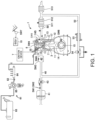
- Fig. 1 is a view illustrating the engine system.
- Fig. 2 is a view illustrating a configuration of a combustion chamber of the engine.
- An intake side and an exhaust side illustrated in Fig. 1 are opposite from the intake side and the exhaust side illustrated in Fig. 2 .
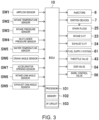
- Fig. 3 is a block diagram illustrating a control device for the engine.
- the engine system is particularly mounted on a vehicle or an automobile.
- the engine system includes an engine 1.
- the engine 1 includes cylinders 11, and is particularly a four-stroke engine in which an intake stroke, a compression stroke, an expansion stroke, and an exhaust stroke are repeated in each cylinder 11.
- the engine 1 is particularly mounted on a four-wheeled automobile, and the automobile travels according to the operation of the engine 1.
- Fuel of the engine 1 is gasoline in this example.
- the engine 1 is provided with a cylinder block 12 and a cylinder head 13.
- the cylinder head 13 is placed on the cylinder block 12.
- a plurality of cylinders 11 are formed inside the cylinder block 12.
- the engine 1 is particularly a multi-cylinder engine. In Fig. 1 , only one cylinder 11 is illustrated.
- a piston 3 is inserted into each cylinder 11.
- the piston 3 is coupled to a crankshaft 15 through a connecting rod 14.
- the piston 3 reciprocates inside the cylinder 11.
- the piston 3, the cylinder 11, and the cylinder head 13 define a combustion chamber 17.
- a lower surface of the cylinder head 13 is particularly constituted by a sloped surface 1311 and a sloped surface 1312.
- the sloped surface 1311 is a slope on a side of an intake valve 21 (described later), and inclines upwardly toward a central part of the ceiling of the cylinder 11.
- the sloped surface 1312 is a slope on a side of an exhaust valve 22 (described later), and inclines upwardly toward the central part of the ceiling of the cylinder 11.
- the ceiling of the cylinder 11 is a pentroof type.
- the cylinder head 13 is formed with intake ports 18 for the cylinders 11 such that each intake port 18 communicates with the inside of the corresponding cylinder 11.
- the intake port 18 is particularly a so-called tumble port. That is, the intake port 18 has a shape which generates a tumble flow inside the cylinder 11.
- the pentroof ceiling of the cylinder 11 and the tumble port particularly generate the tumble flow inside the cylinder 11.
- Each intake port 18 is provided with the intake valve 21.
- the intake valve 21 opens and closes the intake port 18.
- a valve operating mechanism opens and closes the intake valve 21 at a given timing.
- the valve operating mechanism may be a variable valve operating mechanism which varies a valve timing and/or a valve lift.
- the valve operating mechanism particularly includes an intake S-VT (Sequential-Valve Timing) 23 of an electric type or a hydraulic type.
- the intake S-VT 23 continuously changes a rotational phase of an intake camshaft within a given angle range.
- a valve opening period of the intake valve 21 does not change.
- the cylinder head 13 is formed with exhaust ports 19 for the cylinders 11 such that each exhaust port 19 communicates with the inside of the corresponding cylinder 11.
- Each exhaust port 19 is provided with the exhaust valve 22.
- the exhaust valve 22 opens and closes the exhaust port 19.
- a valve operating mechanism opens and closes the exhaust valve 22 at a given timing.
- the valve operating mechanism may be a variable valve operating mechanism which varies a valve timing and/or a valve lift.
- the valve operating mechanism particularly includes an exhaust S-VT 24 of an electric type or a hydraulic type.
- the exhaust S-VT 24 continuously changes a rotational phase of an exhaust camshaft within a given angle range.
- a valve opening period of the exhaust valve 22 does not change.
- Injectors 6 are attached to the cylinder head 13 for the respective cylinders 11. As illustrated in Fig. 2 , each injector 6 is provided to the central part of the cylinder 11 in the plan view (at or near a center axis X1 of the cylinder). In detail, the injector 6 is disposed in a valley part of the pentroof where the sloped surface 1311 and the sloped surface 1312 intersect with each other.
- the injector 6 directly injects fuel into the cylinder 11.
- the injector 6 is one example of a fuel injector, and is of a multiple nozzle hole type having a plurality of nozzle holes (not illustrated in detail). As illustrated by two-dot chain lines in Fig. 2 , the injector 6 injects fuel radially outwardly from the central part to a peripheral part of the cylinder 11.
- the injector 6 particularly has ten nozzle holes which are circumferentially disposed at an equal angle, the number of nozzle holes and the positions thereof are not particularly limited to this configuration.
- the injector 6 is connected to a fuel supply system 61.
- the fuel supply system 61 is comprised of a fuel tank 63 which stores fuel, and a fuel supply passage 62 which couples the fuel tank 63 to the injector 6.
- a fuel pump 65 and a common rail 64 are interposed in the fuel supply passage 62.
- the fuel pump 65 pumps fuel to the common rail 64.
- the fuel pump 65 is a plunger-type pump driven by the crankshaft 15 in this example.
- the common rail 64 stores at a high fuel pressure the fuel pumped from the fuel pump 65.
- the injector 6 is valve-opened, the fuel stored in the common rail 64 is injected into the cylinder 11 from the nozzle holes of the injector 6.
- the pressure of the fuel supplied to the injector 6 may be changed according to the operating state of the engine 1. Note that the configuration of the fuel supply system 61 is not limited to the configuration described above.
- Spark plugs (or ignition plugs) 25 are attached to the cylinder head 13 for the respective cylinders 11. Each spark plug 25 forcibly ignites a mixture gas inside the cylinder 11. Although detailed illustration is omitted, a center electrode and a ground electrode of the spark plug 25 are positioned at the central part of the cylinder 11 in the plan view, near the ceiling.
- the spark plug 25 is electrically connected to an ignition device 7.
- the ignition device 7 applies voltage between the electrodes of the spark plug 25 to cause an electric discharge (arc discharge) so as to ignite the mixture gas inside the cylinder 11.
- the ignition device 7 also causes the spark plug 25 to discharge the electricity when the mixture gas is not ignited or not to be ignited, and detects a parameter related to a current value (or a value of a current) of an electric-discharge channel, which is generated between the electrodes in the electric discharge (details will be described later).
- the detected parameter is used to estimate a state of flow inside the cylinder 11.
- the configuration of the ignition device 7 will be described later.
- the engine 1 is connected at one side to an intake passage 40.
- the intake passage 40 communicates with the intake ports 18 of the cylinders 11. Air to be introduced into the cylinders 11 flows through the intake passage 40.
- the intake passage 40 is provided at its upstream-end part with an air cleaner 41.
- the air cleaner 41 filters the air.
- the intake passage 40 is provided, near its downstream end, with a surge tank 42. A part of the intake passage 40 downstream of the surge tank 42 constitutes independent passages branching for the respective cylinders 11. Downstream ends of the independent passages are connected to the intake ports 18 of the cylinders 11, respectively.
- the intake passage 40 is provided, between the air cleaner 41 and the surge tank 42, with a throttle valve 43.
- the throttle valve 43 adjusts the opening of the valve to control an amount of air to be introduced into the cylinder 11.
- the engine 1 is particularly provided with a swirl generator which generates a swirl flow inside the cylinders 11.
- the swirl generator particularly has a swirl control valve 56 attached to the intake passage 40.
- the intake passage 40 particularly includes a first intake passage 18a and a second intake passage 18b (see Fig. 2 ) which are parallelly provided downstream of the surge tank 42, and the swirl control valve 56 is provided to the second intake passage 18b.
- the swirl control valve 56 is an opening control valve which is capable of choking a cross-section of the second intake passage 18b.
- the intake port 18 of the engine 1 may be configured to be a helical port capable of generating the swirl flow.
- the engine 1 is connected at the other side to an exhaust passage 50.
- the exhaust passage 50 communicates with the exhaust ports 19 of the cylinders 11.
- the exhaust passage 50 is a passage through which exhaust gas discharged from the cylinders 11 flows.
- an upstream part of the exhaust passage 50 constitutes independent passages branching for the respective cylinders 11. Upstream ends of the independent passages are connected to the exhaust ports 19 of the cylinders 11, respectively.
- the exhaust passage 50 is provided with an exhaust gas purification system having a plurality of catalytic converters.
- An upstream catalytic converter includes a three-way catalyst 511 and a GPF (Gasoline Particulate Filter) 512.
- a downstream catalytic converter includes a three-way catalyst 513.
- the exhaust gas purification system is not limited to the illustrated configuration.
- the GPF may be omitted.
- the catalytic converter is not limited to the one including the three-way catalyst. Further, the disposed order of the three-way catalyst and the GPF may be changed suitably.
- An exhaust gas recirculation (EGR) passage 52 is particularly connected between the intake passage 40 and the exhaust passage 50.
- the EGR passage 52 is a passage through which a part of exhaust gas recirculates to the intake passage 40.
- An upstream end of the EGR passage 52 is connected to a part of the exhaust passage 50 between the upstream and downstream catalytic converters.
- a downstream end of the EGR passage 52 is connected to a part of the intake passage 40 between the throttle valve 43 and the surge tank 42.
- the EGR passage 52 is particularly provided with an EGR cooler 53 of a water-cooled type.
- the EGR cooler 53 cools exhaust gas.
- the EGR passage 52 is also provided with an EGR valve 54.
- the EGR valve 54 controls a flow rate of exhaust gas flowing through the EGR passage 52.
- the EGR valve 54 changes its opening to control a recirculating amount of the cooled exhaust gas.
- the control device for the engine 1 is provided with an ECU (Engine Control Unit or Electronic Control Unit) 10 to operate the engine 1.
- the ECU 10 is particularly a controller based on a well-known microcomputer, and includes a processor (e.g., a central processing unit (CPU)) 101 which executes a program, memory 102 which is comprised of, for example, RAM (Random Access Memory) and ROM (Read Only Memory), and stores the program and data, and an interface (I/F) circuit 103 which inputs and outputs an electric signal.
- the ECU 10 is one example of a "controller.”
- one or more sensors are connected to the ECU 10.
- the sensors SW1-SW9 output signals to the ECU 10.
- the sensors particularly include the following sensors.
- An airflow sensor SW1 is provided to the intake passage 40 downstream of the air cleaner 41, and measures the flow rate of air flowing through the intake passage 40.
- An intake temperature sensor SW2 is provided to the intake passage 40 downstream of the air cleaner 41, and measures the temperature of the air flowing through the intake passage 40.
- An intake pressure sensor SW3 is attached to the surge tank 42, and measures the pressure of the air to be introduced into the cylinder 11.
- An in-cylinder pressure sensor SW4 is attached to the cylinder head 13 for each cylinder 11, and measures the pressure inside the cylinder 11.
- a water temperature sensor SW5 is attached to the engine 1, and measures the temperature of coolant.
- a crank angle sensor SW6 is attached to the engine 1, and measures a rotational angle of the crankshaft 15.
- An accelerator opening sensor SW7 is attached to an accelerator pedal mechanism, and measures an accelerator opening corresponding to an operation amount of an accelerator pedal.
- An intake cam angle sensor SW8 is attached to the engine 1, and measures a rotational angle of the intake camshaft.
- An exhaust cam angle sensor SW9 is attached to the engine 1, and measures a rotational angle of the exhaust camshaft.
- the ECU 10 determines the operating state of the engine 1 based particularly on at least one of the signals of the sensors SW1-SW9, and also calculates a control amount of each device based on a given control logic stored in the memory 102.
- the control logic particularly includes calculating a target amount and/or the control amount by using a map stored in the memory 102.
- the ECU 10 particularly outputs electric signals related to the calculated control amounts to the injectors 6, the spark plugs 25, the intake S-VT 23, the exhaust S-VT 24, the fuel supply system 61, the throttle valve 43, the EGR valve 54, and the swirl control valve 56.
- the ECU 10 electrically connected to the various sensors and devices constitutes a plurality of functional blocks to operate the engine 1, which will be described later.
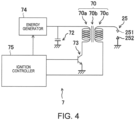
- Fig. 4 illustrates a configuration of the ignition device 7.
- the ignition device 7 particularly applies voltage between a center electrode 251 and a ground electrode 252 of the spark plug 25 so as to cause the electric discharge inside the cylinder 11.
- the ignition device 7 particularly includes an ignition coil 70 having a primary coil 70a, a secondary coil 70c, and an iron core 70b. Further particularly, the ignition device 7 is also provided with a capacitor 72, a transistor 73, an energy generator 74, and an ignition controller 75.
- the center electrode 251 is particularly connected to the secondary coil 70c of the ignition coil 70, and the ground electrode 252 is particularly connected to the ground.
- the electric discharge occurs at a gap between the center electrode 251 and the ground electrode 252.
- the capacitor 72 stores electrical energy to supply a primary current to the primary coil 70a.
- the energy generator 74 includes a power source, and charges the capacitor 72.
- the other end of the primary coil 70a is particularly connected to a collector of the transistor 73.
- the transistor 73 particularly switches between supplying or not supplying the primary current to the ignition coil 70.
- one end of the secondary coil 70c is connected to the center electrode 251, and the other end is connected to the ignition controller 75.
- the ignition controller 75 particularly controls the energy generator 74 and the transistor 73 so that the spark plug 25 ignites the mixture gas inside the cylinder 11 at a given timing.
- the ignition controller 75 can measure the secondary voltage applied between the electrodes of the spark plug 25 by the secondary coil 70c, and a secondary current flown from the secondary coil 70c to the spark plug 25. As described above, the ignition device 7 causes the spark plug 25 to discharge the electricity when the mixture gas is not ignited or not to be ignited, and detects the parameter related to the current value at the time of the electric discharge.
- the engine 1 is particularly a spark-ignition engine.
- the injector 6 injects fuel into the cylinder 11 during an intake stroke and/or a compression stroke by an amount corresponding to the operating state of the engine 1 to form mixture gas inside the cylinder 11, and the spark plug 25 ignites the mixture gas at a given timing near a compression top dead center (TDC) to combust the mixture gas.
- TDC compression top dead center
- the engine 1 particularly generates a turbulence inside the cylinder 11 to improve fuel efficiency.
- combustion speed increases.
- the engine 1 is provided with the cylinder 11 with the pentroof ceiling, and the intake port 18 of the tumble-port type.
- the intake air introduced into the cylinder 11 generates a tumble flow.
- the engine 1 also includes the swirl control valve 56. When the swirl control valve 56 is closed, the intake air introduced into the cylinder 11 generates a swirl flow.
- an oblique flow in which a tumble vortex and a swirl vortex are combined, is generated inside the cylinder 11.
- the state of the intake flow inside the cylinder 11 is not the same in every cycle, but may vary depending on various factors.
- the change in the state of the intake flow may lead to the change in the combustion speed.
- combustion variation of the engine 1 may be caused.
- the engine system and the method of controlling the engine 1 disclosed herein reduce the combustion variation of the engine 1 by reducing the variations in the combustion speed between the cycles.
- the state of the flow inside the cylinder 11 is estimated every cycle, as well as supplemental fuel being injected into the cylinder 11 as needed based on the estimated flowing state.
- Fig. 5 is a block diagram illustrating a configuration of the control device for the engine 1, which executes the control for reducing the combustion variation.
- Fig. 5 illustrates functional blocks of the ECU 10.
- the ECU 10 particularly includes a main fuel injection module 81 and a main ignition control module 82 executed by the processor 101 to perform their respective functions. These modules stored in the memory 102 as software modules.
- the main fuel injection module 81 sets an injection amount and an injection timing of main fuel corresponding to a demanded torque of the engine 1, and causes the injector 6 to inject the main fuel.
- the main ignition control module 82 causes the spark plug 25 to ignite the mixture gas inside the cylinder 11 at a given timing after the injection of the main fuel.
- the ECU 10 also includes a determination module 83 and/or a supplemental fuel injection module 84.
- the determination module 83 determines the flowing state inside the cylinder 11 based on the parameters detected by using the ignition device 7 and the spark plug 25.
- the supplemental fuel injection module 84 injects supplemental fuel inside the cylinder 11 as needed before the spark plug 25 ignites the mixture gas, based on the flowing state inside the cylinder 11 determined by the determination module 83.
- Fig. 6 is a view illustrating the center of the tumble vortex in an early half of a compression stroke and the flowing state inside the cylinder 11 in a latter half of the compression stroke.
- Chart 601 in Fig. 6 illustrates the flowing state inside the cylinder 11 in the early half of the compression stroke, where the center of the tumble vortex is near the piston 3 inside the cylinder 11.
- Chart 604 illustrates the flowing state inside the cylinder 11 in the latter half of the compression stroke, in which the crank angle progressed from the state of chart 601.
- chart 602 illustrates the flowing state inside the cylinder 11 in the early half of the compression stroke, where the center of the tumble vortex is at the middle between the piston 3 and the ceiling inside the cylinder 11.
- Chart 605 illustrates the flowing state inside the cylinder 11 in the latter half of the compression stroke, in which the crank angle progressed from the state of chart 602.
- chart 603 illustrates the flowing state inside the cylinder 11 in the early half of the compression stroke, where the center of the tumble vortex is near the ceiling inside the cylinder 11.
- Chart 606 illustrates the flowing state inside the cylinder 11 in the latter half of the compression stroke, in which the crank angle progressed from the state of chart 603.
- the ignition device 7 detects the flowing state inside the cylinder 11.
- the ignition device 7 causes the electric discharge inside the cylinder 11 at a timing when the mixture gas is not ignited or not to be ignited, and detects a period of time for which the electric discharge continues (discharge duration).
- the determination module 83 estimates the intensity of the flow around the spark plug 25 based on the detected discharge duration, and determines the center of the tumble vortex based on the estimated flow intensity.
- Fig. 7 illustrates a time-series change 701 in the voltage and a time-series change 702 in the current between the electrodes of the spark plug 25 at different flow intensities around the spark plug 25.
- an electric-discharge channel is formed between the center electrode 251 and the ground electrode 252 (see charts 703 and 704).
- the electric-discharge channel is blown and extended by the flow.
- the extension of the electric-discharge channel increases the resistance between the electrodes, which accelerates a decrease in the voltage applied between the electrodes.
- a period of time required for the consumption of the energy applied to the spark plug 25 i.e., the discharge duration
- the electric-discharge channel when there is no flow around the spark plug 25, the electric-discharge channel is hardly extended (see chart 703), and thus, the discharge duration is long. Since the electric-discharge channel extends as the intensity of the flow around the spark plug 25 increases (see chart 704), the discharge duration becomes shorter as illustrated by broken lines and dotted lines in charts 701 and 702. That is, the discharge duration of the current between the electrodes of the spark plug 25 is in proportion to the intensity of the flow around the spark plug 25.
- the determination module 83 can estimate the intensity of the flow (i.e., a flow velocity) around the spark plug 25.
- Fig. 8 illustrates a relationship between the discharge duration detected by the ignition device 7, and the center of the tumble vortex inside the cylinder 11.
- Chart 800 of Fig. 8 illustrates a relationship between the discharge duration and a flow velocity Vp around the spark plug 25.
- the discharge duration is in proportion to the flow velocity Vp, and the flow velocity Vp increases as the discharge duration is shorter, and the flow velocity Vp decreases as the discharge duration is longer.
- Fig. 9 is a view illustrating a relationship between the center of the swirl vortex during the intake stroke and the flowing state inside the cylinder 11 in the latter half of the compression stroke.
- Chart 901 of Fig. 9 illustrates the flowing state inside the cylinder 11 when the center of the swirl vortex deviates to the exhaust-valve side inside the cylinder 11 during the intake stroke.
- Chart 904 illustrates a propagation state of the flame after the latter half of the compression stroke, in which the crank angle progressed from the state of chart 901.
- chart 902 illustrates the flowing state inside the cylinder 11 when the center of the swirl vortex is almost on the axis of the cylinder 11 at the central part of the cylinder 11 during the intake stroke.
- Chart 905 illustrates the propagation state of the flame after the latter half of the compression stroke, in which the crank angle progressed from the state of chart 902.
- chart 903 illustrates the flowing state inside the cylinder 11 when the center of the swirl vortex deviates to the intake-valve side inside the cylinder 11 during the intake stroke.
- Chart 906 illustrates the propagation state of the flame after the latter half of the compression stroke, in which the crank angle progressed from the state of chart 903.
- the flow velocity of the swirl vortex is relatively high on the intake-valve side which is far from the center of the swirl vortex.
- the flame propagating from the central part of the cylinder 11 to the exhaust-valve side propagates radially outwardly while being curved in the circumferential direction
- the flame propagating from the central part of the cylinder 11 to the intake-valve side is intensely curved by the swirl vortex at the high flow velocity, thus the radially outward propagation being difficult.
- the flame propagation in the intake-side area is difficult as indicated by the one-dot chain line in chart 904. In this case, the combustion speed is lower than the case of chart 905.
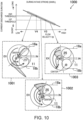
- Fig. 10 illustrates a relationship between the duration of the electric discharge detected by the ignition device 7, and the center of the swirl vortex inside the cylinder 11.
- Chart 1000 of Fig. 10 illustrates a relationship between the discharge duration and the flow velocity around the spark plug 25.
- the intake air is flown into the cylinder 11 mainly from the first intake passage 18a to generate the swirl flow.
- a flow-velocity distribution occurs inside the cylinder 11 during the intake stroke by the intake air which is introduced mainly from the first intake passage 18a.
- the center of the swirl vortex is located on the axis around the central part of the cylinder 11 when the velocity distribution during the intake stroke is as illustrated in chart 1002, in which the flow velocity is the maximum at a certain position in the radial direction between the central part and a liner of the cylinder 11, and the flow velocity decreases toward the central part and toward the liner from the certain position.
- the flow velocity around the spark plug 25 is between V3 and V4.
- the swirl vortex formed mainly by a swirl flow inside the cylinder 11 becomes stable during the intake stroke between the opening and closing of the intake valve 21.
- the ignition device 7 causes the spark plug 25 to carry out the electrical discharge (a first electric discharge described later) and detects the discharge duration (a first discharge duration described later) during the intake stroke.
- the flow of the intake air easily changes for a certain period from the opened timing of the intake valve 21.
- the swirl vortex stabilizes after the certain period from the opening of the intake valve 21, before the closing of the intake valve 21.
- the ignition device 7 causes the spark plug 25 to carry out the electric discharge after a given period (a time constant ⁇ t described later) from the opening of the intake valve 21, and detects the discharge duration.
- the determination module 83 can determine that the center of the swirl vortex deviates to the intake-valve side when the discharge duration is shorter than the first threshold corresponding to the velocity V3.
- the determination module 83 can determine that the center of the swirl vortex deviates to the exhaust-valve side when the discharge duration is longer than the second threshold corresponding to the velocity V4.
- the determination module 83 can determine that the center of the swirl vortex is on the axis at the central part of the cylinder 11 when the discharge duration is between the first threshold and the second threshold. Note that the velocity V3 corresponding to the first threshold and the velocity V1 described above are not necessarily the same. Similarly, the velocity V4 corresponding to the second threshold and the velocity V2 described above are not necessarily the same.
- Fig. 11 is a time chart illustrating the timing of the fuel injection by the injector 6, and the timings of the electric discharge and the ignition by the spark plug 25. The crank angle progresses from the left to the right in Fig. 11 .
- the area with a small turbulence and/or the area with difficulty in the flame propagation are generated inside the cylinder 11.
- the supplemental fuel makes the mixture gas of which the fuel concentration is locally high be positioned in the area with the small turbulence and/or the area with the difficulty in the flame propagation so as to accelerate the flame propagation toward such specific areas.
- the main fuel injection module 81 particularly causes the injector 6 to inject the main fuel inside the cylinder 11 in a period during the intake stroke between the opening and closing of the intake valve 21 (see a main fuel injection 1104).
- the main fuel is spread inside the cylinder 11 by the flow, and the mixture gas is generated inside the cylinder 11.
- the determination module 83 causes the ignition device 7 and the spark plug 25 to carry out a first electric discharge 1105 at a timing during the intake stroke after the given time constant ⁇ t passes from the opening of the intake valve 21.
- the first electric discharge 1105 is the electric discharge which is performed when the mixture gas is not ignited or not to be ignited.
- the ignition device 7 detects the first discharge duration of the first electric discharge.
- the determination module 83 estimates the center of the swirl vortex based on the first discharge duration detected in the first electric discharge 1105.
- the determination module 83 also causes the ignition device 7 and the spark plug 25 to carry out a second electric discharge 1106, for example, in the early half of the compression stroke after the closing of the intake valve 21.
- the second electric discharge 1106 is the electric discharge which is performed when the mixture gas is not ignited or not to be ignited.
- the ignition device 7 particularly detects the second discharge duration of the second electric discharge.
- the determination module 83 estimates the center of the tumble vortex based on the second discharge duration detected in the second electric discharge 1106.
- the center of the tumble vortex is located at the middle between the piston 3 and the ceiling inside the cylinder 11, and the center of the swirl vortex is located on the axis at the central part of the cylinder 11.
- the injection of the supplemental fuel is unnecessary.
- the supplemental fuel injection module 84 suspends the injection of the supplemental fuel, and the main ignition control module 82 causes the spark plug 25 to ignite the mixture gas at the given timing near the compression TDC in the latter half of the compression stroke (see a main ignition 1107 of Fig. 11 ).
- the turbulence is uniform or substantially uniform entirely inside the cylinder 11.
- the flame uniformly or substantially uniformly propagates from the central part toward the peripheral part of the cylinder 11.
- the combustion speed is comparatively high.
- the supplemental fuel injection module 84 particularly causes the injector 6 to inject a given amount of supplemental fuel (a first supplemental fuel 1108).
- the injector 6 particularly injects the first supplemental fuel 1108 at a first injection timing, for example, in the early half of the compression stroke or the latter half of the compression stroke.
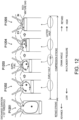
- Fig. 12 is a view illustrating the flow change and distribution of the first supplemental fuel inside the cylinder 11 when the center of the tumble vortex is near the piston 3 inside the cylinder 11.
- the center of the vortex contacts the top surface of the piston 3 and the lower half of the tumble vortex is broken as the piston 3 ascends as illustrated in P1201, P1202, P1203, and P1204, in this order. Accordingly, as indicated by a black arrow in P 1205, the flow inside the cylinder 11 becomes the forward one-way flow from the intake valve 21 toward the exhaust valve 22 in the latter half of the compression stroke.
- the first supplemental fuel is injected inside the cylinder 11 at a relatively early timing (P1203) during the compression stroke, and since the pressure inside the cylinder 11 is not relatively high at that early timing, the injected first supplemental fuel rides on the tumble vortex to be carried from the exhaust-valve side to the intake-valve side (see hatched areas in P1203, P1204, and P1205) before the vortex is broken. As a result, the mixture gas with the high fuel concentration can be positioned around the intake valve.
- the main ignition control module 82 causes the spark plug 25 to ignite the mixture gas at the given timing near the compression TDC in the latter half of the compression stroke (see the main ignition 1107 in chart 1101).
- the flame is difficult to be propagated toward the intake-valve side due to the forward one-way flow, since the fuel concentration of the mixture gas is high on the intake-valve side, the flame propagation toward the intake-valve side is accelerated. Accordingly, the combustion speed is increased to the extent similar to the case where the discharge duration is between the first threshold and the second threshold. Therefore, combustion variation of the engine 1 is reduced.
- the supplemental fuel injection module 84 particularly causes the injector 6 to inject a given amount of supplemental fuel (a second supplemental fuel 1109).
- the injector6 injects the second supplemental fuel 1109 at a second injection timing in the latter half of the compression stroke.
- the injection timing of the second supplemental fuel 1109 is later than the injection timing of the first supplemental fuel 1108.
- Fig. 13 is a view illustrating the flow change and distribution of the second supplemental fuel inside the cylinder 11 when the center of the tumble vortex is near the ceiling inside the cylinder 11.
- the center of the vortex contacts the ceiling and the upper half of the tumble vortex is broken as the piston 3 ascends as illustrated in P1301, P1302, P1303, and P1304, in this order. Accordingly, as indicated by black arrows in P1305, the flow inside the cylinder 11 becomes the backward one-way flow from the exhaust valve 22 toward the intake valve 21 in the latter half of the compression stroke.
- the injector 6 particularly injects the second supplemental fuel in the latter half of the compression stroke (see P1304). Since the pressure inside the cylinder 11 is high in the latter half of the compression stroke, the second supplemental fuel injected inside the cylinder 11 stays at the central part inside the cylinder 11 by receiving the high compression pressure, as well as flowing to the exhaust-valve side where the flow is relatively weak (see hatched areas in Pl304 and P1305). As a result, the mixture gas with the high fuel concentration can be positioned around the exhaust valve.
- the main ignition control module 82 particularly causes the spark plug 25 to ignite the mixture gas at the given timing near the compression TDC in the latter half of the compression stroke (see the main ignition 1107 in chart 1103).
- the flame is difficult to be propagated toward the exhaust-valve side due to the backward one-way flow, since the fuel concentration of the mixture gas is high on the exhaust-valve side, the flame propagation toward the exhaust-valve side is accelerated. Accordingly, the combustion speed is increased to the extent similar to the case where the discharge duration is between the first threshold and the second threshold. Therefore, combustion variation of the engine 1 is reduced.
- the ECU 10 can make the combustion speed to be the same or substantially the same. Thus, the combustion variation can be reduced.
- the supplemental fuel injection module 84 particularly causes the injector 6 to inject the given amount of supplemental fuel (i.e., the first supplemental fuel 1108).
- the injector 6 particularly injects the first supplemental fuel 1108 at the first injection timing, for example, in the early half of the compression stroke or the latter half of the compression stroke.
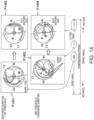
- P1401 and P1402 of Fig. 14 are views illustrating the flow change and distribution of the first supplemental fuel inside the cylinder 11 when the center of the swirl vortex deviates to the intake-valve side.
- the center of the swirl vortex deviates to the intake-valve side, as illustrated in P1401, the kurtosis of the flow velocity distribution inside the cylinder 11 during the compression stroke is low. Therefore, an area where the flow velocity is extremely high does not exist.
- the main ignition control module 82 causes the spark plug 25 to ignite the mixture gas at the given timing near the compression TDC in the latter half of the compression stroke (see the main ignition 1107 of chart 1101).
- the combustion speed is increased to the extent similar to the case where the discharge duration is between the first threshold and the second threshold. Therefore, combustion variation of the engine 1 is reduced.
- the supplemental fuel injection module 84 particularly causes the injector 6 to inject the given amount of supplemental fuel (i.e., the second supplemental fuel 1109).
- the injector 6 particularly injects the second supplemental fuel 1109 at the second injection timing in the latter half of the compression stroke.
- the injection timing of the second supplemental fuel 1109 is later than the injection timing of the first supplemental fuel 1108.
- P1403 and P1404 of Fig. 14 are views illustrating the flow change and distribution of the second supplemental fuel inside the cylinder 11 when the center of the swirl vortex deviates to the exhaust-valve side.
- the velocity distribution inside the cylinder 11 in the latter half the compression stroke includes an area near the liner where the flow velocity is extremely high.
- the supplemental fuel injected to the intake-valve side rides on the flow at the low velocity, thus moving a little and staying on the intake-valve side.
- the supplemental fuel injected to the exhaust-valve side rides on the flow at the high velocity, thus being carried promptly to the intake-valve side in the circumferential direction.
- the sprays of the supplemental fuel are overlapped with each other, and the fuel concentration of the mixture gas on the intake-valve side is increased at the ignition timing (P1404).
- the main ignition control module 82 particularly causes the spark plug 25 to ignite the mixture gas at the given timing near the compression TDC in the latter half of the compression stroke (see the main ignition 1107 of chart 1103).
- the flame is difficult to be propagated toward the intake-valve side since the propagating direction is curved by the swirl vortex with the deviated center.
- the fuel concentration of the mixture gas is high on the intake-valve side, the flame propagation toward the intake-valve side is accelerated. Accordingly, the combustion speed is increased to the extent similar to the case where the discharge duration is between the first threshold and the second threshold. Therefore, combustion variation of the engine 1 is reduced.
- the ECU 10 can make the combustion speed to be constant or substantially constant. Thus, the combustion variation can be reduced.
- the energies applied to the spark plug 25 in the first electric discharge, the second electric discharge, and the main ignition may be the same as, or different from each other.
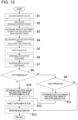
- step S1 the ECU 10 acquires at least one of the sensor values of the sensors SW1 to SW9.
- step S2 the ECU 10 particularly calculates the demanded torque of the engine 1 based on the acquired sensor values.
- step S3 the ECU 10 particularly determines the injection amount and injection timing of the main injection, which can achieve the demanded torque. Particularly, the ECU 10 also determines the main ignition timing.
- the ECU 10 particularly determines the timings of the first electric discharge and the second electric discharge. Further particularly, at this step, the ECU 10 also determines the time constant ⁇ t for the execution of the first electric discharge. For example, the ECU 10 may adjust the time constant ⁇ t according to the operating state of the engine 1 (i.e., the load and/or the speed of the engine 1)
- the ECU 10 particularly causes the injector 6 to carry out the main injection 1104 based on the injection amount and injection timing determined at step S3. As illustrated in Fig. 11 , the injector 6 performs the main injection 1104 during the intake stroke.
- the ECU 10 particularly causes the ignition device 7 to carry out the first electric discharge 1105.
- the ignition device 7 performs the first electric discharge 1105 during the intake stroke, and detects the first discharge duration.
- the ECU 10 particularly causes the ignition device 7 to carry out the second electric discharge 1106.
- the ignition device 7 performs the second electric discharge 1106 in the early half of the compression stroke, and detects the second discharge duration.
- step S8 the ECU 10 particularly determines whether the first discharge duration is below the first threshold, and whether the second discharge duration is below the first threshold.
- the ECU 10 determines as YES at step S8 (when the first discharge duration or the second discharge duration is below the first threshold)
- the process proceeds to step S10.
- the ECU 10 determines as NO at step S8 (when the first discharge duration or the second discharge duration is below the first threshold)
- the process proceeds to step S9.
- the ECU 10 particularly determines whether the first discharge duration is above the second threshold, and whether the second discharge duration is above the second threshold.
- the ECU 10 determines as YES at step S9 (when the first discharge duration or the second discharge duration is above the second threshold)
- the process proceeds to step S11.
- the ECU 10 determines as NO at step S9, the supplemental fuel is not injected.
- the ECU 10 particularly determines the injection amount and injection timing of the first supplemental fuel 1108. As described above, the injection timing of the first supplemental fuel 1108 is advanced compared with the injection timing of the second supplemental fuel 1109. At step S11, the ECU 10 particularly determines the injection amount and injection timing of the second supplemental fuel 1109. The injection timing of the second supplemental fuel 1109 is retarded compared with the injection timing of the first supplemental fuel 1108. The injection amount and injection timing of the first supplemental fuel 1108, and the injection amount and injection timing of the second supplemental fuel 1109 may be determined according to the operating state of the engine 1.
- the ECU 10 determines the injection amount and injection timing of the supplemental fuel
- the ECU 10 particularly executes the injection of the supplemental fuel in the early or latter half of the compression stroke (in the case of the first supplemental fuel 1108), or in the latter half of the compression stroke (in the case of the second supplemental fuel 1109).
- the ECU causes the spark plug 25 to ignite the mixture gas.
- the injection amount of the supplemental fuel is suppressed to an amount which will not degrade an emission performance, for example.
- the reduction in the injection amount of the supplemental fuel can maintain the favorable emission performance, as well as suppressing the degradation in fuel efficiency.
- the injector 6 is not limited to inject the main fuel during the intake stroke, but may inject the main fuel during the compression stroke.
- the spark plug 25 may perform the first electric discharge before or after the injection of the main fuel. Similarly, the spark plug 25 may perform the second electric discharge before or after the injection of the main fuel.
Landscapes
- Engineering & Computer Science (AREA)
- Chemical & Material Sciences (AREA)
- Combustion & Propulsion (AREA)
- Mechanical Engineering (AREA)
- General Engineering & Computer Science (AREA)
- Combined Controls Of Internal Combustion Engines (AREA)
- Ignition Installations For Internal Combustion Engines (AREA)
- Electrical Control Of Air Or Fuel Supplied To Internal-Combustion Engine (AREA)
Description
- The present disclosure relates to control of an engine according to a flow inside a cylinder.
- Increasing combustion speed is beneficial to improve the fuel efficiency of an engine. In an engine provided with spark plugs, each spark plug ignites a mixture gas inside a cylinder to generate a flame around the spark plug. Then, the flame is propagated entirely inside the cylinder while causing a reaction of unburned mixture gas, and the combustion for one cycle finishes. Therefore, in order to accelerate the reaction of the unburned mixture gas to the flame and to increase the combustion speed, it is preferable to increase a contacting area between the flame and the unburned mixture gas, and to generate a strong turbulence. Conventionally, a swirl flow and a tumble flow are generated inside the cylinder in order to accelerate the generation of the turbulence inside the cylinder.
- Although it is known that the turbulence is generated when the flow inside the cylinder is crushed (broken) before a piston reaches a top dead center during a compression stroke, the state of the intake flow may vary between cycles. Therefore, conventionally, various methods are examined for estimating the in-cylinder flow.
- For example,
JP2014-145306A - Here, the present inventors conducted a diligent study for improving the combustion according to the flow estimated based on the current value of the electric-discharge channel as described in
JP2014-145306A - A tumble-vortex component and a swirl-vortex component are combined in the intake flow to form an oblique in-cylinder flow. When the centers of the vortexes exist around the central part of the cylinder in the side view and the plan view, respectively, the rotating flow is maintained also in the latter half of the compression stroke. As a result, the turbulence becomes uniform or substantially uniform entirely inside the cylinder. In this case, the flame is uniformly or substantially uniformly propagated from around the center toward a peripheral part inside the cylinder.
- However, the present inventors found that, when the center of the tumble vortex deviates downward of the cylinder in the side view, the vortex center contacts a top surface of the piston and a lower half of the tumble vortex is broken, which causes the in-cylinder flow to form a forward one-way flow from an intake-valve side to an exhaust-valve side. With the forward one-way flow, the turbulence in an area inside the cylinder on the exhaust-valve side is strong whereas the turbulence in an area on the intake-valve side is weak. In such a case, although the flame is easily propagated toward the exhaust-side area, the propagation toward the intake-side area is difficult.
- Moreover, when the center of the tumble vortex deviates upward of the cylinder in the side view, the vortex center contacts a ceiling of the cylinder, and an upper half of the tumble vortex is broken, which causes the in-cylinder flow to form a backward one-way flow from the exhaust-valve side to the intake-valve side. With the backward one-way flow, the turbulence in the intake-side area of the cylinder is strong whereas the turbulence in the exhaust-side area is weak. In such a case, although the flame is easily propagated toward the intake-side area, the propagation toward the exhaust-side area is difficult.
- On the other hand, the present inventors found that, when the center of the swirl vortex deviates outward of the cylinder in the plan view, part of the flame under the propagation from the central part toward the peripheral part inside the cylinder is disturbed by the swirl flow deviated from the center of the cylinder, and thus, the propagation of the flame toward a specific area is difficult.
- The obstruction of the flame propagation toward the partial area inside the cylinder lowers the combustion speed, and causes combustion variation. Therefore, in order to reduce the combustion variation of the engine, it is necessary to accelerate the flame propagation toward the partial area according to the state of the in-cylinder flow. When the combustion variation of the engine is reduced, fuel efficiency of the engine improves.
-
WO 2014/147795 A1 describes that a control device for an internal combustion engine comprises a detection means, a control parameter setting means, and a control input determination means. The control parameter setting means sets control parameters according to the detected discharge voltage. The control input determination means determines the control input for the actuators using the control parameters. - Therefore, the present disclosure is made in view of the above situation, and one purpose thereof is reducing combustion variation by estimating a state of a flow inside a cylinder and controlling a fuel injector according to the flowing state.
- As a result of further diligent study to solve the problem, the present inventors found that the position of the vortex inside the cylinder can be estimated by detecting a current value of an electric-discharge channel which is generated between electrodes of a spark plug during an intake stroke or a compression stroke before starting the combustion of the mixture gas, and thus, the flowing state in a latter half of the compression stroke can be estimated.
- According to the invention, a method of controlling an engine by using a controller is provided, as defined in
claim 1. - Here, for convenience, a "forward one-way flow" indicates a flow from an intake-valve side to an exhaust-valve side, and a "backward one-way flow" indicates a flow from the exhaust-valve side to the intake-valve side; however, they may be the opposite.
- The engine of this configuration includes the cylinder with the pentroof ceiling, the spark plug provided at or near the center axis of the cylinder, and the fuel injector provided at or near the center axis of the cylinder. Since the ceiling is the pentroof type, the intake air introduced into the cylinder forms a tumble vortex, and the intake air introduced into the cylinder through the intake valve also forms a swirl vortex. The flow inside the cylinder becomes oblique with respect to the cylinder axis.
- During the intake stroke or the compression stroke, the mixture gas is formed inside the cylinder by the injecting main fuel by the fuel injector, and the ignition device applies the high voltage between the electrodes of the spark plug at the timing when the mixture gas is not ignited or not to be ignited, and generates the electric-discharge channel between the electrodes. In the detecting the parameter, the parameter related to the current value of the electric-discharge channel generated at the spark plug is detected. Note that the detecting the parameter may be after or before the main fuel injection.
- The electric-discharge channel generated between the electrodes by energy being applied to the spark plug, is extended as the intensity of the flow around the spark plug increases. The extension of the electric-discharge channel increases the resistance between the electrodes, which accelerates a decrease in the voltage applied between the electrodes. As a result, a period of time required for the consumption of the energy applied to the spark plug (i.e., a discharge duration) becomes shorter. The present inventors found that the ignition device can measure the intensity of the flow around the spark plug by detecting the discharge duration of the current as the parameter related to the current value, and can estimate, based on the measured intensity, the center of the vortex inside the cylinder.
- In more detail, when the center of the tumble vortex positions around the center of the combustion chamber in a side view, since the center of the tumble vortex separates from the spark plug to a certain extent, the intensity of the flow around the spark plug becomes moderate. In this case, the parameter falls within the range between the first threshold and the second threshold. When the center of the tumble vortex deviates upward in the cylinder, since the center of the tumble vortex is near the spark plug, the intensity of the flow around the spark plug becomes weak (i.e., the flow is slow). In this case, the parameter exceeds the second threshold. When the center of the tumble vortex deviates downward in the cylinder, since the center of the tumble vortex is far from the spark plug, the intensity of the flow around the spark plug becomes strong (i.e., the flow is fast). In this case, the parameter falls below the first threshold. The controller determines whether the detected parameter is below the first threshold or above the second threshold. According to this, the controller can estimate, before igniting the mixture gas inside the cylinder, whether the flow is the forward one-way flow or the backward one-way flow and whether an area where the turbulence is weak exists.
- Moreover, when the center of the swirl vortex positions around the center of the cylinder in a plan view, the intensity of the flow around the spark plug becomes moderate, and the parameter falls within the range between the first threshold and the second threshold. When the center of the swirl vortex deviates from the center of the cylinder, the intensity of the flow around the spark plug becomes weak and the parameter exceeds the second threshold, and alternatively, the intensity of the flow around the spark plug becomes strong and the parameter falls below the first threshold. The controller determines whether the detected parameter is below the first threshold or above the second threshold so that it can estimate whether an area where the flame is difficult to propagate exists before igniting the mixture gas inside the cylinder.
- Moreover, when the parameter is determined to be below the first threshold or above the second threshold, the fuel injector injects the supplemental fuel, in the injecting the supplemental fuel, at an injection timing retarded from the main fuel. The supplemental fuel makes the fuel concentration higher at the area where the turbulence is weak or the area where the flame is difficult to propagate (hereinafter, referred to as a "specific area"). Therefore, in a latter half of the compression stroke, a normal mixture gas can be positioned in areas other than the specific area, whereas the mixture gas with the relatively high fuel concentration can be positioned in the specific area. After the injecting the supplemental fuel, the ignition device uses the spark plug to ignite the mixture gas to accelerate the flame propagation toward the specific area, and the flame is uniformly or substantially uniformly propagated entirely inside the cylinder. As a result, the combustion speed increases.
- As described above, by the fuel injector injecting the supplemental fuel as needed according to the flowing state inside the cylinder of each cycle, the combustion speed is made to be constant or substantially constant between the cycles, and thus, combustion variation is reduced. The fuel efficiency of this engine improves.
- The injecting the supplemental fuel includes, when the parameter is determined to be below the first threshold, injecting the supplemental fuel by the fuel injector at a first injection timing, and when the parameter is determined to be above the second threshold, injecting the supplemental fuel at a second injection timing retarded from the first injection timing.
- When the parameter is determined to be below the first threshold, the tumble vortex flows as the forward one-way flow from the intake-valve side to the exhaust-valve side in the latter half of the compression stroke, and thus, the turbulence on the intake-valve side is not likely be generated. When the parameter is determined to be below the first threshold, by the fuel injector injecting the supplemental fuel at the relatively advanced timing, the supplemental fuel does not receive high compression pressure inside the cylinder, and rides on the flow of the tumble vortex to be carried from the exhaust-valve side to the intake-valve side area. Thus, the mixture gas with the high fuel concentration can be positioned on the intake-valve side at the ignition timing.
- On the other hand, when the parameter is determined to be above the second threshold, the tumble vortex becomes the backward one-way flow from the exhaust-valve side to the intake-valve side in the latter half of the compression stroke, and thus, the turbulence on the exhaust-valve side is not likely be generated. When the parameter is determined to be above the second threshold, by the fuel injector injecting the supplemental fuel at the relatively retarded timing, the supplemental fuel receives high compression pressure inside the cylinder, and stays in the central part inside the cylinder, and then flows toward the exhaust valve where the flow is weak. Thus, the mixture gas with the high fuel concentration can be positioned on the exhaust-valve side at the ignition timing.
- Moreover, when the parameter is determined to be below the first threshold, the center of the swirl vortex deviates toward the intake valve. This is because the maximum flow velocity of the intake flow introduced into the cylinder is comparatively low in the velocity distribution in the radial direction, and a kurtosis of the flow velocity distribution is low. In this case, the flame is difficult to propagate toward the intake-valve side area. When the parameter is determined to be below the first threshold, the fuel injector injects the supplemental fuel at the relatively advanced timing. The supplemental fuel rides on the flow of the swirl vortex to be carried to the intake-valve side area taking a long time. Thus, the mixture gas with the high fuel concentration can be positioned near the intake valve at the ignition timing.
- On the other hand, when the parameter is determined to be above the second threshold, the center of the swirl vortex deviates toward the exhaust valve. This is because the flow velocity of the intake flow introduced into the cylinder is extremely high near a liner. Also in this case, the flame is difficult to propagate toward the intake-valve side area. When the parameter is determined to be above the second threshold, the fuel injector injects the supplemental fuel at the relatively retarded timing. The supplemental fuel rides on the fast flow near the liner to be carried to the intake-valve side area quickly. Thus, the mixture gas with the high fuel concentration can be positioned near the intake valve at the ignition timing.
- The applying the voltage or the high voltage, particularly the detecting the parameter, may include detecting the parameter by the ignition device at a timing between an opening of the intake valve and a closing of the intake valve. The determining whether the detected parameter is within the range may include determining by the controller a flowing state of a swirl vortex inside the cylinder based on the parameter.
- The oblique flow generated by the tumble flow and the swirl flow can be divided into the tumble vortex and the swirl vortex. The center of the swirl vortex mainly caused by the swirl flow stabilizes in a period during the intake stroke between the opening and the closing of the intake valve. Thus, by the ignition device detecting the parameter in the period between the opening and the closing of the intake valve, the controller can accurately estimate the flowing state including the center of the swirl vortex.
- The applying the voltage or the high voltage, particularly the detecting the parameter, may include detecting the parameter by the ignition device after a given time constant passes from the opening of the intake valve.
- The intake air easily varies for a certain period from the moment when the intake valve opens. Thus, by not allowing the ignition device to detect the parameter for the certain period, the controller can further accurately estimate the center of the swirl vortex.
- The applying the voltage or the high voltage may include detecting the parameter by the ignition device after the closing of the intake valve. The determining whether the detected parameter is within the range may include determining by the controller a flowing state of a tumble vortex inside the cylinder based on the parameter.
- The center of the tumble vortex mainly caused by the tumble flow stabilizes in a period during the compression stroke after the closing of the intake valve. Thus, by the ignition device detecting the parameter after the closing of the intake valve, the controller can accurately estimate the flowing state including the center of the tumble vortex.
- The applying the voltage or the high voltage, particularly the detecting the parameter, may include detecting the parameter by the ignition device during the intake stroke. The applying the voltage or the high voltage, particularly the detecting the parameter, may include detecting the parameter by the ignition device during the compression stroke.
- That is, by the ignition device detecting the parameter during both of the intake stroke and the compression stroke, as described above, the controller can estimate the positions of the center of the vortex comprised of the swirl vortex component and the center of the vortex comprised of the tumble vortex component, and thus, the state of the oblique flow inside the cylinder can be estimated accurately.
- According to the invention, an engine system is provided, as defined in
claim 6. - Such an engine system is based on the knowledge of the present inventors that the center of the vortex inside the cylinder can be estimated when the ignition device detects the parameter related to the current value of the electric-discharge channel generated between the electrodes of the spark plug, as described above.
- The controller causes the fuel injector to inject the supplemental fuel as needed according to the estimated center of the vortex, after the injection of the main fuel and before the ignition. Thus, the mixture gas with the high fuel concentration can be positioned in the specific area in the latter half of the compression stroke.
- The controller then controls the ignition device so that the spark plug ignites the mixture gas, which increases the combustion speed at the area where the mixture gas with the high fuel concentration is positioned.
- As described above, by injecting the supplemental fuel as needed in each cycle, the combustion speed is made to be constant or substantially constant between the cycles, and thus, combustion variation is reduced.
- By changing the injection timing of the supplemental fuel based on the magnitude relationship between the parameter, and the first threshold and the second threshold, the mixture gas with the high fuel concentration can be positioned in the specific area.
- The ignition device may detect the parameter at a timing between an opening of the intake valve and a closing of the intake valve. The controller may determine a flowing state of a swirl vortex inside the cylinder based on the parameter.
- As described above, by the ignition device detecting the parameter during the intake stroke between the opening and the closing of the intake valve, the controller can accurately estimate the center of the swirl vortex.
- The ignition device may detect the parameter after a given time constant passes from the opening of the intake valve.
- As described above, the intake air easily varies for a certain period from the moment when the intake valve opens. Thus, by not allowing the ignition device to detect the parameter for the certain period, the controller can further accurately estimate the center of the vortex of the swirl vortex.
- The ignition device may detect the parameter after the closing of the intake valve. The controller may determine a flowing state of a tumble vortex inside the cylinder based on the parameter.
- As described above, by the ignition device detecting the parameter during the compression stroke after the closing of the intake valve, the controller can accurately estimate the center of the tumble vortex.
- The ignition device may detect the parameter during the intake stroke. The ignition device may detect the parameter during the compression stroke.
- As described above, by the ignition device detecting the parameter during both of the intake stroke and the compression stroke, the controller can estimate the positions of the center of the vortex comprised of the swirl vortex component and the center of the vortex comprised of the tumble vortex component, and thus, the state of the oblique flow inside the cylinder can be estimated accurately.
- According to still another aspect of the present disclosure, an engine system is provided, which includes an engine and a controller. The engine is mounted on an automobile and includes a cylinder with a pentroof ceiling, air being introduced into the cylinder through an intake valve provided to the ceiling, an ignition device including a spark plug provided at or near the center axis of the cylinder, and a fuel injector provided at or near the center axis of the cylinder. The controller is electrically connected to the ignition device and the fuel injector. The controller particularly includes a processor configured to execute a main fuel injection module to control the fuel injector to inject main fuel during one of an intake stroke and a compression stroke, and provide a mixture gas containing fuel and air inside the cylinder, a determination module to control the ignition device to apply a high voltage between electrodes of the spark plug at a timing when the mixture gas is not ignited or not to be ignited, and detect a parameter related to a current value of an electric-discharge channel generated between the electrodes, and to determine whether the parameter detected by the ignition device is within a range between a first threshold and a second threshold so as to determine a flowing state of a vortex inside the cylinder, a supplemental fuel injection module to control the fuel injector to inject supplemental fuel after the injection of the main fuel, when the determination module determines that the parameter is outside the range, and a main ignition control module to control the ignition device to ignite the mixture gas by the spark plug after the fuel injector injects the supplemental fuel.
- The fuel of the engine may be gasoline.
-
-
Fig. 1 is a view illustrating an engine system. -
Fig. 2 is a view illustrating a configuration of a combustion chamber of an engine, where an upper part of this figure is a plan view of the combustion chamber and a lower part of this figure is a cross-sectional view taken along a line II-II in the upper part. -
Fig. 3 is a block diagram of the engine system. -
Fig. 4 is a view illustrating an ignition device. -
Fig. 5 is a block diagram illustrating functional blocks related to control of the engine. -
Fig. 6 is a view illustrating the center of a tumble vortex and a state of flow inside a cylinder in a latter half of a compression stroke. -
Fig. 7 is a view illustrating a time-series change in voltage and current between electrodes of a spark plug at different flow intensities around the spark plug. -
Fig. 8 is a view illustrating a duration of an electric discharge detected by the ignition device, and the center of the tumble vortex. -
Fig. 9 is a view illustrating a relationship between the center of a swirl vortex and a propagation state of flame inside the cylinder. -
Fig. 10 is a view illustrating a relationship between the duration of the electric discharge detected by the ignition device, and the center of the swirl vortex. -
Fig. 11 is a time chart illustrating an injection timing of main fuel, a timing of the electric discharge, an injection timing of supplemental fuel, and a timing of a main ignition. -
Fig. 12 is a view illustrating a change in a flow and distribution of the supplemental fuel inside the cylinder when the center of the tumble vortex is near a piston. -
Fig. 13 is a view illustrating the change in the flow and the distribution of the supplemental fuel inside the cylinder when the center of the tumble vortex is near a ceiling. -
Fig. 14 is a view illustrating the change in the flow and the distribution of the supplemental fuel inside the cylinder when the center of the swirl vortex deviates toward an exhaust valve, and when the center of the swirl vortex deviates toward an intake valve. -
Fig. 15 is a flowchart illustrating a process for controlling the engine executed by an ECU. - Hereinafter, one embodiment of a method of controlling an engine, and an engine system is described with reference to the accompanying drawings. The engine, the engine system, and the engine control method described herein are merely illustration. All of the features as shown in the drawings may not necessarily be essential.
-
Fig. 1 is a view illustrating the engine system.Fig. 2 is a view illustrating a configuration of a combustion chamber of the engine. An intake side and an exhaust side illustrated inFig. 1 are opposite from the intake side and the exhaust side illustrated inFig. 2 .Fig. 3 is a block diagram illustrating a control device for the engine. The engine system is particularly mounted on a vehicle or an automobile. - The engine system includes an
engine 1. Theengine 1 includescylinders 11, and is particularly a four-stroke engine in which an intake stroke, a compression stroke, an expansion stroke, and an exhaust stroke are repeated in eachcylinder 11. Theengine 1 is particularly mounted on a four-wheeled automobile, and the automobile travels according to the operation of theengine 1. Fuel of theengine 1 is gasoline in this example. - The
engine 1 is provided with acylinder block 12 and acylinder head 13. Thecylinder head 13 is placed on thecylinder block 12. A plurality ofcylinders 11 are formed inside thecylinder block 12. Theengine 1 is particularly a multi-cylinder engine. InFig. 1 , only onecylinder 11 is illustrated. - A
piston 3 is inserted into eachcylinder 11. Thepiston 3 is coupled to acrankshaft 15 through a connectingrod 14. Thepiston 3 reciprocates inside thecylinder 11. Thepiston 3, thecylinder 11, and thecylinder head 13 define acombustion chamber 17. - As illustrated in the lower part of
Fig. 2 , a lower surface of the cylinder head 13 (i.e., a ceiling of the cylinder 11) is particularly constituted by asloped surface 1311 and asloped surface 1312. The slopedsurface 1311 is a slope on a side of an intake valve 21 (described later), and inclines upwardly toward a central part of the ceiling of thecylinder 11. The slopedsurface 1312 is a slope on a side of an exhaust valve 22 (described later), and inclines upwardly toward the central part of the ceiling of thecylinder 11. The ceiling of thecylinder 11 is a pentroof type. - The
cylinder head 13 is formed withintake ports 18 for thecylinders 11 such that eachintake port 18 communicates with the inside of thecorresponding cylinder 11. Although detailed illustration is omitted, theintake port 18 is particularly a so-called tumble port. That is, theintake port 18 has a shape which generates a tumble flow inside thecylinder 11. The pentroof ceiling of thecylinder 11 and the tumble port particularly generate the tumble flow inside thecylinder 11. - Each
intake port 18 is provided with theintake valve 21. Theintake valve 21 opens and closes theintake port 18. A valve operating mechanism opens and closes theintake valve 21 at a given timing. The valve operating mechanism may be a variable valve operating mechanism which varies a valve timing and/or a valve lift. As illustrated inFig. 3 , the valve operating mechanism particularly includes an intake S-VT (Sequential-Valve Timing) 23 of an electric type or a hydraulic type. The intake S-VT 23 continuously changes a rotational phase of an intake camshaft within a given angle range. A valve opening period of theintake valve 21 does not change. - The
cylinder head 13 is formed withexhaust ports 19 for thecylinders 11 such that eachexhaust port 19 communicates with the inside of thecorresponding cylinder 11. - Each
exhaust port 19 is provided with theexhaust valve 22. Theexhaust valve 22 opens and closes theexhaust port 19. A valve operating mechanism opens and closes theexhaust valve 22 at a given timing. The valve operating mechanism may be a variable valve operating mechanism which varies a valve timing and/or a valve lift. As illustrated inFig. 3 , the valve operating mechanism particularly includes an exhaust S-VT 24 of an electric type or a hydraulic type. The exhaust S-VT 24 continuously changes a rotational phase of an exhaust camshaft within a given angle range. A valve opening period of theexhaust valve 22 does not change. -
Injectors 6 are attached to thecylinder head 13 for therespective cylinders 11. As illustrated inFig. 2 , eachinjector 6 is provided to the central part of thecylinder 11 in the plan view (at or near a center axis X1 of the cylinder). In detail, theinjector 6 is disposed in a valley part of the pentroof where the slopedsurface 1311 and the slopedsurface 1312 intersect with each other. - The
injector 6 directly injects fuel into thecylinder 11. Theinjector 6 is one example of a fuel injector, and is of a multiple nozzle hole type having a plurality of nozzle holes (not illustrated in detail). As illustrated by two-dot chain lines inFig. 2 , theinjector 6 injects fuel radially outwardly from the central part to a peripheral part of thecylinder 11. Although, in this example, theinjector 6 particularly has ten nozzle holes which are circumferentially disposed at an equal angle, the number of nozzle holes and the positions thereof are not particularly limited to this configuration. - The
injector 6 is connected to afuel supply system 61. Thefuel supply system 61 is comprised of afuel tank 63 which stores fuel, and afuel supply passage 62 which couples thefuel tank 63 to theinjector 6. Afuel pump 65 and acommon rail 64 are interposed in thefuel supply passage 62. Thefuel pump 65 pumps fuel to thecommon rail 64. Thefuel pump 65 is a plunger-type pump driven by thecrankshaft 15 in this example. Thecommon rail 64 stores at a high fuel pressure the fuel pumped from thefuel pump 65. When theinjector 6 is valve-opened, the fuel stored in thecommon rail 64 is injected into thecylinder 11 from the nozzle holes of theinjector 6. The pressure of the fuel supplied to theinjector 6 may be changed according to the operating state of theengine 1. Note that the configuration of thefuel supply system 61 is not limited to the configuration described above. - Spark plugs (or ignition plugs) 25 are attached to the
cylinder head 13 for therespective cylinders 11. Eachspark plug 25 forcibly ignites a mixture gas inside thecylinder 11. Although detailed illustration is omitted, a center electrode and a ground electrode of thespark plug 25 are positioned at the central part of thecylinder 11 in the plan view, near the ceiling. - As illustrated in
Figs. 1 and3 , thespark plug 25 is electrically connected to anignition device 7. Theignition device 7 applies voltage between the electrodes of thespark plug 25 to cause an electric discharge (arc discharge) so as to ignite the mixture gas inside thecylinder 11. Theignition device 7 also causes thespark plug 25 to discharge the electricity when the mixture gas is not ignited or not to be ignited, and detects a parameter related to a current value (or a value of a current) of an electric-discharge channel, which is generated between the electrodes in the electric discharge (details will be described later). The detected parameter is used to estimate a state of flow inside thecylinder 11. The configuration of theignition device 7 will be described later. - The
engine 1 is connected at one side to anintake passage 40. Theintake passage 40 communicates with theintake ports 18 of thecylinders 11. Air to be introduced into thecylinders 11 flows through theintake passage 40. Theintake passage 40 is provided at its upstream-end part with anair cleaner 41. Theair cleaner 41 filters the air. Theintake passage 40 is provided, near its downstream end, with asurge tank 42. A part of theintake passage 40 downstream of thesurge tank 42 constitutes independent passages branching for therespective cylinders 11. Downstream ends of the independent passages are connected to theintake ports 18 of thecylinders 11, respectively. - The
intake passage 40 is provided, between theair cleaner 41 and thesurge tank 42, with athrottle valve 43. Thethrottle valve 43 adjusts the opening of the valve to control an amount of air to be introduced into thecylinder 11. - The
engine 1 is particularly provided with a swirl generator which generates a swirl flow inside thecylinders 11. Although detailed illustration is omitted, the swirl generator particularly has aswirl control valve 56 attached to theintake passage 40. Theintake passage 40 particularly includes afirst intake passage 18a and asecond intake passage 18b (seeFig. 2 ) which are parallelly provided downstream of thesurge tank 42, and theswirl control valve 56 is provided to thesecond intake passage 18b. Theswirl control valve 56 is an opening control valve which is capable of choking a cross-section of thesecond intake passage 18b. When the opening of theswirl control valve 56 is small, a flow rate of the intake air flowing into thecylinder 11 from thefirst intake passage 18a is relatively large, and a flow rate of the intake air flowing into thecylinder 11 from thesecond intake passage 18b is relatively small, which increases the swirl flow inside thecylinder 11. On the other hand, when the opening of theswirl control valve 56 is large, the flow rate of the intake air flowing into thecylinder 11 from thefirst intake passage 18a and the flow rate of the intake air flowing from thesecond intake passage 18b are substantially equal, which reduces the swirl flow inside thecylinder 11. When theswirl control valve 56 is fully opened, the swirl flow is not generated. Note that as illustrated by white arrows inFig. 2 , the swirl flow circles in the counterclockwise direction. - Note that instead of generating the swirl flow by the
swirl control valve 56, theintake port 18 of theengine 1 may be configured to be a helical port capable of generating the swirl flow. - The
engine 1 is connected at the other side to anexhaust passage 50. Theexhaust passage 50 communicates with theexhaust ports 19 of thecylinders 11. Theexhaust passage 50 is a passage through which exhaust gas discharged from thecylinders 11 flows. Although detailed illustration is omitted, an upstream part of theexhaust passage 50 constitutes independent passages branching for therespective cylinders 11. Upstream ends of the independent passages are connected to theexhaust ports 19 of thecylinders 11, respectively. - The
exhaust passage 50 is provided with an exhaust gas purification system having a plurality of catalytic converters. An upstream catalytic converter includes a three-way catalyst 511 and a GPF (Gasoline Particulate Filter) 512. A downstream catalytic converter includes a three-way catalyst 513. Note that the exhaust gas purification system is not limited to the illustrated configuration. For example, the GPF may be omitted. Moreover, the catalytic converter is not limited to the one including the three-way catalyst. Further, the disposed order of the three-way catalyst and the GPF may be changed suitably. - An exhaust gas recirculation (EGR)
passage 52 is particularly connected between theintake passage 40 and theexhaust passage 50. TheEGR passage 52 is a passage through which a part of exhaust gas recirculates to theintake passage 40. An upstream end of theEGR passage 52 is connected to a part of theexhaust passage 50 between the upstream and downstream catalytic converters. A downstream end of theEGR passage 52 is connected to a part of theintake passage 40 between thethrottle valve 43 and thesurge tank 42. - The
EGR passage 52 is particularly provided with anEGR cooler 53 of a water-cooled type. TheEGR cooler 53 cools exhaust gas. TheEGR passage 52 is also provided with anEGR valve 54. TheEGR valve 54 controls a flow rate of exhaust gas flowing through theEGR passage 52. TheEGR valve 54 changes its opening to control a recirculating amount of the cooled exhaust gas. - As illustrated in
Fig. 3 , the control device for theengine 1 is provided with an ECU (Engine Control Unit or Electronic Control Unit) 10 to operate theengine 1. TheECU 10 is particularly a controller based on a well-known microcomputer, and includes a processor (e.g., a central processing unit (CPU)) 101 which executes a program,memory 102 which is comprised of, for example, RAM (Random Access Memory) and ROM (Read Only Memory), and stores the program and data, and an interface (I/F)circuit 103 which inputs and outputs an electric signal. TheECU 10 is one example of a "controller." - As illustrated in
Figs. 1 and3 , one or more sensors, particularly various kinds of sensors SW1-SW9 are connected to theECU 10. The sensors SW1-SW9 output signals to theECU 10. The sensors particularly include the following sensors. An airflow sensor SW1 is provided to theintake passage 40 downstream of theair cleaner 41, and measures the flow rate of air flowing through theintake passage 40. An intake temperature sensor SW2 is provided to theintake passage 40 downstream of theair cleaner 41, and measures the temperature of the air flowing through theintake passage 40. An intake pressure sensor SW3 is attached to thesurge tank 42, and measures the pressure of the air to be introduced into thecylinder 11. An in-cylinder pressure sensor SW4 is attached to thecylinder head 13 for eachcylinder 11, and measures the pressure inside thecylinder 11. A water temperature sensor SW5 is attached to theengine 1, and measures the temperature of coolant. A crank angle sensor SW6 is attached to theengine 1, and measures a rotational angle of thecrankshaft 15. An accelerator opening sensor SW7 is attached to an accelerator pedal mechanism, and measures an accelerator opening corresponding to an operation amount of an accelerator pedal. An intake cam angle sensor SW8 is attached to theengine 1, and measures a rotational angle of the intake camshaft. An exhaust cam angle sensor SW9 is attached to theengine 1, and measures a rotational angle of the exhaust camshaft. - The
ECU 10 determines the operating state of theengine 1 based particularly on at least one of the signals of the sensors SW1-SW9, and also calculates a control amount of each device based on a given control logic stored in thememory 102. The control logic particularly includes calculating a target amount and/or the control amount by using a map stored in thememory 102. - The
ECU 10 particularly outputs electric signals related to the calculated control amounts to theinjectors 6, the spark plugs 25, the intake S-VT 23, the exhaust S-VT 24, thefuel supply system 61, thethrottle valve 43, theEGR valve 54, and theswirl control valve 56. - The
ECU 10 electrically connected to the various sensors and devices constitutes a plurality of functional blocks to operate theengine 1, which will be described later. -
Fig. 4 illustrates a configuration of theignition device 7. Theignition device 7 particularly applies voltage between acenter electrode 251 and aground electrode 252 of thespark plug 25 so as to cause the electric discharge inside thecylinder 11. Theignition device 7 particularly includes anignition coil 70 having aprimary coil 70a, asecondary coil 70c, and aniron core 70b. Further particularly, theignition device 7 is also provided with acapacitor 72, atransistor 73, anenergy generator 74, and anignition controller 75. - The
center electrode 251 is particularly connected to thesecondary coil 70c of theignition coil 70, and theground electrode 252 is particularly connected to the ground. When a secondary voltage applied between the electrodes by thesecondary coil 70c reaches a voltage required for electrical breakdown, the electric discharge occurs at a gap between thecenter electrode 251 and theground electrode 252. - One end of the
primary coil 70a is particularly connected to thecapacitor 72. Thecapacitor 72 stores electrical energy to supply a primary current to theprimary coil 70a. Theenergy generator 74 includes a power source, and charges thecapacitor 72. - The other end of the
primary coil 70a is particularly connected to a collector of thetransistor 73. Thetransistor 73 particularly switches between supplying or not supplying the primary current to theignition coil 70. - As described above, one end of the
secondary coil 70c is connected to thecenter electrode 251, and the other end is connected to theignition controller 75. - The
ignition controller 75 particularly controls theenergy generator 74 and thetransistor 73 so that thespark plug 25 ignites the mixture gas inside thecylinder 11 at a given timing. - Moreover, the
ignition controller 75 can measure the secondary voltage applied between the electrodes of thespark plug 25 by thesecondary coil 70c, and a secondary current flown from thesecondary coil 70c to thespark plug 25. As described above, theignition device 7 causes thespark plug 25 to discharge the electricity when the mixture gas is not ignited or not to be ignited, and detects the parameter related to the current value at the time of the electric discharge. - Next, operation control for the
engine 1 by theECU 10 is described. Theengine 1 is particularly a spark-ignition engine. Theinjector 6 injects fuel into thecylinder 11 during an intake stroke and/or a compression stroke by an amount corresponding to the operating state of theengine 1 to form mixture gas inside thecylinder 11, and thespark plug 25 ignites the mixture gas at a given timing near a compression top dead center (TDC) to combust the mixture gas. - The
engine 1 particularly generates a turbulence inside thecylinder 11 to improve fuel efficiency. When the turbulence is generated inside thecylinder 11, combustion speed increases. In detail, theengine 1 is provided with thecylinder 11 with the pentroof ceiling, and theintake port 18 of the tumble-port type. The intake air introduced into thecylinder 11 generates a tumble flow. Theengine 1 also includes theswirl control valve 56. When theswirl control valve 56 is closed, the intake air introduced into thecylinder 11 generates a swirl flow. By the tumble flow and the swirl flow being combined together, an oblique flow in which a tumble vortex and a swirl vortex are combined, is generated inside thecylinder 11. - Here, the state of the intake flow inside the
cylinder 11 is not the same in every cycle, but may vary depending on various factors. The change in the state of the intake flow may lead to the change in the combustion speed. When the combustion speed varies between cycles, combustion variation of theengine 1 may be caused. The engine system and the method of controlling theengine 1 disclosed herein reduce the combustion variation of theengine 1 by reducing the variations in the combustion speed between the cycles. - In more detail, in this engine system, the state of the flow inside the
cylinder 11 is estimated every cycle, as well as supplemental fuel being injected into thecylinder 11 as needed based on the estimated flowing state. -
Fig. 5 is a block diagram illustrating a configuration of the control device for theengine 1, which executes the control for reducing the combustion variation.Fig. 5 illustrates functional blocks of theECU 10. TheECU 10 particularly includes a mainfuel injection module 81 and a mainignition control module 82 executed by theprocessor 101 to perform their respective functions. These modules stored in thememory 102 as software modules. The mainfuel injection module 81 sets an injection amount and an injection timing of main fuel corresponding to a demanded torque of theengine 1, and causes theinjector 6 to inject the main fuel. The mainignition control module 82 causes thespark plug 25 to ignite the mixture gas inside thecylinder 11 at a given timing after the injection of the main fuel. - Further particularly, the
ECU 10 also includes adetermination module 83 and/or a supplementalfuel injection module 84. As will be described later, thedetermination module 83 determines the flowing state inside thecylinder 11 based on the parameters detected by using theignition device 7 and thespark plug 25. The supplementalfuel injection module 84 injects supplemental fuel inside thecylinder 11 as needed before thespark plug 25 ignites the mixture gas, based on the flowing state inside thecylinder 11 determined by thedetermination module 83. - Below, the estimation of the flowing state inside the
cylinder 11, which is executed by the engine control device illustrated inFig. 5 , is described. Then, injection control of the supplemental fuel based on the estimated flowing state is described. -
Fig. 6 is a view illustrating the center of the tumble vortex in an early half of a compression stroke and the flowing state inside thecylinder 11 in a latter half of the compression stroke. Chart 601 inFig. 6 illustrates the flowing state inside thecylinder 11 in the early half of the compression stroke, where the center of the tumble vortex is near thepiston 3 inside thecylinder 11.Chart 604 illustrates the flowing state inside thecylinder 11 in the latter half of the compression stroke, in which the crank angle progressed from the state ofchart 601. - Similarly, chart 602 illustrates the flowing state inside the
cylinder 11 in the early half of the compression stroke, where the center of the tumble vortex is at the middle between thepiston 3 and the ceiling inside thecylinder 11.Chart 605 illustrates the flowing state inside thecylinder 11 in the latter half of the compression stroke, in which the crank angle progressed from the state ofchart 602. - Moreover, chart 603 illustrates the flowing state inside the
cylinder 11 in the early half of the compression stroke, where the center of the tumble vortex is near the ceiling inside thecylinder 11.Chart 606 illustrates the flowing state inside thecylinder 11 in the latter half of the compression stroke, in which the crank angle progressed from the state ofchart 603. - Note that the early half and the latter half of the compression stroke correspond to the early half and the latter half when the compression stroke is equally divided, respectively.
- First, as illustrated in
chart 602, when the center of the tumble vortex inside thecylinder 11 is located around the center of thecombustion chamber 17 in the side view, the rotating flow is maintained also in the latter half of the compression stroke as indicated by a solid arrow inchart 605. As a result, the turbulence is uniform or substantially uniform entirely inside the cylinder. In this case, the flame is uniformly or substantially uniformly propagated from around the center toward the peripheral part inside thecylinder 11. Since the propagation of the flame is accelerated by the turbulence inside thecylinder 11, the combustion speed is comparatively high. - As illustrated in
chart 601, when the center of the tumble vortex deviates downward inside thecylinder 11 in the side view, the vortex center contacts the top surface of thepiston 3 and a lower half of the tumble vortex is broken in the latter half of the compression stroke as illustrated inchart 604. Accordingly, as indicated by an arrow inchart 604, the flow inside thecylinder 11 becomes a one-way flow from theintake valve 21 toward theexhaust valve 22. Hereinafter, this one-way flow is referred to as a "forward one-way flow." When the flow inside thecylinder 11 is the forward one-way flow, the turbulence inside thecylinder 11 is uneven. In detail, while the turbulence in an area on the exhaust-valve side is strong, the turbulence in an area on the intake-valve side (the area surrounded by a one-dot chain line in chart 604) is weak. In such a case, although the flame generated by the ignition of the mixture gas at the central part of thecylinder 11 is easily propagated toward the exhaust-side area, the propagation toward the intake-side area is difficult. The combustion speed in the case ofchart 604 is lower than the case ofchart 605. - As illustrated in
chart 603, when the center of the tumble vortex deviates upward inside thecylinder 11 in the side view, the vortex center contacts the ceiling of thecylinder 11 and an upper half of the tumble vortex is broken in the latter half of the compression stroke as illustrated inchart 606. Accordingly, as indicated by arrows inchart 606, the flow inside thecylinder 11 becomes a one-way flow from theexhaust valve 22 toward theintake valve 21. Hereinafter, this one-way flow is referred to as a "backward one-way flow." When the flow inside thecylinder 11 is the backward one-way flow, the turbulence inside thecylinder 11 is uneven. In detail, while the turbulence in the area on the intake-valve side is strong, the turbulence in the area on the exhaust-valve side (the area surrounded by a one-dot chain line in chart 606) is weak. In such a case, although the flame is easily propagated toward the intake-side area, the propagation toward the exhaust-side area is difficult. The combustion speed in the case ofchart 606 is lower than the case ofchart 605. - In the engine system, the
ignition device 7 detects the flowing state inside thecylinder 11. In detail, theignition device 7 causes the electric discharge inside thecylinder 11 at a timing when the mixture gas is not ignited or not to be ignited, and detects a period of time for which the electric discharge continues (discharge duration). Thedetermination module 83 estimates the intensity of the flow around thespark plug 25 based on the detected discharge duration, and determines the center of the tumble vortex based on the estimated flow intensity. -
Fig. 7 illustrates a time-series change 701 in the voltage and a time-series change 702 in the current between the electrodes of thespark plug 25 at different flow intensities around thespark plug 25. When thespark plug 25 is applied with energy and voltage is applied between the electrodes, an electric-discharge channel is formed between thecenter electrode 251 and the ground electrode 252 (seecharts 703 and 704). As the intensity of the flow around thespark plug 25 increases, the electric-discharge channel is blown and extended by the flow. The extension of the electric-discharge channel increases the resistance between the electrodes, which accelerates a decrease in the voltage applied between the electrodes. As the intensity of the flow around thespark plug 25 increases, a period of time required for the consumption of the energy applied to the spark plug 25 (i.e., the discharge duration) becomes shorter. - In more detail, as indicated by solid lines in
Fig. 7 , when there is no flow around thespark plug 25, the electric-discharge channel is hardly extended (see chart 703), and thus, the discharge duration is long. Since the electric-discharge channel extends as the intensity of the flow around thespark plug 25 increases (see chart 704), the discharge duration becomes shorter as illustrated by broken lines and dotted lines incharts spark plug 25 is in proportion to the intensity of the flow around thespark plug 25. When theignition device 7 detects the discharge duration, thedetermination module 83 can estimate the intensity of the flow (i.e., a flow velocity) around thespark plug 25. -
Fig. 8 illustrates a relationship between the discharge duration detected by theignition device 7, and the center of the tumble vortex inside thecylinder 11. Chart 800 ofFig. 8 illustrates a relationship between the discharge duration and a flow velocity Vp around thespark plug 25. As described above, the discharge duration is in proportion to the flow velocity Vp, and the flow velocity Vp increases as the discharge duration is shorter, and the flow velocity Vp decreases as the discharge duration is longer. - As illustrated in
chart 802 ofFig. 8 , when the center of the tumble vortex is at the middle between thepiston 3 and the ceiling inside thecylinder 11 in the early half of the compression stroke, the center of the vortex is separated from thespark plug 25 to some extent. Therefore, the flow velocity Vp around thespark plug 25 is between V1 and V2. - On the other hand, as illustrated in
chart 801, when the center of the tumble vortex is near thepiston 3 in the early half of the compression stroke, the center of the vortex is largely separated from thespark plug 25. Therefore, the flow velocity Vp around thespark plug 25 is higher than V1. - Moreover, as illustrated in
chart 803, when the center of the tumble vortex is near the ceiling in the early half of the compression stroke, the center of the vortex is near thespark plug 25. Therefore, the flow velocity Vp around thespark plug 25 is lower than V2. - The tumble vortex which is formed inside the
cylinder 11 mainly by a tumble flow, becomes stable and the center of the tumble vortex is defined during the compression stroke after theintake valve 21 is closed. Therefore, the center of the tumble vortex can be estimated by thespark plug 25 carrying out the electrical discharge (a second electric discharge described later) and theignition device 7 detecting the discharge duration (a second discharge duration described later) in the early half of the compression stroke. If the discharge duration is shorter than a first threshold corresponding to the velocity V1, the center of the tumble vortex can be estimated to be near thepiston 3. If the discharge duration is longer than a second threshold corresponding to the velocity V2, the center of the tumble vortex can be estimated to be near the ceiling. If the discharge duration is between the first threshold and the second threshold, the center of the tumble vortex can be estimated to be at the middle of thecombustion chamber 17 in the side view. -
Fig. 9 is a view illustrating a relationship between the center of the swirl vortex during the intake stroke and the flowing state inside thecylinder 11 in the latter half of the compression stroke. Chart 901 ofFig. 9 illustrates the flowing state inside thecylinder 11 when the center of the swirl vortex deviates to the exhaust-valve side inside thecylinder 11 during the intake stroke.Chart 904 illustrates a propagation state of the flame after the latter half of the compression stroke, in which the crank angle progressed from the state ofchart 901. - Similarly, chart 902 illustrates the flowing state inside the
cylinder 11 when the center of the swirl vortex is almost on the axis of thecylinder 11 at the central part of thecylinder 11 during the intake stroke.Chart 905 illustrates the propagation state of the flame after the latter half of the compression stroke, in which the crank angle progressed from the state ofchart 902. - Moreover, chart 903 illustrates the flowing state inside the
cylinder 11 when the center of the swirl vortex deviates to the intake-valve side inside thecylinder 11 during the intake stroke.Chart 906 illustrates the propagation state of the flame after the latter half of the compression stroke, in which the crank angle progressed from the state ofchart 903. - First, as illustrated in
chart 902, when the center of the swirl vortex inside thecylinder 11 is located on the axis at the central part of thecylinder 11 in the plan view, the center of the swirl vortex is located near the axis also in the latter half of the compression stroke. The turbulence inside thecylinder 11 is uniform or substantially uniform entirely inside thecylinder 11. When thespark plug 25 ignites the mixture gas at the central part of thecylinder 11, the flame is propagated from the central part toward the peripheral part inside thecylinder 11 while being curved in the circumferential direction by the swirl vortex as indicated by broken arrows inchart 905. The flame is uniformly or substantially uniformly propagated from around the center toward the peripheral part inside thecylinder 11. Since the propagation of the flame is accelerated by the turbulence inside thecylinder 11, the combustion speed is comparatively high. - As illustrated in
chart 901, when the center of the swirl vortex deviates to the exhaust-valve side in the plan view, the center of the swirl vortex deviates from the center of thecylinder 11. The turbulence inside thecylinder 11 becomes uneven entirely inside thecylinder 11. Moreover, when thespark plug 25 ignites the mixture gas at the central part of thecylinder 11 near the compression TDC in the latter half of the compression stroke, the flame is propagated from the central part toward the peripheral part inside thecylinder 11 while being curved (turned) in the circumferential direction by the swirl vortex as indicated by broken arrows inchart 904. Here, the flow velocity of the swirl vortex is higher as being separated from the center of the swirl vortex (see concentric circles in chart 904). That is, the flow velocity of the swirl vortex is relatively high on the intake-valve side which is far from the center of the swirl vortex. Although the flame propagating from the central part of thecylinder 11 to the exhaust-valve side propagates radially outwardly while being curved in the circumferential direction, the flame propagating from the central part of thecylinder 11 to the intake-valve side is intensely curved by the swirl vortex at the high flow velocity, thus the radially outward propagation being difficult. As a result, the flame propagation in the intake-side area is difficult as indicated by the one-dot chain line inchart 904. In this case, the combustion speed is lower than the case ofchart 905. - As illustrated in
chart 903, also when the center of the swirl vortex deviates to the intake-valve side in the plan view, the center of the swirl vortex deviates from the center of thecylinder 11. The turbulence inside thecylinder 11 becomes uneven entirely inside thecylinder 11. Moreover, when thespark plug 25 ignites the mixture gas at the central part of thecylinder 11 near the compression TDC in the latter half of the compression stroke, the flame is propagated from the central part toward the peripheral part inside thecylinder 11 while being curved in the circumferential direction by the swirl vortex as indicated by broken arrows inchart 906. Here, the direction from the central part to the intake-valve side of thecylinder 11 is the direction opposite from the flow of the swirl vortex in the counterclockwise direction indicated by solid lines inchart 906. As a result, although the flame propagating from the central part of thecylinder 11 to the exhaust-valve side propagates radially outwardly while being curved in the circumferential direction, the flame propagating from the central part of thecylinder 11 to the intake-valve side is pushed back by the flow of the swirl vortex, thus the radially outward propagation being difficult. As a result, the flame propagation in the intake-side area is difficult as indicated by the one-dot chain line inchart 906. In this case, the combustion speed is lower than the case ofchart 905. -
Fig. 10 illustrates a relationship between the duration of the electric discharge detected by theignition device 7, and the center of the swirl vortex inside thecylinder 11.Chart 1000 ofFig. 10 illustrates a relationship between the discharge duration and the flow velocity around thespark plug 25. - The intake air is flown into the
cylinder 11 mainly from thefirst intake passage 18a to generate the swirl flow. As illustrated inchart 1002 ofFig. 10 , a flow-velocity distribution occurs inside thecylinder 11 during the intake stroke by the intake air which is introduced mainly from thefirst intake passage 18a. The center of the swirl vortex is located on the axis around the central part of thecylinder 11 when the velocity distribution during the intake stroke is as illustrated inchart 1002, in which the flow velocity is the maximum at a certain position in the radial direction between the central part and a liner of thecylinder 11, and the flow velocity decreases toward the central part and toward the liner from the certain position. In this case, the flow velocity around thespark plug 25 is between V3 and V4. - On the other hand, as illustrated in
chart 1001, in a case of the flow-velocity distribution in which the flow velocity near the liner is extremely high during the intake stroke, the center of the swirl vortex deviates to the exhaust-valve side. In this case, the flow velocity around thespark plug 25 is lower than V4. - Moreover, as illustrated in
chart 1003, when the maximum flow velocity is comparatively low, and a kurtosis of the flow velocity is small in the flow-velocity distribution during the intake stroke, the center of the swirl vortex deviates to the intake-valve side. In this case, the flow velocity around thespark plug 25 is higher than V3. - The swirl vortex formed mainly by a swirl flow inside the
cylinder 11 becomes stable during the intake stroke between the opening and closing of theintake valve 21. Theignition device 7 causes thespark plug 25 to carry out the electrical discharge (a first electric discharge described later) and detects the discharge duration (a first discharge duration described later) during the intake stroke. In detail, the flow of the intake air easily changes for a certain period from the opened timing of theintake valve 21. The swirl vortex stabilizes after the certain period from the opening of theintake valve 21, before the closing of theintake valve 21. Theignition device 7 causes thespark plug 25 to carry out the electric discharge after a given period (a time constant Δt described later) from the opening of theintake valve 21, and detects the discharge duration. - The
determination module 83 can determine that the center of the swirl vortex deviates to the intake-valve side when the discharge duration is shorter than the first threshold corresponding to the velocity V3. Thedetermination module 83 can determine that the center of the swirl vortex deviates to the exhaust-valve side when the discharge duration is longer than the second threshold corresponding to the velocity V4. Thedetermination module 83 can determine that the center of the swirl vortex is on the axis at the central part of thecylinder 11 when the discharge duration is between the first threshold and the second threshold. Note that the velocity V3 corresponding to the first threshold and the velocity V1 described above are not necessarily the same. Similarly, the velocity V4 corresponding to the second threshold and the velocity V2 described above are not necessarily the same. -
Fig. 11 is a time chart illustrating the timing of the fuel injection by theinjector 6, and the timings of the electric discharge and the ignition by thespark plug 25. The crank angle progresses from the left to the right inFig. 11 . - As described above, when the center of the tumble vortex and/or the swirl vortex deviate due to the variation in the intake flow, the area with a small turbulence and/or the area with difficulty in the flame propagation are generated inside the
cylinder 11. The supplemental fuel makes the mixture gas of which the fuel concentration is locally high be positioned in the area with the small turbulence and/or the area with the difficulty in the flame propagation so as to accelerate the flame propagation toward such specific areas. - First, the main
fuel injection module 81 particularly causes theinjector 6 to inject the main fuel inside thecylinder 11 in a period during the intake stroke between the opening and closing of the intake valve 21 (see a main fuel injection 1104). The main fuel is spread inside thecylinder 11 by the flow, and the mixture gas is generated inside thecylinder 11. - As illustrated in
chart 1102, thedetermination module 83 causes theignition device 7 and thespark plug 25 to carry out a firstelectric discharge 1105 at a timing during the intake stroke after the given time constant Δt passes from the opening of theintake valve 21. The firstelectric discharge 1105 is the electric discharge which is performed when the mixture gas is not ignited or not to be ignited. Theignition device 7 detects the first discharge duration of the first electric discharge. Thedetermination module 83 estimates the center of the swirl vortex based on the first discharge duration detected in the firstelectric discharge 1105. - Further particularly, the
determination module 83 also causes theignition device 7 and thespark plug 25 to carry out a secondelectric discharge 1106, for example, in the early half of the compression stroke after the closing of theintake valve 21. Also the secondelectric discharge 1106 is the electric discharge which is performed when the mixture gas is not ignited or not to be ignited. Theignition device 7 particularly detects the second discharge duration of the second electric discharge. Thedetermination module 83 estimates the center of the tumble vortex based on the second discharge duration detected in the secondelectric discharge 1106. - When both of the first discharge duration and the second discharge duration detected by the
ignition device 7 are between the first threshold and the second threshold, the center of the tumble vortex is located at the middle between thepiston 3 and the ceiling inside thecylinder 11, and the center of the swirl vortex is located on the axis at the central part of thecylinder 11. In this case, the injection of the supplemental fuel is unnecessary. As illustrated inchart 1102 ofFig. 11 , the supplementalfuel injection module 84 suspends the injection of the supplemental fuel, and the mainignition control module 82 causes thespark plug 25 to ignite the mixture gas at the given timing near the compression TDC in the latter half of the compression stroke (see amain ignition 1107 ofFig. 11 ). In this case, since the centers of the swirl vortex and the tumble vortex are located at the central part of thecylinder 11, the turbulence is uniform or substantially uniform entirely inside thecylinder 11. The flame uniformly or substantially uniformly propagates from the central part toward the peripheral part of thecylinder 11. The combustion speed is comparatively high. - Next, the case where the second discharge duration detected by the
ignition device 7 is below (shorter than) the first threshold is described. In this case, the center of the tumble vortex is near thepiston 3 inside thecylinder 11, and the forward one-way flow is generated inside thecylinder 11 in the latter half of the compression stroke. As illustrated inchart 1101 ofFig. 11 , the supplementalfuel injection module 84 particularly causes theinjector 6 to inject a given amount of supplemental fuel (a first supplemental fuel 1108). Theinjector 6 particularly injects the firstsupplemental fuel 1108 at a first injection timing, for example, in the early half of the compression stroke or the latter half of the compression stroke. -
Fig. 12 is a view illustrating the flow change and distribution of the first supplemental fuel inside thecylinder 11 when the center of the tumble vortex is near thepiston 3 inside thecylinder 11. As described above, when the center of the tumble vortex is near thepiston 3, the center of the vortex contacts the top surface of thepiston 3 and the lower half of the tumble vortex is broken as thepiston 3 ascends as illustrated in P1201, P1202, P1203, and P1204, in this order. Accordingly, as indicated by a black arrow in P 1205, the flow inside thecylinder 11 becomes the forward one-way flow from theintake valve 21 toward theexhaust valve 22 in the latter half of the compression stroke. - The first supplemental fuel is injected inside the
cylinder 11 at a relatively early timing (P1203) during the compression stroke, and since the pressure inside thecylinder 11 is not relatively high at that early timing, the injected first supplemental fuel rides on the tumble vortex to be carried from the exhaust-valve side to the intake-valve side (see hatched areas in P1203, P1204, and P1205) before the vortex is broken. As a result, the mixture gas with the high fuel concentration can be positioned around the intake valve. - After the injection of the first
supplemental fuel 1108, the mainignition control module 82 causes thespark plug 25 to ignite the mixture gas at the given timing near the compression TDC in the latter half of the compression stroke (see themain ignition 1107 in chart 1101). Although the flame is difficult to be propagated toward the intake-valve side due to the forward one-way flow, since the fuel concentration of the mixture gas is high on the intake-valve side, the flame propagation toward the intake-valve side is accelerated. Accordingly, the combustion speed is increased to the extent similar to the case where the discharge duration is between the first threshold and the second threshold. Therefore, combustion variation of theengine 1 is reduced. - Next, the case where the second discharge duration detected by the
ignition device 7 is above (longer than) the second threshold is described. In this case, the center of the tumble vortex is near the ceiling inside thecylinder 11, and the backward one-way flow is generated inside thecylinder 11 in the latter half of the compression stroke. As illustrated inchart 1103 ofFig. 11 , the supplementalfuel injection module 84 particularly causes theinjector 6 to inject a given amount of supplemental fuel (a second supplemental fuel 1109). The injector6 injects the secondsupplemental fuel 1109 at a second injection timing in the latter half of the compression stroke. The injection timing of the secondsupplemental fuel 1109 is later than the injection timing of the firstsupplemental fuel 1108. -
Fig. 13 is a view illustrating the flow change and distribution of the second supplemental fuel inside thecylinder 11 when the center of the tumble vortex is near the ceiling inside thecylinder 11. As described above, when the center of the tumble vortex is near the ceiling, the center of the vortex contacts the ceiling and the upper half of the tumble vortex is broken as thepiston 3 ascends as illustrated in P1301, P1302, P1303, and P1304, in this order. Accordingly, as indicated by black arrows in P1305, the flow inside thecylinder 11 becomes the backward one-way flow from theexhaust valve 22 toward theintake valve 21 in the latter half of the compression stroke. - The
injector 6 particularly injects the second supplemental fuel in the latter half of the compression stroke (see P1304). Since the pressure inside thecylinder 11 is high in the latter half of the compression stroke, the second supplemental fuel injected inside thecylinder 11 stays at the central part inside thecylinder 11 by receiving the high compression pressure, as well as flowing to the exhaust-valve side where the flow is relatively weak (see hatched areas in Pl304 and P1305). As a result, the mixture gas with the high fuel concentration can be positioned around the exhaust valve. - After the injection of the second
supplemental fuel 1109, the mainignition control module 82 particularly causes thespark plug 25 to ignite the mixture gas at the given timing near the compression TDC in the latter half of the compression stroke (see themain ignition 1107 in chart 1103). Although the flame is difficult to be propagated toward the exhaust-valve side due to the backward one-way flow, since the fuel concentration of the mixture gas is high on the exhaust-valve side, the flame propagation toward the exhaust-valve side is accelerated. Accordingly, the combustion speed is increased to the extent similar to the case where the discharge duration is between the first threshold and the second threshold. Therefore, combustion variation of theengine 1 is reduced. - Therefore, by injecting the supplemental fuel according to the flowing state inside the
cylinder 11, even when the center of the tumble vortex varies due to the variation in the state of the intake flow between the cycles, theECU 10 can make the combustion speed to be the same or substantially the same. Thus, the combustion variation can be reduced. - Next, the case where the first discharge duration detected by the
ignition device 7 is below (shorter than) the first threshold is described. In this case, the center of the swirl vortex deviates to the intake-valve side inside thecylinder 11. As illustrated inchart 1101 ofFig. 11 , the supplementalfuel injection module 84 particularly causes theinjector 6 to inject the given amount of supplemental fuel (i.e., the first supplemental fuel 1108). Theinjector 6 particularly injects the firstsupplemental fuel 1108 at the first injection timing, for example, in the early half of the compression stroke or the latter half of the compression stroke. - P1401 and P1402 of
Fig. 14 are views illustrating the flow change and distribution of the first supplemental fuel inside thecylinder 11 when the center of the swirl vortex deviates to the intake-valve side. When the center of the swirl vortex deviates to the intake-valve side, as illustrated in P1401, the kurtosis of the flow velocity distribution inside thecylinder 11 during the compression stroke is low. Therefore, an area where the flow velocity is extremely high does not exist. - The first supplemental fuel radially injected from the central part inside the
cylinder 11 in the early or latter half of the compression stroke after the second electric discharge, rides on the flow to be carried in the circumferential direction. Since the injection timing of the supplemental fuel is relatively advanced, a long period of time is spent for the spray of the supplemental fuel injected to the exhaust-valve side to be carried to the intake-valve side. As a result, the fuel concentration of the mixture gas on the intake-valve side is increased at the ignition timing (P 1402). - After the injection of the first supplemental fuel, the main
ignition control module 82 causes thespark plug 25 to ignite the mixture gas at the given timing near the compression TDC in the latter half of the compression stroke (see themain ignition 1107 of chart 1101). As described above, since the radially outward flame propagation is disturbed by the swirl vortex with the deviated center, the propagation toward the intake-valve side is difficult. However, since the fuel concentration of the mixture gas on the intake-valve side is high, the flame propagation toward the intake-valve side is accelerated. Accordingly, the combustion speed is increased to the extent similar to the case where the discharge duration is between the first threshold and the second threshold. Therefore, combustion variation of theengine 1 is reduced. - Next, the case where the first discharge duration detected by the
ignition device 7 is above (longer than) the second threshold is described. In this case, the center of the swirl vortex deviates to the exhaust-valve side inside thecylinder 11. As illustrated inChart 1103 ofFig. 11 , the supplementalfuel injection module 84 particularly causes theinjector 6 to inject the given amount of supplemental fuel (i.e., the second supplemental fuel 1109). Theinjector 6 particularly injects the secondsupplemental fuel 1109 at the second injection timing in the latter half of the compression stroke. The injection timing of the secondsupplemental fuel 1109 is later than the injection timing of the firstsupplemental fuel 1108. - P1403 and P1404 of
Fig. 14 are views illustrating the flow change and distribution of the second supplemental fuel inside thecylinder 11 when the center of the swirl vortex deviates to the exhaust-valve side. When the center of the swirl vortex deviates to the exhaust-valve side, as illustrated in P1403, the velocity distribution inside thecylinder 11 in the latter half the compression stroke includes an area near the liner where the flow velocity is extremely high. - Among the second supplemental fuel radially injected from the central part inside the
cylinder 11 at the late timing in the latter half of the compression stroke, the supplemental fuel injected to the intake-valve side rides on the flow at the low velocity, thus moving a little and staying on the intake-valve side. On the other hand, the supplemental fuel injected to the exhaust-valve side rides on the flow at the high velocity, thus being carried promptly to the intake-valve side in the circumferential direction. As a result, the sprays of the supplemental fuel are overlapped with each other, and the fuel concentration of the mixture gas on the intake-valve side is increased at the ignition timing (P1404). - After the injection of the second
supplemental fuel 1109, the mainignition control module 82 particularly causes thespark plug 25 to ignite the mixture gas at the given timing near the compression TDC in the latter half of the compression stroke (see themain ignition 1107 of chart 1103). As described above, the flame is difficult to be propagated toward the intake-valve side since the propagating direction is curved by the swirl vortex with the deviated center. However, since the fuel concentration of the mixture gas is high on the intake-valve side, the flame propagation toward the intake-valve side is accelerated. Accordingly, the combustion speed is increased to the extent similar to the case where the discharge duration is between the first threshold and the second threshold. Therefore, combustion variation of theengine 1 is reduced. - Therefore, by injecting the supplemental fuel according to the flowing state inside the
cylinder 11, even when the center of the swirl vortex varies due to the variation in the state of the intake flow between the cycles, theECU 10 can make the combustion speed to be constant or substantially constant. Thus, the combustion variation can be reduced. - Note that the energies applied to the
spark plug 25 in the first electric discharge, the second electric discharge, and the main ignition may be the same as, or different from each other. - Next, a controlling process of the control device of the
engine 1 described above is described with reference to the flowchart ofFig. 15 . All of the steps as shown inFig. 15 may not necessarily be essential. First, at step S1, theECU 10 acquires at least one of the sensor values of the sensors SW1 to SW9. Next, at step S2, theECU 10 particularly calculates the demanded torque of theengine 1 based on the acquired sensor values. At step S3, theECU 10 particularly determines the injection amount and injection timing of the main injection, which can achieve the demanded torque. Particularly, theECU 10 also determines the main ignition timing. - At step S4, the
ECU 10 particularly determines the timings of the first electric discharge and the second electric discharge. Further particularly, at this step, theECU 10 also determines the time constant Δt for the execution of the first electric discharge. For example, theECU 10 may adjust the time constant Δt according to the operating state of the engine 1 (i.e., the load and/or the speed of the engine 1) - Next, at step S5, the
ECU 10 particularly causes theinjector 6 to carry out themain injection 1104 based on the injection amount and injection timing determined at step S3. As illustrated inFig. 11 , theinjector 6 performs themain injection 1104 during the intake stroke. - At step S6, the
ECU 10 particularly causes theignition device 7 to carry out the firstelectric discharge 1105. Theignition device 7 performs the firstelectric discharge 1105 during the intake stroke, and detects the first discharge duration. Moreover, at step S7, theECU 10 particularly causes theignition device 7 to carry out the secondelectric discharge 1106. Theignition device 7 performs the secondelectric discharge 1106 in the early half of the compression stroke, and detects the second discharge duration. - At step S8, the
ECU 10 particularly determines whether the first discharge duration is below the first threshold, and whether the second discharge duration is below the first threshold. When theECU 10 determines as YES at step S8 (when the first discharge duration or the second discharge duration is below the first threshold), the process proceeds to step S10. When theECU 10 determines as NO at step S8, the process proceeds to step S9. - At step S9, the
ECU 10 particularly determines whether the first discharge duration is above the second threshold, and whether the second discharge duration is above the second threshold. When theECU 10 determines as YES at step S9 (when the first discharge duration or the second discharge duration is above the second threshold), the process proceeds to step S11. When theECU 10 determines as NO at step S9, the supplemental fuel is not injected. - At step S10, the
ECU 10 particularly determines the injection amount and injection timing of the firstsupplemental fuel 1108. As described above, the injection timing of the firstsupplemental fuel 1108 is advanced compared with the injection timing of the secondsupplemental fuel 1109. At step S11, theECU 10 particularly determines the injection amount and injection timing of the secondsupplemental fuel 1109. The injection timing of the secondsupplemental fuel 1109 is retarded compared with the injection timing of the firstsupplemental fuel 1108. The injection amount and injection timing of the firstsupplemental fuel 1108, and the injection amount and injection timing of the secondsupplemental fuel 1109 may be determined according to the operating state of theengine 1. - After the
ECU 10 determines the injection amount and injection timing of the supplemental fuel, at step S12, theECU 10 particularly executes the injection of the supplemental fuel in the early or latter half of the compression stroke (in the case of the first supplemental fuel 1108), or in the latter half of the compression stroke (in the case of the second supplemental fuel 1109). Then, at step S13, the ECU causes thespark plug 25 to ignite the mixture gas. - Note that, particularly, the injection amount of the supplemental fuel is suppressed to an amount which will not degrade an emission performance, for example. The reduction in the injection amount of the supplemental fuel can maintain the favorable emission performance, as well as suppressing the degradation in fuel efficiency.
- The
injector 6 is not limited to inject the main fuel during the intake stroke, but may inject the main fuel during the compression stroke. Thespark plug 25 may perform the first electric discharge before or after the injection of the main fuel. Similarly, thespark plug 25 may perform the second electric discharge before or after the injection of the main fuel. - Moreover, the technology disclosed herein is applicable not only to the
engine 1 with the configuration described above, but to engines with various configurations. - It should be understood that the embodiments herein are illustrative and not restrictive, since the scope of the invention is defined by the appended claims rather than by the description preceding them.
-
- 1
- Engine
- 10
- ECU (Controller)
- 11
- Cylinder
- 1311
- Sloped Surface (Ceiling)
- 1312
- Sloped Surface (Ceiling)
- 25
- Spark Plug
- 6
- Injector (Fuel Injector)
- 7
- Ignition Device
- 81
- Main Fuel Injection Module
- 82
- Main Ignition Control Module
- 83
- Determination Module
- 84
- Supplemental Fuel Injection Module
Claims (13)
- A method of controlling an engine (1) by using a controller (10), the engine (1) including a cylinder (11) with a pentroof ceiling, air being introduced into the cylinder (11) through an intake valve (21) provided to the ceiling; an ignition device (7) including a spark plug (25) provided at or near the center axis (X1) of the cylinder (11); and a fuel injector (6) provided at or near the center axis (X1) of the cylinder (11), the method comprising steps of:injecting main fuel by the fuel injector (6) during one of an intake stroke and a compression stroke, and providing a mixture gas containing fuel and air inside the cylinder (11);applying by the ignition device (7) a voltage between electrodes of the spark plug (25) at a timing when the mixture gas is not ignited or not to be ignited, and detecting a parameter related to a current value of an electric-discharge channel generated between the electrodes;determining by the controller (10) whether the detected parameter is within a range between a first threshold and a second threshold to determine a flowing state of a vortex inside the cylinder (11);injecting supplemental fuel by the fuel injector (6) after the injecting the main fuel, and igniting the mixture gas by the ignition device (7) using the spark plug (25) after the injecting the supplemental fuel, when the parameter is determined to be outside the range; andigniting the mixture gas by the ignition device (7) using the spark plug (25) without injecting the supplemental fuel, when the parameter is determined to be within the range,characterized in thatthe injecting the supplemental fuel includes, when the parameter is determined to be below the first threshold, injecting the supplemental fuel at a first injection timing, and when the parameter is determined to be above the second threshold, injecting the supplemental fuel at a second injection timing retarded from the first injection timing.
- The method of claim 1,wherein the detecting the parameter includes detecting the parameter by the ignition device (7) at a timing between an opening of the intake valve (21) and a closing of the intake valve (21), andwherein the determining whether the detected parameter is within the range includes determining by the controller (10) a flowing state of a swirl vortex inside the cylinder (11) based on the parameter.
- The method of any one of the preceding claims, wherein the detecting the parameter includes detecting the parameter by the ignition device (7) after a given time constant passes from the opening of the intake valve (21).
- The method of any one of the preceding claims,wherein the detecting the parameter includes detecting the parameter by the ignition device (7) after the closing of the intake valve (21), andwherein the determining whether the detected parameter is within the range includes determining by the controller (10) a flowing state of a tumble vortex inside the cylinder (11) based on the parameter.
- The method of any one of the preceding claims, wherein the detecting the parameter includes detecting the parameter by the ignition device (7) during the intake stroke and/or during the compression stroke.
- An engine system, comprising:
an engine (1) including:a cylinder (11) with a pentroof ceiling, air being introduced into the cylinder (11) through an intake valve (21) provided to the ceiling;an ignition device (7) including a spark plug (25) provided at or near the center axis (X1) of the cylinder (11); anda fuel injector (6) provided at or near the center axis (X1) of the cylinder (11); and a controller (10) electrically connected to the ignition device (7) and the fuel injector (6), wherein the controller (10) is configuredto control the fuel injector (6) to inject main fuel during one of an intake stroke and a compression stroke, and provide a mixture gas containing fuel and air inside the cylinder (11);to control the ignition device (7) to apply a voltage between electrodes of the spark plug (25) at a timing when the mixture gas is not ignited or not to be ignited, and detect a parameter related to a current value of an electric-discharge channel generated between the electrodes;to determine whether the parameter detected by the ignition device (7) is within a range between a first threshold and a second threshold to determine a flowing state of a vortex inside the cylinder (11);to control the fuel injector (6) to inject supplemental fuel after the injection of the main fuel, and the ignition device (7) to ignite the mixture gas by the spark plug (25) after the fuel injector (6) injects the supplemental fuel, when the controller (10) determines that the parameter is outside the range; andto control the ignition device (7) to ignite the mixture gas by the spark plug (25) without injecting the supplemental fuel, when the controller (10) determines that the parameter is within the range,characterized in that
when the controller (10) determines that the parameter is below the first threshold, the fuel injector (6) is configured to inject the supplemental fuel at a first injection timing, and when the controller (10) determines that the parameter is above the second threshold, the fuel injector (6) is configured to injects the supplemental fuel at a second injection timing retarded from the first injection timing. - The engine system of claim 6,
wherein the controller (10) includes a processor (101) configured to execute:a main fuel injection module (81) to control the fuel injector (6) to inject main fuel during one of the intake stroke and the compression stroke, and provide the mixture gas containing fuel and air inside the cylinder (11);a determination module (83) to control the ignition device (7) to apply the voltage between electrodes of the spark plug (25) at the timing when the mixture gas is not ignited or not to be ignited, and detect the parameter related to the current value of the electric-discharge channel generated between the electrodes, and to determine whether the parameter detected by the ignition device (7) is within the range between the first threshold and the second threshold to determine the flowing state of the vortex inside the cylinder (11);a supplemental fuel injection module (84) to control the fuel injector (6) to inject the supplemental fuel after the injection of the main fuel, when the determination module (83) determines that the parameter is outside the range; anda main ignition control module (82) to control the ignition device (7) to ignite the mixture gas by the spark plug (25) after the fuel injector (6) injects the supplemental fuel. - The engine system of claim 6 or 7,wherein the ignition device (7) is configured to detect the parameter at a timing between an opening of the intake valve (21) and a closing of the intake valve (21), andwherein the controller (10) is configured to determine a flowing state of a swirl vortex inside the cylinder (11) based on the parameter.
- The engine system of any one of claims 6 to 8, wherein the ignition device (7) is configured to detect the parameter after a given time constant passes from the opening of the intake valve (21).
- The engine system of any one of claims 6 to 9,wherein the ignition device (7) is configured to detect the parameter after the closing of the intake valve (21), andwherein the controller (10) is configured to determine a flowing state of a tumble vortex inside the cylinder (11) based on the parameter.
- The engine system of any one of claims 6 to 10, wherein the ignition device (7) is configured to detect the parameter during the intake stroke and/or during the compression stroke.
- The engine system of any one of claims 6 to 11,
wherein the engine (1) is mounted on an automobile. - The engine system of any one of claims 6 to 12, wherein the fuel of the engine (1) is gasoline.
Applications Claiming Priority (1)
| Application Number | Priority Date | Filing Date | Title |
|---|---|---|---|
| JP2020187350A JP7537234B2 (en) | 2020-11-10 | 2020-11-10 | Engine control method and engine system |
Publications (2)
| Publication Number | Publication Date |
|---|---|
| EP3995683A1 EP3995683A1 (en) | 2022-05-11 |
| EP3995683B1 true EP3995683B1 (en) | 2024-07-24 |
Family
ID=77998808
Family Applications (1)
| Application Number | Title | Priority Date | Filing Date |
|---|---|---|---|
| EP21199297.9A Active EP3995683B1 (en) | 2020-11-10 | 2021-09-28 | Method of controlling engine, and engine system |
Country Status (3)
| Country | Link |
|---|---|
| US (1) | US11326547B1 (en) |
| EP (1) | EP3995683B1 (en) |
| JP (1) | JP7537234B2 (en) |
Families Citing this family (2)
| Publication number | Priority date | Publication date | Assignee | Title |
|---|---|---|---|---|
| JP7749990B2 (en) * | 2021-09-07 | 2025-10-07 | マツダ株式会社 | Engine control method and engine system |
| CN115199398B (en) * | 2022-07-25 | 2023-12-19 | 东风汽车集团股份有限公司 | Engine capable of igniting compression ignition |
Family Cites Families (56)
| Publication number | Priority date | Publication date | Assignee | Title |
|---|---|---|---|---|
| JP4691373B2 (en) * | 2005-03-14 | 2011-06-01 | 日立オートモティブシステムズ株式会社 | Spark ignition engine, control device used for the engine, and ignition coil used for the engine |
| DE102005043686A1 (en) * | 2005-09-14 | 2007-03-15 | Robert Bosch Gmbh | Controlled auto-ignition of a gasoline engine by assisting spark ignition |
| US7441537B2 (en) | 2005-10-18 | 2008-10-28 | Gm Global Technology Operations, Inc. | Method and apparatus to control combustion in a spray-guided direct injection spark-ignited engine |
| JP4984976B2 (en) | 2007-03-06 | 2012-07-25 | トヨタ自動車株式会社 | In-cylinder injection spark ignition internal combustion engine control device |
| JP2008303798A (en) | 2007-06-08 | 2008-12-18 | Toyota Motor Corp | Internal combustion engine and control device for internal combustion engine |
| US8347860B2 (en) * | 2008-02-15 | 2013-01-08 | GM Global Technology Operations LLC | Control strategy for a homogeneous-charge compression-ignition engine |
| CN102084108B (en) * | 2008-05-02 | 2013-12-25 | 通用汽车环球科技运作公司 | Method and apparatus for improving light load and idle HCCI combustion control |
| JP4981942B2 (en) | 2010-03-18 | 2012-07-25 | 三菱電機株式会社 | Control device for internal combustion engine |
| JP5121965B2 (en) | 2011-04-15 | 2013-01-16 | 三菱電機株式会社 | Control device for internal combustion engine |
| US9291142B2 (en) * | 2011-09-14 | 2016-03-22 | Toyota Jidosha Kabushiki Kaisha | Ignition control device for internal combustion engine |
| WO2014087504A1 (en) * | 2012-12-05 | 2014-06-12 | トヨタ自動車株式会社 | Control device of internal combustion engine |
| US20160010616A1 (en) * | 2013-01-23 | 2016-01-14 | Toyota Jidosha Kabushiki Kaisha | Ignition control apparatus for internal combustion engine (as amended) |
| JP2014145306A (en) | 2013-01-29 | 2014-08-14 | Toyota Motor Corp | Ignition control device of internal combustion engine |
| WO2014147795A1 (en) * | 2013-03-21 | 2014-09-25 | トヨタ自動車株式会社 | Control device for internal combustion engines |
| US9803568B2 (en) * | 2013-05-31 | 2017-10-31 | Toyota Jidosha Kabushiki Kaisha | Control system of internal combustion engine (as amended) |
| JP6206285B2 (en) * | 2013-09-06 | 2017-10-04 | トヨタ自動車株式会社 | Internal combustion engine |
| JP6176005B2 (en) * | 2013-09-06 | 2017-08-09 | トヨタ自動車株式会社 | Control device for internal combustion engine |
| JP2015190393A (en) | 2014-03-28 | 2015-11-02 | 株式会社デンソー | Ignition control device of engine |
| JP2015200257A (en) | 2014-04-10 | 2015-11-12 | 株式会社デンソー | Control device for internal combustion engine |
| US9599061B2 (en) * | 2014-06-27 | 2017-03-21 | GM Global Technology Operations LLC | Internal combustion engine and method of igniting a fuel |
| US9970407B2 (en) * | 2014-09-08 | 2018-05-15 | GM Global Technology Operations LLC | Method and apparatus for controlling operation of an internal combustion engine |
| JP6332345B2 (en) * | 2016-07-05 | 2018-05-30 | トヨタ自動車株式会社 | Control device for internal combustion engine |
| JP6436134B2 (en) * | 2016-07-05 | 2018-12-12 | トヨタ自動車株式会社 | Control device for internal combustion engine |
| JP6741513B2 (en) * | 2016-08-04 | 2020-08-19 | 株式会社デンソー | Internal combustion engine ignition device |
| JP6782117B2 (en) * | 2016-08-04 | 2020-11-11 | 株式会社デンソー | Ignition control system |
| JP6753288B2 (en) * | 2016-12-05 | 2020-09-09 | 株式会社デンソー | Ignition control system |
| JP6753327B2 (en) * | 2017-02-06 | 2020-09-09 | 株式会社デンソー | Ignition control system |
| JP6571706B2 (en) * | 2017-02-21 | 2019-09-04 | 株式会社豊田中央研究所 | Ignition device for internal combustion engine |
| JP6377198B1 (en) * | 2017-04-07 | 2018-08-22 | 三菱電機株式会社 | Control device and control method for internal combustion engine |
| JP6784214B2 (en) * | 2017-04-12 | 2020-11-11 | トヨタ自動車株式会社 | Internal combustion engine control device |
| JP6658663B2 (en) * | 2017-04-25 | 2020-03-04 | トヨタ自動車株式会社 | Control device for internal combustion engine |
| JP6395905B1 (en) * | 2017-06-27 | 2018-09-26 | 三菱電機株式会社 | Control device and control method for internal combustion engine |
| WO2019016862A1 (en) | 2017-07-18 | 2019-01-24 | 日産自動車株式会社 | Control method for in-cylinder direct-injection internal combustion engine |
| JP6951900B2 (en) * | 2017-08-04 | 2021-10-20 | 株式会社Soken | Ignition system for internal combustion engine |
| JP6825582B2 (en) | 2018-01-30 | 2021-02-03 | マツダ株式会社 | Engine control method and engine control device |
| JP6489255B2 (en) * | 2018-03-06 | 2019-03-27 | 株式会社デンソー | Ignition device for internal combustion engine |
| JP7043961B2 (en) * | 2018-05-02 | 2022-03-30 | マツダ株式会社 | Compression ignition engine controller |
| JP6935783B2 (en) * | 2018-05-02 | 2021-09-15 | マツダ株式会社 | Compression ignition engine controller |
| JP7052535B2 (en) * | 2018-05-02 | 2022-04-12 | マツダ株式会社 | Compression ignition engine controller |
| JP7052534B2 (en) * | 2018-05-02 | 2022-04-12 | マツダ株式会社 | Compression ignition engine controller |
| JP7024584B2 (en) * | 2018-05-02 | 2022-02-24 | マツダ株式会社 | Compression ignition engine controller |
| JP7052536B2 (en) * | 2018-05-02 | 2022-04-12 | マツダ株式会社 | Compression ignition engine controller |
| JP7024587B2 (en) * | 2018-05-02 | 2022-02-24 | マツダ株式会社 | Compression ignition engine controller |
| JP7024585B2 (en) * | 2018-05-02 | 2022-02-24 | マツダ株式会社 | Compression ignition engine controller |
| JP7047580B2 (en) * | 2018-05-02 | 2022-04-05 | マツダ株式会社 | Compression ignition engine controller |
| JP7024586B2 (en) * | 2018-05-02 | 2022-02-24 | マツダ株式会社 | Compression ignition engine controller |
| JP7047581B2 (en) * | 2018-05-02 | 2022-04-05 | マツダ株式会社 | Compression ignition engine controller |
| JP7043960B2 (en) * | 2018-05-02 | 2022-03-30 | マツダ株式会社 | Compression ignition engine controller |
| JP7124496B2 (en) * | 2018-07-04 | 2022-08-24 | 株式会社デンソー | Ignition device for internal combustion engine |
| JP7155918B2 (en) * | 2018-11-16 | 2022-10-19 | マツダ株式会社 | engine combustion chamber structure |
| JP7180304B2 (en) * | 2018-11-16 | 2022-11-30 | マツダ株式会社 | engine combustion chamber structure |
| JP7150620B2 (en) * | 2019-01-09 | 2022-10-11 | 日立Astemo株式会社 | Control device |
| JP7223271B2 (en) * | 2019-04-19 | 2023-02-16 | マツダ株式会社 | Homogeneous mixture compression ignition engine controller |
| JP7167831B2 (en) * | 2019-04-19 | 2022-11-09 | マツダ株式会社 | Compression ignition engine controller |
| JP2020186717A (en) * | 2019-05-17 | 2020-11-19 | マツダ株式会社 | Control device of compression ignition-type engine |
| JP2020186716A (en) * | 2019-05-17 | 2020-11-19 | マツダ株式会社 | Compression ignition engine controller |
-
2020
- 2020-11-10 JP JP2020187350A patent/JP7537234B2/en active Active
-
2021
- 2021-09-28 EP EP21199297.9A patent/EP3995683B1/en active Active
- 2021-10-25 US US17/452,101 patent/US11326547B1/en active Active
Also Published As
| Publication number | Publication date |
|---|---|
| EP3995683A1 (en) | 2022-05-11 |
| JP7537234B2 (en) | 2024-08-21 |
| US20220145825A1 (en) | 2022-05-12 |
| JP2022076784A (en) | 2022-05-20 |
| US11326547B1 (en) | 2022-05-10 |
Similar Documents
| Publication | Publication Date | Title |
|---|---|---|
| JP2017186984A (en) | Control device for internal combustion engine | |
| EP3130785B1 (en) | Engine control system | |
| JPWO2003010428A1 (en) | In-cylinder direct injection internal combustion engine | |
| US20200362778A1 (en) | Control device for compression ignition engine | |
| US11118528B2 (en) | Fuel injection control device for engine | |
| JP4161789B2 (en) | Fuel injection control device | |
| JP5079754B2 (en) | Control device for internal combustion engine | |
| EP3995683B1 (en) | Method of controlling engine, and engine system | |
| EP3770409A1 (en) | Fuel injection control device, and method of controlling injection of fuel | |
| EP3770411A1 (en) | Fuel injection control device, and method of controlling injection of fuel | |
| JP5794566B2 (en) | Control device for internal combustion engine | |
| JP2018040264A (en) | Control device for internal combustion engine | |
| EP3995687B1 (en) | Method of controlling a spark ignition engine, and spark ignition engine system | |
| JP2020037895A (en) | Premixed compression ignition engine | |
| KR101826562B1 (en) | Apparatus for controlling gasolin-diesel complex combustion engine and method using the same | |
| JP7622401B2 (en) | Engine System | |
| JP7468306B2 (en) | Engine System | |
| JP6544418B2 (en) | Engine control device | |
| JP7622400B2 (en) | Engine System | |
| JP7622399B2 (en) | Engine System | |
| JP7476764B2 (en) | Engine System | |
| JP7468305B2 (en) | Engine System | |
| US12152550B2 (en) | Engine controller, engine control method, and storage medium | |
| JP2011241714A (en) | Control device of internal combustion engine | |
| JP2008309062A (en) | Engine knocking detection device |
Legal Events
| Date | Code | Title | Description |
|---|---|---|---|
| PUAI | Public reference made under article 153(3) epc to a published international application that has entered the european phase |
Free format text: ORIGINAL CODE: 0009012 |
|
| STAA | Information on the status of an ep patent application or granted ep patent |
Free format text: STATUS: THE APPLICATION HAS BEEN PUBLISHED |
|
| AK | Designated contracting states |
Kind code of ref document: A1 Designated state(s): AL AT BE BG CH CY CZ DE DK EE ES FI FR GB GR HR HU IE IS IT LI LT LU LV MC MK MT NL NO PL PT RO RS SE SI SK SM TR |
|
| STAA | Information on the status of an ep patent application or granted ep patent |
Free format text: STATUS: REQUEST FOR EXAMINATION WAS MADE |
|
| 17P | Request for examination filed |
Effective date: 20221013 |
|
| RBV | Designated contracting states (corrected) |
Designated state(s): AL AT BE BG CH CY CZ DE DK EE ES FI FR GB GR HR HU IE IS IT LI LT LU LV MC MK MT NL NO PL PT RO RS SE SI SK SM TR |
|
| GRAP | Despatch of communication of intention to grant a patent |
Free format text: ORIGINAL CODE: EPIDOSNIGR1 |
|
| STAA | Information on the status of an ep patent application or granted ep patent |
Free format text: STATUS: GRANT OF PATENT IS INTENDED |
|
| INTG | Intention to grant announced |
Effective date: 20240320 |
|
| GRAS | Grant fee paid |
Free format text: ORIGINAL CODE: EPIDOSNIGR3 |
|
| GRAA | (expected) grant |
Free format text: ORIGINAL CODE: 0009210 |
|
| STAA | Information on the status of an ep patent application or granted ep patent |
Free format text: STATUS: THE PATENT HAS BEEN GRANTED |
|
| AK | Designated contracting states |
Kind code of ref document: B1 Designated state(s): AL AT BE BG CH CY CZ DE DK EE ES FI FR GB GR HR HU IE IS IT LI LT LU LV MC MK MT NL NO PL PT RO RS SE SI SK SM TR |
|
| REG | Reference to a national code |
Ref country code: GB Ref legal event code: FG4D |
|
| REG | Reference to a national code |
Ref country code: CH Ref legal event code: EP |
|
| REG | Reference to a national code |
Ref country code: DE Ref legal event code: R096 Ref document number: 602021016046 Country of ref document: DE |
|
| REG | Reference to a national code |
Ref country code: IE Ref legal event code: FG4D |
|
| REG | Reference to a national code |
Ref country code: LT Ref legal event code: MG9D |
|
| REG | Reference to a national code |
Ref country code: NL Ref legal event code: MP Effective date: 20240724 |
|
| PG25 | Lapsed in a contracting state [announced via postgrant information from national office to epo] |
Ref country code: PT Free format text: LAPSE BECAUSE OF FAILURE TO SUBMIT A TRANSLATION OF THE DESCRIPTION OR TO PAY THE FEE WITHIN THE PRESCRIBED TIME-LIMIT Effective date: 20241125 |
|
| REG | Reference to a national code |
Ref country code: AT Ref legal event code: MK05 Ref document number: 1706492 Country of ref document: AT Kind code of ref document: T Effective date: 20240724 |
|
| PG25 | Lapsed in a contracting state [announced via postgrant information from national office to epo] |
Ref country code: NL Free format text: LAPSE BECAUSE OF FAILURE TO SUBMIT A TRANSLATION OF THE DESCRIPTION OR TO PAY THE FEE WITHIN THE PRESCRIBED TIME-LIMIT Effective date: 20240724 |
|
| PG25 | Lapsed in a contracting state [announced via postgrant information from national office to epo] |
Ref country code: PT Free format text: LAPSE BECAUSE OF FAILURE TO SUBMIT A TRANSLATION OF THE DESCRIPTION OR TO PAY THE FEE WITHIN THE PRESCRIBED TIME-LIMIT Effective date: 20241125 Ref country code: NL Free format text: LAPSE BECAUSE OF FAILURE TO SUBMIT A TRANSLATION OF THE DESCRIPTION OR TO PAY THE FEE WITHIN THE PRESCRIBED TIME-LIMIT Effective date: 20240724 |
|
| PG25 | Lapsed in a contracting state [announced via postgrant information from national office to epo] |
Ref country code: NO Free format text: LAPSE BECAUSE OF FAILURE TO SUBMIT A TRANSLATION OF THE DESCRIPTION OR TO PAY THE FEE WITHIN THE PRESCRIBED TIME-LIMIT Effective date: 20241024 |
|
| PG25 | Lapsed in a contracting state [announced via postgrant information from national office to epo] |
Ref country code: FI Free format text: LAPSE BECAUSE OF FAILURE TO SUBMIT A TRANSLATION OF THE DESCRIPTION OR TO PAY THE FEE WITHIN THE PRESCRIBED TIME-LIMIT Effective date: 20240724 Ref country code: PL Free format text: LAPSE BECAUSE OF FAILURE TO SUBMIT A TRANSLATION OF THE DESCRIPTION OR TO PAY THE FEE WITHIN THE PRESCRIBED TIME-LIMIT Effective date: 20240724 Ref country code: GR Free format text: LAPSE BECAUSE OF FAILURE TO SUBMIT A TRANSLATION OF THE DESCRIPTION OR TO PAY THE FEE WITHIN THE PRESCRIBED TIME-LIMIT Effective date: 20241025 |
|
| PG25 | Lapsed in a contracting state [announced via postgrant information from national office to epo] |
Ref country code: BG Free format text: LAPSE BECAUSE OF FAILURE TO SUBMIT A TRANSLATION OF THE DESCRIPTION OR TO PAY THE FEE WITHIN THE PRESCRIBED TIME-LIMIT Effective date: 20240724 |
|
| PG25 | Lapsed in a contracting state [announced via postgrant information from national office to epo] |
Ref country code: LV Free format text: LAPSE BECAUSE OF FAILURE TO SUBMIT A TRANSLATION OF THE DESCRIPTION OR TO PAY THE FEE WITHIN THE PRESCRIBED TIME-LIMIT Effective date: 20240724 |
|
| PG25 | Lapsed in a contracting state [announced via postgrant information from national office to epo] |
Ref country code: AT Free format text: LAPSE BECAUSE OF FAILURE TO SUBMIT A TRANSLATION OF THE DESCRIPTION OR TO PAY THE FEE WITHIN THE PRESCRIBED TIME-LIMIT Effective date: 20240724 Ref country code: IS Free format text: LAPSE BECAUSE OF FAILURE TO SUBMIT A TRANSLATION OF THE DESCRIPTION OR TO PAY THE FEE WITHIN THE PRESCRIBED TIME-LIMIT Effective date: 20241124 |
|
| PG25 | Lapsed in a contracting state [announced via postgrant information from national office to epo] |
Ref country code: HR Free format text: LAPSE BECAUSE OF FAILURE TO SUBMIT A TRANSLATION OF THE DESCRIPTION OR TO PAY THE FEE WITHIN THE PRESCRIBED TIME-LIMIT Effective date: 20240724 |
|
| PG25 | Lapsed in a contracting state [announced via postgrant information from national office to epo] |
Ref country code: ES Free format text: LAPSE BECAUSE OF FAILURE TO SUBMIT A TRANSLATION OF THE DESCRIPTION OR TO PAY THE FEE WITHIN THE PRESCRIBED TIME-LIMIT Effective date: 20240724 Ref country code: RS Free format text: LAPSE BECAUSE OF FAILURE TO SUBMIT A TRANSLATION OF THE DESCRIPTION OR TO PAY THE FEE WITHIN THE PRESCRIBED TIME-LIMIT Effective date: 20241024 |
|
| PG25 | Lapsed in a contracting state [announced via postgrant information from national office to epo] |
Ref country code: RS Free format text: LAPSE BECAUSE OF FAILURE TO SUBMIT A TRANSLATION OF THE DESCRIPTION OR TO PAY THE FEE WITHIN THE PRESCRIBED TIME-LIMIT Effective date: 20241024 Ref country code: PL Free format text: LAPSE BECAUSE OF FAILURE TO SUBMIT A TRANSLATION OF THE DESCRIPTION OR TO PAY THE FEE WITHIN THE PRESCRIBED TIME-LIMIT Effective date: 20240724 Ref country code: NO Free format text: LAPSE BECAUSE OF FAILURE TO SUBMIT A TRANSLATION OF THE DESCRIPTION OR TO PAY THE FEE WITHIN THE PRESCRIBED TIME-LIMIT Effective date: 20241024 Ref country code: LV Free format text: LAPSE BECAUSE OF FAILURE TO SUBMIT A TRANSLATION OF THE DESCRIPTION OR TO PAY THE FEE WITHIN THE PRESCRIBED TIME-LIMIT Effective date: 20240724 Ref country code: IS Free format text: LAPSE BECAUSE OF FAILURE TO SUBMIT A TRANSLATION OF THE DESCRIPTION OR TO PAY THE FEE WITHIN THE PRESCRIBED TIME-LIMIT Effective date: 20241124 Ref country code: HR Free format text: LAPSE BECAUSE OF FAILURE TO SUBMIT A TRANSLATION OF THE DESCRIPTION OR TO PAY THE FEE WITHIN THE PRESCRIBED TIME-LIMIT Effective date: 20240724 Ref country code: GR Free format text: LAPSE BECAUSE OF FAILURE TO SUBMIT A TRANSLATION OF THE DESCRIPTION OR TO PAY THE FEE WITHIN THE PRESCRIBED TIME-LIMIT Effective date: 20241025 Ref country code: FI Free format text: LAPSE BECAUSE OF FAILURE TO SUBMIT A TRANSLATION OF THE DESCRIPTION OR TO PAY THE FEE WITHIN THE PRESCRIBED TIME-LIMIT Effective date: 20240724 Ref country code: ES Free format text: LAPSE BECAUSE OF FAILURE TO SUBMIT A TRANSLATION OF THE DESCRIPTION OR TO PAY THE FEE WITHIN THE PRESCRIBED TIME-LIMIT Effective date: 20240724 Ref country code: BG Free format text: LAPSE BECAUSE OF FAILURE TO SUBMIT A TRANSLATION OF THE DESCRIPTION OR TO PAY THE FEE WITHIN THE PRESCRIBED TIME-LIMIT Effective date: 20240724 Ref country code: AT Free format text: LAPSE BECAUSE OF FAILURE TO SUBMIT A TRANSLATION OF THE DESCRIPTION OR TO PAY THE FEE WITHIN THE PRESCRIBED TIME-LIMIT Effective date: 20240724 |
|
| PG25 | Lapsed in a contracting state [announced via postgrant information from national office to epo] |
Ref country code: SM Free format text: LAPSE BECAUSE OF FAILURE TO SUBMIT A TRANSLATION OF THE DESCRIPTION OR TO PAY THE FEE WITHIN THE PRESCRIBED TIME-LIMIT Effective date: 20240724 Ref country code: RO Free format text: LAPSE BECAUSE OF FAILURE TO SUBMIT A TRANSLATION OF THE DESCRIPTION OR TO PAY THE FEE WITHIN THE PRESCRIBED TIME-LIMIT Effective date: 20240724 Ref country code: DK Free format text: LAPSE BECAUSE OF FAILURE TO SUBMIT A TRANSLATION OF THE DESCRIPTION OR TO PAY THE FEE WITHIN THE PRESCRIBED TIME-LIMIT Effective date: 20240724 |
|
| PG25 | Lapsed in a contracting state [announced via postgrant information from national office to epo] |
Ref country code: MC Free format text: LAPSE BECAUSE OF FAILURE TO SUBMIT A TRANSLATION OF THE DESCRIPTION OR TO PAY THE FEE WITHIN THE PRESCRIBED TIME-LIMIT Effective date: 20240724 Ref country code: EE Free format text: LAPSE BECAUSE OF FAILURE TO SUBMIT A TRANSLATION OF THE DESCRIPTION OR TO PAY THE FEE WITHIN THE PRESCRIBED TIME-LIMIT Effective date: 20240724 |
|
| PG25 | Lapsed in a contracting state [announced via postgrant information from national office to epo] |
Ref country code: CZ Free format text: LAPSE BECAUSE OF FAILURE TO SUBMIT A TRANSLATION OF THE DESCRIPTION OR TO PAY THE FEE WITHIN THE PRESCRIBED TIME-LIMIT Effective date: 20240724 |
|
| REG | Reference to a national code |
Ref country code: DE Ref legal event code: R097 Ref document number: 602021016046 Country of ref document: DE |
|
| PG25 | Lapsed in a contracting state [announced via postgrant information from national office to epo] |
Ref country code: SK Free format text: LAPSE BECAUSE OF FAILURE TO SUBMIT A TRANSLATION OF THE DESCRIPTION OR TO PAY THE FEE WITHIN THE PRESCRIBED TIME-LIMIT Effective date: 20240724 Ref country code: IT Free format text: LAPSE BECAUSE OF FAILURE TO SUBMIT A TRANSLATION OF THE DESCRIPTION OR TO PAY THE FEE WITHIN THE PRESCRIBED TIME-LIMIT Effective date: 20240724 |
|
| REG | Reference to a national code |
Ref country code: CH Ref legal event code: PL |
|
| PG25 | Lapsed in a contracting state [announced via postgrant information from national office to epo] |
Ref country code: LU Free format text: LAPSE BECAUSE OF NON-PAYMENT OF DUE FEES Effective date: 20240928 |
|
| PLBE | No opposition filed within time limit |
Free format text: ORIGINAL CODE: 0009261 |
|
| STAA | Information on the status of an ep patent application or granted ep patent |
Free format text: STATUS: NO OPPOSITION FILED WITHIN TIME LIMIT |
|
| 26N | No opposition filed |
Effective date: 20250425 |
|
| REG | Reference to a national code |
Ref country code: BE Ref legal event code: MM Effective date: 20240930 |
|
| PG25 | Lapsed in a contracting state [announced via postgrant information from national office to epo] |
Ref country code: BE Free format text: LAPSE BECAUSE OF NON-PAYMENT OF DUE FEES Effective date: 20240930 |
|
| PG25 | Lapsed in a contracting state [announced via postgrant information from national office to epo] |
Ref country code: FR Free format text: LAPSE BECAUSE OF NON-PAYMENT OF DUE FEES Effective date: 20240930 |
|
| PG25 | Lapsed in a contracting state [announced via postgrant information from national office to epo] |
Ref country code: CH Free format text: LAPSE BECAUSE OF NON-PAYMENT OF DUE FEES Effective date: 20240930 |
|
| PG25 | Lapsed in a contracting state [announced via postgrant information from national office to epo] |
Ref country code: IE Free format text: LAPSE BECAUSE OF NON-PAYMENT OF DUE FEES Effective date: 20240928 |
|
| PG25 | Lapsed in a contracting state [announced via postgrant information from national office to epo] |
Ref country code: SE Free format text: LAPSE BECAUSE OF FAILURE TO SUBMIT A TRANSLATION OF THE DESCRIPTION OR TO PAY THE FEE WITHIN THE PRESCRIBED TIME-LIMIT Effective date: 20240724 |
|
| PGFP | Annual fee paid to national office [announced via postgrant information from national office to epo] |
Ref country code: DE Payment date: 20250805 Year of fee payment: 5 |
|
| PG25 | Lapsed in a contracting state [announced via postgrant information from national office to epo] |
Ref country code: CY Free format text: LAPSE BECAUSE OF FAILURE TO SUBMIT A TRANSLATION OF THE DESCRIPTION OR TO PAY THE FEE WITHIN THE PRESCRIBED TIME-LIMIT; INVALID AB INITIO Effective date: 20210928 |
|
| PG25 | Lapsed in a contracting state [announced via postgrant information from national office to epo] |
Ref country code: HU Free format text: LAPSE BECAUSE OF FAILURE TO SUBMIT A TRANSLATION OF THE DESCRIPTION OR TO PAY THE FEE WITHIN THE PRESCRIBED TIME-LIMIT; INVALID AB INITIO Effective date: 20210928 |