EP3994537B1 - Global path planning using piecewise sigmoid curves - Google Patents
Global path planning using piecewise sigmoid curves Download PDFInfo
- Publication number
- EP3994537B1 EP3994537B1 EP19938153.4A EP19938153A EP3994537B1 EP 3994537 B1 EP3994537 B1 EP 3994537B1 EP 19938153 A EP19938153 A EP 19938153A EP 3994537 B1 EP3994537 B1 EP 3994537B1
- Authority
- EP
- European Patent Office
- Prior art keywords
- function
- path
- curve
- initial
- section
- Prior art date
- Legal status (The legal status is an assumption and is not a legal conclusion. Google has not performed a legal analysis and makes no representation as to the accuracy of the status listed.)
- Active
Links
Images


Classifications
-
- G—PHYSICS
- G01—MEASURING; TESTING
- G01C—MEASURING DISTANCES, LEVELS OR BEARINGS; SURVEYING; NAVIGATION; GYROSCOPIC INSTRUMENTS; PHOTOGRAMMETRY OR VIDEOGRAMMETRY
- G01C21/00—Navigation; Navigational instruments not provided for in groups G01C1/00 - G01C19/00
- G01C21/20—Instruments for performing navigational calculations
- G01C21/206—Instruments for performing navigational calculations specially adapted for indoor navigation
-
- G—PHYSICS
- G05—CONTROLLING; REGULATING
- G05D—SYSTEMS FOR CONTROLLING OR REGULATING NON-ELECTRIC VARIABLES
- G05D1/00—Control of position, course, altitude or attitude of land, water, air or space vehicles, e.g. using automatic pilots
- G05D1/02—Control of position or course in two dimensions
- G05D1/021—Control of position or course in two dimensions specially adapted to land vehicles
- G05D1/0212—Control of position or course in two dimensions specially adapted to land vehicles with means for defining a desired trajectory
-
- G—PHYSICS
- G05—CONTROLLING; REGULATING
- G05D—SYSTEMS FOR CONTROLLING OR REGULATING NON-ELECTRIC VARIABLES
- G05D1/00—Control of position, course, altitude or attitude of land, water, air or space vehicles, e.g. using automatic pilots
- G05D1/02—Control of position or course in two dimensions
- G05D1/021—Control of position or course in two dimensions specially adapted to land vehicles
- G05D1/0212—Control of position or course in two dimensions specially adapted to land vehicles with means for defining a desired trajectory
- G05D1/0217—Control of position or course in two dimensions specially adapted to land vehicles with means for defining a desired trajectory in accordance with energy consumption, time reduction or distance reduction criteria
-
- G—PHYSICS
- G05—CONTROLLING; REGULATING
- G05D—SYSTEMS FOR CONTROLLING OR REGULATING NON-ELECTRIC VARIABLES
- G05D1/00—Control of position, course, altitude or attitude of land, water, air or space vehicles, e.g. using automatic pilots
- G05D1/02—Control of position or course in two dimensions
- G05D1/021—Control of position or course in two dimensions specially adapted to land vehicles
- G05D1/0268—Control of position or course in two dimensions specially adapted to land vehicles using internal positioning means
- G05D1/0274—Control of position or course in two dimensions specially adapted to land vehicles using internal positioning means using mapping information stored in a memory device
Definitions
- the field of the invention relates to robot motion and a global path plan for a robot.
- ROS navigation stack is a powerful tool for mobile robots to move reliably from place to place.
- the job of a navigation stack is to produce a safe path for a robot to navigate, by processing data from odometry, sensors, and a map of the environment.
- Dynamics e.g., the velocity and acceleration of a robot
- DWA dynamic window approach
- TEB time elastic band
- a local path planner inputs sensor and odometry messages and outputs velocity commands that control the robot's motion.
- translational and rotational velocity and acceleration are required.
- Translational velocity (m/s) is the velocity when a robot is moving in a straight line
- rotational velocity (rad/s) is equivalent to angular velocity.
- cost factor Cost factor
- neutral cost Cost factor
- lethal cost If cost factor is higher, cost values will have a plateau around obstacles and the planner will then treat (for example) the whole width of a narrow hallway as equally undesirable and thus will not plan paths down the center. Extreme neutral cost values have the same effect. For lethal cost, setting it to a low value may result in failure to produce any path, even when a feasible path is obvious.
- MARTINEZ-ALFARO H ET AL "Collision-free path planning for mobile robots and/or AGVs using simulated annealing”
- XP010138896 shows a method for determining optimal paths for autonomous vehicles. Especially, the use of segmented paths is shown there.
- the document US 9,804,603 B1 shows a curved path approximation in vehicle guidance systems and according methods. Especially, also the use of segmented paths is shown.
- the document Rairan Jose Danilo "Robot path optimization based on a reference model and sigmoid functions”
- XP093121376 shows a path optimization using sigmoid segments based upon route length and obstacles avoidance.
- global paths are planned using piecewise Sigmoid curves by determining an initial valid path for guiding a robot from a starting position to an ending position, dividing the initial valid path into a plurality of individual segments of the initial valid path, and fitting a separate Sigmoid curve respectively to each of the plurality of individual segments of the initial valid path based on parameters of at least one of smoothness and security to produce a piecewise Sigmoid curve path.
- This aspect may also include the method performed by the computer executing the instructions of the computer program, and an apparatus that performs the method.
- robot motion control with well-defined, smooth, continuous, and non-stop paths may be obtained such that the robot can navigate from the start point to goal point in a smooth and continuous motion.
- the well-defined, smooth, continuous, and non-stop path may be acquired using piecewise well-defined mathematical shapes, such as Sigmoid curves, that allow a robot to navigate from goal point to start point in a single, smooth and continuous motion.
- the A* star algorithm uses grids for planning. The coarser the grid, the less smooth the path is, thus paths that are not smooth are generated. Finer grids can be used to smooth such paths to a certain extent, but this may increase processing time. In addition, since the A* star algorithm gives the shortest possible path, the path may not be mathematically definable.
- Dijkstra Using Dijkstra, paths may also not be well defined or smooth since Dijkstra paths are similar to A* paths in that A* is a special variant of Dijkstra.
- Embodiments herein may also provide adjustment that is much easier than ROS navigation stack systems. Also, as distances from obstacles in an environment are maximized, a robot may navigate continuously without any stop and go behavior.
- Embodiments herein may avoid problems with A*, Dijkstra, or Voronoi path planning, such as ill-defined paths that are not smooth, hugging to obstacles leading to a greater likelihood of stop and re-plan behavior, and/or getting stuck.
- Individual Sigmoid curves may be best fit to individual segments of an initial valid path based on smoothness and security.
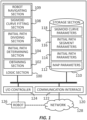
- FIG. 1 shows an exemplary hardware configuration for global path planning using piecewise sigmoid curves, according to an embodiment of the present invention.
- the exemplary hardware configuration includes global path planning device 120, which communicates with network 128, and interacts with robot 126.
- Global path planning device 120 may be a host computer, such as a server computer or a mainframe computer that executes an on-premise application and hosts client computers that use it, in which case global path planning device 120 may not be directly connected to robot 126, but are connected through network 128.
- Global path planning device 120 may be a computer system that includes two or more computers.
- Global path planning device 120 may be a personal computer or a robot computer, such as a computer mounted on a robot, that executes an application for a user of global path planning device 120.
- Global path planning device 120 includes a logic section 100, a storage section 110, a communication interface 122, and an input/output controller 124.
- Logic section 100 may be a computer program product including one or more computer readable storage mediums collectively storing program instructions that are executable by a processor or programmable circuitry to cause the processor or programmable circuitry to perform the operations of the various sections.
- Logic section 100 may alternatively be analog or digital programmable circuitry, or any combination thereof.
- Logic section 100 may be composed of physically separated storage or circuitry that interacts through communication.
- Storage section 110 may be a non-volatile computer-readable medium capable of storing non-executable data for access by logic section 100 during performance of the processes herein.
- Communication interface 122 reads transmission data, which may be stored on a transmission buffering region provided in a recording medium, such as storage section 110, and transmits the read transmission data to network 128 or writes reception data received from network 128 to a reception buffering region provided on the recording medium.
- Input/output controller 124 connects to various input and output units, such as those on robot 126, via a parallel port, a serial port, a keyboard port, a mouse port, a monitor port, and the like to accept commands and present information.
- Output devices on robot 126 may include a display device, speaker, etc.
- Input devices on robot 126 may include a mouse, keyboard, etc. for receiving human input, and may also be a sensor for detecting various types of sensory data using cameras, accelerometers, GPS, etc.
- sensors may be mounted onto robot 126 that includes global path planning device 120, mounted onto another robot dedicated to environment mapping, mounted onto a structure that is static with respect to an environment that is the subject of mapping, or any combination.
- Logic section 100 includes obtaining section 102, initial path determining section 104, initial path dividing section 106, and sigmoid curve fitting section 108.
- Storage section 110 includes map parameters 112, initial path parameters 114, initial path segment parameters 116, and sigmoid curve parameters 118.
- Obtaining section 102 is the portion of logic section 100 that performs obtaining data from robot 126 and network 128, in the course of global path planning using sigmoid curves.
- Obtaining section 102 may store the data, such as map parameters 112, in storage section 110.
- Obtaining section 102 may include sub-sections for performing additional functions, as described in the flow charts below. Such sub-sections may be referred to by a name associated with their function.
- Initial path determining section 104 is the portion of logic section 100 that determines initial valid paths in the course of global path planning using sigmoid curves. In doing so, initial path determining section 104 may process map parameters 112 to produce an initial valid path. Initial path determining section 104 may determine one or more initial valid paths for a given environment. Initial path determining section 104 may store each initial valid path in storage section 110 as initial path parameters 114. Initial path determining section 104 may include sub-sections for performing additional functions, as described in the flow charts below. Such sub-sections may be referred to by a name associated with their function.
- Initial path dividing section 106 is the portion of logic section 100 that divides the initial valid path into a plurality of individual segments of the initial valid path. In doing so, initial path dividing section 106 may refer to initial path parameters 114, and store initial path segment parameters 116 in storage section 110. Initial path dividing section 106 may include sub-sections for performing additional functions, as described in the flow charts below. Such sub-sections may be referred to by a name associated with their function.
- Sigmoid curve fitting section 108 is the portion of logic section 100 that fits a separate Sigmoid curve respectively to each of the plurality of individual segments of the initial valid path based on parameters of at least one of best smoothness and best security to produce a piecewise Sigmoid curve path. In doing so, sigmoid curve fitting section 108 may refer to initial path segment parameters 116, and store sigmoid curve parameters 118 in storage section 110. Sigmoid curve fitting section 108 may include sub-sections for performing additional functions, as described in the flow charts below. Such sub-sections may be referred to by a name associated with their function.
- Robot navigating section 109 is the portion of logic section 100 that navigates a robot along the piecewise Sigmoid curve path. In doing so, robot navigating section 109 may refer to Sigmoid curve parameters 118, and operate motors of robot 126 accordingly. Robot navigating section 109 may include sub-sections for performing additional functions, as described in the flow charts below. Such sub-sections may be referred to by a name associated with their function.
- the global path planning device may be any other device capable of processing logical functions in order to perform the processes herein.
- the traffic flow inference device may not need to be connected to a network in environments where the input, output, and all information is directly connected.
- the logic section and the storage section need not be entirely separate devices, but may share one or more computer-readable mediums.
- the storage section may be a hard drive storing both the computer-executable instructions and the data accessed by the logic section
- the logic section may be a combination of a central processing unit (CPU) and random access memory (RAM), in which the computer-executable instructions may be copied in whole or in part for execution by the CPU during performance of the processes herein.
- CPU central processing unit
- RAM random access memory
- a program that is installed in the computer can cause the computer to function as or perform operations associated with apparatuses of the embodiments of the present invention or one or more sections (including modules, components, elements, etc.) thereof, and/or cause the computer to perform processes of the embodiments of the present invention or steps thereof.
- a program may be executed by a processor to cause the computer to perform certain operations associated with some or all of the blocks of flowcharts and block diagrams described herein.
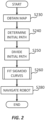
- FIG. 2 shows an exemplary method for global path planning using piecewise sigmoid curves, according to an embodiment of the present invention.
- the operational flow may provide a method of global path planning using piecewise sigmoid curves.
- an obtaining section such as obtaining section 102, obtains a map of an environment including a starting position, an ending position, and at least one obstacle between the starting position and the ending position.
- the map may be compiled from sensory data from observing an environment and capturing sensory data thereof.
- the sensory data may include images, video, spatial data, etc.
- the obtaining section may obtain the map directly from a robot, such as robot 126, or through a network to which the input device is connected.
- the obtaining section may store the map as map parameters, such as map parameters 112, within storage section 110.
- an initial path determining section determines an initial valid path for guiding a robot from the starting position to the ending position.
- the initial valid path may be acquired using a global path planner algorithm, such as A*, Dijkstra, etc., to search for and acquire an initial valid path, e.g., a shortest possible path, and form a search area based on an extension of the initial path.
- the obtaining section may store the initial valid path as initial path parameters, such as initial path parameters 114, within storage section 110.
- an initial path dividing section such as initial path dividing section 106, divides the initial valid path into a plurality of individual segments of the initial valid path. For example, the path may be divided based on the number and location of obstacles in the environment between the starting point and the ending point.
- the obtaining section may store the individual segments as initial path segment parameters, such as initial path segment parameters 116, within storage section 110.
- a Sigmoid curve fitting section such as Sigmoid curve fitting section 108, fits a separate Sigmoid curve respectively to each of the plurality of individual segments of the initial valid path based on parameters of at least one of smoothness and security to produce a piecewise Sigmoid curve path.
- a smoothness parameter may relate to the ability of a robot navigating along the Sigmoid curve to move continuously and reduce the starting and stopping of the onboard motors.
- a security parameter may relate to the ability of a robot navigating along the Sigmoid curve to avoid and maintain distance from obstacles in the environment.
- the piecewise Sigmoid curve path is piece-wise fit such that the initial point and direction of each subsequent Sigmoid curve coincides with the final point and direction of each previous Sigmoid curve.
- a robot navigating section such as robot navigating section 109, navigates a robot along the piecewise Sigmoid curve path.
- robot navigating section operates motors of a robot, such as robot 126, to navigate the robot along the piecewise Sigmoid curve path.
- robot navigating section may refer to sensory data in order to verify that the robot is navigating along the Sigmoid wise curve.
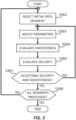
- FIG. 3 shows an exemplary method of fitting Sigmoid curves to individual segments of an initial valid path to produce a piecewise Sigmoid curve path, according to an embodiment of the present invention.
- the operations within this operational flow may be performed by a Sigmoid curve fitting section, such as Sigmoid curve fitting section 108, or a correspondingly named sub-section thereof.
- an initial path segment selecting section such as Sigmoid curve fitting section 108 or a sub-section thereof, selects an initial path segment among the initial path segments. As iterations of the operational flow for global path planning proceed, only previously unselected initial path segments may be selected at S361, to ensure that each initial path segment is processed. For example, initial path segment selecting section may select the initial path segments in order from the starting position to the ending position.
- a parameter adjusting section such as Sigmoid curve fitting section 108 or a sub-section thereof, adjusts at least one of a curve height parameter, a curve start position parameter, a curve sharpness parameter, and a length parameter of a Sigmoid curve occupying the space of the selected initial path segment.
- a smoothness evaluating section such as Sigmoid curve fitting section 108 or a sub-section thereof evaluates a smoothness of the Sigmoid curve occupying the space of the selected initial path segment.
- the smoothness evaluating section may evaluate the ability of a robot navigating along the Sigmoid curve to move continuously and the amount of starting and stopping of the onboard motors.
- a smooth term ( J smooth ) may be realized by setting limitation to the maximal slope of the path function, that is max d path i dt ⁇ C i where d path(i) / dt is the slope of the path and C i is the desired maximum slope.
- a security evaluating section such as Sigmoid curve fitting section 108 or a sub-section thereof evaluates a security of the Sigmoid curve occupying the space of the selected initial path segment.
- the security evaluating section may evaluate ability of a robot navigating along the Sigmoid curve to avoid and maintain distance from obstacles in the environment.
- a Sigmoid curve fitting section determines whether the selected initial path segment has an acceptable security and smoothness, based on the evaluations at S364 and S365.
- a 'cost' function may be applied.
- a 'cost' function J may then be maximized and applied within a search area around an initial valid path segment to obtain parameters of an improved path.
- each Sigmoid curve may be adjusted based on these terms to arrive at a final smooth and secure global path.
- a Sigmoid curve fitting section determines whether all of initial path segments have been processed by the Sigmoid curve fitting section. If any initial path segments remain unprocessed, then the operational flow returns to S361, where initial path segment is selected for processing. If no initial path segments remain unprocessed, then the operational flow ends.
- FIG. 4 shows a map of an environment subjected to global path planning using piecewise sigmoid curves, according to an embodiment of the present invention.
- a piecewise Sigmoid curve path includes three Sigmoid curves 418S 1 , 418S 2 , and 418S 3 defining a single, smooth, and continuous path from starting position 412Ps to ending position 412P E .
- an initial valid path 414 was acquired using a global path planner algorithm, such as A*, Dijkstra, etc., to search for and determine an initial valid path, e.g., a shortest possible path, and form a search area based on an extension of the initial path.
- a global path planner algorithm such as A*, Dijkstra, etc.
- obstacles such as doorway 412D 1 , narrow hallway 412N, and doorway 412D 2 are encountered.
- initial valid path 414 was prepared for piece-wise fitting by dividing the unsmooth, initial valid path into individual segments, such that the individual segments could be joined at midpoints between the obstacles (e.g., midway between doorway 412D 1 , narrow hallway 412N, and doorway 412D 2 ). More specifically, initial valid path 414 was divided into three segments. A first segment of initial valid path 414 includes a Sigmoid curve fit through doorway 412D 1 . A second segment of initial valid path 414 includes a Sigmoid curve fit through narrow hallway 412N, and a third segment of initial valid path 414 includes a Sigmoid curve fit through a central region and doorway 412D 2 .
- Sigmoid curves 418S 1 , 418S 2 , and 418S 3 were adjusted to an acceptable level of security and smoothness. Due to the adjustments, Sigmoid curve 418S 1 has increased clearance through doorway 412D 1 without sacrificing smoothness; Sigmoid curve 418S 2 has increased smoothness through narrow hallway 412N while avoiding unnecessary security; and Sigmoid curve 418S 3 has increased clearance through doorway 412D 2 without sacrificing smoothness.
- FIG. 5 shows a comparative example of a path of piecewise Sigmoid curves, according to an embodiment of the present invention.
- FIG. 5 only two Sigmoid curves, 518S 1 and 518S 2 form the global path from starting position 512Ps to ending position 512P E .
- the path shown in the central region of FIG. 5 appears sub-optimal. For example, a person walking the path would have taken a straighter path to the doorway in the upper right corner of FIG. 5 . This could be due to sub-optimal selection of the number of Sigmoid curves, sub-optimal dividing of the initial valid path, or perhaps starting without an initial valid path. Without use of the initial valid path prior to fitting Sigmoid curves, the path through the central region of FIG. 5 becomes extended and unnatural, leading to sub-optimal smoothness.
- FIG. 6 shows an example of a Sigmoid curve based on a Gompertz function, according to an embodiment of the present invention.
- a Gompertz Sigmoid curve is a well-defined mathematical function.
- the parameters a, b, c and t_end are adjusted to fit a Gompertz function to each of the individual segments of the initial valid path.
- the parameters ( a, b, c, t_end ) of each Gompertz function are adjusted during global path planning to maximize clearances from obstacles of a given individual segment of an initial valid path, and to increase smoothness.
- a defines the height of a curve [a > 0]
- b defines the position at which the curve is started [b ⁇ 0]
- c defines the sharpness of the curve (i.e. sharp turn or smooth turn ) [c ⁇ 0]
- t_end which appears in the parametric form of the equation, defines the length of the curve.
- any type of Sigmoid curve can be used as well in the same way.
- Parameters a, b, and c can be added to the general equations of other Sigmoid curves to obtain similar behavior.
- the parameters a, b, and c can be adjusted to optimize a piecewise Sigmoid curve path.
- Sigmoid curve functions can be made similarly adjustable by introducing a, b, and c parameters appropriately.
- a Gompertz Sigmoid curve and other Sigmoid curve functions can also be used to represent straight lines so that it can be used for generating straight line paths for a robot simply by setting parameter c to be zero.
- processes or blocks are presented in a given order, alternative embodiments may perform routines having operations, or employ systems having blocks, in a different order, and some processes or blocks may be deleted, moved, added, subdivided, combined, and/or modified. While processes or blocks are at times shown as being performed in series, these processes or blocks may instead be performed in parallel, or may be performed at different times. Further, any specific numbers noted herein are only examples; alternative implementations may employ differing values or ranges.
- routines are software program executed by computer hardware and that a subroutine is a software program executed within another routine.
- routines discussed herein may be executed within another routine and subroutines may be executed independently, i.e., routines may be subroutines and vice versa.
- module may refer to, be part of, or include an Application Specific Integrated Circuit (ASIC), a System on a Chip (SoC), an electronic circuit, a programmed programmable circuit (such as, Field Programmable Gate Array (FPGA)), a processor (shared, dedicated, or group) and/or memory (shared, dedicated, or group) or in another computer hardware component or device that execute one or more software or firmware programs or routines having executable machine instructions (generated from an assembler and/or a compiler) or a combination, a combinational logic circuit, and/or other suitable components with logic that provide the described functionality.
- ASIC Application Specific Integrated Circuit
- SoC System on a Chip
- FPGA Field Programmable Gate Array
- Modules may be distinct and independent components integrated by sharing or passing data, or the modules may be subcomponents of a single module, or be split among several modules.
- the components may be processes running on, or implemented on, a single computer, processor or controller node or distributed among a plurality of computer, processor or controller nodes running in parallel, concurrently, sequentially or a combination.
- Various embodiments of the present invention may be described with reference to flowcharts and block diagrams whose blocks may represent (1) steps of processes in which operations are performed or (2) sections of apparatuses responsible for performing operations. Certain steps and sections may be implemented by dedicated circuitry, programmable circuitry supplied with computer-readable instructions stored on computer-readable media, and/or processors supplied with computer-readable instructions stored on computer-readable media.
- Dedicated circuitry may include digital and/or analog hardware circuits and may include integrated circuits (IC) and/or discrete circuits.
- Programmable circuitry may include reconfigurable hardware circuits comprising logical AND, OR, XOR, NAND, NOR, and other logical operations, flip-flops, registers, memory elements, etc., such as field-programmable gate arrays (FPGA), programmable logic arrays (PLA), etc.
- FPGA field-programmable gate arrays
- PLA programmable logic arrays
Landscapes
- Engineering & Computer Science (AREA)
- Radar, Positioning & Navigation (AREA)
- Remote Sensing (AREA)
- Automation & Control Theory (AREA)
- Physics & Mathematics (AREA)
- General Physics & Mathematics (AREA)
- Aviation & Aerospace Engineering (AREA)
- Manipulator (AREA)
- Control Of Position, Course, Altitude, Or Attitude Of Moving Bodies (AREA)
Description
- The field of the invention relates to robot motion and a global path plan for a robot.
- ROS navigation stack is a powerful tool for mobile robots to move reliably from place to place. The job of a navigation stack is to produce a safe path for a robot to navigate, by processing data from odometry, sensors, and a map of the environment.
- Dynamics (e.g., the velocity and acceleration of a robot) are essential for local path planners, including dynamic window approach (DWA) and time elastic band (TEB). In the ROS navigation stack, a local path planner inputs sensor and odometry messages and outputs velocity commands that control the robot's motion. In ROS navigation, translational and rotational velocity and acceleration are required. Translational velocity (m/s) is the velocity when a robot is moving in a straight line, and rotational velocity (rad/s) is equivalent to angular velocity.
- Three parameters determine the quality of the planned global path: cost factor, neutral cost, and lethal cost. If cost factor is higher, cost values will have a plateau around obstacles and the planner will then treat (for example) the whole width of a narrow hallway as equally undesirable and thus will not plan paths down the center. Extreme neutral cost values have the same effect. For lethal cost, setting it to a low value may result in failure to produce any path, even when a feasible path is obvious.
- In mobile robotics, global paths may be planned for a mobile robot using the A*, Dijkstra, or Voronoi algorithms or their variants. However, there is a need to improve on conventional ill-defined paths for robot motion.
The document COLE KENAN ET AL: "Reactive Trajectory Generation for Multiple Vehicles in Unknown Environments With Wind Disturbances", XP011690922 shows a method for determining a path based on a segmented trajectory. The smoothness for the individual segments is taken into account for determining the path.
The document MARTINEZ-ALFARO H ET AL: "Collision-free path planning for mobile robots and/or AGVs using simulated annealing", XP010138896 shows a method for determining optimal paths for autonomous vehicles. Especially, the use of segmented paths is shown there.
The documentUS 9,804,603 B1
The document Rairan Jose Danilo: "Robot path optimization based on a reference model and sigmoid functions", XP093121376 shows a path optimization using sigmoid segments based upon route length and obstacles avoidance. - The present invention is defined by the independent claims. The dependent claims shows further advantageous developments.
- In accordance with an aspect of the present invention, global paths are planned using piecewise Sigmoid curves by determining an initial valid path for guiding a robot from a starting position to an ending position, dividing the initial valid path into a plurality of individual segments of the initial valid path, and fitting a separate Sigmoid curve respectively to each of the plurality of individual segments of the initial valid path based on parameters of at least one of smoothness and security to produce a piecewise Sigmoid curve path. By planning global paths in this manner, a robot navigating along the piecewise Sigmoid curve path may move continuously, smoothly, and with a reduced amount of starting and stopping of the onboard motors while avoiding and maintaining distance from obstacles in the environment.
- This aspect may also include the method performed by the computer executing the instructions of the computer program, and an apparatus that performs the method.
- The summary clause does not necessarily describe all necessary features of the embodiments of the present invention. The present invention may also be a sub-combination of the features described above.
-
-
FIG. 1 shows an exemplary hardware configuration for global path planning using piecewise sigmoid curves, according to an embodiment of the present invention. -
FIG. 2 shows an exemplary method for global path planning using piecewise sigmoid curves, according to an embodiment of the present invention. -
FIG. 3 shows an exemplary method of fitting Sigmoid curves to individual segments of an initial valid path to produce a piecewise Sigmoid curve path, according to an embodiment of the present invention. -
FIG. 4 shows a map of an environment subjected to global path planning using piecewise sigmoid curves, according to an embodiment of the present invention. -
FIG. 5 shows a path of piecewise sigmoid curves, according to an embodiment of the present invention. -
FIG. 6 shows an example of a Sigmoid curve based on a Gompertz function, according to an embodiment of the present invention. -
FIG. 7 shows a path of piecewise sigmoid curves illustrating a curve height adjustment, according to an embodiment of the present invention. -
FIG. 8 shows a path of piecewise sigmoid curves illustrating curve starting point and curve sharpness adjustments, according to an embodiment of the present invention. - To plan a global path, robot motion control with well-defined, smooth, continuous, and non-stop paths may be obtained such that the robot can navigate from the start point to goal point in a smooth and continuous motion. The well-defined, smooth, continuous, and non-stop path may be acquired using piecewise well-defined mathematical shapes, such as Sigmoid curves, that allow a robot to navigate from goal point to start point in a single, smooth and continuous motion.
- In mobile robotics, global paths may be planned for a mobile robot using the A*, Dijkstra, or Voronoi algorithms or their variants. However, all of these algorithms give paths that are either non-smooth or ill-defined paths, or paths that hug obstacles. Such non-optimal paths may lead to several other problems, such as (1) unnecessary stop-and-re-plan behavior which may result in robot motion that becomes non-continuous, (2) the robot opts not to navigate through a narrow area whereas in fact it is capable of doing so, i.e., the robot gets stuck, or (3) higher likelihood of obstacle collision since the robot may drift while following a path that hugs an obstacle, thus again leading to stop-and-re-plan behavior which may result in robot motion that becomes non-continuous.
- The A* star path planning algorithm returns the shortest possible path from the goal point to destination point. Since it is the shortest path, the path hugs the environment and passes very close to obstacles in the environment (i.e., results in "hugging"). To prevent hugging, an inflation layer may be used as a workaround using an inflation radius, which increases the size of obstacles in the environment so that the robot does not hug as close to the environment. However, inflation layering may make a robot think a passageway is too narrow to pass through, whereas in fact the robot can pass through. Thus, inflation layer use may create a problem of the robot getting stuck in a narrow area when it is actually capable of passing through. In other words, since the inflation radius increases the size of obstacles in the environment, a narrow zone which the robot can otherwise pass safely through appears too narrow for the robot to pass through due to the inflation radius. Thus, the robot stops.
- The A* star algorithm uses grids for planning. The coarser the grid, the less smooth the path is, thus paths that are not smooth are generated. Finer grids can be used to smooth such paths to a certain extent, but this may increase processing time. In addition, since the A* star algorithm gives the shortest possible path, the path may not be mathematically definable.
- Using Dijkstra, paths may also not be well defined or smooth since Dijkstra paths are similar to A* paths in that A* is a special variant of Dijkstra.
- The embodiments herein may provide improved and refined robot motion along a global path using a piecewise Sigmoid curve path based on an initial valid path returned by a planner, resulting in a smoother generated path. The resulting path may be well-defined, continuous and smooth, resulting in smooth and continuous robot motion while maximizing secure cost, establishing secure clearance of obstacles.
- Embodiments herein may also provide adjustment that is much easier than ROS navigation stack systems. Also, as distances from obstacles in an environment are maximized, a robot may navigate continuously without any stop and go behavior.
- Embodiments herein may avoid problems with A*, Dijkstra, or Voronoi path planning, such as ill-defined paths that are not smooth, hugging to obstacles leading to a greater likelihood of stop and re-plan behavior, and/or getting stuck. Individual Sigmoid curves may be best fit to individual segments of an initial valid path based on smoothness and security.
-
FIG. 1 shows an exemplary hardware configuration for global path planning using piecewise sigmoid curves, according to an embodiment of the present invention. The exemplary hardware configuration includes globalpath planning device 120, which communicates withnetwork 128, and interacts withrobot 126. Globalpath planning device 120 may be a host computer, such as a server computer or a mainframe computer that executes an on-premise application and hosts client computers that use it, in which case globalpath planning device 120 may not be directly connected torobot 126, but are connected throughnetwork 128. Globalpath planning device 120 may be a computer system that includes two or more computers. Globalpath planning device 120 may be a personal computer or a robot computer, such as a computer mounted on a robot, that executes an application for a user of globalpath planning device 120. - Global
path planning device 120 includes alogic section 100, astorage section 110, acommunication interface 122, and an input/output controller 124.Logic section 100 may be a computer program product including one or more computer readable storage mediums collectively storing program instructions that are executable by a processor or programmable circuitry to cause the processor or programmable circuitry to perform the operations of the various sections.Logic section 100 may alternatively be analog or digital programmable circuitry, or any combination thereof.Logic section 100 may be composed of physically separated storage or circuitry that interacts through communication.Storage section 110 may be a non-volatile computer-readable medium capable of storing non-executable data for access bylogic section 100 during performance of the processes herein.Communication interface 122 reads transmission data, which may be stored on a transmission buffering region provided in a recording medium, such asstorage section 110, and transmits the read transmission data to network 128 or writes reception data received fromnetwork 128 to a reception buffering region provided on the recording medium. Input/output controller 124 connects to various input and output units, such as those onrobot 126, via a parallel port, a serial port, a keyboard port, a mouse port, a monitor port, and the like to accept commands and present information. - Output devices on
robot 126 may include a display device, speaker, etc. Input devices onrobot 126 may include a mouse, keyboard, etc. for receiving human input, and may also be a sensor for detecting various types of sensory data using cameras, accelerometers, GPS, etc. Such sensors may be mounted ontorobot 126 that includes globalpath planning device 120, mounted onto another robot dedicated to environment mapping, mounted onto a structure that is static with respect to an environment that is the subject of mapping, or any combination. -
Logic section 100 includes obtainingsection 102, initialpath determining section 104, initialpath dividing section 106, and sigmoid curvefitting section 108.Storage section 110 includesmap parameters 112,initial path parameters 114, initialpath segment parameters 116, andsigmoid curve parameters 118. - Obtaining
section 102 is the portion oflogic section 100 that performs obtaining data fromrobot 126 andnetwork 128, in the course of global path planning using sigmoid curves. Obtainingsection 102 may store the data, such asmap parameters 112, instorage section 110. Obtainingsection 102 may include sub-sections for performing additional functions, as described in the flow charts below. Such sub-sections may be referred to by a name associated with their function. - Initial
path determining section 104 is the portion oflogic section 100 that determines initial valid paths in the course of global path planning using sigmoid curves. In doing so, initialpath determining section 104 may process mapparameters 112 to produce an initial valid path. Initialpath determining section 104 may determine one or more initial valid paths for a given environment. Initialpath determining section 104 may store each initial valid path instorage section 110 asinitial path parameters 114. Initialpath determining section 104 may include sub-sections for performing additional functions, as described in the flow charts below. Such sub-sections may be referred to by a name associated with their function. - Initial
path dividing section 106 is the portion oflogic section 100 that divides the initial valid path into a plurality of individual segments of the initial valid path. In doing so, initialpath dividing section 106 may refer toinitial path parameters 114, and store initialpath segment parameters 116 instorage section 110. Initialpath dividing section 106 may include sub-sections for performing additional functions, as described in the flow charts below. Such sub-sections may be referred to by a name associated with their function. - Sigmoid curve
fitting section 108 is the portion oflogic section 100 that fits a separate Sigmoid curve respectively to each of the plurality of individual segments of the initial valid path based on parameters of at least one of best smoothness and best security to produce a piecewise Sigmoid curve path. In doing so, sigmoid curvefitting section 108 may refer to initialpath segment parameters 116, and storesigmoid curve parameters 118 instorage section 110. Sigmoid curvefitting section 108 may include sub-sections for performing additional functions, as described in the flow charts below. Such sub-sections may be referred to by a name associated with their function. -
Robot navigating section 109 is the portion oflogic section 100 that navigates a robot along the piecewise Sigmoid curve path. In doing so,robot navigating section 109 may refer toSigmoid curve parameters 118, and operate motors ofrobot 126 accordingly.Robot navigating section 109 may include sub-sections for performing additional functions, as described in the flow charts below. Such sub-sections may be referred to by a name associated with their function. - In other embodiments, the global path planning device may be any other device capable of processing logical functions in order to perform the processes herein. The traffic flow inference device may not need to be connected to a network in environments where the input, output, and all information is directly connected. The logic section and the storage section need not be entirely separate devices, but may share one or more computer-readable mediums. For example, the storage section may be a hard drive storing both the computer-executable instructions and the data accessed by the logic section, and the logic section may be a combination of a central processing unit (CPU) and random access memory (RAM), in which the computer-executable instructions may be copied in whole or in part for execution by the CPU during performance of the processes herein.
- In embodiments where the global path planning device is a computer, a program that is installed in the computer can cause the computer to function as or perform operations associated with apparatuses of the embodiments of the present invention or one or more sections (including modules, components, elements, etc.) thereof, and/or cause the computer to perform processes of the embodiments of the present invention or steps thereof. Such a program may be executed by a processor to cause the computer to perform certain operations associated with some or all of the blocks of flowcharts and block diagrams described herein.
-
FIG. 2 shows an exemplary method for global path planning using piecewise sigmoid curves, according to an embodiment of the present invention. The operational flow may provide a method of global path planning using piecewise sigmoid curves. - At S230, an obtaining section, such as obtaining
section 102, obtains a map of an environment including a starting position, an ending position, and at least one obstacle between the starting position and the ending position. The map may be compiled from sensory data from observing an environment and capturing sensory data thereof. The sensory data may include images, video, spatial data, etc. The obtaining section may obtain the map directly from a robot, such asrobot 126, or through a network to which the input device is connected. The obtaining section may store the map as map parameters, such asmap parameters 112, withinstorage section 110. - At S240, an initial path determining section, such as initial
path determining section 104, determines an initial valid path for guiding a robot from the starting position to the ending position. The initial valid path may be acquired using a global path planner algorithm, such as A*, Dijkstra, etc., to search for and acquire an initial valid path, e.g., a shortest possible path, and form a search area based on an extension of the initial path. The obtaining section may store the initial valid path as initial path parameters, such asinitial path parameters 114, withinstorage section 110. - At S250, an initial path dividing section, such as initial
path dividing section 106, divides the initial valid path into a plurality of individual segments of the initial valid path. For example, the path may be divided based on the number and location of obstacles in the environment between the starting point and the ending point. The obtaining section may store the individual segments as initial path segment parameters, such as initialpath segment parameters 116, withinstorage section 110. - At S260, a Sigmoid curve fitting section, such as Sigmoid curve
fitting section 108, fits a separate Sigmoid curve respectively to each of the plurality of individual segments of the initial valid path based on parameters of at least one of smoothness and security to produce a piecewise Sigmoid curve path. A smoothness parameter may relate to the ability of a robot navigating along the Sigmoid curve to move continuously and reduce the starting and stopping of the onboard motors. A security parameter may relate to the ability of a robot navigating along the Sigmoid curve to avoid and maintain distance from obstacles in the environment. The piecewise Sigmoid curve path is piece-wise fit such that the initial point and direction of each subsequent Sigmoid curve coincides with the final point and direction of each previous Sigmoid curve. - At S280, a robot navigating section, such as
robot navigating section 109, navigates a robot along the piecewise Sigmoid curve path. For example, robot navigating section operates motors of a robot, such asrobot 126, to navigate the robot along the piecewise Sigmoid curve path. While navigating, robot navigating section may refer to sensory data in order to verify that the robot is navigating along the Sigmoid wise curve. -
FIG. 3 shows an exemplary method of fitting Sigmoid curves to individual segments of an initial valid path to produce a piecewise Sigmoid curve path, according to an embodiment of the present invention. The operations within this operational flow may be performed by a Sigmoid curve fitting section, such as Sigmoid curvefitting section 108, or a correspondingly named sub-section thereof. - At S361, an initial path segment selecting section, such as Sigmoid curve
fitting section 108 or a sub-section thereof, selects an initial path segment among the initial path segments. As iterations of the operational flow for global path planning proceed, only previously unselected initial path segments may be selected at S361, to ensure that each initial path segment is processed. For example, initial path segment selecting section may select the initial path segments in order from the starting position to the ending position. - At S363, a parameter adjusting section, such as Sigmoid curve
fitting section 108 or a sub-section thereof, adjusts at least one of a curve height parameter, a curve start position parameter, a curve sharpness parameter, and a length parameter of a Sigmoid curve occupying the space of the selected initial path segment. - A desired path may be defined as a combination of several sigmoid curves,

where adjacent curves are connected and subject to the following constraints

where tstart and tend are the boundaries of a sigmoid curve i, and xstart and xend are the positions that a piecewise Sigmoid curve path including n Sigmoid curves begins and ends. - At S364, a smoothness evaluating section, such as Sigmoid curve
fitting section 108 or a sub-section thereof, evaluates a smoothness of the Sigmoid curve occupying the space of the selected initial path segment. For example, the smoothness evaluating section may evaluate the ability of a robot navigating along the Sigmoid curve to move continuously and the amount of starting and stopping of the onboard motors. A smooth term (Jsmooth ) may be realized by setting limitation to the maximal slope of the path function, that is

where dpath(i) /dt is the slope of the path and Ci is the desired maximum slope. - At S365, a security evaluating section, such as Sigmoid curve
fitting section 108 or a sub-section thereof, evaluates a security of the Sigmoid curve occupying the space of the selected initial path segment. For example, the security evaluating section may evaluate ability of a robot navigating along the Sigmoid curve to avoid and maintain distance from obstacles in the environment. A secure term (Jsecure ) may be realized by setting limitation to the distance difference between the left obstacle clearance and the right obstacle clearance, defined as

where dj is the total available clearance of an obstacle j, and path(j) is the distance of the path from the obstacle, for each ofobstacles 1 through k. - At S368, a Sigmoid curve fitting section, such as Sigmoid curve
fitting section 108 or a sub-section thereof, determines whether the selected initial path segment has an acceptable security and smoothness, based on the evaluations at S364 and S365. To find the best-fit Sigmoid curve, a 'cost' function may be applied. A 'cost' function J may then be maximized and applied within a search area around an initial valid path segment to obtain parameters of an improved path. The cost function J is defined as:

- If the selected initial path segment has an acceptable security and smoothness, then the operational flow proceeds to S368. If the selected initial path segment has an acceptable security and smoothness, then the operational flow returns to S363, to re-adjust at least one of a curve height parameter, a curve start position parameter, a curve sharpness parameter, and a length parameter of a Sigmoid curve occupying the space of the selected initial path segment. As iterations of S363 to S365 of the operational flow proceed, each Sigmoid curve may be adjusted based on these terms to arrive at a final smooth and secure global path.
- At S368, a Sigmoid curve fitting section, such as Sigmoid curve
fitting section 108 or a sub-section thereof, determines whether all of initial path segments have been processed by the Sigmoid curve fitting section. If any initial path segments remain unprocessed, then the operational flow returns to S361, where initial path segment is selected for processing. If no initial path segments remain unprocessed, then the operational flow ends. -
FIG. 4 shows a map of an environment subjected to global path planning using piecewise sigmoid curves, according to an embodiment of the present invention. A piecewise Sigmoid curve path includes three Sigmoid curves 418S1, 418S2, and 418S3 defining a single, smooth, and continuous path from starting position 412Ps to ending position 412PE. - In particular, as shown in
FIG. 4 , an initialvalid path 414 was acquired using a global path planner algorithm, such as A*, Dijkstra, etc., to search for and determine an initial valid path, e.g., a shortest possible path, and form a search area based on an extension of the initial path. Along the path from starting position 412Ps to ending position 412PE, obstacles, such asdoorway 412D1,narrow hallway 412N, anddoorway 412D2 are encountered. - For this environment, initial
valid path 414 was prepared for piece-wise fitting by dividing the unsmooth, initial valid path into individual segments, such that the individual segments could be joined at midpoints between the obstacles (e.g., midway betweendoorway 412D1,narrow hallway 412N, anddoorway 412D2). More specifically, initialvalid path 414 was divided into three segments. A first segment of initialvalid path 414 includes a Sigmoid curve fit throughdoorway 412D1. A second segment of initialvalid path 414 includes a Sigmoid curve fit throughnarrow hallway 412N, and a third segment of initialvalid path 414 includes a Sigmoid curve fit through a central region anddoorway 412D2. - Each of the Sigmoid curves 418S1, 418S2, and 418S3 were adjusted to an acceptable level of security and smoothness. Due to the adjustments, Sigmoid curve 418S1 has increased clearance through
doorway 412D1 without sacrificing smoothness; Sigmoid curve 418S2 has increased smoothness throughnarrow hallway 412N while avoiding unnecessary security; and Sigmoid curve 418S3 has increased clearance throughdoorway 412D2 without sacrificing smoothness. -
FIG. 5 shows a comparative example of a path of piecewise Sigmoid curves, according to an embodiment of the present invention. InFIG. 5 , only two Sigmoid curves, 518S1 and 518S2 form the global path from starting position 512Ps to endingposition 512PE. In comparing the piecewise Sigmoid curve paths inFIG. 4 and FIG. 5 , note how the path shown in the central region ofFIG. 5 appears sub-optimal. For example, a person walking the path would have taken a straighter path to the doorway in the upper right corner ofFIG. 5 . This could be due to sub-optimal selection of the number of Sigmoid curves, sub-optimal dividing of the initial valid path, or perhaps starting without an initial valid path. Without use of the initial valid path prior to fitting Sigmoid curves, the path through the central region ofFIG. 5 becomes extended and unnatural, leading to sub-optimal smoothness. - After the initial valid path was determined and divided into segments, the individual segments of the initial valid path were then piece-wise fit into a well-defined mathematical shape, such as Sigmoid curves. A Sigmoid curve is, generally speaking, a mathematically-defined 'S' shaped curve that may extend out to be a straight line at one extreme, and be a step-shape with rounded corners at the other extreme.
-
FIG. 6 shows an example of a Sigmoid curve based on a Gompertz function, according to an embodiment of the present invention. A Gompertz Sigmoid curve, is a well-defined mathematical function. In non-parametric form, the Gompertz Sigmoid curve is represented as:

and in parametric form, the Gompertz Sigmoid curve is represented as:

- The parameters a, b, c and t_end are adjusted to fit a Gompertz function to each of the individual segments of the initial valid path. The parameters (a, b, c, t_end) of each Gompertz function are adjusted during global path planning to maximize clearances from obstacles of a given individual segment of an initial valid path, and to increase smoothness.
- In the Gompertz Sigmoid curve, a defines the height of a curve [a > 0], b defines the position at which the curve is started [b < 0], c defines the sharpness of the curve (i.e. sharp turn or smooth turn ) [c < 0], and t_end, which appears in the parametric form of the equation, defines the length of the curve.
- In addition to the Gompertz Sigmoid curve, any type of Sigmoid curve can be used as well in the same way. Parameters a, b, and c can be added to the general equations of other Sigmoid curves to obtain similar behavior. The parameters a, b, and c can be adjusted to optimize a piecewise Sigmoid curve path. For instance, the Sigmoid curve may be a Logistic function:

- a Hyperbolic tangent:

- an Arctangent function:

- a Gudermannian function:

- an Error function:

- a Generalized logistic function:

- a Smoothstep function:

- or even an Algebraic function:

- For instance, consider a Logistic function Sigmoid curve. By introducing parameters a, b, and c to the Logistic function, the Logistic function equation becomes:

- In this way, adjustment of the Logistic function equation behaves just like adjustment of the Gompertz Sigmoid curve, and thus can be adjusted in the same way. As another example, by introducing the a, b, and c parameters into the Arctangent function results in the following equation:

- Other Sigmoid curve functions can be made similarly adjustable by introducing a, b, and c parameters appropriately. For completeness, it should be understood that a Gompertz Sigmoid curve and other Sigmoid curve functions can also be used to represent straight lines so that it can be used for generating straight line paths for a robot simply by setting parameter c to be zero.
- For example, while processes or blocks are presented in a given order, alternative embodiments may perform routines having operations, or employ systems having blocks, in a different order, and some processes or blocks may be deleted, moved, added, subdivided, combined, and/or modified. While processes or blocks are at times shown as being performed in series, these processes or blocks may instead be performed in parallel, or may be performed at different times. Further, any specific numbers noted herein are only examples; alternative implementations may employ differing values or ranges.
- Unless the context clearly requires otherwise, throughout the description and the claims, references are made herein to routines, subroutines, and modules. Generally it should be understood that a routine is a software program executed by computer hardware and that a subroutine is a software program executed within another routine. However, routines discussed herein may be executed within another routine and subroutines may be executed independently, i.e., routines may be subroutines and vice versa. As used herein, the term "module" (or "logic") may refer to, be part of, or include an Application Specific Integrated Circuit (ASIC), a System on a Chip (SoC), an electronic circuit, a programmed programmable circuit (such as, Field Programmable Gate Array (FPGA)), a processor (shared, dedicated, or group) and/or memory (shared, dedicated, or group) or in another computer hardware component or device that execute one or more software or firmware programs or routines having executable machine instructions (generated from an assembler and/or a compiler) or a combination, a combinational logic circuit, and/or other suitable components with logic that provide the described functionality. Modules may be distinct and independent components integrated by sharing or passing data, or the modules may be subcomponents of a single module, or be split among several modules. The components may be processes running on, or implemented on, a single computer, processor or controller node or distributed among a plurality of computer, processor or controller nodes running in parallel, concurrently, sequentially or a combination.
- Various embodiments of the present invention may be described with reference to flowcharts and block diagrams whose blocks may represent (1) steps of processes in which operations are performed or (2) sections of apparatuses responsible for performing operations. Certain steps and sections may be implemented by dedicated circuitry, programmable circuitry supplied with computer-readable instructions stored on computer-readable media, and/or processors supplied with computer-readable instructions stored on computer-readable media. Dedicated circuitry may include digital and/or analog hardware circuits and may include integrated circuits (IC) and/or discrete circuits. Programmable circuitry may include reconfigurable hardware circuits comprising logical AND, OR, XOR, NAND, NOR, and other logical operations, flip-flops, registers, memory elements, etc., such as field-programmable gate arrays (FPGA), programmable logic arrays (PLA), etc.
- The operations, procedures, steps, and stages of each process performed by an apparatus, system, program, and method shown in the claims, embodiments, or diagrams can be performed in any order as long as the order is not indicated by "prior to," "before," or the like and as long as the output from a previous process is not used in a later process. Even if the process flow is described using phrases such as "first" or "next" in the claims, embodiments, or diagrams, it does not necessarily mean that the process must be performed in this order.
Claims (15)
- A method comprising:determining (S240) an initial valid path for guiding a robot from a starting position to an ending position;dividing (S250) the initial valid path into a plurality of individual segments of the initial valid path; andfitting (S260) a separate Sigmoid curve respectively to each of the plurality of individual segments of the initial valid path based on parameters of at least one of smoothness and security to produce a piecewise Sigmoid curve path,wherein the determining (S240) the initial valid path includes applying one of an A* algorithm and a Dijkstra algorithm between the starting position and the ending position.
- The method of Claim 1, wherein:
the fitting (S260) includes adjusting a curve height parameter, a curve start position parameter, a curve sharpness parameter, or a length parameter of each Sigmoid curve. - The method of Claim 2, wherein:
the adjusting includes adjusting the parameters according to one of a Gompertz function, a logistic function, a hyperbolic tangent function, an arctangent function, a hyperbolic tangent function, an arctangent function, a Gudermannian function, an error function, a generalized logistic function, a smoothstep function, and an algebraic function. - The method of any of Claims 1-3, further comprising:
navigating (S280) a robot along the piecewise Sigmoid curve path. - The method of any of Claims 1-4, further comprising:
obtaining (S230) a map of an environment including the starting position, the ending position, and at least one obstacle between the starting position and the ending position. - A computer program that is executable by a computer to cause the computer to perform operations comprising:determining (S240) an initial valid path for guiding a robot from a starting position to an ending position;dividing (S250) the initial valid path into a plurality of individual segments of the initial valid path; andfitting (S260) a separate Sigmoid curve respectively to each of the plurality of individual segments of the initial valid path based on parameters of at least one of smoothness and security to produce a piecewise Sigmoid curve path,wherein the determining (S240) the initial valid path includes applying one of an A* algorithm and a Dijkstra algorithm between the starting position and the ending position.
- The computer program of Claim 6, wherein:
the fitting (S260) includes adjusting a curve height parameter, a curve start position parameter, a curve sharpness parameter, or a length parameter of each Sigmoid curve. - The computer program of Claim 7, wherein:
the adjusting includes adjusting the parameters according to one of a Gompertz function, a logistic function, a hyperbolic tangent function, an arctangent function, a hyperbolic tangent function, an arctangent function, a Gudermannian function, an error function, a generalized logistic function, a smoothstep function, and an algebraic function. - The computer program of any of Claims 6-8, further comprising:
navigating (S280) a robot along the piecewise Sigmoid curve path. - The computer program of any of Claims 6-9, further comprising:
obtaining (S230) a map of an environment including the starting position, the ending position, and at least one obstacle between the starting position and the ending position. - An apparatus (120) comprising:an initial path determining section (104) configured to determine an initial valid path for guiding a robot from a starting position to an ending position;an initial path dividing section (106) configured to divide the initial valid path into a plurality of individual segments of the initial valid path; anda Sigmoid curve fitting section (108) configured to fit a separate Sigmoid curve respectively to each of the plurality of individual segments of the initial valid path based on parameters of at least one of smoothness and security to produce a piecewise Sigmoid curve path,wherein the initial valid path determining section (104) applies one of an A* algorithm and a Dijkstra algorithm between the starting position and the ending position.
- The apparatus of Claim 11, wherein:
the Sigmoid curve fitting section (108) includes an adjusting section configured to adjust a curve height parameter, a curve start position parameter, a curve sharpness parameter, or a length parameter of each Sigmoid curve. - The apparatus of Claim 12, wherein:
the adjusting section is further configured to adjust the parameters according to one of a Gompertz function, a logistic function, a hyperbolic tangent function, an arctangent function, a hyperbolic tangent function, an arctangent function, a Gudermannian function, an error function, a generalized logistic function, a smoothstep function, and an algebraic function. - The apparatus of any of Claims 11-13, further comprising:
a robot navigating section (109) configured to navigate a robot along the piecewise Sigmoid curve path. - The apparatus of any of Claims 11-14, further comprising:
an obtaining section configured to obtain a map of an environment including the starting position, the ending position, and at least one obstacle between the starting position and the ending position.
Applications Claiming Priority (1)
| Application Number | Priority Date | Filing Date | Title |
|---|---|---|---|
| PCT/CN2019/096909 WO2021012125A1 (en) | 2019-07-19 | 2019-07-19 | Global path planning using piecewise sigmoid curves |
Publications (3)
| Publication Number | Publication Date |
|---|---|
| EP3994537A1 EP3994537A1 (en) | 2022-05-11 |
| EP3994537A4 EP3994537A4 (en) | 2022-07-27 |
| EP3994537B1 true EP3994537B1 (en) | 2025-03-12 |
Family
ID=74192610
Family Applications (1)
| Application Number | Title | Priority Date | Filing Date |
|---|---|---|---|
| EP19938153.4A Active EP3994537B1 (en) | 2019-07-19 | 2019-07-19 | Global path planning using piecewise sigmoid curves |
Country Status (4)
| Country | Link |
|---|---|
| US (1) | US20220136837A1 (en) |
| EP (1) | EP3994537B1 (en) |
| CN (1) | CN114127653A (en) |
| WO (1) | WO2021012125A1 (en) |
Families Citing this family (11)
| Publication number | Priority date | Publication date | Assignee | Title |
|---|---|---|---|---|
| EP4298399B1 (en) * | 2021-02-24 | 2026-04-15 | Epiroc Rock Drills Aktiebolag | Method and system for autononomus driving of a mining machine in an underground environment |
| CN113091750B (en) * | 2021-04-12 | 2023-04-07 | 京东科技信息技术有限公司 | Local path planning method, device, computer equipment and storage medium |
| CN113325846B (en) * | 2021-05-31 | 2024-02-27 | 西安建筑科技大学 | A dynamic path planning method for unmanned mining trucks in open-pit mines based on the improved TEB method |
| CN114636415A (en) * | 2022-02-21 | 2022-06-17 | 广州科语机器人有限公司 | Movement route optimization display method and device, computer equipment and storage medium |
| US20230311934A1 (en) * | 2022-03-31 | 2023-10-05 | Wipro Limited | Method and system for dynamically controlling navigation of an autonomous vehicle |
| CN117193278B (en) * | 2022-05-31 | 2024-08-02 | 深圳市普渡科技有限公司 | Method, apparatus, computer device and storage medium for dynamic edge path generation |
| CN115061470B (en) * | 2022-06-30 | 2023-03-21 | 哈尔滨理工大学 | Improved TEB navigation method for unmanned vehicles suitable for narrow spaces |
| US12504765B2 (en) * | 2024-01-04 | 2025-12-23 | Inception Robotics, LLC | Artificial intelligence (AI)-based system for autonomous navigation of robotic devices in dynamic human-centric environments and method thereof |
| CN118404576B (en) * | 2024-04-10 | 2025-11-07 | 福州大学 | Sampling motion planning method based on working space guidance |
| CN118310535B (en) * | 2024-06-07 | 2024-10-11 | 江苏苏亿盟智能科技有限公司 | Robot path planning method and system |
| CN119335952B (en) * | 2024-12-13 | 2025-05-02 | 苏州谋迅智能科技有限公司 | Method for re-optimizing S-shaped speed curve |
Family Cites Families (14)
| Publication number | Priority date | Publication date | Assignee | Title |
|---|---|---|---|---|
| DE102008013988B4 (en) * | 2007-03-13 | 2022-07-21 | Continental Autonomous Mobility Germany GmbH | Method and device for performing an evasive maneuver |
| JP2015535373A (en) * | 2012-10-05 | 2015-12-10 | アイロボット コーポレイション | Robot management system and method for using it to determine the attitude of a docking station including a mobile robot |
| EP3084539B1 (en) * | 2013-12-19 | 2019-02-20 | Aktiebolaget Electrolux | Prioritizing cleaning areas |
| US9283967B2 (en) * | 2014-07-16 | 2016-03-15 | GM Global Technology Operations LLC | Accurate curvature estimation algorithm for path planning of autonomous driving vehicle |
| US9804603B1 (en) | 2015-03-18 | 2017-10-31 | Ag Leader Technology | Curved path approximation in vehicle guidance systems and methods |
| CN105955280A (en) * | 2016-07-19 | 2016-09-21 | Tcl集团股份有限公司 | Mobile robot path planning and obstacle avoidance method and system |
| CN108253984A (en) * | 2017-12-19 | 2018-07-06 | 昆明理工大学 | A kind of method for planning path for mobile robot based on improvement A star algorithms |
| US10901424B2 (en) * | 2018-03-28 | 2021-01-26 | Wipro Limited | Method and system for generating a safe navigation path in real-time for navigating a vehicle |
| CN108645411B (en) * | 2018-05-15 | 2020-07-10 | 深圳大学 | Robot path planning method, device and terminal equipment based on particle swarm optimization |
| CN109227549A (en) * | 2018-11-08 | 2019-01-18 | 汕头大学 | A kind of smooth avoidance motion planning method of robot based on tangent line recursion |
| US20200241541A1 (en) * | 2019-01-28 | 2020-07-30 | GM Global Technology Operations LLC | System and method of an algorithmic solution to generate a smooth vehicle velocity trajectory for an autonomous vehicle with spatial speed constraints |
| CN109799822A (en) * | 2019-01-30 | 2019-05-24 | 中国石油大学(华东) | Mobile robot global smooth paths planing method |
| CN109798909A (en) * | 2019-02-01 | 2019-05-24 | 安徽达特智能科技有限公司 | A kind of method of global path planning |
| US11614740B2 (en) * | 2019-05-28 | 2023-03-28 | Baidu Usa Llc | Determining speeds for an autonomous vehicle |
-
2019
- 2019-07-19 EP EP19938153.4A patent/EP3994537B1/en active Active
- 2019-07-19 CN CN201980098593.0A patent/CN114127653A/en active Pending
- 2019-07-19 WO PCT/CN2019/096909 patent/WO2021012125A1/en not_active Ceased
-
2022
- 2022-01-19 US US17/578,936 patent/US20220136837A1/en not_active Abandoned
Non-Patent Citations (1)
| Title |
|---|
| RAIRAN JOSE DANILO: "Robot Path Optimization Based on a Reference Model and Sigmoid Functions", vol. 12, no. 3, 1 January 2015 (2015-01-01), CR, pages 19, XP093121376, ISSN: 1729-8814, Retrieved from the Internet <URL:http://journals.sagepub.com/doi/full-xml/10.5772/60063> [retrieved on 20240118], DOI: 10.5772/60063 * |
Also Published As
| Publication number | Publication date |
|---|---|
| WO2021012125A1 (en) | 2021-01-28 |
| EP3994537A4 (en) | 2022-07-27 |
| US20220136837A1 (en) | 2022-05-05 |
| CN114127653A (en) | 2022-03-01 |
| EP3994537A1 (en) | 2022-05-11 |
Similar Documents
| Publication | Publication Date | Title |
|---|---|---|
| EP3994537B1 (en) | Global path planning using piecewise sigmoid curves | |
| CN111923905B (en) | System and method for estimating trajectory | |
| JP7150067B2 (en) | Vehicle control system, method for controlling vehicle, and non-transitory computer readable memory | |
| EP3702230B1 (en) | Method and apparatus for planning travelling path, and vehicle | |
| US9405293B2 (en) | Vehicle trajectory optimization for autonomous vehicles | |
| US10012984B2 (en) | System and method for controlling autonomous vehicles | |
| JP2022511714A (en) | Perceptual collision avoidance | |
| US20200363816A1 (en) | System and method for controlling autonomous vehicles | |
| EP3373200A1 (en) | Offline combination of convolutional/deconvolutional and batch-norm layers of convolutional neural network models for autonomous driving vehicles | |
| US20200167934A1 (en) | Systems and methods for applying maps to improve object tracking, lane-assignment and classification | |
| US20160318513A1 (en) | Real-time anticipatory speed control | |
| CN111123947B (en) | Robot travel control method and device, electronic equipment, medium and robot | |
| US20180032077A1 (en) | Method for guiding and controlling drone using information for controlling camera of drone | |
| CN111813117A (en) | Robot line patrol priority navigation method, device and equipment | |
| US20250262762A1 (en) | Robot control method and system based on deep reinforcement learning | |
| CN117413233A (en) | track planning device | |
| CN111445723A (en) | vehicle path recognition | |
| CN112415995B (en) | Planning control method based on real-time safety boundary | |
| CN119902432B (en) | Cluster path planning method and system based on improved A-star algorithm and reinforcement learning | |
| US20250153821A1 (en) | Control method applied in underwater robot, underwater robot, and storage medium | |
| CN115151470A (en) | System and method for adjusting a planned trajectory of an autonomous vehicle | |
| Zheng et al. | Bézier curve-based motion planning for efficient robot exploration in unknown environments | |
| US20220397905A1 (en) | Information processing apparatus, information processing method, and program | |
| CN115348931A (en) | Travel route generation device | |
| Yoon et al. | Shape-aware and g2 continuous path planning based on bidirectional hybrid a∗ for car-like vehicles |
Legal Events
| Date | Code | Title | Description |
|---|---|---|---|
| STAA | Information on the status of an ep patent application or granted ep patent |
Free format text: STATUS: THE INTERNATIONAL PUBLICATION HAS BEEN MADE |
|
| PUAI | Public reference made under article 153(3) epc to a published international application that has entered the european phase |
Free format text: ORIGINAL CODE: 0009012 |
|
| STAA | Information on the status of an ep patent application or granted ep patent |
Free format text: STATUS: REQUEST FOR EXAMINATION WAS MADE |
|
| 17P | Request for examination filed |
Effective date: 20220207 |
|
| AK | Designated contracting states |
Kind code of ref document: A1 Designated state(s): AL AT BE BG CH CY CZ DE DK EE ES FI FR GB GR HR HU IE IS IT LI LT LU LV MC MK MT NL NO PL PT RO RS SE SI SK SM TR |
|
| A4 | Supplementary search report drawn up and despatched |
Effective date: 20220627 |
|
| RIC1 | Information provided on ipc code assigned before grant |
Ipc: G01C 21/20 20060101ALI20220621BHEP Ipc: G05D 1/02 20200101AFI20220621BHEP |
|
| DAV | Request for validation of the european patent (deleted) | ||
| DAX | Request for extension of the european patent (deleted) | ||
| STAA | Information on the status of an ep patent application or granted ep patent |
Free format text: STATUS: EXAMINATION IS IN PROGRESS |
|
| 17Q | First examination report despatched |
Effective date: 20240131 |
|
| REG | Reference to a national code |
Ref country code: DE Ref legal event code: R079 Free format text: PREVIOUS MAIN CLASS: G05D0001020000 Ipc: G05D0001000000 Ref country code: DE Ref legal event code: R079 Ref document number: 602019067353 Country of ref document: DE Free format text: PREVIOUS MAIN CLASS: G05D0001020000 Ipc: G05D0001000000 |
|
| GRAP | Despatch of communication of intention to grant a patent |
Free format text: ORIGINAL CODE: EPIDOSNIGR1 |
|
| STAA | Information on the status of an ep patent application or granted ep patent |
Free format text: STATUS: GRANT OF PATENT IS INTENDED |
|
| RIC1 | Information provided on ipc code assigned before grant |
Ipc: G01C 21/20 20060101ALI20240930BHEP Ipc: G05D 1/00 20060101AFI20240930BHEP |
|
| INTG | Intention to grant announced |
Effective date: 20241024 |
|
| GRAS | Grant fee paid |
Free format text: ORIGINAL CODE: EPIDOSNIGR3 |
|
| GRAA | (expected) grant |
Free format text: ORIGINAL CODE: 0009210 |
|
| STAA | Information on the status of an ep patent application or granted ep patent |
Free format text: STATUS: THE PATENT HAS BEEN GRANTED |
|
| P01 | Opt-out of the competence of the unified patent court (upc) registered |
Free format text: CASE NUMBER: APP_719/2025 Effective date: 20250108 |
|
| AK | Designated contracting states |
Kind code of ref document: B1 Designated state(s): AL AT BE BG CH CY CZ DE DK EE ES FI FR GB GR HR HU IE IS IT LI LT LU LV MC MK MT NL NO PL PT RO RS SE SI SK SM TR |
|
| REG | Reference to a national code |
Ref country code: GB Ref legal event code: FG4D |
|
| REG | Reference to a national code |
Ref country code: CH Ref legal event code: EP |
|
| REG | Reference to a national code |
Ref country code: DE Ref legal event code: R096 Ref document number: 602019067353 Country of ref document: DE |
|
| REG | Reference to a national code |
Ref country code: IE Ref legal event code: FG4D |
|
| PG25 | Lapsed in a contracting state [announced via postgrant information from national office to epo] |
Ref country code: RS Free format text: LAPSE BECAUSE OF FAILURE TO SUBMIT A TRANSLATION OF THE DESCRIPTION OR TO PAY THE FEE WITHIN THE PRESCRIBED TIME-LIMIT Effective date: 20250612 |
|
| PG25 | Lapsed in a contracting state [announced via postgrant information from national office to epo] |
Ref country code: FI Free format text: LAPSE BECAUSE OF FAILURE TO SUBMIT A TRANSLATION OF THE DESCRIPTION OR TO PAY THE FEE WITHIN THE PRESCRIBED TIME-LIMIT Effective date: 20250312 |
|
| PG25 | Lapsed in a contracting state [announced via postgrant information from national office to epo] |
Ref country code: ES Free format text: LAPSE BECAUSE OF FAILURE TO SUBMIT A TRANSLATION OF THE DESCRIPTION OR TO PAY THE FEE WITHIN THE PRESCRIBED TIME-LIMIT Effective date: 20250312 |
|
| REG | Reference to a national code |
Ref country code: LT Ref legal event code: MG9D |
|
| PG25 | Lapsed in a contracting state [announced via postgrant information from national office to epo] |
Ref country code: NO Free format text: LAPSE BECAUSE OF FAILURE TO SUBMIT A TRANSLATION OF THE DESCRIPTION OR TO PAY THE FEE WITHIN THE PRESCRIBED TIME-LIMIT Effective date: 20250612 |
|
| PG25 | Lapsed in a contracting state [announced via postgrant information from national office to epo] |
Ref country code: HR Free format text: LAPSE BECAUSE OF FAILURE TO SUBMIT A TRANSLATION OF THE DESCRIPTION OR TO PAY THE FEE WITHIN THE PRESCRIBED TIME-LIMIT Effective date: 20250312 |
|
| REG | Reference to a national code |
Ref country code: NL Ref legal event code: MP Effective date: 20250312 |
|
| PG25 | Lapsed in a contracting state [announced via postgrant information from national office to epo] |
Ref country code: LV Free format text: LAPSE BECAUSE OF FAILURE TO SUBMIT A TRANSLATION OF THE DESCRIPTION OR TO PAY THE FEE WITHIN THE PRESCRIBED TIME-LIMIT Effective date: 20250312 |
|
| PG25 | Lapsed in a contracting state [announced via postgrant information from national office to epo] |
Ref country code: BG Free format text: LAPSE BECAUSE OF FAILURE TO SUBMIT A TRANSLATION OF THE DESCRIPTION OR TO PAY THE FEE WITHIN THE PRESCRIBED TIME-LIMIT Effective date: 20250312 Ref country code: GR Free format text: LAPSE BECAUSE OF FAILURE TO SUBMIT A TRANSLATION OF THE DESCRIPTION OR TO PAY THE FEE WITHIN THE PRESCRIBED TIME-LIMIT Effective date: 20250613 |
|
| REG | Reference to a national code |
Ref country code: AT Ref legal event code: MK05 Ref document number: 1775516 Country of ref document: AT Kind code of ref document: T Effective date: 20250312 |
|
| PG25 | Lapsed in a contracting state [announced via postgrant information from national office to epo] |
Ref country code: NL Free format text: LAPSE BECAUSE OF FAILURE TO SUBMIT A TRANSLATION OF THE DESCRIPTION OR TO PAY THE FEE WITHIN THE PRESCRIBED TIME-LIMIT Effective date: 20250312 |
|
| PG25 | Lapsed in a contracting state [announced via postgrant information from national office to epo] |
Ref country code: SE Free format text: LAPSE BECAUSE OF FAILURE TO SUBMIT A TRANSLATION OF THE DESCRIPTION OR TO PAY THE FEE WITHIN THE PRESCRIBED TIME-LIMIT Effective date: 20250312 |
|
| PG25 | Lapsed in a contracting state [announced via postgrant information from national office to epo] |
Ref country code: SM Free format text: LAPSE BECAUSE OF FAILURE TO SUBMIT A TRANSLATION OF THE DESCRIPTION OR TO PAY THE FEE WITHIN THE PRESCRIBED TIME-LIMIT Effective date: 20250312 |
|
| PG25 | Lapsed in a contracting state [announced via postgrant information from national office to epo] |
Ref country code: PT Free format text: LAPSE BECAUSE OF FAILURE TO SUBMIT A TRANSLATION OF THE DESCRIPTION OR TO PAY THE FEE WITHIN THE PRESCRIBED TIME-LIMIT Effective date: 20250714 |
|
| PGFP | Annual fee paid to national office [announced via postgrant information from national office to epo] |
Ref country code: DE Payment date: 20250604 Year of fee payment: 7 |
|
| PG25 | Lapsed in a contracting state [announced via postgrant information from national office to epo] |
Ref country code: IT Free format text: LAPSE BECAUSE OF FAILURE TO SUBMIT A TRANSLATION OF THE DESCRIPTION OR TO PAY THE FEE WITHIN THE PRESCRIBED TIME-LIMIT Effective date: 20250312 Ref country code: PL Free format text: LAPSE BECAUSE OF FAILURE TO SUBMIT A TRANSLATION OF THE DESCRIPTION OR TO PAY THE FEE WITHIN THE PRESCRIBED TIME-LIMIT Effective date: 20250312 |
|
| PG25 | Lapsed in a contracting state [announced via postgrant information from national office to epo] |
Ref country code: AT Free format text: LAPSE BECAUSE OF FAILURE TO SUBMIT A TRANSLATION OF THE DESCRIPTION OR TO PAY THE FEE WITHIN THE PRESCRIBED TIME-LIMIT Effective date: 20250312 |
|
| PG25 | Lapsed in a contracting state [announced via postgrant information from national office to epo] |
Ref country code: EE Free format text: LAPSE BECAUSE OF FAILURE TO SUBMIT A TRANSLATION OF THE DESCRIPTION OR TO PAY THE FEE WITHIN THE PRESCRIBED TIME-LIMIT Effective date: 20250312 Ref country code: CZ Free format text: LAPSE BECAUSE OF FAILURE TO SUBMIT A TRANSLATION OF THE DESCRIPTION OR TO PAY THE FEE WITHIN THE PRESCRIBED TIME-LIMIT Effective date: 20250312 |
|
| PG25 | Lapsed in a contracting state [announced via postgrant information from national office to epo] |
Ref country code: RO Free format text: LAPSE BECAUSE OF FAILURE TO SUBMIT A TRANSLATION OF THE DESCRIPTION OR TO PAY THE FEE WITHIN THE PRESCRIBED TIME-LIMIT Effective date: 20250312 |
|
| PG25 | Lapsed in a contracting state [announced via postgrant information from national office to epo] |
Ref country code: SK Free format text: LAPSE BECAUSE OF FAILURE TO SUBMIT A TRANSLATION OF THE DESCRIPTION OR TO PAY THE FEE WITHIN THE PRESCRIBED TIME-LIMIT Effective date: 20250312 |
|
| PG25 | Lapsed in a contracting state [announced via postgrant information from national office to epo] |
Ref country code: IS Free format text: LAPSE BECAUSE OF FAILURE TO SUBMIT A TRANSLATION OF THE DESCRIPTION OR TO PAY THE FEE WITHIN THE PRESCRIBED TIME-LIMIT Effective date: 20250712 |
|
| REG | Reference to a national code |
Ref country code: DE Ref legal event code: R097 Ref document number: 602019067353 Country of ref document: DE |
|
| PG25 | Lapsed in a contracting state [announced via postgrant information from national office to epo] |
Ref country code: DK Free format text: LAPSE BECAUSE OF FAILURE TO SUBMIT A TRANSLATION OF THE DESCRIPTION OR TO PAY THE FEE WITHIN THE PRESCRIBED TIME-LIMIT Effective date: 20250312 |
|
| PLBE | No opposition filed within time limit |
Free format text: ORIGINAL CODE: 0009261 |
|
| STAA | Information on the status of an ep patent application or granted ep patent |
Free format text: STATUS: NO OPPOSITION FILED WITHIN TIME LIMIT |
|
| REG | Reference to a national code |
Ref country code: CH Ref legal event code: L10 Free format text: ST27 STATUS EVENT CODE: U-0-0-L10-L00 (AS PROVIDED BY THE NATIONAL OFFICE) Effective date: 20260121 |
|
| 26N | No opposition filed |
Effective date: 20251215 |
|
| REG | Reference to a national code |
Ref country code: CH Ref legal event code: H13 Free format text: ST27 STATUS EVENT CODE: U-0-0-H10-H13 (AS PROVIDED BY THE NATIONAL OFFICE) Effective date: 20260224 |
|
| PG25 | Lapsed in a contracting state [announced via postgrant information from national office to epo] |
Ref country code: LU Free format text: LAPSE BECAUSE OF NON-PAYMENT OF DUE FEES Effective date: 20250719 |
|
| GBPC | Gb: european patent ceased through non-payment of renewal fee |
Effective date: 20250719 |
|
| REG | Reference to a national code |
Ref country code: BE Ref legal event code: MM Effective date: 20250731 |
|
| PG25 | Lapsed in a contracting state [announced via postgrant information from national office to epo] |
Ref country code: GB Free format text: LAPSE BECAUSE OF NON-PAYMENT OF DUE FEES Effective date: 20250719 |
|
| PG25 | Lapsed in a contracting state [announced via postgrant information from national office to epo] |
Ref country code: BE Free format text: LAPSE BECAUSE OF NON-PAYMENT OF DUE FEES Effective date: 20250731 |
|
| PG25 | Lapsed in a contracting state [announced via postgrant information from national office to epo] |
Ref country code: FR Free format text: LAPSE BECAUSE OF NON-PAYMENT OF DUE FEES Effective date: 20250731 |
|
| PG25 | Lapsed in a contracting state [announced via postgrant information from national office to epo] |
Ref country code: CH Free format text: LAPSE BECAUSE OF NON-PAYMENT OF DUE FEES Effective date: 20250731 |