EP3994104B1 - Method for producing an oxyhydride-based photochromic device - Google Patents
Method for producing an oxyhydride-based photochromic device Download PDFInfo
- Publication number
- EP3994104B1 EP3994104B1 EP20740258.7A EP20740258A EP3994104B1 EP 3994104 B1 EP3994104 B1 EP 3994104B1 EP 20740258 A EP20740258 A EP 20740258A EP 3994104 B1 EP3994104 B1 EP 3994104B1
- Authority
- EP
- European Patent Office
- Prior art keywords
- oxyhydride
- rare
- earth metal
- metal hydride
- water content
- Prior art date
- Legal status (The legal status is an assumption and is not a legal conclusion. Google has not performed a legal analysis and makes no representation as to the accuracy of the status listed.)
- Active
Links
Images




Classifications
-
- C—CHEMISTRY; METALLURGY
- C03—GLASS; MINERAL OR SLAG WOOL
- C03C—CHEMICAL COMPOSITION OF GLASSES, GLAZES OR VITREOUS ENAMELS; SURFACE TREATMENT OF GLASS; SURFACE TREATMENT OF FIBRES OR FILAMENTS MADE FROM GLASS, MINERALS OR SLAGS; JOINING GLASS TO GLASS OR OTHER MATERIALS
- C03C17/00—Surface treatment of glass, not in the form of fibres or filaments, by coating
- C03C17/22—Surface treatment of glass, not in the form of fibres or filaments, by coating with other inorganic material
-
- C—CHEMISTRY; METALLURGY
- C09—DYES; PAINTS; POLISHES; NATURAL RESINS; ADHESIVES; COMPOSITIONS NOT OTHERWISE PROVIDED FOR; APPLICATIONS OF MATERIALS NOT OTHERWISE PROVIDED FOR
- C09K—MATERIALS FOR MISCELLANEOUS APPLICATIONS, NOT PROVIDED FOR ELSEWHERE
- C09K9/00—Tenebrescent materials, i.e. materials for which the range of wavelengths for energy absorption is changed as a result of excitation by some form of energy
-
- C—CHEMISTRY; METALLURGY
- C23—COATING METALLIC MATERIAL; COATING MATERIAL WITH METALLIC MATERIAL; CHEMICAL SURFACE TREATMENT; DIFFUSION TREATMENT OF METALLIC MATERIAL; COATING BY VACUUM EVAPORATION, BY SPUTTERING, BY ION IMPLANTATION OR BY CHEMICAL VAPOUR DEPOSITION, IN GENERAL; INHIBITING CORROSION OF METALLIC MATERIAL OR INCRUSTATION IN GENERAL
- C23C—COATING METALLIC MATERIAL; COATING MATERIAL WITH METALLIC MATERIAL; SURFACE TREATMENT OF METALLIC MATERIAL BY DIFFUSION INTO THE SURFACE, BY CHEMICAL CONVERSION OR SUBSTITUTION; COATING BY VACUUM EVAPORATION, BY SPUTTERING, BY ION IMPLANTATION OR BY CHEMICAL VAPOUR DEPOSITION, IN GENERAL
- C23C14/00—Coating by vacuum evaporation, by sputtering or by ion implantation of the coating forming material
- C23C14/06—Coating by vacuum evaporation, by sputtering or by ion implantation of the coating forming material characterised by the coating material
-
- C—CHEMISTRY; METALLURGY
- C23—COATING METALLIC MATERIAL; COATING MATERIAL WITH METALLIC MATERIAL; CHEMICAL SURFACE TREATMENT; DIFFUSION TREATMENT OF METALLIC MATERIAL; COATING BY VACUUM EVAPORATION, BY SPUTTERING, BY ION IMPLANTATION OR BY CHEMICAL VAPOUR DEPOSITION, IN GENERAL; INHIBITING CORROSION OF METALLIC MATERIAL OR INCRUSTATION IN GENERAL
- C23C—COATING METALLIC MATERIAL; COATING MATERIAL WITH METALLIC MATERIAL; SURFACE TREATMENT OF METALLIC MATERIAL BY DIFFUSION INTO THE SURFACE, BY CHEMICAL CONVERSION OR SUBSTITUTION; COATING BY VACUUM EVAPORATION, BY SPUTTERING, BY ION IMPLANTATION OR BY CHEMICAL VAPOUR DEPOSITION, IN GENERAL
- C23C14/00—Coating by vacuum evaporation, by sputtering or by ion implantation of the coating forming material
- C23C14/22—Coating by vacuum evaporation, by sputtering or by ion implantation of the coating forming material characterised by the process of coating
- C23C14/34—Sputtering
-
- C—CHEMISTRY; METALLURGY
- C23—COATING METALLIC MATERIAL; COATING MATERIAL WITH METALLIC MATERIAL; CHEMICAL SURFACE TREATMENT; DIFFUSION TREATMENT OF METALLIC MATERIAL; COATING BY VACUUM EVAPORATION, BY SPUTTERING, BY ION IMPLANTATION OR BY CHEMICAL VAPOUR DEPOSITION, IN GENERAL; INHIBITING CORROSION OF METALLIC MATERIAL OR INCRUSTATION IN GENERAL
- C23C—COATING METALLIC MATERIAL; COATING MATERIAL WITH METALLIC MATERIAL; SURFACE TREATMENT OF METALLIC MATERIAL BY DIFFUSION INTO THE SURFACE, BY CHEMICAL CONVERSION OR SUBSTITUTION; COATING BY VACUUM EVAPORATION, BY SPUTTERING, BY ION IMPLANTATION OR BY CHEMICAL VAPOUR DEPOSITION, IN GENERAL
- C23C14/00—Coating by vacuum evaporation, by sputtering or by ion implantation of the coating forming material
- C23C14/22—Coating by vacuum evaporation, by sputtering or by ion implantation of the coating forming material characterised by the process of coating
- C23C14/54—Controlling or regulating the coating process
- C23C14/542—Controlling the film thickness or evaporation rate
-
- C—CHEMISTRY; METALLURGY
- C23—COATING METALLIC MATERIAL; COATING MATERIAL WITH METALLIC MATERIAL; CHEMICAL SURFACE TREATMENT; DIFFUSION TREATMENT OF METALLIC MATERIAL; COATING BY VACUUM EVAPORATION, BY SPUTTERING, BY ION IMPLANTATION OR BY CHEMICAL VAPOUR DEPOSITION, IN GENERAL; INHIBITING CORROSION OF METALLIC MATERIAL OR INCRUSTATION IN GENERAL
- C23C—COATING METALLIC MATERIAL; COATING MATERIAL WITH METALLIC MATERIAL; SURFACE TREATMENT OF METALLIC MATERIAL BY DIFFUSION INTO THE SURFACE, BY CHEMICAL CONVERSION OR SUBSTITUTION; COATING BY VACUUM EVAPORATION, BY SPUTTERING, BY ION IMPLANTATION OR BY CHEMICAL VAPOUR DEPOSITION, IN GENERAL
- C23C14/00—Coating by vacuum evaporation, by sputtering or by ion implantation of the coating forming material
- C23C14/58—After-treatment
- C23C14/5846—Reactive treatment
- C23C14/5853—Oxidation
-
- G—PHYSICS
- G02—OPTICS
- G02B—OPTICAL ELEMENTS, SYSTEMS OR APPARATUS
- G02B5/00—Optical elements other than lenses
- G02B5/20—Filters
- G02B5/22—Absorbing filters
- G02B5/23—Photochromic filters
-
- C—CHEMISTRY; METALLURGY
- C03—GLASS; MINERAL OR SLAG WOOL
- C03C—CHEMICAL COMPOSITION OF GLASSES, GLAZES OR VITREOUS ENAMELS; SURFACE TREATMENT OF GLASS; SURFACE TREATMENT OF FIBRES OR FILAMENTS MADE FROM GLASS, MINERALS OR SLAGS; JOINING GLASS TO GLASS OR OTHER MATERIALS
- C03C2217/00—Coatings on glass
- C03C2217/70—Properties of coatings
-
- C—CHEMISTRY; METALLURGY
- C03—GLASS; MINERAL OR SLAG WOOL
- C03C—CHEMICAL COMPOSITION OF GLASSES, GLAZES OR VITREOUS ENAMELS; SURFACE TREATMENT OF GLASS; SURFACE TREATMENT OF FIBRES OR FILAMENTS MADE FROM GLASS, MINERALS OR SLAGS; JOINING GLASS TO GLASS OR OTHER MATERIALS
- C03C2218/00—Methods for coating glass
- C03C2218/10—Deposition methods
- C03C2218/15—Deposition methods from the vapour phase
- C03C2218/151—Deposition methods from the vapour phase by vacuum evaporation
-
- C—CHEMISTRY; METALLURGY
- C03—GLASS; MINERAL OR SLAG WOOL
- C03C—CHEMICAL COMPOSITION OF GLASSES, GLAZES OR VITREOUS ENAMELS; SURFACE TREATMENT OF GLASS; SURFACE TREATMENT OF FIBRES OR FILAMENTS MADE FROM GLASS, MINERALS OR SLAGS; JOINING GLASS TO GLASS OR OTHER MATERIALS
- C03C2218/00—Methods for coating glass
- C03C2218/10—Deposition methods
- C03C2218/15—Deposition methods from the vapour phase
- C03C2218/154—Deposition methods from the vapour phase by sputtering
-
- C—CHEMISTRY; METALLURGY
- C03—GLASS; MINERAL OR SLAG WOOL
- C03C—CHEMICAL COMPOSITION OF GLASSES, GLAZES OR VITREOUS ENAMELS; SURFACE TREATMENT OF GLASS; SURFACE TREATMENT OF FIBRES OR FILAMENTS MADE FROM GLASS, MINERALS OR SLAGS; JOINING GLASS TO GLASS OR OTHER MATERIALS
- C03C2218/00—Methods for coating glass
- C03C2218/30—Aspects of methods for coating glass not covered above
- C03C2218/32—After-treatment
- C03C2218/322—Oxidation
Definitions
- Windows are, from an insulating point of view, the weakest point in a building, mainly because of their poor thermal insulation properties, but also because they allow for a significant unwanted indoors-outdoors radiative heat exchange.
- Smart windows industry is currently dominated by technologies which give relative control, for example by utilizing electricity or dispersed particle alignment methods.
- this control itself creates a pseudo sensation of "smart" technology because an authentic smart technology requires no control and adjust itself with the specifications it was designed according to the environment it resides.
- one promising application can be considered as smart; photochromic applications. They can adjust themselves to the environmental change without needing any control and have relatively simple structural designs compared to the complex electrochromic applications. Therefore, photochromic applications show high promise at the current industry as a genuine smart technology for future applications.
- the fabrication method according to the invention relates to the production method described in WO2018/024394 where oxyhydride coatings are produced as follows: an initial reactive sputter deposition of a metal hydride thin film based on a rare earth, lanthanide or alkaline metal-potentially doped by one or more other elements from the same groups, followed by a subsequent oxidation in air that aims to generate or improve any photochromic properties within the material.
- oxyhydride material tends to degrade when exposed to air or with prolonged illumination as also mentioned in WO2017/125573 .
- oxygen itself is the reason for increased stress levels, cracking/deformation and delamination of the material, there is no result supporting the postulate.
- oxygen itself is the reason for increased stress levels, cracking/deformation and delamination of the material, there is no result supporting the postulate.
- an improved working environment and storage conditions for oxyhydride materials are described in WO2018/024394 where oxyhydride coatings are produced as follows: an initial reactive s
- the present invention thus concerns a method of producing a rare earth metal oxyhydride-based photochromic device, and more specifically relates to a method of preparation, storing and working conditions for a rare earth metal oxyhydride-based (REMOH) photochromic device comprising a substrate, at least one layer including a photochromic layer having a chosen band gap range
- the REMOH-based device preparation method comprises the steps of: -first the formation on a substrate of a layer of rare-earth metal hydride with a predetermined thickness using a physical vapor deposition process; and -second oxidizing the films.
- Distinction from the above-mentioned publications in the present patent is about finding the way to prevent degradation of the photochromic material over time and preserving photochromic kinetics. This is related to avoiding water levels that would damage the device but preserving some water levels for necessary for maintaining the photochromic kinetics, specifically bleaching (recovery when illumination stops or intensity reduces or light source wavelength composition changes), that would occur in an essentially water (water, humidity or vapour etc.) free environment. After the oxidation of the resulting rare-earth metal hydride material would be a REMOH with photochromic properties.
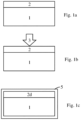
- Figure 1a-c illustrates the production method according to the invention where the process with the deposition of an essentially oxygen-free metal hydride 2, preferably less than 0.1 ppm O 2 , onto a substrate 1 (e.g. glass or a polymer-based substrate) as in figure 1a .
- the substrate is transparent where the aim of the photochromic layer is to provide a variable transmission rate depending on the light intensity. Transparent in this case also including a degree of attenuation, e.g. for permanent shading.
- the performance of the step of applying the metal hydride in the oxygen-free environment is known to the person skilled in the art, e.g. as discussed in WO2018/024394 .
- the metal hydride may comprise a metal from the groups of rare earth elements, but according to the preferred embodiment of the invention the metal is yttrium, forming yttrium hydride.
- the rare-earth metal hydride is exposed to an environment 3 that oxidizes the metal hydride, preferably in an environment where humidity present, forming rare-earth metal oxyhydride.
- Humidity in this case referring to any one of water vapour, liquid water in air or liquid water, as it is the chemical response with the water molecules that initiates the reaction.
- the oxidising environment should contain water in any form with a range of: water amount in air at sea level pressure with RH between >0%RH and 60%RH, for temperatures between 0°C and 40°C, preferably 25° Celsius.
- the substrate 1 and the resulting oxyhydride is enclosed in a container 5 or similar keeping the relative humidity around the photochromic material at a low level which would contain less water in any form than the air at sea level pressure with 10% RH at 25° Celsius and above than 0.1 ppm H 2 O.
- the exposure to humidity is therefore limited afterward production so as to maintain the photochromic characteristics of the material.
- the final oxygen content of the active photochromic film can be pre-defined by controlling properties like porosity and microstructure, thickness and other features of the as-deposited metal hydride as discussed in the publications mentioned above. These properties, as described below, can be achieved by tuning the deposition parameters, such as substrate temperature, substrate type, chamber pressure, sputtering power, deposition time, deposition gas flow, etc.
- rare-earth metal oxyhydride materials are highly susceptible to environment. After oxidation at the end of the production process environmental elements, specifically water content in the air, cause cracking of the films, delamination, reducing the contrast, and damaging the photochromic kinetics.
- environmental elements specifically water content in the air
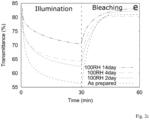
- we refer to the accompanying graphs in figure 2a-2e an experimental procedure was designed using yttrium oxyhydride thin film coatings which were prepared according to the T. Mongstad (2011), C.C. You (2014) articles and WO2017/125573 , then immediately after oxidation on air, placed in airtight boxes filled with regular air but with varying relative humidity at 25°C temperature.
- Figures 2a-e demonstrate photochromic kinetics of stored samples in relative humidity (RH) from ⁇ 10%RH to 100%RH, respectively. Photochromic kinetic studies were performed with 30 minutes of illumination using an UV Laser and 30 minutes of storing at dark for recovery (bleaching). Kinetic studies were performed after 2, 4 and 14 days storing inside the airtight boxes with respective relative humidity.
- RH relative humidity
- FIG. 3 Scanning electron microscopy (SEM) images of microstructure deformation, caused by varying relative humidity levels; ⁇ 10% (a), 30% (b), 50% (c), 75% (d) and 100% (e) after 14 days storage at room temperature.
- Panel (f) showing one deformation in detail.
- structural change depending on the water content level in the air after 14 days of storage Parallel to the increasing water content in air, increasing number of cracks and deformation can be observed which is correlated with contrast loss of photochromic oxyhydride material.
- absence of moisture as how conventional insulating glass units on buildings being prepared, has negative impact on the material's photochromic kinetics.
- the produced material is preferably enclosed in a container after production having the described humidity in the contained environment.
- the present invention relates to a method for producing a photochromic rare-earth metal oxyhydride material comprising the steps of formation on a substrate of a layer of an essentially oxygen free rare-earth metal hydride with a predetermined thickness preferably within the range of 50-1500 nm using a physical vapor deposition process.
- the substrate will preferably be a transparent substrate, e.g. a glass or polymer-based substrate.
- the rare-earth metal hydride layer is exposed to air in a second step, where the metal hydride oxidises, by oxygen and water (humidity, vapour and/or moisture).
- the second step is performed in an environment which contain water in any form with a range of: water amount in air at sea level pressure with RH between >0% and 60%, for temperatures between 0°C and 40°C, preferably 25° Celsius
- the metal hydride is chosen from the groups of rare earth metals, and according to the preferred embodiment of the invention an yttrium hydride.
- the second step may be followed by a step of containing the material in a tight container or covering the photochromic material in a humidity/water tight material, sealing it from the environment.
- the rare-earth metal hydride may have a porosity being above zero, i.e. it contains hollow pores, voids and/or cavities to improve the absorption of oxygen in the oxyhydride.
- a photochromic component comprising a first, transparent substrate and a layer constituted metal oxyhydride enclosed in a humidity/water tight enclosure, where the oxyhydride is made from a rare-earth metal oxyhydride, preferably an yttrium oxyhydride, which can be made using the method described above.
- the environment in the container comprise water content in any form, equal or less than the water content of air at sea level pressure with 20%RH at 25°C, preferably 10%RH and above 0.1 ppm H 2 O..
Landscapes
- Chemical & Material Sciences (AREA)
- Materials Engineering (AREA)
- Engineering & Computer Science (AREA)
- Organic Chemistry (AREA)
- Chemical Kinetics & Catalysis (AREA)
- Mechanical Engineering (AREA)
- Metallurgy (AREA)
- Physics & Mathematics (AREA)
- Optics & Photonics (AREA)
- General Physics & Mathematics (AREA)
- Life Sciences & Earth Sciences (AREA)
- General Chemical & Material Sciences (AREA)
- Geochemistry & Mineralogy (AREA)
- Physical Vapour Deposition (AREA)
Description
- Due to improved building techniques and the utilization of modern methods for the fabrication of glass, large windows are an increasingly common sight in modern architecture. Although the incorporation of large-area windows often results in aesthetic facades and excellent indoor lighting conditions, it can also represent a challenge in terms of energy efficiency and energy savings. Windows are, from an insulating point of view, the weakest point in a building, mainly because of their poor thermal insulation properties, but also because they allow for a significant unwanted indoors-outdoors radiative heat exchange.
- Smart windows industry is currently dominated by technologies which give relative control, for example by utilizing electricity or dispersed particle alignment methods. However, this control itself creates a pseudo sensation of "smart" technology because an authentic smart technology requires no control and adjust itself with the specifications it was designed according to the environment it resides. On the other hand, one promising application can be considered as smart; photochromic applications. They can adjust themselves to the environmental change without needing any control and have relatively simple structural designs compared to the complex electrochromic applications. Therefore, photochromic applications show high promise at the current industry as a genuine smart technology for future applications.
- Previously, photochromic oxygen containing Yttrium hydride films, e.g. production was demonstrated in the articles by T. Mongstad et al., Solar Energy materials and Solar Cells 95 (2011) 3596-3599, "A new thin film photochromic material: Oxygen-containing yttrium hydride" and, C.C. You, Applied Physics Letters 105, 031910 (2014), "Engineering of the band gap and optical properties of thin films of yttrium hydride" and in international patent applications
WO2017/125573 (IFE ),WO2018/024394 (IFE ) andWO2016/109651 (Saint Gobain ). - The fabrication method according to the invention relates to the production method described in
WO2018/024394 where oxyhydride coatings are produced as follows: an initial reactive sputter deposition of a metal hydride thin film based on a rare earth, lanthanide or alkaline metal-potentially doped by one or more other elements from the same groups, followed by a subsequent oxidation in air that aims to generate or improve any photochromic properties within the material. However, oxyhydride material tends to degrade when exposed to air or with prolonged illumination as also mentioned inWO2017/125573 . Although it was postulated in the same publication that oxygen itself is the reason for increased stress levels, cracking/deformation and delamination of the material, there is no result supporting the postulate. Here we describe an improved working environment and storage conditions for oxyhydride materials. - The problems discussed above are solved using the method as described in the accompanying claims.
- More specifically the present invention thus concerns a method of producing a rare earth metal oxyhydride-based photochromic device, and more specifically relates to a method of preparation, storing and working conditions for a rare earth metal oxyhydride-based (REMOH) photochromic device comprising a substrate, at least one layer including a photochromic layer having a chosen band gap range where the REMOH-based device preparation method comprises the steps of: -first the formation on a substrate of a layer of rare-earth metal hydride with a predetermined thickness using a physical vapor deposition process; and -second oxidizing the films. Distinction from the above-mentioned publications in the present patent is about finding the way to prevent degradation of the photochromic material over time and preserving photochromic kinetics. This is related to avoiding water levels that would damage the device but preserving some water levels for necessary for maintaining the photochromic kinetics, specifically bleaching (recovery when illumination stops or intensity reduces or light source wavelength composition changes), that would occur in an essentially water (water, humidity or vapour etc.) free environment. After the oxidation of the resulting rare-earth metal hydride material would be a REMOH with photochromic properties.
- The invention will be described more in detail with reference to the accompanying drawings, illustrating the reason of the improvement to the device described above:
- Figure 1a-c
- Illustrates the production method according to the invention.
- Figure 2a-e
- Illustrates photochromic oxyhydride material optical kinetic degradation after stored at varying relative humidity levels.
- Figure 3
- Illustrates microstructure deformation, caused by varying relative humidity levels.
- Figure 4a,b
- Illustrates the photochromic kinetic difference between dry air (H2O<0.1 ppm) environment and ambient air environment.
-
Figure 1a-c illustrates the production method according to the invention where the process with the deposition of an essentially oxygen-free metal hydride 2, preferably less than 0.1 ppm O2, onto a substrate 1 (e.g. glass or a polymer-based substrate) as infigure 1a . The substrate is transparent where the aim of the photochromic layer is to provide a variable transmission rate depending on the light intensity. Transparent in this case also including a degree of attenuation, e.g. for permanent shading. The performance of the step of applying the metal hydride in the oxygen-free environment is known to the person skilled in the art, e.g. as discussed inWO2018/024394 . The metal hydride may comprise a metal from the groups of rare earth elements, but according to the preferred embodiment of the invention the metal is yttrium, forming yttrium hydride. - In
figure 1b the rare-earth metal hydride is exposed to anenvironment 3 that oxidizes the metal hydride, preferably in an environment where humidity present, forming rare-earth metal oxyhydride. Humidity in this case referring to any one of water vapour, liquid water in air or liquid water, as it is the chemical response with the water molecules that initiates the reaction. The oxidising environment should contain water in any form with a range of: water amount in air at sea level pressure with RH between >0%RH and 60%RH, for temperatures between 0°C and 40°C, preferably 25° Celsius. - In
figure 1c thesubstrate 1 and the resulting oxyhydride is enclosed in a container 5 or similar keeping the relative humidity around the photochromic material at a low level which would contain less water in any form than the air at sea level pressure with 10% RH at 25° Celsius and above than 0.1 ppm H2O. - According to the present invention the exposure to humidity is therefore limited afterward production so as to maintain the photochromic characteristics of the material.
- The final oxygen content of the active photochromic film can be pre-defined by controlling properties like porosity and microstructure, thickness and other features of the as-deposited metal hydride as discussed in the publications mentioned above. These properties, as described below, can be achieved by tuning the deposition parameters, such as substrate temperature, substrate type, chamber pressure, sputtering power, deposition time, deposition gas flow, etc.
- As mentioned above rare-earth metal oxyhydride materials, particularly yttrium oxyhydrides, are highly susceptible to environment. After oxidation at the end of the production process environmental elements, specifically water content in the air, cause cracking of the films, delamination, reducing the contrast, and damaging the photochromic kinetics. To illustrate this, we refer to the accompanying graphs in
figure 2a-2e , an experimental procedure was designed using yttrium oxyhydride thin film coatings which were prepared according to the T. Mongstad (2011), C.C. You (2014) articles andWO2017/125573 , then immediately after oxidation on air, placed in airtight boxes filled with regular air but with varying relative humidity at 25°C temperature.Figures 2a-e demonstrate photochromic kinetics of stored samples in relative humidity (RH) from <10%RH to 100%RH, respectively. Photochromic kinetic studies were performed with 30 minutes of illumination using an UV Laser and 30 minutes of storing at dark for recovery (bleaching). Kinetic studies were performed after 2, 4 and 14 days storing inside the airtight boxes with respective relative humidity. - Photochromic yttrium oxyhydride coatings, initially, showing 25% contrast however, every sample demonstrates lower contrast with increased contrast loss depending on storage time (
Figure 2 (a-e)). Contrast loss is strongly dependent on storage time but also water content level in the air is a factor for the speed of contrast loss. This can be observed, fromFigures 2a-2e where contrast loss is more notable for samples stored at 100% RH after 14 days than at <10% RH and, samples stored at 100% RH lost the same contrast under 4days as the samples stored at <10% RH but after 14 days. -
Figure 3 Scanning electron microscopy (SEM) images of microstructure deformation, caused by varying relative humidity levels; <10% (a), 30% (b), 50% (c), 75% (d) and 100% (e) after 14 days storage at room temperature. Panel (f) showing one deformation in detail. As can be seen structural change depending on the water content level in the air after 14 days of storage. Parallel to the increasing water content in air, increasing number of cracks and deformation can be observed which is correlated with contrast loss of photochromic oxyhydride material. On the other hand, absence of moisture as how conventional insulating glass units on buildings being prepared, has negative impact on the material's photochromic kinetics. InFigure 4 (a,b), photochromic kinetics of yttrium oxyhydride in dry air environment (H2O<0.1ppm) and ambient air environment can be observed. Bleaching speed of yttrium oxyhydride slowed considerably as a result of reduced oxidation agent presence, namely water content in air. - Due to the kinetic loss and structural deformation under air with higher water content than the water content of air with 10%RH at 25°C, storage and working environment of oxyhydride materials should therefore contain less water than the water content of air with 10%RH at 25°C water. Additionally, due to the kinetic loss under dry air environment with water content of H2O<0.1 ppm, storage and working environment of oxyhydride materials should therefore contain water; H2O≥0.1 ppm. Therefore, the produced material is preferably enclosed in a container after production having the described humidity in the contained environment.
- As will also be understood by the person skilled in the art a small change of humidity and temperature would have the same water content but technically different humidity. Thus a water content of air with same volume at sea level pressure that is 25°C and 10%RH may correspond to 5%RH at 30°C more or less equal as higher temperature can hold more water and this humidity is Relative Humidity to the same water content to this defined limit. Therefore, under some circumstances the water content corresponding to 20% at sea level pressure and is 25°C depending on the intended use of the component, for example with varying temperaures.
- To summarize the present invention relates to a method for producing a photochromic rare-earth metal oxyhydride material comprising the steps of formation on a substrate of a layer of an essentially oxygen free rare-earth metal hydride with a predetermined thickness preferably within the range of 50-1500 nm using a physical vapor deposition process. The substrate will preferably be a transparent substrate, e.g. a glass or polymer-based substrate. Following this the rare-earth metal hydride layer is exposed to air in a second step, where the metal hydride oxidises, by oxygen and water (humidity, vapour and/or moisture). The second step is performed in an environment which contain water in any form with a range of: water amount in air at sea level pressure with RH between >0% and 60%, for temperatures between 0°C and 40°C, preferably 25° Celsius
- The metal hydride is chosen from the groups of rare earth metals, and according to the preferred embodiment of the invention an yttrium hydride.
- In order to maintain the characteristics of the photochromic material the second step may be followed by a step of containing the material in a tight container or covering the photochromic material in a humidity/water tight material, sealing it from the environment. The rare-earth metal hydride may have a porosity being above zero, i.e. it contains hollow pores, voids and/or cavities to improve the absorption of oxygen in the oxyhydride.
- A photochromic component is provided comprising a first, transparent substrate and a layer constituted metal oxyhydride enclosed in a humidity/water tight enclosure, where the oxyhydride is made from a rare-earth metal oxyhydride, preferably an yttrium oxyhydride, which can be made using the method described above. The environment in the container comprise water content in any form, equal or less than the water content of air at sea level pressure with 20%RH at 25°C, preferably 10%RH and above 0.1 ppm H2O..
Claims (7)
- Method for producing a photochromic rare-earth metal oxyhydride material comprising the steps of:- first, in an environment with less than 0.1 ppm O2, formation on a substrate of a layer of an essentially oxygen free rare-earth metal hydride with a predetermined thickness using a physical vapor deposition process;
and- second, exposing the rare-earth metal hydride layer to an oxygen containing environment where the layer oxidizes and results with rare-earth metal oxyhydride, said second step being performed in an environment having water content in any form with a range defined by a water amount in air at sea level pressure with RH between >0% and 60% RH for temperatures between 0°C and 40°C. - Method according to claim 1, wherein the metal in the metal hydride is yttrium.
- Method according to claim 1, wherein the thickness of the formed rare earth metal hydride layer is within the range of 50-1500 nm using a physical vapor deposition process
- Method according to any of the preceding claims, followed by the step of oxidizing the material in a humidity tight container.
- Method according to any of the preceding claims, followed by the step of containing or covering the oxyhydride material in a humidity/watertight material maintaining a humidity/water content in the container at a level less than air at sea level pressure with 10%RH at 25°C and the oxyhydride material having a water content H2O≥0.1 ppm..
- Method according to claim 1, wherein said metal hydride is fabricated on a transparent, e.g. on top of a glass or polymer-based substrate.
- Method according to claim 1, wherein said water content as defined in step 2 is less than 60%RH at a temperature of 25° Celsius.
Applications Claiming Priority (2)
| Application Number | Priority Date | Filing Date | Title |
|---|---|---|---|
| NO20190855 | 2019-07-05 | ||
| PCT/EP2020/068991 WO2021005003A1 (en) | 2019-07-05 | 2020-07-06 | Method for producing an oxyhydride-based photochromic device |
Publications (3)
| Publication Number | Publication Date |
|---|---|
| EP3994104A1 EP3994104A1 (en) | 2022-05-11 |
| EP3994104C0 EP3994104C0 (en) | 2024-10-09 |
| EP3994104B1 true EP3994104B1 (en) | 2024-10-09 |
Family
ID=71614862
Family Applications (1)
| Application Number | Title | Priority Date | Filing Date |
|---|---|---|---|
| EP20740258.7A Active EP3994104B1 (en) | 2019-07-05 | 2020-07-06 | Method for producing an oxyhydride-based photochromic device |
Country Status (5)
| Country | Link |
|---|---|
| US (1) | US20220357491A1 (en) |
| EP (1) | EP3994104B1 (en) |
| ES (1) | ES3001136T3 (en) |
| PL (1) | PL3994104T3 (en) |
| WO (1) | WO2021005003A1 (en) |
Families Citing this family (2)
| Publication number | Priority date | Publication date | Assignee | Title |
|---|---|---|---|---|
| NO346606B1 (en) * | 2020-04-15 | 2022-10-31 | Inst Energiteknik | A rare-earth metal oxyhydride based superconductive thin film |
| NO348427B1 (en) * | 2023-05-03 | 2025-01-20 | Inst Energiteknik | Photochromic materials |
Family Cites Families (8)
| Publication number | Priority date | Publication date | Assignee | Title |
|---|---|---|---|---|
| US5820994A (en) * | 1996-02-16 | 1998-10-13 | Mitsui Chemicals, Inc. | Laminate and method for preparing same |
| EP2649126A4 (en) * | 2010-12-09 | 2015-10-21 | Kilolambda Tech Ltd | Fast response photochromic composition and device |
| TWI585196B (en) | 2014-12-31 | 2017-06-01 | 聖高拜塑膠製品公司 | Solar control films, an assembly comprising the same and methods for producing the same |
| NO342807B1 (en) | 2016-01-21 | 2018-08-06 | Inst Energiteknik | Photochromic device |
| JP2017182062A (en) * | 2016-03-25 | 2017-10-05 | 日東電工株式会社 | Manufacturing method of light control film |
| NO20161267A1 (en) | 2016-08-05 | 2018-02-06 | Inst Energiteknik | Photochromic device |
| CN109097734A (en) * | 2018-08-21 | 2018-12-28 | 中国科学院上海硅酸盐研究所 | Oxygen-containing hydrogenation yttrium light thermochromism multilayered film material |
| NO346606B1 (en) * | 2020-04-15 | 2022-10-31 | Inst Energiteknik | A rare-earth metal oxyhydride based superconductive thin film |
-
2020
- 2020-07-06 WO PCT/EP2020/068991 patent/WO2021005003A1/en not_active Ceased
- 2020-07-06 ES ES20740258T patent/ES3001136T3/en active Active
- 2020-07-06 PL PL20740258.7T patent/PL3994104T3/en unknown
- 2020-07-06 EP EP20740258.7A patent/EP3994104B1/en active Active
- 2020-07-06 US US17/623,537 patent/US20220357491A1/en active Pending
Also Published As
| Publication number | Publication date |
|---|---|
| PL3994104T3 (en) | 2025-05-26 |
| ES3001136T3 (en) | 2025-03-04 |
| EP3994104A1 (en) | 2022-05-11 |
| US20220357491A1 (en) | 2022-11-10 |
| EP3994104C0 (en) | 2024-10-09 |
| WO2021005003A1 (en) | 2021-01-14 |
Similar Documents
| Publication | Publication Date | Title |
|---|---|---|
| CN101542771B (en) | Flexible substrates with thin film barriers | |
| CA2762319C (en) | Thin film deposition method and resulting product | |
| JP5816281B2 (en) | Self-passivating mechanically stable hermetic thin film | |
| JP4790396B2 (en) | Method for producing transparent film | |
| DE60233418D1 (en) | METHOD FOR THE MAJOR MANUFACTURE OF CDTE / CDS THIN-LAYER SOLAR CELLS | |
| US20220357491A1 (en) | Method for producing an oxyhydride-based photochromic device | |
| CN103173720A (en) | Preparation method for waterproof laser film | |
| EP3494191B1 (en) | Fabrication of photochromic device | |
| EA026182B1 (en) | Process for manufacturing glazing comprising a porous layer | |
| Gaponenko et al. | Erbium and terbium photoluminescence in silica sol–gel films on porous alumina | |
| CN108779023A (en) | Transparent Photochromic Devices | |
| Han et al. | Simple Encapsulation Method for Flexible Perovskite Solar Cells with Transparent Electrode‐Integrated Barrier Films | |
| Barichello et al. | Beneath the Surface: Investigating Perovskite Solar Cells Under Water | |
| Szelwicka et al. | High‐Performance Thermochromic VO2‐Based Coatings Deposited by Roll‐to‐Roll High‐Power Impulse Magnetron Sputtering | |
| EP2744760A1 (en) | Antireflection glazing unit equipped with a porous coating | |
| US11753712B2 (en) | Durable electrochromic device including tungsten oxide film prepared in high ion bombardment and low pressure deposition environment, and/or methods of making the same | |
| Winkowski et al. | Wide band antireflective coatings Al2O3/HfO2/MgF2 for UV region | |
| Joost et al. | Heat treatment and substrate dependant properties of titania thin films with high copper loading | |
| Shanak et al. | Fast coloration in sputtered gasochromic tungsten oxide films | |
| CN112596279A (en) | Fluorocarbon/palladium/magnesium-ruthenium gas-induced dimming film and preparation method thereof | |
| JP2025132320A (en) | Semi-transparent gas barrier film, light-transmitting solar cell module, and light-transmitting display device | |
| TW201602390A (en) | Method for reacting a precursor material in a reaction gas phase | |
| Jiang et al. | The study of the effects of atomic oxygen erosion on the microstructure and property of VO2 thermochromic coating using CSA’s space simulation apparatus | |
| Poortmans | Effects of Low-Thermal-Budget Treatments on the Porous Si Material Properties | |
| FR3105212A1 (en) | Process for rapid thermal treatment of thin films on tempered glass substrates |
Legal Events
| Date | Code | Title | Description |
|---|---|---|---|
| STAA | Information on the status of an ep patent application or granted ep patent |
Free format text: STATUS: UNKNOWN |
|
| STAA | Information on the status of an ep patent application or granted ep patent |
Free format text: STATUS: THE INTERNATIONAL PUBLICATION HAS BEEN MADE |
|
| PUAI | Public reference made under article 153(3) epc to a published international application that has entered the european phase |
Free format text: ORIGINAL CODE: 0009012 |
|
| STAA | Information on the status of an ep patent application or granted ep patent |
Free format text: STATUS: REQUEST FOR EXAMINATION WAS MADE |
|
| 17P | Request for examination filed |
Effective date: 20220204 |
|
| AK | Designated contracting states |
Kind code of ref document: A1 Designated state(s): AL AT BE BG CH CY CZ DE DK EE ES FI FR GB GR HR HU IE IS IT LI LT LU LV MC MK MT NL NO PL PT RO RS SE SI SK SM TR |
|
| DAV | Request for validation of the european patent (deleted) | ||
| DAX | Request for extension of the european patent (deleted) | ||
| REG | Reference to a national code |
Ref legal event code: R079 Free format text: PREVIOUS MAIN CLASS: C03C0017220000 Ref country code: DE Ref legal event code: R079 Ref document number: 602020039084 Country of ref document: DE Free format text: PREVIOUS MAIN CLASS: C03C0017220000 Ipc: C09K0009000000 |
|
| GRAP | Despatch of communication of intention to grant a patent |
Free format text: ORIGINAL CODE: EPIDOSNIGR1 |
|
| STAA | Information on the status of an ep patent application or granted ep patent |
Free format text: STATUS: GRANT OF PATENT IS INTENDED |
|
| RIC1 | Information provided on ipc code assigned before grant |
Ipc: G02B 5/23 20060101ALI20240408BHEP Ipc: C23C 14/58 20060101ALI20240408BHEP Ipc: C23C 14/06 20060101ALI20240408BHEP Ipc: C03C 17/22 20060101ALI20240408BHEP Ipc: C09K 9/00 20060101AFI20240408BHEP |
|
| INTG | Intention to grant announced |
Effective date: 20240503 |
|
| GRAS | Grant fee paid |
Free format text: ORIGINAL CODE: EPIDOSNIGR3 |
|
| GRAA | (expected) grant |
Free format text: ORIGINAL CODE: 0009210 |
|
| STAA | Information on the status of an ep patent application or granted ep patent |
Free format text: STATUS: THE PATENT HAS BEEN GRANTED |
|
| AK | Designated contracting states |
Kind code of ref document: B1 Designated state(s): AL AT BE BG CH CY CZ DE DK EE ES FI FR GB GR HR HU IE IS IT LI LT LU LV MC MK MT NL NO PL PT RO RS SE SI SK SM TR |
|
| REG | Reference to a national code |
Ref country code: CH Ref legal event code: EP |
|
| REG | Reference to a national code |
Ref country code: DE Ref legal event code: R096 Ref document number: 602020039084 Country of ref document: DE |
|
| REG | Reference to a national code |
Ref country code: IE Ref legal event code: FG4D |
|
| U01 | Request for unitary effect filed |
Effective date: 20241108 |
|
| U07 | Unitary effect registered |
Designated state(s): AT BE BG DE DK EE FI FR IT LT LU LV MT NL PT RO SE SI Effective date: 20241118 |
|
| RAP2 | Party data changed (patent owner data changed or rights of a patent transferred) |
Owner name: SUNPHADE AS |
|
| U1K | Transfer of rights of the unitary patent after the registration of the unitary effect |
Owner name: SUNPHADE AS; NO |
|
| REG | Reference to a national code |
Ref country code: GB Ref legal event code: 732E Free format text: REGISTERED BETWEEN 20250123 AND 20250128 |
|
| U1N | Appointed representative for the unitary patent procedure changed after the registration of the unitary effect |
Representative=s name: AWA NORWAY AS; NO |
|
| REG | Reference to a national code |
Ref country code: ES Ref legal event code: FG2A Ref document number: 3001136 Country of ref document: ES Kind code of ref document: T3 Effective date: 20250304 |
|
| PG25 | Lapsed in a contracting state [announced via postgrant information from national office to epo] |
Ref country code: IS Free format text: LAPSE BECAUSE OF FAILURE TO SUBMIT A TRANSLATION OF THE DESCRIPTION OR TO PAY THE FEE WITHIN THE PRESCRIBED TIME-LIMIT Effective date: 20250209 Ref country code: HR Free format text: LAPSE BECAUSE OF FAILURE TO SUBMIT A TRANSLATION OF THE DESCRIPTION OR TO PAY THE FEE WITHIN THE PRESCRIBED TIME-LIMIT Effective date: 20241009 |
|
| PG25 | Lapsed in a contracting state [announced via postgrant information from national office to epo] |
Ref country code: GR Free format text: LAPSE BECAUSE OF FAILURE TO SUBMIT A TRANSLATION OF THE DESCRIPTION OR TO PAY THE FEE WITHIN THE PRESCRIBED TIME-LIMIT Effective date: 20250110 |
|
| PG25 | Lapsed in a contracting state [announced via postgrant information from national office to epo] |
Ref country code: RS Free format text: LAPSE BECAUSE OF FAILURE TO SUBMIT A TRANSLATION OF THE DESCRIPTION OR TO PAY THE FEE WITHIN THE PRESCRIBED TIME-LIMIT Effective date: 20250109 |
|
| PG25 | Lapsed in a contracting state [announced via postgrant information from national office to epo] |
Ref country code: SM Free format text: LAPSE BECAUSE OF FAILURE TO SUBMIT A TRANSLATION OF THE DESCRIPTION OR TO PAY THE FEE WITHIN THE PRESCRIBED TIME-LIMIT Effective date: 20241009 |
|
| PGFP | Annual fee paid to national office [announced via postgrant information from national office to epo] |
Ref country code: PL Payment date: 20250624 Year of fee payment: 6 |
|
| PGFP | Annual fee paid to national office [announced via postgrant information from national office to epo] |
Ref country code: NO Payment date: 20250611 Year of fee payment: 6 |
|
| U20 | Renewal fee for the european patent with unitary effect paid |
Year of fee payment: 6 Effective date: 20250617 |
|
| PG25 | Lapsed in a contracting state [announced via postgrant information from national office to epo] |
Ref country code: SK Free format text: LAPSE BECAUSE OF FAILURE TO SUBMIT A TRANSLATION OF THE DESCRIPTION OR TO PAY THE FEE WITHIN THE PRESCRIBED TIME-LIMIT Effective date: 20241009 |
|
| PG25 | Lapsed in a contracting state [announced via postgrant information from national office to epo] |
Ref country code: CZ Free format text: LAPSE BECAUSE OF FAILURE TO SUBMIT A TRANSLATION OF THE DESCRIPTION OR TO PAY THE FEE WITHIN THE PRESCRIBED TIME-LIMIT Effective date: 20241009 |
|
| PLBE | No opposition filed within time limit |
Free format text: ORIGINAL CODE: 0009261 |
|
| STAA | Information on the status of an ep patent application or granted ep patent |
Free format text: STATUS: NO OPPOSITION FILED WITHIN TIME LIMIT |
|
| 26N | No opposition filed |
Effective date: 20250710 |
|
| PGFP | Annual fee paid to national office [announced via postgrant information from national office to epo] |
Ref country code: ES Payment date: 20250821 Year of fee payment: 6 |
|
| PGFP | Annual fee paid to national office [announced via postgrant information from national office to epo] |
Ref country code: GB Payment date: 20250722 Year of fee payment: 6 |
|
| REG | Reference to a national code |
Ref country code: CH Ref legal event code: H13 Free format text: ST27 STATUS EVENT CODE: U-0-0-H10-H13 (AS PROVIDED BY THE NATIONAL OFFICE) Effective date: 20260224 |
|
| PG25 | Lapsed in a contracting state [announced via postgrant information from national office to epo] |
Ref country code: CH Free format text: LAPSE BECAUSE OF NON-PAYMENT OF DUE FEES Effective date: 20250731 |