EP3993314A1 - Keys for elliptic curve cryptography - Google Patents
Keys for elliptic curve cryptography Download PDFInfo
- Publication number
- EP3993314A1 EP3993314A1 EP20425046.8A EP20425046A EP3993314A1 EP 3993314 A1 EP3993314 A1 EP 3993314A1 EP 20425046 A EP20425046 A EP 20425046A EP 3993314 A1 EP3993314 A1 EP 3993314A1
- Authority
- EP
- European Patent Office
- Prior art keywords
- keys
- pairs
- elliptic curve
- ecc
- generated
- Prior art date
- Legal status (The legal status is an assumption and is not a legal conclusion. Google has not performed a legal analysis and makes no representation as to the accuracy of the status listed.)
- Granted
Links
Images


Classifications
-
- H—ELECTRICITY
- H04—ELECTRIC COMMUNICATION TECHNIQUE
- H04L—TRANSMISSION OF DIGITAL INFORMATION, e.g. TELEGRAPHIC COMMUNICATION
- H04L9/00—Cryptographic mechanisms or cryptographic arrangements for secret or secure communications; Network security protocols
- H04L9/30—Public key, i.e. encryption algorithm being computationally infeasible to invert or user's encryption keys not requiring secrecy
- H04L9/3066—Public key, i.e. encryption algorithm being computationally infeasible to invert or user's encryption keys not requiring secrecy involving algebraic varieties, e.g. elliptic or hyper-elliptic curves
-
- H—ELECTRICITY
- H04—ELECTRIC COMMUNICATION TECHNIQUE
- H04L—TRANSMISSION OF DIGITAL INFORMATION, e.g. TELEGRAPHIC COMMUNICATION
- H04L9/00—Cryptographic mechanisms or cryptographic arrangements for secret or secure communications; Network security protocols
- H04L9/30—Public key, i.e. encryption algorithm being computationally infeasible to invert or user's encryption keys not requiring secrecy
- H04L9/3066—Public key, i.e. encryption algorithm being computationally infeasible to invert or user's encryption keys not requiring secrecy involving algebraic varieties, e.g. elliptic or hyper-elliptic curves
- H04L9/3073—Public key, i.e. encryption algorithm being computationally infeasible to invert or user's encryption keys not requiring secrecy involving algebraic varieties, e.g. elliptic or hyper-elliptic curves involving pairings, e.g. identity based encryption [IBE], bilinear mappings or bilinear pairings, e.g. Weil or Tate pairing
-
- H—ELECTRICITY
- H04—ELECTRIC COMMUNICATION TECHNIQUE
- H04L—TRANSMISSION OF DIGITAL INFORMATION, e.g. TELEGRAPHIC COMMUNICATION
- H04L9/00—Cryptographic mechanisms or cryptographic arrangements for secret or secure communications; Network security protocols
- H04L9/08—Key distribution or management, e.g. generation, sharing or updating, of cryptographic keys or passwords
- H04L9/0816—Key establishment, i.e. cryptographic processes or cryptographic protocols whereby a shared secret becomes available to two or more parties, for subsequent use
- H04L9/0819—Key transport or distribution, i.e. key establishment techniques where one party creates or otherwise obtains a secret value, and securely transfers it to the other(s)
- H04L9/0825—Key transport or distribution, i.e. key establishment techniques where one party creates or otherwise obtains a secret value, and securely transfers it to the other(s) using asymmetric-key encryption or public key infrastructure [PKI], e.g. key signature or public key certificates
-
- H—ELECTRICITY
- H04—ELECTRIC COMMUNICATION TECHNIQUE
- H04L—TRANSMISSION OF DIGITAL INFORMATION, e.g. TELEGRAPHIC COMMUNICATION
- H04L9/00—Cryptographic mechanisms or cryptographic arrangements for secret or secure communications; Network security protocols
- H04L9/08—Key distribution or management, e.g. generation, sharing or updating, of cryptographic keys or passwords
- H04L9/0816—Key establishment, i.e. cryptographic processes or cryptographic protocols whereby a shared secret becomes available to two or more parties, for subsequent use
- H04L9/0838—Key agreement, i.e. key establishment technique in which a shared key is derived by parties as a function of information contributed by, or associated with, each of these
-
- H—ELECTRICITY
- H04—ELECTRIC COMMUNICATION TECHNIQUE
- H04L—TRANSMISSION OF DIGITAL INFORMATION, e.g. TELEGRAPHIC COMMUNICATION
- H04L9/00—Cryptographic mechanisms or cryptographic arrangements for secret or secure communications; Network security protocols
- H04L9/32—Cryptographic mechanisms or cryptographic arrangements for secret or secure communications; Network security protocols including means for verifying the identity or authority of a user of the system or for message authentication, e.g. authorization, entity authentication, data integrity or data verification, non-repudiation, key authentication or verification of credentials
- H04L9/3247—Cryptographic mechanisms or cryptographic arrangements for secret or secure communications; Network security protocols including means for verifying the identity or authority of a user of the system or for message authentication, e.g. authorization, entity authentication, data integrity or data verification, non-repudiation, key authentication or verification of credentials involving digital signatures
-
- H—ELECTRICITY
- H04—ELECTRIC COMMUNICATION TECHNIQUE
- H04L—TRANSMISSION OF DIGITAL INFORMATION, e.g. TELEGRAPHIC COMMUNICATION
- H04L2209/00—Additional information or applications relating to cryptographic mechanisms or cryptographic arrangements for secret or secure communication H04L9/00
- H04L2209/12—Details relating to cryptographic hardware or logic circuitry
Definitions
- the present disclosure generally concerns cryptography and its use for digital signatures and key agreements and, more particularly, elliptic curve cryptography.
- the present disclosure more particularly addresses the generation of a pair of keys for elliptic curve cryptography.
- Elliptic curve cryptography is a type of cryptography using certain properties of elliptic curves. More particularly, cryptographic primitives compatible with elliptic curves have advantageous characteristics in terms of security and performance.
- An embodiment overcomes all or part of the disadvantages of known methods of generation of elliptic curve cryptography keys.
- One embodiment provides a method of generation of N first pairs of ECC keys for elliptic curve cryptography, wherein each first pair of keys is a linear combination of previously-generated second pairs of elliptic curve cryptography keys.
- the linear combination is an addition of some of said second pairs of keys.
- said some second pairs of keys are randomly selected among the second pairs of ECC keys.
- the method comprises a step of initialization of the N first pairs of keys before the application of the linear combination.
- the N first pairs of ECC keys are set to zero and to the point at infinity respectively.
- the N first pairs of keys are initialized to the value taken by the last generated first pair of keys.
- matrix A is a Vandermonde matrix.
- said first and second pairs of keys are formed of a scalar and of a point on an elliptic curve.
- the number of second pairs of keys is smaller than N.
- An embodiment provides a device capable of generating elliptic curve cryptography keys by implementing the disclosed method.
- An embodiment provides a digital signature and/or key agreement method using elliptic curve cryptography keys generated by implementing the disclosed method.
- An embodiment provides a digital signature and/or key agreement device capable of digital signature and/or key agreement by implementing the disclosed method.
- Figure 1 schematically shows in the form of blocks an electronic device 10.
- Device 10 comprises:
- the different elements comprised in device 10 are coupled together and capable of exchanging data over a data bus 16.
- Processor 11 is capable of processing data stored in storage unit 12, and/or data originating from circuits 14 and from unit 15.
- Cryptographic coprocessor unit 13 is a processor capable of implementing modular arithmetic and elliptic curve operations.
- Cryptographic coprocessor unit 13 may form part of processor 11 or be the intermediary thereof with the elements of the device 10 with which it exchanges data.
- unit 13 may be used as an intermediary between unit 13 and processor 11, by processing the data which are being exchanged.
- Cryptographic coprocessor unit 13 is more particularly capable of implementing digital signature and key agreement algorithms based on elliptic curve cryptography.
- cryptographic coprocessor 13 is capable of generating pairs of elliptic curve cryptography keys, or pairs of ECC keys, implementing methods of generation of pairs of keys such as those described in relation with Figures 2 to 4 .
- the generation methods of Figures 2 to 4 are based on the fact that a linear combination of elliptic curve cryptography keys provides an elliptic curve cryptography key.
- Cryptographic coprocessor 13 is further capable of using the pairs of elliptic curve cryptography keys in digital signature and/or key agreement algorithms.
- Figure 2 is a flowchart illustrating an implementation mode of a method of generation of a plurality of pairs of ECC keys capable of being implemented by the device 10 described in relation with Figure 1 . More particularly, the method of Figure 2 enables to generate N pairs of ECC keys (r(i), R(i)), with i varying from 1 to N, N being an integer.
- the pair of keys (r(i), R(i)) is formed of a scalar r(i), and of a point R(i) of an elliptic curve.
- the method described herein enables to generate N pairs of ECC keys (r(i), R(i)) by using a linear combination of K pairs of ECC keys (p(k), P(k)), with k varying from 1 to K, K being an integer smaller than N.
- a pair of ECC keys (p(k), P(k)) is formed of a scalar p(k) and of a point P(k) of an elliptic curve.
- the K pairs of ECC keys (p(k), P(k)) are pre-generated by using current ECC key generation methods.
- the K pairs of ECC keys (p(k), P(k)) are for example pre-generated and then stored in a memory circuit.
- each pair of ECC keys (r(i), R(i)) is generated one by one by using the three following steps:
- the pair of ECC keys (r(i), R(i)) is set to zero. More particularly, scalar r(i) is zero, and point R(i) is set to the neutral element of the elliptic curve, also known as the point at infinity.
- step 222 a number C of randomly-selected pairs of ECC keys (p(k), P(k)) is added to pair of ECC keys (r(i), R(i)). More particularly, step 222 is a loop of C iterations during which a pair of ECC keys (p(k), P(k)) is randomly selected and then added to the pair of ECC keys (r(i), R(i)). More particularly, at each iteration, the scalar p(k) of the randomly selected pair of ECC keys (p(k), P(k)) is added to the scalar r(i) of the pair of ECC keys (r(i), R(i)). Similarly, at each iteration, the point P(k) of the randomly selected pair of ECC keys (p(k), P(k)) is added to the point R(i) of the pair of ECC keys (r(i), R(i)).
- the larger number C the larger the number N of pairs of ECC keys (r(i), R(i)) capable of being generated, and the better the security. But the larger number C, the more computation is needed.
- C is 32, K is 8 and N is 64.
- the pair of keys (r(i), R(i)) is ready to be used, it may for example be stored in a memory space.
- the method carries on to the generation of the next pair of keys (r(i+1), R(i+1)) until N pairs of keys have been generated.
- An advantage of the method of generation of pairs of ECC keys described herein is that based on the conventional generation of the K pairs of ECC keys (p(k), P(k)), it enables to obtain N pairs of ECC keys (r(i), R(i)) by only performing additions, which are operations having a negligible calculation time as compared with the calculation time of a scalar multiplication operation.
- this method enables to generate N pairs of ECC keys faster.
- An example of application of this method is its use in a signature method.
- Figure 3 is a flowchart illustrating an implementation mode of a method of generation of a plurality of pairs of ECC keys capable of being implemented by the device 10 described in relation with Figure 1 . More particularly, the method of Figure 2 enables to generate N pairs of ECC keys (r(i), R(i)), with i varying from 1 to N, N being an integer.
- the pair of keys (r(i), R(i)) is formed of a scalar r(i), and of a point R(i) of an elliptic curve.
- the method described herein enables to generate N pairs of ECC keys (r(i), R(i)) by using a linear combination of K pairs of ECC keys (p(k), P(k)), with k varying from 1 to K, K being an integer smaller than N.
- a pair of ECC keys (p(k), P(k)) is formed of a scalar p(k) and of a point P(k) of an elliptic curve P(k).
- the K pairs of ECC keys (p(k), P(k)) are pre-generated during the implementation of step 20.
- each pair of ECC keys (r(i), R(i)) is generated one by one by using the three following steps:
- the first pair of keys (r(1), R(1)) is set to a first pair of values, for example, to zero and the point at infinity, after which the next ones take the value of one of the previous W pairs of ECC keys (r(i-j), R(i-j)), where j is a random integer between 1 and the maximum value between W and (i - 1).
- the pair of ECC keys (r(i), R(i)) is not set to zero, but to the previously-generated pair of ECC keys (r(i-1), R(i-1)).
- the first pair of keys (r(1), R(1)) is set to a first pair of values, for example, to zero and the point at infinity, after which the next ones take the value of the directly previous pair of ECC keys (r(i-1), R(i-1)).
- the method of Figure 3 enables better security, as the number N of pairs of ECC keys (r(i), R(i)) capable of being generated becomes larger.
- device 10 or more particularly cryptographic coprocessor 13 only uses M pairs of ECC keys (r(i), R(i)), M being a natural integer smaller than number N.
- the M pairs of ECC keys (r(i), R(i)) used by device 10, or cryptographic coprocessor 13, are linearly dependent.
- Still another advantage of this method is that the set of key pairs that can be generated by this method grows with N.
- Figure 4 is a flowchart illustrating an implementation mode of a method of generation of a plurality of pairs of ECC keys capable of being implemented by the device 10 described in relation with Figure 1 . More particularly, the method of Figure 4 enables to generate N pairs of ECC keys (r(i), R(i)), with i varying from 1 to N, N being an integer. As previously described, the pair of keys (r(i), R(i)) is formed of a scalar r(i) and of a point R(i) of an elliptic curve.
- the method described herein enables to generate N pairs of ECC keys (r(i), R(i)) by using a linear combination of K pairs of ECC keys (p(k), P(k)), with k varying from 1 to K, K being an integer smaller than N.
- a pair of ECC keys (p(k), P(k)) is formed of a scalar p(k) and of a point P(k) of an elliptic curve.
- the K pairs of ECC keys (p(k), P(k)) are pre-generated by using ECC key generation methods.
- the K pairs of ECC keys (p(k), P(k)) are for example pre-generated and then stored in a memory circuit.
- the N pairs of ECC keys (r(i), R(i)) are generated.
- a vector comprising the K pairs of ECC keys (p(K), P(k)) is multiplied by a matrix A.
- Matrix A having a general term A(i, j), has a size N*K, and is characterized by the fact that all its square sub-matrices of size K*K are invertible.
- An example of such a matrix A is a Vandermonde matrix.
- the N pairs of ECC keys (r(i), R(i)) are ready to be used, they may for example be stored in a memory space.
- device 10 or more particularly cryptographic coprocessor 13 only uses M pairs of ECC keys (r(i), R(i)), M being a natural integer smaller than number N.
Landscapes
- Engineering & Computer Science (AREA)
- Computer Security & Cryptography (AREA)
- Signal Processing (AREA)
- Computer Networks & Wireless Communication (AREA)
- Theoretical Computer Science (AREA)
- Mathematical Physics (AREA)
- Physics & Mathematics (AREA)
- Pure & Applied Mathematics (AREA)
- Mathematical Optimization (AREA)
- Computing Systems (AREA)
- Mathematical Analysis (AREA)
- General Physics & Mathematics (AREA)
- Algebra (AREA)
- Complex Calculations (AREA)
- Storage Device Security (AREA)
Abstract
Description
- The present disclosure generally concerns cryptography and its use for digital signatures and key agreements and, more particularly, elliptic curve cryptography. The present disclosure more particularly addresses the generation of a pair of keys for elliptic curve cryptography.
- Elliptic curve cryptography (ECC) is a type of cryptography using certain properties of elliptic curves. More particularly, cryptographic primitives compatible with elliptic curves have advantageous characteristics in terms of security and performance.
- It would be desirable to be able to at least partly improve certain aspects of known methods and devices of generation of elliptic curve cryptography keys.
- There is a need for faster methods of generation of elliptic curve cryptography keys.
- There is a need for methods of generation of elliptic curve cryptography keys enabling to implement faster signature methods.
- There is a need for methods of generation of elliptic curve cryptography keys enabling to implement faster key agreements methods.
- There is a need for methods of generation of elliptic curve cryptography keys capable of being implemented by less powerful processors.
- An embodiment overcomes all or part of the disadvantages of known methods of generation of elliptic curve cryptography keys.
- One embodiment provides a method of generation of N first pairs of ECC keys for elliptic curve cryptography, wherein each first pair of keys is a linear combination of previously-generated second pairs of elliptic curve cryptography keys.
- According to an embodiment, the linear combination is an addition of some of said second pairs of keys.
- According to an embodiment, said some second pairs of keys are randomly selected among the second pairs of ECC keys.
- According to an embodiment, the method comprises a step of initialization of the N first pairs of keys before the application of the linear combination.
- According to an embodiment, during the initialization step, the N first pairs of ECC keys are set to zero and to the point at infinity respectively.
- According to an embodiment, during the initialization step, the N first pairs of keys are initialized to the value taken by the last generated first pair of keys.
- According to an embodiment, during the initialization step, the N first pairs of keys (r(i), R(i)) are initialized to the value taken by one of the last W generated pair of keys (r(i-j), R(i-j)), where j <= W, j < I and j >= 1.
- According to an embodiment, N first pairs of elliptic curve cryptography keys r(i), R(i), with i varying from 1 to N, are generated using K previously-generated second pairs of elliptic curve cryptography keys p(k), P(k), with k varying from 1 to K, wherein K is smaller than N, and wherein the linear combination is:

- According to an embodiment, matrix A is a Vandermonde matrix.
- According to an embodiment, said first and second pairs of keys are formed of a scalar and of a point on an elliptic curve.
- According to an embodiment, the number of second pairs of keys is smaller than N.
- An embodiment provides a device capable of generating elliptic curve cryptography keys by implementing the disclosed method.
- An embodiment provides a digital signature and/or key agreement method using elliptic curve cryptography keys generated by implementing the disclosed method.
- An embodiment provides a digital signature and/or key agreement device capable of digital signature and/or key agreement by implementing the disclosed method.
- The foregoing features and advantages, as well as others, will be described in detail in the following description of specific embodiments given by way of illustration and not limitation with reference to the accompanying drawings, in which:
-
Figure 1 very schematically shows in the form of blocks an embodiment of an electronic system; -
Figure 2 shows, in the form of a flowchart, an embodiment of a method of generation of a pair of elliptic curve cryptography keys; -
Figure 3 shows, in the form of a flowchart, another embodiment of a method of generation of a pair of elliptic curve cryptography keys; and -
Figure 4 shows, in the form of a flowchart, another embodiment of a method of generation of a pair of elliptic curve cryptography keys. - Like features have been designated by like references in the various figures. In particular, the structural and/or functional features that are common among the various embodiments may have the same references and may dispose identical structural, dimensional and material properties.
- For the sake of clarity, only the steps and elements that are useful for an understanding of the embodiments described herein have been illustrated and described in detail. In particular, the general principles of elliptic curve cryptography are not reminded in the description of the embodiments.
- Unless indicated otherwise, when reference is made to two elements connected together, this signifies a direct connection without any intermediate elements other than conductors, and when reference is made to two elements coupled together, this signifies that these two elements can be connected or they can be coupled via one or more other elements.
- In the following disclosure, unless otherwise specified, when reference is made to absolute positional qualifiers, such as the terms "front", "back", "top", "bottom", "left", "right", etc., or to relative positional qualifiers, such as the terms "above", "below", "higher", "lower", etc., or to qualifiers of orientation, such as "horizontal", "vertical", etc., reference is made to the orientation shown in the figures.
- Unless specified otherwise, the expressions "around", "approximately", "substantially" and "in the order of" signify within 10%, and preferably within 5%.
-
Figure 1 schematically shows in the form of blocks anelectronic device 10. -
Device 10 comprises: - a processor (CPU) 11;
- a data storage unit (MEM) 12 capable of comprising one or a plurality of memory circuits of different types;
- a cryptographic coprocessor (CYP) 13;
- one or a plurality of circuits (FCT) 14 capable of implementing specific functions of
device 10; and - optionally, for example, a communication unit (I/O) 15 enabling
device 10 to exchange data, for example, with other electronic devices. - The different elements comprised in
device 10 are coupled together and capable of exchanging data over adata bus 16. -
Processor 11 is capable of processing data stored instorage unit 12, and/or data originating fromcircuits 14 and fromunit 15. -
Cryptographic coprocessor unit 13 is a processor capable of implementing modular arithmetic and elliptic curve operations.Cryptographic coprocessor unit 13 may form part ofprocessor 11 or be the intermediary thereof with the elements of thedevice 10 with which it exchanges data. As an example,unit 13 may be used as an intermediary betweenunit 13 andprocessor 11, by processing the data which are being exchanged. -
Cryptographic coprocessor unit 13 is more particularly capable of implementing digital signature and key agreement algorithms based on elliptic curve cryptography. In particular,cryptographic coprocessor 13 is capable of generating pairs of elliptic curve cryptography keys, or pairs of ECC keys, implementing methods of generation of pairs of keys such as those described in relation withFigures 2 to 4 . The generation methods ofFigures 2 to 4 are based on the fact that a linear combination of elliptic curve cryptography keys provides an elliptic curve cryptography key. -
Cryptographic coprocessor 13 is further capable of using the pairs of elliptic curve cryptography keys in digital signature and/or key agreement algorithms. -
Figure 2 is a flowchart illustrating an implementation mode of a method of generation of a plurality of pairs of ECC keys capable of being implemented by thedevice 10 described in relation withFigure 1 . More particularly, the method ofFigure 2 enables to generate N pairs of ECC keys (r(i), R(i)), with i varying from 1 to N, N being an integer. The pair of keys (r(i), R(i)) is formed of a scalar r(i), and of a point R(i) of an elliptic curve. - The method described herein enables to generate N pairs of ECC keys (r(i), R(i)) by using a linear combination of K pairs of ECC keys (p(k), P(k)), with k varying from 1 to K, K being an integer smaller than N. A pair of ECC keys (p(k), P(k)) is formed of a scalar p(k) and of a point P(k) of an elliptic curve.
- At a preliminary step 20 (GEN K key pairs), the K pairs of ECC keys (p(k), P(k)) are pre-generated by using current ECC key generation methods. The K pairs of ECC keys (p(k), P(k)) are for example pre-generated and then stored in a memory circuit.
- At a
step 22 subsequent tostep 20, the N pairs of ECC keys (r(i), R(i)) are generated. For this purpose, each pair of ECC keys (r(i), R(i)) is generated one by one by using the three following steps: - a step 221 (Init) of initialization of the pair of ECC keys (r(i), R(i));
- a step 222 (Add Rnd) of addition of pre-generated pairs of keys (p(k), P(k)) to the pair of ECC keys (r(i), R(i)); and
- a step 223 (Return) at which the pair of ECC keys (r(i), R(i)) is ready for use.
- At
step 221, the pair of ECC keys (r(i), R(i)) is set to zero. More particularly, scalar r(i) is zero, and point R(i) is set to the neutral element of the elliptic curve, also known as the point at infinity. - At
step 222, a number C of randomly-selected pairs of ECC keys (p(k), P(k)) is added to pair of ECC keys (r(i), R(i)). More particularly,step 222 is a loop of C iterations during which a pair of ECC keys (p(k), P(k)) is randomly selected and then added to the pair of ECC keys (r(i), R(i)). More particularly, at each iteration, the scalar p(k) of the randomly selected pair of ECC keys (p(k), P(k)) is added to the scalar r(i) of the pair of ECC keys (r(i), R(i)). Similarly, at each iteration, the point P(k) of the randomly selected pair of ECC keys (p(k), P(k)) is added to the point R(i) of the pair of ECC keys (r(i), R(i)). - The larger number C, the larger the number N of pairs of ECC keys (r(i), R(i)) capable of being generated, and the better the security. But the larger number C, the more computation is needed. As an example, C is 32, K is 8 and N is 64.
- At
step 223, the pair of keys (r(i), R(i)) is ready to be used, it may for example be stored in a memory space. - Once a pair of keys (r(i), R(i)) has been generated, the method carries on to the generation of the next pair of keys (r(i+1), R(i+1)) until N pairs of keys have been generated.
- An advantage of the method of generation of pairs of ECC keys described herein is that based on the conventional generation of the K pairs of ECC keys (p(k), P(k)), it enables to obtain N pairs of ECC keys (r(i), R(i)) by only performing additions, which are operations having a negligible calculation time as compared with the calculation time of a scalar multiplication operation. Thus, this method enables to generate N pairs of ECC keys faster. An example of application of this method is its use in a signature method.
-
Figure 3 is a flowchart illustrating an implementation mode of a method of generation of a plurality of pairs of ECC keys capable of being implemented by thedevice 10 described in relation withFigure 1 . More particularly, the method ofFigure 2 enables to generate N pairs of ECC keys (r(i), R(i)), with i varying from 1 to N, N being an integer. The pair of keys (r(i), R(i)) is formed of a scalar r(i), and of a point R(i) of an elliptic curve. - The method described in relation with
Figure 3 is similar to the method described in relation withFigure 2 ,only initialization step 221 is modified in an initialization step 221'. The elements common to the two methods will not be detailed again. - Like the method of
Figure 2 , the method described herein enables to generate N pairs of ECC keys (r(i), R(i)) by using a linear combination of K pairs of ECC keys (p(k), P(k)), with k varying from 1 to K, K being an integer smaller than N. A pair of ECC keys (p(k), P(k)) is formed of a scalar p(k) and of a point P(k) of an elliptic curve P(k). The K pairs of ECC keys (p(k), P(k)) are pre-generated during the implementation ofstep 20. - At a
step 22 subsequent to step 20, the N pairs of ECC keys (r(i), R(i)) are generated. For this purpose, each pair of ECC keys (r(i), R(i)) is generated one by one by using the three following steps: - a step 221' (Init) of initialization of the pair of ECC keys (r(i), R(i));
- a step 222 (Add Rnd) of addition of pre-generated pairs of keys (p(k), P(k)) to the pair of ECC keys (r(i), R(i)); and
- a step 223 (Return) at which the pair of ECC keys (r(i), R(i)) is ready for use.
- Step 221' differs from the
step 221 described in relation withFigure 2 in that the pair of ECC keys (r(i), R(i)) is not set to zero, but one of the previously-generated W pairs of ECC keys (r(i-j), R(i-j)), where j <= W, j < i, j >= 1 and is an integer that is a parameter of the algorithm. More particularly, the first pair of keys (r(1), R(1)) is set to a first pair of values, for example, to zero and the point at infinity, after which the next ones take the value of one of the previous W pairs of ECC keys (r(i-j), R(i-j)), where j is a random integer between 1 and the maximum value between W and (i - 1). For example, when the parameter W is chosen to be one, the pair of ECC keys (r(i), R(i)) is not set to zero, but to the previously-generated pair of ECC keys (r(i-1), R(i-1)). More specifically, the first pair of keys (r(1), R(1)) is set to a first pair of values, for example, to zero and the point at infinity, after which the next ones take the value of the directly previous pair of ECC keys (r(i-1), R(i-1)). - The method described in relation with
Figure 3 has the same advantages as the method ofFigure 2 , but also additional advantages. - In particular, as compared with the method described in relation with
Figure 2 , the method ofFigure 3 enables better security, as the number N of pairs of ECC keys (r(i), R(i)) capable of being generated becomes larger. - Further, once the N pairs of ECC keys (r(i), R(i)) have been generated,
device 10, or more particularlycryptographic coprocessor 13, only uses M pairs of ECC keys (r(i), R(i)), M being a natural integer smaller than number N. - If number M is greater than number K, then the M pairs of ECC keys (r(i), R(i)) used by
device 10, orcryptographic coprocessor 13, are linearly dependent. In other words, the inventors have shown that when M is greater than K, the pairs of ECC keys (r(i), R(i)) comply with the following formula: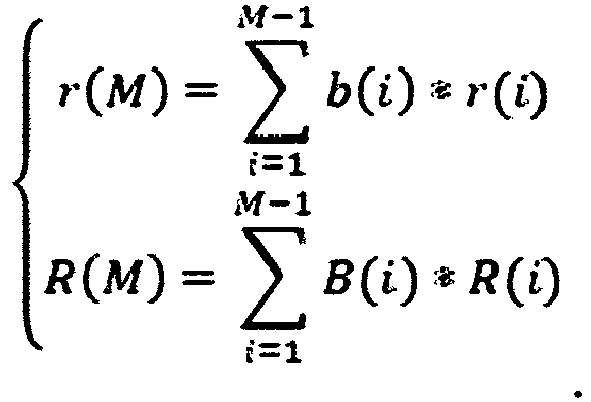
- The determination of coefficients b(i) and B(i) is more difficult for the method described in relation with
Figure 3 than with the method described in relation withFigure 2 . As a result, the set of pairs of ECC keys (r(i), R(i)) that can be generated by this method is larger. - Still another advantage of this method is that the set of key pairs that can be generated by this method grows with N.
-
Figure 4 is a flowchart illustrating an implementation mode of a method of generation of a plurality of pairs of ECC keys capable of being implemented by thedevice 10 described in relation withFigure 1 . More particularly, the method ofFigure 4 enables to generate N pairs of ECC keys (r(i), R(i)), with i varying from 1 to N, N being an integer. As previously described, the pair of keys (r(i), R(i)) is formed of a scalar r(i) and of a point R(i) of an elliptic curve. - Like the methods described in relation with
Figures 2 and3 , the method described herein enables to generate N pairs of ECC keys (r(i), R(i)) by using a linear combination of K pairs of ECC keys (p(k), P(k)), with k varying from 1 to K, K being an integer smaller than N. A pair of ECC keys (p(k), P(k)) is formed of a scalar p(k) and of a point P(k) of an elliptic curve. - At a preliminary step 30 (GEN K key pairs), identical to the
step 20 described in relation withFigure 2 , the K pairs of ECC keys (p(k), P(k)) are pre-generated by using ECC key generation methods. The K pairs of ECC keys (p(k), P(k)) are for example pre-generated and then stored in a memory circuit. - At a
step 31, the N pairs of ECC keys (r(i), R(i)) are generated. For this purpose, a vector comprising the K pairs of ECC keys (p(K), P(k)) is multiplied by a matrix A. Matrix A, having a general term A(i, j), has a size N*K, and is characterized by the fact that all its square sub-matrices of size K*K are invertible. An example of such a matrix A is a Vandermonde matrix. Thus, the N pairs of ECC keys (r(i), R(i)) are provided by the following formulas:
- At
step 32, the N pairs of ECC keys (r(i), R(i)) are ready to be used, they may for example be stored in a memory space. - Further, once the N pairs of ECC keys (r(i), R(i)) have been generated,
device 10, or more particularlycryptographic coprocessor 13, only uses M pairs of ECC keys (r(i), R(i)), M being a natural integer smaller than number N. - If number M is smaller than or equal to number K, then the M pairs of ECC keys (r(i), R(i)) used by
device 10, orcryptographic coprocessor 13, are not linearly dependent. This provides a higher security to signatures generated by means of such a key. - Various embodiments and variants have been described. Those skilled in the art will understand that certain features of these various embodiments and variants may be combined, and other variants will occur to those skilled in the art.
- Finally, the practical implementation of the described embodiments and variations is within the abilities of those skilled in the art based on the functional indications given hereabove. In particular, while the invention was described with respect to ECC, it could be applied to other finite groups in which keys are generated by scalar multiplication.
Claims (14)
- A method of generation of N first pairs of ECC keys for elliptic curve cryptography, wherein each first pair of keys is a linear combination of previously-generated second pairs of elliptic curve cryptography keys.
- The method according to claim 1, wherein the linear combination is an addition of some of said second pairs of keys.
- The method according to claim 2, wherein said some second pairs of keys are randomly selected among the second pairs of ECC keys.
- The method according to any of claims 1 to 3, comprising a step of initialization (20, 30) of the N first pairs of keys before the application of the linear combination.
- The method according to claim 4, wherein during the initialization step, the N first pairs of ECC keys are set to zero and to the point at infinity respectively.
- The method according to claim 4, wherein during the initialization step, the N first pairs of keys are initialized to the value taken by the last generated first pair of keys.
- The method according to claim 4, wherein during the initialization step, the N first pairs of keys (r(i), R(i)) are initialized to the value taken by one of the last W generated pair of keys (r(i-j), R(i-j)), where j <= W, j < i and j >= 1.
- The method according to claim 1 or 2, wherein N first pairs of elliptic curve cryptography keys r(i), R(i), with i varying from 1 to N, are generated using K previously-generated second pairs of elliptic curve cryptography keys p(k), P(k), with k varying from 1 to K, wherein K is smaller than N, and wherein the linear combination is:

- The method according to claim 8, wherein matrix A is a Vandermonde matrix.
- The method according to any of claims 1 to 9, wherein said first and second pairs of keys are formed of a scalar and of a point on an elliptic curve.
- The method according to any of claims 1 to 10, wherein the number of second pairs of keys (K) is smaller than N.
- A device capable of generating elliptic curve cryptography keys by implementing the method according to any of claims 1 to 11.
- A digital signature and/or key agreement method using elliptic curve cryptography keys generated by implementing the method according to any of claims 1 to 12.
- A digital signature and/or key agreement device capable of digital signature and/or key agreement by implementing the method according to claim 13.
Priority Applications (3)
| Application Number | Priority Date | Filing Date | Title |
|---|---|---|---|
| EP20425046.8A EP3993314B1 (en) | 2020-10-30 | 2020-10-30 | Keys for elliptic curve cryptography |
| US17/506,377 US11831771B2 (en) | 2020-10-30 | 2021-10-20 | Keys for elliptic curve cryptography |
| CN202111275402.9A CN114448634B (en) | 2020-10-30 | 2021-10-29 | Keys used for elliptic curve cryptography |
Applications Claiming Priority (1)
| Application Number | Priority Date | Filing Date | Title |
|---|---|---|---|
| EP20425046.8A EP3993314B1 (en) | 2020-10-30 | 2020-10-30 | Keys for elliptic curve cryptography |
Publications (2)
| Publication Number | Publication Date |
|---|---|
| EP3993314A1 true EP3993314A1 (en) | 2022-05-04 |
| EP3993314B1 EP3993314B1 (en) | 2023-11-29 |
Family
ID=73598028
Family Applications (1)
| Application Number | Title | Priority Date | Filing Date |
|---|---|---|---|
| EP20425046.8A Active EP3993314B1 (en) | 2020-10-30 | 2020-10-30 | Keys for elliptic curve cryptography |
Country Status (2)
| Country | Link |
|---|---|
| US (1) | US11831771B2 (en) |
| EP (1) | EP3993314B1 (en) |
Families Citing this family (2)
| Publication number | Priority date | Publication date | Assignee | Title |
|---|---|---|---|---|
| IT202100008951A1 (en) | 2021-04-09 | 2022-10-09 | St Microelectronics Srl | PROCEDURE FOR CONCEALING A SUBSCRIPTION IDENTIFIER IN EQUIPMENT USING A MOBILE COMMUNICATION NETWORK AND CORRESPONDING COMPUTER SYSTEM AND PRODUCT |
| FR3129262A1 (en) * | 2021-11-15 | 2023-05-19 | Stmicroelectronics (Rousset) Sas | Reduction and conversion of a scalar to a tau-adic representation |
Citations (1)
| Publication number | Priority date | Publication date | Assignee | Title |
|---|---|---|---|---|
| EP3316125A1 (en) * | 2016-10-26 | 2018-05-02 | Nxp B.V. | Method of generating an elliptic curve cryptographic key pair |
Family Cites Families (3)
| Publication number | Priority date | Publication date | Assignee | Title |
|---|---|---|---|---|
| JP5742960B2 (en) * | 2011-10-31 | 2015-07-01 | 富士通株式会社 | Cryptographic apparatus and method and program |
| FR3055444B1 (en) * | 2016-08-23 | 2022-02-04 | Maxim Integrated Products | SECURE ELLIPTICAL CURVE ENCRYPTION DEVICE CONTROL DEVICE AND METHODS |
| US11144649B2 (en) * | 2018-01-25 | 2021-10-12 | Kigen (Uk) Limited | Sensitive information provision process |
-
2020
- 2020-10-30 EP EP20425046.8A patent/EP3993314B1/en active Active
-
2021
- 2021-10-20 US US17/506,377 patent/US11831771B2/en active Active
Patent Citations (1)
| Publication number | Priority date | Publication date | Assignee | Title |
|---|---|---|---|---|
| EP3316125A1 (en) * | 2016-10-26 | 2018-05-02 | Nxp B.V. | Method of generating an elliptic curve cryptographic key pair |
Non-Patent Citations (1)
| Title |
|---|
| LI XIN ET AL: "CPK Unified Identity Based Secure Remote Access System for Mobile Terminal", COMPUTATIONAL INTELLIGENCE AND DESIGN (ISCID), 2012 FIFTH INTERNATIONAL SYMPOSIUM ON, IEEE, 28 October 2012 (2012-10-28), pages 493 - 496, XP032302501, ISBN: 978-1-4673-2646-9, DOI: 10.1109/ISCID.2012.129 * |
Also Published As
| Publication number | Publication date |
|---|---|
| US20220141016A1 (en) | 2022-05-05 |
| EP3993314B1 (en) | 2023-11-29 |
| US11831771B2 (en) | 2023-11-28 |
Similar Documents
| Publication | Publication Date | Title |
|---|---|---|
| CN107040362B (en) | Modular multiplication apparatus and method | |
| US6876745B1 (en) | Method and apparatus for elliptic curve cryptography and recording medium therefore | |
| CN104937537B (en) | Cryptographic methods involving multiplication with scalars or exponentiation | |
| Renes et al. | qDSA: small and secure digital signatures with curve-based Diffie–Hellman key pairs | |
| Renes et al. | Kummer: Efficient hyperelliptic signatures and key exchange on microcontrollers | |
| US20110161390A1 (en) | Modular multiplication processing apparatus | |
| US20030059043A1 (en) | Elliptic curve signature verification method and apparatus and a storage medium for implementing the same | |
| EP3993314B1 (en) | Keys for elliptic curve cryptography | |
| JP3794266B2 (en) | Elliptic curve scalar multiplication method and apparatus, and storage medium | |
| EP3048754A1 (en) | Multivariate public key signature/verification system and signature/verification method | |
| JP4875686B2 (en) | Accelerating finite field operations on elliptic curves | |
| EP3226120B1 (en) | Non-modular multiplier, method for non-modular multiplication and computational device | |
| US10361855B2 (en) | Computing a secure elliptic curve scalar multiplication using an unsecured and secure environment | |
| CN106371803A (en) | Computing method and computing device for Montgomery domain | |
| US20090136025A1 (en) | Method for scalarly multiplying points on an elliptic curve | |
| Lee et al. | Area-efficient subquadratic space-complexity digit-serial multiplier for type-II optimal normal basis of $ GF (2^{m}) $ using symmetric TMVP and block recombination techniques | |
| US7680268B2 (en) | Elliptic curve point octupling using single instruction multiple data processing | |
| US20240163074A1 (en) | Circuit for a Combined Key Value-Dependent Exchange and Randomization of Two Values | |
| CN111740821A (en) | Method and apparatus for establishing shared key | |
| Realpe-Muñoz et al. | High-performance elliptic curve cryptoprocessors over GF (2 m) on Koblitz curves | |
| RU2401513C2 (en) | Method for generating and verification electronic digital signature authenticating electronic document | |
| CN114448634B (en) | Keys used for elliptic curve cryptography | |
| US12566651B2 (en) | Error detection for encryption or decryption keys | |
| JP2002508523A (en) | Fast finite field operation on elliptic curves | |
| Yang et al. | Digit-serial GNB multiplier based on TMVP approach over GF (2m) |
Legal Events
| Date | Code | Title | Description |
|---|---|---|---|
| PUAI | Public reference made under article 153(3) epc to a published international application that has entered the european phase |
Free format text: ORIGINAL CODE: 0009012 |
|
| STAA | Information on the status of an ep patent application or granted ep patent |
Free format text: STATUS: THE APPLICATION HAS BEEN PUBLISHED |
|
| AK | Designated contracting states |
Kind code of ref document: A1 Designated state(s): AL AT BE BG CH CY CZ DE DK EE ES FI FR GB GR HR HU IE IS IT LI LT LU LV MC MK MT NL NO PL PT RO RS SE SI SK SM TR |
|
| STAA | Information on the status of an ep patent application or granted ep patent |
Free format text: STATUS: REQUEST FOR EXAMINATION WAS MADE |
|
| 17P | Request for examination filed |
Effective date: 20221020 |
|
| RBV | Designated contracting states (corrected) |
Designated state(s): AL AT BE BG CH CY CZ DE DK EE ES FI FR GB GR HR HU IE IS IT LI LT LU LV MC MK MT NL NO PL PT RO RS SE SI SK SM TR |
|
| GRAP | Despatch of communication of intention to grant a patent |
Free format text: ORIGINAL CODE: EPIDOSNIGR1 |
|
| STAA | Information on the status of an ep patent application or granted ep patent |
Free format text: STATUS: GRANT OF PATENT IS INTENDED |
|
| INTG | Intention to grant announced |
Effective date: 20230711 |
|
| GRAS | Grant fee paid |
Free format text: ORIGINAL CODE: EPIDOSNIGR3 |
|
| GRAA | (expected) grant |
Free format text: ORIGINAL CODE: 0009210 |
|
| STAA | Information on the status of an ep patent application or granted ep patent |
Free format text: STATUS: THE PATENT HAS BEEN GRANTED |
|
| AK | Designated contracting states |
Kind code of ref document: B1 Designated state(s): AL AT BE BG CH CY CZ DE DK EE ES FI FR GB GR HR HU IE IS IT LI LT LU LV MC MK MT NL NO PL PT RO RS SE SI SK SM TR |
|
| REG | Reference to a national code |
Ref country code: GB Ref legal event code: FG4D |
|
| REG | Reference to a national code |
Ref country code: CH Ref legal event code: EP |
|
| REG | Reference to a national code |
Ref country code: DE Ref legal event code: R096 Ref document number: 602020021841 Country of ref document: DE |
|
| REG | Reference to a national code |
Ref country code: IE Ref legal event code: FG4D |
|
| REG | Reference to a national code |
Ref country code: LT Ref legal event code: MG9D |
|
| REG | Reference to a national code |
Ref country code: NL Ref legal event code: MP Effective date: 20231129 |
|
| PG25 | Lapsed in a contracting state [announced via postgrant information from national office to epo] |
Ref country code: GR Free format text: LAPSE BECAUSE OF FAILURE TO SUBMIT A TRANSLATION OF THE DESCRIPTION OR TO PAY THE FEE WITHIN THE PRESCRIBED TIME-LIMIT Effective date: 20240301 |
|
| PG25 | Lapsed in a contracting state [announced via postgrant information from national office to epo] |
Ref country code: IS Free format text: LAPSE BECAUSE OF FAILURE TO SUBMIT A TRANSLATION OF THE DESCRIPTION OR TO PAY THE FEE WITHIN THE PRESCRIBED TIME-LIMIT Effective date: 20240329 |
|
| PG25 | Lapsed in a contracting state [announced via postgrant information from national office to epo] |
Ref country code: LT Free format text: LAPSE BECAUSE OF FAILURE TO SUBMIT A TRANSLATION OF THE DESCRIPTION OR TO PAY THE FEE WITHIN THE PRESCRIBED TIME-LIMIT Effective date: 20231129 |
|
| PG25 | Lapsed in a contracting state [announced via postgrant information from national office to epo] |
Ref country code: ES Free format text: LAPSE BECAUSE OF FAILURE TO SUBMIT A TRANSLATION OF THE DESCRIPTION OR TO PAY THE FEE WITHIN THE PRESCRIBED TIME-LIMIT Effective date: 20231129 |
|
| PG25 | Lapsed in a contracting state [announced via postgrant information from national office to epo] |
Ref country code: LT Free format text: LAPSE BECAUSE OF FAILURE TO SUBMIT A TRANSLATION OF THE DESCRIPTION OR TO PAY THE FEE WITHIN THE PRESCRIBED TIME-LIMIT Effective date: 20231129 Ref country code: IS Free format text: LAPSE BECAUSE OF FAILURE TO SUBMIT A TRANSLATION OF THE DESCRIPTION OR TO PAY THE FEE WITHIN THE PRESCRIBED TIME-LIMIT Effective date: 20240329 Ref country code: GR Free format text: LAPSE BECAUSE OF FAILURE TO SUBMIT A TRANSLATION OF THE DESCRIPTION OR TO PAY THE FEE WITHIN THE PRESCRIBED TIME-LIMIT Effective date: 20240301 Ref country code: ES Free format text: LAPSE BECAUSE OF FAILURE TO SUBMIT A TRANSLATION OF THE DESCRIPTION OR TO PAY THE FEE WITHIN THE PRESCRIBED TIME-LIMIT Effective date: 20231129 Ref country code: BG Free format text: LAPSE BECAUSE OF FAILURE TO SUBMIT A TRANSLATION OF THE DESCRIPTION OR TO PAY THE FEE WITHIN THE PRESCRIBED TIME-LIMIT Effective date: 20240229 |
|
| REG | Reference to a national code |
Ref country code: AT Ref legal event code: MK05 Ref document number: 1637233 Country of ref document: AT Kind code of ref document: T Effective date: 20231129 |
|
| PG25 | Lapsed in a contracting state [announced via postgrant information from national office to epo] |
Ref country code: NL Free format text: LAPSE BECAUSE OF FAILURE TO SUBMIT A TRANSLATION OF THE DESCRIPTION OR TO PAY THE FEE WITHIN THE PRESCRIBED TIME-LIMIT Effective date: 20231129 |
|
| PG25 | Lapsed in a contracting state [announced via postgrant information from national office to epo] |
Ref country code: SE Free format text: LAPSE BECAUSE OF FAILURE TO SUBMIT A TRANSLATION OF THE DESCRIPTION OR TO PAY THE FEE WITHIN THE PRESCRIBED TIME-LIMIT Effective date: 20231129 Ref country code: RS Free format text: LAPSE BECAUSE OF FAILURE TO SUBMIT A TRANSLATION OF THE DESCRIPTION OR TO PAY THE FEE WITHIN THE PRESCRIBED TIME-LIMIT Effective date: 20231129 Ref country code: PL Free format text: LAPSE BECAUSE OF FAILURE TO SUBMIT A TRANSLATION OF THE DESCRIPTION OR TO PAY THE FEE WITHIN THE PRESCRIBED TIME-LIMIT Effective date: 20231129 Ref country code: NO Free format text: LAPSE BECAUSE OF FAILURE TO SUBMIT A TRANSLATION OF THE DESCRIPTION OR TO PAY THE FEE WITHIN THE PRESCRIBED TIME-LIMIT Effective date: 20240229 Ref country code: NL Free format text: LAPSE BECAUSE OF FAILURE TO SUBMIT A TRANSLATION OF THE DESCRIPTION OR TO PAY THE FEE WITHIN THE PRESCRIBED TIME-LIMIT Effective date: 20231129 Ref country code: LV Free format text: LAPSE BECAUSE OF FAILURE TO SUBMIT A TRANSLATION OF THE DESCRIPTION OR TO PAY THE FEE WITHIN THE PRESCRIBED TIME-LIMIT Effective date: 20231129 Ref country code: HR Free format text: LAPSE BECAUSE OF FAILURE TO SUBMIT A TRANSLATION OF THE DESCRIPTION OR TO PAY THE FEE WITHIN THE PRESCRIBED TIME-LIMIT Effective date: 20231129 |
|
| PG25 | Lapsed in a contracting state [announced via postgrant information from national office to epo] |
Ref country code: DK Free format text: LAPSE BECAUSE OF FAILURE TO SUBMIT A TRANSLATION OF THE DESCRIPTION OR TO PAY THE FEE WITHIN THE PRESCRIBED TIME-LIMIT Effective date: 20231129 |
|
| PG25 | Lapsed in a contracting state [announced via postgrant information from national office to epo] |
Ref country code: AT Free format text: LAPSE BECAUSE OF FAILURE TO SUBMIT A TRANSLATION OF THE DESCRIPTION OR TO PAY THE FEE WITHIN THE PRESCRIBED TIME-LIMIT Effective date: 20231129 Ref country code: CZ Free format text: LAPSE BECAUSE OF FAILURE TO SUBMIT A TRANSLATION OF THE DESCRIPTION OR TO PAY THE FEE WITHIN THE PRESCRIBED TIME-LIMIT Effective date: 20231129 |
|
| PG25 | Lapsed in a contracting state [announced via postgrant information from national office to epo] |
Ref country code: SK Free format text: LAPSE BECAUSE OF FAILURE TO SUBMIT A TRANSLATION OF THE DESCRIPTION OR TO PAY THE FEE WITHIN THE PRESCRIBED TIME-LIMIT Effective date: 20231129 |
|
| PG25 | Lapsed in a contracting state [announced via postgrant information from national office to epo] |
Ref country code: SM Free format text: LAPSE BECAUSE OF FAILURE TO SUBMIT A TRANSLATION OF THE DESCRIPTION OR TO PAY THE FEE WITHIN THE PRESCRIBED TIME-LIMIT Effective date: 20231129 Ref country code: SK Free format text: LAPSE BECAUSE OF FAILURE TO SUBMIT A TRANSLATION OF THE DESCRIPTION OR TO PAY THE FEE WITHIN THE PRESCRIBED TIME-LIMIT Effective date: 20231129 Ref country code: RO Free format text: LAPSE BECAUSE OF FAILURE TO SUBMIT A TRANSLATION OF THE DESCRIPTION OR TO PAY THE FEE WITHIN THE PRESCRIBED TIME-LIMIT Effective date: 20231129 Ref country code: IT Free format text: LAPSE BECAUSE OF FAILURE TO SUBMIT A TRANSLATION OF THE DESCRIPTION OR TO PAY THE FEE WITHIN THE PRESCRIBED TIME-LIMIT Effective date: 20231129 Ref country code: EE Free format text: LAPSE BECAUSE OF FAILURE TO SUBMIT A TRANSLATION OF THE DESCRIPTION OR TO PAY THE FEE WITHIN THE PRESCRIBED TIME-LIMIT Effective date: 20231129 Ref country code: DK Free format text: LAPSE BECAUSE OF FAILURE TO SUBMIT A TRANSLATION OF THE DESCRIPTION OR TO PAY THE FEE WITHIN THE PRESCRIBED TIME-LIMIT Effective date: 20231129 Ref country code: CZ Free format text: LAPSE BECAUSE OF FAILURE TO SUBMIT A TRANSLATION OF THE DESCRIPTION OR TO PAY THE FEE WITHIN THE PRESCRIBED TIME-LIMIT Effective date: 20231129 Ref country code: AT Free format text: LAPSE BECAUSE OF FAILURE TO SUBMIT A TRANSLATION OF THE DESCRIPTION OR TO PAY THE FEE WITHIN THE PRESCRIBED TIME-LIMIT Effective date: 20231129 |
|
| PG25 | Lapsed in a contracting state [announced via postgrant information from national office to epo] |
Ref country code: PT Free format text: LAPSE BECAUSE OF FAILURE TO SUBMIT A TRANSLATION OF THE DESCRIPTION OR TO PAY THE FEE WITHIN THE PRESCRIBED TIME-LIMIT Effective date: 20240401 |
|
| PG25 | Lapsed in a contracting state [announced via postgrant information from national office to epo] |
Ref country code: PT Free format text: LAPSE BECAUSE OF FAILURE TO SUBMIT A TRANSLATION OF THE DESCRIPTION OR TO PAY THE FEE WITHIN THE PRESCRIBED TIME-LIMIT Effective date: 20240401 |
|
| REG | Reference to a national code |
Ref country code: DE Ref legal event code: R097 Ref document number: 602020021841 Country of ref document: DE |
|
| PLBE | No opposition filed within time limit |
Free format text: ORIGINAL CODE: 0009261 |
|
| STAA | Information on the status of an ep patent application or granted ep patent |
Free format text: STATUS: NO OPPOSITION FILED WITHIN TIME LIMIT |
|
| PG25 | Lapsed in a contracting state [announced via postgrant information from national office to epo] |
Ref country code: SI Free format text: LAPSE BECAUSE OF FAILURE TO SUBMIT A TRANSLATION OF THE DESCRIPTION OR TO PAY THE FEE WITHIN THE PRESCRIBED TIME-LIMIT Effective date: 20231129 |
|
| PG25 | Lapsed in a contracting state [announced via postgrant information from national office to epo] |
Ref country code: SI Free format text: LAPSE BECAUSE OF FAILURE TO SUBMIT A TRANSLATION OF THE DESCRIPTION OR TO PAY THE FEE WITHIN THE PRESCRIBED TIME-LIMIT Effective date: 20231129 |
|
| 26N | No opposition filed |
Effective date: 20240830 |
|
| REG | Reference to a national code |
Ref country code: DE Ref legal event code: R081 Ref document number: 602020021841 Country of ref document: DE Owner name: STMICROELECTRONICS S.R.L., AGRATE BRIANZA, IT Free format text: FORMER OWNERS: PROTON WORLD INTERNATIONAL N.V., DIEGEM, BE; STMICROELECTRONICS S.R.L., AGRATE BRIANZA, (MB), IT Ref country code: DE Ref legal event code: R081 Ref document number: 602020021841 Country of ref document: DE Owner name: STMICROELECTRONICS BELGIUM N.V., BE Free format text: FORMER OWNERS: PROTON WORLD INTERNATIONAL N.V., DIEGEM, BE; STMICROELECTRONICS S.R.L., AGRATE BRIANZA, (MB), IT |
|
| REG | Reference to a national code |
Ref country code: CH Ref legal event code: PL |
|
| GBPC | Gb: european patent ceased through non-payment of renewal fee |
Effective date: 20241030 |
|
| PG25 | Lapsed in a contracting state [announced via postgrant information from national office to epo] |
Ref country code: MC Free format text: LAPSE BECAUSE OF FAILURE TO SUBMIT A TRANSLATION OF THE DESCRIPTION OR TO PAY THE FEE WITHIN THE PRESCRIBED TIME-LIMIT Effective date: 20231129 |
|
| PG25 | Lapsed in a contracting state [announced via postgrant information from national office to epo] |
Ref country code: GB Free format text: LAPSE BECAUSE OF NON-PAYMENT OF DUE FEES Effective date: 20241030 |
|
| PG25 | Lapsed in a contracting state [announced via postgrant information from national office to epo] |
Ref country code: LU Free format text: LAPSE BECAUSE OF NON-PAYMENT OF DUE FEES Effective date: 20241030 Ref country code: BE Free format text: LAPSE BECAUSE OF NON-PAYMENT OF DUE FEES Effective date: 20241031 |
|
| PG25 | Lapsed in a contracting state [announced via postgrant information from national office to epo] |
Ref country code: FR Free format text: LAPSE BECAUSE OF NON-PAYMENT OF DUE FEES Effective date: 20241031 |
|
| PG25 | Lapsed in a contracting state [announced via postgrant information from national office to epo] |
Ref country code: CH Free format text: LAPSE BECAUSE OF NON-PAYMENT OF DUE FEES Effective date: 20241031 |
|
| REG | Reference to a national code |
Ref country code: BE Ref legal event code: MM Effective date: 20241031 |
|
| PG25 | Lapsed in a contracting state [announced via postgrant information from national office to epo] |
Ref country code: FI Free format text: LAPSE BECAUSE OF FAILURE TO SUBMIT A TRANSLATION OF THE DESCRIPTION OR TO PAY THE FEE WITHIN THE PRESCRIBED TIME-LIMIT Effective date: 20231129 |
|
| PG25 | Lapsed in a contracting state [announced via postgrant information from national office to epo] |
Ref country code: IE Free format text: LAPSE BECAUSE OF NON-PAYMENT OF DUE FEES Effective date: 20241030 |
|
| PGFP | Annual fee paid to national office [announced via postgrant information from national office to epo] |
Ref country code: DE Payment date: 20250923 Year of fee payment: 6 |
|
| PG25 | Lapsed in a contracting state [announced via postgrant information from national office to epo] |
Ref country code: HU Free format text: LAPSE BECAUSE OF FAILURE TO SUBMIT A TRANSLATION OF THE DESCRIPTION OR TO PAY THE FEE WITHIN THE PRESCRIBED TIME-LIMIT; INVALID AB INITIO Effective date: 20201030 |
|
| PG25 | Lapsed in a contracting state [announced via postgrant information from national office to epo] |
Ref country code: CY Free format text: LAPSE BECAUSE OF FAILURE TO SUBMIT A TRANSLATION OF THE DESCRIPTION OR TO PAY THE FEE WITHIN THE PRESCRIBED TIME-LIMIT; INVALID AB INITIO Effective date: 20201030 |