EP3992876B1 - Integration navigator and intelligent monitoring for living systems - Google Patents
Integration navigator and intelligent monitoring for living systems Download PDFInfo
- Publication number
- EP3992876B1 EP3992876B1 EP21200183.8A EP21200183A EP3992876B1 EP 3992876 B1 EP3992876 B1 EP 3992876B1 EP 21200183 A EP21200183 A EP 21200183A EP 3992876 B1 EP3992876 B1 EP 3992876B1
- Authority
- EP
- European Patent Office
- Prior art keywords
- information
- action
- generating
- ticket
- engine
- Prior art date
- Legal status (The legal status is an assumption and is not a legal conclusion. Google has not performed a legal analysis and makes no representation as to the accuracy of the status listed.)
- Active
Links
Images



Classifications
-
- H—ELECTRICITY
- H04—ELECTRIC COMMUNICATION TECHNIQUE
- H04L—TRANSMISSION OF DIGITAL INFORMATION, e.g. TELEGRAPHIC COMMUNICATION
- H04L41/00—Arrangements for maintenance, administration or management of data switching networks, e.g. of packet switching networks
- H04L41/50—Network service management, e.g. ensuring proper service fulfilment according to agreements
- H04L41/5061—Network service management, e.g. ensuring proper service fulfilment according to agreements characterised by the interaction between service providers and their network customers, e.g. customer relationship management
- H04L41/5074—Handling of user complaints or trouble tickets
-
- G—PHYSICS
- G06—COMPUTING OR CALCULATING; COUNTING
- G06N—COMPUTING ARRANGEMENTS BASED ON SPECIFIC COMPUTATIONAL MODELS
- G06N20/00—Machine learning
-
- G—PHYSICS
- G06—COMPUTING OR CALCULATING; COUNTING
- G06N—COMPUTING ARRANGEMENTS BASED ON SPECIFIC COMPUTATIONAL MODELS
- G06N5/00—Computing arrangements using knowledge-based models
- G06N5/02—Knowledge representation; Symbolic representation
-
- G—PHYSICS
- G06—COMPUTING OR CALCULATING; COUNTING
- G06N—COMPUTING ARRANGEMENTS BASED ON SPECIFIC COMPUTATIONAL MODELS
- G06N5/00—Computing arrangements using knowledge-based models
- G06N5/04—Inference or reasoning models
-
- G—PHYSICS
- G06—COMPUTING OR CALCULATING; COUNTING
- G06Q—INFORMATION AND COMMUNICATION TECHNOLOGY [ICT] SPECIALLY ADAPTED FOR ADMINISTRATIVE, COMMERCIAL, FINANCIAL, MANAGERIAL OR SUPERVISORY PURPOSES; SYSTEMS OR METHODS SPECIALLY ADAPTED FOR ADMINISTRATIVE, COMMERCIAL, FINANCIAL, MANAGERIAL OR SUPERVISORY PURPOSES, NOT OTHERWISE PROVIDED FOR
- G06Q10/00—Administration; Management
- G06Q10/06—Resources, workflows, human or project management; Enterprise or organisation planning; Enterprise or organisation modelling
-
- G—PHYSICS
- G06—COMPUTING OR CALCULATING; COUNTING
- G06Q—INFORMATION AND COMMUNICATION TECHNOLOGY [ICT] SPECIALLY ADAPTED FOR ADMINISTRATIVE, COMMERCIAL, FINANCIAL, MANAGERIAL OR SUPERVISORY PURPOSES; SYSTEMS OR METHODS SPECIALLY ADAPTED FOR ADMINISTRATIVE, COMMERCIAL, FINANCIAL, MANAGERIAL OR SUPERVISORY PURPOSES, NOT OTHERWISE PROVIDED FOR
- G06Q10/00—Administration; Management
- G06Q10/06—Resources, workflows, human or project management; Enterprise or organisation planning; Enterprise or organisation modelling
- G06Q10/063—Operations research, analysis or management
- G06Q10/0631—Resource planning, allocation, distributing or scheduling for enterprises or organisations
- G06Q10/06316—Sequencing of tasks or work
-
- H—ELECTRICITY
- H04—ELECTRIC COMMUNICATION TECHNIQUE
- H04L—TRANSMISSION OF DIGITAL INFORMATION, e.g. TELEGRAPHIC COMMUNICATION
- H04L41/00—Arrangements for maintenance, administration or management of data switching networks, e.g. of packet switching networks
- H04L41/50—Network service management, e.g. ensuring proper service fulfilment according to agreements
- H04L41/5061—Network service management, e.g. ensuring proper service fulfilment according to agreements characterised by the interaction between service providers and their network customers, e.g. customer relationship management
- H04L41/507—Filtering out customers affected by service problems
Definitions
- This disclosure generally relates to integrations in a system.
- Systems may include different applications and services that are integrated together.
- a system may use integrations to bind together many kinds of applications to work in conjunction in various automated operations.
- integrations may experience failures.
- an integration between two different applications may fail when a process that exchanges data between the applications fails.
- US 2019/0362291 A1 discloses a computer-implemented method that includes generating, by a processor of a problem-tracking system, a problem ticket.
- the problem ticket describes a problem encountered by a first user, and the problem ticket is assigned to at least one qualified user to resolve.
- the method also includes receiving additional information relating to the problem from at least one second user.
- the method also includes storing the received additional information in association with the problem ticket. The receiving and the storing of the additional information occurs while the problem ticket is waiting to be resolved by the at least one qualified user.
- the method also includes providing the stored received additional information and the problem ticket to the at least one qualified user.
- US 2019/0132191 A1 discloses a system and method for predictive ticketing in information technology (IT) systems.
- the method includes extracting a plurality of features from monitoring data related to an IT system, wherein the plurality of features includes at least one incident parameter, wherein the monitoring data includes machine-generated textual data; applying a machine learning model to the extracted plurality of features, wherein the machine learning model is configured to output a suitable insight for an incident represented by the at least one incident parameter, wherein the suitable insight is selected from among a plurality of historical insights; and generating a predictive ticket based on the suitable insight, wherein the predictive ticket includes a textual description of an expected future symptom in the IT system.
- an aspect of the subject matter described in this specification may involve a process for resolving contextual tickets.
- a contextual ticket may describe an issue that was experienced by a user of a system.
- a contextual ticket may describe that a user was unable to send a meter location change to a meter data management system.
- a system may provide a guided process for creation of a contextual ticket.
- the system may guide a user to create a contextual ticket in response to the user being unable to send a meter location change to a meter data management system.
- the guided contextual ticket creation may enable users of the system to create highly relevant contextual tickets, where contextual data in the tickets help increase speed of issue resolution and provide a foundation for automation in resolving the issue.
- the contextual data in the contextual tickets can include data that specifies one or more of integration systems, specific flows, application programming interface end points, real time integration status, message flow information, infrastructure status, impact score, possible root causes, possible solutions, and correlated past tickets.
- the system may generate a ticket knowledge graph that represents the contextual data of the contextual ticket, and may provide the graph to a machine-learning trained action determination engine.
- the engine may output an indication of an action for resolving the issue indicated by the contextual ticket, and the system may then initiate the action indicated by the engine.
- One advantage may be the issues may be more quickly resolved based on automatic determination and initiation of actions to resolve the issues. Another advantage may be that actions that resolve the issues may be more accurately determined by the machine-learning trained action determination engine than by a human operator. Yet another advantage is that non-standardized information may be standardized, and then used by a machine-learning trained model that requires standardized input.
- the subject matter described in this specification may be embodied in methods that may include the actions of receiving a request from a user to generate a contextual ticket that indicates an issue with an integration for sending a meter location change to a meter data management system, obtaining baseline information for the issue, wherein the baseline information comprises a description provided by the user and a navigation point for the issue, generating, based on the baseline information, a ticket knowledge graph, comprising: generating extracted information based on the baseline information, wherein the extracted information comprises one or more of integration status, technical metadata and integration type; and generating the ticket knowledge graph based on the baseline information and the extracted information; providing the ticket knowledge graph to a machine-learning trained action determination engine, receiving, from the machine-learning trained action determination engine, an indication of an action for resolving the issue, and automatically providing, based on the indication of the action for resolving the issue, the action to a particular engine to resolve the issue.
- implementations of this and other aspects include corresponding systems, apparatus, and computer programs, may be configured to perform the actions of the methods, encoded on computer storage devices.
- a system of one or more computers can be so configured by virtue of software, firmware, hardware, or a combination of them installed on the system that in operation cause the system to perform the actions.
- One or more computer programs can be so configured by virtue of having instructions that, when executed by data processing apparatus, cause the apparatus to perform the actions.
- generating, based on the baseline information, a ticket knowledge graph includes generating extracted information based on the baseline information, generating calculated information based on the baseline information and the extracted information, generating correlated information based on the calculated information, generating predicted information based on the correlated information, and generating a ticket knowledge graph based on the baseline information, extracted information, the calculated information, the correlated information, and the predicted information.
- generating a ticket knowledge graph based on the baseline information, the extracted information, the calculated information, the correlated information, and the predicted information includes generating the ticket knowledge graph to include nodes that represent the baseline information, the extracted information, the calculated information, the correlated information, and the predicted information.
- the ticket knowledge graph includes links that represent relationships between the nodes.
- a root node of the ticket knowledge graph represents a navigational point of the issue.
- generating extracted information based on the baseline information includes obtaining a common information model for integration and generating the extracted information from the common information model for integration based on the baseline information.
- providing the ticket knowledge graph to a machine-learning trained action determination engine includes providing the baseline information to a first action predictor engine, providing the extracted information to a second action predictor engine, providing the calculated information to a third action predictor engine, providing the correlated information to a fourth action predictor engine, providing the predicated information to a fifth action predictor engine, receiving respective actions from the first action predictor engine, the second action predictor engine, the third action predictor engine, the fourth action predictor engine, and the fifth action predictor engine, providing the respective actions to an action selection engine, and receiving a selected action from the action selection engine.
- generating, based on the baseline information, a ticket knowledge graph includes generating a standardized data structure that represents at least a portion of the extracted information, a portion of the predicted information, and at least a portion of the calculated information and providing the standardized data structure to a machine-learning regression model, where the machine-learning regression model is trained based on standardized data structures and labeled outputs that represent values for at least a second portion of the predicted information.
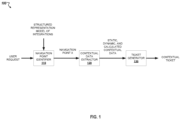
- FIG. 1 illustrates a diagrams of an exemplary system 100 for guided contextual ticket creation.
- the system 100 includes a navigation point identifier 110 that identifies a navigation point, a contextual data extractor 120 that extracts contextual data based on the navigation point, and a ticket generator 130 that generates a contextual ticket based on the contextual data.
- the navigation point identifier 110, the contextual data extractor 120, and the ticket generator 120 may be implemented as one or more computer systems.
- the navigation point identifier 110 may receive a request from a user to generate a ticket regarding a particular integration that has an issue, obtain a structured representation model of integrations in the system including the particular integration, and identify the navigation point that corresponds to the particular integration. For example, a user may navigate through a graphical representation of the model of integrations and request to submit a ticket for an integration for sending a meter location change to a meter data management system.
- a navigation point may be a specific user interface in an integration navigator.
- An integration navigator may be an application that provides a graphical user interface that users may use to view various integrations and create contextual tickets for issues.
- the navigation point identifier 110 may receive the request, search through the model of integrations for a particular link that corresponds to the integration for sending a meter location change to a meter data management system, and then output text that specifies the particular link.
- the contextual data extractor 120 extracts contextual data based on the navigation point that was identified by the navigation point identifier 110.
- the contextual data extractor may extract specific flows, application programming interface end points, real time integration status, message flow information, infrastructure status, impact score, possible root causes, possible solutions, and correlated past tickets that correspond to the particular link that corresponds to the integration for sending a meter location change to a meter data management system.
- the contextual data extractor 120 extracts contextual data based on (i) extracting static contextual data based on the navigation point, (ii) extracting dynamic contextual data based on the static contextual data, and (iii) determining calculated contextual data based on the dynamic contextual data.
- the contextual data extractor 120 may (i) extract static contextual data that includes specific flows, application programming interface end points, (ii) from the specific flows, application programming interface end points then extract dynamic contextual data that includes real time integration status, message flow information, infrastructure status, and (iii) from the real time integration status, message flow information, infrastructure status then calculate contextual data that includes impact score, possible root causes, possible solutions, and correlated past tickets that correspond to the particular link that corresponds to the integration for sending a meter location change to a meter data management system.
- the ticket generator 130 generates a contextual ticket based on the contextual data.
- the ticket generator 130 may receive specific flows, application programming interface end points, real time integration status, message flow information, infrastructure status, impact score, possible root causes, possible solutions, and correlated past tickets that correspond to the particular link that corresponds to the integration for sending a meter location change to a meter data management system, and, in response, generate a contextual ticket that includes a link that corresponds to the integration for sending a meter location change to a meter data management system, a user description of the issue, technical metadata, recent tickets, relevant documentation link, integration status, contact information, and probably root cause.
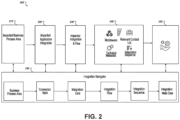
- FIG. 2 illustrates a diagram of another exemplary model 200 for guided contextual ticket creation.
- the model 200 includes a business process area 210 impacted by an issue, an application 220 impacted by the issue, an integration 230 impacted by the issue, technical information 240, a ticketing tool 250, and an integration navigator 290.
- the business process area 210 may be a collection of related, structured activities, people, and/or equipment in which a specific sequence produces a service or product for a particular customer or customers.
- a utility customer information system may include six high level business process areas of federal insurance contributions act, billing, device, sales service, marketing, and digital.
- the application 220 may be computer software that supports a process.
- the application 220 may be a service order system, a meter reading system, etc.
- the integration 230 may be a data exchange with an application.
- applications and a core system may have fifteen output and ten inbound integrations between each other.
- Technical information 240 may be information associated with a specific integration.
- technical information may be a Uniform Resource Locator (URL), security information, logging index, server, etc.
- a ticketing tool 250 may be a tool that resolves tickets.
- the ticketing tool 250 may be software that automatically determines an action to resolve an issue and then initiates the action.
- the integration navigator 290 may enable users to start by displaying business process areas and receiving a user selection of one, after selection of a business area then displaying connected applications and receiving a user selection of one, after selection of a connected application then displaying integration lists and receiving a user selection of one, after selection of an integration list then displaying a corresponding integration flow, integration sequence, and integration metadata.
- An integration list for an application may refer to a list of integrations used by an application.
- An integration flow may be a visual depiction of end to end detailed message flow of an integration.
- An integration sequence may be detailed sequential steps of a specific integration flow.
- Integration metadata may be technical data associated with a specific integration flow.
- FIG. 3 illustrates a diagram of example stages 300 for resolving a contextual ticket.
- the stages 300 may include integration ticket creation 310, obtain baseline information 320, generate extracted information 330, generate calculated information 340, generate correlated information 350, generate predicted information 360, and action space determination 370.
- the integration ticket creation 310 may be user initiated from a graphical user interface of an integration navigator, proactively generated by the integration navigator without an explicit request to generate by the user, or automatically generated from middleware monitoring.
- the baseline information 320 may be foundational information provided by the user and integration navigator when a user tries to create a ticket for any suspected issue.
- the baseline information may indicate a qualitative description of the issue as provided by the user, and a navigational path from the integration navigator system which helps in understanding the exact integration, connected application, and flow impacted based on a common information model for integration (CCIMI) model.
- CCIMI common information model for integration
- the navigational path may be the previously described navigation point.
- the extracted information may be generated by getting relevant information from various middleware platforms, connected systems, and document repository systems directly related to the components for which the incident has been raised.
- the extracted information may represent the most direct relevant data related to the system, process and flows impacted.
- the system may generate the extracted information by making application programming interface (API) calls, database queries, log extraction, or any other data retrieval techniques.
- API application programming interface
- Some example of data elements extracted may be integration status, technical metadata of the integration, relevant documentation, support schedule, integration type, dependency, and issue raised by, etc.
- the calculated information may be generated based on the user-provided information and extracted information, and may be the result of various calculation operations to gather additional secondary data relevant to the incident.
- the system may be able to add the calculated information based on intelligent calculation functions by getting a reference from the baseline and the extracted information.
- Some examples of a calculated information may be raised by manager, number of tickets raised by user in last predetermined number of days, average past resolution time for similar tickets raised by the user, recent tickets, contact information, net promotor score (NPS) for the group, user sentiment, and knowledge graph of relevant documentation, etc.
- the correlated information may be generated based on gathering correlated information using the baselined, extracted, and calculated information.
- the correlated information may represent information that is not directly connected to the incident but may help understand the impact or root cause of the issues in a broader context.
- Correlated information may include recently deployed changes, related key performance indicators (KPI), related KPI trending, related active tickets, and related active tickets root cause, etc.
- KPI key performance indicators
- Predicted information may be added through sophisticated machine learning algorithms. These machine learning models may gather predicted information dependent on the data from the previous stages. Predicted information may include Service Level Agreement expiration probability, priority, business impact, best assigned person, resolution time prediction, and probable root cause, etc.
- the action space that may be determined includes actions that may be determined to resolve the issue.
- the action space may include executing a bot or workflow to resolve the issue, determining a resolution confidence score, determining whether a callout is required, and determining whether leadership communication is required.
- FIG. 4 illustrates a diagram of a ticket knowledge graph 400.
- the ticket knowledge graph 400 includes various nodes that represent data.
- the nodes may include baseline information nodes 410A-F, extracted information nodes 420A-G, calculated information nodes 430A-H, correlated information nodes 440A-D, and predicted information nodes 450A-F.
- the root node of the ticket knowledge graph 400 may be the baseline information node 410A that represents the navigational path.
- Links between the nodes may represent relationships between the nodes.
- node 410A may be linked to the node 420E that represents the relevant documentation by a link that indicates that the relevant documentation is determined from the navigational path with an integration navigator query
- the node 420E may be linked to the node 420F that represents support schedule by another link that indicates that the support schedule is determined from the relevant documentation with an integration navigator query
- the node 420F may be linked to the node 430J that represents contact info by a link that indicates that the contact info is determined from the support schedule with data mining
- the node 430J may be linked to the node 450A that represents best assigned person by a link that indicates that the best assigned person is determined from the contact info with a calculation function.
- FIG. 5 illustrates a diagram of an exemplary action determination architecture for resolving a contextual ticket.
- the action determination architecture may provide a robust framework that utilizes the ticket knowledge graph. Actions that resolve the issue indicated by the contextual ticket may be predicted based on each type of information in the ticket knowledge graph, and an action determination engine may determine the final output by taking recommendations from each type into consideration.
- a baseline information engine 510 may obtain the baseline information and provide the baseline information to the action predictor engine 560A, which outputs a predicted action to the action selection engine 570.
- An extracted information engine 520 may generate the extracted information from the baseline information and provide the extracted information to the action predictor engine 560B, which outputs a predicted action to the action selection engine 570.
- a calculated information engine 530 may generate the calculated information from the extracted information and provide the calculated information to the action predictor engine 560C, which outputs a predicted action to the action selection engine 570.
- a correlated information engine 540 may generate the correlated information from the calculated information and provide the correlated information to the action predictor engine 560D, which outputs a predicted action to the action selection engine 570.
- a predicted information engine 550 may generate the predicted information from the correlated information and provide the predicted information to the action predictor engine 560E, which outputs a predicted action to the action selection engine 570.
- the action selection engine 570 may receive all the predicted actions from the action predictor engines 560A-E and output a final action.
- the action predictor engines 560A-E may be machine-learning trained models that are trained to predict an action that will resolve an issue based on corresponding types of information in the tree knowledge graph 400.
- the action predictor engine 560A may be trained to receive a tree knowledge graph that only includes baseline information and output an action that is predicted to resolve an issue with the baseline information, where the action predictor engine 560A is trained with training data that includes respective sets of baseline information and corresponding actions that resolve issues with the sets of baseline information.
- the action predictor engine 560B may be trained to receive a tree knowledge graph that includes both baseline information and extracted information, and output an action that is predicted to resolve an issue with both the baseline information and extracted information, where the action predictor engine 560B is trained with training data that includes respective sets of baseline information, extracted information, and corresponding actions that resolve issues with the sets of baseline information and extracted information.
- the action selection engine 570 may be a machine-learning trained model that is trained to select an action that will resolve an issue based on a set of input actions. For example, the action selection engine 570 may be trained to receive a set of five actions, each from one of the action predictor engines 560A-E, and select one of the actions from the set. In some implementations, the action selection engine 570 may be trained to select a particular action based on training data that indicates sets of input actions labeled with corresponding actions to select. For example, the training data may indicate that a set of Action A, Action B, Action A, Action C, Action D is labeled with a selection of action C.
- the training data may indicate that a set of Action A, Action B, Action B, Action C, Action D is labeled with a selection of action D.
- the action predictor engines 560A-E may each output a confidence score for an action, and the action selection engine 570 may be trained with training data that indicates sets of actions, confidence scores for each action, and labels of corresponding actions to select for each set.
- FIG. 6 illustrates a diagram of an example common information model for integration (CCMI).
- the CCMI may be a structured representation model of a distributed integration landscape and define relationships between each component in the model.
- the CCMI may include representations of business process areas, connected applications, integrations, integration flows, integration sequences, integration metadata, integration documentation, and integration contacts.
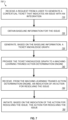
- FIG. 7 illustrates a flowchart of an example process 700 for resolving a contextual ticket.
- the process 700 may be performed by the system 100 shown in FIG. 1 or another system.
- the process 700 includes receiving a request from a user to generate a contextual ticket that indicates an issue with an integration (710), obtaining baseline information for the issue (720), generating, based on the baseline information, a ticket knowledge graph (730), providing the ticket knowledge graph to a machine-learning trained action determination engine (740), receiving, from the machine-learning trained action determination engine, an indication of an action for resolving the issue (750), and initiating, based on the indication of the action for resolving the issue, the action for resolving the issue (760).
- the process 700 includes receiving a request from a user to generate a contextual ticket that indicates an issue with an integration (710).
- the navigation point identifier 110 may receive a request from a user to create a ticket for an issue while the user is viewing a particular integration in the integration navigator.
- the process 700 includes obtaining baseline information for the issue (720).
- the navigation point identifier 110 may obtain baseline information for the issue.
- obtaining baseline information for the issue may include obtaining a description provided by the user and identifying a navigation point for the issue.
- the navigation point identifier 110 may extract the user entered description of "meter location change didn't change location" from the request and identify a navigation point in the integration navigator for the meter location change.
- the process 700 includes generating, based on the baseline information, a ticket knowledge graph (730).
- the contextual data extractor 120 may obtain the navigation point and description, and from both generate the ticket knowledge graph 400.
- generating, based on the baseline information, a ticket knowledge graph includes generating extracted information based on the baseline information, generating calculated information based on the baseline information and the extracted information, generating correlated information based on the calculated information, generating predicted information based on the correlated information, and generating a ticket knowledge graph based on the baseline information, extracted information, the calculated information, the correlated information, and the predicted information.
- the contextual data extractor 120 may perform the stages 330-360 shown in FIG. 3 to iteratively obtain the different types of information based on the previously obtained types of information, and then generate the ticket knowledge graph 400 from the different types of information.
- generating a ticket knowledge graph based on the baseline information, the extracted information, the calculated information, the correlated information, and the predicted information includes generating the ticket knowledge graph to include nodes that represent the baseline information, the extracted information, the calculated information, the correlated information, and the predicted information.
- the contextual data extractor 120 may generate the ticket knowledge graph 400 that includes baseline information nodes 410A-F, extracted information nodes 420A-G, calculated information nodes 430A-H, correlated information nodes 440A-D, and predicted information nodes 450A-F
- generating, based on the baseline information, a ticket knowledge graph includes generating a standardized data structure that represents at least a portion of the extracted information, a portion of the predicted information, and at least a portion of the calculated information and providing the standardized data structure to a machine-learning regression model, where the machine-learning regression model is trained based on sets of standardized data structures and labeled outputs that represent values for at least a second portion of the predicted information.
- the contextual data extractor 120 may provide information of raised by, integration status, support schedule, probable root cause, priority, best assigned person, average past resolution time, and sentiment analysis of the ticket to a data pre-processing engine that standardizes the information into a standardized data structure, and the standardized data structure may then be provided to a machine-learning regression model that outputs a SLA expiration probability of either low, medium, or high based on the standardized data structure.
- generating a standardized data structure may include determining a name of a role of a user that raised the ticket and generating the standardized data structure to include the name of the role of the user instead of a name of the user that raised the ticket.
- the process 700 includes providing the ticket knowledge graph to a machine-learning trained action determination engine (740).
- the ticket generator 130 may provide the contents of the ticket to the action predictor engines 560A-E, which then provide outputs to an action selection engine 570.
- providing the ticket knowledge graph to a machine-learning trained action determination engine includes providing the baseline information to a first action predictor engine, providing the extracted information to a second action predictor engine, providing the calculated information to a third action predictor engine, providing the correlated information to a fourth action predictor engine, providing the predicated information to a fifth action predictor engine, receiving respective actions from the first action predictor engine, the second action predictor engine, the third action predictor engine, the fourth action predictor engine, and the fifth action predictor engine, providing the respective actions to an action selection engine, and receiving a selected action from the action selection engine.
- the baseline information may be provided to the action predictor engine 560A which outputs a first predicted action
- the extracted information may be provided to the action predictor engine 560B which outputs a second predicted action
- the calculated information may be provided to the action predictor engine 560C which outputs a third predicted action
- the correlated information may be provided to the action predictor engine 560D which outputs a fourth predicted action
- the predicted information may be provided to the action predictor engine 560E which outputs a fifth predicted action
- the action selection engine 570 may receive the five predicted actions and select to output a particular action to resolve the issue based on the five predicted actions.
- the process 700 includes receiving, from the machine-learning trained action determination engine, an indication of an action for resolving the issue (750).
- the ticket generator 130 may receive an indication of an action performed by a particular workflow.
- the process 700 includes initiating, based on the indication of the action for resolving the issue, the action for resolving the issue (760).
- the ticket generator 130 may, in response to receiving the indication of the action and without user input after receiving the indication, automatically provide the contextual ticket to a particular engine that performs the particular workflow.
- the ticket generator 130 may, in response to receiving the indication of the action of notify leadership and without user input after receiving the indication, automatically generate and transmit a notification to leaders regarding the issue.
- FIG. 8 illustrates a schematic diagram of an exemplary generic computer system 800.
- the system 100 may be implemented on the system 800.
- the system 800 includes a processor 810, a memory 820, a storage device 830, and an input/output device 840. Each of the components 810, 820, 830, and 840 are interconnected using a system bus 850.
- the processor 810 is capable of processing instructions for execution within the system 800. In one implementation, the processor 810 is a single-threaded processor. In another implementation, the processor 810 is a multi-threaded processor.
- the processor 810 is capable of processing instructions stored in the memory 820 or on the storage device 830 to display graphical information for a user interface on the input/output device 840.
- the memory 820 stores information within the system 800.
- the memory 820 is a computer-readable medium.
- the memory 820 is a volatile memory unit.
- the memory 820 is a non-volatile memory unit.
- the storage device 830 is capable of providing mass storage for the system 800.
- the storage device 830 is a computer-readable medium.
- the storage device 830 may be a floppy disk device, a hard disk device, a solid state drive, an optical disk device, a tape device, universal serial bus stick, or some other storage device.
- the input/output device 840 provides input/output operations for the system 800.
- the input/output device 840 includes a keyboard and/or pointing device.
- the input/output device 840 includes a display unit for displaying graphical user interfaces.
- the features described can be implemented in digital electronic circuitry, or in computer hardware, firmware, software, or in combinations of them.
- the apparatus can be implemented in a computer program product tangibly embodied in an information carrier, e.g., in a machine-readable storage device, for execution by a programmable processor; and method steps can be performed by a programmable processor executing a program of instructions to perform functions of the described implementations by operating on input data and generating output.
- the described features can be implemented advantageously in one or more computer programs that are executable on a programmable system including at least one programmable processor coupled to receive data and instructions from, and to transmit data and instructions to, a data storage system, at least one input device, and at least one output device.
- a computer program is a set of instructions that can be used, directly or indirectly, in a computer to perform a certain activity or bring about a certain result.
- a computer program can be written in any form of programming language, including compiled or interpreted languages, and it can be deployed in any form, including as a stand-alone program or as a module, component, subroutine, or other unit suitable for use in a computing environment.
- Suitable processors for the execution of a program of instructions include, by way of example, both general and special purpose microprocessors, and the sole processor or one of multiple processors of any kind of computer.
- a processor will receive instructions and data from a read-only memory or a random access memory or both.
- the elements of a computer are a processor for executing instructions and one or more memories for storing instructions and data.
- a computer will also include, or be operatively coupled to communicate with, one or more mass storage devices for storing data files; such devices include magnetic disks, such as internal hard disks and removable disks; magneto-optical disks; and optical disks.
- Storage devices suitable for tangibly embodying computer program instructions and data include all forms of non-volatile memory, including by way of example semiconductor memory devices, such as EPROM, EEPROM, and flash memory devices; magnetic disks such as internal hard disks and removable disks; magneto-optical disks; and CD-ROM and DVD-ROM disks.
- semiconductor memory devices such as EPROM, EEPROM, and flash memory devices
- magnetic disks such as internal hard disks and removable disks
- magneto-optical disks and CD-ROM and DVD-ROM disks.
- the processor and the memory can be supplemented by, or incorporated in, ASICs (application-specific integrated circuits).
- ASICs application-specific integrated circuits
- the features can be implemented on a computer having a display device such as a CRT (cathode ray tube) or LCD (liquid crystal display) monitor for displaying information to the user and a keyboard and a pointing device such as a mouse or a rail trackball by which the user can provide input to the computer.
- a display device such as a CRT (cathode ray tube) or LCD (liquid crystal display) monitor for displaying information to the user
- a keyboard and a pointing device such as a mouse or a rail trackball by which the user can provide input to the computer.
- the features can be implemented in a computer system that includes a back-end component, such as a data server, or that includes a middleware component, such as an application server or an Internet server, or that includes a front-end component, such as a client computer having a graphical user interface or an Internet browser, or any combination of them.
- the components of the system can be connected by any form or medium of digital data communication such as a communication network. Examples of communication networks include, e.g ., a LAN, a WAN, and the computers and networks forming the Internet.
- the computer system can include clients and servers.
- a client and server are generally remote from each other and typically interact through a network, such as the described one.
- the relationship of client and server arises by virtue of computer programs running on the respective computers and having a client-server relationship to each other.
- the servers may be part of a cloud, which may include ephemeral aspects.
Landscapes
- Engineering & Computer Science (AREA)
- Business, Economics & Management (AREA)
- Theoretical Computer Science (AREA)
- Human Resources & Organizations (AREA)
- Physics & Mathematics (AREA)
- General Physics & Mathematics (AREA)
- Economics (AREA)
- Entrepreneurship & Innovation (AREA)
- Strategic Management (AREA)
- General Business, Economics & Management (AREA)
- Software Systems (AREA)
- Computing Systems (AREA)
- Artificial Intelligence (AREA)
- Mathematical Physics (AREA)
- General Engineering & Computer Science (AREA)
- Evolutionary Computation (AREA)
- Data Mining & Analysis (AREA)
- Game Theory and Decision Science (AREA)
- Development Economics (AREA)
- Tourism & Hospitality (AREA)
- Marketing (AREA)
- Educational Administration (AREA)
- Operations Research (AREA)
- Quality & Reliability (AREA)
- Computer Networks & Wireless Communication (AREA)
- Signal Processing (AREA)
- Computational Linguistics (AREA)
- Computer Vision & Pattern Recognition (AREA)
- Medical Informatics (AREA)
- Information Retrieval, Db Structures And Fs Structures Therefor (AREA)
- Navigation (AREA)
Description
- This application claims the benefit of
U.S. Provisional Application No. 63/086,195, filed October 1, 2020 - This disclosure generally relates to integrations in a system.
- Systems may include different applications and services that are integrated together. For example, a system may use integrations to bind together many kinds of applications to work in conjunction in various automated operations. However, integrations may experience failures. For example, an integration between two different applications may fail when a process that exchanges data between the applications fails.
-
US 2019/0362291 A1 discloses a computer-implemented method that includes generating, by a processor of a problem-tracking system, a problem ticket. The problem ticket describes a problem encountered by a first user, and the problem ticket is assigned to at least one qualified user to resolve. The method also includes receiving additional information relating to the problem from at least one second user. The method also includes storing the received additional information in association with the problem ticket. The receiving and the storing of the additional information occurs while the problem ticket is waiting to be resolved by the at least one qualified user. The method also includes providing the stored received additional information and the problem ticket to the at least one qualified user. -
US 2019/0132191 A1 discloses a system and method for predictive ticketing in information technology (IT) systems. The method includes extracting a plurality of features from monitoring data related to an IT system, wherein the plurality of features includes at least one incident parameter, wherein the monitoring data includes machine-generated textual data; applying a machine learning model to the extracted plurality of features, wherein the machine learning model is configured to output a suitable insight for an incident represented by the at least one incident parameter, wherein the suitable insight is selected from among a plurality of historical insights; and generating a predictive ticket based on the suitable insight, wherein the predictive ticket includes a textual description of an expected future symptom in the IT system. - In general, an aspect of the subject matter described in this specification may involve a process for resolving contextual tickets. A contextual ticket may describe an issue that was experienced by a user of a system. For example, a contextual ticket may describe that a user was unable to send a meter location change to a meter data management system.
- A system may provide a guided process for creation of a contextual ticket. For example, the system may guide a user to create a contextual ticket in response to the user being unable to send a meter location change to a meter data management system. The guided contextual ticket creation may enable users of the system to create highly relevant contextual tickets, where contextual data in the tickets help increase speed of issue resolution and provide a foundation for automation in resolving the issue.
- The contextual data in the contextual tickets can include data that specifies one or more of integration systems, specific flows, application programming interface end points, real time integration status, message flow information, infrastructure status, impact score, possible root causes, possible solutions, and correlated past tickets.
- The system may generate a ticket knowledge graph that represents the contextual data of the contextual ticket, and may provide the graph to a machine-learning trained action determination engine. The engine may output an indication of an action for resolving the issue indicated by the contextual ticket, and the system may then initiate the action indicated by the engine.
- Particular embodiments of the subject matter described in this specification can be implemented so as to realize one or more of the following advantages. One advantage may be the issues may be more quickly resolved based on automatic determination and initiation of actions to resolve the issues. Another advantage may be that actions that resolve the issues may be more accurately determined by the machine-learning trained action determination engine than by a human operator. Yet another advantage is that non-standardized information may be standardized, and then used by a machine-learning trained model that requires standardized input.
- In some aspects, the subject matter described in this specification may be embodied in methods that may include the actions of receiving a request from a user to generate a contextual ticket that indicates an issue with an integration for sending a meter location change to a meter data management system, obtaining baseline information for the issue, wherein the baseline information comprises a description provided by the user and a navigation point for the issue, generating, based on the baseline information, a ticket knowledge graph, comprising: generating extracted information based on the baseline information, wherein the extracted information comprises one or more of integration status, technical metadata and integration type; and generating the ticket knowledge graph based on the baseline information and the extracted information; providing the ticket knowledge graph to a machine-learning trained action determination engine, receiving, from the machine-learning trained action determination engine, an indication of an action for resolving the issue, and automatically providing, based on the indication of the action for resolving the issue, the action to a particular engine to resolve the issue.
- Other implementations of this and other aspects include corresponding systems, apparatus, and computer programs, may be configured to perform the actions of the methods, encoded on computer storage devices. A system of one or more computers can be so configured by virtue of software, firmware, hardware, or a combination of them installed on the system that in operation cause the system to perform the actions. One or more computer programs can be so configured by virtue of having instructions that, when executed by data processing apparatus, cause the apparatus to perform the actions.
- The foregoing and other embodiments can each optionally include one or more of the following features, alone or in combination. For instance, in some aspects generating, based on the baseline information, a ticket knowledge graph includes generating extracted information based on the baseline information, generating calculated information based on the baseline information and the extracted information, generating correlated information based on the calculated information, generating predicted information based on the correlated information, and generating a ticket knowledge graph based on the baseline information, extracted information, the calculated information, the correlated information, and the predicted information.
- In certain aspects, generating a ticket knowledge graph based on the baseline information, the extracted information, the calculated information, the correlated information, and the predicted information includes generating the ticket knowledge graph to include nodes that represent the baseline information, the extracted information, the calculated information, the correlated information, and the predicted information. In some aspects, the ticket knowledge graph includes links that represent relationships between the nodes.
- In some aspects, a root node of the ticket knowledge graph represents a navigational point of the issue. In certain aspects, generating extracted information based on the baseline information includes obtaining a common information model for integration and generating the extracted information from the common information model for integration based on the baseline information.
- In certain aspects, providing the ticket knowledge graph to a machine-learning trained action determination engine includes providing the baseline information to a first action predictor engine, providing the extracted information to a second action predictor engine, providing the calculated information to a third action predictor engine, providing the correlated information to a fourth action predictor engine, providing the predicated information to a fifth action predictor engine, receiving respective actions from the first action predictor engine, the second action predictor engine, the third action predictor engine, the fourth action predictor engine, and the fifth action predictor engine, providing the respective actions to an action selection engine, and receiving a selected action from the action selection engine.
- In some aspects, generating, based on the baseline information, a ticket knowledge graph includes generating a standardized data structure that represents at least a portion of the extracted information, a portion of the predicted information, and at least a portion of the calculated information and providing the standardized data structure to a machine-learning regression model, where the machine-learning regression model is trained based on standardized data structures and labeled outputs that represent values for at least a second portion of the predicted information.
- The details of one or more implementations are set forth in the accompanying drawings and the description, below. Other potential features and advantages of the disclosure will be apparent from the description and drawings, and from the claims.
-
-
FIG. 1 illustrates a diagrams of an exemplary system for guided contextual ticket creation. -
FIG. 2 illustrates a diagram of an exemplary model for guided contextual ticket creation. -
FIG. 3 illustrates a diagram of example stages for resolving a contextual ticket. -
FIG. 4 illustrates a diagram of an example ticket knowledge graph. -
FIG. 5 illustrates a diagram of an exemplary action determination architecture for resolving a contextual ticket. -
FIG. 6 illustrates a diagram of an example common information model for integration. -
FIG. 7 illustrates a flowchart of an example process for resolving a contextual ticket. -
FIG. 8 illustrates a schematic diagram of an exemplary generic computer system. - Like reference symbols in the various drawings indicate like elements.
-
FIG. 1 illustrates a diagrams of anexemplary system 100 for guided contextual ticket creation. Thesystem 100 includes anavigation point identifier 110 that identifies a navigation point, acontextual data extractor 120 that extracts contextual data based on the navigation point, and aticket generator 130 that generates a contextual ticket based on the contextual data. Thenavigation point identifier 110, thecontextual data extractor 120, and theticket generator 120 may be implemented as one or more computer systems. - The
navigation point identifier 110 may receive a request from a user to generate a ticket regarding a particular integration that has an issue, obtain a structured representation model of integrations in the system including the particular integration, and identify the navigation point that corresponds to the particular integration. For example, a user may navigate through a graphical representation of the model of integrations and request to submit a ticket for an integration for sending a meter location change to a meter data management system. A navigation point may be a specific user interface in an integration navigator. An integration navigator may be an application that provides a graphical user interface that users may use to view various integrations and create contextual tickets for issues. - In the example, the
navigation point identifier 110 may receive the request, search through the model of integrations for a particular link that corresponds to the integration for sending a meter location change to a meter data management system, and then output text that specifies the particular link. - The
contextual data extractor 120 extracts contextual data based on the navigation point that was identified by thenavigation point identifier 110. For example, the contextual data extractor may extract specific flows, application programming interface end points, real time integration status, message flow information, infrastructure status, impact score, possible root causes, possible solutions, and correlated past tickets that correspond to the particular link that corresponds to the integration for sending a meter location change to a meter data management system. - The
contextual data extractor 120 extracts contextual data based on (i) extracting static contextual data based on the navigation point, (ii) extracting dynamic contextual data based on the static contextual data, and (iii) determining calculated contextual data based on the dynamic contextual data. For example, thecontextual data extractor 120 may (i) extract static contextual data that includes specific flows, application programming interface end points, (ii) from the specific flows, application programming interface end points then extract dynamic contextual data that includes real time integration status, message flow information, infrastructure status, and (iii) from the real time integration status, message flow information, infrastructure status then calculate contextual data that includes impact score, possible root causes, possible solutions, and correlated past tickets that correspond to the particular link that corresponds to the integration for sending a meter location change to a meter data management system. - The
ticket generator 130 generates a contextual ticket based on the contextual data. For example, theticket generator 130 may receive specific flows, application programming interface end points, real time integration status, message flow information, infrastructure status, impact score, possible root causes, possible solutions, and correlated past tickets that correspond to the particular link that corresponds to the integration for sending a meter location change to a meter data management system, and, in response, generate a contextual ticket that includes a link that corresponds to the integration for sending a meter location change to a meter data management system, a user description of the issue, technical metadata, recent tickets, relevant documentation link, integration status, contact information, and probably root cause. -
FIG. 2 illustrates a diagram of another exemplary model 200 for guided contextual ticket creation. The model 200 includes abusiness process area 210 impacted by an issue, anapplication 220 impacted by the issue, anintegration 230 impacted by the issue,technical information 240, aticketing tool 250, and anintegration navigator 290. - The
business process area 210 may be a collection of related, structured activities, people, and/or equipment in which a specific sequence produces a service or product for a particular customer or customers. For example, a utility customer information system may include six high level business process areas of federal insurance contributions act, billing, device, sales service, marketing, and digital. - The
application 220 may be computer software that supports a process. For example, theapplication 220 may be a service order system, a meter reading system, etc. Theintegration 230 may be a data exchange with an application. For example, applications and a core system may have fifteen output and ten inbound integrations between each other. -
Technical information 240 may be information associated with a specific integration. For example, technical information may be a Uniform Resource Locator (URL), security information, logging index, server, etc. Aticketing tool 250 may be a tool that resolves tickets. For example, theticketing tool 250 may be software that automatically determines an action to resolve an issue and then initiates the action. - The
integration navigator 290 may enable users to start by displaying business process areas and receiving a user selection of one, after selection of a business area then displaying connected applications and receiving a user selection of one, after selection of a connected application then displaying integration lists and receiving a user selection of one, after selection of an integration list then displaying a corresponding integration flow, integration sequence, and integration metadata. - An integration list for an application may refer to a list of integrations used by an application. An integration flow may be a visual depiction of end to end detailed message flow of an integration. An integration sequence may be detailed sequential steps of a specific integration flow. Integration metadata may be technical data associated with a specific integration flow.
-
FIG. 3 illustrates a diagram of example stages 300 for resolving a contextual ticket. Thestages 300 may includeintegration ticket creation 310, obtainbaseline information 320, generate extractedinformation 330, generatecalculated information 340, generate correlatedinformation 350, generate predictedinformation 360, andaction space determination 370. - The
integration ticket creation 310 may be user initiated from a graphical user interface of an integration navigator, proactively generated by the integration navigator without an explicit request to generate by the user, or automatically generated from middleware monitoring. - The
baseline information 320 may be foundational information provided by the user and integration navigator when a user tries to create a ticket for any suspected issue. The baseline information may indicate a qualitative description of the issue as provided by the user, and a navigational path from the integration navigator system which helps in understanding the exact integration, connected application, and flow impacted based on a common information model for integration (CCIMI) model. The CCIMI model is described in more detail below in regards toFIG. 6 . The navigational path may be the previously described navigation point. - The extracted information may be generated by getting relevant information from various middleware platforms, connected systems, and document repository systems directly related to the components for which the incident has been raised. The extracted information may represent the most direct relevant data related to the system, process and flows impacted. The system may generate the extracted information by making application programming interface (API) calls, database queries, log extraction, or any other data retrieval techniques. Some example of data elements extracted may be integration status, technical metadata of the integration, relevant documentation, support schedule, integration type, dependency, and issue raised by, etc.
- The calculated information may be generated based on the user-provided information and extracted information, and may be the result of various calculation operations to gather additional secondary data relevant to the incident. The system may be able to add the calculated information based on intelligent calculation functions by getting a reference from the baseline and the extracted information. Some examples of a calculated information may be raised by manager, number of tickets raised by user in last predetermined number of days, average past resolution time for similar tickets raised by the user, recent tickets, contact information, net promotor score (NPS) for the group, user sentiment, and knowledge graph of relevant documentation, etc.
- The correlated information may be generated based on gathering correlated information using the baselined, extracted, and calculated information. The correlated information may represent information that is not directly connected to the incident but may help understand the impact or root cause of the issues in a broader context. Correlated information may include recently deployed changes, related key performance indicators (KPI), related KPI trending, related active tickets, and related active tickets root cause, etc.
- Predicted information may be added through sophisticated machine learning algorithms. These machine learning models may gather predicted information dependent on the data from the previous stages. Predicted information may include Service Level Agreement expiration probability, priority, business impact, best assigned person, resolution time prediction, and probable root cause, etc.
- The action space that may be determined includes actions that may be determined to resolve the issue. For example, the action space may include executing a bot or workflow to resolve the issue, determining a resolution confidence score, determining whether a callout is required, and determining whether leadership communication is required.
-
FIG. 4 illustrates a diagram of aticket knowledge graph 400. Theticket knowledge graph 400 includes various nodes that represent data. The nodes may includebaseline information nodes 410A-F, extracted information nodes 420A-G, calculatedinformation nodes 430A-H, correlatedinformation nodes 440A-D, and predictedinformation nodes 450A-F. The root node of theticket knowledge graph 400 may be thebaseline information node 410A that represents the navigational path. - Links between the nodes may represent relationships between the nodes. For example,
node 410A may be linked to the node 420E that represents the relevant documentation by a link that indicates that the relevant documentation is determined from the navigational path with an integration navigator query, the node 420E may be linked to the node 420F that represents support schedule by another link that indicates that the support schedule is determined from the relevant documentation with an integration navigator query, and the node 420F may be linked to thenode 430J that represents contact info by a link that indicates that the contact info is determined from the support schedule with data mining, and thenode 430J may be linked to thenode 450A that represents best assigned person by a link that indicates that the best assigned person is determined from the contact info with a calculation function. -
FIG. 5 illustrates a diagram of an exemplary action determination architecture for resolving a contextual ticket. The action determination architecture may provide a robust framework that utilizes the ticket knowledge graph. Actions that resolve the issue indicated by the contextual ticket may be predicted based on each type of information in the ticket knowledge graph, and an action determination engine may determine the final output by taking recommendations from each type into consideration. - For example, a
baseline information engine 510 may obtain the baseline information and provide the baseline information to theaction predictor engine 560A, which outputs a predicted action to theaction selection engine 570. An extractedinformation engine 520 may generate the extracted information from the baseline information and provide the extracted information to theaction predictor engine 560B, which outputs a predicted action to theaction selection engine 570. A calculatedinformation engine 530 may generate the calculated information from the extracted information and provide the calculated information to theaction predictor engine 560C, which outputs a predicted action to theaction selection engine 570. A correlatedinformation engine 540 may generate the correlated information from the calculated information and provide the correlated information to theaction predictor engine 560D, which outputs a predicted action to theaction selection engine 570. A predictedinformation engine 550 may generate the predicted information from the correlated information and provide the predicted information to theaction predictor engine 560E, which outputs a predicted action to theaction selection engine 570. Theaction selection engine 570 may receive all the predicted actions from theaction predictor engines 560A-E and output a final action. - The
action predictor engines 560A-E may be machine-learning trained models that are trained to predict an action that will resolve an issue based on corresponding types of information in thetree knowledge graph 400. For example, theaction predictor engine 560A may be trained to receive a tree knowledge graph that only includes baseline information and output an action that is predicted to resolve an issue with the baseline information, where theaction predictor engine 560A is trained with training data that includes respective sets of baseline information and corresponding actions that resolve issues with the sets of baseline information. In another example, theaction predictor engine 560B may be trained to receive a tree knowledge graph that includes both baseline information and extracted information, and output an action that is predicted to resolve an issue with both the baseline information and extracted information, where theaction predictor engine 560B is trained with training data that includes respective sets of baseline information, extracted information, and corresponding actions that resolve issues with the sets of baseline information and extracted information. - The
action selection engine 570 may be a machine-learning trained model that is trained to select an action that will resolve an issue based on a set of input actions. For example, theaction selection engine 570 may be trained to receive a set of five actions, each from one of theaction predictor engines 560A-E, and select one of the actions from the set. In some implementations, theaction selection engine 570 may be trained to select a particular action based on training data that indicates sets of input actions labeled with corresponding actions to select. For example, the training data may indicate that a set of Action A, Action B, Action A, Action C, Action D is labeled with a selection of action C. In another example, the training data may indicate that a set of Action A, Action B, Action B, Action C, Action D is labeled with a selection of action D. In some implementations, theaction predictor engines 560A-E may each output a confidence score for an action, and theaction selection engine 570 may be trained with training data that indicates sets of actions, confidence scores for each action, and labels of corresponding actions to select for each set. -
FIG. 6 illustrates a diagram of an example common information model for integration (CCMI). The CCMI may be a structured representation model of a distributed integration landscape and define relationships between each component in the model. For example, the CCMI may include representations of business process areas, connected applications, integrations, integration flows, integration sequences, integration metadata, integration documentation, and integration contacts. -
FIG. 7 illustrates a flowchart of an example process 700 for resolving a contextual ticket. The process 700 may be performed by thesystem 100 shown inFIG. 1 or another system. Briefly, and as will be described in more detail below, the process 700 includes receiving a request from a user to generate a contextual ticket that indicates an issue with an integration (710), obtaining baseline information for the issue (720), generating, based on the baseline information, a ticket knowledge graph (730), providing the ticket knowledge graph to a machine-learning trained action determination engine (740), receiving, from the machine-learning trained action determination engine, an indication of an action for resolving the issue (750), and initiating, based on the indication of the action for resolving the issue, the action for resolving the issue (760). - The process 700 includes receiving a request from a user to generate a contextual ticket that indicates an issue with an integration (710). For example, the
navigation point identifier 110 may receive a request from a user to create a ticket for an issue while the user is viewing a particular integration in the integration navigator. - The process 700 includes obtaining baseline information for the issue (720). For example, the
navigation point identifier 110 may obtain baseline information for the issue. In some implementations, obtaining baseline information for the issue may include obtaining a description provided by the user and identifying a navigation point for the issue. For example, thenavigation point identifier 110 may extract the user entered description of "meter location change didn't change location" from the request and identify a navigation point in the integration navigator for the meter location change. - The process 700 includes generating, based on the baseline information, a ticket knowledge graph (730). For example, the
contextual data extractor 120 may obtain the navigation point and description, and from both generate theticket knowledge graph 400. - In some implementations, generating, based on the baseline information, a ticket knowledge graph includes generating extracted information based on the baseline information, generating calculated information based on the baseline information and the extracted information, generating correlated information based on the calculated information, generating predicted information based on the correlated information, and generating a ticket knowledge graph based on the baseline information, extracted information, the calculated information, the correlated information, and the predicted information. For example, the
contextual data extractor 120 may perform the stages 330-360 shown inFIG. 3 to iteratively obtain the different types of information based on the previously obtained types of information, and then generate theticket knowledge graph 400 from the different types of information. - In some implementations, generating a ticket knowledge graph based on the baseline information, the extracted information, the calculated information, the correlated information, and the predicted information includes generating the ticket knowledge graph to include nodes that represent the baseline information, the extracted information, the calculated information, the correlated information, and the predicted information. For example, the
contextual data extractor 120 may generate theticket knowledge graph 400 that includesbaseline information nodes 410A-F, extracted information nodes 420A-G, calculatedinformation nodes 430A-H, correlatedinformation nodes 440A-D, and predictedinformation nodes 450A-F - In some implementations, generating, based on the baseline information, a ticket knowledge graph includes generating a standardized data structure that represents at least a portion of the extracted information, a portion of the predicted information, and at least a portion of the calculated information and providing the standardized data structure to a machine-learning regression model, where the machine-learning regression model is trained based on sets of standardized data structures and labeled outputs that represent values for at least a second portion of the predicted information. For example, the
contextual data extractor 120 may provide information of raised by, integration status, support schedule, probable root cause, priority, best assigned person, average past resolution time, and sentiment analysis of the ticket to a data pre-processing engine that standardizes the information into a standardized data structure, and the standardized data structure may then be provided to a machine-learning regression model that outputs a SLA expiration probability of either low, medium, or high based on the standardized data structure. In some implementations, generating a standardized data structure may include determining a name of a role of a user that raised the ticket and generating the standardized data structure to include the name of the role of the user instead of a name of the user that raised the ticket. - The process 700 includes providing the ticket knowledge graph to a machine-learning trained action determination engine (740). For example, the
ticket generator 130 may provide the contents of the ticket to theaction predictor engines 560A-E, which then provide outputs to anaction selection engine 570. - In some implementations, providing the ticket knowledge graph to a machine-learning trained action determination engine includes providing the baseline information to a first action predictor engine, providing the extracted information to a second action predictor engine, providing the calculated information to a third action predictor engine, providing the correlated information to a fourth action predictor engine, providing the predicated information to a fifth action predictor engine, receiving respective actions from the first action predictor engine, the second action predictor engine, the third action predictor engine, the fourth action predictor engine, and the fifth action predictor engine, providing the respective actions to an action selection engine, and receiving a selected action from the action selection engine.
- For example, the baseline information may be provided to the
action predictor engine 560A which outputs a first predicted action, the extracted information may be provided to theaction predictor engine 560B which outputs a second predicted action, the calculated information may be provided to theaction predictor engine 560C which outputs a third predicted action, the correlated information may be provided to theaction predictor engine 560D which outputs a fourth predicted action, the predicted information may be provided to theaction predictor engine 560E which outputs a fifth predicted action, and theaction selection engine 570 may receive the five predicted actions and select to output a particular action to resolve the issue based on the five predicted actions. The process 700 includes receiving, from the machine-learning trained action determination engine, an indication of an action for resolving the issue (750). For example, theticket generator 130 may receive an indication of an action performed by a particular workflow. - The process 700 includes initiating, based on the indication of the action for resolving the issue, the action for resolving the issue (760). For example, the
ticket generator 130 may, in response to receiving the indication of the action and without user input after receiving the indication, automatically provide the contextual ticket to a particular engine that performs the particular workflow. In another example, theticket generator 130 may, in response to receiving the indication of the action of notify leadership and without user input after receiving the indication, automatically generate and transmit a notification to leaders regarding the issue. -
FIG. 8 illustrates a schematic diagram of an exemplarygeneric computer system 800. Thesystem 100 may be implemented on thesystem 800. - The
system 800 includes aprocessor 810, amemory 820, astorage device 830, and an input/output device 840. Each of thecomponents system bus 850. Theprocessor 810 is capable of processing instructions for execution within thesystem 800. In one implementation, theprocessor 810 is a single-threaded processor. In another implementation, theprocessor 810 is a multi-threaded processor. Theprocessor 810 is capable of processing instructions stored in thememory 820 or on thestorage device 830 to display graphical information for a user interface on the input/output device 840. - The
memory 820 stores information within thesystem 800. In one implementation, thememory 820 is a computer-readable medium. In one implementation, thememory 820 is a volatile memory unit. In another implementation, thememory 820 is a non-volatile memory unit. - The
storage device 830 is capable of providing mass storage for thesystem 800. In one implementation, thestorage device 830 is a computer-readable medium. In various different implementations, thestorage device 830 may be a floppy disk device, a hard disk device, a solid state drive, an optical disk device, a tape device, universal serial bus stick, or some other storage device. - The input/
output device 840 provides input/output operations for thesystem 800. In one implementation, the input/output device 840 includes a keyboard and/or pointing device. In another implementation, the input/output device 840 includes a display unit for displaying graphical user interfaces. - The features described can be implemented in digital electronic circuitry, or in computer hardware, firmware, software, or in combinations of them. The apparatus can be implemented in a computer program product tangibly embodied in an information carrier, e.g., in a machine-readable storage device, for execution by a programmable processor; and method steps can be performed by a programmable processor executing a program of instructions to perform functions of the described implementations by operating on input data and generating output. The described features can be implemented advantageously in one or more computer programs that are executable on a programmable system including at least one programmable processor coupled to receive data and instructions from, and to transmit data and instructions to, a data storage system, at least one input device, and at least one output device. A computer program is a set of instructions that can be used, directly or indirectly, in a computer to perform a certain activity or bring about a certain result. A computer program can be written in any form of programming language, including compiled or interpreted languages, and it can be deployed in any form, including as a stand-alone program or as a module, component, subroutine, or other unit suitable for use in a computing environment.
- Suitable processors for the execution of a program of instructions include, by way of example, both general and special purpose microprocessors, and the sole processor or one of multiple processors of any kind of computer. Generally, a processor will receive instructions and data from a read-only memory or a random access memory or both. The elements of a computer are a processor for executing instructions and one or more memories for storing instructions and data. Generally, a computer will also include, or be operatively coupled to communicate with, one or more mass storage devices for storing data files; such devices include magnetic disks, such as internal hard disks and removable disks; magneto-optical disks; and optical disks. Storage devices suitable for tangibly embodying computer program instructions and data include all forms of non-volatile memory, including by way of example semiconductor memory devices, such as EPROM, EEPROM, and flash memory devices; magnetic disks such as internal hard disks and removable disks; magneto-optical disks; and CD-ROM and DVD-ROM disks. The processor and the memory can be supplemented by, or incorporated in, ASICs (application-specific integrated circuits).
- To provide for interaction with a user, the features can be implemented on a computer having a display device such as a CRT (cathode ray tube) or LCD (liquid crystal display) monitor for displaying information to the user and a keyboard and a pointing device such as a mouse or a rail trackball by which the user can provide input to the computer.
- The features can be implemented in a computer system that includes a back-end component, such as a data server, or that includes a middleware component, such as an application server or an Internet server, or that includes a front-end component, such as a client computer having a graphical user interface or an Internet browser, or any combination of them. The components of the system can be connected by any form or medium of digital data communication such as a communication network. Examples of communication networks include, e.g., a LAN, a WAN, and the computers and networks forming the Internet.
- The computer system can include clients and servers. A client and server are generally remote from each other and typically interact through a network, such as the described one. The relationship of client and server arises by virtue of computer programs running on the respective computers and having a client-server relationship to each other. The servers may be part of a cloud, which may include ephemeral aspects.
Claims (10)
- A computer-implemented method comprising:receiving a request from a user to generate a contextual ticket that indicates an issue with an integration for sending a meter location change to a meter data management system;obtaining baseline information (320; 410) for the issue, wherein the baseline information comprises a description provided by the user and a navigation point for the issue;generating, based on the baseline information, a ticket knowledge graph (400), the generating comprising:generating extracted information (330) based on the baseline information, wherein the extracted information comprises one or more of integration status, technical metadata and integration type; andgenerating the ticket knowledge graph based on the baseline information and the extracted information;providing the ticket knowledge graph to a machine-learning trained action determination engine (500);receiving, from the machine-learning trained action determination engine, an indication of an action for resolving the issue; andautomatically providing, based on the indication of the action for resolving the issue, the action to a particular engine to resolve the issue.
- The method of claim 1, wherein generating, based on the baseline information, the ticket knowledge graph further comprises:generating correlated information (350) based on the calculated information;generating predicted information (360) based on the correlated information; andgenerating the ticket knowledge graph based on the baseline information, extracted information, the calculated information, the correlated information, and the predicted information.
- The method of claim 2, wherein generating the ticket knowledge graph based on the baseline information, the extracted information, the calculated information, the correlated information, and the predicted information comprises:
generating the ticket knowledge graph to include nodes (410; 420; 430; 440; 450) that represent the baseline information, the extracted information, the calculated information, the correlated information, and the predicted information. - The method of claim 3, wherein the ticket knowledge graph includes links that represent relationships between the nodes.
- The method of claim 3 or 4, wherein a root node of the ticket knowledge graph represents a navigational path of the issue.
- The method of any of claims 2 to 5, wherein generating extracted information based on the baseline information comprises:Obtaining a common information model for integration (600); andgenerating the extracted information from the common information model for integration based on the baseline information.
- The method of any of claims 2 to 6, wherein providing the ticket knowledge graph to a machine-learning trained action determination engine comprises:providing the baseline information to a first action predictor engine (560);providing the extracted information to a second action predictor engine (560);providing the calculated information to a third action predictor engine (560);providing the correlated information to a fourth action predictor engine (560);providing the predicated information to a fifth action predictor engine (560);receiving respective actions from the first action predictor engine, the second action predictor engine, the third action predictor engine, the fourth action predictor engine, and the fifth action predictor engine;providing the respective actions to an action selection engine (570); andreceiving a selected action from the action selection engine.
- The method of any of the preceding claims, wherein generating, based on the baseline information, the ticket knowledge graph comprises:generating a standardized data structure that represents at least a portion of the extracted information, a portion of the predicted information, and at least a portion of the calculated information; andproviding the standardized data structure to a machine-learning regression model, wherein the machine-learning regression model is trained based on prior standardized data structures and labeled outputs that represent values for at least a second portion of the predicted information.
- A system comprising:one or more computers (800) and one or more storage devices (830) storing instructions that are operable, when executed by the one or more computers, to cause the one or more computers to perform operations comprising:receiving a request from a user to generate a contextual ticket that indicates an issue with an integration for sending a meter location change to a meter data management system;obtaining baseline information (320; 410) for the issue, wherein the baseline information comprises a description provided by the user and a navigation point for the issue;generating, based on the baseline information, a ticket knowledge graph (400), the generating comprising:generating extracted information (330) based on the baseline information, wherein the extracted information comprises one or more of integration status, technical metadata and integration type; andgenerating the ticket knowledge graph based on the baseline information and the extracted information;providing the ticket knowledge graph to a machine-learning trained action determination engine (500);receiving, from the machine-learning trained action determination engine, an indication of an action for resolving the issue; andautomatically providing, based on the indication of the action for resolving the issue, the action to a particular engine to resolve the issue.
- The system of claim 9, wherein the instructions are operable, when executed by the one or more computers, to cause the one or more computers to perform operations as defined in one or more of claims 2 to 8.
Applications Claiming Priority (1)
| Application Number | Priority Date | Filing Date | Title |
|---|---|---|---|
| US202063086195P | 2020-10-01 | 2020-10-01 |
Publications (2)
| Publication Number | Publication Date |
|---|---|
| EP3992876A1 EP3992876A1 (en) | 2022-05-04 |
| EP3992876B1 true EP3992876B1 (en) | 2025-06-18 |
Family
ID=78621619
Family Applications (1)
| Application Number | Title | Priority Date | Filing Date |
|---|---|---|---|
| EP21200183.8A Active EP3992876B1 (en) | 2020-10-01 | 2021-09-30 | Integration navigator and intelligent monitoring for living systems |
Country Status (2)
| Country | Link |
|---|---|
| US (1) | US20220109615A1 (en) |
| EP (1) | EP3992876B1 (en) |
Families Citing this family (3)
| Publication number | Priority date | Publication date | Assignee | Title |
|---|---|---|---|---|
| US20230132033A1 (en) * | 2021-10-22 | 2023-04-27 | Microsoft Technology Licensing, Llc | Automatically generating, revising, and/or executing troubleshooting guide(s) |
| US12373755B2 (en) | 2021-12-31 | 2025-07-29 | Microsoft Technology Licensing, Llc | Generating a mitigation workflow for mitigating a technical issue of a computing service using historical mitigation workflows |
| US12541417B2 (en) | 2023-04-12 | 2026-02-03 | T-Mobile Usa, Inc. | Fault identification and prevention using trained machine learning model and knowledge graph |
Family Cites Families (6)
| Publication number | Priority date | Publication date | Assignee | Title |
|---|---|---|---|---|
| US10949791B2 (en) * | 2011-03-07 | 2021-03-16 | Tata Consultancy Services Limited | Collaborative platform for it service and vendor management |
| US10740692B2 (en) * | 2017-10-17 | 2020-08-11 | Servicenow, Inc. | Machine-learning and deep-learning techniques for predictive ticketing in information technology systems |
| US20180253736A1 (en) * | 2017-03-06 | 2018-09-06 | Wipro Limited | System and method for determining resolution for an incident ticket |
| US10489728B1 (en) * | 2018-05-25 | 2019-11-26 | International Business Machines Corporation | Generating and publishing a problem ticket |
| US20200333772A1 (en) * | 2019-04-18 | 2020-10-22 | Siemens Industry Software Ltd. | Semantic modeling and machine learning-based generation of conceptual plans for manufacturing assemblies |
| US11645138B2 (en) * | 2020-07-01 | 2023-05-09 | International Business Machines Corporation | Diagnosing and resolving technical issues |
-
2021
- 2021-09-29 US US17/488,533 patent/US20220109615A1/en not_active Abandoned
- 2021-09-30 EP EP21200183.8A patent/EP3992876B1/en active Active
Also Published As
| Publication number | Publication date |
|---|---|
| US20220109615A1 (en) | 2022-04-07 |
| EP3992876A1 (en) | 2022-05-04 |
Similar Documents
| Publication | Publication Date | Title |
|---|---|---|
| US10747651B1 (en) | System for optimizing system resources and runtime during a testing procedure | |
| US11562304B2 (en) | Preventative diagnosis prediction and solution determination of future event using internet of things and artificial intelligence | |
| US10725827B2 (en) | Artificial intelligence based virtual automated assistance | |
| US10839404B2 (en) | Intelligent, interactive, and self-learning robotic process automation system | |
| US11954461B2 (en) | Autonomously delivering software features | |
| JP6765885B2 (en) | Methods and systems for intelligent cloud planning and decommissioning | |
| EP3146431B1 (en) | Intelligent service assistant inference engine | |
| US12026470B2 (en) | Method and system for bridging a gap between disparate platforms that remove the need for a user to switch between the disparate platforms | |
| EP3992876A1 (en) | Integration navigator and intelligent monitoring for living systems | |
| US20200285569A1 (en) | Test suite recommendation system | |
| CN120723402A (en) | A multi-agent collaborative task planning method, related device, equipment and storage medium | |
| US20220318681A1 (en) | System and method for scalable, interactive, collaborative topic identification and tracking | |
| US20220365861A1 (en) | Automated actions based on ranked work events | |
| CN118520257A (en) | Information processing method, score prediction model training method, device and equipment | |
| EP4086824A1 (en) | Method for automatically updating unit cost of inspection by using comparison between inspection time and work time of crowdsourcing-based project for generating artificial intelligence training data | |
| CN120763062A (en) | A software testing task management method and device based on an intrusive instruction knowledge base | |
| Hamid et al. | Sentiment Analysis and Topic Modeling for Discovering Knowledge in Indonesian Mobile Government Applications | |
| Tumenjargal et al. | Requirements elicitation from user feedback using real-time conversational ai | |
| Menukhin et al. | Now and next: A maturity model to guide analytics growth | |
| US20250390844A1 (en) | Intelligent generation of a task list based on data obtained from different domains | |
| CN111079439A (en) | Abnormal information identification method and device, electronic equipment and computer storage medium | |
| CN120106687B (en) | Resource scheduling method, elastic computing system, computing equipment, medium and product | |
| US20230281188A1 (en) | Report management system | |
| Abhilash et al. | Fixmate: Enhancing Device Repairability using Machine Learning | |
| Menezes | Ai-driven software development: how has the rise of Chatgpt impacted Github users?-Impact on gode quality |
Legal Events
| Date | Code | Title | Description |
|---|---|---|---|
| PUAI | Public reference made under article 153(3) epc to a published international application that has entered the european phase |
Free format text: ORIGINAL CODE: 0009012 |
|
| STAA | Information on the status of an ep patent application or granted ep patent |
Free format text: STATUS: THE APPLICATION HAS BEEN PUBLISHED |
|
| AK | Designated contracting states |
Kind code of ref document: A1 Designated state(s): AL AT BE BG CH CY CZ DE DK EE ES FI FR GB GR HR HU IE IS IT LI LT LU LV MC MK MT NL NO PL PT RO RS SE SI SK SM TR |
|
| STAA | Information on the status of an ep patent application or granted ep patent |
Free format text: STATUS: REQUEST FOR EXAMINATION WAS MADE |
|
| 17P | Request for examination filed |
Effective date: 20221031 |
|
| RBV | Designated contracting states (corrected) |
Designated state(s): AL AT BE BG CH CY CZ DE DK EE ES FI FR GB GR HR HU IE IS IT LI LT LU LV MC MK MT NL NO PL PT RO RS SE SI SK SM TR |
|
| GRAP | Despatch of communication of intention to grant a patent |
Free format text: ORIGINAL CODE: EPIDOSNIGR1 |
|
| STAA | Information on the status of an ep patent application or granted ep patent |
Free format text: STATUS: GRANT OF PATENT IS INTENDED |
|
| INTG | Intention to grant announced |
Effective date: 20250304 |
|
| GRAS | Grant fee paid |
Free format text: ORIGINAL CODE: EPIDOSNIGR3 |
|
| GRAA | (expected) grant |
Free format text: ORIGINAL CODE: 0009210 |
|
| STAA | Information on the status of an ep patent application or granted ep patent |
Free format text: STATUS: THE PATENT HAS BEEN GRANTED |
|
| P01 | Opt-out of the competence of the unified patent court (upc) registered |
Free format text: CASE NUMBER: APP_19726/2025 Effective date: 20250424 |
|
| AK | Designated contracting states |
Kind code of ref document: B1 Designated state(s): AL AT BE BG CH CY CZ DE DK EE ES FI FR GB GR HR HU IE IS IT LI LT LU LV MC MK MT NL NO PL PT RO RS SE SI SK SM TR |
|
| REG | Reference to a national code |
Ref country code: GB Ref legal event code: FG4D |
|
| REG | Reference to a national code |
Ref country code: CH Ref legal event code: EP |
|
| REG | Reference to a national code |
Ref country code: DE Ref legal event code: R096 Ref document number: 602021032374 Country of ref document: DE |
|
| REG | Reference to a national code |
Ref country code: CH Ref legal event code: EP |
|
| REG | Reference to a national code |
Ref country code: IE Ref legal event code: FG4D |
|
| PG25 | Lapsed in a contracting state [announced via postgrant information from national office to epo] |
Ref country code: FI Free format text: LAPSE BECAUSE OF FAILURE TO SUBMIT A TRANSLATION OF THE DESCRIPTION OR TO PAY THE FEE WITHIN THE PRESCRIBED TIME-LIMIT Effective date: 20250618 |
|
| PGFP | Annual fee paid to national office [announced via postgrant information from national office to epo] |
Ref country code: DE Payment date: 20250805 Year of fee payment: 5 |
|
| REG | Reference to a national code |
Ref country code: LT Ref legal event code: MG9D |
|
| PG25 | Lapsed in a contracting state [announced via postgrant information from national office to epo] |
Ref country code: GR Free format text: LAPSE BECAUSE OF FAILURE TO SUBMIT A TRANSLATION OF THE DESCRIPTION OR TO PAY THE FEE WITHIN THE PRESCRIBED TIME-LIMIT Effective date: 20250919 Ref country code: NO Free format text: LAPSE BECAUSE OF FAILURE TO SUBMIT A TRANSLATION OF THE DESCRIPTION OR TO PAY THE FEE WITHIN THE PRESCRIBED TIME-LIMIT Effective date: 20250918 |
|
| PG25 | Lapsed in a contracting state [announced via postgrant information from national office to epo] |
Ref country code: BG Free format text: LAPSE BECAUSE OF FAILURE TO SUBMIT A TRANSLATION OF THE DESCRIPTION OR TO PAY THE FEE WITHIN THE PRESCRIBED TIME-LIMIT Effective date: 20250618 |
|
| PGFP | Annual fee paid to national office [announced via postgrant information from national office to epo] |
Ref country code: GB Payment date: 20250807 Year of fee payment: 5 |
|
| PG25 | Lapsed in a contracting state [announced via postgrant information from national office to epo] |
Ref country code: HR Free format text: LAPSE BECAUSE OF FAILURE TO SUBMIT A TRANSLATION OF THE DESCRIPTION OR TO PAY THE FEE WITHIN THE PRESCRIBED TIME-LIMIT Effective date: 20250618 |
|
| PGFP | Annual fee paid to national office [announced via postgrant information from national office to epo] |
Ref country code: FR Payment date: 20250808 Year of fee payment: 5 |
|
| PG25 | Lapsed in a contracting state [announced via postgrant information from national office to epo] |
Ref country code: RS Free format text: LAPSE BECAUSE OF FAILURE TO SUBMIT A TRANSLATION OF THE DESCRIPTION OR TO PAY THE FEE WITHIN THE PRESCRIBED TIME-LIMIT Effective date: 20250918 |
|
| PGFP | Annual fee paid to national office [announced via postgrant information from national office to epo] |
Ref country code: IE Payment date: 20250812 Year of fee payment: 5 |
|
| REG | Reference to a national code |
Ref country code: NL Ref legal event code: MP Effective date: 20250618 |
|
| PG25 | Lapsed in a contracting state [announced via postgrant information from national office to epo] |
Ref country code: LV Free format text: LAPSE BECAUSE OF FAILURE TO SUBMIT A TRANSLATION OF THE DESCRIPTION OR TO PAY THE FEE WITHIN THE PRESCRIBED TIME-LIMIT Effective date: 20250618 |
|
| PG25 | Lapsed in a contracting state [announced via postgrant information from national office to epo] |
Ref country code: NL Free format text: LAPSE BECAUSE OF FAILURE TO SUBMIT A TRANSLATION OF THE DESCRIPTION OR TO PAY THE FEE WITHIN THE PRESCRIBED TIME-LIMIT Effective date: 20250618 |
|
| PG25 | Lapsed in a contracting state [announced via postgrant information from national office to epo] |
Ref country code: PT Free format text: LAPSE BECAUSE OF FAILURE TO SUBMIT A TRANSLATION OF THE DESCRIPTION OR TO PAY THE FEE WITHIN THE PRESCRIBED TIME-LIMIT Effective date: 20251020 |
|
| REG | Reference to a national code |
Ref country code: AT Ref legal event code: MK05 Ref document number: 1804893 Country of ref document: AT Kind code of ref document: T Effective date: 20250618 |
|
| PG25 | Lapsed in a contracting state [announced via postgrant information from national office to epo] |
Ref country code: IS Free format text: LAPSE BECAUSE OF FAILURE TO SUBMIT A TRANSLATION OF THE DESCRIPTION OR TO PAY THE FEE WITHIN THE PRESCRIBED TIME-LIMIT Effective date: 20251018 |
|
| PG25 | Lapsed in a contracting state [announced via postgrant information from national office to epo] |
Ref country code: AT Free format text: LAPSE BECAUSE OF FAILURE TO SUBMIT A TRANSLATION OF THE DESCRIPTION OR TO PAY THE FEE WITHIN THE PRESCRIBED TIME-LIMIT Effective date: 20250618 Ref country code: SM Free format text: LAPSE BECAUSE OF FAILURE TO SUBMIT A TRANSLATION OF THE DESCRIPTION OR TO PAY THE FEE WITHIN THE PRESCRIBED TIME-LIMIT Effective date: 20250618 |
|
| PG25 | Lapsed in a contracting state [announced via postgrant information from national office to epo] |
Ref country code: CZ Free format text: LAPSE BECAUSE OF FAILURE TO SUBMIT A TRANSLATION OF THE DESCRIPTION OR TO PAY THE FEE WITHIN THE PRESCRIBED TIME-LIMIT Effective date: 20250618 |
|
| PG25 | Lapsed in a contracting state [announced via postgrant information from national office to epo] |
Ref country code: PL Free format text: LAPSE BECAUSE OF FAILURE TO SUBMIT A TRANSLATION OF THE DESCRIPTION OR TO PAY THE FEE WITHIN THE PRESCRIBED TIME-LIMIT Effective date: 20250618 |
|
| PG25 | Lapsed in a contracting state [announced via postgrant information from national office to epo] |
Ref country code: EE Free format text: LAPSE BECAUSE OF FAILURE TO SUBMIT A TRANSLATION OF THE DESCRIPTION OR TO PAY THE FEE WITHIN THE PRESCRIBED TIME-LIMIT Effective date: 20250618 |
|
| PG25 | Lapsed in a contracting state [announced via postgrant information from national office to epo] |
Ref country code: SK Free format text: LAPSE BECAUSE OF FAILURE TO SUBMIT A TRANSLATION OF THE DESCRIPTION OR TO PAY THE FEE WITHIN THE PRESCRIBED TIME-LIMIT Effective date: 20250618 Ref country code: RO Free format text: LAPSE BECAUSE OF FAILURE TO SUBMIT A TRANSLATION OF THE DESCRIPTION OR TO PAY THE FEE WITHIN THE PRESCRIBED TIME-LIMIT Effective date: 20250618 |
|
| PG25 | Lapsed in a contracting state [announced via postgrant information from national office to epo] |
Ref country code: ES Free format text: LAPSE BECAUSE OF FAILURE TO SUBMIT A TRANSLATION OF THE DESCRIPTION OR TO PAY THE FEE WITHIN THE PRESCRIBED TIME-LIMIT Effective date: 20250618 |
|
| REG | Reference to a national code |
Ref country code: DE Ref legal event code: R097 Ref document number: 602021032374 Country of ref document: DE |
|
| PG25 | Lapsed in a contracting state [announced via postgrant information from national office to epo] |
Ref country code: DK Free format text: LAPSE BECAUSE OF FAILURE TO SUBMIT A TRANSLATION OF THE DESCRIPTION OR TO PAY THE FEE WITHIN THE PRESCRIBED TIME-LIMIT Effective date: 20250618 |
|
| PG25 | Lapsed in a contracting state [announced via postgrant information from national office to epo] |
Ref country code: IT Free format text: LAPSE BECAUSE OF FAILURE TO SUBMIT A TRANSLATION OF THE DESCRIPTION OR TO PAY THE FEE WITHIN THE PRESCRIBED TIME-LIMIT Effective date: 20250618 |
|
| PLBE | No opposition filed within time limit |
Free format text: ORIGINAL CODE: 0009261 |
|
| STAA | Information on the status of an ep patent application or granted ep patent |
Free format text: STATUS: NO OPPOSITION FILED WITHIN TIME LIMIT |
|
| REG | Reference to a national code |
Ref country code: CH Ref legal event code: H13 Free format text: ST27 STATUS EVENT CODE: U-0-0-H10-H13 (AS PROVIDED BY THE NATIONAL OFFICE) Effective date: 20260425 |
|
| REG | Reference to a national code |
Ref country code: CH Ref legal event code: L10 Free format text: ST27 STATUS EVENT CODE: U-0-0-L10-L00 (AS PROVIDED BY THE NATIONAL OFFICE) Effective date: 20260430 |