EP3992605B1 - Apparatus and method for material testing - Google Patents
Apparatus and method for material testing Download PDFInfo
- Publication number
- EP3992605B1 EP3992605B1 EP21188388.9A EP21188388A EP3992605B1 EP 3992605 B1 EP3992605 B1 EP 3992605B1 EP 21188388 A EP21188388 A EP 21188388A EP 3992605 B1 EP3992605 B1 EP 3992605B1
- Authority
- EP
- European Patent Office
- Prior art keywords
- energy
- actuator
- sample
- force
- store
- Prior art date
- Legal status (The legal status is an assumption and is not a legal conclusion. Google has not performed a legal analysis and makes no representation as to the accuracy of the status listed.)
- Active
Links
Images


Classifications
-
- G—PHYSICS
- G01—MEASURING; TESTING
- G01N—INVESTIGATING OR ANALYSING MATERIALS BY DETERMINING THEIR CHEMICAL OR PHYSICAL PROPERTIES
- G01N3/00—Investigating strength properties of solid materials by application of mechanical stress
- G01N3/02—Details
-
- G—PHYSICS
- G01—MEASURING; TESTING
- G01N—INVESTIGATING OR ANALYSING MATERIALS BY DETERMINING THEIR CHEMICAL OR PHYSICAL PROPERTIES
- G01N3/00—Investigating strength properties of solid materials by application of mechanical stress
- G01N3/08—Investigating strength properties of solid materials by application of mechanical stress by applying steady tensile or compressive forces
-
- G—PHYSICS
- G01—MEASURING; TESTING
- G01N—INVESTIGATING OR ANALYSING MATERIALS BY DETERMINING THEIR CHEMICAL OR PHYSICAL PROPERTIES
- G01N19/00—Investigating materials by mechanical methods
-
- H—ELECTRICITY
- H02—GENERATION; CONVERSION OR DISTRIBUTION OF ELECTRIC POWER
- H02J—ELECTRIC POWER NETWORKS; CIRCUIT ARRANGEMENTS OR SYSTEMS FOR SUPPLYING OR DISTRIBUTING ELECTRIC POWER; SYSTEMS FOR STORING ELECTRIC ENERGY
- H02J7/00—Circuit arrangements for charging or discharging batteries or for supplying loads from batteries
- H02J7/34—Parallel operation in networks using both storage and other DC sources, e.g. providing buffering
- H02J7/345—Parallel operation in networks using both storage and other DC sources, e.g. providing buffering using capacitors as storage or buffering devices
-
- G—PHYSICS
- G01—MEASURING; TESTING
- G01N—INVESTIGATING OR ANALYSING MATERIALS BY DETERMINING THEIR CHEMICAL OR PHYSICAL PROPERTIES
- G01N2203/00—Investigating strength properties of solid materials by application of mechanical stress
- G01N2203/003—Generation of the force
-
- G—PHYSICS
- G01—MEASURING; TESTING
- G01N—INVESTIGATING OR ANALYSING MATERIALS BY DETERMINING THEIR CHEMICAL OR PHYSICAL PROPERTIES
- G01N2203/00—Investigating strength properties of solid materials by application of mechanical stress
- G01N2203/02—Details not specific for a particular testing method
- G01N2203/0202—Control of the test
-
- G—PHYSICS
- G01—MEASURING; TESTING
- G01N—INVESTIGATING OR ANALYSING MATERIALS BY DETERMINING THEIR CHEMICAL OR PHYSICAL PROPERTIES
- G01N2203/00—Investigating strength properties of solid materials by application of mechanical stress
- G01N2203/02—Details not specific for a particular testing method
- G01N2203/04—Chucks, fixtures, jaws, holders or anvils
Definitions
- This invention relates to apparatus and methods for material testing.
- Material testing machines are used to test the physical characteristics of a material sample.
- Material testing machines use sample holding means to hold the material sample and force means to apply a force to the material sample.
- Energy is utilized to apply the force to the sample via the force means and to provide acceleration to moving parts of the material testing machine. Some of this energy is retained as potential energy in the machine (for example, a spring being compressed) or as kinetic energy caused by momentum of moving parts. When the force applied to the sample is released or deceleration is applied, some of this energy flows back into the material testing apparatus as 'regenerative energy'.
- specimen such as a material specimen for testing.
- the specimen may be a piece of material which is placed into a material testing machine to be tested.
- the material testing machine may exert a force on the specimen to the test various physical properties of the material of the specimen.
- the specimen may be, for example, taken from a production process of the material as a sample of the material being produced.
- FIG 1 illustrates a material testing apparatus according to an embodiment of the present invention, indicated generally by reference numeral 100.
- the material testing apparatus 100 may be configured to perform a method according to an embodiment of the invention as described below in relation to Figure 4 .
- the material testing apparatus 100 comprises sample holding means 120, such as a sample holding device, for holding a sample 130 and force means 140, such as a force apparatus, comprising a first actuator for applying a releasable force to the sample 130.
- the first actuator 210 of the force apparatus 120 is arranged to apply a releasable force to the sample 130, which may be to test the physical properties of the sample 130.
- the first actuator 210 may repeatedly apply force to the sample 130.
- the first actuator 210 may apply a deformation or testing force to the deform the sample 130, by one or more of stretching, compression or torsion.
- the first actuator 210 may be an electric or electromechanical actuator. However, other types of actuators will be envisaged.
- the first actuator 210 when the first actuator 210 applies the releasable force to the sample, 130, at least some energy utilised by the actuator 210 to apply the force is retained in the material testing apparatus 100.
- the applied force is released, for example, the first actuator 210 releases the force applied to the sample 130, at least some of the retained energy is received by the material testing apparatus 100 as regenerative energy. Therefore, the first actuator 210 outputs the regenerative energy in dependence on the release of the force applied to the sample 130.
- the regenerative energy is in the form of electrical energy.
- the regenerative energy may be released when deceleration is applied to the components of the apparatus 100 which are moved to apply the force to the sample 130.
- Various components of the material apparatus 100 are moved to apply the force to the sample 130.
- the force apparatus 140 including the first actuator 210 may be moved to apply the force to the sample 130.
- at least some energy, such as retained kinetic energy is outputted into the material testing apparatus 100 as regenerative energy.
- the first actuator 210 may deaccelerate when it reaches a physical limit causing movement of the first actuator 210 to stop or when the first actuator 210 is controlled to stop via a brake or control signal.
- the regenerative energy may be excess energy in that it is waste energy that can be removed from the system.
- such regenerative energy is removed from the material testing apparatus 100 by being 'burned off' such as in dynamic braking resistors as heat. Therefore, the regenerative energy is wasted and contributes to thermal load that the material testing apparatus 100 presents to any climate control systems in an environment, such as a laboratory, in which the material testing machine 100 is located.
- the regenerative energy output by the first actuator 210 is stored in the material testing apparatus 100 for use.
- the regenerative energy is not therefore wasted and may instead be used by the material testing apparatus 100.
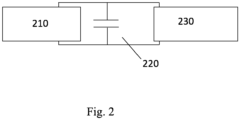
- Figure 2 illustrates a schematic diagram of an electrical system of the testing apparatus 100 according to an embodiment of the present invention.
- Figure 2 illustrates the first actuator 210 of the force apparatus 140, an energy store 220 and an energy consumer 230.
- the energy store 220 is arranged to store regenerative energy from at least the first actuator 210.
- the regenerative energy is be transferred to the energy store 220.
- an electronic circuit is implemented in which the regenerative energy output from the first actuator 210 is directed to the energy store 220 to be stored by using at least one switching device, such as a relay switch or solid state switch, which directs the regenerative energy output from the first actuator 210 to the energy store 220.
- the energy store 220 comprises at least one energy storage device.
- the at least one energy storage device comprises electrical energy storage device.
- the energy store 220 may comprise at least one battery.
- the energy store 220 may comprise at least one capacitor as shown in Figure 2 with it being appreciated that this is merely an example. As such, when the energy store 220 stores the regenerative energy this may correspond to at least partly charging the at least one capacitor 220.
- the energy store 220 comprises at least one capacitor
- the energy store 220 stores the regenerative energy for at least a short period of time.
- the energy store 220 may store the regenerative energy for a longer period of time in dependence on the type of energy store 220, for example if the energy store 220 is a battery.
- the energy wasted by the material testing apparatus 100 is reduced because the regenerative energy is retained the material testing apparatus 100 in contrast to being burned off heat.
- the energy store 220 may comprise an array (e.g. more than 2, more than 6, or more than 10) of "small" capacitors ("small” may be up to a capacitance of e.g. 50 ⁇ F, or e.g. 500 ⁇ F).
- an array of 12 capacitors each with a capacitance of 470 ⁇ F may be used.
- Using such an array of smaller capacitors may improve a high frequency response of the energy store 220, which in turn may enable the energy store 220 to react quickly to the incoming regenerative energy.
- Using such an array of small capacitors may provide the effect of impedance matching a motor drive of the material testing apparatus 100, to prevent unwanted transients and resonances in a power circuit of the material testing apparatus 100. It will be appreciated that different sized arrays with different sized capacitors may be used to achieve the same or similar advantageous effects.
- the electrical system of Figure 2 comprises the energy consumer 230.
- the energy consumer 230 is arranged to, at least in part, consume energy from the energy store 220.
- the energy consumer 230 is a device arranged to consume energy in order to perform an operation.
- the energy consumer 230 comprises the first actuator 210.
- the first actuator 210 may be arranged to, at least in part, consume the energy from the energy store 220 to apply the releasable force to the sample 130.
- An electronic circuit may be implemented in which the energy stored in the energy store 220 is transferred to the energy consumer 230 to be utilised therein.
- the energy consumer 230 may also consume energy from another energy source in combination with the energy from the energy store 220.
- the energy consumer 230 may consume energy from a mains electrical supply provided to the apparatus 100, particularly when the energy in the energy store 200 is insufficient to power the energy consumer 230.
- the energy store 220 is at least one capacitor and the energy consumer 230 consumes the energy from the energy store 230 this may correspond to at least partly discharging the at least one capacitor.
- arranging the energy consumer 230 to consume the energy from the energy store 220 improves the energy efficiency of the material testing apparatus 100 because the material testing apparatus 100 is able to reuse energy.
- the energy consumer 230 may comprise a second actuator 230.
- the second actuator of the energy consumer 230 may be arranged to, at least in part, consume energy from the energy store 220.
- the second actuator may be an electrical or electromechanical actuator.
- the second actuator of the energy consumer 230 may also be arranged to output regenerative energy in dependence on an operation performed by the energy consumer 230. That is, the output of the regenerative energy from the second actuator, i.e. the actuator of the energy consumer 230 is released during its operation. As such, the second actuator does not continuously output regenerative energy.
- the first actuator 210 and second actuator of the energy consumer 230 may release regenerative energy. That is, the first actuator 210 may output a first regenerative energy and the second actuator 230 may output a second regenerative energy. The second actuator may output the second regenerative energy when performing an operation in which energy is released.
- the energy consumer 230 may comprise at least one of a cooling system or one or more control electronics of the testing apparatus 100.
- the operation performed by the cooling system in which the energy from the energy store is consumed may be operation of a fan, heat pump or peltier cooling system.
- the operation performed by the one or more control electronics may be to control other components of the material testing apparatus 100.
- the energy consumer 230 may comprise other subsystems of the material testing apparatus 100, such that the energy consumer 230 may comprise a subsystem other than the provided examples of the cooling system and one or more control electronics.
- At least one of the cooling system, one or more control electronics and other subsystem of the material testing apparatus 100 may be arranged to, at least in part, consume energy from the energy store 220. Furthermore, at least one of the cooling system, one or more control electronics and other subsystem of the material testing apparatus 100 may be arranged to output regenerative energy in dependence on an operation performed by the energy consumer 230.
- At least one of the cooling system, one or more control electronics and other subsystem of the material testing apparatus 100 may comprise the second actuator described above. Therefore, at least one of the cooling system, one or more control electronics and any other subsystem of the material testing apparatus 100 may be arranged to, at least in part, consume energy from the energy store 220. Furthermore, at least one of the cooling system, one or more control electronics and other subsystem of the material testing apparatus 100 may be arranged to output regenerative energy in dependence on an operation performed by the energy consumer 230.
- the energy consumer 230 comprises a plurality of the first actuator 210, the second actuator, the cooling system, one or more control electronics and other subsystem of the material testing apparatus 100
- the possibility of the energy store 220 overflowing with excess regenerative energy is reduced. Since multiple components of the material testing apparatus 100 consume the regenerative energy stored in the energy store 220, the regenerative energy is recycled across a plurality of components on the material testing apparatus 100.
- the energy store 220 may be arranged to store the regenerative energy output by the second actuator 230 or at least one of the cooling system, one or more control electronics and other subsystem of the material testing apparatus 100. That is, the energy store 220 may store the second regenerative energy.
- an electronic circuit may be implemented in which the regenerative energy output from the second actuator is directed to the energy store 220 to be stored by using at least one switching device, such as a relay switch or solid state switch, which directs the second regenerative energy output from the second actuator to the energy store 220.
- the material testing apparatus 100 comprises a controller 170 configured to control various operations of the material testing apparatus 100.
- the controller 170 is configured to control the first actuator 210 to apply and to release the force applied to the sample 130, wherein the first actuator 210 is arranged to output the regenerative energy in dependence on the release of the force.
- the regenerative energy is output from the first actuator 210 in dependence on release of the force applied to the sample 130.
- the controller 170 may be configured to control at least one of the second actuator of the energy consumer 230, the cooling system, one or more control electronics and other subsystem of the material testing apparatus 100. At least one of the second actuator 230, the cooling system, one or more control electronics and other subsystem of the material testing apparatus 100 may be arranged to output regenerative energy, which may be the second regenerative energy, as discussed above.
- the force apparatus 120 may apply the force via the sample holding device 120.
- the force to be applied to the sample 130 is applied by moving the sample holding device 120.
- the force apparatus 120 may be arranged to apply the force to one end of the sample 130 or two opposing ends of the sample 130.
- the force apparatus 120 may be adapted according to force requirements and/or a shape and size of the material testing apparatus 100.
- the first actuator 210 may be arranged to, in use, move at least one portion of the sample holding device 120 to apply force to the sample 130 held therein.
- Figure 1 illustrates the sample holding device 120 may be arranged to grip the sample 130 and may be comprised of a plurality of members, such that the sample 130 is gripped when placed between members of the sample holding device 120.
- the sample holding device 120 may comprise a plurality of grips, such as claws, each arranged at opposing ends of the sample 130. In some embodiments, there is a pair of grips.
- the sample holding device 120 may be configured to withstand a maximum force to be applied to the sample by the material testing apparatus 100.
- the sample holding device 120 may be structured and formed of a material such that the sample holding device 120 is not deformed by a force less than or equal to the maximum force to be applied to the sample 130.
- the sample holding device 120 may therefore be adapted according to force requirements and/or a shape and size of the sample 130 to be tested.
- the sampling holding device 120 may be arranged horizontally or vertically in dependence on a type and amount of force to be applied to the sample.
- other structures and forms of sample holding device will be envisaged.
- Figure 1 also illustrates guide means 110, such as a guide, and a crosshead 150.
- the crosshead 150 is supported on the guide 110 and arranged to support at least a portion of one or both of the sample holding device 120 and the force apparatus 140.
- using the crosshead 150 as a support for other components of the material testing apparatus 100 results in a compact apparatus.
- the force apparatus 140 is supported by the crosshead 150 in that the force apparatus 140 is located on the crosshead 150.
- an upper part of the sample holding device 120 is supported by the crosshead 150 in that in some embodiments the upper part is suspended below the crosshead 150.
- the crosshead 150 may be adapted according to force requirements and/or a shape and size of the material testing apparatus 100.
- the guide means 110 may be a guide arranged to support the crosshead 150 and guide a movement of the crosshead 150 about the guide 110.
- the guide 110 may be supported by a base 105 of the material testing apparatus 100.
- the guide 110 comprises two stanchions, laterally separated by less than a width of the crosshead 150 which extend vertically from the base 105.
- the guide 110 may be configured according to force requirements and/or a shape and size of the material testing apparatus 100.
- the guide 110 may comprise one stanchion.
- Each guide in the illustrated embodiment has a generally circular lateral cross-section although it will be appreciated that other cross-sectional shapes of the guide means may be envisaged.
- the crosshead 150 may be vertically moveable about the guide 110.
- the crosshead 150 may be arranged to vertically move along the two stanchions of the guide 110 in first and second opposed directions about the guide 110, which relates to up and down directions along the guide 110.
- the crosshead 150 may be manually moved vertically about the guide 110 by a user using a handle or lever or may be moved electronically using crosshead drive means 180, which may be a crosshead drive mechanism.
- the movement of the crosshead 150 vertically about the guide 110 may be referred to as a crosshead drive operation.
- the crosshead drive mechanism 180 may comprise a combination of electrical and mechanical components arranged in such a way as to move the crosshead 150 vertically about the guide 110.
- the crosshead drive mechanism 180 may comprise an electric machine and may include a mechanism to convert rotational motion of the electric machine into linear motion of the crosshead 150 about the guide 110.
- the crosshead 150 is moved such as lifted to allow the sample 130 to be inserted or removed from the material testing apparatus 100 and to accommodate samples of different sizes to be tested.
- the movement of the crosshead 150 about the guide 110 enables a position of the sample holding device 120 to be adjusted in dependence on the size of the sample 130.
- the material testing apparatus 100 of some embodiments may comprise clamping means 160, such as a clamping apparatus, arranged to apply a releasable clamping force to the guide 110 to secure the crosshead 150 at a location with respect to the guide 110.
- the clamping apparatus 160 may comprise at least one clamping member (not illustrated) arranged to apply the releasable clamping force.
- the at least one clamping member may be at least partially moveable and arranged to contact the guide 110.
- the clamping force may be a friction force between the at least one clamping member and the guide 110.
- the clamping apparatus 160 may comprise an electric clamping apparatus.
- the electric clamping apparatus may comprise an electric machine to control movement of the at least one clamping member.
- the controller 170 may be implemented by a processor 171 and a memory 172 including a computer program 173 comprising computer program instructions 174.
- the processor 171 may comprise an output interface 175 via which data and/or commands in the form of control signals are output by the processor and an input interface 176 via which data and/or commands are input to the processor.
- Implementation of the controller 170 can be in hardware alone (a circuit), have certain aspects in software including firmware alone or can be a combination of hardware and software (including firmware).
- the computer program 173 may be stored on a computer readable storage medium (disk, memory etc).
- the computer program 173 may be computer software which, when executed, is arranged to perform a method according to the method described below in relation to Figure 4 .
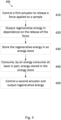
- Figure 4 illustrates a flowchart of a method 400 according to an embodiment of the invention.
- the method 400 may be performed by the material testing apparatus 100 described above and illustrated in Figures 1-3 .
- the method 400 comprises controlling 410 the first actuator 210 to release the force applied to the sample 130.
- the force applied to the sample 130 is a releasable force, which may be to test the physical properties of the sample 130.
- the first actuator 210 may apply a deformation or testing force to the deform the sample 130, by one or more of stretching, compression or torsion.
- the method 400 comprises outputting 420, by the first actuator 210, regenerative energy in dependence on the release of the force.
- regenerative energy may be retained within the sample 130.
- the method comprises outputting at least some of the retained energy by the sample 130 into the material testing apparatus 100 as regenerative energy.
- method step 420 may comprise outputting the regenerative energy in the form of electrical energy capable of being stored in an energy store, such as energy store 220.
- the method 400 comprises storing 430 the regenerative energy from at least the first actuator 210 in an energy store 220, such as the energy store 220 of Figure 2 .
- Method step 430 may comprise storing the regenerative energy in at least one energy storage device of the energy store 220.
- Method step 430 may comprise storing the regenerative energy in at least one capacitor of the energy store 220.
- the method 400 comprises consuming 440, by the energy consumer 230 at least in part, energy stored in the energy store 220.
- the energy consumer 230 comprises the first actuator 210.
- the method step 440 comprises consuming the energy in order to perform an operation.
- method step 440 may comprise consuming, by the first actuator 210 at least in part, the energy stored in the energy store 220 to apply the releasable force to the sample 130.
- the method 400 may also comprise the energy consumer 230 consuming energy from a different energy source in combination with the energy from the energy store 220.
- the method 400 may comprise the energy consumer 230 consuming energy from a mains supply or a battery.
- the energy store 220 is at least one capacitor and the method step 400 comprises the energy consumer 230 consuming the energy from the energy store 230, this may correspond to discharging the at least one capacitor.
- Method step 440 may comprise the second actuator, i.e. the actuator of the energy consumer 230 consuming, at least in part, the energy stored in the energy store 220 by applying a second force to the sample 130.
- Method step 440 may comprise the at least one of the cooling system, one or more control electronics and other subsystem of the material testing apparatus 100 consuming, at least in part, the energy stored in the energy store 220 by performing an operation.
- the method 400 may comprise comprising controlling 450 of a second actuator of the energy consumer 230 and outputting, by the second actuator, regenerative energy.
- the second actuator releases a force, such as when performing an operation in which energy is released
- the regenerative energy may be output. That is, the method 400 comprises outputting 420, by the first actuator 210, a first regenerative energy in dependence on the release of the force and optionally, outputting, by the second actuator a second regenerative energy.
- the method step 450 may comprise controlling at least one of the cooling system, one or more control electronics and other subsystem of the material testing apparatus 100 and outputting, by at least one of the cooling system, one or more control electronics and other subsystem of the material testing apparatus 100, regenerative energy.
- embodiments of the present invention can be realised in the form of hardware, software or a combination of hardware and software. Any such software may be stored in the form of volatile or non-volatile storage such as, for example, a storage device like a ROM, whether erasable or rewritable or not, or in the form of memory such as, for example, RAM, memory chips, device or integrated circuits or on an optically or magnetically readable medium such as, for example, a CD, DVD, magnetic disk or magnetic tape. It will be appreciated that the storage devices and storage media are embodiments of machine-readable storage that are suitable for storing a program or programs that, when executed, implement embodiments of the present invention.
- embodiments provide a program comprising code for implementing a system or method as claimed in any preceding claim and a machine readable storage storing such a program. Still further, embodiments of the present invention may be conveyed electronically via any medium such as a communication signal carried over a wired or wireless connection and embodiments suitably encompass the same.
Landscapes
- Analytical Chemistry (AREA)
- Physics & Mathematics (AREA)
- Health & Medical Sciences (AREA)
- Life Sciences & Earth Sciences (AREA)
- Chemical & Material Sciences (AREA)
- Biochemistry (AREA)
- General Health & Medical Sciences (AREA)
- General Physics & Mathematics (AREA)
- Immunology (AREA)
- Pathology (AREA)
- Power Engineering (AREA)
- Engineering & Computer Science (AREA)
- Investigating Strength Of Materials By Application Of Mechanical Stress (AREA)
Description
- This invention relates to apparatus and methods for material testing.
- Material testing machines (also sometimes known as structural tests machines) are used to test the physical characteristics of a material sample. Material testing machines use sample holding means to hold the material sample and force means to apply a force to the material sample. Energy is utilized to apply the force to the sample via the force means and to provide acceleration to moving parts of the material testing machine. Some of this energy is retained as potential energy in the machine (for example, a spring being compressed) or as kinetic energy caused by momentum of moving parts. When the force applied to the sample is released or deceleration is applied, some of this energy flows back into the material testing apparatus as 'regenerative energy'. Typically, the energy is 'burned off' in dynamic braking resistors as heat, which is then wasted and contributes to thermal load that the machine presents to any climate control systems in a laboratory with the material testing machine. Some examples of relevant prior art are ;
US2020173895 ,WO2020/097659 ,US2011/227565 ,CN108426771 ,GB2475683 US5739411 .! - It is an object of the present invention to mitigate at least some of the above problems.
- In accordance with the present inventions there is provided a material testing apparatus as defined in claim 1, a method as defined in claim 8, a computer software as defined in claim 14 and a computer-readable recording medium, as defined in claim 15. Other alternatives are defined in the dependent claims.
- Embodiments of the invention are further described hereinafter with reference to the accompanying drawings, in which:
-
Figure 1 illustrates an apparatus according to an embodiment of the present invention; -
Figure 2 illustrates a schematic according to an embodiment of the present invention; -
Figure 3 illustrates a controller according to an embodiment of the invention; and -
Figure 4 illustrates a method according to an embodiment of the invention. - Throughout this application, references to "sample" are intended to refer to a specimen, such as a material specimen for testing. The specimen may be a piece of material which is placed into a material testing machine to be tested. The material testing machine may exert a force on the specimen to the test various physical properties of the material of the specimen. The specimen may be, for example, taken from a production process of the material as a sample of the material being produced.
-
Figure 1 illustrates a material testing apparatus according to an embodiment of the present invention, indicated generally byreference numeral 100. Thematerial testing apparatus 100 may be configured to perform a method according to an embodiment of the invention as described below in relation toFigure 4 . Thematerial testing apparatus 100 comprisessample holding means 120, such as a sample holding device, for holding asample 130 and force means 140, such as a force apparatus, comprising a first actuator for applying a releasable force to thesample 130. - The
first actuator 210 of theforce apparatus 120 is arranged to apply a releasable force to thesample 130, which may be to test the physical properties of thesample 130. Thefirst actuator 210 may repeatedly apply force to thesample 130. For example, thefirst actuator 210 may apply a deformation or testing force to the deform thesample 130, by one or more of stretching, compression or torsion. Thefirst actuator 210 may be an electric or electromechanical actuator. However, other types of actuators will be envisaged. - It will be appreciated that when the
first actuator 210 applies the releasable force to the sample, 130, at least some energy utilised by theactuator 210 to apply the force is retained in thematerial testing apparatus 100. When the applied force is released, for example, thefirst actuator 210 releases the force applied to thesample 130, at least some of the retained energy is received by thematerial testing apparatus 100 as regenerative energy. Therefore, thefirst actuator 210 outputs the regenerative energy in dependence on the release of the force applied to thesample 130. The regenerative energy is in the form of electrical energy. - The regenerative energy may be released when deceleration is applied to the components of the
apparatus 100 which are moved to apply the force to thesample 130. Various components of thematerial apparatus 100 are moved to apply the force to thesample 130. For example, theforce apparatus 140 including thefirst actuator 210 may be moved to apply the force to thesample 130. Thus, when the deceleration is applied to thefirst actuator 210, at least some energy, such as retained kinetic energy, is outputted into thematerial testing apparatus 100 as regenerative energy. Thefirst actuator 210 may deaccelerate when it reaches a physical limit causing movement of thefirst actuator 210 to stop or when thefirst actuator 210 is controlled to stop via a brake or control signal. - However, the regenerative energy may be excess energy in that it is waste energy that can be removed from the system. In existing apparatuses, such regenerative energy is removed from the
material testing apparatus 100 by being 'burned off' such as in dynamic braking resistors as heat. Therefore, the regenerative energy is wasted and contributes to thermal load that thematerial testing apparatus 100 presents to any climate control systems in an environment, such as a laboratory, in which thematerial testing machine 100 is located. - In embodiments of the present invention, the regenerative energy output by the
first actuator 210 is stored in thematerial testing apparatus 100 for use. Advantageously the regenerative energy is not therefore wasted and may instead be used by thematerial testing apparatus 100. -
Figure 2 illustrates a schematic diagram of an electrical system of thetesting apparatus 100 according to an embodiment of the present invention. In particular,Figure 2 illustrates thefirst actuator 210 of theforce apparatus 140, anenergy store 220 and anenergy consumer 230. Theenergy store 220 is arranged to store regenerative energy from at least thefirst actuator 210. When the regenerative energy is output from thefirst actuator 210, the regenerative energy is be transferred to theenergy store 220. For example, an electronic circuit is implemented in which the regenerative energy output from thefirst actuator 210 is directed to theenergy store 220 to be stored by using at least one switching device, such as a relay switch or solid state switch, which directs the regenerative energy output from thefirst actuator 210 to theenergy store 220. - In some embodiments, the
energy store 220 comprises at least one energy storage device. The at least one energy storage device comprises electrical energy storage device. For example, theenergy store 220 may comprise at least one battery. Theenergy store 220 may comprise at least one capacitor as shown inFigure 2 with it being appreciated that this is merely an example. As such, when theenergy store 220 stores the regenerative energy this may correspond to at least partly charging the at least onecapacitor 220. When theenergy store 220 comprises at least one capacitor, theenergy store 220 stores the regenerative energy for at least a short period of time. However, theenergy store 220 may store the regenerative energy for a longer period of time in dependence on the type ofenergy store 220, for example if theenergy store 220 is a battery. - Advantageously, by storing the regenerative energy from the
first actuator 210, the energy wasted by thematerial testing apparatus 100 is reduced because the regenerative energy is retained thematerial testing apparatus 100 in contrast to being burned off heat. - Advantageously, the
energy store 220 may comprise an array (e.g. more than 2, more than 6, or more than 10) of "small" capacitors ("small" may be up to a capacitance of e.g. 50µF, or e.g. 500µF). For example, an array of 12 capacitors each with a capacitance of 470µF may be used. Using such an array of smaller capacitors may improve a high frequency response of theenergy store 220, which in turn may enable theenergy store 220 to react quickly to the incoming regenerative energy. Using such an array of small capacitors may provide the effect of impedance matching a motor drive of thematerial testing apparatus 100, to prevent unwanted transients and resonances in a power circuit of thematerial testing apparatus 100. It will be appreciated that different sized arrays with different sized capacitors may be used to achieve the same or similar advantageous effects. - As mentioned above, the electrical system of
Figure 2 comprises theenergy consumer 230. Theenergy consumer 230 is arranged to, at least in part, consume energy from theenergy store 220. Theenergy consumer 230 is a device arranged to consume energy in order to perform an operation. Theenergy consumer 230 comprises thefirst actuator 210. For example, thefirst actuator 210 may be arranged to, at least in part, consume the energy from theenergy store 220 to apply the releasable force to thesample 130. An electronic circuit may be implemented in which the energy stored in theenergy store 220 is transferred to theenergy consumer 230 to be utilised therein. Theenergy consumer 230 may also consume energy from another energy source in combination with the energy from theenergy store 220. For example, theenergy consumer 230 may consume energy from a mains electrical supply provided to theapparatus 100, particularly when the energy in the energy store 200 is insufficient to power theenergy consumer 230. When theenergy store 220 is at least one capacitor and theenergy consumer 230 consumes the energy from theenergy store 230 this may correspond to at least partly discharging the at least one capacitor. - Advantageously, arranging the
energy consumer 230 to consume the energy from theenergy store 220 improves the energy efficiency of thematerial testing apparatus 100 because thematerial testing apparatus 100 is able to reuse energy. - In some embodiments, the
energy consumer 230 may comprise asecond actuator 230. The second actuator of theenergy consumer 230 may be arranged to, at least in part, consume energy from theenergy store 220. The second actuator may be an electrical or electromechanical actuator. However, other types of actuators will be envisaged. The second actuator of theenergy consumer 230 may also be arranged to output regenerative energy in dependence on an operation performed by theenergy consumer 230. That is, the output of the regenerative energy from the second actuator, i.e. the actuator of theenergy consumer 230 is released during its operation. As such, the second actuator does not continuously output regenerative energy. - Therefore, the
first actuator 210 and second actuator of theenergy consumer 230 may release regenerative energy. That is, thefirst actuator 210 may output a first regenerative energy and thesecond actuator 230 may output a second regenerative energy. The second actuator may output the second regenerative energy when performing an operation in which energy is released. - In some embodiments, the
energy consumer 230 may comprise at least one of a cooling system or one or more control electronics of thetesting apparatus 100. The operation performed by the cooling system in which the energy from the energy store is consumed may be operation of a fan, heat pump or peltier cooling system. The operation performed by the one or more control electronics may be to control other components of thematerial testing apparatus 100. It will be appreciated that theenergy consumer 230 may comprise other subsystems of thematerial testing apparatus 100, such that theenergy consumer 230 may comprise a subsystem other than the provided examples of the cooling system and one or more control electronics. - At least one of the cooling system, one or more control electronics and other subsystem of the
material testing apparatus 100 may be arranged to, at least in part, consume energy from theenergy store 220. Furthermore, at least one of the cooling system, one or more control electronics and other subsystem of thematerial testing apparatus 100 may be arranged to output regenerative energy in dependence on an operation performed by theenergy consumer 230. - In some embodiments, at least one of the cooling system, one or more control electronics and other subsystem of the
material testing apparatus 100 may comprise the second actuator described above. Therefore, at least one of the cooling system, one or more control electronics and any other subsystem of thematerial testing apparatus 100 may be arranged to, at least in part, consume energy from theenergy store 220. Furthermore, at least one of the cooling system, one or more control electronics and other subsystem of thematerial testing apparatus 100 may be arranged to output regenerative energy in dependence on an operation performed by theenergy consumer 230. - Advantageously, when the
energy consumer 230 comprises a plurality of thefirst actuator 210, the second actuator, the cooling system, one or more control electronics and other subsystem of thematerial testing apparatus 100, the possibility of theenergy store 220 overflowing with excess regenerative energy is reduced. Since multiple components of thematerial testing apparatus 100 consume the regenerative energy stored in theenergy store 220, the regenerative energy is recycled across a plurality of components on thematerial testing apparatus 100. - The
energy store 220 may be arranged to store the regenerative energy output by thesecond actuator 230 or at least one of the cooling system, one or more control electronics and other subsystem of thematerial testing apparatus 100. That is, theenergy store 220 may store the second regenerative energy. For example, an electronic circuit may be implemented in which the regenerative energy output from the second actuator is directed to theenergy store 220 to be stored by using at least one switching device, such as a relay switch or solid state switch, which directs the second regenerative energy output from the second actuator to theenergy store 220. - The
material testing apparatus 100 comprises acontroller 170 configured to control various operations of thematerial testing apparatus 100. Thecontroller 170 is configured to control thefirst actuator 210 to apply and to release the force applied to thesample 130, wherein thefirst actuator 210 is arranged to output the regenerative energy in dependence on the release of the force. As discussed above, at least some energy utilised to apply the force on thesample 130 is retained in thematerial testing apparatus 100 and the regenerative energy is output from thefirst actuator 210 in dependence on release of the force applied to thesample 130. - The
controller 170 may be configured to control at least one of the second actuator of theenergy consumer 230, the cooling system, one or more control electronics and other subsystem of thematerial testing apparatus 100. At least one of thesecond actuator 230, the cooling system, one or more control electronics and other subsystem of thematerial testing apparatus 100 may be arranged to output regenerative energy, which may be the second regenerative energy, as discussed above. - The
force apparatus 120 may apply the force via thesample holding device 120. In some embodiments the force to be applied to thesample 130 is applied by moving thesample holding device 120. Theforce apparatus 120 may be arranged to apply the force to one end of thesample 130 or two opposing ends of thesample 130. Theforce apparatus 120 may be adapted according to force requirements and/or a shape and size of thematerial testing apparatus 100. Thefirst actuator 210 may be arranged to, in use, move at least one portion of thesample holding device 120 to apply force to thesample 130 held therein. - Referring back to
Figure 1 , as mentioned above,Figure 1 illustrates thesample holding device 120 may be arranged to grip thesample 130 and may be comprised of a plurality of members, such that thesample 130 is gripped when placed between members of thesample holding device 120. For example, thesample holding device 120 may comprise a plurality of grips, such as claws, each arranged at opposing ends of thesample 130. In some embodiments, there is a pair of grips. - The
sample holding device 120 may be configured to withstand a maximum force to be applied to the sample by thematerial testing apparatus 100. As such, thesample holding device 120 may be structured and formed of a material such that thesample holding device 120 is not deformed by a force less than or equal to the maximum force to be applied to thesample 130. Thesample holding device 120 may therefore be adapted according to force requirements and/or a shape and size of thesample 130 to be tested. Thesampling holding device 120 may be arranged horizontally or vertically in dependence on a type and amount of force to be applied to the sample. However, it will be appreciated that other structures and forms of sample holding device will be envisaged. -
Figure 1 also illustrates guide means 110, such as a guide, and acrosshead 150. Thecrosshead 150 is supported on theguide 110 and arranged to support at least a portion of one or both of thesample holding device 120 and theforce apparatus 140. Advantageously, using thecrosshead 150 as a support for other components of thematerial testing apparatus 100 results in a compact apparatus. In the embodiment illustrated inFigure 1 , theforce apparatus 140 is supported by thecrosshead 150 in that theforce apparatus 140 is located on thecrosshead 150. Furthermore, an upper part of thesample holding device 120 is supported by thecrosshead 150 in that in some embodiments the upper part is suspended below thecrosshead 150. Thecrosshead 150 may be adapted according to force requirements and/or a shape and size of thematerial testing apparatus 100. - The guide means 110 may be a guide arranged to support the
crosshead 150 and guide a movement of thecrosshead 150 about theguide 110. Theguide 110 may be supported by abase 105 of thematerial testing apparatus 100. In the embodiment illustrated inFigure 1 , theguide 110 comprises two stanchions, laterally separated by less than a width of thecrosshead 150 which extend vertically from thebase 105. It will be appreciated that theguide 110 may be configured according to force requirements and/or a shape and size of thematerial testing apparatus 100. For example, theguide 110 may comprise one stanchion. Each guide in the illustrated embodiment has a generally circular lateral cross-section although it will be appreciated that other cross-sectional shapes of the guide means may be envisaged. - The
crosshead 150 may be vertically moveable about theguide 110. In the embodiment inFigure 1 , thecrosshead 150 may be arranged to vertically move along the two stanchions of theguide 110 in first and second opposed directions about theguide 110, which relates to up and down directions along theguide 110. Thecrosshead 150 may be manually moved vertically about theguide 110 by a user using a handle or lever or may be moved electronically using crosshead drive means 180, which may be a crosshead drive mechanism. The movement of thecrosshead 150 vertically about theguide 110 may be referred to as a crosshead drive operation. - The crosshead drive mechanism 180 may comprise a combination of electrical and mechanical components arranged in such a way as to move the
crosshead 150 vertically about theguide 110. For example, the crosshead drive mechanism 180 may comprise an electric machine and may include a mechanism to convert rotational motion of the electric machine into linear motion of thecrosshead 150 about theguide 110. - In the crosshead drive operation, the
crosshead 150 is moved such as lifted to allow thesample 130 to be inserted or removed from thematerial testing apparatus 100 and to accommodate samples of different sizes to be tested. The movement of thecrosshead 150 about theguide 110 enables a position of thesample holding device 120 to be adjusted in dependence on the size of thesample 130. - The
material testing apparatus 100 of some embodiments may comprise clamping means 160, such as a clamping apparatus, arranged to apply a releasable clamping force to theguide 110 to secure thecrosshead 150 at a location with respect to theguide 110. Theclamping apparatus 160 may comprise at least one clamping member (not illustrated) arranged to apply the releasable clamping force. The at least one clamping member may be at least partially moveable and arranged to contact theguide 110. As a result of the contact between the at least one clamping member and theguide 110, the clamping force may be a friction force between the at least one clamping member and the guide 110.In some embodiments, theclamping apparatus 160 may comprise an electric clamping apparatus. For example, the electric clamping apparatus may comprise an electric machine to control movement of the at least one clamping member. - As shown in
Figure 3 , thecontroller 170 may be implemented by aprocessor 171 and amemory 172 including acomputer program 173 comprisingcomputer program instructions 174. Theprocessor 171 may comprise anoutput interface 175 via which data and/or commands in the form of control signals are output by the processor and aninput interface 176 via which data and/or commands are input to the processor. Implementation of thecontroller 170 can be in hardware alone (a circuit), have certain aspects in software including firmware alone or can be a combination of hardware and software (including firmware). Thecomputer program 173 may be stored on a computer readable storage medium (disk, memory etc). Thecomputer program 173 may be computer software which, when executed, is arranged to perform a method according to the method described below in relation toFigure 4 . -
Figure 4 illustrates a flowchart of amethod 400 according to an embodiment of the invention. Themethod 400 may be performed by thematerial testing apparatus 100 described above and illustrated inFigures 1-3 . - The
method 400 comprises controlling 410 thefirst actuator 210 to release the force applied to thesample 130. The force applied to thesample 130 is a releasable force, which may be to test the physical properties of thesample 130. For example, thefirst actuator 210 may apply a deformation or testing force to the deform thesample 130, by one or more of stretching, compression or torsion. - The
method 400 comprises outputting 420, by thefirst actuator 210, regenerative energy in dependence on the release of the force. As discussed above, at least some energy utilised to apply the releasable force may be retained within thesample 130. Thus, when the force applied to the sample is released, the method comprises outputting at least some of the retained energy by thesample 130 into thematerial testing apparatus 100 as regenerative energy. In particular,method step 420 may comprise outputting the regenerative energy in the form of electrical energy capable of being stored in an energy store, such asenergy store 220. - The
method 400 comprises storing 430 the regenerative energy from at least thefirst actuator 210 in anenergy store 220, such as theenergy store 220 ofFigure 2 .Method step 430 may comprise storing the regenerative energy in at least one energy storage device of theenergy store 220.Method step 430 may comprise storing the regenerative energy in at least one capacitor of theenergy store 220. - The
method 400 comprises consuming 440, by theenergy consumer 230 at least in part, energy stored in theenergy store 220. As discussed above, theenergy consumer 230 comprises thefirst actuator 210. Themethod step 440 comprises consuming the energy in order to perform an operation. For example,method step 440 may comprise consuming, by thefirst actuator 210 at least in part, the energy stored in theenergy store 220 to apply the releasable force to thesample 130. - The
method 400 may also comprise theenergy consumer 230 consuming energy from a different energy source in combination with the energy from theenergy store 220. For example, themethod 400 may comprise theenergy consumer 230 consuming energy from a mains supply or a battery. When theenergy store 220 is at least one capacitor and themethod step 400 comprises theenergy consumer 230 consuming the energy from theenergy store 230, this may correspond to discharging the at least one capacitor.Method step 440 may comprise the second actuator, i.e. the actuator of theenergy consumer 230 consuming, at least in part, the energy stored in theenergy store 220 by applying a second force to thesample 130.Method step 440 may comprise the at least one of the cooling system, one or more control electronics and other subsystem of thematerial testing apparatus 100 consuming, at least in part, the energy stored in theenergy store 220 by performing an operation. - The
method 400 may comprise comprising controlling 450 of a second actuator of theenergy consumer 230 and outputting, by the second actuator, regenerative energy. For example, when the second actuator releases a force, such as when performing an operation in which energy is released, the regenerative energy may be output. That is, themethod 400 comprises outputting 420, by thefirst actuator 210, a first regenerative energy in dependence on the release of the force and optionally, outputting, by the second actuator a second regenerative energy. - The
method step 450 may comprise controlling at least one of the cooling system, one or more control electronics and other subsystem of thematerial testing apparatus 100 and outputting, by at least one of the cooling system, one or more control electronics and other subsystem of thematerial testing apparatus 100, regenerative energy. - It will be appreciated that embodiments of the present invention can be realised in the form of hardware, software or a combination of hardware and software. Any such software may be stored in the form of volatile or non-volatile storage such as, for example, a storage device like a ROM, whether erasable or rewritable or not, or in the form of memory such as, for example, RAM, memory chips, device or integrated circuits or on an optically or magnetically readable medium such as, for example, a CD, DVD, magnetic disk or magnetic tape. It will be appreciated that the storage devices and storage media are embodiments of machine-readable storage that are suitable for storing a program or programs that, when executed, implement embodiments of the present invention. Accordingly, embodiments provide a program comprising code for implementing a system or method as claimed in any preceding claim and a machine readable storage storing such a program. Still further, embodiments of the present invention may be conveyed electronically via any medium such as a communication signal carried over a wired or wireless connection and embodiments suitably encompass the same.
- Throughout the description and claims of this specification, the words "comprise" and "contain" and variations of them mean "including but not limited to", and they are not intended to (and do not) exclude other moieties, additives, components, integers or steps. Throughout the description and claims of this specification, the singular encompasses the plural unless the context otherwise requires. In particular, where the indefinite article is used, the specification is to be understood as contemplating plurality as well as singularity, unless the context requires otherwise.
Claims (15)
- A material testing apparatus (100), comprising:guide means (110);sample holding means (120) for holding a sample (130);force means (140) comprising a first actuator (210) for applying a releasable force to the sample (130);a crosshead (150) supported on the guide means (110) and arranged to support at least a portion of one or both of the sample holding means (120) and the force means (140); characterized byan energy store (220) arranged to store regenerative energy from at least the first actuator (210), the regenerative energy being in the form of electrical energy;an energy consumer (230) arranged to, at least in part, consume the energy from the energy store (220), wherein the energy consumer (230) comprises the first actuator (210); anda controller (170) configured to control the first actuator (210) to release the force applied to the sample (130), wherein the first actuator (210) is arranged to output the regenerative energy in dependence on the release of the force applied to the sample (130).
- The apparatus (100) of claim 1, wherein the energy consumer (230) comprises a second actuator.
- The apparatus (100) of claim 2, wherein the controller (170) is configured to control the second actuator, wherein the second actuator is arranged to output regenerative energy.
- The apparatus (100) of any preceding claim, wherein the energy store (220) comprises at least one energy storage device.
- The apparatus (100) of any preceding claim, wherein the energy store (220) comprises at least one capacitor.
- The apparatus (100) of any preceding claim, wherein the first actuator (210) is arranged to, at least in part, consume the energy from the energy store (220) to apply the releasable force to the sample (130).
- The apparatus of any preceding claim, wherein the energy consumer (230) comprises at least one of a cooling system or one or more control electronics.
- A method of operating a material testing apparatus (100), the material testing apparatus (100) comprising guide means (110), sample holding means (120) for holding a sample (130), force means (140) comprising a first actuator (210) for applying a releasable force to the sample (130), a crosshead (150) supported on the guide means (110) and arranged to support at least a portion of one or both of the sample holding means (120) and the force means (140); and
wherein the method comprises:controlling the first actuator (210) to release the force applied to the sample (130); and characterized by outputting, by the first actuator (210), regenerative energy in dependence on the release of the force applied to the sample (130), the regenerative energy being in the form of electrical energy;storing the regenerative energy from at least the first actuator (210) in an energy store (220); andconsuming, by an energy consumer (230) at least in part, energy stored in the energy store (220), wherein the energy consumer (230) comprises the first actuator (210). - The method of claim 8, comprising controlling of a second actuator of the energy consumer (230) and outputting, by the second actuator, regenerative energy.
- The method of claim 8 or 9, comprising storing the regenerative energy in at least one energy storage device of the energy store (220).
- The method of any of claims 8 to 10, comprising storing the regenerative energy in at least one capacitor of the energy store (220).
- The method of any of claims 8 to 11, comprising at least one of a cooling system or one or more control electronics consuming, at least in part, the energy from the energy store (220).
- The method of any of claims 8 to 12, comprising consuming, by the first actuator (210) at least in part, the energy from the energy store (220) to apply the releasable force to the sample (130).
- Computer software which, when executed, causes the apparatus according to any of claims 1 to 7 to perform a method according to any of claims 8 to 13.
- A computer-readable recording medium having tangibly stored thereon the computer software of claim 14.
Priority Applications (3)
| Application Number | Priority Date | Filing Date | Title |
|---|---|---|---|
| US17/501,624 US11796433B2 (en) | 2020-10-30 | 2021-10-14 | Apparatus and method for material testing including regenerative energy storage |
| JP2021172954A JP7839627B2 (en) | 2020-10-30 | 2021-10-22 | Apparatus and methods for material testing |
| CN202111262636.XA CN114441434A (en) | 2020-10-30 | 2021-10-28 | Apparatus and method for material testing |
Applications Claiming Priority (1)
| Application Number | Priority Date | Filing Date | Title |
|---|---|---|---|
| GBGB2017212.8A GB202017212D0 (en) | 2020-10-30 | 2020-10-30 | Apparatus and method for material testing |
Publications (2)
| Publication Number | Publication Date |
|---|---|
| EP3992605A1 EP3992605A1 (en) | 2022-05-04 |
| EP3992605B1 true EP3992605B1 (en) | 2023-09-06 |
Family
ID=73776461
Family Applications (1)
| Application Number | Title | Priority Date | Filing Date |
|---|---|---|---|
| EP21188388.9A Active EP3992605B1 (en) | 2020-10-30 | 2021-07-29 | Apparatus and method for material testing |
Country Status (5)
| Country | Link |
|---|---|
| US (1) | US11796433B2 (en) |
| EP (1) | EP3992605B1 (en) |
| JP (1) | JP7839627B2 (en) |
| CN (1) | CN114441434A (en) |
| GB (1) | GB202017212D0 (en) |
Family Cites Families (15)
| Publication number | Priority date | Publication date | Assignee | Title |
|---|---|---|---|---|
| JPH0684930B2 (en) * | 1986-04-25 | 1994-10-26 | 株式会社島津製作所 | Material testing equipment |
| US5696312A (en) * | 1995-11-13 | 1997-12-09 | Brigham Young University | Accelerated impact testing apparatus |
| GB0616590D0 (en) * | 2006-08-21 | 2006-09-27 | Instron Ltd | Tuning of materials testing machine |
| JP2008254224A (en) * | 2007-03-31 | 2008-10-23 | Yushin Precision Equipment Co Ltd | Peripheral equipment of molding machine |
| CA2745153A1 (en) * | 2008-11-30 | 2010-06-03 | University Of Wyoming | Magnetic sensor for determining wear |
| GB2475683B (en) * | 2009-11-25 | 2011-10-19 | Micro Materials Ltd | Apparatus and method for testing materials |
| CN104271880A (en) * | 2011-05-24 | 2015-01-07 | 快帽系统公司 | Power system for high temperature applications with rechargeable energy storage |
| JP5956909B2 (en) * | 2012-10-31 | 2016-07-27 | 株式会社鷺宮製作所 | Test apparatus and test apparatus control method |
| US9645064B1 (en) * | 2015-03-09 | 2017-05-09 | Amazon Technologies, Inc. | Measurement of dynamic material properties |
| US9488562B1 (en) * | 2015-03-09 | 2016-11-08 | Amazon Technologies, Inc. | Measurement of dynamic battery pack properties |
| US10508978B2 (en) * | 2017-11-03 | 2019-12-17 | Saudi Arabian Oil Company | Strain energy-based method and apparatus to determine the coefficient of resilience of lost circulation materials |
| CN108426771A (en) * | 2018-04-11 | 2018-08-21 | 佛山科学技术学院 | A kind of multi-functional prestressed concrete resistance assay device |
| CA3119847A1 (en) * | 2018-11-13 | 2020-05-22 | Gekko Systems Pty Ltd | A wear sensor system |
| US11879871B2 (en) * | 2018-11-30 | 2024-01-23 | Illinois Tool Works Inc. | Safety systems requiring intentional function activation and material testing systems including safety systems requiring intentional function activation |
| US11592376B2 (en) * | 2018-11-30 | 2023-02-28 | Illinois Tool Works Inc. | Safety systems and material testing systems including safety systems |
-
2020
- 2020-10-30 GB GBGB2017212.8A patent/GB202017212D0/en not_active Ceased
-
2021
- 2021-07-29 EP EP21188388.9A patent/EP3992605B1/en active Active
- 2021-10-14 US US17/501,624 patent/US11796433B2/en active Active
- 2021-10-22 JP JP2021172954A patent/JP7839627B2/en active Active
- 2021-10-28 CN CN202111262636.XA patent/CN114441434A/en active Pending
Also Published As
| Publication number | Publication date |
|---|---|
| EP3992605A1 (en) | 2022-05-04 |
| JP2022074036A (en) | 2022-05-17 |
| GB202017212D0 (en) | 2020-12-16 |
| US20220136942A1 (en) | 2022-05-05 |
| JP7839627B2 (en) | 2026-04-02 |
| US11796433B2 (en) | 2023-10-24 |
| CN114441434A (en) | 2022-05-06 |
Similar Documents
| Publication | Publication Date | Title |
|---|---|---|
| EP3992605B1 (en) | Apparatus and method for material testing | |
| US12210001B2 (en) | Apparatus and method for material testing | |
| US20170095860A1 (en) | Method for controlling powder compacting apparatus and compacting apparatus | |
| CN106680721B (en) | Performance testing device for fuel cell | |
| CN112763412B (en) | Spring type energy storage mechanism of material friction abnormal sound test bed | |
| US9802252B2 (en) | Method for controlling powder compacting apparatus and compacting apparatus | |
| JP2011245566A (en) | Chuck device | |
| WO2020198729A1 (en) | Collision mitigation apparatus and material testing systems having collision mitigation apparatus | |
| US11788940B2 (en) | Apparatus and method for material testing including configuring an electrical machine in a braking configuration | |
| JP2010167429A (en) | Sliding nozzle control apparatus and sliding nozzle apparatus using the same | |
| CN114252326B (en) | Apparatus and method for material testing | |
| GB2619416A (en) | Apparatus and method for material testing | |
| JP2002131379A (en) | Electronic part testing pressing device, electronic part testing device, and its control method | |
| CN216847231U (en) | Rubber stretching device | |
| JP7501325B2 (en) | Testing machine and test piece collection device | |
| CN207930685U (en) | a kind of flexible clamping system | |
| CN211638348U (en) | Numerical control lathe knife rest and tailstock anticollision structure | |
| CN119739213B (en) | Product pressing detection method and system based on linear actuator | |
| CN222125278U (en) | A sample tray transfer placement mechanism | |
| CN205471021U (en) | A intelligent system for storage commodity circulation | |
| CN221758826U (en) | Automatic tissue section collection system | |
| CN217703230U (en) | Clamping device | |
| CN219253831U (en) | A punching tool for rear beam of automobile chassis | |
| CN223303139U (en) | An adaptive tray for power control and protection device | |
| JP7215856B2 (en) | positioning device |
Legal Events
| Date | Code | Title | Description |
|---|---|---|---|
| PUAI | Public reference made under article 153(3) epc to a published international application that has entered the european phase |
Free format text: ORIGINAL CODE: 0009012 |
|
| STAA | Information on the status of an ep patent application or granted ep patent |
Free format text: STATUS: THE APPLICATION HAS BEEN PUBLISHED |
|
| AK | Designated contracting states |
Kind code of ref document: A1 Designated state(s): AL AT BE BG CH CY CZ DE DK EE ES FI FR GB GR HR HU IE IS IT LI LT LU LV MC MK MT NL NO PL PT RO RS SE SI SK SM TR |
|
| STAA | Information on the status of an ep patent application or granted ep patent |
Free format text: STATUS: REQUEST FOR EXAMINATION WAS MADE |
|
| 17P | Request for examination filed |
Effective date: 20221101 |
|
| RBV | Designated contracting states (corrected) |
Designated state(s): AL AT BE BG CH CY CZ DE DK EE ES FI FR GB GR HR HU IE IS IT LI LT LU LV MC MK MT NL NO PL PT RO RS SE SI SK SM TR |
|
| GRAP | Despatch of communication of intention to grant a patent |
Free format text: ORIGINAL CODE: EPIDOSNIGR1 |
|
| STAA | Information on the status of an ep patent application or granted ep patent |
Free format text: STATUS: GRANT OF PATENT IS INTENDED |
|
| INTG | Intention to grant announced |
Effective date: 20230414 |
|
| P01 | Opt-out of the competence of the unified patent court (upc) registered |
Effective date: 20230605 |
|
| GRAS | Grant fee paid |
Free format text: ORIGINAL CODE: EPIDOSNIGR3 |
|
| GRAA | (expected) grant |
Free format text: ORIGINAL CODE: 0009210 |
|
| STAA | Information on the status of an ep patent application or granted ep patent |
Free format text: STATUS: THE PATENT HAS BEEN GRANTED |
|
| AK | Designated contracting states |
Kind code of ref document: B1 Designated state(s): AL AT BE BG CH CY CZ DE DK EE ES FI FR GB GR HR HU IE IS IT LI LT LU LV MC MK MT NL NO PL PT RO RS SE SI SK SM TR |
|
| REG | Reference to a national code |
Ref country code: GB Ref legal event code: FG4D |
|
| REG | Reference to a national code |
Ref country code: CH Ref legal event code: EP |
|
| REG | Reference to a national code |
Ref country code: DE Ref legal event code: R096 Ref document number: 602021004894 Country of ref document: DE |
|
| REG | Reference to a national code |
Ref country code: IE Ref legal event code: FG4D |
|
| REG | Reference to a national code |
Ref country code: LT Ref legal event code: MG9D |
|
| REG | Reference to a national code |
Ref country code: NL Ref legal event code: MP Effective date: 20230906 |
|
| PG25 | Lapsed in a contracting state [announced via postgrant information from national office to epo] |
Ref country code: GR Free format text: LAPSE BECAUSE OF FAILURE TO SUBMIT A TRANSLATION OF THE DESCRIPTION OR TO PAY THE FEE WITHIN THE PRESCRIBED TIME-LIMIT Effective date: 20231207 |
|
| PG25 | Lapsed in a contracting state [announced via postgrant information from national office to epo] |
Ref country code: SE Free format text: LAPSE BECAUSE OF FAILURE TO SUBMIT A TRANSLATION OF THE DESCRIPTION OR TO PAY THE FEE WITHIN THE PRESCRIBED TIME-LIMIT Effective date: 20230906 Ref country code: RS Free format text: LAPSE BECAUSE OF FAILURE TO SUBMIT A TRANSLATION OF THE DESCRIPTION OR TO PAY THE FEE WITHIN THE PRESCRIBED TIME-LIMIT Effective date: 20230906 Ref country code: NO Free format text: LAPSE BECAUSE OF FAILURE TO SUBMIT A TRANSLATION OF THE DESCRIPTION OR TO PAY THE FEE WITHIN THE PRESCRIBED TIME-LIMIT Effective date: 20231206 Ref country code: LV Free format text: LAPSE BECAUSE OF FAILURE TO SUBMIT A TRANSLATION OF THE DESCRIPTION OR TO PAY THE FEE WITHIN THE PRESCRIBED TIME-LIMIT Effective date: 20230906 Ref country code: LT Free format text: LAPSE BECAUSE OF FAILURE TO SUBMIT A TRANSLATION OF THE DESCRIPTION OR TO PAY THE FEE WITHIN THE PRESCRIBED TIME-LIMIT Effective date: 20230906 Ref country code: HR Free format text: LAPSE BECAUSE OF FAILURE TO SUBMIT A TRANSLATION OF THE DESCRIPTION OR TO PAY THE FEE WITHIN THE PRESCRIBED TIME-LIMIT Effective date: 20230906 Ref country code: GR Free format text: LAPSE BECAUSE OF FAILURE TO SUBMIT A TRANSLATION OF THE DESCRIPTION OR TO PAY THE FEE WITHIN THE PRESCRIBED TIME-LIMIT Effective date: 20231207 Ref country code: FI Free format text: LAPSE BECAUSE OF FAILURE TO SUBMIT A TRANSLATION OF THE DESCRIPTION OR TO PAY THE FEE WITHIN THE PRESCRIBED TIME-LIMIT Effective date: 20230906 |
|
| REG | Reference to a national code |
Ref country code: AT Ref legal event code: MK05 Ref document number: 1609138 Country of ref document: AT Kind code of ref document: T Effective date: 20230906 |
|
| PG25 | Lapsed in a contracting state [announced via postgrant information from national office to epo] |
Ref country code: NL Free format text: LAPSE BECAUSE OF FAILURE TO SUBMIT A TRANSLATION OF THE DESCRIPTION OR TO PAY THE FEE WITHIN THE PRESCRIBED TIME-LIMIT Effective date: 20230906 |
|
| PG25 | Lapsed in a contracting state [announced via postgrant information from national office to epo] |
Ref country code: IS Free format text: LAPSE BECAUSE OF FAILURE TO SUBMIT A TRANSLATION OF THE DESCRIPTION OR TO PAY THE FEE WITHIN THE PRESCRIBED TIME-LIMIT Effective date: 20240106 |
|
| PG25 | Lapsed in a contracting state [announced via postgrant information from national office to epo] |
Ref country code: AT Free format text: LAPSE BECAUSE OF FAILURE TO SUBMIT A TRANSLATION OF THE DESCRIPTION OR TO PAY THE FEE WITHIN THE PRESCRIBED TIME-LIMIT Effective date: 20230906 |
|
| PG25 | Lapsed in a contracting state [announced via postgrant information from national office to epo] |
Ref country code: ES Free format text: LAPSE BECAUSE OF FAILURE TO SUBMIT A TRANSLATION OF THE DESCRIPTION OR TO PAY THE FEE WITHIN THE PRESCRIBED TIME-LIMIT Effective date: 20230906 |
|
| PG25 | Lapsed in a contracting state [announced via postgrant information from national office to epo] |
Ref country code: SM Free format text: LAPSE BECAUSE OF FAILURE TO SUBMIT A TRANSLATION OF THE DESCRIPTION OR TO PAY THE FEE WITHIN THE PRESCRIBED TIME-LIMIT Effective date: 20230906 Ref country code: RO Free format text: LAPSE BECAUSE OF FAILURE TO SUBMIT A TRANSLATION OF THE DESCRIPTION OR TO PAY THE FEE WITHIN THE PRESCRIBED TIME-LIMIT Effective date: 20230906 Ref country code: IS Free format text: LAPSE BECAUSE OF FAILURE TO SUBMIT A TRANSLATION OF THE DESCRIPTION OR TO PAY THE FEE WITHIN THE PRESCRIBED TIME-LIMIT Effective date: 20240106 Ref country code: ES Free format text: LAPSE BECAUSE OF FAILURE TO SUBMIT A TRANSLATION OF THE DESCRIPTION OR TO PAY THE FEE WITHIN THE PRESCRIBED TIME-LIMIT Effective date: 20230906 Ref country code: EE Free format text: LAPSE BECAUSE OF FAILURE TO SUBMIT A TRANSLATION OF THE DESCRIPTION OR TO PAY THE FEE WITHIN THE PRESCRIBED TIME-LIMIT Effective date: 20230906 Ref country code: CZ Free format text: LAPSE BECAUSE OF FAILURE TO SUBMIT A TRANSLATION OF THE DESCRIPTION OR TO PAY THE FEE WITHIN THE PRESCRIBED TIME-LIMIT Effective date: 20230906 Ref country code: AT Free format text: LAPSE BECAUSE OF FAILURE TO SUBMIT A TRANSLATION OF THE DESCRIPTION OR TO PAY THE FEE WITHIN THE PRESCRIBED TIME-LIMIT Effective date: 20230906 Ref country code: SK Free format text: LAPSE BECAUSE OF FAILURE TO SUBMIT A TRANSLATION OF THE DESCRIPTION OR TO PAY THE FEE WITHIN THE PRESCRIBED TIME-LIMIT Effective date: 20230906 Ref country code: PT Free format text: LAPSE BECAUSE OF FAILURE TO SUBMIT A TRANSLATION OF THE DESCRIPTION OR TO PAY THE FEE WITHIN THE PRESCRIBED TIME-LIMIT Effective date: 20240108 |
|
| PG25 | Lapsed in a contracting state [announced via postgrant information from national office to epo] |
Ref country code: PL Free format text: LAPSE BECAUSE OF FAILURE TO SUBMIT A TRANSLATION OF THE DESCRIPTION OR TO PAY THE FEE WITHIN THE PRESCRIBED TIME-LIMIT Effective date: 20230906 Ref country code: IT Free format text: LAPSE BECAUSE OF FAILURE TO SUBMIT A TRANSLATION OF THE DESCRIPTION OR TO PAY THE FEE WITHIN THE PRESCRIBED TIME-LIMIT Effective date: 20230906 |
|
| REG | Reference to a national code |
Ref country code: DE Ref legal event code: R097 Ref document number: 602021004894 Country of ref document: DE |
|
| PG25 | Lapsed in a contracting state [announced via postgrant information from national office to epo] |
Ref country code: DK Free format text: LAPSE BECAUSE OF FAILURE TO SUBMIT A TRANSLATION OF THE DESCRIPTION OR TO PAY THE FEE WITHIN THE PRESCRIBED TIME-LIMIT Effective date: 20230906 |
|
| PLBE | No opposition filed within time limit |
Free format text: ORIGINAL CODE: 0009261 |
|
| STAA | Information on the status of an ep patent application or granted ep patent |
Free format text: STATUS: NO OPPOSITION FILED WITHIN TIME LIMIT |
|
| PG25 | Lapsed in a contracting state [announced via postgrant information from national office to epo] |
Ref country code: DK Free format text: LAPSE BECAUSE OF FAILURE TO SUBMIT A TRANSLATION OF THE DESCRIPTION OR TO PAY THE FEE WITHIN THE PRESCRIBED TIME-LIMIT Effective date: 20230906 Ref country code: SI Free format text: LAPSE BECAUSE OF FAILURE TO SUBMIT A TRANSLATION OF THE DESCRIPTION OR TO PAY THE FEE WITHIN THE PRESCRIBED TIME-LIMIT Effective date: 20230906 |
|
| 26N | No opposition filed |
Effective date: 20240607 |
|
| PG25 | Lapsed in a contracting state [announced via postgrant information from national office to epo] |
Ref country code: BG Free format text: LAPSE BECAUSE OF FAILURE TO SUBMIT A TRANSLATION OF THE DESCRIPTION OR TO PAY THE FEE WITHIN THE PRESCRIBED TIME-LIMIT Effective date: 20230906 |
|
| PG25 | Lapsed in a contracting state [announced via postgrant information from national office to epo] |
Ref country code: BG Free format text: LAPSE BECAUSE OF FAILURE TO SUBMIT A TRANSLATION OF THE DESCRIPTION OR TO PAY THE FEE WITHIN THE PRESCRIBED TIME-LIMIT Effective date: 20230906 |
|
| PG25 | Lapsed in a contracting state [announced via postgrant information from national office to epo] |
Ref country code: MC Free format text: LAPSE BECAUSE OF FAILURE TO SUBMIT A TRANSLATION OF THE DESCRIPTION OR TO PAY THE FEE WITHIN THE PRESCRIBED TIME-LIMIT Effective date: 20230906 |
|
| REG | Reference to a national code |
Ref country code: CH Ref legal event code: PL |
|
| PG25 | Lapsed in a contracting state [announced via postgrant information from national office to epo] |
Ref country code: LU Free format text: LAPSE BECAUSE OF NON-PAYMENT OF DUE FEES Effective date: 20240729 |
|
| PG25 | Lapsed in a contracting state [announced via postgrant information from national office to epo] |
Ref country code: LU Free format text: LAPSE BECAUSE OF NON-PAYMENT OF DUE FEES Effective date: 20240729 |
|
| PG25 | Lapsed in a contracting state [announced via postgrant information from national office to epo] |
Ref country code: CH Free format text: LAPSE BECAUSE OF NON-PAYMENT OF DUE FEES Effective date: 20240731 Ref country code: BE Free format text: LAPSE BECAUSE OF NON-PAYMENT OF DUE FEES Effective date: 20240731 |
|
| PG25 | Lapsed in a contracting state [announced via postgrant information from national office to epo] |
Ref country code: FR Free format text: LAPSE BECAUSE OF NON-PAYMENT OF DUE FEES Effective date: 20240731 |
|
| REG | Reference to a national code |
Ref country code: BE Ref legal event code: MM Effective date: 20240731 |
|
| PG25 | Lapsed in a contracting state [announced via postgrant information from national office to epo] |
Ref country code: IE Free format text: LAPSE BECAUSE OF NON-PAYMENT OF DUE FEES Effective date: 20240729 |
|
| PGFP | Annual fee paid to national office [announced via postgrant information from national office to epo] |
Ref country code: DE Payment date: 20250729 Year of fee payment: 5 |
|
| PGFP | Annual fee paid to national office [announced via postgrant information from national office to epo] |
Ref country code: GB Payment date: 20250728 Year of fee payment: 5 |
|
| PG25 | Lapsed in a contracting state [announced via postgrant information from national office to epo] |
Ref country code: CY Free format text: LAPSE BECAUSE OF FAILURE TO SUBMIT A TRANSLATION OF THE DESCRIPTION OR TO PAY THE FEE WITHIN THE PRESCRIBED TIME-LIMIT; INVALID AB INITIO Effective date: 20210729 |
|
| PG25 | Lapsed in a contracting state [announced via postgrant information from national office to epo] |
Ref country code: HU Free format text: LAPSE BECAUSE OF FAILURE TO SUBMIT A TRANSLATION OF THE DESCRIPTION OR TO PAY THE FEE WITHIN THE PRESCRIBED TIME-LIMIT; INVALID AB INITIO Effective date: 20210729 |